Magazine
pp. 37-38 · Read in the full issue
In Hokule’a’s wake - and it’ll be pure Polynesian!
From KEITH HAUGEN in Honolulu
Although the voyaging canoe Hokule'a, which Herb Kane designed, is not yet dried out from its trip to Tahiti and back, Kane already is talk ing about another canoe and another trip.
His dream is a canoe trip, the mere mention of which will stagger the minds of even the hardiest of sailors.
Kane is planning a project to involve all of Polynesia.
He wants to build another double hulled canoe 10 feet longer than the 60 ft Hokule’a and, using a number of different crews, sail from Hawaii throughout all of Polynesia and back to Hawaii. He expects the entire project would take about four years.
“The idea is to build a canoe that will belong to all Polynesians,” Kane said. “The canoe itself becomes the ambassador.”
The vessel would be more like the original Polynesian canoes before the Hawaiian modifications reflected in the design of Hokule’a.
Kane did the research and the ar tistic design of Hokule’a.
Rudy Choy, a veteran of more than 25 years in naval designing, did the engineering and technical design. And Warren Seaman, Choy’s partner in commercial catamaran design, in itiated the construction of the hull and worked with Kane on the sail plan.
“The next sail plan will be slightly different,” Kane said. “And the other major differences in design would be in the cross boom structure. We will use straight cross booms, more like the ancient Polynesian canoes.”
Kane said the canoe would be very similar to Hokule'a, but more authen tic, using plaited lauhala sails instead of canvas and sennit rope instead of nylon cord.
Kane, the canoe and the sponsoring Polynesian Voyaging Society had
been criticised by some for using other than natural materials in the construction of the Hokule’a. And, although the Hokule'a and its crews made successful voyages to and from Tahiti, the entire project had been labelled by some as a hoax because of such things as fibreglass covering on the hulls and the sail material used.
Although the Hokule a project has cost the society more than SUSI3O,- 000, Kane said he believes the next canoe he is going to build can be launched for about $U545,000. And he expects to outfit it with a life raft, emergency radio equipment and provisions for the first leg of the journey for only about $U53,500.
We learned a lot from mistakes made on the Hokule a project,” he said. We had a lot of expenses that turned out to be unnecessary.
Kane said his new venture will be a private project and he will seek to raise the money privately. Those inlerested in being a part of the project would all be volunteers, unpaid and serving only for the experience, training and adventure they would gain from the involvement, Kane said.
He said he believes the canoe can be built by volunteers and with funds contributed by those interested in such a venture.
On the Hokule’a project. Captain Kawika Kapahulehua was salaried, partly by the society and partly by his regular employer, Western Airlines.
Others on the crews that sailed the canoe to Tahiti and back were reimbursed for some of their fixed living expenses during their absence from regular jobs.
To get started as soon as possible on this canoe project, Kane plans to put his Kailua, O’ahu, home up for sale and move to Kona where he will build a new home and, simultaneously, the new canoe.
He hopes to launch the canoe by the end of next year and, following a “long period of training in Hawaiian waters,” start the voyage the follow ing year.
The canoe, with a Hawaiian crew of 12 handpicked by Kane, would sail from Kona on the Island of Hawaii, through the Island chain to Kaua’i, then depart from Ni’ihau on the first leg of the voyage.
The Hawaiian crew would sail the canoe to the Cook Islands, where Kane would turn the canoe and the project over to a friend, George Cowan. The voyage would be made without escort, another tremendous saving, Kane said. On its voyage to Tahiti Hokule'a was escorted by a 64loot escort vessel, equipped with both sails and motor, Kane said a Cook Island crew would be trained and would sail the canoe to Samoa. How long the canoe stayed in the Cook Islands would be up to them, Kane said, “Then the Cook Island boys would go home,” Kane added, All crew members would donate their lime and pay all their own per sonal expenses, Kane said, including plane fare to get back home, A Samoan crew would be trained and would lake the canoe through the Lau Islands and on to Tonga. And a Tongan crew would sail the canoe to New Zealand.
A Maori crew from New Zealand would then sail the vessel to Fiji and a Fijian crew would take it through the Gilberts to Kapingamarangi, in the Carolines.
He said the canoe might stay as long as six months at any one island destination, while crews were trained and repairs done. At each island, the ownership of the canoe would change “It would be their own,” Kane said, Kane said he has not yet named the
new canoe, but thought it might carry two names one in Tnglish and one in Hawaiian. He suggested Bird of the North, the name of the canoe in his book, as one possibility, and maybe Kama Hokule'a. Child of Hokule'a.
But the name might be changed at each island stop, he said. “They can rename it if they want.”
A Kapinga crew would take her up through the Carolines to Guam where there is much interest in reviving the ancient canoe by the native Chamorros who are trying to regain a culture almost entirely wiped out by the Spanish.
Prom there the canoe would sail through the Marianas and north to the Kuroshiro Current, almost to the latitude of Japan, where it would catch the prevailing westerlies for the return trip to Hawaii.
Kane said he has been in contact with people of different Island groups already and there is much interest in his project. Many of them had wanted Hokule’a to visit their islands, Kane said, but that is not possible.
Hokule'a is being converted to a floating classroom in Hawaii.
Kane said he would make the first leg of the trip himself, leaving the canoe in the Cook Islands after launching a project he hopes will catch on throughout Polynesia. “It will be a sharing project,” he said.
If the right crew can be found and trained here, it is possible that a small core of Hawaiians could accompany
the canoe on its entire lour-year trip.
If not, a select crew- from the many different crews used throughout the voyage might be named lor the linal leg the long trip across the North Pacific to Hawaii.
“But it would be all at their own ex pense," he said.
Kane said navigation would be by the stars, the way the ancient mariners did it. It would be non instrument navigation all the way.
There will be much more training and testing required for this voyage than for the Hokule'a, which was ac companied by the escort vessel in both directions.
“We spent a great deal of lime and expense in making sails for the Hokule’a,” he said, “and they were never used. So we have no perfor mance data on the (plaited) sails.”
He said there also has been no real test of the canoe in heavy weather.
Hokule'a was sailed across the treacherous Alenuihaha Channel in
Hawaii in moderate gale conditions, but they needed to lest the eanoe in a lull gale.
Kane, an artist, said he can do his work (painting for a living) as well in Kona as on Oahu and is making the move because he feels he can live more cheaply in the more rural com munity while building the eanoe.
And he will need every bit of spare time to work on his project, to realise hopes that already are more than just a dream.
Already , he has done a preliminary drawing of the eanoe, and he has benefited from all the mistakes made during the making and sailing ol the Hokule'a, a vessel that proved itself on the 34-day voyage to Tahiti and a 22-day voyage from Papeete baek to I lawaii.
After all, people thought it was a era/y scheme when Kane first con ceived of a double-hulled eanoe that could sail to Tahiti and baek. And Kane proved himself and the eanoe on that project.
Now he is strengthened by the fact that many others share his belief that the eanoe is emerging as the central figure in the revival of cultures of the Pacific Islands people.
It was their sole mode of transport er centuries and the one thing they all had in common. In fact, it brought them all together, gave them purpose and led to the adventure of exploration that finally resulted in the settling of such far away places as Hawaii.
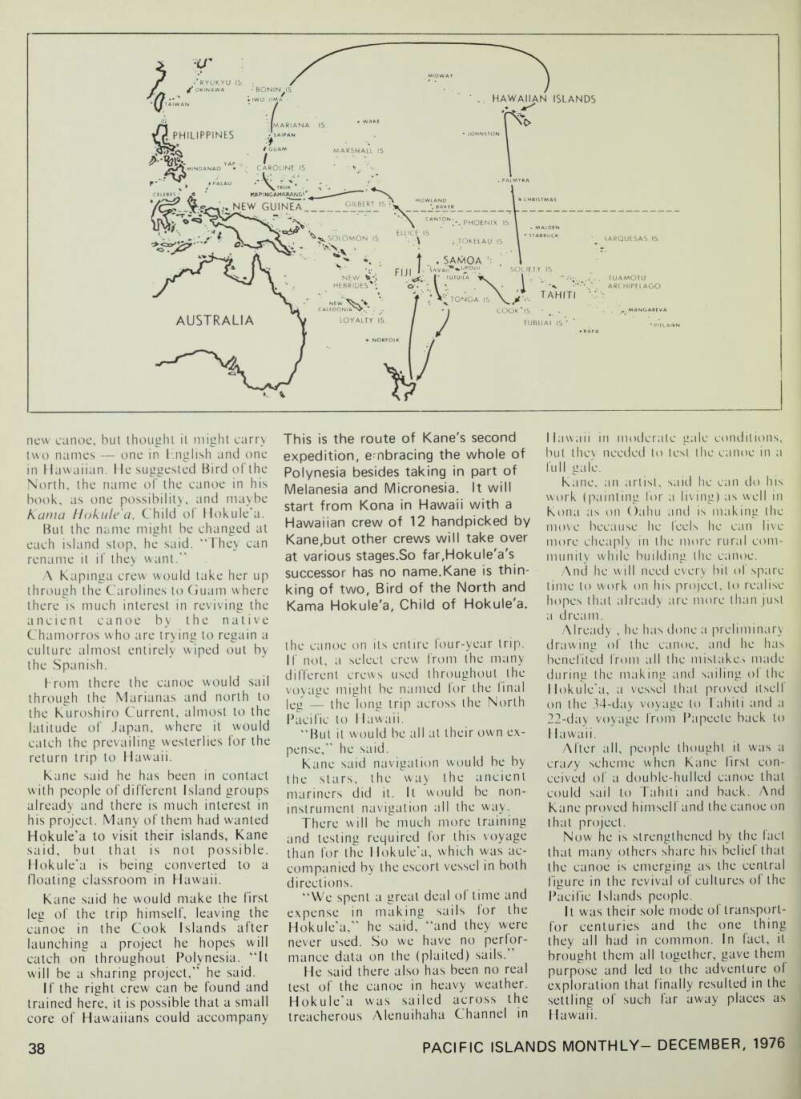
This is the route of Kane's second expedition, embracing the whole of Polynesia besides taking in part of Melanesia and Micronesia. It will start from Kona in Hawaii with a Hawaiian crew of 12 handpicked by Kane,but other crews will take over at various stages.So far, Hokule'a's successor has no name. Kane is thin king of two, Bird of the North and Kama Hokule'a, Child of Hokule'a.