g-assse
pp. 33-35 · Read in the full issue
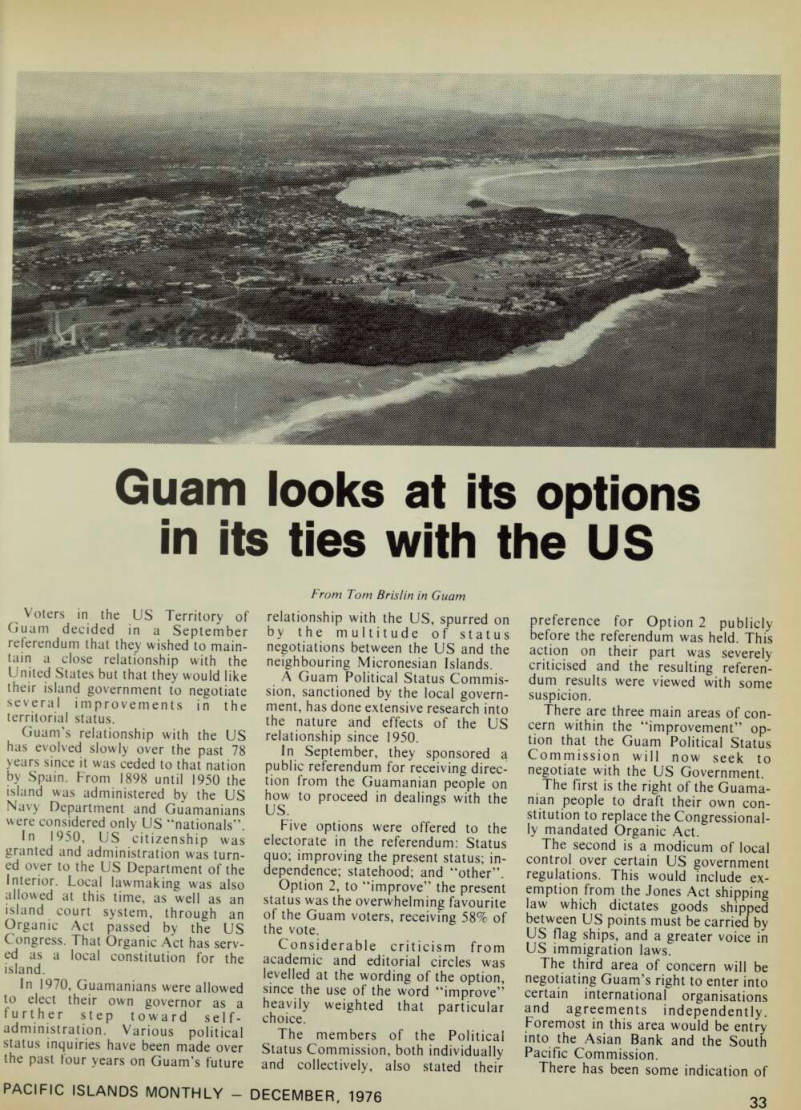
Guam looks at its options in its ties with the US
From Tom Brislin in Guam
A US T rntor y L of Ouam decided in a September referendum that they wished to mamnlvf hc£ °. SC rela [ ,ons h'P with the United States but that they would hke their island government to negotiate territorial [TlT*™™'* ,n the lerntonal status.
Guam s relationship with the US as evolved s l°wly over the past 78
by Spain^From 8 mfuntVl
Navy Dcp^rtmcm 8 were considered o n l y U s “ n aSs" S granted and admiis t r a 1 f| e r.n Sh,P , WaS Idoier to the ni nl ? , Interior l" 16 " ° f he
-a*' “ sw.t
C. “Z
rimini.tr.tion’ various political
the US Tf irieS haVe made over the past tour years on Guam’s future
relationship with the US, spurred on by the multitude of status negotiations between the US and the neighbouring Micronesian Islands.
A Guam Political Status Commission, sanctioned by the local govern- T*' haS done te f " sive research into the nature and effects of the US relationship since 1950.
In September, they sponsored a refer t ? ndam for receivin g <jirec-
u| "v*** the
Five options were offered to the electorate ln . the referendum: Status 3 UO; T proVlng th ,e present status; inde P endenc f statehood; and “other”.
Si'Tvs 2 t ,h .'.S n “
g-assse
‘The members of the Political Status Commission, both individually and collectively, also stated their
preference for Option 2 publicly before the referendum was held This action on their part was severely criticised and the resulting referen dum results were viewed with some suspicion There are three main areas of con cern within the “improvement” on tion that the Guam Political Status Commission will now seek to negotiate with the US Government.
drTft'teoSnT
8 ' 68510 " 3 '' The second is a modicum of local control over certain US government regulations. This would include ex
mss
Z’^SouS
Pacific Commission There some indication of
willingness on the part of the US Government to discuss status items with the Guam Government in a negotiations setting. No detailed agenda of acceptability has been dis cussed, however.
The US House of Representatives has already passed a measure allow ing the Territories of Guam and the Virgin Islands (in the Atlantic Ocean) to draft their own constitutions. It is expected that the measure will get full senate approval and be signed into law by the US President by the end of the year.
Guam’s representative to the US Congress, Antonio B. Won Pat, has cast some doubts over the probability of exemption from the Jones Act ship ping law because of the powerful lob bying efforts of US West Coast shippers and dockworkers.
The US State Department has traditionally cast a dim view over Guam entering any international agreements independently.
The course for negotiations, in short, will be difficult to steer by the Guam negotiators, Guam remains an important US military strategic base, and the US Government may wish to maintain a tight rein on its inter national relationships.
The next most popular option in the status referendum was statehood, in dicating that Guamanians are content to remain a part of the US flag. The option for independence received only a few votes.
The option in the referendum en titled “other” allowed the voters to write in a status preference not listed in the other options. There were several votes in this category to seek re-integration with the remainder of the Mariana Islands which were separated politically in 1898 when Guam went to the US and the Northern Marianas were sold to Ger many.
After World War I, the Marianas were awarded to Japan by the League of Nations. The US gained control of these islands as well as the rest of Micronesia as a Trust Territory following World War 11, Last year, the Northern Marianas split from Micronesia and are now in a transition process of becoming a Commonwealth of the United States, similar to Puerto Rico.
Guam’s status negotiations are slated to begin sometime after January, according to Frank Bias, a member of the Guam Legislature and chairman of the Guam Political Status Commission.