Christ is Melanesian
p. 43 · Read in the full issue
From MA RGA RET FIELD, of St Albans Parish
St Albans Abbey, one of the oldest and most impressive centres of worship in England, has recently given new interest to visitors from all over the world who have come to admire its ancient glories.
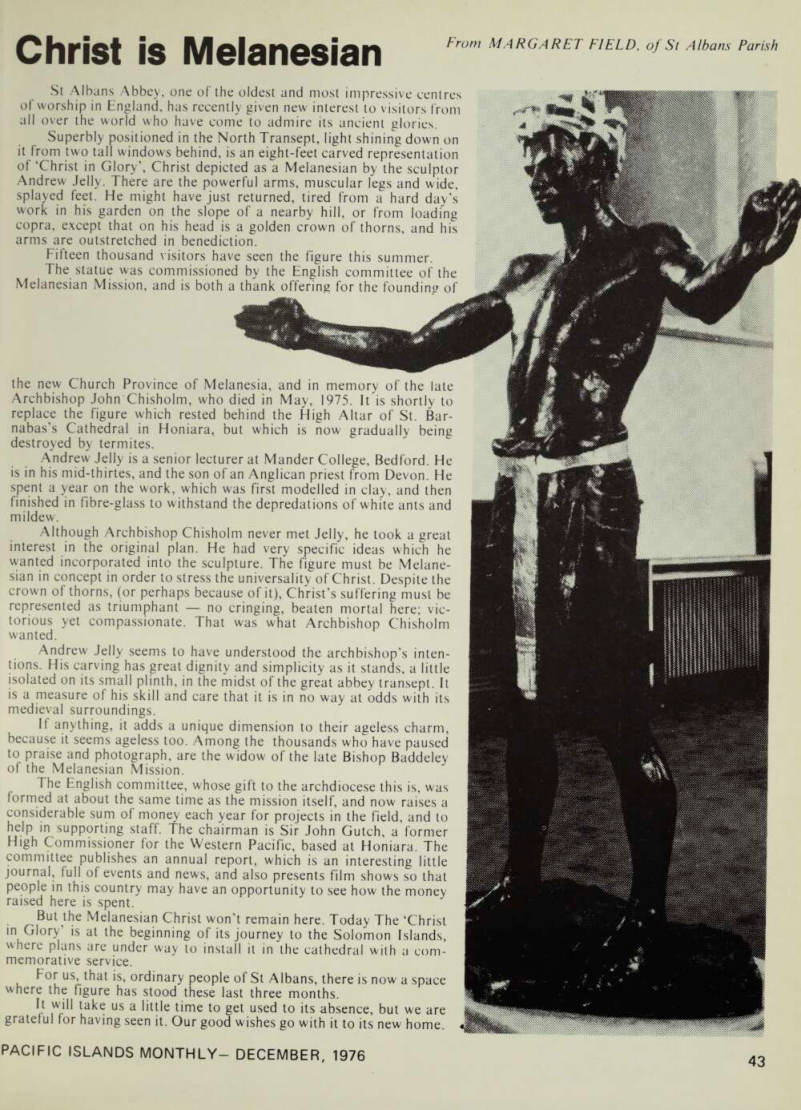
Superbly positioned in the North Transept, light shining down on it from two tall windows behind, is an eight-feet carved representation of ‘Christ in Glory’, Christ depicted as a Melanesian by the sculptor Andrew Jelly. There are the powerful arms, muscular legs and wide, splayed feet. He might have just returned, tired from a hard day's work in his garden on the slope of a nearby hill, or from loading copra, except that on his head is a golden crown of thorns, and his arms are outstretched in benediction.
Fifteen thousand visitors have seen the figure this summer.
The statue was commissioned by the English committee of the Melanesian Mission, and is both a thank offering for the founding of the new Church Province of Melanesia, and in memory of the late Archbishop John'Chisholm, who died in May, 1975. It is shortly to replace the figure which rested behind the High Altar of St. Bar nabas’s Cathedral in Honiara, but which is now gradually being destroyed by termites.
Andrew Jelly is a senior lecturer at Mander College, Bedford. He is in his mid-thirtes, and the son of an Anglican priest from Devon. He spent a year on the work, which was first modelled in clay, and then finished in fibre-glass to withstand the depredations of white ants and mildew.
Although Archbishop Chisholm never met Jelly, he took a great interest in the original plan. He had very specific ideas which he wanted incorporated into the sculpture. The figure must be Melane sian in concept in order to stress the universality of Christ. Despite the crown of thorns, (or perhaps because of it), Christ’s suffering must be represented as triumphant no cringing, beaten mortal here; vic torious yet compassionate. That was what Archbishop Chisholm wanted.
Andrew Jelly seems to have understood the archbishop’s inten tions. His carving has great dignity and simplicity as it stands, a little isolated on its small plinth, in the midst of the great abbey transept. It is a measure of his skill and care that it is in no way at odds with its medieval surroundings.
If anything, it adds a unique dimension to their ageless charm, because it seems ageless too. Among the thousands who have paused to praise and photograph, are the widow of the late Bishop Baddeley of the Melanesian Mission.
The English committee, whose gift to the archdiocese this is, was formed at about the same time as the mission itself, and now raises a considerable sum of money each year for projects in the field, and to help in supporting staff. The chairman is Sir John Gutch, a former High Commissioner for the Western Pacific, based at Honiara. The committee publishes an annual report, which is an interesting little journal, full of events and news, and also presents film shows so that people in this country may have an opportunity to see how the money raised here is spent.
But the Melanesian Christ won’t remain here. Today The ‘Christ in Glory’ is at the beginning of its journey to the Solomon Islands, where plans are under way to install it in the cathedral with a com memorative service.
For us, that is, ordinary people of St Albans, there is now a space where the figure has stood these last three months.
It will take us a little time to get used to its absence, but we are grateful for having seen it. Our good wishes go with it to its new home. <