Tropicalities
pp. 31-33 · Read in the full issue
A cooked result
in the Cooks?
“The important thing is not to win but to have taken part” so says the Olympic motto given to the world by the father of the modern Olympic Games, Baron Pierre de Coubertin.
At Montreal this year some Olym pic contestants showed they’ve forgotten it. But certain people at Rarotonga, Cook Islands, have ap parently never even heard of it.
The annual Cook Islands Constitu tion Dance Festival held in August wound up in an unholy row after the judges, without public announcement, changed the rules under which the festival had previously been held.
Under the old rules, devised around 1970 by a visiting Australian husband and wife team of dance specialists, Beth Dean and Vic Carell, 100 points were allotted for each of the four sec tions; drum dance, action song, legend and ute (improvised song contest).
But this year the number of points allotted for the ute section was un ceremoniously upped to 600.
Main practical consequence of this change was that instead of emerging as outright winners, the widely acclaimed team from Manihiki Island finished up drawing as equal winners and sharing the coveted Air New Zealand trophy with the team from Mauke Island.
Now Mauke Island is the con stituency represented for the past 10 years in the Cook Islands. Assembly by Tupui Ariki Henry, Minister for Internal Affairs, who was also chair man of the committee in charge of the constitution celebrations.
Reacting to the public outcry which followed announcement of the result, Tupui Henry admitted that he had in deed asked the judges to change the figures. He had magnanimously re quested them to make it a draw because their original 'figures " had given his electorate of Mauke victory by four points over Manihiki. (His statement didn t stop local sceptics
from saying that if he hadn’t taken this step the whole thing would have created an even greater stink than in the event it did.) Tupui Henry made no mention at all of the original change in the rules without which Mauke wouldn’t have come within cooee of winning anyway.
Just to underline this point, a reader of the local daily. Cook Islands News, took the trouble to work out what the results would have been if the original system of points allot ment had been followed. The figures, as published in a letter to the editor, showed Manihiki a clear winner with 360 points, Tupapa-Maraerenga Youth Club second with 351, and Mauke a very poor third with 240. It will probably surprise nobody who has stayed with us up to this point to learn that the ute section, whose im portance had been multiplied sixfold by the change in the rules, was the only one of the four in which Mauke got more points than Manihiki 85.6 to 81.7, counting under the original system. ‘Nuff said? Not quite. To express the mood of the Rarotonga man in the street about the whole affair, we will leave the last word to the Cook Islands Daily News, which reported on August 12: “Donors today made a gift of money totalling $lOO to the Manihiki Dance Team in recognition of their excellent performances during this year’s Dance Festival Competi tion. The donors, who wished to re main anonymous, also stated that the donation reflected their opinion as to who should have won ...”
Solomons’ Kakamora
Reporter dies
A combination of too few jour nalists and too many printers’ bills has killed the independent Solomon Islands monthly the Kakamora least Tar the Time-be ing.
The paper’s editor, Mr Henry Raraka, an industrial relations officer
with Brewer Solomon Associates, has said he is too busy with his job to put the necessary time into the paper. He had been producing it with a group of people on a part-time basis.
He didn’t know whether the paper could be revived at some time in the future.
Some people were critical of the Kakamora Reporter, saying that it presented only one man’s view.
But, as the only independent newspaper voice in the Solomons, it certainly filled a need. There is con siderable dissatisfaction with the News Drum, now the only newspaper in the Solomons.
Many people have told Mr Raraka they are sorry the Kakamora Reporter has stopped publication.
Mr Raraka agreed that this period of political transition in the Solomons cries out for an independent newspaper, but repeated that the work-load and the debts were just too great for his paper to keep going.
How pretty
mermaids are made?
Has plankton a future as a beauty aid?
What makes us think it might have is the recent appearance in Papeete, Apia, Suva and Sydney of Julia Papasov, a ravishing Bulgarian honey-blonde who practically lived on the stuff during a 96-day crossing of the Pacific in a lifeboat with her hus band Doncho.
What is certain, if you can manage to get it down it’s “stinking and horrible to eat’’, according to the Papasovs is that plankton is a great slimming diet; Julia lost 7 kg on the voyage, and her husband twice as much.
But, although food scientists have a power of work to do before we’ll be sitting down with relish to plankton based -breakfasts, this aggregation of minute organic substances which abounds in the oceans of the world can sustain human life and that is
what the Papasovs were out to prove.
Their expedition, sponsored by the Bulgarian Government and UNESCO, also had other aims.
These included the study of psy chological and physiological reaction in conditions resembling those of the shipwrecked, the development of ideas for possible improvements in lifeboat design, and research into oceanic pollution.
As to their reactions, the Papasovs say they did not reach the limits of their capacity for endurance. This was despite a damaged rudder (a sea lion charged it off the South American coast), a mast smashed in a storm, and injuries suffered by Julia when the boom of their sail hit her on the head and KO’d her.
On lifeboat design, they say the conventional floating anchor fitted to modern lifeboats is no good.
On oceanic pollution, they say the Pacific is much less polluted than the Atlantic. (They should know, because they crossed the Atlantic in 1974 in similar conditions to their latest voyage.) But they warn that this desirable situation will not last forever if countries bordering the Pacific fail to act to combat what pollution there is.
During their stay in Sydney, the Papasovs asked PIM to pass on their warm thanks to all the good friends who helped them and looked after them during their landfalls at Papeete, Apia and Suva. They say they are looking forward to meeting them all again on their next voyage.
In 1978 they plan to sail clean round the world. But this time they’ll be taking their daughter Yana with them as “crew”. They reckon she’ll be old enough by then. She’ll be five.
Anyone know
this old badge?
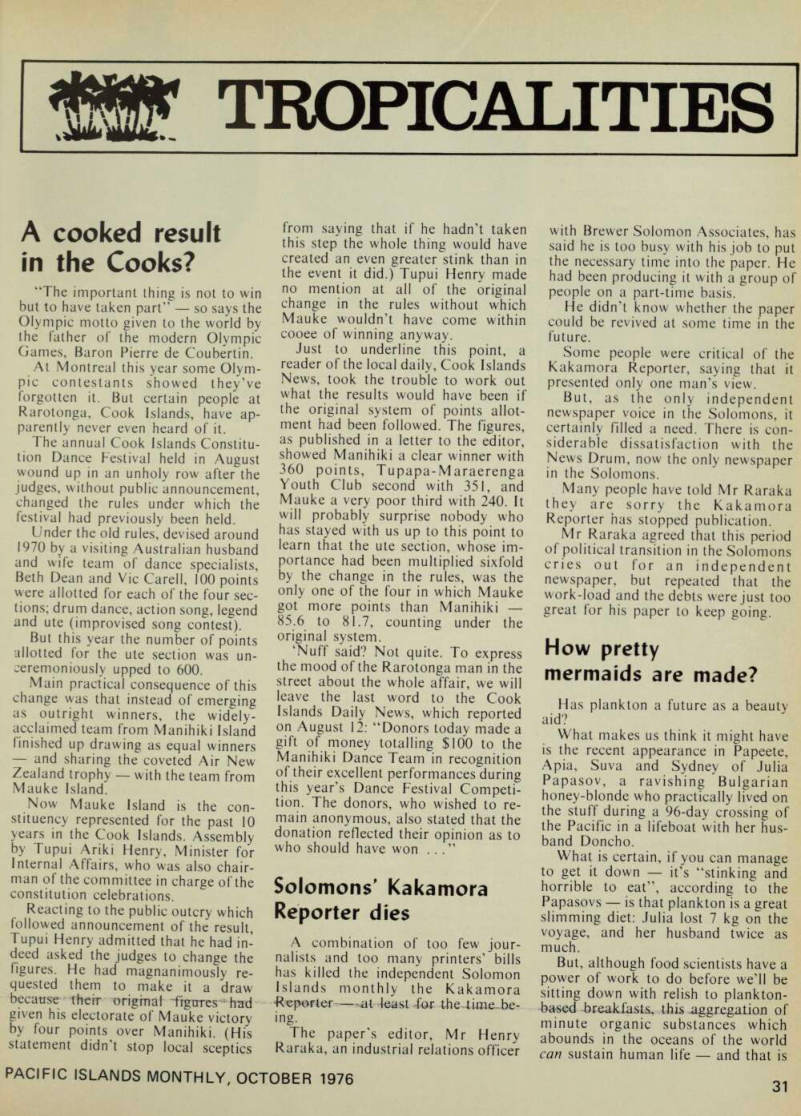
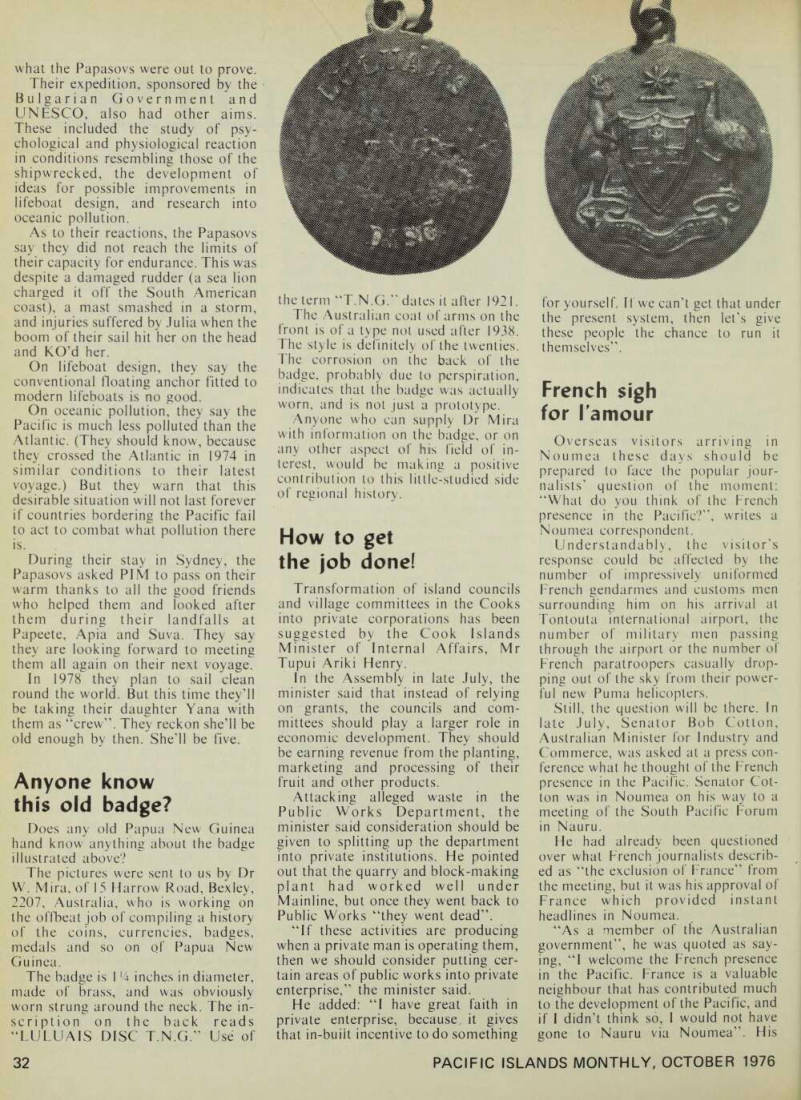
Does any old Papua New Guinea hand know anything about the badge illustrated above?
The pictures were sent to us by Dr W. Mira, of 15 Harrow Road, Bexley, 2207, Australia, who is working on the offbeat job of compiling a history of the coins, currencies, badges, medals and so on of Papua New Guinea.
The badge is I 'A inches in diameter, made of brass, and was obviously worn strung around the neck. The in scription on the back reads
“Luluais Disc T.N.G.” Use Of
the term “T.N.G.” dates it after 1921.
The Australian coat of arms on the front is of a type not used after 1938.
The style is definitely of the twenties.
The corrosion on the back of the badge, probably due to perspiration, indicates that the badge was actually worn, and is not just a prototype.
Anyone who can supply Dr Mira with information on the badge, or on any other aspect of his field of in terest, would be making a positive contribution to this little-studied side of regional history.
How to get
the job done!
Transformation of island councils and village committees in the Cooks into private corporations has been suggested by the Cook Islands Minister of Internal Affairs, Mr Tupui Ariki Henry.
In the Assembly in late July, the minister said that instead of relying on grants, the councils and com mittees should play a larger role in economic development. They should be earning revenue from the planting, marketing and processing of their fruit and other products.
Attacking alleged waste in the Public Works Department, the minister said consideration should be given to splitting up the department into private institutions. He pointed out that the quarry and block-making plant had worked well under Mainline, but once they went back to Public Works “they went dead”.
“If these activities are producing when a private man is operating them, then we should consider putting cer tain areas of public works into private enterprise,” the minister said.
He added: “1 have great faith in private enterprise, because, it gives that in-buiit incentive to do something
for yourself. If we can’t gel that under the present system, then let’s give these people the chance to run it themselves”.
French sigh
for I’amour
Overseas visitors arriving in Noumea these days should be prepared to face the popular jour nalists' question of the moment: “What do you think of the French presence in the Pacific?”, writes a Noumea correspondent.
Understandably, the visitor’s response could be affected by the number of impressively uniformed French gendarmes and customs men surrounding him on his arrival at Tontouta international airport, the number of military men passing through the airport or the number of French paratroopers casually drop ping out of the sky from their power ful new Puma helicopters.
Still, the question will be there. In late July, Senator Bob Cotton, Australian Minister for Industry and Commerce, was asked at a press con ference what he thought of the French presence in the Pacific. Senator Cot ton was in Noumea on his way to a meeting of the South Pacific Forum in Nauru.
He had already been questioned over what French journalists describ ed as “the exclusion of France” from the meeting, but it was his approval of France which provided instant headlines in Noumea.
“As a member of the Australian government”, he was quoted as say ing, “I welcome the French presence in the Pacific. France is a valuable neighbour that has contributed much to the development of the Pacific, and if I didn’t think so, I would not have gone to Nauru via Noumea”. His
remarks were published by the French news service in the New Hebrides.
Shortly afterwards, two members of the French embassy in Tokyo visited New Caledonia. They included Mr A. Laget, who had visited Singapore, Sydney and New Zealand as part of a study of land, sea and air transport systems in the area. Asked whether he had felt any uneasiness in troducing himself as a Frenchman in English-speaking countries, the French official was quoted in the Noumea press as saying; “Not at all.
I did not feel any objections to a French presence in the Pacific.”
An editorial in a Noumea daily has described the, reportedly, changed at titude in Canberra as an “Australian about-face”. The paper claimed Australia was following the new at titude from Washington, since the USA now took a new view of the French nuclear force “which could always serve as a valuable support”.
The editorial pointed out that France has not yet entered the South Pacific Forum but that “efforts are being made in this direction”.
Bouquet for
Nauruan stamps
The special Nauruan stamp issue for the recent South Pacific Forum meeting hosted by the republic’s government has been warmly praised by its British printers.
Mr Bill Peeling, managing director of Format International Security Printers Ltd of London, said; “I have absolutely no hesitation in saying that the new Nauruan stamps in honour of the South Pacific Forum are the most attractive we have printed for a long time.”
Designs of the four stamps in the issue are based on Nauruan flowers, a globe showing the Forum’s area of operations, and some of the Nauruan services to the countries within the Forum.
Denominations and descriptions are; 10c Pandanus mei, Nauru Pacific Line M.V. Enna G. and map of shipping lines (NPL in blue, others in red). 20c Tournefortia argentea, Air Nauru 8737 and F2B aircraft and map of airlines (AN in blue, others in red). 30c Thespesia populnea, satellite earth station on Nauru. 40c Cordia subcordata, produce of the South Pacific Bureau of Economic Co-operation.
So, it’s not
tea drinking!
Papua New Guinea’s public ser vants copped a few brickbats in August as both the Minister for Finance, Mr Julius Chan, and one of their own unions attacked the way many of them go about their work.
“Are you really serving your coun try, or are you just interested in pick ing up your pay cheques?” Mr Chan asked a group of public servants assembled for a Port Moresby con ference.
Speaking in Lae, Mr Bernie Oberleuter, president of the Provin cial Public Service Association, was on the same tack but a lot more specific when he said of some local public servants; “They decide to take payday off, and spend the day getting drunk.”
Mr Chan told the Moresby meeting; “The bulk of public expen diture in the budget goes on salaries for public servants, and these are paid for by taxation imposed on the peo ple, by the generosity of other coun tries, and by loans which have to be repaid in the future.
“This means that from the very outset the public service is a financial burden on the community and if it is to justify itself it must give back to the community benefits which are at least as great as the burdens it imposes . . .
Are you earning your keep?”
Main theme of Mr Chan’s address was that public servants must work to involve the people in rural develop ment projects. “Such involvement of
the people will contribute more to the success of a project than all other fac tors put together,” he said.
He concluded: “When we talk about management in the abstract, it often sounds very vague and also very complicated. But in practice, manage ment is very straightforward. It simp ly means knowing what you are trying to do and knowing how to do it. To be successful, a manager has to know the people he is dealing with and the en vironment he is operating in. He needs to be able to think clearly, to work hard, and to use initiative, judg ment and common sense . .
Mr Oberleuter, for his part, is do ing his bit to that end: he’s setting up a union inquiry into that little matter of his members who allegedly spend their paydays on the booze.
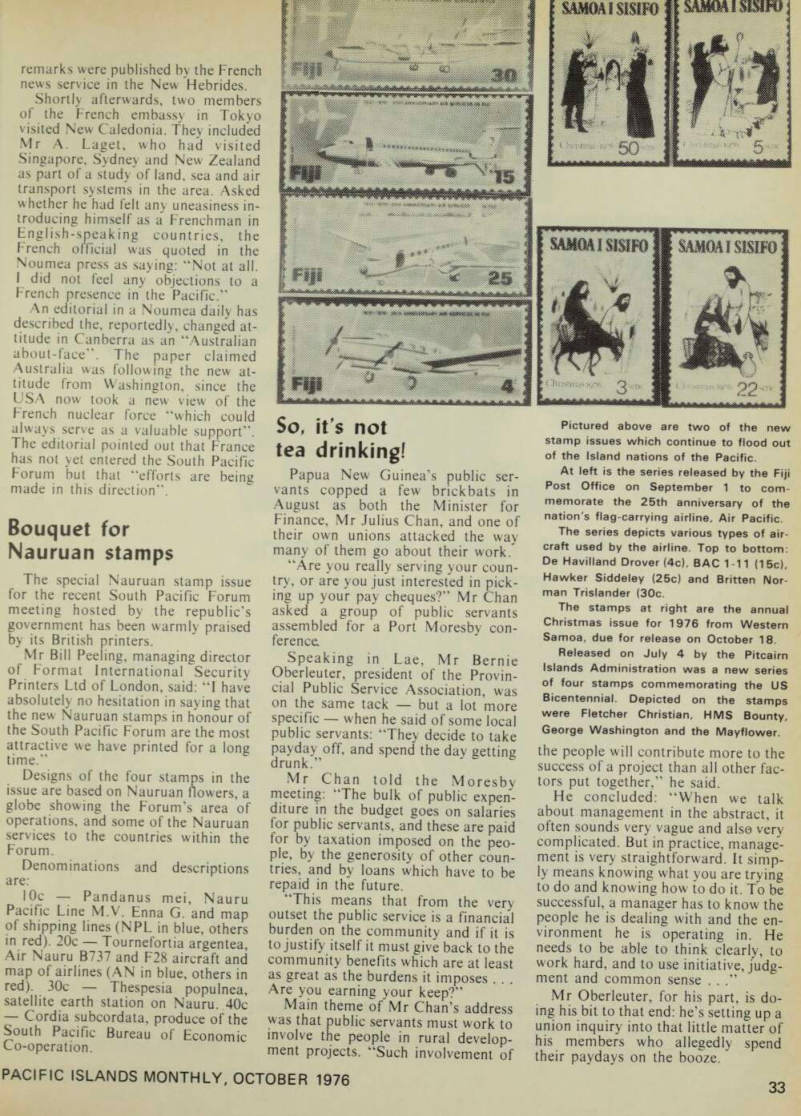
Pictured above are two of the new stamp issues which continue to flood out of the Island nations of the Pacific.
At left is the series released by the Fiji Post Office on September 1 to com memorate the 25th anniversary of the nation's flag-carrying airline. Air Pacific.
The series depicts various types of air craft used by the airline. Top to bottom: De Havilland Drover (4c), BAG 1-11 (15c), Hawker Siddeley (25c) and Britten Nor man Trislander (30c.
The stamps at right are the annual Christmas issue for 1976 from Western Samoa, due for release on October 18.
Released on July 4 by the Pitcairn Islands Administration was a new series of four stamps commemorating the US Bicentennial. Depicted on the stamps were Fletcher Christian, HMS Bounty, George Washington and the Mayflower,