Search For A National
pp. 35-37 · Read in the full issue
Language For Png
From PERCY CHATTERTON in Port Moreshx
The question of a national language for Papua New Guinea is periodically taken out and dusted, and then put back into the “too hard” tray. Mostly, when it is taken out for dusting, the initiative comes from enthusiastic academics in Canberra, Honolulu or wherever, for whom New Guinea Pidgin seems to have an irresistible attraction.
But at the present moment, a bit of high pressure salesmanship for Pidgin is going on at Papua New Guinea’s own university.
The paragraph headed “Pisin em i winim ol” which leads off Tropicalities in the July PIM shows very clearly what is going on, though the writer of the par is apparently unaware that in Pidgin “ol” does not mean “all”.
PI M’s paragraph quoted Professor Tom Dutton, Professor of Language at the PNG University, as saying Pidgin should be PNG’s natural language.
Should non-nationals butt in on this controversy, or should it be left to the nationals?
It seems to me reasonable, and indeed helpful, when non-nationals contribute fac tual background information on linguistic aspects of the problem or on the way in which new nations in other parts of the world have attempted to solve it. But when it comes to taking sides, I think that that should be left to the nationals.
The trouble with the academic linguists’ approach to the problem is that they assume that it is, or should be treated as, a purely linguistic one. In fact it isn’t, and can’t be. It has political and emotional overtones rooted in PNG’s traditional and colonial history which just can’t be ig nored.
Prime Minister Somare is realistic enough to recognise this, and recently re stated, in effect, the three language policy established by the colonial administration in the 19605. This declared English, Pidgin and Hiri Motu to be the country’s “of ficial” languages, and arranged for simultaneous translation of House of Assembly debates and translation of basic documents into these three languages.
Since Pidgin is historically the lingua franca of New Guinea and Hiri Motu that of the smaller and less-populated Papua, it is not surprising that Pidgin soon became the major medium of parliamentary debate, and Papuan politicians were fore-
ed, by the hard realities of parliamentary life, to make use of it.
But outside parliament, the three languages have quietly found and settled down at their own levels and in their own areas of usefulness and usage.
Of the three, Hiri Motu has clearly no chance of becoming the national language of a united Papua New Guinea; and even if Miss Abaijah’s dream of an independent Papuan nation came ture, it is quite pos sible that Papuans would opt for English rather than Motu as their national language. While Hiri Motu will continue to be used as a regional language, at least in Central and Eastern Papua, the choice for a national language for the whole of Papua New Guinea will lie between English and Pidgin.
Non-Papuans, brown and white, often misunderstand the attitude of Papuans to Pidgin, mistaking tolerance for accep tance. In Port Moresby many Papuans, and more than a few New Guineans, have some knowledge of all three official languages, and use whichever one is the most appropriate for the situation in which they find themselves.
Papuans have no hang-ups about using Pidgin when talking to New Guineans, but normally speak either English or Motu when talking among themselves. But a very large number of Papuans, including many who do not support the extremist stance of Miss Abaijah, would object strenuously to Professor Dutton’s proposal (if indeed he has been correctly reported)
that on one day each week they should be obliged to speak only Pidgin.
Does Professor Dutton envisage that those who refused to do so would be thrown into prison or fined? How Josephine Abaijah would love that; it would be worth thousands of voles to Papua Besena candidates in the next general election. I'm quite sure that the Prime Minister, ruefully remembering the recent Central Province by-election in which the Papua Besena candidate romped home to win and the Pangu candidate ran fourth, would not want that to happen.
Voluntary Pidgin? Fair enough. But compulsory Pidgin would promote not uni ty but disunity and possibly violence.
And what about those who don't know
Pidgin?
Enthusiasts for Pidgin lend to ex aggerate its universality. The Bureau of Statistics does not support them. In 1971, an overall 45 per cent of the total popula tion of Papua New Guinea over the age of 10 claimed to be able to speak Pidgin. But the variation on each side of this mean was enormous, ranging from 93 per cent in New Ireland to 8 per cent in the Milne Bay Province.
The statisticians would probably be the first to warn us not to regard these figures as 100 accurate, and they are five years old anyway. But they are the best available and a better guide to the true situation than figures pulled out of the air by pro- Pidgin propagandists.
In a country which likes to order its af fairs by consensus, the choice of a national language by the will of the majority im posed on an unwilling minority would not only be un-Melanesian, but extremely un wise, probably dangerous, and possibly disastrous.
Nor do we even know for certain that Pidgin would be adequate to fulfil all the demands made on a national language.
For some it would be admirable.
After 52 years in Papua I naturally tend to be a bit anti-Pidgin, but I don’t mind confessing that I often read short stories, plays and poems written in Pidgin with great delight. In creative writing I believe that it has a great future. But whether it is an adequate vehicle for conducting the business of a modern nation in the fields of
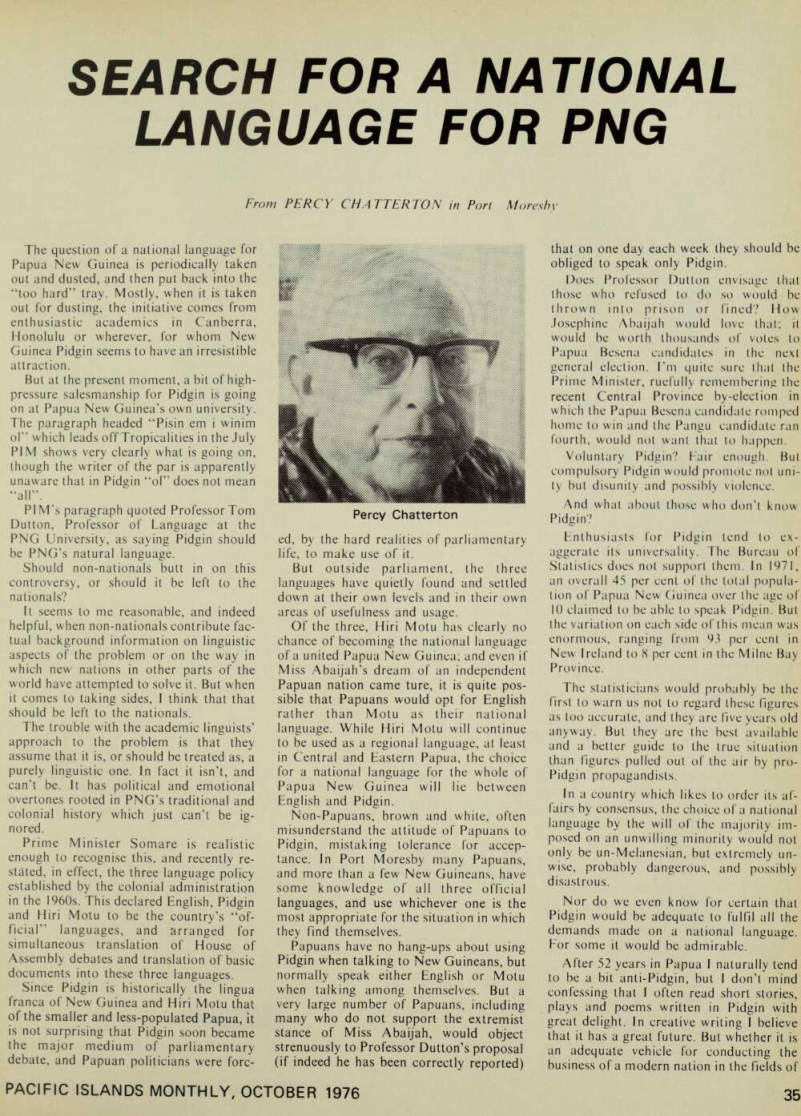
Percy Chatterton
government, administration and com merce is another matter.
Speaking out of my eight years ex perience in the House of Assembly I would say that Pidgin as it is at present is certain ly not adequate.
“Ah”, say the academic linguists, “but it could be made adequate by a controlled and guided infusion of neologism”. They, presumably, would do the guiding.
Well, they may be right. But if they are, let them get on with the job and give us a chance to evaluate and try out the new vocabulary they come up with. In the meantime we would be unwise to burn our boats before we are sure that our Tom Dutton life-jackets will keep us afloat.
When we turn to the question of the language of education, we find the situa tion even more bedevilled. In pre-war Papua there were no government schools and most mission schools operated in the local vernacular, with a modicum of English taught as a subject wherever possi ble. In pre-war New Guinea most schools operated in Pidgin, though I believe there were one or two government schools in the Ga/.elle Peninsula where English was taught.
In post-war Papua New Guinea, the Department of Education adopted an all- English system, which has now been in (orce for nearly 30 years. I have always regarded this system as unsound, but there can be no doubt that it has been what the customers (that is, the pupils and their parents) wanted and still want, even though the image of English as the open sesame to the while man’s affluence has become a bit tarnished.
To convince them that they have been wrong all the time would be pretty dif ficult, and they are unlikely to be won over by the argument (in hard fact a very dubious argument) that education in Pidgin would be cheaper.
Ideally, the initial school language should be the language of the home. In many rural areas this would be quite prac ticable, but it would no longer be so in ur ban situations.
In Port Moresby there are many homes where the home language is that of the village from which both parents come.
Where the parents come from different parts of Papua, the language of the home is likely to be Hiri Motu. Where they come from different parts of New Guinea, or where one parent is a New Gui nean and the other a Papuan, the language of the home will probably be Pidgin.
But it must not be overlooked that in a steadily-increasing number of homes, in which both parents have received a secon dary or tertiary education, the language of the home is English. This is almost in variably the case when the parents come from different language areas, but it is also true in some cases in which the parents
have a common vernacular. I know a number of Papuan parents who have a common vernacular but who speak to each other in English in the home, “for the sake of the children” as they put it.
The plan breaks down when granny comes to stay, but is resumed when she goes home. It seems unlikely that such parents would take kindly to sending their children to a school operating in Pidgin.
They could be right too. Even making the utmost allowance for the im provements which have been made in language teaching over the years, 1 believe that many teachers would regard it as educationally unsound to postpone the start in English until the educand knows whether he will need it or not.
On the other hand, Professor Dutton is undoubtedly right when he claims that those pupils who don't go beyond primary school have largely wasted their time in their laborious pursuit of English.
How to resolve this dilemma? Plato came up with one answer breed your elite! But this solution is unlikely to appeal to egalitarian Papua New Guinea.
One further point must be made.
Our former “Primary T” schools have now been renamed “Community schools”, and stress is being laid on the responsibility of the communities they serve to support them. Fair enough too. But if these schools are to receive community support, the community may not unreasonably demand a say in choosing the language in which the community children are to be educated.
I'm afraid that even in the case of the Kilakila Community School, of which Professor Dutton was once a highly respected and very able headmaster, it can not be assumed that the community it serves would be prepared unhesitatingly to accept his advice in making their choice, especially if his advice was to choose Pidgin.