People
pp. 29-30 · Read in the full issue
Rear-Admiral G. de Castelbajac, Commander-in-Chief of French Armed Forces in the Pacific and Commander of the CEP (nuclear test centre), visited Australia for a week in late August, from Tahiti, via New Zealand. Coinciding with this visit, two destroyers from Tahiti, the Balny and E.V. Henry, berthed at Garden Island naval dockyard in Sydney.
The French Admiral had three days of talks in Canberra and met Rear- Admiral W. Gladstone, Flag Officer Com manding the Australian Fleet.
The visit by this highest-ranking of French armed forces’ chiefs in the Pacific followed on the June trip to Australia by General Andre Fournier, of Noumea. The visits highlight France’s interest in selling uranium technology and armaments to the Australian government.
Rear-Admiral Castelgajac pooh-pooed the reports of alarm caused by the Russian presence in the Pacific, remarking at a news conference in Canberra that Soviet naval activity was not worth noting. It was confined, mainly, to merchant marine and fishing operations.. So far as the Indian Ocean was concerned, he said, the French naval presence there was quite important in comparison with the Soviet naval presence.
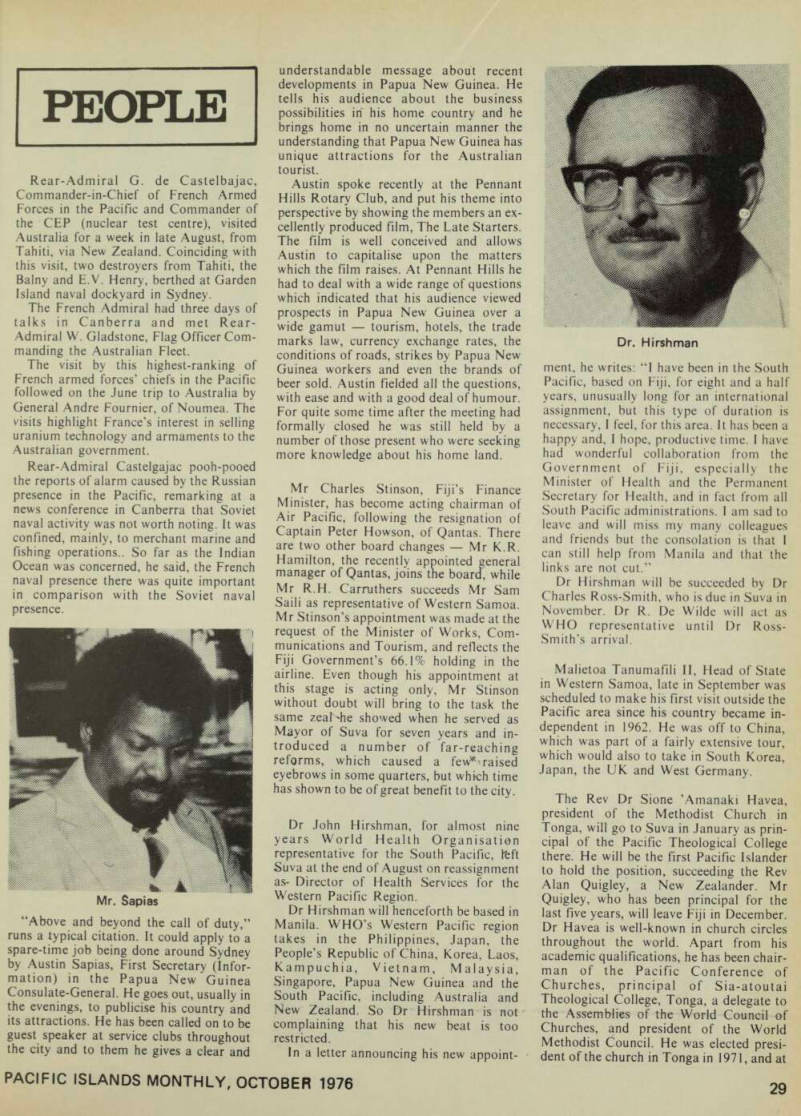
“Above and beyond the call of duty,” runs a typical citation. It could apply to a spare-time job being done around Sydney by Austin Sapias, First Secretary (Infor mation) in the Papua New Guinea Consulate-General. He goes out, usually in the evenings, to publicise his country and its attractions. He has been called on to be guest speaker at service clubs throughout the city and to them he gives a clear and
understandable message about recent developments in Papua New Guinea. He tells his audience about the business possibilities in his home country and he brings home in no uncertain manner the understanding that Papua New Guinea has unique attractions for the Australian tourist.
Austin spoke recently at the Pennant Hills Rotary Club, and put his theme into perspective by showing the members an ex cellently produced film, The Late Starters.
The film is well conceived and allows Austin to capitalise upon the matters which the film raises. At Pennant Hills he had to deal with a wide range of questions which indicated that his audience viewed prospects in Papua New Guinea over a wide gamut tourism, hotels, the trade marks law, currency exchange rates, the conditions of roads, strikes by Papua New Guinea workers and even the brands of beer sold. Austin fielded all the questions, with ease and with a good deal of humour.
For quite some time after the meeting had formally closed he was still held by a number of those present who were seeking more knowledge about his home land.
Mr Charles Stinson, Fiji’s Finance Minister, has become acting chairman of Air Pacific, following the resignation of Captain Peter Howson, of Qantas. There are two other board changes Mr K.R.
Hamilton, the recently appointed general manager of Qantas, joins the board, while Mr R.H. Carruthers succeeds Mr Sam Saili as representative of Western Samoa.
Mr Stinson’s appointment was made at the request of the Minister of Works, Com munications and Tourism, and reflects the Fiji Government’s 66.1% holding in the airline. Even though his appointment at this stage is acting only, Mr Stinson without doubt will bring to the task the same zeaNhe showed when he served as Mayor of Suva for seven years and in troduced a number of far-reaching reforms, which caused a eyebrows in some quarters, but which time has shown to be of great benefit to the city.
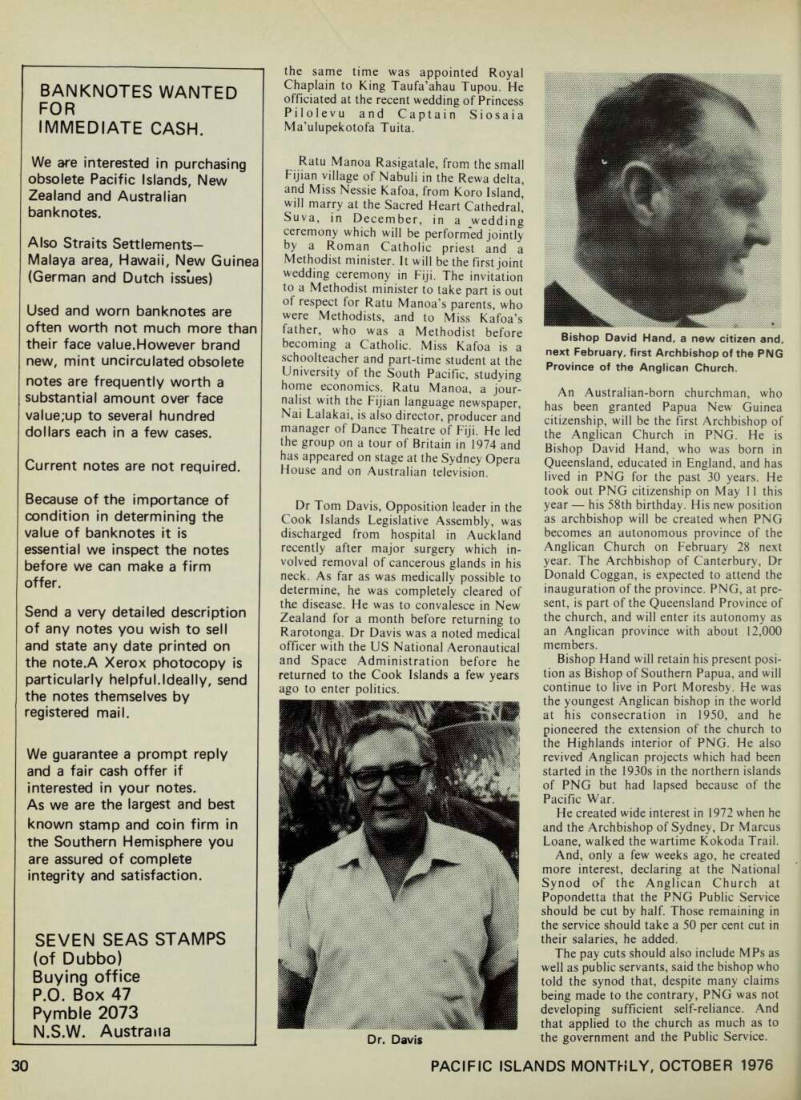
Dr John Hirshman, for almost nine years World Health Organisation representative for the South Pacific, teft Suva at the end of August on reassignment as- Director of Health Services for the Western Pacific Region.
Dr Hirshman will henceforth be based in Manila. WHO’s Western Pacific region takes in the Philippines, Japan, the People’s Republic of China, Korea, Laos, Kampuchia, Vietnam, Malaysia, Singapore, Papua New Guinea and the South Pacific, including Australia and New Zealand. So Dr Hirshman is not complaining that his new beat is too restricted.
In a letter announcing his new appoint-
merit, he writes: “I have been in the South Pacific, based on Fiji, for eight and a half years, unusually long for an international assignment, but this type of duration is necessary, I feel, for this area. It has been a happy and, I hope, productive time. I have had wonderful collaboration from the Government of Fiji, especially the Minister of Health and the Permanent Secretary for Health, and in fact from all South Pacific administrations. I am sad to leave and will miss my many colleagues and friends but the consolation is that I can still help from Manila and that the links are not cut.”
Dr Hirshman will be succeeded by Dr Charles Ross-Smith, who is due in Suva in November. Dr R. De Wilde will act as WHO representative until Dr Ross- Smith’s arrival.
Malietoa Tanumafili 11, Head of State in Western Samoa, late in September was scheduled to make his first visit outside the Pacific area since his country became in dependent in 1962. He was off to China, which was part of a fairly extensive tour, which would also to take in South Korea, Japan, the UK and West Germany.
The Rev Dr Sione ’Amanaki Havea, president of the Methodist Church in Tonga, will go to Suva in January as prin cipal of the Pacific Theological College there. He will be the first Pacific Islander to hold the position, succeeding the Rev Alan Quigley, a New Zealander. Mr Quigley, who has been principal for the last five years, will leave Fiji in December.
Dr Havea is well-known in church circles throughout the world. Apart from his academic qualifications, he has been chair man of the Pacific Conference of Churches, principal of Sia-atoutai
Theological College, Tonga, a delegate to
the Assemblies of the World Council of Churches, and president of the World Methodist Council. He was elected presi dent of the church in Tonga in 1971, and at
Mr. Sapias
Dr. Hirshman
the same time was appointed Royal Chaplain to King Taufa’ahau Tupou. He officiated at the recent wedding of Princess Pilolevu and Captain Siosaia
Ma’ulupekotofa Tuita.
Ratu Manoa Rasigatale, from the small Fijian village of Nabuli in the Rewa delta, and Miss Nessie Kafoa, from Koro Island,’ will marry at the Sacred Heart Cathedral, Suva, in December, in a wedding ceremony which will be performed jointly by a Roman Catholic priest and a Methodist minister. It will be the first joint wedding ceremony in Fiji. The invitation to a Methodist minister to take part is out of respect for Ratu Manoa’s parents, who were Methodists, and to Miss Kafoa’s father, who was a Methodist before becoming a Catholic. Miss Kafoa is a schoolteacher and part-time student at the University of the South Pacific, studying home economics. Ratu Manoa, a jour nalist with the Fijian language newspaper, Nai Lalakai, is also director, producer and manager of Dance Theatre of Fiji. He led the group on a tour of Britain in 1974 and has appeared on stage at the Sydney Opera House and on Australian television.
Dr Tom Davis, Opposition leader in the Cook Islands Legislative Assembly, was discharged from hospital in Auckland recently after major surgery which in volved removal of cancerous glands in his neck. As far as was medically possible to determine, he was completely cleared of the disease. He was to convalesce in New Zealand for a month before returning to Rarotonga. Dr Davis was a noted medical officer with the US National Aeronautical and Space Administration before he returned to the Cook Islands a few years ago to enter politics.
An Australian-born churchman, who has been granted Papua New Guinea citizenship, will be the first Archbishop of the Anglican Church in PNG. He is Bishop David Hand, who was born in Queensland, educated in England, and has lived in PNG for the past 30 years. He took out PNG citizenship on May 11 this year his 58th birthday. His new position as archbishop will be created when PNG becomes an autonomous province of the Anglican Church on February 28 next year. The Archbishop of Canterbury, Dr Donald Coggan, is expected to attend the inauguration of the province. PNG, at pre sent, is part of the Queensland Province of the church, and will enter its autonomy as an Anglican province with about 12,000 members.
Bishop Hand will retain his present posi tion as Bishop of Southern Papua, and will continue to live in Port Moresby. He was the youngest Anglican bishop in the world at his consecration in 1950, and he pioneered the extension of the church to the Highlands interior of PNG. He also revived Anglican projects which had been started in the 1930 s in the northern islands of PNG but had lapsed because of the Pacific War.
He created wide interest in 1972 when he and the Archbishop of Sydney, Dr Marcus Loane, walked the wartime Kokoda Trail.
And, only a few weeks ago, he created more interest, declaring at the National Synod of the Anglican Church at Popondetta that the PNG Public Service should be cut by half. Those remaining in the service should take a 50 per cent cut in their salaries, he added.
The pay cuts should also include MPs as well as public servants, said the bishop who told the synod that, despite many claims being made to the contrary, PNG was not developing sufficient self-reliance. And that applied to the church as much as to the government and the Public Service.
Or. Davis
Bishop David Hand, a new citizen and, next February, first Archbishop of the PNG Province of the Anglican Church.