A Challenging Job
p. 57 · Read in the full issue
For Fiji’S Phil Best
Fiji-born Philip Best took on one of the most challenging positions in Australia- Pacific Islands commerce as general manager of Burns Philp and Co Ltd on July 1. Although he is only 41, and has another quarter of a century before reaching retiring age, he has a wealth of business experience behind him as a top ex ecutive for several years with Burns Philp (South Sea) Co Ltd.
Mr Best came to Australia in October, 1975, as assistant to the general manager of Burns Philp, Mr Maurice O’Connor, who retired on July 9 and left Sydney the day after for a few weeks at his favourite fishing spot at Yamba, on the north coast of NSW. Mr O’Connor worked for the South Sea company for many years, both before and after World War 11.
Mr Best comes to his new position as the “old firm” is going through a process of reorganisation and consolidation initiated by his predecessor, with new subsidiary and associate companies under its wing.
But reorganisation is nothing new to him for in 1966 his predecessor as general manager of the South Sea company, Mr John Baker, selected him as one of a team to restructure that company, and Mr Baker, now a senior inspector at head quarters, was one of the group assisting Mr O’Connor in the parent company reorganisation.
Burns Philp and Co Ltd is now a vastly different company from what it was, even a few years ago. Gone is the shipping line, but Mr Best now finds himself responsible, directly or indirectly, for such enterprises as engineering, timber, motor-cars (last year the BP network sold 16,000 new vehicles), hotels (which it does not run, but leases), merchandising, travel, electrical appliances, wholesale distribution, in surance, overseas trading, buying for the Islands enterprises, and trustee and finance companies.
There will be no diminution of Burns Philp’s activities in the Pacific. There will be expansion in Australia as opportunity offers. In the Pacific Islands, localisation is the policy in accordance with official and company requirements. The attainment of 100 per cent localisation will be some years away, but it is difficult to name the year.
Burns Philp in Papua New Guinea and Fiji is training local people at all levels of commercial and industrial activity. Mr Charles Black, who controls the Pacific Islands division at headquarters, has a co ordinating role between Islands board of
directors and general managers and the Sydney board.
Asked to compare his South Sea role with his new position, Mr Best said that from a commercial point of view he knew everyone in Suva, and his contacts were as close as the end of a telephone. Sydney, too, has the telephone, but it is a question at this stage of knowing who to ring.
He says prospects for expansion in Western Samoa and Tonga are not great, but the outlook for continuity of business is good. Burns Philp (South Sea) Ltd is building a new store at Nukualofa to replace one destroyed by fire. The main ac tivities in Western Samoa and Tonga are merchandising, shipping, travel and the motor trade.
Fiji is the focal point of the South Sea company activities, and the wide range of the economy leads Mr Best to comment on an imbalance which does not make business commonsense. He says there should be more regional co-operation from an economic angle. The individual pop ulations of the various groups are too small to enable each group to “do its own
thing”.
“They are always going to be subject to outside influence and they will not be able to get money without strings attached in some way,” he said. “I believe there should be an interchange of manufacturing processes to help create a back-loading for shipping. They should keep internal management in the political arena, and use sound commonsense outside. I know this sounds idealistic, but to me economic in dependence is a lot more difficult to achieve than political.”
The current political situation in the New Hebrides does not worry him. Burns Philp had shown it can live with any coun try whatever the political climate, and he sees no reason why it should be any different in the New Hebrides. Burns Philp is happy to co-operate with Islands governments, and to show its good inten tions it does not poach top civil servants.
The firm has, of course, recruited senior civil servants, but only after they have made it very clear they were going to leave the civil service in any event. The initiative for such moves is not taken by Burns Philp. Burns Philp believes that a strong government has to have a strong civil ser vice, and in the long run there is no benefit to the country or the firm through poaching.
Mr Best’s first link with Burns Philp was casual work in the spare parts section
at Lautoka, where he was born, while on holiday from Suva Boys’ Grammar School. On leaving school he took up per manent work in the division. This was in 1952. Later, he transferred to the motor division and eventually moved to Suva. In Suva he became manager of the motor division, and was there till 1966, when he was chosen to help in the restructuring of the company.
That work included relieving as branch inspector at several centres outside Suva, and a lot of inspection work, which at times took him to the New Hebrides and other Pacific Islands. Three months at the Australian Staff College, Mt Eliza, Vic toria, preceded his appointment as general manager of the South Sea company, and a seat on the board.
After he took over as general manager in 1971, he consolidated the expansion and diversification programme started by Mr Baker. This programme took the company
into heavy engineering, ship-building,
paint manufacture, steel manufacture, etc.
It also acquired interests in several plan tations.
Like many of Fiji’s top businessmen he was called in to serve on a number of out side bodies. He was on the Fiji Public Ser vice Commission for three years. He was also a director of the government-owned Fiji Sugar Corporation, and a member of the Fiji Training Council, a comparatively new body which lays down a training programme covering numerous activities.
He also lectured on business administra tion at the University of the South Pacific and was a trustee of the Church of England.
All that left him little lime for recrea tion, but he did manage to play golf and squash and indulge in a little sailing. Since his arrival in Sydney he has joined the Killara Golf Club, about two minutes walk from where he lives in the executive circle on Sydney’s North Shore. He married Barbara, a daughter of Mr David Crowe, who recently retired as managing director of the Carpenter group in Fiji, the rival firm of Burns Philp (South Sea) Ltd.
There are two Best children, a boy 7, and a girl 5.
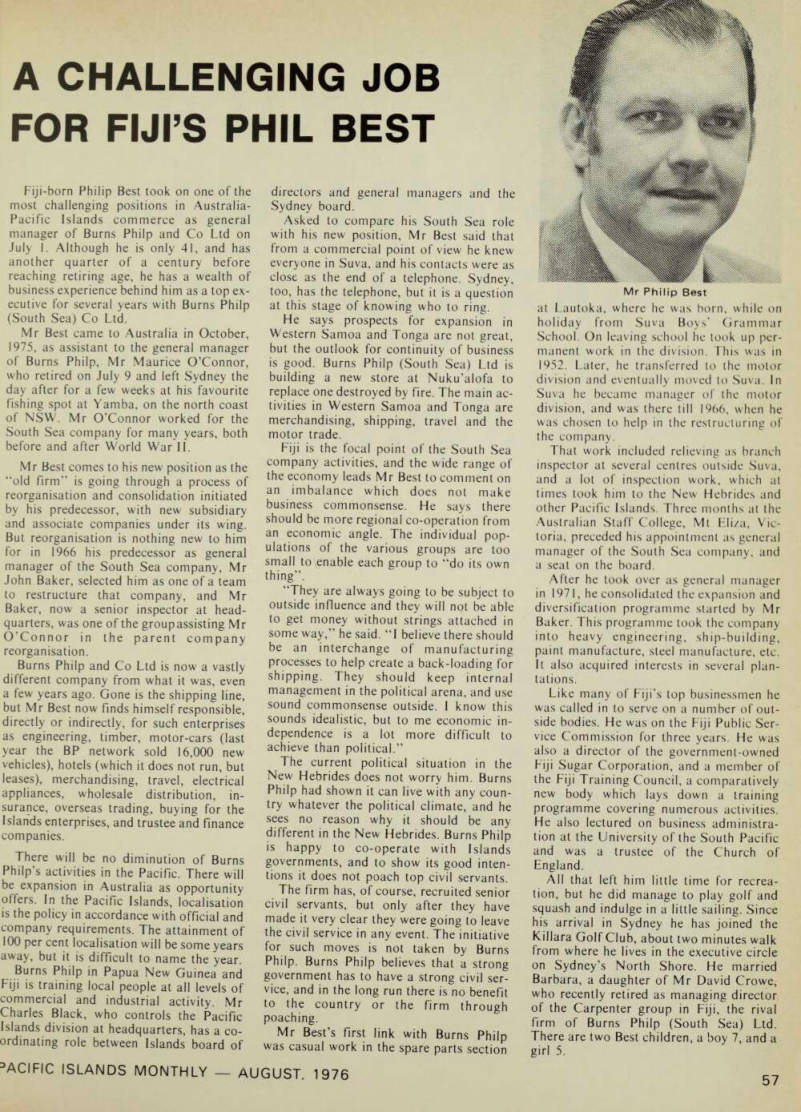
Mr Philip Best