Pacific Transport
pp. 59-64 · Read in the full issue
A New ‘Suit’ And A Soul-Search
For Air Pacific’S 25Th Birthday
From a staff writer
Air Pacific, soon, officially to celebrate its 25th anniversary, is about to indulge in a lot of soul-searching on its future role.
To mark the anniversary, which will be celebrated on September 10, all air craft will be in new livery of blue, red and orange chosen to represent the natural colours of the beauty of the South Pacific and to go with Air Pacific’s new slogan, “Islands in the sky”. The new colours sweep the entire length of the aircraft in a broad stripe, ending with a swirl in the tail.
Air Pacific has come a long way since it was founded in 1951 by Harold Gatty with Rapide and Drover aircraft, and known as Fiji Airways. There was a fairly smooth transition into regional operations, first to Tonga, with four-engined Herons, but in recent years the airline has been beset with a lot of trouble. Now the Fiji Government, which owns 61 per cent of the shareholding, has called in the Com monwealth Fund for Technical Co operation to make a study of the airline.
The government has asked CFTC to review the policy which led to the forma tion of Air Pacific, progress to date and to advise on procedures which should be followed to enhance the viability of the air line, with particular reference to its regional role and its relationship with other airlines trunk, regional and domestic serving the area.
Probably, because of a feeling of inade quacy in negotiating routes, rights and other matters, the government has also asked CFTC for a traffic rights adviser, as negotiating air service agreements was a specialised knowledge which required both experience and expert knowledge. (The Fiji Prime Minister, Ratu Sir Kamisese Mara, gave vent to his feelings at the unofficial South Pacific Forum at Rotorua in March, when he complained about the manner Fiji had to sacrifice national rights
in exchange for airline co-ordination.)
Without expert advice any party is at a irave disadvantage in negotiations. An ad viser would be required to carry out ;esearch, compile data and prepare briefs or traffic rights. He would be at the legotiating table, at the right hand of the eader of the Fiji team, ready to give ap •ropriate advice during tallcs.
Mr Ross Keenan, commercial services manager of Air Pacific, recently explained the changing role of Air Pacific. It was making a major shift in emphasis and im age from a traditional communications link into that of a sound commercial operator. Air Pacific saw itself as providing important links across the Pacific, but it was not in a position to con sider itself as a competitor for trunk operators.
Air Pacific had a unique opportunity to achieve a particular style of personal ser vice. The identification of a new Air Pacific was being heavily promoted on television in New Zealand and Australia, and within Fiji to develop the “our” airline theme. And to help create a new airline im age the uniform for the hostesses has been
changed.
Mr Keenan, who was speaking at a
meeting of the Air Pacific management staff, said that in 1975, while revenue from domestic services rose by 17 per cent ($500,000), the actual carriage of passengers was down by six per cent. There was a significant change in overall traffic flow. Domestic traffic had declined, but on regional routes, the number of passengers was 34 per cent higher than 1974. The Auckland route once accounted for 40 per cent of the regional revenue; now it was 25 per cent.
It seems as though there would be fewer air pockets for Air Pacific if Western Samoa and Tonga looked at things realistically and concluded that try ing to “do their own thing” in a limited market can lead to horrendous financial losses.
While Air Pacific’s future policy is not
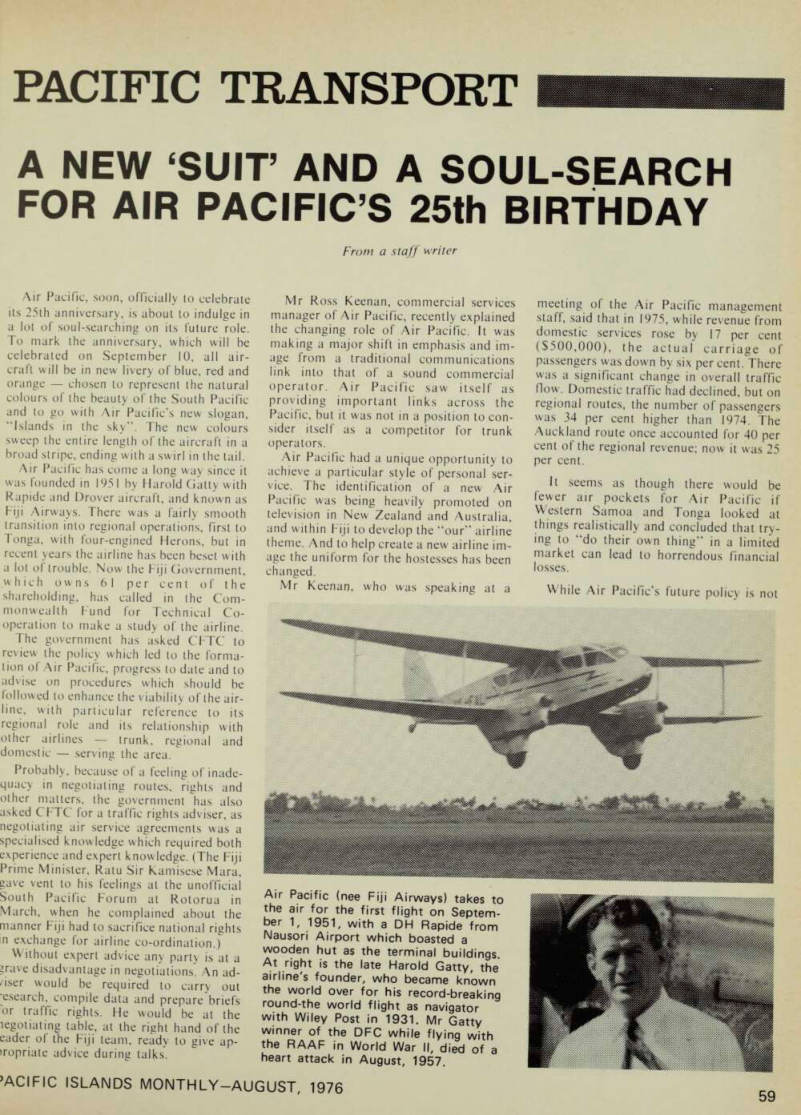
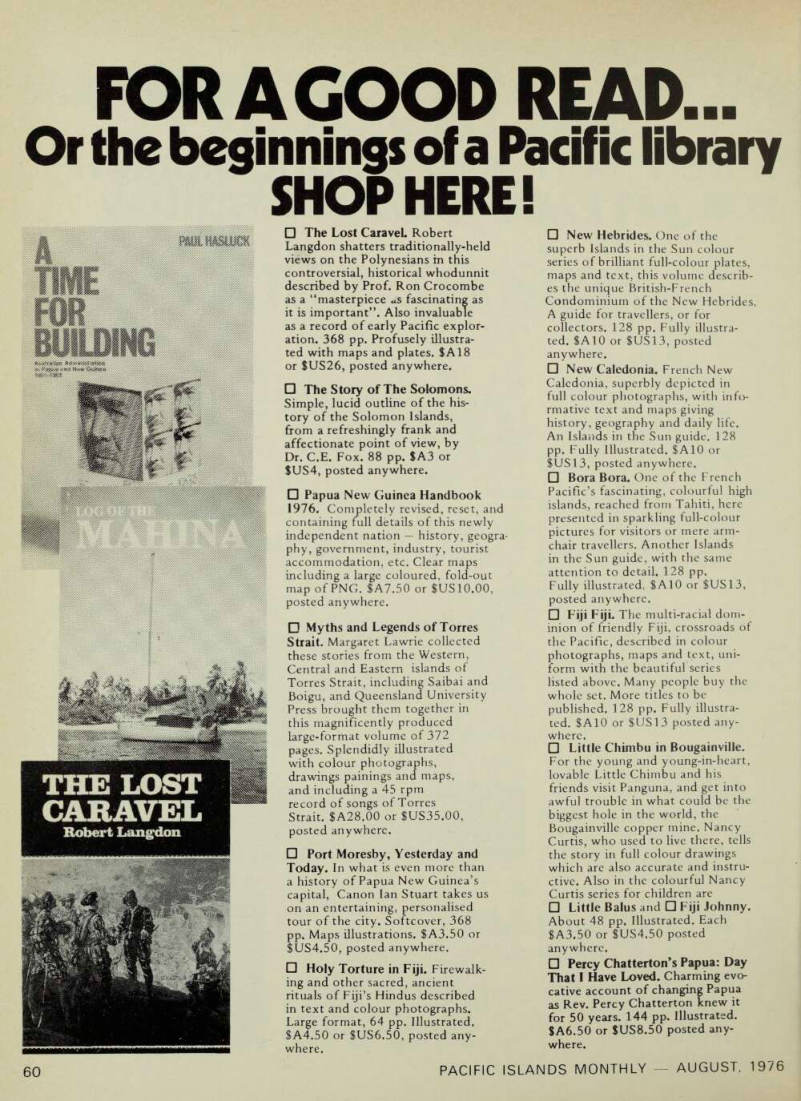
Air Pacific (nee Fiji Airways) takes to the air for the first flight on Septem ber 1, 1951, with a DH Rapide from Nauson Airport which boasted a wooden hut as the terminal buildings At right is the late Harold Gatty, the airline's founder, who became known the world over for his record-breaking round-the world flight as navigator with Wiley Post in 1931. Mr Gatty winner of the DFC while flying with the RAAF in World War II, died of a heart attack in August, 1957.
yet clear, Air Nauru continues to expand.
Recently President Hammer deßoburt signed an agreement with Sir Reginald Ansett to buy a Boeing 727-100 C from Ansett Transport Industries. That will in crease the Air Nauru’s fleet to four, made up of a Boeing 737, a Boeing 727 and two F2B Fokker Friendship jets.
Air Nauru expects to use its latest ac quisition on the Melbourne-Nauru route and the Nauru-Japan route. It will operate two services a week from Melbourne to Nauru, via Noumea. Air Nauru now has an extensive network, covering most island groups in the central and southern Pacific, as well as flying to Australia, the
Philippines, Hong Kong, Taiwan and
Japan.
It was a festive occasion on Nauru when the Boeing 727 arrived on its delivery flight. The Boeing, which has been named Chief Auweieda, was blessed by the Rev I.
Amram and the Rev Father B. Lahn.
King Taufa’ahau Tupou, of Tonga, in his Speech from the Throne, to open Parliament in June, said joint participation with New Zealand in Polynesian Airlines had been negotiated. A conference had been planned, with Tonga, NZ and Western Samoa taking part, to reorganise Polynesian Airlines. At the same time, Tonga would hold on to its share in Air Pacific.
Meanwhile, Tonga is negotiating for an
Australian-made 15-seater aircraft to meet the country’s internal aviation needs, King Taufa’ahau Tupou said. At present, only one aircraft was serving the kingdom’s needs. He expected the aircraft to arrive soon. It would be capable, apart from in ternal requirements, of flying from Vavau to Pago Pago.
Rescue Bid For
Pacific Navigation
The board of the Pacific Navigation Co Ltd, of Tonga, has been replaced for three months by A.W. Ellem and Associates, a Sydney-based firm of management con sultants. The firm will be directly responsi ble to the Prime Minister, Prince Tuipelehake for the reconstruction of Pacific Navigation.
Pacific Navigation has been in financial difficulty for some time. Some of the ships have operated profitably; others have run at continual loss. PIM, in April (p 68) reported that it was heavily in debt and try ing to borrow P 200,000 to pay creditors.
Pacific Navigation is government owned. One of the Ellem duties will be to introduce another substantial shareholder.
With reorganisation. Pacific Navigation expects to be refinanced, along with exten sive development and expansion.
Four Lines
Raise Rates
Four shipping lines servicing Papua New Guinea and the Solomon Islands from Australia hiked their freight rates by 8 per cent in June. There was an earlier rise of 8 per cent on April 1. The new rates in corporate adjustments to the Waterside Workers’ Federation award and levies since November, 1975. The bunker sur charge has been reviewed and has been reduced to 4.72 per cent.
The shipping lines involved are Karlander, Conpac, New Guinea Express Line and New Guinea Australia Line.
Farrell Lines, which also operates an Australia-PNG service, is negotiating separately with the Australian Shippers’
Council for an increase.
Captain Williams
Buys The Aoniu
The Pacific Navigation Co Ltd has sold the Aoniu, 500 tons, to Captain Hugh Williams, of Australia, for P 70,000. Cap tain Williams has renamed the passenger/cargo ship Taoniu. The Tonga Copra Board took delivery of the Aoniu in 1958. The cost was then put at £stgB7,ooo, but delivery costs from Holland and other
charges probably put the price close to £stg 100,000.
Captain Williams, his brother, and Mr Tom Hare have formed a company, South Seas Shipping Co, to operate the Taoniu and plan a monthly cargo service between Suva and Nukualofa and a passenger ser vice, if there is support. There is also a possiblity of operating charter services between Apia and the Tokelaus and reviv ing the Suva-Rotuma service which the Aoniu covered a number of years ago.
Bougainville Ships
On New Service
Atolls Shipping Pty Ltd, of Bougain ville, has taken over the operation of its two ships, the Bougainville Chief and the Maluan Solok from a firm of agents.
Atolls Shipping is a subsidiary of Bougain ville Development Corporation Ltd. The Bougainville Chief will make regular trips from Kieta to Buka, via all ports, and a monthly trip to Rabaul. The Maluan Solok will provide a monthly service to the Mortlock and Tasman Islands, and a se cond service to the Fead and Cataract groups, and will offer supplementary trips along the Bougainville coast.
Tonga’S Biggest
‘Home-Grown’ Ship
The owner of the biggest ship ever built in Tonga has ambitious plans to operate services to Hawaii, as well as Fiji, the Samoas and internally. The owner is ’Uliti Uata, a MP from Haapai. He expected to commission her on June 26, after she was towed about 20 metres overland from the building site to the water.
Mr Uata commissioned Paula Hemaloto, of Vavau, to build the craft without plans, but with a replica as a model. The ship is about 26 metres long with a beam of about six metres and measures about two and a quarter metres from deck to keel. She is about 122 tonnes.
Dakua timber from Fiji was used for the planking. The keel was made of tangato from Eua. The cargo-hold runs from the engine-room at the stern to the bow. On deck there are five cabins with bunk beds.
There are toilet facilities, showers and a
galley.
There is a rear double deck for deck passengers. On the top deck will be a special cabin with beds, shower, toilet, cooling fans and dining facilities for the
Royal family.
Mr Uata said the ship could carry 70- 100 tonnes of cargo, and more than 200 passengers, but the final decision on those capacities rested with the Harbour Master.
The cost was about PI 10,000.
Mr Uata said he expected the boat to make two trips a year to Hawaii. He hopes to make an arrangement with Pacific
Navigation Co Ltd to share routes with the Olovaha, and expects the crew to total 14 captain, two other officers, two engineers, a cook and eight others.
He decided to build the boat to help cur tail rising freight charges which were seriously affecting his wholesale and retail shops. Also, he felt that as a People’s Representative in Parliament, the craft could be used to help the people of the out er islands.
Talair Flies
Into The Red
Talair, the biggest third-level airline in Papua New Guinea, faces a loss of K.350,- 000 in the current financial year.
The managing director, Mr Deni's Buchanan, said he had been forced to ground 11 aircraft, including a Twin Otter, retrench 15 pilots and close the engineer ing division at Port Moresby. Three other pilots had resigned for other reasons, in cluding dislike of transfers needed in reorganisation of the company. There was a 40 per cent overall cut in company staffing.
Mr Buchanan said Talair was not get ting much assistance from the government.
Talair, with other major operators, was be ing hampered by the recent introduction of new operators, who were making inroads into the operations of the recognised operators.
Florida’S Second
Reef Stranding
The Florida, a 700-ton freighter, owned by Silk and Boyd, of the Cook Islands, and registered in Fiji, ran aground on a reef off Townsville, Queensland, on June 9, and started to break up soon after. The crew of 12 was rescued by a tug and a Royal Australian Navy patrol boat. The Florida was on the way from the New Hebrides to Townsville, carrying a cargo of pozzuolana (volcanic material).
The Florida was under the command of Captain Robert Rae. The second officer is a Levuka, Fiji man, Mr Jack Riley, who was on watch when the ship grounded. He said later than about 4 am there was a “big bang’’ as the ship went on to the reef. Fif teen minutes later, water was seeping into the engine-room. At daybreak he saw the rudder was stuck fast and the aft of the Florida was badly damaged.
Throughout the day the officers and crew manned the pumps in an effort to empty the flooded rooms, but in vain.
It was the second time in nine months the Florida had run aground. In September, 1975, she drifted off Suva when the gearbox failed and ran aground on a reef near Laucala Bay. After repairs and during trials she hit the Pacific Princess, a cruise ship at Kings Wharf.
Her bow was extensively damaged.
She is expected to be a total loss.
Peace Again On
Fiji’S Waterfronts
Fiji’s threatened dock strike, scheduled to start on July 1, turned out to be a non event, after a settlement was reached between the Waterside Workers’ and Seamen’s Union and the Ports Authority of Fiji. There was a lot of pre-settlement huffing and puffing, chiefly by the union’s industrial adviser, Mr Taniela Veitata, some dissension within the union with of ficials at Lautoka and Labasa saying they would not strike, and a trip to New Zealand and Australia by Mr Veitata to enlist support from maritime unions in those countries.
The union took full-page newspaper advertisements to set out its case. The government and the Ports Authority had little to say. The acting Prime Minister, Ratu Sir Penaia Ganilau, early on said that if the strike occurred the government would take over the operation of the wharves. He did not go into details, but the obvious inference was that the troops would be called in. Ratu Sir Penaia says little, but can act decisively. And he com mands tremendous respect throughout the country. This would have been at the back of Mr Veitata’s mind at all stages leading up to the settlement.
The dockers, however, won a 15 per cent pay increase to $l.OB an hour, plus 12c an hour, fringe benefits and bonuses, for per manent men. The rate for casuals went up by 15c to $ 1.15 an hour, plus 11c an hour bonus. Relief workers at Princes Wharf, Suva, will now get about 90c an hour, with another 20c an hour in fringe benefits.
The Ports Authority will re-examine and re-draft a seven-point package offered earlier.