Crisis
pp. 56-69 · Read in the full issue

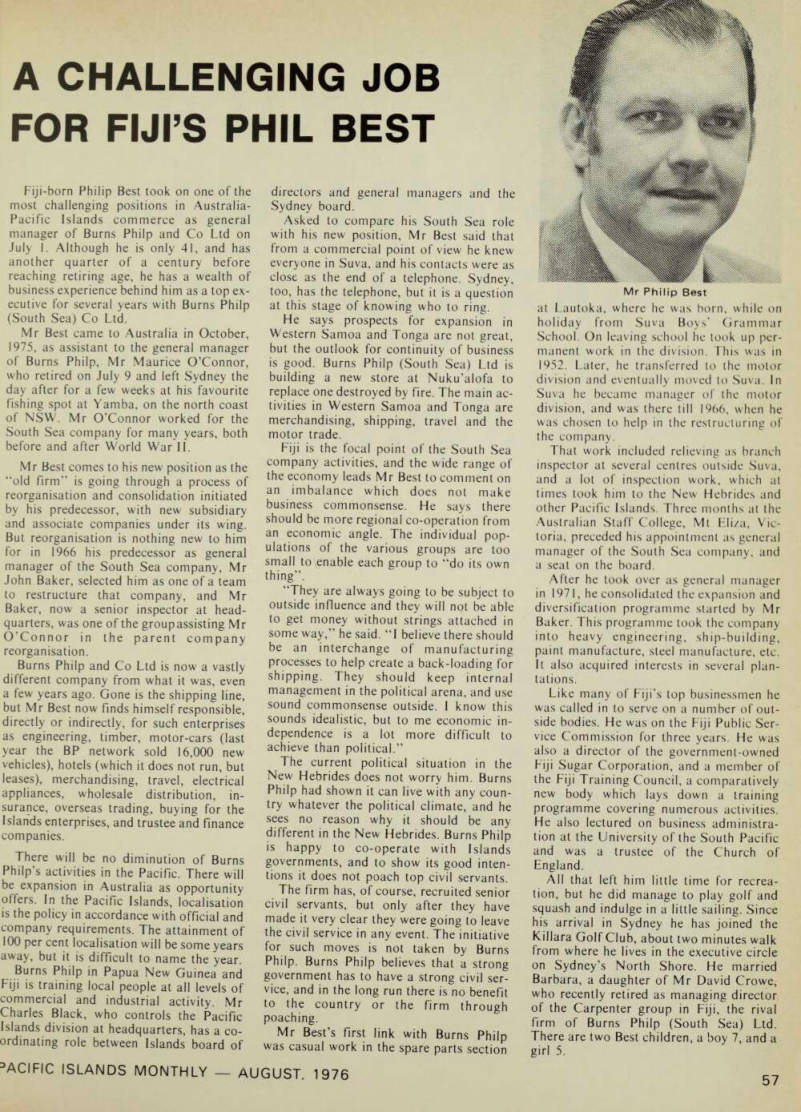
for Islands’ copra
The South Pacific copra industry is in a sorry state. A Sydney authority said that in Papua New Guinea there was the makings of an industry collapse unless there was a significant improvement in world prices. He described the outlook as “lousy”.
The Philippines has an exportable sur plus of copra which is helping to depress prices, and a glut of soya bean oil, which will soon become a drug on the market, will make matters even more difficult for the Islands with copra-based economies.
For some time now PNG growers have had their prices propped up with their own money from the Copra Stabilisation Fund. This fund could be exhausted by the end of this year. If that happens, growers will be lucky to get KlOO a tonne, and at that price plantations are likely to close.
The PNG price bottomed at KlB9 a tonne some time ago. It has climbed to K 277, but growers need K. 300 before they even think about meeting production costs.
The current low prices are discouraging growers to such an extent that the Copra Marketing Board is concerned about being able to fill orders. The Minster for Primary Industry, Mr Sali, said a shortage meant the board could not take advantage of some open market sales to Singapore.
He warned cash producers it was not in their, or the country’s, interest to wait for an improved price for copra. He urged them to carry on with copra production as coconuts became available.
In the Solomons there has been some improvement in shipments in quantity, but not in price. Western Samoa is produc ing very little copra at present.
In Fiji, copra is declining as an impor tant factor in the economy. The govern ment has subsidised the price for some time to guarantee $l9O a tonne for first grade and $l7l a tonne for second grade.
But it has been unable to give any firm in dication how long it will continue the sub sidy, nor has it said whether growers will be required to repay the subsidy if, and when, the market improves.
In 1964, Fiji reached its peak in the area under production 89,000 hectares. But now about half of the existing palms are
Continued on page 69
From page 56
past peak bearing. Production is also declining. In 1956 it was a record 48,817 tonnes. In 1975 production was down by more than 50 per cent to 23,875 tonnes.
The lower prices and lower production directly affect the Fijian villagers in some of the more remote areas. Small Fijian owned plantations produce about 60 per cent of the country’s copra. The coconut is a basic and essential crop for the Fijians in those areas. The lives of more than 100,000 Fijians are closely tied to it.
Most of Fiji’s copra is crushed locally and in 1975 about 16,000 tonnes of coconut oil was exported, earning about $lO million. Coconut meal pellets are produced from the by-products at the mill.
Under Development Plan 7 the govern ment will urge copra growers to diversify into cocoa, yaqona, root crops and other vegetables. Cattle will be encouraged on bigger plantations. The government will also encourage the processing of whole nuts into charcoal, fibre, desiccated coconut, coconut cream, coconut oil and particle board to change the copra in dustry into a coconut industry.