Pilioko,
p. 45 · Read in the full issue
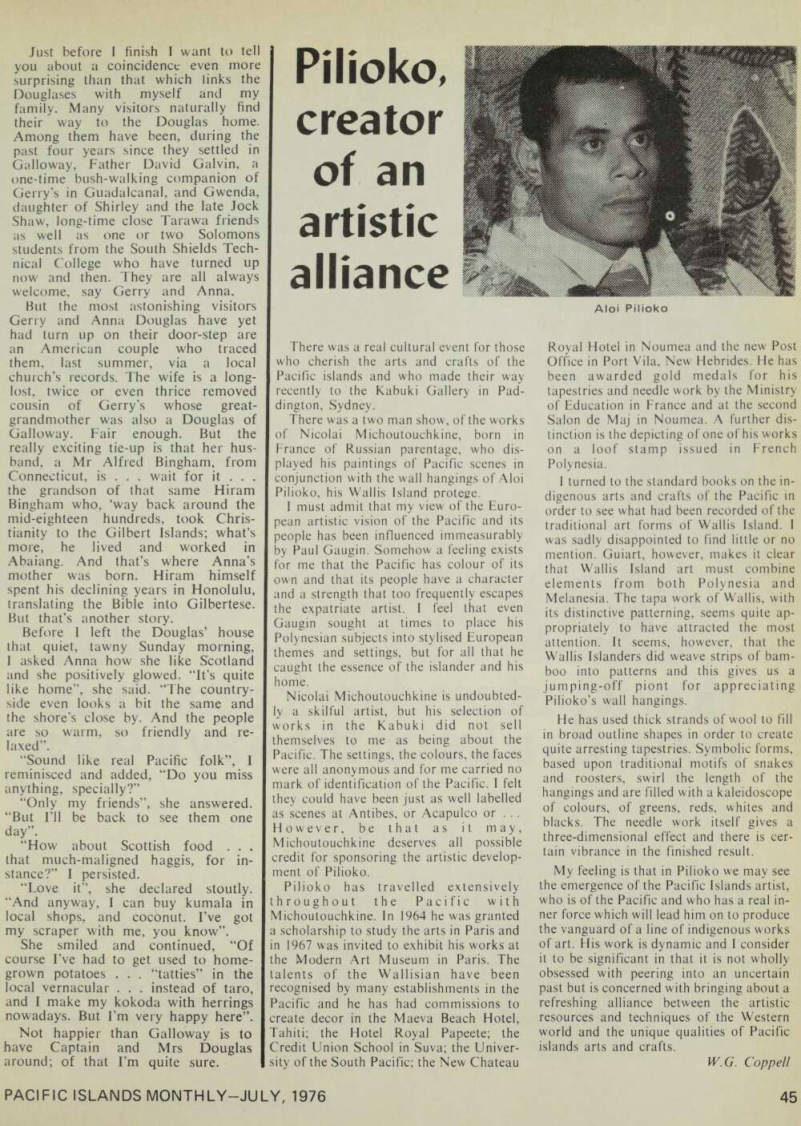
creator of an artistic alliance
There was a real cultural event for those who cherish the arts and crafts of the Pacific islands and who made their way recently to the Kabuki Gallery in Pad dington, Sydney.
There was a two man show, of the works of Nicolai Michoutouchkine, born in France of Russian parentage, who dis played his paintings of Pacific scenes in conjunction with the wall hangings of Aloi Pilioko, his Wallis Island protege.
I must admit that my view of the Euro pean artistic vision of the Pacific and its people has been influenced immeasurably by Paul Gaugin. Somehow a feeling exists for me that the Pacific has colour of its own and that its people have a character and a strength that too frequently escapes the expatriate artist. I feel that even Gaugin sought at times to place his Polynesian subjects into stylised European themes and settings, but for all that he caught the essence of the islander and his home.
Nicolai Michoutouchkine is undoubted ly a skilful artist, but his selection of works in the Kabuki did not sell themselves to me as being about the Pacific. The settings, the colours, the faces were all anonymous and for me carried no mark of identification of the Pacific. I felt they could have been just as well labelled as scenes at Antibes, or Acapulco or . . .
However, be that as it may, Michoutouchkine deserves all possible credit for sponsoring the artistic develop ment of Pilioko.
Pilioko has travelled extensively throughout the Pacific with Michoutouchkine. In 1964 he was granted a scholarship to study the arts in Paris and in 1967 was invited to exhibit his works at the Modern Art Museum in Paris. The talents of the Wallisian have been recognised by many establishments in the Pacific and he has had commissions to create decor in the Maeva Beach Hotel, Tahiti; the Hotel Royal Papeete; the Credit Union School in Suva; the Univer sity of the South Pacific; the New Chateau
Royal Hotel in Noumea and the new Post Office in Port Vila, New Hebrides. He has been awarded gold medals for his tapestries and needle work by the Ministry of Education in France and at the second Salon de Maj in Noumea. A further dis tinction is the depicting of one of his works on a loof stamp issued in French Polynesia. 1 turned to the standard books on the in digenous arts and crafts of the Pacific in order to see what had been recorded of the traditional art forms of Wallis Island. I was sadly disappointed to find little or no mention. Guiart, however, makes it clear that Wallis Island art must combine elements from both Polynesia and Melanesia. The tapa work of Wallis, with its distinctive patterning, seems quite ap propriately to have attracted the most attention. It seems, however, that the Wallis Islanders did weave strips of bam boo into patterns and this gives us a
jumping-off piont for appreciating
Pilioko’s wall hangings.
He has used thick strands of wool to fill in broad outline shapes in order to create quite arresting tapestries. Symbolic forms, based upon traditional motifs of snakes and roosters, swirl the length of the hangings and are filled with a kaleidoscope of colours, of greens, reds, whites and blacks. The needle work itself gives a three-dimensional effect and there is cer tain vibrance in the finished result.
My feeling is that in Pilioko we may see the emergence of the Pacific Islands artist, who is of the Pacific and who has a real in ner force which will lead him on to produce the vanguard of a line of indigenous works of art. His work is dynamic and I consider it to be significant in that it is not wholly obsessed with peering into an uncertain past but is concerned with bringing about a refreshing alliance between the artistic resources and techniques of the Western world and the unique qualities of Pacific islands arts and crafts.
W.G. Coppell
Aloi Pilioko