or Uncle Sam's joker
pp. 47-48 · Read in the full issue
Micronesian card game: Islanders' ace or Uncle Sam's joker
Micronesia means small islands, and small, indeed, are land area (700 sq m) and population (125,000) of the Mariana, Caroline and Marshall islands groups making up the Micronesia of this book.
Big, however, is the ocean area involved (roughly the size of the US) and big, too, is the nation administering those islands, the United States of America.
Truk Lagoon in the Carolines was the base of the Japanese fleet that attacked Pearl Harbour in 1941; 6,200 Americans died and 22,810 were wounded in wresting the islands from the Japanese who had held them under mandate from the League of Nations since 1921. “We fought for them, we’ve got them, we should keep them. They are necessary for our safely”, said F.E. Hebert, influential Congressman from Louisiana.
While D.F. McHenry, author of Micronesia: Trust Betrayed regards the islands as useful but not essential to US security or to international peace and security, and quotes Henry Kissinger as saying “there are only 90,000 people out there. Who gives a damn?”, Washington’s stance since 1947 when the US became trustee of the islands, under a strategic trusteeship agreement with the UN, has consistently demonstrated that Congressman Hebert and like-minded Americans have had the whip-hand.
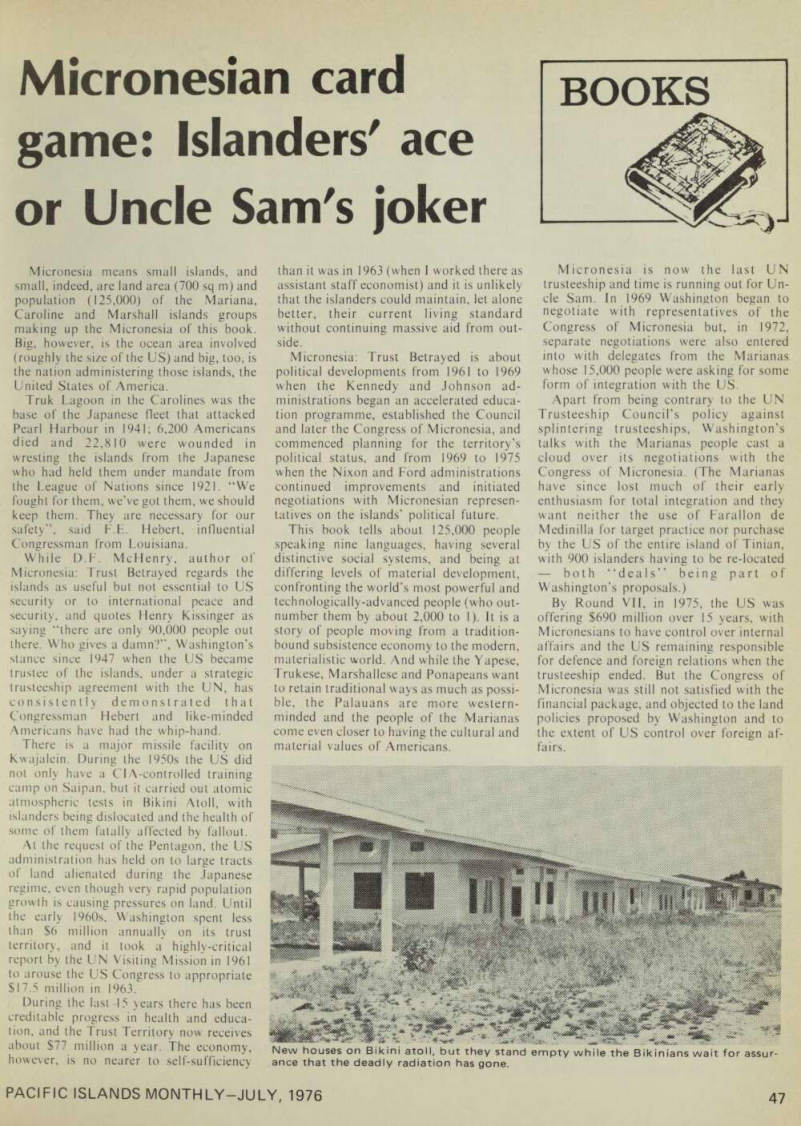
There is a major missile facility on Kwajalein. During the 1950 s the US did not only have a CIA-controlled training camp on Saipan, but it carried out atomic atmospheric tests in Bikini Atoll, with islanders being dislocated and the health of some of them fatally affected by fallout.
At the request of the Pentagon, the US administration has held on to large tracts of land alienated during the Japanese regime, even though very rapid population growth is causing pressures on land. Until the early 19605, Washington spent less than $6 million annually on its trust territory, and it took a highly-critical report by the UN Visiting Mission in 1961 to arouse the US Congress to appropriate $17.5 million in 1963.
During the last 4 5 years there has been creditable progress in health and educa tion, and the Trust Territory now receives about $77 million a year. The economy, however, is no nearer to self-sufficiency
than it was in 1963 (when I worked there as assistant staff economist) and it is unlikely that the islanders could maintain, let alone better, their current living standard without continuing massive aid from outside.
Micronesia: Trust Betrayed is about political developments from 1961 to 1969 when the Kennedy and Johnson administrations began an accelerated education programme, established the Council and later the Congress of Micronesia, and commenced planning for the territory’s political status, and from 1969 to 1975 when the Nixon and Ford administrations continued improvements and initiated negotiations with Micronesian representatives on the islands’ political future.
This book tells about 125,000 people speaking nine languages, having several distinctive social systems, and being at differing levels of material development, confronting the world’s most powerful and technologically-advanced people (who outnumber them by about 2,000 to 1). It is a story of people moving from a traditionbound subsistence economy to the modern, materialistic world. And while the Yapese, Trukese, Marshallese and Ponapeans want to retain traditional ways as much as possible, the Palauans are more westernminded and the people of the Marianas come even closer to having the cultural and material values of Americans.
Micronesia is now the last UN trusteeship and time is running out for Un cle Sam. In 1969 Washington began to negotiate with representatives of the Congress of Micronesia but, in 1972, separate negotiations were also entered into with delegates from the Marianas whose 15,000 people were asking for some form of integration with the US.
Apart from being contrary to the UN Trusteeship Council’s policy against splintering trusteeships, Washington’s talks with the Marianas people cast a cloud over its negotiations with the Congress of Micronesia. (The Marianas have since lost much of their early enthusiasm for total integration and they want neither the use of Farallon de Medinilla for target practice nor purchase by the US of the entire island of Tinian, with 900 islanders having to be re-located both “deals” being part of Washington’s proposals.) By Round VII, in 1975, the US was offering $690 million over 15 years, with Micronesians to have control over internal affairs and the US remaining responsible for defence and foreign relations when the trusteeship ended. But the Congress of Micronesia was still not satisfied with the financial package, and objected to the land policies proposed by Washington and to the extent of US control over foreign af fairs.
New houses on Bikini atoll, but they stand empty while the Bikinians wait for assur ance that the deadly radiation has gone.
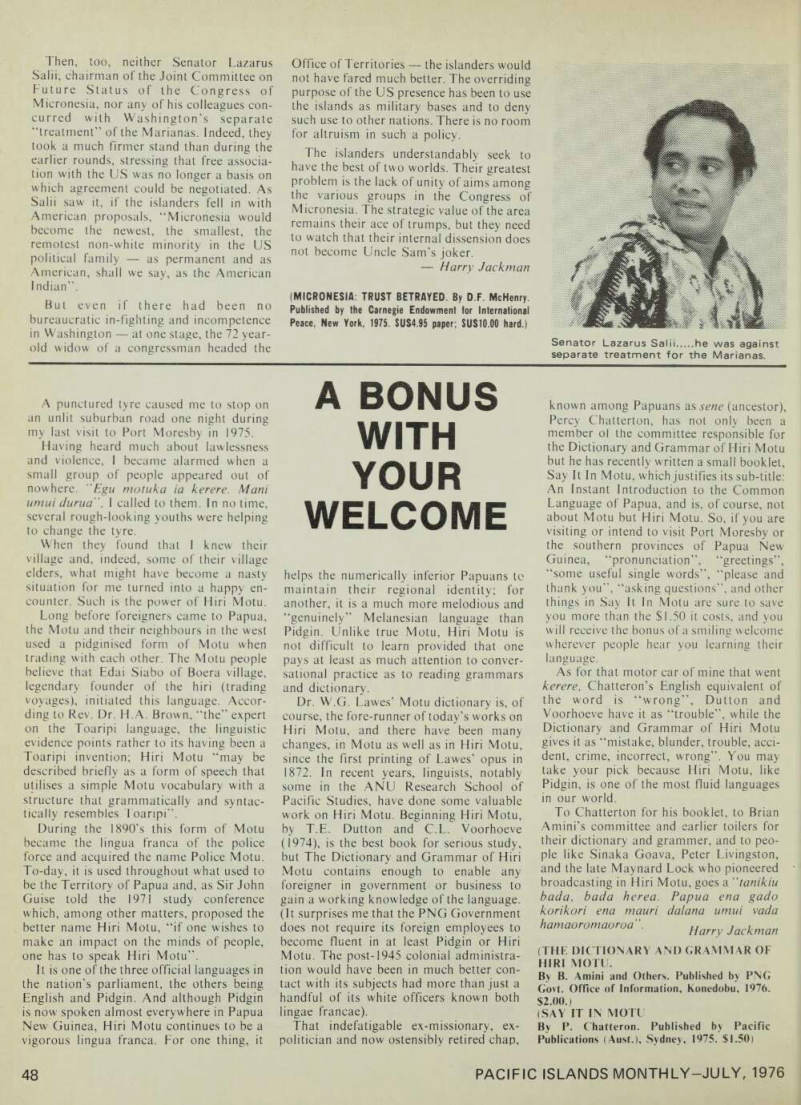
Then, too, neither Senator Lazarus Salii, chairman of the Joint Committee on Future Status of the Congress of Micronesia, nor any of his colleagues con curred with Washington’s separate “treatment” of the Marianas. Indeed, they took a much firmer stand than during the earlier rounds, stressing that free associa tion with the US was no longer a basis on which agreement could be negotiated. As Salii saw it, if the islanders fell in with American proposals, “Micronesia would become the newest, the smallest, the remotest non-white minority in the US political family as permanent and as American, shall we say, as the American Indian”.
But even if there had been no bureaucratic in-fighting and incompetence in Washington at one stage, the 72 year old widow of a congressman headed the
Office of Territories the islanders would not have fared much better. The overriding purpose of the US presence has been to use the islands as military bases and to deny such use to other nations. There is no room for altruism in such a policy.
The islanders understandably seek to have the best of two worlds. Their greatest problem is the lack of unity of aims among the various groups in the Congress of Micronesia. The strategic value of the area remains their ace of trumps, but they need to watch that their internal dissension does not become Uncle Sam’s joker.
Harry Jackman
(Micronesia: Trust Betrayed. By D.F. Mchenry.
Published by the Carnegie Endowment for International Peace, New York, 1975. SUS4.9S paper; SUSIO.OO hard.)
Senator Lazarus Salii... he was against separate treatment for the Marianas.