Magazine
pp. 43-45 · Read in the full issue
A Very Far Cry
From The Pacific
She was big and she was beautiful —a golden Labrador, and she cer tainly knew what she wanted. And what she wanted, that particular autumn Sunday morning in Scotland’s “grey Galloway” was ... Me!
In this quiet countryside we walk down to the store in the bay to col lect our Sunday papers. I was re turning with ours, admiring the golden-tawny colours of the changing season and, on passing a solid, grey granite villa, there was this gorgeous golden Labrador in the garden where the winter-flowering heather was splashing its pale lilac amongst the last of the summer dahlias. She marked ‘hello’ to me; I returned the greeting and walked on past the iron gate which was ajar.
Suddenly I felt the dog beside me; stopped to pat her and in return or that piece of civility she took ip the hem of my coat and began, lowly but with great determination, o pull me towards her house!
“Drop”, I said, trying to sound onvincing; nothing doing. “Let go”, pleaded; but she didn’t. “Stay”, I ommanded, trying to remember any >r all of the doggy talk I had ever icard. But “stay” we most certainly lidn’t.
Inexorably, I was dragged up the ath, increasingly conscious that, as newcomer to the district, I’d no lea who owned this over-friendly east. My own tug on my coat merely 3used my captor to fresh enthusi sm. What to do? Slip out of my oat? But the path was damp and it 'as my good coat. Finally, feeling istmctly foolish, I decided that the nly thing to do was to let the wners of this ardent retriever deal ith the matter as presumably only ley knew how to do.
So, I went with the dog on to the ont door-step and rang the bell.
A tall man came to the door.
“Drop, Marama”, he said and istantly, of course, I was released, ut the familiar Fijian word roused y curiosity and I was only too
By Jane Gregor
glad to accept the invitation to “come in”.
And that was how I came to meet Captain Gerry Douglas, originally a Galwegian from ‘way back’ and nowadays what might be called ‘an old Pacific hand”, like myself.
One inside the spacious house I noticed with pleasure the familiar tapa cloth wall-hangings, the giant clam shells, the paintings of tropical landscapes which all reminded me of my own brief stay in Fiji a few years ago.
After I’d been chatting to Captain Douglas for a few moments and as I sat patting my lovely captor, now quite happy merely to sit beside me, in came Mrs Douglas, as pretty a representative of her south west Pacific homeland as you’d ever hope to meet . . . especially in a remote corner of south-west Scotland.
You can imagine how the talk flowed after we’d finished exclaiming at the coincidence of two families, ex-Pacific, now neighbours (a mere quarter of a mile apart in fact) in quietest lowland Scotland!
It’s not really surprising that Cap tain Douglas decided to retire from the Marine Department in the Solo mons to his native heath. Douglases are closely woven into the history of Galloway and our local market town, famous for some of the best beef in the world, is actually called
Castle-Douglas.
Just outside it, on a tiny islet which necessitates a ferry-boat cross ing to reach it, stands the one-time seat of the Douglases, Threave Castle. A square, uncompromising building of grey stone, it has above its main door a weather-worn stone knob; this was known as the “gallows knob” by virtue of the “human tassel” which all too often adorned it during the over-lordship of the bold Douglas robber barons whose descendant, be it ever-so remotely,
Gerry Douglas must be and about whom he loves to joke.
What is much more surprising is the fact that it was actually Mrs Douglas who suggested that they should spend their retirement in Galloway. After all, it’s considerably colder here than in her homeland and Scotland is a very long way from the Pacific, even if their topo graphy has certain common features, such as forest-covered hills, lush valleys, rugged cliffs and sandy beaches.
Anna, who, as Ana Viniana Tupou Sowani, will be remembered in Fiji, where many of her family still live,’ married her tall Scots sailor in Suva in September 1955, some three years after he d first set foot in Fiji when he and a friend had crossed from New Zealand in a yacht.
At the time of their wedding, old friends will recall that Gerry was in command of the MV Tuvalu.
And it was only a month or two later that he and Anna, en route to start their life together in the Gil* berts, came across the wreck of the notorious Joyita, still today, a sea faring yarn which holds one’s imagin ation.
Gerry and Anna keep many happy memories of their stay in the Gilberts where they lived until 1964, first on Betio when Gerry was in command first of the Tuvalu, then the Tema tapula and the Nareau, and later on Bairiki after Gerry became the Co lony’s Marine Superintendent.
“I loved the Gilberts but I longed
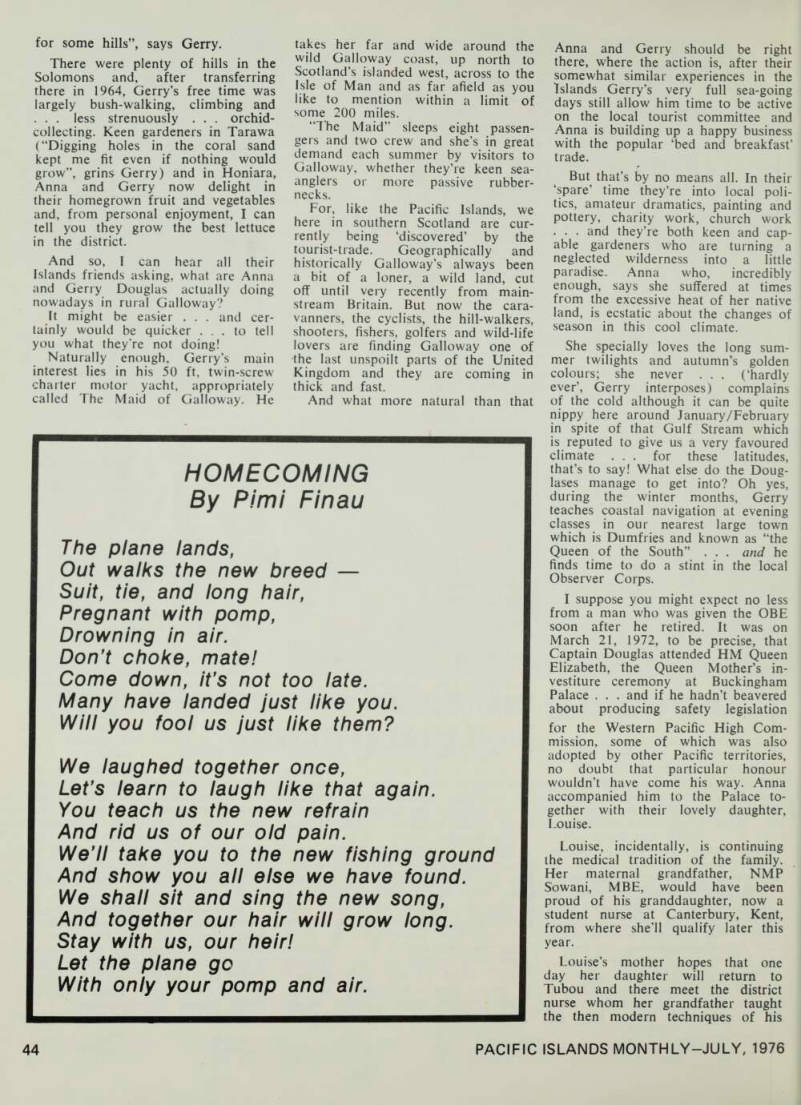
Gerry Douglas, some snow and a friend of a different colour.
for some hills”, says Gerry.
There were plenty of hills in the Solomons and, after transferring there in 1964, Gerry’s free time was largely bush-walking, climbing and . . . less strenuously . . . orchid collecting. Keen gardeners in Tarawa (“Digging holes in the coral sand kept me fit even if nothing would grow”, grins Gerry) and in Honiara, Anna and Gerry now delight in their homegrown fruit and vegetables and, from personal enjoyment, I can tell you they grow the best lettuce in the district.
And so, I can hear all their Islands friends asking, what are Anna and Gerry Douglas actually doing nowadays in rural Galloway?
It might be easier . . . and cer tainly would be quicker ... to tell you what they’re not doing!
Naturally enough, Gerry’s main interest lies in his 50 ft, twin-screw charter motor yacht, appropriately called The Maid of Galloway. He
takes her far and wide around the wild Galloway coast, up north to Scotland’s islanded west, across to the Isle of Man and as far afield as you like to mention within a limit of some 200 miles.
“The Maid” sleeps eight passen gers and two crew and she’s in great demand each summer by visitors to Galloway, whether they’re keen sea anglers or more passive rubber necks.
For, like the Pacific Islands, we here in southern Scotland are cur rently being ‘discovered’ by the tourist-trade. Geographically and historically Galloway’s always been a bit of a loner, a wild land, cut off until very recently from main stream Britain. But now the cara vanners, the cyclists, the hill-walkers, shooters, fishers, golfers and wild-life lovers are finding Galloway one of the last unspoilt parts of the United Kingdom and they are coming in thick and fast.
And what more natural than that
Anna and Gerry should be right there, where the action is, after their somewhat similar experiences in the Islands Gerry’s very full sea-going days still allow him time to be active on the local tourist committee and Anna is building up a happy business with the popular ‘bed and breakfast’ trade.
But that’s by no means all. In their ‘spare’ time they’re into local poli tics, amateur dramatics, painting and pottery, charity work, church work . . . and they’re both keen and cap able gardeners who are turning a neglected wilderness into a little paradise. Anna who, incredibly enough, says she suffered at times from the excessive heat of her native land, is ecstatic about the changes of season in this cool climate.
She specially loves the long sum mer twilights and autumn’s golden colours; she never . . . (‘hardly ever’, Gerry interposes) complains of the cold although it can be quite nippy here around January/February in spite of that Gulf Stream which is reputed to give us a very favoured climate ... for these latitudes, that’s to say! What else do the Doug lases manage to get into? Oh yes, during the winter months, Gerry teaches coastal navigation at evening classes in our nearest large town which is Dumfries and known as “the Queen of the South” . . . and he finds time to do a stint in the local Observer Corps.
I suppose you might expect no less from a man who was given the OBE soon after he retired. It was on March 21, 1972, to be precise, that Captain Douglas attended HM Queen Elizabeth, the Queen Mother’s in vestiture ceremony at Buckingham Palace . . . and if he hadn’t beavered about producing safety legislation for the Western Pacific High Com mission, some of which was also adopted by other Pacific territories, no doubt that particular honour wouldn’t have come his way. Anna accompanied him to the Palace to gether with their lovely daughter, Louise.
Louise, incidentally, is continuing the medical tradition of the family.
Her maternal grandfather, NMP Sowani, MBE, would have been proud of his granddaughter, now a student nurse at Canterbury, Kent, from where she’ll qualify later this year.
Louise’s mother hopes that one day her daughter will return to Tubou and there meet the district nurse whom her grandfather taught the then modern techniques of his
Just before I finish I want to tell you about a coincidence even more surprising than that which links the Douglases with myself and my family. Many visitors naturally find their way to the Douglas home.
Among them have been, during the past four years since they settled in Galloway, Father David Galvin, a one-time bush-walking companion of Gerry’s in Guadalcanal, and Gwenda, daughter of Shirley and the late Jock Shaw, long-time close Tarawa friends as well as one or two Solomons students from the South Shields Tech nical College who have turned up now and then. They are all always welcome, say Gerry and Anna.
But the most astonishing visitors Gerry and Anna Douglas have yet had turn up on their door-step are an American couple who traced them, last summer, via a local church’s records. The wife is a long lost, twice or even thrice removed cousin of Gerry’s whose great grandmother was also a Douglas of Galloway. Fair enough. But the really exciting tie-up is that her hus band, a Mr Alfred Bingham, from Connecticut, is . . . wait for it . . . the grandson of that same Hiram Bingham who, ‘way back around the mid-eighteen hundreds, took Chris tianity to the Gilbert Islands; what’s more, he lived and worked in Abaiang. And that’s where Anna’s mother was born. Hiram himself spent his declining years in Honolulu, translating the Bible into Gilbertese.
But that’s another story.
Before I left the Douglas’ house that quiet, tawny Sunday morning, I asked Anna how she like Scotland and she positively glowed. “It’s quite like home’’, she said. “The country side even looks a bit the same and the shore’s close by. And the people are so warm, so friendly and re laxed”.
“Sound like real Pacific folk”, I reminisced and added, “Do you miss anything, specially?”
“Only my friends”, she answered.
“But I’ll be back to see them one day”.
“How about Scottish food . . . that much-maligned haggis, for in stance?” I persisted.
“Love it”, she declared stoutly.
“And anyway, I can buy kumala in local shops, and coconut. I’ve got my scraper with me, you know”.
She smiled and continued, “Of course I’ve had to get used to home grown potatoes . . . “tatties” in the local vernacular . . . instead of taro, and I make my kokoda with herrings nowadays. But I'm very happy here”.
Not happier than Galloway is to have Captain and Mrs Douglas around; of that I’m quite sure.