Islands Want More Of The
pp. 30-31 · Read in the full issue
East-West Centre Cake
The East-West Centre is a national educational institution established in Hawaii by US Congress in 1960 "to promote better relations and un derstanding between the United States and other nations of Asia and Pacific through
co-operative study, training and research”.
In the decade and a half of its existence to June 30. I 975, the Centre’s activities in Hawaii and in the fields have involved close to 15,000 Asians and Pacific Islan ders. Out of that figure about 3,000 were from the Pacific, excluding U.S. territories, but taking in Australia and New Zealand. For the enlightenment of our Kiwi and Aussie friends, in the bigger outside world, we’re all clumped together as from the South Pacific.
Participants who have come to Hawaii for programmes conducted here have numbered about 5,000. Of this figure we made up just under 900. We can, theiefore, say that proportion-wise we have been adequately represented, when we compare our population to the whole of Asia. Still we wish for more.
It is in the degree programmes that our Island nations appear not to be well catered for. Out of the 275 degree students at present enrolled at the Univer sity of Hawaii on East-West Centre grants, only seven are from the South Pacific two from Western Samoa, two from Australia, and one each from Tonga, Easter Island and New Zealand.
Only 10
Up to June last year, there have been 2,074 East-West-funded degree seekers who have come here 61 were of our kind. In all these 15 years we have had only 10 post-graduates, and here I’m ex cluding Australia and New Zealand, because of the available graduate study in stitutions in the two countries. The 10 comprised of one MA to the Cooks, three to Fiji, two to Papua New Guinea, one to Western Samoa and three to Tonga.
When we realise that a good number of Pacific Island students came up in the early years of this institution, we can see how little participation we have had on this level of the Centre’s activities during a good part of the last decade.
One reason for the waning of Pacific in volvement was, perhaps, due to the establishment of our own universities in Suva and Port Moresby. At this stage the East-West Centre shifted its emphasis to
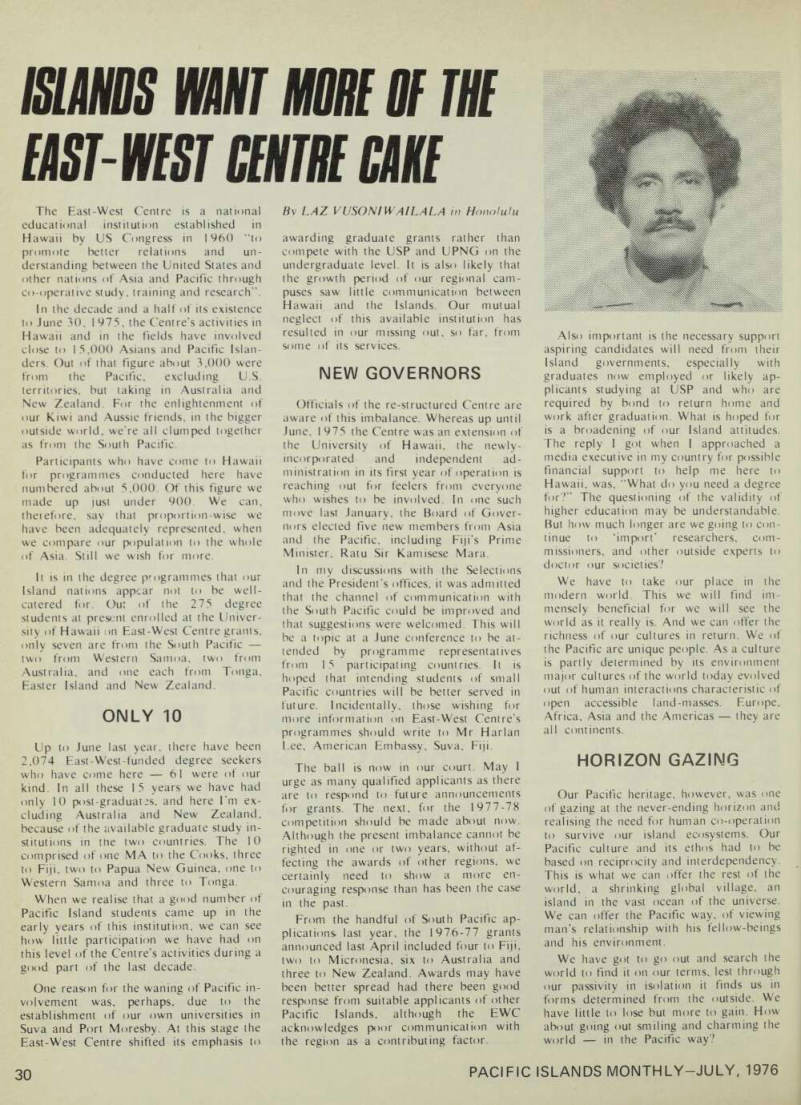
By LAZ VUSONIWAILALA in Honolulu
awarding graduate grants rather than compete with the USP and UPNG on the undergraduate level. It is also likely that the growth period of our regional cam puses saw little communication between Hawaii and the Islands. Our mutual neglect of this available institution has resulted in our missing out, so far, from some of its services.
New Governors
Officials of the re-structured Centre are aware of this imbalance. Whereas up until June, 1 975 the Centre was an extension of the University of Hawaii, the newly incorporated and independent ad ministration in its first year of operation is reaching out for feelers from everyone who wishes to be involved. In one such move last January, the Board of Gover nors elected five new members from Asia and the Pacific, including Fiji's Prime Minister, Ratu Sir Kamisese Mara.
In my discussions with the Selections and the President’s offices, it was admitted that the channel of communication with the South Pacific could be improved and that suggestions were welcomed. This will be a topic at a June conference to be at tended by programme representatives from 15 participating countries. It is hoped that intending students of small Pacific countries will be better served in future. Incidentally, those wishing for more information on East-West Centre’s programmes should write to Mr Harlan Lee, American Embassy, Suva, Fiji.
The ball is now in our court. May I urge as many qualified applicants as there are to respond to future announcements for grants. The next, for the 1977-78 competition should be made about now.
Although the present imbalance cannot be righted in one or two years, without af fecting the awards of other regions, we certainly need to show a more en couraging response than has been the case in the past.
From the handful of South Pacific ap plications last year, the 1976-77 grants announced last April included four to Fiji, two to Micronesia, six to Australia and three to New Zealand. Awards may have been better spread had there been good response from suitable applicants of other Pacific Islands, although the EWC acknowledges poor communication with the region as a contributing factor.
Also important is the necessary support aspiring candidates will need from their Island governments, especially with
graduates now employed or likely ap
plicants studying at USP and who are required by bond to return home and work after graduation. What is hoped for is a broadening of our Island attitudes.
The reply I got when I approached a media executive in my country for possible financial support to help me here to Hawaii, was, "What do you need a degree for?” The questioning of the validity of higher education may be understandable.
But how much longer are we going to con tinue to ‘import’ researchers, com missioners, and other outside experts to doctor our societies?
We have to take our place in the modern world. This we will find im mensely beneficial for we will see the world as it really is. And we can offer the richness of our cultures in return. We of the Pacific are unique people. As a culture is partly determined by its environment major cultures of the world today evolved out of human interactions characteristic of open accessible land-masses. Europe, Africa, Asia and the Americas they are all continents.
Horizon Gazing
Our Pacific heritage, however, was one of gazing at the never-ending horizon and realising the need for human co-operation to survive our island ecosystems. Our Pacific culture and its ethos had to be based on reciprocity and interdependency.
This is what we can offer the rest of the world, a shrinking global village, an island in the vast ocean of the universe.
We can offer the Pacific way. of viewing man’s relationship with his fellow-beings and his environment.
We have got to go out and search the world to find it on our terms, lest through our passivity in isolation it finds us in forms determined from the outside. We have little to lose but more to gain. How about going out smiling and charming the world in the Pacific way?
From the Samoa Times: A young man was acquitted of rape at the Supreme Court Tuesday afternoon by a panel of four assessors ... He told the court that he had sexual intercourse with the woman as payment for her ride on his bicycle.
Editorial comment in The Fiji Times on recent diplomatic overtures overseas by New Zealand Prime Minister, Mr Bob Muldoon: . . . Mr Muldoon is paddling against wind and tide if he believes that the independent Pacific nations (apart from New Zealand and possibly Australia) will welcome his call for closer ties between France and its colonies and other countries of the region. There is everywhere in the Pacific sympathy and support for those people in New Caledonia and French Polynesia who are seeking independence, but very little indeed for the colonial power which for so long has littered the region with its filthy nuclear garbage . . . Nor will islands people be enchanted despite Mr Muldoon’s assurance that New Zealand has a special Pacific responsibility, with his glib comment about a newly independent Pacific country; “Eight islands together 7000 people and lots of coconuts that nobody wants”.
From Tohi Tala Niue: Hakapu the last village on the southern circuit celebrated the power switch on in a style usually reserved for such occasions as opening of a new village church or pastor’s house. According to people who attended the festivities every man and his dog celebrated.
From the Solomons News Drum: John Lapaite’e of Aulutau was on a fishing trip off Wahi’i when he hooked a big fish. In a hard struggle the fish sank Mr Lapaite’e’s canoe and it took him more than six hours to swim ashore. Our correspondent Jeffrey Noris, says the man arrived safely at Liwe village late in the evening but he did not catch the fish.
From a Micronesian Independent report of a speech by Mr Fred M. Zeder, US Director of Territories,
on Saipan:
Saipan, Zeder, said, should be more like White Sulphur Springs, a well-known resort area for the very rich in the United Slates.
With recreation facilities, a medical centre, and gathering place for small conventions, companies like IBM, Xerox, US Steel would “book years in advance” to come to Saipan; “A good image for the island to attract people with money,” Zeder exclaimed, “not honeymoon couples from Japan with a roll of nickles”.
From a Micronesian Independent report of the celebrations marking the Northern Marianas US commonwealth status: . . . The festivities were filled with plenty of pomp and circumstance a spiffy Navy band, marching Marines, boring speeches, the Island Chorus singing “God bless America” and even a 852 bomber zooming over the crowd . . . But something seemed to be missing ... No great outbursts of joy or enthusiasm swept through the crowd over their new status many business employees had to be back at work by 2, and left shortly after eating ... As the band closed down its last set around 10, someone yelled out from a passing car, “Hey Brown, how’s it feel to be second-class Americano?”
Carting coals to Newcastle, or, in this case, to Nauru as reported in the republic’s Bulletin: Mr Peter Tapsell, Conservative MP for Louth (UK), made a short visit to Nauru where he was the guest of Mr Simon Gilletl.
Mr Tapsell, who is a stockbroker . . . presented the President with two turtles and these are now installed in Turtle Pool at Slate House.
Lesieli S. Vete underlines the importance of keeping Tonga’s Sunday observance law in a letter to the
Tonga Chronicle:
If the Maker of Modern Tonga was here today, I am sure he would remind us that; “It is written, the Sabbath Day in my country will be called a day of prayer, but you are making it a day of unloading cargo for your ship."
From the Samoa Times: Married senior police officers have been accused of having illicit affairs with unattached female members of the police. The -charges will be heard by a "police court" itself but informed sources said that a “Judge" to preside was difficult to find as the Commissioner of Police, Unasa Lio, and other senior officers have declined to preside over the hearings.
From Tohi Tala Niue: How do you order a “rock crushing plant” worth in the vicinity of $70,000 without bothering to find out if it is powered by electricity or diesel?
The answer is simple, don’t bother, because she’ll be right mate.
Apparently the Public Works Department, the biggest government department on Niue, had placed an order for new “rock crushing plant” without firstly finding out, or bothering to properly investigate the new plant before placing the order. This blunder, not the first, will cost an extra $4,500 to install a sub station, transformers and high tension reticulation cables to the quarry, because the crusher is powered by 150 hp electric motors and not diesel as assumed.
From The Samoa Times, reporting nearly 60 per cent of Parliament’s members were not returned in elections: High titles, which once ensured holders easy entry into Parliament, failed to produce the expected results. Even Prime Minster Tupua Tamasese Lealofi, holder of one of the four Tama-a-Aiga titles, had to fight for his seat. The first time a holder of such a title has had to compete for a seat. Maulolo Motuloa, holder of one of the most important orator titles in the whole country, went down to Taliaoa Maoama, the possessor of a less important title.