Canned festival
p. 33 · Read in the full issue
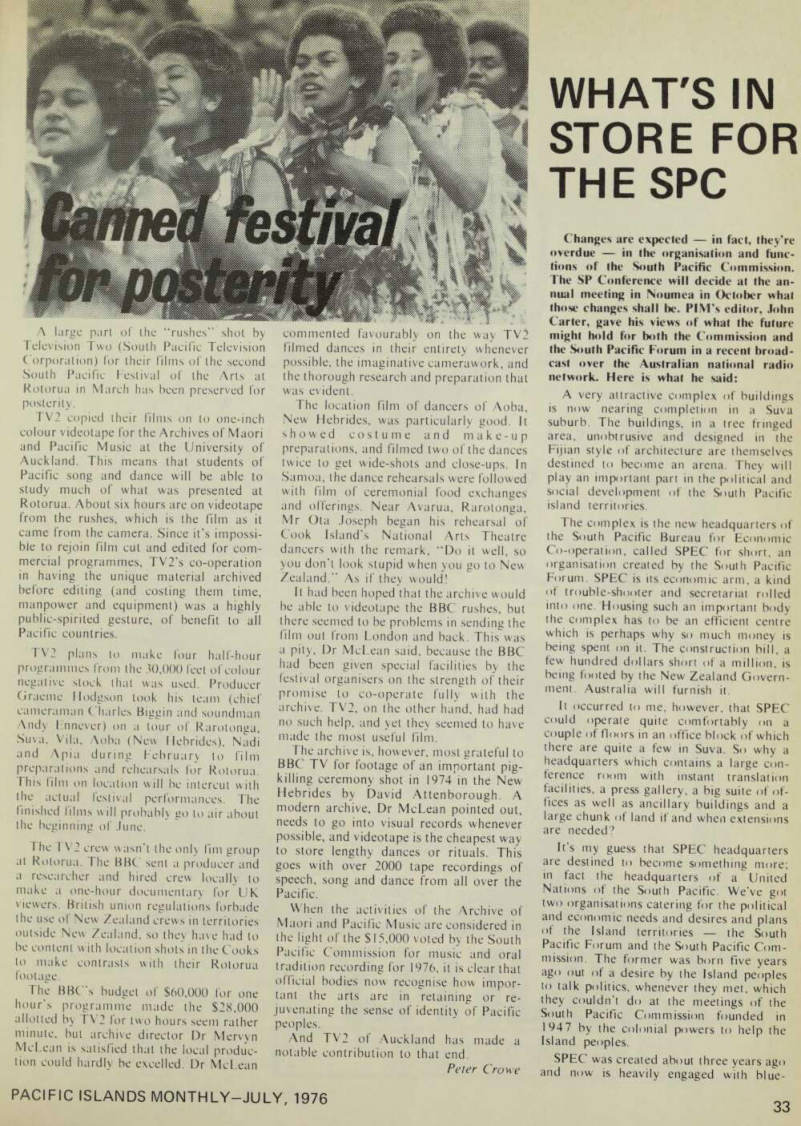
for posterity
A large part of the “rushes” shot by Television Two (South Pacific Television Corporation) for their films of the second South Pacific Festival of the Arts at Rotorua in March has been preserved for posterity.
TV2 copied their films on to one-inch colour videotape for the Archives of Maori and Pacific Music at the University of Auckland. This means that students of Pacific song and dance will be able to study much of what was presented at Rotorua. About six hours are on videotape from the rushes, which is the film as it came from the camera. Since it’s impossi ble to rejoin film cut and edited for com mercial programmes, TV2’s co-operation in having the unique material archived before editing (and costing them time, manpower and equipment) was a highly public-spirited gesture, of benefit to all Pacific countries.
IV2 plans to make four half-hour programmes from the 30,000 feel of colour negative slock that was used. Producer Graeme Hodgson look his team (chief cameraman Charles Biggin and soundman Andy Lnnever) on a lour of Rarotonga, Suva, Vila, Aoba (New Hebrides), Nadi and Apia during February to film preparations and rehearsals for Rotorua.
This film on location will be intercut with the actual festival performances. The finished films w ill probably go to air about the beginning of June.
The TV2 crew wasn't the only fim group at Rotorua. The BBC sent a producer and a researcher and hired crew locally to make a one-hour documentary for UK viewers. British union regulations forbade the use ol New Zealand crews in territories outside New Zealand, so they have had to be content with location shots in the Cooks to make contrasts with their Rotorua
footage.
The BBC's budget of $60,000 for one hour's programme made the $28,000 allotted by TV2 lor two hours seem rather minute, but archive director Dr Mervyn McLean is satisfied that the local produc tion could hardly be excelled. Dr McLean
commenled favourably on the way TV2 filmed dances in their entirety whenever possible, the imaginative camerawork, and the thorough research and preparation that was evident.
The location film of dancers of Aoba, New Hebrides, was particularly good. It showed costume and make-up preparations, and filmed two of the dances twice to gel wide-shots and close-ups. In Samoa, the dance rehearsals were followed with film of ceremonial food exchanges and offerings. Near Avarua, Rarotonga, Mr Ola Joseph began his rehearsal of Cook Island’s National Arts Theatre dancers with the remark, “Do it well, so you don't look stupid when you go to New Zealand.” As if they would!
It had been hoped that the archive would be able to videotape the BBC rushes, but there seemed to be problems in sending the film out from London and back. This was a pity. Dr McLean said, because the BBC had been given special facilities by the festival organisers on the strength of their promise to co-operate fully with the archive. TV2, on the other hand, had had no such help, and yet they seemed to have made the most useful film.
The archive is, however, most grateful to BBC TV for footage of an important pig killing ceremony shot in 1974 in the New Hebrides by David Attenborough. A modern archive. Dr McLean pointed out, needs to go into visual records whenever possible, and videotape is the cheapest way to store lengthy dances or rituals. This goes with over 2000 tape recordings of speech, song and dance from all over the Pacific.
When the activities of the Archive of Maori and Pacific Music are considered in the light of the $ 15,000 voted by the South Pacific Commission for music and oral tradition recording for 1976, it is clear that official bodies now recognise how impor tant the arts are in retaining or re juvenating the sense of identity of Pacific peoples.
And TV2 of Auckland has made a notable contribution to that end.
Peter Crowe