How Fish
pp. 36-44 · Read in the full issue


Revived
A Dying
Town
From Robert Keith-Reid
in Suva Two Japanese companies have helped lay the foundations of a fish cannery venture in Fiji, which, by the end of this decade, should be one of the country’s largest export industries.
C. Itoh and Co Ltd, of Osaka, and Nichiryo Ltd, of Tokyo, have taken the Fiji Government as a major shareholding partner in build ing a $1 million cannery at Levuka, Fiji’s old capital, on the island ot Ovalau.
Due to start production by the end of 1976, the cannery is scheduled to process 12,000 tons of tuna by 1979. It would, at this rate, contri bute $lO million to $l5 million a year to exports and will be the logical conclusion to events since the start of the Itoh-Nichiryo partner ship at Levuka 12 years ago.
The old capital, Levuka, was head ing for ghost town status at the time the Japanese companies established themselves there as the Pacific Fish ing Company Ltd, the private com pany incorporated by them in Fiji., The town’s flourishing copra trade had declined and finally vanished.
Until now, nothing had replaced an industry which had supported its very existence.
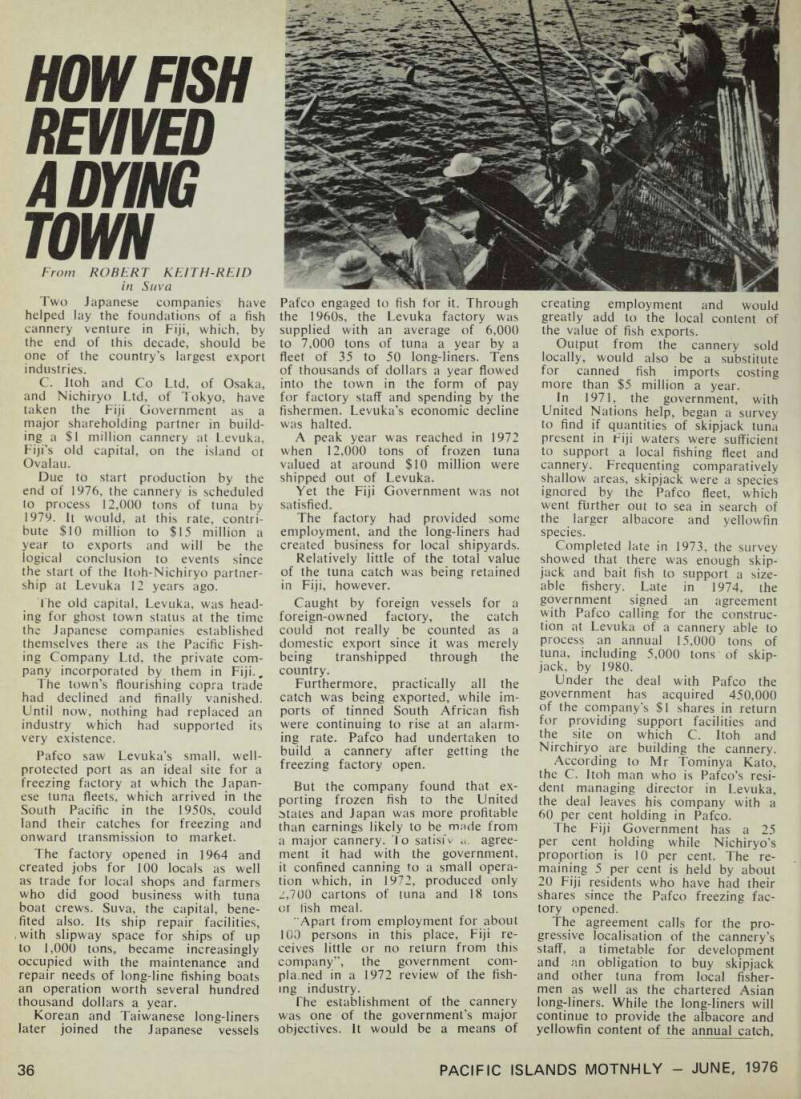
Pafco saw Levuka’s small, well protected port as an ideal site for a freezing factory at which the Japan ese tuna fleets, which arrived in the South Pacific in the 19505, could land their catches for freezing and onward transmission to market.
The factory opened in 1964 and created jobs for 100 locals as well as trade for local shops and farmers who did good business with tuna boat crews. Suva, the capital, bene fited also. Its ship repair facilities, with slipway space for ships of up to 1,000 tons, became increasingly occupied with the maintenance and repair needs of long-line fishing boats an operation worth several hundred thousand dollars a year.
Korean and Taiwanese long-liners later joined the Japanese vessels
Pafco engaged to fish for it. Through the 19605, the Levuka factory was supplied with an average of 6,000 to 7,000 tons of tuna a year by a fleet of 35 to 50 long-liners. Tens of thousands of dollars a year flowed into the town in the form of pay for factory staff and spending by the fishermen. Levuka’s economic decline was halted.
A peak year was reached in 1972 when 12,000 tons of frozen tuna valued at around $lO million were shipped out of Levuka.
Yet the Fiji Government was not satisfied.
The factory had provided some employment, and the long-liners had created business for local shipyards.
Relatively little of the total value of the tuna catch was being retained in Fiji, however.
Caught by foreign vessels for a
foreign-owned factory, the catch
could not really be counted as a domestic export since it was merely
being transhipped through the
country.
Furthermore, practically all the catch was being exported, while im ports of tinned South African fish were continuing to rise at an alarm ing rate. Pafco had undertaken to build a cannery after getting the freezing factory open.
But the company found that ex porting frozen fish to the United states and Japan was more profitable than earnings likely to be made from a major cannery. To satisfy a. agree ment it had with the government, it confined canning to a small opera tion which, in 1972, produced only 2,700 cartons of tuna and 18 tons or fish meal.
"Apart from employment for about 100 persons in this place, Fiji re ceives little or no return from this company”, the government com pla.ned in a 1972 review of the fish ing industry.
The establishment of the cannery was one of the government’s major objectives. It would be a means of
creating employment and would greatly add to the local content of the value of fish exports.
Output from the cannery sold locally, would also be a substitute for canned fish imports costing more than $5 million a year.
In 1971, the government, with United Nations help, began a survey to find if quantities of skipjack tuna present in Fiji waters were sufficient to support a local fishing fleet and cannery. Frequenting comparatively shallow areas, skipjack were a species ignored by the Pafco fleet, which went further out to sea in search of the larger albacore and yellowfin species.
Completed late in 1973, the survey showed that there was enough skip jack and bait fish to support a size able fishery. Late in 1974, the government signed an agreement with Pafco calling for the construc tion at Levuka of a cannery able to process an annual 15,000 tons of tuna, including 5,000 tons of skip jack, by 1980.
Under the deal with Pafco the government has acquired 450,000 of the company’s $1 shares in return for providing support facilities and the site on which C. Itoh and Nirchiryo are building the cannery.
According to Mr Tominya Kato, the C. Itoh man who is Pafco’s resi dent managing director in Levuka, the deal leaves his company with a 60 per cent holding in Pafco.
The Fiji Government has a 25 per cent holding while Nichiryo’s proportion is 10 per cent. The re maining 5 per cent is held by about 20 Fiji residents who have had their shares since the Pafco freezing fac tory opened.
The agreement calls for the pro gressive localisation of the cannery’s staff, a timetable for development and an obligation to buy skipjack and other tuna from local fisher men as well as the chartered Asian long-liners. While the long-liners will continue to provide the albacore and yellowfin content of the annual catch,
Continued from page 36. skipjack would be caught by a fleet of nine ships the Fiji Government will build during 1976-1980.
These will be operated by the Ika Corporation, a government owned company formed to manage the fish ing fleet and to charter other ships as needed.
A Japanese skipjack catcher the corporation chartered for an initial nine months, arrived in January to train local seamen in fishing tech niques and to catch fish for the can nery. It landed its first catch, 40 tons, at Levuka after a two-week trip.
Exports of frozen tuna will pro gressively fall as more is sent for canning. By 1980 the cannery should be processing 12,000 tons of fish a year, yielding 650,000 cases of prime-quality brine pack and up to 5,000,000 half-pound cans of tuna flakes.
Local sales of canned fish are expected to replace 35 per cent to 40 per cent of unt is imported for local consumption. As a sideline, the cannery will produce about 700 tons of meal a year suitable for poultry and pig feed.
Mr Kato, 48, formerly assistant manager in C. Itoh’s marine depart ment, expects the canned skipjack o find a market in Britain. Albacore and yellowfin will continue to go to the long-established United States and Japanese markets.
He is confident about the joint enterprise’s future, which, he says, is being launched at a time when the size of annual catches and prices are beginning to recover. Catches have slumped since the record 12,000 tons taken in 1972 and in recent years have averaged 7,000-8,000 tons.
Last year's was down to 5,000 tons.
The reasons for the drop are not known, except that tuna just were not around in their former quantities.
But albacore and yellowfin stocks seem to be recovering now, and to gether with 1,000 tons of skipjack due to be supplied by the Fiji Government fleet, landings this year are expected to reach 8,000 tons.
When in full operation the can nery will add real earnings worth at least $lO million a year to export income.
Pafco’s annual payroll—now cost ing $250,000 a year for the 100 locals employed by it—will swell proportionately as the cannery force builds up to a projected level of 400.
And while the size of the chart ered long-line fleet is expected to remain constant at about 35 to 45 vessels, the new local skipjack fleet the cannery will support is expected to create a further 200 to 300 new jobs.