Tonga’S Royal’ Sumo Wrestlers
p. 35 · Read in the full issue
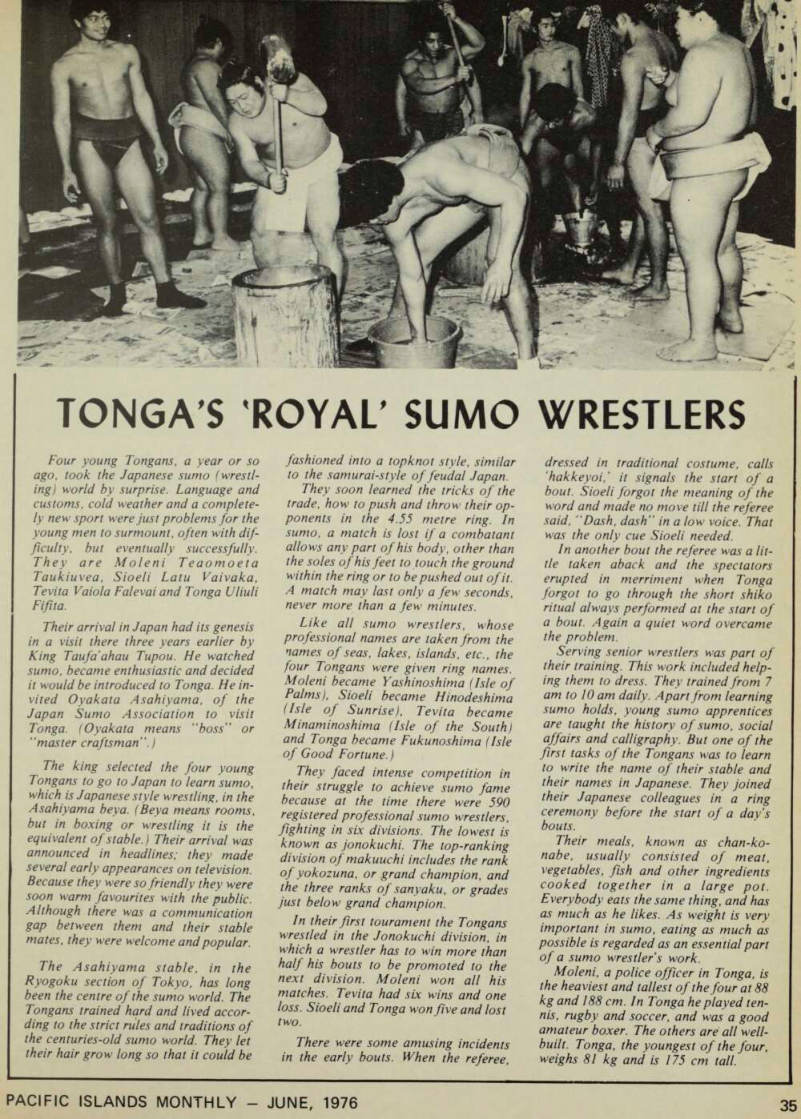
Four young Tongans, a year or so ago, took the Japanese sumo (wrestl ing) world by surprise. Language and customs, cold weather and a complete ly new sport were just problems for the young men to surmount, often with dif ficulty, but eventually successfully.
They are Moleni Teaomoeta Taukiuvea, Sioeli Latu Vaivaka, Tevita Vaiola Falevai and Tonga Uliuli Fifita.
Their arrival in Japan had its genesis in a visit there three years earlier by King Taufa’ahau Tupou. He watched sumo, became enthusiastic and decided it would be introduced to Tonga. He in vited Oyakata Asahiyama, of the Japan Sumo Association to visit Tonga. (Oyakata means "boss” or "master craftsman”.) The king selected the four young Tongans to go to Japan to learn sumo, which is Japanese style wrestling, in the Asahiyama beya. (Beya means rooms, but in boxing or wrestling it is the equivalent of stable.) Their arrival was announced in headlines: they made several early appearances on television.
Because they were so friendly they were soon warm favourites with the public.
Although there was a communication gap between them and their stable mates, they were welcome and popular.
The Asahiyama stable, in the Ryogoku section of Tokyo, has long been the centre of the sumo world. The Tongans trained hard and lived accor ding to the strict rules and traditions of the centuries-old sumo world. They let their hair grow long so that it could be
fashioned into a topknot style, similar to the samurai-style of feudal Japan.
They soon learned the tricks of the trade, how to push and throw their op ponents in the 4.55 metre ring. In sumo, a match is lost if a combatant allows any part of his body, other than the soles of his feet to touch the ground within the ring or to be pushed out of it.
A match may last only a few seconds, never more than a few minutes.
Like all sumo wrestlers, whose professional names are taken from the names of seas, lakes, islands, etc., the four Tongans were given ring names.
Moleni became Yashinoshima (Isle of Palms), Sioeli became Hinodeshima (Isle of Sunrise), Tevita became Minaminoshima (Isle of the South) and Tonga became Fukunoshima (Isle of Good Fortune.) They faced intense competition in their struggle to achieve sumo fame because at the time there were 590 registered professional sumo wrestlers, fighting in six divisions. The lowest is known as jonokuchi. The top-ranking division of makuuchi includes the rank of yokozuna. or grand champion, and the three ranks of sanyaku, or grades just below grand champion.
In their first tourament the Tongans wrestled in the Jonokuchi division, in which a wrestler has to win more than half his bouts to be promoted to the next division. Moleni won all his matches. Tevita had six wins and one loss. Sioeli and Tonga won five and lost two.
There were some amusing incidents in the early bouts. When the referee,
dressed in traditional costume, calls ‘hakkeyoi,’ it signals the start of a bout. Sioeli forgot the meaning of the word and made no move till the referee said. 'Dash, dash” in a low voice. That was the only cue Sioeli needed.
In another bout the referee was a lit tle taken aback and the spectators erupted in merriment when Tonga forgot to go through the short shiko ritual always performed at the start of a bout. Again a quiet word overcame
the problem.
Serving senior wrestlers was part of their training. This work included help ing them to dress. They trained from 7 am to 10 am daily. Apart from learning sumo holds, young sumo apprentices are taught the history of sumo, social affairs and calligraphy. But one of the first tasks of the Tongans was to learn to write the name of their stable and their names in Japanese. They joined their Japanese colleagues in a ring ceremony before the start of a day’s bouts.
Their meals, known as chan-ko nabe, usually consisted of meat, vegetables, fish and other ingredients cooked together in a large pot.
Everybody eats the same thing, and has as much as he likes. As weight is very important in sumo, eating as much as possible is regarded as an essential part of a sumo wrestler’s work.
Moleni, a police officer in Tonga, is the heaviest and tallest of the four at 88 kg and 188 cm. In Tonga he played ten nis, rugby and soccer, and was a good amateur boxer. The others are all well built. Tonga, the youngest of the four, weighs 81 kg and is 175 cm tall.