A New Phenomenon
pp. 44-45 · Read in the full issue
In The Pacific
From FELISE VA'A in Pago Pago
Japanese investments in the Samoas are very small, compared with their in vestments in places like Guam. However, Japanese interest in the Samoas is in creasing. In the entertainment world, for instance, Japanese businessmen are en ticing groups of top Samoan entertainers every year for six or more months engagements in Japanese hotels and restaurants.
The Japanese first became interested in Samoa's fishing industry in the early 19505. In 1954, they proved that large amounts of tuna could be fished from the coastal areas around the Samoas and their success made it possible for the Van Camp Seafood Co of California, to create a profitable fish canning industry in Pago Pago, American Samoa. For the first few years of this operation, Japanese fishing boats were largely responsible for supply ing the cannery.
In the 19605, however, the Japanese fishing companies began to pull out their fishing fleets from American Samoa. This was partly because of the diminished supp ly of tuna nearer American Samoa, but mostly to increased costs of Japanese labour. By 1970,, Japanese fishing boats
had practically disappeared from
American Samoa. Their places were taken by fishing boats from Taiwan and Korea, where labour costs were much cheaper than Japan.
Today, there is not a single Japanese fishing boat in American Samoa.
However, there are two Japanese fisheries companies still operating here, Taiyo
Fishery and Marine Trading (South Sea) Inc. Both are headquartered in Tokyo, and function as agents for about 24 Taiwanese boats.
Hitoshi Tanaka, Taiyo’s new manager, said both Star Kist and Van Camp canneries employ about 25 Taiwanese boats and 80 Korean boats. These have been contracted to the canneries usually for a period of from one to two years, but come under the management of the various fishery companies here.
Touhru Shibata, manager of Marine Trading Inc, said his company previously managed 70 Taiwanese and two Korean training boats. Now it controls only 12 Taiwanese boats.
Shibata and his assistant, Naohiko Kamiji, arrived here on November I, 1972.
These, then, are the only Japanese businesses in American Samoa, unless one is also to count businesses run by part- Japanese entrepreneurs, Toko and Shimasaki. Shimasaki has for many years operated retail stores in the territory. Toko began five years ago with a wholesale business. Late in 1974, he opened a super market, one of the most thriving in the territory.
Japanese investments in Western Samoa are a comparatively new phenomenon.
Since independence in 1962, teams of Japanese ethnologists have visited Western Samoa to study its culture and govern ment. They were impressed by the stability
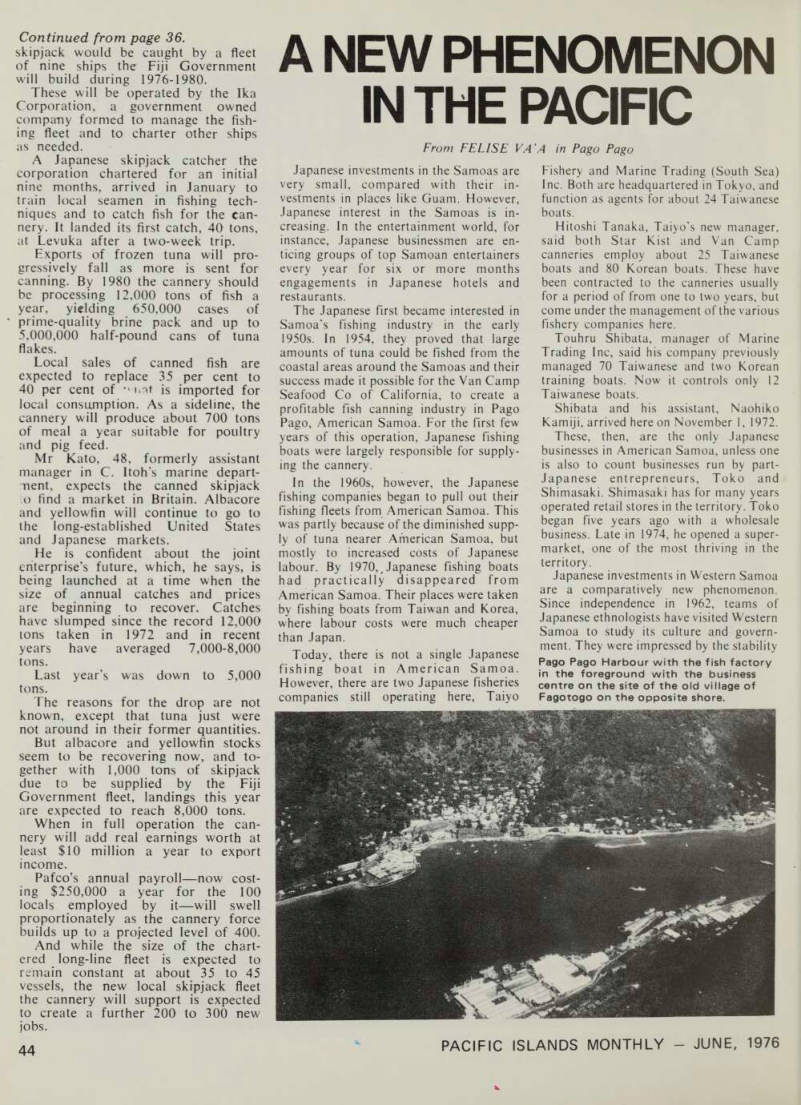
Pago Pago Harbour with the fish factory in the foreground with the business centre on the site of the old village of Fagotogo on the opposite shore.
of Western Samoan society and by the country’s potential for investment and became good ambassadors for Western Samoa back in Japan.
They helped sell Western Samoa to the Japanese Government and businessmen.
By 1968, the Japanese were beginning to gain a foothold in Western Samoa. In that year, they established New Samoa In dustries, engaged chiefly in logging, mill ing, seasoning and sale of timbers primari ly for the local market.
According to Hans Kruse, Director of the Department of Economic Develop ment, the authorised capital of the com pany is $200,000 of which Japanese in terests hold 58 per cent. In 1974, the com
pany expanded operations in the produc
tion of timber, manufacturing of first-class furniture for export and production of taro and banana cases for Western Samoan ex ports.
Last year the company employed 75 workers and produced 1,000 cu ft of logs a day. Fifty per cent of the logs are used to produce sawn timber for the local market, and fifty per cent for furniture and case
production.
“Both the initial establishment and the expansion into production of banana and taro shooks were encouraged by the government through tax and duty incen tives,” Kruse said.
Key positions in New Samoa Industries Ltd are held by Japanese but there is a move to gradually replace them with
qualified Samoans.
Kruse reports that there are four other Japanese tradesmen working in the fields of construction and production of footwear and the Western Samoa Government is on the point of approving a proposal from Nippon View Hotel Co Ltd for the con struction of a hotel at Cape Lefatu, several miles from Faleolo airport. This will be a joint venture involving a local enterprise.
The proposal had earlier been postponed because of the world-wide recession and consequent slump in tourism, Kruse said.
The new SUS 4 million hotel will have 150 rooms with beach side facilities such as piers for sightseeing, glass-bottom boats for rides through the coral lagoons, fishing boats, beaches and a yacht harbour.
Nippon View owns and operates the Narita First City Hotel, Nasu View Hotel and Irako View Hotel in Japan. It is also engaged in real estate, operating sightsee ing facilities, plays, shows and motion pic tures.
Lower prices, superior qualities and a swift, sure supply of spare parts these are the factors which have enabled Japanese car manufacturers to win their
dominating position.
The first Japanese cars did not make a good impression when they arrived in the early 19605. They looked old-fashioned, even ugly, compared with European makes. Many had serious defects.