Magazine Section
pp. 37-45 · Read in the full issue
Tourists Are Flocking To Easter,
The Island Of Brooding Statues
By Dr Jim Boutilier
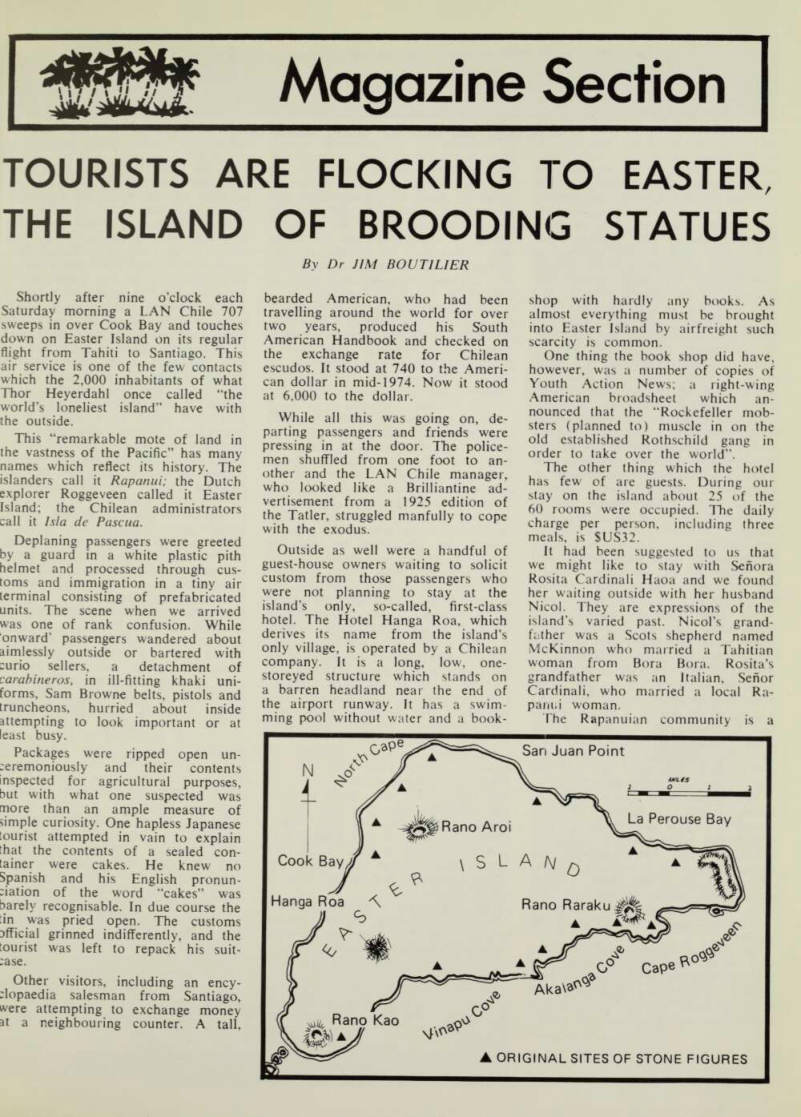
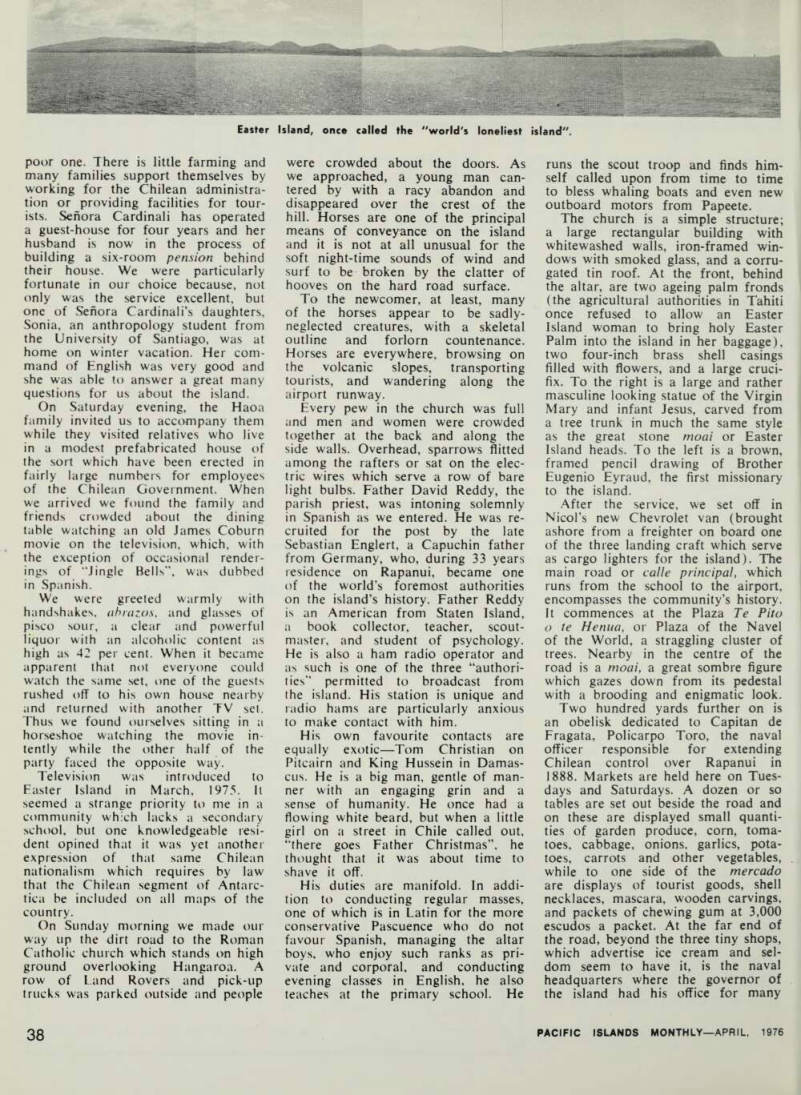
Shortly after nine o’clock each Saturday morning a LAN Chile 707 sweeps in over Cook Bay and touches down on Easter Island on its regular flight from Tahiti to Santiago. This air service is one of the few contacts which the 2,000 inhabitants of what Thor Heyerdahl once called “the world’s loneliest island” have with the outside.
This “remarkable mote of land in the vastness of the Pacific” has many names which reflect its history. The islanders call it Rapanui; the Dutch explorer Roggeveen called it Easter Island; the Chilean administrators call it Isla de Pascua.
Deplaning passengers were greeted by a guard in a white plastic pith helmet and processed through cus toms and immigration in a tiny air terminal consisting of prefabricated □nits. The scene when we arrived was one of rank confusion. While onward’ passengers wandered about aimlessly outside or bartered with curio sellers, a detachment of camhineros, in ill-fitting khaki uni forms, Sam Browne belts, pistols and truncheons, hurried about inside attempting to look important or at least busy.
Packages were ripped open un ceremoniously and their contents inspected for agricultural purposes, but with what one suspected was more than an ample measure of simple curiosity. One hapless Japanese tourist attempted in vain to explain that the contents of a sealed con tainer were cakes. He knew no Spanish and his English pronun ciation of the word “cakes” was barely recognisable. In due course the tin was pried open. The customs Dfficial grinned indifferently, and the tourist was left to repack his suit case.
Other visitors, including an ency clopaedia salesman from Santiago, were attempting to exchange money at a neighbouring counter. A tall,
bearded American, who had been travelling around the world for over two years, produced his South American Handbook and checked on the exchange rate for Chilean escudos. It stood at 740 to the Ameri can dollar in mid-1974. Now it stood at 6,000 to the dollar.
While all this was going on, de parting passengers and friends were pressing in at the door. The police men shuffled from one foot to an other and the LAN Chile manager, who looked like a Brilliantine ad vertisement from a 1925 edition of the Tatler, struggled manfully to cope with the exodus.
Outside as well were a handful of guest-house owners waiting to solicit custom from those passengers who were not planning to stay at the island’s only, so-called, first-class hotel. The Hotel Hanga Roa, which derives its name from the island’s only village, is operated by a Chilean company. It is a long, low, one storeyed structure which stands on a barren headland near the end of the airport runway. It has a swim ming pool without water and a book
shop with hardly any books. As almost everything must be brought into Easter Island by airfreight such scarcity is common.
One thing the book shop did have, however, was a number of copies of Youth Action News; a right-wing American broadsheet which an nounced that the “Rockefeller mob sters (planned to) muscle in on the old established Rothschild gang in order to take over the world”.
The other thing which the hotel has few of are guests. During our stay on the island about 25 of the 60 rooms were occupied. The daily charge per person, including three meals, is SUS 32.
It had been suggested to us that we might like to stay with Sehora Rosita Cardinali Haoa and we found her waiting outside with her husband Nicol. They are expressions of the island’s varied past. Nicol’s grand father was a Scots shepherd named McKinnon who married a Tahitian woman from Bora Bora. Rosita’s grandfather was an Italian, Senor Cardinali, who married a local Ra
pariui woman.
The Rapanuian community is a
poor one. There is little farming and many families support themselves by working for the Chilean administra tion or providing facilities for tour ists. Senora Cardinali has operated a guest-house for four years and her husband is now in the process of building a six-room pension behind their house. We were particularly fortunate in our choice because, not only was the service excellent, but one of Senora Cardinali’s daughters, Sonia, an anthropology student from the University of Santiago, was at home on winter vacation. Her com mand of English was very good and she was able to answer a great many questions for us about the island.
On Saturday evening, the Haoa family invited us to accompany them while they visited relatives who live in a modest prefabricated house of the sort which have been erected in fairly large numbers for employees of the Chilean Government. When we arrived we found the family and friends crowded about the dining table watching an old James Coburn movie on the television, which, with the exception of occasional render ings of “Jingle Bells”, was dubbed in Spanish.
We were greeted warmly with handshakes, ahrazos, and glasses of pisco sour, a clear and powerful liquor with an alcoholic content as high as 42 per cent. When it became apparent that not everyone could watch the same set, one of the guests rushed off to his own house nearby and returned with another TV set.
Thus we found ourselves sitting in a horseshoe watching the movie in tently while the other half of the party faced the opposite way.
Television was introduced to Easter Island in March, 1975. It seemed a strange priority to me in a community which lacks a secondary school, but one knowledgeable resi dent opined that it was yet another expression of that same Chilean nationalism which requires by law that the Chilean segment of Antarc tica be included on all maps of the country.
On Sunday morning we made our way up the dirt road to the Roman Catholic church which stands on high
ground overlooking Hangaroa. A
row of Land Rovers and pick-up trucks was parked outside and people
were crowded about the doors. As we approached, a young man can tered by with a racy abandon and disappeared over the crest of the hill. Horses are one of the principal means of conveyance on the island and it is not at all unusual for the soft night-time sounds of wind and surf to be broken by the clatter of hooves on the hard road surface.
To the newcomer, at least, many of the horses appear to be sadly neglected creatures, with a skeletal outline and forlorn countenance.
Horses are everywhere, browsing on the volcanic slopes, transporting tourists, and wandering along the airport runway.
Every pew in the church was full and men and women were crowded together at the back and along the side walls. Overhead, sparrows flitted among the rafters or sat on the elec tric wires which serve a row of bare light bulbs. Father David Reddy, the parish priest, was intoning solemnly in Spanish as we entered. He was re cruited for the post by the late Sebastian Englert, a Capuchin father from Germany, who, during 33 years residence on Rapanui, became one of the world’s foremost authorities on the island’s history. Father Reddy is an American from Staten Island, a book collector, teacher, scout master, and student of psychology.
He is also a ham radio operator and as such is one of the three “authori ties” permitted to broadcast from the island. His station is unique and radio hams are particularly anxious to make contact with him.
His own favourite contacts are equally exotic—Tom Christian on Pitcairn and King Hussein in Damas cus. He is a big man, gentle of man ner with an engaging grin and a sense of humanity. He once had a flowing white beard, but when a little girl on a street in Chile called out, “there goes Father Christmas”, he thought that it was about time to shave it off.
His duties are manifold. In addi tion to conducting regular masses, one of which is in Latin for the more conservative Pascuence who do not favour Spanish, managing the altar boys, who enjoy such ranks as pri vate and corporal, and conducting evening classes in English, he also teaches at the primary school. He
runs the scout troop and finds him self called upon from time to time to bless whaling boats and even new outboard motors from Papeete.
The church is a simple structure; a large rectangular building with whitewashed walls, iron-framed win dows with smoked glass, and a corru gated tin roof. At the front, behind the altar, are two ageing palm fronds (the agricultural authorities in Tahiti once refused to allow an Easter Island woman to bring holy Easter Palm into the island in her baggage), two four-inch brass shell casings filled with flowers, and a large cruci fix. To the right is a large and rather masculine looking statue of the Virgin Mary and infant Jesus, carved from a tree trunk in much the same style as the great stone moai or Easter Island heads. To the left is a brown, framed pencil drawing of Brother Eugenio Eyraud, the first missionary to the island.
After the service, we set off in Nicol’s new Chevrolet van (brought ashore from a freighter on board one of the three landing craft which serve as cargo lighters for the island). The main road or calle principal, which runs from the school to the airport, encompasses the community’s history.
It commences at the Plaza Te Pito o te Henua, or Plaza of the Navel of the World, a straggling cluster of trees. Nearby in the centre of the road is a moai, a great sombre figure which gazes down from its pedestal with a brooding and enigmatic look.
Two hundred yards further on is an obelisk dedicated to Capitan de Fragata, Policarpo Toro, the naval officer responsible for extending Chilean control over Rapanui in 1888. Markets are held here on Tues days and Saturdays. A dozen or so tables are set out beside the road and on these are displayed small quanti ties of garden produce, corn, toma toes, cabbage, onions, garlics, pota toes, carrots and other vegetables, while to one side of the mercado are displays of tourist goods, shell necklaces, mascara, wooden carvings, and packets of chewing gum at 3,000 escudos a packet. At the far end of the road, beyond the three tiny shops, which advertise ice cream and sel dom seem to have it, is the naval headquarters where the governor of the island had his office for many
Easter Island, once called the "world's loneliest island".
years. At this point, near the tele graph office the road turns and runs along the northern side of the run way.
On the southern side of the airstrip is a dark grove of eucalyptus trees.
A small party of American service men have their camp here. United States military personnel came to Easter Island in 1966 and remained there until the early 1970 s when the accession to power of the Allende regime necessitated their withdrawal.
They left behind a water and electric system for Hangaroa as well as such Pascuence colloquialisms as “no problem”.
Now they are back, ostensibly to conduct measurements of sea level, but more probably, one of my in formants surmised, to maintain a distant watch on the French nuclear tests at Mururoa. Some of the people, he observed, were “delirious with joy” at the prospect of their return.
It seems they found the relaxed and generous attitude of the Americans highly attractive; an interesting parallel with some of the cargo cults of Melanesia. Beyond the main gate of the airport is a small rock-crush ing plant. Each day heavy-duty lorries rumble across the island bringing rock to be processed into various grades of gravel. Some of the gravel is used for making concrete blocks and some for building up the found ation of the runway extension.
It is extremely easy to obtain rock on Easter Island. The landscape is littered with volcanic debris. It is as if the fields of waving grass had been sown with boulders. From a distance this sea of dragons’ teeth
give many parts of the island a sooty appearance. It is alleged that the war fare which racked Rapanui in the 1600 s may have had its origin in a dispute over these rocks. Tradition has it that the Hanau Eepe, or late comers to the island, wanted the Hanau Momoko, or the original in habitants, to clear all the stones from the land and dump them into the ocean. The Hanau Eepe resided for the most part on the slopes of Poike, the volcano at the eastern end of Rapanui and the smooth, largely stone-free flanks of the mountain lend credence to the story. The Hanau Momoko refused to undertake the task and fighting broke out.
On another occasion rocks were dumped into the sea. A breakwater was being constructed at the tiny harbour of Hangaroa and one of the neighbouring ahu, or funeral plat forms on which the moai stood, was destroyed in order to obtain stone; a tragic event on an island where stone is so plentiful.
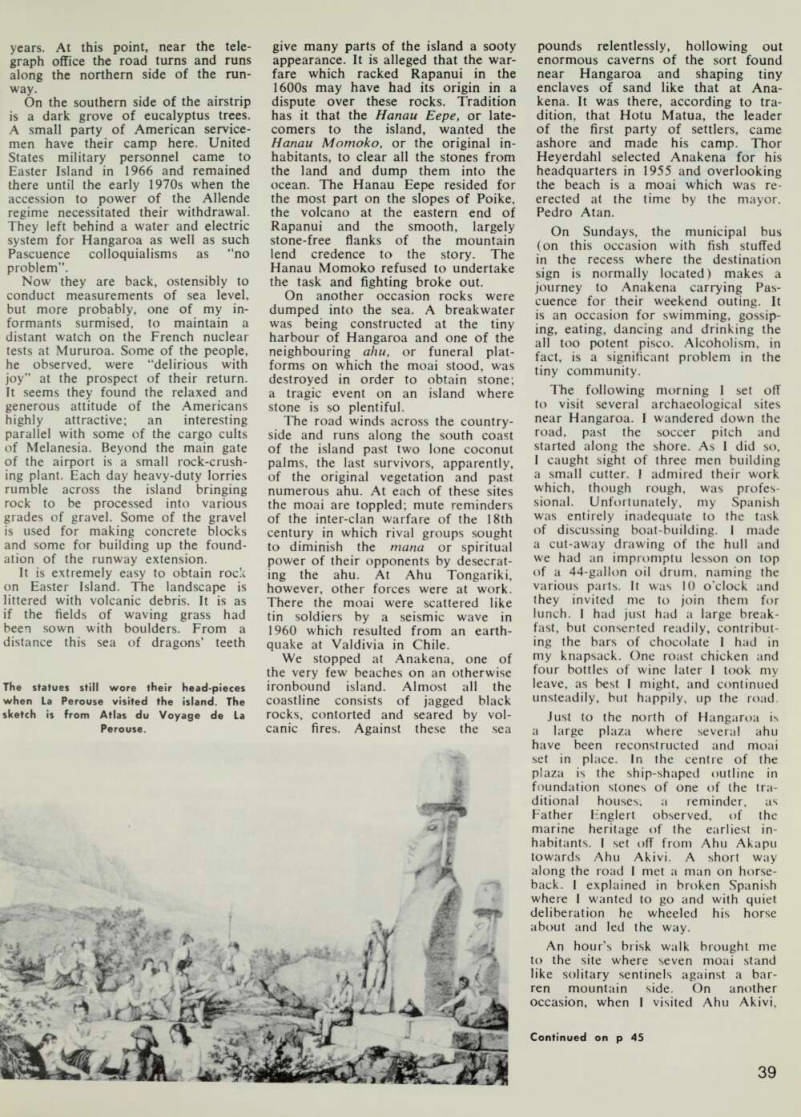
The road winds across the country side and runs along the south coast of the island past two lone coconut palms, the last survivors, apparently, of the original vegetation and past numerous ahu. At each of these sites the moai are toppled; mute reminders of the inter-clan warfare of the 18th century in which rival groups sought to diminish the mana or spiritual power of their opponents by desecrat ing the ahu. At Ahu Tongariki, however, other forces were at work.
There the moai were scattered like tin soldiers by a seismic wave in 1960 which resulted from an earth quake at Valdivia in Chile.
We stopped at Anakena, one of the very few beaches on an otherwise ironbound island. Almost all the coastline consists of jagged black rocks, contorted and seared by vol canic fires. Against these the sea
pounds relentlessly, hollowing out enormous caverns of the sort found near Hangaroa and shaping tiny enclaves of sand like that at Ana kena. It was there, according to tra dition, that Hotu Matua, the leader of the first party of settlers, came ashore and made his camp. Thor Heyerdahl selected Anakena for his headquarters in 1955 and overlooking the beach is a moai which was re erected at the time by the mayor, Pedro Atan.
On Sundays, the municipal bus (on this occasion with fish stuffed in the recess where the destination sign is normally located) makes a journey to Anakena carrying Pas cuence for their weekend outing. It is an occasion for swimming, gossip ing, eating, dancing and drinking the all too potent pisco. Alcoholism, in fact, is a significant problem in the tiny community.
The following morning I set off to visit several archaeological sites near Hangaroa. I wandered down the road, past the soccer pitch and started along the shore. As I did so, I caught sight of three men building a small cutter. I admired their work which, though rough, was profes sional. Unfortunately, my Spanish was entirely inadequate to the task of discussing boat-building. 1 made a cut-away drawing of the hull and we had an impromptu lesson on top of a 44-gallon oil drum, naming the various parts. It was 10 o’clock and they invited me to join them for lunch. I had just had a large break fast, but consented readily, contribut ing the bars of chocolate I had in my knapsack. One roast chicken and four bottles of wine later I took my leave, as best I might, and continued unsteadily, but happily, up the road.
Just to the north of Hangaroa is a large plaza where several ahu have been reconstructed and moai set in place. In the centre of the plaza is the ship-shaped outline in foundation stones of one of the tra ditional houses, a reminder, as Father Englert observed, of the marine heritage of the earliest in habitants. I set off from Ahu Akapu towards Ahu Akivi. A short way along the road I met a man on horse back. I explained in broken Spanish where I wanted to go and with quiet deliberation he wheeled his horse about and led the way.
An hour’s brisk walk brought me to the site where seven moai stand like solitary sentinels against a bar ren mountain side. On another occasion, when I visited Ahu Akivi,
Continued on p 45
The statues still wore their head-pieces when La Perouse visited the island. The sketch is from Atlas du Voyage de La Perouse.
ree trucks appeared over the crest a hill. Almost before they had me to a halt a party of French urists tumbled out of them and 'armed over the ahu like a com iny of marines storming ashore, ley had flown from Santiago on e Thursday flight which arrives at 50 and were scheduled to leave at .20 on Saturday morning; a 4,600 ile journey in order to spend one y on Easter Island.
The island is experiencing an un pected boom in tourism even ?ugh July and August are the “off ison”. Whereas a year ago 707 s ide the journey with 30 or 40 ssengers, now they are sold out. fact on a recent flight the airline d confirmed bookings for 10 seats >re than there were places on the craft and a number of wait-listed ssengers, ourselves included, were ced to stay on the island for an icr week.
Phis was not a hardship. We
passed our time visiting the wind swept summit of Rano Kau and the moai “factory” at Rano Raraku. This volcano is the most famous of the Easter Island sites. Dozens of moai stand in the shadow of the weathered outer face of the massif; some are upright and alert while others are tilted crazily or sprawled on the grassy slopes. They are silent and eyeless. Above them, hewn in the rock are partly completed figures, abandoned centuries ago.
We clambered up to the highest point of the crater lip and sat for the longest time gazing out across the countryside. We were absolutely alone. The only sounds were those of the wind, the crickets and the hawks wheeling below. The solitude reminded us of the words written by Mrs Routledge, the leader of a British expedition to Easter Island in 1914. “Everywhere”, she wrote, “is the wind of heaven; around and above all are boundless sea and sky, infinite space and a great silence”.