for Fiji's politicians
pp. 33-35 · Read in the full issue
Land hunger, a hot potato for Fiji's politicians
From ROBERT KEITH-REID in Suva
Ehe Leader of the Opposition in i proclaims: “My cup of dis isionment on the land question is I!” The Prime Minister looks be sed and asked the Opposition ider to define what the land ques i is, >ver on the Island of Taveuni. :ans, who for years have let Indian tner Ashrak Khan till a bit of ir fertile land, suddenly tell him get off; he must; he hasn’t got a ;e, and he has to leave $25,000th of maturing crops behind. 4ear Suva an Indian family wakes find that their tin shack house been ringed in by a barbed wire :e; the Fijians from who they e the land they occupy are hint they want more rent, iji’s biggest landlord, the Native id Trust Board, suddenly realises owed arrears of rent by most of 27,000 or so tenants —just a m,' of $3,700,000. d Nausori Mohammed Hussein defiantly; the NLTB has pointed to him that he is improperly g the Fijian land leased to him agricultural use and using it for istrial purposes instead, and that lias illegally built a house on the 1 only four years before the lease res. [ can vacate the land in a matter minutes”, he says, “if I get 000 compensation”.
Ir lan Thomson, independent irman of the Sugar Industry, irman of the Coconut Board, of the most widely-respected trusted persons in Fiji, says its ise talking about increasing sugar •ut, or any other agricultural out until the Indian tenant small lers, who do most of the growing, n that their tenure is safe, he House of Representatives has 1 nothing to improve the land re situation, he laments—“ln l the House positively caused un linties to develop in the minds many cane growers because of imotional debate on the issue”.
Whatever emotions are aroused the land problem, land is the est, most vexatious question that
there is in Fiji, and it looks as if it is, at last coming to a head.
Eighty-two per cent of Fiji land is communally owned by 250,000 native Fijians. They can’t sell it, but they can lease it.
What little freehold there is— eight per cent of the total land area —is completely insufficient to satisfy the land-hunger of most non-Fijians, and they are mostly the descendants of indentured labourers brought from India to work sugar plantations.
Most Fiji Indians are farmers.
Those who have not been able to buy land must lease it.
They do so through the NLTB, the statutory organisation in which all Fijian land is vested.
More than 20,000 Indian tenant farmers have the board as their land lord. The relationship between the two parties has never been an easy one.
The relationship between all Fiji agricultural tenants and landlords is ruled by the Agricultural Landlord and Tenant Ordinance, a 1966 bit of legislation supposed to give a ten ant more security on the grounds that insecurity is a prime factor retarding agricultural developments.
But the ordinance, usually referred to as Alto, had a bit of a backlash effect and actually causes more dis content.
Before Alto, tenants usually man aged to get leases of about 30 years.
Alto said leases had to be for a minimum of 10 years, with the prob ability of an automatic 10-year ex tension, if the landlord could not show that he needed the land for his own use, plus a second 10-year extension under the same circum stances.
The NLTB promptly took the minimum as a maximum and tenants soon came to complain: “What’s the use of doing much with the land if we might have to leave it after 10 years?”
The Fijians had gripes also. They said that at the end of the first 10 years they found it hard to prove that they had a case for getting the leased land back.
It was reported in February that 477 Fijian canefarmers in Na droga Province, one of the choice cane areas in the country, failed to plant any cane in 1975. The loss of that production would cost Fiji several hundred thousand! dollars. IVadroga farmers usually harvest about 200,000 tons of cane annually. In 1975, the har vest was down to about 150,000 tons, and the Fijians, more so than their Indian counterparts, were to blame.
A committee to review Alto was appointed in 1969.
But, what with changes in mem bers, changes in government, and, not least of all, the sheer complexity of the issues involved, the report of its findings wasn’t published until late last year.
Even then it wasn’t a unanimous one. Basically, however, it said the minimum lease should be for 33 years and that a statutory board should be established to set fair farm rents.
A Fijian member of the commit tee was all for the retention of the 10-year minimum while some Indian members said the Crown at least should grant leases of 99 years dura tion, if not in perpetuity.
Towards the end of last year.
Prime Minister Ratu Sir Kamisese Mara said the Alliance Government accepted most of the report.
This year, legislation would be brought in to set the minimum lease period at 30 years while farm rents would be limited to a maximum of six per cent of the unimproved capi tal value of the property concerned.
Referring to the years it had taken to decide on reforms to Alto, the Prime Minister commented: “It has been a lengthy process, but too im portant to be rushed”.
Unfortunately, the decision has far from appeased the National Federation Party leader, Mr Siddiq Koya.
In a series of speeches to farmers, from whom his party draws a good deal of its support, he has adopted an increasingly belligerent stance.
He has repeatedly accused the Alljance of breaking a promise to maintain constant close consultation with the NFP on land tenure issues on which, he says, Fiji’s whole future hangs.
Other NFP personalities have fre quently alleged that Alliance poli ticians use the land issue as a tool to try to win supporters away from the NFP.
What they do, the NFP men say, is go round offering to arrange long leases for farmers in return for their political support.
Speaking to 500 farmers in the Ba farming district in January, Mr Koya said that unless the land prob lem was solved quickly, Fiji would have “the biggest political and in dustrial confrontation in its history”.
Farmers had caused upheavals before and, he promised, they were ready to do so again.
“Fiji would be like a Timor” he predicted.
According to Mr Koya, the Alli ance doesn’t really want to touch the existing tenure set-up for fear of losing Fijian votes.
As the political temperature over land begins to rise dangerously, so are feelings about another aspect of the question.
For years the NLTB was a ram shackle, frustrating and highly inefficient organisation.
Tenants who had to deal with it had just cause for resentment about the treatment they got. Getting a lease out of the board, or any other dealing was a trip part-way along the path to insanity.
Apart from being stupid, disin terested or just plain anti, some NLTB officials were also corrupt; a lease might cost somewhat more than just lease money.
The NLTB woke up to its faults about seven years ago and began praiseworthy efforts to reform. Its administration has been drastically reorganised, people have been fired, outside expertise brought in and much of the routine processes are now even done by electronic com puter.
Efficiency has highlighted one glaring fact—that while some ten ants have been mistreated, others have been getting away with murder.
They have not being paying rent on time, if at all, and have blatantly ignored the terms of their leases.
At the end of 1975 the board was owed $3,718,606 in rent arrears.
Two years ago it began a drive to collect the money. At the outset it went kindly; it just asked the de faulters to be good and pay up.
The board got some response, but not enough.
So it began to get tougher.
Tenants, who did not pay up, faced eviction or would not get ex piring leases renewed, it warned, and began issuing warning notices as a first step to court actions.
In January, the NLTB’s manager, Mr Josefata Kamikamica, said a lot of tenants were still being “stubborn”.
Only a small number of cane farmers had paid promptly.
In February, the NLTB declared that it had been “too lenient to the point where its rights and integrity and those of the landowners have Been threatened”.
“Some tenants have sorely tested the patience of the landowners and the NLTB, When the latter have tried to be as reasonable as possible they have taken advantage of this reasonable attitude to presume the board’s consent”.
In the same month, it issued orders to a large number of tenants in the area around the market town of Nausori to quit their land due to breach of lease agreements. Others were told to pay money that was due or face eviction.
The board would not give num bers, but one source said 500 tenants were involved.
The NLTB, a spokesman said was going to put its foot down—and firmly.
Its hard line has caused wide spread alarm and indignation amongst the big tenant farmer com munity.
The NLTB appears to be deter mined to have a showdown that is bound to produce some ugly situ ations when the time comes for de faulting farming families to be evicted.
The land issue is generating forces which could attain gale, if not hurri cane proportions in months not 100 tar ahca.i. • Cane-farmers in the Nadi area of Fiji are growing zucchini with their sugarcane as a profitable side line. The zucchini is grown to supply the New Zealand winter market.
Thirteen farmers have a contract to plant the zucchini and sell it to the National Marketing Authority at 30c lb. The marketing authority air freights the zucchini to NZ. One farmer harvested $9OO-worth of zucchini from one square chain inter-planted with sugarcane.
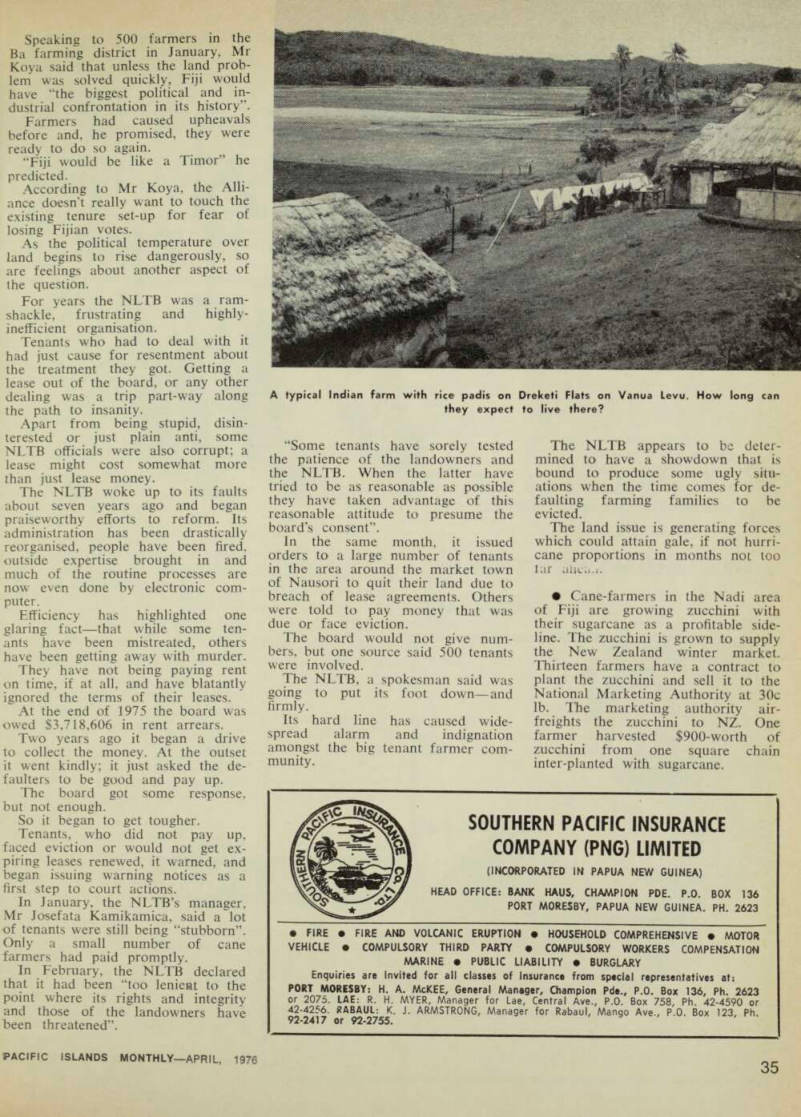
A typical Indian farm with rice padis on Dreketi Flats on Vanua Levu. How long can they expect to live there?