Oil Drum Ovens And Practical
pp. 29-31 · Read in the full issue
Miracles In The Spc School
By Joan Cobb
Miss Sue is an authority on how to use old oil drums and packing cases. She knows how to grow capsi cums without much soil and she’s pretty good at turning salt water into fresh. She’s probably the best person in the whole South Pacific to be wrecked on a desert island with, and, incidentally, also pretty enough to qualify for any male’s choice of com panion. Miss Sue is a genuine authority on survival and if anyone :an teach the art of turning a sow’s sar into a silk purse, she probably :an.
Miss Sue directs the South Pacific Commission’s Education Training Centre at Suva.
“Ask for Miss Sue,” they said in Suva, packing me off by car. A Vic orian noveletish type of demand I bought as we twisted our way down he winding green lanes that gyrate iff into the lush Fiji hills. Miss >ue, I concluded, should be nothing ess than one half of a pair of sisters unning a genteel school for young adies.
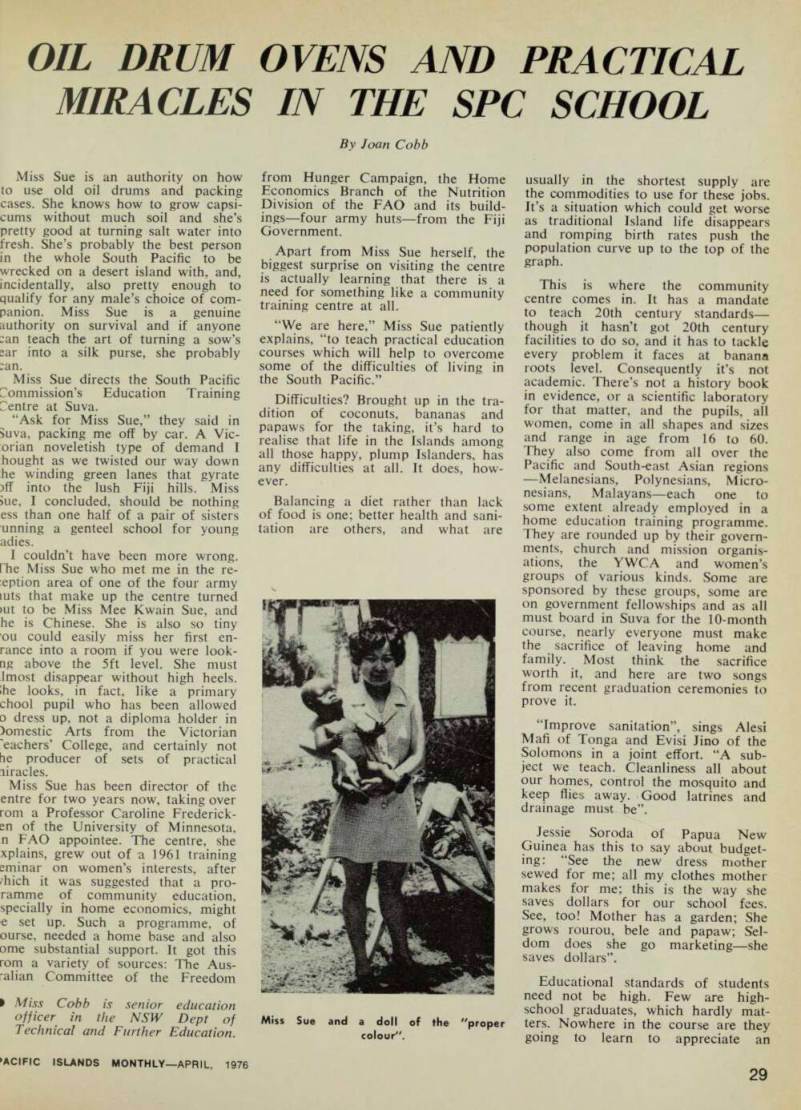
I couldn’t have been more wrong, fhe Miss Sue who met me in the re eption area of one of the four army mts that make up the centre turned »ut to be Miss Mee Kwain Sue, and he is Chinese. She is also so tiny ou could easily miss her first en rance into a room if you were look ng above the sft level. She must Imost disappear without high heels.
Ihe looks, in fact, like a primary chool pupil who has been allowed 0 dress up, not a diploma holder in )omestic Arts from the Victorian 'eachers’ College, and certainly not tie producer of sets of practical liracles.
Miss Sue has been director of the entre for two years now, taking over rom a Professor Caroline Frederick en of the University of Minnesota, n FAO appointee. The centre, she xplains, grew out of a 1961 training eminar on women’s interests, after diich it was suggested that a pro ramme of community education, specially in home economics, might e set up. Such a programme, of ourse, needed a home base and also ome substantial support. It got this rom a variety of sources: The Aus -alian Committee of the Freedom 1 Miss Cobb is senior education officer in the NSW Dept of Technical and Further Education.
from Hunger Campaign, the Home Economics Branch of the Nutrition Division of the FAO and its build ings—four army huts—from the Fiji Government.
Apart from Miss Sue herself, the biggest surprise on visiting the centre is actually learning that there is a need for something like a community training centre at all.
“We are here,” Miss Sue patiently explains, “to teach practical education courses which will help to overcome some of the difficulties of living in the South Pacific.”
Difficulties? Brought up in the tra dition of coconuts, bananas and papaws for the taking, it’s hard to realise that life in the Islands among all those happy, plump Islanders, has any difficulties at all. It does, how ever.
Balancing a diet rather than lack of food is one; better health and sani tation are others, and what are
usually in the shortest supply are the commodities to use for these jobs.
It’s a situation which could get worse as traditional Island life disappears and romping birth rates push the population curve up to the top of the graph.
This is where the community centre comes in. It has a mandate to teach 20th century standards— though it hasn’t got 20th century facilities to do so, and it has to tackle every problem it faces at banana roots level. Consequently it’s not academic. There’s not a history book in evidence, or a scientific laboratory for that matter, and the pupils, all women, come in all shapes and sizes and range in age from 16 to 60.
They also come from all over the Pacific and South-east Asian regions —Melanesians, Polynesians, Micro nesians, Malayans—each one to some extent already employed in a home education training programme.
They are rounded up by their govern ments, church and mission organis ations, the YWCA and women’s groups of various kinds. Some are sponsored by these groups, some are on government fellowships and as all must board in Suva for the 10-month course, nearly everyone must make the sacrifice of leaving home and family. Most think the sacrifice worth it, and here are two songs from recent graduation ceremonies to prove it.
“Improve sanitation”, sings Alesi Mafi of Tonga and Evisi lino of the Solomons in a joint effort. “A sub ject we teach. Cleanliness all about our homes, control the mosquito and keep flies away. Good latrines and drainage must be”.
Jessie Soroda of Papua New Guinea has this to say about budget ing: “See the new dress mother sewed for me; all my clothes mother makes for me; this is the way she saves dollars for our school fees.
See, too! Mother has a garden; She grows rourou, bele and papaw; Sel dom does she go marketing—she saves dollars”.
Educational standards of students need not be high. Few are high school graduates, which hardly mat ters. Nowhere in the course are they going to learn to appreciate an
Miss Sue and a doll of the "proper colour".
iambic pentameter or how to analyse an irregular French verb.
“They’re here”, said Miss Sue, “to learn how to do a lot with very little; to tell their fellow Islanders how to cook better, sew better, keep their houses and huts better, grow more in their vegetable gardens, ook after their children better, bal ance their budgets and raise their standard of living generally.
Mthough we do teach remedial Eng ish and some basic psychology, nusic and first aid, students are here lasically to develop practical skills md to learn how to pass them on”.
There’s a real educational concept )ehind all this, a highly pragmatic me —something along the lines of ‘waste not, want not”—or “God iclps those who help themselves”.
And what the students have to iclp themselves with is often pretty urprising.
“Take cooking”, said Miss Sue, licking her dainty way outdoors and ►ver to the fence hard by a primary chool sportsground.
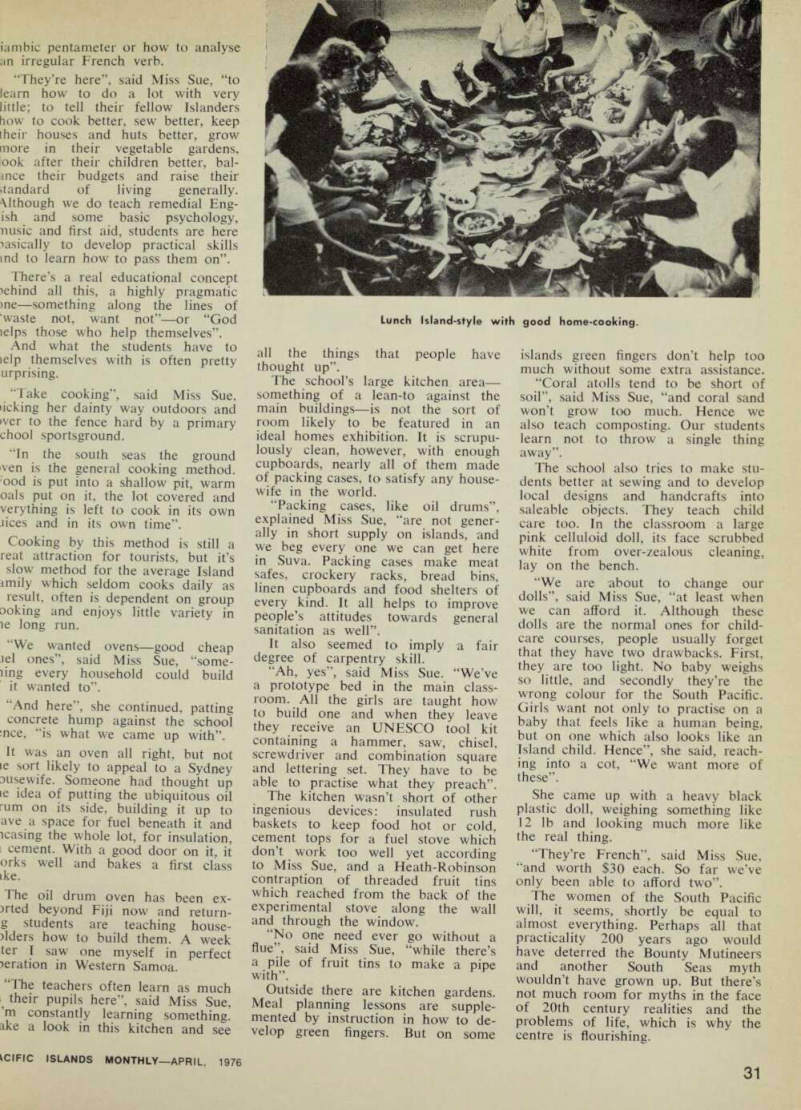
“In the south seas the ground ven is the general cooking method, ood is put into a shallow pit, warm oals put on it, the lot covered and verything is left to cook in its own jices and in its own time”.
Cooking by this method is still a reat attraction for tourists, but it’s slow method for the average Island amily which seldom cooks daily as result, often is dependent on group □oking and enjoys little variety in ie long run.
“We wanted ovens—good cheap Jel ones”, said Miss Sue, “some ling every household could build it wanted to”.
“And here”, she continued, patting concrete hump against the school mce, “is what we came up with”.
It was an oven all right, but not ic sort likely to appeal to a Sydney ausewife. Someone had thought up ie idea of putting the übiquitous oil rum on its side, building it up to ave a space for fuel beneath it and leasing the whole lot, for insulation, i cement. With a good door on it, it orks well and bakes a first class ike.
The oil drum oven has been ex ited beyond Fiji now and return g students are teaching house )lders how to build them. A week ter I saw one myself in perfect icration in Western Samoa.
The teachers often learn as much their pupils here”, said Miss Sue, ’m constantly learning something, ake a look in this kitchen and see
all the things that people have thought up”.
The school’s large kitchen area— something of a lean-to against the main buildings—is not the sort of room likely to be featured in an ideal homes exhibition. It is scrupu lously clean, however, with enough cupboards, nearly all of them made of packing cases, to satisfy any house wife in the world.
“Packing cases, like oil drums”, explained Miss Sue, “are not gener ally in short supply on islands, and we beg every one we can get here in Suva. Packing cases make meat safes, crockery racks, bread bins, linen cupboards and food shelters of every kind. It all helps to improve people’s attitudes towards general sanitation as well”.
It also seemed to imply a fair degree of carpentry skill.
“Ah, yes”, said Miss Sue. “We've a prototype bed in the main class room. All the girls are taught how to build one and when they leave they receive an UNESCO tool kit containing a hammer, saw, chisel, screwdriver and combination square and lettering set. They have to be able to practise what they preach”.
The kitchen wasn’t short of other ingenious devices: insulated rush baskets to keep food hot or cold, cement tops for a fuel stove which don’t work too well yet according to Miss Sue, and a Heath-Robinson contraption of threaded fruit tins which reached from the back of the experimental stove along the wall and through the window.
“No one need ever go without a flue”, said Miss Sue, “while there’s a pile of fruit tins to make a pipe with”.
Outside there are kitchen gardens.
Meal planning lessons are supple mented by instruction in how to de velop green fingers. But on some
islands green fingers don’t help too much without some extra assistance.
“Coral atolls tend to be short of soil”, said Miss Sue, “and coral sand won’t grow too much. Hence we also teach composting. Our students learn not to throw a single thing away”.
The school also tries to make stu dents better at sewing and to develop local designs and handcrafts into saleable objects. They teach child care too. In the classroom a large pink celluloid doll, its face scrubbed white from over-zealous cleaning, lay on the bench.
“We are about to change our dolls”, said Miss Sue, “at least when we can afford it. Although these dolls are the normal ones for child care courses, people usually forget that they have two drawbacks. First, they are too light. No baby weighs so little, and secondly they’re the wrong colour for the South Pacific.
Girls want not only to practise on a baby that feels like a human being, but on one which also looks like an Island child. Hence”, she said, reach ing into a cot, “We want more of these”.
She came up with a heavy black plastic doll, weighing something like 12 lb and looking much more like the real thing.
“They’re French”, said Miss Sue, “and worth $3O each. So far we’ve only been able to afford two”.
The women of the South Pacific will, it seems, shortly be equal to almost everything. Perhaps all that practicality 200 years ago would have deterred the Bounty Mutineers and another South Seas myth wouldn’t have grown up. But there’s not much room for myths in the face of 20th century realities and the problems of life, which is why the centre is flourishing.
Lunch Island-style with good home-cooking.