Pitcairn’s who-dunnit:
p. 45 · Read in the full issue
where did Fletcher Christian die?
By Dr W. Wilfried Schuhmacher
At a time when even more import mt historical facts no longer are acts, it seems not unappropriate herefore to ask the question whether Tetcher Christian really did die on *itcairn Island.
Unlike the other Bounty mutineers yho were killed on Pitcairn by the ‘olynesians on October 3, 1793 ohn Mills, William Brown, Isaac Tartin and John Williams—the □under and first leader of the Pit airn settlement is still remembered, nd many legends have come to be ssociated with his name. Thus, the ;ory goes that he was not shot but Itimately returned to England in- Dgnito.
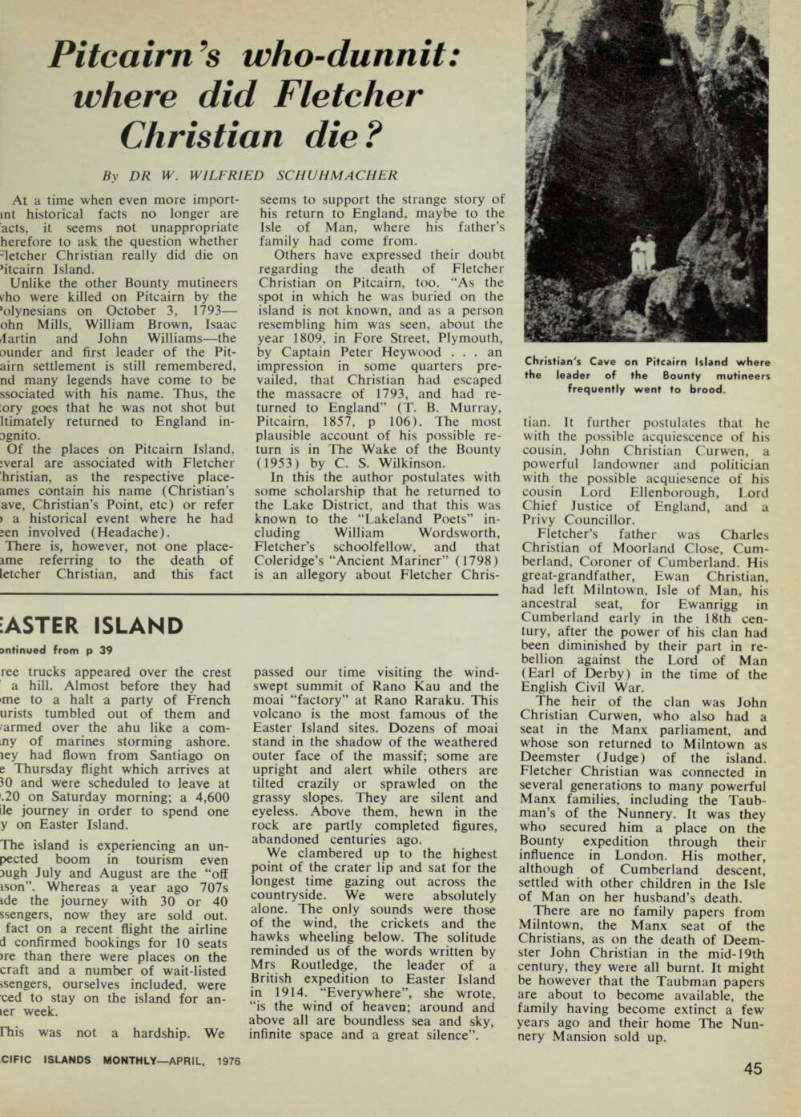
Of the places on Pitcairn Island, ;veral are associated with Fletcher Christian, as the respective place ames contain his name (Christian’s ave, Christian’s Point, etc) or refer > a historical event where he had ;en involved (Headache).
There is, however, not one place ame referring to the death of letcher Christian, and this fact
seems to support the strange story of his return to England, maybe to the Isle of Man, where his father’s family had come from.
Others have expressed their doubt regarding the death of Fletcher Christian on Pitcairn, too. “As the spot in which he was buried on the island is not known, and as a person resembling him was seen, about the year 1809, in Fore Street, Plymouth, by Captain Peter Heywood ... an impression in some quarters pre vailed, that Christian had escaped the massacre of 1793, and had re turned to England” (T. B. Murray, Pitcairn, 1857, p 106). The most plausible account of his possible re turn is in The Wake of the Bounty (1953) by C. S. Wilkinson.
In this the author postulates with some scholarship that he returned to the Lake District, and that this was known to the “Lakeland Poets” in cluding William Wordsworth, Fletcher’s schoolfellow, and that Coleridge’s “Ancient Mariner” (1798) is an allegory about Fletcher Chris-
tian. It further postulates that he with the possible acquiescence of his cousin, John Christian Curwen, a powerful landowner and politician with the possible acquiesence of his cousin Lord Ellenborough, Lord Chief Justice of England, and a Privy Councillor.
Fletcher’s father was Charles Christian of Moorland Close, Cum berland, Coroner of Cumberland. His great-grandfather, Ewan Christian, had left Milntown, Isle of Man, his ancestral seat, for Ewanrigg in Cumberland early in the 18th cen tury, after the power of his clan had been diminished by their part in re bellion against the Lord of Man (Earl of Derby) in the time of the English Civil War.
The heir of the clan was John Christian Curwen, who also had a seat in the Manx parliament, and whose son returned to Milntown as Deemster (Judge) of the island.
Fletcher Christian was connected in several generations to many powerful Manx families, including the Taub man’s of the Nunnery. It was they who secured him a place on the Bounty expedition through their influence in London. His mother, although of Cumberland descent, settled with other children in the Isle of Man on her husband’s death.
There are no family papers from Milntown, the Manx seat of the Christians, as on the death of Deem ster John Christian in the mid-19th century, they were all burnt. It might be however that the Taubman papers are about to become available, the family having become extinct a few years ago and their home Tlie Nun nery Mansion sold up.
Christian's Cave on Pitcairn Island where the leader of the Bounty mutineers frequently went to brood.