Magazine Section
pp. 37-38 · Read in the full issue
Air Ace Exchanged His War Cross
FOR A CROSS IN A PNG CEMETERY
By Wing Commander JOHN J. McKENZIE, RAAF
October 22, 1974, was the 50th anniversary of the death of perhaps the most highly-decorated man buried in Papua New Guinea, At the time of his death at Yule Island, the man, Father Jean-Pierre Marie Leon Bourjade, was a Roman Catholic priest of the order of the Missionaries of the Sacred Heart. But, at the end of World War One in November, 1918, he was Lieutenant Bourjade, holder of France’s highest decoration, the Legion of Honour, together with the Croix de Guerre, 14 mentions in despatches and the grand gold medal of the Aero Club of France.
Apart from one mention in des patches, his awards were for service as a fighter pilot during which he was credited with shooting down 24 German observation balloons and four aircraft in 86 missions between December, 1917, and November, 1918.
Leon Bourjade was born in the South of France on May 25, 1889.
He had an undistinguished academic record but excelled in sport. Shortly after scraping through his final exams, he decided to become a mis sionary and went to Spain, initially, before finishing his studies in Switzer land in 1910 as Brother Bourjade.
At the end of 1910, he returned to France for his two-year period of national service military training in the 23rd Regiment of Artillery at Toulouse. There he proved to be an excellent rider and called his horse Angelus (Angel). The assess ment by his senior officer noted— “ Could possibly, if need be, be pro moted to lance-corporal”.
In 1912, he finished his military training and started studying for the priesthood. In August, 1914, his studies were interrupted. He was called back to his old military unit with the outbreak of World War One.
Bourjade’s unit was soon in action.
At the Battle of the Marne the unit fought gloriously and Bourjade was
promoted to corporal. In February, 1915, he received his first mention in despatches. In December, 1916, he was promoted to second-lieutenant.
At this time Bourjade applied for a posting to French Military Aviation, hoping to gain pilot quali fications that would be useful in his later life as a missionary.
Because of his artillery experience, Bourjade faced the prospect of being trained as an observer. He in sisted, however, that he wished to be a pilot and on March 15, 1917, started pilot training. After three months and 35 hours 35 minutes fly ing training, he received his pilot’s wings and was then given a further period of operational training to qualify as a fighter pilot.
During his training Bourjade took off one morning for unauthorised aerobatics over the Grotto of Lourdes followed by some fast hedge-hopping over a series of churches, and finish ing up with a steep dive in the direc tion of a statue.
Introduction to aerial combat for Bourjade came in December, 1917, with an unsuccessful attack on a German aircraft, and later on a balloon. These balloons were station ary ‘sausage balloons’ used for artil lery observation. As they hung, anchored in the air at heights up to 3,000 ft, they could be seen for miles.
Aerial attacks on balloons was an attractive and highly-dangerous enter prise, more dangerous perhaps than attacking aircraft because of the superior efficiency of the German anti-aircraft batteries protecting the balloons. In addition to protection from guns on the ground, the bal loons were nearly always guarded by a line patrol of fighter aircraft.
Even when not protected by aircraft, balloons generally had to be attacked from the side or below because when the incendiary bullets exploded the balloon, the ball of flame would rise and envelop the attacker.
In January, 1918, Bourjade fitted his aircraft with a small French flag.
This was mounted to the side of the cockpit and below the upper wing.
Despite problems in keeping the flag in place, Bourjade’s practice was to raise the flag after takeoff and lower it before landing. Later on the Ger mans came to recognise this flag flying aircraft.
Bourjade’s strong religious beliefs were clearly demonstrated in the approach to his flying and air com bat. Fitted to the left hand side of Bourjade’s Nieuport Scout was a rather large picture of Saint Therese of Lisieux. Bourjade, true to his religious vocation, would make the Sign of the Cross as he attacked
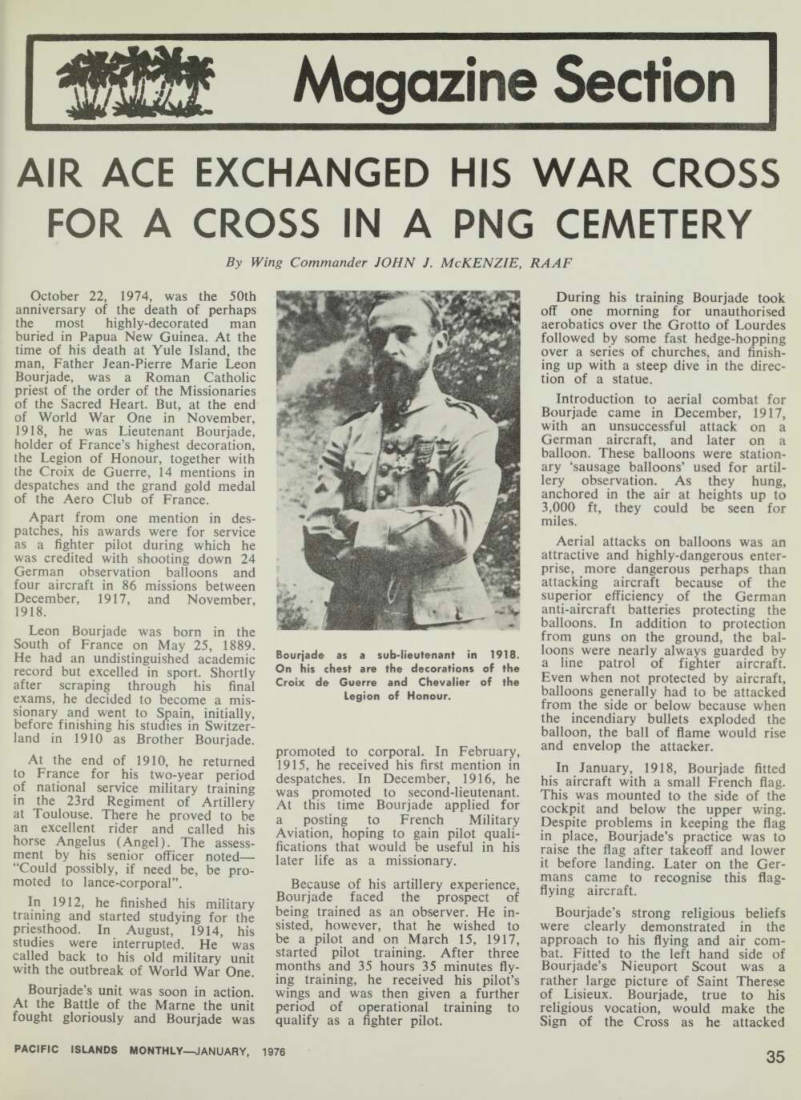
Bourjade as a sub-lieutenant in 1918.
On his chest are the decorations of the Croix de Guerre and Chevalier of the Legion of Honour.
enemy aircraft and balloons and say a prayer for his enemies.
Bourjade shot down his first Ger man aircraft on February 10, 1918.
It fell behind enemy lines and, although confirmed by French artil lery, Bourjade was not credited with a victory. His first acknowledged success came on March 27, 1918, with the shooting down of an air craft. After that, Bourjade regularly engaged in air combat with German aircraft but achieved greater success, and fame, as the destroyer of the sausage-shaped balloons. The soldiers on the ground nicknamed him the ‘Sausage Griller’.
Enemy fire frequently damaged his aircraft but Bourjade was only wounded once. This occurred in a low-level attack on a balloon that was being rapidly winched to the ground. The doctor recommended a three-month rest, but Bourjade was in action again after four weeks.
Frequent jamming of the aircraft guns in flight probably cost Bourjade many victories. To overcome this problem, whilst airborne, he carried a small hammer fixed to a long stick with w'hich he reached out and gave the jammed gun a few taps to free the mechanism.
His last combat mission took place on October 29, 1918 when, in company with another fighter air craft piloted by a priest, Father Garin, they were attacked by five German Fokkers. Garin was caught in a vertical climb by one of the enemy aircraft and set on fire.
Bourjade was on the tail of the attacker but his gun jammed. Garin was killed when his aircraft fell be hind German lines. On November 12, immediately after the armistice, Bourjade set out on a two-hour low level sortie to look for his friend but the search was fruitless.
At the end of the war Bourjade had flown in 86 combats in 254 flying hours. He was credited with 28 vic tories—four aircraft and 24 balloons.
His contemporaries, however, claim that his actual victories totalled over 40.
Official recognition for his achieve ments in the form of palms or men tion in despatches to his Croix de Guerre, came at very regular inter vals. His first palm for flying was awarded in April, 1918. By Novem ber that year he had 12 with a further two received early in 1919 for his war exploits. In June, 1918, he was made a Chevalier of the Legion of Honour. In 1919, it was proposed that Bourjade be raised to a higher order of the Legion of Honour but this recommendation, came back from the Defence Ministry, endorsed in the margin, “sufficiently rewarded by 14 despatches”.
Bourjade was demobilised in July, 1919, and went back to his studies for the priesthood. In May, 1921, while studying in Switzerland, his previously recommended higher award was presented to him by the French Military Attache. He was awarded the Croix d’Officer de la Legion d’Honneur, He had earlier been given the Grand Gold Medal of the Aero Club of France.
On July 26, 1921, Bourjade was ordained priest and four months later arrived at Yule Island in Papua. He served as a missionary on the main land among the people in the Waima and the Pinupaka areas. After con tracting malaria, he died at Yule Island on October 22, 1924. An Australian Government represent ative attended the funeral at which the Union Jack was lowered and six policemen fired a volley.
Since 1924, French warships pass ing through PNG waters have stopped at Yule Island to pay tribute to Bourjade. This tribute consisted of a simple graveside ceremony, fol lowed by the firing of a volley.
Attached to the cross on Bourjade’s grave are seven metal plaques recording the visits of the French ships.
Now the RAAF has added its tri bute.
In 1974, I, as Senior Air Force Officer in Papua New Guinea, visited Yule Island after hearing of the
visiting warships. Details of Bour jade’s life were obtained from mission libraries in PNG and also from the RAAF Air Attache in Paris. The RAAF’s No 2 Aircraft Depot made a metal plaque setting out Bourjade’s record and awards.
This has been attached to the exist ing cross which was refurbished by personnel from the RAAF Caribou unit based in PNG, No 38 Squadron Detachment A.
A simple memorial service, con ducted by the Catholic Chaplain of No 1 Battalion, Ist Pacific Islands Regiment, Father Pat O’Connell MSC, was held at the graveside, to mark the fitting of the RAAF plaque •on May 20, 1975, Bourjade’s birth day. • Yule Island is in the Gulf Of Papua in the Central District of Papua New Guinea about 50 miles up the coast from Port Moresby. It is a small island named for Lieu tenant Yule, of the Royal Navy who, in HMS Bramble, in 1846, charted the area from the head of Gulf to Redscar Bay. He decided in that year to “take possession” in the name of Britain, but Britain, at that time, ignored the annexation. When Fr Bourjade went to Yule Island he was joining his countrymen, for French priests of the Mission of the Sacred Heart established themselves on the island in 1885, a short while after the arrival of the LMS whose mis sionaries complained that the Roman Catholics were building on founda tions laid by the LMS.
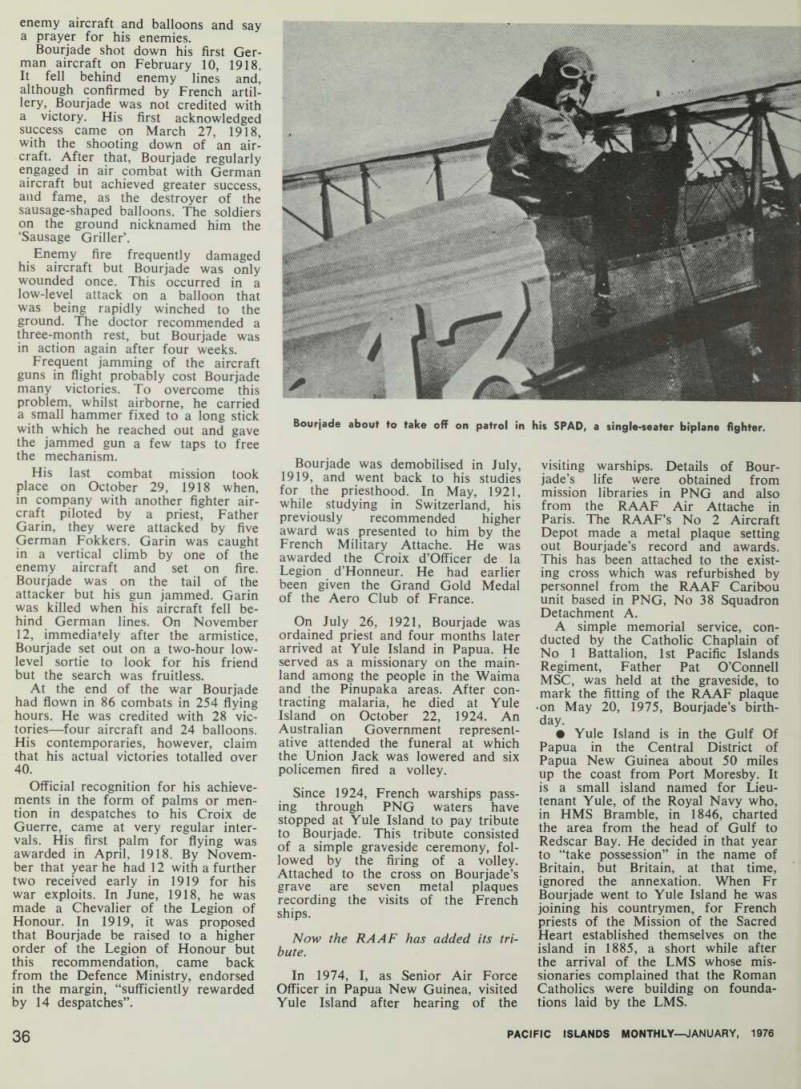
Bourjade about to take off on patrol in his SPAD, a single-seater biplane fighter.