Up Mount Hagen
p. 43 · Read in the full issue
the mountain just in time for lunch
by James Porter
About fifteen miles north-west of the township of Mount Hagen in the heart of Papua New Guinea’s Highlands, lies the not always ob vious, but nevertheless massive, block of mountain which inspired the name. For most of the year clouds hide the 12,500 ft (4,000 metre) summit of the five-mile long range, first named early in the century by German explorers from the Sepik side after the presi dent of the German colonist’s New Guinea Company.
But it was the famous Leahy brothers and Jim Taylor who put it on the map. In April 1933, at the limit of their exploration of the beautiful Wahgi Valley with its thousands of then-unheard-of people, Mick Leahy and Jim Taylor spied the great blue range and called its highest point Mt Hagen.
Here, in the Upper Wahgi, they came across the ‘planters of parks’ —native landscaping which sur passed anything then seen in ‘pri mitive’ territory. Tall casuarina trees had been planted in straight rows along paths lined by orna mental shrubs and flowers and clumps of bamboo, with well-kept lawns used as ceremonial grounds.
The explorers were surprised to find that these natural gardeners had in these parks daisies, lilies and even zinnias (they called them ‘Wahgi zinnias’) and also planted them along the fences and foot ways leading to their own houses.
The sight caused Dan Leahy to re mark to his brother that people with such an appreciation of beauty could hardly be called ‘savage’.
Here also, they saw the strikingly attractive ceremonial axes called ‘kenduaubu’, unique to the area, and nowadays eagerly sought after by collectors as the
‘Hagen axe’. These axes have a highly polished blue stone blade, with a long, fan-shaped counter balance behind the blade, of artis tically decorated, woven cane.
The craftsmen responsible for all these things, the Hageners, also made themselves attractive to the young women of their clans by wearing superbly decorative head plumes taken from the colourful birds-of-paradise.
In June of that year, the Leahy’s together with surveyor Ken Spinks, climbed to the summit of the great mountain towering 7,000 ft above the floor of the Wahgi Valley.
They camped within a hundred feet of the top. Mick Leahy de scribed the scene later: “That sun rise from the top of Mt Hagen was for all of us who saw it a thing to be remembered and cherished all our lives.”
Colin Simpson wrote superbly of the occasion in his now classic history of the New Guinea High lands, “Plumes and Arrows”. To quote: “To the east the great Waghi Valley was a sea of white mist breaking against two great shores of mountains. Over the northern range towered Wilhelm, glistening with snow. Beyond the southern wall, past the peak of the mighty Kubor, the summit of Mt Michael caught the light.
Southwest, the nearest of the high peaks, Giluwe in Papua, showed itself higher than Hagen. It rose like a great mound, to thirteen thousand and then was topped with pointed crags. Directly to the south the mist was a sea with but one island, the crest of lalibu,”
Forty-two years after it was put on the map I decided to have a look at that scene myself. Our party of five, guided by a Tomba villager, left the Wabag road at Tomba sawmill at first break of
daylight to climb the remaining five thousand odd feet.
The approach around 8,000 ft altitude through heavy moss forest jungle growth was wet underfoot and gloomy from the continuous canopy overhead. We saw no more villages after leaving Tomba.
At 11,000-odd ft, tree cover thinned until we broke out onto the open tussock grass and narrow ridges which gave splendid views back towards the towering mass of cloud-enshrined Giluwe (14,346 ft) and Tambul settlement in the distance down on the old Mendi road. Clusters of small mountain tarns, spread over ancient glacial flats tucked in between the high ridges, gave the tops an out of this world appearance.
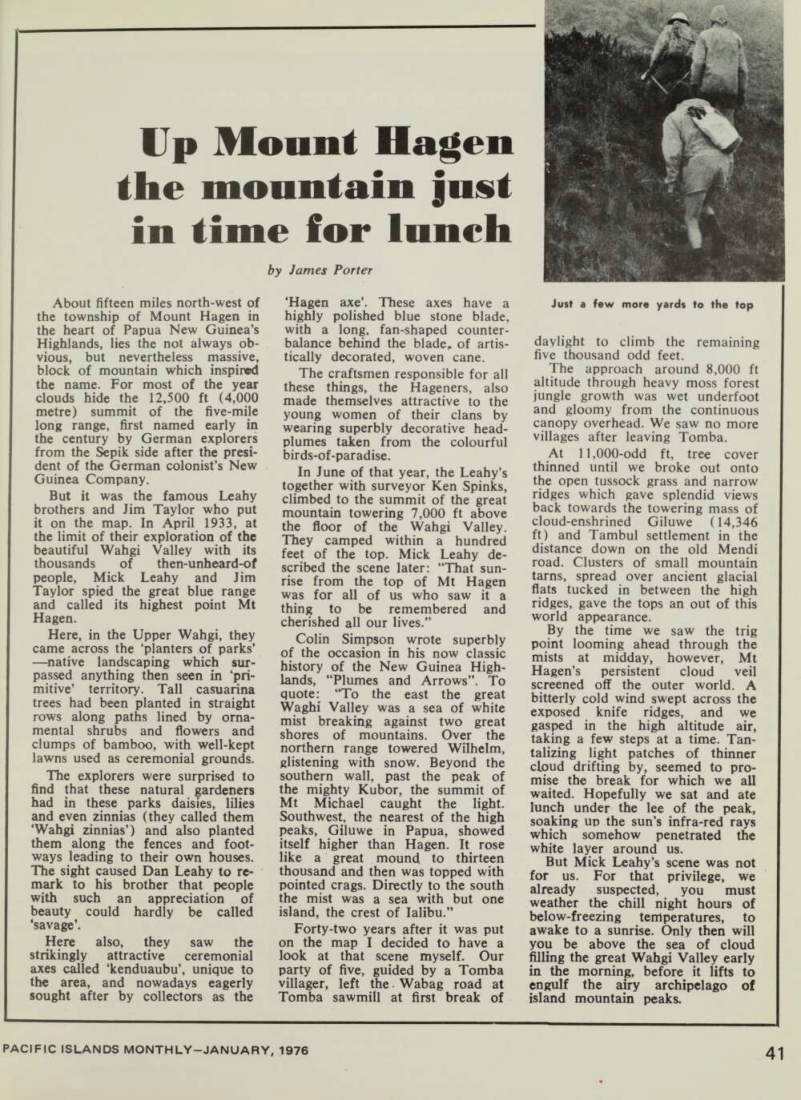
By the time we saw the trig point looming ahead through the mists at midday, however, Mt Hagen’s persistent cloud veil screened off the outer world. A bitterly cold wind swept across the exposed knife ridges, and we gasped in the high altitude air, taking a few steps at a time. Tan talizing light patches of thinner cloud drifting by, seemed to pro mise the break for which we all waited. Hopefully we sat and ate lunch under the lee of the peak, soaking up the sun’s infra-red rays which somehow penetrated the white layer around us.
But Mick Leahy’s scene was not for us. For that privilege, we already suspected, you must weather the chill night hours of below-freezing temperatures, to awake to a sunrise. Only then will you be above the sea of cloud filling the great Wahgi Valley early in the morning, before it lifts to engulf the airy archipelago of island mountain peaks.
Just a few more yards to the top