Solomons'



Pacific Islands Monthly
News Magazine Of The South Pacific
Uary, 1976
Solomons'
The Truth About
\> V Those Coins
australia,*n.z., p.n.g^n.Hebrides, tonga 75c W SAMOA G E.1.C., COOKS. NORFOLK, NIUE, NAURU 75c
Solomons 85C
Am. Samoa,Hawaii, Micronesia, Guam $1.25
New Caledonia And French Polynesia Cfpi2S
Our Cover
She's beautiful, she's eight years old and she’s named Lea.
She comes from the village of Faaopore, on the island of Tahaa, which is one of the Society Group, north-west of Tahiti. Captain J. R. Williams, who knows the village and its people well, captured the lovely Lea in colour for us.
Advertisements & other items, pp. 2-4 (1 item)
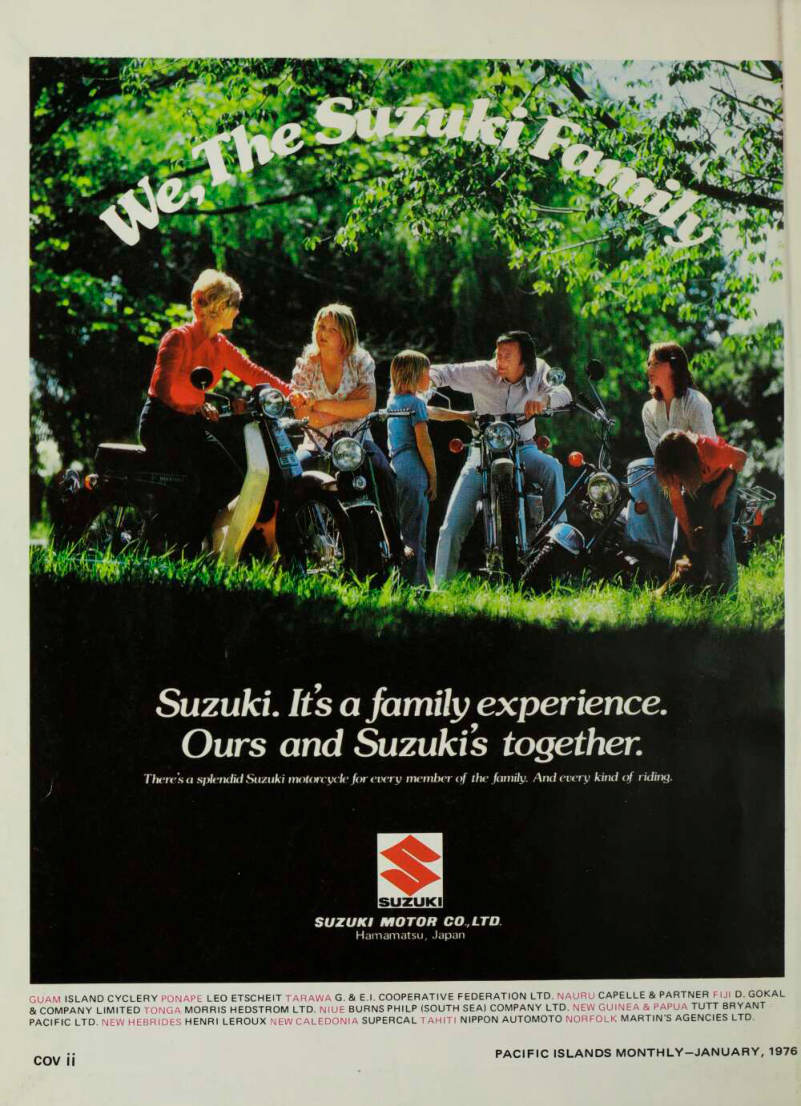
Suzuki. Its a family experience.
m , i .* >**ss 4 V * 4 z<: n * «. ,«r ft > i Ai' I Ns I V * X w\ i -r. r# 4 mr m c /' ■j y 'j Xlk 44 * 1 rw Rf*
Ours and Suzuki s together.
There’s a splendid Suzuki motorcycle for every member of the family. And every kind of riding s
SUZUKI
SUZUKI MOTOR CO, LTD
Hamamatsu, Japan GUAM ISLAND CYCLERY PONAPE LEO ETSCHEIT TARAWA G. & E.l. COOPERATIVE FEDERATION LTD. NAURU CAPELLE & PARTNER FIJI D. GOKAL & COMPANY LIMITED TONGA MORRIS HEDSTROM LTD. NIUE BURNS PHILP (SOUTH SEA) COMPANY LTD. NEW GUINEA & PAPUA TUTT BRYANT PACIFIC LTD. NEW HEBRIDES HENRI LEROUX NEW CALEDONIA SUPERCAL TAHITI NIPPON AUTOMOTO NORFOLK MARTIN'S AGENCIES LTD.
Jewellery that writes.
It’s known as Parker's ‘Place Vendome' collection.
Each model is distinguished by the painstaking engraving of Parisian craftsmen, and the precious metals, gold and silver.
There are four distinctive patterns in gold pens, and three patterns in silver, each with matching ball pensand pencils.
The pens have convertible filling systems and nibs that adjust to your writing style. The point can be rotated 360° until it reaches the angle that most naturally suits you.
The ball pens and pencils give you long-lasting Parker cartridge refills. Up to 80,000 words is what you can expect from the ball pen refills.
Clearly, the finest in function and fashion, and magnificent gifts whether you choose a single or a set from the Place Vendome collection.
+PARKER
World's most wanted pens
Top performance takes the guesswork
out of going hi-fi.
No imitations here. Every one of the
RONDO 2000 Stereo Sound Mates was
component created and Pioneer blended into a total system stereo package. And at a price much lower than you think.
First, an advanced design AM/FM
stereo receiver produces a powerful 13 watts per channel virtually distortion-free.
Accurate tonal management is achieved with separate bass and treble controls and AM/FM reception is clean and clear.
On the input side of the RONDO 2000 is a professional type manual turntable.
The super-smooth belt-drive mechanism provides loving care for your records.
Auto-cut at the touch of a button plus the convenience of auto-return.
On the output side, beautifully balanced
two-way, two-speaker systems. Every
earthy note from the big 20cm. woofers is enriched by the solid bass-reflex
design cabinets.
And for your private listening pleasure,
RONDO 2000 Sound-Mates include
lightweight high-polymer headphones.
RONDO 2000 Stereo Sound Mates.
From stylus to speaker...the direct
approach to top performance.
£W PIONEER
Pioneer Electronic Corporation
4-1, Meguro 1-chome, Meguro-ku, Tokyo 153, Japan Australia Pioneer Electronics Australia Pty. Ltd., 178-184 Boundary Road, Braeside, Victoria 3195, Phone: 90-9011, Sydney 93-0246, Brisbane 52-8213, Adelaide 433379, Perth 76-7776 Fiji Islands Brijlal & Company, G.P.O. Box No. 362, Suva, Fiji Islands Tel: 22258 Lae Hagemeyer (Australasia) 8.V., P.O. Box No. 90, Lae, Papua* New Guinea Tel: 42-32 OO Rabaul Hagemeyer (Australasia) 8.V., P.O. Box No. 63. Rabaul, Papua»New Guinea Tel: 26 Port Moresby Hagemeyer (Australasia) 8.V., P.O. Box No. 1428, Boroko, Port Moresby, Papua»New Guinea Tel: 5 61 44 Madang Hagemeyer (Australasia) 8.V., P.O. Box No. 673, Madang, T.P.N.G. Tel: 24 45 New Zealand Fountain Marketing Ltd., Maidstone Street Auckland, New Zealand Tel: 763-064 Norfolk Island Burns Philp (Norfolk Island) Ltd., Norfolk Island, South Pacific New Hebrides Burns Philp (New Hebrides) Ltd..
Vila, New Hebrides Nauru Island Jacob Enterprises, P.O. Box No 4, Nauru Island Tahiti Ets. PERFECT, B.P. 594, Papeete, Tahiti Tel: 20 407 New Caledonia Menard Freres, B.P. 123, Noumea, New Caledonia Tel: 52-22 American Samoa Transpac Corporation, P.O. Box 1477, Pago Pago, American Samoa 96799 Tel: 633-5224 Rarotonga South Seas International Ltd..
P.O. Box 49, Rarotonga Cook Islands Tel: 2327
Monthly
Pacific Islands
FOUNDED BY R. W. ROBSON IN 1930
Published Monthly By
Pacific Publications (Aust.) Pty. Ltd.,
Postal Address: G.P.O. BOX 3408, SYDNEY,
N.S.W. 2001.
Telegraphic Address: PACPUB, Sydney.
Telex: 25168.
Telephones: 61-9197, 61-7101, 61-4369.
Publisher: Stuart Inder, Business Manager: John Berry.
Pacific Islands Monthly
Editor: John Carter.
Advertising Manager: Alan Batt.
Subscription Rates:
"Pacific Islands Monthly" is airfreighted to the majority of subscribers and agents in the Pacific Islands and the U.S.A.; copies to the Cook Islands, Nauru, Niue, Micronesia and Guam go by surface mail.
Australia (including Lord Howe and Thursday Islands), New Zealand, Papua New Guinea, Fiji, New Hebrides, Tonga, Cook Islands, Western Samoa, Gilbert & Ellice Islands, Norfolk Island, Niue and Nauru: $9.00 (local currency); Solomon Islands: $lO.OO Aust.; American Samoa, Micronesia and Guam: $12.00 U.S.; Hawaii and U.S. Mainland: $15.00 US.; New Caledonia and French Polynesia: 1,500 C.F.P.; United Kingdom: £6.50; Japan: 4,000 Yen; Elsewhere: $11.50 Aust.
Representatives
Fiji: Advertising and Distribution —Fiji Times & Herald Ltd., 20 Gordon Street, Suva. Telephone: 25-601. Telex: FJ 2124.
Papua New Guinea: Advertising and Distribution —PNG Post-Courier, P.O. Box 85, Port Moresby.
Telephone: 25-9899. Enquiries: Post News agency, Telephone 24-2148.
French Polynesia: Distribution —Hachette Paci fique, 10 Ave Bruat, Papeete.
New Zealand; Pacific Publications, C.P.O.
Box 2229, Auckland.
United Kingdom; The Herald and Weekly Times Limited, 8-10 Clifford's Inn, Fetter Lane, London EC4A IBU. Telephone: 01-8316041. Telex; London 21989.
Japan: Advertising—Universal Media Corpora' tion, C.P.O. Box 46, Tokyo. Telephone: 666-3036.
Victoria: Advertising Pacific Publications (Aust.) Pty. Ltd., Herald and Weekly Times Building, 2nd Floor, 61 Flinders Lane, Mel bourne, 3000. Telephone: 652-1565.
Hawaii and U.S. Mainland only: N. Grogan. (Send change of address notices. Form 3579 and new subscriptions to P.O. Box 2193, Honolulu, Hawaii, U.S.A. 96805.) Second class postage paid at Honolulu, Hawaii.
Copyright ©, 1976,
Pacific Publications (Aust.) Pty. Ltd.
Printed by The Harbour Press, Chalmers Street, Sydney, Registered at the G.P.O. Sydney for trans mission by post as a newspaper—category B. * Recommended retail price only.
Vol. 47, No. I January, 1976
Up Front
with the Publisher
THE Australian Department of Foreign Affairs wants Australia to take over Norfolk Island. The de partment put its views to the Norfolk Island Royal Commission on the island’s future administration, saying it would be good for Australia, and no reason could be seen why it would be bad for Norfolk. Australia’s best interests would be served by fully incorporating the island into Australia.
The department sees no reason why that should conflict with the real interests of the islanders. It would be consistent with the spirit of the times that the people of Nor folk, who are already Australian citizens, should enjoy to the full the same rights and duties as main landers.
That’s what the department says about this small hunk of South Seas land, first seen by Captain Cook, and which became, in 1788, the sec ond British settlement in the South Seas.
But the department’s views com prise only a small fraction of the 4,000 typed pages of evidence, and 250 exhibits, presented in all by 140 witnesses when the public hearings finished on the island at the end of November. Yet to come are a written summing-up by counsel and the royal commissioner, Sir John Nimmo, and a further opportunity for islanders to comment on counsels’ views, before this absolutely invalu able wealth of material is ready for final release, which is not before the middle of the year.
Luckily, all the material will go into Norfolk’s archives, and it might —it surely has to—put an end to the political frustration and unease that has existed on Norfolk for what must be the last century. Questions such as who does own Norfolk?
What rights, if any, have the Norfolk Islanders? Did Britain really give the land to the Pitcairners when they were moved there with goods and chattels from their own overcrowded island in 1856?
During Sir John’s inquiry it’s been obvious that here is a man who is charmed by his task; a man fully involved with the problems and atti tudes of this extraordinary island
and its independent people.
In an interview with the Norfolk Island News as he wound up his public sittings, Sir John allowed himself to say, “This little island has more legal problems than con tinents. This is a real challenge. I’m fascinated by the situation here”.
Sir John not only has to clarify its legal problems, that is, the island’s constitutional position, he has to make recommendations on the kind of government Norfolk should have. A government that can work on a small island about 1,000 miles off the Australian mainland.
Among the variety of information that has come out during the in quiry, I found two items of special interest.
First, the views of Mr Peter Cus tance on the Pitcairn community. It had been said earlier at the inquiry that the Pitcairners had been de creasing in importance as the “main landers” had come in, but Mr Custance had analysed the list of the 996 adults who live on Norfolk, and decided that 876 of them could be considered members of the perma nent population, and that of these, 486, or 55 per cent, were members of the “Pitcairn community”. That is, they had direct Pitcairn descent or had married someone of Pitcairn descent. In addition, of the 309 children in school, 178, or 58 per cent, were of Pitcairn descent. And members of the Pitcairn community were a majority on the council.
The second interesting fact, for me, was the extent of the money that was passing through little Nor folk at the height of its “tax haven” days. A bank manager told the com mission that a total of $643 million which may have involved tax avoid ance had gone through company accounts at his bank.
Peak year was to September 30, 1971, when $2Ol million passed through just 97 major accounts, since when the money flow had been easing steadily. For the last 12 months to September, only $63 mil lion passed through a fewer number of accounts. No wonder the Aus tralian Treasury was interested!
Stuart Inder
Advertisements & other items, p. 6 (1 item)
S. E. Tathfim & Co. Pty. Ltd.
% Va S. E. TATHfIM & CO. PTY. LTD.
BEEHIVE BLDG., 94 ELIZABETH STREET
G.P.O, BOX 8 CABLES "SET"
MELBOURNE, 3001, AUSTRALIA
TELEX: AA34293 TELEPHONE 63-5094
Buyers hr the Pacific Islands
AND IN
|F“ Popup New Guineo:
S. E. TATHAM (P.N.G.) PTY. LTD.
LAE: MALAITA ST. (P.O. BOX 1562)
PORT MORESBY: Cnr. GOROA & MUNAHU Sts., GORDON
(P.O. BOX 6733, BOROKO).
Fiji: S. E. TATHAM (FIJI) LTD.,
LAUTOKA P.O. BOX 366.
SUVA G.P.O. BOX 671,
TELEGRAMS: ALL OFFICES “SET'’
YOUR GUARANTEE
SINCE 1924
\ 21 % % 1
FOR SERVICE
In This Issue
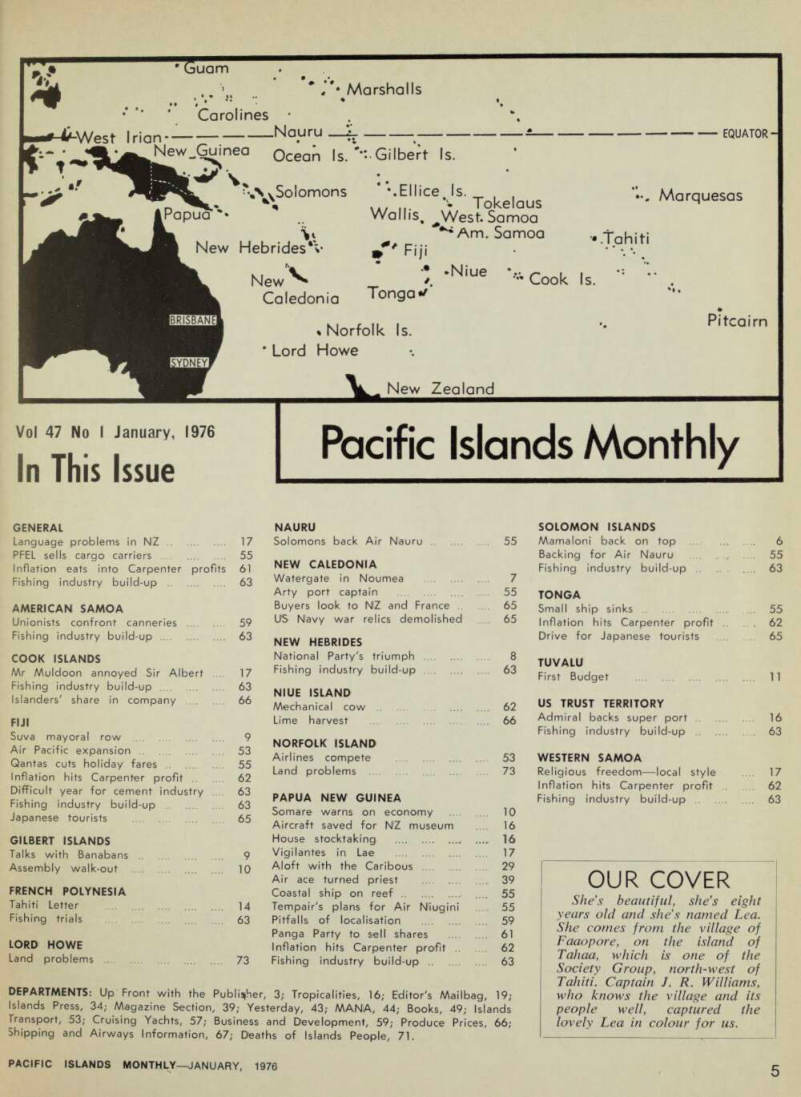
General
Language problems in NZ 17 PFEL sells cargo carriers 55 Inflation eats into Carpenter profits 61
Fishing industry build-up 63
American Samoa
Unionists confront canneries 59 Fishing industry build-up 63
Cook Islands
Mr Muldoon annoyed Sir Albert 17
Fishing industry build-up 63
Islanders' share in company 66
Fiji
Suva mayoral row 9 Air Pacific expansion 53 Qantas cuts holiday fares 55 Inflation hits Carpenter profit 62 Difficult year for cement industry 63
Fishing industry build-up 63
Japanese tourists 65
Gilbert Islands
Talks with Banabans 9 Assembly walk-out 10
French Polynesia
Tahiti Letter 14 Fishing trials 63
Lord Howe
Land problems 73
Nauru
Solomons back Air Nauru 55
New Caledonia
Watergate in Noumea 7 Arty port captain 55 Buyers look to NZ and France 65 US Navy war relics demolished ... 65
New Hebrides
National Party's triumph 8
Fishing industry build-up 63
Niue Island
Mechanical cow 62 Lime harvest 66
Norfolk Island
Airlines compete 53 Land problems 73
Papua New Guinea
Somare warns on economy 10 Aircraft saved for NZ museum ... 16 House stocktaking 16 Vigilantes in Lae 17 Aloft with the Caribous 29 Air ace turned priest 39 Coastal ship on reef ... 55 Tempair's plans for Air Niugini ... 55 Pitfalls of localisation 59 Panga Party to sell shares 61 Inflation hits Carpenter profit 62
Fishing industry build-up 63
Solomon Islands
Mamaloni back on top 6 Backing for Air Nauru 55
Fishing industry build-up 63
Tonga
Small ship sinks 55 Inflation hits Carpenter profit 62 Drive for Japanese tourists 65
Tuvalu
First Budget 11
Us Trust Territory
Admiral backs super port 16
Fishing industry build-up 63
Western Samoa
Religious freedom —local style ... 17 Inflation hits Carpenter profit . 62 Fishing industry build-up 63
DEPARTMENTS: Up Front with the Publisher, 3; Tropicalities, 16; Editor's Mailbag, 19; Islands Press, 34; Magazine Section, 39; Yesterday, 43; MAN A, 44; Books, 49; Islands Transport, 53; Cruising Yachts, 57; Business and Development, 59; Produce Prices, 66; Shipping and Airways Information, 67; Deaths of Islands People, 71.
Pacific Islands Monthly
The Story Of Solomon, His Coins
And His Return To The Top
From a Honiara Correspondent
Forced to resign on November 18 over an “unofficial” deal with a Cali fornian private mint for coins com memorating Solomon Islands self government, Chief Minister Solomon Mamaloni bounced back into the top seat 13 days later.
He was re-elected by 18 votes to four, with two abstentions in what was obviously a deal with his former opponents in the United Solomon Islands Party, which had formed the official Opposition. It cost Mama loni’s People’s Progress Party four portfolios and gave the USIP five seats in the eight-member cabinet.
Mr Mamaloni was re-elected on the first ballot. Two members, whose names haven’t been published, ab stained from voting. The Chief Minis ter had only one rival for the job, Mr Allan Taki, the newly-elected member for West Kwara’ae, who was nominated by Mr Andrew Ku kuti, member for Vella Lavella and the Shortlands.
According to the government news paper, The Solomons News Drum, when the result of the ballot was announced, “Mr Taki began shout ing mentally and he was led away by friends. He was later taken to the Central Hospital and admitted”.
Leading figure in the deal, which returned Mr Mamaloni, was Mr Jonathan Fifi’i, USIP leader who was jailed for two years in the early 1950 s for his part in the anti-govern ment “Marching Rule” movement.
Mr Fifi’i becomes Minister for Home Affairs, a most influential post in the Solomons.
A minority party of nine in the last parliament, the People’s Pro gress Party was short on good pros pective ministers. Mr Mamaloni needed the strongest team he could get to lead the country into self government. But the PPP is very much a minority in the cabinet. It has only two portfolios against five held by the USIP, which had a seat in the last cabinet held by Philip Solodia Funifaka, former USIP
leader. The eighth seat is held by an independent. The only minister to hold his old position is the reserved but highly-competent Willi Betu, the Finance Minister.
The new cabinet is: Mr Mama loni, Chief Minister; Mr Betu, Finance Minister; Mr Ashley Wick ham, Works and Public Utilities; Mr Fifi’i, Home Affairs; Mr Benedict Kinika, Education and Cultural Affairs; Dr Francis Kikolo, Health and Welfare; Mr David Thuguvoda, Natural Resources; Mr Pulepada Ghemu, Foreign Trade, Industry and Labour; Mr Jeriel Ausuta, Agricul ture and Lands.
If, indeed, self-government has already come to the Solomons, there has been no fanfare of trumpets.
The tentative date was to be between November 1 and December 1 but there has been no formal announce ment. The fact that the cabinet
members are called ministers—which didn’t happen in Fiji until self government—doesn’t signify any thing. They’ve been called ministers since August, 1974.
It’s probable that there will be some announcement when the Legis lative Assembly meets on January 5.
The new set-up spells the end of two-party government in the Solo mons. There was no love for the Westminster pattern from the first.
And the Solomons won’t be the only one to change in the Islands.
Ratu Sir Kamisese Mara, Fiji’s Prime Minister, isn’t fond of the system. He told PIM in one inter view in March, 1972, that the two party system “is politically unhealthy a developing country”. His com plaint was that, as there were no political parties in Fiji, the two party system had, of necessity, to find a racial division.
Mr Fifi’i said, after Mr Mama loni’s re-election, that the choice of cabinet reflected the end of party politics which had proved to be un workable in present circumstances.
The party system—which was really founded on personalities and not politics—had limited selection of cabinet. In Mr Mamaloni’s case, he had to find eight ministers out of nine PPP members.
He couldn’t do it and, therefore, at the outset, had to bring in Philip Solodia.
The agreement between the PPP and the USIP means the end of that system and, presumably, the end of the crisis caused by Mr Mama loni’s agreement with the Letcher Mint of California, He was said to have resigned because the Legislative Assembly refuted the mint’s claims to have had official authority to mint the coins. Mr Mamaloni re signed because, he said, a misunder standing over the authorisation of the coins had caused embarrassment.
But, was that the sole reason?
Hadn’t Mr Mamaloni jumped the gun so far as the British Government
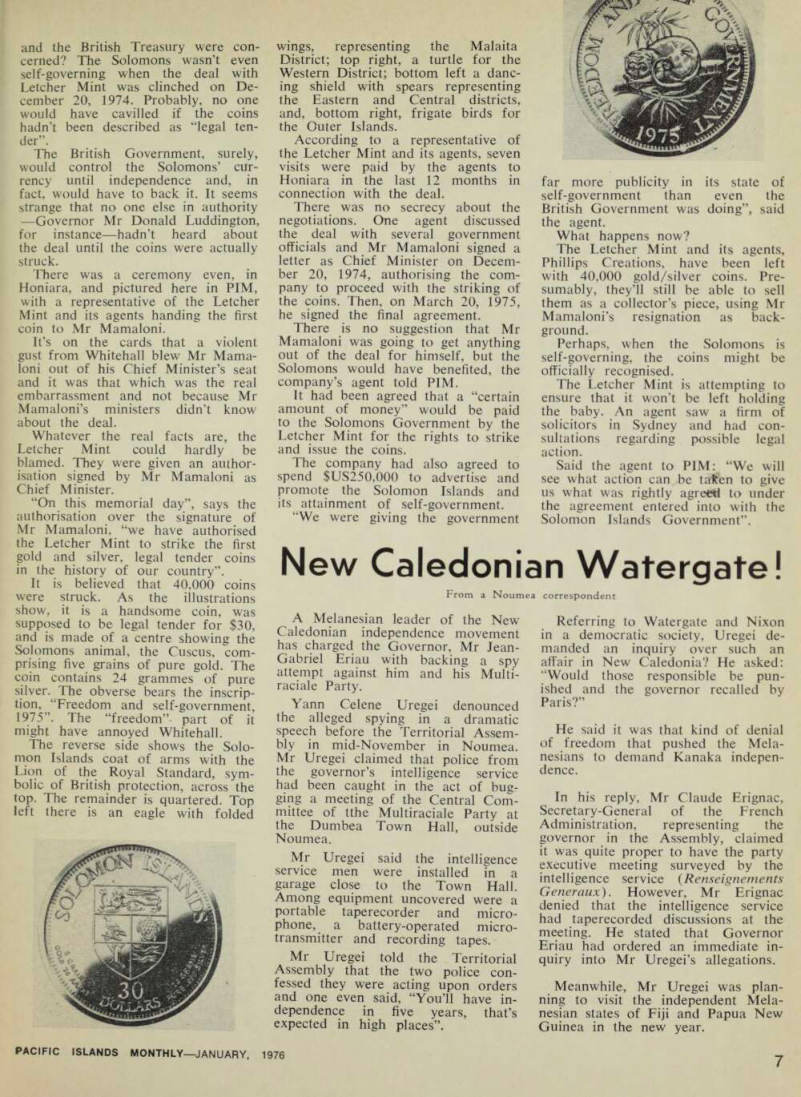
The presentation which brought down a government—Mr Mamaloni receives the first coin from Mr Barney L. Phillips, of Phillips Creations, the firm which arrange the commemorative coins deal.
and the British Treasury were con cerned? The Solomons wasn’t even self-governing when the deal with Letcher Mint was clinched on De cember 20, 1974. Probably, no one would have cavilled if the coins hadn’t been described as “legal ten der”.
The British Government, surely, would control the Solomons’ cur rency until independence and, in fact, would have to back it. It seems strange that no one else in authority —Governor Mr Donald Luddington, for instance—hadn’t heard about the deal until the coins were actually struck.
There was a ceremony even, in Honiara, and pictured here in PIM, with a representative of the Letcher Mint and its agents handing the first coin to Mr Mamaloni.
It’s on the cards that a violent gust from Whitehall blew Mr Mama loni out of his Chief Minister’s seat and it was that which was the real embarrassment and not because Mr Mamaloni’s ministers didn’t know about the deal.
Whatever the real facts are, the Letcher Mint could hardly be blamed. They were given an author isation signed by Mr Mamaloni as Chief Minister.
“On this memorial day”, says the authorisation over the signature of Mr Mamaloni, “we have authorised the Letcher Mint to strike the first gold and silver, legal tender coins in the history of our country”.
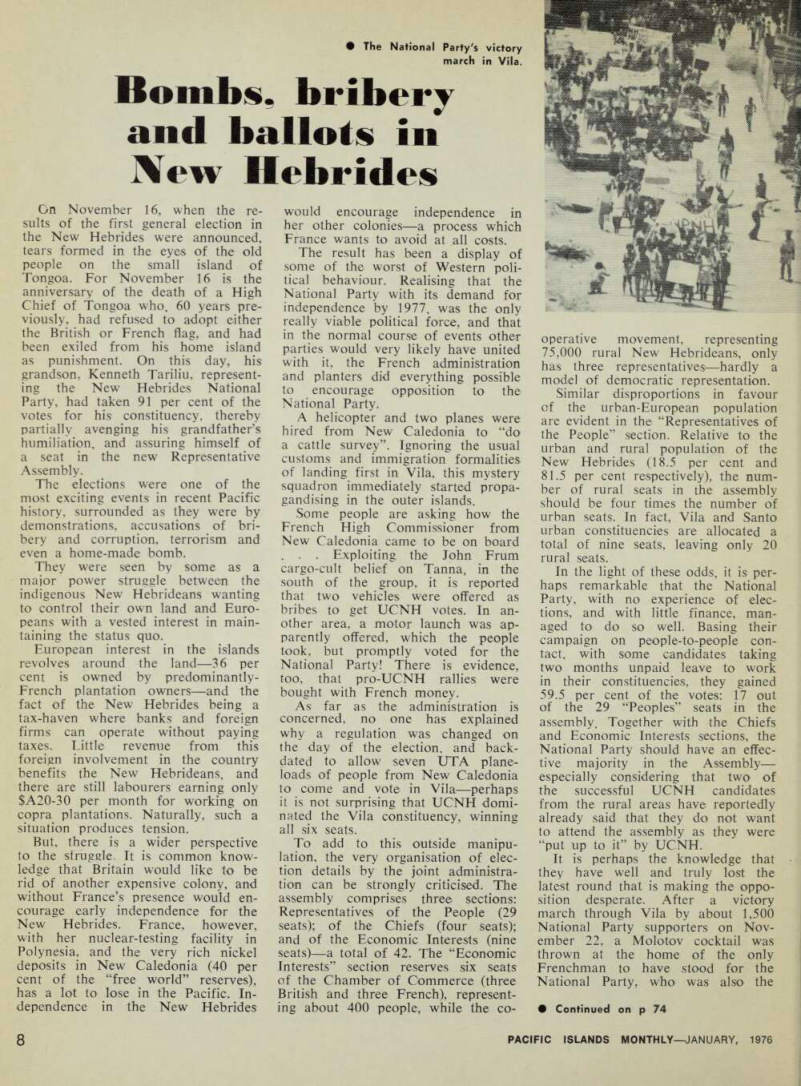
It is believed that 40,000 coins were struck. As the illustrations show, it is a handsome coin, was supposed to be legal tender for $3O, and is made of a centre showing the Solomons animal, the Cuscus, com prising five grains of pure gold. The coin contains 24 grammes of pure silver. The obverse bears the inscrip tion, “Freedom and self-government, 1975”. The “freedom” part of it might have annoyed Whitehall.
The reverse side shows the Solo mon Islands coat of arms with the Lion of the Royal Standard, sym bolic of British protection, across the top. The remainder is quartered. Top left there is an eagle with folded
wings, representing the Malaita District; top right, a turtle for the Western District; bottom left a danc ing shield with spears representing the Eastern and Central districts, and, bottom right, frigate birds for the Outer Islands.
According to a representative of the Letcher Mint and its agents, seven visits were paid by the agents to Honiara in the last 12 months in connection with the deal.
There was no secrecy about the negotiations. One agent discussed the deal with several government officials and Mr Mamaloni signed a letter as Chief Minister on Decem ber 20, 1974, authorising the com pany to proceed with the striking of the coins. Then, on March 20, 1975, he signed the final agreement.
There is no suggestion that Mr Mamaloni was going to get anything out of the deal for himself, but the Solomons would have benefited, the company’s agent told PIM.
It had been agreed that a “certain amount of money” would be paid to the Solomons Government by the Letcher Mint for the rights to strike and issue the coins.
The company had also agreed to spend 5U5250,000 to advertise and promote the Solomon Islands and its attainment of self-government.
“We were giving the government
far more publicity in its state of self-government than even the British Government was doing”, said the agent.
What happens now?
The Letcher Mint and its agents, Phillips Creations, have been left with 40,000 gold/silver coins. Pre sumably, they’ll still be able to sell them as a collector’s piece, using Mr Mamaloni’s resignation as back ground.
Perhaps, when the Solomons is self-governing, the coins might be officially recognised.
The Letcher Mint is attempting to ensure that it won't be left holding the baby. An agent saw a firm of solicitors in Sydney and had con sultations regarding possible legal action.
Said the agent to PIM: “We will see what action can be taken to give us what was rightly agreed to under the agreement entered into with the Solomon Islands Government”.
New Caledonian Watergate!
From a Noumea correspondent
A Melanesian leader of the New Caledonian independence movement has charged the Governor, Mr Jean- Gabriel Eriau with backing a spy attempt against him and his Multiraciale Party.
Yann Celene Uregei denounced the alleged spying in a dramatic speech before the Territorial Assembly in mid-November in Noumea.
Mr Uregei claimed that police from the governor’s intelligence service had been caught in the act of bug ging a meeting of the Central Committee of tthe Multiraciale Party at the Dumbea Town Hall, outside Noumea.
Mr t f ii* mp B n *>. l l l nt , elll « ence garage dose to the Town HalL po™abfe e Tap«lcorde n r COV and d micronhrmp q j •
transmitted and'^co^lapeT" 0 '
& p Mr Uregei told the Territorial Assembly that the two police con fessed they were acting upon orders ed one even said, “You’ll have independence in five years, that’s expected in high places”.
Referring to Watergate and Nixon in a democratic society, Uregei de manded an inquiry over such an affair in New Caledonia? He asked: “Would those responsible be pun ished and the governor recalled by Paris?”
He said was that kind of denial of .freedom that pushed the Mela nesians to demand Kanaka indepen dence.
In his reply, Mr Claude Erignac, Secretary-General of the French Administration, representing the governor in the Assembly, claimed it was quite proper to have the party executive meeting surveyed by the
H™* mT*ErTgnac
,hat l ? e H ‘"t elli S e . nce se ™“ had taperecorded discussions at the --ting He stated that Governor Eriau had ordered an immediate m quiry into Mr Uregei’s allegations.
Meanwhile, Mr Uregei was plan ning to visit the independent Mela nesian states of Fiji and Papua New Guinea in the new year.
Bombs, bribery
and ballots in New Hebrides
On November 16, when the re sults of the first general election in the New Hebrides were announced, tears formed in the eyes of the old people on the small island of Tongoa. For November 16 is the anniversary of the death of a High Chief of Tongoa who. 60 years pre viously, had refused to adopt either the British or French flag, and had been exiled from his home island as punishment. On this day, his grandson, Kenneth Tariliu, represent ing the New Hebrides National Party, had taken 91 per cent of the votes for his constituency, thereby partially avenging his grandfather’s humiliation, and assuring himself of a seat in the new Representative Assembly.
The elections were one of the most exciting events in recent Pacific history, surrounded as they were by demonstrations, accusations of bri bery and corruption, terrorism and even a home-made bomb.
They were seen by some as a major power struggle between the indigenous New Hebrideans wanting to control their own land and Euro peans with a vested interest in main taining the status quo.
European interest in the islands revolves around the land—36 per cent is owned by predominantly- French plantation owners—and the fact of the New Hebrides being a tax-haven where banks and foreign firms can operate without paying taxes. Little revenue from this foreign involvement in the country benefits the New Hebrideans, and there are still labourers earning only SA2O-30 per month for working on copra plantations. Naturally, such a situation produces tension.
But, there is a wider perspective to the struggle. It is common know ledge that Britain would like to be rid of another expensive colony, and without France’s presence would en courage early independence for the New Hebrides. France, however, with her nuclear-testing facility in Polynesia, and the very rich nickel deposits in New Caledonia (40 per cent of the “free world” reserves), has a lot to lose in the Pacific. In dependence in the New Hebrides
would encourage independence in her other colonies—a process which France wants to avoid at all costs.
The result has been a display of some of the worst of Western poli tical behaviour. Realising that the National Party with its demand for independence by 1977, was the only really viable political force, and that in the normal course of events other parties would very likely have united with it, the French administration and planters did everything possible to encourage opposition to the National Party.
A helicopter and two planes were hired from New Caledonia to “do a cattle survey”. Ignoring the usual customs and immigration formalities of landing first in Vila, this mystery squadron immediately started propa gandising in the outer islands.
Some people are asking how the French High Commissioner from New Caledonia came to be on board . . . Exploiting the lohn Frum cargo-cult belief on Tanna, in the south of the group, it is reported that two vehicles were offered as bribes to get UCNH votes. In an other area, a motor launch was ap parently offered, which the people took, but promptly voted for the National Party! There is evidence, too, that pro-UCNH rallies were bought with French money.
As far as the administration is concerned, no one has explained why a regulation was changed on the day of the election, and back dated to allow seven UTA plane loads of people from New Caledonia to come and vote in Vila—perhaps it is not surprising that UCNH domi nated the Vila constituency, winning all six seats.
To add to this outside manipu lation, the very organisation of elec tion details by the joint administra tion can be strongly criticised. The assembly comprises three sections: Representatives of the People (29 seats); of the Chiefs (four seats); and of the Economic Interests (nine seats) —a total of 42. The “Economic Interests” section reserves six seats of the Chamber of Commerce (three British and three French), represent ing about 400 people, while the co-
operative movement, representing 75,000 rural New Hebrideans, only has three representatives—hardly a model of democratic representation.
Similar disproportions in favour of the urban-European population are evident in the “Representatives of the People” section. Relative to the urban and rural population of the New Hebrides (18.5 per cent and 81.5 per cent respectively), the num ber of rural seats in the assembly should be four times the number of urban seats. In fact, Vila and Santo urban constituencies are allocated a total of nine seats, leaving only 20 rural seats.
In the light of these odds, it is per haps remarkable that the National Party, with no experience of elec tions, and with little finance, man aged to do so well. Basing their campaign on people-to-people con tact, with some candidates taking two months unpaid leave to work in their constituencies, they gained 59.5 per cent of the votes; 17 out of the 29 “Peoples” seats in the assembly. Together with the Chiefs and Economic Interests sections, the National Party should have an effec tive majority in the Assembly— especially considering that two of the successful UCNH candidates from the rural areas have reportedly already said that they do not want to attend the assembly as they were “put up to it” by UCNH.
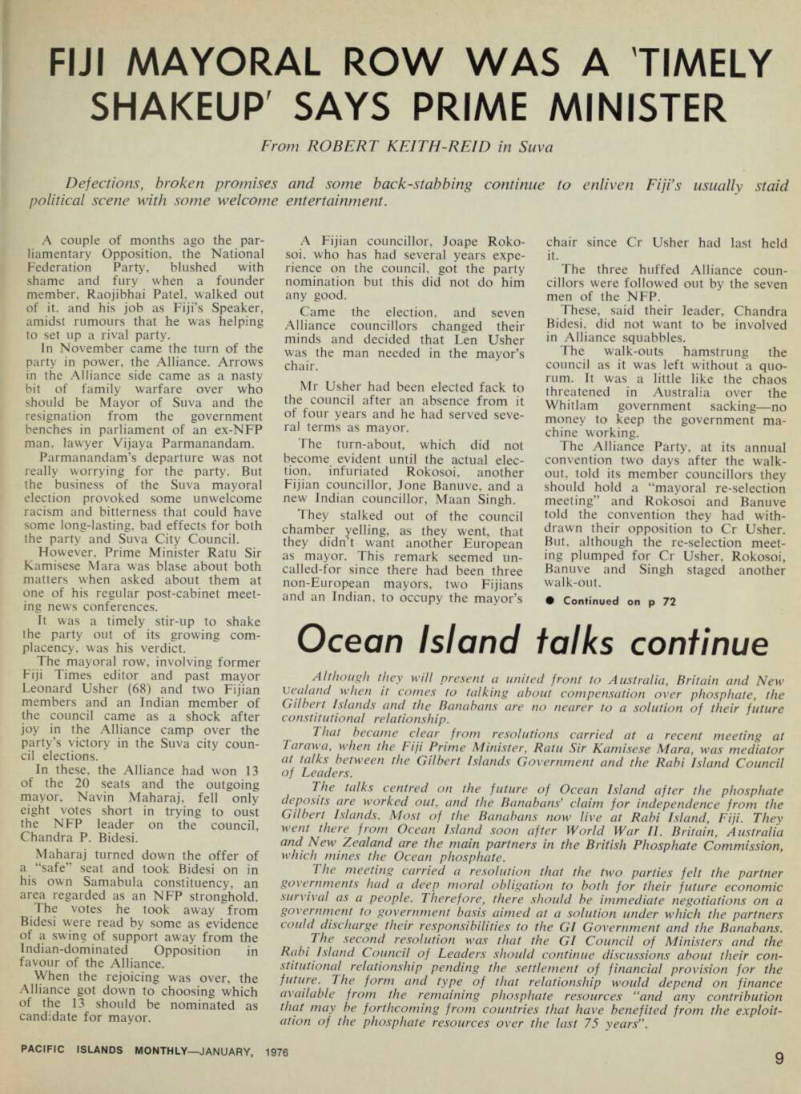
It is perhaps the knowledge that they have well and truly lost the latest round that is making the oppo sition desperate. After a victory march through Vila by about 1,500 National Party supporters on Nov ember 22, a Molotov cocktail was thrown at the home of the only Frenchman to have stood for the National Party, who was also the
• Continued on p 74
• The National Party's victory march in Vila.
only European to have joined the march.
These terror tactics are matched by panic in the banks: it has been reported that in a period of two days after the elections, SA6 million left the country. Judging by their past behaviour, there is little doubt that French interests will continue to excite emotions and create a fear of the future among both the Euro pean and Melanesian communities by spreading rumours similar to the current, quite-unfounded, one that the National Party intends kicking out all whites as soon as it gets into power. All this to delay the dominoes of independence for the French Pacific territories from falling for as long as possible.
In the next months, then, more rounds in the fight will be played, and there will doubtless be more punches below the belt. However, the strength of the National Party, now boosted by a victory, which is in reality much greater than it appears on paper, seems certain to increase, and lead the country to wards their goal of independence by 1977. 3 Walter Lini, leader of the National Party majority in the new Repre sentative Assembly of the New Heb
rides, maintains 1977 as the target date for independence in the con dominium.
Objectives were outlined in an interview published in Nabanga, the French/bichelamar newspaper.
Father Lini attributed the National Party success to the personal contact they had made with the people rather than insulting” them by dropping tracts from planes and helicopters.
He said the election results showed the party was capable of organising everything itself, contrary to what many people had claimed.
Asked about the contrast with the September municipal elections which were not a success for the National Party, Walter Lini said since then many people have felt that MANH (which won many seats in Septem ber ) did not truly represent the aspirations of the New Hebrideans in Santo.
Faced with the question of how the UCNH party had won all six seats in the Vila electorate, Mr Lini claimed there had been certain voting irregularities in that area, whereas election supervisors had been stricter in Santo.
Mr Lini was also asked how he thought the new assembly would function if the National Party occu pied 20 seats, for example, and 19 were held by other parties. Mr Lini replied that if the Representative Assembly does not function it will be the fault of the British and French governments who have not adequately prepared the political future of the country.
Father Lini pointed out, “We spoke of independence and our victory shows that the people of the New Hebrides are not afraid of this in dependence, despite the efforts of the pro-colonialist parties who tried to prove that independence is a bad thing and that the New Hebrides are not economically prepared”.
Questioned over the future status of the French language, he said his party would not seek to make English the official language but would in fact encourage both English and French schools and would also en courage the use of bichelamar.
On the question of whether he maintained the National Party ob jective of independence for the New Hebrides in 1977, Mr Lini reaffirmed this date which had been part of his election platform.
He stressed his party, contrary to certain others, wanted political in dependence ahead of economic independence.
Fiji Mayoral Row Was A Timely
Shakeup' Says Prime Minister
From ROBERT KEITH-REID in Suva Dejections, broken promises and some back-stabbing continue to enliven Fiji’s usually staid political scene with some welcome entertainment.
A couple of months ago the par liamentary Opposition, the National Federation Party, blushed with shame and fury when a founder member, Raojibhai Patel, walked out of it, and his job as Fiji’s Speaker, amidst rumours that he was helping to set up a rival party.
In November came the turn of the party in power, the Alliance. Arrows in the Alliance side came as a nasty bit of family warfare over who should be Mayor of Suva and the resignation from the government benches in parliament of an ex-NFP man, lawyer Vijaya Parmanandam.
Parmanandam’s departure was not really worrying for the party. But the business of the Suva mayoral election provoked some unwelcome racism and bitterness that could have some long-lasting, bad effects for both the party and Suva City Council.
However, Prime Minister Ratu Sir Kamisese Mara was blase about both matters when asked about them at one of his regular post-cabinet meet ing news conferences.
It was a timely stir-up to shake the party out of its growing com placency, was his verdict.
The mayoral row, involving former Fiji Times editor and past mayor Leonard Usher (68) and two Fijian members and an Indian member of the council came as a shock after joy in the Alliance camp over the party’s victory in the Suva city coun cil elections.
In these, the Alliance had won 13 of the 20 seats and the outgoing mayor, Navin Maharaj, fell only eight votes short in trying to oust the NFP leader on the council, Chandra P. Bidesi.
Maharaj turned down the offer of a “safe” seat and took Bidesi on in his own Samabula constituency, an area regarded as an NFP stronghold.
The votes he took away from Bidesi were read by some as evidence of a swing of support away from the Indian-dominated Opposition in favour of the Alliance.
When the rejoicing was over, the Alliance got down to choosing which of the 13 should be nominated as candidate for mayor.
A Fijian councillor, Joape Roko soi, who has had several years expe rience on the council, got the party nomination but this did not do him any good.
Came the election, and seven Alliance councillors changed their minds and decided that Ten Usher was the man needed in the mayor’s chair.
Mr Usher had been elected fack to the council after an absence from it of four years and he had served seve ral terms as mayor.
The turn-about, which did not become evident until the actual elec tion, infuriated Rokosoi, another Fijian councillor, lone Banuve, and a new Indian councillor, Maan Singh.
They stalked out of the council chamber yelling, as they went, that they didn’t want another European as mayor. This remark seemed un called-for since there had been three non-European mayors, two Fijians and an Indian, to occupy the mayor’s
chair since Cr Usher had last held it.
The three huffed Alliance coun cillors were followed out by the seven men of the NFP.
These, said their leader, Chandra Bidesi, did not want to be involved in Alliance squabbles.
The walk-outs hamstrung the council as it was left without a quo rum. It was a little like the chaos threatened in Australia over the Whitlam government sacking—no money to keep the government ma chine working.
The Alliance Party, at its annual convention two days after the walk out, told its member councillors they should hold a “mayoral re-selection meeting” and Rokosoi and Banuve told the convention they had with drawn their opposition to Cr Usher.
But, although the re-selection meet ing plumped for Cr Usher, Rokosoi, Banuve and Singh staged another walk-out.
• Continued on p 72
As it’s necessary to have a mayor if only to sign cheques, Suva faced i a crisis for nearly three weeks. The only money available was in a coun cil imprest account. That paid staff wages but there was no money for anything else.
Then the government stepped in and Minister for Local Government Mr Mohammed Ramzan ordered the council to hold a mayoral selection meeting. As a refusal might have prompted the minister to dissolve the council and order fresh elections, the councillors came to heel.
The mayoral election was a tie, 10 votes each for Usher and Roko soi so the result came out of a hat —Cr Usher.
The vote for deputy-mayor was also a tie, but the Loval Government Act doesn’t provide for a ballot so the council was stuck with that one, new Mayor Usher promising that he would call for immediate changes to the act which is full of holes. It doesn’t even provide for the mayor to give a casting vote on any motion.
Once in the chair, Cr Usher sued for peace and warned that Suva faced possible bankruptcy unless they all worked together. There were clear indications, however, that the three renegade Alliance men would con tinue to be a thorn in Cr Usher’s side.
What’s happened to party discip line, Alliance supporters wondered, but the Alliance had troubles higher up. Suva lawyer, Vijay Parmanan dam, who defected from the National Federation Party opposition in April last year and crossed the floor, there by strengthening the Alliance image in Fiji-Indian eyes, announced he was quitting the Alliance. He said he didn’t like party internal conflicts arising out of the City Council row or an accusation levelled at him at the Alliance convention alleging he campaigned for NFP candidates in the municipal elections.
Later, he said he intended forming a steering committee to organise an “Indian Nationalist Party”.
Asked how he saw the council dis pute and Parmanandam’s resignation, the Prime Minister replied; “I think' that, on the whole, it is always good to have a little stir up in the party now and again”.
But not so much as to shake the whole thing apart.
“We tend to get complacent”, the PM remarked. “I think this shaking up is very timely, before the next election, so we know exactly who our friends are, who our half-friends and who our non-friends are”.
Ocean Island talks continue
Although they will present a united front to Australia, Britain and New vealand when it comes to talking about compensation over phosphate, the Gilbert Islands and the Banabans are no nearer to a solution of their future constitutional relationship.
That became clear from resolutions carried at a recent meeting at Tarawa, when the Fiji Prime Minister, Ratu Sir Kamisese Mara, was mediator at talks between the Gilbert Islands Government and the Rabi Island Council of Leaders.
The talks centred on the future of Ocean Island after the phosphate deposits are worked out, and the Banabans ’ claim for independence from the Gilbert Islands. Most of the Banabans now live at Rabi Island, Fiji. They went there from Ocean Island soon after World War 11. Britain, Australia and New Zealand are the main partners in the British Phosphate Commission, which mines the Ocean phosphate.
The meeting carried a resolution that the two parties felt the partner governments had a deep moral obligation to both for their future economic survival as a people. Therefore, there should be immediate negotiations on a government to government basis aimed at a solution under which the partners could discharge their responsibilities to the GI Government and the Banabans.
The second resolution was that the GI Council of Ministers and the Rabi Island Council of Leaders should continue discussions about their con stitutional relationship pending the settlement of financial provision for the future. The form and type of that relationship would depend on finance available from the remaining phosphate resources “and any contribution that may be forthcoming from countries that have benefited from the exploit ation of the phosphate resources over the last 75 years”.
And Offers To Sell His Car
Make Sacrifices' Says Mr. Somare
Papua New Guinea’s Prime Minister, Mr Michael Somare, has appealed to his people for sacrifices and for restraint over wage claims and spending to help the country weather l h hnlTX?,T/ , .° rm a As he % ay - , b n°™\ • • must start at the As a first step.
I have decided to offer my official Daimler car or sale as a means of saving the government money”. PIM reports his statement in full.
As you are all aware, PNG faces a great challenge in the years imme diately ahead. For the past two or three years we have been lucky enough to have quite a large amount of money because of the state of the world economy and the prices we have received for the goods that we sell to other countries.
Now that has all changed, and it has changed for reasons which are not our fault and which we have no way of doing anything about. We are now in a situation where we are very short of money and next year, so far as we can see, we will have even less money. The world economy is in a very poor state and there is no chance that it will recover for some time to come.
The situation requires us all to adjust our thinking and to accept that we must all exercise restraint.
When a country is poor, if some members of that country get more for themselves, then it means that some other members will get less. It is the government’s job to make sure that in a time of hardship everyone gets their fair share and nobody is allowed to benefit at the expense of their fellow citizens.
For my own part, I accept that restraint and sacrifice must start at the top. As a first step, I have de cided to offer my official Daimler car for sale as a means of saving the government money. The government will also be selling its five Mercedes cars which were bought for the pur pose of entertaining distinguished guests at the time of our indepen dence. This is only a small thing, but I think it is essential to show clearly that we mean what we are saying when we talk about restraint. I will also make sure that from now on there will be strict economy in minis terial expenses for travel and enter tainment. Further economy measures are being investigated urgently and I hope to announce them shortly.
At its last meeting for the year, the national executive council con sidered the question of incomes policy and wages policy from the point of view of fair distribution in line with our eight-point plan and our com
mitment to putting the interests of rural people first.
There has been a good deal of confusion on the subject of wages, particularly public servants’ wages and question of indexation. I have recently received some figures which put the matter in a clear light.
In the past two years, the total money available to the government in the Budget has increased by KB7 million. This comes from all the many difficult and unpopular things we have done in that period, includ ing the renegotiation of the Bougain ville copper agreement, the raising of unpopular new taxes, putting up the price of cigarettes and other tough measures.
Of this total amount of KB7 mil lion, no less than K 38.6 million has
gone on paying higher salaries to national public servants. This is 44 per cent of the total amount. In other words, during these two years each national public servant has received on average an additional K7BB. All the rest of the money is what is left for the whole of the population not including public servants, and this means that on average every Papua New Guinean, except for public ser vants, has received Kl 9 in the form of additional benefits.
Let me repeat those figures. In the past two years each national pub lic servant has received an average of K7BB extra. Everyone else has received an average of Kl 9 extra. In other words, public servants have re ceived 40 times, I repeat that, 40 times more than the rest of the popu lation.
I am sure that if the public under stands these figures they will agree with me that there has to be res traint in further wage increases for public servants. In the next year or two we will not have more money than we have now and if we give more to public servants than there will be less for others. The rural people will receive fewer services, fewer roads will be built, etc, etc.
As the National Government com mitted to the welfare of the rural people we would be failing in our duty if we allowed that situation to occur. What the national executive council decided today, therefore, was to set up machinery which will re sult in a genuine and full national incomes policy. However, it will re quire time to set up this machinery, because many laws will have to be changed and new ones passed by parliament.
In the meantime, all the various conciliation and arbitration pro cedures, wage boards and tribunals will continue to exist. It will still be possible for all trade unions to put their case to these tribunals and boards. It is in these bodies that the arguments if any, should take place.
From now on the government will put its own case through the proper channels.
The National Executive Council
today decided that in future the government will also put its case to These tribunals and boards. The government’s case will be based on what the economy can afford, and as a general guideline the index ation base of K5OO will be used as the starting point for the govern ment’s case.
This applies not only to public servants but to everyone.
I must make it clear that this K5OO indexation base still means that public servants and other organised workers will be getting more money.
They will not be having their wages cut. It is simply, that if the govern ment’s case is accepted, they will be getting smaller increases than they would otherwise have got. This is only fair at a time when the country has no extra money to give out.
The Minister for Labour, Com merce and Industry has informed me that he will be appointing a new Minimum Urban Wages Board to review the automatic indexation granted by the last Minimum Urban Wages Board in 1974. This again is only fair, because if we all have to accept restraint then that must in clude urban workers as well as pub lic servants and others.
The government has been accused of breaking agreements and other things, mainly by the Public Service Association. We are not doing that.
We are faced with a national crisis and we would be completely failing in our duty as national leaders if we did not do everything we can to try and make sure that at this time of crisis the burden of restraint is fairly shared throughout the community.
I appeal to all of you to accept the need for restraint. Before you start demanding higher wages and benefits, think to yourselves that this can only be at the expense of your fellow Papua New Guineans.
I am speaking now to ministers as well as to public servants, workers and all other citizens. • Meanwhile, Mr Somare has re shuffled his government in pre paration for a restructuring of the public service. Some ministries have been dropped, new ones introduced and others amalga mated. No ministers have been dropped but the changes have caused a row behind the scenes which has disturbed the three party coalition. All 19 ministers will be members of the National Executive and there will be no return to the system of senior and junior ministers.
Several portfolios have been swap ped. Mr Julius Chan remains as Finance Minister.
the Gilberts
A walk-out in the Gilberts
Members of the opposition walked out of the Gilbert Islands House of Assembly early in De cember when the Financial Secret ary, Mr Patrick Reardon, intro duced the Budget for 1976, but returned to vote against the second reading of the Budget bill. Their numbers were insufficient, and the House passed the bill.
The bill provided for hefty in creases in direct and indirect taxes.
Included was a provision for about $5 million to finance development projects. Mr Reardon said the colony had to shotv it was prepared to make its contribution to deve lopment projects.
The house voted money to set up a defence force. The Chief Minister, Mr Naboua Ratieta, said the force would have a strong de velopment role. The term “defence force” might give a wrong im pression, so he wanted to make it clear that development would be its major task.
The Gilbert Islands at present has a police force, but no defence force.
How Tuvalu Will 'Raise The Wind '
The first budget for the new British colony of Tuvalu, which came into existence on October 1 and which has to paddle its own canoe from January 1 this year, totals $A 1,687,150 —roughly half of it to come from local revenues.
Britain’s grant will be $A839,090, and local revenues are estimated to be $850,060, comprising personal tax revenue of $50,000, customs duties $125,000, philately and coinage $360,000.
Of the British grant, $250,000 will comprise working capital for the new colony.
In addition, Tuvalu will have deve lopment money, derived from grant
and loan funds, of $1,761,970 for 1976. This will be used, among other things, for the building of an adminis tration centre at the new capital of Funafuti, a civil servants’ home ownership loan scheme of $424,000, and houses for Her Majesty’s Com missioner, the Chief Minister and a government guest house, totalling $120,000. Education, including over seas scholarships and training, will take $220,000, and working capital for the co-operative wholesale society will be $425,000.
Tuvalu in 1976 is budgeting to spend, among other things, $758,980 on home affairs, including shipping and works, $354,280 on social ser vices and education, and $42,030 on commerce and natural resources.
Advertisements & other items, p. 13 (1 item)
Qbe Insurance
Q E
serves the Islands with expert
insurance service and advice.
QBE INSURANCE
LIMITED
(FORMERLY—QUEENSLAND INSURANCE COMPANY LIMITED)
Central Office: 82 Pitt Street, Sydney f 7l //— Branch Office, Suva, Manager for Fiji: F. N. Davies (A.A.U.).
LAUTOKA—Sub-Branch Office: Burns Philp Bldg. — Breckwoldt & Company (5.1.) Pty. Limited.
NEW CALEDONIA—T. A. Hagen, Ste. W. A. Johnston, S.A.R.L. —Noumea.
NEW HEBRlDES—Resident Officer: G. F. Donnelly, Vila; Santo: Burns Philp (New Hebrides) Ltd.
Chung: Immeuble 8.1., Front de Mer, Papeete.
NRJE NORFOLK ISLAND, SAMOA, TONGA and other South Sea Islands—Bums Philp (South Sea) Company Ltd.
QUEENSLAND INSURANCE (P.N.G.) LTD
PAPUA NEW GUINEA
Head Office, Port Moresby: General Manager: D. J. Gran ter District Managers at Rabaul: C. D. Dickings; Lae: W. J. Leonard Mt. Hagen: D. F. Carroll. Atawa: A. M. Tanner; Madang: I. R Martin.
Wanted: a national sport for PNG
From Gus Smales in Port Moresby
With all its new-found nationalism, Papua New Guinea has yet to pro duce what could be called a truly national sport.
Australian Rules supporters tried to establish their brand of football in PNG (with fair success in some areas), and the Prime Minister, Mr Somare, even tried his hand at a national golf promotion.
Cynics describe the local version of cards— laki, pronounced “lucky” —as the national sport, and super cynics give the honours to beer drinking.
But, now. the Defence Minister, Sir Maori Kiki, has come up with his own definition, referring to the “national sport” of traditional fighting between tribes.
Sir Maori was asked in the Natio nal Parliament if he considered the ceiling of 3,500 men in the Papua New Guinea Defence Force was ade quate to cope with possible trouble.
"What would happen in the even of civil war?” asked Opposition leader, Mr Tei Abal.
Sir Maori dismissed the possibility of civil war with what amounted to
a mental shrug of the shoulders. He said he supposed the present incidence of inter-tribal fighting already amounted to a kind of civil war.
“But I would call it the national sport of tribal fighting”, he added, and stressed that control measures were part of the duties of the civil police.
The continual eruption of tribal fights and the violence and hardship which they bring, worries the newly independent PNG just as much as it worried the former Australian administration.
The fighting ties up police strength, overtaxes the court system, and sets back rural development and national unity programmes.
Against this background, there’s tendency to accuse Sir Maori of flippancy when he dismisses tribal fighting as nothing more than a national sport.
But the point is that inter-tribal fighting is very much a reflection of the standard of development of the tribes which practise it. Sir Maori and other national leaders accept the
fact that in the more primitive parts of their country tribal feuding is a way of life, and that there is no easy cure.
There’s nothing ideological about these clashes which spring from such earthy matters as arguments between neighbouring farmers, fights over women and livestock (usually pigs), road accidents, and insults and in dignities (real or imagined).
There are indications that some aspects of today’s community deve lopment—roads, motor vehicles and cash markets in particular—have worsened rather than improved the tribal fighting pattern.
This could be true because today’s villager has more opportunity than ever before to meet a greater num ber of potential enemies as well as a greater number of potential friends.
But the PNG Government sees this as only a transient condition, and believes that tribal fighting will become a thing of the past when real social development starts to catch up with veneer development in the more remote parts of the country.
Advertisements & other items, pp. 14-15 (1 item)
Built To Earn A Living
SHIPS AND WORKBOATS BY CARPENTERS INDUSTRIAL
From a village fishing boat to an inter-island trader. A tugboat to a 100 foot barge. We design and in wood or steel up to 120 feet in length.
If you trust your living to the sea, trust your shipbuilding to Carpenters Industrial.
CARPENTERS INDUSTRIAL
BOX 296 SUVA FIJI. PHONE 23031. Cable MILLERS SUVA Telex 2195FJ build them all.
8 Speed
Power
Blender
THE APPLIANCE YOU CAN USE
EVERY MEAL
With powerful. Solid-state motor. Which means the exact blending action you need to— Whip, grate, mix, chop or liquefy. Stainless steel cutters give fast food preparation while switching from speed to speed without turning off . . .
Shot-of-Steam
Iron
iiir
A totally new concept in irons.
Cruises effortlessly over woollens, linen, cotton and all synthetics. Removes unwanted creases and wrinkles with a penetrating shot-of-steam —at the touch of a button.
Luxury of your own viewpoint
your own viewpoint
In an ABC commentary last week I made passing reference to the mat ter of immigration of South Pacific Islanders to Australia.
I said that Island leaders have pointed out over the years that the right of Islanders to work in Aus tralia on temporary permits, a right which many Islanders already have in New Zealand, would help the economies of the poorer Island nations. It was, I said, a matter for the next Australian Government, of whatever political persuasion, to come to grips with.
I had one or two calls after that commentary, suggesting there was no reason why Australia should have to follow New Zealand’s immigration policy . , . and that in any case, as I myself had pointed out, Mr Mul doon had threatened to reduce Island migration into New Zealand.
Now the point of my reference last week was that I believed the election of Mr Muldoon’s govern ment in New Zealand, with his policy on immigration, would draw attention to Australia’s immigration policies as they affect the people of those South Pacific Island nations around our perimeter. Whether we are speak ing of temporary or permanent migra tion doesn’t matter. And it doesn’t matter what I think of Island immi gration to Australia (although I hap pen to support a quota system of entry). In the years I have been broadcasting on South Pacific mat ters, my task, as I have seen it (in my notoriously humble way!) is to inform my fellow-Australians about the problems and attitudes of Islanders.
Well, this matter of immigration has been for years one of the great talking points in the Islands, and Australians can continue to ignore it only at their own peril. And the subject has many facets.
Not long ago, for instance, it was important to a vocal number of Papuans. This was before Indepen dence, when Papua and New Guinea could be said to have had different political antecedents. Papua was an Australian territory, New Guinea a United Nations Trust Territory.
All this disappeared with Indepen dence, but not before the Papuan
This is the script of a broadcast made by Stuart Inder, publisher of the Pacific Islands Monthly, over the Australian national ABC net work on December 10, a few days before the Australian general election.
nationalists had argued that they were Australian citizens, with more rights than New Guineans who were merely Australian-protected persons.
But unfortunately it became obvious to both Papuans and New Guineans at that time that the so-called Aus tralian citizens had no citizenship right of entry to Australia, so it was rather an inferior “citizenship”.
Now I believe this question of easier Papua New Guinean access to Australia is merely dormant tempo rarily, while Papua New Guineans get on with the task of absorbing their independence, but in time it will become a live issue in that virile nation, with its population of almost three million.
Meanwhile, lying to the north-east of Papua New Guinea is a British colony of 7,000 people called Tuvalu —you can be forgiven for not having heard of it, because it was established only on October 1. Tuvalu was pre viously the Ellice portion of the Gilbert and Ellice Islands Colony. I happened to be at Funafuti, capital of Tuvalu, on the day the new “state” came into existence, where I talked with the members of the new House of Assembly including the man who next day became the Chief Minister.
Their colony had only a fish-and coconut economy virtually at sub sistence level and a promise of a yearly handout from Britain, but they said surely Australia and New Zealand would do something for them? At the very least, they said, Australia would allow Tuvaluans to work in Australia and send money home?
I have had that question asked of me, as most Australians have, in all parts of the Pacific.
Another example—At a recent high level seminar held in Tonga, both the Australian and the Tongan Governments were criticised for their immigration policy—Australia be cause of its restrictions, and the Tongan Government because, it was said, it failed to safeguard the in terests of its own citizens in this wider sphere.
There was criticism that perma nent migration to Australia was only for those of developed skills, thus creating a brain-drain in the very
• Continued on p 73
nintries that receive aid from Aus alia in order to build up their skills. was said that Australia and New ealand had a responsibility towards teir Pacific neighbours as well as to icmselves, and a wider variety of jople and age-groups should be Imitted.
Now this point about wider res msibility has been made by Ratu r Kamisese Mara, Prime Minister : Fiji, among other leaders. In Aus alia a few years ago Ratu Mara ade it clear that he thought Aus alia’s Island migration restrictions ere not the policy of the govern ent, any government, but of the ustralian people.
They were the work of a series of wernments doing what the Austra m people wanted, he said.
“But my problem in Fiji”, Ratu ara explained, “is to work the irious races together into multi cial harmony. If Australia treats y citizens differently according to eir race, it is working against my vn domestic policy”.
As I said, there are many facets this question of Island immigration Australia, and my point in this oadcast is that Australia will not ways have the luxury of viewing e question only from its own point view.
I present that as a simple state ent of fact.
Tahiti Letter
French Polynesia’s Year of Decision
From Al Prince In Papeete
IF 1975 was the “Year of the Statute” here, 1976 may well become the “Year of the Elections”, and, more importantly, “the Referendum”, with France giving French Polynesia the choice of being (1) independent, (2) an Overseas Department of France, (3) a region of France, or, (4), an Overseas Territory, as it is now, but with a new law providing more autonomy. As 1975 drew to a close, the more imminent possibility for 1976 was the dissolution of the French Polynesia Territorial Assembly, which approached the new year powerless and deadlocked for the first time in its history.
But as the old year ended on uncertainty about the future, the new year began with two certainties—(l) Charles Schmitt will replace Daniel Videau as French Polynesia’s Governor soon, giving the territory its first governor who has never had an overseas post; (2) Olivier Stirn, the French Minister of Overseas Depart ments and Territories, will be making a return visit to Tahiti, probably in January.
The political life in French Polynesia has never been the same since Mr Stirn first visited Tahiti last March, opening a dialogue on a new statute, which he sub sequently proposed, to make French Polynesia a more autonomous Overseas Territory. But since March, the discussions here and in Paris and between France and Tahiti have shifted more and more away from the new statute to a simple choice—independence or a region or department.
While never saying anything about a referendum, Mr Stirn hinted at such a possibility in a mid-November interview when he said; “The Polynesians must cer tainly decide one day if they want to remain French or become independent”.
Mr Stirn will find anything but a calm political situ ation when he returns here. Instead, the situation has developed into a hornets’ nest with the local government unable to govern, the governor unable to break the deadlock, the major political parties calling for the dis solution of the Territorial Assembly and the holding of new elections, the formation of a leftist Socialist party and the interjection of racist statements in the local political dialogue.
On November 13, the majority in the 30-member Territorial Assembly shifted from the autonomist party headed by Frantz Vanizette to the Gaullist party of Gaston Flosse. The majority shifted by one vote when the councillors voted on the formation of a committee to study the new statute proposed by Mr Stirn. The deciding votes were cast by councillors Adophe Bohl and Lucien Rattinassamy, who later said they were still loyal to the autonomist camp, having only switched sides on this one particular vote.
But before going to Paris with the committee headed by Flosse, Bohl and Rattinassamy attacked the Popaa
(the Tahitians word for white man) in the Territorial Assembly. In interjecting the first openly-racist political dialogue here, the two councillors specifically attacked President Vanizette and councillors Henri Bouvier and Daniel Millaud, saying that the Tahitians have a suf ficient maturity to discuss the situation with the Minis ter of Overseas Territories without the assistance of the popaa.
Bohl and Rattinassamy continued the attack by say ing that if the popaa want to make politics, “why don’t they form their own party? Polynesian parties that speak in the name of Polynesians should not be man aged by popaa”. They said their only regret was that they had not taken this stand earlier and not put a popaa as President of the Territorial Assembly.
The two councillors subsequently received several threatening telephone calls. There was even a report that Rattinassamy received at his home an envelope containing a rifle bullet wrapped in cotton wool. It was, therefore, not surprising that the two men were given a heavy escort by the gendarmes when they went to the airport to fly to Paris with the statute committee headed by Flosse.
THEN, with Flosse and his group in Paris, President Vanizette called an extraordinary session of the Territorial Assembly at 12.15 am on November 19 with 20 councillors present, only five of whom represented Flosse’s so-called “new majority”. Despite the unusual hour, some 300 persons sat in the audience, represent ing all walks of life, including truck drivers, gardeners and longshoremen.
Vanizette, turning the gavel over to another coun cillor so he could speak from the floor, opened the session by saying, “We don’t want to be boxed into a dilemma. We don’t want a region, or independence. (Applause). I think that the French Parliament will understand us”. (Applause).
Gaullist councillor Nedo Salmon charged that the session was illegal. When Vanizette asked for proof, four of the Gaullist councillors left the hall, with Salmon saying he planned to lodge a protest.
The statute proposed by Mr Stirn was then brought up and rejected by a 15-0 vote with one abstention.
The assembly session ended at 3.25 am after Vanizette refused to set a date for the next session, thus leaving the assembly blocked.
The autonomists, therefore, defied the administrative powers, stacking the cards in their favour for the first time in order to achieve their main objective of having the assembly dissolved. However, the assembly cannot dissolve itself. This is something that can only be done in Paris. And Mr Stirn indicated in a communique that the action of Vanizette’s so-called “new minority” in rejecting the statute on November 19 was illegal.
The same day that Mr Stirn issued his communique from Paris, Governor Videau held a press conference in Tahiti, saying that France had no intention of taking such a drastic step as dissolving the Territorial Assem bly. Governor Videau also ruled out a referendum on the statute, adding, “One uses a referendum when part of the territory wants to separate itself from the whole; when it demands its independence”.
Governor Videau accused Vanizette of abusing his power as Assembly President by calling a session at an hour when it was impossible to bring the other coun cillors back from Paris in time and by assuming that only he can call a meeting of the Assembly. The Governor said he had asked the State Council to rule on the situation within 90 days, hoping to get an answer within three weeks.
President Vanizette had until December 31 to call another assembly session, which he said he had no intention of doing. After December 31, Governor Videau can call the assembly together in an extra ordinary session. But if President Vanizette does not transmit the governor’s call for a session, or if the president and vice-president of the assembly are not present, none is held.
With the Territorial Assembly rendered powerless, the 1976 Budget cannot be voted. The governor will have to intervene after January 1 to release money on a monthly basis equivalent to a twelfth of the 1975 Budget.
Meanwhile, President Vanizette accused Governor Videau of bluffing. He also described Councilloi Salmon’s motion before the Administrative Appellate Court a bluff, saying the court has no authority to rule on territorial assembly actions other than elections.
Vanizette said he regretted the present situation of a blocked assembly, which, he said, could last until the renewal of the assembly next May. The only solution, he said, is dissolution, which all the political groups have demanded at one time or another. He said Flosse wanted dissolution when he was leader of the minority, but now that the government has helped him regain the majority he (Flosse) does not want the assembly dissolved.
As for the future, Vanizette said, “We don’t want independence. We’re not crazy”.
However, French National Assembly Deputy Francis Sanford was talking about independence.
“We want to remain French, but not at the price of disguised departmentalisation as Mr Stim wants to impose on us. We want to remain on the whole French but we want to assure ourselves the administration of our affairs”, he said.
Mr Stirn has now proposed to us departmentalisation, regionahsation or independence. For us, the choice will be difficult to make, but between departmentalisation and independence, we will choose independence—if we are forced to”.
Noting that the autonomist party he heads asked Mr Stirn in a telegram 9n February 6 to dissolve the assembly, Sanford said in mid-November that in the weeks to come his party would take other action to force the dissolution of the assembly and hold a referendum.
Thus, as the new year approached, the political situation in French Polynesia was stalemate, the only hope for ending the deadlock being Mr Stirn’s arrival m January, which could well coincide with Mr Videau’s departure and the arrival of the Territory’s new governor.
FRANCE conducted its second underground nuclear test of 1975 on the French Polynesian atoll of Fangataufa, some 800 miles southeast of Tahiti, on November 26. The test, code-named Hector, was des cribed by the French Defence Ministry in Paris as pro viding “satisfactory results”.
The test, originally scheduled for October, was the second and last test to be conducted at Fangataufa for the foreseeable future, France having decided earlier to move its underground testing facilities to Mururoa, the site of previous atmospheric tests. France’s first under ground nuclear test occurred on June 5.
France moved its nuclear testing underground be cause of pressure from other countries, mostly in the South Pacific, who were worried about radio-active fallout. French officials have estimated that the under ground tests costs more than $l6 million each, com pared to $4-$5 million for atmospheric tests.
About two weeks before France’s latest underground blast, French President Valery Giscard d’Estaing claimed that France is now the third nuclear power in the world, far behind the United States and the Soviet Union, but well ahead of Britain.
France, like the People’s Republic of China, has not signed the nuclear test ban treaty. And its nuclear wea pons are not under the direct control of the North Atlantic Treaty Organisation, since France does not belong to the NATO integrated command structure. ★ ★ ★ ★ r>LANS have been disclosed for a 2,650-metre long A airport runway at Nukuhiva in the Marquesas. This will enable larger aircraft to service the island on a more frequent basis from Tahiti. Also planned are a two-lane motor vehicle tunnel under the current runway at Tahiti-Faaa International Airport sometime next year and a second runway in the next five or six years for all light aircraft.
The plans were disclosed at the week-long 12th informal meeting of the directors of civil aviation in Asia and the Pacific. Delegates from 18 countries attended the meeting.
The Nukuhiva runway project has been divided into two phase, the first at an estimated cost of 16.5 million French Pacific Francs, which is about U 55206,000. The first phase will involve the construction of a 1,500metre-long runway, which would be expanded to 2,650 metres under Phase 2 of the project. No dates for the project were mentioned.
In presenting a working paper to the meeting, France noted that the Marquesas Archipelago, 800 nautical miles northeast of Tahiti with some 5,000 inhabitants, in the recent past had only the copra boats as a link with Tahiti.
Said the spokesman: “When a few years ago French Polynesia entered the aviation era, the Marquesans longed for an airport of their own, but owing to the volcanic nature of their islands and to the fact that they have no surrounding lagoon, meeting their wish appeared an uneasy task.
“Commercial flights were then started, using a third small airfield, Manihi, as a stepping stone between Tahiti (300 nautical miles away) and the Marquesas (a 500-mile hop). The aircraft used, which had to operate on runways less than 800 metres long, were a Piper Aztec and a Twin Otter. Obviously, those planes, or in fact, any other now available and having similar take off and landing requirements, cannot be operated safely, regularly, or economically on such a distance over the ‘blue sea’.”
Tropicalities
Admiral backs a super port
During a visit to the Palauan Islands, Admiral Kent Carroll, Com mander of the US Naval Forces in the Marianas, said that the most im portant thing happening now in the Western Pacific is the prospect of “Port Pacific” in Palau, a superport complex proposed for the northern reefs of Palau.
Backed by lapanese and Iranian government interests, the port would be capable of storing a three-months supply of oil for Japan.
Carroll commented: “The US is certainly not opposed to it. However, the people of Palau are the import ant key. There has to be no opposi tion to it. My personal feeling is that I predict the preliminary studies will show that it’s a viable concept and I think it makes a tremendous amount of sense. There will be tre mendous pressure in Palau from huge concerns and countries. I think it will be a difficult thing for the Pa lauans to turn down”.
He emphasised that, in his opinion, the positioning of the port in Palau would depend greatly on Palau’s close alliance with the United States.
“No country is going to put money into something without strong politi cal stability—and that can only be with the US”.
Questioned as to the military’s interest in obtaining a lease option on 30,000 acres of land in Babel thaup, Palau’s largest island, Carroll replied: “If we lose or pull out of additional areas in the Western Paci fic, we will have to pull back. Tinian is our priority area, but Babelthaup would be needed for contingency operations. We need operations grounds for amphibious operations.
We are losing many of the beaches we used to use for this type of train ing, so we’re looking for other areas”.
Carroll said that at present he does not foresee too many changes in the Trust Territory “unless some thing happens in the Western Pacific” such as the loss of bases the US now holds. This, he felt, is extremely un likely, but if it did happen, “the
Trust Territory would become im
portant overnight. The build-up
would be tremendous, Guam would be'first, then Tinian, and third Babel thaup. In the case of Babelthaup negotiations would first be necessary”.
Admiral Carroll made his first trip to Palau in November as part of a larger visitation schedule to all the districts of Micronesia. He was travelling as the official represen tative of Admiral Guyler, Com mander-in-Chief, Pacific. Admiral Carroll’s command area includes all the Trust Territory, New Zealand and Australia.
Cat was
for burning
A Catalina flying boat, one of World War Two’s historic aircraft, has been rescued from a team of eager firemen in Port Moresby. Fire men from the Civil Aviation Agency wanted to burn the abandoned flying boat to practise fire and rescue drill for airport emergencies.
But an aircraft restoration group from New Zealand stepped in and rescued the flying boat from its graveyard beside Port Moresby In ternational Airport.
After negotiating with officials of the PNG Air Museum, the restora tion group used a crane to lift the flying boat from a pile of old tyres which had been heaped round it to make a fire.
The flying boat—or part of it, anyway—was sent by sea to the Auckland Museum of Transport and
Technology.
With a wingspan of 104 feet, it was too bulky to be loaded in one piece in the freighter Capitaine Cook.
After restoration, the Catalina will go on permanent display in Auckland as an example of one of the most famous maritime reconnaissance and courier aircraft from all theatres of war in World War Two.
In return, the PNG Air Museum, which has yet to establish its public displays, will get the fully-restored cockpit sections of two famous World War Two fighters—a Spitfire and a Thunderbolt.
The Consolidated PBY Catalina was a distinctive aircraft with a high
pedestal wing, two engines, and two distinctive viewing blisters amidships.
It was a Catalina operated by the RAF which made the historic sighting of the Bismarck on May 26, 1941.
Nearly 4,000 Catalinas were built altogether in factories in the US, Canada and Russia.
In Australia, the RAAF carried out its Catalina training from a base at Lake Boga near Swan Hill.
During the postwar reconstruction of air services in PNG, Qantas operated Catalinas on passenger and freight services on the Papuan coast and to coastal outstations on New Britain and Bougainville.
Later, TAA took over the services, and the last Catalina to fly in PNG was withdrawn from service in 1967.
This was the one which has gone to New Zealand, and which was origi nally flown to PNG from Hong Kong where it had also been used in civil air services.
Has anyone
found a house?
The Papua New Guinea Govern ment has “lost” hundreds of houses in all parts of the country, so stock taking is being organised to find out how many houses the Government owns—or should own—and where they are.
There’s no doubt that the houses still exist, that people are living in them, and that they are still on the sites where the Government built them. But confusion in records cover ing many years in frustrating attempts to establish an accurate central register.
“We will just have to go out and look for them”, a Government officer said.
There are indications that some public servants may be living rent free in houses which have quietly slipped from the records. The situa tion is coming to light as the PNG Housing Commission prepared to take over responsibility for all Government houses and flats.
The former Australian administra tion in PNG and the PNG Govern ment have followed and inherited the typical colonial custom of providing
houses for all public servants, and at token rentals.
This was because public servants were either brought in from overseas or were drawn from distant, village type communities.
The records became increasingly confused because each government department kept its own housing records and because huge adminis trative upheavals accompanied recent political change.
The Government, wanting to en courage a more settled type of com munity, involving personal house ownership where possible, is centralis ing all Government housing through the Housing Commission in a plan which will take three years to implement.
The Commission will also operate on a strict commercial basis, stepping up rentals to economic levels and helping to finance personal ownership.
Language problem
spells disaster
Life in a sophisticated country has proved too much for some Paci fic Islanders trying to earn money in NZ to send home. They are earn ing good money, but at a price.
Language problems have had some disastrous consequences.
A Samoan working in a galvanis ing iron factory lost practically all of one arm after he put it in an acid vat to retrieve an object. He just could not understand what acid would do. Another Islander, during his first day on the job was put on a cutting machine. He amputated his fingers.
A family lived in darkness for a week because none of them knew how to change a light bulb, and none knew the word ‘bulb’. An other family cooked on a backyard fire because no one knew how to put 20c in the gas meter.
There is an obvious need to fill communication gaps somewhere.
Religious freedom,
Samoa-style
In an unnamed village in Savaii, Western Samoa, a man’s creed is governed not so much by his con science but by the village council.
Apparently, some children have been regularly attending the Roman Catho lic Sunday School, and refused to stay away. The village council met and decided to uphold a village tra dition that there be only one religion in the village—the original LMS.
Involved in this decision was the dismissal of three matai. Three fami lies were discouraged from being Catholics. The village apparently, in 1931, adopted a regulation that there
was to be only one religion (the LMS) for its people. But when the Catholic religion was introduced later it was welcomed with open arms, and established.
A Catholic villager claimed that more people were becoming Catho lics, so the chiefs decided to uphold something they themselves broke more than 40 years ago. The upshot now was that the children concerned were more dedicated Catholics than ever before, reported the Samoa Times.
NZ’s Mr Muldoon
annoyed Sir Albert
New Zealand’s new Prime Minis ter, Mr Robert Muldoon, with a long reputation for being rather an abrasive character, incurred the wrath of Cook Islands Premier, Sir Albert Henry, during the NZ elec tion campaign. Mr Muldoon said that immigration restrictions would be necessary to reduce the immigrant flow, and the dual citizenship rights of Islanders might be affected. Some months earlier he said that Islanders who got into trouble with the law should be sent home.
Sir Albert, who was in Auckland during part of the campaign, said the Cook Islands Government would not co-operate with a National Government, which attempted to impose such restrictions. Islanders had a free right of entry into NZ
for 60 years, and to stop them going there would be cruel.
It turned out to be a storm in a tea-cup. Mr Muldoon denied he would restrict Cook Islands migra tion to NZ. It was constitutionally impossible.
Vigilantes to
“ride” in Lae
Police in Lae, Papua New Guinea’s second city, have tacitly approved the formation of vigilante-type groups to combat night crime.
But a group would act only if one of its members was in trouble, and its weapons would be “golf clubs, cricket bats and things like that”.
Inspector Watson Beaton, of Lae, said he envisaged a scheme in which householders would form self-help groups among themselves and in their own street or neighbourhood.
If a member of a group was dis turbed at night by a thief or prowler he would ring one contact in the group who would then use a pre arranged telephone list to call out the others.
He believed that the arrival of a formidable collection of neighbours armed wtih golf clubs and cricket bats would chase away a lawbreaker or enable capture, and would act as a general deterrent.
Inspector Beaton was issuing an appeal for organised public support to help police.
The brilliant colours of these stamps will ensure a ready sale for them among those philatelists especially youngsters, who specialise in exotic sets, but the Christmas stamps from the Gilbert and Ellice Islands should find favour with all collectors for their historic value. They are the last stamps to bear the name Gilbert and Ellice.
The Ellice Islands, now Tuvalu, parted company from the Gilberts on October 1, but the joint administration services continued until January 1. New Year's Day marked the complete separation of the two Island territories with Tuvalu opening its own government offices and departments. On December 1, Mr Naboua Ratieta, the Gilberts' Chief Minister, presented Tuvalu with its one ship, the Navanga, the only piece of "equipment" which Tuvalu was given under the terms of secession from the GEIC.
To mark the separation the Gilberts planned to issue two stamps on January 2. One stamp shows the Gilbert group and the other Tuvalu which means "eight islands". In fact, there are nine islands but one, Niulakita is a plantation island not permanently settled. Therefore, it doesn't count.
Advertisements & other items, pp. 20-21 (1 item)
We cool anything
under the sun.
From the smallest home to the largest factory— there’s a Daikin unit to help keep you cool.
And wherever your particular hot spot is there’s a Daikin man within calling distance to help keep you happy. Because Daikin specializes in air conditioning equipment, you can always feel comfortable knowing you have a fine unit that should give you years of whisper-quiet, trouble-free service. But, we can’t cool your place under the sun until we know where it is, now can we? So call soon.
Comfort will be on its way.
©.DAIKIN
AIRCONDITIONERS
Daikin Kogyo Co., Ltd.
Head Office: Shin Hankyu Bldg 8 Umeda Kitaku Osaka Japan Mechanical Service Ltd.
P.O. Box 412, Suva, Fiji Islands
Cable; MECHSERV SUVA
Societe Japon Import S.A.R.L.
B. P. 590, Papeete, Tahiti
Cable; TAKAMARU PAPEETE
Daikin PNG Limited CNR. Sir Hubert Murray Highway & Taurama Road Port Moresby, Papua New Guinea Cable: TAXICO Clark Daikin Pty., Ltd. 15 Harley, Crescent, Condell Park, N.S.W. 2200 Tel. 708-1088 P.O. Box 378, Bankstown, N.S.W. 2200
Become a part of PIM’s Pacific and subscribe now S i i _i__2x i i i
•P>P O
as £ o a HD O a o a CO fcO a a &.
Ch 03 O CO £h a; Fill in the details on the attached order forms
The Editor's Mailbag
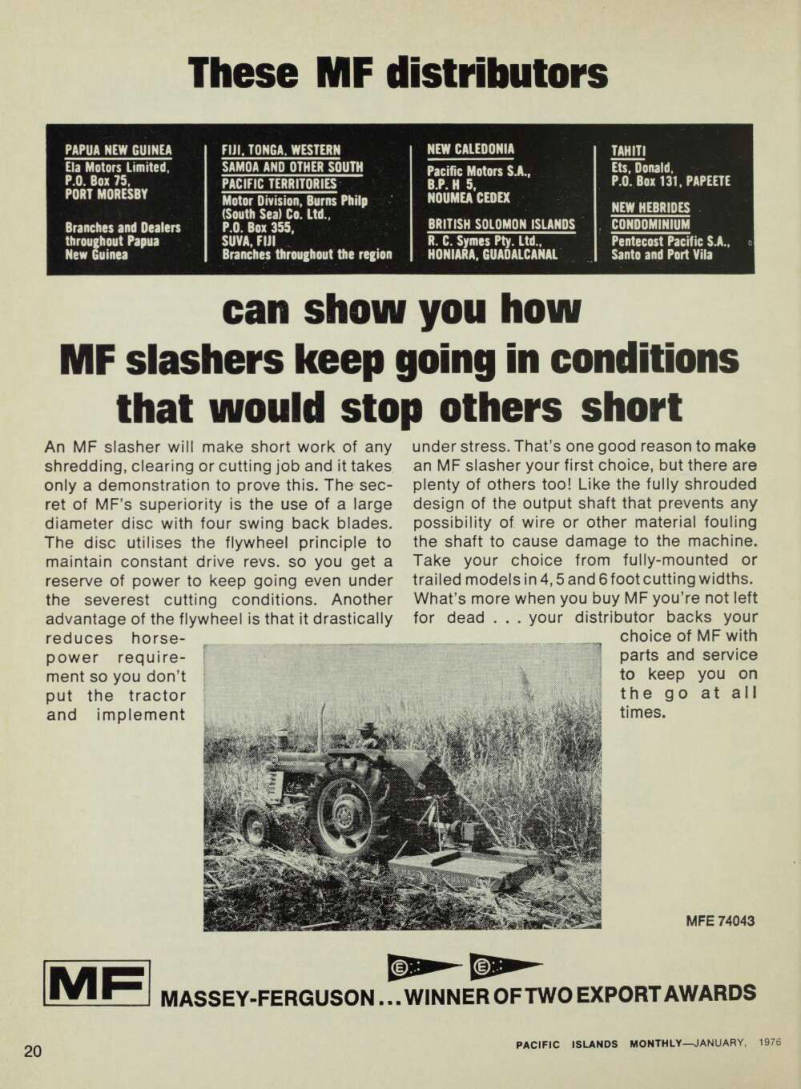

Politics In The New Hebrides
I refer to the article by Mr David A. Joffick, UCNH’s assistant secret ary on “A rout for nationalists in New Hebrides elections” (PIM, Oct P 39).
As a New Hebridean, I wish to draw Mr Joffick’s attention to a number of points that he has over looked in his haste to once more speak for and about New Hebrideans in the New Hebrides situation.
Expatriate populations are concen trated in the two urban centres of Santo and Vila. Among them, the colonial attitude that the New Hebri dean is of little consequence pre dominates. The Protocol of 1914, which excludes the New Hebridean, is a reality. The bulk of New Heb rideans in town are employees while the bulk of expatriates are employers.
Colonialists, especially French, have never been known to support any in digenous effort to regain their right ful places that have been usurped through colonialism. The boundaries of the Municipal Council electorates were so designed that even if there were a few National Party hopes these were rendered impossible from the outset.
Mr Joffick considers it regrettable that two of the twelve protestant churches in the New Hebrides have adopted a political stance. All Chris tian churches purportedly teach Christianity. Jesus Christ was political.
Christian churches have a Christian duty to make a stand in the country’s politics. Christ made his stand for justice and for the people.
UCNH and MTN finance comes from within the New Hebrides be cause the coalition of the UCNH and MTN parties was a coalition of the controllers of New Hebrides economy.
The crux and the weight of Municipal Council elections is economic.
The entire economy of New Hebri des is controlled from Vila and Santo, controlled by expatriates who con gregate in the urban areas and who are the backbone of the UCNH and MTN coalition. The Administration and the economic sector work hand in hand and many administration deci sions are made with one ear open full valve to the economic sector.
UCNH and MTN have sought pre election information from the French Residency. When a non-New Hebri
dean entered the New Hebrides to have talks with the National Party prior to the elections, he was igno miniously arrested, and expelled, the reason given being that he was a Black Power man.
No one has ever labelled the ex patriates involved in politics in the New Hebrides as White Power men.
Power is neither black nor white.
It is a tool used by men. In New Hebrides power is in the hands of white men and they are doing all they can to keep their hold. The National Party intervened in the deportation proceedings and 20 of them were arrested and later convicted to either pay fines ranging from $2O to $6O or face two-three months imprison ment.
Concerning the popularity of UCNH and MTN membership cards being sold to expatriate and New Hebridean populations throughout the group. Mr Joffick failed to point out that the coalition receives assistance in sea transport from the French Ad ministration in the New Hebrides and France has sent over a private plane for their air transport while National Party can little afford air fares and does not receive free transport from either administration fleet.
In the election campaign, coalition money and money-power worked more than anything else. There were many subtle forms of bribery includ ing threats that if workers did not vote for the coalition they would lose their jobs. Even government per sonnel went around saying that if people vote for National Party they are voting for their deaths; if they vote for the coalition they vote for their lives. New Hebrideans know that any show of New Hebridean soli darity brings the military over from New Caledonia at very short notice.
In one of the first demonstrations New Hebrideans ever held, a police cordon waited for them with guns and a banner saying “Proceed no further or we shoot”. The New Hebrideans con cerned were unarmed.
Using numbers of New Hebrideans against number of expatriates is no reason or excuse as this kind of poli tics is a European game for which the expatriates make and change the rules when it suits them. Expatriates know
Letters
what an election is all about because it is part of the culture in which they were brought up while New Hebri deans are being grafted into it. For New Hebrideans from the oldest to the youngest this is their first nation wide election. The manner in which New Hebrideans are being introduced to democracy is disgusting.
Nationalism has its roots in the rural areas. The vocal Nationalists happen to be in the urban areas be cause that is where they need to make their voice heard because that is where the body and head of the colonising Octopus is located.
Traditional ways are rooted in rural areas. Mention was made of heredi tary and elected chiefs and age-old custom and social practices. Our New Hebridean cultures are diverse. In many, hereditary chieftainship did not exist. The very idea of elections is European. Our age-old customs and social practices have been massacred by European infiltration, intervention, and oppression. Whatever culture emerges from the past and the present as today’s New Hebrideans evolve it is still custom and New Hebridean no less. Time will give it the brand of approval. However, even if the National Party did break some cus toms it is time New Hebrideans made their own mistakes.
The French have established schools everywhere offering free edu cation but do not mention that French colonial policy on education is such that New Hebrideans will be system atically weeded out during their edu cation process so that only an oddly select few will ever see the last year of high school. There is enough evi dence of concrete buildings around so they can claim they are giving edu cation. French education is the teaching of the French language and culture so people can make better Frenchmen. That education does not proceed to spell out that, however French you become, you can never be nor be accepted as a Frenchman.
If the two Administrations recognised the existence of the New Hebridean people they would have changed the Protocol of 1914 and all its related attitudes but they haven’t. Now that there is some hope all efforts are being made by expatriates to hamper any progress towards its realisation.
Instead of leaving New Hebrideans to find themselves politically, expatriates are engaging themselves in politics on
behalf of New Hebrideans. This for absolutely no reason other than to cement and perpetuate European colonisation of the New Hebrides.
Jimmy Stevens’s alliances are for his own personal interests not for his followers who are New Hebridean mostly from the rural areas. Nagria mel leadership has been bought by the French. Nagriamel people remain New Hebridean.
Expatriates are always measuring us against other people and compar ing New Hebrides to other countries.
For example, Mr Joffick compares British education in the New Hebri des to the UK, Australia and New Zealand to show the stark differences but fails to state that this is the exact aim of the colonial education policy.
Many of us don’t know what the UK, Australia and New Zealand are like but if we were given the chance to know we will not want to be like the UK, Australia and New Zealand.
Grace Mera
University of the South Pacific, Suva, Fiji • This letter has been considerably shortened.
Church's Role
As an elder and a past volunteer of the Presbyterian Church of the New Hebrides 1 can only affirm Mr David Joffick’s, and Mr David Curtis’s re marks in PIM.
I came to the group as a Presby terian bible class volunteer, and from working as a volunteer to attaining a responsible position in a major com pany in the group, I have seen most of the major islands in the group, and have worked with many New Heb rideans. I am also married to a New Hebridean, and as a result of these contacts have come to know a little of their life styles, hopes and fears.
As a past elder, I can only endorse these two gentlemen’s remarks, though I have never met either of them. I can only say that what is happening in the Church has happened before: eg Israel’s entry into politics in the Books of Samuel. When politics come into church policy it is the beginning of the end for that particular church, and I am afraid it will be a long time before the hierarchy at Paton Memorial Church see it this way, and can only hope that as the people in the Old Testament did, they even tually learn to differentiate from the Kingdom of God, and the Kingdom of the New Hebrides, as one person
put it to me one time. Until they learn to do this, I can see very little prospects for expansion in the proper role of the Presbyterian Church today in the New Hebrides.
David Joffick’s article was also very interesting. The pastor who was shouted down at the Presbyterian Church Assembly for saying that he thought it was wrong to mix church and politics, I believe is my pastor at the Presbyterian Church I am now attending in Santo. I feel very sad too, that this happened, and he has my full sympathy as I feel at this particular time he is a voice crying in the wilderness.
I can only hope that like the prophets of old, his prophecy will come true, and the remainder of his fellow pastors eventually see the role of the church as working for the ex pansion of God’s Kingdom, not the Kingdom of the New Hebrides.
As an elder, and a Sunday School Superintendent in the PCNH I see there is much conflict within the Presbyterian Church over the political role this church has taken in these islands, but the future of the church remains a promising one. I see many young people, and older ones too, who wonder just what is happening at PMC in Vila, and 1 think the time is fast coming when various church leaders will have to make a decision as to what calling they wish to take.
They cannot serve as a fulltime pastor, with the church supplying them with their worldly necessities, that is car, house, etc, and take part in full time politics too. It is not fair to expect their congregations to pro vide money to do this.
The Church has one particular role not only in these islands but through out the whole world, and that is not the role of politics, but the role of spreading the Good News of the Sal vation of Jesus Christ, and this means strict neutrality in the field of politics, if the true role of the Church is to be carried out in a Christlike manner.
David Burt
Santo
Loud Noises
It is good to read in PlM's October issue of all that has happened with Papua New Guinea Independence Day, all the celebrations, festivities and speeches made during that his toric time for one of our Island territories achieving its aim.
That historic day has marked an end to Australian colonial rule and opened a new nationalist era in which Papua New Guineans will be
able to manage their own affairs. All well-wishers throughout the Pacific region sent congratulations including our two Resident Commissioners from the New Hebrides.
Now that the Australian colonial ists will no longer be needed in Papua New Guinea they will move into the other Island territories with their colonial and capitalist doctrines.
Already in the New Hebrides we have two of them, probably more but the others made less noise. These two notorious Australians who hap pened to be called Mr David Curtis and Mr David Joffick have only arrived in the group but are already making loud noises in New Hebrides politics as if it was their birthplace.
If they really care about their busi ness it would be best to keep out of New Hebrides politics, otherwise they should go back to Australia and practise their politics where, at this very moment, Australia is facing a political crisis.
It is quite obvious that Mr Curtis and Mr Joffick have not travelled far and wide into the outer islands of the New Hebrides and therefore do not know the people. The only time Mr Curtis has taken his foot off the main Vila shopping centres was during the General Assembly of the Presbyterian Church of the New Hebrides on Emae island in May this year.
Mr Curtis, a Presbyterian himself, should study the history of the Pres byterian Church of the New Heb rides before he starts to criticise its leaders. He must realise that the Presbyterian Church is a widely populated Church in the New Heb rides. It has been (when it was still under the supervision of both Pres byterian church of Australia and New Zealand Overseas Board of Missions) controlling schools for more than a decade. In 1971, the Presbyterian Church of the New Heb rides eventually handed over all its schools to the District Education Committee under the supervision of the British Government.
These young pastors, elders and teachers whom Mr Joffick referred to in his article (PIM, Oct, p 41) (A “rout” for nationalists in New Hebrides election) are well-educated and know what they are talking about. I am more surprised that noth ing is mentioned about students from USP and University of Papua New Guinea who have already gained degrees and are now employed in the New Hebrides. The Presbyterian Mission and others have played an important role in the development of the territory not to mention the Roman Catholic Church, a pet of
the French Government in the New Hebrides.
If the pastors did not involve themselves in politics what is wrong in their doing so now?
Do politicians have to be well edu cated? Would you say that some of the UCNH New Hebridean members now in both Vila and Santo Muni cipal Councils are better educated than their New Hebridean col leagues? Are all the customary chiefs who would be elected to the Repre sentative Assembly not literate?
I would like to remind Mr Curtis and Mr Joffick that we welcome expatriates who come to New Heb rides to help us develop our country
educationally, economically, socially
and politically. We oppose the ideas of people who come into the New Hebrides and make themselves as if they own the country.
W. Tasaruru.
Vila, New Hebrides.
Sport V Politics
France plays sport in the Pacific.
France, a funny old republic which rests on the flattering principles of liberty, equality and fraternity, still remains faithful to an outmoded colonialist policy which is quite out of date in the South Pacific.
But, to distract attention from this embarrassing attitude which she adopted in front of countries which are already independent and in face of her conduct towards her colonies, emphasis is placed on sport to avoid political issues. So the French autho rities think it is better to encourage sport rather than attend to the poli tical statutes.
New Hebrides was accepted at the last minute at Agana as the venue of the next South Pacific Games, as the outcome of a highly secret political strategy. France already knew that the National Party’s objective is independence in 1977, but orders came from on high in Paris.
The first thing necessary was to stop the British, whose desire to get out of the New Hebrides is seen by Paris as a bid to evict the French from the New Hebrides.
Mr Degaillande was entrusted with the mission of bringing back the Games to the New Hebrides, and he fought body and soul for this objective. In the New Hebrides there are now two new flags, the Games flag and the flag of independence, which are likely to replace those of the two governing powers. The idea of the 1978 Games in Port Vila
would certainly further accentuate the political dependence of the New Hebrides on the joint administration.
France, always generous in directions where it is least requested, is going to spend as much money as possible in order to take over the control of the Sixth South Pacific Games.
So, for King Stirn (French Minister for Overseas Territories), sport is highly desirable, as it gives one a youthful feeling and one auto matically forgets his duty to bring up his children to support themselves. (By concentrating on sport, people neglect bringing their children to adulthood).
The New Hebrides would obtain new modern sporting facilities, which would bring it rapidly out of the age of old coconut plantations and into the age of Olympic stadiums.
As for the New Hebridean, he continues to ask about his real identity and perhaps he will get his reply after the Games. At the moment, the New Hebridean still has not clearly-defined legal or political status. So, you may say, the 1978 Games will take place in a country where the existence of the Melanesian New Hebrideans is not even recog nised.
Saurei Arei Moso.
Noumea
Pim's Cover
I feel that Ms Griffen’s letter (PIM, Nov, p 28), which complains about the choice of the New Cale donian “Golden Girls” as the cover for your September issue is an example of how anti-colonialism, “Pacific for the Pacific Islanders”, or whatever you like to call it, can become such an obsession as to lead to the sort of petty-mindedness her letter illustrates. I agree with the Editor of PIM that the photograph is colourful, and shows some of the exuberance of young sportswomen, whatever race they may be.
However, if one is looking for political motives in PlM’s choice of photograph, surely it illustrates the fact that the Pacific is made up of many multi-racial societies. A great many white New Caledonians have been living in the Pacific for several generations, and whether Ms Griffen and others like it or not, they are now part of the Pacific; in the same way as are other immigrant commu nities, such as the Indians and Chinese, and I doubt that Ms Griffen would have objected if girls from one of these communities had been de picted on the cover instead.
Alice Mcgowon
Bureta Street, Suva
• More letters on p 25
Nauru House
When metropolitan-based journa lists comment on Pacific Islanders about whom they know very little, they are bound to put their foot in it. Mr Stevens' article on Melbourne’s tallest building. Nauru House (PIM.
July, p 15) and his interpretation of Nauruan motive in out-skyscraping every other building in town, aroused the ire of Mr Hansvold, Seattle,
Usa (Pim. Oct., P 33).
In passing, Mr Stevens had said that the Nauruans’ aim could be seen by some as a form of exploitation of the Australian people in retaliation for the years of Australian exploita tion of Nauru's phosphates. Revenge, in other words, of the “We’ll show you” kind.
Mr. Hansvold. in an angry, stick waving diatribe, accused Australia of ingratitude and said that we ought to be grateful that Nauru House had been built in Australia instead of Tokyo or Taipei. 1 am not a Nauruan, but after a lengthy association with the Nauruans 1 feel I am better qualified than Messrs Stevens and Hansvold to speak on the subject of the tallest building in town.
Despite everything, the Nauruans have a considerable fund of goodwill towards Australia. They will do business with everyone and sundry but still feel their main links lie with Australia. It would never have occurred to them to build Nauru House in Tokyo or Taipei.
But they are also realists. With a go-ahead President intent on ensuring Nauru’s ability to survive once the phosphate gives out, the building of Nauru House was a natural out growth of Nauru’s investment policy.
And if you’re going to build, what better return on your investment than to build as high as you can?
And if the decision had been consciously made to build higher than anyone else, it would certainly not have been done from a spirit of revenge. The Nauruans are not like that. The idea may have appealed to their sense of humour in the Annie Oakley tradition of “Anything you can do I can do better” but never with malice.
Mr Stevens’ two passing remarks were more calculated to irritate than upset. Why, then, Mr Hansvold’s angry letter all the way from America? Mr Hansvold is surely not stupid enough to suppose that two remarks by a journalist represent the Australian’s attitude to a fine asset to the city’s skyline. Why then, is Mr.
Hansvold constantly trying to get into the Nauruan act? As it is no secret that he had made at least two attempts to interest the Nauruans in ventures requiring their participation to the tune of several thousand if not hundreds of thousands of dollars, I feel that Mr Hansvold’s altruism is suspect.
The Nauruans have had more than enough of friendly back-slappers with an eye to the main chance.
If the Nauruans found anything objectionable in Mr Stevens’ article it was up to them to say so. They do not need someone to do it for them all the way from America. Nauru has come of age.
Anon
Victoria. (Name and address supplied)
Freedom Fighters
Through the medium of your magazine we would like to express our concern about the latest political development regarding West Papua/
West New Guinea as expressed by Indonesia and PNG earlier this (November) month.
We were rather shocked when we heard both Indonesia and PNG con templated to carry out “cleaning up” operations in the border areas where our freedom fighters are living. The men of the military arm of the Provisional Government of West Papua, are demanding to recapture our birthright which has been force fully removed from us 13 years ago and therefore any attempt to change this is an inhuman act which no man can tolerate.
We are very disappointed that even our Melanesian Blood brothers of the Eastern part of the island have been misled by Suharto’s neo-colonial forces to accept without question Indonesian-designed and selfishly drafted communiques.
One thing we are sure of is, that these sorts of practices have been carried out by PNG’s previous colonial master and wonder when this will end.
We now appeal to our fellow islanders from the Pacific nations to take note of the impending attempts to completely eliminate the Melane sian race in the Western half of the island of New Guinea.
Please help us in any possible way for the lives of our innocent people need saving from the hands of the notorious Indonesian Criminals.
We trust that you will consider our plea and thank you in anticipation.
Freedom Fighters Of
West Papua.
Per P. Grocott (USP), Port Moresby.
Guam Games
I refer to the article on the Guam Games (PIM, Sept, p 5) part of which refers to Far North Queens land Soccer Teams presence in Guam.
Well Sir: I was in Guam myself, with 22 Far North Queenslanders to “Participate” in the Games.
Officially invited by Mr T, Nelson, following the appeal by the Guam Football Federation to have addi tional teams in the Fifth South Paci fic Games Soccer Tournament, I rang Mr Nelson in Guam who enthusi astically agreed and, who sub sequently confirmed the invitation by telex. We received from the South
Pacific Games Council, the ID cards and completed and returned same.
FNQ Associated Sports Council appointed myself as their delegate with instructions to apply for full membership. We received two tele grams prior to our departure and each time I rang Guam to speak to Mr Nelson. He could not be found.
However, I spoke to Fr P. Brousseau, Chief Sports Co-ordinator to the Games. I explained we had 23 seats on the PNG Contingent Charter, that there was no chance of being able to get monies refunded. He stated some French members (New Cale donia were named) were objecting to us because they KNEW we were professionals. After assuring him of our amateur status, he said come ahead and sort it out later.
So we went to Guam! We were refused official participation and it was left to the soccer participants to play us if they wished. The fol lowing day I was given the oppor tunity to state our case.
The soccer nations were unable to go against their delegates’ deci sions and so we were excluded. This situation, in blunt contrast to the Charter Objects Art cite 9, para 2, “To create bonds of kindred friend ship and brotherhood amongst peoples of the Territories of the South Pacific Region, without any distinction whatever race, religion or politics, etc”, prompted Mr Don Pedro to resign in protest. Mr F.
Alvarez of FIFA was asked then to take the chair. He also refused for the same reason.
And who do you think upheld the objects of the Charter and took charge of the Soccer competition
after being elected unanimously?
None other than myself, and with five other referees controlled the soccer tournament. Mr Hedges and I, half an hour before the first match, were still marking the field at George
Washington High School. Soccer
would not have been competed at all had we not taken the responsibil ity upon ourselves to run it. This we did in the spirit of sportsmanship, whilst our players were refused par
ticipation.
Various incidents that New Cale donian officials were involved in, proved to the writer that there was no “shining example of sportsman
ship and competitive spirit”, on their
behalf.
We don’t blame Guam. They were marvellous people, they were in experienced, and needed all the help they could get.
J. Anzalone
(Chief Delegate)
Far North Queensland Soccer Federation.
Cairns, Q.
Advertisements & other items, pp. 22-30 (1 item)
MF slashers keep going in conditions
These MF distributors
can show you how
that would stop others short
An MF slasher will make short work of any shredding, clearing or cutting job and it takes only a demonstration to prove this. The secret of MF’s superiority is the use of a large diameter disc with four swing back blades.
The disc utilises the flywheel principle to maintain constant drive revs, so you get a reserve of power to keep going even under the severest cutting conditions. Another advantage of the flywheel is that it drastically reduces horsepower requirement so you don’t put the tractor and implement „ ■ ...v - ;iiiiii under stress. That’s one good reason to make an MF slasher your first choice, but there are plenty of others too! Like the fully shrouded design of the output shaft that prevents any possibility of wire or other material fouling the shaft to cause damage to the machine.
Take your choice from fully-mounted or trailed models in 4,5 and 6 foot cutting widths.
What’s more when you buy MF you’re not left for dead . . . your distributor backs your choice of MF with parts and service to keep you on the go at all times. .
MFE 74043
MF
MASSEY-FERGUSON.. .WINNER OF TWO EXPORT AWARDS
Concentrated Pea-Ben
is lethal to flies, mosquitoes
and all insect pests ...
Yet so pisrs It's safe to spray anywhere With tropical weather providing ideal conditions for prolifically-breeding flies and mosquitoes, serious outbreaks of disease can be spread by swarms of these insect invaders. Once more, householders are urged to combat this threat to public health by killing every disease-carrying insect seen. A.N.I. Research Chemists are constantly at work world-wide to ensure that Pea-Beu aerosol insecticide is effective in eliminating flies and mosquitoes from households. Pea-Beu is specifically formulated to contain pyrethrins, one of the most powerful insecticidal ingredients known deadly to mosquitoes, and all insect pests and yet harmless to man and his pets. corners of the room, thus eliminating any hidden insects.
The mosquitoes’ record is just as grim.
Besides wrecking your night’s rest with their irritating whine and inflicting painful toxic bites, mosquitoes pass on many serious diseases including malaria, hepatitis, dengue and yellow fever, disfiguring elephantiasis and encephalitis.
Total Killing Power with Total Safety Controlling these dangerous diseasespreaders demands rapid destruction wherever they appear. Long-term research was needed to formulate the insect spray that combines high killing potential with complete safety for users, as powerful Pea-Beu aerosol does. Pea-Beu is particularly effective as the wide action spray ensures total coverage of any room. Pea Beu’s efficient spray seeks out and destroys insects before they have a chance to bring irritation and illness to your family. \ ' -v • ' A t "Sir SstsS The Deadliest Traffickers of Disease Four centuries ago flies were suspected of spreading tropical ulcers. Modern pathologists have proved they spread a whole list of infections, ranging from mild but unpleasant stomach upsets to infective hepatitis, bacillary, dysentery, typhoid and persistent ameobiasis. Worse still, flies transmit crippling scourges such as cholera, smallpox, poliomyelitis, opthalmia and trachoma. A highly efficient method of fly extermination is to use powerful Pea-Beu aerosol insecticide. A few short bursts of Pea-Beu in a room will kill all flies on the wing.
The permeating action of Pea-Beu also spreads into hidden
ill
m
Pea-Beu the safe, powerful insecticide
What Makes vt
an Alfa Romeo
Front wheel drive and McPherson suspension make it handle like an Alfa.
The four cylinder, horizontally opposed motor and four speed gearbox make it perform like one, too.
And disc brakes all round guarantee it stops the way an Alfa Romeo should.
The only un-Alfa thing about the Alfasud is its price.
What Makes it
a Family Car
It's big on the inside, so there’s room inside for the whole family.
But it’s quite compact on the outside.
So it doesn’t need much room to park.
The space inside the boot is about the same as the space in the average family refrigerator.
The front seats adjust up and down as well as backwards and forwards. And the steeringcolumnalsoadjustsupanddown. % So you can adjust your Alfasud to suit you and your family. Which is better than adjusting your family to suit the car.
alfa (f^D
romeo v O /
AN INVESTMENT IN SAFETY
For information contact Alfa Romeo Pty. Ltd.
Cnr. Beauchamp & Botany Rds., Botany, N.S.W., Australia.
Trade enquiries welcome.
o % H O >v pi u
In our 80th year
Selling
SERVICE"
to the Pacific Islands
NELSON & ROBERTSON
PTY. LIMITED
(Established 1895)
PLANTATION HOUSE, 197 CLARENCE STREET, SYDNEY
CABLES: "IVAN", SYDNEY, BRISBANE. TELEX: AA22381, SYDNEY.
FOR:
INDENTS
COMMODITIES
SHIPPING
TRAVEL
INSURANCE
REAL ESTATE
Branch Office: Nelson & Robertson Pty. Ltd., 303 Adelaide St., Brisbane, Old.
New Guinea Representatives: Rabtrad Niugini Pty. Ltd., Rabaul Lae Madang Kieta.
Caterpillar reliability, productivity, availability. Now you can get it all in a wheel skidder. The 518.
A whole new standard in skidder engineering. 120 turbocharged horsepower, 20,400 pounds of working muscle with full articulation and frame oscillation for stability and minimum maintenance.
Single lever “on the go” powershift. Dual rate steering for controlled response at ail speeds. An operator’s compartment engineered for efficiency with safety features built In for man and machine.
You’ll find all the best skidder ideas, plus added refinement and top quality manufacturing that can make the 518 the backbone of your logging operation.
And South-West Pacific Caterpillar dealers will ensure that your backbone stays in top condition no matter how far in the bush you are.
Parts, maintenance, repairs or simple Information—we’ll see that you get it fast.
So tackle the jungle with the new Cat 518.
Caterpillar Dealers in South-West Pacific.
HASTINGS DEERING
Lae: Milford Haven Road. Ph: 42 2355 Port Moresby: Champion Parade, Knoedobu.
Ph: 3138 or 2098.
Bougainville: Itakara.
Industrial Park, Arawa.
Ph: 95 9004. 154 Queens Road, Suva.
Ph: 24 051-4 Cables: Carptrac Suva Telex: Carptrac FG2190 Suva
HOB2S
Primitive luxury
(Polynesian style) Nestled away in the untouched Kingdom of Tonga is new, luxurious "Port of Refuge" International resort. Here is a unique opportunity for your clients to experience the tranquil and relaxed Tongan atmosphere while they enjoy the picturesque surroundings of the new "Port of Refuge". And only a short flight from Fiji.
Reasonable tariffs from $17.50 with special concessions for children. Agents commission 10 per cent.
Tonga's
Port of Refuge
INTERNATIONAL RESORT U
Uava’u Tonga Cables: "Refuge" Tonga or "Tongatours"
Sydney. Phone: Sydney 85-1603 or 852162
KEEPING BABY
HAPPY & WELL -
By giving your baby a Fisher's Teething Powder as needed, you not only keep the little one happy and well, but save yourself all those upsets and nervous tension that beset a mother when baby suffers distress. If used as directed Fisher's Teething Powders quickly and safely soothe baby's sore gums, digestive disorders and intestinal upsets. Get a packet from your chemist or store today —you'll be so glad you did. Fisher & Co., Manufacturing Chemists (Est. 1876) 17 May St., St. Peters, N.S.W. 2044.
PMBOB/72
ffi
jp* D,
international;
DATELINE HOTEL
TONGA
"Friendly Hotel" of the "Friendly Islands"
Situated along the Nukualofa waterfront. Only five minutes walk from town. Single, double, family suites, airconditioning, and hot and cold water showers. Pool, bar, restaurant, duty-free shop, tour desk and boutique.
Book through your travel agent or write to International Dateline Hotel, P.O. Box 62, Nukualofa Tonga.
Cable Address: "DATELINE".
Represented Overseas by: Charles J. Henry and Associates Pty. Ltd.
Sydney and Melbourne.
We can't change
what you pump.
But we can change how
reliably you pump it.
We make mining pumps that have run for days on a snorer full of slurry. Bore-hole pumps that haven't been lifted in 15 years. Sewerage pumps that are unaffected by wet-strength fibres, pantyhose, nappies or solids up to 6" diameter. And farm-water pumps that deliver town-water pressure or better, 5 miles from the creek. As well as pumps for boiling cheese, grease, acids, cooked fruit and biscuit dough. Or anything else that can be pumped, and a few things other pumps can’t pump.
All of them have one thing in common. In a few years you'll begin to wonder if your Mono Pump will ever stop pumping. And our pumps are backed by 24 hours a day service from local engineers, factory trained in Australia. We can't change what you pump, but we can pump it more reliably. 2. * tllllM 1. T series-mining & foods (Flanges or Tapped Ports) 2. Borehole series 3. Monta Pump-sewerage 4. Mutrator-sewerage 5. ‘o9’ series-farming 6. CP series-light industrial 6.
MONO IMUMII?
(AUSTRALIA) PTY. LTD.
Head Office and Works: “Mono House’’, 338-348 Lower Dandenong Rd, Mordialloc, Vic. 3195. Phone 90-5211.
Agents in all major South East Asian and Pacific areas.
I I Please send details of your pumps for (describe purpose): I I j If a Borehole pump, indicate: Approx, depth of bore I estimated yield gph. NAME I
|ADDRESS
I ft.; estimated water level n .ft.; J 344-P-043
days of the RAAF in PNG
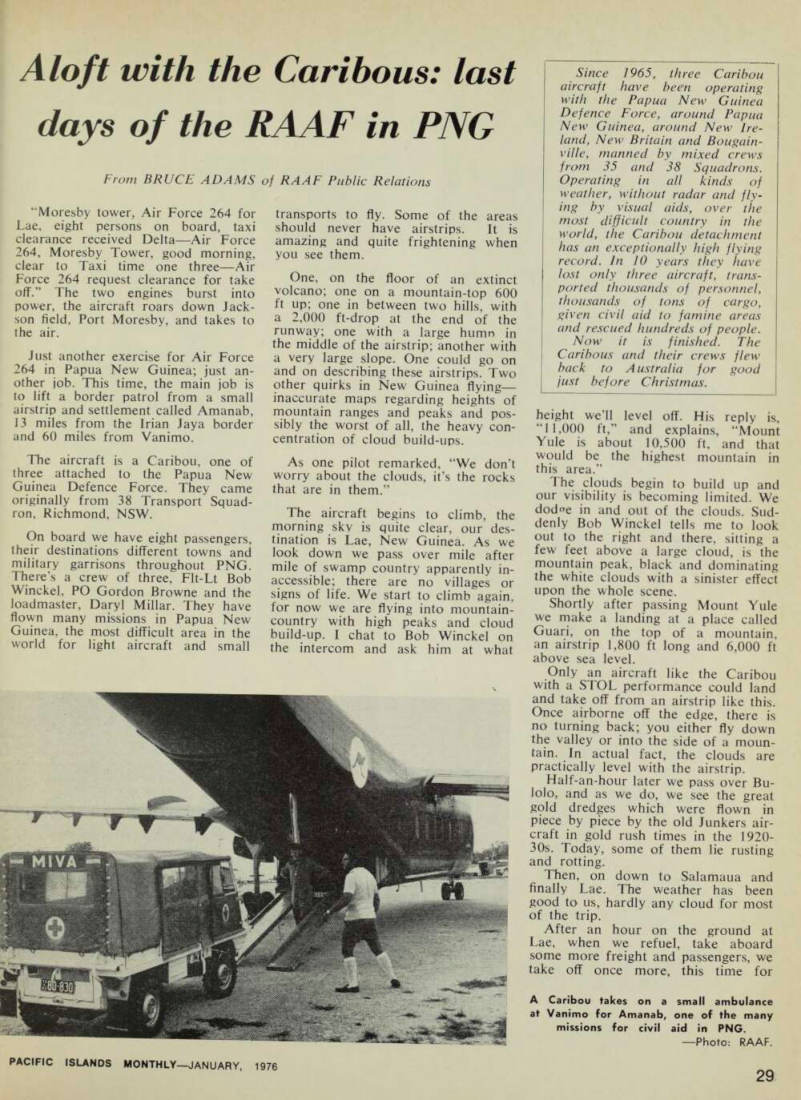
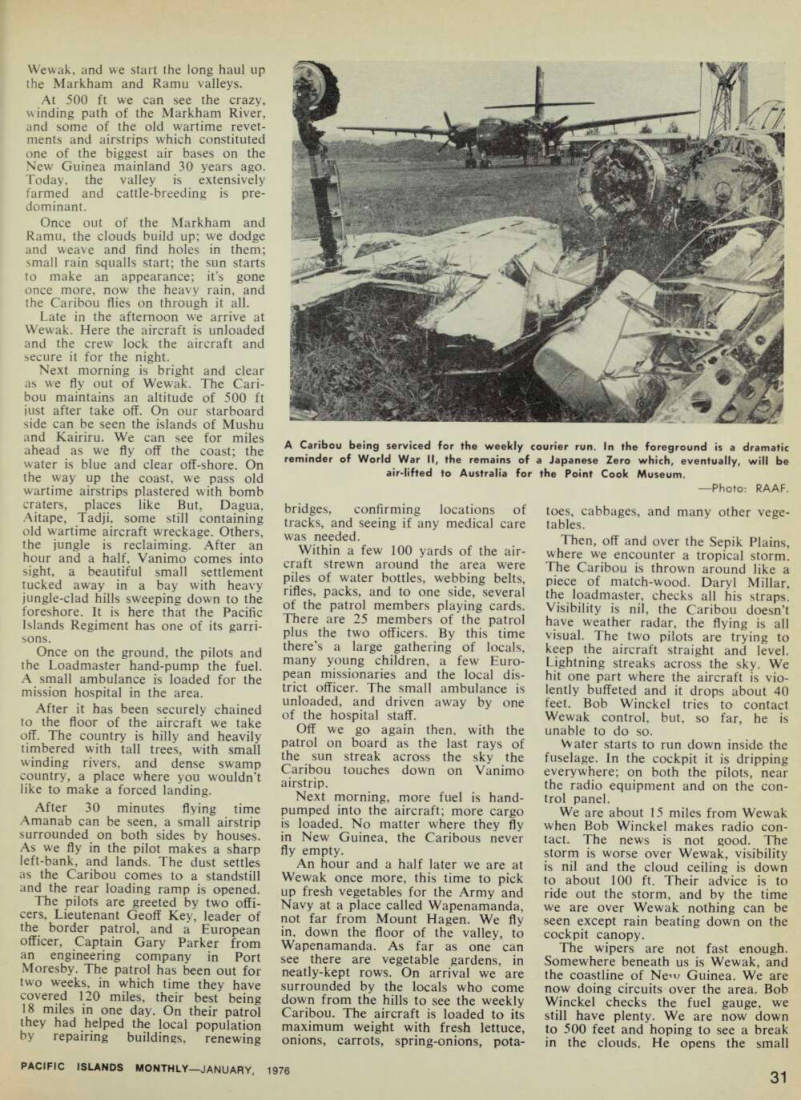

Aloft with the Caribous: last days of the RAAF in PNG
From BRUCE ADAMS of RAAF Public Relations
“Moresby tower, Air Force 264 for Lae, eight persons on board, taxi clearance received Delta—Air Force 264, Moresby Tower, good morning, clear to Taxi time one three—Air Force 264 request clearance for take off.” The two engines burst into power, the aircraft roars down Jack son field, Port Moresby, and takes to the air.
Just another exercise for Air Force 264 in Papua New Guinea; just an other job. This time, the main job is to lift a border patrol from a small airstrip and settlement called Amanab, 13 miles from the Irian Jaya border and 60 miles from Vanimo, The aircraft is a Caribou, one of three attached to the Papua New Guinea Defence Force. They came originally from 38 Transport Squad ron, Richmond, NSW.
On board we have eight passengers, their destinations different towns and military garrisons throughout PNG.
There’s a crew of three, Flt-Lt Bob Winckel, PO Gordon Browne and the loadmaster, Daryl Millar. They have flown many missions in Papua New Guinea, the most difficult area in the world for light aircraft and small
transports to fly. Some of the areas should never have airstrips. It is amazing and quite frightening when you see them.
One, on the floor of an extinct volcano; one on a mountain-top 600 ft up; one in between two hills, with a 2,000 ft-drop at the end of the runway; one with a large humn in the middle of the airstrip; another with a very large slope. One could go on and on describing these airstrips. Two other quirks in New Guinea flying— inaccurate maps regarding heights of mountain ranges and peaks and pos sibly the worst of all, the heavy con centration of cloud build-ups.
As one pilot remarked, “We don’t worry about the clouds, it’s the rocks that are in them.”
The aircraft begins to climb, the morning sky is quite clear, our des tination is Lae, New Guinea. As we look down we pass over mile after mile of swamp country apparently in accessible; there are no villages or signs of life. We start to climb again, for now we are flying into mountain country with high peaks and cloud build-up. I chat to Bob Winckel on the intercom and ask him at what
Since 1965, three Caribou aircraft have been operating with the Papua New Guinea Defence Force, around Papua New Guinea, around New Ire land, New Britain and Bougain ville, manned by mixed crews from 35 and 38 Squadrons.
Operating in all kinds of weather, without radar and fly ing by visual aids, over the most difficult country in the world, the Caribou detachment has an exceptionally high flying record. In 10 years they have lost only three aircraft, trans ported thousands of personnel, thousands of tons of cargo, given civil aid to famine areas and rescued hundreds of people.
Now it is finished. The Caribous and their crews flew back to Australia for good just before Christmas.
height we’ll level off. His reply is, “11,000 ft,” and explains, “Mount Yule is about 10,500 ft, and that would be the highest mountain in this area.”
The clouds begin to build up and our visibility is becoming limited. We dod»e in and out of the clouds. Sud denly Bob Winckel tells me to look out to the right and there, sitting a few feet above a large cloud, is the mountain peak, black and dominating the white clouds with a sinister effect upon the whole scene.
Shortly after passing Mount Yule we make a landing at a place called Guari, on the top of a mountain, an airstrip 1,800 ft long and 6,000 ft above sea level.
Only an aircraft like the Caribou with a STOL performance could land and take off from an airstrip like this.
Once airborne off the edge, there is no turning back; you either fly down the valley or into the side of a moun tain. In actual fact, the clouds are practically level with the airstrip.
Half-an-hour later we pass over Bu- Jolo, and as we do, we see the great gdd dredges which were flown in piece by piece by the old Junkers air craft in gold rush times in the 1920- 30s. Today, some of them lie rusting and rotting.
Then, on down to Salamaua and finally Lae. The weather has been good to us, hardly any cloud for most of the trip.
After an hour on the ground at Lae, when we refuel, take aboard some more freight and passengers, we take off once more, this time for
A Caribou takes on a small ambulance at Vanimo for Amanab, one of the many missions for civil aid in PNG.
Photo: RAAF.
Wewak, and we start the long haul up the Markham and Ramu valleys.
At 500 ft we can see the crazy, winding path of the Markham River, and some of the old wartime revet ments and airstrips which constituted one of the biggest air bases on the New Guinea mainland 30 years ago.
Today, the valley is extensively farmed and cattle-breeding is pre dominant.
Once out of the Markham and Ramu, the clouds build up; we dodge and weave and find holes in them; small rain squalls start; the sun starts to make an appearance; it’s gone once more, now the heavy rain, and the Caribou flies on through it all.
Late in the afternoon we arrive at Wewak. Here the aircraft is unloaded and the crew lock the aircraft and secure it for the night.
Next morning is bright and clear as we fly out of Wewak. The Cari bou maintains an altitude of 500 ft just after take off. On our starboard side can be seen the islands of Mushu and Kairiru. We can see for miles ahead as we fly off the coast; the water is blue and clear off-shore. On the way up the coast, we pass old wartime airstrips plastered with bomb craters, places like But, Dagua, Aitape, Tadji, some still containing old wartime aircraft wreckage. Others, the jungle is reclaiming. After an hour and a half, Vanimo comes into sight, a beautiful small settlement tucked away in a bay with heavy jungle-clad hills sweeping down to the foreshore. It is here that the Pacific Islands Regiment has one of its garri sons.
Once on the ground, the pilots and the Loadmaster hand-pump the fuel.
A small ambulance is loaded for the mission hospital in the area.
After it has been securely chained to the floor of the aircraft we take off. The country is hilly and heavily limbered with tall trees, with small winding rivers, and dense swamp country, a place where you wouldn’t like to make a forced landing.
After 30 minutes flying time Amanab can be seen, a small airstrip surrounded on both sides by houses.
As we fly in the pilot makes a sharp left-bank, and lands. The dust settles as the Caribou comes to a standstill and the rear loading ramp is opened.
The pilots are greeted by two offi cers, Lieutenant Geoff Key, leader of the border patrol, and a European officer, Captain Gary Parker from an engineering company in Port Moresby. The patrol has been out for two weeks, in which time they have covered 120 miles, their best being 18 miles in one day. On their patrol they had helped the local population by repairing buildings, renewing
bridges, confirming locations of tracks, and seeing if any medical care w -- eded - f inn , Within a few 100 yards of the aircraft strewn around the area were piles of water bottles, webbing belts, rifles, packs, and to one side, several of the patrol members playing cards.
There are 25 members of the patrol plus the two officers. By this time there’s a large gathering of locals, many young children, a few European missionaries and the local district officer. The small ambulance is unloaded, and driven away by one of the hospital staff.
Off we go again then, with the patrol on board as the last rays of the sun streak across the sky the Caribou touches down on Vanimo airstrip.
Next morning, more fuel is handpumped into the aircraft; more cargo is loaded. No matter where they fly in New Guinea, the Caribous never fly empty.
An hour and a half later we are at Wewak once more, this time to pick up fresh vegetables for the Army and Navy at a place called Wapenamanda, not far from Mount Hagen. We fly in, down the floor of the valley, to Wapenamanda. As far as one can see there are vegetable gardens, in neatly-kept rows. On arrival we are surrounded by the locals who come down from the hills to see the weekly Caribou. The aircraft is loaded to its maximum weight with fresh lettuce, onions, carrots, spring-onions, pota-
toes, cabbages, and many other vege tables.
Then, off and over the Sepik Plains, where we encounter a tropical storm The Caribou is thrown around like a piece of match-wood. Daryl Millar the loadmaster, checks all his straps’
Visibility is nil, the Caribou doesn’t have weather radar, the flying is all visual. The two pilots are trying to keep the aircraft straight and level, Lightning streaks across the sky. We hit one part where the aircraft is vio lently buffeted and it drops about 40 feet. Bob Winckel tries to contact Wewak control, but, so far, he is unable to do so.
Water starts to run down inside the fuselage. In the cockpit it is dripping everywhere; on both the pilots, near the radio equipment and on the con trol panel, We are about 15 miles from Wewak when Bob Winckel makes radio con tact. The news is not good. The storm is worse over Wewak, visibility is nil and the cloud ceiling is down to about 100 ft. Their advice is to ride out the storm, and by the time we are over Wewak nothing can be seen except rain beating down on the cockpit canopy.
The wipers are not fast enough, Somewhere beneath us is Wewak, and the coastline of Ne*v Guinea. We are now doing circuits over the area. Bob Winckel checks the fuel gauge, we still have plenty. We are now down to 500 feet and hoping to see a break in the clouds. He opens the small
A Caribou being serviced for the weekly courier run. In the foreground is a dramatic reminder of World War 11, the remains of a Japanese Zero which, eventually, will be air-lifted to Australia for the Point Cook Museum.
Photo: RAAF.
pilot’s window. The rain beats on his flying suit and helmet. He screeches out, “It’s there.” A very small break in the clouds and we can just see Wewak. Down to 300 ft and we make for the break, his window still open.
Two hundred feet 100 feet, and there it is, the airstrip. We touch down in a large spray of water. The ram is so heavy that the hangars cannot be seen from the runway.
Halt an hour later the storm has gone, and the sun shines once more.
The aircraft is unloaded and refuelled fly o^ove“he d Spik P y |ai B ns down the ny out over me riains uown me Ramu Valley, and the Markham into Lae The weather is perfect all the ine weamcr is pcrieu di me way and the flight is uneventful.
From Lae we make for Port Moresby, across the Owen Stanley Ranges. It is now about four o’clock in the afternoon, and some small clouds are beginning to build up over the Huon Gulf. We leave the New Guinea coastline and head into the interior of Papua to cross the Owen Stanleys. Once in the mountainous area the clouds begin to build up and take the form of dark black shapes. Behind us the clouds are clos-
ing in, we can’t go back, only forward. We pass through a few light rain squalls. Then the cloud is all around us. We begin to climb, 5,000 ft, 8,000 ft 10,000 ft, the crew put on their oxygen masks.
Still the c i OU( j sur rounds the aircra ft There is no visibility, we climb once more to 12,000 ft. There is nothing to identify as a map reference point. We change course, all the time looking f or a break in the clouds. the Su c^ ly b / ne s a 7 h al^
ft It ‘Jhe'floor of
’ f prp ’ „ rp taVpn wp J* ma P references are taken as we tty along the valley. We find we are 15 p w , t . . miles on course, we cant go back, so the new flight plan is to head for the Popondetta area. The clouds hang heavily around us, but here and there are small gaps.
The aircraft dodges in and out of the gaps. A few miles away to starboard is the dark outline of a mountain range. We can’t climb because of the heavy cloud above us. We descend to 5,000 ft to try to identify some landmarks; the pilot gets his bearings. Ahead of us the clouds are
beginning to get heavier. Up again to 10,000 ft. This time we pass over the top, down again, in and out of the gaps.
Then comes a large break in the clouds, and miles ahead we can see the ocean, and the coastline of Papua, We dive down to 1,000 ft and track along a small river. In the distance, over the Coral Sea we can see large storm clouds heading our way.
Twenty minutes flying time and we nrp , ftVpr ran? w/o qtp n fl ' ,ins at 50 « ft al °ng’ the coastline,
fading Po . rt The /ff
starts to beat down heavily and the , . u/hirh W p r p r>vpr the* fnr^i clouds which were over the Coral Sea are beginning to catch up with It • , tp ft „ . thp ,• ht H s * *.* at ® aft e ™° on ’ and the h e ht K Bob Winckel makes contact with Moresby control. The weather over Moresby is perfect. Twenty minutes l ater Moresby is sighted and the Cari kou start l.. to descend, the sky over Jackson Field darkening as the last rays of the sun disappear behind the Owen Stanleys.
“Moresby Tower Air Force 264 from Lae, request clearance to land.”
Advertisements & other items, pp. 32-36 (2 items)
Girmi
we thought It to be a
good Idea to
remind
1 BEKAERT
you
BEKAERT-FENCING
oo
RAAK-SOFT DRINKS
M Gl>
J & B-WHISKY
GIRMI
GIRMI- ELECTRICAL APPLIANCES
Bompani
SIGMA-PAINTS
FAY-PAPERWARE
VOLTA
BOMPANI —RANGES
THE PEOPLE IN THE PACIFIC FOR...BEKAERT FENCING...SIGMA PAINTS & ADHESIVES...GILBEYS LONDON DRY GIN .VOLTA VACUUM CLEANERS...BOMPANI GAS AND ELECTRIC COOKERS AND
RANGES...RAAK SOFT DRINK...GIRMI ELECTRICAL APPLIANCES...WEEKS TRAILERS...FAY
HYGIENIC TABLEWARE, ADVERTISING AND ADHESIVE PRODUCTS..J & B RARE SCOTCH
WHISKY ARE...
Kerr Brother/ Ply. limited
65 YORK STREET, SYDNEY, N.S.W. 2000, AUSTRALIA
TELEX: AA23181
CABLE: "CAREFULNESS" SYDNEY.
I hCTA
TURNS GRASS INTO LAWN
I iTILITY
UTILITY 160
THE “WORK HORSE’
VICTA RANGE
OF THE
SUPER 24
THE BIG MOWER FOR
BIG AREAS
The big mower from Victa. It takes a full 61 cm wide bite into and cuts a smooth swath over large expanses of grass. It is the mower for municipal parks and gardens, sports grounds, road-side growth control as well as home owners with large areas of land. The lightweight construction of the mower makes it easy to manoeuvre and the giant rear wheels ride rough ground effortlessly. Two freeswinging blades on the cutting disc absorb shock when hard objects are encountered.
A tough but lightweight mower without grasscatcher, a model designed to do a superb grasscutting job—on meadows full of weeds or on a fine lawn. It cuts up to trees and fences and is the lightest Victa mower of all to use. Available with either a 125 c.c. Victa 2-stroke engine or with the Victa 160 c.c. 2-stroke engine— Folding handle and single-lever simultaneous height adjustment are other features that make this lowest priced VICTA a popular mower.
J|j7 up & away
with... VfUsJ'A
E. G. BARKER & CO. PTY. LTD.
Established 1826—150 Years of Service
AUSTRALIA'S OLDEST EXPORT HOUSE
GENERAL EXPORT MERCHANTS
Specialising in world-wide distribution of General Merchandise, Provisions & Produce EXPORTING TO ALL PORTS IN PACIFIC ISLANDS Buying Agents for: —THE CO-OPERATIVE WHOLESALE SOCIETY LTD.
LAE AND ALL BRANCHES
PORT MORESBY
RAYMOND WONG
P.O. Box 5020
BOROKO.
Phone 25 5546.
Representatives
RABAUL
CON SASSADIS
P.O. Box 611
RABAUL.
FIJI
PARAMOUNT AGENCIES
G.P.O. Box 459
SUVA.
Phone 2 3127.
34 HUNTER STREET, SYDNEY, 2000
Cable Address: KERBAR SYDNEY. Phone: 61-2877 Melbourne Office: 520 Little Collins Street. Phone: 61-2877.
Telex: 31732.
Telex: 317321.
From the
Islands Press
From the Lae Nius: The “girls of the night” are operating along the Highway again, this time in broad daylight and only 10 miles or so from Lae. Fee is Kl.
An editorial in the (Western) Samoa Times: Judges at the Land and Titles Court, Mulinuu, are again accepting food and other gifts (bribes according to critics) from disputing parties. Chief Justice Scully, the president of the court, has made it clear to the judges and assessors that they must not accept any more of these so-called gifts. We suggest that this is another government organ that needs a thorough investigation.
Preserving the Islands environment as indicated in a Co-op advertisement in the Gilberts’ Atoll Pioneer: All you require for local buildings. Are you constructing a local house? We have; Pandanus posts; coconut fronds: thatch; local string.
From The Fiji Times: The future of the banana industry as an export crop is uncertain. Since November, 1973, there have been no banana shipments to New Zealand. However, on the home front there has been a significant increase in the demand for fresh fruit in urban centres, particularly in the hotel trade . . . Only about five per cent of the present crop produce plantation grade fruit because most of the farmers have gone back to the traditional way of planting. As a result, production has dropped by about 270,000 pounds compared to the same period last year.
A neat commentary on the Australian political scene contained in a caption under a photograph of Sir John Kerr, Governor- General of Australia, in the Papua New Guinea Post-Courier: In Rabaul in April. Sir John boasted that he teas a powerful rainmaker. He has proved he is a powerful reign-breaker too. by throtcing the Australian Government out of office in the middle of its term.
From the Solomon Islands News Drum: The Christian Fellowship Church is concerned about the forthcoming independence of the Solomons. The Leader, the Holy Mama, asked Mr Luddington (Governor) whether his church could stay out until such time as it thinks fit to join. The church was worried that it might be neglected after independence as it was only a small organisation . . . Some
church members wanted to know who asked for independence, does the Government know who the leaders will be and what will haooen if there is trouble after independence. ... Mr Luddington does not think the British Government will agree to a small community staying out of independence . . .
From a report in the Cook Islands News of
Tereora College public speaking contest:
The Senior Group obviously are considering the future of the Cook Islands with some seriousness. Raemaki Karati, who won the first prize, fluently spoke of the possible ruination of the Cook Islands which he attributed to “Gambling, liquor and sex”. Senepi Ikimaunga, with his second prizewinning speech, had chosen also this subject. Both boys clearly showed that gambling, liquor and sex incorrectly and unwisely used could indeed lead to the moral degradation of the Cook Islands as it has indeed done in some parts of the world.
From an editorial in The Norfolk Island News: , . . “We believe that Australia's interests would be best served by the Island’s (Norfolk’s) full incorporation into Australia”, Foreign Affairs continues. “We see no reason why this should conflict with the real interests of the islanders”, the department goes on.
“People who live on Norfolk, says the department, “should enjoy to the full the same rights and duties as people living on the mainland”. It is so hard to get such people to understand (said the editorial writer).
They do not know Norfolk. They prefer to live in Australia. And so they assume that we are deprived, and that we need to be tidied up, made to conform, forced into the mould that 13,000,000 mainlanders find themselves in.
From the Lae Nius: Member for Upper Sepik, Mr Anskar Karmel, has expressed concern over the activities of some foreign missionaries in his electorate and other parts of the East Sepik Province. Mr Karmel said he had heard reports that some missionaries were local people from following their traditional customs. "I want to warn these missionaries that their future in the East Sepik will be very short if they interfere with traditional customs/' said Mr Karmel.
From The Fiji Times: Suva taxi operators have begged the Fiji Government to drop the idea of getting horse-drawn carts back into large-scale use in rural areas. According to the Suva Taxi Union, the return of horse and cart days would put the taxi business in such country towns as Nausori, Tavua, Rakiraki, Ba and Sigatoka ‘in danger of extinction”. In his 1976 Budget speech last week, Mr Stinson announced various import tax cuts. Some, he said, were meant to encourage more use of horse and bullock drawn transport in rural areas as a fuel economy measure.
From the Arawa Bulletin: A man was killed on the Kieta corner recently and a safety rail was installed. A couple of years ago four young men met death on the Tunuru corner — islands and give-away signs were then installed. Do we have to have a death on the pedestrian crossing to get adequate lighting.
Magazine Section
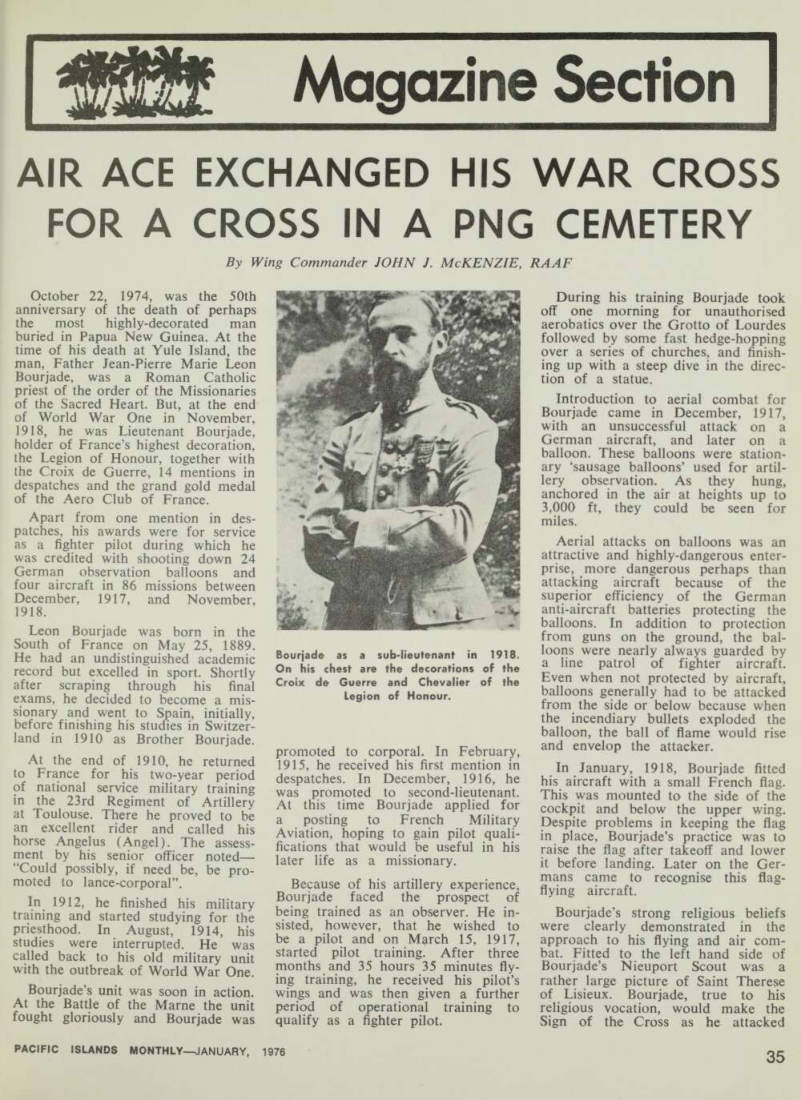
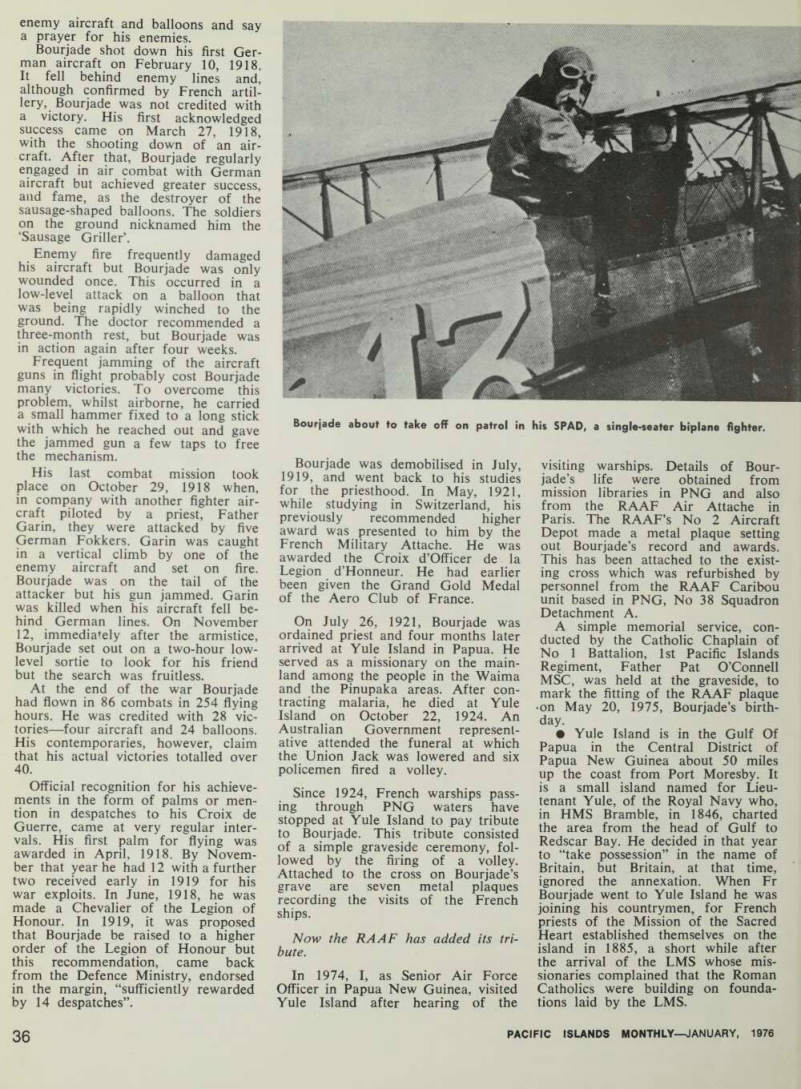
Air Ace Exchanged His War Cross
FOR A CROSS IN A PNG CEMETERY
By Wing Commander JOHN J. McKENZIE, RAAF
October 22, 1974, was the 50th anniversary of the death of perhaps the most highly-decorated man buried in Papua New Guinea, At the time of his death at Yule Island, the man, Father Jean-Pierre Marie Leon Bourjade, was a Roman Catholic priest of the order of the Missionaries of the Sacred Heart. But, at the end of World War One in November, 1918, he was Lieutenant Bourjade, holder of France’s highest decoration, the Legion of Honour, together with the Croix de Guerre, 14 mentions in despatches and the grand gold medal of the Aero Club of France.
Apart from one mention in des patches, his awards were for service as a fighter pilot during which he was credited with shooting down 24 German observation balloons and four aircraft in 86 missions between December, 1917, and November, 1918.
Leon Bourjade was born in the South of France on May 25, 1889.
He had an undistinguished academic record but excelled in sport. Shortly after scraping through his final exams, he decided to become a mis sionary and went to Spain, initially, before finishing his studies in Switzer land in 1910 as Brother Bourjade.
At the end of 1910, he returned to France for his two-year period of national service military training in the 23rd Regiment of Artillery at Toulouse. There he proved to be an excellent rider and called his horse Angelus (Angel). The assess ment by his senior officer noted— “ Could possibly, if need be, be pro moted to lance-corporal”.
In 1912, he finished his military training and started studying for the priesthood. In August, 1914, his studies were interrupted. He was called back to his old military unit with the outbreak of World War One.
Bourjade’s unit was soon in action.
At the Battle of the Marne the unit fought gloriously and Bourjade was
promoted to corporal. In February, 1915, he received his first mention in despatches. In December, 1916, he was promoted to second-lieutenant.
At this time Bourjade applied for a posting to French Military Aviation, hoping to gain pilot quali fications that would be useful in his later life as a missionary.
Because of his artillery experience, Bourjade faced the prospect of being trained as an observer. He in sisted, however, that he wished to be a pilot and on March 15, 1917, started pilot training. After three months and 35 hours 35 minutes fly ing training, he received his pilot’s wings and was then given a further period of operational training to qualify as a fighter pilot.
During his training Bourjade took off one morning for unauthorised aerobatics over the Grotto of Lourdes followed by some fast hedge-hopping over a series of churches, and finish ing up with a steep dive in the direc tion of a statue.
Introduction to aerial combat for Bourjade came in December, 1917, with an unsuccessful attack on a German aircraft, and later on a balloon. These balloons were station ary ‘sausage balloons’ used for artil lery observation. As they hung, anchored in the air at heights up to 3,000 ft, they could be seen for miles.
Aerial attacks on balloons was an attractive and highly-dangerous enter prise, more dangerous perhaps than attacking aircraft because of the superior efficiency of the German anti-aircraft batteries protecting the balloons. In addition to protection from guns on the ground, the bal loons were nearly always guarded by a line patrol of fighter aircraft.
Even when not protected by aircraft, balloons generally had to be attacked from the side or below because when the incendiary bullets exploded the balloon, the ball of flame would rise and envelop the attacker.
In January, 1918, Bourjade fitted his aircraft with a small French flag.
This was mounted to the side of the cockpit and below the upper wing.
Despite problems in keeping the flag in place, Bourjade’s practice was to raise the flag after takeoff and lower it before landing. Later on the Ger mans came to recognise this flag flying aircraft.
Bourjade’s strong religious beliefs were clearly demonstrated in the approach to his flying and air com bat. Fitted to the left hand side of Bourjade’s Nieuport Scout was a rather large picture of Saint Therese of Lisieux. Bourjade, true to his religious vocation, would make the Sign of the Cross as he attacked
Bourjade as a sub-lieutenant in 1918.
On his chest are the decorations of the Croix de Guerre and Chevalier of the Legion of Honour.
enemy aircraft and balloons and say a prayer for his enemies.
Bourjade shot down his first Ger man aircraft on February 10, 1918.
It fell behind enemy lines and, although confirmed by French artil lery, Bourjade was not credited with a victory. His first acknowledged success came on March 27, 1918, with the shooting down of an air craft. After that, Bourjade regularly engaged in air combat with German aircraft but achieved greater success, and fame, as the destroyer of the sausage-shaped balloons. The soldiers on the ground nicknamed him the ‘Sausage Griller’.
Enemy fire frequently damaged his aircraft but Bourjade was only wounded once. This occurred in a low-level attack on a balloon that was being rapidly winched to the ground. The doctor recommended a three-month rest, but Bourjade was in action again after four weeks.
Frequent jamming of the aircraft guns in flight probably cost Bourjade many victories. To overcome this problem, whilst airborne, he carried a small hammer fixed to a long stick with w'hich he reached out and gave the jammed gun a few taps to free the mechanism.
His last combat mission took place on October 29, 1918 when, in company with another fighter air craft piloted by a priest, Father Garin, they were attacked by five German Fokkers. Garin was caught in a vertical climb by one of the enemy aircraft and set on fire.
Bourjade was on the tail of the attacker but his gun jammed. Garin was killed when his aircraft fell be hind German lines. On November 12, immediately after the armistice, Bourjade set out on a two-hour low level sortie to look for his friend but the search was fruitless.
At the end of the war Bourjade had flown in 86 combats in 254 flying hours. He was credited with 28 vic tories—four aircraft and 24 balloons.
His contemporaries, however, claim that his actual victories totalled over 40.
Official recognition for his achieve ments in the form of palms or men tion in despatches to his Croix de Guerre, came at very regular inter vals. His first palm for flying was awarded in April, 1918. By Novem ber that year he had 12 with a further two received early in 1919 for his war exploits. In June, 1918, he was made a Chevalier of the Legion of Honour. In 1919, it was proposed that Bourjade be raised to a higher order of the Legion of Honour but this recommendation, came back from the Defence Ministry, endorsed in the margin, “sufficiently rewarded by 14 despatches”.
Bourjade was demobilised in July, 1919, and went back to his studies for the priesthood. In May, 1921, while studying in Switzerland, his previously recommended higher award was presented to him by the French Military Attache. He was awarded the Croix d’Officer de la Legion d’Honneur, He had earlier been given the Grand Gold Medal of the Aero Club of France.
On July 26, 1921, Bourjade was ordained priest and four months later arrived at Yule Island in Papua. He served as a missionary on the main land among the people in the Waima and the Pinupaka areas. After con tracting malaria, he died at Yule Island on October 22, 1924. An Australian Government represent ative attended the funeral at which the Union Jack was lowered and six policemen fired a volley.
Since 1924, French warships pass ing through PNG waters have stopped at Yule Island to pay tribute to Bourjade. This tribute consisted of a simple graveside ceremony, fol lowed by the firing of a volley.
Attached to the cross on Bourjade’s grave are seven metal plaques recording the visits of the French ships.
Now the RAAF has added its tri bute.
In 1974, I, as Senior Air Force Officer in Papua New Guinea, visited Yule Island after hearing of the
visiting warships. Details of Bour jade’s life were obtained from mission libraries in PNG and also from the RAAF Air Attache in Paris. The RAAF’s No 2 Aircraft Depot made a metal plaque setting out Bourjade’s record and awards.
This has been attached to the exist ing cross which was refurbished by personnel from the RAAF Caribou unit based in PNG, No 38 Squadron Detachment A.
A simple memorial service, con ducted by the Catholic Chaplain of No 1 Battalion, Ist Pacific Islands Regiment, Father Pat O’Connell MSC, was held at the graveside, to mark the fitting of the RAAF plaque •on May 20, 1975, Bourjade’s birth day. • Yule Island is in the Gulf Of Papua in the Central District of Papua New Guinea about 50 miles up the coast from Port Moresby. It is a small island named for Lieu tenant Yule, of the Royal Navy who, in HMS Bramble, in 1846, charted the area from the head of Gulf to Redscar Bay. He decided in that year to “take possession” in the name of Britain, but Britain, at that time, ignored the annexation. When Fr Bourjade went to Yule Island he was joining his countrymen, for French priests of the Mission of the Sacred Heart established themselves on the island in 1885, a short while after the arrival of the LMS whose mis sionaries complained that the Roman Catholics were building on founda tions laid by the LMS.
Bourjade about to take off on patrol in his SPAD, a single-seater biplane fighter.
Advertisements & other items, pp. 39-42 (1 item)
“So this is a Lamborghini,”
she breathed, as we sped down the autostrada towards Turin.
“Yes,” I said, offering her a Benson and Hedges. “Five forward gears and 170 in top.”
“Can you prove that?” she demanded.
“Do I really have to? You did say you only wanted a little car to do the shopping”
V I 'N \S >. f Benson & Hedges.
When only the best will do.
W678-10/75
If you’ve got work to do,
we’ve got trucks to do it.
TOYOTA
Stout
TOYOTA
Hi Ace
TOYOTA
Land Cruiser Pickup
TOYOTA Hi-Lux
PAPUA, NEW GUINEA: ELA MOTORS LIMITED, Scratchley Rd„ Badili, Papua. U.S. TRUST TERRITORY: MICROL CORPORATION, P.O. Box 267. Saipan. FIJI ISLANDS: AUTOMOTIVE SUPPLIES CO., LTD., G.P.O. Box 355, Suva. AMERICAN SAMOA; BURNS PHILP (SOUTH SEA) CO., LTD., Pago Pago. WESTERN SAMOA: BURNS PHILP (SOUTH SEA) LTD., P.O. Box 188, Apia. GUAM: RICKY'S AUTO CO.. P.O. Box 1458, Agana, NEW HEBRIDES: NEW HEBRIDES MOTORS LTD., P.O. Box 18. Vila. SOLOMON ISLANDS: MENDANA ENTERPRISES (5.1.), LTD,, P.O. Box 1 74, Honiara.
* flnovmr. 5'
TOYOTA Dyna
From different styles of the 4-wheel-drive Land Cruiser, to vans and pickups, to heavy duty trucks. Toyota makes them.
And Toyota makes them tough.
There's a Toyota truck that will work for you. Economically.
Reliably.
Find out about it. From your local Toyota dealer.
TOYOTA Truck
TOYOTA
Toyo-Ace
TOYOTA
TAHITI: NIPPON AUTOMOTO, B.P. 545, Papeete. COOK ISLANDS; COOK ISLANDS TRADING CORPORATION LTD., P.O. Box 92, Rarotonga. NAURU ISLAND: NAURU COOPERATIVE SOCIETY. GILBERT & ELLICE ISLANDS COLONY; TARAWA MOTORS Box Bair.ki Tarawa. NORFOLK ISLAND: MARIE'S NORFOLK TOURS, LTD., P.O. Box 276. TIMOR: SANG TAI HOO Sang Tai Building Dili NEW CALEDONIA; SOCIETE IMPORTATION AUTOMOBILE DU PACIFIQUE. Rond-Point du Pacific (Station Total) B.P. 438 Noumea.
Sony presents more power,
are tonal quality than you e\
dreamed was possible.
The Sony CF-480S cassette-corder/radio sounds as big and real as life itself.
Its powerful, specially-designed amplifier delivers 4 watts of power—enough to fill even the largest room with clear, distortion-free sound.
What’s more, it has a unique 2-way speaker system. One big 6 1/2-inch woofer for the lows and a separate 2-inch tweeter for the highs.
Result: rephcNst^^^|^^§|^nrograms
and cassette recordings, with audibly superior shortwave and medium wave sound, too.
In fact, the great-sounding CF-480S represents Sony cassette-corder technology at its finest: there is a DC servo-controlled tape drive motor, sensitive electret condenser microphone, tape selector for normal and Cro2 cassettes, mlc mixing controls, and much more. It’s a dream of versatility.
But you shouldn’t just take our word for it.
Visit the nearest Sony_daaler and audition the Sony CF-480S for yourself.
You’d never dream that a cassettes could sound so good. 95
Up Mount Hagen
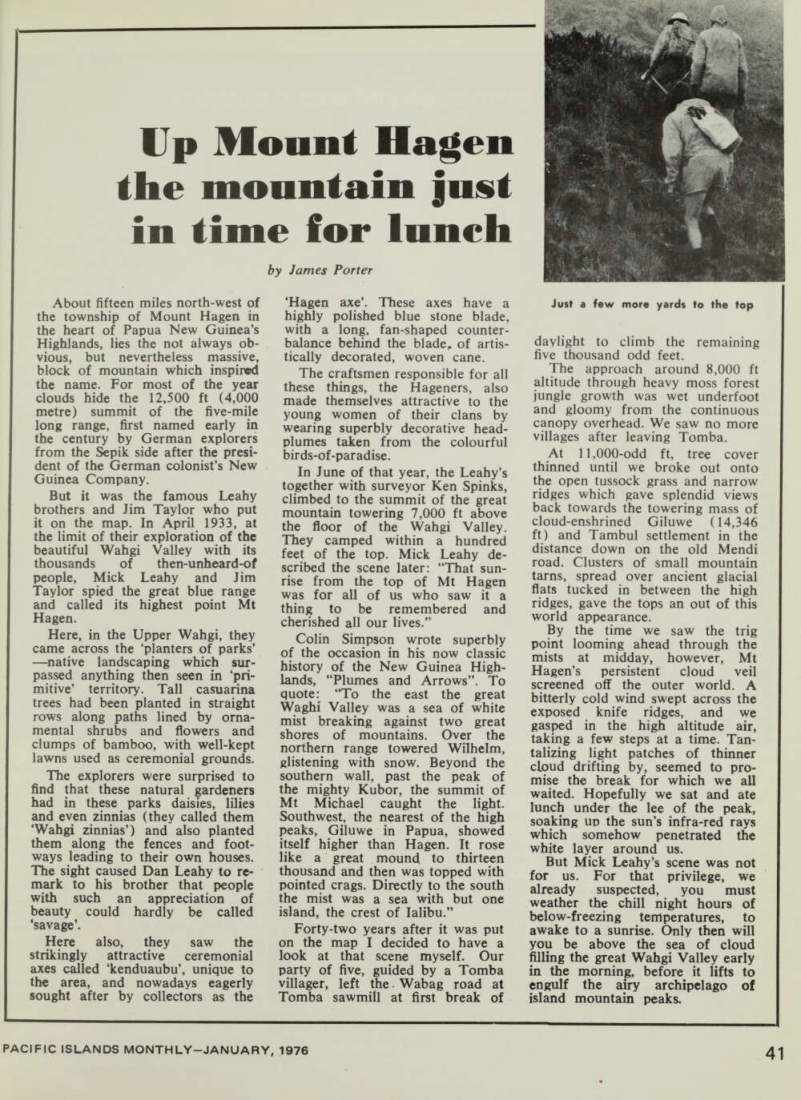
the mountain just in time for lunch
by James Porter
About fifteen miles north-west of the township of Mount Hagen in the heart of Papua New Guinea’s Highlands, lies the not always ob vious, but nevertheless massive, block of mountain which inspired the name. For most of the year clouds hide the 12,500 ft (4,000 metre) summit of the five-mile long range, first named early in the century by German explorers from the Sepik side after the presi dent of the German colonist’s New Guinea Company.
But it was the famous Leahy brothers and Jim Taylor who put it on the map. In April 1933, at the limit of their exploration of the beautiful Wahgi Valley with its thousands of then-unheard-of people, Mick Leahy and Jim Taylor spied the great blue range and called its highest point Mt Hagen.
Here, in the Upper Wahgi, they came across the ‘planters of parks’ —native landscaping which sur passed anything then seen in ‘pri mitive’ territory. Tall casuarina trees had been planted in straight rows along paths lined by orna mental shrubs and flowers and clumps of bamboo, with well-kept lawns used as ceremonial grounds.
The explorers were surprised to find that these natural gardeners had in these parks daisies, lilies and even zinnias (they called them ‘Wahgi zinnias’) and also planted them along the fences and foot ways leading to their own houses.
The sight caused Dan Leahy to re mark to his brother that people with such an appreciation of beauty could hardly be called ‘savage’.
Here also, they saw the strikingly attractive ceremonial axes called ‘kenduaubu’, unique to the area, and nowadays eagerly sought after by collectors as the
‘Hagen axe’. These axes have a highly polished blue stone blade, with a long, fan-shaped counter balance behind the blade, of artis tically decorated, woven cane.
The craftsmen responsible for all these things, the Hageners, also made themselves attractive to the young women of their clans by wearing superbly decorative head plumes taken from the colourful birds-of-paradise.
In June of that year, the Leahy’s together with surveyor Ken Spinks, climbed to the summit of the great mountain towering 7,000 ft above the floor of the Wahgi Valley.
They camped within a hundred feet of the top. Mick Leahy de scribed the scene later: “That sun rise from the top of Mt Hagen was for all of us who saw it a thing to be remembered and cherished all our lives.”
Colin Simpson wrote superbly of the occasion in his now classic history of the New Guinea High lands, “Plumes and Arrows”. To quote: “To the east the great Waghi Valley was a sea of white mist breaking against two great shores of mountains. Over the northern range towered Wilhelm, glistening with snow. Beyond the southern wall, past the peak of the mighty Kubor, the summit of Mt Michael caught the light.
Southwest, the nearest of the high peaks, Giluwe in Papua, showed itself higher than Hagen. It rose like a great mound, to thirteen thousand and then was topped with pointed crags. Directly to the south the mist was a sea with but one island, the crest of lalibu,”
Forty-two years after it was put on the map I decided to have a look at that scene myself. Our party of five, guided by a Tomba villager, left the Wabag road at Tomba sawmill at first break of
daylight to climb the remaining five thousand odd feet.
The approach around 8,000 ft altitude through heavy moss forest jungle growth was wet underfoot and gloomy from the continuous canopy overhead. We saw no more villages after leaving Tomba.
At 11,000-odd ft, tree cover thinned until we broke out onto the open tussock grass and narrow ridges which gave splendid views back towards the towering mass of cloud-enshrined Giluwe (14,346 ft) and Tambul settlement in the distance down on the old Mendi road. Clusters of small mountain tarns, spread over ancient glacial flats tucked in between the high ridges, gave the tops an out of this world appearance.
By the time we saw the trig point looming ahead through the mists at midday, however, Mt Hagen’s persistent cloud veil screened off the outer world. A bitterly cold wind swept across the exposed knife ridges, and we gasped in the high altitude air, taking a few steps at a time. Tan talizing light patches of thinner cloud drifting by, seemed to pro mise the break for which we all waited. Hopefully we sat and ate lunch under the lee of the peak, soaking up the sun’s infra-red rays which somehow penetrated the white layer around us.
But Mick Leahy’s scene was not for us. For that privilege, we already suspected, you must weather the chill night hours of below-freezing temperatures, to awake to a sunrise. Only then will you be above the sea of cloud filling the great Wahgi Valley early in the morning, before it lifts to engulf the airy archipelago of island mountain peaks.
Just a few more yards to the top
Advertisements & other items, pp. 43-44 (2 items)
41
PACIFIC ISLANDS MONTH LY-JANUARY, 1976
Brockhoff
The
f .
'■ > A m % V* . % . * *. .y a . ri * . . - Cheds. Savoury crackers, deliciously topped with cheese. - '
. KOOCHOff
SHEDS
Salada. So versatile. They go with everything. Enjoy them man-size, snack-size or bite-size.
Salada, the three-in-one cracker.
BROCKHOFF
LC Clix. The crackers that taste like they’re already buttered. Scrumptious.
Krispy Wheat Wafer. The satisfying, wafer-thin cracker with the hearty taste of wheat.
Brockhoff crackers seem to be
always just right. Crisp and fresh
and always tasty...as though
they just came from the oven.
And there’s a Brockhoff cracker
to suit every taste.
All baked oven crisp by Brockhoff.
BROCKHOff
Arnott-Brockhoff-Guest Pty. Ltd., Burwood, Victoria, Australia. 3125. Telex 33075. 1630
Yesterday
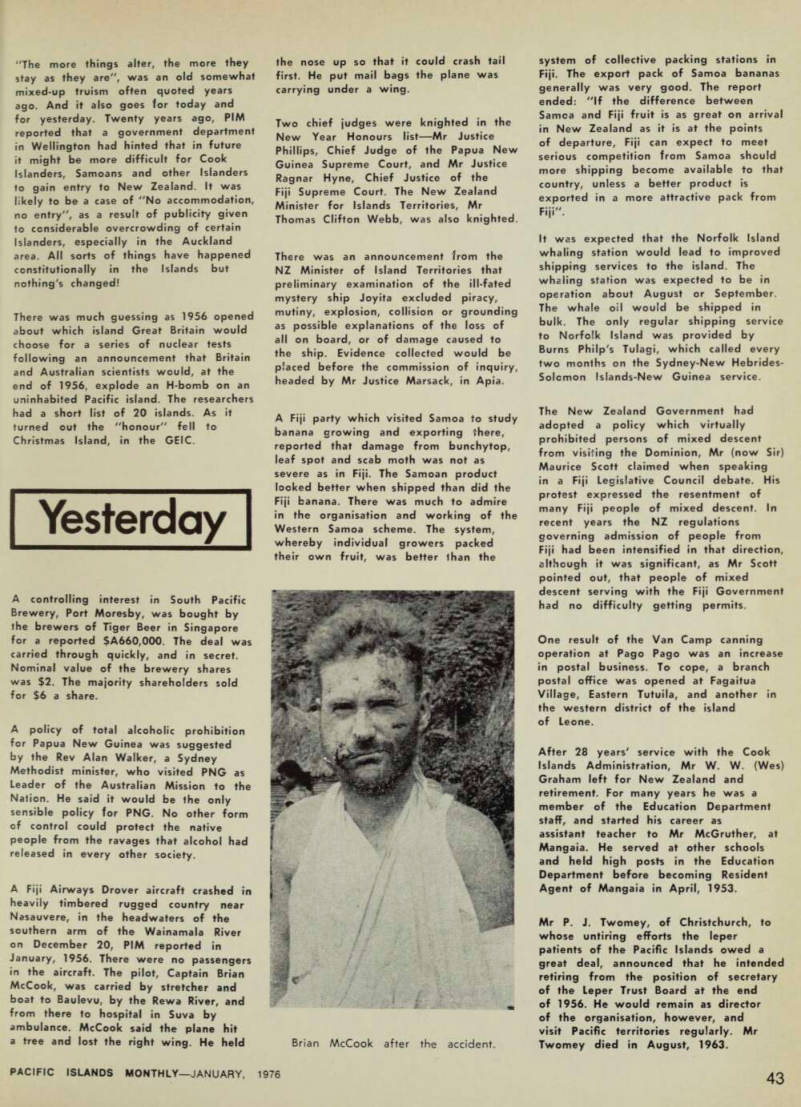
"The more things alter, the more they stay as they are", was an old somewhat mixed-up truism often quoted years ago. And it also goes for today and for yesterday. Twenty years ago, PIM reported that a government department in Wellington had hinted that in future it might be more difficult for Cook Islanders, Samoans and other Islanders to gain entry to New Zealand. It was likely to be a case of "No accommodation, no entry", as a result of publicity given to considerable overcrowding of certain Islanders, especially in the Auckland area. All sorts of things have happened constitutionally in the Islands but nothing's changed!
There was much guessing as 1956 opened about which island Great Britain would choose for a series of nuclear tests following an announcement that Britain and Australian scientists would, at the end of 1956, explode an H-bomb on an uninhabited Pacific island. The researchers had a short list of 20 islands. As it turned out the "honour" fell to Christmas Island, in the GEIC.
A controlling interest in South Pacific Brewery, Port Moresby, was bought by the brewers of Tiger Beer in Singapore for a reported $A660,000. The deal was carried through quickly, and in secret.
Nominal value of the brewery shares was $2. The majority shareholders sold for $6 a share.
A policy of total alcoholic prohibition for Papua New Guinea was suggested by the Rev Alan Walker, a Sydney Methodist minister, who visited PNG as Leader of the Australian Mission to the Nation. He said it would be the only sensible policy for PNG. No other form of control could protect the native people from the ravages that alcohol had released in every other society.
A Fiji Airways Drover aircraft crashed in heavily timbered rugged country near Nasauvere, in the headwaters of the southern arm of the Wainamala River on December 20, PIM reported in January, 1956. There were no passengers in the aircraft. The pilot, Captain Brian McCook, was carried by stretcher and boat to Baulevu, by the Rewa River, and from there to hospital in Suva by ambulance. McCook said the plane hit a tree and lost the right wing. He held
the nose up so that it could crash tail first. He put mail bags the plane was carrying under a wing.
Two chief judges were knighted in the New Year Honours list—Mr Justice Phillips, Chief Judge of the Papua New Guinea Supreme Court, and Mr Justice Ragnar Hyne, Chief Justice of the Fiji Supreme Court. The New Zealand Minister for Islands Territories, Mr Thomas Clifton Webb, was also knighted.
There was an announcement from the NZ Minister of Island Territories that preliminary examination of the ill-fated mystery ship Joyita excluded piracy, mutiny, explosion, collision or grounding as possible explanations of the loss of all on board, or of damage caused to the ship. Evidence collected would be placed before the commission of inquiry, headed by Mr Justice Marsack, in Apia.
A Fiji party which visited Samoa to study banana growing and exporting there, reported that damage from bunchytop, leaf spot and scab moth was not as severe as in Fiji. The Samoan product looked better when shipped than did the Fiji banana. There was much to admire in the organisation and working of the Western Samoa scheme. The system, whereby individual growers packed their own fruit, was better than the
system of collective packing stations in Fiji. The export pack of Samoa bananas generally was very good. The report ended: "If the difference between Samoa and Fiji fruit is as great on arrival in New Zealand as it is at the points of departure, Fiji can expect to meet serious competition from Samoa should more shipping become available to that country, unless a better product is exported in a more attractive pack from Fiji".
It was expected that the Norfolk Island whaling station would lead to improved shipping services to the island. The whaling station was expected to be in operation about August or September.
The whale oil would be shipped in bulk. The only regular shipping service to Norfolk Island was provided by Burns Phi Ip's Tulagi, which called every two months on the Sydney-New Hebrides- Solomon Islands-New Guinea service.
The New Zealand Government had adopted a policy which virtually prohibited persons of mixed descent from visiting the Dominion, Mr (now Sir) Maurice Scott claimed when speaking in a Fiji Legislative Council debate. His protest expressed the resentment of many Fiji people of mixed descent. In recent years the NZ regulations governing admission of people from Fiji had been intensified in that direction, although it was significant, as Mr Scott pointed out, that people of mixed descent serving with the Fiji Government had no difficulty getting permits.
One result of the Van Camp canning operation at Pago Pago was an increase in postal business. To cope, a branch postal office was opened at Fagaitua Village, Eastern Tutuila, and another in the western district of the island of Leone.
After 28 years' service with the Cook Islands Administration, Mr W. W. (Wes) Graham left for New Zealand and retirement. For many years he was a member of the Education Department staff, and started his career as assistant teacher to Mr McGruther, at Mangaia. He served at other schools and held high posts in the Education Department before becoming Resident Agent of Mangaia in April, 1953.
Mr P. J. Twomey, of Christchurch, to whose untiring efforts the leper patients of the Pacific Islands owed a great deal, announced that he intended retiring from the position of secretary of the Leper Trust Board at the end of 1956. He would remain as director of the organisation, however, and visit Pacific territories regularly. Mr Twomey died in August, 1963.
Brian McCook after the accident.
nano
MANA is a vehicle for Pacific Islands’ writers and artists to publish their work. It is an organ of the South Pacific Creative Arts Society and its editorial committee comprises writers from many islands.
Material for publication must be sent direct to MANA’s editor, Marjorie Crocombe, South Pacific Creative Arts Society, Box 5083, Suva.
MANA enters 1976 with a new motif, surely recognisable by the Samoans.
It is a photograph (copyright British Museum) of a piece of old Samoan tapa which is now in the British Museum in London. Maybe the Samoans would like to ask for its return now that the Islands are experiencing a culture rebirth!
A Thirst
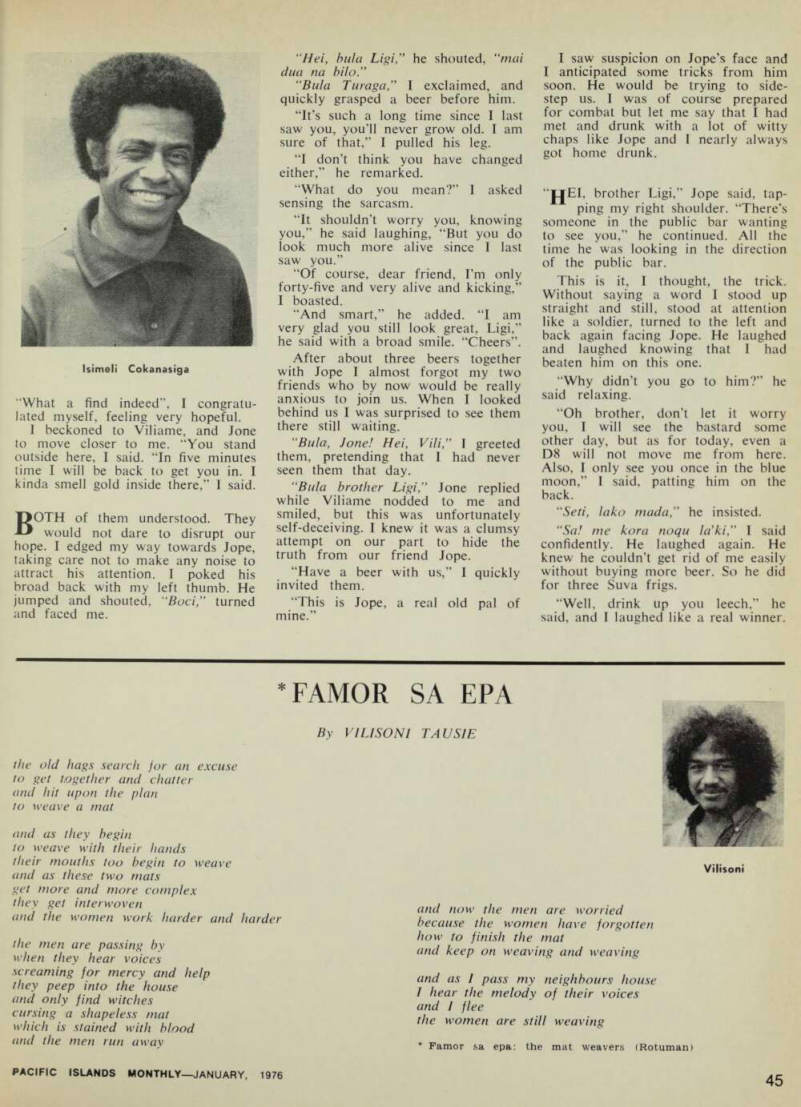
By I Simeli Cokanasiga
1 started my usual round of the public bars in the city of Suva sharp at opening time on Friday.
Since it was too early in the day, I didn’t expect to find much. Usually, the chaps with money drink between four and six in the afternoon.
Nevertheless, since I was dying for a drink, I decided to take my chances. _.,. . . . , It was one of these weeks in which there was not a job to be found at the waterfront. I therefore had to turn into a damn blood sucker a namu, throughout the week, as usual. 1 did not care what people thought or said about me because I knew almost everybody who frequented the public-bars and almost every single drinker and sportsman m the city. I knew they regarded me as a valuable source of a few hearty laughs. I was, so to speak, an accepted clown in the city.
Seru was the only barman at the Suva Hotel’s public bar when I got in at about half-past ten. . . „ , Yadra, Ligi, w- 6 ™ me with a smile. ‘Sa la ki ya.
Since no one was drinking there I bluffed, saying that I wanted to use the 100. After wasting about two minutes I came out again and thanked Seru. He nodded and waved.
I slipped through the door and headed for the much-frequented Metropole Hotel.
I got into the public bar at the Metropole Hotel and found it very quiet, and an atmosphere of gross misuse during yesterday’s drinking hours. Jone and Viliame were enjoy ing a beer at the far end of the bar opposite me. I knew that they would not have more than fifty cents each in their pockets because we were all dock-workers and had had practi cal, no jobs to do that week But as good friends, they offered me a g i ass beer j Q e, the barman, knew quite well how much we were worth and bougb t us a glass of beer each before we left for the Garrick Hotel, The crowd at the Ga rrick Hotel public bar did not int erest me be caUse I thought I knew almost every one of them Jone vii iame , and i hurried along Victoria Parade and went stra i g ht to the Club Hotel, Adjacent to the public bar there was a smaller bar which sold beer at a higher price. I could feel that there was gold inside. I stepped by the doorway and cautiously held the two friends back. I peeped inside, Jo m y de light, I recognised a fami liar figure drinking at the bar, I stepped back and turned my right ear towards him. He was joking and having a good laugh with Setareki, the barman. I tried to remember what date it was and realised it was August 30. It was Jope’s pay day of course, and he was on holiday.
“What a find indeed”, I congratu lated myself, feeling very hopeful.
I beckoned to Viliame, and Jone to move closer to me. “You stand outside here, I said. “In five minutes time I will be back to get you in. I kinda smell gold inside there,” I said.
BOTH of them understood. They would not dare to disrupt our hope. I edged my way towards Jope, taking care not to make any noise to attract his attention. I poked his broad back with my left thumb. He jumped and shouted, “ Boci” turned and faced me.
“Hei, bula Ligi,” he shouted, “mai dua na hilo”
“Bula Turaga ,” I exclaimed, and quickly grasped a beer before him.
“It’s such a long time since I last saw you, you’ll never grow old. I am sure of that,” I pulled his leg.
“I don’t think you have changed either,” he remarked.
“What do you mean?” I asked sensing the sarcasm.
“It shouldn’t worry you, knowing you,” he said laughing, “But you do look much more alive since I last saw you.”
“Of course, dear friend, I’m only forty-five and very alive and kicking,”
I boasted.
“And smart,” he added. “I am very glad you still look great, Ligi,” he said with a broad smile. “Cheers”.
After about three beers together with Jope I almost forgot my two friends who by now would be really anxious to join us. When I looked behind us I was surprised to see them there still waiting.
“Bula, Jone! Hei, Vili,” I greeted them, pretending that I had never seen them that day, “Bula brother Ligi,” Jone replied while Viliame nodded to me and smiled, but this was unfortunately self-deceiving. I knew it was a clumsy attempt on our part to hide the truth from our friend Jope.
“Have a beer with us,” I quickly invited them.
“This is Jope, a real old pal of mine.”
I saw suspicion on Jope’s face and I anticipated some tricks from him soon. He would be trying to side step us. I was of course prepared for combat but let me say that I had met and drunk with a lot of witty chaps like Jope and I nearly always got home drunk.
H EI brother Ligi,” Jope said, tap ping my right shoulder. “There’s someone in the public bar wanting to see you,” he continued. All the time he was looking in the direction of the public bar.
This is it, I thought, the trick.
Without saying a word I stood up straight and still, stood at attention like a soldier, turned to the left and back again facing Jope. He laughed and laughed knowing that I had beaten him on this one, “Why didn’t you go to him?” he
said relaxing.
“Oh brother, don’t let it worry you, I will see the bastard some other day, but as for today, even a D 8 will not move me from here.
Also, I only see you once in the blue moon,” I said, patting him on the back.
“Seti, lako mada,” he insisted.
“Sa! me kora noqu la’ki,” I said confidently. He laughed again. He knew he couldn’t get rid of me easily without buying more beer. So he did for three Suva frigs.
"Well, drink up you leech,” he said, and I laughed like a real winner.
Isimeli Cokanasiga
*Famor Sa Epa
By Vi Li Son I Tausie
the old hags search for an excuse to get together and chatter and hit upon the plan to weave a mat
and as they begin
to weave with their hands their mouths too begin to weave and as these two mats get more and more complex they get interwoven and the women work harder and harder the men are passing by when they hear voices screaming for mercy and help they peep into the house and only find witches cursing a shapeless mat which is stained with blood and the men run away
and now the men are worried because the women have forgotten how to finish the mat and keep on weaving and weaving and as I pass my neighbours house I hear the melody of their voices and I flee the women are still weaving * Famor sa epa; the mat weavers (Rotuman)
Vilisoni
Jo’s in the navy
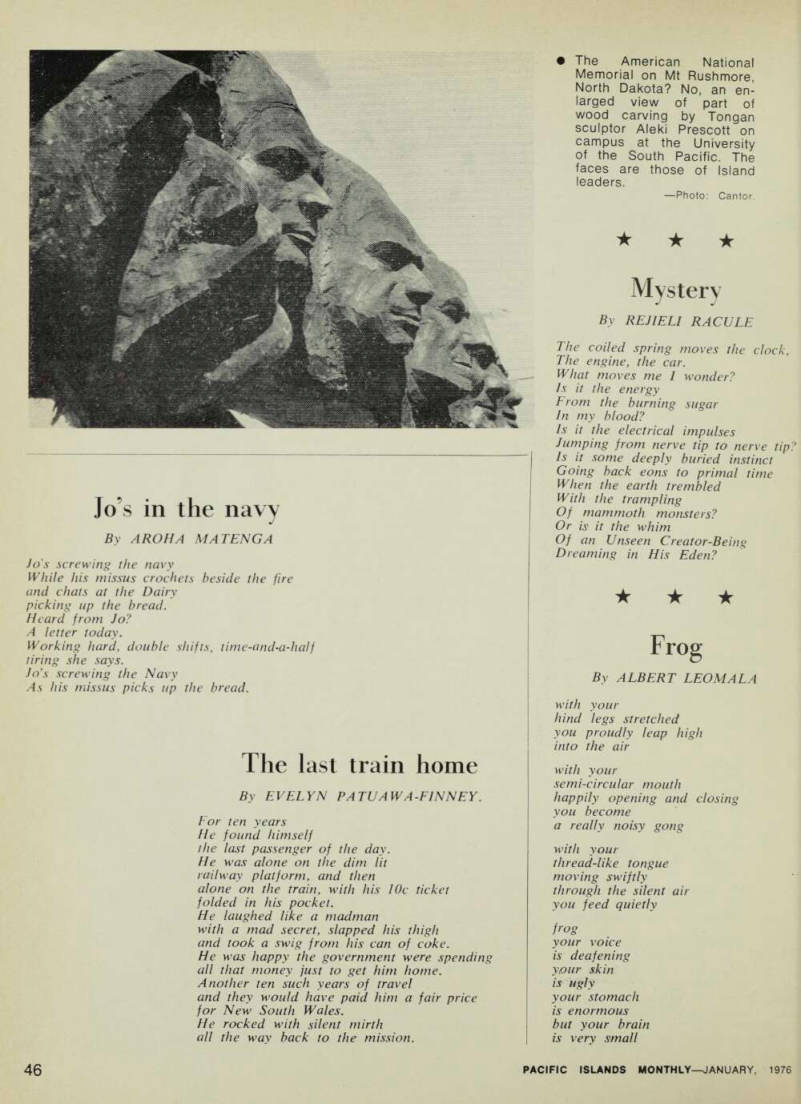
By Aroha Matenga
Jo's screwing the navy While his missus crochets beside the fire and chats at the Dairy picking up the bread.
Heard from Jo?
A letter today.
Working hard, double shifts, time-and-a-half tiring she says.
Jo's screwing the Navy As his missus picks up the bread.
• The American National Memorial on Mt Rushmore, North Dakota? No, an en larged view of part of wood carving by Tongan sculptor Aleki Prescott on campus at the University of the South Pacific. The faces are those of Island leaders.
Photo: Cantor.
The last train home
By Evelyn Patuawa-Finney.
For ten years He found himself the last passenger of the day.
He was alone on the dim lit railway platform, and then alone on the train, with his 10c ticket folded in his pocket.
He laughed like a madman with a mad secret, slapped his thigh and took a swig from his can of coke.
He was happy the government were spending all that money just to get him home.
Another ten such years of travel and they would have paid him a fair price for New South Wales.
He rocked with silent mirth all the way back to the mission.
Mystery
By Rejieli Racule
The coiled spring moves the clock, The engine, the car.
What moves me I wonder?
Is it the energy From the burning sugar In my blood?
Is it the electrical impulses Jumping from nerve tip to nerve tip?
Is it some deeply buried instinct Going back eons to primal time When the earth trembled With the trampling Of mammoth monsters?
Or is it the whim Of an Unseen Creator-Being Dreaming in His Eden?
Frog
By Albert Leomala
with your hind legs stretched you proudly leap high into the air with your semi-circular mouth happily opening and closing you become a really noisy gong with your thread-like tongue moving swiftly through the silent air you feed quietly frog your voice is deafening your skin is ugly your stomach is enormous but your brain is very small
The Sacred Turtles
Of Kadavu
By David Blakelock
ON the island of Kadavu, one of the larger islands of the Fiji Group and some fifty miles by water from the capital, Suva, is the village of Namuana.
Namuana nestles at the foot of a beautiful bay adjacent to the Government Station in Vunisea Harbour.
Here the island narrows down to a very narrow isthmus and by climbing the hill behind the village one can stand on the saddle and look out to the sea to the south and to the north. Legend says that in the past, during tribal wars, warriors slid the canoes on rollers up over the narrow neck of the land to save them the long journey round the east and west ends of the island.
The legend associated with the women of Namuana village is one of the most interesting ones, beside the legend of the Firewalkers of Beqa. This is the legend of the Sacred Turtles of Kadavu.
Many, many years ago in the beautiful Namuana village lived a very beautiful princess called Tinaicaboga, wife of the chief of Namuana, She had a charming daughter called Raudalice.
The two women often went fishing together on the reefs close to their shores. On one particular occasion, the two women went further afield than usual and out into the submerged reef which juts out from the rocky headland to the east of the bay.
They became so engrossed with their fishing that they did not notice the stealthy approach of a great canoe filled with fishermen from Nabukelevu, a village at the west end of Kadavu. Nabukelevu is in the shadow of Mt Washington, the highest peak on Kadavu.
The fishermen suddenly leapt from their canoe and seized the two women, bound their hands and feet with vines and tossed them into their canoe and set off in great haste for Nabukelevu. Although these women pleaded for their lives, the warriors took no notice of them. Their entreaties fell on the deaf ears of these cruel men.
The gods of the sea, however, were kind and soon a great storm arose and the canoe was tossed about by huge waves which almost swamped it.
AS the canoe was foundering in the sea, the fishermen were astonished to learn that the two women lying in the water in the hold of the canoe had suddenly changed into the form of a turtle, and to save their lives, the men got hold of them and threw them into the rough seas. As soon as the turtles hit the water, the storm began to subside. But the frightened fishermen continued on their homeward journey.
Although the women were saved from those cruel fishermen, they were not to regain their human form.
So, as turtles, they lived on in the lagoons of the bay.
When the people of Namuana learned of the incident, they mourned and then a very strange ritual began. The women of Namuana, assembled at the top of a rocky headland about 120 to 150 feet above sea level and chanted. As they chanted, beautiful turtles would rise to the calm surface of the lagoon below and float about listening to the chants.
The translation of this strange song is: “The women of Namuana are all dressed in mourning Each carries a sacred club, each is tattooed in strange patterns.
Do rise to the surface, Raudalice, so we may look at you Do rise, Tinaicaboga, so we may also look at you.”
Like other rituals, this has taboos. One of these is that no fishing is permitted in the waters of that lagoon, let alone turtle fishing. The other taboo is that no one from the village of Nabukelevu should be present during the ceremony of the calling of the turtles. This is very important for if one is present, no turtle will rise. These are still observed today.
As is usually the case with such strange ceremonies and customs in Fiji, the turtle-calling is based on an ancient legend still passed on from father to son among the people of Kadavu.
You may doubt the truth of the legend, but you can not doubt the fact that the chanting of this strange song does in fact lure giant turtles to the surface of the blue water of the bay. The ritual is still preserved by the women of Namuana village on the island of Kadavu.
You My Own Son
By Michael Evo
I will comfort you no more, I will feed you no more, You my own son Now the Whiteman’s friend.
The books you read, The radio you listen to, and the papers in your hands will be your comforters
The Whiteman your friend and the job you worship Will now house and feed you.
You my son, now the Whiteman’s friend.
Advertisements & other items, p. 50 (1 item)
Demka (Australia)
PTY. LIMITED
Represents manufacturers exporting to the South Pacific
SWEDISH HARDBOARD
ITALIAN LPG STOVES
GERMAN WINES
TAIWANESE PLYWOOD
JAPANESE GENERATORS
BELGIAN CANNED VEGETABLES
DUTCH SHOCK ABSORBERS
BELGIAN EXHAUST SYSTEMS
HONG KONG SUITCASES
CHINESE FOODSTUFFS
DANISH CANNED MEATS
JAPANESE REFRIGERATORS
DUTCH CONFECTIONERY
HONG KONG SWEETS & BISCUITS
GERMAN CURTAIN MATERIALS
BELGIAN DELICACIES
JAPANESE ELECTRICAL TOOLS
DUTCH WEIGHING EQUIPMENT
184 SUSSEX ST. (3rd floor) SYDNEY, NSW 2000 AUSTRALIA
r. 1 . w 8$ rl*f ft#* sa& IP® vre**? f.vV
3" Hand Planer 19238
m m KS»
ELectn.ic.FowaSLTcy&L\
NOW CELEBRATING
60 4' Belt Sander 9401
YEARS OF LEADERSHIP IN INDUSTRY.
OVER 130 MODELS FOR EVERY PURPOSE.
(8) ItLoJdta.
REPRESENTATIVE: DEMKA (AUSTRALIA)
PTY. LIMITED, 184 Sussex Street (Third Floor), Sydney, N.S.W. 2000, Australia.
DISTRIBUTORS: Papua New Guinea; BURNS
PHILP (NEW GUINEA) LTD., TUTT BRYANT
PACIFIC LTD., NEW GUINEA COMPANY
LIMITED, TERRITORIAL PLUMBING SUP-
PLIES & SERVICES PTY. LTD.. British Solo-
mon Islands, CONCRETE INDUSTRIES LTD.,
New Hebrides: BURNS PHILP (NEW HEBRI- DES) LTD., New Caledonia; CALEDONIENNE
D'IMPORT ATI ON DE MATERIEL AUTOMO-
BILE ET CONSTRUCTION. ETS. CHU VAN
FRERES Norfolk Island; IRVINE'S BUILD-
ING SUPPLY CENTRE, Fiji.CORAL ISLAND
MOTORS. Tahiti; SIN TUNG RING MATERI-
- DE CONSTRUCTION,
Books, Reviews, Writers
More Clues In The Search For
Islanders' First Parents
Oceanic Prehistory by Richard Shutler Jr, Professor of Anthro pology at the University of lowa and Mary Elizabeth Shutler, Professor of Anthropology at San Diego State University is a concise statement, yet it includes a fund of carefully- Jocumented material on some of the most recent thinking by experts in Pacific studies.
Its wide panorama begins with mainland and South-east Asian pre listory findings. It ends with an ex cellent six page resume of Oceanic prehistory in perspective. Its state ment, “We have attempted to throw iome light on the story of human cultural development in Oceania” is ypical of its modest approach yet erudite achievement for it certainly loes achieve the shedding of much ight on the subject. Its collation of icattered data in one small edition )f 125 pages will be a useful source )f reference to the interested lay >erson, avid student and to the luthors’ own co-workers, the experts n the various fields of Oceanic Judies.
The Shutlers have included, in a lumber of instances, the two sides )f conflicting views on particularly 'exing questions.
For example: Referring to a heory by Birdsell (1967) “that the nodern aborigine is the hybrid re ult of migration by Negritos, Mur ayians and Carpentarians to Austra ia”, the book also points out: Macintosh (1963) and Abbie 1966) feel that the aborigine repre ents a single stock, which has dif erentiated because of long isolation, mall population, consequent genetic Irift and environmental adaptation”.
The famous Talgai skull (from a ite near Warwick in Queensland) is at least 14,000 years old and may >e as much as 20,000 years old Hendy, Rafter and Macintosh, 972). The morphologically more nodern Keilor cranium from Vic oria seems to be accurately dated it 12,900 plus or minus 120 BP Macintosh 1972). Then concerning
the oldest skull, the Lake Mungo, NSW woman, “though displaying a number of primitive features . , . (the remains) . . . are the most modern in appearance with many points of resemblance to present day aborigines, (Bowler, Jones, Allen and Thorne 1970)”.
The Shutlers seem to think that the question of Polynesian origins is far from solved. “However all evi dence at the present time is against earlier theories that held that Poly nesians moved as a group through Melanesia or Micronesia.
“In Polynesia, the Lapita pottery makers were the first inhabitants, arriving in Tonga from Fiji by 1140 BC. In Samoa the discovery of de corated Lapita pottery dating per haps as early as 800 BC seems to give Samoa an equal claim to that
of Tonga as being the cradle of Polynesian culture”.
The Shutlers finish their book with the statement: “Discoveries will continue that will require constant revisions of ideas regarding the time and routes used to settle various parts of Oceania and the influences affecting the prehistoric cultural de velopment in this vast area”.
One finding they mention concerns blood groupings: “Present evidence from blood groupings (Simmons 1956, Swindler 1955) and anthropo morphic studies (Swindler 1962) indicate no genetic relationship be tween the dark-skinned people of the Pacific and those of Africa as to a common origin” and “The differ ences between Melanesia, Polynesia and Micronesia have been exagger ated in the past”.
As to probable dates of settlement of Island South East Asia and Oceania they include a fascinating table and give the following dates: South East Asian Mainland and In donesia 2,000,000 to 4,500 BP (Be fore the Present). Philippines 400,000 BP, Micronesia 3,500 BP, New Guinea and Australia 35,000 + BP, Island Melanesia 4,000 BP and Poly nesia 1140 BC. None of the above quotes taken thus out of context can give the reader a full picture of the care with which the authors preface their statements. They have sifted the great amount of scientific material upon which it is based into a prac tical format.
The authors are correct in their understatement that “the book pro vides a review of major topics on what is currently known of the pre history of the Pacific Islands and Australia, There are 17 pages of re ferences cited, a five-page index, six excellent maps, three tables of data, five pages of illustrated line drawings and eight photo plates. The authors have substantiated the ring of author ity throughout this book by con veniently placing many names and often the dates of the relevant
scientific statements right in the body of the text beside the subject matter.
There has long been a need for just such a book as Richard Shutler Jr and Mary Elizabeth Shutler have created concerning the beginning of man’s habitation of the 3,000,000 square miles and some 25,000 islands which are included in the term, Oceania. Small as is this soft-cover edition, its research was big and the work involved is a lasting addition to the field of Oceanic studies.
I was pleased to see on its opening page the words, “In memoriam J.
Bruce Palmer” ... a fitting tribute to a man whose love for and excel lent work among the peoples of the Islands has never been accorded its just dues.
Oceanic Prehistory knits together many isolated facts which would be impossible for an interested non expert to sort out on his own. It suc ceeds in presenting in a nutshell the results of many lifetimes of search
ing, discussing and collating.
Beth
Dean.
(OCEANIC PREHISTORY, by Richard Shutter Jr and Mary Elizabeth Shutter.
Published by Cummings Publishing Co, Menlo Park, California. No price given).
Macabre moments
in the jungle
1 am tired of novels written in jerking English where the author seems to think the only punctuation is the full-point, and, like most others it seems. I’m tired of four-letter words being made to do more than they were ever intended to do.
All this may be said of Master White Grass, but more so than many novels this one is suited to this treatment and to this style. Although it may not seem so on the surface, Master White Grass is painstakingly constructed and highly readable.
These are the reasons I enjoyed read ing Master White Grass, and because each of the characters is known to everyone who was ever with an Aus tralian, or for that matter, any other Army in World War 11.
Perhaps the book will be of interest only to those who have gone through World War II in tropical jungles, but those of you who have might do worse than renew an old friendship with the persons who move through the book Master White Grass —Peter Livingston (MASTER WHITE GRASS, by Douglas Waugh. Published by Thomas Nelson (Australia) Limited, 19-39 Jeffcott Street, West Melbourne: 104 Bathurst Street, Sydney. Cased, 174 pages, $5.95.)
Tahiti Bird Life
A new book depicting the bird life of Tahiti has just been published in French. It is Oiseaux de Tahiti by Jean-Claude Thibault and Claude Rives, published by les Editions du Pacifique.
All the birds pictured in the book can be seen around the shores of Tahiti, which has the most varied bird life in all the Society Islands.
It is claimed that of the 90 bird species noted in French Polynesia, 59 are seen in the Society group. Simi larities are noted with the bird life of Australia, Asia and especially Papua New Guinea.
The writers note the various
characteristics developed by birds
living in an isolated island environ ment, where the absence of competi tive or predatory birds leads to a change in feeding habits or ability to
fly •
The book also notes migratory birds which fly in from as far as New Zealand to spend the winter in Polynesia.
Advertisements & other items, p. 51 (1 item)
49
ACIFIC ISLANDS MONTHLY— JANUARY, 1976
Waigani education planners
tackle pitfalls in PNG
A rural bias primary school, with food gardens, piggery and poultry run, was established on the Gazelle Peninsula (PNG) during the 19505.
It found no favour with the villagers who demanded for their children a school like the others in the country, “the same as in Australia”. Other attempts by the Australian adminis tration to evolve an education sys tem meeting Papua New Guinea’s needs failed, too.
The Education Department has made a number of changes since then, particularly in syllabi and materials, but the system still bears the Australian stamp and is under growing challenge by the nation’s teachers and students, politicians and village leaders.
The 1974-75 expenditure of $53.8 million on education—l 6.7 per cent of the nation’s budget—provides schooling for but 50 per cent of primary-aged children and 17 per cent of secondary-aged children.
There is a high pushout and dropout rate; many school leavers cannot find jobs, and some of the inevitable malaise of rapid urbanisation is being blamed on the education system, Alkan Tololo, director of educa tion, told the eighth Waigani Seminar in 1974 that the Western-type education is still not well understood, “even by many of the comparatively well-educated persons whose deci sions affect the future of our coun try”. The problem of two-way com munication between decision-makers and people bedevils education no less than other facets of life at all levels. It is questionable, though, whether ‘de-schooling’ and other radical changes advocated by foreign academics like Illich and tried by some teachers, eg Hemmes at Kokglamp near Mount Hagen, can do more than solve micro-level problems.
Other developing countries have found that formal Western-type education is the most important single factor in the monetisation of the rural sector (and achievement of much of the nation’s programme depends upon rural modernisation).
As Professor Philip Foster points out in one of the 59 papers in Education in Melanesia, education policies need to be based on the market, not run counter to it. People do not send their children to school
for the good of the nation, they send them there for their own good, and the government therefore needs to “capitalise on the selfish motivations of individuals for the ultimate bene fit of all”.
Formal education is virtually the only means of access to the modern occupational structure which, with its corpus of knowledge and tech niques, has to be developed if the new nation is to hold its own against others. Because social and health services, agricultural and business extension, public works, and many other activities mainly depend, or ought to depend, upon the govern ment’s revenue and loan-raising, many people believe that it is the education system’s prime function to maximise economic returns within the framework of national policies.
However, as Foster warns, “edu cational policies that are economic ally rational may well turn out to be politically disastrous given the situ ation in many less-developed coun tries”. Waigani’s policy makers have to tread the middle ground if education policy is not to increase dependence upon foreign aid or to cause drastic reduction in the popu lation’s material well-being.
Some of the papers in this volume are for the specialist but most are of interest and value to anyone concerned with the totality of national development. Straight forward papers like those by Nelson Giraure, Alan Isoaimu, Dus Mapun and Renagi Lohia speak to poli ticians, other leaders and the general public as much as to educators. They seek an education system which in fluences the changes in culture and technology. Several of the technical papers, eg Paliau Lukas’ Look at manpower development and edu cation, and J. D. Conroy’s Model of educational expansion and un employment, are concerned with the end product.
In all, this volume indicates that the Eighth Waigani Seminar has been a worthy successor of the earlier ones; it has made for better-informed participants in the never-ending debate about education and so con tributed to the nation’s development.
Harry Jackman
(Education In Melanesia, Edited By
J. Brammall and R. May. Published by ANU Press, Canberra. $6.95).
clings to past
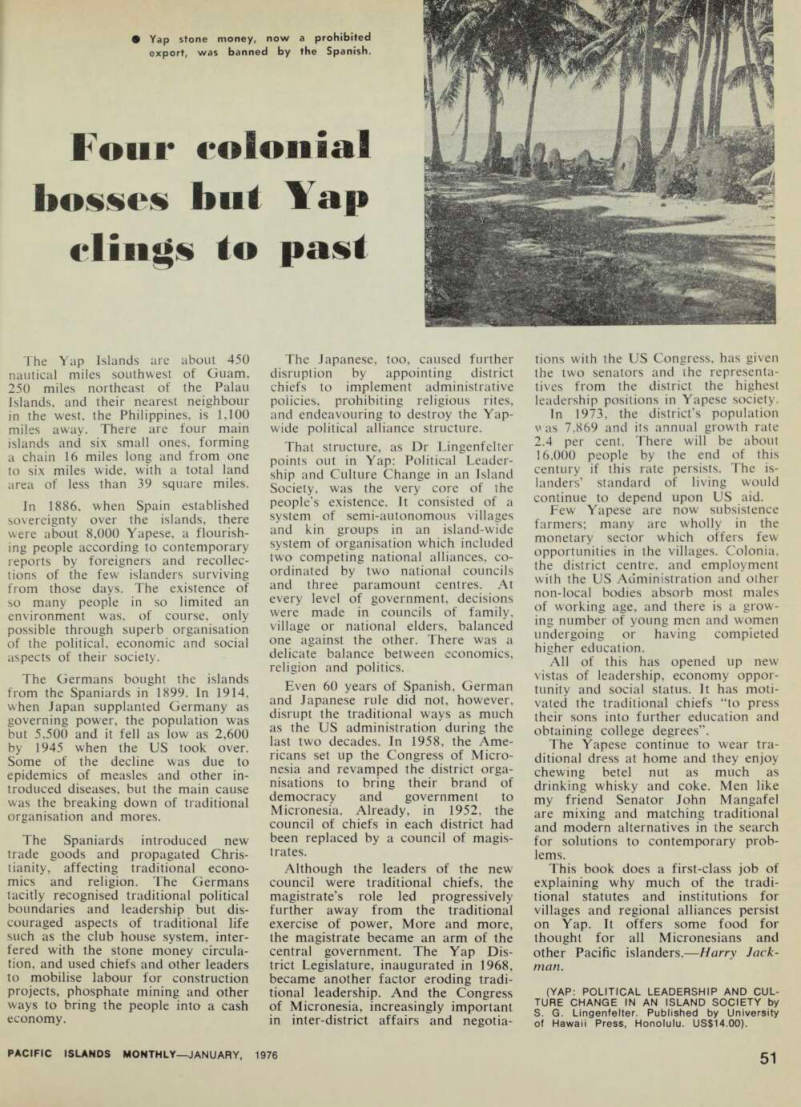
Four colonial bosses but Yap clings to past
The Yap Islands are about 450 nautical miles southwest of Guam, 250 miles northeast of the Palau Islands, and their nearest neighbour in the west, the Philippines, is 1,100 miles away. There are four main islands and six small ones, forming a chain 16 miles long and from one to six miles wide, with a total land area of less than 39 square miles.
In 1886, when Spain established sovereignty over the islands, there were about 8,000 Yapese, a flourish ing people according to contemporary reports by foreigners and recollec tions of the few islanders surviving from those days. The existence of so many people in so limited an environment was, of course, only possible through superb organisation of the political, economic and social aspects of their society.
The Germans bought the islands from the Spaniards in 1899. In 1914, when Japan supplanted Germany as governing power, the population was but 5,500 and it fell as low as 2,600 by 1945 when the US took over.
Some of the decline was due to epidemics of measles and other in troduced diseases, but the main cause was the breaking down of traditional organisation and mores.
The Spaniards introduced new trade goods and propagated Chris tianity, affecting traditional econo mics and religion. The Germans tacitly recognised traditional political boundaries and leadership but dis couraged aspects of traditional life such as the club house system, inter fered with the stone money circula tion, and used chiefs and other leaders to mobilise labour for construction projects, phosphate mining and other ways to bring the people into a cash economy.
The Japanese, too, caused further disruption by appointing district chiefs to implement administrative
policies, prohibiting religious rites,
and endeavouring to destroy the Yap wide political alliance structure.
That structure, as Dr Lingenfelter points out in Yap: Political Leader ship and Culture Change in an Island Society, was the very core of the people’s existence. It consisted of a system of semi-autonomous villages and kin groups in an island-wide system of organisation which included two competing national alliances, co ordinated by two national councils and three paramount centres. At every level of government, decisions were made in councils of family, village or national elders, balanced one against the other. There was a delicate balance between economics, religion and politics.
Even 60 years of Spanish, German and Japanese rule did not, however, disrupt the traditional ways as much as the US administration during the last two decades. In 1958, the Ame ricans set up the Congress of Micro nesia and revamped the district orga nisations to bring their brand of democracy and government to Micronesia. Already, in 1952, the council of chiefs in each district had been replaced by a council of magis trates.
Although the leaders of the new council were traditional chiefs, the
magistrate’s role led progressively
further away from the traditional exercise of power. More and more, the magistrate became an arm of the central government. The Yap Dis trict Legislature, inaugurated in 1968, became another factor eroding tradi tional leadership. And the Congress of Micronesia, increasingly important in inter-district affairs and negotia
tions with the US Congress, has given the two senators and the representa tives from the district the highest leadership positions in Yapese society.
In 1973, the district’s population was 7,869 and its annual growth rate 2.4 per cent. There will be about 16,000 people by the end of this century if this rate persists. The is landers’ standard of living would continue to depend upon US aid.
Few Yapese are now subsistence farmers; many are wholly in the monetary sector which offers few opportunities in the villages. Colonia, the district centre, and employment with the US Administration and other non-local bodies absorb most males of working age, and there is a grow ing number of young men and women undergoing or having completed higher education.
All of this has opened up new vistas of leadership, economy oppor tunity and social status. It has moti vated the traditional chiefs “to press their sons into further education and obtaining college degrees”.
The Yapese continue to wear tra ditional dress at home and they enjoy chewing betel nut as much as drinking whisky and coke. Men like my friend Senator John Mangafel are mixing and matching traditional and modern alternatives in the search for solutions to contemporary prob lems.
This book does a first-class job of explaining why much of the tradi tional statutes and institutions for villages and regional alliances persist on Yap. It offers some food for thought for all Micronesians and
other Pacific islanders.
Harry Jack-
man.
(Yap: Political Leadership And Cul
TURE CHANGE IN AN ISLAND SOCIETY by S. G. Lingenfelter. Published by University of Hawaii Press, Honolulu. US$l4.OO).
• Yap stone money, now a prohibited export, was banned by the Spanish.
Advertisements & other items, p. 54 (1 item)
"tnanK goodness
we have Air Pacific!”
THANK GOODNESS
WE HAVE AIR PACIFIC
FAAFETAI ILE
EA PASEFIKA
MO LE
GALUEGA LELEI
-m T N> phi < 1 cnrr fakafetai,
KO MAUA
NE MATOU TE
“EA-PASEFIKA
TAGIO TUMAS
IU Ml KAREM
EA PASIFIK
y
TAGIO TUMAS
IU Ml KAREM
EA PASIFIK
*1
TAGIO TUMAS
IU Ml KAREM
ME’A LELEI KO
‘ETAU MA U E
EA PASIFIKI’
EA PASIFIK
& * r !C ■M K^. r , / ■ L :: ‘ i if K f
RABA!EAI
ROURA TE
UR PACIFIC
REKE
tm
E UASIVI DUADUA
NA AIR PACIFIC’
the one we know!
When you live in an area as big as our
South Pacific you will appreciate having
an airline like Air Pacific. Fast, reliable and
efficient!
GILBERT ' ISLANDS
NAURU«
jFsLANDS
I -.SAMOA
TONGA
MOR
NEW
HERI
BRIDES
BRISBANE
AUCKLAND
Not too big to lose its friendly personal South Seas island touch-and’not too small to give you a crowded feeling. When you fly Air Pacific-you'll experience that wonderful 'welcome back home' feeling from the people you know. Jet Air Pacific to the REAL PACIFIC.
am PflOF/c
We fly to more South Pacific Islands than any other Airline.
For details and bookings contact your travel agent or Air Pacific, Private Bag, Suva Fiji.
Pacific Transport
Air Pacific Loses $600,000 But
Plans Services Increase
A loss of $643,974 in the year ended March 31, 1974, has not daunted Air Pacific, which is plan ning to step up Fiji internal services, as well as overseas services, bui wun fewer aircraft. The 1974-75 loss was the worst the airline had suffered, and reflected extremely difficult con ditions.
The recent return of the BAC 111 leased to Air Malawi gives the air line two jet aircraft for regional services. This has freed other air craft for domestic routes. But traffic growth has not been sufficient to keep the entire fleet of HS74Bs and Trislanders profitably employed.
So, a Trislander and a HS74B will be either leased or sold because there is enough work for them.
Mr Ross Keenan, commercial manager of Air Pacific, said at a recent meeting of the board of the Fiji Visitors Bureau, that the number of passengers on internal routes, except on the Labasa run, had de clined. The days were gone when an under-utilised aircraft could be left sitting around.
The airline’s growth was in its regional services, not the domestic ones. It was operating small jets at uneconomic fares to get established.
Mr Keenan’s remarks raised the question, referred to previously in these columns, about one airline trying to cater for both regional and internal services. Air Pacific is doing well on its regional services, and this year is increasing the number of flights to both Australia and New Zealand.
The Fiji Government is the major shareholder in Air Pacific, and it also has a substantial interest in Fiji Air Services, which operates un scheduled flights and some regular services to outer islands. The time could be approaching for Air Pacific to become a solely regional operator, while Fiji Air Services takes over all internal services.
Several countries which operate airlines through commissions have seen the wisdom of international and internal airlines, operating sepa rately, and profitably.
Recent Fiji approval for Hawaiian Airlines for a daily service between Fiji and Hawaii, via Pago Pago, could bring additional business tor Air Pacific as a regional operator.
Hawaiian Airlines plans to use a 193-passenger DCS.
The Fiji Prime Minister, Ratu Sir Kamisese, commenting on the proposal, which is still subject to approval by the US Civil Aeronautics Board, said Hawaiian Airlines would serve Fiji as a destination point.
Other operators served Nadi only as a transit point to America, Australia and New Zealand.
While it might affect the business
of Air Pacific and Air Polynesia on direct Fiji-Pago Pago flights, both airlines could pick up new business.
The thrusting expansion-oriented Air Nauru no doubt will keep a close watch on the move by Hawaiian Airlines. The service to Pago Pago could provide Air Nauru, which flies to Apia, with additional passengers, for the return flight to Nauru, via Tarawa, and then on to the US Trust Territory. A Hawaii-Fiji-American Samoa - Western Samoa - Tarawa- Nauru-Trust Territory link up in volving three or four airlines would allow tourists to cover a lot of the Pacific in a few days.
Airlines compete tor Norfolk

Norfolk Island has attracted the interest of several airlines which want to operate there from Australia and New Zealand. Included among them is the big Australian government-owned internal airline, TAA.
The Royal Commission into the future of the island recently received a number of submissions.
One was that Norfolk Island Airlines had offered the Norfolk Island Council a free shareholding in return for exclusive rights to provide the island’s air services to Australia and New Zealand. NIA could start operating with a leased jet F-28 at one month’s notice, and would buy its own aircraft for delivery in February, 1977, if authorised to take over the services.
Carrying 40 passengers a flight, it would earn between $3,000 and $5,000 a flight. It could break even with 27 passengers.
TAA advised it would like to take oyer the Sydney-Norfolk Island service if the airport was upgraded for larger jets. TAA would use Boeing 7275, which could carry up to 108 passengers and 2,040 kg of cargo.
TAA on present figuring, could operate the service economically with a return fare of $171.40.
East-West Airlines (NSW) was
prepared to take over the service from Qantas and use a F-27. The aircraft could carry 35 passengers. In case of bad weather it could hold over Norfolk Island for half an hour, and if necessary, fly on to Noumea.
Hawker de Havilland is pushing the Norfolk Island Council to allow the DHC-Dash 7, a pressurised four engine turbo prop, to go on to the service. The company claims the Dash 7 makes less noise and pollu tion impact than the DC4 at present used, and substantially less than other jets suggested for the island service. It could operate a daily service between Australia and Nor folk Island, carrying about 40 pas sengers. It could also land at Lord Howe Island, if necessary. The air craft needed a runway of only 2,400 eet to ta^e °ff an d land.
Dur uv
Company
Broke Radio Laws
Steamships Trading Co Ltd paid the penalty with the loss of radio transmitting equipment worth $1,500 when it pleaded guilty in Port Moresby Court to having been un lawfully in possession of two un licensed radio transceivers, The magistrate, Mr M. Mackellar, said that because of forfeiture of
the equipment he would impose no further penalty. He took into account the company’s good record as a small ship operator, and because it oper ated the equipment without deli berate attempt to violate the existing radio communication laws.
Mr Lester Cooke, a radio inspec tor, told the court that two trans ceivers were found installed in the manager’s office in Port Moresby.
The search for the apparatus fol lowed reported interference to the Port Moresby Coastal Radio Service by another station.
Mr N. Malik, for the company, said shippers and consignees along the coast relied entirely on broad est shipping schedules, which were mnly accurate when ships were able :o transmit information reliably at Frequent intervals.
The company had tried for many /ears to improve its efficiency in :ommunications. It had approached he retiring Director of Posts and felegraphs in November, 1974, and jxplained its dilemma. The company nterpreted the sympathy of the lirector to indicate that emergency isage of the equipment would not )e regarded too harshly. It was not in intentional flagrant breach of the aw.
Solomons Traders
Sack Air Nauru
The Honiara Chamber of Com nerce is in favour of Air Nauru >eing given full traffic rights in the Solomons in place of the present re uelling rights. The chamber con iders that a second carrier would lot have a detrimental effect on Air ’acific. Instead, it could open a sec >nd gateway to Australia in Mel lourne.
Air Pacific flights through Honiara o Australia terminate in Brisbane.
Tie second service into Australia /ould generate more traffic for Air ‘acific, rather than divert it, the hamber argues. The commercial ourist potential of Victoria and ’asmania was untapped for the Solomons. Access to that market ould only be achieved if Air Nauru /as granted rights between Mel bourne and Honiara.
Rongan Ship Sinks:
:rew escapes on logs The Kao, 50 tons, a Tongan inter dand ship, sank 11 miles from Celefesia Island on November 21. he was on her way from Nukualofa o Haapai with hurricane relief build rig materials, worth about $3,500.
A Pacific Navigation Co spokes man said one of the crew saw logs loating in the sea, near the ship, ben saw water coming on to the top
deck. He and others found a leaking bulkhead which they tried to plug, without success. Apparently there were eight on board, and all got away on logs. They were picked up by the Olovaha.
The Kao had been in service be tween Nukualofa and Haapai for 18 years. Her first and only master was Captain Tolati Fifita.
Oantas Cuts
Sts Holiday Fares
In these days of continually rising costs it is like a breath of fresh air to see a price actually reduced. That will soon happen with a Qantas holi day fare to Fiji. A new advance purchase excursion fare is cheaper (han the present fare—s2so return instead of $252.30 from Sydney or Brisbane.
Qantas, with lATA approval, has introduced a completely new package of fares between the two countries.
The main feature is the advance purchase excursion fare, which re places the excursion fare and the individual inclusive tour fare. The period of validity has also been ex tended—from 8-23 days to 6-50 days. It will now be possible for Australian tourists to visit Fiji on a weekend to weekend basis, which was not possible with the previous eight-day minimum.
The advance purchase provision on the excursion fare will be 35 days.
However, there will be some small increases in the Australia-Fiji fare structure. The normal economy fare rises from $187.50 to $192, and the first class fare from $262.50 to $2BB.
But the $262.50 affinity group fare will be replaced by a cheaper public group fare of $240 (no affinity re quired). There is an increase in the group inclusive fare from $216.20 to $240 with validity extended to 6-50 days. Both group fares are on a 45-day advance purchase basis.
There have been other fare in
creases in the South-West Pacific area. The Australia-PNG-NZ-Fiji- Noumea-Tahiti fares will rise by ten per cent, except for the Sydney- Papeete fare, which rises five per cent. Fares from the South-West Pacific to South-East Asia rise by five to ten per cent.
The new fares will become effec tive on April 1, subject to approval by the various governments.
Pfel Sells
Its Cargo Carriers
Farrell Lines Inc, of New York, has formally acquired the Pacific cargo services of Pacific Far East Line. The US Maritime Administra tion approved the sale of four ships and the Australian trade route for $47 million. Involved are two LASH (lighter aboard ship) ships, and two container ships, the Hawaii Bear and the New Zealand Bear.
Farrell Lines now have services from both coasts of the US to the South Pacific. Ports of call are Papeete, Pago Pago, Auckland, a Tasmanian port, Melbourne, Sydney, Brisbane, Lae, Rabaul and Kieta.
The cruise liners, Mariposa and Monterey, are not involved in the deal, and remain under PFEL flag.
Png Coaster
Runs On Reef
The Umboi, a 40-ton coastal boat owned by the PNG Lutheran Mis sion, ran aground on a reef about 40 miles from Lae in mid-November.
Strong winds and heavy seas pushed it inside the reef.
Sixteen passengers and the crew of five used life-rafts to get ashore.
They were picked up by the Vitiaze, which had sighted distress flares fired from the Umboi.
The ship started to break up in the heavy seas, and it was decided no attempts would be made to salvage it. The Umboi was built in Australia in 1946.
Tempair's Plans For
Air Niugini Service
An increasing share in the opera tion of Air Niugini’s international services will pass into the hands of PNG people under a K 2 million training programme. The pro gramme will be controlled by the British airline company, Tempair, which will operate the services with Boeing 8720 aircraft.
Tempair won the contract to sup ply the aircraft against bids by Qantas, TAA and Ansett. It will operate the weekly services from Port Moresby to Brisbane, Manila and Hong Kong starting on Feb
ruary 1. Tempair will also supply the crews.
Eventually Papua New Guineans will take over cabin staff positions, maintenance and basic engineering.
About 50 of them will be trained by Tempair under a K 2 million “wet lease” contract. The lease provides that Tempair staff will be pro gressively “dried out” as local people gain sufficient experience to take over.
Tempair will provide the aircraft, flight deck crew, cabin crew, opera tions and management staff and engineering services till local people are trained.
Missing Yacht
I understand that at the present :ime approximately 1,000 yachts are :ruising within an area of the South Pacific between Noumea, New Heb rides, Fiji, and Samoa and a large percentage of these yachtsmen look forward to your monthly news nagazine. Being aware of these facts, : riends of the Veronica thought it m excellent idea using your maga zine to request you to publish details pf the missing yacht as we feel there s a distinct possibility that the vessel nay still be afloat or the crew mem pers, Messrs Cornthwaite, Hoskings md Hay, may be marooned on some uninhabited island or reef irea.
The vessel which was a 28 ft ketch eft Gisbourne on August 16 bound : or Lyttleton in the South Island of Vew Zealand. Strong gale conditions vere being experienced in that area it the time and it is thought prob ible that the yacht capsized and the nast and spars were lost; if this is ;o the crew may have been able to nake some kind of jury rig which :ould have been sufficient for them o make headway to the north and yet not be efficient enough for them o beat back towards the coast of Vew Zealand.
We would ask all cruising yachts sailing in the areas mentioned to ceep a sharp lookout and especially, vere possible, to sail close to any minhabited islands that may be in hat part of the Pacific. There is dways the chance that these men nay still be alive and the more yachtsmen that are aware of the above facts the greater the chance pf finding them.
This lamentable tragedy has prought a great deal of anguish and fieartbreak to the families of these nen and your assistance will be greatly appreciated.
A. R. Rusden.
Auckland, NZ.
Advertisements & other items, p. 56 (1 item)
nedlloyd
4M/£
him™
"T 7"
EXPORTERSTO THE
llreckw®M< & C® Pty Ltd
276 Pitt Street, Box 5027, G.P.O. Sydney 2001 CABLE ADDRESS: EREWO SYDNEY TELEX AA 22890.
TELEPHONES: 61-7110 61-8674 26-6893
Pacific Island Branches:
P.O. BOX 1549, BOROKO, PORT MORESBY.
P.O. BOX 222, RABAUL. p.O. BOX 185, MADANG.
P.O. BOX 72, KIETA. p.O. BOX 237, MT. HAGEN P.O. BOX 178, WEWAK. P.O. BOX 1188, LAE. 3RECKWOLDT & CO., P.O. BOX 47, APIA.
BRECKWOLDT & CO. (5.1.) LTD., P.O. BOX 140, HONIARA.
BRECKWOLDT S.A.R.L. B.P. 2369, NOUMEA.
Offices in Europe: Hamburg, London, Milan and West Africa as well as Singapore. Kuala Lumpur Bangkok and Hong Kong.
Enquiries from Australian Manufacturers invited.
nedlloyd
REGULAR SAILINGS BY FAST, MODERN CARGO VESSELS from EUROPE via PANAMA to:
PAPEETE, NOUMEA,
APIA, SUVA, LAUTOKA,
NEW ZEALAND.
from NEW ZEALAND via PANAMA to:
EUROPE
(MEDITERRANEAN tj NORTH CONTINENT)
and from AUSTRALIA to:
CENTRAL AMERICA Cr CARIBBEAN
heavy-lift facilities—refrigerated space—cargo deeptanks
For further particulars apply to Agents: / / Ets. Donald Tahiti Agence Maritime Aerienne Caledonienne O. F. Nelson & Co. Ltd. Carpenters Shipping Papeete. S.A. A.M.A.C., Noumea. Apia. Suva, Lautoka.
Interocean Australia Services Pty. Ltd.
Sydney.
Joint Shipping Management Ltd.
P.O. Bex 890, Wellington, N.Z.
Arty Captain
Noumea’s Port Captain, Com mandant Roland Morin , well known to visiting seamen , is also a keen artist in his spare moments around the Noumea waterfront. Some of his latest painting. during an October art contest, has been chosen as the motive for the 1976 Caledonian postage stamp
sponsored by the conservation
group—Association pour la Sauvegarde de la Nature. The theme is ii Protect our
lagoon”.
Advertisements & other items, pp. 57-58 (2 items)
55
ACIFIC ISLANDS MONTHLY— JANUARY, 1976
Let Lane
lend a hand
These are some of the products which are keeping our customers prosperous. From this range, you can obtain a really effective herbicide such as M.S.M.A.. which controls persistent grasses and sedges in coconuts and bananas, or a short, residual, quick-acting insecticide like DIBROM which controls fruit and vegetable insects and mosquitoes, sandflies and midges.
Also, our research facilities and advisory services in the field are among the best available, so drop us a line and let us help you. t Lane Ltd., Export Division, P.O. Box 59, Bankstown, N.S.W. 2200 Lane (Fiji) Ltd., P.O. Box 89, Suva, Fiji Insecticide t Fungici f * . Feed Supplement f « Animal Health *•s* umigants t Home Carded N \ \ A * Don't forget—Amalgamated Chemicals is now Lane 9859
To Future Generations,
Security
9Vm: ' * Custodian of the past Social welfare is a subject of serious consideration in most modern societies. Man in the twentieth century accepts his responsibility to bequeath to the next generation a society better than his own.
Daiwa Bank is not unique in accepting this responsibility, but Daiwa is unique in making acceptance of this role in society an integral part of their banking service.
Daiwa is the only Japanese city bank to combine banking and trust business. Daiwa is thus a fully integrated banking institution, comprising banking, international financing, trust, pension trust, and real estate business. This integration is part of our effort to fulfil our social responsibility consistent with society's needs in a contemporary environment. a fully integrated banking service
DAIWA BANK
Head Office: Osaka, Japan London and Frankfurt Branches New York and Los Angeles Agencies Singapore, Sydney and Sao Paulo Representative Offices Joint Venture Banks; P.T. Bank Perdania, Jakarta, International Credit Alliance, Ltd., Hong Kong
Cruising
Yachts
• KAWAMEE, 47 ft American ketch, arrived at Rarotonga on November 8 from Tonga and Bora Bora with Captain Rockne H. Johnson and a mixed crew of nine. Kawamee left for Mangaia and Tahiti on November 12. • UNBOUND, 35 ft trimaran regis tered at Sydney, arrived at Rarotonga on November 19 from Bora Bora and Aitutaki. On board were Captain John C. Murray, an Australian, South African Florence Hobbs, Australian Martin Doyle, and Canadians Lorraine Armor and Linda Benson. They sailed on November 20 for Auckland and Sydney. • SACHIKAZE, a Japanese yacht from Yokosuka reached Noumea late October after sailing through Saipan, Guam, Tuvalu (Ellice) and Fiji. Mr Yusohira, to gether with three men and one woman aboard, then planned to sail home via Australia, New Guinea and Taiwan. 0 MIYAKODORI, 54 ft Japanese owned yacht, was a recent visitor to Suva after taking part in the Los Angeles- Honolulu yacht race, in which it was placed fourth. The yacht carries a crew of 11; the master is 28-years-old Muneo Masui. The Miyakodori is only about six months old. The aluminium hull was built in Tokyo to an American design.
The interior fittings were completed in Los Angeles. The yacht has a theoretical cruising speed of 14 knots in a 35-knot wind. The Miyakodori sailed from Suva for Sydney, via New Caledonia, to take part in the annual Sydney-Hobart yacht race. • ALISIO, 40 ft wood sloop, with Frank McCarthy of Santa Barbara, and crewman Steven Cassella of Dobbs Ferry, New York on board arrived in Honolulu on October after a 26-day sail from Papeete, which they left on September 7. • TAREMA, 21 ft wood sloop, was single-handed by Gary Adams of Hawaii, from Papeete to Hilo in 25 days. He left Papeete on June 4 and arrived in Hilo on June 29. After spending the summer months in the outer islands he returned to Oahu in October. • SOLAR WIND, 48 ft fibreglass sloop with Berle Crisp of La Jolla, California and his crew, William Chapman and Steve Pereiras of Stockton (Calif) Neil Rabinowitz of Boston (Mass) and John
Heckes of Sacramento, made a scream ing 12-day passage from Papeete to Honolulu. They left Papeete on October 1 and arrived in Honolulu on October 13. • MERIDIAN 11, 40 ft wood/flbreglass ketch, with Bill, Dawn and Simon Kitch ing, all of Auckland (NZ) left Auckland on May 2. After stops at Rarotonga, Papeete, Moorea, Huahine, Raiatea, they left Bora Bora on August 25 and arrived in Hilo, Hawaii on September 15. From there they stopped at Maui before arriv ing at the Hawaii Yacht Club on October 16, 1975. 9 HOKUTO, a 25 ft wooden sloop with skipper Kazumasa Yamamoto, of Numazu city, Japan, and crew Yoshihiro Yamashita, Tomio, Koizumi and Jiro Miyabe, left Japan in July and arrived in Honolulu in October after calling at Alameda, California. They planned to leave Honolulu on November 30 for Fanning Island and the South Pacific before returning to Japan. • SONIC, a 60 ft auxiliary yawl and one of the best equipped yachts ever to visit Rarotonga, arrived there on November 25, from Papeete. On board were owner-captain Arlo Nish, his wife, Margaret, their children Sandra, Gayle, and Daryl, and friends William Boughman and John Hartigan. Sonic left San Diego, California, last August and Pacific ports of call included the Marquesas and Tua motus. Mr Nish plans to spend the hurri cane season in New Zealand then sail to Australia, the Pacific Islands, Indo nesia, the Mediterranean, and home, thus completing a circumnavigation. The vessel is fitted with radar and a weather map making machine that charts positions of storms and rough seas and gives wind speeds and directions, the height of the waves and other vital information. A water condenser supplies the crew with ample fresh water, and there is complete air conditioning, a showerbath, refriger ator and deep freezer. • NIGHTINGALE, 31 ft American ketch, arrived at Rarotonga from Suva on October 26 with Robert Patton (captain) and Joanna Whipp, a British citizen. They sailed for Papeete in early November. • I LOVE YOU 11, 57 ft catamaran from Bellingham, Washington, arrived in Tahiti on October 4 with five men and one woman aboard. They were: owner Don Glidden, former pilot for Western Airlines; his son Scott, 19, Ann Evans, Bim Seegers, Hank Gratten, all of Malibu; and Ann's step-father Marcel Barel of Switzer land and Las Vegas. Also aboard was the ship's dog, Yoshi. I Love You II was built by Don and some friends and was designed by James Warren, who spent many years in Polynesia studying the out riggers. The 23 ft wide catamaran is
built in outrigger style and carries the Polynesian motif even further by carving the bows into tikis and painting the rongo rongo writings from Easter Island's statues on the exterior. They planned to spend the hurricane season in French Polynesia before sailing to the Cook Islands.
O KLARABORG, schooner from Gothenborg, Sweden, arrived in Tahiti mid-October and went into the boatyard almost immediately, as they were vir tually sinking. The 116-year-old boat left Panama in July for the Galapagos, but couldn't get there, so headed for the Marquesas and arrived after 88 days at sea and running two bilge pumps 24 hours a day. The owner and captain, Ove Linner, 32, left Sweden in 1967 and sailed the Klaraborg around the world. This is the second circumnavigation. The ship's dog, Klara, has been on board for seven years. They hoped to be in New Zealand by Christmas. ® MARY ANN 11, 36 ft Cheoy Lee Clipper ketch from Los Angeles, arrived in Tahiti on October 6 for the hurricane season, before sailing on to the Cooks, Samcas and Fiji. Owner lan Holland, Peter Zeiler, Dick Barbara, all of Los Angeles, and Scott Vuillemot of Hawaii left Los Angeles in July and sailed to Nukuhiva in 41 days, fighting winds and currents all the way, then stopped in Rangiroa before sailing to Tahiti. © MOCKINGBIRD, Hershoff 28 ft ketch owned by Tom Cassidy of Macon, Georgia, and Mary Phillips of San Diego, left San Diego two years ago and sailed to Mexico and Centra! America, then left Panama in May of 1975 and went to the Galapagos and Marquesas, before arriving in Tahiti in late September. Their plans were to remain in Tahiti until April and then sail to Hawaii. ® PUFFIN, 30 ft Rawson sloop made in Redmond, Washington and owned by Don and Kathy Walker of Alemeda, Cali fornia, arrived in Tahiti on October 4 and planned to stay in the Societies until April. They left San Francisco on June 7 and crossed to Nukuhiva in 39 days with no vane. From the Marquesas they visited the Tuamotus before sailing to Tahiti.
Their plans are to visit the Cooks, Tonga and Fiji and hope to arrive in New Zea land by the end of 1976. • FAIRWINDS, 13 metre yacht, drag ged her anchor and broke up at Pitcairn Island late in November. The two crew, Earle Lipscombe and Irene Jans, were ashore at the time. • VANESSA, 36 ft sloop owned by Jerry Sauzier, 40, of Mauritius, who has
sailed some 60,000 miles, always ending up back in Tahiti, was in Tahiti again in November, having repairs done on his boat that he plans to sail around Cape Horn in early 1977. In the mean time, Jerry plans to sail Vanessa back to Bora Bora, where he charters her to the Club Mediterranee guests for trips around the lagoon. ® LA PAZ, 35 ft wood sloop carrying Leland and Shirley Richey left New Zea land in March and arrived at the Hawaii Yacht Club on September 25 after stops in the South Pacific. * KILA KILA, 45 ft ferrocement ketch with Roger and Beth Bath, of Honolulu, plus the crew Jody and Casey Cox of Kailua-Kona, Hawaii, spent 48 days sailing from Pago Pago to Honolulu, leaving Pago on August 14, and arriving at the Hawaii Yacht Club on October 1. ® LINTIE, 36 ft cutter, carrying owner skipper Tony Murdoch went on a reef near New Caledonia recently. Murdoch left England in 1963 to sail the seas.
For company, he installed a piano, which helped him to while away the lonely hours. After going on the reef he took to a small boat, and spent 10 hours rowing ashore. It looked as though he had lost Untie, and his piano. ® SOL-Y-MAR, 45 ft cutter registered in Sydney, arrived at Rarotonga on De cember 1, from New York, *he Bahamas, Jamaica, Panama and the Marquesas. On board were owner-skipper Australian Ken Beashel, wife Barbara, their children Colin (16), Joanne (13), Adam (7), and friend Leon Tringham. They planned to sail direct to Sydney, reaching there, hopefully, by Christmas. Mr Beashel has his own boat-building business in Aus tralia and was employed as a professional boat builder in New York for 2? years with a team of 45 Portuguese. He did not learn Portuguese, so he called his yacht "Sun and Sea" in Spanish. © DIOGENES, 50 ft yawl registered in Portland, Oregon, arrived at Rarotonga from Bora Bora on December 1 bound for Auckland. On board were Gustaf Wollmar, captain; John Goring, Andrew Price and Penny Sgeele.
Sydney-Suva
Race?
A new race for yachtsmen may be introduced in 1976—over 3,200 kilometres from Sydney to Suva. Details are being arranged by the Middle Harbour Yacht Club, Sydney, and the Royal Suva Yacht Club. The MHYC expects a field of 25 to 30. In 1977 there will be another Auckland-Suva race.
Advertisements & other items, p. 60 (1 item)
Lost
5 * S 5 5 6 > * > 9 i > i > 5 > t
Public
acclaim
for
THE
LOST
CARAVEL
by Robert Langdon
Was a group of 16th century shipwrecked Spanish sailors responsible for the legendary Polynesian canoe-building and navigation skills?
This startling question is answered in Robert Langdon’s important new book, THE LOST CARAVEL, which shatters many traditionally-held views on the origin of the Polynesians. Mr Langdon contends that the crew of the Spanish caravel San Lesmes, shipwrecked east of Tahiti in 1526 en route for the East Indies, survived and established themselves in Polynesian society, forming dynasties that lasted down to Captain Cook’s time.
BUT READ IT
FOR YOURSELF!
Fill in the details
on the attached
order form
Business and Development

American Samoa's Unionists
Confront The Big Canneries
From FELISE VA’A in Pago Pago
The introduction of unionism into American Samoa is one of those aspects of so-called progress which the people of the territory are find ing difficult to accept.
For centuries, Samoans have been trained not to challenge the authority of their elders and society. The sys tem has been based on consensus.
With the coming of unionism, how ever, there is the inherent desire by union members to criticise the system as represented here by the ultra wealthy canning companies of Van Camp and Star Kist.
This tendency to criticise, in a constructive and objective way, is novel to Samoan society and so it is no surprise that there is a lot of opposition to the establishment of unions in American Samoa.
The biggest culprit, from the establishment’s point of view, is the United Cannery and Industrial Workers of the Pacific Union, which is based in Los Angeles, USA. This union, which boasts thousands of members, is affiliated to the Ameri can Federation of Labour and the Congress of Industrial Organisations
(Afl-Cio).
Most of its members are cannery workers in the United States as well as seamen and other industrial workers.
It is headed by Steve Edney, a well-educated negro, who not only has a sharp, retentive mind, but possesses that hard drive and winning personality typical of successful American business executives.
When Standard Oil lost an import ant case involving its monopoly of the oil industry in American Samoa, an important principle was discovered in American law. This was that that even though American Samoa is an unincorporated territory of the United States, this does not exclude American Samoa from the jurisdic tion of the American courts nor from United States law.
With this decision as its precedent, United Cannery embarked on an in
vasion of the Van Camp and Star Kist canneries located in the terri tory. Van Camp was first established here in 1954, and Star Kist in the early 19605. Both took advantage of the generous incentives offered by the territorial government which was interested primarily in provid ing employment for Samoans and expanding the economy.
The canneries have fulfilled these purposes well. They remain the prin cipal employers in the territory em ploying 1,500 employees between them and the chief sources for government revenue. Most of the government’s current financial prob lems are due to a drastic reduction in the revenues from the canneries.
This, in turn, was due to a drought in late 1974, and to a reduction in the fish catch.
Despite those setbacks, recent sta tistics reveal that the two canneries seem to be doing pretty well.
Between them, they exported pro ducts such as frozen fish, shark fin, fish meal, tuna and pet food worth $60,714,470 in 1973, and similar products worth $77,724,773 in 1974.
The foregoing are government figures, yet, according to Edney, the canneries payroll in 1973 was not above $2 million and their payroll in 1974 was not above $4 million.
Edney claims his estimates were made on the most generous calcu lations possible. If his estimates were true, then the canneries are guilty of exploiting the Samoans by leaving only a minute percentage of their total earnings in the country, he said.
Last May, hundreds of workers went to the polls at Van Camp to decide whether they would be repre sented by the United Cannery. The workers voted overwhelmingly against it.
United Cannery retaliated by filing 11 charges against Van Camp’s tac tics during the election, accusing Van Camp of unfair election practices.
The National Labour Relations Board (NLRB) sent an investigator.
The evidence appeared to be heavily in favour of the union and Van Camp was prodded to agree to an other election.
This election was held on October 23, and United Cannery was
thoroughly vindicated when the earlier result was reversed in almost the same proportion; 383 voted to join the union, and only 187 were against.
The union election at Star Kist was held on November 13, resulting in a major victory for the company when 366 workers voted against the union, and only 130 voted for it.
It was a big setback for United Cannery which had hoped that a victory at the Star Kist would strengthen its bargaining power in contract negotiations with the can neries.
As an aftermath. Van Camp has filed charges with the NLRB accus ing the union of unfair election prac tices. NLRB ordered a preliminary investigation which was carried out by Ed Parnell, who also supervised the Star Kist election.
As a matter of opinion only, it is not likely that the result of the October union election at Van Camp will be nullified.
Van Camp will find it hard to sub stantiate its charges of bribery and intimidation.
True, a union worker had almost broken the jaw of a palagi, who had been distributing anti-union leaflets.
The assault was not in connection with the distribution of leaflets, but because of inflammatory remarks made by the palagi who is reported to have said that Samoans are fools and would believe anything. The assault was purely a personal matter and was not part of the union’s cam
paign methods.
Van Camp fired Titipa, a security guard, for pro-union sentiments. It is reported that Vern Wright, general manager at Van Camp, personally did the firing. United Cannery took up Titipa’s cause and the NLRB ordered Titipa’s reinstatement. In addition. Van Camp was ordered to pay four months back pay to Titipa, amounting to $1,187.
Before Edney returned to the United States after the Star Kist election, he made it clear that United Cannery is going to contest the result of the Star Kist election. This time, United Cannery is not going to move for the nullification of the result and the holding of another election.
“We are going to ask that Star Kist be ordered to bargain with us”, Edney said. This, in effect, will amount to the same thing as if the union had won the election.
Edney said he won’t ask for an other election because there is no longer any “free atmosphere” for holding another election. Also, if another election is to be held in a year’s time, as provided by law, the union will not likely win the election
because Star Kist will see to it that its salaries and benefits are on a par with those enjoyed by union mem bers at Van Camp.
The legal grounds for Edney’s request to the NLRB to order Star Kist to bargain with the union are based on the effect of third parties on the Star Kist election. The third parties complained of by Edney are Van Camp and the Economic Liber ation Movement.
Edney complained that Van Camp laid off a lot of workers during the last few days before the Star Kist election. This had the effect of scar ing the Star Kist voters. He thinks that Van Camp deliberately did this to affect the Star Kist election.
The Economic Liberation Move ment was formed by a group of locals who do not want the unions to come to American Samoa. Its leader is Fonoti P. Reid, a small businessman, and, reportedly, a shareholder in G. H. Reid Co which is involved in retailing, wholesaling and shipping.
The group distributed leaflets and posters urging the voters to save the country’s economy by voting against the union. Their principal message is that the unions should be kept out of Samoa because they will make unreasonable demands on an already ailing economy.
However, Edney maintains that the union’s presence here will boost the economy by giving the workers more wages, hence more money for them to buy goods from local stores.
Better than more money be left be hind than that the companies should send most of it to their parent com panies on the mainland.
As it stands, therefore, it is not absolutely certain whose economy is being liberated, the economy as con trolled by certain elite groups, or the economy in which everyone parti cipates.
As things now stand, the issues on unionism are still confused in the minds of many people. Perhaps time will change that.
Pitfalls of localisation
PNG Minister for Finance Julius Chan , in a speech to sub-branch managers of the Papua New Guinea Banking Corporation warned of the dangers of rapid promotion of Papua New Guineans for the sake of localisation.
Mr Chan said the real meaning of localisation was not the promotion of a fete black faces into senior jobs but to create a situation where institutions can become genuinely Papua New Guinean, in tune with national aspirations and able to meet the people’s needs.
Papua New Guinean executives should be able to meet these require ments better than expatriates, but only if they were really prepared to take responsibility. Mr Chan said it was all too easy to learn the negative parts of a job; how to delay; how to go through “proper channels”; how to say ‘no’ because it is safer than saying ‘yes’. If that was to be the result of localisation , where young executives were not ready for responsibility , it would be a waste of time and the country would be worse off than before. The Finance Minister said the public would be better served by efficient , dynamic officers , regardless of whether they were black or white.
Advertisements & other items, p. 62 (1 item)
Australian Building
Materials
strength and quality
Australian building materials are available to exact specifications at competitive prices.
The range is wide. The quality is guaranteed.
Products include; structural steel, hardboards, veneers, cast-iron pipe fittings, all kinds of insulation, aluminium framed doors and windows, louvre doors, kitchen and bathroom fittings, cupboard furnitu r e, and concrete placement equipment.
For the construction and design of factories, schools, housing or offices you can rely on Australian
building materials.
Quality and value that’s only hours away The Australian Trade Commissioner can give you details of suppliers.
You can contact him at: 7th Floor, Dominion House, Thomson Street. Suva, FIJI. (Post Office Box 1252).
Telephone: 312844, or: Post Office Box 9129, Hohola, Port Moresby, P.N.G. Telephone: 25 9333.
Australian Department of Overseas Trade
Pangu Party sheds shares

Pangu, Prime Minister Michael Somare’s party in Papua New Guinea, is trying to get rid of a shareholding of half a million dollars which embarrasses the party.
Until recently the motor trading and air conditioning businesses covered by the shares—including the Mazda car franchise—belonged to PNG Associated Industries listed on the Sydney Stock Exchange.
A takeover deal was organised to give half-ownership to the Pangu Party and half to the Opposition party in parliament, the United Party.
The novel scheme to provide party funds was believed to contain an in built check and balance because opposing parties were involved and because the directors would be party leaders open to scrutiny in parlia ment. But, when the takeover was half completed, there was a split over the issue between Pangu’s parlia mentary wing and its national execu tive.
The national executive claimed it hadn’t been consulted, and said that involvement in the sensitive motor trade conflicted with party doctrine.
The national executive won the argument, and Mr Somare agreed to drop Pangu’s involvement in the deal.
In the meantime, legal agreements already negotiated have forced Pangu to take up its half-share in the suc
cessful takeover which is worth a total of just over $1 million.
But a party spokesman said: “We are taking immediate steps to divest ourselves of the shares, but it takes some time because of the legal re quirements”.
There will be no money for Pangu in any transfer arrangement which it is able to negotiate. The only pay out by either party so far has been a nominal seven dollars or so, be cause holding company vendors who took over from the public company ownership had planned to fully fin ance the deal.
The most likely outcome is that the Pangu shareholding will be trans ferred to another group of approved Papua New Guinea nationals, and under the same financing agreement.
Inflation eats into
Carpenter's profits
Profits from W. R. Carpenter’s trading activities in the South Pacific 1974-75 were only marginally up on the previous year, in spite of a sig nificant jump in turnover, particu larly in Papua New Guinea. The company turned in a net profit of $8.27 million, compared with $8.2 million in 1973-74. The final divi dend is 5c a share. The payout for the year is 10c a share.
Group turnover in PNG increased
by almost 24 per cent to K4B million.
Price inflation contributed to a gain in the merchandising and automotive divisions. The profit level in PNG was only 1.9 per cent higher than in 1973-74.
Copra production increased by 12i per cent, compared with 1973-74, but the price was 30 per cent lower. The weather was less suitable for cocoa and output fell by 4i per cent. How ever, that was more than offset by a rise of 31 per cent (average) in cocoa prices.
W. R. Carpenter (South Pacific) Ltd, with headquarters in Fiji, and which also operates in Western Samoa and Tonga, earned a profit of $2,852,000, which was six per cent down on the previous year. A significant factor in the fall in profit was $718,000 in losses on shipments of coconut products, following the downturn in world copra and coconut oil prices.
The South Pacific company lifted turnover from $66 million in 1973- 74 to $7B million. The increase was caused mainly by inflation, and to increases in the cost of imported goods.
Some details of turnover were, with percentage rise in brackets: General merchandise, $4O million (17.5 per cent); automotive, $l7 million (13.1 per cent); industrial, $7 million (22 per cent); shipping, $2.5 million (20 per cent).
The group spent $2B million on local purchases, compared with $18.5 million in 1973-74; more than $lO million went to copra producers.
Salaries and wages totalled $8.5 million (up 31 per cent); taxes and duties accounted for $8 million.
Group employment dropped by 207 to 3,651, mainly because of the re cession in the building industry.
Niueans milk a
mechanical cow
A “mechanical cow” is now provid ing Niue Island’s population of 3,500 with fresh milk daily.
The $20,000 beast—a conglomera tion of stainless steel pipes, tanks and filters—is housed in the island’s De velopment Board factory at Fonua kula.
Paid for by the NZ Government and designed by the NZ Dairy Re search Institute, Niue’s recombined milk plant has taken over production formerly obtained from a small dairy herd.
According to the board’s factory manager, Mr David Pooch of New Zealand, the plant is believed to be the first of its kind in the South Pacific. He said there were similar plants built with foreign aid in South- East Asia.
After initial mixing and stirring, with the flick of a switch the “mechanical cow” can churn out 60 gallons of milk an hour.
The process is relatively simple.
Skimmed milk, butter fat and butter milk powder—provided by the NZ Dairy Board in Wellington—are mixed in warm water then passed through an in-line filter. The liquid then flows across a series of plates heated by steam and is then quickly cooled, killing any harmful bacteria.
The end result: Pasteurised milk, which many claim tastes better than “the real thing”.
Mr Pooch says that about 50 gallons a day is supplied to all schools on the island and bulk deliveries are made to local traders.
“The Board is investigating the flavouring of milk and the possi bilities of packaging the product,” he added.
Fishing trials
in Tahiti
A fishing boat left Sydney in late November for Tahiti where it will be used in live-bait fishing trials for bonito.
The vessel is the ex-Torres Strait, renamed the Tainui and has been bought for about $A200,000 by the Territory of French Polynesia in co-operation with the National Oceanographic Research Centre
(Cnexo).
With storage capacity for up to 40 tonnes of bonito and four separate tanks to hold live bait, the Tainui would be capable of catching up to 400 tonnes of bonito a year.
Some 18 to 24 months survey work in Polynesian waters is planned to help decide how commercial fisheries could operate. The bonito catch would be tinned in Tahiti or exported through US companies already represented in Tahiti.
Fiji cement
had no easy year
Fiji Industries Ltd, cement manu facturer, did not have an easy year to June 30, 1975. The chairman, Mr R. A. Dickson, in his annual address to shareholders pinpointed a number of problem areas, most of which could be traced back to in flation. On top of the problems of 1974-75, the profits for the first three months of the current financial year were about 50 per cent below the corresponding three months of 1974.
Mr Dickson said the company was finding it difficult to maintain sales to export markets. The government might well have common ground with the company to gain by provid ing export incentives. Remission of
• Continued on p 65
duty paid on imported supplies used to make cement for export was one area worthy of consideration.
Local sales were affected by the downturn in the building industry.
That situation showed no sign of improvement at present.
In the long-term, the likelihood of Fiji constructing its own hydro electric power system would assist the company, and, of course, the country.
The profit, after tax, of $168,758 (last year $181,391) included a gain of $38,875 from a “material currency realignment” on the repayment amount of an overseas loan.
Australia might
lose a market
The future of Australian exports to New Caledonia is being threatened by rising costs in the port of Sydney which is prompting the Caledonians to consider importing more from New Zealand or from France.
The problem was highlighted by a November article in a Noumea daily newspaper which reported the growing concern of a Noumea ship ping company trading through Syd ney, Commenting on repeated work stoppages and increasing handling charges in Sydney harbour, a com pany spokesman warned that if the current anarchy were not overcome, it would be impossible to continue trade.
New Zealand would then appear a more suitable source of supply for the many products, especially foodstuffs, which New Caledonia is obliged to import. Even France could be in a better position to sup ply the island, since the Messageries Maritimes has acquired roll on-roll off ships with considerable space for refrigerated cargo.
US navy war
relics demolished
Demolition teams have removed US navy buildings at Anse Vata beach in Noumea which had been used since the war by the French scientific research institute, ORSTOM.
The US Navy built these quarters in 1942 as a hospital and certain sections have remained in medical use, as part of the French Poly clinique private hospital. After all these years of service, even the dis mantled buildings used by ORSTOM are not going to be useless as the sheet metal walls will be used as tool sheds on other construction jobs.
As for the French scientists at ORSTOM, they have now moved into fine new headquarters, which include a convention hall intended
to accommodate congresses for Paci fic researchers, particularly in the fields of botany and oceonography.
JAL plans 14 Fiji
charter flights
The Fiji tourist industry will get a much needed shot in the arm in February-March when Japan Air Lines makes 14 charter flights carry ing Japanese who will spend five days in Fiji. There will be a DCS flight from Japan every four days.
The charters are for affinity groups. The venture is in the nature of a pilot project and should it be
successful it could lead to a perma nent air link between the two coun tries. Last year it was suggested there could be a big influx of Japanese to the South Pacific. • Tonga is making an attempt to attract more Japanese tourists in 1976. Mr Albin Johansson, manager of the International Dateline Hotel, and Mr Mate Lemoto, manager of Teta Tours, recently went to Japan on a promotion visit sponsored by Air Pacific and UTA. They spoke to representatives of travel agencies, and screened a film, Tonga Royal, for their benefit. Mr Johansson said the response was promising.
Advertisements & other items, pp. 64-67 (1 item)
Travelodge offers
you a whole
sight more in
Australia and
the South Pacific
t m % i s 1
lID 9
Jti
7. £ Right around the South Pacific you’ll find international standard Travelodge where the sights are ...where the action is.
And that’s where you’ll want to stay-to see the things, do the things you wish without moving too far from your room.
Friendly Travelodge offers the best in accommodation, service, food and value for money.
So book Travelodge. You’ll get a whole sight more. • Australia • New Zealand • Fiji • Tahiti • New Caledonia Papua New Guinea • Indonesia
'RAVE/ODCE CARE
RESERVATIONS: for any one of over 70 Travelodges in Australia, Fiji, New Zealand, Papua New Guinea, Tahiti, Japan & Indonesia:-. Australia: Sydney (02) 31.0601: Adelaide (08) 223.6194: Melbourne (03) 387.1233: Perth (092) 25.3811: Brisbane (072) 21.8586: Hobart (002) 34.2911: Canberra (062) 49.1424: Darwin 81.5388. U.K. (London): Trust Houses Forte (01) 567.3444. Japan (Tokyo): Travelodge Branch Office (03) 214.0961. Fiji: Travelodge Reservations, Suva 2.4600. Hong Kong: Travelodge Reservations 522.2251. U.S.A. (Toll Free): Travelodge International Inc. (800) 255.3050.
NX (Auckland): Travelodge Reservations 374.108.
OR YOUR TRAVEL AGENT
TR99/75
No matter which way you look at it. . . you’ll find . . .
KLEVKII
is the finest allpurpose ply for building in hot and humid conditions.
Made by Commonwealth N.G.
Timbers Ltd and available from leading plywood suppliers.
N 4 £
FOR
SALE
TWIN SCREW STEEL CARGO VESSEL
$72,000 Built 1968 • LOA 136 ft. • Beam 25 ft. • Depth 8 ft. • Gross Tons 305 • Twin Hatches • 8 ton Kato crane • CAT D 333 Main Engines.
Out of survey and needs repairs presently anchored Port Moresby.
Please reply Box No. 1176 Pacific Islands Monthly or telephone SANDERS, Port Moresby 256915 or A. TALL, Brisbane 392 2033.
PACIFIC ISLANDS TRANSPORT LINE
Owners: Thor Dahls H\al]angerselskap A/S — Sandefjord, Norway.
MS CAMELLIA VENTURE
Express Freight Service between Pacific Coast Ports of
U.S.A.
and
TAHITI and SAMOA
Full container service including reefers.
GENERAL STEAMSHIP CORPORATION LTD.
General Agents 400 California Street, San Francisco, California, U.S.A.
APlA—Burns Philp (South Sea) Company, SYDNEY —Trans-Austral Shipping Pty. Ltd.
Ltd. SUVA —Burns Philp (South Sea) Company, PAPEETE —Agence Maritime Internationale Ltd.
Tahiti. LAE/RABAUL —Burns Philp (New Guinea) Ltd.
PAGO PAGO-Polynesia Shipping Services Inc. PORT VILA —Comptoirs Francais de Nouvelles NOUMEA —Etablissements Ballande. Hebrides.
fishing industry build-up
Big powers role in Islands fishing industry build-up
The importance of fish looms large in the life of many Island groups in the Pacific. Fish is an important source of protein in the Islander’s diet; commercially, fishing is provid ing several groups with major in dustries.
Japan and the United States have key roles in Pacific fishing industries, as canners and consumers. Japanese fishing fleets supply a number of canneries. Without these two coun tries it is doubtful if places like American Samoa, Fiji and the Solo mon Islands would have viable fish ing industries.
Delegates and fisheries officers from 11 Pacific countries and terri tories at a recent meeting gave strong support to a South Pacific Commis sion committee proposal for a skip jack survey and stock assessment in the central and western equatorial regions. The survey is expected to last three years, and provide a de tailed understanding of the migra tions, stocks and growth rate of skip jack, and also to assess the avail ability and effectiveness of various types of baitfish used to catch skip jack.
The meeting also recommended that SPC ongoing fisheries pro grammes be continued. The pro grammes include a special project on outer reef fisheries, which has worked in the New Hebrides and Western Samoa, and which will move to the Cook Islands, work on turtle biology in Fiji and the Cooks, and studies of live lobster storage and biology in the Solomons.
The SPC, through committees, is actively engaged in other fisheries development, and in studies of the most suitable types of small craft for fishing.
Papua New Guinea is now getting into the fisheries act. The National Executive Council recently approved the establishment of a K 1.6 million fisheries training centre at Kavieng in New Ireland, Japan is paying for the centre as a grant-in-aid project.
The centre will be able to provide practical fisheries training for about 100 students each year. The Japanese Government will also supply training ships for the project.
Japan is taking a long term view, aimed at retaining rights to fish for bonita and tuna in the waters round Papua New Guinea. About 100 Japanese fishing boats operate in
the waters off PNG, catching an average of 5,000 tons a year.
The Trust Territory is urging the US to provide assistance, running in to millions of dollars, for fisheries development, Micronesia claims the surrounding Pacific is exploited by other nations to the tune of $lOO million a year, and the Micronesians are entitled to a share. If the econ omy is not developed, the Trust Territory could become an inter national beggar. Fishing represented a chance for economic survival.
In Fiji, a new fish cannery will be built at Levuka, base of the Japanese-owned Pacific Fishing Co.
The company hopes to finish the cannery early in 1976. It will have a capacity of 30 tons of canned tuna or 1,500 cartons of canned fish in an eight-hour shift.
The Fiji Government is right be hind the enterprise for it fully realises the importance to the economy of a major stable industry. Under an agreement with the government, 1,150 tonnes of locally-caught tuna will be supplied to the cannery in 1976. The figure will rise to 4,150 tonnes by 1979.
The company hopes to export 95 per cent of the production to the United Kingdom, Japan and the United States.
To the east in American Samoa, the Star Kist and Van Camp can neries provide more than 80 per cent of the territory’s foreign exchange earnings. Recently, Van Camp ran into difficulties over water pollution.
The company paid $20,000 to settle a water pollution control case.
The US Environmental Agency took action against Van Camp be cause of alleged violations of its per mit which limits the discharge of waste water into Pago Pago Harbour.
Van Camp attorneys contended that the company had been unable to meet the conditions of the permit on schedule because of management difficulties and problems in obtaining pollution control equipment.
Mr Paul De Falco jun, regional administrator, said the case showed the Environmental Protection Agency meant business in enforcing time-tables for industrial clean up.
The fine was one of the heaviest under the 1972 Federal Water Pollu tion Control Act.
Produce Prices
Unless otherwise stated quotations are in Australian currency. Australian dollar (Decem ber 8) equals; New Zealand, $1.2067 (buying) rl 2823 , (s .e ,,in 9); F'lT $1 0972 (buying), SI .0732 (selling); Western Samoa, tala 0.9703 (buying), tala 0.9569 (selling); Tonga, pa'anga P,® 82 * « (b “ yin9) ' Pa'anga 0.8650 (selling); 26 *? 8 uyin 9)' $1 2558 (selling); UK, £0.6224 (buying), £0.6170 (selling); French Pacific, CFP, 102.51 (buying), 100.96 (selling).
Copra
Copra Industries are controlled through copra boards in PNG, the Solomons, the GEIC, both Samoas, Fiji, Tonga, the Cooks and the US Trust Territory. New Hebrides, French Polynesia and New Caledonia do not have boards and copra is either sold individually by growers to overseas buyers or used locally.
NEW GUINEA; The board, with planters' reps, directs distribution and sales and pays planters. Shipments are made to UK, European markets and to Australia and Japan, and coco nut oil mills on New Britain.
Prices are: Per tonne, delivered main ports, hot-air dried, K 145; FMS, K 142; smoke-dried, Kl4O.
FIJI:—The board fixes prices on Philippines copra, taking into account freight, taxes, selling costs, shrinkage, etc. The price is subsidised.
Latest prices were: Fiji 1, $190; Fiji 2, $171;
Cas, $7O.
NEW HEBRIDES; Copra sold direct by planters to France and Japan. Burns Philp paying on wharf, Vila or Santo, Oct 31 4 000 NHF, Nov 28, 89.50 met francs 100 kg cif Marseilles.
US TRUST TERRITORY:— Ist grade, $9O, 2nd grade, $BO, 3rd grade, $7O. Outer Islands, $65, $55 and $45 ton for the three grades.
if serviced by government ships and $55, $45 and $35 if serviced by private ships.
COOK ISLANDS. —AII production is sold to Abels Ltd, Auckland. Prices are based en average world prices for the prior three or six months, and remain in force for three months.
GILBERT ISLANDS.— SI79.2O a ton, or 8c a pound.
WESTERN SAMOA.— Ist grade, $W576.36; 2nd grade $W564.96.
Other Produce
COCOA.— lslands rates are based on Ghana prices. Ghana price on Dec 5 was spot £stg6BB ton, c.i.f., UK Continent.
Dec 8, in store, Rabaul, export quality, K9OO per tonne; delivered ex wharf Sydney $1,060 per tonne.
Solomons.—Delivered to Agriculture Dept. offices in Honiara and Aukl. Recent price was 25c per lb dried beans first grade, 20c second grade. 1 (Western Samoa, —Ungraded beans, $23.50 COFFEE. —PNG, Nov 14: Good quality, A Grade 153 c per kg; B Grade, 149 c; C Grade, 143 c, Y Grade, 143 c (ex-store Sydney).
W. Samoa. —Recently, WSTEC ground and dried beans, 60 sene per lb wholesale, PEANUTS. PNG: Sydney agents reported recently f.0.b., Lae: Kernels—white Spanish 19c lb.
RICE (Aust):— PNG: Dried brown, 25 kilo bags, $298.94 per tonne. Vitamin enriched white, 25 kilo bags, $303.94 per tonne, all f.o.w. Sydney/Melbourne. Pacific Islands: Calrose med. grain, white, 25 kilo bags, $3lO per tonne. Kulu long grain white, 25 kilo bags, $355 per tonne. All prices c.&f, Sydney/ Melbourne.
RUBBER.— Singapore, Dec 3: 35.25 c a kilo.
VANILLA BEANS. Prices recently were: White and yellow label processed standard packs, $7.50; green label $7.40, c.i.f., Sydney.
Tonga.—sT4.2o, f.0.b., Nukualofa; $T4.50, Mel bourne. • Niue Island expects to harvest about 152 tonnes of limes in 1975, and from it process about 32,000 litres of lime juice which will be ex ported to Australia and New Zealand.
Exchange Rates
FIJI. —Nov 14: Through Bank of NSW, ANZ Bank, Bank of NZ, Bank of Baroda, First National City Bank, Aust $ on Fiji buying
Sfi = Sa.9I.
COOK IS., NIUE. —New Zealand currency is used.
NEW HEBRIDES. —Dec 8; Through Bank of NSW, ANZ Bank, Commercial Bank of Australia, National Bank of A'asia, Banque Nationale De Paris, Barclays Bank, Hong Kong & Shanghai Banking Corp, Mosbert Bank, SAI = 90.98 New Hebridean francs (buying), 89.70 (selling)—airmail transfer rate.
WESTERN SAMOA.—Through Bank of Western Samoa, controlled from NZ, SWS. Tala 1 = $A1.02 (buying).
TONGA. —Tongan dollar (pa'anga) =r $A 1.13 (buying), $A1.16 (selling).
Norfolk Is, Solomon Is, Geic, Nauru.—
Australian currency used; no exchange payable in transactions with Australia.
PAPUA NEW GUINEA.— PNG kina and toea used; no exchange payable, at present, in transactions with Australia.
FRENCH PACIFIC COLONIES.—Pacific francs (CFP) are used in New Caledonia, Wallis and Futuna Is, and Fr Polynesia French Bank, Sydney, on Dec 8 quoted: SAI = 102.35 CFP (buying), 100.92 CFP (selling). Paris- London: £1 = 9.005 francs (buying), 9.0150 francs (selling). Pacific franc—London: £1 = 163.9091 CFP (buying), 164.0909 (selling).
CFP to 1 metropolitan franc 18.43 (buying), 17.94 (selling).
Banks should be approached for daily rates.
Islanders Share
In New Company
A new company, the Manurere Shipping Company, has been formed in the Cook Islands to carry cargoes of fish and copra from the islands of Manuae, Palmerston and Mitiaro.
The people of Mitiaro and Palmer ston are shareholders in the venture.
A 54 ft fishing boat, Miss Geraldine, from New Zealand arrived at Raro tonga in October and will be used to collect the cargoes. The vessel was skippered by Derek Lumbers,
Advertisements & other items, p. 68 (2 items)
*Rr\ Converters
MERCHANTS
LEAD
SHEET
INGOT
ALLOY
SCRAP
RESIDUES
BERJAK METALS PTY. LTD.
424 ST. KILDA ROAD, MELBOURNE, 3004
Cable: METJAK MELBOURNE Telex: AA30334
Henry Cumines Pty. Ltd.
EXPORTERS • GENERAL MERCHANTS
428 GEORGE ST., SYDNEY
CABLES: HENCO SYDNEY. G.P.O. Box 3949. PHONE: 25-3383.
For specialised and personalised buying service throughout the Pacific Islands and the East.
Local enquiries to our agents: PORT MORESBY: Agencies Pacific Pty Ltd, Box 5044, P. 0., Boroko, Port Moresby. Telephone 55261.
MADANG: W. Double, P.O. Box 22, Madang. Telephone 2696.
FIJI: K. Witherington Ltd, P.O. 293, Suva. Telephone 22-356.
NEW HEBRIDES; John Lum & Associates, Box 65, P. 0., Santo. Telephone 329.
LAE: Osborne Agencies, P.O. Box 8, Lae.
Resident Agents in other Pacific Territories.
Shipping & Airways Information
Shipping
SYDNEY - NZ - FIJl/TAHITI - UK Chandris Lines maintains a twice-monthly passenger service from Sydney via NZ, Suva or Papeete.
Details from Chandris Lines, 135 King Street, Svdney (28-2451).
SYDNEY - LORD HOWE IS - AUCKLAND -
Norfolk Is ■ New Caledonia
Compagnie des Chargeurs Caledoniens oper ates four-weekly cargo service Sydney-Lord Howe Island-Norfolk Island-Auckland-Norfolk Island-Noumea.
Details: Hetherington Kingsbury Pty Ltd, 37-49 Pitt Street, Sydney (27-1671).
Sydney - New Caledonia
Somacal operates 21-day service from Sydney to Noumea.
Details from Karlander (Aust) Pty Ltd, 19-31 Pitt Street, Sydney (27-6301).
SYDNEY - NZ - FIJI ■ HAWAII -
Canada ■ Us
P and 0 liners call at Auckland, Suva and Honolulu on eastbound and westbound voyages between Sydney and the US.
Details from P & 0 Australia Ltd, 55 Hunter Street, Sydney (230-0177).
SYDNEY - NZ - FIJI - TONGA - VILA •
Noumea - Samoas - Tahiti
Sitmar Cruises operates a South Pacific cruise programme to include most of the above countries plus the Solomons. uetails from Sitmar Line (Australia) Pty Ltd, 22-30 Bridge Street, Sydney (27-4521).
Royal Viking Line, with luxury cruise ships Royal Viking Sea, Star and Sky, cruises the Pacific from Sydney, calling at most of above countries.
Details from Wilh. Wilhelmsen Agency Pty Ltd, 13-15 Bridge Street, Sydney (2-0517).
P & 0 liners call at Suva, Honiara, Pago Pago, Auckland, Vila, Noumea, Honolulu, Nukualofa and Vavau, Savusavu, regularly on cruises from Australia.
Details from P & 0 Australia Ltd, 55 Hunter Street, Sydney (230-0177).
Austilalia - New Caledonia •
New Hebrides
Compagnie des Chargeurs Caledoniens operates three-weekly cargo service from Sydney to Noumea, Port Vila, Santo.
Details: Hetherington Kingsbury Pty Ltd, 37- 49 Pitt Street, Sydney (27-1671).
Sofrana-Umlmes' ships call regularly at Sydney and Noumea. Vila/Santo cargo ex Melbourne and Brisbane only trans-shipped at Noumea.
Details from Sofrana-Unilines, 37 Pitt Street, Sydney (27-2031), Burns Philp and Co Ltd, 340 Collins Street, Melbourne (67-8941) and John Swire and Sons, Brisbane (46-1155).
South Pacific United Lines maintain a two veek cargo service from Sydney to Noumea, /ila and Santo.
Details from Omni Traders & Brokers Pty .Imited, 261 George Street, Sydney (241-2872/6).
Australia - Fiji
Sofrana-Unilines operates Melbourne-Sydney- Fiji every 28 days.
Details from Sofrana-Unilines, 37 Pitt Street Sydney (27-2031); Burns Philp and Co Ltd, 340 Zollins Street, Melbourne (67-8941).
Nauru Pacific Line operates cargo/passenger service to Fiji and South Pacific ports.
Details from Nauru Pacific Line, 227 Collins Street, Melbourne (654-4977); Interocean Swire, 3 Spring Street. Sydney (20-522); Dalaety dipping, 79 Eagle Street, Brisbane (31-0331).
Karlander (Aust) Pty Ltd operates three weekly cargo services from Sydney to Suva and Lautoka.
Details from Karlander (Aust) Pty Ltd, 19-31 Pitt Street, Sydney (27-6301); Dalgety Shipping, 461 Bourke St, Melbourne (60-0731); Burns Philp (SS) Co Ltd, Suva and Lautoka.
AUSTRALIA - TAHITI - MEXICO - US South Pacific United Lines maintain a six weekly service from Sydney to Papeete, Mexico and US.
Details from Omni Traders & Brokers Pty Limited, 261 George Street, Sydney (241-2872/6).
Australia - Png
Containers Pacific Express (Burns Philp and AWP Line) operates four-weekly cargo service from Melbourne and Brisbane with Samos to Port Moresby and Lae and three-weekly cargo service from Sydney (direct) to Lae and Port Moresby with Nimos.
Details from Burns Philp & Co Ltd, 51 Pitt Street, Sydney (241-3816).
Pacific Far East Line operates a service every 18 days from Tasmania, Melbourne, Sydney and Brisbane to Lae and Rabaul.
Details from PFEL, 50 Young Street, Sydney, (27-4272), 454 Collins Street, Melbourne (67-7237), Burns Philp (NG) Ltd, Rabaul and Kieta, Robert Laurie-Carpenter (NG) Pty Ltd, Lae.
New Guinea Express Lines with two ships operates three-weekly Melbourne, Sydney, Brisbane, Port Moresby, Lae, Rabaul.
Details from New Guinea Express Lines, PO Box R 73, Royal Exchange PO, Sydney (241-3991) and 72 Eagle St, Brisbane (21-9333), Westralian Farmers Transport Pty Ltd, 459 Collins St, Melbourne (67-8291), Breckwoldt's Shipping Agencies in Port Moresby, Lae, Rabtrad Niu gini Pty Ltd, Rabaul.
Karlander New Guinea Line's cargo vessels call at Melbourne, Sydney, Lae, Madang, Wewak, Manus, Kimbe.
Details from Karlander (Aust) Pty Ltd. 19-31 Pitt Street, Svdnev (27-6301)? Daloety Shipping, 461 Bourke St, Melbourne (60-0731).
Australia - Png - Bsip
New Guinea Australia Line's vessels operate from Svdnev and Brisbane to Port Moresby
Lae, Rabaul, Kavieng, Honiara. Kieta, Gizo, Madang and Samarai.
Details from Interocean Swire, 8 Spring Street, Sydney (20-522).
Australia - Ng - Micronesia -
Guam
Nauru Pacific Line operates monthly con ventional/container service Melbourne/Sydney to New Guinea, Guam and Micronesia.
Details from Nauru Pacific Line, 227 Collins Street, Melbourne (654-4977); Interocean Swire, 8 Spring Street, Sydney (20-522).
Us - Png
Pacific Far East Line operates regular services from all US west coast ports to Lae and Rabaul.
Details from PFEL, 50 Young Street, Sydney, (27-4272), One Embarcadero Centre, San Francisco, Burns Philp (NG) Ltd, Rabaul and Kieta, Robert Laurie-Carpenter (PNG) Pty Ltd, Lae.
Png - Us - Canada
Pacific Far East Line operates regular services from Lae, Rabaul and Kieta to US west coast ports and Vancouver.
Details from Burns Philp (NG) Ltd, Rabaul and Kieta, Robert Laurie-Carpenter (PNG) Pty Ltd, Lae, PFEL, One Embarcadero Centre, San Francisco and 50 Young Street, Sydney (27-4272).
FAR EAST - FIJI - NEW ZEALAND New Zealand Unit Express (CNC, MOL, RID operates a three-weekly cargo service from Hong Kong to Lautoka, Suva, NZ ports, Manila, Kaoshiung, Keelung, Hong Kong.
Details from Interocean Swire, 8 Spring Street, Sydney (20-5221.
Royal Interocean Lines operates monthly cargo service with three shies from Surabaya, Bangkok, Port Kelang and Singapore to Suva and NZ ports.
Details from Interocean Australia Services, 261 George Street, Sydney (2-0573), Burns Phllc (SS) Co Ltd. Suva and Lautoka.
Ben Shipping Co (Pte) Ltd, sailing monthly from Singapore, Hong Kong, Keelung, Kao shiung, Suva and main NZ ports.
Details from Seatrans (Fiji) Ltd, GPO Box 152, Suva, Fiji.
FAR EAST - PNG ■ BSI - NEW HEBRIDES ■
Noumea - Tahiti - Samoa
China Navigation Co's vessels operate a regular cargo service from Hong Kong, Tai wan and Singapore to Rabaul, Wewak, Madang Lae, Port Moresby, Honiara, New Hebrides Noumea, Papeete and Samoa.
Details from Interocean Swire, 8 Spring Street, Sydney (20-522). P 9
North Europe - New Caledonia
Hamburg/Sued operates monthly cargo services from Dunkirk and Le Havre to Noumea, via Panama.
Details from Columbus Overseas Services Pty Ltd, 333 George Street, Sydney (290-2966).
Messageries Maritimes operates five cargo services a month from north and Mediterranean European ports to Papeete and Noumea.
Details from Messageries Maritimes, 4-6 Bhgh Street, Sydney (221-2522).
JAPAN - GUAM - FIJI - SAMOA -
N Caledonia ■ N Hebrides
Daiwa Line runs a monthly cargo service from Japan via Guam to Suva, Lautoka, Pago Pago, Apia, Vila, Santo and Noumea.
Details from Burns Philp (SS) Co Ltd, Suva.
TONGA - SAMOA - FIJI - NORFOLK IS -
Australia
Pacific Navigation Co Ltd operates a monthly cargo service between Nukualofa, Apia, Suva, Lautoka and Norfolk Is to Sydney.
Details from Karlander (Aust) Pty Ltd, 19-31 Pitt St, Sydney (27-6301); Burns Philp (SS) Co Ltd.
NZ - FIJI - TONGA - SAMOAS -
Tahiti
Union Steam Ship Co of NZ operates a fully containerised service-Auckland-Suva-Pago Pago- Apia-Nukualofa every 14 days.
A 28-day service by conventional ship is operated from Auckland to Papeete, Apia and Nukualofa.
Details from Union Steam Ship Co of NZ Ltd, PO Box 12, Auckland, or from branch offices/agents in Fiji, Tonga, Samoa and Tahiti.
Nz - Norfolk Is
Compagnie des Chargeurs Caledoniens operate four-weekly cargo service from Auckland to Norfolk Island.
Details from Maritime Services Ltd, 14-18 Customs Street E, Auckland (75-509).
NZ - N CALEDONIA - N HEBRIDES -
Ng - Bsip
Sofrana/Unilines with two ships operates to Vila and Santo; to K'oniara and New Guinea; and to Noumea.
Details from Sofrana-Unilines, 42 Customs Street, Auckland (73-279), P.O. Box 3614.
Telex: NZ 2313.
Nz - N Caledonia
Compagnie des Chargeurs Caledoniens oper ates four-weekly cargo service from Auckland to Noumea.
Details from Maritime Services Ltd, 14-18 Customs Street E, Auckland (75-509).
Nz - Png
Pacific Far East Line operates regular service every 18 days from Auckland to Lae and Rabaul.
Details from PFEL, 109 Queen Street, Auck land (31022) Burns Philp (NG) Ltd, Rabaul and Kieta, Robert Laurie-Carpenter (PNG) Pty Ltd, Lae.
NZ - FIJI - NORTH AMERICA (WC) Crusader cargo ships call at Suva, Levuka and Honolulu on NZ-US west coast trips and at Suva and/or Lautoka on US-NZ return trips.
Details from Blue Star Port Lines (Manage ment) Ltd, P.O. Box 192, Wellington (739-029); Burns Philp (SS) Co Ltd, Suva.
Nz ■ Fiji
Reef operates a regular 18 day service from Auckland to Suva and Lautoka.
Details from Reef Shipping Agencies Ltd, P.O. Box 13-315, Onehunga, NZ. (Phone 663- 918, 663-928).
Nz - Tonga
Pacific Navigation Co Ltd operates two ships Auckland-Lyttelton-Nukualofa, on a 14-21-day schedule, and other ports by inducement.
Details from the Northern Steam Ship Co Ltd, 22-24 Quay Street, Auckland (362-730).
Nz - Fiji - Samoa
Pacific Line with one ship operates monthly cargo service. New Zealand, Lautoka, Suva, Apia.
Details: Sofrana-Unilines, 42 Customs Street, Auckland (73-279) PO Box 3614, Telex: NZ 2313.
Nz - Cook Is - Niue
The Shipping Corporation of NZ Ltd with Foa Moana and Lorena, operates cargo services From Auckland to Rarotonga and Aitutaki [fortnightly) and Niue (monthly).
Details from the Shipping Corp of NZ Ltd, s 0 Box 3420 Auckland (379-430); Waterfront [ommission, PO Box 61, Rarotonga; Lighterage and Stevedoring Co, Aitutaki; Niue Govt Dffices, Niue Island.
UK • PANAMA - SAMOA - FIJI The Fiji Direct Service, cargo only, is main ained by Conference vessels, sailing at regular monthly intervals out of London, via Panama, or Apia, Suva and Lautoka.
Details from Burns Philp (SS) Co Ltd, Suva.
JK - PNG - BSIP - GEIC - N HEBRIDES ■
N Caledonia
Bank Line operates a monthly direct cargo lervice from Europe, via the Panama Canal to s apeete, Noumea, Vila, major PNG ports and loniara, occasionally to Tarawa, Santo, Kieta, layapura and Yandina and return.
Details from Bank Line (A'asia) Pty Ltd, I York St, Sydney (27-2041); Burns Philp (SS) '.o Ltd, Suva.
EUROPE - TAHITI - W SAMOA - FIJI •
N Caledonia
Nedlloyd offers regular cargo services from 'Jorthern Europe and UK to Papeete, Apia, Fiji md New Caledonia.
Details: Interocean Aust. Services Pty Ltd, !61 George Street, Sydney (2-0573).
US - A SAMOA - NZ - AUSTRALIA Pacific Far East Line LASH ships operate egularly from US to Australia, via Pago Pago md Auckland, returning via PNG ports.
Details from PFEL, 50 Young Street, Sydney 27-4272), 454 Collins Street, Melbourne 67-7237), One Embarcadero Centre, San rancisco (576-4000), 109 Queen Street, Auck and (31-022), Kneubuhl Maritime Services, ’ago Pago (633-5121).
US - SYDNEY ■ GEIC ■ HONOLULU Columbus Line operates a three weekly ontainer cargo sailing from West Coast, US to Australasia, returning via Tarawa, GEIC and lonolulu to Nth America.
Details from Columbus Overseas Services Pty td, 333 George Street, Sydney (290-2966).
Us - Fiji/Tahiti ■ Australia
Bank Line Ltd operate regular cargo ser ies from US Gulf ports to Australia and NZ. alls at Suva, Lautoka and Papeete on demand.
Details from Bank Line (A/asia) Pty Ltd York St, Sydney (27-2041).
Pacific Far East Line cruise ships operate egularly from San Francisco, Los Angeles lonolulu, Moorea, Papeete, Rarotonga, Auck and, Opua, Sydney, and return via Suva, fiuafoou, Pago Pago and Honolulu to San rancisco.
Freight is carried on these passenger liners.
Pacific Far East Line cellular container essels operate regularly from North American /est coast ports to Australia, via Papeete, eturning via Auckland and Pago Pago.
Details from PFEL, 50 Young Street, Sydney 27-4272).
Us ■ Tahiti - Samoa
Pacific Islands Transport operates a ive/six weekly cargo service from North American west coast ports to Papeete, Paqo ’ago, Apia.
Details from Trans-Austral Shipping Pty Ltd 9 Pitt Street, Sydney (27-2441).
Polynesia Line operates container and general cargo service from US west coast ports to Papeete and Pago Pago.
Details from Polynesia Shipping Services Inc, PO Box 1478, Pago Pago (96799).
Airways
From Australia
Qantas (707s, 747s, DC4)—PNG, Norfolk Is.
New Caledonia, Fiji, Tahiti, US, Canada.
PAA (707s and 747s) —Fiji, American Samoa, Hawaii, US.
CP Air (DCS) —Fiji, Hawaii, Canada.
UTA (DC8s and DClOs)—New Caledonia, Fiji, New Zealand, Tahiti, US. (DClOs) —New Zealand, Fiji, Hawaii, Air Nauru (F28)—New Caledonia, Solomon Islands, Nauru, Tarawa, Majuro.
Air Niugini (727s)—PNG.
Advance Aviation (from Sydney), North Coast Airlines (from Coffs Harbour) and Oxley Air lines (from Port Macquarie)—Lord Howe Is.
From New Zealand
Air-NZ (DC8s, DClOs, F27) —Fiji, American Samoa, Cook Is, Tahiti, Hawaii, US, New Caledonia, Norfolk Is.
PAA (707s) —American Samoa.
UTA (DCS)—Tahiti.
PACIFIC - FAR EAST - S. AMERICA Air Nauru (F28) —Nauru to Micronesia, Okinawa, Japan, Taiwan, K'ong Kong.
Air France (707s)—Japan to Tahiti, Peru.
Air Niugini (707s) —to Manila.
Pacific Is ■ Aust
Air Pacific (B AC 111) —From Fiji, via New Hebrides or New Caledonia, to Brisbane.
Air Nauru flies to Melbourne.
Air Niugini (727s and Fokker Friendships] to Cairns and Brisbane.
Norfolk Island Airlines (Beechcraft) to Brisbane.
Pacific Is - Nz
Air Pacific (BAC111)—Fiji-Tonga-NZ.
Inter-Territory
Lan-Chile (707s) —Easter Is, Tahiti, Fiji.
Air Pacific (BAC111 and HS748s)—Fiji to GEIC, Nauru, Western Samoa, Tonga, New Heb rides, Solomon Islands, New Caledonia, PNG.
Fiji Air Services—Wallis and Futuna (charter).
Qantas (707s) —PNG to Singapore.
PAA (707s) —Hawaii to Am. Samoa and Tahiti, US.
UTA (707s, Caravelles) from New Caledonia to Fiji, New Hebrides, Wallis Is, Tahiti.
Continental-Air Micronesia (727s) from Hawaii to Micronesia.
Air Nauru from Nauru to Tarawa, Marshall Is, Wallis Is and Western Samoa.
Polynesian Airlines from Apia to Tonga, Niue Is, Fiji, Am. Samoa.
South Pacific Island Airways flies between American and Western Samoa.
Air Tahiti from Tahiti to Cook Is.
Air Niugini to Irian/Jaya, Solomon Is.
Norfolk Island Airlines (Beechcraft) to Noumea.
Internal
Fiji—Air Pacific (HS748s and Trislanders), Fiji Air Services (Beech Barons and Islanders).
French Polynesia—Air Polynesia (Fokker Friendships), Air Tahiti.
US Trust Territory and Guam—Continental- Air Micronesia (727s) and Air Pacific Interna-, tional Inc.
GEIC —Air Pacific.
PNG —Air Niugini, Aerial Tours, Talair, Melanesian Airlines, Crowley Airways.
Bougainville—Bougainville Air Services.
New Caledonia —Air Caledinie (Twin Otters).
New Hebrides—Air Melanesiae (Islanders).
Solomon Is —Solair (Beech Barons and Islanders).
Tonga—Tonga Internal Air Service (Islanders).
Cook Is —Cook Island Airways (Islander).
Norfolk Island Airlines (Beechcraft) —Norfolk Is-Lord Howe Is.
Western Samoa —Air Samoa Ltd, and Samoa* Aviation Ltd.
Advertisements & other items, pp. 69-72 (1 item)
Polynesia Line, Ltd.
Containers, General and Refrigerated Cargo
Express service between US West Coast
and
TAHITI and SAMOA
GENERAL AGENTS:
FURNESS INTEROCEAN CORPORATION
465 California Street, Suite 1001, San Francisco, Ca. 94104 Telephone TWX 910-372-7350 RCA 278-207 CABLE
(415)398-2000 INTEROCEAN INTER UR "INTERCO"—SF
TAHITI
AAORGAN-VERNEX
Boite Postale 449 Papeete Telephone: 309 Cables: MOREX
PORT AGENTS
AMERICAN SAMOA
POLYNESIA SHIPPING SERVICES, INC.
Pago Pago.
Telephone: 633-5169 Cables: POLYSHIP
DIRECT REGULAR SERVICE
JAPAN-SOUTH PACIFIC
TARAWA-PAPEETE-PAGO PAGO-APIA
SUVA-LAUTOKA-NOUMEA-VILA
SANTO-HONIARA
JAPAN-TAIWAN-GUAM
JAPAN-KEELUNG-GUAM BY
EXCELLENT CAR/CONTAINER-CARRIER
JAPAN-WEST IRIAN-DILI
HONG KONG-TAIWAN-WEST IRIAN-DILI
AGENTS:
GUAM: ATKINS, KROLL (GUAM) LTD.
TARAWA: G. & E. I. DEVELOPMENT AUTHORITY.
APIA: BURNS PHILP (SOUTH SEA) CO., LTD.
PAGO PAGO: KNEUBUHL MARITIME SERVICES CORP,
NUKUALOFA: PACIFIC NAVIGATION CO., LTD.
SUVA: BURNS PHILP (SOUTH SEA) CO.. LTD.
LAUTOKA: BURNS PHILP (SOUTH SEA) CO., LTD.
NOUMEA: AGENCE MARITIME ET AERIENNE
CALEDONIENNE.
SANTO: BURNS PHILP (NEW HEBRIDES) LTD.
VILA: BURNS PHILP (NEW HEBRIDES) LTD.
HONIARA: BRITISH SOLOMONS TRADING CO., LTD.
PAPEETE: AGENCE MARITIME DE FARA UTE.
HONG KONG: IKE MARITIME CO., LTD.
SINGAPORE: THE BORNEO CO.. (SINGAPORE) LTD.
DJAJAPURA: P. N. PELAJARAN NASIONAL INDONESIA
DILI: SANG TAI HOO
TAIWAN: FOR CARGO BETWEEN JAPAN/GUAM/TAIWAN
FORMOSA SHIPPING & ENTERPRISE CORP.
TAIWAN; FOR CARGO BETWEEN JAPAN/SOUTH PACIFIC/
WEST IRIAN/DILI
MARITIME TRANSPORTATION AGENCIES, LTD.
THE DAIWA NAVIGATION CO.. LTD.
OSAKA; “DAILINE”
HEAD OFFICE
DAIICHI KYOGYO BLDG.,
45, 2-CHOME, AWAZAMINAMI-DORI
NISHI-KU, OSAKA, JAPAN
TELEPHONE: (06) 531-0471 ~9
TELEX: 525-6324 & 525-6325
TOKYO; “FUNEDAILINE”
TOKYO OFFICE
SHIN-DAIICHI BLDG.,
4-13, NIHONBASHI 3-CHOME CHUO-KU
TOKYO, JAPAN
TELEPHONE: (03) 274-3251 ~8
THE
BANK
GLOBAL SERVICE FOR SHIPPERS
v \ y
UNE
MONTHLY SERVICES
United Kingdom and Continent to: Papeete, Noumea, New Hebrides, Papua New Guinea and Solomon Islands.
Papua New Guinea to: North America, United Kingdom and Continent.
Solomons, Fiji, Tonga, Samoa and Tarawa to: United Kingdom and Continent.
For particulars apply:
THE BANK UNE (AUSTRALASIA) PTY. LTD,,
18TH FLOOR, 1 YORK STREET,
SYDNEY, N.S.W.
KYOWA SHIPPING LINES
Monthly Services
Hong Kong,Taiwan,S.Korea, Japan
To: Guam, Saipan, British Solomon, New Caledonia, Fiji, W. Samoa, A. Samoa. Tahiti, Cook Is., Tonga, New Hebrides.
Taiwan,Hong Kong, Singapore, Jakarta
To : Australia, Papua New Guinea
South Korea, Japan
To: Guam, Saipan, Papua New Guinea, Other Pacific Islands
AGENTS
Taiwan: Royal Steamship Corp., Ltd., Taipei S. Korea: Dong Sue Shipping Co., Ltd., Seoul Hong Kong: Dahzun Enterprises Ltd.
Singapore: Ocean Shipping & Enterprises Pte., Ltd.
Mariana Is.: Island Navigation Co., Ltd., Guam 8.5.1. P.: British Solomon Trading Co., Ltd., Honiara Tahiti: J. A. Cowan & Fils, Papeete Tonga: E. M. Jones Ltd., Nukualofa New Hebrides: Agence Maritime Raymond Velicite, Port Vila A. Samoa: Toko Shimasaki Agencies Ltd., Pago Pago W. Samoa: Morris Hedstrom Ltd., Apia Fiji: Carpenter Shipping, Suva & Lautoka PNG: Carpenter Shipping Agencies, Port Moresby, Rabaul New Caledonia: Agence Maritime Du Rond Point Du Pacific, Noumea Indonesia: P.T. Porodisa Raya Shipping Lines, Jakarta Australia: Hetherington Kingsbury Pty. Ltd., Sydney, N.S.W.
KYOWA SHIPPING CO., LTD.
OJIMA BLDG., 22-8, 6-CHOME, SHINBASHI, MINATO-KU,
TOKYO, JAPAN
TELEPHONE: TOKYO 03 (437) 2885 (REP.)
CABLE ADDRESS: "MARIQUEEN" TOKYO
TELEX NO.: (0) 2424651 KYOWA J
Deaths of Islands People
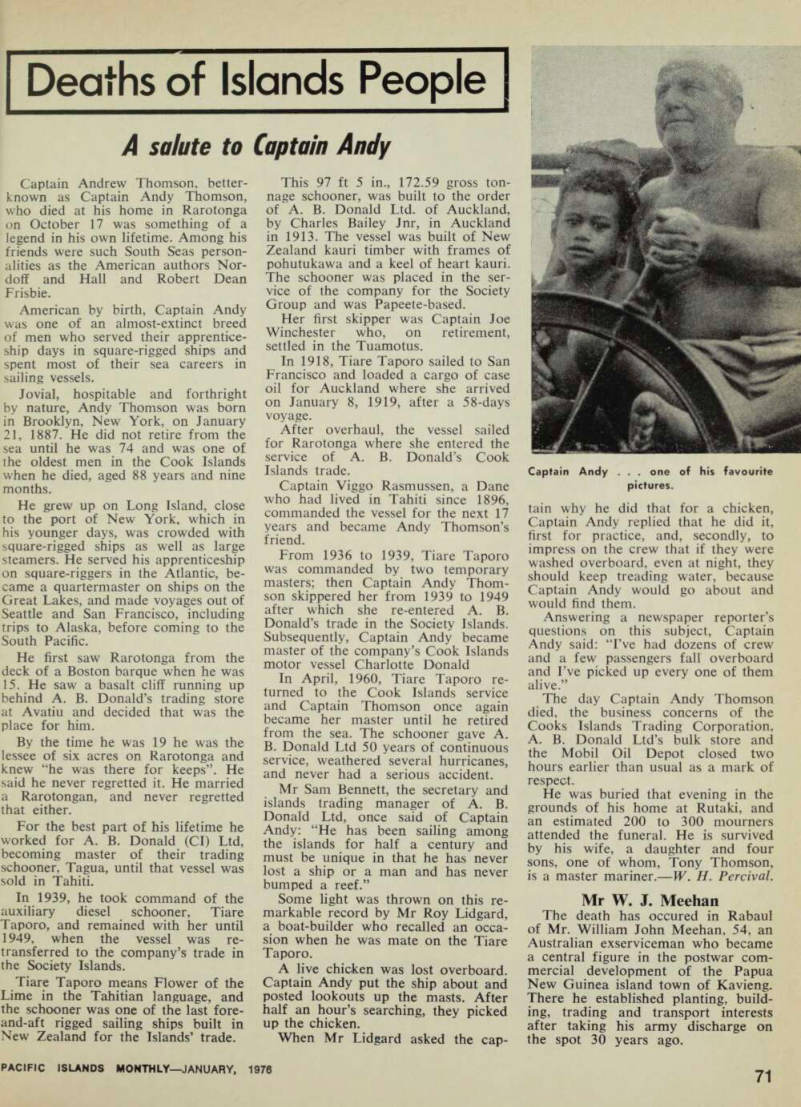
A salute to Captain Andy
Captain Andrew Thomson, better known as Captain Andy Thomson, who died at his home in Rarotonga on October 17 was something of a legend in his own lifetime. Among his friends were such South Seas person alities as the American authors Nor doff and Hall and Robert Dean Frisbie.
American by birth, Captain Andy was one of an almost-extinct breed of men who served their apprentice ship days in square-rigged ships and spent most of their sea careers in sailing vessels.
Jovial, hospitable and forthright by nature, Andy Thomson was born in Brooklyn, New York, on January 21, 1887, He did not retire from the sea until he was 74 and was one of the oldest men in the Cook Islands when he died, aged 88 years and nine months.
He grew up on Long Island, close to the port of New York, which in his younger days, was crowded with square-rigged ships as well as large steamers. He served his apprenticeship on square-riggers in the Atlantic, be came a quartermaster on ships on the Great Lakes, and made voyages out of Seattle and San Francisco, including trips to Alaska, before coming to the South Pacific.
He first saw Rarotonga from the deck of a Boston barque when he was 15. He saw a basalt cliff running up behind A. B. Donald’s trading store at Avatiu and decided that was the place for him.
By the time he was 19 he was the lessee of six acres on Rarotonga and knew “he was there for keeps”. He said he never regretted it. He married a Rarotongan, and never regretted that either.
For the best part of his lifetime he worked for A. B. Donald (Cl) Ltd, becoming master of their trading schooner, Tagua, until that vessel was sold in Tahiti.
In 1939, he took command of the auxiliary diesel schooner, Tiare Taporo, and remained with her until 1949, when the vessel was re transferred to the company’s trade in the Society Islands.
Tiare Taporo means Flower of the Lime in the Tahitian language, and the schooner was one of the last fore and-aft rigged sailing ships built in New Zealand for the Islands’ trade.
This 97 ft 5 in., 172.59 gross ton nage schooner, was built to the order of A. B. Donald Ltd. of Auckland, by Charles Bailey Jnr, in Auckland in 1913. The vessel was built of New Zealand kauri timber with frames of pohutukawa and a keel of heart kauri.
The schooner was placed in the ser vice of the company for the Society Group and was Papeete-based.
Her first skipper was Captain Joe Winchester who, on retirement, settled in the Tuamotus.
In 1918, Tiare Taporo sailed to San Francisco and loaded a cargo of case oil for Auckland where she arrived on January 8, 1919, after a 58-days voyage.
After overhaul, the vessel sailed for Rarotonga where she entered the service of A. B. Donald’s Cook Islands trade.
Captain Viggo Rasmussen, a Dane who had lived in Tahiti since 1896, commanded the vessel for the next 17 years and became Andy Thomson’s friend.
From 1936 to 1939, Tiare Taporo was commanded by two temporary masters; then Captain Andy Thom son skippered her from 1939 to 1949 after which she re-entered A, B.
Donald’s trade in the Society Islands.
Subsequently, Captain Andy became master of the company’s Cook Islands motor vessel Charlotte Donald In April, 1960, Tiare Taporo re turned to the Cook Islands service and Captain Thomson once again became her master until he retired from the sea. The schooner gave A.
B. Donald Ltd 50 years of continuous service, weathered several hurricanes, and never had a serious accident.
Mr Sam Bennett, the secretary and islands trading manager of A. B.
Donald Ltd, once said of Captain Andy: “He has been sailing among the islands for half a century and must be unique in that he has never lost a ship or a man and has never bumped a reef.”
Some light was thrown on this re markable record by Mr Roy Lidgard, a boat-builder who recalled an occa sion when he was mate on the Tiare Taporo.
A live chicken was lost overboard.
Captain Andy put the ship about and posted lookouts up the masts. After half an hour’s searching, they picked up the chicken.
When Mr Lidgard asked the cap-
tain why he did that for a chicken, Captain Andy replied that he did it, first for practice, and, secondly, to impress on the crew that if they were washed overboard, even at night, they should keep treading water, because Captain Andy would go about and would find them.
Answering a newspaper reporter’s questions on this subject, Captain Andy said: “I’ve had dozens of crew and a few passengers fall overboard and I’ve picked up every one of them alive.”
The day Captain Andy Thomson died, the business concerns of the Cooks Islands Trading Corporation, A. B. Donald Ltd’s bulk store and the Mobil Oil Depot closed two hours earlier than usual as a mark of respect.
He was buried that evening in the grounds of his home at Rutaki, and an estimated 200 to 300 mourners attended the funeral. He is survived by his wife, a daughter and four sons, one of whom, Tony Thomson, is a master mariner.— W. H. Percival.
Mr W. J. Meehan The death has occured in Rabaul of Mr. William John Meehan, 54, an Australian exserviceman who became a central figure in the postwar com mercial development of the Papua New Guinea island town of Kavieng.
There he established planting, build ing, trading and transport interests after taking his army discharge on the spot 30 years ago.
Captain Andy . . . one of his favourite pictures.
Bring

long lasting loveliness to your skin
Over the centuries women have tried countless skin beauty treatments in their search for a perfect complexion. One of the most significant advances has been achieved through the scientific develop ment of a unique tropically moist oil blend which has proved highly effective and become widely known and widely used throughout the world.
The promise of ne flawless com plexion beauty is initially found be neath the surface of the skin where the tiny oil and moisture reservoirs maintain a delicate balance by re leasing just the right amounts of natural fluids to keep the complexion soft, supple and gloriously radiant.
As you grow older the supply of natural fluids is slowed down by advancing age and by the drying effects of climate, resulting in rough ness and wrinkle dryness which can make your complexion look pre maturely older. With the scientific development of a tropically moist oil blend it is possible to supplement the skin’s own natural oils and moisture helping to maintain their balance and so restore a youthful loveliness to the complexion.
A soft, dewy
fresh complexion
The tropically moist oil blend, lightly and regularly smoothed over
the complexion, simulates the action of the natural oils and moisture, creating a moist environment pro viding benefits to the skin similar to those created by Nature herself.
Known in England as Oil of Ulay and in America as Oil of Olay this unique beautifying fluid is available here from chemists and beauty counter sas Oil of Ulan.
Every morning and at night smooth on your Oil of Ulan to further your skin’s ability to maintain a constantly soft and dewy fresh complexion. Oil of Ulan moist oil blend also protects the complexion from the excessive dryness that can result from artificial indoor environ ments and, above all, it is the truly wonderful means of bringing a youth ful freshness and radiance to your complexion now and in the years to come.
Advertisements & other items, p. 74 (1 item)
72
PACIFIC ISLANDS MONTHLY— JANUARY, 1976
6 Continued from p 9
Problems On Norfolk And Lord Howe
Norfolk and Lord Howe Islands ave land problems to sort out. On Jorfolk the titles and sales for more lan 100 acres have been thrown into oubt because of an English law nacted in 1828. The Attorney leneral’s Department in Canberra as ruled that the law makes it illegal 3r aliens to own or lease land on le island. Those with British, Aus alian or New Zealand citizenship my legally own land, but practically veryone else is ruled out.
It is understood that a French citi ;n owns more than 100 acres of lorfolk land. Base of the ruling lies i a 1913 proclamation under which le then Governor of New South /ales, who was also Governor of forfolk, gave Australia the right to overn Norfolk. The proclamation ipealed existing laws, and laid down ew laws on 32 topics. Subject to lose 32 laws and any others which
might be enacted later, “all laws and statutes in force in the realm of England on the 25th day of July, 1828 . . . shall be applied in the ad ministration of justice in Norfolk Island, so far as the same can be ap plied within the said island”.
One of those laws prohibited any one but a British subject from own ing land, leasing land or owning other property. The prohibition also applies to inheritances.
Lord Howe Island, about 500 miles to the south-east, was having a bit of “mainland” trouble with the NSW
Minister for Lands, Mr Mason. The minister froze land sales pending enactment and proclamation of a new Lord Howe Island Act. Under the new law, stil to be passed by the NSW Parliament, “islander prefe rence” will disappear.
Mr Mason says it is no longer tolerable to have two classes of citi zens in a small community. The law is being changed to bring it more into line with present-day practice else where.
Mr Mason gave an unequivocal “no” in reply to a petition signed by 94 island residents (more than half the adult population), asking for islander preference to be maintained.
Advertisements & other items, pp. 75-80 (5 items)
■our own viewpoint
73
iCIFIC ISLANDS MONTHLY—JANUARY, 1976
■our own viewpoint rom p 13
swtso
D apua new guinea
printing co. pty. ltd.
Serving the Country from Aitape to Alotau, Manus to Moresby Leaders in Commercial Offset and Letterpress Printing. • Stationery • Office Supplies • Office Equipment • Rubber Stamps • Self-Adhesive Labels • In Fact:— Everything For The Office.
P.O. Box 633, Port Moresby P.O. Box 759, Lae P.O. Box 1239, Rabaul
swtso
THE NEW LONGER-DEE
KNIVES THAT HAVE THE EDGE
OVER ALL OTHERS
Swiss design and manufacture
OBTAINABLE
FROM ALL
ISLAND
TRADERS
Sole Importers:
PETER FISHER
TRADING PTY.LTD.
321 Pitt Stre»
SYDNEY
Telephone 26 IIK
Line Advertisements
Per line, $2.50 Anst.
Minimum rate, 4 lines.
ELECTRONIC COMPONENTS
EXPORTERS, AAANUFACTURERS,
GENERAL MERCHANTS,
WHOLESALERS, IMPORTERS
• All enquiries answered • Keen prices • Prompt delivery Contact us for any requirement.
ELECTRONIC EXPORTS A'ASIA PTY. LTD.,
G.P.O. Box 1365, Brisbane, Q., 4101.
Telegraphic: SZEKELY, Brisbane.
PARK VIEW MOTEL—BRISBANE
Quiet location—opp. Botanic Gardens.
Single, double, family suites, all with refrig., air conditioning, phone, TV, radio, tea making facilities, from $l2. Pool and restaurant.
Phone 31-2695—Telex 40270.
Write for coloured brochure— Park View Motel, 128 Alice St, BRISBANE Qld., 4000.
FOR SALE
KIKUYU GRASS CERTIFIED SEED for
sale A 53.00 per lb. For supplies and information about this highly nutritious and abundantly productive grazing grass write to ROY EYKAMP, Quirindi, N.S.W., Australia, 2343. Phone Quipolly, 466541.
CONCRETE BLOCK MAKER. Makes
blocks, flags, edgings, screen-blocks, garden stools—up to 8 at once and 96 an hour. $179.00 c.i.f. main ports. Send for leaflets. Forest Farm Research, Londonderry, N.S.W., 2753.
BOATS—Easy build kits for dinghies, sailboats, canoes etc. Send for brochure, Blockey, the Boatbuilder 448 Chapel St, Sth. Yarra 3141 Australia.
If you have shells to sell—any quantity —contact Anisa Commodity Traders Pty.
Ltd., P.O. Box 1413, Lae, Papua New Guinea, Phone 424159. We are buyers of Trochus, Greensnail, Blacklip MOP, Goldlip MOP, and Marine Specimens. Best prices paid. Rabaul agents: Gazelle Agencies Pty. Ltd., P.O. Box 262, Rabaul, P.N.G. Phone: 921397. Manus Island Agents, R. L. & V. J. Knight, P.O. Box 108, Lorengan, Manns Island, P.N.G.
Phone: 38.
POSITION WANTED. Young singleminded Swiss, married, with a Swiss College marketing degree, basic knowledge of EDP, 3 yrs experience in air-tourism, is looking for a job in the Pacific area. I will take over travel expenses for a job starting in Sep 76 or later. I will agree any line.
R. Muntener, Kiefernweg 18, 8057 Zurich, Switzerland.
THE PAPUA HOTEL
PORT MORESBY
• Right In the business centre • A tradition for comfort and fine food • All rooms air conditioned • Restaurant • Bars • Banquet Hall Telephone 24 2121 Cables PAPTEL
A. C. NEUMANN
Manager
MAPS AND PRINTS
OF THE OLD PACIFIC
Original antiquarian Pacific views and maps for sale. Enquiries invited stating areas of interest.
C. HINCHCLIFFE, 7 Royd Avenue, Heckmondwike, West Yorkshire, WFI6 9AL, United Kingdom.
Fast efficient reliable
SPEED-E-GAS
A H I > The Gas Supply Company Limited, a member of the major Australian Boral Group of Companies is associated with a network of bulk storage terminals distributing SPEED-E-GAS throughout the Pacific region.
Terminals at Port Moresby, Lae, Rabaul, Kieta,Wewak, Honiara, Santo, Suva, Lautoka, Nukualofa and Rarotonga now supply fast efficient SPEED-E-GAS for industrial, commercial and domestic requirements in these areas.
SPEED-E-GAS is completely dependable and highly efficient fuel, so vital to the development of modern living.
SPEEDEGAS
w The Gas Company Limited Head Office, 221 Miller Street North Sydney 2060 Phone 92-0951 A member of the
BORAL
Group * SPEED-E-GAS is known in Papua New Guinea as GUINEA GAS, in Tonga as TONGA SPEED-E-GAS and in Fiji as FIJI-GAS
TIMELY PACIFIC READING!
Specially selected titles from Pacific Publications
PAVtZ
m m L™
PAPUA NEW GUINEA
HANDBOOK
7th edition
This new edition of the Papua New Guinea Handbook —completely revised and reset —provides the first full upto-date details of the new self-governing nation.
For businessmen, travellers, schools, universities and libraries, government departments, tourists and Papua New Guinea residents, this timely, up-to-the-minute edition, is essential.
A large attractive fold-out map of Papua New Guinea is also included. 332 pages of text.
PRICE: $5.50 Aust., plus postage. (Within Aust., $1.20, Overseas, $2.00 Aust.) USA, $9.80 US posted.
Percy Chatterton's Papua
DAY THAT I HAVE LOVED
This is more than an autobiography by well-known Percy Chatterton, OBE, who has spent 50 years in Papua as missionary, teacher and outspoken politician fighting for the underdog. It is a colourful, and charming, account of the Papuan people, giving warm insight into their hopes, fears and changing way of life. Some Papuan leaders say they don't want Papua to be submerged by New Guinea in the move towards independence, and readers of Percy Chatterton's timely book will readily sympathise with their desire to retain their identity. The book is illustrated with evocative pen sketches by Percy Chatterton's longtime friend and neighbour in Port Moresby, Rev. Bert Brown. 144 pages, illustrated.
PRICE: $5.25 Aust., plus postage. (Within Aust. and Overseas, 70c Aust.) USA, $8.30 US posted.
I r
HOLY TORTURE IN FIJI
Written by a group of academic participants and observers.
Editing and commentary by Prof. Ron Crocombe.
This book describes sacred ancient rituals involving physical ordeals which are performed once a year at certain Hindu temples in Fiji. The rituals include walking on fire, dancing on upturned knife-blades, whipping, plunging the hands in burning fat and piercing the body with steel skewers and silver wires.
Yet those who go through the ordeals suffer no pain, burns or injuries.
The book is beautifully produced in full colour and black-and-white.
PRICE: $2.50 Aust., plus postage. (Within Aust. and Overseas, 70c Aust.) USA, $5.50 US posted.
THE STORY OF THE
SOLOMONS Charles E. Fox
“Refreshingly frank . . .”
“Admirably simple and lucid . . .”
“A rare blend of objectivity and affection . . "
That is what some of the critics have said about this unusual book which outlines the history of the Solomon Islands from the point of view of the people who live there.
The Reverend C. E. Fox, CBE, AAA, LittO, spent more than 70 years in the Pacific Islands, 65 of them in the Solomon Islands, and no person is better qualified to write of the Solomons and the Solomon Islanders. Dr Fox is now living in retirement in New Zealand. 88 pages.
PRICE: $2.50 Aust., plus postage. (Within Aust. and Overseas, 50c Aust.) USA, $3.75 US posted. f
Pacific Publications (Aust.) Pty. Ltd.
29 Alberta Street, Sydney, N.S.W. 2000 (Postal Address: Box 3408, G.P.0., Sydney, N.S.W. 2001.)
* - « s v . , '* m \
Performance
You Enjoy Living With.
Honda is a true life drama, performed on the world’s stage. By average folks, teenagers, men, and women everywhere. Your neighbors, maybe even you are playing a part. If so, you know Honda is more than great machines.
It’s people concerned with taking people where they want to go in life.
On two wheels, we’re the best selling motorcycle. The easy to operate hard workers who don’t demand much. Honda is always ready and gets you there safely. We move / on four wheels. The precedent setting Honda Civic continues to receive international economy and performance awards. It’s the elegant compact car.
Sometimes, we have no wheels. Honda portable power operates machinery, generates electricity, pumps water and tills the soil.
Little wonder good things happen on Honda —we work harder to assure they do.
M " % w I World’s Largest Motorcycle Manufacturer
HONDA MOTOR CO., LTD. TOKYO, JAPAN
PAPUA NEW GUINEA; Steamships Trading Co., Ltd. P.O. Box 74, Papua/U.S. TRUST TERRITORY: J.C. Tenorio Enterprise P.O. Box 137, Saipan /FIJI ISLANDS: Coral Island Motors Walu Bay Suva Fiji Island. P.O. Box 48, Suva, Fiji /TARAWA: The Gilbert & Ellice Islands Development Authority Gilbert & Ellice Islands / WESTERN SAMOA; Motor Distributors (Samoa) Ltd. P.O. Box 576, Apia / AM ERICAN SAMOA: Halook’s Service Center P.O. Box 1138, Pago Pago, American Samoa/TONGA: E.M. Jones Ltd. P.O. Box 34 Nukualofa/SOLOMON ISLANDS: British Solomons Trading Co., Ltd. P.O. Box 114. Honiara/ NEW CALEDONIA: Establissements Ballande, Noumea / TAHITI: Ets. COMIMPEX P.O. Box 200, Papeete /COOK ISLANDS: Cook Islands Motor Centre Ltd. P.O. Box 74, Rarotonga / NAURU ISLAND: Nauru Cooperative Society 14th Floor, Wales Corner. 227 Collins Street Melbourne Victoria 3000 / NIUE ISLAND: S. Jessdp & Sons P.O. Box 71, Alofi South, Niue Island / SAIPAN: United Micronesia Development Association P.O. Box 298, Saipan, Marianas Islands 96951
miAxmicai ujUI/l ao Imjxjcll puMJckl.
Mr. Chau Jin Man, motor mechanic , i
Vdt&UAt-itipkovicb to
be, AOwltttU^luaJ^
Miss Diane Frogia, teacher.
ika
mm J7> ;
Vi# >*z ft- ' &
(JUcdiMCL^hcaiuAco^
m /)
tfj uhuii uCth, SapiAi
i
Your Datsun. Your special island.
Once it has found you, it’ll never let you go.
Where else can you find such
economical, worry-free
motoring? Little wonder Datsuns are enjoyed in Tahiti —and in 130 other nations! In a series of on-thespot global interviews, Nissan Motor representatives met many owners and asked them for a frank assessment of their Datsuns. Answers were surprisingly similar, despite the very different circumstances in which the Datsuns were used.
The Datsun, they told us. is economical, reliable, durable, comfortable.
Fun to own.
Again and again.
DATSUN
Product of NISSAN DATSUN distributor network covers the following areas: Fiji -T.P.N.G. • W. Samoa-New Caledonia -New Hebrides *6.5.1.?. -Timor • Norfolk' Is. * A. Samoa -Tahiti*Cook Is. - Nauru -Tonga- Saipan -Guam - Australia- New Zealand
New Hebrides Election
From p 8
75
VCIF 1C ISLANDS MONTHLY—JANUARY, 1976
Iii
CIFIC ISLANDS MONTHLY-JANUARY, 1976