Pacific Islands Monthly



News Magazine Of The South Pacific
France's Pacific
Problems Grow
Ruary, 1976
, Australia,*N,Z., P.N.G., N.Hebrides, Tonga 75C
1/V.SAMOA, (£e.I.C., COOKS, NORFOLK, NIUE, NAURU 75c
V < •V, Solomons 85C
** ' \ Samoa,Hawafi,
' ' NEW CALEDONIA AND FREISJCH POt*?*IESI£ «CFPI2S
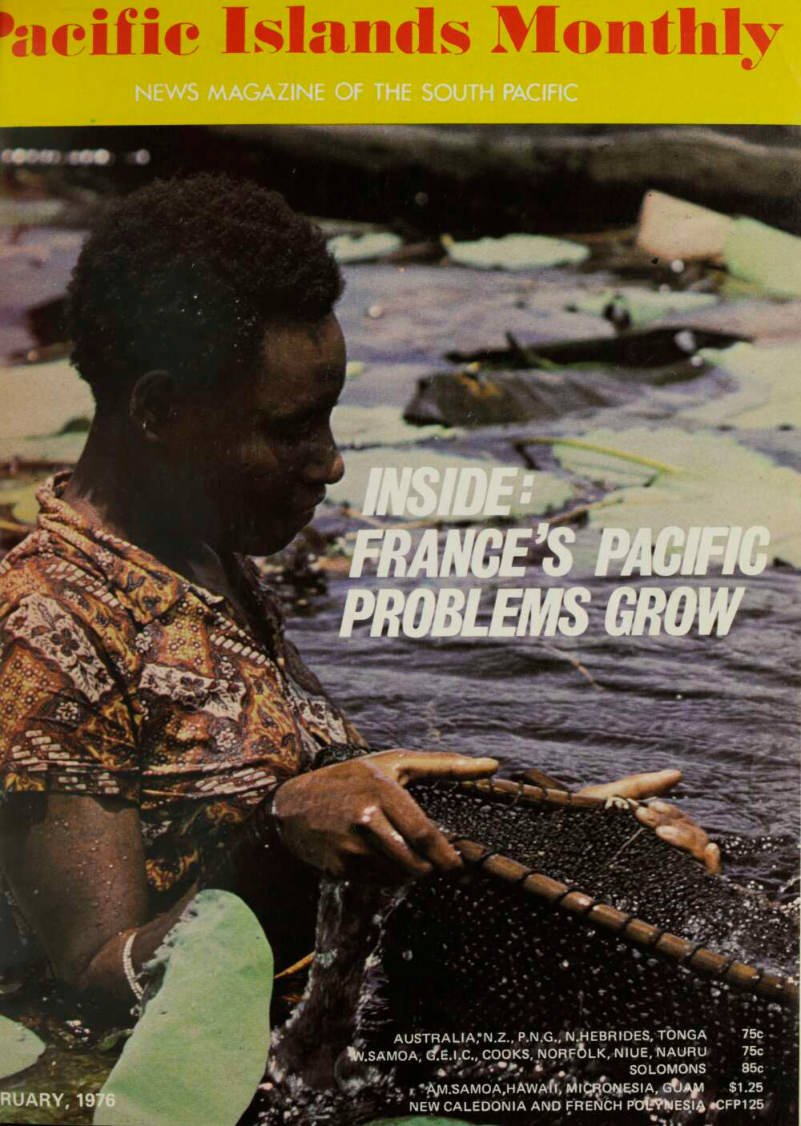
Our Cover
Papua New Guinea water lilies in the Sepik make this tranquil scene. Papua New Guinea has its less-tranquil problems as you will see on p 8.
Advertisements & other items, pp. 2-4 (1 item)
When you buy a Toyota
we promise you much more than
one of the world’s finest cars.
We'll be the first to admit that at Toyota we make some of the world's finest cars.
You only have to look at them to see that.
And driving them just goes to confirm your first opinions.
But there's more to buying a car than buying a good one. You also have to be sure you can keep it that way.
Which is why Toyota have always insisted that their after-sales service be as good as the cars themselves.
In the Pacific Islands area alone we have over fifty designated outlets to provide everything you might need, from a simple service to a major overhaul. So get yourself a Toyota and get a lot more than a car.
And that's a promise.
TOYOTA
SERVICE
z/
TOYOTA
The Toyota range includes: Toyota 1000, Toyota Corolla, Toyota Celica, Toyota Corona, Toyota Corona Mark 11, Toyota Crown xn° B °* 75 ' Port MoreSby - UA TRUST TERR '™RY: MICROL CORPORATION, P.O. Box 267. Saipan. FIJI ISLANDS: AUTOMOTIVE SUPPLIES CO.. LTD., G.P.O. Box 355. Suva. AMERICAN SAMOA; BURNS PHILP (SOUTH SEA) CO., LTD., P.O. 1057 Pago Pago WESTERN SAMOA BURNS PHILP (SOUTH SEA) ITD ENTERPRISES'VsT) G LTD M: p A n K R NS ' Z 1 ; P d ° d BOX 6428 - Tamunin9 - NEW HEBRIDES: NEW HEBRIDES MOTORS LTd!^p!o^Box^IS^VHa.^>OLOMC)N^SLAdVDsP WAnnn P Pc| S fwn S xiApIP D^DA-J 7 Po onlara ' TAHIT,: NIPPON AUTOMOTO, B.P. 342, Papeete. COOK ISLANDS: COOK ISLANDS TRADING CORPORATION LTD. PO Box 92 Rarotonga IEBERT ELI - IC E ISLANDS COLONY: TARAWA MOTORS, Box 36, Bairiki Tarawa. NORFOLK ISLAND: MARIE'S NORFOLK TOURS, LTD;’
P.0.80x 276. TIMOR. SANG TAI HOO, Sang Ta, Bu.ldmg, D,h. NEW CALEDONIA: SOCIETE IMPORTATION AUTOMOBILE DU PACIFIQUE. Rond-Point du Pacific (Station Total) B P 438 Noumea
Top performance takes the guesswork
out of going hi-fi.
Mo imitations here. Every one of the ONDO 2000 Stereo Sound Mates was jmponent created and Pioneer blended to a total system stereo package. And a price much lower than you think.
r irst, an advanced design AM/FM
ereo receiver produces a powerful 13
arts per channel virtually distortion-free.
:curate tonal management is achieved ith separate bass and treble controls id AM/FM reception is clean and clear.
Dn the input side of the RONDO 2000 is a professional type manual turntable.
The super-smooth belt-drive mechanism provides loving care for your records.
Auto-cut at the touch of a button plus the convenience of auto-return.
On the output side, beautifully balanced
two-way, two-speaker systems. Every
earthy note from the big 20cm. woofers is enriched by the solid bass-reflex
design cabinets.
And for your private listening pleasure,
RONDO 2000 Sound-Mates include
lightweight high-polymer headphones.
RONDO 2000 Stereo Sound Mates.
From stylus to speaker., .the direct
approach to top performance.
M PIONEER
Pioneer Electronic Corporation
4-1, Meguro 1-chome, Meguro-ku, Tokyo 153, Japan istralia jneer Electronics Australia Pty. Ltd , 8-184 Boundary Road, Braeside. Victoria 95, Phone: 90-9011, Sydney 93-0246, isbane 52-8213, Adelaide 433379, rth 76-7776 i Islands ijlal & Company, G.PO. Box No. 362, va, Fiji Islands Tel: 22258 e gemeyer (Australasia) 8.V., P.O. Box '■ 90, Lae, Papua«New Guinea Tel: 42-32 ( Rabaul Hagemeyer (Australasia) 8.V., P.O. Box No 63, Rabaul. Papua«New Guinea Tel: Port Moresby Hagemeyer (Australasia) 8.V., P.O. Box No 1428, Boroko, Port Moresby, Papua»New Guinea Tel: 5 61 44 Madang Hagemeyer (Australasia) 8.V., P.O. Box No. 673. Madang. T.P.N.G.TeI: 24 45 New Zealand Fountain Marketing Ltd., Maidstone Str Auckland, New Zealand Tel: 763-064 Norfolk Island Burns Philp (Norfolk Island) Ltd., 26 33 Norfolk Island, South Pacific New Hebrides Burns Philp (New Hebrides) Ltd., Vila. New Hebrides Nauru Island Jacob Enterprises, P.O Box No. 4 Nauru Island Tahiti Jet Ets. PERFECT, BP 594, Papeete, Tahiti Tel: 20 407 New Caledonia Menard Freres, B.P. 123, Noumea, New Caledonia Tel: 52-22 American Samoa Transpac Corporation, P.O. Box 1477, Pago Pago, American Samoa 96799 Tel: 633-5224 Rarotonga South Seas International Ltd .
P.O. Box 49, Rarotonga Cook Islands Tel: 2327
Arnott’s!
The taste of Australia
Milk A rrowroot A wholesome biscuit enjoyed by all the family.
Milk Coffee. A plain crisp biscuit to enjoy with coffee or tea.
Amott’s plain sweet biscuits are not too sweet, not too fancy. They’re just right for those times when you really want a biscuit to go with a cup of tea or coffee, or a glass of icy cold milk.
Discover the taste of Arnott’s for
yourself.
Nice. A sweet biscuit sprinkled with fine sugar.
BISCUITS
225gNETj
cMilkJJoffee ;
Shredded Wheatmeal.
Crunchy, with the nutty flavour of baked wheatmeal. .V
BISCUITS
■ Vs
<SBSBS^
met
biscuits Ornotts * .
nice
r
BISCUITS
225« NET
i!
Qrnotts/“ Biscuits
There is no Substitute for Quality
W 639
Pacific Islands
Monthly
FOUNDED BY R. W. ROBSON IN 1930
Published Monthly By
Pacific Publications (Aust.) Pty. Ltd.,
76 Clarence Street, Sydney 2000.
Postal Address: G.P.O. BOX 3408, SYDNEY,
N.S.W. 2001.
Telegraphic Address: PACPUB, Sydney.
Telex: 21242.
Telephone: 296693.
Publisher: Stuart Inder.
Business Manager: John Berry.
Pacific Islands Monthly
Editor: John Carter.
Advertising Manager: Alan Batt.
Subscription Rates:
"Pacific Islands Monthly" is airfreighted to the majority of subscribers and agents in the Pacific Islands and the U.S.A.
Australia (including Lord Howe and Thursday Islands), New Zealand, Papua New Guinea, Fiji, New Hebrides, Tonga, Cook Islands, Western Samoa, Gilberts and Tuvalu, Norfolk Island, Niue and Nauru: $9.00 (local currency); Solomon Islands: $lO.OO Aust.; American Samoa, Micronesia and Guam: $12.00 U.S.; Hawaii and U.S. Mainland: $15.00 U.S.; New Caledonia and French Polynesia: 1,500 C.F.P.; United Kingdom: £6.50; Japan: 4,000 Yen; Elsewhere: $11.50 Aust.
Representatives
Fiji: Advertising and Distribution—Fiji Times & Herald Ltd., 20 Gordon Street, Suva. Telephone: 25-601. Telex: FJ 2124.
Papua New Guinea; Advertising and Distribution —PNG Post-Courier, P.O. Box 85, Port Moresby.
Telephone: 25-9899. Enquiries: Post News agency, Telephone 24-2148.
French Polynesia: Distribution —Hachette Paci fique, 10 Ave Bruat, Papeete.
New Zealand: Pacific Publications, C.P.O.
Box 2229, Auckland.
United Kingdom; The Herald and Weekly Times Limited, 8-10 Clifford's Inn, Fetter Lane, London EC4A IBU. Telephone: 01-8316041. Telex: London 21989.
Japan; Advertising—Universal Media Corpora tion, C.P.O. Box 46, Tokyo. Telephone: 666-3036.
Victoria: Advertising Pacific Publications (Aust.) Pty. Ltd., Herald and Weekly Times Building, 2nd Floor, 61 Flinders Lane, Mel bourne, 3000. Telephone: 652-1565.
Hawaii and U.S. Mainland only: N. Grogan. (Send change of address notices. Form 3579 and new subscriptions to P.O. Box 2193, Honolulu, Hawaii, U.S.A. 96805.) Second class postage paid at Honolulu, Hawaii.
Copyright ©, 1976,
Pacific Publications (Aust.) Pty. Ltd.
Printed by The Harbour Press, Chalmers Street, Sydney.
Registered at the G.P.O. Sydney for trans mission by post as a newspaper—category B. * Recommended retail price only.
Vol. 47. No. 2 Februar^l976
Up Front
with the Publisher
ON Nauru in October I met Walter McQuade, who was collecting information for an article in the US business magazine Fortune.
Walter is a quietly-spoken, even tempered Fortune writer with the American reporter’s propensity for extensive note-taking, and I suppose he must have spent what would be PlM’s entire travel budget for 12 months in covering the Nauru story with his Paris-based photographer.
They spent a couple of weeks there.
It was quite obvious to me that Walter liked Nauru and the Nauru ans. He didn’t hide the fact in his article in the December issue of Fortune.
“Neither financial prosperity nor political independence seems to have changed the inhabitants of Nauru”, he wrote. “The usual Nau ruan is genial and uncompetitive . . .
Those who draw the big money from royalties are expected to donate to their clansmen, and do so.
Generosity remains supreme”.
And, unlike some other reporters in the past (which is one reason, I suspect, why journalists haven’t found it easy to get visitor’s visas for the republic in recent years), Walter doesn’t write Nauru off as going to the dogs, filled with unreal people and a government all dissipat ing their common wealth, putting nothing aside for a rainy day. He thinks there will still be plenty for a rainy day; that the Nauruans are quite competent at managing, and he submits these figures (all in US dollars): In 1974/75, Nauru shipped out 1.9 million tons of phosphate at prices averaging about $74 per ton.
Production cost was under $lO per ton, so total profit was more than $123 million, or nearly $31,000 for every Nauruan citizen, man, woman and child.
The Fortune man compares this per capita figure with the Persian Gulf oil sheikhdoms, and says that in the same year oil exports brought in $51,000 per person in Abu Dhabi and $9,000 in Kuwait.
He says Nauru’s money was, as usual, distributed to a formula: $3.50 per ton (or nearly $7 million) to the specific Nauruans whose land was mined during the year; $23.60 per ton ($45 million) to the Nauru
Phosphate Royalties Trust, and S3B a ton (572 million) to the Nauru Local Government Council and the Government of the Republic of Nauru.
It was the Phosphate Royalties Trust which fascinated Walter. This fund is to provide for the Nauruans when the phosphate runs out, esti mated in about 18 years.
Walter estimates the present value of the fund at $165 million.
Nauru has a Melbourne financial adviser, Douglas Rogers, investing this money with the aim of getting 10 per cent, and Walter McQuade estimates that if this earning rate can be sustained, with the fund reinvest ing its earnings, then 18 years from now the fund will have reached a staggering $3.4 billion, or a half million US dollars for each Nauruan living, assuming a 50 per cent in crease in the meantime.
There are some “ifs” there, of course. Including “if” Walter’s figure for the Trust Fund’s present resources is correct, and “if” 10 per cent can be sustained.
THESE paragraphs are being writ ten in Sydney in some difficulty.
We’re in the centre of the dustiest clean-up campaign PIM has experi enced in almost 50 years.
We’re moving house. We’re shift ing from our notorious premises at Alberta Street (it’s true that they were, before our time, used as a brothel), to carpets and air conditioning at 76 Clarence Street, Sydney—the classier end of town.
It’s near the Harbour Bridge.
Yes, “classy” doesn’t sound like us! So our move is thus noteworthy enough to have rated a story in the Australian Financial Review (which didn’t forget to mention the bro thels). Said the review, “PIM is moving to slick, downtown premises . . . PIM magazine—it regards it self as a monthly newspaper—and the people who bring it out, are a little-known tradition of Sydney. The old offices were a port of call for every Island personality who breezed through Sydney”. And so on . . .
Well, Islands visitors are still wel come. We apologise for our premises being slick but we promise to work hard to rectify that.
Stuart Inder
Advertisements & other items, p. 6 (1 item)
Kodak color prints
Remember the good times
with silk-finish
«» X Borderless round-cornered pictures with a silk surface that actually hides fingerprints. Pass them around.
Show your friends.
You’ll forget. Pictures won’t.
Silk-finish Kodak color printsfrom all sizes of Kodacolor film.
Silk-finish Kodak color prints are standard from all photo dealers where you see this sign.
KODAK (Australasia) PTY. LTD.
See your photo dealer now. aSK for
COLOR
PROCESSING
Kodak
K6l/5074
In This Issue
General
hanging history 18 attle for tourist dollar 29 Jrline moves 56 egional shipping talks 57 iloomy future for copra 65 lobe-trotting Islands agent 66 acific women speak up 67
Lew Zealand Feature
x>king for two-way trade 31 erial grocery run 31 / ski-plane to glaciers 33 ourses for Polynesians 35
Ook Islands
egional shipping talks ... 57 Jl lan to use empty acres 15 ir Nauru flies in 56 egional shipping talks 57 lil power to save money 59 loomy future for copra 65 to tuna fishing 65 g profit for Post Office 66 acific women meet 67
Lench Polynesia
uund Tahiti race 18
Gilbert Islands
Regional shipping talks 57
Nauru
Air service to Fiji 56 Regional shipping talks 57 German ship borrowed 59 Satellite communications system ... 68
New Caledonia
Confrontation in Noumea 13 Private flyers 17
New Hebrides
That absurd condominium 11 Independence demand 12 First for Pacific Princess 57
Niue
Big fish caught 17
Papua New Guinea
Somare accused of dictatorship ... 8 Citizenship worries 9 Air Niugini's wings may be clipped 55
Regional shipping talks 57
Gloomy future for copra 65 Smooth currency change 66
Solomon Islands
Tear-gas used to quell riot 16 US Marines return to Guadalcanal ... 37 Regional shipping talks 57
Tonga
Royal thoughts on shipping 56 Regional shipping talks 57 Ship chartered 59 Fishing industry 63 Japanese cold on oil 65
Tuvalu
Separation day 17
Us Trust Territory
Bastion of US strategy 10 Japan air route battle on again 55
Western Samoa
Blind children's treat 19 Regional shipping talks 57 Shifting Apia's port 57
EPARTMENTS: Up Front with the Publisher, 5; Tropicalities, 17; Editor's Mailbag, 21; ilands Press, 36; Magazine Section, 37; Yesterday, 44; MANA, 46; Books, 51; Pacific ransport, 55; Cruising Yachts, 59; Business and Development, 63; Produce Prices, 68; hipping and Airways Information, 69; Deaths of Islands People, 74.
Advertisements & other items, p. 7 (1 item)
7
ACIFIC ISLANDS MONTHLY—FEBRUARY, 1976
Pacific Islands Monthly
Somare Accused Of Dictatorship
-And The Year's Just Begun!
From a Port Moresby correspondent
The National Party leader, and Natural Resources Minister, Mr Thomas Kavali, in January orches trated an amusing scene when he called for general elections this year.
Among the well-informed in Port Moresby there were a few appreci ative sniggers.
Few could take seriously a sen tence in Mr Kavali’s statement that read, “the National Party wants freedom and democracy to replace the Somare dictatorship”.
Mr Kavali’s gripe stems from December’s ministerial reshuffle. He is upset that the Prime Minister, Mr Michael Somare, did not consult him when making the changes.
The National Party is one of the three groups in the coalition govern ment. The others are Mr Somare’s Pangu Party, and the People’s Pro gress Party, to which the Finance Minister, Mr Chan, belongs.
Lashing out at Mr Somare, Mr Kavali said the Prime Minister was dictatorial and undemocratic in the way he had reshuffled the ministries.
From the outset, Mr Kavali’s grouch seemed a petty reason for forcing an early election. As well, his call was a complete reversal of the party’s stand last year to defer elections until 1977.
Nevertheless, he timed his state ment well. In his home region of the Highlands, there is a rumble over unfair distribution of jobs, both in the civil service and government ministries. The Highlanders, in a series of meetings, resolved to force an early election for a new govern ment and a better deal. They are now supported by their parliamen tarians on both sides of the House.
Whether or not the majority of the parliamentarians will call the same tune when the House meets again is another matter. Past form indicates that they will not. Who wants to lose the juicy benefits of being a parliamentarian? Most of
them also appreciate the gamble of re-election in a country whose poli tical party system has confounded even the best observers.
In the latest development, the op position leader, Mr Tei Abal, threw his weight behind the call for early elections, saying his United Party would seek a vote of no confidence in the government. Mr Abal said a stalemate in government could re sult if the struggle for power and leadership between the coalition partners continued.
In spite of the reassurances from Mr Abal, the strength and unity of his own United Party is open to question. He and his radical shadow minister for Defence, Foreign Rela tions and Trade, Mr Anton Parao, have been at loggerheads over the opposition leadership. At the height of the struggle, Mr Abal issued a writ against Mr Parao for slander— the matter has yet to be settled.
Perhaps the changing moods of
Mr Somare can best sum up the present situation.
The day Mr Kavali issued his statement, Mr Somare emerged from his office visibly angry. The morning after Mr Abal’s statement, he was in high spirits and was seen with an influential member of Mr Kavali’s National Party. The other night, among close friends, he quipped about the day Mr Kavali would take over.
If there is anyone who really wants an election it is Mr Somare himself. He does not need the finance wizards to tell him that the present economic cutbacks are only the start of a long, hard road towards econ omic self-reliance in Papua New Guinea.
In 1977, after two full years of economic problems, reflecting the world situation, he will have lost whatever capital his party could make out of claims that it was they who brought Papua New Guinea freedom and democracy—the ele ments that Mr Kavali now claims are lost.
Unnecessary spending by the
government is not helping the crisis that is besetting the country’s economy.
Early in January, an investment mission of six left for Europe to pro mote Papua New Guinea’s economy.
The size of the mission brought a public outcry from government officers who believed a smaller group would have achieved the same result while, at the same time, saving money.
In his battle against the crisis, the Finance Minister, Mr Chan, an nounced a five-point anti-recession programme. Measures like indexation and a cutback in spending have been implemented by the government. Mr Chan’s programme seeks to avoid ad-hoc planning in isolation by giving the government a package deal it can use while drawing up its strategy to fight recession.
A recent decision by Mr Somare
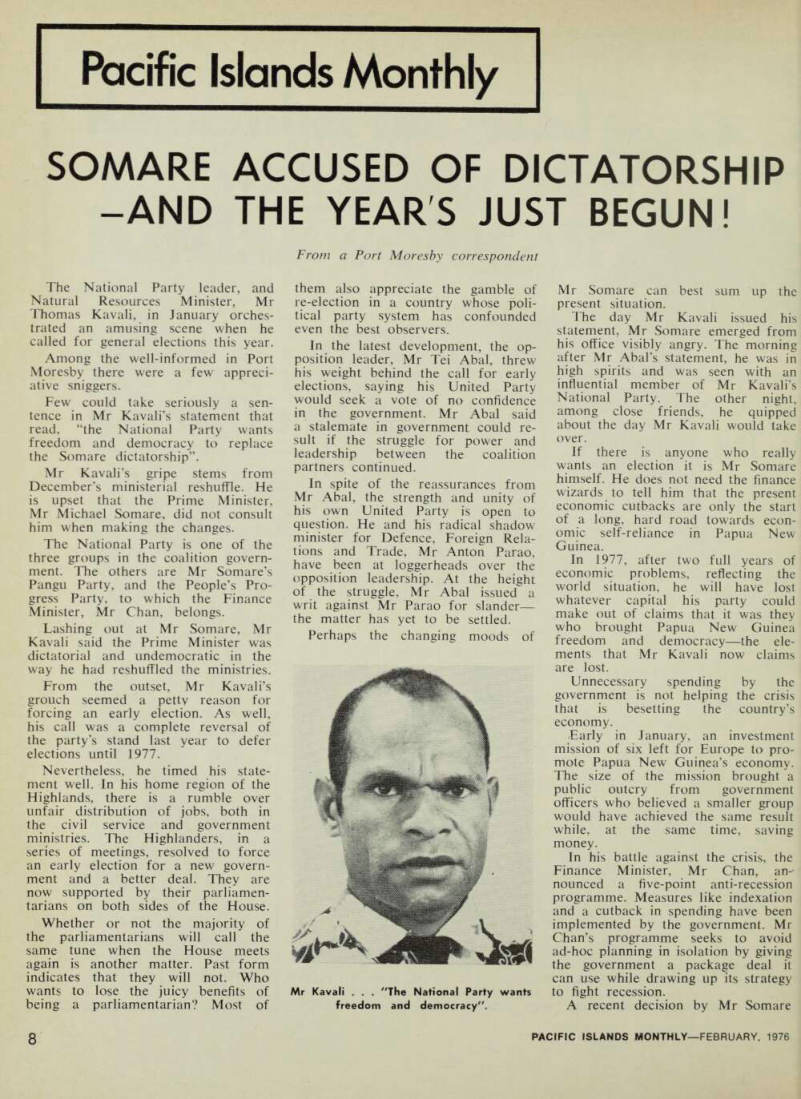
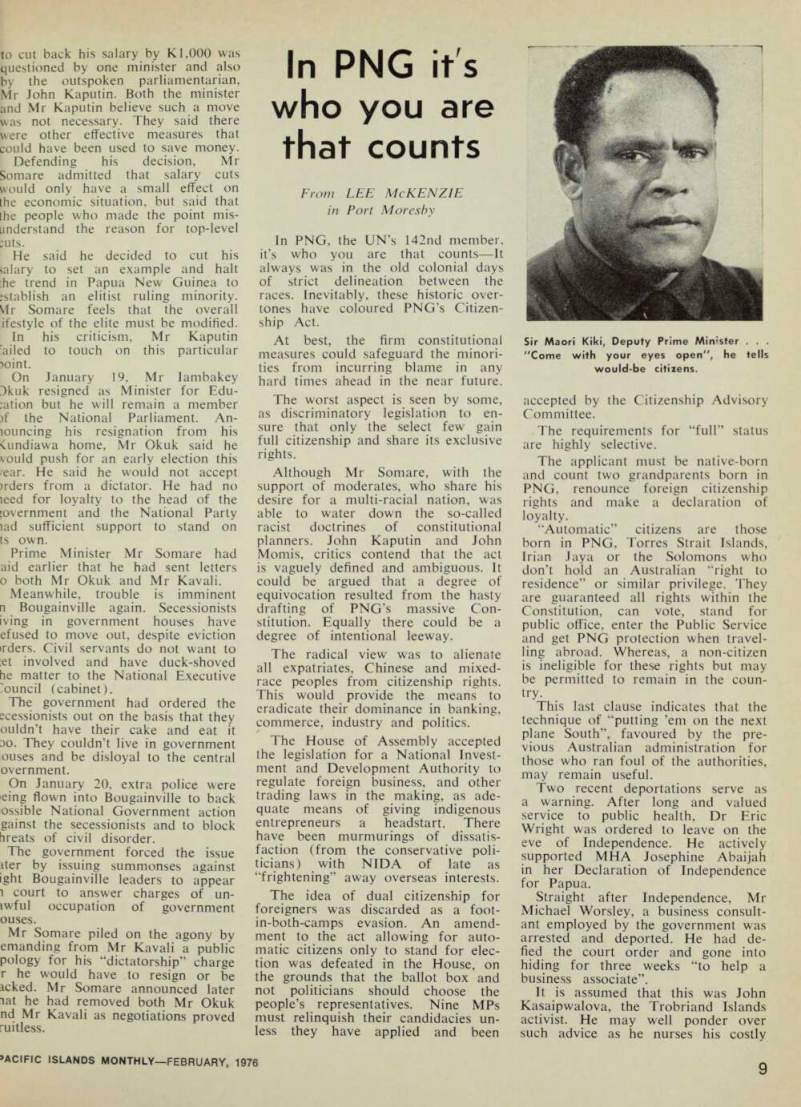
Mr Kavali . . . "The National Party wants freedom and democracy".
to cut back his salary by K 1,000 was questioned by one minister and also by the outspoken parliamentarian, Mr John Kaputin. Both the minister and Mr Kaputin believe such a move was not necessary. They said there were other effective measures that could have been used to save money.
Defending his decision, Mr Somare admitted that salary cuts would only have a small effect on the economic situation, but said that the people who made the point mis understand the reason for top-level :uts.
He said he decided to cut his salary to set an example and halt :he trend in Papua New Guinea to establish an elitist ruling minority.
Vlr Somare feels that the overall ifestyle of the elite must be modified.
In his criticism, Mr Kaputin 'ailed to touch on this particular joint.
On January 19. Mr lambakey Dkuk resigned as Minister for Edu cation but he will remain a member )f the National Parliament. An louncing his resignation from his Cundiawa home, Mr Okuk said he vould push for an early election this He said he would not accept )rders from a dictator. He had no teed for loyalty to the head of the ;overnment and the National Party lad sufficient support to stand on ts own.
Prime Minister Mr Somare had aid earlier that he had sent letters 0 both Mr Okuk and Mr Kavali.
Meanwhile, trouble is imminent n Bougainville again. Secessionists iving in government houses have efused to move out, despite eviction irders. Civil servants do not want to :et involved and have duck-shoved he matter to the National Executive 'ouncil (cabinet).
The government had ordered the ecessionists out on the basis that they ouldn’t have their cake and eat it do. They couldn’t live in government ouses and be disloyal to the central overnment.
On January 20, extra police were eing flown into Bougainville to back ossible National Government action gainst the secessionists and to block hreats of civil disorder.
The government forced the issue iter by issuing summonses against ight Bougainville leaders to appear 1 court to answer charges of un iwful occupation of government ouses.
Mr Somare piled on the agony by emanding from Mr Kavali a public pology for his “dictatorship” charge r he would have to resign or be acked. Mr Somare announced later lat he had removed both Mr Okuk nd Mr Kavali as negotiations proved ruitless.
that counts
In PNG it's who you are that counts
From Lee Mckenzie
in Port Moresby In PNG, the UN’s 142nd member, it’s who you are that counts—lt always was in the old colonial days of strict delineation between the races. Inevitably, these historic over tones have coloured PNG’s Citizen ship Act.
At best, the firm constitutional measures could safeguard the minori ties from incurring blame in any hard times ahead in the near future.
The worst aspect is seen by some, as discriminatory legislation to en sure that only the select few gain full citizenship and share its exclusive rights.
Although Mr Somare, with the support of moderates, who share his desire for a multi-racial nation, was able to water down the so-called racist doctrines of constitutional planners. John Kaputin and John Momis, critics contend that the act is vaguely defined and ambiguous. It could be argued that a degree of equivocation resulted from the hasty drafting of PNG’s massive Con stitution. Equally there could be a degree of intentional leeway.
The radical view was to alienate all expatriates, Chinese and mixed race peoples from citizenship rights.
This would provide the means to eradicate their dominance in banking, commerce, industry and politics.
The House of Assembly accepted the legislation for a National Invest ment and Development Authority to regulate foreign business, and other trading laws in the making, as ade quate means of giving indigenous entrepreneurs a headstart. There have been murmurings of dissatis faction (from the conservative poli ticians) with NIDA of late as “frightening” away overseas interests.
The idea of dual citizenship for foreigners was discarded as a foot in-both-camps evasion. An amend ment to the act allowing for auto matic citizens only to stand for elec tion was defeated in the House, on the grounds that the ballot box and not politicians should choose the people’s representatives. Nine MPs must relinquish their candidacies un less they have applied and been
accepted by the Citizenship Advisory Committee.
The requirements for “full” status are highly selective.
The applicant must be native-born and count two grandparents born in PNG, renounce foreign citizenship rights and make a declaration of loyalty.
“Automatic” citizens are those born in PNG, Torres Strait Islands, Irian Jaya or the Solomons who don’t hold an Australian “right to residence” or similar privilege. They are guaranteed all rights within the Constitution, can vote, stand for public office, enter the Public Service and get PNG protection when travel ling abroad. Whereas, a non-citizen is ineligible for these rights but may be permitted to remain in the coun try.
This last clause indicates that the technique of “putting ’em on the next plane South”, favoured by the pre vious Australian administration for those who ran foul of the authorities, may remain useful.
Two recent deportations serve as a warning. After long and valued service to public health, Dr Eric Wright was ordered to leave on the eve of Independence. He actively supported MHA Josephine Abaijah in her Declaration of Independence for Papua.
Straight after Independence, Mr Michael Worsley, a business consult ant employed by the government was arrested and deported. He had de fied the court order and gone into hiding for three weeks “to help a business associate”.
It is assumed that this was John Kasaipwalova, the Trobriand Islands activist. He may well ponder over such advice as he nurses his costly
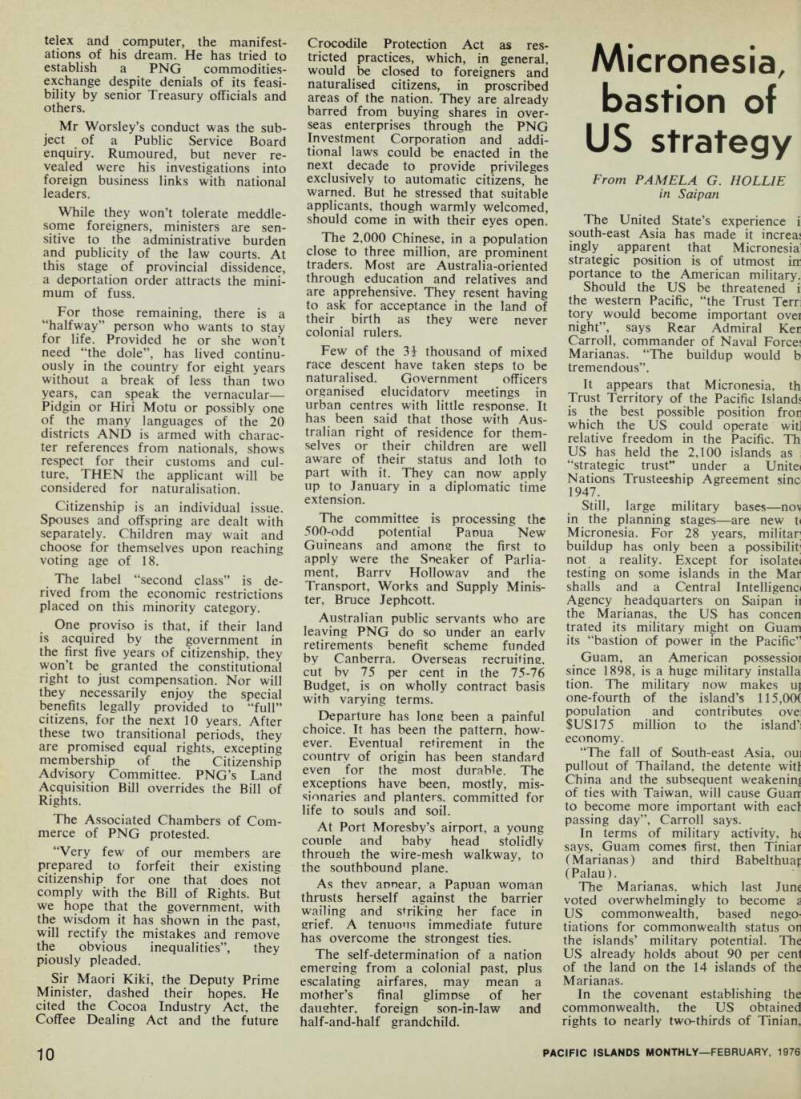
Sir Maori Kiki, Deputy Prime Minister . . .
"Come with your eyes open", he tells would-be citizens.
telex and computer, the manifest ations of his dream. He has tried to establish a PNG commodities exchange despite denials of its feasi bility by senior Treasury officials and others.
Mr Worsley’s conduct was the sub ject of a Public Service Board enquiry. Rumoured, but never re vealed were his investigations into foreign business links with national leaders.
While they won’t tolerate meddle some foreigners, ministers are sen sitive to the administrative burden and publicity of the law courts. At this stage of provincial dissidence, a deportation order attracts the mini mum of fuss.
For those remaining, there is a “halfway” person who wants to stay for life. Provided he or she won’t need “the dole”, has lived continu ously in the country for eight years without a break of less than two years, can speak the vernacular— Pidgin or Hiri Motu or possibly one of the many languages of the 20 districts AND is armed with charac ter references from nationals, shows respect for their customs and cul ture, THEN the applicant will be considered for naturalisation.
Citizenship is an individual issue.
Spouses and offspring are dealt with separately. Children may wait and choose for themselves upon reaching voting age of 18.
The label “second class” is de rived from the economic restrictions placed on this minority category.
One proviso is that, if their land is acquired by the government in the first five years of citizenship, they won’t be granted the constitutional right to just compensation. Nor will they necessarily enjoy the special benefits legally provided to “full” citizens, for the next 10 years. After these two transitional periods, they are promised equal rights, excepting membership of the Citizenship Advisory Committee. PNG’s Land Acquisition Bill overrides the Bill of Rights.
The Associated Chambers of Com merce of PNG protested.
“Very few of our members are prepared to forfeit their existing citizenship for one that does not comply with the Bill of Rights. But we hope that the government, with the wisdom it has shown in the past, will rectify the mistakes and remove the obvious inequalities”, they piously pleaded.
Sir Maori Kiki, the Deputy Prime Minister, dashed their hopes. He cited the Cocoa Industry Act, the Coffee Dealing Act and the future
Crocodile Protection Act as res tricted practices, which, in general, would be closed to foreigners and naturalised citizens, in proscribed areas of the nation. They are already barred from buying shares in over seas enterprises through the PNG Investment Corporation and addi tional laws could be enacted in the next decade to provide privileges exclusively to automatic citizens, he warned. But he stressed that suitable applicants, though warmly welcomed, should come in with their eyes open.
The 2,000 Chinese, in a population close to three million, are prominent traders. Most are Australia-oriented through education and relatives and are apprehensive. They resent having to ask for acceptance in the land of their birth as they were never colonial rulers.
Few of the 3i thousand of mixed race descent have taken steps to be naturalised. Government officers organised elucidatorv meetings in urban centres with little response. It has been said that those with Aus tralian right of residence for them selves or their children are well aware of their status and loth to part with it. They can now apply up to January in a diplomatic time extension.
The committee is processing the 500-odd potential Papua New Guineans and among the first to apply were the Sneaker of Parlia ment, Barrv Hollowav and the Transport, Works and Supply Minis ter, Bruce Jephcott.
Australian public servants who are leaving PNG do so under an earlv retirements benefit scheme funded by Canberra. Overseas recruiting, cut bv 75 per cent in the 75-76 Budget, is on wholly contract basis with varying terms.
Departure has long been a painful choice. It has been the pattern, how ever. Eventual retirement in the country of origin has been standard even for the most durable. The exceptions have been, mostly, mis sionaries and planters, committed for life to souls and soil.
At Port Moresby’s airport, a young couple and baby head stolidly throueh the wire-mesh walkway, to the southbound plane.
As thev appear, a Papuan woman thrusts herself against the barrier wailing and striking her face in grief. A tenuous immediate future has overcome the strongest ties.
The self-determination of a nation emerging from a colonial past, plus escalating airfares, may mean a mother’s final glimpse of her daughter, foreign son-in-law and half-and-half grandchild.
Advertisements & other items, p. 9 (1 item)
9
’ACIFIC ISLANDS MONTHLY—FEBRUARY, 1976
Micronesia,
bastion of US strategy
From Pamela G. Hollie
in Saipan The United State’s experience i south-east Asia has made it increas ingly apparent that Micronesia’ strategic position is of utmost im portance to the American military.
Should the US be threatened i: the western Pacific, “the Trust Terri tory would become important over night”, says Rear Admiral Ken Carroll, commander of Naval Forces Marianas. “The buildup would b tremendous”.
It appears that Micronesia, th Trust Territory of the Pacific Islands is the best possible position fron which the US could operate wit) relative freedom in the Pacific. Tb US has held the 2,100 islands as ; “strategic trust” under a Unite* Nations Trusteeship Agreement sine 1947.
Still, large military bases—nov in the planning stages—are new t< Micronesia. For 28 years, militar buildup has only been a possibility not a reality. Except for isolate* testing on some islands in the Mar shalls and a Central Intelligenc* Agency headquarters on Saipan it the Marianas, the US has concen trated its military might on Guam its “bastion of power in the Pacific”
Guam, an American possessioi since 1898, is a huge military installa tion. The military now makes ui one-fourth of the island’s 115,00 C population and contributes ovei SUSI7S million to the island’: economy.
“The fall of South-east Asia, oui pullout of Thailand, the detente witl China and the subsequent weakening of ties with Taiwan, will cause Guarr to become more important with eacl passing day”, Carroll says.
In terms of military activity, he says, Guam comes first, then Tiniar (Marianas) and third Babelthuap (Palau).
The Marianas, which last June voted overwhelmingly to become a US commonwealth, based nego tiations for commonwealth status on the islands’ military potential. The US already holds about 90 per cent of the land on the 14 islands of the Marianas.
In the covenant establishing the commonwealth, the US obtained rights to nearly two-thirds of Tinian,
about 17,800 acres. The KKLyear lease will cost the US $17.5 million a year, or about $9.83 per acre for the next 100 years. Also included in the land arrangement are 177 acres at Saipan’s harbour for $2 million and 206 acres on Farallon de Medi nilla. In effect, the US got the whole island for $20,600.
The military’s plans for Tinian are to build a supply base, ammunition storage deport and a Marine amphi bious training site. Tinian would be an “interior position”—what mili tary strategists call a securely American-held island territory.
While there is a counter campaign against those who oppose the pro posed new commonwealth of the Marianas on the grounds that it will be a “military colony”, the fact re mains that without the military’s interest in the Marianas, the islands probably would not have been able to enter into separate negotiations with the United States.
With Tinian pretty well secured, the third “fallback” position in Micronesia is expected to be Palau’s largest island, Babelthuap. But, in the case of Palau, negotiations for the nearly 32,000 acres for the military have not yet begun. The military has tentative plans for an intermittent ground force training and manoeuvres installation and a submarine base.
The military also wants joint use of Palau’s airport.
Like the Marianas, Palau has asked for separate negotiations with the US, but unlike their neighbours to the north, Palau hasn’t decided what status it wants. Yet one thing
is certain; after watching the Mari anas’ problems with their covenant, Palau would be expected to drive a harder bargain for its land.
Although the US has not said yes or no to Palau’s request for separate political status talks, the district is confident that the military’s interest in Palau will put the district in a strong bargaining position.
While there is also some opposi tion in Micronesia to the military, specifically to the use of Micronesian lands to dispose of dangerous wastes or to test nuclear weapons, “there
is an appeal”, says Johnson Tori biong, a freshman legislator and floor leader of the Palau district legislature.
“A small country with undeveloped resources will always see the military base as a means of bringing money into the area”.
But, he fears that the US will slowly take over more and more of Micronesia for military purposes.
“There’s that nagging feeling that we’re (Palau) being surrounded . . . first they took Bikini, then Kwajalein, Guam, the Marianas and now we see helicopters”.
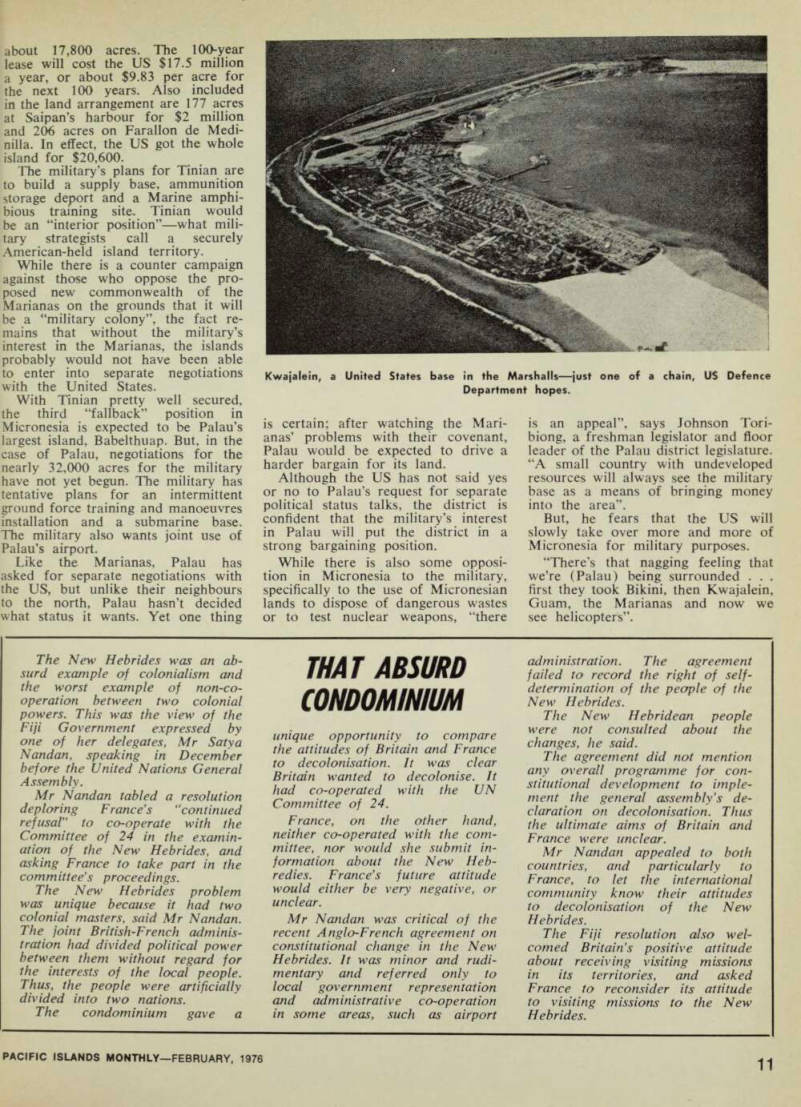
Kwajalein, a United States base in the Marshalls —just one of a chain, US Defence Department hopes.
That Absurd
Condominium
The New Hebrides was an ab surd example of colonialism and the worst example of non-co operation between two colonial powers. This was the view of the Fiji Government expressed by one of her delegates, Mr Satya Nandan, speaking in December before the United Nations General Assembly.
Mr Nandan tabled a resolution deploring France’s “continued refusal” to co-operate with the Committee of 24 in the examin ation of the New Hebrides, and asking France to take part in the committee’s proceedings.
The New Hebrides problem was unique because it had two colonial masters, said Mr Nandan.
The joint British-French adminis tration had divided political power between them without regard for the interests of the local people.
Thus, the people were artificially divided into two nations.
The condominium gave a
unique opportunity to compare the attitudes of Britain and France to decolonisation. It was clear Britain wanted to decolonise. It had co-operated with the UN Committee of 24.
France, on the other hand, neither co-operated with the com mittee, nor would she submit in formation about the New Heb redies. France’s future attitude would either be very negative, or unclear.
Mr Nandan was critical of the recent Anglo-French agreement on constitutional change in the New Hebrides. It was minor and rudi mentary and referred only to local government representation and administrative co-operation in some areas, such as airport
administration. The agreement failed to record the right of self determination of the people of the New Hebrides.
The New Hebridean people were not consulted about the changes, he said.
The agreement did not mention any overall programme for con stitutional development to imple ment the general assembly’s de claration on decolonisation. Thus the ultimate aims of Britain and France were unclear.
Mr Nandan appealed to both countries, and particularly to France, to let the international community know their attitudes to decolonisation of the New Hebrides.
The Fiji resolution also wel comed Britain’s positive attitude about receiving visiting missions in its territories, and asked France to reconsider its attitude to visiting missions to the New H ebrides.
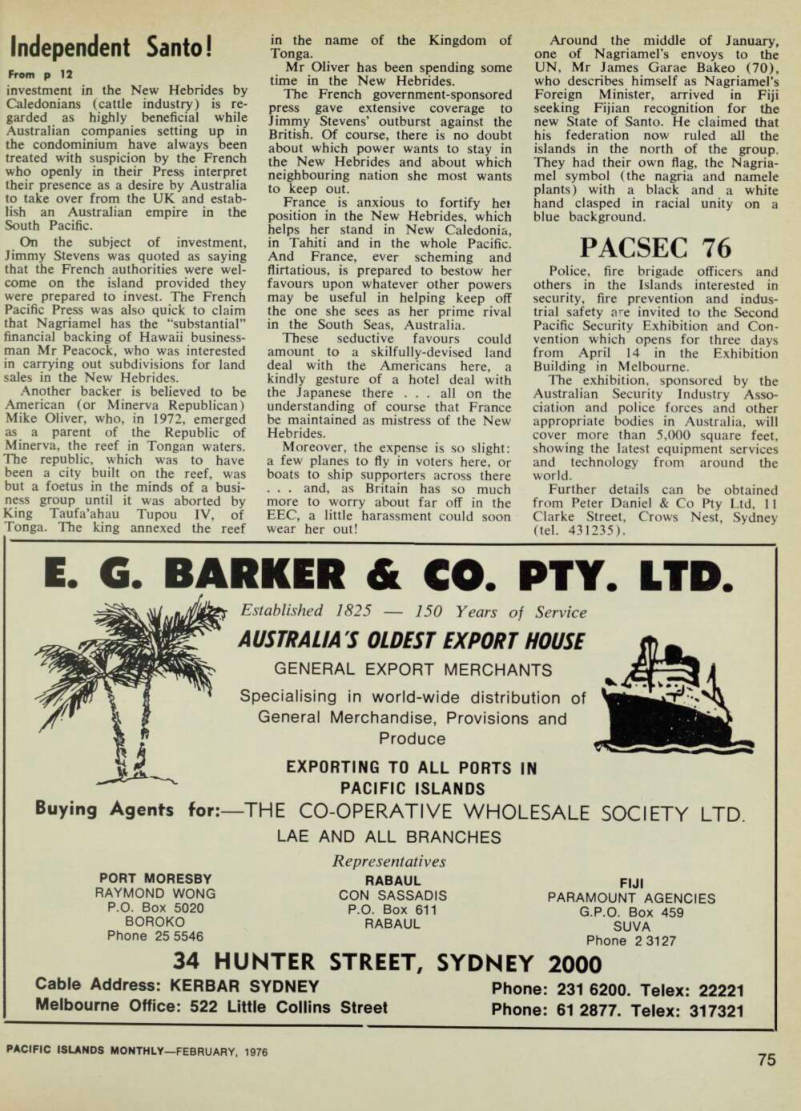
Independent Santo!

Christmas crackers from Jimmy Stevens
From a Vila correspondent
The fact that not everyone sits down to feast on plum pudding, Christmas cake or buche de Noel in December was highlighted by events that month in the New Hebrides which culminated in Nagriamel party leader Jimmy Stevens sending envoys to the United Nations to seek the removal of the British from the con dominium partnership and indepen dence for Santo by April 1, 1976 (April Fool’s Day!) Meantime, the elections for the territory’s first Representative Assem bly for which the population voted in November, had still not been completed. With French Overseas Territories Minister Mr Olivier Stirn planning a South Pacific visit in January, it really looked as though someone was holding up the assem bly and desperately playing for time.
Events seemed to crystallise around December 11 when a large crowd of supporters made it known that Na griamel leader Jimmy Stevens was contesting the validity of the elec tion results for six seats in Santo, after the overwhelming defeat of Nagriamel and the National Party victory.
An ultimatum was launched de manding an inquiry and response from the joint administration by De cember 27. If some people non chalantly spent the meantime writing Christmas cards, others were busy writing a list of grievances against the British authorities, ending with a demand that the UK should get out of Santo by April 1, 1976, OR
Else . . .
The list of charges against the British administration were in a let ter presented to the French and British delegates in Santo on De cember 27, during a massive rally by about 2,700 supporters of Jimmy Stevens. The letter was signed by Stevens and MANH party leader, Aime Malere.
A second letter, dated December 29, went a step further. Signed only by Jimmy Stevens and not by the
MANH group, this letter urged in dependence for Santo and other islands in the north, possibly the Banks, Malo, Torres, Maewo, Aoba and perhaps others. (This would mean separation from the Island of Vate and capital Vila). The letter repeated the desire to see an end to the British, but a continued French presence in the islands.
In a joint public communique dated December 31, the British and French resident commissioners stated that under the 1914 Protocol, neither France nor Britain could withdraw from the territory without the other.
Moreover, they considered that no leader of a political party could claim to speak for the whole or a part of the New Hebrides.
Concerning independence, they pointed out that any modification of the condominium’s political status would depend on the two governing powers acting in co-operation with such local bodies as the new Repre sentative Assembly.
Meanwhile, main recriminations listed against the British were that the British Administration had helped the National Party electoral fraud, that it obstructed economic develop ment by its policy over the Pekoa airfield and wharf at Santo, while only the French, through French settlers, had aided the development of Santo.
It was claimed, moreover, that only French possessions accepted Hebridean workers and took copra and meat exports from the New Hebrides. Furthermore, the French were giving back land to the locals.
The letter criticised the British land
policy adopted through the Land Trust Board. As for roads, only the war and the US had provided a suitable network, while in the area of sporting facilities the British were denounced as being as deficient as elsewhere.
All in all, the anti-British letter could not have been better written by a Paris public servant. And after all, wasn’t Jimmy Stevens received in France last July by President Valery Giscard d’Estaing, an honour not even accorded to leaders of the New Caledonian Territorial Assem bly?
Some see Jimmy Stevens’ dramatic move as an attempt to, • Get back into the limelight after his sun was eclipsed by the National Party’s successes at the polls, or • To give supporters something more to think about than the where abouts of Nagriamel funds.
That he wanted to create an in dependence bandwagon of his own was demonstrated by his comments at the rally when he strongly de nounced the British and the Presby terian ministers for supporting the National Party which seemed to have overshadowed him by calling for independence for the New Heb rides by 1977.
His attempt to get the United Nations to back his campaign for an independent Santo apparently fizzled out. His envoys got no fur ther at UN headquarters than the desk of a minor official.
It is interesting to note also, that
• Continued on p 75
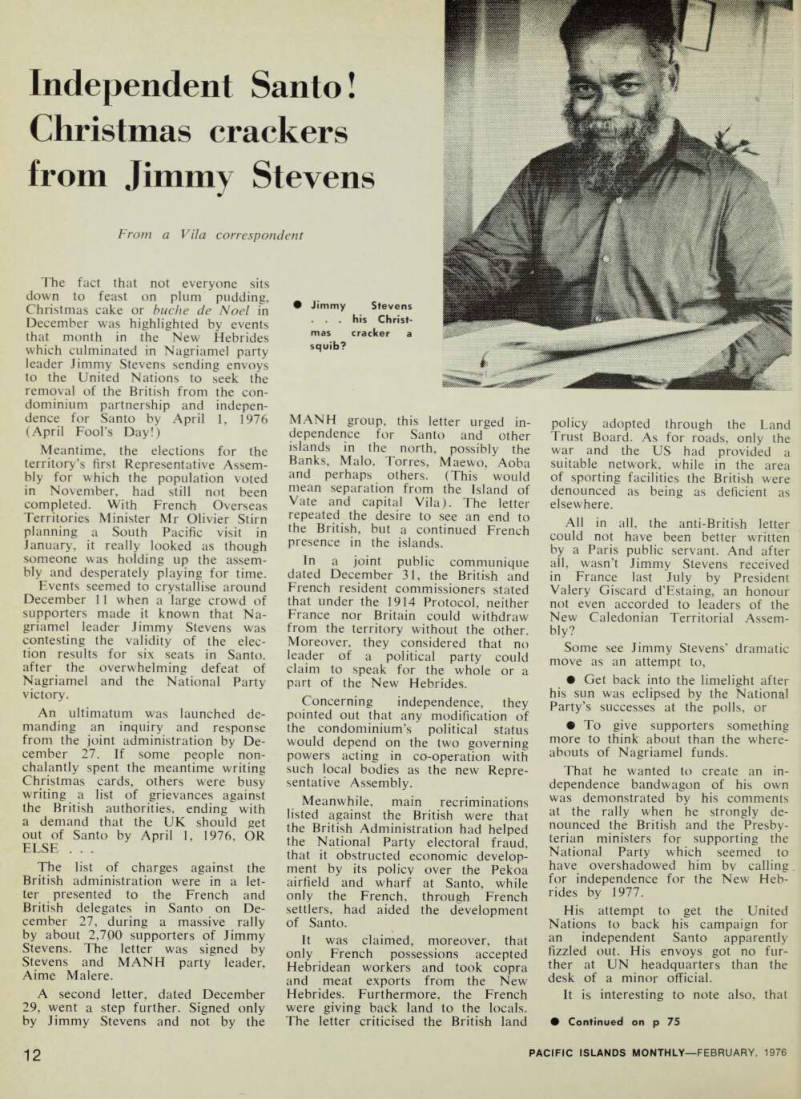
• Jimmy Stevens . . . his Christ mas cracker a squib?
investment in the New Hebrides by Caledonians (cattle industry) is re garded as highly beneficial while Australian companies setting up in the condominium have always been treated with suspicion by the French who openly in their Press interpret their presence as a desire by Australia to take over from the UK and estab lish an Australian empire in the South Pacific.
On the subject of investment, Jimmy Stevens was quoted as saying that the French authorities were wel come on the island provided they were prepared to invest. The French Pacific Press was also quick to claim that Nagriamel has the “substantial” financial backing of Hawaii business man Mr Peacock, who was interested in carrying out subdivisions for land sales in the New Hebrides.
Another backer is believed to be American (or Minerva Republican) Mike Oliver, who, in 1972, emerged as a parent of the Republic of Minerva, the reef in Tongan waters.
The republic, which was to have been a city built on the reef, was but a foetus in the minds of a busi ness group until it was aborted by King Taufa’ahau Tupou IV, of Tonga. The king annexed the reef
in the name of the Kingdom of Tonga.
Mr Oliver has been spending some time in the New Hebrides.
The French government-sponsored press gave extensive coverage to Jimmy Stevens’ outburst against the British. Of course, there is no doubt about which power wants to stay in the New Hebrides and about which neighbouring nation she most wants to keep out.
France is anxious to fortify hei position in the New Hebrides, which helps her stand in New Caledonia, in Tahiti and in the whole Pacific.
And France, ever scheming and flirtatious, is prepared to bestow her favours upon whatever other powers may be useful in helping keep off the one she sees as her prime rival in the South Seas, Australia.
These seductive favours could amount to a skilfully-devised land deal with the Americans here, a kindly gesture of a hotel deal with the Japanese there ... all on the understanding of course that France be maintained as mistress of the New Hebrides.
Moreover, the expense is so slight: a few planes to fly in voters here, or boats to ship supporters across there . . . and, as Britain has so much more to worry about far off in the EEC, a little harassment could soon wear her out!
Around the middle of January, one of Nagriamel’s envoys to the UN, Mr James Garae Bakeo (70), who describes himself as Nagriamel’s Foreign Minister, arrived in Fiji seeking Fijian recognition for the new State of Santo. He claimed that his federation now ruled all the islands in the north of the group.
They had their own flag, the Nagria mel symbol (the nagria and namele plants) with a black and a white hand clasped in racial unity on a blue background.
Pacsec 76
Police, fire brigade officers and others in the Islands interested in security, fire prevention and indus trial safety are invited to the Second Pacific Security Exhibition and Con vention which opens for three days from April 14 in the Exhibition Building in Melbourne.
The exhibition, sponsored by the Australian Security Industry Asso ciation and police forces and other appropriate bodies in Australia, will cover more than 5,000 square feet, showing the latest equipment services and technology from around the world.
Further details can be obtained from Peter Daniel & Co Pty Ltd, 11 Clarke Street, Crows Nest, Sydney (tel. 431235).
Bitter Confrontation To Noumea
Policeman's Fatal Shot Brings A
From a Noumea correspondent
The fatal shooting of a young Melanesian by a Noumea policeman during an incident on December 27 in Noumea’s central square has aroused further bitter confrontation between New Caledonian Melanesians and the French administration.
Victim of the shooting was 22year-old Richard Kamouda, from the east coast town of Poindimie.
He was shot around 10 pm by a metropolitan French policeman, one of three police to intervene in what appeared as a brawl between three young Melanesians. Needless to say, the whole population was shocked at the killing, with resentment and indignation on the Melanesian side and fear of reprisals among the European community.
The shooting led, almost within minutes, to gatherings of up to 2,000 people in the streets of Noumea, with militant Melanesians and their supports using microphones to call for Kanaka independence in New Caledonia. An Action Committee for the Kamouda Affair (CAAK) was straightway formed and included five Kanaka leaders in the Territorial Assembly.
On the other hand, another com mittee was formed in support of police action to maintain law and order. On January 8, groups of police walked the streets of Noumea handing out pamphlets to defend their position. At the earliest signs of public demonstrations, bands of police and riot squad (gardes mobiles) had been sent on to the streets equipped with arms, helmets and shields.
These incidents led to violent re criminations in the Territorial Assem bly. Melanesian Yann Celene Uregei, leader of the Union Multiraciale Party, accused the territory’s Secretary-General, Mr Claude Erig nac, of having tried to hide the real cause of Kamouda’s death when he went to the young man’s tribal village.
Mr Erignac, acting head of the territory in the absence of Governor Eriau in France, hotly denied the accusation and the assembly debate was closed in up roar.
Amid a rapidly-deteriorating cli mate in Noumea, a second meeting of the assembly on January 7 con demned the distribution of tracts inciting the locals to violence.
Numerous speakers condemned the French administration for its tardi ness in tracking down those respons ible for a violent tract distributed on New Year’s Eve calling for direct action in the name of an “Action Committee against Independence”.
Assembly members pointed out that in September, 1969, the Mela nesian authors of certain tracts had been rapidly arrested, brought before the courts and imprisoned.
In an emotional speech denouncing the anti-independence committee and their tract, Mr Uregei said: “Let them realise that death is part of our struggle and if we must die we will die, our heads held high for a Kanaka New Caledonia”.
Other assembly members con demned a tract distributed by the Kamouda Committee (CAAK), which called for a “general uprising”, for “rebellion against French colonialism” and referred to the day “when the French Government will be expelled from the territory”.
Maurice Lenormand, a leader of the Union Caledonienne, denounced the “armada” of armed, helmeted police sent out to every street demon stration and said this was “sheer provocation”.
Lenormand also pointed out that it seemed only Melanesians were
victims of the authorities’ guns. He mentioned a second incident on De cember 30 when gendarmes chased and shot at a car near Paita, just beyond Noumea, simply because it did not have a number plate.
Mr Erignac said the car had driven through two road blocks. However, this second use of guns, this time by the gendarmerie, also shocked the Caledonians.
It is strange to note that the be ginning of protests over Richard Kamouda’s death in Noumea and the massive 2,700-man protest meet ing by Jimmy Stevens directed against the British in the New Heb rides, both occurred on December 27.
The whole turmoil of events occurred against a serious economic background, with the Caledonian Territorial Assembly again urging employment preference for the locals over new arrivals from France.
In addition, the assembly has been repeatedly refusing exhortations from Mr Erignac that they must vote the SA2O million extra local taxes pro posed by the French Administration to overcome the budget deficit. The Caledonians are stolidly replying that they are not responsible for local economic problems engineered by Paris.
At the time, Governor Eriau, High Commissioner for France in the Pacific, was on mission in France. Both New Caledonia and the
• Continued on p 76
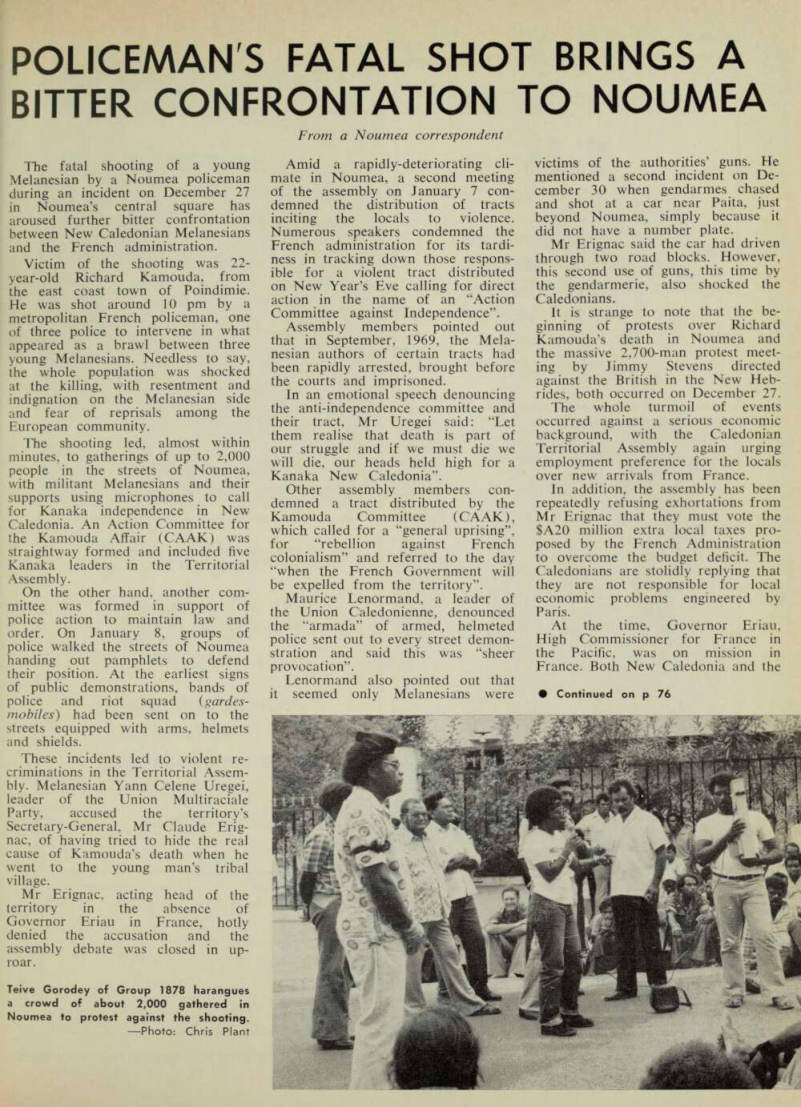
Teive Gorodey of Group 1878 harangues a crowd of about 2,000 gathered in Noumea to protest against the shooting.
Photo: Chris Plant
New Hebrides have growing move ments calling for independence and this on the eve of the arrival of French Overseas Territories Minister, Olivier Stirn, expected in Noumea by early February.
Some observers would see the bitter confrontation since December 27 as a repeat of past French ad ministration performances in allow ing, if not inciting, Melanesian vio lence to overflow, thereby frightening the Europeans and thus giving France another opportunity to sup press opposition and declare that her presence is essential to maintain the peace between what would allegedly otherwise be economic exploitation (of the Melanesians) or death (of the Europeans).
Mr Uregei, leader of the Union Multiraciale Party, in an atempt to enlist support in Fiji and, perhaps, have Fiji’s delegation at the United Nations raise the matter there, visited Fiji in the second week in January.
He had a meeting with Fiji’s Deputy Prime Minister, Ratu Sir Penaia Ganilau. Later, he saw com mittee members of the Conference for a Nuclear Free Pacific and said that, after the fatal shooting, the administration censored radio, tele vision and newspaper reports. • The Niue Hotel, opened in March, 1975, had accommodated only 20 tourists by about the end of November. The hotel which cost about $220,000, was paid for by NZ government grants. It can accommo date up to 40 guests. In an effort to boost the tourist industry for the island, room tariffs have been halved till March 31.
Advertisements & other items, p. 14 (1 item)
Ooodfvcar
GOOD-YEAR
€8
CROSS PLY TYRE
G 8 offers you improved wet-
skid protection smoother
handling and quieter softer
ride. Three choices;
G 8 Custom G 8
Super Cushion G 8
1 ** s: V'* r r ■a
OOODfvCAR
0800
RADIAL PLY TYRE
You get extra tyre toughness,
longer tread life and more
fuel economy from Goodyear
GBOO, Custom GBOO Bib or
GBOO Grand Prix.
/ r v GOODYEAR DISTRIBUTORS IN S.E. ASIA AND PACIFIC BASIN Boroko Motors Ltd.
Port Moresby, PNG.
Guam Tire & Supply Co.
Agana, Guam Coral Island Motors Suva, Fiji Landis Brothers & Co. Ltd.
Hong Kong Solomon Motors Ltd.
Honiara, 8.5.1. P.
Susupe Enterprises Saipan, Mariana is.
Societe General Automobile Noumea, New Caledonia Service Mobil Papeete, Tahiti Santo Engineers Santo. New Hebrides Micro! Corporation Saipan, Mariana Is.
W.S.T.C.S.
Western Samoa Samoa Motors Inc.
American Samoa Pacific Motors Vila, New Hebrides Yap Cooperative Ass.
Yap, W. Caroline Is.
Morris Hedstrom Ltd.
Apia, Western Samoa Buncombe Bay Garage Norfolk Is.
Truk Trading Co.
Truk, E. Caroline Is.
P.A.M.I.
Kolonia, Ponape Morris Hedstrom Tonga Cook Island Motors Cook Is.
Island Construction Co.
Majuro, Marshall Is.
Ngiratkel Etpison Co. Ltd.
Koror, Palau Yung Wei Tung Trading Co. Ltd.
Taipei, Taiwan A 557 /
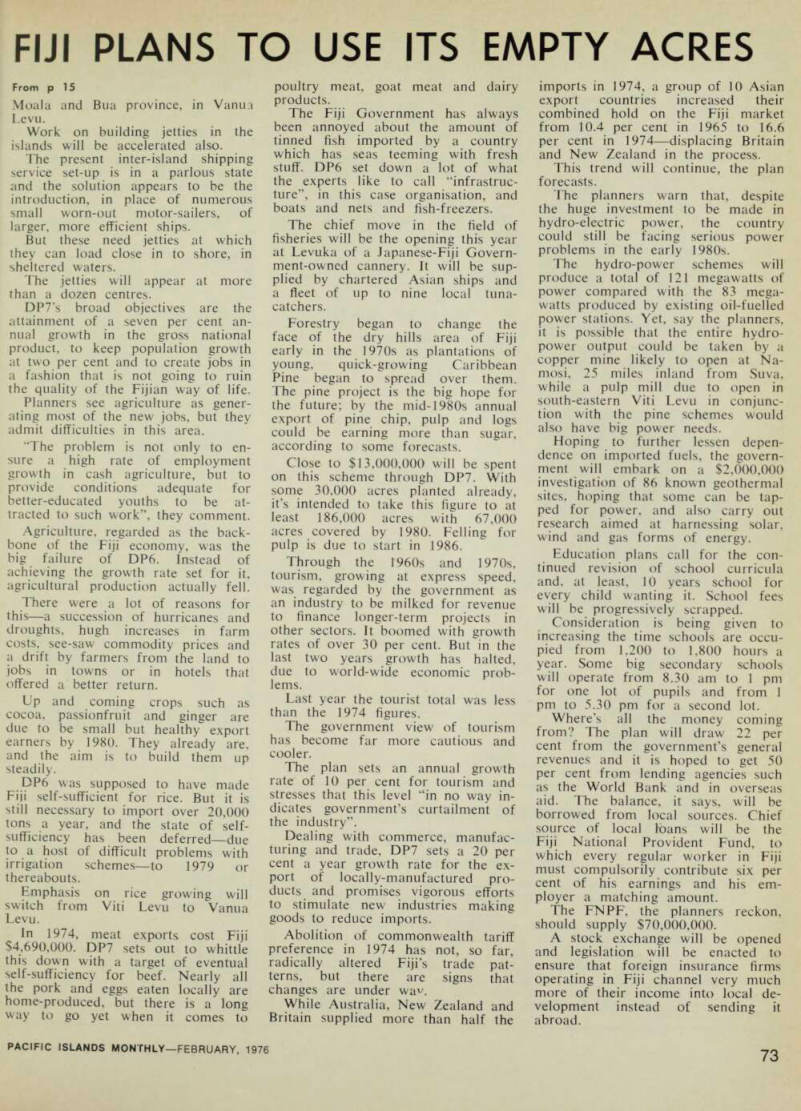
Fiji Plans To Use
Its Empty Acres
From ROBERT KEITH-REID in Suva
Take a small plane and fly low over Fiji and you’ll be puzzled by often-heard comments that the coun try’s 560,000 people are short of land.
The plane ride would reveal that hundreds of the 7055 square miles that make up the 350 islands of the Fiji group are uninhabited and ap parently untouched.
There is little sign of humanity in much of the wild and mountainous interiors of the 4011 square miles of Viti Levu, the biggest island in the group.
Vast tracts of the 2137 square miles of Vanua Levu, the second big gest island, are similarly deserted, apart from an isolated Fijian village here and there at the bottom of a deep river valley.
Even the next two biggest islands, Taveuni, 168 square miles, and Ka davu, 156 square miles, appear to offer a lot of unused living space.
The plane ride would partly ex plain why so much land lies de serted. Jagged volcanic peaks and razor-backed ridges climbing out of a thick, green shroud of tropical rain forest arc evidence of terrain that so far has been too tough for Fiji’s people to bother tackling.
They have not had to touch such land since flat plains cleared for them by the workings of the Rewa, Navua, Ba and other major rivers have been much more easily worked.
But now, population pressure in the plains has caused a land shortage of a sort. There is little easily tilled land left. Aspiring farmers must now turn their eyes inland for land from which they can get a living.
The opening up of interior areas is one of the chief strategies of De velopment Plan Seven—DP 7 for short—which the Fiji Government published at the end of December.
As the title suggests, it is the seventh in a series of economic plans drafted and undertaken by successive governments.
It touches every aspect of life in Fiji.
DP7 will cover the years 1976- 1980 and succeds DP6, which covered 1971-1975.
“If DP7 can be said to have a distinctive character”, says Prime Minister Ratu Sir Kamisese Mara in a foreword, “I should say it is an increased concern with the need to
ensure a more equal sharing of the fruits of development, and a deeper recognition of the sources of Fiji’s real wealth and productive capacity —in the soil, in the sea and in the hands of rural producers”.
Putting the PM’s words more bluntly, the plan takes notices of old laments from the bush that the flesh pots of Suva, Lautoka, Nadi and other urban areas have long got too much attention at the expense of country folk. And that, because this has been so, there has been a danger ous flow, in volume increasing almost daily, of country folk to the towns, there to swell the problems of unemployment, slum-housing con ditions and crime that already exist in them.
DP7 is an attempt to even out the balance. During the next five years the Fiji Government plans capital expenditure of $337,000,000 —about three times the amount spent on DP6—in trying to set the balance right.
Of this, about $60,000,000 will go on a big hydro-electric power scheme which will cover much of those un touched expanses of Viti Levu’a interior with a network of lakes, dams and roads.
And $30,000,000 will go on roads which push into some of the most isolated areas of Fiji. The Public Works Departments will gear up to build 711 miles of roads, compared with only 200 miles built during DP6.
Some of the new roads will be major ones, including a circum insular road for Vanua Levu to open up large areas of Natewa Bay and Bua, a couple or more roads across the same island, and numerous im portant extensions of existing roads into the Viti Levu interior.
Local air and sea services will get almost as much attention on the assumption that the mere availability of regular, reliable transportation will do more to stimulate local de velopment schemes than anything else.
Airstrips suitable for the Islander and Trislander planes flown by Air Pacific and Fiji Air will be built in the outer island region at the rate of three a year.
The first strips will be for Gau, Kadavu, Vanua Balavu, Koro,
• Continued on p 73
Moala and Bua province, in Vanua Levu.
Work on building jetties in the islands will be accelerated also.
The present inter-island shipping service set-up is in a parlous state and the solution appears to be the introduction, in place of numerous small worn-out motor-sailers, of larger, more efficient ships.
But these need jetties at which they can load close in to shore, in sheltered waters.
The jetties will appear at more than a dozen centres.
DP7’s broad objectives are the attainment of a seven per cent an nual growth in the gross national product, to keep population growth at two per cent and to create jobs in a fashion that is not going to ruin the quality of the Fijian way of life.
Planners see agriculture as gener ating most of the new jobs, but they admit difficulties in this area.
“The problem is not only to en sure a high rate of employment growth in cash agriculture, but to provide conditions adequate for better-educated youths to be at tracted to such work”, they comment.
Agriculture, regarded as the back bone of the Fiji economy, was the big failure of DP6. Instead of achieving the growth rate set for it,
agricultural production actually fell.
There were a lot of reasons for this—a succession of hurricanes and droughts, hugh increases in farm costs, see-saw commodity prices and a drift by farmers from the land to jobs in towns or in hotels that offered a better return.
Up and coming crops such as cocoa, passionfruit and ginger are due to be small but healthy export earners by 1980. They already are, and the aim is to build them up steadily.
DP6 was supposed to have made Fiji self-sufficient for rice. But it is still necessary to import over 20,000 tons a year, and the state of self sufficiency has been deferred—due to a host of difficult problems with irrigation schemes—to 1979 or thereabouts.
Emphasis on rice growing will switch from Viti Levu to Vanua Levu.
In 1974, meat exports cost Fiji $4,690,000. DP7 sets out to whittle this down with a target of eventual self-sufficiency for beef. Nearly all the pork and eggs eaten locally are home-produced, but there is a long way to go yet when it comes to
poultry meat, goat meat and dairy products.
The Fiji Government has always been annoyed about the amount of tinned fish imported by a country which has seas teeming with fresh stuff. DP6 set down a lot of what the experts like to call “infrastruc ture”, in this case organisation, and boats and nets and fish-freezers.
The chief move in the field of fisheries will be the opening this year at Levuka of a Japanese-Fiji Govern ment-owned cannery. It will be sup plied by chartered Asian ships and a fleet of up to nine local tuna catchers.
Forestry began to change the face of the dry hills area of Fiji early in the 1970 s as plantations of young, quick-growing Caribbean Pine began to spread over them.
The pine project is the big hope for the future; by the mid-1980s annual export of pine chip, pulp and logs could be earning more than sugar, according to some forecasts.
Close to $13,000,000 will be spent on this scheme through DP7. With some 30,000 acres planted already, it’s intended to take this figure to at least 186,000 acres with 67,000 acres covered by 1980. Felling for pulp is due to start in 1986.
Through the 1960 s and 19705, tourism, growing at express speed, was regarded by the government as an industry to be milked for revenue to finance longer-term projects in other sectors. It boomed with growth rates of over 30 per cent. But in the last two years growth has halted, due to world-wide economic prob lems.
Last year the tourist total was less than the 1974 figures.
The government view of tourism has become far more cautious and cooler.
The plan sets an annual growth rate of 10 per cent for tourism and stresses that this level “in no way in dicates government’s curtailment of the industry”.
Dealing with commerce, manufac turing and trade, DP7 sets a 20 per cent a year growth rate for the ex port of locally-manufactured pro ducts and promises vigorous efforts to stimulate new industries making goods to reduce imports.
Abolition of commonwealth tariff preference in 1974 has not, so far, radically altered Fiji’s trade pat terns, but there are signs that changes are under wav.
While Australia, New Zealand and Britain supplied more than half the
imports in 1974, a group of 10 Asian export countries increased their combined hold on the Fiji market from 10.4 per cent in 1965 to 16.6 per cent in 1974—displacing Britain and New Zealand in the process.
This trend will continue, the plan forecasts.
The planners warn that, despite the huge investment to be made in hydro-electric power, the country could still be facing serious power problems in the early 1980 s.
The hydro-power schemes will produce a total of 121 megawatts of power compared with the 83 mega watts produced by existing oil-fuelled power stations. Yet, say the planners, it is possible that the entire hydro power output could be taken by a copper mine likely to open at Na mosi, 25 miles inland from Suva, while a pulp mill due to open in south-eastern Viti Levu in conjunc tion with the pine schemes would also have big power needs.
Hoping to further lessen depen dence on imported fuels, the govern ment will embark on a $2,000,000 investigation of 86 known geothermal sites, hoping that some can be tap ped for power, and also carry out research aimed at harnessing solar, wind and gas forms of energy.
Education plans call for the con tinued revision of school curricula and, at least, 10 years school for every child wanting it. School fees will be progressively scrapped.
Consideration is being given to increasing the time schools are occu pied from 1,200 to 1,800 hours a year. Some big secondary schools will operate from 8.30 am to 1 pm for one lot of pupils and from 1 pm to 5.30 pm for a second lot.
Where’s all the money coming from? The plan will draw 22 per cent from the government’s general revenues and it is hoped to get 50 per cent from lending agencies such as the World Bank and in overseas aid. The balance, it says, will be borrowed from local sources. Chief source of local loans will be the Fiji National Provident Fund, to which every regular worker in Fiji must compulsorily contribute six per cent of his earnings and his em ployer a matching amount.
The FNPF, the planners reckon, should supply $70,000,000.
A stock exchange will be opened and legislation will be enacted to ensure that foreign insurance firms operating in Fiji channel very much more of their income into local de velopment instead of sending it abroad.
Advertisements & other items, p. 15 (1 item)
“Skillet”
Round gourmet
THE HANDIEST NEW APPLIANCE
SINCE FRYPANS
Bacon and eggs for two? Simple for the Sunbeam "Skillet". Yet "Skillet" is big enough to roast a size 8 chicken to perfection. And to wash simply remove the control and dunk the pan in the sink.
Another first and it comes only from Sunbeam.
8 Speed
Power
Blender
THE APPLIANCE YOU CAN USE
EVERY MEAL
With powerful. Solid-state motor. Which means the exact blending action you need to— Whip, grate, mix, chop or liquefy. Stainless steel cutters give fast food preparation while switching from speed to speed without turning off .
Happy Self-Government Day
Teargas In The Solomons On
From a Honiara correspondent
The Solomon Islands became an “internal self-governing” state on January 2, not with flags flying and trumpets sounding, but with the firing of teargas canisters into riot ing crowds in Honiara.
About 200 members of the Solo mons Islands General Workers’
Union, on strike for more wages and angered at a ban on their demon stration march planned for that day and the arrest a few days before of six union leaders for leading an un lawful gathering, rioted in Mendana Avenue.
Shop windows were smashed and 18 shops were damaged by demon strators running from clouds of teargas fired by policemen, who halted the marchers as they neared the Chief Minister’s office in Men dana Avenue. Nineteen people were arrested and were due to appear in court on January 26.
Probably the most surprised per son in Honiara that day was Chief Minister Solomon Mamaloni. The riot was a bolt from the blue.
Little had been heard over the
past few months from people opposed to self-government and it was not until December 11 that the General Workers’ Union declared its militant opposition.
And, there is nothing to suggest that violence was planned. The police handled the situation admir ably and there is little likelihood of a repeat performance by the union, whose members were a little con fused over the reason for the demon stration.
Some thought it was in protest against self-government, while others thought they were demonstrating for more wages.
Mr Mamaloni, who has had his own troubles over the commemo rative coins, which he “unconstitu tionally” ordered from a private mint in California, commented, in his message to the people on Self- Governing Day (January 2): “Most of our people do not want any part of this stupid and destructive be haviour. We have to learn, painfully it seems, that violence does not pay . . . Those who excite and stir up my brothers in this way, those are the real enemies of our country”.
Mr Mamaloni told the people his first aim was to lead the government through the next six months to a general election in the middle of 1976, to be followed by indepen dence.
He listed the dangers which faced the country after independence— political fragmentation with a lot of parties quarrelling over the job of Prime Minister; ministers taking too high a salary or claiming privileges; a bad constitution; splits among the people on an island basis, a class struggle or a rural-urban struggle; discouragement of foreign investors “by hysterical outbursts” and the creation of a “general impression abroad that we are playing around with our future like silly people”.
One warning was a dramatic one.
If they fought among themselves, he said, “those hungry sharks I have seen in the outside world are going to move in, quick as a flash, and swallow us piece by piece, until there is nothing left of us, nothing left of our peaceful and healthy way of life, nothing of our hopes and dreams for our children’s future”.
Advertisements & other items, p. 16 (1 item)
Qbe Insurance
Q E
serves the Islands with expert
insurance service and advice.
QBE INSURANCE
LIMITED
(FORMERLY—QUEENSLAND INSURANCE COMPANY LIMITED)
Central Office: 82 Pitt Street, Sydney Office* Suva, Manager for Fiji: F. N. Davies (A.A.U.), Office: Burns Philp Bldg.
S?w^J^V P A ) -^ Breckwoldt & Comply (5.1.) Pty. Limited.
NEW CALEDONIA—T. A. Hagen, Ste. W. A. Johnston, S.A.R.L. —Noumea.
NEW HEBRlDES—Resident Officer: G. F. Donnelly, Vila; Santo: Burns Philp (New Hebrides) Ltd.
Chung: Immeuble 8.1., Front de Mer, Papeete.
NIUE, NORFOLK ISLAND, SAMOA, TONGA and other South Sea Islands—Bums Philp (South Sea) Company Ltd.
QUEENSLAND INSURANCE (P.N.G.) LTD
PAPUA NEW GUINEA
Head Office, Port Moresby: General Manager: D. J. Granter.
District Managers at Rabaul: C. D. Dickings; Lae: W. J. Leonard; Mt. Hagen: D. F. Carroll. Atawa: A. M. Tanner; Madang: I. R.’
Martin.
H 359
Tropicalities
Marvellous do for Tuvalu
“Parting is such sweet sorrow”, wrote Shakespeare, and the Gil bertese and Tuvaluans (ex-Ellice Islanders) would have agreed with him, if they’d been asked on New Year’s Day.
But they were too busy holding celebration separation ceremonies at Funafuti to think up suitable classi cal quotes for the occasion—the formal final separation of the two partners in the 60-year-old Crown Colony of the Gilbert and Ellice Islands.
Tuvalu was proclaimed a separate colony on October 1 last year but the joint administration continued until January 1 this year.
Now the two are separate colonies with the Gilberts expecting to go in dependent by 1977. But no separa tion of two distinctly separate races has been attended with so much goodwill. It was Tuvalu’s decision, arrived at by referendum in which the people voted overwhelmingly for their new status.
They believed that, if they stayed with the Gilbertese, who outnumbered them by seven to one, they would be dominated by their partners.
Such a situation almost anywhere else would have created great re sentment one way or another but, from the first mention of separation in 1972, the Gilbertese, albeit regret fully, agreed that if that was what the Ellice people wanted, they could have it so far as the Gilbertese were concerned.
One New Zealand newspaper, re porting the formal separation, said the Gilbertese were glad as the Tu valuans would have been a econ omic liability. Well, that’s news to PIM. The Gilbertese would have welcomed the Tuvaluans as partners in an independent state.
The most striking thing about the ceremonies, which lasted for several days on Funafuti, was the great goodwill which was expressed in many ways.
Tarawa sent its Chief Minister, Mr Toalipi Lauti, and four other
ministers to the celebrations and be fore they left Funafuti they presented the new country of Tuvalu with Its first gift, a motor cycle.
In case anyone thinks that a motor cycle is a rather prosaic gift for one country to give to another on such an occasion, such a gift will be of far more use on Funafuti than, say, a kava bowl or a set of war clubs.
The Tuvaluans can do with all the utility gifts they can get. After all, the only thing they’ve taken with them from the GEIC is a ship.
Funafuti’s population of around 1,100 was quadruppled for the cere monies and many telegrams of con gratulation arrived, including one from the Queen and another from the Prime Minister of New Zealand, Mr Muldoon.
The Tuvaluans used the occasion to pick their team for the South Pacific Festival of Arts at Rotorua (NZ) in March. The dancing com petition for places lasted three days.
Everything went without a hitch and, as the Queen’s Commissioner in Tuvalu, Mr Tom Layng, heading the festivities, told PIM, “Separation was achieved with great goodwill. It was incredible that there have been no unpleasant incidents of any kind to mar the setting up of a separate territory”.
Which isn’t really surprising. The rest of the world could study with great profit the Islanders’ pacific way of doing things.
Niuean gets
a big one Leslie Rex jr, a Niuean fisherman, has a great “fish story” to tell. It’s about the one that DIDN’T get away.
With two companions in a small aluminium dinghy, Leslie landed a black marlin weighing over 380 kilos.
Caught off Niue Island’s wild Sepa Point, the fish which was nearly four metres long, took four hours to land and was hauled onto the reef at Avatele village by a large bulldozer working nearby on the elec tric power reticulation scheme.
“We used a flying fish bait and landed the marlin on a 180 lb hand line. At one stage we went so far
out to sea that I was getting ready to cut the line”, said Leslie.
The fish is believed to be one of the largest marlin ever landed on a handline and Leslie plans to make inquiries from NZ fishing authorities with the hope of submitting claims for a world record.
In true Niuean tradition, the fish was cut up and handed out to friends, relatives and villagers.
“Actually we never got to try a piece ourselves but we heard it was very tasty”, said Leslie who, on the day of the big catch, originally set out to boat a few Spanish mackerel.
High-flying
Caledonians
The growth of private aviation in New Caledonia is underlined by the increasing number of instructors and planes at the Caledonian Aero Club and the licensing of the first com pany authorised to transport passen gers by helicopter.
Since early 1976 the Aero Club Caledonien has had a fleet of nine planes, following its recent acquisi tion of two new Piper Cherokee Warriors. In addition, the club now has three full-time flying instructors, including two young men seconded from military service (VAT). With these increased reinforcements, the aero club is planning to organise an itinerant flying school to train in habitants of the inland and outer islands.
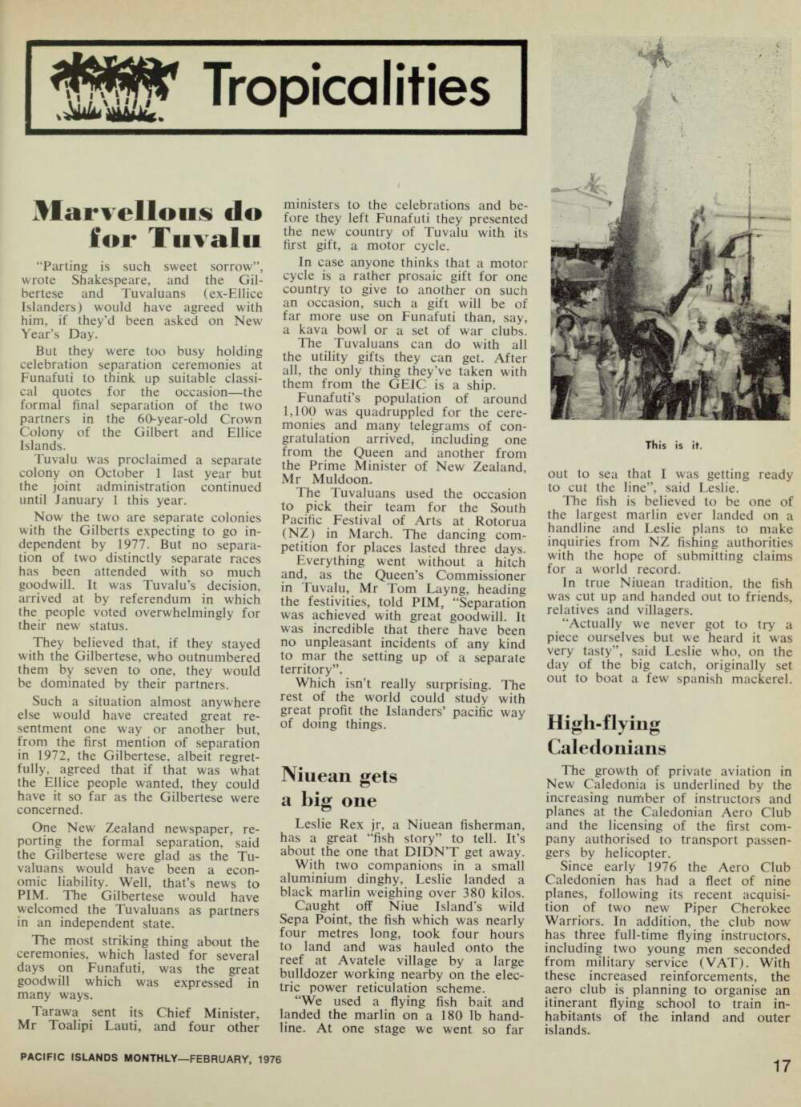
This is it.
At the last official count in early 1975, New Caledonia had 10 planes registered locally for public transport, three for the armed forces, two for the gendarmerie as well as six private helicopters and 43 private planes.
Meanwhile, the first company licensed to transport passengers by helicopter is Air Noumea, operating a French Alouette (“skylark”) helicopter. Air Noumea is owned by well-known Caledonian mining per sonality Mr Jean-Claude Berton.
They’re running
round Tahiti
While Caledonians are keen to challenge overseas sportsmen to their annual races around the island by bicycle or rally car, the Tahitians have now set the pace with a round the-island foot race.
The lead was given by solitary marathon runners from the French gendarmerie and Foreign Legion.
Then, in December, a relay team, the 31 “Bureaucrates” of the Nuclear Test Centre (CEP) ran the route of 116 kilometres (72 miles) in 8 hours 58 minutes, making an average speed of 12.88 km/hour (8 mph).
The problem of
changing history
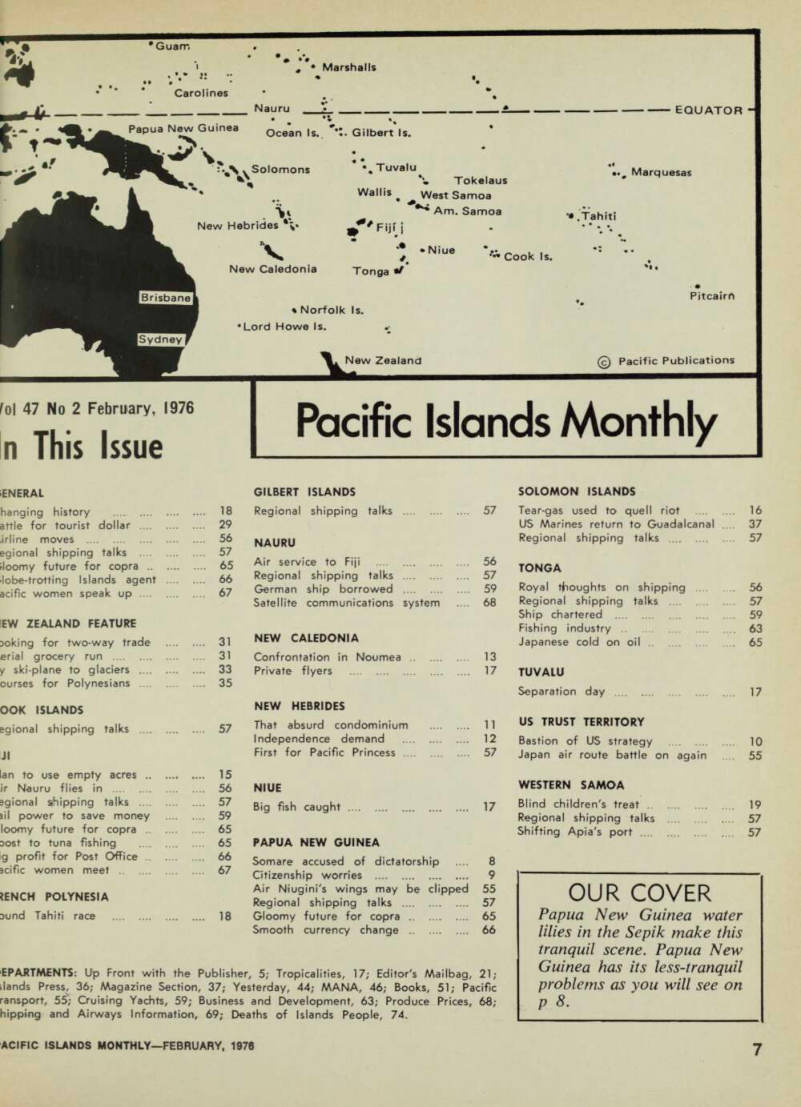
PIM has a new frontispiece map this issue, but only to keep up with the changing Pacific.
Since Independence, Papua New Guinea is one nation, with no dotted line down its central mountain chain to distinguish the old Papua from the old New Guinea. And, of course, the Gilbert & Ellice Islands Colony has now been split into the Gilbert Islands and Tuvalu. Another recent change has been the name of the British Solomon Islands Protectorate, which is now simply the Solomon Islands. And a change to come soon is in the Marianas, currently part of the Trust Territory of the Pacific Islands, but to have a separate identity.
Although PIM usually manages to keep up editorially with the changes, unfortunately the office system which puts the addresses on our subscriber copies doesn’t. PIM circulation department has always used stencils to label envelopes, and some of these stencils still show addresses in the “GEIC”, the “BSIP” or simply “New Guinea”.
One of our PNG subscribers wrote
during the month that he was still getting his copy addressed to “TPNG” (meaning the Territory of Papua and New Guinea) and although he “enjoyed the magazine very much and have never regretted taking out a subscription”, he’s greatly surprised to see PNG still addressed as a territory. Our apolo gies to this reader and hundreds of others in PNG, the Solomons, the Gilberts and Tuvalu, but we have been aware of the problem, and re lief is now at hand!
It costs money to change stencils, but we haven’t changed them because all our stencils are being discarded and in the next couple of months we are going on computer. Our com puter will get it right (so they keep telling us!) And, before we get any more let ters—yes, we do realise that the front cover of PIM still refers to the GEIC, but this is the last issue on which you will find that.
Footnote: We are relieved to see the people who design stamps share our problems. We’ve just received the latest GEIC definitives—or what presumably were designed to be GEIC definitives.
The set shows various Island
activities, such as fishing coconut dehusking, and copra loading, but in each case the Gilbert & Ellice Islands name has been blocked out and replaced with a Gilbert Islands overprint. The method of blocking out will create the interest, as the printers have used at different times red, black and gold—but with vary ing results! Mostly the red doesn’t do the job effectively, usually the black destroys the whole design of the stamp, and the gold overprint (on the 35c stamp) can’t even be seen unless the stamp is held to the light in a particular way.
We can only imagine that both the designers and the printers are tearing their hair; although collectors perhaps will be happy at these oddi ties forced on the world by changing Pacific history.
Details of the stamps are: 1c (cut ting toddy), 2c (lagoon fishing), 3c (cleaning pandanus leaves), 4c (casting nets), 5c (Gilbertese canoe), 6c (dehusking coconuts), 8c (weav ing pandanus fronds), 10c (weaving a basket), 15c (tiger shark and fishermen), 20c (beating a rolled pandanus leaf), 25c (loading copra), 35c (fishing at night), 50c (local handicrafts), and $1 (weaving a coconut screen).
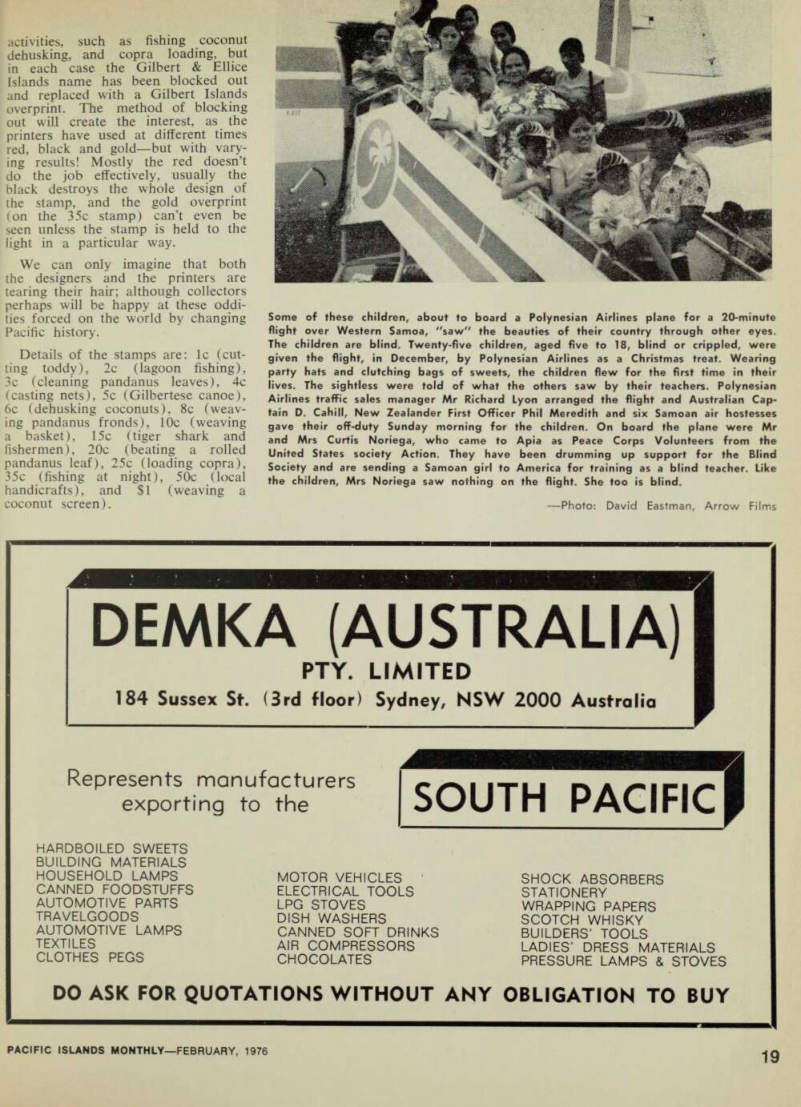
Some of these children, about to board a Polynesian Airlines plane for a 20-minute flight over Western Samoa, "saw" the beauties of their country through other eyes.
The children are blind. Twenty-five children, aged five to 18, blind or crippled, were given the flight, in December, by Polynesian Airlines as a Christmas treat. Wearing party hats and clutching bags of sweets, the children flew for the first time in their lives. The sightless were told of what the others saw by their teachers. Polynesian Airlines traffic sales manager Mr Richard Lyon arranged the flight and Australian Cap tain D. Cahill, New Zealander First Officer Phil Meredith and six Samoan air hostesses gave their off-duty Sunday morning for the children. On board the plane were Mr and Mrs Curtis Noriega, who came to Apia as Peace Corps Volunteers from the United States society Action. They have been drumming up support for the Blind Society and are sending a Samoan girl to America for training as a blind teacher. Like the children, Mrs Noriega saw nothing on the flight. She too is blind.
Photo: David Eastman, Arrow Films
Advertisements & other items, pp. 18-21 (1 item)
the Regent of Fiji
BOOK SPACE IN PARADISE
>4 mm »*■>
bhi
s:vi
The Regent of Fiji, with 300 gracious guest rooms, is paradise on the glistening Pacific shore.
Cordial, like a Fijian village, the Regent invites you to a treasure of Melanesian arts. The Steakhouse and The Terrace serve delicious food platters and a spectacular ocean-view.
Whafs more, the Regent is well-mannered service: in-room phones, air conditioning. Fijian stewards, complete banquet/convention pavilion and duty free shopping.
And the Regent is sports: scuba, sailing, fishing, beachcombing, swimming and tennis . All in wave-free Nadi Bay.
Book space in paradise. For the night of a lifetime.
The Regent of Fiji—2o minutes from the airport.
POST OFFICE BOX 441 • NADI, FUI ■ PHONE 70700 • TELEX (792) 5214
the Regent of Fiji
DENARAU BEACH RESORT
PHONE COUECT FOR RESERVATIONS
Mr. Rex Vidler, Sydney, Australia Sales Office No. 1 York Streef, 14th floor • Sydney, Australia 2000 Phone (02) 276469 In Auckland. New Zealand, phone Instant Hotels, 374921
DEMKA (AUSTRALIA)
PTY, LIMITED
184 Sussex St. (3rd floor) Sydney, NSW 2000 Australia
Represents manufacturers
exporting to the
HARDBOILED SWEETS
BUILDING MATERIALS
HOUSEHOLD LAMPS
CANNED FOODSTUFFS
AUTOMOTIVE PARTS
TRAVELGOODS
AUTOMOTIVE LAMPS
TEXTILES
CLOTHES PEGS
SOUTH PACIFIC
MOTOR VEHICLES
ELECTRICAL TOOLS
LPG STOVES
DISH WASHERS
CANNED SOFT DRINKS
AIR COMPRESSORS
CHOCOLATES
SHOCK ABSORBERS
STATIONERY
WRAPPING PAPERS
SCOTCH WHISKY
BUILDERS’ TOOLS
LADIES’ DRESS MATERIALS
PRESSURE LAMPS & STOVES
DO ASK FOR QUOTATIONS WITHOUT ANY OBLIGATION TO BUY
GLENYS
DICKSON
COUNTDOWN
your top sounds * tune to Radio Australia 090CM100 G.M.T. Monday oFriday -T - -i I^9
liADic mmm
write to Countdown. Radio Australia. Melbourne,3ooo, for record requests, programme guides.fan cards. & posters
Become a part of PlM’s Pacific and subscribe now
Pacific Islands Monthly Keeps you informed on Pacific happenings
Fi7/ in the details on the attached order forms
The Editor's Mailbag


Guadalcanal Memories
Of An Old Marine
The other day I was enjoying reading a back issue of PIM (Feb, 1975) and came across an article concerning the Solomon Islands. At first glance 1 noticed that the article was mostly of a political nature and I wasn’t immediately interested. How ever, on looking closer at the pic tures printed with the article, I realised I was looking at aerial views of the ridges, beaches and jungles where the US Marines and Japanese soldiers met to begin the many battles of the Pacific War, The pictures show today’s view of Honiara and Point Cruz and the Matanikau River area. About five or six miles east of there the marines landed on August 7, 1942 near the mouth of the Tenaru River.
For six months the battle raged on land and sea. The Matanikau vil lage and coconut farm were des troyed; several Japanese tanks were shot and burned on the sand bar at the river’s mouth. The Japanese commander, “Tenacious Tanaka”, threw his troops against the marines up and down Guadalcanal until over 25,000 Japanese had died and the island was left to the marines and their allies.
The beautiful waters out toward Savo island are now called “Iron Bottom Sound” because of the many warships that were sunk there during the battle. Your ships, the Australia and Canberra are there. You lost many fine men like Capt Gitting and Capt Farnsworth. The marines took into their fold Sergeant-Major Vouza, your Solomon Islander hero.
Marine A 1 Schmidt, machine gunner, was blinded fighting on the ridges above the Matanikau, but kept firing guided by his buddies nearby.
Pilot Joe Foss flew out of Henderson Field time after time, dead-tired, to shoot down almost 50 Japanese planes. Joe later became the Governor of his home state. Many other heroes were made at Guadal canal. They were given first priority to rest forever in Hawaii’s Punch Bowl cemetery.
The Japanese retired up the Solo mon chain only to have the “Devil
Dog” marines follow them relent lessly to New Georgia. Bougainville, the Gilberts, Iwo Jima and on to Japan itself where also in an August, the Atom bomb stopped the war.
During the long three years since the Guadalcanal landing, the marines fought to free many islands, but only on one were they fighting for Ameri can interests. This was on Guam.
The marine hymn has a phrase “First to fight for right and free dom . . The phrase doesn’t dis tinguish whose rights or freedom, what race, colour or creed. Marines interpret the phrase to include all mankind whether they be Chamorros, Gilbertese, Palauans, Solomon Island ers or, yes, even Japanese.
The Marine Corps celebrates its 200th birthday this (1975) year. The corps was founded November 10, 1775, by the Continental Congress which authorised the first two bat talions.
The marines have done a lot of fighting for right and freedom since then at lots of places around the world, but I like to believe Guadal canal will live in history as one of the more significant battlegrounds.
For it was there in 1942 that the free world watched and hoped and gained the inspiration and spiritual strength so desperately needed to defeat the Japanese.
T recall the day my unit left Guadalcanal to attack Okinawa back in 1945. My regiment had camped along the Bonegi River, west of Honiara. We were leaving for the last time. Our tent city was empty and as I prepared to board the boats I saw two natives appear out of the jungle and walk curiously among the vacant company streets. They were scavenging and wore nothing but a seashell at their loins and coloured baubles in their fuzzy hair. They seemed as primitive as the day Men dana discovered the Solomons hundreds of years before. I remem bered that day and those men as I read your article on the soon-to-be independence for the Solomons. I felt better for all the tough war experiences and gratified that these natives and their kind are now about to have a free nation of their own, like Papua New Guinea, Nauru,
Letters
Tonga and others. It won’t be easy for them, but it will certainly be worthwhile ... as was the battle for Guadalcanal.
Francis Hepburn
(formerly Marine Raider and 4th Regiment, residing on Kwajalein). >an Francisco. • See US Marines at Guadalcanal again, p 37
Cruise Yachts
From my experiences the time is ight for Island governments of the Pacific to take advantage of the ;conomic benefits offered by the growing numbers of yachts cruising he Pacific waters. From all over the vorld they come to the Pacific—not is the adventure seekers of old but is a new class of tourist intent on mjoying but not despoiling the slands. In a sense it is the Explora ion Era all over but the explorers ire now family groups and friends.
Vorld-wide cruising, particularly in he tropical waters, has become >ossible through improved yacht lesign, better weather reporting, and he availability of reliable local navi ;ation information.
People of all ages the world over lave taken to the water in great lumbers and, having whetted their ippetite for sailing in home waters, hey are now crossing oceans in heir small craft to see new lands and leople. The Pacific Ocean with its ;enerally fine weather and a multi ude of attractive islands and friendly •copies has become a most popular ruising ground. On July 14, 1975, *IM counted 56 visiting yachts in ‘apeete alone. They came from such formerly) far-away places as Australia, New Zealand, England, Jermany, United States, Canada, Iwitzerland, France and Belgium.
Ve are personally aware of many ►thers that were in ports stretched rom the Marquesas to the New lebrides.
A cruising yacht is combined home md transportation and depends on ts ports of call for supplies and ither necessities. While a yacht may lepart from its home port well pro isioned, the long ocean passages oon deplete the supplies requiring irovisioning along the way. This can •e an additional source of income o those Islands which have taken teps to attract the cruising yachts nan. PIM has from time to time eported income derived by Pacific
countries from tourism. The latest was Tonga (PIM, Oct, 1975, p 84) which happened to be our last coun try of call before coming to New Zealand to wait out the hurricane season. Tonga reported for 1974 that an average air tourist stayed 11 days and spent 5T17.25 per day while the average cruise ship tourist stayed one day and spent STIB.BI. I have no way of calculating comparative time and dollars spent by an average cruis ing yacht while in port but our experience may shed some light on such a comparison. Since leaving California in February, 1975, we have spent an average of $U520.50 each day while in port. Our duration
of stay has varied widely but possibly averaged between seven and 14 days putting as much as SUS2B7 into the local economy at a stop.
The sectors of the local economy which receive this income are notice ably different from those which re ceive the income from ship and air tourists.
People’s markets with their inviting home-grown, fresh foods and gro cery stores handling staple goods are first-sought places in the yachtsman’s shopping trip. Hardware, fuels and oils, and specialised maintenance services are other sectors of the local economy which benefit. It may come as somewhat of a surprise that
Island handicrafts are also eagerly sought but the yachtsman rarely buys at the tourist craft stores. More in keeping with his desire to meet the Island people he will usually seek out those persons who do the craft work and buy from them the tapa cloth, wood carvings, stone and shell jewellery, etc. He may even have the craft items made to order as we have often done combining the artisan’s skill with native materials to produce souvenirs far different from the usual kind at the tourist stores. All needs considered, the yachtsman’s dollar finds its way into different and, possibly, more basic economic channels of the host coun try than does the usual tourist dollar.
But why are some countries already attracting more cruising yachts than others? It is because the yachtsmen, through their exchanges of individual experiences, are estab lishing the relative visiting appeal of each country. Further, the ports of entry of each country materially in fluence the visiting appeal for the entire country. Today’s cruising yachtsman is not the transient ne’er do-well beachcomber/seaman of yes teryear and he is attracted by clean harbours, fair officials, and security for his yacht while in port.
Nothing turns yachtsmen off quicker than theft, harassment, or dirty harbours. We have encountered these problems to varying degrees in our United States-New Zealand crossing. Apia, as an example, is con sidered a security risk in cruising circles. Neiafu has undue harassment by local persons seeking the yachts man’s dollar even before he goes ashore. The beautiful harbour of Pago Pago has an unkempt shoreline.
Official harassment has been notice ably absent in all of our Pacific islands stops but we still carry scars from Mexican ports which are slow to heal. Since customs, immigration, agriculture, and port officials are the first and last persons a yachtsman meets in a foreign country, they make a lasting impression of his visit.
What, then, can a country’s port 3f entry do within economic reason o make its harbour attractive to the lundreds of overseas yachts now appearing in Pacific waters? First, provide some elementary shoreside acilities such as a place to shower vith fresh water (need not be warm), Jo laundry at least by hand, and Jraw water for the boat’s tanks. Toi ets would also help keep the harbour dean and a safe and secure dinghy lock is a very welcome sight.
Papeete is the unquestioned Pacific eader in taking steps to provide at ractive shore facilities for visiting yachts and no complaint is heard about the fair charge made. Secondly,
boat security and freedom from local harassment must be impressed on the local people and enforced by the harbour management; Thirdly, offic ial entry and departure procedures should be written (at least in outline form) and given to the entering yacht to avoid creating undesirable official problems. With such a variety of countries in the Pacific commun ity, it is little wonder that a foreign yacht occasionally has trouble when effecting an entry or departure clear ance in a new country.
Visiting yachtsmen can be ambas sadors of goodwill for your country and, if tourism is part of the econ omy, they can materially help it along. Recognition of the yachts men’s simple needs to make a visit pleasant is all that is asked.
Countries which would like to make their visiting yacht facilities known to US yachtsmen can write to me at PO Box 1315, Torrance, California 90505, USA, and I will endeavour to disseminate the in formation to the cruising yachtsmen.
Earl R. Hinz
Yacht Horizon, Whangarei, NZ.
New Hebrides
Elections
Congrats to the National Party brothers in New Hebrides and their historical success in November’s general elections!
We watch your progress with interest.
To the pitiful efforts of the evil colonial forces that tried to stop the National Party (PIM, Jan, p 8) . . .
Tut-tut.
Tarcissius M. Bobola
Port Moresby, PNG.
Bougainville's
Triplets
I write to challenge the statement made in the September, 1975, PIM (p 25) “Increasing output on Bou gainville” referring to the first record of surviving triplets born on Bougain ville.
I have only recently seen this article as I have been travelling a lot—in Papua New Guinea for the Dr George Brown centenary cele brations; on Bougainville during Sep tember, 1975, and in Rabaul for Independence Day celebrations.
But I knew that the statement was incorrect for I remembered the trip let births of girls at Tonu, Siwai, in 1957, while we were still living at Kihili Buin, one of which was named after my wife Beryl, so I wrote to the nurse who had been in charge at the time, Nurse Mary Addison, and only now have the details I asked for. I send a picture of the three girls born February 16, 1957, all of whom are still living, and the following details may prove of interest.
The mother’s name is Tapukoi, and the father’s name is Tamahe, who were living at Tonu village with their other three children, two boys and a girl.
The triplets were full-term babies and weighed 5 lb, 4 lb 7 oz and 3 lb 14 oz respectively. They were named Tohi, Komura and Beryl Touku. The parents cared for the two bigger ones, but Beryl was cared for at the sister’s house for her first five years. The girls are now nearly 19 years of age.
The first one, Tohi, is married to Mr Philip Potoruho; the second, Komura, is with her parents and the third, Beryl, is a nurse at the United
The Touku triplets 10 years ago—from the left, Komura, Tohi and Beryl.
Church Hospital at Tonu, Siwai. We saw her and talked with her during our stay in September last.
These triplets pre-dated those you mention by nearly 19 years, and are all grown-up, useful members of the Bougainville society today.
At the time of the birth, I was Superintendent of the Methodist Mission on Bougainville.
A. Harry Voyce (Rev)
Brisbane, Q.
Island Migrants
I read George Atkins’ “Language beating island migrants” enviously. (PIM Sept, p 29).
The Islanders living in New Zea land are believed to come from dif ferent cultures and the problems of language as he stated may be true.
But what has he done to remedy this problem in the Solomons for the rest of the Pacific Islands to absorb?
He should realise that the Islanders flooded to New Zealand on their own accord, and finding the place “paradise” decided to send for the families and friends back home, so the exodus progressed rapidly.
The backward black world from which Islanders emerge which he mentioned in support of what others think, could easily mislead tourists to the Islands, but perhaps true where he’s bred. Recently, there was an article about tourism in Tonga where visitors praised the kingdom about the things they see and the people they meet. This is the attitude of visitors to all the islands they’ve gone to, and this article in the paper is an insult to all of us in the Islands who are doing our jolly best to build up our societies to the standard Atkins is thinking about. There are no drinking habits in the islands like those he wrote about but because early settlers from the west came to the islands practised exactly what he said; such pictures islanders imitate, so the process is established.
Atkins brought to light Muldoon’s deportation threat against the people who don’t obey the law. But what’s the use of the law to the language and culture spoilt by western in fluence?
A mother language is taught first to Island children back home.
Gradually, English is taught further up the classes, and the children
arriving in New Zealand perhaps haven’t got all the knowledge they should have for that new society and environment.
We really appreciated the help and patience of those involved in education in an endeavour to shape Island children to suit the new en vironment.
But the nonsense Atkins bothered to advertise I gathered, was in humane, and I wish that he would have been awarded with a preaching decoration or something.
It’s entirely up to the authorities responsible to see that law and order are respected by visitors so making everyone happy.
We owe our sincere thanks to New Zealand for allowing and accepting Pacific people into the country, so it’s up to the Islanders themselves to show appreciation for this freedom. We in the Islands on the other hand don’t want them to return home spoilt but we want them full of new ideas suitable for the development of the Pacific nations.
Hermon P. Foliola
Hikutavake, Niue.
Where's Diana?
Perhaps one of your readers could help me find Diana, the daughter of the late H. L. (Harry) Downing who was a pre-war officer in New Guinea and later worked in the De partment of Territories in Australia.
I would like to ask her permission to publish some photographs taken by Mr Downing in New Guinea.
H. Nelson
(Dept of Pacific History, Australian National University) Canberra, ACT.
South Pacific
Commission
I have just received my copy of PIM November and hurry to con gratulate you on the candour and incisiveness with which you wrote “South Pacific Commission Needs a Heart Transplant”, the story of the Nauru South Pacific conference.
It should help in two ways: Act as a catalyst for people and govern ments involved in the membership of the South Pacific Commission and the South Pacific Conference, and provide accurate information to government and non-government organisations engaged in technical assistance to nations of the Pacific Islands, which help them in the policy-making decisions regarding the degree and manner of co operation and co-ordination with the
Spc.
We move to California tomorrow.
This will end a pilgrimage of 35
years in Latin America, Europe, South-east Asia, Africa and the Pacific Islands. But ended only in the sense of location, for I will still continue to go out on assignments as a Foreign Affairs consultant, and anticipate several visits a year to these beloved Pacific Islands.
With best wishes and again to express what I did to the Editor in person at Nauru. The Pacific Islands Monthly is the most valuable and interesting publication covering the Pacific Islands. Each month’s issue is looked forward to most eagerly.
William B. Hussey.
Pago Pago, enroute to Beverly Hills, California.
Subject: Shock
Shock, sir, is the word I find closest to my lips upon commenting on your cover for November, 1975.
I refer of course to the startling in sinuation implied in the caption “Nauru: what happened there?” You left this reader in a quandary of thoughts speculating upon all sorts of salacious possibilities. I’m sure you’ll have other readers responding to your audacious choice of matter for a cover presentation.
Joe Murphy,
Editor, Micronesia Independent.
Majuro.
Subject: Thrill
I have been a reader and an ad mirer of your magazine for many years. I have always been impressed with your photography.
On the cover of the November issue is a picture of indescribable beauty and grace. It is especially meaningful for me because the wo man is a Solomon Islander.
Peter Falion.
Honiara.
Guam Games
Please let me clear up a point that was made about yachting in the South Pacific Games.
In your September issue of PIM (p 15) it was stated that “. . . Mike Tattersall, of Auckland, had more than an official interest in the com petition. The lasers came from his factory . . .”
The only truth to this statement is that Mike Tattersall is from Auck
land. The Laser sailboats were made by Performance Sailcraft Corpora tion in California and were purchased and brought out to Guam by Para dise Safari, the authorised Laser dealer for Guam and the Trust Terri tory.
Scott Daniel.
Paradise Safari, Guam. • PlM’s comment on the source of the lasers arose from a mis understanding. Mike Tattersall makes lasers and PIM understood they came from his factory. Sorry, Scott!
Air Nauru's
Rights
How can Stuart Inder write an article on Air Nauru saying bluntly that it “still has traffic rights diffi culties” without blushing at his choice of accompanying photograph? (PIM, Nov, p 65).
Air Nauru still has no traffic rights in or out of Brisbane in any direc tion and this year has had to endure the chagrin of seeing Air Pacific get the first traffic rights on the Brisbane- Noumea route, which has proved to be very profitable for it.
In any court of natural justice I would feel that Air Nauru should be entitled to at least $2,000,000 damages against the Australian Government and Qantas, Air Pacific’s greedy godmother, for being forced to deny passengers their Noumea- Brisbane leg all the years that they have been flying it.
You sure have to be rich to be independent in the Pacific. Stuart Inder is right on that at least.
Yours in admiration of Air Nauru.
John Allan.
Spring Hill, Qld. • Stuart Inder wasn't responsible for the photograph showing Air Nauru in Brisbane in earlier days.
However, neither Inder's story nor the picture caption said that Nauru had any rights in Brisbane, so Reader Allan is tilting at the wrong wind-mill. But we agree with him about the need for rights, as Air Nauru for technical reasons is forced already to put down in Brisbane on its south bound flights between Nauru- Honiara-Ndumea-Melbourne. Nou mea to Melbourne via Brisbane is certainly a heck of a direction, and especially annoying for passengers who might want to disembark at Brisbane and can't.
Advertisements & other items, pp. 22-28 (2 items)
Mixmaster Mixer
mm. i l|| : ;
3 times better than any
other mixer. Designed especially for family food preparation. 12-speed mixfinder dial indicates the correct speed for each mixing action. Complete with 2 heat-resistant bowls and juice extractor. Sunbeam’s exclusive 3-way beating action— extra large, contoured beaters, and automatic bowl movement— gives perfect aeration and more even mixing. It can handle everything from beating one egg to mixing a large fruit cake.
AUSTRALIA
A RECYCLING COMPANY
12 SEVILLE STREET, VILLAWOOD, N.S.W. 2163
CABLES: WITWOOL TELEX: AA24541
TEL.: SYDNEY 72-0631
Bulk Suppliers to the Islunds of
• ZORBIES BRAND NON-WOVEN WIPERS
• KOALA BRAND CLEANING CLOTHS
• INDUSTRIAL WIPING RAGS
• INDUSTRIAL WADDING AND FLOCK
• COTTON WASTE STOCKINETTE
• GRADED SECOND HAND CLOTHING
OF ALL DESCRIPTIONS
WITTERS”—The most prominent name in rags
WRITE FOR PRICE LIST
KOALA BRAND CLOTHS
What Makes it
an Alfa Romeo
Front wheel drive and McPherson suspension make it handle like an Alfa.
V\ The four cylinder, horizontally opposed motor and four speed gearbox make it perform like one, too.
And disc brakes all round guarantee it stops the way an Alfa Romeo should.
The only un-Alfa thing about the Alfasud is its price.
What Nates it
a Family Car
It’s big on the inside, so there’s room inside for the whole family.
But it’s quite compact on the outside.
So it doesn’t need much room to park.
The space inside the boot is about the same as the space in the average family refrigerator.
The front seats adjust up and down as well as backwards and forwards. And the steeringcolumn also adjusts upand down.
So you can adjust your Alfasud to suit you and your family. Which is better than adjusting your family to suit the car.
alfa
romeo
AN INVESTMENT IN SAFETY
For information contact Alfa Romeo Pty. Ltd.
Cnr. Beauchamp & Botany Rds., Botany, N.S.W., Australia.
Trade enquiries welcome.
m XT: w-: Caterpillar reliability, productivity, availability. Now you can get it all in a wheel skidder. The 518.
A whole new standard in skidder engineering. 120 turbocharged horsepower, 20,400 pounds of working muscle with full articulation and frame oscillation for stability and minimum maintenance.
Single lever “on the go” powershift. Dual rate steering for controlled response at all speeds. An operator’s compartment engineered for efficiency with safety features built In for man and machine.
You’ll find all the best skidder ideas, plus added refinement and top quality manufacturing that can make the 518 the backbone of your logging operation.
And South-West Pacific Caterpillar dealers will ensure that your backbone stays in top condition no matter how far in the bush you are.
Parts, maintenance, repairs or simple information—we’ll see that you get it fast.
So tackle the jungle with the new Cat 518.
Caterpillar Dealers in South-West Pacific.
Lae: Milford Haven Road, Ph: 42 2355 Port Moresby: Champion Parade, Knoedobu.
Ph: 3138 or 2098.
Bougainville: Itakara.
Industrial Park, Arawa.
Ph: 95 9004. 154 Queens Road, Suva.
Ph: 24 051-4 Cables: Carptrac Suva Telex: Carptrac FG2190 Suva T
CARPENTERS
TRACTOR E> EQUIPMENT
HD 529
Primitive luxury
(Pol)iicsian style) Nestled away in the untouched Kingdom of Tonga is new, luxurious "Port of Refuge" International resort. Here is a unique opportunity for your clients to experience the tranquil and relaxed Tongan atmosphere while they enjoy the picturesque surroundings of the new "Port of Refuge". And only a short flight from Fiji.
Reasonable tariffs from $17.50 with special concessions for children. Agents commission 10 per cent.
Tonga's
Port of Refuge
INTERNATIONAL RESORT U
7?* Uava’u Tonga
Cables: "Refuge" Tonga or "Tongatours"
Sydney. Phone: Sydney 85-1603 or 852162
I AT A LOSS
TO COMFORT BABY?
t Those distressing symptoms that come I with teething troubles —sore gums, digestive disorders, intestinal upsets, £ can be, if used as directed, safely and [ quickly soothed with Fisher's Teething b Powders. You'll be delighted at what b an effective and soothing aid they are to baby—and when baby's happy your upsets and nervous tension will be > soothed, too. Fisher's Teething Powders b are available from your chemist or store. Fisher & Co., Manufacturing Chemists (Est. 1876) 17 May St., St. Peters,
N.S.W. 2044.
PMBO9/72
DATELINE HOTEL
TONGA
"Friendly Hotel" of the "Friendly Islands"
Situated along the Nukualofa waterfront. Only five minutes walk from town. Single, double, family suites, airconditioning, and hot and cold water showers. Pool, bar, restaurant, duty-free shop, tour desk and boutique.
Book through your travel agent or write to International Dateline Hotel, P.O. Box 62, Nukualofa Tonga.
Cable Address: "DATELINE".
Represented Overseas by: Charles J. Henry and Associates Pty. Ltd.
Sydney and Melbourne.
n
A oiesel engine-powered Forestmil sawing timber from small hardwood logs in Tasmania.
The Forestmil
PORTABLE
SAWMILL
turns trees
into timber!
Forestmil produces house building or construction size timber direct from the log in the forest. No need to resaw, it’s ready to use. Inter-acting vertical and horizontal blades cut simultaneously producing accurate timber any size up to 12” x 6” x 18”, including boards, framing, bridge sized, etc.
Larger machines also available.
CHECK THESE
STANDARD FEATURES
• Dismantles into small sections • Only two men required to operate • Total weight 1,560 lb. • Erected ready to use in one hour • Powered by petrol or diesel engine Over 700 Forestmils operating in 23 countries
MACQUARRIE
INDUSTRIES .v .a
F.O. Box 20, Coburg
Victoria 3058, AUST.
Cables: Macbound Melb.
Telex: AA 33729
23
»ACIFIC ISLANDS MONTHLY— FEBRUARY, 1976
The tourist IS searching for
the Pacific of his dreams
By a Sydney travel agent
A recent item in PIM stated that colour TV in Australia was a cause of the falling-off in tourism by Aussies in Fiji. At least this is the view of the chairman of the Fiji Visitors Bureau. He claims that in stead of visiting Fiji the Aussie is buying a colour TV set. He also attributes Fiji’s tourist slack to the fact that Fiji is meeting competition from New Caledonia where there is a gambling casino at Noumea. He considers the gambling Australians would need a casino to get them to visit Fiji. 1 think the chairman is dodging a few important facts as to why tour ists visit a country or they don’t. If an Aussie wants to visit Fiji, buying a colour TV set won’t stop him—it will merely postpone the day. The point is, does he?
There is, of course, the question of cost. If it’s expensive to get there, it’s got to be worthwhile. Is Fiji worth it? If recent bad publicity is any guide, it is not.
Poker Machines Apparently, gambling casinos and poker machines have been suggested for Fiji in the past and the govern ment had the good sense to say “No”.
Their thinking was no doubt influ enced by more pressing consider ations than the tourist scene. The Fijian seems to be having difficulty coping with the stresses of an evolv ing society and the realisation that the haves and have-nots are a fact of life. The Fijian appears to be ensuring what side he's on.
When taxi drivers make their own rules and look on the tourist as fair game; when there is no law making it mandatory for all taxis to have meters so the tourist can see what he is paying for; when the crime rate is such that you run the risk of being robbed in broad daylight; where drinking is not a civilised cus tom but a marathon, resulting in dangerous drunks abroad, then Fiji had best take a long, hard look at itself if it wishes to attract tourists.
Within five minutes of arrival a tourist has the “feel” of a place.
What a country is, is shown in the officials and the people with whom he comes in contact. If it is a “grab”
society your tourist sees it instantly.
If it is a sick society, he feels it. And your Pacific Island tourist is a romantic—he doesn’t want to see either.
What then does the tourist look for from the Pacific? All his life he has heard of the friendly, happy Islanders; of blue skies, white beaches and waving coconut palms.
In music, song and literature the Pacific has been romanticised, so that to our starry-eyed tourist it represents the next best thing to Paradise.
Island Conspiracy
He is going for a holiday and hopes he has left the rat-race behind him. On the average he may be there two weeks. He is very often not rich but has saved hard for the trip.
He will spend his money and be happy doing it if he is getting full value. But he doesn’t want to be taken for his shirt. It must surely be possible to treat him kindly, give him a good time and send him on his way with his dreams intact, even if it means an island conspiracy to do so.
The difficulty with conspiracies, however, is that they often come un stuck. And when your starry-eyed tourist starts to look around him, he may be in for a jolt.
There are the frangipani and hibis cus just as he imagined it—but the place looks filthy. Empty beer bottles and beer cans all over the place; beaches and reefs strewn with broken glass and rusty tins; derelict cars and discarded machinery dotting the beautiful landscape. Who’d have be lieved it?
And call that a main road?—he’d never had such a rough ride in his life. What a bone-shaker!
He’s right, of course. Roads come first and casinos last. He can gamble at home, but he’s spent a lot of money to come and see your land and your people and he expects to do this in reasonable comfort.
And when he books into a hotel he doesn’t want to see a carbon copy of the Hotel Australia or a Miami beach skyscraper. It should have something of the character of the place he is in. He wants to hear the sound of the sea, the rustle of coco nut palms smell the scent of frangi
pani. And he can’t do all that from 20 storeys up. He expects meals to be reasonably priced and be tempted to taste the dishes of the region. He expects to see coconuts on the menu as well as on the trees.
And while he equates the Pacific Islander with the happy-go-lucky, he expects reasonably efficient service for which he is paying. Not break fast at 10 o’clock when he was dis tinctly told 9 o’clock, and the bus arriving at noon when he was told 1.15 pm. No tourist industry will survive such frustrations. He only has two weeks, remember, and wants to see and do as much as he can.
Having been shown courtesy, friendliness, and had a marvellous time sightseeing, cruising, fishing, shopping, swimming, filming and photographing to his heart’s content, our tourist is ready for the night’s entertainment. Can he survive with out poker machines and a casino?
He can and must.
Song and Dance I have sat for hours listening and looking to island song and dance, telling of their history and their legends of which I didn’t understand a word—but what matter if the sights and sounds are right? Your happy tourist will be as delighted as I was, if only he is given the chance to get some of it on film. He has just got to show the folk back home—and of course it’s all wonderful publicity for the islands.
It is important to remember that the tourist is looking for the un spoiled Pacific of his dreams. He does not want to see the islands he has idealised becoming a part of the civilised rat-race. If he is dis illusioned the first time he will not go back again.
If the Islands wish to cash in on the tourist bonanza, then the people themselves must be educated in the part they too must play. Your ro mantic tourist doesn’t want to be looked at with dollar eyes but to be welcomed as the romantic that he is.
He is in love with you, so don’t let him down.
And leave the casinos and poker machines to those places devoid of mystery and imagination—the Islands don’t need them.
Advertisements & other items, p. 30 (1 item)
Epiglass antifoulings
New range of
give up to 12 months
growth-free performance.
Consolidated Chemicals Ltd have launched a new range of antifoulings now being marketed under the name of Epiglass E-type. Superior, in terms of performance, to any antifouling currently on the market, they are the result of years of research and development work in the company’s laboratories followed by extensive testing.
PRODUCT PERFORMANCE PROVED
Tests have been carried out under widely varying conditions throughout the Pacific area which have conclusively proved the effectiveness of E-type antifouling on both Commercial and Pleasure craft.
12 MONTHS GROWTH-FREE PERFORMANCE
Epiglass E-type antifouling is formulated to guard your boat against the expensive damage that can be done by algae, barnacles, slime weed and general fouling. The formulation includes a very high percentage of special toxins which are “release controlled" This positive control release of toxins means that if applied as directed you can expect up to 12 months growth-free performance.
Whatever size your boat, whether it is power or sail, protect below the water line with new Epiglass E-type antifouling.
iix
LA I i Consolidated Chemicals Ltd. 1 P.O. Box 15-104,
] New Lynn, Auckland.
i i i Please send me a free copy of your Epiglass Boat Owners J Manual plus facts on new E-type antifouling.
I Mr I i
I Address i
I (Block letters please)
I j from 7ft to 73ft I epiglass power or sail
New Zealand's looking
for a bigger two - way trade flow
New Zealand looks to the Pacific Islands, especially its nearest South Pacific neighbours, as an area offer ing continuing prospects for trade expansion.
Recent export/import statistics support this view.
Exports from New Zealand, both of primary products and manufac tured goods, have shown a steady increase over the years, and although the balance of trade continues to be in New Zealand’s favour, there has been a significant increase in the value of purchases from the Islands which in the year ended June, 1975, totalled $NZ36.9 million, compared with SNZI6.7 million in the year mded June, 1974.
Shipping problems are of concern to both New Zealand and other Paci fic nations. But despite this, there las been a considerable growth in trade within the Pacific region.
Fiji is New Zealand’s largest South Pacific market, with exports to the /alue of $NZ20,191,097 (fob) re :orded for the year ended June 1975.
Phis market has shown a steady growth over the years with meat and iairy products, fruit and vegetables, md manufactured goods being the najor purchases.
With current New Zealand efforts o diversify further into the manu acturing sector, Fiji will continue to >e a valuable market for these pro lucts.
Sugar is Fiji’s main export to New Zealand although there has been a teady growth in sales of wood, wood nanufactures, and miscellaneous nanufactured goods including jewel ery handicrafts.
Trade with Papua New Guinea las continued to expand over recent 'ears with New Zealand’s main im >orts from PNG being coffee, tea, lardwoods and veneers. New Zea and purchases of coffee have in reased four-fold between 1970 and 974. As the forestry industry ex >ands, it is likely that NZ importers vill seek to buy increasing quantities )f hardwoods, veneers and other vood products.
New Zealand imports from other
Pacific island groups are mainly fruit and vegetables (including bana nas), oil seeds, nuts and kernels (including desiccated coconut and products) and other primary pro duce, but imports of phosphate from Nauru and Ocean Island in the Gil berts amounting to 5NZ22.4 million in the year ended June 30, 1975, are also important aspects of New Zea land-Pacific trade.
While Fiji has been a target for special trade promotional activities, countries such as Papua New Guinea, Western Samoa, American Samoa, New Caledonia, Tonga, French Polynesia, and the New Hebrides are also valuable export markets.
Meat, dairy products, chemicals and a wide range of manufactured goods have been New Zealand’s chief export earners.
The NZ Government has recently established a Developing Countries Liaison Unit to provide assistance in finding opportunities on the New Zealand market for Pacific exporters and to encourage a greater flow of trade to New Zealand (and indeed third countries) from its Pacific neighbours.
Early 1975 saw a Fiji selling mission visit major New Zealand centres and similar missions are ex pected shortly from other developing countries including Papua New Guinea. These ventures indicate the type of trade assistance through which New Zealand is helping the development of its Pacific trading associates.
A scheme to facilitate the import ation into New Zealand of handi-
In terms of help for the un developed nations, New Zea land is, probably, the most generous country in the world.
Per head of population—and it’s only around three million —New Zealand gives away in aid more money than any other country. In the last 20 years, she has contributed more than $75 million to Asian funds and another $lB million is earmarked for 1975-76. The South Pacific Islands do even better. The beneficiaries could reciprocate by buying New Zealand’s undeniably high class exports. She’s looking for bigger markets in the Pacific.
crafts from the Pacific Islands was established in 1973, It provides for duty-free entry for certified handi crafts from Papua New Guinea, Tonga, Fiji, Western Samoa, the Cook Islands, Niue and the Tokelau Islands.
Last October, the NZ Government instituted a new pricing scheme for Island bananas which will assist both the Island producers and the NZ consumers by encouraging the pro duction of high-quality fruit.
The current world economic situ ation has caused balance of payment problems and depressed primary produce prices for both New Zealand and other Pacific nations. However, the proximity of New Zealand and its Pacific neighbours, a deliberate policy of closer co-operation by the governments, and an awareness by commercial parties of continuing business opportunities available will all ensure that trade between New Zealand and her Pacific partners will continue to grow and prosper in the coming years.
Air NZ's aerial grocery run
New Zealand has the chance to boost by up to five times its exports to New Caledonia following a decision by Air New Zealand to replace DCBs with DC 10s on its weekly Auckland-Noumea service.
The airline’s move is designed not only to overcome shortage of cargo capacity on the route but also to enable exporters of primary products to take full advantage of the new competitive edge provided by devaluation.
“We have been conscious of the lack of sufficient cargo capacity on this route and devaluation has made it all the more necessary to enhance New Zealand’s airfreighting capability to Noumea’’, said Air New Zealand’s Director of Commercial Services, Mr J. B. Wisdom.
He said it would enable exporters not only to expand existing business but also to open avenues for other products.
Fruit and vegetables are the major export to New Caledonia. Air New Zealand carried more than 200,000 kilos of them in the 1974-75 trading year.
Other significant exports have been meat, dairy products, fish and oysters and building materials. The extra capacity is expected to result, particularly, in an expansion of the meat trade.
Advertisements & other items, p. 32 (1 item)
George & Ashton fibreglass
insulated or refrigerated units
can be custom built in any size
or coloun are foam insulated,
seam free, hygenic, easily cleaned,
can give a greater payload
and can be pre-fabricated
for easy shipping and erection.
Could you ask for more
in a fibreglass refrigerated unit?
It you could, then why not ask Goerge & Ashton, specialists sections. Panels made to buyers specifications, fittings in solving problems in fibreglass. They've solved problems are supplied. Units can be supplied as a static or a mobile for Roadair (illustrated). General Foods, Borthwicks, Kiwi cool room, insulation properties are excellent. The units Bacon, and La Grande, to name but a few. They’ve made conform to the most stringent health regulations and are units to fit any type of vehicles from 6’ to 42’ long, from approved by the NZ Departments of Health and pickup to semi trailer. Agriculture. All units are hard wearing, hygenic, corrosion Units can be made assembled or in prefabricated resistant and easy to maintain.
George and Ashton Limited Could you ask for more?
Then ask George & Ashton Limited P.O. Box 2056, South Dunedin, New Zealand Telephones 4-108 or 54-109
By ski-plane
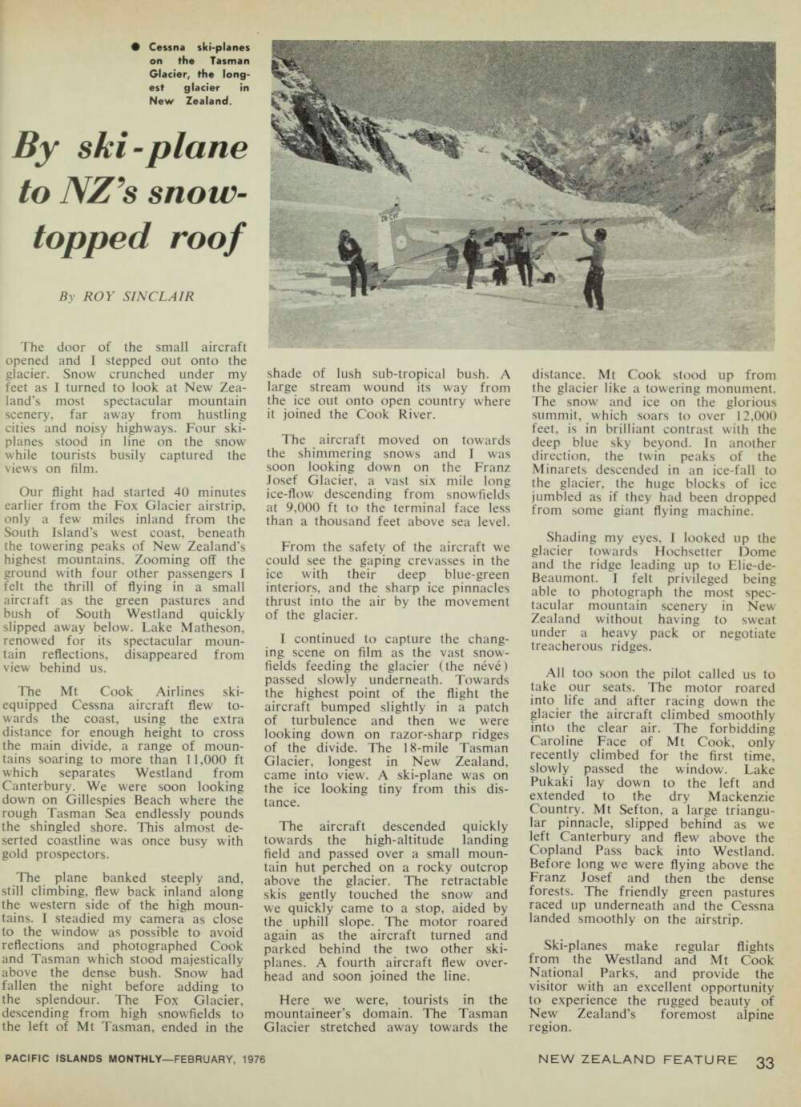
to NZ’s snow topped roof
By Roy Sinclair
The door of the small aircraft opened and I stepped out onto the glacier. Snow crunched under my feet as I turned to look at New Zea land’s most spectacular mountain scenery, far away from hustling cities and noisy highways. Four ski planes stood in line on the snow while tourists busily captured the views on film.
Our flight had started 40 minutes earlier from the Fox Glacier airstrip, only a few miles inland from the South Island’s west coast, beneath the towering peaks of New Zealand’s highest mountains. Zooming off the ground with four other passengers I felt the thrill of flying in a small aircraft as the green pastures and bush of South Westland quickly slipped away below. Lake Matheson, renewed for its spectacular moun tain reflections, disappeared from view behind us.
The Mt Cook Airlines ski equipped Cessna aircraft flew to wards the coast, using the extra distance for enough height to cross the main divide, a range of moun tains soaring to more than 11,000 ft which separates Westland from Canterbury. We were soon looking down on Gillespies Beach where the rough Tasman Sea endlessly pounds the shingled shore. This almost de serted coastline was once busy with gold prospectors.
The plane banked steeply and, still climbing, flew back inland along the western side of the high moun tains. I steadied my camera as close to the window as possible to avoid reflections and photographed Cook and Tasman which stood majestically above the dense bush. Snow had fallen the night before adding to the splendour. The Fox Glacier, descending from high snowfields to the left of Mt Tasman, ended in the
shade of lush sub-tropical bush. A large stream wound its way from the ice out onto open country where it joined the Cook River.
The aircraft moved on towards the shimmering snows and I was soon looking down on the Franz Josef Glacier, a vast six mile long ice-flow descending from snowfields at 9,000 ft to the terminal face less than a thousand feet above sea level.
From the safety of the aircraft we could see the gaping crevasses in the ice with their deep blue-green interiors, and the sharp ice pinnacles thrust into the air by the movement of the glacier.
I continued to capture the chang ing scene on film as the vast snow fields feeding the glacier (the neve) passed slowly underneath. Towards the highest point of the flight the aircraft bumped slightly in a patch of turbulence and then we were looking down on razor-sharp ridges of the divide. The 18-mile Tasman Glacier, longest in New Zealand, came into view. A ski-plane was on the ice looking tiny from this dis tance.
The aircraft descended quickly towards the high-altitude landing field and passed over a small moun tain hut perched on a rocky outcrop above the glacier. The retractable skis gently touched the snow and we quickly came to a stop, aided by the uphill slope. The motor roared again as the aircraft turned and parked behind the two other ski planes. A fourth aircraft flew over head and soon joined the line.
Here we were, tourists in the mountaineer’s domain. The Tasman Glacier stretched away towards the
distance. Mt Cook stood up from the glacier like a towering monument.
The snow and ice on the glorious summit, which soars to over 12,000 feet, is in brilliant contrast with the deep blue sky beyond. In another direction, the twin peaks of the Minarets descended in an ice-fall to the glacier, the huge blocks of ice jumbled as if they had been dropped from some giant flying machine.
Shading my eyes, I looked up the glacier towards Hochsetter Dome and the ridge leading up to Elie-de- Beaumont. I felt privileged being able to photograph the most spec tacular mountain scenery in New Zealand without having to sweat under a heavy pack or negotiate treacherous ridges.
All too soon the pilot called us to take our seats. The motor roared into life and after racing down the glacier the aircraft climbed smoothly into the clear air. The forbidding Caroline Face of Mt Cook, only recently climbed for the first time, slowly passed the window. Lake Pukaki lay down to the left and extended to the dry Mackenzie Country. Mt Sefton, a large triangu lar pinnacle, slipped behind as we left Canterbury and flew above the Copland Pass back into Westland.
Before long we were flying above the Franz Josef and then the dense forests. The friendly green pastures raced up underneath and the Cessna landed smoothly on the airstrip.
Ski-planes make regular flights from the Westland and Mt Cook National Parks, and provide the visitor with an excellent opportunity to experience the rugged beauty of New Zealand’s foremost alpine region.
• Cessna ski-planes on the Tasman Glacier, the long est glacier in New Zealand.
Advertisements & other items, p. 34 (1 item)
Methnn
Ttfe touch of beauty"
PLUMBING BRASSWARE SUPPLIED BY
INTERNATIONAL BRASSWARE LTD
OF NEW ZEALAND
The "Methven" range of plumbing brassware, supplied by New Zealand's international Brassware Ltd, is one of the world's finest for the extent of its selection and the superb high quality of its manufacture and finish. All fittings are made from certified brass or gunmetal and are triple coated i.e. copper, nickel and chrome (or gold) in modern, sophisticated, semi-automated plating plants.
Methnn
CS9 J \ . * • B For further information please write for catalogue material and wall charts
INIERMAIIONAI BRASSWARE ITD.
P.O. Box 15142, Auckland 7, New Zealand 55 Portage Road, New Lynn, Auckland.
Phone 876-195 Cables "Inbrass" Telex NZ2700 Fittings available include: Taps and Faucets • Mixing Valves • Shower Roses and Fittings • Reducing Valves • Relief Valves • Bathroom Fittings • Hospital Faucets and Fittings • Back Flow Preventers • Forgings (machined and unmachined) • Castings in Brass • Polypropylene Traps • Injection Mouldings. 8667
Courses For

Polynesians
Pacific Islanders are very much a part of New Zealand’s industrial economy.
Many thousands work in factories, on construction sites and in com merce. In fact, many have risen through the ranks to become super visors in a very short time.
To overcome communication and language problems experienced by some supervisors, the NZ Depart ment of Labour, through its Indus trial Training Service, has developed Instructor-Tutor courses for Poly nesians. These have been accepted with enthusiasm by management and
Polynesian personnel.
In Auckland the programmes have been operating for almost a year and the first Wellington programme was held at the end of last October.
Wellington personnel taking part came mainly from Western Samoa.
Their tutor, Hugo Stanley, an Indus trial Training Service officer, came to New Zealand from Savalalo, Apia, 14 years ago.
Some course members had already been through the programmes in their own factories or with the In-
dustrial Training Service. For others it was an entirely new experience.
The men and the one woman on the Wellington course all agreed the programme would help them im mensely in their instruction and induction work with all nationalities.
In Auckland, Polynesian Training Officer, Fred Atiga, has with John Pasley, a training development officer, conducted six Polynesian
Instructor courses covering 20 com
panies. Students included people
from the Cook Islands, NZ Maoris, Niueans, Tongans and Samoans.
All company managers have com mented favourably on the results of the programme. They have noted improved performance and changed attitudes of employees which could only be attributed to the Polynesian Instructor programme.
Training officer Hugo Stanley makes a point to (from left) Amatago Milo, Time Lolo, Ana Sea and lakapo Pio.
Advertisements & other items, pp. 35-36 (2 items)
Ask the bank which has
Do you want to do business in New Zealand?
40% of the banking business
in New Zealand
The BNZ can give you full information on buying or selling in New Zealand and overseas. Full information on investment, movement of money, transfers of dividends etc., is also readily available.
There are offices everywhere, more than 400 in fact.
Whatever your financial or trade needs, the BNZ can help you.
Wellington-Head Office, International Division, Box 2392.
Sydney-GRO Box 507, Sydney, N.S.W. 2001.
Melbourne-GRO Box 528 E, Melbourne, Vic. 3001.
Tokyo-Mr E. L. Banks, Bank of New Zealand Representative Office, Japan. Suite 240,lShin,Tokyo Bldg, 3-1,3-Chrome, Marunouchi, lOO.
Singapore-Mr R. F. Warren, Bank of New Zealand Representative Office, South East Asia. Suite 230,23 rd Floor, Ocean Bldg, Coltyer Quay, Singapore 1.
London-PO Box 402, LondonEC4P.4.H.E.
Fiji, Suva-25 Victoria Parade. Also at Labasa, Lautoka, NadijSigatoka, Ba
Bank of New Zealand
From the
Islands Press
The Pitcairn Miscellany reporting the birth of a daughter to Tom and Betty Christian: As one lion said to another lion at the Coliseum —Ah goody , here’s another Christian.
From the Norfolk Island News which announces “We’re on the phone at last” and
reports that being without a phone—
. . . meant that outraged readers had to drive down to Collins Head in order to register their protests. On Tuesdays, there were usually two queues, one at the News Office and one at the editor’s house. To avoid unfairness, people with complaints were given numbered chits, so that they could be assured that someone else would not get their scream heard first.
Coffee was served, and many good friendships sprang up among people waiting to assault the editor.
A Fiji Times headline, reminiscent of the days of cannibalism: FTU tear ns over drinking teachers .
From the Papua New Guinea Post-Courier reporting that Prime Minister Mr Michael Somare had cut his K 12,000 a year salary by K 1,000: . . . Mr Somare said he did not believe that he or his ministers or MPs were overpaid. "People who have been critical of politicians' salary levels should keep in mind that there are no cost of living adjustments for parliamentarians.
Except in very special circumstances a Member of Parliament retains the same salary level for the four-year period of his term", he said.
From the Lae Nius: National male public servants living at the Government Hostel in Lae want the hostel’s facilities and meals upgraded in order to improve its living conditions, the President of the hostel, Mr. Lukas Yawau, said this week. Mr. Yawau said that meals were very poorly prepared. Two meals of bread and spaghetti were eaten daily during breakfast and lunch hours, he said. ‘‘We need a good balanced diet to give us energy to do our work well” . . .
The officers are also concerned about their cooks who get themselves drunk when they are rostered for duty.
From an editorial in the Tonga Chronicle
on Family Planning:
Isn't it just right that each family plan the number of children as thought essential. Whoever planned, regardless what, I think he is following the unique example manifested in Christmas joys. According to
clairvoyant Edgar Cayce and Dead Sea Scroll, Jesus was looked after and taught by Essenes staff, particularly Miss Judy. He was sent to Persia, India and Egypt to study and sat for examination qualifying for Priesthood. During this time Mother Mary didn't have any more children until Jesus was 10 years old before His brother James was conceived. His two sisters, Ruth and Jude were born much later.
What a Happy Planned Family, From a letter by Lady Cleland, of Port Moresby, in the Papua New Guinea Post-Courier setting out one point of view of the situation in Timor: ... I doubt if PNG would hove been os restrained and patient for as long as Indonesia has. Of course, she must intervene if the United Nations won’t.
Would not a tiny Communist country which could offer bases to Russia or China be a terrible threat not only to Indonesia but to Australia and Papua New Guinea?
British Government policy as explained by
the new British Resident Commissioner in the New Hebrides, Mr J. S. Champion, and reported in the New Hebrides News: British Government policy is neither to keep constitutional progress from territories which want it, nor to force it on countries which do not want it. Every territory is different, though, and the needs and problems of each one must be carefully and separately considered.
For example, we need to be very sure what are the real wishes and interests of the people of a country.
They may not always be those of the people with the loudest voices.
From a Fiji Times report on earth tremors which shook Viti Levu in mid-December: . . . Air Pacific’s reservations clerks on the fourth floor of Air Pacific House dropped their telephones and left callers in the air when the tremor struck . . .
Many workers at Government Buildings raced outdoors after the tremors but moved back indoors when coconuts began falling among them from nearby trees . . .
An editorial in the Norfolk Island News makes a few guesses about the future following the defeat of the Australian Labor Government: It seems probable that —Pressures to amalgamate Norfolk Island into Australia and make it conform with the 'rest of Australia' will disappear for the time being. Socialist philosophies, including Mr Bryant's belief that there should be no private ownership of land on Norfolk, will become merely philosophies again rather than prospective government policies . . .
From the Tohi Tala Niue: The guest of honour to the celebrations (first anniversary of self-government on Niue) was the President of Nauru, Hammer Deßoburt nicknamed by the locals as 'Moneybags 7 .
Magazine Section
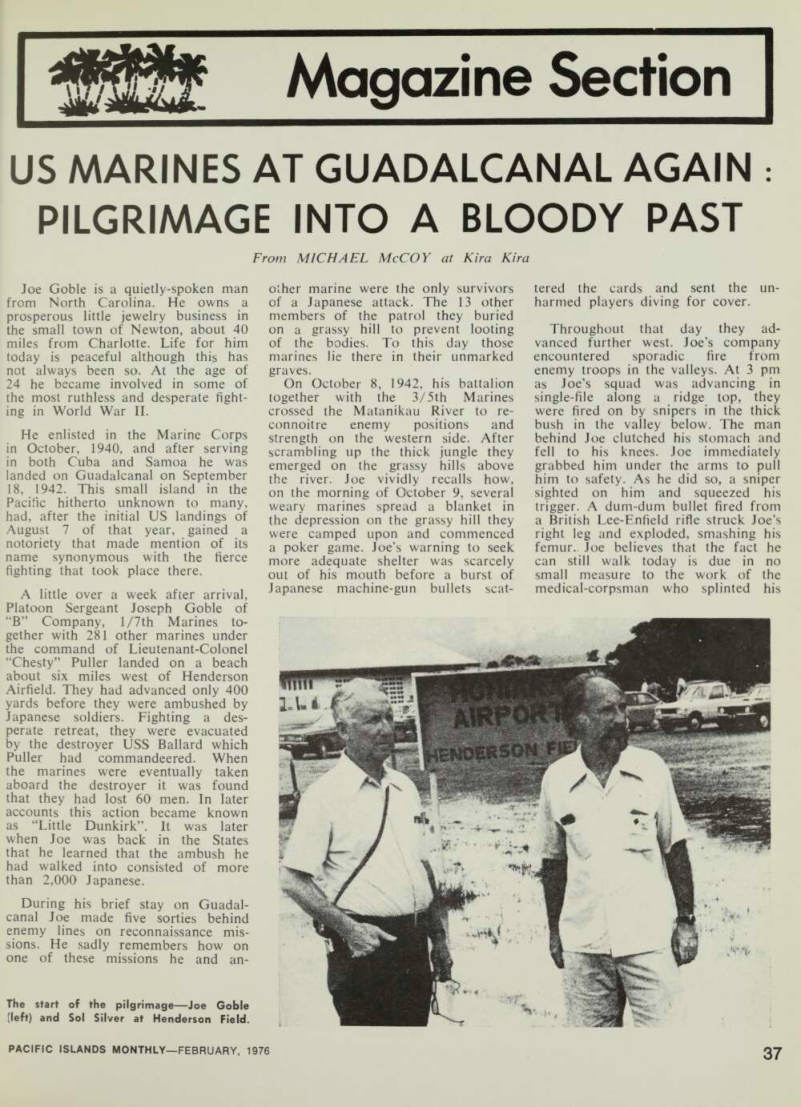
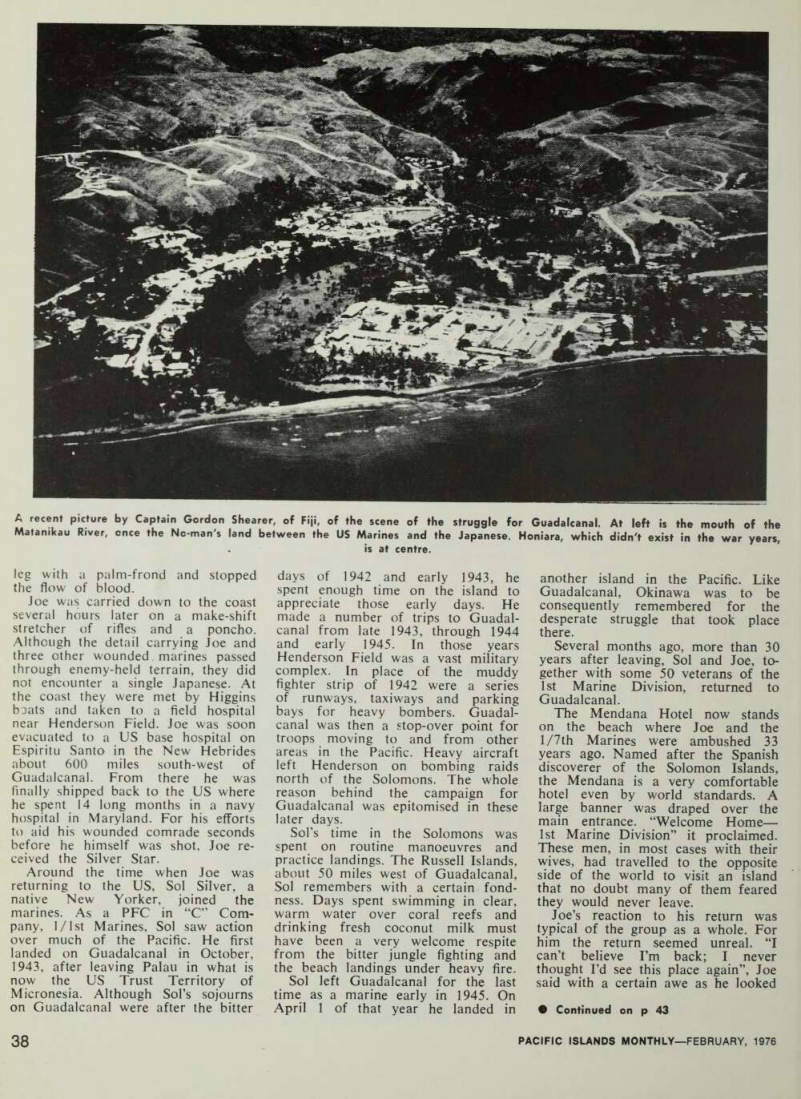
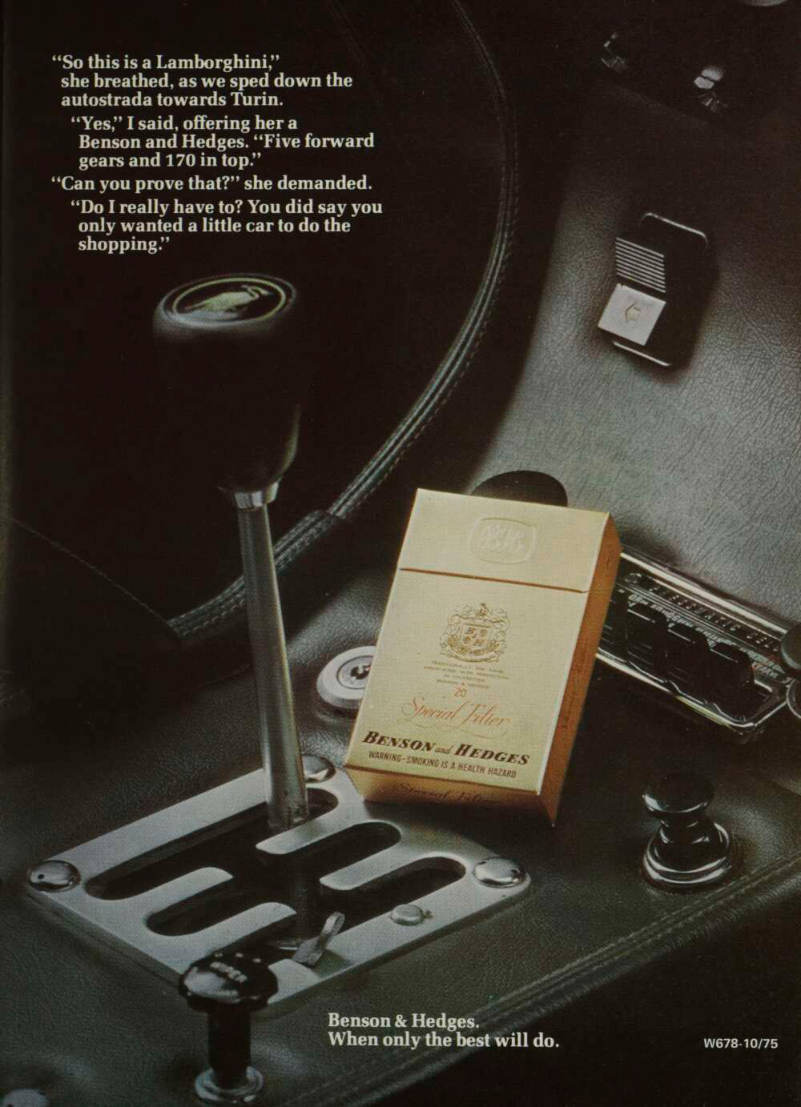
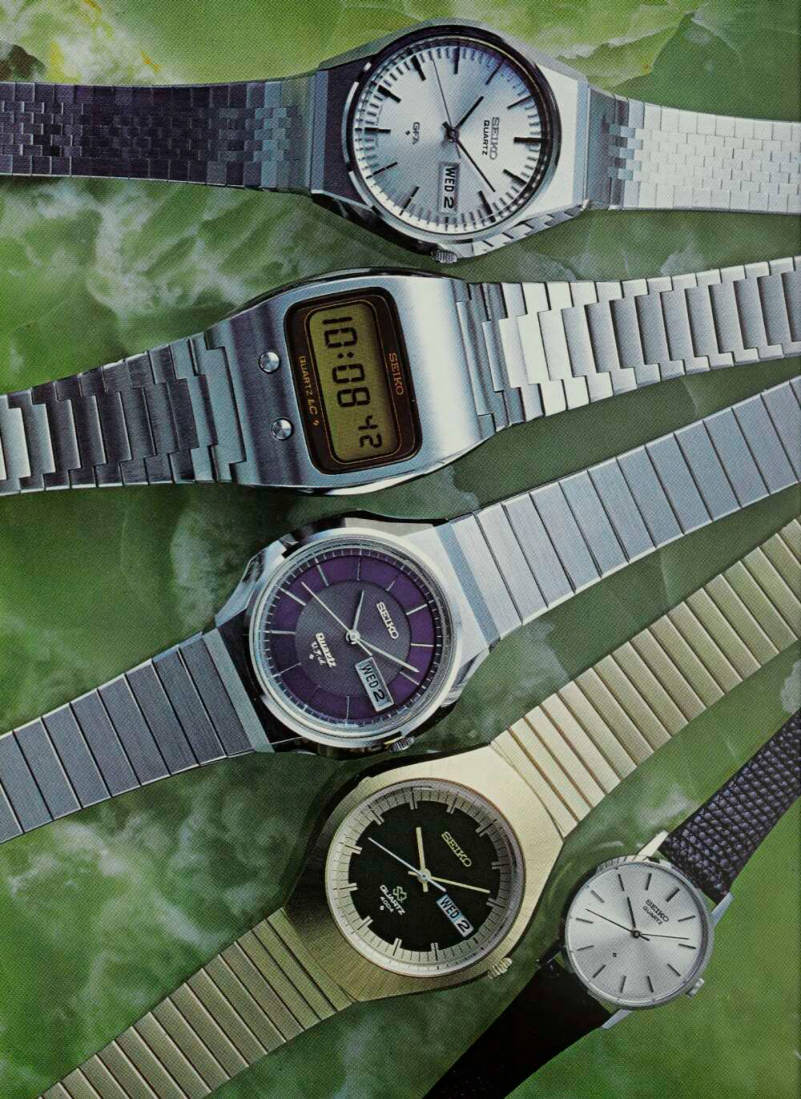
Us Marines At Guadalcanal Again:
Pilgrimage Into A Bloody Past
From MICHAEL McCOY at Kira Kira
Joe Goble is a quietly-spoken man from North Carolina. He owns a prosperous little jewelry business in the small town of Newton, about 40 miles from Charlotte. Life for him today is peaceful although this has not always been so. At the age of 24 he became involved in some of the most ruthless and desperate fight ing in World War 11.
He enlisted in the Marine Corps in October, 1940, and after serving in both Cuba and Samoa he was landed on Guadalcanal on September 18, 1942. This small island in the Pacific hitherto unknown to many, had, after the initial US landings of August 7 of that year, gained a notoriety that made mention of its name synonymous with the fierce fighting that took place there.
A little over a week after arrival, Platoon Sergeant Joseph Goble of “B” Company, 1 /7th Marines to gether with 281 other marines under the command of Lieutenant-Colonel “Chesty” Puller landed on a beach about six miles west of Henderson Airfield. They had advanced only 400 yards before they were ambushed by Japanese soldiers. Fighting a des perate retreat, they were evacuated by the destroyer USS Ballard which Puller had commandeered. When the marines were eventually taken aboard the destroyer it was found that they had lost 60 men. In later accounts this action became known as “Little Dunkirk”. It was later when Joe was back in the States that he learned that the ambush he had walked into consisted of more than 2,000 Japanese.
During his brief stay on Guadal canal Joe made five sorties behind enemy lines on reconnaissance mis sions. He sadly remembers how on one of these missions he and an
other marine were the only survivors of a Japanese attack. The 13 other members of the patrol they buried on a grassy hill to prevent looting of the bodies. To this day those marines lie there in their unmarked graves.
On October 8, 1942, his battalion together with the 3/sth Marines crossed the Matanikau River to re connoitre enemy positions and strength on the western side. After scrambling up the thick jungle they emerged on the grassy hills above the river. Joe vividly recalls how, on the morning of October 9, several weary marines spread a blanket in the depression on the grassy hill they were camped upon and commenced a poker game. Joe’s warning to seek more adequate shelter was scarcely out of his mouth before a burst of Japanese machine-gun bullets scat
tered the cards and sent the un harmed players diving for cover.
Throughout that day they ad vanced further west. Joe’s company encountered sporadic fire from enemy troops in the valleys. At 3 pm as Joe’s squad was advancing in single-file along a ridge top, they were fired on by snipers in the thick bush in the valley below. The man behind Joe clutched his stomach and fell to his knees. Joe immediately grabbed him under the arms to pull him to safety. As he did so, a sniper sighted on him and squeezed his trigger. A dum-dum bullet fired from a British Lee-Enfield rifle struck Joe’s right leg and exploded, smashing his femur., Joe believes that the fact he can still walk today is due in no small measure to the work of the medical-corpsman who splinted his
The start of the pilgrimage—Joe Goble [left) and Sol Silver at Henderson Field.
leg with a palm-frond and stopped the flow of blood.
Joe was carried down to the coast several hours later on a make-shift stretcher of rifles and a poncho.
Although the detail carrying Joe and three other wounded marines passed through enemy-held terrain, they did not encounter a single Japanese. At the coast they were met by Higgins boats and taken to a field hospital near Henderson Field. Joe was soon evacuated to a US base hospital on Espiritu Santo in the New Hebrides about 600 miles south-west of Guadalcanal. From there he was finally shipped back to the US where he spent 14 long months in a navy hospital in Maryland. For his efforts to aid his wounded comrade seconds before he himself was shot, Joe re ceived the Silver Star.
Around the time when Joe was returning to the US, Sol Silver, a native New Yorker, joined the marines. As a PFC in “C” Com pany, 1/lst Marines, Sol saw action over much of the Pacific. He first landed on Guadalcanal in October, 1943, after leaving Palau in what is now the US Trust Territory of Micronesia. Although Sol’s sojourns on Guadalcanal were after the bitter
days of 1942 and early 1943, he spent enough time on the island to appreciate those early days. He made a number of trips to Guadal canal from late 1943, through 1944 and early 1945. In those years Henderson Field was a vast military complex. In place of the muddy fighter strip of 1942 were a series of runways, taxiways and parking bays for heavy bombers. Guadal canal was then a stop-over point for troops moving to and from other areas in the Pacific. Heavy aircraft left Henderson on bombing raids north of the Solomons. The whole reason behind the campaign for Guadalcanal was epitomised in these later days.
Sol’s time in the Solomons was spent on routine manoeuvres and practice landings. The Russell Islands, about 50 miles west of Guadalcanal, Sol remembers with a certain fond ness. Days spent swimming in clear, warm water over coral reefs and drinking fresh coconut milk must have been a very welcome respite from the bitter jungle fighting and the beach landings under heavy fire.
Sol left Guadalcanal for the last time as a marine early in 1945. On April 1 of that year he landed in
another island in the Pacific. Like Guadalcanal, Okinawa was to be consequently remembered for the desperate struggle that took place there.
Several months ago, more than 30 years after leaving, Sol and Joe, to gether with some 50 veterans of the Ist Marine Division, returned to Guadalcanal.
The Mendana Hotel now stands on the beach where Joe and the 1 /7th Marines were ambushed 33 years ago. Named after the Spanish discoverer of the Solomon Islands, the Mendana is a very comfortable hotel even by world standards. A large banner was draped over the main entrance. “Welcome Home— -Ist Marine Division” it proclaimed.
These men, in most cases with their wives, had travelled to the opposite side of the world to visit an island that no doubt many of them feared they would never leave.
Joe’s reaction to his return was typical of the group as a whole. For him the return seemed unreal. “I can’t believe I’m back; I never thought I’d see this place again”, Joe said with a certain awe as he looked
• Continued on p 43
A recent picture by Captain Gordon Shearer, of Fiji, of the scene of the struggle for Guadalcanal. At left is the mouth of the Matanikau River, once the No-man's land between the US Marines and the Japanese. Honiara, which didn't exist in the war years, is at centre.
over the hills he had walked as a marine.
With little difficulty Joe found the very spot where he was shot on October 9, 1942. He traced the path he took over the Matanikau River and over the grassy ridges. As Joe pointed out his movements on that October day, Sol was moved to remark how vivid was Joe’s recollection. “The whole thing is really burnt into his brain, he can never forget the time he spent here”.
Although the township of Honiara, the capital of the Solomon Islands now stands along the coast where much of the action took place during the Guadalcanal campaign, the grass hills behind the town are much as they were 30 years ago.
Along the tracks where Joe walked as a marine, rusty pieces of metal still litter the ground. C-ration tins, pieces of shrapnel, mortar bombs and unexploded hand-grenades are still to be seen. Coca-Cola bottles, spent cartridge cases and magazine clips are everywhere. Fox-holes still line the ridge-tops. Sol climbed into a few of these and, by digging in the loose earth at the bottom, found numerous pieces of wartime mis cellany that he recognised at once.
Sol Silver is an astute man, keenly aware of the world around him. He admitted to a certain reluctance be fore returning to Guadalcanal. He remembers the war as “a bad dream, a nightmare, not something to come back to”. Once back on Guadalcanal though, standing on the ridges look ing over the grassy plains, he too was overcome by that feeling of un reality that Joe professed to. Sol is more philosophical than the other veterans with regard to the war and Guadalcanal in particular. Unlike the majority of marine veterans Sol regards the latter-day conflict of Vietnam as “a mistake—an illegal war my country was suckered into”.
The emphasis on “my country” is most apparent: Sol is a keen patriot.
He regarded Guadalcanal as a neces sary evil; something that had to be done. With the Japanese perilously close to Australia and given the strategic position of Henderson Field, his sentiments are no doubt justified in that context of 1942.
Sol was able to appreciate Guadalcanal for what it is today.
When not viewed in its wartime set ting, Guadalcanal is a beautiful island. With cool, clean, fast-running rivers all along its coast, palm fringed beaches and, by tropical stan dards, very pleasant climate, Guadal canal could easily be any city dweller’s idea of a South Pacific paradise. The tranquility of the island today belies the image it pre sented to the world 30 years ago.
Perhaps the only people to benefit from the war on and around Guadal canal are the salvage divers who work in the Solomons today. Mostly Australians, they have found that the returns from the wartime scrap metal in the waters around Guadal canal are quite lucrative. Brass pro pellers from Japanese and US ships, copper and brass engine-room fittings and the brass shell cases from US ammunition dumps are all easily dis posed of on the scrap metal market in Australia.
Like the land, the sea-bottom around the coast of Guadalcanal and particularly around Red Beach where the initial landings took place, is littered with wartime debris. Jeeps, bulldozers, landing craft, pontoon bridges, aircraft and shell cases are all accessible to anyone proficient with scuba apparatus.
No doubt, the most grisly wartime relics still on Guadalcanal are the human remains. Skeletons are not uncommonly found as the township of Honiara expands. In 1972, a Solomon Islander from Guadalcanal found the skeletal remains of several US soldiers in thick bush on Mount Austen behind Honiara. With these remains were several items of personal effect. A gold ring, tooth brushes and, most importantly, the dog-tags identifying the bodies were also there.
Joe Gaffney, who was then man ager of the Mendana Hotel, collected these dog-tags and sent a letter to the appropriate authorities in the US notifying them of the find. Several months later a representative of the US Air Force Attache’s Office in Canberra, Australia, arrived in Honi ara to collect the bones.
I went with Tech Sergeant Wood
and Joe Gaffney to the place where the remains were found. After about a mile walk through the forest we found the graves on a small embank ment bordering a narrow stream. By digging in these shallow graves we came across more bone fragments and the remains of boots as well as buttons and brass eyelets from cloth ing and equipment. Nearby, along the stream bed, we found a consider able number of human bones. Skull fragments, ribs, femurs and sections of vertebrae were all there. All of these unidentified remains were solemnly collected and carried back to Honiara. Ironically enough, these bones were sent to a US Air Force base in Japan where, in the case of the identified remains, it was to be decided whether or not to send them to any next-of-kin still living.
The Japanese, too, have returned to collect their dead. More than 20,000 Japanese soldiers died on Guadalcanal and over the past few years there have been several groups from the Japanese War Graves Com mission return to Guadalcanal to collect their soldiers’ remains. These groups have also erected monuments at various sites on the island dedi cated “to the Japanese and American soldiers who gave their lives in their country’s cause”.
Before the Ist Marine Division veterans left Guadalcanal they visited the village of Jacob Vouza, war-time Sergeant-Major Jacob Vouza of the Solomon Islands Police who was captured by the Japanese. Repeatedly bayoneted by his captors, he refused to betray the positions of the US troops he then served.
After being left for dead he man aged to scramble back to the Ameri can lines where he gave a full report on the Japanese positions and strengths. Today Vouza is an old man. He is still held in great esteem by his people. In turn Vouza has a great deal of respect and admiration for the American people. Since the war Vouza has visited the US where he was decorated by the Marine Corps for his gallantry. He proudly wears his Marine Corps uni form and flies the American flag in his village which has been affec tionately renamed “California”.
Although Guadalcanal is looked upon almost reverently by the Americans who fought there, to the Solomon Islander in 1975 it is but one of the islands of the Solomon Islands. A British protectorate since before the war, the Solomons today are striving towards independence.
While not a rich country in terms of resources, they possess an un spoilt beauty and a lifestyle that many richer countries would do well to emulate.
Jacob Vouza
Advertisements & other items, pp. 39-42 (1 item)
“So this is a Lamborghini/'
she breathed, as we sped down the autostrada towards Turin.
“Yes,” I said, offering her a Benson and Hedges. “Five forward gears and 170 in top.”
“Can you prove that?” she demanded.
“Do I really have to? You did say you only wanted a little car to do the shopping.” y 7. «l i- >.A "S X 1 f Benson & Hedges.
When only the best will do.
W678-10/75 lx A ’
VO
SEI.KO »
QUARTZ
X Z'l jm IM / \ \ mL *
THE SEIKO QUARTZ
COLLECTION.
CHANGING THE WORLD’S
STANDARD OF ACCURACY.
The Seiko Quartz Collection encompasses a wide and exciting scope of quartz watches for men and women. Quartz guaranteed accurate to within one second per month. Ultra-thin quartz. Day/date Quartz. Digital quartz watches with liquid crystal for continuous readout to the second, and no buttons to push. Even a digital quartz chronograph. It's what you'd expect of Seiko.
Seiko sold the world's first quartz wristwatch.
And Seiko even makes every part of every watch (except for the battery) to insure impeccable quality control and a superb product. Whatever Seiko Quartz model you select, you get more than just a technologically advanced timepiece. You get the watch that's changing the world's standard of accuracy. Seiko Quartz. $a
SEIKO
Someday all watches will be made this way.
Sony presents more power,
more tonal quality than you ever
dreamed was possible.
The Sony CF-480S cassette-corder/radio sounds as big and real as life itself.
Its powerful, specially-designed amplifier delivers 4 watts of power-enough to fill even the largest room with clear, distortion-free sound.
What’s more, it has a unique 2-way speaker system. One big 6 1/2-inch woofer for the lows and a separate 2-inch tweeter for the highs.
Result: Superb re grams and cassette recordings, with audibly superior shortwave and medium wave sound, too.
In fact, the great-sounding CF-480S represents Sony cassette-corder technology at its finest; there is a DC servo-controlled tape drive motor, sensitive electret condenser microphone, tape selector for normal and CrCh cassettes, mic mixing controls, and much more. It’s a dream of versatility.
But you shouldn’t just take our word for it.
Visit the nearest and audition the Sony CF-480S for yourself.
You’d never dream that a could sound , so good. * 15 ?}»»• d
Yesterday
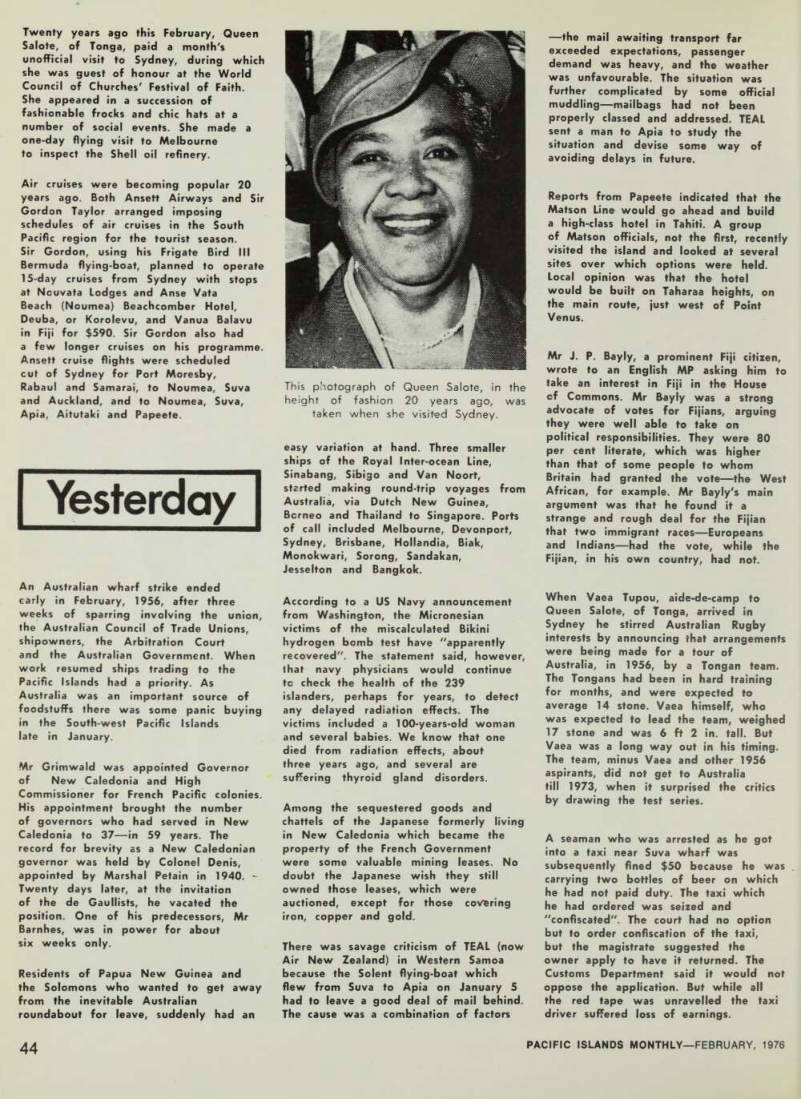
Twenty years ago this February, Queen Salote, of Tonga, paid a month's unofficial visit to Sydney, during which she was guest of honour at the World Council of Churches' Festival of Faith.
She appeared in a succession of fashionable frocks and chic hats at a number of social events. She made a one-day flying visit to Melbourne to inspect the Shell oil refinery.
Air cruises were becoming popular 20 years ago. Both Ansett Airways and Sir Gordon Taylor arranged imposing schedules of air cruises in the South Pacific region for the tourist season.
Sir Gordon, using his Frigate Bird 111 Bermuda flying-boat, planned to operate 15-day cruises from Sydney with stops at Nouvata Lodges and Anse Vata Beach (Noumea) Beachcomber Hotel, Deuba, or Korolevu, and Vanua Balavu in Fiji for $590. Sir Gordon also had a few longer cruises on his programme.
Ansett cruise flights were scheduled cut of Sydney for Port Moresby, Rabaul and Samarai, to Noumea, Suva and Auckland, and to Noumea, Suva, Apia, Aitutaki and Papeete.
An Australian wharf strike ended early in February, 1956, after three weeks of sparring involving the union, the Australian Council of Trade Unions, shipowners, the Arbitration Court and the Australian Government. When work resumed ships trading to the Pacific Islands had a priority. As Australia was an important source of foodstuffs there was some panic buying in the South-west Pacific Islands late in January.
Mr Grimwald was appointed Governor of New Caledonia and High Commissioner for French Pacific colonies.
His appointment brought the number of governors who had served in New Caledonia to 37—in 59 years. The record for brevity as a New Caledonian governor was held by Colonel Denis, appointed by Marshal Petain in 1940. • Twenty days later, at the invitation of the de Gaullists, he vacated the position. One of his predecessors, Mr Barnhes, was in power for about six weeks only.
Residents of Papua New Guinea and the Solomons who wanted to get away from the inevitable Australian roundabout for leave, suddenly had an
easy variation at hand. Three smaller ships of the Royal Inter-ocean Line, Sinabang, Sibigo and Van Noort, started making round-trip voyages from Australia, via Dutch New Guinea, Borneo and Thailand to Singapore. Ports of call included Melbourne, Devonport, Sydney, Brisbane, Hollandia, Biak, Monokwari, Sorong, Sandakan, Jesselton and Bangkok.
According to a US Navy announcement from Washington, the Micronesian victims of the miscalculated Bikini hydrogen bomb test have "apparently recovered". The statement said, however, that navy physicians would continue to check the health of the 239 islanders, perhaps for years, to detect any delayed radiation effects. The victims included a 1 00-years-old woman and several babies. We know that one died from radiation effects, about three years ago, and several are suffering thyroid gland disorders.
Among the sequestered goods and chattels of the Japanese formerly living in New Caledonia which became the property of the French Government were some valuable mining leases. No doubt the Japanese wish they still owned those leases, which were auctioned, except for those covering iron, copper and gold.
There was savage criticism of TEAL (now Air New Zealand) in Western Samoa because the Solent flying-boat which flew from Suva to Apia on January 5 had to leave a good deal of mail behind.
The cause was a combination of factors
—the mail awaiting transport far exceeded expectations, passenger demand was heavy, and the weather was unfavourable. The situation was further complicated by some official muddling—mailbags had not been properly classed and addressed. TEAL sent a man to Apia to study the situation and devise some way of avoiding delays in future.
Reports from Papeete indicated that the Matson Line would go ahead and build a high-class hotel in Tahiti. A group of Matson officials, not the first, recently visited the island and looked at several sites over which options were held.
Local opinion was that the hotel would be built on Taharaa heights, on the main route, just west of Point Venus.
Mr J. P. Bayly, a prominent Fiji citizen, wrote to an English MP asking him to take an interest in Fiji in the House cf Commons. Mr Bayly was a strong advocate of votes for Fijians, arguing they were well able to take on political responsibilities. They were 80 per cent literate, which was higher than that of some people to whom Britain had granted the vote —the West African, for example. Mr Bayly's main argument was that he found it a strange and rough deal for the Fijian that two immigrant races—Europeans and Indians—had the vote, while the Fijian, in his own country, had not.
When Vaea Tupou, aide-de-camp to Queen Salote, of Tonga, arrived in Sydney he stirred Australian Rugby interests by announcing that arrangements were being made for a tour of Australia, in 1956, by a Tongan team.
The Tongans had been in hard training for months, and were expected to average 14 stone. Vaea himself, who was expected to lead the team, weighed 17 stone and was 6 ft 2 in. tall. But Vaea was a long way out in his timing.
The team, minus Vaea and other 1956 aspirants, did not get to Australia till 1973, when it surprised the critics by drawing the test series.
A seaman who was arrested as he got into a taxi near Suva wharf was subsequently fined $5O because he was carrying two bottles of beer on which he had not paid duty. The taxi which he had ordered was seized and "confiscated". The court had no option but to order confiscation of the taxi, but the magistrate suggested the owner apply to have it returned. The Customs Department said it would not oppose the application. But while all the red tape was unravelled the taxi driver suffered loss of earnings.
This photograph of Queen Salote, in the height of fashion 20 years ago, was taken when she visited Sydney.
Advertisements & other items, pp. 45-46 (2 items)
Wunderflex gives
good design at low cost
m £ You want modern design?
Then use modern material that won’t warp, shrink or rot You want least cost?
Then build with a board that can be worked with handyman’s tools.
Inside and out, your home will have the modern, simple lines of Wunderflex building board.
E324ED
kViunderlich
Wunderflex
Available from: Papua New Guinea: Steamships Trading Co. Ltd.
Norfolk Island; Irvine's Building Supply Centre- Made in Australia and marketed by CSR Building Materials Export Sales; 4 O'Connell Street, Sydney, Australia 2000
mAnA
is a vehicle for Pacific Islands’ writers and artists to publish their work. It is an organ of the South Pacific Creative Arts Society and its editorial committee comprises writers from many islands.
Material for publication must be sent direct to MANA’s editor, Marjorie Crocombe, South Pacific Creative Arts Society, Box 5083, Suva.
They are all familiar names in this month’s MANA and, with the exception of artists Malakai Lavulo, who hails from Tonga, and the well-known Aloisio Pilioko, a Wallis islander, who has his studio in the New Hebrides, they are all from Fiji—short-story writers Rokobua Naiyaqa and Sam Simpson and poets Sushil Sharma and Alefina Vuki.
Turning Point
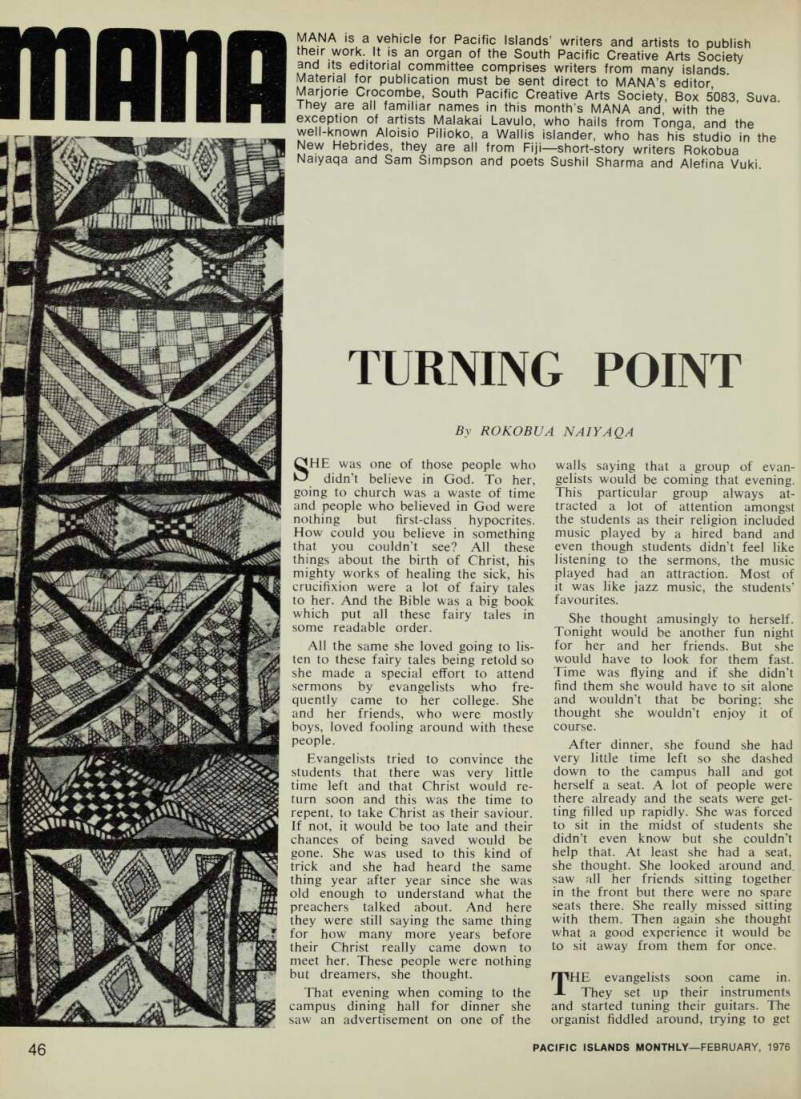
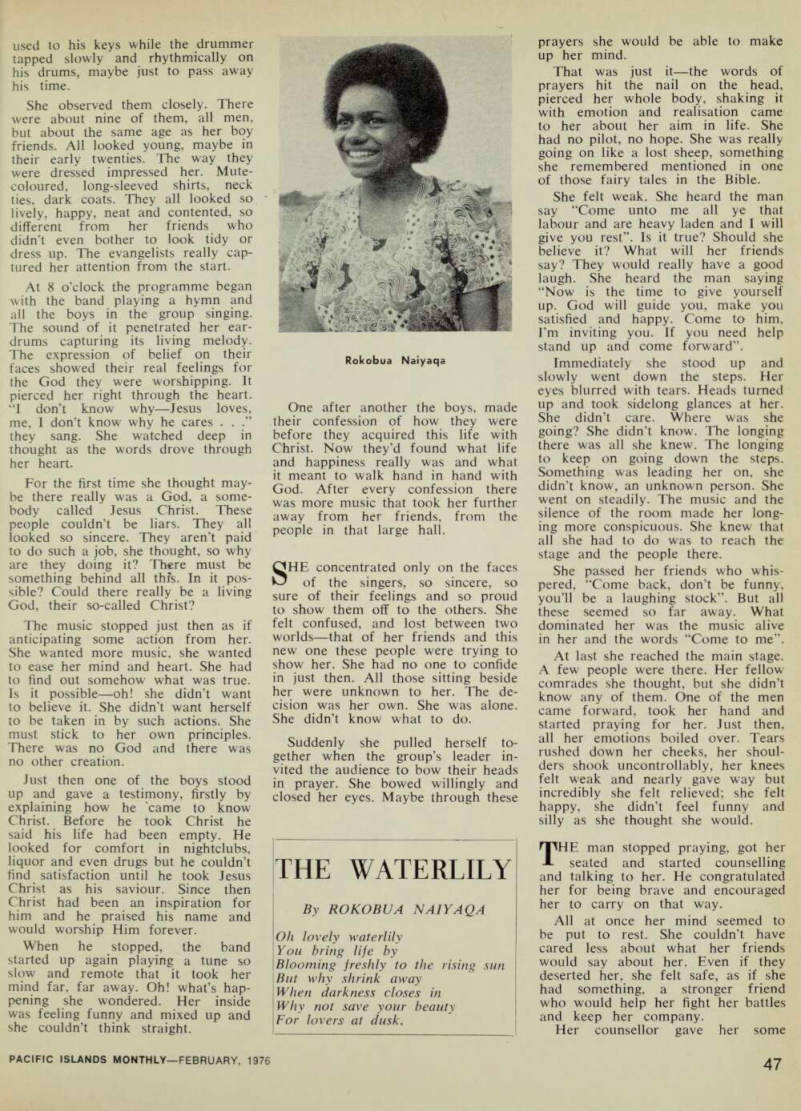
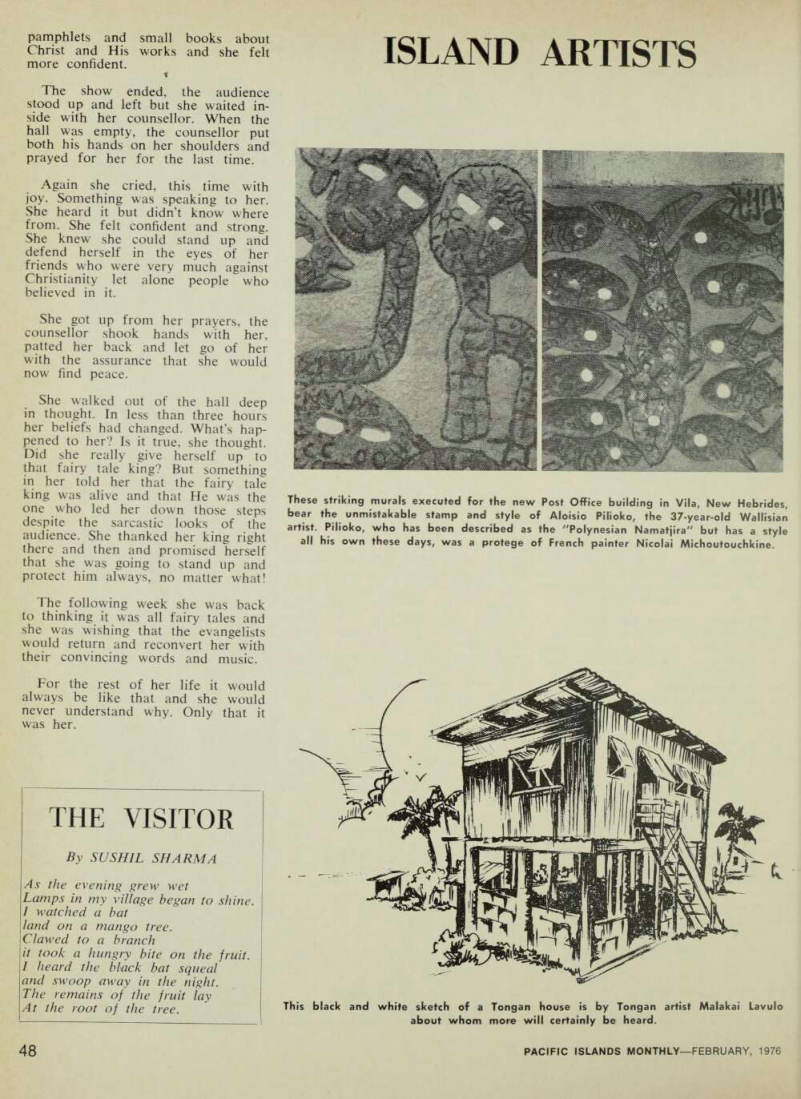
By Rokobua Naiyaqa
SHE was one of those people who didn’t believe in God. To her, going to church was a waste of time and people who believed in God were nothing but first-class hypocrites.
How could you believe in something that you couldn’t see? All these things about the birth of Christ, his mighty works of healing the sick, his crucifixion were a lot of fairy tales to her. And the Bible was a big book which put all these fairy tales in some readable order.
All the same she loved going to lis ten to these fairy tales being retold so she made a special effort to attend sermons by evangelists who fre quently came to her college. She and her friends, who were mostly boys, loved fooling around with these people.
Evangelists tried to convince the students that there was very little time left and that Christ would re turn soon and this was the time to repent, to take Christ as their saviour.
If not, it would be too late and their chances of being saved would be gone. She was used to this kind of trick and she had heard the same thing year after year since she was old enough to understand what the preachers talked about. And here they were still saying the same thing for how many more years before their Christ really came down to meet her. These people were nothing but dreamers, she thought.
That evening when coming to the campus dining hall for dinner she saw an advertisement on one of the
walls saying that a group of evan gelists would be coming that evening.
This particular group always at tracted a lot of attention amongst the students as their religion included music played by a hired band and even though students didn’t feel like listening to the sermons, the music played had an attraction. Most of it was like jazz music, the students’ favourites.
She thought amusingly to herself.
Tonight would be another fun night for her and her friends. But she would have to look for them fast.
Time was flying and if she didn’t find them she would have to sit alone and wouldn’t that be boring; she thought she wouldn’t enjoy it of course.
After dinner, she found she had very little time left so she dashed down to the campus hall and got herself a seat. A lot of people were there already and the seats were get ting filled up rapidly. She was forced to sit in the midst of students she didn’t even know but she couldn’t help that. At least she had a seat, she thought. She looked around and. saw all her friends sitting together in the front but there were no spare seats there. She really missed sitting with them. Then again she thought what a good experience it would be to sit away from them for once.
THE evangelists soon came in.
They set up their instruments and started tuning their guitars. The organist fiddled around, trying to get
used to his keys while the drummer tapped slowly and rhythmically on his drums, maybe just to pass away his time.
She observed them closely. There were about nine of them, all men, but about the same age as her boy friends. All looked young, maybe in their early twenties. The way they were dressed impressed her. Mute coloured, long-sleeved shirts, neck ties, dark coats. They all looked so lively, happy, neat and contented, so different from her friends who didn’t even bother to look tidy or dress up. The evangelists really cap tured her attention from the start.
At 8 o’clock the programme began with the band playing a hymn and all the boys in the group singing.
The sound of it penetrated her ear drums capturing its living melody.
The expression of belief on their faces showed their real feelings for the God they were worshipping. It pierced her right through the heart.
“I don’t know why—Jesus loves, me, I don’t know why he cares . . .” they sang. She watched deep in thought as the words drove through her heart.
For the first time she thought may be there really was a God, a some body called Jesus Christ. These people couldn’t be liars. They all looked so sincere. They aren’t paid to do such a job, she thought, so why are they doing it? There must be something behind all thfs. In it pos sible? Could there really be a living God, their so-called Christ?
The music stopped just then as if anticipating some action from her.
She wanted more music, she wanted to ease her mind and heart. She had to find out somehow what was true.
Is it possible—oh! she didn’t want to believe it. She didn’t want herself to be taken in by such actions. She must stick to her own principles.
There was no God and there was no other creation.
Just then one of the boys stood up and gave a testimony, firstly by explaining how he ‘came to know Christ. Before he took Christ he said his life had been empty. He looked for comfort in nightclubs, liquor and even drugs but he couldn’t find satisfaction until he took Jesus Christ as his saviour. Since then Christ had been an inspiration for him and he praised his name and would worship Him forever.
When he stopped, the band started up again playing a tune so slow and remote that it took her mind far, far away. Oh! what’s hap pening she wondered. Her inside was feeling funny and mixed up and she couldn’t think straight.
One after another the boys, made their confession of how they were before they acquired this life with Christ. Now they’d found what life and happiness really was and what it meant to walk hand in hand with God. After every confession there was more music that took her further away from her friends, from the people in that large hall.
SHE concentrated only on the faces of the singers, so sincere, so sure of their feelings and so proud to show them off to the others. She felt confused, and lost between two worlds—that of her friends and this new one these people were trying to show her. She had no one to confide in just then. All those sitting beside her were unknown to her. The de cision was her own. She was alone.
She didn’t know what to do.
Suddenly she pulled herself to gether when the group’s leader in vited the audience to bow their heads in prayer. She bowed willingly and closed her eyes. Maybe through these
prayers she would be able to make up her mind.
That was just it—the words of prayers hit the nail on the head, pierced her whole body, shaking it with emotion and realisation came to her about her aim in life. She had no pilot, no hope. She was really going on like a lost sheep, something she remembered mentioned in one of those fairy tales in the Bible.
She felt weak. She heard the man say “Come unto me all ye that labour and are heavy laden and I will give you rest”. Is it true? Should she believe it? What will her friends say? They would really have a good laugh. She heard the man saying “Now is the time to give yourself up. God will guide you, make you satisfied and happy. Come to him.
I’m inviting you. If you need help stand up and come forward”.
Immediately she stood up and slowly went down the steps. Her eyes blurred with tears. Heads turned up and took sidelong glances at her.
She didn’t care. Where was she going? She didn’t know. The longing there was all she knew. The longing to keep on going down the steps.
Something was leading her on, she didn’t know, an unknown person. She went on steadily. The music and the silence of the room made her long ing more conspicuous. She knew that all she had to do was to reach the stage and the people there.
She passed her friends who whis pered, “Come back, don’t be funny, you’ll be a laughing stock”. But all these seemed so far away. What dominated her was the music alive in her and the words “Come to me”.
At last she reached the main stage.
A few people were there. Her fellow comrades she thought, but she didn’t know any of them. One of the men came forward, took her hand and started praying for her. Just then, all her emotions boiled over. Tears rushed down her cheeks, her shoul ders shook uncontrollably, her knees felt weak and nearly gave way but incredibly she felt relieved; she felt happy, she didn’t feel funny and silly as she thought she would.
THE man stopped praying, got her seated and started counselling and talking to her. He congratulated her for being brave and encouraged her to carry on that way.
All at once her mind seemed to be put to rest. She couldn’t have cared less about what her friends would say about her. Even if they deserted her, she felt safe, as if she had something, a stronger friend who would help her fight her battles and keep her company.
Her counsellor gave her some
Rokobua Naiyaqa
pamphlets and small books about Christ and His works and she felt more confident.
The show ended, the audience stood up and left but she waited in side with her counsellor. When the hall was empty, the counsellor put both his hands on her shoulders and prayed for her for the last time.
Again she cried, this time with joy. Something was speaking to her.
She heard it but didn’t know where from. She felt confident and strong.
She knew she could stand up and defend herself in the eyes of her friends who were very much against Christianity let alone people who believed in it.
She got up from her prayers, the counsellor shook hands with her, patted her back and let go of her with the assurance that she would now find peace.
She walked out of the hall deep in thought. In less than three hours her beliefs had changed. What’s hap pened to her? Is it true, she thought.
Did she really give herself up to that fairy tale king? But something in her told her that the fairy tale king was alive and that He was the one who led her down those steps despite the sarcastic looks of the audience. She thanked her king right there and then and promised herself that she was going to stand up and protect him always, no matter what!
The following week she was back to thinking it was all fairy tales and she was wishing that the evangelists would return and reconvert her with their convincing words and music.
For the rest of her life it would always be like that and she would never understand why. Only that it was her.
The Waterlily
By Rokobua Naiyaqa
Oh lovely waterlily You bring life by Blooming freshly to the rising sun But why shrink away When darkness closes in Why not save your beauty For lovers at dusk.
The Visitor
By Sushil Sharma
As the evening grew wet Lamps in my village began to shine. \ I / watched a bat land on a mango tree.
Clawed to a branch it took a hungry bite on the fruit, i / heard the black bat squeal and swoop away in the night.
The remains of the fruit lay At the root of the tree.
Island Artists
These striking murals executed for the new Post Office building in Vila, New Hebrides, bear the unmistakable stamp and style of Aloisio Pilioko, the 37-year-old Wallisian artist. Pilioko, who has been described as the "Polynesian Namatjira" but has a style all his own these days, was a protege of French painter Nicolai Michoutouchkine.
This black and white sketch of a Tongan house is by Tongan artist Matakai Lavulo about whom more will certainly be heard.
In Our District
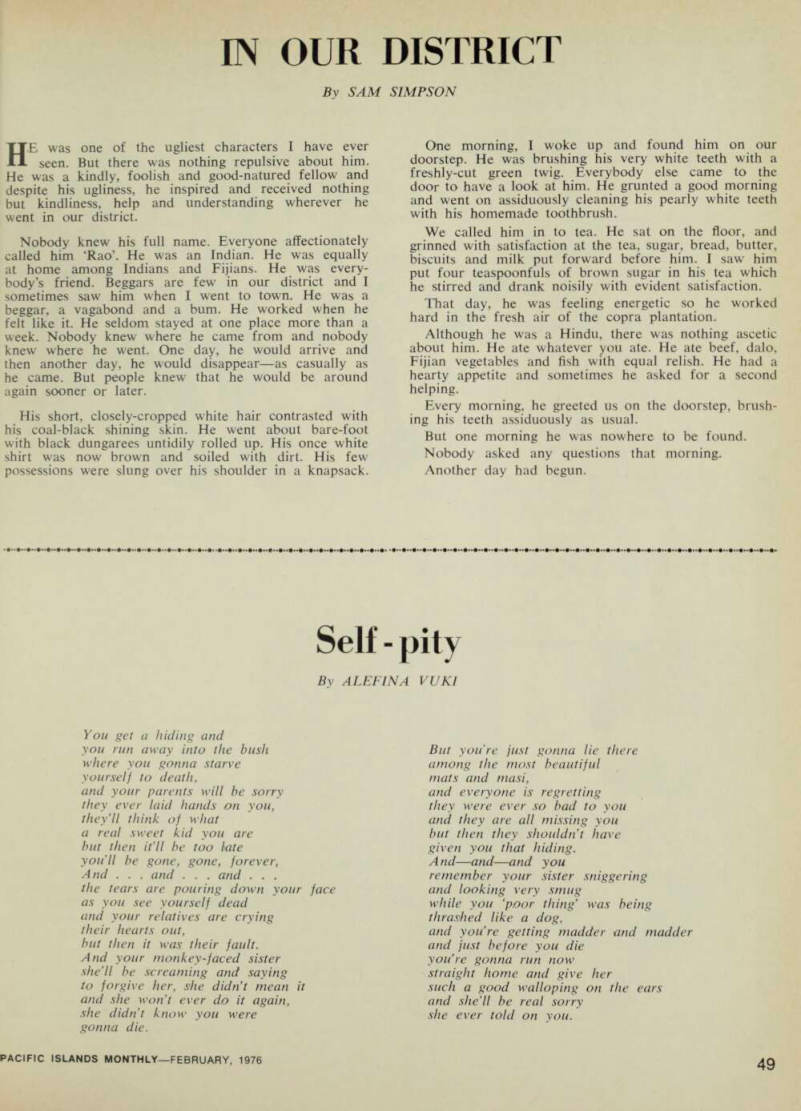
By Sam Simpson
HE was one of the ugliest characters I have ever seen. But there was nothing repulsive about him.
He was a kindly, foolish and good-natured fellow and despite his ugliness, he inspired and received nothing but kindliness, help and understanding wherever he went in our district.
Nobody knew his full name. Everyone affectionately called him ‘Rao’. He was an Indian, He was equally at home among Indians and Fijians. He was every body’s friend. Beggars are few in our district and I sometimes saw him when I went to town. He was a beggar, a vagabond and a bum. He worked when he felt like it. He seldom stayed at one place more than a week. Nobody knew where he came from and nobody knew where he went. One day, he would arrive and then another day, he would disappear—as casually as he came. But people knew that he would be around again sooner or later.
His short, closely-cropped white hair contrasted with his coal-black shining skin. He went about bare-foot with black dungarees untidily rolled up. His once white shirt was now brown and soiled with dirt. His few possessions were slung over his shoulder in a knapsack.
One morning, I woke up and found him on our doorstep. He was brushing his very white teeth with a freshly-cut green twig. Everybody else came to the door to have a look at him. He grunted a good morning and went on assiduously cleaning his pearly white teeth with his homemade toothbrush.
We called him in to tea. He sat on the floor, and grinned with satisfaction at the tea, sugar, bread, butter, biscuits and milk put forward before him, I saw him put four teaspoonfuls of brown sugar in his tea which he stirred and drank noisily with evident satisfaction.
That day, he was feeling energetic so he worked hard in the fresh air of the copra plantation.
Although he was a Hindu, there was nothing ascetic about him. He ate whatever you ate. He ate beef, dalo, Fijian vegetables and fish with equal relish. He had a hearty appetite and sometimes he asked for a second helping.
Every morning, he greeted us on the doorstep, brush ing his teeth assiduously as usual.
But one morning he was nowhere to be found.
Nobody asked any questions that morning.
Another day had begun.
Self - pity
By Alefina Vuki
You get a hiding and you run away into the bush where you gonna starve yourself to death, and your parents will be sorry they ever laid hands on you, they’ll think of what a real sweet kid you are but then it’ll be too late you’ll be gone, gone, forever, And . . . and . . . and . . . the tears are pouring down your face as you see yourself dead and your relatives are crying their hearts out, but then it was their fault.
And your monkey-faced sister she’ll be screaming and saying to forgive her, she didn’t mean it and she won’t ever do it again, she didn’t know you were gonna die.
But you're just gonna lie there among the most beautiful mats and masi, and everyone is regretting they were ever so bad to you and they are all missing you but then they shouldn’t have given you that hiding.
And — and—and you remember your sister sniggering and looking very smug while you ‘poor thing’ was being thrashed like a dog, and you’re getting madder and madder and just before you die you’re gonna run now straight home and give her such a good walloping on the ears and she’ll be real sorry she ever told on you.
Advertisements & other items, p. 50 (1 item)
Let Lane
lend a hand
These are some of the products which are keeping our customers prosperous. From this range, you can obtain a really effective herbicide such as M.S.M.A., which controls persistent grasses and sedges in coconuts and bananas, or a short, residual, quick-acting insecticide like DIBROM, which controls fruit and vegetable insects and mosquitoes, sandflies and midges.
Also, our research facilities and advisory services in the field are among the best available, so drop us a line and let us help you. t Lane Ltd., Export Division, P.O. Box 59, Bankstown, N.S.W. 2200 Lane (Fiji) Ltd., P.O. Box 89, Suva, Fiji f f Insecticide f Fungici f Weedkiller . Feed Supplement f f Animal Health *9* umigants e x Home Garde^ s \\ A * Don't forget—Amalgamated Chemicals is now Lane
To Future Generations,
Security
Custodian of the past Social welfare is a subject of serious consideration in most modern societies. Man in the twentieth century accepts his responsibility to bequeath to the next generation a society better than his own.
Daiwa Bank is not unique in accepting this responsibility, but Daiwa is unique in making acceptance of this role in society an integral part of their banking service.
Daiwa is the only Japanese city bank to combine banking and trust business. Daiwa is thus a fully integrated banking institution, comprising banking, international financing, trust, pension trust, and real estate business. This integration is part of our effort to fulfil our social responsibility consistent with society's needs in a contemporary environment. a fully integrated banking service
DAIWA BANK
Head Office: Osaka, Japan London and Frankfurt Branches New York and Los Angeles Agencies Singapore, Sydney and Sao Paulo Representative Offices Joint Venture Banks: P.T. Bank Perdania, Jakarta, International Credit Alliance, Ltd., Hong Kong
Books, Reviews, writers
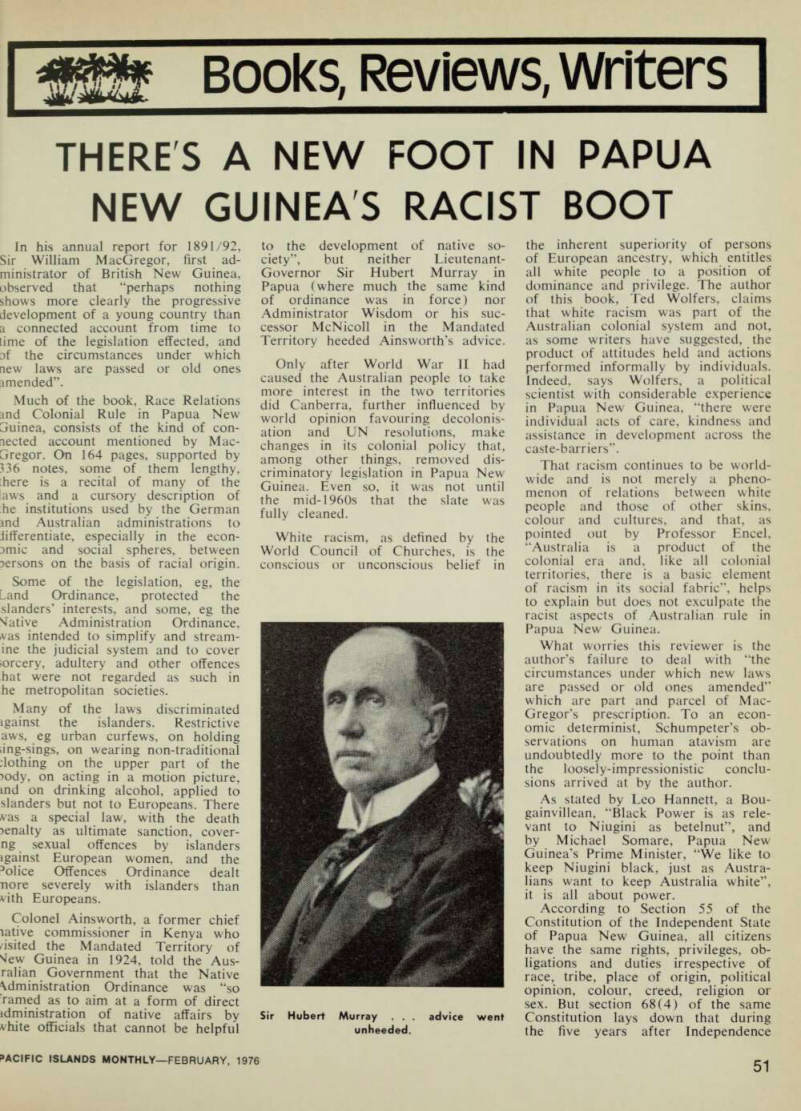
There's A New Foot In Papua
New Guinea's Racist Boot
In his annual report for 1891/92, Sir William MacGregor, first ad ministrator of British New Guinea, observed that “perhaps nothing shows more clearly the progressive development of a young country than a connected account from time to time of the legislation effected, and af the circumstances under which new laws are passed or old ones amended”.
Much of the book, Race Relations and Colonial Rule in Papua New Guinea, consists of the kind of con nected account mentioned by Mac- Gregor. On 164 pages, supported by 336 notes, some of them lengthy, there is a recital of many of the laws and a cursory description of he institutions used by the German and Australian administrations to differentiate, especially in the econ omic and social spheres, between oersons on the basis of racial origin.
Some of the legislation, eg, the Land Ordinance, protected the slanders’ interests, and some, eg the Native Administration Ordinance, yas intended to simplify and stream ine the judicial system and to cover sorcery, adultery and other offences hat were not regarded as such in he metropolitan societies.
Many of the laws discriminated igainst the islanders. Restrictive aws, eg urban curfews, on holding iing-sings, on wearing non-traditional dothing on the upper part of the iody, on acting in a motion picture, md on drinking alcohol, applied to slanders but not to Europeans. There vas a special law, with the death icnalty as ultimate sanction, cover ng sexual offences by islanders igainst European women, and the 3 olice Offences Ordinance dealt nore severely with islanders than vith Europeans.
Colonel Ainsworth, a former chief lative commissioner in Kenya who dsited the Mandated Territory of 'dew Guinea in 1924, told the Aus ralian Government that the Native \dministration Ordinance was “so ramed as to aim at a form of direct idministration of native affairs by vhite officials that cannot be helpful
to the development of native so ciety”, but neither Lieutenant- Governor Sir Hubert Murray in Papua (where much the same kind of ordinance was in force) nor Administrator Wisdom or his suc cessor McNicoll in the Mandated Territory heeded Ainsworth’s advice.
Only after World War II had caused the Australian people to take more interest in the two territories did Canberra, further influenced by world opinion favouring decolonis ation and UN resolutions, make changes in its colonial policy that, among other things, removed dis criminatory legislation in Papua New Guinea. Even so, it was not until the mid-1960s that the slate was fully cleaned.
White racism, as defined by the World Council of Churches, is the conscious or unconscious belief in
the inherent superiority of persons of European ancestry, which entitles all white people to a position of dominance and privilege. The author of this book, Ted Wolfers, claims that white racism was part of the Australian colonial system and not, as some writers have suggested, the product of attitudes held and actions performed informally by individuals.
Indeed, says Wolfers, a political scientist with considerable experience in Papua New Guinea, “there were individual acts of care, kindness and assistance in development across the caste-barriers”.
That racism continues to be world wide and is not merely a pheno menon of relations between white people and those of other skins, colour and cultures, and that, as pointed out by Professor Encel, “Australia is a product of the colonial era and, like all colonial territories, there is a basic element of racism in its social fabric”, helps to explain but does not exculpate the racist aspects of Australian rule in Papua New Guinea.
What worries this reviewer is the author’s failure to deal with “the circumstances under which new laws are passed or old ones amended” which are part and parcel of Mac- Gregor’s prescription. To an econ omic determinist, Schumpeter’s ob servations on human atavism are undoubtedly more to the point than the loosely-impressionistic conclu sions arrived at by the author.
As stated by Leo Hannett, a Bou gainvillean, “Black Power is as rele vant to Niugini as betelnut”, and by Michael Somare, Papua New Guinea’s Prime Minister, “We like to keep Niugini black, just as Austra lians want to keep Australia white”, it is all about power.
According to Section 55 of the Constitution of the Independent State of Papua New Guinea, all citizens have the same rights, privileges, ob ligations and duties irrespective of race, tribe, place of origin, political opinion, colour, creed, religion or sex. But section 68(4) of the same Constitution lays down that during the five years after Independence
Sir Hubert Murray . . . advice went unheeded.
Day only a citizen who was born in the country before that day and has two grandparents, who were born in the country or the Solomon Islands or Irian Jaya or the Torres Strait Islands, “shall have the rights con ferred by Section 53 (Protection from Unjust Deprivation of Pro perty)”.
Section 53 and its concomitant Section 54, a special provision in relation to certain lands, and public statements by Sir Maori Kiki, Foreign Minister, leave no doubt that racism is as alive in Papua New Guinea to day as it was during the German and Australian regimes. Only the boot is on the other foot.
There could be several reasons why the new nation has adopted a
racist Constitution and practises racial discrimination in certain spheres. For one thing, about 85 per cent of the country’s secondary and tertiary industries are foreign-owned and foreigners hold most of the top positions in commerce and industry.
For another, there are as yet only a handful of nationals on the academic staffs of the two universities and
other tertiary institutions. Again, isn’t it all about power?
History teaches that racial dis crimination in any form degrades those who practise it. It is sad that, like many other nations, Papua New Guinea has not heeded the lesson.
This book is a useful account of some aspects of Papua New Guinea’s past but it falls short of presenting the whole picture. In spite of its title, it does not explain race-relations. It needs to be read and understood in the light of a number of caveats contained in the text, especially those in its Introduction and Conclusion. —Harry Jackman. (Race Relations and Colonial Rule in Papua New Guinea. By E. P. Wolfers. Pub lished by Australia & New Zealand Book Co, Sydney. $6.95).
A Nostalgic Look At The Cooks
Mr Ronald Syme, of Rarotonga, Cook Islands, may not be the ori ginal guy who got away from it all but he must come high on the list of those who made it stick.
In the good old days when Pacpub published a Who’s Who in the Pacific there was this about SYME, Neville Ronald: “Author”, we said, “b.
March 13, 1913, at Formby, Lancs, UK, s. of David Godfrey Syme; ed. at Collegiate School, Wanganui, NZ Career: Feature writer and special correspondent. Express Newspapers Ltd, 1932-37; foreign correspondent, Abyssinia and Spain, 1937-38; editor, Peter Lunn, publishers, London, 1946-47; PRO, British Road Feder ation, 1948-51 . . . British Army Intelligence Corps, 1940-45, as Capt; Lecturer and broadcaster, USA, Britain, West Indies, New Zealand; radio playright; script writer, etc, etc”.
After all that, how was it that, according to the biography, he “arrived Cook Islands, 1953”. What is more to the point, why was he still there, over 20 years later.
In a new book, Isles of the Frigate Bird, he tells how it came about and why, in somewhat nostalgic vein, concentrating on the 1950 s and early Sixties, before Albert Henry and the conversion of the Cook Islanders to jet airports and tourism.
Although now inclined to look back on those years through gold tinted glasses, the Ronald Syme that older PIM readers will remember during his first years in the Cooks was something of a stirrer—a re former who got those who had been there longer, and felt they knew bet
ter, by the short hairs. He lived for a time on Mangaia and caused angu ish to PlM’s old correspondent there whose typewriter ran hot with vitriol as a consequence. More importantly, he didn’t like the way NZ officials were running the Cooks, and said so, a fact that didn’t endear him to stodgy officialdom. He then set the Auckland Star digging up buried skeletons, which endeared him even less.
He fights some of these old battles again, dismissing all NZ newspapers other than the Star, as right wing, protestant establishment and, if you take what he says at face value, still doesn’t think much of New Zea landers in general and NZ bureau crats in particular. Although, from the Who’s Who biography, he ap pears to have gone to school in New Zealand.
In Isles of the Frigate Bird his youth seems to have been spent in Ireland.
He has plenty of NZ gripes. He blames a Kiwi politician for intro ducing minah birds to the Cooks although these Indian migrants are now widespread in the Pacific and in Australia and no New Zealand politician can be blamed for that.
When he arrived in Wellington from Europe he found the Depart ment of Island Territories almost totally ignorant of Cook Islands conditions; and in Rarotonga that officials were not only misguided in the way they were running the terri tory but downright uncouth as well.
At the old Rarotonga Hotel-cum boarding-house, run mainly for expatriate public servants at that time, he sat at table with a young
man whom Syme dubbed The Thing. Their first encounter, after Syme had asked what he did in Rarotonga, went something like this: “00, me?” grunted The Thing.
“Treasury. ’Course I do a lot of the local sheilas as well. Got two of them in the family way right now I ’ave . . . Bloody Pom, aincha?
Wotcha doing ’ere in this bloody place”.
Some years ago this reviewer spent a short time in Rarotonga and came to the conclusion that some of its bureaucrats had been too long in the bush. But not even the Hotel Rarotonga, delicious as it was for journalistic copy if not for food, could then produce anything like The Tiling. A wharfie from Woolloo mooloo, Sydney, he might have been. But a New Zealand Treasury official? Shame on you, Mr Syme.
Apart from this phobia about NZ’s officialdom, this is otherwise a pleasant enough light story about life in the Cooks a decade or two ago, more suited, perhaps, to people on the other side of the world who still have not heard of the Group and think all Pacific Islanders quaint children of nature, than for readers nearer at hand—in New Zealand, for instance.
At its best when describing Cook Islander life and his contacts with the family of the Rarotongan girl he married; at its worst when re counting old feuds and old theories.
At the time the Cooks got self government he thought it would be better if New Zealand and the United Nations shared administration
for three years until the Islanders sorted themselves out, although why he thought UN bureaucrats any bet ter than the New Zealand variety it is hard to imagine and he doesn’t say.
Ronald Syme still lives at Muri, Rarotonga, with his wife and beauti ful 12-year-old daughter and ap parently intends to continue doing just that. He is thus carrying on the tradition established by two expatriate predecessors—Julian Dashwood, an Englishman who combined author ship, storekeeping and politics; and Robert Dean Frisbie, who left poli tics alone but was better known for his books.
In spite of its then-isolation, its small population on scattered islands, its parochial politics, its religious inhibitions and New Zealand hang ups, the Cooks gave them sanctuary.
Maybe Syme is the last of this tribe.
Nationalism, work permits, residen tial visas, an Islands-for-the-islanders outlook now make it almost impos sible to take root on any Pacific Island, marry the local chiefs daughter and do nothing more to boost the economy than tell it like it was. —Judy Tudor. (ISLES OF ' THE FRIGATE BIRD. By Ronald Syme. Published by Michael Joseph Ltd, 52 Bedford Square, London, WC 1. £5.50).
The Solomons Through The Eyes
Of Bellona's Talkative Animals
Having been awarded, by Frederick IX, King of the Danes, in 1952, the Galathea Medal for services in the cause of science, it has been a great pleasure for me to renew my acquaintance with some of those efficient and most human Danes who worked in many scientific fields in the Pacific over many years, by reviewing Volume IV of the Lang uage and Culture of Rennell and Bellona Islands. This volume by Rolf Kuschel is called Animal Stories from Bellona Island (Mungiki).
The great humanity of these Danish workers was, perhaps, their greatest asset, and this humanity is revealed in the way Kuschel handles the material in this volume. It is much more than a collection of ani mal stories: it is a revelation of the inhabitants of Bellona and Rennell as people as human as those who have recorded the zoology, geology, history and other aspects of those islands.
There are nine chapters before we come to the actual animal stories, all
dealing with aspects of the Danish expeditions and scientific investigations on these islands. In the chapter called The Narrators, Kuschel says of one of them: “Tony Teikangongo, Ngikobaka lineage, aged only 24, was the youngest of the story-tellers. Despite his rather weighty contribution of five stories he harbours no real veneration for the old oral tradition.” How often throughout the Pacific have we heard this sad story; this generation trying to live in two worlds, recounting spurious ‘ancient’ tales, while singing equally spurious ‘folk’ songs to a guitar? However, Tony was outnumbered by genuine story-tellers »ho were brought up in the true oral tradition Kuschel tells us. Training in oral ability took place informally, anywhere and at any time. However, it was not uncommon for children and young people to congregate round he older people in the evening and isten to their stories. This could hardly be avoided due to the limited f‘ ze f°V h .l , settleme , nt ’ a " d du , e . lo the fact that parents and children preferred to stay closely together for the ever-present fear of possible attacks on the settlement Given as reasons for writing this volume Kuschel tells us, “One of my intentions here, m publishing animal stories from Bellona, a tiny - j . v, • -rU r, i Polynesian raised atoll in the Solomon Islands, is to illuminate some
of the problems presented by the study of alien cultures, problems which tend to disappear or become marginal in the study of more corn prehensive and complex institutions and phenomena such as a society’s religion, social and economic struc ture: a people’s visual perceptions or dreams.
“A second purpose is to help to fill a gap in our records of Polynesian oral traditions, for in most collec tions animal stories are rare. It is a i so my hope that work may help the Bellonese of the next genera tions to maintain and learn to write their own language ...”
The illustrations by Sengeika T uke of Be , lona are delightful. So are most of , he stories Iet b us finish with the shortest one in the co , lec .
Uon; xhe Blind Mollus k. 1. The b|jnd mollusk was sleeping and saw (i a dream) a mollus £ coming into , h shal|ow wat (saying); 2 . “The thi , am so abo y ut % that bott ® m wi „ be ' aten r Which of us has the right of it? w who sit in the evenings and view , he imaginings of the B television writ the Be |l o nese who sit and , isten to the musical orations f th Bellonese elders? te
Peter Livingston
\ ol £ k E . LL 2 N k A ISLAND (MUNGIKI) by Rolf Kuschel. Pub- Mshed by National Museum, Copenhagen, Denmark, Danish kroner 130.45).
Advertisements & other items, pp. 53-54 (1 item)
printing co. ply. ltd.
D pua new guinea
Serving the Country from Aitape to Alotau, Manus to Moresby Leaders in Commercial Offset and Letterpress Printing. • Stationery • Office Supplies • Office Equipment • Rubber Stamps Self-Adhesive Labels In Fact:— Everything For The Office.
P.O. Box 633, Port Moresby P.O. Box 759, Lae P.O. Box 1239, Rabaul
“thank goodness
we have Air Pacific!”
THANK GOODNESS
E HAVE AIR PACIFIC
f qfTT WE
FAKAFETAI,
KO MAUA
NE MATOU TE
‘EA-PASEFIKA
FAAFETAI
EA PASEFIKA’
MO LE
GALUEGA LELEI
TAGIO TUMAS
IU Ml KAREM
EA PASIFIK m
TAGIO TUMAS
IU Ml KAREM
EA PASIFIK
TAGIO TUMAS
IU Ml KAREM
‘EA PASIFIK'
ME A LELEI KO
ETAU MA U E
EA PASIFIKI’
HP <c * * m 4 m H U 1
RABA
EA
REKE
ROURA
TE
E UASIVI DUADUA
NA AIR PACIFIC'
AIR
PACIFIC
M. %
IMIWUR OMO ,
ATSIN TURIN
AIR PACIFIC’
i-;
the one we know!
When you live in an area as big as our
South Pacific you will appreciate having
an airline like Air Pacific. Fast, reliable and
efficient!
GILBERT MSLANDS
BSE
NAURU
ESBY
BRISBANE
* ELLICE
SOLOMON I ISLANDS
ISLANDS I
SAMOA
NEW
HEBRIDES
TONGA
AUCKLAND
Not too big to lose its friendly personal South Seas island touch-and'not too small to give you a crowded feeling. When you fly Air Pacific-you'll experience that wonderful 'welcome back home' feeling from the people you know. Jet Air Pacific to the REAL PACIFIC.
am aacißic
We fly to more South Pacific Islands than any other Airline.
For details and bookings contact your travel agent or Air Pacific, Private Bag, Suva Fiji.
Pacific Transport
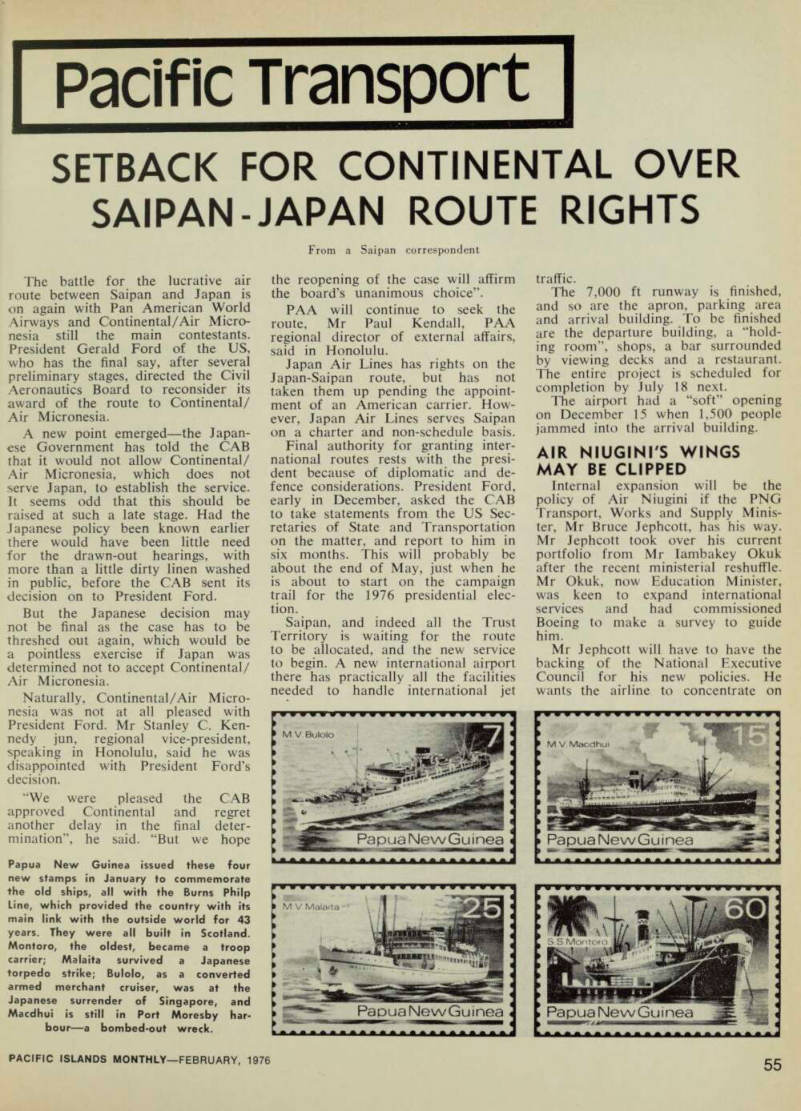
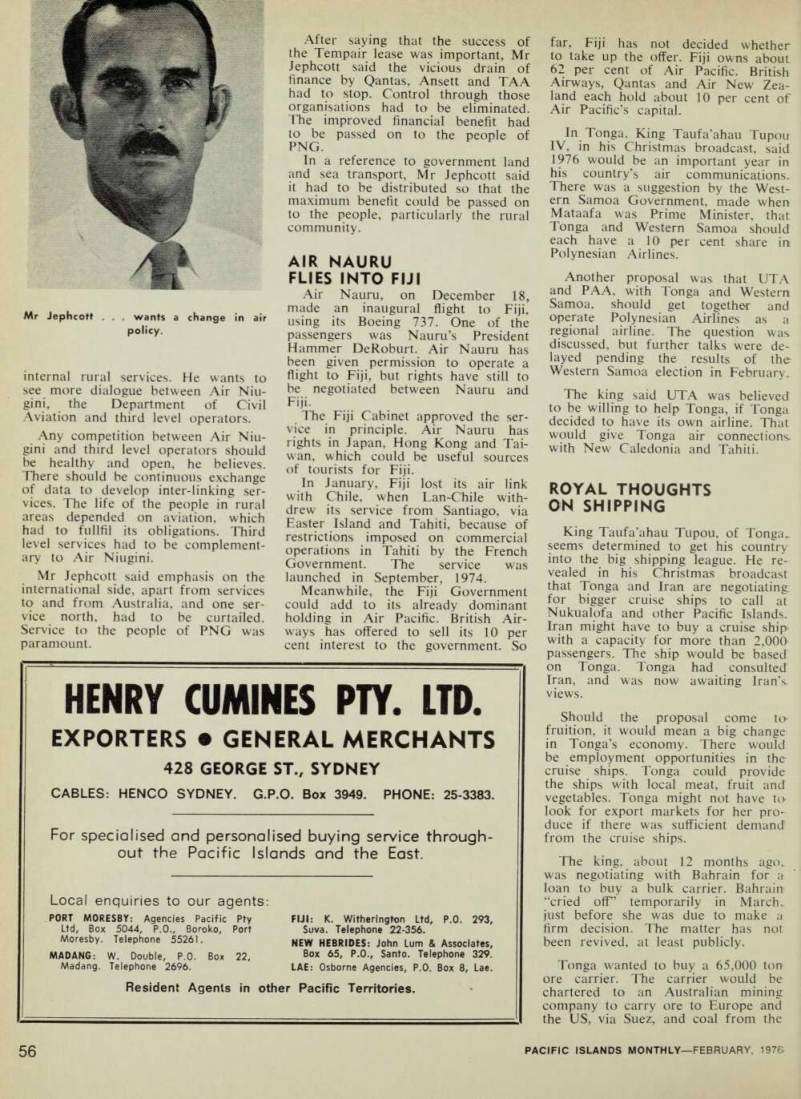
Setback For Continental Over
Saipan-Japan Route Rights
From a Saipan correspondent
The battle for the lucrative air route between Saipan and Japan is on again with Pan American World Airways and Continental/Air Micro nesia still the main contestants.
President Gerald Ford of the US, who has the final say, after several preliminary stages, directed the Civil Aeronautics Board to reconsider its award of the route to Continental/ Air Micronesia.
A new point emerged—the Japan ese Government has told the CAB that it would not allow Continental/ Air Micronesia, which does not serve Japan, to establish the service.
It seems odd that this should be raised at such a late stage. Had the Japanese policy been known earlier there would have been little need for the drawn-out hearings, with more than a little dirty linen washed in public, before the CAB sent its decision on to President Ford.
But the Japanese decision may not be final as the case has to be threshed out again, which would be a pointless exercise if Japan was determined not to accept Continental/ Air Micronesia.
Naturally, Continental/Air Micro nesia was not at all pleased with President Ford. Mr Stanley C. Ken nedy jun, regional vice-president, speaking in Honolulu, said he was disappointed with President Ford’s decision.
“We were pleased the CAB approved Continental and regret another delay in the final deter mination”, he said. “But we hope
the reopening of the case will affirm the board’s unanimous choice”.
PAA will continue to seek the route, Mr Paul Kendall, PAA regional director of external affairs, said in Honolulu.
Japan Air Lines has rights on the Japan-Saipan route, but has not taken them up pending the appoint ment of an American carrier. How ever, Japan Air Lines serves Saipan on a charter and non-schedule basis.
Final authority for granting inter national routes rests with the presi dent because of diplomatic and de fence considerations. President Ford, early in December, asked the CAB to take statements from the US Sec retaries of State and Transportation on the matter, and report to him in six months. This will probably be about the end of May, just when he is about to start on the campaign trail for the 1976 presidential elec tion.
Saipan, and indeed all the Trust Territory is waiting for the route to be allocated, and the new service to begin, A new international airport there has practically all the facilities needed to handle international jet
traffic.
The 7,000 ft runway is finished, and so are the apron, parking area and arrival building. To be finished are the departure building, a “hold ing room”, shops, a bar surrounded by viewing decks and a restaurant.
The entire project is scheduled for completion by July 18 next.
The airport had a “soft” opening on December 15 when 1,500 people jammed into the arrival building.
Air Niugini's Wings
May Be Clipped
Internal expansion will be the policy of Air Niugini if the PNG Transport, Works and Supply Minis ter, Mr Bruce Jephcott, has his way.
Mr Jephcott took over his current portfolio from Mr lambakey Okuk after the recent ministerial reshuffle.
Mr Okuk, now Education Minister, was keen to expand international services and had commissioned Boeing to make a survey to guide him.
Mr Jephcott will have to have the backing of the National Executive Council for his new policies. He wants the airline to concentrate on
Papua New Guinea issued these four new stamps in January to commemorate the old ships, all with the Burns Philp Line, which provided the country with its main link with the outside world for 43 years. They were all built in Scotland.
Montoro, the oldest, became a troop carrier; Malaita survived a Japanese torpedo strike; Bulolo, as a converted armed merchant cruiser, was at the Japanese surrender of Singapore, and Macdhui is still in Port Moresby har bour—a bombed-out wreck.
internal rural services. He wants to see more dialogue between Air Niu gini, the Department of Civil Aviation and third level operators.
Any competition between Air Niu gini and third level operators should be healthy and open, he believes.
There should be continuous exchange of data to develop inter-linking ser vices. The life of the people in rural areas depended on aviation, which had to fullfil its obligations. Third level services had to be complement ary to Air Niugini.
Mr Jephcott said emphasis on the international side, apart from services to and from Australia, and one ser vice north, had to be curtailed.
Service to the people of PNG was paramount.
After saying that the success of the Tempair lease was important, Mr Jephcott said the vicious drain of finance by Qantas, Ansett and TAA had to stop. Control through those organisations had to be eliminated.
The improved financial benefit had to be passed on to the people of
Png.
In a reference to government land and sea transport, Mr Jephcott said it had to be distributed so that the maximum benefit could be passed on to the people, particularly the rural community.
Air Nauru
Flies Into Fiji
Air Nauru, on December 18, made an inaugural flight to Fiji, using its Boeing 737. One of the passengers was Nauru’s President Hammer Deßoburt. Air Nauru has been given permission to operate a flight to Fiji, but rights have still to be negotiated between Nauru and Fiji.
The Fiji Cabinet approved the ser vice in principle. Air Nauru has rights in Japan, Hong Kong and Tai wan, which could be useful sources of tourists for Fiji.
In January, Fiji lost its air link with Chile, when Lan-Chile with drew its service from Santiago, via Easter Island and Tahiti, because of restrictions imposed on commercial operations in Tahiti by the French Government. The service was launched in September, 1974.
Meanwhile, the Fiji Government could add to its already dominant holding in Air Pacific. British Air ways has offered to sell its 10 per cent interest to the government. So
far, Fiji has not decided whether to take up the offer. Fiji owns about 62 per cent of Air Pacific. British Airways, Qantas and Air New Zea land each hold about 10 per cent of Air Pacific’s capital.
In Tonga. King Taufa’ahau Tupou IV, in his Christmas broadcast, said 1976 would be an important year in his country’s air communications.
There was a suggestion by the West* ern Samoa Government, made when Mataafa was Prime Minister, that Tonga and Western Samoa should each have a 10 per cent share in Polynesian Airlines.
Another proposal was that UTA and PAA, with Tonga and Western Samoa, should get together and operate Polynesian Airlines as a regional airline. The question was discussed, but further talks were de layed pending the results of the Western Samoa election in February.
The king said UTA was believed to be willing to help Tonga, if Tonga decided to have its own airline. That would give Tonga air connections, with New Caledonia and Tahiti.
Royal Thoughts
On Shipping
King Taufa’ahau Tupou, of Tonga,, seems determined to get his country into the big shipping league. He re vealed in his Christmas broadcast that Tonga and Iran are negotiatings for bigger cruise ships to call at Nukualofa and other Pacific Islands.
Iran might have to buy a cruise ship with a capacity for more than 2,000 passengers. The ship would be based on Tonga. Tonga had consulted Iran, and was now awaiting Iran’s views.
Should the proposal come to fruition, it would mean a big change in Tonga’s economy. There would be employment opportunities in the cruise ships. Tonga could provide the ships with local meat, fruit and vegetables. Tonga might not have to look for export markets for her pro duce if there was sufficient demand from the cruise ships.
The king, about 12 months ago,, was negotiating with Bahrain for a loan to buy a bulk carrier. Bahrain “cried off” temporarily in March, just before she was due to make a firm decision. The matter has not been revived, at least publicly.
Tonga wanted to buy a 65,000 ton ore carrier. The carrier would be chartered to an Australian mining company to carry ore to Europe and the US, via Suez, and coal from the
Mr Jephcott . . . wants a change in air policy.
US to Japan, via Panama, on the return trip. The ship would sail under the Tongan flag, and carry a Tongan crew.
More Talking
On Regional Shipping
A regional shipping line in the South Pacific is by no means certain.
Whether it is practical, ie, profitable, as well as providing a good service, will be known by the South Pacific Bureau of Economic Co-operation (Spec) early this year. Members of the Spec Shipping Advisory Board met in Lae in December to study a special report on the business pros pects of such a venture.
Members were tight-lipped about what went on at the meeting, although such vague expressions as a “fairly encouraging report”, and “generally constructive discussion” were leaked.
The Shipping Advisory Board is scheduled to meet at Rotorua, NZ, on February 9 and 10 for further discussion on the report. The meet ing will have the benefit of member countries’ comments on the report, which was prepared by Mr D. De Vlaming, whose services were made available to Spec by the Netherlands Government.
The members of the Shipping Advisory Board are Australia, Cook Islands, Fiji, Gilbert Islands, Nauru, New Zealand, Papua New Guinea, the Solomon Islands, Tonga and Western Samoa.
A First For
Pacific Princess
The Pacific Princess will create a first for P & O on May 1 when she calls at Santo in the New Hebrides.
No P & O liner has ever called there.
Another P & O liner, the well-known Arcadia, 30,480 tonnes, will follow the Pacific Princess into Santo twice, later in 1976.
The New Hebrides is becoming more and more popular with cruise ships. So far 48 liners are scheduled to call at Vila in 1976. In the 10 months from January to October, 1975, 35 liners visited Vila, and a further eight were scheduled to call there in November and December.
Apia's Port
To Be Shifted
The port at Apia will be resited at Valusu Bay on a recommendation from Professor Raudkivi, formerly of Auckland University, who was commissioned in 1972 to investigate the problem of surging in the har bour, and future expansion of the port. The Western Samoa Cabinet I
early in December approved the re commendation covering resiting.
Professor Raudkivi recommended a programme of drilling and samp ling of the coral in the bay. The programme would include a hydro graphic survey of the area. The Pub lic Works Department will make the preliminary investigation. Details of the port will be investigated with the aid of a computer and hydraulic model studies.
The Apia wharf, which was opened in March, 1966, cost £BOO,OOO and, as was realised at the time, was sited in the wrong place.
At the opening ceremony, in which the Union Steam Ship Com pany’s veteran passenger-freighter Matua took part—being the first ship to berth there—doubts were privately expressed about the site. Some of the Matua’s crew prophesied to a PIM man, who was there, that there would always be trouble from surging.
The opinion expressed by a visit ing US warship’s crew was in much more colourful terms.
Raising The Wind
To Save Money
Sail power allied with engine power may be one way of cutting down operating costs of the Fiji inter island fleet. Tine Fiji Marine Depart ment is studying the question, prompted by several sharp increases in the price of fuel.
Some time this year a 100 ft diesel ship will be fitted with sails. If this pilot project shows worthwhile sav ings can be made, the ship may be turned into a staysail schooner. With sails used to assist the engines big fuel savings would be possible.
The prevailing south-east trade wind in Fiji would make the use of such ships a one-way proposition in most instances. Ships leaving Suva for Lau would have to rely on engine power for most of the trip. However, on the return trip, sails could be brought into full play.
Nauru Borrows
A German Ship
The Nauru Pacific Line has chartered the Weser Carrier, a semi container ship, from German owners to operate a service covering Fiji, Samoa, New Zealand and ports on the east coast of Australia. The ship has an overall length of 345 ft and a beam of 50 ft, with a speed of 19 knots. She will make two trips a month between Australia and Fiji with up to 5,000 tons of cargo.
The Weser Carrier was previously used by Bougainville Copper Ltd to carry copper from Bougainville to Hobart and other Australian ports.
She carries a crew of six German officers and 20 Papua New Guinea seamen.
Transport
Briefs
• Mr Paul Pora has been ap pointed chairman of the Papua New Guinea Airlines Commission, which operates Air Niugini. The other members are Messrs Joa Tauvasa, Elies Vuvu, George Blacker (PNG Banking Corporation), Captain R.
J. Ritchie (Qantas), Dr Harold Poulton (Ansett) and Captain R.
Bailey (TAA). Alternates are Messrs Paul Bengo (Prime Minister’s staff), Paul Kipo (Secretary, Transport De partment), Cedric Chee (Lae), Henry Deßobert (Governor, Bank of PNG), H. G. Cook (Qantas), B.
Costello (Ansett) and Captain L. J.
Thrift (TAA). • The Fiji Government shipyard in Suva is booked for the next five years. Ships to be built include a second Kaunitoni-class passenger cargo ship, a fourth cruiser for Blue Lagoon Cruises Ltd, a 140 ft landing barge which will be the longest ship built in Fiji, and a tug. • The Fiji pleasure cruise ship, Sayandra, 132 tons, has been bought by Mr Barrie LeFevre, managing director of LeFevre Enterprises Pty Ltd, of Australia. Mr LeFevre hopes to form a company in Fiji to pro mote charters. • Nissan Island Shipping, a PNG company, has opened a trade route covering Buka, Nissan Island and Rabaul. It recently bought a 130-ton ship, the Astronaut, for K 140,000.
The ship will ensure a regular link with Rabaul for the Nissan islanders who have had difficulty in shipping their produce there. The PNG- Chinese Association helped to arrange the purchase of the ship, and to negotiate a carrying contract with the Copra Marketing Board. • A Cessna 185 somersaulted just before making a forced landing on a Fauro Island beach, south of Bougainville, late in December. The pilot, Graham Barnett, 30, a Seventh-day Adventist mission school supervisor, a little shaken, walked away unhurt. He radioed a Mayday call just before the crash. • The Pacific Navigation Co, of Tonga, has chartered the Fijian Swift from the Reef Shipping Co, Auckland, to replace the Aoniu and Frysna. The Fijian Swift, on a bare boat charter, will be reregistered and renamed in Tonga. The small ships she replaces are nearing the end of their lives, and have been a drain on the strained finances of Pacific Navigation Co. Reef Shipping, which operates a service between Auckland and Fiji, expects to charter a 2,600 ship to replace the Fijian Swift.
Advertisements & other items, pp. 56-58 (1 item)
Henry Cumines Pty. Ltd.
EXPORTERS • GENERAL MERCHANTS
428 GEORGE ST., SYDNEY
CABLES: HENCO SYDNEY. G.P.O. Box 3949. PHONE: 25-3383.
For specialised and personalised buying service throughout the Pacific Islands and the East.
Local enquiries to our agents: PORT MORESBY; Agencies Pacific Pty Ltd, Box 5044, P. 0., Boroko, Port Moresby. Telephone 55261.
MADANG; W. Double, P.O. Box 22, Madang. Telephone 2696.
FIJI: K. Witherington Ltd, P.O . 293, Suva. Telephone 22-356.
NEW HEBRIDES: John Lum & Associates, Box 65, P. 0., Santo. Telephone 329.
LAE: Osborne Agencies, P.O. Box 8, Lae.
Resident Agents in other Pacific Territories.
Ikavdodge offers
you a whole
sight more in
Australia and
the South Pacific
■ i 1 •« I Right around the South Pacific you’ll find international standard Travelodge where the sights are ...where the action is.
And that’s where you’ll want to stay-to see the things, do the things you wish without moving too far from your room.
Friendly Travelodge offers the best in accommodation, service, food and value for money.
So book Travelodge. You’ll get a whole sight more. • Australia • New Zealand
• Fiji
• Tahiti • New Caledonia Papua New Guinea • Indonesia
'RAVE/ODCE CARE
RESERVATIONS: for any one of over 70 Travelodges in Australia, Fiji, New Zealand. Papua New Guinea, Tahiti, Japan & Indonesia:- .Australia: Sydney (02) 31.0601: Adelaide (08) 223.6194: Melbourne (03) 387.1233: Perth (092) 25.3811: Brisbane (072) 21.8586: Hobart (002) 34.2911: Canberra (062) 49.1424: Darwin 81.5388. U.K. (London): Trust Houses Forte (01) 567.3444 Japan (Tokyo): Travelodge Branch Office (03) 214.0961. Fiji: Travelodge Reservations, Suva 2.4600. Hong Kong: Travelodge Reservations 522.2251. U.S.A. (Toll Free): Travelodge International Inc. (800) 255.3050.
N.Z. (Auckland); Travelodge Reservations 374.108.
OR YOUR TRAVEL AGENT
Total service 0n..,
plumbing supplies Fast
WATSON & CRANE
are organised to fulfil your needs
wherever you are in the South Pacific « You can get all you need from one supply source: water taps, valves, copper tube, tools and a host of other fittings and related plumbing equipment for domestic, industrial and multistorey buildings.
Watson & Crane Pty Ltd have over 20,000 plumbing items in stock at their central warehouse located at Waterloo, NSW, Australia.
Years of experience in handling and shipping right throughout the South Pacific add up to another big reason for you to deal with Watson & Crane Pty Ltd.
Representatives call regularly at New Guinea, Papua, the Solomons, New Hebrides and Fiji Islands to personally discuss your requirements and appropriate credit arrangements.
Write, cable or telephone today for complete plumbers' supplies service.
Watson & Crane Pty. Ltd. 1037 Bourke Street, Waterloo,
NSW 2017.
Phone: Sydney 699-1333.
Telex: AA 25548.
Cables: "Watcrane" Sydney.
G. E.
CRANE
GROUP
Pacific Island distributors of Crane Enfield copper tube for water, sanitation, engineering, refrigeration and air conditioning.
Cruising
Yachts
• ASHYMAKAIHKEN, yacht, arrived December at Port Moresby from Fort Lauderdale, Florida, via the Caribbean and the Pacific. She is owned by Ashley and Brenda Russell, both 32. They left Fort Lauderdale about two years ago.
From Port Moresby they planned to sail to Australia, then across the Indian Ocean, through the Mediterranean and across the Atlantic Ocean to Canada, where they live. Ashley, an Australian journalist, left his native country 10 years ago to live in Canada. One of his Australian ports of call will probably be Fremantle so that he can visit h's parents in Perth. • DUMEKLAMMAR, 10 metre grey hound yacht, left Port Moresby late in November for Germany, via Suez. The yacht, skippered by owner Hermmans Heinz,, of Ratingen, Germany, is on a world tour, and expects to be home by July, 1977. He has a crew of two, American Randy Baier, who joined in Suva, and Australian Paul Brant. • ARMINEL, 94 ft ketch owned by Michael Morehart, 26, of Santa Barbara, California, is spending the hurricane sea son in French Polynesia, after sailing from Ft Lauderdale, Florida through the Panama Canal and visiting the Galapagos and Marquesas. With Michael aboard the Arminel were Susan Calkins of San Francisco, Brian Murphy, Donald Carroll and Sharon Dittner. The Arminel was built in Southampton in 1910 for an English peer and had no engine for 50 years. Miqhael has been rebuilding her as they sail. From Tahiti their plans will carry them to Tonga and New Zealand. • CYGNET, 30 ft ketch from Hawaii, left Hawaii in July and arrived in Tahiti in September, after visiting the Mar quesas and Tuamotus. Aboard were Harm Koster and Lea Mizuta, who planned to sail to the Societies before heading westward to New Zealand after the hurricane season. • EDWARD RICHMOND, 60 ft blade ferro-cement ketch from Hilo, Hawaii, is in Tahiti after visiting Mexico and the Marquesas. Paul and Wendy Pollitt and their son lan, 8 years, plan to remain in Frenqh Polynesia until April, before continuing their circumnavigation, • MESSIAH, 46 ft Cross trimaran from San Diego, owned by Stan and
Kathy Gollaher, went on the reef in Raiatea on November 4, as a result of strong currents and not enough wind.
There was no engine aboard to save the yacht from the wave that brought her destruction. The Gollahers sold her to a Tahitian for $5OO. Also aboard at the time were Chris Briscoe of Santa Barbara, Tom Armour and Karen Crie of San Diego. Stan's plans were to return home and build another boat. • WEST WIND, modified Piver Tri maran 25, registered in Vancouver and owned by single-hander Heinz Kuntze mann, arrived in Tahiti after being stripped in Mexico of all the food, uten sils, knives and anything of value, and after losing her rudder at sea 300 miles from Nukuhiva, Marquesas. Heinz put West Wind up for sale in Papeete for $5,500 in sail-away condition. His plans were to return to Los Angeles to build another boat. • BLACK DUKE, Cheoy-Lee Offshore 40 yawl, left Honolulu on December 8, 1975, bound for the Line Islands, with owner-skipper Edmond K. Slaven, LCDR USN ret, and his wife Opal aboard. Cdr Slaven did his last tour of duty with the Navy in Rota, Spain. Commander Slaven is a naval aviator and also a radio Ham (HP!-AX). After spending Christmas at Christmas Island, plans call for an extended visit to the Marquesas, Tua motus and Papeete for Bastile Day, 1976.
The Slavens left San Francisco in Novem ber, 1969, spent two years in the Sea of Cortez, Mexico, a year in Central America, then Cocos Island and the Gala pagos. They sailed back to Panama, up the west coast of Central America to Nicaragua, then to Hilo, Hawaii. After wintering in the Hawaiian Islands, they are off again with the Mediterranean and
their old home in Spain as their ultimate destination. "We are hoping that all of our old cruising friends will see this in PIAA and we can once again renew the old friendships that make cruising such a meaningful way of life", writes Cdr Slaven. • DAUNTLESS, 36 ft plywood/fibre glass ketch, with Colin and Sandy White of Auckland (NZ) on board arrived in Honolulu in October. They left Santa Catalina, California on September 18, and, after leaving Oahu, they plan to stop at Lanai before heading for the South Paci fic and their home in Auckland. • KWAIE TEK, 53 ft Spencer ketch (skipper/ owner Albert P. Morrow of Vancouver, BC) arrived in Honolulu in November after a two-year cruise of the South Pacific. Also on board were Dan Borman of Eugene, Oregon, Jefferson Menze, of Honolulu, and Mary Ann Page of Oakland, California. Since leaving Vancouver in September, 1973, Kwaie Tek has called at US, Mexican, and Costa Rican ports, the Galapagos, Marquesas, Tuamotus, and the Societies. She has now left Honolulu for San Diego. • RASCAL, 28 ft wood/fibreglass sloop, skippered by Rex McDowell of Wellington (NZ) arrived in Honolulu on November 18. She left the Marquesas in September and stopped at Hilo before continuing on to Oahu. • FREEDOM, 45 ft fibreglass ketch, with Don McNeil, and Scott Morris of Los Angeles, and Qhris Bliscoe of Santa Barbara, California, left Papeete in No vember and arrived in Honolulu on December 17.
Advertisements & other items, pp. 60-62 (1 item)
Lost
Public
acclaim
for
THE
LOST
CARAVEL
by Robert Langdon Was a group of 16th century shipwrecked Spanish sailors responsible for the legendary Polynesian canoe-building and navigation skills?
This startling question is answered in Robert Langdon’s important new book, THE LOST CARAVEL, which shatters many traditionally-held views on the origin of the Polynesians. Mr Langdon contends that the crew of the Spanish caravel San Lesmes, shipwrecked east of Tahiti in 1526 en route for the East Indies, survived and established themselves in Polynesian society, forming dynasties that lasted down to Captain Cook’s time.
BUT READ IT
FOR YOURSELF!
Fill in the details
on the attached
order form
PACIFIC ISLANDS TRANSPORT LINE
Owners: Thor Dahls Hvalfangerselskap A/S — Sandefjord, Norway.
MS CAMELLIA VENTURE
Express Freight Service between Pacific Coast Ports of
U.S.A.
and
TAHITI and SAMOA
Full container service including reefers.
GENERAL STEAMSHIP CORPORATION LTD.
General Agents 400 California Street, San Francisco, California, U.S.A.
APIA —Burns Philp (South Sea) Company, SYDNEY —Trans-Austral Shipping Pty. Ltd.
Ltd. SUVA —Burns Philp (South Sea) Company, PAPEETE—Agence Maritime Internationale Ltd.
Tahiti. LAE/RABAUL —Burns Philp (New Guinea) Ltd.
PAGO PAGO—Polynesia Shipping Services Inc. PORT VILA —Comptoirs Francais de Nouvelles NOUMEA —Etablissements Ballande. Hebrides.
S. E. TATHAM
& CO. PTY. LTD.
SOME OF THE FIRMS
WE REPRESENT ARE:
Asia Rubber Works (Singapore Rubber Shoes) Frappier (French Brandy) Huvet (French Brandy) Indika (Belgium Dairy Produce) Durobor S.A. (Belgium Glassware) Miroiterie Gen. de Belgiqe S.A. (Louvre glass and mirrors) City Engineers (U.K. Bicycles) F.H.I. Japan (Subaru Cars) Kraggs (Wines, Spirits, Ciders) Sunshine Biscuits Sunrise (Confectionery) Flamenco (Instant Coffee & Tea) Quaker Products (Oats, Jets) Hancocks (Spaghetti, Cereals) Melbourne Canning (Jams) Amatil (Twisties, Twirlies) Edward Zorn (Margarine, Cooking Fats) Allens (Confectionery) Red Tulip (Fine Chocolates) Robert Timms (New Guinea Gold Instant Coffees and Teas) S.P.C. (Canned Fruit) •j- -m '/A. 1
BEEHIVE BLDG.,
94 ELIZABETH ST.,
MELBOURNE, 3001, AUSTRALIA.
G.P.O. BOX B—CABLES "SET"
TELEPHONE 63 5094
TELEX: AA34293
S.P.C. (Abalone) Wing Lee (See You Sauce) Magnet (Mattresses) Essteel (Cookware) Warner-Drayton (Fans) Mitchell's (Abrasives) Tilbury & Lewis (Sports Trophies & Silverplate) Regent (Swiss watches) Lega Marcasite (Jewellery) Austramax (Pressure Lanterns) Lawn Chair; Tubco (Garden Furniture) Electronic Industries (Electrical Household Appliances) Jex (Steelwool) Arnbro (Folding Beds) James Miller (Blankets) Elmaco (Plastics —Electrical Fittings) B.X. (Plastics) Stegbar (Wooden Louvres) Franklite (Light Fittings) JJ. Cash Embroidered Labels) Disston (Saws)
BUYERS FOR THE
PACIFIC ISLANDS
DIRECT ENQUIRIES WELCOMED
PAPUA NEW GUINEA: S. E. TATHAM (P.N.G.) PTY. LTD.,
LAE: MALAITA STREET (P.O. BOX 1562).
PORT MORESBY: CNR. GOROA AND MUNAHU STREETS, GORDON
(P.O. BOX 6733, BOROKO).
FIJI: S. E. TATHAM (FIJI) LTD.,
LAUTOKA: P.O. BOX 366.
SUVA; G.P.O. BOX 671.
YOUR GUARANTEE
SINCE 1924
1 1 1
FOR SERVICE
r. 2
Australian
hardware
builds better
sales—better
buildings
♦ ♦ T> 4 Per head of population, Australia has the highest rate of home ownership in the world. Around 80 per cent. So Australian building fittings have a tough market to satisfy - their own. That’s why they’re designed and built to top standards why they’re used in buildings in so many parts of the world. Door and cabinet fittings (including new-design ball-bearing hinges). Smartly styled sliding doors and windows, louvres. Elegant faucets, sinks, baths, hand basins. All kinds of plumbing fittings. But the range of building products available from Australia doesn’t stop there. There’s also air-conditioning and refrigeration equipment, a unique floor covering for tropical conditions, dramatic decorative panellings, fasteners, insulation materials and many more.
Quality and value
that's only days away
The Australian Trade Commissioner can give you details of suppliers. You can contact him at: FIJI 7th Floor, Dominion House, Thomson St., Suva. (P.O. Box 1252). Phone: 312844.
P.N.G. P.O. Box 9129, Hohola, Port Moresby.
Phone: 25 9333.
Australian Department of Overseas Trade,
Business and Development
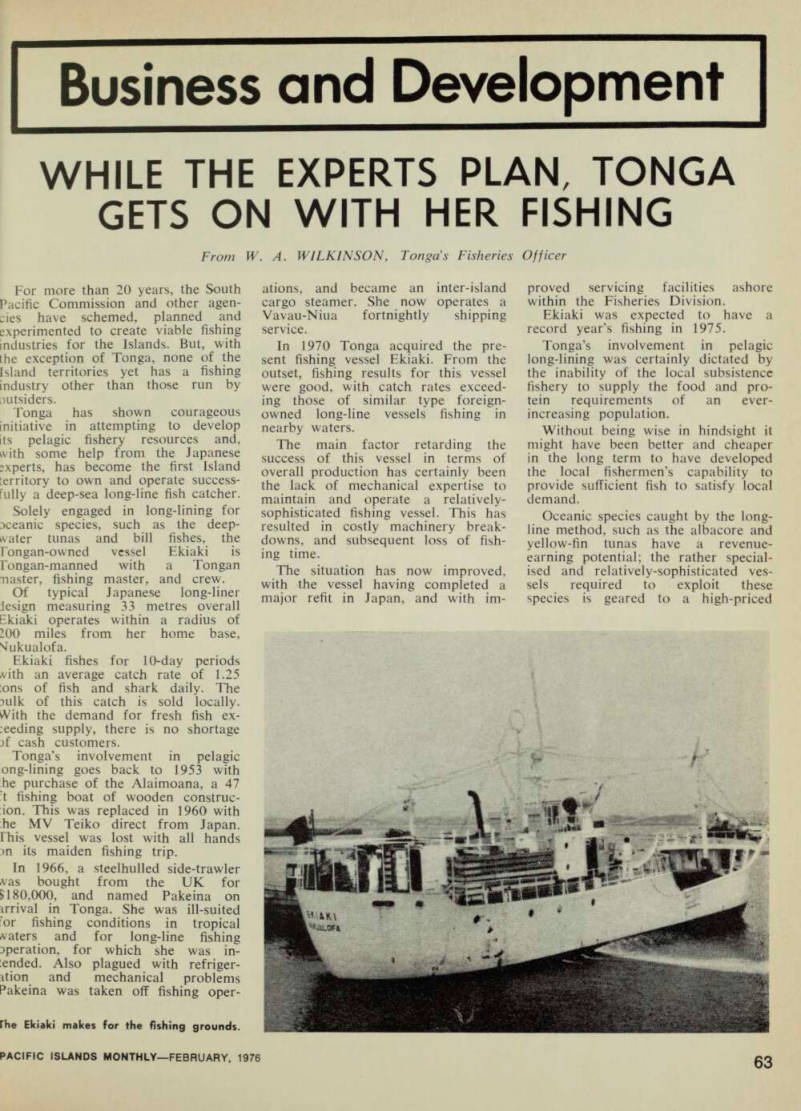
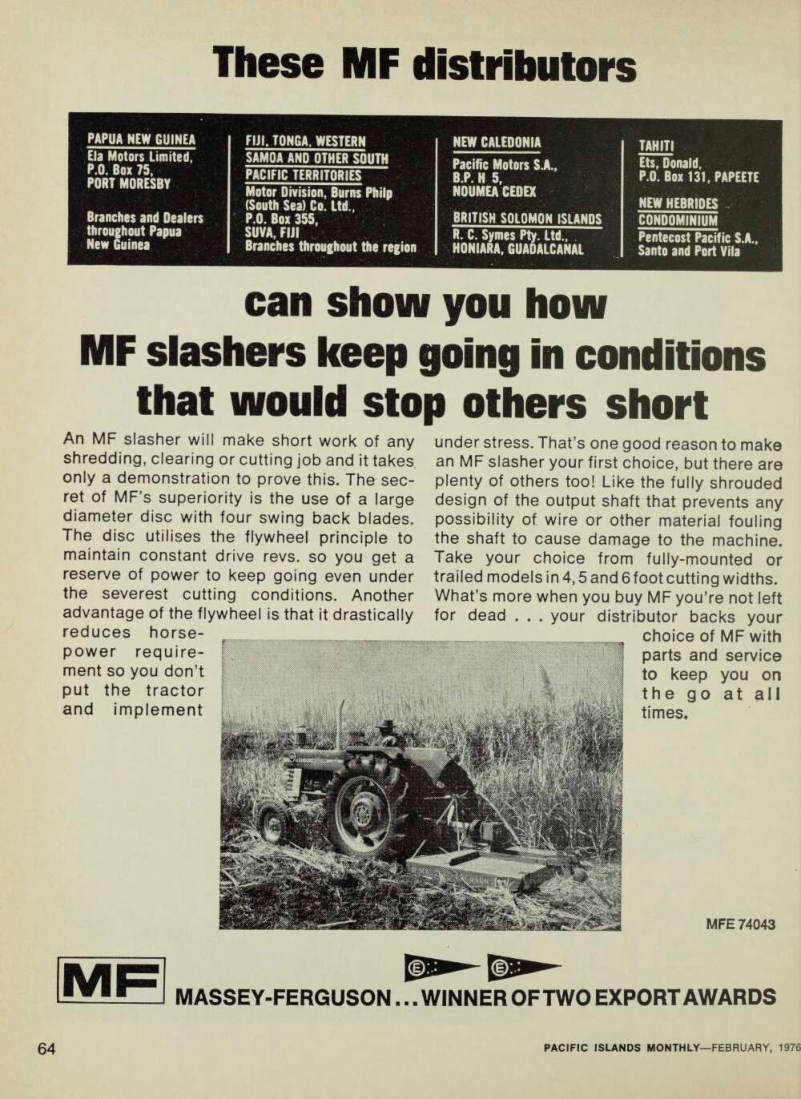
While The Experts Plan, Tonga
Gets On With Her Fishing
From W. A. WILKINSON, Tonga's Fisheries Officer
For more than 20 years, the South Pacific Commission and other agen cies have schemed, planned and experimented to create viable fishing industries for the Islands. But, with the exception of Tonga, none of the Island territories yet has a fishing industry other than those run by outsiders, Tonga has shown courageous initiative in attempting to develop its pelagic fishery resources and, with some help from the Japanese experts, has become the first Island territory to own and operate success fully a deep-sea long-line fish catcher.
Solely engaged in long-lining for oceanic species, such as the deep water tunas and bill fishes, the Eongan-owned vessel Ekiaki is Eongan-manned with a Tongan naster, fishing master, and crew.
Of typical Japanese long-liner Jesign measuring 33 metres overall Ekiaki operates within a radius of ZOO miles from her home base, Nukualofa.
Ekiaki fishes for 10-day periods with an average catch rate of 1.25 tons of fish and shark daily. The oulk of this catch is sold locally.
With the demand for fresh fish ex :eeding supply, there is no shortage af cash customers.
Tonga’s involvement in pelagic ong-lining goes back to 1953 with .he purchase of the Alaimoana, a 47 r t fishing boat of wooden construc tion. This was replaced in 1960 with the MV Teiko direct from Japan.
Ehis vessel was lost with all hands tin its maiden fishing trip.
In 1966, a steelhulled side-trawler was bought from the UK for 5180,000, and named Pakeina on arrival in Tonga. She was ill-suited : or fishing conditions in tropical waters and for long-line fishing operation, for which she was in tended. Also plagued with refriger ation and mechanical problems Pakeina was taken off fishing oper
ations, and became an inter-island cargo steamer. She now operates a Vavau-Niua fortnightly shipping service.
In 1970 Tonga acquired the pre sent fishing vessel Ekiaki. From the outset, fishing results for this vessel were good, with catch rates exceed ing those of similar type foreign owned long-line vessels fishing in nearby waters.
The main factor retarding the success of this vessel in terms of overall production has certainly been the lack of mechanical expertise to maintain and operate a relatively sophisticated fishing vessel. This has resulted in costly machinery break downs, and subsequent loss of fish ing time.
The situation has now improved, with the vessel having completed a major refit in Japan, and with im
proved servicing facilities ashore within the Fisheries Division.
Ekiaki was expected to have a record year’s fishing in 1975, Tonga’s involvement in pelagic long-lining was certainly dictated by the inability of the local subsistence fishery to supply the food and pro tein requirements of an ever increasing population.
Without being wise in hindsight it might have been better and cheaper in the long term to have developed the local fishermen’s capability to provide sufficient fish to satisfy local demand.
Oceanic species caught by the long line method, such as the albacore and yellow-fin tunas have a revenue earning potential; the rather special ised and relatively-sophisticated ves sels required to exploit these species is geared to a high-priced
the Ekiaki makes for the fishing grounds.
nd product such as canned tuna, ather than for local domestic con amption in fresh fish form.
Nevertheless, Tonga is now pro ressing towards the development of s local fisheries. A Loans to 'ishermen’s Scheme has been estab shed which provides low-interest >ans to fishermen for the purchase f engines, boats and fishing equip lent, The use of ice is now being icouraged by the Fisheries Division; 2W diesel-powered fishing boats are ;ing constructed, and used by the ical fishermen.
Bilateral assistance from the more weloped Pacific neighbours has ;en requested. Australia has com eted a fisheries programme report ir Tonga, and will assist with the ovision of fishing boats, extension id training centres, cold storage id transport facilities.
New Zealand is providing scientific, id material help in assessing the issibilities of establishing an oyster id mussel cultivation programme, le UNDP has now an ongoing hery resource survey project, which looking at both the potential for e demersal and the pelagic migrat g species, particularly the skipjack na.
During 1973, a survey carried out the Japan Marine Fishery Re urce Centre Organisation indicated potential commercial resource of ipjack exists, sufficient to support live-bait pole and line fishery based Vavau. The UNDP team is also instigating the availability of a itable live bait to support this hery.
The prospects for fisheries develop mt in Tonga looks promising, istakes made in the past, hopefully, 11 not be repeated. What is en uraging is that Tongans have own that they can master modern hing techniques. Their long liner manned entirely by Tongans, in lat is accepted as one of the trld’s most arduous jobs.
Future development of the fishing Justry will ensure employment in mga for Tongans who certainly ust otherwise look overseas, with 2 social and community damage lich enforced family separations uses.
It will provide revenue and much eded protein: it should lessen the iportation of nutritionally-suspect ined food from overseas.
Tonga imported $365.000-worth of ined fish alone in 1974. These may 4 be over-prestigious objectives; ey are certainly fundamental ones, lich no Pacific Island territory can : ord to neglect.
Advertisements & other items, p. 64 (1 item)
MF slashers keep going in conditions
These MF distributors
PAPUA NEW GUINEA
Ela Motors Limited.
P.O. Box T 5,
PORT MORESBY
Branches and Dealers throughout Papua New Guinea
FIJI. TONGA. WESTERN
SAMOA AND OTHER SOUTH
PACIFIC TERRITORIES
Motor Division, Burns Philp (South Sea) Co. Ltd., P.O. Box 355,
SUVA. FIJI
Branches throughout the region
can show you how
MF slashers keep going in conditions
that would stop others short
An MF slasher will make short work of any shredding, clearing or cutting job and it takes only a demonstration to prove this. The secret of MF’s superiority is the use of a large diameter disc with four swing back blades.
The disc utilises the flywheel principle to maintain constant drive revs, so you get a reserve of power to keep going even under the severest cutting conditions. Another advantage of the flywheel is that it drastically reduces horsepower requirement so you don’t put the tractor and implement under stress. That’s one good reason to make an MF slasher your first choice, but there are plenty of others too! Like the fully shrouded design of the output shaft that prevents any possibility of. wire or other material fouling the shaft to cause damage to the machine.
Take your choice from fully-mounted or trailed models in 4,5 and 6 foot cutting widths.
What’s more when you buy MF you’re not left for dead . . . your distributor backs your choice of MF with parts and service to keep you on the go at ail times.
MF=
MASSEY-FERGUSON
MFE 74043
WINNER OF TWO EXPORT AWARDS
Gloomy Future For Copra
Embattled Pacific Islands copra producers can expect little change in their plight in the foreseeable future.
Prices went down quickly after the 1974 boom. In several territories they do not now cover the cost of production.
Mr Boyamo Sali, recently, when acting as Minister for Agriculture in Papua New Guinea, said the indus try was faced with a major crisis.
The PNG Government resisted attempts to increase the bounty of K5O a tonne from the Copra Stabil isation Fund. There is enough money in the fund to keep paying the bounty till August. In December, PNG producers expected to receive prices K3O to K4O a tonne below the calculated average cost of pro duction for plantations and K4O a tonne below that needed to give smallholders a return equal to the rural minimum wage of $8.90 a week.
If it were not for the bounty, prices to growers would be KBO to K9O a tonne lower.
Although Stabilisation Fund money will keep prices at current levels till August only, Mr Sali urged growers to continue to produce copra.
In Fiji, the government pays growers a subsidy to keep the price for top grade at $l9O a ton and second grade at $l7l a ton. As this is a direct charge on the revenue the government is not keen to continue the subsidy indefinitely. But Fiji does have a chance of receiving a subsidy under the Lome Convention through its associate membership of the European Economic Community.
The return of the Philippines to full-scale production, plus buyer re sistance, forced prices down from the 1974 levels. World supplies of coconut oil are sufficient to meet demands.
The failure of the US soya bean crop and the fish meal industry in Peru in 1974, sent up the demand for alternative sources of protein, which coconut meal helped to meet.
The soya bean industry is now back in full production and the fish meal industry in Peru is recovering, two factors which are affecting the de mand for copra.
One Sydney copra authority sees no light at the end of the tunnel for the copra grower. Big mills in Europe have bought forward to June, so any chances of a recovery before then are remote, even though there have been one or two upward moves in recent weeks. But those rises were short-lived.
When copra prices rose in 1974, a number of users looked for alter natives, and some started using palm oil. Now they have no intention of going back to the coconut while there are supplies of palm oil at steady prices.
In Australia, which admittedly does not use a great deal of copra or coconut oil compared with the huge markets of Europe and the US, two main users have given up copra and turned to palm oil. A third user has retained copra, but has intro duced palm oil.
Fiji to boost
tuna fishing
The Fiji government-owned Ika Corporation has chartered a fishing ship from Japan in an effort to step up skipjack tuna fishing. The main aim of the corporation is to supply skipjack tuna from Fiji waters to the Pacific Fishing Co at Levuka.
The chartered ship, the Hatsutori Maru, will carry a crew of 10 Japanese and 24 local men. The Japanese crew will train the Fiji crew in skipjack tuna fishing techniques.
The Pacific Fishing Co plans to add up to 20 longline fishing boats to the fleet.
Japanese cold
water on oil prospects
Japanese oil interests do not share the belief of King Taufa’ahau Tupou that there are rich oil deposits in Tonga.
The king, late in 1975, sent a team of three to Japan to approach Japan ese companies about developing Tonga’s oil resources. The team comprised the Deputy Prime Minis ter, a law officer, and Mr Masanobu Ono, a Japanese who is special ad viser to the king. They took with them a report by the Saudi Arabian Government which, at the request of the king, made a survey of Tonga’s oil potential.
The Tongan team said in Japan that six companies, including Shell, were prospecting for oil in Tonga.
The Japanese companies they ap proached said they were reluctant to undertake development of the re sources because boring by the US companies showed there were no promising oil fields in Tonga. The managing director of one of the com panies added that his company could
not afford it because it was hard hit by the recession.
The two other companies made a concession by saying they would study the matter further.
Big profit for
Fiji post office
A dream of a former Fiji Post master-General, Mr W. J. (Bill) Cruikshank, has come true. The country’s postal and telephone ser vices are now operated as a business organisation, not a government de partment, and in its first year it turned in a net profit of $2,476,936.
Mr Cruikshank, who is now a busi nessman in Fiji, worked hard in the early 1960 s to have the post office become a business, but he could not convince his colonial masters.
In spite of the good result, the post office is not happy. The ac counting system is understaffed and in some areas out of date, and a “total breakdown” is said to be only a matter of time. And even though the services are among the cheapest in the world, users don’t get value for money, because not enough is spent on operating and maintaining services. Earnings were enough to meet all annual costs and a substan tial part of the amount needed for expansion.
Smooth dollar
swap for PNG
Papua New Guinea smoothly changed over to an independent cur rency on January 1. Only kina and toea are now legal tender in PNG, after a long period in which Austra lian currency was legal tender, and a short period during which Austra lian dollars and PNG kina operated side by side.
The kina has been pegged to the
Australian dollar, with K 1 equalling
Sai.
On January 5, PNG Finance Minister Mr Julius Chan said, “Some other fixed relationship could be adopted depending on circumstances
at the time, but at present, one for one is the appropriate one. This is the only policy that makes sense in our present circumstances. A few half-hearted people have been pre dicting the kina would be devalued on January 1, but events have proved how wrong they were”.
Mr Chan said that as at December 31, 1975, when the dual currency period ended, the total value of PNG’s international reserves was Kl4O million, which he regarded as “relatively modest, but adequate provided we in PNG exercise restraint in our expenditures over the next few years”.
He added, “PNG has become the unhappy recipient of the worst economic conditions in 50 years”.
Advertisements & other items, p. 65 (1 item)
65
CIFIC ISLANDS MONTHLY—FEBRUARY, 1976
A smashing time!
This is globe-trotting Peter Fisher, an islands agent, who, when he’s not making his rounds in almost every part of the world, sits at his desk in Sydney. Recently, Peter went to see
two bone special ists, one in Swit zerland and the other in Nairobi for a check-up.
But, why two and in such far flung places? It’s all because Peter had a smashing time twice while on his rounds. In Addis Ababa (Ethiopia) he fell
in the street and broke a hip. He was airfreighted to Nairobi for treat ment. Then, after he’d recovered, he was once more on his rounds; this time in Switzerland.
He slipped on some ice and broke his arm.
Advertisements & other items, p. 66 (1 item)
Ioliy Roger Marine Pr Ltd.
G ■* y
7 ALL-
-7 PRODUCT
CATALOGUE
Can any boating professional or enthusiast afford to be without it? A 212-page, illustrated catalogue of all the marine equipment and boat hardware that's made Jolly Roger famous. Send cheque or money order and get yours now.
ONLY
4 .00
POST PAID
IOLIY ROGER MARINE PR LTD.
HEAD OFFICE: 111 DARLEY STREET
MONA VALE, N.S.W. 2103
Also: Melbourne, Brisbane. AGENTS: Adelaide, Perth, Darwin, Tasmania.
JR62.12/9
Pacific
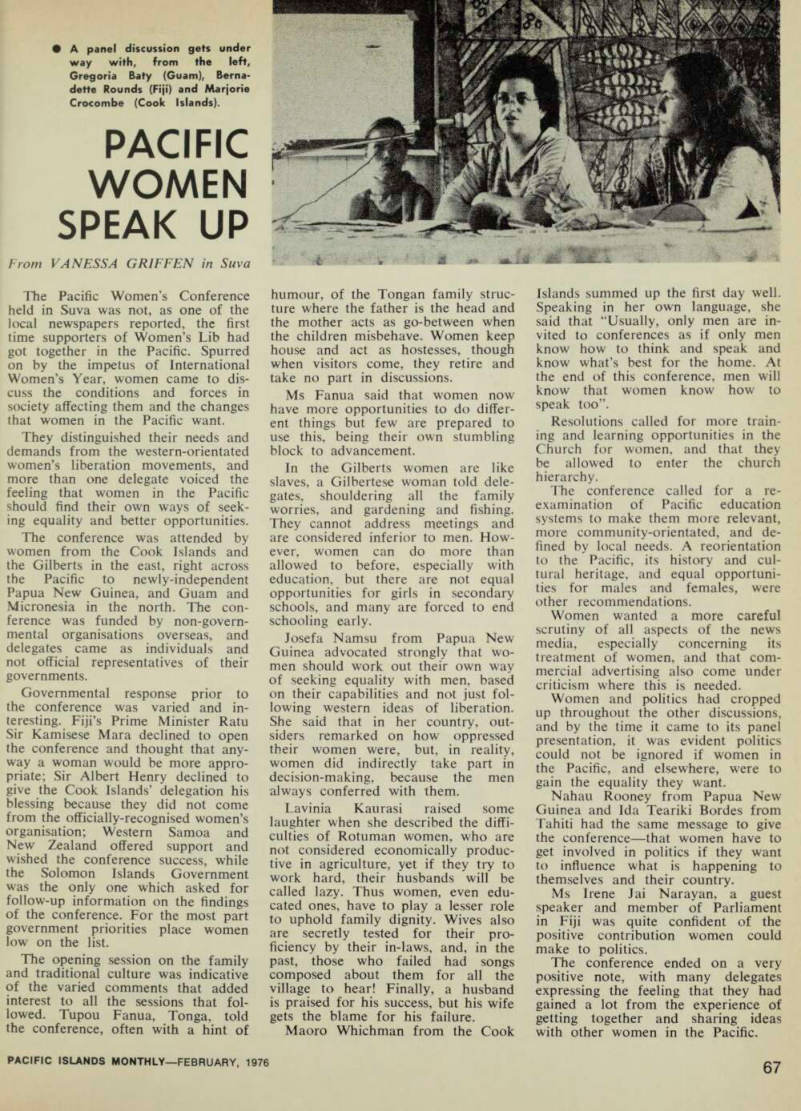
Women
Speak Up
From VANESSA G RIF FEN in Suva
The Pacific Women’s Conference held in Suva was not, as one of the local newspapers reported, the first time supporters of Women’s Lib had got together in the Pacific. Spurred on by the impetus of International Women’s Year, women came to dis cuss the conditions and forces in society affecting them and the changes that women in the Pacific want.
They distinguished their needs and demands from the western-orientated women’s liberation movements, and more than one delegate voiced the feeling that women in the Pacific should find their own ways of seek ing equality and better opportunities.
The conference was attended by women from the Cook Islands and the Gilberts in the east, right across the Pacific to newly-independent Papua New Guinea, and Guam and Micronesia in the north. The con ference was funded by non-govern mental organisations overseas, and delegates came as individuals and not official representatives of their governments.
Governmental response prior to the conference was varied and in teresting. Fiji’s Prime Minister Ratu Sir Kamisese Mara declined to open the conference and thought that any way a woman would be more appro priate; Sir Albert Henry declined to give the Cook Islands’ delegation his blessing because they did not come from the officially-recognised women’s organisation; Western Samoa and New Zealand offered support and wished the conference success, while the Solomon Islands Government was the only one which asked for follow-up information on the findings of the conference. For the most part government priorities place women low on the list.
The opening session on the family and traditional culture was indicative of the varied comments that added interest to all the sessions that fol lowed. Tupou Fanua, Tonga, told the conference, often with a hint of
humour, of the Tongan family struc ture where the father is the head and the mother acts as go-between when the children misbehave. Women keep house and act as hostesses, though when visitors come, they retire and take no part in discussions.
Ms Fanua said that women now have more opportunities to do differ ent things but few are prepared to use this, being their own stumbling block to advancement.
In the Gilberts women are like slaves, a Gilbertese woman told dele gates, shouldering all the family worries, and gardening and fishing.
They cannot address meetings and are considered inferior to men. How ever, women can do more than allowed to before, especially with education, but there are not equal opportunities for girls in secondary schools, and many are forced to end schooling early.
Josefa Namsu from Papua New Guinea advocated strongly that wo men should work out their own way of seeking equality with men, based on their capabilities and not just fol lowing western ideas of liberation.
She said that in her country, out siders remarked on how oppressed their women were, but, in reality, women did indirectly take part in decision-making, because the men always conferred with them.
Lavinia Kaurasi raised some laughter when she described the diffi culties of Rotuman women, who are not considered economically produc tive in agriculture, yet if they try to work hard, their husbands will be called lazy. Thus women, even edu cated ones, have to play a lesser role to uphold family dignity. Wives also are secretly tested for their pro ficiency by their in-laws, and, in the past, those who failed had songs composed about them for all the village to hear! Finally, a husband is praised for his success, but his wife gets the blame for his failure.
Maoro Whichman from the Cook
Islands summed up the first day well.
Speaking in her own language, she said that “Usually, only men are in vited to conferences as if only men know how to think and speak and know what’s best for the home. At the end of this conference, men will know that women know how to speak too”.
Resolutions called for more train ing and learning opportunities in the Church for women, and that they be allowed to enter the church hierarchy.
The conference called for a re examination of Pacific education systems to make them more relevant, more community-orientated, and de fined by local needs. A reorientation to the Pacific, its history and cul tural heritage, and equal opportuni ties for males and females, were other recommendations.
Women wanted a more careful scrutiny of all aspects of the news media, especially concerning its treatment of women, and that com mercial advertising also come under criticism where this is needed.
Women and politics had cropped up throughout the other discussions, and by the time it came to its panel presentation, it was evident politics could not be ignored if women in the Pacific, and elsewhere, were to gain the equality they want.
Nahau Rooney from Papua New Guinea and Ida Teariki Hordes from Tahiti had the same message to give the conference—that women have to get involved in politics if they want to influence what is happening to themselves and their country.
Ms Irene Jai Narayan, a guest speaker and member of Parliament in Fiji was quite confident of the positive contribution women could make to politics.
The conference ended on a very positive note, with many delegates expressing the feeling that they had gained a lot from the experience of getting together and sharing ideas with other women in the Pacific.
• A panel discussion gets under way with, from the left, Gregoria Baty (Guam), Berna dette Rounds (Fiji) and Marjorie Crocombe (Cook Islands).
Produce Prices
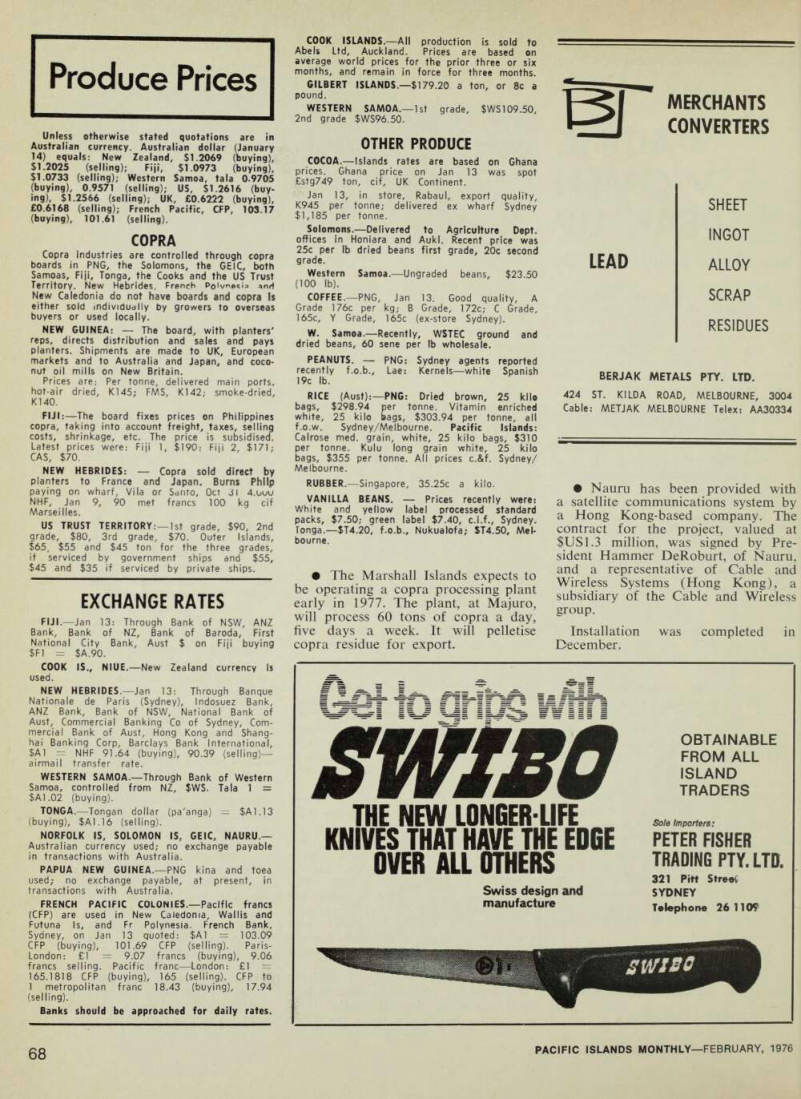
Unless otherwise stated quotations are in Australian currency. Australian dollar (January 14) equals: New Zealand, $1.2069 (buying), $1.2025 (selling); Fiji, $1.0973 (buying), $1.0733 (selling); Western Samoa, tala 0.9705 (buying), 0.9571 (selling); US, $1.2616 (buy ing), $1.2566 (selling); UK, £0.6222 (buying), £0.6168 (selling); French Pacific, CFP, 103.17 (buying), 101.61 (selling).
Copra
Copra Industries are controlled through copra boards in PNG, the Solomons, the GEIC, both Samoas, Fiji, Tonga, the Cooks and the US Trust Territory. New Hebrides. French Polynesia and New Caledonia do not have boards and copra Is either sold individually by growers to overseas buyers or used locally.
NEW GUINEA: The board, with planters' reps, directs distribution and sales and pays planters. Shipments are made to UK, European markets and to Australia and Japan, and coco nut oil mills on New Britain.
Prices are: Per tonne, delivered main ports, hot-air dried, K 145; FMS, K 142; smoke-dried,
Kuo.
FIJI: —The board fixes prices on Philippines copra, taking into account freight, taxes, selling costs, shrinkage, etc. The price is subsidised.
Latest prices were: Fiji 1, $190: Fiji 2, $171;
Cas, $7O.
NEW HEBRIDES: Copra sold direct by planters to France and Japan. Burns Phllp paying on wharf, Vila or Santo, Oct 31 4.ouu NHF, Jan 9, 90 met francs 100 kg cif Marseilles.
US TRUST TERRITORY;— Ist grade, $9O, 2nd grade, $BO, 3rd grade, $7O. Outer Islands, $65, $55 and $45 ton for the three grades, if serviced by government ships and $55, $45 and $35 if serviced by private ships.
Exchange Rates
FIJI.— Jan 13: Through Bank of NSW, ANZ Bank, Bank of NZ, Bank of Baroda, First National City Bank, Aust $ on Fiji buying
Sfi = Sa.9O.
COOK IS., NIUE. —New Zealand currency Is used.
NEW HEBRIDES.— Jan 13: Through Banque Nationale de Paris (Sydney), Indosuez Bank, ANZ Bank, Bank of NSW, National Bank of Aust, Commercial Banking Co of Sydney, Com mercial Bank of Aust, Hong Kong and Shang hai Banking Corp, Barclays Bank International, SAI = NHF 91.64 (buying), 90.39 (selling)— airmail transfer rate.
WESTERN SAMOA. —Through Bank of Western Samoa, controlled from NZ, SWS. Tala 1 = $A1.02 (buying).
TONGA.— Tongan dollar (pa'anga) = $A 1.13 (buying), $A1.16 (selling).
Norfolk Is, Solomon Is, Geic, Nauru.—
Australian currency used; no exchange payable in transactions with Australia.
PAPUA NEW GUINEA.— PNG kina and toea used; no exchange payable, at present, in transactions with Australia.
FRENCH PACIFIC COLONIES.— Pacific francs (CFP) are used in New Caledonia, Wallis and Futuna Is, and Fr Polynesia. French Bank, Sydney, on Jan 13 quoted: SAI = 103.09 CFP (buying), 101.69 CFP (selling). Paris- London: £1 = 9.07 francs (buying), 9.06 francs selling. Pacific franc —London: £1 = 165.1818 CFP (buying), 165 (selling). CFP to 1 metropolitan franc 18.43 (buying), 17.94 (selling).
Banks should be approached for daily rates.
COOK ISLANDS.—AII production is sold to Abels Ltd, Auckland. Prices are based on average world prices for the prior three or six months, and remain in force for three months.
GILBERT ISLANDS.— SI79.2O a ton, or 8c a pound.
WESTERN SAMOA.— Ist grade, $W5109.50, 2nd grade $W596.50.
Other Produce
COCOA. —lslands rates are based on Ghana prices. Ghana price on Jan 13 was spot £stg749 ton, cif, UK Continent.
Jan 13, in store, Rabaul, export quality, K 945 per tonne; delivered ex wharf Sydney $1,185 per tonne.
Solomons. —Delivered to Agriculture Dept, offices in Honiara and Aukl. Recent price was 25c per lb dried beans first grade, 20c second grade.
Western Samoa. —Ungraded beans, $23.50 (100 lb).
COFFEE. —PNG, Jan 13. Good quality, A Grade 176 c per kg; B Grade, 172 c; C Grade, 165 c, Y Grade, 165 c (ex-store Sydney).
W. Samoa. —Recently, WSTEC ground and dried beans, 60 sene per lb wholesale.
PEANUTS. PNG: Sydney agents reported recently f.0.b., Lae: Kernels —white Spanish 19c lb.
RICE (Aust): — PNG: Dried brown, 25 kilo bags, $298.94 per tonne. Vitamin enriched white, 25 kilo bags, $303.94 per tonne, all f.o.w. Sydney/Melbourne. Pacific Islands: Calrose med. grain, white, 25 kilo bags, $3lO per tonne. Kulu long grain white, 25 kilo bags, $355 per tonne. All prices c.&f. Sydney/ Melbourne.
RUBBER. —Singapore, 35.25 c a kilo.
VANILLA BEANS. Prices recently were: White and yellow label processed standard packs, $7.50; green label $7.40, c.i.f., Sydney.
Tonga.—sT4.2o, f.0.b., Nukualofa; $14.50, Mel bourne. • The Marshall Islands expects to
be operating a copra processing plant
early in 1977. The plant, at Majuro, will process 60 tons of copra a day, five days a week. It will pelletise copra residue for export.
• Nauru has been provided with a satellite communications system by a Hong Kong-based company. The contract for the project, valued at SUSI. 3 million, was signed by Pre sident Hammer Deßoburt, of Nauru, and a representative of Cable and Wireless Systems (Hong Kong), a subsidiary of the Cable and Wireless group.
Installation was completed in December.
Advertisements & other items, p. 68 (1 item)
Swibo
MERCHANTS
CONVERTERS
LEAD
SHEET
INGOT
ALLOY
SCRAP
RESIDUES
BERJAK METALS PTY, LTD.
424 ST. KILDA ROAD, MELBOURNE, 3004
Cable: METJAK MELBOURNE Telex: AA30334
=== = = = = = 1 =w
SWIBO
THE NEW LONGER-LIFE
KNIVES THAT HAVE THE EDGE
OVER All OTHERS
Swiss design and manufacture
OBTAINABLE
FROM ALL
ISLAND
TRADERS
Sole Importers:
PETER FISHER
TRADING PTY.LTD.
321 Pitt Street
SYDNEY
Telephone 26 110?
SWISS
Shipping & Airways Information
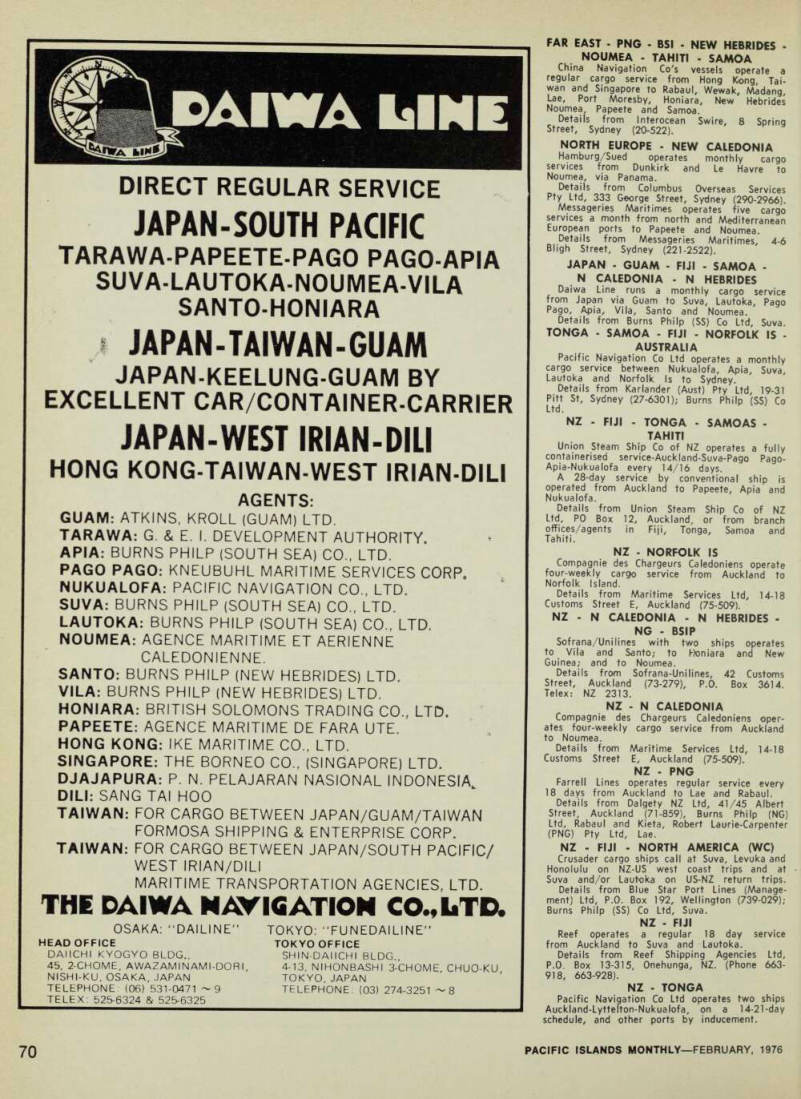
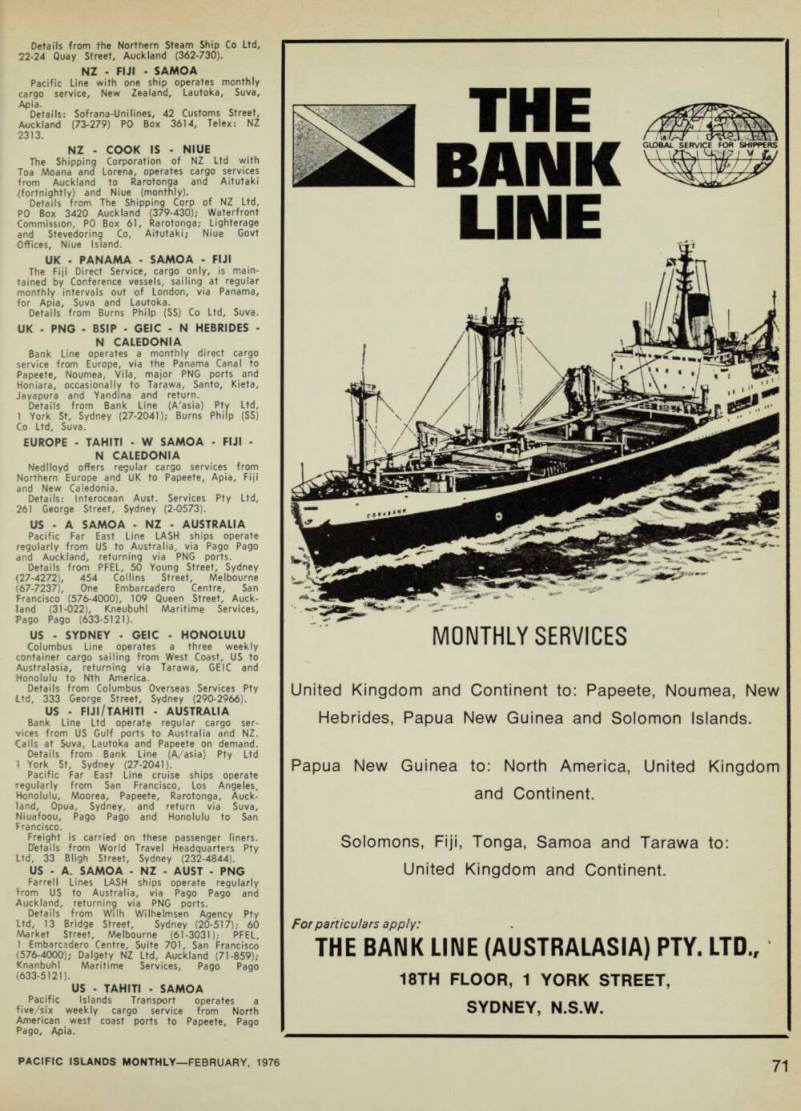
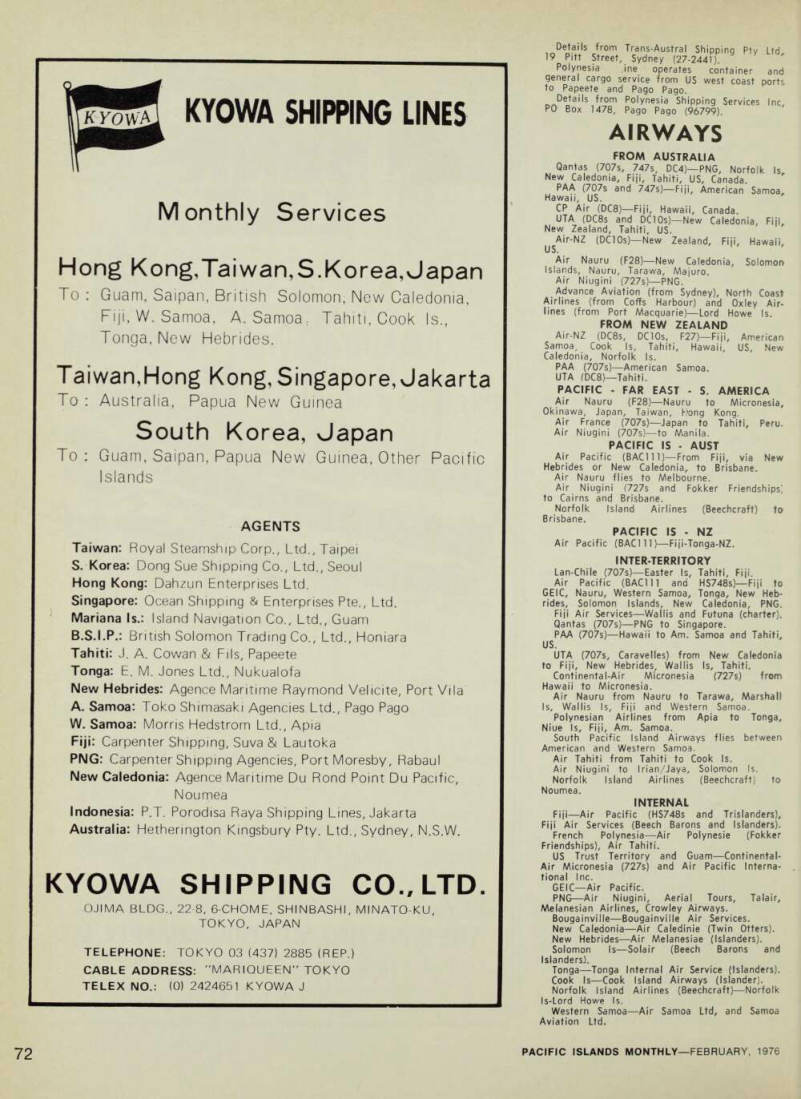
Shipping
SYDNEY - NZ - FIJI/TAHITI - UK Chandris Lines maintains a twice-monthly passenger service from Sydney via NZ, Suva or Papeete.
Details from Chandris Lines, 135 King Street, Svdney (28-2451).
SYDNEY - LORD HOWE IS - AUCKLAND -
Norfolk Is ■ New Caledonia
Compagnie des Chargeurs Caledoniens oper ates four-weekly cargo service Sydney-Lord Howe Island-Norfolk Island-Auckland-Norfolk Island-Noumea.
Details: Hetherington Kingsbury Pty Ltd, 37-49 Pitt Street, Sydney (27-1671).
Sydney - New Caledonia
Somacal operates 21-day service from Sydney to Noumea.
Details from Karlander (Aust) Pty Ltd, 19-31 Pitt Street, Sydney (27-6301).
SYDNEY - NZ - FIJI - HAWAII -
Canada - Us
P and 0 liners call at Auckland, Suva and Honolulu on eastbound and westbound voyages between Sydney and the US.
Details from P & 0 Australia Ltd, 55 Hunter Street, Sydney (230-0177).
SYDNEY ■ NZ - FIJI - TONGA - VILA •
Noumea - Samoas - Tahiti
Sltmar Cruises operates a South Pacific cruise programme to include most of the above countries plus the Solomons.
Details from Sitmar Line (Australia) Pty Ltd, 22-30 Bridge Street, Sydney (27-4521).
Royal Viking Line, with luxury cruise ships Royal Viking Sea, Star and Sky, cruises the Pacific from Sydney, Hobart and Cairns call ing at most of above countries.
Details from Wilh. Wilhelmsen Agency Pty Ltd. 13-15 Bridge Street, Sydney (2-0517).
P & 0 liners call at Suva, Honiara, Pago Pago, Auckland, Vila, Noumea, Honolulu, Nukualofa and Vavau, Savusavu, regularly on cruises from Australia.
Details from P & 0 Australia Ltd, 55 Hunter Street, Sydney (230-0177).
Australia - New Caledonia -
New Hebrides
Compagnie des Chargeurs Caledoniens operates three-weekly cargo service from Sydney to Noumea, Port Vila, Santo.
Details: Hetherington Kingsbury Pty Ltd, 37- 49 Pitt Street, Sydney (27-1671).
Sotrana-Umlines' ships call regularly at Sydney and Noumea. Vila/Santo cargo ex Melbourne and Brisbane only trans-shipped at Noumea.
Details from Sofrana-Unilines, 37 Pitt Street, Sydney (27-2031), Burns Philp and Co Ltd, 340 Collins Street, Melbourne (67-8941) and John Swire and Sons, Brisbane (46-1155).
South Pacific United Lines maintain a two week cargo service from Sydney to Noumea, Vila and Santo.
Details from Omni Traders & Brokers Pty Limited, 261 George Street, Sydney (241-2872/6).
Australia - Fiji
Sofrana-Unilines operates Melbourne-Sydney- Fiji every 28 days.
Details from Sofrana-Unilines, 37 Pitt Street, Sydney (27-2031); Burns Philp and Co Ltd, 340 Collins Street, Melbourne (67-8941).
Australia - Fiji - W. Samoa
Nauru Pacific Line operates monthly con ventional/oontainer service from Sydney and Brisbane to Fiji and Western Samoa.
Details from Nauru Pacific Line, 227 Collins Street, Melbourne (654-4977); Interocean Swire, 8 Spring Street, Sydney (20-522); Dalgety
Shipping, 79 Eagle Street, Brisbane (31-0331).
Karlander (Aust) Pty Ltd operates three weekly cargo services from Sydney to Suva and Lautoka.
Details from Karlander (Aust) Pty Ltd, 19-31 Pitt Street, Sydney (27-6301); Dalgety Shipping, 461 Bourke St, Melbourne (60-0731); Burns Philp (SS) Cos Ltd, Suva and Lautoka. aiktpama TAHITI MFYiro IK Sout S h Tß pa!mc' "united a M X US*'™ fr ° m 10 Papeete ' Defails from Omni Traders & Brokers Pty Limited, 261 George Street, Sydney (241-2872/6). aiictoaiia om/~ „ * . « .1. r A ■ nun Containers Pacific Express (Burns Philp and AWP Line) operates four-weekly cargo service from Melbourne and Brisbane with Samos to Port Moresby and Lae and three-weekly cargo service from Sydney (direct) to Lae and Port Moresby with Nimos.
Details from Burns Philp & Cos Ltd, 51 Pitt
Street, Sydney (241-3816).
Farrell Lines operates a service every 18 days from Tasmania, Melbourne, Sydney and Brisbane to Lae and Rabaul.
Details from Wilh Wilhelmsen Agency Pty Ltd, 13 Bridge Street, Sydney (20-517), 60 Market Street, Melbourne (67-7237), Burns Philp (NG) Ltd, Rabaul and Kieta, Robert Laurie-Carpenter (NG) Pty Ltd, Lae.
New Guinea Express Lines with two ships operates three-weekly Melbourne Sydney, Brisbane, Port Moresby, Lae, Rabaul.
D De D^' ls D from , Guinea Express lines PO Box R 73, Royal Exchange PO Sydney 241-3991) and 70 Eagle St, Brisbane (221-9333) Westrahan Farmers Transport Pty Ltd, 459 Little Collins St Melbourne (67-8291), Breckwoldt's Shipping Agencies m Port Moresby, Lae, Rabtrad Niugim Pty Ltd, Rabaul.
Karlander New Guinea Line s cargo vessels 55lLk ’ Svd "' y ' Lae ' MalJans ' Wl ni/ii/V,™' /...I o,„ M 1Q„ Details from Karlander (Aust) Pty Ltd, 19-31
2" Smppin9 '
461 Bourke St, Melbourne (60-0731).
Australia - Png - Bsip
New Guinea Australia Line's vessels operate from Sydney and Brisbane to Port Moresby,
Lae, Rabaul, Kavieng, Wewak, Honiara, Kieta, Gize, Madang and Samarai.
Details from Interocean Swire, 8 Spring Street, Sydney (20-522). amctpaiia Mr mitpomfsia
Australia - Ng - Micronesia
Guam
Nauru Pacific Line operates monthly con ventional/container service Melbourne/Sydney to Street, Melbourne (654-4977); Interocean Swire, 8 Street, Sydney (20-522).
Us - Png
Farrell Lines operates regular services from all US wet coast ports to Lae and Rabaul.
Details from Wilh Wilhelmsen Agency Pty Ltd/ 13 Bridge street, Sydney (2 0-517), One Embarcadero Centre, Suite 701, San Francisco, Burns phj p (NG) Ltd/ Rabau and Kieta/ Rober t Laurie-Carpenter (PNG) Pty Ltd, Lae.
Png - Us - Canada
Farrel Lines operates regular services from Lae and Rabaul to US west coast ports and Vancouver.
Details from Burns Philp (NG) Ltd, Rabaul and Kieta, Robert Laurie-Carpenter (PNG) Pty Ltd, Lae, PFEL, One Embarcadero Centre, Suite 701, San Francisco and Wilh Wilhelmsen Agency Pty Ltd, 13 Bridge Street, Sydney (20-517). par EAST - FIJI - NEW ZEALAND New Zealand Unit Express (CNC, MOL, RIL) operates a three-weekly cargo service from H ong Kong to Lautoka, Suva, NZ ports, Manila, K aos h iung Keelung, Hong Kong, Detaj|s from , y nteroC ean Swire, 8 Spring street Svdnev 17 0-522) Royal WroSm Lines operates monthly cargo y servjce with three ships from Surabaya, Bangkok, Port Kelang and Singapore to Suva , nH m? nm-tc Details from lote-oceao Australia Services, 261 George Street, Sydney (2-0573), Burns Philo ,ccu f trf r ' n H lautoka Ben CO ShippinrCo (Pte Ltd sailing monthly from sing 7 por a e/ H ong Kong, Keelung, Kao shiung, Suva and main NZ ports.
Details from Seatrans (Fiji) Ltd, GPO Box 152, Suva, Fiji.
FAR EAST - PNG - BSI - NEW HEBRIDES -
Noumea - Tahiti - Samoa
China Navigation Co's vessels operate a regular cargo service from Hong Kong, Tai wan and Singapore to Rabaul, Wewak, Madang, Lae, Port Moresby, Honiara, New Hebrides Noumea Papeete and Samoa.
Details from Interocean Swire, 8 Spring Street, Sydney (20-522).
North Europe ■ New Caledonia
Hamburg/Sued operates monthly cargo services from Dunkirk and Le Havre to Noumea, via Panama.
Details from Columbus Overseas Services Pty Ltd, 333 George Street, Sydney (290-2966).
Messageries Maritimes operates five cargo services a month from north and Mediterranean European ports to Papeete and Noumea.
Details from Messageries Maritimes, 4-6 Bligh Street, Sydney (221-2522).
JAPAN - GUAM - FIJI - SAMOA -
N Caledonia ■ N Hebrides
Daiwa Line runs a monthly cargo service from Japan via Guam to Suva, Lautoka, Pago Pago, Apia, Vila, Santo and Noumea.
Details from Burns Philp (SS) Cos Ltd, Suva.
TONGA - SAMOA - FIJI - NORFOLK IS -
Australia
Pacific Navigation Cos Ltd operates a monthly cargo service between Nukualofa, Apia, Suva, Lautoka and Norfolk Is to Sydney.
Details from Karlander (Aust) Pty Ltd, 19-31 Pitt St, Sydney (27-6301); Burns Philp (SS) Cos Ltd.
NZ - FIJI - TONGA - SAMOAS -
Tahiti
Union Steam Ship Cos of NZ operates a fully containerised service-Auckland-Suva-Pago Pago- Apia-Nukualofa every 14/16 days.
A 28-day service by conventional ship is operated from Auckland to Papeete, Apia and Nukualofa.
Details from Union Steam Ship Cos of NZ Ltd, PO Box 12, Auckland, or from branch offices/agents in Fiji, Tonga, Samoa and Tahiti.
Nz - Norfolk Is
Compagnie des Chargeurs Caledoniens operate four-weekly cargo service from Auckland to Norfolk Island.
Details from Maritime Services Ltd, 14-18 Customs Street E, Auckland (75-509).
NZ - N CALEDONIA - N HEBRIDES -
Ng - Bsip
Sofrana/Unilines with two ships operates to Vila and Santo; to Honiara and New Guinea; and to Noumea.
Details from Sofrana-Unilines, 42 Customs Street, Auckland (73-279), P.O. Box 3614.
Telex: NZ 2313.
Nz - N Caledonia
Compagnie des Chargeurs Caledoniens oper ates four-weekly cargo service from Auckland to Noumea.
Details from Maritime Services Ltd, 14-18 Customs Street E, Auckland (75-509).
Nz - Png
Farrell Lines operates regular service every 18 days from Auckland to Lae and Rabaul.
Details from Dalgety NZ Ltd, 41/45 Albert Street, Auckland (71-859), Burns Philp (NG) Ltd, Rabaul and Kieta, Robert Laurie-Carpenter (PNG) Pty Ltd, Lae.
NZ - FIJI - NORTH AMERICA (WC) Crusader cargo ships call at Suva, Levuka and Honolulu on NZ-US west coast trips and at Suva and/or Lautoka on US-NZ return trips.
Details from Blue Star Port Lines (Manage ment) Ltd, P.O. Box 192, Wellington (739-029); Burns Philp (SS) Cos Ltd, Suva.
Nz - Fiji
Reef operates a regular 18 day service from Auckland to Suva and Lautoka.
Details from Reef Shipping Agencies Ltd, P.O. Box 13-315, Onehunga, NZ. (Phone 663- 918, 663-928).
Nz - Tonga
Pacific Navigation Cos Ltd operates two ships Auckland-Lyttelton-Nukualofa, on a 14-21-day schedule, and other ports by inducement.
Details from the Northern Steam Ship Cos Ltd, 22-24 Quay Street, Auckland (362-730).
Nz - Fiji • Samoa
Pacific Line with one ship operates monthly cargo service. New Zealand, Lautoka, Suva, Apia.
Details: Sofrana-Unilines, 42 Customs Street, Auckland (73-279) PO Box 3614, Telex: NZ 2313.
Nz - Cook Is - Niue
The Shipping Corporation of NZ Ltd with Toa Moana and Lorena, operates cargo services from Auckland to Rarotonga and Aitutaki (fortnightly) and Niue (monthly).
Details from The Shipping Corp of NZ Ltd, PO Box 3420 Auckland (379-430); Waterfront Commission, PO Box 61, Rarotonga; Lighterage and Stevedoring Cos, Aitutaki; Niue Govt Offices, Niue Island.
UK ■ PANAMA - SAMOA - FIJI The Fiji Direct Service, cargo only, is main tained by Conference vessels, sailing at regular monthly intervals out of London, via Panama, for Apia, Suva and Lautoka.
Details from Burns Philp (SS) Cos Ltd, Suva.
UK - PNG - BSIP - GEIC - N HEBRIDES -
N Caledonia
Bank Line operates a monthly direct cargo service from Europe, via the Panama Canal to Papeete, Noumea, Vila, major PNG ports and Honiara, occasionally to Tarawa, Santo, Kieta, Jayapura and Yandina and return.
Details from Bank Line (A'asia) Pty Ltd, 1 York St, Sydney (27-2041); Burns Philp (SS) Cos Ltd, Suva.
EUROPE - TAHITI - W SAMOA - FIJI -
N Caledonia
Nedlloyd offers regular cargo services from Northern Europe and UK to Papeete, Apia, Fiji and New Caledonia.
Details: Interocean Aust. Services Pty Ltd, 261 George Street, Sydney (2-0573).
US - A SAMOA - NZ ■ AUSTRALIA Pacific Far East Line LASH ships operate regularly from US to Australia, via Pago Pago and Auckland, returning via PNG ports.
Details from PFEL, 50 Young Street, Sydney (27-4272), 454 Collins Street, Melbourne (67-7237), One Embarcadero Centre, San Francisco (576-4000), 109 Queen Street, Auck land (31-022), Kneubuhl Maritime Services, Pago Pago (633-5121).
US - SYDNEY - GEIC - HONOLULU Columbus Line operates a three weekly container cargo sailing from West Coast, US to Australasia, returning via Tarawa, GEIC and Honolulu to Nth America.
Details from Columbus Overseas Services Pty Ltd, 333 George Street, Sydney (290-2966).
Us - Fiji/Tahiti - Australia
Bank Line Ltd operate regular cargo ser vices from US Gulf ports to Australia and NZ.
Calls at Suva, Lautoka and Papeete on demand.
Details from Bank Line (A/asia) Pty Ltd 1 York St, Sydney (27-2041).
Pacific Far East Line cruise ships operate regularly from San Francisco, Los Angeles, Honolulu, Moorea, Papeete, Rarotonga, Auck land, Opua, Sydney, and return via Suva, Niuafoou, Pago Pago and Honolulu to San Francisco.
Freight is carried on these passenger liners.
Details from World Travel Headquarters Pty Ltd, 33 Bligh Street, Sydney (232-4844).
US - A. SAMOA - NZ - AUST ■ PNG Farrell Lines LASH ships operate regularly from US to Australia, via Pago Pago and Auckland, returning via PNG ports.
Details from Wilh Wilhelmsen Agency Pty Ltd, 13 Bridge Street, Sydney (20-517); 60 Market Street, Melbourne (61-3031); PFEL, 1 Embarcadero Centre, Suite 701, San Francisco (576-4000); Dalgety NZ Ltd, Auckland (71-859); Knanbuhl Maritime Services, Pago Pago (633-5121).
Us - Tahiti - Samoa
Pacific Islands Transport operates a five/six weekly cargo service from North American west coast ports to Papeete, Pago Pago, Apia.
Details from Trans-Austral Shippinq Ptv Ltd 19 Pitt Street, Sydney (27-2441) ' Polynesia ,ine operates container and general cargo service from US west coast ports to Papeete and Pago Pago.
Details from Polynesia Shipping Services Inc, PO Box 1478, Pago Pago (96799).
Airways
From Australia
Qantas (707s, 747s, DC4)—PNG, Norfolk Is, New Caledonia, Fiji, Tahiti, US, Canada.
PAA (707s and 747s) —Fiji, American Samoa, Hawaii, US.
CP Air (DCS) —Fiji, Hawaii, Canada.
UTA (DC8s and DClOs) —New Caledonia, Fiji, New Zealand, Tahiti, US. (DClOs) —New Zealand, Fiji, Hawaii, Air Nauru (F28) —New Caledonia, Solomon Islands, Nauru, Tarawa, Majuro.
Air Niugini (727s) —PNG.
Advance Aviation (from Sydney), North Coast Airlines (from Coffs Harbour) and Oxley Air lines (from Port Macquarie)—Lord Howe Is.
From New Zealand
Air-NZ (DC8s, DClOs, F27) —Fiji, American Samoa, Cook Is, Tahiti, Hawaii, US, New Caledonia, Norfolk Is.
PAA (707s) —American Samoa.
UTA fDC8)—Tahiti.
PACIFIC - FAR EAST - S. AMERICA Air Nauru (F28) —Nauru to Micronesia, Okinawa, Japan, Taiwan, K'ong Kong.
Air France (707s) —Japan to Tahiti, Peru.
Air Niugini (707s) —to Manila.
Pacific Is - Aust
Air Pacific (BAC 111) —From Fiji, via New Hebrides or New Caledonia, to Brisbane.
Air Nauru flies to Melbourne.
Air Niugini (727s and Fokker Friendships] to Cairns and Brisbane.
Norfolk Island Airlines (Beechcraft) to Brisbane.
Pacific Is - Nz
Air Pacific (BAC111) —Fiji-Tonga-NZ.
Inter-Territory
Lan-Chile (707s) —Easter Is, Tahiti, Fiji.
Air Pacific (BAC111 and HS748s)—Fiji to GEIC, Nauru, Western Samoa, Tonga, New Heb rides, Solomon Islands, New Caledonia, PNG.
Fiji Air Services—Wallis and Futuna (charter).
Qantas (707s) —PNG to Singapore.
PAA (707s) —Hawaii to Am. Samoa and Tahiti, US.
UTA (707s, Caravelles) from New Caledonia to Fiji, New Hebrides, Wallis Is, Tahiti.
Continental-Air Micronesia (727s) from Hawaii to Micronesia.
Air Nauru from Nauru to Tarawa, Marshall Is, Wallis Is, Fiji and Western Samoa.
Polynesian Airlines from Apia to Tonga, Niue Is, Fiji, Am. Samoa.
South Pacific Island Airways flies between American and Western Samoa.
Air Tahiti from Tahiti to Cook Is.
Air Niugini to Irian/Jaya, Solomon Is.
Norfolk Island Airlines (Beechcraft) to Noumea.
Internal
Fiji—Air Pacific (HS748s and Trislanders), Fiji Air Services (Beech Barons and Islanders).
French Polynesia—Air Polynesie (Fokker Friendships), Air Tahiti.
US Trust Territory and Guam—Continental- Air Micronesia (727s) and Air Pacific Interna tional Inc.
GEIC—Air Pacific.
PNG —Air Niugini, Aerial Tours, Talair, Melanesian Airlines, Crowley Airways.
Bougainville—Bougainville Air Services.
New Caledonia—Air Caledinie (Twin Otters).
New Hebrides —Air Melanesiae (Islanders).
Solomon Is —Solair (Beech Barons and Islanders).
Tonga—Tonga Internal Air Service (Islanders).
Cook Is —Cook Island Airways (Islander).
Norfolk Island Airlines (Beechcraft) —Norfolk Is-Lord Howe Is.
Western Samoa —Air Samoa Ltd, and Samoa Aviation Ltd.
Advertisements & other items, pp. 69-73 (2 items)
Union Steam Ship Co. Of N.Z.
LIMITED
Serving the Pacific for nearly 100 years.
Regular Sailings by Modern Vessels
From Auckland to Lautoka, Suva, Pago Pago, Apia, Niue, Vavau, Nukualofa. Also from Tauranga to Lautoka, Suva, Apia, Nukualofa. Regular sailings from Australia to New Zealand to enable transhipment of cargo to all the above ports.
Ship your cargo by a Union Company Vessel.
BRANCHES AT ALL MAIN AUSTRALIAN, NEW ZEALAND AND ISLAND PORTS.
DIRECT REGULAR SERVICE
JAPAN-SOUTH PACIFIC
TARAWA-PAPEETE-PAGO PAGO-APIA
SUVA-LAUTOKA-NOUMEA-VILA
SANTO-HONIARA
i JAPAN-TAIWAN-GUAM
JAPAN-KEELUNG-GUAM BY
EXCELLENT CAR/CONTAINER-CARRIER
JAPAN-WEST IRIAN-DILI
HONG KONG-TAIWAN-WEST IRIAN-DILI
AGENTS:
GUAM: ATKINS, KROLL (GUAM) LTD.
TARAWA: G. & E. I. DEVELOPMENT AUTHORITY.
APIA: BURNS PHILP (SOUTH SEA) CO.. LTD.
PAGO PAGO: KNEUBUHL MARITIME SERVICES CORP.
NUKUALOFA: PACIFIC NAVIGATION CO., LTD.
SUVA: BURNS PHILP (SOUTH SEA) CO., LTD.
LAUTOKA: BURNS PHILP (SOUTH SEA) CO., LTD.
NOUMEA: AGENCE MARITIME ET AERIENNE
CALEDONIENNE.
SANTO: BURNS PHILP (NEW HEBRIDES) LTD.
VILA: BURNS PHILP (NEW HEBRIDES) LTD.
HONIARA: BRITISH SOLOMONS TRADING CO., LTD.
PAPEETE: AGENCE MARITIME DE FARA UTE.
HONG KONG: IKE MARITIME CO., LTD.
SINGAPORE: THE BORNEO CO., (SINGAPORE) LTD.
DJAJAPURA: P. N. PELAJARAN NASIONAL INDONESIA
DILI: SANG TAI HOO
TAIWAN: FOR CARGO BETWEEN JAPAN/GUAM/TAIWAN
FORMOSA SHIPPING & ENTERPRISE CORP.
TAIWAN: FOR CARGO BETWEEN JAPAN/SOUTH PACIFIC/
WEST IRIAN/DILI
MARITIME TRANSPORTATION AGENCIES, LTD.
THE DAIWA NAVIGATION CO.. LTD.
OSAKA: "DAILINE” TOKYO; “FUNEDAILINE”
HEAD OFFICE TOKYO OFFICE
DAIICHI KVOGVO BLDG., SHIN-DAIICHI BLDG.,
45, 2-CHOME, AWAZAMINAMI-DORI, 4-13, NIHONBASHI 3-CHOME CHUO-KU
NISHI-KU, OSAKA, JAPAN TOKYO, JAPAN
TELEPHONE. (06) 531-0471 ~9 TELEPHONE. (03) 274-3251 ~8
TELEX: 525-6324 & 525-6325
THE
BANK
LINE
GLOBAL SERVICE FOR SHIPPERS
- M"
MONTHLY SERVICES
United Kingdom and Continent to; Papeete, Noumea, New Hebrides, Papua New Guinea and Solomon Islands.
Papua New Guinea to: North America, United Kingdom and Continent.
Solomons, Fiji, Tonga, Samoa and Tarawa to: United Kingdom and Continent.
For particulars apply:
THE BANK LINE (AUSTRALASIA) PTY. LTD.,
18TH FLOOR, 1 YORK STREET,
SYDNEY, N.S.W.
KYOWA SHIPPING LINES
Monthly Services
Hong Kong,Taiwan,S.Korea,Japan
To : Guam, Saipan, British Solomon, New Caledonia, Fiji, W. Samoa, A. Samoa. Tahiti, Cook Is., Tonga, New Hebrides.
Taiwan,Hong Kong. Singapore, Jakarta
To: Australia, Papua New Guinea
South Korea, Japan
To: Guam, Saipan, Papua New Guinea, Other Pacific Islands
AGENTS
Taiwan: Royal Steamship Corp., Ltd., Taipei S. Korea: Dong Sue Shipping Co., Ltd., Seoul Hong Kong: Dahzun Enterprises Ltd.
Singapore: Ocean Shipping & Enterprises Pte., Ltd, Mariana Is.: Island Navigation Co., Ltd., Guam 8.5.1. P.: British Solomon Trading Co., Ltd., Honiara Tahiti: J. A. Cowan & Fils, Papeete Tonga: E. M. Jones Ltd., Nukualofa New Hebrides: Agence Maritime Raymond Velicite, Port Vila A. Samoa: Toko Shimasaki Agencies Ltd., Pago Pago W. Samoa: Morris Hedstrom Ltd., Apia Fiji: Carpenter Shipping, Suva & Lautoka PNG: Carpenter Shipping Agencies, Port Moresby, Rabaul New Caledonia: Agence Maritime Du Rond Point Du Pacific, Noumea Indonesia: P.T. Porodisa Raya Shipping Lines, Jakarta Australia: Hetherington Kingsbury Pty. Ltd., Sydney, N.S.W.
KYOWA SHIPPING CO., LTD.
OJIMA BLDG., 22-8, 6-CHOME, SHINBASHI, MINATO-KU,
TOKYO. JAPAN
TELEPHONE: TOKYO 03 (437) 2885 (REP.)
CABLE ADDRESS: "MARIQUEEN" TOKYO
TELEX NO.: (0) 2424651 KYOWA J
Fiji Plans To Use Its Empty Acres
73
PACIFIC ISLANDS MONTHLY— FEBRUARY, 1976
From p 15
FIJI PLANS TO USE ITS EMPTY ACRES
Islands People
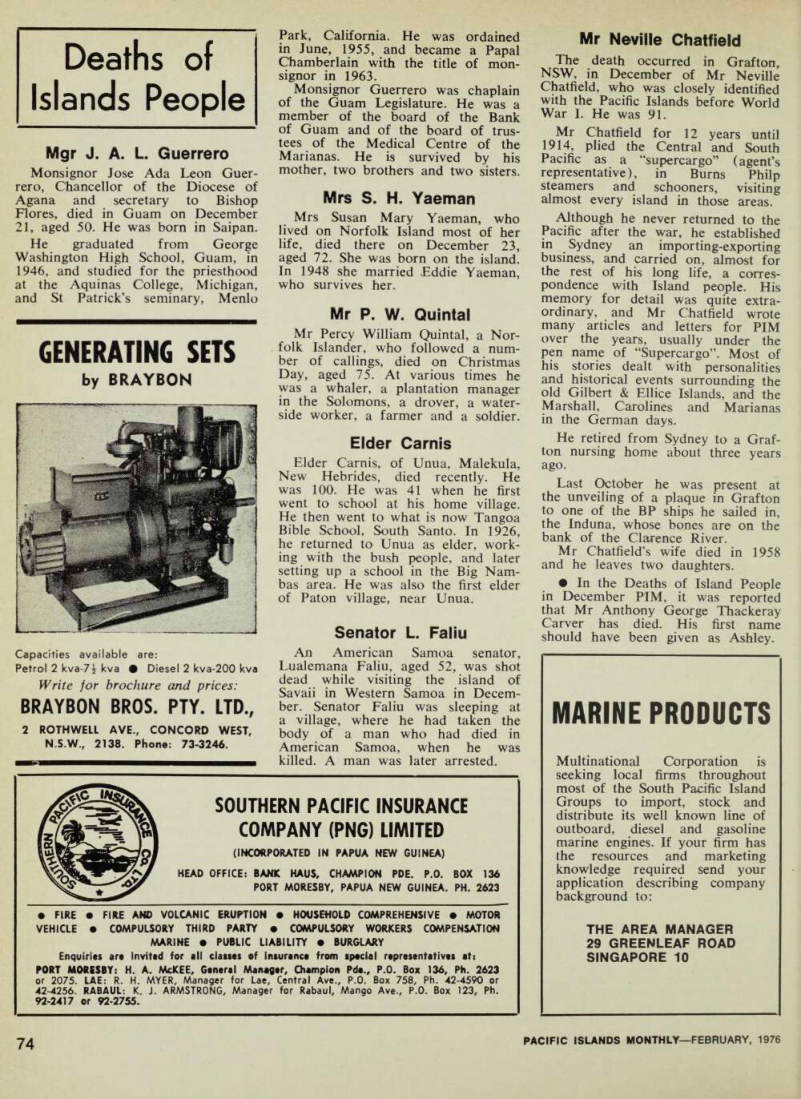
Deaths of Islands People
Mgr J. A. L. Guerrero Monsignor Jose Ada Leon Guer rero, Chancellor of the Diocese of Agana and secretary to Bishop Flores, died in Guam on December 21, aged 50. He was born in Saipan.
He graduated from George Washington High School, Guam, in 1946, and studied for the priesthood at the Aquinas College, Michigan, and St Patrick’s seminary, Menlo
Park, California. He was ordained in June, 1955, and became a Papal Chamberlain with the title of mon signor in 1963.
Monsignor Guerrero was chaplain of the Guam Legislature. He was a member of the board of the Bank of Guam and of the board of trus tees of the Medical Centre of the Marianas. He is survived by his mother, two brothers and two sisters.
Mrs S. H. Yaeman Mrs Susan Mary Yaeman, who lived on Norfolk Island most of her life, died there on December 23, aged 72. She was born on the island.
In 1948 she married Eddie Yaeman, who survives her.
Mr P. W. Quintal Mr Percy William Quintal, a Nor folk Islander, who followed a num ber of callings, died on Christmas Day, aged 75. At various times he was a whaler, a plantation manager in the Solomons, a drover, a water side worker, a farmer and a soldier.
Elder Carnis Elder Carnis, of Unua, Malekula, New Hebrides, died recently. He was 100. He was 41 when he first went to school at his home village.
He then went to what is now Tangoa Bible School, South Santo. In 1926, he returned to Unua as elder, work ing with the bush people, and later setting up a school in the Big Nam bas area. He was also the first elder of Paton village, near Unua, Senator L. Faliu An American Samoa senator, Lualemana Faliu, aged 52, was shot dead while visiting the island of Savaii in Western Samoa in Decem ber. Senator Faliu was sleeping at a village, where he had taken the body of a man who had died in American Samoa, when he was killed. A man was later arrested.
Mr Neville Chatfield The death occurred in Grafton, NSW, in December of Mr Neville Chatfield, who was closely identified with the Pacific Islands before World War I. He was 91.
Mr Chatfield for 12 years until 1914, plied the Central and South Pacific as a “supercargo” (agent’s representative), in Burns Philp steamers and schooners, visiting almost every island in those areas.
Although he never returned to the Pacific after the war, he established in Sydney an importing-exporting business, and carried on, almost for the rest of his long life, a corres pondence with Island people. His memory for detail was quite extra ordinary, and Mr Chatfield wrote many articles and letters for PIM over the years, usually under the pen name of “Supercargo”. Most of his stories dealt with personalities and historical events surrounding the old Gilbert & Ellice Islands, and the Marshall, Carolines and Marianas in the German days.
He retired from Sydney to a Graf ton nursing home about three years ago.
Last October he was present at the unveiling of a plaque in Grafton to one of the BP ships he sailed in, the Induna, whose bones are on the bank of the Clarence River.
Mr Chatfield’s wife died in 1958 and he leaves two daughters. • In the Deaths of Island People in December PIM, it was reported that Mr Anthony George Thackeray Carver has died. His first name should have been given as Ashley.
Advertisements & other items, pp. 74-80 (3 items)
Generating Sets
by BRAYBON
Capacities available are: Petrol 2 kva-7i kva • Diesel 2 kva-200 kva Write for brochure and prices:
BRAYBON BROS. PTY. LTD.,
2 ROTHWELL AVE., CONCORD WEST,
N.S.W., 2138. Phone: 73-3246.
MARINE PRODUCTS
Multinational Corporation is seeking local firms throughout most of the South Pacific Island Groups to import, stock and distribute its well known line of outboard, diesel and gasoline marine engines. If your firm has the resources and marketing knowledge required send your application describing company background to:
THE AREA MANAGER
29 GREENLEAF ROAD
SINGAPORE 10
SOUTHERN PACIFIC INSURANCE
COMPANY (PNG) LIMITED
(INCORPORATED IN PAPUA NEW GUINEA)
HEAD OFFICE: BANK HAUS, CHAMPION PDE. P.O. BOX 136 PORT MORESBY, PAPUA NEW GUINEA. PH. 2623 • FIRE • FIRE AND VOLCANIC ERUPTION • HOUSEHOLD COMPREHENSIVE • MOTOR VEHICLE • COMPULSORY THIRD PARTY • COMPULSORY WORKERS COMPENSATION
MARINE • PUBLIC LIABILITY • BURGLARY
Enquiries are Invited for all classes of insurance from special representatives at: PORT MORESBY: H. A. McKEE, General Manager, Champion Pda., P.O. Box 136, Ph. 2623 or 2075. LAE: R. H. MYER, Manager for Lae, Central Ave., P.O. Box 758, Ph. 42-4590 or 42-4256. RABAUL: K. J. ARMSTRONG, Manager for Rabaul, Mango Ave., P.O. Box 123, Ph. 92-2417 or 92-2755. $ &
E. G. BARKER & CO. PTY. LTD
Buying Agents for:
Established 1825 150 Years of Service
AUSTRALIA 'S OLDEST EXPORT HOUSE
GENERAL EXPORT MERCHANTS
Specialising in world-wide distribution of General Merchandise, Provisions and Produce
EXPORTING TO ALL PORTS IN
PACIFIC ISLANDS
-THE CO-OPERATIVE WHOLESALE SOCIETY LTD
LAE AND ALL BRANCHES
PORT MORESBY
RAYMOND WONG
P.O. Box 5020
BOROKO
Phone 25 5546 Representatives
RABAUL FIJI
CON SASSADIS PARAMOUNT AGENCIES
P.O. Box 611 G.P.O. Box 459
RABAUL SUVA
Phone 2 3127
34 HUNTER STREET, SYDNEY 2000
Cable Address: KERBAR SYDNEY Phone: 231 6200. Telex: 22221 Melbourne Office: 522 Little Collins Street Phone: 61 2877. Telex: 317321
WANTED: Reliable Agent/Marine Surveyor to locate 25-30 ft seagoing sailboat for sale South Pacific, C. Ireland, Gen’l Delivery, Pago Pago, Am. Samoa 96799.
FOR SALE
CHARTS OF ALL SEA AREAS,
Navigation and Safety Equipment write to:
TRANS PACIFIC MARINE LTD.
Box 3269, Auckland, New Zealand.
CONCRETE BLOCK MAKER. Makes
blocks, flags, edgings, screen-blocks, garden stools—up to 8 at once and 96 an hour. 3215.00 c.i.f. main ports. Send for leaflets. Forest Farm Research, Londonderry, N.S.W., 2753.
BOATS— Easy build kits for dinghies, sailboats, canoes etc. Send for brochure, Blockey, the Boatbuilder 448 Chapel Stj Sth. Yarra 3141 Australia.
If you have shells to sell—any quantity —contact Anisa Commodity Traders Pty.
Ltd., P.O. Box 1413, Lae, Papua New Guinea, Phone 424159. We are buyers of Trochus, Greensnail, Blacklip MOP, Goldlip MOP, and Marine Specimens. Best prices paid. Rabaul agents: Gazelle Agencies Pty. Ltd., P.O. Box 262, Rabaul, P.N.G. Phone: 921397. Manus Island Agents, R. L. & V. J. Knight, P.O. Box 108, Lorengau, Manus Island, P.N.G.
Phone: 38.
Line Advertisements
Per line, $2.50 Anst.
Minimum rate, 4 lines.
ELECTRONIC COMPONENTS
EXPORTERS, MANUFACTURERS,
GENERAL MERCHANTS,
WHOLESALERS, IMPORTERS
• All enquires answered • Keen prices • Prompt delivery Contact us for any requirement.
ELECTRONIC EXPORTS A'ASIA PTY. LTD.,
G.P.O. Box 1365, Brisbane, Q., 4101.
Telegraphic: SZEKELY, Brisbane.
PARK VIEW MOTEL—BRISBANE
Quiet location—opp. Botanic Gardens.
Single, double, family suites, all with refrig., air conditioning, phone, TV, radio, tea making facilities, from $l2. Pool and restaurant.
Phone 31-2695—Telex 40270.
Write for coloured brochure— Park View Motel, 128 Alice St, BRISBANE Qld., 4000.
WILL OPEN SOON!
In the centre of the European Common Market, A Trade, Social and Cultural Office for all PACIFIC
ISLANDS.
We are looking for contracts now.
Government contracts welcomed.
For more details, write to L. PHILIPS, Arawa, P.O. Box 794, Bougainville Island or call PNG 951134.
MAPS AND PRINTS
OF THE OLD PACIFIC
Original antiquarian Pacific views and maps for sale. Enquiries invited stating areas of interest.
C. HINCHCLIFFE, 7 Royd Avenue, Heckmondwike, West Yorkshire, WFI6 9AL, United Kingdom.
SHIP MASTER, Coastal and Island Deliveries. Also relieving Officer..
P.O. Box 1276, Cairns, Queensland 4870.
WANTED STAMPS. From any of Pacific Islands, mint or used, on or off paper, any quantity, best prices paid. Contact: F. J. Trading, P.O. Box 20, Roselands, N.S.W. 2195, Aust.
THE PAPUA HOTEL
PORT MORESBY
CITIZEN BUSINESS MACHINES
• CASH REGISTERS • ADDING MACHINES
• TYPEWRITERS • ELECTRONIC CALCULATORS
Write for brochures and prices Maison Barrau, 8.P.A4 Cedex, Noumea 1 Protec, B.P. 366 Port Vila or direct to
GOODSON CALCULATORS PTY. LTD.
23/25 ABERCROMBIE STREET, CHIPPENDALE, SYDNEY 2008
Agency enquiries invited
• Right in the business centre • A tradition for comfort and fine food ® All rooms air conditioned • Restaurant • Bars • Banquet Hall Telephone 24 2121 Cables PAPTEL
A. C. NEUMANN
Manager
PETER FISHER TRADING Pty. Ltd.
321 PITT STREET, SYDNEY, 2000, AUSTRALIA
Telephone: 26-1109 CABLES: "FISHERION", SYDNEY
EXPORTERS TO THE PACIFIC ISLANDS
No matter which way you look at it. . . you’ll find . . .
KLEVKII
is the finest allpurpose ply for building in hot and humid conditions.
Made by Commonwealth N.G.
Timbers Ltd and available from leading plywood suppliers.
The Power
Pacifi
■ mm If you’ve ever watched a big Pacific roller about to break, you’ll agree that two things are undeniable.
The majesty of it all.
And the power of it all.
Nothing could be more true than in concert-hall stereo reproduction.
It takes power.
Lots of power. To reproduce stereo sound majestically.
And that’s just what you get from Sansui stereo integrated •amplifiers and stereo FM/AM tuners.
The Sansui AU-11000 stereo amp delivers a whopping 110 watts, min. RMS per channel.
While the Sansui AU-9900 has an output that’s no less awe-inspiring: 80 watts, min. RMS per channel.
And both offer no more than 0.08% total harmonic distortion.
Ideally matched is the Sansui FM/AM stereo tuner TU-9900.
Its plus-minus dual power supply can be depended upon to bring in all the majesty of sound' broadcasts. And, as is to be expected in a tuner of this calibre, the distortion is very low: 0.06%
(mono) and 0.08% (stereo) in FM
performance.
So, if the best sound in the Pacific is what you’re after, better tune in to the power of the Pacific.
Sansui. Dynamic audio answers.
3 (HI SILL
SANSUI ELECTRIC CO., LTD.
14-1, 2-chome, Izumi, Suginami-ku, Tokyo 168, Japan Australia Rank Industries Australia Pty. Ltd. 68 Queensbridge Street, South Melbourne, Victoria 3205 Phone: 61 3281 Australia Atkins Carlyle Ltd. 44 Belmont Avenue, Belmont, Western Australia, 6104 Phone: 65 0511 Fiji Prabhu Brothers Ltd.
P.O. Box 183, Nadi Phone: 70183/4 Papua New Guinea Oceania Indent Agency (P.N.G.) Pty. Ltd.
Box 5518, Boroko, Port Moresby Phone: PM 56406 New Zealand David J. Reid (N.Z.) Ltd.
C.P.O. Box 2630, Auckland, 1 Phone: 492-139 Nlle-Caledonie Ets Michel MERCIER 9, rue de Sebastopol, Noumea Phone: 759. 11 South Pacific Miltons Department Stores Limited P.O. Box 146, Norfolk Island 2899 Western Samoa H.J. Keil and Company, Ltd.
P.O. Box 7, Apia Phone: 198 New Hebrides South Pacific Audio & Photo Supplies B.P. 274, Vila Cook Islands United Island Traders Ltd.
P.O. Box 1 & 2, Rarotonga Tahiti Societe JAUNEZ & Cie B.P. 322, Papeete Phone; 2.04.24
Performance
You Enjoy Living With
Honda is a true life drama, performed on the world’s stage. By average folks, teenagers, men, and women everywhere. Your neighbors, maybe even you are playing a part. If so, you know Honda is more than great machines.
It’s people concerned with taking people where they want to go in life.
On two wheels, we’re the best selling motorcycle. The easy to operate hard workers who don’t demand much. Honda on four wheels. The precedent setting Honda Civic continues to receive international economy and performance awards. It’s the elegant compact car.
Sometimes, we have no wheels. Honda portable power operates machinery, generates electricity, pumps water and tills the soil.
Little wonder good things happen on Honda —we work harder to assure they do. is always ready and gets you there safely. We move
HONDA MOTOR CO.. LTD. TOKYO. JAPAN
PAPUA NEW GUINEA: Steamships-Machinery P.O. Box 1, Port MoresSy/TAHITI: Societe Tahitienne d'lmportation des Produits Honda B.P. 1665 Papeete/FIJI ISLANDS: Coral Island Motors P.O. Box 48, Suva/U.S. TRUST TERRITORY: United Micronesia Development Assn P.O. Box 238, Saipan, Mairiana Islands 96950/CDOK ISLANDS: Cook Islands Motor Centre Ltd. P.O. Box 74, Rarotonga AMERICAN SAMOA; Samoan Holiday and Travel Center P.O. Box 968, Pago Pago/AMERICAN SAMOA: Haleck’s Service Center P.O. Box 1138, Pago Pago/ GUAM: Mark’s Motor Co., Inc. P.O. Box DV. Agana/WESTERN SAMOA: Motor Distributors (Samoa) Ltd. P.O. Box 576, Apia/SOLOMON ISLANDS: British Solomons Trading Co.. Ltd: P.O. Box 114, Honiara / NEW CALEDONIA: Establissements Ballande Boite Postale No. C 4 Noumea Cedex / TONGA: E.M. Jones Limited, P.O. Box 34, Nuku’alofa/TARAWA: Gilbert & Ellice Islands Development Authority P.O. Box 488, Beito/NIUE ISLAND: S. Jessop & Sons Ltd. P.O. Box 71, Alofi South/NAURU: Nauru Cooperative Society, Republic of Nauru. Nauru Island Central Pacific
httwn OAAXfUwi
COAOA
vcmomjbicJl uuW/l &o Imju^PuaajcJl?
Mr. Chfeu lin Man, motor mechanic. € u n
Vdt&UM.
3a p/mtdto
y
(Hii3k^A£/L^CUMUi
OuHAA^p^i
teacher m & UJt dmt W’bumM. 3a uham Uitt(£ Sa^aAi Mrs. Ilona Wimer, housewife.
HI 1 M
Your Datsun. Your special island.
Once it has found you, it'll never let you go.
Where else can you find such economical, worry-free motoring? Little wonder Datsuns are enjoyed in Tahiti—and in 130 other nations! In a series of on-thespot global interviews, Nissan Motor representatives met many owners and asked them for a frank assessment of their Datsuns. Answers were surprisingly similar, despite the very different circumstances in which the Datsuns were used.
The Datsun, they told us. is economical, reliable, durable, comfortable.
Fun to own.
Again and again.
DATSUN
Product of NISSAN DATSUN distributor network covers the following areas: Fiji•T.P.N.G.* W. Samoa‘New Caledonia‘New Hebrides‘B.S.lP. ‘Timor‘Norfolk Is.* A. Samoa‘Tahiti‘Cook Is.‘Nauru ‘Tonga‘Saipan‘Guam ‘Australia‘New Zealand
Independent Santo!
75
PACIFIC ISLANDS MONTHLY— FEBRUARY, 1976
From p 12
79
CIF 1C ISLANDS MONTHLY-FEBRUARY, 1976