Pacific Islands Monthly




Reaches Its
Century
>Ecember. 1975
§ " 0.1.G., N. HEBRIDES TONGA 75c
W.Samqa, G.Fi.C., Cooks, Norfolk Niue, £Jsc
Solomons 85C
V £ AM.SAMOA, HAWAII, MICRONESIA, GUAM $1.25 : - J f nn t r nnrn n nnr in
Our Cover
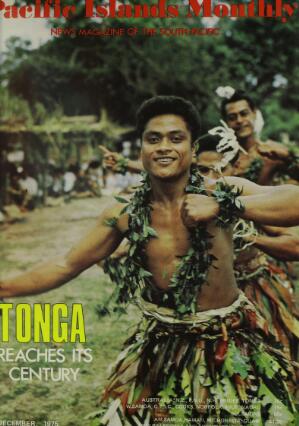
The Torigans, like other Islanders, will dance at the drop of a hat. This young Tongan, photographed by August Hettig, of Tonga, is performing at the capital, Nukualofa. Tourism, which has been blamed for many things—ruining Island culture, for instance—has given an im petus to Island dancing. In some islands, ceremonies, which had fallen into disuse, are once again being staged, this time for the benefit of the tourists.
Advertisements & other items, pp. 2-4 (1 item)
shouldn’t be cheap.
An economy car
TOYOTA COROLLA
We put more than economy into a Toyota* We build them to be comfortable* We build them to be safe* And we build them very carefully * ♦ ♦ so that they*!! last* Before you buy your next car, check with your Toyota dealer. He has a lot of economical models to choose from*
But no cheap ones.
TOYOTA 1000
TOYOTA CORONA
TOYOTA CELICA
TOYOTA MARK II
TOYOTA
PAPUA, NEW GUINEA: ELA MOTORS LIMITED. Scratchley Rd„ 8ad,1,, Papua U.S. TRUST TERRITORY: MICROL COR /°™ T 'o^ SUPPLIES CO.. LTD , G P O, Box 355, Suva AMERICAN SAMOA: BURNS PHILP (SOUTH SEA) CO.. LTD., Pago Pago WESTERN SAMOA: BURNS PHILP JSOUTHI SEA >LTD.. P-0 Bo < HEBRIDES: NEW HEBRIDES MOTORS LTD., P O. Box 18, Vila. SOLOMON ISLANDS: MENDANA ENTERPRISES (S I ), LI UL Apia. GUAM: RICKY'S AUTO CO., P.O. Box 1458, Agana. NEW I : iMbW Htomucs mu i uno u i u., r.u. '<j, v.. 0 - - - P.O Box 174, Honiara. TAHITI; NIPPON AUTOMOTO. B P 54b, Papeete COOK ISLANDS; COOK ISLANDS TRADING CORPORATION LTD P.O. TD p 0 B NAURU COOPERATIVE SOCIETY GILBERT & ELLICE ISLANDS COLONY: TARAWA MOTORS, Box 36. Bairiki Tarawa NORFOLK ISLAND: MARIE ® NORFOLK TOURS. LTD R O B .. r-v. a . rnnki ia . ictc iMonoxATinM ai ithmori IPni j PAPIPIOUF Rond-Pomt du Pacific (Station Total) BP 430. Noumei 276 TIMOR: SANG TAI HOO, Sang Ta, Building, Dili NEW CALEDONIA: SOCIETE IMPORTATION AUTOMOBILE DU PACIFIQUE, Rond-Point du Pacific (Station Total)
Invest in precious metals.
Of the eight precious netals, it takes four to make a 3 arker 75 pen. The silver, gold, )latinum and ruthenium aren't here just for show. They make t work better. And they make it i gift to treasure. What you :ould call a lifetime investment.
Sterling silver gives the
:ase heft and balance.
We use our own special alloy of 14ct gold for the nib, because few other metals resist ink corrosion as well, and still provide such responsiveness as you write.
For the tip that touches the paper, we developed an alloy of platinum and ruthenium that resists wear so well, we don’t know how long a tip will last.
It's even more exceptional.
The nib can turn 360° to write at the angle most natural to you.
Quite an investment, the sterling silver Parker 75.
There’s a nylon nib version and matching ball pen or pencil.
Also rolled gold or Vermeil, which is 14ct gold on silver.
The distinctive arrow clip identifies every Parker model.
tPARKER
World's most wanted pens
Sony’s original stereo
radio/cassette-corder.
Can you imagine a better pickme-up?
The honest-to-goodness sound of real Sony stereo. At the beach, the park, or on a picnic.
And remember, the Sony CF-550A is N the daddy of all one-piece stereos. A tried and proved design.
It’s unique Sound Stereo System plus tour built-in speakers give you richer ,# and more natural stereo reproduction.
“Live” stereo recording is simple with two sensitive built-in electret condenser microphones. And besides that, you can also record directly off AM or FM wavebands.
Sony’s original stereo radio/ cassette-corder works off batteries, mains power (AC cord included) or off your car/boat battery (adaptor optional). Pick one up. You’ll love it.
Cr What seems like magic is actually great Sony design. m.
Pacific Islands
Monthly
FOUNDED BY R. W. ROBSON IN 1930
Published Monthly By
Pacific Publications (Aust.) Pty. Ltd.,
29 Alberta Street, Sydney, N.S.W. 2000.
Postal Address: G.P.O. BOX 3408, SYDNEY,
N.S.W. 2001.
Telegraphic Address: PACPUB, Sydney.
Telex: 25168.
Telephones: 61-9197, 61-7101, 61-4369.
Publisher: Stuart Inder.
Business Manager: John Berry.
Pacific Islands Monthly
Editor; John Carter.
Advertising Manager: Alan Batt.
Subscription Rates:
"Pacific Islands Monthly" is airfreighted to the majority of subscribers and agents in the Pacific Islands and the U.S.A.; copies to the Cook Islands, Nauru, Niue, Micronesia and Guam go by surface mail.
Australia (including Lord Howe and Thursday Islands), New Zealand, Papua New Guinea, Fiji, New Hebrides, Tonga, Cook Islands, Western Samoa, Gilbert & Ellice Islands, Norfolk Island, Niue and Nauru: $9.00 (local currency); Solomon Islands: $lO.OO Aust.; American Samoa, Micronesia and Guam: $12.00 U.S.; Hawaii and U.S. Mainland: $15.00 US.; New Caledonia and French Polynesia: 1,500 C.F.P.; United Kingdom: £6.50; Japan: 4,000 Yen; Elsewhere: $11.50 Aust.
Representatives
Fiji: Advertising and Distribution—Fiji Times & Herald Ltd., 20 Gordon Street, Suva. Telephone: 25-601. Telex: FJ 2124.
Papua New Guinea: Advertising and Distribution —PNG Post-Courier, P.O. Box 85, Port Moresby.
Telephone; 25-9899. Enquiries: Post News agency, Telephone 24-2148.
French Polynesia: Distribution—Hachette Paci fique, 10 Ave Bruat, Papeete.
New Zealand: Pacific Publications, C.P.O.
Box 2229, Auckland.
United Kingdom: The Herald and Weekly Times Limited, 8-10 Clifford's Inn, Fetter Lane, London EC4A IBU. Telephone: 01-8316041. Telex; London 21989.
Japan: Advertising—Universal Media Corpora tion, C.P.O. Box 46, Tokyo. Telephone: 666-3036.
Victoria: Advertising Pacific Publications (Aust.) Pty. Ltd., Herald and Weekly Times Building, 2nd Floor, 61 Flinders Lane, Mel bourne, 3000. Telephone: 652-1565.
Hawaii and U.S. Mainland only: N. Grogan. (Send change of address notices. Form 3579 and new subscriptions to P.O. Box 2193, Honolulu, Hawaii, U.S.A. 96805.) Second class postage paid at Honolulu, Hawaii.
Copyright ©, 1975,
Pacific Publications (Aust.) Pty. Ltd.
Printed by The Harbour Press, Chalmers Street, Sydney.
Registered at the G.P.O. Sydney for trans mission by post as a newspaper—category B.
Vol. 46, No. 12 December, 1975
Up Front
with the Publisher
WE should know within a few days of publication of this issue just how many South Pacific territories and nations will be taking part in the conference that will review the role of the South Pacific Commission.
The conference will be in Nauru about May next year, and each of the South Pacific countries had until November 30 to decide if it wanted to participate.
This will be one conference where the fur should be made to fly. There ought to be no holds barred. Speak ing ought to be plain and to the point. If there is to be any pussy footing around, the Nauru conference might as well not be held.
Decision to have the review meet ing was made at the 16th South Paci fic Conference in Nauru in October, after it had become obvious there that the SPC needed both a blood transfusion and a heart transplant.
This organisation of Pacific Islands countries is near death because no body now knows what it is supposed to do.
It has been going since 1947, and its role is advisory and consultative.
Its programmes are co-ordinated with those of the Island groups in the three main fields in which it works— health, and social and economic de velopment. The SPC is not involved with politics, nor does it have any authority to control Island develop ment programmes. It gets its money from subscriptions and grants from its various members, who represent 4.5 million people, scattered over 13 million square miles (only three per cent of it land area).
Certainly, it is now widely agreed that the SPC has to help the Pacific Islands develop at the grass roots level—but just what does that mean in practice? More important, what should the structure of the SPC be?
And, can it work alongside the South Pacific Forum, or the South Pacific Bureau for Economic Co-operation?
I believe in the need for an SPC.
There must continue to be some organisation that can give a voice to the Pacific’s English and French speaking peoples. And there must be an organisation that can co-ordinate or carry out technical programmes of common interest to the Islands.
Just what such an organisation should look like, what staff and funding it should have, I confess I don’t know. But I suspect it should have the lean and hungry look, with the minimum of bureaucrats and ad ministrative overheads, and probably only a small list of worthwhile pro jects to carry out at any one time.
Perhaps, we should resolve the question of the SPC’s future by ignor ing the fact that an organisation exists, and getting right back to the drawing board.
ANDREW Peacock, Australia’s caretaker government Minister for Foreign Affairs, is a man with a great regard for Papua New Guinea.
When the Liberals were in govern ment he was, during most of 1972, the last Liberal Minister for Terri tories, and he played a key part in preparing the way for self-govern ment which in turn led to indepen dence. He and Prime Minister Somare and many of Mr Somare’s ministers had, and continue to have, a warm personal relationship, and it’s my view that Andrew Peacock’s continued interest in Papua New Guinea affairs transcends mere party politics. In short, he’s stuck on the place and probably would continue to visit it even if he were not a Federal politician.
Because I believe all this, I regret a paragraph about him I included in my report of Papua New Guinea’s independence celebrations in the October issue. In it, I said that he had visited Port Moresby and had left for Iran two days before inde pendence, “to the chagrin of some of his local supporters who thought he could have organised himself better”.
This was true, but my paragraph is less than fair because it fails to point out that Andrew Peacock was unhappy at having to leave before the festivities, and fails to indicate to the general reader the regard with which he is held in PNG. The sup porters who were “chagrined” did not include Mr Somare, or as far as I know, his key ministers. Andrew Peacock was mightily wounded by my paragraph, and although he has not asked for an apology, I owe him
one.-
Stuart Inder
Advertisements & other items, p. 6 (1 item)
Kodak color prints
Remember the good times
with sUk-mtish
u 1 Borderless round-cornered pictures with a silk surface that actually hides fingerprints. Pass them around.
Show your friends.
You’ll forget. Pictures won’t.
Silk-finish Kodak color printsfrom all sizes of Kodacolor film.
Silk-finish Kodak color prints are standard from all photo dealers where you see this sign.
ASK FOR
KODAK (Australasia) PTY. LTD.
See your photo dealer now.
COLOR
PROCESSING
by Kodak K6l/5074
In This Issue
Eneral
>rres Strait border problem 31 landers in trouble in NZ 33 jgional air council ... 59
Merican Samoa
>ntinental plans air route 61 jvelopment plan for Pago 73
Dok Islands
ederick Joseph Moss 39
air council 59 Jl irty leaders fall out 11 sgional air council 59 >ntinental plans S. Pacific air route 61 >rt Authority in operation 61 lionists buy bus company 61 10-ton ship built 63 >tuma may get air service 63 rline changes name 64 igar production down 69 power scheme 71
Eench Polynesia
hiti letter 16 >uring by le Truck 35 5S Co withdraws 63
Ilbert Islands
an escapes shark 25 ‘gional air council 59
Nauru
SP Conference stamp issue 25 Regional air council 59 No worry over phosphate sales drop 67
New Caledonia
Paris political proposals accepted 8 Polynesie for sale 61 Two crews rescued 64 Lobster freezer 70 Arab investment in nickel 71 New air base for Noumea 71
New Hebrides
Election result 14 Friendly words to expatriates 14 Polynesie for sale 61
Papua New Guinea
Lae going broke 9 Bougainville moves 9 Wewak cultural centre row 27 Torres Strait border problem 31 Australia will negotiate border 33 International air routes 59 Air Niugini flies to Manila 63 Rise for wharfies 64 Plans to protect kina 73
Solomon Islands
Mamaloni resigns 9 Labour strife 13 Regional air council 59
Tonga
Century of freedom 10 Miracle on mountain 27 Islanders in trouble in NZ 33
Tuvalu
Safety valve lost 15
Us Trust Territory
Constitution convention 6 Extended Daiwa service sought 64
Western Samoa
Strange stories of land dealings 13 Church built in Auckland 26 Islanders in trouble in NZ ... 33 Regional air council 59
EPARTMENTS: Up Front with the Publisher, 3; Editor's Mailbag, 19; Topicalities, 25; lands Press, 29; Magazine Section, 39; MANA, 46; Yesterday, 51; Books, 53; Islands ansport, 59; Cruising Yachts, 64; Business and Development, 67; Produce Prices, 74; lipping and Airways Information, 77; Deaths of Islands People, 81.
Micronesians' Blue Print Making
One Nation Of Many Islands'
From PAMELA G. HOLLIE on Saipan
The preamble to the constitution of the future government of Micro nesia espoused all that Micronesia hoped to gain from its 90-day, $1 million constitutional convention (Con-Con).
When the nearly 50 delegates filed past the table to sign the document on the closing day, November 8, they completed a significant step to ward the territory’s goal of self government.
Micronesia is a United Nation’s trusteeship, which has been adminis tered by the United States since 1947.
It is the last of the original 11 UN trust territories, and the only one which is expected to opt for some kind of “close association” with its trustee instead of independence.
Now in the last stages of the 28year administration by the US, Micro nesia is nearing the termination date of the trusteeship.
The constitution of the Federated States of Micronesia is the outline for the future government of Micronesia after the trusteeship is.---terminated around 1981. The constitution states that it will become effective not more than one year after the document is ratified by the Micronesian people. Because this may precede the termination of the Trus teeship Agreement, the constitutional provisions in conflict won’t come into effect until the trusteeship is termi nated.
The 23-page document contains 16 articles. The government will consist of a one-chamber legislature, each of the six districts electing one repre sentative for a four-year term and other representatives, according to state population, for two-year terms.
The executive will consist of a presi
dent and vice-president, who will be chosen from among the six or seven representatives serving four-year terms.
The government will be composed of loosely-federated states (now called districts under the trust terri tory). The three branches of the government are the executive, legis lative and the judicial. The greatest power rests with the districts. The central government will be weak, and relatively small. Power not expressly delegated to the national government is automatically a state power unless otherwise prohibited.
A prominent concern of the Con- Con was the use of Micronesia’s land, which is limited. The consti tution is silent on the right of emi nent domain. Micronesian land will remain in the hands of the people— Micronesian citizens only. A non
citizen, or a corporation less than 100 per cent owned by Micronesians, may not acquire title to land or waters in Micronesia.
The territory’s experience with the US led to sections in the constitution calling for the “renegotiation of any agreement for the use of land to which the Government of the United States of America is a party”.
The US holds long-term land agreements —some taken with its right of eminent domain—for use as military bases and testing sites.
The constitution also prohibits the testing, storage, use or disposal of radioactive, toxic chemical or harm ful substances on Micronesia’s land or waters.
These provisions are expressly aimed at America’s use of Micro nesia as a “strategic trust” under its trusteeship. In isolated instances,
)me islands have been rendered un ihabitable through US nuclear test ig or disposal of wastes.
The constitution is a relatively mple document. It calls for unity. incorporates the concepts of de locracy and a representative form P government, and still recognises le rights of traditional leaders in ic new government. It is the best )mpromise a widely-divergent nation Ice Micronesia could hope to pro ice.
Until the last four days of the 90ty convention, it was not certain hether the Con-Con would produce 5 document. Indecision over major sues in the formation of the govern ent forced the convention into ree days of closed-door sessions.
When the negotiators emerged, the on-Con had miraculously reached )mpromises that the six districts— alau, Yap, the Marshalls, Ponape, e Marianas, and Truk—could live ith. Every district signed the con itution including Kusaie, now part ; Ponape, which will become a dis ict in 1977.
From the beginning the Con-Con ced what seemed to be heavy odds ;ainst its success.
It was hoped that the Con-Con ould revitalise the political status Iks between the territory and the nited States. Talks between the two oke down in December, 1974, over nd disputes after seven years of :gotiations.
Lazarus Salii, chairman of the Dngress of Micronesia’s Joint Com ittee on Future Status, was one ho had hoped that the constitution Duld be clear on the question of atus. For the last five years, he had :aded talks with the US on “free sociation”, a status which is a tran ;ion towards full independence, but
requires that some duties, such as de fence and foreign affairs, be handled by the US in return for some other benefits in Micronesia.
The US has been under pressure from the UN to terminate its ad ministration, but the US maintained that it had not completed its res ponsibilities to the territory and that for national security reasons it must retain military bases in the area.
The constitution, it was decided, would provide instructions for the next round of talks, but it would not indicate status.
From the outset, the biggest chal lenges confronting the Con-Con were: Could it bring unity? Could a con stitution be written before the terri tory’s status was settled? Many dele gates were dubious.
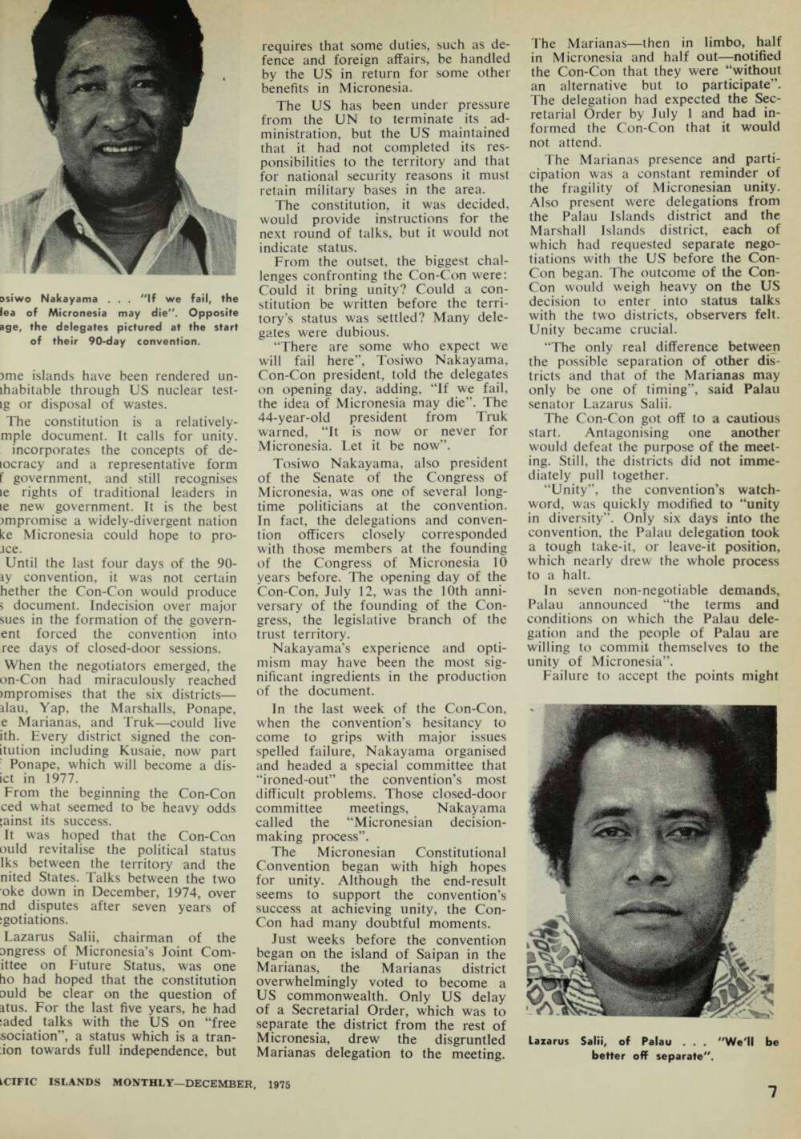
“There are some who expect we will fail here”, Tosiwo Nakayama, Con-Con president, told the delegates on opening day, adding, “If we fail, the idea of Micronesia may die”. The 44-year-old president from Truk warned, “It is now or never for Micronesia. Let it be now”.
Tosiwo Nakayama, also president of the Senate of the Congress of Micronesia, was one of several long time politicians at the convention.
In fact, the delegations and conven tion officers closely corresponded with those members at the founding of the Congress of Micronesia 10 years before. The opening day of the Con-Con, July 12, was the 10th anni versary of the founding of the Con gress, the legislative branch of the trust territory.
Nakayama’s experience and opti mism may have been the most sig nificant ingredients in the production of the document.
In the last week of the Con-Con, when the convention’s hesitancy to come to grips with major issues spelled failure, Nakayama organised and headed a special committee that “ironed-out” the convention’s most difficult problems. Those closed-door committee meetings, Nakayama called the “Micronesian decision making process”.
The Micronesian Constitutional Convention began with high hopes for unity. Although the end-result seems to support the convention’s success at achieving unity, the Con- Con had many doubtful moments.
Just weeks before the convention began on the island of Saipan in the Marianas, the Marianas district overwhelmingly voted to become a US commonwealth. Only US delay of a Secretarial Order, which was to separate the district from the rest of Micronesia, drew the disgruntled Marianas delegation to the meeting.
The Marianas—then in limbo, half in Micronesia and half out —notified the Con-Con that they were “without an alternative but to participate”.
The delegation had expected the Sec retarial Order by July 1 and had in formed the Con-Con that it would not attend.
The Marianas presence and parti cipation was a constant reminder of the fragility of Micronesian unity.
Also present were delegations from the Palau Islands district and the Marshall Islands district, each of which had requested separate nego tiations with the US before the Con- Con began. The outcome of the Con- Con would weigh heavy on the US decision to enter into status talks with the two districts, observers felt.
Unity became crucial.
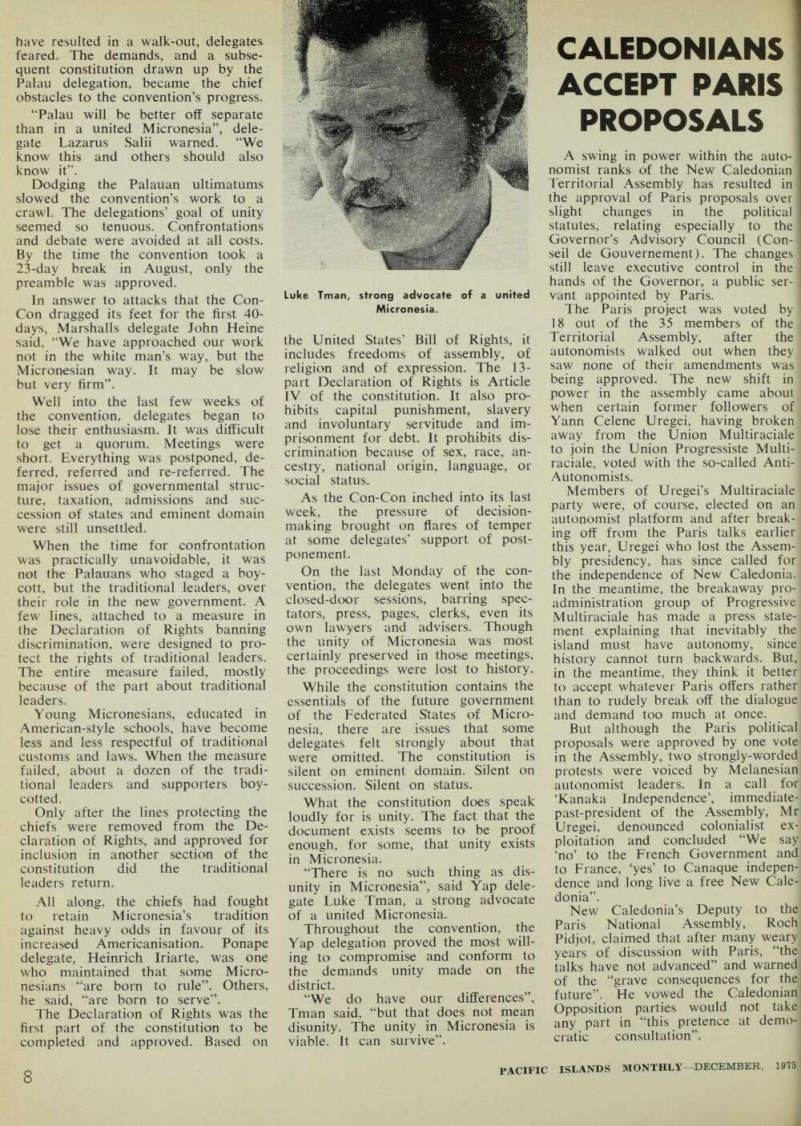
“The only real difference between the possible separation of other dis tricts and that of the Marianas may only be one of timing”, said Palau senator Lazarus Salii.
The Con-Con got off to a cautious start. Antagonising one another would defeat the purpose of the meet ing. Still, the districts did not imme diately pull together.
“Unity”, the convention’s watch word, was quickly modified to “unity in diversity”. Only six days into the convention, the Palau delegation took a tough take-it, or leave-it position, which nearly drew the whole process to a halt.
In seven non-negotiable demands, Palau announced “the terms and conditions on which the Palau dele gation and the people of Palau are willing to commit themselves to the unity of Micronesia”.
Failure to accept the points might
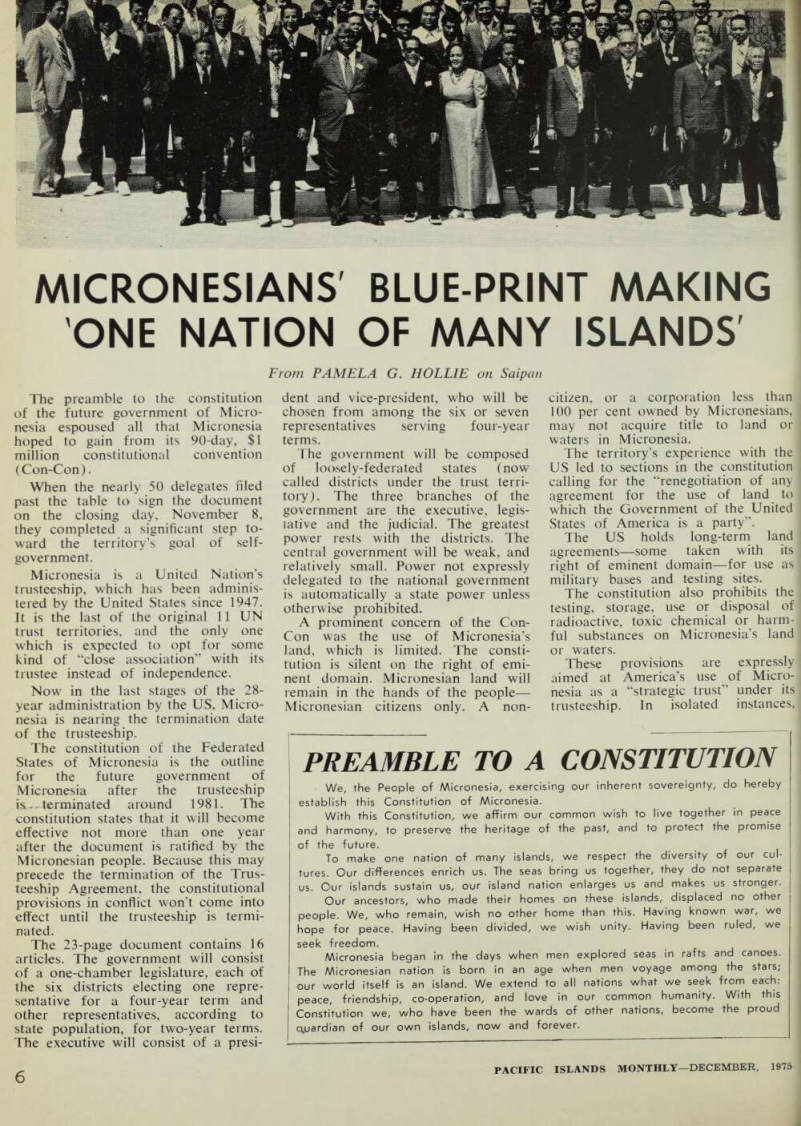
posiwo Nakayama . . . "If we fail, the dea of Micronesia may die". Opposite page, the delegates pictured at the start of their 90-day convention.
Lazarus Salii, of Palau . . . "We'll be better off separate".
have resulted in a walk-out, delegates feared. The demands, and a subse quent constitution drawn up by the Palau delegation, became the chief obstacles to the convention’s progress.
“Palau will be better off separate than in a united Micronesia”, dele gate Lazarus Salii warned. “We know r this and others should also know it”.
Dodging the Palauan ultimatums slowed the convention’s work to a crawd. The delegations’ goal of unity seemed so tenuous. Confrontations and debate were avoided at all costs.
By the time the convention took a 23-day break in August, only the preamble was approved.
In answer to attacks that the Con- Con dragged its feet for the first 40days, Marshalls delegate John Heine said, “We have approached our work not in the white man’s way, but the Micronesian way. It may be slow but very firm”.
Well into the last few weeks of the convention, delegates began to lose their enthusiasm. It was difficult to get a quorum. Meetings were short. Everything was postponed, de ferred, referred and re-referred. The major issues of governmental struc ture, taxation, admissions and suc cession of states and eminent domain were still unsettled.
When the time for confrontation was practically unavoidable, it was not the Palauans who staged a boy cott, but the traditional leaders, over their role in the new government. A few lines, attached to a measure in the Declaration of Rights banning discrimination, were designed to pro tect the rights of traditional leaders.
The entire measure failed, mostly because of the part about traditional leaders.
Young Micronesians, educated in American-style schools, have become less and less respectful of traditional customs and laws. When the measure failed, about a dozen of the tradi tional leaders and supporters boy cotted.
Only after the lines protecting the chiefs were removed from the De claration of Rights, and approved for inclusion in another section of the constitution did the traditional leaders return.
All along, the chiefs had fought to retain Micronesia’s tradition against heavy odds in favour of its increased Americanisation. Ponape delegate, Heinrich Iriarte, was one who maintained that some Micro nesians “are born to rule”. Others, he said, “are born to serve”.
The Declaration of Rights was the first part of the constitution to be completed and approved. Based on
the United States’ Bill of Rights, it includes freedoms of assembly, of religion and of expression. The 13part Declaration of Rights is Article IV of the constitution. It also pro hibits capital punishment, slavery and involuntary servitude and im prisonment for debt. It prohibits dis crimination because of sex, race, an cestry, national origin, language, or social status.
As the Con-Con inched into its last week, the pressure of decision making brought on flares of temper at some delegates’ support of post ponement.
On the last Monday of the con vention, the delegates went into the closed-door sessions, barring spec tators, press, pages, clerks, even its own lawyers and advisers. Though the unity of Micronesia was most certainly preserved in those meetings, the proceedings were lost to history.
While the constitution contains the essentials of the future government of the Federated States of Micro nesia, there are issues that some delegates felt strongly about that were omitted. The constitution is silent on eminent domain. Silent on succession. Silent on status.
What the constitution does speak loudly for is unity. The fact that the document exists seems to be proof enough, for some, that unity exists in Micronesia.
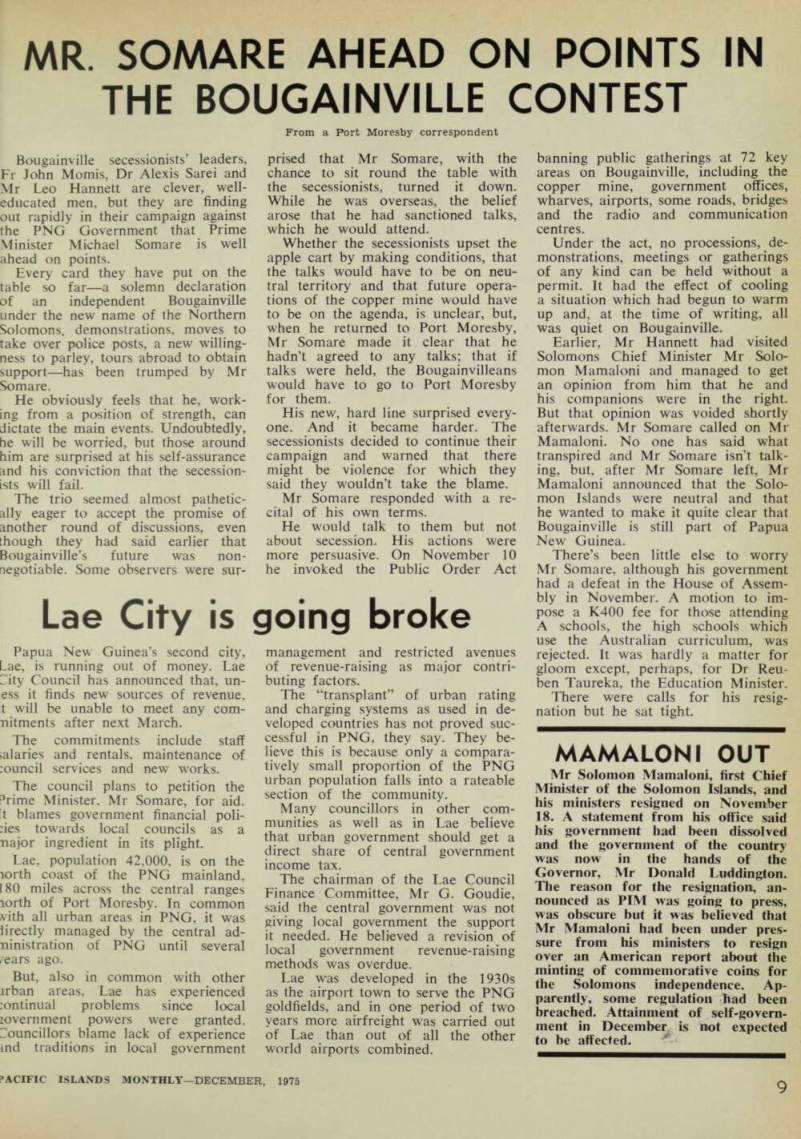
“There is no such thing as dis unity in Micronesia”, said Yap dele gate Luke Tman, a strong advocate of a united Micronesia.
Throughout the convention, the Yap delegation proved the most will ing to compromise and conform to the demands unity made on the district.
“We do have our differences”, Tman said, “but that does not mean disunity. The unity in Micronesia is viable. It can survive”.
Luke Tman, strong advocate of a united Micronesia.
Preamble To A Constitution
We, the People of Micronesia, exercising our inherent sovereignty, do hereby establish this Constitution of Micronesia.
With this Constitution, we affirm our common wish to live together in peace and harmony, to preserve the heritage of the past, and to protect the promise of the future.
To make one nation of many islands, we respect the diversity of our cul tures. Our differences enrich us. The seas bring us together, they do not separate us. Cur islands sustain us, our island nation enlarges us and makes us stronger.
Our ancestors, who made their homes on these islands, displaced no other people. We, who remain, wish no other home than this. Having known war, we hope for peace. Having been divided, we wish unity. Having been ruled, we seek freedom.
Micronesia began in the days when men explored seas in rafts and canoes.
The Micronesian nation is born in an age when men voyage among the stars; our world itself is an island. We extend to all nations what we seek from each: peace, friendship, co-operation, and love in our common humanity. With this Constitution we, who have been the wards of other nations, become the proud cyjardian of our own islands, now and forever.
Advertisements & other items, p. 9 (1 item)
7
CIFIC ISLANDS MONTHLY— DECEMBER, 1975
Caledonians
Accept Paris
Proposals
A swing in power within the auto-! nomist ranks of the New Caledonian Territorial Assembly has resulted in the approval of Paris proposals over slight changes in the political statutes, relating especially to the ] Governor’s Advisory Council (Con seil de Gouvernement). The changes ! still leave executive control in the hands of the Governor, a public ser vant appointed by Paris.
The Paris project was voted by ] 18 out of the 35 members of the Territorial Assembly, after the autonomists walked out when they saw none of their amendments was being approved. The new shift in power in the assembly came about when certain former followers of Yann Celene Uregei, having broken away from the Union Multiraciale to join the Union Progressiste Multi raciale, voted with the so-called Anti- Autonomists.
Members of Uregei’s Multiraciale party were, of course, elected on an autonomist platform and after break ing off from the Paris talks earlier this year, Uregei who lost the Assem bly presidency, has since called for the independence of New Caledonia.
In the meantime, the breakaway pro administration group of Progressive Multiraciale has made a press state ment explaining that inevitably the island must have autonomy, since history cannot turn backwards. But, in the meantime, they think it better to accept whatever Paris offers rather than to rudely break off the dialogue and demand too much at once.
But although the Paris political proposals were approved by one vote in the Assembly, two strongly-worded protests were voiced by Melanesian autonomist leaders. In a call for ‘Kanaka Independence’, immediate past-president of the Assembly, Mr Uregei, denounced colonialist ex ploitation and concluded “We say ‘no’ to the French Government and to France, ‘yes’ to Canaque indepen dence and long live a free New Cale donia”.
New Caledonia’s Deputy to the Paris National Assembly, Roch Pidjot, claimed that after many weary years of discussion with Paris, “the talks have not advanced” and warned of the “grave consequences for the future”. He vowed the Caledonian Opposition parties would not take any part in “this pretence at demo cratic consultation”.
Mr. Somare Ahead On Points In
The Bougainville Contest
From a Port Moresby correspondent
Bougainville secessionists’ leaders, Fr John Momis, Dr Alexis Sarei and Mr Leo Hannett are clever, well educated men. but they are finding out rapidly in their campaign against the PNG Government that Prime Minister Michael Somare is well ahead on points.
Every card they have put on the table so far—a solemn declaration of an independent Bougainville under the new name of the Northern Solomons, demonstrations, moves to take over police posts, a new willing ness to parley, tours abroad to obtain support—has been trumped by Mr Somare.
He obviously feels that he, work ing from a position of strength, can dictate the main events. Undoubtedly, he will be worried, but those around him are surprised at his self-assurance and his conviction that the secession ists will fail.
The trio seemed almost pathetic ally eager to accept the promise of another round of discussions, even though they had said earlier that Bougainville’s future was non negotiable. Some observers were sur
prised that Mr Somare, with the chance to sit round the table with the secessionists, turned it down.
While he was overseas, the belief arose that he had sanctioned talks, which he would attend.
Whether the secessionists upset the apple cart by making conditions, that the talks would have to be on neu tral territory and that future opera tions of the copper mine would have to be on the agenda, is unclear, but, when he returned to Port Moresby, Mr Somare made it clear that he hadn’t agreed to any talks; that if talks were held, the Bougainvilleans would have to go to Port Moresby for them.
His new, hard line surprised every one. And it became harder. The secessionists decided to continue their campaign and warned that there might be violence for which they said they wouldn’t take the blame.
Mr Somare responded with a re cital of his own terms.
He would talk to them but not about secession. His actions were more persuasive. On November 10 he invoked the Public Order Act
banning public gatherings at 72 key areas on Bougainville, including the copper mine, government offices, wharves, airports, some roads, bridges and the radio and communication centres.
Under the act, no processions, de monstrations, meetings or gatherings of any kind can be held without a permit. It had the effect of cooling a situation which had begun to warm up and, at the time of writing, all was quiet on Bougainville.
Earlier, Mr Hannett had visited Solomons Chief Minister Mr Solo mon Mamaloni and managed to get an opinion from him that he and his companions were in the right.
But that opinion was voided shortly afterwards. Mr Somare called on Mr Mamaloni. No one has said what transpired and Mr Somare isn’t talk ing, but, after Mr Somare left, Mr Mamaloni announced that the Solo mon Islands were neutral and that he wanted to make it quite clear that Bougainville is still part of Papua New Guinea.
There’s been little else to worry Mr Somare, although his government had a defeat in the House of Assem bly in November. A motion to im pose a K4OO fee for those attending A schools, the high schools which use the Australian curriculum, was rejected. It was hardly a matter for gloom except, perhaps, for Dr Reu ben Taureka, the Education Minister.
There were calls for his resig nation but he sat tight.
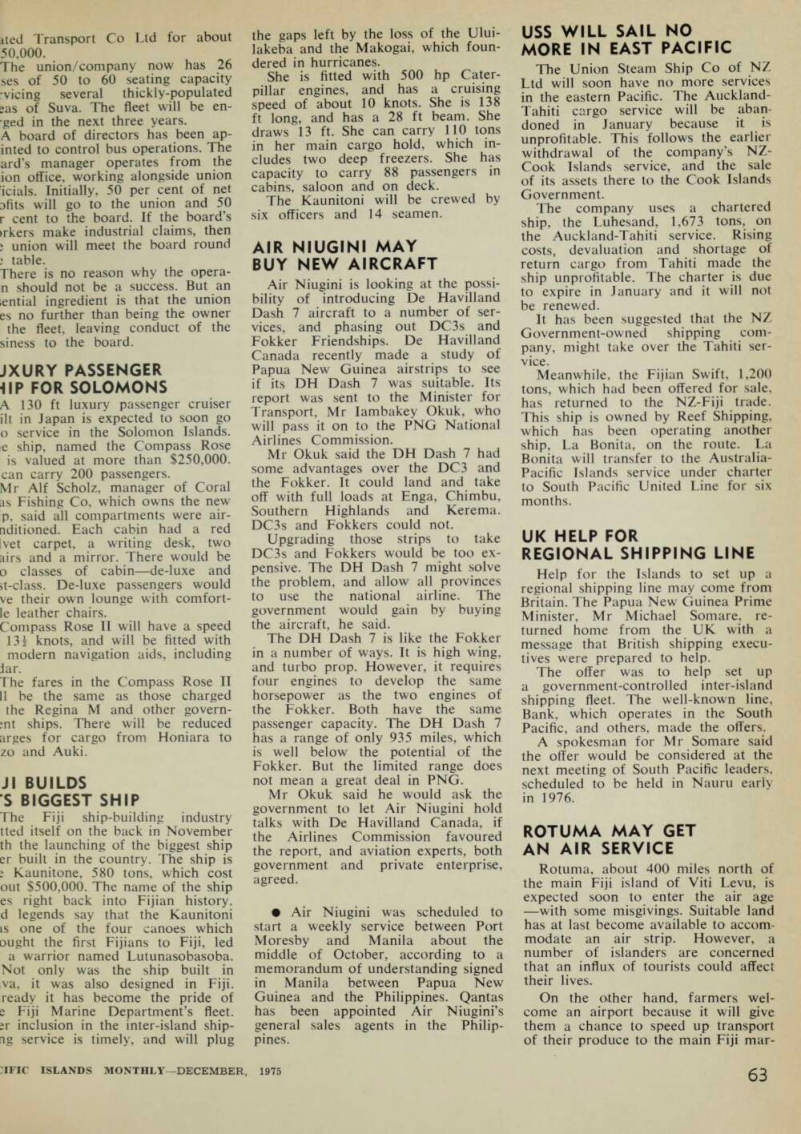
Lae City is going broke
Papua New Guinea’s second city, Lae, is running out of money. Lae ITity Council has announced that, un ess it finds new sources of revenue, t will be unable to meet any com nitments after next March.
The commitments include staff salaries and rentals, maintenance of :ouncil services and new works.
The council plans to petition the 3 rime Minister. Mr Somare, for aid. t blames government financial poli ces towards local councils as a najor ingredient in its plight.
Lae, population 42,000, is on the lorth coast of the PNG mainland, ISO miles across the central ranges lorth of Port Moresby. In common vith all urban areas in PNG, it was Erectly managed by the central ad ninistration of PNG until several ago.
But, also in common with other irban areas, Lae has experienced continual problems since local joverament powers were granted.
Councillors blame lack of experience md traditions in local government
management and restricted avenues of revenue-raising as major contri buting factors.
The “transplant” of urban rating and charging systems as used in de veloped countries has not proved suc cessful in PNG, they say. They be lieve this is because only a compara tively small proportion of the PNG urban population falls into a rateable section of the community.
Many councillors in other com munities as well as in Lae believe that urban government should get a direct share of central government income tax.
The chairman of the Lae Council Finance Committee, Mr G. Goudie, said the central government was not giving local government the support it needed. He believed a revision of local government revenue-raising methods was overdue.
Lae was developed in the 1930 s as the airport town to serve the PNG goldfields, and in one period of two years more airfreight was carried out of Lae than out of all the other world airports combined.
Mamaloni Out
Mr Solomon Mamaloni, first Chief Minister of the Solomon Islands, and his ministers resigned on November 18. A statement from his office said his government had been dissolved and the government of the country was now in the hands of the Governor, Mr Donald Luddington.
The reason for the resignation, an nounced as PIM was going to press, was obscure but it was believed that Mr Mamaloni had been under pres sure from his ministers to resign over an American report about the minting of commemorative coins for the Solomons independence. Ap parently, some regulation had been breached. Attainment of self-govern ment in December is not expected to be affected.
Advertisements & other items, p. 11 (1 item)
9
■•ACIFIC ISLANDS MONTHLY—DECEMBER, 1975
Tonga celebrates its century of freedom
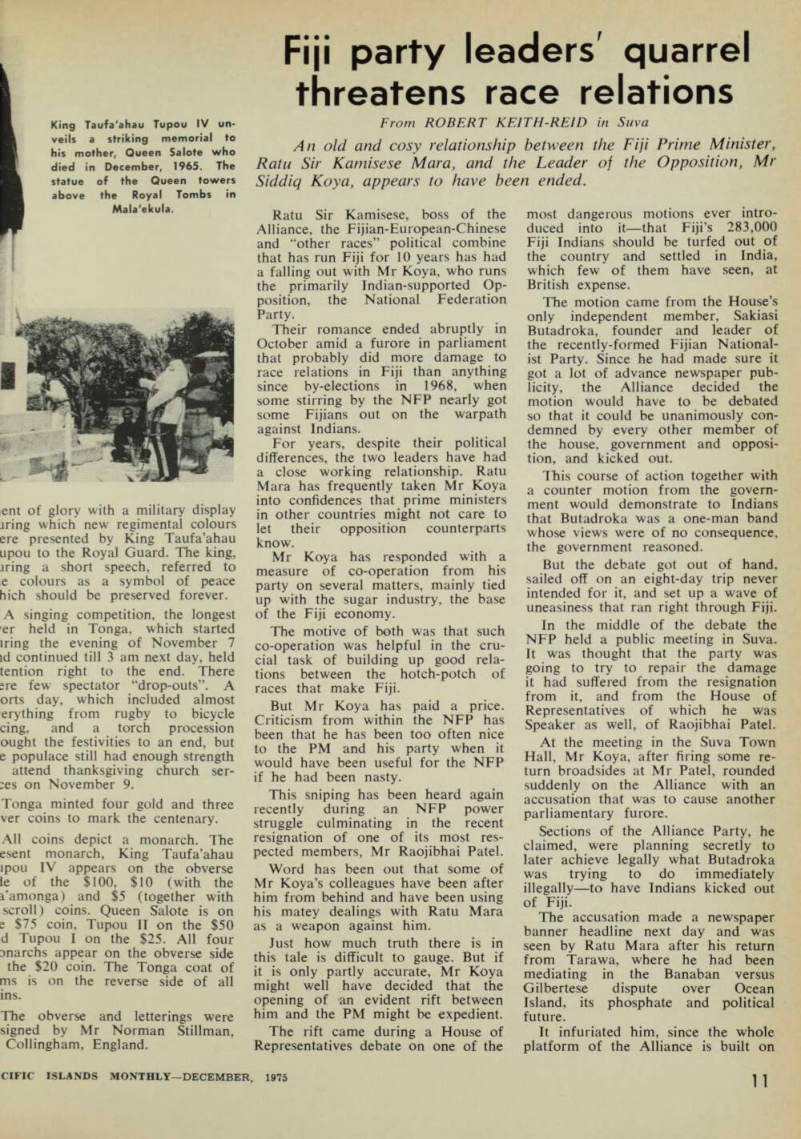
The constitution of Tonga, one of the oldest in the Pacific, given to it on November 4, 1875, by King Tupou I, has easily stood the test of time. This was brought home during eight days of centenary celebrations in November as people gathered in Nukualofa in their thousands to re member stirring events of the previ ous 100 years, to pay their respects to King Taufa’ahau Tupou IV, to attend special church services, and to enjoy themselves.
During the last few days, the local people were joined by hundreds of overseas visitors, eager to see what was happening. It was a gay occasion, and even heavy rain during the first few days failed to damp enthusiasm.
Feasting, dancing, kava ceremonies, all part of South Pacific traditions, were to the fore.
The Rev Dr Sione ’Amanaki Havea, President of the Free Wes leyan Church of Tonga, and Royal Chaplain, preaching the sermon to mark the opening of the celebrations, said it was up to all, the King, Prime Minister, the government and the people, to ensure that what Tupou I had established remained—that the people might be free; that they shared all benefits from the land; that edu cation was developed to ensure ap propriate learning for the people; that no one be made destitute; and that the government and Church work together to ensure a powerful country. Stirring words indeed, which should never be forgotten.
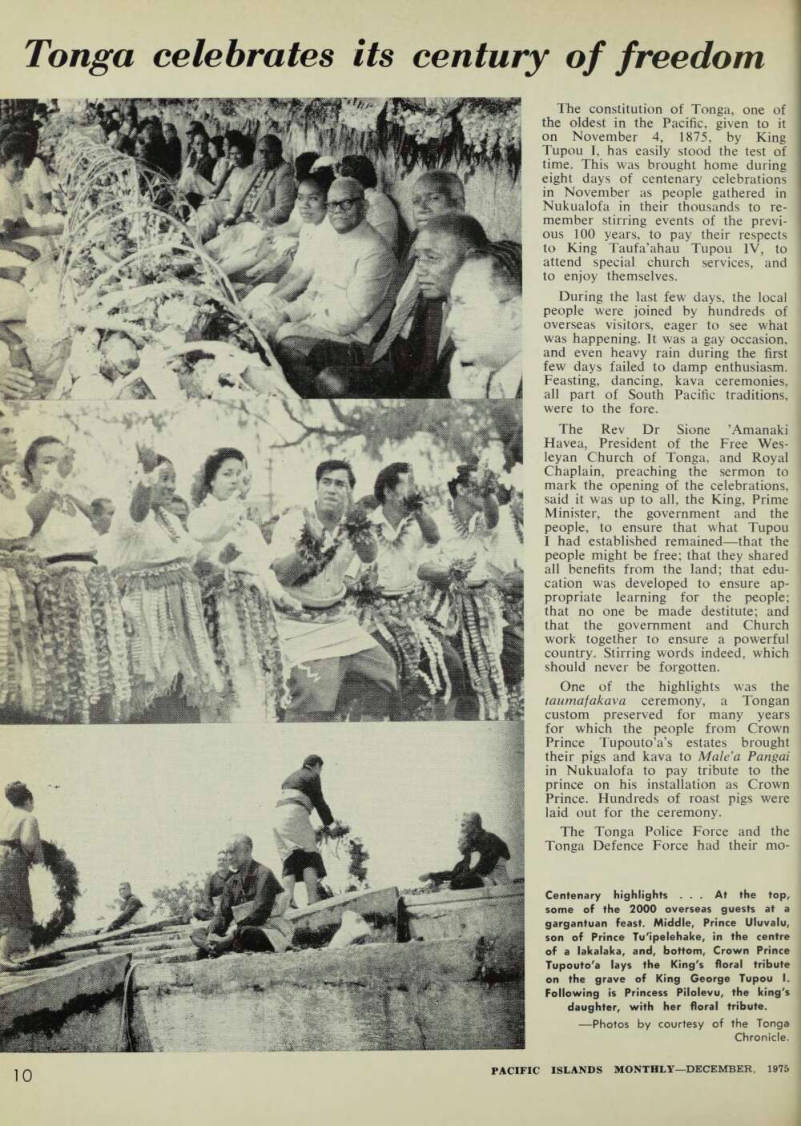
One of the highlights was the taumafakava ceremony, a Tongan custom preserved for many years for which the people from Crown Prince Tupouto’a’s estates brought their pigs and kava to Male’a Pangai in Nukualofa to pay tribute to the prince on his installation as Crown Prince. Hundreds of roast pigs were laid out for the ceremony.
The Tonga Police Force and the Tonga Defence Force had their mo-
Centenary highlights ... At the top, some of the 2000 overseas guests at a gargantuan feast. Middle, Prince Uluvalu, son of Prince Tu'ipelehake, in the centre of a lakalaka, and, bottom, Crown Prince Tupouto'a lays the King's floral tribute on the grave of King George Tupou I.
Following is Princess Pilolevu, the king's daughter, with her floral tribute. —Photos by courtesy of the Tonga Chronicle.
ent of glory with a military display .iring which new regimental colours ere presented by King Taufa’ahau upou to the Royal Guard. The king, iring a short speech, referred to e colours as a symbol of peace hich should be preserved forever.
A singing competition, the longest er held in Tonga, which started iring the evening of November 7 id continued till 3 am next day, held tention right to the end. There ;re few spectator “drop-outs”. A orts day, which included almost erything from rugby to bicycle cing, and a torch procession ought the festivities to an end, but e populace still had enough strength attend thanksgiving church ser :es on November 9.
Tonga minted four gold and three ver coins to mark the centenary.
All coins depict a monarch. The esent monarch, King Taufa’ahau ipou IV appears on the obverse le of the $lOO, $lO (with the i’amonga) and $5 (together with scroll) coins. Queen Salote is on 2 $75 coin, Tupou II on the $5O d Tupou I on the $25. All four anarchs appear on the obverse side the $2O coin. The Tonga coat of ms is on the reverse side of all ins.
The obverse and letterings were signed by Mr Norman Stillman, Collingham, England.
King Taufa'ahau Tupou IV un veils a striking memorial to his mother, Queen Salote who died in December, 1965. The statue of the Queen towers above the Royal Tombs in Mala'ekula.
Fiji party leaders' quarrel
threatens race relations
From ROBERT KEITH-REID in Suva
An old and cosy relationship between the Fiji Prime Minister, Ratu Sir Kamisese Mara, and the Leader of the Opposition, Mr Siddiq Koya, appears to have been ended.
Ratu Sir Kamisese, boss of the Alliance, the Fijian-European-Chinese and “other races” political combine that has run Fiji for 10 years has had a falling out with Mr Koya, who runs the primarily Indian-supported Op position, the National Federation Party.
Their romance ended abruptly in October amid a furore in parliament that probably did more damage to race relations in Fiji than anything since by-elections in 1968, when some stirring by the NFP nearly got some Fijians out on the warpath against Indians.
For years, despite their political differences, the two leaders have had a close working relationship. Ratu Mara has frequently taken Mr Koya into confidences that prime ministers in other countries might not care to let their opposition counterparts know.
Mr Koya has responded with a measure of co-operation from his party on several matters, mainly tied up with the sugar industry, the base of the Fiji economy.
The motive of both was that such co-operation was helpful in the cru cial task of building up good rela tions between the hotch-potch of races that make Fiji.
But Mr Koya has paid a price.
Criticism from within the NFP has been that he has been too often nice to the PM and his party when it would have been useful for the NFP if he had been nasty.
This sniping has been heard again recently during an NFP power struggle culminating in the recent resignation of one of its most res pected members, Mr Raojibhai Patel.
Word has been out that some of Mr Koya’s colleagues have been after him from behind and have been using his matey dealings with Ratu Mara as a weapon against him.
Just how much truth there is in this tale is difficult to gauge. But if it is only partly accurate, Mr Koya might well have decided that the opening of an evident rift between him and the PM might be expedient.
The rift came during a House of Representatives debate on one of the
most dangerous motions ever intro duced into it—that Fiji’s 283,000 Fiji Indians should be turfed out of the country and settled in India, which few of them have seen, at British expense.
The motion came from the House’s only independent member, Sakiasi Butadroka, founder and leader of the recently-formed Fijian National ist Party. Since he had made sure it got a lot of advance newspaper pub licity, the Alliance decided the motion would have to be debated so that it could be unanimously con demned by every other member of the house, government and opposi tion, and kicked out.
This course of action together with a counter motion from the govern ment would demonstrate to Indians that Butadroka was a one-man band whose views were of no consequence, the government reasoned.
But the debate got out of hand, sailed off on an eight-day trip never intended for it, and set up a wave of uneasiness that ran right through Fiji.
In the middle of the debate the NFP held a public meeting in Suva.
It was thought that the party was going to try to repair the damage it had suffered from the resignation from it, and from the House of Representatives of which he was Speaker as well, of Raojibhai Patel.
At the meeting in the Suva Town Hall, Mr Koya, after firing some re turn broadsides at Mr Patel, rounded suddenly on the Alliance with an accusation that was to cause another parliamentary furore.
Sections of the Alliance Party, he claimed, were planning secretly to later achieve legally what Butadroka was trying to do immediately illegally—to have Indians kicked out of Fiji.
The accusation made a newspaper banner headline next day and was seen by Ratu Mara after his return from Tarawa, where he had been mediating in the Banaban versus Gilbertese dispute over Ocean Island, its phosphate and political future.
It infuriated him, since the whole platform of the Alliance is built on
the concept of inter-racial co operation and harmony.
He entered the debate on the Buta droka motion with a special minis terial statement.
“Apart from the gravity of the charge itself, the nation will not be satisfied, even after the defeat of the motion (Butadroka’s) at present be fore the House, if there is any sub stance to the Honourable Leader of the Opposition’s allegation”, he said.
Ratu Mara gave Mr Koya until the end of the day to prove his claim or retract it.
“If he can satisfy this House that there is substantial evidence to sup port the validity of his statement then
I am quite prepared to resign from office, not only as Prime Minister but also as a Member of Parliament”, he said. “This is not an idle or irres ponsible offer”.
Mr Koya neither produced proof nor retracted. On the contrary, he shouted angrily at midnight as the House wrapped up its latest-ever sitting: “It is my, my, my observation on what I have seen”.
He challenged the government to set up a Royal Commission to check his accusation out, and promised some irrefutable evidence for it.
He went on to berate the Alliance for imagining that the Opposition Party was subservient to it.
It was nothing of the sort, he said,] and warned that, in future, relations between the two parties would not be nearly as cosy as they had been.
At a news conference after a routine cabinet meeting a few days ! later Ratu Sir Kamisese was asked what his relations with Mr Koya now were.
“Not very good”, he said, and attributed the deterioration to Mr Koya’s story about the secret plot to get Indians out.
He complained that the Opposition Leader had repeated the charge at a meeting at Nadi, again without sup porting it by a shred of evidence.
Ratu Sir Kamisese counter-charged that the NFP had broken its word by breaking an agreement to treat all sugar industry affairs at the bi partisan level of a standing parlia mentary select committee on sugar.
The NFP, which gets much of its support from sugar industry farmers and workers, was busily and harm fully making capital out of an argu ment about whether farmers should contribute to a sugar cane price in surance scheme, he said.
Mr Koya quickly hit back by call ing the only news conference that Fiji journalists can recall him hold ing.
“If they (the government) need co-operation to solve national prob lems, especially in the sugar indus try, land inflation and other consti tutional problems, then they must first realise that we are an equal partner”, he said.
The NFP would not, he declared, play second fiddle to the Alliance.
In suggesting that the NFP might have been playing a second fiddle, Mr Koya was being unfair to him self.
For the dalliance with Ratu Mara has not prevented him from assail ing the Alliance on many other issues some hardly less important than sugar.
There could be some serious con sequences for Fiji if the split be tween Ratu Mara and Mr Koya is not patched up.
An end to the dialogue between them would be the destruction of one of the most important bridges that there is across the racial chasm dividing the two chief political parties. • Fiji Finance Minister Charles Stinson has announced that his 1976 Budget “was the nicest” he had been able to produce. There are no duty or tax increases and the taxi industry has been given big licence and per mit fee reductions.
Advertisements & other items, pp. 13-14 (2 items)
11
CIFIC ISLANDS MONTHLY—DECEMBER, 1975
Bulk Suppliers to the Islands
AUSTRALIA PTY. LIMITED
A RECYCLING COMPANY
12 SEVILLE STREET, VILLAWOOD, N.S.W. 2163
CabIes—WITTERCO Telex WITWOOL AA24541
TEL: SYDNEY 72-0631
Bulk Suppliers to the Islands
of
ZORBIES BRAND NON-WOVEN WIPERS
KOALA BRAND CLEANING CLOTH
INDUSTRIAL WIPING RAG
INDUSTRIAL WADDING & FLOCK
COTTON WASTE STOCKINETTE
And Graded Second Hand “WITTERS”—The most prominent name Clothing of All Descriptions m rags
KOALA BRAND CLOTHS
Strange Stories Of Land Dealing
And Wheeling In Western Samoa
From an Apia correspondent
Some rather strange procedures in dealing with land leases in several parts of Western Samoa were re vealed during a Commission of In quiry into the affairs of the country’s Lands and Survey Department and the Land Board.
One example was an admission by a departmental head that he was un aware there was a right of appeal against unfavourable decisions on lease applications. Thus unsuccessful applicants were not advised of their rights. If they appealed now and were successful, the government :ould be up for hundreds of thou sands of dollars in compensation from those who were granted leases and had built.
Then there was the failure of Pola taivao Fosi, former Minister of Lands and Survey, and chairman of the Land Board, to appear before the inquiry, in spite of several invitations.
Mr Fosi decided he would explain matters in Parliament, claiming he could not attend the inquiry be muse he was chairman of the Bills Committee of the Legislative Assem ?ly. The committee was sitting at the >ame time as the inquiry, and it was imperative that he be at the com mittee meeting.
He was given another time-slot at he inquiry, which was headed by Mr fustice Donne. Again he pleaded he iad to attend a Bills Committee meeting. A sceptical Mr Peter jraham, counsel assisting the com mission, said a quorum of the com mittee was half its members, and in absence of the chairman and vice chairman, the committee had power o elect a protem chairman.
Mr Justice Donne remarked that Mr Fosi had been grossly dis courteous, and in the result it could ?e he was manifestly foolish.
Mr Graham in his final address asked Mr Justice Donne to set out n detail allegations against Mr Fosi, >o that when Mr Fosi stood up in the Fono he knew exactly what he was answering for.
Those questions were: • How did he become a success ful applicant for land that was not advertised? • Why should be pay less rent ;han others? • Why was his rent payment post
poned while others were not post poned? • Was the land ever cultivated?
The Director of Lands and Survey, Mr Patu Saena Afa Hunter, in reply to a series of questions by Mr Graham, said he did not know till the previous morning that an un successful applicant for advertised government land for lease had a right of appeal against an unfavour able Land Board decision.
Mr Graham said the law gave an unsuccessful applicant 28 days to lodge an appeal. The department
failed to notify unsuccessful appli cants of that right. Now the govern ment might have to pay substantial compensation should successful appli cants have to be removed from the land given to them and on which they had built expensive houses, if unsuccessful applicants appealed their cases and won.
Mr Graham said that because of the department’s failure to comply with the law, the deeds of sale and leases held by people living in the sub-divisions concerned were not worth the paper they were written on.
Labour strife in Solomons
From a Honiara correspondent
The labour laws in the Solomon Islands may be changed following an inquiry by a tribunal into a dispute on the Honiara waterfront which led to an 11-day strike in August. The main issue for the tribunal was whether the 50 stevedores concerned should be paid for the period they were on strike.
The tribunal, presided over by Mr Fred Osifelo, was also required to de cide whether the Ports Authority should pay more to stevedores. The stevedores asked for an increase of 25 per cent for seniors and 30 per cent for juniors.
Members of the tribunal were not in complete agreement, and it was left to Mr Osifelo to use his powers to make six awards and recommenda tions. First, he ruled that the steve dores were not entitled to any wages for the time they were on strike. Then he came up with an odd one—that money paid to them by the Commis sioner of Labour, would not have to be paid back. (Apparently the steve dores were entitled to some sort of relief while they were on strike.) Mr Osifelo said the money paid by the Commissioner of Labour should become a charge on public funds to preserve good relationships between the government, the union concerned, and the Ports Authority.
Mr Osifelo then decided the union demands for increased wages were too great, but he still gave them a whack ing rise—2o per cent up for seniors and 25 per cent for juniors.
He decided that the Ports Authority had treated the workers fairly. This
ruling was on one of the terms of reference—whether employers fol lowed the government’s advice that all workers who went right back to work after the strike should get their jobs back without loss of seniority.
Mr Osifelo indemnified the Ports Authority and the union on costs— neither could claim from the other any money it spent on the strike.
He strongly recommended that the government act urgently to change the labour laws to protect the rights of both employers and employees, es pecially the law covering strikes. Both sides should be told clearly what was involved in compulsory arbitration and compulsory negotiation. He suggested that the government set up a com mittee to work out the changes. The committee should comprise three members of the union, three from em ployers and three from the govern ment.
The general secretary of the Solo mon Islands General Workers’ Union, Mr Bartholomew Ulufa’alu, was not altogether happy about the recom mendations. He claimed Mr Osifelo was “scared” to award some sort of compensation to workers dismissed on the ground that it lacked the power, as the government had failed to con sult the Ports Authority on conditions which led up to the strike. The tribunal failed to consider the social consequences of an award which affected those workers who lost their employment with the Ports Authority.
Mr Ulufa’alu also questioned the tribunal finding that the workers had been fairly treated.
Sound and friendly' words to New Hebrides expatriates
New Hebrides expatriates
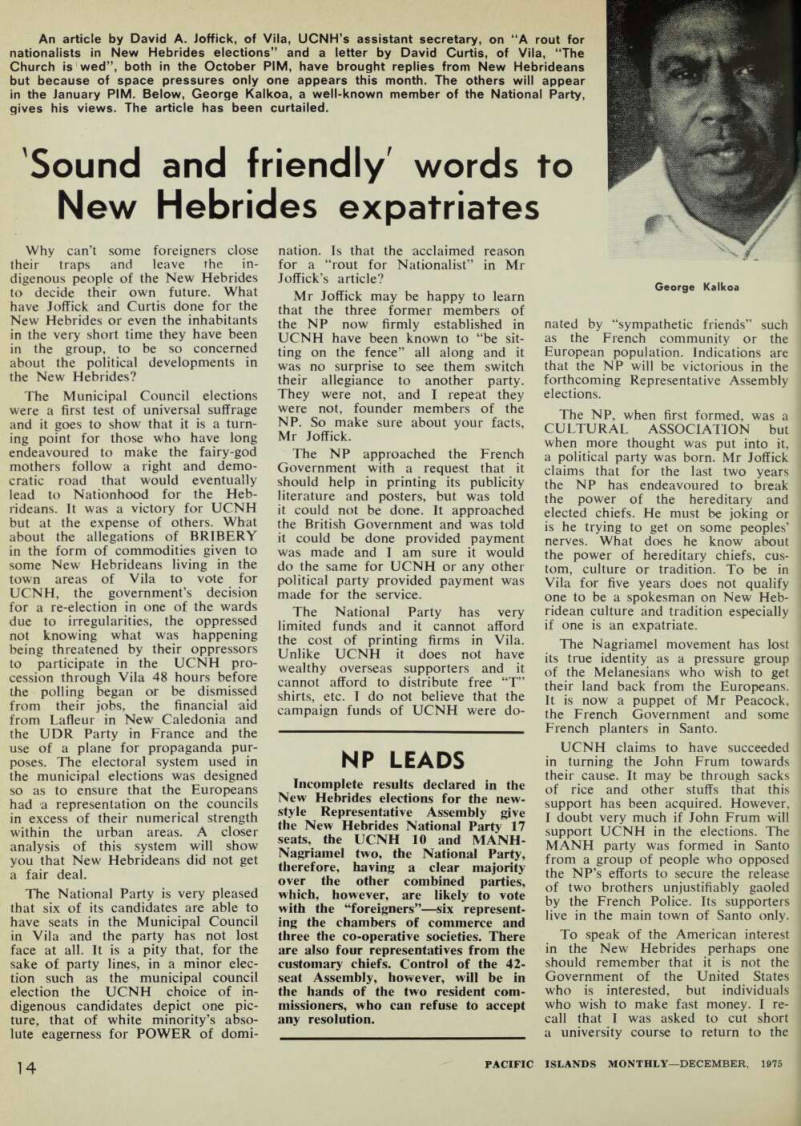
An article by David A. Joffick, of Vila, UCNH’s assistant secretary, on “A rout for nationalists in New Hebrides elections” and a letter by David Curtis, of Vila, “The Church is wed”, both in the October PIM, have brought replies from New Hebrideans but because of space pressures only one appears this month. The others will appear in the January PIM. Below, George Kalkoa, a well-known member of the National Party, gives his views. The article has been curtailed.
Why can’t some foreigners close their traps and leave the in digenous people of the New Hebrides to decide their own future. What have Joffick and Curtis done for the New Hebrides or even the inhabitants in the very short time they have been in the group, to be so concerned about the political developments in the New Hebrides?
The Municipal Council elections were a first test of universal suffrage and it goes to show that it is a turn ing point for those who have long endeavoured to make the fairy-god mothers follow a right and demo cratic road that would eventually lead to Nationhood for the Heb rideans. It was a victory for UCNH but at the expense of others. What about the allegations of BRIBERY in the form of commodities given to some New Hebrideans living in the town areas of Vila to vote for UCNH, the government’s decision for a re-election in one of the wards due to irregularities, the oppressed not knowing what was happening being threatened by their oppressors to participate in the UCNH pro cession through Vila 48 hours before the polling began or be dismissed from their jobs, the financial aid from Lafleur in New Caledonia and the UDR Party in France and the use of a plane for propaganda pur poses. The electoral system used in the municipal elections was designed so as to ensure that the Europeans had a representation on the councils in excess of their numerical strength within the urban areas. A closer analysis of this system will show you that New Hebrideans did not get a fair deal.
The National Party is very pleased that six of its candidates are able to have seats in the Municipal Council in Vila and the party has not lost face at all. It is a pity that, for the sake of party lines, in a minor elec tion such as the municipal council election the UCNH choice of in digenous candidates depict one pic ture, that of white minority’s abso lute eagerness for POWER of domi
nation. Is that the acclaimed reason for a “rout for Nationalist” in Mr Joffick’s article?
Mr Joffick may be happy to learn that the three former members of the NP now firmly established in UCNH have been known to “be sit ting on the fence” all along and it was no surprise to see them switch their allegiance to another party.
They were not, and I repeat they were not, founder members of the NP. So make sure about your facts, Mr Joffick.
The NP approached the French Government with a request that it should help in printing its publicity literature and posters, but was told it could not be done. It approached the British Government and was told it could be done provided payment was made and I am sure it would do the same for UCNH or any other political party provided payment was made for the service.
The National Party has very limited funds and it cannot afford the cost of printing firms in Vila.
Unlike UCNH it does not have wealthy overseas supporters and it cannot afford to distribute free “T” shirts, etc. I do not believe that the campaign funds of UCNH were do-
nated by “sympathetic friends” such as the French community or the European population. Indications are that the NP will be victorious in the
forthcoming Representative Assembly
elections.
The NP, when first formed, was a
Cultural Association But
when more thought was put into it, a political party was born. Mr Joffick claims that for the last two years the NP has endeavoured to break the power of the hereditary and elected chiefs. He must be joking or is he trying to get on some peoples’ nerves. What does he know about the power of hereditary chiefs, cus tom, culture or tradition. To be in Vila for five years does not qualify one to be a spokesman on New Heb ridean culture and tradition especially if one is an expatriate.
The Nagriamel movement has lost its true identity as a pressure group of the Melanesians who wish to get their land back from the Europeans.
It is now a puppet of Mr Peacock, the French Government and some French planters in Santo.
UCNH claims to have succeeded in turning the John Frum towards their cause. It may be through sacks of rice and other stuffs that this support has been acquired. However, I doubt very much if John Frum will support UCNH in the elections. The MANH party was formed in Santo from a group of people who opposed the NP’s efforts to secure the release of two brothers unjustifiably gaoled by the French Police. Its supporters live in the main town of Santo only.
To speak of the American interest in the New Hebrides perhaps one should remember that it is not the Government of the United States who is interested, but individuals who wish to make fast money. I re call that I was asked to cut short a university course to return to the
George Kalkoa
New Hebrides to discuss a regulation on land speculation.
I remember vividly a planter who praised the Americans for having protected the group from the Japan ese during World War II and because they have a lot of money would help the New Hebrides in its development.
I told the planter and others who were present that “Peaceful exploit ation is different from land specula tion”. The Joint Administrations enacted the regulation and that was it. It is unfortunate for those Ameri cans who bought land from Mr Pea cock because this regulation will not be amended or repealed for some considerable time.
Perhaps Mr Joffick would be well advised to seek facts from the British Education Department in Vila be fore he starts saying things about the British output in literacy. The British Secondary School in the New Heb rides has established some good records overseas and proof from private students overseas shows that the education level in the New Heb rides is quite high, as a number of students have returned from the University of the South Pacific and are now working and soon others will follow suit from the University of Papua New Guinea and the Uni versity of Technology in Lae. Just in passing, I would mention that an ex-student of BSS has completed an aircraft engineering course in UK and is also licensed to fly. A Euro pean ex-student of BSS now attending Auckland Grammar school finds himself placed higher in the form in Auckland than he could maintain at BSS. Does that make any sense to Mr Joffick? I doubt very much that the French language will predominate here in the years to come. It is a second language to a New Hebridean like English and it will remain thus.
The National Party is a nationalist movement and will struggle on to achieve its aim in 1977, come rain or hail. There is no turning back. I doubt very much whether the coali tion by UCNH-MANH-Tabwenasana and Nagriamel will achieve anything as far as the future of the New Heb rides is concerned and they are no threat to those who seek JUSTICE and FREEDOM. The New Hebrides is not going to be another South Africa, that is definite, and make no mistake about it.
Let me give a sound and friendly word to those expatriates who wish to make loud noises in the New Hebrides political front “BETTER
To Be Seen And Not Heard”.
Np Leads
Incomplete results declared in the New Hebrides elections for the new style Representative Assembly give the New Hebrides National Party 17 seats, the UCNH 10 and MANH- Nagriamel two, the National Party, therefore, having a clear majority over the other combined parties, which, however, are likely to vote with the “foreigners”—six represent ing the chambers of commerce and three the co-operative societies. There are also four representatives from the customary chiefs. Control of the 42seat Assembly, however, will be in the hands of the two resident com missioners, who can refuse to accept any resolution.
Tuvaluans lose a 'safety valve'
The Tuvaluans, known before October 1 as the Ellice Islanders, lost a safety valve when they separated from the Gilberts—the opportunity to move further afield when they tired of life at home.
The Queen’s Commissioner in Tuvalu, Mr Tom Layng, warned them of the possible consequences of that loss when he opened the first sitting of the Tuvalu House of Assembly at Funafuti at the end of October.
In modern times, he said, Tuvalu had been a small part of a much larger whole. The able, the energetic, the restless and the misfits had been able to leave their small island homes and seek a degree of escape and anonymity in Tarawa, Ocean or Nauru. All that was now changing, and with separation the world for Tuvaluans would inevitably contract.
Many of the safety valves would be blocked, and that might cause difficulties which the people had to be ready for.
From January 1, when Tuvalu would finally be on its own, horizons would contract, job opportunities would be reduced, there would be much less racial dilution, people would be very much more on top of one another, and there would be greatly increased scope for friction.
Mr Layng reminded the people that before they complained, or criticised, they should remember that nearly all voted for separation. Their vote showed they considered the advantages outweighed the disadvantages.
They should stand by the decision
uncomplainingly; they should be tolerant.
Visitors to Tuvalu, particularly the outer islands, noted the outstanding local pride in doing things well, the staunch team spirit, and the “so very manifest friendliness, goodness and niceness all round .
But . th ere wa s a reverse side of com. Too often those unsuccess ful thetr applications for jobs in Tuvalu had levelled accusations of favouritism or malpractice at the Appointments Board instead of stand mg back and admitting that better men were selected. At one stage, the petty rivalries and jealousies between individuals seemed finely to disrupt seriously the work of forming a new Clv *l , serv^ l e * , , We still see, too often, those dis appointed in their ambitions, com mercial, administrative, scholastic or political, turning sour, revengeful and disruptive, rather than pausing to take a * on B hard look at them selves to see what personal failure or error had been the cause of their lack of success , Mr Layng said, He ur B ec all to try and think of the good side of things and people, P u * aside petty differences, and think first of the national interest, and the good of the people as a whole.
Mr Layng said political mdepen dence meant very little without economic independence. Tuvalu had as^ Britain for a grant-m-aid of 5A840,000 for 1976; of that about $440,000 could be clearly identified
Continued on p 82
From p 15
as being money needed to stock up with what was needed when estab lishing a new capital. The real re current grant-in-aid was about $400,000.
He suggested that the first national aim should be to reduce that figure annually by not less than $lOO,OOO.
If that was achieved, the budget would balance, using local resources, and economic independence could be achieved by 1980.
New sources of revenue would have to be found without delay. A scheme had been launched to raise additional revenue by minting coins for Tuvalu, and by concentrating on the sale of stamps to collectors.
Those schemes were estimated to be worth an additional $250,000 in 1976. Another benefit was the estab lishment of a philatelic bureau in Funafuti which would create 10 new jobs for local people.
As it was unlikely that those sources of revenue would be capable of significant increases in future, the government suggested three possi bilities: • Development of a fishing in dustry; • Development of the copra in dustry; • New crops and small industries.
Advertisements & other items, p. 17 (1 item)
Swiso
B = = mm s =§= 9 = sss =
THE NEW 10NGERUFE
KNIVES THAT HAVE THE EDGE
OVER All OTHERS
Swiss design and manufacture
OBTAINABLE
FROM ALL
ISLAND
TRADERS
Sole Importers:
PETER FISHER
TRADING PTY.LTD.
321 Pitt Street
SYDNEY
Telephone 26 1109
Tahiti Letter
Political muddle and a Royal stomach ache
From Al Prince In Papeete
POLITICS played a dominant role in the affairs of French Polynesia in September, October and right through the early part of November. The only cer tainty emerging from the exchanges between Tahiti and Paris was that there will be no new law going into effect on January 1 as originally scheduled, changing the relationship between France and her overseas terri tory.
However, the debate, sometimes heated, that has occurred since March over the so-called “new Statute” got side-tracked during the first week in November, and, despite the efforts of French Polynesia Governor Daniel Videau to set the record straight, the new year may arrive with the principal officials locked in a dis cussion of two possible courses for Tahiti—indepen dence or a ‘Department’.
The new debate stems from a seemingly-innocuous statement by Olivier Stirn, the French Minister for Overseas Departments and Territories. At the very end of Mr Stirn’s Overseas Territories’ budget presentation for next year, he was quoted as saying that a regional statute and the status of a French Department is pre ferable for those territories that have not considered their ties with the French Republic irreversible.
Mr Stirn was describing the three developments he has found in 1975 emerging from Overseas Territories.
One was a territory becoming a Department of France.
The second was a territory having a regional statute with the status of a French Department. And the third was the statute proposed for French Polynesia and New Caledonia, permitting more decentralisation from France administratively and economically, but rejecting internal autonomy, or self-determination.
The newspapers here immediately had a field day, along with the local politicians. Le Journal de Tahiti interpreted Mr Stirn’s remarks to mean that a regional statute and departmentalisation are the best solutions the French Government can propose to Overseas Terri tories.
The local politicians immediately interpreted Mr Stirn’s remarks to mean a choice for Tahiti between independence or a department. Obviously, these are two extremes, independence meaning a complete break with France, and a department meaning the purest form of French status possible, putting Tahiti in the same category as Martinique and Guadeloupe in the Caribbean—as much an integral part of France as any part of the country.
In effect, however, what the local politicians did was to reiect Mr Stim’s proposed new statute, independence, for the time being, and the status of a department.
But Governor Videau, concerned over how the de bate had become sidetracked to include the possibility of Tahiti becoming a department, wasted no time in trying to set the record straight. He said the interpre tations by the news media and politicians of Mr Stirn’s
statement did not conform with the truth. Governor Videau said that the statutory text presented by France and himself as recently as the October 31 meeting of the French Polynesia Territorial Assembly has not contained anything indicating a regional statute or de partmentalisation.
But the debate continued, nevertheless, over Mr Stirn’s remarks. French National Assembly Deputy Francis Sanford, leader of the autonomist movement, was touring the United States as a guest of the Ameri can Government.
Upon returning to Tahiti on November 12, Mr San ford noted that Mr Stirn had told the French parlia ment and the press that “We can have our independence when we want it. Thank you. We have already known it for three years, it having been set up as a right written into the Constitution. The only alternative he offers us to rushing into independence is departmental isation, which no one here wants. Why then does he put before us such an absurd choice?
“Since Mr Stirn doesn’t want to explain it to us, I will do it in his place. The reason for it is that he wants to assure peace (excuse the word) for the CEP and CEA military personnel and technicians in the years to come. Because President Giscard d’Estaing has given the green light for an excessively ambitious military programme he intends to develop a third generation of nuclear bombs, supplying multiple war heads, consequently resulting in continued underground tests at Mururoa at least until 1982—if all goes well, which rarely is the case.
“The withdrawal of the CEP and the CEA from the Tuamotu sites would not constitute the first step of this programme. The best would then be for Paris to transform French Polynesia as quickly as possible into a department”.
Then, without the Territory Assembly and the Government Council there would be no one to effec tively protest the decisions made sovereignly by Paris.
“There would also be, certainly, some income taxes as in France, as well as all the other metropolitan legis lation, paralysing and unsuitable for specific local con ditions”, Mr Sanford said.
But the Deputy then wondered what might happen if the electorate in Tahiti turned the scales and voted for independence, in effect, calling Mr Stim’s bluff.
But Mr Sanford rejected both independence and de partmentalisation as the course for French Polynesia.
Instead, he repeated his long-standing demand for in ternal autonomy as the most acceptable course for the territory.
Mr Stirn probably did not realise at the time he was amplifying his Budget for the Overseas Territories that he was opening up a can of worms in Tahiti that has only added fuel to the political fire in the debate over exactly what will be French Polynesia’s future relationship with France.
rHREE of the seven munitions thieves of 1972, who were sent to France’s maximum security prison icar Marseilles, returned to Tahiti in late October as ree men. Robert Cahn, Charlie Ching and Felix feheiura were greeted at Tahiti-Faaa International Air >ort by Tahiti’s Senator to France, 76-year-old Pou /anaa a Oopa.
After three years in prison, much of the time in olitary confinement, Cahn said upon his arrival, “We hall continue our fight”. Ching was a little more pre :ise about what fight. “Tahiti belongs to the Tahitians, fhe French are not here to throw the Tahitians out )f Tahiti. It’s up to the Tahitians to throw the French nto the sea”.
Cahn also complained about the stand taken by ocal politicians, claiming they were too wishy washy.
The trio was released under a general amnesty 'ranted all except serious criminals, such as those con icted of murder, when France elects a new President, /alery Giscard d’Estaing was elected more than a year igo. * * * * HIRARD Gilloteaux spent his 60th birthday and last official day with the Tahiti Tourist Board on November 5 escorting British Princess Margaret to the fahiti-Faaa International Airport. For Gilloteaux, it vas a fitting last official duty after 14 years of work n the field of tourism in French Polynesia.
For Princess Margaret, it was the end of a H-day inofficial visit that left a lot of ruffled feathers and not nuch in the way of goodwill. Shortly after the Princess
arrived from Sydney and had been greeted by Governor Videau, she and the small staff travelling with her moved into their suites at Tahiti Travelodge Hotel. The Princess stayed in her room the whole time with a reported Royal stomach ache.
The ailment prevented the Princess from attending a lavish picnic that was arranged for her on the nearby island of Moorea. But it was only at the very last minute, when Governor Videau came calling for her, that the Princess declined the invitation. The picnic went ahead as scheduled while the Princess slept in her room.
If some officials here were upset by the Princess’s stomach ache, Qantas Airways was even more upset when it found out that Princess Margaret’s private secretary was telling journalists here that he and the Princess had upset stomachs “probably because of some of the food we ate on the flight”. The Royal group was flown from Sydney to Tahiti on Qantas.
As for Gilloteaux, he was feeling a different kind of pain, knowing that his very last day was also the final day for a hotel apprenticeship school that he helped set up in Tahiti. In both cases, it was a matter of offic ials in Paris deciding not to continue budgets—either for Gilloteaux’s salary or the operation of the school.
Gilloteaux arrived in Tahiti in 1961 to become head of the government tourist bureau, a job he held until the present Tahiti Tourist Board was created in 1966.
At that time, Gilloteaux became manager of promotion, publicity and public relations. He was director of pub lic relations when he left the Tourist Board on Novem ber 5. His position will now be filled by Patrick Robson.
Asked the day after he officially left his post what his plans are, Gilloteaux said, “I’m looking for a job”.
Advertisements & other items, pp. 19-20 (2 items)
17
‘ACIFIC ISLANDS MONTHLY—DECEMBER, 1975
Fay International Limited
★ HYGIENIC, HOUSEHOLD AND BABY
PRODUCTS
★ RETAIL TABLEWARE PRODUCTS
★ METEOR ADHESIVE TAPES
★ ADVERTISING PRODUCTS
lh imt Meteor — j For further information contact: KERR BROTHERS PTY LTD 65 York St., Sydney, N.S.W. 2000.
Telex AA 23181 Cable: CAREFULNESS, Sydney.
These IMF distributors
can show you how
MF slashers keep going in conditions
that would stop others short
An MF slasher will make short work of any shredding, clearing or cutting job and it takes only a demonstration to prove this. The secret of MF’s superiority is the use of a large diameter disc with four swing back blades.
The disc utilises the flywheel principle to maintain constant drive revs, so you get a reserve of power to keep going even under the severest cutting conditions. Another advantage of the flywheel is that it drastically reduces horse-
ill
under stress. That’s one good reason to make an MF slasher your first choice, but there are plenty of others too! Like the fully shrouded design of the output shaft that prevents any possibility of wire or other material fouling the shaft to cause damage to the machine.
Take your choice from fully-mounted or trailed models in 4,5 and 6 foot cutting widths.
What’s more when you buy MF you’re not left for dead . . . your distributor backs your choice of MF with power requirement so you don’t put the tractor and implement v m parts and service to keep you on the go at all times.
MFE 74043
MF
MASSEY-FERGUSON. EXPORT AWARDS
The Editor's Mailbag

Pictorial History Of Png
Further to your recent review of ‘A fictorial History of New Guinea’
PIM, Nov, p 61), I would like to ualify your reviewer’s comments by aying that this volume could have een a fascinating addition to every ne’s library, had it not been thrown ogether without full knowledge of le material used or available. 1 should add that in December, 973, I was privileged to inspect more fan 14,000 photographs in the DIES les in Port Moresby; and in the ourse of a book recently completed, ave obtained a fair idea of what is vailable in Sydney and London.
I feel that the seven pages devoted d the first people are contemptuous, am in favour of archaeological data eing included, but not the omission f a wealth of material on the Papua lew Guineans (I hate the term ‘lndi ces’ used in the index) recorded on amera for very many years. This tiows the people in the natural sur- ‘doing their own thing’ in leir own way—such as the fantastic ing-sing photos from the Orokolo )istrict in the 19305. Then there was o attempt to show the diversity of arms of native architecture: J. Beete ukes’ and D’Albertis’ 150-yard long inghouses in the Fly Delta area; or *ee houses in O. C. Stone. . , .
Why was it necessary for most laps to be redrawn by Edgar Ford? )etailed maps of W. Irian are extant md out of copyright) in 'Verslag van er Militaire Exploratie van Neder mdsch Nieuw Guinee, 1907-1915’ üblished in 1920 and there is a mag ificent map with sketches super nposed showing the forms of archi jcture used in various areas of the 'est of the island.
Instead, we find pages and pages f posed groups (whether they are ierman, Queen Emma’s multitude of slations or the whites of the Kikori fiver Station in 1926 is irrelevant), here are just too many static pictures f meaningless groups of people, of iterest only to an individual who by hance, might see someone he knew.
But I must not neglect the text. On 59 there is an illustration which all Australian school children should ap reciate. John Moresby raising the ag. They also know that he dis overed the port, which bears his
family name, on February 20, 1873.
But turn to the top of p 68 (Plate 127) and there is a portrait of Andrew Goldie. Much to my astonishment, the caption says that he ‘came to Port Moresby in 1872 as a botanist’. I am amazed that such a revolutionary dis covery by the compilers did not re ceive greater prominence and that Goldie’s picture did not precede Moresby’s; or could it be that lan Stuart in Port Moresby, Yesterday and Today was correct when he said that Goldie actually arrived in POM in 1875?
It is also surprising that although the caption to Plate 41 states D’Albertis and Beccari spent ‘most of 1872-73 in the Arfak Mountains’ the Italian explorer in his book wrote that he arrived at Mansinam between August 2 and 5 and left there on November 7, 1872. In other words, the total period in the area was just over three calendar months; and the period D’Albertis was in the moun tains was from September 4 to October 1.
Then, as a last example of such accuracy, on p 113 there is a drawing of ‘The Rev and Mrs Lawes crossing the Laloki River in about 1875 as depicted in the Illustrated Sydney News’. The edition when this was published happened to be March 3, 1876, and had the compilers looked a page or two further on and read the text, they would have learnt that the ladies pictured were the wives of the Polynesian teachers. In Lawes’ diary, they would have learnt that Mrs Lawes, after bearing the first white child to be born in New Guinea, earlier in 1875, did not ac company her husband inland. On this expedition, incidentally, the organiser was O. C. Stone; they left Port Moresby on December 7, 1875 (see his book pp 149-151) and they were accompanied by Hargrave, Broadbent and Petterd. Hargrave’s diary indicates that he was probably the man illus trated on the end of the rope, pulling the others across.
What is of much greater interest would be the location of a photo graph which Lawes claimed he took of the expedition members, which is neither in the Mitchell Library col lection, nor in the LMS Archives in London.
In conclusion, I also find it strange
Letters
at Lindt’s first photographic book i New Guinea does not receive men >n in the shockingly laid-out biblio aphy.
John Goode
Midi Junction, NSW
The Lost Caravel
Robert Langdon’s book The Lost iravel (PIM, Oct, p 63) has, if (thing else, brought creeping once ain into the light of day everyone 10 has an axe to grind about Pacific igrations. Not particularly caring provide an exception to the general le. I may as well add my two nts.
A criticism brought against Lang n’s “Spanish” theory is that it is tronising of the Polynesians. This true but irrelevant. Also it is, to a gree, understandable.
Four hundred years before the rt of our era, the mathematicians Alexandria measured our planet d set it spinning among the fixed rs. It had to spin almost 2,000 >re times, however, before the irs of Hellenistic expertise could rise clocks accurate and reliable Dugh to provide navigators on this clidean sphere with a ready means determining longitude.
Fhus equipped with the finest pro mts of our civilisation, the great rigators at last sailed into the rific . . . only to discover a people 0 had been navigating the Great can with ease and accuracy for at st several centuries. To the Euro in eye, the navigational techniques the autochthons seemed so “primi as to be beneath notice, much * emulation. (A notable exception this attitude—as to so much else Pacific history—was shown by t singular man James Cook, who 5 genuinely interested in Poly ian navigation and might have rned a good deal about it except the secrecy of the navigators’ ools.) Tie Polynesian system seemed too imathematical” to provide nice itional discrimination to European igators who were themselves thematically unsophisticated x)k, again, excepted). (What is, 1 is not, the preserve of mathe tics depends on the point of view; is in this area—the mathematical is of Polynesian navigation—that
I hope, in a paper now in prepara tion, to resolve some of the current confusion.) The entire attitude of denigration bespeaks profound cultural shock, a malady which some Europeans, in cluding, apparently, Langdon, haven’t recovered from yet. This runs to such extreme cases as that of Andrew Sharp, who chooses to ignore the evidence and insist that the Poly nesians couldn’t navigate at all.
But a more serious criticism of Langdon’s argument, it seems to me, is that, like Heyerdahl’s, it is psycho logically unsound. Castaways simply do not found dynasties, no matter how “culturally superior” they may assume their own civilisation to be.
There are reports of Japanese fishing vessels which became disabled and drifted to Hawaiian beaches during the century that preceded European contact; while their crews interbred with the local populace and certain characteristics noted by early Ha waiian writers were presumed to be results of these unions, the cultural impact of this forced immigration was so slight as to be subliminal.
It is possible—even likely—that some of the European ships that dis appeared in the Pacific during the era of exploration found hospitable islands where their crews survived and eventually reproduced. But the probability that these survivors at tained any cultural or political hege mony in the established hereditary order seems vanishingly small. And if—by dint of their iron cannon or Roman Catholic God or by the force of some really outstanding person ality—they overcame these almost impossible odds to become founders of an important sub-branch of the Polynesian civilisation we would certainly know about it in less am biguous terms: the Polynesians are not exactly noted for being overly modest about important ancestors.
David Call.
Greenslopes, Queensland.
Chipper-Austin Travelmill
It is noted you featured an article covering the Chipper-Austin Travel mill which this company exhibited at the Forest Industries Machinery Ex position in Victoria.
It is also noted that you indicate that inquiries should be directed to Austin Engineers, Rabaul. This is incorrect. Inquiries should be directed to this company who now manufac ture the Chipper-Austin Travelmill and have worldwide sales rights.
J. L. Chipper
J. L. Chipper & Co. Pty. Ltd., Rabaul, PNG
Mana
The section MANA was missing from your October issue, owing to some foul-up in communications. In its present form it could well be omitted more frequently.
There are two main deficiencies in MANA. Firstly, it does not represent the contributions of the full spectrum of Pacific Islands Monthly reader and writership. From the various com mentaries accompanying articles, stories and poems in the past, one can only conclude MANA is the sole preserve of the people of islander ethnic identity. While such an ex clusionist policy may have been neces sary in the early days of MANA, surely, as the Island states are now shedding their “Protected” and de pendent status, it is time that the pro tective editorial policy was modified.
Secondly, with the wealth of material now available from writers, poets, and students perhaps a more critical approach by the editor could be attempted. A lot of what has been published in the past is excellent, but, in my opinion, a great deal deserves to be re-worked and some filed in the waste paper basket.
I am not only voicing my opinion in this, but have discussed it with a number of other people.
It would be interesting to ascertain the opinions of your other readers.
J. A. Bennett
Suva, Fiji
Country Women's Help
Regarding an item (PIM, Oct, p 28) which alludes to the Country Women’s Association study of Pacific Islands as its Annual International Project for 1975, you mention that a “whip around” might be a good idea.
Well I would like you to know that the CWA of NSW does give help to Island women though not by a “whip around”. Each year we sponsor an Island scholar to do a course in cooking, nutrition, health, hygiene and the art of making prac tical use of materials at hand in a native village.
This knowledge the student ac quires at a suitable institution in Suva, Fiji. She then returns to her particular home village to dissemin ate the knowledge and techniques gained, thereby promoting its general welfare. As an example, our 1966 scholar Kala Kila, has now risen to be Vocational Centres Supervisor in Port Moresby. She has formed 100 centres, 35 of which are for young women.
Also, each year we make a state wide collection, known as “Village
Aid”, which is dispatched to Papua New Guinea. This comprises sewing materials, dress lengths, cottons, scissors, saucepans, even an oc casional sewing machine—in fact anything which can be of use to our darker sisters who “want to learn low”. So you see, in our modest way, ve do try to help.
Just recently this writer spent a month in Samoa and Tonga where ;he visited sister associations in Apia md Nuku’alofa and was most kindly eceived in both towns. Incidentally, his writer could settle in very easily o the unflurried tempo of Poly lesian life, plus a few comforts, of :ourse, like electricity in the home.
I love the Pacific Islands and have ilso a great affection for PIM as a egular reader.
Christine Brown (Mrs)
rumut, NSW.
South Pacific Literature
A literary association with a engthy, but accurate, name has re ently appeared in the Pacific Islands egion. It is the South Pacific Asso iation for Commonwealth Literature nd Language Studies, set up after onsultation among writers, editors, cholars, teachers, and students in the louth Pacific region.
Its aim is to bring together people oncerned with the writing, reading, nd study of literature in the region nd with the study of the language i which it is written. It is affiliated /ith a world-wide association con erned with the reading and study of iterature in English, the association or Commonwealth Literature and .anguage Studies, having its head uarters at present in Mysore, India.
The new South Pacific Association /ill publish a newsletter for mem bers, containing information about rants available to creative writers nd about facilities for the study and caching of Commonwealth literature nd languages. The newsletter will rovide information, in particular, bout what is being written and pub ished in the South Pacific region.
The association will also act as a learing-house for information about ravel and exchange between one commonwealth country and another, it will hold conferences to bring agether writers, scholars, and stu ents of ‘Commonwealth’ literature nd language.
Information about the association
is available from the Honorary Sec retary, SPACLALS, Department of English, University of Queensland, St Lucia, Queensland, Australia 4067.
K. L. Goodwin
(Interim Chairman, SPACLALS) Department of English University of Queensland Brisbane 4067.
Any Offers?
I am 29 years old, a civil building engineer living in the Western Bohemia region of Czechoslovakia, and my really big hobby is the col lecting of coloured view cards from the Pacific Islands. I study the his tory, geography and architecture of the area and am very much interested in the life of the Islands.
However, I haven’t in my collec tion any view card in colour or black and white of Norfolk, Pitcairn, Wallis Island, Guam, Saipan, Rota, New Hebrides, Canton, Enderbury and the Line Islands.
I am looking for contact with people on these islands to exchange correspondence and view cards. I have received several editions of your magazine.
Ing. John Kostalek.
Susice 147/111, 342 01 Susice, Czechoslovakia.
Bougainville
1 would have some understanding for UN to ignore Fr Momis and Teosin’s request that Bougainville separates itself from Papua New Guinea, the reason being that the UN or member countries were instru mental in making Bougainville arti ficially part of PNG, but I cannot see any reason whatsoever for PNG Gov ernment to force Bougainville to stay as part of PNG except that PNG Government is being a puppet of some foreign influence.
PNG Government knows very well that the foreign idea of unity it aspires for, cannot be achieved by force if islands that are not part of PNG wish to stay out. Experience has shown and continues to show that countries forced to unite in this way almost always fall apart; we really never learn, don’t we?
I think I would be speaking on be half of a lot of my countrymen when I write to say that the PNG Govern ment should let Bougainville go the way it wishes to go. The PNG Gov ernment should act according to facts but not on artificial notions which have no lasting values and have no lasting binding force.
PNG Government knows very well that in the islands from long ago we have been independent. Islands or
tribes have their own leaders and manage their own affairs. There was trade between the islands and so forth, but they were not united under one government or one leader. This unity under one leader is a foreign concept and it works only in societies such as ours when kingdoms or islands voluntarily opt to be governed bv one government and under one leader. But there has been proof that although we are separated yet we had elements of unity among islands.
Can’t the PNG Government see this kind of unity? Or should we still follow whiteman blindly even though we are independent. Michael Somare are you starting another Ireland here?
Please look at the example of Tuvalu and the Gilbert Islands, learn from these little ones.
In my little way I would plead to the islands of the South Pacific to assist in solving this problem or are we going to repeat with, Cain’s “Am I my brother’s keeper?”
D. Kane.
Honiara.
Solomons' Birth Pangs
I write to put the record straight with regard to a passage in the article by Ken McGregor entitled Birth pangs of a new Solomons (PIM, Oct, P. 37).
The Chief Minister is quoted as saying that a scheme for appointing Solomon Islanders to understudy de partmental heads was turned down by the Governor and the Public Service Board.
I am authorised by my board to say that no scheme has been referred to it.
J. A. Jones
(Secretary, Public Service Advisory Board) Honiara, Solomon Islands
Advertisements & other items, pp. 21-32 (11 items)
19
ACIFIC ISLANDS MONTHLY—DECEMBER, 1975
Christmas ?
Want PIM for a
friend this
We’ll make it easier for you! * s S M S = © £ o c o "O OD co bD a O S **3 Oh 0 Oh <S o o (» Oh ID Fill in the details on one of the attached order forms.
<dr< * ft A y 'J ( p Why not give them Instant Sunshine Milk?
It dissolves in seconds to make rich, creamy milk that has essential vitamins A & D, plus Calcium-just like fresh milk
Instant Sunshine
dissolves in seconds
Nestle
nshin*
W c
E. G. BARKER & CO. PTY. LTD.
Established 1825—150 Years of Service
AUSTRALIA'S OLDEST EXPORT HOUSE
GENERAL EXPORT MERCHANTS
Specialising in world-wide distribution of General Merchandise, Provisions & Produce EXPORTING TO ALL PORTS IN PACIFIC ISLANDS Buying Agents for: —THE CO-OPERATIVE WHOLESALE SOCIETY LTD.
LAE AND ALL BRANCHES
PORT MORESBY
RAYMOND WONG
P.O. Box 5020
BOROKO.
Phone 25 5546.
Representatives
RABAUL
CON SASSADIS
P.O. Box 611
RABAUL.
FIJI
PARAMOUNT AGENCIES
G.P.O. Box 459
SUVA.
Phone 2 3127.
34 HUNTER STREET, SYDNEY, 2000
Cable Address: KERBAR SYDNEY. Phone: 61-2877. Telex: 31732.
Melbourne Office: 520 Little Collins Street. Phone: 61-2877. Telex: 317321.
Let Lane
lend a hand
These are some of the products which are keeping our customers prosperous. From this range, you can obtain a really effective herbicide such as M.S.M.A., which controls persistent grasses and sedges in coconuts and bananas, or a short, residual, quick-acting insecticide like DIBROM, which controls fruit and vegetable insects and mosquitoes, sandflies and midges.
Also, our research facilities and advisory services in the field are among the best available, so drop us a line and let us help you. f Lane Ltd., Export Division, P.O. Box 59, Bankstown, N.S.W. 2200 Lane (Fiji) Ltd., P.O. Box 89, Suva, Fiji f t Insecticide t Fungici t Weedkiller Feed supplement f Animal Health umigants \ e X N Home Garde^ W \ * Don’t forget—Amalgamated Chemicals is now Lane 9859
DATELINE HOTEL
TONGA
Friendly Hotel" of the "Friendly Islands"
Situated along the Nukualofa waterfront. Only five minutes walk from town. Single, double, family suites, airconditioning, and hot and cold water showers. Pool, bar, restaurant, duty-free shop, tour desk and boutique.
Book through your travel agent or write to International Dateline Hotel, P.O. Box 62, Nukualofa Tonga.
Cable Address: "DATELINE".
Represented Overseas by: Charles J. Henry and Associates Pty. Ltd.
Sydney and Melbourne. ™
Built for the bush. Built to last
Cat 518|og-skulileE, \
Caterpillar reliability, productivity, availability. Now you can get it all in a wheel skidder. The 518.
A whole new standard in skidder engineering. 120 turbocharged horsepower, 20,400 pounds of working muscle with full articulation and frame oscillation for stability and minimum maintenance.
Single lever “on the go” powershift. Dual rate steering for controlled response at all speeds. An operator’s compartment engineered for efficiency with safety features built In for man and machine.
You’ll find all the best skidder ideas, plus added refinement and top quality manufacturing that can make the 518 the backbone of your logging operation.
And South-West Pacific Caterpillar dealers will ensure that your backbone stays in top condition no matter how far in the bush you are.
Parts, maintenance, repairs or simple Information—we’ll see that you get it fast.
So tackle the jungle with the new Cat 518.
Caterpillar Dealers in South-West Pacific.
HASTINGS DEERING
Lae: Milford Haven Road, Ph: 42 2355 Port Moresby: Champion Parade, Knoedobu.
Ph: 3138 or 2098.
Bougainville: Itakara.
Industrial Park, Arawa.
Ph: 95 9004. 164 Queens Road, Suva.
Ph: 24 051-4 Cables: Carptrac Suva Telex: Carptrac FG2190 Suva Hoaat
21
CIFIC ISLANDS MONTHLY-DECEMBER, 1975
Letters
TropicaIities
One that
got away
Sharks are being made the heroes, >r the baddies, in books and on the creen these days, but none of the tories will be as thrilling, or chilling at least for one Gilbertese) than tiis story sent to PIM by Mrs Vic- Dria Conrad, of Ocean Island.
Early one morning in October, 'eburetau, a slightly-built Gilbertese rom Tamana, working as an R.B. perator on Ocean Island, went fish ig, Mrs Conrad relates.
The weather was fine, with a light asterly wind. The sea was moderate nth a low swell, and the sky was ightly overcast.
Storing his fishing gear in his anoe, he paddled away from the lore at Anteren village, heading to le west of the island where the old oat harbour is. About H miles off lore he let his canoe drift with the arrent, and began fishing, using a 14 bamboo pole with line, to the end f which he had attached a lure-type ook ( Kaneati ) he had made out of Baeao ) shell.
Teburetau did well, and by about ine o’clock he had caught nearly bonito. all roughly a foot in ngth. Suddenly, while he was haul ig in yet another catch, a dark sha iw torpedoed through the water.
HARK. Seeing that he was in dan :r of losing the hooked fish, Tabu itau, with a swift movement of the hipping bamboo pole, landed his rize in the canoe.
Cheated out of a free meal, the lark turned and attacked the canoe, nashing through the I inch planks, rith a seven-inch hole in its side, ic canoe began to sink fast, and eburetau called for help.
He was lucky. The only other moe in the vicinity was about 15 irds away. Its occupant, Itamaeli, so from Tamana, heard his cries id paddled furiously towards him. eburetau’s canoe had by now dis ipeared beneath the surface.
Danger still lurked. More than a )zen other sharks, all about six et long, attracted by dozens of dead
bonito which had floated away from Teburetau’s canoe, were wildly snap ping and churning the water around him in a feeding frenzy.
Swiftly pulling Teburetau into his own canoe, Itamaeli quickly paddled away from the swirling waters, to the distant shore and safety.— Phew!
Whi(*h doctor
is genuine?
An examination system qualifying witch doctors to practise in Papua New Guinea has been advocated in the National Parliament.
In a private member’s motion, Mr Gideon Arpeng said that witch doctors should be called before medical authorities to give practical demon strations of their skills and knowledge.
If they weren’t up to scratch they should be barred from practice, Mr Arpeng said.
Some authorities in PNG have already conceded tacit recognition of
the value of witch doctors in certain illnesses involving psychological fac tors. There has been limited research into some of the natural drugs occa sionally used, but most PNG witch doctors work by magic spell and in cantations backed up by supernatural imagery.
A former Health Minister, Dr Reuben Taureka—he is now Educa tion Minister—once advocated con sultations between witch doctors and hospital doctors in some illnesses.
But Mr Arpeng told the National Parliament in Port Moresby that the witch doctor system was developing into a large scale rip-off of the gullible public. Many so-called witch doctors, with no tribal traditions be hind them, were falling back on cheap conjuring tricks to impress their patients, he said.
A common trick was to pretend to remove foreign objects from a patient’s body through the mouth.
Mr Arpeng, 52, who was born in a northern mainland village in PNG, is a former medical orderly, school teacher and Lutheran church official.
He said he believed sincerely that
Nauru, which left no piece of phosphate rock unturned to entertain delegates to the South Pacific Conference in October, issued these attractive stamps to celebrate the occasion, and the stamps are a real mixed bag. At top on left is the new Civic Centre, which housed the conference and below it the famous Domaneab, the Meeting House at State House where Nauru's Parliament met. The others are different types of canoes representing the areas covered by the SPC, Melanesia, Polynesia and Micronesia, with the Micronesian outrigger (top left), the Melanesian outrigger (bottom left), the Polynesian double hull (top right) and the Polynesian
outrigger (bottom right).
witch doctors had the power to heal some sicknesses which still defeated western doctors. But too many false] pretences were creeping in, and the government should approve and regis ter witch doctors before permitting them to practise.
Parliament adjourned debate on Mr] Arpeng’s proposal.
Girl with a
golden smile
Somewhere, in the environs of a Fijii overseas mission headquarters, a Fiji officer’s wife is flashing a glittering smile. Heck! It’s a golden smile worth $728. And it’s causing a headache or two in the corridors of Fiji’s Foreign Affairs Department.
It’s like this. The regulations gov-j erning service conditions overseas pro vide, among other things, for the payH ment by the poor Fiji taxpayer of the dental expenses of the officers and their families.
Well, one officer’s wife has got her teeth into the regulations. According to Fiji’s Auditor-General, Mr T.
Bhim, in his annual report, the offi cer’s wife had some dental treatment.
The bill, included in Foreign Affairs expenses, came to $1,140. It included an item for three ceramic gold crowns —you know, gold-topped teeth—gold post and some other treatment at a cost of $728.
Mr Bhim says it appears to be a doubtful charge to public funds and Foreign Affairs is looking into it.
Here's a happy
story from NZ
There’s a lot being said about Islanders going off the rails in New Zealand but here’s the other side of the coin.
Samoan Methodists in Grey Lynn, Auckland, one of the biggest Poly nesian centres in New Zealand, have built a three-storey church —with their own hands and their own money.
Sixty men and 45 women contri buted all the money they could afford and backed that up with money raised through dances and other social functions. Their minister, the Rev Feagi Opelu, banked about $1,600 a week.
Their wages bill while the church was being built was limited to the wages of one foreman who super vised the job over the last two years.
Two carpenters worked for nothing and the congregation did the labour ing for nothing, digging the found
tions, ditches and drains, hod arrying and all the other jobs. The nly machinery was a crane which as used to hoist the roof.
The church was opened near the nd of October by the president of le Samoan Methodist Church, the ev Lele Milo, who flew from amoa with 400 other people. Four sen choirs from all over New Zea md provided the music and there as a huge pile of Island gifts, fine lats and other articles, as well as loney.
Of the $250,000 needed to build le church, all but $50,000 had een raised before the doors were pened, and it won’t take them long ) raise that.
So all the spending money isn’t Ding on booze, or horses! tlira<*le on a
Pongan mountain
In 1837, lean Baptiste Francois ompallier, the Roman Catholic ishop of Oceania, sailed into Vavau arbour hoping to establish his church i that northern group of the Tongan lands. However, George I, the King f Tonga, influenced by the Wesleyan lissionaries, who had recently con ;rted him to Christianity, refused to t the Catholics stay and they were >rced to sail away. Before they left, owever, a young French priest, ather Peter Chanel, whom Bishop ompallier had hoped to leave in avau, walked up Talau mountain ad left there on a tree a medal ex ressing the hope that, in the future, riests of his faith could work in avau.
Father Chanel went on to work 1 the island of Futuna where, in 1841 2 was murdered by the natives. He as been canonised and is, to-date, the tily Roman Catholic saint of Poly esia.
This October, the Vavau Catholic immunity celebrated two events hich seem to them to be the result f St Peter Chanel’s faith. The first, i the grounds of Chanel High School t Kelana, Neiafu, was the ordination f Maka Falani Tatafu of Nga’unoho illage, Vavau.
The ordination—the first to be held i Vavau, was conducted by Bishop atelisio Finau of Tonga, assisted by is predecessor, Bishop John Rodgers, ho is now Bishop of Rarotonga, and y clergy from Tonga, Fiji and New ealand. The impressive ceremony as seen by a large crowd of local lurch members—including represen itives of the leading Protestant lurches and by civic and community
leaders. Following the ordination a feast was held in the Neiafu Catholic Boys’ Club.
On the following day, on that same Mount Talau on which the young priest, Peter Chanel, left a medal 138 years ago, a new church was dedi cated. In naming it Futuna, St Peter Chanel’s Chapel, Bishop Finau stressed the fact that it was a memorial to the saint of Polynesia.
It is a memorial also to one of his countrymen, Father Georges Callet of Lyons, priest-in-charge of the Vavau parish, who first conceived it and who has been responsible for all the work in connection with its build ing.
Following Bishop Finau’s dedica tion, the newly-ordained Father Maka said the first mass in the grounds before the church, after which it was opened for inspection. Of an interest ing modern design, the L-shaped con crete church features a central pulpit and a breath-taking view of Vavau harbour. Wood from a tree felled on the site has been used by local crafts men to fashion the carved Stations of the Cross, the lectern and other church fittings. Thoroughly Tongan in conception also is the crucifix which has been painted on native tapa cloth by a Vavau artist.
Perhaps the miracle that would most have surprised both St Peter Chanel and the old-time Wesleyans who refused to let him stay in Vavau was the fact that—hostilities and sectarian differences forgotten—the local protestant churches joined in the Catholic celebrations with a true dis play of ecumenical goodwill. The Wesleyan Boys Band of Maile Fihe College provided music for all the events and Wesleyan and Anglican ministers joined in the speeches.
Indeed, the entire Vavau com munity joins the Roman Catholics in feeling proud of their new church and of their new priest.
A fishy
artefact?
Claims were made at October’s end that tinned fish and rice were re placing traditional art at a cultural centre which Australia helped to sponsor in Papua New Guinea.
A Wewak town councillor, Mr Albert Crichton, made the allega tions when calling for a government inquiry into the operations of the Wewak Cultural Centre. But the director of the cultural centre, Mr R. Wyatt, described the allegations and the call for an inquiry as “non sense”. He said that dissatisfied fac tions in local politics were “stopping at nothing” to discredit the work of the cultural centre.
The cultural centre, at the northern PNG coastal town of Wewak, operates under the authority of the PNG Department of Culture.
It also received a share of a special cultural grant provided in PNG by the Australian Government.
It was established to display and encourage the continued production of traditional art and artefacts of the people of the Sepik River District.
It is also a marketing organisation for traditional art, helping to develop organised craft industries in rural areas inland from Wewak.
But Mr Crichton told a meeting of the Wewak Town Council that the centre was “inactive and wasting money”. He called for a government inquiry to determine whether funds passing through the centre had “really been spent in the name of culture”.
Mr Crichton said, “It is disappoint ing to see that instead of displays of traditional pottery and artefacts there is a stockpile of cartons of tinned fish and bags of rice”.
The director, Mr Wyatt, said later that the cultural centre spent con-
These two Nauruan police constables, proudly displaying their retirement plaques share 64 years of service.
They are (left), Con stable Ist class Rewuru Omeri (27 years) and Constable Ist class Taupo Talua (37 years).
siderable time and effort encouraging village craft industries and buying the finished products. This sometimes in volved the establishment of practical reciprocal arrangements with embryo! business communities in village areas, i On some occasions, consumer goods had been stored for brief periods at the cultural centre before being trucked to village communities which were providing craftwork and exhibi-j tion materials.
At no time had such arrangements interfered with the display of craft work or the economics of the cultural centre.
“Hey <axi!” But
it was a ghost
Superstitious passengers believe the ghosts of two taxi drivers who died violently have returned from the grave and are driving on the Port Moresby (PNG) night shift.
Police have been told that three passengers picked up by taxi number 337 at night used cigarette ends to burn the arms of the driver to make sure he wasn’t one of the ghosts. Taxi number 337, an easily-recognised Mazda station sedan, was formerly used by a driver who was found hanged in a quarry outside Port Moresby.
Two other passengers fled in terror from the taxi when the driver turned round to ask them their destination.
They claimed they were “looking into the face of a dead man, with his tongue sticking out and his neck bruised and swollen.”
The taxi company is even con sidering an advertising campaign to scotch the rumours, although some of the superstitious fears have spread to the drivers themselves.
The manager, Mr Rei Fisk, was called out one night when drivers claimed that the ghost of a workmate killed in a road accident in July was calling from inside the locked work shop. The drivers told Mr Fisk they believed the ghost was trying to find a taxi to drive. They could hear his footsteps on the concrete floor, and he had rattled doors and windows.
The two ghost drivers are identified by their former workmates simply as Jacob and Frank. Jacob died in the wreckage of his taxi in an accident beyond the Port Moresby airport.
Frank was found hanged in a quarry.
Mr Fisk said the taxi company had considered the possiblity of an advertising campaign to indicate that all drivers were “real live men”. “We can produce the log books to show that no ghosts could possibly have been driving the cars,” he said.
25
ICIFIC ISLANDS MONTHLY—DECEMBER, 1975
Bring
long lasting
loveliness
to your skin
Over the centuries women have tried countless skin beauty treatments in their search for a perfect complexion. One of the most significant advances has been achieved through the scientific development of a unique tropically moist oil blend which has proved highly effective and become widely known and widely used throughout the world.
The promise of fine flawless complexion beauty is initially found beneath the surface of the skin where the tiny oil and moisture reservoirs maintain a delicate balance by releasing just the right amounts of natural fluids to keep the complexion soft, supple and gloriously radiant.
As you grow older the supply of natural fluids is slowed down by advancing age and by the drying effects of climate, resulting in roughness and wrinkle dryness which can make your complexion look prematurely older.
With the scientific development of a tropically moist oil blend it is possible to supplement the skin’s own natural oils and moisture helping to maintain their balance and so restore a youthful loveliness to the complexion.
A soft, dewy
fresh complexion
The tropically moist oil blend, lightly and regularly smoothed over the complexion, simulates the action of the natural oils and moisture, creating a moist environment providing benefits to the skin similar to those created by Nature herself.
Known in England as Oil of Ulary and in America as Oil of Olay this unique beautifying fluid is available here from chemists and beauty counters as Oil of Ulan.
Every morning and at night, smooth on your Oil of Ulan to further your skin’s ability to maintain a constantly soft and dewy fresh complexion. Oil of Ulan moist oil blend also protects the complexion from the excessive dryness that can result from artificial indoor environments and, above all, it is the truly wonderful means of bringing a youthful freshness and radiance to your complexion now and in the years to come. ★ ★ ★ i *
HENRY CUMINES PTY. LTD.
EXPORTERS • GENERAL MERCHANTS
428 GEORGE ST., SYDNEY
CABLES: HENCO SYDNEY. G.P.O. Box 3949. PHONE: 25-3383.
For specialised and personalised buying service throughout the Pacific Islands and the East, Local enquiries to our agents: PORT MORESBY: Agencies Pacific Pty Ltd, Box 5044, P. 0., Boroko, Port Moresby. Telephone 55261.
MADANG: W. Double, P.O. Box 22, Madang. Telephone 2696.
Resident Agents In ot FIJI: K. Witherington Ltd, P.O. 293, Suva. Telephone 22-356.
NEW HEBRIDES: John Lum & Associates, Box 65, P. 0., Santo. Telephone 329.
LAE: Osborne Agencies, P.O. Box 8, Lae. • Pacific Territories.
Throughout the Islands
Q E
are foremost in General Insurance
QBE INSURANCE
LIMITED
(FORMERLY—QUEENSLAND INSURANCE COMPANY LIMITED)
Central Office: 82 Pitt Street, Sydney FlJl—Branch Office, Suva, Manager for Fiji: F. N. Davies (A.A.I.L).
LAUTOKA—Sub-Branch Office: Burns Philp Bldg.
HONIARA (8.5.1. P.) —Breckwoldt & Company (S.T.) Pty. Limited.
NEW CALEDONIA—T. A. Hagen, Ste. W. A. Johnston, S.A.R.L. —Noumea.
NEW HEBRlDES—Resident Officer: G. F. Donnelly, Vila; Santo: Burns Philp (New Hebrides) Ltd.
TAHlTl—Arthur Chung: Immeuble 8.1., Front de Mer, Papeete.
NIUE, NORFOLK ISLAND, SAMOA, TONGA and other South Sea Islands—Bums Philp (South Sea) Company Ltd.
QUEENSLAND INSURANCE (P.N.G.) LTD
PAPUA NEW GUINEA
Head Office, Port Moresby: General Manager: D. J. Granter.
District Managers at Rabaul: C. D. Dickings; Lae: W. J. Leonard; Mt. Hagen: D. F. Carroll. Atawa: A. M. Tanner; Madang: I. R.
27
&CIFIC ISLANDS MONTHLY—DECEMBER, 1975
From the
Islands Press
om The Fiji Times reporting a shortage of suitable 3ur in Suva: he bosses of Suva Bakery worked without a eak yesterday trying to produce satisfactory ead from the flour available. Without inking, one of them sent the office girl out to ■t him a couple of sandwiches. She returned Ith the news, “Sorry, no sandwiches — there's ) bread”. om a letter by Tom Davis in the Cook Island
JWS:
)ng hair is here to stay, except for the skin-head sect d to me it would seem that those who battle against ; fashion of long hair show their inability to keep with the times, and if they are people in thority it clearly shows to me their inability to ep up with the times in that respect also. ider the heading "Cigarettes, Whusky and Wild omen" in Lae Nius: sbands of the five women who were charged in Lae al court for gambling told the magistrate, Mrs Minty Mae M, they did not have any money to pay for their wives' irges. "We can't afford to pay their charges because y have used up every toea we gave them on playing ds".
description by Sherry O'Sullivan of the
derground Press in American Samoa, quoted in - Samoa Times, of a certain businessman, who all be nameless: ,e vice-president is a beautiful talker. When he talks, ) would think they're worth millions, but he's nothing but reacherous, lecherous, quote me, con man", she said h feeling. )m the Tonga Chronicle: Albert Henry, Premier of the Cook Islands, in ; Cook Islands News, appealing to the people to Ip eradicate a dog menace: eel sad I feel upset—l feel concerned so nust now make it quite clear to everyone that s is going to be my last warning broadcast -ssage on this subject. etter in Tohi Tala Niue: ar Sir, Big boss I want to know what time we start rk morning what time we finito work afternoon jvhy I ask is because I heraly drive my ugly bomb an I hum to get to work before I past seven.
but some bigger boss than me come to work about 1 hour latter or even two hour latter and then go home about 1 to 1 5 hour earlier. You know big boss this very unfair to me. Please big boss do something about it. I don’t want to blame this to pule fakamotu NO it is the people. Thank you very much big boss and please put some action into this letter of mine, sgd: “5 past 7 to 4 o’clock Public Servant” (printed as received).
From a letter by Lee Aloha Tiki, of Honiara, in the Arawa Bulletin: I am very upset of what the manager of the Arawa’s Taxi’s treats her drivers. I remember on Thursday . . .
I booked a Guava taxi from Arawa to Panguna.
On our way to Panguna the driver of Taxi No 441 was called by the Base. “Base to 441 where the hell are you? You stupid idiot . .
From the New Hebrides radio news: Air Melanesiae report this morning that there have recently been instances of life jackets found to be missing from their aircraft. Air Melanesiae wish to remind passengers that life jackets placed under the seats in the aircraft are for the safety of passengers on board. It is a serious offence to take these life jackets out of the aircraft and people who remove them unlawfully will be liable to prosecution.
From a survey by Mr B. A. Rochford, Deputy Commissioner, A.C.T. Police Region on Norfolk Island's Police Department as reported in The Norfolk Islander: ... I gained the impression that members of the community, particularly those who have close ties to the island and its customs, would rather support a moderate form of law enforcement than be over-regulated and controlled.
As is the case with most communities, a certain degree of misbehaviour and even crime is preferable to an over-zealous Police Force. A balance needs to be maintained . . .
From a report by a Fiji parliamentary committee
appointed to investigate criticism by the
Auditor-General of government spending as reported in The Fiji Times: . . . The report criticises purchases of bitumen by the Public Works Department. A spot check on 100 drums of bitumen had shown that when delivered 32 had been completely empty, others were half empty and none were of the full weight of 387 lbs.
Cinema-going can be a disappointment, sometimes,
as a correspondent, Hugh Young, points out in the Solomons News Drum: . . . My wrath has spilled over with a performance of Camelot cut short by 20 minutes by the omission of a whole reel, making nonsense of the second half. There was also five minutes when we could see the sound-track but not hear it. There is a saying, “Don’t shoot the pianist; he’s doing his best”. Well, a friend who went into the projection box to complain about a really long-standing fault found the projectionist reading comics. Is that his best? And if not . . .
29
CIFIC ISLANDS MONTHLY—DECEMBER, 1975
Have
1 WE
MOVED ■
S. E. lATHAM & CO. PTV. LTD.
PARENT OFFICE HAS MOVED TO
NEW LARGER PREMISES
This move has brought all our operations together to give you speedier more efficient service for all your needs.
NOTE OUR NEW ADDRESS . . .
S. E. TATHAM & CO. PTY. LTD.
BEEHIVE BUILDING, 94 ELIZABETH ST.,
G.P.O. BOX 8, MELBOURNE, BOOT, AUSTRALIA
PHONE 63-5094. TELEX AA34293.
Associate Offices PAPUA NEW GUINEA: S. E. Tatham (PNG) Pty. Ltd.
Lae; Malaita St. (P.O. Box 1562) PORT MORESBY: Cnr. Goroa & Munahu Sts., Gordon. (P.O. Box 6733, Boroko) FIJI: S. E. Tatham (Fiji) Ltd., Lautoka P.O. Box 366 Suva G.P.O. Box 671
TELEGRAMS: ALL OFFICES "SET"
YOUR GUARANTEE
SINCE 1924
FOR SERVICE
Torres Strait Islands, A Border
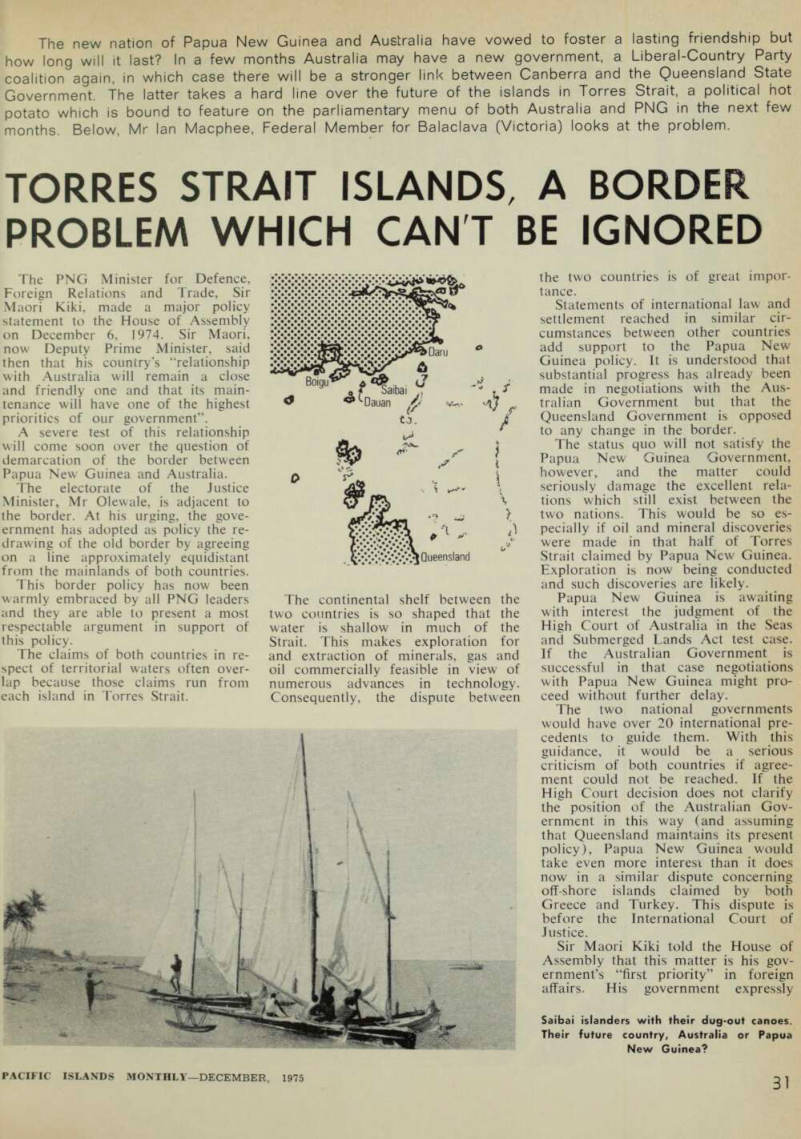

Problem Which Cant Be Ignored
The new nation of Papua New Guinea and Australia have vowed to foster a lasting friendship but how long will it last? In a few months Australia may have a new government, a Liberal-Country Party coalition again, in which case there will be a stronger link between Canberra and the Queensland State Government. The latter takes a hard line over the future of the islands in Torres Strait, a political hot potato which is bound to feature on the parliamentary menu of both Australia and PNG in the next few months. Below, Mr lan Macphee, Federal Member for Balaclava (Victoria) looks at the problem.
The PNG Minister for Defence, Foreign Relations and Trade, Sir Maori Kiki, made a major policy statement to the House of Assembly on December 6, 1974. Sir Maori, now Deputy Prime Minister, said then that his country’s “relationship with Australia will remain a close and friendly one and that its main tenance will have one of the highest
priorities of our government”.
A severe test of this relationship will come soon over the question of demarcation of the border between Papua New Guinea and Australia.
The electorate of the Justice Minister, Mr Olewale, is adjacent to the border. At his urging, the gove ernment has adopted as policy the re drawing of the old border by agreeing on a line approximately equidistant from the mainlands of both countries.
This border policy has now been warmly embraced by all PNG leaders and they are able to present a most respectable argument in support of
this policy.
The claims of both countries in re spect of territorial waters often over lap because those claims run from each island in Torres Strait.
The continental shelf between the two countries is so shaped that the water is shallow in much of the Strait. This makes exploration for and extraction of minerals, gas and oil commercially feasible in view of numerous advances in technology.
Consequently, the dispute between
the two countries is of great impor tance.
Statements of international law and settlement reached in similar cir cumstances between other countries add support to the Papua New Guinea policy. It is understood that substantial progress has already been made in negotiations with the Aus tralian Government but that the Queensland Government is opposed to any change in the border.
The status quo will not satisfy the Papua New Guinea Government, however, and the matter could seriously damage the excellent rela tions which still exist between the two nations. This would be so es pecially if oil and mineral discoveries were made in that half of Torres Strait claimed by Papua New Guinea.
Exploration is now being conducted and such discoveries are likely.
Papua New Guinea is awaiting with interest the judgment of the High Court of Australia in the Seas and Submerged Lands Act test case.
If the Australian Government is successful in that case negotiations with Papua New Guinea might pro ceed without further delay.
The two national governments would have over 20 international pre cedents to guide them. With this guidance, it would be a serious criticism of both countries if agree ment could not be reached. If the High Court decision does not clarify the position of the Australian Gov ernment in this way (and assuming that Queensland maintains its present policy), Papua New Guinea would take even more interest than it does now in a similar dispute concerning off-shore islands claimed by both Greece and Turkey. This dispute is before the International Court of Justice.
Sir Maori Kiki told the House of Assembly that this matter is his gov ernment’s “first priority” in foreign affairs. His government expressly
Saibai islanders with their dug-out canoes.
Their future country, Australia or Papua New Guinea?
recognises the need to protect the interests of the Torres Strait Islanders but is also determined to protect the “traditional rights of our people”.
Moreover, his government believes “that natural justice demands some degree of equality in the sharing of the natural resources of the area be tween the two countries”.
Sir Maori’s statement is echoed widely by other Papua New Guinea leaders and even on Independence morning the Papua New Guinea Post- Courier gave prominence to a strong statement on the subject by the Justice Minister, Mr Olewale.
The newspaper then ventured the : ollowing comment: “The government s believed to be concerned that the border be resolved because of the possibility of oil and other mineral liscoveries in the shallow areas of he Strait. It is feared that if settle nent is not reached, Queensland riming companies might move in and eap the benefits of such discoveries m Papua New Guinea’s doorstep.”
This is an important problem and t will not go away by being ignored. \ustralia has a moral obligation and practical necessity to resolve this problem as soon as possible.
Likewise, it must continue to assist he new nation with technical and naterial aid and in the extension of rade between the two countries.
Advertisements & other items, p. 34 (1 item)
Equipment
Australian Industrial
made wdl...works weU...sells well
Dependability, performance, quality of production and value for money, that’s how Australian industrial equipment has gained increasing sales in the world’s toughest markets.
The range is wide. From press brakes, guillotines, lathes, box-banding and wire-tying machinery to machine drills, electric motors, welding equipment, wood working machinery and safety equipment.
With Australian-made products, importers get prompt deliveries and the customer gets dependability. Look to Australia for your industrial equipment.
Quality and value that’s only hours away The Australian Trade Commissioner can give you details of suppliers.
You can contact him at: 7th Floor, Dominion House, Thomson Street, Suva, FIJI. (Post Office Box 1252).
Telephone: 312844, or: Post Office Box 9129, Hohola, Port Moresby, P.N.G. Telephone: 25 9333. □0 \ Australian Department of Overseas Trade
Australia will negotiate
By a staff writer
The Australian Government’s position, stated several times in re cent years, was reiterated by Foreign Affairs Minister, Senator Willesee in the Senate on October 2 in reply to a question about progress in negotia tions between the two countries about Torres Strait. Senator Willesee said: “We remain committed to negotiat ing with Papua New Guinea on the distribution of resources and the division of jurisdiction in the Torres Strait. In so doing we seek to accom modate the interests of all the parties affected Papua New Guinea, Queensland, Australia, and, of course, the Torres Strait Islanders them selves.”
In April, 1974, the Queensland Premier, Mr Johannes Bjelke-Petersen, proposed an international park for the Torres Strait area, which would pro tect the environment and control com mercial activities. Officials of the Australian and Queensland govern ments were discussing an environ mentally-protected zone along those lines.
Now that Papua New Guinea is independent, it is a matter for the PNG and Australian governments to negotiate a treaty, and Mr Bjelke- Petersen had endorsed that approach.
Mr Somare has expressed confidence that the Australian and Queensland governments would come to some common agreement to agree with
Png.
“The Australian Government is keen to reach agreement with Papua New Guinea and has every expecta tion of progress towards the resolu tion of this issue as soon as the constitutional problems are over come,” Senator Willesee concluded.
Australia’s control over the present area goes back to 1879, before there was a government of Australia. The Queensland Parliament, in that year, enacted a bill which acquired all the land south of the present border.
Since federation in 1901, Australia has legislated for the traditional three mile limit, plus a 12-mile fishing zone and rights to resources of the conti nental shelf.
Trouble In
Islanders In
New Zealand
Mr Justice Speight of the New Zealand Supreme Court stirred up a lornet’s nest with some outspoken :omments about bringing unsophisti :ated Pacific Islanders into a metro •olitan environment with which they vere totally unfitted to cope.
He made his remarks when sent ncing a young Tongan to six years mprisonment for the manslaughter )f a Niue Islander.
The real criminal was liquor, he aid. Exposure to liquor was totally langerous to unsophisticated persons, t was a pity that the responsibility )f industrialists ended at knock-off ime.
Doubtless, it was praiseworthy to iclp economically under-developed ountries, but the pity was that it did lot seem to have been done by taking conomic aid to those areas, but ather by bringing its unprepared nembers to an unsuitable environ aent.
The young man, in a defence to a harge of murder, claimed he was so runk he could not be held to have atended to kill. The jury found him uilty of manslaughter.
Industrialists and employers did not ake Mr Justice Speight’s remarks ying down. They quoted cases where ousing, language lessons and coun elling assistance were provided.
There were few employers who were not deeply involved in the welfare of Islander employees.
There seemed to be more support for Mr Justice Speight than criticism.
Mr Robert Muldoon, leader of the Opposition, who calls a spade a spade, said Islanders who got into trouble with the law, should be sent home. Mrs Metaui Mata’afa, widow of the late Prime Minister of Western Samoa, and now a Western Samoa MP, agreed. She said Western Samoa would send home New Zealanders who did not behave.
If Western Samoans were sent home to the villages and were subject to the authority of the matai system they would soon be sorted out. The matai enforced traditional Samoan discipline which was absent when the young men went to NZ without their families.
The Minister of Education, Mr Amos, said Mr Justice Speight had accurately summarised the problems
facing Pacific Islanders settling in NZ.
The department had been aware of those problems for many years.
Several projects had been set up to help Pacific Islanders to settle.
The Western Samoa Trade Com missioner in NZ, Mr E. Stehlin, agreed with Mr Justice Speight that liquor was a problem with his people.
It was exposure to an unknown world of high wages, plenty of leisure time at night, and the attraction of liquor which led many Western Samoans into trouble.
He hoped New Zealanders would not think it was the character of Western Samoans and other Island people which led to problems.
A suggestion from the Rev L. I.
Sio, senior minister of the Pacific Islanders’ Presbyterian Church, New ton, Auckland, was that employers bank most of the money earned by
new arrivals, leaving just enough for
living and travelling expenses. After a few months, if the employer felt the Islander knew more about the NZ way of life he could pass control of the wages to the Islander.
Another suggestion was that the immigration rate be scaled down.
That would allow for more educa tional and recreational facilities to help condition the Islander to the fast pace of city life.
Advertisements & other items, p. 36 (1 item)
Mixmaster Mixer
I ' ' • fj I
imbeam
3 times better than any
other mixer. Designed especially for family food preparation. 12-speed mixfinder dial indicates the correct speed for each mixing action. Complete with 2 heat-resistant bowls and juice extractor. Sunbeam’s exclusive 3-way beating action — extra large, contoured beaters, and automatic bowl movementgives perfect aeration and more even mixing. It can handle everything from beating one egg to mixing a large fruit cake.
bargain key to


'Le truck'is the bargain key to Tahitian touring
By Ned Avary
Prices are a lot higher here in ahiti now than they were when the ten of the Bounty got three coconuts ad two girls—for a friendly smile id a warm greeting.
But, there are ways to beat the >aring prices, and one of the best is E TRUCK. You’ll see Tahiti the in way. And happily miss solid ild-priced rental cars . . . and arisian metered taxis, which double icir fares at night!
Ride Le Truck as most local ;ople do! You’ll save a bundle— id see what you came to see. The ilynesian people . . . the blue la >ons . . . the towering green moun ins . . . the lazy, alluring life. Le ruck is just what it sounds. Almost! ■ightly painted—with two comfort >le rows of benches—running fore id aft. Open air. Baggage racks on p—stairs at back, where you >ard —and pay your ridiculously w fare—4o cents—for doing it the diitian way.
Le Truck is Tahiti’s delightful iswer to public transport. And your st local bargain. They run every
15 minutes—from about 5 am to 6 pm. Where do you catch them?
Along any main road—or the down town Central Market. They all start . . . and end . . . right there. Le Truck passes all the hotels and points of interest—anywhere on the island.
Before touring Tahiti the right way, you must do a couple of things.
Head for the Tahitian-style Tourist Bureau, smack in the middle of Papeete’s fabled waterfront. Meet the gorgeous Tahitian hostesses there.
Pick up a map of the island and, if you can break away, stroll back to your truck depot, a short block away.
It also helps if you have latched onto a copy of The Tahiti Bulletin— at your hotel desk that morning. It is Tahiti’s only English language daily. Chock full of juicy tourist items—and free!
Armed with your map of Tahiti pick out your Trtick. It’s so easy.
For example: You happen to be stay ing at the fantastic Taharaa Hotel, out in the Arue district. And you want to go home. Your hotel name —or your district—or both—will be
printed on the sides of your Truck.
So are the other districts youTi pass through: Mamao . . . Taaone . . .
Pirae . . . and your Arue. Check it out on your map then climb aboard —sit back—relax! This ride will cost you 40 cents. A taxi could sock you 10 dollars!
Horn blasting, Tahitian-taped music blaring, Le Truck weaves through Papeete’s crazy, colourful streets. Smile at the Chinese, Tahi tian or French passengers. And they flash you a warm welcome. Better yet: say la Ora Na! (Hello) —and they’ll love you! Shops, streets, cars, trees, people, trucks and buildings fly by. A real Polynesian parade!
Through a side street—you’ll catch a glimpse of distant Moorea—James Michener’s real Bali Ha’i Island— waiting across the channel. You pro mise yourself a Moorea beach-head.
Later.
Now you wind through tree-lined Taaone District with its typical Tahi tian homes as—plumeria, hibiscus, bougainvillea—flowers charge your route with living colour. High on your right, wild, green volcanic peaks beckon you up the Fautaua Valley. To Pierre Loti’s Pool. Where he lived—and loved—and produced his pagan poetry.
Le Truck now wheels you out into the lovely Pirae and Arue districts.
Past the drive-in theatre (of all things)!—and the Chinese cemetery.
Then the yacht club—on the lovely lagoon—with the distant surf pounded reef. Here is James Norman Hall’s home. Where Mutiny on the Bounty—and his other South Sea classics were jointly created with Charles Nordhoff. Now Le Truck starts climbing, around lush green mountain curves, as you gaze down on Matavai Bay.
There is where it all started. The ‘discovery’ of Tahiti . . . just 200 years ago—by Wallis, Bougainville,
A bonus on top of your truck ride— beaming smiles from the hostesses at the Tahitian Tourist Bureau.
ITook and Bligh. Down on those beautiful beaches the Bounty crew rolicked with luscious local vahines.
Vo wonder so many mutinied!
Here is your Taharaa Hotel— Mastered on a rugged cliff—guarding Vlatavai Bay. Reluctantly you leave mur new friends aboard Le Truck, )ay the driver with a warm mau •uuru (thank you)—and stroll to four hotel entrance. Where you’ll irobably see some poor tourist, slidi ng out 10 dollars to his cab driver or the same ride you just loved— or 40 cents!
That night at the Happy Hour cocktail time in the tropics)— pread out your Tahiti map. Relish he musical names of the districts ,nd villages—Faaa, Maeva, Puna uia, Taapuna, Taravao, Tautira.
Plan your next day’s Truck tour, low about going south this time?
U 1 the way to the end of the line: "autira! You’ll see Tahiti’s splendid lew Faaa jet strip—which opened the ood gates of tourism here. On past 'unaauia—the Gold Coast District— /ith Tahitian mansions on green hills nd gleaming white yachts anchored i the blue lagoon. Here are the only fhite sand beaches of Tahiti! Loads f them though, across the channel, n Moorea.
Make this Truck tour on a Sunday ? possible. To collect a couple of are bonuses. Both the Travelodge nd Maeva Beach hotels in this dis -ict have wonderful shows Sunday oon. Tahitian dancing and folklore, dl free! So—leave your Truck here ; you like—see the shows—and pick p the next one!
Later, one of your fellow passen ers will point out the spot where aul Gauguin lived and painted his rst Tahitian masterpieces. The same lace where Somerset Maugham ought a Gauguin window for a song! low you pass Charles NordhofFs ome (the other half of the Bounty rilogy team). Then you enter the aea district—home of the late Eddie und, American musical genius, who rst put marvellous Tahitian music n paper.
And here is the Marae de Arahu ihu—fabulous stone temple—on the illside. Scene of kings crowned, jyal weddings, weird religious rites nd human sacrifice.
Your 40-mile odyssey to Tautira half-over. And everyone is a bit ry. So pile out with your new iends at the first Chinese shop. |uaff down a cold Tahitian Hinano eer. And another! Then off again dth Le Truck!
Do you like caves and grottos? lere’s a beauty now, with a cool, nderground lake. Le Grotto de laraa. Ask your driver to stop.
Take a swim ... or just gaze at this natural wonder. Next on your route; the Gauguin Museum, nestled in 700 acres of fabulous botanical gardens.
Don’t miss it!
Now you cross the Isthmus of Taravao joining the two Tahitis.
Back in 1925, this was the end of the line—for Tahiti’s first Trucks— four faithful old Reo jalopies! Later, they pushed on to Tautira, most dis tant point from Papeete, where you’re heading right now!
Deep into unspoiled Tahiti-iti you roll, passing through flower-covered Afaahiti and Pueu districts. And here is your goal: Tautira! A Tahi
tian fishing village—right out of your dreams!
The great Robert Louis Stevenson lived here for months in 1888. He wrote: “Tautira is the most beautiful spot, and its people the most ami able, I have ever found”. And you will agree! So, spend the night here, sing and dance with the people.
Swim . , . feast . . . drink in the purity of the place. Return to Pa peete tomorrow. Or never!
If you must leave, another happy discovery is yours: This priceless Tautira trip you took with Le Truck cost you $3! Same tour by taxi SBO. la Ora Na! Le Truck of Tahiti!
Advertisements & other items, pp. 37-40 (3 items)
35
CIFIC ISLANDS MONTHLY DECEMBER, 1975
a Family Car
What Makes vt
an Alfa Romeo
Front wheel drive and McPherson suspension make it handle like an Alfa. a The four cylinder, horizontally opposed motor and four speed gearbox make it perform like one, too.
And disc brakes all round guarantee it stops the way an Alfa Romeo should.
The only un-Alfa thing about the Alfasud is its price.
What Makes it
a Family Car
It’s big on the inside, so there’s room inside for the whole family.
But it’s quite compact on the outside.
So it doesn’t need much room to park.
The space inside the boot is about the same as the space in the average family refrigerator.
The front seats adjust up and down as well as backwards and forwards. And the steeringcolumn also adjusts upand down.
So you can adjust your Alfasud to suit you and your family. Which is better than .adjusting your family to suit the car.
alfa
romeo
AN INVESTMENT IN SAFETY
For information contact Alfa Romeo Ply. Ltd.
Cnr. Beauchamp & Botany Rds.. Botany, N.S.W., Australia.
Trade enquiries welcome.
AR 6560
% b. °" 4 r*** Z ■. , AW to HE* MAJtSir THE OUff* /j.V s OOoli m Prize Alc^ ol# » rn • w r-ECE, > I I I r S2fi! WW,S,CV OlSTillfM
JO» <N DCWA« ft JONS. ITO
SAV-
•®»3 l«»< d
.„ itc Lab^>
Scotch Whis^
rs
Ltd
Dewa
Sons
For people who value
tradition.
Dewar’s “White Label”-it never varies.
r No matter which way you look at it . . . you’ll find . . .
KLEMKII
is the finest allpurpose ply for building in hot and humid conditions.
Made by Commonwealth N.G.
Timbers Ltd and available from leading plywood suppliers.
N 4 *1
37
’ACIFIC ISLANDS MONTHLY—DECEMBER, 1975
Magazine Section
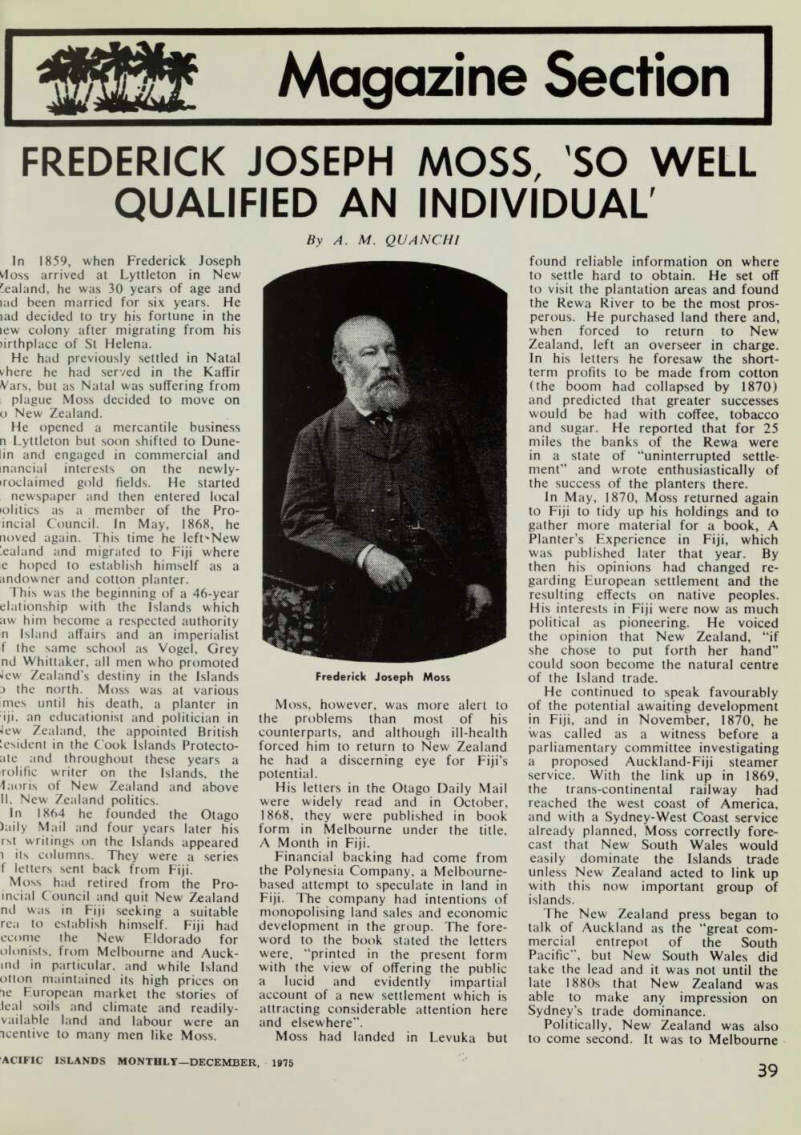

Frederick Joseph Moss, So Well
Qualified An Individual'
By A. M. Quanchi
In 1859, when Frederick Joseph vloss arrived at Lyttleton in New Zealand, he was 30 years of age and lad been married for six years. He lad decided to try his fortune in the lew colony after migrating from his lirthplacc of St Helena.
He had previously settled in Natal vhere he had served in the Kaffir Vars, but as Natal was suffering from plague Moss decided to move on 0 New Zealand.
He opened a mercantile business n Lyttleton but soon shifted to Dune lin and engaged in commercial and mancial interests on the newly proclaimed gold fields. He started newspaper and then entered local politics as a member of the Pro incial Council. In May, 1868, he noved again. This time he left v New 'ealand and migrated to Fiji where e hoped to establish himself as a andowner and cotton planter.
This was the beginning of a 46-year elationship with the Islands which aw him become a respected authority n Island affairs and an imperialist f the same school as Vogel, Grey nd Whittaker, all men who promoted Jew Zealand’s destiny in the Islands 3 the north. Moss was at various mes until his death, a planter in iji, an educationist and politician in Jew Zealand, the appointed British Resident in the Cook Islands Protecto ate and throughout these years a rolific writer on the Islands, the laoris of New Zealand and above 11, New Zealand politics.
In 1864 he founded the Otago )aily Mail and four years later his rst writings on the Islands appeared 1 its columns. They were a series f letters sent back from Fiji.
Moss had retired from the Pro incial Council and quit New Zealand nd was in Fiji seeking a suitable rea to establish himself. Fiji had ccome the New Eldorado for olonists, from Melbourne and Auck md in particular, and while Island otton maintained its high prices on ie European market the stories of leal soils and climate and readily vailable land and labour were an icentive to many men like Moss.
Moss, however, was more alert to the problems than most of his counterparts, and although ill-health forced him to return to New Zealand he had a discerning eye for Fiji’s potential.
His letters in the Otago Daily Mail were widely read and in October, 1868, they were published in book form in Melbourne under the title, A Month in Fiji.
Financial backing had come from the Polynesia Company, a Melbourne based attempt to speculate in land in Fiji. The company had intentions of monopolising land sales and economic development in the group. The fore word to the book stated the letters were, “printed in the present form with the view of offering the public a lucid and evidently impartial account of a new settlement which is attracting considerable attention here and elsewhere”.
Moss had landed in Levuka but
found reliable information on where to settle hard to obtain. He set off to visit the plantation areas and found the Rewa River to be the most pros perous. He purchased land there and, when forced to return to New Zealand, left an overseer in charge.
In his letters he foresaw the short term profits to be made from cotton (the boom had collapsed by 1870) and predicted that greater successes would be had with coffee, tobacco and sugar. He reported that for 25 miles the banks of the Rewa were in a state of “uninterrupted settle ment” and wrote enthusiastically of the success of the planters there.
In May, 1870, Moss returned again to Fiji to tidy up his holdings and to gather more material for a book, A Planter’s Experience in Fiji, which was published later that year. By then his opinions had changed re garding European settlement and the resulting effects on native peoples.
His interests in Fiji were now as much political as pioneering. He voiced the opinion that New Zealand, “if she chose to put forth her hand” could soon become the natural centre of the Island trade.
He continued to speak favourably of the potential awaiting development in Fiji, and in November, 1870, he was called as a witness before a parliamentary committee investigating a proposed Auckland-Fiji steamer service. With the link up in 1869, the trans-continental railway had reached the west coast of America, and with a Sydney-West Coast service already planned, Moss correctly fore cast that New South Wales would easily dominate the Islands trade unless New Zealand acted to link up with this now important group of islands.
The New Zealand press began to talk of Auckland as the “great com mercial entrepot of the South Pacific”, but New South Wales did take the lead and it was not until the late 1880 s that New Zealand was able to make any impression on Sydney’s trade dominance.
Politically, New Zealand was also to come second. It was to Melbourne
Frederick Joseph Moss
that the predominantly Victorian settler community in Fiji looked when internal troubles threatened their prosperity.
New Zealand’s name was linked with Fiji in several proposals before the eventual British annexation in 1874 and, after annexation, in 1885 and 1901 there were further attempts to cement a political link between the two. Moss served on investigating committees in both cases, neither of which became anything more than pipe-dreams for disgruntled settlers in Fiji and visionary imperialists in New Zealand.
After resettling at Parnell on the North Island, Moss worked on the local Board of Education until 1876 when he was elected to the House of Representatives. He served there for 14 years until he left New Zealand again to take up his appoint ment in the Cook Islands.
In his years in parliament he spoke often on Island matters and became a staunch supporter of Sir George Grey. In 1879, he was the centre of a controversy when Grey suggested him as the new Attorney-General to replace Stout, another New Zealander with a keen eye towards expansion in the Islands.
Moss served on most committees dealing with Island affairs, and in 1885 he spoke of the “unbearable political tyranny” which the European community in Fiji suffered under. He was then on a committee investigat ing a petition from Fiji offering annexation to New Zealand.
As a colony herself New Zealand could not annex, and even if Great Britain had been willing to allow New Zealand some participation in Fiji’s government, such a proposal was overshadowed by a stronger in terest in the, as yet, unclaimed Samoan Islands.
In 1886, Moss visited Fiji and met the two administrators, William Mac- Gregor and John Bates Thurston.
Moss had met Thurston on his pre vious visit to Fiji and they had cor responded regularly. Indeed there is a certain similarity in many of their ideas on European behaviour and the fate of the Pacific Islanders. However, they did not agree on this occasion and the proposed trade reciprocity agreement between Tahiti, Tonga and New Zealand fell through.
In 1888, Moss served on the Royal Commission investigating Julius Vogel’s grandiose confederation and annexation scheme. This was a plan to ensure New Zealand’s paramountcy over the political hegemony of the unclaimed Islands to the north. Both political and commercial circles saw gains to be made from an empire in the Islands controlled from Auck land, but there were internal and im-
perial obstacles to overcome. Vogel’s plan sought to overcome these. Although it was never put into practice expansion did occur three years later, and Moss and Vogel could rightly claim that New Zealand’s destiny in the Islands was at last being fulfilled. * During this time Moss wrote Through Atolls and Islands in the Great South Seas, a School History of New Zealand and a study of the Maori titled Native Lands and their Incidents. He also travelled to the Islands in the trading vessels of his acquaintances Henderson and Mac- Farlane, of island trading fame; 1888 was also to see the two threads of Moss’s life come together.
His active political life in New Zealand and his experiences in the Islands were linked with his interests in expansion in the South Pacific. In September, 1888', Great Britain announced a protectorate over the Cook Islands and after a lengthy debate the colonial Office agreed that New Zealand could administer the new protectorate provided she paid the costs of the appointed Administrator, Moss was nominated for the position and in April, 1891, he commenced at his new post.
In recommending him, the Covernor of New Zealand had written, “1 consider the Government of New Zealand have been fortunate in securing the services of so well qualified an individual for a post the emoluments of which are but small”.
Moss had the responsibility of establishing firm government in a dis-
persed group of islands where there was already a small community of traders and planters and a background of strong missionary control, Moss set about immediately to secure native participation in a cen tralised administration but there were several problems. Moss was restricted by the non-interference assurances given to the traditional High Chiefs when the protectorate was announced, They imposed restraint on his actions where they might disturb existing customs and laws. He was also to guarantee that both Europeans and Islanders obeyed the laws. It was a difficult position to be in. The High Chiefs were rightly jealous of their position and they frequently reminded Moss of the earlier assurances they had been given.
Moss planned a federal system based on a single administration which still allowed the districts to retain local authority. He gradually overcame old inter-island and inter tribal jealousies, and an executive composed of the ariki, and a legisla ture with both ariki and nominated representatives were established. He, as Resident, exercised the veto over their decisions but Moss preferred to act as an adviser to both bodies.
There was a serious liquor problem on Rarotonga and both medical and education services needed to be established. Moss set about his tasks with the belief that Island people lost the will to survive and became dis couraged as they lost their former prestige and status. He started the teaching of English so they could
The Rewa River, Fiji's biggest river in what Moss called "Fiji's most prosperous area".
The scene is Wainibokasi Landing with the busy putt-putts in the water. —Photo: Rob Wright
mrticipate effectively in their own ;overnment and he localised all spects of the administration by per onally training Islanders for positions n the administrative and judicial ser ices.
There were also problems over land temming from the ill-defined tra litional rights of tenure and the dif culty of establishing legality in the irevious land transactions between slanders and Europeans.
Moss’s own ideas on land were to reate an agricultural economy based n individual native ownership on a amily farming basis, free from what e saw as burdensome obligations to in groups and chiefs. These ideas /ere not shared by the European ommunity or the ariki-dominated jgislature.
It was a disagreement with the riki which finally led to Moss’s dis lissal as Resident in 1898. He had 3und the judicial system inadequate ?r dealings over land and for legal isputes involving Islanders and uropeans.
He planned a High Court which 'ould act as Court of Appeal for the
lower Native Courts, and as a final court in matters involving both races.
Under this scheme the Resident would have had the final effective say.
The European community, hostile to most of Moss’s commonsense, though often idealistic ideas, stirred up opposition among the ariki and agitated for the rejection of Moss’s High Court Bill. New Zealand was forced to make an official investiga tion and it was decided to recall Moss as his health had deteriorated during the recent troubles, and because, “he had lost the confidence of the natives”.
Moss returned to New Zealand and, although not entering politics again, he continued his active interests in both Island affairs and internal prob lems of government in New Zealand.
He continued to write and two articles he had published on the Cook Islanders remained as standard references on the Cook Islands many years after his death in 1904.
Frederick Joseph Moss was a re spected and influential figure and his successes as the first Administrator in the Cooks are evidence of his under
standing of the complexity involved in balancing European settlement against native interests, Above all. Moss was an advocate of New Zealand’s expansion and it was fitting that he served in New Zealand’s long-awaited and first ex pansionary move into the Islands, Moss had written in 1891 to the Governor of New Zealand that his appointment in the Cooks, “might fairly be regarded as the first step towards the extension of New Zealand influence and to her becoming the commercial and ultimately the political centre of an island federation that would form a fitting companion to federated Australia’’.
With his ideas on colonial govern ment, European expansion and native policy, Moss was typical of several other notable Europeans active in the Islands in the late 19th century. His 46 years in the Islands and New Zealand had given him the oppor tunity to express in words and actions the ideas he held, beginning with his first visit to Levuka in 1868, through his service in the Cooks and up until his death in 1904.
Advertisements & other items, pp. 41-48 (5 items)
39
ACIFIC ISLANDS MONTHLY— DECEMBER, 1975
Statesman
smoothest cigars on
ie international scene
5 1801 * ns
STATESMAN
CORONA
5 v ’
Corona
X554-10/75
in
BKEKO
QUARTZ
/ r, m / \ ««•* \ / m
THE SEIKO QUARTZ
COLLECTION.
CHANGING THE WORLD’S
STANDARD OF ACCURACY.
The Seiko Quartz Collection encompasses a wide and exciting scope of quartz watches for men and women. Quartz guaranteed accurate to within one second per month. Ultra-thin quartz. Day/date Quartz. Digital quartz watches with liquid crystal for continuous readout to the second, and no buttons to push. Even a digital quartz chronograph. It's what you'd expect of Seiko.
Seiko sold the world's first quartz wristwatch.
And Seiko even makes every part of every watch (except for the battery) to insure impeccable quality control and a superb product. Whatever Seiko Quartz model you select, you get more than just a technologically advanced timepiece. You get the watch that's changing the world's standard of accuracy. Seiko Quartz.
SEIKO
Someday all watches will be made this way.
'T^O'VCET'
OIOA
Top performance takes the guesswork
out of going hi-fi.
No imitations here. Every one of the ON DO 2000 Stereo Sound Mates was Dmponent created and Pioneer blended ito a total system stereo package. And : a price much lower than you think.
First, an advanced design AM/FM ereo receiver produces a powerful 13 arts per channel virtually distortion-free, ccurate tonal management is achieved ith separate bass and treble controls id AM/FM reception is clean and clear.
On the input side of the RONDO 2000 is a professional type manual turntable.
The super-smooth belt-drive mechanism provides loving care for your records.
Auto-cut at the touch of a button plus the convenience of auto-return.
On the output side, beautifully balanced
two-way, two-speaker systems. Every
earthy note from the big 20cm. woofers is enriched by the solid bass-reflex
design cabinets.
And for your private listening pleasure,
RONDO 2000 Sound-Mates include
lightweight high-polymer headphones.
RONDO 2000 Stereo Sound Mates.
From stylus to speaker.. .the direct
approach to top performance.
ODpiomeer
Pioneer Electronic Corporation
4-1, Meguro 1-chome, Meguro-ku, Tokyo 153, Japan jstralia oneer Electronics Australia Pty. Ltd , ’B-184 Boundary Road, Braeside, Victoria 95, Phone: 90-9011, Sydney 93-0246, isbane 52-8213, Adelaide 433379, Jrth 76-7776 |i Islands ijlal & Company, G.P.O. Box No. 362, jva, Fiji Islands Tel: 22258 jgemeyer (Australasia) 8.V., P.O Box 3. 90, Lae, Papua»New Guinea Tel: 42-32 Rabaul Hagemeyer (Australasia) B.V, P.O. Box No. 63. Rabaul, Papua»New Guinea Tel: 26 Port Moresby Hagemeyer (Australasia) 8.V., P.O. Box No. 1428, Boroko, Port Moresby, Papua»New Guinea Tel: 5 61 44 Madang Hagemeyer (Australasia) B V , P.O. Box No. 673, Madang, T.P.N.G.TeI: 24 45 New Zealand Fountain Marketing Ltd , Maidstone Street Auckland, New Zealand Tel: 763-064 Norfolk Island Burns Philp (Norfolk Island) Ltd., Norfolk Island. South Pacific New Hebrides Burns Philp (New Hebrides) Ltd..
Vila, New Hebrides Nauru Island Jacob Enterprises, P.O Box No. 4, Nauru Island Tahiti Ets. PERFECT, B.P. 594, Papeete, Tahiti Tel: 20 407 New Caledonia Menard Freres, B.P. 123, Noumea, I New Caledonia Tel: 52-22 American Samoa Transpac Corporation, P.O. Box 1477| Pago Pago, American Samoa 967991 Tel: 633-5224 Rarotonga South Seas International Ltd., P.O. Box 49, Rarotonga Cook Islands Tel: 2327
20 MINUTES FROM THE AIRPORT;
CENTURIES APART FROM THE WORLD.
mrwri fi IP mm mmwimmgl Uiii *h lpu uji (i w-j t iMi naM m«1 u« 3 h HR ml m
r.i! in
Pacific passengers can step into one of the world's most legendary experiences.
The Regent of Fiji is a beach-front paradise. 300 gracious rooms clustered among towering palms and dazzling orchids.
With two enchanted dining rooms. The rousing Meke Lounge.
Complete banquet/convention pavillion and duty free shopping.
Outside, the gleaming Vuda—white shore—slopes into wavefree Nadi Bay. Experience our realm of ocean sports. Beachcombing, tennis and our own fresh-water pool.
Book space in paradise now. For the night of a lifetime.
The Regent of Fiji—2o minutes from the airport.
POST OFFICE BOX 441 NADI, FIJI PHONE 70700 TELEX (792) 5214 ONE OF THE many worlds OF REGENT INTERNATIONAL HOTELS
the Regent of Fiji
DENARAU BEACH RESORT
Sydney, Australia Sales Office No. 1 York Street, 14th floor Sydney, Australia 2000 Phone (02) 276469 Phone collect for reservations In Auckland, New Zealand, phone 71909
Ific Islands Monthly—December, 1975
Lcific Islands Monthly—December, 1975
mAnA
is a vehicle for Pacific Islands’ writers and artists to publish their work. It is an organ of the South Pacific Creative Arts Society and its editorial committee comprises writers from many islands.
Material for publication must be sent direct to MANA’s editor, Marjorie Crocombe, South Pacific Creative Arts Society, Box 5083, Suva.
Vanessa Griffen, Fiji-born graduate of the University of the South Pacific, takes up most of MANA's space this month with a poignant story of a family in Suva, drawing from her own background a sketch of life in Fiji's capital not seen by the tourist. It is an almost all-Fiji section this month with contributions from Isimeli Cokanasiga and Rejieli Racule.
Odd man out is Albert Leomala of the New Hebrides.
One Saturday
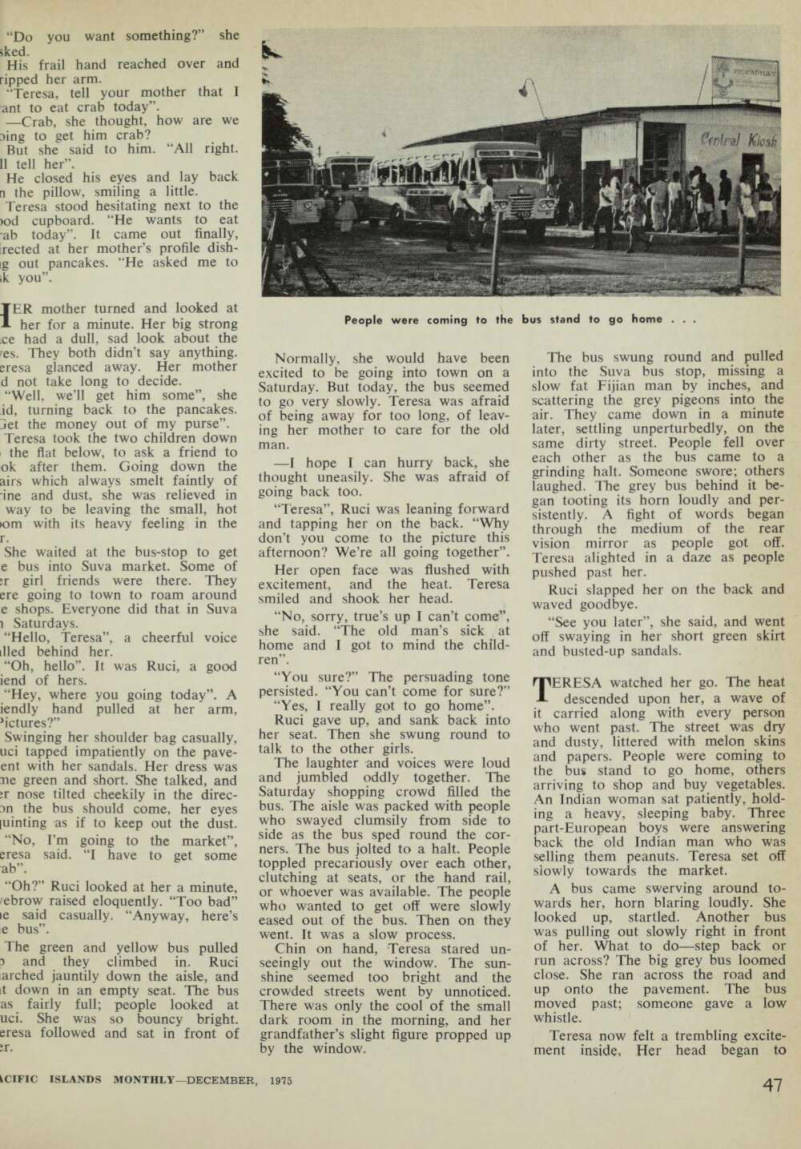
Morning
By Vanessa Griffen
TERESA woke up to the sound of
her grandfather’s coughing. The
old man was from Lami village and he had come to stay with his part- European daughter-in-law while he was sick. It was early in the morning and the sun was not yet up, so the room was still cool. Her mother had already got up and was bending over the old man.
“Sit up”, she was saying. “Sit up and drink some tea”. Her voice was soft but slightly tired. Her hair was still untidy from sleep.
The old man could not lift him self, so she bent over, placed her hands under his arms and lifted him up. Teresa watched them a minute.
The old man was very thin and weak, and his skin hung about his chest. He sneezed and coughed into an old hanky. Teresa’s mother patted him on the back gently. She turned and looked back at the girl.
“Teresa, you get up now”, she said.
Teresa sat up and gathered her sulu about her. She climbed over the children, who were still sleeping bundles close together. Before she went into the kitchen, she glanced at her grandfather and smiled at him.
He didn’t look at her, but his thin hand on the sheet flapped feebly in silent acknowledgment of her look.
As she was leaving her mother said, “Make him some pancakes. The kids can have some too”, The flour, water and sugar stuck to the spoon as she stirred. It was sticky and Teresa turned the mixture up and down with the spoon, slowly, “He is worse today. He is worse . . .” went round in her head. Her hand kept stirring the dough, and as it swept thickly round the bowl, a fearful almost unformed question kept recurring. “What are we going to do?”
The children woke up crying. Her mother called out softly: “Come and see to them. I’ll cook the pancakes”, and she quickly left the old man’s side.
Teresa came in and picked up the youngest.
“Shoo, shoo, don’t cry. See, grand father is still sleeping”, When Teresa looked at him, the old man was staring back at her. She smiled at him again, and this time he smiled back faintly in return, Teresa bent over the children and began dressing them. The smell of cooking pancakes crept into the room. The room was getting hotter.
Grandfather was becoming restless, “Teresa, Teresa”, he called weakly, “Come here”. She went over.
“Do you want something?” she sked.
His frail hand reached over and ripped her arm.
“Teresa, tell your mother that I ant to eat crab today”. —Crab, she thought, how are we aing to get him crab?
But she said to him. “All right.
II tell her”.
He closed his eyes and lay back a the pillow, smiling a little.
Teresa stood hesitating next to the >od cupboard. “He wants to eat ab today”. It came out finally, irected at her mother’s profile dish ig out pancakes. “He asked me to ik you”. lER mother turned and looked at her for a minute. Her big strong ice had a dull, sad look about the res. They both didn’t say anything, eresa glanced away. Her mother d not take long to decide.
“Well, we’ll get him some”, she id, turning back to the pancakes. 3et the money out of my purse”.
Teresa took the two children down the flat below, to ask a friend to ok after them. Going down the airs which always smelt faintly of ine and dust, she was relieved in way to be leaving the small, hot ►om with its heavy feeling in the r.
She waited at the bus-stop to get e bus into Suva market. Some of tr girl friends were there. They ere going to town to roam around e shops. Everyone did that in Suva i Saturdays.
“Hello, Teresa”, a cheerful voice illed behind her.
“Oh, hello”. It was Ruci, a good iend of hers.
“Hey, where you going today”. A iendly hand pulled at her arm, Mctures?”
Swinging her shoulder bag casually, uci tapped impatiently on the pave ent with her sandals. Her dress was Tie green and short. She talked, and ;r nose tilted cheekily in the (Brec on the bus should come, her eyes [uinting as if to keep out the dust.
“No, I’m going to the market”, eresa said. “I have to get some ab”.
“Oh?” Ruci looked at her a minute, /ebrow raised eloquently. “Too bad” te said casually. “Anyway, here’s e bus”.
The green and yellow bus pulled ? and they climbed in. Ruci arched jauntily down the aisle, and it down in an empty seat. The bus as fairly full; people looked at uci. She was so bouncy bright, eresa followed and sat in front of ;r.
Normally, she would have been excited to be going into town on a Saturday. But today, the bus seemed to go very slowly. Teresa was afraid of being away for too long, of leav ing her mother to care for the old man, —I hope I can hurry back, she thought uneasily. She was afraid of going back too.
“Teresa”, Ruci was leaning forward and tapping her on the back. “Why don’t you come to the picture this afternoon? We’re all going together”.
Her open face was flushed with excitement, and the heat. Teresa smiled and shook her head.
“No, sorry, true’s up I can’t come”, she said. “The old man’s sick at home and I got to mind the child ren .
“You sure?” The persuading tone persisted. “You can’t come for sure?”
“Yes, I really got to go home”.
Ruci gave up, and sank back into her seat. Then she swung round to talk to the other girls.
The laughter and voices were loud and jumbled oddly together. The Saturday shopping crowd filled the bus. The aisle was packed with people who swayed clumsily from side to side as the bus sped round the cor ners. The bus jolted to a halt. People toppled precariously over each other, clutching at seats, or the hand rail, or whoever was available. The people who wanted to get off were slowly eased out of the bus. Then on they went. It was a slow process.
Chin on hand, Teresa stared un seeingly out the window. The sun shine seemed too bright and the crowded streets went by unnoticed.
There was only the cool of the small dark room in the morning, and her grandfather’s slight figure propped up by the window.
The bus swung round and pulled into the Suva bus stop, missing a slow fat Fijian man by inches, and scattering the grey pigeons into the air. They came down in a minute later, settling unperturbedly, on the same dirty street. People fell over each other as the bus came to a grinding halt. Someone swore; others laughed. The grey bus behind it be gan tooting its horn loudly and per sistently. A fight of words began through the medium of the rear vision mirror as people got off.
Teresa alighted in a daze as people pushed past her.
Ruci slapped her on the back and waved goodbye.
“See you later”, she said, and went off swaying in her short green skirt and busted-up sandals.
TERESA watched her go. The heat descended upon her, a wave of it carried along with every person who went past. The street was dry and dusty, littered with melon skins and papers. People were coming to the bus stand to go home, others arriving to shop and buy vegetables.
An Indian woman sat patiently, hold ing a heavy, sleeping baby. Three part-European boys were answering back the old Indian man who was selling them peanuts. Teresa set off slowly towards the market.
A bus came swerving around to wards her, horn blaring loudly. She looked up, startled. Another bus was pulling out slowly right in front of her. What to do—step back or run across? The big grey bus loomed close. She ran across the road and up onto the pavement. The bus moved past; someone gave a low whistle.
Teresa now felt a trembling excite ment inside, Her head began to
People were coming to the bus stand to go home . . .
throb with the heat, and with the shock the bus had given her. She walked across the taxi stand, and through the stalls of dalo, tied in bundles, and bunches of green bana nas. Chillis formed bright red piles; there were the odd lemons and com.
She stepped over a puddle towards the cold, wet fish market.
Women were sitting outside with coconut-leaf baskets resting in front of them on rough brown sacks.
Maybe they will have crab here, Teresa thought. It may be cheaper too.
She walked past slowly, looking at the baskets. Most of them had black closed kai shells. No crabs.
The women sat fanning themselves and didn’t take much notice of her.
Coming to the end of the row without success, Teresa stepped over a pool of fish-smelling water, and into the fish market.
The cold concrete counter was pressing against the customers, two rows deep, who leaned over the coun ter, pointing at the fish.
“How much for that one?”
“Two dollar”.
“Whoa! Too much! And that one, the small ones?”
Teresa could not find any room for herself. She wandered along, careful not to slip on the wet floor, peering over the heads of the shorter women there.
At first she could not see any crabs. She felt heavy-hearted. —lf there are no crabs, what will I do?
Just as she was beginning to worry, an old man pulled away with his short bundle of silver fish, and Teresa quickly slipped into his place.
The fish counter felt cold under her elbows as she leaned against it. Once more she glanced along the wet grey slab of concrete that the fish were thrown upon. Almost directly in front of her was a bundle of crabs.
The crabs were very big dark green things with thick nippers. Teresa leaned forward to look at them, frowning at their size. —They are too big, I won’t have enough money, she thought.
Teresa felt someone’s basket poke into her side. She looked at the woman next to her. She was point ing at the crabs and saying “sst-sst” to the young man behind the counter, so that he would come up to her.
Teresa moved a little out of her way.
The woman had a loud voice.
“Hey”, she called down the coun ter, “How much these crabs?”
The young man came up in a dirty white robe. He looked indifferently back to where she was pointing.
“Four dollar!” he said.
Teresa’s breath caught in shock and disappointment.—Four dollars!
SHE barely heard the woman ask ing to see the crabs, or poking at them with a crooked finger, hagg ling further, then opening up her dirty hanky and getting out the money.
The cold concrete seeped up into Teresa’s arms. They still rested on the counter. She was looking blankly at the cold empty slab. The young man noticed her there.
“Yes”, he asked, his head to one side, “What do you want?”
Teresa started, then found her tongue. On the counter her fist clutched the money her mother had given her.
“Have you got any more crabs?” she dared to ask.
She watched the man turn his head and slowly look down the long row.
His head was coming back.
“No, no more”, he said, looking at her.
Her face crumpled, her eyes be came very bright. The young man glanced keenly at her, then he broke into an unexpected smile.
“Wait. I’ll look for you”, he said.
He went through the door on the side, then came back, still looking around. He spoke to the other man
serving. Teresa watched them in tently. She saw the other man point.
The young man stooped down some where, and came up with a bundle of small crabs. He held it out in front of him and walked up to Teresa.
“Last ones!” It was a kind sales man’s smile. “For you I’ll give it for three dollars”.
Relief made Teresa almost light headed.
“Here”, she said, handing him the money.
She reached out and took the string of crabs in her hand. The string was slippery, and the crabs dripped froth over her, but she didn’t notice. She lifted them carefully over the counter and squeezed herself out of the wet concrete room. Outside, the bustle and noise came as a hot steamy breath across her face.
Teresa sat perspiring in the bus, holding the crabs carefully by the window. It was about eleven o’clock.
The streets were full of people. The sun beat down relentlessly on the crowd that strolled amongst the stalls and along the hot pavements. The bus stand was relatively shady but people jostled and pushed to get on buses. In the heat, everything seemed to move very slowly and heavily.
The crabs moved their legs up and down, and the sharp nippers made fractional movements in and out. They were dark olive green, with rough brown spikes running along the ends of their legs. Their eyes were small yellow knobs that stuck out expressionlessly. Teresa watched the crabs as they moved in slow motion, frothing white bubbles.
A small hand reached down to wards them. Teresa looked up to see a little Indian girl leaning over the seat in front of her. Her wide black eyes, kohl-painted, stared down at the crabs. Teresa held them up for the child to see. The crabs wriggled frantically. A big smile wreathed the child’s face, and she stooped down to touch them. Teresa started to laugh.
“No, if you do that they will bite you”, she said, smiling. She pulled away the crabs just in time.
THE mother turned her dark head to see what her baby was doing.
She looked at the crabs and at her baby’s intent face. She smiled, and laughing a little, she scolded the child, putting out a hand to draw her back. The black eyes shone with interest as they looked backwards over her shoulder at the crabs.
“Eh you”, Teresa said and pinched the girl’s fat cheeks.
The baby turned her head away.
The bus felt hot and close again. was full, there was the smell of arket goods, fish; peanuts were fisily cracked open, shells scattered erywhere. Teresa thought of home. —They must be waiting for me. le wished the bus driver would irry up instead of drinking his orning tea.
The bus stopped close to her place. le grey block of flats baked slowly the sun. Doors were open black •les all along the floors. Washing pped listlessly along the verandahs. lildren ran around the yard, a few ouched over an intense game of arbles being carried on in the dust. stinctively, Teresa glanced up at sir flat. It would be hot now, dark en though the door was open. The imus roaring furiously, emanating 2 smell of kerosene throughout the o rooms. The air always seemed ipped inside. The old man would by the window, trying to fan
IlSe , -
Teresas feet moved slowly up the rty stairs. Two little boys came ampering down as she made her ly up. They looked at her, dropped -ir eyes, and swerved past. They In’t make a sound.—What are they to now, she thought.
She came up to the top floor and used. There was a crowd of people Dcking the way, mostly women. resa saw that they were all gath- ?d outside their flat. Something Id ran quickly through her body, d suddenly the crabs seemed very avy in her hand. Teresa let them
hang foolishly by her side.
“Hey, dear . . .” someone had noticed her, Mrs Smith the part- European woman from the other flat.
She was turning towards Teresa, her arms held out and a soft strained expression coming over her face.
Teresa pushed past them and made her way to the door. Over the heads of the people, her mother saw her.
Her eyes filled with tears, and she silently beckoned Teresa in. People made way for her without a word.
“The old man’s gone”, her mother said, “Just after you left”.
CJHE felt her eyes sting, but that was all. There was no time to think about it She put the crabs in the sink and went j£ t 0 the room t 0 get t^e children. Grandfather was gone. The children had been forgotten, and were cowering in the corner, wide-eyed. Teresa reached down, took both the small hands, and led them out.
Mrs Smith said, “Come dear, give them to me Marv can i onk after y The children drifted into the woman’s warm embrace without protest.
Teresa went back into the kitchen.
Most of the women were going back to their flats, after saying comforting words to her mother. Teresa stood waiting, not knowing what to do.
Her Aunt Rosie stayed with them.
Her mother stopped crying and got up to cook the crabs. Teresa had forgotten all about them.
Lying in bed between the two
children, Teresa found it hard to sleep. Night had not cooled the air.
A black heat hung over the room, After a while, she got up quietly, und went out the door onto the verandah.
The pale moth-covered lights burned on. Three floors down, the yard was lit in patches by the street lights near the road, and the veran dah lights of the flats on both sides, Only at the far end there was a deep patch of shadow. The clotheslines llke . ® tark de-frocked umbrellas m tne middle - It was slightly cooler outside, Teresa leaned on the low concrete wa U> anci l°°ked down into the yard, anc * at the A ats opposite. Most lights were out; some glowed through bright curtains. It was quiet and still, Gradually, Teresa started to feel and think again. The events of the day oozed out from where they had been smothered. Her grandfather was dead. She dwelt on that for a while. She felt sad, but she had accepted it. He was old, and ill. Her thoughts wavered there—there was nothing more to be said—then moved on - They came upon the dark bright eyes °f the little Indian baby on the hus, and the expression on her face as s he stretched towards the crabs nippers.
“Eh, what a funny baby”, Teresa smiled as she remembered. “So silly”, It did not feel so hot any more, so Teresa left the verandah and went quietly inside. She crept into bed next to the sleeping children and fell asleep quite peacefully.
Advertisements & other items, p. 49 (1 item)
47
LCIFIC ISLANDS MONTHLY—DECEMBER, 1975
Live In Me
By Albert Leomala
fathers of father and fathers of mother where are your bones and where are your stories I search the book over trying hard to find your faces I listen to the oldtime stories hoping to hear your names fathers of father what made you leave and what made you sell our land for sticks of tobacco fathers of mother who separated you from mothers of mother then chained you like wild dogs fathers of father and mothers of mother your sufferings live in me.
A Teacher
By Isim Eli Cokanasiga
the break of day f body wakes its wholesome delight, e breeze blowing gently, id all at once I realise hat a busy day is going to be. e School hall is crowded d at a quick glance one can see ? school is well-represented a wide cross-section of the whole community, inging in age and look.
I teach and learn throughout the day.
But let me say There is no comfort for me In teaching more two and two. / need patience of course for these kids are bursting with energy.
They will do this and that though with all sincerity.
And when it comes to the end of the day, O I will shudder to remember how harshly I had treated them.
Advertisements & other items, p. 51 (1 item)
49
IKK’ ISLANDS MONTHLY DECEMBER, 1975
The Gift
A page by Rejieli Racule
NITA and I were making our beds when the booming of the first lali for school resounded across the school compound.
“Come on, girls! Hurry up!” the prefect called out. “Ten more minutes!”
As I spread the piece of masi on my bed, my grandmother’s face sud denly wavered in front of me.
She was sitting under the cool mango tree beside her small bare, engrossed in her work. I was sitting beside her, watching fascinated as intricate patterns appeared on the white masi in front of her. It was a lazy drowsy afternoon. The only movement was that of her gnarled fingers, now dipping into the can of black kesa, now pressing onto the banana leaf stencil on the masi.
“But what are you making that masi for?” I asked, not expecting any answer. She had been very patient with me. Ever since she had asked me to help her make the masi a fortnight before, I had asked her that question.
We had gone to her plantation and cut the masi plants, their stems so slender and smooth. We had stripped off the bark and soaked it in sea-water.
After a day we had carefully sepa rated out the soft, fine inner bark.
Then I had helped Pu set up her tapa board and watched her pound out the masi. Amazement had surged up in me as the narrow strips began to spread out, thinning and widening.
“U-U! Pu, isn’t it just like magic?”
I had laughed in delight.
Her eyes, half-blinded by cataracts, had smiled at me.
“Here, why don’t you try?” she had said, handing me the beater. 1 had pounded so hard, Pu had been moved to observe, “If that masi could cry, it would be howling by now!”
I had reluctantly relinquished the beater.
A few days later, we had boiled some cassava and used it to glue the small rectangular piece we had pounded out to make a piece of masi about six feet long.
NOW we had reached the last stage in its making. And 1 had asked the question again, more for some thing to say than anything else.
“Oi, it’s for you,” Pu said.
“For me? What for? I was startled.
“Ei, don’t spill the kesa,” she said, removing the can of dye from beside me.
“Sorry,” I said, wrinkling my nose as the acrid smell of the dye wafted towards me.
Must remember to ask Pu what she had made that dye from, 1 thought.
“You’ll need it,” Pu said. “It’s my present to you.”
“But I won’t need it!” I said.
“Oh, you will,” she assured me.
“Next year when you go to boarding school, your teachers will tell you to use it on your bed.”
“Don’t talk nonsense, Pu. I don’t think I’ll pass the exam and, anyway, people don’t cover beds with masi.
They use sheets and bed-spreads. Ori just mats as we do. You only spread masi on beds if someone dies.”
Pu didn’t reply. She resumed stencilling the masi.
How does she do it? I wondered.
Those designs evenly spaced out, so perfectly geometrical. ‘‘About two months ago I had a dream,” Pu said quietly. “You will go to this school.” She looked at me for a long moment, a considering look. “I won’t be here when the news comes,” she said.
The next day Pu came home and formally presented the masi 1 6 my mother, saying it was for me.
Three weeks later Pu died. She was only 56.
The day after her funeral the letter containing the news that I had been accepted at Torocake Girls’ High School in Suva arrived.
“Hey, Kini! What’s the matter?”
Nita’s voice woke me from my reverie.
“You’re sick? No? Then come on!
“There’s the second lali. Miss Dunn will be after our hide if we’re late for maths!”
A Marriage
A SENA threw the sasa broom violently into the corner.
It is always the same, she thought. He struts in here expecting everything to be in order. The children quiet, the food cooked, the kerosene lamp lit. Now, his egoism having been bolstered by a display of manly power, he’s off again. No doubt back to that unwashed, disgusting drunk Bui. What does he care about our fearful children crouched beside the rusty wall? What does he care about my swelling eye and cut cheek? Does he care that there’s only a plate of stale cassava—last night’s left-over—for dinner tonight? He expects the children to do well at school. How? With no food in their stomachs and conspicuous old clothes on their backs?
Does he care that the roof is leaking and the steps are rotting? Oh, no, he’s in there laughing, as always shout ing bottle after bottle of beer for his friends. It is always the same!
Asena looked down at what had been her most treasured possession. Nine years before that vase had been a wedding present from her mother.
Why don’t 1 give up? she thought. Take the children away to somewhere more healthy? Make life better for ourselves.
The smashed pieces of glass on the floor glared re proachfully back at her. Tears came into her eyes.
Was this smashed wedding present symbolic of her smashed marriage?
Asena picked up the scattered hibiscus blooms which had been in the vase.
Why, they’re crying too she thought in surprised anguish, looking at the drops of water clinging to the crushed petals.
Yesterday
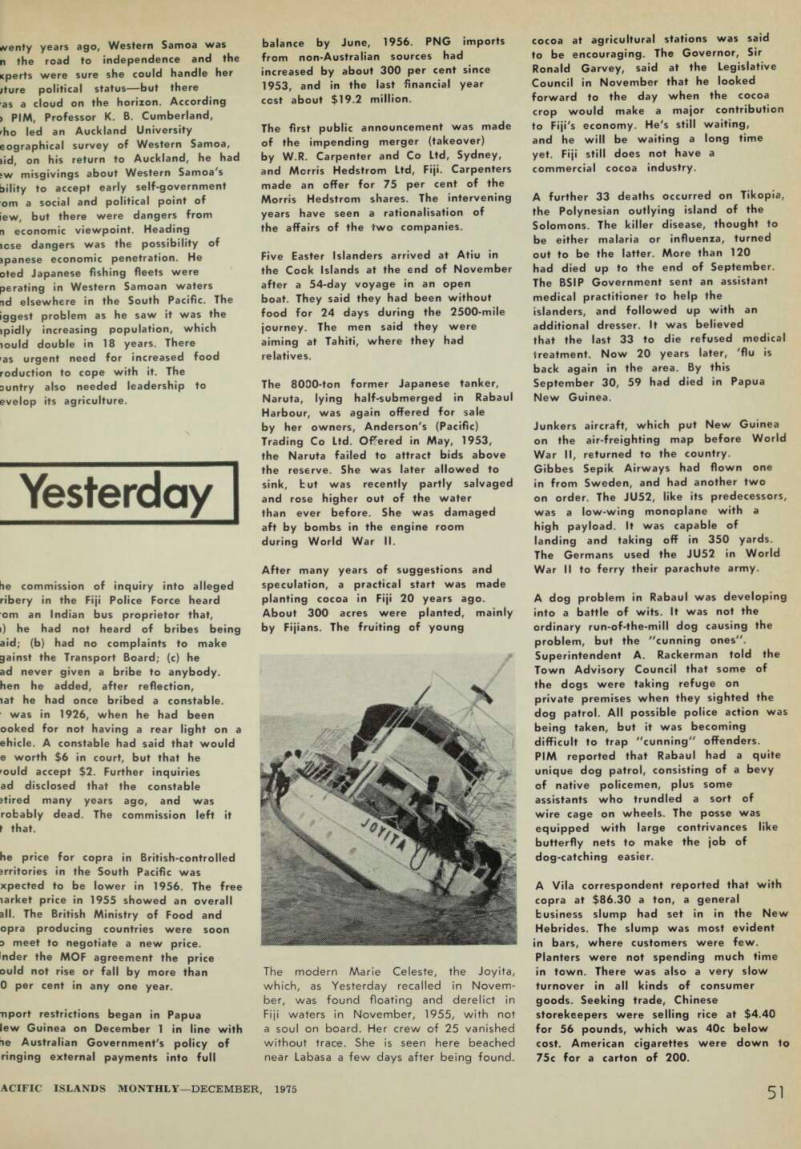
wenty years ago, Western Samoa was n the road to independence and the Kperts were sure she could handle her iture political status —but there as a cloud on the horizon. According > PIM, Professor K. B. Cumberland, rho led an Auckland University eographical survey of Western Samoa, lid, on his return to Auckland, he had •w misgivings about Western Samoa's bility to accept early self-government om a social and political point of lew, but there were dangers from i economic viewpoint. Heading lose dangers was the possibility of ipanese economic penetration. He oted Japanese fishing fleets were perating in Western Samoan waters id elsewhere in the South Pacific. The iggest problem as he saw it was the ipidly increasing population, which lould double in 18 years. There 'as urgent need for increased food reduction to cope with it. The suntry also needed leadership to evelop its agriculture.
he commission of inquiry into alleged ribery in the Fiji Police Force heard om an Indian bus proprietor that, i) he had not heard of bribes being aid; (b) had no complaints to make gainst the Transport Board; (c) he ad never given a bribe to anybody, hen he added, after reflection, lat he had once bribed a constable. was in 1926, when he had been ooked for not having a rear light on a ehicle. A constable had said that would e worth $6 in court, but that he 'ould accept $2. Further inquiries ad disclosed that the constable ;tired many years ago, and was robably dead. The commission left it t that. he price for copra in British-controlled irritories in the South Pacific was xpected to be lower in 1956. The free larket price in 1955 showed an overall all. The British Ministry of Food and opra producing countries were soon a meet to negotiate a new price, nder the MOF agreement the price ould not rise or fall by more than 0 per cent in any one year. nport restrictions began in Papua lew Guinea on December 1 in line with lie Australian Government's policy of ringing external payments into full
balance by June, 1956. PNG imports from non-Australian sources had increased by about 300 per cent since 1953, and in the last financial year cost about $19.2 million.
The first public announcement was made of the impending merger (takeover) by W.R. Carpenter and Co Ltd, Sydney, and Morris Hedstrom Ltd, Fiji. Carpenters made an offer for 75 per cent of the Morris Hedstrom shares. The intervening years have seen a rationalisation of the affairs of the two companies.
Five Easter Islanders arrived at Atiu in the Cock Islands at the end of November after a 54-day voyage in an open boat. They said they had been without food for 24 days during the 2500-mile journey. The men said they were aiming at Tahiti, where they had relatives.
The 8000-ton former Japanese tanker, Naruta, lying half-submerged in Rabaul Harbour, was again offered for sale by her owners, Anderson's (Pacific) Trading Co Ltd. Offered in May, 1953, the Naruta failed to attract bids above the reserve. She was later allowed to sink, but was recently partly salvaged and rose higher out of the water than ever before. She was damaged aft by bombs in the engine room during World War 11.
After many years of suggestions and speculation, a practical start was made planting cocoa in Fiji 20 years ago.
About 300 acres were planted, mainly by Fijians. The fruiting of young
cocoa at agricultural stations was said to be encouraging. The Governor, Sir Ronald Garvey, said at the Legislative Council in November that he looked forward to the day when the cocoa crop would make a major contribution to Fiji's economy. He's still waiting, and he will be waiting a long time yet. Fiji still does not have a commercial cocoa industry.
A further 33 deaths occurred on Tikopia, the Polynesian outlying island of the Solomons. The killer disease, thought to be either malaria or influenza, turned out to be the latter. More than 120 had died up to the end of September.
The BSIP Government sent an assistant medical practitioner to help the islanders, and followed up with an additional dresser. It was believed that the last 33 to die refused medical treatment. Now 20 years later, 'flu is back again in the area. By this September 30, 59 had died in Papua New Guinea.
Junkers aircraft, which put New Guinea on the air-freighting map before World War 11, returned to the country.
Gibbes Sepik Airways had flown one in from Sweden, and had another two on order. The JUS2, like its predecessors, was a low-wing monoplane with a high payload. It was capable of landing and taking off in 350 yards.
The Germans used the JUS2 in World War II to ferry their parachute army.
A dog problem in Rabaul was developing into a battle of wits. It was not the ordinary run-of-the-mill dog causing the problem, but the "cunning ones".
Superintendent A. Rackerman told the Town Advisory Council that some of the dogs were taking refuge on private premises when they sighted the dog patrol. All possible police action was being taken, but it was becoming difficult to trap "cunning" offenders.
PIM reported that Rabaul had a quite unique dog patrol, consisting of a bevy of native policemen, plus some assistants who trundled a sort of wire cage on wheels. The posse was equipped with large contrivances like butterfly nets to make the job of dog-catching easier.
A Vila correspondent reported that with copra at $86.30 a ton, a general business slump had set in in the New Hebrides. The slump was most evident in bars, where customers were few.
Planters were not spending much time in town. There was also a very slow turnover in all kinds of consumer goods. Seeking trade, Chinese storekeepers were selling rice at $4.40 for 56 pounds, which was 40c below cost. American cigarettes were down to 75c for a carton of 200.
The modern Marie Celeste, the Joyita, which, as Yesterday recalled in Ndvem ber, was found floating and derelict in Fiji waters in November, 1955, with not a soul on board. Her crew of 25 vanished without trace. She is seen here beached near Labasa a few days after being found.
Advertisements & other items, pp. 53-54 (2 items)
51
ACIFIC ISLANDS MONTHLY—DECEMBER, 1975
A growing airline
in a shrinking world...
Fly to any of 16 AIR NEW ZEALAND Gateways to the World.
Ira
Los Angeles
K ■
Sing
i pore AIR NEW ZEALAND is a truly international airline, flying you throughout the Pacific to any of 16 Gateways to the World, as far apart as Wellington and Singapore, Auckland and Los Angeles.
. You fly the friendly fleet
5 of DClOs and DQBs.
Our magnificent wide-bodied DC-10s now fly on most international AIR NEW ZEALAND routes. On other flights and services, our personalised DC-8s provide outstanding AIR NEW ZEALAND service.
16 exciting Gateways
to the World.
AIR NEW ZEALAND flies to Hawaii Los Angeles, Hong Kong, Singapore, Sydney, Melbourne, Brisbane, Auckland, Wellington, Christchurch, Fiji, Tahiti, New Caledonia, Samoa, Rarotonga and Norfolk Island. fi
air /if a/ zEatano
Friendliest wings across your world.
Talk to AIR NEW ZEALAND or your travel agent
ANZ 233
Books, Reviews, writers
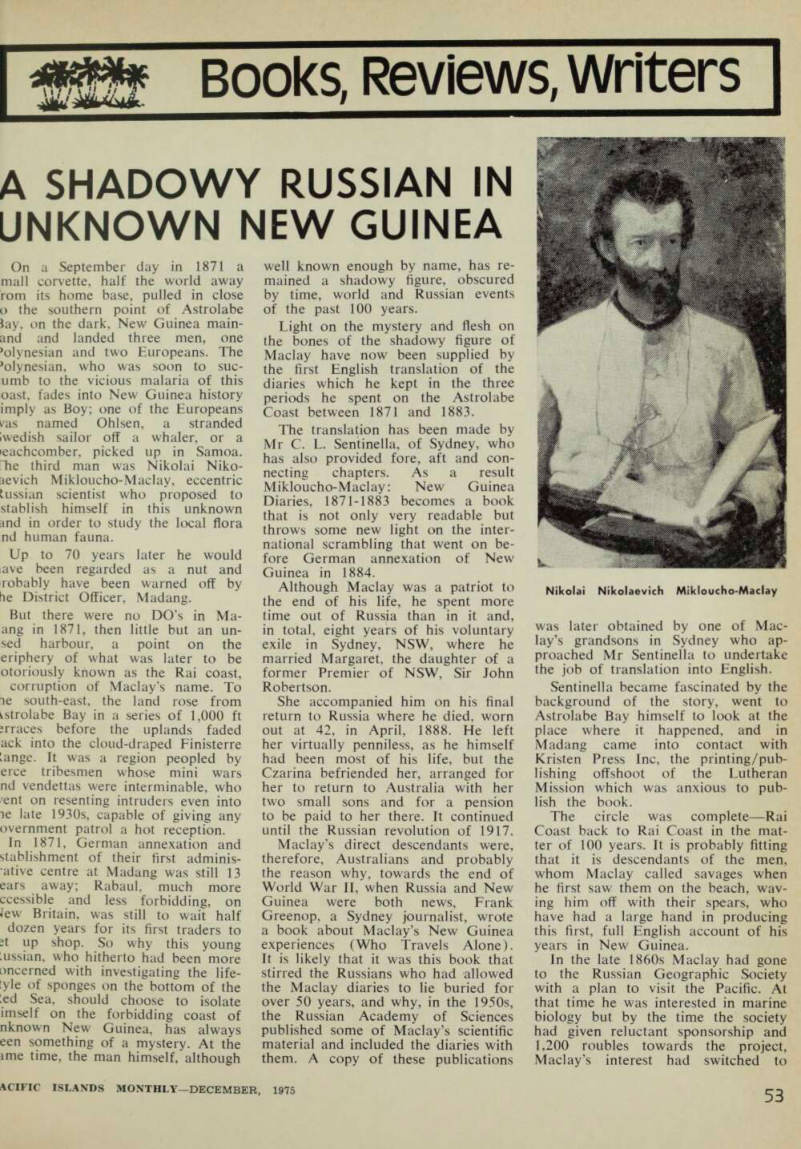
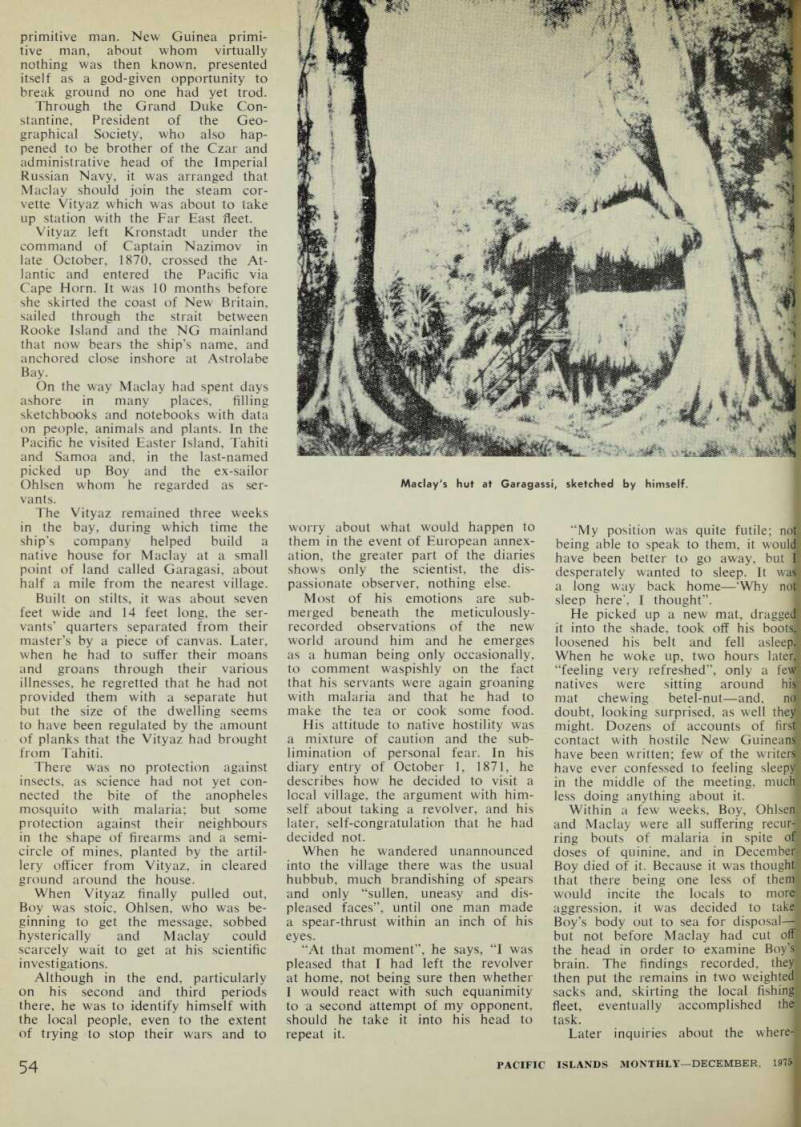
A Shadowy Russian In
Unknown New Guinea
On a September day in 1871 a mall corvette, half the world away rom its home base, pulled in close o the southern point of Astrolabe Jay, on the dark, New Guinea main and and landed three men, one ’olynesian and two Europeans. The *olynesian, who was soon to suc umb to the vicious malaria of this oast, fades into New Guinea history imply as Boy; one of the Europeans vas named Ohlsen, a stranded Iwedish sailor off a whaler, or a •eachcomber, picked up in Samoa.
Tie third man was Nikolai Niko aevich Mikloucho-Maclay, eccentric Russian scientist who proposed to stablish himself in this unknown and in order to study the local flora nd human fauna.
Up to 70 years later he would ave been regarded as a nut and robably have been warned off by he District Officer, Madang.
But there were no DO’s in Ma ang in 1871, then little but an un sed harbour, a point on the eriphery of what was later to be otoriously known as the Rai coast, corruption of Maclay’s name. To le south-east, the land rose from astrolabe Bay in a series of 1,000 ft traces before the uplands faded ack into the cloud-draped Finisterre lt was a region peopled by erce tribesmen whose mini wars nd vendettas were interminable, who 'ent on resenting intruders even into ic late 19305, capable of giving any overnment patrol a hot reception.
In 1871, German annexation and stablishment of their first adminis ative centre at Madang was still 13 ears away; Rabaul, much more ccessible and less forbidding, on lew Britain, was still to wait half dozen years for its first traders to it up shop. So why this young Russian, who hitherto had been more oncerned with investigating the life tyle of sponges on the bottom of the :ed Sea, should choose to isolate imself on the forbidding coast of nknown New Guinea, has always een something of a mystery. At the ime time, the man himself, although
well known enough by name, has re mained a shadowy figure, obscured by time, world and Russian events of the past 100 years.
Light on the mystery and flesh on the bones of the shadowy figure of Maclay have now been supplied by the first English translation of the diaries which he kept in the three periods he spent on the Astrolabe Coast between 1871 and 1883.
The translation has been made by Mr C. L. Sentinella, of Sydney, who has also provided fore, aft and con necting chapters. As a result Mikloucho-Maclay: New Guinea Diaries, 1871-1883 becomes a book that is not only very readable but throws some new light on the inter national scrambling that went on be fore German annexation of New Guinea in 1884.
Although Maclay was a patriot to the end of his life, he spent more time out of Russia than in it and, in total, eight years of his voluntary exile in Sydney, NSW, where he married Margaret, the daughter of a former Premier of NSW, Sir John Robertson.
She accompanied him on his final return to Russia where he died, worn out at 42, in April, 1888. He left her virtually penniless, as he himself had been most of his life, but the Czarina befriended her, arranged for her to return to Australia with her two small sons and for a pension to be paid to her there. It continued until the Russian revolution of 1917.
Maclay’s direct descendants were, therefore, Australians and probably the reason why, towards the end of World War 11, when Russia and New Guinea were both news, Frank Greenop, a Sydney journalist, wrote a book about Maclay’s New Guinea experiences (Who Travels Alone).
It is likely that it was this book that stirred the Russians who had allowed the Maclay diaries to lie buried for over 50 years, and why, in the 19505, the Russian Academy of Sciences published some of Maclay’s scientific material and included the diaries with them. A copy of these publications
was later obtained by one of Mac lay’s grandsons in Sydney who ap proached Mr Sentinella to undertake the job of translation into English.
Sentinella became fascinated by the background of the story, went to Astrolabe Bay himself to look at the place where it happened, and in Madang came into contact with Kristen Press Inc, the printing/pub lishing offshoot of the Lutheran Mission which was anxious to pub lish the book.
The circle was complete—Rai Coast back to Rai Coast in the mat ter of 100 years. It is probably fitting that it is descendants of the men, whom Maclay called savages when he first saw them on the beach, wav ing him off with their spears, who have had a large hand in producing this first, full English account of his years in New Guinea.
In the late 1860 s Maclay had gone to the Russian Geographic Society with a plan to visit the Pacific. At that time he was interested in marine biology but by the time the society had given reluctant sponsorship and 1,200 roubles towards the project, Maclay’s interest had switched to
Nikolai Nikolaevich Mikloucho-Maclay
primitive man. New Guinea primi tive man, about whom virtually nothing was then known, presented itself as a god-given opportunity to break ground no one had yet trod.
Through the Grand Duke Con stantine, President of the Geo graphical Society, who also hap pened to be brother of the Czar and administrative head of the Imperial Russian Navy, it was arranged that Maclay should join the steam cor vette Vityaz which was about to take up station with the Far East fleet.
Vityaz left Kronstadt under the command of Captain Nazimov in late October, 1870, crossed the At lantic and entered the Pacific via Cape Horn. It was 10 months before she skirted the coast of New Britain, sailed through the strait between Rooke Island and the NG mainland that now bears the ship’s name, and anchored close inshore at Astrolabe Bay.
On the way Maclay had spent days ashore in many places, filling sketchbooks and notebooks with data on people, animals and plants. In the Pacific he visited Easter Island, Tahiti and Samoa and, in the last-named picked up Boy and the ex-sailor Ohlsen whom he regarded as ser vants.
The Vityaz remained three weeks in the bay, during which time the ship’s company helped build a native house for Maclay at a small point of land called Garagasi, about half a mile from the nearest village.
Built on stilts, it was about seven feet wide and 14 feet long, the ser vants’ quarters separated from their master’s by a piece of canvas. Later, when he had to suffer their moans and groans through their various illnesses, he regretted that he had not provided them with a separate hut but the size of the dwelling seems to have been regulated by the amount of planks that the Vityaz had brought from Tahiti.
There was no protection against insects, as science had not yet con nected the bite of the anopheles mosquito with malaria; but some protection against their neighbours in the shape of firearms and a semi circle of mines, planted by the artil lery officer from Vityaz, in cleared ground around the house.
When Vityaz finally pulled out, Boy was stoic, Ohlsen, who was be ginning to get the message, sobbed hysterically and Maclay could scarcely wait to get at his scientific
investigations.
Although in the end, particularly on his second and third periods there, he was to identify himself with the local people, even to the extent of trying to stop their wars and to
worry about what would happen to them in the event of European annex ation, the greater part of the diaries shows only the scientist, the dis passionate observer, nothing else.
Most of his emotions are sub merged beneath the meticulously recorded observations of the new world around him and he emerges as a human being only occasionally, to comment waspishly on the fact that his servants were again groaning with malaria and that he had to make the tea or cook some food.
His attitude to native hostility was a mixture of caution and the sub limination of personal fear. In his diary entry of October 1, 1871, he describes how he decided to visit a local village, the argument with him self about taking a revolver, and his later, self-congratulation that he had decided not.
When he wandered unannounced into the village there was the usual hubbub, much brandishing of spears and only “sullen, uneasy and dis pleased faces”, until one man made a spear-thrust within an inch of his eyes.
“At that moment”, he says, “I was pleased that I had left the revolver at home, not being sure then whether I would react with such equanimity to a second attempt of my opponent, should he take it into his head to repeat it.
“My position was quite futile; not being able to speak to them, it would have been better to go away, but I desperately wanted to sleep. It wal a long way back home—‘Why not sleep here', I thought”.
He picked up a new mat, draggeJ it into the shade, took off his boots, loosened his belt and fell asleepl When he woke up, two hours lateil “feeling very refreshed”, only a few natives were sitting around his mat chewing betel-nut—and. no doubt, looking surprised, as well the)l might. Dozens of accounts of firsa contact with hostile New Guineans have been written; few of the writers have ever confessed to feeling sleepy in the middle of the meeting, much; less doing anything about it.
Within a few weeks, Boy, Ohlserl and Maclay were all suffering recurj ring bouts of malaria in spite of doses of quinine, and in December Boy died of it. Because it was thought; that there being one less of them would incite the locals to morel aggression, it was decided to take I Boy’s body out to sea for disposal—-! but not before Maclay had cut off the head in order to examine Boy’s! brain. The findings recorded, they,; then put the remains in two weighted sacks and, skirting the local fishing! fleet, eventually accomplished the task.
Later inquiries about the where-i
Maclay's hut at Garagassi, sketched by himself.
out of Boy were apparently (interacted by Maclay floating a le methylated spirits on top of a acer of water and setting it alight, which the villagers were suitably mbfounded. They apparently con ided that anyone who would set z to water and who had already monstrated his ability to kill birds d animals with a weapon far more adly than their spears, was a super man, not to be questioned over ; disappearance of an inferior.
Relations improved steadily and len Maclay and Ohlsen, by then physical and mental wreck, were :ked up by the Russian clipper ip Izumrud, in December 1872, id were the lamentations along the li Coast.
It was 4i years beore Maclay got ck to Astrolabe Bay, during which ne he made expeditions in West ;w Guinea, already nominally itch for 50 years, and in the Ma r Peninsula. He left Singapore, records, partly “in order to avoid (closing information (about Mato the English” who were busy nsolidating their position in that rt of the world; and partly because reports that Australia and Eng id were considering annexing that rt of New Guinea not claimed by ; Dutch. In this he saw danger to i Astrolabe Bay friends and de led to protect them by (a) his ssence and (b) by appealing to i Russian Government to declare protectorate over that part of New jinea.
He took passage on a small ship lied Seabird, under the command none other than Captain O’Keefe, own better to movie mogus in the 50s as His Majesty. He spent four Dnths on the Seabird while O’Keefe nducted his business in Micronesia d the Admiralty Islands, being nerally outraged at what he con lered the “vicious exploitation lich the natives were subjected to whites”.
With a Malay cook and a young an and girl from Pelau, he was ided on his coast in June 1876.
Keefe promised to come for him six months, probably without the ghtest intention of doing so.
Maclay spent 17 months there at is period, becoming closely involved th the people whom he came to lieve should be saved from the fate being annexed by anyone but assia. His early scientific detach snt goes by the board and his diary least as published in the last three □nths before he was picked by an iglish schooner, Flower of Yarrow, des away to virtually nothing.
He spent six months in Singapore
followed by almost four years in Sydney, leaving there in 1882 on a Russian warship for his first visit to his homeland in 12 years.
His visit was partly to see his family, mainly to negotiate for the publication of his scientific work. He left again before the end of the year, destination Australia. He took passage for Brisbane on a ship that called at Batavia where he transferred suddenly to a waiting Russian naval corvette; Skobeliev, which left port early the following morning. On March 17, 1883 the corvette was at anchor at Cape Constantine, Astrolabe Bay.
Maclay had brought with him, as gifts for the people, a bull, two heifers and a goat, seeds of tropical fruits, beads, cotton material and mirrors but this time he stayed with the corvette which spent some weeks surveying and exploring the coast.
Although his diaries carefully mask the fact, the archives of the Russian Navy reveal that Mikloucho-Maclay’s switch at Batavia from the British steamer Chyebassa to the Russian corvette Skobeliev was not impulse, as Maclay stated, but part of a carefully arranged plan made in St Petersburg. Skobeliev’s purpose was to investigate suitable harbours for a Russian naval station in the Pacific and Maclay took part in it because of his knowledge of the region.
After leaving New Guinea on March 23, the Skobeliev inspected other harbours in the Admiralty group and in the Pelau Islands. A month later the vessel arrived in monm later me vessel arrived in Manila where Maclay left her to go on to Hong Kong. It was there he
learned of the Queensland Govern ment’s attempt in April, 1883, to annex part of New Guinea by send ing H. M. Chester from Thursday Island to Port Moresby to run up the flag. This action was later repudiated by the British Government but let ters written at the time by Maclay show that he believed that his non arrival at Brisbane with the Chyebassa, and the fact that he had transferred to the Russian warship,
had precipitated Queensland’s action.
Although this incident has gone down in the history books as having been caused by fear of German an nexation, fear of the Russians at this period was even more obsessive in Australia. Russia had expanded across the northern hemisphere as far as Alaska and by the 1880 s was already challenging Japan for the right for trade and territory in Man churia. News of Russian adventures around New Guinea directed Aus tralian attention to the long, un defended coastline of its own con tinent, and to activities that only hindsight can call irrational.
Back in Australia later in 1883, Maclay threw himself into any move that would safeguard the future of the New Guineans, meantime hoping that the conflicting colonial interests of Germany and Britain would keep both from making any definite move in regard to New Guinea. In this, of course, he was soon to be dis
illusioned.
Judy Tudor
(Mikloucho-maclay: new guinea DIARIES. 1871-1883; trans. by C. L. Senti nella Published by Kristen Press me. po box 712, Madang, png. Recommended price $4,951.
Advertisements & other items, pp. 55-58 (3 items)
53
ACIFIC ISLANDS MONTHLY—DECEMBER, 1975
55
CIFIC ISLANDS MONTHLY-DECEMBER, 1975
lapua new guinea
D
printing co. ply. ltd.
Serving the Country from Aitape to Alotau, Manus to Moresby Leaders in Commercial Offset and Letterpress Printing. • Stationery • Office Supplies • Office Equipment • Rubber Stamps • Self-Adhesive Labels • In Fact; Everything For The Office.
P.O. Box 633, Port Moresby P.O. Box 759, Lae P.O. Box 1239, Rabaul
Total service 0n ...
plumbing supplies fast
WATSON & CRANE
are organised to fulfil your needs
wherever you are in the South Pacific U « You can get all you need from one supply source: water taps, valves, copper tube, tools and a host of other fittings and related plumbing equipment for domestic, industrial and multistorey buildings.
Watson & Crane Pty Ltd have over 20,000 plumbing items in stock at their central warehouse located at Waterloo, NSW, Australia.
Years of experience in handling and shipping right throughout the South Pacific add up to another big reason for you to deal with Watson & Crane Pty Ltd.
Representatives call regularly at New Guinea, Papua, the Solomons, New Hebrides and Fiji Islands to personally discuss your requirements and appropriate credit arrangements.
Write, cable or telephone today for complete plumbers' supplies service.
Watson & Crane Pty. Ltd. 1037 Bourke Street, Waterloo,
NSW 2017.
Phone; Sydney 699-1333.
Telex: AA 25548.
Cables: "Watcrane" Sydney.
[crane I
[GROUP I
Pacific Island distributors of Crane Enfield copper tube for water, sanitation, engineering, refrigeration and air conditioning.
Melanesians Search
For An Identity
According to the Concise Oxford ictionary, the word Melanesia comes 3m the Greek: melas (black) nesos dand) and refers to the group of ands, NE of Australia, in which the uninant race is dark-skinned and izzly-haired. Geographically, the rm Melanesia is usually used to ver New Caledonia, New Hebrides, ji, Solomon Islands, Papua New ainea and Irian Jay a, though e Torres Straits Islands ought to be :luded, and Fiji might better be put .o a category of its own. And, as is inted out in An Introduction to the oples and Cultures of Melanesia, sre is much cultural overlap be een Melanesia, Micronesia and ilynesia. What, then, is Melanesia? hat constitutes a Melanesian?
The author, an anthropologist with nsiderable field experience in Papua jw Guinea, believes that “Melanesia best regarded as a geographical ifion within which some culture tits occur with greater frequency an they do in some of the surround l areas” and that it is not possible ) make more than a handful of neralisations that will apply to even ; majority of the societies in Melan a, and many of these generalisa •ns do not distinguish Melanesia >m Micronesia, eastern Indonesia, the smaller islands of Polynesia”.
In this booklet, one of a series current topics in anthropology, the thor’s experience and skilful use of levant material from recognised urces provide a most helpful over jw. In clear and concise language, ;e from academic jargon, Chowning iefly summarises the main facets of ? past and present of the Islanders d their environment.
The text is divided into sections on ysical anthropology, languages, pre »tory, environment and resources, rticulture, demography, land-use, cial organisation, warfare, kinship d marriage, sexual relations, reli -3n and ceremonial, art, and econo ic organisation. Inevitably, there are me overlaps, and some people will efer a different arrangement of the a and/or wish to change the iphases given to sections. For in mce, because the nexus between •rticulture and land-use, and that be een social organisation and econo ic organisation, is so strong, the vision into separate sections will not ;ase every reader.
It might be asked why the section i demography has no reference to e work of Dr Norma McArthur,
perhaps the foremost authority on population studies in the Pacific. And it is not correct to state that too little is known about the Western Islands to class their people as Micronesians: Hohnschopp (1971) has provided de tailed evidence that, on Aua and Wuvulu, proto-Polynesian conquerors introduced a culture which has over come the original Manus culture.
The real test, however, is whether one can see the wood for the trees.
Most academic writers have taken a microcosmic approach, leaving the ‘ordinary’ reader to tackle a plethora of books, monographs and articles in order to gain an overview. This book let passes that ‘arboreal’ test with flying colours. Equally important, Chowning draws attention to some as sumptions which, though valid only for the group of people and/or limited environment about which they have been made, are close to becoming conventional wisdom for the whole of Melanesia.
She rightly stresses that much more needs to be known about such matters as the historical development of mi gration and settlement, of land owner ship and use, of kinship, and of the role of women. Our current know ledge supports Chowning’s view that Melanesia can only be regarded as a geographical region in a wide sense, and as an even wider one in relation to the peoples who inhabit it. How ever, she concludes, “the greatly in creased interaction between people of different groups as a result of Euro pean influence and control, along with the gradual disappearance of tra ditional technology, ceremonies, and customs, has reduced the cultural dis tinctions that were once the most outstanding characteristic of Melan nesia”.
Intra- and inter-island politics, close personal relationships between leaders in the region, eg that of the prime ministers of Papua New Guinea and Fiji, and inter-marriage among the politico-economic elites are but some of the factors contributing to what may become a pan-Melanesian cul ture.
The new nations of the Pacific have gained international recognition, but they are still searching for identity within the region. This booklet may help Melanesians in that search. It deserves to be read by them and theii
friends.
Harry Jackman.
(An Introduction To The Peoples
And Cultures Of Melanesia. By Ann
Chowning. Published by Cummings Publishing Co, Menlo Park, USA. $2.00.)
small fry
Amusing bored small fry
What to do with bored small fry on a rainy afternoon, or keeping an active measles victim amused are just two questions which have bedevilled parents for quite a time.
It’s not so bad with two children; they can usually have a good argu ment, but one child with “nothing to do” can send a parent reaching for the picture rail.
Susan Dickinson, in her aptly named book Mothers’ Help, couples her mother’s experience with her writer’s imagination to bring help to the harassed. Covering many dif ferent twists on such gems as dress ing up, story time, making music, etc, the editor adds such hackle-raising tit-bits as co-operative cooking and caterpillar boxes.
The editor and her 11 writers have come up with a collection of things to do for children up to five which don’t simply say “tell them to do this . . but actually show how the child can be organised to keep him or her happy for hours.
I have tried several items on my own three-year-old son and the sight of him mixing pastry for jam tarts has to be seen to be believed , . .
Real Time is not a catalogue in the style of the Whole Earth Cata logue or similar publications dealing, as the title implies, more with ideas than available goods. Divided into five sections, Communications, Human Systems, Mind, Science and Technology and Trends, Real Time is well written and edited and features excellent illustrations. However, the publishers should know better than to try to “Perfect” bind the good quality offset paper, as one is con stantly reinserting pages which have come adrift due to this writing pad effect.
Excellent reading, a book one can pick up and put down at one’s leisure and always find something of interest.
John Collins.
(MOTHER’S HELP, edited by Susan Dickenson; Fontana Books; $A1.50.) (REAL TIME, edited by John Brockman and Ed Rosenfeld; Picador, Pan Books Ltd London; $A5.95.)
Advertisements & other items, pp. 59-60 (2 items)
57
CIFIC ISLANDS MONTHLY— DECEMBER, 1975
Doming Boats
Ideal for fishing,
pleasure or workboat
I » *sit ■■i m E m m Safe go anywhere diesel powered, 18' x B', raised decker with 2 bunk cabin and self draining cockpit in solid maintenance free fibreglass. Choice of marine diesels; 8 to 25 H.P. giving speeds up to 10 knots. 2 ton carrying capacity. DORY (workboat) plan available, completely open but fully self draining. Rigging plan available for both models providing the ultimate in safety..
ENG
TO ET
ENG
DORY PLAN
Write for full export details to:
DOMING BOATS
4 Tengah Crescent, Mona Vale, N.S.W., 2103. Phone: 997 2491 Dealer inquiries welcome.
Islands Create An Air Council
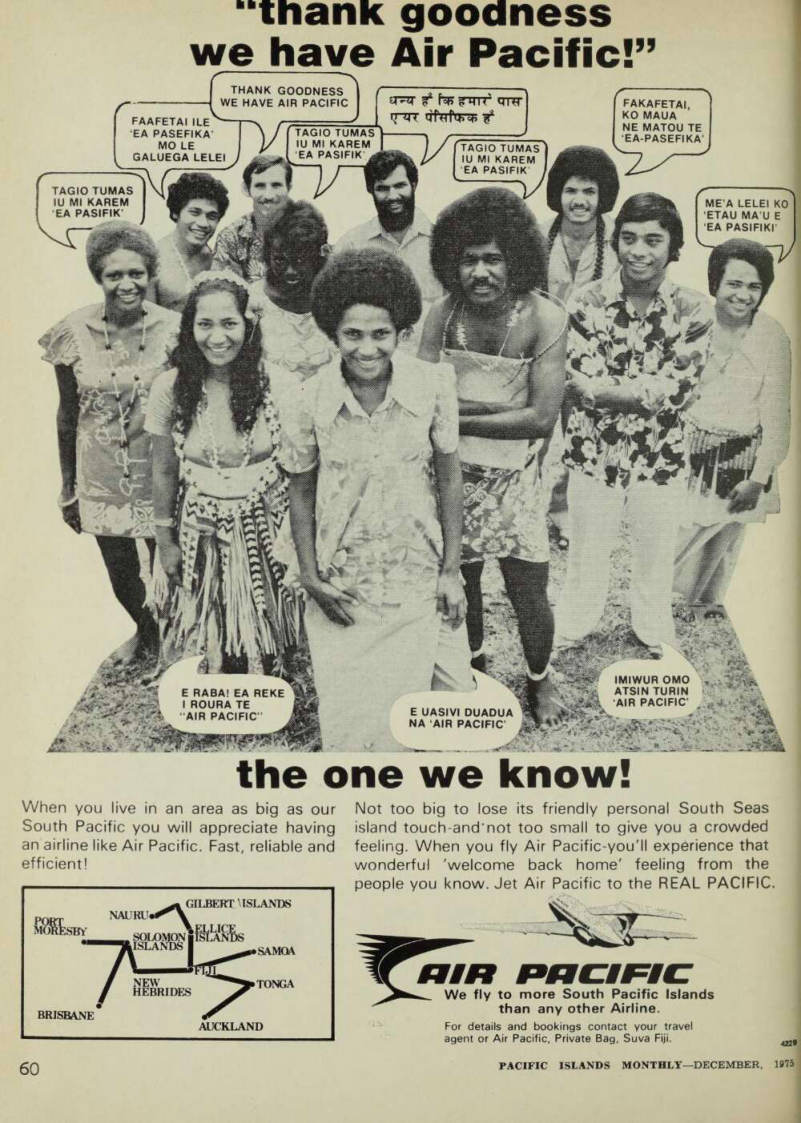

Pacific Transport
But There's No Regional Airline
By a staff writer
The question of rationalising re onal air services in the South acific is still very much in the melt ig pot following a meeting in Nauru n October 28 and 29 of aviation iinisters from seven countries. The :anty information released after the iceting suggests that Air Pacific is ill as far away as ever from realising s dream of becoming the accepted igional operator.
The ministers agreed to set up a Duth Pacific regional civil aviation Duncil of government ministers, acked up by an advisory committee f aviation experts. The council’s »b will be to stimulate technical co peration between rival airlines based i the region and ration out routes nong them.
Fiji’s Minister for Communica ons. Works and Tourism, Mr Ted eddoes, before leaving for Nauru, joke at a tourism conference in Suva, id put Fiji’s case for Air Pacific in nutshell—there were already too lany little airlines shunting people bout in the Islands. The need was for ic region to support one big, well rganised airline.
The Nauru meeting was attended y ministers responsible for civil avia on from Fiji, the Gilberts, Nauru, ic Solomons, Western Samoa, Cook ilands and Papua New Guinea. Aus alia and New Zealand were also The South Pacific Bureau for conomic Co-operation, which organ ed the meeting, issued a brief com mnique after the meeting, held be ind closed doors, saying the recom lendations for the new council and dvisory committee would go to the outh Pacific Forum for ratification, loth organisations would constitute le consultative body on regional viation matters already mentioned by le forum as being a desirable tool to ave in shaping the improvement of ’acific Islands air services.
Undoubtedly some overhaul is ceded, for the Pacific Islands do not
represent a big enough internal market for everybody. No airline is making a fortune. It may have been coincidental but Air Pacific, about the time of the conference, reported a hefty loss, unstated, for the year ended March 31.
Five Pacific countries are repre sented on the Air Pacific board —Fiji, Western Samoa, Tonga, the Solomons and the Gilberts. Qantas, Air New Zealand and British Airways are also represented.
The Air Pacific board, at its annual meeting, lifted the number of Fiji
directors from two to four. All other interests have one director each. But Captain P. Howson, of Qantas, re mains chairman.
As internal traffic has dropped back to the level of that of 1972, because of a slump in tourist traffic, Air Pacific is considering leasing or selling one of its three Trislanders, bought earlier this year for domestic services.
Another airline. South Pacific Island Airways, about the same time announced it was, at last, ready to launch new services between the two Samoas, using new Cessnas. Rather
ban buy two new aircraft, it could lave been a better deal for SPIA to :harter the Trislander.
Air Pacific is obviously doing well vith its regional services. Its second 3AC 111, which was leased to Air Malawi, is due back in Fiji in De :ember. Air Pacific will then make a ?ig expansion of services—four a veek each to Auckland and Brisbane >y December 31, and a fifth flight o Brisbane early in 1976.
So far there is no clash of regional ervices, but if Air Pacific is expan ion minded, it will find a worthy ival in Air Nauru. Continental has ights in Apia, and other points on he way down from Micronesia, ilthough it has not yet exercised them.
Vhen it does it could look for a re urn route, say through the Solomons, vhich would cut across part of an Ur Pacific service. Air Niugini too, s looking at expansion, but so far no urther east than Honiara. At the aoment Air Niugini seems more in ent on going north and south.
Obviously there is a need for ationalisation, which won’t be chieved without close co-operation, Stuart Inder wrote in PIM in une, 1974: “Is the South Pacific to lave one regional airline doing the reatest good for the greatest number, •r is every mini-state going to estab ish its own international airline and ight its neighbours for landing rights nd customers?
“Ratu Sir Kamisese Mara, Fiji]s •rime Minister, summed it up in his isual direct fashion following the outh Pacific Forum in Rarotonga /hen he said that the Forum would land or fall on civil aviation, which /ould be ‘the real test of Pacific egional co-operation’.”
His remarks are still highly rele ant.
Continental Plans
Ts S. Pacific Route
Continental Airlines, which has pplied to the US Civil Aeronautics loard for permission to establish a oute to the South Pacific, sent two if its executives to look over the rea recently.
The airline’s vice-president, Don leek, and the market planning direc or, Fritz Blayney, flew into Pago ’ago and also visited other islands.
Continental, which was a victim if political fiddling in 1969 when ’resident Nixon quashed its award iy his predecessor, President John on, for a South Pacific route and ;ave it to American Airlines, plans o operate between San Francisco, ,os Angeles, Hawaii, Pago, Fiji, New Zealand and Australia.
American Airlines, which withdrew
from the South Pacific last year, blamed the denial of its use of these West Coast gateways for its failure to make the South Pacific route pay.
Continental’s application is due for hearing in Washington in December and it plans to begin the new opera tions in a year’s time with medium range DC 10/10s which, at present, are configured in a non-lATA 200 seat arrangement.
Carrying 6,100,000 passengers and generating 5.6 billion pay-miles in 1974, Continental is the smallest of the American trunks, but one of the most profitable. It has rationalised its 53-plane fleet to two types only— the tri-motored DC 10/10 and the 8727-200. It also holds 31 per cent of the equity in Air Micronesia, which it manages.
Polynesie Is
Up For Sale
The Polynesie has been withdrawn from the Sydney-Noumea-Santo-Vila service and offered for sale. She was operated by South Pacific United
Lines, a subsidiary of Messageries Maritimes, which is looking for a re placement. In the meantime, the ser vice will be operated with La Bonita, a conventional cargo and container ship, which is on temporary time charter.
The Polynesie, a cargo/passenger ship, was introduced to the service about 20 years ago. Her replacement will be a cargo-only ship. The econo mics of building a cargo/passenger ship as a replacement, ruled out any possibility of bringing in a ship similar to the Polynesie.
Fiji Unionists
Buy Bus Company
A chance remark by union officials during wage negotiations that the union could run bus companies better than existing bus operators led to a situation where the Fiji Transport Workers’ Union now has a foot in both camps. The chance remark caused union officials to do a bit of thinking, and that thinking was fol lowed by the purchase of Amalga
ited Transport Co Ltd for about 50,000.
The union/company now has 26 ses of 50 to 60 seating capacity -vicing several thickly-populated ;as of Suva. The fleet will be en •ged in the next three years.
A board of directors has been ap inted to control bus operations. The ard’s manager operates from the ion office, working alongside union icials. Initially, 50 per cent of net ofits will go to the union and 50 r cent to the board. If the board’s irkers make industrial claims, then ; union will meet the board round ; table.
There is no reason why the opera n should not be a success. But an ;ential ingredient is that the union es no further than being the owner the fleet, leaving conduct of the siness to the board.
Jxury Passenger
Hp For Solomons
A 130 ft luxury passenger cruiser ilt in Japan is expected to soon go o service in the Solomon Islands, e ship, named the Compass Rose is valued at more than $250,000. can carry 200 passengers.
Mr Alf Scholz, manager of Coral as Fishing Co, which owns the new p, said all compartments were air aditioned. Each cabin had a red [vet carpet, a writing desk, two airs and a mirror. There would be 0 classes of cabin—de-luxe and >t-class. De-luxe passengers would ve their own lounge with comfort le leather chairs.
Compass Rose II will have a speed 13k knots, and will be fitted with modern navigation aids, including Jar.
The fares in the Compass Rose II 11 be the same as those charged the Regina M and other govern ;nt ships. There will be reduced arges for cargo from Honiara to zo and Auki.
Jl Builds
S Biggest Ship
The Fiji ship-building industry tted itself on the back in November th the launching of the biggest ship er built in the country. The ship is 1 Kaunitone, 580 tons, which cost out $500,000. The name of the ship es right back into Fijian history, d legends say that the Kaunitoni is one of the four canoes which ought the first Fijians to Fiji, led a warrior named Lutunasobasoba.
Not only was the ship built in va, it was also designed in Fiji, ready it has become the pride of e Fiji Marine Department’s fleet. ;r inclusion in the inter-island ship ng service is timely, and will plug
the gaps left by the loss of the Ului lakeba and the Makogai, which foun dered in hurricanes.
She is fitted with 500 hp Cater pillar engines, and has a cruising speed of about 10 knots. She is 138 ft long, and has a 28 ft beam. She draws 13 ft. She can carry 110 tons in her main cargo hold, which in cludes two deep freezers. She has capacity to carry 88 passengers in cabins, saloon and on deck.
The Kaunitoni will be crewed by six officers and 14 seamen.
Air Niugini May
Buy New Aircraft
Air Niugini is looking at the possi bility of introducing De Havilland Dash 7 aircraft to a number of ser vices, and phasing out DC3s and Fokker Friendships. De Havilland Canada recently made a study of Papua New Guinea airstrips to see if its DH Dash 7 was suitable. Its report was sent to the Minister for Transport, Mr lambakey Okuk, who will pass it on to the PNG National Airlines Commission.
Mr Okuk said the DH Dash 7 had some advantages over the DC3 and the Fokker. It could land and take off with full loads at Enga, Chimbu, Southern Highlands and Kerema.
DC3s and Fokkers could not.
Upgrading those strips to take DC3s and Fokkers would be too ex pensive. The DH Dash 7 might solve the problem, and allow all provinces to use the national airline. The government would gain by buying the aircraft, he said.
The DH Dash 7 is like the Fokker in a number of ways. It is high wing, and turbo prop. However, it requires four engines to develop the same horsepower as the two engines of the Fokker. Both have the same passenger capacity. The DH Dash 7 has a range of only 935 miles, which is well below the potential of the Fokker. But the limited range does not mean a great deal in PNG.
Mr Okuk said he would ask the government to let Air Niugini hold talks with De Havilland Canada, if the Airlines Commission favoured the report, and aviation experts, both government and private enterprise, agreed. • Air Niugini was scheduled to start a weekly service between Port Moresby and Manila about the middle of October, according to a memorandum of understanding signed in Manila between Papua New Guinea and the Philippines. Qantas has been appointed Air Niugini’s general sales agents in the Philip pines.
Uss Will Sail No
More In East Pacific
The Union Steam Ship Co of NZ Ltd will soon have no more services in the eastern Pacific. The Auckland- Tahiti cargo service will be aban doned in January because it is unprofitable. This follows the earlier withdrawal of the company’s NZ- Cook Islands service, and the sale of its assets there to the Cook Islands Government.
The company uses a chartered ship, the Luhesand, 1,673 tons, on the Auckland-Tahiti service. Rising costs, devaluation and shortage of return cargo from Tahiti made the ship unprofitable. The charter is due to expire in January and it will not be renewed.
It has been suggested that the NZ Government-owned shipping com pany, might take over the Tahiti ser vice.
Meanwhile, the Fijian Swift, 1,200 tons, which had been offered for sale, has returned to the NZ-Fiji trade.
This ship is owned by Reef Shipping, which has been operating another ship. La Bonita, on the route. La Bonita will transfer to the Australia- Pacific Islands service under charter to South Pacific United Line for six months.
Uk Help For
Regional Shipping Line
Help for the Islands to set up a regional shipping line may come from Britain. The Papua New Guinea Prime Minister, Mr Michael Somare, re turned home from the UK with a message that British shipping execu tives were prepared to help.
The offer was to help set up a government-controlled inter-island shipping fleet. The well-known line.
Bank, which operates in the South Pacific, and others, made the offers.
A spokesman for Mr Somare said the offer would be considered at the next meeting of South Pacific leaders, scheduled to be held in Nauru early in 1976.
Rotuma May Get
An Air Service
Rotuma, about 400 miles north of the main Fiji island of Viti Levu, is expected soon to enter the air age —with some misgivings. Suitable land has at last become available to accom modate an air strip. However, a number of islanders are concerned that an influx of tourists could affect their lives.
On the other hand, farmers wel come an airport because it will give them a chance to speed up transport of their produce to the main Fiji mar
ket in Suva. Rotuma is served fairlv regularly by ships, which have to un load cargo and load island produce by lighter.
UK operators for Air Niugini
Templewood, a British air charter firm, known as Tempair, has outbid Qantas, TAA and Ansett for a con tract to operate Air Niugini’s inter national routes. Templewood’s was the lowest tender. Qantas and Ansett made individual offers, and Ansett, as a second string to its bow, made a bid with TAA.
The deal was expected to be signed before the end of November, and the services are expected to start in January. Templewood is required to provide, maintain and crew a Boeing 720, which is similar in appearance to a Boeing 707, but structurally different.
The aircraft will carry Air Niu gini’s livery on the PNG-Australia and PNG-Far East routes. Qantas will share the PNG-Australia route with Air Niugini under a reciprocal rights arrangement. Qantas remains the sales agent for Air Niugini.
It had been suggested earlier that the likelihood of Templewood win ning the contract was a “slap in the face” for the Australian Minister for Transport, Mr Charles Jones, That
is not the case. It was simply a ques tion of economics.
Under an interim arrangement Ansett and TAA are already in volved in Air Niugini’s Australian route. Their aircraft will eventually disappear from this route, although they will still retain their interest, temporarily, in Air Niugini, as share holders, along with Qantas. The three airlines are minority share holders. PNG holds majority owner ship, and under government arrange ments between Australia and PNG will eventually acquire full owner ship.
Qantas, TAA and Ansett were all asked about six months ago if they could nominate a suitable manager to take over in 1976 from Mr Ralph Conley. Mr Conley, who built up Air Niugini in its formative period, will leave PNG in January.
When the three Australian airlines failed to nominate a manager. Air New Zealand was asked to step into the breach. The chairman of Air NZ, Mr J. F. Jeffries, said his airline would consider if it could provide management from its limited re sources.
Advertisements & other items, pp. 61-62 (2 items)
59
ACIFIC ISLANDS MONTHLY—DECEMBER, 1975
"thank goodness
we have Air Pacific!”
THANK GOODNESS
WE HAVE AIR PACIFIC
t cnrr
FAKAFETAI,
KO MAUA
NE MATOU TE
EA-PASEFIKA
r
FAAFETAI ILE "
EA PASEFIKA’
MO LE
GALUEGA LELEI
TAGIO TUMAS
IU Ml KAREM
EA PASIFIK
TAGIO TUMAS
IU Ml KAREM
EA PASIFIK
TAGIO TUMAS
IU Ml KAREM
EA PASIFIK
ME A LELEI KO
ETAU MA’U E
EA PASIFIKI’
V 4 Vi bi * < ts / y ' .w-
E RABA! EA REKE
I ROURA TE
AIR PACIFIC’
E UASIVI DUADUA
NA AIR PACIFIC’
m
IMIWUR OMO ,
ATSIN TURIN
AIR PACIFIC’
• ■ "--ir ._*_ A ** .j
the one we know!
When you live in an area as big as our
South Pacific you will appreciate having
an airline like Air Pacific. Fast, reliable and
efficient!
GILBERT \ ISLANDS
ELLICE
ISLANDS
NAURU
ISLAN
SAMOA
NEW
HEBI
TONGA
EBRIDES
BRISBANE
AUCKLAND
Not too big to lose its friendly personal South Seas island touch-and’not too small to give you a crowded feeling. When you fly Air Pacific-you'll experience that wonderful 'welcome back home' feeling from the people you know. Jet Air Pacific to the REAL PACIFIC.
am aaci
We fly to more South Pacific Islands than any other Airline.
For details and bookings contact your travel agent or Air Pacific, Private Bag, Suva Fiji.
Fiji Legalises Its Ports Authority
From a Suva correspondent
The Fiji Ports Authority, which had been operating unofficially for some time, was able to constitute its board recently, following the passage of legislation. The chairman is the Minis ter for Communications, Mr Ted Bed does. The other members are Messrs Bob Dods (Secretary for Transport and Tourism), Savenaca Siwatibau (Secretary for Finance), Loh Heng Kee (Director-General of the Ports Authority), P. J. J. Corbett and Eddie Wong.
The authority will take over re sponsibility for ports in Fiji. It will operate as a profit-making body, and is required by law to provide and maintain efficient services in all Fiji’s main ports.
Mr Loh, who was recruited from Singapore to be director-general, spent some months laying the groundwork for the authority. One of his problems was congestion in wharf sheds, parti cularly in Suva. He came up with inland freight stations (IFS). The first one was in the old RNZAF hangar at Laucala Bay. There are others at Walu Bay, Amy Street and the King’s Wharf.
Excess cargo at Suva is transferred to an IFS to be properly stored, marked and sorted for delivery to im porters. Apart from relieving conges tion, this move has helped to reduce pilferage.
With the storage problem at King’s Wharf eliminated, ships will not now
have to anchor in the stream, waiting for cargo space.
The authority had its genesis in 1972 with the appointment of a com mission of inquiry into ways and means of improving facilities in Fiji ports. The commission, of which Mr Loh Heng Kee was chairman, duly made its report, recommending, among other things, that a ports authority be set up.
The authority’s main efforts, initially, at least, will be directed to the three ports of entry—Suva, Lau toka and Levuka. It will extend its services to other ports to co-ordinate services throughout the country.
Training programmes and refresher courses will be arranged for dock workers and other employees. These are aimed at improving productivity.
“This would involve the upgrading of skills of the operational staff, in cluding comprehensive training pro grammes for managerial staff,” Mr Loh said. “Comprehensive training will lead to modern cargo handling methods such as container operations and other highly mechanised facilities yet to be introduced.”
Naturally there will be a huge capi tal expenditure, but it will be well worth it if cargo flows smoothly through to the importer, and it eli minates that all-embracing frustrating phrase a purchaser, after some urgently needed item, so often hears, “It’s on the wharf”.
Advertisements & other items, pp. 64-65 (2 items)
Epiglass antif oulings
New range of
give up to 12 months
growth-free performance.
Consolidated Chemicals Ltd have launched a new range of antifoulings now being marketed under the name of Epiglass E-type. Superior, in terms of performance, to any antifouling currently on the market, they are the result of years of research and development work in the company's laboratories followed by extensive testing.
PRODUCT PERFORMANCE PROVED
Tests have been carried out under widely varying conditions throughout the Pacific area which have conclusively proved the effectiveness of E-type antifouling on both Commercial and Pleasure craft.
12 MONTHS GROWTH-FREE PERFORMANCE
Epiglass E-type antifouling is formulated to guard your boat against the expensive damage that can be done by algae, barnacles, slime weed and general fouling. The formulation includes a very high percentage of special toxins which are “release controlled'’ This positive control release of toxins means that if applied as directed you can expect up to 12 months growth-free performance.
Whatever size your boat, whether it is power or sail, protect below the water line with new Epiglass E-type antifouling.
IGLAS
Consolidated Chemicals Ltd.
P.O. Box 15-104, New Lynn, Auckland.
Please send me a free copy of your Epiglass Boat Owners Manual plus facts on new E-type antifouling.
Mr Address
(Block letters please)
from 7ft to 73ft
IG
power or sail
63
:iFIC ISLANDS MONTHLY—DECEMBER, 1975
Cruising
Transport Briefs
• Waterside workers in Port Moresby have won improved condi tions in a new award handed down by an industrial tribunal. They will work 37 hours a week in seven-hour shifts between 7 am and 5 pm, Mon days to Fridays, and two hours on Saturdays between 7 and 10 am. They will get time and a half after 4 pm, Mondays to Fridays, and after 10 am on Saturdays. Previously the work ing week was 42 hours. Nobody has said so yet, but the extra costs in volved will sooner or later be re flected in freight rates. 9 Fiji Air Services has changed its name to Fiji Air Ltd. The airline operates a number of scheduled flights to smaller islands in the Fiji group, to small runways on the main island of Viti Levu, and charter ser vices, using Islander and Baron air craft. The Fiji Government has a significant shareholding in the airline. • Twenty crewmen from a Tai wanese fish catcher, the Yung Minh, who were stranded on rocky, desolate Matthew Island early in October when their ship ran on the reef, were landed at Noumea from a French warship, La Bayonaisse. The men lived on rations salvaged from the ship and were rescued after five days when a Russian fishing vessel saw emergency flares while sailing past the island and gave the alarm.
Towards the end of October, there was a second rescue operation, 19 Taiwanese fishermen being taken off a fish catcher the Shen Fa, which ran on a reef off New Caledonia’s east coast. • A proposed extension of Daiwa Shipping Line services to Truk and Ponape is supported by the Majuro Chamber of Commerce. Daiwa, in seeking to extend its services, advised that the additional stops could lead to lower tariffs and eventually a full containerised service. Daiwa is re ported to be losing money on the existing service with only one authority port. Daiwa services Saipan from Japan, and since Transpac broke up it has been serving Majuro. • Air Melanesiae, in the New Hebrides, is investigating the possi bility of using Fokker F27s three times a week on the Vila-Santo-Vila service. The aircraft are at present used on the Noumea-Vila route.
Cruising Yachts
• GANESH, brand-new 29 ft fibre glass yacht is in Suva with her owner designer-builder, commercial artist and marine architect Reinart Habar, of Ottawa.
He designed and built the yacht in Whan garei (NZ) but registered her in Canada.
After sailing Ganesh to Fiji single-handed, Reinart is spending a few months there working on her interior design and fit tings before he heads for Australia. He will have a crew on that trip, Melbourne girl Jenny Braun, who was shipwrecked in Fiji in July when the 45 ft NZ yacht AYEISHA hit a reef and sank off Nairai island in the Koro Sea. Jenny and Ayeisha's owners, William Sibly and his wife Pamela, of Auckland, escaped un hurt in a life-raft but lost most of their possessions. • FREEDOM, 36 ft sloop from Provi dence, Rhode Island, arrived in Tahiti on September 12. Singlehanding the Nor wegian built boat is Barry D. Loeckler, 29, who bought her a year ago and left Rhode Island in May. His trip thus far has taken him through tremendous north east gales in the Gulf Stream—where he lost the use of his engine due to frozen valves—to the West Indies, Panama, the
As fuel costs continue to rise rapidly transport operators in various fields are constantly on the lookout for ways of cutting down costs. In small boats this can be achieved by sacrificing speed for economical diesel en gines in displacement boats. An 18 ft fibreglass boat designed and developed by a Sydney manufac turer, Doning Boats Pty Ltd, may be used commercially or as a family boat.
It combines stability, maximum safety, economical operation and low maintenance costs. With an inboard diesel motor of 8 hp to 30 hp it can give about 30 miles to the gallon with a maximum speed of 10 knots.
The boat is designed for good performance in choppy seas; is easy to clean, and has ample space for two full-length bunks, a toilet and spirit stove. Two further bunks could be installed.
Apart from basic fittings a num ber of optional extras are avail able.
Marquesas and Tuamotus. Barry, who be lieves he is the 4th American to circum navigate singlehanded, planned to cruise the Societies for a month and head on to Samoa, Fiji and New Zealand. • GALATEA, 42 ft Cascade sloopJ from Seattle, arrived in Tahiti on Sep tember 5 with the Gane family aboard, consisting of Mahlon and Faye and their sons Lonnie, 25, David, 20 and RandyJ 15. Galatea was built mostly by Mahlon's. father and David, and was launched ir>| 1972. They left Seattle in August, 1974 and are making a loop through the Paci fic, which will take them to the Cooks and to American Samoa, where they will stay the hurricane season. Galatea arrived at Rarotonga on October 20. 9 HOLOKIKI, Ohlson 38 ft sloop from Honolulu, left Hawaii May 4 and visited Nukuhiva and other islands in the Mar quesas before sailing into Tahiti the first week in September. Owners Jim Roy and 1 Kamuela Holman planned to cruise the Societies for three months and in April resume their sail toward the Cooks, Samoas, Tonga and Fiji. Jim cruised the Societies a few years ago in SEA CALL. • lAGO, a Rudy Choy 42 ft cata maran from San Diego, arrived in Tahiti at the end of June with owner Duane Brown, 29, and Nancy Yertson, 24, aboard. Duane, who is a surfboarcf shaper, and Nancy, who is a high school art teacher in San Francisco, spent three months in the Marquesas and two months in the Tuamotus before sailing to Tahiti. ■ ago will be anchored in the district of Mataiea until the owners form their plans. • KRAKA, 45 ft sloop built of maho gany and teak by owner Lars Jennssen of Denmark, sailed into Tahiti on Septem ber 10. With him were Jan Ostrom of Sweden and Juan Gaddiel Jaime of Puerto Rico. Lars began his circumnavi gation two years ago from Denmark, and* has since visited many countries in Europe before crossing the Atlantic to the West Indies and spending a year in Puerto Rico, where Jan and Juan joined* him. From there they visited the Domini can Republic, Panama, Las Perlas islands, the Galapagos, Marquesas and Tuamotus.
Their plans were to spend at least a month in the Societies before heading on to Fiji, Samoa, New Zealand and Aus tralia. • KWAIE'TEK, 53 ft Spencer ketch registered in Vancouver, arrived in Ta hiti on September 12 and left 10 days later for Honolulu. On board were Albert (Bert) Morrow, 64, Jeff Menze of Hawaii and Sharon Ditmer of Idaho. Bert and his wife sailed from Vancouver to Costa Rica by themselves and intended to sail to the Cocos Islands to look for buried treasure. On the way there she became ill and they returned to Costa Rica, where she flew home to Vancouver. Then
f and Sharon became his crew mem rs and they sailed to the Galapagos, rquesas, Tuamotus and Tahiti. • NEELEEN, brand-new 45 ft Reactor op built in Auckland, arrived in Tahiti September 11 with owner-captain ph Neeley, 40, at the helm. A Pan i pilot from Santa Cruz, California, ph planned to bring his family to lit! to cruise the Societies a month Fore sailing to Honolulu where he will e Neeleen. Sailing from Auckland to titi with him were Ann Hering of nolulu, Peter McKenzie and Bob Ver i, both of Auckland. • OCARINA, Westsail 42 ft cutter m Beaver, Washington, was in Tahiti ween August 31 and September 12. oard were owner-skipper Ken Laymon, »ty Way and his wife, Rica, of Los geles, and John Franke of Garden jve, California. Their plans were to to American Samoa, then to Suva, 3 and on to Australia for the Sydney bart race on Boxing Day. t PEN KALET, a 30 ft wooden sloop ned by Alain Virlouvet, 28, of Le >isit, France, sailed into Tahiti early >tember for a one or two year visit, h him were Ann Le Caer of Brittany, nee, and Rosalynn Fuerman of Denver, in left France 6* years ago in his 65ir-old boat and visited all the harbours ween France and Senegal, Africa, then ted Brazil, the West Indies and Cen- America. In Mexico he was painting bottom of his boat when it fell and shed his hips, but in a few months e he was off again to California, ere Ann joined him for the Pacific ssing to the Marquesas and Tuamotus I on to Tahiti. Rosalynn joined Pen et in the Marquesas. • PEREGRINE, 41* ft trimaran from i Diego, was back in Tahiti in early >tember, after cruising the Societies, mer Rich Jensen, 37, a shipwright.
It this one-of-a-kind trimaran in five irs. It is the fourth boat Rich has built. left San Diego two years ago and nt one year in the Sea of Cortez, n sailed to the Marquesas, where he ted all the islands and then five of atolls in the Tuamotus before arriv in Tahiti in March, 1975. Rich planned remain in Tahiti during the hurricane son and then head west to the Cooks, lerican Samoa, Fiji, and maybe around world. • REJOICE, 56 ft staysail schooner It in 1931, arrived in Tahiti early >tember carrying seven people: ner-skipper Larry Brennan, 47; Katy Met, Paul Krier, first mate; Ivan Bott- John Landry; Mike Frazier and Bar a O'Connell, all of California. They \ Los Angeles on July 13 and plan to for a year. Their ports of call so far re been several islands in the Mar
quesas. After several months in Tahiti they will visit the Samoas. • TARGA, 40 ft ketch from Sete, France, was built in 2* years in the garden of owners Ivan and Danielle Desfour, who arrived in Tahiti on August 22. With them are their three sons: Pat rick, 16; Jerry, 15; and Renaud, 8. The family left France two years ago and spent the school year in Martinique be fore sailing on to the Marquesas, Tua motus and Tahiti, where they planned to remain for one or two years before going on to New Caledonia and around the world. • VELA, 41 ft Alden design ketch from Honolulu, carrying the Fielding family, left Tahiti late September for the Tuamotus before returning home to Hawaii in mid-October. Mel, wife Ann, daughter Emily and 8-year-old son Bren nan left Honolulu in June and arrived in Tahiti on July 25. They cruised the Societies and lost their dinghy while en joying a moonlight picnic in Moorea's Opunohu Bay. It was found by a fishing boat five miles out to sea and eventually returned to the happy owners. • MATHEW, a 31 ft Tahiti ketch, arrived at Rarotonga from Niue and Pago Pago on October 14 with owner skipper David Irvine, his English-born wife, Edna May, and their 10-year-old son, James. Their cruise started from San Francisco in 1970 and took them to Mexican ports, Hawaii, the Line Islands and Samoa. They stayed in Samoa for four years and plan to spend the hurri cane season in French Polynesia. • TAIPAN, a 33 ft sloop-rigged motor sailer, registered in Savannah, US, arrived at Rarotonga on October 14 from Bora Bora with John Haley of Annapolis, cap tain, David Shipp and Frances Hermann.
Their next port of call was to be Auck land where Taipan will be handed over to her new owner, James Dirksen, of Wellington. • LANDFALL 11, a 27 ft sloop regis tered in Wellington, NZ, arrived at Raro tonga from Papeete with Robert Rose
and Jolene Rose. They left for Russell, Bay of Islands, New Zealand, on October 11, after spending six days in Rarotonga. • VOORDEWIND, 32 ft teak ketch and her owner/skipper Lawrence Velle man are resting in Fiji before making the long voyage back to their native Belgium.
Lawrence, from Ghent, has been sailing single-handed since his retirement a few years ago and has been cruising in the Pacific for the past two years. He will be calling at New Zealand some time in November before heading home via the Indian Ocean and the Suez Canal. • GYPSY COWBOY, 40 ft ketch, is In Fiji, soon to leave on the return leg of her circumnavigation from Miami, USA, with Americans Carl Ericson (skipper) and William Duncan (owner). They left Fort Lauderdale, Miami, in February last year and are heading back via New Zealand, the Indian Ocean and will be spending some time in the Mediterranean before going home.
O SEESCHAUM, 40 ft sloop visited Fiji in October. On board are her owner/ skipper John Foster of Auckland plus fellow-New Zealanders Keith Anderson, Jack Englehart and Randy Baier and Paul Koroi of Fiji. Seeschaum left Auckland at the end of July for a four-month cruise around the Fiji Islands. On the way to Suva she lost her rudder on a reef in the Somosomo Strait. All on board spent an anxious night anchored near a village, but the rudder had been washed ashore and was returned by the villagers the next day. • INTERLUDE I, 33 ft steel sloop, called at Suva in October on her way home to Auckland after a round trip voy age to Rarotonga, Hawaii, the Fennick Islands, Christmas Island and Fiji. On board are her skipper/owner John Mc- Kenzie accompanied by fellow New Zealander Craig MacAulay. • ZIGEUNER, a 60 ft yawl, made her first visit to Fiji in October with Ameri cans Eric Jensen, Harry Butler, Tom Sleight, Alison Warren and two-year-old Simon Russel, plus Britisher Dave Bur
chett. Also on board is her owner and Simon's mum, Linda Russel of Denmark.
The group sailed from Jamaica two years ago and is aiming for America. They are cruising the Pacific at the moment with New Zealand as their next destination. • DAUNTLESS, a trimaran which American Errol Christen built in the United States 10 years ago, left Vila in October with Mr Christen en route for New Zealand to join his wife Erica, a New Zealander, who flew home to have her baby a week before. Errol was on his way around the world when he met his wife in New Zealand. They married and sailed to Vila three years ago. He worked with a Vila firm of architects and his wife taught French at the British
Secondary School.
• SALTY, 34 ft Alden cutter, after grounding on a south Santo reef in the New Hebrides on September 16, is now being rebuilt by owner Chip Anderton, at Santo. Salty left Santo two days earlier for New Zealand, but had to turn back because of violent gale force winds from the south-east. Anderton, and Michael Mallard, his crew, escaped with minor injuries. Mallard later sailed to New Zea land. Anderton, in a note to PIM, said Salty was not a complete loss. What was left was refloated and towed to Santo.
Anderton may be reached at Luganville Marine Centre, Santo. • SUPER SHRIMP, 18 ft sloop regis tered in London, arrived at Rarotonga in late October with owner-captain Shane Acton and his Swiss companion. Iris Derungs, who joined the yacht in Pana ma. His voyage has taken him to the Canary Islands, Barbados, Panama, Ecuador, the Galapagos Islands and Tahiti. They hope to spend the hurricane season in Rarotonga then sail to Austra lia. • MISTOULET, 30 ft sloop of Swiss registry, arrived at Rarotonga from Pa peete on October 21 with owner-captain Alain Bassin, a Swiss, and American Michael McCright. They left for Whanga rei (NZ) on October 23. • CHINTA, 32 ft sloop owned by German brothers Dr Wolf Muller-Fabian and Uwe Muller-Fabian, arrived in Tahiti on October 8 from Rarotonga and planned to sail for the Tuamotus, Marquesas and Hawaii after a three-week stay in Tahiti.
Nicknamed the "Crazy Chinta Brothers" because they claim not to be real sailors, but are just using the boat as a method of transportation to see the islands, they have tested their luck many times by sailing against the trade winds. In June, 1974 they rolled over completely in 10 metre waves and 70 knot winds 150 miles north of the Bay of Islands. They feel they will have had enough of the sea by the time they reach Hawaii, and
plan to sell the boat there and travel by land across the US. • DIOGENES, 50 ft ketch registered in Portland, Oregon, sailed into Tahiti in mid-October, after what they believa may be a record passage between Bai* Elizabeth in the Galapagos to Fatu HivJ in the Marquesas, which they made in 17i days. Aboard were owner-skippel Gus Wolmar of San Francisco, John Goii ing of England, Andy Price of Wales!
Penny Steele of South Africa and SteveJ Minden of New York. • Two yachts mentioned in the Sep* tember issue have been reported enl route to Hawaii from EIO in the Marl quesas in mid-October. They are HONEY-j MEADE, 45 ft ketch from Brisbane, wit™ owners Chester and Norma Lemoii aboard, and RASCAL, 28 ft Wollacotl Truant sloop from Wellington, with Red McDowell and Nance Lowe aboard. • HORIZON, Out Island 41 ft ketclj owned by Earl and Betty Hinz of Los Angeles, mentioned in the September issue, wrote on October 1 from Nukuj alofa that they spent two delightful weeks in Bora Bora, had a nine-day pass] age to Samoa, visiting Pago Pago andl Apia. Then they sailed to Vavau in three! days for a weeks' stay, then to Nukuj alofa. They planned to leave on Octobej 5 for the Bay of Islands. • PIM also heard from SWEET THING reported in September issue. She is inj Pago Pago and skipper Jim Wilson wasij planning to sail for Tonga in October, then to NZ. • RENEGADE, 43 ft fibreglass sloop] left Monterey, California, on July 7, 1975, and arrived in the Hawaiian Islands in July. After cruising among the islands for a few months, skipper Richard Bonvicino, and his family; May, Toni, and Dawn, arrived at Honolulu on September! 10. After refitting, they left for the Mar quesas and Society Islands at the end of
September.
• EVENING STAR, 42 ft wood ketch with skipper W. A. Corley, wife Jeannie, and daughter Susan, arrived in Honolulu on September 18 from the Nbw Hebrides. • DOVE, 33 ft fibreglass sloop, with David and Suzanne Alfson, and crewman John Reinhart, all of Pasadena, California, arrived in Honolulu on September 21.
They left Bora Bora on August 6, and had a fast 18-day sail to Hilo, Hawaii, a • ELLA, 32 ft fibreglass cutter with Walt Poitevent, the owner, and Sherri Goddickson, stopped at the Hawaii Yacht Club on September 22. Walt, of Honolulu, and Sherry from Costa Mesa, Calif, left New Zealand in June arriving in Hilo, Hawaii, in September, after stops through out the South Pacific.
Advertisements & other items, pp. 67-68 (2 items)
65
CIFIC ISLANDS MONTHLY—DECEMBER, 1975
Aitchison Yacht Masts Of
NEW ZEALAND
CONSTRUCT AND SUPPLY FOR YACHTS:
SPARS • ALL SPAR FITTINGS, LIGHTING, ROPES, RIGGING,
WINCHES, STAINLESS STEEL BOAT FITTINGS.
Yachties for quick experienced service contact the specialist firm with the world wide reputation now Hi We air freight and ship all over the islands. Flagpoles also made and supplied. 71 ROWANDALE AVE., MANUREWA (P.O. BOX 274, MANUREWA),
AUCKLAND, N.Z. Ph: 63-500
WOODEN MASTS AND SPARS • ALUMINIUM MASTS AND
AITCHISON YACHT MASTS
Here is Pacific reading
for all tastes!
ISLANDS IN THE SUN
The Islands in the Sun books each give you more than 120 pages of beautiful colour plates of island scenery, people and art, together with an accurate and objective commentary of the geography, history and political background of the islands with which they deal. Available now are Tahiti, Fiji, New Caledonia, Bora Bora and New Hebrides. Splendid as gifts, souvenirs, or tor your own library!
Price: $6.95, plus $1.20 postage within Aust., $2.00 overseas. USA $U511.95 posted.
THE LOST CARAVEL
By Robert Langdon A book which shatters many traditionally-held views on the Polynesians. A fascinating Pacific whodunnit for the general reader, and of real importance for the serious student. Langdon argues, in 368 pages with many plates, maps and illustrations, that the survivors of a Spanish ship wrecked in Polynesia in 1526, were responsible for great changes in Polynesian society.
Price: $14.50, plus $1.50 postage within Aust., $2.70 postage elsewhere. USA 5U524.00 posted.
MARINE SHELLS OF
THE PACIFIC
By Walter Cernohorsky For serious shell collectors, this 412-page Volume II of Cernohorsky's works has been long recognised as a "must". It describes more than 400 shells found in the Pacific, and tells you how to find, arrange and photograph them.
Ask also for details of his earlier volume.
Price: $13.00, plus $1.50 postage within Aust., $2.70 postage elsewhere. USA SUS2I posted.
Business and Development
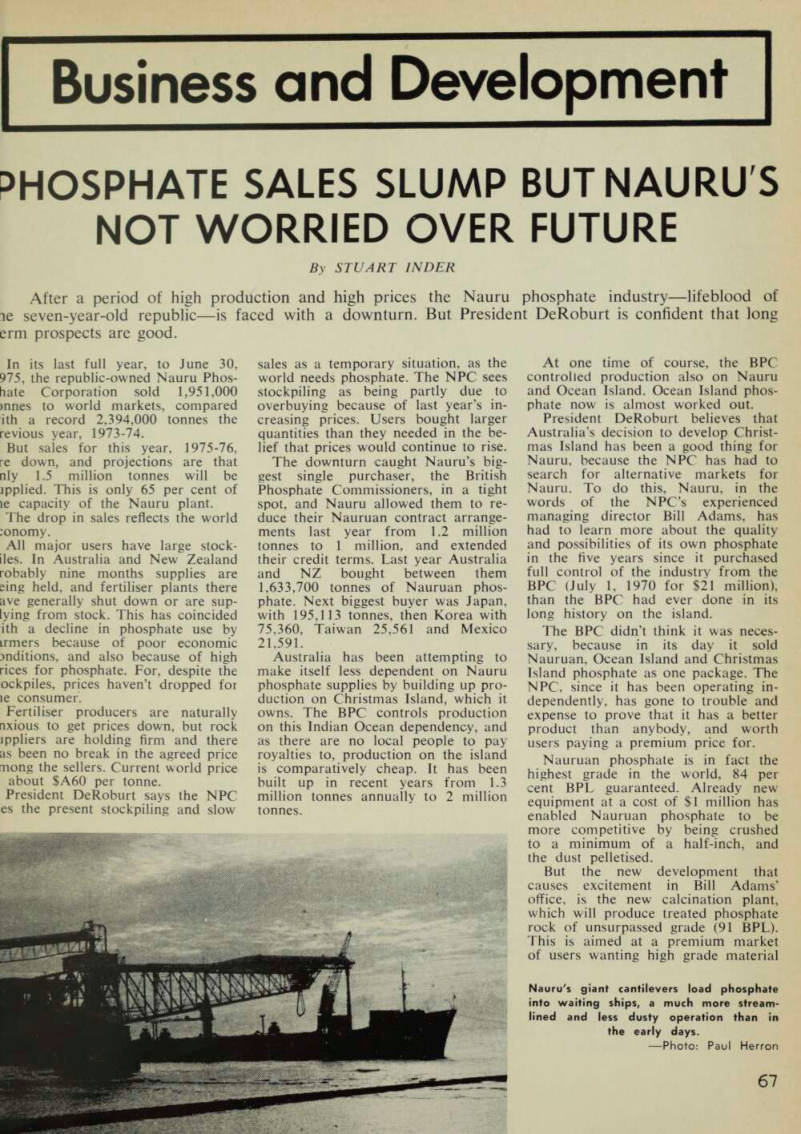

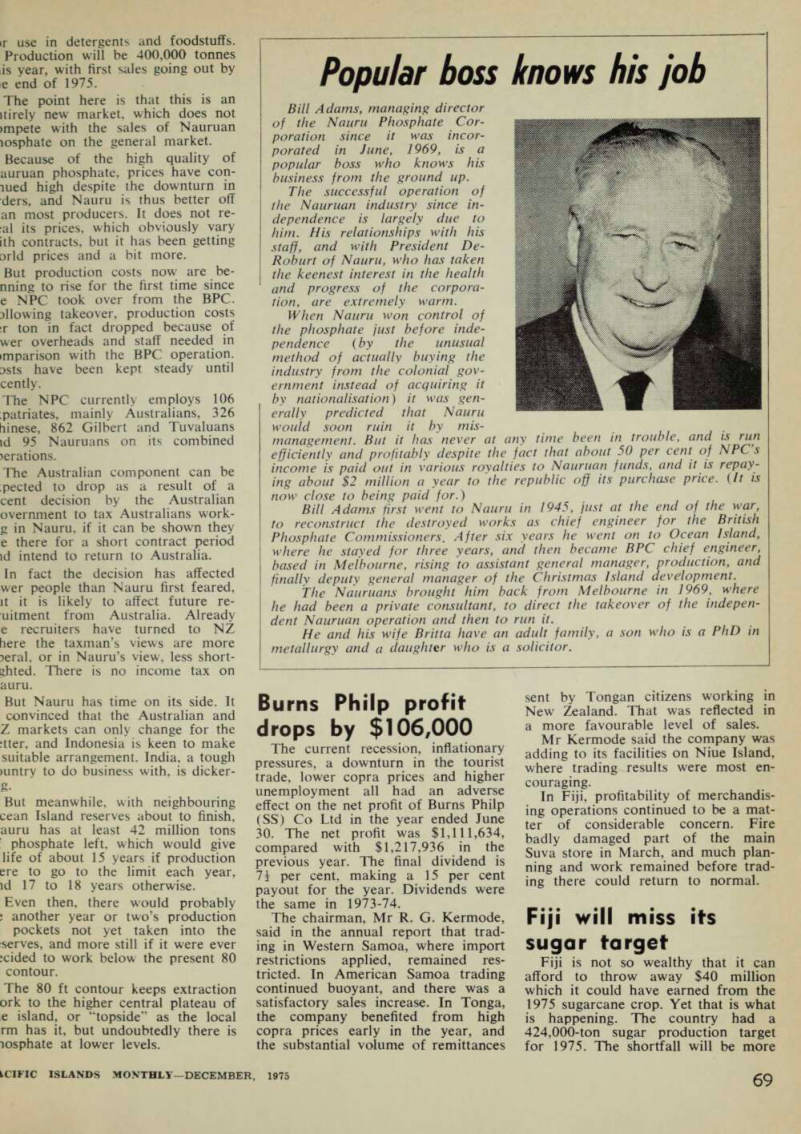
Phosphate Sales Slump But Nauru's
Not Worried Over Future
By Stuart Inder
After a period of high production and high prices the Nauru phosphate industry—lifeblood of ic seven-year-old republic—is faced with a downturn. But President Deßoburt is confident that long erm prospects are good.
In its last full year, to June 30, 975, the republic-owned Nauru Phoshate Corporation sold 1,951,000 mnes to world markets, compared ith a record 2,394,000 tonnes the revious year, 1973-74.
But sales for this year, 1975-76, re down, and projections are that nly 1.5 million tonnes will be ipplied. This is only 65 per cent of ie capacity of the Nauru plant.
The drop in sales reflects the world ;onomy.
All major users have large stockiles. In Australia and New Zealand robably nine months supplies are eing held, and fertiliser plants there ave generally shut down or are suplying from stock. This has coincided ith a decline in phosphate use by irmers because of poor economic mditions, and also because of high rices for phosphate. For, despite the ockpiles, prices haven’t dropped for le consumer.
Fertiliser producers are naturally nxious to get prices down, but rock ippliers are holding firm and there as been no break in the agreed price mong the sellers. Current world price about SA6O per tonne.
President Deßoburt says the NPC es the present stockpiling and slow
sales as a temporary situation, as the world needs phosphate. The NPC sees stockpiling as being partly due to overbuying because of last year’s in creasing prices. Users bought larger quantities than they needed in the be lief that prices would continue to rise, The downturn caught Nauru’s big gest single purchaser, the British Phosphate Commissioners, in a tight spot, and Nauru allowed them to re duce their Nauruan contract arrange ments last year from 1.2 million tonnes to 1 million, and extended their credit terms. Last year Australia and NZ bought between them 1,633,700 tonnes of Nauruan phos phate. Next biggest buyer was Japan, with 195,113 tonnes, then Korea with 75,360, Taiwan 25,561 and Mexico 21,591.
Australia has been attempting to make itself less dependent on Nauru phosphate supplies by building up pro duction on Christmas Island, which it owns. The BPC controls production on this Indian Ocean dependency, and as there are no local people to pay royalties to, production on the island is comparatively cheap. It has been built up in recent years from 1.3 million tonnes annually to 2 million tonnes.
At one time of course, the BPC controlled production also on Nauru and Ocean Island. Ocean Island phos phate now is almost worked out.
President Deßoburt believes that Australia’s decision to develop Christ mas Island has been a good thing for Nauru, because the NPC has had to search for alternative markets for Nauru. To do this, Nauru, in the words of the NPC’s experienced managing director Bill Adams, has had to learn more about the quality and possibilities of its own phosphate in the five years since it purchased full control of the industry from the BPC (July 1, 1970 for $2l million), than the BPC had ever done in its long history on the island.
The BPC didn’t think it was neces sary, because in its day it sold Nauruan, Ocean Island and Christmas Island phosphate as one package. The NPC, since it has been operating in dependently, has gone to trouble and expense to prove that it has a better product than anybody, and worth users paying a premium price for, Nauruan phosphate is in fact the highest grade in the world, 84 per cent BPL guaranteed. Already new equipment at a cost of $1 million has enabled Nauruan phosphate to be more competitive by being crushed to a minimum of a half-inch, and the dust pelletised.
But the new development that causes excitement in Bill Adams’ office, is the new calcination plant, which will produce treated phosphate rock of unsurpassed grade (91 BPL).
This is aimed at a premium market of users wanting high grade material
Nauru's giant cantilevers load phosphate into waiting ships, a much more stream lined and less dusty operation than in the early days. —Photo: Paul Herron
ir use in detergents and foodstuffs.
Production will be 400,000 tonnes is year, with first sales going out by e end of 1975.
The point here is that this is an itirely new market, which does not >mpete with the sales of Nauruan losphate on the general market.
Because of the high quality of auruan phosphate, prices have con lued high despite the downturn in ders, and Nauru is thus better off an most producers. It does not re :al its prices, which obviously vary ith contracts, but it has been getting arid prices and a bit more.
But production costs now are be nning to rise for the first time since e NPC took over from the BPC.
?Ilowing takeover, production costs
ir ton in fact dropped because of wer overheads and staff needed in »mparison with the BPC operation, asts have been kept steady until cently.
The NPC currently employs 106 patriates, mainly Australians, 326 tiinese, 862 Gilbert and Tuvaluans id 95 Nauruans on its combined >erations.
The Australian component can be pected to drop as a result of a cent decision by the Australian overnment to tax Australians work g in Nauru, if it can be shown they e there for a short contract period id intend to return to Australia.
In fact the decision has affected wer people than Nauru first feared, it it is likely to affect future re uitment from Australia. Already e recruiters have turned to NZ here the taxman’s views are more >eral, or in Nauru’s view, less short ghted. There is no income tax on auru.
But Nauru has time on its side. It convinced that the Australian and Z markets can only change for the :tter, and Indonesia is keen to make suitable arrangement. India, a tough mntry to do business with, is dicker s' But meanwhile, with neighbouring cean Island reserves about to finish, auru has at least 42 million tons ’ phosphate left, which would give life of about 15 years if production ere to go to the limit each year, id 17 to 18 years otherwise.
Even then, there would probably 5 another year or two’s production pockets not yet taken into the serves, and more still if it were ever ;cided to work below the present 80 contour.
The 80 ft contour keeps extraction ork to the higher central plateau of e island, or “topside” as the local rm has it, but undoubtedly there is losphate at lower levels.
Burns Philp profit
drops by $106,000
The current recession, inflationary pressures, a downturn in the tourist trade, lower copra prices and higher unemployment all had an adverse effect on the net profit of Burns Philp (SS) Co Ltd in the year ended June 30. The net profit was $1,111,634, compared with $1,217,936 in the previous year. The final dividend is lh per cent, making a 15 per cent payout for the year. Dividends were the same in 1973-74.
The chairman, Mr R. G. Kermode, said in the annual report that trad ing in Western Samoa, where import restrictions applied, remained res tricted. In American Samoa trading continued buoyant, and there was a satisfactory sales increase. In Tonga, the company benefited from high copra prices early in the year, and the substantial volume of remittances
sent by Tongan citizens working in New Zealand. That was reflected in a more favourable level of sales.
Mr Kermode said the company was adding to its facilities on Niue Island, where trading results were most en couraging.
In Fiji, profitability of merchandis ing operations continued to be a mat ter of considerable concern. Fire badly damaged part of the main Suva store in March, and much plan ning and work remained before trad ing there could return to normal.
Fiji will miss its
sugar target
Fiji is not so wealthy that it can afford to throw away S4O million which it could have earned from the 1975 sugarcane crop. Yet that is what is happening. The country had a 424,000-ton sugar production target for 1975. The shortfall will be more
than 155,000 tons of raw sugar. And the mills are closing early this year because there is no more cane to crush.
The ball seems to lie squarely in the court of the cane farmers. About 2,000 of them failed to reach their quotas. Many did fill their quotas and would have been happy to grow more cane if it was possible.
Even the record $52 a ton they will get for their cane this year has not proved sufficient incentive to higher production. The chairman of the Fiji Sugar Corporation, Mr A. D.
Leys, said at the annual meeting of the corporation, production for 1975 would probably be the lowest for 13 years.
The salvation of the industry, and with it, the economy of Fiji, lay in greater cane production. The low 1975 production must be a bitter blow to the Prime Minister, Ratu Sir Kamisese Mara, after his 1974 triumph in getting a substantial Com mon Market quota for Fiji. It will be at least another year, and probably two, before Fiji can grow enough cane to meet all commitments, pro vided the weather, farmers, millers and mill workers do the right thing.
There was still some good news though, on the sugar front. The final payment for the 1974 crop of 40.28 c a ton, brought the payout to a record $20.90 a ton for cane. That was double the previous record and should have made the growers smile. And from its smaller crop this year, Fiji will get an extra $l2 a ton for the 170,000 tons it will sell to Britain from the 1975 crop. Britain will pay about $479 a ton, or about! $BO million.
Lobster freezer
for New Caledonia
Among the various plans in recent years to build up a fishing industry in Noumea, the latest project seems the most extensive and ambitious.
This new scheme involves the trap ping of lobsters from the New Heb rides to the Loyalty Islands off the Caledonian mainland, to be frozen at a plant which could be installed at Nouville, in the harbour opposite Noumea.
The project was outlined in Nou mea in October by Mr Michel Niox, acting as adviser to the French com pany, Benichou S.A. Pacifique. If a loading vessel picked up some 72 tonnes of lobster a year from nine points in the New Hebrides and 11 bays in New Caledonia, the catch would be shipped to ponds and freez
ing plant at Nouville.
The output would then be avail able for export to France and Japan.
lydro-electric
:heme for Fiji
Completion of the first stage of a dro-electric power project in cen il Viti Levu in Fiji could see a ?e dream of politicians for many ars come true. The Fiji Govern ;nt has decided to go ahead with ; project, which could cost upwards $7O-$BO million.
The scheme has been recommended New Zealand experts, and the i Electricity Authority will imple ;nt it as soon as possible. The first irk will be in the Monasavu and ;atoka areas. The scheme will en l creating several lakes and build ; big dams. The government hopes start drawing power from the leme by 1980.
rab money for
aledonian nickel?
Arabian investors could be in ested in helping to finance the ig-talked of project to develop kel deposits in northern New ledonia.
According to a Parisian financial tvspaper L’Agence Nouvelle, the mch Government is studying the ssibility of Saudi Arabia joining
in the nickel project by taking a 25 per cent share, the other possible partners being the French Govern ment and the French mining group Pechiney Ugine-Kuhlmann.
Only a short while ago the US AMAX had been mentioned as one in the series of possible foreign part ners to get the project financed.
New air base
for Noumea
The French armed forces in New Caledonia plan to build a new air base at Tontouta, next to the inter national airport, almost an hour’s drive from the capital, Noumea.
Until now the French have oper ated a Fleet Air Arm base at Ton touta. The new Air-Marine base will belong to the Air Force under Com mandant Philippe Moulieras. Its chief function will be to operate the Puma type helicopters which are being gradually introduced to the territory. These helicopters can trans port 20 armed men and their equip ment at a speed of 280 kilometres per hour and land them rapidly at any point in the island.
Construction of the new aircraft parking area, repair hangars and accommodation for the troops is scheduled to begin in December and
be completed by the end of 1976.
When fully operational, the new air base will employ about 120 per sonnel.
A French aviation official flew from Paris in late October to study airport expansion projects in New Caledonia and New Hebrides.
At Tontouta, New Caledonia’s international airport, work is pro gressing to make the runway and parking zone capable of handling jumbos as well as building the new Air Force base.
In the New Hebrides the aviation official, Mr Montmarin, was in terested in the possibility of extend ing the runway at Bauerfield to take DCB aircraft while at Santo it is planned to equip the runway to take Fokker planes.
Relief work
in New Caledonia
A proposal to release an extra SAIO million to employ the jobless in New Caledonia has been made by Governor Eriau.
The funds could be lent from re serves of the CAFAT social services fund, if the Territorial Assembly is prepared to approve such an increase in the island’s borrowing. The SAIO
nillion could be used to create jobs ,nd at the same time build up the nfrastructure outside Noumea.
It is difficult to obtain accurate inemployment figures, due to the sland life-style, but official sources ndicate that the Labour Office in Noumea has this year registered a 0 per cent drop in the number of abs it has filled, compared with 974.
Already dole payments are being nade to the unemployed through the 'AFAT, which imposes a payroll tax f about 25 per cent on employers.
*NG plans to
jrotect kina
Papua New Guinea is to examine leasures for the protection of its iternational money reserves.
The Bank of Papua New Guinea -the country’s central bank—is pre aring policy submissions for govem lent to manage and protect the re erves as they accumulate.
PNG introduced its own currency 1 April, and it will cut loose from utomatic money parity with Aus ralia on December 31.
One immediate source of PNG [iternational reserves is Australian urrency withdrawn from PNG em ulation over the past seven months, nd still being withdrawn. The mount, which has not been dis losed, is being progressively banked n Australia to the credit of the PNG lovernment.
The need to develop policies for he protection of overseas reserves mmediately was given in the 1974-75 eport of the Bank of PNG.
The Finance Minister, Mr Julius Tian, tabled the report in the lational parliament in Port Moresby.
The bank confirmed its commit nent under government policy to de relop a “hard currency” strategy >ased on the PNG kina. It said this vould maintain the value of the kina, md would ensure an adequate level >f international reserves, but an im >ortant requirement was to develop >olicies which would protect the re erves against depletion.
The report said that immediate >rospects for economic growth with n PNG were “not bright”. There vas every reason to believe, how ;ver, that a sound base existed for uture economic growth.
The sound base was provided by leliberate structural changes to the :conomy over the past three years, md by the evidence of “considerable latural resources endowments”.
Development plan
for Pago harbour
A master plan for the use of American Samoa Government property in the harbour area from Faga’alu to Breakers Point is being developed.
The plan, when completed, will make specific recommendations for future development, land use, zoning and transportation.
The plan, financed by a 5U526,000 grant from Housing and Urban De velopment, will go to the governor and the Fono for approval.
Among the projects under con sideration: • An improved and expanded road
system through Fagatogo. The malae will not be affected by the changes. • A pedestrian circulation system and a “greenbell” between the Rain maker Hotel and Pago Park. • Expansion of the port adminis tration facility and building a security system for it. • The carrying out of the park and recreation recommendations in the American Samoa Recreation Area De velopment Plan of 1975. • Preservation of historic sites. • A central bus terminal near the Fagatogo Market. • Expansion of the Marine Re sources facilities and, • Improvements to the water, sewage, solid waste and electrical sys tems.
Advertisements & other items, p. 70 (1 item)
the most important ingredient
y > W i • iMiMiii
% MIW>
SYDNEY N.SM
r: m
OFAUSTBAIM
25 KG NET
iito ? & .. , - i
Ifc aLskl
Kjp ■ ME '%
the most important ingredient
BREAD FLOURS:
CAKE FLOURS:
BISCUIT FLOURS:
SPECIALITY FLOURS:
• MAINTOP—high protein bread flour • ANCHOR—bakers flour • 50/50 MEAL—brown bread • MEDlUM—cake and pastry • SPONGE—sponge cakes • SPECIAL CAKE —madeira and cup cakes • STRONG—cracker biscuits •MEDIUM —Shortbreads • SOFT—sweet biscuits • RYE flour • RYE meal • KIBBLED RYE • SHARPS—roti and chapati flour • 100% STONE GROUND
WHOLEMEAL
GILLESPIE BROS. PTY. LTD.
HEAD OFFICE; BRISBANE OFFICE:
52 UNION ST., PYRMONT, SYDNEY. N.S.W. CABLE ADDRESS; ALBION. BRISBANE, QUEENSLAND. (G.P.O. BOX 2518, SYDNEY, 2001.) "GILLESPIE", (P.O. BOX 8, ALBION, BRISBANE, 4010.
PHONE: 660-4933. SYDNEY AND BRISBANE. PHONE: 6-1121.
Popular boss knows his job
Bill Adams, managing director of the Nauru Phosphate Cor poration since it was incor porated in June, 1969, is a popular boss who knows his business from the ground up.
The successful operation of the Nauruan industry since in dependence is largely due to him. His relationships with his staff, and with President De- Roburt of Nauru, who has taken the keenest interest in the health and progress of the corpora tion, are extremely warm.
When Nauru won control of the phosphate just before inde pendence (by the unusual method of actually buying the industry from the colonial gov ernment instead of acquiring it by nationalisation ) it was gen erally predicted that Nauru
would soon ruin it by mis management. But it has never at any time been in trouble, and is run efficiently and profitably despite the fact that about 50 per cent of NPC s income is paid out in various royalties to Nauruan funds, and it is repay ing about $2 million a year to the republic off its purchase price. (It is now close to being paid for.) Bill Adams first went to Nauru in 1945, just at the end of the war, to reconstruct the destroyed works as chief engineer for the British Phosphate Commissioners. After six years he went on to Ocean Island, where he stayed for three years, and then became BPC chief engineer, based in Melbourne, rising to assistant general manager, production, and finally deputy general manager of the Christmas Island development.
The Nauruans brought him back from Melbourne in 1969, where he had been a private consultant, to direct the takeover of the indepen dent Nauruan operation and then to run it.
He and his wife Britta have an adult family, a son who is a PhD in metallurgy and a daughter who is a solicitor.
Advertisements & other items, pp. 71-75 (3 items)
69
LCIFIC ISLANDS MOVTHLY-DECEMBER, 1975
Travelodge offers
you a whole
sight more in
Australia and
the South Pacific
m i a i mi 9 a Right around the South Pacific you’ll find international standard Travelodge where the sights are ...where the action is.
And that’s where you’ll want to stay-to see the things, do the things you wish without moving too far from your room.
Friendly Travelodge offers the best in accommodation, service, food and value for money.
So book Travelodge. You’ll get a whole sight more. • Australia • New Zealand
• Fiji
• Tahiti • New Caledonia Papua New Guinea • Indonesia
'RAVE/ODCE CARE
RESERVATIONS: for any one of over 70 Travelodges in Australia, Fiji, New Zealand, Papua New Guinea, Tahiti, Japan & Indonesia:- .Australia; Sydney (02) 31.0601: Adelaide (08) 223.6194: Melbourne (03) 387.1233: Perth (092) 25.3811: Brisbane (072) 21.8586: Hobart (002) 34.2911; Canberra (062) 49.1424: Darwin 81.5388. U.K. (London): Trust Houses Forte (01) 567.3444. Japan (Tokyo): Travelodge Branch Office (03) 214.0961. Fiji: Travelodge Reservations, Suva 2.4600. Hong Kong: Travelodge Reservations 522.2251. U.S.A. (Toll Free): Travelodge International Inc. (800) 255.3050.
N.Z. (Auckland): Travelodge Reservations 374.108.
OR YOUR TRAVEL AGENT
TR99/75
Do you want to do business in New Zealand ?
Ask the bank which has
40% of the banking business
in New Zealand
The BNZ can give you full information on buying or selling in New Zealand and overseas. Full information on investment movement of money, transfers of dividends etc., is also readily available.
There are offices everywhere, more than 400 in fact.
Whatever your financial or trade needs, the BNZ can help you.
Wellington-International Division, Box 2392.
Sydney-GPO Box 507, Sydney, N.S.W. 2001.
Melbourne-GPO Box 528 E, Melbourne, Vic. 3001.
Tokyo - Mr G. Scott, Bank of New Zealand Representative Office, Japan. Suite 240, New Tokyo Bldg, 3-1, 3-Chrome, Marunouchi, Chiyoda-ku, Tokyo 100.
Singapore - Mr R. F. Warren, Bank of New Zealand Representative Office, South East Asia. 4th Floor, Ramayana Bldg, 45/47 D, Robinson Rd, Singapore.
London - PO Box 402, London EC4.
Fiji-25 Victoria Parade. Also at Labasa, Lautoka, Nadi, Sigatoka, Ba.
Bank of New Zealand
lb Future Generations,
Security
•WB mm 183^ * Custodian of the past Social welfare is a subject of serious consideration in most modern societies. Man in the twentieth century accepts his responsibility to bequeath to the next generation a society better than his own.
Daiwa Bank is not unique in accepting this responsibility, but Daiwa is unique in making acceptance of this role in society an integral part of their banking service.
Daiwa is the only Japanese city bank to combine banking and trust business. Daiwa is thus a fully integrated banking institution, comprising banking, international financing, trust, pension trust, and real estate business. This integration is part of our effort to fulfil our social responsibility consistent with society's needs in a contemporary environment. a fully integrated banking service
DAIWA BANK
Head Office: Osaka, Japan London and Frankfurt Branches New York and Los Angeles Agencies Singapore, Sydney and Sao Paulo Representative Offices Joint Venture Banks: P.T. Bank Perdania, Jakarta, International Credit Alliance, Ltd., Hong Kong
POWERLITE GENERATORS
a P f
15 YEARS PROVEN SERVICE
THROUGHOUT AUSTRALIA
PORTABLE or
STATIONARY
We offer you a choice of AIR or WATER cooled Power units.
DIESEL or PETROL driven by the engine of your choice.
BRUSHLESS or SLIP RING ALTERNATORS made to any requirement or specification in either — Manual, Automatic, Electric and Start-A-Matic.
A full range available from:
1 KVA THROUGH TO 500 KVA
Service and parts readily available.
POWERLITE PTY. LTD.
23A Gordon St., Chipping Norton, N.S.W., 2170, Australia.
Phone: 727-0077. Telex: 24893.
KINGSTON J SO DIESEL
IDEAL ISLAND TRANSPORT-WORKBOAT-FISHING BOAT
YANMAR POWER 8 H.P.
12 H.P. - 24 H.P.
for seagoing reliability and economy.
Distributed by: Western Fuelpump and Injector Services Pty. Ltd.
225-227 VICTORIA ROAD, RYDALMERE, AUST.
Telephone 638 6100 (5 lines) Cables: "Wesfuel'
DEALER ENQUIRIES WELCOME
UNION STEAM SHIP CO. of N.Z.
LIMITED
Serving the Pacific for nearly 100 years.
Regular Sailings by Modern Vessels
From Auckland to Lautoka, Suva, Pago Pago, Apia, Niue, Vavau, Nukualofa. Also from Tauranga to Lautoka, Suva, Apia, Nukualofa. Regular sailings from Australia to New Zealand to enable transhipment of cargo to all the above ports.
Ship your cargo by a Union Company Vessel.
BRANCHES AT ALL MAIN AUSTRALIAN, NEW ZEALAND AND ISLAND PORTS.
71
IFIC ISLANDS MONTHLY—DECEMBER, 1975
Produce Prices
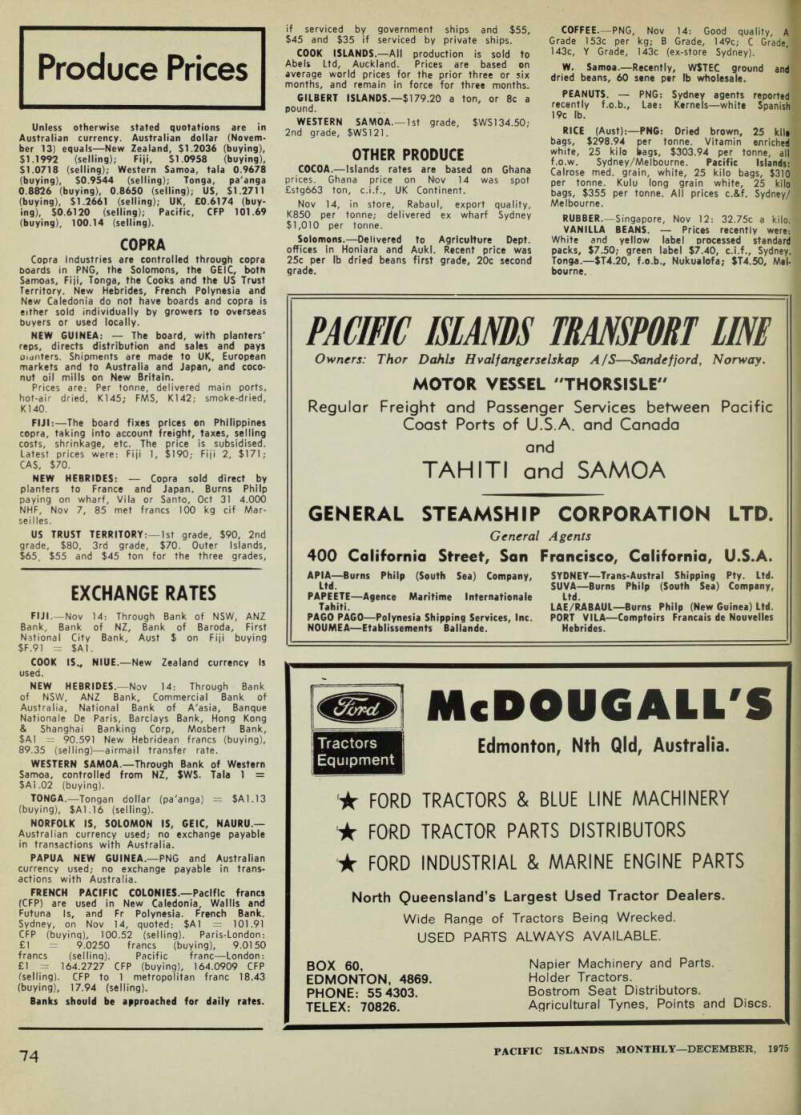
Unless otherwise stated quotations are in Australian currency. Australian dollar (Novem ber 13) equals—New Zealand, $1.2036 (buying), $1.1992 (selling); Fiji, $1.0958 (buying), $1.0718 (selling); Western Samoa, tala 0.9678 (buying), $0.9544 (selling); Tonga, pa'anga 0.8826 (buying), 0.8650 (selling); US, $1.2711 (buying), $1.2661 (selling); UK, £0.6174 (buy ing), $0.6120 (selling); Pacific, CFP 101.69 (buying), 100.14 (selling).
Copra
Copra industries are controlled through copra boards in PNG, the Solomons, the GEIC, both Samoas, Fiji, Tonga, the Cooks and the US Trust Territory. New Hebrides, French Polynesia and New Caledonia do not have boards and copra is either sold individually by growers to overseas buyers or used locally.
NEW GUINEA: The board, with planters' reps, directs distribution and sales and pays Planters. Shipments are made to UK, European markets and to Australia and Japan, and coco nut oil mills on New Britain.
Prices are: Per tonne, delivered main ports, hot-air dried, K 145; FMS, K 142; smoke-dried,
Kuo.
FIJI: —The board fixes prices on Philippines copra, taking into account freight, taxes, selling costs, shrinkage, etc. The price is subsidised.
Latest prices were: Fiji 1, $190; Fiji 2, $171;
Cas, $7O.
NEW HEBRIDES; Copra sold direct by planters to France and Japan. Burns Philp paying on wharf, Vila or Santo, Oct 31 4.000 NHF, Nov 7, 85 met francs 100 kg cif Mar seilles.
US TRUST TERRITORY:—Ist grade, $9O, 2nd grade, $BO, 3rd grade, $7O. Outer Islands, $65, $55 and $45 ton for the three grades.
if serviced by government ships and $55, $45 and $35 if serviced by private ships.
COOK ISLANDS.—AII production is sold to Abels Ltd, Auckland. Prices are based on average world prices for the prior three or six months, and remain in force for three months.
GILBERT ISLANDS.—SI79.2O a ton, or 8c a pound.
WESTERN SAMOA.—Ist grade, $W5134.50; 2nd grade, SWSI2I.
Other Produce
COCOA.—lslands rates are based on Ghana prices. Ghana price on Nov 14 was spot £stg663 ton, c.i.f., UK Continent.
Nov 14, in store, Rabaul, export quality, KB5O per tonne; delivered ex wharf Sydney $l,OlO per tonne.
Solomons.—Delivered to Agriculture Dept, offices in Honiara and Aukl. Recent price was 25c per lb dried beans first grade, 20c second grade.
COFFEE.—PNG, Nov 14: Good quality, A Grade 153 c per kg; B Grade, 149 c; C Grade 143 c, Y Grade, 143 c (ex-store Sydney).
W. Samoa.—Recently, WSTEC ground and dried beans, 60 sene per lb wholesale.
PEANUTS. PNG: Sydney agents reported recently f.0.b., Lae: Kernels—white Spanish 19c lb.
RICE (Aust): —PNG: Dried brown, 25 klle bags, $298.94 per tonne. Vitamin enriched white, 25 kilo bags, $303.94 per tonne, all f.o.w. Sydney/Melbourne. Pacific Islands; Calrose med. grain, white, 25 kilo bags, $3lO per tonne. Kulu long grain white, 25 kilo bags, $355 per tonne. All prices c.&f. Sydney/ Melbourne.
RUBBER.—Singapore, Nov 12: 32.75 c a kilo.
VANILLA BEANS. Prices recently were: White and yellow label processed standard packs, $7.50; green label $7.40, c.i.f., Sydney.
Tonga—sl4.2o, f.0.b., Nukualofa; $T4.50, Mel bourne.
Exchange Rates
FIJI.—Nov 14; Through Bank of NSW, ANZ Bank, Bank of NZ, Bank of Baroda, First National City Bank, Aust $ on Fiji buying
$F .91 = Sai.
COOK IS„ NIUE.—New Zealand currency Is used.
NEW HEBRIDES.—Nov 14: Through Bank of NSW, ANZ Bank, Commercial Bank of Australia, National Bank of A'asia, Banque Nationale De Paris, Barclays Bank, Hong Kong & Shanghai Banking Corp, Mosbert Bank, SAI = 90.591 New Hebridean francs (buying), 89.35 (selling)—airmail transfer rate.
WESTERN SAMOA.—Through Bank of Western Samoa, controlled from NZ, SWS. Tala 1 = $A1.02 (buying).
TONGA.—Tongan dollar (pa'anga) = $A 1.13 (buying), $A1.16 (selling).
Norfolk Is, Solomon Is, Geic, Nauru
Australian currency used; no exchange payable in transactions with Australia.
PAPUA NEW GUINEA.—PNG and Australian currency used; no exchange payable in trans actions with Australia, FRENCH PACIFIC COLONIES.—Pacific francs (CFP) are used in New Caledonia, Wallis and Futuna Is, and Fr Polynesia. French Bank.
Sydney, on Nov 14, quoted: SAI = 101.91 CFP (buying), 100.52 (selling). Paris-London: £1 = 9.0250 francs (buying), 9.0150 francs (selling). Pacific franc—London: £1 = 164.2727 CFP (buying), 164.0909 CFP (selling). CFP to 1 metropolitan franc 18.43 (buying), 17.94 (selling).
Banks should be approached for daily rates.
Advertisements & other items, pp. 76-78 (1 item)
Mcdougall's
PACIFIC ISLANDS TRANSPORT LINE
Owners: Thor Dahls Hvalfangerselskap A/S — Sandefjord, Norway.
MOTOR VESSEL "THORSISLE"
Regular Freight and Passenger Services between Pacific Coast Ports of U.S.A. and Canada and
TAHITI and SAMOA
GENERAL STEAMSHIP CORPORATION LTD.
General Agents 400 California Street, San Francisco, California, U.S.A.
APIA —Burns Philp (South Sea) Company, SYDNEY—Trans-Austral Shipping Pty. Ltd.
Ltd. SUVA—Burns Philp (South Sea) Company, PAPEETE—Agence Maritime Internationale Ltd.
Tahiti. LAE/RABAUL —Burns Philp (New Guinea) Ltd.
PAGO PAGO—Polynesia Shipping Services, Inc. PORT VILA —Comptoirs Francais de Nouvelles NOUMEA —Etablissements Ballande. Hebrides.
McDOUGALL'S
Edmonton, Nth Qld, Australia.
★ FORD TRACTORS & BLUE LINE MACHINERY
★ FORD TRACTOR PARTS DISTRIBUTORS
★ FORD INDUSTRIAL & MARINE ENGINE PARTS North Queensland’s Largest Used Tractor Dealers.
Wide Range of Tractors Being Wrecked.
USED PARTS ALWAYS AVAILABLE.
BOX 60, Napier Machinery and Parts.
EDMONTON, 4869. Holder Tractors.
PHONE: 55 4303. Bostrom Seat Distributors.
TELEX: 70826. Agricultural Tynes, Points and Discs.
' A m
Make your
bread-
biscuits
L fj
A f>r r *
with
BUNGE
mdtS&y. 1 «
MATCHLESS
30 piece Semi Automatic Bun Divider Moulder Machine.
BEST AUSTRALIAN
WHEATEN FLOUR
Packed in 25 kg & 50 kg bags.
Regular shipments arranged.
We supply Bakery Machinery and Ovens.
BUNGE (AUSTRALIA)
PROPRIETARY LIMITED (INCORPORATED IN VICTORA)
POSTAL ADDRESS: G.P.O. Box 2705, Sydney, 2001
ROYAL EXCHANGE BUILDING
56 PITT STREET SYDNEY, 2000
Cables—Telegrams: "Bungeco". Telephones 27-3543 (6 lines). Telex 20517
DEMKA (AUSTRALIA)
PTY. LIMITED
184 Sussex St. (3rd floor) Sydney, NSW 2000 Australia
Represents manufacturers
exporting to the
SOUTH PACIFIC
HARDBOILED SWEETS
BUILDING MATERIALS
HOUSEHOLD LAMPS
CANNED FOODSTUFFS
AUTOMOTIVE PARTS
TRAVELGOODS
AUTOMOTIVE LAMPS
TEXTILES
CLOTHES PEGS
MOTOR VEHICLES
ELECTRICAL TOOLS
LPG STOVES
DISH WASHERS
CANNED SOFT DRINKS
AIR COMPRESSORS
CHOCOLATES
SHOCK ABSORBERS
STATIONERY
WRAPPING PAPERS
SCOTCH WHISKY
BUILDERS’ TOOLS
LADIES’ DRESS MATERIALS
PRESSURE LAMPS & STOVES
DO ASK FOR QUOTATIONS WITHOUT ANY OBLIGATION TO BUY
SURFACE
PROTECTION
FOR • CLEANING, DEGREASING • STRIPPING
• DESCALING, DERUSTING • PHOSPHATING • RUST CONVERSION • RUST PRIMERS AND ENAMELS • LONG LIFE CLADDING • WATERPROOF MEMBRANES • DUCT AND JOINT SEALERS • CHEM. RESISTANT COATINGS • MARINE FINISHES • CLEANING PROTECTION OF
BUILDINGS.
Manufactured by:
EMERY CHEMICALS PTY LTD
64 Mary Street, St. Peters, N.S.W. 2044.
Phone; 51-5644, 519-4550, 519-4561.
Licencees: PGH INDUSTRIES (N.Z.) LTD. P.O. Box 13-231, Auckland 6, N.Z.
Shipping & Airways Information
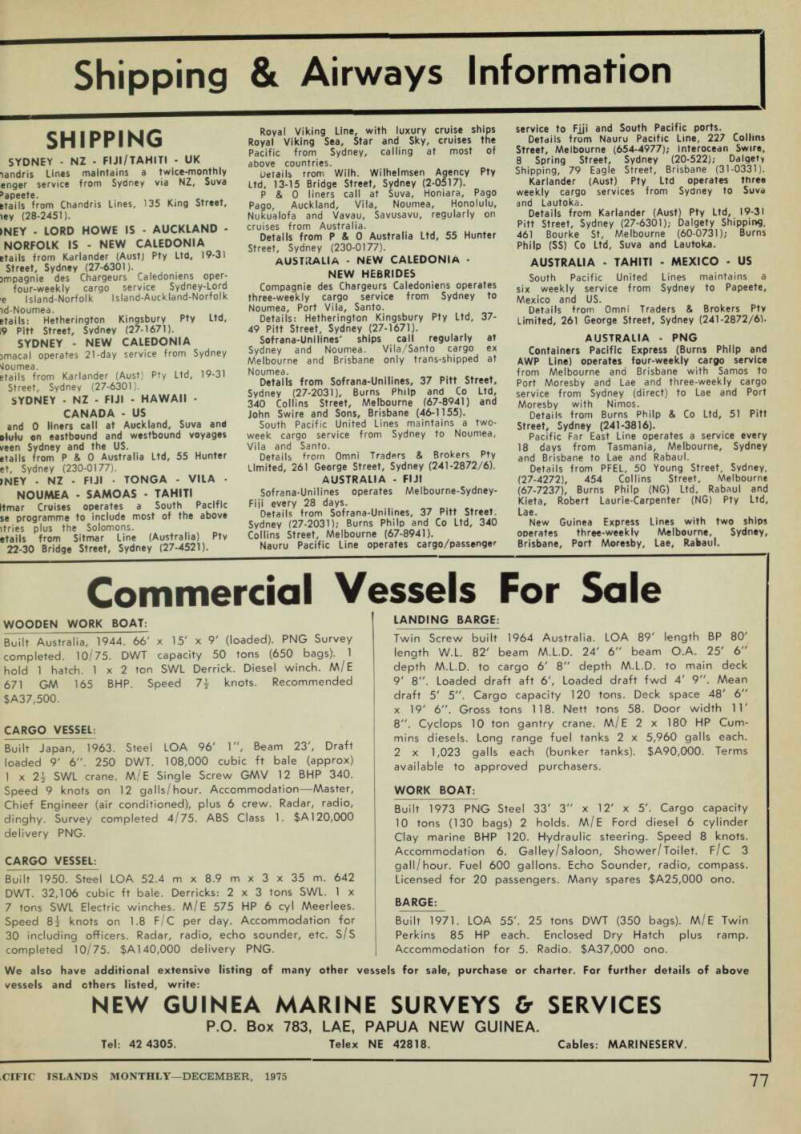
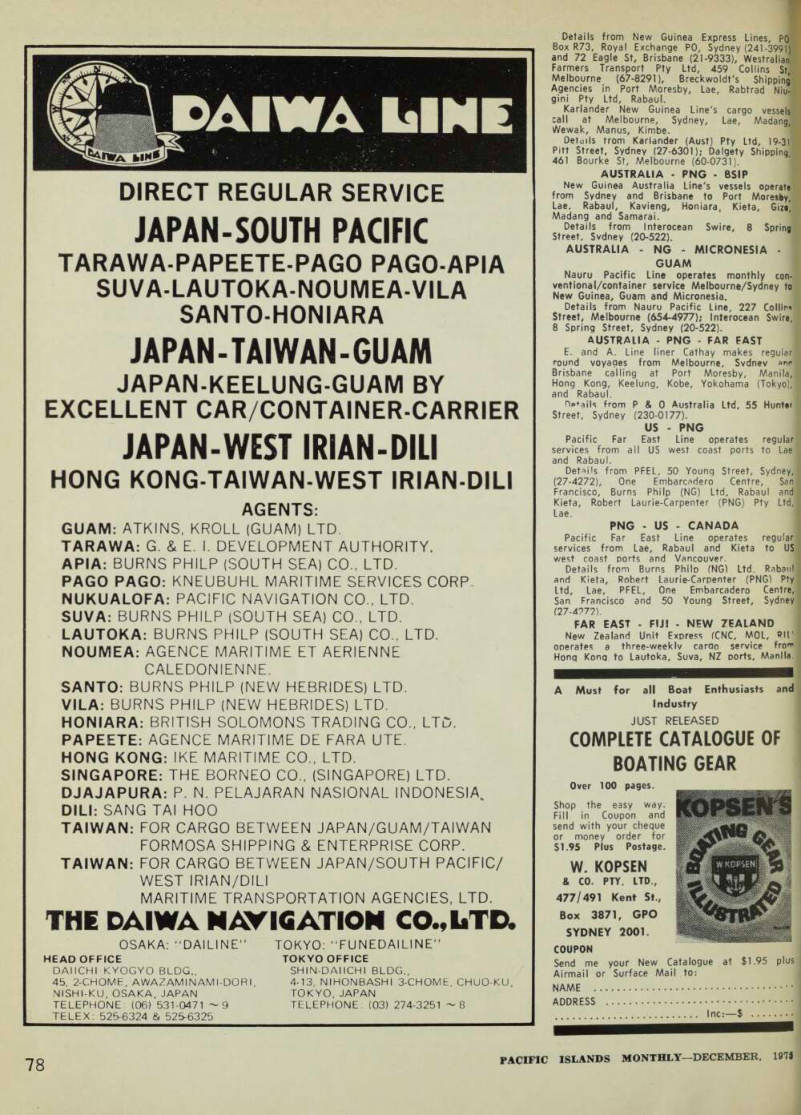
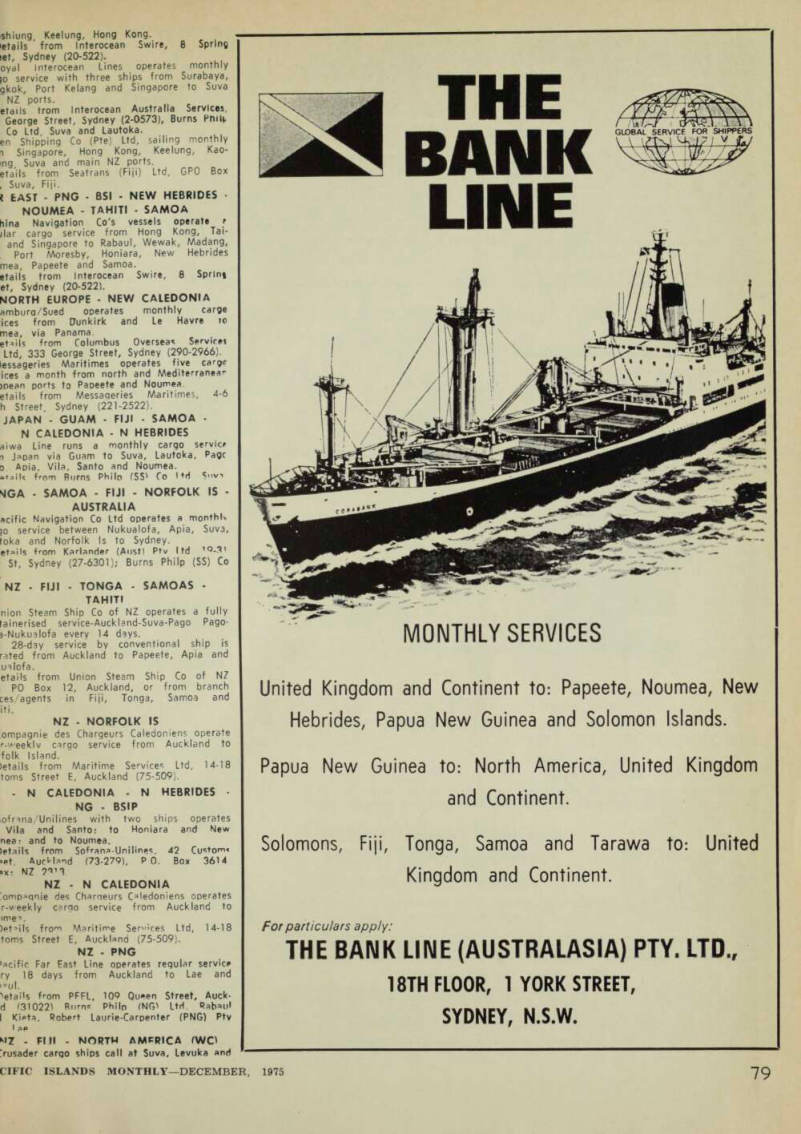
Shipping
SYDNEY - NZ - FUI/TAHITI - UK landris Lines maintains a twice-monthly enger service from Sydney via NZ, Suva »apeete. stalls from Chandris Lines, 135 King Street, ley (28-2451). )NEY ■ LORD HOWE IS • AUCKLAND -
Norfolk Is - New Caledonia
stalls from Karlander (Aust) Pty Ltd, 19-31 Street, Sydney (27-6301). jmpagnie des Chargeurs Caledomens oper four-weekly cargo service Sydney-Lord e Island-Norfolk Island-Auckland-Norfolk id-Noumea. stalls: Hetherington Kingsbury Pty Ltd, 19 Pitt Street, Sydney (27-1671).
Sydney - New Caledonia
jmacal operates 21-day service from Sydney Noumea. , etails from Karlander (Aust) Pty Ltd, 19-31 Street, Sydney (27-6301).
SYDNEY - NZ - FIJI - HAWAII -
Canada - Us
and 0 liners call at Auckland, Suva and elulu on eastbound and westbound voyages veen Sydney and the US. etails from P & 0 Australia Ltd, 55 Hunter et, Sydney (230-0177). >NEY - NZ - FIJI - TONGA - VILA •
Noumea - Samoas • Tahiti
Itmar Cruises operates a South Pacific se programme to include most of the above itries plus the Solomons, etails from Sitmar Line (Australia) Pty 22-30 Bridge Street, Sydney (27-4521).
Royal Viking Line, with luxury cruise ships Royal Viking Sea, Star and Sky, cruises the Pacific from Sydney, calling at most of above count ries. ueJails from Wilh. Wilhelmsen Agency Pty Ltd, 13-15 Bridge Street, Sydney (2-0517).
P & 0 liners call at Suva, Honiara, Pago Pago Auckland, Vila, Noumea, Honolulu, Nukualofa and Vavau, Savusavu, regularly on cruises from Austrelie. from p & 0 Australia Ltd, 55 Hunter Street, Sydney (230-0177).
Australia - New Caledonia -
New Hebrides
Compagnie des Chargeurs Caledoniens operates three-weekly cargo service from Sydney to Noumea, Port Vila, Santo.
Details: Hetherington Kingsbury Pty Ltd, 37- 49 Pitt Street, Sydney (27-1671).
Sofrana-Unilines' ships call regularly at Sydney and Noumea. Vila/Santo cargo ex and Brisbane on)y trans-shipped at Noumea. .
Details from Sofrana-Unilines, 37 Pitt Street, Sydney (27-2031), Burns Philp and Co Ltd, 340 Co||jns Street> Melbourne (67-8941) and John Swire and Sons, Brisbane (46-1155).
South Pacific United Lines maintains a twoweek cargo service from Sydney to Noumea, Vila and Santo.
Details from Omni Traders & Brokers Pty Limited, 261 George Street, Sydney (241-2872/6).
Australia - Fiji
Sofrana-Unilines operates Melbourne-Sydney- Fiji every 28 days.
Details from Sofrana-Unilines, 37 Pitt Street.
Sydney (27-2031); Burns Philp and Co Ltd, 340 Collins Street, Melbourne (67-8941).
Nauru Pacific Line operates cargo/passenger
service to Fiji and South Pacific ports.
Details from Nauru Pacific Line, 227 Collins Street, Melbourne (654-4977); Interocean Swire, 8 Spring Street Sydney (?°- 5 22); Dalge’y Shipping, 79 Eagle Street, Brisbane (31-0331).
Karlander (Aust) Pty Ltd operates three weekly cargo services from Sydney to Suva and Lautoka.
Details from Karlander (Aust) Pty Ltd, 19-31 Pitt Street, Sydney (27-6301); Delgety Shipping, 461 Bourke St, Melbourne (60-0731); Burns Philp (SS) Co Ltd, Suva and Lautoka.
AUSTRALIA - TAHITI - MEXICO - US South Pacific United Lines maintains a s j x wee k|y service from Sydney to Papeete, Mexico and US.
Details from Omni Traders & Brokers Pty Limit ed, 261 George Street, Sydney (241-2872/6).
Australia • Png
Containers Pacific Express (Burns Philp and AWP Line) operates four-weekly cargo service from Melbourne and Brisbane with Samos to Port Moresby and Lae and three-weekly cargo service from Sydney (direct) to Lae and Port Moresby with Nimos.
Details from Burns Philp & Co Ltd, 51 Pitt street, Sydney (241-3816).
Pacific Far East Line operates a service every 18 days from Tasmania, Melbourne, Sydney and Brisbane to Lae and Rabaul.
Details from PFEL, 50 Young Street, Sydney. (27-4272), 454 Collins Street, Melbourne (67-7237), Burns Philp (NG) Ltd, Rabaul and Kieta, Robert Laurie-Carpenter (NG) Pty Ltd, Lae.
New Guinea Express Lines with two ships operates three-weekly Melbourne Sydney, Brisbane, Port Moresby, Lae, Rabaul.
Details from New Guinea Express Lines, PO Box R 73, Royal Exchange PO, Sydney (241-3991) and 72 Eagle St, Brisbane (21-9333), Westralian Farmers Transport Pty Ltd, 459 Collins St, Melbourne (67-8291), Breckwoldt's Shipping Agencies in Port Moresby, Lae, Rabtrad Niu gini Pty Ltd, Rabaul.
Karlander New Guinea Line's cargo vessels call at Melbourne, Sydney, Lae, Madang, Wewak, Manus, Kimbe.
Details trom Karlander (Aust) Pty Ltd, 19-3) Pitt Street, Sydney (27-6301); Dalgety Shipping 461 Bourke St, Melbourne (60-0731).
Australia - Png - Bsip
New Guinea Australia Line's vessels operate from Sydney and Brisbane to Port Moresby, Lae, Rabaul, Kavieng, Honiara. Kieta, Gizo, Madang and Samarai.
Details from Interocean Swire, 8 Spring Street, Svdney (20-522).
Australia - Ng ■ Micronesia ■
Guam
Nauru Pacific Line operates monthly con ventional/container service Melbourne/Sydney to New Guinea, Guam and Micronesia.
Details from Nauru Pacific Line, 227 Collin' Street, Melbourne (654-4977); Interocean Swire, 8 Spring Street. Sydney (20-522).
Australia - Png - Far Fast
E. and A. Line liner Cathay makes regular round voyages from Melbourne, Svdnev and Brisbane calling at Port Moresby, Manila, Hong Kong, Keelung, Kobe, Yokohama (Tokyo), and Rabaul.
Derails from P & 0 Australia Ltd, 55 Hunter Street, Sydney (230-0177).
Us - Png
Pacific Far East Line operates regular services from all US west coast ports to Lae and Rabaul.
Details from PFEL, 50 Young Street, Sydney, (27-4272), One Embarcadero Centre, San Francisco, Burns Philp (NG) Ltd, Rabaul and Kieta, Robert Laurie-Carpenter (PNG) Pty Ltd, Lae.
Png - Us - Canada
Pacific Far East Line operates regular services from Lae, Rabaul and Kieta to US west coast ports and Vancouver.
Details from Burns Philo (NG) Ltd. Rabaul and Kieta, Robert Laurie-Carpenter (PNG) Pty Ltd, Lae, PFEL, One Embarcadero Centre, San Francisco and 50 Young Street, Sydney (27-4972).
FAR EAST - FIJI - NEW ZEALAND New Zealand Unit Express (CNC, MOL, RIP operates a three-week Iv caroo service from Honq Konq to Lautoka, Suva, NZ ports, Manila,
shiung, Keelung, Hong Kong. letails from Interocean Swire, 8 Spring iet, Sydney (20-522). oyal Interocean Lines operates monthly 10 service with three ships from Surabaya, gkok. Port Kelang and Singapore to Suva NZ ports. etails trom Interocean Australia Services, George Street, Sydney (2-0573), Burns PhiU.
Co Ltd Suva and Lautoka. en Shipping Co (Pte) Ltd, sailing monthly i Singapore, Hong Kong, Keelung, Kao mg Suva and main NZ ports, etails from Seatrans (Fiji) Ltd, GPO Box , Suva, Fiji.
I EAST - PNG ■ BSI - NEW HEBRIDES
Noumea ■ Tahiti - Samoa
hlna Navigation Co's vessels operate r liar cargo service from Hong Kong, Tai and Singapore to Rabaul, Wewak, Madang, Port Moresby, Honiara, New Hebrides mea, Papeete and Samoa, etails trom Interocean Swire, 8 Sprint et, Sydney (20-522).
North Europe - New Caledonia
amburq/Sued operates monthly carge ices from Dunkirk and Le Havre to mea, via Panama. etails from Columbus Overseas Service* Ltd, 333 George Street, Sydney (290-2966). lessageries Maritimes operates five tariff ices a month from north and Mediterranean mean ports to Papeete and Noumea, etails from Messaqeries Maritimes, 4-6 h Street, Sydney (221-2522).
JAPAN - GUAM - FIJI - SAMOA •
N Caledonia - N Hebrides
aiwa Line runs a monthly cargo service n Japan via Guam to Suva, Lautoka, Page o, Apia, Vila, Santo and Noumea, otaile from Burns Philo (SS' Co Itd Suva SIGA - SAMOA - FIJI - NORFOLK IS -
Australia
acific Navigation Co Ltd operates a monthK jo service between Nukualofa, Apia, Suva, (oka and Norfolk Is to Sydney, etails from Karlander (Aust) Ptv ltd 10 -3’
St, Sydney (27-6301); Burns Philp (SS) Co NZ • FIJI - TONGA ■ SAMOAS ■
Tahiti
nion Steam Ship Co of NZ operates a fully lainerised service-Auckland-Suva-Pago Pago s-Nukualofa every 14 days. 28-day service by conventional ship is rated from Auckland to Papeete, Apia and ualofa. etails from Union Steam Ship Co of NZ PO Box 12, Auckland, or from branch ces/agents in Fiji, Tonga, Samoa and iti.
Nz • Norfolk Is
ompagnie des Chargeurs Caledoniens operate r-\»'eeklv cargo service from Auckland to folk Island. letails from Maritime Services Ltd, 14-18 toms Street E, Auckland (75-509). - N CALEDONIA - N HEBRIDES •
Ng - Bsip
ofrana/Unilines with two ships operates Vila and Santo: to Honiara and New near and to Noumea. letails from Sofrana-Unilines. 42 Custom* >et, Auckland (73-279), PO. Box 3614 ■x: NZ 7*»'3
Nz - N Caledonia
iompaqnie des Charneurs Caledoniens operates r-weekly cargo service from Auckland to •me’.
Jet’ils from Maritime Sendees Ltd, 14-18 toms Street E, Auckland (75-509).
Nz - Png
•acific Far East Line operates regular service ry 18 days from Auckland to Lae and >’ul. ■'etails from PFFL, 109 Queen Street, Auck d (310221 Rums Philp (NGI Ltd. Rabaul I Kiata, Robert Laurie-Carpenter (PNG) Ptv I ae M 7 - Fill - NORTH AMERICA (WO Crusader cargo ships call at Suva, Levuka and
Honolulu on NZ-US west coast trips and at Suva and/or Lautoka on US-NZ return trips.
Details from Blue Star Port Lines (Manage ment) Ltd, P.O. Box 192, Wellington (739-02 V); Burns Philp (SS) Co Ltd, Suva.
Nz - Fiji
Reef operates a regular 18 day service from Auckland to Suva and Lautoka. oetaus from Reet Shipping Agencies Ltd, P.O. Box 13-315, Onehunga, NZ. (Phone 663- 918, 663-928).
Nz - Tonga
Pacific Navigation Co Ltd operates two ships
Auckland-Lyttelton-Nukualofa-Vavau-Haapai, on
a 14-21-day schedule, and other ports by inducement.
Details from the Northern Steam Ship Co Ltd, 22-24 Quay Street, Auckland (362-730).
Nz - Fiji - Samoa
Pacific Line with one ship operates monthly cargo service. New Zealand, Lautoka, Suva, Apia.
Details: Sofrana-Unilines, 42 Customs Street, Auckland (73-279) PO Box 3614, Telex: NZ 2313.
Nz - Cook Is • Niue
NZ Shipping Corporation, with Toa Moana and Lorena, operates cargo services from Auckland to Rarotonga and Aitutaki (fort
nightly) and Niue (three-weekly).
Details from NZ Shipping Corporation, PO Box 3420, Auckland (33-039); Waterfront Com mission, PO Box 61 Rarotonga, Lighterage and Shipping Co, Aitutaki; Niue Govt Offices, Niue Island.
UK - PANAMA - SAMOA - FIJI The Fiji Direct Service, cargo only, is main tained by Conference vessels, sailing at regular monthly intervals out of London, via Panama, for Apia, Suva and Lautoka.
Details from Burns Philp (SS) Co Ltd, Suva.
UK • PNG - BSIP - GEIC • N HEBRIDES •
N Caledonia
Bank Line operates a monthly direct cargo service from Europe., via the Panama Canal to Papeete, Noumea, Vila, ma|or PNG ports and Honiara, occasionally to Tarawa, Santo, Kieta, Jayapura and Yandina and return.
Details from Bank Line (A'asia) Pty Ltd, 1 York St, Sydney (27-2041); Burns Philp (SS) Co Ltd, Suva.
EUROPE - TAHITI - W SAMOA - FIJI •
N Caledonia
Nedlloyd offers regular cargo services from Northern Europe and UK to Papeete, Apia, Fiji and New Caledonia.
Details: Interocean Aust. Services Pty Ltd, 261 George Street, Sydney (2-0573).
US - A. SAMOA - NZ - AUSTRALIA Pacific Far East Line LASH ships operate regularly from US to Australia, via Pago Pago and Auckland, returning via PNG ports.
Details from PFEL, 50 Young Street, Sydney (27-4272), 454 Collins Street, Melbourne (67-7237), One Embarcadero Centre, San Francisco (576-4000), 109 Queen Street, Auck land (31-022), Kneubuhl Maritime Services, Pago Pago (633-5121).
Us Sydney - Gfic ■ Honolulu
Columbus Line operates a three weekly container cargo sailing from West Coast, US to Australasia, returning via Tarawa, GEIC and Honolulu to Nth America.
Details from Columbus Overseas Services Pty Ltd, 333 George Street, Sydney (290-29661.
Us - Fiji/Tahiti - Australia
Bank Line Ltd operate regular cargo ser vices from US Gulf ports to Australia and NZ.
Calls at Suva, Lautoka and Papeete on demand.
Details from Bank Line (A/asia) Pty Ltd, 1 York St, Sydney (27-2041).
Pacific Far East Line cruise ships operate regularly from San Francisco, Los Angeles, Honolulu, Moorea, Papeete, Rarotonga, Auck land, Opua, Sydney, and return via Suva, Niuafoou, Pago Pago and Honolulu to San Francisco.
Freioht Is carried on these passenger liners.
Pacific Far East Line cellular container vessels operate regularly from North American west coast ports to Australia, via Papeete, returning via Auckland and Pago Pago.
Details from PFEL, 50 Young Street, Sydney (27-4272).
Us - Tahiti - Samoa
Pacific Islands Transport operates a flve/six weekly cargo service from North
American west coast ports to Papeete, Pago Pago, Apia.
Details from Trans-Austral Shipping Pty Ltd 19 Pitt Street. Sydney (27-2441).
Polynesia Line operates container and general cargo service from US west coast ports to Papeete and Pago Pago.
Details from Polynesia Shipping Services IncJ PO Box 1478, Pago Pago (96799).
Advertisements & other items, pp. 79-82 (3 items)
77
CIFIC ISLANDS MONTHLY—DECEMBER, 1975
Commercial Vessels For Sale
WOODEN WORK BOAT:
Built Australia, 1944. 66' x 15' x 9' (loaded). PNG Survey completed. 10/75. DWT capacity 50 tons (650 bags). 1 hold 1 hatch. 1 x 2 ton SWL Derrick. Diesel winch. AA/E 671 GAA 165 BHP. Speed knots. Recommended $A37,500.
CARGO VESSEL:
Built Japan, 1963. Steel LOA 96' 1", Beam 23', Draft loaded 9' 6". 250 DWT. 108,000 cubic ft bale (approx) 1 x SWL crane. AA/E Single Screw GAAV 12 BHP 340.
Speed 9 knots on 12 galls/hour. Accommodation —AAaster, Chief Engineer (air conditioned), plus 6 crew. Radar, radio, dinghy. Survey completed 4/75. ABS Class 1. $A120,000 delivery PNG.
CARGO VESSEL:
Built 1950. Steel LOA 52.4 m x 8.9 m x 3 x 35 m. 642 DWT. 32,106 cubic ft bale. Derricks: 2x3 tons SWL. 1 x 7 tons SWL Electric winches. AA/E 575 HP 6 cyl AAeerlees.
Speed 8i knots on 1.8 F/C per day. Accommodation for 30 including officers. Radar, radio, echo sounder, etc. S/S completed 10/75. $A140,000 delivery PNG.
LANDING BARGE;
Twin Screw built 1964 Australia. LOA 89' length BP 80' length W.L. 82' beam AA.L.D. 24' 6" beam O.A. 25' 6" depth AA.L.D. to cargo 6' 8" depth AA.L.D. to main deck 9' 8". Loaded draft aft 6', Loaded draft fwd 4' 9". AAean draft 5' 5". Cargo capacity 120 tons. Deck space 48' 6" x 19' 6". Gross tons 118. Nett tons 58. Door width 11' 8". Cyclops 10 ton gantry crane. AA/E 2 x 180 HP Cummins diesels. Long range fuel tanks 2 x 5,960 galls each. 2 x 1,023 galls each (bunker tanks). $A90,000. Terms available to approved purchasers.
WORK BOAT:
Built 1973 PNG Steel 33' 3" x 12' x s'. Cargo capacity 10 tons (130 bags) 2 holds. AA/E Ford diesel 6 cylinder Clay marine BHP 120. Hydraulic steering. Speed 8 knots.
Accommodation 6. Galley/Saloon, Shower/Toilet. F/C 3
gall/hour. Fuel 600 gallons. Echo Sounder, radio, compass.
Licensed for 20 passengers. AAany spares $A25,000 ono.
BARGE:
Built 1971. LOA 55'. 25 tons DWT (350 bags). AA/E Twin Perkins 85 HP each. Enclosed Dry Hatch plus ramp.
Accommodation for 5. Radio. $A37,000 ono.
We also have additional extensive listing of many other vessels for sale, purchase or charter. For further details of above vessels and others listed, write:
NEW GUINEA MARINE SURVEYS & SERVICES
P.O. Box 783, LAE, PAPUA NEW GUINEA.
Tel: 42 4305. Telex NE 42818. Cables: AAARINESERV.
DAIWA LINE
DIRECT REGULAR SERVICE
JAPAN-SOUTH PACIFIC
TARAWA-PAPEETE-PAGO PAGO-APIA
SUVA-LAUTOKA-NOUMEA-VILA
SANTO-HONIARA
JAPAN-TAIWAN-GUAM
JAPAN-KEELUNG-GUAM BY
EXCELLENT CAR/CONTAINER-CARRIER
JAPAN-WEST IRIAN-DILI
HONG KONG-TAIWAN-WEST IRIAN-DILI
AGENTS:
GUAM: ATKINS, KROLL (GUAM) LTD.
TARAWA: G. & E. I. DEVELOPMENT AUTHORITY.
APIA: BURNS PHILP (SOUTH SEA) CO.. LTD.
PAGO PAGO: KNEUBUHL MARITIME SERVICES CORP.
NUKUALOFA: PACIFIC NAVIGATION CO., LTD.
SUVA: BURNS PHILP (SOUTH SEA) CO., LTD.
LAUTOKA: BURNS PHILP (SOUTH SEA) CO., LTD.
NOUMEA: AGENCE MARITIME ET AERIENNE
CALEDONIENNE.
SANTO: BURNS PHILP (NEW HEBRIDES) LTD.
VILA: BURNS PHILP (NEW HEBRIDES) LTD.
HONIARA: BRITISH SOLOMONS TRADING CO., LTD.
PAPEETE: AGENCE MARITIME DE FARA UTE.
HONG KONG: IKE MARITIME CO.. LTD.
SINGAPORE: THE BORNEO CO., (SINGAPORE) LTD.
DJAJAPURA: P. N. PELAJARAN NASIONAL INDONESIA,
DILI: SANG TAI HOO
TAIWAN: FOR CARGO BETWEEN JAPAN/GUAM/TAIWAN
FORMOSA SHIPPING & ENTERPRISE CORP.
TAIWAN: FOR CARGO BETWEEN JAPAN/SOUTH PACIFIC/
WEST IRIAN/DILI
MARITIME TRANSPORTATION AGENCIES, LTD.
THE DAIWA NAVIGATION CO.* LTD.
OSAKA: “DAILINE”
HEAD OFFICE
DAIICHI KYOGYO BLDG.,
45, 2-CHOME, AWAZAMINAMI-DORI,
NISHI-KU, OSAKA, JAPAN
TELEPHONE: (06) 531-0471 ~9
TELEX: 525-6324 & 525-6325
TOKYO; “FUNEDAILINE”
TOKYO OFFICE
SHIN-DAIICHI BLDG.,
4-13, NIHONBASHI 3-CHOME, CHUO-KU,
TOKYO, JAPAN
TELEPHONE: (03) 274-3251 ~8
A Must for all Boat Enthusiasts and
Industry
JUST RELEASED
COMPLETE CATALOGUE OF
BOATING GEAR
Over 100 pages.
Shop the easy way.
Fill in Coupon and send with your cheque or money order for $1.95 Plus Postage.
W. KOPSEN
& CO. PTY. LTD.,
477/491 Kent St., Box 3871, GPO
SYDNEY 2001.
COUPON
\ Send me your New Catalogue at $1.95 plus Airmail or Surface Mail to:
NAME
ADDRESS
lnc.—s
THE
BANK
LINE
GLOBAL SERVICE FOR SHIPPERS
1
MONTHLY SERVICES
United Kingdom and Continent to: Papeete, Noumea, New Hebrides, Papua New Guinea and Solomon Islands.
Papua New Guinea to: North America, United Kingdom and Continent.
Solomons, Fiji, Tonga, Samoa and Tarawa to-. United Kingdom and Continent.
For particulars apply:
THE BANK LINE (AUSTRALASIA) PTY. LTD
18TH FLOOR, 1 YORK STREET,
SYDNEY, N.S.W.
GENERATING SETS
by BRAYBON
Capacities available are: Petrol 2 kva-7i kva • Diesel 2 kva-200 kva Write for brochure and prices:
BRAYBON BROS. PTY. LTD.,
2 ROTHWELL AVE., CONCORD WEST,
N.S.W., 2138. Phone: 73-3246.
SOUTHERN PACIFIC INSURANCE
COMPANY (PNG) LIMITED
(INCORPORATED IN PAPUA NEW GUINEA)
HEAD OFFICE: BANK HAUS, CHAMPION PDE. P.O. BOX 136 PORT MORESBY, PAPUA NEW GUINEA. PH. 2623 • FIRE • FIRE AND VOLCANIC ERUPTION • HOUSEHOLD COMPREHENSIVE • MOTOR VEHICLE • COMPULSORY THIRD PARTY • COMPULSORY WORKERS COMPENSATION
MARINE • PUBLIC LIABILITY • BURGLARY
Enquiries are Invited for all classes of insurance from special representatives at: PORT MORESBY: H. A. McKEE, General Manager, Champion Pde., P.O. Box 136, Ph. 2623 or 2075. LAE: R. H. MYER ( Manager for Lae, Central Ave., P.O. Box 758, Ph. 42-4590 or 42-4256. RABAUL: K. J. ARMSTRONG, Manager for Rabaul, Mango Ave., P.O. Box 123, Ph. 92-2417 or 92-2755. 86 ft' &
79
CIFIC ISLANDS MONTHLY—DECEMBER, 1975
Airways
From Australia
Qantas (7075, 7475, DC4)—PNG, Norfolk Is, New Caledonia, Fiji, Tahiti, US, Canada.
PAA (707 s and 747 s) —Fiji, American Samoa,' Hawaii, US.
CP Air (DCS) —Fiji, Hawaii, Canada.
UTA (DCSs and DClOs) —New Caledonia, Fiji!
New Zealand, Tahiti, US.
Air-NZ (DClOs)—New Zealand, Fiji, Hawaii, US.
Air Nauru (F2B) —New Caledonia, Solomon!
Islands, Nauru, Tarawa, Majuro.
Air Niugini (727s)—PNG.
Advance Aviation (from Sydney), North Coast] Airlines (from CofTs Harbour) and Oxley Air-] lines (from Port Macquarie)—Lord Howe Is. 1
From New Zealand
Air-NZ (DCSs, DClOs, F 27) —Fiji, American!
Samoa, Cook Is, Tahiti, Hawaii, US, Nava Caledonia, Norfolk Is.
PAA (707 s) —American Samoa.
UTA (DCS)—Tahiti.
PACIFIC - FAR EAST - S. AMERICA Air Nauru (F2B) —Nauru to Micronesia,] Okinawa, Japan, Taiwan, Kong Kong.
Air France (707 s) —Japan to Tahiti, PeruJ Air Niugini (707 s) —to Manila.
Pacific Is - Aust
Air Pacific (SAC 111) —From Fiji, via New Hebrides or New Caledonia, to Brisbane.
Air Nauru flies to Melbourne.
Air Niugini (727 s and Fokker Friendships;;! to Cairns and Brisbane.
Norfolk Island Airlines (Beechcraft) to; Brisbane.
Pacific Is - Nz
Air Pacific (SACIII) —Fiji-Tonqa-NZ.
Inter-Territory
Lan-Chile (707 s) —Easter Is, Tahiti, Fiji.
Air Pacific (BACIII and HS74Bs)—Fiji to GEIC, Nauru, Western Samoa, Tonga, New Heb rides, Solomon Islands, New Caledonia, PNG.
Fiji Air Services —Wallis and Futuna (charter).
Qantas (707 s) —PNG to Singapore.
PAA (707 s) —Hawaii to Am. Samoa and Tahiti, US UTA (7075, Caravelles) from New Caledonia] to Fiji, New Hebrides, Wallis Is, Tahiti.
Continental-Air Micronesia (7275) from!
Hawaii to Micronesia.
Air Nauru from Nauru to Tarawa, Marshal?
Is, Wallis Is and Western Samoa.
Polynesian Airlines from Apia to Tonga,) Niue Is, Fiji, Am. Samoa.
South Pacific Island Airways flies between American and Western Samoa.
Air Tahiti from Tahiti to Cook Is.
Air Niugini to Irian/Jaya, Solomon Is.
Norfolk Island Airlines (Beechcraft) to Noumea.
Internal
Fiji —Air Pacific (HS74Bs and Trislandersl,, Fiji Air Services (Beech Barons and Islanders).
French Polynesia —Air Polynesie (Fokker Friendships), Air Tahiti.
US Trust Territory and Guam —Continental-] Air Micronesia (7275) and Air Pacific Interna tional Inc.
GEIC —Air Pacific.
PNG—Air Niugini, Aerial Tours, Talair,) Melanesian Airlines, Crowley Airways.
Bougainville—Bougainville Air Services.
New Caledonia —Air Caledinie (Twin Otters).
New Hebrides —Air Melanesiae (Islanders). j Solomon Is—Solair (Beech Barons and 1 Islanders).
Tonga—Tonga Internal Air Service (Islanders,.
Cook Is—Cook Island Airways (Islander).
Norfolk Island Airlines (Beechcraft) —Norfolk Is-Lord Howe Is.
Islands People
Deaths of Islands People
Mr Faalavaau Galu Mr Faalavaau Galu, once secretary the Mau movement in Western noa, and then a politician for 26 irs, died on October 29, aged 73. lile he was associated with the iu he offered himself many times punishment by the New Zealand horities in place of older people 0 were to be imprisoned.
Hie went into politics in 1939, and s in the Legislative Council till 16. He then worked for the Union am Ship Co of NZ Ltd for eight irs. Resuming his political career, made steady advance, becoming nister of Post Office and Radio in )9, and holding that portfolio for years. He retired from politics in 12. In his younger days he played :ket and football, with some dis :tion.
Mr Galu left a widow, and four )pted daughters. r • i Mr A. G. T. Carver Mr Anthony George Thackeray rver, known as Tim to his many ;nds, and who spent 27 years in 1 with the CSR Co Ltd, died in iney recently. He joined the com ly in 1915, and the same year en ed in the Ist AIF, serving as a mer in Egypt and France and ris to commissioned rank.
He was transferred to Fiji in 1920, 1 served as field officer on many tors at Rarawai and Lautoka mills. played an active part in the all portant and successful transition m cane estates to production by lividual farmers, and later became d superintendent at Lautoka and rawai, before being appointed inager of Penang mill in 1941.
He moved to Sydney in 1944 as listant Fiji inspector. He became i inspector in 1947. For the last s years, before his retirement in 57, he was a senior executive icer and a member of CSR’s five in general management group at it time.
Mr Jaswant Singh Mr Jaswant Singh, president of the i Kisan Sangh (the biggest union cane-growers in Fiji) died in Aus lia on October 15, aged 56. He had ;n in Australia twice for medical atment. Mr Singh had worked for ; sangh since 1938, and became
president in 1974. He took an active interest in public affairs, and made one unsuccessful attempt to win a seat in the House of Representatives, He leaves a widow, five daughters and three sons. d v « Bro i\evm rooie Marist Brother Kevin Foote, who helped to develop and run two Catholie Mission estates in Taveuni, Fiji, died recently, aged 59. He was born in New Zealand and volunteered for mission service in Fiji in 1959. He was an expert in farming and marketing, and put these skills to good use.
Staff of the Agriculture Department often sought his advice, In 1969, he was appointed to help establish the Marist training centre in Taveuni, when the Marist Society transferred its Island brothers training centre from Hunters Hill, Sydney, to that island. In co-operation with the Fiji Government, he helped to set up a rural education for the people of Cakaudrove. At the time of his death he was co-chairman of the Taveuni Local Rural Authority. He was secre tary of the Fiji Copra Producers Association for several years and was also active in organising sport in Taveuni.
Advertisements & other items, pp. 83-88 (3 items)
81
CIFIC ISLANDS MONTHLY—DECEMBER, 1975
For Sale
s
THROUGHOUT THE PACIFIC
Single hand control
T£R*4Bl OUTBOARD MOTOR
And look at some of the
outstanding features . . .
Needle Roller Bearings throughout—Heavy Duty Crankshaft and Mair Bearings—Loop Scavenging. Stainless Steel and Non Ferrous Metal on all water contact parts.
The Quality is The Best! Spare Parts amongst the Cheapest!
HUNDREDS OF OTHER FINE POINTS ON THIS REALLY
MODERN TERHI OUTBOARD MOTOR FROM FINLAND.
The full range available ex stock.
Pacific data
19 Carrington Rd. ( Marrickville, N.S.W. 2204 Australia.
CABLES: "DIESELTECH” SYDNEY. TELEX: AA 25568.
FOR SALE
STEEL COASTAL VESSEL
M.V. "PAPUAN EXPLORER"
BUILT SINGAPORE 1968
136 Ft. Overall Loaded Draft 6’. 305 Tons Gross: With Two Hatches For’d and 8 Ton Kato Crane Amidships. Powered by Perkins 6 Cylinder Diesel.
Main Propulsion 2 Cat Marine Diesels D.333'5. Auxiliaries are Lister 2 Cylinder Aircooled Diesel and Manchang 2 Cylinder Water Cooled Diesel with Gen. Sets.
This Vessel is available as is, Port Moresby Enquiries ;
SANDERS SALVAGE CO. PTY. LTD.
P.O. Box 324, Port Moresby. Telephone: 256915.
FOR SALE
KIKUYU GRASS CERTIFIED SEED f 0
sale A 53.00 per lb. For supplies and in formation about this highly nutritloi and abundantly productive grazing gras write to ROY EYKAMP, Qulrindi, N.S/W Australia, 2343. Phone Quipolly, 466541.
CONCRETE BLOCK MACHINES. Make
blocks, flags, edgings, screen-block; garden stools—up to 8 at once and an hour $215.00 c.i.f. main ports. Se: for leaflets. Forest Farm Research, Lo donderry, N.S.W., 2753.
FREEHOLD LAND, 4 acres, Satala, Pa Pago, American Samoa. Contact L.
Groves, 65A ANZAC Pde, Wanganui, N Zealand.
If you have shells to sell—any quantl —contact Anisa Commodity Traders Pi Ltd., P.O. Box 1413, Lae, Papua Ni Guinea, Phone 424159. We are buyers Trochus, Greensnail, Blacklip MOP, 00l lip MOP. and Marine Specimens. Be prices paid. Rabaul agents: Gaze Agencies Pty. Ltd., P.O. Box 262, Rabai P.N.G. Phone: 921397. Manns Islai Agents. R. L. & V. J. Knight, P.O. B 108. Lorengau. Manus Island, P.N.
Phone: 38.
Line Advertisements
Per line, $3.50 Aust.
Minimum rate, 4 line*.
ELECTRONIC COMPONENTS
EXPORTERS, MANUFACTURERS,
GENERAL MERCHANTS,
WHOLESALERS, IMPORTERS
• All enquiries answered • Keen prices • Prompt delivery Contact us for any requirement.
ELECTRONIC EXPORTS A'ASIA PTY. LTD.,
G.P.O. Box 1365, Brisbane, Q„ 4101.
Telegraphic: SZEKELY, Brisbane.
PARK VIEW MOTEL—BRISBANE
Quiet location—opp. Botanic Gardens.
Single, double, family suites, all with refrig., air conditioning, phone, TV, radio, tea making facilities, from $l2. Pool and restaurant.
Phone 31-2695—Telex 40270.
Write for coloured brochure— Park View Motel, 128 Alice St, BRISBANE Old., 4000.
EXPERIENCED INDEPENDENT
GEOLOGIST
Based in Sydney, good professional knowledge of Pacific island geology and resources. Specialising in beach sands, non metallics. Particularly interested in developing local resources. Mining and quarrying appraisals, feasibility studies, etc. Would consider task assignment on short term appointments.
Write P.O. Box 3408 Sydney 2001
LAUA AVANAPU ETC.
Available from Rabaul Bookshopj Tinabar Gift Shop, New Guinea Book Depot, Boroko and the Bowral Bazaar, Bowral, N.S.W.
C opies may be obtained with autograph direct from Nari Watkins, Raua Estate, PMB. Tinputz PO, Bougainville, PNG, at no extra charge. $3 00 per copy at all sellers, including Nari at Bougainville.
Primitive luxury
(Polynesian style) Nestled away in the untouched Kingdom of Tonga is new, luxurious "Port of Refuge" International resort. Here is a unique opportunity for your clients to experience the tranquil and relaxed Tongan atmosphere while they enjoy the picturesque surroundings of the new "Port of Refuge". And only a short flight from Fiji.
Reasonable tariffs from $17.50 with special concessions for children. Agents commission 10 per cent.
Tonga's
Port of Ref uge
international resort u
Uava’u Tonga
Cables: "Refuge" Tonga or "Tongatours"
Sydney. Phone: Sydney 85-1603 or 852162
BOATS—Easy build kits for dinghies, sa boats, canoes etc. Send for brochd Blockey, the Boatbnilder 448 Chapel !
Sth. Yarra 3141 Australia.
GIFT ITEMS, car vacuum cleaner! lantern (revolving) each pee. Bulk e ports: all lines. Write: KOV Corp., GI 15986, Hong Ko/ng.
SCHOOL TEACHERS AVAILABLE. Ml
(B.A. English) and wife (B.A. English ai B.F.A. Ceramics), non-political, U.
Citizens, Hawaii residents, desire to teai and learn from Islanders. Salary—ope Rory Jackson, 2626 Pamoa Road, Horn Haw., U.S.A., 96822.
CAIRNS WATERFRONT INVESTMEN
Vz Acre on Cairns Esplanade. Three Stre Frontage. Only three City blocks fro G.P.O. Multi Unit Site suitable Motel ] Home Units. Sale price only—sAl7s.ooo.j Enquiries Tony Price. Phone: Cain (Queensland) 53 2944.
A SOOTHING AID
FOR BABY
You'll be delighted what a soothing and effective aid Fisher's Teething Powders are to baby's natural teething disorders. Sore gums, digestive disturbances and intestinal upsets quickly respond to Fisher's Teething Powders. So safe too, if used as directed, they do not contain Calomel, Opiates, Bromides, or any harmful substances. Save yourself distress and keep the little one happy and well by using Fisher's Teething Powders as needed. At your chemist or store.
Fisher & Co., Manufacturing Chemists, (Est. 1876) 17 May St., St. Peters,
N.S.W. 2044.
PM 807/72
PETER FISHER TRADING Pty. Ltd.
321 PITT STREET, SYDNEY, 2000, AUSTRALIA
Telephone: 26-1109 CABLES: "FISHERION", SYDNEY
EXPORTERS TO THE PACIFIC ISLANDS
MAPS AND PRINTS
OF THE OLD PACIFIC
Original antiquarian Pacific views and maps for sale. Enquiries invited stating areas of interest, C. HINCHCLIFFE, 7 Royd Avenue, 'Heckmondwike, West Yorkshire, WFI6 9AL, United Kingdom.
Sao. A light crisp cracker biscuit. .. delicious with butter and cheese, ham, or anything savoury or sweet.
Jatz. A cracker biscuit with a tangy flavour. Enjoy them just as they are—or with any savoury spread. Saltine. Light, tangy and crisp team perfectly with salads, cheese or soups.
Arnott’s! The taste of Australia
Top them. Dip them. Dress them up.
Or eat them plain. However you choose to enjoy your Amott’s cracker and savoury biscuits you’ll know right away that you are getting the special taste of Australia’s favourite biscuits. drnotts Shapes. Great for parties or " just nibbling. In delicious Barbecue and Savoury flavours.
* JATZ ' *
CRACKER BISCUITS MF
. 4* tv; f * r, fcts ' r : M'n v’V }• yc *> 'o i * ' 4k
SAV/QURv
®efl/sr„¥ K »T
slteis
Qrnott's/ Biscuits
There is no Substitute for Quality
W 637
WHY NOT A LASTING XMAS GIFT ...
A BOOK FROM PACIFIC PUBLICATIONS
Mother'
l /Trif
ba l u s
0 Mg -
HOLY TORTURE IN FIJI
Written by a group of academic participants and observers.
Editing and commentary by Prof. Ron Crocombe.
This book describes sacred ancient rituals involving physical ordeals which are performed once a year at certain Hindu temples in Fiji. The rituals include walking on fire, dancing on upturned knife-blades, whipping, plunging the hands in burning fat and piercing the body with steel skewers and silver wires.
Yet those who go through the ordeals suffer no pain, burns or injuries.
The book is beautifully produced in full colour and black-and-white.
PRICE: Australia, Pacific Islands and Overseas, $2.50 Aust., plus 70c posted; U.S.A., $6.50 U.S. posted.
LITTLE CHIMBU IN
BOUGAINVILLE Nancy Curtis
This is the story of lovable Little Chimbu, and his friends, who go off to see the biggest hole in the world . . . the Bougainville copper mine, at Papua New Guinea Adventures follow one after the other on their arrival at the mine, and young readers (and their parents!) will be fascinated by Nancy Curtis' colourful, yet accurate and instructive account of the workings of the big Bougainville enterprise ... its giant trucks, its processing plant, its port and shipping.
Illustrated in full colour.
PRICE: Australia, Pacific Islands and Overseas, $2.50 Aust., plus 70c posted; U.S.A., $4.20 U.S. posted.
THE STORY OF THE
SOLOMONS Charles E. Fox
"Refreshingly frank ...”
"Admirably simple and lucid ...” m "A rare blend of objectivity and affection . . .
That is what some of the critics have said about this unusual book which outlines the history of the Solomon Islands from the point of view of the people who live there.
The Reverend C. B. Fox, CBB, MA, LittD, spent more than 70 years in the Pacific Islands, 65 of them in the Solomon Islands, and no person is better qualified to write of the Solomons and the Solomon Islanders. Dr Fox is now living in retirement in New Zealand. 88 pages.
PRICE: Australia, Pacific Islands and Overseas, $2.50 Aust., plus 50c posted; U.S.A., $3.75 U.S. posted.
LITTLE BALUS Non «y Curtis
This is the story about a little aeroplane called Little Balus, in the land of New Guinea Little Balus has a pilot called Little. Chimbu who, in another book (Little Chimbu), also lived in New Guinea and had many adventures.
Now, every morning, Little Chimbu loads Little Balus up with freight, and sometimes Little Balus is stuffed so full he feels that he will burst. This makes Little Balus very iad ne morning after he had left the ground, with his little igine puffing and his little propeller whirling angrily, he ;cided to play a trick on Little Chimbu. Little Balus flew f>Sl DE DOWN. What follows is a string of strange and mnetimes terrible adventures.
Fully illustrated in colour and black-and-white.
RICE- Australia, Pacific Islands and Overseas, $2.50 Aust., plus IA. J. II C A on II C nnctpd p
Send your order direct to
Pacific Publications (Aust.) Pty. Ltd.
29 Alberta Street, Sydney, N.S.W. 2000
K. K.
V **w'W- i \ A*-
Performance
You Enjoy Living With.
Honda is a true life drama, performed on the world’s stage. By average folks, teenagers, men, and women everywhere. Your neighbors, maybe even you are playing a part. If so, you know Honda is more than great machines.
It’s people concerned with taking people where they want to go in life.
On two wheels, we’re the best selling motorcycle. The easy to operate hard workers who don’t demand much. Honda is always ready and gets you there safely. We move on four wheels. The precedent setting Honda Civic continues to receive international economy and performance awards. It’s the elegant compact car.
Sometimes, we have no wheels. Honda portable power operates machinery, generates electricity, pumps water and tills the soil.
Little wonder good things happen on Honda we work harder to assure they do. ■s VI World s Largest Motorcycle Manufacturer
HONDA MOTOR CO.. LTD. TOKYO. JAPAN
PAPUA NEW GUINEA: Steamships Trading Co., Ltd. P.O. Box 74, Papua/U.S. TRUST TERRITORY: J.C. Tenorio Enterprise P.O. Box 137, Saipan /FIJI ISLANDS: Coral Island Motors Walu Bay Suva, Fiji Island. P.O. Box 48, Suva, Fiji /TARAWA: The Gilbert & Ellice Islands Development Authority Gilbert & Ellice Islands / WESTERN SAMOA: Motor Distributors (Samoa) Ltd. P.O. Box 576, Apia / AM ERICAN SAMOA: Halook’s Service Center P.O. Box 1138. Pago Pago. American Samoa/TONGA: E.M. Jones Ltd. P.O. Box 34. Nukualofa/SOLOMON ISLANDS: British Solomons Trading Co., Ltd. P.O. Box 114, Honiara/ NEW CALEDONIA: Establissements Ballande, Noumea / TAHITI: Ets. COMIMPEX P.O. Box 200, Papeete /COOK ISLANDS: Cook Islands Motor Centre Ltd. P.O. Box 74, Rarotonga / NAURU ISLAND: Nauru Cooperative Society 14th Floor, Wales Corner, 227 Collins Street Melbourne Victoria 3000 / NIUE ISLAND: S. Jessdp & Sons P.O. Box 71, Alofi South, Niue Island / SAIPAN: United Micronesia Development Association P.O. Box 298, Saipan, Marianas Islands 96951
Uth/ILOM^WICOAQA
cconcmiad wltk, to TmjuucJ/l punch' l .
Ahj_ Udt&uun-(tAphiHtldj to
AcmiltuA^hjial^
Miss Diane Frogia, teacher. . w W : ' ■ - H , c *4 m #> ■ I jsajgg mm m u
UJcclmt
UAUMaUL
M DfErQr,V97slWife. T* it I R
Your Datsun. Your special Maud.
Once it has found you, it'll never let you go.
Where else can you find such economical, worry-free motoring? Little wonder Datsuns are enjoyed in Tahiti —and in 130 other nations! In a series of on-thespot global interviews, Nissan Motor representatives met many owners and asked them for a frank assessment of their Datsuns. Answers were surprisingly similar, despite the very different circumstances in which the Datsuns were used.
The Datsun, they told us. is economical, reliable, durable, comfortable.
Fun to own.
Again and again.
DATSUN
Product of NISSAN DATSUN distributor network covers the following areas: Fiji -T.P.N.G.-W. Samoa-New Caledonia -New Hebrides•B.S.l.P. -Timor-Norfolk Is.* A. Samoa-Tahiti*Cook Is.-Nauru -Tonga-Saipan-Guam-Australia-New Zealand
Iii
:iFIC ISLANDS MONTHLY-DECEMBER, 1975