Pacific Islands Monthly

Nauru:
what happened there?
I/Ember, 1975
Austra|«: Hmm Fiji N.Jiebrides. Tonga
W. Samp/Mjhgfxmcs. Nofwlk, Niue, Nauru
B 4 Solomons
I Guam
Tow «Ledonia «M»Fnch Pm Vimfsia
75c 75c 85c 1 $1.25 r
Our Cover
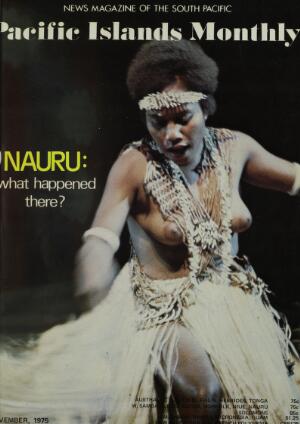
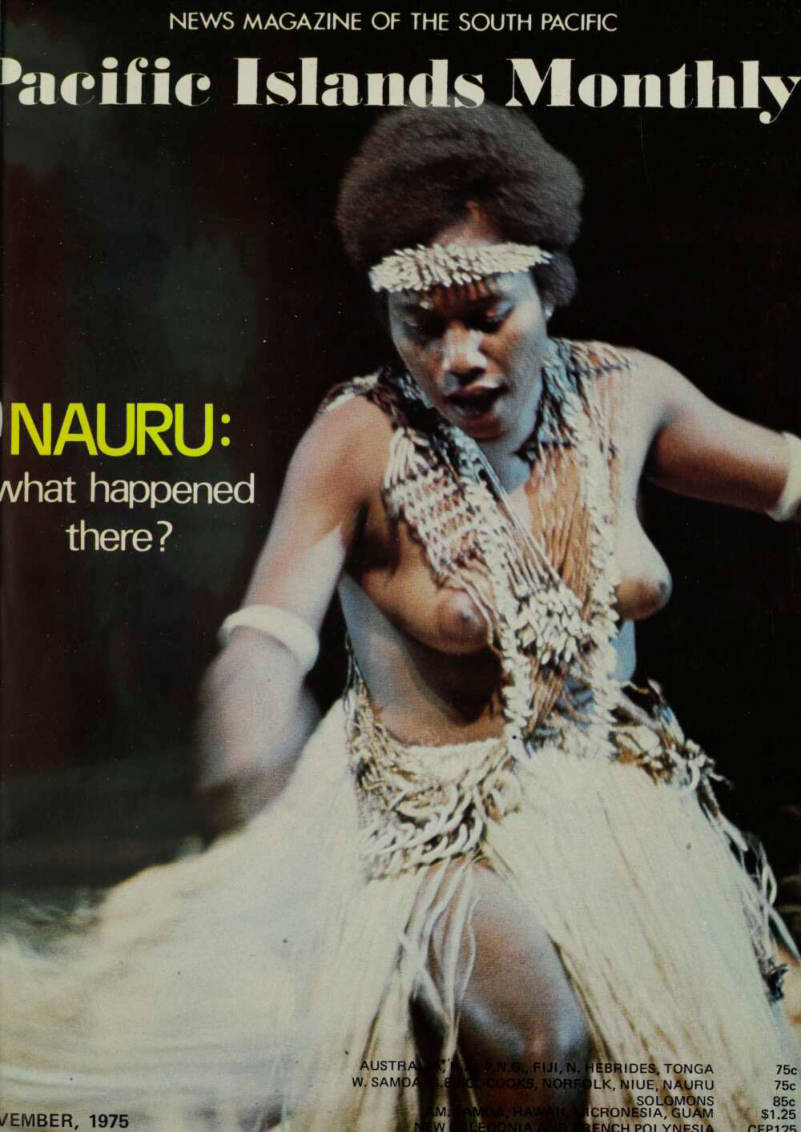
Poetry in glamorous motion “frozen” by the camera held by Ukraine born photographer Stan Goik. The dancer, from the Solomon Islands, was performing at the Sydney Opera House.
Advertisements & other items, pp. 2-4 (1 item)
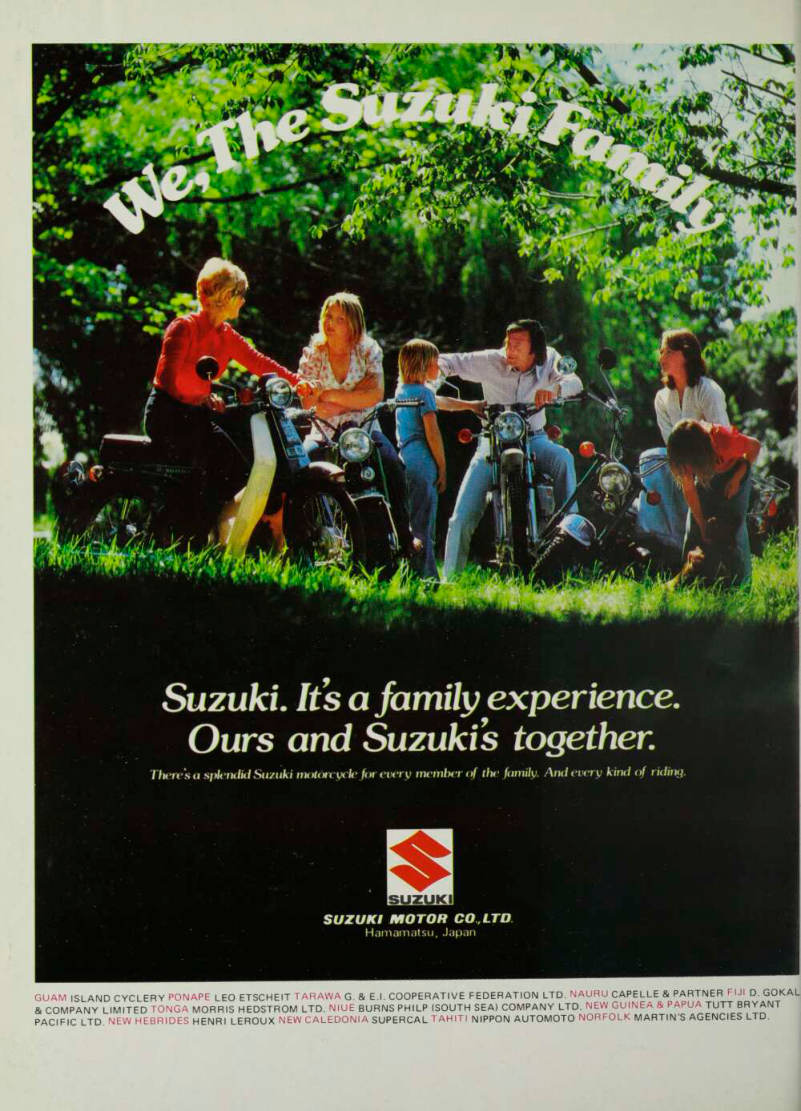
Suzuki. Its a family experience.
• • 7 v r 4 < T / *9/ #v * 4* ■ ir * % * iP*. •V > X :*# It.
W 2 *> k « f < 4 'V N> s. i r V •/N E ■* s*■ MT\ * lift* f 1 m t % * *
Ours and Suzuki s together.
There’s a sf)k>ndki Suzuki nutlorcycle for every member cf the family. And every kind of riding. m
SUZUKI
SUZUKI MOTOR CO, LTD
Hamamatsu, Japan GUAM ISLAND CYCLERV PONAPE LEO ETSCHEIT TARAWA G. & E.l. COOPERATIVE FEDERATION LTD. NAURU CAPELLE & PARTNER FIJI D. GOKAL & COMPANY LIMITED TONGA MORRIS HEDSTROM LTD. NIUE BURNS PHILP (SOUTH SEA) COMPANY LTD. NEW GUINEA & PAPUA TUTT BRYANT PACIFIC LTD. NEW HEBRIDES HENRI LEROUX NEW CALEDONIA SUPERCAL TAHITI NIPPON AUTOMOTO NORFOLK MARTIN'S AGENCIES LTD.
iTisj*
W $ * -'• ter 1 - deSr
K Jl
r. » V \ V . ,.
m Sc -|j
■ v'M i
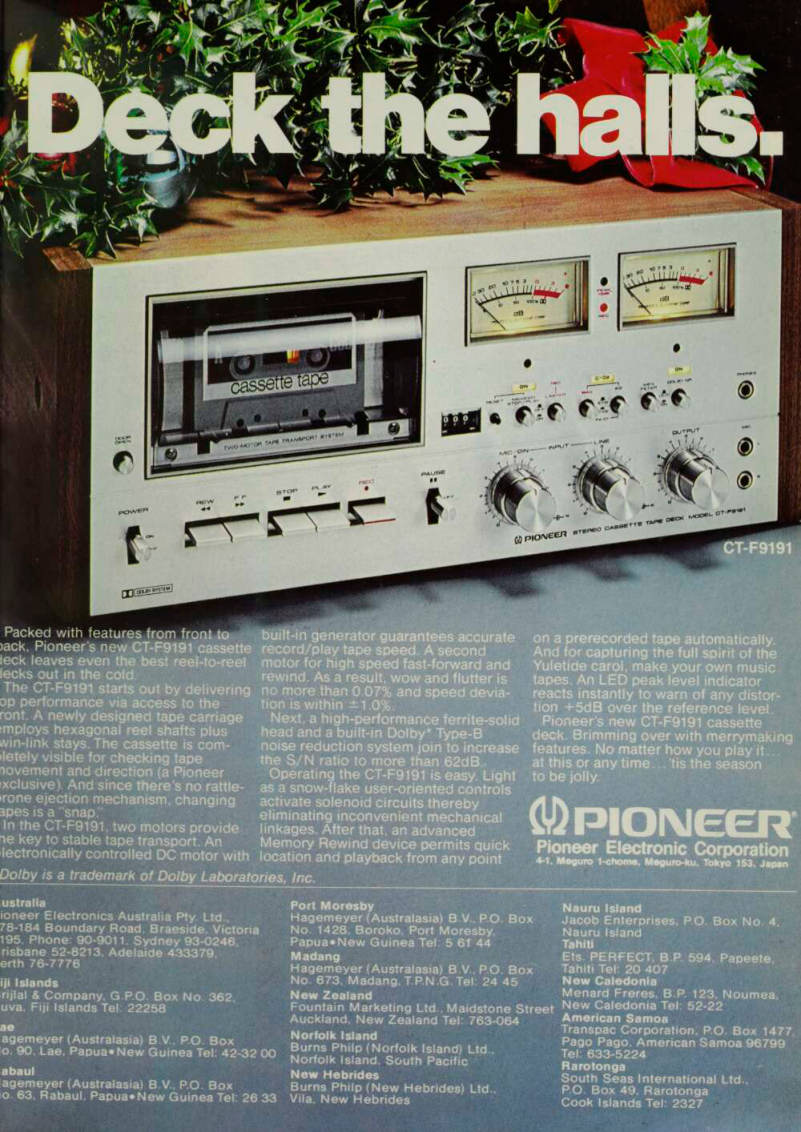
□ a Packed with features from front to iack t Pioneer’s new CT-F9191 cassette eck leaves even the best reel-to-reel ecks out in the cold.
The CT-F9191 starts out by delivering dp performance via access to the ont. A newly designed tape carriage mploys hexagonal reel shafts plus win-link stays. The cassette is comletely visible for checking tape lovement and direction (a Pioneer xclusive). And since there’s no rattlerone ejection mechanism, changing jpes is a “snap"
In the CT-F9191, two motors provide ie key to stable tape transport. An lectronically controlled DC motor with built-in generator guarantees accurate record/play tape speed. A second motor for high speed fast-forward and rewind. As a result, wow and flutter is no more than 0.07% and speed deviation is within ±1.0%.
Next, a high-performance ferrite-solid head and a built-in Dolby* Type-B noise reduction system join to increase the S/N ratio to more than 62dB..
Operating the CT-F9191 is easy. Light as a snow-flake user-oriented controls activate solenoid circuits thereby eliminating inconvenient mechanical linkages. After that, an advanced Memory Rewind device permits quick location and playback from any point Dolby is a trademark of Dolby Laboratories, Inc.
CT-F9191
on a prerecorded tape automatically.
And for capturing the full spirit of the Yuletide carol, make your own music tapes. An LED peak level indicator reacts instantly to warn of any distortion +5dB over the reference level.
Pioneer’s new CT-F9191 cassette deck. Brimming over with merrymaking features. No matter how you play it., at this or any time... ’tis the season to be jolly.
flO PIONEER
Pioneer Electronic Corporation
4-1, Meguro 1-chom®, Meguro-ku. Tokyo 153, Japan ustralia loneer Electronics Australia Pty Ltd.. 1 8-184 Boundary Road, Braeside, Victoria 195, Phone: 90-9011, Sydney 93-0246, risbane 52-8213. Adelaide 433379. erth 76-7776 iji islands rijlal & Company. G.P.O Box No. 362, uva, Fiji Islands Tel: 22258 ae agemeyer (Australasia) B.V., P.O Box o. 90, Lae. Papua*New Guinea Tel; 42-32 00 abaui agemeyer (Australasia) B.V, P.O. Box o. 63. Rabaul. Papua# New Guinea Tel; 26 33 Port Moresby Hagemeyer (Australasia) B.V., P.O. Box No. 1428, Boroko, Port Moresby, Papua#New Guinea Tel: 5 6t 44 Madang Hagemeyer (Australasia) B.V., P.O. Box No. 673. Madang, T PN G Tel: 24 45 New Zealand Fountain Marketing Ltd., Maidstone Street Auckland, New Zealand Tel: 763-064 Norfolk Island Burns Philp (Norfolk Island) Ltd., Norfolk Island, South Pacific New Hebrides Burns Philp (New Hebrides) Ltd., Vila, New Hebrides Nauru Island Jacob Enterprises, PO. Box No. 4.
Nauru Island Tahiti Ets. PERFECT. B.P. 594, Papeete.
Tahiti Tel: 20 407 New Caledonia Menard Freres. B.P 123, Noumea.
New Caledonia Tel; 52-22 American Samoa Transpac Corporation, P.O. Box 1477, Pago Pago, American Samoa 96799 Tel; 633-5224 Rarotonga South Seas International Ltd., P.O. Box 49. Rarotonga Cook Islands Tel: 2327
T
TT—rv
■ \ V. \ » V * * fife? ■ & k s * *2r?|s •■„ 1 SS& '' -r u -S' - -kt » « a m V «a «a ■ S
I* ; I-■ > tT 1
RHlg t Ml mkjA i i ■
IIIJJcW
There is no Substitute tor V"
Pacific Islands
Monthly
FOUNDED BY R. W. ROBSON IN 1930
Published Monthly By
Pacific Publications (Aust.) Pty. Ltd.,
29 Alberta Street, Sydney, N.S.W. 2000.
Postal Address: G.P.O. BOX 3408, SYDNEY,
N.S.W. 2001.
Telegraphic Address: PACPUB, Sydney.
Telex: 25168.
Telephones: 61-9197, 61-7101, 61-4369.
Publisher: Stuart Inder.
Pacific Islands Monthly
Editor; John Carter.
Advertising Manager: Alan Batt.
Circulation Manager: Maria Mann.
Subscription Rates:
"Pacific Islands Monthly" is airfreighted to the majority of subscribers and agents in the Pacific Islands and the U.S.A.; copies to the Cook Islands, Nauru, Niue, Micronesia and Guam go by surface mail.
Australia (including Lord Howe and Thursday Islands), New Zealand, Papua New Guinea, Fiji, New Hebrides, Tonga, Cook Islands, Western Samoa, Gilbert & Ellice Islands, Norfolk Island, Niue and Nauru: $9.00 (local currency); Solomon Islands: $lO.OO Aust.; American Samoa, Micronesia and Guam: $12.00 U.S.; Hawaii and U.S. Mainland: $15.00 U.S.; New Caledonia and French Polynesia: 1,500 C.F.P.; United Kingdom: £6.50; Japan: 4,000 Yen; Elsewhere: $11.50 Aust.
Representatives
Fiji: Advertising and Distribution—Fiji Times & Herald Ltd., 20 Gordon Street, Suva. Telephone: 25-601. Telex: FJ 2124.
Papua New Guinea: Advertising and Distribution —PNG Post-Courier, P.O. Box 85, Port Moresby.
Telephone: 25-9899. Enquiries.- Post News agency, Telephone 24-2148. : rench Polynesia; Distribution—Hachette Paci :ique, 10 Ave Bruat, Papeete.
Hew Zealand: Pacific Publications, C.P.O. lox 2229, Auckland.
Jnited Kingdom; The Herald and Weekly Times .imited, 8-10 Clifford's Inn, Fetter Lane, London iC4A IBU. Telephone: 01-8316041. Telex: ondon 21989. apan: Advertising—Universal Media Corpora ion, C.P.O. Box 46, Tokyo. Telephone: 666-3036.
Victoria : Advertising Pacific Publications Aust.) Pty. Ltd., Herald and Weekly Times luilding, 2nd Floor, 61 Flinders Lane, Mel ourne, 3000. Telephone: 652-1565. lawaii and U.S. Mainland only: N. Grogan.
Send change of address notices. Form 3579 nd new subscriptions to P.O. Box 2193 lonolulu, Hawaii, U.S.A. 96805.) econd class postage paid at Honolulu, Hawaii.
Copyright ©, 1975,
Pacific Publications (Aust.) Pty. Ltd.
Tinted by The Harbour Press, Chalmers Street, Sydney.
Registered at the G.P.O. Sydney for trans dssion by post as a newspaper—category B.
Vol. 46, No. 11 November, 1975
Up Front
with the Publisher
Written on NAURU IPUT my slim, smart executive styled briefcase on the bar table next to John Moses, who had been waiting to see me, and ordered a gin.
“That attache case is not YOU,” exclaimed Moses. “What in heck has happened to your battered old crocodile-skin bag?”
He seemed almost incredulous.
In 20 years of Island hopping, that bulgy bag and I have been in separable, but not until that moment in Suva the other day did it occur to me that anyone would have thought it worthy of comment.
Well, it’s gone, and I have to admit to myself that I loved that bag—in the same way I loved a battered Volkswagen I drove for 12 years. The bag burst for the last time at the end of Papua New Guinea’s Independence celebrations only a week before I flew to Suva. I suppose it was a fitting end to a bag that has done such loyal work in the Islands, and one whose skin probably came from Papua New Guinea anyhow.
For 20 years that crocodile skin bag was continuously being stuffed with reports, notes, photographs, manuscripts, proofs and letters on Island affairs from hundreds of sorties out of Sydney. It’s been crammed with books and whisky bottles. One pouch in it permanently held a plastic raincoat that has saved me from a thousand sudden Island showers.
The end of that bag also happens to coincide with the end of a personal era for me. From October 1, I passed over PIM editorship to John Carter, which is why this column is from the Publisher, not the Editor. I have had the chair for 18 years. John has been assistant editor for the last few, but for many years before that he’ was chief reporter for The Fiji Times, in Suva, and in his many years of Island travel he has long since become com pletely identified with the Pacific and its problems, and with PIM. I will continue to contribute to PIM as publisher, under John’s competent editorship.
T>ORT MORESBY is a place where I feel immediately at home as soon as I get off the plane. Within the hour I am wearing the town like an old comfortable pair of boots, as if I had always lived there.
That rather special feeling I have for Port Moresby is now, somewhat
to my surprise, shared with Nauru.
I’m surprised because this visit to cover the conference is only my third to Nauru, and the previous one was almost seven years ago during Inde dence.
But there is the same feeling of warmth here, or personal friendship and of a general generosity of spirit.
Like Papua New Guineans, Nauruans away from home can take on a cer tain reservation and formality, but at home on Nauru I am surrounded by cheerful faces that I realise I have known well for many years. Around the streets I am continually greeting or being greeted by old friends.
Perhaps, because of Hammer Deßoburt’s paternal but positive leadership, Independence has brought a confidence here that I find comfort able. Thus, I own a second pair of favourite old boots, with Nauru’s name stitched into the leather.
IT’S not true, that I’ve visited every island in the South Pacific, or that I ever will. Among those that have escaped me are Rotuma, north of Fiji, and Ocean Island, east of Nauru.
I have been reminded of both of them here on Nauru. Among the South Pacific Conference visitors are Q. Weston and his wife Jill, whom I first met in Levuka, Fiji, in 1958, when Q, was Commissioner Eastern and Rotuma was part of his res ponsibility.
He was then about to depart by smallship for Rotuma for a few days and invited me along. I declined, saying I had a few other things to do and “would catch up with Rotuma the next time around”. Naturally, that was the last opportunity I have ever had of visiting Rotuma.
This week on Nauru when I was given the opportunity to visit Ocean Island aboard the Nauruan ship Eigamoiya, I discarded all my pre vious plans and grasped the oppor tunity with four pairs of hands. I en joyed the 14-hour voyage there, and the 14 hours back.
But what I saw of Ocean Island I saw with the aid of the ship’s glasses, because the weather was too bad to enable me to land. I wonder if it will also be the last opportunity I have of visiting Ocean Island, be fore the phosphate is exhausted and it sinks into oblivion.— Stuart Inder
Advertisements & other items, pp. 5-6 (2 items)
3
ACIFIC ISLANDS MONTHLY—NOVEMBER 1975
Make Storage Pay-
Install a Lysaght-STATHAM silo
ECONOMICAL - VERSA TILE - M WARRANTED m M m m m
Lysaght -STATHAAA
WATER TANKS
• From 1,000 to 10,000 gallons • Fully enclosed. Heavily galvanized steel plate construction • Completely prefabricated • Easy to erect on timber platform ; 1 “i»
Lysaght -STATHAM
SMALL CAPACITY
ELEVATED SILOS
2608—5508 • A "must” for seed grain storage, for the dairyman, the poultry farmer, the pig breeder • 4 models for seed grain storage, 1 for poultry pellets, and 2 with 60 cones to gravity unloac most hammer-milled and mash feeds
Lysaght -STATHAM
GENERAL PURPOSE
SILOS
• For safe, dry, rodent proof storage under all conditions • Raise the stock carrying capacity of your property • The best drought insurance you can buy • Enable you to purchase supplementary feed grain in bulk with all its economic advantages m
Lysaght -STATHAM
GENERAL PURPOSE
ELEVATED SILOS
• Big conical base elevated silos from 12008 to 37008 • Ideal for bulk handling or bulk fodder storage • Complete gravity emptying by mobile auger through auger boot in base of cone • Suitable for wheat, oats, grain sorghum, barley, rye, millet, milo, linseed.
CONTACT YOUR LOCAL DEALER FOR FURTHER DETAILS AND FREE BROCHURE
STATHAM LTD.
Head Office: 25 Pacific Highway, Bennetts Green, NEWCASTLE, N.S.W. 2290, AUSTRALIA
Telephone: 48 9588 (10 lines)
In This Issue
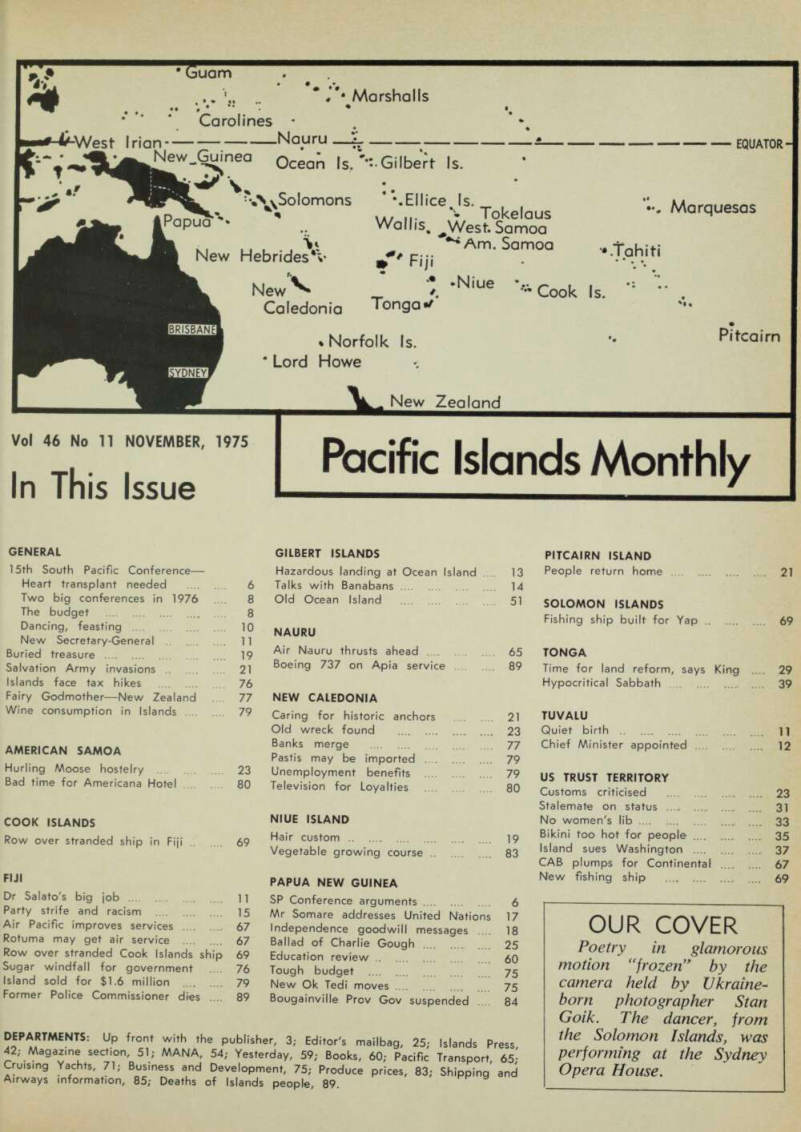
General
15th South Pacific Conference— Heart transplant needed 6 Two big conferences in 1976 ... 8 The budget 8 Dancing, feasting 10 New Secretary-General 11 Buried treasure 19 Salvation Army invasions 21 Islands face tax hikes 76 Fairy Godmother—New Zealand ... 77 Wine consumption in Islands 79
American Samoa
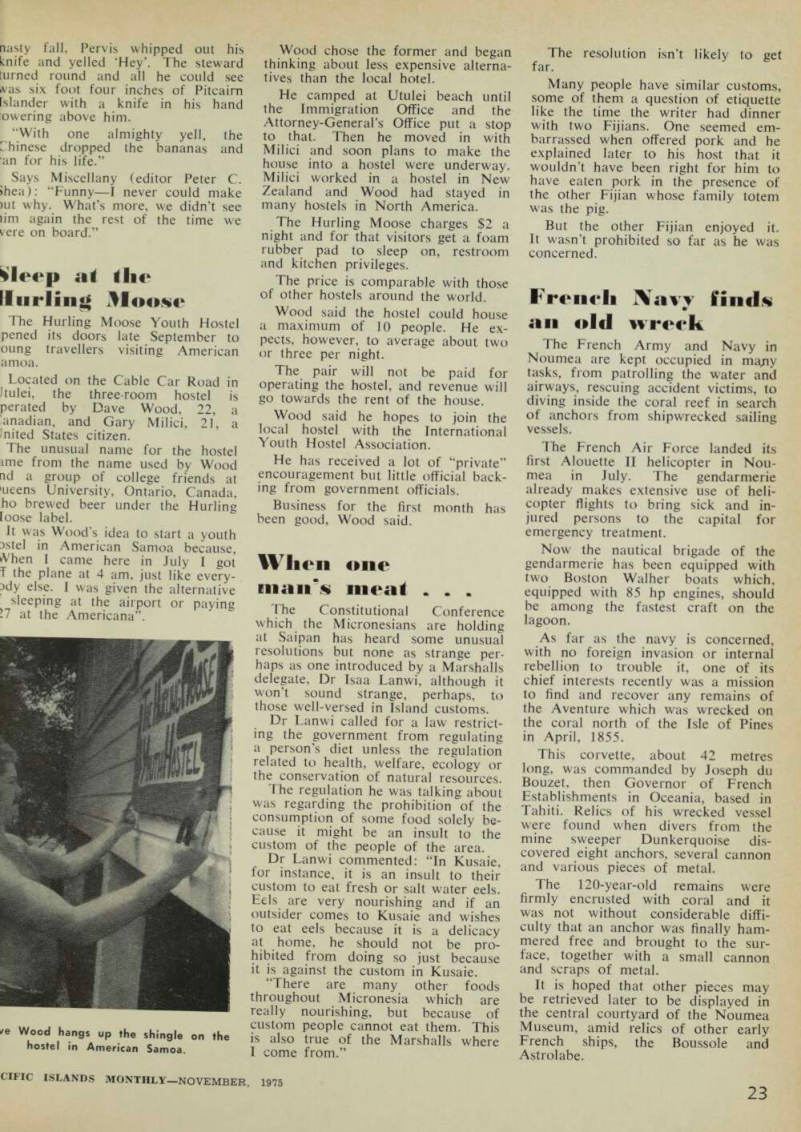
Hurling Moose hostelry 23 Bad time for Americana Hotel 80
Cook Islands
Row over stranded ship in Fiji 69
Fiji
Dr Salato's big job 11 Party strife and racism 15 Air Pacific improves services 67 Rotuma may get air service 67 Row over stranded Cook Islands ship 69 Sugar windfall for government ... 76 Island sold for $1.6 million 79 Former Police Commissioner dies ... 89
Gilbert Islands
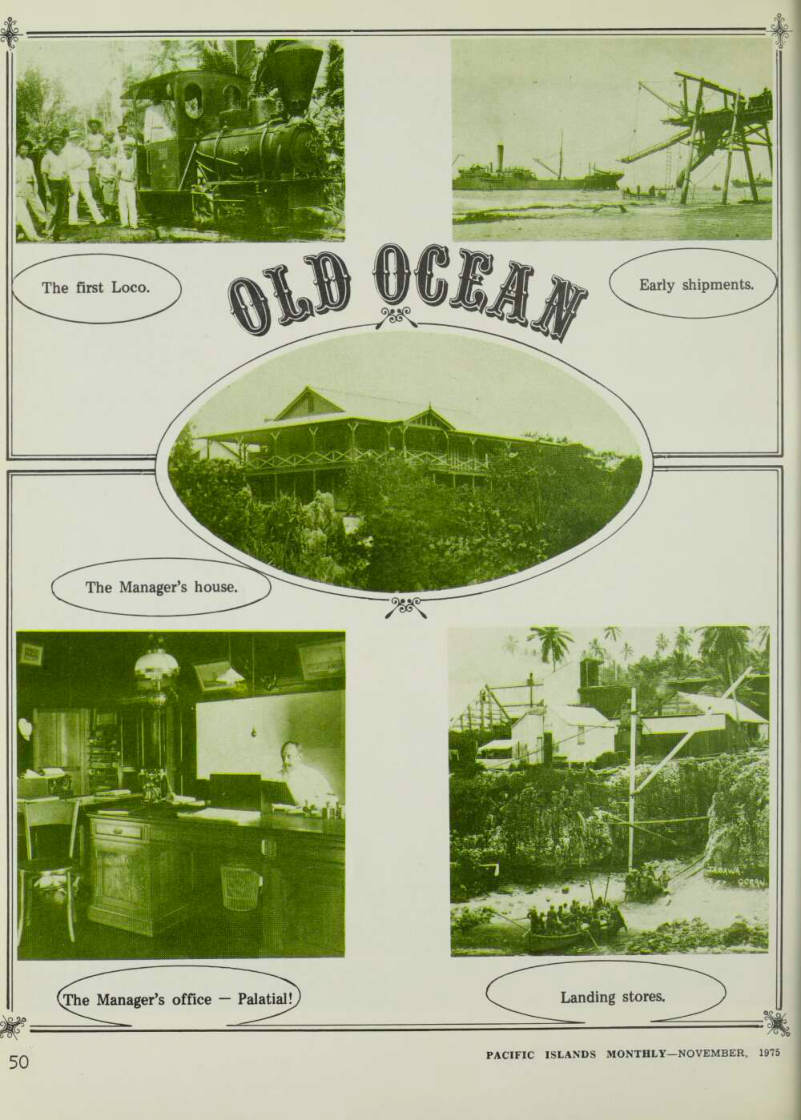
Hazardous landing at Ocean Island 13 Talks with Banabans 14 Old Ocean Island 51
Nauru
Air Nauru thrusts ahead 65 Boeing 737 on Apia service 89
New Caledonia
Caring for historic anchors 21 Old wreck found 23 Banks merge 77 Pastis may be imported 79 Unemployment benefits 79 Television for Loyalties 80
Niue Island
Hair custom 19 Vegetable growing course 83
Papua New Guinea
SP Conference arguments 6 Mr Somare addresses United Nations 17 Independence goodwill messages ... 18 Ballad of Charlie Gough 25 Education review 50 Tough budget 75 New Ok Tedi moves 75 Bougainville Prov Gov suspended ... 84
Pitcairn Island
People return home 21
Solomon Islands
Fishing ship built for Yap 69
Tonga
Time for land reform, says King ... 29 Hypocritical Sabbath 39
Tuvalu
Quiet birth H Chief Minister appointed 12
Us Trust Territory
Customs criticised 23 Stalemate on status 31 No women's lib 33 Bikini too hot for people 35 Island sues Washington 37 CAB plumps for Continental ..., ... 67 New fishing ship ... 69
DEPARTMENTS: Up front with the publisher, 3; Editor's mailbag, 25; Islands Press 42; Magazine section 51; MAN A, 54; Yesterday, 59; Books, 60; Pacific Transport, 65,' Cruising Yachts, 71; Business and Development, 75; Produce prices, 83; Shipping and Airways information, 85; Deaths of Islands people, 89.
'South Pacific Commission Needs
A Heart Transplant'
From STUART INDER, on Nauru
The South Pacific Commission is sicker than any of us thought, and it needs more than a blood transfusion to recover. I suspect it needs a heart transplant That’s my diagnosis after having sat through the 15th South Pacific Conference, held here on Nauru from September 29 to October 10.
I’ve never attended a South Pacific Conference so depressing in its frustrations or in its inability for most of its sitting days to stir itself into anv kind of action.
When it did, only in the final day or two, it made the one significant decision of the whole meeting. And that was to set up a review committee to re-evaluate urgently the entire function of the South Pacific Commission' Having thus recorded that result, I don't intend to bore you, as we were all bored silly at the conference, with a point by point description of the meeting's tedious progress; about who said what and who drafted what amendments to already thrice- ters of no special significance anyters ot no special signmc y simply accept my word that there was the greatest percentage of wasted wordage at this conference than in any previous, and probably the great-
est weight of unread paper. Although there was so frequent a reference to doing things “the Pacific Way” that the term finally became a bad joke, it was a most un-Island conference.
There was too much formality in the conference hall itself, too many un-Pacific expressions such as “in deference to the Distinguished Delegate from . . .”, and “Yes, I agree with my Distinguished Friend on his valuable contribution to debate, but might I suggest we make this minor amendment to read as follows . . . ’
The simple digging stick was replaced by a bulldozer fitted with a grading blade, and we were all covered m a continual dust cloud.
Papua New Guinea’s Deputy Prime Minister and Minister for Foreign Affairs, Sir Maori Kiki, once exploded in one of the conference’s tooinfrequent moments of plain speaking, “We have had an ear bashing!
If people have nothing to say they should just shut up!
Another time, Mahe Tupoumua, there as an observer in his capacity of director of the. South Pacific Bureau for Economic Co-operation, information on a particular matter, “I have brought no paper on it because there is too much paper here”, and proceeded to offer instead a stinging verbal blast
about the conference’s lack of direc tion, and action.
Looking back at the recent history of both the SPC and the conferences which have now become identified as the one package, we perhaps should have realised that this con ference would meet trouble. It was after all, two or three years back that people first began to count all the words and the money spent, and measure them against the commis sion s achievements. Clearly, nobody had liked what they saw.
But last year at Rarotonga there was a false summer The delegates had finally t n *c‘ ence of the colonial powers to a C ceptable levels, and had streamlined Procedures to such an extent that PIM man John Carter was able to report from that 14th Conference, Sweet reason permeated the atmos phere like at no other conference m SPC history .
The SPC had really run out of red blood corpuscles without any body noticing, and the sweet reason ableness was m fact a sign of al preaching semi-coma. Which i surely why the 15th Conference met onNauru withsuch awM leftargy.
Yet it parted on a hopeful note
|»N»s e with Presid^ni
lion Civic Centre, with President
of improving their subsistence econ omies. If the SPC was not meeting the basic needs of the village (and Ratu Mara left no doubt that he thought it wasn’t) then it should be re-examined, he said.
French Representative Henri Nettre agreed to the extent there was need for the SPC to concentrate on practical, consolidated pro grammes.
But soon after this injection of spirit, and after a game of golf, Ratu Mara flew back to Fiji, leaving his criticism to fester.
With the patient being, as we now know, in a weakened state through anaemia, reaction was slow. Especi ally as by now the whole conference was adrift.
It was sent occasionally a few yards in this direction or that by the indeterminate paddling of Dr Joseph Williams, Cook Islands’ Minister of Health and Education, and Palauni Tuiasosopo, Assistant to the Governor of American Samoa. Dr Williams had the kind of precise, carefully modulated delivery that appeared to prevent him from stating anything briefly. He also appeared fascinated by the theory and practice of the resolution, and could be depended upon to draft resolutions, move them, second them, amend them, speak to them and otherwise pay homage to them in all their parts.
Mr Tuiasosopo, I suspect, simply liked talking, and it’s time his best friend took him aside.
Both men did have many useful contributions to make, especially in committee, but in the final analysis I believe that their verbal trigger happiness over the entire course of the conference probably had the effect of despatching at birth some
Deßoburt being aware of differences of opinion on the work of the com mission but stressing that Nauru was not of the school of thought, if it existed, “which considers that the commission has had its day”.
Where else but through the com mission, he asked, could the metro politan and Island countries meet as friends and equals? He said the SPC was not unreceptive to constructive criticism, but it was the responsibil ity of the conference to ensure that the Islands got value for money from the commission, and this could be done by delegates “approaching the agenda with a view to securing clear cut decisions”.
One soon began to suspect that there was to be no immediate clear cut decision-making despite the Pre sident’s warning. But things did again begin to sound promising next day when Fiji’s Ratu Sir Kamisese Mara, the only Prime Minister at the con ference, pitched in with criticism on the lack of a grass roots approach within the SPC.
He suggested the larger donor countries might still exert too much influence on projects; the commission was not attuned to assisting Islanders on the basic need of shelter and food, of using their local resources.
worthwhile comments by Islanders which otherwise may have seen the light of day and sparked much needed debate and interest.
As it was, we usually only heard these sorts of matters being discussed privately, in small groups over drinks during the busy social rounds that accompanied the conference. Thus the frustrations grew, and fed on each other. , Conference chairman Kenas Aroi had the authority to put better order into affairs, and to encourage greater distribution of speakers. But surpris ingly in a man with the reputation of being a competent, firm Speaker of the Nauru Parliament, he never appeared comfortable or confident, and the conference heard most from the conference chairman via the whispered exchanges on procedure between him and SPC secretary general Fred Betham that were picked up by the sensitive micro phones.
And so, drearily, to the major business.
The SPC Budget took a great deal of time to dispense with, despite the work of the Planning Committee which had met in Noumea earlier this year, and a conference ad hoc com mittee established to re-examine the figures in light of later information on income and costs. The ad hoc committee chopped thousands from the budget estimates with an un expectedly firm hand (see separate story on the next page). Without the work of the committee, the drift-
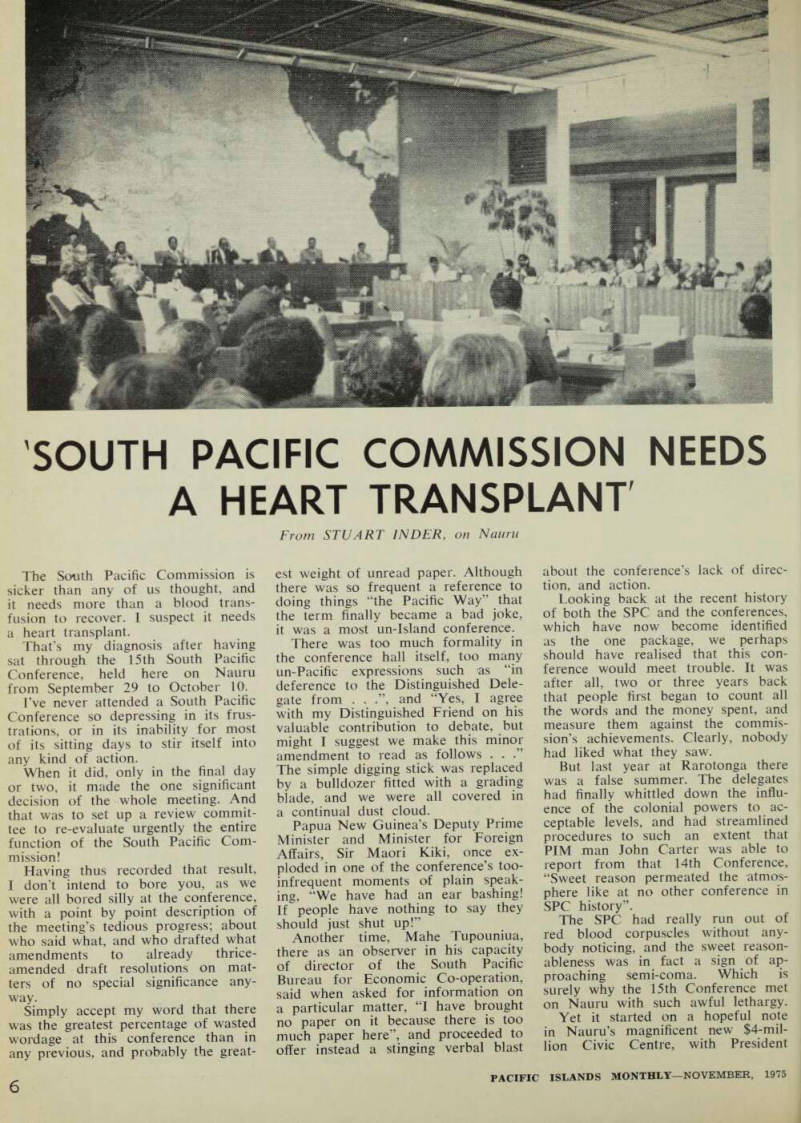
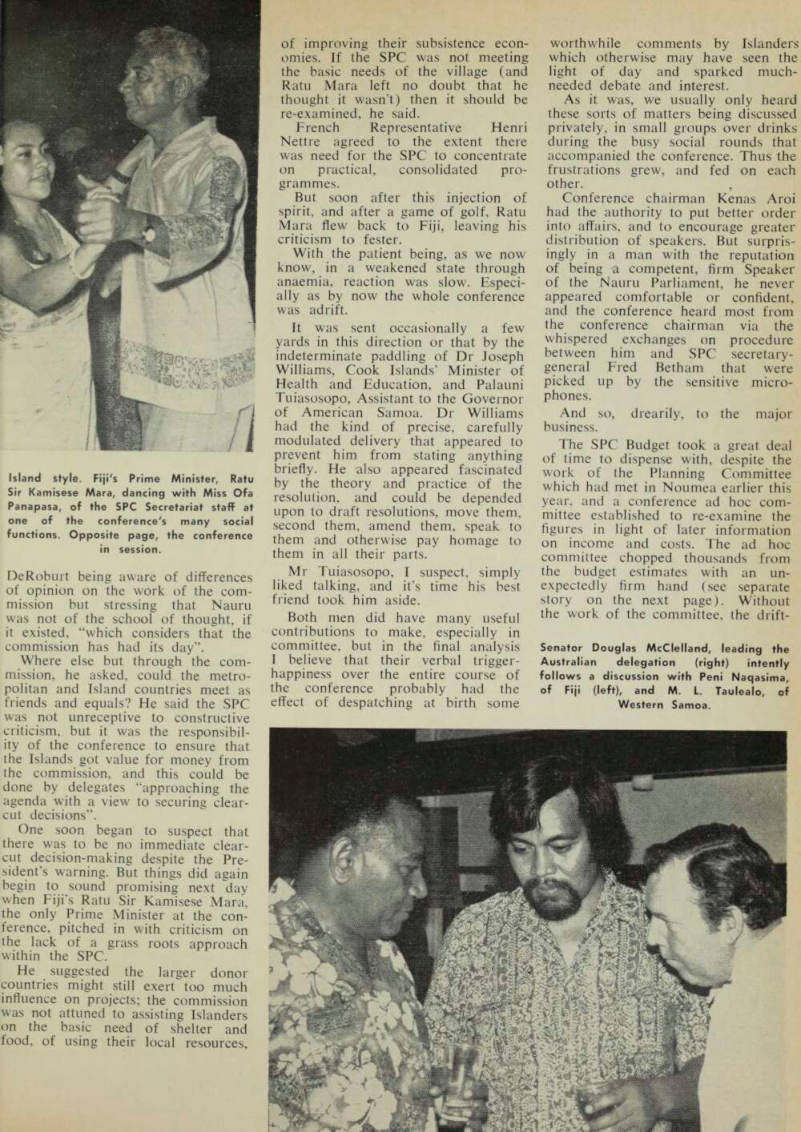
Island style. Fiji's Prime Minister, Ratu Sir Kamisese Mara, dancing with Miss Ofa Panapasa, of the SPC Secretariat staff at one of the conference's many social functions. Opposite page, the conference in session.
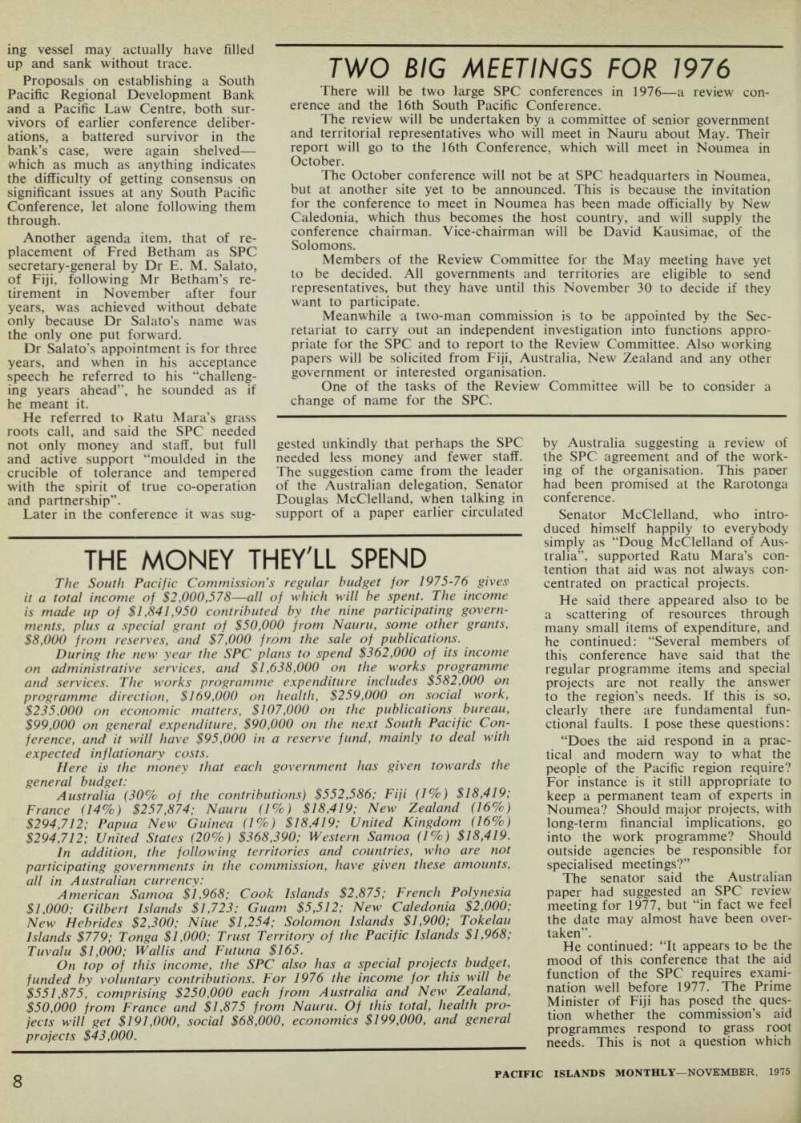
Senator Douglas McClelland, leading the Australian delegation (right) intently follows a discussion with Peni Naqasima, of Fiji (left), and M. L. Taulealo, of Western Samoa.
ing vessel may actually have filled
up and sank without trace.
Proposals on establishing a South Pacific Regional Development Bank and a Pacific Law Centre, both sur vivors of earlier conference deliber ations, a battered survivor in the bank’s case, were again shelved— which as much as anything indicates the difficulty of getting consensus on significant issues at any South Pacific Conference, let alone following them through.
Another agenda item, that of re placement of Fred Betham as SPC secretary-general by Dr E. M. Salato, of Fiji, following Mr Betham’s re tirement in November after four years, was achieved without debate only because Dr Salato’s name was the only one put forward.
Dr Salato’s appointment is for three years, and when in his acceptance speech he referred to his “challeng ing years ahead”, he sounded as if he meant it.
He referred to Ratu Mara’s grass roots call, and said the SPC needed not only money and staff, but full and active support “moulded in the crucible of tolerance and tempered with the spirit of true co-operation and partnership”.
Later in the conference it was sug
gested unkindly that perhaps the SPC needed less money and fewer staff.
The suggestion came from the leader of the Australian delegation, Senator Douglas McClelland, when talking in support of a paper earlier circulated
by Australia suggesting a review of the SPC agreement and of the work ing of the organisation. This paner had been promised at the Rarotonga conference.
Senator McClelland, who intro duced himself happily to everybody simply as “Doug McClelland of Aus tralia”, supported Ratu Mara’s con tention that aid was not always con
centrated on practical projects.
He said there appeared also to be a scattering of resources through many small items of expenditure, and he continued: “Several members of this conference have said that the regular programme items and special projects are not really the answer to the region’s needs. If this is so, clearly there are fundamental fun ctional faults. I pose these questions: “Does the aid respond in a prac tical and modern way to what the people of the Pacific region require?
For instance is it still appropriate to keep a permanent team of experts in Noumea? Should major projects, with long-term financial implications, go into the work programme? Should outside agencies be responsible for
specialised meetings?”
The senator said the Australian paper had suggested an SPC review meeting for 1977, but “in fact we feel the date may almost have been over taken”.
He continued: “It appears to be the mood of this conference that the aid function of the SPC requires exami nation well before 1977. The Prime Minister of Fiji has posed the ques tion whether the commission’s aid programmes respond to grass root needs. This is not a question which
should be left unanswered. When we get the answer, everyone will be in a better position to consider in what other ways the structure of the com mission should be changed.”
Doug McClelland of Australia then built on an earlier proposal by Dr Williams, of the Cooks, that a com mittee of review be established to report back to the 16th conference in Noumea next October. So the pieces now began to come together, until with various helpful, and some times unhelpful, comments from various directions in the next day or two, the conference decided to set up a review committee to meet in Nauru about May next year, “to conduct an exhaustive re-evaluation of the total function and organisation of the South Pacific Commission, with the view towards recommending changes necessary to enable the or ganisation to respond more positively and effectively to the changing times and needs of its members”.
The resolution also said the review committee should consider a change of name for the South Pacific Com mission. This was something which had come out of the 14th conference, where it had been agreed that the name South Pacific Commission didn't adequately describe the geo graphical scope of the Pacific Islands represented by the commission, as some of the islands were north of the Equator.
So at the request of that con ference, the SPC earlier this year con ducted a competition for a new name among residents living within the region, with a $lOO first prize. The SPC received a total of 375 names, got it down to a short list of 22 and submitted this to the 1975 Planning Committee meeting in Noumea, which in turn submitted four of the names for a final decision by the Nauru conference.
In order of preference by the SPC, the recommendations were: Pacific Islands Commission; Pacific Islands Organisation; Pacific Regional Com mission; and Fono Pasifika.
When the matter came up in Nauru, Papua New Guinea’s Sir Maori Kiki was all for getting the decision over with and said the first preference was good enough for him.
But when it appeared there were going to be a few other brave souls ready to nail their colours to the mast the debate was shelved.
Among those who helped push the conference finally towards a full SPC review was 30-year-old Niue Minister for Education, Agriculture and De velopment, Mr Young Vivian. During the deadly course of the conference he had become increasingly annoyed at the lack of action, and, one after noon, he had been particularly in
censed at hearing the big countries repeating one after another that they would give a percentage increase in their grants, “so long as others also did so”.
There were no strings to Niue’s grant, among some others, and Young Vivian said: “It has been very dis appointing, humiliating, disgusting, frustrating, to hear the donor countries say they will give their in crease if Joe down the road does the same. Now I know what a monkey feels like when a banana is held up to him outside the cage! We are small. Do you have to make us feel smaller? We have increased our per centage from last year, just like the little Tokalaus. We are making no problems about it.”
The conference listened in silence as Young Vivian told about the efforts of Niue, population 3,000, to support itself and to survive in a big world.
He said Niue had on its rugged island an area occupied by crabs and birds, which people were absolutely for bidden to enter, because it was set aside by tradition for the hungry times. In hungry times the people would be told they could forage there for food.
“Niue has little faith in the future,” said Young Vivian. “Where would we go if the New Zealand house wives said they didn’t like our passionfruit? Where would we go then and what would we do?”
The man from Niue said a review was certainly needed of what the SPC stood for, and added, “Once as a child I had a little prayer which said, ‘Oh Lord, renew a right spirit within me’. I say now, ‘Oh Lord, renew a right spirit within the con ference’!”
Outside the hall he was warmly congratulated.
To help stage the review con ference the Nauru delegation an nounced that Nauru would make a cash gift to the SPC of $50,000. This moved 32 - year - old Bwebwetake Areieta, Minister for Communica tions, Works and Utilities in the Gilbert Islands, who felt Nauru’s generosity rather showed up the big powers.
“It seems to me,” he said, “that if the commission collapses tomorrow
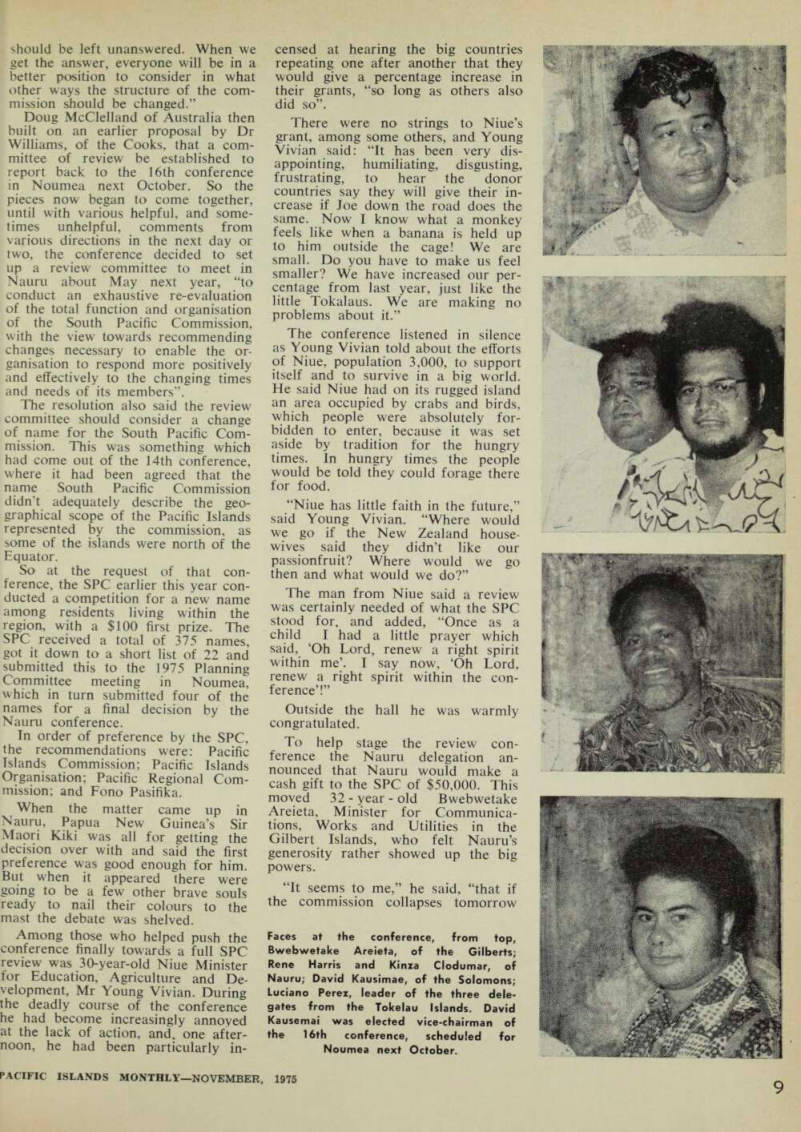
Faces at the conference, from top, Bwebwetake Areieta, of the Gilberts; Rene Harris and Kinza Clodumar, of Nauru; David Kausimae, of the Solomons; Luciano Perez, leader of the three dele gates from the Tokelau Islands. David Kausemai was elected vice-chairman of the 16th conference, scheduled for Noumea next October.
because it hasn’t got enough funds to continue functioning, our biggest brothers would be hesitant to come to its aid. As far as I’m concerned, very little has been done by the bigger powers to help develop Islands’ terri tories in the South Pacific. Most of their aid has been pouring into the Middle East, South-East Asia or in nuclear weapons or nuclear tests.
“This is my second time at a con ference, the first was in 1971, and during all this time people have always been talking about regional co-operation. 1 think we are not practising the true concept of the term.”
Areieta said that if they talked about a regional bank then it had to be helpful to the Islands and not confined to the already richer countries. If they talked regional trade, then all exports shouldn’t go to Europe.
“In the Gilberts we find it very expensive nowadays to buy a pound of sugar from Australia, and I’m sure it would be cheaper to buy in Fiji”.
Some people thought he was a bit hard on the bigger powers about their contribution’s policy, with New Zea land for instance putting in volun tarily SNZ3OO,OOO in addition to 16 per cent of the budget, and Australia putting in $A250,000, in addition to 30 per cent of the budget. But there was no doubt he was striking the right note on the need for a better distribu tion of resources among the Islands of the South Pacific. There was cer tainly need for a new trade pattern.
But how to do this?
The conference resolved this by making other recommendations, this one a direction to the SPC secretariat “to investigate in consultation and collaboration with the South Pacific Bureau for Economic Co-operation and other interested organisations, the possibility of creating a South Pacific Common Market Board and other means of actively promoting regional trade, and to submit its findings to the 16th South Pacific Conference and the 1976 Meeting of the South Pacific Forum”, Thus, again, the South Pacific con ference had not done anything. It had merely talked, and put the thought aside in the hope that some one else might do something.
It's an appropriate note to end with.
But, as a postscript, and as President Deßoburt referred to Women’s Year, it’s worthy of note that there were only nine women members of delega tions out of a total of 87—a secretary with the Australian team, an adviser from the Gilberts, three delegates from Nauru and one each from Niue, Papua New Guinea, the United Kingdom and Western Samoa.
Two Big Meetings For 1976
There will be two large SPC conferences in 1976—a review con erence and the 16th South Pacific Conference.
The review will be undertaken by a committee of senior government and territorial representatives who will meet in Nauru about May. Their report will go to the 16th Conference, which will meet in Noumea in October.
The October conference will not be at SPC headquarters in Noumea, but at another site yet to be announced. This is because the invitation for the conference to meet in Noumea has been made officially by New Caledonia, which thus becomes the host country, and will supply the conference chairman. Vice-chairman will be David Kausimae, of the Solomons, Members of the Review Committee for the May meeting have yet to be decided. All governments and territories are eligible to send representatives, but they have until this November 30 to decide if they want to participate.
Meanwhile a two-man commission is to be appointed by the Sec retariat to carry out an independent investigation into functions appro priate for the SPC and to report to the Review Committee. Also working papers will be solicited from Fiji, Australia, New Zealand and any other government or interested organisation.
One of the tasks of the Review Committee will be to consider a change of name for the SPC.
The Money They'll Spend
The South Pacific Commission’s regular budget for 1975-76 gives it a total income of $2,000,578 —all of which will be spent. The income is made up of $1,841,950 contributed by the nine participating govern ments, plus a special grant of $50,000 from Nauru, some other grants, $B,OOO from reserves, and $7,000 from the sale of publications.
During the new year the SPC plans to spend $362,000 of its income on administrative services, and $1,638,000 on the works programme and services. The works programme expenditure includes $582,000 on programme direction, $169,000 on health, $259,000 on social work, $235,000 on economic matters, $107,000 on the publications bureau, $99,000 on general expenditure, $90,000 on the next South Pacific Con ference, and it will have $95,000 in a reserve fund, mainly to deal with expected inflationary costs.
Here is the money that each government has given towards the general budget: Australia (30% of the contributions) $552,586; Fiji (1%) $18,419; France (14%) $257,874; Nauru (1%) $18,419; New Zealand (16%) $294,712; Papua New Guinea (1%) $18,419; United Kingdom (16%) $294,712; United States (20%) $368,390; Western Samoa (1%) $18,419.
In addition, the following territories and countries, who are not participating governments in the commission, have given these amounts, all in Australian currency: American Samoa $1,968; Cook Islands $2,875; French Polynesia $1,000; Gilbert Islands $1,723; Guam $5,512; New Caledonia $2,000; New Hebrides $2,300; Niue $1,254; Solomon Islands $1,900; Tokelau Islands $779; Tonga $1,000; Trust Territory of the Pacific Islands $1,968; Tuvalu $1,000; Wallis and Futuna $165.
On top of this income, the SPC also has a special projects budget, funded by voluntary contributions. For 1976 the income for this will be $551,875, comprising $250,000 each from Australia and New Zealand, $50,000 from France and $1,875 from Nauru. Of this total, health pro jects will get $191,000, social $68,000, economics $199,000, and general projects $43,000.
Dancing, feasting into
the Nauruan dawn
Roast pigs from the Solomons, fruit from Japan, Island dance teams from Micronesia, a band from the Cook Islands, T-shirts from Hong Kong, book matches from Australia and drinking water from all over the Pacific. These are some of the im ported ingredients which went to make the social arrangements for the 15th South Pacific Conference the most successful, and probably the most colourful, of any conference.
Although the debates within the conference itself were less than satis factory, the hospitality and generosity of the Republic of Nauru and the many arrangements made for the re ception of the 140 delegates and observers and their entertainment after conference hours, were a huge success. They brought nothing but praise from the visitors, many of whom were frankly astounded at the detail of the arrangements.
Nauru had been working for 12 months to make itself a worthy host to the conference, but in recent months there had been greatly in creased activity as the republic’s own ships and airlines brought in equip ment and supplies from all points of the compass.
The Nauru Civic Centre, begun in March last year on the site of the old hospital and social hall, was rushed through to the point where the conference could occupy the
main function hall and offices, although a cinema and some other facilities of the $4-million complex have still to be finished by the Hono lulu firm of builders.
The main air-conditioned hall, where the conference took place, is magnificent in design, with every kind of comfort and facility, includ ing an up-to-the-minute communi cations system that allowed delegates to move freely about the conference and still hear proceedings in either French or English through individual electronic ear-pieces, issued to each participant.
The old Hotel Menen, at Anibare Bay, where most of the VIP dele gates stayed, had been improved and extended (it now has a total of 58 rooms) at a cost of S 3 million and is of top standard in design and facilities. A day and night shuttle service of small, fast buses moved delegates between the hall and the hotel and to other accommodation made available to them at nominal cost in government and Nauru Phosphate Corporation housing. Cars and drivers were made available to delegate leaders.
The republic had also rushed through work on widening and seal ing the round-island road of 12 miles, done by Japanese contractors in six months at a cost of $1.6 million. A whole new modem telephone system, Japanese built, was put into the
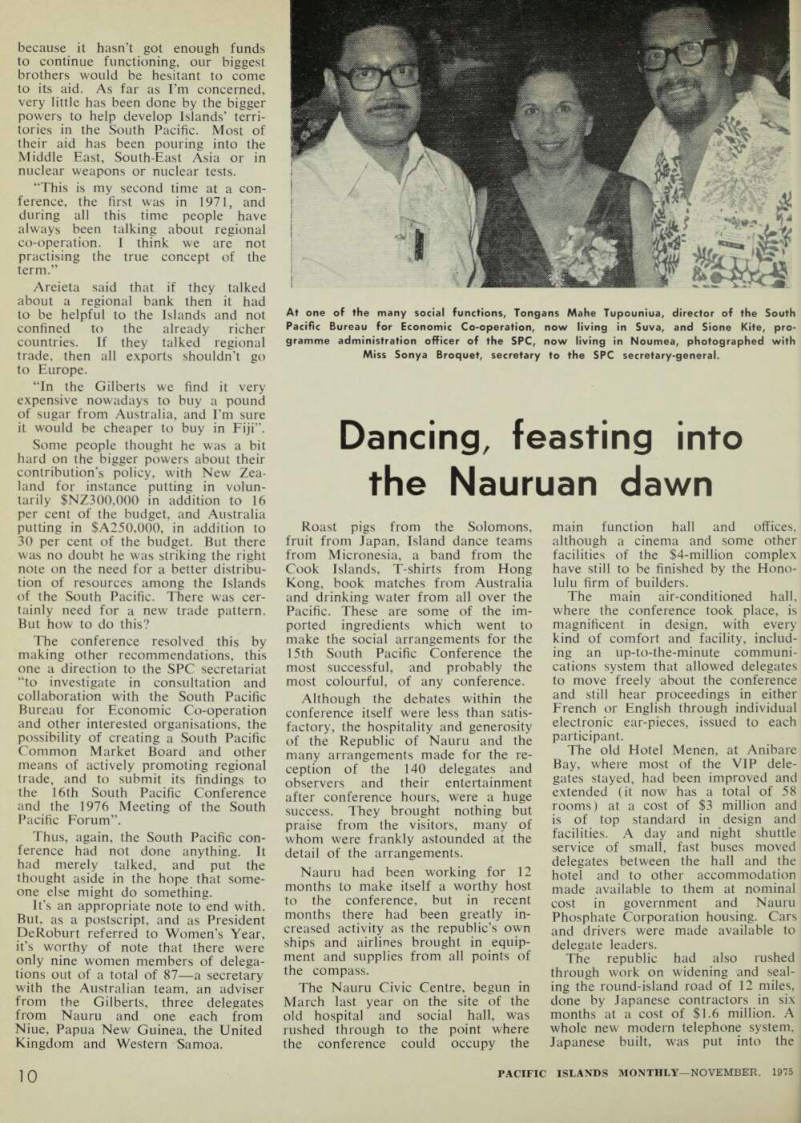
At one of the many social functions, Tongans Mahe Tupouniua, director of the South Pacific Bureau for Economic Co-operation, now living in Suva, and Sione Kite, pro gramme administration officer of the SPC, now living in Noumea, photographed with Miss Sonya Broquet, secretary to the SPC secretary-general.
island to coincide with the con ference.
Although most SPC member governments put on social functions during the conference, the Nauruan nights were easily the most memo rable and Island in atmosphere— especially a night of feasting and dancing put on by President De- Roburt in his other capacity of Head Chief of Nauru.
The Head Chief directed all the arrangements himself for the feasting, which was in the grounds of his own house near the conference hall, and he was still working when the first guests began arriving, so he had no :hance to change out of his working shorts. That party went on all night, helped by dancers from Truk and ather areas of the US Trust Territory af Micronesia who were flown in by Air Nauru to put on some of the Tiost fascinating dancing seen at any Conference.
Food had also been flown to Nauru from other parts of the Pacific, md delegates danced to the rhythm of fake’s Band. Jake (Rarotonga fire nan Jake Numanga), with brothers famatoa and Ti Short, who run a ilantation when they are not belting >ut the rhythm, were brought by air Tom Rarotonga as guests of Nauru, md played on no fewer than seven wenings during the conference, twice ;oing right through the night until • am and once until 7 am. But Jake igreed that the daddy of them all vas the Head Chief’s party, which inally finished at 10 am the next lay in a house several miles away, vith President Deßoburt as the lead ag participant.
Other Island entertainments that Dok conference delegates into the lawn hours were feasts put on by the jader of the Nauruan delegation, luraro Detudamo, who is also Nauru’s Minister for Works and Community Services, by the three idies of the Nauruan delegation, and y the managing director of the re ublic-owned Nauru Phosphate Cor oration.
The NPC was a vital link in the apply of food and also of water to ie conference visitors. NPC catering iperyisor Alex Waugh, with a staff i kitchens, bakery and butchery, orked round the clock, supplying lore than 5,100 meals in addition > extra meals put on in regular icss-rooms, and the meals supplied / the hotel.
At the big party at the NPC’s Cliff odge, Waugh’s staff started at 4.30 n and were still cleaning up at 1.30 n next day. Stewards and kitchen aff on Nauruan-owned ships off lore were also pressed into service id they sent ashore a stream of
meals and savouries to help out the staff at the hotel and hard-working Tongan waiters there under chief steward John Tonga.
Nauru has insufficient water sup plies of its own and imports water by ship to keep the island’s storage tank topped up. But as Nauru was currently in the grip of a drought, extra supplies had to be brought in to meet this in addition to the extra needs of the conference delegates for a fortnight.
The largest single quantity of water shipped in during the confer ence, and the biggest ever single load to reach Nauru, was 30,000 tons aboard a new Japanese tanker, the Silverway, directly out of a Japanese shipyard and en-route to Australia.
It was chartered especially by the NPC as a water carrier.
Most delegates were not aware of Nauru’s water problem, and with true island hospitality their hosts didn’t bother to draw it to their attention, let alone mention the cost to the re public of its importation.
If the SRC is sick, then, maybe, the new Secretary-General, Macu Salato, is the very man to attend to it. He's a doctor. His new job means he's embarking on his third career—doctor, diplomat and now the SRC's chief executive. Born in Fiji's Lau Group, Dr Salato won three gold medals out of four in his final examin ations at the Fiji School of Medicine in 1935. Then he got his Diploma in Health Education at London University and was with the Fiji Medical Department from 1936 to 1972, with the exception of two years World War II service in the Fiji Royal Naval Volunteer Reserve. He was Mayor of Suva in 1970 and in 1972 left for overseas as acting Fiji High Com missioner in London and Ambassador to the EEC in Brussels. He was awarded a CBE in 1973.
quiet birth
It was a quiet birth for Tuvalu
From STUART INDER, on Nauru There was no flag-waving or fire works on Tuvalu on October 1. When my Air Pacific aircraft put down at the capital, Funafuti, at mid-morning, the new-born colony was clearly tak ing its new status in the manner in which it can be expected to approach its future—with quiet reserve.
October 1 was Constitution Dav— the day that the Gilbert and Ellice Islands became legally separated and the Ellice changed its name. There was a small crowd at the airport to welcome Mr Tom Layng, who had been Deputy Governor of the Gil bert and Ellice Islands Colony until the previous day, but who now is Deputy Governor of the Gilbert Islands and Her Majesty’s Commis sioner in Tuvalu. He would be from that afternoon, anyhow.
Mr Layng had been in Fiji and we were on the same plane, together with—Mr Layng hoped—a parcel of printed Constitutions for Tuvalu which he intended to distribute pub licly after being sworn in and officially proclaiming the Constitu tion that day. As it happened, there was no parcel in the freight compart ments, so he made do with the single copy he had, pinning it up on the wall of the meeting house that after noon after he had read it out.
Among the crowd at the airport, whose surroundings were still show ing signs of the ravages of Hurricane Bebe three years previously, were six of the eight members of Tuvalu’s new House of Assembly.
The assembly is to have its first meeting on October 28, during which the eight elected members will be joined by the Attorney-General and Financial-Secretary, as ex-officio members, and will elect a Speaker from their numbers. The elected members represent eight of the nine former Ellice islands, the ninth, Niu lakita, being tiny and regarded as part of Niutao anyway. The name Tuvalu is the old name of Ellice and means ‘eight standing together’.
The welcome of the parliament
arians for Tom Layng was a warm one. Mr Layng will continue to live at Tarawa, in the Gilberts. In fact there will continue to be much to-ing and fro-ing between Funafuti and Tarawa at least until the new year, while the two territories satisfactorily complete their separation.
From October 1 to January 1, Tuvalu is still administratively linked to Tarawa so as to make the sepa ration formalities as smooth as possible.
From January 1, Tuvalu is set adrift, with direct access to Britain going through Her Majesty’s Com missioner. She is then a separate colony of Britain in just the same way that the Gilberts are.
Of the six members of the new House I saw at the airport there was a possibility that one would become Tuvalu’s first Chief Minister the next day, when the election was to be held from among the eight members.
The two missing men were Isakala Paeniu and Tau Finikaso.
The information I had was that the Chief Minister would either be Isakala Paeniu or Toalipi Lauti.
Some time earlier, front-running had definitely been given to Isa, but I heard on Funafuti that morning that Isa had lost his chance because he had for too long preached the gospel of non-separation of the two groups.
The fact was that the Ellice Islanders had been overwhelmingly in favour of separation during the referendum of August-September, 1974, and now appeared quite pre pared to paddle their own canoe des pite the obvious need for some furi ous baling.
The seven of us talked for half an hour while the search went on in the aircraft compartments for the parcel of Constitutions. The six members said they knew very well that Tuvalu had ended up with little in a material sense out of today’s separation. They would get one small ship, the Nivanga, absolutely no money from the Ocean Island phosphate royalties, a fish and coconut economy virtually at subsistence level for their popu lation of 7,000, and a promise of a handout from the UK.
They were at least their own man, and the choice had been theirs, they said—but surely Australia and New Zealand could do something for them? We discussed it. We discussed what I had heard discussed many times over many years by these same islanders, that is, the need for tempo-
rary or permanent migration to Aus tralia and New Zealand.
Tuvaluans, they said (and one should add, Gilbertese) should be able to benefit like the Niueans, West Samoans and Cook Islanders, who lived or worked in New Zealand and sent much-needed money home.
Tongans weren’t New Zealand citi zens, but they worked in New Zea land. What could Australia do for the Tuvaluans? Surely aid was going to be needed?
I don’t speak for Australia, but I reported that Australia had set itself against temporary migration for workers, and that there was evidence that the strength of the unions in Australia saw to it that the govern ment would continue to operate this policy.
This unofficial open-air meeting of the new Tuvalu House of Assem bly was not particularly impressed by my explanation, and I could hardly blame them.
My aircraft flew north to the great
lagoon of Tarawa, headquarters of the new separate colony of the Gil bert Islands, population 43,000, and then to the Republic of Nauru, popu lation 7,000, only about 3,800 of them being Nauruans (most of the others being Gilbert or Tuvalu workers in the phosphate).
On October 2 we heard the results of the Tuvalu elections. There had been two nominations, that of Toa lipi and Isa. Isa got two votes, his own and that of the Member for Nukufetau. Toalipi got six.
Tuvalu heard the details in the very first broadcast of Radio Tuvalu, with an interview by Faimalanga Luka with the new Chief Minister, who said he had this message to give to all the people of Tuvalu: “We have now a Chief Minister, and that’s me. I do not want to be famous but I want to serve you as your servant, so that we can obtain what we have been aiming for. We should be united to achieve a com mon good for Tuvalu. For those things which we do not yet have and wish to have, I assure you that I shall do my best to make the Government of Tuvalu a good one so that we can get them. There will be difficul ties, but we should never be dis heartened and give up all too easily”.
It was a simple and honest mess age which he repeated two days later at the South Pacific Conference here at Nauru, when he arrived to take the seat that had been reserved for the Tuvalu delegate.
He was given an extremely cordial welcome by President Deßoburt, an old friend who later described the new Chief Minister to me as a fair, honest and very capable man. The President should know, because for 12 years Toalipi Laud was Labour Relations and Training Officer on Nauru, first for the British Phosphate Commissioners and then with the Nauruan Phosphate Corporation. He left Nauru last year only because his people asked him to come home so they could elect him unopposed to the GEIC House of Assembly as Member for Funafuti. By then, sepa-
Her Majesty's Commissioner in Tuvalu, Mr Tom Layng, on his arrival at Funafuti to proclaim the constitution of the new British dependency.
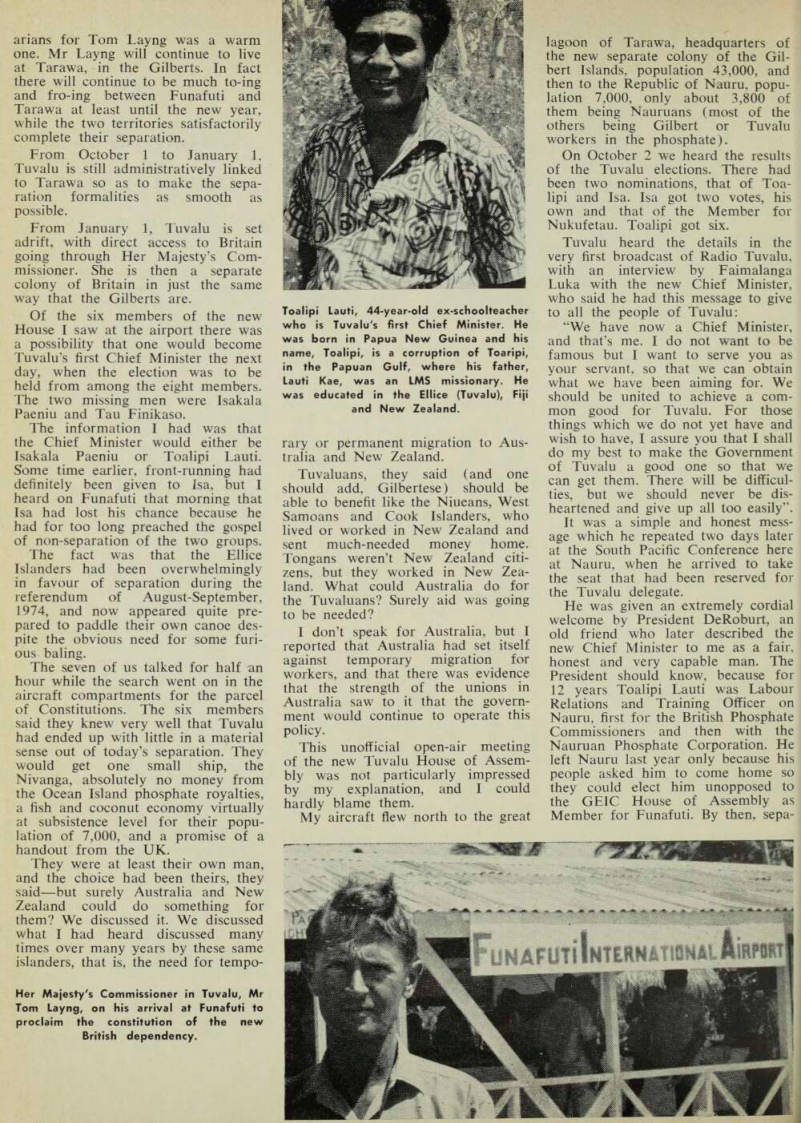
Toalipi Lauti, 44-year-old ex-schoolteacher who is Tuvalu's first Chief Minister. He was born in Papua New Guinea and his name, Toalipi, is a corruption of Toaripi, in the Papuan Gulf, where his father, Lauti Kae, was an LMS missionary. He was educated in the Ellice (Tuvalu), Fiji and New Zealand.
ration was in the air, and he was needed.
Toalipi told the conference in his maiden address that he was pleased that the birth of Tuvalu had been so readily accepted, and that Tuvalu was now able to work out its destiny on its own. Meanwhile Tuvaluans thanked their Gilbertese friends and could assure them they would con tinue to maintain and extend their good relations.
Toalipi’s new cabinet is Minister for Social Services, Taui Finikaso, and Minister for Commerce and In dustries, Tomu Sione. As Chief Minister, Toalipi also holds the port folio of Home Affairs.
At a news conference he explained that Tuvalu had decided to go sepa rately because democracy was a rule of the majority, and the Ellice would always have been a minority in the GEIC. The people had to retain their identity.
Yes, he would like to see self government—which Tuvalu now had followed by independence as soon as possible—possibly in two or three years.
Meanwhile, they depended upon Britain, who had promised develop ment money to make it possible to build administration offices and staff housing and get the new government running. From 1975 to 1978, the UK had promised about $4 million, but this presumably would drop when there was no further need for estab lishment costs.
He expected that total internal revenue for the first year would be no more than about $400,000, from taxes, some copra sales and sale of postage stamps. Projections were that as much as $300,000 might come from stamps the first year.
“We have been assured we can be
independent without being financially
independent”, he said, “But I don’t like that. It’s got to be real indepen dence”.
There is also untangling to be done of the joint GEIC co-operative, so that Tuvalu can get continuity of supplies as it moves over to dealing with suppliers direct. And then, of course, there’s the physical disruption caused by moving Tuvalu public ser vants from Tarawa to the new head quarters.
Probably most men’s families will be transferred before housing is ready for them, because now that the split has been made the public ser vants are anxious that it be com pleted before relations deteriorate.
There are resentments on Tarawa about the transfer of allegiance, be cause Ellice Islanders have been im portant to the proper functioning of the GEIC public service.
Advertisements & other items, p. 13 (1 item)
11
CIFIC ISLANDS MONTHLY—NOVEMBER. 1975
From the Middle Temple
to the South Seas
It’s now almost 40 years since Gilchrist Alexander wrote his autobiographical book of reminiscences of a British barrister from London’s Middle Temple who became a Fiji magistrate, titled From the Middle Temple to the South Seas. If they should get a copy of the book, some of Alexander’s experiences would probably be of interest to British High Court Judge Sir Robert Megarry and a small group of London barristers and solicitors who in October made their own quick dash from the Middle Temple to the South Seas. The Middle Temple is one of the Inns of Court, the centre of the British legal profession.
The occasion was the case of the Banaban people of Ocean Island who are suing the British Crown and the British Phosphate Commissioners over their past use of the island—a case which has been going on for some months, Mr Justice Megarry, who is hearing the matter, agreed to adjourn the London court for a special visit of inspection to Ocean Island.
With him went a large part of the court, including Sir Robert’s clerk, Mr Arthur Bradford, who at 65, is the same age as the judge; Mr John Vinelott, QC, who is the counsel leading the Crown case, with Mr Roy Price, the Treasury solicitor instructing him; Mr Donald Rattee, the barrister representing the British Phosphate Commissioners at the hearing, with his instructing solicitor, Mr
George Clarke; Mr John Mc- Donald, barrister leading the Banaban case, with his instructing solicitor, Mr Keith Hollis.
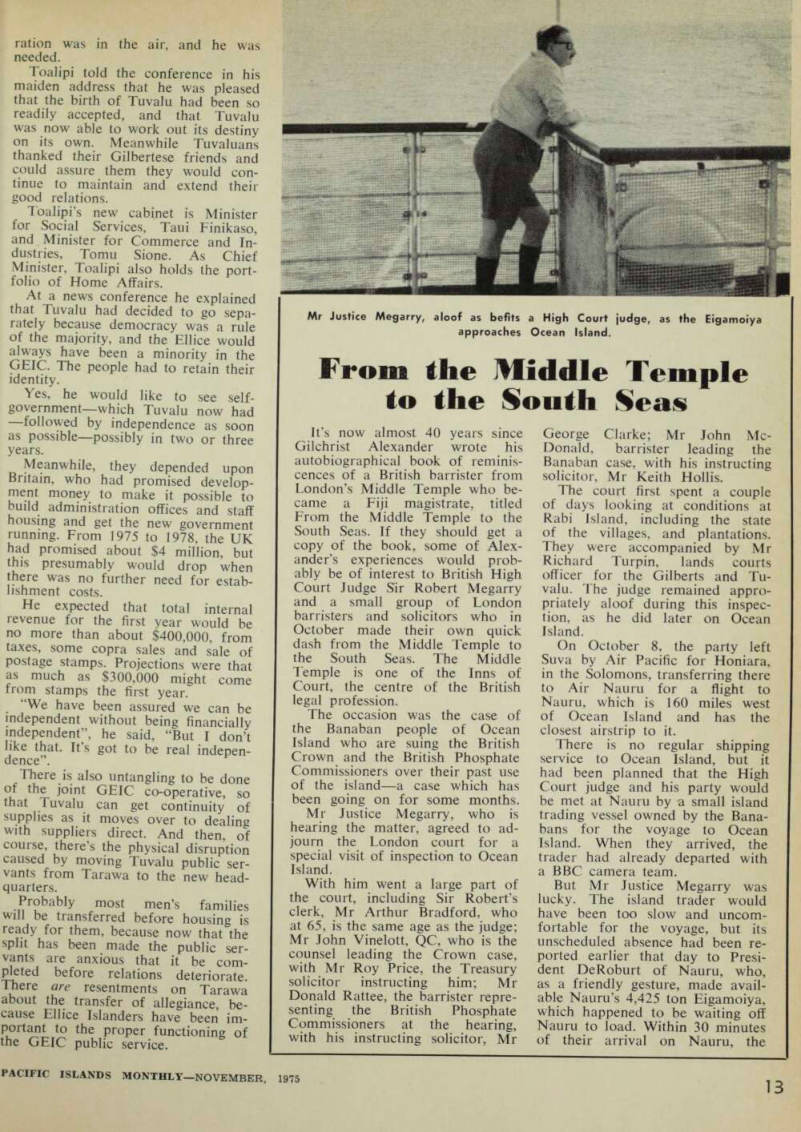
The court first spent a couple of days looking at conditions at Rabi Island, including the state of the villages, and plantations, They were accompanied by Mr Richard Turpin, lands courts officer for the Gilberts and Tu valu. The judge remained appro priately aloof during this inspec tion, as he did later on Ocean Island.
On October 8, the party left Suva by Air Pacific for Honiara, in the Solomons, transferring there to Air Nauru for a flight to Nauru, which is 160 miles west of Ocean Island and has the closest airstrip to it.
There is no regular shipping service to Ocean Island, but it had been planned that the High Court judge and his party would be met at Nauru by a small island trading vessel owned by the Bana bans for the voyage to Ocean Island. When they arrived, the trader had already departed with a BBC camera team.
But Mr Justice Megarry was lucky. The island trader would have been too slow and uncom fortable for the voyage, but its unscheduled absence had been re ported earlier that day to Presi dent Deßoburt of Nauru, who, as a friendly gesture, made avail able Nauru’s 4,425 ton Eigamoiya, which happened to be waiting off Nauru to load. Within 30 minutes of their arrival on Nauru, the
Mr Justice Megarry, aloof as befits a High Court judge, as the Eigamoiya approaches Ocean Island.
judge’s party was comfortably embarked on the 14-hour over night voyage to its final destin ation. Also aboard was Rotan Tito, the Banabans’ leader.
While the legal group thankfully relaxed in the bar, Mr Justice Megarry walked the deck alone, watching the flying fish. The voy age paralleled the equator, only about 30 miles south of it, and this was the real mid-Pacific— empty, and with a warm and
balmy breeze.
But next morning, as Ocean Island came up on the horizon, it was obvious on the bridge that getting the judge ashore would be a hazardous undertaking.
Strong winds and choppy seas made it impossible for the Eiga moiya to moor at the island.
Captain Phil Brimley decided to have the ship’s derrick hoist the party over the side into a heaving barge which had come out from the island. A special container with wooden seats was prepared on deck and half the party was locked into it. Mr Justice Megarry was to go in the second group.
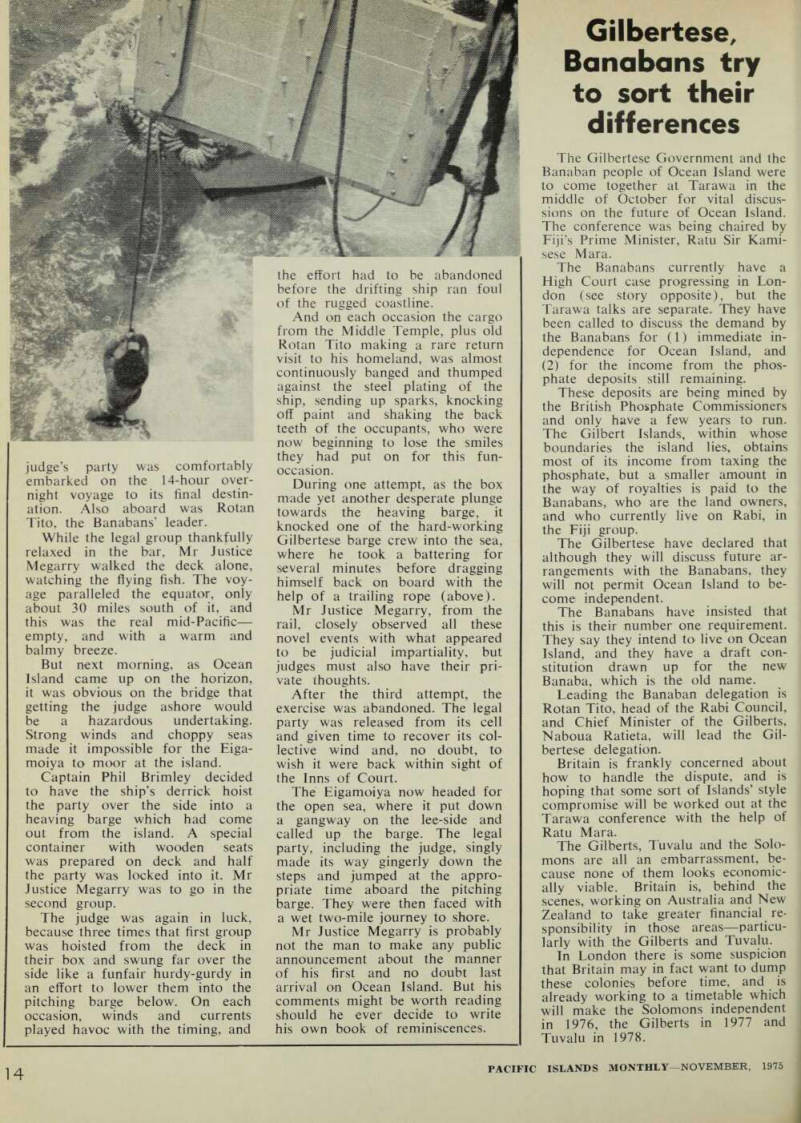
The judge was again in luck, because three times that first group was hoisted from the deck in their box and swung far over the side like a funfair hurdy-gurdy in an effort to lower them into the pitching barge below. On each occasion, winds and currents played havoc with the timing, and
the effort had to be abandoned before the drifting ship ran foul of the rugged coastline.
And on each occasion the cargo from the Middle Temple, plus old Rotan Tito making a rare return visit to his homeland, was almost continuously banged and thumped against the steel plating of the ship, sending up sparks, knocking off paint and shaking the back teeth of the occupants, who were now beginning to lose the smiles they had put on for this fun occasion.
During one attempt, as the box made yet another desperate plunge towards the heaving barge, it knocked one of the hard-working Gilbertese barge crew into the sea, where he took a battering for several minutes before dragging himself back on board with the help of a trailing rope (above).
Mr Justice Megarry, from the rail, closely observed all these novel events with what appeared to be judicial impartiality, but judges must also have their pri vate thoughts.
After the third attempt, the exercise was abandoned. The legal party was released from its cell and given time to recover its col lective wind and, no doubt, to wish it were back within sight of the Inns of Court.
The Eigamoiya now headed for the open sea, where it put down a gangway on the lee-side and called up the barge. The legal party, including the judge, singly made its way gingerly down the steps and jumped at the appro priate time aboard the pitching barge. They were then faced with a wet two-mile journey to shore.
Mr Justice Megarry is probably not the man to make any public announcement about the manner of his first and no doubt last arrival on Ocean Island. But his comments might be worth reading should he ever decide to write his own book of reminiscences.
Banabans try
Gilbertese, Banabans try to sort their differences
The Gilbertese Government and the Banaban people of Ocean Island were to come together at Tarawa in the middle of October for vital discus sions on the future of Ocean Island.
The conference was being chaired by Fiji’s Prime Minister, Ratu Sir Kami sese Mara.
The Banabans currently have a High Court case progressing in Lon don (see story opposite), but the Tarawa talks are separate. They have been called to discuss the demand by the Banabans for (1) immediate in dependence for Ocean Island, and (2) for the income from the phos phate deposits still remaining.
These deposits are being mined by the British Phosphate Commissioners and only have a few years to run.
The Gilbert Islands, within whose boundaries the island lies, obtains most of its income from taxing the phosphate, but a smaller amount in the way of royalties is paid to the Banabans, who are the land owners, and who currently live on Rabi, in the Fiji group.
The Gilbertese have declared that although they will discuss future ar rangements with the Banabans, they will not permit Ocean Island to be come independent.
The Banabans have insisted that this is their number one requirement.
They say they intend to live on Ocean Island, and they have a draft con stitution drawn up for the new Banaba, which is the old name.
Leading the Banaban delegation is Rotan Tito, head of the Rabi Council, and Chief Minister of the Gilberts, Naboua Ratieta, will lead the Gil bertese delegation.
Britain is frankly concerned about how to handle the dispute, and is hoping that some sort of Islands’ style compromise will be worked out at the Tarawa conference with the help of Ratu Mara.
The Gilberts, Tuvalu and the Solo mons are all an embarrassment, be cause none of them looks economic ally viable. Britain is, behind the scenes, working on Australia and New Zealand to take greater financial re sponsibility in those areas—particu larly with the Gilberts and Tuvalu.
In London there is some suspicion that Britain may in fact want to dump these colonies before time, and is already working to a timetable which will make the Solomons independent in 1976, the Gilberts in 1977 and Tuvalu in 1978.
under Fiji's political pot
Party strife and racial parades light a fire under Fiji's political pot
From ROBERT KEITH-REID in Suva Balmy days of unchallenged power look like being over for Fiji politicians who have been cock of the roost for longer than most voters can remember.
The months of August, September and October saw more excitement generated than at any time since the general election of April, 1972.
A new political party made a stealthy appearance as a breakaway group from the largely Indian-backed National Federation Party, holder of all but one of the seats on the Opposition side of the House of Representatives. And an Alliance Party rebel, Mr Sakiasi Butadroka, dismayed and alarmed the vast majority of Fiji’s 550,000 inhabitants by leading supporters of his Fijian Nationalist Party in a procession through Suva in which placards tell ing Indians to get out of Fiji were displayed.
August saw the tour through the country of a Royal Commission of three British lawyers, who, at the end of this year, will issue a report recommending what changes, if any, should be made in Fiji’s complex voting arrangements.
The new party is the Fiji Social Democratic Party. Despite its name it’s not a left-wing organisation. A month after making its presence known there was still not much re vealed about its true leadership and objectives.
But rumours—and the Nadi areas of western Viti Levu, where it was formed, was seething with them—in dicated it was the baby of some Hindu businessmen and farmers who declare they are fed up with the NFP's leader, Muslim lawyer Siddiq Koya.
The party was inaugurated at a private meeting at Nadi attended, it is said, by about 30 people.
Afterwards, pamphlets were scat tered about Nadi Town saying the party had been formed by followers 3f the late A. D. Patel and wanted to “clean up” Fiji’s politics.
Mr Patel was an India-born lawyer who founded the NFP and died in 1969, a year before the arrival of Independence.
The pamphlet’s invocation of his lame heightened speculation that the SDP’s mystery president might be
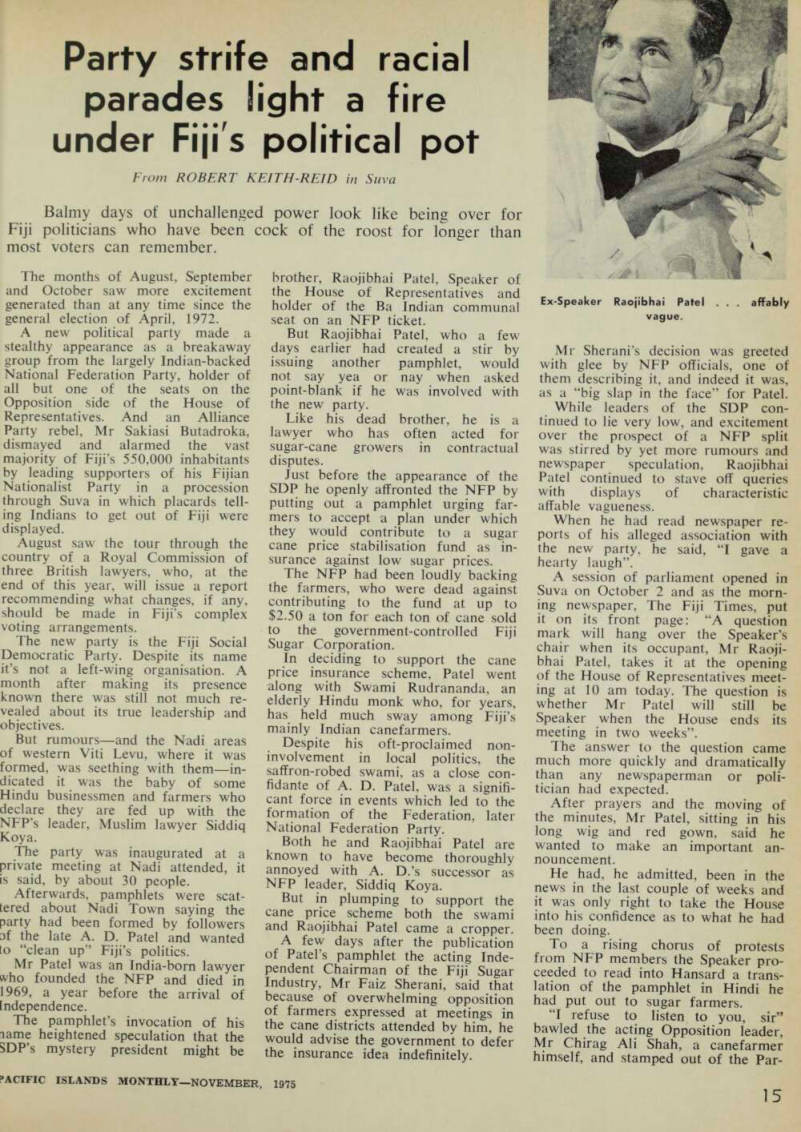
brother, Raojibhai Patel, Speaker of the House of Representatives and holder of the Ba Indian communal seat on an NFP ticket.
But Raojibhai Patel, who a few days earlier had created a stir by issuing another pamphlet, would not say yea or nay when asked point-blank if he was involved with the new party.
Like his dead brother, he is a lawyer who has often acted for sugar-cane growers in contractual disputes.
Just before the appearance of the SDP he openly affronted the NFP by putting out a pamphlet urging far mers to accept a plan under which they would contribute to a sugar cane price stabilisation fund as in surance against low sugar prices.
The NFP had been loudly backing the farmers, who were dead against contributing to the fund at up to $2.50 a ton for each ton of cane sold to the government-controlled Fiji Sugar Corporation.
In deciding to support the cane price insurance scheme, Patel went along with Swami Rudrananda, an elderly Hindu monk who, for years, has held much sway among Fiji’s mainly Indian canefarmers.
Despite his oft-proclaimed non involvement in local politics, the saffron-robed swami, as a close con fidante of A. D. Patel, was a signifi cant force in events which led to the formation of the Federation, later National Federation Party.
Both he and Raojibhai Patel are known to have become thoroughly annoyed with A. D.’s successor as NFP leader, Siddiq Koya.
But in plumping to support the cane price scheme both the swami and Raojibhai Patel came a cropper.
A few days after the publication of Patel’s pamphlet the acting Inde pendent Chairman of the Fiji Sugar Industry, Mr Faiz Sherani, said that because of overwhelming opposition of farmers expressed at meetings in the cane districts attended by him, he would advise the government to defer the insurance idea indefinitely.
Mr Sherani’s decision was greeted with glee by NFP officials, one of them describing it, and indeed it was, as a “big slap in the face” for Patel.
While leaders of the SDP con tinued to lie very low, and excitement over the prospect of a NFP split was stirred by yet more rumours and newspaper speculation, Raojibhai Patel continued to stave off queries with displays of characteristic affable vagueness.
When he had read newspaper re ports of his alleged association with the new party, he said, “I gave a hearty laugh”.
A session of parliament opened in Suva on October 2 and as the morn ing newspaper. The Fiji Times, put it on its front page: “A question mark will hang over the Speaker’s chair when its occupant, Mr Raoji bhai Patel, takes it at the opening of the House of Representatives meet ing at 10 am today. The question is whether Mr Patel will still be Speaker when the House ends its meeting in two weeks”.
The answer to the question came much more quickly and dramatically than any newspaperman or poli tician had expected.
After prayers and the moving of the minutes, Mr Patel, sitting in his long wig and red gown, said he wanted to make an important an nouncement.
He had, he admitted, been in the news in the last couple of weeks and it was only right to take the House into his confidence as to what he had been doing.
To a rising chorus of protests from NFP members the Speaker pro ceeded to read into Hansard a trans lation of the pamphlet in Hindi he had put out to sugar farmers.
“I refuse to listen to you, sir” bawled the acting Opposition leader, Mr Chirag Ali Shah, a canefarmer himself, and stamped out of the Par
Ex-Speaker Raojibhai Patel . . . affably vague.
liament Chamber, after angrily thumping his desk.
His pamphlet safely in the parlia mentary record, Mr Patel continued: “I am now going to tell you that I solemnly and seriously declare that from today I am out of the National Federation Party”.
And since he had quit the party that had got him into parliament, he added, he felt impelled to also resign from Parliament also.
Mr Patel took his final bow as Speaker on the brink of tears. In fact so overcome was he that he had to be brought back after what should have been his last exit from the Chamber because he had forgotten to make the formal adjournment.
Later in the day, the ex-Speaker was his chirpy self again as he spoke to reporters. But he was still skating round the question of: “Are you with the SDP?”
“You’re assuming that I am play ing a role in the new party”, is all that he would say.
Back to his lawyer’s practice in Ba he went, and a couple of days later the first SDP official to pub licly admit to being such, Mr Ram Sami Pillay, denied that Mr Patel had anything to do with his party whatsoever.
So ended, at least for the present, Mr Patel’s career in the House. It has had its purple patches, notably when, during a stormy debate in May, 1973, on trade unions, he locked all the MPs out of the House.
Prime Minister Ratu Sir Kamisese Mara, who missed the resignation as he was at the South Pacific confer ence in Nauru, said in commenting on the affair, that as a statesman he didn’t like the idea of the Fiji Opposi tion being fragmented by the arrival of a new party.
But as a politician—well, an op ponent was an opponent.
News-making as Patel’s resig nation was, even more space in Fiji’s dailies was being won at the time of it by Mr Sakeasi Butadroka, an avowed nationalist who has set up the Fijian Nationalist Party with the slogan of “Fiji for the Fijians”.
Formerly an Assistant Minister for Co-operatives, he was dismissed by the Prime Minister and then slung out of the Alliance for open de fiance of the party and its leader.
He became an embarrassment to the party as his speeches in the House of Representatives became more openly racist, and anti-Indian in particular.
Mr Butadroka’s bitterness appears to lie in the failure of a public com pany, Rewa Provincial Development Ltd, which he formed as a vehicle
for getting Fijians into business.
Based in the Rewa area, which is also his communal constituency, the company has a disastrous financial record.
Its efforts at running a bus service have been unhappy and Mr Buta droka has decided that the cause has not been Fijian, and his own, business inexperience, but “unfair” competition from Indian bus com panies and the alleged refusal of the government, and particularly the Prime Minister, to give a Fijian enterprise special help.
Despite claims by him that the party is a growing one, support is probably restricted to a small area of the Rewa district and its followers probably amount to little more than the ailing company’s shareholders.
But Mr Butadroka is a man who knows the value of publicity and how to go about getting it. He's organised a couple of processions through Suva, the most recent being in September when he decided to present a petition to Ratu Sir Kami sese one Saturday morning.
The petition cited a number of “grievances” ranging from the prob lems Fijians have in getting loans from the Fiji Development Bank, to a protest against a recent government decision to permit doctors, who have qualified at certain universities in India, to go into medical practice in Fiji.
Mr Butadroka got permission to hold a march through Suva and fore cast that about 5000 people would take part in it. Less than 200 did so, but this was quite enough to send a chill running through the country when the “Indians —quit Fiji” pla cards appeared.
The day before, Ratu Sir Kamisese had announced that neither he nor any officials of his department would be at Government Buildings to re
ceive the petition on Saturday morn ing as requested by Mr Butadroka.
The reasons: The Prime Minister’s office was not normally open on Saturday; Mr Butadroka’s request had been received only the day be fore the march; and the PM and his staff, in any case, were already tied up with other matters.
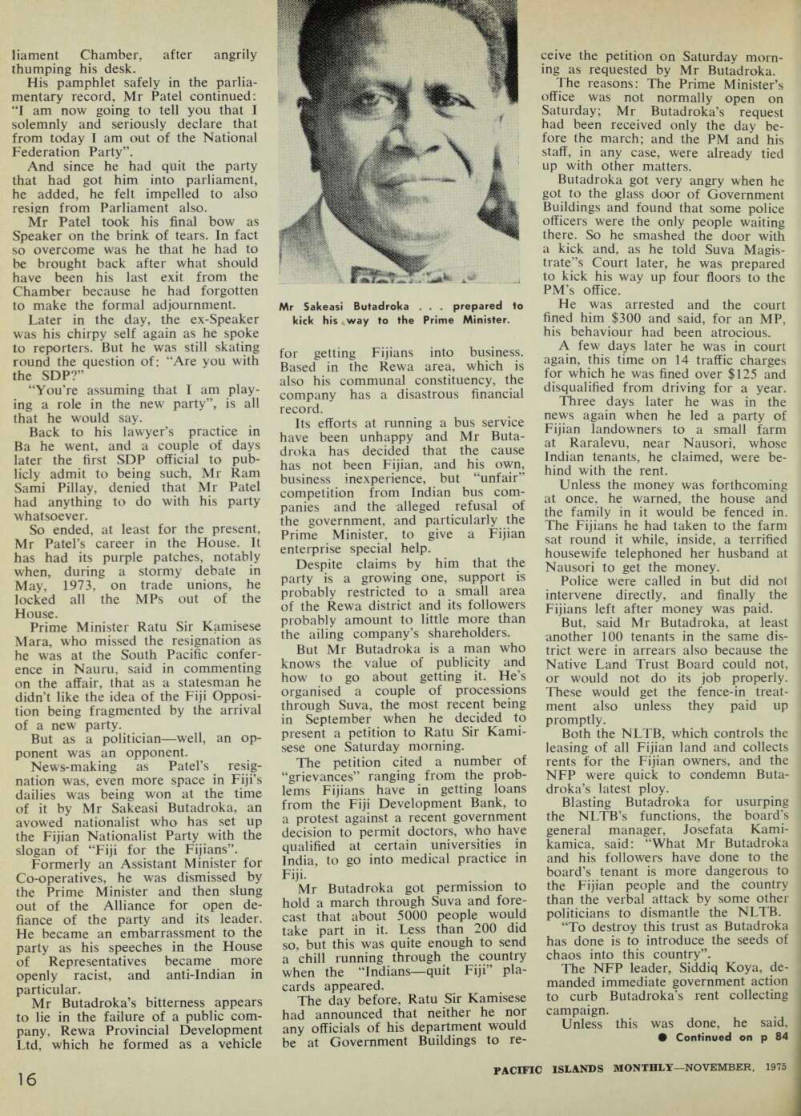
Butadroka got very angry when he got to the glass door of Government Buildings and found that some police officers were the only people waiting there. So he smashed the door with a kick and, as he told Suva Magis- Court later, he was prepared to kick his way up four floors to the PM’s office.
He was arrested and the court fined him $3OO and said, for an MP. his behaviour had been atrocious.
A few days later he was in court again, this time on 14 traffic charges for which he was fined over $125 and disqualified from driving for a year.
Three days later he was in the news again when he led a party of Fijian landowners to a small farm at Raralevu, near Nausori, whose Indian tenants, he claimed, were be hind with the rent.
Unless the money was forthcoming at once, he warned, the house and the family in it would be fenced in.
The Fijians he had taken to the farm sat round it while, inside, a terrified housewife telephoned her husband at Nausori to get the money.
Police were called in but did not intervene directly, and finally the Fijians left after money was paid.
But, said Mr Butadroka, at least another 100 tenants in the same dis trict were in arrears also because the Native Land Trust Board could not, or would not do its job properly.
These would get the fence-in treat ment also unless they paid up promptly.
Both the NLTB, which controls the leasing of all Fijian land and collects rents for the Fijian owners, and the NFP were quick to condemn Buta droka’s latest ploy.
Blasting Butadroka for usurping the NLTB’s functions, the board’s general manager, Josefata Kami kamica, said: “What Mr Butadroka and his followers have done to the board’s tenant is more dangerous to the Fijian people and the country than the verbal attack by some other politicians to dismantle the NLTB.
“To destroy this trust as Butadroka has done is to introduce the seeds of chaos into this country”.
TTie NFP leader, Siddiq Koya, de manded immediate government action to curb Butadroka’s rent collecting campaign.
Unless this was done, he said,
Continued on p 84
Mr Sakeasi Butadroka . . . prepared to kick his way to the Prime Minister.
How Papua New Guinea Sees
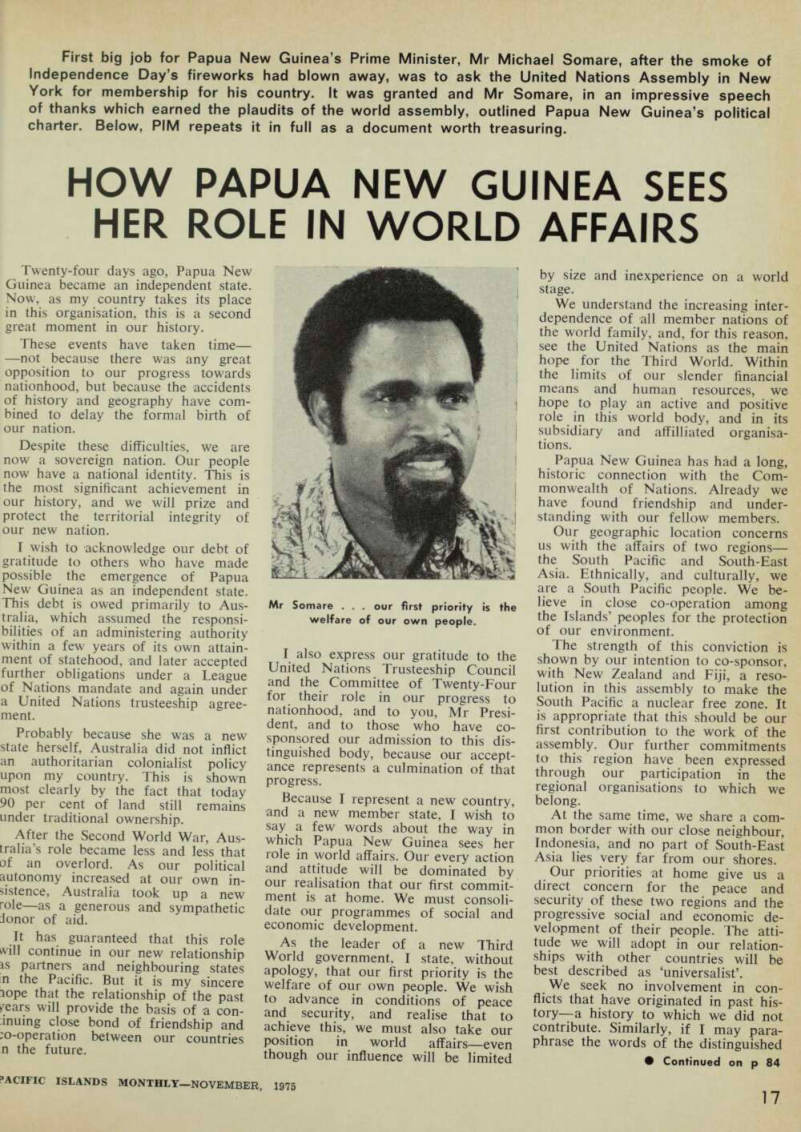
Her Role In World Affairs
First big job for Papua New Guinea’s Prime Minister, Mr Michael Somare, after the smoke of Independence Day’s fireworks had blown away, was to ask the United Nations Assembly in New York for membership for his country. It was granted and Mr Somare, in an impressive speech of thanks which earned the plaudits of the world assembly, outlined Papua New Guinea’s political charter. Below, PIM repeats it in full as a document worth treasuring.
Twenty-four days ago, Papua New Guinea became an independent state.
Now, as my country takes its place in this organisation, this is a second great moment in our history.
These events have taken time— —not because there was any great opposition to our progress towards nationhood, but because the accidents of history and geography have com bined to delay the formal birth of our nation.
Despite these difficulties, we are now a sovereign nation. Our people now have a national identity. This is the most significant achievement in our history, and we will prize and protect the territorial integrity of our new nation.
I wish to acknowledge our debt of gratitude to others who have made possible the emergence of Papua New Guinea as an independent state.
This debt is owed primarily to Aus tralia, which assumed the responsi bilities of an administering authority within a few years of its own attain ment of statehood, and later accepted further obligations under a League of Nations mandate and again under a United Nations trusteeship agree ment.
Probably because she was a new state herself, Australia did not inflict an authoritarian colonialist policy upon my country. This is shown most clearly by the fact that today 90 per cent of land still remains under traditional ownership.
After the Second World War, Aus tralia’s role became less and less that of an overlord. As our political autonomy increased at our own in sistence, Australia took up a new role —as a generous and sympathetic donor of aid.
It has guaranteed that this role will continue in our new relationship is partners and neighbouring states n the Pacific. But it is my sincere aope that the relationship of the past (ears will provide the basis of a con inuing close bond of friendship and :o-operation between our countries n the future.
I also express our gratitude to the United Nations Trusteeship Council and the Committee of Twenty-Four for their role in our progress to nationhood, and to you, Mr Presi dent, and to those who have co sponsored our admission to this dis tinguished body, because our accept ance represents a culmination of that progress.
Because I represent a new country, and a new member state, I wish to say a few words about the way in which Papua New Guinea sees her role in world affairs. Our every action and attitude will be dominated by our realisation that our first commit ment is at home. We must consoli date our programmes of social and economic development.
As the leader of a new Third World government, I state, without apology, that our first priority is the welfare of our own people. We wish to advance in conditions of peace and security, and realise that to achieve this, we must also take our position in world affairs—even though our influence will be limited
by size and inexperience on a world stage.
We understand the increasing inter dependence of all member nations of the world family, and, for this reason, see the United Nations as the main hope for the Third World. Within the limits of our slender financial means and human resources, we hope to play an active and positive role in this world body, and in its subsidiary and affilliated organisa tions.
Papua New Guinea has had a long, historic connection with the Com monwealth of Nations. Already we have found friendship and under standing with our fellow members.
Our geographic location concerns us with the affairs of two regions— the South Pacific and South-East Asia. Ethnically, and culturally, we are a South Pacific people. We be lieve in close co-operation among the Islands’ peoples for the protection of our environment.
The strength of this conviction is shown by our intention to co-sponsor, with New Zealand and Fiji, a reso lution in this assembly to make the South Pacific a nuclear free zone. It is appropriate that this should be our first contribution to the work of the assembly. Our further commitments to this region have been expressed through our participation in the regional organisations to which we belong.
At the same time, we share a com mon border with our close neighbour, Indonesia, and no part of South-East Asia lies very far from our shores.
Our priorities at home give us a direct concern for the peace and security of these two regions and the progressive social and economic de velopment of their people. The atti tude we will adopt in our relation ships with other countries will be best described as ‘universalist’.
We seek no involvement in con flicts that have originated in past his tory—a history to which we did not contribute. Similarly, if I may para phrase the words of the distinguished
Continued on p 84
Mr Somare . . . our first priority is the welfare of our own people.
Advertisements & other items, p. 19 (1 item)
17
ACIFIC ISLANDS MONTHLY—NOVEMBER, 1975
Japan hopes for 'i vigorous
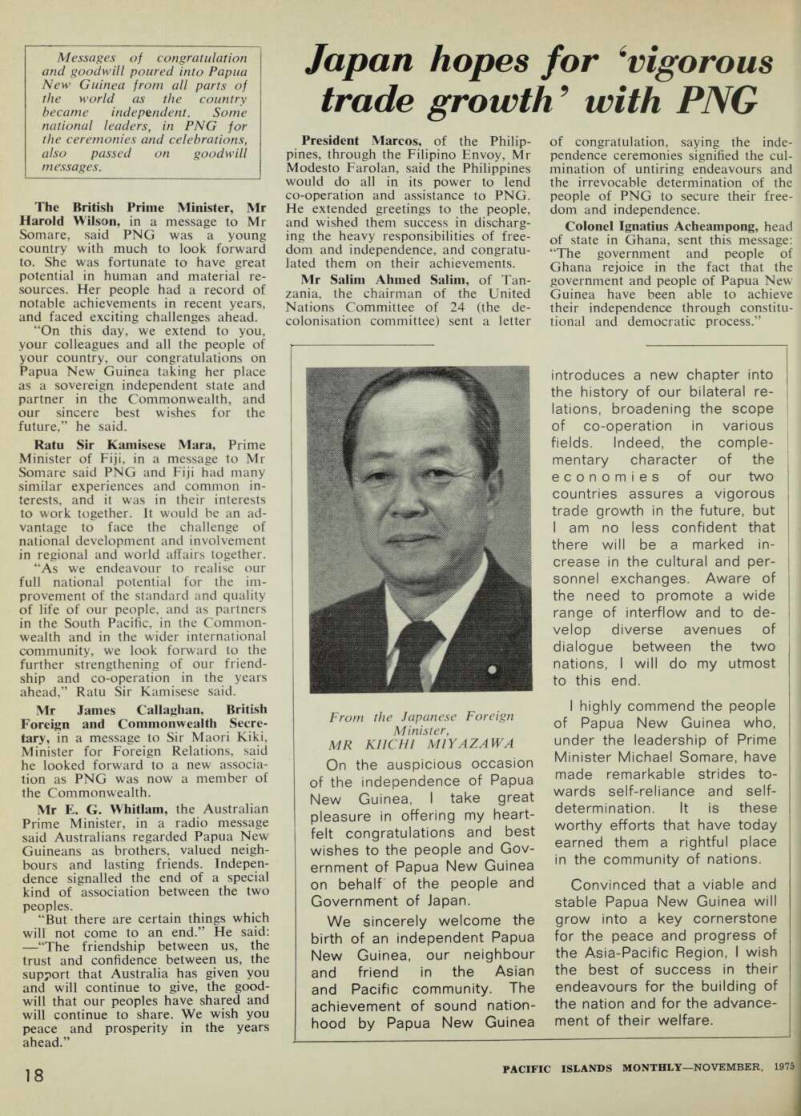
trade growth ' with PNG
Messages of congratulation and goodwill poured into Papua New Guinea from all parts of the world as the country became independent. Some national leaders, in PNG for the ceremonies and celebrations, also passed on goodwill messages.
The British Prime Minister, Mr Harold Wilson, in a message to Mr Somare, said PNG was a young country with much to look forward to. She was fortunate to have great potential in human and material re sources. Her people had a record of notable achievements in recent years, and faced exciting challenges ahead.
“On this day, we extend to you, your colleagues and all the people of your country, our congratulations on Papua New Guinea taking her place as a sovereign independent state and partner in the Commonwealth, and our sincere best wishes for the future,” he said.
Ratu Sir Kamisese Mara, Prime Minister of Fiji, in a message to Mr Somare said PNG and Fiji had many similar experiences and common in terests, and it was in their interests to work together. It would be an ad vantage to face the challenge of national development and involvement in regional and world affairs together.
“As we endeavour to realise our full national potential for the im provement of the standard and quality of life of our people, and as partners in the South Pacific, in the Common wealth and in the wider international community, we look forward to the further strengthening of our friend ship and co-operation in the years ahead,” Ratu Sir Kamisese said.
Mr James Callaghan, British Foreign and Commonwealth Secre tary, in a message to Sir Maori Kiki, Minister for Foreign Relations, said he looked forward to a new associa tion as PNG was now a member of the Commonwealth.
Mr E. G. Whitlam, the Australian Prime Minister, in a radio message said Australians regarded Papua New Guineans as brothers, valued neigh bours and lasting friends. Indepen dence signalled the end of a special kind of association between the two peoples.
“But there are certain things which will not come to an end.” He said: —“The friendship between us, the trust and confidence between us, the support that Australia has given you and will continue to give, the good will that our peoples have shared and will continue to share. We wish you peace and prosperity in the years ahead.”
President Marcos, of the Philip pines, through the Filipino Envoy, Mr Modesto Farolan, said the Philippines would do all in its power to lend co-operation and assistance to PNG.
He extended greetings to the people, and wished them success in discharg ing the heavy responsibilities of free dom and independence, and congratu lated them on their achievements.
Mr Salim Ahmed Salim, of Tan zania, the chairman of the United Nations Committee of 24 (the de colonisation committee) sent a letter
of congratulation, saying the inde pendence ceremonies signified the cul mination of untiring endeavours and the irrevocable determination of the people of PNG to secure their free dom and independence.
Colonel Ignatius Acheampong, head of state in Ghana, sent this message: “The government and people of Ghana rejoice in the fact that the government and people of Papua New Guinea have been able to achieve their independence through constitu tional and democratic process,”
On the auspicious occasion of the independence of Papua New Guinea, 1 take great pleasure in offering my heart felt congratulations and best wishes to the people and Gov ernment of Papua New Guinea on behalf of the people and Government of Japan.
We sincerely welcome the birth of an independent Papua New Guinea, our neighbour and friend in the Asian and Pacific community. The achievement of sound nation hood by Papua New Guinea
introduces a new chapter into the history of our bilateral re lations, broadening the scope of co-operation in various fields. Indeed, the comple mentary character of the economies of our two countries assures a vigorous trade growth in the future, but I am no less confident that there will be a marked in crease in the cultural and per sonnel exchanges. Aware of the need to promote a wide range of interflow and to de velop diverse avenues of dialogue between the two nations, I will do my utmost to this end.
I highly commend the people of Papua New Guinea who, under the leadership of Prime Minister Michael Somare, have made remarkable strides to wards self-reliance and self determination. It is these worthy efforts that have today earned them a rightful place in the community of nations.
Convinced that a viable and stable Papua New Guinea will grow into a key cornerstone for the peace and progress of the Asia-Pacific Region, I wish the best of success in their endeavours for the building of the nation and for the advance ment of their welfare.
From the Japanese Foreign Minister,
Mr Kllchl Miyazawa
Tropicalities
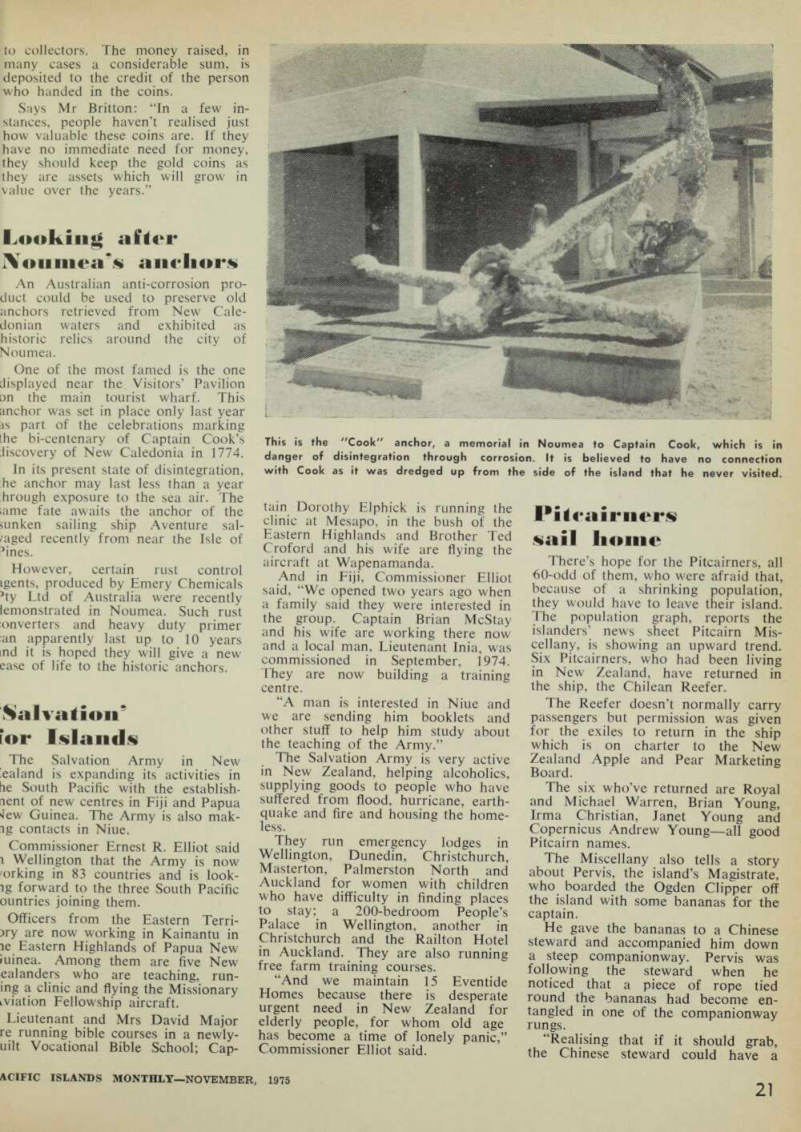

A costly
haircut
To cut a boy’s hair when he’s in i New Zealand detention centre must •e an ordinary job but not if the •oy happens to be a Niuean.
An eight-year-old Niuean boy, who /as placed in the Owairaka Boys’ )etention Centre, had shoulder-length air, so somebody at the centre cut . There was a hair-raising row when is parents saw his close-cropped ead because his long hair had a otential value of several thousand ollars.
The clippers had cut right through liuean custom under which all males row their hair long until they’re round 12 or 13 years old.
Then it’s ceremoniously cut in the Ifiulu ceremony when all the rela ons and friends give money. The st such ceremony in New Zealand lised $7,000.
The parents were upset and com ained to the Pacific Islanders’ Ad sory Council, which has taken the alter up with the NZ Government id is claiming compensation and an surance that such a breach of iuean custom won’t happen again.
A Niuean member of the council, r John Kolo, said: “They should sped our culture. These people ive lost an investment they were anning on, because they would have ►t several thousand dollars at the remony.” io more
oor soakers;
The action of the rich in “soaking” poor on Saipan will stop, says a icronesia Congress release through NS.
PIM reported in Tropicalities last mth (p 27) that rainwater which llected in the new Continental )tel car-park was flooding into
nearby houses—“A classic example of the rich people getting richer at the expense of the poor people,” said Congressman Herman Guerrero.
Mr Guerrero arranged a meeting between the hoteliers, the wet and aggrieved residents and half a dozen boards and authorities. As a result, holding ponds and drainpipes will be installed to stop the flooding both at the Continental Hotel and the now building Intercontinental Inn.
Treasure
under the bed
There’s buried treasure all over the Islands—old coins that have been stashed away in boxes and under beds in readiness for that inevitable rainy day.
The hoarders are now bringing out the treasure and banking it or chang ing it for new currency, as in Papua New Guinea, without, in many cases, realising the enhanced value.
The changeover in PNG from Aus tralian currency to the kina and toea is literally unearthing a fortune. Re ports of German marks and old British and Australian coins being handed in to banks have been re ceived.
One coin collector, while being shown a new shipment of coins just arrived at the Rabaul branch of the Bank of PNG, was offered a few old “holey” PNG shillings. The collector bought all 12 offered at face value one kina, 20 toea.
He reports that four of the coins, dated between 1935 and 1945, are in mint condition, except for mild oxida tion. The other eight had suffered damage from the soil which had obviously been their owner’s bank vault over the years.
A similar story is told by Mr Ted Britton, manager of the New Hebrides Co-operative Federation Bank in Vila, who says there’s a steady stream of gold sovereigns and half-sovereigns coming into the bank’s agencies scattered throughout the condo minium.
The coins are sent to Mr Britton’s office and he arranges for their sale
to collectors. The money raised, in many cases a considerable sum, is deposited to the credit of the person who handed in the coins.
Says Mr Britton: “In a few in stances, people haven’t realised just how valuable these coins are. If they have no immediate need for money, they should keep the gold coins as they are assets which will grow in value over the years.”
Looking after
Noumea's anchors
An Australian anti-corrosion pro duct could be used to preserve old anchors retrieved from New Cale donian waters and exhibited as historic relics around the city of Noumea.
One of the most famed is the one displayed near the Visitors’ Pavilion on the main tourist wharf. This anchor was set in place only last year as part of the celebrations marking the bi-centenary of Captain Cook’s discovery of New Caledonia in 1774.
In its present state of disintegration, he anchor may last less than a year hrough exposure to the sea air. The lame fate awaits the anchor of the sunken sailing ship Aventure sal vaged recently from near the Isle of 3 ines.
However, certain rust control igents, produced by Emery Chemicals *ty Ltd of Australia were recently lemonstrated in Noumea. Such rust onverters and heavy duty primer an apparently last up to 10 years md it is hoped they will give a new ease of life to the historic anchors.
Salvation 9
for Islands
The Salvation Army in New Zealand is expanding its activities in lie South Pacific with the establish rient of new centres in Fiji and Papua "Jew Guinea. The Army is also mak ig contacts in Niue.
Commissioner Ernest R. Elliot said i Wellington that the Army is now working in 83 countries and is look ig forward to the three South Pacific ountries joining them.
Officers from the Eastern Tern ary are now working in Kainantu in le Eastern Highlands of Papua New luinea. Among them are five New ealanders who are teaching, Tun ing a clinic and flying the Missionary iviation Fellowship aircraft.
Lieutenant and Mrs David Major re running bible courses in a newly uilt Vocational Bible School; Cap-
tain Dorothy Elphick is running the clinic at Mesapo, in the bush of the Eastern Highlands and Brother Ted Croford and his wife are flying the aircraft at Wapenamanda.
And in Fiji, Commissioner Elliot said, “We opened two years ago when a family said they were interested in the group. Captain Brian McStay and his wife are working there now and a local man, Lieutenant Inia, was commissioned in September, 1974.
They are now building a training centre.
“A man is interested in Niue and we are sending him booklets and other stuff to help him study about the teaching of the Army.”
The Salvation Army is very active in New Zealand, helping alcoholics, supplying goods to people who have suffered from flood, hurricane, earth quake and fire and housing the home less.
They run emergency lodges in Wellington, Dunedin, Christchurch, Masterton, Palmerston North and Auckland for women with children who have difficulty in finding places to stay; a 200-bedroom People’s Palace in Wellington, another in Christchurch and the Railton Hotel in Auckland. They are also running free farm training courses.
“And we maintain 15 Eventide Homes because there is desperate urgent need in New Zealand for elderly people, for whom old age has become a time of lonely panic,”
Commissioner Elliot said.
Pig oairners
Mail home
There’s hope for the Pitcairners, all 60-odd of them, who were afraid that, because of a shrinking population, they would have to leave their island.
The population graph, reports the islanders' news sheet Pitcairn Mis cellany, is showing an upward trend.
Six Pitcairners, who had been living in New Zealand, have returned in the ship, the Chilean Reefer.
The Reefer doesn’t normally carry passengers but permission was given for the exiles to return in the ship which is on charter to the New Zealand Apple and Pear Marketing Board.
The six who’ve returned are Royal and Michael Warren, Brian Young, Irma Christian, Janet Young and Copernicus Andrew Young—all good Pitcairn names.
The Miscellany also tells a story about Pervis, the island’s Magistrate, who boarded the Ogden Clipper off the island with some bananas for the captain.
He gave the bananas to a Chinese steward and accompanied him down a steep companionway. Pervis was following the steward when he noticed that a piece of rope tied round the bananas had become en tangled in one of the companionway rungs.
“Realising that if it should grab, the Chinese steward could have a
This is the "Cook" anchor, a memorial in Noumea to Captain Cook, which is in danger of disintegration through corrosion. It is believed to have no connection with Cook as it was dredged up from the side of the island that he never visited.
nasty fall, Pervis whipped out his knife and yelled ‘Hey’. The steward turned round and all he could see vas six foot four inches of Pitcairn [slander with a knife in his hand lowering above him.
“With one almighty yell, the Chinese dropped the bananas and an for his life.”
Says Miscellany (editor Peter C. >hea): “Funny—l never could make mt why. What’s more, we didn’t see urn again the rest of the time we vere on board.”
iileep at the
Hurling Moose
The Hurling Moose Youth Hostel pened its doors late September to oung travellers visiting American amoa.
Located on the Cable Car Road in Jtulei, the three-room hostel is perated by Dave Wood, 22, a Canadian, and Gary Milici, 21, a Inited States citizen.
The unusual name for the hostel ime from the name used by Wood ad a group of college friends at ueens University, Ontario, Canada, ho brewed beer under the Hurling loose label.
It was Wood's idea to start a youth astel in American Samoa because, When I came here in July I got T the plane at 4 am, just like every pdy else. I was given the alternative sleeping at the airport or paying -7 at the Americana”.
Wood chose the former and began thinking about less expensive alterna tives than the local hotel.
He camped at Utulei beach until the Immigration Office and the Attorney-General’s Office put a stop to that. Then he moved in with Milici and soon plans to make the house into a hostel were underway.
Milici worked in a hostel in New Zealand and Wood had stayed in many hostels in North America.
The Hurling Moose charges S 2 a night and for that visitors get a foam rubber pad to sleep on, restroom and kitchen privileges.
The price is comparable with those of other hostels around the world.
Wood said the hostel could house a maximum of 10 people. He ex pects, however, to average about two or three per night.
The pair will not be paid for operating the hostel, and revenue will go towards the rent of the house.
Wood said he hopes to join the local hostel with the International Youth Hostel Association.
He has received a lot of “private” encouragement but little official back ing from government officials.
Business for the first month has been good, Wood said.
Wlii‘ii one
man’s meal . . .
The Constitutional Conference which the Micronesians are holding at Saipan has heard some unusual resolutions but none as strange per haps as one introduced by a Marshalls delegate, Dr Isaa Lanwi, although it won’t sound strange, perhaps, to those well-versed in Island customs.
Dr Lanwi called for a law restrict ing the government from regulating a person’s diet unless the regulation related to health, welfare, ecology or the conservation of natural resources.
The regulation he was talking about was regarding the prohibition of the consumption of some food solely be cause it might be an insult to the custom of the people of the area.
Dr Lanwi commented: “In Kusaie, for instance, it is an insult to their custom to eat fresh or salt water eels.
Eels are very nourishing and if an outsider comes to Kusaie and wishes to eat eels because it is a delicacy at home, he should not be pro hibited from doing so just because it is against the custom in Kusaie.
“There are many other foods throughout Micronesia which are really nourishing, but because of custom people cannot eat them. This is also true of the Marshalls where I come from.”
The resolution isn’t likely to get far.
Many people have similar customs, some of them a question of etiquette like the time the writer had dinner with two Fijians. One seemed em barrassed when offered pork and he explained later to his host that it wouldn’t have been right for him to have eaten pork in the presence of the other Fijian whose family totem was the pig.
But the other Fijian enjoyed it.
It wasn’t prohibited so far as he was concerned.
Fri‘iu*li Xavv find*
an €>ld wreck
The French Army and Navy in Noumea are kept occupied in ma/iy tasks, from patrolling the water and airways, rescuing accident victims, to diving inside the coral reef in search of anchors from shipwrecked sailing vessels.
The French Air Force landed its first Alouette II helicopter in Nou mea in July. The gendarmerie already makes extensive use of heli copter flights to bring sick and in jured persons to the capital for emergency treatment.
Now the nautical brigade of the gendarmerie has been equipped with two Boston Walher boats which, equipped with 85 hp engines, should be among the fastest craft on the lagoon.
As far as the navy is concerned, with no foreign invasion or internal rebellion to trouble it, one of its chief interests recently was a mission to find and recover any remains of the Aventure which was wrecked on the coral north of the Isle of Pines in April, 1855.
This corvette, about 42 metres long, was commanded by Joseph du Bouzet, then Governor of French Establishments in Oceania, based in Tahiti. Relics of his wrecked vessel were found when divers from the mine sweeper Dunkerquoise dis covered eight anchors, several cannon and various pieces of metal.
The 120-year-old remains were firmly encrusted with coral and it was not without considerable diffi culty that an anchor was finally ham mered free and brought to the sur face, together with a small cannon and scraps of metal.
It is hoped that other pieces may be retrieved later to be displayed in the central courtyard of the Noumea Museum, amid relics of other early French ships, the Boussole and Astrolabe,
We Wood hangs up the shingle on the hostel in American Samoa.
Advertisements & other items, pp. 21-26 (4 items)
Cific Islands Monthly—November, 1975
Monthly
Want PIM for a friend this Christmas ?
We’ll make it easier for you!
Pacific Islands Monthly Keeps you informed on Pacific happenings
Fill in the details on one of the attached order forms.
dELAMDO
> a land 0
*m\ mo^
m ’3 VIVIAN*
< <v US «<***«* w* ** , v '' ' ,»v <*# #»** , < j ( pit^ ' •:•>;< •>.« ' '■'«*> V sons ?!!,<-■
MIAMBA
From vineyards like Orlando’s Miamba Estate in the Barossa Valley of South Australia have come such popular ranges of wines as the MIAMBA HERMITAGE, MOSELLE and RIESLING wines. Vintaged by the traditional Orlando winemaking techniques, they are widely enjoyed.
:• m i' f y * • * >
ikwJ
Why not give them Instant Sunshine Milk?
It dissolves in seconds to make rich,creamy milk that has essential vitamins A & D, plus Calcium-just like fresh milk
Instant Sunshine
dissolves in seconds
Nestle
nshii^
NLS6769PIM
% m WE
HAVE
MOVED!
S. E. TATHAM & CO. PTY. LTD.
PARENT OFFICE HAS MOVED TO
NEW LARGER PREMISES
This move has brought all our operations together to give you speedier more efficient service for all your needs.
NOTE OUR NEW ADDRESS . . .
S. E. TATHAM & CO. PTY. LTD.
BEEHIVE BUILDING, 94 ELIZABETH ST.,
G.P.O. BOX 8, MELBOURNE, 3001, AUSTRALIA
PHONE 63-5094. TELEX AA34293.
Associate Offices PAPUA NEW GUINEA: S. E. Tatham (PNG) Pty. Ltd.
Lae: Malaita St. (P.O. Box 1562) PORT MORESBY: Cnr. Goroa & Munahu Sts., Gordon. (P.O. Box 6733, Boroko) FIJI: S. E. Tatham (Fiji) Ltd., Lautoka P.O. Box 366 Suva G.P.O. Box 671
TELEGRAMS: ALL OFFICES "SET"
YOUR GUARANTEE
SINCE 1924
a \ % i i i
FOR SERVICE
21
ACIFIC ISLANDS MONTHLY—NOVEMBER, 1975
23
CIFIC ISLANDS MONTHLY—NOVEMBER, 1975
The Editor's Mailbag
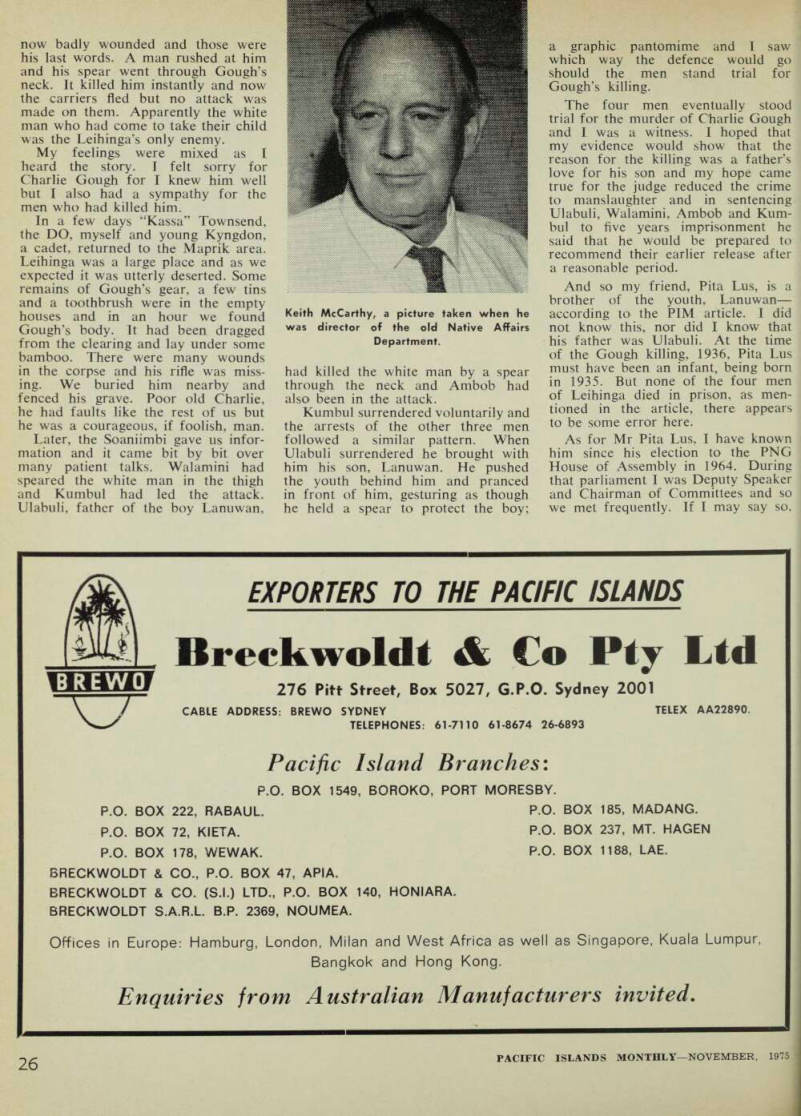
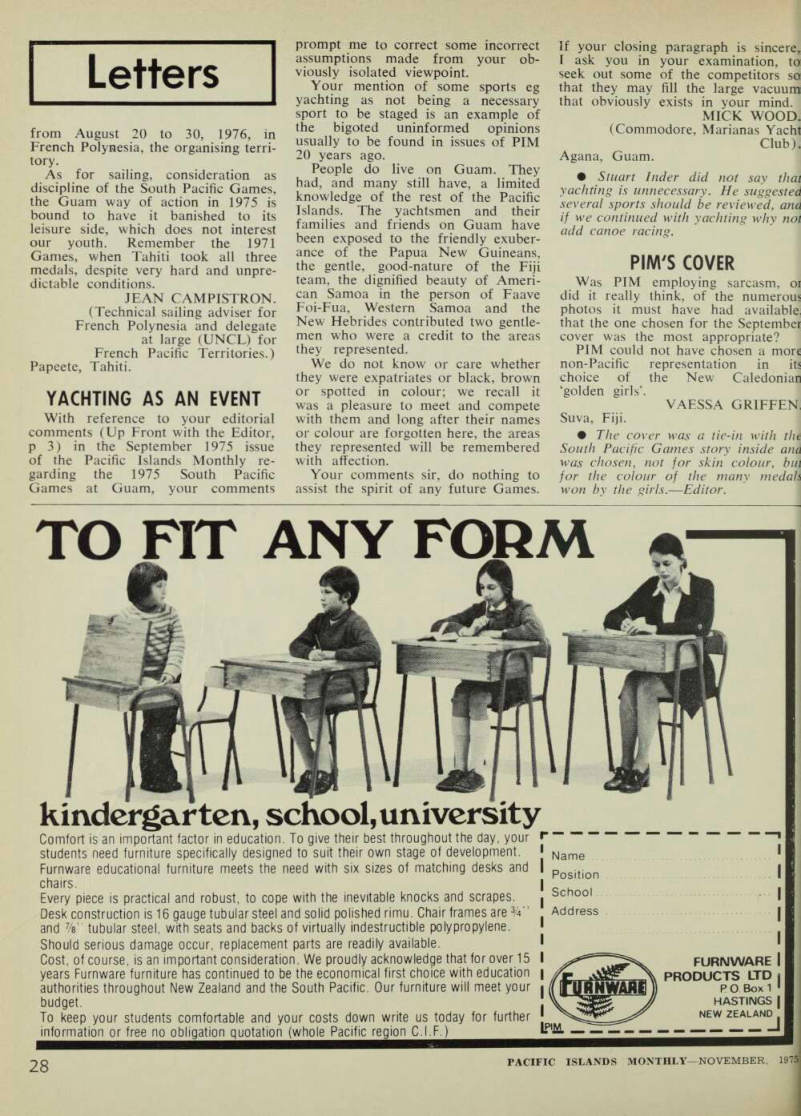
Ballad Of Charlie Gough
1 was most interested to read the story of my friend, Pita Lus, MHA id Minister of Police in the Govern ent of Papua New Guinea (PIM ily, p 10).
The mention of how Pita Lus’s ther killed a white man at Leihinga ought back many memories for I as very closely concerned in the atter —in fact, I have described it ther fully in my book, Patrol into in the chapter, The illad of Charlie Gough.
There are several errors in the tide. Charlie Gough was the Euro an killed at Leihinga and his death curred in 1936—and not 1934 as mtioned in the PIM account and was not killed as he slept but was eared when he was approaching the lage.
In 1935-36 I was Assistant District ficer at Aitape. The District Officer icre were no district commissioners those days) of the Sepik District is G. W. L. Townsend and the adquarters was at Wewak. Charlie nigh, then aged about 52, had a ire at Aitape and had formerly □spected for gold at Wau and ilolo. He still dreamt of finding
Id and occasionally recruited
lourers for work in other parts of :w Guinea. His Aitape store was :cessful but Charlie never missed opportunity to make a bob and his /e of money was to be the cause of i death.
The area, now known as Maprik which Leihinga village was a part, is then prohibited country. The ministration had declared it a losed area” and no Europeans, ler than official patrols, were per iled to enter it without a permit.
In 1936 I was on patrol on the rder of this restricted area. To my rprise I learned that Gough was
mped in a nearby village: unknown
me he had followed me in. I went the place and found that Gough s using one of the village headmen, nedical tultul, to recruit labourers, is was strictly illegal and I warned arhe and the tultul about it and it the latter back to his village. I 0 warned Gough that he was near : uncontrolled area border and was t under any account to enter it. 1 Charlie was all apologies and muses when I left him and con ued with my patrol.
Early next morning, at Amom
village, there were rumours that Gough had been killed and soon some of his carriers arrived to tell me the story. The tultul had re turned to Gough as soon as I had left his camp and had suggested to him that he (the tultul) should go to Leihinga, in the uncontrolled area, and try to recruit natives. Gough would remain at Ilahaup village and the tultul would bring the recruits to him. Gough agreed to this and off went the man to Leihinga, whose people he said he knew. Later, the tultul returned bringing with him a youth, aged about 14, named Lanu wan. Charlie was delighted to see him and to bind the bargain gave him a present of an axe, a knife and a lavalava. However, Lanuwan’s absence from Leihinga was soon dis covered and Ulabuli, his father, set out to get him back. At Ilahaup Ulabuli called to his son from the bush surrounding the village and young Lanuwan obeyed him. He de camped, taking his presents with him.
Charlie Gough was very angry at the loss of his recruit and his trade goods, which were worth about 12/6 —say Si,2s—as I say, he hated losing money.
“No damned boy puts it over me!” he roared and he determined to get the boy back.
Gough had 10 carriers with him—■ men from the coastal areas—and he had five shotguns and a Winchester .44 rifle. He distributed the shotguns amongst his carriers and gave them two cartridges each and armed him self with the rifle. They set out for Leihinga and by late afternoon had reached the outskirts of the village.
Across the track a tree had been felled and two spears were planted in the ground—an ominous sign of hostility and some of his carriers begged Charlie to go no further.
Gough cursed them as cowards; up rooted the spears and went on. A man’s voice from the bush called upon them to go back but Charlie was a determined man. He demanded that either Lanuwan return to him or that the axe and knife be handed back. A spear whistled through the air as Gough reached the clearing before the haus tambaran and then there was a shower of arrows. Gough fired his rifle and a spear pierced his thigh. The carriers fired too, but were soon out of ammunition, “More cartridges in my pack,” gasped Gough
now badly wounded and those were his last words. A man rushed at him and his spear went through Gough’s neck. It killed him instantly and now the carriers fled but no attack was made on them. Apparently the white man who had come to take their child was the Leihinga’s only enemy.
My feelings were mixed as I heard the story. I felt sorry for Charlie Gough for I knew him well but I also had a sympathy for the men who had killed him.
In a few days “Kassa” Townsend, the DO, myself and young Kyngdon, a cadet, returned to the Maprik area.
Leihinga was a large place and as we expected it was utterly deserted. Some remains of Gough’s gear, a few tins and a toothbrush were in the empty houses and in an hour we found Gough’s body. It had been dragged from the clearing and lay under some bamboo. There were many wounds in the corpse and his rifle was miss ing. We buried him nearby and fenced his grave. Poor old Charlie, he had faults like the rest of us but he was a courageous, if foolish, man.
Later, the Soaniimbi gave us infor mation and it came bit by bit over many patient talks. Walamini had speared the white man in the thigh and Kumbul had led the attack.
Ulabuli, father of the boy Lanuwan,
had killed the white man by a spear through the neck and Ambob had also been in the attack.
Kumbul surrendered voluntarily and the arrests of the other three men followed a similar pattern. When Ulabuli surrendered he brought with him his son, Lanuwan. He pushed the youth behind him and pranced in front of him, gesturing as though he held a spear to protect the boy;
a graphic pantomime and I saw which way the defence would go should the men stand trial for
Gough’s killing.
The four men eventually stood trial for the murder of Charlie Gough and I was a witness. I hoped that my evidence would show that the reason for the killing was a father’s love for his son and my hope came true for the judge reduced the crime to manslaughter and in sentencing Ulabuli, Walamini, Ambob and Kum bul to five years imprisonment he said that he would be prepared to recommend their earlier release after a reasonable period.
And so my friend, Pita Lus, is a brother of the youth, Lanuwan— according to the PIM article. I did not know this, nor did I know that his father was Ulabuli. At the time of the Gough killing, 1936, Pita Lus must have been an infant, being bom in 1935. But none of the four men of Leihinga died in prison, as men tioned in the article, there appears to be some error here.
As for Mr Pita Lus, I have known him since his election to the PNG House of Assembly in 1964. During that parliament I was Deputy Speaker and Chairman of Committees and so we met frequently. If I may say so.
Keith McCarthy, a picture taken when he was director of the old Native Affairs Department.
Mr Lus was sometimes pretty fiery in his speeches but I remember that he was often goaded by the taunts of some Europeans who were mem bers of the House at the time.
This is a pretty long-winded epistle, typical of a lapun who is apt to babble on, but I hope Pita Lus reads it for I am sure that it is in his generous nature to appreciate that at least there were some white men who had a sympathy for men, like his brave father, Ulabuli.
J. K. Mccarthy.
Mt Eliza, Vic.
The Pangu Rati
In 1967, Mr Oala Oala Rama described the Pangu Pati as a white man’s party, run by white men— Messrs Abel, Holloway, and Voutas.
Jackson’s characterisation of Pangu today—“an empty shell, the creature inside has perished” (PIM, July, p 10)—suggests it was indeed a white idea.
Papua New Guinea, we are fre quently told, is a unique country.
However the major component in its government lacking grass-roots sup port can hardly be one of the more encouraging special features it has.
One can appreciate why Pangu’s leaders should be grateful for what Poni Voutas has achieved for them, md that gratitude has now been ex pressed in a very tangible fashion I PIM, August, p 5).
While no one doubts his personal iincerity—proven by his practice of dways stepping down—the benefits of vhat he believed in, worked for, and las seen come to pass, have yet to ?e demonstrated for the ordinary people of Papua New Guinea.
John R. Horne.
3unedoo, NSW.
Golden Sail For Guam?
Reading this article (PIM, Sept, p 5) did astound all yachtsmen of -rench territories of the Pacific. How ome a magazine with the impor ance of yours is so misinformed ihout what happened to sailing in juam? Why was this other scandal mshed? To spare Nelson’s glory or naybe in a true commercial aim? . . .
So, we must settle up things, so s not to leave any ambiguity which light be prejudicial to sailing. When ailing was accepted in the First outh Pacific Games, the territories ecided, by a democratic vote, to hoose the FIRE-BALL.
Although not having that kind of mghy, the French territories, in re pect with the committee decisions ought quite a few Fire-balls and tarted practising with them.
We always did respect the Games barter.
The Guam Committee, after sending several contradictory advices, even letting us think that it would be possible to sail with Fire-ball, as long as we took care to bring our own dinghies, decided a few months before the Games that the race would be performed with the LASER. The Laser, which, of course, the French territories didn’t have . . . Why not sailing - rollerskates or SUNFISH?
What is the good of buying Fire-ball and training young ones if the Guam precedent is to be renewed?
So we have decided, in agreement with New Zealand, New Caledonia, New Hebrides and Australia, and if the Federation agrees, to organise a
high-level competition in the South Pacific, with the name of Sailing Challenge of Southern Pacific. The technical and sporting level of such a competition will be of no compari son with the Guam one, thanks to the sharing of Australian and New Zealand crews.
All interested territories of the South Pacific are most welcome. The chosen groups are as follows: Optimist Class—cadets; 420—juniors; 470 and Fire-ball—juniors and seniors.
The first challenge took place from August 20 to 30, 1975, in Noumea.
Sixty-eight yachtsmen joined that beautiful race. This will happen again
Letters
from August 20 to 30, 1976, in French Polynesia, the organising terri tory.
As for sailing, consideration as discipline of the South Pacific Games, the Guam way of action in 1975 is bound to have it banished to its leisure side, which does not interest our youth. Remember the 1971 Games, when Tahiti took all three medals, despite very hard and unpre dictable conditions.
Jean Campistron.
(Technical sailing adviser for French Polynesia and delegate at large (UNCL) for French Pacific Territories.) Papeete, Tahiti.
Yachting As An Event
With reference to your editorial comments (Up Front with the Editor, p 3) in the September 1975 issue of the Pacific Islands Monthly re garding the 1975 South Pacific Games at Guam, your comments
prompt me to correct some incorrect assumptions made from your ob
viously isolated viewpoint.
Your mention of some sports eg yachting as not being a necessary sport to be staged is an example of
the bigoted uninformed opinions
usually to be found in issues of PIM 20 years ago.
People do live on Guam. They had, and many still have, a limited knowledge of the rest of the Pacific Islands. The yachtsmen and their families and friends on Guam have been exposed to the friendly exuber ance of the Papua New Guineans, the gentle, good-nature of the Fiji team, the dignified beauty of Ameri can Samoa in the person of Faave Foi-Fua, Western Samoa and the New Hebrides contributed two gentle men who were a credit to the areas they represented.
We do not know or care whether they were expatriates or black, brown or spotted in colour; we recall it was a pleasure to meet and compete with them and long after their names or colour are forgotten here, the areas they represented will be remembered with affection.
Your comments sir, do nothing to assist the spirit of any future Games.
If your closing paragraph is sincere, I ask you in your examination, to seek out some of the competitors so that they may fill the large vacuum that obviously exists in your mind.
Mick Wood.
(Commodore, Marianas Yacht Club).
Agana, Guam. • Stuart Inder did not say that yachting is unnecessary. He suggested several sports should be reviewed, and if we continued with yachting why not add canoe racing.
Rim's Cover
Was PIM employing sarcasm, or did it really think, of the numerous photos it must have had available, that the one chosen for the September cover was the most appropriate?
PIM could not have chosen a more non-Pacific representation in its choice of the New Caledonian ‘golden girls’.
Vaessa Griffen.
Suva, Fiji.
• The cover was a tie-in with the South Pacific Games story inside ana was chosen, not for skin colour, bin for the colour of the many medals won by the girls. — Editor.
Advertisements & other items, pp. 27-30 (3 items)
25
:iFIC ISLANDS MONTHLY—NOVEMBER, 1975
System
Elegant Displays
NACO*
SHOPFRONT
SYSTEM
The Naco Shopfront System features elegant simplicity of
design. Outstanding
appearance is combined with ruggedness and reliability.
Flush glazing gives clear, clean sight lines for optimum display of merchandise. An in-built drainage system provides a second line of defence against moisture entering through joints.
And three depths of framing and flexible glazing are available to intermix for variety and economy.
Contact Comalco Fabricators Export Pty. Limited, manu-. facturers and overseas distributors of Naco products.
COMALCO FABRICATORS
EXPORT PTY. LIMITED
BOX 715 G.P.O.
BRISBANE 4001
AUSTRALIA.
COMALCO
is aluminium
4\l; i
EXPORTERS TO THE PACIFIC ISLANDS
Breckwoldt <& Co P Ltd
276 Pitt Street, Box 5027, G.P.O. Sydney 2001
CABLE ADDRESS: BREWO SYDNEY TELEX AA22890.
TELEPHONES: 61-7110 61-8674 26-6893
Pacific Island Branches :
P.O. BOX 1549, BOROKO, PORT MORESBY.
P.O. BOX 222, RABAUL. P.O. BOX 185, MADANG.
P.O. BOX 72, KIETA. P.O. BOX 237, MT. HAGEN P.O. BOX 178, WEWAK. P.O. BOX 1188, LAE.
BRECKWOLDT & CO., P.O. BOX 47, APIA.
BRECKWOLDT & CO. (5.1.) LTD., P.O. BOX 140, HONIARA.
BRECKWOLDT S.A.R.L B.P. 2369, NOUMEA.
Offices in Europe: Hamburg, London, Milan and West Africa as well as Singapore, Kuala Lumpur,
Bangkok and Hong Kong.
Enquiries from Australian Manufacturers invited .
9>st z -o o > >l/ w
In our 80 year
Selling
SERVICE"
to the Pacific Islands
NELSON & ROBERTSON
PTY. LIMITED
(Established 1895)
PLANTATION HOUSE, 197 CLARENCE STREET, SYDNEY
CABLES: "IVAN", SYDNEY, BRISBANE. TELEX: AA223BT, SYDNEY.
FOR:
INDENTS
COMMODITIES
SHIPPING
TRAVEL
INSURANCE
REAL ESTATE
Branch Office: Nelson & Robertson Pty. Ltd., 303 Adelaide St., Brisbane, Old New Guinea Representatives: Rabtrad Niugini Pty. Ltd., Rabaul Lae Madang Kieta.
TO FIT ANY FORM
0
kindergarten, school, university
f!nmfnrt ic an imnnr+ant fartnr in prlnratinn Tn niup thpir hpst thrnilflhnilt the flav VOUr r ““ “““ “ Comfort is an important factor in education. To give their best throughout the day, your students need furniture specifically designed to suit their own stage of development.
Furnware educational furniture meets the need with six sizes of matching desks and chairs.
Every piece is practical and robust, to cope with the inevitable knocks and scrapes.
Desk construction is 16 gauge tubular steel and solid polished rimu. Chair frames are %” and 7 /s” tubular steel, with seats and backs of virtually indestructible polypropylene.
Should serious damage occur, replacement parts are readily available.
Cost, of course, is an important consideration. We proudly acknowledge that for over 15 years Furnware furniture has continued to be the economical first choice with education authorities throughout New Zealand and the South Pacific. Our furniture will meet your budget.
To keep your students comfortable and your costs down write us today for further information or free no obligation quotation (whole Pacific region C.1.F.) Name Position School Address ism
FURNWARE
PRODUCTS LTD
P O Box 1
HASTINGS
NEW ZEALAND^
27
ACIFIC ISLANDS MONTHLY—NOVEMBER, 1975
Reform' Says Tonga's King
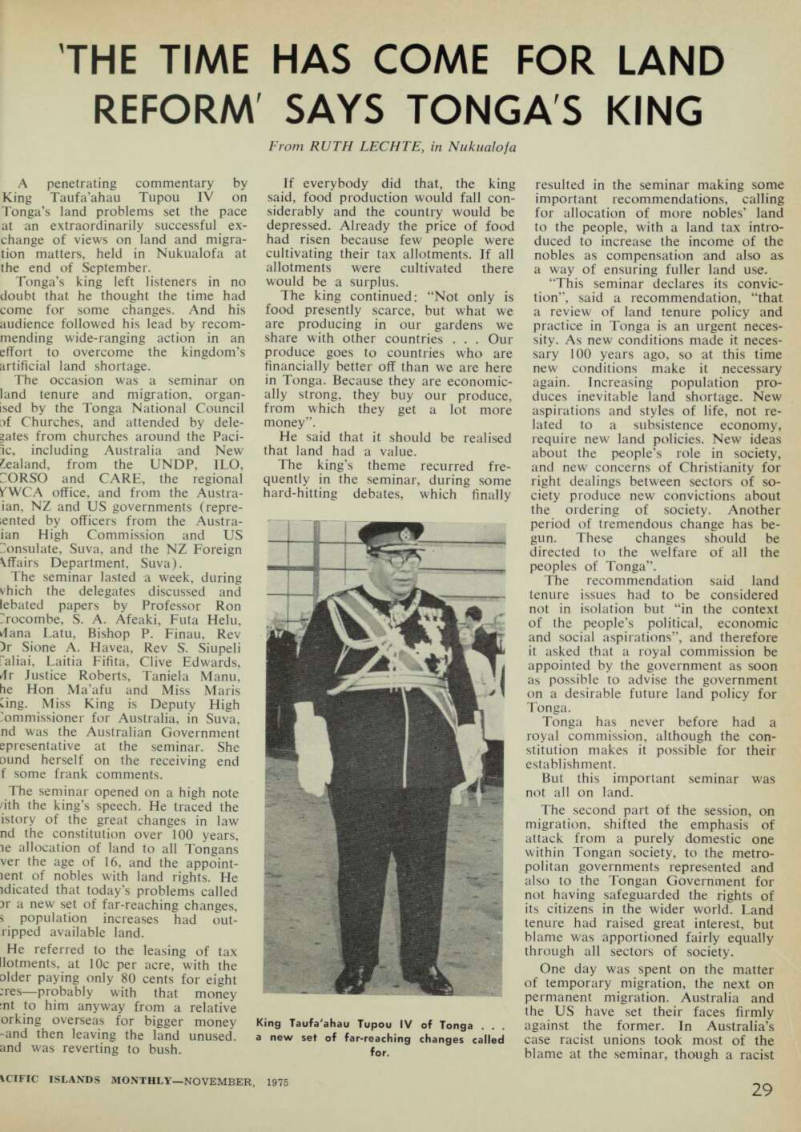
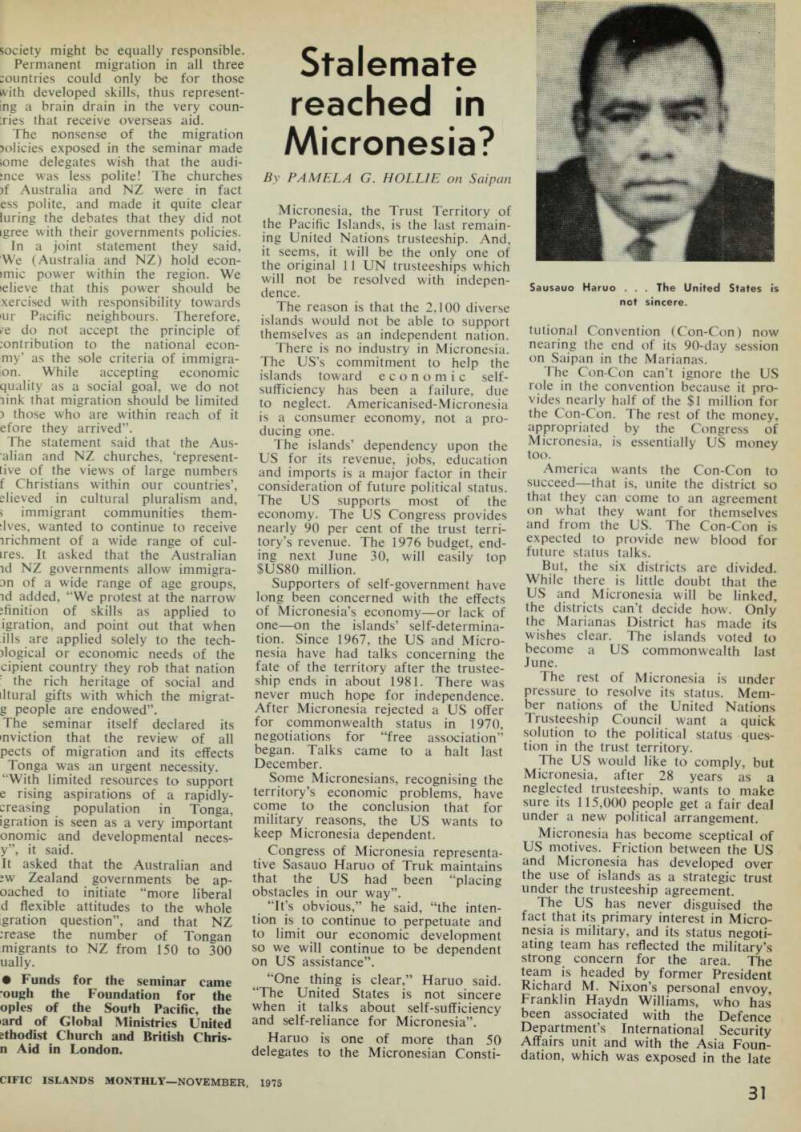
The Time Has Come For Land
From RUTH LECHTE, in Nukualofa
A penetrating commentary by King Taufa’ahau Tupou IV on Tonga’s land problems set the pace at an extraordinarily successful ex change of views on land and migra tion matters, held in Nukualofa at the end of September.
Tonga’s king left listeners in no doubt that he thought the time had come for some changes. And his audience followed his lead by recom mending wide-ranging action in an effort to overcome the kingdom’s artificial land shortage.
The occasion was a seminar on land tenure and migration, organ ised by the Tonga National Council af Churches, and attended by dele gates from churches around the Paci ic, including Australia and New Zealand, from the UNDP, ILO, ~ORSO and CARE, the regional ifWCA office, and from the Austra ian, NZ and US governments (repre icnted by officers from the Austra ian High Commission and US Consulate, Suva, and the NZ Foreign \ffairs Department, Suva).
The seminar lasted a week, during vhich the delegates discussed and lebated papers by Professor Ron >ocombe, S. A. Afeaki, Futa Helu, Tana Latu, Bishop P. Finau, Rev )r Sione A. Havea, Rev S. Siupeli faliai, Laitia Fifita, Clive Edwards, At Justice Roberts, Taniela Manu, he Hon Ma’afu and Miss Maris Cing. Miss King is Deputy High Commissioner for Australia, in Suva, nd was the Australian Government epresentative at the seminar. She aund herself on the receiving end f some frank comments.
The seminar opened on a high note nth the king’s speech. He traced the istory of the great changes in law nd the constitution over 100 years, le allocation of land to all Tongans ver the age of 16, and the appoint lent of nobles with land rights. He idicated that today’s problems called 3r a new set of far-reaching changes, 5 population increases had out ripped available land.
He referred to the leasing of tax llotments, at 10c per acre, with the aider paying only 80 cents for eight :res —probably with that money :nt to him anyway from a relative orking overseas for bigger money -and then leaving the land unused, and was reverting to bush.
If everybody did that, the king said, food production would fall con siderably and the country would be depressed. Already the price of food had risen because few people were cultivating their tax allotments. If all allotments were cultivated there would be a surplus.
The king continued: “Not only is food presently scarce, but what we are producing in our gardens we share with other countries . . , Our produce goes to countries who are financially better off than we are here in Tonga. Because they are economic ally strong, they buy our produce, from which they get a lot more money”.
He said that it should be realised that land had a value.
The king’s theme recurred fre quently in the seminar, during some hard-hitting debates, which finally
resulted in the seminar making some important recommendations, calling for allocation of more nobles’ land to the people, with a land tax intro duced to increase the income of the nobles as compensation and also as a way of ensuring fuller land use, “This seminar declares its convic tion”, said a recommendation, “that a review of land tenure policy and practice in Tonga is an urgent neces sity. As new conditions made it neces sary 100 years ago, so at this time new conditions make it necessary again. Increasing population pro duces inevitable land shortage. New aspirations and styles of life, not re lated to a subsistence economy, require new land policies. New ideas about the people’s role in society, and new concerns of Christianity for right dealings between sectors of so ciety produce new convictions about the ordering of society. Another period of tremendous change has be gun. These changes should be directed to the welfare of all the peoples of Tonga”.
The recommendation said land tenure issues had to be considered not in isolation but “in the context of the people’s political, economic and social aspirations”, and therefore it asked that a royal commission be appointed by the government as soon as possible to advise the government on a desirable future land policy for Tonga.
Tonga has never before had a royal commission, although the con stitution makes it possible for their establishment.
But this important seminar was not all on land.
The second part of the session, on migration, shifted the emphasis of attack from a purely domestic one within Tongan society, to the metro politan governments represented and also to the Tongan Government for not having safeguarded the rights of its citizens in the wider world. Land tenure had raised great interest, but blame was apportioned fairly equally through all sectors of society.
One day was spent on the matter of temporary migration, the next on permanent migration. Australia and the US have set their faces firmly against the former. In Australia’s case racist unions took most of the blame at the seminar, though a racist
King Taufa'ahau Tupou IV of Tonga . . . a new set of far-reaching changes called for.
society might be equally responsible.
Permanent migration in all three countries could only be for those with developed skills, thus represent ing a brain drain in the very coun tries that receive overseas aid.
The nonsense of the migration 3olicies exposed in the seminar made >ome delegates wish that the audi ence was less polite! The churches >f Australia and NZ were in fact ess polite, and made it quite clear luring the debates that they did not igree with their governments policies.
In a joint statement they said.
We (Australia and NZ) hold econ imic power within the region. We elieve that this power should be xercised with responsibility towards iur Pacific neighbours. Therefore, vc do not accept the principle of contribution to the national econ my’ as the sole criteria of immigra ion. While accepting economic quality as a social goal, we do not link that migration should be limited ) those who are within reach of it efore they arrived”.
The statement said that the Aus alian and NZ churches, ‘represent tive of the views of large numbers f Christians within our countries’, elieved in cultural pluralism and, 5 immigrant communities them :lves, wanted to continue to receive irichment of a wide range of cul ires. It asked that the Australian id NZ governments allow immigra an of a wide range of age groups, id added, “We protest at the narrow efinition of skills as applied to igration, and point out that when ills are applied solely to the tech ilogical or economic needs of the cipient country they rob that nation the rich heritage of social and iltural gifts with which the migrat g people are endowed”.
The seminar itself declared its inviction that the review of all pects of migration and its effects Tonga was an urgent necessity.
“With limited resources to support e rising aspirations of a rapidly creasing population in Tonga, igration is seen as a very important onomic and developmental neces y”, it said.
It asked that the Australian and cw Zealand governments be ap oached to initiate “more liberal d flexible attitudes to the whole gration question”, and that NZ crease the number of Tongan migrants to NZ from 150 to 300 ually. • Funds for the seminar came ough the Foundation for the oples of the Sou*h Pacific, the ard of Global Ministries United ethodist Church and British Chris n Aid in London.
Advertisements & other items, pp. 31-32 (2 items)
29
.CIFIC ISLANDS MONTHLY—NOVEMBER, 1975
Kunkii Ply
B\MS & SILOS
cR ATES Ah d & sM/>
&* FUR N, TO*S
vnSE^ o v PL
KUNKII PLY
Made by Commonwealth N.G. Timbers Ltd and available from leading plywood suppliers offers the widest range of plywood products specifically designed for hot and humid conditions. Interior, exterior and marine grades; weather-resistant and insect-proofed products, and Placarol doors; all provide high tensile strength for light weight, smooth face, straight even grain without core voids.
reached in

Stalemate reached in Micronesia?
By PAMELA G. HOLLIE on Saipan
Micronesia, the Trust Territory of the Pacific Islands, is the last remain ing United Nations trusteeship. And, it seems, it will be the only one of the original 11 UN trusteeships which will not be resolved with indepen dence.
The reason is that the 2,100 diverse islands would not be able to support themselves as an independent nation.
There is no industry in Micronesia.
The US’s commitment to help the islands toward economic self sufficiency has been a failure, due to neglect. Americanised-Micronesia is a consumer economy, not a pro ducing one.
The islands’ dependency upon the US for its revenue, jobs, education and imports is a major factor in their consideration of future political status.
The US supports most of the economy. The US Congress provides nearly 90 per cent of the trust terri tory’s revenue. The 1976 budget, end ing next June 30, will easily top SUSBO million.
Supporters of self-government have long been concerned with the effects of Micronesia’s economy—or lack of one—on the islands’ self-determina tion. Since 1967, the US and Micro nesia have had talks concerning the fate of the territory after the trustee ship ends in about 1981. There was never much hope for independence.
After Micronesia rejected a US offer for commonwealth status in 1970, negotiations for “free association” began. Talks came to a halt last December.
Some Micronesians, recognising the territory’s economic problems, have come to the conclusion that for military reasons, the US wants to keep Micronesia dependent.
Congress of Micronesia representa tive Sasauo Haruo of Truk maintains that the US had been “placing obstacles in our way”.
“It’s obvious,” he said, “the inten tion is to continue to perpetuate and to limit our economic development so we will continue to be dependent on US assistance”.
“One thing is clear,” Haruo said.
“The United States is not sincere when it talks about self-sufficiency and self-reliance for Micronesia”.
Haruo is one of more than 50 delegates to the Micronesian Consti-
tutional Convention (Con-Con) now nearing the end of its 90-day session on Saipan in the Marianas.
The Con-Con can’t ignore the US role in the convention because it pro vides nearly half of the SI million for the Con-Con. The rest of the money, appropriated by the Congress of Micronesia, is essentially US money too.
America wants the Con-Con to succeed—that is, unite the district so that they can come to an agreement on what they want for themselves and from the US. The Con-Con is expected to provide new blood for future status talks.
But, the six districts are divided.
While there is little doubt that the US and Micronesia will be linked, the districts can’t decide how. Only the Marianas District has made its wishes clear. The islands voted to become a US commonwealth last June.
The rest of Micronesia is under pressure to resolve its status. Mem ber nations of the United Nations Trusteeship Council want a quick solution to the political status ques tion in the trust territory.
The US would like to comply, but Micronesia, after 28 years as a neglected trusteeship, wants to make sure its 115,000 people get a fair deal under a new political arrangement.
Micronesia has become sceptical of US motives. Friction between the US and Micronesia has developed over the use of islands as a strategic trust under the trusteeship agreement.
The US has never disguised the fact that its primary interest in Micro nesia is military, and its status negoti ating team has reflected the military’s strong concern for the area. The team is headed by former President Richard M. Nixon’s personal envoy, Franklin Haydn Williams, who has been associated with the Defence Department’s International Security Affairs unit and with the Asia Foun dation, which was exposed in the late
Sausauo Haruo . . . The United States is not sincere.
960 s as a Central Intelligence gency (CIA) funded organisation.
Micronesia has been using its rategic military possibilities as a argaining point. The islands have ttle else to attract outside interest, i terms of dollars and cents, the lands will need about $l5O million om the US in 1980 to support its irrent standard of living as they pro ice much less than one-tenth that nount in taxes and exports.
Micronesia’s current economy is ised almost entirely on the opera ins of the Trust Territory Govern ent. US funds were not spent on e most obvious economic projects, tiich would have encouraged self fficiency.
What US spending did was to sate an artificial economy centred ound a government in which a very lented man can make more than 5,000 a year. The average Micro sian government worker makes ,000 a year, about the same money :eived from husking 100,000 coco ts to make 28 tons of copra or im catching about 2,240 tuna fish ighing 10 lb each. The minimum ige in the trust territory is 80c an ur, a recent hike from 60c.
Micronesia imports nearly 90 per it of all the goods it consumes, ipra is the largest export, but in best year, exports of copra have ly reached about $4.5 million.
Government has proved an accept le industry for Micronesians, who ve mastered the rhetoric of bureau icy. Young Micronesians, lured by t-finding junkets, leadership grants i a good income, have become less 1 less prepared to lead Micronesia yards independence. Instead, as •re and more Micronesians gradu from American universities with ideal science and law degrees, the ser the dependency on the US has :ome.
JS-Micronesian ties have not 'ays been close. For many years, US wasn’t interested in Micro ia. Except for the brief use of pan, now the capital of Micronesia, a top-secret CIA training ground, US generally neglected its finan l obligations to the trust territory.
' the first five years of the trustee p, Micronesia received about $1 lion a year. Later expenditures rose about $5.5 million annually, ixpenditures began increasing in •3 when the late President John F. inedy launched a programme to mericanise” Micronesia. The under ig motive was to solidify the nds’ allegiance to the US at a e when Vietnam focused military intion on South-east Asia and the :ific. n 1963, the budget for the trust itory jumped to $17.5 million
from $7.5 million two years before.
By 1968, the US was spending $35 million in Micronesia.
When South Vietnam and Cam bodia fell to the communists, the US began making plans for Micronesia.
Micronesian bases would make up for other US bases lost in South-east Asia.
Micronesian bases seem to fill the US military’s basic requirements.
They can be isolated and shielded.
For a small investment, the local population will be co-operative.
Micronesian bases along with bases in Japan, the Philippines, Australia and Diego Garcia form a strategic ring around Asia.
The US military’s need for Micro nesian bases to close the ring gives Micronesia more clout than the
islands would normally have had, if South-east Asia hadn’t been lost.
Yet, the US’s economic hold on the islands precludes discussions of a political status outside of one ensur ing a “close association” between the two. So, Micronesia is locked into an irreversible dependency upon the US.
And, the US has made a commitment it can hardly ignore.
Micronesia has about five years be fore the trusteeship ends to settle its future political status. During that time it is inconceivable that it will ask for less US money or that the US would give the trust territory less.
As the dependency on US funds grows, Micronesia’s chance for inde pendence lessens. It is a dependency —that for better or worse—neither the US nor Micronesia have attempted to change.
Advertisements & other items, pp. 33-34 (2 items)
31
CIFIC ISLANDS MONTHLY—NOVEMBER, 1975
We can't change
what you pump.
But we can change how
reliably you pump it.
We make mining pumps that have run for days on a snorer full of slurry. Bore-hole pumps that haven't been lifted in 15 years. Sewerage pumps that are unaffected by wet-strength fibres, pantyhose, nappies or solids up to 6" diameter. And farm-water pumps that deliver town-water pressure or better, 5 miles from the creek. As well as pumps for boiling cheese, grease, acids, cooked fruit and biscuit dough. Or anything else that can be pumped, and a few things other pumps can’t pump.
All of them have one thing in common. In a few years you'll begin to wonder if your Mono Pump will ever stop pumping. And our pumps are backed by 24 hours a day service from local engineers, factory trained in Australia. We can t change what you pump, but we can pump it more reliably. 4. 2. «**»•#* ti > 6. 1.
I 1. T series-mining & foods (Flanges or Tapped Ports) 2. Borehole series 3. Monta Pump-sewerage 4. Mutrator-sewerage 5. ‘o9’ series-farming . CP series-light industrial
MONO
[FtLDKaiF© (AUSTRALIA) PTY LTD.
Head Office and Works; “Mono House”, 338-348 Lower Dandenong Rd, Mordialloc, Vic. 3195. Phone 90-5211.
Agents in all major South East Asian and Pacific areas.
I Please send details of your pumps for (describe purpose): - I I- : : ; ! l lf a Borehole pump, indicate; Approx, depth of bore ft.; estimated water level ft.;J I estimated yield gph. NAME J I
ADDRESS J
1 344-P-043
Women’s Lib! Not here
The drafters of Micronesia’s constitution face a formidable modern-day problem that threatens to permanently disrupt the islands’ male-oriented society.
The question is: Should the new government of Micronesia allow discrimination against women?
The Micronesian Constitutional Convention (Con-Con) is nearing the completion of its 90-day session. The $1 million convention is charged with the task of writing a constitution for the island dis tricts of the US-administered Trust Territory of the Pacific Islands.
Among the most controversial social issues being considered is women’s rights. Opening up the society to all Micronesians, regard less of sex, threatens the basis of island traditional customs and laws, which maintain that women are inferior to men.
Carl Heine, chairman of the Con-Con s committee on civil liberties, believes that it is time for Micronesia to accept “sweep ing changes” in some of its prac tices. “This is the 20th century.
It is only proper and fair to give equal rights to all citizens of Micronesia.”
Heine maintains that the new government of Micronesia must “eliminate all forms of slavery and servitude in Micronesian society”.
Although the Micronesian society is matrilineal and some women hold titles and great power,
the males are the active and visible members of the society. Micro nesian women are supposed to be submissive. As a reminder, throughout Micronesia, it is a custom for the female to show respect to men and elders by assuming a lower position—either bowing or, if necessary, crawling to be lower than a man who is seated on the floor.
But, things are changing. After 28 years under US influence, the islands of Micronesia are Ameri canised. While Women’s Lib hasn’t swept the islands, Micronesian women have readily adopted western ways.
In the Marshalls, for instance, women have entered politics. The district elected the first female representative to the House of Representatives of the Congress of Micronesia last year. Another Marshallese woman is the only female delegate to the Con-Con.
Ironically, the Marshall Islands are known for their “love uni versity” on the island of Arno.
There, women once trained in the art of lovemaking. Upon gradua tion, the legend says, the women were given grass sleeping mats.
It is not likely that an equal rights clause in the new Micro nesian constitution will have much of an immediate impact. What the addition of such a clause does do is recognise that a modern con stitution for a modern nation must include equal rights for women.
Advertisements & other items, pp. 35-36 (2 items)
33
IFIC ISLANDS MONTHLY—NOVEMBER, 1975
Wunderflex gives
good design at low cost
f
E324ED
You want modern design?
Then use modern material that won’t warp, shrink or rot You want least cost?
Then build with a board that can be worked with handyman’s tools.
Inside and out, your home will have the modern, simple lines of Wunderflex building board.
kViunderlich
Wunderflex
Available from: Papua New Guinea: Steamships Trading Co. Lid.
Norfolk Island: Irvine's Building Supply Centre Made in Australia and marketed by CSR Building Materials Export Sales: 4 O’Connell Street. Sydney, Australia 2000
for its people
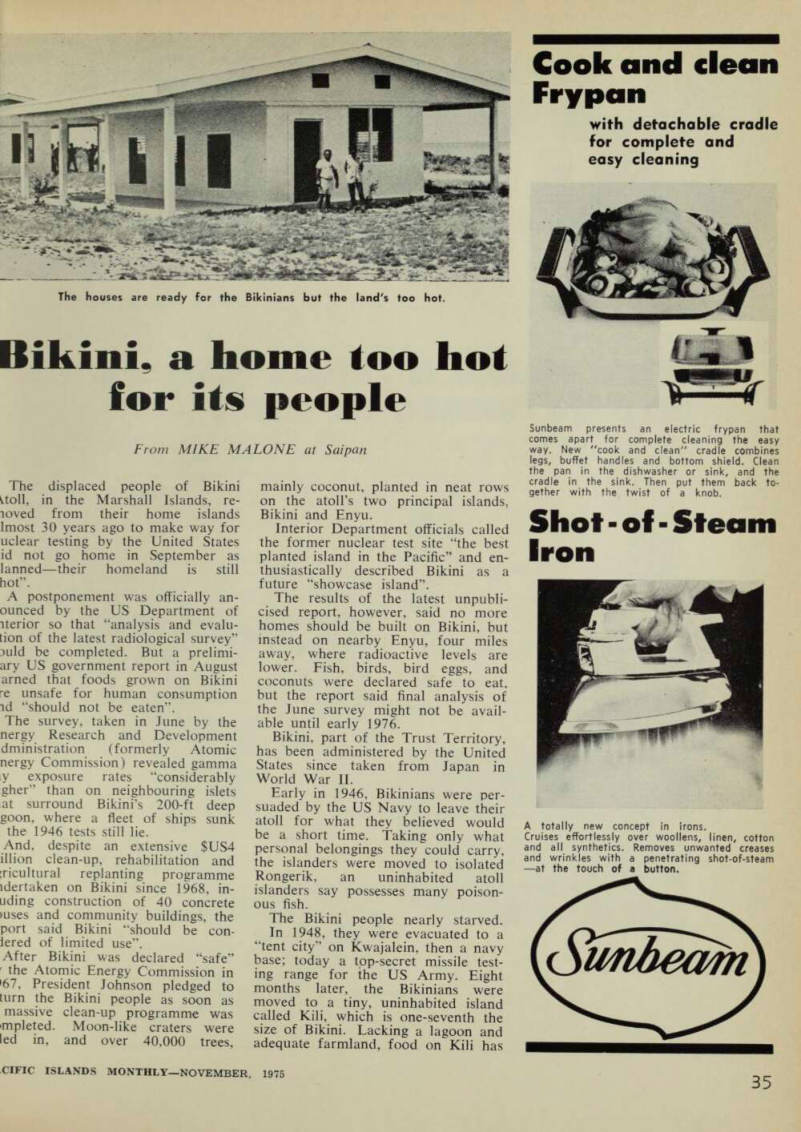

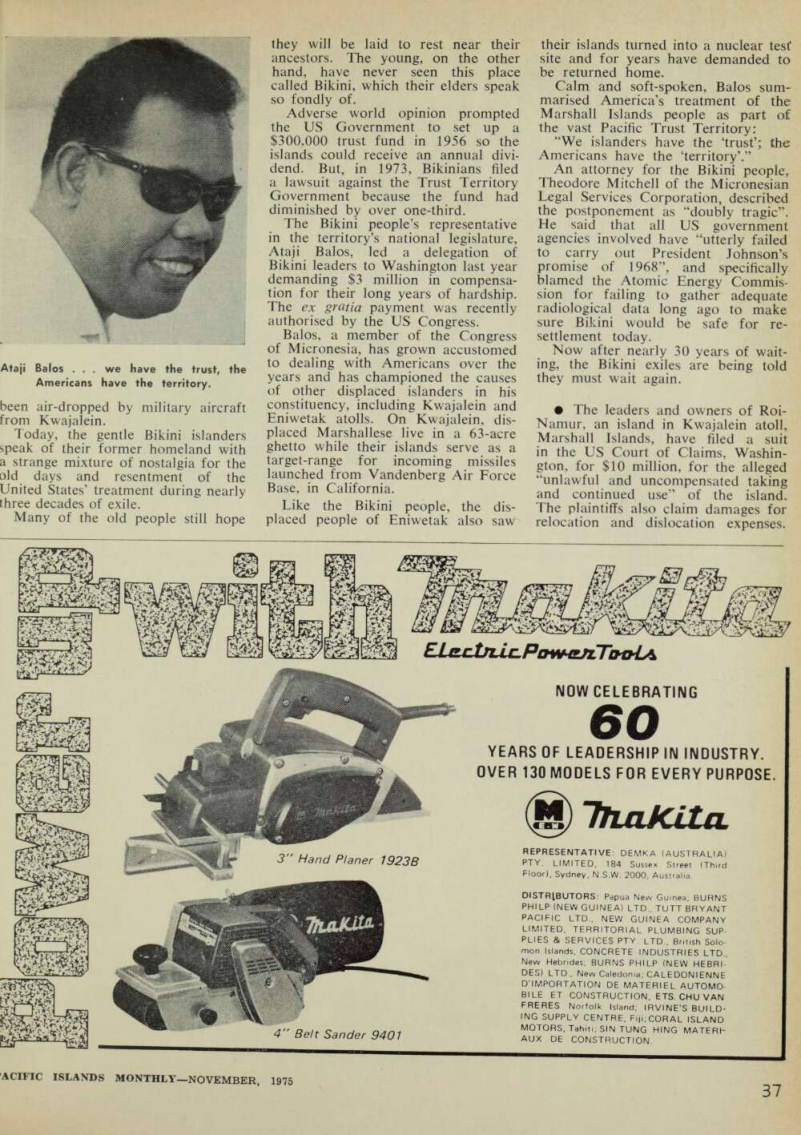
Bikini, a home too hot for its people
From MIKE MALONE at Saipan
The displaced people of Bikini doll, in the Marshall Islands, reloved from their home islands Imost 30 years ago to make way for uclear testing by the United States id not go home in September as lanned—their homeland is still hot”.
A postponement was officially anounced by the US Department of iterior so that “analysis and evalution of the latest radiological survey” luld be completed. But a prelimiary US government report in August arned that foods grown on Bikini re unsafe for human consumption id “should not be eaten”.
The survey, taken in June by the nergy Research and Development dministration (formerly Atomic nergy Commission) revealed gamma y exposure rates “considerably gher” than on neighbouring islets at surround Bikini’s 200-ft deep goon, where a fleet of ships sunk the 1946 tests still he.
And, despite an extensive SUS 4 illion clean-up, rehabilitation and incultural replanting programme idertaken on Bikini since 1968, inuding construction of 40 concrete »uses and community buildings, the port said Bikini should be cona USe T i u tGF A - 1 was declared “safe”
' the Atomic Energy Commission in 67, President Johnson pledged to turn the Bikini people as soon as massive clean-up programme was mpleted. Moon-like craters were led in, and over 40,000 trees,
mainly coconut, planted in neat rows on the atoll’s two principal islands, Bikini and Enyu.
Interior Department officials called the former nuclear test site “the best planted island in the Pacific” and en thusiastically described Bikini as a future “showcase island”.
The results of the latest unpubli cised report, however, said no more homes should be built on Bikini, but instead on nearby Enyu, four miles away, where radioactive levels are lower. Fish, birds, bird eggs, and coconuts were declared safe to eat. but the report said final analysis of the June survey might not be avail able until early 1976.
Bikini, part of the Trust Territory, has been administered by the United States since taken from Japan in World War 11.
Early in 1946, Bikinians were per suaded by the US Navy to leave their atoll for what they believed would be a short time. Taking only what personal belongings they could carry, the islanders were moved to isolated Rongerik, an uninhabited atoll islanders say possesses many poison ous fish.
The Bikini people nearly starved, In 1948, they were evacuated to a “ ten t c * ty ” on Kwajalein, then a navy base; today a top-secret missile test ing range for the US Army. Eight months later, the Bikinians were moved to a tiny, uninhabited island called Kili, which is one-seventh the size of Bikini. Lacking a lagoon and adequate farmland, food on Kili has
The houses are ready for the Bikinians but the land's too hot.
been air-dropped by military aircraft from Kwajalein.
Today, the gentle Bikini islanders speak of their former homeland with a strange mixture of nostalgia for the □ld days and resentment of the United States’ treatment during nearly three decades of exile.
Many of the old people still hope
they will be laid to rest near their ancestors. The young, on the other hand, have never seen this place called Bikini, which their elders speak so fondly of.
Adverse world opinion prompted the US Government to set up a $300,000 trust fund in 1956 so the islands could receive an annual divi dend. But, in 1973, Bikinians filed a lawsuit against the Trust Territory Government because the fund had diminished by over one-third.
The Bikini people’s representative in the territory’s national legislature, Ataji Bales, led a delegation of Bikini leaders to Washington last year demanding $3 million in compensa tion for their long years of hardship.
The ex gratia payment was recently authorised by the US Congress.
Bales, a member of the Congress of Micronesia, has grown accustomed to dealing with Americans over the years and has championed the causes of other displaced islanders in his constituency, including Kwajalein and Eniwetak atolls. On Kwajalein, dis placed Marshallese live in a 63-acre ghetto while their islands serve as a target-range for incoming missiles launched from Vandenberg Air Force Base, in California.
Like the Bikini people, the dis placed people of Eniwetak also saw
their islands turned into a nuclear tesf site and for years have demanded to be returned home.
Calm and soft-spoken, Bales sum marised America’s treatment of the Marshall Islands people as part of the vast Pacific Trust Territory: “We islanders have the ‘trust’; the Americans have the ‘territory’.”
An attorney for the Bikini people, Theodore Mitchell of the Micronesian Legal Services Corporation, described the postponement as “doubly tragic”.
He said that all US government agencies involved have “utterly failed to carry out President Johnson’s promise of 1968”, and specifically blamed the Atomic Energy Commis sion for failing to gather adequate radiological data long ago to make sure Bikini would be safe for re settlement today.
Now after nearly 30 years of wait ing, the Bikini exiles are being told they must wait again. • The leaders and owners of Roi- Namur, an island in Kwajalein atoll, Marshall Islands, have filed a suit in the US Court of Claims, Washin gton, for $lO million, for the alleged “unlawful and uncompensated taking and continued use” of the island.
The plaintiffs also claim damages for relocation and dislocation expenses.
Ataji Bales . . . we have the trust, the Americans have the territory.
Advertisements & other items, pp. 37-40 (3 items)
35
CIFIC ISLANDS MONTHLY—NOVEMBER, 1975
Frypan
Cook and clean
with detachable cradle
for complete and
easy cleaning
Sunbeam presents an electric frypan that comes apart for complete cleaning the easy way. New "cook and clean" cradle combines legs, buffet handles and bottom shield. Clean the pan in the dishwasher or sink, and the cradle in the sink. Then put them back together with the twist of a knob.
Shot - of - Steam
Iron
A totally new concept in irons.
Cruises effortlessly over woollens, linen, cotton and all synthetics. Removes unwanted creases and wrinkles with a penetrating shot-of-steam —at the touch of a button.
What Makes it
an Alfa Romeo
Front wheel drive and McPherson suspension make it handle like an Alfa.
The four cylinder, horizontally opposed motor and four speed gearbox make it perform like one, too.
And disc brakes all round guarantee it stops the way an Alfa Romeo should.
The only un-Alfa thing about the Alfasud is its price.
What Makes it
a Family Car
It’s big on the inside, so there’s room inside for the whole family.
But it’s quite compact on the outside.
So it doesn’t need much room to park.
The space inside the boot is about the same as the space in the average family refrigerator.
The front seats adjust up and down as well as backwards and forwards. And the steeringcolumn also adjusts upand down. 4 So you can adjust your Alfasud to suit you and your family. Which is better than adjusting your family to suit the car.
alfa
romeo
AH INVESTMENT IN SAFETY
For information contact Alfa Romeo Pty. Ltd.
Cnr. Beauchamp & Botany Rds., Botany, N.S.W., Australia.
Trade enquiries welcome.
-A i ?»>■ *8 »> & I \ »-ya 3" Hand Planer 19238 a: "■i k *«M
Elact/LiaPow^jLTiytyL^
NOW CELEBRATING
60
YEARS OF LEADERSHIP IN INDUSTRY.
OVER 130 MODELS FOR EVERY PURPOSE,
M) ItLoJdta.
REPRESENTATIVE: DEMKA (AUSTRALIA)
PTY. LIMITED, 184 Sussex Street (Third Floor), Sydney, N.S.W. 2000, Australia.
DISTRIBUTORS: Papua New Guinea: BURNS
PHILP (NEW GUINEA) LTD., TUTT BRYANT
PACIFIC LTD., NEW GUINEA COMPANY
LIMITED, TERRITORIAL PLUMBING SUP-
PLIES & SERVICES PTY. LTD., British Solo-
mon Islands, CONCRETE INDUSTRIES LTD.,
New Hebrides: BURNS PHILP (NEW HEBRI- DES) LTD., New Caledonia, CALEDONIENNE
DTMPORTATION DE MATERIEL AUTOMO-
BILE ET CONSTRUCTION, ETS. CHU VAN
FRERES Norfolk Island; IRVINE'S BUILD-
ING SUPPLY CENTRE, Fiji; CORAL ISLAND
MOTORS, Tahiti: SIN TUNG RING MATERI-
AUX DE CONSTRUCTION
Let Lane*
lend a hand
These are some of the products which are keeping our customers prosperous. From this range, you can obtain a really effective herbicide such as M.S.M.A., which controls persistent grasses and sedges in coconuts and bananas, or a short, residual, quick-acting insecticide like DIBROM which controls fruit and vegetable insects and mosquitoes, sandflies and midges.
Also, our research facilities and advisory services in the field are among the best available, so drop us a line and let us help you.
Lane Ltd., Export Division, P.O. Box 59, Bankstown, N.S.W. 2200 Lane (Fiji) Ltd., P.O. Box 89, Suva, Fiji e f Insecticide t Fungici t Weedkiller . Feed upplement f e Animal Health Fumigants *9 e Home Gardes^ X *N \ a * Don’t forget—Amalgamated Chemicals is now Lane
The VOLTA Super Suction Cleaners
v Ocr
Upright or cylinder cleaner, there is a VOLTA model to suit every need. All of them with outstanding cleaning power and advanced features—at a realistic price—to make home cleaning easier and quicker.
VOLTA
VOLTA offers three magnificent models: The dashing BLUE VOLTA speed cleaner with super power, the economy-priced WHITE VOLTA for the smaller home. And if you prefer an upright, there is the outstanding performer, the superbly styled DUAL ACTION VOLTA combining the powered brush and easy manoeuvrability of an upright with the powerful suction and convenience of a
cylinder.
For sale through The VOLTA people for the Pacific Islands:
KERR BROTHERS PTY. LIMITED
65 York St., Sydney, N.S.W. 2001
Acific Islands Monthly—November, 1975
Hypocritical Sabbath'
The Traveller Landed On Tonga's
By a Traveller in Tonga
“The Sabbath Day shall be sacred in Tonga for ever and it shall not be lawful to work artifice or play games, or trade on the Sabbath.”
The words come from the Tongan Constitution of 1875 and still today they stand as the law of the land. I think there are few people—even among the tourists, who are usually regarded as an irreligious lot, who would disagree with the spirit of the regulation, but, after spending two Sundays in the kingdom recently, I cannot help feeling that its modern application has led to nothing but religious hypocrisy and chicanery.
Awakening on my first Sunday at Nuku’alofa to the sound of church bells, I decided to attend a service.
The sermon, in Tongan, was, of course, incomprehensible, but, like io many other visitors to the king dom, I found the singing of unsur passable beauty and listening to it was a rare spiritual experience.
Again, like many other visitors, I ound the Tongan hospitality un ;xpectedly warm and welcoming for, ifter the service, a smiling man ap proached me and invited me to come md eat with his family.
The home to which he led me was poor compared with many we passed, put the feast that was spread before is was filled with all the good things )f the land—with pig and chicken md fish and all sorts of vegetables. I vondered how my host could possibly ifford it all, but he nudged me and aid proudly, “From my bush—except he fish. I catch that last night”.
When the final grace was over, my lost said, “You must excuse me now. will take some of this food to the lospital. My second son is there with broken leg, but there is nothing /rong with his appetite”.
I remembered—on my way into awn from the airport having seen be fine new hospital that serves Tmgatapu. I remembered, too, that : was a long way out of town.
You’ll go by bus?” I asked.
He shook his head, “The buses do ot run on Sunday. I shall walk”.
“Let me get you a taxi,” I volun iered, hoping to be able to repay in ame small measure, his hospitality, ut he shook his head again. “Taxis re not allowed to work on Sundays,” e said.
Walking back to my hotel shortly
afterwards along the beach road, I found myself constantly dodging auto mobiles and motorcycles. Tongans, whom I questioned, affirmed my sus picion that, although the buses and taxis which would have enabled people of moderate means like my host of the morning to go on errands of mercy to the hospital, were against the Sabbath law, there was no restric tion at all on the movements of any one fortunate enough to own an auto mobile or a motorcycle. Obviously Sabbath observance was not so much a matter of principle as of wealth.
The following Sunday I observed an even greater show of governmental hypocrisy. I had sailed the night before for Vava’u on the ’Aoniu, a Tongan ship which is clean and ex cellently run. As we pulled into the port of Neiafu about sunset on Sunday, I went into my cabin to check my luggage—a suitcase and several cardboard cartons of food and miscellaneous household goods which I had brought for the friend with whom I would be staying.
Outside, the decks sprang into life as crewmen ran to ready the ship for anchoring and to throw the ropes to
the shore crew. I followed them and spotted my friend on the wharf. Soon he was on the ship greeting me and following me into the cabin.
“Is all this yours?” he asked look ing at the pile of boxes in the middle of the floor. I nodded and he shook his head. “There’s no trouble,” I said, lifting a couple of boxes. “We can take them between us.”
“We can,” he said, “but I don’t know if we’ll be allowed to. I’ll go and see.”
I went with him onto the deck where a smartly got-up young police man was sitting. In reply to my friend’s question he said abruptly, “No, you can’t take it”.
I had been told that the cargo in the hold would not be worked until Monday morning and thinking he had mistaken by luggage for cargo, I said, “It’s just the things from my cabin that we’re talking about . . . not things in the hold.”
“You can’t take it,” the policeman repeated and, looking at us as if we were the most unregenerate criminals added, “It’s Sunday. You can come back for it at midnight.”
My friend explained that we had to
Advertisements & other items, pp. 41-42 (3 items)
39
ACIFIC ISLANDS MONTHLY—NOVEMBER, 1975
Henry Cumines Pr Ltd.
EXPORTERS • GENERAL MERCHANTS
428 GEORGE ST. SYDNEY
CABLES: HENCO SYDNEY. G.P.O. Box 3949. PHONE: 25-3383.
For specialised and personalised buying service throughout the Pacific Islands and the East.
Local enquiries to our agents: PORT MORESBY: Agencies Pacific Pty Ltd, Box 5044, P. 0., Boroko, Port Moresby. Telephone 55261.
MADANG; W. Double, P.O. Box 22, Madang. Telephone 2696.
Resident Agents in other FIJI: K. Witherington Ltd, P.O. 293, Suva. Telephone 22-356.
NEW HEBRIDES: John Lum & Associates, Box 65, P. 0., Santo. Telephone 329.
LAE: Osborne Agencies, P.O. Box 8, Lae.
Pacific Territories.
This little flower is your key
to the safe insect killer
One of the safest and most potent insect-killers known to contemporary science is derived from an innocentlooking small white flower, the African Pyrethrum daisy. Pure pyrethrins, as chemists call this substance, is the active ingredient in Pea-Beu insect spray, and the key to its concentrated killing power. Continuing research by the chemists in the laboratories of A.N.I. Chemical Research and by health and environmental authorities throughout the world, confirms that insects do not become immune to pyrethrum. Pea- Beu contains a high concentration of pyrethrins which means that short bursts only are needed to kill flies, mosquitoes and every type of insect pest.
The mosquito—a deadly
trafficker of disease The mosquito’s record as a killer is world recognised. Beside wrecking
mUM
so pure it’s safe to spray
anywhere
your night’s sleep with its irritating whine and inflicting its painful toxic bites, the mosquito passes on many serious diseases, including malaria, hepatitis, dengue and yellow fever, disfiguring elephantiasis and encephalitis. Pea-Beu is recommended to kill every mosquito that enters your home, because it is guaranteed completely effective, yet absolutely safe.
No fears near food Your kitchen and food-cupboards are the favourite places for houseflies, especially when attracted by exposed food as you cook or serve.
Of course you’re reluctant to use pungent insecticides, and fear toxic effects. But never hesitate to use Pea-Beu.
Its active ingredient guarantees it harmless to humans and pets, and thanks to the purity of all its ingredients, it is completely safe to spray anywhere in the home.
Pea-Beu the safe, powerful insecticide
“He said to them, “What

man of you, if he has one sheep and it falls into a pit on the sabbath, will not lay hold of it and lift it out. Of how much more value is a man than a sheep! So it is lawful to do good on the sabbath.” (Matt. chap. 12).
go to one of the outer islands and that running back and forth the length of the harbour was—particularly during the present benzine shortage—a great hardship. The policeman was not moved. “If I let you take your lug gage everyone else would expect to io the same.”
“And so they should,” I said. The 'emark was logical, but scarcely wise, or the policeman shouted arrogantly it us, “Go with your body. That’s dl you’ll take. Your own body. This s the Sabbath.”
True, it was Sunday, but did the efusal to let passengers take their >wn luggage ashore add to the holi less of the day? There is no waiting oom in Neiafu, no shelter where >assengers can sit to wait the striking >f midnight. Is it a Christian act to orce people to wait around on an ►pen wharf which is cold and often or to force them, as an alterna ive, to make double trips down the ang harbour?
I submit that if the Tongan Govern ment wishes to be strictly logical, rivate cars as well as taxis should •e forbidden to move on Sundays nd, as the last stroke of midnight ings out on Saturday night, the ngines of all Tongan vessels should e stopped and the ships should be llowed to drift at the divine will ntil midnight Sunday ends the abbath. Needless to say, men should ot be suffered either to throw ropes rom the ship nor to catch them on lie wharf on the holy day.
In pointing out the blatant ypocrisy of the Sabbath laws of onga, I mean no irreverence. Cer unly the churchgoing of Tonga and le quiet observance of the day is amething the rest of the world might ;ell emulate, but I suggest that, in lew of the fact that Tonga is a part f the modern world, it should recog ise that modernity is not necessarily idl.
I suggest further that the law lakers have another look at the Bible r hich they claim as the supreme law ir all men. It says there, “The abbath was made for man not man )r the Sabbath”.
'There Is But One Law For All'
Writing in the Tonga Chronicle, the editor, Siosiua H. Fonua, stressed, “There is but one law in Tonga for chiefs and commoners, Tongans and Europeans. It is as difficult for us to accept this provision as it is for Euro peans to accept some of our codes. I refer again to the Sunday laws which very few Europeans find easy to adapt to. However, it is becoming increas ingly common to hear of Tongans landing themselves in trouble overseas because they are not aware of the provisions of the law there. Fortunately, in time they learn to abide by the law, and equally fortunate, the expatriates here in Tonga learn that there can be no exception where they are con cerned. Perhaps the most important thing is the realisation that there is but one law in Tonga, and also the fact that there is but one God in Heaven and earth. When we apply those principles to our everyday thinking and actions, the spirit by which His Majesty King George Tupou I included this particular clause in the Constitution is made clear to us”.
Advertisements & other items, p. 43 (2 items)
41
CIFIC ISLANDS MONTHLY—NOVEMBER, 1975
%lc label
50 G •14 ! V\. .. * 5 0 Odd and &>■ n-; \ ,T *^NT„ fw
To HEM MAJESTY THE QUEEN
i»v ■*fsS%®p£h!r ■ *
%lc label
j E Scotch WhisK'
Ltd
n Dewa
Sons
H crmL^ B
COT
$UPi» v ' 5
For people who value
tradition.
Dewar’s “White Label”-it never varies.
Islands Press
From the Islands Press
From the Arawa Bulletin: And on the subject of weddings, why do people who rarely go to church have to be subjected to singing three or jour lengthy hymns known only to the parson and the organist (if that).
Becomes one of the more embarrassing moments of maritalisation when one has to sing about fighting the good fight, when all one knows is
Waltzing Matilda.
From a letter by M. B. Taite, in News Drum, Solomon Islands: I am an enthusiast for soccer. I love everything of it.
I follow it even if it means paying 80c taxi to watch it.
From a court report in The Fiji Times: A businessman convicted in Suva Court of obtaining money by false pretences commended the detective inspector and other officers assigned to the case for their quick work in tracking him down. Mahendra Prasad Shandil (18), of Lakeba Street, Samabula, pleaded guilty to 10 counts of false pretences . . . Shandil told (the magistrate): "I would like to congratulate Detective Inspector Sahindra Kumar Singh and his party for their quick work in tracking me and finding out about my offence" . . .
Ronald Martin reports in the Papua New Guinea Post-Courier: Village social nights are beginning to be “too sociable” according to Asaro Watabung councillors.
The councillors will move to abolish social nights because they are doing more damage than good to the lives of the village communities, they say.
Illegal sales of beer at exorbitant prices and a high rate of pregnancy among unmarried women are among problems brought into village communities by social nights, councillors say . . , From a letter by Katy Ceal in The Solomon Islands News Drum: . . . the Solomon Islands are getting worse. Murdering, stealing, raping girls and other crimes are growing more and more. Especially in recent years when we have learned that our Solomon Islands are going to be independent.
The risk of being a reporter as reported in the Samoa Times: A Samoa Times reporter was threatened with bodily harm by several members of the Apia rugby team last Saturday following an article which appeared in this newspaper recently. The reporter . . . was unexpectedly jolted when an Apia player walked off
the field and grabbed him by the hair. The reporter fended off the player’s hand, inquiring what was wrong. The player replied with a threat. “You will be beaten up if you ever write anything bad about the Apia rugby team in your paper again” he told our reporter . . .
From submissions made to the Royal Commission on Norfolk Island's future constitution by Administrator Air Commodore E. T. Pickerd: as reported in The Norfolk Islander.
“. . . there may be occasions during my appearance before the Royal Commission when my attitudes and reactions as either the Administrator, and/or the Chairman of the Norfolk Island Council, and/or a private individual may not be in consonance.
Should this occur, I shall make my position on each occasion quite clear so as to leave no doubt as to which hat I am wearing at the time . , .
Mr Apisai Tora, Fijian politician, trade union leader and stirrer, in The Fiji Times: It all boils down to the fact that both Mr James Raman and Mr Joeli Gavoka don’t exactly like the look of my face. And I don’t blame them because I’m merely black and not exactly beautiful.
The Cook Islands' Premier, Sir Albert Henry, speaking on the 10th anniversary of self-government, as reported by the Cook Islands News: . . . Remember today we have allowed ourselves to enter into the world of political and industrial strife—a real world. It is a world of fact, a world of realities. There is no place for imitation, it is a world where a banana is a banana, a coconut is a coconut —there is no place for dreams . . . when we look at the world we marvel, and we say to ourselves what a hell of a world this is.
Who made it so?—Greedy human being full of bamboozaly ideas, all over the world . . .
From the Tohi Tala Niue: After waiting 16 months for the glue for Fibre Glass Tanks they have arrived but no good to be used as outside the tins it says "Use before April". What it contains in them were hard and only little can be used.
From an interview in the Atoll Pioneer (GEIC) with Mr Mulikihaamea Matekitoga (named and adopted by the King of Wallis), president of the
Tonga Trading Co:
. . . He came into this business because of his desire to help his people (meaning the people of Wallis, Tonga and other Pacific Islands such as us) from being exploited by foreigners. “I am disgusted”, said Mulikihaamea”, at the way some of the tourists carry on bargaining down, lower and lower the price of art work from a poor islander”. . . .
From The Fiji Times Flotsam and Jetsam column: Asked what he thought of Dr Anthony (former Fiji trade union official) in general, the Prime Minister (Ratu Sir Kamisese Mara) commented: “One of the brightest politicians going around without a constituency”.
Advertisements & other items, pp. 45-52 (3 items)
\
So this is a Lamborghini," she breathed, as we spoil down the autostrada towards Turin, “Yes,” I said, offering her a Henson and Hedges. “Five forward gears and 170 in lop." ’Can you prove that?" she demanded. ‘Do 1 really have to? You did say you only wanted a little ear to do the
shopping."
* fv kV ■ ’ ' ' s V. v f.
Jpf- ,V> Benson & Hed 5* v When best will do.
A-' : m (f:x Olt< I* llOlt (. ,M
If you’ve got work to do
we’ve got trucks to do it
TOYOTA
Land Cruiser Pickup
TOYOTA
Hi-Ace
TOYOTA
Stout
TOYOTA Hi-Lux
MICROL CORPORATION, P.O. Box 267, Saipan. FIJI ISLANDS: AUTOMOI PAPUA NEW GUINEA: ELA MOTORS LIMITED, Scratchley Rd.. Badili, Papua. U.S. TRUST TERRITORY: SUPPLIES CO.. LTD., G.P.O. Box 355, Suva. AMERICAN SAMOA: BURNS PHILP (SOUTH SEA) CO,. LTD.. Pago Pago. TcVenteßPr7sEsTs Apia. GUAM: RICKY'S AUTO CO,. P.O. Box 1458, Agana. NEW HEBRIDES: NEW HEBRIDES MOTORS LTD., P.O. Box 18. V,la. SOLOMON ISLANDS. MENDANA ENTERPRISES (S.
P.O. Box 174, Honiara.
s v>\ \ A ' 4 s\: V % * , % X V* *
Jv v^;
iM i % \ i ■■ % >: *■•■*• ; v v'o*. v: • I ‘ ' «' J ', 4,/. •> v\ hi'-4b x *\> V' ''A t' • ■rv ■ V* «-',: '.;- 4>|% t >V .
W •- : • " v r wm S' - «*5 M S $-4 ft % x From different styles of the 4-wheel-drive Land Cruiser, to vans and pickups, to heavy duty trucks. Toyota makes them.
And Toyota makes them tough.
There's a Toyota truck that will work for you. Economically.
Reliably.
Find out about it. From your local Toyota dealer.
K TOYOTA Truck
TOYOTA Dyna
OYOTA
TOYOTA
Toyo-Ace TAHITI: NIPPON AUTOMOTO, B.P. 545, Papeete. COOK ISLANDS: COOK ISLANDS TRADING CORPORATION LTD PO Box 92 Ratotonga. NAURU ISLAND: NAURU COOPERATIVE SOCIETY. GILBERT & ELLICE ISLANDS COLONY: TARAWA MOTORS Box 36‘ t^ LK ISLAND: MARIE'S NORFOLK TOURS, LTD., P.O. Box 276. TIMOR: SANG TAI HOO. Sang Tai Building Dili' NEW CALEDONIA: SOCIETE IMPORTATION AUTOMOBILE DU PACIFIQUE. Rond-Point du Pacific (Station Total) B.P. 438. Noumea.
Tparker
V.‘ »> *»»> *» »*» m»v An •Wl «t •t »». »* ii
Surprisingly slim ball pens
for such big-hearted refills.
•i I'laMSti > jffi »«•« iMigi wibi iHmgS*Sf Hint! .wait
wtgtt
iii;:!*:!
unit;
0*;// Jflßf Parker International
» J 0 W Classic ball pens look lean JBr and feel light but they're far from light on ink. Up to 80,000 words is what to expect from one refill.
The Parker ball point is tungsten carbide, the third-hardest substance there is, and it’s machined so accurately that we can offer it in extra fine, fine, medium or broad point sizes. From left: Stainless steel; Sterling silver; 12ct gold-filled; Vermeil (Sterling/gold); 14ct gold-filled.
tPARKER
World's most wanted pens 066.P.295D
Sony’s original stereo
radio/cassette-corder.
Can you imagine a better pickme-up?
The honest-to-goodness sound of real Sony stereo. At the beach, the park, or on a picnic.
And remember, the Sony CF-550A the daddy of all one-piece stereos. A tried and proved design.
It’s unique Matrix Sound Stereo System plus built-in speakers give you richer'' (((«"o.,»))) and more natural stereo reproduction.
“Live” stereo recording is simple with two sensitive built-in electret condenser microphones. And besides that, you can also record directly off AM or FM wavebands.
Sony’s original stereo radio/ cassette-corder works off batteries, mains power (AC cord included) or off your car/boat battery (adaptor optional). Pick one up. You’ll love it. what seems like magic Is actually great Sony design. four C s'". ...
E rTF-
The House of Seppelt
has been producingfine wines
in Australia since 1851.
Enjoy these wines from the House of Seppelt. one of Australia's great winemakers.
Moyston Claret.
Chalambar Burgundy.
Salinger White Burgundy.
Arawatta Riesling.
Greenock Sauterne.
Melita Moselle.
Rhymney Chablis.
Barossa Valley Rose.
Para Liqueur Port.
Solero Sherries.
SEPPELT
B. Seppelt & Sons Limited, Gresham Street, Adelaide, South Australia, 5000. f I D 546 :
i "At, -• ’T Whatever you want in a pickup, the 81600 delivers it.
With performance. With economy. With style.
Consider the things we build into it so you can get more out of it. The 1600 cc overhead cam engine, for instance, is a lot like the one you find in some sports cars.
Yet ours just sips gas. And the important things like the heavy duty suspension system and the safe, sure braking system make operating the 81600 a joy.
Want a sporty pickup for the fun of it?
Or just for its carry-all capabilities?
Test drive the Mazda 81600 pickup.
The truck-load of fun and economy. 1975 Toyo Kogyo Co., Ltd.
A ,v.
PMr a Niran ians Autoport LtdJ3.P.O. Box 450, Suva TEL: 22691 Soci6t6 Riviere et Bernanos, 27, Rue de Sebastopol Noumea Duncomb« P ß N i A, a D d o nd D US rl^ S A L d l , P .° Box 1394 ' B ° r okoTEL: 55788 Mazda Motors of New Zealand Ltd. Otahuhu, PO Box 22-472 TEL- 69-099 Buncombe Bay Gara o e. PO. Box 220, Norfolk Island TEL: 2097 B S Solomon Motors Ltd. PO. Box 20, Honiara TEL: 313 Comptoir Polynes°en B P 628 Papeete The trademark MAZDA in this advertisement stands for AUTOMOBILES MAZDA as far as France and her territories are concerned.
Early shipments The first Loco.
The Manager s house. h 'I Landing stores.
The Manager s office Palatial!
Acific Islands Monthly—November, 1975
Magazine Section
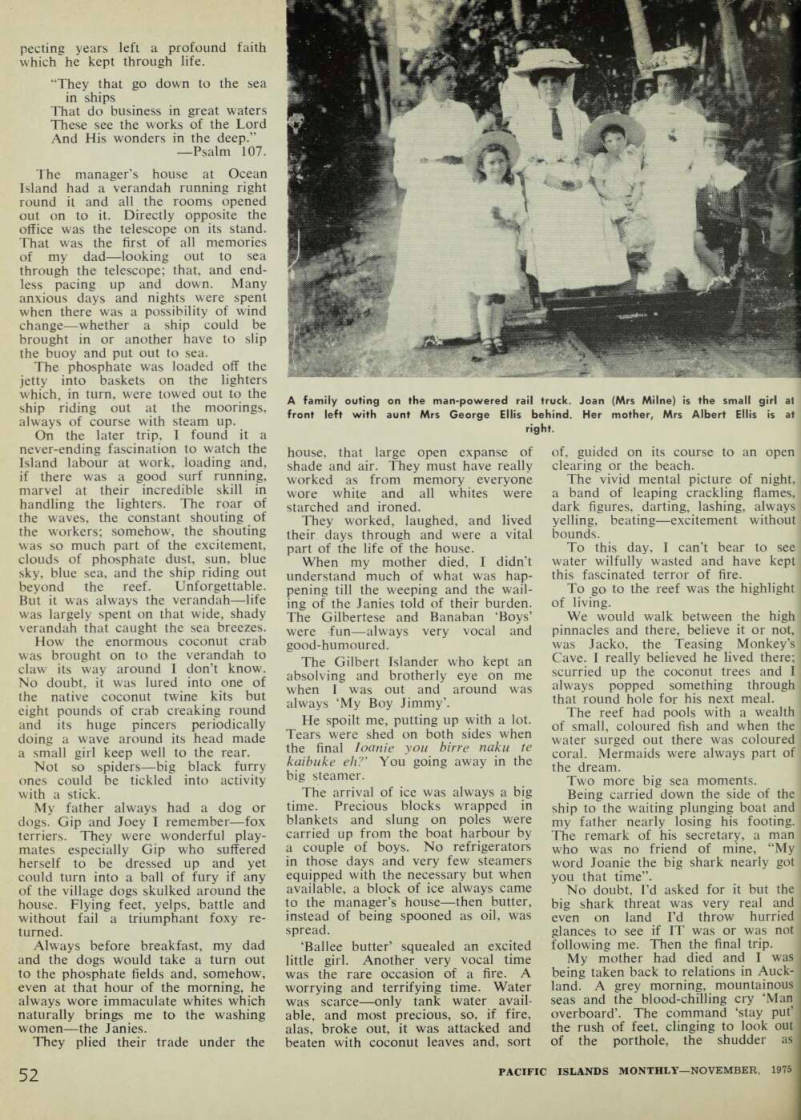
IN THE DAYS WHEN OCEAN WAS OLD
Ocean And Nauru Was A Pup
Seventy-five years ago, Mr (later Sir) Albert Ellis discovered that Nauru was a vast heap of ihosphate and his discovery urged him on to look for more. He found it on Ocean Island. Today, Ocean Island and its people, the Banabans, are the centre of a multi-million dollar action in the British High Court and a subject for discussion by the United Nations. Late in 1900, the first shipment of ihosphate left Ocean Island. Three years later, a small girl, Albert Ellis's daughter, arrived on Ocean ' sland. Now, so many years later, as Mrs Joan Milne, of Khandallah, Wellington (NZ), she writes his story for PIM.
By Joan Milne
[Z’O-NA-MAURI and Te Akabo— over the years a fair amount has een written about Ocean Island lostly in newspaper articles, agricul iral journals, magazines, as well as i the odd book. Its very early history » sketchy and it was not held in any nportance. It appears in Admiralty harts under the name of Paanopa eing named after a British vessel diich “discovered” it in 1804. The ame over the years evidently became anaba and the inhabitants Banabans. ; had, supposedly, no commercial alue; it was subject to droughts; it as isolated but carried a moderate opulation for its size and at times a :w of the beachcomber types of lose days.
The story of the finding of the ast phosphate deposits has been told ad it does not need repeating, but I ould like to stress that Albert Ellis, ly father, was a prospector and he rospected on many islands for phos laate as an employee of the Pacific lands Company.
Because of experience and a trained ft he recognised a certain piece of >ck for what it was. At no time aring his long career in the phos aate industry did he work on his vn behalf. The work of shipping it phosphate started from scratch, ;gan remarkably quickly; equipment >ed being brought from other work gs. Indeed, the other workings were an all-time low so Ocean Island as a life-saver. Late in 1900 Ocean land’s people saw the first shipments aving.
Three years later, a small five eek-old baby girl arrived by ship
with her mother. I suppose one re members incidents back to the age of three and as I was 5i when I left, a few indelible memories remain and they are memories, not hearsay.
Also because of those fleeting early years, there was forged this strong and lasting love for a small sea-girt isle and its inhabitants. Nostalgic thoughts? Yes. Emotional? Yes—and somehow a strong, continuing yen.
It is because of these I have an under standing and certain sympathy for some of the desires of the Banabans at the present time quite apart from the money aspect.
Ocean was old Ocean When Nauru was a pup.
Ocean will be old Ocean When Nauru’s swallowed up. ran the old ditty only it doesn’t seem to be working out that way.
One would naturally begin with one’s mother and father. My father was always a quiet, unassuming man.
Recently, I have read two criticisms of him which have shown that the writers did not know him at all. He was described as a ‘merchant adven turer’ and the other suggested that he was a selfish man.
The first is absurd. His whole pattern of life refuted that: his books are completely straight-forward, un complicated and speak for them selves. As for being selfish, he was a good New Zealander who was con vinced the farmers of his country needed phosphate in fertiliser form for their farms and that they needed it at low cost. In that aspect, maybe, he had a one-track mind.
Over the intervening years, perhaps phosphate has been used extrava gantly but that was not his depart ment.
He had a number of sayings.
Some that come to mind are: “That will spill the milk in the coconut: it’s good to bear the yoke in one’s youth: you can’t make omelettes without breaking eggs: give way in little things but not in big”.
When travelling one either ‘roughed it’ or ‘suffered in comfort’.
In the days when Albert Ellis and his brother George were prospecting through the Islands for guano and phosphate deposits they really did rough it. Sailing ships, schooners, brigantines, storms, becalmed, camp ing, coping with rats, cockroaches, lice of all varieties—it was all very much in the pioneering class.
My dad had many stories he could tell and every now and then they fitted irrto daily life. He took a dim view of complaints regarding food and would call to mind trips when all biscuits had to be tapped to release livestock and there were horrid stories about evil-smelling butter and doubt ful salted meat.
Two stories used to thrill me and were in constant demand. One, how his rug ‘woolly’ saved the life of a native chief and the other the sighting of a small open craft in mid-ocean with some French escapees who by that time were in sore plight. They were taken on board, murderous weapons and all. But all his tales of adventure have been factually written with no straining after effect. Early upbringing and his wandering pros
pecting years left a profound faith which he kept through life.
“They that go down to the sea in ships That do business in great waters These see the works of the Lord And His wonders in the deep.” —Psalm 107.
The manager’s house at Ocean Island had a verandah running right round it and all the rooms opened out on to it. Directly opposite the office was the telescope on its stand.
That was the first of all memories of my dad—looking out to sea through the telescope; that, and end less pacing up and down. Many anxious days and nights were spent when there was a possibility of wind change—whether a ship could be brought in or another have to slip the buoy and put out to sea.
The phosphate was loaded off the jetty into baskets on the lighters which, in turn, were towed out to the ship riding out at the moorings, always of course with steam up.
On the later trip, I found it a never-ending fascination to watch the Island labour at work, loading and, if there was a good surf running, marvel at their incredible skill in handling the lighters. The roar of the waves, the constant shouting of the workers; somehow, the shouting was so much part of the excitement, clouds of phosphate dust, sun, blue sky, blue sea, and the ship riding out beyond the reef. Unforgettable.
But it was always the verandah—life was largely spent on that wide, shady verandah that caught the sea breezes.
How the enormous coconut crab was brought on to the verandah to claw its way around I don’t know.
No doubt, it was lured into one of the native coconut twine kits but eight pounds of crab creaking round and its huge pincers periodically doing a wave around its head made a small girl keep well to the rear.
Not so spiders—big black furry ones could be tickled into activity with a stick.
My father always had a dog or dogs. Gip and Joey I remember—fox terriers. They were wonderful play mates especially Gip who suffered herself to be dressed up and yet could turn into a ball of fury if any of the village dogs skulked around the house. Flying feet, yelps, battle and without fail a triumphant foxy re turned.
Always before breakfast, my dad and the dogs would take a turn out to the phosphate fields and, somehow, even at that hour of the morning, he always wore immaculate whites which naturally brings me to the washing women—the Janies.
They plied their trade under the
house, that large open expanse of shade and air. They must have really worked as from memory everyone wore white and all whites were starched and ironed.
They worked, laughed, and lived their days through and were a vital part of the life of the house.
When my mother died, I didn’t understand much of what was happening till the weeping and the wailing of the Janies told of their burden, The Gilbertese and Banaban ‘Boys’ were fun—always very vocal and good-humoured.
The Gilbert Islander who kept an absolving and brotherly eye on me when I was out and around was always ‘My Boy Jimmy’.
TI ... ... ’ ... i .
He spoilt me putting up with a lot.
Tears were shed on both sides when the final loam eyou bine kaibuke eh? You going away m the big steamer.
The arrival of ice was always a big time. Precious blocks wrapped in blankets and slung on poles were carried up from the boat harbour by a couple of boys. No refrigerators in those days and very few steamers equipped with the necessary but when available, a block of ice always came to the manager’s house—then butter, instead of being spooned as oil, was spread. ‘Bailee butter’ squealed an excited little girl. Another very vocal time was the rare occasion of a fire. A worrying and terrifying time. Water was scarce—only tank water available, and most precious, so, if fire, alas, broke out, it was attacked and beaten with coconut leaves and, sort
of, guided on its course to an open clearing or the beach, The vivid mental picture of night, a band of leaping crackling flames, dark figures, darting, lashing, always yelling, beating—excitement without bounds.
To this day, I can’t bear to see water wilfully wasted and have kept this fascinated terror of fire, To go to the reef was the highlight
of living.
We would walk between the high pinnacles and there, believe it or not, was Jacko, the Teasing Monkey’s Cave. I really believed he lived there; scurried up the coconut trees and I always popped something through that round hole for his next meal.
The reef had pools with a wealth Qf sma „ coloure s foh and when the water sur g e d out there was coloured naku te coral Mermaids were alwa art of the Two more big sea moments.
Being carried down the side of the ship to the waiting plunging boat and m y father nearly losing his footing, The remark of his secretary, a man w ho was no friend of mine, “My WO rd Joanie the big shark nearly got y o u that time”.
No doubt. I’d asked for it but the big shark threat was very real and even on land I’d throw hurried glances to see if IT was or was not following me. Then the final trip, My mother had died and I was being taken back to relations in Auck land. A grey morning, mountainous seas and the blood-chilling cry ‘Man overboard’. The command ‘stay put’ the rush of feet, clinging to look out of the porthole, the shudder as
A family outing on the man-powered rail truck. Joan (Mrs Milne) is the small girl al front left with aunt Mrs George Ellis behind. Her mother, Mrs Albert Ellis is at right.
ngines changed to astern, the slow wing round: the tiny little boat with nen rowing, climbing up those mounains—endless time. He’s safe, thank jod, they’ve got him.
My father was a very helpful actor in that rescue. Rushing to the >ridge, he spotted the man and, linging to the rail, held at arm’s ;ngth a handkerchief always pointing :> that dark spot in the grey ocean. le had excellent long sight. I renember later in the day looking dth great awe at the man who had terally been in deep waters.
My mother was a greatly-loved /oman. Being a registered nurse, she aturally served throughout the commnity and occasionally I was llowed to go on rounds with her. /hen moving around the Island one avelled on the railway.
Normally, a Walt Disney type of >co pulled the rake of trucks from le phosphate workings to the rushers. However, when used by us ungs were different, a seat being xed to a platform on wheels, and we ere poled along by two Gilbertese, If the visited patient was a child sweetie was generally popped into s mouth. She was also the manajr’s wife and, having come from a imily of strong - minded homelakers, that flair was well to the fore id everything was fittingly done.
Hospitable, she was gay and had a tremendous sense of humour.
The dining-room must have been restful and cool on the hottest day.
It had three walls of trellis with a shelf right round holding crotons and such-like with their variegated leaves.
The light shade was the dried stretched skin of a porcupine fish.
The kitchen was ruled over by a Japanese cook named Sato and his wife was my long-suffering nurse maid.
Thinking back, I realise what a blest little girl I was. Looking at old photographs, one wonders how the women could tolerate the clothes they wore compared with the Mother Hubbard and patio dresses of these days. Those dresses were long, had tight waists, long sleeves and high collars. The women seemed to wear this type of dress even to picnics.
Fish and skinny poultry would certainly be the mainstay for diet, otherwise we were dependent on tinned food. I don’t think my mother had good health and imagine the lack of fresh foods we take so much for granted had a lot to do with this.
Papaw and sour-sop are the only fruits I remember growing there. That she was remembered by the Banaban population with love was forcibly brought home to me when we had the great pleasure of visiting Rabi
Island about 11 years ago. Why else did the name of Florence occur so frequently? Why else did the older women suddenly brim over and, when 1 asked what they were saying, the answer came, “They say you are like your mother”. Also at Rabi we met Ben Corrie, my father’s interpreter from long ago and, I imagine, my oldest friend. We had an emotional time together. My mother had nursed him back to life after a severe accident.
We had a wonderful and generous welcome from the Banaban com munity. Whatever their feelings are now, it was obvious the memories of the past, my father’s visit to Rabi and all past links were strong with respect and affection on both sides.
This one-time ooma woman felt at home and welcome.
Ocean Island—it’s all a very dif ferent scene today. Big business, modern houses, refrigerators, club house with swimming pool: cantilever loading, sophisticated machinery and as near-perfect method of mooring buoys as can be devised: bougain villea, frangipani, iced beer, frozen foods, all mod cons. Still a little sea girt isle. Still the day-long, night-long boom of the surf, the rustle of coco nut trees, the white beaches and the magic that makes dreaming possible.
Ocea’ Islan’ Te Akabo.
Advertisements & other items, pp. 53-56 (4 items)
Cific Islands Monthly—November, 1975
Cific Islands Monthly—November, 1975
A Better Mixer Gilbey's Gin
The London Dry direct from London
TRY SOME OF THESE:—
Elephant Walk Gimlet Coco cool Tom Collins Screwdriver Bushman Gin Fizz Blue Lady Grape Shot or with tonic ASK US FOR GILBEYS LONDON DRY GIN RECIPE
LEAFLET
THE GILBEYS GIN PEOPLE FOR
THE PACIFIC ISLANDS.
KERR BROTHERS Pty. Ltd.
65 York Street, Sydney, N.S.W. 2000, Australia.
Telex: AA23181. Cable: CAREFULNESS, Sydney mm gi n 4 *
mAnA
is a vehicle for Pacific Islands’ writers and artists to publish their work. It is an organ of the South Pacific Creative Arts Society and its editorial committee comprises writers from many islands.
Material for publication must be sent direct to MANA’s editor, Marjorie Crocombe, South Pacific Creative Arts Society, Box 5083, Suva.
Vili Vete, a Tongan student at the University of the South Pacific, is the author of the short story which heads this month’s MANA.
For Change is not without some significance as it's an honest assessment of the hold tradition has on an individual. The other short story, Was It True?, is by Una Sitaba, who is also a student at the USP.
This month’s poets are Samoans Ruperake Petaia and Tate Simi, the latter a student architect in New Zealand in verse for the first time, Mildred Sope, May Rona Ligo and Kaltakau Kalse, all from the New Hebrides.
For Change
By Vili Vete
SIONE sat on a tree trunk surrounded by his newly-harvested yams and vegetables. He kept slapping his thigh and shaking his head as if he could not believe that so much good fortune lay around him.
“There will be enough to pay somebody to help me replant the field with kumala and bananas,” he said, “and to keep what we want.
“I shall need to buy a new uniform for our son Tevita, a pair of trousers for you, and some cooking utensils, Ana, his wire, said.
Yes, Sione said. ere V® enough money for all this, you will see. God in His mercy has given us another chance.
“Fi rs t th f marketing, Ana said, ‘ then the plans. pien and there, m a fever of impatience, they wove baskets for the yams and set to calculating quantities and prices.
As born farmers there was nothing to equal the deep satisfaction ot a rich harvest Later that night they went and offered their prayers at the church.
After the evening meal, Sione went straight to bed. Ana tidied up. The food scraps and banana leaves were put in a basket for the pigs. She then went to bed. She found Sione still awake. She knew he was calculating the profits and how they were to spend it. Ana stretched herself out beside him in the dim light of the kerosene lamp placed on the big chest in which they kept their valuables.
Sione turned abruptly towards her.
Their hearts were full of joy. The silence was broken by the sound of a lali from the village. Sione reached out from under the tattered tapa and put out the light. In the straining darkness she felt his body moving
towards her, his hands on her were trembling, and she felt her senses opening like flowers to his urgency, She waited for him to come to her.
Next morning, Sione went to market. The horse-driven cart was laden with baskets of yams, talo, cab bages and bunches of bananas. The earth had yielded richly.
TT was ear iy afternoon when Sione 1 d back h He had so i d al , his crops , He was whistling, and ignored the hot sun. When he was passing the ’Eiki of his village’s home, SO mebody called out. “Sione, Sione, st a minute i”
Sione stopped the horse. “What is The man came c j oser said: “I have good news for you. The ’Eiki heard that you had a rich harvest, He sent me „ “$0 he sent y OU to congratulate me? j s t h a t the good news?” « No « said the man. “His son arr i V ed yesterday from the city to spen d his school holidays here.”
“That is good news for everybody.”
Sion said warily. He was thinking of his own son, hoping to see him at home that day.
“Yes, of course!” the man said, “The ’Eiki wants every farmer on his j an d to produce a basket of yams, You are to bring a puaka toho (big gest pig) for the celebration.” Sione didn’t know what to say.
“What’s wrong, Sione? Aren’t you pr oud to be honoured with such a task? Every person here longs for that honour.”
“Nothing wrong,” said Sione.
He wanted to strike the man; he wanted to ram the words down into his throat. But he managed with great effort to control himself, The man left. Sione drove on.
Vhen he reached home it was late tfternoon. Ana came out of the ooking shed. Smoke had forced ears out of her eyes. She hurried to lim as he jumped down from the art.
“You are early, Sione! What hap pened? Did you manage to sell every tiing?” she asked. Sione didn’t say
nything.
“Sione, are you all right? Are you 1 9”
Sione didn’t answer her questions.
“Damn it!” he said loudly. “I am etting sick of it.”
Ana was very surprised. She stared t him. For the 15 years of their larriage she had never heard him ly such words. She thought that he ad been drinking.
jHONE quietly unharnessed the
' horse. He repeated the words, iter tying the horse to a coconut ee he hurried into the house. Ana as worried. Sione called out that he as hungry.
Ana went to the nearest banana ee and cut out a leaf. She took to the cooking shed and placed it i the middle of the earthen floor, tie then took the baka from the fire, Dured the water out into a kumete id distributed the food on the anana leaf.
From a box at the corner, she took it a big basin which contained lu lat had been cooked in coconut milk, ic put some in a coconut bowl and aced it on the opposite side. Sione ime in, sat down on a dried coco jt leaf, and faced her.
“You say the grace, Ana. I am it in the mood,” he said.
“Bless the food which we are about receive, make it for our good use, t Christ’s sake.”
“Amen.”
Sione started to eat. Ana watched m. He said nothing. There was a ushed look about him which spoke the deep hurt he had suffered, e had always wanted to own his vn land. Through the years there id been the hope, growing fainter ich year, that one day he would : able to call a small portion of nd his own. Now, even his son lew it would never be. Like his ther before him. Ana broke the lence by asking what had happened, ic was sure now that he was not unk.
“On my way back I was stopped ' Ohule, the ’Eiki’s matapule. He Id me that the ’Eiki wanted our laka toho for the feast to celebrate e arrival of ’Amanaki Lelei, his son; ter his first term at secondary hool.”
“So,” Ana said, “we are finally inoured.”
“We are being robbed again.”
“What do you mean?” Ana said as she started eating.
“Ana, don’t you understand? We, the eaters of the soil, toil from sun rise to sunset to get enough to feed ourselves, pay our son’s school fees, and to have some for other purposes.
But that ’Eiki he does nothing, but just eat, shit and sleep.” Ana listened patiently. “Last week we sent him the best of our harvest and your new tapa. This week he wants the puaka toho which we were going to sell and pay for Tevita’s school fees. That old . . .”
“He is not human,” Ana declared.
“He has no love in him. He has always demanded our best, ignoring the needs of us poor creatures.”
THE memory of their son, who was going to arrive at any moment, came to her mind. She thought about his future. This brought tears to her eyes, hot and bitter, flowing and flowing as if the very springs of sorrow had been touched in her body.
Sione listened to her but it was a sham, poor, shabby pretence to mask
his feelings.
“Well, what . . ?” Their dog barked and ran outside.
“Somebody is coming,” Sione said.
The sound of the cart became louder and finally stopped outside the fale mohe. Sione stood up and, with out a word, walked out with long, quick strides. Ana followed him.
Outside were two men on a cart.
Both were dressed traditionally to show their status. They both leaped down. The one who was tall and burly did all the talking and the other one, who was thin and insignifi
cant, stood silently and agreed with what his companion said.
“Malo lelei, Ana mo Sione.”
Sione didn’t speak, his face was overlaid with misery and anger.
But Ana managed to speak up.
She seemed to have completely for gotten her earlier comments. She now showed the typical island custom —eager to show any wealth and dis guising hurt with an easy-going manner.
“Malo lelei, ongo matapule,” Ana said. “How are you?”
“Sai pe,” the two men replied, one after the other. And before they spoke of their visit. Ana spoke up again.
“Come in, come into the house and make yourselves comfortable.” She turned to lead the way, but the tall man stopped her.
“It’s very kind of you Ana, but because we are in a hurry I will ex plain the purpose of our visit.”
“Do not speak of your visit. We expected you. My husband had told me. We are proud. Bring the cart to the other side of the cooking shed.”
SHE turned to Sione and com manded him to get the ripe bunch of hopa which was being kept for Tevita, their son. Sione slowly turned to do what he was told.
“Is that the pig?” asked the thin man.
“Yes, that big one,” Ana said, still watching her husband go.
“MAUMAU mo’oni!” he said.
“It’s all right,” Ana said as she went close to the pig. “We fed him up for two years now. We had in tended to sell it to help finance our son’s studies.”
“So, we better leave it, and take another one,” the fat man said.
“No, you take it, you know, our duty comes first, even though we are poor,” Ana said.
The two men looked at each other, and then acted immediately. They tied the pig’s feet together and loaded it onto the cart. They both leaped up to go.
“Wait,” Ana stopped them. “Sione!
Sione! Hurry up!” Sione came with the kau hopa and lifted it up to the fat man.
“Malo ’aupito,” the fat man said.
“Mo nofo a.” The horse moved and the wheels turned.
“Mo o a.” Ana replied.
As the cart disappeared, Sione went and fed the pigs and chickens. Ana went into the cooking shed to tidy it. She found that all the food scraps had been eaten by the pigs. She put the basin into the pot and hung them on a nail on a corner post. It was late evening. She felt hot and de cided to bathe. She went to the fale
kaukau and got the empty kerosene tin which they used to fetch water and went to the well.
When she went into the fale mohe, Sione was already in bed. She took the comb and a bottle of coco nut oil from the pola of the wall, sat beside him, oiled her hair and then combed, plaited it. Sione turned to her.
“Ana.”
“Yes? What is it?”
“You know, I was afraid.”
“You mean, you are afraid of me?”
“'VTO, Ana, I am not afraid of you ■k' —I love you.”
“But what do you mean?”
“I mean, I was scared to say any thing when the two matapule were here.”
“Why?” Ana asked as she stretched herself on the other side of the lamp which was between them.
“I don’t understand—probably I was very tired—but no, —I hate them all.”
“Sione, I always found you a man of courage and love, but since this occasion, I noticed the change in you,” Ana wearily said.
“Yes, Ana, you are right—but not enough courage, as those young educated people have—you know.
it was in my mind since the birth of our son . . .”
“What was in your mind?” Ana asked.
“That one day, I would speak to the ’Eiki of the village about it—but I couldn’t—l couldn’t because there is so much of our ancestors in me— so much tradition.”
“I don’t understand what you are talking about, Sione.”
“I am talking about that fat man in the village and his authority. He uses it wrongly. I might call him a senseless, selfish person.”
“But, Sione, you forget that he owns the land.”
“And God owned us and the land,”
Sione said. “If we believe that there is God—God of Love—who demands nothing for us but to love our neigh bours as ourselves, then we should act likewise.”
“Then you are wrong, Sione, for you hate your neighbour, the ’Eiki of our village.”
“That is different, for he was not
asking but confiscating.”
“I can see what you mean now,” she said.
“Hard labour has taught me to think and understand you know, I always think, that, more than half of the problems in our community are
caused by misunderstanding. People ■ sometimes say, that white collar jobs are discouraging young people from farming, but I disagree. There were< lots of talented farmers who gave up farming because of that misunder-j standing. They looked for other jobs! or migrated to other places.” The memory of their son came into his] mind. He kept silent but Ana asked:] “Do you think that Tevita would like to be a farmer?”
“I hope not,” Sione said. “Unless God helps those men change from| brutality to love and understanding our needs.”
“No!” Ana said. “Not those old men. They are hard as iron. We hope their successors are better.”
“Yes! yes,” Sione said. “I hope that our son be changed too.”
“And be successful in his studies, so he can get a job in town,” Ana said.
The lamp ran out of fuel and Sione put it on the chest. Sounds of sing ing and laughter from the ’Eiki’s cele brations were heard.
Ana drifted into uneasy sleep. In her dreams, she saw her son sitting behind a desk, with a line of pens in his pocket. He was talking to two black men in a language she couldn’t understand.
City
By Tate Simi.
Bald lights hang suspended Over shadows growing out Of concrete lawns To guard half-frightened streets.
I walk through the wilderness Of neon signs—past the bus shelter pocketing the bottle bought with his pension— to the station Where the Black Power congregates In their black misery eating chips And sharing their insecurity.
Like them I took the bait Of the promised land.
I carry a briefcase to hide My poverty and the purse That holds my life.
Advertisements & other items, pp. 57-58 (2 items)
55
CIFIC ISLANDS MONTHLY—NOVEMBER, 1975
My
By MILDRED SORE.
My body you carry a heavy load My head you are there to keep my shape My brain you tell me when to act My eyes you tell me where to look My ears you tell me where the sound is My nose you tell me where the danger is My feet you carry me to my destination My heart you are big you feel the pain you receive the warmth you keep the love My spirit when will it be your turn.
At The Coffee Bar
By Tate Simi.
He questioned me thru’ bleary alcoholic eyes, ‘What do you think of me?’ 7 think you’re decent’—admitting his Indecency. I cursed him in my brain For the familiar tattered loneliness He wore on his face. ‘Of course I’m decent.’ He blurted Angered by my lie. Silently We sat watching each other In each other’s faces.
The Old
By May Rona Ligo
The old thatched roof stood At the foot of the hills And here passes the whiteman’s highway.
Thrice a day, smoke rises Vertically but worriedly Through the old thatched roof As the old man cooks his meal Over the yellow flame.
His occupation is his garden, His money his crops, His friends the unseen spirits, His supporter his walking-stick, But where is everyone else?
The young ones, where are they?
In the towns, of course.
Ruperake
Government
Some poems by
Petaia
die drinks the lational sweat in gulps vhile her people eed on a pile of promises. die gets so fat and clumsy, 'verytime she waddles along he stumbles on > otholed-roads and high iving costs. it times she gets very sick nd makes quite a number >f unnecessary visits overseas eeking financial treatment Some people say her sickness r incurable and she will ie soon).
Hypocrites
And Gods
have sat i churches with ypocrites doing fashion show nd ave worked in n office where rdinary men grow into iff, starched-white gods who have wear spectacles i see their miracles.
Grandmother
Dear
On your 70th birthday I would if I could have bought you a flash Datsun Pick-up, auto-controlled for your every comfort.
I would if I could have built you the finest of all fale — palagi, For your delight a refrigerator and an electric stove a 21 inch colour T.V. set On the verandah a rocking chair to creak your aging bones to rest.
And if I could 1 would have changed your life for what I though was best for you.
Your new day would have strictly consisted of three meals, two baths and evening Pick-up ride, and early to bed.
Yet it seems so pointless to try and change you, when you are so happy and real.
Self-Betrayal
I ate myself to hunger for the ready-made miracles of the Papalagis (I can’t afford anymore tinned meals and artificial pleasures of the miracle makers).
The quest for these introduced— pleasures, burned within my eyes until at a point I had no choice I sold myself in the market-places and in the streets I posed for the technicoloured fascinations of the tourist cameras.
Soon . . . my prideless, sacred way of life, fashioned by my ancestors not for sale, was torn worldwide. My worth got cheaper and cheaper day after day . . .
I knew it too late that I was dead while living I fell in shame for I have lost my moorings my canoe has drifted away from the fleet Today I can only try to salvage the wreckage dispersed on foreign shores.
Advertisements & other items, p. 59 (1 item)
57
CIFIC ISLANDS MONTHLY—NOVEMBER, 1975
Was It True?
By Una Sit Aba
IT was on a Wednesday. How well I remember that day. I was in form five then, and I was nearly 17.
Our class was right in the middle of an English lesson, our first for the day, when the school clerk came into our room. The teacher stopped. We all waited.
After a while, our teacher called out, “T. Talolo, Miss Marke wants to see you in her office”. All the eyes turned to me. Slowly I got up and walked out.
It was a warm morning, and I was thankful for that, for I was trembling with fear. The clerk turned to go.
I ran up to her and asked, “What does she want me for?”
“I don’t know,” she replied.
“But I've already paid my school fees,” I repeated. She didn’t reply but walked on.
When I was near the office, I saw a taxi. My father’s older brother and two of my cousins were there talking to Miss Marke. She turned to me and said, “Run to the dormitory and get some clothes. You’re going home for a few days”. 1 looked at my uncle. He wasn’t looking at me, but I saw that he was tired and frowning. I quickly looked away. 1 ran to our dormitory, grabbed some clothes, stuffed them into my school bag, and ran down to the waiting cab. I got in it. We left for Suva.
I questioned by cousins. They began to cry so I shut up and looked away, wondering. My uncle was sitting with the driver, but I daren’t ask him. As we neared the bus station, 1 heard my uncle asking the driver to stop there for a while.
Both he and the driver got out and went towards the market. 1 questioned my cousins again, so one of them said, “Draiba”.
“Why do you come to get me?”
“Tata Inoke wants you to come.”
“I don’t want to go.” They didn’t reply but looked away. They sat like that until the other two returned. 1 sat quietly till we got to Draiba.
SUDDENLY I heard women crying.
A lot of women were cooking, outside, and men were making a lovo. Others were drinking yaqona.
Tata Inoke came and said, “Go inside to your mother”.
“What for?” I asked suddenly.
He didn’t reply, but turned and walked away, puzzled. I saw that everyone outside was looking at me.
I was still in my green school uniform and a black pullover.
So I stayed there. I didn’t want to go into a house full of wailing women. Tata Volau, my father’s younger brother, came, held me and said, “Lewa, your father . . . ,” he started and stopped, looked at me, then walked away, rubbing his eyes.
“What’s wrong with TVz?” I called after him.
Suddenly, I saw everything. It wasn’t possible. Ta had been in hospital for a week. So what? People stay longer than that and still come out well. How long I stood there I couldn’t recall, then I heard my mother’s voice calling me from inside.
I walked in. She fainted when she first saw me. I gave her some water.
I came and sat beside her. She was all in black. How I hated that colour.
I looked around the room. I recog nised most of my aunties sitting around on mats and kumi. My mother told me that Ta had died with my name on his lips. I looked at her, but not seeing her, only the face of Ta, the last time I visited him in
hospital.
I thought, “These people must be mad. Ta is not dead. Why cry? He is still in hospital waiting for me to come and visit him. I won’t and don’t want to believe otherwise. Unless I see him, I won’t believe what you say about him. Na must be mad to have believed them so easily”.
I sat there, staring at and cursing those crazy women. I felt hot so I went outside. What was I expecting?
I didn’t know. I just waited.
At two o’clock he arrived. Some of my male cousins brought him in.
They wanted to see him for the last time, so the coffin was opened.
It was my turn to go and kiss him good-bye. He was dressed in his best Sunday suit. A little smile parted his lips. Na fainted repeatedly. She tried to wake him up, calling his name.
I bent down to kiss him. The coldness shot through me, and I felt sick, weak all over. I wasn’t the courageous girl anymore. I hugged Na, and for the first time that day, cried bitterly.
Ta was buried at three o’clock.
Ta—father. Tata —uncle. Na—mother.
Lewa—pet name for girls. Lovo —earth oven. Yaqona—kava. Kumi —tapa.
The Decision
By Kaltakau Kalse
Who will you choose, Me, the revolutionary, Or him, the conservative?
Education is a friend of mine, Custom is a friend of his; My tools are pencils, books, rulers; His tools are leaves, stones, magic.
Modern world is mine.
Old world is his.
Oh my people, Who will you choose Me, the politician Or him, the preserver?
The decision is yours.
Yesterday
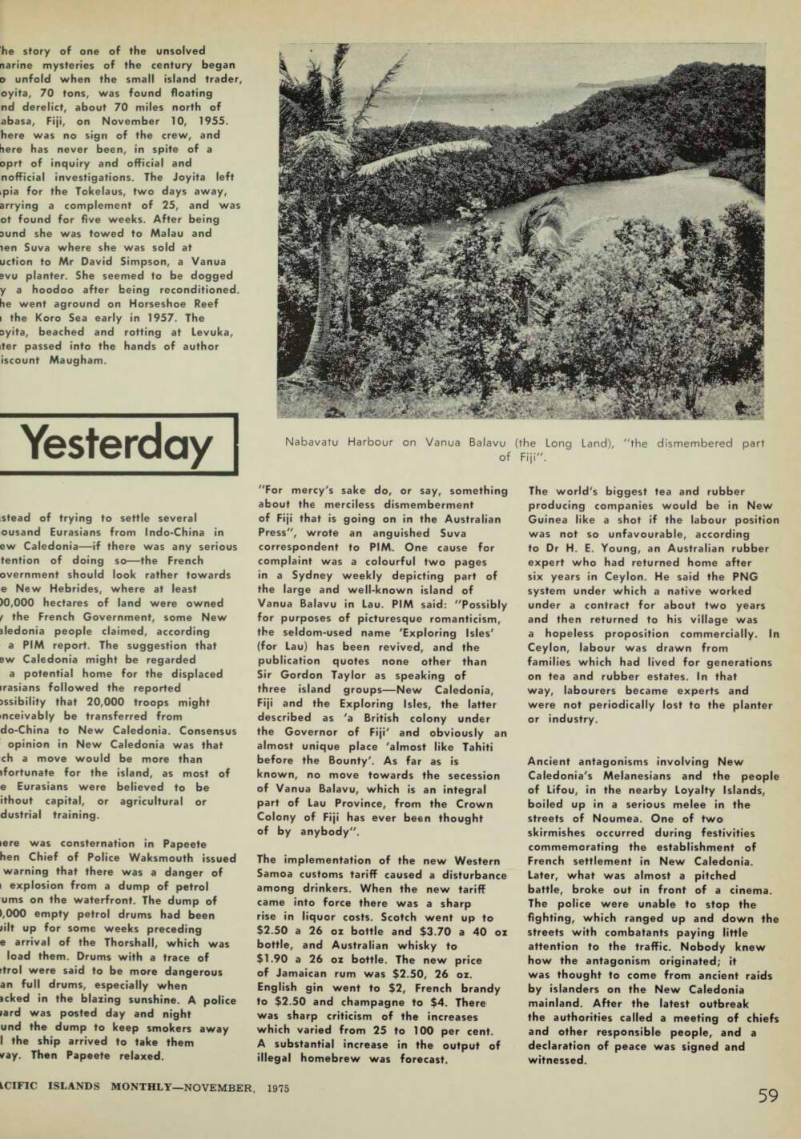
he story of one of the unsolved narine mysteries of the century began 0 unfold when the small island trader, oyita, 70 tons, was found floating nd derelict, about 70 miles north of abasa, Fiji, on November 10, 1955. here was no sign of the crew, and here has never been, in spite of a oprt of inquiry and official and nofficial investigations. The Joyita left >pia for the Tokelaus, two days away, arrying a complement of 25, and was ot found for five weeks. After being sund she was towed to Malau and ten Suva where she was sold at uction to Mr David Simpson, a Vanua evu planter. She seemed to be dogged y a hoodoo after being reconditioned, he went aground on Horseshoe Reef 1 the Koro Sea early in 1957. The oyita, beached and rotting at Levuka, iter passed into the hands of author iscount Maugham.
stead of trying to settle several ousand Eurasians from Indo-China in ew Caledonia—if there was any serious tention of doing so—the French overnment should look rather towards e New Hebrides, where at least )0,000 hectares of land were owned f the French Government, some New iledonia people claimed, according a PIM report. The suggestion that aw Caledonia might be regarded a potential home for the displaced irasians followed the reported >ssibility that 20,000 troops might mceivabiy be transferred from do-China to New Caledonia. Consensus opinion in New Caledonia was that ch a move would be more than ifortunate for the island, as most of e Eurasians were believed to be ithout capital, or agricultural or dustrial training. (ere was consternation in Papeete hen Chief of Police Waksmouth issued warning that there was a danger of i explosion from a dump of petrol urns on the waterfront. The dump of 1,000 empty petrol drums had been lilt up for some weeks preceding e arrival of the Thorshall, which was load them. Drums with a trace of strol were said to be more dangerous an full drums, especially when jcked in the blazing sunshine. A police lard was posted day and night und the dump to keep smokers away I the ship arrived to take them vay. Then Papeete relaxed.
"For mercy's sake do, or say, something about the merciless dismemberment of Fiji that is going on in the Australian Press", wrote an anguished Suva correspondent to PIM. One cause for complaint was a colourful two pages in a Sydney weekly depicting part of the large and well-known island of Vanua Balavu in Lau. PIM said: "Possibly for purposes of picturesque romanticism, the seldom-used name 'Exploring Isles' (for Lau) has been revived, and the publication quotes none other than Sir Gordon Taylor as speaking of three island groups—New Caledonia, Fiji and the Exploring Isles, the latter described as 'a British colony under the Governor of Fiji' and obviously an almost unique place 'almost like Tahiti before the Bounty'. As far as is known, no move towards the secession of Vanua Balavu, which is an integral part of Lau Province, from the Crown Colony of Fiji has ever been thought of by anybody".
The implementation of the new Western Samoa customs tariff caused a disturbance among drinkers. When the new tariff came into force there was a sharp rise in liquor costs. Scotch went up to $2.50 a 26 oz bottle and $3.70 a 40 oz bottle, and Australian whisky to $1.90 a 26 oz bottle. The new price of Jamaican rum was $2.50, 26 oz.
English gin went to $2, French brandy to $2.50 and champagne to $4. There was sharp criticism of the increases which varied from 25 to 100 per cent.
A substantial increase in the output of illegal homebrew was forecast.
The world's biggest tea and rubber producing companies would be in New Guinea like a shot if the labour position was not so unfavourable, according to Dr H. E. Young, an Australian rubber expert who had returned home after six years in Ceylon. He said the PNG system under which a native worked under a contract for about two years and then returned to his village was a hopeless proposition commercially. In Ceylon, labour was drawn from families which had lived for generations on tea and rubber estates. In that way, labourers became experts and were not periodically lost to the planter or industry.
Ancient antagonisms involving New Caledonia's Melanesians and the people of Lifou, in the nearby Loyalty Islands, boiled up in a serious melee in the streets of Noumea. One of two skirmishes occurred during festivities commemorating the establishment of French settlement in New Caledonia.
Later, what was almost a pitched battle, broke out in front of a cinema.
The police were unable to stop the fighting, which ranged up and down the streets with combatants paying little attention to the traffic. Nobody knew how the antagonism originated; it was thought to come from ancient raids by islanders on the New Caledonia mainland. After the latest outbreak the authorities called a meeting of chiefs and other responsible people, and a declaration of peace was signed and witnessed.
Nabavatu Harbour on Vanua Balavu (the Long Land), "the dismembered part of Fiji".
Advertisements & other items, p. 61 (1 item)
59
CIFIC ISLANDS MONTHLY—NOVEMBER, 1975
Books, Reviews, writers
De-Schooling And Re-Schooling
In The World's Newest Nation
Geoffrey Smith, who recently spent three years in teaching and research at the University of Papua New Guinea, begins his book on education in the world’s newest nation with a salutary reminder that education is not necessarily to be equated with schooling, and that Papua New Guinea had an education system long before it had western-style schools.
He devotes his first chapter—“ The Management of Knowledge”— to a consideration of education in pre contact Papua New Guinea.
“Knowledge was imparted when the learner needed to use it”, he says, and adds that to the people of Papua New Guinea “true knowledge was of a ritual character whether it related to the secular or the sacred categories of Western thought”. “The transmission of knowledge was efficient”, he concludes, “because it associated learning with the need to use what was learned”.
Chapter 2 gives us an account of the development of the school system in Papua New Guinea, and deals in turn with the pre-1942 era of mission operated schools, the post-war deve lopment of administration schools, and finally the emergence of a national education system in 1970.
In dealing with the pre-war period, the author quotes a comment of Camilla Wedgwood’s: “Above all, after they left school the natives had nothing to read either in English or the vernacular except the Bible and their old school books, so that they lacked the incentive and the oppor tunity to practise the skill which they had acquired in childhood”.
There is, sadly enough, a measure of truth in this, but it is perhaps not the whole truth. Literacy in the vernacular did provide the pupils of mission schools with a means of communication which they made use of in adult life. During the first four decades of this century, when the Pax Britannica and later its Austra lian counterpart had led to increased mobility, people all along the Papuan coast were writing letters in the ver nacular to friends and relatives who
were away from home, and were re ceiving letters from them in return.
These letters were generally con veyed by safe, or sometimes not so safe, hands rather than through His Majesty’s mails, but their volume was considerable, and they were a lively and valuable means of com munication.
At one period during the war, the turnover of letters written by carriers from the Gulf District to their fami lies at home became so great that a missionary with a knowledge of the Toaripi language was pressed into service to help censor them. This kind of communication was a pro duct of early mission schooling not to be sneezed at.
With the historical background established, there follows a percep tive chapter on “Relevance” and a statistics-packed one on “Efficiency”, in the course of which the author expresses reservations about the value of man-power forecasting and cost-benefit analysis to the educa tional planners.
Following a chapter on “Decen tralisation and Control”, the author winds up his study with a thought provoking one on “Alternative Futures”. These he defines as “more schooling”, “de-schooling” and “re schooling”. By “more schooling” he means the further extension of the present school structure. Fie con cludes that such expansion “will not remedy the present dysfunction be tween the education system and its environment”, but recognises that it is what the politicians are most likely to press for.
Under the heading of “de-school ing” he refers to Illich’s and Reimer’s advocacy of alternative networks for spreading knowledge in place of schools as we know them. Such net works would be, in effect, a return to the kind of education system which obtained in pre-contact Papua New Guinea. But it does not neces sarily follow that what was adequate for the Stone Age would be adequate for the Space Age, and, as Geoffrey Smith points out, the proponents of de-schooling provide little guidance on how to move towards it and how to overcome inevitable opposition.
The third alternative, and clearly that which the author himself favours, is “re-schooling”, by which he means a restructuring of the school system and its links with society. He explains in some detail how this might be done, and the pic ture is an attractive one.
However, he does not overlook the fact that re-schooling, no less than de-schooling, will have to overcome opposition. And it must be noted that those who will be shaping edu cation policies for the future will not be those who have cause to be dissatisfied with the present system but rather those for whom it has provided an affluent livelihood in air-conditioned offices.
All in all this is a mind-stretching book which I can warmly commend.
Percy Chatterton.
(Geoffrey Smith: Education in Papua New Guinea. Melbourne University Press, PO Box 278, Carlton South, Victoria 3053.
Recommended price $3.90.)
Saving a tongue
A Tahitian grammar book to help Tahitians preserve their own language has been published by a young Tahitian linguist, Duro Raapoto.
This book of over 300 pages is en titled Te Reo Haohi—Elements of Tahitian Grammar. It has been pub lished with the help of Jacques Drollet of the cultural group POL and the Protestant Education Depart ment in Tahiti. It is the first time such a work has been published by a Tahitian, seeking to explain the depths of meaning in his native tongue.
The teaching medium for school children throughout French Polynesia is French, and Raapoto's book is seen as part of a movement to reassert the significance of the Tahitian language and provide a basis for island chil dren to be correctly taught the tongue closest to their way of life.
eye-view
Camera's eye-view of PNG
European traders, missionaries, >fficials, miners and planters have ►een the catalyst of the changes /hich occurred in Papua New Guinea rom the early 19th century until re ently.
A Pictorial History of New Guinea Gash and Whittaker) provides a isual impression of those changes, t emphasises expatriate life and in ludes little of the kind of illustra ions and photographs used in an tiropological studies, but one needs o imagination to get the feel of the olonial era before World War 11.
The post-war years are only briefly ealt with.) One must, of course, keep in mind lat, because of the slow spread of teracy and modern technology mong the islanders, nearly all of the Titten and pictorial information has ame from Europeans.
Of the 680 plates, 36 are maps, a ;w are lithographs or cartoons, and le rest photographs. Edgar Ford, ho has drawn or re-drawn the maps, as done a magnificent job, and most f the other material has been ex ertly reproduced. There is a wealth f visual information, much of it ew even to anyone steeped in the terature of the islands. Starting
with photographs of stone tools and other finds of prehistorians, early maps such as the Mercator of 1569, the plates, accompanied by brief but pertinent texts, take us to the opening of the Legislative Council in 1951.
The co-authors do not claim that this is the pictorial history of the new nation of Papua New Guinea, and their selection is, of course, subjec tive.
Nevertheless, few readers will quarrel with the choice of such photo graphs as: Tolai people in the 1870 s; Motu students, 1884; Methodist Mission schooner Lord of the Isles off Dobu, 1891; LMS College at Vatorata, 1896; early Lutheran mis sionaries, 1900; European miners on Woodlark Is, 1905; German Sepik expedition, 1912-13; first postulants of the Handmaidens of the Lord, Yule Is, 1919; Louis Vangeke (who became the first indigenous Catholic
bishop), 1928; and pilot O’Day and assistant district officer Jim Taylor, Hagen-Sepik patrol, 1938.
No one will fail to be moved by the photograph of Aminio Bale, first Fijian missionary on the Gazelle Peninsula, or fail to enjoy the Sydney Bulletin cartoon of 1885, showing an islander telling John Bull and the Kaiser’s representative, “How happy 1 could be with neither”. And there are hundreds of other plates of equal historical significance and interest.
In a work of this magnitude there are, as one would expect, a few errors and omissions. The former are mainly misprints, eg Count Pfeil, not Pfiel, is correct, while the latter are failures to identify persons who were or are well-known to people still alive. (For example, the unidentified man in Plate 676, a group of people with Governor-General McKell at Rabaul in 1949 is, of course, adminis trator J. K. Murray; the Papua New Guinea delegates to the South Pacific Conference at Suva in 1950, Plate 679, include the late George Kassi and the late Miria Gavera who made a considerable contribution to their country’s development.) In the context of the achievement which this book represents, those
errors and omissions are, however, almost irrelevant, and arguments about photographs that ought to have been included in preference to those presented are, of course, purely sub jective.
Similarly, that the index contains pagination references when plate numbers would have been more helpful is, as criticism, not much more than a quibble.
Now that Papua New Guineans are citizens of their own, independent country, much of the emotionalism and shibboleths that have bedevilled academics and popular accounts of some aspects of other of their societies, their economics and their politics are gradually being laid to rest.
Good and bad, Europeans have played an important part in Papua New Guinea’s history, and although that part is rapidly diminishing, A Pictorial History of New Guinea, relatively free of personal opinion and allowing us to see for ourselves, is, therefore, an important contribu tion to the corpus of knowledge about the new nation. There is truth in the old saws “Seeing is believing” and “One picture is worth a hundred words”.
At $8.95, hardly more than one cent per plate, this book is a bargain.
The co-authors and Jacaranda Press deserve our thanks. —Harry Jackman.
(A Pictorial History Of New
GUINEA, by N. Gash and J. Whittaker; Jacaranda Press, Milton, 1975; $8.95'.)
Advertisements & other items, p. 63 (2 items)
61
4CIFIC ISLANDS MONTHLY—NOVEMBER, 1975
the Regent of Fiji
BOOK SPACE IN PARADISE
a * m 1
Ilf;
T/1 f k j iT, II ir<
am y
mMi .mg
The Regent of Fiji, with 300 gracious guest rooms, is paradise on the glistening Pacific shore.
Cordial, like a Fijian village, the Regent invites you to a treasure of Melanesian arts. The Steakhouse and The Terrace serve delicious food platters and a spectacular ocean-view.
What’s more, the Regent is well-mannered service: in-room phones, air conditioning, Fijian stewards, complete banquet/convention pavilion and duty free shopping.
And the Regent is sports: scuba, sailing, fishing, beachcombing swimming, tennis and golf. All in wave-free Nadi Bay.
Book space in paradise. For the night of a lifetime.
The Regent of Fiji—2o minutes from the airport.
POST OFFICE BOX 441 • NADI, FUI • PHONE 70700 • TELEX (792) 5214 ONE OF THE MANY worlds OF REGENT INTERNATIONAL HOTELS
the Regent of Fiji
DENARAU BEACH RESORT
Sydney, Australia Sales Office No. 1 York Street. 14th floor Sydney, Australia 2000 Phone (02) 276469 In Auckland, New Zealand, phone 71909
What's in Australia for
the non-white migrant
Australia’s rapid demographic and economic growth and extensive socio cultural changes since the 1950 s have in no small measure been due to immigration, promoted and consider ably assisted by the government.
About one in seven of the present population is foreign-born.
One of the pillars of federation in 1901, the White Australia policy has been modified in recent years and “Australia for the White Man” has become politically unacceptable rhe toric. Tens of thousands of Asians and other non-Europeans, including Chinese and ‘mixed race’ persons from Papua New Guinea, have settled in Australia each year during the last decade or so. Any non-European or Part-European can now become an Australian citizen after the same waiting period (three years) that applies to any other resident.
The Immigration Reform Group (IRG), formed by academics and other private citizens, which presents this book, Australia and the Non white Migrant (K. Rivett), wants to do away with what remains of the White Australia policy. It accepts that immigration must not be allowed to create racial friction or deprive developing nations of skills in short supply, but stresses that neither caveat is a valid argument against planned settling of non- Europeans, including some from de veloping nations. Problems of inte
grating immigrants would be mini mised if they were explained to prospective settlers and Australians alike.
Among the IRG proposals are that the intake of non-Europeans and part- Europeans should rise to about 20,000 a year; that the present occupational categories of non-Europeans eligible to immigrate be extended; and that political refugees have a strong claim to enter. IRG believes that Australia’s special links with the Pacific Islands warrant an immediate move to let in some migrants from that region, with a view to training and settlement.
In other words, some Pacific Islanders ought to be admitted even though they may not possess the occupational skills normally required of immi grants.
Anyone migrating to Australia from a developing country is likely to benefit economically. For the de veloping country, emigration of un skilled persons, particularly of those from overpopulated areas, is usually advantageous, but the opposite may be the case when skilled people leave.
In 1972 E. G. Whitlam, now Aus tralia’s Prime Minister, suggested that before the decade was out Aus tralia was likely to have agreements with Papua New Guinea, Fiji and other Pacific nations under which as many of their citizens could live in Australia as there were Australians living in those countries.
Fiji’s Prime Minister, Ratu Sir Kamisese Mara, has spoken in a similar vein and Sir Maori Kiki, Papua New Guinea’s Foreign Minister, who, believing that his country needs a larger population, is against emigra tion, also wants formalised agree ments. In Sir Maori’s case, it is a matter of controlling immigration, to prevent foreigners taking jobs where nationals are available.
A problem common to all Pacific countries with tertiary institutions of a standard comparable with those of, say, such institutions in Australia and New Zealand, is “brain drain”, that is, any move by their graduates to seek jobs in other countries. Wes terners who claim that an individual should be free to work anywhere in the world forget that it costs about 530,000 to turn out a BA, and more in the caes of, say, a doctor of medicine.
There can be no doubt that nations like Papua New Guinea must consider
all the effects on their economy and society of skilled or unskilled emigra tion, and it just does not seem practic able for them to allow individuals free choice where emigration is con cerned.
In this book, IRG does not put forward any judgment concerning the suitability as immigrants of people, taking them as groups, from any one country. Any such judgment would probably cause great controversy and earn accusations of racism and the like. Nevertheless, I would have liked to find some details, no matter how imprecise, of the manner in which the intake of Pacific Islanders, “war ranted by Australia’s special links”, ought to be implemented as part of the total immigration scheme. It is my guess that, like the vast majority of my fellow-Australians, the mem bers of IRG know almost nothing of the Pacific and its current prob lems, and that they are just as ignorant about the people who live in the Islands.
New Zealand’s experience has shown that Western Samoans and Tongans do not take long to become integrated, and there is no reason to believe that the same would not be the case in Australia.
Australian business interests have done very well in the Pacific during the last century or more, and it is therefore not merely on humanitarian grounds that people from overpopu lated islands—and Gilbertese and Fuvalu (Ellice) Islanders immediately :ome to mind—ought to be invited to settle ahead of other unskilled non-Europeans. In any case, the term “unskilled” denotes no more than temporary labour characteris tics, and the past performance of Islanders in the shipping industry, For instance, points to their adapt ability being at least as good as that )f people from the Near East, Asia ar developing European countries, Vl any of them do, moreover, have a working knowledge of the English anguage.
If nothing else, this book is to be welcomed because IRG has already uade a valuable contribution to the lemise of racism and the building of i harmonious multi-racial society in Australia. It would have been en lanced by much more detail in the proposals, especially where Pacific slanders are, or could be, affected. —Harry Jackman.
(Australia And The Non-White
MIGRANT, by K. Rivett. Published by Melbourne University Press, Carlton, 1975.
H 5.00.) • All book prices given, unless ffherwise stated, are in Australian urrency.
Advertisements & other items, p. 64 (1 item)
printing co. ply. lid.
D pua new guinea
Serving the Country from Aitape to Alotau, Manus to Moresby Leaders in Commercial Offset and Letterpress Printing. • Stationery • Office Supplies • Office Equipment • Rubber Stamps • Self-Adhesive Labels • In Fact:— Everything For The Office.
P.O. Box 633, Port Moresby P.O. Box 759, Lae P.O. Box 1239, Rabaul
The linguistic scene in PNG
More than 17 years research has gone into the preparation of a major language work now being published by the Australian National Uni versity.
The three-volume publication is called New Guinea Area Languages and Language Study. Its first volume, Papuan Languages and the New Guinea Linguistic Scene, runs to 1,000 pages and is the work of 10 authors recognised as the top authori ties in this field. It will be published in the series Pacific Linguistics by the Department of Linguistics in the uni versity’s Research School of Pacific Studies, and is expected to be avail able from December.
Papuan languages, the researchers explain, are not just those of the area known as Papua. Instead, the term Papuan was a description coined last century for languages in the area be
tween Indonesia and Polynesia which are neither Australian nor Austro nesian. The boundaries of this area stretch from Timor across the New Guinea mainland to the Solomon Islands.
Papuan languages make up one sixth of the total number of different languages in the world. Until re cently, linguists were unaware of the existence of extensive relationships between the non-Australian and non- Austronesian languages in this area.
For this reason, the first volume is seen as an invaluable reference work.
It actually rewrites previous incorrect material about the Papuan languages.
The two other volumes—The Austronesian Languages (700 pages and 12 authors) and Language, Cul ture, Society, and the Modern World (1,200 pages and 30-40 authors) — will be published by the end of 1976.
Advertisements & other items, pp. 65-66 (2 items)
63
’ACIFIC ISLANDS MONTHLY—NOVEMBER, 1975
Qbe Insurance
Q E
serves the Islands with expert
insurance service and advice.
QBE INSURANCE
LIMITED
(FORMERLY—QUEENSLAND INSURANCE COMPANY LIMITED)
Central Office: 82 Pitt Street, Sydney FlJl—Branch Office, Suva, Manager for Fiji: F. N. Davies (A.A.1.1.).
LAUTOKA—Assistant Manager; G, A. Wooley.
HONIARA (8.5.1. P.) —Breckwoldt & Company (5.1.) Pty. Limited.
NEW CALEDONIA—T. A. Hagen, Ste. W. A. Johnston, S.A.R.L. —Noumea.
NEW HEBRlDES—Resident Officer: G. F. Donnelly Vila; Santo: Burns Philp (New Hebrides) Ltd.
TAHlTl—Arthur Chung: Immeuble 8.1., Front de Mer, Papeete.
NIUE, NORFOLK ISLAND, SAMOA, TONGA and other South Sea Islands—Bums Philp (South Sea) Company Ltd.
QUEENSLAND INSURANCE(P.N.G.)LTD
PAPUA NEW GUINEA
Head Office, Port Moresby: General Manager: D. J. Granter.
District Managers at Rabaul: C. D. Dickings; Lae: W. J. Leonard; Mt. Hagen: D. F. Carroll. Atawa; A. M. Tanner; Madang: I. R.
Martin.
H 359
A growing airline
in a shrinking world...
Fly to any of 16 AIR NEW ZEALAND Gateways to the World.
Los Angeles
<; 'WW: r t
Singapore
AIR NEW ZEALAND is a truly international airline, flying you throughout the Pacific to any of 16 Gateways to the World, as far apart as Wellington and Singapore, Auckland and Los Angeles.
. You fly the friendly fleet
1 of DClOs and DC Bs.
Our magnificent wide-bodied DC-10s now fly on most international AIR NEW ZEALAND routes. On other flights and services, our personalised DC-8s provide outstanding AIR NEW ZEALAND service.
16 exciting Gateways
to the World.
AIR NEW ZEALAND flies to Hawaii Los Angeles, Hong Kong, Singapore, Sydney, Melbourne, Brisbane, Auckland, Wellington, Christchurch, Fiji, Tahiti, New Caledonia, Samoa, Rarotonga and Norfolk Island.
g air neiu
Friendliest wings across your world.
Talk to AIR NEW ZEALAND or your travel agent
ANZ 233
Pacific Transport
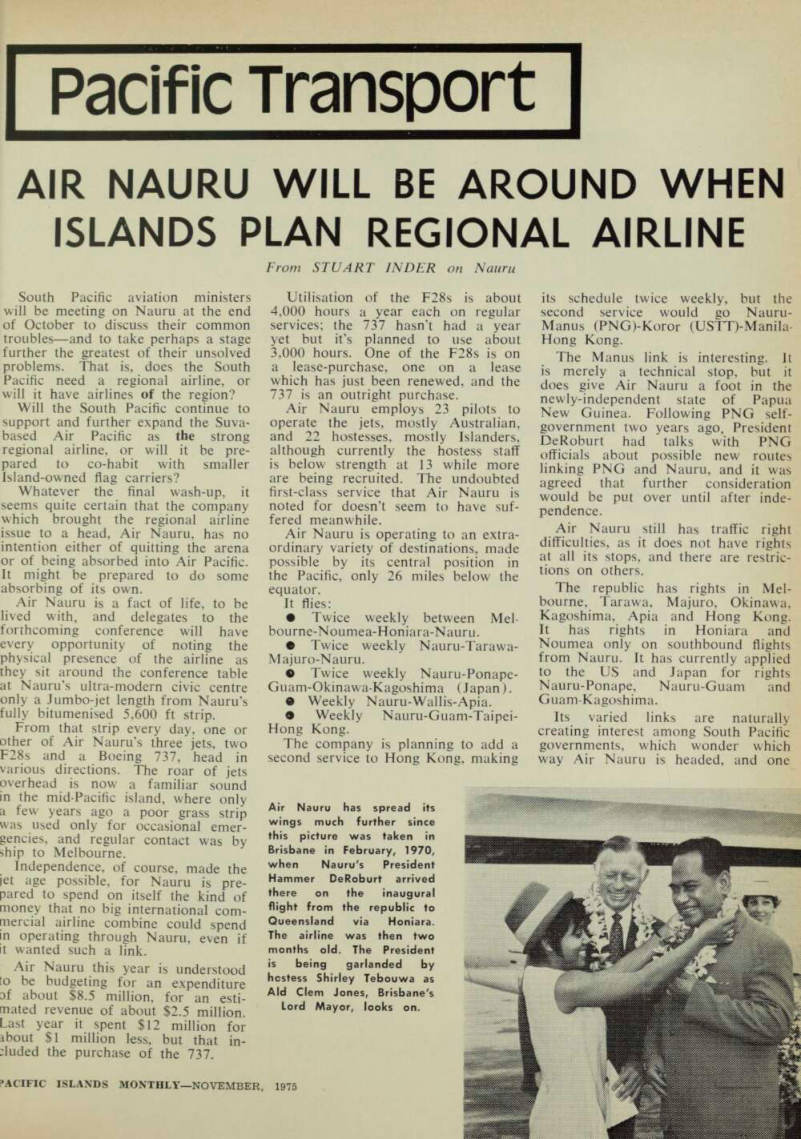

Air Nauru Will Be Around When
Islands Plan Regional Airline
From STUART JNDER on Nauru
South Pacific aviation ministers will be meeting on Nauru at the end of October to discuss their common troubles—and to take perhaps a stage further the greatest of their unsolved problems. That is, does the South Pacific need a regional airline, or will it have airlines of the region?
Will the South Pacific continue to support and further expand the Suva based Air Pacific as the strong regional airline, or will it be pre pared to co-habit with smaller Island-owned flag carriers?
Whatever the final wash-up, it seems quite certain that the company which brought the regional airline issue to a head, Air Nauru, has no intention either of quitting the arena or of being absorbed into Air Pacific.
It might be prepared to do some absorbing of its own.
Air Nauru is a fact of life, to be lived with, and delegates to the forthcoming conference will have every opportunity of noting the physical presence of the airline as they sit around the conference table at Nauru’s ultra-modern civic centre only a Jumbo-jet length from Nauru’s fully bitumenised 5,600 ft strip.
From that strip every day, one or other of Air Nauru’s three jets, two F2Bs and a Boeing 737, head in various directions. The roar of jets overhead is now a familiar sound in the mid-Pacific island, where only a few years ago a poor grass strip was used only for occasional emer gencies, and regular contact was by ship to Melbourne.
Independence, of course, made the jet age possible, for Nauru is pre pared to spend on itself the kind of money that no big international com mercial airline combine could spend in operating through Nauru, even if it wanted such a link.
Air Nauru this year is understood to be budgeting for an expenditure Df about $8.5 million, for an esti mated revenue of about $2.5 million.
Last year it spent $l2 million for about $1 million less, but that in :luded the purchase of the 737.
Utilisation of the F2Bs is about 4.000 hours a year each on regular services; the 737 hasn’t had a year yet but it’s planned to use about 3.000 hours. One of the F2Bs is on a lease-purchase, one on a lease which has just been renewed, and the 737 is an outright purchase.
Air Nauru employs 23 pilots to operate the jets, mostly Australian, and 22 hostesses, mostly Islanders, although currently the hostess staff is below strength at 13 while more are being recruited. The undoubted first-class service that Air Nauru is noted for doesn’t seem to have suf fered meanwhile.
Air Nauru is operating to an extra ordinary variety of destinations, made possible by its central position in the Pacific, only 26 miles below the equator.
It flies: • Twice weekly between Mel bourne-Noumea-Honiara-Nauru. e Twice weekly Nauru-Tarawa- Majuro-Nauru. © Twice weekly Nauru-Ponape- Guam-Okinawa-Kagoshima (Japan). 9 Weekly Nauru-Wallis-Apia. 9 Weekly Nauru-Guam-Taipei- Hong Kong.
The company is planning to add a second service to Hong Kong, making
its schedule twice weekly, but the second service would go Nauru- Manus (PNG)-Koror (USTT)-Manila- Hong Kong.
The Manus link is interesting. It is merely a technical stop, but it does give Air Nauru a foot in the newly-independent state of Papua New Guinea. Following PNG self government two years ago. President Deßoburt had talks with PNG officials about possible new routes linking PNG and Nauru, and it was agreed that further consideration would be put over until after inde pendence.
Air Nauru still has traffic right difficulties, as it does not have rights at all its stops, and there are restric tions on others.
The republic has rights in Mel bourne, Tarawa, Majuro, Okinawa, Kagoshima, Apia and Hong Kong.
It has rights in Honiara and Noumea only on southbound flights from Nauru. It has currently applied to the US and Japan for rights Nauru-Ponape, Nauru-Guam and Guam-Kagoshima.
Its varied links are naturally creating interest among South Pacific governments, which wonder which way Air Nauru is headed, and one
Air Nauru has spread its wings much further since this picture was taken in Brisbane in February, 1970, when Nauru's President Hammer DeRoburt arrived there on the inaugural flight from the republic to Queensland via Honiara.
The airline was then two months old. The President is being garlanded by hostess Shirley Tebouwa as Aid Clem Jones, Brisbane's Lord Mayor, looks on.
najor decision that is expected to ome out of the ministerial con erence at the end of October is the stablishment of some sort of consul ative body that can at least make ecommendations on the further de elopment of civil aviation in the slands.
At present all negotiations are overnment-to-government, with no eneral organisation responsible for joking at the overall affects that light flow from the granting of rights ) various airlines in the region.
If such an organisation can be dablished, then civil aviation in the outh Seas will have reached an im ortant new—and necessary—stage in s development.
President Deßoburt is not unhappy jout progress of the republic’s air ne, which he sees as a necessary ijunct to a small island with big /erseas investments which must be rviced and protected. Nauru has to ; involved in the world and it can’t > that by ship, or by a fortnightly ght of somebody else’s airline. And e fact is that Nauru can afford its rline and to support it while it :pands.
Its forthcoming rights to Guam ill make a big difference to expan -3n plans.
But more important, an announce ent is momentarily expected of affic rights being granted Air Nauru r Nadi and Suva, which will make possible for a direct north-south ik from Guam through Nauru to ji. This should quickly develop into lucrative route.
President Deßoburt grins when he ports what some of his pilots are irrently saying: “Sir, if we don’t atch out we are going to find our- Ives making money!”
Crew morale is extremely high, id there is a belief that the early tablishment days are now over and e sky is now the limit. Both freight id passenger loadings are improving ' the month, and the airline is get ig better known. Its aircraft are odern, and cabin services are good.
President Deßoburt’s view is that ere is room for a number of gional airlines in the Pacific, and at Air Nauru is destined to be a ajor one. He certainly has proved has the drive and the resources make it happen. • Five out of 40 cruise ships tiich will visit the New Hebrides in •76, will call at Santo. The Russian ip, Leonid Sobinov, will call twice, id the Fairstar will make three 11s. Bookings have been made as r ahead as January, 1977, for the ursky and the Fairstar to visit the ew Hebrides.
Air Pacific Plans
Services Improvement
Air Pacific will step up its services from Fiji to New Zealand and Aus tralia when its BACIII jet, on lease to Air Malawi, is returned about mid- December. The jet was originally leased because there was not enough work for it in the South Pacific region, and because Air Pacific wanted to cut costs. Air Pacific flies BACIII services to New Zealand, via Tonga, and to Brisbane, via New Caledonia.
In another move to improve ser vices, the airline plans to introduce Britten-Norman Trislanders to the Nausori-Nadi run. This will release HS74Bs for more regional work. The airline now has four Trislanders, and is using them to provide a better coverage within Fiji.
These moves followed a recent board meeting in Suva, at which it was reported there was a severe
downturn in revenue, compared with original budget results. It was re- P.? rt , ed hat. Passenger r evenue was l ,k . e ‘ y *° more . tha " *700,000 fe low estimate ? on domestic services, a ' s ° s'Smficant cost in creases to be faced ' „.
Conpac Expands
Its Png Service
.. D A , Conpac, the Burns Philp-Australia est P aclfi ‘ Ime, has rationalised lts servi ces from Australia to Papua ld P ea amos ai ? d Nj mos - The Nimos in future will a Sydney-Lae-Port Moresbys X dn ey service every 23 days. Pre- Vl °usly the Nimos called at Brisbane on northbound voyages from Sydney, The Samos, which previously sailed direct for Papua New Guinea from Melbourne, will now call at Brisbane on northbound voyages, Her route for the 28-day round trip
Advertisements & other items, p. 68 (1 item)
These IMF distributors
can show you the
greater the load on an MF2I Trailer
the better the grip!
The all-steel hydraulic-tipping MF2I is a “goanywhere” unit with large section tyres to give good flotation on wet ground and MF’s famous rear axle design which puts 25% of the load on the tractor’s rear wheels. The bigger the load, the better the grip!
Capacity is 3Vz. tons, tray area 60 square feet. A powerful hydraulic ram tips the tray to 56 degrees for fast, clean unloading. Everything about this trailer is planned for one-man operation. What’s more, it’s built for years of tough work in the m i / .V' field road. or on the
MFE 74041
MF
MASSEY-FERGUSON. EXPORT AWARDS
Continental wins a round
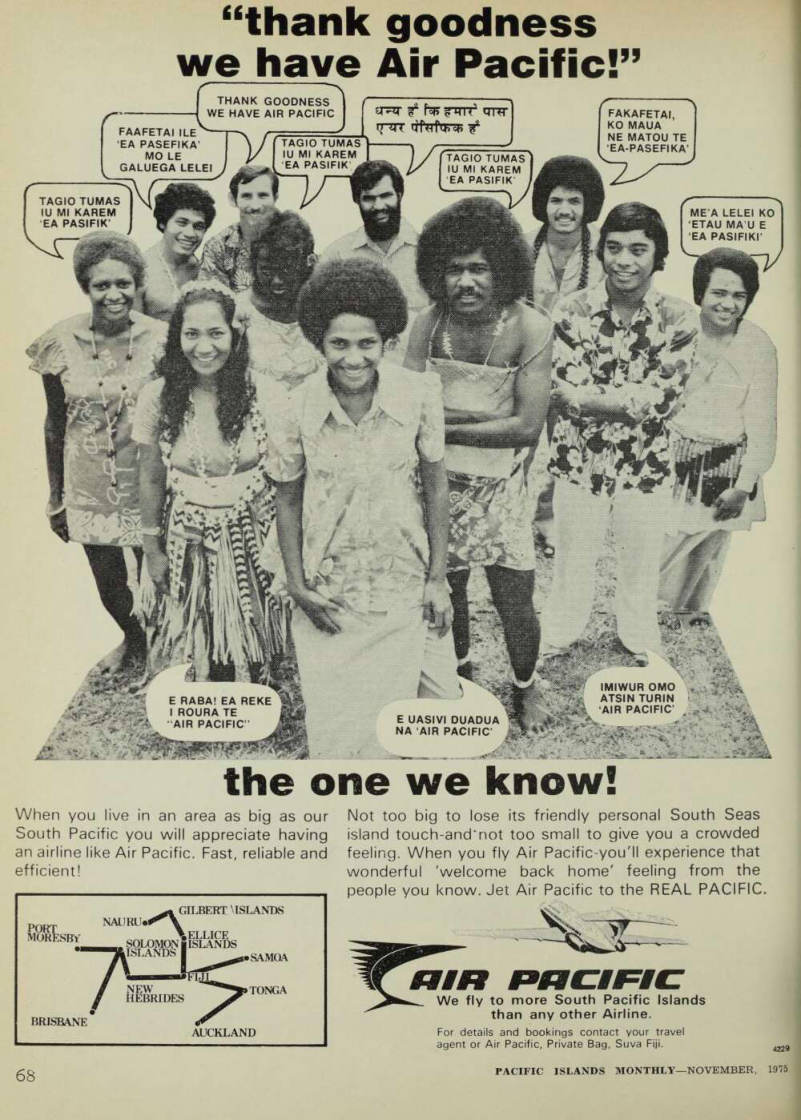
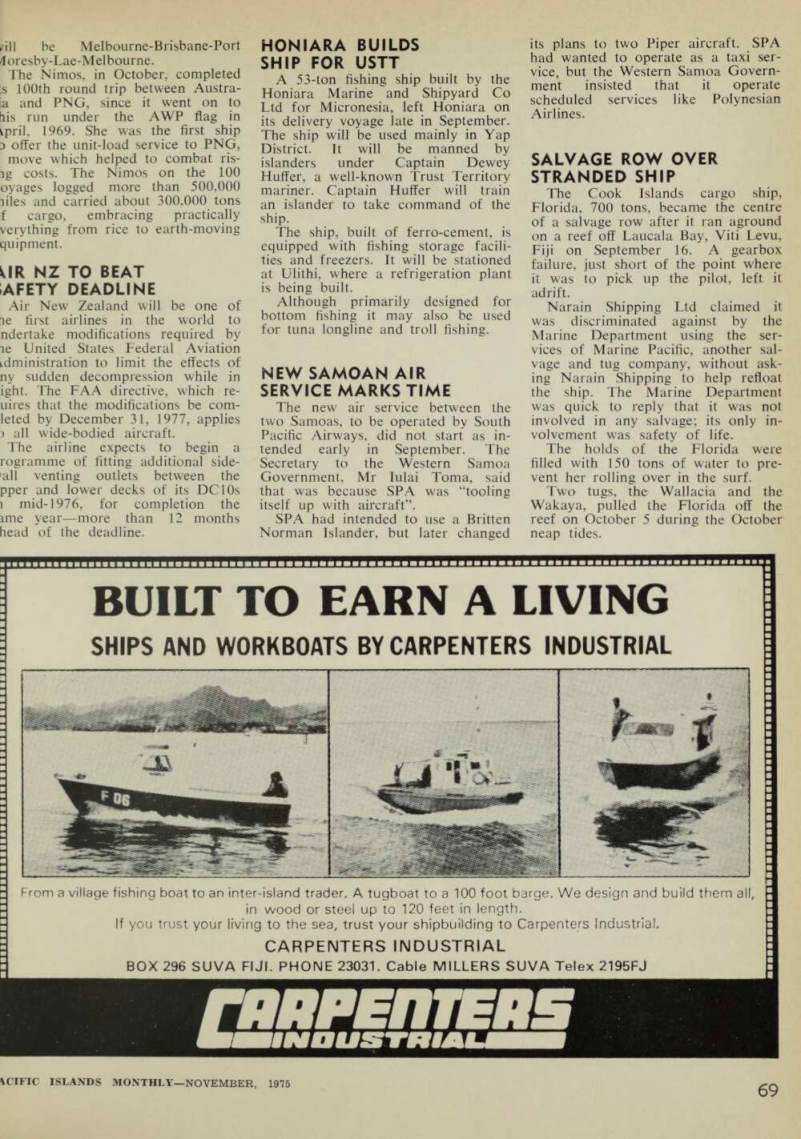
Continental Airlines has won the second-last round in the battle for the lucrative Saipan-Tokyo route when the US Civil Aeronautics Board voted 4-0 in its favour. The final decision rests with President Ford to whom an appropriate recommendation has been sent. President Ford may approve the CAB decision, disapprove, or send it back to the board.
The other major contender for the airline was Pan-American Airlines, which had its application supported by the CAB Bureau of Operating Rights, and two administrative law judges who heard evidence in what turned out to be rather a dirty case.
A third applicant. Northwest Orient, was never really in the hunt.
The fight for the route had its genesis about 5i years ago when the US and Japan agreed to allow Japan Airlines, which now serves Guam, to fly to Saipan from Japan. In return, a US carrier was to be allowed to serve the two areas, and to receive landing rights in Japan. JAL now flies unscheduled charter flights to Saipan.
Air Continental is the parent company of Continental Air Micronesia, which operates internal services in Mirrnnpcia In May, 1973, CAB administrative law judge, Milton H. Shapiro, proposed that PAA should get the route, He suggested only slight weight should be given to local opinion about which carrier should be selected, because such opinion was
devalued by the airlines’ intensive lobbying.
The State Department took the view that considerable weight should attached to the opinions of the Congress of Micronesia and the dis trict legislatures in the Trust Terri to , n 1974> another CAB judge , Greer M Murphy> held hearings on Saipan. He fol £/ that the conduct of PAA a nd Continental Airlines pre sented a “depressing picture” and a “laminated story of pressure and counter pressure”. However, he up held Judge Shapiro’s earlier report in favour of PAA.
PAA, claiming the “predominant support of local civil and government parties” as well as that of elected officials of the Marianas and Guam, mentioned Continental s alleged es pionage and surveillance of PAA representatives during the hearings, Continental, on the other hand, claimed the support of the Congress of Micronesia, and representatives of Yap, Palau, and the Marshalls. Con tmental accused PAA of “unethical conduct, corporate espionage, cover up and pressuring the people to sign j n support”, -t-. n * D Dl . „„„ tr . k CA r L B T , pL T? 6 ”' told the CAB that PAA > and t 0 a lesser extent, Continental, merited disqualification from consideration unless they committed themselves to comply with CAB regulations. The bureau recommended hearings, but the Operating Rights Board said the CAB should adopt Judge Murphy’s recommendation.
/ill be Melbourne-Brisbane-Port Moresby-Lae-Melbourne.
The Nimos, in October, completed ;s 100th round trip between Austra ia and PNG, since it went on to tiis run under the AWP flag in tpril, 1969. She was the first ship 3 offer the unit-load service to PNG, move which helped to combat ris ig costs. The Nimos on the 100 oyages logged more than 500,000 ■files and carried about 300,000 tons f cargo, embracing practically verything from rice to earth-moving quipment.
Ur Nz To Beat
Afety Deadline
Air New Zealand will be one of le first airlines in the world to ndertake modifications required by ie United States Federal Aviation administration to limit the effects of ny sudden decompression while in ight. The FAA directive, which re uires that the modifications be com leted by December 31, 1977, applies ) all wide-bodied aircraft.
The airline expects to begin a rogramme of fitting additional side wall venting outlets between the pper and lower decks of its DC 10s i mid-1976, for completion the ime year—more than 12 months head of the deadline.
Honiara Builds
Ship For Ustt
A 53-ton fishing ship built by the Honiara Marine and Shipyard Co Ltd for Micronesia, left Honiara on its delivery voyage late in September.
The ship will be used mainly in Yap District. It will be manned by islanders under Captain Dewey Huffer, a well-known Trust Territory mariner. Captain Huffer will train an islander to take command of the ship.
The ship, built of ferro-cement, is equipped with fishing storage facili ties and freezers. It will be stationed at Ulithi, where a refrigeration plant is being built.
Although primarily designed for bottom fishing it may also be used for tuna longline and troll fishing.
New Samoan Air
Service Marks Time
The new air service between the two Samoas, to be operated by South Pacific Airways, did not start as in tended early in September. The Secretary to the Western Samoa Government, Mr lulai Toma, said that was because SPA was “tooling itself up with aircraft”.
SPA had intended to use a Britten Norman Islander, but later changed
its plans to two Piper aircraft. SPA had wanted to operate as a taxi ser vice, but the Western Samoa Govern ment insisted that it operate scheduled services like Polynesian Airlines.
Salvage Row Over
Stranded Ship
The Cook Islands cargo ship, Florida, 700 tons, became the centre of a salvage row after it ran aground on a reef off Laucala Bay, Viti Levu, Fiji on September 16. A gearbox failure, just short of the point where it was to pick up the pilot, left it adrift.
Narain Shipping Ltd claimed it was discriminated against by the Marine Department using the ser vices of Marine Pacific, another sal vage and tug company, without ask ing Narain Shipping to help refloat the ship. The Marine Department was quick to reply that it was not involved in any salvage; its only in volvement was safety of life.
The holds of the Florida were filled with 150 tons of water to pre vent her rolling over in the surf.
Two tugs, the Wallacia and the Wakaya, pulled the Florida off the reef on October 5 during the October neap tides.
Advertisements & other items, pp. 69-72 (3 items)
67
CIFIC ISLANDS MONTHLY—NOVEMBER, 1975
“thank goodness
we have Air Pacific!”
THANK GOODNESS
WE HAVE AIR PACIFIC
t N> cnrr
FAKAFETAI,
KO MAUA
NE MATOU TE
EA-PASEFIKA
r
FAAFETAI ILE
EA PASEFIKA’
MO LE
GALUEGA LELEI
TAGIO TUMAS
IU Ml KAREM
EA PASIFIK *
TAGIO TUMAS
IU Ml KAREM
EA PASIFIK
TAGIO TUMAS
IU Ml KAREM
EA PASIFIK’
ME’A LELEI KO
ETAU MA’U E
EA PASIFIKI’
Vo ■■ > m u m 4 * £ IWfi* ft i u n m ►
IMIWUR OMO <. ; • .
ATSIN TURIN
AIR PACIFIC’ , , \-
E RABA! EA REKE
I ROURA TE
AIR PACIFIC’’
E UASIVI DUADUA
NA AIR PACIFIC’
the one we know!
When you live in an area as big as our
South Pacific you will appreciate having
an airline like Air Pacific. Fast, reliable and
efficient!
GILBERT ISLANDS
NAURU
LLICE
>LANDS
MORESBY
SOLO
•MON
NDS
ISLA
SAMOA
NEW
HEBRIDES
TONGA
BRISBANE
AUCKLAND
Not too big to lose its friendly personal South Seas island touch-and’not too small to give you a crowded feeling. When you fly Air Pacific-you'll experience that wonderful 'welcome back home' feeling from the people you know. Jet Air Pacific to the REAL PACIFIC.
am pact Ftc
We fly to more South Pacific Islands than any other Airline.
For details and bookings contact your travel agent or Air Pacific, Private Bag, Suva Fiji.
Tim i mi ii 111 111 i i mn mn 111 irrm 11 n mn mill iiirrl
BUILT TO EARN A LIVING
SHIPS AND WORKBOATS BY CARPENTERS INDUSTRIAL
r % a* XJ *» "v X From a village fishing boat to an inter-island trader. A tugboat to a 100 foot barge. We design and build them all, in wood or steel up to 120 feet in length.
If you trust your living to the sea, trust your shipbuilding to Carpenters Industrial.
CARPENTERS INDUSTRIAL
BOX 296 SUVA FIJI. PHONE 23031. Cable MILLERS SUVA Telex 2195FJ
Whichever way
you choose to go,
go Pan Am.
TO LONDON VIA
Honolulu Los Angeles San Francisco New York London
TO LONDON \i\*
Sydneu Honq Nona De\Wv FrankfurV London Pan Am, the only airline Three times a week in either operating out of Fiji to take you direction. Ask your travel agent all the way around the world, about it. via London. In either direction.
In fact, the only airline that can take you direct to London (via the U.S.A.) at all.
Or call Panair, Suva 22.641, Nadi 72.100.
You call it the world. We call it home. 250.P.193A
69
\CIFIC ISLANDS MONTHLY—NOVEMBER, 1975
Cruising
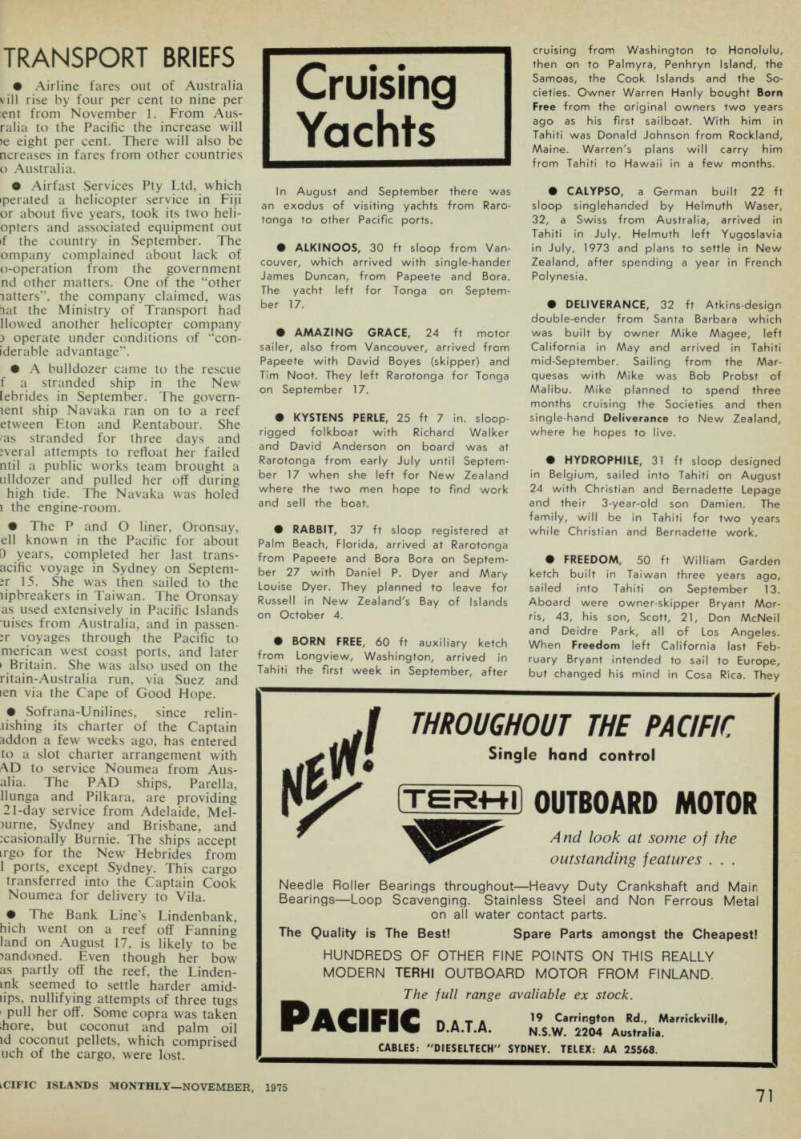

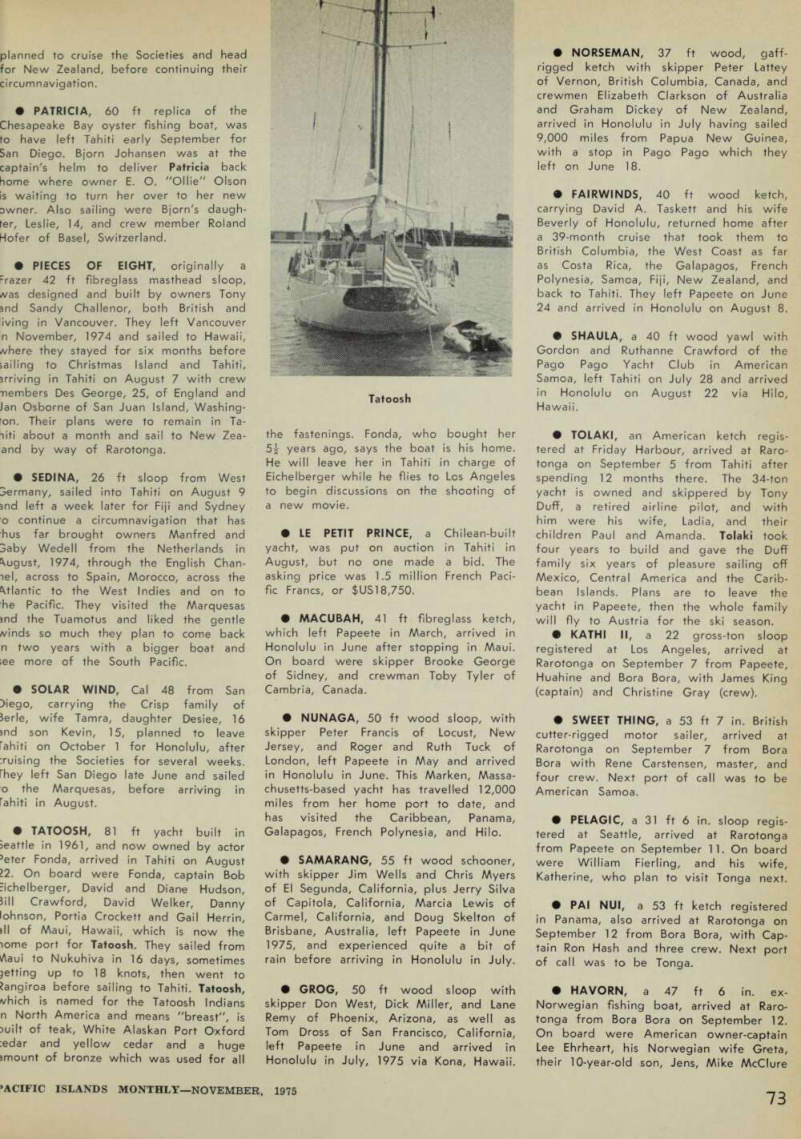
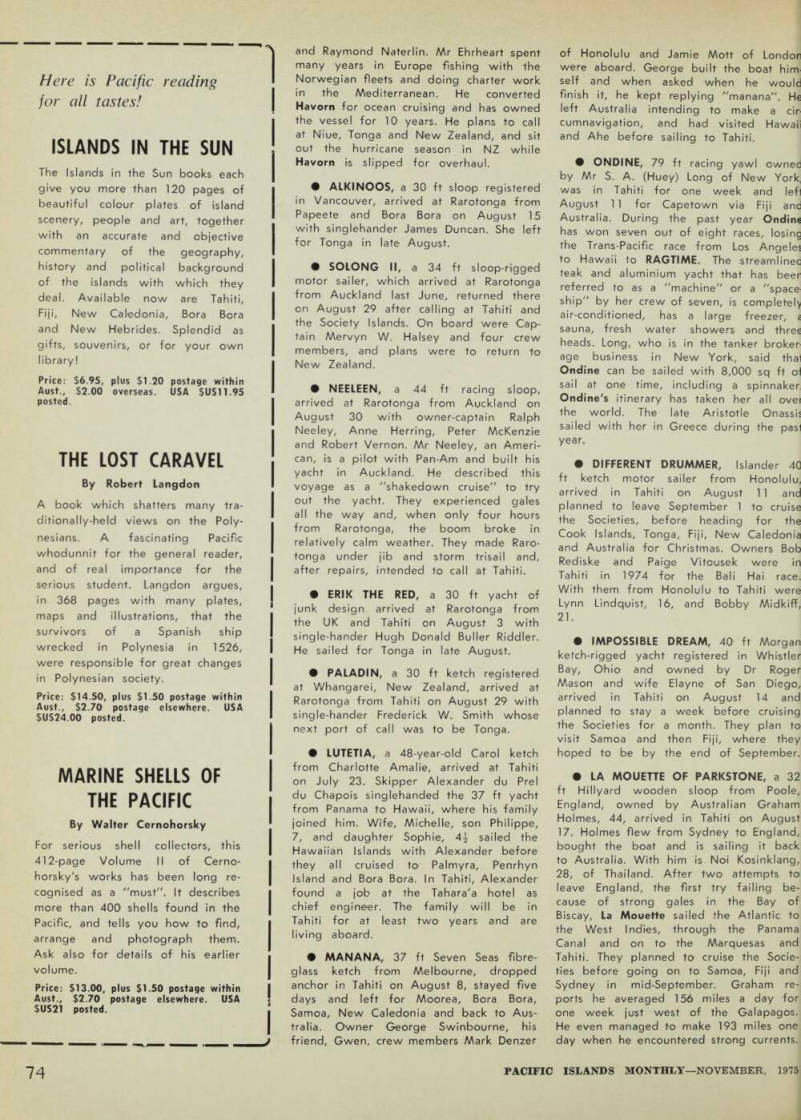
Transport Briefs
• Airline fares out of Australia vill rise by four per cent to nine per ent from November 1. From Aus ralia to the Pacific the increase will >e eight per cent. There will also be ncreases in fares from other countries 0 Australia.
O Airfast Services Pty Ltd, which iperated a helicopter service in Fiji or about five years, took its two heli opters and associated equipment out if the country in September. The ompany complained about lack of o-operation from the government nd other matters. One of the “other latters”, the company claimed, was lat the Ministry of Transport had Mowed another helicopter company 3 operate under conditions of “con iderable advantage”. • A bulldozer came to the rescue f a stranded ship in the New lebrides in September. The govern lent ship Navaka ran on to a reef etween Eton and Rentabour. She 'as stranded for three days and weral attempts to refloat her failed ntil a public works team brought a ulldozer and pulled her off during high tide. The Navaka was holed 1 the engine-room. • The P and O liner, Oronsay, ell known in the Pacific for about 0 years, completed her last trans acific voyage in Sydney on Septem ;r 15. She was then sailed to the lipbreakers in Taiwan. The Oronsay as used extensively in Pacific Islands uises from Australia, and in passen ir voyages through the Pacific to merican west coast ports, and later ► Britain. She was also used on the ritain-Australia run, via Suez and icn via the Cape of Good Hope. • Sofrana-Unilines, since relin aishing its charter of the Captain addon a few weeks ago, has entered to a slot charter arrangement with AD to service Noumea from Aus alia. The PAD ships, Parella, llunga and Pilkara, are providing 21-day service from Adelaide, Mel aurne, Sydney and Brisbane, and xasionally Burnie. The ships accept irgo for the New Hebrides from 1 ports, except Sydney. This cargo transferred into the Captain Cook Noumea for delivery to Vila. • The Bank Line’s Lindenbank, hich went on a reef off Fanning land on August 17, is likely to be )andoned. Even though her bow as partly off the reef, the Linden ink seemed to settle harder amid lips, nullifying attempts of three tugs ’ pull her off. Some copra was taken ►hore, but coconut and palm oil id coconut pellets, which comprised uch of the cargo, were lost.
Cruising Yachts
In August and September there was an exodus of visiting yachts from Raro tonga to other Pacific ports. • ALKINOOS, 30 ft sloop from Van couver, which arrived with single-hander James Duncan, from Papeete and Bora.
The yacht left for Tonga on Septem ber 17. • AMAZING GRACE, 24 ft motor sailer, also from Vancouver, arrived from Papeete with David Boyes (skipper) and Tim Noot. They left Rarotonga for Tonga on September 17. • KYSTENS PERLE, 25 ft 7 in. sloop rigged folkboat with Richard Walker and David Anderson on board was at Rarotonga from early July until Septem ber 17 when she left for New Zealand where the two men hope to find work and sell the boat. • RABBIT, 37 ft sloop registered at Palm Beach, Florida, arrived at Rarotonga from Papeete and Bora Bora on Septem ber 27 with Daniel P. Dyer and Mary Louise Dyer. They planned to leave for Russell in New Zealand's Bay of Islands on October 4. • BORN FREE, 60 ft auxiliary ketch from Longview, Washington, arrived in Tahiti the first week in September, after
cruising from Washington to Honolulu, then on to Palmyra, Penhryn Island, the Samoas, the Cook Islands and the So cieties. Owner Warren Hanly bought Born Free from the original owners two years ago as his first sailboat. With him in Tahiti was Donald Johnson from Rockland, Maine. Warren's plans will carry him from Tahiti to Hawaii in a few months. • CALYPSO, a German built 22 ft sloop singlehanded by Helmuth Waser, 32, a Swiss from Australia, arrived in Tahiti in July. Helmuth left Yugoslavia in July, 1973 and plans to settle in New Zealand, after spending a year in French Polynesia. • DELIVERANCE, 32 ft Atkins-design double-ender from Santa Barbara which was built by owner Mike Magee, left California in May and arrived in Tahiti mid-September. Sailing from the Mar quesas with Mike was Bob Probst of Malibu. Mike planned to spend three months cruising the Societies and then single-hand Deliverance to New Zealand, where he hopes to live. • HYDROPHILE, 31 ft sloop designed in Belgium, sailed into Tahiti on August 24 with Christian and Bernadette Lepage and their 3-year-old son Damien. The family, will be in Tahiti for two years while Christian and Bernadette work. • FREEDOM, 50 ft William Garden ketch built in Taiwan three years ago, sailed into Tahiti on September 13.
Aboard were owner-skipper Bryant Mor ris, 43, his son, Scott, 21, Don McNeil and Deidre Park, all of Los Angeles.
When Freedom left California last Feb ruary Bryant intended to sail to Europe, but changed his mind in Cosa Rica. They
planned to cruise the Societies and head for New Zealand, before continuing their circumnavigation. • PATRICIA, 60 ft replica of the Chesapeake Bay oyster fishing boat, was fo have left Tahiti early September for San Diego. Bjorn Johansen was at the captain's helm to deliver Patricia back home where owner E. O. "Ollie" Olson is waiting to turn her over to her new owner. Also sailing were Bjorn's daugh ter, Leslie, 14, and crew member Roland Hofer of Basel, Switzerland. • PIECES OF EIGHT, originally a Frazer 42 ft fibreglass masthead sloop, /vas designed and built by owners Tony and Sandy Challenor, both British and iving in Vancouver. They left Vancouver n November, 1974 and sailed to Hawaii, /vhere they stayed for six months before jailing to Christmas Island and Tahiti, arriving in Tahiti on August 7 with crew nembers Des George, 25, of England and Jan Osborne of San Juan Island, Washing ton. Their plans were to remain in Ta liti about a month and sail to New Zea and by way of Rarotonga. • SEDINA, 26 ft sloop from West Germany, sailed into Tahiti on August 9 and left a week later for Fiji and Sydney o continue a circumnavigation that has hus far brought owners Manfred and 3aby Wedell from the Netherlands in \ugust, 1974, through the English Chan nel, across to Spain, Morocco, across the Atlantic to the West Indies and on to he Pacific. They visited the Marquesas and the Tuamotus and liked the gentle /vinds so much they plan to come back n two years with a bigger boat and ;ee more of the South Pacific. • SOLAR WIND, Cal 48 from San )iego, carrying the Crisp family of Jerle, wife Tamra, daughter Desiee, 16 and son Kevin, 15, planned to leave fahiti on October 1 for Honolulu, after rruising the Societies for several weeks.
Fhey left San Diego late June and sailed o the Marquesas, before arriving in fahiti in August. • TATOOSH, 81 ft yacht built in Seattle in 1961, and now owned by actor s eter Fonda, arrived in Tahiti on August 12. On board were Fonda, captain Bob richelberger, David and Diane Hudson, Jill Crawford, David Welker, Danny lohnson, Portia Crockett and Gail Herrin, ill of Maui, Hawaii, which is now the lome port for Tatoosh. They sailed from lAaui to Nukuhiva in 16 days, sometimes jetting up to 18 knots, then went to Jangiroa before sailing to Tahiti. Tatoosh, vhich is named for the Tatoosh Indians n North America and means "breast", is >uilt of teak, White Alaskan Port Oxford redar and yellow cedar and a huge imount of bronze which was used for all
the fastenings. Fonda, who bought her 5? years ago, says the boat is his home.
He will leave her in Tahiti in charge of Eichelberger while he flies to Los Angeles to begin discussions on the shooting of a new movie. • LE PETIT PRINCE, a Chilean-built yacht, was put on auction in Tahiti in August, but no one made a bid. The asking price was 1.5 million French Paci fic Francs, or $U518,750. • MACUBAH, 41 ft fibreglass ketch, which left Papeete in March, arrived in Honolulu in June after stopping in Maui.
On board were skipper Brooke George of Sidney, and crewman Toby Tyler of Cambria, Canada. • NUNAGA, 50 ft wood sloop, with skipper Peter Francis of Locust, New Jersey, and Roger and Ruth Tuck of London, left Papeete in May and arrived in Honolulu in June. This Marken, Massa chusetts-based yacht has travelled 12,000 miles from her home port to date, and has visited the Caribbean, Panama, Galapagos, French Polynesia, and Hilo. • SAMARANG, 55 ft wood schooner, with skipper Jim Wells and Chris Myers of El Segunda, California, plus Jerry Silva of Capitola, California, Marcia Lewis of Carmel, California, and Doug Skelton of Brisbane, Australia, left Papeete in June 1975, and experienced quite a bit of rain before arriving in Honolulu in July. • GROG, 50 ft wood sloop with skipper Don West, Dick Miller, and Lane Remy of Phoenix, Arizona, as well as Tom Dross of San Francisco, California, left Papeete in June and arrived in Honolulu in July, 1975 via Kona, Hawaii.
• NORSEMAN, 37 ft wood, gaff rigged ketch with skipper Peter Lattey of Vernon, British Columbia, Canada, and crewmen Elizabeth Clarkson of Australia and Graham Dickey of New Zealand, arrived in Honolulu in July having sailed 9,000 miles from Papua New Guinea, with a stop in Pago Pago which they left on June 18. • FAIRWINDS, 40 ft wood ketch, carrying David A. Taskett and his wife Beverly of Honolulu, returned home after a 39-month cruise that took them to British Columbia, the West Coast as far as Costa Rica, the Galapagos, French Polynesia, Samoa, Fiji, New Zealand, and back to Tahiti. They left Papeete on June 24 and arrived in Honolulu on August 8. • SHAULA, a 40 ft wood yawl with Gordon and Ruthanne Crawford of the Pago Pago Yacht Club in American Samoa, left Tahiti on July 28 and arrived in Honolulu on August 22 via Hilo, Hawaii. • TOLAKI, an American ketch regis tered at Friday Harbour, arrived at Raro tonga on September 5 from Tahiti after spending 12 months there. The 34-ton yacht is owned and skippered by Tony Duff, a retired airline pilot, and with him were his wife, Ladia, and their children Paul and Amanda. Tolaki took four years to build and gave the Duff family six years of pleasure sailing off Mexico, Central America and the Carib bean Islands. Plans are to leave the yacht in Papeete, then the whole family will fly to Austria for the ski season. • KATHI 11, a 22 gross-ton sloop registered at Los Angeles, arrived at Rarotonga on September 7 from Papeete, Huahine and Bora Bora, with James King (captain) and Christine Gray (crew). • SWEET THING, a 53 ft 7 in. British cutter-rigged motor sailer, arrived at Rarotonga on September 7 from Bora Bora with Rene Carstensen, master, and four crew. Next port of call was to be American Samoa. • PELAGIC, a 31 ft 6 in. sloop regis tered at Seattle, arrived at Rarotonga from Papeete on September 11. On board were William Fierling, and his wife, Katherine, who plan to visit Tonga next. • PAI NUI, a 53 ft ketch registered in Panama, also arrived at Rarotonga on September 12 from Bora Bora, with Cap tain Ron Hash and three crew. Next port of call was to be Tonga. • HAVORN, a 47 ft 6 in. ex- Norwegian fishing boat, arrived at Raro tonga from Bora Bora on September 12.
On board were American owner-captain Lee Ehrheart, his Norwegian wife Greta, their 10-year-old son, Jens, Mike McClure
Tatoosh
and Raymond Naterlin. Mr Ehrheart spent many years in Europe fishing with the Norwegian fleets and doing charter work in the Mediterranean. He converted Havorn for ocean cruising and has owned the vessel for 10 years. He plans to call at Niue, Tonga and New Zealand, and sit out the hurricane season in NZ while Havorn is slipped for overhaul. • ALKINOOS, a 30 ft sloop registered in Vancouver, arrived at Rarotonga from Papeete and Bora Bora on August 15 with singlehander James Duncan. She left for Tonga in late August. • SOLONG 11, a 34 ft sloop-rigged motor sailer, which arrived at Rarotonga from Auckland last June, returned there on August 29 after calling at Tahiti and the Society Islands. On board were Cap tain Mervyn W. Halsey and four crew members, and plans were to return to New Zealand. • NEELEEN, a 44 ft racing sloop, arrived at Rarotonga from Auckland on August 30 with owner-captain Ralph Neeley, Anne Herring, Peter McKenzie and Robert Vernon. Mr Neeley, an Ameri can, is a pilot with Pan-Am and built his yacht in Auckland. He described this voyage as a "shakedown cruise" to try out the yacht. They experienced gales all the way and, when only four hours from Rarotonga, the boom broke in relatively calm weather. They made Raro tonga under jib and storm trisail and, after repairs, intended to call at Tahiti. • ERIK THE RED, a 30 ft yacht of junk design arrived at Rarotonga from the UK and Tahiti on August 3 with single-hander Hugh Donald Buller Riddler.
He sailed for Tonga in late August. • PALADIN, a 30 ft ketch registered at Whangarei, New Zealand, arrived at Rarotonga from Tahiti on August 29 with single-hander Frederick W. Smith whose next port of call was to be Tonga. • LUTETIA, a 48-year-old Carol ketch from Charlotte Amalie, arrived at Tahiti on July 23. Skipper Alexander du Prel du Chapois singlehanded the 37 ft yacht from Panama to Hawaii, where his family joined him. Wife, Michelle, son Philippe, 7, and daughter Sophie, 4\ sailed the Hawaiian Islands with Alexander before they all cruised to Palmyra, Penrhyn Island and Bora Bora. In Tahiti, Alexander found a job at the Tahara'a hotel as chief engineer. The family will be in Tahiti for at least two years and are living aboard. • MANANA, 37 ft Seven Seas fibre glass ketch from Melbourne, dropped anchor in Tahiti on August 8, stayed five days and left for Moorea, Bora Bora, Samoa, New Caledonia and back to Aus tralia. Owner George Swinbourne, his friend, Gwen, crew members Mark Denzer
of Honolulu and Jamie Mott of London were aboard. George built the boat him self and when asked when he would finish it, he kept replying "manana". He left Australia intending to make a cir cumnavigation, and had visited Hawaii and Ahe before sailing to Tahiti. • ONDINE, 79 ft racing yawl owned by Mr S. A. (Huey) Long of New York, was in Tahiti for one week and left August 11 for Capetown via Fiji and Australia. During the past year Ondine has won seven out of eight races, losing the Trans-Pacific race from Los Angeles to Hawaii to RAGTIME. The streamlined teak and aluminium yacht that has been referred to as a "machine" or a "space ship" by her crew of seven, is completely air-conditioned, has a large freezer, a sauna, fresh water showers and three heads. Long, who is in the tanker broker age business in New York, said thal Ondine can be sailed with 8,000 sq ft ol sail at one time, including a spinnaker.
Ondine's itinerary has taken her all ovei the world. The late Aristotle Onassis sailed with her in Greece during the past year.
• Different Drummer, Islander 40
ft ketch motor sailer from Honolulu, arrived in Tahiti on August 11 and planned to leave September 1 to cruise the Societies, before heading for the Cook Islands, Tonga, Fiji, New Caledonia and Australia for Christmas. Owners Bob Rediske and Paige Vitousek were in Tahiti in 1974 for the Bali Hai race.
With them from Honolulu to Tahiti were Lynn Lindquist, 16, and Bobby Midkiff, 21. • IMPOSSIBLE DREAM, 40 ft Morgan ketch-rigged yacht registered in Whistler Bay, Ohio and owned by Dr Roger Mason and wife Elayne of San Diego, arrived in Tahiti on August 14 and planned to stay a week before cruising the Societies for a month. They plan to visit Samoa and then Fiji, where they hoped to be by the end of September. • LA MOUETTE OF PARKSTONE, a 32 ft Hillyard wooden sloop from Poole, England, owned by Australian Graham Holmes, 44, arrived in Tahiti on August 17. Holmes flew from Sydney to England, bought the boat and is sailing it back to Australia. With him is Noi Kosinklang, 28, of Thailand. After two attempts to leave England, the first try failing be cause of strong gales in the Bay of Biscay, La Mouette sailed the Atlantic to the West Indies, through the Panama Canal and on to> the Marquesas and Tahiti. They planned to cruise the Socie ties before going on to Samoa, Fiji and Sydney in mid-September. Graham re ports he averaged 156 miles a day for one week just west of the Galapagos.
He even managed to make 193 miles one day when he encountered strong currents.
Advertisements & other items, pp. 73-76 (3 items)
71
iCIFIC ISLANDS MONTHLY—NOVEMBER, 1975
Pacific
I THROUGHOUT THE PACIFIC
" Single hand control
TSFH-+H OUTBOARD MOTOR
And look at some of the outstanding features . . .
Needle Roller Bearings throughout—Heavy Duty Crankshaft and Main Bearings—Loop Scavenging. Stainless Steel and Non Ferrous Metal on all water contact parts.
The Quality is The Best! Spare Parts amongst the Cheapest!
HUNDREDS OF OTHER FINE POINTS ON THIS REALLY
MODERN TERHI OUTBOARD MOTOR FROM FINLAND.
The full range available ex stock
Pacific
D.A.T.A.
19 Carrington Rd., Marrickvilla, N.S.W. 2204 Australia.
CABLES: "DIESELTECH" SYDNEY. TELEX: AA 25568.
Caterpillar reliability, productivity, availability. Now you can get it all in a wheel skidder. The 518.
A whole new standard in skidder engineering. 120 turbocharged horsepower, 20,400 pounds of working muscle with full articulation and frame oscillation for stability and minimum maintenance.
Single lever “on the go” powershift. Dual rate steering for controlled response at all speeds. An operator’s compartment engineered for efficiency with safety features built In for man and machine.
You’ll find all the best skidder ideas, plus added refinement and top quality manufacturing that can make the 518 the backbone of your logging operation.
And South-West Pacific Caterpillar dealers will ensure that your backbone stays in top condition no matter how far in the bush you are.
Parts, maintenance, repairs or simple information—we’ll see that you get it fast.
So tackle the jungle with the new Cat 518.
Caterpillar Dealers in South-West Pacific.
HASTINGS DEERING
Lae: Milford Haven Road, Ph: 42 2355 Port Moresby: Champion Parade, Knoedobu.
Ph: 3138 or 2098.
Bougainville: Itakara.
Industrial Park, Arawa.
Ph: 95 9004. 154 Queens Road, Suva.
Ph: 24 051-4 Cables: Carptrac Suva Telex: Carptrac FG2190 Suva HD529
Here is Pacific reading
for all tastes!
ISLANDS IN THE SUN
The Islands in the Sun books each give you more than 120 pages of beautiful colour plates of island scenery, people and art, together with an accurate and objective commentary of the geography, history and political background of the islands with which they deal. Available now are Tahiti, Fiji, New Caledonia, Bora Bora and New Hebrides. Splendid as gifts, souvenirs, or for your own library!
Price: $6.95, plus $1.20 postage within Aust., $2.00 overseas. USA $U511.95 posted.
THE LOST CARAVEL
By Robert Langdon A book which shatters many traditionally-held views on the Polynesians. A fascinating Pacific whodunnit for the general reader, and of real importance for the serious student. Langdon argues, in 368 pages with many plates, maps and illustrations, that the survivors of a Spanish ship wrecked in Polynesia in 1526, were responsible for great changes in Polynesian society.
Price: $14.50, plus $1.50 postage within Aust., $2.70 postage elsewhere. USA $U524.00 posted.
MARINE SHELLS OF
THE PACIFIC
By Walter Cernohorsky For serious shell collectors, this 412-page Volume II of Cernohorsky's works has been long recognised as a "must". It describes more than 400 shells found in the Pacific, and tells you how to find, arrange and photograph them.
Ask also for details of his earlier volume.
Price: $13.00, plus $1.50 postage within Aust., $2.70 postage elsewhere. USA SUS2I posted.
73
‘ACIFIC ISLANDS MONTHLY—NOVEMBER, 1975
Business and Development
The High Cost Of Self-Reliance' In
An Austere' Papua New Guinea
One of Papua New Guinea’s first tastes of what it is like to be independent came in September vith Finance Minister Julian Chan’s Budget, which he described as “self-reliant” and “austere”. With Australian aid K 36 million below what was expected, he announced big cuts in government spending, vhich will rub off throughout the economy.
Public reaction to the budget was nixed. Some people thought it was air; one critic called it “terrible”, lut from whatever angle it is viewed, Jr Chan was obviously on the right rack in warning the people that they /ould have to live within their means, hat the next three years could be nugh.
The time will come when Austra an direct aid will be phased out. *apua New Guinea would probably /ant it that way, for there is a dignity bout independence. Any Australian ssistance in the long term is more kely to be through loans than direct rants.
However, the Australian aid offer, Ithough disappointing, could not be sfused. The government found itself i a very tough situation, which Mr 'han described as a national emer ency.
Mr Chan has restructured the taxa on system to abolish most conces ions, and increase the general rate y about 12 per cent. He is budgeting Dr increased departmental spending f about K 35.7 million (about 16 per ent), but most of this will go in igher salaries and wages for national üblic servants, rather than into de elopment projects or a stepping-up f government services.
To gain more revenue he put up 3e duties on luxury imports, and in reased stamp duties on cheques from t to 6t. But there were no increases i company tax, duties on cars, liquor r tobacco products. Perhaps he is eserving those for the future, for they re items which finance ministers and ■easurers find hard to leave alone, lowever, an increase of any magni jde in company tax could be ounter-productive, by driving away 3vestment incentives.
Mr Chan said PNG was still a poor ountry, but the hopes of the people ad been aroused and demands were lounting for great increases in all
kinds of benefits which only a rich country could afford. There was nothing about political independence which automatically made PNG richer.
He warned that people would have to work hard for the extra benefits they wanted.
Mr Chan replaced concessional tax deductions in favour of a 10 per cent rebate with a maximum limit of K 250 for each taxpayer. The mini mum taxable income level rose from Kl 2 to KlB a week, an apparent give away, offset by the rise of 12 per
cent in general rates. All taxpayers, other than low-income earners, will pay more, with bigger increases for higher incomes. Low-income earners with dependants will benefit from a minimum rebate of K3O for each dependant.
Concessional deductions were largely an Australian phenomenon, and many Papua New Guineans were not aware they could claim them.
Concessional deductions which disap peared were those for dependants (ex cept the K3O for low income earners), medical, funeral and educational ex penses, life assurance, superannuation, contributions, and gifts to charitable organisations. Deductions for ex penses incurred in earning income re main.
Higher customs duties apply to electrical appliances, photographic and sound equipment, pleasure boats and cosmetics. The duty for domestic air conditioners rose from 10 per cent to 45 per cent. The exemption from duty of basic food items was continued.
Departmental spending is estimated at K 216.4 million. The highest de partmental allocations were K 45.9 million to education, and K 27.8 million to health. The allocation for universities is K 15.3 million, com pared with Kl 3 million last year.
The Office of Minerals and Energy and Ok Tedi Development Co, and the Purari hydro-electric power scheme received allocations totalling K 6.5 million. Bougainville will re ceive K 4.14 million for capital works, but the money will be channelled through government agencies because of a breakdown in negotiations with the Bougainville interim provincial government.
Money for the works programme will be K 42.2 million, about KlO million higher than last year. The allocation for the rural improvement programme is K 6 million.
In an effort to combat the rising
crime rate the budget allocated 15.3 per cent more to recurrent law and order functions. The police force will get an additional K 15.1 million.
Spending on corrective institutions will rise by $2.4 million.
The defence allocation is K 16.25 million, part of which will be met by a special grant from Australia. The spending on agriculture will rise from K 15.2 million to K 19.3 million. Agri culture had the highest priority rating in the scale set by the Budget Priori ties Committee for the allocation of funds.
Mr D. Clarke, president of the Rabaul Chamber of Commerce, after describing the budget as “terrible” said that increased taxation, added to the naturalisation laws, would prompt expatriates to leave PNG. His counterpart in the Lae Chamber of Commerce, Mr Tim Leahy, said the budget was very fair, and he was sup ported by Mr Jim Seeto, president of the Lae Chinese Association.
The Planters Association was criti cal of the tax on speed boats. A spokesman claimed this would send up the cost of operating plantations. For many plantations, a speed boat was not a luxury Mr C. Gregory, lecturer in econo mics at the University of PNG, said the budget would be burdensome for national workers. Expatriate business men and villagers would not be seriously affected. He also thought the government should have considered the tax holiday provisions for busi nesses.
The Public Service Association launched a national campaign against budget policies and what it claimed was a breach by the government of industrial obligations to workers in public employment. Protest meetings and demonstrations were arranged at which the general secretary, Mr Jacob T. Lemeki, and officers of the asso ciation were to speak on the implica tions of the government’s financial measures.
The sweet smell
of success
The Fiji Government, as a 90 per cent shareholder in the Fiji Sugar Corporation, will be the main bene ficiary in the corporation’s post-tax net profit of $6,392,047, in its latest financial year. In the previous year the profit was $974,458. The corpora tion recommended a dividend of 10 per cent which requires $1,850,000.
The Fiji Government will receive $1,665,000 in dividends, which should help Finance Minister Charles Stinson when he prepares his 1976 budget.
The directors report that the in dustry could face difficulties, unless sugar production increased.
Ok Tedi project
New moves in Ok Tedi project
The Papua New Guinea Govern ment and the US mining company, Kennecott, look like patching up their differences over the Ok Tedi copper project. And Australia’s big gest company, BHP, may get in volved.
The PNG Government and Kenne cott have reopened talks. PNG is looking for at least one, and probably two, partners for the project because of the risk capital involved.
The chairman of BHP, Sir lan McLennan, in his annual address to shareholders, said BHP was having discussions with the PNG Govern ment about a possible involvement in Ok Tedi. Ok Tedi was a major copper ore body with stated reserves of more than 150 million tonnes grading 0.9 per cent copper.
Sir lan said that was not enough to justify commercial development, but further reserves were likely to be found. More than S4OO million would be required to finance the develop ment. If BHP secured an interest it would be as manager of the project.
Kennecott in six years, spent sl6 million establishing the presence of the 150 million tonnes of copper ore.
Advertisements & other items, p. 77 (1 item)
75
ACIFIC ISLANDS MONTHLY—NOVEMBER, 1975
feel the economic pinch

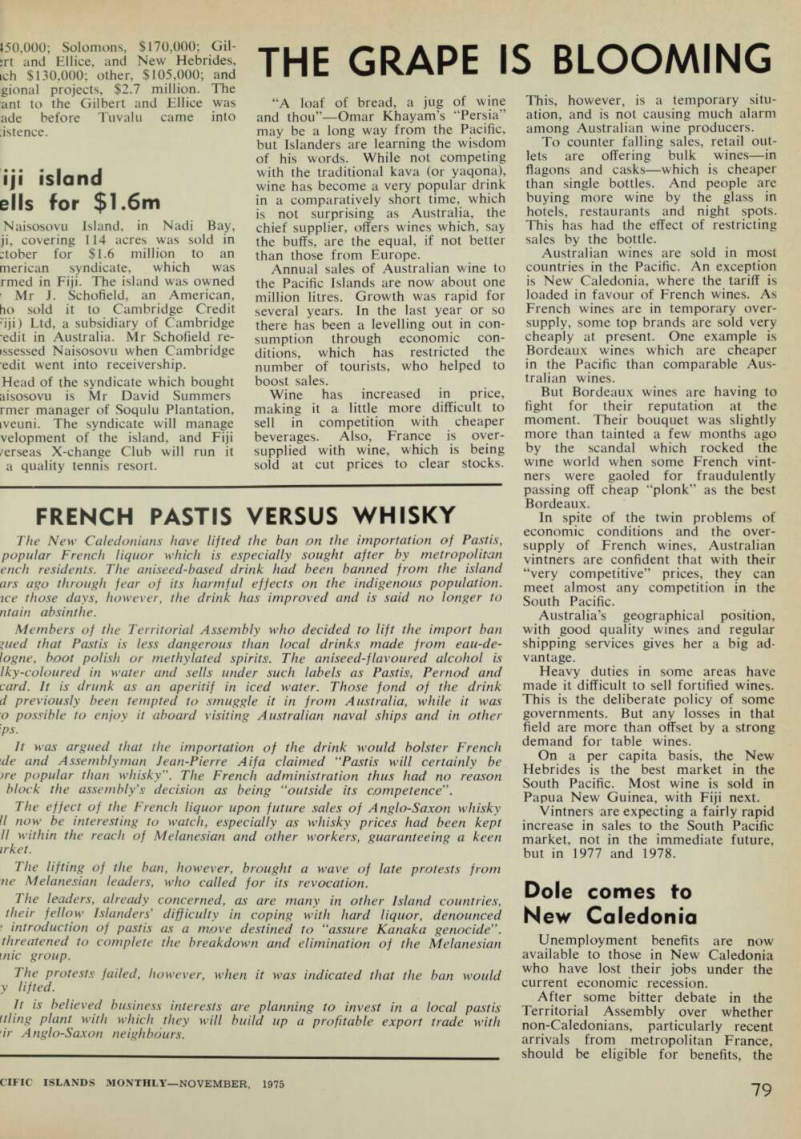
Taxing time ahead as Islands feel the economic pinch
September-October was a taxing time in several parts of the Pacific as treasurers or finance ministers pre pared their budgets, or when govern ments found it necessary to raise more revenue.
The Cook Islands budget was the toughest for 10 years; in Papua New Guinea income taxes and customs duties were raised (see separate re port); the New Hebrides hiked duties in pre-budget measures; American Samoa has to decide how best to finance an unexpected drop in tax revenue, and New Caledonia looks like raising local taxes.
In the Cook Islands, income tax, postal charges, and vehicle and driv ing licence fees went up, along with higher charges for government ser vices. The taxation increases included a 50 per cent surcharge on assessed income and higher import taxes.
Government spending is expected to rise 17.6 per cent above the previous year’s $l2 million.
In the New Hebrides, in several pre-budget measures, the Resident Commissioners reduced from 15 per cent to 5 per cent the import duties on sugar, tea, coffee, powdered milk, tinned mackerel, oils, margarine and soap. To offset the loss in revenue, and help meet an expected large bud get deficit, duties were lifted on petrol (3 francs a litre), beer, ciga rettes (12 to 16 francs, depending on brand), wines (20 to 130 francs a bottle, depending on quality) and spirits (40 to 80 francs a bottle).
In another move, designed to give the condominium duty-free status, a number of luxury items became sub ject to a uniform service tax of 10 per cent only. It applied to cameras, tape recorders, radios and watches.
The object is to increase sales to tourists, and make the New Hebrides competitive with Fiji.
In American Samoa, local tax revenue for the 1976 budget will be $2.63 million lower than expected.
The estimate when the budget was passed in June was $8 million. Now it is $5.37 million. Local tax revenue has dropped dramatically in the last three years, primarily in corporate taxes.
The government tax manager, Mr Arthur Westervelt, gave three reasons for the decline: • Since Star Kist opened its own can manufacturing operation, and Van Camp had announced it would
supply its own cans by January 1, the American Can Co planned to close its plant; • Fishing had been below normal for the last two years and tax revenue from both canneries was down; • Some other corporations, be cause of the general decline in business in 1974, overpaid estimated taxes and would claim credit for them in the 1976 tax period.
Both the Bank of Hawaii and Stan dard Oil were in the overpaid group.
The budget for 1976 totalled $47.33 million. But only $31.49 million is considered firm. The addi tional 5i5.84 million depends on a capital improvement request, which is under consideration by US Con gress.
American Samoa has three main sources of revenue—direct con gressional appropriations, US federal grants, and local tax revenue. De partment heads have been asked to suggest how to meet the $2.63 mil lion drop in revenue. Governor Ruth has sought an across-the-board prun ing of 10 per cent.
New Caledonia’s territorial budget in 1976 is expected to total 12,000 million CFP (about SAI2O million) based on revenue raised locally, chiefly indirect taxes such as import and sales tax, as well as tax on the island’s nickel. The 1976 budget esti mates a 20 per cent increase over 1975 expenditure.
Main areas of expenditure planned by the administration for 1976 in clude SA6S million for territorial public servants and equipment paid for out of local funds (other public service expenses are met by France).
In addition $9 million is required to repay loans, and about SA2O million is expected to go to local government councils, with about another SA2O million earmarked for church schools and social services.
As usually happens, after the public service takes its slice, this would seem to leave only about $500,000 of local revenue to be spent on infrastructure projects.
Since planned expenditure con tinues again to exceed estimated revenue, this time by SA2O million, rather than seek further subsidies from France, the Territorial Assem bly will be asked to increase existing local taxes, including certain pro positions which last year’s autonomist Assembly refused to vote in.
»lew search
or Fiji wealth
A French company, Societe ationale de Petroles D’Aquitaine, as mapped out areas of Viti Levu ad Vanua Levu in Fiji to search for lid, copper, lead, zinc and silver, he areas, which the company has iplied to prospect were surrendered / the Barringer group after pre ninary investigation. The first year •ogramme covers reconnaissance ex oration, including geological impling, mapping and a study of mlogical work done by the Fiji overnment and other mining com mies.
>anks merge
i New Caledonia
The oldest of New Caledonia’s 'e banks, the Banque de I’lndochine, ned on October 1 with the Banque Suez et de I’Union des Mines to come the Banque de I’lndochine et Suez, or more simply, the Bank Indo-Suez. Head office of the bank Noumea is on the corner of the ae de I’Alma and the Avenue Foch.
While the Banque de Suez was incipally involved in France and
Europe, the Bank of Indo-China has been particularly active in Asia and overseas from France. The newly formed Bank of Indo-Suez is a wholly-owned subsidiary of the French company, Compagnie Finan cier de Suez. In New Caledonia, the bank has 20 branches and agencies throughout the territory as well as a branch in the New Hebrides.
One reported aim of the new banking group is to engage in inter national investment projects and assist the expansion of French over seas trade.
Boom year for
Air New Zealand
Air New Zealand overcame a generally adverse economic climate in many of its trading areas to turn in a net profit of $4,365,146 in the year ended March 31, compared with $4,061,124 in the previous year. The directors recommend a dividend of five per cent, which will go to the owner of all the shares—the NZ Gov ernment.
The airline carried more pasengers than ever bef0re—825,569, compared with 649,214 the previous year. The amount of cargo carried increased spectacularly from 57.9 million tonnes in 1973-74 to 89.6 million tonnes.
Air New Zealand operates a fleet of five DC 10s and six DCBs. Another DC 10 was scheduled to arrive in October, 1975, and yet another, which will give it seven DClOs, is due in September, 1976. Air NZ also owns a Britten Norman Islander which is on charter to Cook Island Airways.
It holds 380,000 shares in Air Pacific and 20,000 in Polynesian Airlines.
It also has investments in hotels.
Fairy godmother
to the Islands
New Zealand is being something of a fairy godmother to the Pacific Islands in 1975-76 with aid of $17,285,000 for capital and expert assistance projects. The 1975-76 bi lateral aid programme is likely to involve more than 300 individual de velopment projects, the Prime Minis ter, Mr W. E. Rowling, said in Par liament recently in answer to a ques tion.
Many projects had started; other had to be confirmed or clarified after discussion with the recipient govern ment. Cook Islands is doing the best with $3,450,000, followed by Fiji with $3 million, Western Samoa $2 million; Niue Island, $1,950,000; Papua New Guinea, $1.7 million; Tonga $1.5 million; Tokelau Island,
150,000; Solomons, $170,000; Gil ;rt and Ellice, and New Hebrides, ich $130,000; other, $105,000; and gional projects, $2.7 million. The ant to the Gilbert and Ellice was ade before Tuvalu came into Jstence.
iji island
ells for sl.6m
Naisosovu Island, in Nadi Bay, ji, covering 114 acres was sold in :tober for $1.6 million to an merican syndicate, which was rmed in Fiji. The island was owned r Mr I. Schofield, an American, ho sold it to Cambridge Credit r iji) Ltd, a subsidiary of Cambridge edit in Australia. Mr Schofield re tssessed Naisosovu when Cambridge edit went into receivership.
Head of the syndicate which bought aisosovu is Mr David Summers rmer manager of Soqulu Plantation, iveuni. The syndicate will manage velopment of the island, and Fiji X-change Club will run it a quality tennis resort.
Advertisements & other items, pp. 79-80 (2 items)
77
ICIFIC ISLANDS MONTHLY—NOVEMBER, 1975
Security
To Future Generations,
ns Custodian of the past Social welfare is a subject of serious consideration in most modern societies. Man in the twentieth century accepts his responsibility to bequeath to the next generation a society better than his own.
Daiwa Bank is not unique in accepting this responsibility, but Daiwa is unique in making acceptance of this role in society an integral part of their banking service.
Daiwa is the only Japanese city bank to combine banking and trust business. Daiwa is thus a fully integrated banking institution, comprising banking, international financing, trust, pension trust, and real estate business. This integration is part of our effort to fulfil our social responsibility consistent with society's needs in a contemporary environment. a fully integrated banking service
DAIWA BANK
Head Office: Osaka, japan London and Frankfurt Branches New York and Los Angeles Agencies Singapore, Sydney and Sao Paulo Representative Offices Joint Venture Banks: P.T. Bank Perdania, Jakarta, International Credit Alliance, Ltd., Hong Kong
,T
cheaper
ARSON roofs & Rivets
r
HERE'S HOW THEY WORK
HERE'S WHAT THEY DO
Replace spot welding, nuts and bolts, screws and other less economical methods of fastening. The fastening is quicker, stronger, cheaper and resistant to vibration. Ideal for hundreds of repair and construction needs . . . mending toys, metal furniture, awnings, etc.
MARSON No. 220
WORKSHOP MASTER
The most complete tradesman and handyman construction and repair kit. Contains HP4 plier plus 200 assorted rivets in steel carrying case. Suggested retail $25.00.
MARSON HP2/4 MONITOR
The world's strongest and most versatile riveting tool in steel case. Sets rivets 3/32" to 3/16" diameter.. Suggested retail $21.30. rnvns
MARSON No. 250
MASTER MARINER
Designed specially for the boat builder. Contains HP4 hand plier plus over 200 assorted rivets in copper, stainless steel and marine specification aluminium.
Suggested retail $26.25. - m • -Ml ■ tt
RAK-66 RIVET-ALL KIT
The only deluxe riveting kit in attractive gift pack. Contains riveting plier and large assortment of rivets. Sets three sizes of rivets. Suggested retail $5.89.
LAZY TONG RIVETER
Sets rivets up to 3/16" dia. Small diameter head permits riveting in restricted areas.
Suggested retail $27.75.
MARSON KLIK FAST RIVETS
Klik fast rivets are available in minor packs of 25, poly bags of 100 and boxes of 500.
They are available in steel, aluminium, copper, and stainless steel, in 1/8", 5/32", 3/16" and %" dia. and from 1/8" (3mm) long to 2" (50mm) long.
AT ALL LEADING HARDWARE STORES
Distributed all over Australia and guaranteed by MARSON PRODUCTS (AUST.) PTY. LTD. 108 Warrane Road, Willoughby, N.S.W.
French Fastis Versus Whisky
The New Caledonians have lifted the ban on the importation of Fastis, popular French liquor which is especially sought after by metropolitan ench residents. The aniseed-based drink had been banned from the island ars ago through fear of its harmful effects on the indigenous population, ice those days, however, the drink has improved and is said no longer to ntain absinthe.
Members of the Territorial Assembly who decided to lift the import ban ?ued that Fastis is less dangerous than local drinks made from eau-de logne, boot polish or methylated spirits. The aniseed-flavoured alcohol is Iky-coloured in water and sells under such labels as Fastis, Pernod and card. It is drunk as an aperitif in iced water. Those fond of the drink d previously been tempted to smuggle it in from Australia, while it was o possible to enjoy it aboard visiting Australian naval ships and in other ps.
It has argued that the importation of the drink would bolster French de and Assemblyman Jean-Pierre Aifa claimed “Fastis will certainly be ire popular than whisky”. The French administration thus had no reason block the assembly’s decision as being “outside its competence”.
The effect of the French liquor upon future sales of Anglo-Saxon whisky II now be interesting to watch, especially as whisky prices had been kept II within the reach of Melanesian and other workers, guaranteeing a keen irket.
The lifting of the ban, however, brought a wave of late protests from ne Melanesian leaders, who called for its revocation.
The leaders, already concerned, as are many in other Island countries, their fellow Islanders’ difficulty in coping with hard liquor, denounced ’ introduction of pastis as a move destined to “assure Kanaka genocide”, threatened to complete the breakdown and elimination of the Melanesian inic group.
The protests failed, however, when it was indicated that the ban would y lifted.
It is believed business interests are planning to invest in a local pastis tiling plant with which they will build up a profitable export trade with 'ir Anglo-Saxon neighbours.
The Grape Is Blooming
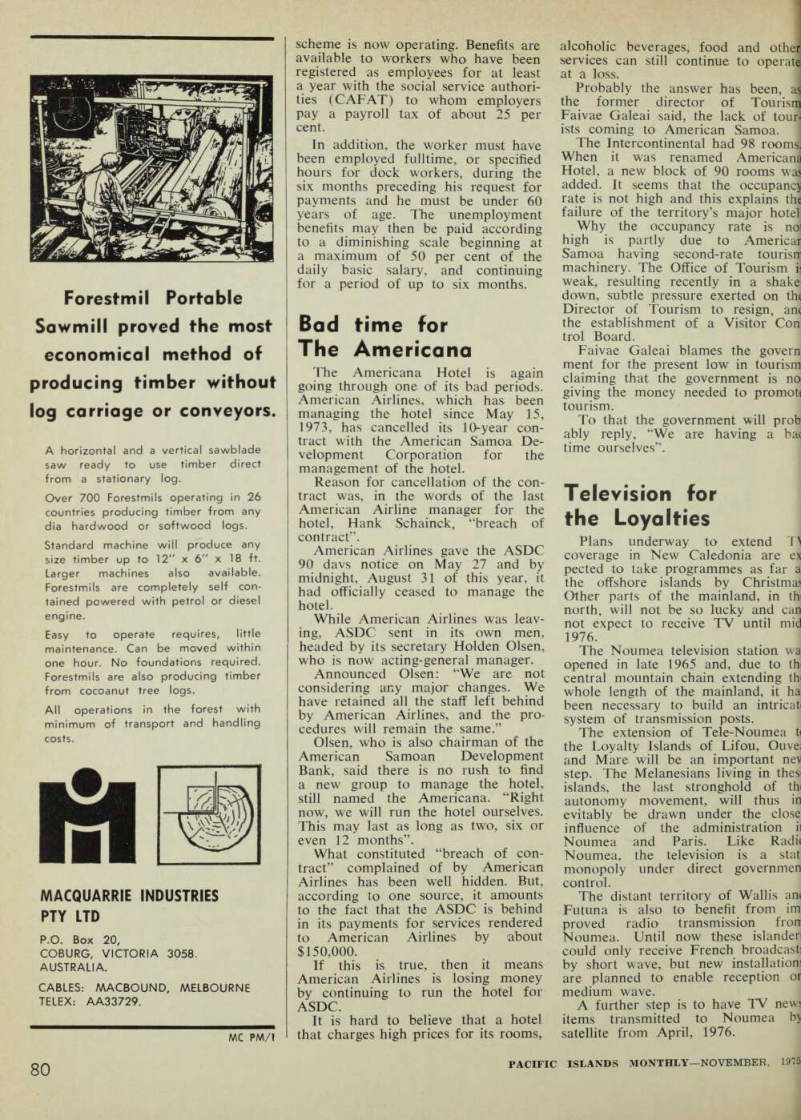
“A loaf of bread, a jug of wine and thou” —Omar Khayam’s “Persia” may be a long way from the Pacific, but Islanders are learning the wisdom of his words. While not competing with the traditional kava (or yaqona), wine has become a very popular drink in a comparatively short time, which is not surprising as Australia, the chief supplier, offers wines which, say the buffs, are the equal, if not better than those from Europe.
Annual sales of Australian wine to the Pacific Islands are now about one million litres. Growth was rapid for several years. In the last year or so there has been a levelling out in con sumption through economic con ditions, which has restricted the number of tourists, who helped to boost sales.
Wine has increased in price, making it a little more difficult to sell in competition with cheaper beverages. Also, France is over supplied with wine, which is being sold at cut prices to clear stocks.
This, however, is a temporary situ ation, and is not causing much alarm among Australian wine producers.
To counter falling sales, retail out lets are offering bulk wines—in flagons and casks—which is cheaper than single bottles. And people are buying more wine by the glass in hotels, restaurants and night spots.
This has had the effect of restricting sales by the bottle.
Australian wines are sold in most countries in the Pacific. An exception is New Caledonia, where the tariff is loaded in favour of French wines. As French wines are in temporary over supply, some top brands are sold very cheaply at present. One example is Bordeaux wines which are cheaper in the Pacific than comparable Aus tralian wines.
But Bordeaux wines are having to fight for their reputation at the moment. Their bouquet was slightly more than tainted a few months ago by the scandal which rocked the wine world when some French vint ners were gaoled for fraudulently passing off cheap “plonk” as the best Bordeaux.
In spite of the twin problems of economic conditions and the over supply of French wines, Australian vintners are confident that with their “very competitive” prices, they can meet almost any competition in the South Pacific.
Australia’s geographical position, with good quality wines and regular shipping services gives her a big ad vantage.
Heavy duties in some areas have made it difficult to sell fortified wines.
This is the deliberate policy of some governments. But any losses in that field are more than offset by a strong demand for table wines.
On a per capita basis, the New Hebrides is the best market in the South Pacific. Most wine is sold in Papua New Guinea, with Fiji next.
Vintners are expecting a fairly rapid increase in sales to the South Pacific market, not in the immediate future, but in 1977 and 1978.
Dole comes to
New Caledonia
Unemployment benefits are now available to those in New Caledonia who have lost their jobs under the current economic recession.
After some bitter debate in the Territorial Assembly over whether non-Caledonians, particularly recent arrivals from metropolitan France, should be eligible for benefits, the
scheme is now operating. Benefits are available to workers who have been registered as employees for at least a year with the social service authori ties (CAFAT) to whom employers pay a payroll tax of about 25 per cent.
In addition, the worker must have been employed fulltime, or specified hours for dock workers, during the six months preceding his request for payments and he must be under 60 years of age. The unemployment benefits may then be paid according to a diminishing scale beginning at a maximum of 50 per cent of the daily basic salary, and continuing for a period of up to six months.
Bad time for
The Americana
The Americana Hotel is again going through one of its bad periods.
American Airlines, which has been managing the hotel since May 15, 1973, has cancelled its 10-year con tract with the American Samoa De velopment Corporation for the management of the hotel.
Reason for cancellation of the con tract was, in the words of the last American Airline manager for the hotel, Hank Schainck, “breach of contract”.
American Airlines gave the ASDC 90 davs notice on May 27 and by midnight, August 31 of this year, it had officially ceased to manage the hotel.
While American Airlines was leav ing, ASDC sent in its own men, headed by its secretary Holden Olsen, who is now acting-general manager.
Announced Olsen: “We are not considering any major changes. We have retained all the staff left behind by American Airlines, and the pro cedures will remain the same.”
Olsen, who is also chairman of the American Samoan Development Bank, said there is no rush to find a new group to manage the hotel, still named the Americana. “Right now, we will run the hotel ourselves.
This may last as long as two, six or even 12 months”.
What constituted “breach of con tract” complained of by American Airlines has been well hidden. But, according to one source, it amounts to the fact that the ASDC is behind in its payments for services rendered to American Airlines by about $150,000.
If this is true, then it means American Airlines is losing money by continuing to run the hotel for
Asdc.
It is hard to believe that a hotel that charges high prices for its rooms,
alcoholic beverages, food and other services can still continue to operate at a loss.
Probably the answer has been, as the former director of Tourism Faivae Galeai said, the lack of tour ists coming to American Samoa.
The Intercontinental had 98 rooms.
When it was renamed Americana Hotel, a new block of 90 rooms was added. It seems that the occupancy rate is not high and this explains the failure of the territory’s major hotel Why the occupancy rate is nol high is partly due to American Samoa having second-rate tourism machinery. The Office of Tourism i: weak, resulting recently in a shake down, subtle pressure exerted on the Director of Tourism to resign, am the establishment of a Visitor Con trol Board.
Faivae Galeai blames the govern ment for the present low in tourism claiming that the government is no giving the money needed to promote tourism.
To that the government will prob ably reply, “We are having a bac time ourselves”.
Television for
the Loyalties
Plans underway to extend coverage in New Caledonia are ex pected to take programmes as far a the offshore islands by Christmas Other parts of the mainland, in th north, will not be so lucky and can not expect to receive TV until mid 1976.
The Noumea television station wa opened in late 1965 and, due to th central mountain chain extending th whole length of the mainland, it ha been necessary to build an intricat system of transmission posts.
The extension of Tele-Noumea t( the Loyalty Islands of Lifou, Ouve; and Mare will be an important nev step. The Melanesians living in thes< islands, the last stronghold of th autonomy movement, will thus in evitably be drawn under the close influence of the administration ii Noumea and Paris. Like Radi< Noumea, the television is a stat monopoly under direct governmen control.
The distant territory of Wallis am Futuna is also to benefit from im proved radio transmission fron Noumea. Until now these islander; could only receive French broadcast; by short wave, but new installation; are planned to enable reception or medium wave.
A further step is to have TV news items transmitted to Noumea by satellite from April, 1976.
Advertisements & other items, pp. 81-84 (3 items)
79
CIFIC ISLANDS MONTHLY—NOVEMBER, 1975
log carriage or conveyors.
Forestmil Portable
Sawmill proved the most
economical method of
producing timber without
log carriage or conveyors.
A horizontal and a vertical sawblade saw ready to use timber direct from a stationary log.
Over 700 Forestmils operating in 26 countries producing timber from any dia hardwood or softwood logs.
Standard machine will produce any size timber up to 12" x 6" x 18 ft.
Larger machines also available.
Forestmils are completely self contained powered with petrol or diesel engine.
Easy to operate requires, little maintenance. Can be moved within one hour. No foundations required.
Forestmils are also producing timber from cocoanut tree logs.
All operations in the forest with minimum of transport and handling costs.
MACQUARRIE INDUSTRIES
PTY LTD
P.O. Box 20,
COBURG, VICTORIA 3058.
AUSTRALIA.
CABLES: MACBOUND, MELBOURNE
TELEX: AA33729.
MC PM/I
Australian Engineering
Equipment
tough and reliable
The performance reliability and economy of Australian plant and equipment result from many years of experience. The first Australian heavy engineering shops came into existence back in the great gold rush days of the 1850’s.
Since then Australian companies have evolved the capacity to manufacture equipment for major developmental projects, the mining, processing, steel and other key industries. Equipment that ranges from large ferrous and non-ferrous forgings and castings, to machine tools for all kinds of applications from a single special design through to batch production or continuous high volume production. Let us help with your particular requirements.
Quality and value that’s only hours away The Australian Trade Commissioner can give you details of suppliers.
You can contact him at; 7th Floor, Dominion House, Thomson Street, Suva, FIJI. (Post Office Box 1252).
Telephone: 312844, or: Post Office Box 9129, Hohola, Port Moresby, P.N.G; Telephone: 25 9333. \mmmu'
nmm
MMrA
Australian Department of Overseas Trade
-a •S 3 &
TIMBER FOR THE
SOUTH PACIFIC
BUILDING INDUSTRY
MAREERA
‘ CAIRNS
WANGAN
INGHAM
TOWNSVILLE • t>
HUGHENDEN
I ox wood
Major Manufacturers and 1 or Suppliers of
ROTARY VENEER SLICED VENEER INTERIOR EXTERIOR
MARINE PLYWOOD SAWN TIMBER BOTH DRESSED & ROUGH
MOULDINGS OF ALL DESCRIPTIONS
Direct Pacific Islands enquiries to —
THE MANAGER,
FOXWOOD INTERNATIONAL,
G.P.O. BOX 8. HONIARA, SOLOMON IS.
PHONE: 0720.
Direct Australian enquiries to—
FOXWOOD, CAIRNS, NTH. OLD.,
P.O. BOX 1102, CAIRNS.
PHONE: 53-3401.
WITH BRANCHES AT HONIARA, SOLOMON ISLANDS.
IN AUSTRALIA AT—CAIRNS, MAREEBA, WANGAN, INGHAM, HUGHENDEN, TOWNSVILLE. BRISBANE
SYDNEY.
BUILD BETTER WITH
South Pacific Builders & Handymen
I-— TRADE WITH FOXWOOD FOR
OXWOOCI VALUE IN TIMBER
81
kCIFIC ISLANDS MONTHLY—NOVEMBER, 1975
Produce Prices
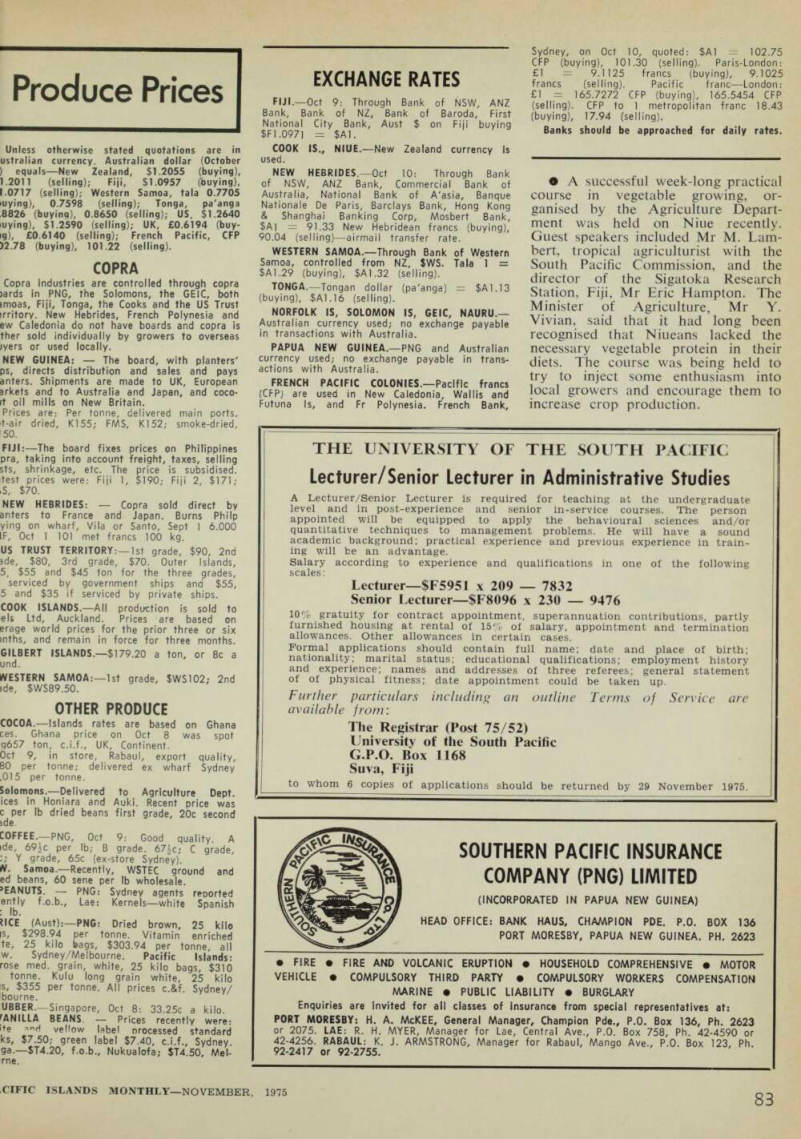
Unless otherwise stated quotations are in ustralian currency. Australian dollar (October ) equals—New Zealand, $1.2055 (buying), 1.2011 (selling); Fiji, $1.0957 (buying), 1.0717 (selling); Western Samoa, tala 0.7705 mying), 0.7598 (selling); Tonga, pa'anga 8826 (buying), 0.8650 (selling); US, $1.2640 uying), $1.2590 (selling); UK, £0.6194 (buy ig), £0.6140 (selling); French Pacific, CFP )2.78 (buying), 101.22 (selling).
Copra
Copra Industries are controlled through copra >ards in PNG, the Solomons, the GEIC, both imoas, Fiji, Tonga, the Cooks and the US Trust irritory. New Hebrides, French Polynesia and ew Caledonia do not have boards and copra is ther sold individually by growers to overseas lyers or used locally.
NEW GUINEA: The board, with planters' ps, directs distribution and sales and pays anters. Shipments are made to UK, European arkets and to Australia and Japan, and coco it oil mills on New Britain.
Prices are: Per tonne, delivered main ports, t-air dried, K 155; FMS, K 152; smoke-dried, 50.
FIJI:—The board fixes prices on Philippines pra, taking into account freight, taxes, selling sts, shrinkage, etc. The price is subsidised, test prices were: Fiji 1, $190; Fiji 2, $171; iS, $7O.
NEW HEBRIDES; Copra sold direct by anters to France and Japan. Burns Philp ying on wharf, Vila or Santo, Sept 1 6.000 IF, Oct 1 101 met francs 100 kg.
US TRUST TERRITORY:—Ist grade, $9O, 2nd ade, $BO, 3rd grade, $7O. Outer Islands, 5, $55 and $45 ton for the three grades, serviced by government ships and $55, 5 and $35 if serviced by private ships.
COOK ISLANDS.—AII production is sold to els Ltd, Auckland. Prices are based on erage world prices for the prior three or six mths, and remain in force for three months.
GILBERT ISLANDS.—SI79.2O a ton, or 8c a und.
WESTERN SAMOA:—Ist grade, SWSIO2; 2nd ide, $W589.50.
Other Produce
COCOA.—lslands rates are based on Ghana ces. Ghana price on Oct 8 was spot q 657 ton, c.i.f., UK, Continent.
Oct 9, in store, Rabaul, export quality, BO per tonne; delivered ex wharf Sydney ,015 per tonne.
Solomons. —Delivered to Agriculture Dept. ices in Honiara and Auki. Recent price was c per lb dried beans first grade, 20c second ide.
COFFEE.—PNG, Oct 9: Good quality A ide, 69£c per lb; B grade. 67£c; C grade, Y grade, 65c (ex-store Sydney).
W. Samoa.—Recently, WSTEC ground and ed beans, 60 sene per lb wholesale. ’EANUTS. PNG: Sydney agents reoorted ently f.0.b., Lae: Kernels—white Spanish : lb.
UCE (Aust):—PNG: Dried brown, 25 kilo is, $298.94 per tonne. Vitamin enriched te, 25 kilo bags, $303.94 per tonne, all w. Sydney/Melbourne. Pacific Islands: rose med. grain, white, 25 kilo bags, $3lO tonne. Kulu long grain white, 25 kilo s, $355 per tonne. All prices c.&f. Sydney/ bourne.
ÜBBER.—Singapore, Oct 8: 33.25 c a kilo.
MANILLA BEANS Prices recently were; it e 3"d yellow label processed standard ks, $7.50; green label $7.40, c.i.f., Sydney, ga.—sT4.2o, f.0.b., Nukualofa; $T4.50, Mel rne.
Exchange Rates
FIJI.—Oct 9: Through Bank of NSW, ANZ Bank, Bank of NZ, Bank of Baroda, First National City Bank, Aust $ on Fiji buying
$F1.097] = Sai.
COOK IS,, NIUE. —New Zealand currency Is used.
NEW HEBRIDES.—Oct 10: Through Bank of NSW, ANZ Bank, Commercial Bank of Australia, National Bank of A'asia, Banque Nationale De Paris, Barclays Bank, Hong Kong & Shanghai Banking Corp, Mosbert Bank, $Ai = 91.33 New Hebridean francs (buying), 90.04 (selling)—airmail transfer rate.
WESTERN SAMOA.—Through Bank of Western Samoa, controlled from NZ, SWS. Tala 1 = $A1.29 (buying), $A1.32 (selling).
TONGA.—Tongan dollar (pa'anga) = $A 1.13 (buying), $A1.16 (selling).
Norfolk Is, Solomon Is, Geic, Nauru.—
Australian currency used; no exchange payable in transactions with Australia.
PAPUA NEW GUINEA.—PNG and Australian currency used; no exchange payable in trans actions with Australia.
FRENCH PACIFIC COLONIES.—Pacific francs (CFP) are used in New Caledonia, Wallis and Futuna Is, and Fr Polynesia. French Bank,
Sydney, on Oct 10, quoted: SAI = 102.75 CFP (buying), 101.30 (selling). Paris-London: £1 = 9.1125 francs (buying), 9.1025 francs (selling). Pacific franc—London: £1 = 165.7272 CFP (buying), 165.5454 CFP (selling). CFP to 1 metropolitan franc 18.43 (buying), 17.94 (selling).
Banks should be approached for daily rates.
• A successful week-long practical course in vegetable growing, or ganised by the Agriculture Depart ment was held on Niue recently.
Guest speakers included Mr M. Lam bert, tropical agriculturist with the South Pacific Commission, and the director of the Sigatoka Research Station, Fiji, Mr Eric Hampton. The Minister of Agriculture, Mr Y.
Vivian, said that it had long been recognised that Niueans lacked the necessary vegetable protein in their diets. The course was being held to try to inject some enthusiasm into local growers and encourage them to increase crop production.
Advertisements & other items, p. 85 (2 items)
83
CIFIC ISLANDS MONTHLY—NOVEMBER. 1975
Lecturer/Senior Lecturer in Administrative Studies
THE UNIVERSITY OF THE SOUTH PACIFIC
A Lecturer/Senior Lecturer is required for teaching at the undergraduate level and in post-experience and senior in-service courses. The person appointed will be equipped to apply the behavioural sciences and/or quantitative techniques to management problems. He will have a sound academic background; practical experience and previous experience in training will be an advantage.
Salary according to experience and qualifications in one of the following scales ’
Lecturer—sFs9sl x 209 7832 Senior Lecturer—SFBo96 x 230 9476 10% gratuity for contract appointment, superannuation contributions, partly furnished housing at rental of 15% of salary, appointment and termination allowances. Other allowances in certain cases.
Formal applications should contain full name; date and place of birth; nationality; marital status; educational qualifications; employment history and experience; names and addresses of three referees; general statement of of physical fitness; date appointment could be taken up.
Further particulars including an outline Terms of Service are
available from :
The Registrar (Post 75/52)
University of the South Pacific G.P.O. Box 1168
Suva, Fiji
to whom 6 copies of applications should be returned by 29 November 1975.
SOUTHERN PACIFIC INSURANCE
COMPANY (PNG) LIMITED
(INCORPORATED IN PAPUA NEW GUINEA)
HEAD OFFICE: BANK HAUS, CHAMPION PDE. P.O. BOX 136 PORT MORESBY, PAPUA NEW GUINEA. PH. 2623 • FIRE • FIRE AND VOLCANIC ERUPTION • HOUSEHOLD COMPREHENSIVE • MOTOR VEHICLE • COMPULSORY THIRD PARTY • COMPULSORY WORKERS COMPENSATION
MARINE • PUBLIC LIABILITY • BURGLARY
Enquiries are invited for all classes of insurance from special representatives at: PORT MORESBY: H. A. McKEE, General Manager, Champion Pde., P.O. Box 136, Ph. 2623 or 2075. LAE: R. H. MYER, Manager for Lae, Central Awe., P.O. Box 758, Ph. 42-4590 or 42-4256. RABAUL; K. J. ARMSTRONG, Manager for Rabaul, Mango Ave., P.O. Box 123, Ph. 92-2417 or 92-2755. 2%
Bougainville Prov
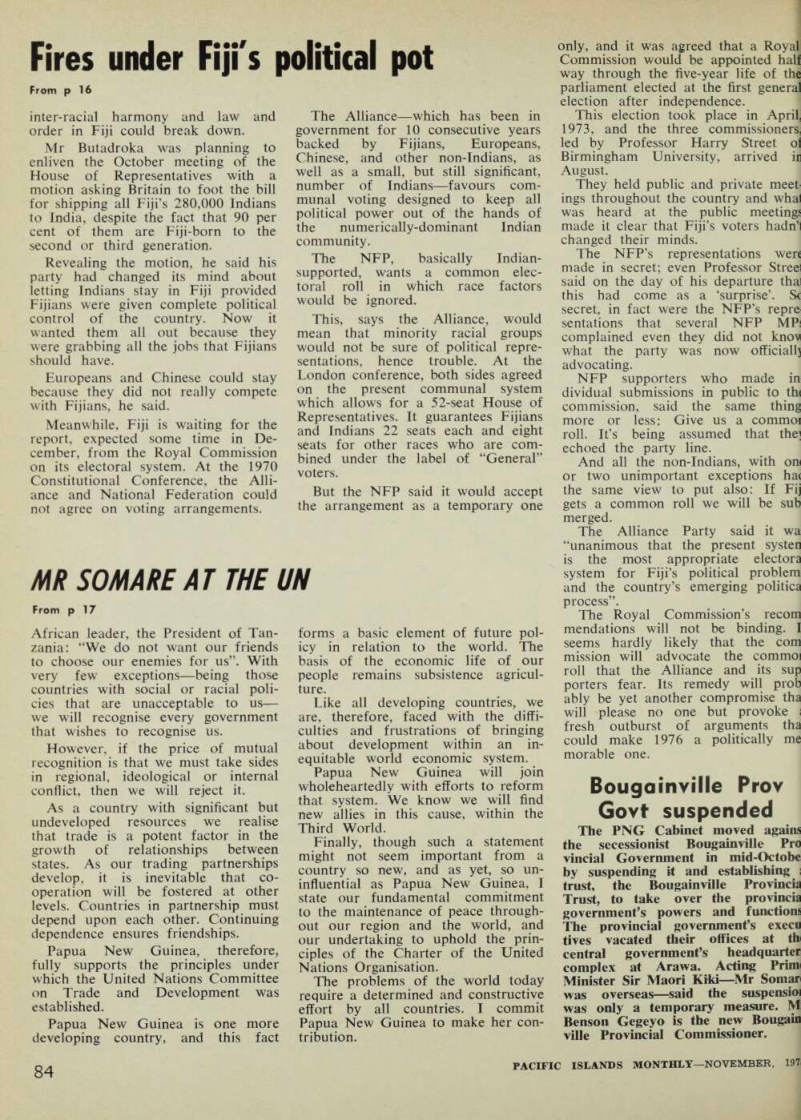
inter-racial harmony and law and order in Fiji could break down.
Mr Butadroka was planning to enliven the October meeting of the House of Representatives with a motion asking Britain to foot the bill for shipping all Fiji’s 280,000 Indians to India, despite the fact that 90 per cent of them are Fiji-born to the second or third generation.
Revealing the motion, he said his party had changed its mind about letting Indians stay in Fiji provided Fijians were given complete political control of the country. Now it wanted them all out because they were grabbing all the jobs that Fijians should have.
Europeans and Chinese could stay because they did not really compete with Fijians, he said.
Meanwhile, Fiji is waiting for the report, expected some time in De cember, from the Royal Commission on its electoral system. At the 1970 Constitutional Conference, the Alli ance and National Federation could not agree on voting arrangements.
The Alliance—which has been in government for 10 consecutive years backed by Fijians, Europeans, Chinese, and other non-Indians, as well as a small, but still significant, number of Indians—favours com munal voting designed to keep all political power out of the hands of the numerically-dominant Indian community.
The NFP, basically Indian supported, wants a common elec toral roll in which race factors would be ignored.
This, says the Alliance, would mean that minority racial groups would not be sure of political repre sentations, hence trouble. At the London conference, both sides agreed on the present communal system which allows for a 52-seat House of Representatives. It guarantees Fijians and Indians 22 seats each and eight seats for other races who are com bined under the label of “General” voters.
But the NFP said it would accept the arrangement as a temporary one
only, and it was agreed that a Royal Commission would be appointed half way through the five-year life of the parliament elected at the first general election after independence.
This election took place in April, 1973, and the three commissioners, led by Professor Harry Street of Birmingham University, arrived in August.
They held public and private meet ings throughout the country and what was heard at the public meetings made it clear that Fiji’s voters hadn’t changed their minds.
The NFP’s representations were made in secret; even Professor Street said on the day of his departure that this had come as a ‘surprise’. Sc secret, in fact were the NFP’s repre sentations that several NFP MPs complained even they did not knov what the party was now officially advocating.
NFP supporters who made in dividual submissions in public to th< commission, said the same thing more or less; Give us a commoi roll. It’s being assumed that they echoed the party line.
And all the non-Indians, with on< or two unimportant exceptions hac the same view to put also: If Fij gets a common roll we will be sub merged.
The Alliance Party said it wa “unanimous that the present systen is the most appropriate electora system for Fiji’s political problem and the country’s emerging politica process”.
The Royal Commission’s recom mendations will not be binding. I seems hardly likely that the com mission will advocate the commoi roll that the Alliance and its sup porters fear. Its remedy will prob ably be yet another compromise tha will please no one but provoke J fresh outburst of arguments tha could make 1976 a politically me morable one.
Bougainville Prov
Govt suspended
The PNG Cabinet moved agains the secessionist Bougainville Pro vincial Government in mid-Octobe by suspending it and establishing i trust, the Bougainville Provincia Trust, to take over the provincia government’s powers and functions The provincial government’s execu tives vacated their offices at th( central government’s headquarter complex at Arawa. Acting Prinn Minister Sir Maori Kild—Mr Soman was overseas—said the suspensioi was only a temporary measure. Mi Benson Gegeyo is the new Bougain ville Provincial Commissioner.
African leader, the President of Tan-
African leader, the President of Tanzania: “We do not want our friends to choose our enemies for us”. With very few exceptions—being those countries with social or racial policies that are unacceptable to us— we will recognise every government that wishes to recognise us.
However, if the price of mutual recognition is that we must take sides in regional, ideological or internal conflict, then we will reject it. . . ~u . , .
As a country with significant but undeveloped resources we realise that trade is a potent factor in the growth of relationships between states. As our trading partnerships develop, it is inevitable that cooperation will be fostered at other levels. Countries in partnership must depend upon each other Continuing dependence ensures friendships.
Papua New Guinea, therefore, fully supports the principles under which the United Nations Committee on Trade and Development was established.
Papua New Guinea is one more developing country, and this fact
forms a basic element of future pol icy in relation to the world. The basis of the economic life of our people remains subsistence agricul ture.
Like all developing countries, we are, therefore, faced with the diffi culties and frustrations of bringing about development within an in equitable world economic system, Papua .^ Ull l ea W 1 l om wholeheartedly with efforts to reform that system. We know we will find allies in this cause, within the Thj rc j World Finall though such a statem ent mi h( * t see ” important from a co * nt SQ and ‘ as yet> so un . influen ' ial as Papua New Guinea, , s(ate our fundamenta i commitment (Q tbe ma i n t enance 0 f pe ace through our r ion and the world and our undertaking t 0 uphold the prin . c i p i es Q f the Charter of the United Nations Organisation, Th e problems of the world today require a determined and constructive effort by all countries. I commit Papua New Guinea to make her con tribution.
Advertisements & other items, p. 86 (1 item)
Fires under Fiji's political pot
84
PACIFIC ISLANDS MONTHLY—NOVEMBER, 19
MR SOMARE AT THE UN
From p 17
Fires under Fiji's political pot From p 16
Shipping & Airways Information
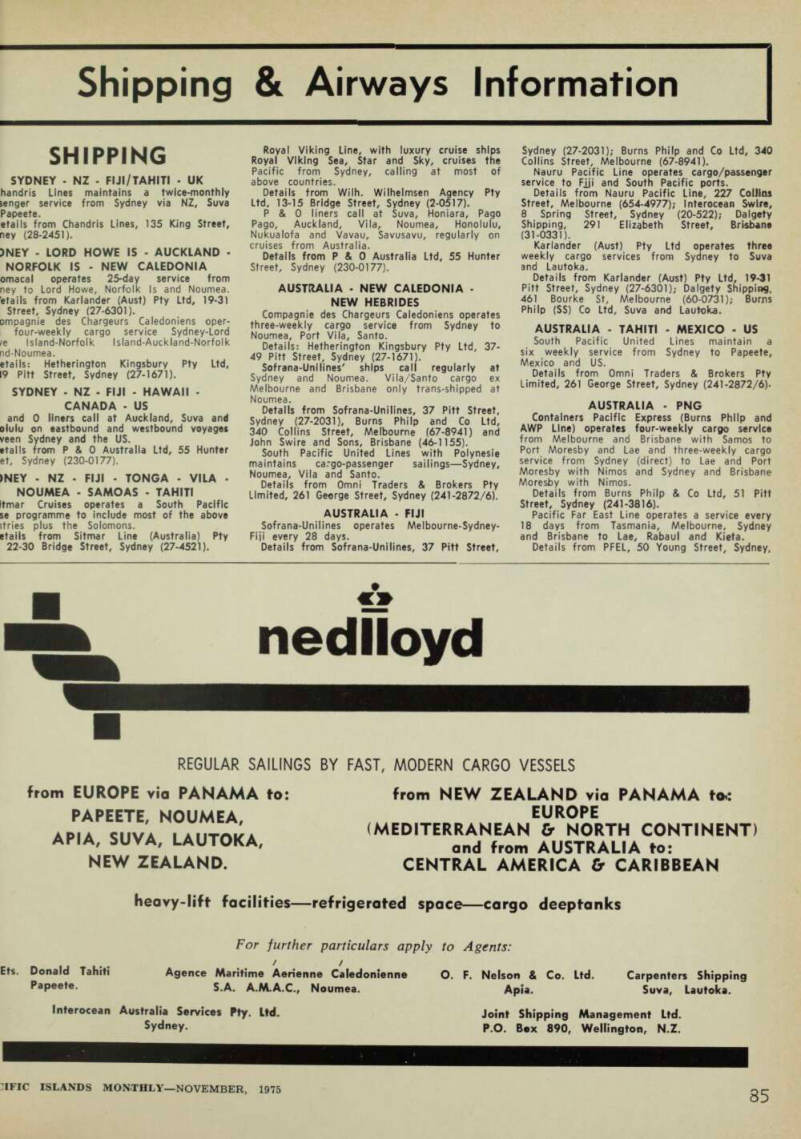
Shipping
SYDNEY - NZ - FUI/TAHITI - UK handris Lines maintains a twice-monthly ienger service from Sydney via NZ, Suva Papeete. etails from Chandris Lines, 135 King Street, ney (28-2451).
SNEY - LORD HOWE IS - AUCKLAND -
Norfolk Is - New Caledonia
omacal operates 25-day service from ney to Lord Howe, Norfolk Is and Noumea, etails from Karlander (Aust) Pty Ltd, 19-31 Street, Sydney (27-6301). ompagnie des Chargeurs Caledoniens oper four-weekly cargo service Sydney-Lord ie Island-Norfolk Island-Auckland-Norfolk nd-Noumea. etails: Hetherington Kingsbury Pty Ltd, 19 Pitt Street, Sydney (27-1671).
SYDNEY - NZ - FIJI - HAWAII -
Canada - Us
and 0 liners call at Auckland, Suva and olulu on eastbound and westbound voyages veen Sydney and the US. etails from P & 0 Australia Ltd, 55 Hunter et, Sydney (230-0177).
INEY - NZ - FIJI - TONGA ■ VILA -
Noumea ■ Samoas - Tahiti
Itmar Cruises operates a South Pacific se programme to include most of the above itries plus the Solomons, etails from Sitmar Line (Australia) Pty 22-30 Bridge Street, Sydney (27-4521).
Royal Viking Line, with luxury cruise ships Royal Viking Sea, Star and Sky, cruises the Pacific from Sydney, calling at most of above countries.
Details from Wilh. Wilhelmsen Agency Pty Ltd, 13-15 Bridge Street, Sydney (2-0517).
P & 0 liners call at Suva, Honiara, Pago Pago, Auckland, Vila, Noumea, Honolulu, Nukualofa and Vavau, Savusavu, regularly on cruises from Australia.
Details from P & 0 Australia Ltd, 55 Hunter Street, Sydney (230-0177).
Australia - New Caledonia •
New Hebrides
Compagnie des Chargeurs Caledoniens operates fceT Port vT San'tf' ,r ° m Svd "' V rwaii'c. Hf>thprinnton Kinnshuru Ptu IH 'Xi
•*»»» P,V L,D ' 37 ‘
Sofrana-Unilines' shins call reoularlv at Sydney and Noumea. P Vila/Santo cargo ex Melbourne and Brisbane only trans-shipped at Details from Sofrana-Unilines, 37 Pitt Street, Sydney (27-2031), Burns Philp and Co Ltd, 340 Collins Street Melbourne (67-8941) and John swire and Sons, Brisbane (46-1155).
South Pacific United Lines with Polynesia maintains cargo-passenger sailings—Sydney, Noumea, Vila and Santo.
Details from Omni Traders & Brokers Pty Limited, 261 George Street, Sydney (241-2872/6).
Australia - Fiji
Sofrana-Unilines operates Melbourne-Sydney- Fiji every 28 days.
Details from Sofrana-Unilines, 37 Pitt Street,
Sydney (27-2031); Burns Philp and Co Ltd, 340 Collins Street, Melbourne (67-8941).
Nauru Pacific Line operates cargo/passenger service to Fiji and South Pacific ports, Details from Nauru Pacific Line, 227 Collins Street, Melbourne (654-4977); Interocean Swire, 8 Spring Street, Sydney (20-522); Dalgety Shipping, 291 Elizabeth Street, Brisbane (31-0331).
Karlander (Aust) Pty Ltd operates three weekly cargo services from Sydney to Suva and Lautoka.
Details from Karlander (Aust) Pty Ltd, 19-31 Pitt Street, Sydney (27-6301); Dalgety Shipping, 461 Bourke St, Melbourne (60-0731); Burns Philp (SS) Co Ltd ' Suva and Lautoka.
AUSTRALIA - TAHITI ■ MEXICO - US South Pacific United Lines maintain a t uT ice from Svdney Pap ""' Mexico and US. , Limited, 261 George Street, Sydney (241-2872/6).
Usa * P £* G
Al s° ntalne / S Pac ‘ f,c f xpress , ( ? urns phllp and AWP Line) operates four-weekly cargo service from Melbourne and Brisbane with Samos to Port Moresby and Lae and three-weekly cargo service from Sydney (direct) to Lae and Port Moresby with Nimos and Sydney and Brisbane Moresby with Nimos.
Details from Burns Philp & Co Ltd, 51 Pitt Street, Sydney (241-3816).
Pacific Far East Line operates a service every 18 days from Tasmania, Melbourne, Sydney and Brisbane to Lae, Rabaul and Kieta.
Details from PFEL, 50 Young Street, Sydney.
(27-4272), 454 Collins Street, Melbourl (67-7237), Burns Philp (NG) Ltd, Rabaul an Kieta, Robert Laurie-Carpenter (NG) Pty Lt< Lae.
New Guinea Express Lines with two ship operates three-weekly Melbourne, Sydney Brisbane, Port Moresby, Lae, Rabaul.
Details from New Guinea Express Lines, B Box R 73, Royal Exchange PO, Sydney (241-139< and 72 Eagle St, Brisbane (21-9333), Westralid Farmers Transport Pty Ltd, 459 Collins S Melbourne (67-8291), Breckwoldt's Shippirl Agencies in Port Moresby, Lae, Rabtrad Nil gini Pty Ltd, Rabaul.
Karlander New Guinea Line's cargo vessd call at Melbourne, Sydney, Lae, Madam \/Vewak, Manus, Kimbe.
Details from Karlander (Aust) Pty Ltd, 19-3 Pitt Street, Sydney (27-6301); Dalqety Shippim 461 Bourke St, Melbourne (60-0731).
Australia ■ Png - Bsip
New Guinea Australia Line's vessels operal from Sydney and Brisbane to Port Moresb Lae, Rabaul, Kavieng, Honiara. Kieta, Giz Madang and Samarai.
Details from Interocean Swire, 8 Sprir Street, Sydney (20-522).
Australia - Ng ■ Micronesia ■
Guam
Nauru Pacific Line operates monthly co ventional/container service Melbourne/Sydney New Guinea, Guam and Micronesia.
Details from Nauru Pacific Line, 227 Collii Street, Melbourne (654-4977); Interocean Swir T Spring Street, Sydney (20-522).
Australia - Png - Far East
E. and A. Line liner Cathay makes reguli round voyages from Melbourne, Sydney ai Brisbane calling at Port Moresby, Manil Hong Kong, Keelung, Kobe, Yokohama (Tokyc and Rabaul.
Details from P & 0 Australia Ltd, 55 Hunt Street, Sydney (230-0177).
Us - Png
Pacific Far East Line operates regul services from all US west coast ports to La Rabaul, Kieta.
Details from PFEL, 50 Young Street, Sydne (27-4272), One Embarcadero Centre, S< Francisco, Burns Philp (NG) Ltd, Rabaul ai Kieta, Robert Laurie-Carpenter (PNG) Pty Lt Lae.
Png - Us - Canada
Pacific Far East Line operates reguli services from Lae, Rabaul and Kieta to I west coast ports and Vancouver.
Details from Burns Philp (NG) Ltd, Rabai and Kieta, Robert Laurie-Carpenter (PNG) PI Ltd, Lae, PFEL, One Embarcadero Centr San Francisco and 50 Young Street, Sydne (27-4272).
FAR EAST - FIJI - NEW ZEALAND New Zealand Unit Express (CNC, MOL, Rll operates a three-weekly cargo service froi Hong Kong to Lautoka, Suva, NZ ports, Manlli Kaoshiung, Keelung, Hong Kong.
Details ' from Interocean Swire, 8 Sprln Street, Sydney (20-522).
Royal Interocean Lines operates month! cargo service with three shins from Surabayj Bangkok, Port Kelang and Singapore to Suv and NZ ports.
Details from Interocean Australia Service! 261 George Street, Sydney (2-0573), Burns Phil SS' Co ltd Suva and Lautoka.
Ben Shipping Co (Pte) Ltd, sailing month! from Singapore, Hong Kong, Keelung, Kac shiung, Suva and main NZ ports.
Details from Seatrans (Fiji) Ltd, GPO Bo 152, Suva, Fiji.
FAR EAST - PNG - BSI - NEW HEBRIDES
Noumea - Tahiti - Samoa
China Navigation Co's vessels operate ; regular cargo service from Hong Kong, Tai wan and Singapore to Rabaul, Wewak, Madang Lae, Port Moresby, Honiara, New ,Hebride| Noumea, Papeete and Samoa.
Details from Interocean Swire, 8 Sprln!
Street, Sydney (20-522).
North Europe - New Caledonia
lamburg/Sued operates monthly cargo rices from Dunkirk and Le Havre to mea, via Panama. etails from Columbus Overseas Services Ltd, 333 George Street, Sydney (290-2966). lessageries Maritimes operates five cargo ices a month from north and Mediterranean jpean ports to Papeete and Noumea, etails from Messageries Maritimes, 4-6 h Street, Sydney (221-2522).
JAPAN - GUAM ■ FIJI - SAMOA •
N Caledonia - N Hebrides
aiwa Line runs a monthly cargo service i Japan via Guam to Suva, Lautoka, Pago ), Apia, Vila, Santo and Noumea, stalls from Burns Philp (SS) Co Ltd, Suva.
ONGA - SAMOA - FIJI ■ AUSTRALIA icific Navigation Co Ltd operates a monthly 0 service between Nukualofa, Apia, Suva Lautoka to Sydney. stails from Karlander (Aust) Pty Ltd, 19-31 St, Sydney (27-6301); Burns Philp (SS) Co NZ ■ FIJI - TONGA - SAMOAS -
Tahiti
lion Steam Ship Co of NZ operates a fully ainerised service-Auckland-Suva-Pago Pago -Nukualofa every 14 days. 28-day service by conventional ship is ated from Auckland to Papeete, Apia and lalofa. (tails from Union Steam Ship Co of NZ PO Box 12, Auckland, or from branch es/agents in Fiji, Tonga, Samoa and
Nz - Norfolk Is
mpagnie des Chargeurs Caledoniens operate weekly cargo service from Auckland to oik Island. tails from Maritime Services Ltd, 14-18 3ms Street E, Auckland (75-509). - N CALEDONIA - N HEBRIDES •
Ng - Bsip
frana/Unilines with two ships operates ✓ila and Santo; to Honiara and New sa; and to Noumea. tails from Sofrana-Unilines, 42 Customs t, Auckland (73-279), P.O. Box 3614. : NZ 2313.
Nz - N Caledonia
mpagnie des Chargeurs Caledoniens operates weekly cargo service from Auckland to lea. tails from Maritime Services Ltd, 14-18 ims Street E, Auckland (75-509).
Nz - Png
cific Far East Line operates regular service 18 days from Auckland to Lae, Rabaul, tails from PFEL, 109 Queen Street, Auck (3lo22) Burns Philp (NG) Ltd. Rabaul Kieta, Robert Laurie-Carpenter (PNG) Pty Lae.
Z - FIJI - NORTH AMERICA (WC) <sader cargo ships call at Suva, Levuka and lulu on NZ-US west coast trips and at and/or Lautoka on US-NZ return trips, fails from Blue Star Port Lines fManaaa -1 Ltd, P.O. Box 192, Wellington (739-029); : Philp (SS) Co Ltd, Suva.
Nz . Fiji
Bonita operates a regular 18 day service Auckland to Suva and Lautoka. ails from Reef Shipping Agencies Ltd, Box 13-315, Onehunga, NZ. (Phone 663- 663-928).
Nz ■ Tonga
:ific Navigation Co Ltd operates two ships
and-Lyttelton-Nukualofa-Vavau-Haapai, on
1-21 -day schedule, and other ports by ament. ails from the Northern Steam Ship Co Ltd Quay Street, Auckland (362-730).
Advertisements & other items, pp. 87-89 (2 items)
nedlloyd
REGULAR SAILINGS BY FAST, MODERN CARGO VESSELS from EUROPE via PANAMA to: from NEW ZEALAND via PANAMA to.:
PAPEETE, NOUMEA EUROPE
adia ciix/a (MEDITERRANEAN & NORTH CONTINENT)
APIA, SUVA, LAUTOKA, and from AUSTRALIA to:
NEW ZEALAND. CENTRAL AMERICA & CARIBBEAN
heavy-lift facilities—refrigerated space—cargo deeptanks
For further particulars apply to Agents: Ets.
Donald Tahiti Papeete. / / Agence Maritime Aerienne Caledonienne S.A. A.M.A.C., Noumea.
O. F. Nelson & Co. Ltd.
Apia.
Carpenters Shipping Suva, Lautoka.
Interocean Australia Services Pty. Ltd.
Sydney.
Joint Shipping Management Ltd.
P.O. Bex 890, Wellington, N.Z.
THE
BANK
LINE
GLOBAL SERVICE FOR SHIPPERS
m
MONTHLY SERVICES
United Kingdom and Continent to: Papeete, Noumea, New Hebrides, Papua New Guinea and Solomon Islands.
Papua New Guinea to: North America, United Kingdom and Continent.
Solomons, Fiji, Tonga, Samoa and Tarawa to: United Kingdom and Continent.
For particulars apply:
THE BANK LINE (AUSTRALASIA) PTY. LTD.,
18TH FLOOR, 1 YORK STREET,
SYDNEY, N.S.W.
DIRECT REGULAR SERVICE
JAPAN-SOUTH PACIFIC
TARAWA-PAPEETE-PAGO PAGO-APIA
SUVA-LAUTOKA-NOUMEA-VILA
SANTO-HONIARA
JAPAN - TAIWAN - GUAM
JAPAN-KEELUNG-GUAM BY
EXCELLENT CAR/CONTAINER-CARRIER
JAPAN-WEST BRIAN-DILI
HONG KONG-TAIWAN-WEST IRIAN-DILI
GUAM: ATKINS, KROLL (GUAM) LTD.
TARAWA: G. & E. I. DEVELOPMENT AUTHORITY.
APIA: BURNS PHILP (SOUTH SEA) CO., LTD.
PAGO PAGO: KNEUBUHL MARITIME SERVICES CORP
NUKUALOFA: PACIFIC NAVIGATION CO., LTD
SUVA: BURNS PHILP (SOUTH SEA) CO., LTD.
LAUTOKA: BURNS PHILP (SOUTH SEA) CO., LTD.
NOUMEA: AGENCE MARITIME ET AERIENNE
CALEDONIENNE.
SANTO: BURNS PHILP (NEW HEBRIDES) LTD.
VILA: BURNS PHILP (NEW HEBRIDES) LTD.
HONIARA: BRITISH SOLOMONS TRADING CO., LTD.
PAPEETE: AGENCE MARITIME DE FARA UTE.
HONG KONG: IKE MARITIME CO., LTD.
SINGAPORE: THE BORNEO CO., (SINGAPORE) LTD.
DJAJAPURA: P. N. PELAJARAN NASIONAL INDONESIA
DILI: SANG TAI HOO
TAIWAN: FOR CARGO BETWEEN JAPAN/GUAM/TAIWAN
FORMOSA SHIPPING & ENTERPRISE CORP.
TAIWAN: FOR CARGO BETWEEN JAPAN/SOUTH PACIFIC/
WEST IRIAN/DILI
MARITIME TRANSPORTATION AGENCIES, LTD.
THE DAIWA NAVIGATION CO.. LTD.
AGENTS:
OSAKA; “DAILINE”
TOKYO; "FUNEDAILINE”
HEAD OFFICE
DAIICHI KYOGYO BLDG.,
45, 2-CHOME, AWAZAMINAMI-DORI
NISHI-KU, OSAKA, JAPAN
TELEPHONE: (06) 531-0471 ~9
TELEX: 525-6324 & 525-6325
TOKYO OFFICE
SHIN-DAI ICHI BLDG.,
4-13, NIHONBASHI 3-CHOME, CHUO-KU
TOKYO, JAPAN
TELEPHONE: (03) 274-3251 ~8
87
FIC ISLANDS MONTHLY—NOVEMBER. 1975
Nz • Fiji - Samoa
Pacific Line with one ship operates monthly cargo service. New Zealand, Lautoka, Suva, Apia. details: Sofrana-Unilines, 42 Customs Street, Auckland (73-279) PO Box 3614, Telex: NZ 2313.
UK • PANAMA • SAMOA - FIJI The Fiji Direct Service, cargo only, is main tained by Conference vessels, sailing at regular monthly intervals out of London, via Panama, for Apia, Suva and Lautoka.
Details from Burns Philp (SS) Co Ltd, Suva.
UK - PNG - BSIP - GEIC - N HEBRIDES •
N Caledonia
Bank Line operates a monthly direct cargo service from Europe, via the Panama Canal to Papeete, Noumea, Vila, major PNG ports and Honiara, occasionally to Tarawa, Santo, Kieta, Jayapura and Yandina and return.
Details from Bank Line (A'asia) Ptv Ltd, 1 York St, Sydney (27-2041); Burns Philp (SS) Co Ltd, Suva.
EUROPE • TAHITI - W SAMOA - FIJI •
N Caledonia
Nedlloyd offers regular cargo services from Northern Europe and UK to Papeete, Apia, Fiji and New Caledonia.
Details: Interocean Aust. Services Pty Ltd, 261 George Street, Sydney (2-0573).
US - A. SAMOA - NZ - AUSTRALIA Pacific Far East Line LASH ships operate regularly from US to Australia, via Pago Pago and Auckland, returning via PNG ports.
Details from PFEL, 50 Young Street, Sydney (27-4272), 454 Collins Street, Melbourne (67-7237), One Embarcadero Centre, San Francisco (576-4000), 109 Queen Street, Auck land (31-022), Kneubuhl Maritime Services, Pago Pago (633-5121).
US - SYDNEY ■ GEIC - HONOLULU Columbus Line operates a three weekly container cargo sailing from West Coast, US to Australasia, returning via Tarawa, GEIC and Honolulu to Nth America.
Details from Columbus Overseas Services Pi Ltd, 333 George Street, Sydney (290-2966),
Us ■ Fiji/Tahiti - Australia
Bank Line Ltd operate regular cargo sei vices from US Gulf ports to Australia and Ni Calls at Suva, Lautoka and Papeete on demani Details from Bank Line (A/asia) Pty Lt< 1 York St, Sydney (27-2041).
Pacific Far East Line cruise ships operal regularly from San Francisco, Los Angelei Honolulu, Moorea, Papeete, Rarotonga, Aucl land, Opua, Sydney, and return via Suw Niuafoou, Pago Pago and Honolulu to Sa Francisco.
Freight Is carried on these passenger liner Pacific Far East Line cellular contain! vessels operate regularly from North America west coast ports to Australia, via Papeet returning via Auckland and Pago Pago.
Details from PFEL, 50 Young Street, Sydna (27-4272).
Us - Tahiti - Samoa
Pacific Islands Transport operates five/six weekly cargo service from Norl American west coast ports to Papeete, Pa{ Pago, Apia.
Details from Trans-Austral Shipping Pty Lt 19 Pitt Street, Svdnev (27-2441).
Polynesia Line operates cargo service fro US west coast ports to Papeete and Pa< Pago.
Details from Furness Inter Ocean Corp, 4< California Street, San Francisco (398-2000).
Airways
From Australia
Qantas (7075, 7475, DC4)—PNG, Norfolk I New Caledonia, Fiji, Tahiti, US, Canada.
PAA (707 s and 747 s) —Fiji, American Samo Hawaii, US.
CP Air (DCS) —Fiji, Hawaii, Canada.
UTA (DCSs and DClOs) —New Caledonia, Fi New Zealand, Tahiti, US.
Air-NZ (DClOs) —New Zealand, Fiji, Hawa US.
Air Nauru (F2B) —New Caledonia, Solomi Islands, Nauru, Tarawa, Majuro.
Air Niugini (727s)—PNG.
Advance Aviation (from Sydney), North Coa Airlines (from Coffs Harbour) and Oxley Ai lines (from Port Macquarie)—Lord Howe Is.
From New Zealand
Air-NZ (DCSs, DClOs, F27)—Fiji, Americi Samoa, Cook Is, Tahiti, Hawaii, US, Ne Caledonia, Norfolk Is.
PAA (707 s) —American Samoa.
UTA (DCS)—Tahiti.
PACIFIC - FAR EAST ■ S. AMERICA Air Nauru (F2B) —Nauru to Micronesi Okinawa, Japan, Taiwan, K'ong Kong.
Air France (707 s) —Japan to Tahiti, Per Air Niugini (707 s) —to Manila.
Pacific Is - Aust
Air Pacific (BACIII) —From Fiji, via Ne Hebrides or New Caledonia, to Brisbane.
Air Niugini (727 s and Fokker Friendship to Cairns and Brisbane.
Norfolk Island Airlines (Beechcraft) Brisbane.
Pacific Is ■ Nz
Air Pacific (BACIII) —Fiji-Tonga-NZ.
Inter-Territory
Lan-Chile (707s)—Easter Is, Tahiti, Fiji.
Air Pacific (BACIII and HS74Bs)—Fiji GEIC, Nauru, Western Samoa, Tonga, New He rides, Solomon Islands, New Caledonia, PN< Fiji Air Services—Wallis and Futuna (chartei Qantas (707s)—PNG to Singapore.
PAA (707 s) —Hawaii to Am. Samoa and Tahil US (jTA (7075, Caravelles) from New Caledon to Fiji, New Hebrides, Wallis Is, Tahiti.
Continental-Air Micronesia (7275) fro Hawaii to Micronesia.
Air Nauru from Nauru to Tarawa, Marsha Is, Wallis Is and Western Samoa.
Polynesian Airlines from Apia to Tong Niue Is, Fiji, Am. Samoa.
Air Tahiti from Tahiti to Cook Is.
Air Niugini to Irian/Jaya, Solomon Is.
Norfolk Island Airlines (Beechcraft) to umea.
Internal
Fiji—Air Pacific (HS74Bs and Trislanders), i Air Services (Beech Barons and Islanders).
French Polynesia—Air Polynesie (Fokker cndships). Air Tahiti.
US Trust Territory and Guam —Continental- ■ Micronesia (7275) and Air Pacific Intema nal Inc. 3EIC—Air Pacific.
PN& —Air Niugini, Aerial Tours, Talair, lanesian Airlines, Crowley Airways.
Bougainville—Bougainville Air Services.
Yew Caledonia —Air Caledinie (Twin Otters).
Yew Hebrides —Air Melanesiae (Islanders).
Solomon Is —Solair (Beech Barons and anders).
Fonga—Tonga Internal Air Service ('lslanders), look Is —Cook Island Airways (Islander).
Norfolk Island Airlines (Beechcraft) —Norfolk .ord Howe Is. • Marine Pacific Ltd, of Fiji, a
lolly-owned subsidiary of Inchcape
d Co Ltd, UK, reported that it übled profit in 1973-74 after distic freight charges were ap ?ved by the Prices and Incomes ard. But the profit was not an unced. Marine Pacific also
trganised is inter-island freight
vices, and it increased charter es, which helped to boost profit ility. Bish Ltd, Suva, marine and icral engineering firm, in which :hcape has a 50 per cent interest, i a disappointing first half-year, t improved in the second half after reorganisation of accountancy thods.
Advertisements & other items, p. 90 (1 item)
Pacific Islands Transport Line
POLYNESIA LINE, LTD.
Containers, General and Refrigerated Cargo
Express service between US West Coast
and
TAHITI and SAMOA
GENERAL AGENTS:
FURNESS INTEROCEAN CORPORATION
465 California Street, Suite 1001, San Francisco, Ca. 94104 Telephone TWX 910-372-7350 RCA 278-207 CABLE
(415)398-2000 INTEROCEAN INTER UR "INTERCO" —SF
PORT AGENTS
.. AMERICAN SAMOA
MORGAN-VERNEX POLYNESIA SHIPPING SERVICES, INC.
Boite Postale 449 p ago Pago Papeete Telephone: 633-5169 Telephone: 309 Cables: POLYSHIP Cables: MOREX
PACIFIC ISLANDS TRANSPORT LINE
Owners: Thor Dahls Hvalfangerselskap A/S — Sandefjord, .
MOTOR VESSEL "THORSISLE"
Regular Freight and Passenger Services between Pacific Coast Ports of U.S.A. and Canada and
TAHITI and SAMOA
GENERAL STEAMSHIP CORPORATION LTD.
General Agents 400 California Street, San Francisco, California, U.S.A.
APlA—Burns Philp (South Sea) Company, SYDNEY—Trans-Austral Shipping Pty. Ltd.
SUVA—Burns Philp (South Sea) Company, PAPEETE —Agence Maritime Internationale Ltd.
Tahiti. LAE/RABAUL—Burns Philp (New Guinea) Ltd.
PAGO PAGO—Polynesia Shipping Services, Inc. PORT VILA —Comptoirs Francais de Nouvelles NOUMEA—Etablissements Ballande. Hebrides.
Islands People
Deaths of Islands People
Mr W. T. McCoy Mr William Tilly (Willy Phil) McCoy, a former member of the Norfolk Island Council, died recently, aged 74. He spent most of his life farming Steele’s Point, a property which was part of an original grant to his grandfather. He was recog nised as a leading horticulturist and agriculturist. He always took a keen interest in Norfolk Island affairs, and not long before he died he was pre paring a submission for the Royal Commission, proposing a referendum to allow the islanders to decide their own fate.
Mrs M. H. Savage Mrs Mabel Helen Savage, who went to live in Rabaul more than 50 years ago, died at Maidenhead, Eng land, on September 19. She was 91.
Mrs Savage was born in Norfolk, England, and went to Rabaul in 1920, where her husband was serving with the government.
Mr Savage fought in World War I, and was in the landing at Gallipoli.
Mrs Savage left New Guinea in 1941 because of ill-health, and went to live in Sydney. Her husband worked for the Ministry of Supply in Sydney and Hobart; he died suddenly in 1947.
Mrs Savage returned to England in 1947. She is survived by her only
daughter, Mrs A. de G. Best, a grandchild and three great-grand children.
Colonel J. E. Workman Colonel John Edward Workman, Commissioner of Police in Fiji from 1937 to 1946, died recently in Eng land. During a long career in the Colonial Police Service, he served in a number of colonies and protecto rates. While he was in Fiji, the first Fijian was promoted to commissioned rank; Indians became commissioned officers soon after. He also recruited the first Fiji-born Indians into the Royal Fiji Police Force or Fiji Con stabulary, as it was then known, fly ing in the face of much public criti cism. He set up the first fingerprint bureau in Fiji and introduced new training and administrative methods.
Advertisements & other items, pp. 91-96 (4 items)
89
:IFIC ISLANDS MONTHLY—NOVEMBER, 1975
Union Steam Ship Co. Of N.Z.
MAPS AND PRINTS
OF THE OLD PACIFIC
Original antiquarian Pacific views and maps for sale. Enquiries invited stating areas of interest.
C. HINCHCLIFFE, 7 Royd Avenue, Heckmondwike, West Yorkshire, WFI6 9AL, United Kingdom.
PARK VIEW MOTEL—BRISBANE
Quiet location—opp. Botanic Gardens.
Single, double, family suites, all with refrig., air conditioning, phone, TV, radio, tea making facilities, from $l2. Pool and restaurant.
Phone 31-2695—Telex 40270.
Write for coloured brochure— Park View Motel, 128 Alice St, BRISBANE Qld., 4000.
UNION STEAM SHIP CO. of N.Z.
LIMITED
Serving the Pacific for nearly 100 years.
Regular Sailings by Modern Vessels
From Auckland to Lautoka, Suva, Pago Pago, Apia, Niue, Vavau, Nukualofa. Also from Tauranga to Lautoka, Suva, Apia, Nukualofa. Regular sailings from Australia to New Zealand to enable transhipment of cargo to all the above ports.
Ship your cargo by a Union Company Vessel.
BRANCHES AT ALL MAIN AUSTRALIAN, NEW ZEALAND AND ISLAND PORTS.
Line Advertisements
Per line, $2.50 Aust.
Minimum rate, 4 lines.
MANAGER REQUIRED
THE GUADALCANAL CLUB, HONIARA,
requires the services of an experienced manager, capable of handling all facets of the club’s services. For further details, please contact the president, P.O. Box 124, Honiara, Solomon Islands.
SEASHELL COLLECTORS WANTED, from
all Pacific Island areas. Top prices paid.
For information write in strictest confidence to, K. D. Weston, P.O. Box 760, Gladstone, Qld., Australia 4680.
PITCAIRN ISLANDS STAMPS BOUGHT.
Mint used also covers FDC. Write Airmail: B. Barringer, Celsiusg ISA S-212, 14 Malmo Sweden.
If you have shells to sell —any quantity —contact Anisa Commodity Traders Pty.
Ltd., P.O. Box 1413, Lae, Papua New Guinea, Phone 424159. We are buyers of Trochus, Greensnail, Blacklip MOP, Goldlip MOP, and Marine Specimens. Best prices paid. Rabaul agents: Gazelle Agencies Pty. Ltd., P.O. Box 262, Rabaul, P.N.G. Phone: 921397. Manus Island Agents, R. L. & V. J. Knight, P.O. Box 108, Lorengau, Manus Island, P.N.G.
Phone: 38.
INTERNATIONAL
DATELINE HOTEL
TONGA
'elV™
'Friendly Hotel" of the "Friendly Islands' Situated along the Nukualofa waterfront. Only five minutes walk from town. Single, double, family suites, airconditioning, and hot and cold water showers. Pool, bar, restaurant, duty-free shop, tour desk and boutique.
Book through your travel agent or write to International Dateline Hotel, P.O. Box 62, Nukualofa Tonga.
Cable Address: "DATELINE".
Represented Overseas by: Charles J. Henry and Associates Pty. Ltd.
Sydney and Melbourne.
FOR SALE
SYDNEY RESIDENCE. Situated at MonS Vale Beach. 32 square texture brick. Self contained section for in-laws or servants.
For full particulars contact, The Advertiser, c/- 156 Mitchell Road, Alexandria, N.S.W., Australia. 1 BOATS—Easy build kits for dinghies, sail] boats, canoes etc. Send for brochure, Blockey, the Boatbuilder 448 Chapel St, Sth. Yarra 3141 Australia.
GIFT PARCELS. Shop early for X’mas.
Each Pee: car vacuum cleaner/el. dragon boat lantern. Bulk exports: all lines; Write: KOV Corp., GPO 15986 Hong Kong.
CONCRETE BLOCK MACHINES. Makes
blocks, flags, edgings, screen-blocks, garden stools—up to 8 at once and 9( an hour $215.00 c.i.f. main ports. Send for leaflets. Forest Farm Research, Lon. donderry, N.S.W., 2753.
FREEHOLD LAND, 4 acres, Satala, Pag( Pago, American Samoa. Contact L. A Groves, 65A ANZAC Pde, Wanganui, New Zealand.
KIKUYU GRASS CERTIFIED SEED foi
sale A 53.00 per lb. For supplies and in formation about this highly nutritioui and abundantly productive grazing grasi write to ROY EYKAMP, Quirindi, N.S.W.
Australia, 2343. Phone Quipolly, 466541.
SHIP FOR SALE 38’ x 12’ 6”, 12 ton copra capacity (200 bags), 4LW GARDNEI engine, store on deck, excellent condition Contact Leung Jack, P.O. Box 19, GIZO
BSIP.
BUSINESS FOR SALE Gizo Solomon Is Store 48’ length x 42’ width, 2 story livin( quarter in rear over 3,000 sq. ft. Work shop 60’ x 24’ next to shop. Contac Leung Jack, P.O. Box 19, GIZO, BSIP.
YACHT DELIVERIES
SMALL CRAFT DELIVERY undertake! throughout the Pacific. Vancouver Yach Delivery c/- PO Box 3408 G.P.O. Sydne; 2001 Australia.
FOR LEASE
LAND AND WAREHOUSE FOR LEASI
next to StarKist Fisheries opposite wharf Satala, Pago Pago, Am. Samoa. Replj F. S. Lewis, 8 Tui Glen Rd., Birkenhead 10. New Zealand.
POSITION WANTED
MARRIED COUPLE seek Pacific Islands positions, 27 year-old husband requires position as Working Manager, prefer developing cattle property on New Hebrides, Experience includes 2 years running New Ireland PNG plantation and saw-milling operation, have Diploma Farm Management. Presently managing cattle property with A 1 pasture improvement, horses, commercial sale bulls. Wife requires job where shorthand, typing and bookkeeping can be used. Interview can be arranged by writing to R. Ingram, 13 Kingsley Ave., Vermont, Victoria, Australia. STD 03 8780650.
Primitive luxury
(Polynesian style) Nestled away in the untouched Kingdom of Tonga is* new, luxurious "Port of Refuge" International resort. Here is a unique opportunity for your clients to experience the tranquil and relaxed Tongan atmosphere while they enjoy the picturesque surroundings of the new "Port of Refuge". And only a short flight from Fiji.
Reasonable tariffs from $17.50 with special concessions for children. Agents commission 10 per cent.
Tonga's
Port of Refuge
INTERNATIONAL RESORT U
75* Uava’u Tonga Cables: "Refuge" Tonga or "Tongatours"
Sydney. Phone: Sydney 85-1603 or 852162
WHAT'S THE MATTER
WITH BABY?
Most probably it's teething troubles and the surest way of soothing baby's sore gums, digestive disturbances and intestinal upsets, is to give baby Fisher's Teething Powders. You'll be delighted how effective they are—and so safe too, if used as directed.
Fisher's Teething Powders are available from your chemist. Fisher & Co., Manufacturing Chemists (Est. 1876), 17 May St„ St. Peters, N.S.W. 3044.
PM 806/72
ELECTRONIC COMPONENTS
EXPORTERS, MANUFACTURERS,
GENERAL MERCHANTS,
WHOLESALERS, IMPORTERS
• All enquiries answered • Keen prices • Prompt delivery Contact us for any requirement.
ELECTRONIC EXPORTS A'ASIA PTY, LTD.,
G.P.O. Box 1365, Brisbane, Q., 4101.
Telegraphic; SZEKELY, Brisbane.
MUSICIAN, Samoan or Fijian; good in western and local musics; single or married. More info write “The Little Micronesia”, P.O. Box 612, Ponape, T.T. 96941.
PETER FISHER TRADING Pty. Ltd.
321 PITT STREET, SYDNEY, 2000, AUSTRALIA
Telephone: 26-1109 CABLES: "FISHERION", SYDNEY
EXPORTERS TO THE PACIFIC ISLANDS
Do you want to do business in New Zealand ?
Ask the bank which has
40% of the banking business
in New Zealand
The BNZ can give you full information on buying or selling in New Zealand and overseas. Full information on investment movement of money, transfers of dividends etc., is also readily available.
There are offices everywhere, more than 400 in fact Whatever your financial or trade needs, the BNZ can help you.- Wellington - International Division, Box 2392.
Sydney -GPO Box 507, Sydney, N.S.W. 2001.
Melbourne -GPO Box 528 E, Melbourne, Vic. 3001.
Tokyo - Mr G. Scott, Bank of New Zealand Representative Office, Japan. Suite 240, New Tokyo Bldg, 3-1, 3-Chrome, Marunouchi, Chiyoda-ku,.Tokyo 100.
Singapore - Mr R. F. Warren, Bank of New Zealand Representative Office, South East Asia. 4th Floor, Ramayana Bldg, 45/47 D, Robinson Rd, Singapore.
London - PO Box 402, London EC4.
Fiji -25 Victoria Parade. Also at Labasa, Lautoka, Nadi, Sigatoka, Ba.
Bank of New Zealand
Model shown ranges from 2 to 15 H.P.
STEAM STEAM STEAM
For Laundries, Dry Cleaners, Humidification, Process Heating, Kitchens, Bread Making, Hospital Sterilisers etc.
SIMONS
FULLY AUTOMATIC
ELECTRIC STEAM BOILERS
• Steam output from 9 to 525 Ibs/hr. • Models range from 1/3 H.P. (3 kw) to 15 H.P. (150 kw). • Working pressure to 100 p.s.i.g. • Efficiency of 99% and no flue required.
W. SIMONS S SONS (AUST) PIT LTD 124 Parramatta Road, CAMPERDOWN, NSW. Phone 516 1966 345 Punt Road, RICHMOND, VIC. Phone 42 2952 Engineers Specialising in Air Compressor Units, Spray Painting Equipment, Automatic Electric Steam Boilers, Steam Pressing Machinery.
*** *** *j *** *j** *5 WHY NOT A LASTING XMAS GIFT ...
A BOOK FROM PACIFIC PUBLICATIONS
° a °'*>'LlTTrp
l /rn f
bh l u s
w r a w o NA *y cut*
HOLY TORTURE IN FIJI
Written by ■ group of academic participants and observers.
Editing and commentary by Prof. Ron Crocombe.
This book describes sacred ancient rituals involving ohysical ordeals which are performed once a year at certain Hindu temples in Fiji. The rituals include walking on fire, dancing on upturned knife-blades, whipping, plunging the hands in burning fat and piercing the body with steel skewers and silver wires.
Yet those who go through the ordeals suffer no pain, burns or injuries.
The book is beautifully produced in full colour and black-and-white.
PRICE: Australia, Pacific Islands and Overseas, $2.50 Aust., plus 70c posted; U.S.A., $6.50 U S. posted.
LITTLE CHIMBU IN
BOUGAINVILLE Nancy Curtis
This is the story of lovable Little Chimbu, and his friends, who go off to see the biggest hole in the world . . . the Bougainville copper mine, at Papua Ntew Guinea Adventures follow one after the other on their arrival at the mine, and young readers (and their parents!) will be fascinated by Nancy Curtis' colourful, yet accurate and instructive account of the workings of the big Bougainville enterprise ... its giant trucks, its processing plant, its port and shipping.
Illustrated in full colour.
PRICE: Australia, Pacific Islands and Overseas, $2.50 Aust., plus 70c posted; U.S.A., $4.20 U.S. posted.
THE STORY OF THE
SOLOMONS Charles E. Fox
“Refreshingly frank . .
“Admirably simple and lucid . . .”
“A rare blend of objectivity and affection . .
That is what some of the critics have said about this unusual book which outlines the history of the Solomon Islands from the point of view of the people who live there.
The Reverend C. E. Fox, CBE, MA, LittD, spent more than 70 years in the Pacific Islands, 65 of them in the Solomon Islands, and no person is better qualified to write of the Solomons and the Solomon Islanders. Dr Fox is now living in retirement in New Zealand. 88 pages.
PRICE: Australia, Pacific Islands and Overseas, $2.50 Aust., plus 50c posted; U.S.A., $3.75 U.S. posted.
LITTLE BALDS Nancy Curtis
This is the story about a little aeroplane called Little Balus, in the land of New Guinea Little Balus has a pilot called Little.Chimbu who, in another book (Little Chimbu), also lived in New Guinea and had many adventures.
Now, every morning, Little Chimbu loads Little Balus up with freight, and sometimes Little Balus is stuffed so full he feels that he will burst. This makes Little Balus very mad.
One morning after he had left the ground, with his little engine puffing and his little propeller whirling angrily, he decided to play a trick on Little Chimbu. Little Balus flew UPSIDE DOWN. What follows is a string of strange and sometimes terrible adventures.
Fully illustrated in colour and black-and-white.
PRICE: Australia, Pacific Islands and Overseas, $2.50 Aust., plus 70c posted; U.S.A., $4.20 U.S. posted.
P
PPG9
Send your order direct to
Pacific Publications (Aust.) Pty. Ltd.
29 Alberto Street, Sydney, N.S.W. 2000
V 4 V
kVa
Performance
You Enjoy Living With.
Honda is a true life drama, performed on the world’s stage. By average folks, teenagers, men, and women everywhere. Your neighbors, maybe even you are playing a part. If so, you know Honda is more than great machines.
It’s people concerned with taking people where they want to go in life.
On two wheels, we’re the best selling motorcycle. The easy to operate hard workers who don’t demand much. Honda is always ready and gets you there safely. We move on four wheels. The precedent setting Honda Civic continues to receive international economy and performance awards. It’s the elegant compact car.
Sometimes, we have no wheels. Honda portable power operates machinery, generates electricity, pumps water and tills the soil.
Little wonder good things happen on Honda we work harder to assure they do.
VI momia World s Largest Motorcycle Manufacturer
HONDA MOTOR CO., LTD. TOKYO, JAPAN
PAPUA NEW GUINEA; Steamships Trading Co., Ltd. P.O. Box 74, Papua/U.S. TRUST TERRITORY: J.C. Tenorio Enterprise P O Box 137 Saipan/FIJI ISLANDS; Coral Island Motors Walu Bay Suva Fiji Island. P.O. Box 48, Suva. Fiji/TARAWA: The Gilbert & Ellice Islands Development Authority Gilbert & Ellice Islands / WESTERN SAMOA: Motor Distributors (Samoa) Ltd. P.O. Box 576, Apia / AMERICAN ?o /^2«o Ha,0 ° k S Service Center P.O. Box 1138, Pago Pago, American Samoa/TONGA; E.M. Jones Ltd. P.O. Box 34, Nukualofa/SOLOMON L S . LA^™?.7.Vth^° lomonsTradingCo ' Ltd - P 0 Box 114 - Honiara/NEW CALEDONIA: Establissements Ballande, Noumea / TAHITI: Ets. COMIMPEX P.O. Box 200, Papeete/COOK ISLANDS: Cook Islands Motor Centre Ltd. P.O. Box 74, Rarotonga / NAURU ISLAND: Nauru Cooperative Society 14th Floor, Wales Corner, 227 Collins Street Melbourne Victoria 3000 / NIUE ISLAND: S. Jessop & Sons P.O. Box 71, Alofi South, Niue Island / SAIPAN: United Micronesia Development Association P.O. Box 298, Saipan, Marianas Islands 96951
mwxmJLal (jutik &o ImjjuJl pmACi
M.
faphmidjtb
VatiiM-
y-
cuM^fpyi
W Frogi >* >: ■ IU 9 75 tA tfAuMUmi. mm
iWßiiiiiffi ||liH
£#*««« I* Ki^ 4| . ;c M .
I I -
Your Datsun. Your special island.
Once it has found you, it'll never let you go.
Where else can you find such
economical, worry-free
motoring? Little wonder Datsuns are enjoyed in Tahiti—and in 130 other nations! In a series of on-thespot global interviews, Nissan Motor representatives met many owners and asked them for a frank assessment of their Datsuns. Answers were surprisingly similar, despite the very different circumstances in which the Datsuns were used.
The Datsun, they told us. is economical, reliable, durable, comfortable.
Fun to own.
Again and again.
DATSUN
Product of NISSAN DATSUN distributor network covers the following areas: Fiji -T.P.N.G.-W. Samoa-New Caledonia -New Hebrides•B.S.lP.-Timor-Norfolk Is.*- A. Samoa -Tahiti - Cook Is. - Nauru -Tonga - Saipan -Guam - Australia - New Zealand
Generating Sets
by BRAYBON
lacities available are: •ol 2 kva-7i kva • Diesel 2 kva-200 kva Write for brochure and prices:
*AYBON BROS. PTY. LTD.,
ROTHWELL AVE., CONCORD WEST,
N.S.W., 2138. Phone: 73-3246.
91
CIFIC ISLANDS MONTHLY—NOVEMBER, 1975