Pacific Islands Monthly


sxdtru
hitect a iA/ nation
Ober, 1975
AUSTRALIA* N.Z., P.N.G.. FIJI, N. HEBRIDES, TONGA 75c W. SAMOA. G.E.1.C., COOKS. NORFOLK, NIUE, NAURU 75c
[■}>.<• Tms Solomons 85C
Am. Samoa, Hawaii, Micronesia, Guam $1.25
NEW CALEDONIA AND FRENCH POI VMFSIA rcPioK
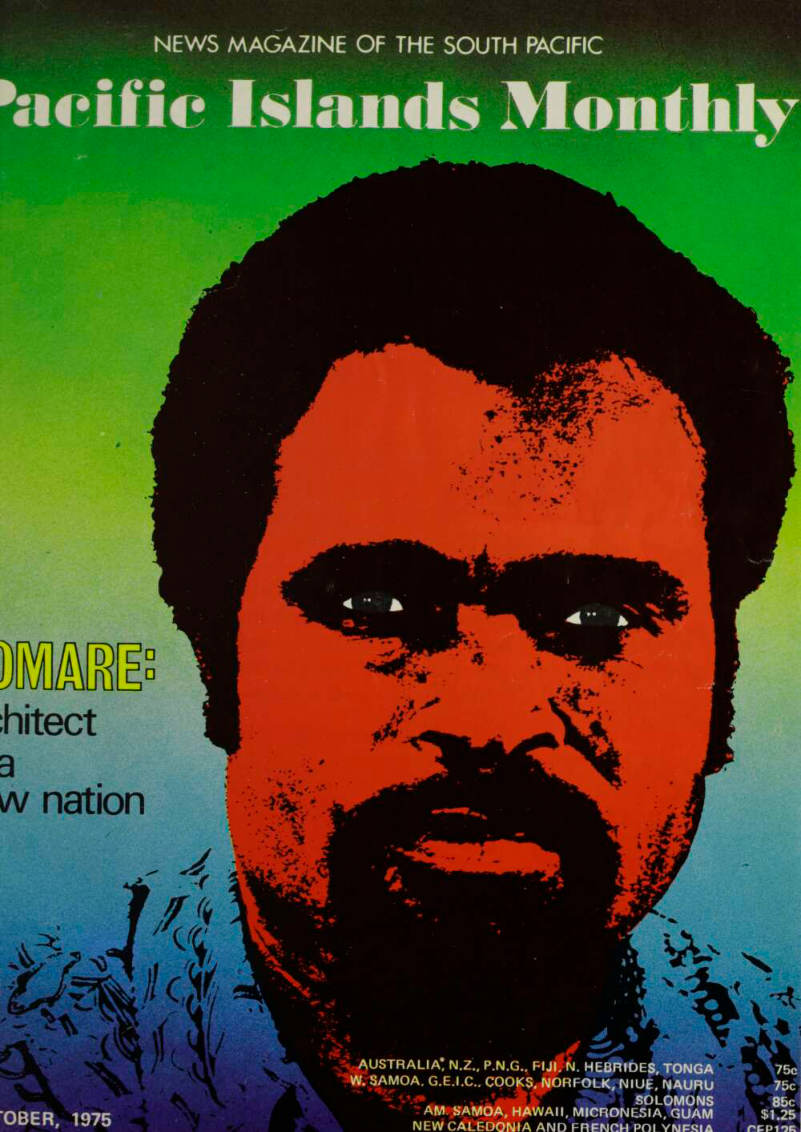
Our Cover
Prime Minister Michael Somare, architect of a new nation, Papua New Guinea; a portrait by PI M's own art department.
Advertisements & other items, pp. 2-3 (1 item)
shouldn’t be cheap.
An economy car
TOYOTA COROLLA
We put more than economy into a Toyota.
We build them to be comfortable. We build them to be safe.
And we build them very carefully... so that they'll last.
Before you buy your next car, check with your Toyota dealer. He has a lot of economical models to choose from.
But no cheap ones.
TOYOTA 1000 TOYOTA CORONA TOYOTA CELICA
TOYOTA MARK II
TOYOTA
PAPUA. NEW GUINEA: ELA MOTORS LIMITED, Sc.iohl., Rd„ 8.d.1i, Papa. U S, TRUST TERRITORY: MICROL C ° R / T °"‘ T '°~' SUPPLIES CO LTD G.P O, Bo« 355, Suva, AMERICAN SAMOA: BURNS PHILP ISOUTH SEAI CO , LTD , P.,0 Pago WESTERN SAMOA BURNS PHILP ISOUTH SEAI_LT0_, P O Bo Apia GUAM: RICKY'S AUTO CO.. P.O. 80. 1458, Ag.o. NEW HEBRIDES: NEW HEBRIDES MOTORS LTD -CL 80. 8. VE. SOLOMON M6NOAN* * RU , SL
ISLANOS TRADING SSS
ELLICE ISLANDS COLONY: TARAWA MOTORS, Box 36, Bainki Tarawa. NORFOLK ISLAND. MARIE S NORFOLKJOU j
NAURU COOPERATIVE SOCIETY. GILBERT ,
276 TIMOR: SANG TAI HOO, Sang Tai Building, Oil 'new CALEDONIA: SOCIETE IMPORTATION AUTOMOBILE DU PACIFIQUE, Rond-Point du Pacific (Station Totall B P 438 Noumaa
Parker refilbble nylon nib pens.
The three great newwriters of today
- V WA 'f 3 These are the greats of modern, expressive writing. They make your every word carry weight.
They’re Parker refillable nylon nib pens, always identified by the distinctive arrow clip.
They come in ink colours of red, blue, green, black, and three cartridge refills are included in each price.
From the top: There's the basic model that lets you choose from red, black, green or blue cases.
The middle one has a ‘seventies' look with its stainless steel case.
Then there’s the sterling silver Parker 75 model, a luxury to give one or get one.
Ask to try one. See how they help your writing flow as freely as your thoughts.
tPARKER
World's most wanted pens 066.P.296D
Pacific Islands
Monthly
FOUNDED BY R. W. ROBSON IN 1930
Published Monthly By
Pacific Publications (Aust.) Pty. Ltd.,
29 Alberta Street, Sydney, N.S.W. 2000.
Postal Address: G.P.O. BOX 3408, SYDNEY,
N.S.W. 2001.
Telegraphic Address: PACPUB, Sydney.
Telex: 25168.
Telephones: 61-9197, 61-7101, 61-4369.
Publisher: Stuart Inder.
Director of Advertising: Alan Batt.
Pacific Islands Monthly
Editor: Stuart Inder.
Assistant Editor: John Carter.
Subscription Rates;
"Pacific Islands Monthly" is airfreighted to the majority of subscribers and agents in the Pacific Islands and the U.S.A.; copies to the Cook Islands, Nauru, Niue, Micronesia and Guam go by surface mail, Australia (including Lord Howe and Thursday Islands), New Zealand, Papua New Guinea, Fiji, New Hebrides, Tonga, Cook Islands, Western Samoa, Gilbert & Ellice Islands, Norfolk Island, Niue and Nauru: $9.00 (local currency); Solomon Islands: $lO.OO Aust.; American Samoa, Micronesia and Guam: $12.00 U.S.; Hawaii and U.S. Mainland: $15.00 U.S.; New Caledonia and French Polynesia: 1,500 C.F.P.; United Kingdom: £6.50; Japan; 4,000 Yen; Elsewhere: $11.50 Aust.
Representatives
Fiji: Advertising and Distribution—Fiji Times & Herald Ltd., 20 Gordon Street, Suva. Telephone: 25-601. Telex: FJ 2124.
Papua New Guinea; Advertising and Distribution —PNG Post-Courier, P.O. Box 85, Port Moresby.
Telephone: 25-9899.
French Polynesia: Distribution—Hachette Paci fique, 10 Ave Bruat, Papeete.
New Zealand: Pacific Publications, C.P.O.
Box 2229, Auckland.
United Kingdom; The Herald and Weekly Times Limited, 8-10 Clifford's Inn, Fetter Lane, London EC4A IBU. Telephone: 01-831 6041. Telex: London 21989.
Japan: Advertising—Universal Media Corpora tion, C.P.O. Box 46, Tokyo. Telephone: 666-3036.
Victoria: Advertising Pacific Publications (Aust.) Pty. Ltd., Herald and Weekly Times Building, 2nd Floor, 61 Flinders Lane, Mel bourne, 3000. Telephone: 652-1565.
Hawaii and U.S. Mainland only: N. Grogan, 3354 Hayden Street, Honolulu, 96815. (Send change of address notices. Form 3579 and new subscriptions to P.O. Box 2193, Honolulu, Hawaii, U.S.A. 96805.) Second class postage paid at Honolulu, Hawaii.
Copyright ©, 1975,
Pacific Publications (Aust.) Pty. Ltd.
Printed by The Harbour Press, Chalmers Street, Sydney.
Registered at the G.P.O. Sydney for trans mission by post as a newspaper—category B.
Vol. 46, No. 10 October, 1975
Up Front
with the Editor
T don’t know whether it has any thing to do with the death wish which appears to be inherent in human nature, but the most frequent question I get asked by people who wonder about the future of Papua New Guinea is, “Do you think there will be a blood-bath up there?”
The answer is, “No I don’t”. I have never thought it in the 20 years I have been following Papua New Guinea affairs, and I have no reason to change my mind with PNG’s independence.
For the record, I used to be asked the same question about Fiji, but when Fiji independence came and went without blood-letting, people stopped asking, and you never hear it now. There were also predictions about the social chaos that would follow Western Samoa’s indepen dence and Nauru’s independence.
But when the Samoans and the Nau ruans refused to oblige the Jeremiahs, those predictions have died too.
Why it is that people are not more positive and constructive in their ap proach, I will never know.
EVERYBODY has said it, and it’s true: “How sad that Sir Donald Cleland died virtually on the eve of the independence of the country he did so much for and chose to live out his days in”.
Don Cleland was buried in Port Moresby with State honours. In a personal tribute to him in an article in the Papua New Guinea Post- Courier, Sir John Gunther, who as his second-in-command for so many years knew Don Cleland better than most men, tells how Cleland was a modest man who got impatient with pomp and ceremony and forgot to take his medals when he was pre sented to the Queen in Canberra in 1954, although another administrator of a small Australian possession not only wore his, but pinned them on a morning suit!
On more serious matters John Gunther added: “Personally, I be lieve a colonial civil servant must on occasions think he has a conflict of loyalty. Appointed by the metro politan government to administer its colonial policies, he is nevertheless appointed to advance the welfare of the colonial dependents and if a direction is in conflict with that wel
fare the Administrator has to decide how to react.
“Donald Cleland found that in the later years of his administration he disagreed with those who spoke for the Australian Government. He re acted in the strongest possible terms.
But he never reacted without a punctilious examination of all aspects of the directive and his reaction tc it. He had a “sixth sense” for any likely political ramifications and here he served Australia well. His legal training gave him an analytical mind, his military training allowed him to see attack and defence, and counter attack”.
When one considers that Sir Donald Cleland’s main term as Ad ministrator of Papua New Guinea was in the heady days of conflicting pressures from Territories Minister Paul Hasluck and the Australian Cabinet, a very strong PNG Public Service, a growingly vocal Legis lative Council and from Dr John Gunther himself, I think history may record that Don Cleland was the most able of the country’s colonial administrators.
THERE was another death in Port Port Moresby not long before Independence whose ripples were felt over a wide area. Rev Percy Chatterton’s “Chrissie” slipped away after a long illness. She had been 50 years a missionary in Papua.
“Her end was peaceful and as far as one can tell, without pain”, writes Percy in a sad letter. “Yesterday, after an early morning service in the Hanuabada Church, we took her back to her beloved Delena and buried her there. The Delena people had some time ago expressed a wish that she should be buried there and I gladly agreed, as I felt sure that that was what she would like best.
“For her it can only be regarded as a merciful release. For me it means a period of readjustment. For nearly three years now my thrice daily visits to the hospital have been the centre of gravity of my existence; now I have to find a new one”.
I’ll best remember Chrissie Chat terton for the fey Scots humour she shared out with the tea and biscuits around their small kitchen table during many visits I made over many
years.
Stuart Inder
Advertisements & other items, pp. 5-8 (2 items)
Cid Pioneer
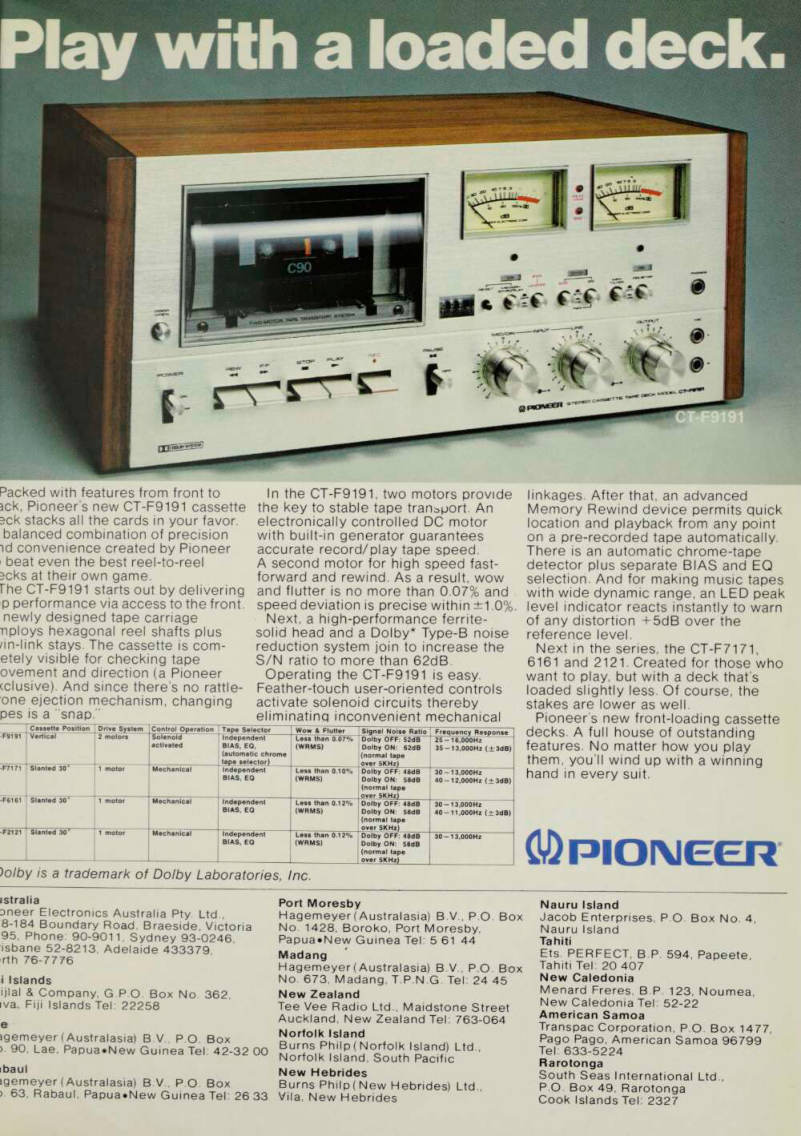
Packed with features from front to ick, Pioneer’s new CT-F 9191 cassette 3ck stacks all the cards in your favor, balanced combination of precision id convenience created by Pioneer i beat even the best reel-to-reel 3cks at their own game.
Fhe CT-F 9191 starts out by delivering p performance via access to the front, newly designed tape carriage nploys hexagonal reel shafts plus fin-link stays. The cassette is cometely visible for checking tape ovement and direction (a Pioneer (elusive). And since there’s no rattleone ejection mechanism, changing pes is a “snap.”
In the CT-F 9191, two motors provide the key to stable tape transport. An electronically controlled DC motor with built-in generator guarantees accurate record/play tape speed.
A second motor for high speed fastforward and rewind. As a result, wow and flutter is no more than 0.07% and speed deviation is precise within ±1.0%.
Next, a high-performance ferritesolid head and a Dolby* Type-B noise reduction system join to increase the S/N ratio to more than 62d8.
Operating the CT-F 9191 is easy.
Feather-touch user-oriented controls activate solenoid circuits thereby eliminating inconvenient mechanical )o/by is a trademark of Dolby Laboratories, Inc. istralia sneer Electronics Australia Pty. Ltd., 8-184 Boundary Road, Braeside, Victoria 95, Phone: 90-9011, Sydney 93-0246 isbane 52-8213, Adelaide 433379, rth 76-7776 i Islands ijlal & Company, G.P.O. Box No. 362, iva, Fiji Islands Tel: 22258 e igemeyer (Australasia) 8.V., P.O. Box ). 90, Lae, Papua*New Guinea Tel; 42-32 00 ibaui igemeyer (Australasia) 8.V., P.O. Box ) 63. Rabaul, Papua«New Guinea Tel: 26 33 Port Moresby Hagemeyer(Australasia) 8.V., P.O. Box No. 1428, Boroko, Port Moresby, Papua«New Guinea Tel: 5 61 44 Madang Hagemeyer(Australasia) 8.V., P.O. Box No. 673, Madang, T.P.N.G. Tel: 24 45 New Zealand Tee Vee Radio Ltd , Maidstone Street Auckland, New Zealand Tel: 763-064 Norfolk Island Burns Philp(Norfolk Island) Ltd., Norfolk Island, South Pacific New Hebrides Burns Philp(New Hebrides) Ltd., Vila, New Hebrides linkages. After that, an advanced Memory Rewind device permits quick location and playback from any point on a pre-recorded tape automatically.
There is an automatic chrome-tape detector plus separate BIAS and EQ selection. And for making music tapes with wide dynamic range, an LED peak level indicator reacts instantly to warn of any distortion +sdß over the reference level.
Next in the series, the CT-F 7171, 6161 and 2121. Created for those who want to play, but with a deck that's loaded slightly less. Of course, the stakes are lower as well.
Pioneer s new front-loading cassette decks. A full house of outstanding features. No matter how you play them, you’ll wind up with a winning hand in every suit.
CiD PIONEER
Nauru Island Jacob Enterprises, P.O. Box No. 4, Nauru Island Tahiti Ets. PERFECT, B P. 594, Papeete, Tahiti Tel: 20 407 New Caledonia Menard Freres, B.P. 123, Noumea, New Caledonia Tel: 52-22 American Samoa Transpac Corporation, P.O. Box 1477, Pago Pago, American Samoa 96799 Tel: 633-5224 Rarotonga South Seas International Ltd., P.O. Box 49, Rarotonga Cook Islands Tel: 2327
IB r .
Care lare
WFRESHEf
es^ forest pine fIZMs * * .
FOR A
CRISP. FRESH
FINISH
1 GOLD
COtbS
AEHOSOi
\SECTiCIOe
LEMON
Kwi
i,ter wi
i. H
LEMON
Kwlt
ScottS
£
Sheraton
DETERGENT
BO mmw fly and insect kilter
HC«T*^
n
Scotts
household products
give you real value
for your money.
For twenty five years Scotts have been helping out in homes throughout Australia and the Pacific.
Washing dishes. Cleaning. Keeping germs and dirt at bay.
All with quality products at sensible prices.
Scotts household products. Big on value and big on quality for 25 years. m T
0^ r Mr J m ii ClSFLfis«o^
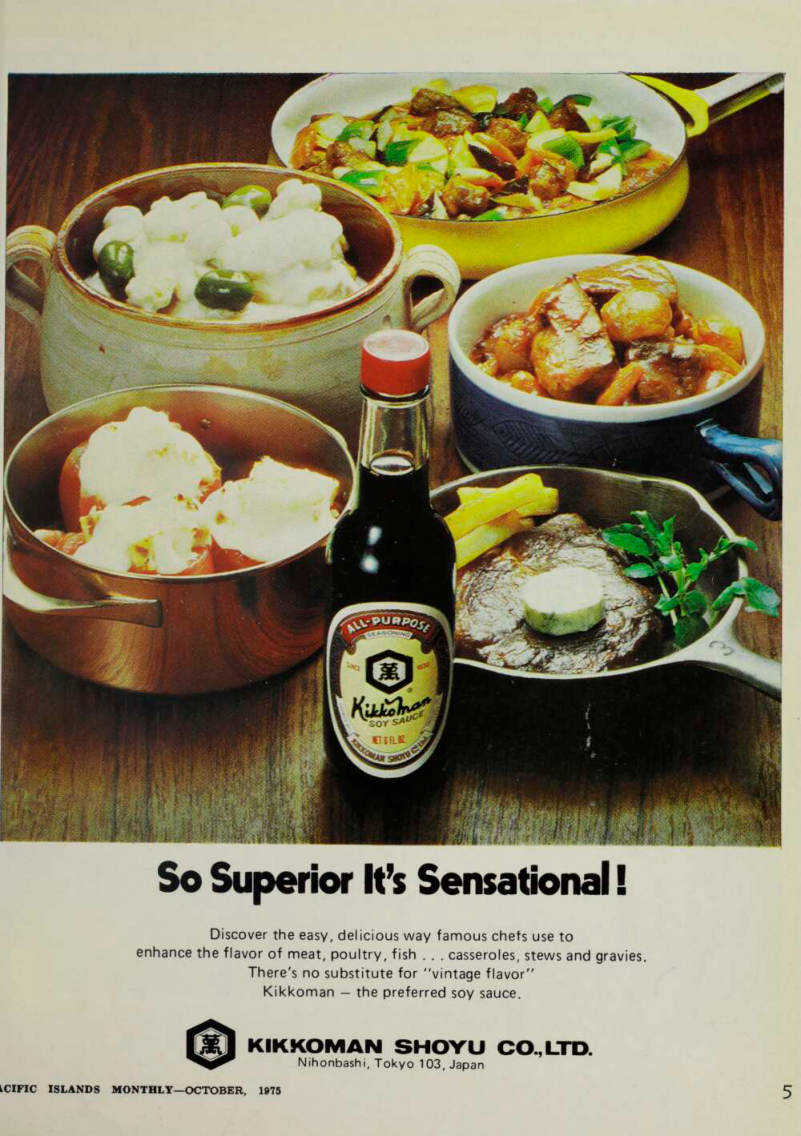
So Superior It’s Sensational!
Discover the easy, delicious way famous chefs use to enhance the flavor of meat, poultry, fish . . . casseroles, stews and gravies.
There's no substitute for "vintage flavor"
Kikkoman the preferred soy sauce.
JO KIKKOMAN SHOYU CO., LTD.
Nihonbashi, Tokyo 103, Japan
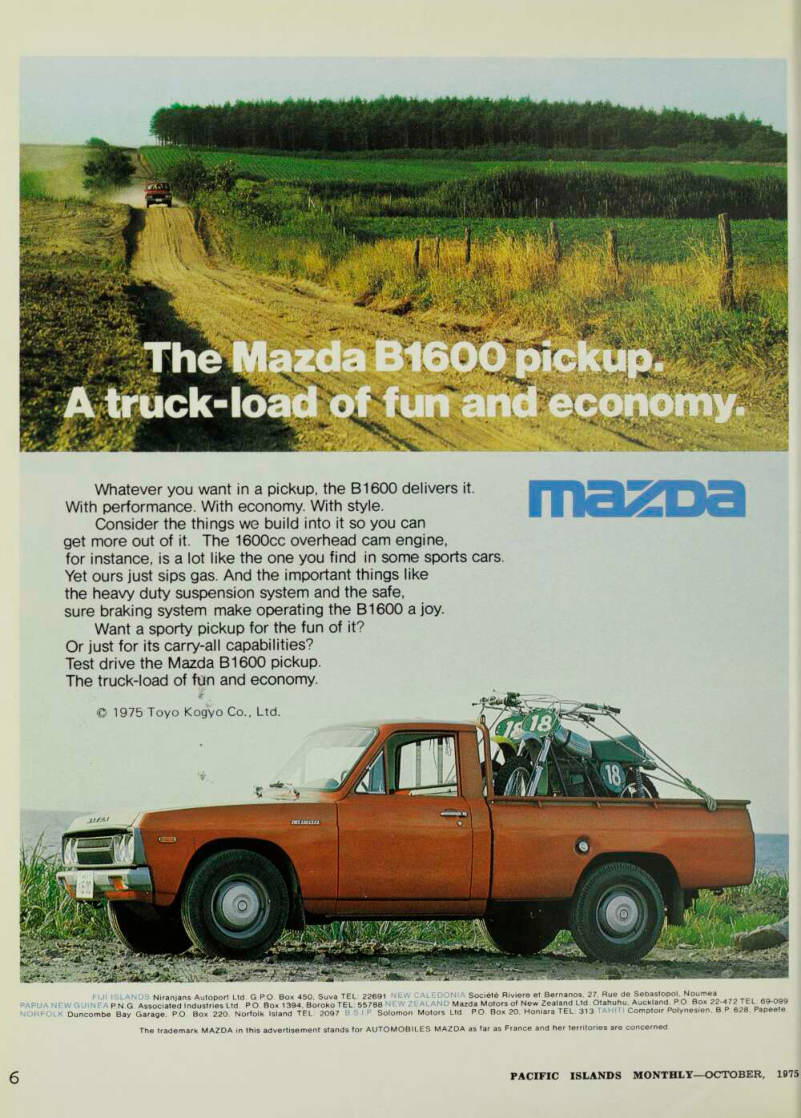
Whatever you want in a pickup, the 81600 delivers it.
With performance. With economy. With style.
Consider the things we build into it so you can get more out of it. The 1600 cc overhead cam engine, for instance, is a lot like the one you find in some sports cars.
Yet ours just sips gas. And the important things like the heavy duty suspension system and the safe, sure braking system make operating the 81600 a joy.
Want a sporty pickup for the fun of it?
Or just for its carry-all capabilities?
Test drive the Mazda 81600 pickup.
The truck-load of fun and economy. 1975 Toyo Kogyo Co., Ltd.
FIJI ISLANDS Niranjans Autoport Ltd. G.P.O. Box 450, Suva TEL: 22691 NEW CALEDONIA Soci6t6 Riviere et Bernanos, 27. Rue de Sebastopol. Noumea PAPUA NEWGUINEA png Associated Industries Ltd PO Box 1394, BorokoTEL: 55788 NEW ZEALAND Mazda Motors of New Zealand Ltd Otahuhu, Auckland P.O. Box 22-472 TEL_ 69-099 NORFOLK Duncombe Bay Garage, PO Box 220, Norfolk Island TEL: 2097 BS I P Solomon Motors Ltd P.O. Box 20, Honiara TEL: 313 TAHITI Comptoir Polynesian, B.P. 628. Papeete.
The trademark MAZDA in this advertisement stands for AUTOMOBILES MAZDA as far as France and her territories are concerned.
5
LCIFIC ISLANDS MONTHLY—OCTOBER, 1975
In This Issue
Eneral
ood Australia-French relations ... 27 IM's founder is 90 29 S die in aftermath of ship fire ... 73 land agent for 55 years 81
Merican Samoa
ontroversial television film 23 pposition for Air Polynesia 69
Ook Islands
;nth anniversary 27 art for Atiu 67 Jl ansport report 13 dependence film in Papua New Guinea 27 uieter time on wharves 69 ofit out of property 81 ew partners in copper search ... 81 irther development at Deuba 83
!Ench Polynesia
jclear tests 12 te's name restored 25
Ilbert & Ellice Islands
valu separates 12 :>vernor hits at Britain 21 idenbank on reef 71
4Uru
C meeting 13
New Caledonia
Newspaper news 28
New Hebrides
National Party's boycott 13 Big job for Mr du Boulay 25 Nationalists routed in election 39
Norfolk Island
Evidence to Royal Commission 21 Question for Qantas 69
Papua New Guinea
Independence
celebrated 8,9, 10, 11, 12 Style of Prime Minister 15 New nation searches for its identity 19 Fountain controversy 27 Fiji independence film shown 27 Man who steals the show 43 Gold in cultural heritage 45 Arts role for small industries 46 Art for PNG promotion 46 Reminiscences of a district commis sioner 55 How radio came to the islands 58 First Papuan announcer 59 Japanese-made vehicles preferred ... 67 New shipping laws 69 Bad credit risk 77 Budgeting for self-reliance 77 Another timber project 78 Possible K 500,000 loss 78 Ok Tedi strike may be big 79
Wales to open PNG subsidiary ... 79 Do it yourself plan 83 Huge Bougainville contract 83 Death of Sir Donald Cleland 93
Solomon Islands
Tentative time-table for independence 23 Exodus of Chinese 25 Birthpangs of new Solomons 37 New trading vessel 74 Steel barge purchase 74 Tourism growing 84
Tonga
New patrol boat 71 Infant bank thrives 79
Us Trust Territory
Flooding problem 27
Marianas capital argument 29 Air Micronesia earnings drop 71
Western Samoa
Opposition for Air Polynesia 69 Economic ups and downs 79
iPARTMENTS: Up front with the Editor, 2; Tropicalities, 27; Editor's Mailbag, 31agazine section, 55; Books, 60; Pacific Transport, 67; Cruising Yachts, 74; Business id Development, 77; Produce Prices, 85; Shipping and Airways Information, 87; ands Deaths, 93.
the flag
They didn’t tear down the flag
From STUART INDER, in Port Moresby
It was radio which really took the news of independence to Papua New Guinea on Septem ber 16. A vast hook-up by the country's National Broadcasting Commission, planned for three months, reported it to an estimated 1.5 million of Papua New Guinea's 2.6 millions scattered across ridges, valleys and beaches.
At one minute past midnight they heard the brief proclamation of inde pendence by the Governor-General, Sir John Guise, preceded by speeches by Prime Minister Michael Somare and lesser leaders. And, for the next
two days, they had detailed reports or direct broadcasts of the festivities in the national capital and the main towns. Most of PNG’s population does not live in the urban areas.
Even those who do, who had a village
to go to, had gone home—to be back in the womb, as it were, at a momen tous time.
So in fact Papua New Guinea has had two kinds of independence cele brations: the quiet grass-roots inde pendence of the vast majority, and the busy, efficiently - organised, smooth-running celebration in the national capital, dominated by VIPs from 37 nations and by white faces.
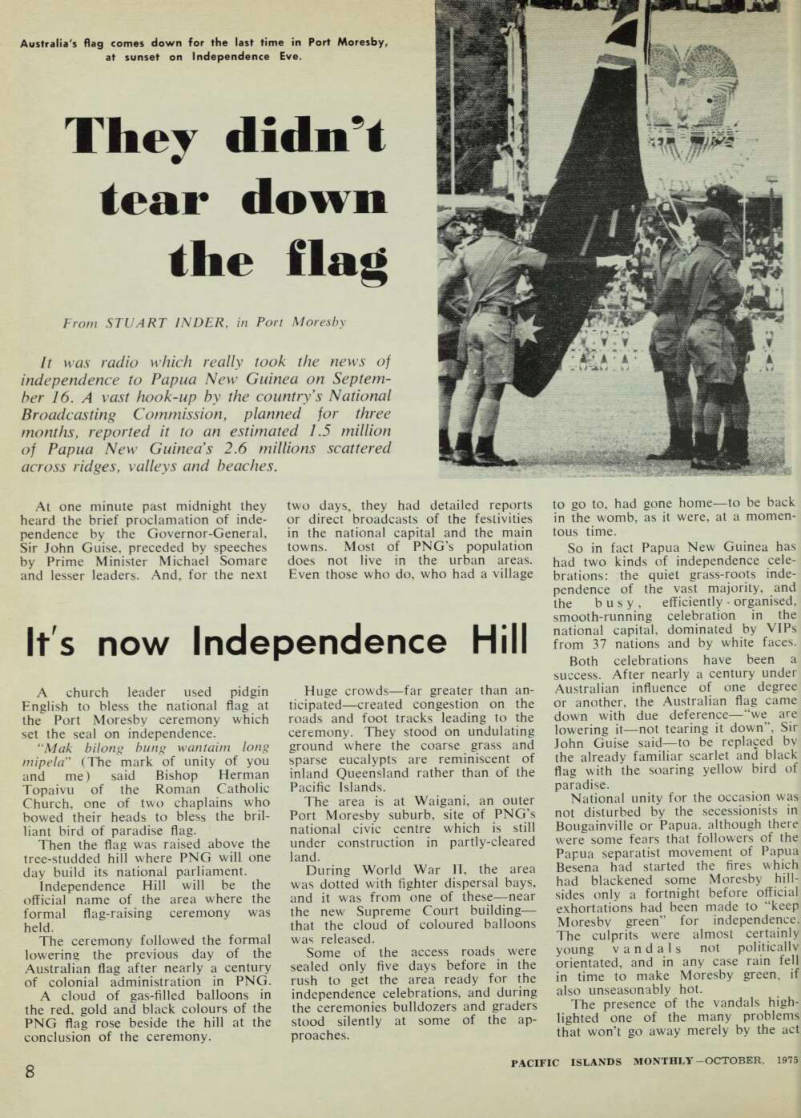
Both celebrations have been a success. After nearly a century under Australian influence of one degree or another, the Australian flag came down with due deference —“we are lowering it —not tearing it down”, Sir John Guise said —to be replaced by the already familiar scarlet and black flag with the soaring yellow bird of paradise.
National unity for the occasion was not disturbed by the secessionists in Bougainville or Papua, although there were some fears that followers of the Papua separatist movement of Papua Besena had started the fires which had blackened some Moresby hill sides only a fortnight before official exhortations had been made to “keep Moresby green” for independence.
The culprits were almost certainly young vandals not politicallv orientated, and in any case rain fell in time to make Moresby green, if also unseasonably hot.
The presence of the vandals high lighted one of the many problems that won’t go away merely by the act
Australia's flag comes down for the last time in Port Moresby, at sunset on Independence Eve.
of independence—that is, the shortage of work in the towns for school dropouts, with resultant crime, par ticularly theft. Another problem was highlighted by the presence of World Bank officials among the hundreds of VIP guests, mixing in this case business with pleasure. The World Bank admits PNG has great potential, but doesn t want to give the new nation borrower status, insisting on an Australian guarantee, and even in the midst of the celebrations there was undercover resentment among many PNG government officers at this lack of faith in a new nation (see report on p 77).
The visitors poured in on all kinds af aircraft. The Islands delegates vere a roll-call of the South Pacific Commission.
They included President Hammer 3eßoburt of Nauru, Sir George Cakobau, Governor-General of Fiji, ■Tench Governor in the Pacific Mr .-C. Eriau, Prime Ministers Ratu >ir Kamisese Mara, Fiji, Sir Albert denry, Cooks, Prince Tui’pelehake, fonga, Tupua Tamasese Leolofi of Vestern Samoa, Chief Minister iolomon Mamaloni, of the Solomons, ogether with the Governor, Mr D. C. -uddington; and Naboua Ratieta, of he Gilbert and Ellice.
Mr Fred Bettham, secretary-general if the SPC, was there, together with i huge delegation from Australia, ed by Governor-General Sir John Cerr, Prime Minister Gough Whitlam, nd politicians of all persuasions. Old *NG hands included the surviving administrators from Colonel J. K.
Jurray, former university vice hancellor, Sir John Gunther, and ex iaps such as Sir Home Niall, J. K.
IcCarthy and Ivan Champion.
Sir Paul Hasluck didn’t make it, nd former Australian Territories linister Andrew Peacock actually isited Moresby, but left for Iran two ays before Independence, to the hagrin of some of his local sup □rters who thought he could have rganised himself better.
Principal guest, Prince Charles, to the British throne, seemed a ttle bit more correct and formal in üblic than the Pacific has known im, although he unbent during a iree-day tour of PNG after the main debrations.
There was a sparkling exhibition scene-stealing on Independence ly itself when Imelda Marcos, first dy of the Philippines, managing to ok light and beautiful despite a lickening waistline, arrived on the ggest aircraft of them all, a stretch CB, with the biggest entourage of em all, about 40, most of them curity men who surrounded her in flying wedge wherever she moved.
She arrived late and from the
wrong direction for the flag-raising ceremony, unpardonably late for the State opening of the National Parlia ment by Prince Charles, thus inter rupting the proceedings, and at a formal presentation by foreign diplo mats of their credentials to Sir John Guise later that day she so outraged one of the diplomats by attempting to take precedence that he walked out, and returned on his own later.
Fortunately her visit was brief.
Not even the wife of the President of the Philippines could overshadow the obvious fact that PNG’s inde pendence was an Islands occasion.
There has been a widely-held view ' that Papua New Guinea is not of the South Pacific, but is oriented towards the politics and economics of the Philippines, Indonesia and Japan.
That view was shattered by the special warmth of the welcome for Islanders by Prime Minister Michael Somare, together with the Islands style of the festivities, and clear political expressions of where PNG stands in relation to the South Pacific, made in various speeches over the three days of celebrations.
For most of the formal occasions, colour was added by 400 students from Sogeri Senior High School, representing groups from each PNG district, some of each group wearing traditional dress, others in specially designed outfits displaying hand (Continued next page)
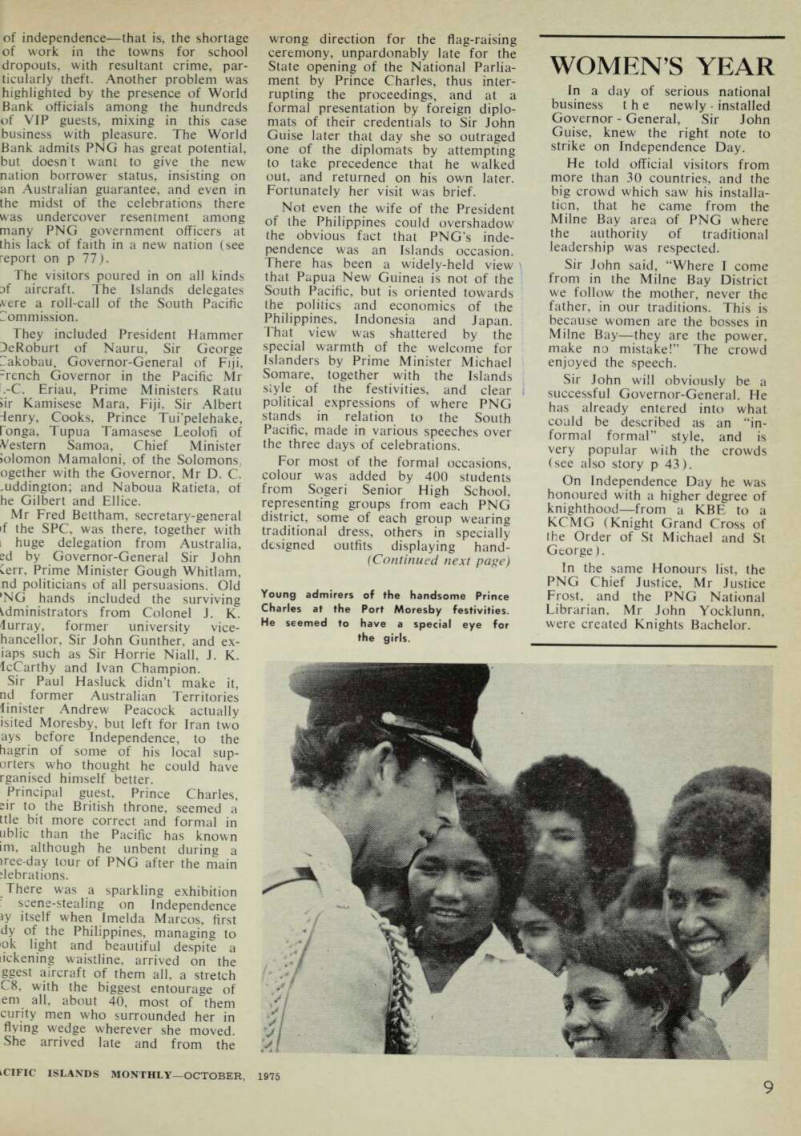
Young admirers of the handsome Prince Charles at the Port Moresby festivities.
He seemed to have a special eye for the girls.
printed designs typical of the districts.
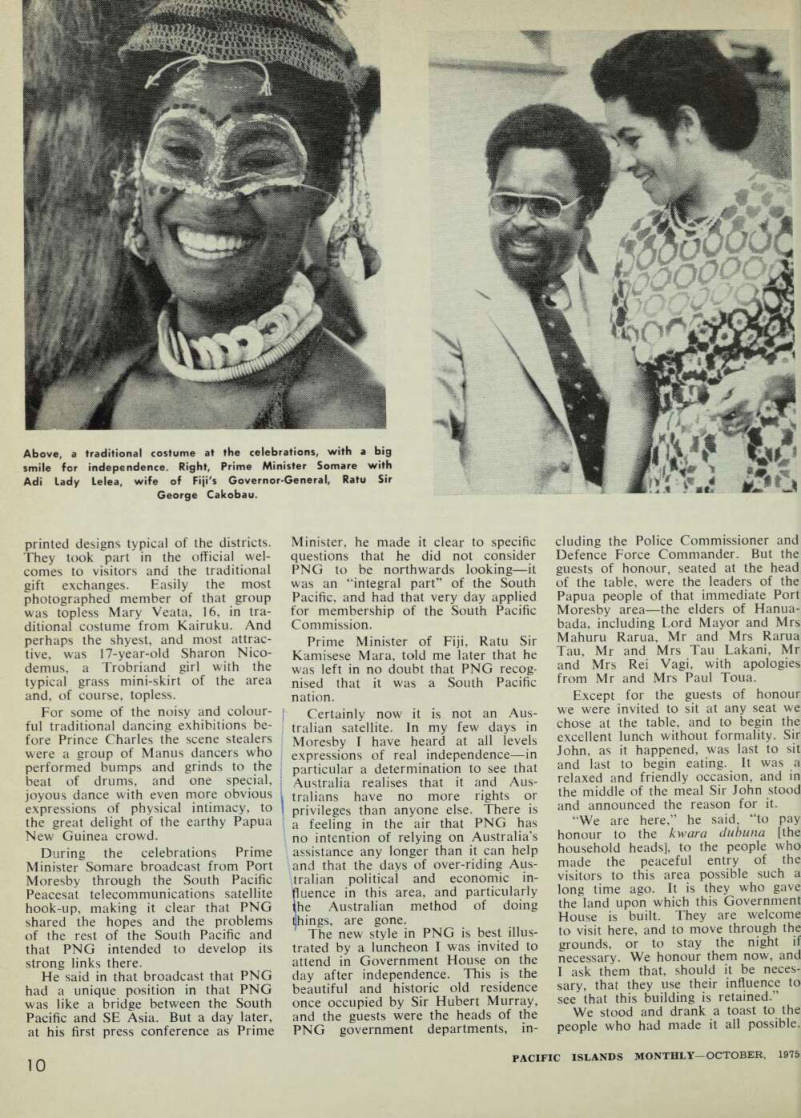
They took part in the official wel comes to visitors and the traditional gift exchanges. Easily the most photographed member of that group was topless Mary Veata, 16, in tra ditional costume from Kairuku. And perhaps the shyest, and most attrac tive, was 17-year-old Sharon Nico demus, a Trobriand girl with the typical grass mini-skirt of the area and, of course, topless.
For some of the noisy and colour ful traditional dancing exhibitions be fore Prince Charles the scene stealers were a group of Manus dancers who performed bumps and grinds to the beat of drums, and one special, joyous dance with even more obvious expressions of physical intimacy, to the great delight of the earthy Papua New Guinea crowd.
During the celebrations Prime Minister Somare broadcast from Port Moresby through the South Pacific Peacesat telecommunications satellite hook-up, making it clear that PNG shared the hopes and the problems of the rest of the South Pacific and that PNG intended to develop its strong links there.
He said in that broadcast that PNG had a unique position in that PNG was like a bridge between the South Pacific and SE Asia. But a day later, at his first press conference as Prime
Minister, he made it clear to specific questions that he did not consider PNG to be northwards looking—it was an “integral part” of the South Pacific, and had that very day applied for membership of the South Pacific Commission.
Prime Minister of Fiji, Ratu Sir Kamisese Mara, told me later that he was left in no doubt that PNG recog nised that it was a South Pacific nation.
Certainly now it is not an Aus tralian satellite. In my few days in Moresby I have heard at all levels expressions of real independence—in particular a determination to see that Australia realises that it and Aus tralians have no more rights or privileges than anyone else. There is a feeling in the air that PNG has no intention of relying on Australia’s assistance any longer than it can help and that the days of over-riding Aus tralian political and economic in fluence in this area, and particularly the Australian method of doing nhings, are gone.
The new style in PNG is best illus trated by a luncheon I was invited to attend in Government House on the day after independence. This is the beautiful and historic old residence once occupied by Sir Hubert Murray, and the guests were the heads of the PNG government departments, in
eluding the Police Commissioner and Defence Force Commander. But the guests of honour, seated at the head of the table, were the leaders of the Papua people of that immediate Port Moresby area —the elders of Hanua bada, including Lord Mayor and Mrs Mahuru Rarua, Mr and Mrs Rarua Tau, Mr and Mrs Tau Lakani, Mr and Mrs Rei Vagi, with apologies from Mr and Mrs Paul Toua.
Except for the guests of honour we were invited to sit at any seat we chose at the table, and to begin the excellent lunch without formality. Sir John, as it happened, was last to sit and last to begin eating. It was a relaxed and friendly occasion, and in the middle of the meal Sir John stood and announced the reason for it.
“We are here,” he said, “to pay honour to the kwara duhuna [the household heads], to the people who made the peaceful entry of the visitors to this area possible such a long time ago. It is they who gave the land upon which this Government House is built. They are welcome to visit here, and to move through the grounds, or to stay the night if necessary. We honour them now, and I ask them that, should it be neces sary, that they use their influence to see that this building is retained.”
We stood and drank a toast to the people who had made it all possible.
Above, a traditional costume at the celebrations, with a big smile for independence. Right, Prime Minister Somare with Adi Lady Lelea, wife of Fiji's Governor-General, Ratu Sir George Cakobau.
It's now Independence Hill
A church leader used pidgin English to bless the national flag at the Port Moresby ceremony which set the seal on independence.
“Mak bilong bung wantaim long mipela” (The mark of unity of you and me) said Bishop Herman Topaivu of the Roman Catholic Church, one of two chaplains who bowed their heads to bless the bril liant bird of paradise flag.
Then the flag was raised above the tree-studded hill where PNG will one day build its national parliament.
Independence Hill will be the official name of the area where the formal flag-raising ceremony was held.
The ceremony followed the formal lowering the previous day of the Australian flag after nearly a century of colonial administration in PNG.
A cloud of gas-filled balloons in the red, gold and black colours of the PNG flag rose beside the hill at the conclusion of the ceremony.
Huge crowds—far greater than an ticipated—created congestion on the roads and foot tracks leading to the ceremony. They stood on undulating ground where the coarse grass and sparse eucalypts are reminiscent of inland Queensland rather than of the Pacific Islands.
The area is at Waigani, an outer Port Moresby suburb, site of PNG’s national civic centre which is still under construction in partly-cleared land.
During World War 11, the area was dotted with fighter dispersal bays, and it was from one of these—near the new Supreme Court building— that the cloud of coloured balloons was released.
Some of the access roads were sealed only five days before in the rush to get the area ready for the independence celebrations, and during the ceremonies bulldozers and graders stood silently at some of the ap proaches.
Women's Year
In a day of serious national business the newly - installed Governor - General, Sir John Guise, knew the right note to strike on Independence Day.
He told official visitors from more than 30 countries, and the big crowd which saw his installa tion, that he came from the Milne Bay area of PNG where the authority of traditional leadership was respected.
Sir John said, “Where I come from in the Milne Bay District we follow the mother, never the father, in our traditions. This is because women are the bosses in Milne Bay—they are the power, make no mistake!” The crowd enjoyed the speech.
Sir John will obviously be a successful Governor-General. He has already entered into what could be described as an “in formal formal” style, and is very popular with the crowds (see also story p 43).
On Independence Day he was honoured with a higher degree of knighthood—from a KBE to a KCMG (Knight Grand Cross of the Order of St Michael and St George).
In the same Honours list, the PNG Chief Justice, Mr Justice Frost, and the PNG National Librarian, Mr John Yocklunn, were created Knights Bachelor.
Advertisements & other items, p. 11 (1 item)
Icific Islands Monthly—October, 1975
national self-reliance'
Mr. Somare's target is national self-reliance'
Prime Minister Mr Somare plans to continue running his country as he finds it despite legacies of long colonial rule.
A new national self-reliance will be his main target, drawing on what he calls the commonsense of the people. But there will be no tearing down of institutions, ideas or systems simply because they were inherited from a colonial past.
Mr Somare said this at a press conference in Port Moresby only hours after the birth of indepen dent Papua New Guinea, ruled for nearly a century by Australia.
“It would be a wrong decision for any leader to try to get a big axe and chop existing things down,” Mr Somare said.
Newsmen from his own country, from Australia, and from the world at large had asked him if he intended to remould a society emerging from the patterns of long colonial-type administration. But there was no sug gestion of a new broom sweeping clean—there won’t even be a cabinet
reshuffle in honour of independence and no policy changes are planned.
His answers showed there was still a trace of bitterness that Australia was not maintaining the level of aid which he believed had been promised.
But he shrugged off the bitterness with a belief that he had all the more incentive to work for internal self reliance—and that his country would be the better for it.
Mr Somare said that until Inde- 1 pendence Day when PNG had been under Australian administration, PNG had a similar position to the Aus-i tralian states in being entitled to some! specific measure of aid.
“But now, as the Prime Minister of an independent nation I have changed my attitude—we have no prerogative to say what aid Australia should give us,” Mr Somare said.
The result would be a true sense of independence in PNG, coupled with the need to be self-reliant.
Mr Somare forecast a low-key initial approach to foreign relations, and said there was no doubt that his country was an integral part of the Pacific community.
He spoke of good with Indonesia and Australia which he believed would continue to exist.
But he said, at the same time, that he would “deal with the dispute over the Queensland-PNG border at a time to be fixed”.
The dealings would be with Aus tralia, because PNG had no part to play in Australian relationships with its states. • There was temporary drama in the 1,700-mile Brisbane to Port Moresby Independence Air Race, staged by the South Pacific Aero Clubs, Port Moresby, when one of the contestants ran out of fuel and was forced to land on a beach in the Gulf District. Fortunately a heli copter happened to be nearby, who supplied him with fuel and picked up his passenger so the plane could make a light-weight takeoff. A total of 44 planes and 150 people took part in the race, which ended on Independence Day. First prize in the VFR section was taken by Mrs Jan Mackay, of Melbourne, and in the IFR section by Tony Schwerdt, of Adelaide. Mrs Mackay, flying her Piper Commanche, is an experienced pilot with 1,500 hours of private flying. Two Papuan New Guinean pilots took part. They were Joe Walames, with Air Niugini, and Leo Glaglas, of the Civil Aviation Agency.
What happened
to the war?
From GUS SMALES in Port Moresby
This may be a sentimental question but whatever happened to the war?
Among the tributes in official speeches to those who helped to make Papua New Guinea free no reference has been made at all to the fighting of 1941-45 or to those who were involved.
Yet 10,000 Australians lie in war cemeteries outside Port Moresby and at Lae and Rabaul.
And many PNG people suffered in the war which was a landmark in keeping PNG open for future independence.
Some say that Mr Somare does not want to offend the Japanese whom he has frankly liked since he had a Japanese schoolmaster in Wewak as a boy.
Others say the new PNG wants a non-military image.
But, I suspect that the general feeling is that it was not PNG’s war, that it was a long time ago and that it’s best to forget it.
... and what about
the rain?
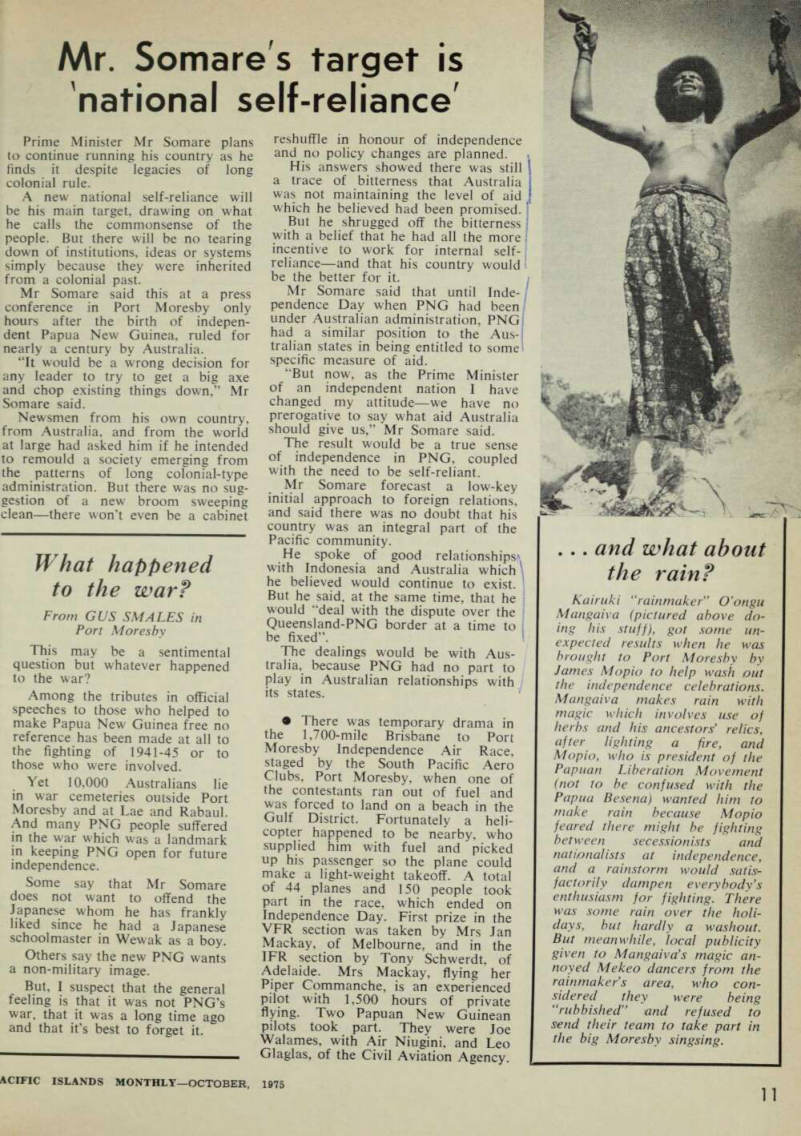
Kairuki “rainmaker” O’ongu Mangaiva (pictured above do ing his stuff), got some un expected results when he was brought to Port Moresby by James Mopio to help wash out the independence celebrations.
Mangaiva makes rain with magic which involves use of herbs and his ancestors’ relics, after lighting a fire, and Mopio, who is president of the Papuan Liberation Movement (not to be confused with the Papua Besena) wanted him to make rain because Mopio feared there might be fighting between secessionists and nationalists at independence, and a rainstorm would satis factorily dampen everybody’s enthusiasm for fighting. There was some rain over the holi days, but hardly a washout.
But meanwhile, local publicity given to Mangaiva’s magic an noyed Mekeo dancers from the rainmaker’s area, who con sidered they were being “rubbished” and refused to send their team to take part in the big Moresby singsing.
Advertisements & other items, p. 13 (1 item)
11
ACIFIC ISLANDS MONTHLY—OCTOBER, 1975
Independence
Highlights
Highlights from Papua New Guinea’s Independence celebrations: • A two-ton 33-ft-high statue of steel and a 12-ton rock were tributes to independence. The statue is a free sculpture titled Strength and Unity by the Papua New Guinean fine arts designer Jeffrey Musuwadoga. It was unveiled in the grounds of the PNG University at Port Moresby. The 12ton rock was brought from a river bed near Lae and mounted as a symbol of solidarity in Lae. • At Mendi in the Highlands of Papua, organisers of independence dressed a young girl in the PNG flag and chained her to a post with plastic chains. To symbolise independence the chains were cut. The girl released a bird from a cage. • One of the oldest examples of cultural symbolism in the national celebrations was provided by a traditional Chinese dragon imported a few weeks ago by the PNG Chinese community. The 80-ft long dragon, held by 12 men in its body and one in its head, danced through the streets of suburban Port Moresby. • A group of guests at a reception stroked the legs and feet of the Prime Minister. The incident—symbol of reverence for leadership—was at a re ception in Mr Somare’s electorate at Wewak, on the PNG north coast. He had returned there after attending the celebrations in Port Moresby. Prince Charles and Fiji Prime Minister Ratu Sir Kamisese Mara were also guests at the reception held by the Second Battalion of the Pacific Islands Regi ment. The 300 guests met in a thatched building decorated with flowers and palms on the shores of the Bismarck Sea. Mr Somare was talking to a group of people when an elderly man came across, knelt near him, and stroked his feet. Later other men came across, stroking Mr Somare’s legs and feet, speaking to him briefly, and then returning to their companions. The men said afterwards, “The legs and feet carry a man where is going. That is why they are important”. • More than 1,500 police were on duty in Port Moresby during the celebrations. The average man worked 14 hours a day. Many had meals brought to them. The general view was that the police performed with great credit at a difficult time, particularly in crowd control.
Tuvalu, The New Mini-State
The Gilbert and Ellice Islands Colony, for more than 80 years a British colony, divided on October 1 into the Gilbert Islands, which looks for early independence, and Tuvalu, the small group of Polynesian islands to the south of the Gilberts known as the Ellice Islands which has opted for continued rule by Britain.
Outnumbered by the Gilbertese by seven to one, the Ellice Islanders feared domination by the Gilbertese once the colony had become independent.
They voted in a referendum in 1974 to separate from the Gilberts and become a British colony with the name of the Tuvalu Islands. The split, however, is in name only until January 1, 1976. Until then, the two groups will continue under the same administration. With the coming of the new year, the Tuvaluans will transfer their administrative headquarters to Funafuti.
The Tuvalu House of Assembly was scheduled to operate from October 1 with an executive body of three ministers including its chief minister.
biggest
France's biggest bang!
From AL PRINCE in Papeete All was nearly ready on the French Polynesian atoll of Fangataufa at September’s end for France’s second underground nuclear test of the year, sometime in October. The test, code named Hector, follows by about four months France’s first underground explosion, Achille, at Fangataufa on June 5.
Officially, France is not saying how powerful Hector will be or when it will be conducted. Even 54 visiting journalists from France, Australia, New Zealand and Fiji could not find that out during an eight-day visit to French Polynesia, including the test ing sites of Fangataufa and Mururoa, sponsored by the Centre for Pacific Experiments.
One reliable source, however, indi cates that Achille, the first under ground blast, was a mere infant, designed more to test the under ground site with a safe baptism ex plosion. Although France has already announced that it is moving back to Mururoa for further tests, it wants to leave Fangataufa in style with a really big blast. Hence, Hector may well turn out to be the biggest blast France has ever conducted above or below ground. Only time, and a very short period of time at that, will tell how accurate this guess is.
Meanwhile, some of the visiting journalists returned from their escorted tour of the test sites—the first France has conducted in several years—with a variety of impressions and many of the nagging questions that they arrived with and left with, still unanswered. One immediate im
pression is the huge amount of money France has spent to develop its test ing facilities, which only went under ground this year. Another impression is how pleased the French officials are with what they have accom plished, particularly with their first underground explosion in June.
The visiting journalists left little doubt that the French officials were constantly on stage. The newsmen saw and photographed just about any thing, including two top French officials swimming in a lagoon right next to where the June test was con ducted. But is that what the journal ists came to see? The only exciting thing about being at the test site is knowing that you are standing at “point zero” where the last test was held or the next will be held. As for the rest of the site, it looks exactly like what it is—a flat, desert-like atoll in the middle of the blue Pacific with a tower like an oil drilling rig stick ing up. France could just as well be drilling for oil on Fangataufa as test ing nuclear devices underground, from the looks of the site.
But what can one expect? After several years of absolute silence about its testing programme, France has now gone 180-degrees in the op posite direction by actually picking up the tab to bring journalists half-way round the world just to personally examine the French Pacific testing facilities. Under such circumstances, there is probably no government in the world that is going to be com pletely candid about something as controversial as nuclear testing.
And there are, probably, not that many journalists in the world who are going to knock themselves out on their first, and perhaps only, free trip to Tahiti to try to find out what is really going on with the French nuclear testing programme. So both sides gain. France gets the exnosure, but does not get embarrassed. The journalists get their free trip, take some photos and file stories.
Of course, there were some
journalists who did ask some potent questions, which were either politely referred to the French Defence Ministry in Paris or to French Poly nesia Governor Daniel Videau, who happened to be in Paris at the time.
And some journalists wanted to know how safe the tests really are. But as one newsman from Australia said, “Only a physicist would know”.
A Boycott
The New Hebrides
The six members of the New Heb rides National Party, who won seats in the first municipal elections in Vila, boycotted the first meeting of the new Vila Municipal Council recently.
They said they would not attend meetings until complaints they had made concerning the electoral cam paign were dealt with.
The Resident Commissioners, who were at the meeting, pointed out that there was a standard procedure for dealing with complaints. Their com plaints were being dealt with, they said.
In the meantime, however, those candidates declared elected were regarded as the legitimate represent atives of their electorate, and their work would, in no way, be invali dated whatever decision was reached by the Electoral Committee on the ;omplaints.
The work of the council could not ae delayed as there were many argent and important tasks awaiting ts attention, the Resident Com nissioners said.
The National Party is in a 3-1 ninority on the council.
Spc On Nauru
The 15th South Pacific Conference vas scheduled to open on Nauru on September 29 and continue until October 10.
Newly - independent Papua New luinea will, for the first time, speak or !T lf and become the ninth participating government, a role vhich belonged only to the metro politan governments until Island terri ories became independent. PNG’s 'el p cation will be led by Foreign lelations Minister Sir Maori Kiki.
CocrntsTry}-General Fred Betham, of Vesfern Sarnia. complete? his term f office in October and his successor ' almost sure to be Dr Macu Salato, f Fiji, M’ho has the backing of Aus 'alia, Fiji and New Zealand. Up to eptemher 20 there had been no other ominations.
Fiji’s transport pie?
Who gets the plums in Fiji’s transport pie?
From ROBERT KEITH-REID in Suva
Fiji taxi owners have a long standing pet hate: U-drives, or if you prefer it, rental cars.
U-drives, they contend, take too much business that should rightfully be going to the taxis.
As a seeming afterthought they tend to add casually that it’s a pity that most rental cars are owned by foreign companies.
Actually, it’s the afterthought that is the real crux of the matter; the taxi men would like to be running big U-drive fleets themselves.
Hardly a session of the Fiji House of Representatives goes by without some backbench MP. usually of the Opposition, getting up to berate rental car barons on the taximen’s behalf.
One such occasion was in March, 1971, when Mr Chirag Ali Shah, a veteran of the Opposition, National Federation Party, which makes a vote-catching point of worrying about the worries of taxi owners, rose to demand a select committee to “in quire into the grievances of the taxi owners of Fiji”.
Were local people getting their “fair share” of the business Mr Shah wanted to know.
And, more to the point, to what extent had the transport industry in general and the rental and hire car trade in particular “fallen into the hands of expatriate firms or expatri ate companies”.
Answers to Mr Shah’s queries have come 4i years later with the pub lication of a select committee’s re port.
The information dug out by it was what everyone mostly knew already. The rental car business cer tainly is almost completely domi nated by outside interests.
But who runs practically all Fiji’s taxis and bus services? The commit tee’s figures speak for themselves.
Of 514 U-drives being operated by 27 firms at the end of 1973, 308 were owned by five European firms; 173 were owned by 15 Indian pro prietors; 12 by four Fijians; and 17 by joint Fijian-European or Fijian- Indian concerns.
Of 74 hire cars (rental cars in cluding a driver) 50 were owned by seven Europeans; 18 by 13 Indians, and five by two joint venture con cerns.
But if Indian transport operators
feel compelled to complain about European dominance of the U-drive business, other figures in the com mittee’s report are presumably grounds for complaint by non- Indians.
Of 734 buses in service at the end of 1973, 670 were owned by 58 Indian firms; 20 by two Fijian com panies, three by one European firm and 41 by a joint European-Indian company which has since reverted to 100 per cent Indian ownership.
Of 957 taxis in service at the end of 1973, 907 were owned by 664 Indian proprietors; 20 by 19 Fijians; six by five Europeans and 24 by seven other proprietors.
In view of the committee’s terms of reference it might be thought that such figures could have caused Indian taxi owners some embarrassment.
The committee was asked to de cide if existing legislation was ade quate to “secure reasonable oppor tunity for local people of all com munities to participate in the indus try”. And also if it was preventing monopolies “either local or expatri ate in any sector or sectors” of it.
But if the taxi men feel embarrass ment they have not shown any sign of it. In fact some were gratified by some of the committee’s 147 recom mendations.
One is that the Fiji Government should stop issuing any more U-drive car licences to foreign-controlled rental car companies, although those already established in Fiji should be allowed to keep the number they already have.
Licences for chauffeur-driven hire cars should be abolished since this type of rental car is merely “a dig nified form of taxi”, the committee says.
According to the committee, foreign involvement in transport has not harmed local interests so far.
But the time has come when locals have acquired all the expertise from foreign operators they need to be able to run road transport fleets efficiently themselves.
The nine-man committee, including six members of the House of Repre sentatives, is not entirely sympathetic to wailings from taxi owners. It sug gests that the taxi industry should take a look at its own faults.
Taxi businesses would be much more efficient if taxis had two-way
Continued on p 94
radios operated through a co operative network, the committee says.
While some complaints from taxi men were justified, the committee comments, the best thing they could do for themselves would be to “escalate their standards and comoete with others in the industry on their own terms”.
In mulling over the lack of Fijians in the transport industry, the com mittee says this is due partly to lack of commercial know-how and capital.
A couple of Fiiian bus companies had run into disaster mainly because
no one knew out to keep the book; Fijians will have trouble breakim into a field in which others ar already entrenched, the committe warns.
The best way of getting Fijian into the industry as effective opei ators, it suggests, would be to se that taxi and bus service licences i
predominantly Fijian-populated dh
tricts go only to Fijians.
The terms of reference given th committee went beyond the trouble of taximen.
Local shipping services and an other matters affecting public tram port were within its purview as wel Even the little sugar cane trait which for years has carried passer gers free between Sigatoka and Eh was dealt with, and not kindly.
This service, said the committe* should be terminated forthwith be cause it originated in the days whe road traffic was practically nor existent.
The committee opposes nationalis ation of any transport services, pai ticularly bus services.
And it is about time, it says, th£ the small, commercial passengei carrying punts, which ski along Fiji inland waterways, are made to can lifejackets at all times and light when they move at night.
The committee came up with strong plea for the introduction c
compulsory breathalyser tests and
national 55 mph road speed limit.
This was because there was n doubt that too many road accident were the outcome of too much drin or speeding, or a combination c both.
Safety belts should also be a con pulsory feature of cars, it added actually, they already are. Since Jun< new cars have had to be fitted wit belts and it’s illegal for people nc to wear them.
There’s just one drawback. Whi with a long series of public meeting held by the committee throughout Fi the 95-page report must have been rather expensive one to compile.
It has appeared largely as a hii tory book. Many of its recommem ations have been put into force b the government on its own initiativi while others are policy mattei which the government has long sine ruled against adopting.
The report was tabled in th House of Representatives in Augui without a word of discussion.
It will, by now, have joined th growing pile of other parliamentar reports gathering cobwebs and mi dew on a shelf somewhere in Goven ment Buildings in Suva, hardly rea and probably disregarded.
Advertisements & other items, pp. 15-16 (2 items)
13
ACIFIC ISLANDS MONTHLY—OCTOBER, 1975
“Papua New Guinea is now independent. The Constitution
Constitution of the independent state of Papua New Guinea, under which all power rests with the people, is now in effect. We have at this point in time broken with our colonial past and we now stand as an independent nation in our own right. Let us unite with the Almighty God f s guidance and help in working together for the future as a strong and free country.” —Proclamation of Independence by the Governor-General, Sir John Guise, September 16, 1975.
“Our task now is to find a way of life that suits our own people and at the same time will equip us to take our place in the world family of nations. From our rich resources and traditions, from shared experiences and varied skills, we will strive to create in our new nation a distinctive Papua New Guinea society. ...Asa united people we will achieve our goals, with the stability of our background to support us, and the richness of the earth to provide for us." —From an Independence Day address by the Prime Minister, Mr Michael Somare.
Papua New Guinea Office of Information Port Moresby
Conciliation

Prime Minister
Som Are:
Is His Style
If Papua New Guinea Prime Minister Michael Somare’s just lublished autobiography does nothing Ise, it makes clear that the belief ic has in conciliation, which has ieen so apparent in his handling of be many problems leading up to his ountry’s independence, is a belief bat is basic and deep-rooted in him.
Born into the Sana section of the ait clan, in the Murik Lakes area f Papua New Guinea’s Sepik, he fas taught from a boy that his clan ad “the magic of peace”. Every lan had its own magic, and the lagic of his clan was that it knew bout peace, that it knew how to invite people” (because you couldn’t fin people by being angry with lem).
“My people taught me that men re equal and should have equal pportunities”, he writes in his auto iography, Sana. “Disputes can be lived by discussion, and decisions lould be arrived at by concensus, man must protect himself against /il attacks, but once he has publicly tposed his enemy he must not think f any further revenge.
“My people believed that almost ly dispute could be settled by talk, hey believed in reconciliation rather tan retribution. Even in cases of itchcraft or suspected witchcraft it as considered wrong to retaliate, ou defended yourself by exposing ic evil-doer. Exposing his machin ions to the public rendered him dpless”.
Although born in Rabaul, where s father happened to be stationed
as a policeman, and where he lived for his first six years following his birth there in April 1936, Somare regards his home village as Karau, in the Sepik. Today he holds the Sana, the chiefly title of his clan, passed to him from his grandfather, via Michael Somare’s own father, Somare, who died in 1972.
But that came much later, and meanwhile young Somare was to enjoy what he recalls as a pleasant, fairly carefree boyhood during the Japanese occupation of New Guinea.
He had been taken back to the Sepik by his father just before the Japanese struck in 1942, and when the Japanese eventually occupied the Murik Lakes, young Michael went to a Japanese school for nine months or a year (he can’t recall exactly). It was his first schooling, and he enjoyed it, and he enjoyed the Japanese schoolmaster. The Japanese in that area were a good lot, he recalls, who respected local women and didn’t plunder the food gardens.
The local people were sorry to see them forced out by the advancing Australians, and when they did go there was no more schooling for young Michael for some time, for
PI M’s editor, Stuart Inder, reviews Sana, the autobiography of Michael Somare, published in September by Niugini Press, Port Moresby, our copy from Jacaranda Press, 20 Falcon Street, Crows Nest, Sydney, price $4.95.
Australia didn’t provide a school in his area. This was the time when Australia was picking up the pieces after the war and many areas suffered serious neglect, to the lasting detri ment of Australia’s reputation.
When the young Michael finally went to school again at Boram, then Dregerhafen, he was obviously a bright student, if inclined to be talkative, and was in time selected for a 12-month teacher-training course at Sogeri, near Port Moresby.
This was followed by his first school teaching job in New Ireland, then over the next few years in the Sepik and Madang.
The turning point in his life came in 1961 when he was selected for a crash course in political education in Port Moresby so that he and other young teachers could explain to local populations the election procedures of the PNG Legislative ouncil.
It made him politically aware, and when, after another stint at teaching, he became an announcer-reporter with the Administration-run Radio Wewak, seconded from the PNG Education Department, he found an outlet for his growing interest in the policies and methods of colonial government.
He was finally and irrevocably
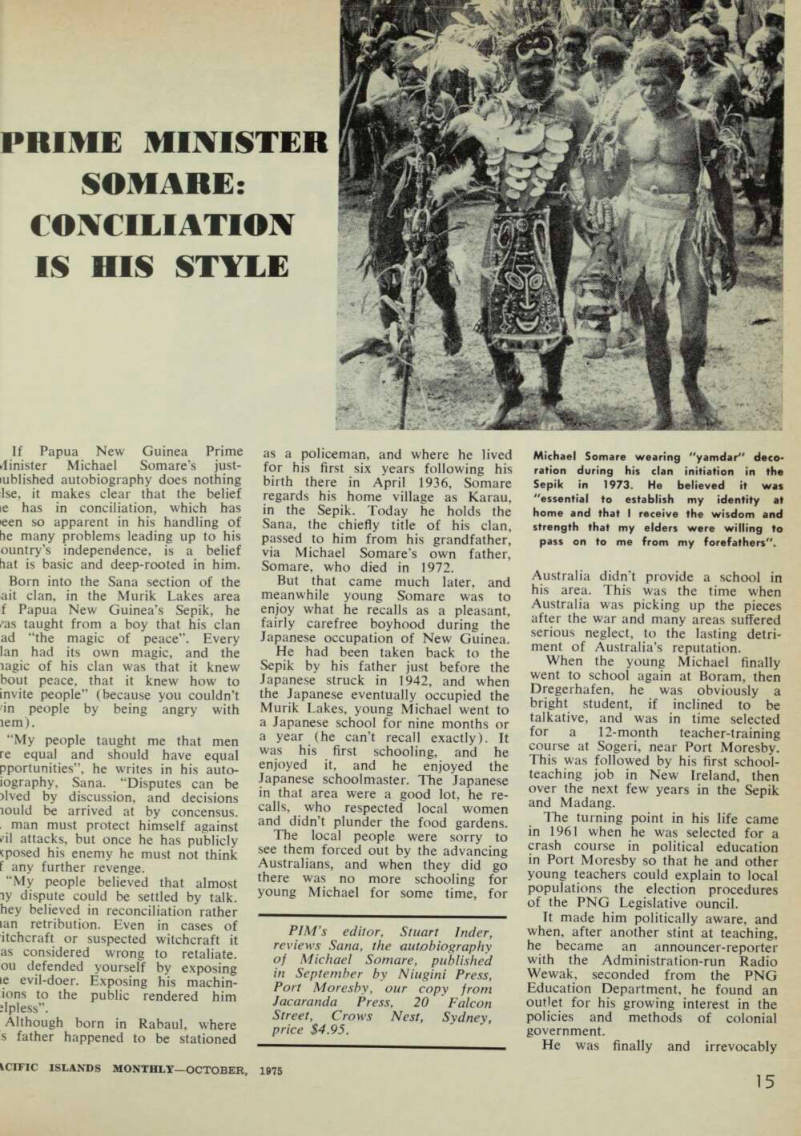
Michael Somare wearing "yamdar" deco ration during his clan initiation in the Sepik in 1973. He believed it was "essential to establish my identity at home and that I receive the wisdom and strength that my elders were willing to pass on to me from my forefathers".
activated the day that the then Minister for Territories, Mr C. E.
Barnes, froze the salary scales paid to local public servants (that is, tfiack public servants). It had been lecided by Australia that PNG ihould operate on a salary structure he emerging national government :ould afford in the future. From hen onwards, those given new ippointments as local public servants vere to receive salaries about half ff those currently being paid to xpatriates for the same job.
“This new rule angered all of us”, ie writes. “There was probably no •ther single issue that made Papua tew Guineans more aware of the ijustices of colonialism”.
He comments: “I knew that some expatriates 'ere making a lot of money in our ountry. But they paid their employ es poorly. In all towns Europeans the best land for themselves i so-called ‘high covenant’ areas, apua New Guineans were isolated i their poorly built compounds, /ith the new salary scheme it be ime practically impossible for any apua New Guinean to move into tie of the more comfortable houses.
“I was on the old public service ilary and was therefore able to live i a good flat. But when the salary ljustment came, those who were nployed after me, and who were 'ten better educated than I. found impossible to afford this kind of xommodation. I did not think this as good enough, I became angrier id angrier and spoke out very loudly that time.
“The government did not like it all, and I became very unpopular ith them. My boss wrote several tiers of complaint to Port Moresby, e said that each time I read the ws there were political overtones it. This was correct, of course, it I did not think that, at that time the history of our country, a civil rvant should keep out of politics”.
His sense of anger grew after he is sent to the Administrative Col te in Port Moresby to do a matri lation course, for there he met my like-minded Papua New iineans such as Albert Maori Kiki, ivera Rea, Jack Karakuru and Ebia ewale (who was president of the idents Representative Council at ! Port Moresby Teachers’ College), mare records that at the college ly had the advantage of “some Islanding teachers”, such as David lenoweth, “Tos” Barnett, Cecil >el Ted Wolfers, to whom, he fs “all of us owe a great deal”.
There, the like-minded people -med The Bully Beef Club, an in
formal study group to inform them selves on political affairs.
That early group made Albert’s house (he is now Sir Maori Kiki, PNG Minister for Foreign Affairs) the breeding ground for politics.
“Sometimes we were late for classes because we had spent the whole night arguing”, he admits. ‘Often we did not finish our assign ments”.
The “Special Branch”—that rather inept organisation sponsored by the Australian Government which had the job of keeping an eye on poten tial trouble-makers, took an interest in their affairs.
“There were very few educated Papua New Guineans then”, he re calls. “Only a few of us could see and understand what was actually happening, and it was our duty to tell the people”.
So back in Wewak again on his radio job he continued, deliberately, to speak up against what he regarded as injustice and to be heartily in volved in union affairs, until his de partmental chief decided to bring him back to Port Moresby, where they could “keep an eye on him”.
So they “promoted him” to a new headquarters position, which under the new salary scale actually meant he had to take a salary cut!
He says now that in more ways than one it was the best thing they could have done for him. He found himself in Port Moresby, in the
centre of political activity, at a time that the first PNG House of Assembly was on the boil and elec tions for the Second Assembly of 1968 were not far off.
He was soon up to his neck in politics, became one of the founders of the Pangu Party on June 13, 1967, and stood for his Sepik district on the Pangu ticket for the 1968 Assem bly, campaigning boldly for early self-government. He took his seat after a poll count which put him far ahead of his nearest rivals.
There is fascinating material in the autobiography on how the small group of Pangu party members laid the foundations in that second As sembly for the success they had in forming a government at the begin ning of the third House in 1972.
Pangu members rejected posts as assistant ministers, which they could have had, because they believed their long-term future lay in forming an effective opposition.
He gives us a detailed account of how, after the 1972 elections, he worked to form what is still today the National Coalition Government, and the first Independence govern ment. He was unopposed in the 1972 poll.
“When I look back on the form ation of the National Coalition”, he writes, “it seems that the one thing that worked significantly in our favour was the United Party’s over confidence that they would form the government, and their comparative inactivity in lobbying additional sup port”.
Pangu, despite its small numbers after the votes were counted, refused to concede the elections to the United Party and went out to enlist sympa thisers and to commit the yet un committed. It attracted the Mataun gans, the People’s Progress Party and Dr Guise’s independants and put to gether a saleable package.
This autobiography indeed reveals that one of Somare’s strengths has been his respect for priorities and for the grass roots of the problem.
Despite what might appear to be overwhelming odds he refuses to give up, and pushes through; if he can’t tackle the problem head-on he works it around the edges, using the old Sana magic!
Although the new Prime Minister takes his story almost up to the pre sent he does not give us the whole picture. There are some significant omissions. There are also signs of haste in the production of the final chapters (not really surprising con sidering the number of political prob lems he has had to deal with without having to produce an autobiography
on the side!) But his omissions are clearly not due to haste: there are some secrets he obviously intends to keep to himself in the present poli tical climate.
He does not hesitate to praise former Australian High Commissioner Les Johnson, or Rev Percy Chatter ton (“the expatriate member who was always ready to give us warm and intelligent support in the House . , . it will be a long time before people in this country forget Percy Chatterton, and I will always feel warm towards him”). There is nothing politically difficult about saying that now, but what are his feelings about Sir John Guise, now the Governor-General, and John Kaputin, the Justice Minister he sacked, and people like Leo Hannett, and Father John Momis (who “had always preached national unity”).
It would be interesting to know, for instance, whether Sir John Guise was created Governor-General as a result of a secret deal between Mr Somare and Dr Guise more than 12 months ago, which is what has been suggested elsewhere.
But these relationships are ob viously too recent and too close; they are continuing relationships, and
Prime Minister Somare has too much political sense to unburden himself in public on matters like these.
Presumably, we will have to wait until the Prime Minister becomes the elder statesman, and we can read his memoirs.
But, meanwhile, what does Papua New Guinea’s new Prime Minister think of the future, and the immedi ate political past? Here it is, in one of the last chapters of his most read able book: “The conflicts and tensions between various groups, sometimes moving them to the brink of secession, have been one of our most difficult prob lems. Like most other third world countries that have thrown off colonial rule and been faced with the problem of forging numerous language groups and cultural tradi tions into one nation state, we are faced with two options.
“We could create an all-powerful central government and force dissi dent groups to fall into line, using force if necessary. Our other option is to adopt a tolerant attitude to wards local interests and to recognise the existing variety of patterns.
“The first alternative is relatively \easy for a government willing to rely
on force. But it is highly undesirable because it means imposing on the people a way of life based on some abstract ideology that is alien to them. The government would neces sarily remain remote from the people.
“The second alternative is far more difficult, but it is the only way poss ible for this country. It is a difficult way because the central government may often appear weak. It puts the central government into the awkward position of having to arbitrate con stantly between different local in terest groups and between different regions of the country.
“It involves the danger that, if the government cannot resolve the issues and local pressure groups become too strong, the country could fall apart. However, it is the wise way to take and the one congenial to our own conditions. It allows the govern ment to decentralise many of its powers. It enables people in the vill ages to make decisions on issues that are going to affect their lives directly.
It allows for a good deal of experi mentation with local government structures, and the government is in a position to accept and support pat terns of village government alterna tive to the Australian-introduced council system”.
Advertisements & other items, pp. 17-18 (2 items)
15
ICIFIC ISLANDS MONTHLY—OCTOBER, 1975
irrigation problem,the
Whatever your
ahswer is in here!
‘ : There are two ways you can get the benefit of Dunlop/IBC’s 86 years of experience in irrigation for all types of country: send for this free booklet, prepared by our irrigation experts; or call your local Dunlop/IBC branch, and speak to the experts yourself!
Either way you’ll benefit from the advice and assistance of a company that’s long been leader in irrigation. With Australia’s largest range of pumping, water handling, and water conditioning equipment.
Post the coupon now. Or call!
The sooner you do, the quicker you’ll reap the benefit. i
ion
I mm
FREE 12 page booklet from:
I
DUNLOP
send me free Irrigation Booklet
NAME:...,
QLD.: Dunlop/IBC Ltd., Station Road, Yeerongpilly, 4105. Phone 40 9011.
VIC.: 795 Springvale Road, Muigrave, 3170. Phone 560 6222.
S.A.: 98 Churchill Road, Prospect, 5082. Ph0ne446944.
ADDRESS:
indicate If for school project □' N.S.W. Distributors: Flexhide TAS.: J.S.W. Products, Pty. Ltd., 536 Botany Road, Alexandria, 2015. Phone 699 8444. 990-994 Hunter Street, Newcastle, 2302. Phone 691688. 186 Charles Street, Launceston, 7250. Phone 25 312.
W.A.: Westralian Farmers Co-Op. Ltd., Railway Parade, Bassendean, 6054. Phone 79 1671.
L8Q1717
That Special
Touch
A continuing theme in Prime Minister Michael Somare’s autobiography is his regard for the country’s artistic heritage.
He tells how on one occasion he gave an angry dressing down to a missionary who destroyed an artifact. He said some Murik villages had been com pletely pillaged, their festivals had ceased, their initiations dis continued, their sacred works of art, burnt or stolen or sold.
He said he had consistently encouraged elders to keep up the ceremonies, to protect and preserve PNG’s heritage.
“We do not wish to become a nation of black Australians.
Only if we learn to understand the value of cultures will we be able to bring to the task of modern nation building that special touch that will allow us to build a unique country”.
Advertisements & other items, pp. 19-20 (2 items)
17
CIFIC ISLANDS MONTHLY-OCTOBER, 1975
40% of the banking business
Do you want to do business in New Zealand ?
Ask the bank which has
in New Zealand
The BNZ can give you full information on buying or selling in New Zealand and overseas. Full information on investment movement of money, transfers of dividends etc., is also readily available.
There are offices everywhere, more than 400 in fact.
Whatever your financial or trade needs, the BNZ can help you.
Wellington-International Division, Box 2392.
Sydney-GPO Box 507, Sydney, N.S.W. 2001.
Melbourne-GPO Box 528 E, Melbourne, Vic. 3001.
Tokyo - M r G. Scott, Bank of New Zealand Representative Office, Japan. Suite 240, New Tokyo Bldg, 3-1,3-Chrome, Marunouchi, Chiyoda-ku, Tokyo 100.
Singapore - Mr R. F. Warren, Bank of New Zealand Representative Office, South East Asia. 4th Floor, Ramayana 81dg,45/47D, Robinson Rd, Singapore.
London - PO Box 402, London EC4.
Fiji - 25 Victoria Parade. Also at Labasa, Lautoka, Nadi, Sigatpka, Ba.
HH Bank of New Zealand
identity
New nation searches for its identity
From LEE McKENZIE in Port Moresby
It pays to be choosy when only the est will do. That goes double for *apua New Guinea searching along lany different roads for a national lentity and the marks of unity. Its ;aders think a new name, a national nthem and a national dress will help.
Which is one reason why the National Broadcasting Commission’s udience has been bombarded for 'eeks with the five “finalists” in the ational anthem competition.
This daily airing was not a good lea. Comment was unfavourable.
Funereal and depressing”, “mis onary hymns”, “colonial and dull”, un-Melanesian” were some of the riticisms. The judges retorted, “These nthems need to be played and under ood overseas, it’s no good using istruments native only to PNG,” to istify their choices. “Would the rench translate their Marseillaise?” ueried one critic. The “forlorn five” m a poor second to the widely tiown and used song Papua.
Anyone who heard the broadcast om the South Pacific Games in iuam featuring the PNG women’s asketball team’s lusty, proud ren ition of Papua, would stick to this > a “winner”.
Despite its strong Papuan flavour, national theme could be added with ;veral language versions.
So PNG’s anthem competition ap -ars to have suffered the same fate > the Australian brave try—to re tain dormant, if not moribund.
That old perennial showed up, a jw name for that unwieldy inherit ice “Papua New Guinea”. Since te 60s names like Pagini and Para
disea have been bandied about. The ruling political party grabbed one contender, “Pangu”, first.
One loyal public servant proposed “Somare” after Mr Somare. His idea was rubbished as too like Somaliland or smacking of dictatorships. So the old handle stuck for the time being.
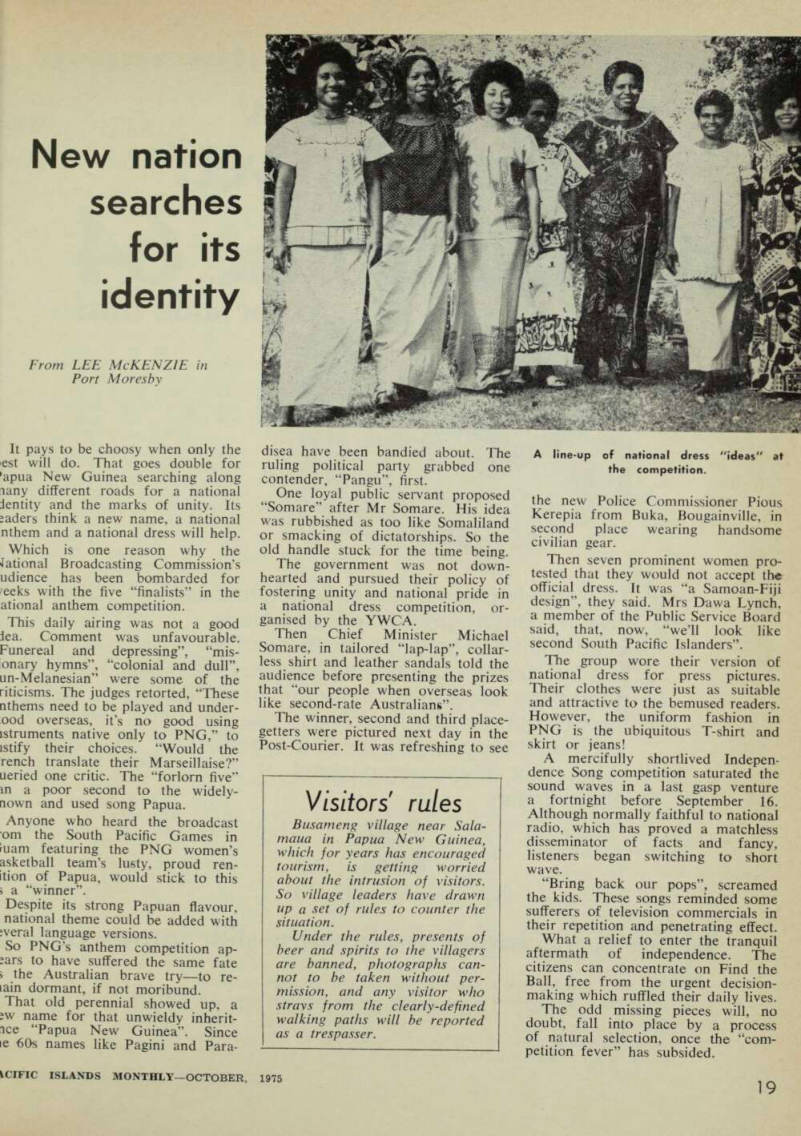
The government was not down hearted and pursued their policy of fostering unity and national pride in a national dress competition, or ganised by the YWCA.
Then Chief Minister Michael Somare, in tailored “lap-lap”, collar less shirt and leather sandals told the audience before presenting the prizes that “our people when overseas look like second-rate Australians”.
The winner, second and third place getters were pictured next day in the Post-Courier. It was refreshing to see
the new Police Commissioner Pious Kerepia from Buka, Bougainville, in second place wearing handsome civilian gear.
Then seven prominent women pro tested that they would not accept the official dress. It was “a Samoan-Fiji design”, they said. Mrs Dawa Lynch, a member of the Public Service Board said, that, now, “we’ll look like second South Pacific Islanders”.
The group wore their version of national dress for press pictures.
Their clothes were just as suitable and attractive to the bemused readers.
However, the uniform fashion in PNG is the übiquitous T-shirt and skirt or jeans!
A mercifully shortlived Indepen dence Song competition saturated the sound waves in a last gasp venture a fortnight before September 16.
Although normally faithful to national radio, which has proved a matchless disseminator of facts and fancy, listeners began switching to short wave.
“Bring back our pops”, screamed the kids. These songs reminded some sufferers of television commercials in their repetition and penetrating effect.
What a relief to enter the tranquil aftermath of independence. The citizens can concentrate on Find the Ball, free from the urgent decision making which ruffled their daily lives.
The odd missing pieces will, no doubt, fall into place by a process of natural selection, once the “com petition fever” has subsided.
A line-up of national dress "ideas" at the competition.
Visitors' rules
Busameng village near Sala maua in Papua New Guinea, which for years has encouraged tourism, is getting worried about the intrusion of visitors.
So village leaders have drawn up a set of rules to counter the situation.
Under the rules, presents of beer and spirits to the villagers are banned, photographs can not to be taken without per mission, and any visitor who strays from the clearly-defined walking paths will be reported as a trespasser.
Advertisements & other items, pp. 21-22 (2 items)
Kcific Islands Monthly—October, 1975
Kodachrome 64
Tiied die new
Kodak film yet?
color slide film
36? kb!?!
This new film has a new emulsion that will give you bright greens, reds and blues.
In addition you have the flexibility of a fast film rating (ASA 64) to help you take good color shots even under dull or difficult light conditions. Try it soon and see the difference for yourself. It’s in the familiar yellow box, at your local island photo dealer.
KODAK (Australasia) PTY. LTD.
Ask for Kodachrome 64 film-the slide improver •Available in sizes to fit 135,126 and 110 size cameras.
"Kodak" and are registered trademarks of KODAK (Australasia) PTY. LTD, K6l 4948
Meanwhile... in other Islands


Geic Governor
Hits At Britain
The Governor of the Gilbert and illice Islands, Mr John Hilary ►mith, recently brought a touch of ealism to the, so-far, rather one-sided rgument about self-government for he Banabans on Ocean Island. At a ress conference in London he lashed ut at his employer, the UK Govern lent, for failing to attempt a refut tion of the Banabans’ arguments.
Mr Smith, setting the record raight, confessed he was on the de of the GEIC administration in le argument. And he said in plain ords that he did not think Ocean ;land had much of a future once 1 the phosphate was mined in the jxt two or three years.
Once all the phosphate was mined, cean Island would be uninhabitable, ; said. “There was no water; water id to be shipped in by British losphate Commission ships. There as no anchorage, and the GEIC [ministration could never afford to aintain ship moorings.
“In fact, it is rather miserable”, ' said. There was no water; water ! but about 100 of the Banabans and left. They could not get out fast ough”.
Mr Smith explained that the Bana ns did very nicely out of royalties >m Ocean Island phosphate. They rsonally received 15 per cent of phosphate proceeds, plus land its and tonnage royalties.
Out of the latest budget of sl9 llion for the GEIC, sls million s to come from phosphate revenue, e GEIC expects to get SSO million •m phosphate in the next two years : ore deposits are exhausted. If the nabans got that money, the rest of GEIC people would suffer great 'dship.
Vlr Ted Rowlands, Under-Secretary
State at the Foreign and Common alth Office, was in the GEIC in ffember. But his government is efully keeping out of the argument, ing any independence question is sly one for the GEIC Government, ich has rejected the Banabans’ im.
Tie second phase in the multi lion dollar action brought by the rabans against the British Phos te Commissioners is expected to t in the High Court in London
in November before Mr Justice Megarry.
Mr Justice Megarry has heard evi dence and addresses on the first claim, for between $5 million and $lO million, sought by the Banabans, who alleged that the BPC on Ocean Island, failed to replant mined land, and mined unleased land.
He then adjourned the hearing so that he could visit Ocean Island. This was on the 66th day of the hearing.
The suggestion that the judge visit the island was first proposed in April, but was opposed by the BPC and the British Government, on the grounds that the advantage would be out weighed by the disadvantage in costs (estimated at about $400,000) and delay to the hearing. The judge may also visit Rabi Island in Fiji where the Banabans were resettled.
Happy Days
For Norfolk?
The Royal Commission, which is being conducted by Australian judge Sir John Nimmo into the future status of Norfolk Island, is unearth ing an assortment of facts, many un connected. One hints that the island may have a prosperous future; that it is sitting on a tremendous reser voir of fresh water and that there may be oil in sedimentary beds off the east coast.
A witness, retired oil engineer Mr Gordon C. Duvall, of Cascade, told Sir John that near sea-level there appeared to be a thick, water saturated zone holding very consider able quantities of fresh water. The amount had not been calculated, but 64 inches of rain recorded in 1974 would produce thousands of millions of gallons of fresh water. Mr Duvall, who also said there could be oil in sedimentary beds off the island’s east coast, added that Norfolk had been part of the continent of Gondawana land, which existed 200 million years ago but broke up.
Another fact which emerged was the “completely intolerable” tax bur den being carried by Burns Philp according to the company’s financial adviser, Mr H. L. Thomas, who said the amount of tax demanded from the firm jeopardised the future of its trading activities on the island.
Because of various taxes stemming from the 1973 Income Tax Act,
Burns Philp was assessed at 82.6 per cent of its profit from its island trad ing in 1973, 75.4 per cent in 1974 and the 1975 assessment would be more than 70 per cent.
After tracing the history of the company on the island, since its ships first started trading there in 1895, Mr Thomas said represent ations to the Taxation Department had drawn the comment that the company was an unfortunate casualty of an act designed to plug a loophole exploited by other companies.
Mr Thomas also said the Taxation Department has not taken advantage of its powers of discretion, except to make the company pay the highest possible taxation. The Australian company tax of 45 per cent (reduced to 42 J per cent in the latest budget) made a reasonable profit doubtful.
There was also a withholding tax of 30 per cent from any dividends paid.
That Norfolk Island, with local self-government, would best be served by remaining a territory of Australia, was the view of the retiring Administrator, Air-Commodore E.
T. Pickerd.
Air-Commodore Pickerd, wearing his “private” hat, said in evidence that the present constitutional relationship with Australia should be preserved, but modified to provide for a Norfolk Island Executive Council. That council would adminis ter the island for the Australian Government. There was a need for evolutionary change to meet current social and economic conditions for the next decade.
At present, Norfolk Island was experiencing dynamic changes in most facets covered by the commis sion’s terms of reference. Some of those changes would need to be de veloped, others accommodated and many needed to be stilled. But all should be subject to codified control, preferably by local legislation, Air- Commodore Pickerd said. • The Royal Commission expects to hear evidence from a number of Australian Government departments and about 20 private individuals and organisations at a sitting scheduled to start in Canberra early in October.
Late in August, the Royal Com missioner and his staff, left Norfolk Island for about 10 weeks. Tran scripts of evidence given in Canberra will be flown to Norfolk Island. Sir John Nimmo will probably return to Norfolk Island later this year to hear further evidence.
Ghost' Walks
In Pago Pago
From FELISE VA’A in Pago Pago On October 19, 1974, NBC-TV telecast a programme on American Samoa as part of its new “Weekend” series. According to many witnesses, who viewed the programme here, the programme tended to derogate the status of the territory as well as Governor John Haydon, who left American Samoa in October, 1974, Whether NBC deliberately planned to slander the governor and his ad ministration, as Governor Haydon maintained in a subsequent complaint to the National News Council of the United States, is, as the council put it, a moot point.
In its written decision regarding the governor’s complaint, the council stated: “We do not find or imply that Governor Haydon’s administra tion of Samoa, or the entire Ameri can presence there, has been bene ficial, or otherwise. There are clearly various opinions on both questions”.
However, the council found suf ficient evidence to conclude that the “distortions and misrepresentations (in the NBC programme) go well beyond any that could be justified under the rubric of robust journal ism”.
And to that extent the council found that Governor Haydon’s com plaint against the programme was justified.
In his complaint to the council, Haydon claimed the NBC film was viciously slanted and untrue.
The film’s “consistent and deli berate use of erroneous material makes it appear obvious that the producer and NBC came to Ameri can Samoa to make a film that would be controversial and would serve to give their new ‘Weekend’ series a good kickoff”, Mr Haydon said.
As a result of the complaint, the council viewed the controversial film and held a public hearing at which expert testimony was taken from the famed anthropologist on Samoa, Dr Margaret Mead, and from many other government and ex-government officials who had worked in Ameri can Samoa.
Then it came out with a decision stating that “a television producer is not required, in producing a docu mentary, to meet the test of absolute fairness”.
“Under the principles of free
speech, the council believes he is en titled to very considerable latitude in determining which facts he will stress and which he will play down or to tally ignore”, the decision stated.
“The result may not be altogether fair, balanced or dispassionate, but the disadvantages of what is often described as robust journalism are surely preferable to any attempt to suggest a standard that is probably unattainable in any case.
“We must, and do, have confidence that a free interplay of biased views is likelier to produce effective guid ance than a determined effort to compel adherence to a highly hypo thetical objectivity”, the decision stated.
The council, however, was of the opinion that “while great latitude must be accorded to television pro ducers . . . that is not to say that there is not, or ought not to be, a limit to the degree of distortion and misrepresentation that a producer can indulge in”.
The council was of the firm be lief that the NBC documentary on Samoa “clearly exceeds that limit”.
One of the major instances of mis representation pointed out by the council involved a comparison of American Samoa and Western Samoa.
Western Samoa, the council deci sion states, “has 10 times the area, and is capable of sustaining itself economically”.
“Political and economic solutions perfectly suited to Western Samoa are simply not applicable to Ameri can Samoa, according to expert after expert, and the documentary’s clear implication to the contrary is seri ously misleading”, the decision stated.
The council pointed out that it was not the comparison with Western Samoa or any other single assertion in the documentary that led to the conclusion. It was the overall effect of a series of distortions and mis representations in the production, writing and editing, “effectively con tradicted by impressive witnesses”.
NBC declined an invitation from the council to take part in the public hearing. Its reply was: “NBC News is interested in maintaining standards of fairness and objectivity; but NBC News does not believe that any pur pose is served by debating comments such as those made by Mr Haydon except before the Federal Communi cations Commission, to which NBC, as a licensee, is accountable”.
Though it is now a year since he left the territory, John Haydon’s ghost still haunts the place.
Time-Table For
Solomons 'Day'
The Solomon Islands government has drawn up a tentative time-table which will lead to independence in July or August, 1977. First step is internal self-government on Novem ber 1, followed by a general election about the middle of 1976. This will be followed by a constitutional con ference in London, attended by mem bers of the Legislative Assembly, about November, 1976.
The Legislative Assembly has set up a constitutional committee to settle details of the government when the country becomes independent. (See earlier report, page 37). The committee will aim at planning the “best kind of national government to suit the country” and be accepted by the Solomon Islanders; how to guarantee powers to local councils, and how best to to smooth the path to independence. The constitution is expected to reflect traditional values, and say how to protect the country against individual or group mono poly of power.
Not everyone is in favour of a general election about mid-1976.
During the August session of the Legislative Assembly, Mr Ashley Wickham moved that a general elec tion be held within five months. He claimed the people had lost con fidence in the government; some in the public service were disillusioned and were resigning.
Although the people generally accepted the idea of self-government, they feared independence and would not accept it. The government should go to the people.
Another difficulty ahead of the government is in the Western District, which has threatened to fly its own flag if the government approves the present design. The Western Council, meeting at Gizo, described the frigate bird and the golden chain design as meaningless, and not a true picture of the Solomons.
The councillors preferred a design by a schoolboy, Eddie Daiding. This showed six stars for the six councils, and the Solomons coat of arms for the four districts. The coat of arms truly showed the background and cultures of all the Solomons people, they argued.
Meanwhile, despite a visit from Bougainville’s leading secessionists, Mr Mamaloni and his government maintain a strict neutrality, the Chief Minister having, reportedly said he left it to Somare and Bou gainville.
Exodus From
The Solomons
Coming independence in the Solo mon Islands and a wish to get a better education for their children, are the main reasons behind an exodus of Chinese from the country. About 200 have left in the last four years, and another 60 are preparing to go. Most of the Chinese go to relatives in Aus tralia, Canada and the US. Mr Stephen Yee, chairman of the Chinese Association said other reasons were a lack of benefits for elderly people, strong competition from local busi ness and the attitude of some Solo mon Islanders to Chinese people.
“Politically, it is not very favourable for Chinese people here,” he said.
Mr Yee, however, was at odds with the Solomons Chinese Association, which said it had full confidence in the government. The association felt sure there would be many Chinese remaining, who would continue to be loyal to the Solomons. It was true that Chinese had been discredited and discriminated against in some ways, but they had continued to help in developing the country.
The association wants to establish closer relationships and better under standing with the government and all sections of the community.
Statements made by some Chinese as individuals had been misinterpreted and had misled the public, the asso ciation said.
The Permanent Secretary for Edu cation and Cultural Affairs, Mr Francis Bugotu, commenting on allegations about discrimination against Chinese in the schools, said the education opportunities were the same for all Solomon Islanders.
Big Job For
Mr. Du Boulay
Mr Roger du Boulay, British Resi dent Commissioner in the New Hebrides, has been appointed the Queen’s Vice-Marshal of the Dip lomatic Corps, responsible for the organisation and smooth running of the Court of St James. At the same time he will be in charge of the pro tocol and ceremonial department of the Foreign and Commonwealth Office, which deals with all matters of protocol and ceremonial connected with royal matters and royal visits, and with the privileges and immuni ties of the Diplomatic Corps. This department also deals with the organ isation of ministerial conferences in Britain, and all visits abroad by British ministers.
Advertisements & other items, pp. 23-26 (2 items)
21
IFIC ISLANDS MONTHLY—OCTOBER, 1975
nshin*
-1 * . i ■ *r, ( f Why not give them Instant Sunshine Milk?
It dissolves in seconds to make rich,creamy milk that has essential vitamins A & D, plus Calcium-just like fresh milk
Instant Sunshine
dissolves in seconds
Nestle
nshin*
vcv O
I IICTA
TURNS GRASS INTO LAWN
\ lity UT
UTILITY 160
THE “WORK HORSE” OF THE
VICTA RANGE
SUPER 24
THE BIG MOWER FOR
BIG AREAS
The big mower from Victa. It takes a full 61 cm wide bite into and cuts a smooth swath over large expanses of grass. It is the mower for municipal parks and gardens, sports grounds, road-side growth control as well as home owners with large areas of land. The lightweight construction of the mower makes it easy to manoeuvre and the giant rear wheels ride rough ground effortlessly. Two freeswinging blades on the cutting disc absorb shock when hard objects are encountered.
A tough but lightweight mower without grasscatcher, a model designed to do a superb grasscutting job—on meadows full of weeds or on a fine lawn. It cuts up to trees and fences and is the lightest Victa mower of all to use. Available with either a 125 c.c. Victa 2-stroke engine or with the Victa 160 c.c. 2-stroke engine— Folding handle and single-lever simultaneous height adjustment are other features that make this lowest priced VICTA a popular mower.
iip up & away
with...KSS
Tahiti’S Fete Shines Again
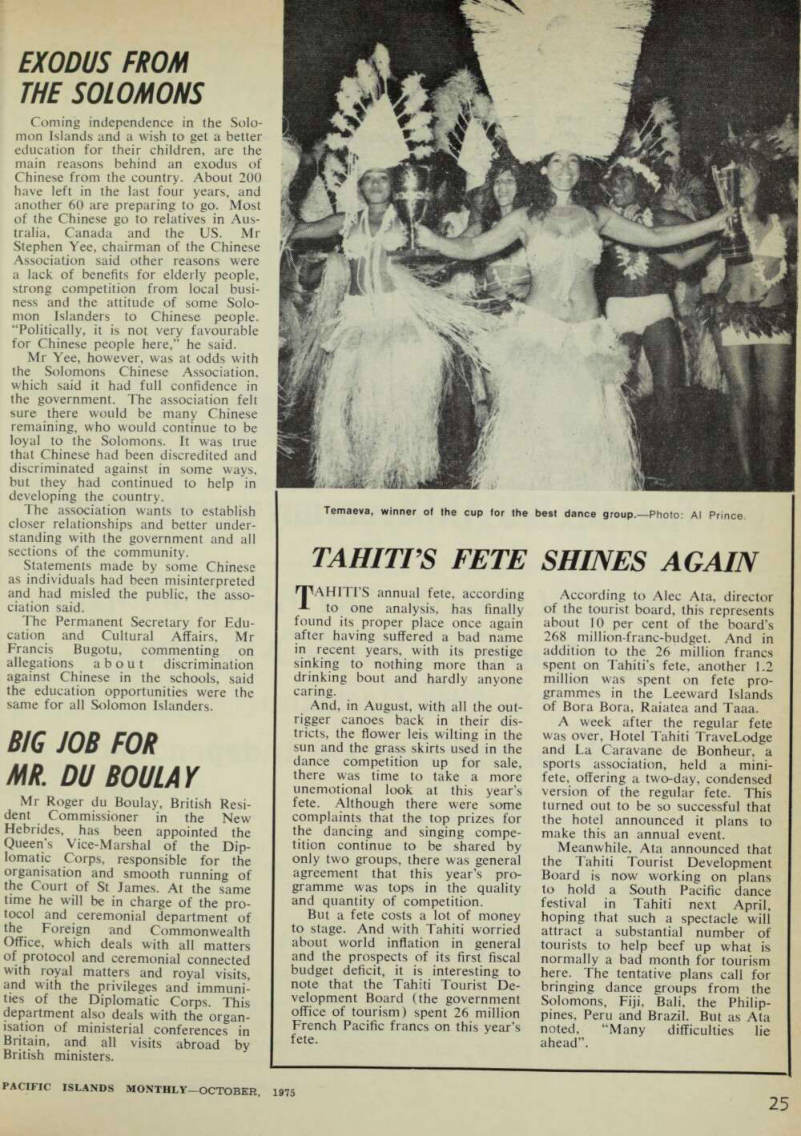
HP A HITES annual fete, according to one analysis, has finally found its proper place once again after having suffered a bad name in recent years, with its prestige sinking to nothing more than a drinking bout and hardly anyone caring.
And, in August, with all the outrigger canoes back in their districts, the flower leis wilting in the sun and the grass skirts used in the dance competition up for sale, there was time to take a more unemotional look at this year’s fete. Although there were some complaints that the top prizes for the dancing and singing compethion continue to be shared by only two groups, there was general agreement that this year’s programme was tops in the quality and quantity of competition.
But a fete costs a lot of money to stage. And with Tahiti worried about world inflation in general and the prospects of its first fiscal budget deficit, it is interesting to note that the Tahiti Tourist Development Board (the government office of tourism) spent 26 million French Pacific francs on this year’s fet e-
According to Alec Ata, director of the tourist board, this represents about 10 per cent of the board’s 268 million-franc-budget. And in addition to the 26 million francs spent on Tahiti’s fete, another 1.2 million was spent on fete pro grammes in the Leeward Islands of Bora Bora, Raiatea and Taaa.
A week after the regular fete was over, Hotel Tahiti TraveLodge and La Caravane de Bonheur, a sports association, held a mini fete, offering a two-day, condensed version of the regular fete. This turned out to be so successful that the hotel announced it plans to make this an annual event, Meanwhile, Ata announced that the Tahiti Tourist Development Board is now working on plans to hold a South Pacific dance festival in Tahiti next April, hoping that such a spectacle will attract a substantial number of tourists to help beef up what is normally a bad month for tourism here. The tentative plans call for bringing dance groups from the Solomons, Fiji, Bali, the Philip pines, Peru and Brazil. But as Ata noted, “Many difficulties lie ahead’’.
Temaeva, winner of the cup for the best dance group. Photo: Al Prince.
Advertisements & other items, p. 28 (1 item)
Feel Free. ”
fmtr %«
BACARDI
9Sp*i4*
SACARDI A Cat^l
i /»*
Feel Free. ”
CONGRATULATION And BEST WISHES
To The People Of Papua New Guinea On The Occasion Of The Proclamation Of Independence We are conducting exploration and researches in prospecting of oil and gas. We expect to contribute greatly toward the prosperity of you and your country through this enterprise.
PNG PETROLEUM CO., LTD.
No. 11 MORI BUILDING, 11 AKEFUNECHO, SHIBA-NISHIKUBO, MINATO-KU, TOKYO. JAPAN
P.N.G. PETROLEUM PTY., LTD.
BOROKO SQUASH ARCADE, HUBERT MURRAY HIGHWAY, BOROKO, PAPUA, NEW GUINEA
Tropicalities

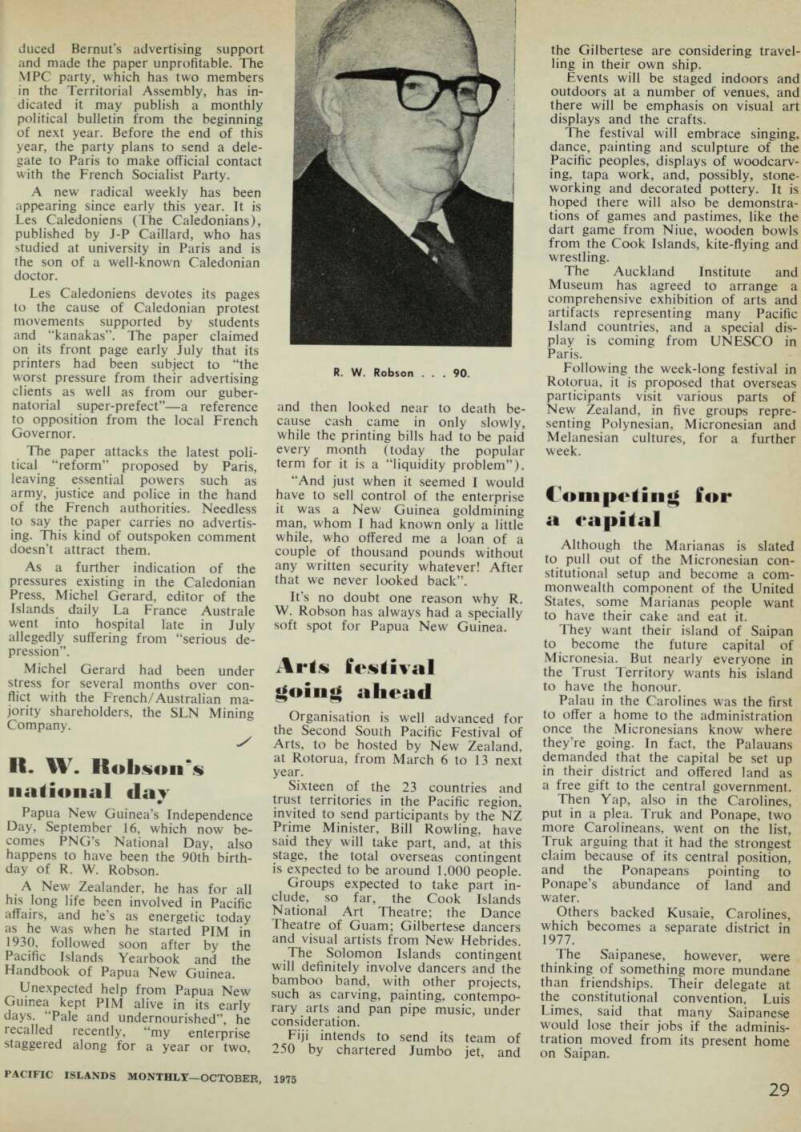
Rich soak
the poor
“A classic example of the rich people getting richer at the expense of the poor people,” said Micronesia Congressman Herman R. Guerrero in Saipan around the middle of August, But the congressman wasn’t talk ing about money. He was talking about water, lots of it, which, he said, was flooding the houses of the people on Saipan.
He blamed the new, luxurious Continental Hotel for the flood, alleging that in the current rainy season rainwater was flowing from the hotel’s car-park and into the houses on a nearby estate.
Mr Guerrero said the water col lected on the hotel roof and then ran off on to the car-park. There had never been similar flooding before the hotel was built.
Another hotel, the Inter-Continental, which is nearing completion nearby, might cause more flooding, the con gressman suggested and complained, “While the rich owners of the Con tinental Hotel are sitting high and dry, its neighbouring poor are suffer ing, low and wet”.
Artist gives
PAG ‘the bird’
An Australian artist producing a bird of paradise fountain for Papua New Guinea Independence cut his working design into pieces and freighted the pieces to Brisbane to wards the end of August.
His action was the climax to a controversy which arose because an Australian instead of a Papua New Guinea national was designing the fountain. The artist, Mr Hal Holman, of Port Moresby, said “I’ve cut up the bird with a hacksaw. He’s dead, and wrapped up in an eight-foot bundle, and as far as Papua New Guinea is concerned he stays dead and finished”.
Mr Holman plans eventually to
reassemble the design model, which has already been exhibited in Port Moresby, and will attempt to attract interest from tourist and civic authorities in Queensland.
He said “a great fuss” was made of the fact that Papua New Guinea was the home of the bird of para dise, but Queensland had two species of its own. For that reason he be lieved there would be Queensland interest in his design.
Mr Holman, who formerly worked for the PNG Government, initiated the idea of the fountain and sub mitted his plan to Cabinet which approved the design, and at least $40,000 towards the cost was pro mised in public support—mainly from the PNG Chinese community.
The final design was to have been in bronze or stainless steel, 35 ft high, and with streams of water lit from below forming the bird’s plumes.
Mr Holman said the project had ground to a halt because of the public controversy and because of some “white-inspired jealousies”.
Song and dance
in the Cooks
The 10th anniversary of self government in the Cook Islands was a gay affair, particularly in Raro tonga which was crowded with visitors. A clean town, if you can call the business centre a town, gar dens and orchards in full bloom pro vided an appropriate backdrop.
There was a week of song and dance. Teams from the various islands competed for two major prizes—the Duke of Edinburgh Cup for the outright winner of the High School events and the Air-NZ Trophy for the winner of the senior events.
Tereora College won the Duke’s cup, and Manihiki Island the Air-NZ trophy.
The Cook Islands National Art Theatre, formed in 1969, played a dominant role in the celebrations. It worked with the various clubs, en couraging them to perform traditional numbers of a high standard. The efforts of the performers, and the re ception given them by the big crowds, left no doubt that CINAT has done a remarkable job since its formation.
Fiji model
of independence
A film on Fiji’s independence cele brations in 1970, which has beer screened in many countries, helped tc allay the fears of Papuans that inde pendence for Papua New Guinea would bring war between expatriates.
Papuans and New Guineans.
After the film had been shown in Port Moresby and in many villages, a Central District Government liaison officer, Mrs Rosa Lailai said the people had been very surprised tc see that Independence Day was a time of festival and celebration, and not war.
“Many villagers had thought that there would be a big fight to chase all the expatriates away to gain inde pendence,” Mrs Lailai said.
“The people have told me that Miss Josephine Abaijah had said this sort of thing to them. However, they were very pleased to see Fiji’s indepen dence film showing people of dif ferent races, religions and cultures taking part in the celebrations to gether.
“It has taken away many of the people’s doubts and fears about inde pendence.”
French VIP
visitor soon
The French Ambassador to Aus tralia visited New Caledonia late July and called the Noumea press together to tell them that relations between France and Australia are now excellent, after the nuclear pro test era.
The ambassador, H. E. M. Treca, took up his Canberra post only two months previously and was on his way to Paris where he was expected to discuss plans for French Prime Minister Jacques Chirac to visit the South Pacific in November.
Mr Treca emphasised that a “page has been turned” and that trade be tween France and Australia is in creasing considerably. The ambassa dor felt Caledonian tourist revenue could be improved if less expensive accommodation was available for
Australian visitors in Noumea. The ambassador underlined the role of New Caledonia in creating a favour able impression for France in the Pacific, with cultural activities such as the summer schools each January for visiting Australian and New Zea land teachers.
Some articles in the Noumea press have continued to be hostile towards Australians. However a Noumea cor respondent believes Mr Treca’s re ference to the importance of growing French trade with Australia could alter this attitude.
The March visit to Australia and New Zealand of Mr Olivier Stirn, French Minister for Overseas Terri tories, underlined the fact that France is keenly interested in obtaining Australian uranium and in selling French aircraft and other goods to Australia and New Zealand. Mr Stirn also said that French Prime Minister Jacques Chirac intended to visit Australia and New Zealand this year.
Island nights
in NSW
The Country Women’s Association of New South Wales has gone all Island-conscious, an association cor respondent told PIM. Each year, the association studies a country. This year they chose the Islands, ferreted out all the information they could about them and then held an Island day to demonstrate and test their knowledge.
There was doll-dressing in Island costumes, with points for authenticity, a quiz and a display of Island dancing and singing. It all helps to foster friendship, but PIM has another sug gestion for the Country Women’s Association.
How about ending the year’s study with a whip-round for a donation to present to some needy cause in the Islands?
S
Voiv du Cagou
doses down
One of the Caledonians’ strongest critics of the French Administration has been subdued with the closure of a once-popular weekly newspaper, Alain Bernut’s Voix du Cagou. It was an organ of Bernut’s party in the Territorial Assembly, the Mouvement Populaire Caledonien, and it was started by Bernut when he was elected to the Territorial Assembly in July 1967 and left the weekly Journal Caledonien.
Most Caledonians are now weary of the autonomy struggle. This re
duced Bernut’s advertising support and made the paper unprofitable. The MPC party, which has two members in the Territorial Assembly, has in dicated it may publish a monthly political bulletin from the beginning of next year. Before the end of this year, the party plans to send a dele gate to Paris to make official contact with the French Socialist Party.
A new radical weekly has been appearing since early this year. It is Les Caledoniens (The Caledonians), published by J-P Caillard, who has studied at university in Paris and is the son of a well-known Caledonian doctor.
Les Caledoniens devotes its pages to the cause of Caledonian protest movements supported by students and “kanakas”. The paper claimed on its front page early July that its printers had been subject to “the worst pressure from their advertising clients as well as from our guber natorial super-prefect”—a reference to opposition from the local French Governor.
The paper attacks the latest poli tical “reform” proposed by Paris, leaving essential powers such as army, justice and police in the hand of the French authorities. Needless to say the paper carries no advertis ing. This kind of outspoken comment doesn’t attract them.
As a further indication of the pressures existing in the Caledonian Press, Michel Gerard, editor of the Islands daily La France Australe went into hospital late in July allegedly suffering from “serious de pression”.
Michel Gerard had been under stress for several months over con flict with the French/Australian ma jority shareholders, the SLN Mining Company. y
It. W. Robson’s
national dav
w Papua New Guinea’s Independence Day, September 16, which now be comes PNG’s National Day, also happens to have been the 90th birth day of R. W. Robson.
A New Zealander, he has for all his long life been involved in Pacific affairs, and he’s as energetic today as he was when he started PIM in 1930, followed soon after by the Pacific Islands Yearbook and the Handbook of Papua New Guinea.
Unexpected help from Papua New Guinea kept PIM alive in its early days. “Pale and undernourished”, he recalled recently, “my enterprise staggered along for a year or two,
and then looked near to death be cause cash came in only slowly, while the printing bills had to be paid every month (today the popular term for it is a “liquidity problem”).
“And just when it seemed I would have to sell control of the enterprise it was a New Guinea goldmining man, whom I had known only a little while, who offered me a loan of a couple of thousand pounds without any written security whatever! After that we never looked back”.
It’s no doubt one reason why R.
W. Robson has always had a specially soft spot for Papua New Guinea.
Arts festival
going ahead
Organisation is well advanced for the Second South Pacific Festival of Arts, to be hosted by New Zealand, at Rotorua, from March 6 to 13 next year.
Sixteen of the 23 countries and trust territories in the Pacific region, invited to send participants by the NZ Prime Minister, Bill Rowling, have said they will take part, and, at this stage, the total overseas contingent is expected to be around 1,000 people.
Groups expected to take part in clude, so far, the Cook Islands National Art Theatre; the Dance Theatre of Guam; Gilbertese dancers and visual artists from New Hebrides.
The Solomon Islands contingent will definitely involve dancers and the bamboo band, with other projects, such as carving, painting, contempo rary arts and pan pipe music, under consideration.
Fiji intends to send its team of 250 by chartered Jumbo jet, and
the Gilbertese are considering travel ling in their own ship.
Events will be staged indoors and outdoors at a number of venues, and there will be emphasis on visual art displays and the crafts.
The festival will embrace singing, dance, painting and sculpture of the Pacific peoples, displays of woodcarv ing, tapa work, and, possibly, stone working and decorated pottery. It is hoped there will also be demonstra tions of games and pastimes, like the dart game from Niue, wooden bowls from the Cook Islands, kite-flying and wrestling.
The Auckland Institute and Museum has agreed to arrange a comprehensive exhibition of arts and artifacts representing many Pacific Island countries, and a special dis play is coming from UNESCO in Paris.
Following the week-long festival in Rotorua, it is proposed that overseas participants visit various parts of New Zealand, in five groups repre senting Polynesian, Micronesian and Melanesian cultures, for a further week.
Competing for
a eapital
Although the Marianas is slated to pull out of the Micronesian con stitutional setup and become a com monwealth component of the United States, some Marianas people want to have their cake and eat it.
They want their island of Saipan to become the future capital of Micronesia. But nearly everyone in the Trust Territory wants his island to have the honour.
Palau in the Carolines was the first to offer a home to the administration once the Micronesians know where they’re going. In fact, the Palauans demanded that the capital be set up in their district and offered land as a free gift to the central government.
Then Yap, also in the Carolines, put in a plea. Truk and Ponape, two more Carolineans, went on the list, Truk arguing that it had the strongest claim because of its central position, and the Ponapeans pointing to Ponape’s abundance of land and water.
Others backed Kusaie, Carolines, which becomes a separate district in 1977.
The Saipanese, however, were thinking of something more mundane than friendships. Their delegate at the constitutional convention, Luis Limes, said that many Saipanese would lose their jobs if the adminis tration moved from its present home on Saipan.
R. W. Robson... 90.
Wonders for Your Skin
Modern Science can do Wonders for Your Skin
The beauty of your skin really begins down under the surface, where the tiny oil and moisture glands maintain a fine balance by releasing just the right amounts of natural fluids to nurture the complexion and keep it soft, supple and always with a youthful, radiant glow.
Early in life, nature supnlies these vital secretions in abundance. But with the passing years they slow down, and the complexion thirsts for oil and moisture to supplement the dwindling natural supplies. Without them the skin will soon lose its plumpness and resilience as tiny lines and other tell tale signs of age make a premature appearance.
Beauty secrets revealed Cosmetic chemists formulated a tropically moist oil blend with the remarkable ability to assist nature, by supplying never failing quantities of vital oil and moisture to the skin.
This important scientific break through is helping women all over the world achieve and maintain a youthfully smooth and radiant com plexion. The unique beautifying fluid is available from pharmacies here as Oil of Ulan. It quickly penetrates into the surface layer of the skin and merges readilv with the natural fluids, achieving the level necessary to main tain a soft, naturally beautiful com plexion.
To keep your complexion smooth and radiant, generously apply a film of Oil of Ulan over your face and neck every day. It is helpful to every type of complexion because as well as maintaining a balanced level of vital oils and moisture it also sets up an invisible film on the skin sur face to protect against harsh weather elements and the dehydrating effects of artificial air-conditioning. Used as you would a make-up base, Oil of Ulan moist oil blend not only beauti fies and helps protect the skin against wrinkle dryness, but ensures that your make-up smooths on easily and stays soft and matt. Stroked on again at night, paying special attention to the neck and chinline Oil of Ulan will nurture the skin all through the night while you sleep.
Skin care experts advise Every time you laugh, squint, grimace or smile, you stretch the delicate skin around your eyes. There fore this area is particularly prone to lines and wrinkle dryness and needs the gentle care of Oil of Ulan. This moist oil blend should be gently fingerprinted on, in an anti-clockwise motion starting from beneath the eyes and extended onto the temples. Oil of Ulan gently penetrates and helps restore the delicate oil and moisture balance which keeps the skin soft and beautifully smooth.
Advertisements & other items, p. 32 (1 item)
QantasJVustmlia’s airline
salutes FapuaNew Guinea
onlndependenceDay.
It’s a great occasion for both of us. Because your country and our airline have had a long association together.
During World War 11, our “biscuit Bombers” dropped food and supplies, and after the war, we helped set up your internal air network.
In 1967 Port Moresby became part of the Qantas international network. Then, in November 1973, we were there to help Air Niugini. After independence, our two airlines will together link Papua New Guinea and Australia.
On this your Independence Day, we wish you all the best. - - X m i « * V 'Cr ,;. f: .- v . ■ '■ : : vr s-AA 3 :; L 81.2611
The Editor's Mailbag

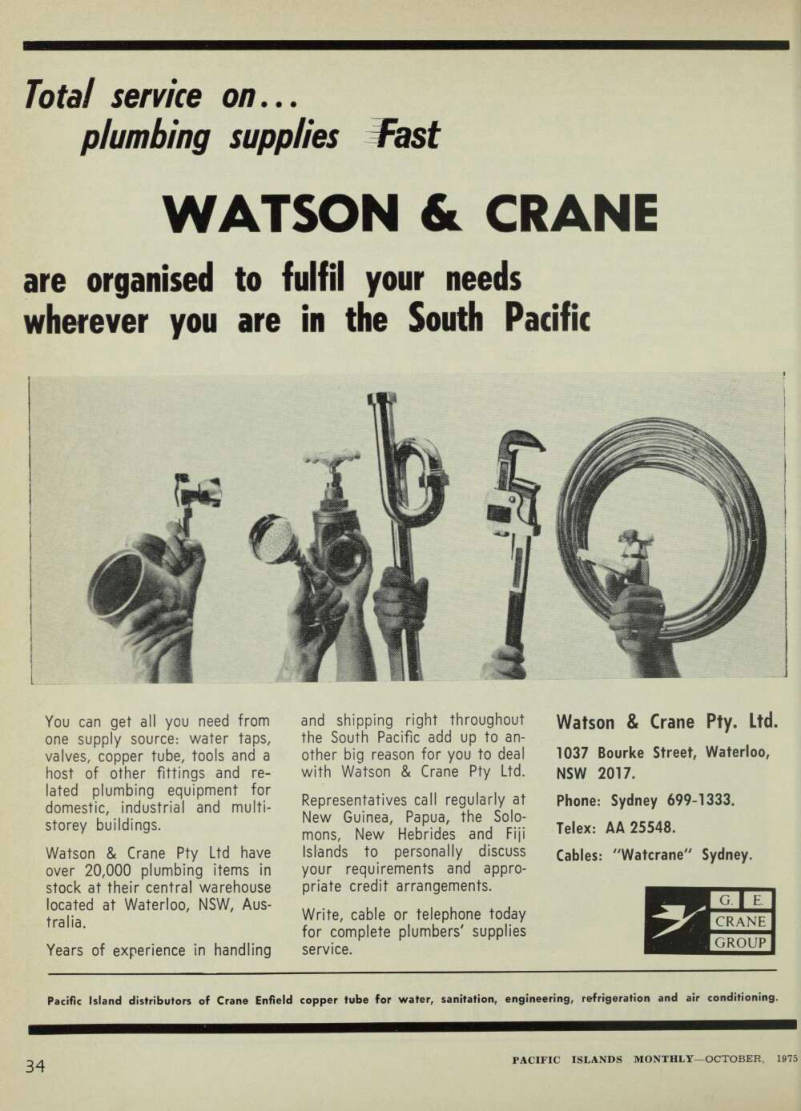
"The Church Is Wed"
I refer to Mr J. Garrett’s version 3f this year’s Assembly of the Presby erian Church of the New Hebrides leaded “Wooing the church in the Vew Hebrides with elections in mind”
PIM July).
Mr Garrett is not known to me but lis fabricated report shows clearly lis political bias towards the British \dministration and the New Hebrides National Party.
Mr Garrett in his quest for political mleage paid little attention to the acts. I would like to correct a few )f the errors in Mr Garrett’s report )efore showing my own political bias. 1. I attended the Assembly of the Vesbyterian Church as an observer or the Nagriamel movement who had a fact been invited by the assembly o attend. This was explained to the issembly. I did not explain to the issembly that I “was along to fill the issembly in on the recent land deals ti South Santo ...” 2. The details of the joint venture greement between Chief Buluk (not Puluk” as spelt by Mr Garrett) and local French company were only •rovided in response to a question rom the assemblv. 3. This “land deal” (as Mr Garrett •refers to call it) did not concern and in South Santo; it is land in the : anfo village area. 4. Mr Garrett’s article suggests ome clandestine reason for the pre ence of the two Resident Commis ioners at the assembly. In fact, the Resident Commissioners were also at he assembly in response to an invi ation from the Presbyterian Church. 5. The relevant land was not “ac uired from individual land proprie ors”. The land was in fact leased rom Chief Buluk who is recognised s the sole owner according to Cus om law. 6. Mr Garrett’s suggestion that many people are asking how much •f the money will flow on to the adividual family proprietors and iow much will remain in the hands •f a few at the top who sealed the leal” is below contempt. “The few t the top who sealed the deal” were he two parties to the agreement, r hief Buluk’s eldest son and the en ire Nagriamel committee. Their sig latures were witnessed by 10 Custom aw chiefs from surrounding islands.
The sealing of the deal” in fact ook place at a public meeting in
front of an estimated crowd of 4,000 people. The only cheque to change hands was handed by the writer to Chief Buluk and this represented the first year’s rental and the premium of the lease. I understand that this money has been applied for village com munity improvements.
Whether or not the Presbyterian Church ‘ stresses it is not officially for any one narty” in the New Heb rides is academic.
I would suggest that there simply is no room for “wooing the church in the New Hebrides”. So far as the Presbyterian Church is concerned, it is already firmly wed to the National Party.
If you do not accept this then look at the list of National Party candi dates for the elections; listen to a few sermons and ask the “man in the street” in Vila what church the National Party controls.
As a Presbyterian I was ashamed at this year’s assembly to see an elderly New Hebridean pastor literally shouted down by other politically minded clerics when he advocated that it was improper for the church to be involved in politics.
It seems of little concern to the Presbyterian Church that people are turning away from the church be cause of the political preachings of some of its younger pastors.
It is obvious from correspondence between the writer and the Presby terian Church in Australia that the New Hebrides Presbyterian Church has the full backing of the Australian church.
It is now openly admitted that the World Council of Churches contri butes handsomely to the funds of the National Party. It is understood that the other major contributor to the National Party’s funds is Tanzania.
I would suggest to the editor of Pacific Islands Monthly that if PIM wishes to retain its credibility for objective reporting it should insist that its various correspondents in the South Pacific provide their names.
Articles signed “Vila correspondent” are likely to be mistaken as a reflec tion of the editor’s views.
The “Vila correspondent” who has contributed generously to PIM over the last year is in fact an executive member of the National Party. The PIM coverage of New Hebrides poli tics over the past year has been dis tinctly one-sided and anti-French.
The largest political parties—Nagri
amel and UCNH—have barely been mentioned by PIM correspondents when dealing with New Hebrides poli tics. I notice that Mr Garrett did not even have the courtesy to men tion that the president of UCNH, Mr Remy Delaveuve, was present at the Presbyterian Assembly.
In the article headed “Perfidious Albion Again!” (also PIM July) your “Noumea correspondent” asserts that the French admit “the superior in fluence of the British over the in digenous people in the Condo minium”, I challenge your Noumean correspondent to provide his authority for this assertion. Perhaps he could also provide his name. Certainly, this “superior influence” is not obvious to the writer after living in the New Hebrides for four years.
David Curtis.
Vila, New Hebrides.
New Hebrides Land Laws
In order to have the Fleming papers on the subject of unifying land laws acceptable by both the British and French Governments, a lot of facts had to be omitted and covered up with what outsiders pre tend to think are the cause of resent ment and frustration among indigen
ous New Hebrideans over Custom lands and lands in general.
The Fleming report claims that the factors causing the above-mentioned feelings among New Hebrideans are: • Having no title to their land; • Not being able to participate to any great extent in land development, the potential of which has been ap parent over the past few years and, • They cannot borrow on the security of their land and therefore cannot enter into business arrange ments or partnerships involving de velopment schemes, using their regis tered land.
There is no mention of alienated land whatsoever. This is the true cause of resentment and frustration among New Hebrideans. However, it has to be left out deliberately as the Fleming papers would be rub bished should they ever have any thing to say about alienated land.
New Hebrideans are frustrated not for the reasons given in the Fleming report, but because they feel and know that their Custom lands are being unjustly alienated by outsiders.
Some scandalous measures adopted in alienating land in the New Heb rides are still being described in the Joint Court as just.
The awareness of injustice on land matters had, at times, initiated in
cidents such as destroying Ernest Young’s fence in Santo; disputing land with Peacock in Santo and Efate and barring the way of the French High Commissioner with a barrier of barbed wire and people with placards.
To produce a unified system on land matters acceptable to indigen ous folks would require re-examin ation of the judgments passed in the Joint Court. Often, these judgments were passed in favour of only one party while completely ignoring the other. Others seemed to have been influenced by outsiders.
Outsiders are pushing out New Hebridean owners of land by persu ading the Joint Court to pass judg ments in their favour and giving them the right to own what does not belong to them.
P. J. Roan.
Vila, New Hebrides.
Nauru House
The article by Melbourne column ist John Stevens (PIM, July, p 15) on the Nauru House office structure being erected in that city represents a typically nationalistic viewpoint prevalent throughout the world, especially in the attitudes of the big and powerful states towards those
Letters
that are small, weak, and almost in variably populated by dark-skinned races.
This country is one of the worst offenders in this respect.
To refute the inference that this development is an exploitation of the Australian people, let’s look at the balance sheet.
Nauruan benefit: • Rental income from office and store spaces (less four floors for their own use).
Australian benefits: • Jobs for the predominantly Aus tralian work force constructing the building; • Material, supplies, and equip ment sales for Australian business firms; • Modern, air-conditioned work ing environments for Australian busi ness and industrial firms and their employees (equal facilities which have been sadly lacking for Nauruan employees on the island); • Various and sundry taxes to be levied by Australian government en tities; • Upgrading the appearance and amenities of a section of the city by providing a spacious plaza (which generates no income).
Since the top four floors of the edifice will be occupied by employees of Nauru organisations (including a number of Australians) busily en gaged in buying and shipping Aus tralian goods to the island, it appears that Australia should be damned glad that the Nauruans decided to put the building up in Melbourne rather than in Tokyo, Taipei, Hong Kong, or Singapore.
A. Hansvold.
Seattle, USA.
Cook Islands Stamps
My purpose in writing to you is not to criticise Dr Coppell’s ex tremely interesting article about the Cook Islands stamps (June, p 37) but to contradict to a certain extent his statement that “the Cook Islands Philatelic Bureau has made great use of current events when producing new issues and overprints”.
In fact most events of local sig nificance have been overlooked by the American philatelic agency solely responsible for the design of the Cook Islands stamps.
As an instance of unfortunate oversight, I may mention the tri
umphal visit of Queen Elizabeth II early last year. But other important occasions were also missed: the adoption of the new Cook Islands flag, the inauguration of the Raro tonga International Airport, the start of the direct jet service operated by Air New Zealand between Auckland and Rarotonga, the promotion of the tourist trade, etc . . .
The establishment of the Cook Islands National Park has been very much in the news of late months. If and when the project is carried out, can we expect the Cook Islands Post Office to issue a series of pictorial stamps, including some aerial views, likely to do justice to the scenic beauty of Rarotonga?
In the meantime, there is no lack of philatelic topics in the Cook Islands and, for my part, I would be only too pleased to add to my col lection some colourful stamps depict ing a typical dancing-team, various local productions, etc. That would be a bit of a change!
Robert Rousseau.
Paris, France.
Any Help?
The Gadjah Mada University in Yogyakarta has for a number of years maintained a Department of Anthropology within the Faculty of Letters. Until recently, the depart ment has been almost exclusively concerned with studies of the Indo nesian archipelago. Now, though, with the help of an Australian staff member, they have set up a pro gramme of Oceanic studies which will enable students to learn about
the diverse peoples of the Pacific from Malaysia to Easter Island, and from Tasmania to Hawaii.
However, the programme has been hampered to date by a lack of books, journals and periodicals. A number of prestigious journals have kindly donated subscriptions for current issues, but there is still a need to obtain back issues to complete the collections. This is an expensive pro position far beyond the available funds.
I wonder if any of your readers might be able to help the Anthro pology Department? Money dona tions to help offset the cost of the journals would be greatly appreciated.
In addition, I would be glad to enter into correspondence with any one who might have books or old issues of journals which they would like to give the department.
Dr Masri Singarimbun,
Anthropology Department, Gadjah Mada University.
Yogyakarta, Indonesia.
Apologies To The Mekeo
The “Highlands warrior” on PlM’s July cover does not come from the Highlands, but from somewhere very near Bereina in the Central District of Papua. We Maiva people, and our neighbours, the Mekeo of the Bereina sub-district, take great pride in our way of dressing up for ceremonial occasions. I can only say that I find this error most disappointing in your otherwise fine magazine.
T. O. Godwin (Mrs)
Nightcliff, NT, Australia.
Advertisements & other items, pp. 33-38 (3 items)
31
ACIFIC ISLANDS MONTHLY—OCTOBER, 1975
Islands In The Sun
Here is Pacific reading
for all tastes!
The Islands in the Sun books each give you more than 120 pages of beautiful colour plates of island scenery, people and art, together with an accurate and objective commentary of the geography, history and political background of the islands with which they deal. Available now are Tahiti, Fiji, New Caledonia, Bora Bora and New Hebrides. Splendid as gifts, souvenirs, or for your own library!
Price: $6.95, plus $1.20 postage within Aust., $2.00 overseas. USA $U511.95 posted.
THE LOST CARAVEL
By Robert Langdon A book which shatters many traditionally-held views on the Polynesians. A fascinating Pacific whodunnit for the general reader, and of real importance for the serious student. Langdon argues, in 368 pages with many plates, maps and illustrations, that the survivors of a Spanish ship wrecked in Polynesia in 1526, were responsible for great changes in Polynesian society.
Price: $14.50, plus $1.50 postage within Aust., $2.70 postage elsewhere. USA $U524.00 posted.
MARINE SHELLS OF
THE PACIFIC
By Walter Cernohorsky For serious shell collectors, this 412-page Volume II of Cernohorsky's works has been long recognised as a "must". It describes more than 400 shells found in the Pacific, and tells you how to find, arrange and photograph them.
Ask also for details of his earlier volume.
Price: $13.00, plus $1.50 postage within Aust., $2.70 postage elsewhere. USA SUS2I posted.
Concentrated Pea-Ben
is lethal to flies, mosquitoes
and all insect pests ...
Yet so pure it's safe to spray anywhere With tropical weather providing ideal conditions for prolifically-breeding flies and mosquitoes, serious outbreaks of disease can be spread by swarms of these insect invaders. Once more, householders are urged to combat this threat to public health by killing every disease-carrying insect seen. A.N.I. Research Chemists are constantly at work world-wide to ensure that Pea-Beu aerosol insecticide is effective in eliminating flies and mosquitoes from households. Pea-Beu is specifically formulated to contain pyrethrins, one of the most powerful insecticidal ingredients known deadly to mosquitoes, and all insect pests and yet harmless to man and his pets.
V - ■ ...
The Deadliest Traffickers of Disease Four centuries ago flies were suspected of spreading tropical ulcers. Modern pathologists have proved they spread a whole list of infections, ranging from mild but unpleasant stomach upsets to infective hepatitis, bacillary, dysentery, typhoid and persistent ameobiasis. Worse still, flies transmit crippling scourges such as cholera, smallpox, poliomyelitis, opthalmia and trachoma. A highly efficient method of fly extermination is to use powerful Pea-Beu aerosol insecticide. A few short bursts of Pea-Beu in a room will kill all flies on the wing.
The permeating action of Pea-Beu also spreads into hidden corners of the room, thus eliminating any hidden insects.
The mosquitoes’ record is just as grim.
Besides wrecking your night’s rest with their irritating whine and inflicting painful toxic bites, mosquitoes pass on many serious diseases including malaria, hepatitis, dengue and yellow fever, disfiguring elephantiasis and encephalitis.
Total Killing Power with Total Safety Controlling these dangerous diseasespreaders demands rapid destruction wherever they appear. Long-term research was needed to formulate the insect spray that combines high killing potential with complete safety for users, as powerful Pea-Beu aerosol does. Pea-Beu is particularly effective as the wide action spray ensures total coverage of anv room. Pea Beu’s efficient spray seeks out and destroys insects before they have a chance to bring irritation and illness to your family. mw ■n
Pea-Beu the safe, powerful insecticide
1 BEKAERT means MILES OF FENCES
n The BEKAERT people for the Pacific Islands.
★ CHOICE OF STYLES
★ FIRST QUALITY
★ GALVANISED OR
PLASTIC COATINGS
BEKAERT is the leading European wire-mill with a yearly capacity of over 350,000 tons of high quality wires and wire-products and all kinds of ornamental, welded or chain link fences.
For further information or supplies contact:
KERR BROTHERS PTY. LTD.
65 York St., Sydney, N.S.W., 2001.
Total service 0n,..
plumbing supplies Fast
WATSON & CRANE
are organised to fulfil your needs
wherever you are in the South Pacific « You can get all you need from one supply source: water taps, valves, copper tube, tools and a host of other fittings and related plumbing equipment for domestic, industrial and multistorey buildings.
Watson & Crane Pty Ltd have over 20,000 plumbing items in stock at their central warehouse located at Waterloo, NSW, Australia.
Years of experience in handling and shipping right throughout the South Pacific add up to another big reason for you to deal with Watson & Crane Pty Ltd.
Representatives call regularly at New Guinea, Papua, the Solomons, New Hebrides and Fiji Islands to personally discuss your requirements and appropriate credit arrangements.
Write, cable or telephone today for complete plumbers' supplies service.
Watson & Crane Pty. Ltd. 1037 Bourke Street, Waterloo,
NSW 2017.
Phone: Sydney 699-1333.
Telex: AA 25548.
Cables: "Watcrane" Sydney.
Pacific Island distributors of Crane Enfield copper tube for water, sanitation, engineering, refrigeration and air conditioning.
SWIBO
THE NEW LONGER-LIFE
KNIVES THAT HAVE THE EDGE
OVER ALL OTHERS
Swiss design and manufacture
OBTAINABLE
FROM THE
LEADING
BUTCHER
SUPPLIERS
Sole Importers:
PETER FISHER
TRADING PTY. LTD.
321 Pitt Street
SYDNEY
Telephone 26 1109
Lei Lane
lend a hand
These are some of the products which are keeping our customers prosperous. From this range, you can obtain a really effective herbicide such as M.S.M.A., which controls persistent grasses and sedges in coconuts and bananas, or a short, residual, quick-acting insecticide like DIBROM, which controls fruit and vegetable insects and mosquitoes, sandflies and midges.
Also, our research facilities and advisory services in the field are among the best available, so drop us a line and let us help you.
Lane Ltd., Export Division,
P.O. Box 59, Bankstown, N.S.W. 2200 Lane (Fiji) Ltd., P.O. Box 89, Suva, Fiji f t Insecticide f Fungici e . Feed Supplement Weedkiller f f Animal Health *9* umigants f Home
Carded
-a \ * Don't forget—Amalgamated Chemicals Is now Lane
20 MINUTES FROM THE AIRPORT;
CENTURIES APART FROM THE WORLD.
mmvßm
rrrrrr] ■ nr«A - 'JV. 7ATI It - V a oh
kkHl
kk.
IK !H : m-
i^ iA - A - -7—-r::' -*■’» h n rnnmnnmmuummunm m m m Pacific passengers can step into one of the world’s most legendary experiences.
The Regent of Fiji is a beach-front paradise. 300 gracious rooms clustered among towering palms and dazzling orchids. With two enchanted dining rooms. The rousing Meke Lounge. Complete banquet/convention pavilion and duty free shopping.
Outside, the gleaming Vuda—white shore—slopes into wavefree Nadi Bay. Experience our realm of ocean sports. Beachcombing, tennis, or golf. And our own fresh-water pool.
Book space in paradise now. For the night of a lifetime.
The Regent of Fiji—2o minutes from the airport.
POST OFFICE BOX 441 • NADI. FUI • PHONE 70700 • TELEX (792) 5214 ONE of THE MANY WORLDS of REGENT INTERNATIONAL HOTELS W 3
the Regent of Fiji
DENARAU BEACH RESORT
Sydney, Australia Sales Office No. 1 York Street. 14th floor Sydney, Australia 2000 Phone (02) 276469 Phone collect for reservations In Auckland, New Zealand, phone 71909
Acific Islands Monthly—October, 1975
Birth-pangs
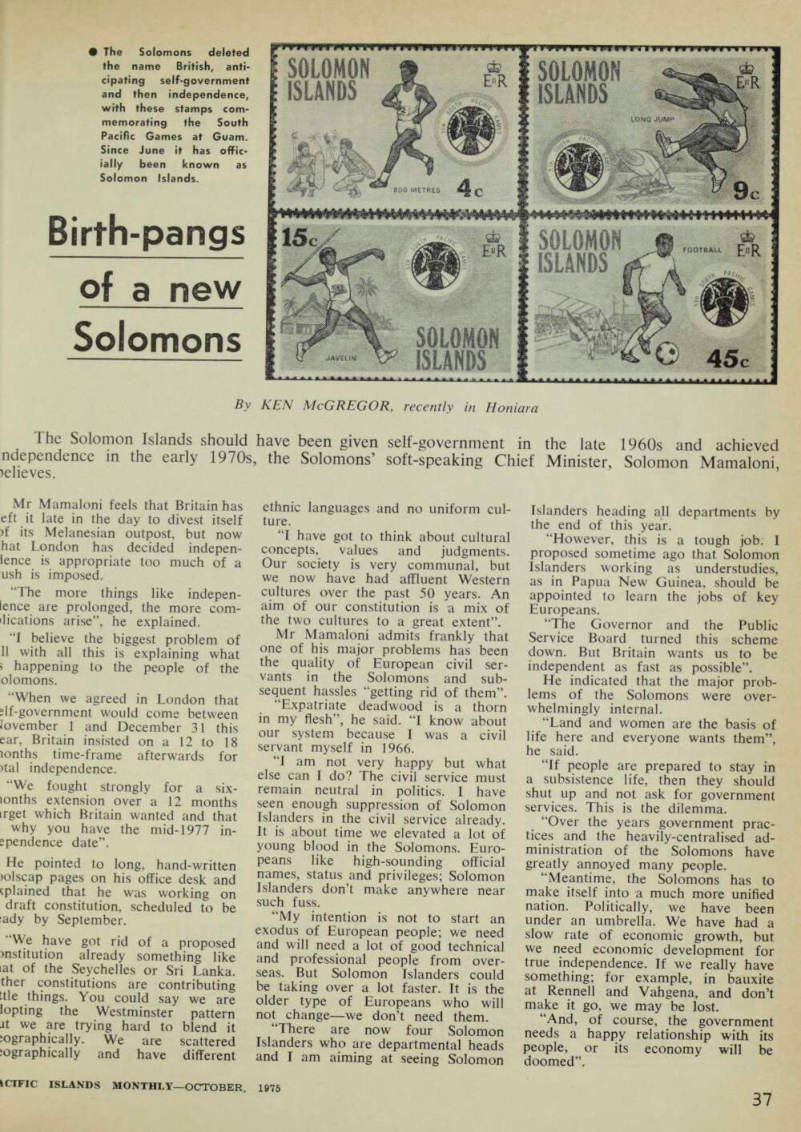
of a new Solomons
By KEN McGREGOR, recently in Honiara
The Solomon Islands should have been given self-government in the late 1960 s and achieved ndependence in the early 19705, the Solomons’ soft-speaking Chief Minister, Solomon Mamaloni )elieves.
Mr Mamaloni feels that Britain has eft it late in the day to divest itself )f its Melanesian outpost, but now hat London has decided indepen lence is appropriate too much of a ush is imposed.
"The more things like indepen lence are prolonged, the more com •lications arise”, he explained.
"I believe the biggest problem of 11 with all this is explaining what » happening to the people of the olomons.
“When we agreed in London that df-government would come between Jovember 1 and December 31 this ear, Britain insisted on a 12 to 18 lonths time-frame afterwards for )tal independence.
“We fought strongly for a six mnths extension over a 12 months irget which Britain wanted and that why you have the mid-1977 in spendence date”.
He pointed to long, hand-written >olscap pages on his office desk and tplained that he was working on draft constitution, scheduled to be :ady by September.
“We have got rid of a proposed mstitution already something like at of the Seychelles or Sri Lanka, ther constitutions are contributing ttle things. You could say we are lopting the Westminster pattern Jt we are trying hard to blend it jographically. We are scattered and have different
ethnic languages and no uniform culture.
“1 have got to think about cultural concepts, values and judgments.
Our society is very communal, but we now have had affluent Western cultures over the past 50 years. An aim of our constitution is a mix of the two cultures to a great extent”.
Mamaloni admits frankly that R* 16 °* ,! s ma J or problems has been the Quality of European civil servants in the Solomons and subse( ? t p 6nt hassles “getting rid of them”. • Expatriate deadwood is a thorn “ r my fl f sh ’ . he said * i l know ab 9Hj servant myself' * CIVI “r y , * , , 1 T n ?\ ba ? py b . ut wh at else can I do? The civil service must remain neutral m politics. I have seen enough suppression of Solomon Islanders in the civil service already.
U " ab K °, Ut H time r e c' e , Vated a lOt ° £ young blood in the Solomons. Europeans like high-sounding official ? ame . s ’ sta * us and P rivil eges; Solomon lsla nders don t make anywhere near su ?!}/ us ?' .
My intention is not to start an ex ° dus ° f European people; we need and will need a lot of good technical and Phonal People from overseas. But Solomon Islanders could be taking over a lot faster. It is the older f yp e of Europeans who will not change-we don’t need them. r h & "T f ° Ur S ? lomon Islanders who are departmental heads and I am aiming at seeing Solomon
Islanders heading all departments bv the end of this year.
“However, this is a tough job. I proposed sometime ago that Solomon Islanders working as understudies, as in Papua New Guinea, should be appointed to learn the jobs of key Europeans.
“The Governor and the Public Service Board turned this scheme down. But Britain wants us to be independent as fast as possible”, He indicated that the major prob lems of the Solomons were over whelmingly internal.
“Land and women are the basis of l! fe h ?F e and everyone wants them”, he said.
“If people are prepared to stay in a subsistence life, then they should shut up and not ask for government services. This is the dilemma, “Over the years government nrac tices and theTeavify™airsed P ad ministration of the Solomons have greatly annoyed many people.
“Meantime, the Solomons has to make itself into a much more unified nation. Politically, we have been under an umbrella. We have had a slow rate of economic growth, but we need economic development for true independent If we reSfy have something* for example in bauxhe at Rennell and Vahgena and don’t make it go we may be lost “And of couSe the government needs a happy relationshfp with its people or its Pm nnmv F doomed" Y W, “ be
• The Solomons deleted the name British, anti
cipating self-government
and then independence, with these stamps com memorating the South Pacific Games at Guam.
Since June it has offic ially been known as Solomon Islands.
Advertisements & other items, pp. 39-40 (2 items)
Icific Islands Monthly—October, 1975
Caterpillar Dealers in South-West Pacific.
Caterpillar reliability, productivity, availability. Now you can get it all in a wheel skidder. The 518.
A whole new standard in skidder engineering. 120 turbocharged horsepower, 20,400 pounds of working muscle with full articulation and frame oscillation for stability and minimum maintenance.
Single lever “on the go” powershift. Dual rate steering for controlled response at all speeds. An operator’s compartment engineered for efficiency with safety features built In for man and machine.
You’ll find all the best skidder ideas, plus added refinement and top quality manufacturing that can make the 518 the backbone of your logging operation.
And South-West Pacific Caterpillar dealers will ensure that your backbone stays in top condition no matter how far in the bush you are.
Parts, maintenance, repairs or simple information—we’ll see that you get it fast.
So tackle the jungle with the new Cat 518.
Caterpillar Dealers in South-West Pacific.
3 Lae: Milford Haven Road, Ph: 42 2355 Port Moresby: Champion Parade, Knoedobu.
Ph: 3138 or 2098.
Bougainville: Itakara.
Industrial Park, Arawa.
Ph: 95 9004. 154 Queens Road, Suva.
Ph: 24 051-4 Cables: Carptrac Suva Telex: Carptrac FG2190 Suva L 0 r ‘o 3
CARPENTERS
TRACTOR S EQUIPMENT
HD529
A ‘rout’ for nationalists in
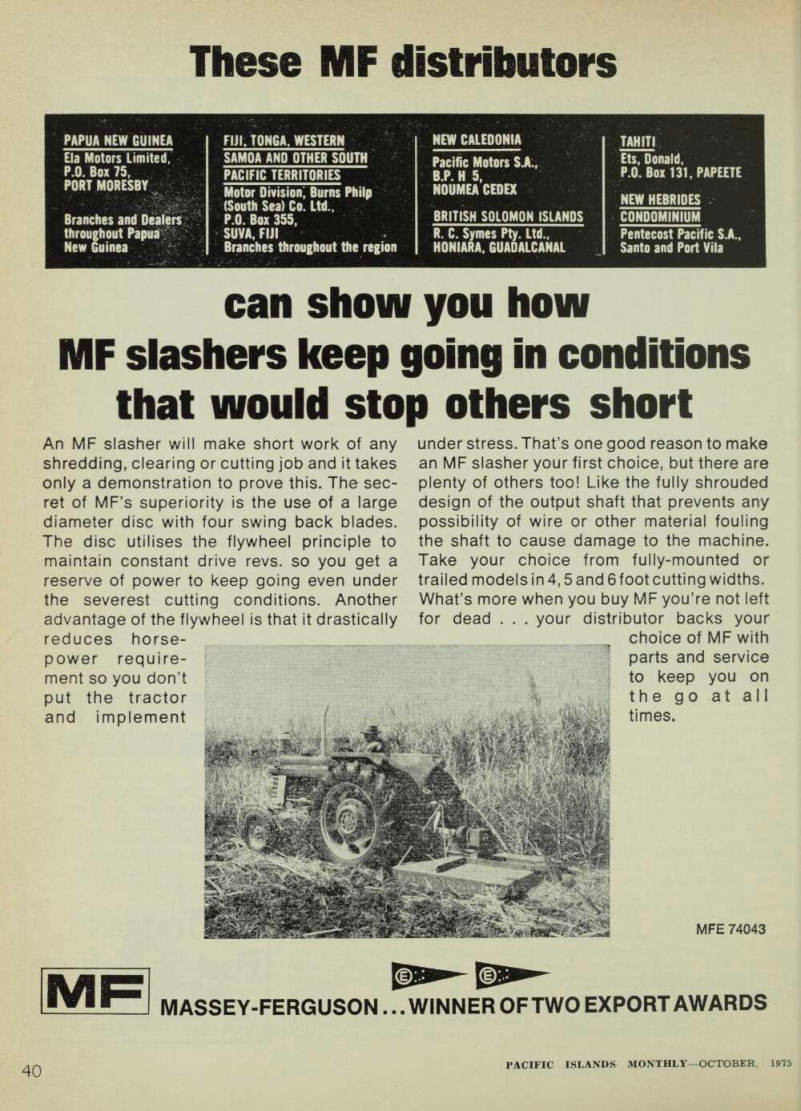
New Hebrides elections
From DAVID A. JOFFICK in Vila, UCNH’s Assistant Secretary
The New Hebrides, in the towns of Vila and Santo, had their first taste of municipal elections on August 16.
The roll-call was exceptional. In a holiday atmosphere of ordered calm and suppressed excitement more than 80 per cent of the registered voters of both towns went to the polls, and despite the complexity of the cross voting system, elected their munici pal councillors with less than 10 per cent of the votes cast being informal.
The results speak for themselves and represent nothing short of a rout for the National Party (NP) and their platform. UCNH in Vila won with a three to one margin—winning 18 out of the 24 seats contested— and the MANH-Tabwemasana-Na griamel (MTN) coalition secured 15 out of the 16 seats in Santo. No in dependent candidate was elected des pite the National Party’s great efforts to split the vote.
The most astonishing aspect of these elections was the Melanesian support for UCNH in Vila and the MTN movements in Santo as reflected in the results and from photographs 3f a procession through Vila 48 hours before polling began.
It may be useful to students of ocal history to learn that UCNH (Union des Communautes Neo- Tebridaises) stands for The Union }f the Communities of the New Heb ides and that its steering committee :onsists of six members, three of vhich —Melanesians—had partici pated in the founding of the National 3 arty and had split away to cement he corner-stone of another move nent as a result of the overwhelming md irrational radicalism of the first.
Df the three, one is the vice-president md the second general-secretary of
Jcnh.
Regrettably, two of the protestant lurches out of the 12 represented n the New Hebrides have adopted i political stance and through the Ecumenical Council, and otherwise, ontinue to finance the National s arty. It is to be hoped that wise : °unsel will prevail and that these hurches will refrain from actively >articipating in political activity and >ropaganda from the pulpit.
There has been much said about he successful coalition in Vila and n Santo being French Government
sponsored, led and directed. Nothing can be further from the truth. Cer tainly, it has sought pre-election information from the French Resi dency, but this is no less than that gratuitously offered by certain British public servants to the National Party —including the printing of National Party campaign literature and posters.
Whereas the National Party elec tion campaign funds originated pre dominantly from overseas, as men tioned earlier and as confirmed during a public meeting by one of its members, a substantial portion of the funds for the UCNH and the MTN campaigns were donated by local “sympathetic friends” and it should not be a surprise that much of this came from the French com munity. Apart from two British banks, there are no UK interests in the New Hebrides at all—the trust companies, as well as the Australian banks and Burns Philp, having main tained a strict neutrality in this first political contest.
A major source of UCNH funds for the Vila election campaign has been from the sale of party member ship cards to the Melanesian and the European population throughout all the islands of the group and this on its own could attest as to its popu larity.
The old Advisory Council had a Melanesian majority and both metro politan governments took exceptional note of the recommendations of this body in matters concerning the forth coming elections. It was the Mela nesian councillors, including members of the National Party, who voted unanimously that the age limit should be set at 21 years despite European opposition. The motion was carried on the Melanesian vote.
During the visit of Mr Olivier Stirn of France and Miss Joan Lestor, of Britain, in November, 1974, a Melanesian member of the Advisory Council suggested that four representatives from the customary chiefs be elected to the Represent ative Assembly. The ministers had agreed and the numbers were ad justed at the expense of represent ation from the Chamber of Com merce. Further, the nine represent atives from urban constituencies (six from Vila and three from Santo), the six from the Chamber of Com-
New Hebrides Elections
merce and the three from the co operative movements are to be equally split into four from the Melanesian population, four British and four French: the nature and bent of these cannot be predicted at this time.
The numerical Melanesian strength of 34 in the assembly of 42 is not, therefore, in stark contrast to the population as one would imagine. It is representative of the expressed wishes of the old Advisory Council and the present economic forces at play. In fact it could be held that the reverse is very much the case as substantial development investment by private capital will be required in the medium term which risks being unrepresented in the assembly.
It could hardly be expected that a Speaker elected from the ranks at the very first meeting of the Repre sentative Assembly would have the required experience to maintain control over the assembly’s deliber ations. Legal and other precedence will have to be established in the functioning of this assembly before any real meaning can be attached to the function and role of the Speaker elected from within—in time perhaps, and at the sitting of the Second Representative Assembly such an election, and such a post, may have some real sense.
The future Representative Assem bly will have the power to insist on legislation being enacted at the second "eading of a Bill if it can garner a :wo-thirds majority, ie 28 out of 42.
Should the matter concern Melanesian velfare and interests, social and ;conomic, this number, as seen from tbove, can be readily reached.
Should it not, in view of the con uliatory attitude of both govern uents, reasoned amendments, argu uent and debate will inevitably ichieve the same results—for is this lot the purpose of the Representa ive Assembly?
The political climate at the moment s one of solid work. Having been outed in the urban areas, the National Party will no doubt take ts argument for “Independence 1977” to the outer islands. But there, dready, it has totally undermined he very purpose of its existence.
The National Party has, continu msly, over the last two years en leavoured to break the power of he hereditary and elected chiefs. It las endeavoured to substitute, over light, age-old custom and social iractices with semi-educated and emi-literate teachers and church elders”. The discontent sown among
the villages by this divisive influence has resulted in the John Frum and Kapiel custom forces supporting UCNH in the south, and Nagriamel supporting MANH-Tabwemasana in the north. This alliance is therefore not paradoxical, and in fact very certain. For a party which claims it is the “Voice of the People” it has certainly shown itself totally devoid of any feeling for their professed kind.
Another point worth bringing to the attention of the student of New Hebrides politics is that Nagriamel was originally sponsored by the British Residency, and Jimmy Stephens, the leader of the Nagria mel custom movement, could hardly be described as being “intensely jealous” of the man leading the National Party—for the Nagriamel people, and this practically now in cludes all the islands of the north, have profited enormously, as PIM justly points out, by Jimmy Stephens’ wisdom and his alliances—and with American interests to boot!
It is a shame that the country is divided by education. More is the shame that the British output in literacy is below the normally accepted levels for entry into ordin ary secondary schools in Australia, New Zealand or the United King dom. However, the French Govern ment is indeed making a great effort to restore the balance with the net result that in a few years time one might well expect the French lan guage to predominate.
One thing, however, remains cer tain after these municipal elections.
The British-oriented radical move ment for independence in 1977 has taken a severe pounding by dint of the heavy Melanesian vote. The future, it would appear at the mo ment, lies mainly in the hands of the UCNH-MANH-Tabwemasana- Nagriamel coalition and its ability to coerce the two metropolitan govern ments into a process of gradual de volving of power through education, economic planning and assistance, and the creation of democratic insti tutions and implementation of demo cratic processes and traditions—a difficult, onerous and expensive task.
Advertisements & other items, pp. 41-44 (3 items)
39
'ACIFIC ISLANDS MONTHLY—OCTOBER. 1975
Tonga's
AT A LOSS
TO COMFORT BABY?
Those distressing symptoms that come with teething troubles—sore gums, digestive disorders, intestinal upsets, can be, if used as directed, safely and quickly soothed with Fisher's Teething Powders. You'll be delighted at what an effective and soothing aid they are to baby—and when baby's happy your upsets and nervous tension will be soothed, too. Fisher's Teething Powders are available from your chemist or store.
Fisher & Co., Manufacturing Chemists (Est. 1876) 17 May St., St. Peters,
N.S.W. 2044.
PMBO9/72
W* DATELINE HOTEL 111
/ TONGA
"Friendly Hotel" of the "Friendly Islands"
Situated along the Nuku'alofa waterfront. Only five minutes walk from town. Single, double, family suites, airconditioning, and hot and cold water showers. Pool, bar, restaurant, duty-free shop, tour desk and boutique.
Book through your travel agent or write to International Dateline Hotel, P.O. Box 62, Nuku'alofa Tonga.
Cable Address: "DATELINE".
Represented Overseas by: Charles J. Henry and Associates Pty. Ltd.
Sydney and Melbourne.
Primitive luxury
(Polynesian style' Nestled away in the untouched Kingdom of Tonga is new, luxurious "Port of Refuge" International resort. Here is a unique opportunity for your clients to experience the tranquil and relaxed Tongan atmosphere while they enjoy the picturesque surroundings of the new "Port of Refuge". And only a short flight from Fiji.
Reasonable tariffs from $17.50 with special concessions for children. Agents commission 10 per cent.
Tonga's
Port of Refuge
INTERNATIONAL RESORT U
Uava’u Tonga
Cables: "Refuge" Tonga or "Tongatoors"
Sydney. Phone: Sydney 85-1603 or 852162
These MF distributors
can show you how
MF slashers keep going in conditions
that would stop others short
An MF slasher will make short work of any shredding, clearing or cutting job and it takes only a demonstration to prove this. The secret of MF’s superiority is the use of a large diameter disc with four swing back blades.
The disc utilises the flywheel principle to maintain constant drive revs, so you get a reserve of power to keep going even under the severest cutting conditions. Another advantage of the flywheel is that it drastically reduces horseunder stress. That’s one good reason to make an MF slasher your first choice, but there are plenty of others too! Like the fully shrouded design of the output shaft that prevents any possibility of wire or other material fouling the shaft to cause damage to the machine.
Take your choice from fully-mounted or trailed models in 4,5 and 6 foot cutting widths.
What’s more when you buy MF you’re not left for dead . . . your distributor backs your choice of MF with power requirement so you don’t put the tractor
and implement
MF= parts and service to keep you on the go at all times.
MFE 74043
MASSEY-FERGUSON
WINNER OF TWO EXPORT AWARDS
sdafafa
D apua new guinea
printing co. pty. ltd.
Serving the Country from Aitape to Alotau, Manus to Moresby Leaders in Commercial Offset and Letterpress Printing. • Stationery Office Supplies • Office Equipment • Rubber Stamps • Self-Adhesive Labels • In Fact:— Everything For The Office.
P.O. Box 633, Port Moresby P.O. Box 759, Lae P.O. Box 1239, Rabaul
CONGRATULATIONS T 8
THE PEOPLE OF PAPUA NEW GUINEA
UN THE OCCASION UP THEIR
INDEPENDENCE
TUSHO MARINE S FIRE MSURANIX CQ, LTD. 5, Kyobashi 1 -chome, Chuo-ku, Tokyo, Japan Telex: J 24670 a KALMSEA
41
’ACIFIC ISLANDS MONTHLY—OCTOBER, 1975
“That's Papua new guinea all over!
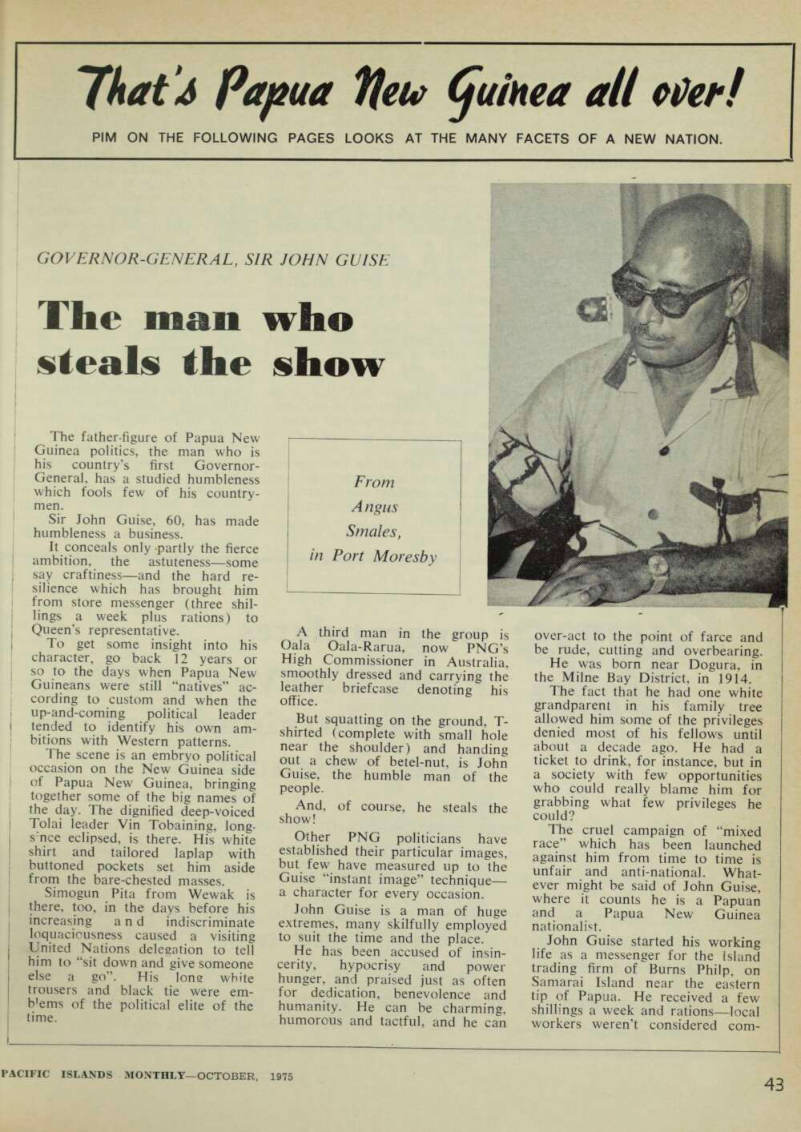
The man who steals the show
PIM ON THE FOLLOWING PAGES LOOKS AT THE MANY FACETS OF A NEW NATION.
Governor-General, Sir John Guise
'Hie father-figure of Papua New Guinea politics, the man who is his country’s first Governor- General, has a studied humbleness which fools few of his country men.
Sir John Guise, 60, has made humbleness a business.
It conceals only partly the fierce ambition, the astuteness —some say craftiness—and the hard re silience which has brought him from store messenger (three shil lings a week plus rations) to Queen’s representative.
To get some insight into his character, go back 12 years or so to the days when Papua New Guineans were still “natives” ac cording to custom and when the up-and-coming political leader tended to identify his own am bitions with Western patterns.
The scene is an embryo political occasion on the New Guinea side of Papua New Guinea, bringing together some of the big names of the day. The dignified deep-voiced Tolai leader Yin Tobaining, long s nee eclipsed, is there. His white shirt and tailored laplap with buttoned pockets set him aside from the bare-chested masses.
Simogun Pita from Wewak is there, too, in the days before his increasing and indiscriminate loquaciousness caused a visiting United Nations delegation to tell him to “sit down and give someone else a go”. His lone white trousers and black tie were em b’ems of the political elite of the time.
From Angus Smales, in Port Moresby
A third man in the group is Uala Oala-Rarua, now PNG’s Commissioner in Australia, smoothly dressed and carrying the leather briefcase denoting his offlce - But squatting on the ground, Tshirted (complete with small hole near the shoulder) and handing out a chew of betel-nut, is John Guise, the humble man of the people.
And, of course, he steals the show!
Othpr PM n U
ffgfSSr particular images*
a character for every occasion.
John Guise is a man of huge extremes, many skilfully employed to suit the time and the place.
He has been accused of insincenty, hypocrisy and power hunger, and praised just as often tor dedication, benevolence and humanity. He can be charming, humorous and tactful, and he can
over-act to the point of farce and be rude, cutting and overbearing.
He was born near Dogura, in the Milne Bay District, in 1914.
The fact that he had one white grandparent in his family tree allowed him some of the privileges denied most of his fellows until about a decade ago. He had a ticket to drink, for instance, but in a society with few opportunities who could really blame him for grabbing what few privileges he could?
The cruel campaign of “mixed where it COU nts he is a Papuan and a Papua New Guinea nationalist.
John Guise started his working life as a messenger for the Island trading firm of Bums Philp, on Samarai Island near the eastern tip of Papua. He received a few shillings a week and rations—local workers weren’t considered com-
The man who steals the show
• etent to handle their own food
buying arrangements.
During the Pacific War he was a signals clerk with the Australian New Guinea Administrative Unit, and he later became a policeman and a welfare worker.
He was a well above average cricketer who has always retained an interest in the game.
He entered national politics in 1961 when he became a member of the then Legislative Council, and he has been a member of all parliaments since. He was Speaker of the Second House of Assembly, received an honorary Doctorate of Laws from the PNG University for his services to the people, and became a knight in this year’s Queen’s Birthday List.
He’s been known to issue edicts on how his name should be used in different connotations—just plain “Guise” or “Dr John”.
“I think it’s more fitting for the nation if you just continue to call me ‘Doctor’ rather than ‘Sir’,” he said after his knighthood was an nounced.
There’s been a tendency, par ticularly among whites, to see John Guise as a man out for power at any price. Although he has been Deputy Chief Minister through the life of the present parliament, for instance, he re mained an independent and seized the reins strongly when his much younger Chief Minister, Michael Somare, was absent.
But this would seem to be nothing more serious than yet another facet of his image-building techniques. After all, he has lived twice as long as many of his col leagues, and was in politics when some of them were still at school, travelling a long, long road of political and personal develop ment.
Small wonder now that he sits on a sort of pinnacle from which he feels free to say all sorts of things, merely to get a kick out of the reaction.
And it would not be surprising if this attitude carries over into his office of Governor-General, be cause he wouldn’t be John Guise if it didn’t.
Sir John Guise, who had been a member of PNG Par liament for a longer period than any other member, de feated two other candidates in a one-hour secret ballot held behind locked doors at the National Constituent Assembly in Port Moresby in July for the post of Governor-General. The Constituent Assembly was the House of Assembly meeting under a separate identity to make constitutional arrange ments for nationhood.
The two other candidates were the Opposition leader, Mr Tei Abel, and the Country Party leader, Mr Sinake Gire gire. Dr Guise was nominated by the Government in the House.
Mr Abel privately asked to withdraw before the Assembly sat, but the chairman, Mr Barry Holloway, asked him to con tinue in fairness to his nomi nators.
On the first ballot Mr Abel was eliminated when the voting was Sir John 45, Mr Giregire 25, and Mr Abel 21. The second vote resulted in Sir John 53, and Mr Giregire 38.
Advertisements & other items, p. 46 (1 item)
Bums congratulates
Phi/o PAPUA NEW GUINEA
GROUP OF COMPANIES B
on the attainment of its
Independence
Burns Philp has been associated with Papua New Guinea for over 90 years and has contributed its share to the Nation's commercial and economic progress over several generations.
We look forward to playing our part in the continued development and prosperity of the new Nation in the future and wish it every success.
PRINCIPAL OFFICE: 7 BRIDGE STREET, SYDNEY, NSW, 2000, AUSTRALIA with main centres in Papua New Guinea at Port Moresby, Rabaul, Lae, Madang and Samarai.
Papua New Guinea Finds Gold
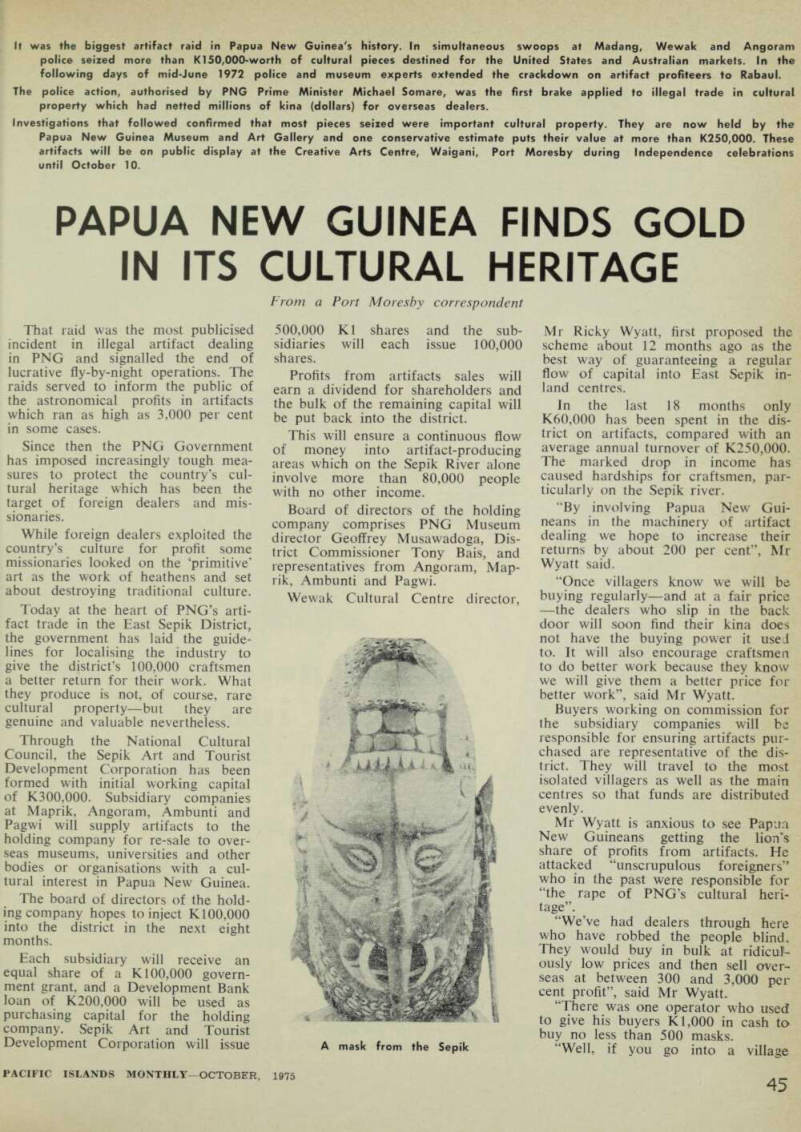
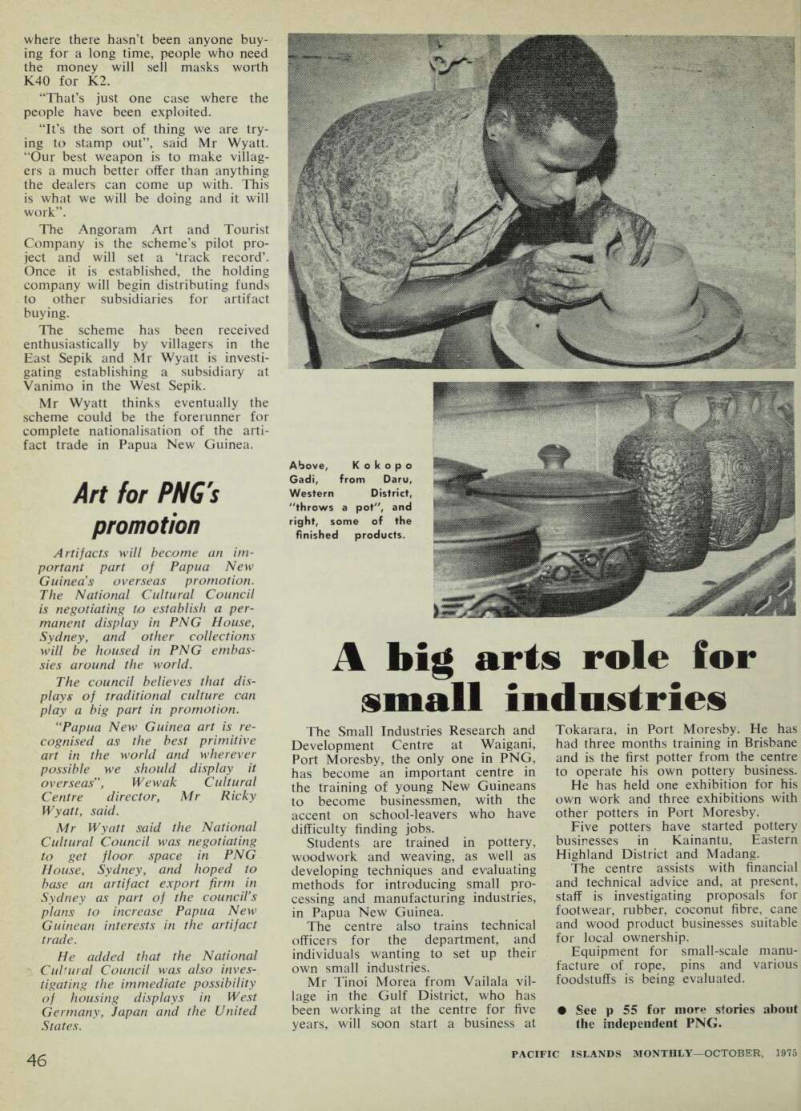
In Its Cultural Heritage
It was the biggest artifact raid in Papua New Guinea's history. In simultaneous swoops at Madang, Wewak and Angoram police seized more than K 150,000-worth of cultural pieces destined for the United States and Australian markets. In the following days of mid-June 1972 police and museum experts extended the crackdown on artifact profiteers to Rabaui.
The police action, authorised by PNG Prime Minister Michael Somare, was the first brake applied to illegal trade in cultural property which had netted millions of kina (dollars) for overseas dealers.
Investigations that followed confirmed that most pieces seized were important cultural property. They are now held by the Papua New Guinea Museum and Art Gallery and one conservative estimate puts their value at more than K 250,000. These artifacts will be on public display at the Creative Arts Centre, Waigani, Port Moresby during Independence celebrations until October 10.
From a Port Moresby correspondent
That raid was the most publicised incident in illegal artifact dealing in PNG and signalled the end of lucrative fly-by-night operations. The raids served to inform the public of the astronomical profits in artifacts which ran as high as 3,000 per cent in some cases.
Since then the PNG Government has imposed increasingly tough mea sures to protect the country’s cul tural heritage which has been the target of foreign dealers and mis sionaries.
While foreign dealers exploited the country’s culture for profit some missionaries looked on the ‘primitive’ art as the work of heathens and set about destroying traditional culture.
Today at the heart of PNG’s arti fact trade in the East Sepik District, the government has laid the guide lines for localising the industry to give the district’s 100,000 craftsmen a better return for their work. What they produce is not, of course, rare cultural property—but they are genuine and valuable nevertheless.
Through the National Cultural Council, the Sepik Art and Tourist Development Corporation has been formed with initial working capital of K 300,000. Subsidiary companies at Maprik, Angoram, Ambunti and Pagwi will supply artifacts to the holding company for re-sale to over seas museums, universities and other bodies or organisations with a cul tural interest in Papua New Guinea.
The board of directors of the hold ing company hopes to inject K 100,000 into the district in the next eight months.
Each subsidiary will receive an equal share of a K 100,000 govern ment grant, and a Development Bank loan of K 200,000 will be used as purchasing capital for the holding company. Sepik Art and Tourist Development Corporation will issue
500,000 K 1 shares and the sub sidiaries will each issue 100,000 shares.
Profits from artifacts sales will earn a dividend for shareholders and the bulk of the remaining capital will be put back into the district.
This will ensure a continuous flow of money into artifact-producing areas which on the Sepik River alone involve more than 80,000 people with no other income.
Board of directors of the holding company comprises PNG Museum director Geoffrey Musawadoga, Dis trict Commissioner Tony Bais, and representatives from Angoram, Map rik, Ambunti and Pagwi.
Wewak Cultural Centre director,
Mr Ricky Wyatt, first proposed the scheme about 12 months ago as the best way of guaranteeing a regular flow of capital into East Sepik in land centres.
In the last 18 months only K 60,000 has been spent in the dis trict on artifacts, compared with an average annual turnover of K 250,000.
The marked drop in income has caused hardships for craftsmen, par ticularly on the Sepik river.
"By involving Papua New Gui neans in the machinery of artifact dealing we hope to increase their returns by about 200 per cent”, Mr Wyatt said.
“Once villagers know we will be buying regularly—and at a fair price —the dealers who slip in the back door will soon find their kina does not have the buying power it used to. It will also encourage craftsmen to do better work because they know we will give them a better price for better work”, said Mr Wyatt.
Buyers working on commission for the subsidiary companies will be responsible for ensuring artifacts pur chased are representative of the dis trict. They will travel to the most isolated villagers as well as the main centres so that funds are distributed evenly.
Mr Wyatt is anxious to see Papua New Guineans getting the lion’s share of profits from artifacts. He attacked “unscrupulous foreigners” who in the past were responsible for “the rape of PNG’s cultural heri tage”.
“We've had dealers through here who have robbed the people blind.
They would buy in bulk at ridicul ously low prices and then sell over seas at between 300 and 3,000 per cent profit”, said Mr Wyatt.
“There was one operator who used to give his buyers K 1,000 in cash to buy no less than 500 masks.
“Well, if you go into a village
A mask from the Sepik
where there hasn’t been anyone buy ing for a long time, people who need the money will sell masks worth K4O for K 2.
“That’s just one case where the people have been exploited.
“It’s the sort of thing we are try ing to stamp out”, said Mr Wyatt.
“Our best weapon is to make villag ers a much better offer than anything the dealers can come up with. This is what we will be doing and it will work”.
The Angoram Art and Tourist Company is the scheme’s pilot pro ject and will set a ‘track record’.
Once it is established, the holding company will begin distributing funds to other subsidiaries for artifact buying.
The scheme has been received enthusiastically by villagers in the East Sepik and Mr Wyatt is investi gating establishing a subsidiary at Vanimo in the West Sepik.
Mr Wyatt thinks eventually the scheme could be the forerunner for complete nationalisation of the arti fact trade in Papua New Guinea.
Above, Kokopo Gadi, from Daru, Western District, "throws a pot", and right, some of the finished products.
promotion
Art for PNG's promotion
Artifacts will become an im portant part of Papua New Guinea’s overseas promotion.
The National Cultural Council is negotiating to establish a per manent display in PNG House, Sydney, and other collections will be housed in PNG embas sies around the world.
The council believes that dis plays of traditional culture can play a big part in promotion.
“Papua New Guinea art is re cognised as the best primitive art in the world and wherever possible we should display it overseas”, Wewak Cultural Centre director, Mr Ricky Wyatt, said.
Mr Wyatt said the National Cultural Council was negotiating to get floor space in PNG House, Sydney, and hoped to base an artifact export firm in Sydney as part of the council’s plans to increase Papua New Guinean interests in the artifact trade.
He added that the National Cultural Council was also inves tigating the immediate possibility of housing displays in West Germany, Japan and the United States.
small industries
A big arts role for small industries
The Small Industries Research and Development Centre at Waigani, Port Moresby, the only one in PNG, has become an important centre in the training of young New Guineans to become businessmen, with the accent on school-leavers who have difficulty finding jobs.
Students are trained in pottery, woodwork and weaving, as well as developing techniques and evaluating methods for introducing small pro cessing and manufacturing industries, in Papua New Guinea.
The centre also trains technical officers for the department, and individuals wanting to set up their own small industries.
Mr Tinoi Morea from Vailala vil lage in the Gulf District, who has been working at the centre for five years, will soon start a business at
Tokarara, in Port Moresby. He has had three months training in Brisbane and is the first potter from the centre to operate his own pottery business.
He has held one exhibition for his own work and three exhibitions with other potters in Port Moresby.
Five potters have started pottery businesses in Kainantu, Eastern Highland District and Madang.
The centre assists with financial and technical advice and, at present, staff is investigating proposals for footwear, rubber, coconut fibre, cane and wood product businesses suitable for local ownership.
Equipment for small-scale manu facture of rope, pins and various foodstuffs is being evaluated. • See p 55 for more stories about the independent PNG.
Advertisements & other items, pp. 49-56 (4 items)
When onlylhe
“So this is a Lamborghini,” she breathed, as we sped down the autostrada towards Turin.
“Yes,” I said, offering her a Benson and Hedges. “Five forward gears and 170 in top.”
“Can you prove that?” she demanded.
“Do I really have to? You did say you only wanted a little car to do the shopping “ vr* V i . 4^ * sag fK Benson & Hedg
When onlylhe
V ■» v f will do.
THE DEFINITION SERIES.
WE PUT EVERYTHING
into it.
Sansui’s new Definition Series amplifiers. Today’s finest, most accurate, super-watt components. Handbuilt without any shortcuts. The 300 watts-perchannel BA-5000 and the 170 watts-perchannel BA-3000 power amplifiers feature expensive toroidal-coil power transformers, multiple heavy-duty output transistors, and triple protection circuits for full-performance stability and safety.
The low-distortion (less than 0.03% total harmonic distortion) CA-3000 preamplifier has two dual-FET amplifier sections—one for bass, one for treble—to achieve very accurate RIAA equalization for superb
disc-play.
All Definition Series amplifiers are consigned with “Factory Data” pre-test
performance logs.
If you feel ready, ask your Sansui audio dealer to demonstrate the finest quality in power today. Sansui’s new Definition Series.
SaitsruL
SANSUI ELECTRIC CO., LTD.
14-1, 2-chome, Izumi, Suginami-ku, Tokyo 168, Japan Australia Rank Industries Australia Pty. Ltd. 58 Queensbridge Street, South Melbourne. Victoria 3205 Phone: 61 3281 Australia Atkins Carlyle Ltd. 894 Hay Street. Perth, Western Australia 6000 Phone: 21 0101 Fiji Prabhu Brothers Ltd.
P.O. Box 183, Nadi Phone: 70183/4 Papua New Guinea Oceania Indent Agency (P.N.G.) Pty. Ltd.
Box 5518, Boroko. Port Moresby Phone; PM 56406 New Zealand David J. Reid (N.Z.) Ltd.
C.P.O. Box 2630, Auckland, 1 Phone: 492-189 Nlle-Caledonie Ets Michel MERCIER 9, rue de Sebastopol. Noumea Phone: 759.11 South Pacific Miltons Department Stores Limited P.O. Box 146, Norfolk Island 2899 Western Samoa H.J. Keil and Company, Ltd.
P.O. Box 7, Apia Phone: 198 New Hebrides South Pacific Audio & Photo Supplies B.P. 274, Vila Cook Islands United Island Traders Ltd.
Box Nos. 1 & 2, Rarotonga Tahiti Societe JAUNEZ &Cie B.P. 322, Papeete Phone: 2.04.24 •4 m - n Q - . -4 m ' : • - > * o. **-3000 1 -Tv “ v ukum fWr n BA-5000 Sansui Power Amplifter
Sansui. Dynamic audio answers.
YAMAHA
Independence Congratulations
Papua New Guinea
Mi 25A 48A
EndurolSA
In commemoration of the Papua New Guinea Independence Day, YAMAHA Motor Company stands ready to offer service and quality products creating an atmosphere conducive to positive growth and mutual benefits for both the people of Papua New Guinea and
YAMAHA.
YAMAHA...It’s a way of life Producing a vast array of motorcycles and outboard motors, each style designed to satisfy a particular range of requirements, YAMAHA expends countless hours in technical and market research in order to assure the finest in quality and to place before the people products which are not only considered timely, but those which are first in dependability and service.
Yamaha Trail ■& Yamaha Mini Trail Yamaha Street I I s
ELA MOTORS LTD.
Head office : P.0.80x 75 Port Moresby Phone 54088 Kieta Branch: P.O. Box 171 Madang Branch: PO. Box 110 Lae Branch; P.O. Box 91 Wewak Branch: P.O. Box 581 Rabaul Branch: P.O. Box 712
©YAMAHA*
since 188 7 YAMAHA MOTOR CO LTD 2500 SHINGAI IWATA SHI SHIZUOKA KEN JAPAN
s Kim
:A '
qua
RTZ
5-W
CSSf)!.
m if.' * I \ • * ‘ l| ♦ f \0 ; 0 8 / \ / \ % £
THE SEIKO QUARTZ
COLLECTION.
CHANGING THE WORLD’S
STANDARD OF ACCURACY.
The Seiko Quartz Collection encompasses a wide and exciting scope of quartz watches for men and women. Quartz guaranteed accurate to within one second per month. Ultra-thin quartz. Day/date Quartz. Digital quartz watches with liquid crystal for continuous readout to the second, and no buttons to push. Even a digital quartz chronograph. It's what you'd expect of Seiko.
Seiko sold the world's first quartz wristwatch.
And Seiko even makes every part of every watch (except for the battery) to insure impeccable quality control and a superb product. Whatever Seiko Quartz model you select, you get more than just a technologically advanced timepiece. You get the watch that's changing the world's standard of accuracy. Seiko Quartz.
SEIKO
Someday all watches will be made this way.
r. ! / ,•
v ri;
/ \ V % >?< ,r i*. ■ V iWii
mmm*f anl0 US Biscuits
There is no Substitute for Quality
Sony’s original stereo
radio/cassette-corder.
Can you imagine a better pickme-up?
The honest-to-goodness sound of real Sony stereo. At the beach, the park, or on a picnic.
And remember, the Sony CF-550A the daddy of all one-piece stereos. A tried and proved design.
It’s unique Matrix Sound Stereo System plus four built-in speakers give you richer
(((t«ez3»»)))
■36 ' £ StsC" and more natural stereo reproduction.
“Live” stereo recording is simple with two sensitive built-in electret condenser microphones. And besides that, you can also record directly off AM or FM wavebands.
Sony’s original stereo radio/ cassette-corder works off batteries, mains power (AC cord included) or off your car/boat battery (adaptor optional). Pick one up. You’ll love it.
What seems like magic is actually great Sony design. v\ v w
It took time to perfect the
NEW Hyster electrics.
Time to make the best.
H Y $ T s 1 fi
HYSTER
m We could have added new Hyster electric trucks to our extensive lift truck range some time ago. After all, we knew what people wanted, and we had the dealer and service network to back our sales Australia-wide.
But long after electric lift trucks first hit the market, we were busy perfecting a better hydraulic system to overcome the oil leaks and minimise the battery drain other manufacturers weren’t so concerned about.
We wanted to make ours the top performance electric. An easy-handling truck with a short turning radius. Longer life between charges. Smoother deceleration. And single pedal control to keep the drivers happy.
Now, we’ve built these advantages into a range of Hyster electric trucks with load capacities of up to 10,000 lbs (5,000 kgs). We believe they’re the world’s finest, and they’re available from your Hyster dealer. Ask to see them in action. Or contact Hyster Australia Pty. Ltd., Ashford Avenue, Milperra, N.S.W. 2214. Telephone Sydney 77 0511,
HYSTER AUSTRALIA PTY. LTD.
HR39.84
49
4CIFIC ISLANDS MONTHLY—OCTOBER, 1975
51
ACIFIC ISLANDS MONTHLY—OCTOBER, 1975
Icific Islands Monthly—October, 1975
‘Yes, we brought them shell-the
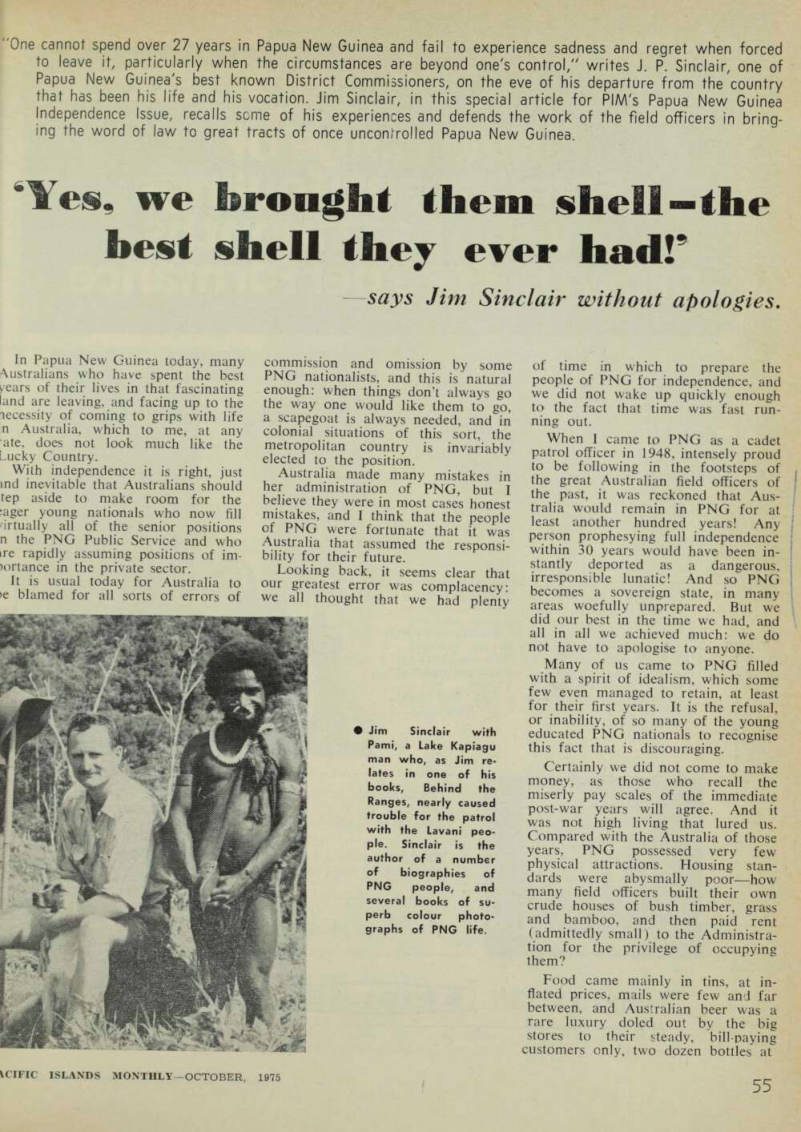
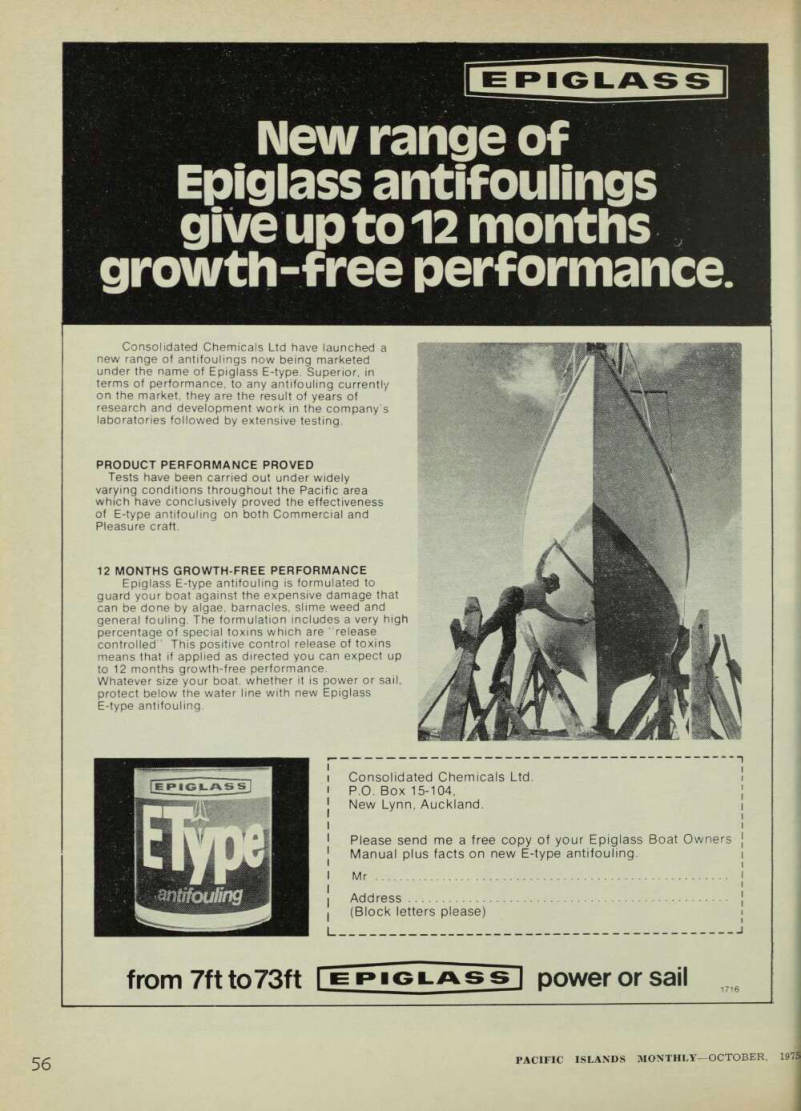
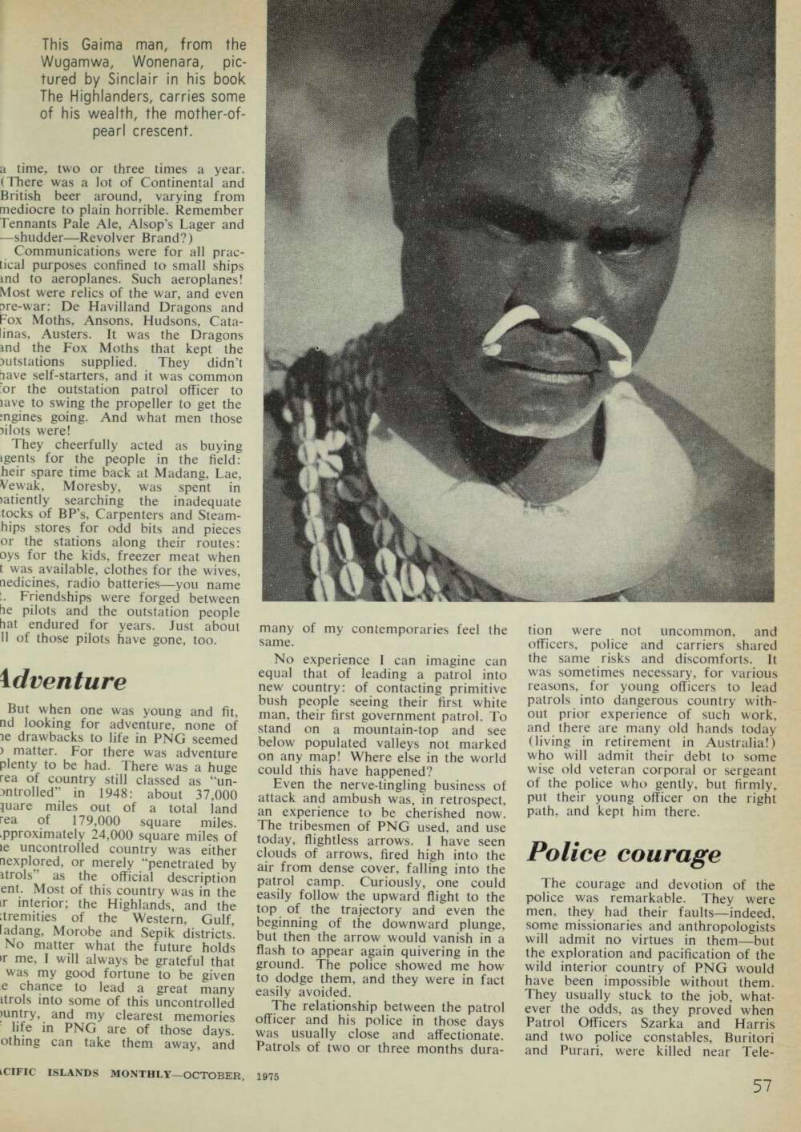
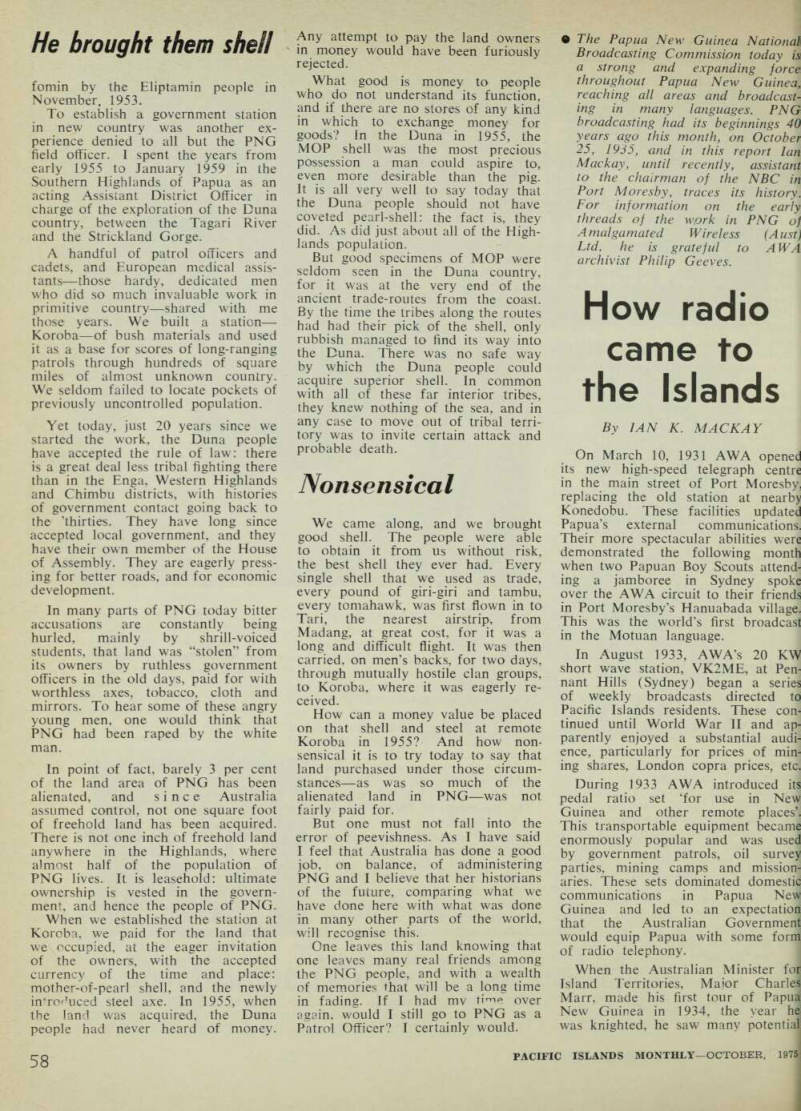
best shell they ever had! '
One cannot spend over 27 years in Papua New Guinea and fail to experience sadness and regret when forced to leave it, particularly when the circumstances are beyond one's control," writes J. P. Sinclair, one of Papua New Guinea's best known District Commissioners, on the eve of his departure from the country that has been his life and his vocation. Jim Sinclair, in this special article for PIAA's Papua New Guinea Independence Issue, recalls some of his experiences and defends the work of the field officers in bring ing the word of law to great tracts of once uncontrolled Papua New Guinea.
says Jim Sinclair without apologies.
In Papua New Guinea today, many Australians who have spent the best years of their lives in that fascinating land are leaving, and facing up to the lecessity of coming to grips with life n Australia, which to me, at any ate, does not look much like the Lucky Country.
With independence it is right, just md inevitable that Australians should tep aside to make room for the :ager young nationals who now fill virtually all of the senior positions n the PNG Public Service and who ire rapidly assuming positions of im )ortance in the private sector.
It is usual today for Australia to >e blamed for all sorts of errors of
commission and omission by some PNG nationalists, and this is natural enough: when things don’t always go the way one would like them to go, a scapegoat is always needed, and in colonial situations of this sort, the metropolitan country is invariably elected to the position.
Australia made many mistakes in her administration of PNG, but I believe they were in most cases honest mistakes, and I think that the people of PNG were fortunate that it was Australia that assumed the responsi bility for their future.
Looking back, it seems clear that our greatest error was complacency: we all thought that we had plenty
of time in which to prepare the people of PNG for independence, and we did not wake up quickly enough to the fact that time was fast run ning out.
When I came to PNG as a cadet patrol officer in 1948, intensely proud to be following in the footsteps of the great Australian field officers of the past, it was reckoned that Aus tralia would remain in PNG for at least another hundred years! Any person prophesying full independence within 30 years would have been in stantly deported as a dangerous, irresponsible lunatic! And so PNG becomes a sovereign state, in many areas woefully unprepared. But we did our best in the time we had, and all in all we achieved much: we do not have to apologise to anyone.
Many of us came to PNG filled with a spirit of idealism, which some few even managed to retain, at least for their first years. It is the refusal, or inability, of so many of the young educated PNG nationals to recognise this fact that is discouraging.
Certainly we did not come to make money, as those who recall the miserly pay scales of the immediate post-war years will agree. And it was not high living that lured us.
Compared with the Australia of those years, PNG possessed very few physical attractions. Housing stan dards were abysmally poor—how many field officers built their own crude houses of bush timber, grass and bamboo, and then paid rent (admittedly small) to the Administra tion for the privilege of occupying them?
Food came mainly in tins, at in flated prices, mails were few and far between, and Australian beer was a rare luxury doled out by the big stores to their steady, bill-paying customers only, two dozen bottles at
• Jim Sinclair with Pami, a Lake Kapiagu man who, as Jim re lates in one of his books, Behind the Ranges, nearly caused trouble for the patrol with the Lavani peo ple. Sinclair is the author of a number of biographies of PNG people, and several books of su perb colour photo graphs of PNG life.
a time, two or three times a year. (There was a lot of Continental and British beer around, varying from mediocre to plain horrible. Remember Tennants Pale Ale, Alsop’s Lager and —shudder —Revolver Brand?) Communications were for all prac tical purposes confined to small ships md to aeroplanes. Such aeroplanes!
Most were relics of the war, and even pre-war: De Havilland Dragons and Fox Moths, Ansons, Hudsons, Cata linas, Austers. It was the Dragons and the Fox Moths that kept the xitstations supplied. They didn’t have self-starters, and it was common : or the outstation patrol officer to lave to swing the propeller to get the mgines going. And what men those pilots were!
They cheerfully acted as buying igents for the people in the field: heir spare time back at Madang, Lae, Vewak, Moresby, was spent in latiently searching the inadequate locks of BP’s, Carpenters and Steam hips stores for odd bits and pieces or the stations along their routes: oys for the kids, freezer meat when t was available, clothes for the wives, nedicines, radio batteries—you name :• Friendships were forged between he pilots and the outstation people hat endured for years. Just about 11 of those pilots have gone, too.
Adventure
But when one was young and fit, nd looking for adventure, none of ic drawbacks to life in PNG seemed ) matter. For there was adventure plenty to be had. There was a huge rea of country still classed as “un trolled” in 1948: about 37,000 juare miles out of a total land rea of 179,000 square miles, approximately 24,000 square miles of le uncontrolled country was either nexplored, or merely “penetrated by atrols” as the official description ent. Most of this country was in the ir interior; the Highlands, and the :tremities of the Western, Gulf, [adang, Morobe and Sepik districts.
No matter what the future holds •r me, I will always be grateful that was my good fortune to be given e chance to lead a great many itrols into some of this uncontrolled mntry, and my clearest memories life in PNG are of those days, othing can take them away, and
many of my contemporaries feel the same.
No experience I can imagine can equal that of leading a patrol into new country: of contacting primitive bush people seeing their first white man, their first government patrol. To stand on a mountain-top and see below populated valleys not marked on any map! Where else in the world could this have happened?
Even the nerve-tingling business of attack and ambush was, in retrospect, an experience to be cherished now.
The tribesmen of PNG used, and use today, flightless arrows. I have seen clouds of arrows, fired high into the air from dense cover, falling into the patrol camp. Curiously, one could easily follow the upward flight to the top of the trajectory and even the beginning of the downward plunge, but then the arrow would vanish in a flash to appear again quivering in the ground. The police showed me how to dodge them, and they were in fact easily avoided.
The relationship between the patrol officer and his police in those days was usually close and affectionate.
Patrols of two or three months dura
tion were not uncommon, and officers, police and carriers shared the same risks and discomforts. It was sometimes necessary, for various reasons, for young officers to lead patrols into dangerous country with out prior experience of such work, and there are many old hands today (living in retirement in Australia!) who will admit their debt to some wise old veteran corporal or sergeant of the police who gently, but firmly, put their young officer on the right path, and kept him there.
Police courage
The courage and devotion of the police was remarkable. They were men, they had their faults—indeed, some missionaries and anthropologists will admit no virtues in them—but the exploration and pacification of the wild interior country of PNG would have been impossible without them.
They usually stuck to the job, what ever the odds, as they proved when Patrol Officers Szarka and Harris and two police constables, Buritori and Purari, were killed near Tele-
This Gaima man, from the Wugamwa, Wonenara, pic tured by Sinclair in his book The Highlanders, carries some of his wealth, the mother-of pearl crescent.
He brought them shell
fomin by the Eliptamin people in November, 1953.
To establish a government station in new country was another ex perience denied to all but the PNG field officer. I spent the years from early 1955 to January 1959 in the Southern Highlands of Papua as an acting Assistant District Officer in charge of the exploration of the Duna country, between the Tagari River and the Strickland Gorge.
A handful of patrol officers and cadets, and European medical assis tants —those hardy, dedicated men who did so much invaluable work in primitive country —shared with me those years. We built a station— Koroba—of bush materials and used it as a base for scores of long-ranging patrols through hundreds of square miles of almost unknown country.
We seldom failed to locate pockets of previously uncontrolled population.
Yet today, just 20 years since we started the work, the Duna people have accepted the rule of law: there is a great deal less tribal fighting there than in the Enga, Western Highlands and Chimbu districts, with histories of government contact going back to the ’thirties. They have long since accepted local government, and they have their own member of the House of Assembly. They are eagerly press ing for better roads, and for economic
development.
In many parts of PNG today bitter accusations are constantly being hurled, mainly by shrill-voiced students, that land was “stolen” from its owners by ruthless government officers in the old days, paid for with worthless axes, tobacco, cloth and mirrors. To hear some of these angry young men, one would think that PNG had been raped by the white man.
In point of fact, barely 3 per cent of the land area of PNG has been alienated, and since Australia assumed control, not one square foot of freehold land has been acquired.
There is not one inch of freehold land anywhere in the Highlands, where almost half of the population of PNG lives. It is leasehold: ultimate ownership is vested in the govern ment, and hence the people of PNG.
When we established the station at Koroba, we paid for the land that we occupied, at the eager invitation of the owners, with the accepted currency of the time and place: mother-of-pearl shell, and the newly in f ror>uced steel axe. In 1955, when the land was acquired, the Duna people had never heard of money.
Any attempt to pay the land owners in money would have been furiously rejected.
What good is money to people who do not understand its function, and if there are no stores of any kind in which to exchange money for goods? In the Duna in 1955, the MOP shell was the most precious possession a man could aspire to, even more desirable than the pig.
It is all very well to say today that the Duna people should not have coveted pearl-shell: the fact is, they did. As did just about all of the High lands population.
But good specimens of MOP were seldom seen in the Duna country, for it was at the very end of the ancient trade-routes from the coast.
By the time the tribes along the routes had had their pick of the shell, only rubbish managed to find its way into the Duna. There was no safe way by which the Duna people could acquire superior shell. In common with all of these far interior tribes, they knew nothing of the sea, and in any case to move out of tribal terri tory was to invite certain attack and probable death.
Nonsensical
We came along, and we brought good shell. The people were able to obtain it from us without risk, the best shell they ever had. Every single shell that we used as trade, every pound of giri-giri and tambu, every tomahawk, was first flown in to Tari, the nearest airstrip, from Madang, at great cost, for it was a long and difficult flight. It was then carried, on men’s backs, for two days, through mutually hostile clan groups, to Koroba, where it was eagerly re ceived.
How can a money value be placed on that shell and steel at remote Koroba in 1955? And how non sensical it is to try today to say that land purchased under those circum stances —as was so much of the alienated land in PNG—was not fairly paid for.
But one must not fall into the error of peevishness. As I have said I feel that Australia has done a good job, on balance, of administering PNG and I believe that her historians of the future, comparing what we have done here with what was done in many other parts of the world, will recognise this.
One leaves this land knowing that one leaves many real friends among the PNG people, and with a wealth of memories that will be a long time in fading. If I had mv over again, would I still go to PNG as a Patrol Officer? I certainly would.
• The Papua New Guinea National Broadcasting Commission today is a strong and expanding force throughout Papua New Guinea, reaching all areas and broadcast ing in many languages. PNG broadcasting had its beginnings 40 years ago this month, on October 25, 1935, and in this report lan Mockery, until recently, assistant to the chairman of the NBC in Port Moresby, traces its history.
For information on the early threads of the work in PNG oj Amalgamated Wireless (Aust) Ltd, he is grateful to AWA archivist Philip Geeves.
Advertisements & other items, pp. 57-59 (3 items)
55
LCIFIC ISLANDS MONTHLY—OCTOBER, 1975
Epiglass antif oulings
New range of
give up to 12 months
growth-free performance.
Consolidated Chemicals Ltd have launched a new range of antifoulings now being marketed under the name of Epiglass E-type. Superior, in terms of performance, to any antifouling currently on the market, they are the result of years of research and development work in the company's laboratories followed by extensive testing.
PRODUCT PERFORMANCE PROVED
Tests have been carried out under widely varying conditions throughout the Pacific area which have conclusively proved the effectiveness of E-type antifouling on both Commercial and Pleasure craft.
12 MONTHS GROWTH-FREE PERFORMANCE
Epiglass E-type antifouling is formulated to guard your boat against the expensive damage that can be done by algae, barnacles, slime weed and general fouling. The formulation includes a very high percentage of special toxins which are ‘release controlled This positive control release of toxins means that if applied as directed you can expect up to 12 months growth-free performance.
Whatever size your boat, whether it is power or sail, protect below the water line with new Epiglass E-type antifouling. t O S_ JX s Consolidated Chemicals Ltd.
P.O. Box 15-104, New Lynn, Auckland.
Please send me a free copy of your Epiglass Boat Owners Manual plus facts on new E-type antifouling.
Mr Address
(Block letters please)
1
from 7ft to 73ft
power or sail
57
CIFIC ISLANDS MONTHLY—OCTOBER, 1975
the Islands
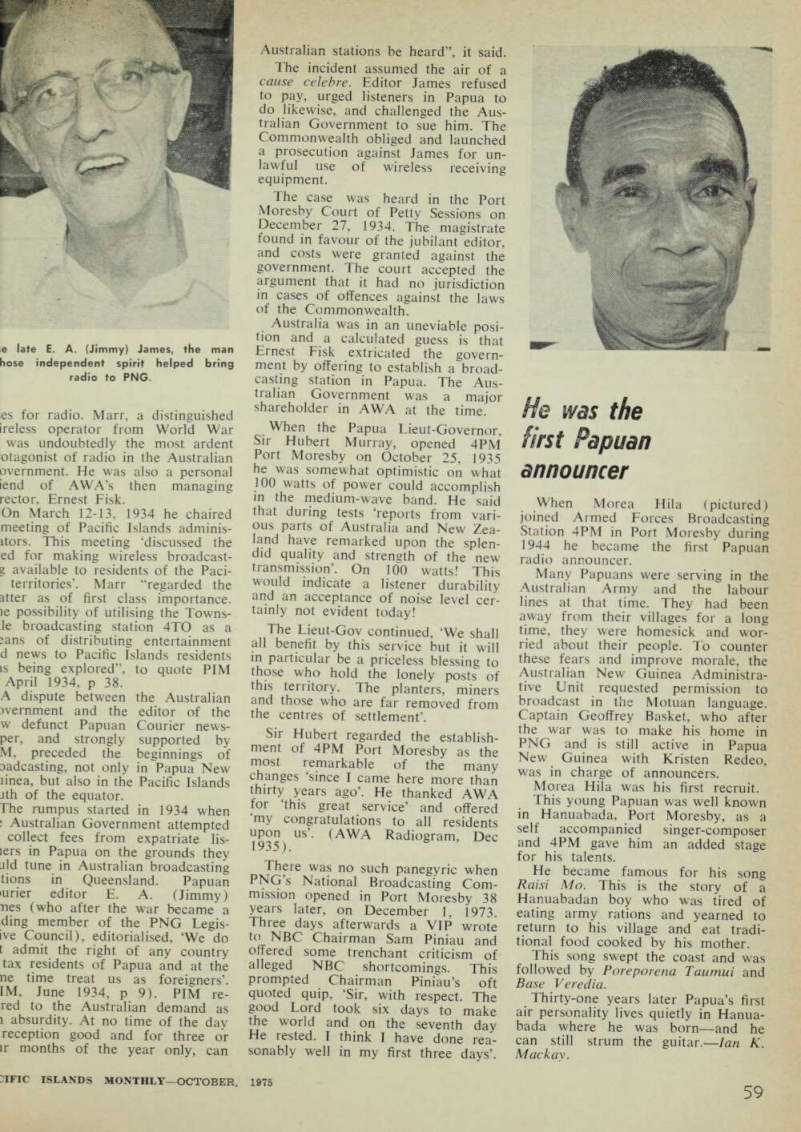
How radio came to the Islands
By Ian K. Mackay
On March 10, 1931 AWA opened its new high-speed telegraph centre in the main street of Port Moresby, replacing the old station at nearby Konedobu. These facilities updated Papua’s external communications.
Their more spectacular abilities were demonstrated the following month when two Papuan Boy Scouts attend ing a jamboree in Sydney spoke over the AWA circuit to their friends in Port Moresby’s Hanuabada village.
This was the world’s first broadcast in the Motuan language.
In August 1933, AWA’s 20 KW short wave station, VK2ME, at Pen nant Hills (Sydney) began a series of weekly broadcasts directed to Pacific Islands residents. These con tinued until World War II and ap parently enjoyed a substantial audi ence, particularly for prices of min ing shares, London copra prices, etc.
During 1933 AWA introduced its pedal ratio set ‘for use in New Guinea and other remote places’.
This transportable equipment became enormously popular and was used by government patrols, oil survey parties, mining camps and mission aries. These sets dominated domestic communications in Papua New Guinea and led to an expectation that the Australian Government would equip Papua with some form of radio telephony.
When the Australian Minister for Island Territories, Major Charles Marr, made his first tour of Papua New Guinea in 1934, the year he was knighted, he saw many potential
es for radio. Marr, a distinguished ireless operator from World War was undoubtedly the most ardent otagonist of radio in the Australian overnment. He was also a personal lend of AWA’s then managing rector, Ernest Fisk.
On March 12-13, 1934 he chaired meeting of Pacific Islands adminis itors. This meeting ‘discussed the ed for making wireless broadcast g available to residents of the Pad territories’. Marr “regarded the alter as of first class importance, le possibility of utilising the Towns le broadcasting station 4TO as a Jans of distributing entertainment d news to Pacific Islands residents is being explored”, to quote PIM April 1934, p 38.
A dispute between the Australian avernment and the editor of the w defunct Papuan Courier news per, and strongly supported by M, preceded the beginnings of aadcasting, not only in Papua New linea, but also in the Pacific Islands ath of the equator.
The rumpus started in 1934 when : Australian Government attempted collect fees from expatriate lis lers in Papua on the grounds they -ild tune in Australian broadcasting tions in Queensland. Papuan 'urier editor E. A, (Jimmy) Res (who after the war became a ding member of the PNG Legis ive Council), editorialised, ‘We do t admit the right of any country tax residents of Papua and at the ne time treat us as foreigners’.
IM, June 1934, p 9). PIM re red to the Australian demand as i absurdity. At no time of the day reception good and for three or ir months of the year only, can
Australian stations be heard”, it said.
The incident assumed the air of a cause celebre. Editor James refused to pay, urged listeners in Papua to do likewise, and challenged the Aus tralian Government to sue him. The Commonwealth obliged and launched a prosecution against James for un lawful use of wireless receiving equipment.
The case was heard in the Port Moresby Court of Petty Sessions on December 27, 1934. The magistrate found in favour of the jubilant editor, and costs were granted against the government. The court accepted the argument that it had no jurisdiction in cases of offences against the laws of the Commonwealth.
Australia was in an uneviable posi tion and a calculated guess is that Ernest Fisk extricated the govern ment by offering to establish a broad casting station in Papua. The Aus tralian Government was a major shareholder in AWA at the time.
When the Papua Lieut-Governor, Sir Hubert Murray, opened 4PM Port Moresby on October 25, 1935 he was somewhat optimistic on what 100 watts of power could accomplish m the medium-wave band. He said that during tests ‘reports from vari ous parts of Australia and New Zea land have remarked upon the splen did quality and strength of the new transmission’. On 100 watts! This would indicate a listener durability and an acceptance of noise level cer tainly not evident today!
The Lieut-Gov continued, ‘We shall all benefit by this service but it will in particular be a priceless blessing to those who hold the lonely posts of this territory. The planters, miners and those who are far removed from the centres of settlement’.
Sir Hubert regarded the establish ment of 4PM Port Moresby as the most remarkable of the many changes ‘since I came here more than thu-ty years ago’. He thanked AWA for ‘this great service’ and offered ‘my congratulations to all residents Y 935) US ' Radiogram, Dec There was no such panegyric when PNG’s National Broadcasting Com mission opened in Port Moresby 38 years later, on December 1, 1973.
Three days afterwards a VIP wrote to NBC Chairman Sam Piniau and offered some trenchant criticism of alleged NBC shortcomings. This prompted Chairman Piniau’s oft quoted quip, ‘Sir, with respect. The good Lord took six days to make the world and on the seventh day He rested. I think I have done rea sonably well in my first three days’.
He was the
first Papuan
announcer
When Morea Hila (pictured) joined Armed Forces Broadcasting Station 4PM in Port Moresby during 1944 he became the first Papuan radio announcer.
Many Papuans were serving in the Australian Army and the labour lines at that time. They had been away from their villages for a long time, they were homesick and wor ried about their people. To counter these fears and improve morale, the Australian New Guinea Administra tive Unit requested permission to broadcast in the Motuan language.
Captain Geoffrey Basket, who after the war was to make his home in PNG and is still active in Papua New Guinea with Kristen Redeo, was in charge of announcers.
Morea Hila was his first recruit.
This young Papuan was well known in Hanuabada, Port Moresby, as a self accompanied singer-composer and 4PM gave him an added stage for his talents.
He became famous for his song Raisi Mo. This is the story of a Hanuabadan boy who was tired of eating army rations and yearned to return to his village and eat tradi tional food cooked by his mother.
This song swept the coast and was followed by Poreporena Taumui and Base Veredia.
Thirty-one years later Papua’s first air personality lives quietly in Hanua bada where he was born—and he can still strum the guitar. —lan K.
Mackay.
[? ]e late E. A. (Jimmy) James, the man hose independent spirit helped bring radio to PNG.
Advertisements & other items, p. 61 (1 item)
59
IFIC ISLANDS MONTHLY—OCTOBER. 1975
Books, Reviews, writers
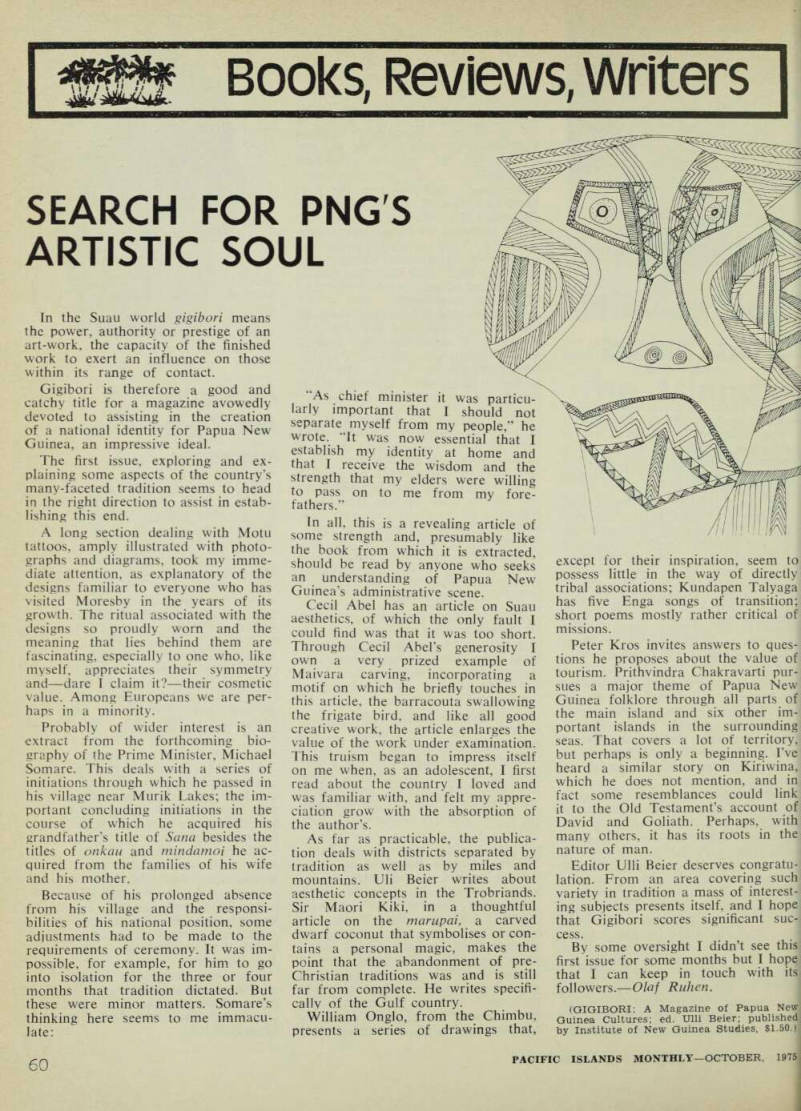
Search For Png's
Artistic Soul
In the Suau world gigibori means the power, authority or prestige of an art-work, the capacity of the finished work to exert an influence on those within its range of contact.
Gigibori is therefore a good and catchy title for a magazine avowedly devoted to assisting in the creation of a national identity for Papua New Guinea, an impressive ideal.
The first issue, exploring and ex plaining some aspects of the country’s many-faceted tradition seems to head in the right direction to assist in estab lishing this end.
A long section dealing with Motu tattoos, amply illustrated with photo graphs and diagrams, took my imme diate attention, as explanatory of the designs familiar to everyone who has visited Moresby in the years of its growth. The ritual associated with the designs so proudly worn and the meaning that lies behind them are fascinating, especially to one who, like myself, appreciates their symmetry and—dare I claim it?—their cosmetic value. Among Europeans we are per haps in a minority.
Probably of wider interest is an extract from the forthcoming bio graphy of the Prime Minister, Michael Somare. This deals with a series of initiations through which he passed in his village near Murik Lakes; the im portant concluding initiations in the course of which he acquired his grandfather’s title of Sana besides the titles of onkau and mindamoi he ac quired from the families of his wife and his mother.
Because of his prolonged absence from his village and the responsi bilities of his national position, some adjustments had to be made to the requirements of ceremony. It was im possible, for example, for him to go into isolation for the three or four months that tradition dictated. But these were minor matters. Somare’s thinking here seems to me immacu late:
As chief minister it was particu larly important that I should not separate myself from my people,” he wrote. “It was now essential that I establish my identity at home and that I receive the wisdom and the strength that my elders were willing to pass on to me from my fore fathers.”
In all, this is a revealing article of some strength and, presumably like the book from which it is extracted, should be read by anyone who seeks an understanding of Papua New Guinea’s administrative scene.
Cecil Abel has an article on Suau aesthetics, of which the only fault I could find was that it was too short.
Through Cecil Abel’s generosity I own a very prized example of Maivara carving, incorporating a motif on which he briefly touches in this article, the barracouta swallowing the frigate bird, and like all good creative work, the article enlarges the value of the work under examination.
This truism began to impress itself on me when, as an adolescent, I first read about the country I loved and was familiar with, and felt my appre ciation grow with the absorption of the author’s.
As far as practicable, the publica tion deals with districts separated by tradition as well as by miles and mountains. Uli Beier writes about aesthetic concepts in the Trobriands.
Sir Maori Kiki, in a thoughtful article on the marupai, a carved dwarf coconut that symbolises or con tains a personal magic, makes the point that the abandonment of pre- Christian traditions was and is still far from complete. He writes specifi cally of the Gulf country.
William Onglo, from the Chimbu, presents a series of drawings that,
except for their inspiration, seem to possess little in the way of directly tribal associations; Kundapen Talyaga has five Enga songs of transition; short poems mostly rather critical of missions.
Peter Kros invites answers to ques tions he proposes about the value of tourism. Prithvindra Chakravarti pur sues a major theme of Papua New Guinea folklore through all parts of the main island and six other im portant islands in the surrounding seas. That covers a lot of territory, but perhaps is only a beginning. I’ve heard a similar story on Kiriwina, which he does not mention, and in fact some resemblances could link it to the Old Testament’s account of David and Goliath. Perhaps, with many others, it has its roots in the nature of man.
Editor Dili Beier deserves congratu lation. From an area covering such variety in tradition a mass of interest ing subjects presents itself, and I hope that Gigibori scores significant suc-j cess.
By some oversight I didn’t see this first issue for some months but I hope that I can keep in touch with its
followers.
Olaf Ruhen.
(GIGIBORI: A Magazine of Papua New Guinea Cultures; ed. Ulli Beier; published by Institute of New Guinea Studies, $1.50.)
chronicle,
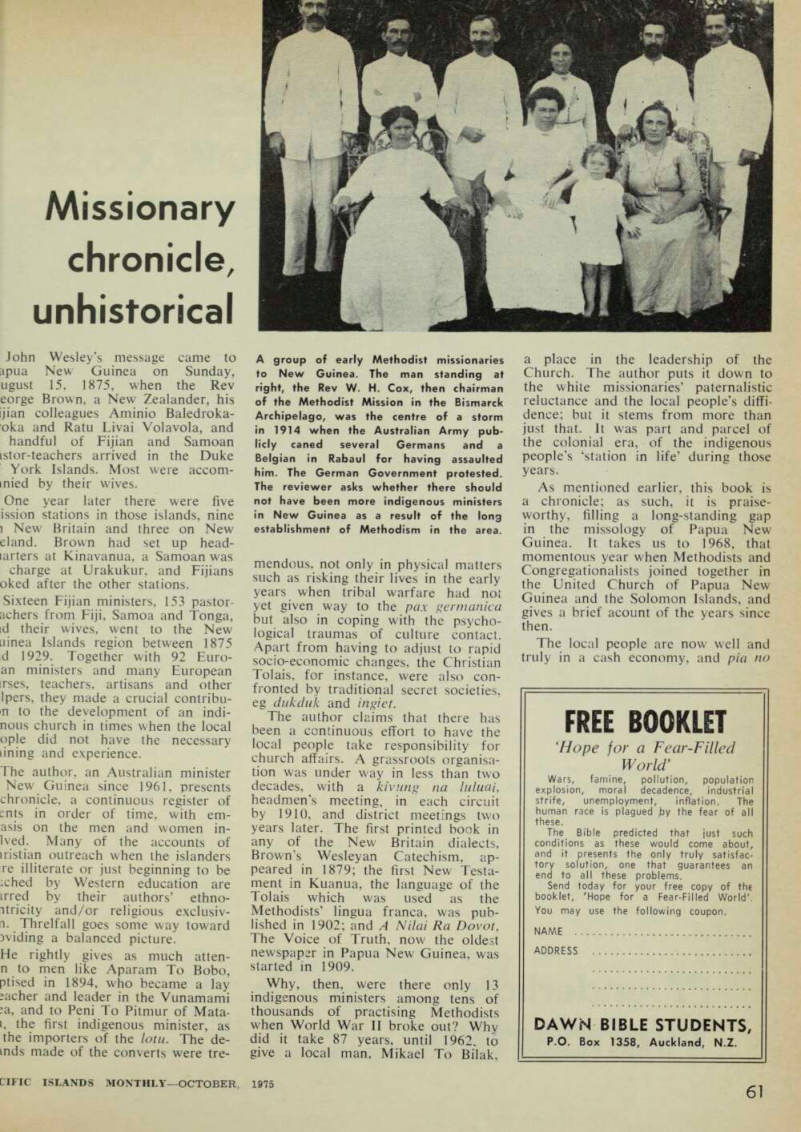

Missionary chronicle, unhistorical
John Wesley’s message came to apua New Guinea on Sunday, ugust 15, 1875, when the Rev eorge Brown, a New Zealander, his ijian colleagues Aminio Baledroka oka and Ratu Livai Volavola, and handful of Fijian and Samoan istor-teachers arrived in the Duke York Islands. Most were accom inied by their wives.
One year later there were five ission stations in those islands, nine i New Britain and three on New eland. Brown had set up head larters at Kinavanua, a Samoan was charge at Urakukur, and Fijians oked after the other stations.
Sixteen Fijian ministers, 153 pastor achers from Fiji, Samoa and Tonga, id their wives, went to the New Liinea Islands region between 1875 d 1929. Together with 92 Hum an ministers and many European irses, teachers, artisans and other Ipers, they made a crucial contribu n to the development of an indi nous church in times when the local ople did not have the necessary lining and experience.
The author, an Australian minister New Guinea since 1961, presents chronicle, a continuous register of ents in order of time, with em asis on the men and women in- Ived. Many of the accounts of iristian outreach when the islanders re illiterate or just beginning to be iched by Western education are irred by their authors’ ethno itricity and/or religious exclusiv n. Threlfall goes some way toward Dviding a balanced picture.
He rightly gives as much atten n to men like Aparam To Bobo, ptised in 1894, who became a lay -acher and leader in the Vunamami -a, and to Peni To Pitmur of Mata 1, the first indigenous minister, as the importers of the lotu. The de mds made of the converts were tre-
mendous, not only in physical matters such as risking their lives in the early years when tribal warfare had not yet given way to the pax gennanica but also in coping with the psycho logical traumas of culture contact.
Apart from having to adjust to rapid socio-economic changes, the Christian Tolais, for instance, were also con fronted by traditional secret societies, eg dukduk and ingiet.
The author claims that there has been a continuous effort to have the local people take responsibility for church affairs. A grassroots organisa tion was under way in less than two decades, with a kivung na liiluai, headmen’s meeting, in each circuit by 1910, and district meetings two years later. The first printed book in any of the New Britain dialects, Brown’s Wesleyan Catechism, ap peared in 1879; the first New Testa ment in Kuanua, the language of the Tolais which was used as the Methodists’ lingua franca, was pub lished in 1902; and A Nilai Ra Dovot, The Voice of Truth, now the oldest newspaper in Papua New Guinea, was started in 1909.
Why, then, were there only 13 indigenous ministers among tens of thousands of practising Methodists when World War II broke out? Why did it take 87 years, until 1962. to give a local man, Mikael To Bilak,
a place in the leadership of the Church. The author puts it down to the white missionaries’ paternalistic reluctance and the local people’s diffi dence; but it stems from more than just that. It was part and parcel of the colonial era, of the indigenous people’s ‘station in life’ during those years.
As mentioned earlier, this book is a chronicle; as such, it is praise worthy, filling a long-standing gap in the missology of Papua New Guinea, It takes us to 1968, that momentous year when Methodists and Congregationalists joined together in the United Church of Papua New Guinea and the Solomon Islands, and gives a brief acount of the years since then.
The local people are now well and truly in a cash economy, and pia no
A group of early Methodist missionaries to New Guinea. The man standing at right, the Rev W. H. Cox, then chairman of the Methodist Mission in the Bismarck Archipelago, was the centre of a storm in 1914 when the Australian Army pub licly caned several Germans and a Belgian in Rabaul for having assaulted him. The German Government protested.
The reviewer asks whether there should not have been more indigenous ministers in New Guinea as a result of the long establishment of Methodism in the area.
votovoto, congregations holding cus tomary land and producing cash crops to pay the salaries of pastors and teachers, has almost disappeared. But the work of those mentioned in this chronicle continues. Leslie Bosito, a Solomon Islander, heads the United Church and Saimon Gaius, a Tolai, is bishop of the New Guinea Islands region—both of them ‘products’ of Methodism.
Regrettably, this book is not a history. It neither gives an adequate iccount of the setting for the chron cle nor does it properly analyse the nteraction between ‘extraneous fac ers’, eg changes in villages society, ntrusion of modem forms of govern ment and commerce, and the Method st church (taking the term ‘Church’ n its full sense).
Cne can appreciate the dilemma of he author, a Christian clergyman in m ecumenical era, having to deal vith unpleasant historical facts such is instances of mutual intolerance be ween Methodists and Catholics and strained relations between expatriate entrepreneurs and missionaries. But much more than just glimpses of hose facts, and not merely glossing hem over, is needed in an historical iccount. Mr Threlfall has provided he bones; one hopes that others, especially Melanesians, will add the lesh.
Finally, it is good to see mention )f the late Hosea Linge whose life ; tory, translated into English in 1931 is The Erstwhile Savage, was the first mtobiography by a Papua New juinean. All who saw him help the 'Jew Ireland people rehabilitate therm elves after World War II will surely >e pleased. —Harry Jackman.
(One Hundred Years In The
SLANDS, by N. Threlfall. Published in Inited Church Book Dept., Rabaul Papua lew Guinea, 1975. $5.50 in the Pacific, 6.95 elsewhere.)
Advertisements & other items, pp. 63-65 (2 items)
61
CIFIC ISLANDS MONTHLY—OCTOBER, 1975
Free Booklet
‘Hope for a Fear-Filled
World’
Wars, famine, pollution, population explosion, moral decadence, industrial strife, unemployment, inflation. The human race is plagued ,by the fear of all these.
The Bible predicted that just such conditions as these would come about, and it presents the only truly satisfactory solution, one that guarantees an end to all these problems.
Send today for your free copy of the booklet, 'Hope for a Fear-Filled World'.
You may use the following coupon.
NAME
ADDRESS
DAWN BIBLE STUDENTS,
P.O. Box 1358, Auckland, N.Z.
Wunderfßex gives
good design at low cost
"1 m
E324ED
You want modern design?
Then use modern material that won't warp, shrink or rot You want least cost?
Then build with a board that can be worked with handyman’s tools.
Inside and out, your home will have the modern, simple lines erf Wunderflex building board.
kViunderlich
WunderfSsx
Available from: Papua New Guinea; Steamships Trading Co. Ltd.
Norfolk Island: Irvine’s Building Supply Centre Made in Australia and marketed by CSR Building Materials Export Sales; 4 O’Connell Street, Sydney. Australia 2000
NO MANA
There is no MANA feature in this month’s PIM. The material went astray somewhere between Fiji and Sydney.
This is the first time MANA, a popular section of PIM, has not appeared since first publication in the March, 1973, PIM.
Some copies of the 1974 MANA Annual, containing all the works for that year, plus additional material, are available from Pacific Publications, GPO Box 3408, Sydney, at $2.50 plus 70c postage or SUS3.6O posted.
Bouquets, Brickbats And
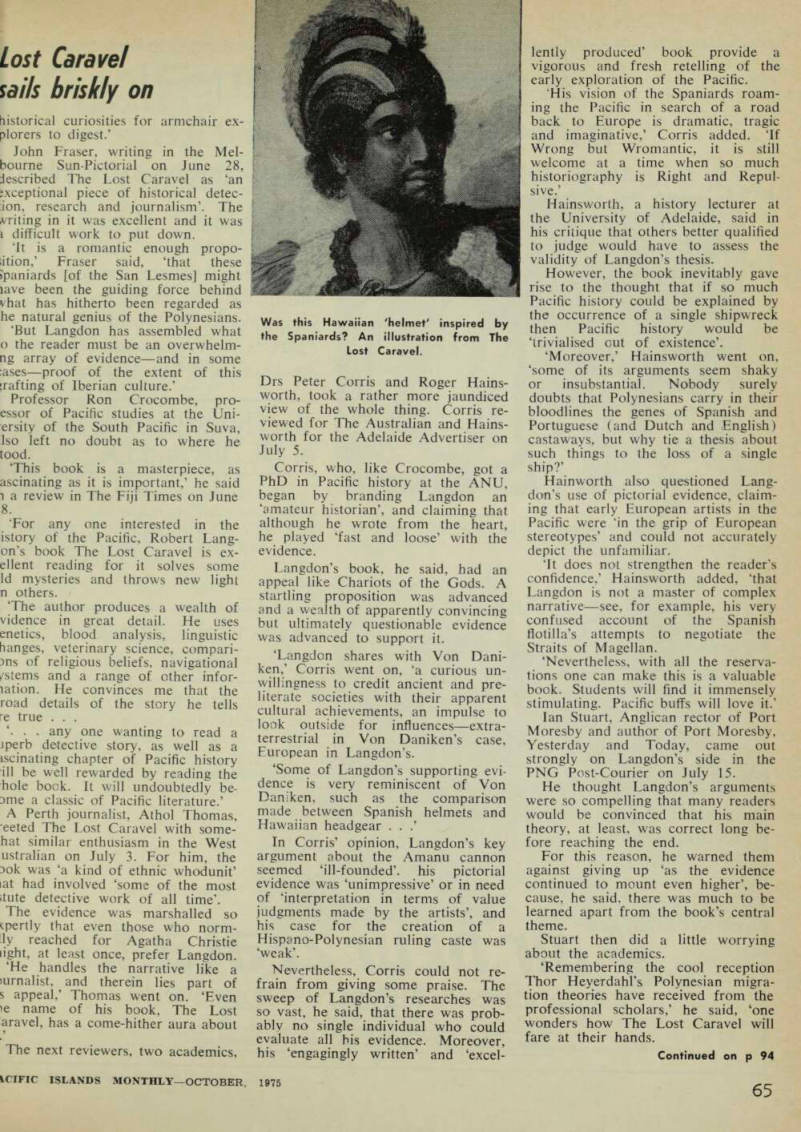
Spanish Cocktails For
Lost Caravel
Robert Langdon’s controversial new book The Lost Caravel, which Pacific Publications recently launched as ‘the book sensation of the Pacific’ and ‘the book that changes Pacific history’, has had a lively and varied reception in its first few weeks on the market.
Some reviewers accepted its theories with strings of superlatives.
Others, like PlM’s own reviewer (PIM July, p 52), felt its theories were fallacious or in the realm of fantasy.
The Spanish Ambassador in Can berra celebrated the book’s appear ance with a reception for 50 or so guests.
The Lost Caravel advances the theory that the caravel San Lesmes, lost from a Spanish expedition to the East Indies, in 1526, was wrecked on Amanu Atoll to the east of Tahiti; that the crew survived and inter married with local women; and that they and their descendants spread to many Polynesian islands, including Tahiti, New Zealand and Easter Island.
The book begins with an account of the discovery of four ancient cannon on the Amanu reef in 1929.
It claims that the Spanish crew that left them there significantly in fluenced Polynesian culture.
First off the mark to review the book was Grant McCall, an anthro pologist at the Australian National University, who is writing a PhD thesis on the modern Easter Islanders.
After lavishing much praise on the book’s author for the breadth of his researches, etc, McCall declared—in a review for a Basque journal in Buenos Aires—that he himself was only competent to judge the author on the question of Easter Island.
He then devoted considerable space to examining the last page or so of Langdon’s 13-page chapter on Easter Island, and finally declared that as far as Easter Island was concerned,
the author’s theories ‘began to fall into disintegrated little pieces’.
Three reviews that appeared in Australian newspapers on June 21 found Langdon’s theories more ac ceptable.
Olaf Ruhen, writing in the Mel bourne Age, said that Langdon’s researches had ‘accumulated an astonishing weight of evidence that at least lends credibility to postula tions that Spanish, or rather a pre dominantly Basque, influence helped to mould eastern Polynesians into a marine community of which some skills derived from Europe’. ‘lt does not, of course, decry the astonishing abilities they had pre viously,’ he said.
Ruhen added: I was convinced while this book was only a rumour that it could not have respectable standing. That conviction I now re tract, absolutely and ashamedly; I accept many of its arguments, though not all, against my former belief.’
Kylie Tennant, writing in the Sydney Morning Herald, devoted half of her review to the views of a skeptical friend, who said: ‘The Poly nesians do not need any theory that they are descended from red-haired, blue-eyed Basques . . .’
However, she went on: ‘One should read The Lost Caravel not with skepticism but in the spirit of delight . . . When we are introduced to lost Spanish mariners repairing their ship, the San Lesmes, on a remote island of the Tuamotus, following Robert Langdon’s skilfully presented case for their survival, the very breadth of ad venture blows through the narrative.’
A reviewer for the Melbourne Herald, Frederick Howard, said Lang don’s book made ‘new and challeng ing probes into the Pacific past’. If Langdon was right, the survivors of a ship of 450 years ago had left traces overran immense area. ‘The experts will debate, perhaps inconclusively and endlessly,’ Howard added. ‘Meanwhile, there is a fat book of deduction, adventure and
Lost Caravel
sails briskly on
historical curiosities for armchair ex plorers to digest.’
John Fraser, writing in the Mel bourne Sun-Pictorial on June 28, described The Lost Caravel as ‘an exceptional piece of historical detec ion, research and journalism’. The vriting in it was excellent and it was i difficult work to put down.
It is a romantic enough propo rtion,’ Fraser said, ‘that these Spaniards [of the San Lesmes] might lave been the guiding force behind vhat has hitherto been regarded as he natural genius of the Polynesians. ‘But Langdon has assembled what 0 the reader must be an overwhelm ng array of evidence—and in some :ases—proof of the extent of this 'rafting of Iberian culture.’
Professor Ron Crocombe, pro essor of Pacific studies at the Uni ersity of the South Pacific in Suva, Iso left no doubt as to where he tood. ‘This book is a masterpiece, as ascinating as it is important,’ he said 1 a review in The Fiji Times on June 8.
For any one interested in the istory of the Pacific, Robert Lang on’s book The Lost Caravel is ex ellent reading for it solves some Id mysteries and throws new light n others. ‘The author produces a wealth of vidence in great detail. He uses enetics, blood analysis, linguistic hanges, veterinary science, compari ms of religious beliefs, navigational and a range of other infor lation. He convinces me that the road details of the story he tells re true . . . ‘. . . any one wanting to read a jperb detective story, as well as a iscinating chapter of Pacific history ill be well rewarded by reading the hole book. It will undoubtedly be ame a classic of Pacific literature.’
A Perth journalist, Athol Thomas, eeted The Lost Caravel with some hat similar enthusiasm in the West ustralian on July 3. For him, the 3ok was ‘a kind of ethnic whodunit’ lat had involved ‘some of the most itute detective work of all time’.
The evidence was marshalled so <pertly that even those who norm ly reached for Agatha Christie light, at least once, prefer Langdon. ‘He handles the narrative like a lurnalist, and therein lies part of s appeal,’ Thomas went on. ‘Even ic name of his book, The Lost aravel, has a come-hither aura about The next reviewers, two academics,
Drs Peter Corris and Roger Hains worth, took a rather more jaundiced view of the whole thing. Corris re viewed for The Australian and Hains worth for the Adelaide Advertiser on July 5.
Corris, who, like Crocombe, got a PhD in Pacific history at the ANU, began by branding Langdon an ‘amateur historian’, and claiming that although he wrote from the heart, he played ‘fast and loose’ with the evidence.
Langdon’s book, he said, had an appeal like Chariots of the Gods. A startling proposition was advanced and a wealth of apparently convincing but ultimately questionable evidence was advanced to support it. ‘Langdon shares with Von Dani ken,’ Corris went on, ‘a curious un willingness to credit ancient and pre literate societies with their apparent cultural achievements, an impulse to look outside for influences—extra terrestrial in Von Daniken’s case, European in Langdon’s. ‘Some of Langdon’s supporting evi dence is very reminiscent of Von Daniken, such as the comparison made between Spanish helmets and Hawaiian headgear . . .’
In Corris’ opinion, Langdon’s key argument about the Amanu cannon seemed ‘ill-founded’, his pictorial evidence was ‘unimpressive’ or in need of ‘interpretation in terms of value judgments made by the artists’, and his case for the creation of a Hispano-Polynesian ruling caste was ‘weak’.
Nevertheless, Corris could not re frain from giving some praise. The sweep of Langdon’s researches was so vast, he said, that there was prob ably no single individual who could evaluate all his evidence. Moreover, his ‘engagingly written’ and ‘excel
lently produced’ book provide a vigorous and fresh retelling of the early exploration of the Pacific.
His vision of the Spaniards roam ing the Pacific in search of a road back to Europe is dramatic, tragic and imaginative,’ Corris added. ‘lf Wrong but Wromantic, it is still welcome at a time when so much historiography is Right and Repul sive.’
Hainsworth, a history lecturer at the University of Adelaide, said in his critique that others better qualified to judge would have to assess the validity of Langdon’s thesis.
However, the book inevitably gave rise to the thought that if so much Pacific history could be explained by the occurrence of a single shipwreck then Pacific history would be ‘trivialised out of existence’. ‘Moreover,’ Hainsworth went on, ‘some of its arguments seem shaky or insubstantial. Nobody surely doubts that Polynesians carry in their bloodlines the genes of Spanish and Portuguese (and Dutch and English) castaways, but why tie a thesis about such things to the loss of a single ship?’
Hainworth also questioned Lang don’s use of pictorial evidence, claim ing that early European artists in the Pacific were ‘in the grip of European stereotypes’ and could not accurately depict the unfamiliar. ‘lt does not strengthen the reader’s confidence,’ Hainsworth added, ‘that Langdon is not a master of complex narrative—see, for example, his very confused account of the Spanish flotilla’s attempts to negotiate the Straits of Magellan. ‘Nevertheless, with all the reserva tions one can make this is a valuable book. Students will find it immensely stimulating. Pacific buffs will love it.’ lan Stuart, Anglican rector of Port Moresby and author of Port Moresby, Yesterday and Today, came out strongly on Langdon’s side in the PNG Post-Courier on July 15.
He thought Langdon’s arguments were so compelling that many readers would be convinced that his main theory, at least, was correct long be fore reaching the end.
For this reason, he warned them against giving up ‘as the evidence continued to mount even higher’, be cause, he said, there was much to be learned apart from the book’s central theme.
Stuart then did a little worrying about the academics. ‘Remembering the cool reception Thor Heyerdahl’s Polynesian migra tion theories have received from the professional scholars,’ he said, ‘one wonders how The Lost Caravel will fare at their hands.
Continued on p 94
Was this Hawaiian 'helmet' inspired by the Spaniards? An illustration from The Lost Caravel.
‘Can one already hear the long knives being sharpened? Langdon himself notes that academics are in stinctively resistant to revolutionary ideas. One hopes that his work will at least attract the scholarly attention it deserves.’
Two Pacific ‘names’ had praise for The Lost Caravel. In the Honolulu Star Bulletin, E. H. Bryan Jr, mana ger of the Pacific Science Information Centre at the Bishop Museum, wrote that ‘we should regard this book as another well-written and informative contribution to the knowledge of
Pacific history’.
In the Canberra Times, Professor O. H. K Spate, acting head of the Research School of Pacific Studies at the Australian National University, said the book ‘is not only a fascinat ing whodunnit for the general reader, but one of real importance to the serious student’. He added, ‘Lang don cannot justly be compared (as he has been) to Von Daniken; rather to
Andrew Sharp or Heyerdahl, though
he conducts his argument with much more skill and restraint than Heyer dahl does’.
Referring to the book as ‘an excit ing and on the whole very well sus tained reconsideration of history, with many fascinating episodes set in the main story’ Professor Spate sums up The Lost Caravel thus: T do not think that Langdon has established his case in its totality; he has estab lished a great deal. At the very least, he has successfully re-opened some old questions thought closed; and he has posed new ones which will demand serious consideration.
That is about as much as anyone can expect to achieve in one book.’
One of the first reviews to appear in the New Zealand press was a double-page spread with seven pic tures in the NZ Listener for July 19.
The reviewer, Jenny Cannon, gave a well-schooled summary of the book’s contents and said it provided ‘a credible solution to some long un
ravelled mysteries.’
Although she thought some readers might feel that Langdon was stretch ing a point by getting some of his castaways to New Zealand, she her self seemed to accept the idea. ‘Langdon has gathered some evi dence to prove that the supposed Maori fleet was a Spanish fleet and that it arrived about 200 years later than commonly thought,’ she said. ‘The strongest link in the chain of evidence is the story of Hiro . . .’
A review in the Otago Dailv Times of Dunedin of July 2, by GJG, said The Lost Caravel was likely to re
main in the ‘permanent canon of Pacific scholarship’.
The most convincing part of it con cerned evidence of European clothing and shipbuilding methods in the general area where the Basque- Spaniards may have survived.
The occurrence of blond and red haired people among the Polynesians also sat well with Langdon’s theories. ‘lf even a twentieth of what Lang don suggests is sound, the history of Maori origins will have to be re written,’ GJG went on. ‘As it is The Lost Caravel must inevitably cause some rumpus in the world of Pacific scholarship, if only for the effort needed to prove or disprove its many ramifications.’
The reviews in the New Zealand press would no doubt have appealed to Spain’s Ambassador to Australia, Don Alberto Pascual Villar.
The ambassador, who has long been an enthusiastic advocate of Langdon’s theories, held a reception on July 24 to celebrate the publica tion of The Lost Caravel. The date was a very special one—the 450th anniversary of the departure from Spain of the San Lesmes and six other ships under the command of Garcia Jofre de Loaisa.
Among the guests were the am bassadors of Portugal, Mexico, the Philippines, Peru, Chile, Argentina, Uruguay and Brazil, other diplomats from those countries, and their wives.
The invitations said that the Loaisa expedition had opened ‘nuevas rutas de Hispanidad’—new routes of Spanishness—in the South Seas.
At the reception, the Spanish Am bassador paid a glowing tribute to the author of The Lost Caravel, and the latter replied with a speech in Spanish. He also presented the am bassador with a copy of his book bound in red leather and yellow cloth, the colours of Spain.
Advertisements & other items, pp. 65-68 (3 items)
63
ACIFIC ISLANDS MONTHLY—OCTOBER, 1975
and touch you
5 * W I n f*' ¥ d r r / y V r ~- r% to** - ; -4 ' s«V ♦
We want to
reach out
and touch you
Searching for oil . . . petrochemical engineering . . . manufacturing synthetic fiber and plastic products.
Teijin is raw materials to finished products.
We’re also top fashion, as you probably know already.
Leading the world of fashion as creators of Teijin Tetoron.* We’re other things, too. Cosmetics, information, housing, food resources, et cetera, et cetera . . .
A diversified company that reaches out and touches the lives of different people in different ways in the spirit of international cooperation and human progress. *Tetoron is Teijin’s registered trademark for its polyester fiber and fabrics.
A Leader Today... For A Better Tomorrow
TEIJIN
TEIJIN LIMITED Tokyo Head Office: 1-1, 2-chome Uchisaiwai-cho, Chiyoda-ku, Tokyo, JOKro & Osaka japan Japan Phone; Tokyo 5064111
A growing airline
in a shrinking world...
Fly to any of 16 AIR NEW ZEALAN D Gateways to the World, §rrn AIR NEW ZEALAND is a truly international airline, flying you throughout the Pacific to any of 16 Gateways to the World, as far apart as Wellington and Singapore, Auckland and Los Angeles.
. You fly the friendly fleet
! of DClOs and DCBs.
Los Angeles
* R I
Singapore
Our magnificent wide-bodiedDC-lOs now fly on most international AIR NEW ZEALAND routes. On other flights and services, our personalised DC-8s provide outstanding AIR NEW ZEALAND service.
16 exciting Gateways
to tlie World.
AIR NEW ZEALAND flies to Hawaii Los Angeles, Hong Kong, Singapore, Sydney, Melbourne, Brisbane, Auckland, Wellington, Christchurch, Fiji, Tahiti, New Caledonia, Samoa, Rarotonga and Norfolk Island.
air new zeaiano
Friendliest wings across your world.
Talk to AIR NEW ZEALAND or your travel agent
ANZ 2;
65
iCIFIC ISLANDS MONTHLY—OCTOBER. 1975
Pacific Transport
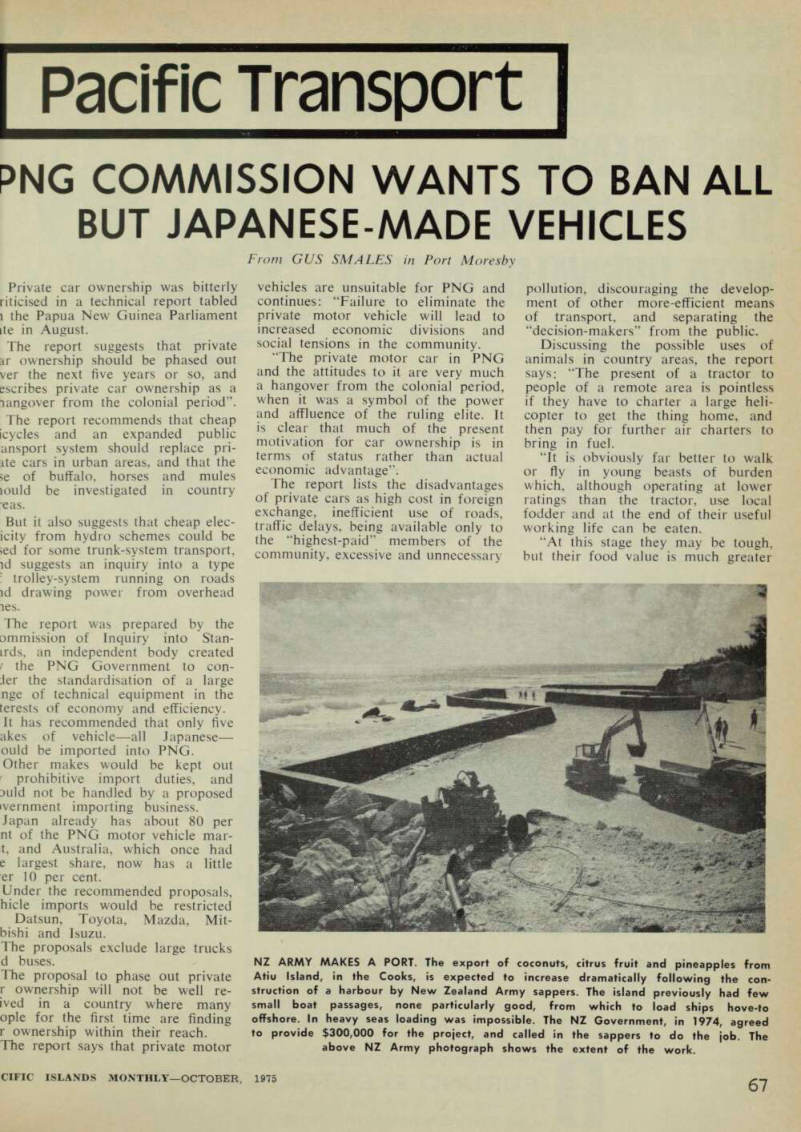

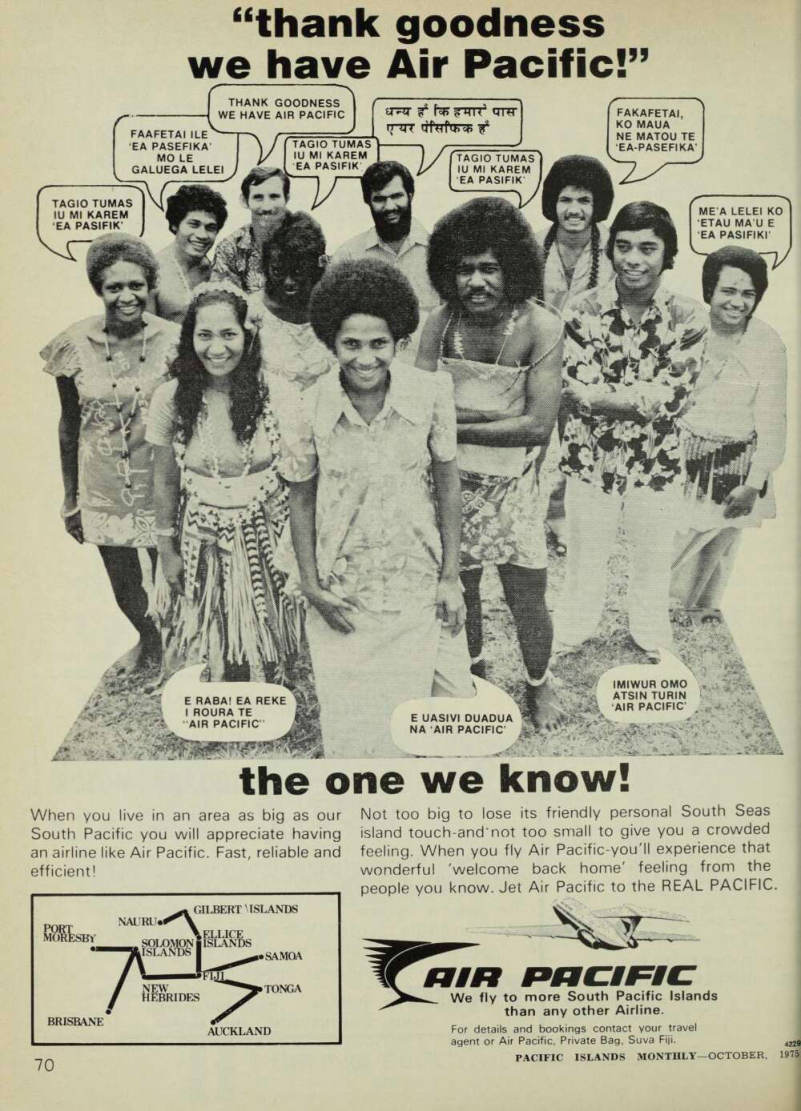
Png Commission Wants To Ban All
But Japanese-Made Vehicles
From GUS SMALES in Port Moresby
Private car ownership was bitterly riticised in a technical report tabled i the Papua New Guinea Parliament ite in August.
The report suggests that private ar ownership should be phased out ver the next five years or so, and escribes private car ownership as a aangover from the colonial period”.
The report recommends that cheap icycles and an expanded public ansport system should replace pri ate cars in urban areas, and that the >e of buffalo, horses and mules tould be investigated in country eas.
But it also suggests that cheap elec icity from hydro schemes could be >ed for some trunk-system transport, id suggests an inquiry into a type : trolley-system running on roads id drawing power from overhead ics.
The report was prepared by the ommission of Inquiry into Stan irds, an independent body created f the PNG Government to con- Jer the standardisation of a large nge of technical equipment in the terests of economy and efficiency.
It has recommended that only five akes of vehicle—all Japanese— ould be imported into PNG.
Other makes would be kept out r prohibitive import duties, and 3uld not be handled by a proposed •vernment importing business.
Japan already has about 80 per nt of the PNG motor vehicle mar t, and Australia, which once had e largest share, now has a little er 10 per cent.
Under the recommended proposals, hide imports would be restricted Datsun, Toyota, Mazda, Mit bishi and Isuzu.
The proposals exclude large trucks d buses.
The proposal to phase out private r ownership will not be well re ived in a country where many ople for the first time are finding r ownership within their reach.
The report says that private motor
vehicles are unsuitable for PNG and continues: “Failure to eliminate the private motor vehicle will lead to increased economic divisions and social tensions in the community.
“The private motor car in PNG and the attitudes to it are very much a hangover from the colonial period, when it was a symbol of the power and affluence of the ruling elite. It is clear that much of the present motivation for car ownership is in terms of status rather than actual economic advantage”.
The report lists the disadvantages of private cars as high cost in foreign exchange, inefficient use of roads, traffic delays, being available only to the “highest-paid” members of the community, excessive and unnecessary
pollution, discouraging the develop ment of other more-efficient means of transport, and separating the “decision-makers” from the public, Discussing the possible uses of animals in country areas, the report says: “The present of a tractor to people of a remote area is pointless if they have to charter a large heli copter to get the thing home, and then pay for further air charters to bring in fuel.
“It is obviously far better to walk or fly in young beasts of burden which, although operating at lower ratings than the tractor, use local fodder and at the end of their useful working life can be eaten, “At this stage they may be tough, but their food value is much greater
NZ ARMY MAKES A PORT. The export of coconuts, citrus fruit and pineapples from Atiu Island, in the Cooks, is expected to increase dramatically following the con struction of a harbour by New Zealand Army sappers. The island previously had few small boat passages, none particularly good, from which to load ships hove-to offshore. In heavy seas loading was impossible. The NZ Government, in 1974, agreed to provide $300,000 for the project, and called in the sappers to do the job. The above NZ Army photograph shows the extent of the work.
han that of a worn-out tractor, and he hide if suitably treated is valu ible”.
Juieter Time On
Iji's Wharves In 1974
Less cargo passed across Fiji diarves in 1974 than 1973, and there 'as also a falling-off in the number f overseas cargo ships calling at iji ports. At the other end of the :ale, Fiji’s exports over wharves r ere 5.1 per cent higher in 1974, Dmpared with 1973.
The overseas cargo tonnage andled in all ports was 1,143,689 >ns, down 57,894 tons.
The King’s Wharf, Suva, handled 56.000 tons in 1974, of which 58.000 tons were petroleum pro ducts. Wheat, most of it for the cal flour mill, accounted for about ) per cent of the King’s Wharf irgo.
Lautoka, from where most of Fiji’s gar is exported, handled 402,879 ns of cargo, including 201,000 tons unrefined sugar and 67,000 tons molasses. Vuda (mainly petro- Jm products), Vatia (mainly used " the Emperor Gold Mining Co), alau (mainly unrefined sugar) and lington (mainly unrefined sugar) ndled 263,000 tons of cargo.
The reason given for a decline in j number of overseas ships calling Fiji was that bigger and more )dern ships, are slowly replacing laller ships.
There has been a big improvement performance by Suva watersiders ce the Ports Authority of Fiji took er the running of Fiji wharves, e director of the authority, Mr Lou ;ng Kee, said recently that their xluction had doubled, which is ad news for shipowners.
Mr Lou said the men had adopted nore conscientious outlook towards :ir work, and had generated in ased productivity, which could be asured in terms of cargo handled I the tumround of ships.
Fhe watersiders had been the sub t of criticism for some time for v production capacity related to ges. They were also criticised for amount of pilferage which ’’rred on the wharves.
Ylr Lou, praising the dockworkers, I the authority’s main function ? to create a congenial atmosphere iduciye to greater efficiency and ducfion. The men had responded earnest.
Ill Oakij4S Clip
5 Norfolk Wings?
Jantas. which lost about $700,000 the Svdnev-Norfolk Island service the last financial year, may not
be averse to a bid by Norfolk Island Airlines, to take over the run. Fokker- VFW International is seeking to sell a Fokker F2B jet to Norfolk Island Airlines, claiming it could go into service almost immediately, and that the existing airport is suitable for F2B operations.
A F2B would be about twice as fast as the lumbering DC4s which Qantas has used for many years. The Royal Commission inquiring into the future of the island has heard sub missions on behalf of Norfolk Island Airlines.
On August 26, Qantas put up the fare and cargo rates for the Sydney- Norfolk Island run. The one-way fare is now $94.10, compared with the previous rate of $78.40. Even the new rates are unlikely to make a big dent in the loss Qantas incurs on the service. The latest rise was in line with the Australian Government’s policy of calculating Norfolk Island fares on the same basis as other domestic airlines in Australia.
Png's New Laws
For Shipping
A new law in Papua New Guinea will give the country the international right to fly the national flag on the high seas. The law established a shipping register under which mer chant ships owned only by citizens and corporations approved by the National Investment and Develop ment Authority will be registered in
Png.
Pleasure craft, canoes and ships less than 10 metres long will be exempt from registration. Registra tion fees will be kept at the minimum needed to run the system.
To encourage the employment of PNG seamen, large ships will be given a rebate of fees if a fixed pro portion of the crew is Papua New Guinean.
Anyone who uses the national flag to pretend a ship is registered will be liable to forfeit his ship. Ship owners or masters who conceal their PNG registration or pretend to be foreign-registered are liable to a penalty of K 1,000 and forfeiture.
A New Fokker
For The Pacific
Fokker is developing a new version of the F-28 Fellowship, a medium haul aircraft, which will carry 85 passengers over distances between 2,000 and 2,700 kilometres. The F-28 Mark 4000 was developed in consul tation with potential users from the prototype of the Mark 6000 version.
It will have longer wings and quieter, stronger Rolls Royce Spey engines. The first F-28 Mark 4000 aircraft will be available for delivery about mid-1976.
Air Nauru operates a F-28 Fellow ship from Melbourne to Nauru, via Tontouta in New Caledonia and Honiara, and then uses it on services from Nauru to Tarawa and Majuro, and to Kagoshima in Japan, via Ponape, Guam and Okinawa.
W. Samoa Frowns
At Aerial Opposition
Western Samoa is not at all happy about having to grant landing rights at Faleolo Airport, near Apia, to American Samoa-based South Pacific Island Airways. But she was obliged
to do so in return for rights at Ta funa Airport in American Samoa.
Western Samoa’s Secretary to the Government, Mr lulai Toma, was quite frank about the matter. He said his government had delayed granting rights to SP Island Air ways to protect Polynesian Airlines.
It was also reluctant to grant rights because it felt there was not enough traffic between Tafua and Faleolo to warrant two airlines.
Pan American World Airways, till December, 1974, was the official designated US airline for rights at Faleolo. But the possibility of this huge airline taking up the rights with a small aircraft was remote.
Mr Toma said the WS Government felt that as Polynesian Airlines had pioneered the route, it was entitled to have time to recover expenses. As the WS Government is the major shareholder in Polynesian Airlines, Mr Toma’s statement is not surpris ing.
At Western Samoa’s insistence it will have to operate a scheduled service, with a fare level comparable with that of Polynesian Airlines.
SP Island Airways did not accept the suggestion that there would not be enough traffic for two airlines.
The airline claims it will not make a dent in Polynesian Airlines opera tions, but rather will generate, and encourage, new traffic from American Samoa to Western Samoa.
The president of SPIA, Mr George Wray, said SPIA would start a ser vice within 30 days of August 5, the day rights were granted, using 9passenger Britten-Norman Islander aircraft. Eventually it will provide commuter-type services with 20 to 30 passenger aircraft, yet to be selected. The 93-mile route had an annual boarding rate of 78,000 passengers, and provided Polynesian Airlines with revenue of SUSI.B million.
Another Patrol
Boat For Tonga
Tonga expects to take delivery early next year of a second fast patrol boat, which will cost $115,000. The boat is being built at the Brooke Marine shipyard, Lowestoft, England.
It will be capable of 30 knots, and will have a continuous maximum speed of 24 knots.
The twin 350 bhp diesel engines will be installed in October, and sea trials are scheduled for November.
The ship has an aluminium hull. It is a sister ship to the 40 ft Ngahau Koula, which is in service. The new boat will incorporate a number of modifications which will give it a longer range than the Ngahau Koula.
The normal complement of the
new ship will be two officers and six crew.
One of the boats will be posted permanently at Vavau to patrol northern waters. The other will operate mainly in the Tongatapu and southern Haapai areas, and will be based at Nukualofa. The boats’ duties include fisheries patrols, mercy mis sions, communications support, troop transport and resources surveys.
Air Micronesia's
Earnings Drop
Net earnings of Air Micronesia Inc in the year ended December 31, 1974, totalled $7,557, compared with $22,295 in 1973. Total revenue at $1,553,413 was 6.1 per cent higher than the 1973 revenue of $1,464,722.
Continental, which has complete financial and operational responsi bility for the air service, incurred a pre-tax loss of $2,268,900 on its Trust Territory operation, compared with a 1973 pre-tax loss of $1,714,800. The after-tax loss was $1,727,200, compared with $891,600 in 1973.
Continental/Air Micronesia links the Trust Territory with Honolulu, Johnston Island, Guam and Okinawa.
In the Trust Territory itself, the air line services Majuro, Kwajalein, Ponape, Truk, Saipan, Tinian, Rota, Yap and Palau. It has authority to operate from the Trust Territory to Pago Pago, Funafuti, Tarawa and Nauru, but service to those points has been postponed as the landing facilities at Tarawa and Funafuti need to be improved to handle jet airliners. In addition bilateral negoti ations between the US and the UK to institute a Continental/Air Micro nesia service have not yet been held.
Lindenbank
Runs On Reef
The Bank Line’s Lindenbank went on a reef off Fanning Island late in August while loading copra. On Sep tember 7 the forward part of the ship was afloat, but she was still fast aground amidships. The owners were hopeful of being able to discharge cargo to lighten the ship sufficiently to enable her to float off, provided the weather remained calm.
The Lindenbank was carrying a cargo of copra, coconut oil and copra pellets loaded in New Guinea, Fiji and other South Pacific ports.
When she went aground another Bank Line ship, the Elmbank, which was nearby, was called in to help.
Then two United States Navy tugs were brought from Hawaii to try to shift the Lindenbank. All efforts were fruitless.
Some cargo was jettisoned and
me was taken to the island to hten the Lindenbank. Early reports re that there was some rupturing the bulkheads, and that the tail ift was damaged, which means it she will have to be towed, as : will have no power.
I Die In
Lip Fire
Several Fijian and other Pacific mds seamen were among 16 >ple who lost their lives after mdoning the blazing Sofrana ilines ship, Capitaine Bougainville, the New Zealand east coast, north Whangarei, on September 3. The ‘ broke out early in the morning, e ship left Auckland the previous r to sail for Papua New Guinea, Sydney. fhere were grim and harrowing ries of efforts to fight the fire, and n efforts to save life as the 37 sengers and crew had to abandon 3 in mountainous and icy seas, ne life rafts and life boats were ited with only the greatest of diffi ty. Others were washed away. i master, Captain Thomas Jean was able to steer the ntaine Bougainville to within 500
metres of the shore before giving the “abandon ship” order.
The captain’s wife and three chil dren were among the casualties. There were several individual tales of heroism.
Apoa Samuels, of Fiji, a member of the crew, dived into the water after his pregnant wife, when she fell into the water. He crashed his head against the side of the ship as he dived. He managed to find his wife and after a long struggle hauled her on to a raft. He battled to get the raft ashore, and then went off to help others to get out of the water. He was later found to have a minor face fracture.
Chief Engineer Afefaoi Panapa, finding there was not enough room on a life raft for all, held on to the edge and suffered the freezing water. When a big wave threw everybody into the water, he floated in his life-jacket till dawn and was carried ashore in the
current, along with other survivors.
Captain Raymond, with his wife, was in a lifeboat which turned over several times. He was holding his wife over the keel as daylight came.
As the boat drifted to the shore he felt the sand, and then realised his wife had died. She slipped from his grasp and drifted away.
The hulk of the Capitain Bougain ville was towed to Whangarei. A formal preliminary inquiry into the disaster was started soon after.
Sofrana-Unilines bought the Capi taine Bougainville, 4,200 tons dead weight, then the Balzac, from northern Europe late in 1972, for the Auckland-New Caledonia-Papua New Guinea-Solomon Islands-New Hebrides-Auckland service. She had 900 cubic metres of refrigerated space and was equipped with two six-ton crane, one one-ton crane, two 12-ton derricks and four six-ton derricks.
Her speed was 15 knots.
The Capitaine Bou gainville before the name-change from Balzac.
Advertisements & other items, pp. 69-75 (5 items)
67
CIFIC ISLANDS MONTHLY—OCTOBER, 1975
Gives Pleasure
URUNO
FURUNO ELECTRONIC EQUIP
TO YOUR LEISURE TIME
WITH UNRIVALEO QUALIT
W &
FRS-24/48
Marine Radar Compact, high reliability, solid-state radar.
Easy operation.
Attractive antenna unit.
FG-11/200 MK-3
Echo Sounder Economical. Portable.
Recorder and flasher. 0 0 FM-21/22 Echo Sounder Simple operation.
Paper cassette. 6" paper.
NS-11 SSB Radiotelephone 150 W, 10 channels in I.6—lBMHz.
Solid-state except final stage.
VF-25NM VHF/FM
Compact 25W, 150 MHz FM Radiotelephone. 12 channel capability. f J O
i-f; O C C O
i % MT F-860 MK-II Series Echo Sounder Rugged, Proven reliability over many years.
The future today with FURUNO's electronics technology.
FURUNO ELECTRIC CO., LTD.
9 52, Ashihara-cho, Nishinomiya City, Japan
Cable: FURUNO NISHINOMIYA, Telex: 5644-325
I THROUGHOUT THE PACIFIC
* Single hand control
TSR+-+H outboard motor
And look at some of the
outstanding features . . .
Needle Roller Bearings throughout—Heavy Duty Crankshaft and Mair Bearings—Loop Scavenging. Stainless Steel and Non Ferrous Metal on all water contact parts.
The Quality is The Best! Spare Parts amongst the Cheapest!
HUNDREDS OF OTHER FINE POINTS ON THIS REALLY
MODERN TERHI OUTBOARD MOTOR FROM FINLAND
Th
Pacific
The full range available ex stock.
D.A.T.A.
19 Carrington Rd., Marrickville, N.S.W. 2204 Australia.
CABLES: "DIESELTECH" SYDNEY. TELEX: AA 25568.
“thank goodness
we have Air Pacific!”
THANK GOODNESS
WE HAVE AIR PACIFIC
£TFST T N> ?Hk' *TTW
TT-VT dfafa* t
FAKAFETAI,
KO MAUA
NE MATOU TE
EA-PASEFIKA
r
FAAFETAI ILE "
EA PASEFIKA'
MO LE
GALUEGA LELEI
TAGIO TUMAS
IU Ml KAREM
EA PASIFIK
V
TAGIO TUMAS
IU Ml KAREM
EA PASIFIK
m
TAGIO TUMAS
ME A LELEI KO
ETAU MA’U E
EA PASIFIKI’
IU Ml KAREM
EA PASIFIK
w mII
< ✓ s "■CW* 1 f f L « I 1 w *
, E RABA! EA REKE
I ROURA TE
AIR PACIFIC
E UASIVI DUADL
NA AIR PACIFIC
m
the one we know!
IMIWUR OMO . ; ,
ATSIN TURIN . '
AIR pacific .
r rs%: f.; t;,..
■' ■- * * • ' When you live in an area as big as our
South Pacific you will appreciate having
an airline like Air Pacific. Fast, reliable and
efficient!
GILBERT ISLANDS
NAURU*
PORT
ELLICE
ISLANDS
MORESBY
ISLAN
• SAMOA
NEW
HEBRIDES
TONGA
BRISBANE
AUCKLAND
Not too big to lose its friendly personal South Seas island touch-and'not too small to give you a crowded feeling. When you fly Air Pacific-you'll experience that wonderful 'welcome back home' feeling from the people you know. Jet Air Pacific to the REAL PACIFIC.
HIA pact
We fly to more South Pacific Islands than any other Airline.
For details and bookings contact your travel agent or Air Pacific, Private Bag, Suva Fiji.
ant PIM for a friend this Christmas ? 7/ make easier for you!
tirii ir imciiiiin
Monthly
Keeps you informed on Pacific happenings
I in the details m one of the ttached order forms.
There's an International Truck
lor every application. Yours toe
Whatever you carry on or off the highway, we’re certain we’ve got just the truck you need.
Thirty-five basic models include petrol and diesel power, single axle and tandem drive, 4 x 2, 6 x 4 and Bx 4, automatic and manual transmission, conventional cab and cab over.
Two series of truck designs which together comprise these 35 options, make up the International truck range.
ACCO-A Series (cab over) Twenty-three basic models feature a ‘human engineered’ all-steel cab for outstanding driver comfort and safety. It tilts for easy access to the engine, cutting servicing and maintenance delays.
Models cater for a wide range of applications tippers, trays, vans, cement agitators, tankers and semi-trailers. A total of 7 petrol and diesel engines power the range.
Q-Line (conventional cab) Twelve basic models including four-wheelorive vehicles for off-highway use. Suited to tray, tippers, vans and as prime movers for semi-trailers.
There’s an International truck to suit almost every practical application. And they’re all backed by reliable after-sales service and parts supply.
For further information contact our authorised distributors— NGG Trading Co., PO Box 459, Lae, PNG.
Solomon Motors Ltd., PO Box Cl 6, Honiara, Guadalcanal, BSIP.
S.I.F.R.A. BP 806,
Noumea, New Caledonia.
Niranjans Autoport Limited, GPO Box 450, Suva, Fiji.
Kerr Bros Pty. Ltd., PO Box 3838, Sydney, NSW, 2001 Tahiti Produits Shelltex, Boite Postale 350, Papeete, Tahiti.
Pacific Products Inc., PO Box 698, Pago Pago, American Samoa 96920 International Harvester Australia Limited
International
To Future Generations,
Security
:r.
I & m. m % istodian of the past Social welfare is a subject of serious consideration in most modern societies. Man in the twentieth century accepts his responsibility to bequeath to the next generation a society better than his own.
Daiwa Bank is not unique in accepting this responsibility, but Daiwa is unique in making acceptance of this role in society an integral part of their banking service.
Daiwa is the only Japanese city bank to combine banking and trust business. Daiwa is thus a fully integrated banking institution, comprising banking, international financing, trust, pension trust, and real estate business. This integration is part of our effort to fulfil our social responsibility consistent with society's needs in a contemporary environment. a fully integrated banking service
DAIWA BANK
Head Office: Osaka, japan London and Frankfurt Branches New York and Los Angeles Agencies Singapore, Sydney and Sao Paulo Representative Offices Joint Venture Banks; P.T. Bank Perdania, Jakarta, International Credit Alliance, Ltd., Hong Kong
;Ific Islands Monthly—October, 1975
71
IFIC ISLANDS MONTHLY—OCTOBER. 1975
73
:fic islands monthly—October. 1975
Cruising
Yachts
Transport Briefs
• A new 37 ft 10-ton ship has been added to the Solomon Islands trading fleet. The ship, the Libaka, will be used round Ysabel to bring cargo to a central point for trans shipment to Honiara. The Libaka, built of ferro-cement, cost $25,000.
It is the second ship of its type to be built by the Honiara Marina and Shipyard Co. An order has been placed for a third ship. • Mr J. I. Tauvasa, of Hoskins, West New Britain, has been ap pointed Controller of Civil Aviation for Papua New Guinea. He will be responsible for administering the civil aviation regulations, which include licensing air crews, airways opera tions officers and aircraft mainten ance engineers. He will also be re sponsible for the Civil Aviation Agency, which operates air traffic control and flight information ser vices. • Marine officers who hold Pacific Island certificates of competence will be able to serve in, and command, Fiji-registered ships trading between Fiji and Australia and New Zealand, under legislation which will go to parliament for approval. This is ex pected to provide greater work oppor tunities for Fiji ships’ officers. • The United States may seek rights in the South Pacific for an other airline in 1976. This hint was dropped by President Ford when he approved a route exchange by Ameri can Airlines and Pan American World Airways. American Airlines withdrew from the South Pacific in 1974 under a deal with PAA, which gave PAA exclusive US rights in the South Pacific and American Airlines some PAA routes in the Caribbean. • Sofrana - Unilines, in mid- August, increased the freight rates on the New Zealand-Pacific Islands service by 10 per cent to cover the cost of the recent devaluation. The Island groups Sofrana-Unilines ser vices from NZ are New Caledonia, the New Hebrides, Papua New Guinea and the Solomons. • The Solomon Islands will use part of a UK grant of $621,270 to buy a steel barge, 80 ft by 25 ft. The barge will be mainly used for charter by the Ministries of Works and Pub lic Utilities, and Agriculture and Lands. It will be capable of carrying 50 tons of cargo—either cattle or heavy plant machinery.
• AKURAKU, 36 ft steel sloop, was a recent visitor to Niue while on a cir cumnavigation, nearing its end. The sloop left Fremantle about three years ago. She carried owner-builder-skipper Fred Grim minck, his wife Lesley, and old baby, Tony. The Akuraku stayed three days at Niue. • MARI, 33 ft sloop, arrived in Bris bane late in July carrying Bob and Marie Hall who started a circumnavigation from Fort Lauderdale, Florida, in November, 1973. They planned to cruise the Great Barrier reef before sailing to Indonesia, Malaysia, the Seychelles and the Red Sea.
After sailing through the Caribbean and the Panama Canal, they visited Nukuhiva, Tahiti and other French Polynesia islands, and Rarotonga. The Halls spent the 1974- 75 hurricane season in New Zealand, and in April sailed for Australia, via Tonga, Fiji and New Caledonia. • YOLANTA, 32 ft double-ended ketch, was a recent visitor to Niue.
Carrying Ron Smart (skipper), Dave Mc- Calister and Rob Alexander, she left Alderney Island in the English Channel in 1974 for a round-the-world trip. While at Niue they helped to put the mooring buoy "back on station", after it was damaged by a tug in April. After Niue, the Yolanta was to visit Vavau. • FAIR WINDS, 43 ft wooden yawl, called at Niue recently. She was on the way from New Zealand to the home port of Los Angeles. On board were skipper Chuck Rockwell, Mark Weber, Cathy Stanaway, NZ and Magdalena Zschokke, Switzerland,
• THESIS 111, a Nicholson SS, fit glass sloop, which was at Niue recei was built in England in 1974 for J Gueroult, of Noumea, who called at N for diesel oil, while on the way fr Bora Bora to Suva. The owner plam to sail back to Noumea from Niue Port Vila. • BETTY J, 40 ft yawl, arrived Rarotonga on July 25 from Papeete, B Bora and other Society islands. On bo were owner-skipper Leonard Pratt, wife Betty, and their two sons. Land 17, and Michael, 16. Betty J was b in Hong Kong in 1969 for Mr P when he retired after 42 years as a o mercial and Air Force pilot. The wo circling cruise started from Miami, Flori and so far has taken them to the Be mas, Haiti, Panama, the Galapagos, A quesas, Societies and Cook Islands. N ports of call were to be Pago Pago i Fiji, with a possible call at Suwan en-route. • CHINTA, 32 ft sloop, with Gen brothers, Dr Wolf Muller-Fabian and L Muller-Fabian, arrived at Rarotonga fi Tonga on July 26. They bought the mer racing yacht in Auckland and < verted it for ocean cruising. They ca at New Caledonia, the Loyalty Islar New Hebrides, Fiji including the Group, and Nukualofa. Yachting frie had advised them that their voy would be "impossible" at this time the year, as they are sailing against trade winds, but so far they have b able to do this. Plans are to visit E Bora, Tahiti and Hawaii, sell the sl( there, and continue their travels in US. • TROUBADOR, 41 ft ketch of Gardener design, arrived at Rarotonga August 2 from Bora Bora in four d and under stormsails. On board w owner-captain George Shoaf, his v Lou, and their sons, Doug and John, Shoafs' circumnavigation started fi San Francisco last January and took tl to the Marquesas and most of the
/ Islands. After a fortnight in Raro ja they hoped to call at Samoa, Tonga Fiji, and spend Christmas in Naw land. After that plans are uncertain, they will probably follow the Indian an-Africa-Caribbean route home. » AMAZING GRACE, 24 ft motor ir registered in Vancouver, arrived at ►tonga on August 9 from Papeete i Captain David Boyes and Tim Noot, f hoped to call at Niue next. • FAIR WINDS, 43 ft yawl-rigged ar sailer from Los Angeles, arrived tarotonga from Niue on August 10, the next port of call will be Papeete, board were Captain Charles Rockwell, c Weber and Catherine Stanaway, \mericans, plus two Swiss.
LAUREE SUE, also from Vancouver, r ft sloop-rigged motor sailer arrived farotonga on August 10 from Bora with Captain George Stickneg and ’ Joan, Susan and Loureen Stickneg. was their next call.
WINDJOB, 37 ft ketch registered Portland, Oregon, USA, arrived at tonga from Papeete on August 12 Dirk Van Abkoude and Garland ster. They hope to visit Tonga and ONDINE, 79 ft racing yawl regis- I in New York, arrived at Rarotonga Tahiti on August 14. On board were owner, Mr S. A. (Huey) Long, Cap- Tom Richardson and five crew in ng Miss Shari McCarty from Hawaii, is the cook. This is the fourth yacht he same name that Mr Long has >d, and the present one was built 15 months ago. The vessel has taken in the Transpac race, gaining second , and when racing carries a crew ). Plans were to call at Niue, Vavau Fiji, then to South Africa for the town to Rio de Janeiro yacht race.
BORN FREE, 60 ft yawl-rigged r sailer, arrived at Rarotonga from Pago, American Samoa, on August oound for Tahiti. On board were men Warren K. Hanly (captain).
Id A. Johnson, Thomas G. Baehr and a Neuteboom.
PREVAIL, 35 ft sloop, recently left i for Hong Kong. Owner-skipper Poulte is making the trip on his KYSTENS PERLE, 25 ft 7 in. sloop d folk sloop, arrived at Rarotonga uly 4 from Tahiti carrying Richard ;r (skipper) and David Anderson, sailed from San Diego to the Mar s and Rangiroa. They encountered >eas in the first three weeks, and Defore them under bare pole for days, covering 90 miles one day 100 the next. After Rarotonga they
intend to sail to Tonga and New Zea land. They plan to sell the Kystens Perle in New Zealand and look for work. The yacht was owned by a Dane who gave it its name, which means Pearl of the Coast. • ADASTRA, 42 ft trimaran, called at Samarai recently while on the way to Madang from Port Moresby. She carried Dave Wells (skipper), Dave Donnan, Stan Gomes and Paul Lincoln. • SACHICAZA, 36 ft sloop called at Guam on the way south from Japan to either Samoa or Australia, carrying Yozo Ohiro (skipper), his wife Sachiro Ohiro, and Hayatomo Fumio, Akira Namoto and Fiji Kunio. Before Guam they called at Chichi Jima and Saipan. From Guam they planned to sail to Ponape, where a de cision would be made —Samoa or Aus tralia. • MARLUVA, 44 ft sloop, built at Rhode Island, US, in 1946, arrived at Samarai recently after a trip to Rabaul and Kieta, carrying Andy and Amy Burns. • TYREE 11, 37 ft ketch rigged tri maran, recently passed through Guam after sailing non-stop from Samoa. On board were Charles Burnett and John Fraser (skipper) who have been sailing together in the Pacific for more than a year. The trimaran is named after the valley of Typee on Nukuhiva in the Marquesas. • JOSPHA, 30 ft Tahiti ketch, from Boston, US, was a recent arrival at Samarai. The master is John Kiley. He has been sailng the Jospha since leaving Boston in 1972. • GRETEL, three-master schooner, was an early September arrival in Port Moresby from Vila on a world cruise. She is owned by five Swedes. Gretel sailed from Stockholm about a year ago, and reached the Pacific via Panama Canal.
There were 10 on board at Port Moresby —five Swedes, four Americans and an Australian.
• SOLONG 11, a 34 ft yacht regis tered at Auckland, arrived at Rarotonga from Auckland on June 26 with skipper Mervyn William Halsey, Fred Halsey, Julie Hodgson and Graeme Hodgson.
Papeete was to be the next port of call. • BABALATCHI, a 45 ft ketch regis tered at Vancouver, arrived at Rarotonga in late June from Papeete with owner skipper Frank Braithwaite, his wife, Pat, their two children Patrick and Joanne, and their dog Jody. They planned to call at Tonga and New Zealand. • TANGALOA, 35 ft yacht, left Syd ney on September 5 on a cruise to Nou mea. Sailing it single-handed was Sydney owner, Dr John Barratt. He expected to be away about a month. • MAIAWA, a sloop with Hal Con way on board and thought to be "some where around New Zealand" is asked to contact Bob Kaufman of 121 South Beverly Drive, Beverly Kills, California 90212 as soon as possible. There's a family problem. • BEYOND, 46 ft high-speed Erikson sloop from Philadelphia, planned to leave Tahiti on September 2 for Newport Beach, California. Jimmy Ballard, an American living in Tahiti, his wife Terii and a crew of two are delivering the boat for owner Bill Packer, who flew home to go into the family business.
Beyond will be put up for sale in New port Beach, as Bill has already ordered a new boat. • DELI Rl US, 43 ft ketch built in France and registered in Panama, arrived in Tahiti on June 25 with owners Jean- Piere and Micheline Hua aboard. The Huas left Marseille in October, 1974, and cruised the Caribbean to Panama, then in the Pacific to the Galapagos, Mar quesas and Tuamotus, before coming to Tahiti. Micheline is a nurse in the clinic in Papeete, and they plan to stay at least a year.
Advertisements & other items, pp. 76-78 (2 items)
Aitch.'Son Yacht Masts Of
NEW ZEALAND
CONSTRUCT AND SUPPLY FOR YACHTS:
WOODEN MASTS AND SPARS • ALUMINIUM MASTS SPARS • ALL SPAR FITTINGS, LIGHTING, ROPES, RIGGI
WINCHES, STAINLESS STEEL BOAT FITTINGS.
Yachties for quick experienced service contact the specii firm with the world wide reputation now 111 We air fre and ship all over the islands. Flagpoles also made and suppl
AITCHISON YACHT MASTS,
71 ROWANDALE AVE., MANUREWA (P.O. BOX 274, MANURE!
AUCKLAND, N.Z. PH: 63-500
SOUTHERN PACIFIC INSURANCE
COMPANY (PNG) LIMITED
(INCORPORATED IN PAPUA NEW GUINEA)
HEAD OFFICE: BANK HAUS. CHAMPION PDE. P.O. BOX 136 PORT MORESBY, PAPUA NEW GUINEA. PH. 2623 • FIRE • FIRE AND VOLCANIC ERUPTION • HOUSEHOLD COMPREHENSIVE • MOTOR VEHICLE • COMPULSORY THIRD PARTY • COMPULSORY WORKERS COMPENSATION
MARINE • PUBLIC LIABILITY • BURGLARY
Enquiries are invited for all classes of insurance from special representatives at: PORT MORESBY: H. A. McKEE, General Manager, Champion Pde., P.O. Box 136, Ph, 2623 or 2075. LAE: R. H. MYER, Manager for Lae, Central Ave., P.O. Box 758, Ph. 42-4590 or 256 ' RABAUL: K - J - ARMSTRONG, Manager for Rabaul, Mango Ave., P.O. Box 123, Ph.
% WE
HAVE
MOVED I
S. E. TATHAM & CO. PTY. LTD.
PARENT OFFICE HAS MOVED TO
NEW LARGER PREMISES
This move has brought all our operations together to give you speedier more efficient service for all your needs.
NOTE OUR NEW ADDRESS . ..
S. E. TATHAM & CO. PTY. LTD.
BEEHIVE BUILDING, 94 ELIZABETH ST.
G.P.O. BOX 8, MELBOURNE, 3001, AUSTRALIA
PHONE 63-5094. TELEX AA34293
Associate Offices PAPUA NEW GUINEA: S. E. Tatham (PNG) Pty. Ltd.
Lae: Malaita St. (P.O. Box 1562) PORT MORESBY: Cnr. Goroa & Munahu Sts., Gordon. (P.O. Box 6733 Boroko) FIJI: S. E. Tatham (Fiji) Ltd., Lautoka P.O. Box 366 Suva G.P.O. Box 671
TELEGRAMS: ALL OFFICES "SET"
YOUR GUARANTEE
SINCE 1924
£ \ % 1
FOR SERVICE
75
TIC ISLANDS MONTHLY—OCTOBER. 1975
Business and Development
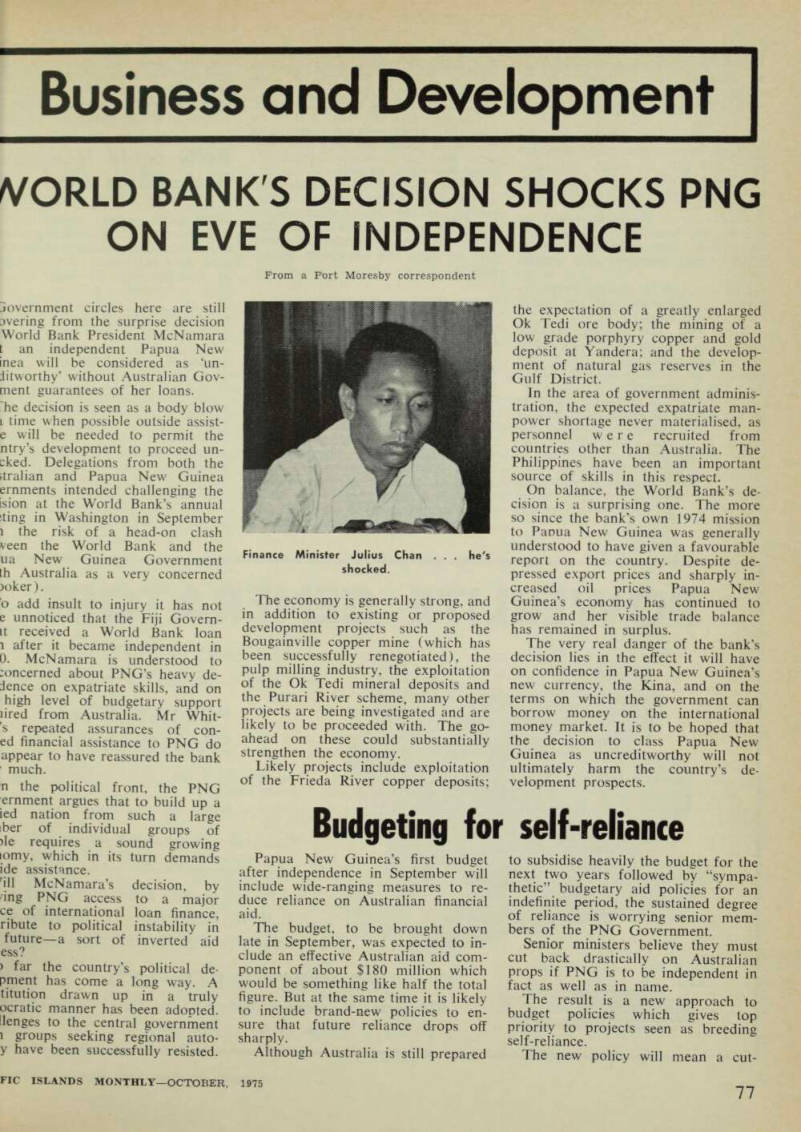
World Bank's Decision Shocks Png
On Eve Of Independence
From a Fort Moresby correspondent
jovernment circles here are still Dvering from the surprise decision World Bank President McNamara t an independent Papua New inea will be considered as ‘un jitworthy’ without Australian Gov ment guarantees of her loans, he decision is seen as a body blow i time when possible outside assist e will be needed to permit the ntry’s development to proceed un cked. Delegations from both the itralian and Papua New Guinea ernments intended challenging the ision at the World Bank’s annual :ting in Washington in September i the risk of a head-on clash veen the World Bank and the ua New Guinea Government th Australia as a very concerned >oker). 0 add insult to injury it has not e unnoticed that the Fiji Govern it received a World Bank loan 1 after it became independent in 0. McNamara is understood to :oncerned about PNG’s heavy de jence on expatriate skills, and on high level of budgetary support fired from Australia. Mr Whit ’s repeated assurances of con ed financial assistance to PNG do appear to have reassured the bank ’ much. n the political front, the PNG eminent argues that to build up a ied nation from such a large ber of individual groups of )le requires a sound growing lomy, which in its turn demands ide assistance. r ill McNamara’s decision, by dng PNG access to a major ce of international loan finance, ribute to political instability in future—a sort of inverted aid ess? ) far the country’s political de pment has come a long way. A titution drawn up in a truly ocratic manner has been adopted, llenges to the central government i groups seeking regional auto y have been successfully resisted.
The economy is generally strong, and in addition to existing or proposed development projects such as the Bougainville copper mine (which has been successfully renegotiated), the pulp milling industry, the exploitation of the Ok Tedi mineral deposits and the Purari River scheme, many other projects are being investigated and are likely to be proceeded with. The go ahead on these could substantially strengthen the economy.
Likely projects include exploitation of the Frieda River copper deposits;
the expectation of a greatly enlarged Ok Tedi ore body; the mining of a low grade porphyry copper and gold deposit at Yandera; and the develop ment of natural gas reserves in the Gulf District.
In the area of government adminis tration, the expected expatriate man power shortage never materialised, as personnel were recruited from countries other than Australia. The Philippines have been an important source of skills in this respect.
On balance, the World Bank’s de cision is a surprising one. The more so since the bank’s own 1974 mission to Panua New Guinea was generally understood to have given a favourable report on the country. Despite de pressed export prices and sharply in creased oil prices Papua New Guinea’s economy has continued to grow and her visible trade balance has remained in surplus.
The very real danger of the bank’s decision lies in the effect it will have on confidence in Papua New Guinea’s new currency, the Kina, and on the terms on which the government can borrow money on the international money market. It is to be hoped that the decision to class Papua New Guinea as uncreditworthy will not ultimately harm the country’s de velopment prospects.
Finance Minister Julius Chan... he's shocked.
Budgeting for self-reliance
Papua New Guinea’s first budget after independence in September will include wide-ranging measures to reduce reliance on Australian financial a id.
The budget, to be brought down late in September, was expected to inelude an effective Australian aid component of about $lBO million which would be something like half the total figure. But at the same time it is likely to include brand-new policies to ensure that future reliance drops off sharply.
Although Australia is still prepared
to subsidise heavily the budget for the next two years followed by “sympa thetic” budgetary aid policies for an indefinite period, the sustained degree of reliance is worrying senior mem bers of the PNG Government, Senior ministers believe they must cut back drastically on Australian props if PNG is to be independent in fact as well as in name, The result is a new approach to budget policies which gives top priority to projects seen as breeding self-reliance.
The new policy will mean a cut
back in many long-established items of expenditure inherited from Austra lian concepts but no longer seen as extremely important in an indepen dent PNG.
The Treasurer, Mr Chan, had to argue strongly in cabinet for the changes. Some of his fellow ministers were reluctant to adopt any pro gramme at independence which sug gested on the surface that the economy was running down.
They believed cut-backs would re flect on the foundation independence government, and could lower morale and political stability at a crucial period.
But Mr Chan believes the long-term dividends will far outweigh any imme diate critical impact.
Under the new budget policies, every item is given a priority rating on a scale determined by a new organisation known as the Budget Priorities Committee.
The priority is allocated according to the degree to which each activity is likely to reduce external depen dence, to increase the personal in comes of the people at large and to improve services to the people.
There is no suggestion yet, how ever, that PNG plans any radical change in its methods of raising revenue.
Mr Chan said two years ago that alternatives to income tax were being studied, but the studies did not materially affect last year’s budget and are unlikely to affect this year’s.
The emphasis of change will be on how the money is spent rather than how it is raised, but with the long term goal of requiring increasingly smaller amounts of external aid.
Meanwhile, Mr Chan has written to all heads of departments calling for greater operational efficiency.
He wants them to prune spending to the bone and to increase the utilisa tion of skills and equipment already available.
Another timber
project in PNG
Yet another timber project in Papua New Guinea is expected to get under way following the signing of a KlO million agreement by the PNG Government and Sagarai Lumber Pty Ltd. The 160,000 hectares to be de veloped are in the Milne Bay and Central District. The forest is esti mated to hold 3.4 million cubic metres of log suitable for sawn timber and veneer, and about four million cubic metres suitable for bulkwood.
There will be employment for
about 900 local people, whose p< will be about K 1 million a yea Royalties are expected to yield aboi K 420,000 annually for the gover ment, and K 140,000 annually for tl owners of the forest.
PNG could lose
half-million kina
Papua New Guinea could lo: about half a million dollars in ove due income tax after Independem Day, because laws which allow PN civil debt judgments to be enforce in Australia were no longer effectb after independence.
The tax office said in Port Mores! that the money was owed by Austr lians who had left PNG, and !
Australian companies which earn* money from PNG but had no fixe assets there.
At June 30 the amount involve was close to one million dollar Privately-owed amounts totalle 5600,000, and company-owe amounts totalled $300,000. Much < this money was now being collecte but about half of it was likely to 1 outstanding by Independence Day.
Australia could correct the sit ation by introducing special legi
ation to recognise the enforcement )f PNG civil debt judgments after ieptember 16.
There was no indication as Sep ember 16 approached of the Austra ian Government’s attitude towards egislation of this nature.
3k Tedi strike
nay be big one
The Frieda-Tifalmin-Ok Tedi area a the remote west of New Guinea Imost next to the border with Irian aya, could rival Bougainville in opper production. Early tests sug est a much higher grade of copper —between one and five per cent, ompared with Bougainville’s .5 per ent, but the size of the deposits is nknown.
But hopes of a viable proposition epend on the results of future assays.
Tie tests in no way indicate the lability of any mining operation.
Tie best that can be said at this stage > that the discovery is “highly promis ig”. .
This discovery was made by a team xploring on behalf of Ok Tedi De elopment Co, which was formed by ic PNG Government, after it failed 3 reach agreement with the US wned Kennecott on share arrange lents for any ultimate mining ven ire.
Should mining prove a commercial reposition a tremendous infrastruc ire will be required to support it. his will be an expensive proposition, > say the least, for the area is most ifficult of access in PNG.
Fhe Wales to open
i PNG subsidiary
The Bank of New South Wales as formed a subsidiary company to ike care of its business in Papua few Guinea when that country be ame independent. Known as the ank of New South Wales (PNG) td, it will trade under that name ■°m October 1. It will have an uthonsed capital of KlO million and paid-up capital of K 4 million.
Provision has been made for ventual local equity, but in the leantime the company will be a 'holly-owned subsidiary of the Wales”. The first board comprises ir John Cadwallader, chairman of ie Bank of NSW; Sir Robert Nor ian, director and chief general lanager; Mr Kitto, assistant general lanager; Mr L. J. Ritson, chief lanager of PNG; and Mr L. Mac herson, deputy manager in Port loresby. Two PNG residents will xm be appointed to the board.
Advertisements & other items, pp. 79-80 (2 items)
77
FIC ISLANDS MONTHLY—OCTOBER, 1975
Powerlite Generators
£7£2&& M ■ ♦ M \ If. i ,• / t : *» ?•* f 6 Hi
15 YEARS PROVEN SERVICE
THROUGHOUT AUSTRALIA
PORTABLE or
STATIONARY
We offer you a choice of AIR or WATER cooled Power units.
DIESEL or PETROL driven by the engine of your choice.
BRUSHLESS or SLIP RING ALTERNATORS made to any requirement or specification in either — Manual, Automatic, Electric and Start-A-Matic.
A full range available from:
1 KVA THROUGH TO 500 KVA
Service and parts readily available.
POWERLITE PTY. LTD.
23A Gordon St., Chipping Norton, N.S.W., 2170, Australia.
Phone; 727-0077. Telex: 24893.
downs, but mostly down

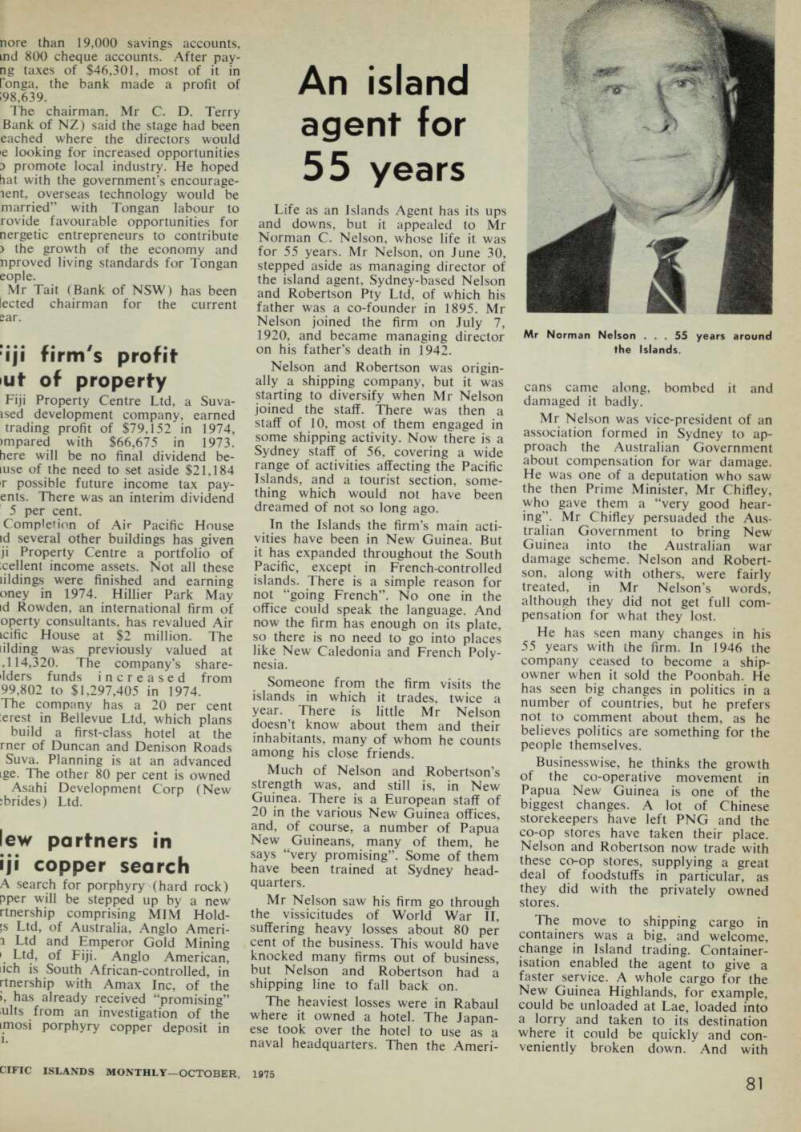
Samoa's economic ups and downs, but mostly down
The inadequate supply of taro and bananas has contributed to internal inflation in Western Samoa as supple mentary foodstuffs have to be im ported from Australia. The Bank of Western Samoa raised this point in its annual report for 1974, when looking at prospects for 1975.
The bank put the cause of lower production as the drift of many former small farmers and potential agriculturalists to the Apia area to take up work, and the emigration of large numbers of Western Samoans to New Zealand. Remittances from NZ to families in Western Samoa fuelled the demand for imported food.
Development of light industry would go a long way towards re moving the need for Western Samoa citizens to look for work overseas.
A change in the land tenure system aimed at arresting the drift of young men from the land was receiving the attention of a specially convened Land Court.
The cocoa industry did much better than expected in 1974. Production at 1,816 tons, was well above the 1973 figure of 1,218 tons and the forecast 1974 figure of 1,100-1,200 tons.
World prices for cocoa flavour re mained high and, along with reason able weather, contributed to the satisfactory result.
The increase in cocoa production was particularly welcome as many plantations were becoming un economic in the early 70s, and pro duction was falling. The industry is again a major source of overseas exchange. The bank’s hopes for con tinued good prices have been sus tained so far in 1975. Although prices have not “gone through the roof” as they did about 18 months ago, the London rate has been fairly steady in the £650-£750 bracket for several months.
The copra industry has not done so well, after booming 12-18 months ago. In 1974, the Western Samoa average price was $3lB a ton, but at the end of the year sales were at $240 a ton. The forecast production for 1975 was 19,000-20,000 tons, but that could be adversely affected if there were further serious falls in prices, which reduced incentive. [The coconut industry, world-wide, has fallen on hard times. Countries in the Asian and Pacific coconut com munity are talking about a restructur ing of the industry, so that new coco
nut products may find their way on to shop shelves. Low prices have been followed by stagnating production, and the future for traditional uses of the coconut are not bright.] Nevertheless, the bank is hopeful that increased Western Samoa pro duction in 1975 might offset lower prices, and still make it a satisfactory year.
The bank says the banana industry needs substantial support to help overcome escalating costs of ferti lisers and sprays. The timber industry was lagging because of the difficulty of getting spare parts for machinery through shipping problems, and there had been a decrease in returns from manufactured goods, such as handi crafts, canned fruit, processed food and clothing.
The tourist industry had potential, says the bank, but to encourage the growth of visitors, procedures for get ting entry permits should be simplified and they should be for longer than the present three days. The industry should also ensure that all inter national flights arriving at Pago Pago were met by Polynesian Airlines.
The bank said credit control would be of considerable importance in 1975. It would be essential to direct imported capital towards development expenditure to dampen a quickening in demand for consumer items. Other areas of concern were the import of luxury goods and the use of fuel.
Some wastage occurred in the import of motor vehicles not designed to withstand the rigours of the climate and roads. There was a case for transport pools.
To make further economies in fuel consumption, alternative methods of generating electricity should be examined. Solar energy for domestic use had made significant contribu tions towards power savings in other countries.
Tonga's infant
bank is thriving
Tonga’s infant bank, the Bank of Tonga is thriving. In its first six months of operation, deposits passed the $5 million mark, TTiis was re vealed at the second annual meeting of the bank, which is owned by the Government of Tonga, the Bank of Hawaii, the Bank of NZ and the Bank of NSW. The bank now has
nore than 19,000 savings accounts, md 800 cheque accounts. After pay ng taxes of $46,301, most of it in fonga, the bank made a profit of 198,639.
The chairman, Mr C. D. Terry Bank of NZ) said the stage had been cached where the directors would >e looking for increased opportunities :> promote local industry. He hoped hat with the government’s encourage lent, overseas technology would be married” with Tongan labour to rovide favourable opportunities for nergetic entrepreneurs to contribute ) the growth of the economy and nproved living standards for Tongan eople.
Mr Tait (Bank of NSW) has been lected chairman for the current ear.
: fji firm's profif
mt of property
Fiji Property Centre Ltd, a Suva ised development company, earned trading profit of $79,152 in 1974, impared with $66,675 in 1973. here will be no final dividend be tuse of the need to set aside $21,184 r possible future income tax pay ents. There was an interim dividend 5 per cent.
Completion of Air Pacific House id several other buildings has given ji Property Centre a portfolio of cellent income assets. Not all these hidings were finished and earning oney in 1974, Hillier Park May id Rowden, an international firm of operty consultants, has revalued Air icific House at $2 million. Hie hiding was previously valued at ,114,320. The company’s share- Jders funds increased from 99,802 to $1,297,405 in 1974.
The company has a 20 per cent erest in Bellevue Ltd, which plans build a first-class hotel at the rner of Duncan and Denison Roads Suva. Planning is at an advanced tge. The other 80 per cent is owned Asahi Development Corp (New ;brides) Ltd.
lew partners in
iji copper search
A search for porphyry (hard rock) pper will be stepped up by a new rtnership comprising MIM Hold ;s Ltd, of Australia, Anglo Ameri i Ltd and Emperor Gold Mining i Ltd, of Fiji. Anglo American, iich is South African-controlled, in rtnership with Amax Inc, of the », has already received “promising” ults from an investigation of the imosi porphyry copper deposit in i.
Advertisements & other items, pp. 81-82 (2 items)
79
ACIFIC ISLANDS MONTHLY—OCTOBER, 1975
Choice of Household and Industrial Consumers Alike!
Ajinomoto Co., Inc. is the world’s largest and original manufacturer of Monosodium Glutamate (MSG), the miraculous flavor-enhancer that brought about a revolution in gastronomy and food technology.
And in the short 60 years since its discovery, Ajinomoto Company’s famous super-seasoning, sold under the trademark AJI-NO-MOTO, has become a favorite of household and food industry consumers in over 90 countries around the world.
But Ajinomoto Company’s success story goes much deeper than this. Its modern research and experimental laboratories have brought a host of other equally important products to household and industrial users products such as flavor Nucleotides (Disodium s’inosinate and Disodium s'-guanylate) and Hydrolyzed Vegetable Protein Products.
Among other famous offerings you will find a long list of diversified products including Amino Acids for the food and feed industries as well as the pharmaceutical and medical fields, and a wide variety of other high protein and flavor enticing products. For further information, please write us at the address shown below.
AJINOMOTO CO., INC.
6, Ichome, Kyobashi, Chuo-ku, Tokyo, Japan Telex; J 22690 & J 24711 (AJNOMOTO) Cable Address; AJINOMOTO TOKYO PRODUCERS OF: AJI-NO-MOTO (Monosodium glutamate • HI-MEMSG and s’-IMP • AJI-SHIO MSG coated salt) • Ajinomoto Co.'s IMP (Disodium s’-inosinate) • Ajinomoto Co.'s GMP (Disodium s’-guanylate) • Ajinomoto Co.’s l+ G (s’-IMP and 5' GMP) • AJI-EKI (Liquid Hydrolyzed Vegetable Protein) • AJIMATE F-40 (Beef Extract Replacement) • AMINO ACIDS (Pharmaceutical, food additive and feed grades • TEMPURA OIL (Cooking oil) • ESSAN & PRORICH (High Protein Soy Products) • AJICURE (Epoxy Curing Agent) • AJICOAT (Polyamino Acid Resin) • AJIDEW (Humectant
An island

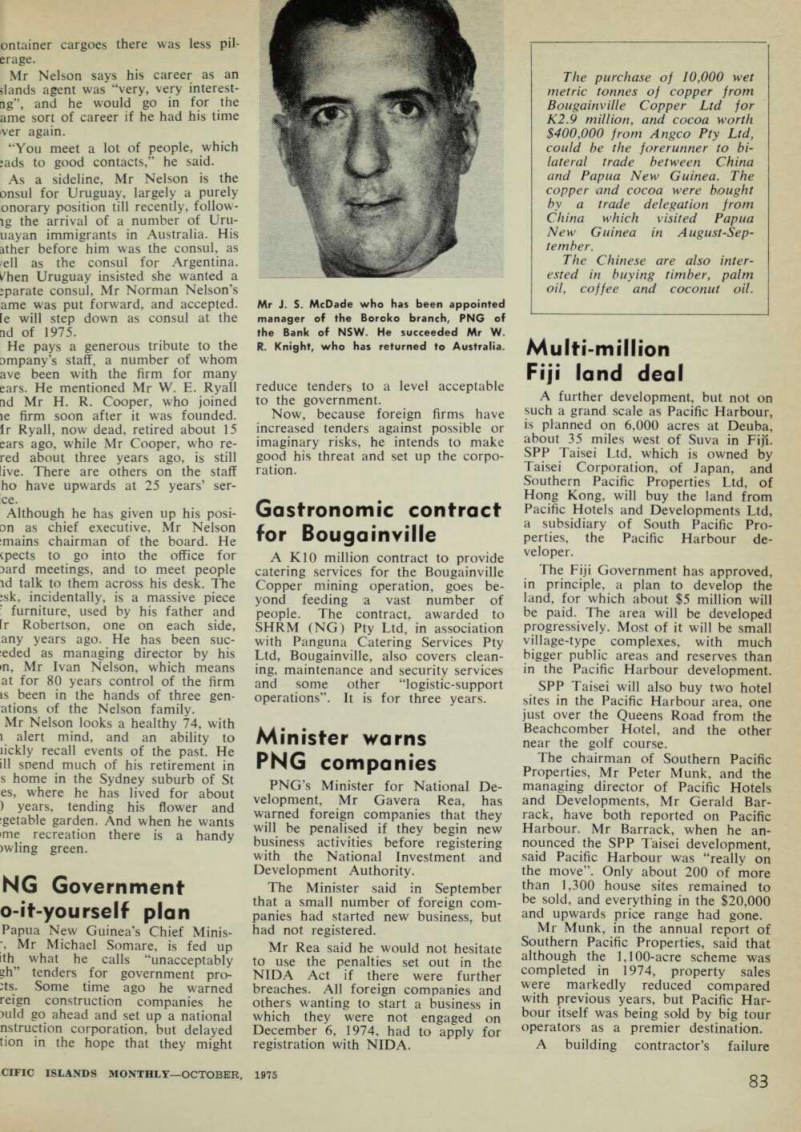
agent for 55 years
Life as an Islands Agent has its ups and downs, but it appealed to Mr Norman C. Nelson, whose life it was for 55 years. Mr Nelson, on June 30, stepped aside as managing director of the island agent, Sydney-based Nelson and Robertson Pty Ltd, of which his father was a co-founder in 1895. Mr Nelson joined the firm on July 7, 1920, and became managing director on his father’s death in 1942.
Nelson and Robertson was origin ally a shipping company, but it was starting to diversify when Mr Nelson joined the staff. There was then a staff of 10, most of them engaged in some shipping activity. Now there is a Sydney staff of 56, covering a wide range of activities affecting the Pacific Islands, and a tourist section, some thing which would not have been dreamed of not so long ago.
In the Islands the firm’s main acti vities have been in New Guinea. But it has expanded throughout the South Pacific, except in French-controlled islands. There is a simple reason for not “going French”, No one in the office could speak the language. And now the firm has enough on its plate, so there is no need to go into places like New Caledonia and French Poly nesia.
Someone from the firm visits the islands in which it trades, twice a year. There is little Mr Nelson doesn’t know about them and their inhabitants, many of whom he counts among his close friends.
Much of Nelson and Robertson’s strength was, and still is, in New Guinea. There is a European staff of 20 in the various New Guinea offices, and, of course, a number of Papua New Guineans, many of them, he says “very promising”. Some of them have been trained at Sydney head quarters.
Mr Nelson saw his firm go through the vissicitudes of World War 11, suffering heavy losses about 80 per cent of the business. This would have knocked many firms out of business, but Nelson and Robertson had a shipping line to fall back on.
The heaviest losses were in Rabaul where it owned a hotel. The Japan ese took over the hotel to use as a naval headquarters. Then the Ameri-
cans came along, bombed it and damaged it badly.
Mr Nelson was vice-president of an association formed in Sydney to ap proach the Australian Government about compensation for war damage.
He was one of a deputation who saw the then Prime Minister, Mr Chifley, who gave them a “very good hear ing”. Mr Chifley persuaded the Aus tralian Government to bring New Guinea into the Australian war damage scheme. Nelson and Robert son, along with others, were fairly treated, in Mr Nelson’s words, although they did not get full com pensation for what they lost.
He has seen many changes in his 55 years with the firm. In 1946 the company ceased to become a ship owner when it sold the Poonbah. He has seen big changes in politics in a number of countries, but he prefers not to comment about them, as he believes politics are something for the people themselves.
Businesswise, he thinks the growth of the co-operative movement in Papua New Guinea is one of the biggest changes. A lot of Chinese storekeepers have left PNG and the co-op stores have taken their place.
Nelson and Robertson now trade with these co-op stores, supplying a great deal of foodstuffs in particular, as they did with the privately owned stores.
The move to shipping cargo in containers was a big, and welcome, change in Island trading. Container isation enabled the agent to give a faster service. A whole cargo for the New Guinea Highlands, for example, could be unloaded at Lae, loaded into a lorry and taken to its destination where it could be quickly and con veniently broken down. And with
Mr Norman Nelson... 55 years around the Islands.
ontainer cargoes there was less pe erage.
Mr Nelson says his career as an dands agent was “very, very interest tig”, and he would go in for the ame sort of career if he had his time ver again.
“You meet a lot of people, which :ads to good contacts,” he said.
As a sideline, Mr Nelson is the onsul for Uruguay, largely a purely onorary position till recently, follow ig the arrival of a number of Uru uayan immigrants in Australia. His ather before him was the consul, as as the consul for Argentina.
Wien Uruguay insisted she wanted a jparate consul, Mr Norman Nelson’s ame was put forward, and accepted, le will step down as consul at the nd of 1975.
He pays a generous tribute to the ampany’s staff, a number of whom ave been with the firm for many ears. He mentioned Mr W. E. Ryall nd Mr H. R. Cooper, who joined le firm soon after it was founded.
Ir Ryall, now dead, retired about 15 ears ago, while Mr Cooper, who re red about three years ago, is still live. There are others on the staff ho have upwards at 25 years’ scr ee.
Although he has given up his posi □n as chief executive, Mr Nelson mains chairman of the board. He cpects to go into the office for lard meetings, and to meet people id talk to them across his desk. The ;sk, incidentally, is a massive piece r furniture, used by his father and lr Robertson, one on each side, any years ago. He has been suc :eded as managing director by his >n, Mr Ivan Nelson, which means at for 80 years control of the firm is been in the hands of three gen ations of the Nelson family.
Mr Nelson looks a healthy 74, with i alert mind, and an ability to lickly recall events of the past. He ill spend much of his retirement in s home in the Sydney suburb of St es, where he has lived for about ) years, tending his flower and igetable garden. And when he wants me recreation there is a handy iwling green.
NG Government
o-it-yourself plan
Papua New Guinea’s Chief Minis '» Mr Michael Somare, is fed up what he calls “unacceptably gh” tenders for government pro mts. Some time ago he warned reign construction companies he >uld go ahead and set up a national instruction corporation, but delayed tion in the hope that they might
reduce tenders to a level acceptable to the government.
Now, because foreign firms have increased tenders against possible or imaginary risks, he intends to make good his threat and set up the corpo ration.
Gastronomic contract
for Bougainville
A KlO million contract to provide catering services for the Bougainville Copper mining operation, goes be yond feeding a vast number of people. The contract, awarded to SHRM (NG) Pty Ltd, in association with Panguna Catering Services Pty Ltd, Bougainville, also covers clean ing, maintenance and security services and some other “logistic-support operations”. It is for three years.
Minister warns
PNG companies
PNG’s Minister for National De velopment, Mr Gavera Rea, has warned foreign companies that they will be penalised if they begin new business activities before registering with the National Investment and Development Authority.
The Minister said in September that a small number of foreign com panies had started new business, but had not registered.
Mr Rea said he would not hesitate to use the penalties set out in the NIDA Act if there were further breaches. All foreign companies and others wanting to start a business in which they were not engaged on December 6, 1974, had to apply for registration with NIDA.
The purchase of 10,000 wet metric tonnes of copper from Bougainville Copper Ltd for K 2.9 million, and cocoa worth $400,000 from Angco Pty Ltd, could be the forerunner to bi lateral trade between China and Papua New Guinea. The copper and cocoa were bought by a trade delegation from China which visited Papua New Guinea in August-Sep tember.
The Chinese are also inter ested in buying timber, palm oil, coffee and coconut oil.
Multi-million
Fiji land deal
A further development, but not on such a grand scale as Pacific Harbour, is planned on 6,000 acres at Deuba, about 35 miles west of Suva in Fiji.
SPP Taisei Ltd, which is owned by Taisei Corporation, of Japan, and Southern Pacific Properties Ltd, of Hong Kong, will buy the land from Pacific Hotels and Developments Ltd, a subsidiary of South Pacific Pro perties, the Pacific Harbour de veloper.
The Fiji Government has approved, in principle, a plan to develop the land, for which about S 5 million will be paid. The area will be developed progressively. Most of it will be small village-type complexes, with much bigger public areas and reserves than in the Pacific Harbour development.
SPP Taisei will also buy two hotel sites in the Pacific Harbour area, one just over the Queens Road from the Beachcomber Hotel, and the other near the golf course.
The chairman of Southern Pacific Properties, Mr Peter Munk, and the managing director of Pacific Hotels and Developments, Mr Gerald Bar rack, have both reported on Pacific Harbour. Mr Barrack, when he an nounced the SPP Taisei development, said Pacific Harbour was “really on the move”. Only about 200 of more than 1,300 house sites remained to be sold, and everything in the $20,000 and upwards price range had gone.
Mr Munk, in the annual report of Southern Pacific Properties, said that although the 1,100-acre scheme was completed in 1974, property sales were markedly reduced compared with previous years, but Pacific Har bour itself was being sold by big tour operators as a premier destination.
A building contractor’s failure
Mr J. S. McDade who has been appointed manager of the Boroko branch, PNG of the Bank of NSW. He succeeded Mr W.
R. Knight, who has returned to Australia.
caused a $575,000 loss at Deuba. Mr Munk said the contractor was Pettit and Sevitt (Fiji) Ltd. As Southern Pacific Properties had presold villas at a fixed price, it had to make up the difference between that price and completion cost after getting another contractor.
Mr Munk said the value of un developed land held in Fiji by Paci fic Hotels and Developments was estimated, at the end of 1974, at $5,549,975. Unsold land in the Paci fic Harbour development was valued at $12,385,000.
Tourism growing
in Solomons
With controlling interests sold in two key companies and a third travel agency starting business shortly, the travel scene in the Solomon Islands is on the boil.
The industry claims about $1.3 million-worth of international busi ness a year written in the Solomons and a small, but growing tourist trickle.
It is hopeful of a bigger tourist industry being developed—with something significant possibly open ing up in the Western Solomons— before international travel for ex
patriates starts to drop off drastically from 1979.
Meantime, competition for the established market will certainly in crease with the arrival of the third travel agency, financed by Kings Travel, of Brisbane, Island agents C.
Sullivan and Co and the Lawson family.
Kings, incidentally, are on the brink of a similar new agency setup in Papua New Guinea, with local equity a prequisite.
The manager of the new Honiara operation, Mrs Diene Lawson, who will have 10 per cent equity, claims she will take some of the lucrative government employee travel business away from the already-established travel agencies, Guadalcanal and Mendana.
Mendana’s principal, Mr Paul Brown, claims there is not room for three travel agencies in the Solomons and he maintains the Lawson com pany will have a hard time getting IATA accreditation because it has to be proved that new, rather than established, business is being found.
Mendana itself is part of the above story because it and the Solomons airline, Solair, with aviation buff, John Seaton, have gone largely into Papua New Guinea hands.
Mr Dennis Buchanan’s 50-plus
aircraft Talair Group, for undis closed sums, has bought controlling interests in both Mendana Inter national Travel, which billed $785,00C of international business in its most recent year, and Solair.
Six years old, Mendana was con trolled by Mr Brown and an Austra lian solicitor, Mr David Thompson.
Mr Brown remains as managing director.
It is understood that the Talair group, which recently took over an other PNG air group, Macair, may offer the Solomons Government a share in both these Honiara-based operations. • Tonga’s revenue from tourism in 1974 rose by more than 50 per cent, compared with 1973, to a record 5T2.14 million. Visitors stayed longer and spent more, according tc statistics prepared by the Tonga Visitors Bureau. Air visitors num bered 6,403. They stayed an average of 11 days, and spent an average of 5T17.25 a day. The number of cruise ship visitors, staying a day and spend ing an average of STIB.BI, was 36,308. Most cruise ship visitors were Australian (85 per cent). Australians and New Zealanders comprised 39 per cent of the visitors who arrived by air.
Advertisements & other items, pp. 83-86 (3 items)
81
CIFIC ISLANDS MONTHLY—OCTOBER, 1975
No matter which
way you look at it. . . you’ll find . . .
KLEVKII
is the finest allpurpose ply for building in hot and humid conditions.
Made by Commonwealth N.G.
Timbers Ltd and available from leading plywood suppliers. £
BEST WAY TO KEEP RECORDS
IN ORDER AND UP-TO-DATE
DISTRIBUTORS WANTED
INSULATED FILES, SAFES, ETC. ALSO AVAILABLE
Fujiset Trading Co., Ltd.
1 1, 2-CHOME YOYOGI, SHIBUYA-KU, TOKYO, 151 JAPAN TELEX NO.: 232-2690 FUJEST J TELEPHONE: 03-379-3210
CABLE ADDRESS: CHAIRFUJISET TOKYO
BANKERS: THE BANK OF TOKYO, LTD.
83
CIFIC ISLANDS MONTHLY—OCTOBER. 1975
Produce Prices
Unless otherwise stated, quotations are in istralian currency. Australian dollar (Septem r 9) equals—New Zealand, $1,206 (buying), .1962 (selling); Fiji, $1.0927 (buying), .0687 (selling); Western Samoa, tala 0.7814 lying), 0.7705 (selling); Tonga, pa'anga 1362 (buying), 0.8650 (selling); US, $1.2818 lying), $1.2768 (selling); UK, £0.6086 (buy l), £0.6035 (selling); French Pacific, CFP, 3.33 (buying), 101.81 selling).
Copra
Copra industries are controlled through copra irds in PNG, the Solomons, the GEIC, both noas, Fiji, Tonga, the Cooks and the US Trust ritory. New Hebrides, French Polynesia and w Caledonia do not have boards and copra is her sold individually by growers to overseas rers or used locally.
YEW GUINEA: The board, with planters' s, directs distribution and sales and pays nters. Shipments are made to UK, European rkets and to Australia and Japan, and coco oil mills on New Britain. ’rices, are: Per tonne, delivered main ports, -air dried, k 145; FMS, k 142; smoke-dried, 10.
Ul: —The board fixes prices on Philippines ra, taking into account freight, taxes, selling l s, shrinkage, etc. The price is subsidised. :es on Sept 3 were: Fiji 1, $190; Fiji 2,
'1; Cas, $7O.
lEW HEBRIDES; Copra sold direct by iters to France and Japan. Burns Philp ing on wharf, Vila or Santo, August 19 DO NHF, Sept 3 101 met francs 100 kg.
IS TRUST TERRITORY:—Ist grade, $l4O, 2nd Je, $l3O, 3rd grade, $l2O. Outer islands, 5, $lO5 and $95 ton for the three grades, serviced by government ships and $lO5, and $B5 if serviced by private ships. 00K ISLANDS.—AII production is sold to Is Ltd, Auckland. Prices are based on age world prices for the prior three or six ths, and remain in force for three months.
ILBERT ISLANDS.—SI79.2O a ton, or 8c a id.
ESTERN SAMOA:—Ist grade, SWSIO2; 2nd e, $W589.50.
Other Produce
DCOA. —lslands rates are based on Ghana ss. Ghana price on Sept 9 was spot 614.5 ton, c.i.f., UK, Continent. ! Pt 10, in store, Rabaul, export quality, D per tonne; delivered ex wharf Sydney 5 per tonne. ilomons.—Delivered to Agriculture Dept es in Honiara and Aukl. Recent price was per lb dried beans first grade, 20c second >FFEE - —PNG, Sept 10: Good quality. A e, 69£c per lb; B grade, 67£c; C grade, Y grade, 65c (ex-store Sydney) ; Samoa.— Recently, WSTEC ground and I beans, 60 sene per lb wholesale.
ANUTS. PNG: Sydney agents reported ]b ° #/ bae: erne * s —white Spanish CE (Aust): —PNG; Dried brown, 25 kilo ' t 29 8 P er ton ne. Vitamin enriched s, 25 kilo bags, $303.94 per tonne, all Sydney/Melbourne. Pacific Islands; se med. grain, white, 25 kilo bags, $3lO tonne. Kulu long grain white, 25 kilo $355 per tonne. All prices c.&f. Sydney/ ourne. 11 mf. R ;~.L n . 9 . a .£ ore ' Sept 8: 33 - 5 c a kilo.
NILLA BEANS. Prices recently were: 5 e-Tl* vellow label orocessed standard 5 ' J reen label * 7 - 40 « c.i.f., Sydney. —ST4.2O, f.0.b., Nukualofa; 5T4.50, Mel
• The PNG Government recently paid K 41,000 for two expatriate owned plantations in east New Britain —K 10,000 for Kabakom on the Duke of York Islands to Burns Philp, and K 31,000 to a Chinese business man for Kabakaul, near Kokopo.
Kabakom will be resold to the Kere wara people, and Kabakaul to the Livuan villagers. The government has now acquired four expatriate-owned plantations to return to the local people under the new land acqui sition laws.
Exchange Rates
FlJl.—Sept 10: Through Bank of NSW, ANZ Bank, Bank of NZ, Bank of Baroda, First National City Bank, Aust $ on Fiji buying
$F1.0971 = Sai.
COOK IS., NIUE. —New Zealand currency Is used.
NEW HEBRIDES.—Through Bank of NSW, ANZ NEW HEBRIDES.—Sept 10: Through Bank of NSW, ANZ Bank, Commercial Bank of Australia, National Bank of A'asia, Banque Nationale De Paris, Barclays Bank, Hong Kong & Shanghai Banking Corp, Mosbert Bank, SAI = 91.63 New Hebridean francs (buying), 90.39 (selling)—airmail transfer rate.
WESTERN SAMOA.—Through Bank of Western Samoa, controlled from NZ, SWS. Tala 1 = $A0.7814 (buying), $A0.7705 (selling).
TONGA.—Tongan dollar (pa'anga) = $A0.8862 (buying), $A0.8650 (selling).
Norfolk Is, Solomon Is, Geic, Nauru.—
Australian currency used; no exchange payable in transactions with Australia.
PAPUA NEW GUINEA.—PNG and Australian currency used; no exchange payable in trans actions with Australia.
FRENCH PACIFIC COLONIES.—Pacific francs (CFP) are used in New Caledonia, Wallis and Futuna Is, and Fr Polynesia. French Bank, Sydney, on Sept 10, quoted: SAI = 103.80 CFP (buying), 101.69 (selling). Paris-London, Sept 10: £1 = 9.2950 francs (buying), 0.2850 francs (selling). Pacific franc—London, Sept 10: £1 = 169.0909 CFP (buying), 168.9090 CFP (selling). CFP to 1 metropolitan franc 18.43 (buying), 17.94 (selling).
Banks should be approached for daily rates.
Advertisements & other items, pp. 87-88 (2 items)
85
IFIC ISLANDS MONTHLY—OCTOBER, 1975
Henry Cumines Pty. Ltd.
MERCHANTS
I *1 CONVERTERS
LEAD
SHEET
INGOT
ALLOY
SCRAP
RESIDUES
BERJAK METALS PTY, LTD.
424 ST. KILDA ROAD, MELBOURNE, 3004
Cable: METJAK MELBOURNE Telex: AA30334
PARK VIEW MOTEL—BRISBANE
Quiet location—opp. Botanic Gardens.
Single, double, family suites, all with refrig., air conditioning, phone, TV, radio, tea making facilities, from $l2. Pool and restaurant.
Phone 31-2695—Telex 40270.
Write for coloured brochure— Park View Motel, 128 Alice St, BRISBANE Old., 4000.
HENRY CUMINES PTY. LTD.
EXPORTERS • GENERAL MERCHANTS
428 GEORGE ST., SYDNEY
CABLES: HENCO SYDNEY. G.P.O. Box 3949. PHONE: 25-3383.
For specialised and personalised buying service throughout the Pacific Islands and the East.
Local enquiries to our agents; PORT MORESBY: Agencies Pacific Pty Ltd, Box 5044, P. 0., Boroko, Port Moresby. Telephone 55261.
MADANG; W. Double, P.O. Box 22, Madang. Telephone 2696.
FIJI: K. Witherington Ltd, P.O. 293, Suva. Telephone 22-356.
NEW HEBRIDES: John Lum & Associates, Box 65, P. 0., Santo. Telephone 329.
LAE: Osborne Agencies, P.O. Box 8, Lae.
Resident Agents in other Pacific Territories.
Wc'vc been growing
together for 23 years.
The New Guinea Australia Line first sailed into Port Moresby in 1952. Now 23 years later we'd like to congratulate Papua New Guinea on achieving independence.
The three 'Chiefs' are a familiar sight in all the major PapUa New Guinea ports. The 'lsland Chief,' the 'Coral Chief,' and the 'New Guinea Chief' transport the produce of your country to Australia.
And bring such things as machinery, essential to the growth of a modern nation, back from Australia.
Papua New Guinea and the New Guinea Australia Line have a long history of shared growth, and we hope for many more successful years together.
|H New Guinea Australia Line
Member of the Swire Group ■ Hea d office; New Guinea Australia Line Pty. Ltd., Port Moresby, P.N.G. \ A, ?ents; Steamship Trading Co. Ltd. (Bums Philp (N.G.) Ltd. at Kavieng IS
Shipping & Airways Information
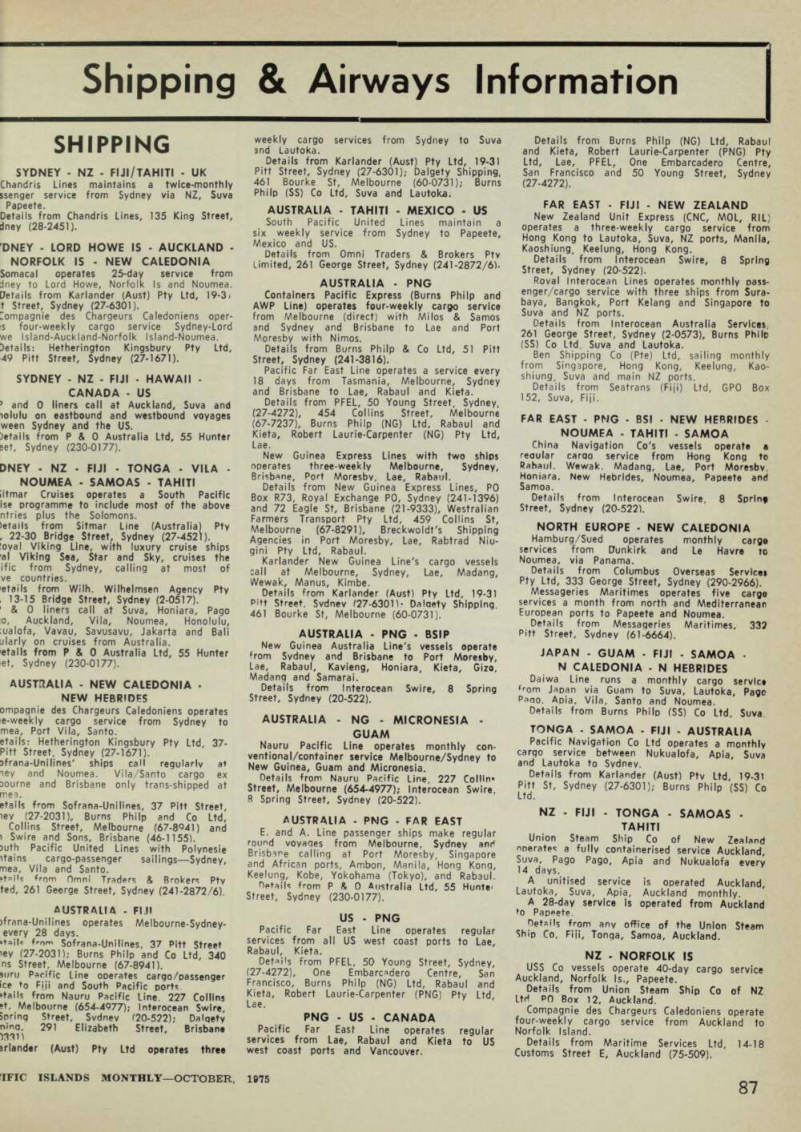
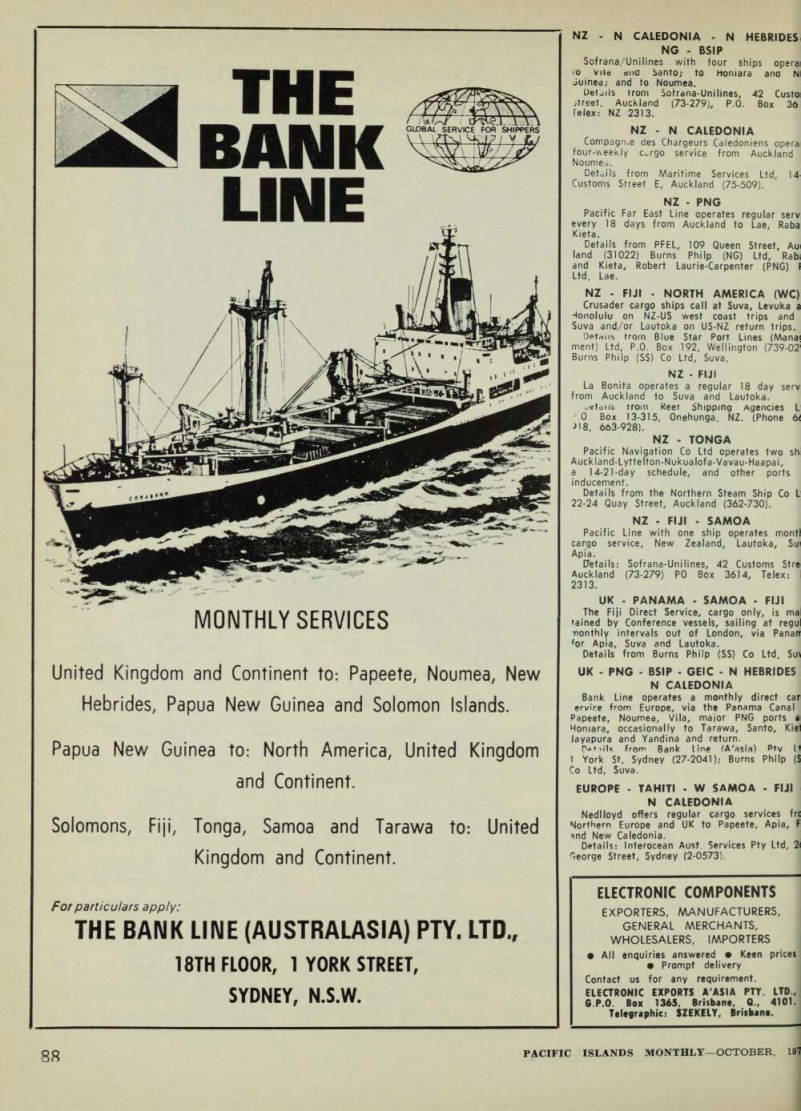
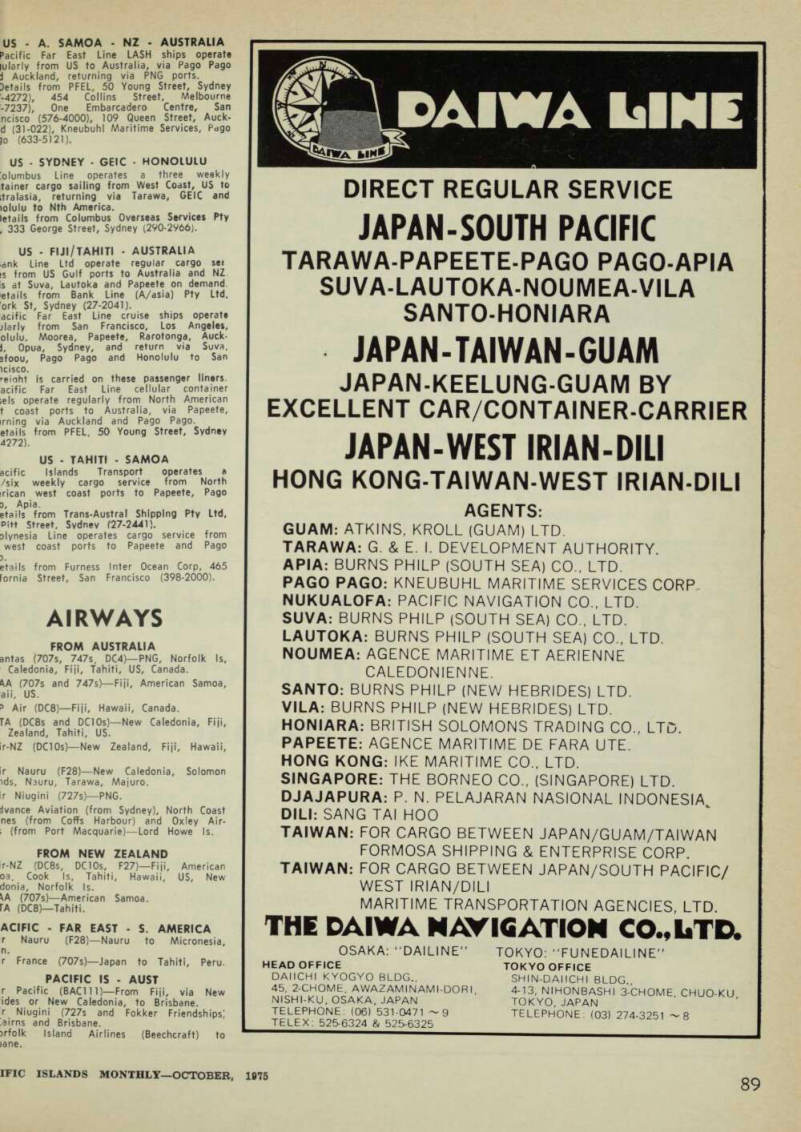
Shipping
SYDNEY - NZ - FIJI/TAHITI ■ UK Chandris Lines maintains a twice-monthly ssenger service from Sydney via NZ, Suva Papeete.
Details from Chandris Lines, 135 King Street, dney (28-2451).
DNEY - LORD HOWE IS - AUCKLAND -
Norfolk Is - New Caledonia
Somacal operates 25-day service from dney to Lord Howe, Norfolk Is and Noumea.
Details from Karlander (Aust) Pty Ltd, 19-3 < t Street, Sydney (27-6301).
Zompagnie des Chargeurs Caledoniens oper as four-weekly cargo service Sydney-Lord we Island-Auckland-Norfolk Island-Noumea.
Details: Hetherington Kingsbury Pty Ltd, 49 Pitt Street, Sydney (27-1671).
SYDNEY - NZ - FIJI - HAWAII -
Canada - Us
5 and 0 liners call at Auckland, Suva and lolulu on eastbound and westbound voyages ween Sydney and the US.
Details from P & 0 Australia Ltd, 55 Hunter set, Sydney (230-0177).
DNEY - NZ - FIJI - TONGA - VILA ■
Noumea - Samoas - Tahiti
litmar Cruises operates a South Pacific ise programme to include most of the above ntries plus the Solomons.
Derails from Sitmar Line (Australia) Pty , 22-30 Bridge Street, Sydney (27-4521). loyal Viking Line, with luxury cruise ships al Viking Sea, Star and Sky, cruises the ific from Sydney, calling at most of ve countries. etails from Wilh. Wilhelmsen Agency Pty , 13-15 Bridge Street, Sydney (2-0517). 1 & 0 liners call at Suva, Honiara, Pago o, Auckland, Vila, Noumea, Honolulu, ;ualofa, Vavau, Savusavu, Jakarta and Bali ularly on cruises from Australia, etails from P & 0 Australia Ltd, 55 Hunter et, Sydney (230-0177).
Australia - New Caledonia -
New Hebrides
ompagnie des Chargeurs Caledoniens operates e-weekly cargo service from Sydney to mea. Port Vila, Santo, etails: Hetherington Kingsbury Pty Ltd, 37- Pitt Street, Sydney (27-1671). sfrana-Unilines' ships call regularly at ney and Noumea. Vila/Santo cargo ex Dourne and Brisbane only trans-shipped at mea. etails from Sofrana-Unilines, 37 Pitt Street, iey (27-2031), Burns Philp and Co Ltd, Collins Street, Melbourne (67-8941) and i Swire and Sons, Brisbane (46-1155). 3uth Pacific United Lines with Polynesia itains cargo-passenger sailings—Sydney, mea, Vila and Santo. •tails from Omni Traders & Brokers Pty ted, 261 George Street, Sydney (241-2872/6).
Australia - Fiji
jfrana-Unilines operates Melbourne-Sydney every 28 days. »taiU from Sofrana-Unilines, 37 Pitt Street 'ey (27-2031); Burns Philp and Co Ltd, 340 ns Street, Melbourne (67-8941). suru Pacific Line ©Derates cargo/passenger ice to Fiji and South Pacific ports •tails from Nauru Pacific Line, 227 Collins tt, Melbourne (654-4977); Interocean Swire, inring Street, Svdnev (20-522); Dalqety nma, 291 Elizabeth Street, Brisbane D33H srlander (Aust) Pty Ltd operates three
weekly cargo services from Sydney to Suva and Lautoka.
Details from Karlander (Aust) Pty Ltd, 19-31 Pitt Street, Sydney (27-6301); Dalgety Shipping. 461 Bourke St, Melbourne (60-0731); Burns Philp (SS) Co Ltd, Suva and Lautoka.
AUSTRALIA - TAHITI - MEXICO - US South Pacific United Lines maintain a six weekly service from Sydney to Papeete, Mexico and US.
Details from Omni Traders & Brokers Ptv Limited, 261 George Street, Sydney (241-2872/6).
Australia - Png
Containers Pacific Express (Burns Philp and AWP Line) operates four-weekly cargo service from Melbourne (direct) with Milos & Samos and Sydney and Brisbane to Lae and Port Moresby with Nimos.
Details from Burns Philp & Co Ltd, 51 Pitt Street, Sydney (241-3816).
Pacific Far East Line operates a service every 18 days from Tasmania, Melbourne, Sydney and Brisbane to Lae, Rabaul and Kieta.
Details from PFEL, 50 Young Street, Sydney. (27-4272), 454 Collins Street, Melbourne (67-7237), Burns Philp (NG) Ltd, Rabaul and Kieta, Robert Laurie-Carpenter (NG) Pty Ltd, Lae.
New Guinea Express Lines with two ships operates three-weekly Melbourne, Sydney, Brisbane, Port Moresby, Lae, Rabaul.
Details from New Guinea Express Lines, PO Box R 73, Royal Exchange PO, Sydney (241-1396) and 72 Eagle St, Brisbane (21-9333), Westralian Farmers Transport Pty Ltd, 459 Collins St, Melbourne (67-8291), Breckwoldt's Shipping Agencies in Port Moresby, Lae, Rabtrad Niu gini Pty Ltd, Rabaul.
Karlander New Guinea Line's cargo vessels call at Melbourne, Sydney, Lae, Madang, Wewak, Manus, Kimbe.
Details from Karlander (Aust) Pty Ltd, 19-31 PHt Street. Svdnev 127-6301 V Daloety Shipping, 461 Bourke St, Melbourne (60-0731).
Australia - Png - Bsip
New Guinea Australia Line's vessels operate from Sydney and Brisbane to Port Moresby, Lae, Rabaul, Kavieng, Honiara, Kieta, Gizo, Madang and Samarai.
Details from Interocean Swire, 8 Spring Street, Sydney (20-522).
Australia - Ng - Micronesia -
Guam
Nauru Pacific Line operates monthly con ventional/container service Melbourne/Sydney to New Guinea, Guam and Micronesia.
Details from Nauru Pacific Line, 227 Collin' Street, Melbourne (654-4977); Interocean Swire, 8 Spring Street, Sydney (20-522).
Australia - Png - Far East
E. and A. Line passenger ships make regular round voyages from Melbourne, Sydney and Brisbane calling at Port Moresby, Singapore and African ports, Ambon, Manila, Hong Kong, Keelung, Kobe, Yokohama (Tokyo), and Rabaul.
Details from P & 0 Australia Ltd, 55 Huntei Street, Sydney (230-0177).
Us - Png
Pacific Far East Line operates regular services from all US west coast ports to Lae, Rabaul, Kieta.
Details from PFEL, 50 Young Street, Sydney, (27-4272), One Embarcadero Centre, San Francisco, Burns Philp (NG) Ltd, Rabaul and Kieta, Robert Laurie-Carpenter (PNG) Pty Ltd, Lae.
Png - Us - Canada
Pacific Far East Line operates regular services from Lae, Rabaul and Kieta to US west coast ports and Vancouver.
Details from Burns Philp (NG) Ltd, Rabaul and Kieta, Robert Laurie-Carpenter (PNG) Pty Ltd, Lae, PFEL, One Embarcadero Centre, San Francisco and 50 Young Street, Sydney (27-4272).
FAR EAST - FIJI - NEW ZEALAND New Zealand Unit Express (CNC, MOL, RIL) operates a three-weekly cargo service from Hong Kong to Lautoka, Suva, NZ ports, Manila, Kaoshiung, Keelung, Hong Kong.
Details from Interocean Swire, 8 Spring Street, Sydney (20-522).
Royal Interocean Lines operates monthly oass enger/cargo service with three ships from Sura baya, Bangkok, Port Kelang and Singapore to Suva and NZ ports.
Details from Interocean Australia Services, 261 George Street, Sydney (2-0573), Burns Philo (SS) Co Ltd. Suva and Lautoka.
Ben Shipping Co (Pte) Ltd, sailing monthly from Singapore, Hong Kong, Keelung, Kao shiung, Suva and main NZ ports.
Details from Seatrans (Fiji) Ltd, GPO Box 152, Suva, Fiji.
FAR EAST - PNG - BSI - NEW HEBRIDES
Noumea - Tahiti - Samoa
China Navigation Co's vessels operate a reaular carao service from Hong Kong to Rabaul. Wewak. Madang, Lae, Port Moresby, Honiara. New Hebrides, Noumea, Papeete and Samoa.
Details from Interocean Swire, 8 Spring Street, Sydney (20-522).
North Europe ■ New Caledonia
Hamburg/Sued operates monthly cargo services from Dunkirk and Le Havre to Noumea, via Panama.
Details from Columbus Overseas Services Pty Ltd, 333 George Street, Sydney (290-2966).
Messageries Maritimes operates five cargo services a month from north and Mediterranean European ports to Papeete and Noumea.
Details from Messageries Maritimes, 332 Pitt Street, Sydney (61-6664).
JAPAN - GUAM - FIJI - SAMOA -
N Caledonia - N Hebrides
Daiwa Line runs a monthly cargo servlcs from Jaoan via Guam to Suva, Lautoka, Pago Paao. Apia, Vila, Santo and Noumea.
Details from Burns Philp (SS) Co Ltd, Suva TONGA - SAMOA - FIJI - AUSTRALIA Pacific Navigation Co Ltd operates a monthly cargo service between Nukualofa, Apia. Suva and Lautoka to Sydney.
Details from Karlander (Aust) Ptv Ltd, 19-31 Pitt St, Sydney (27-6301); Burns Philp (SS) Co Ltd.
NZ - FIJI - TONGA - SAMOAS -
Tahiti
Union Steam Ship Co of New Zealand operates a fully containerised service Auckland, Suva, Pago Pago, Apia and Nukualofa every 14 days.
A unitised service is operated Auckland, Lautoka, Suva, Apia, Auckland monthly.
A 28-day service is operated from Auckland to Papeete.
Details from any office of the Union Steam Ship Co, Fiji, Tonga, Samoa, Auckland.
Nz - Norfolk Is
USS Co vessels operate 40-day cargo service Auckland, Norfolk Is., Papeete.
Details from Union Steam Ship Co of NZ Ltd PO Box 12, Auckland.
Compagnie des Chargeurs Caledoniens operate four-weekly cargo service from Auckland to Norfolk Island.
Details from Maritime Services Ltd, 14-18 Customs Street E, Auckland (75-509).
NZ • N CALEDONIA • N HEBRIDES
Ng - Bsip
Sofrana/Unilines with four ships operai ro Vila and Santo; to Honiara ana Nl Guinea; and to Noumea.
Details from Sofrana-Unilines, 42 Custoi meet, Auckland (73-279), P.O. Box 36 telex: NZ 2313.
Nz - N Caledonia
Compagn.e des Chargeurs Caledoniens opera four-weekly Cargo service from Auckland Noumea.
Details from Maritime Services Ltd, 14- Customs Street E, Auckland (75-509).
Nz - Png
Pacific Far East Line operates regular serv every 18 days from Auckland to Lae, Raba Kieta.
Details from PFEL, 109 Queen Street, Aui land (31022) Burns Philp (NG) Ltd, Rabi and Kieta, Robert Laurie-Carpenter (PNG) I Ltd. Lae.
NZ - FIJI - NORTH AMERICA (WC) Crusader cargo ships call at Suva, Levuka a Honolulu on NZ-US west coast trips and Suva and/or Lautoka on US-NZ return trips.
Details Horn Blue Star Port Lines (Manai ment) Ltd, P.O. Box 192, Wellington (739-02' Burns Philp (SS) Co Ltd, Suva.
Nz - Fiji
La Bonita operates a regular 18 day serv from Auckland to Suva and Lautoka. aetaiis from Reef Shipping Agencies L 0. Box 13-315, Onehunga. NZ. (Phone 6< >lB, 663-928).
Nz - Tonga
Pacific Navigation Co Ltd operates two sh
Auckland-Lyttelton-Nukualofa-Vavau-Haapai,
a 14-21-day schedule, and other ports inducement.
Details from the Northern Steam Ship Co L 22-24 Quay Street, Auckland (362-730).
Nz - Fiji - Samoa
Pacific Line with one ship operates montl cargo service. New Zealand, Lautoka, Sui Apia.
CTetails: Sofrana-Unilines, 42 Customs Stre Auckland (73-279) PO Box 3614, Telex: 2313.
UK - PANAMA ■ SAMOA - FIJI The Fiji Direct Service, cargo only, is mal rained by Conference vessels, sailing at regul monthly intervals out of London, via Panarr for Apia, Suva and Lautoka.
Details from Burns Philp (SS) Co Ltd, Su> UK ■ PNG • BSIP • GEIC • N HEBRIDES
N Caledonia
Bank Line operates a monthly direct car ervire from Europe, via the Panama Canal Papeete, Noumea, Vila, major PNG ports a Honiara, occasionally to Tarawa, Santo, Kiel Jayapura and Yandina and return. tw-'ik from Bank line (A'asia) Ptv M 1 York St, Sydney (27-2041); Burns Philp (S Co Ltd, Suva.
EUROPE • TAHITI - W SAMOA . FIJI
N Caledonia
Nedlloyd offers regular cargo services frc Northern Europe and UK to Papeete, Apia, F md New Caledonia.
Details: Interocean Aust. Services Pty Ltd, 2( George Street, Sydney (2-0573).
US • A. SAMOA - NZ - AUSTRALIA Pacific Far East Line LASH ships operate lularly from US to Australia, via Pago Pago i Auckland, returning via PNG ports.
Details from PFEL, 50 Young Street, Sydney -4272), 454 Collins Street, Melbourne -7237), One Embarcadero Centre, San ncisco (576-4000), 109 Queen Street, Auck d (31-022), Kneubuhl Maritime Services, Pago 10 (633-5121).
US - SYDNEY ■ GEIC - HONOLULU [olumbus Line operates a three weekly tainer cargo sailing from West Coast, US to itralasia, returning via Tarawa, GEIC and lolulu to Nth America. letails from Columbus Overseas Services Pty , 333 George Street, Sydney (290-2966).
Us - Fiji/Tahiti • Australia
ank Line Ltd operate regular cargo set !S from US Gulf ports to Australia and NZ Is at Suva, Lautoka and Papeete on demand, etails from Bank Line (A/asia) Pty Ltd, ork St, Sydney (27-2041). acific Far East Line cruise ships operate jlarly from San Francisco, Los Angeles, olulu, Moorea, Papeete, Rarotonga, Auck- I, Opua, Sydney, and return via Suva, afoou, Pago Pago and Honolulu to San icisco. reioht is carried on these passenger liners. acific Far East Line cellular container iels operate regularly from North American t coast ports to Australia, via Papeete, irning via Auckland and Pago Pago, etails from PFEL, 50 Young Street, Sydney 4272).
Us - Tahiti - Samoa
acific Islands Transport operates a /six weekly cargo service from North irican west coast ports to Papeete, Pago 3, Apia. etails from Trans-Austral Shipping Pty Ltd, Pitt Street, Sydney (27-2441). olynesia Line operates cargo service from west coast ports to Papeete and Pago ). etails from Furness Inter Ocean Corp, 465 Pornia Street, San Francisco (398-2000).
Advertisements & other items, pp. 89-90 (2 items)
87
TFIC ISLANDS MONTHLY—OCTOBER, 1975
Line
THE
GLOBAL SERVICE FOR SHIPPERS
A rV
MONTHLY SERVICES
United Kingdom and Continent to; Papeete, Noumea, New Hebrides, Papua New Guinea and Solomon Islands.
Papua New Guinea to: North America, United Kingdom and Continent.
Solomons, Fiji, Tonga, Samoa and Tarawa to: United Kingdom and Continent.
For particulars apply:
THE BANK LINE (AUSTRALASIA) PTY. LTD
18TH FLOOR, 1 YORK STREET,
SYDNEY, N.S.W.
ELECTRONIC COMPONENTS
EXPORTERS, MANUFACTURERS,
GENERAL MERCHANTS,
WHOLESALERS, IMPORTERS
• All enquiries answered • Keen prices • Prompt delivery Contact us for any requirement.
ELECTRONIC EXPORTS A'ASIA PTY. LTD.,
G.P.O. Box 1365, Brisbane, Q., 4101.
Telegraphic: SZEKELY, Brisbane.
Airways
From Australia
antas (7075, 7475. DC4)—PNG, Norfolk Is, Caledonia, Fiji, Tahiti, US, Canada. <VA (707 s and 747 s) —Fiji, American Samoa, aii, US. s Air (DCS) —Fiji, Hawaii, Canada.
TA (DCSs and DClOs) —New Caledonia, Fiji, Zealand, Tahiti, US. ir-NZ (DC!Os) —New Zealand, Fiji, Hawaii, ir Nauru (F2B) —New Caledonia, Solomon ids, Nauru, Tarawa, Majuro, ir Niugini (727s)—PNG.
Jvance Aviation (from Sydney), North Coast nes (from CofFs Harbour) and Oxley Air ; (from Port Macquarie)—Lord Howe Is.
From New Zealand
r-NZ (DCSs, DC 10s, F27)—Fiji, American oa. Cook Is, Tahiti, Hawaii, US, New donia, Norfolk Is.
VA (707 s) —American Samoa.
FA (DCS)—Tahiti.
ACIFIC - FAR EAST - S. AMERICA r Nauru (F2B) —Nauru to Micronesia, n. r France (707 s) —Japan to Tahiti, Peru.
Pacific Is - Aust
r Pacific (SAC 111) —From Fiji, via New ides or New Caledonia, to Brisbane, r Niugini (727 s and Fokker Friendships) )airns and Brisbane. irfolk Island Airlines (Beechcraft) to lane.
Airlines Contd
Pacific Is - Nz
Air Pacific (BACIII) —Fiji-Tonga-NZ.
Inter-Territory
Lan-Chile (707 s) —Easter Is, Tahiti, Fiji.
Air Pacific (BACIII and HS74Bs)—Fiji to GEIC, Nauru, Western Samoa, Tonga, New Heb rides, Solomon Islands, New Caledonia, PNG.
Fiji Air Services—Wallis and Futuna (charter).
Qantas (707 s) —PNG to Singapore.
PAA (707 s) —Hawaii to Am. Samoa and Tahiti, US.
UTA (7075, Caravelles) from New Caledonia to Fiji, New Hebrides, Wallis Is, Tahiti.
Continental-Air Micronesia (7275) from Hawaii to Micronesia.
Air Nauru from Nauru to Tarawa, Marshall Is and Western Samoa.
Polynesian Airlines from Apia to Tonga, Niue Is, Fiji, Am. Samoa.
Air Tahiti from Tahiti to Cook Is.
Air Niugini to Irian/Jaya, Solomon Is.
Norfolk Island Airlines (Beechcraft) to Noumea.
Internal
Fiji—Air Pacific (HS74Bs and Trislanders), Fiji Air Services (Beech Barons and Islanders).
French Polynesia—Air Polynesia (Fokker Friendships), Air Tahiti.
US Trust Territory and Guam—Continental- Air Micronesia (7275) and Air Pacific Interna tional Inc.
GEIC —Air Pacific.
PNG—Air Niugini, Aerial Tours, Talair, Melanesian Airlines, Crowley Airways.
Bougainville—Bougainville Air Services.
New Caledonia—Air Caledinie (Twin Otters).
New Hebrides—Air Melanesiae (Islanders).
Solomon Is —Solair (Beech Barons and Islanders).
Tonga—Tonga Internal Air Service ('lslanders).
Cook Is—Cook Island Airways (Islander).
Norfolk Island Airlines (Beechcraft) —Norfolk Is-Lord Howe Is.
Advertisements & other items, pp. 91-92 (2 items)
Ific Islands Monthly—October, 1975
Daiwa Line
DIRECT REGULAR SERVICE
JAPAN-SOUTH PACIFIC
TARAWA-PAPEETE-PAGO PAGO-APIA
SUVA-LAUTOKA-IMOUMEA-VILA
SANTO-HONIARA
JAPAN - TAIWAN - GUAM
JAPAN-KEELUNG-GUAM BY
EXCELLENT CAR/CONTAINER-CARRIER
JAPAN-WEST IRIAN-DILI
HONG KONG-TAIWAN-WEST IRIAN-DILI
AGENTS:
GUAM: ATKINS. KROLL (GUAM) LTD.
TARAWA: G. & E. I. DEVELOPMENT AUTHORITY.
APIA: BURNS PHILP (SOUTH SEA) CO., LTD.
PAGO PAGO: KNEUBUHL MARITIME SERVICES CORP
NUKUALOFA: PACIFIC NAVIGATION CO., LTD.
SUVA: BURNS PHILP (SOUTH SEA) CO., LTD.
LAUTOKA; BURNS PHILP (SOUTH SEA) CO., LTD.
NOUMEA; AGENCE MARITIME ET AERIENNE
CALEDONIENNE.
SANTO: BURNS PHILP (NEW HEBRIDES) LTD.
VILA: BURNS PHILP (NEW HEBRIDES) LTD.
HONIARA: BRITISH SOLOMONS TRADING CO., LTD.
PAPEETE: AGENCE MARITIME DE FARA UTE.
HONG KONG; IKE MARITIME CO., LTD.
SINGAPORE; THE BORNEO CO., (SINGAPORE) LTD.
DJAJAPURA: P. N. PELAJARAN NASIONAL INDONESIA
DILI: SANG TAI HOO
TAIWAN: FOR CARGO BETWEEN JAPAN/GUAM/TAIWAN
FORMOSA SHIPPING & ENTERPRISE CORP.
TAIWAN: FOR CARGO BETWEEN JAPAN/SOUTH PACIFIC/
WEST IRIAN/DILI
MARITIME TRANSPORTATION AGENCIES LTD
THE DAIWA MITIGATION CO.. LTD.
OSAKA: “DAILINE”
HEAD OFFICE
DAIICHI KYOGYO BLDG,,
45, 2-CHOME, AWAZAMINAMI-DORI
NISHI-KU, OSAKA, JAPAN
TELEPHONE: (06) 531-0471 ~9
TELEX: 525-6324 & 525-6325
TOKYO; “FUNEDAILINE"
TOKYO OFFICE
SHIN-DAIICHI BLDG.,
4-13, NIHONBASHI 3-CHOME, CHUO-KU
TOKYO, JAPAN
TELEPHONE: (03) 274-3251 ~8
GENERATING SETS
by BRAYBON
Capacities available are: Petrol 2 kva • Diesel 2 kva-200 kva Write for brochure and prices:
BRAYBON BROS. PTY. LTD.,
2 ROTHWELL AVE., CONCORD WEST,
N.S.W., 2138. Phone; 73-3246.
Bompani
~^r-s===n===r=^ •o o o IB 0 0
KERR BROTHERS Pty Ltd
Telex: AA23181.
More than 30
models to
choose from
GAS AND ELECTRIC
COOKERS AND RANGES
Solidly shipped Ex Italy
to you direct Further enquiries: 65 York Street, Sydney, N.S.W. 2001, Australia
Cable: CAREFULNESS
Islands People
Deaths of Islands People
Sir Donald Cleland Sir Donald Cleland, Australis longest serving Administrator Papua New Guinea, died in Pc Moresby on August 27, and w buried there in a State funeral. J Donald, who is survived by Lai Cleland and two sons, had been A ministrator for 14 years until 196 following a brief period as Assista Administrator, and he and Lai Cleland had continued to live in Pc Moresby after his retirement. He w 74.
Sir Donald was a West Austral! who had a distinguished career as lawyer and military leader.
His first association with PNG w more than 30 years ago when served with the Australian N« Guinea Administrative Unit duri World War 11.
This was the military unit whi helped maintain the country’s dorm tic affairs and internal security duri the war, and from which emerged t
t combined civil administration of pua and New Guinea.
He became vice-president of the stralian Liberal Party, and then for years directed the party’s federal retariat.
Fhis led to his appointment by the stralian Government as PNG ad listrator, a decision which was ticised in some areas including G itself for its political overtones, iowever, Sir Donald established iself in his own right as a force and efficient administrator, ie played a part in the first big ve towards political change and mate nationhood in PNG when country’s first elected parliament » established in 1964. deviously, Sir Donald had sat as irman of a colonial-type legislative ncil of appointed members.
Tie office of administrator ceased exist in 1973, when PNG became -governing.
Dr R. W. D. Maxwell, QBE )r Richard William David Max 1, who held high appointments in medical and health services in and Western Samoa and NSW, i recently in Sydney, aged 71. He born at Labasa and graduated medicine at Otago University, er five years in private practice 'JZ he joined the Colonial Service was posted to Fiji. He was )uty Director of Medical Services e, when he retired in 1956. He been Acting Director several 2S. his retirement, Dr Maxwell it to Western Samoa as Director Health. He retired in 1959 and it to live in Sydney, where he ame Senior Medical Officer and istant Medical Officer of Health in New South Wales Health Depart it.
Mr W. E. Donnelly, MBE lr William Ewart Donnelly, a v Zealand schoolmaster who it several years in Fiji, died re dy in Auckland, aged 74. Mr melly was headmaster of the Suva bodist Bovs’ School from 1934 1941, and pioneer principal of Memorial School, Davuilevu, n 1942 to 1945. He then returned Vew Zealand. i 1960 he was invited to return "iii to establish the Ratu Sukuna norial School, at Nabua, near a. He was principal there till L and after that served brief is as relieving principal at other )ols. Mr Donnelly took an active in amateur athletics as an dal, and in Rugby. He was a life iber of the Fiji Rueby Union.
Donnelly is survived by his wife, >n and daughter.
Advertisements & other items, pp. 93-104 (7 items)
[Fic Islands Monthly—October, 1975
Qbe Insurance
UNION STEAM SHIP CO. of N.Z.
LIMITED
Serving the Pacific for nearly 100 years.
Regular Sailings by Modern Vessels
From Auckland to Lautoka, Suva, Pago Pago, Apia, Niue, Vavau, Nukualofa. Also from Tauranga to Lautoka, Suva, Apia, Nukualofa. Regular sailings from Australia to New Zealand to enable transhipment of cargo to all the above ports.
Ship your cargo by a Union Company Vessel.
BRANCHES AT ALL MAIN AUSTRALIAN, NEW ZEALAND AND ISLAND PORTS.
Q E
serves the Islands with expert
insurance service and advice.
QBE INSURANCE
LIMITED
(FORMERLY—QUEENSLAND INSURANCE COMPANY LIMITED)
Central Office: 82 Pitt Street, Sydney FlJl—Branch Office, Suva, Manager for Fiji: F. N. Davies (A.A.1.1.).
LAUTOKA—Assistant Manager: G. A. Wooley.
HONIARA (8.5.1. P.) —Breckwoldt & Company (5.1.) Pty. Limited.
NEW CALEDONIA—T. A. Hagen, Ste. W. A. Johnston, S.A.R.L. —Noumea.
NEW HEBRlDES—Resident Officer: G. F. Donnelly Vila; Santo: Burns Philp (New Hebrides) Ltd.
TAHlTl—Arthur Chung: Immeuble B.L, Front de Mer Papeete.
NIUE, NORFOLK ISLAND, SAMOA, TONGA and other South Sea Islands—Bums Philp (South Sea) Company Ltd.
QUEENSLAND INSURANCE (P.N.G.) LTD
PAPUA NEW GUINEA
Head Office, Port Moresby: General Manager: D. J. Gran ter.
District Managers at Rabaul: C. D. Dickings; Lae: W. J. Leonard; Mt. Hagen: D. F. Carroll. Atawa: A. M. Tanner; Madang: I. R.’
Martin.
H 359
KINGSTON 380 DIESEL CRUISER
IDEAL ISLAND TRANSPORT—WORKBOAT—FISHING BOAT
YANMAR POWER 8 H.P.
12 H.P. - 24 H.P.
for seagoing reliability and economy.
Distributed by: Western Fuel pump and lnjector Services Pty. Ltd.
V
225-227 VICTORIA ROAD, RYDALMERE, AUST.
Telephone 638 6100 (5 lines) Cables: "Wesfuel'
DEALER ENQUIRIES WELCOME
*>«■ ‘■aunch
Line Advertisements
Per line, $2.50 Aust.
Minimum rate, 4 linei.
SEASHELL COLLECTORS WANTED, froß
all Pacific Island areas. Top prices paic For information write in strictest confi dence to, K. D. Weston, P.O. Box 76C Gladstone, Qld., Australia 4680.
WE ASSIST ISLANDERS for articles yoi name and specify. Export all lines/o Single Pee. Write: K.O.V. Corp., GP< 15986, Hong Kong.
CONCRETE BLOCK MACHINES. Make
blocks. flags, edgings. screen-blocks garden stools—up to 8 at once and 9 an hour. $179.00 c.i.f. main ports. Sem for leaflets. Forest Farm Research, Lon donderry, N.S.W., 2753,
KIKUYU GRASS CERTIFIED SEED fc
sale A 53.00 per lb. For supplies and in formation about this highly nutritiou and abundantly productive grazing gras write to ROY EYKAMP, Quirindi, N.S.W Australia, 2343. Phone Quipolly, 466541.
BOATS—Easy build kits for dinghies, sai boats, canoes etc. Send for brochun Blockey, the Boatbuilder 448 Chapel S Sth. Yarra 3141 Australia.
FREE-HOLD LAND 8.5.1. P. Island 33
acres in the Western Solomons for sal Buyers interested please write to: Josep Martin, P.O. Box 480, Honiara.
PITCAIRN ISLANDS STAMPS BOUGH!
Mint used also covers FDC. Write Airmail B. Barringer, Celsiusg 13A S-212, 14 Malm Sweden.
SHIP FOR SALE 38’ x 12’ 6”, 12 ton copra capacity (200 bags), 4LW GARDNEI engine, store on deck, excellent conditiOE Contact Leung Jack, P.O. Box 19, GIZC
BSIP.
BUSINESS FOR SALE Gizo Solomon Is Store 48’ length x 42’ width, 2 story livin quarter in rear over 3,000 sq. ft. Work shop 60’ x 24’ next to shop. Conta< Leung Jack, P.O. Box 19, GIZO, BSIP.
PACIFIC ISLANDS TRANSPORT LINE
Owners: Thor Dahls Hvalfangerselskap A IS — Sandefjord, Norway.
MOTOR VESSEL "THORSISLE"
Regular Freight and Passenger Services between Pacific Coast Ports of U.S.A. and Canada and
TAHITI and SAMOA
GENERAL STEAMSHIP CORPORATION LTD.
General Agents 400 California Street, San Francisco, California, U.S.A.
APIA —Burns Philp (South Sea) Company, SYDNEY—Trans-Austral Shipping Pty. Ltd.
Ltd. SUVA —Burns Philp (South Sea) Company, PAPEETE —Agence Maritime Internationale Ltd.
Tahiti. LAE/RABAUL —Burns Philp (New Guinea) Ltd.
PAGO PAGO—Polynesia Shipping Services, Inc. PORT VILA —Comptoirs Francais de Nouvelles NOUMEA—Etablissements Ballande. Hebrides.
QUEENSLAND, AUST.
Agent will be in Noumea from 19th to 25th October, staying at Chateau Royale.
Contact her for any Queensland Real nc enquiries, more particularly on the Maryborough / Hervey Bay / Fraser island area. Good brick homes from $24,500 and sewered allotments from $5,000.
Contact Maureen Beresford.
PETER FISHER TRADING Pty. Ltd.
321 PITT STREET, SYDNEY, 2000, AUSTRALIA
Telephone: 26-1109 CABLES: "FISHERION", SYDNEY
EXPORTERS TO THE PACIFIC ISLANDS
EXECUTIVE AVAILABLE
Australian with wide experience management, sales, administration, cf anything from aircraft to tourist resort, seeks interesting career or contract in Pacific Islands. Refs, available to Govt, level. Own plane.
Immediate start.
Reply: Manager, Oasis Marina, Caloundra, Qld. 4551. Aust. Phone 912411.
PACIFIC ISLANDS MONTHLY
News magazine of the Pacific
SUBSCRIBE NOW-DETAILS ON OUR INSERT CARD
RADIO AUSTRALIA
CONGRATULATES
PAPUA NEW GUINEA
(the worlds newest nation)
Each day
the world and Australia are brought to Papua New Guinea by Radio Australia.
Programmes of News,
Current Affairs, Interviews, Activities of Papua New Guineans in Australia, the latest music, Listeners Choice and PNG Mailbag are broadcast in Pidgin and English.
Time 5 p.m. 8 p.m.
Best frequencies for listening in Papua New Guinea 9.76 kHz 31 MB, 1 1.88 kHz 25 MB, 11.825 kHz 25 MB.
Free Programme Guides, photographs of Announcers, Listener's Badges, Calendars, Music Requests and Information by writing to Radio Australia, 529 Lonsdale Street, Melbourne, 3000.
Radio Australia broadcasts in Mandarin, Cantonese, Japanese, Indonesian, Thai, Vietnamese, French, Pidgin and English.
TO THE PEOPLE
OF PAPUA NEW GUINEA
OUR HEARTIEST CONGRATULATIONS
ON THE OCCASION
OF YOUR INDEPENDENCE
JAPAN’S LEADING MANUFACTURER OF ELECTRIC POWER TOOLS
TtiaKita FlecDzic.WatUc^,LZtL.
ESTABLISHMENT
CAPITAL
HEAD OFFICE
BRANCHES
MARCH, 1915
U 555,500,000.00
ANJO, JAPAN
TOKYO, OSAKA, NAGOYA AND
OTHER 94 BRANCHES THROUGHOUT
JAPAN
SUBSIDIARIES
: NEW YORK, CHICAGO, LOS ANGELES,
TORONTO, LONDON, PARIS, ROTTERDAM,
MILANO, SYDNEY
TOKYO OFFICE
: 3-5-3 KONGO, BUNKYO-KU, TOKYO
i ■V & * IN < /% < ip> «* > * » in N. * v: T', * v«- * n 4' >, t i » '■ ■ ir r
Suzuki, Its a family experience.
Ours and Suzuki s together.
There’s a splendid Suzuki motorcycle for every member of the family. And every kind of riding.
SUZUKI MOTOR CO, LTD
Hamamatsu, Japan GUAM ISLAND CYCLER Y PONAPE LEO ETSCHEIT TARAWA G. & E.l. COOPERATIVE FEDERATION LTD. NAURU CAPELLE & PARTNERFIJ! D. GOKAL & COMPANY LIMITED TONGA MORRIS HEDSTROM LTD. NIUE BURNS PHILP (SOUTH SEA) COMPANYH-TD NEW ”tS PACIFIC LTD. NEW HEBRIDES HENRI LEROUX NEW CALEDONIA SUPERCAL TAHITI NIPPON AUTOMOTO NORFOLK MARTIN S AGENCIES LTD.
Congratulations on the Independence of Papua New Guinea
Buy some friends.
L 'SSrrr.--: 0 m National sight and sound products are the worthwhile companions you can buy. They’re true friends because they’re built to stick by you.
Our concern for real quality makes all the products we make that way.
Whether its kicky, crazy-colored
carry-along radios. Or, the state-ofthe-electronics-art in one of our direct-drive turntables. Or any of our other fine products.
But uncompromising quality is only
part of our success story. The most advanced design makes all these sound investments as good to look at as they are to listen to. And that makes them great to live with, too.
But why not see your National dealer
and get the picture for yourself.
There you can buy a friend that will live with you happily ever after.
National dealer on these You can find a
nearby islands.
A. SAMOA
W. SAMOA
CAROLINE-IS.
COOK
FIJI
GILBERT-IS.
GUAM
MARSHAL-IS.
NAURU
NEW HEBRIDES
NORFOLK
PAPUA NEW GUINEA
SAIPAN
SOLOMON
TAHITI
TIMOR
TONGA
NEW CALEDONIA
National and Panasonic are the brandnames of Matsushita Electric.
Service Centers In Australia/New Zealand You can obtain under guarantee service for your “NATIONAL” transistor portable radio, tape recorder radiophonograph and its combination type and “Technics” Hi-Fi products from the following authorized service organization in Australia & New Zealand.
AUSTRALIA
N.S.W. HACO Distributing Agencies Pty., Ltd. 57-69, Anzac Parade, Kensington, N.S.W 2033 Phone: 662-1222 VIC. HACO Distributing Agencies Pty., Ltd. 14- Railway Crescent, Croydon, Vic. 3136 Phone: 725-6366 S.A. HACO Distributing Agencies Pty., Ltd. 15- Kingston Avenue, Richmond, South Australia 5033 Phone: 352-1688 W.A. HACO Distributing Agencies Pty., Ltd. 85 Marlow Street, Wembley W.A. 6014 Phone: 87-5700 QUEENSLAND HACO Distributing Agencies Pty., Ltd. 52, Costin Street, Fortitude Valley Old. 4006 Phone; 52-7888
NEW ZEALAND
AUCKLAND Fisher & Paykel Ltd., National Panasonic Division Private Bag, Panmure, Auckland Phone: 575 089 CHRISTCHURCH: Fisher & Paykel Ltd., National Panasonic Service Centre 217 Tuam Street, Christchurch Phone; 64830 WELLINGTON Fisher & Paykel Ltd., National Panasonic Service Centre P.O. Box 2179 Wellington Phone: 41230
AKAL.for top quality
cassette and disc sound reproduction
Akai's GXC-39D cassette stereo tape deck features GX head, Dolby® circuit, limiter circuit, memory rewind, tape selector circuits, and automatic stop.
Our AP-003 semiautomatic turntable with belt drive system features a 4-pole synchronous motor, 30 cm platter, two speeds of AP-003 33)4 and 45 rpm, automatic return of tone arm, and automatic turn off.
Hook up the GXC-39D or AP-003 to our 40-watt AA-1020 stereo tuner amplifier and a pair of our 4-way, 4-speaker SW-156 speakers for top quality sound reproduction.
SW-156 iM Zi m mm
riVVWVVWi
MKNNM
•M W m m
kwlwlw!*
wM WM MX m Mil m m * N « to AA-1020 Audio & Video
AKAI
GXC-39D
©'Dolby' is a trademark of Dolby Laboratories Inc.
AKAI ELECTRIC CO., LTD.
Ohta-ku Tokyo, Japan
k J ’here’s something in the way woman asks to hear her
avourite music that pleases,
md there’s something in the Dund of Toshiba audio
quipment that pleases too.
o why not make the most of our leisure hours by visiting our dealer soon. 50C
RT 250 R
RT-360R
Stereo Music System SX-1 50C FM/FM-ST/MW/LW tuner/ amplifier; AFC for stable radio reception; superb tone quality (loudness control, separate bass/treble control); powerful output (25W); highperformance turntable; MM cartridge; S-type tone arm; 2- speaker system; speaker matrix 4-channel Radio Cassette Recorder RT-250R 3- radio; fine tuning; LED tuning indicator; separate bass/ treble tone control; automatic shut-off; mechanical pause; built-in condenser microphone Radio Cassette Recorder RT-360R 4- radio; fine tuning; large 4" speaker; automatic shut-off; mechanical pause; built-in condenser microphone; 2-way meter
Toshiba
TOSHIBA
TOKYO SHIBAURA ELECTRIC CO., LTD.
Tokyo, Japan
WHY NOT A LASTING XMAS GIFT ...
A BOOK FROM PACIFIC PUBLICATIONS
another ■ Story
L nne
iUs
8 BN r * Jt - k ’V** ©
HOLY TORTURE IN FIJI
Written by ■ group of academic participants and observers.
Editing and commentary by Prof. Ron Crocombe.
This book describes sacred ancient rituals involving physical ordeals which are performed once a year at certain Hindu temples in Fiji. The rituals include walking on fire, dancing on upturned knife-blades, whipping, plunging the hands in burning fat and piercing the body with steel skewers and silver wires.
Yet those who go through the ordeals suffer no pain, burns or injuries.
The book is beautifully produced in full colour and black-and-white.
PRICE: Australia, Pacific Islands and Overseas, $2.50 Aust., plus 70c posted; U.S.A., $6.50 U. 5. posted.
LITTLE CHIMBU IN
BOUGAINVILLE Nancy Curtis
This is the story of lovable Little Chimbu, and his friends, who go off to see the biggest hole in the world . . . the Bougainville copper mine, at Papua Mew Guinea Adventures follow one after the other on their arrival al the mine, and young readers (and their parents!) will be fascinated by Mancy Curtis' colourful, yet accurate anc instructive account of the workings of the big Bougainville enterprise ... its giant trucks, its processing plant, it! port and shipping.
Illustrated in full colour.
PRICE: Australia, Pacific Islands and Overseas, $2.50 Aust., plu 70c posted; U.S.A., $4.20 U. 5. posted.
THE STORY OF THE
SOLOMONS Charles E. Fox
“Refreshingly frank ...”
“Admirably simple and lucid ...” w “A rare blend of objectivity and affection . . .
That is what some of the critics have said about this unusual book which outlines the history of the Solomon Islands from the point of view of the people who live there.
The Reverend C. E. Fox, CBB, AAA, LittD, spent more than 70 years in the Pacific Islands, 65 of them in the Solomon Islands, and no person is better qualified to write of the Solomons and the Solomon Islanders. Dr Fox is now living in retirement in Mew Zealand. 88 pages.
PRICE: Australia, Pacific Islands and Overseas, $2.50 Aust., plus 50c posted; U.5.A., $3.75 U. 5. posted.
LITTLE BALDS Nancy Curti,
This is the story about a little aeroplane called Little Balus in the land of Mew Guinea Little Balus has a pilot called Little Chimbu who, in anothe book (Little Chimbu), also lived in New Guinea and ha< many adventures.
Now, every morning, Little Chimbu loads Little Balus u with freight, and sometimes Little Balus is stuffed so fu he feels that he will burst. This makes Little Balus ver mad.
One morning after he had left the ground, with his littl engine puffing and his little propeller whirling angrily, h decided to play a trick on Little Chimbu. Little Balus fle\ UPSIDE DOWN. What follows is a string of strange an sometimes terrible adventures.
Fully illustrated in colour and black-and-white.
PRICE- Australia, Pacific Islands and Overseas, $2.50 Aust., pi 70c posted; U.S.A., $4.20 U. 5. posted.
order direct to
Send your
Pacific Publications (Aust.) Pty. Ltd.
* - PPG9 29 Alberta Street, Sydney, N.S.W. 2000 ***
Performance
You Cnjoy Living With.
Honda is a true life drama, performed on the world’s stage. By average folks, teenagers, men, and women everywhere. Your neighbors, maybe even you are playing a part. If so, you know Honda is more than great machines.
It’s people concerned with taking people where they want to go in life.
On two wheels, we’re the best selling motorcycle. The easy to operate hard workers who don’t demand much. Honda is always ready and gets you there safely. We move on four wheels. The precedent setting Honda Civic continues to receive international economy and performance awards. It’s the elegant compact car.
Sometimes, we have no wheels. Honda portable power operates machinery, generates electricity, pumps water and tills the soil.
Little wonder good things happen on Honda —we work harder to assure they do. % KONdjv at World s Largest Motorcycle Manufacturer
HONDA MOTOR CO.. LTD. TOKYO, JAPAN
PAPUA NEW GUINEA; Steamships Trading Co., Ltd. P.O. Box 74. Papua/U.S. TRUST TERRITORY: J.C. Tenorio Enterprise P O Box 137 Saipan/FIJI ISLANDS: Coral Island Motors Walu Bay Suva Fiji Island. P.O. Box 48 Suva, Fiji /TARAWA; The Gilbert & Ellice Islands ?AMna P 7i e 7 *“*s“"* G !l bert & Ellice Elands/WESTERN SAMOA: Motor Distributors (Samoa) Ltd. P.O. Box 576 Apia/AMERICAN A2ne H D e . rV ' Ce Center P.O. Box 1138, Pago Pago. American Samoa/TONGA: E.M. Jones Ltd. P.O. Box 34 Nukualofa/SOLOMON ISLANDS: British Solomons Trading Co., Ltd. P.O. Box 114. Honiara/NEW CALEDONIA- Establissements Ballande Noumea / Tahiti E. s , COMIMPEX P.O Box 200. Papeete/COOK ISLANDS: Cook Islands Motor Con,reLtdP " BoT74“R«!?on«/ NAUrS IIfJJiS Nauru Cooperative Society 14th Floor, Wales Corner, 227 Collins Street Melbourne Victoria 3000 / NIUE ISLAND- S Jessdo & Sons P.O. Box 71. Alof. South. Niue Island / SAIPAN: United Micronesia Development Association P.O. Box29B.Saipan. Marianaslsfands
Ltti^mc^hAcaAaA
cuHti ao %uic!l pmj^C
I i H
Ahj_ VatAiMi-CtAphjyvtd to
Miss Diane Frogia, teacher. ■
mtmt,
-4 m M 3 m m fi m
lUtclmtLuh
1
uau&col
mm lU uMM with \ V Aa Mrs. Ilote A M sf?
WHm
8
Your Datsun. Your special Maud.
Once it has found you, it'll never let you go.
Where else can you find such
economical, worry-free
motoring? Little wonder Datsuns are enjoyed in Tahiti —and in 130 other nations! In a series of on-thespot global interviews, Nissan Motor representatives met many owners and asked them for a frank assessment of their Datsuns. Answers were surprisingly similar, despite the very different circumstances in which the Datsuns were used.
The Datsun, they told us. is economical, reliable, durable, comfortable.
Fun to own.
Again and again.
DATSUN
Product of NISSAN DATSUN distributor network covers the following areas: Fiji -T.P.N.G.-W. Samoa-New Caledonia -New Hebrides-8.5.1P.-Timor-Norfolk Is.*- A. Samoa-Tahiti-Cook Is.-Nauru -Tonga-Saipan -Guam -Australia-New Zealand
93
FIC ISLANDS MONTHLY—OCTOBER, 1975
Transport in Fiji
94
Transport in Fiji From p 13
* Front cover Australian price-recommended retail price only. PACIFIC ISLANDS MONTHLY-OCTOBER, 191
The Lost Caravel Continued from p 65
Ific Islands Monthly—October, 1975
97
lIFIC ISLANDS MONTHLY—OCTOBER, 1975
99
FIC ISLANDS MONTHLY—OCTOBER, 1975