(Mime!)
Pacific Islands Monthly
News Magazine Of The South Pacific
mm
(Mime!)
mm
September, 1975
HSTRALIA, N.Z., P.N.4- FIJI, N. HEBRIDES, TONdll
W.’Mmoa, G.E.1.C., Co<|(S, Norfolk, Niue, Naurqhfzsc
Solomonsnr «5C
AM. SAMOA, JaWAII, MICRONESIA, GUAM $1.25 J C NEW CALEDOiA AND FRENCH POLYNESIA IcFPI2S
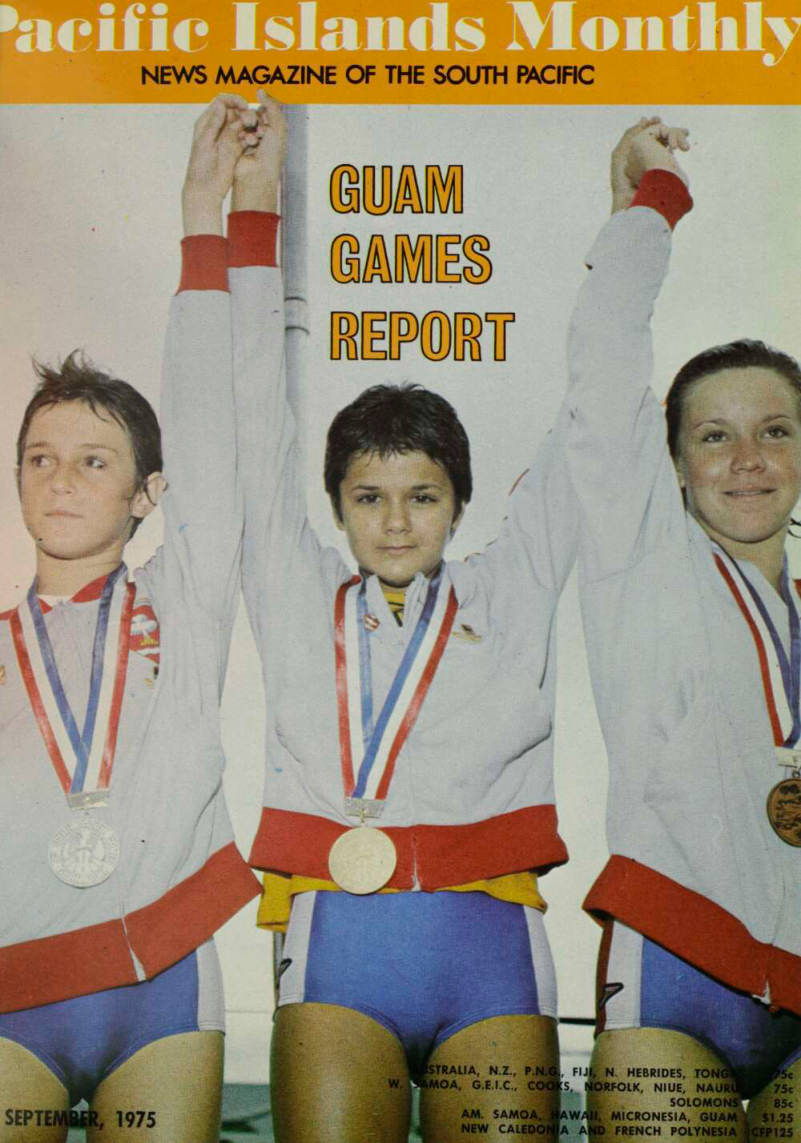
Our Cover
New Caledonia's golden swimmers, from the left, Pat ricia LeGras (five golds), Yolaine Samanadin (six golds) and Danielle Maussion (four golds). This shot comes from a pistol-packing policewoman, Dianne Strong, who, when she isn’t keeping law and order, shoots pictures.
There are more Games pic tures on the following pages.
These are by courtesy of the Pacific Daily News and by Dwayne Buffington, Ed Siguenza and Bill Powell.
Advertisements & other items, pp. 2-4 (1 item)
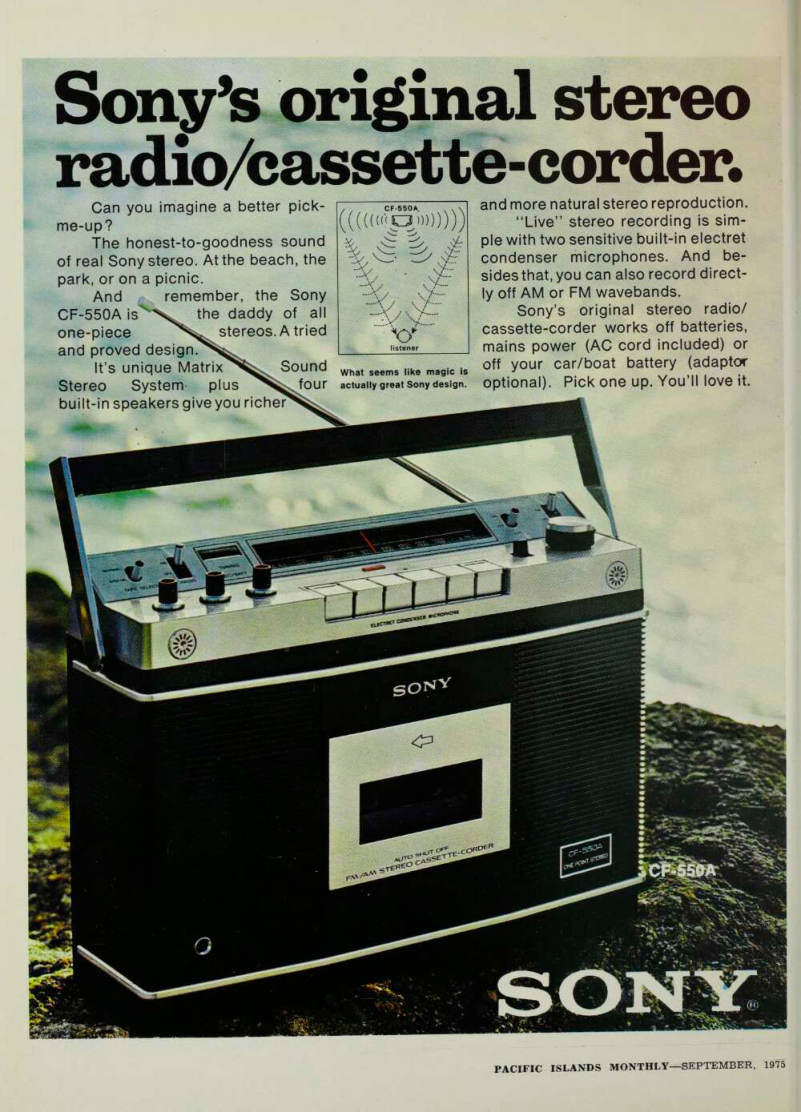
Sony’s original stereo
radio/cassette-corder.
Can you imagine a better pickme-up?
The honest-to-goodness sound of real Sony stereo. At the beach, the park, or on a picnic.
And remember, the Sony CF-550A the daddy of all one-piece stereos. A tried and proved design.
It’s unique Sound Stereo System plus four built-in speakers give you richer
/ . CF-550A. v . \
(((COD)))
v xV C "
V V-- Xf. listener and more natural stereo reproduction.
“Live” stereo recording is simple with two sensitive built-in electret condenser microphones. And besides that, you can also record directly off AM or FM wavebands.
Sony’s original stereo radio/ cassette-corder works off batteries, mains power (AC cord included) or off your car/boat battery (adaptor optional). Pick one up. You’ll love it.
What seems like magic is actually great Sony design. v\ 4Si
tzt* ctt A
IWICBII> i.u^
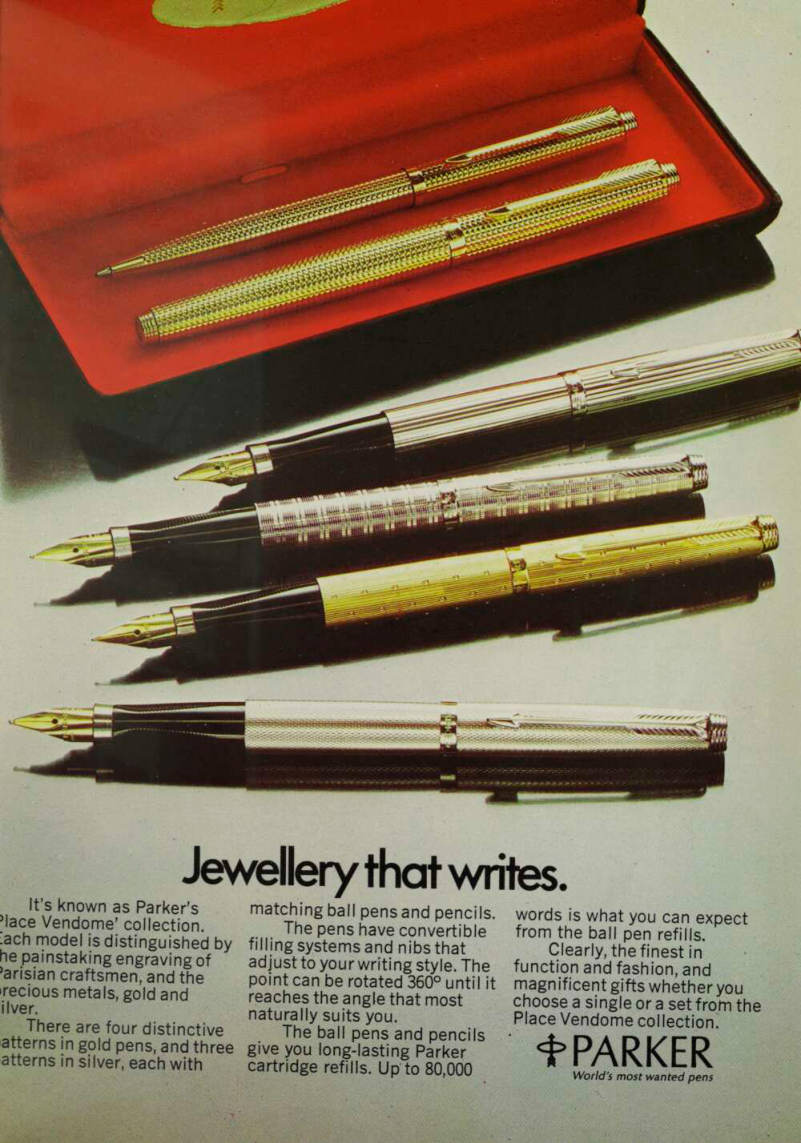
< It’s known as Parker’s
’lace Vendqme' collection,
.ach model is distinguished by
he painstaking engraving of
Frisian craftsmen, and the •recious metals, gold and ilver.
There are four distinctive atterns in gold pens, and three atterns in silver, each with
Jewellery that writes.
• i matching ball pens and pencils.
The pens have convertible filling systems and nibs that adjust to your writing style. The point can be rotated 360° until it reaches the angle that most naturally suits you.
The ball pens and pencils give you long-lasting Parker cartridge refills. Up to 80,000 words is what you can expect from the ball pen refills.
Clearly, the finest in function and fashion, and magnificent gifts whether you choose a single or a set from the Place Vendome collection.
tPARKER
World's most wanted pens
< * Wild I
iiil
ines onic it\c measurement seconds: metres or the tre or 0,01 ft. 900 m (3000 ft.)
WILD (AUST) PTY LTD
N.S.W.: 45 Epping Road, North Ryde. 888 7122 VIC.: 83-85 Palmerston Cres., Sth. Melbourne, 69 2263 OLD.: 11 Buchanan Street, West End. 44 3455
AGENTS IN ALL STATES
Up Front
with the Editor
3N the eve of such stirring events as the Papua New Guinea in ependence celebrations and the stablishment of the separate British jrritory of Tuvalu (Ellice Islands), omment in this column about the ifth South Pacific Games that has ist finished in Guam, might seem lappropriate. But the shambles at iuam can have long-term con jquences for all the South Pacific nless the lessons to be learned from are examined now, while the de lils are still fresh in everybody’s finds, and time doesn’t erode the ;solve to avoid a recurrence.
If there were another Games like uam, we can write finish to the eals of the South Pacific Games— hose concept was created in Rabaul, NG, in 1959 on the assumption that copies who play together, stay to :ther. Since 1963, when the first ames took place at Suva, they have :en a resounding success in every ay—until Guam. Each Games— iva, Noumea, Port Moresby, Pa ete—was better than the last. Un- Guam. PIM staffers have covered ery Games in detail, but John irter’s report about the Guam ames on the next page makes de
essing reading.
The South Pacific Games Council wise to have decided that Vila, ;w Hebrides, will not be confirmed site for the Sixth Games in 1978 til council members assure them ves in the next year that the New tbrides can do the job. But it auld take the opportunity to go ther, and to survey the whole his y of the Games so far.
After five Games, each in a differ ; territory, what have we learned aut just what it costs a host terri y, in cash and in personnel, to ge such an event? How much mey should be expected from tropolitan governments? How my paid officials are required, w many volunteers, how much nsport is needed, what are the )blems of food and accommoda n, what is the maximum distance ;t can be tolerated between the ious venues at any Games? In
deed, should we cease to move the Games to different territories and select a permanent site, or at least two or three sites only? it’ s time, too, for the sporting fix tures themselves to be appraised, pim has complained twice in the past that the official records of results are inaccurate and incomplete in small ways and that this should be remedied. It hasn’t been done. But we should also be asking ourselves whether we really need to stage such sports as, for example, golf, cycling, archery, or even yachting—domi nated perhaps by small groups of expatriates who can afford them, or by national groups to the detriment of all others. If we decide to stick to archery why not also include com petition with native bow and arrow* if we want yachting why not also canoe racing? Should we not also include, in athletics, a coconut palm climbing event or coconut , . . . ■ We should be examining the Games II everJ l f P art ' cula .r- “> see whether ,V make lt , more genuinely “ Il' ore fu "’ well as uf"J 8 more f' eat - The CjUam de ' bac i e glves us . th ?E opportunity and perhaps we should be thankful to have the warning before it is too
late
Stuart Inder
Pacific Islands
Monthly
FOUNDED BY R. W. ROBSON IN 1930
Published Monthly By
Pacific Publications (Aust.) Pty. Ltd.,
29 Alberta St., Sydney, N.S.W., 2000.
Postal Address: G.P.O. BOX 3408, SYDNEY,
N.S.W., 2001.
Telegraphic Address: PACPUB, Sydney.
Telex 25168.
Telephones: 61-9197, 61-7101, 61-4369.
Publisher: Stuart Inder.
Director of Advertising: Alan Batt.
Manager: Selwyn Hughes.
Pacific Islands Monthly
Editor: Stuart Inder.
Assistant Editor: John Carter.
Subscription Rates;
"Pacific Islands Monthly" is airfreighted to the majority of subscribers and agents in the Pacific Islands and the U.S.A.; copies to the Cook Islands, Nauru, Niue, Micronesia and Guam go by surface mail.
Australia (including Lord Howe and Thursday Islands), New Zealand, Papua New Guinea, Fiji, New Hebrides, Tonga, Cook Islands, Western Samoa, Gilbert & Ellice Islands, Norfolk Island, Niue and Nauru: $9.00 (local currency); Solomon Islands: $lO.OO Aust., American Samoa, Micronesia and Guam: $12.00 US; Hawaii and US Mainland: $15.00 US; New Caledonia and French Polynesia: 1,500 CFP; United Kingdom: £6.50; Japan: 4,000 Yen.
Elsewhere $11.50 Aust.
Representatives
Fiji: Advertising and Distribution—Fiji Times & Herald Ltd., 20 Gordon St., Suva. Telephone: 25-601. Telex.: FJ 2124.
Papua New Guinea: PORT MORESBY, PNG Print ing Co. Pty. Ltd., P.O. Box 633; LAE, P.O. Box 227; RABAUL, Mr. David Simpson, P.O. Box 164 (c/- Rabaul Photographic. Tel.; 2677).
French Polynesia. Distribution—Hachette Pacl fique, 10 Ave Bruat, Papeete.
New Zealand: Pacific Publications, C.P.O.
Box 2229, Auckland.
United Kingdom: The Herald & Weekly Times Limited (Mr J. Barker), Ludgate House, 107 Fleet Street, London, EC4A 2AJ.
Japan: Advertising—Universal Media Corpora tion, C.P.O. Box 46, Tokyo. Tel.: 666-3036.
Victoria: Advertising Pacific Publications (Aust.) Pty. Ltd., Herald & Weekly Times Building, 2nd Floor, 61 Flinders Lane, Mel bourne, 3000. Telephone: 652-1565.
Hawaii and U.S. Mainland only: N. Grogan, 3354 Hayden Street, Honolulu, 96815. [Send change of address notices. Form 3579 and new subscriptions to P.O. Box 2193, Honolulu, Hawaii, U.S.A. 96805).
Second class postage paid at Honolulu, Hawaii.
Copyright ©, 1975,
Pacific Publications (Aust) Pty. Ltd.
Vol. 46, No. 9 September, 1975
Advertisements & other items, p. 5 (1 item)
3
IFIC ISLANDS MONTHLY— SEPTEMBER, 1975
The Games—Biggest Rain-Soaked
Near-Disaster In Island History
By JOHN CARTER, who was in Guam for the Games
The Fifth South Pacific Games was the biggest near-disaster in the sporting history of the Islands.
Thankfully, the ordeal is over, but the lesson learned by the South Pacific Games Council is that never again will it allow itself to put such an important inter-island event in such jeopardy.
The council courted disaster when its members agreed four years ago to accept Guam’s invitation to stage the Games. Rumours persisted all those four years that Guam couldn’t do it; that this small, unincorporated terri tory of the United States hadn’t the will, or the wherewithal, to do a good job.
But the council believed the small coterie of Guam officials that every thing would be all right, and, in the face of advice from informed ad visers who had been to Guam, seen the confusion and inertia existing there, and begged the Games coun cil to take the Games elsewhere, de cided to stick to their original de cision to come to Guam.
The council members came a few days before the start in August, and they were appalled.
Hardly one of them then believed the Games would get off the ground!
With only a few days to go, there were too many things wrong.
Hardly anything was ready. The main arena, the venue for athletics at the J. F. Kennedy High School field, was a shambles. It would still be a shambles now had not some of the Papua New Guinea officials weighed in with technical know-how and helped to complete the work only hours before the first event.
Then it rained—and rained. That wasn’t Guam’s fault. But, who agreed to the Games being staged in the middle of Guam’s wet season? A record amount of rain fell on all 10 days of the Games. Only one day was almost fine.
The public relations effort on Games publicity was a failure.
Almost nobody on the island 30 miles by eight miles knew anything about the Games. They’d been told
almost nothing about them. A taxi driver knew nothing about them when I told him what I was doing on the island and Joe Murphy, editor of the island’s morning news paper, the Pacific Daily News, wore sack cloth and ashes when he con fessed in his column that the Press hadn’t given much publicity to them.
Not that it would have mattered much.
One Guamanian told me that locals were not interested in watching a sporting event unless a relative was in the team —and there weren’t many Guamanians in the Games. Apart from that, the favourite sport on Guam is cockfighting—every Friday, Saturday and Sunday, when thou sands of dollars change hands.
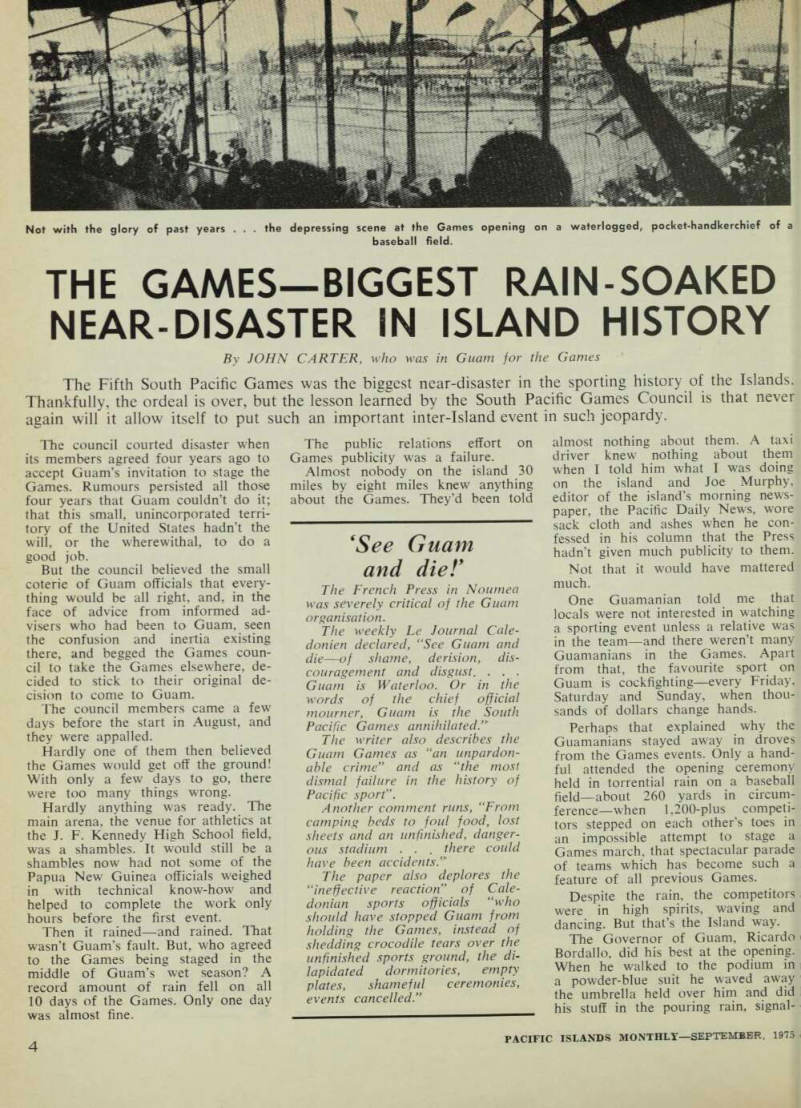
Perhaps that explained why the Guamanians stayed away in droves from the Games events. Only a hand ful attended the opening ceremony held in torrential rain on a baseball field—about 260 yards in circum ference—when 1,200-plus competi tors stepped on each other’s toes in an impossible attempt to stage a Games march, that spectacular parade of teams which has become such a feature of all previous Games.
Despite the rain, the competitors were in high spirits, waving and dancing. But that’s the Island way.
The Governor of Guam, Ricardo Bordallo, did his best at the opening.
When he walked to the podium in a powder-blue suit he waved away the umbrella held over him and did his stuff in the pouring rain, signal
Not with the glory of past years ... the depressing scene at the Games opening on a waterlogged, pocket-handkerchief of a baseball field.
ling that he was one with the few hundred people, mainly Games officials and supporters, plus the Press, who had had to endure two hours of ceremonial exposed to the weather while the favoured few local VIPs (who for some reason included young children) had sheltered in the inadequate covered grandstand.
That was another fault connected with the organisation. Nowhere, apart from the venues for the usual indoor games like basketball played in the fine gymnasium at the George Washington High School, was there cover for the spectators. The result was that only the hardy souls, and Pressmen doing their job, watched the Games.
The only suitable facilities on Guam are those operating for the schools, which are well equipped for gymnastics, basketball, softball, vol leyball and other games not requiring large fields. Agana, the capital (pro nounced Aganya) has a swimming pool, which turned out to be a fine one, liked by all the swimmers. The swimming events were the best (and the only) organised of the sports.
As the schools are scattered over the island, so were the Games venues, which meant that they were many miles apart. No wonder, with every thing scattered so far afield, the Games made an impact on the Guamanians like a snowflake hitting a hot tin roof.
Many venues—the soccer field was a case in point—were not even
fenced, so that it was hopeless to expect an income from spectators although competitors wanting to watch other sports had to pay for the privilege. That was rough, but so were most aspects of whole affair, although I heard few com plaints about the food, and, once the Guam people knew what all the strangers were doing on the island, they helped all they could. They could not have been more friendly and hospitable. The voluntary com mittees also did a good job.
There were frustrations galore.
Most of the Games equipment was ordered at the last minute (it was last minute in everything!) and wasn’t there when it was needed.
The weightlifters hadn’t any weights for pre-Games training. The poles for the pole vault are still in Japan.
And most of the equipment and the uniforms that were in the hands of the local organisers were not handed out until the last minute.
There were bottlenecks created by disputes between politicians and com merce over the supply of equipment from Japan, and many people blamed most of the Games mess on inter ference by politicians, from the ex- Governor downwards. The ex- Governor, Carlos Camacho, was opposed to the Games from the start, because, I was told, he wasn’t in formed Guam was going to invite the Games to come there. He, in 1972, opposed spending any money on the Games.
(Camacho was beaten in the elec tion for governor and he now faces, along with former Lieutenant- Governor Kurt S. Moylan and nine other ex-government officials, indict ment on charges of felonies ranging from embezzlement and falsification of accounts to presenting false claims for government funds involving about SUS3.2B million).
But most people blame, not the politicians for the mess, but self seeking Games officials, headed by Guam Games Council President Theodore Nelson. They accuse him of empire building, of self-glorifica tion, of using the Games for poli tical advancement and of being so dictatorial that many refused to work with him.
Mr Nelson was certainly blamed by some for the very embarrassing situation which arose at the start through the presence of a soccer team from Australia’s northern Queensland, which clamoured for a place in the Games despite the fact that the Games Charter says that only Island government members of the South Pacific Commission, which fathered the Games, can be repre sented. The Queenslanders actually arrived on Guam at a cost to them selves of $15,000 expecting to play in the official competition, only to be told they had no business there.
Their officials said Mr Nelson had told them they could come. Mr Nel son, in my presence, said he had learned in time that they wouldn’t be welcomed and his last message to them a few days before their de parture from Cairns was to stay at home. They denied receiving any message but two junior staff assured me they had seen the cable.
In cash and kind, it has been esti mated that the Games will cost Guam around SUSI.O million. But some officials think that costs spiralled in the last few weeks and that there will be some more bills presented, payment for which has not been authorised. As at the time of writing, there were fears that the Guam Government coffers won’t con tain enough to pay next month’s wages, anyhow, the Guam Games won’t leave a nice taste in the mouths of Guam or the rest of the Pacific.
In fact, so far as the Seiko people were concerned, it was a distinctly sour taste. Seiko, the watch manufac turers in Japan, had sent a full team of technicians to Guam to operate the sophisticated electronic timing equipment which, costing around $30,000, they had loaned to the
Spg.
But there’s no money in the Games kitty, and Seiko may have to pay its own bills. ' '
‘See Guam
and die!'
The French Press in Noumea was severely critical of the Guam organisation.
The weekly Le Journal Cale donien declared, “See Guam and die —of shame, derision, dis couragement and disgust. . . .
Guam is Waterloo. Or in the words of the chief official mourner, Guam is the South Pacific Games annihilated.”' The writer also describes the Guam Games as “an unpardon able crime” and as “the most dismal failure in the history of Pacific sport”.
Another comment runs, “From camping beds to foul food, lost sheets and an unfinished, danger ous stadium . . . there could have been accidents.”
The paper also deplores the “ineffective reaction” of Cale donian sports officials “who should have stopped Guam from holding the Games, instead of shedding crocodile tears over the unfinished sports ground, the di lapidated dormitories, empty plates, shameful ceremonies, events cancelled.”
!rsssriS“““~itt:
A fiery rocket for Guam
?S was 5 ° r9anisa, r ° f ,he inclansan, weather conditions being'™Jffi'ci.n?’ Tc, account'lor Pr ' V '° US ,ha h , atdry"2M e oeol Ua a n ;te 0 n ff ded al ;h in ,t,e f °" owing coin,!: Aparl ,rom ,hc in b ° ,h pampa - tba """■ the Fiftr^uth nC pacific e f o ,m« S , i h ncurrecl b . y a ." pa r' id P a,i "9 te'rritories to be present at Z'T, T" V ° U ' ° f P 7 p “ r ' i “" a »i'h n w o hat W G o ;L an h d as ,l ™offer o,ed '° ,h ' prepara,ion * k ; h 'pa?, l3^ n, ,bL o e n ' , S'e C s , . o . f „d ,h ' Ch ' r, ' r ,n a -ccer team to
atmosphere which is necessary to set up a normal organSion of the' sSSh PaUc nt Game"
Advertisements & other items, p. 7 (1 item)
Acific Islands Monthly—September, 1975
News in a Nutshell
The Micronesian Constitutional Convention, seeking to frame a constitution for the Trust Terri tory, opened on Saipan in July and, until its adjournment on August 22 with resumption on September 15, debated almost every phase of living including women’s rights and the type of legislature. Many male speakers opposed the idea propounded by the women delegates that women were men’s equal. There was no decision on a resolution by the women that there should be no sex discrimination in Micronesia.
There was a division of opinion over the legislature, one section favouring equal representation by all districts and the other, repre sentation according to population.
The convention will study a com promise plan by Maketo Robert of Truk. He suggested that popu lation should govern representa tion in the House of Representa tives and seating in the Senate should be determined by the amount of revenue contributed by each district. This might meet the demands made in the past by the Marshalls with regard to Kwaja lein. □ □ The Australian Department of the Capital Territory has received more than 10 applications for the post of Administrator of Norfolk Island. The present Administrator is Mr T. E. Pickerd, who was to leave the island about the end of August. The job carries a tax-free salary of $17,000 a year, plus several “perks”. The new Adminis trator should be appointed by the end of September. □ □ New Zealand will grant perma nent residence to about 300 people from Fiji each year. In a new policy NZ has removed an ele ment of discrimination by allowing unskilled people to take up perma nent residence. The 300 a year will comprise a cross-section of skilled and unskilled people. New Zealand is about to introduce a new type of visa which will allow Pacific Islanders to work there
for six months. The NZ Minister for Immigration, Mr Fraser Col man, recently visited several South Pacific countries to discuss immigration matters. There will also be one-month visitor permits. □ □ The Tongan rugby team had a fairly successful NZ tour, winning eight of the 12 matches. But they lost both “tests” to the Maoris, the second by 30 points. It was the first time the Maoris had beaten Tonga in a “test” series.
The Tongans scored 268 against 231 by their opponents. Results (Tonga points first): Wairarapa- Bush, 13-12; West Coast, 21-17; North Otago, 18-30; Canterbury, 20-31; Mid-Canterbury, 22-19; Wanganui, 28-15; East Coast, 47-6; Maoris, 16-23; King Coun try, 18-13; Counties, 17-12; Thames Valley, 41-16; Maoris, 7-37. □ □ Mid-August, the PNG police were investigating the theft of SI 4,000 which had disappeared from the Mt Hagen Post Office.
The money was in four packets, two of which were taken from the post office by a man posing as a bank employee. The other packets cannot be traced. This is the second large theft in the last six months. More than 60,000 new kina notes were stolen in transit when the new currency came into operation. About half has been recovered. □ □ A work-rationing scheme has been devised to cater for 58 em ployees the Gilbert and Ellice Islands Development Authority wished to lay off in May as being redundant when a water supply and cable laying project at Bon riki, was finished. The union, BKATM, refused to accept the re dundancies and called a strike. The union ignored a board of inquiry finding that the redundancies were justified. Under a compromise agreement the men will not be laid off. But every week, 58 of 360
employees will be stood down without pay. Although this will not constitute a break in service, the men will lose fringe benefits for that week. BKATM members will make voluntary payments of about $2 a fortnight into a tempo rary provident fund, from which payments will be made to the workers losing a week’s work. □ □ An eight-year-old Palauan boy, Peter Gordon Watts, a non swimmer, fell overboard from a boat while travelling with his mother from Koror to Babelthuap on August 10. He was found 15 hours later, still alive. He had kept afloat by holding a coconut, which he found when he fell over board. Doctors said he was in perfect condition after his ordeal.
“A miracle,” said the Palauans. □ □ France plans another under ground nuclear test at Fangataufa atoll in French Polynesia in October. This will be the last on that atoll. Succeeding tests will be at Muruoa where France operated a series of atmospheric tests over several years. □ □ The Western Samoa Govern ment, in an effort to raise more than $200,000 in extra revenue has lifted import duties. All im ports, except fish, are subject to the new duties. Beer went up by 3c a bottle; whisky will cost about $1 more a bottle, petrol is up by at least 3c a gallon, and kerosene and diesel fuel by 8c a gallon. □ □ The first elections for the New Hebrides’ new-look Representative Assembly, designed to give the people a bigger share in govern ment, will be held in the first two weeks of November. This was confirmed in Paris during talks be tween British and French repre sentatives. With the British Resi dent Commissioner, Mr Roger du
Boulay, at the talks was Mr John S. Champion, head of the Gib raltar and General Department of the Foreign and Commonwealth Office, who is taking over Mr du Boulay’s job. Mr du Boulay will take a senior post in the British Diplomatic Service. Meanwhile, candidates supporting continued rule by Britain and France almost swept the board in the first muni cipal elections in August. UCNH and supporting candidates won 15 out of 16 seats in Santo and 18 out of 24 seats in Vila. The rest were won by the New Hebrides National Party. □ □ Solomons Chief Minister Solo mon Mamaloni reshuffled his cabinet late in July, changing every portfolio except that of Minister of Works and Public Utilities (Mr Philip Solodia) and his own, and creating two new ministries. Finance and Develop ment (Mr Willie Betu) and Natural Resources (Mr Stephen Cheka). Colin Gauwane, a govern ment back-bencher, takes over Agriculture and Lands: Bill Page, Health and Welfare; Dr Francis Kikolo, Home Affairs; David Kausimae, Foreign Trade, Industry and Labour, and Dr Gideon Zolo veke, Education and Cultural Affairs. Dr Kikolo and Mr Page are independents. Mr Mamaloni rejected a suggested coalition with the United Solomons Islands Party. Father Peter Thompson, who was Minister for Health and Welfare, resigned from the Legis lative Assembly on health grounds. □ □ French Prime Minister Jacques Chirac is expected to visit Aus tralia and New Zealand and France’s overseas territories in the South Pacific in November.
The date was given by the French Ambassador to Australia, Mr H.
E. M. Treca, when he visited New Caledonia late July. Rela tions between France and Aus tralia were excellent, Mr Treca said, and trade between the two countries had increased consider ably.
independence nears
Drama as Papua New Guinea independence nears
The last few weeks before PNG’s Independence Day, scheduled for September 16, have been full of drama and decision-making.
The drama has included such things as moves by Bougainville to secede, and a chronic shortage of government money.
The money shortage has resulted in some last-minute belt tightening only a month before PNG’s first Independence Budget is to be brought down in late September. Prices of beer, liquor and cigarettes have been increased overnight by almost 50 per cent, and registration charges for private vehicles have gone up 50 per cent. The new charges will bring in an extra K 5 million this financial ye *J u . x .
Chief Minister Michael Somare told the House that Papua New Guineans will have to adjust to lower living standards and fewer services because of a cut in Australia’s aid grant this year.
It is impossible for two nations to conduct their relations as if one were a department of the other”, he sard. ‘We have been treated very badly this year; to prevent random events in Australia doing this to us again it is essential we reach an agreed perspective with the Australian Government on our long-term aid
rel fj lol iship”.
Mr Somare was referring to Austraha’s promise to provide PNG with $5OO million aid (a dollar is on a par with a Kina) over three years, one year of which has already run.
Because of Australia’s own economic
plight, the Australian grant this year is less than PNG expected, This has caused havoc with PNG finances, because Mr Somare had already cut $5O million out of PNG’s budget estimates before submitting them to Australia in an honest effort to avoid asking for more than PNG needed. The PNG Budget framers thought they had acted very respons ibly. The Independence Budget is shaped to support local development such as construction projects, copper investigations on the Ok Tedi River, etc, and expenditure on health and education will be cut.
When, in August, PNG realised just how much less it would get from Australia, requiring in turn very severe additional cuts to its own very tight Budget, Mr Somare flew urgently to Australia with his top ministers to appeal to Prime Minister Whitlam.
He got nothing. At the meeting Mr Whitlam was, in fact, rude, tell ing his own Minister for Foreign Affairs, Senator Willesee, who at tempted to put the PNG view at one point, to “shut up or get out of the room”.
Mr Somare was incensed and humi- Hated at his reception. But since re turning to Port Moresby he has
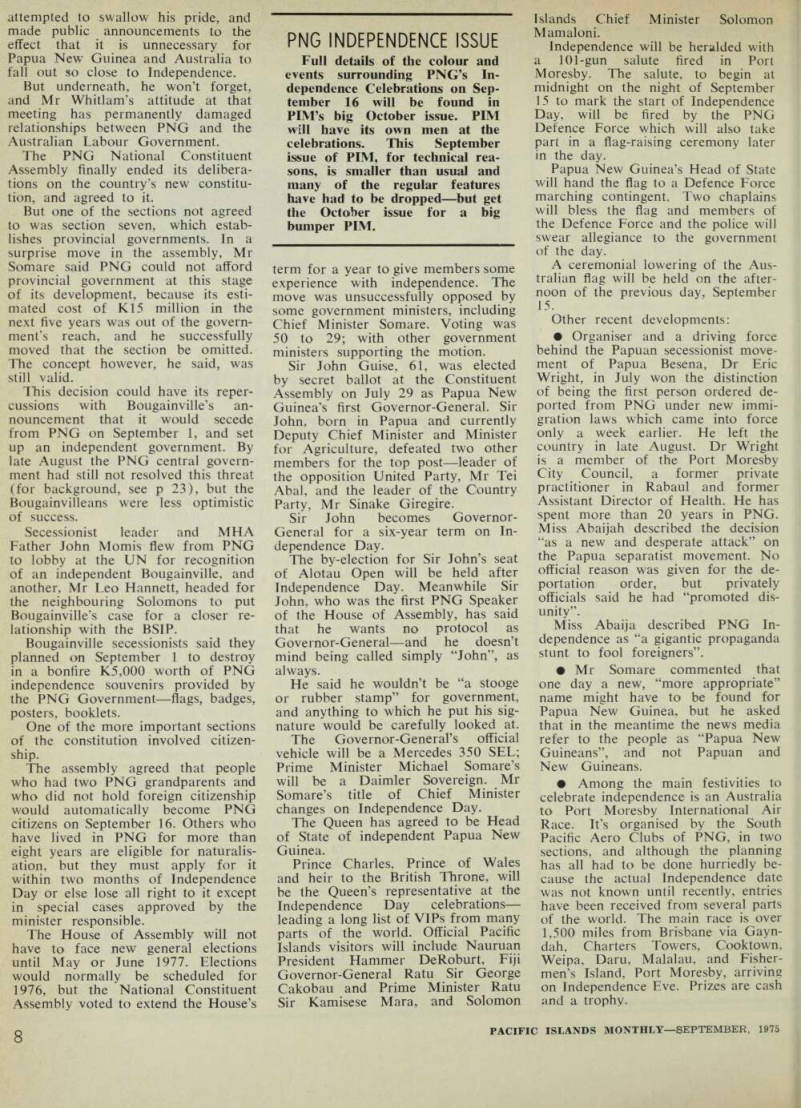
Papua New Guinea's Governor-General elect, Sir John Guise (centre) receives con gratulations from Chief Minister Michael Somare and Australian High Commissioner Tom Critchley at a private luncheon in his honour in Port Moresby.
attempted to swallow his pride, and made public announcements to the effect that it is unnecessary for Papua New Guinea and Australia to fall out so close to Independence.
But underneath, he won’t forget, and Mr Whitlam’s attitude at that meeting has permanently damaged relationships between PNG and the Australian Labour Government.
The PNG National Constituent Assembly finally ended its delibera tions on the country’s new constitu tion, and agreed to it.
But one of the sections not agreed to was section seven, which estab lishes provincial governments. In a surprise move in the assembly, Mr Somare said PNG could not afford provincial government at this stage of its development, because its esti mated cost of Kl 5 million in the next five years was out of the govern ment’s reach, and he successfully moved that the section be omitted.
The concept however, he said, was still valid.
This decision could have its reper cussions with Bougainville’s an nouncement that it would secede from PNG on September 1, and set up an independent government. By late August the PNG central govern ment had still not resolved this threat (for background, see p 23), but the Bougainvilleans were less optimistic of success.
Secessionist leader and MHA Father John Momis flew from PNG to lobby at the UN for recognition of an independent Bougainville, and another, Mr Leo Hannett, headed for the neighbouring Solomons to put Bougainville’s case for a closer re lationship with the BSIP.
Bougainville secessionists said they planned on September 1 to destroy in a bonfire K 5,000 worth of PNG independence souvenirs provided by the PNG Government —flags, badges, posters, booklets.
One of the more important sections of the constitution involved citizen ship.
The assembly agreed that people who had two PNG grandparents and who did not hold foreign citizenship would automatically become PNG citizens on September 16. Others who have lived in PNG for more than eight years are eligible for naturalis ation, but they must apply for it within two months of Independence Day or else lose all right to it except in special cases approved by the minister responsible.
The House of Assembly will not have to face new general elections until May or June 1977. Elections would normally be scheduled for 1976, but the National Constituent Assembly voted to extend the House’s
term for a year to give members some experience with independence. The move was unsuccessfully opposed by some government ministers, including Chief Minister Somare. Voting was 50 to 29; with other government ministers supporting the motion.
Sir John Guise, 61, was elected by secret ballot at the Constituent Assembly on July 29 as Papua New Guinea’s first Governor-General. Sir John, born in Papua and currently Deputy Chief Minister and Minister for Agriculture, defeated two other members for the top post—leader of the opposition United Party, Mr Tei Abal, and the leader of the Country Party, Mr Sinake Giregire.
Sir John becomes Governor- General for a six-year term on In dependence Day.
The by-election for Sir John’s seat of Alotau Open will be held after Independence Day. Meanwhile Sir John, who was the first PNG Speaker of the House of Assembly, has said that he wants no protocol as Governor-General—and he doesn’t mind being called simply “John”, as always.
He said he wouldn’t be “a stooge or rubber stamp” for government, and anything to which he put his sig nature would be carefully looked at.
The Governor-General’s official vehicle will be a Mercedes 350 SEE; Prime Minister Michael Somare’s will be a Daimler Sovereign. Mr Somare’s title of Chief Minister changes on Independence Day.
The Queen has agreed to be Head of State of independent Papua New Guinea.
Prince Charles, Prince of Wales and heir to the British Throne, will be the Queen’s representative at the Independence Day celebrations — leading a long list of VIPs from many parts of the world. Official Pacific Islands visitors will include Nauruan President Hammer Deßoburt, Fiji Governor-General Ratu Sir George Cakobau and Prime Minister Ratu Sir Kamisese Mara, and Solomon
Islands Chief Minister Solomon Mamaloni.
Independence will be heralded with a 101-gun salute fired in Port Moresby. The salute, to begin at midnight on the night of September 15 to mark the start of Independence Day, will be fired by the PNG Defence Force which will also take part in a flag-raising ceremony later in the day.
Papua New Guinea’s Head of State will hand the flag to a Defence Force marching contingent. Two chaplains will bless the flag and members of the Defence Force and the police will swear allegiance to the government of the day.
A ceremonial lowering of the Aus tralian flag will be held on the after noon of the previous day, September 15.
Other recent developments: • Organiser and a driving force behind the Papuan secessionist move ment of Papua Besena, Dr Eric Wright, in July won the distinction of being the first person ordered de ported from PNG under new immi gration laws which came into force only a week earlier. He left the country in late August. Dr Wright is a member of the Port Moresby City Council, a former private practitioner in Rabaul and former Assistant Director of Health. He has spent more than 20 years in PNG.
Miss Abaijah described the decision “as a new and desperate attack” on the Papua separatist movement. No official reason was given for the de
portation order, but privately
officials said he had “promoted dis unity”.
Miss Abaija described PNG In dependence as “a gigantic propaganda stunt to fool foreigners”. • Mr Somare commented that one day a new, “more appropriate” name might have to be found for Papua New Guinea, but he asked that in the meantime the news media refer to the people as “Papua New Guineans”, and not Papuan and New Guineans. • Among the main festivities to celebrate independence is an Australia to Port Moresby International Air Race. It’s organised by the South Pacific Aero Clubs of PNG, in two sections, and although the planning has all had to be done hurriedly be cause the actual Independence date was not known until recently, entries have been received from several parts of the world. The main race is over 1,500 miles from Brisbane via Gayn dah. Charters Towers, Cooktown, Weipa, Dam, Malalau, and Fisher men’s Island, Port Moresby, arriving on Independence Eve. Prizes are cash and a trophy.
Png Independence Issue
Full details of the colour and events surrounding PNG’s In dependence Celebrations on Sep tember 16 will be found in PlM’s big October issue. PIM will have its own men at the celebrations. This September issue of PIM, for technical rea sons, is smaller than usual and many of the regular features have had to be dropped—but get the October issue for a big bumper PIM.
underground bangs
Back to Mururoa for underground bangs
From AL PRINCE in Papeete
Considerable speculation built up here over whether the text for the new law reorganising French Polynesia’s relationship with France as of January 1 had become blocked in Paris on the desk of French President Valery Giscard d’Estaing. This speculation was fed by the strange silence from Paris on “the project”, as the new law is referred to in Tahiti, ever since the delegation of politicians from Tahiti returned home frF; e „ r c y h te ca e p,t , ai ne wUh et X i lr Cfjrr, Pranoh Q. pr . fnr , 7 r
ISte for Overseas DeparZems
and Territories.
Mr Stirn made some of his feelings known in early July about the new law, saying that “the project” would be handed over in the coming few days. Nothing has materialised since except some grand-standing by local On the nuclear testing front, there was a change of command in the military head of the nuclear testing centre with the new director, Gen Lucien Soula, announcing that the next and last underground nuclear explosion at the remote French Polynesia atoll of Fangataufa will be held in October. After that, he said, the underground tests will be held 50 km away at Mururoa, where France conducted its atmospheric nuclear tests for several years.
Gen Soula mentioned nothing about when the first underground test will be held at Mururoa.
However, there are reliable reports circulating in Tahiti and Paris that France plans to conduct at least one test there before the end of this year. There are other reliable reports circulating that France preferred to conduct several underground blasts this year, but was forced to cut back in its programme due to a shortage of funds, something that Gen Soula only vaguely referred to.
And although France has no plans to conduct further underground tests at Fangataufa, Gen Soula said, it would be quite easy
to return there in the future. The new testing director also denied reports that France plans to re turn to its first nuclear testing site, the Sahara Desert in Africa, There have been several rumours over the past few months that France was negotiating with Algeria to re-occupy the testing facilities that it operated in the Sahara until Algeria became in dependent of France, forcing the transfer to French Polynesia bee A „" d ™ a ' t o h u° r U s gh t h ,h t ere ttl haVe h f° been rumours that the subter
“ronT'eno 5
"°* s, ° ng , enou S h <-> withstand tV J? or <, th , ree H nder " § •? d le t s s ’ < -j en ( u a sald ,be " ] ° I ? turn . tc J Mururoa p i act,cal and ec ° n : ° mi fl c y eas ° ns ' Franc , e > condu l cted l ts drS p und “ground test on June
L“ .Mvss
® v “ l . h °“ s , h ‘ he t f r t nch ,P overn ' ha,led that , test as a “In operation it . f pp f ars j!? at , the s “ c "? d l ® st , d a u ® “ ° clo , he ( r wdl be the last for the near fature - In keeping with the French Government’s more open attitude towards its testing programme fol lowing the June 5 blast, Gen Soula also announced that French journalists have been invited to visit the South Pacific Experiment ation Centre in Tahiti and the test sites of Fangataufa and Muru roa in September. This will mark the first time in several years that the government has allowed any journalists to visit the test site.
However, Gen Soula was careful to point out that there will be no test conducted during the journal ists* visit.
As for France’s nuclear device itself, Gen Soula said, “Because in order to have a credible nuclear armament it is necessary to un ceasingly improve it and to do this it is necessary to conduct tests, there is no limit to the Pad fic Experimentation Centre’s existence and presence in French Polynesia”.
governments?
Whither Island governments?
A change by the Islands from the current, Westminster, dual party, sys tem of government to one-party government, and a Federation of the South Pacific were two seeds which Fiji’s Prime Minister, Ratu Sir Kami sese Mara, let fall for germination when he gave the Dillingham Lecture at the East-West Center in Honolulu at July’s end.
Sir Kamisese, who spoke on “Cur rents in the Pacific”, made several comparisons between the traditional life-styles in the Islands and those of the Western colonisers, and instanced the confusion which came with Western civilisation when the Islanders followed the “two appar ently incompatible creeds of material ism and Christianity, which, how ever, also taught the people how to adjust and compromise”.
With the coming of independence Islanders were faced with a real dilemma. Should they go back to their first beginnings, or “press on relentlessly along the lines of indus trialisation and endeavour?”
“Is the Western pattern of govern ment necessarily the one best suited to us in the Pacific?” Sir Kamisese asked. “Or are those African coun tries right who have tried the Western democratic pattern only to find that the real answer to their problems, and the way to progress, was through one-party government”.
Quoting an African argument that “all would be better working for the common aim rather than engaging in the facade of two or more party government, much of which is sterile and unproductive”, the Fiji Prime Minister said that a one-party govern ment may be more effective from the people’s point of view since a government might well give more heed to opposition from its own ranks.
After listing the organisations through which the Islands co operated with one another, Sir Kami sese said it was good to see, not only the inter-island regional co operation, but, also, greater realisa tion of Pacific identity and Pacific responsibility by Australia, New Zealand, Canada and the United States.
Asked Sir Kamisese: “A federation of the South Pacific?” and added that he was asking questions rather than providing answers.
Advertisements & other items, p. 11 (1 item)
9
CIFIC ISLANDS MONTHLY—SEPTEMBER. 1975
How They Did At The Games
Even the rain couldn't dilute the athletes' spirit!
Sixteen records were broken in 35 events which comprised the athletics, four less than at the Tahiti Games.
Four less! The wonder is that any records were broken, considering the conditions encountered on what passed for a sports ampitheatre on Guam.
If anything at Guam reached dis aster’s brink it was the athletics. The heroes, and heroines, were the ath letes and Papua New Guinea’s officials. Three months ago, there wasn’t a venue for athletics. A few days before the first starting pistol was fired, there wasn’t a running track. A few hours before the start, there was a track of sorts, still in complete.
There was no one to complete it until the PNG officials turned up.
Some of them had engineering ex perience. They buckled to and had the track ready. Then it rained. The track, a combination of compacted coral and clay—or so it seemed— was inches under water on that first Saturday evening and the start was postponed until the Monday.
From then on, the athletics con tinued without another hitch but under extremely difficult conditions.
The athletes were tremendous. So were the PNG officials, all experi enced in running athletics. Without them—chaos!
The international juror, Sydney based Mr Arthur Hodsdon, of the Oceania Council of the International Amateur Athletic Federation, was bitter in his criticism, not of the Guam people, but of the United States Amateur Athletic Union.
“I admire the tremendous spirit of these people on Guam who didn’t realise what they were undertaking with the Games”, Mr Hodsdon said.
“I don’t propose to blast them when I return home and make my report.
But I hope that, after I make my
complaints to the federation and to the United States AAU, it will have such a repercussion that the Ameri cans will take great care, if the Games go again to American terri tory, to play their part”.
Despite the poor facilities, despite the continuous rain and the absence of real support from spectators, the athletes staged a great show. How they were able to perform as they did, hampered by the fact that there was no shelter from the rain when they were waiting their turn to com pete, everyone wondered.
But the athletes didn’t fail. They really saved the Fifth South Pacific Games. Rain couldn’t dampen the sporting spirit, which was evident in all the teams although some of the Frenchmen, in the opinion of others, did too much grumbling.
Grousers or not, the Frenchmen, and French women, led the field, particularly the New Caledonians who took 12 gold medals. Fiji was only one gold medal behind, which restored some of the confidence which had drained from the Fijians as they viewed their lack of achievement in other sports.
From champion country at the First South Pacific Games in Fiji in 1963, Fiji dropped to second at Nou mea in 1966, third at Port Moresby in 1969, and fourth at Tahiti in
1971. They stayed fourth at Guam.
Happily for them, they still have good support for athletics at home and had no reason to be ashamed of their performance at Guam. In fact, with just a little luck, they would have come out in front on the athletics field.
The country which can keep its head very high is Tonga. Its full team at the Games numbered three com petitors, the brother Saniseti and Alipeti Latu and woman athlete
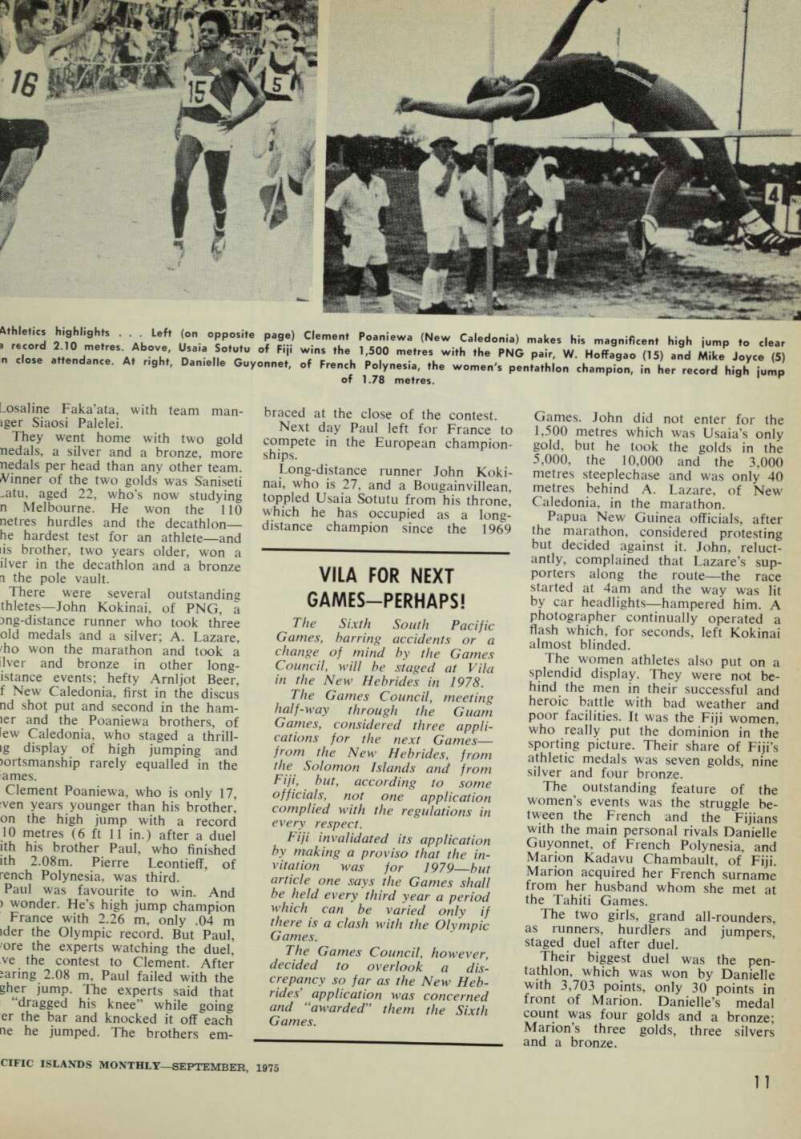
The grimace of victory—That final burst brought a gold to Fiji's champion woman athlete Marion Kadavu Chambault (centre) in the 100 metres dash with New Heb ridean Georgette Delplane (left) close behind. D. Lemen (PNG) (right) was fourth.
Losaline Faka’ata, with team man iger Siaosi Palelei.
They went home with two gold nedals, a silver and a bronze, more nedals per head than any other team.
Winner of the two golds was Saniseti aged 22, who’s now studying n Melbourne. He won the 110 netres hurdles and the decathlon— he hardest test for an athlete—and iis brother, two years older, won a ilver in the decathlon and a bronze n the pole vault.
There were several outstanding thletes—John Kokinai, of PNG, a Dng-distance runner who took three old medals and a silver; A. Lazare, 'ho won the marathon and took a ilver and bronze in other long istance events; hefty Amljot Beer, f New Caledonia, first in the discus nd shot put and second in the ham ler and the Poaniewa brothers, of few Caledonia, who staged a thrill ig display of high jumping and )ortsmanship rarely equalled in the ames.
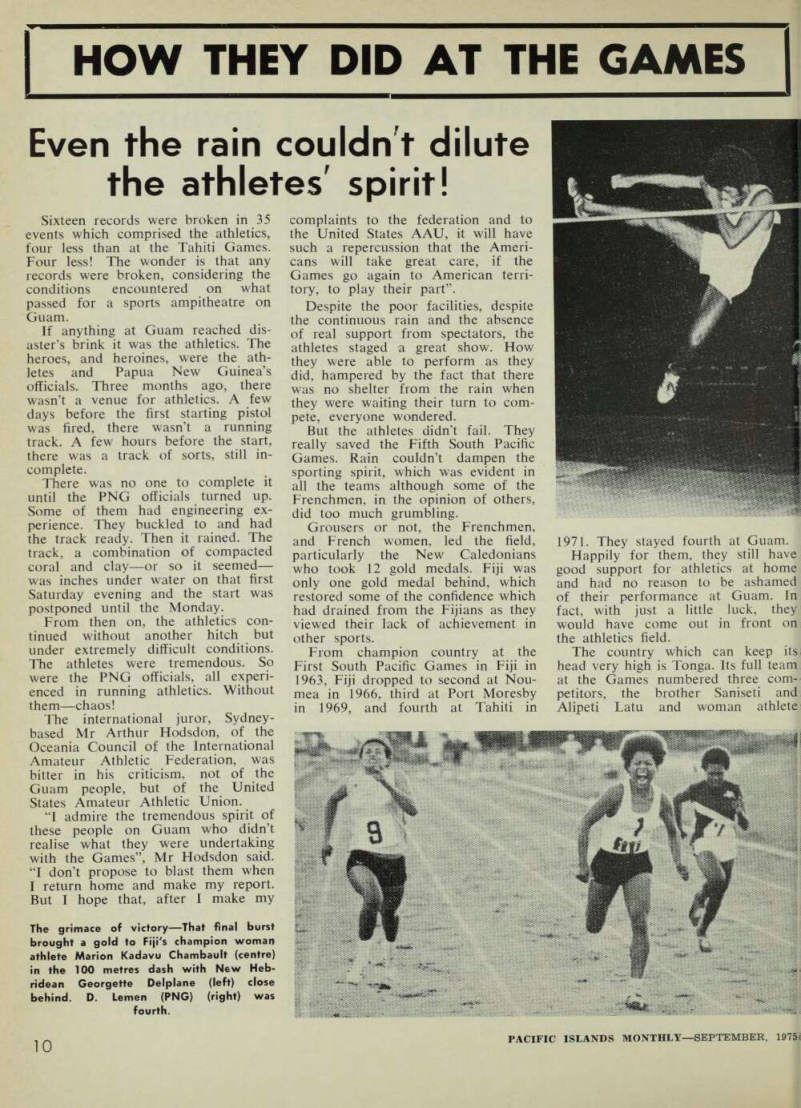
Clement Poaniewa, who is only 17, ven years younger than his brother, on the high jump with a record 10 metres (6 ft 11 in.) after a duel ith his brother Paul, who finished ith 2.08 m. Pierre Leontieff, of rench Polynesia, was third.
Paul was favourite to win. And ) wonder. He’s high jump champion France with 2.26 m, only .04 m ider the Olympic record. But Paul, 'ore the experts watching the duel, ve the contest to Clement. After taring 2.08 m, Paul failed with the gher jump. ’Hie experts said that dragged his knee” while going er the bar and knocked it off each tie he jumped. The brothers em
br?fd t , 2 ‘ he D cl ? S t ?f ‘he contest.
ar* ««*asw
Usaia Sotutu from his throne, a
Games, John did not enter for the 1,500 metres which was Usaia’s only gold, but he took the golds in the 5,000, the 10,000 and the 3,000 metres steeplechase and was only 40 metres behind A. Lazare, of New Caledonia, in the marathon.
Papua New Guinea officials, after the marathon, considered protesting but decided against it. John, reluct antly, complained that Lazare’s sup porters along the route—the race started at 4am and the way was lit by car headlights—hampered him. A photographer continually operated a flash which, for seconds, left Kokinai almost blinded.
The women athletes also put on a splendid display. They were not be hind the men in their successful and heroic battle with bad weather and poor facilities. It was the Fiji women, who really put the dominion in the sporting picture. Their share of Fiji’s athletic medals was seven golds, nine silver and four bronze.
The outstanding feature of the women’s events was the struggle be tween the French and the Fijians with the main personal rivals Danielle Guyonnet, of French Polynesia, and Marion Kadavu Chambault, of Fiji.
Marion acquired her French surname from her husband whom she met at the Tahiti Games.
The two girls, grand all-rounders, as runners, hurdlers and jumpers, staged duel after duel.
Their biggest duel was the pen tathlon, which was won by Danielle with 3,703 points, only 30 points in front of Marion. Danielle’s medal count was four golds and a bronze; Marion’s three golds, three silvers and a bronze.
2 m melL Vl, U * !?" P‘9‘) dement Poaniewa (New Caledonia) makes his magnificent high jump to cleat record 2 10 metres Above, Usa.a Sotelo of Ftp wins the 1,500 metres with the PNG pair, W. Hoffagao (15) and Mik e P Joyce (5) n close attendance. A, right, Danielle Geyonnet, of French Polynesia, the women's pentathlon in Lrrec„d high i„mp of 1.78 metres. 1 r
Games-Perhaps!
Vila For Next
The Sixth South Pacific Games, barring accidents or a change of mind by the Games Council, will be staged at Vila in the New Hebrides in 1978.
The Games Council, meeting half-way through the Guam Games, considered three appli cations for the next Games— from the New Hebrides, from thf Solomon Islands and from Fiji, but, according to some officials, not one application complied with the regulations in every respect.
Fiji invalidated its application by making a proviso that the in vitation was for 1979—but article one says the Games shall be held every third year a period which can be varied only if there is a clash with the Olympic Games.
The Games Council, however, decided to overlook a dis crepancy so far as the New Heb rides’ application was concerned and “ awarded” them the Sixth Games.
Advertisements & other items, p. 13 (1 item)
Cific Islands Monthly—September, 1975
the Western
Heave ho for the Western Samoans!
What makes a man go in for a sport like weightlifting? It’s much harder work than most sports, but Mr Oscar State travelled all the way from London to oversee the weight lifting events as international juror.
It can be a dangerous sport too. A weightlifter died only a few months ago when he slipped while lifting.
The whole contraption fell on him and killed him.
There were no accidents, however, at Dededo Junior High School, in the middle of the island, venue for both weightlifting and judo. But con testants were far from happy with arrangements.
For some obscure reason, the officials refused to release Games equipment for several sports until the last minute, almost. This angered and inconvenienced the weightlifters particularly. They had no equipment to train with—and you don’t fly with a couple of tonnes of iron.
They nearly lifted the roof in their annoyance and the Guam team re fused to play. In fact, but for the Island temperament, compromising and taking things lightly, even in weightlifting, all the teams might have walked out. Some lifters complained that, without the weights to train with, they would soon be out of con dition. One, PNG’s Michael Mexico, had another complaint—the food.
“It’s not the right stuff”, he told PIM. “I’ve already lost a lot of weight”. But, he didn’t lose too much. He made it as a light-heavy and took the silver medal.
Conditions didn’t bother the Western Samoans. Their team of 10 lifters went home with six golds, two silver and a bronze. Papua New Guinea was next best with three golds and a silver.
The judo men, Frenchmen almost to a man—there were also four American Samoans and two from PNG—got through their programme without a hitch, that’s if you can call a team walkout something else. The Guam team, containing the Bias family champions, refused to com pete. The Bias boys, who had caused a commotion at Papeete with com plaints about confused arrangements, decided at Guam that blood’s no thicker than anything else connected with the Games, and pulled out to
the great embarrassment of their countrymen.
They decided to quit because organisation was bad and the Guam officials wouldn’t finance a trip to Japan to enable them to complete their training.
As the Frenchmen outnumbered the rest by five to one, it wasn’t sur prising that they took 21 of the 23 medals on offer.
New Caledonia captured five golds, three silver and three bronze, French Polynesia, a gold, two silver and seven bronze, and American Samoa had a silver and a bronze.
With this sort of setup, with domination by one or two countries of sports which are confined to those countries, it’s little wonder that countries like New Caledonia can look so good in the medals table.
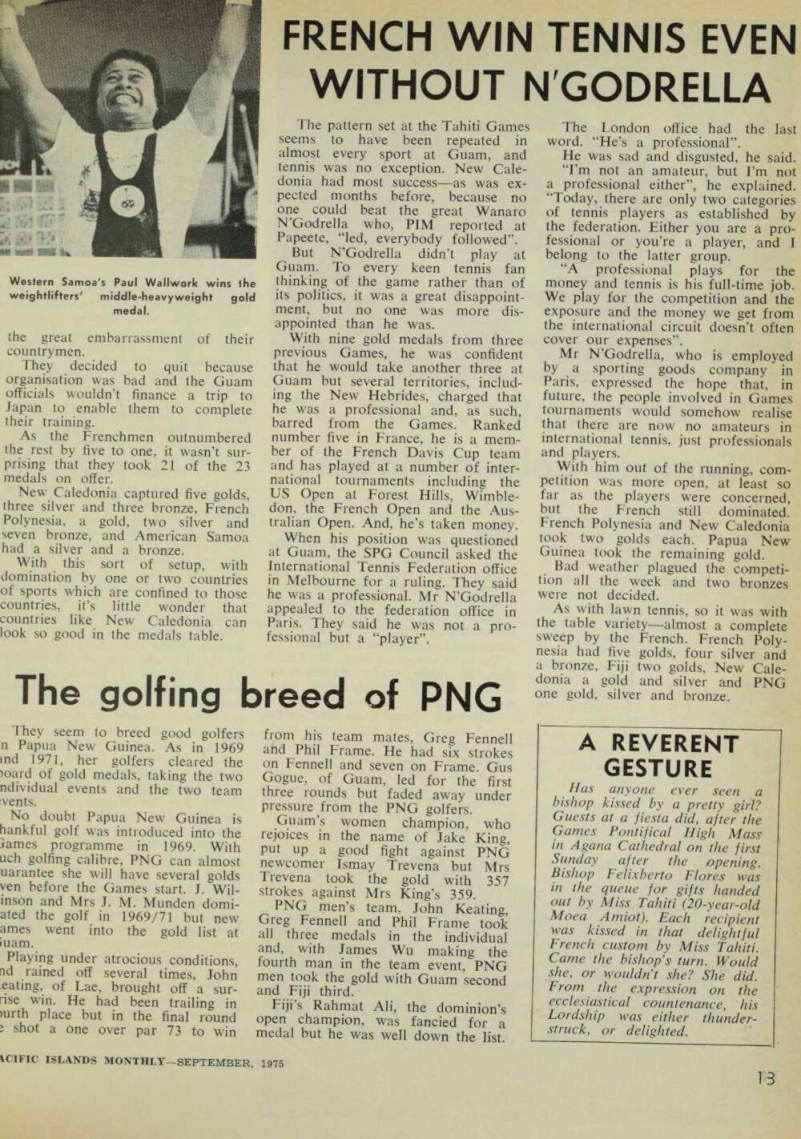
Western Samoa's Paul Wallwork wins the
weightlifters' middle-heavyweight gold
medal.
Advertisements & other items, p. 14 (1 item)
Line
THE
m/w i t
GLOBAL SERVICE FOR SHIPPERS
" LWl*/ V "
LINE
mdSsm
MONTHLY SERVICES
United Kingdom and Continent to: Papeete, Noumea, New Hebrides, Papua New Guinea and Solomon Islands.
Papua New Guinea to: North America, United Kingdom and Continent.
Solomons, Fiji, Tonga, Samoa and Tarawa to: United Kingdom and Continent.
For particulars apply:
THE BANK LINE (AUSTRALASIA) PTY. LTD.,
18TH FLOOR, 1 YORK STREET,
SYDNEY, N.S.W.
Without N'godrella
French Win Tennis Even
The pattern set at the Tahiti Games seems to have been repeated in almost every sport at Guam, and tennis was no exception. New Cale donia had most success—as was ex pected months before, because no one could beat the great Wanaro N’Godrella who, PIM reported at Papeete, “led, everybody followed”.
But N’Godrella didn’t play at Guam. To every keen tennis fan thinking of the game rather than of its politics, it was a great disappoint ment, but no one was more dis appointed than he was.
With nine gold medals from three previous Games, he was confident that he would take another three at Guam but several territories, includ ing the New Hebrides, charged that he was a professional and, as such, barred from the Games. Ranked number five in France, he is a mem ber of the French Davis Cup team and has played at a number of inter national tournaments including the US Open at Forest Hills, Wimble don, the French Open and the Aus tralian Open. And, he’s taken money.
When his position was questioned at Guam, the SPG Council asked the International Tennis Federation office in Melbourne for a ruling. They said he was a professional. Mr N’Godrella appealed to the federation office in Paris. They said he was not a pro fessional but a “player”.
The London office had the last word. “He’s a professional”.
He was sad and disgusted, he said.
“I’m not an amateur, but I’m not a professional either”, he explained.
“Today, there are only two categories of tennis players as established by the federation. Either you are a pro fessional or you’re a player, and I belong to the latter group.
“A professional plays for the money and tennis is his full-time job.
We play for the competition and the exposure and the money we get from the international circuit doesn’t often cover our expenses”, Mr N’Godrella, who is employed by a sporting goods company in Paris, expressed the hope that, in future, the people involved in Games tournaments would somehow realise that there are now no amateurs in international tennis, just professionals and players.
With him out of the running, com petition was more open, at least so far as the players were concerned, but the French still dominated.
French Polynesia and New Caledonia took two golds each. Papua New Guinea took the remaining gold.
Bad weather plagued the competi tion all the week and two bronzes were not decided.
As with lawn tennis, so it was with the table variety—almost a complete sweep by the French. French Poly nesia had five golds, four silver and a bronze, Fiji two golds, New Cale donia a gold and silver and PNG one gold, silver and bronze.
The golfing breed of PNG
They seem to breed good golfers n Papua New Guinea. As in 1969 ind 1971, her golfers cleared the )oard of gold medals, taking the two ndividual events and the two team vents.
No doubt Papua New Guinea is hankful golf was introduced into the James programme in 1969. With uch golfing calibre, PNG can almost uarantee she will have several golds yen before the Games start. J. Wil inson and Mrs J. M. Munden domi ated the golf in 1969/71 but new ames went into the gold list at iuam.
Playing under atrocious conditions, ad rained off several times, John eating, of Lae, brought off a sur rise win. He had been trailing in mrth place but in the final round ; shot a one over par 73 to win
from his team mates, Greg Fennell and Phil Frame. He had six strokes on Fennell and seven on Frame. Gus Gogue, of Guam, led for the first three rounds but faded away under pressure from the PNG golfers.
Guam’s women champion, who rejoices in the name of Jake King, put up a good fight against PNG newcomer Ismay Trevena but Mrs Trevena took the gold with 357 strokes against Mrs King’s 359.
PNG men’s team, John Keating, Greg Fennell and Phil Frame took all three medals in the individual and, with James Wu making the fourth man in the team event, PNG men took the gold with Guam second and Fiji third.
Fiji s Rahmat Ali, the dominion’s open champion, was fancied for a medal but he was well down the list.
Gesture
A Reverent
Has anyone ever seen a bishop kissed by a pretty girl?
Guests at a fiesta did, after the Games Pontifical High Mass in Agana Cathedral on the first Sunday after the opening.
Bishop Felixberto Flores was in the queue for gifts handed out by Miss Tahiti (20-year-old Moea Amiot). Each recipient was kissed in that delightful French custom by Miss Tahiti.
Came the bishop’s turn. Would she, or wouldn’t she? She did.
From the expression on the ecclesiastical countenance, his Lordship was either thunder struck, or delighted.
Advertisements & other items, p. 15 (1 item)
13
VCIFIC ISLANDS MONTHLY—SEPTEMBER, 1975
Samoa's golden gloves
What’s happened to Fiji’s boxing hopes? In the early Games her boxers collected more than their share of gold medals, but at Guam they didn’t get one gold, only three silvers.
Maybe, the fact that in the last few years there was bitterness between Suva's two amateur clubs, Charman's All Races and the Suva Youth Centre, has had something to Hn with Fiii’s fade-out d The h Samoans d took most golds, American Samoa and Western Samoa going home with three each, The remaining five were shared by Papua New Guinea and New Cale-
SfroT Fiji's SL*S£Tn£&
Ti W o es, ( e'i g n ht S h a e mo y a W tf ,) .wo silvers American Samoa onf, PNG two and New Caledonia and French Polyne One°of the heroes of the ring was
DMT^ e T.ImJ Moonlit „ hantim
sprained left hand, Sogohk won the gold with his speciality, a left hook.
As was the case with several sports, host territory officials were criticised for their unpreparedness and ignorance of the sport.
The international juror for boxing, AIBA vice-president John Castle, of Sydney, was bitter because, he said,
Guam’s officials and referees had very little knowledge of amateur boxing.
He complained that a seminar held before the start, revealed almost complete ignorance of the amateur boxing rales, and warned that future boxing figures a ‘ < he Games would not be phoned by >he MBA unless a hard core of in ternational referees was present.
To keep events moving, Mr Castle satd hemade many which did not comply with mter national rules.
My back is sore from bending the 1o 65 many
oTymp'icf thf c“nweaht the
European Amateur Boxing champion-
AssodaSon’s reply
through its president, Mr R. Afflague, was that Guam’s referees had licences ® r nW’ amateur boxing rules . • in the cycling, the most remote of all events, New Caledonia took five of the six golds; Tahiti took the sixth, Individual gold medallists were L.
Dubois, D. Cornaille and J. Testard, all of New Caledonia, and M. B. Du Pont, French Polynesia.
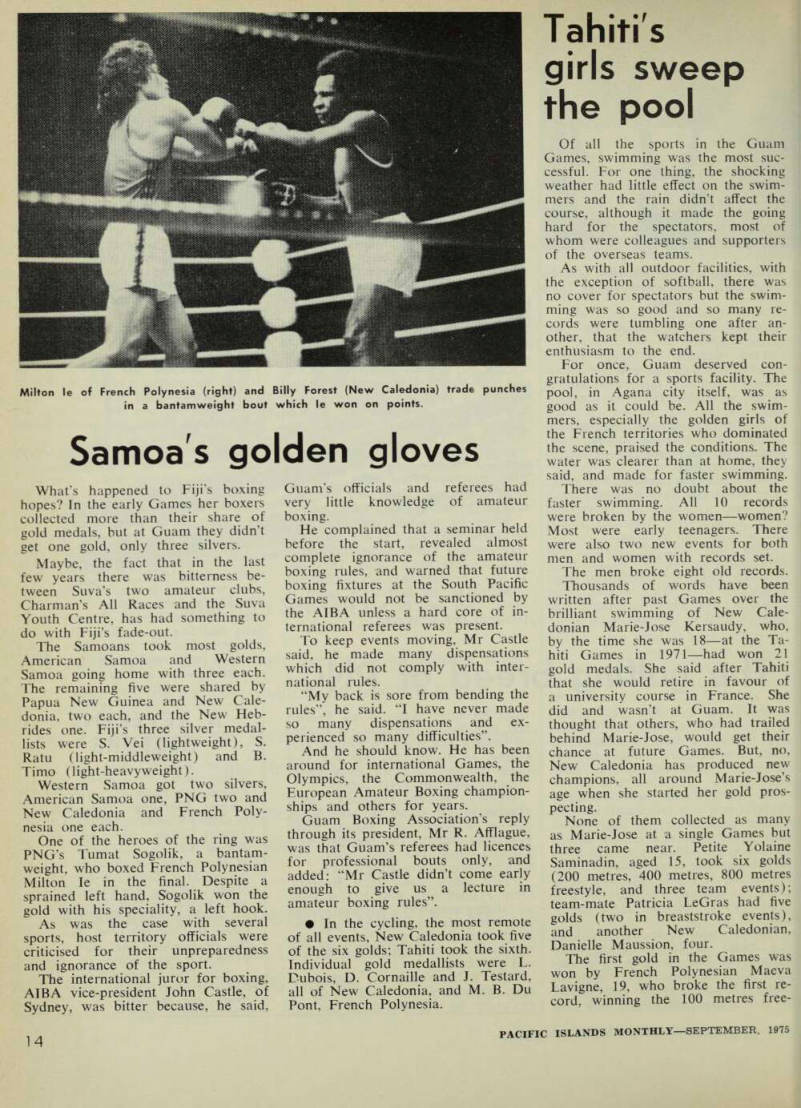
Milton le of French Polynesia (right) and Billy Forest (New Caledonia) trade punches in a bantamweight bout which le won on points.
the pool
Tahiti's girls sweep the pool
Of all the sports in the Guam Games, swimming was the most suc cessful. For one thing, the shocking weather had little effect on the swim mers and the rain didn’t affect the course, although it made the going hard for the spectators, most of whom were colleagues and supporters of the overseas teams.
As with all outdoor facilities, with the exception of softball, there was no cover for spectators but the swim ming was so good and so many re cords were tumbling one after an other, that the watchers kept their enthusiasm to the end.
For once, Guam deserved con gratulations for a sports facility. The pool, in Agana city itself, was as good as it could be. All the swim mers, especially the golden girls of the French territories who dominated the scene, praised the conditions. The water was clearer than at home, they said, and made for faster swimming.
There was no doubt about the faster swimming. All 10 records were broken by the women—women?
Most were early teenagers. There were also two new events for both men and women with records set.
The men broke eight old records.
Thousands of words have been written after past Games over the brilliant swimming of New Cale donian Marie-Jose Kersaudy, who, by the time she was 18—at the Ta hiti Games in 1971—had won 21 gold medals. She said after Tahiti that she would retire in favour of a university course in France. She did and wasn’t at Guam. It was thought that others, who had trailed behind Marie-Jose, would get their chance at future Games. But, no, New Caledonia has produced new champions, all around Marie-Jose’s age when she started her gold pros
pecting.
None of them collected as many as Marie-Jose at a single Games but three came near. Petite Yolaine Saminadin, aged 15, took six golds (200 metres, 400 metres, 800 metres freestyle, and three team events); team-mate Patricia LeGras had five golds (two in breaststroke events), and another New Caledonian, Danielle Maussion, four.
The first gold in the Games was won by French Polynesian Maeva Lavigne, 19, who broke the first re cord, winning the 100 metres free-
style in one minute, 4.63 seconds, which was .8 of a second under the record established at Tahiti in 1971 by Marie-Jose Kersaudy. Maeva, 19, got a team silver at Tahiti and was one of the few girls in the Guam pool to have appeared at other Games. Her tally at Guam was two golds, three silvers and two bronzes.
Games swimming, it seems, is be coming the early teenagers’ preserve, and, at 19, Maeva is almost an oldie.
French Polynesia, which gave in dications at the Tahiti Games of be coming a force in the swimming world, maintained her improvement, especially in the men’s events when her men took 16 golds, 12 of them in team events, three silver and four bronze.
As French Polynesia improved on her Tahiti Games performance, Papua New Guinea lost some ground hough not a lot. Charlie Martin, now 19, the star at Papeete, was still he star when the Guam Games mded. He collected four golds—he lad six gold and two silver at Tahiti —and four silver medals. Four of lis golds were for individual swims.
His nearest rival was H. Noble, )f French Polynesia, a newcomer to he Games, who had five golds, three )f them in team events, a silver and i bronze.
Another newcomer, PNG’s Mark iutchings, aged 16, swam a great ace to win the 1,500 metres free tyle, which left him exhausted.
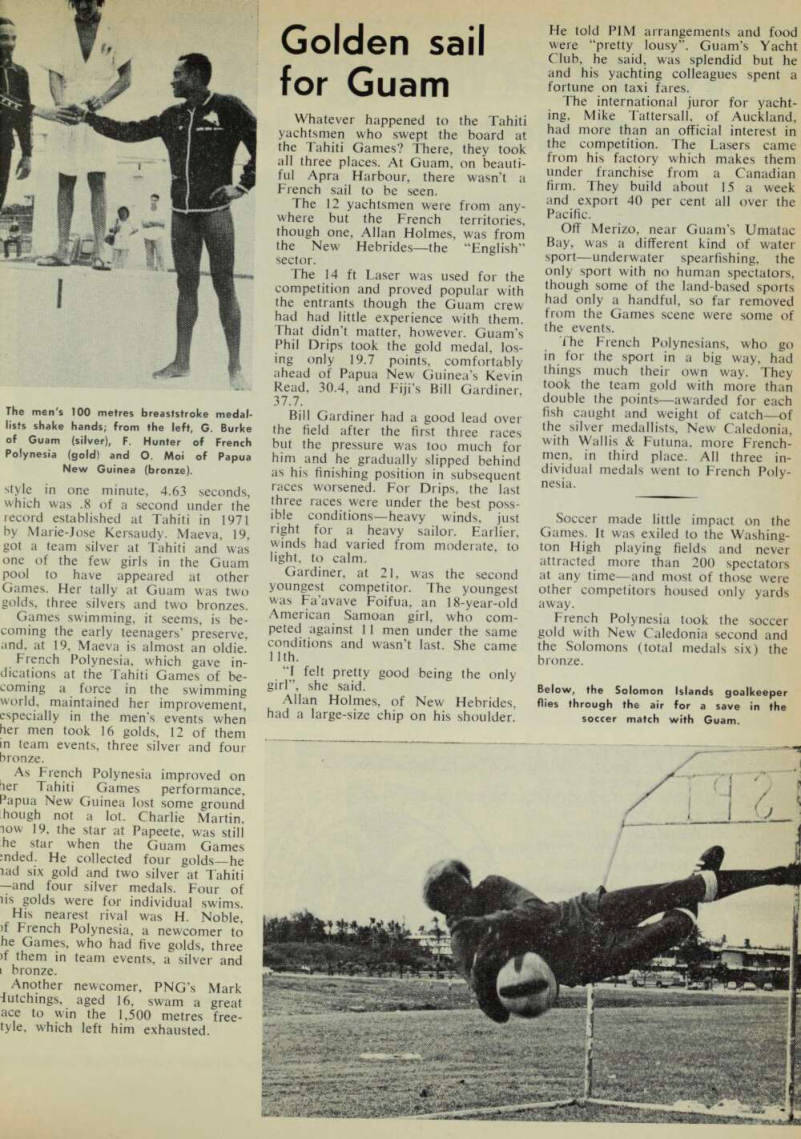
The men's 100 metres breaststroke medal lists shake hands; from the left, G. Burke of Guam (silver), F. Hunter of French Polynesia (gold) and O. Moi of Papua New Guinea (bronze).
Golden sail
for Guam
Whatever happened to the Tahiti yachtsmen who swept the board at the Tahiti Games? There, they took all three places. At Guam, on beauti ful Apra Harbour, there wasn’t a French sail to be seen.
The 12 yachtsmen were from any where but the French territories, though one, Allan Holmes, was from the New Hebrides—the “English” sector.
The 14 ft Laser was used for the competition and proved popular with the entrants though the Guam crew had had little experience with them.
That didn’t matter, however. Guam’s Phil Drips took the gold medal, los ing only 19.7 points, comfortably ahead of Papua New Guinea’s Kevin Read, 30.4, and Fiji’s Bill Gardiner, 37.7.
Bill Gardiner had a good lead over the field after the first three races but the pressure was too much for him and he gradually slipped behind as his finishing position in subsequent races worsened. For Drips, the last three races were under the best poss ible conditions—heavy winds, just right for a heavy sailor. Earlier, winds had varied from moderate, to light, to calm.
Gardiner, at 21, was the second youngest competitor. The youngest was Fa’avave Foifua, an 18-year-old American Samoan girl, who com peted against 11 men under the same conditions and wasn’t last. She came 11th.
“I felt pretty good being the only girl”, she said.
Allan Holmes, of New Hebrides, had a large-size chip on his shoulder.
He told PIM arrangements and food were “pretty lousy”. Guam’s Yacht Club, he said, was splendid but he and his yachting colleagues spent a fortune on taxi fares.
The international juror for yacht ing, Mike Tattersall, of Auckland, had more than an official interest in the competition. The Lasers came from his factory which makes them under franchise from a Canadian firm. They build about 15 a week and export 40 per cent all over the Pacific.
Off Merizo, near Guam’s Umatac Bay, was a different kind of water sport—underwater spearfishing, the only sport with no human spectators, though some of the land-based sports had only a handful, so far removed from the Games scene were some of the events.
The French Polynesians, who go in for the sport in a big way, had things much their own way. They took the team gold with more than double the points—awarded for each fish caught and weight of catch—of the silver medallists, New Caledonia, with Wallis & Futuna, more French men, in third place. All three in dividual medals went to French Poly nesia.
Soccer made little impact on the Games. It was exiled to the Washing ton High playing fields and never attracted more than 200 spectators at any time—and most of those were other competitors housed only yards away.
French Polynesia took the soccer gold with New Caledonia second and the Solomons (total medals six) the bronze.
Below, the Solomon Islands goalkeeper flies through the air for a save in the soccer match with Guam.
Advertisements & other items, p. 18 (1 item)
Wunderflex gives
good design at low cost
* mft---* <* w *8 $ mm
E324ED
You want modern design?
Then use modern material that won’t warp, shrink or rot You want least cost?
Then build with a board that can be worked with handyman’s tools.
Inside and out, your home will have the modern, simple lines of Wunderflex building board.
kViunderlich
Wunderflex
Available from: Papua New Guinea: Steamships Trading Co. Ltd.
Norfolk Island: Irvine’s Building Supply Centre Made in Australia and marketed by GSR Building Materials Export Sales: 4 O'Connell Street. Sydney. Australia 2000
Results Of The 1975 Games
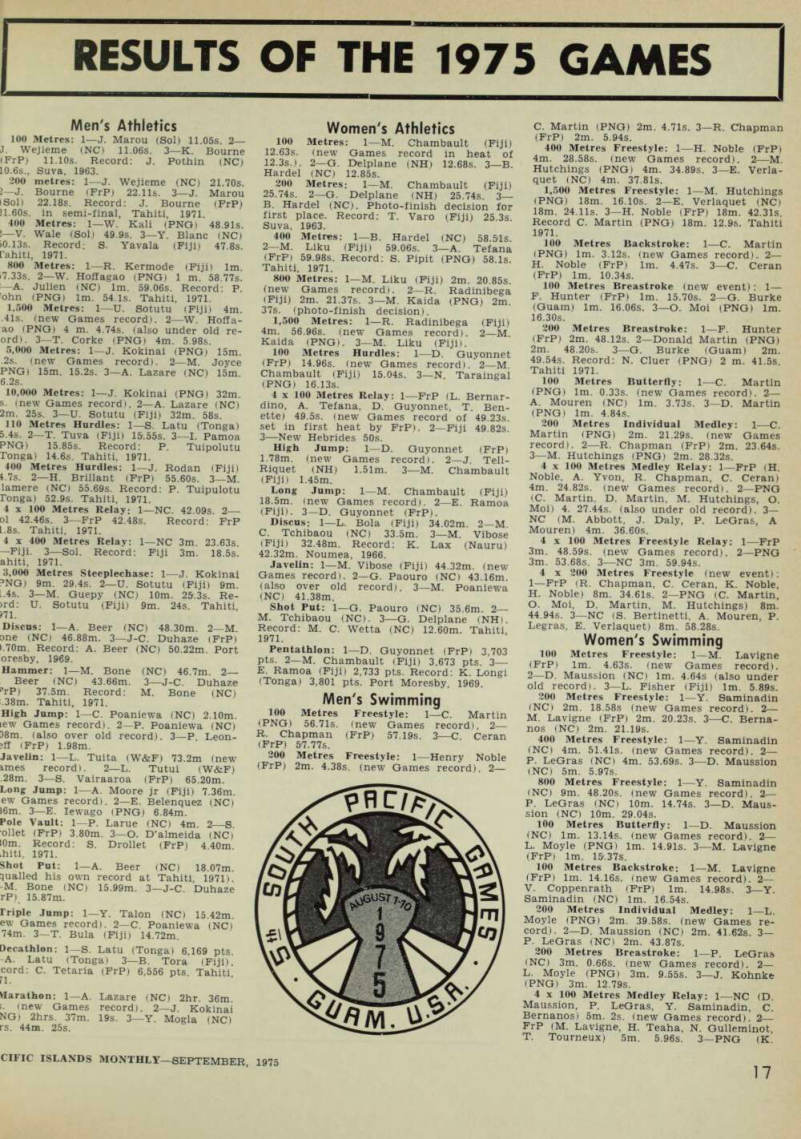
Men's Athletics
100 Metres: I—J. Marou (Sol) 11.055. 2 J. Wejieme (NC) 11.065. 3—K. Bourne (FrP) 11.10 s. Record: J. Pothin (NC) 10.65., Suva, 1963. 200 metres: I—J.1 —J. Wejieme (NC) 21.705. i— J. Bourne (FrP) 22.115. 3—J. Marou (Sol) 22.185. Record: J. Bourne (FrP) !1.605. in semi-final, Tahiti, 1971. 400 Metres: I—W. Kali (PNG) 48.915. ! —V. Wale (Sol) 49.95. 3—Y. Blanc (NC) >0.135. Record; S. Yavala (Fiji) 47.85. rahiti, 1971. 800 Metres: I—R. Kermode (Fiji) Im.
'7.335. 2—W. Hoffagao (PNG) 1 m. 58.775. —A. Julien (NC) Im. 59.065. Record: P. ohn (PNG) Im. 54.15. Tahiti, 1971. 1,500 Metres: I—U. Sotutu (Fiji) 4m. .41s. (new Games record). 2—W. Hoffa ao (PNG) 4 m. 4.745. (also under old re ord). 3—T. Corke (PNG) 4m. 5.985. 5.000 Metres: I—J. Kokinai (PNG) 15m. 2s. (new Games record). 2—M. Joyce PNG) 15m. 15.25. 3—A. Lazare (NC) 15m. 6.25. 10.000 Metres: I—J. Kokinai (PNG) 32m. s. (new Games record). 2—A. Lazare (NC) 2m. 255. 3—U. Sotutu (Fiji) 32m. 58s. 110 Metres Hurdles: I—S. Latu (Tonga) 5.45. 2—T. Tuva (Fiji) 15.555. 3—l. Pamoa PNG) 15.855. Record: P. Tuipolutu Tonga) 14.65. Tahiti, 1971. 400 Metres Hurdles: I—J. Rodan (Fiji) 1.75. 2 —H. Brillant (FrP) 55.605. 3 —M. lamere (NC) 55.695. Record: P. Tuipulotu Tonga) 52.95. Tahiti, 1971. 4 x 100 Metres Relay; I—NC. 42.095. 2 ol 42.465. 3—FrP 42.485. Record: FrP I.Bs. Tahiti, 1971. 4 x 400 Metres Relay: I—NC 3m. 23.635. —Fiji. 3—Sol. Record; Fiji 3m. 18.55. ahiti, 1971. 3.000 Metres Steeplechase: I—J. Kokinai 3 NG) 9m. 29.45. 2—U. Sotutu (Fiji) 9m. ).4s. 3 —M. Guepy (NC) 10m. 25.35. Re >rd: U. Sotutu (Fiji) 9m. 245. Tahiti, 171.
Discus; I—A. Beer (NC) 48.30 m. 2—M. one (NC) 46.88 m. 3—J-C. Duhaze (FrP) ).70m. Record; A. Beer (NC) 50.22 m. Port oresby, 1969.
Hammer: I—M. Bone (NC) 46.7 m. 2 Beer (NC) 43.66 m. 3—J-C. Duhaze p rP) 37.5 m. Record: M. Bone (NC) .38m. Tahiti, 1971.
High Jump: I—C. Poaniewa (NC) 2.10 m. lew Games record). 2—P. Poaniewa (NC) 38m. (also over old record). 3—P. Leon (FrP) 1.98 m.
Javelin: I—L. Tuita (W&F) 73.2 m (new imes record). 2—L. Tutui (W&F) 28m. 3—S. Vairaaroa (FrP) 65.20 m.
Long Jump: I—A. Moore jr (Fiji) 7.36 m. ew Games record). 2—E. Belenquez (NC) (6m. 3—E. lewago (PNG) 6.84 m.
Pole Vault: I—P. Larue (NC) 4m. 2—S diet (PrP) 3.80 m. 3—o. D’almeida (NC) 10m. Record; S. Drollet (FrP) 4.40 m -hiti, 1971.
Shot Put: I—A. Beer (NC) 18.07 m. quailed his own record at Tahiti, 1971). -M. Bone (NC) 15.99 m. 3—J-C. Duhaze rP) 15.87 m.
Lriple Jump: I—Y. Talon (NC) 15.42 m. ew Games record). 2—C. Poaniewa (NC) 74m. 3—T. Bula (Fiji) 14.72 m.
Decathlon: I—S. Latu (Tonga) 6,169 pts. -A. Latu (Tonga) 3—B. Tora (Fiji) cord: C. Tetaria (FrP) 6,556 pts. Tahiti.
Marathon: I—A. Lazare (NC) 2hr. 36m. i. (new Games record). 2—J. Kokinai NG) 2hrs. 37m. 19s. 3—Y. Mogla (NC) rs. 44m. 255.
Women's Athletics
100 Metres; I—M. Chambault (Fiji) 12.635. (new Games record in heat of 12.35.). 2—G. Delplane (NH) 12.685. 3—B.
Hardel (NC) 12.855. 200 Metres; I—M. Chambault (Fiji) 25.745. 2—G. Delplane (NH) 25.745. 3 B. Hardel (NC). Photo-finish decision for first place. Record: T. Varo (Fiji) 25.35.
Suva, 1963. 400 Metres: I—B. Hardel (NC) 58.515. 2 M. Liku (Fiji) 59.065. 3—A. Tefana (FrP) 59.985. Record; S. Pipit (PNG) 58.15.
Tahiti, 1971. 800 Metres: I—M. Liku (Fiji) 2m. 20.855. (new Games record). 2—R. Radinibega (Fiji) 2m. 21.375. 3—M. Kaida (PNG) 2m. 375. (photo-finish decision). 1,500 Metres: I—R. Radinibega (Fiji) 4m. 56.965. (new Games record). 2—M.
Kaida (PNG). 3—M. Liku (Fiji). 100 Metres Hurdles: I—D. Guyonnet (FrP) 14.965. (new Games record). 2—M.
Chambault (Fiji) 15.045. 3—N. Taraingal
(Png) 16.135.
4 x 100 Metres Relay: I—FrP (L. Bernar dino, A. Tefana, D. Guyonnet, T. Ben ette) 49.55. (new Games record of 49.235. set in first heat by FrP). 2—Fiji 49.825. 3 New Hebrides 50s.
High Jump: I—D. Guyonnet (FrP) 1.78 m. (new Games record). 2—J. Tell- Riquet (NH) 1.51 m. 3 —M. Chambault (Fiji) 1.45 m.
Long Jump; I—M. Chambault (Fiji) 18.5 m. (new Games record). 2—E. Ramoa (Fiji). 3—D. Guyonnet (FrP).
Discus; I—L. Bola (Fiji) 34.02 m. 2—M.
C. Tchibaou (NC) 33.5 m. 3—M. Vibose (Fiji) 32.48 m. Record: K. Lax (Nauru) 42.32 m. Noumea, 1966.
Javelin: I—M. Vibose (Fiji) 44.32 m. (new Games record). 2—G. Paouro (NC) 43.16 m. (also over old record). 3—M. Poaniewa (NC) 41.38 m.
Shot Put: I—G. Paouro (NC) 35.6 m. 2 M. Tchibaou (NC). 3 —G. Delplane (NH).
Record: M. C. Wetta (NC) 12.60 m. Tahiti. 1971.
Pentathlon: I—D.1 —D. Guyonnet (FrP) 3,703 pts. 2—M. Chambault (Fiji) 3,673 pts. 3 E. Ramoa (Fiji) 2,733 pts. Record: K. Longi (Tonga) 3,801 pts. Port Moresby, 1969.
Men's Swimming
100 Metres Freestyle: I—C. Martin (PNG) 56.715. (new Games record), 2 R. Chapman (FrP) 57.195. 3 —C. Ceran (FrP) 57.775. 200 Metres Freestyle: I—Henry Noble (FrP) 2m. 4.385. (new Games record). 2
C. Martin (PNG) 2m. 4.715. 3—R. Chapman (FrP) 2m. 5.945. 400 Metres Freestyle: I—H. Noble (FrP) 4m. 28.585. (new Games record). 2—M.
Hutchings (PNG) 4m. 34.895. 3—E. Verla quet (NC) 4m. 37.815. 1,500 Metres Freestyle: I—M. Hutchings (PNG) 18m. 16.105. 2—E. Verlaquet (NC) 18m. 24.115. 3—H. Noble (FrP) 18m. 42.315.
Record C. Martin (PNG) 18m. 12.95. Tahiti 1971. 100 Metres Backstroke: I—C. Martin (PNG) Im. 3.125. (new Games record). 2 H. Noble (FrP) Im. 4.475. 3 —C. Ceran (FrP) Im. 10.345. 100 Metres Breastroke (new event): 1— F. Hunter (FrP) Im. 15.705. 2—G. Burke (Guam) Im. 16.065. 3—o. Moi (PNG) Im. 16.305. 200 Metres Breastroke: I—P.1 —P. Hunter (FrP) 2m. 48.125. 2—Donald Martin (PNG) 2m. 48.205. 3—G. Burke (Guam) 2m. 49.545. Record: N. Cluer (PNG) 2 m. 41.55.
Tahiti 1971. 100 Metres Butterfly: I—C. Martin (PNG) Im. 0.335. (new Games record). 2 A. Mouren (NC) Im. 3.735. 3—D. Martin
(Png) Im. 4.845.
200 Metres Individual Medley; I—C.1 —C.
Martin (PNG) 2m. 21.295. (new Games record). 2—R. Chapman (FrP) 2m. 23.645. 3 —M. Hutchings (PNG) 2m. 28.325. 4 x 100 Metres Medley Relay: I—PrP (H.
Noble, A. Yvon, R. Chapman, C. Ceran) 4m. 24.825. (new Games record). 2—PNG (C. Martin. D. Martin, M. Hutchings, O.
Moi) 4. 27.445. (also under old record). 3 NC (M. Abbott, J. Daly, P. LeGras, A Mouren) 4m. 36.605. 4 x 100 Metres Freestyle Relay: I—FrP 3m. 48.595. (new Games record). 2 —PNG 3m. 53.685. 3 —NC 3m. 59.945. 4 x 200 Metres Freestyle (new event); 1— FrP (R. Chapman, C. Ceran, K. Noble, H. Noble) Bm. 34.615. 2—PNG (C. Martin, O. Moi, D. Martin, M. Hutchings) Bm. 44.945. 3 —NC (S. Bertinetti, A. Mouren, P.
Legras, E. Verlaquet) Bm. 58.285.
Women's Swimming
100 Metres Freestyle: I—M. Lavigne (FrP) Im. 4.635. (new Games record). 2 D. Maussion (NC) Im. 4.64 s (also under old record). 3—L. Fisher (Fiji) Im. 5.895. 200 Metres Freestyle: I—Y. Saminadin (NC) 2m. 18.58 s (new Games record). 2 M. Lavigne (FrP) 2m. 20.235. 3 —C. Berna nos (NC) 2m. 21.195. 400 Metres Freestyle: I—Y. Saminadin (NC) 4m. 51.415. (new Games record). 2 P. LeGras (NC) 4m. 53.695. 3—D. Maussion (NC) sm. 5.975. 800 Metres Freestyle: I—Y. Saminadin (NC) 9m. 48.205. (new Games record). 2 P. LeGras (NC) 10m. 14.745. 3—D. Maus sion (NC) 10m. 29.045. 100 Metres Butterfly: I—D. Maussion (NC) Im. 13.145. (new Games record). 2 L. Moyle (PNG) Im. 14.915. 3—M. Lavigne (FrP) Im. 15.375. 100 Metres Backstroke: I—M. Lavigne (FrP) Im. 14.165. (new Games record). 2 V. Coppenrath (FrP) Im. 14.985. 3—Y.
Saminadin (NC) Im. 16.545. 200 Metres Individual Medley: I—L.1 —L.
Moyle (PNG) 2m. 39.585. (new Games re cord). 2—D. Maussion (NC) 2m. 41.625. 3 P. LeGras (NC) 2m. 43.875. 200 Metres Breastroke: I—P. LeGras (NC) 3m. 0.665. (new Games record). 2 L. Moyle (PNG) 3m. 9.555. 3—J. Kohnke
(Png) 3M. 12.795.
4 x 100 Metres Medley Relay: I—NC (D.
Maussion, P. LeGras, Y. Saminadin, C.
Bernanos) sm. 2s. (new Games record). 2 FrP (M. Lavigne, H. Teaha, N. Gulleminot, T. Tourneux) sm. 5.965. 3—PNG (K.
Antoine, J. Kohnke, L. Moyle, F. Mooney) sm. 19.785. 4 x 100 Metres Freestyle Relay: I—NC 4m. 26.225. (new Games record). 2—FrP 4m. 26.695. (also under old record). 3
Png 4M. 33.985.
100 Metres Breastroke (new event): 1— P. LeGras (NC) Im. 24.015. 2-L. Moyle (PNG) Im. 26.665. 3—H. Teaha (FrP) Im. 29.755. 4 x 200 Metres Freestyle Relay (new event): I—NC (D. Maussion, C. Bernanos, P. LeGras, Y Saminadin) 9m. 32.035. 2 PNG (F. Mooney, J. Kohnke, L. Moyle, K.
Antoine) 9 m. 57.295. 3 —FrP (M. Lavigne, V. Copenrath, M. Gulleminot, M. Froger) 10m. 8.75-s.
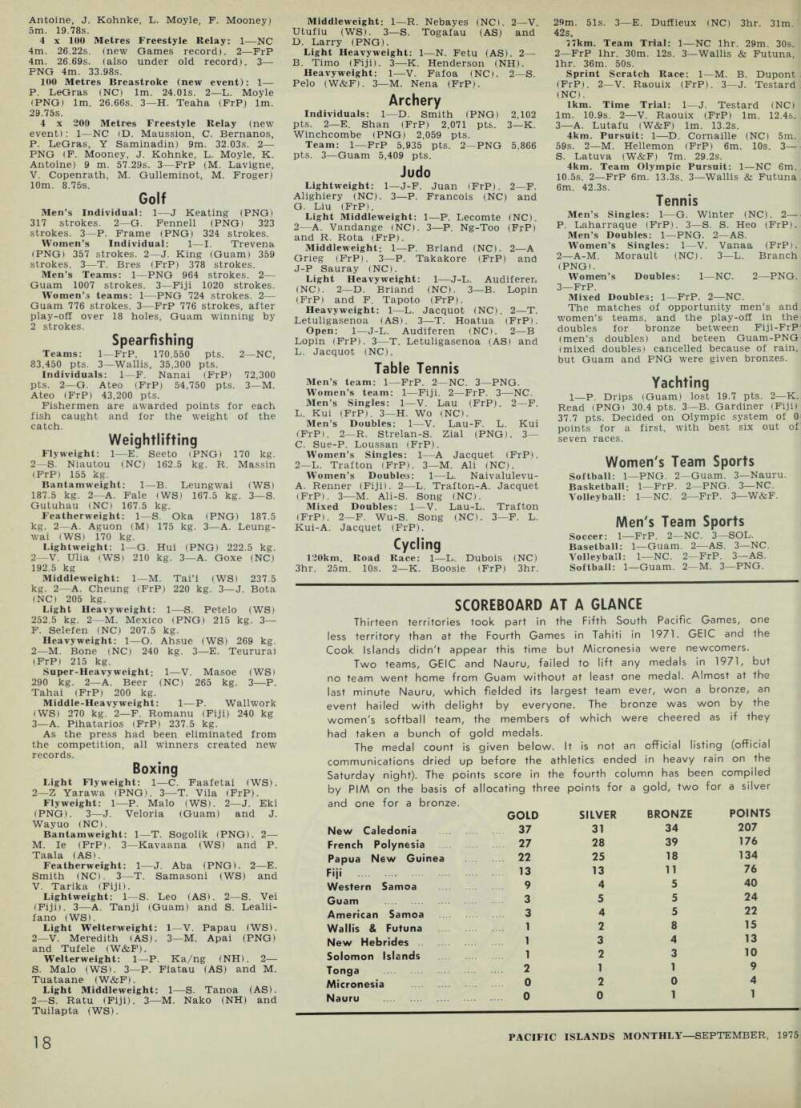
Golf
Men’s Individual: I—J Keating (PNG) 317 strokes. 2—G. Fennell (PNG) 323 strokes. 3—P. Frame (PNG) 324 strokes.
Women’s Individual: I—l. Trevena (PNG) 357 strokes. 2—J. King (Guam) 359 strokes. 3—T. Bres (FrP) 378 strokes.
Men’s Teams: I—PNG 964 strokes. 2 Guam 1007 strokes. 3—Fiji 1020 strokes.
Women’s teams: I—PNG 724 strokes. 2 Guam 776 strokes. 3 —FrP 776 strokes, after play-off over 18 holes, Guam winning by 2 strokes.
Spearfishing
Teams: I—FrP, 170,550 pts. 2—NC, 83,450 pts. 3—Wallis, 35,300 pts.
Individuals: I—F. Nanai (FrP) 72,300 pts. 2—G. Ateo (FrP) 5-4,750 pts. 3—M.
Ateo (FrP) 43,200 pts.
Fishermen are awarded points for each fish caught and for the weight of the catch.
Weightlifting
Flyweight: I—E.1 —E. Seeto (PNG) 170 kg. 2—S. Niautou (NC) 162.5 kg. R. Massin (FrP) 155 kg.
Bantamweight: I—B. Leungwai (WS) 187.5 kg. 2—A. Fale (WS) 167.5 kg. 3—S.
Gutuhau (NC) 167.5 kg.
Featherweight: I—S. Oka (PNG) 187.5 kg. 2—A. Aguon (M) 175 kg. 3 —A. Leung wai (WS) 170 kg.
Lightweight: I—G. Hui (PNG) 222.5 kg. 2—V. Ulia (WS) 210 kg. 3—A. Goxe (NC) 192.5 kg Middleweight: I—M. Tai’i (WS) 237.5 kg. 2 —A. Cheung (FrP) 220 kg. 3 —J. Bota (NC) 205 kg.
Light Heavyweight: I—S.1 —S. Petelo (WS) 252.5 kg. 2—M. Mexico (PNG) 215 kg. 3 F. Selefen (NC) 207.5 kg.
Heavyweight; I—O. Ahsue (WS) 269 kg. 2 M. Bone (NC) 240 kg. 3 —E. Teururai (FrP) 215 kg.
Super-Heavyweight; I—V. Masoe (WS) 290 kg. 2—A. Beer (NC) 265 kg. 3—P.
Tahai (FrP) 200 kg.
Middle-Heavyweight: I—P.1 —P. Wallwork (WS) 270 kg. 2—F. Romanu (Fiji) 240 kg 3 A. Pihatarios (FrP) 237.5 kg.
As the press had been eliminated from the competition, all winners created new records.
Boxing
Light Flyweight: I—C. Faafetai (WS). 2—Z Tarawa (PNG). 3 —T. Vila (FrP).
Flyweight: I—P. Malo (WS). 2—J. Eki (PNG). 3—J. Veloria (Guam) and J.
Wayuo (NC).
Bantamweight: I—T. Sogolik (PNG). 2 M. le (FrP). 3 —Kavaana (WS) and P.
Taala (AS).
Featherweight: I—J. Aba (PNG). 2 —E.
Smith (NC). 3—T. Samasoni (WS) and V. Tarika (Fiji).
Lightweight: I—S. Leo (AS). 2—S. Vei (Fiji). 3 —A. Tanji (Guam) and S. Lealii fano (WS).
Light Welterweight: I—V. Papau (WS). 2—V. Meredith (AS). 3—M. Apai (PNG) and Tufele (W&F).
Welterweight: I—P. Ka/ng (NH). 2 S. Malo (WS). 3—P. Flatau (AS) and M.
Tuataane (W&F).
Light Middleweight: I—S. Tanoa (AS). 2—S. Ratu (Fiji). 3 —M. Nako (NH) and Tuilapta (WS).
Middleweight: I—R. Nebayes (NC). 2—V.
Utufiu (WS). 3 —S. Togafau (AS) and D. Larry (PNG).
Light Heavyweight: I—N. Fetu (AS). 2 B. Timo (Fiji). 3 —K. Henderson (NH).
Heavyweight: I—V. Fafoa (NC). 2—S.
Pelo (W&F). 3—M. Nena (FrP).
Archery
Individuals: I—D. Smith (PNG) 2,102 pts. 2—E. Shan (FrP) 2,071 pts. 3—K.
Winchcombe (PNG) 2,05-9 pts.
Team: I—FrP 5,935 pts. 2—PNG 5,866 pts. 3—Guam 5,409 pts.
Judo
Lightweight: I—J-F. Juan (FrP). 2—F.
Alighiery (NC). 3 —P. Francois (NC) and G. Liu (FrP).
Light Middleweight: I—P. Lecomte (NC). 2—A. Vandange (NC). 3—P. Ng-Too (FrP) and R. Rota (FrP).
Middleweight; I—P. Briand (NC). 2—A Grieg (FrP). 3 —P. Takakore (FrP) and J-P Sauray (NC).
Light Heavyweight; I—J-L. Audiferen (NC). 2—D. Briand (NC). 3—B. Lopin (FrP) and F. Tapoto (FrP).
Heavyweight: I—L. Jacquot (NC). 2—T.
Letuligasenoa (AS). 3—T. Hoatua (FrP).
Open: I—J-L. Audiferen (NC). 2—B Lopin (FrP). 3—T. Letuligasenoa (AS) and L. Jacquot (NC).
Table Tennis
Men’s team; I—FrP. 2—NC. 3—PNG.
Women’s team: I—Fiji. 2—FrP. 3 —NC.
Men’s Singles: I—V. Lau (FrP). 2—F.
L. Kui (FrP). 3—H. Wo (NC).
Men’s Doubles: I—V. Lau-F. L. Kui (FrP). 2—R. Strelan-S. Zial (PNG). 3 C. Sue-P. Loussan (FrP).
Women’s Singles: I—A1 —A Jacquet (FrP). 2—L. Trafton (FrP). 3—M. Ali (NC).
Women’s Doubles: I—L.1 —L. Naivalulevu- A. Renner (Fiji). 2—L. Trafton-A. Jacquet (FrP). 3—M. Ali-S. Song (NC).
Mixed Doubles: I—V.1 —V. Lau-L. Trafton (FrP). 2—F. Wu-S. Song (NC). 3—F. L.
Kui-A. Jacquet (FrP).
Cycling
120 km. Road Race; I—L. Dubois (NC) 3hr. 25m. 10s. 2—K. Boosie (FrP) 3hr.
29m. 51s. 3—E. Duffieux (NC) 3hr. 31m. 425. 77km. Team Trial: I—NC Ihr. 29m. 30s. 2 FrP Ihr. 30m. 12s. 3—Wallis & Futuna, Ihr. 36m. 50s.
Sprint Scratch Race: I—M. B. Dupont ; (FrP). 2—V. Raouix (FrP). 3 —J. Testard (NC).
Ikm. Time Trial: I—J. Testard (NC) Im. 10.95. 2—V. Raouix (FrP) Im. 12.45. 3 A. Lutafu (W&F) Im. 13.25. 4km. Pursuit: I—D. Cornaille (NC) sm. 595. 2—M. Hellemon (FrP) 6m. 10s. 3 S. Latuva (W&F) 7m. 29.25. 4km. Team Olympic Pursuit: I—NC 6m. 10.55. 2—FrP 6m. 13.35. 3—Wallis & Futuna 6m. 42.35.
Tennis
Men’s Singles: I—G. Winter (NC). 2 P. Laharraque (FrP). 3—S. S. Heo (FrP)J Men’s Doubles: I—PNG. 2—AS.
Women’s Singles: I—V.1 —V. Vanaa (FrP). 2 A-M. Morault (NC). 3—L. Branch
(Png).
Women’s Doubles: I—NC. 2 —PNG. 3 FrP.
Mixed Doubles: I—FrP. 2—NC.
The matches of opportunity men’s and women’s teams, and the play-off in the: doubles for bronze between Fiji-FrP (men’s doubles) and beteen Guam-PNG (mixed doubles) cancelled because of rain, but Guam and PNG were given bronzes.
Yachting
I—P. Drips (Guam) lost 19.7 pts. 2—K.
Read (PNG) 30.4 pts. 3—B. Gardiner (Fiji) 37.7 pts. Decided on Olympic system of 0 points for a first, with best six out of seven races.
Women's Team Sports
Softball: I—PNG. 2—Guam. 3—Nauru.
Basketball; I—FrP. 2—PNG. 3—NC.
Volleyball: I—NC. 2—FrP. 3—W&F.
Men's Team Sports
Soccer: I—FrP. 2—NC. 3—SOL.
Basetball: I—Guam. 2—AS. 3—NC.
Volleyball: I—NC. 2—FrP. 3—AS.
Softball: I—Guam. 2—M. 3—PTSfG.
Advertisements & other items, p. 19 (1 item)
17
CIFIC ISLANDS MONTHLY—SEPTEMBER, 1975
Scoreboard At A Glance
Thirteen territories took part in the Fifth South Pacific Games, one less territory than at the Fourth Games in Tahiti in 1971. GEIC and the Cook Islands didn't appear this time but Micronesia were newcomers.
Two teams, GEIC and Nauru, failed to lift any medals in 1971, but no team went home from Guam without at least one medal. Almost at the last minute Nauru, which fielded its largest team ever, won a bronze, an event hailed with delight by everyone. The bronze was won by the women's softball team, the members of which were cheered as if they had taken a bunch of gold medals.
The medal count is given below. It is not an official listing (official communications dried up before the athletics ended in heavy rain on the Saturday night). The points score in the fourth column has been compiled by PIM on the basis of allocating three points for a gold, two for a silver and one for a bronze.
Gold
Silver
Bronze
Points
New Caledonia 37 31 34 207
French Polynesia
27 28 39 176 Papua New Guinea 22 25 18 134
Fiji
13 13 11 76 Western Samoa 9 4 5 40 Guam 3 5 5 24 American Samoa 3 4 5 22 Wallis & Futuna 1 2 8 15 New Hebrides 1 3 4 13 Solomon Islands 1 2 3 10
Tonga
2 1 1 9 Micronesia 0 2 0 4 Nauru 0 0 1 1
decentralisation?


Lessons from islands decentralisation?
• In the following article, Professor J. A. Ballard, Professor of Administrative Studies at the University of Papua New Guinea, focuses on the problems en countered in the Solomons in the task of decentralising government. He visited the Solomons late in June. The article is published at a time when Provincial Government in Papua New Guinea is under attack. The PNG Constituent Assembly in late July shelved immediate plans for its introduction, although the PNG Cabinet has since approved establishment of a Provincial Government Affairs Office to further look at Provincial Government in PNG, the concept of which still exists. See p 23 for Bougainville's problems.
The Solomon Islands, with a popu lation smaller than that of some dis tricts in Papua New Guinea, has been putting into effect a plan of decen tralisation over the past 18 months.
Implementation of the plan has pro ceeded far enough for councils to be gin to recognise some of their new strengths and some of their restric tions, and new balances of power are being struck at both political and administrative levels between the islands and the central government.
Some new councils, particularly in the Western District and Malaita, inherit old council boundaries and district administrative structures and the transition to the new system has been relatively smooth. Progress has been slower in other districts, especially in the Central Islands and Eastern Islands Council areas, where small island councils have been amalgamated and district administra tion must be broken down to coun cil level within the Central and Eastern Districts. Ulawa has refused to join with Makira, and so there are nine instead of the expected total of eight councils.
Within the councils, the formation of area committees at the level of electoral wards or groups of villages has proceeded furthest in Makira, Guadalcanal and Malaita, depending largely on the efforts of local council members, council clerks and district officers, but in very few areas are village committees operating as a regular and integral part of the local government system.
In Malaita, where area committees have been established in most of the 17 sub-districts, sub committees have been formed in some areas to accom modate differences among groups of villages. The area committees and their sub-committees have been par ticularly active in mobilising com munity labour for self-help contri butions to feeder road and water supply projects, and one sign of their popularity is the fact that land dis putes are increasingly referred to
them rather than to local courts for negotiated settlement.
The Malaita Council executive committee and its full-time president are heavily occupied in meeting re quests from area committees for advice on services and on land matters, and they play an important intermediary role between govern ment services and local committees.
The political restructuring of coun cils has gone smoothly, but the de centralisation of government depart ments and transfer of their field activities to council control is a much more complex and difficult matter, since it involves breaking with well established patterns of behaviour.
District administration, with the ex ception of district commissioners and magistrates, was transferred to coun cils at the beginning of 1975. In Western, Malaita and Makira coun cil areas, works and agricultural func tions have also passed to councils, together with all staff below Level 5.
Education and medical administra tion are due to be transferred to councils in 1976 and the whole pro cess is scheduled for completion by 1977.
Although the transfers have been greatly facilitated by administrative decentralisation within most depart ments during recent years, the process of transfer has required very careful planning, staging and trial runs, and even so has raised unanticipated problems. The Department of Finance upset arrangements by a last-minute withdrawal from the transfer of sub treasuries, and this has raised a whole nest of difficulties (farmers obtaining cattle fencing through the usual combination of a central-con trolled loan and a council-controlled grant must now order separately through two agencies).
Apart from departmental hesita tions, which have been eased by localisation and fresh postings, there is anxiety on the part of councils and their clerks about taking over potentially unpopular or financially
insound projects and services. Agri :ulture has been so preoccupied with idministration and training for cattle »rojects that it has fallen far behind n grant payments to farmers. And lerks would prefer to see the new listrict education boards prove their inancial viability, especially in view f reduced government support, be ore councils take responsibility for leeting community expectations in lis field.
The creation of new political insti- Jtions and the transfer of depart tental functions to them places a reat deal of pressure on council erks. Although no political decision as, as yet, been taken to phase out istrict commissioners, the clerks are "adually taking over most of their motions and, in the face of staff lortages, DCs are acting as clerks • at least two major councils. Most erks, however, are recruited from nong assistant administrative offi rs at level 5-7, who are normally )ung men with higher education but nited administrative experience.
The clerk, as chief adviser to his 'uncil, is likely to require con derable skill as an educator in aking intelligible the mysteries of
finance and the exact delimitation of council powers and responsibilities.
At the same time, he must negotiate for his council a viable relationship with services under the council’s control, those yet outside the council and, most importantly, with the De partment of Home Affairs and Minis ters in Honiara. The frustrations of the job recently led the clerk of Makira Council, Francis Hilly, to resign from the public service after almost a year in the post.
At Honiara, the focus of pressure is the Ministry of Home Affairs, through which are funnelled all re lationships between the councils and central governments. When it was the responsibility of Chief Minister Solomon Mamaloni and his Per manent Secretary, Tony Hughes, the Ministry of Home Affairs planned and pushed through arrangements for decentralisation, but the successors to this team cannot hope to have the same political clout.
They are accused by councils and clerks of paternalism, of not giving enough discretion in finance and staff arrangements, and yet are also blamed for not being tough enough to prevent Finance from reneging on
the transfer of sub-treasuries. They are expected to pick up all the un anticipated loose ends, such as the provision of central purchasing facili ties for councils now that govern ment stores have been run down in favour of private enterprise. And they face the increasingly difficult tasks of negotiating compromise be tween councils and the central govern ment during a period in which coun cils are beginning to flex their muscles.
The scope for conflict between Honiara and the councils is wide, but finance and staffing are the cen tral issues. Councils, rather than cen tral departments, receive service grants directly for the services they now control but they find that the central government still vets their ex penditure. This has raised problems particularly in Makira, one of three councils discovered to be bankrupt last year and helped by a government guaranteed bank loan.
Despite energetic and effective tax collection early this year, Makira needed an extension of its loan and found the central government un willing to oblige. At the same time Makira councillors voted themselves an increase in allowance from $l6 to $24 per council sitting, and their president an increase in salary from
Lessons from
Decentralisation
$2O to $lOO per month and managed, despite a visit from the Minister for Home Affairs, to sustain their posi tion.
Makira and other councils find, generally, that they do not have the authority that they expected. One limitation on the central government’s capacity to respond to this with further delegation is the British Treasury’s insistence on central finan cial control of any projects receiving British aid.
Although a single public service remains intact, officers below Level 5 in transferred services are under coun cil control and cannot be posted out of a council area without three months’ notice. Councils have the right to ask for the removal of staff considered incompatible, and some clerks and works officers have been transferred as a result of council re quests. For postings at Class 5 and above, councils appear to have re ceived only limited consultation so far, but are likely to insist on more.
Since the post of council clerk is as political as it is administrative some recent graduates, with support from council presidents, have made
it clear that they would be interested in the post of clerk in their home areas, but only if they could be appointed outside the public service.
At the least, decentralisation is likely to break some of the more rigid of public service precedents.
It is too early to know what effects decentralisation will have on the character of national unity in the Solomons. The politics of allocating scarce resources raised problems well before the present plans for decen tralisation were launched and would continue to do so in any event. The presence of councils with claims to substantial authority does, however, give the council areas a stronger voice in demands for funds and for the location of major projects and plant units.
The Western Council maintains that it has not received government ex penditure commensurate with its con tribution to national revenue.
Although Western (population 38,000) and Malaita (57,000) receive the same service grants, Malaita’s alert administration managed to obtain a large share of the unex pended funds for feeder roads at the end of last year. This had added fuel to Western feeling that Malaita has received an unfair allocation for highly-visible road infrastructure over recent years compared to the invest ment in Western communications.
Western would like to take over a share of government tax on its own copra production and finds con siderable interest in recent develop ments in neighbouring Bougainville.
This means that the siting of the future copra crushing mill may have to be settled on political rather than economic grounds, and there is con siderable unhappiness about the cur rent location of the only three heavy road equipment units—two in Malaita and one in Makira.
To establish effective political con sultation within a council area while consolidating council control over newly-decentralised services requires phenomenal resources of administra tive and political skills which are in short supply, both in the Solomons and in Papua New Guinea.
The major lessons for Papua New Guinea in the Solomons’ experience may be the need for very careful administrative planning and flexible implementation, together with a pro cess of continuous political consulta tion to avoid breakdowns in com munication.
The annual conference of council representatives and clerks, to be held at Honiara in October, will show whether planning and consultation have been effective so far.
Advertisements & other items, pp. 21-24 (4 items)
19
ICIFIC ISLANDS MONTHLY—SEPTEMBER, 1975
Quarterly
For an independent
Papua New Guinea!
HANDBOOK OF
PAPUA
NEW GUINEA
The first edition of the Papua New Guinea handbook was published 20 years ago. This 7th edition, is the only reference book available today with all the information on the world's newest nation.
For businessmen, travellers, schools, universities and libraries, government departments, tourists and Papua New Guinea residents, this timely, up-to-the-minute edition, is essential.
The Handbook covers everything —geography and history, commerce, trade and banking, forestry, primary and secondary industries, finance and taxation, communications and transport, health and education, law and defence, the churches and missions, land and land policy, etc. Each of the 19 districts is treated in detail, with clear and comprehensive maps, all newly drawn. •RICE: Australia, $5.50 plus 85c posted, •acific Islands and Overseas, $5.50 Vust., plus $l.lO posted, U.S.A., $9.80 P S. posted.
NEW GUINEA
QUARTERLY
or 10 years now, the New Guinea Quarterly has been proiding authoritative articles and Diriment on the affairs of Papua lew Guinea, the Pacific Islands nd South-East Asia. But as the rgan of the Council on New ■uinea Affairs, it has particularly lid stress on the affairs of Papua ew Guinea, especially in its retionship with Australia. Now lat Papua New Guinea has r rived at Independence, Papua ew Guinea matters will require /en greater study by all conned with its development, inside id outside the new nation. A jbscription to the New Guinea uarterly will help you keep up. >ur issues a year can be posted • your address at less than the ?ws stand price. mual subscription rates (four issues) •st free; Within Australia, $5 posted; 'erseas, including New Guinea $6.
(M) ItLoKila.
Save hundreds of dollars
on Australians most efficient
WALK IN, ALUMINIUM
COOLROOMS AND
FREEZE ROOMS
Hundreds already installed! The most economical supplementary coolrooms for bottles and food, providing the largest storage capacity of any comparable coolrooms of the same exterior dimensions. Five sizes —from 90-360 cu. ft. capacity; 16 models offering normal temp., two temp., deep freeze, or for pastry and ice storage applications. White vinyl interior, embossed rustproof aluminium exterior. • SUPPLIED IN EASY-TO-ERECT, DO-IT-YOURSELF KIT FORM.
Available from: AUSTRALIAN NEW CALEDONIA EXPORTS (SILVER & BARDA), 363 George St., Sydney, 2000 and Branches.
BRECKWOLDT & CO., 276 Pitt St., Sydney, 2000 and Branches.
PETER FISHER TRADING PTY. LTD., 321 Pitt St„ Sydney, 2000.
HAGEMEYER (A'SIA), 59 Anzac Pde., Kensington, 2033 and Branches.
KERR BROS, 65 York St., Sydney, 2000.
Manufactured by:
NELSON & ROBERTSON PTY. LTD., 197 Clarence St., Sydney, 2000.
RABAUL TRADING CO. PTY. LTD., P.O. Box 219, Rabaul and Branches ROY GALLIMORE & ASSOCIATES, P.O. Box 179, Vila, New Hebrides.
C. SULLIVAN (EXPORT) PTY. LTD., 60 Margaret St., Sydney, 2000 and Branches.
W. S. TAIT & CO, PTY. LTD., 31 Macquarie Place, Sydney, 2000 and Branches.
WARBURTON FRANK!
199 Parramatta Road, Cnr, Skarratt Street, Auburn, N.S.W. 2144, Australia. Phone 648-1711.
POWERED BY
KELVINATOR.
Five-year warranty on compressor. Early delivery.
M J£. « 8 ss
■AYA
m m m ss 3" Hand Planer 19238 & ss m % % *3s m
ELzctnic.P&HMsJz.Ttft*L\
NOW CELEBRATING
60
YEARS OF LEADERSHIP IN INDUSTRY.
OVER 130 MODELS FOR EVERY PURPOSE,
(M) ItLoKila.
4 " Belt Sander 9401
REPRESENTATIVE: DEMKA (AUSTRALIA)
PTY, LIMITED, 184 Sussex Street (Third Floor), Sydney, N.S.W. 2000, Australia.
DISTRIBUTORS: Papua New Guinea; BURNS
PHILP (NEW GUINEA) LTD., TUTT BRYANT
PACIFIC LTD., NEW GUINEA COMPANY
LIMITED, TERRITORIAL PLUMBING SUP-
PLIES & SERVICES PTY. LTD., British Solo-
mon Islands, CONCRETE INDUSTRIES LTD.,
New Hebrides: BURNS PHILP (NEW HEBRI- DES) LTD., New Caledonia; CALEDONIENNE
DTMPORTATION DE MATERIEL AUTOMO-
BILE ET CONSTRUCTION, ETS. CHU VAN
FRERES Norfolk Island; IRVINE'S BUILD-
ING SUPPLY CENTRE, Fiji;CORAL ISLAND
MOTORS, Tahiti; SIN TUNG RING MATERI-
AUX DE CONSTRUCTION.
POWERLITE GENERATORS
y
15 YEARS PROVEN SERVICE
THROUGHOUT AUSTRALIA
PORTABLE or
STATIONARY
We offer you a choice of AIR or WATER cooled Power units.
DIESEL or PETROL driven by the engine of your choice.
BRUSHLESS or SLIP RING ALTERNATORS made to any requirement or specification in either— Manual, Automatic, Electric and Start-A-Matic.
A full range available from:
1 KVA THROUGH TO 500 KVA
Service and parts readily available. —-
POWERLITE PTY. LTD.
23A Gordon St., Chipping Norton, N.S.W., 2170, Australia.
Phone: 727-0077. Telex: 24893.
KERR RROS. THE VICON PEOPLE
FOR THE PACIFIC ISLANDS
YOU'LL SPREAD A LOAD MORE ACCURATELY
WITH THE VICON VARI/SPREADER
And with the Vari/Spreader it is accuracy built to last —the use of corrosion resistant materials sees to that. • Strong, rust free, easy to clean hopper, moulded from glass fibre reinforced polyester. • Stainless steel regulating plate. • Polyester spreading bowl. • Stainless steel spout.
"Versatility" is the right word for the Vicon Vari/Spreader. It broadcasts fertilisers, grain, grass and clover seeds all with equal guaranteed precision. • Spreads as little as 5 lb of grass seed per acre and 2,500 lb per acre of fertiliser. • PT O. driven. • Effective spreading with up to 24 ft.
MAKE THE VARI/SPREADER YOUR CHOICE FOR
LONG DISTANCE ACCURACY
For further information contact:
KERR BROTHERS PTY. LIMITED
65 YORK STREET, SYDNEY, N.S.W. 2000.
Telex: AA23181 Cables: Carefulness, Sydney
!Ific Islands Monthly—September. 1975
lessons from decentralisation
Frustrations Over Bougainville
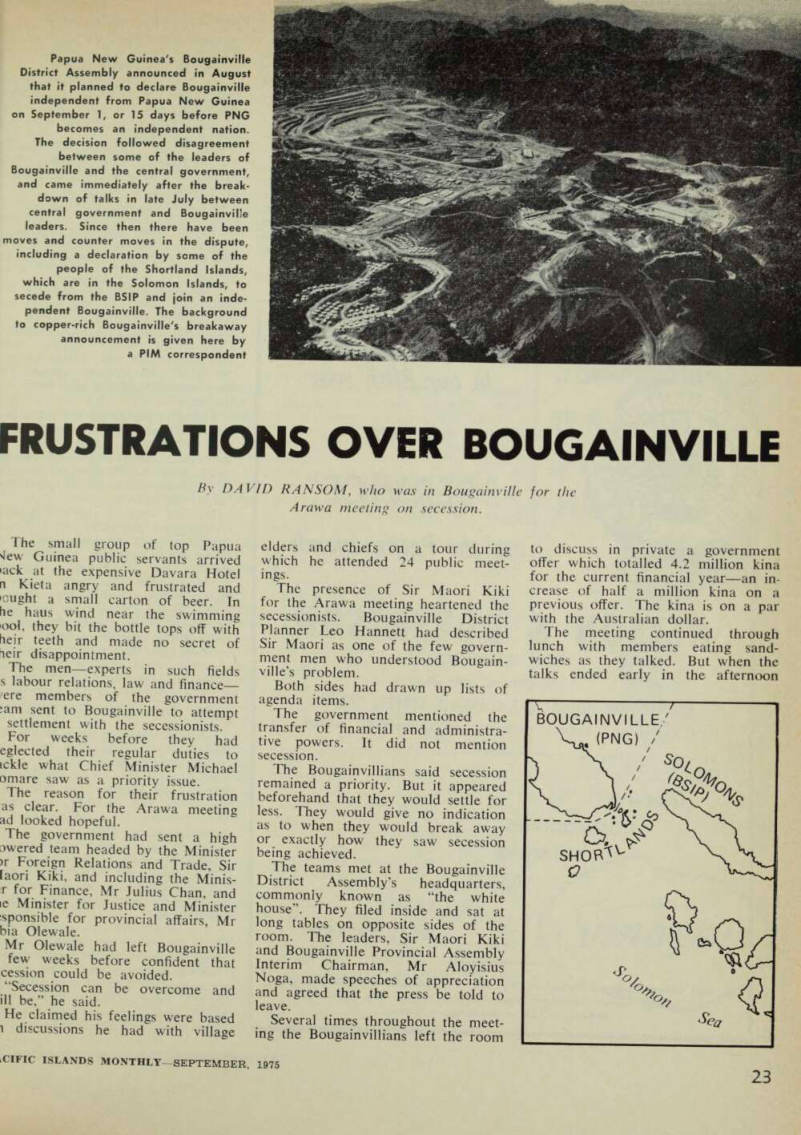
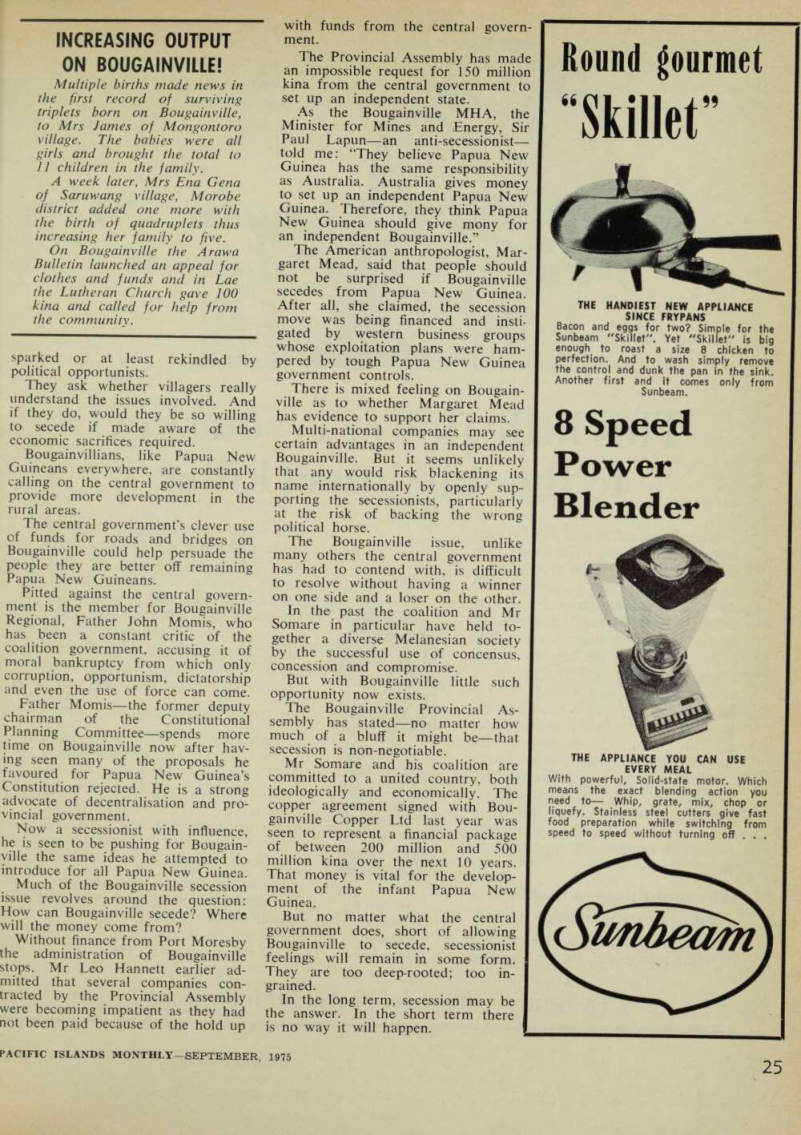
By DAVID RANSOM, who was in Bougainville for the Arawa meeting on secession.
The small group of top Papua 'lew Guinea public servants arrived ►ack at the expensive Davara Hotel n Kieta angry and frustrated and •ought a small carton of beer. In he haus wind near the swimming 001, they bit the bottle tops off with heir teeth and made no secret of
heir disappointment.
The men—experts in such fields s labour relations, law and finance— ere members of the government ; am sent to Bougainville to attempt settlement with the secessionists.
For weeks before they had eglected their regular duties to ickle what Chief Minister Michael omare saw as a priority issue.
The reason for their frustration as clear. For the Arawa meeting ad looked hopeful.
The government had sent a high awered team headed by the Minister >r Foreign Relations and Trade, Sir laori Kiki, and including the Minis r for Finance, Mr Julius Chan, and ie Minister for Justice and Minister sponsible for provincial affairs, Mr bia Olewale.
Mr Olewale had left Bougainville few weeks before confident that cession could be avoided.
“Secession can be overcome and ill be,” he said.
He claimed his feelings were based i discussions he had with village
elders and chiefs on a tour during which he attended 24 public meet ings.
The presence of Sir Maori Kiki for the Arawa meeting heartened the secessionists. Bougainville District Planner Leo Hannett had described Sir Maori as one of the few govern ment men who understood Bougain ville’s problem.
Both sides had drawn up lists of agenda items.
The government mentioned the transfer of financial and administra tive powers. It did not mention secession.
The Bougainvillians said secession remained a priority. But it appeared beforehand that they would settle for less. They would give no indication as to when they would break away or exactly how they saw secession being achieved.
The teams met at the Bougainville District Assembly’s headquarters, commonly known as “the white house”. They filed inside and sat at long tables on opposite sides of the room. The leaders, Sir Maori Kiki and Bougainville Provincial Assembly Interim Chairman, Mr Aloyisius Noga, made speeches of appreciation and agreed that the press be told to leave.
Several times throughout the meet ing the Bougainvillians left the room
to discuss in private a government offer which totalled 4.2 million kina for the current financial year—an in crease of half a million kina on a previous offer. The kina is on a par with the Australian dollar.
The meeting continued through lunch with members eating sand wiches as they talked. But when the talks ended early in the afternoon
Papua New Guinea's Bougainville District Assembly announced in August that it planned to declare Bougainville independent from Papua New Guinea on September 1, or 15 days before PNG becomes an independent nation.
The decision followed disagreement between some of the leaders of Bougainville and the central government, and came immediately after the break down of talks in late July between central government and Bougainville leaders. Since then there have been moves and counter moves in the dispute, including a declaration by some of the people of the Shortland Islands, which are in the Solomon Islands, to secede from the BSIP and join an inde pendent Bougainville. The background to copper-rich Bougainville's breakaway announcement is given here by a PIM correspondent
Bougainville
it appeared that a proper meal was about the only thing that either side would forgo. For no agreement had been reached; the talks had failed.
A joint statement afterwards de scribed the talks as “frank and friendly”.
But many of the government team were bitterly disappointed.
Said one government Minister: “They don’t know what they want.
We offer them more money and they want to talk about something else.
We talk about something else and they say they want more money.”
The government team left Bougain
ville on the first available plane leav ing open the possibility of further talks. Though next time, it appeared, the Bougainvillians would have to go to Port Moresby, because, as one of the government team put it, “We are certainly not coming back here”.
Officially though, the government said it would adopt “a wait and see attitude”.
The Bougainvillians were at their inscrutable best. Mr Hannett smiled and posed for photographs with Sir Maori Kiki. But neither Mr Hannett, the interim chairman, Aloyisius Noga, nor the Bougainville Regional mem ber, Father John Momis, would give any indication of his true feelings.
Two announcements made soon
after the Arawa conference—one by\ the government and the other by the; Provincial Assembly—are most sig nificant to the secession issue.
The first was the surprise announce ment that the National Constituent!
Assembly had scrapped part seven of the Constitution dealing with pro vincial government.
The Chief Minister, Mr Somare, put the motion. Twenty minutes laten Provincial Government was dropped on a vote of 40 to 19.
Mr Somare said that the cost ofi establishing Provincial Government in Papua New Guinea would be 15 million kina during the next five years and the central government could not afford it.
The government did not say how much the failure of the Arawa con ference had influenced its move. Bui the government said that Pfovincia Government would create added problems in the early stages of inde pendence. Mr Somare added: “W«
have experienced big problems with
Bougainville”.
The government did not make deal what it intends to do with the fledg ling Bougainville Government. Th< impression gained is that the Govern ment sees the Provincial Assembly as a child which would have beer better stillborn.
But the vote to shelve Provincia Government generally did not caus< the government to lose sight of th< Bougainville problem. On the sanv day as the Constituent Assembly’ decision, Mr Somare gave th< Bougainvillians only a few days t< come forward with “any reasonabh proposals it may have to bring t( an end the present problem”.
Then came the announcement fron the Provincial Assembly that Bougain ville would secede on September 1— a little more than a fortnight befon Papua New Guinea’s independence date.
This was hardly what Mr Soman had meant by reasonable.
The consequences of such a move had been spelt out earlier by the Minister for Finance, Mr Julius Char He threatened to cut off funds t< the Provincial Assembly if th Bougainvillians did not drop thei secession plans and return to th conference table. Otherwise, he saic funds would be distributed througl “organisations and groups the centra government considered effective fo
development”.
The results of such a move couh be a gauge as to how determine!
Bougainvillians are to break away.
Bougainvillians have an obviou awareness of their own identity. Bu many people—Bougainvillians in eluded—see the widespread voca support for secession as having beei
sparked or at least rekindled by political opportunists.
They ask whether villagers really understand the issues involved. And if they do, would they be so willing to secede if made aware of the economic sacrifices required.
Bougainvillians, like Papua New Guineans everywhere, are constantly calling on the central government to provide more development in the rural areas.
The central government’s clever use of funds for roads and bridges on Bougainville could help persuade the people they are better off remaining Papua New Guineans.
Pitted against the central govern ment is the member for Bougainville Regional, Father John Momis, who has been a constant critic of the coalition government, accusing it of moral bankruptcy from which only corruption, opportunism, dictatorship and even the use of force can come.
Father Momis—the former deputy chairman of the Constitutional Planning Committee—spends more time on Bougainville now after hav ing seen many of the proposals he favoured for Papua New Guinea’s Constitution rejected. He is a strong advocate of decentralisation and pro vincial government.
Now a secessionist with influence, he is seen to be pushing for Bougain ville the same ideas he attempted to introduce for all Papua New Guinea.
Much of the Bougainville secession issue revolves around the question: How can Bougainville secede? Where will the money come from?
Without finance from Port Moresby the administration of Bougainville stops. Mr Leo Hannett earlier ad mitted that several companies con tracted by the Provincial Assembly were becoming impatient as they had not been paid because of the hold up
with funds from the central govern ment.
The Provincial Assembly has made an impossible request for 150 million kina from the central government to set up an independent state.
As the Bougainville MHA, the Minister for Mines and Energy, Sir Paul Lapun—an anti-secessionist— told me: “They believe Papua New Guinea has the same responsibility as Australia. Australia gives money to set up an independent Papua New Guinea. Therefore, they think Papua New Guinea should give mony for an independent Bougainville.”
The American anthropologist, Mar garet Mead, said that people should not be surprised if Bougainville secedes from Papua New Guinea.
After all, she claimed, the secession move was being financed and insti gated by western business groups whose exploitation plans were ham pered by tough Papua New Guinea government controls.
There is mixed feeling on Bougain ville as to whether Margaret Mead has evidence to support her claims.
Multi-national companies may see certain advantages in an independent Bougainville. But it seems unlikely that any would risk blackening its name internationally by openly sup porting the secessionists, particularly at the risk of backing the wrong political horse.
The Bougainville issue, unlike many others the central government has had to contend with, is difficult to resolve without having a winner on one side and a loser on the other.
In the past the coalition and Mr Somare in particular have held to gether a diverse Melanesian society by the successful use of concensus, concession and compromise.
But with Bougainville little such opportunity now exists.
The Bougainville Provincial As sembly has stated—no matter how much of a bluff it might be—that secession is non-negotiable.
Mr Somare and his coalition are committed to a united country, both ideologically and economically. The copper agreement signed with Bou gainville Copper Ltd last year was seen to represent a financial package of between 200 million and 500 million kina over the next 10 years.
That money is vital for the develop ment of the infant Papua New Guinea.
But no matter what the central government does, short of allowing Bougainville to secede, secessionist feelings will remain in some form.
They are too deep-rooted; too in grained.
In the long term, secession may be the answer. In the short term there is no way it will happen.
Advertisements & other items, pp. 25-26 (2 items)
Icific Islands Monthly—September, 1975
"Service"
to the Pacific Islands
In our 80th year
Selling
"SERVICE"
NELSON & ROBERTSON
PLANTATION HOUSE, 197 CLARENCE STREET, SYDNEY
CABLES: "IVAN", SYDNEY, BRISBANE. TELEX; AA22381, SYDNEY.
FOR:
INDENTS
COMMODITIES
SHIPPING
TRAVEL
INSURANCE
REAL ESTATE
Branch Office; Nelson & Robertson Pty. ltd., 303 Adelaide St., Brisbane, Old New Guinea Representatives: Rabtrad Niugmi Pty. Ltd., Rabaul Lae Madang Kieta.
PTY. LIMITED
(Established 1895)
Increasing Output
On Bougainville!
Multiple births made news in the first record of surviving triplets born on Bougainville, to Mrs James of Mongontoro village. The babies were all girls and brought the total to 11 children in the family.
A week later, Mrs Ena Gena of Saruwang village, Morobe district added one more with the birth of quadruplets thus increasing her family to five.
On Bougainville the Arawa Bulletin launched an appeal for clothes and funds and in Lae the Lutheran Church gave 100 kina and called for help from the community.
Advertisements & other items, pp. 27-28 (1 item)
“Skillet”
Round gourmet
r
THE HANDIEST NEW APPLIANCE
SINCE FRYPANS
Bacon and eggs for two? Simple for the Sunbeam "Skillet". Yet "Skillet" is big enough to roast a size 8 chicken to perfection. And to wash simply remove the control and dunk the pan in the sink.
Another first and it comes only from Sunbeam.
8 Speed
Power
Blender
THE APPLIANCE YOU CAN USE
EVERY MEAL
With powerful. Solid-state motor. Which meaiis the exact blending action you need to — Whip, grate, mix, chop or liquefy. Stainless steel cutters give fast food preparation while switching from speed to speed without turning off . . .
n
This little flower is your key
to the safe insect killer
One of the safest and most potent insect-killers known to contemporary science is derived from an innocentlooking small white flower, the African Pyrethrum daisy. Pure pyrethrins, as chemists call this substance, is the active ingredient in Pea-Beu insect spray, and the key to its concentrated killing power. Continuing research by the chemists in the laboratories of A.N.I. Chemical Research and by health and environmental authorities throughout the world, confirms that insects do not become immune to pyrethrum. Pea- Beu contains a high concentration of pyrethrins which means that short bursts only are needed to kill flies, mosquitoes and every type of insect pest.
The mosquito—a deadly
trafficker of disease The mosquito’s record as a killer is world recognised. Beside wrecking so pure it’s safe to spray anywhere your night’s sleep with its irritating whine and inflicting its painful toxic bites, the mosquito passes on many serious diseases, including malaria, hepatitis, dengue and yellow fever, disfiguring elephantiasis and encephalitis. Pea-Beu is recommended to kill every mosquito that enters your home, because it is guaranteed completely effective, yet absolutely safe.
No fears near food Your kitchen and food-cupboards are the favourite places for houseflies, especially when attracted by exposed food as you cook or serve.
Of course you’re reluctant to use pungent insecticides, and fear toxic effects. But never hesitate to use Pea-Beu.
Its active ingredient guarantees it harmless to humans and pets, and thanks to the purity of all its ingredients, it is completely safe to spray anywhere in the home.
Pea-Beu the safe, powerful insecticide
Honour without profit
PNG’s straggling little’ papers: Honour without profit
Perhaps it was the sense of isolation among scattered expatriate communities. Perhaps it was sheer boredom. Whatever the reason, over the years Papua New Guinea has been a fertile breeding ground for a proliferation of tiny newspapers. Keith Jackson, who writes from Port Moresby, presided over one of them, the Kundiawa News. The News (printing 250 in a truly boom week) subsided in 1966 after three tumultuous years of part-time publication. “Weep not for us,” Jackson eulogised to his 'eaders at the time, “for we never wept for you.”
ITHEN I rang, late on a Monday evening, Father Mihalic was in the throes of writing the editorial >r issue number 121. July marked the fifth anniversary f the founding of Wontok, PNG’s longest-surviving ttle newspaper.
“Little” is perhaps too harsh a word for a pub cation with a circulation of 10,000 (800 outside PNG) id which runs to three separate editions. What is minutive is revenue. Mihalic says Wantok “just about •eaks even, depending on luck with advertising”. The iper lost about $2,000 last year, the tab being picked i by overseas donors.
Wantok (Pidgin for “friend”) is owned by the oman Catholic bishops of PNG. It has the dual stinction of being the only newspaper in PNG to )pear wholly in Pidgin and to be a success with aders (if not with advertisers) while retaining a strong velopment orientation in its news pages.
We aim at the little man who has made good, ose of high-school age, drop-out people,” says Father ihahc. He denies that Wantok is a Roman Catholic wspaper: “We’re ecumenical”.
Editorial policy is cautious. Wantok’s political verage is straight and devoid of comment. “We’ve • particular slant,” Mihalic says, “we present a lanced view.”
He d like to see Wantok develop as more of a ws magazine “like Time or The Bulletin”. But first ; paper must be popularised. Already separate edi- Bs are brought out for the Sepik and the Highlands, malic considers that a development of this concept ght create a breakthrough for Wantok’s circulation.
P a P ua New Guineans are very parochial,” he fs, “ a nd local editions create interest.” Separate edi ns are being planned for Rabaul, Port Moresby, Lae indiawa and Wabag. The staff of 10 is also gearing for weekly rather than fortnightly production.
Throughout PNG, Wantok has become an accepted d quoted standard for Pidgin English spelling. This not really surprising as Mihalic himself is the cnowledged authority on the language. About half , f NG population speak Pidgin. It’s easily the most lely-spoken language, with more than 800,000 :akers 10 years and over. Wantok is clearly in a •wth market.
But two problems need to be solved. The first these is distribution—in a country where communi ions, if they exist, are costly. The second, in the rds of Father Mihalic, is that there is “no reading )it in Papua New Guinea”.
T'HE genealogy of the Lae Nius is like that of some A obscure European royal family. Somewhere in the murk of the past are a myriad of relatives. The grand pappy of ’em all was the Times Courier, which disap peared soon after the Melbourne Herald group moved into PNG publishing. There followed a swarm of minor publications—some titled evocatively (Lae Trading Post), some pompously (Lae City News).
Out of all this, in September last year, emerged the Lae Nius, the proprietors of which (PNG Printmg) say is going to stick around. Connections are cagey aout how the Nius is going financially, but it's reliably be lieved to be breaking even. Advertising has picked up in the last three months and in mid-July, for the first time, the paper hit 32 pages.
From its first anniversary issue, during PNG’s Inde pendence celebrations, the Nius will roll off the presses twice weekly. Managing editor, Paul Cox, and his small staff of five are finding a receptive market.
Readership is unknown but circulation is 5,000 and growing.
Managing director of PNG Printing, Ray Thurecht, says that the first responsibility of the Nius is to be parochial. So parochial, indeed, that there’s not even a rate for subscriptions! “We’ve no intention of going national,” Thurecht says. Rather, the strategy appears to be to establish similar locally-orientated publications in other towns.
Thurecht claims that Lae Nius is interested in “penetration rather than circulation” and infers that he’d prefer a good little paper rather than a bad big one. The Nius is aiming for a middle of the road reader ship. Editorial policy, Thurecht says, is “conservative”.
“We don’t feel we’re here to be vindictive. If the government does its best, we’ll support it. But we have responsibilities.” The Nius remains politically neutral but not uncritical.
The biggest problem in the paper’s first year has been in building up advertising. Thurecht is con vinced that many advertisers refused to commit them selves for half a year or more while they assessed the performance of the Nius. Now local advertisers are voting with their cheque books. Curiously perhaps national advertisers remain reluctant.
Lae Nius is still a little newspaper, still battling.
Ray Thurecht has an ideal though. “Someone has got a responsibility to produce a professional newspaper.”
Advertisements & other items, p. 29 (1 item)
27
TFIC ISLANDS MONTHLY—SEPTEMBER, 1975
Nuclear-Free
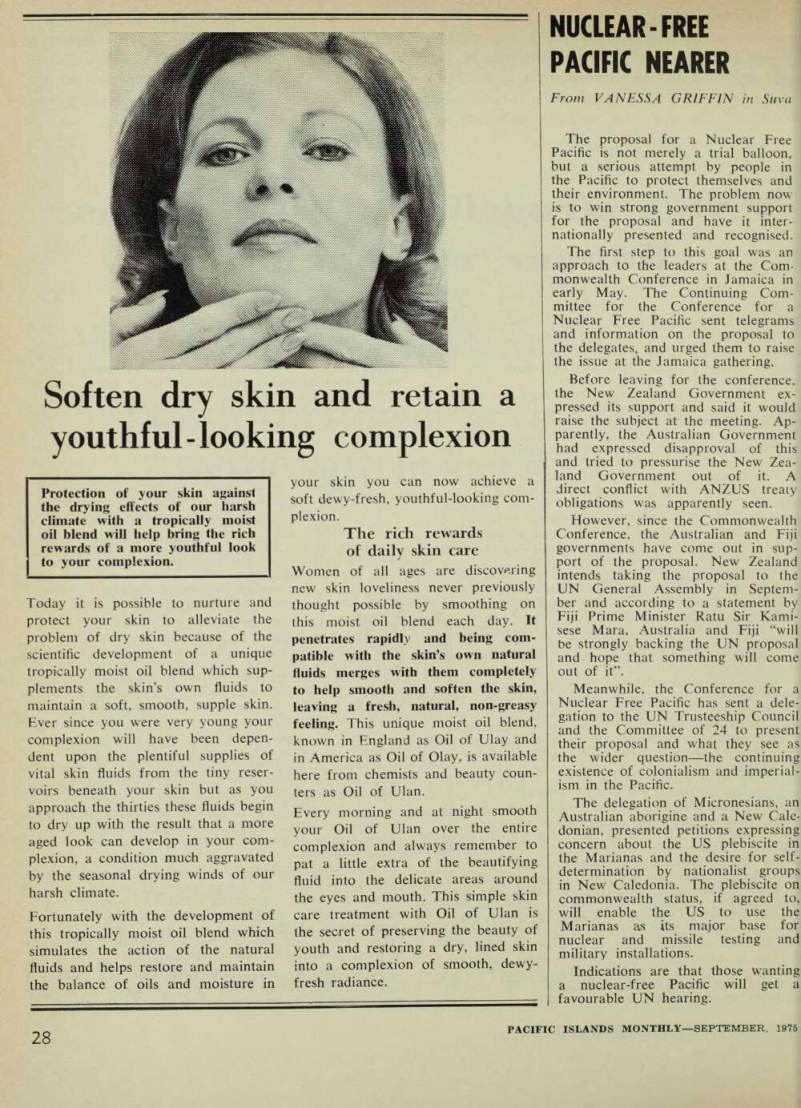
Pacific Nearer
From VANESSA GRIFFIN in Suva
The proposal for a Nuclear Free Pacific is not merely a trial balloon, but a serious attempt by people in the Pacific to protect themselves and their environment. The problem now is to win strong government support for the proposal and have it inter nationally presented and recognised.
The first step to this goal was an approach to the leaders at the Com monwealth Conference in Jamaica in early May. The Continuing Com mittee for the Conference for a Nuclear Free Pacific sent telegrams and information on the proposal to the delegates, and urged them to raise the issue at the Jamaica gathering.
Before leaving for the conference, the New Zealand Government ex pressed its support and said it would raise the subject at the meeting. Ap parently, the Australian Government had expressed disapproval of this and tried to pressurise the New Zea land Government out of it. A direct conflict with ANZUS treaty obligations was apparently seen.
However, since the Commonwealth Conference, the Australian and Fiji governments have come out in sup port of the proposal. New Zealand intends taking the proposal to the UN General Assembly in Septem ber and according to a statement by Fiji Prime Minister Ratu Sir Kami sese Mara, Australia and Fiji “will be strongly backing the UN proposal and hope that something will come out of it”.
Meanwhile, the Conference for a Nuclear Free Pacific has sent a dele gation to the UN Trusteeship Council and the Committee of 24 to present their proposal and what they see as the wider question—the continuing existence of colonialism and imperial ism in the Pacific.
The delegation of Micronesians, an Australian aborigine and a New Cale donian, presented petitions expressing concern about the US plebiscite in the Marianas and the desire for self determination by nationalist groups in New Caledonia. The plebiscite on commonwealth status, if agreed to, will enable the US to use the Marianas as its major base for nuclear and missile testing and military installations.
Indications are that those wanting a nuclear-free Pacific will get a favourable UN hearing.
Advertisements & other items, p. 30 (1 item)
youthful-looking complexion
4 m
Soften dry skin and retain a
Protection of your skin against the drying effects of our harsh climate with a tropically moist oil blend will help bring the rich rewards of a more youthful look to your complexion.
Today it is possible to nurture and protect your skin to alleviate the problem of dry skin because of the scientific development of a unique tropically moist oil blend which supplements the skin’s own fluids to maintain a soft, smooth, supple skin.
Ever since you were very young your complexion will have been dependent upon the plentiful supplies of vital skin fluids from the tiny reservoirs beneath your skin but as you approach the thirties these fluids begin to dry up with the result that a more aged look can develop in your complexion, a condition much aggravated by the seasonal drying winds of our harsh climate.
Fortunately with the development of this tropically moist oil blend which simulates the action of the natural fluids and helps restore and maintain the balance of oils and moisture in your skin you can now achieve a soft dewy-fresh, youthful-looking complexion.
The rich rewards of daily skin care Women of all ages are discovering new skin loveliness never previously thought possible by smoothing on this moist oil blend each day. It penetrates rapidly and being compatible with the skin’s own natural fluids merges with them completely to help smooth and soften the skin, leaving a fresh, natural, non-greasy feeling. This unique moist oil blend, known in England as Oil of Ulay and in America as Oil of Olay, is available here from chemists and beauty counters as Oil of Ulan.
Every morning and at night smooth your Oil of Ulan over the entire complexion and always remember to pat a little extra of the beautifying fluid into the delicate areas around the eyes and mouth. This simple skin care treatment with Oil of Ulan is the secret of preserving the beauty of youth and restoring a dry, lined skin into a complexion of smooth, dewyfresh radiance.
Language beating
island migrants
From George Atkins In
Wellington.
The subjects of language, laws, quor and culture provide major roblems for Islanders in New ealand causing concern to govern lent authorities.
Language is causing problems to acific Island students as well as emigrants. The latter are often ustrated especially in the pubs be mse they feel they are being be ttled by pakehas (whites) when •guments arise. This is because they innot express themselves with their adequate English.
Island immigrants in New Zealand e mainly from Samoa, Niue, Fiji, >nga, Tokelaus and the Cooks. 3eorge Atkins is a Solomon Islands ournalist at present studying at the Vellington (NZ) Polytechnic School of Journalism.
Other Islanders in New Zealand are students from New Hebrides, Solomon Islands and the Gilbert and Ellice Islands Colony.
Some of the immigrants say they go to New Zealand for a change in life, and they think there are more chances to make money to send to their families at home.
Are they accepted by local people and what do the locals think about them?
Very many New Zealanders think of Islanders as “a mass of hooligans” who arrive from a so-called backward black world. Said one, “They are a group of uneducated persons who urinate in public after being to the pub and can’t hold whitemen’s beer because back home they only drink kava”.
The New Zealand’s Parliamentary Opposition Leader, Mr Robert Mul doon, has proposed a “Probation programme”, which, he says, will get rid of immigrants who break the law. Though this includes immi grants from Australia, England, and other countries, the heavier emphasis was on Islanders.
Mr Muldoon said, when outlining his proposal, that if Islanders behaved like hooligans, they should be de ported.
“This country has lots of its own problems already and it should not have any more from outsiders,” he said. “My probation proposal will see that immigrants have a certain amount of time to adopt the New Zealand way of life, and if they can not cope, they cannot remain in this country.”
Educationists say language and Western culture are causing the major problems for Pacific students.
There are a great many Island children who arrive in New Zealand every year only to find that their English is inadequate and they are doomed to struggle with wordy text books and subjects about which they know next to nothing.
The Education Department is one of the many organisations in New Zealand concerned about the welfare of Island immigrants and students.
Many people are now working on this and views from Islanders inside and outside New Zealand could be of help.
Advertisements & other items, pp. 31-32 (2 items)
29
?IFIC ISLANDS MONTHLY-SEPTEMBER, 1975
the Regent of Fiji
BOOK SPACE IN PARADISE
% V -'I v 4
Iff!
stoe 3 °° 9raCi ° US 9USS ' r °° mS ' iS paradise on the Cordial, like a Fijian village, the Regent invites you to a treasure of nnH artsTh t ste <p kh ouse and The Terrace serve delicious food platters and a spectacular ocean-view. the^e 9 ent is well-mannered service: in-room phones ion slropp!ng a,ds comple,e ban Quel/convention pavil-
—ng’lS ancfgolf. StS
Book space in paradise. For the night of a lifetime.
The Regent of Fiji—2o minutes from the airport.
POST OFFICE BOX 441 • NADI, FUI • PHONE 70700 • TELEX (792) 5214 ONE OF THE MANY WORLDS OF REGENT INTERNATIONAL HOTELS
the Regent of Fiji
DENARAU BEACH RESORT
Sydney, Australia Sales Office No. 1 York Sfreet, 14fh floor Sydney, Australia 2000 Phone (02) 276469 In Auckland. New Zealand, phone 71909
mr fix says
f<Sfoi IT Ber,.
cheaper
with
mM ARSON Tools & Rivets
y
HERE'S HOW THEY WORK
Insert pointed end of stem Into tool.
TOP
Place rivet in prepared hole and squeeze handles.
"Klik” the rivet Is set. stem breaks off completely and is ejected.
HERE'S WHAT THEY DO
Replace spot welding, nuts and bolts, screws and other less economical methods of fastening. The fastening is quicker, stronger, cheaper and resistant to vibration. Ideal for hundreds of repair and construction needs . . . mending toys, metal furniture, awnings, etc.
MARSON No. 220
WORKSHOP MASTER
The most complete tradesman and handyman construction and repair kit. Contains HP4 plier plus 200 assorted rivets in steel carrying case. Suggested retail $25.00.
MARSON HP2/4 MONITOR
The world's strongest and most versatile riveting tool in steel case. Sets rivets 3/32" to 3/16" diameter. Suggested retail $21.30. urn
MARSON No. 250
MASTER MARINER
Designed specially for the boat builder. Contains HP4 hand plier plus over 200 assorted rivets in copper, stainless steel and marine specification aluminium.
Suggested retail $26.25. ■ * -Mil
,-iIP •’
* Sfi
RAK-66 RIVET-ALL KIT
The only deluxe riveting kit in attractive gift pack. Contains riveting plier and large assortment of rivets. Sets three sizes of rivets. Suggested retail $5.89.
LAZY TONG RIVETER
Sets rivets up to 3/16" dia. Small diameter head permits riveting in restricted areas.
Suggested retail $27.75. .1
MARSON KLIK FAST RIVETS
Klik fast rivets are available in minor packs of 25, poly bags of 100 and boxes of 500.
They are available in steel, aluminium, copper, and stainless steel, in 1/8", 5/32", 3/16" and %" dia. and from 1/8" (3mm) long to 2" (50mm) long.
AT ALL LEADING HARDWARE STORES
Distributed all over Australia and guaranteed by MARSON PRODUCTS (AUST.) PTY. LTD. 108 Warrane Road, Willoughby, N.S.W.
Letters
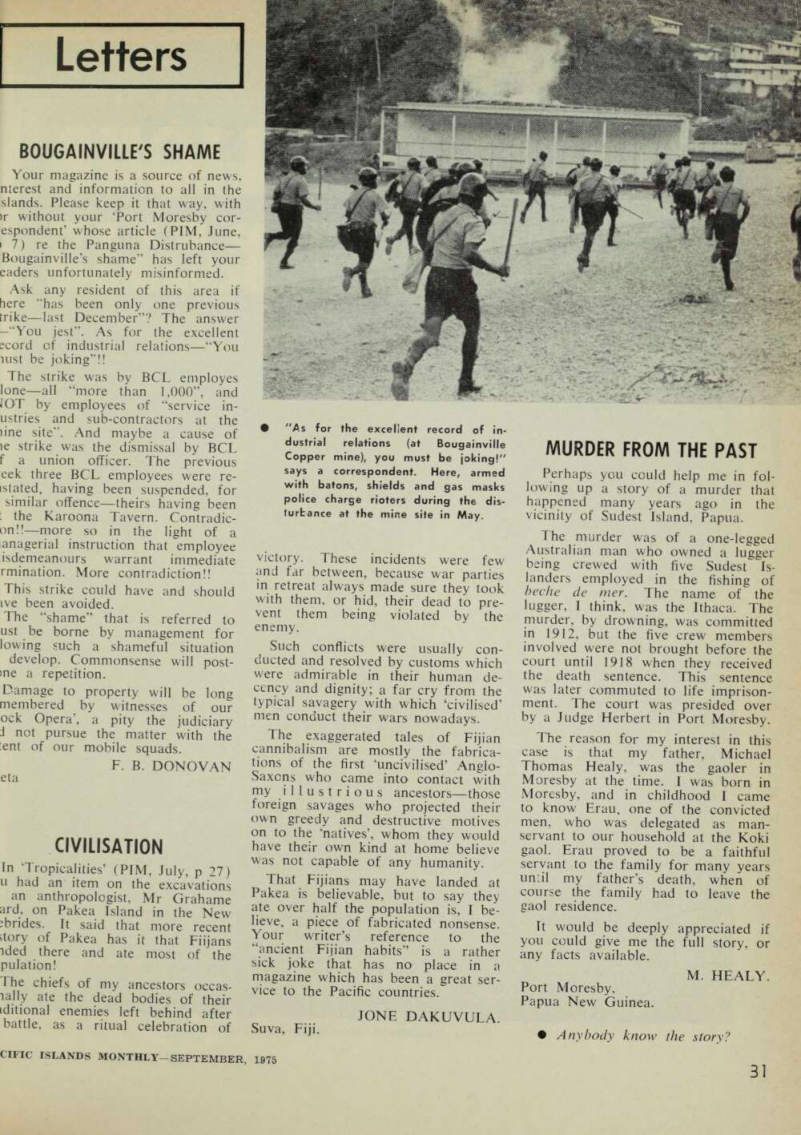
Bougainville's Shame
Your magazine is a source of news, merest and information to all in the slands. Please keep it that way, with ir without your ‘Port Moresby cor espondent’ whose article (PIM, June, > 7) re the Panguna Distrubance— Bougainville’s shame” has left your eaders unfortunately misinformed.
Ask any resident of this area if here “has been only one previous trike —last December”? The answer -“You jest”. As for the excellent scord of industrial relations—“ You lust be joking”!!
The strike was by BCL employes lone—all “more than 1,000”, and lOT by employees of “service in ustries and sub-contractors at the line site”. And maybe a cause of le strike was the dismissal by BCL f a union officer. The previous eek three BCL employees were re istated, having been suspended, for similar offence—theirs having been the Karoona Tavern. Contradic on!!—more so in the light of a anagerial instruction that employee isdemeanours warrant immediate rmination. More contradiction!!
This strike could have and should ive been avoided.
The “shame” that is referred to ust be borne by management for lowing such a shameful situation develop. Commonsense will post »ne a repetition.
Damage to property will be long membered by witnesses of our ock Opera’, a pity the judiciary J not pursue the matter with the ent of our mobile squads.
F. B. Donovan
eta
Civilisation
In ‘Tropicalities’ (PIM, July, p 27) u had an item on the excavations an anthropologist, Mr Grahame ard, on Pakea Island in the New lt said that more recent ‘tory of Pakea has it that Fiijans ided there and ate most of the pulation!
The chiefs of my ancestors occas lally ate the dead bodies of their iditional enemies left behind after battle, as a ritual celebration of
victory. These incidents were few and far between, because war parties in retreat always made sure they took with them, or hid, their dead to pre vent them being violated by the enemy.
Such conflicts were usually con ducted and resolved by customs which were admirable in their human de cency and dignity; a far cry from the typical savagery with which ‘civilised’ men conduct their wars nowadays.
The exaggerated tales of Fijian cannibalism are mostly the fabrica tions of the first ‘uncivilised’ Anglo- Saxons who came into contact with my illustrious ancestors—those foreign savages who projected their own greedy and destructive motives on to the ‘natives’, whom they would have their own kind at home believe was not capable of any humanity.
That Fijians may have landed at Pakea is believable, but to say they ate over half the population is, I be lieve, a piece of fabricated nonsense.
Your writer’s reference to the “ancient Fijian habits” is a rather sick joke that has no place in a magazine which has been a great ser vice to the Pacific countries.
Jone Dakuvula.
Suva, Fiji.
Murder From The Past
Perhaps you could help me in fol lowing up a story of a murder that happened many years ago in the vicinity of Sudest Island, Papua.
The murder was of a one-legged Australian man who owned a lugger being crewed with five Sudest Is landers employed in the fishing of beche de mer. The name of the lugger, I think, was the Ithaca. The murder, by drowning, was committed in 1912, but the five crew members involved were not brought before the court until 1918 when they received the death sentence. This sentence was later commuted to life imprison ment. The court was presided over by a Judge Herbert in Port Moresby.
The reason for my interest in this case is that my father, Michael Thomas Healy, was the gaoler in Moresby at the time. I was born in Moresby, and in childhood I came to know Erau, one of the convicted men, who was delegated as man servant to our household at the Koki gaol. Erau proved to be a faithful servant to the family for many years until my father’s death, when of course the family had to leave the gaol residence.
It would be deeply appreciated if you could give me the full story, or any facts available.
M. Healy.
Port Moresby, Papua New Guinea.
• Anybody know the story?
"As for the excellent record of in dustrial relations (at Bougainville Copper mine), you must be joking!" says a correspondent. Here, armed with batons, shields and gas masks police charge rioters during the dis turbance at the mine site in May.
Advertisements & other items, pp. 33-34 (2 items)
31
CIFIC ISLANDS MONTHLY—SEPTEMBER, 1975
ikMAt*.nuueitt
qui ecoutent
UMOUm&AUE
ETVOUS, ETVOUS, ETVOUS
sin*
i.. 7 JOURS SUR 7: - Informations ■ Musique ■ Commentaires ■ Interviews, Rubriques Nouvelle - Caledonia, Nouvelles - Hebrides \\ H H°3O - \ 2 7H°3°o bandes des 16 et 19m Tahiti TBH3O ■ 20H30band des 16 et 19m Brochures gratuites, photos ■ Ecrire a: RADIO AUST Francais.
Magazine Section
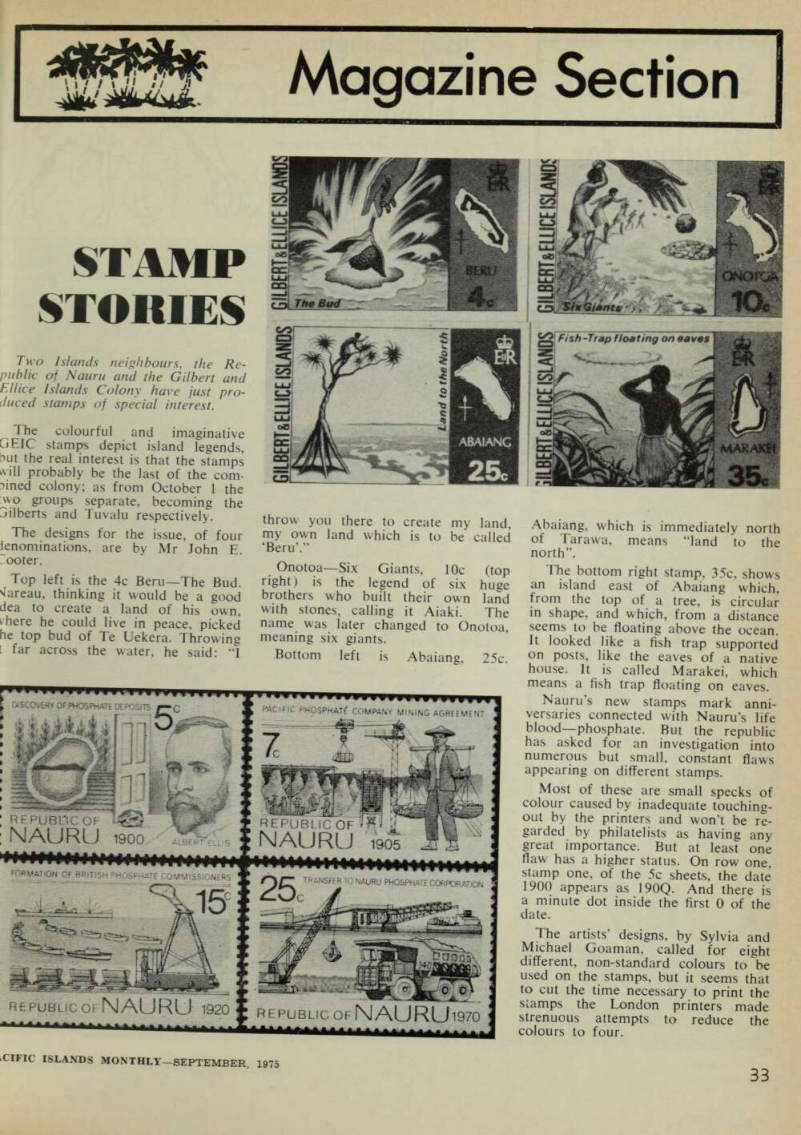
Stamp
Stories
Two Islands neighbours, the Re public of Nauru and the Gilbert and Ellice Islands Colony have just pro duced stamps of special interest.
The colourful and imaginative GEIC stamps depict island legends, but the real interest is that the stamps *;ill probably be the last of the com bined colony; as from October 1 the wo groups separate, becoming the Gilberts and Tuvalu respectively.
The designs for the issue, of four lenominations, are by Mr John E. rooter.
Top left is the 4c Beru—The Bud. 4areau, thinking it would be a good dea to create a land of his own, yhere he could live in peace, picked he top bud of Te Uekera. Throwing t far across the water, he said: “I
throw you there to create my land, my own land which is to be called ‘Beru’.”
Onotoa—Six Giants, 10c (top right) is the legend of six huge brothers who built their own land with stones, calling it Aiaki. The name was later changed to Onotoa, meaning six giants.
Bottom left is Abaiang, 25c.
Abaiang, which is immediately north of Tarawa, means “land to the north”.
The bottom right stamp, 35c, shows an island east of Abaiang which, from the top of a tree, is circular in shape, and which, from a distance seems to be floating above the ocean.
It looked like a fish trap supported on posts, like the eaves of a native house. It is called Marakei, which means a fish trap floating on eaves.
Nauru’s new stamps mark anni versaries connected with Nauru’s life blood—phosphate. But the republic has asked for an investigation into numerous but small, constant flaws appearing on different stamps.
Most of these are small specks of colour caused by inadequate touching out by the printers and won’t be re garded by philatelists as having any great importance. But at least one flaw has a higher status. On row one, stamp one, of the 5c sheets, the date 1900 appears as 190 Q. And there is a minute dot inside the first 0 of the date.
The artists’ designs, by Sylvia and Michael Goaman, called for eight different, non-standard colours to be used on the stamps, but it seems that to cut the time necessary to print the stamps the London printers made strenuous attempts to reduce the colours to four.
Advertisements & other items, p. 35 (1 item)
33
iCIFIC ISLANDS MONTHLY—SEPTEMBER, 1975
island dog
Stray thoughts on the island dog
From a Nukualofa correspondent To anyone coming from the United Kingdom, the Tongan dog is a talking point equalled only by the English weather in terms of variety and be haviour. His reputation had already featured in the briefing exercise I had attended before departure, so that it was no surprise to me when I arrived at the Beach House, Nukualofa to savour not only the nocturnal excur sions, but the territorial disputes which took place from time to time over and under the garden fence.
Since those early days, I have had time to take stock—not only from my own impressions, but from others perhaps less disposed to regard the dog as a noble creature and ‘man’s best friend’. One considered verdict which I recall clearly, if only because of the unemotional way in which it was made, was that the common spectacle of underfed and diseased dogs was a deliberate ploy on the part of the Tongan owner. This, it was said offered in return, a survival pattern which protected at all costs, not only the meagre food diet which was the dog’s lot, but the goods and chattels of the owner.
Certainly, by comparison with the magnificent physique of most horses and foals, and the careless abandon with which the pig and chickens are reared on a free-range diet, the Tongan dog fares badly.
The agricultural expert will quickly explain that this is all due to a failure to understand the basic con cepts of animal husbandry. The dog is a carnivore while the others are all herbiferous eating creatures and so long as there is a shortage of pro tein in the form of meat for Tongans, the dog can hope for scant considera tion.
Those who advocate birth control as a weapon against poverty and hunger in the human situation, would no doubt sympathise with the idea that where meat is in short supply it is common sense to cull the Tongan dog until his numbers are consistent with the food available to keep those that survive in a healthy state.
It will be argued that the police do this business of killing with their shotguns readily and quickly. I have much sympathy for them in this often distasteful task, but the effect on the dog population is haphazard, for it takes no account of whether the
offending animal is male or female.
Modern techniques of rendering a bitch infertile are simple and straight forward, but Tongans themselves must first accept the wisdom of such action and then see to it that the facilities are not merely introduced, but used.
Another means of control which may well be alien to the traditional carefree mode of life in Tonga is a licensing system. This could give protection to the well-looked-after dog in the shape of a distinctive coloured plastic collar with identifica tion disc, and would permit the owner to possess a dog indefinitely for so long as the collar was wear able. This way, costs could be kept very low.
What would be the advantages of such a new deal? For a start, towns and villages would be able to go tc sleep at nights.
Probably too, the dog is second only to the mosquito as a carrier of the infectious tick and lice as well as disease to people in Tonga. A healthier dog population would lesser this risk.
Do not think however that I arr advocating the pampered pet life foi the Tongan dog. Nothing could hi more debasing than the sight of i European dog so reduced in size b} inter-breeding that the progeny wil conveniently domicile into a suburbar ‘semi’, or a Morris Mini. The Britisl are alleged to be a nation of do{ lovers, but I sometimes feel th< companionship of a dog at home i: sought, more out of a desperate sens* of loneliness than a genuine affectior for the domesticated animal.
This, I am positive, will neve happen in Tonga. A solution her* probably lies somewhere in betweer these two very different life styles but in saying this it might be as wel to conclude with a thought for th* views of Albert Schweitzer, th* doctor and Christian philosopher. H* believed in a reverence of all form of fife—the Tongan dog must hav* missed out somewhere.
Advertisements & other items, pp. 36-38 (2 items)
Dependable
Specify Naco’
Louvre
Windows for
Dependable
Service.
Proven design features have ensured Naco as one of the most popular louvres on international markets. High volume manufacture enables us to provide prompt delivery and offer competitive prices. Design features include a central rib for improved performance; fingertip operating handle incorporating positive lock and a centre pivoted blade that ensures excellent balance.
Double operating bars are totally enclosed to ensure clean modern lines. Anodised aluminium or zinc plated steel construction: optional security bars available for additional security protection.
Contact Comalco Fabricators Export Pty Limited, manufacturers and overseas distributors of Naco products.
COMALCO FABRICATORS
EXPORT PTY. LIMITED
BOX 715G.P.0.
BRISBANE 4001
AUSTRALIA.
COMALCO
is aluminium
C0M924
® 3
x CD Q 70 CD Co O
CD O
92 O Co
LM-220
SANSUI LM.
NEW RADICAL DESIGN,
NEW CLEAN SOUND.
Wi Sansui’s new Linear Motion speaker system, LM-330, features two superaccurate drivers acoustically isolated from each other.
The special high-frequency driver
enclosure also has three narrow fanshaped horns fed from the rear of the tweeter’s diaphragm. This unique design simulates an infinite back cavity condition and liberates cone motion.
Pulsive signals are reproduced cleaner with less distortion. There is more high-frequency response at aM listening levels, a better defined stereo image, and expanded stereo perspective.
The unusual Sansui-developed LM
Sansui. Dynamic audio answers.
woofer has the main enclosure to itself and delivers equally linear response down to the lowest frequencies.
Listen to the clean, smooth sound of the LM-330 and the compact LM-220 and LM-110 systems at your nearest Sansui dealer today.
Sctnjsui.
SANSUI ELECTRIC CO., LTD.
14-1, 2-chome, Izumi, Suginami-ku, Tokyo 168, Japan Australia Rank Industries Australia Pty. Ltd. 58 Queensbridge Street, South Melbourne, Victoria 3205 Phone: 61 3281 Australia Atkins Carlyle Ltd. 894 Hay Street, Perth, Western Australia 6000 Phone: 21 0101
FIJI
Prabhu Brothers Ltd.
P.O. Box 183, Nadi Phone: 70183/4 Papua New Guinea Oceania Indent Agency (P.N.G.) Pty. Ltd.
Box 5518, Boroko, Port Moresby Phone: PM 56406 New Zealand David J. Reid (N.Z.) Ltd.
C.P.O. Box 2630, Auckland. 1 Phone: 492-189 Nlle-Caledonle Ets Michel MERCIER 9, rue de Sebastopol, Noumea Phone: 759.11 South Pacific Miltons Department Stores Limited P.O. Box 146, Norfolk Island 2899 Western Samoa H.J. Keil and Company, Ltd.
P.O. Box 7, Apia Phone: 198 New Hebrides South Pacific Audio & Photo Supplies B.P. 274. Vila Cook Islands United Island Traders Ltd.
Box Nos. 1 & 2, Rarotonga Tahiti Society JAUNEZ & Cie B.P. 322, Papeete Phone: 2.04.24
Yesterday
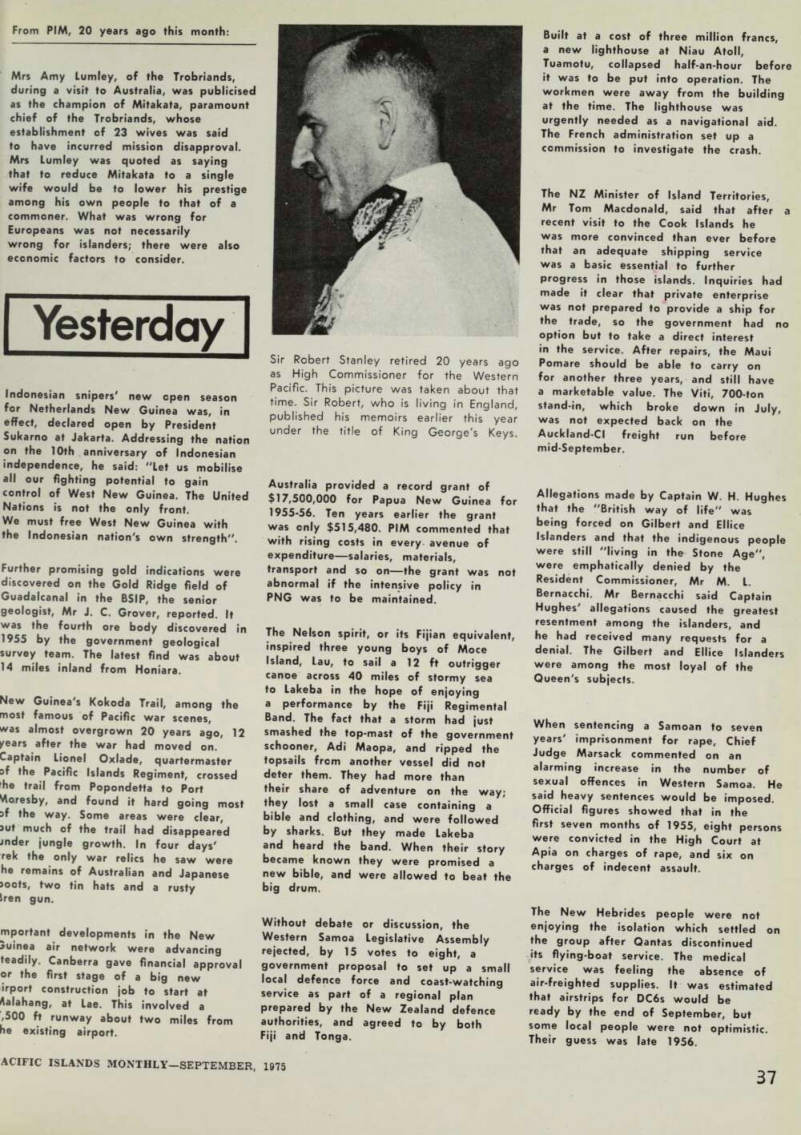
From PIM, 20 years ago this month:
Mrs Amy Lumley, of the Trobriands, during a visit to Australia, was publicised as the champion of Mitakata, paramount chief of the Trobriands, whose establishment of 23 wives was said to have incurred mission disapproval.
Mrs Lumley was quoted as saying that to reduce Mitakata to a single wife would be to lower his prestige among his own people to that of a commoner. What was wrong for Europeans was not necessarily wrong for islanders; there were also economic factors to consider.
Indonesian snipers' new open season for Netherlands New Guinea was, in effect, declared open by President Sukarno at Jakarta. Addressing the nation on the 10th anniversary of Indonesian independence, he said; "Let us mobilise all our fighting potential to gain control of West New Guinea. The United Nations is not the only front.
We must free West New Guinea with the Indonesian nation's own strength".
Further promising gold indications were discovered on the Gold Ridge field of Guadalcanal in the BSIP, the senior geologist, Mr J. C. Grover, reported. It was the fourth ore body discovered in 1955 by the government geological survey team. The latest find was about 14 miles inland from Honiara.
New Guinea's Kokoda Trail, among the most famous of Pacific war scenes, was almost overgrown 20 years ago, 12 years after the war had moved on.
Captain Lionel Oxlade, quartermaster sf the Pacific Islands Regiment, crossed trail from Popondetta to Port Moresby, and found it hard going most sf the way. Some areas were clear, >ut much of the trail had disappeared jnder jungle growth. In four days' rek the only war relics he saw were he remains of Australian and Japanese >oots, two tin hats and a rusty Iren gun. important developments in the New Guinea air network were advancing teadily. Canberra gave financial approval or the first stage of a big new irport construction job to start at Aalahang, at Lae. This involved a ,500 ft runway about two miles from
he existing airport.
Australia provided a record grant of $17,500,000 for Papua New Guinea for 1955-56. Ten years earlier the grant was only $515,480. PIM commented that with rising costs in every avenue of expenditure—salaries, materials, transport and so on—the grant was not abnormal if the intensive policy in PNG was to be maintained.
The Nelson spirit, or its Fijian equivalent, inspired three young boys of Moce Island, Lau, to sail a 12 ft outrigger canoe across 40 miles of stormy sea to Lakeba in the hope of enjoying a performance by the Fiji Regimental Band. The fact that a storm had just smashed the top-mast of the government schooner, Adi Maopa, and ripped the topsails from another vessel did not deter them. They had more than their share of adventure on the way; they lost a small case containing a bible and clothing, and were followed by sharks. But they made Lakeba and heard the band. When their story became known they were promised a new bible, and were allowed to beat the big drum.
Without debate or discussion, the Western Samoa Legislative Assembly rejected, by 15 votes to eight, a government proposal to set up a small local defence force and coast-watching service as part of a regional plan prepared by the New Zealand defence authorities, and agreed to by both Fiji and Tonga.
Built at a cost of three million francs, a new lighthouse at Niau Atoll, Tuamotu, collapsed half-an-hour before it was to be put into operation. The workmen were away from the building at the time. The lighthouse was urgently needed as a navigational aid.
The French administration set up a commission to investigate the crash.
The NZ Minister of Island Territories, Mr Tom Macdonald, said that after a recent visit to the Cook Islands he was more convinced than ever before that an adequate shipping service was a basic essential to further progress in those islands. Inquiries had made it clear that private enterprise was not prepared to provide a ship for the trade, so the government had no option but to take a direct interest in the service. After repairs, the Maui Pomare should be able to carry on for another three years, and still have a marketable value. The Viti, 700-ton stand-in, which broke down in July, was not expected back on the Auckland-CI freight run before
mid-September.
Allegations made by Captain W. H. Hughes that the "British way of life" was being forced on Gilbert and Ellice Islanders and that the indigenous people were still "living in the Stone Age", were emphatically denied by the Resident Commissioner, Mr M. L.
Bernacchi. Mr Bernacchi said Captain Hughes' allegations caused the greatest resentment among the islanders, and he had received many requests for a denial. The Gilbert and Ellice Islanders were among the most loyal of the Queen's subjects.
When sentencing a Samoan to seven years' imprisonment for rape, Chief Judge Marsack commented on an alarming increase in the number of sexual offences in Western Samoa. He said heavy sentences would be imposed.
Official figures showed that in the first seven months of 1955, eight persons were convicted in the High Court at Apia on charges of rape, and six on charges of indecent assault.
The New Hebrides people were not enjoying the isolation which settled on the group after Qantas discontinued its flying-boat service. The medical service was feeling the absence of air-freighted supplies. It was estimated that airstrips for DC6s would be ready by the end of September, but some local people were not optimistic.
Their guess was late 1956.
Sir Robert Stanley retired 20 years ago as High Commissioner for the Western Pacific. This picture was taken about that time. Sir Robert, who is living in England, published his memoirs earlier this year under the title of King George's Keys.
Advertisements & other items, pp. 39-45 (6 items)
37
ACIFIC ISLANDS MONTHLY—SEPTEMBER, 1975
If you ve got work to do
we ve got trucks to do it t . L
TOYOTA
Stout
TOYOTA
Hi-Ace
TOYOTA
Land Cruiser Pickup
TOYOTA Hi-Lux
PAPUA NEW GUINEA: ELA MOTORS LIMITED, Scratchley Rd., Badili, Papua. U.S. TRUST TERRITORY: MICROL ' B P.O.Box P.O. Box 174, Honiara.
Ws-J
AAW
> '-X t *K- / - V N V N * *.\ ? v % ■** j‘% , '.’ vH *;-v a-> * ,> -. \ ■\ ll im i * ..';' i'n v . v '**•'% V v
VV A
% - * \\ - -v\\ >o s >, v X %■' ?. ,vsv *»* v • *'• V 5 ‘ ‘ :tr : v i v. ; * .‘s m From different styles of the 4-wheel-drive Land Cruiser, to vons and pickups, to heavy duty trucks. Toyota makes them.
And Toyota makes them tough.
There's a Toyota truck that will work for you. Economically.
Reliably.
Find out about it. From your local Toyota dealer.
TOYOTA Dyna *
43 m k %
TOYOTA
Toyo-Ace TOYOTA Truck
OYOTA
Bairiki Tarawa. NORFOLK ISLAND: MARIE'S NORFOLK O Box'^VTlMOR 3 SANGTa'i M t ° T ° RS ' Box 36 ' NEW CALEDONIA: SOCIETE IMPORTATION AUTOMOBILE DU PACIFIQUE.Ronc^o^
lißi % m O A
Care Care
yR FRESHEN;
fcresh forest pine «r 250?
FOR A
CRISP. FRESH
FINISH
liquid
GOLD
DETERG
in sm tm- V. cotts I L
LEMON
Kwi
JADE
and
>praV
. Hv
ISCCt
LFV
ose
LEMON
tiler
Kwlt
Skera ion
ontwo?- «Y and insect kilter cohcwtr^;
Scotts
household products
give you real value
for your money.
For twenty five years Scotts have been helping out in homes throughout Australia and the Pacific.
Washing dishes. Cleaning. Keeping germs and dirt at bay.
All with quality products at sensible prices Scotts household products. Big on value and big on quality for 25 years.
From the
Islands Press
From the Atoll Pioneer, reporting a debate in the GEIC House of Assembly: Mr leremia Tabai, had in the meantime stepped up his hackling technique and this forced the Minister of Natural Resources, the Hon Isa Paeniu, to shout from across the floor saying: 'Hey, what's wrong with your mouth?”
Tom a court story in The Fiji Times nvolving the theft of $4,000 from a betting
hop safe by an employee:
. . On Monday police interviewed Yangtesh (the iccused, gaoled for 18 months) in Suva and he idmitted the offence. ASP Verma said that when carched, Yangtesh had a magical powder in his pocket vrapped in a piece of paper. “It stated on the paper hat he should keep it in his pocket whenever he vent to a police station,” he said. . . . rom "English and the Faa Samoa" by tleki-Tamaalelagi in The Viking Star, Faga'itua High chool (American Samoa) students' newspaper: . . For us, Samoan is our first language and mother angue. Our ancestors have been made to think that having nglish as the language of instruction, dropping the Samoan mguage, our mother tongue, to a subsidiary role in ducation, was for our benefit in this modern progress, eally, these so-called "benefits" have never equalled the amage the change has done to our dignity as humans, it alone the extent to which it has instilled in our jrefathers the insulting feeling of subservience to things jropean ... rom a letter by Chriss John Saulo (Rigo) and 1. R. Rema (Islibu) in the PNG Post-Courier
jmmenting on Mr John Kaputin's pro-Bougainville
;cessionist views: . . The encouragement and promotion of •cessionism is indeed nothing more or less than romoting hatred, disunity, fragmentation and esti action in the Papua New Guinean society and v . horn black government. This is the very ung that so-called nationalists are supposed to void. Their prime responsibility is to unite the •ople of their race. . . . om a letter by Bob Cress in the
icronesian Independent:
,e following is addressed to the management of the onder of L'Etao movie theatre: I would like to express my agrm at your dubious practice last June 16th of taking ov.e-goers' money, and then announcing before the max of the show that the final reel was missing. L'Etao,
you've certainly lived up to your name. I suggest you change it so that you can change your style of business.
From Town Talk column in the Arawa Bulletin: Again the question of morality and the BCL housing people. There are enough people living and accepted in Arawa who are not legally married. Many are known, probably many more suspected. But, as many again are respected and accepted members of the community. It becomes a pretty bad show when one of them is allocated a house, then suspended, then loses his house for committing the sin of “living with a woman". Unless, of course, it is a question of colour? No company has any right to act as a lord over the morals (or lack of them) of any of its employees.
From a letter by Curious in the Samoa Times: When people from Samoa travel overseas, NZ, Hawaii or the USA, they obey those countries’ laws. Never do you see them throw paper, orange peel, empty bottles, etc, in the street. They do not spit or blow their noses on the pavement. They use the road crossing provided, and they also obey the driving laws. But when they return to Samoa they forget all this; have they no respect for their own country?
From an interview in the Solomons News Drum with ex-resident Mr Eric (E. V.) Lawson, on a visit to the Solomons: He said the British colonial system in the Solomons was the “biggest racket ever known” with British aid channelled into luxurious housing and “junkets” for British public servants. . . . “Britain has made all the mistakes in building up the economy here and when independence comes, she has got to be made to suffer another 20 years subsidising this place”.
From an editorial in The Fiji Times castigating Suva city councillors for wanting "annual remuneration" for their services in addition to an existing allowance of $lO for each meeting: ... The community recognises that the work of its local councillors is often demanding, complex and time-consuming ... but the community also believes that the rewards for this lie in the satisfaction that comes from a sense of service and commitment to the welfare of councillors' fellow citizens ... If they succeed in their move> they will have helped to destroy one of the finest examples of service and unselfishness in public life.
A Samoa Times report of the activities of an obvious women's libber: A woman caught housebreaking last week by police has also been confirmed as a criminal record-breaker. Punaolealof a Faamatala A seta, 19, of Faleula, appeared in the Apia Supreme Court this week on a charge of burglary. It’s her 16th appearance in court ... a record
unequalled by any other female.
The PNG Post-Courier, in an editorial on the need for stricter control of the country's economy, declares: . . . The great danger is in an outbreak of Parkinson’s Law. The habit of empire building within departments to boost personal ego and achieve little else must be nipped in the bud before it really takes off as it has elsewhere. . . .
41
ICIFIC ISLANDS MONTHLY—SEPTEMBER, 1975
-•
Whatever you want in a pickup, the 81600 delivers it.
With performance. With economy. With style.
Consider the things we build into it so you can get more out of it. The 1600 cc overhead cam engine, for instance, is a lot like the one you find in some sports cars.
Yet ours just sips gas. And the important things like the heavy duty suspension system and the safe, sure braking system make operating the 81600 a joy.
Want a sporty pickup for the fun of it?
Or just for its carry-all capabilities?
Test drive the Mazda 81600 pickup.
The truck-load of fun and economy. 1975 Toyo Kogyo Co., Ltd. m fM
•MI. K
AV - ; UJ r» n —oo r\ IdonH TFI ■ 9HQ7 R®: ! P SolOmOO MOtOfS Ltd P.O. Box 20. Honiara TEL: 313 Duncombe Bay Garage, P.O. Box 220, Norfolk Island TEL: 2097 The trademark MAZDA in this advertisement stands for AUTOMOBILES MAZDA as far as France and her territories are concerned Comptoir Polynesian, B.P 628, Papeete.
mAnA
is a vehicle for Pacific Islands’ writers and artists to publish their work. It is an organ of the South Pacific Creative Arts Society and its editorial committee comprises writers from many islands.
Material for publication must be sent direct to MANA’s editor, Marjorie Crocombe, South Pacific Creative Arts Society, Box 5083, Suva.
There are some familiar names in this month’s MANA—Gilbertese Francis lekonnang, Tongan poet Konai Helu Thaman, Leonard Garae and Albert Leomala, both from the New Hebrides. Author of The Waterhole, Terepai Moetaua is from the Cooks and Kitty Foster, whose short story was highly commended in the short story competition held by the Fiji Association of English Teachers, is a student at St John’s College, Cawaci on the Fiji Island of Ovalau.
The Waterhole
By Terepai Moetaua
17" AATI had smelled that scene be fore. Perhaps a dozen times and he had tried to ignore it and he swore at the futility of the human senses.
But his sixth sense convinced him of his suspicion.
Dawn was breaking and he had just returned from one of his weekly fishing expeditions. For the last few weeks he had had very little luck.
Several times his fishing lines broke, and tonight his canoe had capsized in calm water.
The people of Mitiaro believed that bad luck could be brought upon a fisherman out at sea if his wife was unfaithful to him. The notion that his wife was sleeping with another man haunted Kaati and it was this feeling that had brought him back home earlier than usual.
He gave his immediate surround ing a quick scrutiny and carefully surveyed the entrance to his cave.
The feeling that someone else had been in his cave made him shudder and his whole body trembled with fury. He tried to believe that it was not so and he hated and cursed the gods. He loved his woman and she knew it. Why did she have to do this? No! She loved him too she had told him. He believed her and he himself had a great love for her.
But that now familiar smell could not leave his nostrils and he was determined to get rid of its owner.
He quietly entered his cave. There on his grass bed lay his wife, fast
asleep. She looked so lovely in that early misty dawn and she was as nakedly beautiful just as he had left her. Then he observed that once again that hair on her mount of vtnus was a heap of entangled mass, a condition not of his doing.
Kaati lay down his fishing gear, grabbed his spear and disappeared with lightmng speed into the morn ing twilight.
The whole surrounding suddenly came to life with an outburst of frightening wonder and the air seemed to be filled with the smell of death. As Kaati traversed the rocky paths, the very trees that had known him since his childhood shud dered with fright at his approach. jl/fOKOTUA had lain awake all night, well satisfied with his success. He was a warrior of super natural strength and the greatest lover of his time. He was at ease and had no reason to worry about the world and today he would celebrate another successful sexual foray into one of the domains of his enemies.
It was Mokotua’s morning habit to wash himself at a nearby pond. He was enjoying his bath when Kaati appeared on the scene. Mokotua sud denly became aware of the dangerous plight he was in. He had of all days left his spear in his cave. He knew who Kaati was and the reason for his unexpected presence.
Kaati straightaway took advantage
of the situation and as a true warrior himself delivered his challenge: Te Matangi e!
Tera mai te Manganui! (Oh Mighty Wind!
Here comes thy reward!) Mokotua duly replied: Tiria! (Let it come!) Then Mokotua fell: A!! Te pakau a te vare. (Ah! I've been cheated) —The gods have forsaken me.
Kaati wrenched Mokotua’s penis from his dead body and returned with speed to his cave. The penis would be his wife’s death warrant.
Meanwhile, Kaati’s wife had awoken. She was taken aback when she saw her husband’s fishing gear as it was unusual that he should be back early. But on perceiving the absence of her husband’s spear she knew where he had gone and she also knew what would happen to her if he came back alive. She decided to leave the cave immediately.
Where would she go? She thought of the waterhole where she was born.
If she was to die it would be there.
This waterhole was in a cave some 30 feet deep and the waterhole itself was about 15 feet in diameter. The depth of the water varied from 15 to 20 feet depending on the rise and fall of the tides. The water had a saline taste.
AT the bottom of the waterhole was a small opening that led into a secret compartment, known only to Kaati’s wife’s tribe and was used as a hiding place in times of war. It was here that Kaati’s wife went into hiding.
On arrival at his cave, Kaati found his wife missing. No doubt she had gone back to her own people. Kaati went straight there and produced Mokotua’s penis before his wife’s father, thus rendering him immune to any vengeance from his wife’s people if he had to kill her.
For days and nights Kaati searched for his wife but in vain. Then one day he came to the waterhole. His wife had told him about it but had refrained from telling him of the
secret compartment, a taboo of her tribe.
Kaati climbed down to the water.
He sat there for a long time while he admired the beauty of the crystal clear water. He tasted it and he thought of her. He could see her now clearly mirrored in the water.
Those once bright lovely eyes had become weak and they seemed to beg for forgiveness. His heart sank and he was filled with sorrow. He knew that he wanted her now more than when he first met her. There was nothing to stop him loving her again.
He had killed him and he would be an acclaimed hero. His tears fell into the water causing her image to ripple convulsively. But he knew she was there and she was begging him to come.
He slipped into the water and fol lowed her. Then he suddenly became conscious of the fact that he was somewhere else. It was all dark around him but one tiny spot was darker than the rest. Was he dream ing? He groped his way towards it.
He had found her. He pulled her towards him but she was too weak to move. She was thin and shivering with cold. He held her to him and embraced her.
A song from Ranga
Translated by ALBERT LEO MALA
Kros
Kros mi no wandem u U kilim mi U sakem aot ol Wae blong mi Mi no wandem u Kros Forom u ting baot u nomo Pe u no ting baot mi Watem ol wae blong mi U ting se Mi mi no save samting U ting se Mi mi karanke iat U ting se Ol wae blong me OH no kut U ting se u nomo U kat het Pe u no ting baot Se mi tu Mi kat het Kros ron wae Ron wae long mi Mi no wandem u Karem ol tingting blong u Mo ol wae blong u I ko bak long Plas blong u
Cross
Cross I hate you You are killing me You are destroying My traditions I hate you Cross Because you’re too proud of yourself And never bother about me And my traditions You thought I was ignorant You thought I was primitive You thought My traditions
Were disgusting
You thought You were clever But never thought Of my Cleverness Cross run away Run away from me I hate you Take your ideas And your civilisation And go back To where you belong.
The Ticket
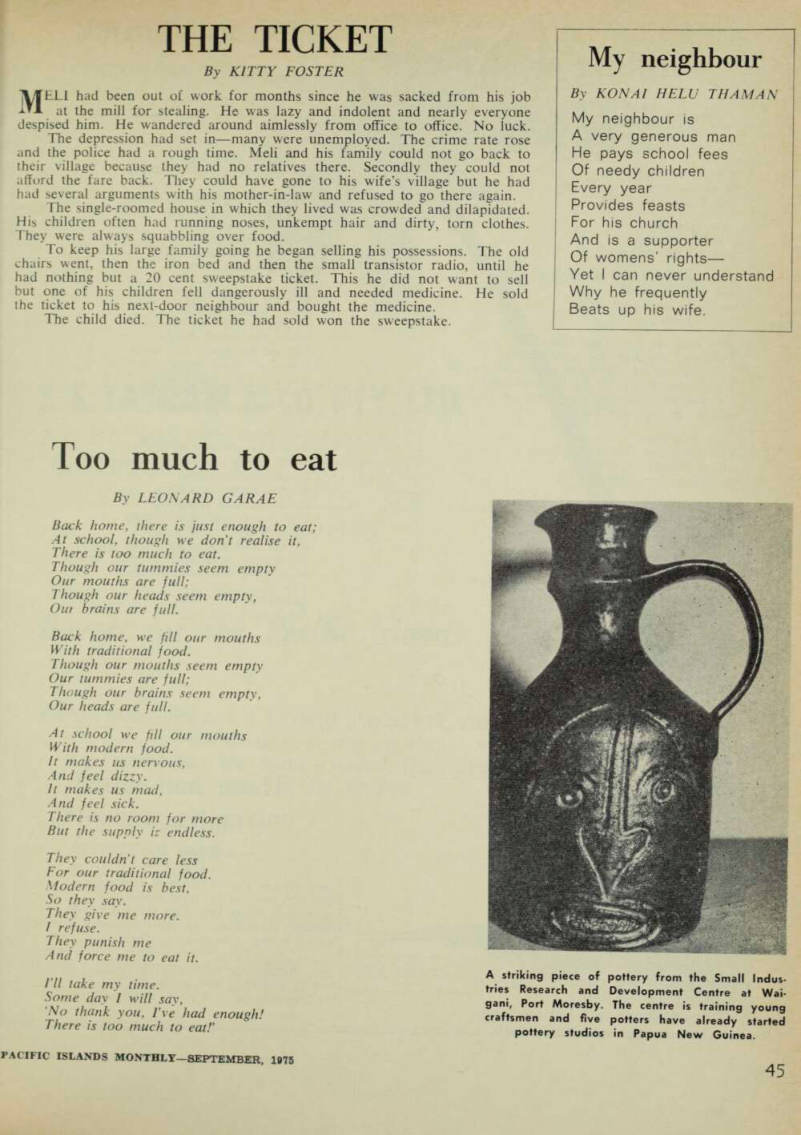
By Kitty Foster
MELI had been out of work for months since he was sacked from his job at the mill for stealing. He was lazy and indolent and nearly everyone despised him. He wandered around aimlessly from office to office. No luck.
The depression had set in—many were unemployed. The crime rate rose and the police had a rough time. Meli and his family could not go back to their village because they had no relatives there. Secondly they could not afford the fare back. They could have gone to his wife’s village but he had had several arguments with his mother-in-law and refused to go there again.
The single-roomed house in which they lived was crowded and dilapidated.
His children often had running noses, unkempt hair and dirty, torn clothes.
They were always squabbling over food.
To keep his large family going he began selling his possessions. The old chairs went, then the iron bed and then the small transistor radio, until he had nothing but a 20 cent sweepstake ticket. This he did not want to sell but one of his children fell dangerously ill and needed medicine. He sold the ticket to his next-door neighbour and bought the medicine.
The child died. The ticket he had sold won the sweepstake.
My neighbour
By Kona Ai Helu Thaman
My neighbour is A very generous man He pays school fees Of needy children Every year Provides feasts For his church And is a supporter Of womens’ rights— Yet I can never understand Why he frequently Beats up his wife.
Too much to eat
By Leonard Garae
Back home, there is just enough to eat; At school, though we don't realise it, There is too much to eat.
Though our tummies seem empty Our mouths are full; Though our heads seem empty, Out brains are full.
Back home, we fill our mouths With traditional food.
Though our mouths seem empty Our tummies are full; Though our brains seem empty, Our heads are full.
At school we fill our mouths With modern food.
It makes us nervous, And feel dizzy.
It makes us mad, And feel sick.
There is no room for more But the supply ir endless.
They couldn't care less For our traditional food.
Modern food is best, So they say.
They give me more. / refuse.
They punish me And force me to eat it.
Til take my time.
Some day I will say, 'No thank you, I've had enough!
There is too much to eat!'
A striking piece of pottery from the Small Indus tries Research and Development Centre at Wai gani, Port Moresby. The centre is training young craftsmen and five potters have already started pottery studios in Papua New Guinea.
Milking the natives
natives
By Moses Ymal Uludong
I never invited you but you came to my island and I welcomed you You told me I was a savage and I believed you You told me I was doomed to hell and I was scared you gave me your bible and I prayed You told me to till my island I planted coconuts for your profits you told me to dig holes and bunkers and 7 defended you with my life and land but you bombed my house and my land and I ran into the woods You told me you freed me from your war and I should be grateful to you as my liberator You established your government on my island without my permission You sent me to your school and I learned your way and 1 worked for you as an office boy you gave me your dollars and I bought your things Now you tell me / cannot live without your money your way your things and I believe you But I can only get them if I give you my island and freedom Never!!!
Friends
By Konai Helu Thaman
My friends tell me I ought to have a housegirl To help ease The unemployment problem She herself has four — One cooks, one does the laundry One cleans the house And one sleeps with her husband How generous can a friend be!
Sea And Shore
By Francis Tekonnang
The tide swiftly creeps Like thick lucid jelly fish with Rounded zigzag edges Meandering silently as tentacles Of a giant jelly fish Crawling on its chest ashore.
Soon there will be no more White patches of sand Among thorny rocks, Nor scattered pools with Starfish black and white To scare your steps.
Yet, see those rocks!
Skulls half submerged Diving into the waves, While the beach naked Lies on her back, her heels Kissed by thick watery lips.
The pregnant beach sighs: Eeee Eeee, as gentle waves Lick her up and down.
Hear crabs snore, And blue waves, stretches of Long racing furrows, menacingly Laugh as they come, Flapping and smacking, Pounding and slapping The beach, like spittle slaps Of tongue; Recoil into muttering claws Scratching, preparing to grab again.
And when the tide goes down The waves retreat Smoothing their way Into another defeat.
university students
Those half-witted university students
By Joseph Veramo
/ am always dazed by their freshness Yet very amazed by their actions.
I see them often besieging the big fishes, Offering themselves to double-minded lecturers.
Torn between a bottomless desire.
I see them there silly as ever Inviting nuisance and scandal For the sake of a bloody awful degree.
Advertisements & other items, p. 49 (1 item)
S. E. Tatham & Co. Pty. Ltd.
Vs m S. E. TATHAM & CO. PTY. LTD.
ASKEW HOUSE, 364 LONSDALE ST.,
MELBOURNE, 3001, AUSTRALIA.
G.P.O. BOX B—CABLES "SET"
TELEPHONE: 601125
Buyers for the Pacific Islands
AND IN
PAPUA NEW GUINEA; S. E. TATHAM (P.N.G.) PTY. LTD.,
LAE; MALEKULA ST. (P.O. BOX 1562).
PORT MORESBY: CNR. 60R0A & MUNAHU STS., GORDON
(P.O. BOX 6733, BOROKO).
FIJI: S. E. TATHAM (FIJI) LTD.,
LAUTOKA P.O. BOX 366,
SUVA G.P.O. BOX 671,
w \
YOUR GUARANTEE
i
FOR SERVICE
SINCE 1924
Books, Reviews, writers
Ancient Tahiti, Without Benefit
Of A Lost Caravel
A Very Personal Review, by ROBERT LANGDON
Some seven years ago, when 1 was still in my first year as executive officer of the Pacific Manuscripts Bureau, Australian National Uni versity, I had a visit from Professor Douglas Oliver, professor of anthro pology at Harvard University. I don’t remember why the professor came to see me. But I vividly recall a conver sation we had on a pet subject of his, ancient Tahiti.
The professor, I gathered, had been writing a book on that subject for some years—a book that would at tempt to describe what Tahitian, ie Society Islands, society was like when Captain Wallis of HMS Dolphin discovered those islands in 1767.
During our conversation, I asked Oliver if he had read an article by me in PIM for January, 1968, en titled ‘Were Europeans living in the Eastern Pacific in the 16th century?’
When he confessd that he hadn’t, I explained that the article concerned the discovery at Amanu Atoll, Tuamotu Archipelago, in 1929 of four ancient iron cannon, and that it was my belief that these were relics of a 16th century Spanish shipwreck; that possibly the Spanish crew had survived and intermarried with Islands women; and that over the years they and their descendants had spread to the islands to the westward, including Tahiti.
I added that evidence pointing to wards this conclusion was to be found in the accounts of some of the early European visitors to Tahiti and surrounding islands accounts of islanders with light skins, European features and sometimes red hair and blue eyes.
The professor expressed consider able interest in all this, and remarked that if there really had been Euro pean castaways in the Eastern Pacific in the 16th century, “that would make all the difference”. Afterwards, I gave him a photocopy of my PIM article, which I presume he read and carried back to Harvard.
Not long after this, I was invited
to a conference in Salt Lake City where I gave a paper on ‘European Castaways in the Pacific before Cap tain Cook’. The additional research that this paper called for, as well as subsequent research, convinced me that there was a great deal of evidence to support my theory and that the only way to deal with it was to write a book.
As the book progressed, I some times wondered whether I hadn’t been a bit reckless in telling Oliver about my PIM article, for it seemed to me that once someone with his knowledge of Society Islands litera ture was alerted to the notion of 16th century Spanish castaways, he could scarcely fail to see the same clues to their existence and influence as I did.
Well, Oliver’s book, Ancient Tahitian Society, and my book, The Lost Caravel, have now been pub lished in Australia within a short time of each other. But whereas mine is all about castaways and their influence, that of the professor doesn’t mention a word about them.
The two books therefore provide an unusual example of how two authors can examine a vast body of largely identical material contempora neously and see in it quite different things.
Oliver’s book is in three attrac tively - produced volumes totalling 1,419 pages. It is a formidable per formance —a monument of enormous industry, dedication and patience ex tending over some 20 years.
The first volume, entitled ‘Enthno graphy’, has an introductory chapter plus 12 others which are devoted to: geography and population; cos mology; the daily cycle; primary tools and crafts; grooming; building; boats and travel; food; diversions; sexuality; warfare; and the individual from conception to afterlife.
In the second volume, ‘Social Re lations’, there are chapters on such matters as sex and age; consan guinity; consanguineal rules; class; friendship; cults; and such like.
The last volume, rather slimmer than the others, examines the fortunes of Tahiti’s ‘royal’ Pomare family from 1767 to the establishment of the French protectorate over Tahiti three quarters of a century later. In this, the author tries to determine why the Pomares rose and fell.
Oliver’s book is undoubtedly the most exhaustive study of ancient Society Islands society ever at tempted. Nothing of its kind is ever likely to be attempted again, for on many topics the author has un doubtedly presented almost every significant scrap of information that can be found.
All the information is neatly com partmentalised by topic so that it is easy to refer to. The book will be an invaluable research tool for Pacific scholars.
Yet despite its great value, the book fails, in my opinion, to achieve one of its principal aims. This is to enable scholars interested in com parative studies to understand why, “in customs that were once alike”, the Society Islands came to differ from other Polynesian communities.
As 1 see it, the reason for the book’s failure is explained in Oliver’s very statement of aim. This implies that in the author’s view, all Poly nesian islands of pre-Dolphin times were, in fact, inhabited only by Poly nesians of the same cultural, and, presumably, the same ethnic stock.
But were they?
Apart from the evidence that I have brought forward in favour of an incursion of 16th-century Spaniards, there is data suggesting the arrival of at least two other non-Polynesian groups in the Society Islands before 1767.
One group seems to have come from Rotuma, an isolated island to the north of Fiji, where the ancient culture, including language, was a mixture of several elements, of which one, admittedly, was Polynesian. The other group apparently came from South America.
Teuira Henry’s book, Ancient Tahiti, records a tradition about a “prince of Rotuma” who landed at Bora Bora and established himself; and this is substantiated by the fact that Rotuma was among the islands known to the Raiatean sage Tupaia, who accompanied Cook on his voyage across the Pacific in 1769.
As for the South American in fluence, a great deal of evidence has been presented by Thor Heyerdahl and others in support of this notion.
Some of it has certainly been dis credited; but much still remains un assailed. The sweet potato, for example, has never been explained away.
I, myself, have presented evidence in my book that tends to supstantiate Heyerdahl’s views. This is in the form of an appendix entitled ‘Evidence of a non-Polynesian language in eastern Polynesia’. The appendix draws together a surprisingly large number of scattered references to many linguistic anomalies in the eastern Pacific, particularly the Tuamotus.
Oliver, of course, could not have known about my foray into linguistics when he went to press. However, Heyerdahl’s ideas have been with us For nearly three decades, and Teuira Henry’s book has been around for nearly five.
It therefore seems to me that Oliver should at least have referred to the American Indians hypothesis and to he probable Rotuman connection iomewhere in his 1,419 pages. More mportantly, he should have pre sented his material in a way that vould have allowed for immigrants rom virtually anywhere, for a truly genuine ethnographic description hould have no built-in assumptions.
As Oliver begins with the assump ion that all the Society Islanders vere much the same to start with — ilthough he doesn’t believe that all ame in together—he inevitably caches the conclusion that such ultural differences as existed between >ne group of islands and another ame about through spontaneous de elopment.
He also manages to convince him elf that the three-level class system hat existed in the Society Islands in Captain Cook’s day was due to the tronger islanders overcoming their weaker compatriots over the centuries nd establishing themselves in sepa ate castes, with elaborate titles and eremonies, etc.
“The most widely espoused expla ation for the three-level class /stem,” the professor says, “has een the ‘conquest’ theory, best epito mized by [the American scholar] landy. According to this writer, a
‘maritime dynasty’, possessing a mar kedly different and in many respects ‘superior’ culture, descended upon these islands from the west and estab lished a beachhead settlement at Opoa, Ra’iatea, from which their de scendants eventually spread out and overcame the Islands’ original inhabi tants. Needless to say, I reject this type of explanation as being overly simplistic, undocumented and quite unnecessary,” Oliver adds.
Well, I, myself, reject Oliver’s rejection of Handy’s ideas. On the other hand, I disagree with Handy’s notion that all the various waves of immigrants to the Society Islands in pre-Dolphin times came from the west.
The first wave, in my estimation, emanated from South America, prob ably as many as 1,500 years ago.
Then came invaders from the Tonga/ Samoa area who overcame the first inhabitants and imposed much of their own Polynesian culture on the area. The Rolumans probably came next. Finally, in the early 16th century, a party of shipwrecked Spaniards came from the east and established the ‘maritime dynasty’ that Handy wrote of, I believe Professor Oliver would not have rejected Handy’s ‘conquest’ theory so emphatically if he had taken a greater interest in what early European visitors said the Society Islanders looked like.
But physical anthropology is not the professor’s line human be haviour is. So it is not surprising that he devoted only of his 1,419 pages to the islanders’ physical characteristics.
“Captain Cook’s matter-of-fact de scription ... is a good as any,” he says purblindly in his first statement on this subject. He thereupon quotes a description that Cook wrote in 1769; passes immediately to one by an officer of the Duff in 1797; and then gives two descriptions by scien tists who accompanied Cook on his second and third voyages. That done, he turns to a couple of accounts of albinos and dwarfs—and called it quits.
This is most unsatisfactory, for none of the accounts quoted mentions the red hair, blue eyes and Caucasian features that many of the early Euro pean visitors described. Nor do they indicate that the people of Raiatea and Huahine were almost invariably described as being lighter-skinned than the generality of Tahitians. Nor is there a clue to Cook’s observations (made on his third voyage) that the women of Moorea, Tahiti’s sister island, were “short, dark and gener ally of forbidding features” as well as strikingly different from those of Tahiti.
On the other hand, the five ac counts that Professor Oliver does quote make it quite plain that the Society Islanders were “of various colours”; that the chiefs were fairer and bigger than the commoners; and that there was a “remarkable con trast” between the “robust make and dark colour” of the Tongans and a “sort of delicacy and whiteness” com mon among the Tahitians.
If the professor had really had his critical wits about him when he culled these quotations, he would surely have realised that something more than behavioural factors was needed
to explain all the striking physical
differences.
Such a discovery might then have led him to examine every other de scription of the islanders with the utmost care, and this, in turn, could have resulted in his reaching more or less the same conclusion as I have.
If my conclusions are correct, then Professor Oliver has clearly put in an enormous amount of time and effort to no great purpose, for his book will not enable scholars to understand why variations in culture occurred. Indeed, the book will not even enable them to discover where variations occurred within the Society Islands in most cases, for Oliver has jumbled up most of his descriptions of cultural traits on Tahiti, Raiatea, Bora Bora, etc, as if they were all equally applicable to every island.
They were not.
I regret very much having to write all these adverse comments on a book on which a fellow-investigator has spent a large part of his life.
But I can, at least, plead that the author was forewarned about my views long ago.
And, of course, if he can show, after all, that I'm only talking through my hat, then he can always say so in a review of my book!
(Ancient Tahitian Society. By
Douglas L. Oliver. Three volumes in slip case. Originally published by The Univer sity Press of Hawaii. Our copy from the Australian National University Press, Canberra. $45.)
Advertisements & other items, pp. 51-52 (2 items)
49
ACIFIC ISLANDS MONTHLY—SEPTEMBER, 1975
The Journal of Pacific History
Now bi-annual A scholarly journal concerned with the history and development of the Pacific Island peoples, containing much of the most authoritative writing on the subject.
Volume X — 1975 Articles based on recent research, sections on Current Developments, Notes and Documents, and Publications, including book reviews and an annual bibliography.
Subscription in 1975 $A6-50 or equivalent ($US 10-00) for two issues, post free. Single copies SA4-00 ($US6-20). Back issues (MX) $A7-00 (SUS11-00) each. Correspondence and subscriptions to Editors, The Journal of Pacific History, The Australian National University, Box 4 P.O., Canberra, A.C.T. 2600, Australia.
INTERNATIONAL
DATELINE HOTEL
TONGA
ELVlffl
Friendly Hotel" of the "Friendly Islands' Situated along the Nukualofa waterfront. Only five minutes walk from town. Single, double, family suites, airconditioning, and hot and cold water showers. Pool, bar, restaurant, duty-free shop, tour desk and boutique.
Book through your travel agent or write to International Dateline Hotel, P.O. Box 62, Nukualofa Tonga.
Cable Address: "DATELINE".
Represented Overseas by: Charles J. Henry and Associates Pty. Ltd.
Sydney and Melbourne. 7
Wit, adventure, errors
in the Trobriands
Gordon Saville, an Englishman then in his early thirties, arrived at Port Moresby in the spring of 1942 as a sergeant in a Docks Operations Com pany of the Australian Army and not long afterwards was transferred to the Australian New Guinea Adminis trative Unit (ANGAU) in which he served as a patrol officer. He left Papua during the war and has not been back since.
In his book, Saville recounts his experiences in the Trobriand Islands and on Fergusson Island during 1943.
In addition to operational duties, ANGAU was entrusted with many of the functions of the suspended civil administration, and a patrol officer’s daily tasks included the maintenance of law and order, dispensing of justice, public health measures, and indeed, just about everything done by a colonial government to bring the ‘blessings’ of western civilisation to its subjects.
White missionaries and traders having been evacuated, Saville found himself the only foreigner in a well regulated chiefly society, the only one of its kind among the many dif ferently organised, egalitarian socie ties of Papua New Guinea.
Although few outsiders had visited the Trobriand Islands before World War 11, the extensive writings of Bronislaw Malinowski, ‘father of modern anthropology’, who had done 21 years’ field work there between 1915 and 1918, had made academics throughout the world aware of the highly-structured and disciplined way of life of the people. Although gov ernment officers, missionaries and traders had caused some changes, the villagers encouraged by Saville in 1943 still lived much like their grand parents had done when the whites first arrived.
The author came to admire the islanders and, except for deplorable attempts to usurp the authority of Mitakata, the paramount chief, he seems to have done his best to lessen the impact of the foreigners’ war.
He recalls giving medical help (in competition with sorcerers), adjudi cating domestic disputes, exercising magisterial functions, and even doing his military bit by capturing several Japanese. And when Saville fell seriously ill, what Harley Street specialists would, no doubt, have
termed psychosomatic was attribut able to environmental factors: Tro briands society had ‘moved in’ on him.
Recent socio-economic upheavals with political undertones, eg the Kabisawali Movement in opposition to the Local Government Council, are better understood after reading Saville’s account of the material and sexual debauching caused by Allied servicemen three decades ago. The very least that Australians who ruled the islands for 90 years must do is to be sympathetic to and patient with the efforts of men like Charles Lepani and John Kasaipwalova who are seek ing to redress the situation.
Written with good humour and as much understanding as a brief visit allows, this book would have been a very good one had not the 30-odd years since his sojourn played havoc with Saville’s memory.
Regrettably, there are so many inaccuracies that ‘King’ of Kiriwina is no more than an enjoyable adven ture story.
To give but a few examples: There is no record of an ANGAU officer having been parachuted, and the dis trict officer then in charge of the Milne Bay District was not notified of any capture of Japanese in the Trobriands. There are no wallabies on the island, nor are there sago palms on Kiriwina.
James Chalmers, of the London Missionary Society, was killed on Goaribari Island, about 800 km west of the Trobriands, and he never visited them. There was a launch named Tamate, but it was stationed at Aird Hills in the then Delta Division, and not at Losuia.
The canoes of the Trobriand Is landers have always been single hulled; double-hulled canoes, with crab-claw sails, have only been used by the Mailu and Motu peoples.
And those megalithic remains are not near Sinaketa but north-east of Losuia, near Omarakana, and were known before Saville’s time: L.
Austin, an assistant resident magis trate, wrote about them in Oceania, Vol X, No 1 (1939). —Harry Jack man.
(‘King’ Of Kiriwina. By Gordon
Saville. Published by Leo Cooper, London. $8.40.)
Looking at PNG's future
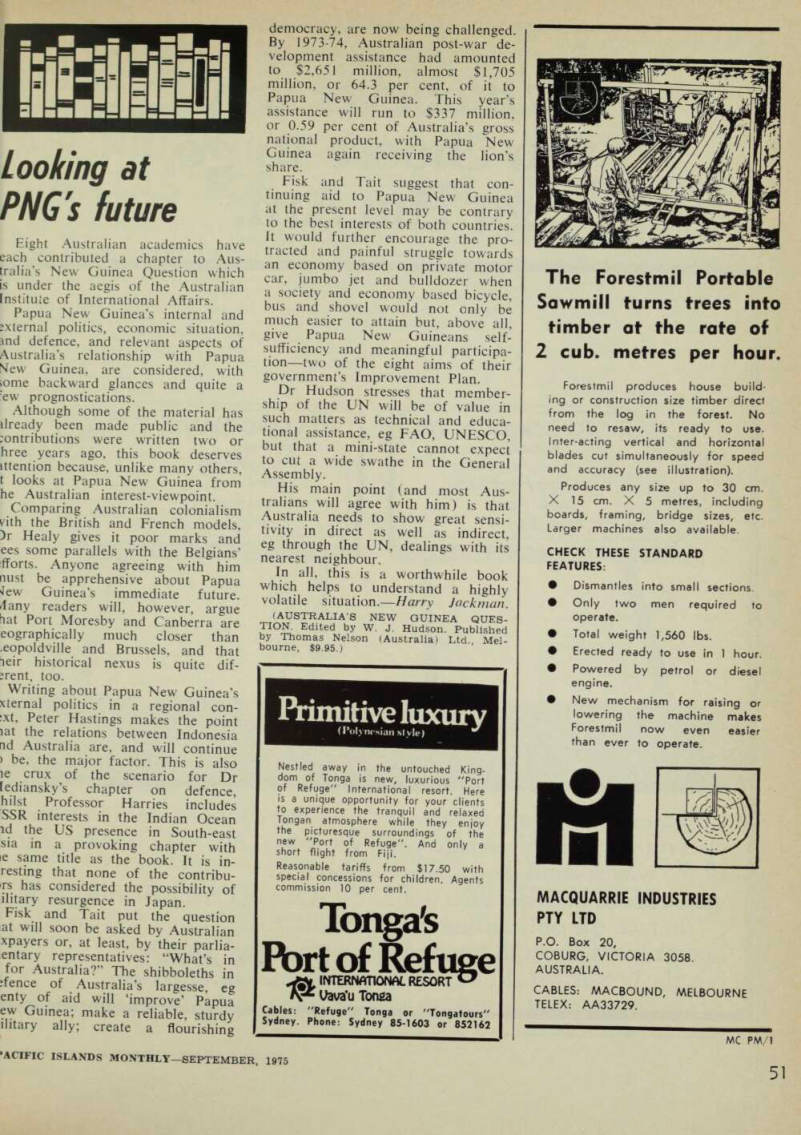
PNG's future
Eight Australian academics have each contributed a chapter to Aus tralia’s New Guinea Question which is under the aegis of the Australian Institute of International Affairs.
Papua New Guinea’s internal and external politics, economic situation, and defence, and relevant aspects of Australia’s relationship with Papua Mew Guinea, are considered, with some backward glances and quite a : ew prognostications.
Although some of the material has already been made public and the :ontributions were written two or hree years ago, this book deserves attention because, unlike many others, t looks at Papua New Guinea from
he Australian interest-viewpoint.
Comparing Australian colonialism vith the British and French models, )r Healy gives it poor marks and ees some parallels with the Belgians’ fforts. Anyone agreeing with him nust be apprehensive about Papua Jew Guinea’s immediate future. 4any readers will, however, argue hat Port Moresby and Canberra are eographically much closer than .eopoldville and Brussels, and that heir historical nexus is quite Aff erent, too.
Writing about Papua New Guinea’s xternal politics in a regional con :xt, Peter Hastings makes the point lat the relations between Indonesia ad Australia are, and will continue ) be, the major factor. This is also ic crux of the scenario for Dr lediansky’s chapter on defence, hilst Professor Harries includes SSR interests in the Indian Ocean ad the US presence in South-east sia in a provoking chapter with ie same title as the book. It is in resting that none of the contribu rs has considered the possibility of ihtary resurgence in Japan.
Fisk and Tait put the question at will soon be asked by Australian xpayers or, at least, by their parlia entary representatives: “What’s in for Australia?” The shibboleths in efence of Australia’s largesse, eg enty of aid will ‘improve’ Papua ew Guinea; make a reliable, sturdy ihtary ally; create a flourishing
democracy, are now being challenged.
By 1973-74, Australian post-war de velopment assistance had amounted to $2,651 million, almost $1,705 million, or 64.3 per cent, of it to Papua New Guinea. This year’s assistance will run to $337 million, or 0.59 per cent of Australia’s gross national product, with Papua New Guinea again receiving the lion’s share.
Fisk and Tail suggest that con tinuing aid to Papua New Guinea at the present level may be contrary to the best interests of both countries.
It would further encourage the pro tracted and painful struggle towards an economy based on private motor car, jumbo jet and bulldozer when a society and economy based bicycle, bus and shovel would not only be much easier to attain but, above all, give Papua New Guineans self sufficiency and meaningful participa tion—two of the eight aims of their government’s Improvement Plan.
Dr Hudson stresses that member ship of the UN will be of value in such matters as technical and educa tional assistance, eg FAO, UNESCO, but that a mini-state cannot expect to cut a wide swathe in the General Assembly.
His main point (and most Aus tralians will agree with him) is that Australia needs to show great sensi tivity in direct as well as indirect, eg through the UN, dealings with its nearest neighbour.
In all, this is a worthwhile book which helps to understand a highly volatile situation. —Harry Jackman.
(Australia’S New Guinea Ques
TION- Edited b y w - J- Hudson. Published by Thomas Nelson (Australia) Ltd. Mel bourne, $9.95.)
Advertisements & other items, pp. 53-54 (2 items)
51
•ACIFIC ISLANDS MONTHLY—SEPTEMBER, 1975
Tonga's
The Forestmil Portable
Sawmill turns trees into
timber at the rate of
2 cub. metres per hour.
Forestmil produces house building or construction size timber direct from the log in the forest. No need to resaw, its ready to use.
Inter-acting vertical and horizontal blades cut simultaneously for speed and accuracy (see illustration).
Produces any size up to 30 cm.
X 15 cm. X 5 metres, including boards, framing, bridge sizes, etc.
Larger machines also available.
CHECK THESE STANDARD
FEATURES;
• Dismantles into small sections. • Only two men required to operate. • Total weight 1,560 lbs. • Erected ready to use in 1 hour. • Powered by petrol or diesel engine. • New mechanism for raising or lowering the machine makes Forestmil now even easier than ever to operate.
MACQUARRIE INDUSTRIES
PTY LTD
P.O. Box 20,
COBURG, VICTORIA 3058.
AUSTRALIA.
CABLES: MACBOUND, MELBOURNE
TELEX: AA33729.
MC PM/1
Primitive luxury
(Polynesian style) ** Nestled away in the untouched Kingdom of Tonga is new, luxurious "Port of Refuge" International resort. Here is a unique opportunity for your clients to experience the tranquil and relaxed Tongan atmosphere while they enjoy the picturesque surroundings of the new "Port of Refuge". And only a short flight from Fiji.
Reasonable tariffs from $17.50 with special concessions for children. Agents commission 10 per cent.
Tonga's
Port of Refuge
INTERNATIONAL RESORT °
Uava’u Tonga Cables: "Refuge" Tonga or "Tongatours"
Sydney. Phone: Sydney 85-1603 or 852162
Whichever way
you choose to go,
go Pan Am.
TO LONDON VIA
Honolulu Los Angeles San Francisco New York London
TO LONDON NA*
Sydneu Hong Kong De\Ki FrankfurV London Pan Am, the only airline Three times a week in either operating out of Fiji to take you direction. Ask your travel agent all the way around the world. about it. via London. In either direction.
In fact, the only airline that can take you direct to London (via the U.S.A.) at all.
Or call Panair, Suva 22.641, Nadi 72.100.
You call it the world. We call it home. 250.P.193A
Pacific Transport
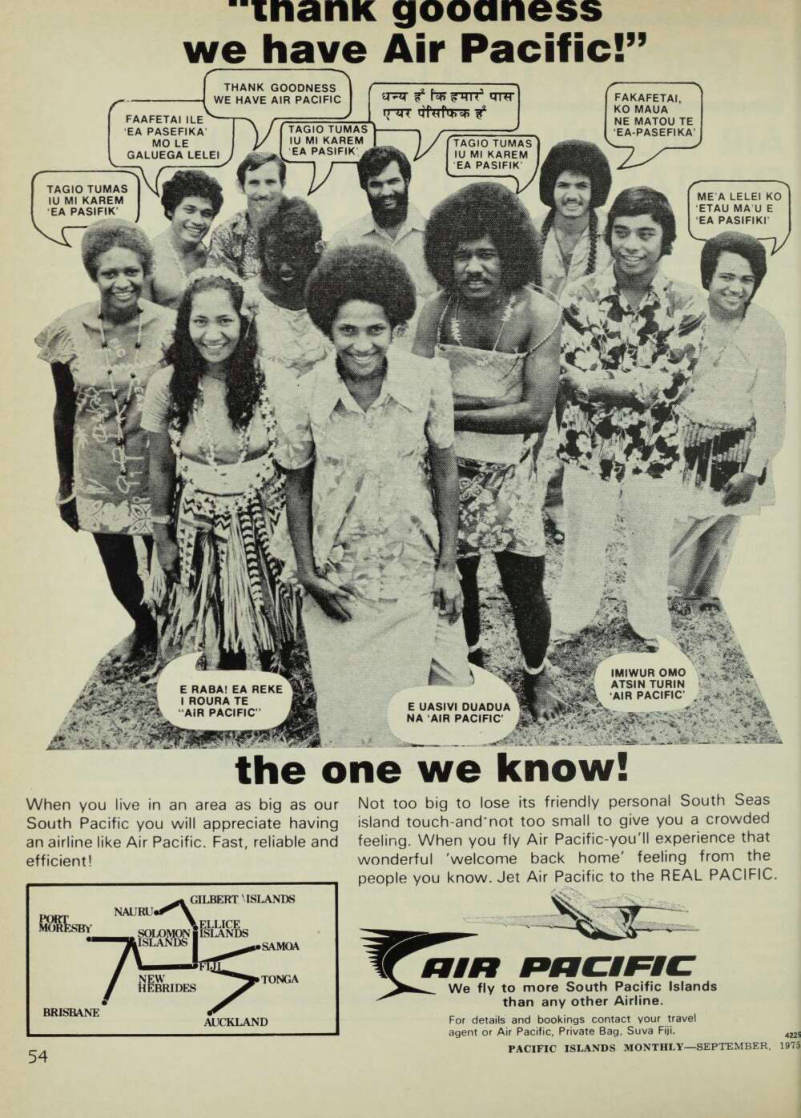
Air Niugini Goes Pool With
Qantas For Australian Services
Air services between Australia and Port Moresby after Papua New Guinea becomes independent on Sep tember 16 will be provided by Qantas and Air Niugini under a pool arrange ment.
Qantas will have four passenger/ freight flights a week from Sydney, using Boeing 7075. Two of these flights will call at Brisbane; the other two are direct. Air Niugini will operate five Boeing 727 flights a week between Brisbane and Port Moresby, and four a week between Cairns and Port Moresby, using Fokker Friend ships. These will also be passenger/ freight services.
Air Niugini will use aircraft chartered from Ansett and TAA.
The Qantas Sydney-Port Moresby flights will be on Mondays and Thurs days via Brisbane, leaving Sydney at 8 am, arriving Brisbane 9.15 am, and leaving at 10 am. The time of arrival in Port Moresby is 12.45 pm.
On Fridays and Sundays the air craft will fly direct, leaving Sydney at 8 am, and arriving at Port Moresby at 11.45 am.
Two return flights, via Brisbane, will leave Port Moresby on Mondays and Thursdays at 2 pm, and arrive at Brisbane at 4.50 pm. They will leave Brisbane at 5.45 am, and are scheduled to arrive at Sydney at 7.5 pm. On Saturdays and Sundays, the aircraft will leave Port Moresby at 1 pm, fly direct to Sydney arriving at 4.35 pm.
The Air Niugini services from Brisbane to Port Moresby will be on Tuesdays, Wednesdays, Fridays, Saturdays and Sundays, leaving at 10 am, and arriving in Port Moresby at 12.40 pm. The return flights, on the same days, will leave Port Moresby at 1.30 pm and arrive at Brisbane at 4.5 pm.
Passengers from other parts of Australia who are travelling to Papua New Guinea will have to travel to Sydney to join the Qantas flights on Mondays and Thursdays, and to Bris bane on the other days to join Air Niugini flights. Sydney people, of course, will have to fly to Brisbane In interstate aircraft on the days there ire no flights from Sydney to join Port Moresby-bound aircraft.
The first schedule under the Qantas- Air Niugini pool arrangement will operate from September 18.
Air Niugini has appointed Qantas its general sales agent in Australia.
Qantas will control all reservations for both airlines, which is a tidy ar rangement for passengers and ship pers.
An important point in these new arrangements is that Qantas will be taking cargo to Port Moresby. In the past, Qantas, which flies regularly through Port Moresby to South-East Asia, has not had freight rights to PNG, these being reserved for Ansett and TAA through Brisbane, even though at times there have been big backlogs of Australian freight sitting at TAA and Ansett Sydney and Bris bane depots.
Similarly, Qantas has been able to take passengers to Port Moresby only if they have a through ticket to the North.
Air Niugini, using chartered air craft, will make its first international flight, other than to Australia, on September 19, flying from Port Moresby to Manila and Hong Kong.
Qantas will charter it a Boeing 707, which will have an Air Niugini flight number.
Air Niugini will have to rely on chartered aircraft for some time yet.
It may lease a jet fleet, plus crews, from Tempair, a British charter com
pany. Tempair was one of four companies which tendered to supply aircraft for PNG international ser vices. The others were Qantas, TAA and Ansett. Tempair’s tender was the lowest, but the PNG National Airline Commission still has to satisfy itself on Tempair’s operational capability.
Ansett and TAA, which have been flying into Papua New Guinea for many years, will charter aircraft to Air Niugini for the Australian flights, at least till after the busy Christmas period. This will give Air Niugini about four months to work out some permanent charter or purchase ar rangement.
There will be a lot of negotiations before firm decisions are made about additional international flights for Air Niugini. If Air Niugini has any par ticular targets, the PNG Government will have to negotiate landing rights, which will mean granting reciprocal rights for other carriers to fly into
Png.
Japan, which has a growing trade in PNG, is one country which is likely to seek rights there, either unilater ally, or in return for granting Air Niugini rights in Japan. Air New Zealand, with a growing fleet, is likely to be looking closely at possible NZ-PNG services. Airlines in the Far East are others expected to seek rights in PNG.
Air Niugini will soon need a new
general manager, who will be at the helm during a crucial period in the young airline’s history. The present general manager, Mr Ralph Conley, who has built up Air Niugini in its formative period, will leave in January. His successor has not yet been chosen. The chairman of the PNG National Airline Commission, Mr Paul Pora, said a number of people would be considered for the post.
Noumea Preparing
For Jumbo Jets
New Caledonian airport authorities have announced plans to prepare the Fontouta runway to receive 747 iumbo jets by about April 1976.
The necessary modifications to Noumea’s international airport at Fontouta include widening the whole ength of the present runway as well is adjacent access areas. The cost is :stimated at about SAI million, of vhich $90,000 would be granted by he Department of Civil Aviation, vhile almost $1 million would be »orrowed from the French Reserve lank, Mr Jean Cheval, president of the 'Jew Caledonian Chamber of Com merce, which manages the Tontouta irport, said it was hoped construc ion work could begin by early )ctober. The project is expected to ake up to six months to complete.
Since the huge new pasenger ter linal was opened at the T’ontouta irport in November, 1972, the Cale omans have been seeking the funds ) provide for jumbos, looking for c'd to the day when these planes ould be able to land their hundreds f passengers on the island. In 1974, ,320 flights passed through Tontouta irport.
Meanwhile, two Fokker Fairchilds cached New Caledonia from their S manufacturer late July to begin :rvice August 4 between Tontouta id Vila, New Hebrides. They re ace the Caravelle previously used y UTA on this route. The new air aft are smaller and slower than the aravelle, and will take 40 passengers id make 14 return trips weekly, impared to the previous six. Travel ig time is U hours.
At the same time, UTA was :gotiating with Air Melanesiae over e possibility of using the Fairchilds i the internal route between Vila id Santo.
Ig Wage Lift For
As Carrier Crew
Fiji seamen benefit, handsomely, inks to the Australian Seamen’s lion, but Islands residents who use uefied petroleum gas from Aus ilia, are finding the cost becoming
more expensive. The gas is shipped to half a dozen Pacific Islands by the Gas Supply Co Ltd, a subsidiary of the big Australian company, Boral, in the carriers Island Gas, Pacific Gas and Fiji Gas.
Liquefied Gas Carriers (Fiji) Ltd, which operates Fiji Gas, recently had to bow to a demand by the Aus tralian Seamen’s Union to pay 14 Fiji seamen in the ship $1,250 each, plus an extra $49.25 a day in wages for each day the ship operates in the Australian coastal trade.
The ship operates in Australian waters for four to six months of the year. The basic rates of pay for the seamen is $144 a month. But add to that the $49.25 a day they receive above the basic pay, and their mini mum for four months is very close to $6,500, which would easily make them the elite of Islands workers.
It is not hard to guess who ultimately pays.
The Fiji Gas needs a special single voyage permit to operate along the Australian coast, and gets this only when no similar specialised Aus tralian ship is available. Permits are not hard to come by.
Early in June, the Australian Sea men’s Union declared the Fiji Gas would not be allowed to sail unless the crew received Australian pay rates while on single-voyage permits. Con ditions for lifting the ban were a lump sum of $1,250 for each seaman, paid into a bank account, plus $49,25 over and above normal pay when the ship is in Australian waters.
The Fiji Prime Minister, Ratu Sir Kamisese Mara, at the South Pacific Forum in July, expressed some reser vations about a regional shipping line, because of the attitude by maritime unions in Australia and New Zealand.
He mentioned the Fiji Gas incident.
This led to his difference of opinion with Australia’s Foreign Affairs Minister, Senator Don Willesee, about whether his remarks should be set out in the communique.
Senator Willesee said the matter had been settled, but did not mention the facts of the settlement.
Gas Supply Co Ltd ships bulk liquefied petroleum gas from Aus tralia to Papua New Guinea, the Solomon Islands, the New Hebrides, Fiji, Tonga and the Cook Islands. In many areas “bottled” gas has come in at a time of social change, helping in better living.
Polynesian and Melanesian house wives, among their manv duties, have always had to collect firewood. But now they are freeing themselves of that task and turning to gas.
The tourist industry has also given a lift to the use of liquefied gas as more and more hotels, motels and top class restaurants have been built.
Tonga's shipping line in trouble
A recent debate in the Tonga Legislative Assembly showed how parlous were the finances of Tonga's Pacific Navigation Co Ltd. There was a loss of $BOO,OOO at the end of April, according to the Acting Minister of Finance, Dr Sione Tapa.
Mr 'Uliti Uata, Haapai people's representative, said the loss at the end of July would be $1.5 to $1.7 million.
The assembly passed a motion, moved by Mr Uata, asking that the line be reduced proportionately to Tonga's requirements, and stated that the loss it suffered "was too great, as to be detrimental to the Tonga economy". The motion also asked that the shipping line be returned to the control of the government.
Mr Uata asked Dr Tapa who would be responsible for paying the deficit as it increased. Dr Tapa said it was the responsibility of the shareholders, who included the Tonga Government and the Commodities Board.
The debate also revealed that there were no funds available to replace the Kao, the Aoniu or the Fangailifuka. Mr Uata said the monetary loss would be bearable if the line had fulfilled its services to the country.
Advertisements & other items, pp. 55-58 (3 items)
53
»ACIFIC ISLANDS MONTHLY—SEPTEMBER, 1975
we have Air Pacific!”
"inarm gooaness
THANK GOODNESS
WE HAVE AIR PACIFIC
N> jnriT 1 «rra*
FAKAFETAI,
KO MAUA
NE MATOU TE
EA-PASEFIKA’
r
FAAFETAI ILE "
EA PASEFIKA’
MO LE
GALUEGA LELEI
TAGIO TUMAS
IU Ml KAREM
EA PASIFIK A
TAGIO TUMAS
IU Ml KAREM
EA PASIFIK
TAGIO TUMAS
IU Ml KAREM
EA PASIFIK
ME A LELEI KO
ETAU MA’U E
EA PASIFIKI'
sis iC >* w !C C 4 m m
f i i
r w r
fer
IMIWUR OMO . : ...
ATSIN TURIN <ug \ ‘
AIR PACIFIC V ;
RABA! EA REKE
ROURA TE
UR PACIFIC”
E UASIVI OUADUA
NA AIR PACIFIC’
’Mm.
the one we know!
When you live in an area as big as our
South Pacific you will appreciate having
an airline like Air Pacific. Fast, reliable and
efficient!
GILBERT ' ISLANDS
LLICE
LANDS
NAURU
SOLO
isla;
SAMOA
NEW
HEBRIDES
TONGA
BRISBANE
AUCKLAND
Not too big to lose its friendly personal South Seas island touch-and'not too small to give you a crowded feeling. When you fly Air Pacific-you'll experience that wonderful 'welcome back home' feeling from the people you know. Jet Air Pacific to the REAL PACIFIC.
am pact Ftc
We fly to more South Pacific Islands than any other Airline.
For details and bookings contact your travel agent or Air Pacific, Private Bag, Suva Fiji.
anywhere,
any time,
any gas.
10 For further information & addresses of your local distributor contact:
THE COMMONWEALTH
NDUSTRIAL GASES LIMITED
Gases Export Department, ‘ 38 Bourke Road, Alexandria, N.S.W., Australia 2015.
Cables ‘CIGAS’-Telex 20241 Sydney. 017.0308
Caterpillar reliability, productivity, availability. Now you can get it all in a wheel skidder. The 518.
A whole new standard in skidder engineering. 120 turbocharged horsepower, 20,400 pounds of working muscle with full articulation and frame oscillation for stability and minimum maintenance.
Single lever “on the go” powershift. Dual rate steering for controlled response at all speeds. An operator’s compartment engineered for efficiency with safety features built In for man and machine.
You ; ll find all the best skidder ideas, plus added refinement and top quality manufacturing that can make the 518 the backbone of your logging operation.
And South-West Pacific Caterpillar dealers will ensure that your backbone stays in top condition no matter how far in the bush you are.
Parts, maintenance, repairs or simple information—we’ll see that you get it fast.
So tackle the jungle with the new Cat 518.
Caterpillar Dealers in South-West Pacific.
Ho32f
55
CIFIC ISLANDS MONTHLY—SEPTEMBER, 1975
Cruising
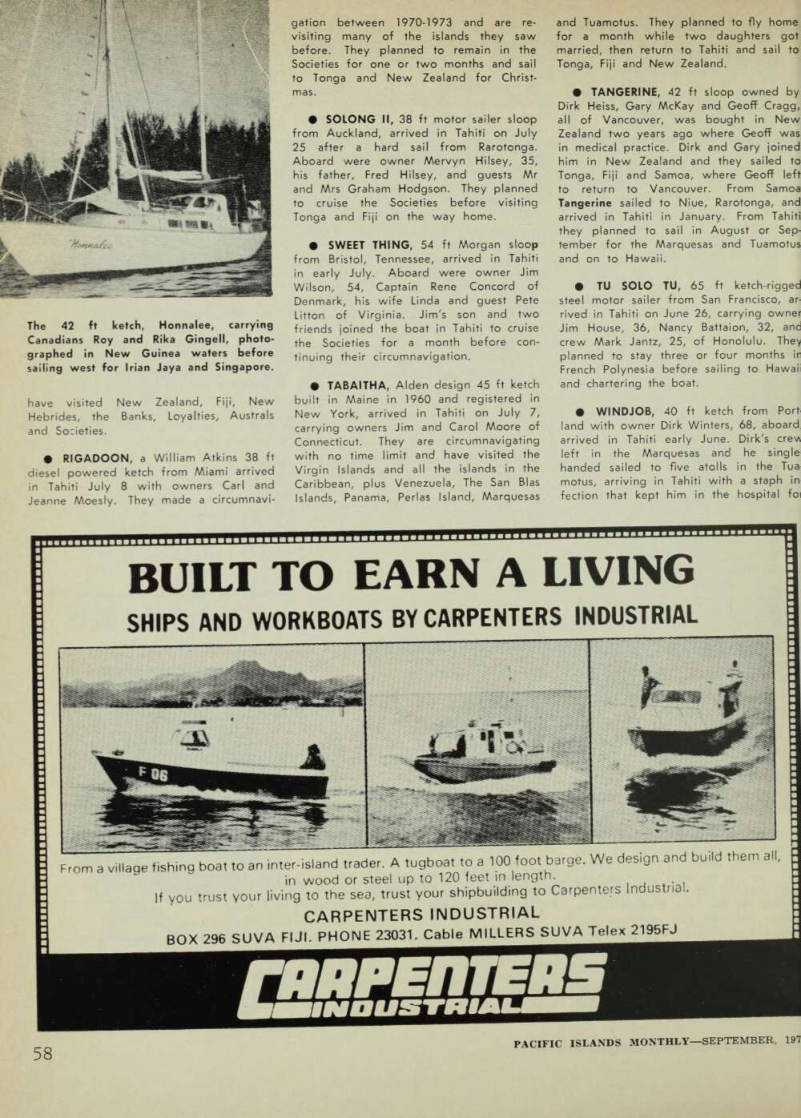
Yachts
• KARLOO, 30 ft Australian sloop, left utoka, Fiji, about the end of April, jised north to visit Rotuma, and then »nt on to Port Vila, New Hebrides, •iving in May. Owners Geoffrey and th Goodman will be cruising New (brides waters until September. • S.E.A. QUEST, 40 ft ketch registered Long Beach, California, arrived at Raro iga on July 19 from Papeete with mer-captain Richard Johnson, his wife, antel, and crew Tom Wone and Erica bey. Mr Johnson had spent 2\ years Tahiti carrying out an active study of irk behaviour. He hopes to return to liti to continue his research on sharks d other sea animals. The S.E.A. part his yacht's name means "Scientific erprises Associates". • AOTEA, 31 ft sloop, arrived at otonga from Papeete and Bora Bora July 20 with captain Richard Charles aimers, a New Zealander, and his e, Ann. Tonga is their next port of i AYEISHA, 45 ft motor sailer, foun ed on a reef north of Nairai Island in Lomaiviti group of Fiji on July 24. owner, William Sibly and his wife, lela, of NZ, and crew Jennifer Braun, Melbourne, took to a life raft. John Margaret McKenzie, nearby in the ATROS, fired distress flares. The ON SOUTH PACIFIC was diverted to scene and picked up the three people. y were taken to Levuka. ► AQUARIUS, 36 ft Cheoy Lee sloop n Honolulu, arrived in Tahiti on July on its second visit. George Bodley, and his sister Paula Myers, planned cruise the Societies, Tuamotus and quesas before returning to Hawaii. ► ERIK THE RED, a junk-like 30 ft ' built of old floorboards by lone )r Donald Ridler, 33, of Dorset, and, arrived in Tahiti early in June left mid-July for Rarotonga. Donald d Erik the Red from England to the bbean and back five years ago. He England in 1974 for a circumnaviga- He has published a book, Erik the FRABJOUS JOY, 32 ft strip plank
sver design sloop from Marina Del
California, arrived in Tahiti early in
June for a second visit. Owners Richard and Susan Guilford were in Tahiti from July, 1973, to April, 1974. • HONEYMEAD, 45 ft ketch from Brisbane, built by owners Chester and Norma Lemon, arrived in Tahiti mid-June after visiting the New Hebrides, Noumea, New Zealand and the Australs. They left late July for the Tuamotus, Marquesas and Hawaii. • HORIZON, Out Island 41 ft ketch, owned by Earl and Betty Hinz, of Los Angeles, arrived in Tahiti early in July.
They planned to sail for New Zealand in August, with crew member Claes Olsson of San Francisco. Norman O'Brien, 50, of Los Angeles, joined the boat in Tahiti for a three-week vacation. He died while swimming in Cook's Bay in Moorea. • KANAVICK, 36 ft ketch owned by a French doctor in Tahiti, went on the reef in Moorea on July 19. The doctor, his wife and child were rescued by Tahitians. The boat, which he bought only two days before, was damaged beyond repair. ® KATHI 11, Islander 44 ft sloop from Los Angeles, arrived Tahiti on July 13 and was to leave at the end of July to cruise the Societies, Cooks, Tonga and head to New Zealand for Christmas.
Aboard were Jim Kling, 33, and Christine Gray, 21. Kathi II was built by Jim. He carved the cockpit and the cabin doors in beautiful designs. • LARKI, 44 ft Spencer ketch from Seattle, arrived in Tahiti mid-June, where owners Louis Tercier, wife Elke and daughter Nichole, 10, planned to remain for several weeks before cruising the Societies, Marquesas and Tuamotus. • MARA, 47 ft Vagabond ketch from Los Angeles, arrived in Tahiti on July 8 with owner Dr Art Saltzer, wife Jo, three children and crew member Bob Black, of Hawaii, aboard. They visited the Mar quesas and Tuamotus and planned to cruise the Societies for two months be fore heading for Suwarrow. • MESSIAH, 46 ft Cross trimaran from San Diego, arrived in Tahiti on July 10, to cruise the Societies for a few months before sailing to Micronesia. Aboard were owners Stan and Kathy Gollaher and Tom Armour and Karen Crie. • PAUROA, 43 ft double outrigger de signed by Hunt Johnson in Hawaii, has been in Tahiti since June, 1974. Owners Jan Newhouse and wife Keaho spent most of the time in the district of Tea hupo, where Jan, who is a marine biologist on leave from the University of
Hawaii, has been working for CNEXO, a French Oceanographic facility. They planned to fly to Hawaii in August and return to Tahiti in another year. • PALEDIN, modified H-28 Herreshoff 30 ft ketch registered in Whangarei, ar rived in Tahiti early June with lone sailor Frederick Smith of Burnham-on-Crouch, England. Fred bought Paledin four years ago and has sailed to Fiji, the New Heb rides, the Solomons, and the Barrier Reef to Sydney, across the Tasman to Lord Howe where he was put on the beam end. From Lord Howe he sailed to New Zealand, the Australs and Tahiti, He cruised the Societies and planned to visit the Tuamotus and Marquesas before going on to Hawaii. • PEGASUS, 43 ft Atkins gaff-rigged ketch from Detroit, arrived in Tahiti in May and left on June 15 for Suwarrow.
Jerry and Helen Fitch and their four sons sailed from Florida to the Caribbean, through the Panama Canal to the Gala pagos, Easter Island, Pitcairn, the Gam biers, Marquesas and Tuamotus, before arrived in Tahiti. They planned to visit Tonga and New Zealand also. • RASCAL, 28 ft Wollacott Truant sloop from Wellington, with owner Rex McDowell, 34, and Nance Lowe, 26, of Maryland, aboard, arrived in Tahiti early in June and planned to leave late in July for the Tuamotus, Marquesas and Hawaii.
They have been cruising since 1973 and
have visited New Zealand, Fiji, New Hebrides, the Banks, Loyalties, Australs and Societies. • RIGADOON, a William Atkins 38 ft diesel powered ketch from Miami arrived in Tahiti July 8 with owners Carl and Jeanne Moesly. They made a circumnavi
gation between 1970-1973 and are re visiting many of the islands they saw before. They planned to remain in the Societies for one or two months and sail to Tonga and New Zealand for Christ mas. • SOLONG 11, 38 ft motor sailer sloop from Auckland, arrived in Tahiti on July 25 after a hard sail from Rarotonga.
Aboard were owner Mervyn Hilsey, 35, his father, Fred Hilsey, and guests Mr and Mrs Graham Hodgson. They planned to cruise the Societies before visiting Tonga and Fiji on the way home. • SWEET THING, 54 ft Morgan sloop from Bristol, Tennessee, arrived in Tahiti in early July. Aboard were owner Jim Wilson, 54, Captain Rene Concord of Denmark, his wife Linda and guest Pete Litton of Virginia. Jim's son and two friends joined the boat in Tahiti to cruise the Societies for a month before con tinuing their circumnavigation. • TABAITHA, Alden design 45 ft ketch built in Maine in 1960 and registered in New York, arrived in Tahiti on July 7, carrying owners Jim and Carol Moore of Connecticut. They are circumnavigating with no time limit and have visited the Virgin Islands and all the islands in the Caribbean, plus Venezuela, The San Bias Islands, Panama, Perlas Island, Marquesas
and Tuamotus. They planned to fly home for a month while two daughters got married, then return to Tahiti and sail to Tonga, Fiji and New Zealand. • TANGERINE, 42 ft sloop owned by Dirk Heiss, Gary McKay and Geoff Cragg, all of Vancouver, was bought in New Zealand two years ago where Geoff was in medical practice. Dirk and Gary joined him in New Zealand and they sailed to Tonga, Fiji and Samoa, where Geoff left to return to Vancouver. From Samoa Tangerine sailed to Niue, Rarotonga, and arrived in Tahiti in January. From Tahiti they planned to sail in August or Sep tember for the Marquesas and Tuamotus and on to Hawaii. • TU SOLO TU, 65 ft ketch-rigged steel motor sailer from San Francisco, ar rived in Tahiti on June 26, carrying owner Jim House, 36, Nancy Battaion, 32, and crew Mark Jantz, 25, of Honolulu. They planned to stay three or four months in French Polynesia before sailing to Hawaii and chartering the boat. • WINDJOB, 40 ft ketch from Port land with owner Dirk Winters, 68, aboard, arrived in Tahiti early June. Dirk's crew left in the Marquesas and he single handed sailed to five atolls in the Tua motus, arriving in Tahiti with a staph in fection that kept him in the hospital foi
The 42 ft ketch, Honnalee, carrying Canadians Roy and Rika Gingell, photo graphed in New Guinea waters before sailing west for Irian Jaya and Singapore.
four days. Garland "Webb" Webster of Detroit, who sailed to Tahiti on PEGASUS, joined Windjob and they planned to leave early August for Rarotonga, Tonga, Fiji and Ntew Zealand. • WISHBONE, 35 ft double-ended gaff cutter from Vancouver, arrived in Tahiti on March 1 and planned to leave at the end of July for Fiji and New Zealand. Owners John and Ned Hutton, their 6i-year-old daughter and John Amos, an Englishman living in New Zealand were aboard.
Wishbone was built by the Huttons, who are also professional sail-makers. • July 14, the French Bastille Day celebration, brought numerous yachts to Tahiti to enjoy the festivities. A count on July 15 showed 56 visiting yachts on Papeete's waterfront. In addition to those reported in this month's issue, some of these yachts were: AEGIR of Los Angeles; ALISIO. Long Beach, Calif; AMAZING
Grace, Vancouver; Any Sea; Ataunto,
San Francisco; CANDIDE, El Dorado, Calif; CHANSON, Los Angeles; Switzerland; DELIRIUS, Panama; DULCI NEA, Vancouver; GAVIOTA 11, Van couver; HAVORN, San Francisco; HEURTE BISE, France; JOSHUA, France; LE CHI CON, Belgium; LE MARIPIER 11, Switzer
Land; Mariposa, Peru; Marita Shan,
Victoria, BC; MERIDIAN, Auckland; PATIENCE, San Francisco; PATRICIA, Los Angeles; PEREGRINE, San Diego; two boats named PETIT PRINCE from France; PRINCESS, Santa Barbara; PUHUA; RAB BIT, Palm Beach, Fla; RESOLVE, Akron, Ohio; SALGARI; SEA STAR, Charlotte Amalie; SHAULA, Seattle; WITCHITIT and
Willy Willy, Paris.
• CHEIRON, 25 ft sloop, arrived at Rarotonga on July 9 from Papeete carry ing Americans Rex Reno and his wife Catherine. They started their cruise in Baja, California and sailed off the coast of Mexico before striking south-west to the Marquesas. They visited some of the Society Islands before sailing to Rarotonga. After 10 days in Rarotonga they intended to sail to Suwarrow and American Samoa. • NEW WORLD, 69 ft schooner, skip pered by Art Merserau, returned to Guam from a trip to Palau, and left soon after on her third voyage to the northern Marianas. She is sailing all the way, as the engine was left at Guam for repairs.
The New World has made several trips out of Guam since she arrived there several months ago. • GALAXIE, 40 ft steel ketch, was a recent visitor to Samarai while on the way from Port Moresby to Rabaul. On board were owner Oliver Twist, Reg Stevenson (skipper, well known in yacht ing circles) and Cane Bennett.
Advertisements & other items, pp. 59-61 (2 items)
57
IFIC ISLANDS MONTHLY—SEPTEMBER, 1975
Generating Sets
by BRAYBON
Capacities available are: Petrol 2 kva-7i kva • Diesel 2 kva-200 kva Write for brochure and prices:
BRAYBON BROS. PTY. ITD.,
2 ROTHWELL AVE., CONCORD WEST,
N.S.W., 2138. Phone: 73-3246.
BUILT TO EARN A LIVING
SHIPS AND WORKBOATS BY CARPENTERS INDUSTRIAL
SMI
i:oe.
m = _J From a village fishing boa. to an inter-island trader. A tugboat to a 100 foot barge. We design and build them all, in wood or steel up to 120 feet in length.
If you trust your living to the sea, trust your shipbuilding to Carpenters Industrial
CARPENTERS INDUSTRIAL
BOX 296 SUVA FIJI. PHONE 23031. Cable MILLERS SUVA Telex 2195FJ
Become a part af PlM’s Pacific and subscribe now
raciiie islands Monthly Keeps you informed on Pacific happenings
11l in the details m the attached order form .
People in transport
• Mr Roderick Wilson, 44, manager of British Airways in the South-West Pacific, and based in Sydney, has been appointed British Airways manager in the United States. He will take up his new post early in 1976, and will be stationed in New York. Mr Wilson will be the youngest manager to hold the most senior appointment in the overseas division of the airline. He is a director of Air Pacific and an alternate director of Air Melanesia.
He will be succeeded in the South- West Pacific by Mr Frank Waters, who is at present manager for the airline in Spain and the Mediter ranean area. ® Mr Peter Kingsford-Smith, a senior member of the staff of Inter ocean Swire Pty Ltd in Sydney, and a nephew of the great Smithy, re tired on July 4 after 43 years in the shipping industry, during which he became well known in some Pacific Islands. He started work with Burns Philp in 1932, and visited Papua New Guinea for the first time in 1935 as assistant purser in the Macdhui. In 1948 he joined American Trading and Shipping Co when that company was operating the Admiral Chase and the Lautoka to PNG. In 1952 he transferred to G. S. Yuill, and since then has been closely linked with the Australia-PNG trade. In his time he saw G. S. Yuill and Co sucessfully become Swire and Yuill, Swire and Gilchrist and Interocean Swire. In World War 11, Mr Kingsford-Smith served with the RAAF and the RAF, and was awarded the DFC. • Mr John F. Jeffries, a Welling ton barrister and solicitor, has been appointed chairman of Air New Zealand, succeeding Sir Geoffrey Roberts, who retired on June 30 after a 44-years’ association with aviation.
Sir Geoffrey, after service with the RAF and RNZAF,, became the first general manager of TEAL, as Air New Zealand was then known, in 1946. He retired from that post in 1958, and joined the board the same year. • Sir Lenox Hewitt has been ap pointed chairman of Qantas, to succeed Sir Donald Anderson, who is retiring because of ill-health. Sir Lenox was Secretary of the Australian Department of Mines and Energy.
Advertisements & other items, pp. 61-62 (2 items)
59
CIFIC ISLANDS MONTHLY-SEPTEMBER, 1975
Agrowing airline
in a shrinking world...
Fly to any of 16 AIR NEW ZEALAND Gateways to theW)rld. -
Los Angeles
Singapore
AIR NEW ZEALAND is a truly international airline, flying you throughout the Pacific to any of 16 Gateways to the World, as far apart as Wellington and Singapore, Auckland and Los Angeles.
. You fly the friendly fleet
I of DC lOs and DC Bs. ■ v I SR m n Our magnificent wide-bodied DC-10s now fly on most international AIR NEW ZEALAND routes. On other flights and services, our personalised DC-8s provide outstanding AIR NEW ZEALAND service.
16 exciting Gateways
to the World.
AIR NEW ZEALAND flies to Hawaii Los Angeles, Hong Kong, Singapore, Sydney, Melbourne, Brisbane, Auckland, Wellington, Christchurch, Fiji, Tahiti, New Caledonia, Samoa, Rarotonga and Norfolk Island.
air new
Friendliest wings across your world.
Talk to AIR NEW ZEALAND or your travel agent
ANZ 2
Business and Development


Like A 'Sinless Sheep Slain'-Samoa's
Finance Minister Saili Sacked
Western Samoa Prime Minister apua Tamasese Lealofi has sacked s Finance Minister Sam Saili. The eking, and that of the Agriculture inister, Muagututia Pinati, came ter the Public Accounts Committee id accused both men of impro ieties connected with unpaid duties, md fees, import control and, in the se of Mr Pinati, the disappearance $1.3 million from the Copra abilisation Fund.
The committee, which had also cused Mr Saili of illegal distribution planting materials from a diseased antation and failure to settle a debt him to the Produce Marketing vision, asked the Fono to pass a te of no-confidence in Saili and aati.
Mr Saili, who, outwardly at least, In’t get hot under the collar over ; dismissal (technically, he and Mr aati resigned) later said he was the :tim of a “political manoeuvre”.
The chairman of the Public Accounts •mmittee is Vaai Kolone, who has sn severely critical of Mr Saili, 10 told the Fono he was innocent all the allegations made against n. He was being victimised because jealousy and vindictiveness of one rticular committee member.
He added that he “was like a sheep in without a sin”.
Fhe Minister of Works, Aumua me, succeeds Mr Saili as Finance nister, with Vaovasamanaia Filipo Agriculture Minister.
Meanwhile, all is not well with ;stern Samoa’s finances, according the Legislative Assembly Public counts Committee. The committee de stringent comments on the state the economy when it tabled a re t on the first supplementary esti tes for 1975. t said evidence suggested that the momy would be in a far worse ntion than that forecast by Saili. fhe actual deficit for the year aid be much higher than the ,277 given by Mr Saili because enue would be so much lower. * committee said there would be indling returns from copra,
bananas and “invisible” earnings.
In June, revenue from import duties fell by $105,355, compared with the April figure, and $157,905 compared with May. There would be a continuing downward trend in import duties, unless there was a sharp rise in the price of main ex ports.
The chances of a rise must be very dim, as the copra price has dropped from SUS74O a ton to SUS22O a ton.
This has reduced incentives to growers. During the peak price period production was 450-500 tons a week. Early in June production was down to 230 tons a week. The copra reserve fund which was in the black to the tune of $1.3 million in the middle of 1974, was overdrawn by $335,546 by the end of June, 1975. Copra and cocoa earnings for the current year are expected to fall by about $3 million.
Bananas are even worse. Not even the low revised estimate of 50,000 cases for export, compared with 150,000 cases in 1974, is likely to be reached. By the end of June, banana exports were only about 10,000 cases.
The committee concluded from a survey that it was unlikely 20,000 cases would be shipped.
Invisible earnings were expected to drop by about $500,000, the com mittee reported. The committee recommended that merchants and importers should be required to re duce imports even further. The gov ernment should cut back spending to a level the economic position could afford.
Gloomily, the committee reported that until the prices of main exports
and remittances from overseas re* covered, the country was in for a bad time. It recommended that the supplementary estimates should be cut by another $67,000.
Just as the committee made its report, Western Samoa concluded an agreement with New Zealand for a Si million loan. Mr Saili said the terms included a three per cent in terest rate over 25 years. There would be no repayments over the first five years. The money will be used to finance development projects up to 1979.
France to join
AMAX in nickel
The French Government has de cided to help provide the necessary capital to launch the long-awaited new nickel treatment factory planned for northern New Caledonia.
The government would take a major share in the project, possibly 51 per cent, leaving the remaining 49 per cent for US mining group AMAX and others. This was an nounced in Paris in July after inter ministerial talks between President Giscard d’Estaing, the Prime Minis ter, Overseas Territories Minister Olivier Stirn and Minister for Indus try Michel d’Ornano.
The French ministers indicated that France had decided to become the majority shareholder so as to hasten the realisation of this long discussed project. The French Government is already a partner in the only existing nickel factory on the island, since the state-controlled oil company SNPA (Aquitaine)
)ined with the SLN in a project to xpand activities. ournac Pr< tias 1 hllTtmoerZ Tor
! , Ir! hrS hampered
f gh J aCk t — T ndS MAX wS h a H n Trhpr rtl hT atl(?n ' Z v uIrZJ i g r nH fit f ’fT 3 th y but couldn’t find a naroJpr 6 Mr Qfim didn’t «,hpn fa cely to take at least four years to icome operational. it was also announced that as far lateritic nickel developments in uthern New Caledonia were conrned, around Goro and Port Boise, r d’Ornano was shortly to hold rther talks with the Canadian comny INCO.
Meanwhile in Noumea, the Terririal Assembly has approved French avernment changes in fiscal laws ended to tax nickel companies on ;ir profits rather than simply on ; volume of exported nickel.
Concerning the Paris proposals to int greater “decentralisation” of litical power, the Assembly was in hurry to debate the issue, parently waiting to see what more e l ral . Propositions Pans might ike to the more demanding Tahins '
Tahitian swine
dine fine
Dairy farmers in Tahiti are de manding action since their locally produced fresh milk is being sold off to pig farmers for lack of sufficient sales outlets in local shops, which are accustomed to specialising in imported powdered and condensed milk.
While the pigs are only too happy to lap up the troughs full of fresh milk, the local authorities are seek ing a way out to satisfy local pro ducers and distributors. Simplest action would be to place extra taxes or quotas upon the importation of milk, although the authorities would prefer to reduce imports by means of gentle persuasion over the im porters. A longer-range suggestion has been that the fresh milk could be used for producing local cheese and yoghurt.
Certainly, it is urged, in view of local teeth deficiencies a way must be found for the fresh milk to reach Tahitian children rather than pigs.
Meanwhile, reports from Paris in dicate that besides milk, other local resources should receive greater en couragement in future. These include
fisheries and that potential wealth of the sea bed—nodules.
The government marine research centre in Tahiti—CNEXO—is to step up development of aquaculture, in cluding the production of shrimps and other delicacies. At the same time, CNEXO sea-going scientists will continue research into the loca tion of possible oilfields and other mineral deposits at sea.
As far as French Polynesian capi tal works are concerned, two major projects now receiving attention are the construction of a large dam to provide hydro-electricity as well as a study into the possibility of erect ing a nuclear power station in the islands.
Landed with
death duty
The estate of former Caledonian millionaire Edouard Pentecost has posed special problems over the 260 million CEP probate to be paid to the territory.
Mr Pentecost, nickel tycoon, died in 1971. The original probate was estimated at 230 million CEP with charges for staggered payment rais ing the total amount to 260 million
francs ($A2.5 million approx).
Edouard Pentecost is survived by his wife and two sons in Noumea as well as a married daughter in Brussels.
The territory was still awaiting a payment of 150 million CFP when :he estate executor suggested land as i form of payment. This was in view if the current economic climate and n order to avoid winding up existing :ompanies, with people thus losing obs. A property of some 60 hectares ' 150 acres approx) has been pro >osed. Situated near the Baie de St Vlarie in Noumea, it is valued at ipprox SAI.2 million.
The proposition has raised the troblem of whether New Caledonia hould allow other families to settle teath duty by paying in land rather ban cash.
: iji land scheme
nay cut import bill
An intensive livestock and crop ultivation scheme covering 100,000 cres in Ra, Fiji, will help the country 3 cut an import bill for food, a bill diich increases steadily each year. It dll be a Fijian venture, by 117 lataqali (land-owning units). The :heme will be operated by Uluisaivou 'orporation.
The scheme is a new approach to >operative land use in Fiji. While lere will be a number of farming rejects, the accent will be on cattle using. There will be financial and chnical backing from New Zealand, he board of the corporation will >mprise a chairman appointed by e Land Development Authority, ataqali delegates and members )minated by the Ministry for Fijian ffairs, Agriculture Department, ative Land Trust Board, Co )eratives Department and Fiji De lopment Bank.
The scheme will be the most am tious single land project, apart from restry, ever launched by the Fiji overnment.
Australians out
f Noumea hotel
Australian investors have pulled t of a large Noumea hotel with i sale by Lanray Industries of their per cent share in the Nouvata )tel on Anse Vata beach. Lanray d its interest in July for $450,000, er making the initial investment $319,382 in 1963.
Fhe Nouvata was the first of the ilti-storied tourist hotels to be built
in Noumea, with Lanray chairman, L. F. (Fred) Mclnnes of Sydney taking a leading part in the personal supervision of Nouvata affairs. How ever annual dividend was only $5,440 and the company thus sold its share holding to Caledonian partners in the venture. The resultant funds were re-invested in Australia where short term interest rates are currently far more attractive.
Meanwhile, tourist figures in New Caledonia are on the up-turn this year. In 1974 a total of 24,008 tour ists visited the island (excluding cruise passengers) but already for the first six months of 1975 there have been 14,930 visitors, compared with 10,654 for the first half of 1974.
The recent opening of new air links with Nadi and Brisbane (Air Pacific) is seen as a positive move, although the Tokyo-Noumea link opened late last year stays under a cloud: only 761 Japanese tourists
visited the territory in the first half of this year.
In the hope of gaining more US and even Japanese visitors, Cale donian tourist promoters are dream ing of some day creating a type of World War II museum that could exhibit relics of those days and attract former servicemen and their wives back to their old battle stations around New Caledonia.
Advertisements & other items, pp. 63-68 (4 items)
61
'IFIC ISLANDS MONTHLY—SEPTEMBER, 1975
Peter Fisher Trading Pty. Ltd.
321 PITT STREET, SYDNEY, 2000, AUSTRALIA
Telephone: 26-1109 CABLES: "FISHERION", SYDNEY
EXPORTERS TO THE PACIFIC ISLANDS
These MF distributors
can show you the
greater the load on an MF2I Trailer
the better the grip!
The all-steel hydraulic-tipping MF2I is a “goanywhere” unit with large section tyres to give good flotation on wet ground and MF’s famous rear axlo design which puts 25% of the load on the tractor’s rear wheels. The bigger the load, thebetterthegrip!
Capacity is 3 1 /2. tons, tray area 60 square feet. A powerful hydraulic ram tips the tray to 56 degrees for fast, clean unloading. Everything about this trailer is planned for one-man operation. What’s more, it’s built for years of tough work in the field or on the road. ■ / '4 m.
MFE 74041
MF
MASSEY-FERGUSON.
. .WINNER OFTWO EXPORT AWARDS
To Future Generations,
Security
Social welfare is a subject of serious consideration in most modern societies. Man in the twentieth century accepts his responsibility to bequeath to the next generation a society better than his own.
Daiwa Bank is not unique in accepting this responsibility, but Daiwa is unique in making acceptance of this role in society an integral part of their banking service.
Daiwa is the only Japanese city bank to combine banking and trust business. Daiwa is thus a fully integrated banking institution, comprising banking, international financing, trust, pension trust, and real estate business. This integration is part of our effort to fulfil our social responsibility consistent with society's needs in a contemporary environment. a fully integrated banking service
DAIWA BANK
Head Office: Osaka, Japan London and Frankfurt Branches New York and Los Angeles Agencies Singapore, Sydney and Sao Paulo Representative Offices Joint Venture Banks: P.T. Bank Perdania, Jakarta, International Credit Alliance, Ltd., Hong Kong
Let Lane*
lend a hand
These are some of the products which are keeping our customers prosperous. From this range, you can obtain a really effective herbicide such as M.S.M.A., which controls persistent grasses and sedges in coconuts and bananas, or a short, residual, quick-acting insecticide like DIBROM which controls fruit and vegetable insects and mosquitoes, sandflies and midges.
Also, our research facilities and advisory services in the field are among the best available, so drop us a line and let us help you.
Lane Ltd., Export Division, P.O. Box 59, Bankstown, N.S.W. 2200 Lane (Fiji) Ltd., P.O. Box 89, Suva, Fiji f Insecticide
I £ iFungici
i
[Weedkiller |i
t . Feed Supplement i f im Animal Health NFumigants f. e Home; Garde^ \ ■Jf Don't forget—Amalgamated Chemicals is now Li 91
GIRMI
L- -6-speed blender and juicer Italy’s leading manufacturer of e Appliances for the kitchen Appliances for the household & Beauty-care equipment Their success is based upon : — Excellent technical quality & Easy and practical operation One year warranty The GIRMI people for the Pacific Islands
KERR BROTHERS PTY LTD
Telex AA 23181 65 York St., Sydney, N.S.W. 2000.
Cable: CAREFULNESS, Sydney.
PARK VIEW MOTEL—BRISBANE
Quiet location—opp. Botanic Gardens.
Single, double, family suites, all with refrig., air conditioning, phone, TV, radio, tea making facilities, from $l2. Pool and restaurant.
Phone 31-2695—Telex 40270.
Write for coloured brochure— Park View Motel, 128 Alice St, BRISBANE Old., 4000.
Throughout the Islands
s E
are foremost in General Insurance
QBE IMSURAMCE
LIMITED
(FORMERLY—QUEENSLAND INSURANCE COMPANY LIMITED)
Central Office: 82 Pitt Street, Sydney FlJl—Branch Office, Suva, Manager for Fiji: F. N. Davies (A.A.M.).
LAUTOKA—Assistant Manager.- G. A. Wooley.
HONIARA (8.5.1. P.) —Breckwoidt & Company (5.1.) Pty. Limited.
NEW CALEDONIA—T. A. Hagen, Ste. W. A. Johnston, S.A.R.L. —Noumea.
NEW HEBRlDES—Resident Officer: R. J. Allsop (A.A.1.1.) Vila; Santo: Bums Philp (New Hebrides) Ltd.
TAHlTl—Arthur Chung: Immeuble 8.1., Front de Mer, Papeete.
NIUE NORFOLK ISLAND, SAMOA, TONGA and other South Sea Islands—Bums Philp (South Sea) Company Ltd.
QUEENSLAND INSURANCE (P.N.G.) LTD
PAPUA NEW GUINEA
Head Office, Port Moresby: General Manager: D. J. Granter.
District Managers at Rabaul: C. D. Dickings; Lae: W. J. Leonard- Mt. Hagen: D. F. Carroll; Arawa: A. M. Tanner; Madang- 1 R Martin.
H 361
the battle
of the
bulge
Fight the battle of the bulge right in your own home with Slendermatic.
Prove the Slendermatic figure control system for yourself.
BEING FLABBY ISN'T FUN
A trim figure makes you feel better, look younger. Slendermatic will firm up and tighten flabby muscles, bringing better shape to hips, thighs, stomach and bottom. And what's more, it all happens in the privacy of your own home.
RELAX WHILE YOU TRIM
Tiny impulses will flex your muscles every few seconds. AM you feel is the luxury of a pleasant tingling. Sit back, relax, read a magazine.
FEEL BETTER, LOOK YOUNGER
Every day you use your Slendermatic is a day nearer the trim figure you deserve. As a Special Bonus Slendermatic has a facial beauty exerciser designed to stimulate tired facial muscles. It works on the sagginess and wrinkles that play around your eyes and jawline.
WILL IT WORK FOR ME?
If you use your Slendermatic properly of course it will.
Slendermatic has everything you need and comes to you beautifully cased. For just $395.00 F. 0.8.
Sydney you can have a figure clinic in your own home. Fill in the coupon below and enclose your cheque, bank draft or letter of credit for $395.00. A small price to pay for year round figure control.
Slendermatic is fully portable and battery powered. It uses its own energy not yours. It is as light and attractive as a vanity case. Remember you get a facial exerciser too.
DEALER AGENTS REQUIRED
IN THE PACIFIC ISLANDS.
Interested parties should write for further information on this superior selling line.
Slendermatic -
A figure clinic inyourown home.
! Mail this coupon today to:
Z SLENDERMATIC AUSTRALASIA PTY. LTD.
I 23 McCauley Street, Alexandria, Sydney, N.S.W. 2015. Australia. ■ Please ship my order for Slendermatic unit as quickly as possible, ■ My cheque/bank draft/ letter of credit for $395.00 is enclosed.
Name Address I Postcode Phone ■ I want to look and feel better. I would like to know more about * Slendermatic. Please send me a free booklet.
Ific Islands Monthly—September, 1975
65
HFIC ISLANDS MONTHLY—SEPTEMBER, 1975
Produce Prices
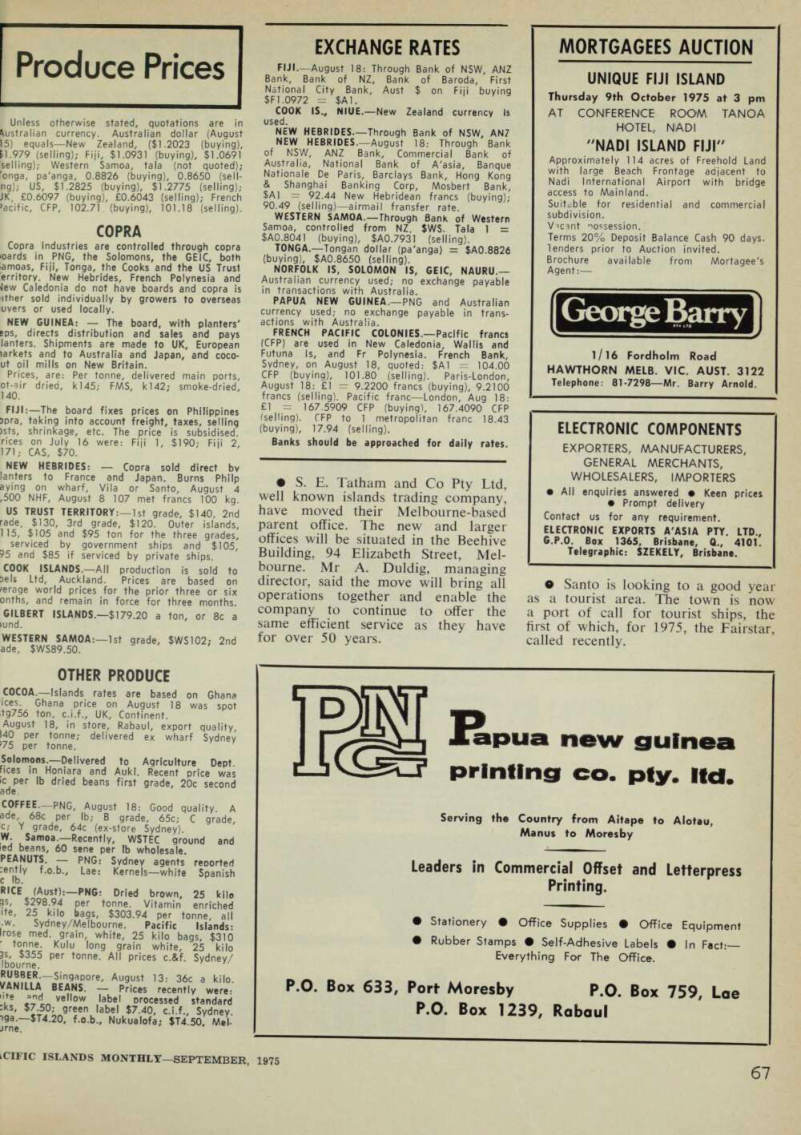
Unless otherwise stated, quotations are in \ustralian currency. Australian dollar (August 15) equals—New Zealand, ($1.2023 (buying), M .979 (selling); Fiji, $1.0931 (buying), $1.0691 selling); Western Samoa, tala (not quoted); tonga, pa'anga, 0.8826 (buying), 0.8650 (sell ng); US, $1.2825 (buying), $1.2775 (selling); JK, £0.6097 (buying), £0.6043 (selling); French *acific, CFP, 102.71 (buying), 101.18 (selling).
Copra
Copra industries are controlled through copra ioards in PNG, the Solomons, the GEIC, both amoas, Fiji, Tonga, the Cooks and the US Trust erritory. New Hebrides, French Polynesia and Jew Caledonia do not have boards and copra is ither sold individually by growers to overseas uyers or used locally.
NEW GUINEA; The board, with planters' Bps, directs distribution and sales and pays lanters. Shipments are made to UK, European larkets and to Australia and Japan, and coco ut oil mills on New Britain.
Prices, are: Per tonne, delivered main ports, ot-air dried, k 145; FMS, k 142; smoke-dried, 140.
FIJI:—The board fixes prices on Philippines 3pra, taking into account freight, taxes, selling )sts, shrinkage, etc. The price is subsidised, rices on July 16 were: Fiji 1, $190; Fiji 2,
171; Cas, $7O.
NEW HEBRIDES: Copra sold direct bv lanters to France and Japan. Burns Philp aying on wharf, Vila or Santo, August 4 ,500 NHF, August 8 107 met francs 100 kg.
US TRUST TERRITORY:—Ist grade, $l4O, 2nd rade, $l3O, 3rd grade, $l2O. Outer islands, 115, $lO5 and $95 ton for the three grades, serviced by government ships and $lO5, 95 and $B5 if serviced by private ships.
COOK ISLANDS.—AII production is sold to Dels Ltd, Auckland. Prices are based on rerage world prices for the prior three or six onths, and remain in force for three months.
GILBERT ISLANDS.—SI79.2O a ton, or 8c a tund.
WESTERN SAMOA;—Ist grade, SWSIO2; 2nd ade, $W589.50.
Other Produce
COCOA.—lslands rates are based on Ghana ices. Ghana price on August 18 was spot tg756 ton, c.i.f., UK, Continent.
August 18, in store, Rabaul, export quality, 140 per tonne; delivered ex wharf Sydney *75 per tonne.
Solomons.—Delivered to Agriculture Dept, rices in Honiara and Auki. Recent price was lc per lb dried beans first grade, 20c second ade.
COFFEE.—PNG, August 18: Good quality. A ade, 68c per lb; B grade, 65c ; C grade, c; Y grade, 64c (ex-store Sydney).
W. Samoa—Recently, WSTEC ground and led beans, 60 sene per lb wholesale.
PEANUTS. PNG: Sydney agents reported -entry t.0.b., Lae: Kernels—white Spanish c lb.
RICE (Aust):—PNG: Dried brown, 25 kilo gs, $298.94 per tonne. Vitamin enriched ite, 25 kilo bags, $303.94 per tonne, all •w. Sydney/Melbourne. Pacific Islands: Irose med. grain, white, 25 kilo bags, $3lO tonne. Kulu long grain white, 25 kilo gs, $355 per tonne. All prices c.&f. Sydney/ Ibourne.
J!l^ B .?. E . R ;~ Singapore ' August 13: 36c a kilo.
VANILLA BEANS. Prices recently were: "i! 6 ve,low , label orocessed standard *V S ?Lv 9r ! en . label $7 - 40 ' Sydney, iga.—sT4.2o, f.0.b., Nukualofa; ST4 50, Mel jrne.
Exchange Rates
FlJl.—August 18: Through Bank of NSW, ANZ Bank, Bank of NZ, Bank of Baroda, First National City Bank, Aust $ on Fiji buying
$F 1.0972 = Sai.
COOK IS., NIUE.—New Zealand currency Is used.
NEW HEBRIDES.—Through Bank of NSW, AN?
NEW HEBRIDES.—August 18: Through Bank of NSW, ANZ Bank, Commercial Bank of Australia, National Bank of A'asia, Banque Nationale De Paris, Barclays Bank, Hong Kong & Shanghai Banking Corp, Mosbert Bank, SAI = 92.44 New Hebridean francs (buying); 90.49 (selling)—airmail fransfer rate.
WESTERN SAMOA.—Through Bank of Western Samoa, controlled from NZ, SWS. Tala 1 = $A0.8041 (buying), $A0.7931 (selling).
TONGA.—Tongan dollar (pa'anga) = $A0.8826 (buying), $A0.8650 (selling).
Norfolk Is, Solomon Is, Geic, Nauru—
Australian currency used; no exchange payable in transactions with Australia.
PAPUA NEW GUINEA.—PNG and Australian currency used; no exchange payable in trans actions with Australia.
FRENCH PACIFIC COLONIES.—Pacific francs (CFP) are used in New Caledonia, Wallis and Futuna Is, and Fr Polynesia. French Bank, Sydney, on August 18, quoted: SAI = 104.00 CFP (buying), 101.80 (selling). Paris-London, August 18: £1 = 9.2200 francs (buying), 9.2100 francs (selling). Pacific franc—London, Aug 18: £1 = 167.5909 CFP (buying), 167.4090 CFP (selling). CFP to 1 metropolitan franc 18.43 (buying), 17.94 (selling).
Banks should be approached for daily rates.
• S. E. Tatham and Co Pty Ltd, well known islands trading company, have moved their Melbourne-based parent office. The new and larger offices will be situated in the Beehive Building, 94 Elizabeth Street, Mel bourne. Mr A. Duldig, managing director, said the move will bring all operations together and enable the company to continue to offer the same efficient service as they have for over 50 years.
• Santo is looking to a good year as a tourist area. The town is now a port of call for tourist ships, the first of which, for 1975, the Fairstar called recently.
Advertisements & other items, pp. 69-70 (2 items)
67
iCIFIC ISLANDS MONTHLY—SEPTEMBER, 1975
George Barry
MORTGAGEES AUCTION
UNIQUE FIJI ISLAND
Thursday 9th October 1975 at 3 pm
AT CONFERENCE ROOM TANOA
HOTEL, NADI
"NADI ISLAND FIJI"
Approximately 114 acres of Freehold Land with large Beach Frontage adjacent to Nadi International Airport with bridge access to Mainland.
Suitable for residential and commercial subdivision.
Vacant possession.
Terms 20% Deposit Balance Cash 90 days, lenders prior to Auction invited.
Brochure available from Mortagee's Agent;—
George Barry
1/ 16 Fordholm Road
HAWTHORN MELB. VIC. AUST. 3122
Telephone: 81-7298 —Mr. Barry Arnold.
ELECTRONIC COMPONENTS
EXPORTERS, MANUFACTURERS,
GENERAL MERCHANTS,
WHOLESALERS, IMPORTERS
• All enquiries answered • Keen prices • Prompt delivery Contact us for any requirement.
ELECTRONIC EXPORTS A'ASIA PTY. LTD.,
G.P.O. Box 1365, Brisbane, Q., 4101.
Telegraphic; SZEKELY, Brisbane.
D apua new guinea
printing co. ply. lid.
Serving the Country from Aitape to Alotau, Manus to Moresby Leaders In Commercial Offset and Letterpress Printing. • Stationery • Office Supplies • Office Equipment • Rubber Stamps • Self-Adhesive Labels • In Fact:— Everything For The Office.
P.O. Box 633, Port Moresby P.O. Box 759, Lae P-0. Box 1239, Rabaul
There's an International Truck
for every application. Yours too
Whatever you carry on or off the highway, we’re certain we’ve got just the truck you need.
Thirty-five basic models include petrol and diesel power, single axle and tandem drive, 4 x 2, 6 x 4 and Bx 4, automatic and manual transmission, conventional cab and cab over.
Two series of truck designs which together comprise these 35 options, make up the International truck range.
ACCO-A Series (cab over) Twenty-three basic models feature a ‘human engineered’ all-steel cab for outstanding driver comfort and safety. It tilts for easy access to the engine, cutting servicing and maintenance delays.
Models cater for a wide range of applications tippers, trays, vans, cement agitators, tankers and semi-trailers. A total of 7 petrol and diesel engines power the range. 0-Line (conventional cab) Twelve basic models including four-wheelurive vehicles for off-highway use. Suited to tray, tippers, vans and as prime movers for semi-trailers.
There’s an International truck to suit almost every practical application. And they’re all backed by reliable after-sales service and parts supply.
For further information contact our authorised distributors—• NGG Trading Co., PO Box 459, Lae, PNG.
Solomon Motors Ltd., PO Box Cl 6, Honiara, Guadalcanal, BSIP.
S.I.F.R.A. BP 806,
Noumea, New Caledonia.
Niranjans Autoport Limited, GPO Box 450, Suva, Fiji.
Kerr Bros Pty. Ltd., PO Box 3838, Sydney, NSW, 2001 Tahiti Produits Shelltex, Boite Postale 350, Papeete, Tahiti.
Pacific Products Inc., ■ PO Box 698, Pago Pago, American Samoa 96920 International Harvester Australia Limited f i
International
Shipping & Airways Information
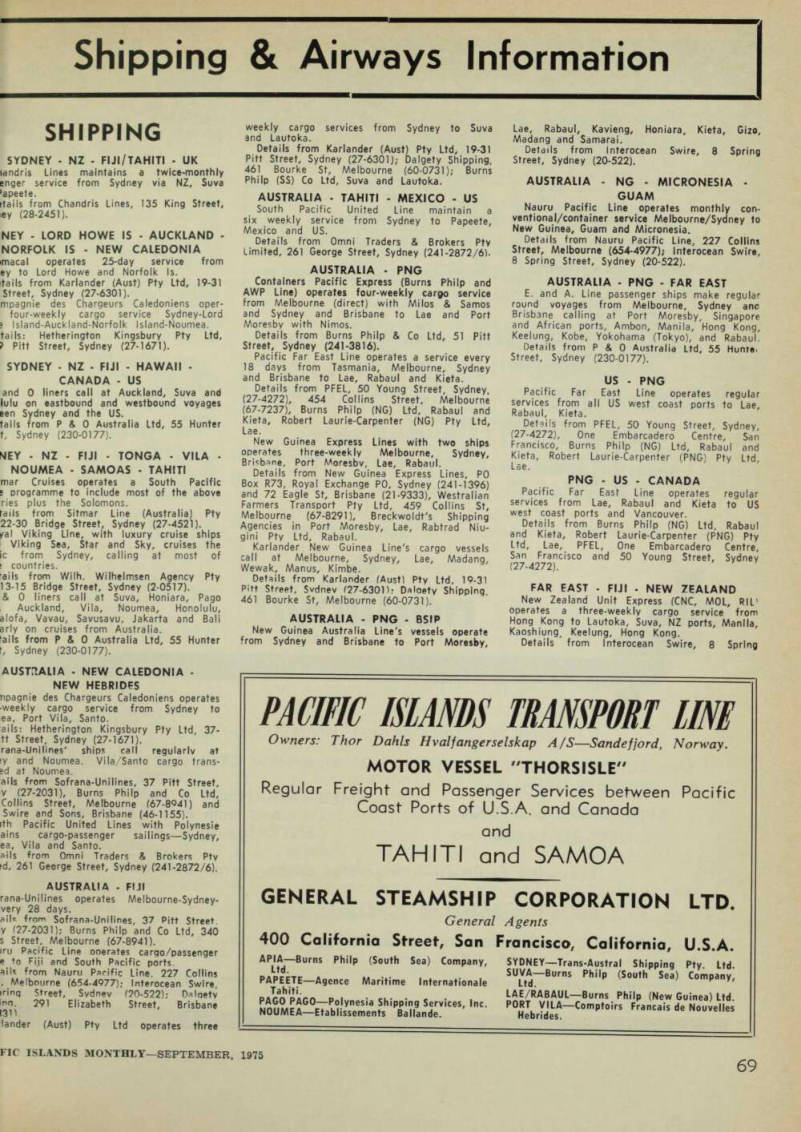
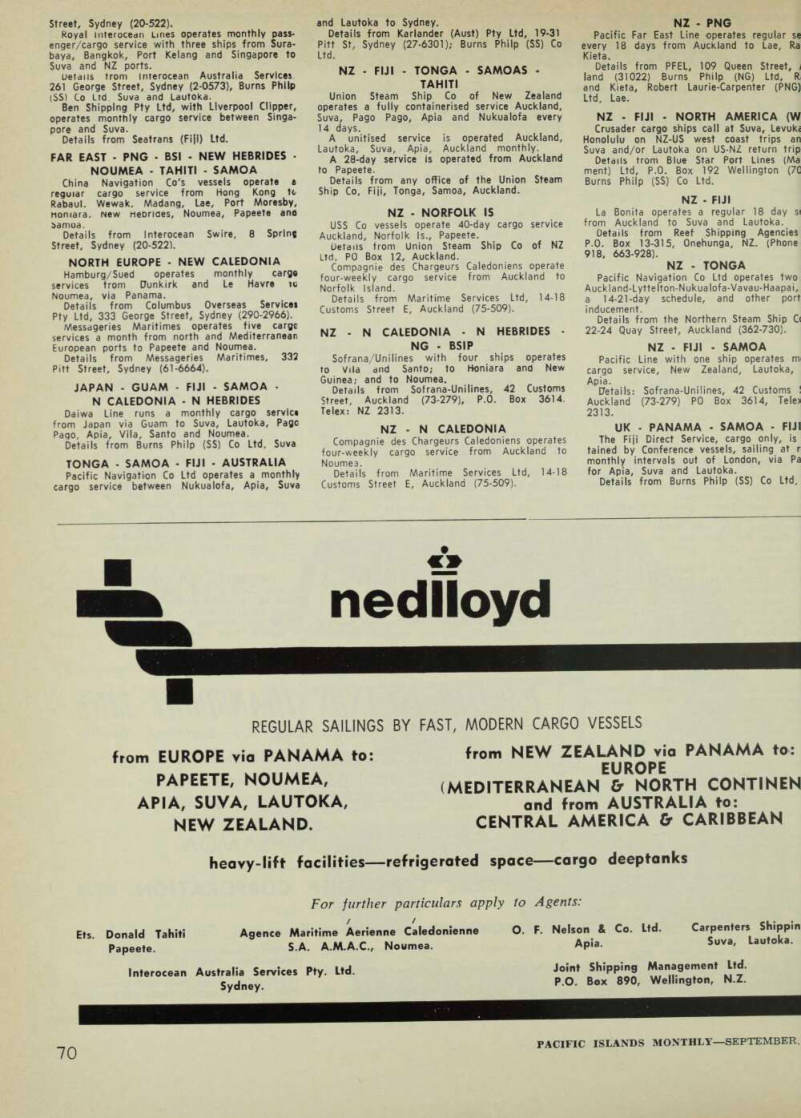
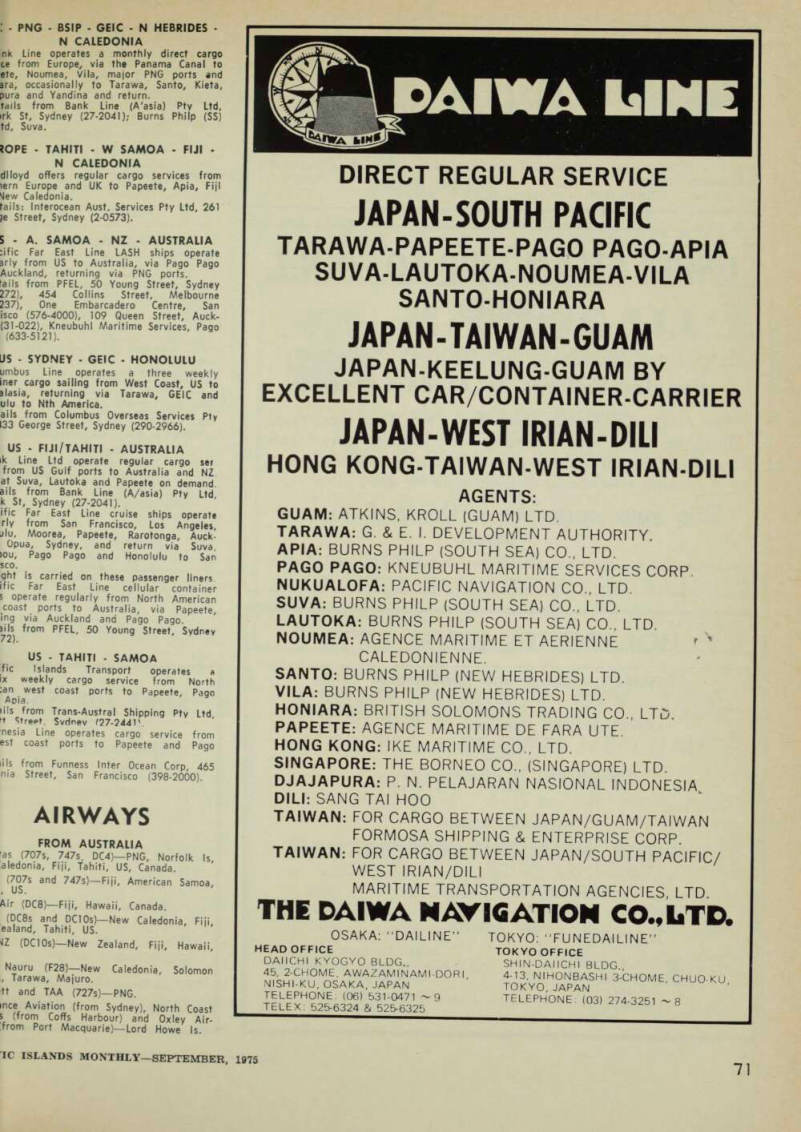
Shipping
SYDNEY - NZ ■ FIJI/TAHITI - UK tandris Lines maintains a twice-monthly enger service from Sydney via NZ, Suva •apeete. ■tails from Chandris Lines, 135 King Street, icy (28-2451).
NEY - LORD HOWE IS • AUCKLAND -
Norfolk Is - New Caledonia
imacal operates 25-day service from ey to Lord Howe and Norfolk Is.
Tails from Karlander (Aust) Pty Ltd, 19-31 Street, Sydney (27-6301). mpagnie des Chargeurs Caledonians oper four-weekly cargo service Sydney-Lord 5 Island-Auckland-Norfolk Island-Noumea. tails: Hetherington Kingsbury Pty Ltd, Pitt Street, Sydney (27-1671).
SYDNEY - NZ ■ FIJI - HAWAII •
Canada - Us
and 0 liners call at Auckland, Suva and lulu on eastbound and westbound voyages een Sydney and the US. tails from P & 0 Australia Ltd, 55 Hunter t, Sydney (230-0177).
NEY - NZ - FIJI - TONGA - VILA •
Noumea - Samoas - Tahiti
mar Cruises operates a South Pacific s programme to include most of the above ries plus the Solomons, rails from Sitmar Line (Australia) Pty 22-30 Bridge Street, Sydney (27-4521). ral Viking Line, with luxury cruise ships Viking Sea, Star and Sky, cruises the ic from Sydney, calling at most of i countries. ails from Wilh. Wilhelmsen Agency Pty 13-15 Bridge Street, Sydney (2-0517). 6 0 liners call at Suva, Honiara, Pago Auckland, Vila, Noumea, Honolulu, alofa, Vavau, Savusavu, Jakarta and Bali arly on cruises from Australia. (ails from P & 0 Australia Ltd, 55 Hunter I, Sydney (230-0177).
Australia - New Caledonia •
New Hebrides
npagnie des Chargeurs Caledoniens operates •weekly cargo service from Sydney to ea. Port Vila, Santo. ails: Hetherington Kingsbury Pty Ltd, 37tt Street, Sydney (27-1671). rana-Unilines' ships call regularly at ;y and Noumea. Vila/Santo cargo trans sd at Noumea. ails from Sofrana-Unilines, 37 Pitt Street, V (27-2031), Burns Philp and Co Ltd, Collins Street, Melbourne (67-8941) and Swire and Sons, Brisbane (46-1155). ith Pacific United Lines with Polynesie ains cargo-passenger sailings—Sydney, ea, Vila and Santo. ails from Omni Traders & Brokers Pty id, 261 George Street, Sydney (241-2872/6).
Australia - Fiji
rana-Unilines operates Melbourne-Sydney very 28 days. ails from Sofrana-Unilines, 37 Pitt Street y (27-2031); Burns Philp and Co Ltd, 340 s Street, Melbourne (67-8941). iru Pacific Line ooerates cargo/passenger e to Fiji and South Pacific ports, ails from Nauru Pacific Line, 227 Collins , Melbourne (654-4977); Interocean Swire, •ring Street, Svdnev (20-522); Dalgety no. 291 Elizabeth Street, Brisbane I3D lander (Aust) Pty Ltd operates three
weekly cargo services from Sydney to Suva and Lautoka.
Details from Karlander (Aust) Pty Ltd, 19-31 Pitt Street, Sydney (27-6301); Dalgety Shipping, 461 Bourke St, Melbourne (60-0731); Burns Philp (SS) Co Ltd, Suva and Lautoka.
AUSTRALIA - TAHITI - MEXICO - US South Pacific United Line maintain a six weekly service from Sydney to Papeete, Mexico and US.
Details from Omni Traders & Brokers Pty Limited, 261 George Street, Sydney (241-2872/6).
Australia - Png
Containers Pacific Express (Burns Philp and AWP Line) operates four-weekly cargo service from Melbourne (direct) with Milos & Samos and Sydney and Brisbane to Lae and Port Moresby with Nimos.
Details from Burns Philp & Co Ltd, 51 Pitt Street, Sydney (241-3816).
Pacific Far East Line operates a service every 18 days from Tasmania, Melbourne, Sydney and Brisbane to Lae, Rabaul and Kieta.
Details from PFEL, 50 Young Street, Sydney. (27-4272), 454 Collins Street, Melbourne (67-7237), Burns Philp (NG) Ltd, Rabaul and Kieta, Robert Laurie-Carpenter (NG) Pty Ltd, Lae.
New Guinea Express Lines with two ships operates three-weekly Melbourne, Sydney, Brisbane, Port Moresby, Lae, Rabaul.
Details from New Guinea Express Lines, PO Box R 73, Royal Exchange PO, Sydney (241-1396) and 72 Eagle St, Brisbane (21-9333), Westralian Farmers Transport Pty Ltd, 459 Collins St, Melbourne (67-8291), Breckwoldt's Shipping Agencies in Port Moresby, Lae, Rabtrad Niu gini Pty Ltd, Rabaul.
Karlander New Guinea Line's cargo vessels call at Melbourne, Sydney, Lae, Madang, Wewak, Manus, Kimbe.
Details from Karlander (Aust) Pty Ltd, 19-31 Pitt Street, Svdnev (27-6301); Dalaety Shipping 461 Bourke St, Melbourne (60-0731).
Australia - Png - Bsip
New Guinea Australia Line's vessels operate from Sydney and Brisbane to Port Moresby,
Lae, Rabaul, Kavieng, Honiara. Kieta, Gizo, Madang and Samarai.
Details from Interocean Swire, 8 Spring Street, Sydney (20-522).
Australia - Ng - Micronesia -
Guam
Nauru Pacific Line operates monthly con ventional/container service Melbourne/Sydney to New Guinea, Guam and Micronesia.
Details from Nauru Pacific Line, 227 Collins Street, Melbourne (654-4977); Interocean Swire, 8 Spring Street, Sydney (20-522).
Australia - Png - Far East
E. and A. Line passenger ships make regular round voyages from Melbourne, Sydney ano Brisbane calling at Port Moresby, Singapore and African ports, Ambon, Manila, Hong Kong, Keelung, Kobe, Yokohama (Tokyo), and Rabaul.
Details from P & 0 Australia Ltd, 55 Hume.
Street, Sydney (230-0177).
Us - Png
Pacific Far East Line operates regular services from all US west coast ports to Lae, Rabaul, Kieta.
Details from PFEL, 50 Young Street, Sydney, (27-4272), One Embarcadero Centre, San Francisco, Burns Philp (NG) Ltd, Rabaul and Kieta, Robert Laurie-Carpenter (PNG) Pty Ltd Lae.
Png - Us - Canada
Pacific Far East Line operates regular services from Lae, Rabaul and Kieta to US west coast ports and Vancouver.
Details from Burns Philp (NG) Ltd, Rabaul and Kieta, Robert Laurie-Carpenter (PNG) Pty Ltd, Lae, PFEL, One Embarcadero Centre, San Francisco and 50 Young Street, Sydney (27-4272).
FAR EAST - FIJI - NEW ZEALAND New Zealand Unit Express (CNC, MOL, RIL' operates a three-weekly cargo service from Hong Kong to Lautoka, Suva, NZ ports, Manila, Kaoshiung, Keelung, Hong Kong.
Details from Interocean Swire, 8 Spring
Street, Sydney (20-522).
Royal interocean Lines operates monthly pass enger/cargo service with three ships from Sura baya, Bangkok, Port Kelang and Singapore to Suva and NZ ports.
Details trom interocean Australia Services 261 George Street, Sydney (2-0573), Burns Philp (SS) Co Ltd Suva and Lautoka.
Ben Shipping Pty Ltd, with Liverpool Clipper, operates monthly cargo service between Singa pore and Suva.
Details from Seatrans (Fiji) Ltd.
FAR EAST - PNG - BSI - NEW HEBRIDES •
Noumea - Tahiti - Samoa
China Navigation Co's vessels operate e regular cargo service from Hong Kong to Rabaul. Wewak, Madang, Lae, Port Moresby, Honiara, New neonoes, Noumea, Papeete ano Samoa.
Details from Interocean Swire, 8 Spring Street, Sydney (20-522).
North Europe ■ New Caledonia
Hamburg/Sued operates monthly cargo services from Dunkirk and Le Havre ic Noumea, via Panama.
Details from Columbus Overseas Service* Pty Ltd, 333 George Street, Sydney (290-2966).
Messageries Maritimes operates five carge services a month from north and Mediterranean European ports to Papeete and Noumea.
Details from Messageries Maritimes, 332 Pitt Street, Sydney (61-6664).
JAPAN - GUAM - FIJI - SAMOA -
N Caledonia - N Hebrides
Daiwa Line runs a monthly cargo servlc* from Japan via Guam to Suva, Lautoka, Pago Pago, Apia, Vila, Santo and Noumea.
Details from Burns Philp (SS) Co Ltd, Suva TONGA - SAMOA - FIJI - AUSTRALIA Pacific Navigation Co Ltd operates a monthly cargo service between Nukualofa, Apia, Suva
and Lautoka to Sydney.
Details from Karlander (Aust) Pty Ltd, 19-31 Pitt St, Sydney (27-6301); Burns Philp (SS) Co Ltd.
NZ - FIJI ■ TONGA - SAMOAS •
Tahiti
Union Steam Ship Co of New Zealand operates a fully containerised service Auckland, Suva, Pago Pago, Apia and Nukualofa every 14 days.
A unitised service is operated Auckland, Lautoka, Suva, Apia, Auckland monthly.
A 28-day service Is operated from Auckland to Papeete.
Details from any office of the Union Steam Ship Co, Fiji, Tonga, Samoa, Auckland,
Nz - Norfolk Is
USS Co vessels operate 40-day cargo service Auckland, Norfolk Is., Papeete.
Details trom Union Steam Ship Co of NZ Ltd, PO Box 12, Auckland.
Compagnie des Chargeurs Caledonians operate four-weekly cargo service from Auckland to Norfolk Island.
Details from Maritime Services Ltd, 14-18 Customs Street E, Auckland (75-509).
NZ - N CALEDONIA - N HEBRIDES •
Ng - Bsip
Sofrana/Unilines with four ships operates to Vila and Santo; to Honiara and New Guinea; and to Noumea.
Details from Sofrana-Unilines, 42 Customs Street, Auckland (73-279), P.O. Box 3614.
Telex: NZ 2313.
Nz - N Caledonia
Compagnie des Chargeurs Caledonians operates four-weekly cargo service from Auckland to Noumea.
Details from Maritime Services Ltd, 14-18 Customs Street E, Auckland (75-509).
Nz - Png
Pacific Far East Line operates regular se every 18 days from Auckland to Lae, Ra Kieta.
Details from PFEL, 109 Queen Street, i land (31022) Burns Philp (NG) Ltd, R, and Kieta, Robert Laurie-Carpenter (PNG) Ltd, Lae.
NZ - FIJI - NORTH AMERICA (W Crusader cargo ships call at Suva, Levuka Honolulu on NZ-US west coast trips an Suva and/or Lautoka on US-NZ return trip; Details trom Blue Star Port Lines (Ma ment) Ltd, P.O. Box 192 Wellington (70 Burns Philp (SS) Co Ltd.
Nz - Fiji
La Bonita operates a regular 18 day se from Auckland to Suva and Lautoka.
Details from Reef Shipping Agencies P.O. Box 13-315, Onehunga, NZ. (Phone 918, 663-928).
Nz - Tonga
Pacific Navigation Co Ltd operates two Auckland-Lyttelton-Nukualofa-Vavau-Haapai, a 14-21-day schedule, and other port inducement.
Details from the Northern Steam Ship Cc 22-24 Quay Street, Auckland (362-730).
Nz ■ Fiji - Samoa
Pacific Line with one ship operates mi cargo service, New Zealand, Lautoka, Apia.
Details: Sofrana-Unilines, 42 Customs 5 Auckland (73-279) PO Box 3614, Telex 2313.
UK - PANAMA - SAMOA - FIJI The Fiji Direct Service, cargo only, is tained by Conference vessels, sailing at r monthly intervals out of London, via Pa for Apia, Suva and Lautoka.
Details from Burns Philp (SS) Co Ltd,
: - PNG - BSIP - GEIC - N HEBRIDES -
N Caledonia
nk Line operates a monthly direct cargo ce from Europe., via the Panama Canal to ete, Noumea, Vila, major PNG ports and ara, occasionally to Tarawa, Santo, Kieta, pura and Yandina and return, tails from Bank Line (A'asia) Pty Ltd, irk St, Sydney (27-2041); Burns Philp (SS) td, Suva. lOPE ■ TAHITI - W SAMOA - FIJI •
N Caledonia
dlloyd offers regular cargo services from tern Europe and UK to Papeete, Apia, Fiji Caledonia. tails: Interocean Aust. Services Pty Ltd, 261 je Street, Sydney (2-0573). 5 - A. SAMOA - NZ - AUSTRALIA :ific Far East Line LASH ships operate srly from US to Australia, via Pago Pago Auckland, returning via PNG ports, fails from PFEL, 50 Young Street, Sydney 272), 454 Collins Street, Melbourne 237), One Embarcadero Centre, San isco (576-4000), 109 Queen Street, Auck (3l-022), Kneubuhl Maritime Services, Pago (633-5121).
JS - SYDNEY - GEIC - HONOLULU umbus Line operates a three weekly iner cargo sailing from West Coast, US to slasia, returning via Tarawa, GEIC and ulu to Nth America. ails from Columbus Overseas Services Pty 133 George Street, Sydney (290-2966).
Us - Fiji/Tahiti - Australia
ik Line Ltd operate regular cargo ser from US Gulf ports to Australia and NZ at Suva, Lautoka and Papeete on demand, ails from Bank Line (A/asia) Pty Ltd k St, Sydney (27-2041). ific Far East Line cruise ships operate rly from San Francisco, Los Angeles jlu. Moorea, Papeete, Rarotonga, Auck- Opua, Sydney, and return via Suva, iou, Pago Pago and Honolulu to San
Sco.
ght is carried on these passenger liners ific Far East Line cellular container s operate regularly from North American coast ports to Australia, via Papeete, ing via Auckland and Pago Pago. »ls from PFEL, 50 Young Street, Sydnev
Us - Tahiti - Samoa
fic Islands Transport operates a ix weekly cargo service from North :an west coast ports to Papeete, Pago Apia. tils from Trans-Austral Shipping Pty Ltd It Street. Svdnev <27-2441V nesia Line operates cargo service from est coast ports to Papeete and Pago iils from Funness Inter Ocean Corp, 465 nia Street, San Francisco (398-2000).
Advertisements & other items, pp. 71-72 (2 items)
69
FIC ISLANDS MONTHLY—SEPTEMBER, 1975
Pacific Isiamds Transport Uni
Owners: Thor Dahls Hvalfangerselskap A/S — Sandefjord, Norway.
MOTOR VESSEL "THORSISLE"
Regular Freight and Passenger Services between Pacific
Coast Ports of U.S.A. and Canada
and
TAHITI and SAMOA
GENERAL STEAMSHIP CORPORATION LTD.
General Agents 400 California Street, San Francisco, California, U.S.A.
APlA—Burns Philp (South Sea) Company, Ltd.
PAPEETE—Agence Maritime Internationale Tahiti.
PAGO PAGO—Polynesia Shipping Services, Inc.
NOUMEA—Etablissements Ballande.
SYDNEY—Trans-Austral Shipping Pty. Ltd.
SUVA Burns Philp (South Sea) Company, Ltd.
LAE/RABAUL—Burns Philp (New Guinea) Ltd.
PORT VlLA—Comptoirs Francais de Nouvelles Hebrides.
nedlloyd
REGULAR SAILINGS BY FAST, MODERN CARGO VESSELS from EUROPE via PANAMA to:
PAPEETE, NOUMEA,
APIA, SUVA, LAUTOKA,
NEW ZEALAND.
from NEW ZEALAND via PANAMA to:
EUROPE
(MEDITERRANEAN & NORTH CONTINEN
and from AUSTRALIA to:
CENTRAL AMERICA & CARIBBEAN
heavy-lift facilities —refrigerated space—cargo deeptanks For further particulars apply to Agents: Ets. Donald Tahiti Agence Maritime Aerienne Caledonienne O, F. Nelson 8 Co. ltd. Carpenters Shippm Papeete. S.A. A.M.A.C., Noumea. Apia. Su.a, lautoka.
Interocean Australia Services Pty. Ltd.
Sydney.
Joint Shipping Management Ltd.
P.O. Box 890, Wellington, N.Z.
Airways
From Australia
(7075, 7475. DC4)—PNG, Norfolk Is, aledonia, Fiji, Tahiti, US, Canada. (707 s and 747 s) —Fiji, American Samoa, Air (DCS) —Fiji, Hawaii, Canada. (DCSs and DClOs) —New Caledonia, Fiji, ealand, Tahiti, US.
JZ (DClOs)—New Zealand, Fiji, Hawaii, Nauru (F2B)—New Caledonia, Solomon , Tarawa, Majuro. tt and TAA (727s)—PNG. mce Aviation (from Sydney), North Coast s (from Coffs Harbour) and Oxley Air from Port Macquarie)—Lord Howe Is.
From New Zealand
Air-NZ (DCBs, DClOs, F27)—Fiji, Ame Samoa, Cook Is, Tahiti, US, New Caled Norfolk Is.
PAA (707 s) —American Samoa.
UTA (DCB)—Tahiti.
PACIFIC ■ FAR EAST - S. AMERIC Air Nauru (F2B) —Nauru to Micron Japan.
Air France (707 s) —Japan to Tahiti, I
Pacific Is ■ Aust
Air Pacific (BAC 111) —From Fiji, via Hebrides or New Caledonia, to Brisbane.
Ansett, TAA (727 s) —From Port Moresb Sydney, via Brisbane.
Pacific Is • Nz
Air Pacific (BAClll)—Fiji-Tonga-NZ.
Inter-Territory
Lan-Chile (707 s) —Easter Is, Tahiti, Fiji.
Air Pacific (BACIII and HS74Bs)—Fij GEIC, Nauru, Western Samoa, Tonga, New rides, Solomon Islands, New Caledonia, Fiji Air Services—Wallis and Futuna (cha Qantas (707 s) —PNG to Singapore.
PAA (707 s) —Hawaii to Am. Samoa and T< US.
UTA (7075, Caravelles) from New Calet to Fiji, New Hebrides, Wallis Is, Tahiti.
Continental-Air Micronesia (7275) Hawaii to Micronesia.
Air Nauru from Nauru to Tarawa, Mar Is and Western Samoa.
Polynesian Airlines from Apia to T( Niue Is, Fiji, Am. Samoa.
Air Tahiti from Tahiti to Cook Is.
Air Niugini to Irian/Jaya, Solomon Is.
Internal
Fiji—Air Pacific (HS74Bs and Trislant Fiji Air Services (Beech Barons and Islam French Polynesia—Air Polynesie (Ft Friendships), Air Tahiti.
US Trust Territory and Guam —Contine Air Micronesia (7275) and Air Pacific Int tional Inc.
GEIC —Air Pacific.
PNG —Air Niugini, Aerial Tours, L Melanesian Airlines, Crowley Airways.
Bougainville—Bougainville Air Services.
New Caledonia —Air Caledinie (Twin Ottt New Hebrides—Air Melanesiae (Islanders; Solomon Is—Solair (Beech Barons Islanders).
Tonga—Tonga Internal Air Service (Islam Cook Is —Cook Island Airways (Islander
Advertisements & other items, pp. 73-74 (2 items)
71
IC ISLANDS MONTHLY—SEPTEMBER, 1975
Japan-South Pacific
DIRECT REGULAR SERVICE
TARAWA-PAPEETE-PAGO PAGO-APIA
SUVA-LAUTOKA-NOUMEA-VILA
SANTO-HONIARA
JAPAN-TAIWAN-GUAM
JAPAIM-KEELUNG-GUAM BY
EXCELLENT CAR/CONTAINER-CARRIER
JAPAN-WEST IRIAN-DILI
HONG KONG-TAIWAN-WEST IRIAN-DILI
GUAM: ATKINS, KROLL (GUAM) LTD.
TARAWA: G. & E. I. DEVELOPMENT AUTHORITY.
APIA: BURNS PHILP (SOUTH SEA) CO.. LTD.
PAGO PAGO: KNEUBUHL MARITIME SERVICES CORP
NUKUALOFA: PACIFIC NAVIGATION CO., LTD.
SUVA: BURNS PHILP (SOUTH SEA) CO., LTD.
LAUTOKA: BURNS PHILP (SOUTH SEA) CO., LTD.
NOUMEA: AGENCE MARITIME ET AERIENNE * s
CALEDONIENNE.
SANTO: BURNS PHILP (NEW HEBRIDES) LTD.
VILA: BURNS PHILP (NEW HEBRIDES) LTD.
HONIARA: BRITISH SOLOMONS TRADING CO., LTD
PAPEETE: AGENCE MARITIME DE FARA UTE.
HONG KONG: IKE MARITIME CO., LTD.
SINGAPORE: THE BORNEO CO., (SINGAPORE) LTD.
DJAJAPURA: P. N. PELAJARAN NASIONAL INDONESIA
DILI: SANG TAI HOO
TAIWAN: FOR CARGO BETWEEN JAPAN/GUAM/TAIWAN
FORMOSA SHIPPING & ENTERPRISE CORP
TAIWAN: FOR CARGO BETWEEN JAPAN/SOUTH PACIFIC/
WEST IRIAN/DILI
MARITIME TRANSPORTATION AGENCIES, LTD.
THE DAIWA NAVIGATION CO., LTD.
AGENTS:
OSAKA: "DAILINE”
TOKYO; “FUNEDAILINE”
HEAD OFFICE
DAIICHI KYOGVO BLDG.,
45, 2-CHOME, AWAZAMINAMI-DORI
NISHI-KU, OSAKA, JAPAN
TELEPHONE: (06) 531-0471 ~9
TELEX: 525-6324 & 525-6325
TOKYO OFFICE
SHIN-DAIICHI BLDG.,
4-13, NIHONBASHi 3-CHOME CHUO-KU
TOKYO, JAPAN
TELEPHONE: (03) 274-3251 ~8
ASK US FOR QUOTATIONS
FROM JAPAN
184 SUSSEX STREET,
(3RD FLOOR),
SYDNEY.
• motor vehicles • automotive parts and accessories • electrical tools • decorative
CABLE ADDRESS:
DEMKAY, SYDNEY.
plywood, etc., etc.
UNION STEAM SHIP CO. of N.Z.
LIMITED
Serving the Pacific for nearly 100 years.
Regular Sailings by Modern Vessels
From Auckland to Lautoka, Suva, Pago Pago, Apia, Niue, Vavau, Nukualofa. Also from Tauranga to Lautoka, Suva, Apia, Nukualofa. Regular sailings from Australia to New Zealand to enable transhipment of cargo to all the above ports.
Ship your cargo by a Union Company Vessel.
BRANCHES AT ALL MAIN AUSTRALIAN, NEW ZEALAND AND ISLAND PORTS.
POLYNESIA LINE, LTD.
Containers, General and Refrigerated Cargo
Express service between US West Coast
and
TAHITI and SAMOA
GENERAL AGENTS;
FURNESS INTEROCEAN CORPORATION
465 California Street, Suite 1001, San Francisco, Ca. 94104 Telephone TWX 910-372-7350 RCA 278-207 CABLE (415) 398-2000 INTEROCEAN INTER UR "INTERCO" —SF
PORT AGENTS
TAHITI
MORGAN-VERNEX
Boite Postale 449 Papeete Telephone: 309 Cables: MOREX
AMERICAN SAMOA
POLYNESIA SHIPPING SERVICES, INC.
Pago Pago.
Telephone: 633-5169 Cables: POLYSHIP
BOAT FOR SALE
Fast motor boat, built in Sing
pore 10 years ago of tea
Copper fastenings. Recent
completely overhauled.
IDA: 37'
BOTH: 10.66'
DPTH; 4.5'
F/CAP: 100 galls.
ENGINES: 2 Ford Thorneycroft Diese dev. 86 bhp each.
SPEED: 13 knots
GROSS TONNAGE: 15.22
FIRST CLASS RUNNING CONDITIO
Sale Price $A12,000.0
Islands People
Deaths of Islands People
Mr C. L. Evans Mr Charles Leopold Evans, of Norfolk Island, died in hospital in lydney on July 22. Mr Evans leaves i widow and five sons and t hree laughters.
Mr F. Muller Mr Frank Muller, a works super isor in the GEIC, died recently at lutaritari. He was 50. He was a reat-great-grandson of a German orn trader who settled in the GEIC lany years ago, and became a trader, le leaves a widow and several chil ren.
Mrs Christian Chatterton The death occurred in Port Mores y on August 13 of Mrs “Chrissie” hatterton, wife of the Rev Percy hatterton, after long illness. She ent to Papua with her husband om England in 1924 and was osely involved with their mission ork until recent years. (A detailed :count of her work will appear in ctober PIM).
Mrs W. Simmonds Mrs Win Simmonds, who lived on orfolk Island for many years, died Auckland on August 3. She and :r husband went to the island from ew Zealand for their honeymoon •out 40 years ago, and decided they Duld like to live there. But they ;re unable to realise their dream 1 about 23 years ago. For part of e time she managed the Leeside opping centre. Mrs Simmonds is rvived by a daughter, Mrs D. iger of Norfolk Island.
Mr N. Takiala, MBE Mr Nason Takiala, MBE, who ;d on August 4 at Rabaul, aged 63, ; nt most of his life serving the lai people. After World War II became a paramount chief, and :n first president of the first local vernment council in the Toma area the Gazelle.
Mrs Kirsty Powell Mrs M. C. (Kirsty) Powell, of Port >resby, author of several articles ich have appeared in PIM, was led in August when her car was in lision with a police car in Port >resby. \ged 39, she was the wife of Keith Powell, a former physician Port Moresby General Hospital, left recently to take another posi
tion in Melbourne and Mrs Powell was planning to join him in a few weeks. She took a great interest in the preservation of Papua New Guinea’s culture and traditions, usually basing her articles on kindred themes. Her last contribution to PIM, a report of the activities of a co operative movement in the Tro briands, appeared in August.
Dr B. Eyres Dr Brian Eyres, the principal medi cal officer in the Solomon Islands, died recently in Britain, aged 47. He went to the Solomons in 1964, and in the next 11 years held a number of senior medical posts in the govern ment service.
Inspector U. Taupaki
Inspector Uikilifi Taupaki, officer in charge of the security branch of the Tonga Police Department, died suddenly on July 9 at the Police Training School. He was in the de partment for 27 years. His promotion to inspector coincided with the intro duction of the security branch, of which he was the first head.
Mr Len Christian Mr Len Christian, formerly of Norfolk Island, died in Auckland on July 21. He was the son of Len and the late Anna Christian, of Norfolk Island. He left a widow and three children.
Ratu Inoke Mara Ratu Inoke Mara, a high chief of Tailevu, Fiji, died in July. He was the Roko Tui Namata. Ratu Inoke is survived by his wife and 11 children.
Dr W. H. McDonald Dr William Hector McDonald, wellknown South Pacific medical officer, died in his native New Zea land on August 2, aged 63.
He joined the British Colonial Service in 1946, and after a period in the Solomons, he went to Fiji as medical superintendent of the Mako gai Leprosy Hospital, where he did some fine work. Dr McDonald rose to become Deputy Director of Medi cal Services in Fiji, and occasionally acted as DMS there, and as Inspector- General, South Pacific Health Ser vices.
He retired to NZ in 1961, and while a member of the Auckland Hospital Board staff he was seconded to Niue Island as Director of Health. He later returned to Fiji as external examiner in preventive medicine at the Medical School. He had only re cently spent six months in Western Samoa as Director of Health. Dr McDonald leaves a widow and a son.
Advertisements & other items, pp. 75-76 (2 items)
73
’IFIC ISLANDS MONTHLY—SEPTEMBER, 1975
Henry Cumines Pty. Ltd.
£5
SOUTHERN PACIFIC INSURANCE
COMPANY (PNG) LIMITED
(INCORPORATED IN PAPUA NEW GUINEA)
HEAD OFFICE: BANK HAUS, CHAMPION PDE. P.O. BOX 136 PORT MORESBY, PAPUA NEW GUINEA. PH. 2623 • FIRE • FIRE AND VOLCANIC ERUPTION • HOUSEHOLD COMPREHENSIVE • MOTOR VEHICLE • COMPULSORY THIRD PARTY • COMPULSORY WORKERS COMPENSATION
MARINE • PUBLIC LIABILITY • BURGLARY
Enquiries are invited for all classes of insurance from special representatives at: PORT MORESBY: H. A. McKEE, General Manager, Champion Pde., P.O. Box 136, Ph. 2623 or 2075. LAE; R. H. MYER, Manager for Lae, Central Ave., P.O. Box 758, Ph. 42-4590 or 42-4256. RABAUL: K. J. ARMSTRONG, Manager for Rabaul, Mango Ave., P.O. Box 123, Ph. 92-2417 or 92-2755.
McDOUGALL'S
EDMONTON: MOSSMAN, NTH. QLD.,
AUSTRALIA.
★ FORD TRACTORS & BLUE LINE MACHINERY ★ FORD INDUSTRIAL ENGINES MARINE AND PARTS ★ FORD PARTS DISTRIBUTORS FOR NORTH QUEENSLAND
★ BOSTROM SEAT DISTRIBUTORS
★ AGRICULTURAL COIL TYNES & POINTS
★ WIDE RANGE OF USED TRACTOR WRECKED SPARE
PARTS
★ HOLDER INTER-ROW TRACTORS
NORTH QUEENSLAND'S LARGEST USED TRACTOR DEALERS
HEAD OFFICE:
BOX 60, EDMONDTON, 4869. MOSSMAN
PHONE: 55-4303. TELEX: 70826. 205.
HENRY CUMINES PTY. LTD.
EXPORTERS • GENERAL MERCHANTS
428 GEORGE ST., SYDNEY
CABLES: HENCO SYDNEY. G.P.O. Box 3949. PHONE: 25-3383.
For specialised and personalised buying service throughout the Pacific Islands and the East.
Local enquiries to our agents: PORT MORESBY: Agencies Pacific Pty Ltd, Box 5044, P. 0., Boroko, Port Moresby. Telephone 55261.
MADANG: W. Double, P.O. Box 22, Madang. Telephone 2696.
Resident Agents in other FIJI: K. Witherington Ltd, P.O. 293, Suva. Telephone 22-356.
NEW HEBRIDES: John Lum & Associates, Box 65, P. 0., Santo. Telephone 329.
LAE: Osborne Agencies, P.O. Box 8, Lae.
Pacific Territories.
Line Advertisements
Per line, $2.50 Aust.
Minimum rate, 4 lines.
If you have shells to sell —any quantity —contact Anisa Commodity Traders Pty.
Ltd., P.O. Box 1413, Lae, Papua New Guinea, Phone 424159. We are buyers of Trochus, Greensnail, Blacklip MOP, Goldlip MOP, and Marine Specimens. Best prices paid. Rabaul agents: Gazelle Agencies Pty. Ltd., P.O. Box 262, Rabaul, P.N.G. Phone: 921397. Manus Island Agents, R. L. & V. J. Knight, P.O. Box 108, Lorengau, Manus Island, P.N.G.
Phone: 38.
KIKUYU GRASS CERTIFIED SEED for
sale A 53.00 per lb. For supplies and Information about this highly nutritious and abundantly productive grazing grass write to ROY EYKAMP, Quirindi, N.S.W., Australia, 2343. Phone Quipolly, 466541.
CONCRETE BLOCK MACHINES. Makes
blocks, flags, edgings, screen-blocks, garden stools —up to 8 at once and 96 an hour. $179.00 c.i.f. main ports. Send for leaflets. Forest Farm Research, Londonderry, N.S.W., 2753.
SEASHELL COLLECTORS WANTED, from
all Pacific Island areas. Top prices paid.
For information write in strictest confidence to, K. D. Weston, P.O. Box 760, Gladstone, Qld., Australia 4680.
YACHTING HOLIDAY
FEMALE, MALE CREW REQUIRED for
cruise on 65 ft twin diesel motor yacht from Mediterranian to Tahiti via India- Australia, March to October 1976. All expenses paid. K. L. Meyer, Fuente de San Angel 35, Mexico 10, D.F. Mexico.
RONSON Razors, Lighters, ESCORT Hairdryers. Export all lines/or Single Pee.
Write: K.O.V. Corp., GPO 15986, Hong Hong.
BOATS—Easy build kits for dinghies, sailboats, canoes etc. Send for brochure, Blockey, the Boatbuilder 448 Chapel St, Sth. Yarra 3141 Australia.
KEEPING BABY
HAPPY & WELL -
By giving your baby a Fisher's Teething Powder as needed, you not only keep the little one happy and well, but save yourself all those upsets and nervous tension that beset a mother when baby suffers distress. If used as directed Fisher's Teething Powders quickly and safely soothe baby's sore gums, digestive disorders and intestinal upsets. Get a packet from your chemist or store today —you'll be so glad you did. Fisher & Co., Manufacturing Chemists (Est. 1876) 17 May St., St. Peters, N.S.W. 2044.
PMBOB/72
People
• Sir Michael Gass, former Higl Commissioner for the Western Pacific is expected to marry soon. His en gagement to Miss Elizabeth Acland Hood, a diplomatic corps worker ii London, was announced recently. • Mr Lilomaiava Niko, 50, ha been appointed Chief Justice c Western Samoa, suceeding Mr Justic Donne who is now Chief Judge c the High Court in the Cook Island: Mr Niko represented the territorij constituency of Faasaleleaga No in the Western Samoa Parliament. • Mr L. W. Robertson, who lei Invercargill, New Zealand’s mo: southerly city, for Tonga, in 1941 to escape a winter, retired recentl from the Tonga civil service. He we Accountant-General when he retire< a post he held for 23 years. He an his wife (nee Jean Riechelmann played a full part in sport in Tong; Mr Robertson was prominent i rugby and athletics administrate while his wife represented Tonga i the 1963 South Pacific Games i tennis and table tennis. For a lot time she was popular “mine hostes: at Beach House, Nukualofa. The will live in Auckland. • Mr M. Edward Rowlands, pr viously UK Parliamentary Unde Secretary of State for Wales, has bee appointed Minister of State, r sponsible for New Hebrides affair He took over this responsibility froi Miss Joan Lestor, who has left tl Foreign and Commonwealth Offi< to become Parliamentary Unde Secretary of State in the Ministry < Education. Miss Lestor visited tl New Hebrides earlier this year wii her French counterpart, Mr Olivii Stirn. • Dr Aiono Fanaafi Larkin again a director of education Western Samoa —this time for tl Congregational Christian Church Samoa. She was recently dismiss* from her post as Director of Educ tion for the Western Samoa Cover ment, for an alleged “adulterous ass ciation”. She has appealed to tl Supreme Court against this dismiss: The education committee of tl CCCS asked her to take up her ne post. Included in the committe* invitation was a request that in 19' she become principal of Malauf< High School.
Advertisements & other items, pp. 77-80 (3 items)
Ic Islands Monthly—September, 1975
Klinkii Ply
EY2 if/ Silos
GRATES Aty o
-V ases
XFURN, ru*I
o v
KLINKII PLY
Made by Commonwealth N.G. Timbers Ltd and available from leading plywood suppliers offers the widest range of plywood products specifically designed for hot and humid conditions. Interior, exterior and marine grades; weather-resistant and insect-proofed products, and Placarol doors; all provide high tensile strength for light weight, smooth face, straight even grain without core voids.
TIMELY PACIFIC READING!
Specially selected titles from
ssjssa
m m
PAPUA NEW GUINEA
HANDBOOK
7th edition
This new edition of the Papua New Guinea Handbook —completely revised and reset —provides the first full upto-date details of the -new self-governing nation.
For businessmen, travellers, schools, universities and libraries, government departments, tourists and Papua New Guinea residents, this timely, up-to-the-minute edition, is essential.
A large attractive fold-out map of Papua New Guinea is also included. 332 pages of text.
PRICE: Australia, $5.50 plus 85c posted. Pacific Islands and Overseas, $5.50 Aust., plus $l.lO posted; U.S.A., $9.80 U.S. posted.
Percy Chatterton's Papua
DAY THAT I HAVE LOVED.
This is more than an autobiography by well-known Percy Chatterton, OBE, who has spent 50 years in Papua as missionary, teacher and outspoken politician fighting for the underdog. It is a colourful, and charming, account of the Papuan people, giving warm insight into their hopes, fears and changing way of life. Some Papuan leaders say they don't want Papua to be submerged by New Guinea in the move towards independence, and readers of Percy Chatterton's timely book will readily sympathise with their desire to retain their identity. The book is illus+rated with evocative pen sketches by Percy Chatterton's longtime friend and neighbour in Port Moresby, Rev. Bert Brown. 144 pages, illustrated.
PRICE: Australia, Pacific Islands and Overseas, $5.25 Aust., plus 50c posted; U.S.A., $8.30 U.S. posted.
I
HOLY TORTURE IN FIJI
Written by a group of academic participants and observers.
Editing and commentary by Prof. Ron Crocombe.
This book describes sacred ancient rituals involving physical ordeals which are performed once a year at certain Hindu temples in Fiji. The rituals include walking on fire, dancing on upturned knife-blades, whipping, plunging the hands in burning fat and piercing the body with steel skewers and silver wires.
Yet those who go through the ordeals suffer no pain, burns or injuries.
The book is beautifully produced in full colour and black-and-white.
PRICE: Australia, Pacific Islands and Overseas, $3.95 Aust., plus 50c posted; U.S.A., $6.40 U.S. posted.
THE STORY OF THE
SOLOMONS Charles E. Fox
“Refreshingly frank . .
“Admirably simple and lucid . . .”
“A rare blend of objectivity and affection .
That is what some of the critics have said about this unusual book which outlines the history of the Solomon Islands from the point of view of the people who live there.
The Reverend C. E. Fox, CBE, MA, LittD, spent more than 70 years in the Pacific Islands, 65 of them in the Solomon Islands, and no person is better qualified to write of the Solomons and the Solomon Islanders. Dr Fox is now living in retirement in New Zealand. 88 pages.
PRICE: Australia, Pacific Islands and Overseas, $2.50 Aust. plus 35c posted; U.S.A., $3.75 U.S. posted. *
Pacific Publications (Aust.) Pty. Ltd.
29 Alberta Street, Sydney, N.S.W. 2000 (Postal Address: Box 3408, G.P.0., Sydney, N.S.W. 2001.)
Performance
You Enjoy Liriny With.
Honda is a true life drama, performed on the world’s stage. By average folks, teenagers, men, and women everywhere. Your neighbors, maybe even you are playing a part. If so, you know Honda is more than great machines.
It s people concerned with taking people where they want to go in life.
On two wheels, we’re the best selling motorcycle. The easy to operate hard workers who don’t demand much. Honda is always ready and gets you there safely. We move on four wheels. The precedent setting Honda Civic continues to receive international economy and performance awards. If s the elegant compact car.
Sometimes, we have no wheels. Honda portable power operates machinery, generates electricity, pumps water and tills the soil.
Little wonder good things happen on Honda -we work harder to assure they do. f9\ nc ; wMiouL World s Largest Motorcycle Manufacturer
HONDA MOTOR CO., LTD. TOKYO. JAPAN
VBKf httiM OMtki/l COAOA
mMMMjLUII AO 'TmjUjcJl pUMJck^?
% Mr. Chau Jin Man, motor mechanic
j A4y, VcHaua^-^aphjyvtd ~to
hcAOWj£tlijiA^/iMJ^^
Miss Diane Frogia, teacher.
BBHHi
A 7 -J,- - / 4 ' r ' ■V
uttkc Sa^Mi.
Vv V ■* **® I / is. II ■ ■m M
Your Datsun. Your special island.
Once it has found you, it'll never let you go.
Where else can you find such
economical, worry-free
motoring? Little wonder Datsuns are enjoyed in Tahiti—and in 130 other nations! In a series of on-thespot global interviews, Nissan Motor representatives met many owners and asked them for a frank assessment of their Datsuns. Answers were surprisingly similar, despite the very different circumstances in which the Datsuns were used.
The Datsun, they told us. is economical, reliable, durable, comfortable.
Fun to own.
Again and again.
DATSUN
Product of NISSAN DATSUN distributor network covers the following areas: Fiji -T P N.G.- W. Samoa -New Caledonia -New Hebrides -B.S J.P. .Timor-Norfo k ls,.
A tim.i .Tahiti. Cook Is. .Nauru .Tonga. Saipan .Guam .Australia .New Zealand