Pacific Islands Monthly


News Magazine Of The South Pacific
August 1975
AUSTRALIA, N.Z, P.N.G, FIJI, N HEBRIDES, TONGA 75c W. SAMOA, G.E.I.C, COOKS, NORFOLK, NIUE, NAURU 75c
Solomons 85C
Am. Samoa, Hawaii, Micronesia, Guam $1.25
New Caledonia And French Polynesia Cfpi2S
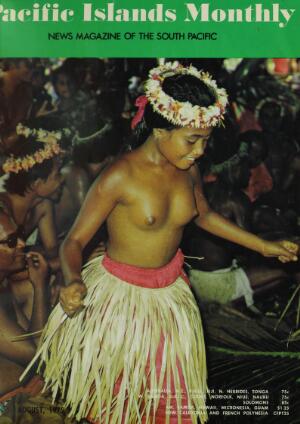
Our Cover
An exciting moment captured by Jon Anderson at Ponape in the Carolines—during the sakau (kava) ceremony, a young girl jumps to her feet suddenly in a spontaneous, free-form dance to the intoxi cating rhythm of the pounding stones.
Advertisements & other items, pp. 2-4 (1 item)
shouldn’t be cheap.
An economy car
TOYOTA COROLLA
We put more than economy into a Toyota.
We build them to be comfortable. We build them to be safe.
And we build them very carefully... so that they*!! last.
Before you buy your next car, check with your Toyota dealer. He has a lot of economical models to choose from.
But no cheap ones.
X •A* •ii*
TOYOTA 1000 TOYOTA CORONA TOYOTA CELICA
TOYOTA MARK II
TOYOTA
PAPUA, NEW GUINEA: ELA MOTORS LIMITED. Scratchley Rd„ Bad.li, Papua. U.S. TRUST TERRITORY: MICROL CORPORATION, P O Box 267, Saipan FIJI ISLANDS: AUTOMOTIVE SUPPLIES CO LTD GP O Box 355 Suva AMERICAN SAMOA: BURNS PHILP (SOUTH SEA) CO., LTD , Pago Pago. WESTERN SAMOA: BURNS PHILP (SOUTH SEA) LTD ,P 0 Box 188, Apia GUAM RICKY’S AUTO CO P O Box 1458 Agana. NEW HEBRIDES: NEW HEBRIDES MOTORS LTD., P O Box 18. Vila. SOLOMON ISLANDS: MENDANA ENTERPRISES (S I I, LTD , PO Box 174, Honiara TAHITI: NIPPON AUTOMOTO, B P 545. Papeete COOK ISLANDS: COOK ISLANDS TRADING CORPORATION LTD , PO Box 92, Rarotonga. NAURU ISLAND: NAURU COOPERATIVE SOCIETY GILBERT & ELLICE ISLANDS COLONY: TARAWA MOTORS, Box 36, Bairlki Tarawa NORFOLK ISLAND: MARIE’S NORFOLK TOURS, LTD . P O, Box 276 TIMOR: SANG TAI HOO, Sang Ta, Building, Dili NEW CALEDONIA: SOCIETE IMPORTATION AUTOMOBILE DU PACIFIQUE, Rond-Pomt du Pacific (Station Total) BP 438. Noumea
Invest in precious metals.
Of the eight precious metals, it takes four to make a Parker 75 pen. The silver, gold, platinum and ruthenium aren’t there just for show. They make it work better. And they make it a gift to treasure. What you :ould call a lifetime investment.
Sterling silver gives the :ase heft and balance.
We use our own special alloy of 14ct gold for the nib, because few other metals resist ink corrosion as well, and still provide such responsiveness as you write.
For the tip that touches the paper, we developed an alloy of platinum and ruthenium that resists wear so well, we don’t know how long a tip will last.
It's even more exceptional.
The nib can turn 360° to write at the angle most natural to you.
Quite an investment, the sterling silver Parker 75.
There's a nylon nib version and matching ball pen or pencil.
Also rolled gold or Vermeil, which is 14ct gold on silver.
The distinctive arrow clip identifies every Parker model.
tPARKER
World's most wanted pens
QUALIFY FOR A
SUCCESSFUL CAREER
IN BUSINESS AND THE PROFESSIONS
375,000 EXAM SUCCESSES
Whichever you want - rapid promotion in your present job, a
bigger opportunity with another
company or an independent career of your own - a
Metropolitan College home study
training, direct from the U.K., is the shortest route to your goal. A fast, world-wide airmail service brings expert tuition direct to your home and we guarantee coaching until successful. Find out how you can reap high rewards in money and prestige.
Get the facts now, by sending for your free copy of 'GUIDE TO
CAREERS'.
To The Prinicipal B. Mendes, B.Sc. Econ., F.C.A.,
METROPOLITAN COLLEGE, DEPT. WTBI
ALDERMASTON COURT, READING, RG7 4PW. ENGLAND
Accredited by the Council for the Accreditation of Correspondence Colleges Accountancy Costing • Company Sec.
Pitmanscript Law • Banking Marketing Hotel 8- Catering Insurance • Export Commerce External Degrees of London University: (B.Sc.Econ. LL.B.) Royal Society of Arts London Chamber of Commerce Cambridge Overseas Certificate GCE 'O' 8 'A' Level over 8,000 Successes
POST COUPON NOW FOR FREE GUIDE
//a*.
Metropolitan
College J
NAME
BLOCK CAPITALS
ADDRESS
METROPOLITAN COLLEGE,
WTBI ALDERMASTON COURT, READING, RG7 4PW, ENGLAND y
Pacific Islands
Monthly
FOUNDED BY R. W. ROBSON IN 1930
Published Monthly By
Pacific Publications (Aust.) Pty. Ltd.,
29 Alberta St., Sydney, N.S.W., 2000.
Postal Address: G.P.O. BOX 3408, SYDNEY,
N.S.W., 2001.
Telegraphic Address: PACPUB, Sydney.
Telex 25168.
Telephones: 61-9197, 61-7101, 61-4369.
Consulting Directors: R. W. Robson, Judy Tudor.
Director of Advertising: Alan Batt.
Manager: Selwyn Hughes.
Publisher: Stuart Inder.
Pacific Islands Monthly
Editor: Stuart Inder.
Assistant Editor: John Carter.
Subscription Rates:
"Pacific Islands Monthly" is airfreighted to th( majority of subscribers and agents in the Pacific Islands and the U.S.A.; copies to the Cool Islands, Nauru, Niue, Micronesia and Guarr go by surface mail.
Australia (including Lord Howe and Thursday Islands), New Zealand, Papua New Guinea, Fiji New Hebrides, Tonga, Cook Islands, Westeri Samoa, Gilbert & Ellice Islands. Norfolk Island Niue and Nauru: $9.00 (local currency) Solomon Islands: $lO.OO Aust,, Americai Samoa, Micronesia and Guam: $12.00 US Hawaii and US Mainland: $15.00 US; Nev Caledonia and French Polynesia: 1,500 CFP United Kingdom: £6.50; Japan: 4,000 Yen Elsewhere $11.50 Aust.
Representatives
Fiji: Advertising and Distribution —Fiji Times i Herald Ltd. 20 Gordon St., Suva. Telephone 25-601. Telex.: FJ 2124.
Papua New Guinea: PORT MORESBY, PNG Print ing Co. Pty. Ltd., P.O. Box 633; LAE, P.O. Boj 227; RABAUL, Mr. David Simpson, P.O. Box (c/- Rabaul Photographic. Tel.; 2677.) French Polynesia. Distribution —Hachette Pad fique, 10 Ave Bruat, Papeete.
New Zealand: Pacific Publications, C.P.O Box 2229, Auckland.
United Kingdom: Advertising—Overseas Publicity Ltd., 214 Oxford Street, London, WIN OEA Phone: 01-636 8296/7. Subscriptions— T. B Graham, Park House, 22 Park Street, Croydon
Cr9 3Np. Tel.; 01-6884177.
Japan: Advertising—Universal Media Corpora tion, C.P.O. Box 46, Tokyo. Tel.: 666-3036.
Victoria: Advertising Pacific Publication: (Aust.) Pty. Ltd., Herald & Weekly Time Building, 2nd Floor, 61 Flinders Lane, Mel bourne, 3000. Telephone: 652-1565.
Hawaii and U.S. Mainland only: N. Grogan 3354 Hayden Street, Honolulu, 96815. (Send change of address notices, Form 35£ and new subscriptions to P.O. Box 2193 Honolulu, Hawaii, U.S.A. 96805).
Second class postage paid at Honolulu, Hawaii
Copyright ©, 1975,
Pacific Publications (Aust) Pty. Ltd.
Vol. 46, No. 8 August, 1975
In This Issue
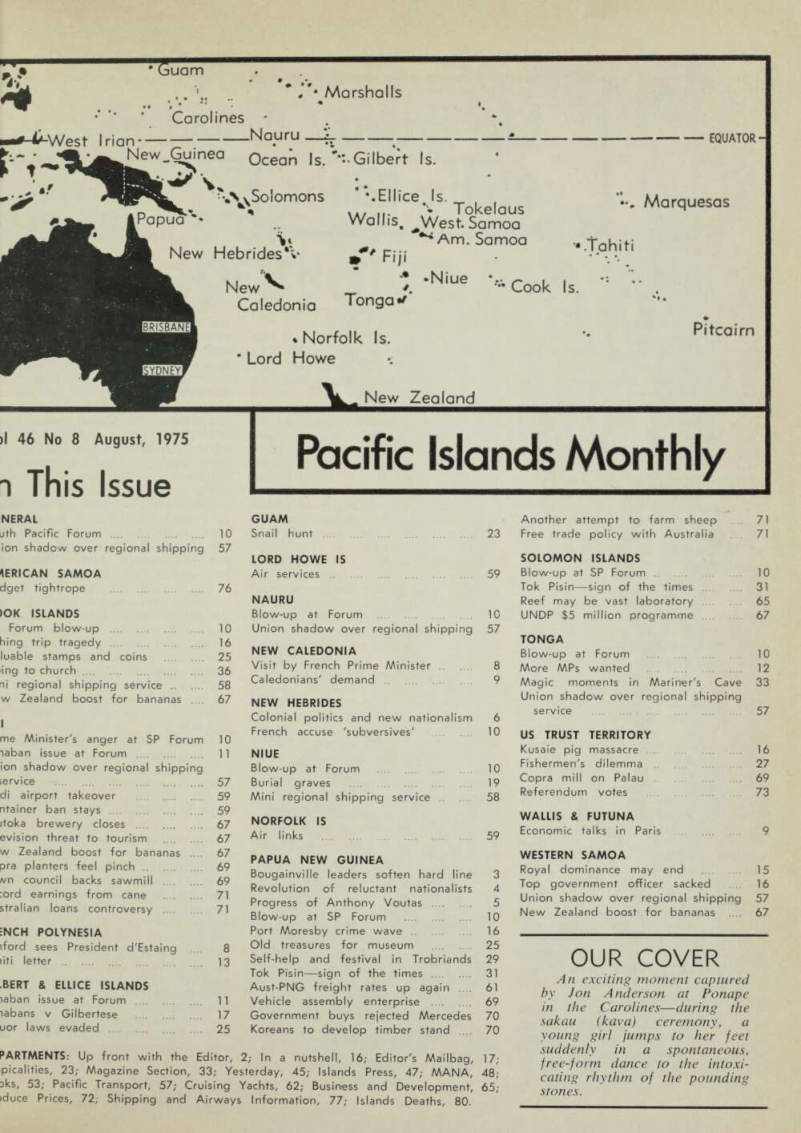
Neral
jth Pacific Forum 10 ion shadow over regional shipping 57
African Samoa
dget tightrope 76
>Ok Islands
Forum blow-up 10 King trip tragedy 16 luable stamps and coins 25 ing to church 36 ni regional shipping service 58 w Zealand boost tor bananas ... 67 I me Minister's anger at SP Forum 10 laban issue at Forum 11 ion shadow over regional shipping iervice ... 57 di airport takeover 59 ntainer ban stays 59 itoka brewery closes 67 evision threat to tourism 67 w Zealand boost for bananas ... 67 pra planters feel pinch 69 vn council backs sawmill 69 :ord earnings from cane 71 stralian loans controversy 71
Inch Polynesia
iford sees President d'Estaing ... 8 liti letter 13
Bert & Ellice Islands
laban issue at Forum 11 labans v Gilbertese 17 uor laws evaded 25
Guam
Snail hunt 23
Lord Howe Is
Air services 59
Nauru
Blow-up at Forum 10 Union shadow over regional shipping 57
New Caledonia
Visit by French Prime Minister 8 Caledonians' demand 9
New Hebrides
Colonial politics and new nationalism 6 French accuse 'subversives' 10
Niue
Blow-up at Forum 10 Burial graves 19 Mini regional shipping service 58
Norfolk Is
Air links 59
Papua New Guinea
Bougainville leaders soften hard line 3 Revolution of reluctant nationalists 4 Progress of Anthony Voutas 5 Blow-up at SP Forum 10 Port Moresby crime wave 16 Old treasures for museum ... ... 25 Self-help and festival in Trobriands 29 Tok Pisin —sign of the times 31 Aust-PNG freight rates up again ... 61 Vehicle assembly enterprise 69 Government buys rejected Mercedes 70 Koreans to develop timber stand ... 70
Another attempt to farm sheep 71 Free trade policy with Australia 71
Solomon Islands
Blow-up at SR Forum 10 Tok Pisin—sign of the times 31 Reef may be vast laboratory 65 UNDP $5 million programme 67
Tonga
Blow-up at Forum 10 More MPs wanted 12 Magic moments in Mariner's Cave 33 Union shadow over regional shipping service 57
Us Trust Territory
Kusaie pig massacre ... 16 Fishermen's dilemma 27 Copra mill on Palau 69 Referendum votes 73
Wallis & Futuna
Economic talks in Paris 9
Western Samoa
Royal dominance may end 15 Top government officer sacked 16 Union shadow over regional shipping 57 New Zealand boost for bananas ... 67
PARTMENTS: Up front with the Editor, 2; In a nutshell, 16; Editor's Mailbag, 17; picalities, 23; Magazine Section, 33; Yesterday, 45; Islands Press, 47; MANA, 48; sks, 53; Pacific Transport, 57; Cruising Yachts, 62; Business and Development, 65; iduce Prices, 72; Shipping and Airways Information, 77; Islands Deaths, 80.
Up Front
with the Editor
-1 SHARE Patricia Matheson’s excite ment at having finally, and un expectedly, satisfied her desire to enter Mariner’s Cave, which she re cords so evocatively on p 33 of this issue.
Living on the threshold of the South Pacific’s most celebrated under water cave, as Pat does, and with her sense of history and her inquiring mind, the fact that the cave was ap parently to be denied to her for ever, was I suspect, even a greater dis appointment than she admits. Thus success was all the sweeter.
I suppose it is 20 years since I first read the story of Mariner’s Cave, and having been fascinated by it, wanted badly, like Pat, to enter it. I often talked about it, and planned it but got no opportunity until last year.
The story of the cave was given to the outside world in 1817 by young William Mariner, the ship’s boy who was befriended by a Tongan chief after the English privateer Port au Prince was attacked by the Tongans in the Ha’apai group in 1806, and most of her crew killed. Mariner lived among the Tongans for several years before he got back to England and published his fascinating account of life there, with the help of Dr John Martin, in a book called An Account of the Natives of the Tongan Islands.
Mariner’s Tonga, as that book is best known, tells how young Mariner was taken by his friends one day to an island in Vavau Harbour, only a few miles from where Pat Matheson has now lived for a major part of her life.
His friends plunged into the sea and disappeared beneath the surface, leaving Mariner perplexed. Later one of them bobbed up again, and initiated Mariner into the secret of the cavern in the island, reached through a submarine passage in the cliff, the entrance to which is also always underwater.
After Mariner’s book was pub lished, Byron enshrined the cave in a famous poem; author/artist Robert Gibbings told the story many years later in 23 beautiful engravings in
his True Tale of Love in Tonga: and there have been numbers of references in other literature.
Basil Thomson, in his Savage Island (published in 1902, about Niue not Tonga, and the Niueans don’t like the title any more than the Tongans would have), tells how a midshipman in RN Calliope in 1852 was sent to investigate the cave by his captain, as being the strongest swimmer in the ship, and scratched his back so severely while coming out again that he was off duty for two months.
An engraving of the inside of the cave was later reported to have been made in Sydney from a sketch done by that midshipman in 1852, but I have never seen it. PIM published a photograph of the inside of the cave in June, 1968, taken by Ann and Marvin Glenn, of the trimaran Rebel. •Easily the most distinguished visitor to the underwater cave has been King Taufa’ahau of Tonga him self, who went in with Luis Marden of the National Geographic, using Scuba gear.
There has always been confusion as to the size of the cave and its entrance, and as far as I know no body has made any specific measure ments. From my own visit to it last year I would estimate that the sub marine passage is about 18 ft in length, with nasty rock overhangs in both cave and harbour sides; and that the main chamber is egg-shaped, about 70 ft in height from the sur face of the water to the domed roof of the cave, and with 50 ft of water in the cave. The entrance to the passage was about six or seven feet below the surface when I entered, which was about mid-tide. Apart from the fact that the entrance to Mariner’s is underwater. Mariner’s is identical in size and shape to nearby Swallow’s Cave, well-known to visitors because there is a gap in the cave wall and it can be entered by boat.
My entry to Mariner’s Cave was a red-letter day for me, which is why 1 especially appreciate Pat’s excite
ment. Pat, in fact, was in the boai at the entrance with me that day one of those occasions she speaks o] when she had to sit there while others met the challenge. But I was ai feverpitch of anticipation. I can nevei be bothered with masks, flippers anc snorkels—they seem to get in mj way—so I had been practising m> underwater swimming and breath holding for weeks, including one ex tended session in Aggie Grey’s swim ming pool at Apia on the way tc Vavau, where I was suspected ol being some sort of a nut.
The outside weather is important A westerly they say is no good be cause it throws you against the cliff, but I was in luck. I found swimming into the passage scarey because you are headed into blackness, and since I wasn’t sure just how far I had tc travel I was concerned that I might run out of breath before I made it. As it happened, I did start to come up too early, but the Tongan boatman from the Port of Refuge, Vavau’s surprisingly magnificent hotel, who had gone in ahead of me, tapped me on the head as a warning and I was able to surface without hitting the overhang.
Getting out is easier because you are looking towards the light, but there is still the nasty harbour over hang to deal with and distances can be deceptive in that light. I missed that one only by a hair’s breadth, too.
My advice to anybody wanting to experience the thrill of entering Mariner’s celebrated cave is to go with a Tongan as a guide. Vavau itself can be reached from Nukualofa by ship or by Tonga’s internal airline.
From the Port of Refuge the entrance to the cave is five miles down the harbour beneath Nuapapu Island; I got there in 30 minutes with a 40 hp outboard. Low tide towards sunset is perhaps the best time, and you need to allow three hours to undertake the whole adventure comfortably.
Pat Matheson and I hope you have as much satisfaction as we did!
Stuart Inder
Pacific Islands Monthly
The Heat's Off Bougainville As
Eaders Soften Their Hard Line
From GLJS SMALES in Port Moresby
Hopes were brighter mid-July that e island of Bougainville, although • doubt still grumbling and still will at least stay with ipua New Guinea when indepen nce is declared from Australia on ptember 16.
This doesn’t mean that the bid by e island district to secede is all nff and hot air, but it does mean at the leaders there have aban ned the hard and uncompromising e of their earlier attitudes. They w seem prepared to confer about eir relationships with the PNG Dvernment, even if they continue wield the economic power of sir island as a big stick.
Bougainville, with an estimated pulation of just under 90,000, is ; site of one of the world’s biggest pper mines, and is the most easterly ?ion of PNG. But it’s also an and group which by history, ethnic ckground, culture and even geo aphic position has had a certain ;parateness” from the rest of PNG.
The islanders, whose nearest neigh urs and closest ethnic relatives live the close-at-hand Solomon Islands, 5 proud of their black skin and fir own brand of culture.
“Redskins” they say, almost as a m of dismissal, of the lighter nned people of the PNG mainland d the PNG northern islands.
On September 16, Bougainville is icduled to merge once and for all th the “Redskins” in the birth of ; new independent nation of PNG, t secession issues have been rock ’ the boat. One of the biggest irces of unintentional disruption is : operation since 1972 of Bougain le Copper Limited—a multi tional corporation owned 20 per \t by the PNG Government, and lich has poured unprecedented jfits into the PNG economy.
The mine didn’t create the seces n atmosphere on the island, but it 1 enable secession to be viewed a viable and practical possibility.
The Bougainville people, who felt they had been forgotten for years, suddenly realised when they looked at the copper balance sheet that Bougainville now means more to the rest of PNG than the rest of PNG ever meant to Bougainville. In an effort to placate increasing agitation on the island for at least some degree of autonomy, the PNG Government created the Bougainville Provincial Assembly and invited the islanders to shape their future how they wanted it—but within the revenue alloca tions made by the PNG Government.
To date, the Provincial Assembly is only an interim body with its mem bers appointed rather than elected, but it got down to its task with a will and over the past months it has been in a state of continual on-and off-again confrontation with the PNG Government.
The situation deteriorated into a direct secession threat when the islanders broke off all negotiations after complaining that they were
“financing” the rest of PNG from their copper mine and were not get ting back a fair share.
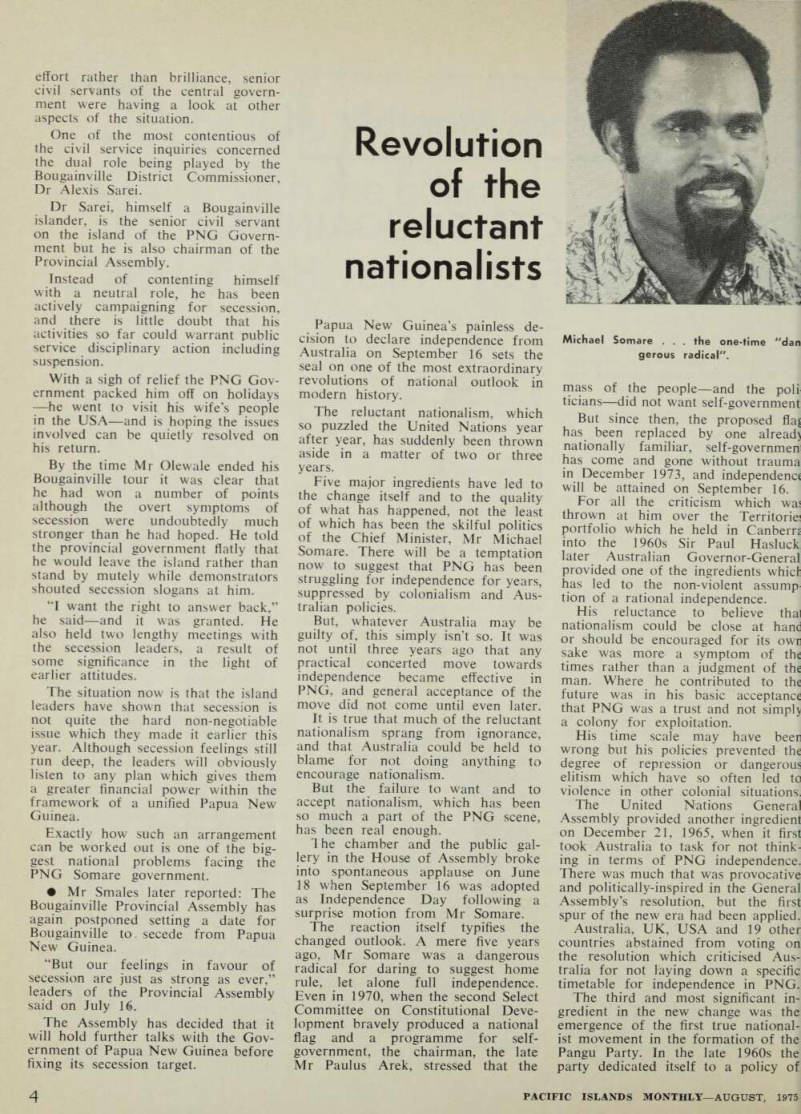
The PNG Justice Minister, Mr Ebia Olewale, returned in mid-July from a meet - the - people campaign on Bougainville where he attempted to promote the central government’s unity platform.
Mr Olewale, who is the newly appointed Special Minister for Pro vincial Affairs in addition to his Justice portfolio, tried to explain that the islanders were getting special attention anyway—including the re turn of all export levies on copper consignments.
If Mr Olewale expected to find that the secession moves were confined to a few provincial government hot heads, he was sadly disappointed.
With a few significant exceptions, meeting after meeting included strong support for secession.
But, perhaps, the most important immediate point which emerged from Mr Olewale’s tour was that there was a lot more to the issue than a simple secession versus unity argu ment.
Two factors were evident. One was that the secessionist leaders were far better organised than the non secessionists. The other was the high degree of good old-fashioned con fusion which existed.
Some of the rank-and-file missed the point of secession altogether and saw the argument as an attempt to decide what country should control Bougainville in the future.
Australia? Papua New Guinea?
“Why not America?” asked one man with vivid memories of the material wealth which USA showered on the South Pacific during World War 11.
Mr Olewale refused to take any for or against votes at his meetings, and he was shadowed for most of the time by members of the Provincial Assembly who made pro-secession talks. While he barnstormed round the country, working by sheer dogged
Minister Ebia Olewale ... it was sheer dogged effort.
effort rather than brilliance, senior civil servants of the central govern ment were having a look at other aspects of the situation.
One of the most contentious of the civil service inquiries concerned the dual role being played by the Bougainville District Commissioner, Dr Alexis Sarei.
Dr Sarei, himself a Bougainville islander, is the senior civil servant on the island of the PNG Govern ment but he is also chairman of the Provincial Assembly.
Instead of contenting himself with a neutral role, he has been actively campaigning for secession, and there is little doubt that his activities so far could warrant public service disciplinary action including suspension.
With a sigh of relief the PNG Gov ernment packed him off on holidays —he went to visit his wife’s people in the USA—and is hoping the issues involved can be quietly resolved on his return.
By the time Mr Olewale ended his Bougainville tour it was clear that he had won a number of points although the overt symptoms of secession were undoubtedly much stronger than he had hoped. He told the provincial government flatly that he would leave the island rather than stand by mutely while demonstrators shouted secession slogans at him.
“I want the right to answer back,” he said—and it was granted. He also held two lengthy meetings with the secession leaders, a result of some significance in the light of earlier attitudes.
The situation now is that the island leaders have shown that secession is not quite the hard non-negotiable issue which they made it earlier this year. Although secession feelings still run deep, the leaders will obviously listen to any plan which gives them a greater financial power within the framework of a unified Papua New Guinea.
Exactly how such an arrangement can be worked out is one of the big gest national problems facing the PNG Somare government. • Mr Smales later reported: The Bougainville Provincial Assembly has again postponed setting a date for Bougainville to secede from Papua New Guinea.
“But our feelings in favour of secession are just as strong as ever,” leaders of the Provincial Assembly said on July 16.
The Assembly has decided that it will hold further talks with the Gov ernment of Papua New Guinea before fixing its secession target.
Advertisements & other items, p. 7 (1 item)
3
CIFIC ISLANDS MONTHLY—AUGUST, 1975
Revolution
of the reluctant nationalists
Papua New Guinea’s painless de cision to declare independence from Australia on September 16 sets the seal on one of the most extraordinary revolutions of national outlook in modern history.
The reluctant nationalism, which so puzzled the United Nations year after year, has suddenly been thrown aside in a matter of two or three years.
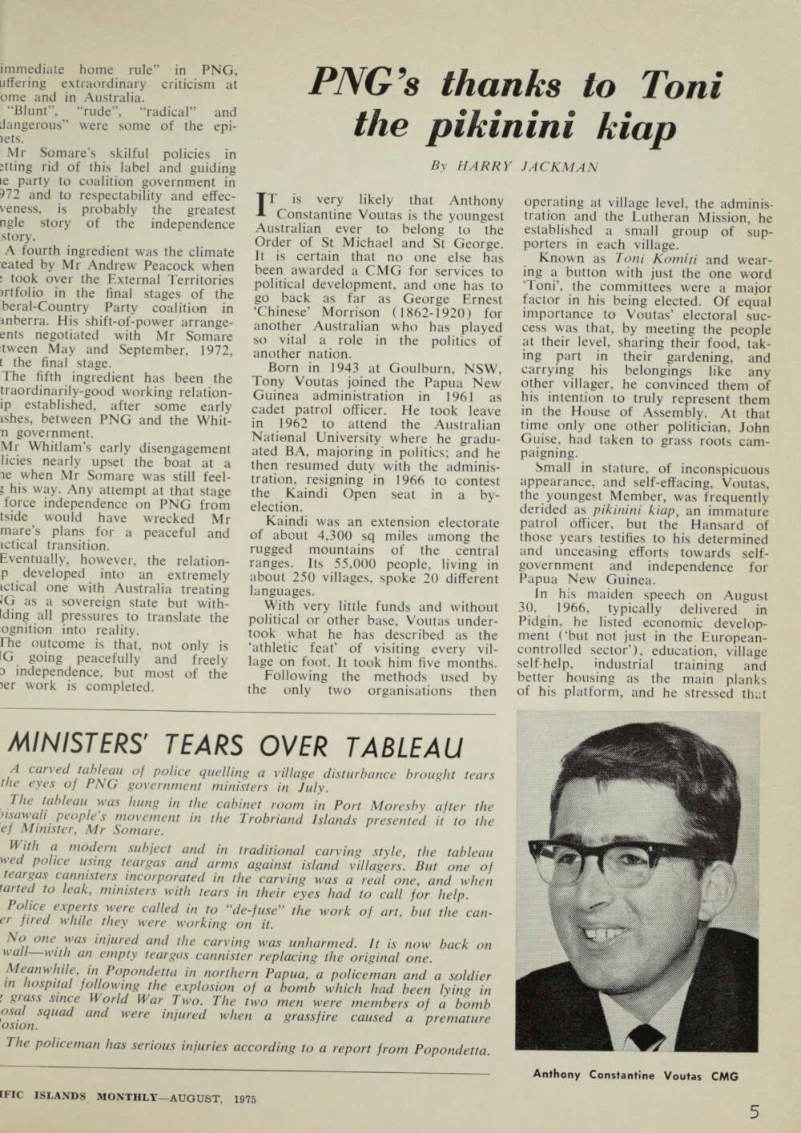
Five major ingredients have led to the change itself and to the quality of what has happened, not the least of which has been the skilful politics of the Chief Minister, Mr Michael Somare. There will be a temptation now to suggest that PNG has been struggling for independence for years, suppressed by colonialism and Aus tralian policies.
But, whatever Australia may be guilty of, this simply isn’t so. It was not until three years ago that any practical concerted move towards independence became effective in PNG, and general acceptance of the move did not come until even later.
It is true that much of the reluctant nationalism sprang from ignorance, and that Australia could be held to blame for not doing anything to encourage nationalism.
But the failure to want and to accept nationalism, which has been so much a part of the PNG scene, has been real enough, Ihe chamber and the public gal lery in the House of Assembly broke into spontaneous applause on June 18 when September 16 was adopted as Independence Day following a surprise motion from Mr Somare.
The reaction itself typifies the changed outlook. A mere five years ago, Mr Somare was a dangerous radical for daring to suggest home rule, let alone full independence.
Even in 1970, when the second Select Committee on Constitutional Deve lopment bravely produced a national flag and a programme for self government, the chairman, the late Mr Paulus Arek, stressed that the
mass of the people—and the poli ticians—did not want self-government But since then, the proposed flag has been replaced by one already nationally familiar, self-governmeni has come and gone without trauma in December 1973, and independence will be attained on September 16.
For all the criticism which was thrown at him over the Territories portfolio which he held in Canberra into the 1960 s Sir Paul Hasluck, later Australian Governor-General provided one of the ingredients which has led to the non-violent assump tion of a rational independence.
His reluctance to believe that nationalism could be close at hand or should be encouraged for its own sake was more a symptom of the times rather than a judgment of the man. Where he contributed to the future was in his basic acceptance that PNG was a trust and not simply a colony for exploitation.
His time scale may have been wrong but his policies prevented the degree of repression or dangerous elitism which have so often led to violence in other colonial situations.
The United Nations General Assembly provided another ingredient on December 21, 1965, when it first took Australia to task for not think ing in terms of PNG independence.
There was much that was provocative and politically-inspired in the General Assembly’s resolution, but the first spur of the new era had been applied.
Australia, UK, USA and 19 other countries abstained from voting on the resolution which criticised Aus tralia for not laying down a specific timetable for independence in PNG.
The third and most significant in gredient in the new change was the emergence of the first true national ist movement in the formation of the Pangu Party. In the late 1960 s the party dedicated itself to a policy of
Michael Somare . . . the one-time "dan gerous radical".
immediate home rule” in PNG, affering extraordinary criticism at ome and in Australia.
“Blunt”, “rude”, “radical” and dangerous” were some of the epi lets.
Mr Somare’s skilful policies in itting rid of this label and guiding le party to coalition government in ?72 and to respectability and effec veness, is probably the greatest ngle story of the independence story.
A fourth ingredient was the climate eated by Mr Andrew Peacock when ‘ took over the External Territories )rtfolio in the final stages of the beral-Country Party coalition in anberra. His shift-of-power arrange ents negotiated with Mr Somare tween May and September, 1972, t the final stage.
The fifth ingredient has been the traordinarily-good working relation ip established, after some early tshes, between PNG and the Whit n government.
Mr Whitlam’s early disengagement licies nearly upset the boat at a ie when Mr Somare was still feel l his way. Any attempt at that stage force independence on PNG from tside would have wrecked Mr mare’s plans for a peaceful and tctical transition.
Eventually, however, the relation p developed into an extremely ictical one with Australia treating JG as a sovereign state but with iding all pressures to translate the ognition into reality.
Fhe outcome is that, not only is IG going peacefully and freely d independence, but most of the >er work is completed.
the pikinini kiap
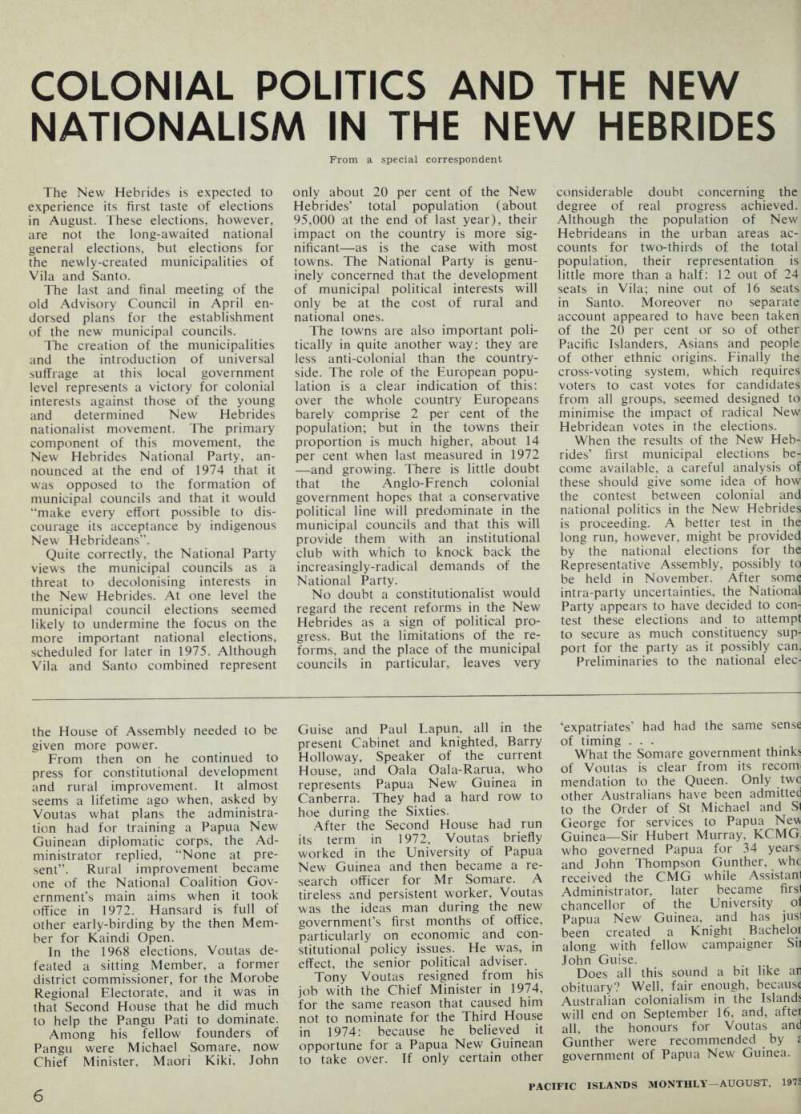
PNG’s thanks to Toni the pikinini kiap
By Harry Jackman
IT is very likely that Anthony Constantine Voutas is the youngest Australian ever to belong to the Order of St Michael and St George, It is certain that no one else has been awarded a CMG for services to political development, and one has to go back as far as George Ernest ‘Chinese’ Morrison (1862-1920) for another Australian who has played so vital a role in the politics of another nation.
Born in 1943 at Goulburn, NSW, Tony Voutas joined the Papua New Guinea administration in 1961 as cadet patrol officer. He took leave in 1962 to attend the Australian National University where he gradu ated BA, majoring in politics; and he then resumed duty with the adminis tration, resigning in 1966 to contest the Kaindi Open seat in a by election.
Kaindi was an extension electorate of about 4,300 sq miles among the rugged mountains of the central ranges. Its 55,000 people, living in about 250 villages, spoke 20 different languages.
With very little funds and without political or other base, Voutas under took what he has described as the ‘athletic feat’ of visiting every vil lage on foot. It took him five months.
Following the methods used by the only two organisations then
operating at village level, the adminis tration and the Lutheran Mission, he established a small group of sup porters in each village.
Known as Toni Komiti and wear ing a button with just the one word Toni’, the committees were a major factor in his being elected. Of equal importance to Voutas’ electoral suc cess was that, by meeting the people at their level, sharing their food, tak ing part in their gardening, and carrying his belongings like any other villager, he convinced them of his intention to truly represent them in the House of Assembly. At that time only one other politician, John Guise, had taken to grass roots cam paigning.
Small in stature, of inconspicuous appearance, and self-effacing, Voutas, the youngest Member, was frequently derided as pikinini kiap, an immature patrol officer, but the Hansard of those years testifies to his determined and unceasing efforts towards self government and independence for Papua New Guinea.
In his maiden speech on August 30, 1966, typically delivered in Pidgin, he listed economic develop ment (‘but not just in the European controlled sector’), education, village self-help, industrial training and better housing as the main planks of his platform, and he stressed that
the House of Assembly needed to be given more power.
From then on he continued to press for constitutional development and rural improvement. It almost seems a lifetime ago when, asked by Voutas what plans the administra tion had for training a Papua New Guinean diplomatic corps, the Ad ministrator replied, “None at pre sent”. Rural improvement became one of the National Coalition Gov ernment’s main aims when it took office in 1972. Hansard is full of other early-birding by the then Mem ber for Kaindi Open.
In the 1968 elections, Voutas de feated a sitting Member, a former district commissioner, for the Morobe Regional Electorate, and it was in that Second House that he did much to help the Pangu Pati to dominate.
Among his fellow founders of Pangu were Michael Somare, now Chief Minister, Maori Kiki, John
Guise and Paul Lapun, all in the present Cabinet and knighted, Barry Holloway, Speaker of the current House, and Oala Oala-Rarua, who represents Papua New Guinea in Canberra. They had a hard row to hoe during the Sixties.
After the Second House had run its term in 1972, Voutas briefly worked in the University of Papua New Guinea and then became a re search officer for Mr Somare. A tireless and persistent worker, Voutas was the ideas man during the new government’s first months of office, particularly on economic and con stitutional policy issues. He was, in effect, the senior political adviser.
Tony Voutas resigned from his job with the Chief Minister in 1974, for the same reason that caused him not to nominate for the Third House in 1974: because he believed it opportune for a Papua New Guinean to take over. If only certain other
‘expatriates’ had had the same sense of timing ...
What the Somare government thinks of Voutas is clear from its recom mendation to the Queen. Only two other Australians have been admitted to the Order of St Michael and Si George for services to Papua New Guinea —Sir Hubert Murray, KCMG. who governed Papua for 34 years, and John Thompson Gunther, who received the CMG while Assistant Administrator, later became first chancellor of the University ol Papua New Guinea, and has jusl been created a Knight Bachelor along with fellow campaigner Sit John Guise.
Does all this sound a bit like an obituary? Well, fair enough, because Australian colonialism in the Islands will end on September 16, and, after all, the honours for Voutas and Gunther were recommended by £ government of Papua New Guinea.
Ministers' Tears Over Tableau
A caned tableau of police quelling a village disturbance brought tears the eyes of PNG government ministers in July.
The tableau was hung in the cabinet room in Port Moresby after the usawah people’s movement in the Trobriand Islands presented it to the ef Minister, Mr Somare.
With a modern subject and in traditional carving style, the tableau wed police using tear gas and arms against island villagers. But one of teargas cannisters incorporated in the carving was a real one, and when arted to leak, ministers with tears in their eyes had to call for help.
Police experts were called in to “de-fuse" the work of art, but the can er fned while they were working on it.
No one was injured and the carving was unharmed. It is now back on wall with an empty teargas cannister replacing the original one.
Meanwhile, in Popondetta in northern Papua, a policeman and a soldier in hospital following the explosion of a bomb which had been lying in ' S>ass since World War Two. The two men were members of a bomb osal squad and were injured when a grassfire caused a premature osion.
The policeman has serious injuries according to a report from Popondetta.
Anthony Constantine Voutas CMG
Advertisements & other items, p. 9 (1 item)
5
IFIC ISLANDS MONTHLY—AUGUST, 1975
Colonial Politics And The New
Nationalism In The New Hebrides
From a special correspondent
The New Hebrides is expected to experience its first taste of elections in August. These elections, however, are not the long-awaited national general elections, but elections for the newly-created municipalities of Vila and Santo.
The last and final meeting of the old Advisory Council in April en dorsed plans for the establishment of the new municipal councils.
The creation of the municipalities and the introduction of universal suffrage at this local government level represents a victory for colonial interests against those of the young and determined New Hebrides nationalist movement. The primary component of this movement, the New Hebrides National Party, an nounced at the end of 1974 that it was opposed to the formation of municipal councils and that it would “make every effort possible to dis courage its acceptance by indigenous New Hebrideans”.
Quite correctly, the National Party views the municipal councils as a threat to decolonising interests in the New Hebrides. At one level the municipal council elections seemed likely to undermine the focus on the more important national elections, scheduled for later in 1975. Although Vila and Santo combined represent
only about 20 per cent of the New Hebrides’ total population (about 95,000 at the end of last year), their impact on the country is more sig nificant—as is the case with most towns. The National Party is genu inely concerned that the development of municipal political interests will only be at the cost of rural and national ones.
The towns are also important poli tically in quite another way: they are less anti-colonial than the country side. The role of the European popu lation is a clear indication of this: over the whole country Europeans barely comprise 2 per cent of the population; but in the towns their proportion is much higher, about 14 per cent when last measured in 1972 —and growing. There is little doubt that the Anglo-French colonial government hopes that a conservative political line will predominate in the municipal councils and that this will provide them with an institutional club with which to knock back the increasingly-radical demands of the National Party.
No doubt a constitutionalist would regard the recent reforms in the New Hebrides as a sign of political pro gress. But the limitations of the re forms, and the place of the municipal councils in particular, leaves very
considerable doubt concerning the degree of real progress achieved.
Although the population of New Hebrideans in the urban areas ac counts for two-thirds of the total
population, their representation is
little more than a half: 12 out of 24 seats in Vila; nine out of 16 seats in Santo. Moreover no separate account appeared to have been taken of the 20 per cent or so of other Pacific Islanders, Asians and people of other ethnic origins. Finally the
cross-voting system, which requires
voters to cast votes for candidates from all groups, seemed designed to minimise the impact of radical New Hebridean votes in the elections.
When the results of the New Heb rides’ first municipal elections be come available, a careful analysis of these should give some idea of how the contest between colonial and national politics in the New Hebrides is proceeding. A better test in the long run, however, might be provided by the national elections for the
Representative Assembly, possibly to
be held in November. After some intra-party uncertainties, the National Party appears to have decided to con test these elections and to attempt to secure as much constituency sup port for the party as it possibly can.
Preliminaries to the national elec-
ons had already begun in May. Both le French Resident Commissioner nd the president of the National arty, whom some might label as le chief protagonists in the present □litical tug-of-war, visited and Jdressed the general assembly of le Presbyterian Church which met n Emai island. The National Party id the pro-French parties were hold g conventions at mid-year, both to arify party policies and to plan icir electoral strategies.
The National Party, still based at e Anglican mission at Tagabe, near ila, had improved its offices with e addition of a typewriter and iplicating machine donated by sym ithetic friends. One of their first eductions was the premier issue of I US, a bislama-language news eet which the party hoped would netrate rural villages and urban ew Hebridean homes.
At least, the intending elections id the formation of a national jpresentative Assembly will provide forum for the first serious test of ength between the nationalists and e colonial government. The out me of course remains very much doubt at this stage. If, as few pect, the National Party wins a sounding victory, it would surely rtend the end of the road for the iglo-French colonialists.
On the other hand, a National rty rout would have a devastating ect on the nationalist movement, rhaps delaying further decolonis on for a decade or more. Con ued political stalemate, with the itional Party winning a respectable mber of seats but not enough to ntrol the Assembly, might give the lonial government the breathing ice it wants to implement its own litical programme, but it could o lead to frustrations and conflicts
of a kind which many well-meaning people, foreigners and nationals alike, hope that the New Hebrides will avoid.
Unfortunately, the elections to the Assembly may turn out to be little more than a numbers display. There are a number of questionable aspects concerning the Assembly itself which leave room for doubt concerning its effectiveness. Of the 42 Assembly members, 29 will be elected by uni versal suffrage, 20 from rural con stituencies and nine from the two main urban areas. The remaining members will be selected by and from special interest groups—six from the chambers of commerce, three from the co-operative societies, and four representatives from the customary chiefs.
From a New Hebridean point of view, the composition of the Assem bly, while a tremendous improvement on that of the old Advisory Council, leaves much to be desired. A mini mum of 12 Assembly members will be foreigners—six from urban con stituencies and all six representatives from the chambers of commerce.
The contrast between the size of the non-Pacific foreigner population (5 per cent) and their numerical strength in the Assembly is a stark one.
Some New Hebrideans also feel that the electoral provisions for the Representative Assembly, which were approved by the Advisory Council, are more likely to favour foreign interests. The age limit for voting in the elections was set at 21 years, rather than 18, and the modest resi dential requirements for voting and for candidacy in the elections are three and five years respectively. A lower voting age and tougher resi dential requirements might have better served New Hebridean interests.
Perhaps of more significance is the constitutional relationship between the Assembly and the colonial government. Despite objections from the Advisory Council, the colonial government is proceeding with a proposal to give the two resident commissioners joint control over the meetings of the Assembly. A counter proposal for the Assembly to elect from its own ranks an independent speaker is unlikely to be accepted by the colonial government.
Not only will the resident com missioners have joint control over the Assembly’s proceedings however, but they will also be able to return to the Assembly any resolutions which are unacceptable to the
colonial government. The Assembly does have the power, by a two-thirds confirmation, to insist on certain legislation being enacted, but the composition of the Assembly is such that the likelihood of this occurring does not seem very high. Executive power very clearly remains in the hands of the colonial government, and even the Assembly’s legislative powers appear to be limited.
If in the short-term the new Assembly does not turn out to have contributed much to the decolonising impetus, there is no doubt that the New Hebrides’ political climate is getting hotter every month. The National Party is by no means the only active, non-government political organisation—although it may well be the only one which is really in dependent of government influence.
The pro-French alliance of UCNH MANH and the New Hebridean Nagriamel movement remains a close one. For most people the alliance is both paradoxical and uncertain.
From Nagriamel’s point of view, however, they have been very well treated by both French planters and government, and the material benefits which they have earned from the alliance are considerable.
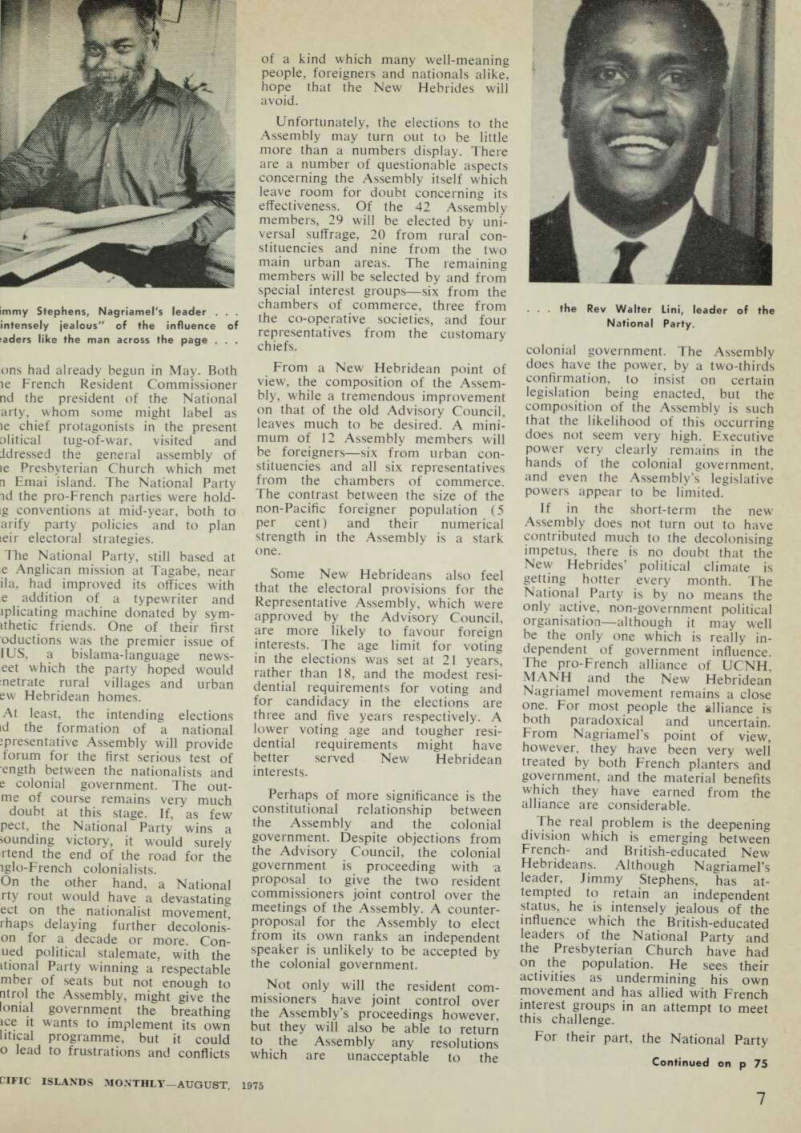
The real problem is the deepening division which is emerging between French- and British-educated New Hebrideans. Although Nagriamel’s leader, Jimmy Stephens, has at tempted to retain an independent status, he is intensely jealous of the influence which the British-educated leaders of the National Party and the Presbyterian Church have had on the population. He sees their activities as undermining his own movement and has allied with French interest groups in an attempt to meet this challenge.
For their part, the National Party
Continued on p 75
[?]mmy Stephens, Nagriamel's leader . . . [?]intensely jealous" of the influence of [?]aders like the man across the page . . .
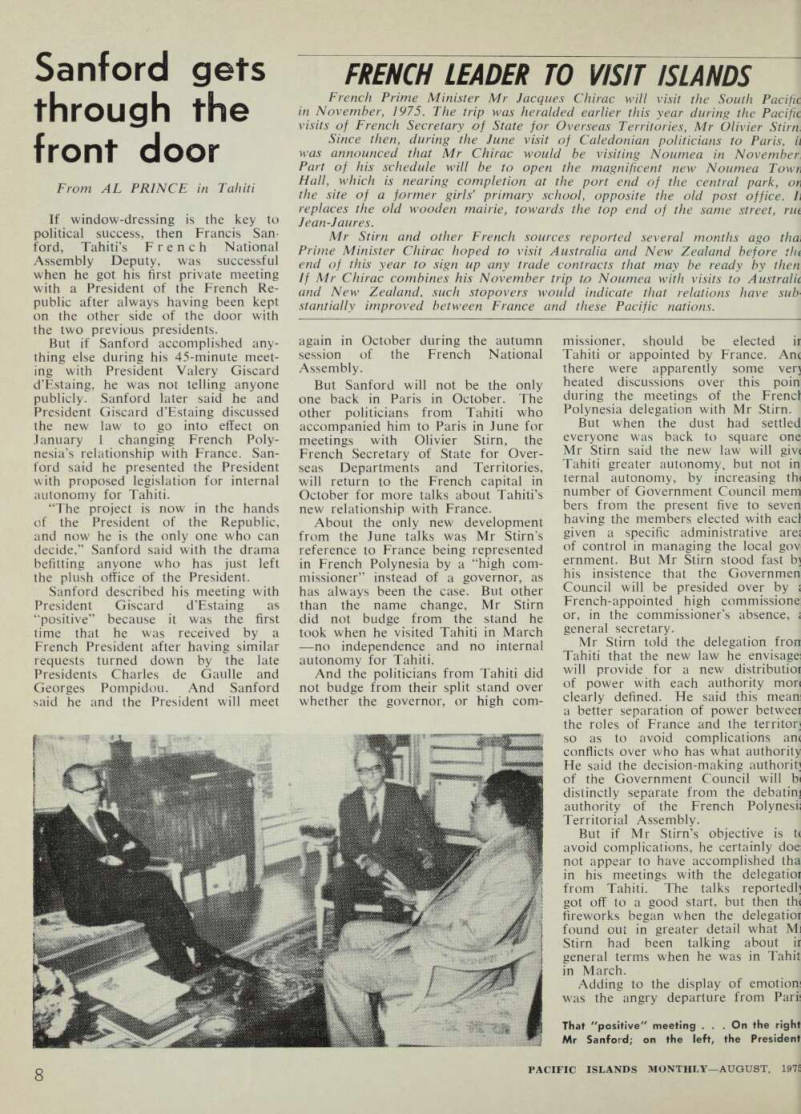
. . . the Rev Walter Lini, leader of the National Party.
eadership has failed to overcome the ;ulf that has emerged and which eems to be widening. Almost none >f the National Party leaders speak 'rench and only a few French ducated New Hebrideans have any onnections with the party at all. At he moment hardly one-fifth of the »Jew Hebridean population is French ducated—but with the activist policy if the French Government this is ikely to change rapidly over the next ew years. Unless the National Party an establish a secure base among rench and British-educated New lebrideans, as well as among the ural community, its long-term pros ects for success as the leader of a ationalist movement must be doubt- Lll.
For the student of politics, the resent situation in the New Heb ides is a perplexing one. Will the lunicipal councils turn out to be the trong-arm of the government as Dme suspect? Will the new Repre mtative Assembly be prepared to ccept a role subservient to that of le colonial government? What will e the strength of the nationalists ithin the Assembly? How stable is le UCNH-MANH-Nagriamel alli nce? Is there a chance that a new, lack nationalist united front will merge to combat colonial politics? hese are only a few of the un jrtainties which affect New Hebrides olitics today. Perhaps by the end f 1975, after the first real rounds f the political contest have been iayed, the nature and the likely Litcome of the conflict will be clearer.
Advertisements & other items, p. 11 (1 item)
7
CIFIC ISLANDS MONTHLY—AUGUST, 1975
through the
Sanford gets through the front door
From AL PRINCE in Tahiti If window-dressing is the key to political success, then Francis San ford, Tahiti’s French National Assembly Deputy, was successful when he got his first private meeting with a President of the French Re public after always having been kept on the other side of the door with the two previous presidents.
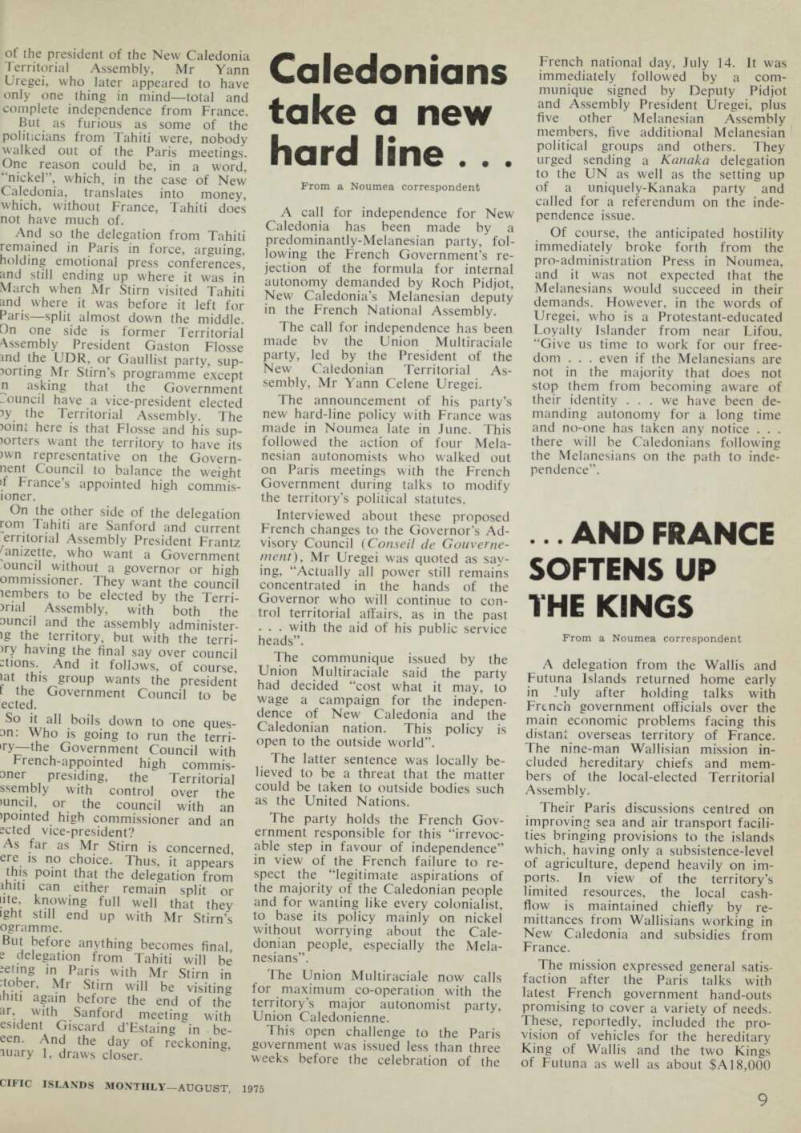
But if Sanford accomplished any thing else during his 45-minute meet ing with President Valery Giscard d’Estaing, he was not telling anyone publicly. Sanford later said he and President Giscard d’Estaing discussed the new law to go into effect on January 1 changing French Poly nesia’s relationship with France. San ford said he presented the President with proposed legislation for internal autonomy for Tahiti.
“The project is now in the hands of the President of the Republic, and now he is the only one who can decide,” Sanford said with the drama befitting anyone who has just left the plush office of the President.
Sanford described his meeting with President Giscard d’Estaing as “positive” because it was the first time that he was received by a French President after having similar requests turned down by the late Presidents Charles de Gaulle and Georges Pompidou. And Sanford said he and the President will meet
again in October during the autumn session of the French National Assembly.
But Sanford will not be the only one back in Paris in October. The other politicians from Tahiti who accompanied him to Paris in June for meetings with Olivier Stirn, the French Secretary of State for Over seas Departments and Territories, will return to the French capital in October for more talks about Tahiti’s new relationship with France.
About the only new development from the June talks was Mr Stirn’s reference to France being represented in French Polynesia by a “high com missioner” instead of a governor, as has always been the case. But other than the name change, Mr Stirn did not budge from the stand he took when he visited Tahiti in March —no independence and no internal autonomy for Tahiti.
And the politicians from Tahiti did not budge from their split stand over whether the governor, or high com-
missioner, should be elected ir Tahiti or appointed by France. Anc there were apparently some verj heated discussions over this poin during the meetings of the Frencl Polynesia delegation with Mr Stirn.
But when the dust had settled everyone was back to square one Mr Stirn said the new law will give Tahiti greater autonomy, but not in ternal autonomy, by increasing the number of Government Council mem bers from the present five to seven having the members elected with eacl given a specific administrative arej of control in managing the local gov ernment. But Mr Stirn stood fast b} his insistence that the Governmen Council will be presided over by '< French-appointed high commissione: or, in the commissioner’s absence, i general secretary.
Mr Stirn told the delegation fron Tahiti that the new law he envisage: will provide for a new distributior of power with each authority mon clearly defined. He said this mean: a better separation of power betweei the roles of France and the territory so as to avoid complications am conflicts over who has what authority He said the decision-making authority of the Government Council will b< distinctly separate from the debating authority of the French Polynesii
Territorial Assembly.
But if Mr Stirn’s objective is tc avoid complications, he certainly doe: not appear to have accomplished tha in his meetings with the delegatior from Tahiti. The talks reported!) got off to a good start, but then th( fireworks began when the delegatior found out in greater detail what Mi Stirn had been talking about ir general terms when he was in Tahit in March.
Adding to the display of emotion: was the angry departure from Pari:
That "positive" meeting . . . On the right Mr Sanford; on the left, the President
of the president of the New Caledonia Territorial Assembly, Mr Yann Uregei, who later appeared to have only one thing in mind—total and complete independence from France.
But as furious as some of the politicians from Tahiti were, nobody walked out of the Paris meetings.
One reason could be, in a word, “nickel”, which, in the case of New Caledonia, translates into money, which, without France, Tahiti does not have much of.
And so the delegation from Tahiti remained in Paris in force, arguing, holding emotional press conferences, and still ending up where it was in March when Mr Stirn visited Tahiti and where it was before it left for Paris —split almost down the middle.
On one side is former Territorial Assembly President Gaston Flosse and the UDR, or Gaullist party, sup porting Mr Stirn’s programme except n asking that the Government Council have a vice-president elected py the Territorial Assembly. The point here is that Flosse and his sup porters want the territory to have its )wn representative on the Govern nent Council to balance the weight »f France’s appointed high commis ioner.
On the other side of the delegation rom Tahiti are Sanford and current Yrritorial Assembly President Frantz 'anizette, who want a Government ouncil without a governor or high ommissioner. They want the council lembers to be elected by the Terri pnal Assembly, with both the auncil and the assembly administer ig the territory, but with the terri fy having the final say over council -tions. And it follows, of course, lat this group wants the president P the Government Council to be ected.
So it all boils down to one ques an: Who is going to run the terri •ry—-the Government Council with French-appointed high commis aner presiding, the Territorial ssembly with control over the >uncil, or the council with an ipomted high commissioner and an scted vice-president?
As far as Mr Stirn is concerned, ere is no choice. Thus, it appears this point that the delegation from miti can either remain split or iite, knowing full well that they ight still end up with Mr Stirn’s ogramme.
But before anything becomes final, s delegation from Tahiti will be 'Ctmg in Paris with Mr Stirn in :tober, Mr Stirn will be visiting ihiti again before the end of the ar, with Sanford meeting with esident Giscard d’Estaing in be een. And the day of reckoning auary 1, draws closer.
French Leader To Visit Islands
French Prime Minister Mr Jacques Chirac will visit the South Pacific in November, 1975. The trip was heralded earlier this year during the Pacific visits of French Secretary of State for Overseas Territories, Mr Olivier Stirn.
Since then, during the June visit of Caledonian politicians to Paris, ii was announced that Mr Chirac would be visiting Noumea in November.
Part of his schedule will be to open the magnificent new Noumea Town Hall, which is nearing completion at the port end of the central park, on the site of a former girls’ primary school, opposite the old post office, h replaces the old wooden mairie, towards the top end of the same street, rue Jean-Jaures.
Mr Stirn and other French sources reported several months ago thai Prime Minister Chirac hoped to visit Australia and New Zealand before the end of this year to sign up any trade contracts that may be ready by then If Mr Chirac combines his November trip to Noumea with visits to Australic and New Zealand, such stopovers would indicate that relations have sub stantially improved between France and these Pacific nations.
Caledonians
take a new hard line . . .
Prom a Noumea correspondent A call for independence for New Caledonia has been made by a predominantly-Melanesian party, fol lowing the French Government’s re jection of the formula for internal autonomy demanded by Roch Pidjot, New Caledonia’s Melanesian deputy in the French National Assembly.
The call for independence has been made bv the Union Multiraciale party, led by the President of the New Caledonian Territorial As sembly, Mr Vann Celene Uregei.
The announcement of his party’s new hard-line policy with France was made in Noumea late in June. This followed the action of four Mela nesian autonomists who walked out on Paris meetings with the French Government during talks to modify the territory’s political statutes.
Interviewed about these proposed French changes to the Governor’s Ad visory Council (Conseil de Gouverne rnent), Mr Uregei was quoted as say ing, “Actually all power still remains concentrated in the hands of the Governor who will continue to con trol territorial affairs, as in the past . . . with the aid of his public service heads”.
The communique issued by the Union Multiraciale said the party had decided “cost what it may, to wage a campaign for the indepen dence of New Caledonia and the Caledonian nation. This policy is open to the outside world”.
The latter sentence was locally be lieved to be a threat that the matter could be taken to outside bodies such as the United Nations.
The party holds the French Gov ernment responsible for this “irrevoc able step in favour of independence” in view of the French failure to re spect the “legitimate aspirations of the majority of the Caledonian people and for wanting like every colonialist, to base its policy mainly on nickel without worrying about the Cale donian people, especially the Mela nesians”.
The Union Multiraciale now calls for maximum co-operation with the territory’s major autonomist party, Union Caledonienne.
This open challenge to the Paris government was issued less than three weeks before the celebration of the
French national day, July 14. It was immediately followed by a com munique signed by Deputy Pidjot and Assembly President Uregei, plus five other Melanesian Assembly members, five additional Melanesian political groups and others. They urged sending a Kanaka delegation to the UN as well as the setting up of a uniquely-Kanaka party and called for a referendum on the inde pendence issue.
Of course, the anticipated hostility immediately broke forth from the pro-administration Press in Noumea, and it was not expected that the Melanesians would succeed in their demands. However, in the words of Uregei, who is a Protestant-educated Loyalty Islander from near Lifou, “Give us time to work for our free dom . . . even if the Melanesians are not in the majority that does not stop them from becoming aware of their identity ... we have been de manding autonomy for a long time and no-one has taken any notice . . . there will be Caledonians following the Melanesians on the path to inde pendence”.
Softens Up
... And France
The Kings
From a Noumea correspondent A delegation from the Wallis and Futuna Islands returned home early in July after holding talks with French government officials over the main economic problems facing this distant overseas territory of France.
The nine-man Wallisian mission in cluded hereditary chiefs and mem bers of the local-elected Territorial Assembly.
Their Paris discussions centred on improving sea and air transport facili ties bringing provisions to the islands which, having only a subsistence-level of agriculture, depend heavily on im ports, In view of the territory’s limited resources, the local cash flow is maintained chiefly by re mittances from Wallisians working in New Caledonia and subsidies from France.
The mission expressed general satis faction after the Paris talks with latest French government hand-outs promising to cover a variety of needs.
These, reportedly, included the pro vision of vehicles for the hereditary King of Wallis and the two Kings of Futuna as well as about $A 18,000
towards the renovation of the Wallisian King’s palace. Other grants were promised for water and elec tricity installations on Wallis as well as a fuel depot, which would avoid the expense of shipping petrol in drums from Noumea.
While there are only about 5,000 islanders left on Wallis, about 11,000 Wallisians live in New Caledonia.
For this reason, the Paris govern ment has promised about $A 150,000 for a Wallisian centre in Noumea.
Depending as they do on the gene rosity of France, the Wallisians have always been relied upon to vote anti autonomist. The French administra tion counts on the large Wallisian community voting in Noumea to continue this tradition. At the same time, the recent Paris subsidies pro vided a happy conclusion to the in cidents in Wallis last November, when island protests forced the re moval of the chief French adminis trator, Mr Jacques de Agostini. • The New Hebrides tourist in dustry will get a boost in 1976 with the new cruise liner, the Pacific Princess, scheduled to make four visits. P and O recently bought the liner from a Dutch company. Twenty one visits by overseas liners are so far scheduled for 1976, and more are likely.
Advertisements & other items, p. 13 (1 item)
9
CIFIC ISLANDS MONTHLY—AUGUST, 1975
Shakes
Eruption
Forum . . .
From Adishwar Padarath
in Suva South Pacific leaders obviously feel an annual summit conference insufficient. The sixth South Pacific Forum meeting which took place in Tonga early in July decided to ex periment with informal discussions in between.
It all began when Nauru’s Presi dent Hammer Deßoburt spoke during opening ceremonies on behalf of all delegates.
“We have a full agenda and we are going to be put on our mettle to get through it”, he said. “I wonder whether as activities develop and new problems challenge the Forum, an annual meeting is sufficient to enable itself to consider fully and in depth the weighty matters requiring our attention.
“We should not lose sight of our priorities. We have work on hand,
work which is not only necessary and challenging to do but which must be worth our while as heads and representatives of our respective governments”.
Later, New Zealand’s Prime Minis ter Wallace Rowling issued invita tions to leaders and their wives to be guests at the next South Pacific Festival of Arts at Rotorua in March.
Leaders decided to hold an informal “mini Forum” while there.
New Zealand will meet all internal costs.
The formal Forum will be at Nauru next August.
The Tonga Forum began with the admission of Niue as a full member and ended with an almighty upheaval involving Fiji and Australia.
By then Mr Rowling had left for home.
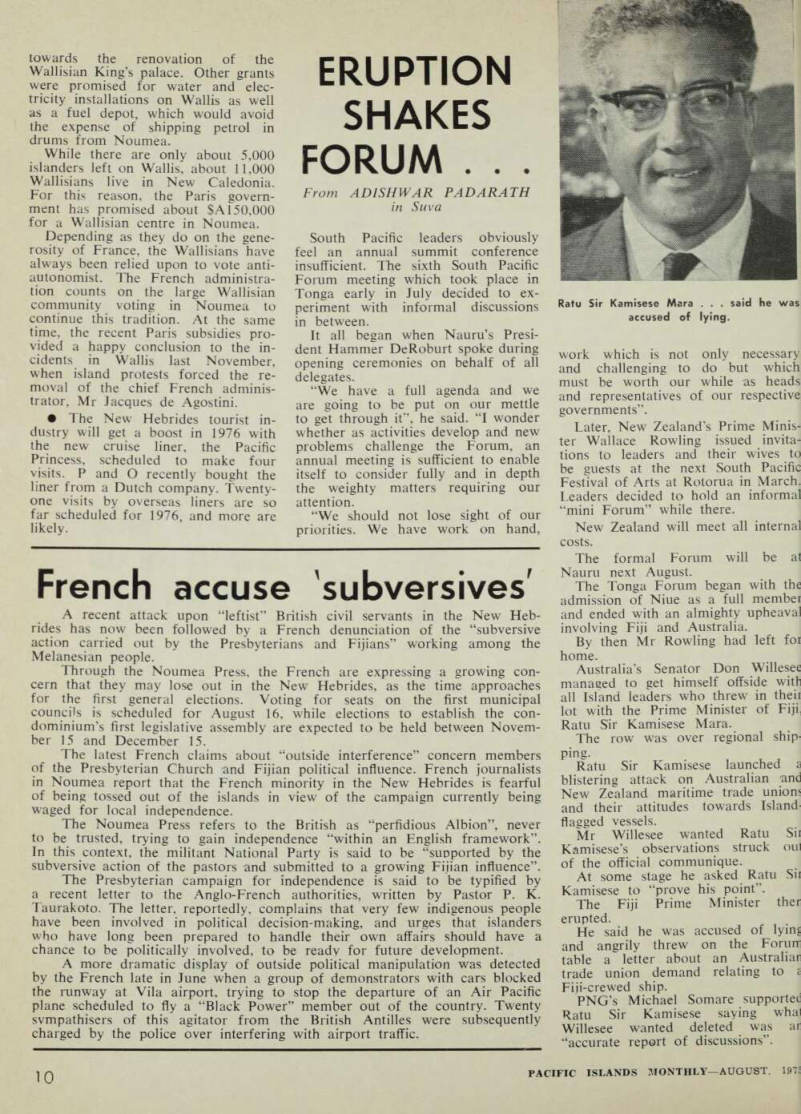
Australia’s Senator Don Willesee managed to get himself offside with all Island leaders who threw in their lot with the Prime Minister of Fiji.
Ratu Sir Kamisese Mara.
The row was over regional ship ping.
Ratu Sir Kamisese launched a blistering attack on Australian and New Zealand maritime trade unions and their attitudes towards Island flagged vessels.
Mr Willesee wanted Ratu Sir Kamisese’s observations struck out of the official communique.
At some stage he asked Ratu Sit Kamisese to “prove his point”.
The Fiji Prime Minister then erupted.
He said he was accused of lying and angrily threw on the Forum table a letter about an Australian trade union demand relating to a Fiji-crewed ship.
PNG’s Michael Somare supported Ratu Sir Kamisese saying whal Willesee wanted deleted was an “accurate report of discussions”.
Ratu Sir Kamisese Mara . . . said he was accused of lying.
Members agreed to retain the item i the communique.
The “offending” paragraph reads: The Forum recognised that a vital ictor in the viability of a regional lipping line was a co-operative atti ide by the maritime trade unions of ustralia and New Zealand towards le Pacific Island Line”.
Mr Willesee was the official Forum )okesman.
A solid battery of about half a izen New Zealand journalists and iree from Fiji travelled to Tonga »r the Forum but surprisingly no ic from Australia, A Wellington-based ABC reporter rived late on the Tuesday night ter the Forum had been going for day. Mr Willesee, at times, adopted flippant attitude during press con rences.
For instance he told us that the EIC Chief Minister, Naboua atieta, and Solomons leader Solo on Mamaloni, would be speaking.
Willesee added that the “lads” luld talk about developments in sir respective countries.
At other times he was vague and ways bent upon getting through a ess session in the bare minimum time.
The Forum agreed unanimously to k- the Tongan Government for an tension of the term of SPEC’s ector, Mr Mahe Tupouniua, whose -sent term expires in November.
New Zealand made two grandstand stures during the meeting. It an unced a SNZSOOO gift for Tonga’s icen Salote Memorial Hall and an tra payment of SNZI per case of jmium quality bananas.
Fiji offered its brown sugar to and members of the Forum, Ratu Kamisese saying his country *uld be willing to conclude long m sugar agreements with each of :m.
SPEC is to co-ordinate arrange nts.
Australian white sugar sells in ngan shops at 44c a lb, Fiji brown jar, when available there, sells at : a lb.
Footnote: The Solomons Islands i.ef Minister, Mr Solomon Mama li, on his return home, said that less the Forum defined its aims ire clearly, the Solomons would become a member. The Forum, a sort of UN of the South Pacific, >uld have been dealing with itical matters, he said. Instead, affairs of its economic arm, the ith Pacific Bureau of Economic -operation, took up most of the nda.
French accuse subversives'
A recent attack upon “leftist” British civil servants in the New Heb rides has now been followed by a French denunciation of the “subversive action carried out by the Presbyterians and Fijians” working among the Melanesian people.
Through the Noumea Press, the French are expressing a growing con cern that they may lose out in the New Hebrides, as the time approaches for the first general elections. Voting for seats on the first municipal councils is scheduled for August 16, while elections to establish the con dominium’s first legislative assembly are expected to be held between Novem ber 15 and December 15.
The latest French claims about “outside interference” concern members of the Presbyterian Church and Fijian political influence. French journalists in Noumea report that the French minority in the New Hebrides is fearful of being tossed out of the islands in view of the campaign currently being waged for local independence.
The Noumea Press refers to the British as “perfidious Albion”, never to be trusted, trying to gain independence “within an English framework”.
In this context, the militant National Party is said to be “supported by the subversive action of the pastors and submitted to a growing Fijian influence”.
The Presbyterian campaign for independence is said to be typified by a recent letter to the Anglo-French authorities, written by Pastor P. K.
Taurakoto. The letter, reportedly, complains that very few indigenous people have been involved in political decision-making, and urges that islanders who have long been prepared to handle their own affairs should have a chance to be politically involved, to be ready for future development.
A more dramatic display of outside political manipulation was detected by the French late in June when a group of demonstrators with cars blocked the runway at Vila airport, trying to stop the departure of an Air Pacific plane scheduled to fly a “Black Power” member out of the country. Twenty sympathisers of this agitator from the British Antilles were subsequently charged by the police over interfering with airport traffic.
In From Ocean Island
. . . AND A WIND BLOWS
From a special correspondent
Some chilly political winds sent shivers down quite a few spines at the South Pacific Forum meeting in Nukualofa in July.
They blew into the Tongan capital with representatives of the Banaban community on Rabi who were launching their latest campaign for self-determination of Ocean Island, their ancestral homeland.
The Banabans were seeking Forum support for their cause, and, as they expected, the mission members found themselves at the centre of a delicate web of diplomatic and protocol related manoeuvring.
“We’re not used to this sort of thing”, said a senior Tongan official.
“Why did the Banabans have to choose our Forum to bring this issue up?”
The Tongans, as hosts, were cautious in the extreme. The Bana bans, they said, were not affiliated to the Forum and could not, there fore, be accorded official status.
Would they be prepared to be part of the GEIC delegation?
“Not on your life”, said the Bana bans. Perhaps they could join the Fiji team? The Banabans dismissed this idea too. Fiji was in a delicate position. The Banabans’ current home, Rabi, is part of that country and the Prime Minister, Ratu Sir Kamisese Mara, while sympathising with them, did not wish to appear too partisan.
So the Banabans were on their own. They quickly became aware of some subtle undercurrents designed presumably to throw them off balance. A British official had allegedly told a senior Forum figure that Ratu Sir Kamisese was angry about their presence in Nukualofa.
If they lost his sympathy, they were told, then they had lost a strong ally.
The Banabans were concerned at first. Then they became sceptical.
The Fiji Prime Minister had been informed that they were Nukualofa bound and had not indicated annoy ance.
The report, decided the Banabans, was a British scare tactic.
One non-island observer suggested that the Banabans had come to Nukualofa to cause trouble. Didn’t they realise they were faced with an uphill task and didn’t they know that
the British were trying hard to keep the question out of the Forum? ‘'Well,” said the Banabans, “how do you define trouble?”
Certainly, they were faced with an uphill task—but over the years they had become used to fighting against big odds. And it wasn’t really surpris ing that the British were unhappy about their presence in Nukualofa.
After all, the United Kingdom was their chief opponent.
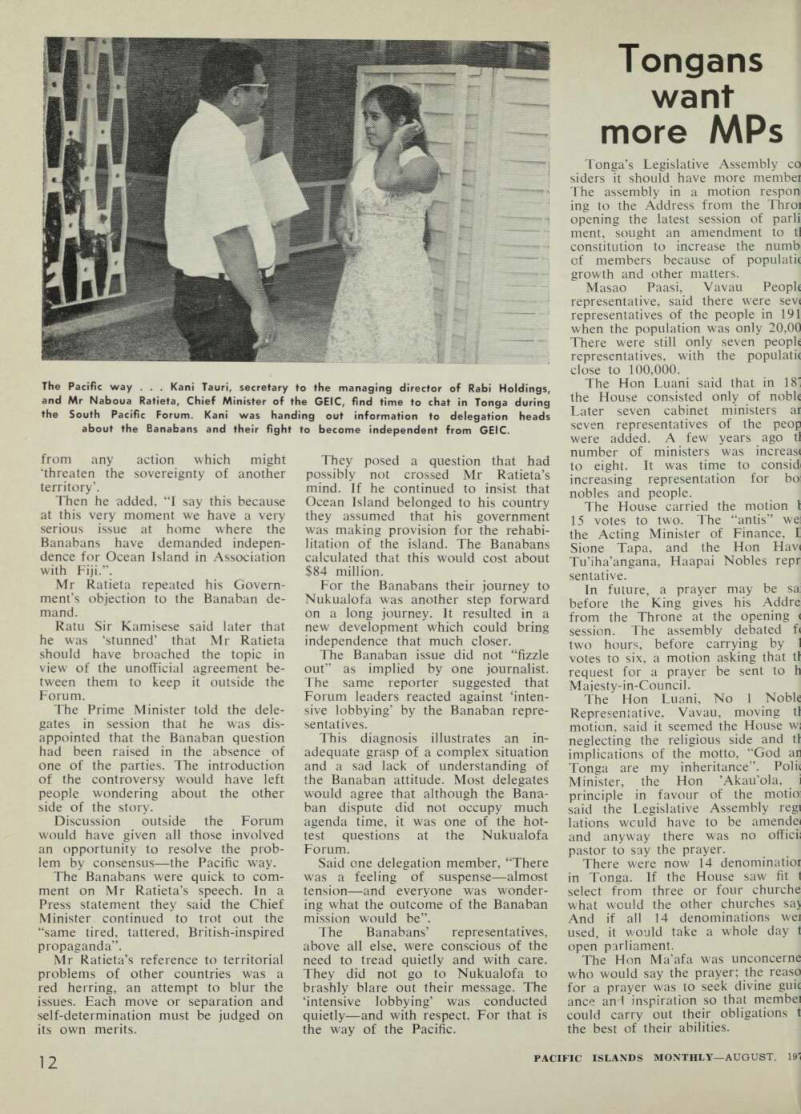
One of the first delegates the Bana bans made contact with was Mr Naboua Ratieta, GEIC’s Chief Minister.
Mr Tekoti Rotan, the Banaban mission leader, felt Mr Ratieta, as a matter of courtesy, should be told why the Banabans were at the Forum. He listened, and reaffirmed his position.
The Banabans approached other leaders, provoking responses ranging from caution to outright sympathy and support. But would the Forum debate the issue? It was not on the prepared agenda and it appeared that the only part of the forum session offering scope for its introduction was “other business”.
One of the Island leaders, after a full briefing, indicated willingness to make the first move. Then there was a new development.
Reports reached the Banabans’ camp that the Fiji Prime Minister might be prepared to act as an inter mediary in a get-together outside the Forum.
Mr Ratieta, apparently, was aware of this fresh proposal and had indi cated his willingness to keep the mat ter out of the Forum.
In the meantime, the Banabans distributed a document to each dele gation outlining their case and appeal ing for support. (The distribution of this submission was a separate exercise in itself. It involved a carefully-timed plan to hand the document to the leaders personally as they left an official luncheon).
The ball was back in Mr Ratieta’s court. It was time for him to make his maiden speech.
Reading from a prepared address, Mr Ratieta described some of his country’s problems and its consti tutional progress. He spoke of the need for Pacific nations to respect territorial sovereignty and refrain
from any action which might ‘threaten the sovereignty of another territory’.
Then he added, “I say this because at this very moment we have a very serious issue at home where the Banabans have demanded indepen dence for Ocean Island in Association with Fiji.”.
Mr Ratieta repeated his Govern ment’s objection to the Banaban de mand.
Ratu Sir Kamisese said later that he was ‘stunned’ that Mr Ratieta should have broached the topic in view of the unofficial agreement be tween them to keep it outside the Forum.
The Prime Minister told the dele gates in session that he was dis appointed that the Banaban question had been raised in the absence of one of the parties. The introduction of the controversy would have left people wondering about the other side of the story.
Discussion outside the Forum would have given all those involved an opportunity to resolve the prob lem by consensus—the Pacific way.
The Banabans were quick to com ment on Mr Ratieta’s speech. In a Press statement they said the Chief Minister continued to trot out the “same tired, tattered, British-inspired propaganda”.
Mr Ratieta’s reference to territorial problems of other countries was a red herring, an attempt to blur the issues. Each move or separation and self-determination must be judged on its own merits.
They posed a question that had possibly not crossed Mr Ratieta’s mind. If he continued to insist that Ocean Island belonged to his country they assumed that his government was making provision for the rehabi litation of the island. The Banabans calculated that this would cost about $B4 million.
For the Banabans their journey to Nukualofa was another step forward on a long journey. It resulted in a new development which could bring independence that much closer.
The Banaban issue did not “fizzle out” as implied by one journalist.
The same reporter suggested that Forum leaders reacted against ‘inten sive lobbying’ by the Banaban repre sentatives.
This diagnosis illustrates an in adequate grasp of a complex situation and a sad lack of understanding of the Banaban attitude. Most delegates would agree that although the Bana ban dispute did not occupy much agenda time, it was one of the hot test questions at the Nukualofa Forum.
Said one delegation member, “There was a feeling of suspense—almost tension—and everyone was wonder ing what the outcome of the Banaban mission would be”.
The Banabans’ representatives, above all else, were conscious of the need to tread quietly and with care.
They did not go to Nukualofa to brashly blare out their message. The ‘intensive lobbying’ was conducted quietly—and with respect. For that is the way of the Pacific.
The Pacific way . . . Kani Tauri, secretary to the managing director of Rabi Holdings, and Mr Naboua Ratieta, Chief Minister of the GEIC, find time to chat in Tonga during the South Pacific Forum. Kani was handing out information to delegation heads about the Banabans and their fight to become independent from GEIC.
Advertisements & other items, p. 15 (1 item)
11
"IFIC ISLANDS MONTHLY—AUGUST, 1975
Tongans
want more MPs
Tonga’s Legislative Assembly co siders it should have more member The assembly in a motion respon ing to the Address from the Throi opening the latest session of parli ment, sought an amendment to tl constitution to increase the numb of members because of populatic growth and other matters.
Masao Paasi, Vavau People representative, said there were sev( representatives of the people in 191 when the population was only 20,00 There were still only seven people representatives, with the populatic close to 100,000.
The Hon Luani said that in 18' the House consisted only of noble Later seven cabinet ministers ar seven representatives of the peop were added. A few years ago tl number of ministers was increase to eight. It was time to considi increasing representation for boi nobles and people.
The House carried the motion I 15 votes to two. The “antis” wei the Acting Minister of Finance, I Sione Tapa, and the Hon Have Tu’iha’angana, Haapai Nobles repr sentative.
In future, a prayer may be sa: before the King gives his Addre from the Throne at the opening < session. The assembly debated fe two hours, before carrying by I votes to six, a motion asking that tl request for a prayer be sent to h
Majesty-in-Council.
The Hon Luani, No 1 Noble Representative, Vavau, moving tl motion, said it seemed the House wi neglecting the religious side and tl implications of the motto, “God an Tonga are my inheritance”. Polic Minister, the Hon ’Akau’ola, i principle in favour of the motio: said the Legislative Assembly regi lations would have to be amende* and anyway there was no officii pastor to say the prayer.
There were now 14 denominatior in Tonga. If the House saw fit 1 select from three or four churche what would the other churches sa> And if all 14 denominations wei used, it would take a whole day t
open parliament.
The Hon Ma’afa was unconcerne who would say the prayer; the reaso for a prayer was to seek divine guic ance an 4 inspiration so that membei could carry out their obligations t the best of their abilities.
A scientific bang and a political whimper
Tahiti Letter
From Al Prince In Papeete
jHRANCE’S first nuclear test of the year went off with A a scientific bang, a positive fallout, a political whimper and an historical footnote. The “bang” was the explosion itself, France’s first underground nuclear test, which occurred on June 5 at the remote French Polynesia atoll of Fangataufa, 800 miles southeast of Tahiti.
The “positive fallout” was France’s almost immediate eagerness to announce the test’s success. The “political whimper was the half-hearted, for-the-record protests from other countries, notably Australia and New Zea land. And the historical footnote came 12 days later when one of the most dramatic protesters in the history of French nuclear testing—David McTaggart of the 1973 protesting yacht Greenpeace-3—won his suit against the French Navy.
Then when there was almost nothing more to say about the test, a Paris correspondent for Le Journal de Tahiti interviewed well-known volcano expert Haroun Fazieff, who had come here prior to the test at the invitation of French test officials to examine the Fanga taufa atoll. Although Tazieff said he is opposed to all such tests, he endorsed the test site to the extent of say ing that if he could choose the exact drilling place for the underground explosion he would not hesitate to put his house right over the blast site, as long as certain security measures were taken.
Asked if such security measures were taken at Fanga taufa on June 5, Tazieff said, “I think so and I hope so. But I wasn t there at H-hour. It is impossible to confirm in the absence of control by an independent scientific organisation”. Tazieff said he would certainly formed 10 PaFt ° f SUCh an organisation if one were / n t ™* e ’ 1 f? opposed to the continuation of mch tests , he said. “But if these must continue, 1 jvouldnt be better off hiding my face. If they can’t hem” PPCd ’ 11 W ° U dbe mUCh m ° re useful to control Thus, France entered the realm of underground South Pacific. As has occurred .mce the 1973 testing programme, Australia was the rst to announce this year’s initial blast. But France llknm on S l e i.T? h time in ending its news Jtlrthlf > u J GStS aS J lt announce d in Paris four days nl wl !} h ? d .u° pene £ ? new cha Pter in nuclear test- ? d t° f 4 he tradlt L onal “ no comment” following revious tests, French officials could hardly wait this ime to express how pleased they were with the first
mderground explosion.
, "I* was , a completely successful operation”, one ietall^f nt bn SPOk ff— H i n S3l f This was ex P an ded into Unmt I h officials and technicians of the French c Energy Commission returned to the atoll within reaped 3 from * the S'S radi ° a « ivi *
A LTHOUGH France is still not a signatory to the . nu clear test ban treaty, the lack of any serious international protest against this year’s initial blast seemed to put France in the “good guy” nuclear club along with the United States and the Soviet Union, who signed the treaty banning atmospheric tests, but still conduct underground nuclear explosions.
In Tahiti, it was difficult to find any interest in the in the past had always tried to beat La Depeche the story to the world, but only carried a “news flash” of one sentence on page one two days after the test, quoting unidentified unofficial sources as saying an explosion had occurred. Le Journal de Tahiti, which in the past had always tried to beat La Depeche with a story of each test, later claimed it knew of this year’s test at the same time as La Depeche. But Le Journal acted like it had not missed anything by not saying anything.
The local politicians, who normally condemn the tests, were off in Paris discussing the future of French Polynesia with French officials. Nevertheless, Tahiti’s French National Assembly Deputy, Francis Sanford, held a press conference in Paris, calling the bomb “dis gusting”. Sanford said it was disgusting the way the French Government conducted this year’s nuclear explosion at the very time when French Polynesia’s elected officials were in Paris for negotiations with the government.
But even Sanford’s comments sounded much the same as those • Australian, New Zealand, Japanese and other political leaders—protests for the record. There was oue exception, however. Fiji officials, once the most vocal opponents of French nuclear testing, did not say a word. If they did, it never got to Tahiti or to the international news media.
Little wonder then that Le Journal de Tahiti decided to poke some fun at the tests, running next to its inter- Xjew with *h e volcano expert a cartoon showing Tazieff’s house and the surrounding land, coconut trees intact, being blown skyward by the explosion. Tazieff is shown saying, “Didn’t I tell you that the atoll wouldn’t split!”
OUT in Paris, David McTaggart, who almost lost an eye protesting French nuclear testing in the South Pacific in 1973, was not poking fun at anyone. For the rugged Canadian yachtsman, it was the beginning of the end of two years of litigation when the Paris Civil tribunal ruled on June 17 that the French Navy was guilty, as charged by McTaggart, of ramming his ketch, Greenpeace-3, and that it must pay damages. A court appointed assessor will determine the amount of dam ages to be paid by the French Navy.
McTaggart, however, has not finished his litiga tion. There was a second, related charge of piracy.
But the court ruled itself incompetent, on the ground
that this is outside its jurisdiction, telling McTaggart that if he wants to pursue the matter he must apply to another French court, the Conseil d’Etat.
“They gave me a carrot”, McTaggart told the Inter national Herald Tribune over a mug of beer at a Paris sidewalk cafe the afternoon of the court’s ruling. But he later conceded that the court’s action might also be construed as half a loaf. As McTaggart sees it, the court’s assent on the ramming charge was inevitable, and therefore winning this point is a comparatively minor victory. As far as he is concerned, the big, un resolved issue is the “piracy” charge—the boarding in cident inside the Mururoa test zone area where McTaggart’s Greenpeace-3 was boarded by French sailors who removed the ketch from the blast zone and beat him so severely that his sight was permanently damaged. (The French Navy contends that McTaggart hurt his eye when he fell during a scuffle with the boarding party.) McTaggart’s bitterness toward his own government, the Canadian, was apparent following the court’s rul ing. He contended, in fact, that the Ottawa government acted “in collusion” with the Paris government in oust ing his 12-metre ketch from the nuclear testing zone.
If there was no collusion, he said, “then why hasn’t the Canadian Government protested vigorously to the French, as the Australian and New Zealand govern ments did?”
Looking to the future, McTaggart said he plans to
press his own case vigorously enough, this time “with Prime Minister Trudeau”, and demand that the Cana dian leader try a new approach—bypassing the French Foreign Ministry officials, whom he claims have a vested interested in the case and therefore cannot be trusted to follow an objective course.
Meanwhile, he said, the book he has written about the Greenpeace-3 episodes, which was published first in Canada, is now being translated into French, Spanish, Italian and German. With the proceeds of the book sales he hopes to be able to finance the next stage of litigation. If this proves insufficient, he said, his only alternative will be “to move to the level of skulduggery —for want of a better word—that’s been used against me”. McTaggart, 42, explained that he believes there is an international conspiracy to deceive the public about atomic weapons testing and that he is one of the victims of this conspiracy.
WORD reached Tahiti in June that the one-time French nuclear testing protest yacht Fri arrived in Tokyo with its peace mission aimed at convincing all the nuclear powers to stop all testing programmes.
Upon arriving in Japan, the weathered Fri persuaded Japanese officials to help in overhauling the yacht.
The next planned stop for the Fri is the People’s Re public of China. There has been no word received here yet whether the Fri has been granted permission to enter China.
Advertisements & other items, pp. 17-18 (2 items)
13
ACIFIC ISLANDS MONTHLY—AUGUST, 1975
A Better Mixer Gilbey's Gin
The London Dry direct from London
TRY SOME OF THESE:—
Elephant Walk Gimlet Coco cool Tom Collins Screwdriver Bushman Gin Fizz Blue Lady Grape Shot or with tonic ASK US FOR GILBEYS LONDON DRY GIN RECIPE
LEAFLET
THE GILBEYS GIN PEOPLE FOR
THE PACIFIC ISLANDS.
KERR BROTHERS Pty. Ltd.
65 York Street, Sydney, N.S.W. 2000.
Australia.
Telex: AA23181 Cable: CAREFULNESS, Sydney gin
Is The Dominance Of Royal
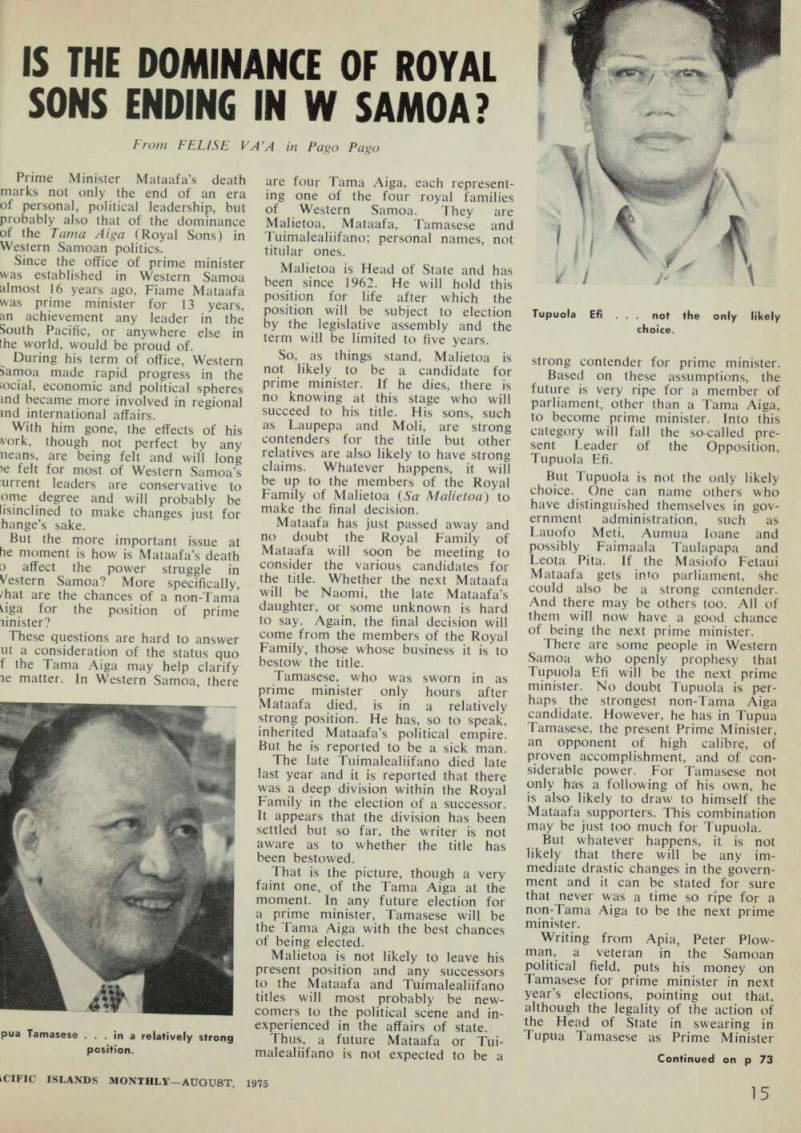
Sons Ending In W Samoa?
From FELISE VA’A in Pago Pago
Prime Minister Mataafa’s death marks not only the end of an era of personal, political leadership, but probably also that of the dominance of the Tama Aiga (Royal Sons) in Western Samoan politics.
Since the office of prime minister was established in Western Samoa almost 16 years ago, Fiame Mataafa was prime minister for 13 years, an achievement any leader in the South Pacific, or anywhere else in the world, would be proud of.
During his term of office, Western Samoa made rapid progress in the social, economic and political spheres md became more involved in regional md international affairs.
With him gone, the effects of his vork, though not perfect by any neans, are being felt and will long )e felt for most of Western Samoa’s urrent leaders are conservative to ome degree and will probably be lisinclined to make changes just for hange’s sake.
But the more important issue at he moment is how is Mataafa’s death o affect the power struggle in Vestern Samoa? More specifically, /hat are the chances of a non-Tama uga for the position of prime linister?
These questions are hard to answer ut a consideration of the status quo f the Tama Aiga may help clarify le matter. In Western Samoa, there
are four Tama Aiga, each represent ing one of the four royal families of Western Samoa. They are Malietoa, Mataafa, Tamasese and Tuimalealiifano; personal names, not titular ones.
Malietoa is Head of State and has been since 1962. He will hold this position for life after which the position will be subject to election by the legislative assembly and the term will be limited to five years.
So, as things stand, Malietoa is not likely to be a candidate for prime minister. If he dies, there is no knowing at this stage who will succeed to his title. His sons, such as Laupepa and Moli, are strong contenders for the title but other relatives are also likely to have strong claims. Whatever happens, it will be up to the members of the Royal Family of Malietoa (Sa Malietoa) to make the final decision.
Mataafa has just passed away and no doubt the Royal Family of Mataafa will soon be meeting to consider the various candidates for the title. Whether the next Mataafa will be Naomi, the late Mataafa’s daughter, or some unknown is hard to say. Again, the final decision will come from the members of the Royal Family, those whose business it is to bestow the title.
Tamasese, who was sworn in as prime minister only hours after Mataafa died, is in a relatively strong position. He has, so to speak, inherited Mataafa’s political empire.
But he is reported to be a sick man.
The late Tuimalealiifano died late last year and it is reported that there was a deep division within the Royal Family in the election of a successor.
It appears that the division has been settled but so far, the writer is not aware as to whether the title has been bestowed.
That is the picture, though a very faint one, of the Tama Aiga at the moment. In any future election for a prime minister, Tamasese will be the Fama Aiga with the best chances of being elected.
Malietoa is not likely to leave his present position and any successors to the Mataafa and Tuimalealiifano titles will most probably be new comers to the political scene and in experienced in the affairs of state.
Thus, a future Mataafa or Tui malealiifano is not expected to be a
strong contender for prime minister.
Based on these assumptions, the future is very ripe for a member of parliament, other than a Tama Aiga, to become prime minister. Into this category will fall the so-called pre sent Leader of the Opposition, Tupuola Efi.
But Tupuola is not the only likely choice. One can name others who have distinguished themselves in gov ernment administration, such as Lauofo Meti, Aumua loane and possibly Faimaala Taulapapa and Leota Pita. If the Masiofo Fetaui Mataafa gets into parliament, she could also be a strong contender.
And there may be others too. All of them will now have a good chance of being the next prime minister.
There are some people in Western Samoa who openly prophesy that Tupuola Efi will be the next prime minister. No doubt Tupuola is per haps the strongest non-Tama Aiga candidate. However, he has in Tupua Tamasese, the present Prime Minister, an opponent of high calibre, of proven accomplishment, and of con siderable power. For Tamasese not only has a following of his own, he is also likely to draw to himself the Mataafa supporters. This combination may be just too much for Tupuola.
But whatever happens, it is not likely that there will be any im mediate drastic changes in the govern ment and it can be stated for sure that never was a time so ripe for a non-Tama Aiga to be the next prime minister.
Writing from Apia, Peter Plow man, a veteran in the Samoan political field, puts his money on Tamasese for prime minister in next year’s elections, pointing out that, although the legality of the action of the Head of State in swearing in Tupua Tamasese as Prime Minister
Continued on p 73
pua Tamasese ... In a relatively strong position.
Tupuola Efi ... not the only likely choice.
only four hours after Mataafa’s death, had been questioned by some, there had been practically no objec tions and the Legislative Assembly had confirmed it.
“It’s an omen in Tamasese’s favour for next year’s elections,” Mr Plow man writes.
He continues: In 1969 Tamasese left a doctor’s chair at the hospital to enter politics and take over the reins of his country as Prime Minister and in the three years as PM he demonstrated his ability to govern. There is little doubt that he would have been returned to office in 1972 but for the wayward ness of some of his ministers during their term of office. Tamasese’s nonesty of purpose is beyond ques ion. He has little personal ambition nut a lot for his country.
But as it has proved, a rotten plank n a good ship can sink the ship md a good PM should see that there ire no such planks in his cabinet.
The Hon Tamasese is now in the unique position of completing a term vith a cabinet that is not of his :hoice and, actually, was in oppo ition to him at the last election for 3 M. The recent tabling in the House )f the findings of the Public Accounts rommittee strengthens his position.
Tupuola Efi is undoubtedly a candi late for the PM stakes, but the ques ion being asked is—is he ready for he responsibility? Everyone remem •ers the great work of his father, he late Tupua Tamasese, CBE, for ndependence for his country, and it ? fitting that his son should follow n his footsteps, but it must be re nembered that the future of many a ood colt has been ruined by too luch racing too early.
The beach has other candidates for ic office but whoever is nominated iy guess is Tamasese will be our next M. Western Samoa, at this stage annot afford any form of unstable overnment that might be introduced y an untried prime minister.
We are nearing the completion of three-year term of financial control Produced by the present Minister f Finance, Sam Saili. Whether such antrol has been beneficial to Samoa as yet to be proved but, according ) evidence dug up by the Public accounts Committee, Sam himself as had some benefit.
In the years of self-government, I ave closely observed the results of mg hours we spent at the two con itutional conventions. During the -bate on the selection of the minis
ters for the cabinet by the prime minister, Mr Timu K. said, “It will mean that the prime minister can select his friends and relations”.
The late Dr Jim Davidson replied, “I think that fear is quite baseless for two reasons. The first is that the PM will always find it necessary to select the members of the Legislative Assembly who he believes are best suited to help him carry out the work of government efficiently”.
The second reason was the fear of a vote of “No confidence”.
Since there has been more than one candidate nominated for the office of PM at three-year intervals, the elected PM has been compelled to select his ministers from his sup porters. And how could he do other wise. Mr Timu K. was right and Dr Davidson wrong, but none of us could see it at the time.
The present method of the elected PM choosing his own ministers from his supporters is not in the interests of good government as it has been proved.
And again, is it fair to the newly elected PM that the responsibility of selecting a cabinet is his entirely.
He may have to choose a minister against his better judgment who he already knows he will have to re place in the near future. And this has happened.
The solution to the problem, in my opinion, is that a panel of 10 to 12 members should be elected by the Legislative Assembly from which the PM should select his cabinet of eight ministers, so that the choice is a responsibility equally shared by the House and the PM.
The fear of a vote of “No confi dence” is remote. Most members of the assembly sacrifice time and money to become members and it is not likely that they will support a vote that will send them back to be reselected, as it is understood that on a vote of “No confidence” being successful the House will be dissolved and new elections called.
The next term of parliament will be the last when two candidates will be selected from the Individual Voters Roll. There is a possibility Peter Paul will be standing again, and Tom Ott tells me he intends to make a comeback.
Alfonse Philips after three years as Minister of Education has been cured of politics, and like many men who have been heckled by women, he’s going fishing. If Sam Saili has any ideas about standing again he should go with him.
Advertisements & other items, p. 19 (1 item)
15
iCIFIC ISLANDS MONTHLY—AUGUST, 1975
Nutshell
In a Nutshell
Crime-Wave
Housebreakings in Port Moresby are now running at the rate of 2,800 a year, a magistrate, Mr M. L.
Mackellar, told a crime prevention seminar in Port Moresby in July. He described the figure as “incredible” in a city with a population of less than 100,000. Mr Mackellar said that 90 per cent of Port Moresby burglaries appeared to involve the selective theft of food, drink, cloth ing and money. The records showed that the only tools necessary for most breakings were pocket knives or even stones. “While houses continue to be built in this breezy old fashioned north Queensland manner, they must continue to remain attrac tive to burglars”, Mr Mackellar said.
'Sticky Beak' Shot
A 69-year-old Australian woman received an arrow wound in the ankle when she was caught between war ring tribesmen in the Highlands on July 9. The woman, who wouldn’t give her name but said she was a PNG resident, said she had been one of several whites who were “sticky beaking” at a tribal compensation ceremony which erupted into a fight on the banks of the Chimbu River near Kundiawa. “I guess I just got
in the way—no one really meant to shoot at me”, she said. The incident prompted police to issue a warning to tourists and white residents who try to get close to “delicate tribal situations”. “If you must have a look keep right out of the way and use a pair of binoculars” said Inspector John Monk of the Chimbu police district. Later, the tribesmen called a truce.
Cooks Tragedy
John Bridgart, 29, assistant secre tary to the Premier of the Cook Islands, Sir Albert Henry, failed to return from a night fishing trip off Rarotonga recently. He went alone.
Later his canoe, containing a torch and other fishing gear, was found, damaged, on a reef near the entrance to Avarua Harbour. A search last ing several days was negative. Mr Bridgart was married, and had four children.
Pig Massacre
Kusaie Island in the Carolines, will soon be pigless. Every pig will be killed in a determined effort to eradi cate hog cholera disease, which had accounted for more than 120 pigs by the beginning of July. Experts ex pect they would complete the eradica tion programme in two to four weeks after which 1,000 young pigs would be shipped in from California as replacements. Dr Larry Dean, the Trust Territory veterinarian said it was suspected that the hog cholera virus could survive in frozen pork for one to two years.
Samoa Sacking
Dr Fanaafi M. Larkin, former Director of Education in Western Samoa, has been dismissed by the Public Service Commission following a commission inquiry into her alleged adulterous association with Leota Pita, a Member of Parliament.
Asked if such liaisons were against the public service regulations, the commission chairman, Mr Faama tuainu Tala Mailei, said such con duct was unbecoming of a person holding the post of a director. The regulations were quite clear about the conduct of an officer in relation to the good name of the service.
Advertisements & other items, pp. 20-21 (1 item)
1
n \ Feel Free. Mix BACARDI rum any way you want.
The Book
Sensation
of the
Pacific
THE
LOST
CARAVEL
by Robert Langdon
Was a group of 16th century shipwrecked Spanish sailors responsible for the legendary Polynesian canoe-building and navigation skills?
This and many equally startling questions are answered in Robert Lanqdon’s important new book, THE LOST CARA- VEL, which shatters many traditionally-held views on the origin of the Polynesians. Mr Langdon contends that the crew of the Spanish caravel San Lesmes, shipwrecked east of Tahiti in 1526 en route for the East Indies, survived and established themselves in Polynesian society, forming dynasties that lasted down to Captain Cook’s time.
PRICE: Australia, $14.50 Aust. plus $1.20 posted; Pacific Islands and Overseas, $14.50 Aust. plus SI.7C posted; USA, $20.00 US plus S2.OC US posted.
Fill in the details
on the attached
order form
The Editor's Mailbag
Leo Hannett
This is not a case of the early bird eating the early worm, as 1 refer you to your February publication. In it an article by Denis Fisk “Blood is much thicker than copper say the Shortland folk” (PIM, Feb, p 7) has been drawn to my attention.
Mr Fisk’s statement regarding Leo Hannett is patently inaccurate. Very little of Mr Hannett’s time in Honiara was spent as a genuine researcher, at least from an academic viewpoint.
Mr Hannett joined The East West Center Project to the Western Coast of Guadalcanal in 1972, but after a few weeks in his field site at Marau Sound went back to Honiara to read council minutes and attend a session of that council.
The next the members of the Project heard, Mr Hannett had found Bougainville more attractive and had left the British Solomons.
To the best of my knowledge Mr Hannett made no attempt to contact either the project leaders or other members after his departure from Honiara, despite letters sent to him including those accompanying his personal effects which had to be sent on to him from Marau and Honiara.
Let us not create any more myths concerning Melanesians. Individuals such as Mr Hannett doubtless have good reasons for their actions. But for the record, let us not try to have it both ways. Politics in Bougainville were more important than research in Marau Sound, Guadalcanal.
Mr Hannett chose the former and did not complete either his planned research for the East-West Center Project or his Master’s degree at the University of Hawaii.
A. J. Bennett.
Research School of Pacific Studies, ANU, Canberra.
Banabans V Gilbertese
Having just caught up with some recent PIMs, I’m concerned to see the fuss and hullabaloo the 2,000 Banabans have created in their de termination to gain ownership of the remaining Ocean Island phosphate estimated at $6O million.
With a public relations team and
expert legal counsel (all no doubt getting whacking great fees and mar vellous publicity) and even Aus tralia’s Dr Cairns putting his oar in on the Banabans’ behalf, no wonder the 50,000 Gilbertese on their coral atolls, whose economy, to date, has rested heavily on the income from Ocean’s phosphate, are feeling the impending chill winds of poverty and a setback to their independence aspirations.
From their new home on Rabi Island in the Fiji Group—a fertile, potentially productive island —it wasn’t homesickness for Ocean Island that got the Banabans calling for a return to “Home, Sweet Home”, but sheer envy of the other great phos phate island in the Pacific—Nauru Island—l6o miles distant from Ocean.
In the 60s the Nauruans were be coming wealthy. Cars, motorbikes and every modern mechanical, electric gadget could be found in any fibro-cement Nauruan home. If you had enough money or you could get it from someone who had, you didn’t work.
The Banabans, although receiving royalty from Ocean’s phosphate, had to share this with the Gilbert Islands into which group it had always been accepted they belonged. Since their move to Rabi they still received these royalties, but after the Nauruan suc cesses at the United Nations forum the Banabans decided to make their play.
Backed by powerful friends and with Nauru’s President Hammer Deßoburt, himself a Banaban by birth with a personal stake in Ocean’s phosphate and who initially offered to fight the Banaban’s cause after the Nauruan successes, the Gilbertese could well feel that the odds were stacked against them.
Ocean Island has two years to go before being thoroughly worked of all its phosphate. Great areas of this tiny island will have been denuded of topsoil, and deep crevices between the coral pinnacles, from which the phosphate was quarried, will remain.
The island has no permanent water supply, is subject to extreme drought conditions, has no fertile soil for growing things (all food being im ported), no employment opportunities once the Phosphate Commission
moves out, and yet the Banabans with a marked disinclination to make a go of it on Rabi, are telling the world that it is to these bones ol an island that they wish to return.
If it hadn’t been for the cheap (by Western standards) and ready avail ability of Gilbertese labour, neithei of the huge sums accruing from phos phate on Nauru or Ocean Island would have been possible.
And it might be remembered at this stage that it was the Gilbertese workers who were massacred or Ocean Island by the Japanese at the end of the last war. They’ve giver their blood as well as their sweat ir the cause of phosphate.
The Gilbertese need all the advo cates they can get if they are noi to be driven into real hardship through loss of phosphate revenue.
Anon
• Name and address supplied.
Niue's Burial Caves
I was rather amused to see Fetau laku Siale’s letter (PIM, June, p 29) While the writer’s plea for the pro tection of burial places on Niue is commendable and one with which I heartily concur, I fear he is both ignorant and ill-informed in regard to the actual situation.
For both Mr Siale’s informatior and for the sake of other readers who may have been misled by the published statements, I would like to point out firstly that the photo graph in the March PIM was posed by the photographer to provide a “human interest” illustration. The archaeological survey was carried out at the invitation of the Govern ment of Niue and with funds pro vided by them.
Because no previous study had been made of ancient Niuean burial customs, this aspect comprised a major part of the survey; yet nc cave was entered without the owner’s permission, and usually only in his presence. Contrary to your corres pondent’s assertion, a vast amount remains to be learnt about the pre historic people of Niue; virtually no study has yet been made of their skeletal remains, and this is the first time that the burial caves and other prehistoric sites have been scientific ally recorded, let alone studied.
About 60 per cent of my work was on the burial caves and this is re flected in my report to the Govern ment.
One of the main outcomes of the survey is the recommendation that, where possible, sites be afforded greater protection against any form of “interference”. Incidently, the survey was carried out by Niueans
under my direction; the two USP students were there to gain experience in field archaeology. My work was greatly facilitated by the friendliness, hospitality and co-operation of the people of Niue, and there was never any suggestion that the study was in any way disrespectful to the re mains of the dead.
Finally, I would like to point out to Mr Siale that if he is ever asked by the Government of New Zealand to study burials in a Christchurch cemetery, and he obtains the neces sary permission from authorities and relatives, he will be perfectly entitled to do so. In fact, graveyards in New Zealand have on a number of occasions been dug up merely in the name of progress to make way for bousing developments and new road ways.
Michael M. Trotter.
Christchurch, NZ.
My attention has been drawn to Fetaulaku Siale’s letter (PIM, June, 3 29), I haven’t seen the photograph o which he objects, but suspect it o be one of those unfortunate illus rations with which the media like o titillate their audience, and which he serious worker in this sensitive ield has to try to avoid when his vork is being publicised. I can’t magine anyone more concerned with :ontrolled field research and further emoved from idle curiosity than dichael Trotter.
Mr Siale’s general sentiments on he protection of burial places are of ourse completely right. But he is lot correct on what is known and vhat is yet to be learned. To alter iis words slightly: there is virtually verything yet to be learned, rchaeologically, from human remains oday in the Western Pacific. It /ould be most unfortunate if con rolled field research were to be ampered by a belief to the contrary.
Ve have very few answers. We are irgely ignorant of many aspects of tature and body form, of health and isease, and even of the relationships 3 other peoples within the Pacific.
I suppose the real reason there is lore interest in burial material from le Pacific than from the Canterbury hurchyard Mr Siale mentions, is rat the latter is historic, and we do now a great deal about the people uried there, their society and their me. Yet, somewhat ironically, I ave just been asked today to xamine material from a Canterbury akeha burial ground of the 1890 s, 'hich is now to be used for other urposes. Even here we will learn )mething.
In this sensitive field it would be
unfortunate if widespread objection to controlled field research arose. I hope it will be possible to continue such work in a scientific manner, respecting the dead, and with the approval and understanding of their descendants.
Philip Houghton.
Lecturer in Anatomy,
University of Otago,
Dunedin, NZ.
Artist's Appeal
I am a Maori artist living in Australia. I wish to reach as many South Pacific artists, writers, poets, musicians, photographers, carvers and sculptors, who are interested in forming a group to promote a South Pacific Arts Festival either on an annual or biennial basis. A different South Pacific nation to play host each year—and all South Pacific governments to be asked to either foot the bill or award substantial travel and accommodation grants to
participants.
In an over-westernised environ ment, there is a growing need for creative people living in isolated and far-flung places in the South Pacific to get together every so often and exchange ideas, renew aesthetic values, come to terms with present trends and above all understand our changing conditions and why certain things are happening around us.
Creative people make a major contribution to the community and the image of their country and in the South Pacific we have our own unique quality which is changing in
the face of Westernisation and the mighty dollar—and I feel there is a great need for us to do something constructive in seeking to strengthen old relationships, forge new ones and create our own shop-window of the South Pacific for at least the duration of a cultural festival.
I would certainly like to see work of New Hebridean artists, listen to poetry by Fijian poets, drama by a Noumean dramatist and I know there are hundreds of others who feel the same way. And hundreds more who’ve never travelled far from their community and would never leave their shores unless given a push.
A cultural festival could not take place without government support and finance and such a venture, well presented, would be a boon to any tourist department. So to this end, I am seeking the views of “working” creative folk in the South Pacific and any interested parties who can lend moral and vocal support to such an eventuality.
By South Pacific participants, I mean, Polynesian, Micronesian, Mela nesian, Aborigine. There is such a great need for unity among mankind today; this small cultural gesture could be one small step in the right direction.
I am already corresponding with something like 60 people all over the Pacific and various governments who are formally disposed towards such an event.
Mrs E. P. Finney.
PO Box 813, Potts Point, NSW 2011.
Letters continued on p 21
Letters
In Praise Of Pim
Td like to shout from all house ops everywhere, how much I appre iate and anticipate each issue of ‘acific Islands Monthly. I do read lot—but this is my favourite pub cation.
Queen Emma, Day That I Have oved—and others, have become a art of me! MANA is my first read ig each month. The short tales, the oetry, the items are a delight. The (formation in New Creations From he Sepik excites me beyond descrip on. As an art teacher I visited the ?pik and Chambri Lake area two jars ago—and was heartsick to :alise the remarkable creativity was ipping away.
My every good wish to Mrs Den ?tt that she can and will hold fast this remarkable culture. The artist mon Norep is to be highly con atulated on his fine work. I sin rely hope the young folk find spiration in such fine aid—my fat’s off to Simon Norep”. I do >pe more of his work can again be ed.
And to your Editor—Mr Inder ay you publish for many, many, any years! Congrats.
Ellyn A. Greywitt.
iio, USA.
Range's 'Quiet' Threats
Re Mr Grocott’s letter (PIM, ne, p 26). I agree about condem tion of atomic tests, and, even five ars ago, led petitions of protest in Cairns area, as (1) A French rn Australian, and as (2) Husband a Melanesian woman (West New itain).
However, before opposing “French denial System” white Australians d New Zealanders should meditate out their treatment of Maoris and >origines.
Well Mr Crocott at PNG Uni rsity, what about former “colonisa n’ of Bainings by Tolais?
Finally, as a lecturer in history, r Grocott committed the error IM, Feb, p 71) in calling Gala gos Islands a “Colonial outpost”, /isited the islands in 1948 and ob ved that they are part of the public of .Ecuador, and historically d never an autochthonous popu ion (a basic condition for “coloni ion”).
J. H. Huon.
herton, Qld 4883.
Advertisements & other items, pp. 22-26 (3 items)
Bullion, And
Agents Wanted
COLD & SILVER
COLD COINS
V A. Austrian 4 Ducat gold piece.
B. English Sovereign gold piece.
C. Hungarian 100 Korona one ounce gold piece.
D. Austrian 1 Ducat gold piece.
We requ're agents (exclusive in each region) to market: • Gold bu.lion from 1 ounce bars upwards. © Silver bullion from 500 gram ingots upwards. • Gold coins including the sought-after: South African Krugerrand, Eng.ish Sovereign, Hungarian 100 Korona, Austrian 100 Corona and 4 Ducat, Mexican 50 Pesos, United States 10 and 20 Dollar.
Unprecendented demand for go’d and silver should make an exclusive agency in your region a very profitable business. To make this agency viable from your point of view, your initial stock order, upon appointment, wou'd need to be about SU.S. 10,000.
Applications, which shou'd conta'n the name and address of your bank, may be forwarded to: The Manager,
BULLION SAVES
International
11 Lucknow Place, West Perth, W.A. 6005, Australia.
Telephone (092) 21 5392. Telex AA 93403.
Cables GOLDEALER PERTH.
HENRY CUMINES PTY. LTD.
EXPORTERS • GENERAL MERCHANTS
428 GEORGE ST., SYDNEY
CABLES: HENCO SYDNEY. G.P.O. Box 3949. PHONE: 25-3383.
For specialised and personalised buying service throughout the Pacific Islands and the East.
Local enquiries to our agents: PORT MORESBY; Agencies Pacific Pty Ltd, Box 5044, P. 0., Boroko, Port Moresby. Telephone 55261.
MADANG: W. Double, P.O. Box 22, Madang. Telephone 2696.
FIJI: K. Witherington Ltd, P.O. 293, Suva. Telephone 22-356.
NEW HEBRIDES: John Lum & Associates, Box 65, P. 0., Santo. Telephone 329.
LAE: Osborne Agencies, P.O. Box 8, Lae.
Resident Agents in other Pacific Territories.
“thank goodness
we have Air Pacific!”
THANK GOODNESS
WE HAVE AIR PACIFIC
sTFsr t N» mw
rrrc
FAKAFETAI,
KO MAUA
NE MATOU TE
EA-PASEFIKA
r
FAAFETAI ILE
EA PASEFIKA
MO LE
GALUEGA LELEI
TAGIO TUMAS
IU Ml KAREM
EA PASIFIK x
TAGIO TUMAS
IU Ml KAREM
EA PASIFIK
TAGIO TUMAS
IU Ml KAREM
EA PASIFIK’
ME A LELEI KO
ETAU MA'U E
EA PASIFIKI’
VO <c R 7k I f V f / * St Ek
IMIWUR OMO ,
ATSIN TURIN
RABA!
EA
REKE
•1 « !
AIR PACIFIC’
ROURA TE
UR PACIFIC
E UASIVI DUADUA
NA AIR PACIFIC’
■I t , , w *
the one we know!
When you live in an area as big as our
South Pacific you will appreciate having
an airline like Air Pacific. Fast, reliable and
efficient!
BK
NAURU
ESBY
BRISBANE
GILBERT MSLANDS
SAMOA
ON I ISLANDS
ISLAN
NEW
HEBRIDES
TONGA
AUCKLAND
Not too big to lose its friendly personal South Seas island touch-and'not too small to give you a crowded feeling. When you fly Air Pacific-you'll experience that wonderful 'welcome back home' feeling from the people you know. Jet Air Pacific to the REAL PACIFIC.
We fly to more South Pacific Islands than any other Airline.
For details and bookings contact your travel agent or Air Pacific, Private Bag, Suva Fiji.
m
serves the Islands with expert
insurance service and advice.
QUEENSLAND INSURANCE
COMPANY LIMITED
(Incorporated 1886 in Australia) Head Office: 82 Pitt Street, Sydney FlJl—Branch Office, Suva, Manager for Fiji: F. N. Davies (A.A.I 1.).
LAUTOKA—Assistant Manager; G. A. Wooley.
HONIARA (B.S.l.P.)—Breckwoidt & Company (5.1.) Pty. Limited.
NEW CALEDONIA—T. A. Hagen, Sle. W. A. Johnston, S.A.R.L. —Noumea.
NEW HEBRlDES—Resident Officer: R. J. Allsop (A.A.1.1.) Vila; Santo: Bums Philp (New Hebrides) Ltd.
TAHlTl—Arthur Chung: Immeuble 8.1., Front de Mer. Papeete.
NIUE, NORFOLK ISLAND, SAMOA, TONGA and other South Sea Islands—Bums Philp (South Sea) Company Ltd.
QUEENSLAND INSURANCE (P.N.G.) LTD
PAPUA NEW GUINEA
Head Office, Port Moresby: General Manager: D. J. Granter.
District Managers at Rabaul: C. D. Dickings; Lae: R. Jackson; Mt. Hagen: D. F. Carroll.
H 359
D apua new guinea
printing co. pty. ltd.
Serving the Country from Aitape to Alotau, Manus to Moresby Leaders in Commercial Offset and Letterpress Printing. • Stationery • Office Supplies • Office Equipment • Rubber Stamps • Self-Adhesive Labels • In Fact:— Everything For The Office.
P.O. Box 633, Port Moresby P.O. Box 759, Lae P.O. Box 1239, Rabaul
Total service 0n ...
plumbing supplies fast
WATSON & CRANE
are organised to fulfil your needs
wherever you are in the South Pacific « You can get all you need from one supply source: water taps, valves, copper tube, tools and a host of other fittings and related plumbing equipment for domestic, industrial and multistorey buildings.
Watson & Crane Pty Ltd have over 20,000 plumbing items in stock at their central warehouse located at Waterloo, NSW, Australia.
Years of experience in handling and shipping right throughout the South Pacific add up to another big reason for you to deal with Watson & Crane Pty Ltd.
Representatives call regularly at New Guinea, Papua, the Solomons, New Hebrides and Fiji Islands to personally discuss your requirements and appropriate credit arrangements.
Write, cable or telephone today for complete plumbers' supplies service.
Watson & Crane Pty. Ltd. 1037 Bourke Street, Waterloo,
NSW 2017.
Phone: Sydney 699-1333.
Telex: AA 25548.
Cables: "Watcrane" Sydney.
Pacific Island distributors of Crane Enfield copper tube for water, sanitation, engineering, refrigeration and air conditioning.
19
ACIFIC ISLANDS MONTHLY—AUGUST, 1975
21
:iFIC ISLANDS MONTHLY—AUGUST, 1975
Tropicalities
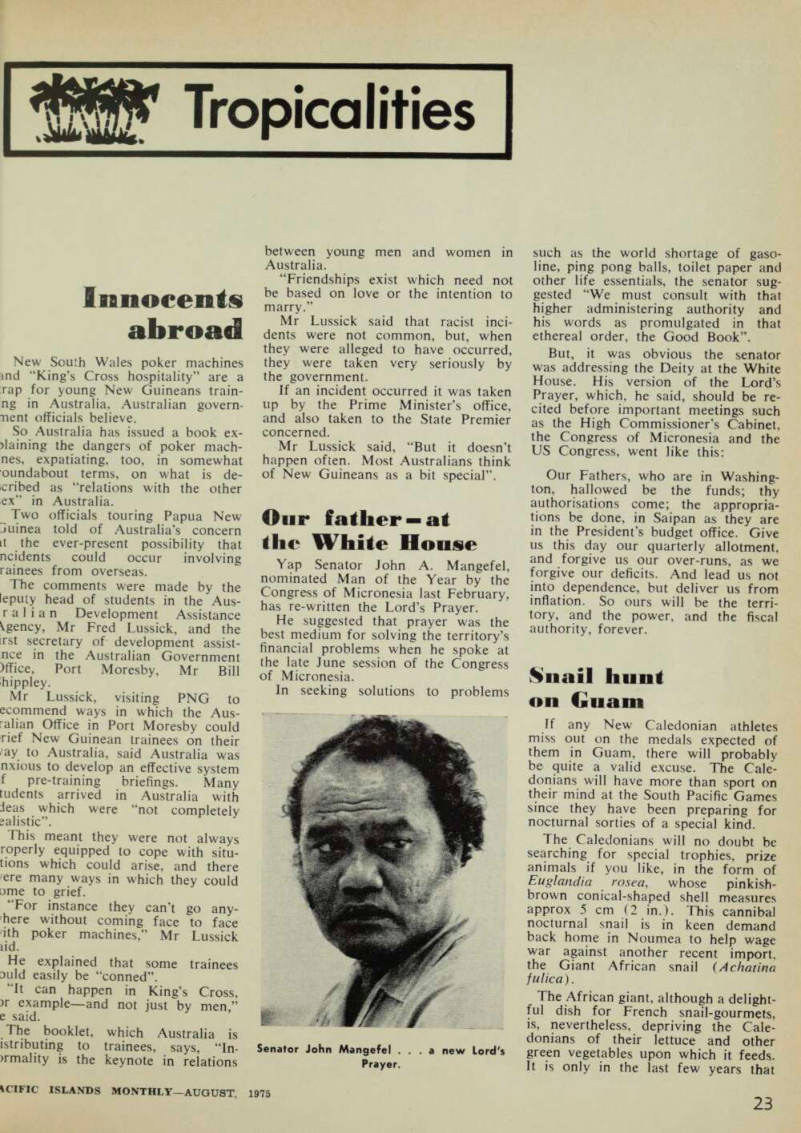

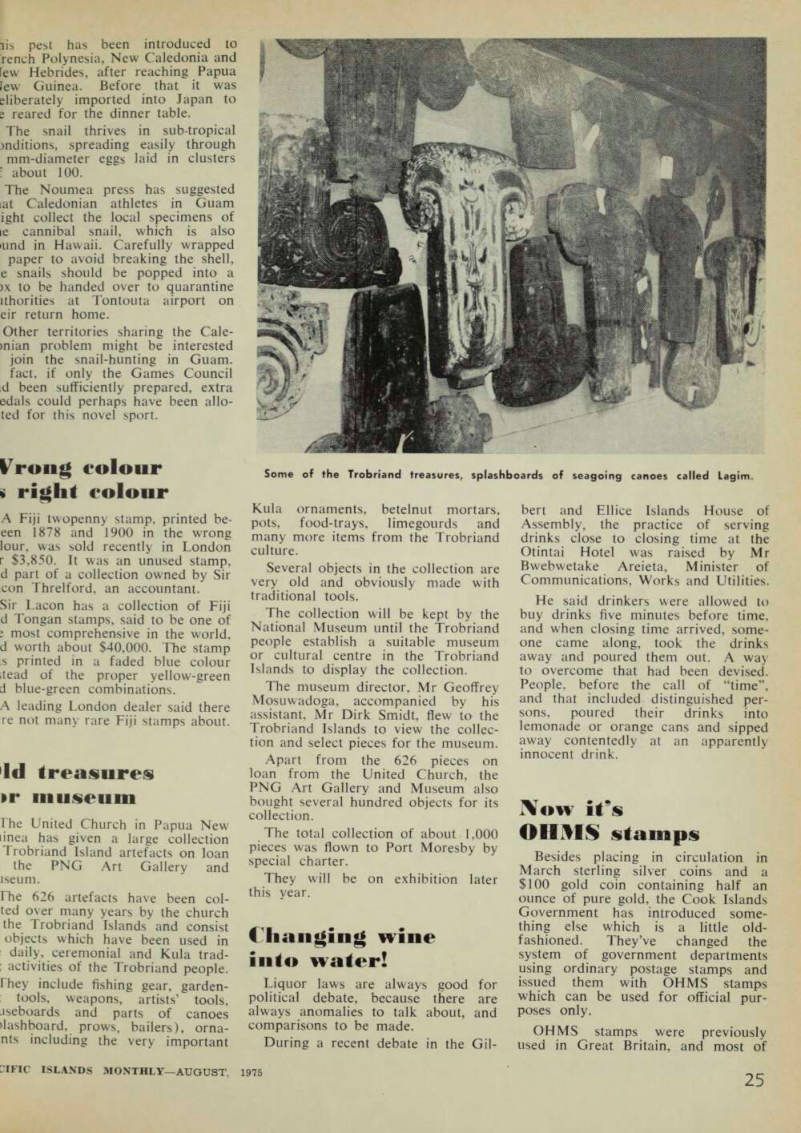
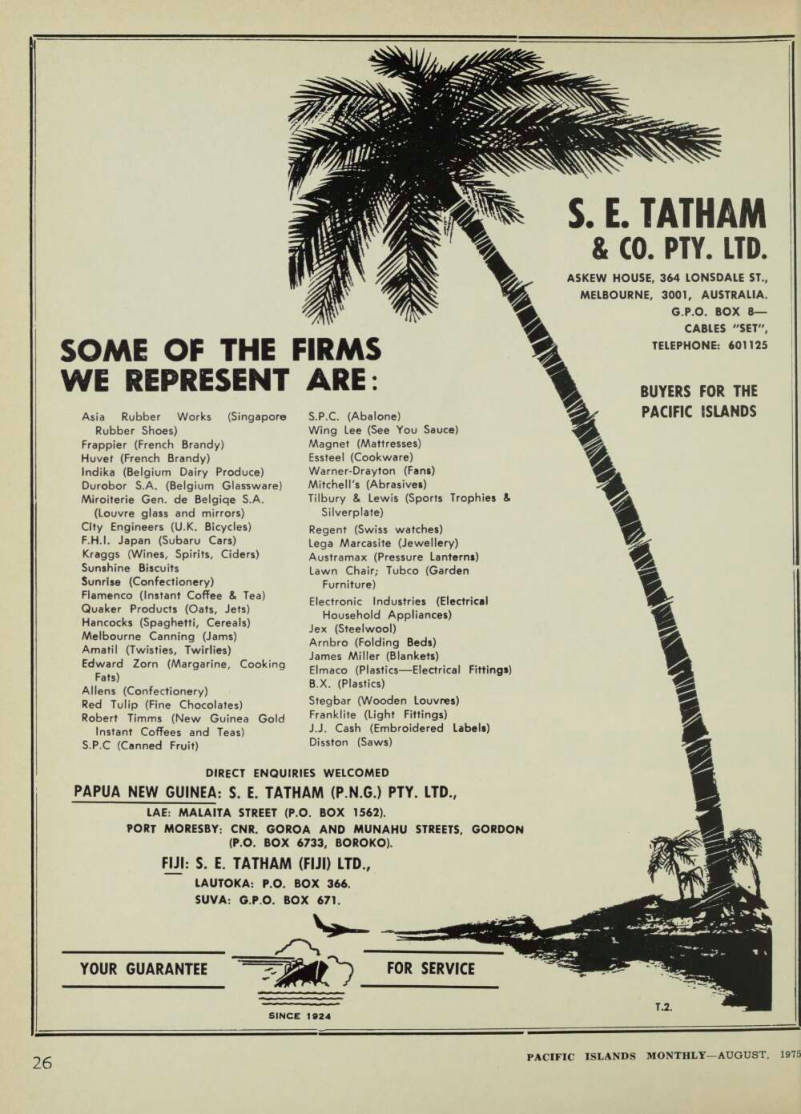
Innocents
abroad
New South Wales poker machines and “King’s Cross hospitality” are a rap for young New Guineans train ng in Australia, Australian govern uent officials believe.
So Australia has issued a book ex flaining the dangers of poker machi nes, expatiating, too, in somewhat oundabout terms, on what is de cribed as “relations with the other ex” in Australia.
Two officials touring Papua New juinea told of Australia’s concern it the ever-present possibility that ncidents could occur involving rainees from overseas.
The comments were made by the leputy head of students in the Aus r a I i a n Development Assistance Agency, Mr Fred Lussick, and the irst secretary of development assist nce in the Australian Government >ffice. Port Moresby, Mr Bill hippley.
Mr Lussick, visiting PNG to ecommend ways in which the Aus ralian Office in Port Moresby could rief New Guinean trainees on their /ay to Australia, said Australia was nxious to develop an effective system f pre-training briefings. Many tudents arrived in Australia with Jeas which were “not completely salistic”.
This meant they were not always roperly equipped to cope with situ tions which could arise, and there ere many ways in which they could □me to grief.
For instance they can’t go any where without coming face to face ith poker machines,” Mr Lussick ud.
He explained that some trainees □uld easily be “conned”.
It can happen in King’s Cross, )r example—and not just by men,” e said.
The booklet, which Australia is istnbuting to trainees, says, “In >rmality is the keynote in relations
between young men and women in Australia.
“Friendships exist which need not be based on love or the intention to marry.”
Mr Lussick said that racist inci dents were not common, but, when they were alleged to have occurred, they were taken very seriously by the government.
If an incident occurred it was taken up by the Prime Minister’s office, and also taken to the State Premier concerned.
Mr Lussick said, “But it doesn’t happen often. Most Australians think of New Guineans as a bit special”.
Our father at
the White House
Yap Senator John A. Mangefel, nominated Man of the Year by the Congress of Micronesia last February, has re-written the Lord’s Prayer.
He suggested that prayer was the best medium for solving the territory’s financial problems when he spoke at the late June session of the Congress of Micronesia.
In seeking solutions to problems
such as the world shortage of gaso line, ping pong balls, toilet paper and other life essentials, the senator sug gested “We must consult with that higher administering authority and his words as promulgated in that ethereal order, the Good Book”.
But, it was obvious the senator was addressing the Deity at the White House. His version of the Lord’s Prayer, which, he said, should be re cited before important meetings such as the High Commissioner’s Cabinet, the Congress of Micronesia and the US Congress, went like this: Our Fathers, who are in Washing ton, hallowed be the funds; thy authorisations come; the appropria tions be done, in Saipan as they are in the President’s budget office. Give us this day our quarterly allotment, and forgive us our over-runs, as we forgive our deficits. And lead us not into dependence, but deliver us from inflation. So ours will be the terri tory, and the power, and the fiscal authority, forever.
Snail hunt
on Guam
If any New Caledonian athletes miss out on the medals expected of them in Guam, there will probably be quite a valid excuse. The Cale donians will have more than sport on their mind at the South Pacific Games since they have been preparing for nocturnal sorties of a special kind.
The Caledonians will no doubt be searching for special trophies, prize animals if you like, in the form of Euglandia rosea, whose pinkish brown conical-shaped shell measures approx 5 cm (2 in.). This cannibal nocturnal snail is in keen demand back home in Noumea to help wage war against another recent import, the Giant African snail (Achatina fulica ).
The African giant, although a delight ful dish for French snail-gourmets, is, nevertheless, depriving the Cale donians of their lettuce and other green vegetables upon which it feeds.
It is only in the last few years that
Senator John Mangefel ... a new Lord's Prayer.
lis pest has been introduced to Tench Polynesia, New Caledonia and few Hebrides, after reaching Papua few Guinea. Before that it was eliberately imported into Japan to s reared for the dinner table.
The snail thrives in subtropical editions, spreading easily through mm-diameter eggs laid in clusters : about 100.
The Noumea press has suggested iat Caledonian athletes in Guam ight collect the local specimens of ic cannibal snail, which is also •und in Hawaii. Carefully wrapped paper to avoid breaking the shell, e snails should be popped into a )x to be handed over to quarantine ithorities at Tontouta airport on eir return home.
Other territories sharing the Cale mian problem might be interested join the snail-hunting in Guam, fact, if only the Games Council d been sufficiently prepared, extra edals could perhaps have been allo ted for this novel sport.
Crong colour
j right colour
A Fiji twopenny stamp, printed be een 1878 and 1900 in the wrong lour, was sold recently in London r $3,850. It was an unused stamp, d part of a collection owned by Sir con Threlford, an accountant.
Sir Lacon has a collection of Fiji d Tongan stamps, said to be one of : most comprehensive in the world, d worth about $40,000. The stamp s printed in a faded blue colour ;tead of the proper yellow-green d blue-green combinations.
A leading London dealer said there re not many rare Fiji stamps about.
Id treasures
»r museum The United Church in Papua New dnea has given a large collection Trobriand Island artefacts on loan the PNG Art Gallery and iseum.
Fhe 626 artefacts have been coi led over many years by the church the Trobriand Islands and consist objects which have been used in daily, ceremonial and Kula trad : activities of the Trobriand people.
Ehey include fishing gear, garden tools, weapons, artists’ tools, jseboards and parts of canoes dashboard, prows, bailers), orna nts including the very important
Kula ornaments, betelnut mortars, pots, food-trays, limegourds and many more items from the Trobriand culture.
Several objects in the collection are very old and obviously made with traditional tools.
The collection will be kept by the National Museum until the Trobriand people establish a suitable museum or cultural centre in the Trobriand Islands to display the collection.
The museum director, Mr Geoffrey Mosuwadoga, accompanied by his assistant, Mr Dirk Smidt, flew to the Trobriand Islands to view the collec tion and select pieces for the museum.
Apart from the 626 pieces on loan from the United Church, the PNG Art Gallery and Museum also bought several hundred objects for its collection.
The total collection of about 1,000 pieces was flown to Port Moresby by special charter.
They will be on exhibition later this year.
Changing wine
into water!
Liquor laws are always good for political debate, because there are always anomalies to talk about, and comparisons to be made.
During a recent debate in the Gil
bert and Ellice Islands House of Assembly, the practice of serving drinks close to closing time at the Otintai Hotel was raised by Mr Bwebwetake Areieta, Minister of Communications, Works and Utilities.
He said drinkers were allowed to buy drinks five minutes before time, and when closing time arrived, some one came along, took the drinks away and poured them out. A way to overcome that had been devised.
People, before the call of “time”, and that included distinguished per sons, poured their drinks into lemonade or orange cans and sipped away contentedly at an apparently innocent drink.
Now it’s
OHMS stamps
Besides placing in circulation in March sterling silver coins and a SIOO gold coin containing half an ounce of pure gold, the Cook Islands Government has introduced some thing else which is a little old fashioned. They’ve changed the system of government departments using ordinary postage stamps and issued them with OHMS stamps which can be used for official pur poses only.
OHMS stamps were previously used in Great Britain, and most of
Some of the Trobriand treasures, splashboards of seagoing canoes called Lagim.
he empire, and “official” stamps vere used in the United States and nany other countries, but were ;radually replaced when meter mail ame into use, and the usage of mail ould be controlled.
In the US, officials use an envelope diich bears the legend “For Official Jse Only” and a warning that if sed on private matters it subjects tie user to a penalty of several undred dollars.
The Cooks OHMS stamps can’t be sed for private mail and their intro uction means the tightening of fiscal ontrols. They are issued under strict ontrols to government departments nd are not sold by the post office i mint condition.
Overseas philatelists, however, were [lowed to buy them in sets but only i cancelled condition. When news f these stamps reached the inter alional stamp market it attracted a emendous amount of interest among hilatelists —as did the gold coin mong numismatists—and the num sr of orders sent in for the cancelled amps was so large that the philatelic jreau had to ration them lest sup ies were exhausted.
ilow ships,
ast shells
Fiji’s new naval squadron’s de mamissioned United States Navy inesweepers may only have a aximum speed of about 12 knots, it that will not help faster ships, igaged in illegal activities in Fiji aters, to get away.
The Fiji Prime Minister, Ratu Sir amisese Mara, remarked recently at he was quite unconcerned about e apparent slow speed—the missiles 3m the minesweepers would travel uch faster than the 12 knots.
Ratu Sir Kamisese, no doubt, >pes such situations will never ;e. He said the squadron would Ip to police territorial waters, sist customs, fisheries and immigra »n officials, and engage in a wide nge of other work. It will work thin the overall framework of the ji Royal Military Forces. Captain an Brown, former commander of ; old Fiji Royal Naval Volunteer :serve, and Colonel Paul Manueli, mmander of the RFMF, were in ; United States in June, investigat ? crew training and refuelling the nesweepers.
There was no lack of volunteers serve in the ships. There were ndreds of applicants, and only 62 :re required. They included former
sailors, members of the Marine De partment, school-leavers and students.
Interviewers were unable to cope, and had to turn many away.
Captain Brown said the 62 men selected would go to Seattle for 2i months of training, which would cover radar, electronics, sonar, gun nery and engineering. He was highly pleased with the standard of the applicants, and considered they would make excellent naval men.
Fishermen
in the soup
Two Micronesian fishermen, fishing with Japanese-type long lines from a canoe off Parem Reef in Ponape District in late June, caught a large Leatherback turtle, the largest ever recorded in the area.
There were visions of almost un limited supplies of turtle soup—until the fishermen discovered they’d broken the law. Leatherbacks, threatened with extinction—this one certainly was—are listed in the United States and in the Trust Terri tory as an “endangered species”.
What’s more, the Trust Territory code prohibits the taking of any kind of turtle between June 1 and August 31 and between December 1 and January 31.
This one was over seven feet overall, with a carapace (the shell, for those who don’t know) measur ing 5J feet and weighing 978 lb.
Burying the
liatehet in PNG
They’ve got long memories in Papua New Guinea! Fifty years ago a villager from the Kumai clan in the Western Highlands was killed in a dispute over potatoes growing in a Niniga clan garden.
The Niniga people claimed that the man was caught stealing potatoes but, obviously, the Kumai people didn’t think the potatoes were as valuable as a man’s life and de manded compensation. The Niniga people paid compensation—soo pigs and traditional riches, but the Kumais weren’t satisfied. They wanted more, and for half a century they’ve asked for more.
Now, there’s a good chance that the Kumais have buried the hatchet, but it was a dear burial.
In June, more than 4,000 warriors, resplendent in traditional costume, met in a payment ceremony and the Ninigans handed over 200 pigs, four cassowaries and 2,000 kina.
Advertisements & other items, pp. 27-32 (4 items)
Icific Islands Monthly—August, 1975
the most important ingredient
■I a
rai — m i nin
• ' T — ""'"TT ? ;r : I * m «.
IM V 4^ ' -5:: ' ill u p A *J * ■" » ? ,f K S& &
h mpfN.§M
4**® OF AUSTRALIA
25 KG NfT
m i i ■ i ■ ip^ m. ,‘S. ; -■*»>- ,if 4 /
the most important ingredient
BREAD FLOURS:
CAKE FLOURS:
BISCUIT FLOURS:
SPECIALITY FLOURS:
• MAINTOP —high protein bread flour • ANCHOR —bakers flour • 50/50 MEAL —brown bread • MEDlUM—cake and pastry • SPONGE—sponge cakes • SPECIAL CAKE —madeira and cup cakes ® STRONG —cracker biscuits •MEDIUM —Shortbreads • SOFT—sweet biscuits • RYE flour • RYE meal • KIBBLED RYE • SHARPS —roti and chapati flour • 100% STONE GROUND
WHOLEMEAL
GILLESPIE BROS. PTY. LTD.
HEAD OFFICE:
52 UNION ST., PYRMONT, SYDNEY, N.S.W.
(6.P.0. BOX 2518, SYDNEY, 2001.)
PHONE: 660-4933.
BRISBANE OFFICE:
CABLE ADDRESS: ALBION, BRISBANE, QUEENSLAND.
"GILLESPIE", (P.O. BOX 8, ALBION, BRISBANE, 4010.
SYDNEY AND BRISBANE. PHONE: 6-1121.
SOME OF THE FIRMS
WE REPRESENT ARE:
Asia Rubber Works (Singapore Rubber Shoes) Frappier (French Brandy) Huvet (French Brandy) Indika (Belgium Dairy Produce) Durobor S.A. (Belgium Glassware) Miroiterie Gen. de Belgiqe S.A. (Louvre glass and mirrors) City Engineers (U.K. Bicycles) F.H.I. Japan (Subaru Cars) Kraggs (Wines, Spirits, Ciders) Sunshine Biscuits Sunrise (Confectionery) Flamenco (Instant Coffee & Tea) Quaker Products (Oats, Jets) Hancocks (Spaghetti, Cereals) Melbourne Canning (Jams) Amatil (Twisties, Twirlies) Edward Zorn (Margarine, Cooking Fats) Allens (Confectionery) Red Tulip (Fine Chocolates) Robert Timms (New Guinea Gold Instant Coffees and Teas) S.P.C (Canned Fruit) S.P.C. (Abalone) Wing Lee (See You Sauce) Magnet (Mattresses) Essteel (Cookware) Warner-Drayton (Fans) Mitchell's (Abrasives) Tilbury & Lewis (Sports Trophies & Silverplate) Regent (Swiss watches) Lega Marcasite (Jewellery) Austramax (Pressure Lanterns) Lawn Chair; Tubco (Garden Furniture) Electronic Industries (Electrical Household Appliances) Jex (Steelwool) Arnbro (Folding Beds) James Miller (Blankets) Elmaco (Plastics —Electrical Fittings) B.X. (Plastics) Stegbar (Wooden Louvres) Franklite (Light Fittings) J.J. Cash (Embroidered Labels) Disston (Saws)
S. E. TATHAM
& CO. PTY. LTD.
ASKEW HOUSE, 364 LONSDALE ST. f
MELBOURNE, 3001, AUSTRALIA.
G.P.O. BOX 8—
CABLES "SET",
TELEPHONE: 601125
BUYERS FOR THE
PACIFIC ISLANDS
IS 1 5* % 1
DIRECT ENQUIRIES WELCOMED
PAPUA NEW GUINEA; S. E. TATHAM (P.N.G.) PTY. LTD.,
LAE: MALAITA STREET (P.O. BOX 1562).
PORT MORESBY: CNR. GOROA AND MUNAHU STREETS, GORDON
(P.O. BOX 6733, BOROKO).
FIJI: S. E. TATHAM (FIJI) LTD.,
LAUTOKA: P.O. BOX 366.
SUVA: G.P.O. BOX 671.
YOUR GUARANTEE
/"N
SINCE 1924
1 1 1
FOR SERVICE
T. 2
Cook and clean
Frypan
with detachable cradle
for complete and
easy cleaning
Sunbeam presents an electric frypan that comes apart for complete cleaning the easy way. New "cook and clean" cradle combines legs, buffet handles and bottom shield. Clean the pan in the dishwasher or sink, and the cradle in the sink. Then put them back together with the twist of a knob.
Shot - off - Steam
Iron
A totally new concept in irons.
Cruises effortlessly over woollens, linen, cotton and all synthetics. Removes unwanted creases and wrinkles with a penetrating shot-of-steam —at the touch of a button.
The VOLTA Super Suction Cleaners
v °ir,
Upright or cylinder cleaner, there is a VOLTA model to suit every need. All of them with outstanding cleaning power and advanced features —at a realistic price—to make home cleaning easier and quicker.
VOLTA offers three magnificent models; The dashing BLUE VOLTA speed cleaner with super power, the economy-priced WHITE VOLTA for the smaller home. And if you prefer an upright, there is the outstanding performer, the superbly styled DUAL ACTION VOLTA combining the powered brush and easy manoeuvrability of an upright with the powerful suction and convenience of a cylinder.
For sale through The VOLTA people for the Pacific Islands:
KERR BROTHERS PTY. LIMITED
65 York St., Sydney, N.S.W. 2001
Save hundreds of dollars
on Australians most efficient
WALK IN, ALUMINIUM
COOLROOMS AND
FREEZE ROOMS
Hundreds already installed! The most economical supplementary coolr ooms for bottles and food, providing the largest storage capacity of any comparable coolrooms of the same exterior dimensions. Five sizes —from 90-360 cu. ft. capacity; 16 models offering normal temp., two temp., deep freeze, or for pastry and ice storage applications. White vinyl interior, embossed rustproof aluminium exterior. • SUPPLIED IN EASY-TO-ERECT DO-IT-YOURSELF KIT FORM.
Available from;
& BARDA), 363
AUSTRALIAN NEW CALEDONIA EXPORTS (SILVER
George St., Sydney, 2000 and Branches.
BRECKWOLDT & CO., 276 Pitt St., Sydney, 2000 and Branches.
PETER FISHER TRADING PTY. LTD., 321 Pitt St., Sydney, 2000.
HAGEMEYER (A'SIA), 59 Anzac Pde., Kensington, 2033 and Branches.
KERR BROS, 65 York St., Sydney, 2000.
Manufactured by:
NELSON & ROBERTSON PTY. LTD., 197 Clarence St., Sydney, 2000 RABAUL TRADING CO. PTY. LTD., P.O. Box 219, Rabaul and Branch ROY GALLIMORE & ASSOCIATES, P.O. Box 179, Vila, New Hebrid C. SULLIVAN (EXPORT) PTY. LTD., 60 Margaret St., Sydney, 2000 a Branches.
W. S. TAIT & CO, PTY. LTD., 31 Macquarie Place, Sydney, 2000 a Branches.
WARBURTON FRANKI
199 Parramatta Road Cnr. Skarratt Street, Auburn, N.S.W. 2144, Australia. Phone 648-1711.
POWERED BY
KELVINATOR.
Five-year warranty compressor. Early d livery.
25
ISLANDS MONTHLY—AUGUST, 1975
Cific Islands Monthly— August, 1975
Self-help and festival
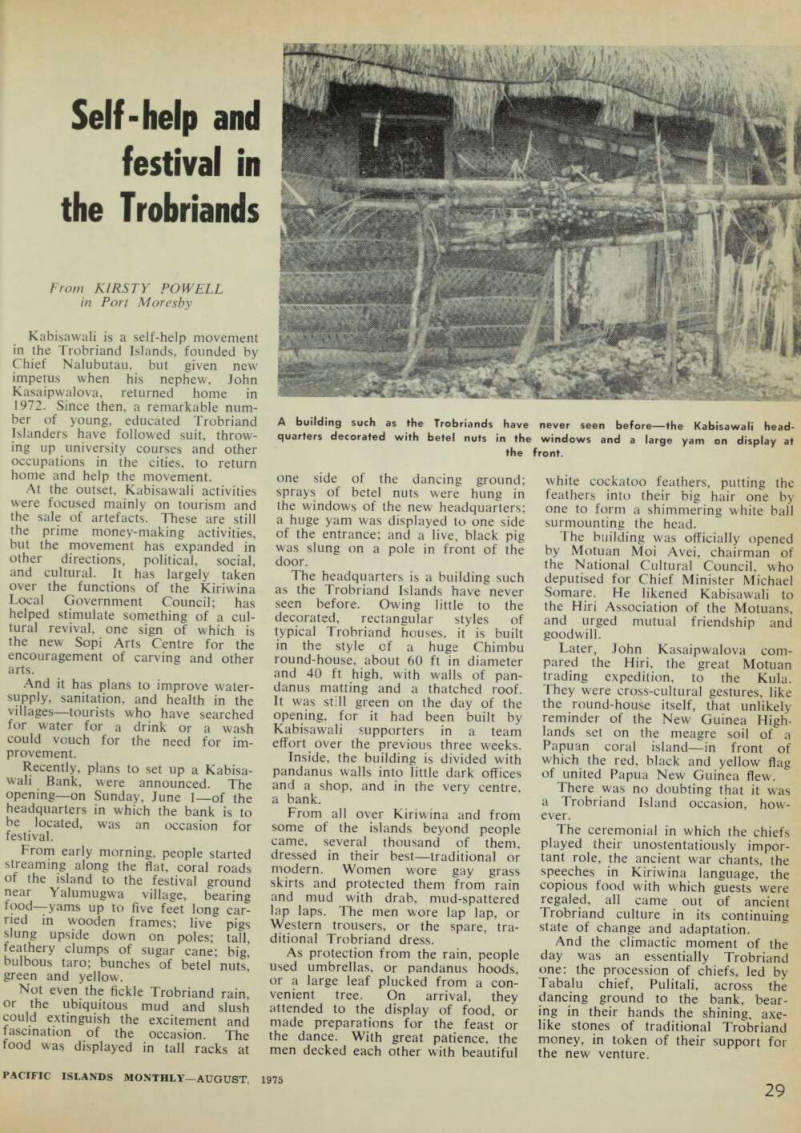
festival in the Trobriands
From Kirsty Powell
in Port Moresby Kabisawali is a self-help movement in the Trobriand Islands, founded by Chief Nalubutau, but given new impetus when his nephew, John Kasaipwalova, returned home in 1972. Since then, a remarkable num ber of young, educated Trobriand Islanders have followed suit, throw ing up university courses and other occupations in the cities, to return home and help the movement.
At the outset, Kabisawali activities were focused mainly on tourism and the sale of artefacts. These are still the prime money-making activities, but the movement has expanded in other directions, political, social, and cultural. It has largely taken over the functions of the Kiriwina Local Government Council; has helped stimulate something of a cul tural revival, one sign of which is the new Sopi Arts Centre for the encouragement of carving and other arts.
And it has plans to improve water supply, sanitation, and health in the villages—tourists who have searched for water for a drink or a wash could vouch for the need for im provement.
Recently, plans to set up a Kabisa wah Bank, were announced. The opening—on Sunday, June I—of the headquarters in which the bank is to be located, was an occasion for festival.
From early morning, people started streaming along the flat, coral roads of the island to the festival ground near Yalumugwa village, bearing food—yams up to five feet long car ried in wooden frames; live pigs slung upside down on poles; tall, feathery clumps of sugar cane; big,’ bulbous taro; bunches of betel nuts, green and yellow.
Not even the fickle Trobriand rain, or the übiquitous mud and slush could extinguish the excitement and fascination of the occasion. The food was displayed in tall racks at
one side of the dancing ground; sprays of betel nuts were hung in the windows of the new headquarters; a huge yam was displayed to one side of the entrance; and a live, black pig was slung on a pole in front of the door.
The headquarters is a building such as the Trobriand Islands have never seen before. Owing little to the decorated, rectangular styles of typical Trobriand houses, it is built in the style of a huge Chimbu round-house, about 60 ft in diameter and 40 ft high, with walls of pan danus matting and a thatched roof.
It was still green on the day of the opening, for it had been built by Kabisawali supporters in a team effort over the previous three weeks.
Inside, the building is divided with pandanus walls into little dark offices and a shop, and in the very centre, a bank.
From all over Kiriwina and from some of the islands beyond people came, several thousand of them, dressed in their best—traditional or modern. Women wore gay grass skirts and protected them from rain and mud with drab, mud-spattered lap laps. The men wore lap lap, or Western trousers, or the spare, tra ditional Trobriand dress.
As protection from the rain, people used umbrellas, or pandanus hoods, or a large leaf plucked from a con venient tree. On arrival, they attended to the display of food, or made preparations for the feast or the dance. With great patience, the men decked each other with beautiful
white cockatoo feathers, putting the feathers into their big hair one by one to form a shimmering white ball surmounting the head.
The building was officially opened by Motuan Moi Avei, chairman of the National Cultural Council, who deputised for Chief Minister Michael Somare. He likened Kabisawali to the Hiri Association of the Motuans, and urged mutual friendship and goodwill.
Later, John Kasaipwalova com pared the Hiri, the great Motuan trading expedition, to the Kula.
They were cross-cultural gestures, like the round-house itself, that unlikely reminder of the New Guinea High lands set on the meagre soil of a Papuan coral island—in front of which the red, black and yellow flag of united Papua New Guinea flew.
There was no doubting that it was a Trobriand Island occasion, how ever.
The ceremonial in which the chiefs played their unostentatiously impor tant role, the ancient war chants, the speeches in Kiriwina language, the copious food with which guests were regaled, all came out of ancient Trobriand culture in its continuing state of change and adaptation.
And the climactic moment of the day was an essentially Trobriand one: the procession of chiefs, led by Tabalu chief, Pulitali, across the dancing ground to the bank, bear ing in their hands the shining, axe like stones of traditional Trobriand money, in token of their support for the new venture.
A building such as the Trobriands have never seen before —the Kabisawali head quarters decorated with betel nuts in the windows and a large yam on display at the front.
Advertisements & other items, p. 34 (1 item)
Let Lane
lend a hand
These are some of the products which are keeping our customers prosperous. From this range, you can obtain a really effective herbicide such as M.S.M.A., which controls persistent grasses and sedges in coconuts and bananas, or a short, residual, quick-acting insecticide like DIBROM which controls fruit and vegetable insects and mosquitoes, sandflies and midges.
Also, our research facilities and advisory services in the field are among the best available, so drop us a line and let us help you.
Lane Ltd., Export Division, P.O. Box 59, Bankstown, N.S.W. 2200 Lane (Fiji) Ltd., P.O. Box 89, Suva, Fiji f f
Jllnsecticide
Fungicids-D^
f t Weedkiller , Feed Supplement f Animal Health umigants f \ 3; Home Carded S w A ■3f Don’t forget—Amalgamated Chemicals is now Lane nqrq
20 MINUTES FROM THE AIRPORT;
CENTURIES APART FROM THE WORLD.
"s H
IIPBO
rrrrrrrrfrwrf "•"B 1 . ! it • ■■ LkkkkkklAkkkhKkkkKkkkk,kk.kkkt»k r-J ESS r.-j P a tiUJUUHiu", ah m VBnianmwuwmmumn nn PW : T p « M Pacific passengers can step into one of the world’s most legendary experiences.
The Regent of Fiji is a beach-front paradise. 300 gracious rooms clustered among towering palms and dazzling orchids. With two enchanted dining rooms. The rousing Meke Lounge. Complete banquet/convention pavilion and duty free shopping.
Outside, the gleaming Vuda—white shore—slopes into wavefree Nadi Bay. Experience our realm of ocean sports. Beachcombing, tennis, or golf. And our own fresh-water pool.
Book space in paradise now. For the night of a lifetime.
The Regent of Fiji—2o minutes from the airport.
POST OFFICE BOX 441 • NADI, FUI • PHONE 70700 • TELEX (792) 5214 ONE OF the many WORLDS OF REGENT INTERNATIONAL HOTELS
the Regent of Fiji
DENARAU BEACH RESORT
Sydney, Australia Sales Office No. 1 York Street, 14th floor Sydney, Australia 2000 Phone (02) 276469 Phone collect for reservations In Auckland, New Zealand, phone 71909
Tok Pisin-A Sign Of The Times
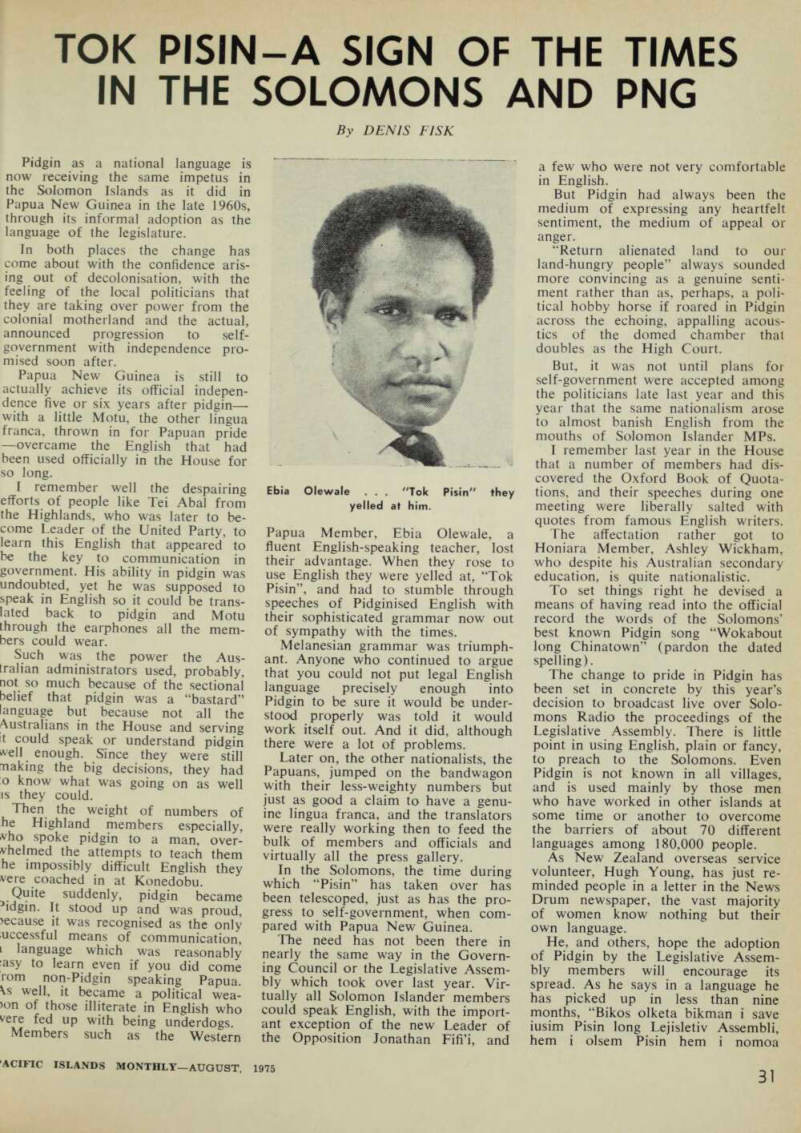

In The Solomons And Png
By Denis Fisk
Pidgin as a national language is now receiving the same impetus in the Solomon Islands as it did in Papua New Guinea in the late 19605, through its informal adoption as the language of the legislature.
In both places the change has come about with the confidence aris ing out of decolonisation, with the feeling of the local politicians that they are taking over power from the colonial motherland and the actual, announced progression to self government with independence pro mised soon after.
Papua New Guinea is still to actually achieve its official indepen dence five or six years after pidgin— with a little Motu, the other lingua franca, thrown in for Papuan pride —overcame the English that had been used officially in the House for so long.
I remember well the despairing efforts of people like Tei Abal from the Highlands, who was later to be come Leader of the United Party, to learn this English that appeared to be the key to communication in government. His ability in pidgin was undoubted, yet he was supposed to speak in English so it could be trans lated back to pidgin and Motu through the earphones all the mem bers could wear.
Such was the power the Aus tralian administrators used, probably, not so much because of the sectional belief that pidgin was a “bastard” language but because not all the Australians in the House and serving it could speak or understand pidgin well enough. Since they were still making the big decisions, they had 0 know what was going on as well is they could.
Then the weight of numbers of he Highland members especially, who spoke pidgin to a man, over vhelmed the attempts to teach them he impossibly difficult English they vere coached in at Konedobu.
Quite suddenly, pidgin became 3 idgin. It stood up and was proud, >ecause it was recognised as the only uccessful means of communication, 1 language which was reasonably ■asy to learn even if you did come rom non-Pidgin speaking Papua. \s well, it became a political wea )on of those illiterate in English who vere fed up with being underdogs.
Members such as the Western
Papua Member, Ebia Olewale, a fluent English-speaking teacher, lost their advantage. When they rose to use English they were yelled at, “Tok Pisin”, and had to stumble through speeches of Pidginised English with their sophisticated grammar now out of sympathy with the times.
Melanesian grammar was triumph ant. Anyone who continued to argue that you could not put legal English language precisely enough into Pidgin to be sure it would be under stood properly was told it would work itself out. And it did, although there were a lot of problems.
Later on, the other nationalists, the Papuans, jumped on the bandwagon with their less-weighty numbers but just as good a claim to have a genu ine lingua franca, and the translators were really working then to feed the bulk of members and officials and virtually all the press gallery.
In the Solomons, the time during which “Pisin” has taken over has been telescoped, just as has the pro gress to self-government, when com pared with Papua New Guinea.
The need has not been there in nearly the same way in the Govern ing Council or the Legislative Assem bly which took over last year. Vir tually all Solomon Islander members could speak English, with the import ant exception of the new Leader of the Opposition Jonathan Fifi’i, and
a few who were not very comfortable in English.
But Pidgin had always been the medium of expressing any heartfelt sentiment, the medium of appeal or anger.
“Return alienated land to our land-hungry people” always sounded more convincing as a genuine senti ment rather than as, perhaps, a poli tical hobby horse if roared in Pidgin across the echoing, appalling acous tics of the domed chamber that doubles as the High Court.
But, it was not until plans for self-government were accepted among the politicians late last year and this year that the same nationalism arose to almost banish English from the mouths of Solomon Islander MPs.
I remember last year in the House that a number of members had dis covered the Oxford Book of Quota tions, and their speeches during one meeting were liberally salted with quotes from famous English writers.
The affectation rather got to Honiara Member, Ashley Wickham, who despite his Australian secondary education, is quite nationalistic.
To set things right he devised a means of having read into the official record the words of the Solomons’ best known Pidgin song “Wokabout long Chinatown” (pardon the dated spelling).
The change to pride in Pidgin has been set in concrete by this year’s decision to broadcast live over Solo mons Radio the proceedings of the Legislative Assembly. There is little point in using English, plain or fancy, to preach to the Solomons. Even Pidgin is not known in all villages, and is used mainly by those men who have worked in other islands at some time or another to overcome the barriers of about 70 different languages among 180,000 people.
As New Zealand overseas service volunteer, Hugh Young, has just re minded people in a letter in the News Drum newspaper, the vast majority of women know nothing but their own language.
He, and others, hope the adoption of Pidgin by the Legislative Assem bly members will encourage its spread. As he says in a language he has picked up in less than nine months, “Bikos olketa bikman i save iusim Pisin long Lejisletiv Assembli, hem i olsem Pisin hem i nomoa
Ebia Olewale . . . "Tok Pisin" they yelled at him.
rabish lanuisi nao”—Now that the big men are using Pidgin, it is no longer denigrated.
He thinks they want Pidgin to spread, for the important reason that women should learn it to learn in turn to improve health and prevent illness, to make better food, and “plande samting moa”.
It is not even two years since the first real effort was made to standardise the writing of a language which is spoken in a variety of ways according to local language variations.
It was the Christian Churches which got together a committee
which evolved a modest spelling book initially, and from that came various bible tracts, prayers and stories which have begun to spread the stan dard spelling, although not without some wayward examples, The reasons for the use of English in the legislature in the Solomons were much as in Papua New Guinea —there were too many expatriates involved to allow Pidgin, despite some of them being expert speakers, Certainly, though, the secretaries to departmental directors and other high officials who doubled as Han sard reporters during the legislature meetings could not cope with Pidgin.
Which leaves me wondering how the official report of debates is being kept now? The Solomons has not the money to spend as Papua New Guinea had to establish translation channels. Do the secretaries now take the Pidgin in shortland? If they do, who translates it into an English book as it has traditionally been?
On the same subject, GUS SMALES writes from Fort Moresby: Melanesian Pidgin (or, if you like, pidgin English, neo-Melanesian or Tok Pisin) is on the up and up in Papua New Guinea. It’s fast acquir ing a new sort of status symbol, dictated largely by the growing spirit of nationalism.
English remains the official langu age of PNG by default rather than by edict, but the status of Pidgin is paradoxically rising despite the grow ing sophistication of politics and pub lic life.
The Transport Minister, Mr lambakey Okuk, bluntly told a white interviewer on radio that “If you want to discuss something properly with me, you had better learn Pidgin”. That was from a man who speaks English, but who pointedly prefers Pidgin if he is not using his home language.
The three recognised languages of the House of Assembly are English, Pidgin and the widely-spread Motu.
But during the June debate on a Constitution for PNG, and despite the operation of a translation service, there have been several interjections of “Talk in Pidgin” when ministers attempted to explain points in English.
Of the 100 members in the House, 35 speak only Pidgin apart from their home languages. Most of the others are fluent in Pidgin and Eng lish, but the records show that the use of Pidgin in the House is in creasing.
This has particularly followed the withdrawal from the House of Aus tralia’s officially-appointed represent atives, with its overtones of territorial control.
A special society in Port Moresby —the Tok Pisin Society—exists to keep the language alive and current.
Appalled by the efforts of some whites, who try to write Pidgin advertisements or public notices, it has offered its help free of charge.
On present indications the increas ing use of Pidgin in high places is a side issue in the nationalism which is accompanying PNG’s approach to independence.
In the next few years its use will probably tend to drop off again, but it still has a long, long life ahead of it as a link between far-flung com munities in PNG.
Advertisements & other items, pp. 35-36 (2 items)
31
ACIFIC ISLANDS MONTHLY—AUGUST, 1975
, itc Labe*
as s OOoli m Prht^ 1 * IrS? 1 TO Mf " HAJfSTT TMI OOtEM V (
■S2^JL WHISI<r D'ST.ILfM
°iWM > SONS. ITO
'“Ssets ANfWIKT CAI»
W 93 IB9A ,0 ” 4
, itc Labe*
INe Scotch Whisk'
Lid
n Dewa
Sons aN p
SCOTL
For people who value
tradition.
Dewar’s“WhiteLabef-it never varies.
Magazine Section
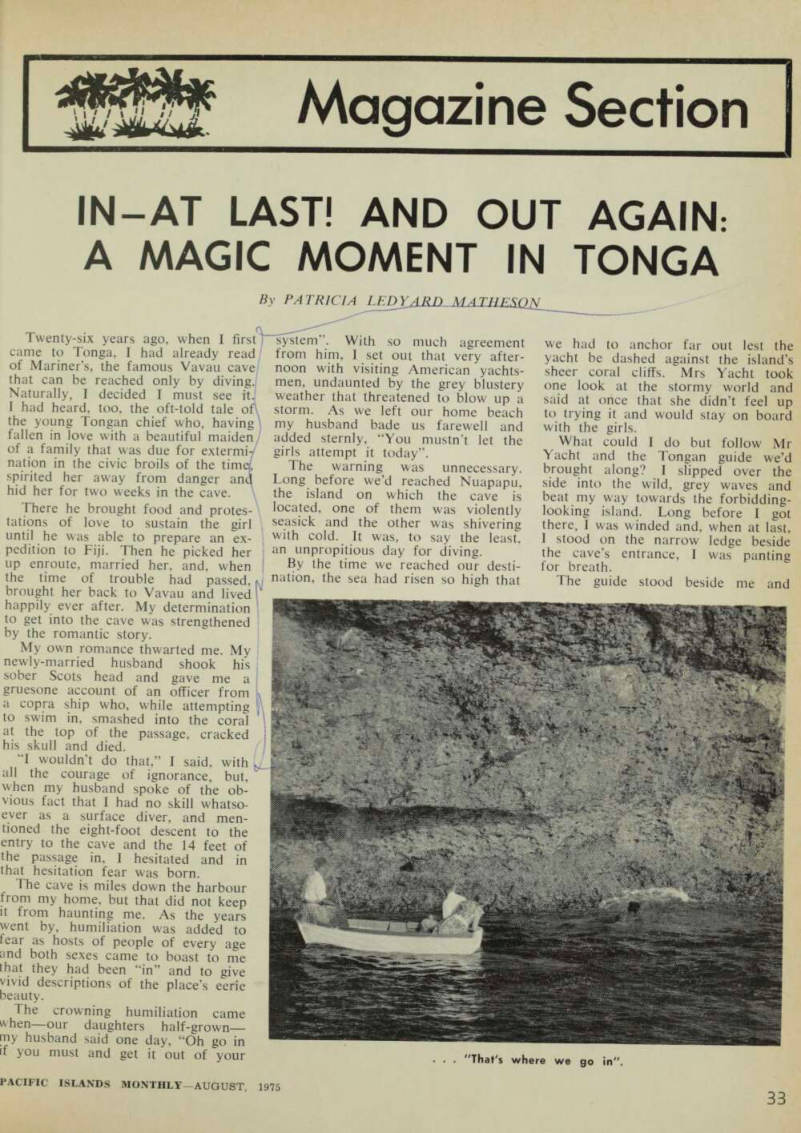

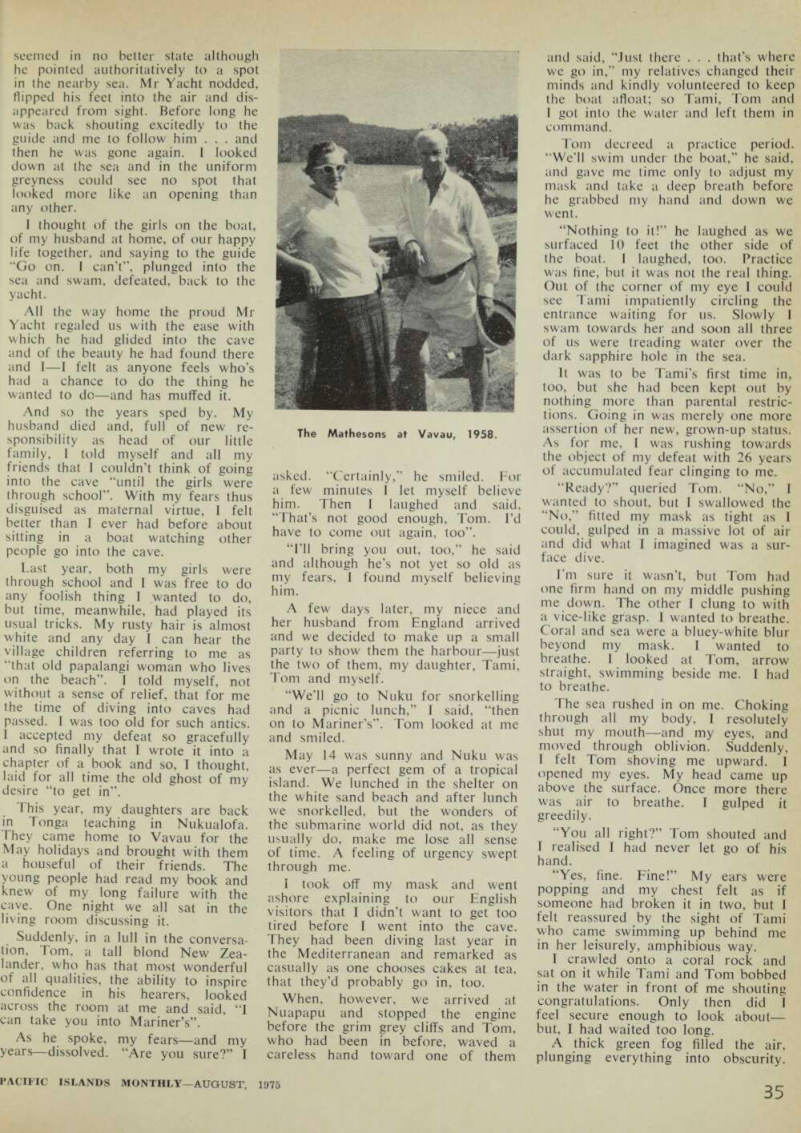
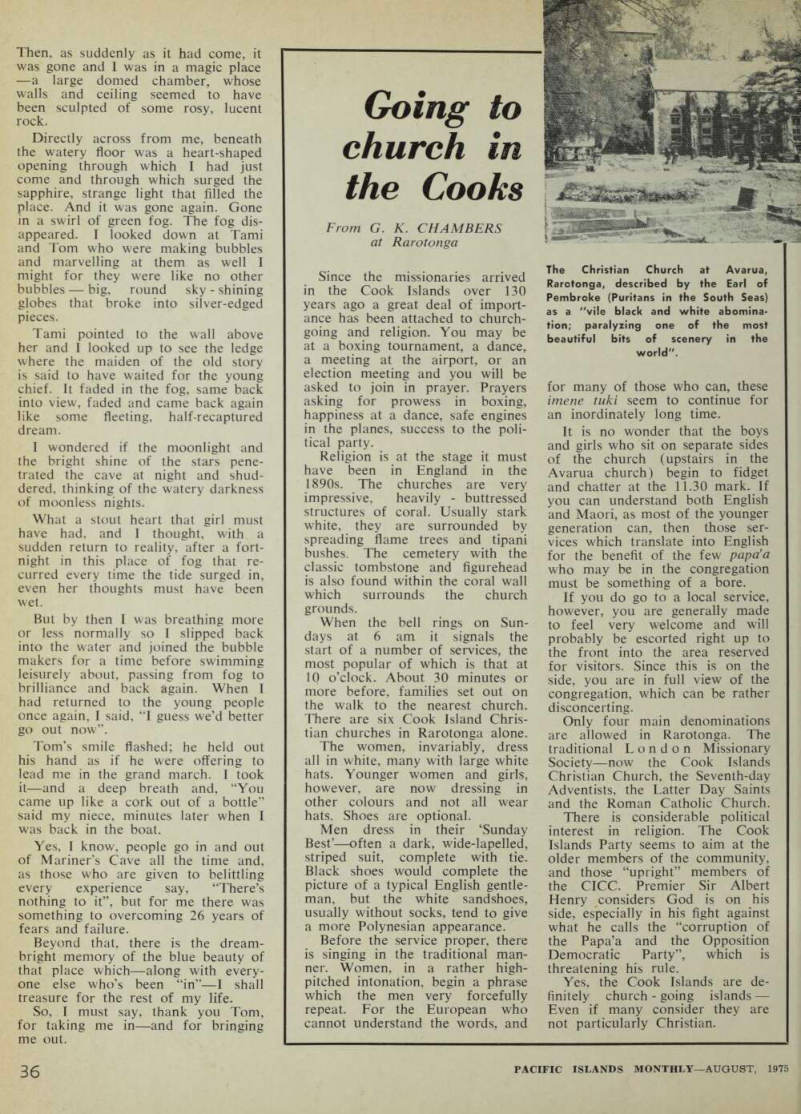
In-At Last! And Out Again:
A Magic Moment In Tonga
By Pa Tricia Ledyard Matheson
Twenty-six years ago, when I first came to Tonga, I had already read of Mariner’s, the famous Vavau cave that can be reached only by diving.
Naturally, I decided I must see it.!
I had heard, too, the oft-told tale of the young Tongan chief who, having fallen in love with a beautiful maiden of a family that was due for extermiV nation in the civic broils of the time/ spirited her away from danger ancj hid her for two weeks in the cave. \ There he brought food and protes tations of love to sustain the girl until he was able to prepare an ex pedition to Fiji. Then he picked her up enroute, married her, and, when the time of trouble had passed,, brought her back to Vavau and lived ! happily ever after. My determination to get into the cave was strengthened by the romantic story.
My own romance thwarted me. My newly-married husband shook his sober Scots head and gave me a gruesone account of an officer from a copra ship who, while attempting to swim in, smashed into the coral at the top of the passage, cracked his skull and died.
“I wouldn’t do that,” I said, with ( all the courage of ignorance, but, when my husband spoke of the ob vious fact that I had no skill whatso ever as a surface diver, and men tioned the eight-foot descent to the entry to the cave and the 14 feet of the passage in, I hesitated and in that hesitation fear was born.
The cave is miles down the harbour from my home, but that did not keep it from haunting me. As the years went by, humiliation was added to fear as hosts of people of every age and both sexes came to boast to me that they had been “in” and to give vivid descriptions of the place’s eerie beauty.
The crowning humiliation came when —our daughters half-grown— my husband said one day, “Oh go in if you must and get it out of your
system”. With so much agreement from him, 1 set out that very after noon with visiting American yachts men, undaunted by the grey blustery weather that threatened to blow up a storm. As we left our home beach my husband bade us farewell and added sternly, “You mustn’t let the girls attempt it today”.
The warning was unnecessary.
Long before we’d reached Nuapapu, the island on which the cave is located, one of them was violently seasick and the other was shivering with cold. It was, to say the least,
an unpropitious day for diving.
By the time we reached our desti nation, the sea had risen so high that
we had to anchor far out lest the yacht be dashed against the island’s sheer coral cliffs. Mrs Yacht took one look at the stormy world and said at once that she didn’t feel up to trying it and would stay on board with the girls.
What could I do but follow Mr Yacht and the Tongan guide we’d brought along? I slipped over the side into the wild, grey waves and beat my way towards the forbidding looking island. Long before I got there, I was winded and, when at last, I stood on the narrow ledge beside the cave’s entrance, I was panting for breath.
The guide stood beside me and
. . . "That's where we go in".
seemed in no better state although he pointed authoritatively to a spot in the nearby sea. Mr Yacht nodded, flipped his feet into the air and dis appeared from sight. Before long he was back shouting excitedly to the guide and me to follow him . . . and then he was gone again. 1 looked down at the sea and in the uniform greyness could see no spot that looked more like an opening than any other.
I thought of the girls on the boat, of my husband at home, of our happy life together, and saying to the guide “Go on. I can’t”, plunged into the sea and swam, defeated, back to the yacht.
All the way home the proud Mr Yacht regaled us with the ease with which he had glided into the cave and of the beauty he had found there and I—l felt as anyone feels who’s had a chance to do the thing he wanted to do—and has muffed it.
And so the years sped by. My husband died and, full of new re sponsibility as head of our little family, I told myself and all my friends that 1 couldn’t think of going into the cave “until the girls were through school”. With my fears thus disguised as maternal virtue, I felt better than I ever had before about sitting in a boat watching other people go into the cave.
Last year, both my girls were through school and I was free to do any foolish thing I wanted to do, but time, meanwhile, had played its usual tricks. My rusty hair is almost white and any day I can hear the village children referring to me as “that old papalangi woman who lives on the beach”. I told myself, not without a sense of relief, that for me the time of diving into caves had passed. I was too old for such antics.
I accepted my defeat so gracefully and so finally that I wrote it into a chapter of a book and so, I thought, laid for all time the old ghost of my desire “to get in”.
This year, my daughters are back in Tonga teaching in Nukualofa.
They came home to Vavau for the May holidays and brought with them a houseful of their friends. The young people had read my book and knew of my long failure with the cave. One night we all sat in the living room discussing it.
Suddenly, in a lull in the conversa tion, Tom, a tall blond New Zea lander, who has that most wonderful of all qualities, the ability to inspire confidence in his hearers, looked across the room at me and said, “I can take you into Mariner’s”.
As he spoke, my fears—and my years—dissolved. “Are you sure?” I
asked. “Certainly,” he smiled. For a few minutes I let myself believe him. Then I laughed and said, “That’s not good enough, Tom. I’d have to come out again, too”.
“I’ll bring you out, too,” he said and although he’s not yet so old as my fears, I found myself believing him.
A few days later, my niece and her husband from England arrived and we decided to make up a small party to show them the harbour—just the two of them, my daughter, Tami, Tom and myself.
“We’ll go to Nuku for snorkelling and a picnic lunch,” 1 said, “then on to Mariner’s”. Tom looked at me and smiled.
May 14 was sunny and Nuku was as ever—a perfect gem of a tropical island. We lunched in the shelter on the white sand beach and after lunch we snorkelled, but the wonders of the submarine world did not, as they usually do, make me lose all sense of time. A feeling of urgency swept through me.
I took off my mask and went ashore explaining to our English visitors that I didn’t want to get too tired before I went into the cave.
They had been diving last year in the Mediterranean and remarked as casually as one chooses cakes at tea, that they’d probably go in, too.
When, however, we arrived at Nuapapu and stopped the engine before the grim grey cliffs and Tom, who had been in before, waved a careless hand toward one of them
and said, “Just there . . . that’s where we go in,” my relatives changed their minds and kindly volunteered to keep the boat afloat; so Tami, Tom and I got into the water and left them in command.
Tom decreed a practice period.
“We’ll swim under the boat,” he said, and gave me time only to adjust my mask and take a deep breath before he grabbed my hand and down we went.
“Nothing to it!” he laughed as we surfaced 10 feet the other side of the boat. I laughed, too. Practice was fine, but it was not the real thing.
Out of the corner of my eye 1 could see Tami impatiently circling the entrance waiting for us. Slowly 1 swam towards her and soon all three of us were treading water over the dark sapphire hole in the sea.
It was to be Tami’s first time in, too, but she had been kept out by nothing more than parental restric tions. Going in was merely one more assertion of her new, grown-up status.
As for me, I was rushing towards the object of my defeat with 26 years of accumulated fear clinging to me.
“Ready?” queried Tom. “No,” I wanted to shout, but I swallowed the “No,” fitted my mask as tight as I could, gulped in a massive lot of air and did what 1 imagined was a sur face dive.
I'm sure it wasn’t, but Tom had one firm hand on my middle pushing me down. The other I clung to with a vice-like grasp. I wanted to breathe.
Coral and sea were a bluey-white blur beyond my mask. I wanted to breathe. I looked at Tom, arrow straight, swimming beside me. I had to breathe.
The sea rushed in on me. Choking through all my body, I resolutely shut my mouth—and my eyes, and
moved through oblivion. Suddenly,
I felt Tom shoving me upward. 1 opened my eyes. My head came up above the surface. Once more there was air to breathe. I gulped it
greedily.
“You all right?” Tom shouted and I realised I had never let go of his hand.
“Yes, fine. Fine!” My ears were popping and my chest felt as if someone had broken it in two, but I felt reassured by the sight of Tami who came swimming up behind me in her leisurely, amphibious way.
I crawled onto a coral rock and sat on it while Tami and Tom bobbed in the water in front of me shouting congratulations. Only then did I feel secure enough to look about— but, I had waited too long.
A thick green fog filled the air,
plunging everything into obscurity.
The Mathesons at Vavau, 1958.
Then, as suddenly as it had come, it was gone and I was in a magic place —a large domed chamber, whose walls and ceiling seemed to have been sculpted of some rosy, lucent rock.
Directly across from me, beneath the watery floor was a heart-shaped opening through which I had just come and through which surged the sapphire, strange light that filled the place. And it was gone again. Gone in a swirl of green fog. The fog dis appeared. I looked down at Tami and Tom who were making bubbles and marvelling at them as well I might for they were like no other
bubbles big, round sky - shining
globes that broke into silver-edged pieces.
Tami pointed to the wall above her and I looked up to see the ledge where the maiden of the old story is said to have waited for the young chief. It faded in the fog, same back into view, faded and came back again like some fleeting, half-recaptured dream.
I wondered if the moonlight and the bright shine of the stars pene trated the cave at night and shud dered, thinking of the watery darkness of moonless nights.
What a stout heart that girl must have had, and I thought, with a sudden return to reality, after a fort night in this place of fog that re curred every time the tide surged in, even her thoughts must have been wet.
But by then I was breathing more or less normally so I slipped back into the water and joined the bubble makers for a time before swimming
leisurely about, passing from fog to
brilliance and back again. When I had returned to the young people once again, I said, “I guess we’d better go out now”.
Tom’s smile flashed; he held out his hand as if he were offering to lead me in the grand march. I took it—and a deep breath and, “You came up like a cork out of a bottle” said my niece, minutes later when I was back in the boat.
Yes, I know, people go in and out of Mariner’s Cave all the time and, as those who are given to belittling every experience say, “There’s nothing to it”, but for me there was something to overcoming 26 years of fears and failure.
Beyond that, there is the dream bright memory of the blue beauty of that place which—along with every one else who’s been “in”—l shall treasure for the rest of my life.
So, I must say, thank you Tom, for taking me in—and for bringing me out.
Advertisements & other items, p. 38 (1 item)
These MF distributors
can show you the
greater the load on an MF2I Trailer
the better the grip!
The all-steel hydraulic-tipping MF2I is a “goanywhere” unit with large section tyres to give good flotation on wet ground and MF’s famous rear axle design which puts 25% of the load on the tractor’s rear wheels. The bigger the load, thebetterthegrip!
Capacity is 3 1 /2. tons, tray area 60 square feet. A powerful hydraulic ram tips the tray to 56 degrees for fast, clean unloading. Everything about this trailer is planned for one-man operation. What’s more, it’s built for years of tough work in the ■ field or road. on the
MFE 74041
MF
MASSEY-FERGUSON... WINNER OFTWO EXPORTAWARDS
Going to
church in the Cooks
From G. K. Chambers
at Rarotonga Since the missionaries arrived in the Cook Islands over 130 years ago a great deal of import ance has been attached to church going and religion. You may be at a boxing tournament, a dance, a meeting at the airport, or an election meeting and you will be asked to join in prayer. Prayers asking for prowess in boxing, happiness at a dance, safe engines in the planes, success to the poli tical party.
Religion is at the stage it must have been in England in the 1890 s. The churches are very impressive, heavily - buttressed structures of coral. Usually stark white, they are surrounded by spreading flame trees and tipani bushes. The cemetery with the classic tombstone and figurehead is also found within the coral wall which surrounds the church grounds.
When the bell rings on Sun days at 6 am it signals the start of a number of services, the most popular of which is that at 10 o’clock. About 30 minutes or more before, families set out on the walk to the nearest church.
There are six Cook Island Chris tian churches in Rarotonga alone.
The women, invariably, dress all in white, many with large white hats. Younger women and girls, however, are now dressing in other colours and not all wear hats. Shoes are optional.
Men dress in their ‘Sunday Best’ —often a dark, wide-lapelled, striped suit, complete with tie.
Black shoes would complete the picture of a typical English gentle man, but the white sandshoes, usually without socks, tend to give a more Polynesian appearance.
Before the service proper, there is singing in the traditional man ner. Women, in a rather high pitched intonation, begin a phrase which the men very forcefully repeat. For the European who cannot understand the words, and
for many of those who can, these imene tuki seem to continue for an inordinately long time.
It is no wonder that the boys and girls who sit on separate sides of the church (upstairs in the Avarua church) begin to fidget and chatter at the 11.30 mark. If you can understand both English and Maori, as most of the younger generation can, then those ser vices which translate into English for the benefit of the few papa’a who may be in the congregation must be something of a bore.
If you do go to a local service, however, you are generally made to feel very welcome and will probably be escorted right up to the front into the area reserved for visitors. Since this is on the side, you are in full view of the congregation, which can be rather disconcerting.
Only four main denominations are allowed in Rarotonga. The traditional London Missionary Society—now the Cook Islands Christian Church, the Seventh-day Adventists, the Latter Day Saints and the Roman Catholic Church.
There is considerable political interest in religion. The Cook Islands Party seems to aim at the older members of the community, and those “upright” members of the CICC. Premier Sir Albert Henry considers God is on his side, especially in his fight against what he calls the “corruption of the Papa’a and the Opposition Democratic Party”, which is threatening his rule.
Yes, the Cook Islands are de finitely church - going islands Even if many consider they are not particularly Christian.
The Christian Church at Avarua, Rarotonga, described by the Earl of Pembroke (Puritans in the South Seas) as a "vile black and white abomina tion; paralyzing one of the most beautiful bits of scenery in the world".
Advertisements & other items, pp. 41-48 (2 items)
\
“So this is a Lamborghini,” she breathed, as we sped down the autostrada towards Turin.
“Yes,” I said, offering her a Benson and Hedges. “Five forward gears and 170 in top.”
“Can you prove that?” she demanded.
“Do I really have to? You did say you only wanted a little car to do the shopping.” m m I V V.
Benson & Hedges. ,v When only-the best will do. 016 P 3408 6 73
The Mazda 81600 pickup.
A truck-load of fun and economy.
mm i Whatever you want in a pickup, the 81600 delivers it.
With performance. With economy. With style.
Consider the things we build into it so you can get more out of it The 1600 cc overhead cam engine, for instance, is a lot like the one you find in some sports cars. Yet ours just sips gas. And the important things like the heavy duty suspension system and the safe, sure braking system make operating the 81600 a joy.
Want a sporty pickup for the fun of it?
Or just for its carry-all capabilities?
Test drive the Mazda 81600 pickup.
The truck-load of fun and economy. ® 1974 Toyo Kogyo Co., Ltd
MAZDA
e m
HKD
Blb'OO
mm ■Sr FIJI ISLANDS Niranjans Autoport Ltd. G.P.O. Box 450, Suva TEL: 22691 NEW CALEDONIA Societe Riviere et Bernanos, 27, Rue de Sebastopol, Noumea NEW GUINEA PNG Motors Ltd. P.O. Box 1394, Boroko, Papua TEL; 55788 NEW ZEALAND Mazda Motors of New Zealand Ltd. Auckland P.O. Box 22-472 TEL: 69-099 WESTERN SAMOA H. & J, Retzlaff, P.O. Box 195, Apia TEL: 237 NEW HEBRIDES Societe Bourgeois et Cie, P.O. Box 28, Port-Vila PORTUGUES TIMOR Sang Tai Hoo, Dili.
The trademark MAZDA In this advertisement stands for AUTOMOBILES MAZDA as far as France and her territories are concerned.
Sony’s original stereo
radio/cassette-corder.
Can you imagine a better pickme-up?
The honest-to-goodness sound of real Sony stereo. At the beach, the park, or on a picnic.
And remember, the Sony CF-550A is x %. the daddy of all one-piece stere °s. A tried and proved design.
It’s unique Matrix Sound Stereo System plus four built-in speakers give you richer (((««>»))) and more natural stereo reproduction.
“Live” stereo recording is simple with two sensitive built-in electret condenser microphones. And besidesthat.you can also record directly off AM or FM wavebands.
Sony’s original stereo radio/ cassette-corder works off batteries, mains power (AC cord included) or off your car/boat battery (adaptor optional). Pick one up. You’ll love it. listener What seems like magic is actually great Sony design.
X.
'/n' «C 2 opoe
■ M 181 . ■ i \ ms.
I / \ / - :: .': / \
MBMM
■R \ \ / \ I ■H IB » H t i ■ :
iHii
THE SEIKO QUARTZ
IS CHANGING THE WORLD'S
STANDARD OF ACCURACY
Seiko gives you elegance with accuracy by incorporating all the vital quartz components into a smaller, ultra-thin case.
But without sacrificing any of the accuracy and dependability you expect from a quartz timepiece.
Seiko makes every part of every quartz watch it sells (except battery), so we're never limited to any particular size or shape. That's why Seiko can achieve these luxuriously thin dress models for men and women.
They're one of the thinnest quartz watches you can buy. And they put Seiko years ahead of any other quartz watch manufacturer. Cj«T^!TTCO • »
SEIKO QUARTZ
Someday all watches will be made this way
It took time to perfect the
NEW Hyster electrics.
Time to make the best.
Y 1
HYSTIR
n , We could have added new Hyster electric trucks to our extensive lift truck range some time ago. After all, we knew what people wanted, and we had the dealer and service network to back our sales Australia-wide.
But tong after electric lift trucks first hit the market, we were busy perfecting a better hydraulic system to overcome the oil teaks and minimise the battery drain other manufacturers weren’t so concerned about.
We wanted to make ours the top performance electric. An easy-handling truck with a short turning radius. Longer life between charges. Smoother deceleration. And single pedal control to keep the drivers happy.
Now, we've built these advantages into a range of Hyster electric trucks with load capacities of up to 10,000 lbs (5,000 kgs). We believe they’re the world’s finest, and they’re available from your Hyster dealer. Ask to see them in action. Or contact Hyster Australia Pty. Ltd., Ashford Avenue, Milperra, N.S.W. 2214. Telephone Sydney 77 0511.
HYSTER AUSTRALIA PTY. LTD.
HR39.84
[ ( rv r of* 0*
NOW COMES THE POWER LINE
FROM SANSUI.
Good, solid Sansui quality in a line of 'eceivers with more stereo power and performance for less than you’d expect.
That, folks, is The Power Line.
Top-of-the-line is Sansui 881: 63 watts )er channel minimum RMS into 8 ohms from !0 to 20,000 Hz with no more than 0.3% total larmonic distortion.
Inside, eleven computer-grade ICs and special Circuit Board Module construction iliminate a lot of the internal wiring to assure long-term stability.
Outside, rugged controls tailor the sound and direct ‘signal traffic’ throughout the 881 for 3 pairs of stereo loudspeakers, tuner section, turntables, decks, tape dubbing, microphone mixing, and much more.
But if the 881 is too much of a good thing, The Power Line offers other big-value receivers with similar cost/performance advantages. See them soon.
Sansui.
Sansui. Dynamic audio answers.
441 66 New Zealand David J. Reid (N.Z.) Ltd.
C.P.O. Box 2630, Auckland, 1 Phone: 492-189 Australia tank Industries Australia Pty. Ltd. 8 Queensbridge Street, South Melbourne ictoria 3205 Phone: 61 3281 Australia tklns Carlyle Ltd. 94 Hay Street, Perth, Western Australia 6000 hone: 21 0101
IJI
rabhu Brothers Ltd. .0. Box 183, Nadi Phone: 70183/4 apua New Guinea 'ceania Indent Agency (P.N.G.) Pty. Ltd. 0x5518, Boroko, Port Moresby hone: PM 56406 Nlle-Caledonle Ets Michel MERCIER 9, rue de Sebastopol, Noumea Phone: 759.11 South Pacific Miltons Department Stores Limited P.O. Box 146, Norfolk Island 2899 Western Samoa H.J. Keil and Company, Ltd.
P.O. Box 7, Apia Phone: 198 New Hebrides South Pacific Audio & Photo Supplies B.P. 274, Vila Cook Islands United Island Traders Ltd.
Box Nos. 1 & 2, Rarotonga Tahiti Societe JAUNEZ & Cie B.P. 322, Papeete Phone: 2.04.24
SANSUI ELECTRIC CO., LTD.
14-1, 2-chome, Izumi, Suginami-ku. Tokyo 168, Japan
New Gemini
Proven WOO engine that goes easy on the gas I Power and economy. That’s what you get with Gemini... the new small car jointly developed by General Motors and Isuzu Motors, Japan. 1600 engine. Four cylinders. Overhead cam. 78 net bhp at 5400 rpm. It’ll give you performance, road holding and great fuel economy—up to 35 mpg (8.07 //100 km), depending on how you want to drive.
All these features are standard equipment!
Four coil suspension. Front disc brakes. Full foam front bucket seats. Flow-through ventilation. Carpets. Four-on-the-floor. Rack and pinion steering. Lockable petrol tank cap. Steering column control stalk. 10.9 cu. ft. luggage space. Full safety package —padded dash, safety glass, integral head restraints, energy absorbing steering column, hazard warning proven GM reliability and Spare Parts back-up.
Plus, traditional Japanese quality combined with flashers, dual circuit brakes. i*
Gemini
* The little Japanese car full of big ideas!
AlO6O
Gemini 4-door Sedan and 2-door Coupe sales, spares and service available from: FIJI ISLANDS: Burns Philp (South Sea) Co. TAHITI: Laiwoa PAPUA NEW GUINEA: Tutt Bryant Pacific Ltd. & Wamp Nga Motors TONGA: Burns Philp (South Sea) Co.
SOLOMON ISLANDS: Solomon Islands Service Station WESTERN SAMOA: O. F. Nelson & Co. Ltd.
*Acific Islands Monthly—August, 1975
Yesterday
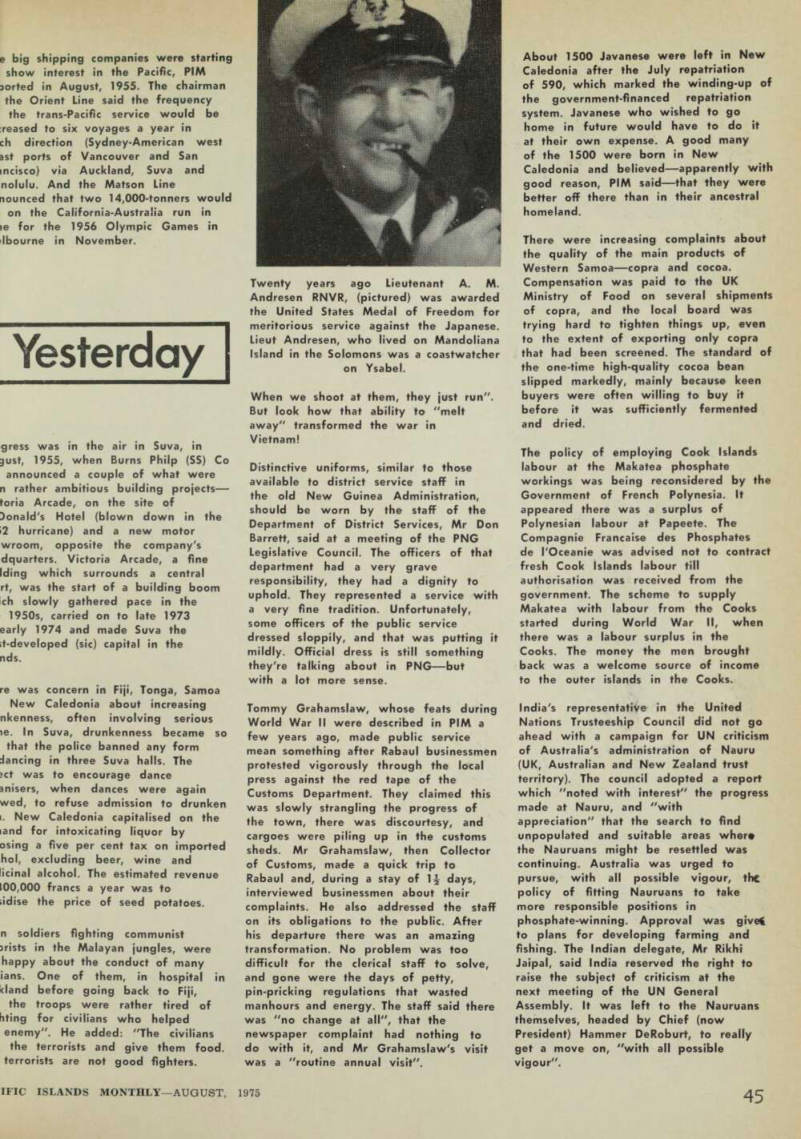
e big shipping companies were starting show interest in the Pacific, PIM aorted in August, 1955. The chairman the Orient Line said the frequency the trans-Pacific service would be Teased to six voyages a year in ch direction (Sydney-American west ast ports of Vancouver and San incisco) via Auckland, Suva and nolulu. And the Matson Line rtounced that two 14,000-tonners would on the California-Australia run in te for the 1956 Olympic Games in Jbourne in November.
gress was in the air in Suva, in just, 1955, when Burns Philp (SS) Co announced a couple of what were n rather ambitious building projects— toria Arcade, on the site of Donald's Hotel (blown down in the >2 hurricane) and a new motor wroom, opposite the company's dquarters. Victoria Arcade, a fine Iding which surrounds a central rt, was the start of a building boom ch slowly gathered pace in the 19505, carried on to late 1973 early 1974 and made Suva the it-developed (sic) capital in the nds. re was concern in Fiji, Tonga, Samoa New Caledonia about increasing nkenness, often involving serious >e. In Suva, drunkenness became so that the police banned any form dancing in three Suva halls. The ;ct was to encourage dance anisers, when dances were again wed, to refuse admission to drunken i. New Caledonia capitalised on the land for intoxicating liquor by osing a five per cent tax on imported hoi, excluding beer, wine and licinal alcohol. The estimated revenue 100,000 francs a year was to lidise the price of seed potatoes. n soldiers fighting communist arists in the Malayan jungles, were happy about the conduct of many ians. One of them, in hospital in <land before going back to Fiji, the troops were rather tired of fiting for civilians who helped enemy". He added: "The civilians the terrorists and give them food, terrorists are not good fighters.
Twenty years ago Lieutenant A. M.
Andresen RNVR, (pictured) was awarded the United States Medal of Freedom for meritorious service against the Japanese.
Lieut Andresen, who lived on Mandoliana Island in the Solomons was a coastwatcher on Ysabel.
When we shoot at them, they just run".
But look how that ability to "melt away" transformed the war in Vietnam!
Distinctive uniforms, similar to those available to district service staff in the old New Guinea Administration, should be worn by the staff of the Department of District Services, Mr Don Barrett, said at a meeting of the PNG Legislative Council. The officers of that department had a very grave responsibility, they had a dignity to uphold. They represented a service with a very fine tradition. Unfortunately, some officers of the public service dressed sloppily, and that was putting it mildly. Official dress is still something they're talking about in PNG—but with a lot more sense.
Tommy Grahamslaw, whose feats during World War II were described in PIM a few years ago, made public service mean something after Rabaul businessmen protested vigorously through the local press against the red tape of the Customs Department. They claimed this was slowly strangling the progress of the town, there was discourtesy, and cargoes were piling up in the customs sheds. Mr Grahamslaw, then Collector of Customs, made a quick trip to Rabaul and, during a stay of 1£ days, interviewed businessmen about their complaints. He also addressed the staff on its obligations to the public. After his departure there was an amazing transformation. No problem was too difficult for the clerical staff to solve, and gone were the days of petty, pin-pricking regulations that wasted manhours and energy. The staff said there was "no change at all", that the newspaper complaint had nothing to do with it, and Mr Grahamslaw's visit was a "routine annual visit".
About 1500 Javanese were left in New Caledonia after the July repatriation of 590, which marked the winding-up of the government-financed repatriation system. Javanese who wished to go home in future would have to do it at their own expense. A good many of the 1500 were born in New Caledonia and believed —apparently with good reason, PIM said—that they were better off there than in their ancestral homeland.
There were increasing complaints about the quality of the main products of Western Samoa —copra and cocoa.
Compensation was paid to the UK Ministry of Food on several shipments of copra, and the local board was trying hard to tighten things up, even to the extent of exporting only copra that had been screened. The standard of the one-time high-quality cocoa bean slipped markedly, mainly because keen buyers were often willing to buy it before it was sufficiently fermented and dried.
The policy of employing Cook Islands labour at the Makatea phosphate workings was being reconsidered by the Government of French Polynesia. It appeared there was a surplus of Polynesian labour at Papeete. The Compagnie Francaise des Phosphates de I'Oceanie was advised not to contract fresh Cook Islands labour till authorisation was received from the government. The scheme to supply Makatea with labour from the Cooks started during World War 11, when there was a labour surplus in the Cooks. The money the men brought back was a welcome source of income to the outer islands in the Cooks.
India's representative in the United Nations Trusteeship Council did not go ahead with a campaign for UN criticism of Australia's administration of Nauru (UK, Australian and New Zealand trust territory). The council adopted a report which "noted with interest" the progress made at Nauru, and "with appreciation" that the search to find unpopulated and suitable areas wher* the Nauruans might be resettled was continuing. Australia was urged to pursue, with all possible vigour, the policy of fitting Nauruans to take more responsible positions in
phosphate-winning. Approval was givet
to plans for developing farming and fishing. The Indian delegate, Mr Rikhi Jaipal, said India reserved the right to raise the subject of criticism at the next meeting of the UN General Assembly. It was left to the Nauruans themselves, headed by Chief (now President) Hammer Deßoburt, to really get a move on, "with all possible vigour".
Advertisements & other items, pp. 49-52 (4 items)
45
IFIC ISLANDS MONTHLY—AUGUST, 1975
No matter which
way you look at it. . . you’ll find . . .
KLINKII
is the finest allpurpose ply for building in hot and humid conditions.
Made by Commonwealth N.G.
Timbers Ltd and available from leading plywood suppliers.
N 4
From the
Islands Press
f days on Niue as the Tohi Tala Niue saw it: day in the life of a Niuean. Steinlager, steinlager, h church and more steinlager, but now there isn’t a drop to be bought at the Bond Store let ne steinlager, but there is one consolation, re’s plenty of wine but how many Niueans have eloped a taste for fermented grape juice . . . m a letter by Mrs I. T. Moceletu,
Fhe Fiji Times:
en there is a garden party at Government ase, people go to a lot of trouble and expense E»et new clothes so they can look nice for occasion. It is very disappointing when the party ancelled at the last minute because of rain. m a letter in the Tonga Chronicle by Mr Heinz ster, of Hamburg, sent along with SUSIOO as a ation to the Queen Salote Memorial Hall Fund: . I can’t understand why Tongans need eight rs to build a memorial hall for the unforgettable ;en Salote. I hope when I come to Tonga in uary next year I will see more than Inca ruins . . . m the masthead of The Norfolk Island News, ewcomer welcomed on Norfolk Island:
e Norfolk Island News—Maybe the only
vspaper in the world without a telephone. n a speech by Fiji Minister of Finance Charles Stinson at the opening of a new shopping iplex as reported in The Fiji Times: offered greater opportunity for young men and women other part of the world, the Minister of Finance, -harles Stinson, said at Lautoka on Saturday night Jtinson told about 700 guests, who attended the ting, that Fiji was a place for people who were ared to work. "This is not a place for lazy people or people who cannot make up their minds whether should go away or stay here", he said. ebate on women's rights at the GEIC House of Jmbly session, as reported by the Atoll Pioneer, luced this from Mr Toalipi Lauti (Funafuti): mid the Colony is overpopulated, so is the d and it is time we realised the importance of i control which can be effective if women are e to know they are the only ones who can do it. n a letter on "Loose girls" by Semion Iputu, iji, in the Solomons News Drum: 1 S quite surprised when I read Mr Basil Alec's r Pray for pros” ... He was trying to change the iviour of prostitutes “by praying ” ... I would ’ been on your side if your letter was written
IFIC ISLANDS MONTHLY—AUGUST, 1975
a hundred years back when Christianity was not yet in existence. But, today, these so-called “loose girls” are from religious families; therefore, I cannot see any reason why we should pray for them . . .
I am doubtful whether our prayers will change the minds of prostitutes or will just make their organisations flourish . . .
From a caption in the PNG Post-Courier under a picture showing a large hole in the side wall of a flat in New Boroko Road, Gordon: ... A spokesman for Property and Accommodation, Department of the Interior, said yesterday the hole could have been left there deliberately. About K3OO of furniture was missing too, the spokesman said.
Mrs Luta Frank, who lives in the same block, said she was awakened by a bumping noise one morning at about 3 o’clock. ‘‘lt was a shake; just like a bump. None of us saw it until later in the morning . .
Under The Fiji Times heading of "School students accused of champ racket": Some secondary school students at Nausori (near Suva) were enrolling in different schools just to play for the champion soccer team, a school* manager said yesterday. The manager of Vunimono High School, Mr Krishna Chaudhary, the Mayor of Nausori, told The Fiji Times he had discovered that a student from his school was one of them. Although the student was enrolled in his school, he was representing another school at soccer, he said. This same student switched to another school in Suva after his team lost.
The student had joined three schools in the past three weeks, Mr Chaudhary said.
Dr A. H. Sarei, Bougainville's District
Commissioner lets his hair down in a letter in the Arawa Bulletin replying to critics: . . . Someone at Panguna has referred to my statement as a "lot of hot air from the Waste Digester". Others too called me such names as "bloody stupid bastard", "rubbish" and "wooden head". I wonder how many of such persons ever said a word of thanks to those who worked very hard to do anything they could to protect the people and their families at the mine during the riot, I bet the poor police got no thanks either ... For the gentlemen who called me a "bastard" I wish to say I was born of a mother legally married to my father. For the person who called me "wooden head" and "stupid" I would like to point out my I.Q. has enabled me to go to one of the international universities in Europe for three years to study for my degree. I graduated with the second highest award from the university . . .
From a GEIC Atoll Pioneer report of the
House of Assembly session:
Mr Ingitae Tobeba, of Tamana, initiated the adjournment topic about the upgrading of schools on the outer islands. He told the House about a degrading thing he witnessed on his home island whfan Mrs John Smith, wife of the Governor, was visiting Tamana. When she entered a classroom of senior pupils she greeted them, saying: “Good morning boys and girls” and the reply: “Good mornine Sir”. This, he said, reflected that there was still room for improvement in schools on outer islands.
mAnA
is a vehicle for Pacific Islands’ writers and artists to publish their work. It is an organ of the South Pacific Creative Arts Society and its editorial committee comprises writers from many islands.
Material for publication must be sent direct to MANA’s editor, Marjorie Crocombe, South Pacific Creative Arts Society, Box 5083, Suva.
The four poems by Samoan poet Sano Malifa in this issue represent the talent of this writer who has spent some time in New Zealand, Hawaii and, now, in Washington (DC). He first wrote Belching Flame which was published in MANA. The South Pacific Creative Arts Society is publishing a book of Sano’s poetry edited by Albert Wendt.
Short story writer Satish Chandra is a Fiji teacher and Jane O’Neill, whose story, Kindness has its own reward, was highly commended in the Fiji Association of English Teachers’ short story competition, is a student at St John’s College, Cawaci, Ovalau, Fiji.
Charley’S Store
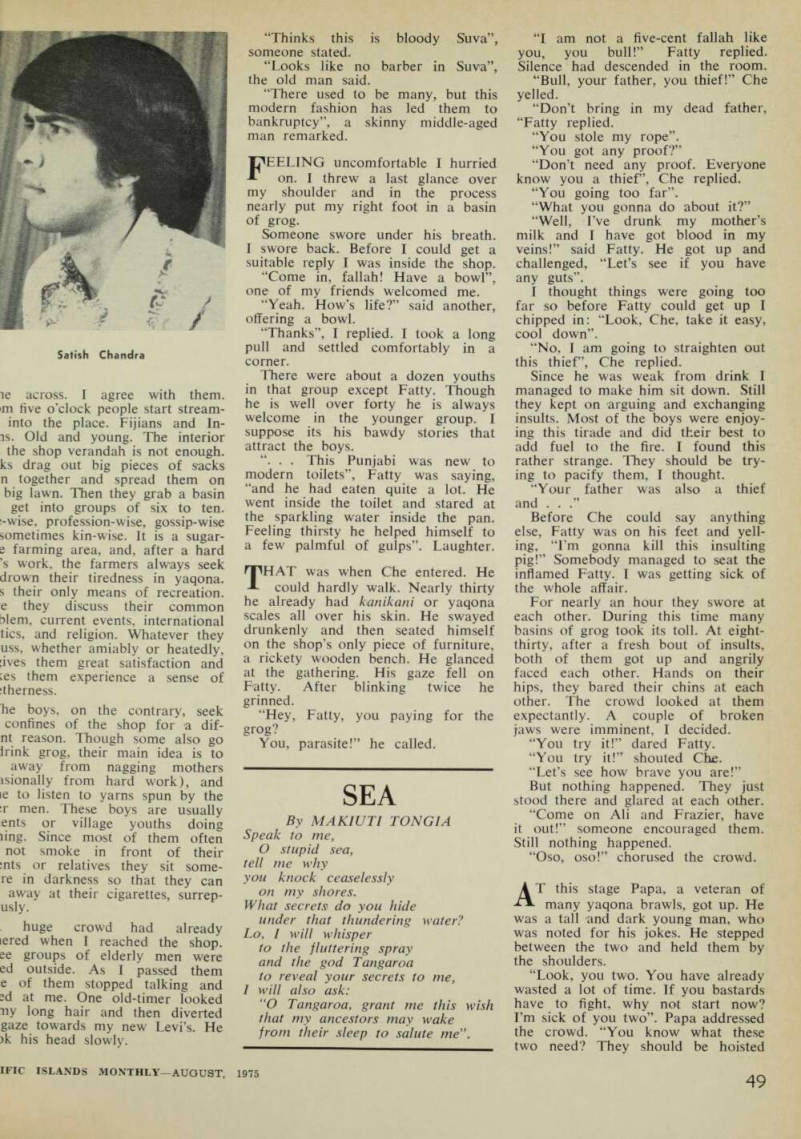
By Satish Chandra
CHARLEY’S Store is like any other small village store found throughout Fiji. Situated at the inter section of King’s Road and Waini koro feeder road it is a concrete and iron construction. The shop is divided into three distinct sections.
The large front room is for business, the shelves are always full of canned goods.
Parallel to the shelves is a long masonite board counter, and under neath this are kept bags of sharps, rice, dhal and all the other para phernalia associated with a village dry goods store. Near the entrance are two huge built-in show cases dis playing items ranging from breakfast crackers to flip-flops.
Sandwiched between the store and the living room is the bulk room which is always in partial darkness.
This section is stacked with stock which cannot be accommodated in the front room. Apart from these there are bottles and even 44-gallon drums strewn all over the place. It has a very suffocating atmosphere.
I once entered the room to serve myself a gallon of kerosene and I couldn’t stay there even for a minute.
The smell of kerosene and oil mingled with rotten potato odour can be very nauseating, particularly on a hot day. 1 once pointed this out to Charley, the owner. He gave his protruding belly a rhythmic pat and laughed and told me it was a good deterrent for undesirables.
The third and the last section of the structure is Charley’s private quarters. An air of mystery hangs about this room. Very few people have been inside it. Once, while buy ing a couple of bottles of beer from the back entrance, I managed to peep inside the partially-open door.
I could glimpse only a pair of shape! legs before the door banged shut i my face. I was puzzled, for Charle; is a bachelor.
The store sees hardly any busines during the day. It is usually lockei and if someone wants to buy some thing he has to knock on one of th windows. Charley works as a hote barman during the day so his father Bhutto, his brother, Choro, 100 l after the shop during his absence Sometimes one has to wait for quit! a long time before one of then comes to serve you. Choro does quit< a bit of other chores around the farn and old Bhutto sleeps under th( mango tree, behind the store, mos of the time. To wake him from hi; siesta is an eternal sin. If some in considerate person happens to wak< him, he had better buy a lot of good! or else he has to put up with a vol ley of invectives. For this reasor many village youngsters think twic< before venturing to buy a few cents worth of sweets. So the day passei on.
THE evenings, on the other hand are very busy. The business is very brisk, and the store is full ol hustling and bustling people. Thougl it is an Indian-owned shop it get!
Fijian customers as well. The reason I suppose, is that there are three koros not too far away from the store. From five to seven the shoi is so crowded that the father and the two sons have to work hurriedly to restore some semblance of order Probably the most interesting fea ture of the place is its grog drinking sessions. Many motorists, who have stopped for refreshments, have claimed these sessions to be some ol the most fantastic they have ever
le across. I agree with them, m five o’clock people start stream into the place. Fijians and In is. Old and young. The interior the shop verandah is not enough, ks drag out big pieces of sacks n together and spread them on big lawn. Then they grab a basin get into groups of six to ten. ;-wise, profession-wise, gossip-wise sometimes kin-wise. It is a sugar e farming area, and, after a hard ’s work, the farmers always seek drown their tiredness in yaqona. s their only means of recreation, e they discuss their common blem, current events, international tics, and religion. Whatever they uss, whether amiably or heatedly, lives them great satisfaction and :es them experience a sense of stherness. he boys, on the contrary, seek confines of the shop for a dif nt reason. Though some also go irink grog, their main idea is to away from nagging mothers isionally from hard work), and ic to listen to yarns spun by the :r men. These boys are usually ents or village youths doing ling. Since most of them often not smoke in front of their :nts or relatives they sit some re in darkness so that they can away at their cigarettes, surrep usly, huge crowd had already iered when I reached the shop, ee groups of elderly men were ed outside. As I passed them e of them stopped talking and -d at me. One old-timer looked uy long hair and then diverted gaze towards my new Levi’s. He )k his head slowly.
“Thinks this is bloody Suva”, someone stated.
“Looks like no barber in Suva”, the old man said.
“There used to be many, but this modern fashion has led them to bankruptcy”, a skinny middle-aged man remarked.
FEELING uncomfortable I hurried on. I threw a last glance over my shoulder and in the process nearly put my right foot in a basin of grog.
Someone swore under his breath.
I swore back. Before I could get a suitable reply I was inside the shop.
“Come in, fallah! Have a bowl”, one of my friends welcomed me.
“Yeah. How’s life?” said another, offering a bowl.
“Thanks”, I replied. I took a long pull and settled comfortably in a corner.
There were about a dozen youths in that group except Fatty. Though he is well over forty he is always welcome in the younger group. I suppose its his bawdy stories that attract the boys.
“. . . This Punjabi was new to modern toilets”, Fatty was saying, “and he had eaten quite a lot. He went inside the toilet and stared at the sparkling water inside the pan.
Feeling thirsty he helped himself to a few palmful of gulps”. Laughter.
THAT was when Che entered. He could hardly walk. Nearly thirty he already had kanikani or yaqona scales all over his skin. He swayed drunkenly and then seated himself on the shop’s only piece of furniture, a rickety wooden bench. He glanced at the gathering. His gaze fell on Fatty. After blinking twice he grinned.
“Hey, Fatty, you paying for the grog?
You, parasite!” he called.
“I am not a five-cent fallah like you, you bull!” Fatty replied.
Silence had descended in the room.
“Bull, your father, you thief!” Che yelled.
“Don’t bring in my dead father, “Fatty replied.
“You stole my rope”.
“You got any proof?”
“Don’t need any proof. Everyone know you a thief”, Che replied.
“You going too far”.
“What you gonna do about it?”
“Well, I’ve drunk my mother’s milk and I have got blood in my veins!” said Fatty. He got up and challenged, “Let’s see if you have any guts”.
I thought things were going too far so before Fatty could get up I chipped in: “Look, Che, take it easy, cool down”.
“No, I am going to straighten out this thief”, Che replied.
Since he was weak from drink I managed to make him sit down. Still they kept on arguing and exchanging insults. Most of the boys were enjoy ing this tirade and did their best to add fuel to the fire. I found this rather strange. They should be try ing to pacify them, I thought.
“Your father was also a thief and . . .”
Before Che could say anything else, Fatty was on his feet and yell ing, “I’m gonna kill this insulting pig!” Somebody managed to seat the inflamed Fatty. I was getting sick of the whole affair.
For nearly an hour they swore at each other. During this time many basins of grog took its toll. At eight thirty, after a fresh bout of insults, both of them got up and angrily faced each other. Hands on their hips, they bared their chins at each other. The crowd looked at them expectantly. A couple of broken jaws were imminent, I decided.
“You try it!” dared Fatty.
“You try it!” shouted Che.
“Let’s see how brave you are!”
But nothing happened. They just stood there and glared at each other.
“Come on Ali and Frazier, have it out!” someone encouraged them.
Still nothing happened.
“Oso, oso!” chorused the crowd.
AT this stage Papa, a veteran of many yaqona brawls, got up. He was a tall and dark young man, who was noted for his jokes. He stepped between the two and held them by the shoulders.
“Look, you two. You have already wasted a lot of time. If you bastards have to fight, why not start now?
I’m sick of you two”. Papa addressed the crowd. “You know what these two need? They should be hoisted
Satish Chandra
up-side down, stripped off their pants, arse soaked with benzine, and then lit. Only then will they get any sense.
Probably their arses have more sense than their brains”. This was greeted with howls of laughter.
“You have no manners and ab solutely no sense of values. You should be setting an example to the younger generation instead of squab bling like two old women having nothing better to do!”
“I was just joking”, said Che lamely.
“Me too”, added Fatty, now that the crisis was over.
“Bloody funny kind of joke!”
Papa replied. “Swearing your heads off. Insulting the dead. Funny, my arse!”
Things returned to normal. Che and Fatty were made to forget their quarrel. They sat in a comer and talked amiably.
That’s when Charley appeared out of the backroom. He puffed out his chest and glowered at the crowd.
“Who were fighting?” He demanded.
“No one was fighting”, replied Papa.
“No one? Eh? You, fallahs, think this is a boxing ring? If you have to fight when these people were arguing? Underneath the bed, I sup pose”, asked Papa.
“Push you fallahs out next time”.
“Ha! Ha! Ha! you almost frighten me”, mocked Papa. “Go and get you”. This time both Che and Fatty get wild once again—this time with you”. This time both, Che and Fatty, joined the crowd in the laughter.
Sea
By Makiuti Tongia
Speak to me, O stupid sea, tell me why you knock ceaselessly on my shores.
What secrets do you hide under that thundering water?
Lo, I will whisper to the fluttering spray and the god Tangaroa to reveal your secrets to me, I will also ask: “O Tangaroa, grant me this wish that my ancestors may wake from their sleep to salute me”.
Advertisements & other items, p. 53 (1 item)
49
IFIC ISLANDS MONTHLY—AUGUST, 1975
Relax
By Francis Tekonnang
Relax in a cushioned arm-chair Just looking out to sea A vast flat pane Glistening in the quiet afternoon And the breeze Gently fanning your thoughts
To sleep.
In bed, dream Not of a child In mother’s arms Nor of a suitor In a wedding gown But of you A light green river
Plaiting, curling and flowing
Into the depths of darkness.
Kindness has its
Short Story
Kindness has its own reward
By Jane O'neill
AS old Matai trudged homewards weighed under a basket of vege tables and a length of sugar-cane, he was brought to a halt by an elderly woman sitting on the roadside. She was weary and showed signs of hav ing travelled far. Being a curious man, Matai began to converse with her and found that she had walked from Ba towards Vatukoula and now, as night was close at hand, she sat down to rest her weary body.
She had a basket with an old tattered dress, a tin of Capstan tobacco, and 50 cents in it. She now brought out her tobacco and began to role a cigar, and as he was not offered any of this tobacco, Matai stood silently observing this strange lady. Her face showed the faded beauty of youth and wrinkles of old age.
The sun went down lower and because Matai could not imagine himself sleeping in his snug bure while the old lady lay out in the cold, perhaps even in the rain, he invited her to his house. The lady at first wanted to refuse the invitation but for his pleas.
On arriving at the village the
people viewed the pair with curiosity
for Matai hardly ever had anything to do with visitors to the village. His wife received them with warmth and having learnt how the old lady came to be with Matai, she graciously in vited her in and prepared a meal while Matai entertained their guest.
After a meal, the visitor was re freshed and became lively. They sat drinking yaqona until the small hours of the morning and retired for about five hours’ sleep.
THE hosts saw to it that their guest was as comfortable as possible and as they were not very wealthy by village standards, it meant going without their own warm blankets.
The lady accepted this hospitality without protest and did not reveal much of her life, but within the few hours that she had arrived, she knew all there was to know about Matai and his wife. They were poor but happy and as all their five children had married, they were now on their
own except for a few occasional visits from the children.
Mereani, Matai’s wife, rose early to prepare breakfast. Her eyes travelled to the corner, where their guest had slept, only to find a bed which did not seem to have been slept in and the only trace of the mysterious visitor was her little
shabby basket.
Mereani woke Matai and together they tried to work out where she could have gone. They searched their compound and asked their neighbours if anyone had seen her leave, but no one had. While Matai searched out side, Mereani held the shabby basket wondering whether she should open it or not and as her curiosity won her over, she excitedly unclasped it and with an exclamation called for Matai.
She was excited, and at the same time scared, but Matai reassured her that it was all right.
In the basket lay a whale’s tooth of the finest quality with silver trimmings and an old necklace of
pigs’ tusks.
Matai, an honourable man, decided that he would guard these priceless items with his whole life and return them to the old lady.
One of his neighbours, being of a chiefly family, now residing in Matai’s village, heard through the village gossip of the old lady’s visit and what she forgot, or what they thought she forgot, and asked Matai to let him see the basket and its contents. To his amazement, he recognised the items.
He explained that the lady was the wife of the great chief Taraniqio who was his ancestor. She was the kindest lady that ever lived and she had come as she had gone to many a person, to test their kindness and generosity and this was her present to good people.
Matai and his wife, were from that day respected by everyone who knew them and they guarded their treasure meticulously. Matai and Mereani vowed never to close their door to anyone and to live up to the honour of generous people, bestowed on them by their visitor.
iello! just to say hello!
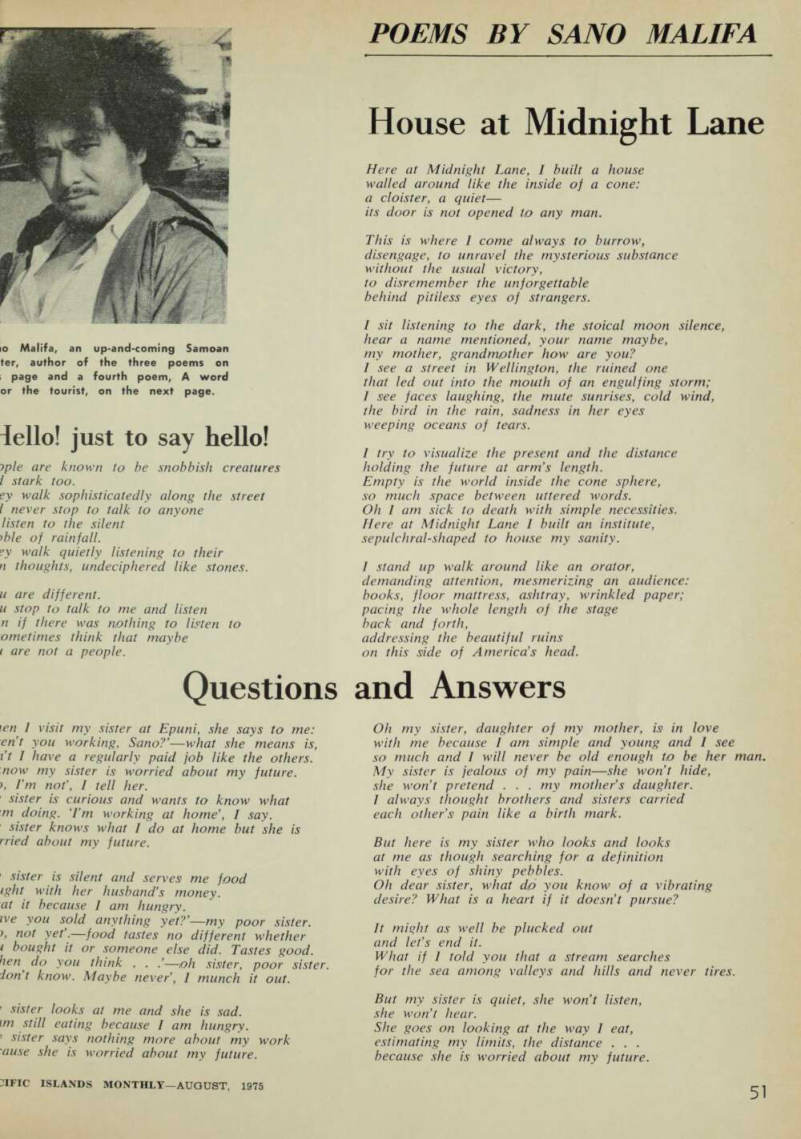
jple are known to be snobbish creatures I stark too. ey walk sophisticatedly along the street i never stop to talk to anyone listen to the silent yble of rainfall. °.y walk quietly listening to their n thoughts, undeciphered like stones. u are different. u stop to talk to me and listen n if there was nothing to listen to ometimes think that maybe i are not a people.
[?]o Malifa, an up-and-coming Samoan ter, author of the three poems on i page and a fourth poem, A word or the tourist, on the next page.
House at Midnight Lane
Poems By Sano Malifa
Here at Midnight Lane, I built a house walled around like the inside of a cone: a cloister, a quiet— its door is not opened to any man.
This is where I come always to burrow, disengage, to unravel the mysterious substance without the usual victory, to disremember the unforgettable behind pitiless eyes of strangers.
I sit listening to the dark, the stoical moon silence, hear a name mentioned, your name maybe, my mother, grandmother how are you?
I see a street in Wellington, the ruined one that led out into the mouth of an engulfing storm; I see faces laughing, the mute sunrises, cold wind, the bird in the rain, sadness in her eyes weeping oceans of tears.
I try to visualize the present and the distance holding the future at arm’s length.
Empty is the world inside the cone sphere, so much space between uttered words.
Oh I am sick to death with simple necessities.
Here at Midnight Lane I built an institute, sepulchral-shaped to house my sanity.
I stand up walk around like an orator, demanding attention, mesmerizing an audience: books, floor mattress, ashtray, wrinkled paper; pacing the whole length of the stage back and forth, addressing the beautiful ruins on this side of America’s head.
Questions and Answers
\en I visit my sister at Epuni, she says to me: en’t you working, Sano?’—what she means is, I’t I have a regularly paid job like the others, now my sister is worried about my future. ), I’m not’, I tell her. sister is curious and wants to know what m doing. ‘l’m working at home’, I say. sister knows what I do at home but she is rried about my future.
' sister is silent and serves me food ight with her husband’s money. at it because I am hungry. ive you sold anything yet?’—my poor sister. >, not yet’.—food tastes no different whether i bought it or someone else did. Tastes good, hen' do you think . . .’—oh sister, poor sister, don’t know. Maybe never’, I munch it out.
' sister looks at me and she is sad. im still eating because I am hungry. ’ sister says nothing more about my work ause she is worried about my future.
Oh my sister, daughter of my mother, is in love with me because I am simple and young and I see so much and I will never be old enough to be her man.
My sister is jealous of my pain—she wont hide, she won’t pretend . . . my mother’s daughter.
I always thought brothers and sisters carried each other’s pain like a birth mark.
But here is my sister who looks and looks at me as though searching for a definition with eyes of shiny pebbles.
Oh dear sister, what do you know of a vibrating desire? What is a heart if it doesn’t pursue?
It miqht as well be plucked out and let’s end it.
What if I told you that a stream searches for the sea among valleys and hills and never tires.
But my sister is quiet, she wont listen, she won’t hear.
She goes on looking at the way I eat, estimating my limits, the distance . . . because she is worried about my future.
Advertisements & other items, p. 55 (1 item)
51
IFIC ISLANDS MONTHLY—AUGUST, 1975
A word for the tourist
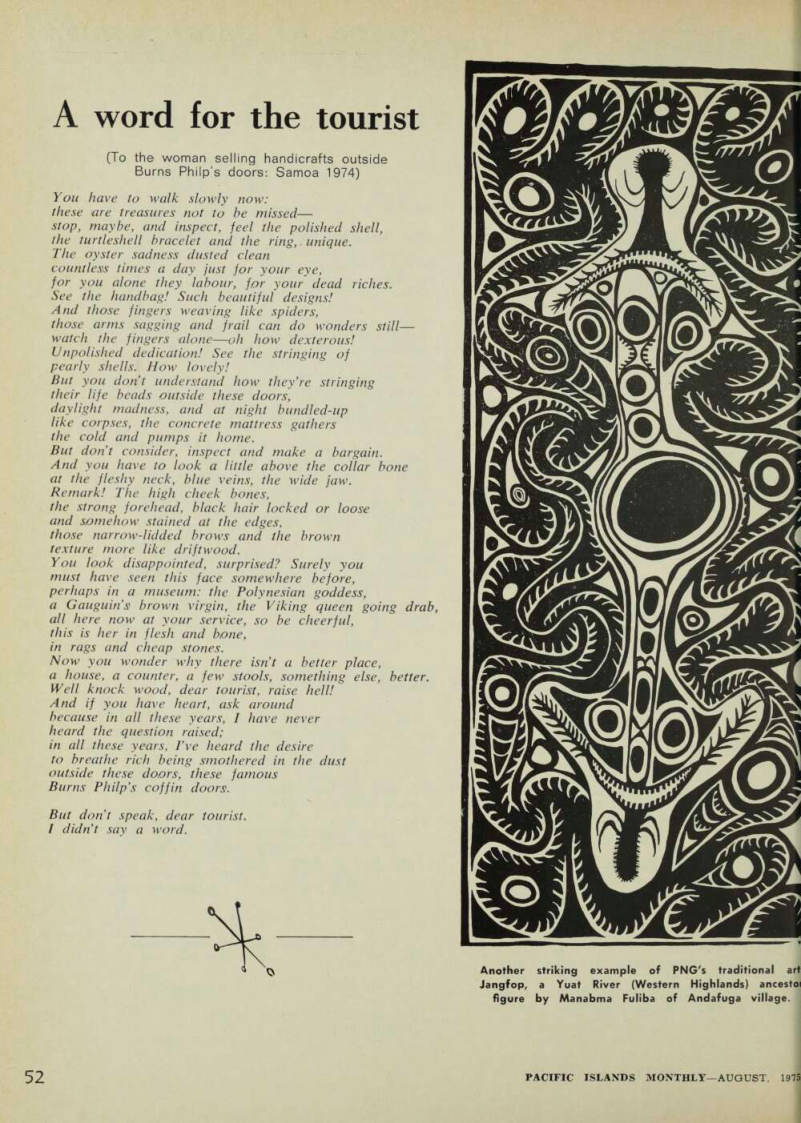
(To the woman selling handicrafts outside Burns Philp’s doors: Samoa 1974) You have to walk slowly now: these are treasures not to be missed— stop, maybe, and inspect, feel the polished shell, the turtleshell bracelet and the ring, . unique.
The oyster sadness dusted clean countless times a day just for your eye, for you alone they labour, for your dead riches.
See the handbag! Such beautiful designs!
And those fingers weaving like spiders, those arms sagging and frail can do wonders still— watch the fingers alone—oh how dexterous!
Unpolished dedication! See the stringing of pearly shells. How lovely!
But you don’t understand how they’re stringing their life beads outside these doors, daylight madness, and at night bundled-up like corpses, the concrete mattress gathers the cold and pumps it home.
But don’t consider, inspect and make a bargain.
And you have to look a little above the collar bone at the fleshy neck, blue veins, the wide jaw.
Remark! The high cheek bones, the strong forehead, black hair locked or loose and somehow stained at the edges, those narrow-lidded brows and the brown texture more like driftwood.
You look disappointed, surprised? Surely you must have seen this face somewhere before, perhaps in a museum: the Polynesian goddess, a Gauguin’s brown virgin, the Viking queen going drab, all here now at your service, so be cheerful, this is her in flesh and bone, in rags and cheap stones.
Now you wonder why there isn’t a better place, a house, a counter, a few stools, something else, better.
Well knock wood, dear tourist, raise hell!
And if you have heart, ask around because in all these years, I have never heard the question raised; in all these years, I’ve heard the desire to breathe rich being smothered in the dust outside these doors, these famous Burns Philp’s coffin doors.
But don’t speak, dear tourist.
I didn’t say a word.
Another striking example of PNG's traditional art Jangfop, a Yuat River (Western Highlands) ancesto[?] figure by Manabma Fuliba of Andafuga village.
Books, Reviews, writers
Dissected Samoans-An Exiled
Community In New Zealand
Auckland University’s Department of Sociology has planned a series of studies of small societies within the New Zealand complex, and Emerging Pluralism examines some nuclei of the rapidly growing Samoan com munity, now perhaps around the 30,000 mark in New Zealand. At least there were 22,198 in 1971, with subsequent migrant growth as well as natural increase.
The Samoans under dissection come from three centres: Auckland, which, in numbers, is the largest Polynesian city anywhere, Wellington and Tokoroa.
This latter, though the study takes it for granted that you know, is itself a phenomenon in New Zealand, a town, perhaps a city now, in Mata mata county 140 miles south of Auckland city. It had a population of 320 in 1947, of more than 7,000 in 1961, and today it’s probably in excess of 20,000. Of this number nearly half are Polynesians and about 2,000 would be Samoans.
The mushroom growth of the town devolved entirely from the develop ment of forestry pursuits and pro ducts, harvested from the large exotic pine forests of the upper Waikato.
Despite a raw climate the occupations seem to suit the Islanders, mostly employed in processing.
Among the factors, which dif erentiate the migrant Samoan from iis new-found neighbours, his loyal ies seem paramount, particularly hose he shows to his extended family md his church. Both these allegiances end to make him a good citizen; )oth help him towards a settled life, md through them both he assists others.
Through the extended family too ic gives very material monetary help o relations back in Western Samoa; le would give more but that New Zealand’s currency export regulations estrict him.
Both church and extended family iclp him to settle by providing a ocial life, opportunities to speak his >wn language, and advice on all the nysteries an urban existence presents o a Polynesian villager. Typically, ic doesn’t change jobs much.
Students of Faa Samoa will welcome two new books, one sociological, the other fiction, which have just been published in New Zealand. Two sociolo gists at Auckland University examine the comparatively large Samoan community in New Zealand, a study which might help to solve some of the problems faced by Islanders in a Europeanised society. Samoan author Albert Wendt also mir rors Samoan custom in a book of short stories. Both books are reviewed by the well-known New Zealand-born author, Olaf Ruhen on this page and over leaf.
The Samoan community in New Zealand is a youthful one. Regula tions restrict migration to a quota of which members must be between the ages of 18 and 45, but the Samoan family in what might be termed exile includes an average of four children; most of these are New Zealand-born. Many of them do not have fluency in the Samoan language or familiarity with all the traditions, and these conditions tend to widen the generation gap that the extended
family (‘aiga) bridges in the home
islands.
Problems of propinquity also threaten the traditions when they are translated to the New Zealand scene.
In Samoa the extended family typic
ally enjoys special unity; its mem
bers all live in the same village or in the same segment of the same village. They also inherit the rights to the same land and their livelihood depends on being members of a group.
Attempts to extend this to a new community meet many barriers. To begin with, there’s the availability of housing. The house in New Zealand is nowhere as elastic as the house in Samoa. It’s necessary for the intend ing immigrant to have accommodation
available before a permit is issued to him or her, and government in spectors check that it is available, un used, and adequate according to New Zealand standards.
So the members of the ‘aiga may be separated by considerable dis tances. The sense of family is strong enough to overcome this and other handicaps; the first generation, despite an acquired European quality of thought, will probably be in fluenced sufficiently to maintain something of family intimacies, but it’s an open question as to how many generations will pass before an inte gration with the total community be comes an established, though prob ably or partially unwelcome fact.
Just the same, Samoa needs to put down roots in countries remote from the limitations of the home islands. There’s the desirability of a cash income greater than Samoa affords, and more potently, the educa tional opportunities in New Zealand which appeal to the Samoan sense of values.
Samoan pride keeps the hived-off community intact as yet. Too few New Zealanders, though, appreciate the differences between the Samoan, the Tokelauan, the Cook Islander and the indigenous Maori.
Emerging Pluralism touches on all these and other related topics, so it offers ample food for thought. Tables analyse occupations, locations, educa tional attainments, job mobility, inter marriage patterns, desire for perma nent severance with the home islands —all the factors that go to establish the community.
A tendency towards generalisations is probably more apparent than real.
A writer like Albert Wendt can lend a situation much greater conviction and drive its realities home far more than computations expressed in per centages, but a complete understand ing, I should think, requires both methods.
Additionally for any wider enquiry into transplantation of people, this book offers the advantage of clarity with its sample community as small as the Samoan yet significant in the microcosm of New Zealand.
Advertisements & other items, p. 57 (1 item)
53
’ACIFIC ISLANDS MONTHLY—AUGUST, 1975
Albert Wendt sings thru'
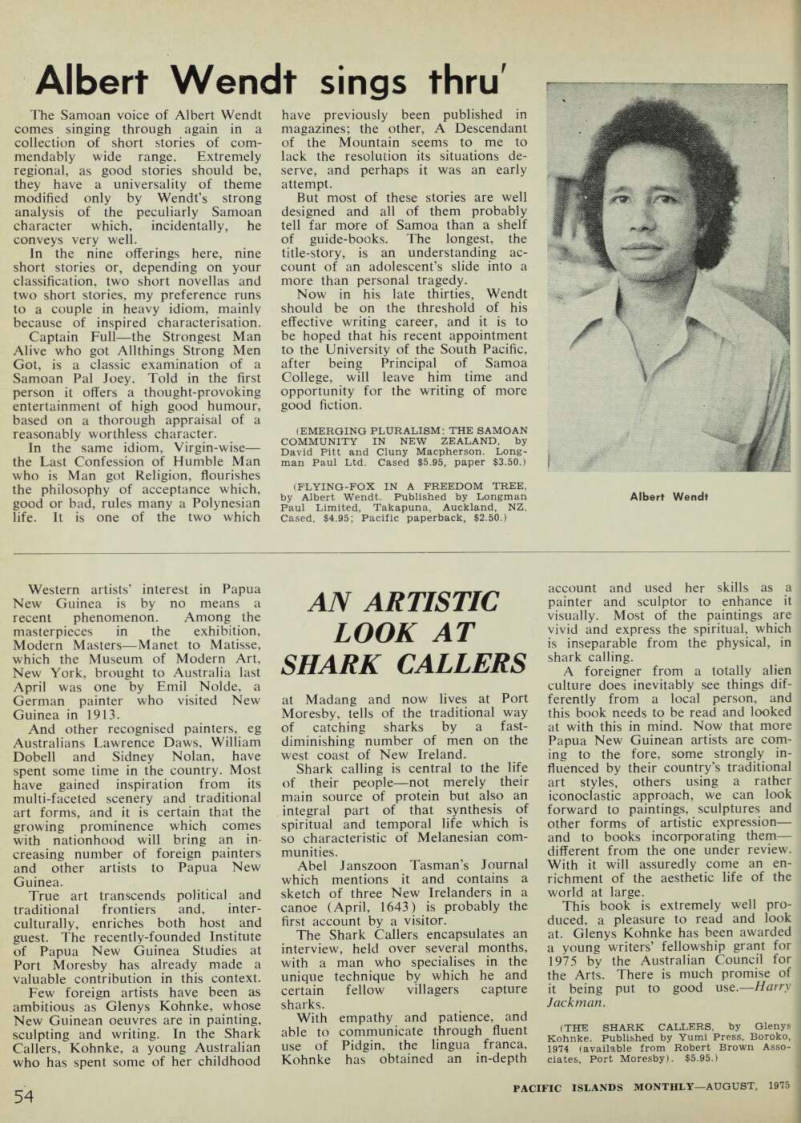
The Samoan voice of Albert Wendt comes singing through again in a collection of short stories of com mendably wide range. Extremely regional, as good stories should be, they have a universality of theme modified only by Wendt’s strong analysis of the peculiarly Samoan character which, incidentally, he conveys very well.
In the nine offerings here, nine short stories or, depending on your classification, two short novellas and two short stories, my preference runs to a couple in heavy idiom, mainly because of inspired characterisation.
Captain Full—the Strongest Man Alive who got Allthings Strong Men Got, is a classic examination of a Samoan Pal Joey. Told in the first person it offers a thought-provoking entertainment of high good humour, based on a thorough appraisal of a reasonably worthless character.
In the same idiom, Virgin-wise— the Last Confession of Humble Man who is Man got Religion, flourishes the philosophy of acceptance which, good or bad, rules many a Polynesian life. It is one of the two which
have previously been published in magazines; the other, A Descendant of the Mountain seems to me to lack the resolution its situations de serve, and perhaps it was an early attempt.
But most of these stories are well designed and all of them probably tell far more of Samoa than a shelf of guide-books. The longest, the title-story, is an understanding ac count of an adolescent’s slide into a more than personal tragedy.
Now in his late thirties, Wendt should be on the threshold of his effective writing career, and it is to be hoped that his recent appointment to the University of the South Pacific, after being Principal of Samoa College, will leave him time and opportunity for the writing of more good fiction.
(Emerging Pluralism: The Samoan
Community In New Zealand, By
David Pitt and Cluny Macpherson. Long man Paul Ltd. Cased $5.95, paper $3.50.)
(Flying-Fox In A Freedom Tree,
by Albert Wendt. Published by Longman Paul Limited, Takapuna, Auckland, NZ.
Cased, $4.95; Pacific paperback, $2.50.)
Albert Wendt
An Artistic
Look At
Shark Callers
Western artists’ interest in Papua New Guinea is by no means a recent phenomenon. Among the masterpieces in the exhibition, Modern Masters —Manet to Matisse, which the Museum of Modern Art, New York, brought to Australia last April was one by Emil Nolde, a German painter who visited New Guinea in 1913.
And other recognised painters, eg Australians Lawrence Daws, William Dobell and Sidney Nolan, have spent some time in the country. Most have gained inspiration from its multi-faceted scenery and traditional art forms, and it is certain that the growing prominence which comes with nationhood will bring an in creasing number of foreign painters and other artists to Papua New Guinea.
True art transcends political and traditional frontiers and, inter culturally, enriches both host and guest. The recently-founded Institute of Papua New Guinea Studies at Port Moresby has already made a valuable contribution in this context.
Few foreign artists have been as ambitious as Glenys Kohnke, whose New Guinean oeuvres are in painting, sculpting and writing. In the Shark Callers, Kohnke, a young Australian who has spent some of her childhood
at Madang and now lives at Port Moresby, tells of the traditional way of catching sharks by a fast diminishing number of men on the west coast of New Ireland.
Shark calling is central to the life of their people—not merely their main source of protein but also an integral part of that synthesis of spiritual and temporal life which is so characteristic of Melanesian com munities.
Abel Janszoon Tasman’s Journal which mentions it and contains a sketch of three New Irelanders in a canoe (April, 1643) is probably the first account by a visitor.
The Shark Callers encapsulates an interview, held over several months, with a man who specialises in the unique technique by which he and certain fellow villagers capture sharks.
With empathy and patience, and able to communicate through fluent use of Pidgin, the lingua franca, Kohnke has obtained an in-depth
account and used her skills as a painter and sculptor to enhance it visually. Most of the paintings are vivid and express the spiritual, which is inseparable from the physical, in shark calling.
A foreigner from a totally alien culture does inevitably see things dif ferently from a local person, and this book needs to be read and looked at with this in mind. Now that more Papua New Guinean artists are com ing to the fore, some strongly in fluenced by their country’s traditional art styles, others using a rather iconoclastic approach, we can look forward to paintings, sculptures and other forms of artistic expression— and to books incorporating them— different from the one under review.
With it will assuredly come an en richment of the aesthetic life of the world at large.
This book is extremely well pro duced, a pleasure to read and look at. Glenys Kohnke has been awarded a young writers’ fellowship grant for 1975 by the Australian Council for the Arts. There is much promise of
it being put to good use.
Harry
Jackman.
(THE SHARK CALLERS, by Glenys Kohnke. Published by Yumi Press, Boroko, 1974 (available from Robert Brown Asso ciates, Port Moresby). $5.95.)
Flight Plan Png An
Scape From Dullness?
One wonders what sort of people ly $5.50 for books like Eileen eenson’s Flight Plan PNG, pub died by Rigby, and one wonders so what sort of people write such ographical books.
Writing is a skill, not necessarily idowed simultaneously with the :currence of some event in a per n’s life. Writing autobiographical aterial is highly-refined skill and dy a very few have ever succeeded it: the rest have merely achieved e listing of events which have curred to colourless non-humanised irticipators in the events, Eileen Steenson is a woman. She akes this clear by saying so. But her than this—and that she drove i aircraft in Papua New Guinea /hich the title does not make clear everyone), used a sewing machine id has permission to publish in her >ok a photograph of Lord and Lady asey—nothing of her as an indi- Jual emerges from her book. Of urse not: she is an aircraft captain, »t a writer. One wonders, in fact, she had not been a woman how uch interest Rigby’s would have own in her book?
Captain Steenson arrived in Papua sw Guinea too late to experience e really exciting adventures of iation, the early days of which )bby Gibbes, to whom she gives ief passing mention in her book— d spelling his name incorrectly thout the final “e”—and Johnnie )se (to name only two) might have itten. Even passengers who hitch ed, and I mean this literally, by • in Papua New Guinea before the ys of the Department of Civil dation might have much to con bute.
I remember, only too vividly, the ung pilot who, running his own line with one aircraft, killed him f in taking off from the Goroka ip, when that strip was situated a higher plateau than it is now, d thereby caused dinner to be de 'ed while the District Officer (as was then called) arranged to have container made for the body, hen it was made, it was placed th the body in it in the dining >m while we ate our dinner with merous toasts to the occupant.
We all knew and liked him and t it would have been inhospitable have left him outside while we re eating.
And the number of aircraft which came airborne only by flipping
themselves over the edge of the air strip at Oglbeng. Twenty years and more, all of this, before our authoress had her big adventure!
I suppose Captain Steenson’s book is of interest to those who have no adventure in their lives (one reason, 1 suppose, why books are published) but it’s a pretty dull list of events to those who have. 1 cannot help feeling that such books are written by people, sur rounded by a dull family, who wish to show that they have escaped from this dullness. Other than this use, I see no useful purpose in such books: they really do not make in teresting reading except to their authors, add little, if anything, to our store of knowledge. In this case, it is doubtful if any contribution is made to the history of aviation in Papua New Guinea, whose history is so wrapped up in aviation, and which has had so many outstandingly interesting and devoted personalities in that field from the days of the old Junkers until the present time.
Captain Steenson’s experiences in Papua New Guinea, if you count up the hundreds (yes, hundreds) of pilots who had similar, and exactly the same experiences, were not unique.
What we want, please, is not only someone who has had experience but someone who, having had them, has the literary skill to record them in
their right perspective, and in doing so, not to forget entirely the many others who have done, or are doing, the same things. The experience and the ability to record it are not one and the same thing. Publishers, it seems, are beginning to think so.
Sorry, Captain Steenson: it’s not so much your fault as the fault of the publishers.
There are thousands of bikeys every week-end who collect more vivid experiences than Captain Steen son has had, and do not regard them as worth mentioning, and 40 per cent of those are women who do not regard the experiences as anything but completely self-existent and sex less.
It is time someone pointed out to publishers that people like Miss Elliott and the Misses Bronte wrote because they were writers and had something to write about, and not because they were women.
It was nice of Lady Casey to write an introduction to the book, but I think that the Literature Board of the Australian Council for the Arts, with whose assistance the book was published, might more usefully
occupy itself.
Peter Livingston.
(FLIGHT PLAN PNG. by Eileen Steen son. Published by Rigby Limited, 30 North Terrace, Kent Town, South Australia. $5.50, cased, illustrated.)
Advertisements & other items, pp. 59-60 (2 items)
55
CIFIC ISLANDS MONTHLY—AUGUST, 1975
Po Fananga Folk Tales of
TOFUA PRESS announces its latest publication
by Tupou Posesi Fanua Tonga
12 traditional folk tales, including one original story. Original illustrations. Bi-lingual text (Tongan and English). Contains historical background and a glossary of Tongan terms. 19 cm. x 26.5 cm. S 5 U.S.
Other titles TONGA PICTORIAL photo essay of Tonga. 55.95 U.S.
GENTLE PEOPLE - history of Vava‘u. $2.95 U.S.
Please add $.50 postage and handling for all Pacific areas. v .
TOFUA PRESS
10457-F Roselle St.
San Diego, Calif. 92121 Free literature • dealer inquiries invited U.S. A.
FokkerF2B
VFW 614
Our flying family
Three different aircraft that meet the specific requirements of short-haul operators.
Whatever those requirements are. • The F 27; the well-known twin turboprop for easy, all purpose operation. • The F2B ; in service in Australia from September 1969, a sleek and modern fan jet that carries up to 79 passengers or freight at high speed from rural or main city airports. • The 614; our latest addition to the family (certification is scheduled in 1974) with two high by-pass engines, offering a 40-44 seat modern jet to the short-haul operator.
Three sister aircraft all embodying the expertise that makes us short-haul specialists.
All profitable to operate.
A unique family
1 /fw-fokker
The short-haul specialists.
Fokker-VFW International b.v., 88 Franklin Street, Melbourne 3000. Telex 33119
Pacific Transport
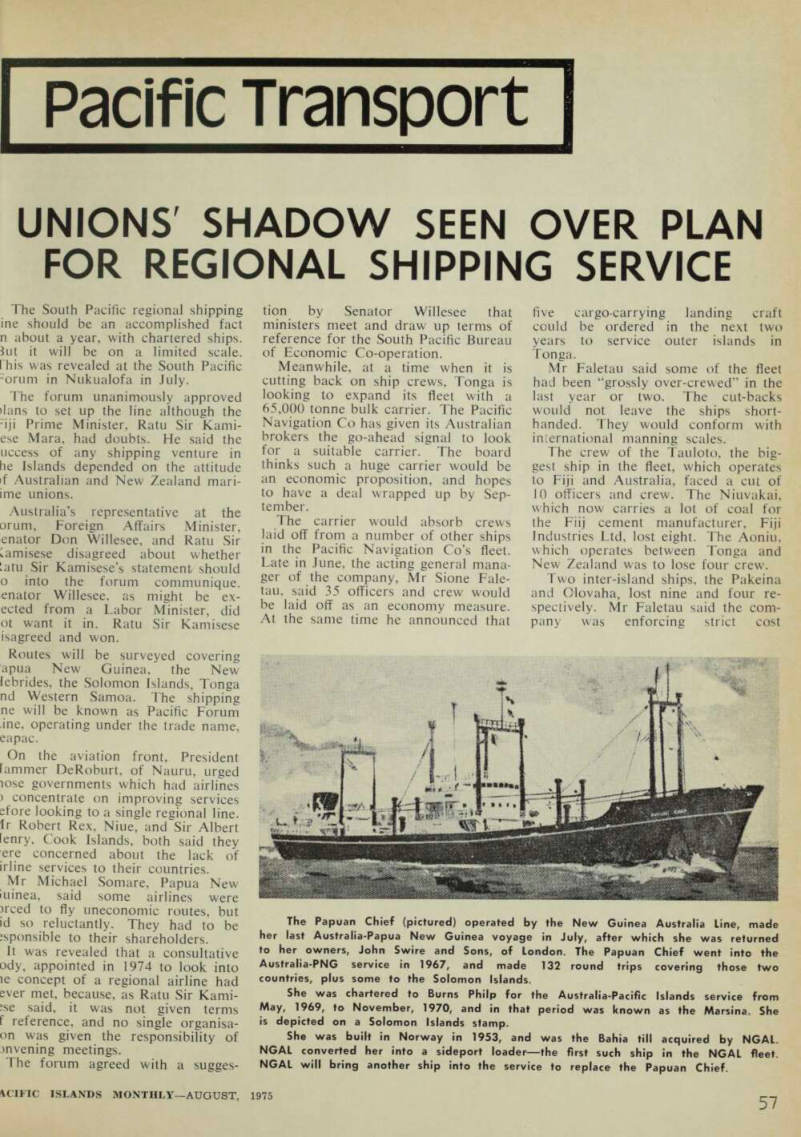
Unions' Shadow Seen Over Plan
For Regional Shipping Service
The South Pacific regional shipping ine should be an accomplished fact n about a year, with chartered ships. 3ut it will be on a limited scale, fh is was revealed at the South Pacific 'orum in Nukualofa in July.
The forum unanimously approved •lans to set up the line although the 7 iji Prime Minister, Ratu Sir Kami ese Mara, had doubts. He said the uccess of any shipping venture in he Islands depended on the attitude if Australian and New Zealand mari ime unions.
Australia’s representative at the □rum, Foreign Affairs Minister, enator Don Willesee, and Ratu Sir Camisese disagreed about whether (atu Sir Kamisese’s statement should o into the forum communique, enator Willesee, as might be ex ected from a Labor Minister, did ot want it in. Ratu Sir Kamisese isagreed and won.
Routes will be surveyed covering apua New Guinea, the New lebrides, the Solomon Islands, Tonga nd Western Samoa. The shipping ne will be known as Pacific Forum ,ine, operating under the trade name, eapac.
On the aviation front, President fammer Deßoburt, of Nauru, urged lose governments which had airlines ) concentrate on improving services efore looking to a single regional line.
Ir Robert Rex, Niue, and Sir Albert tenry, Cook Islands, both said they ere concerned about the lack of irline services to their countries.
Mr Michael Somare, Papua New ruinea, said some airlines were irced to fly uneconomic routes, but id so reluctantly. They had to be ;sponsible to their shareholders.
It was revealed that a consultative ody, appointed in 1974 to look into le concept of a regional airline had ever met, because, as Ratu Sir Kami *se said, it was not given terms f reference, and no single organisa on was given the responsibility of 3nvening meetings.
The forum agreed with a sugges
tion by Senator Willesee that ministers meet and draw up terms of reference for the South Pacific Bureau of Economic Co-operation.
Meanwhile, at a time when it is cutting back on ship crews, Tonga is looking to expand its fleet with a 65,000 tonne bulk carrier. The Pacific Navigation Co has given its Australian brokers the go-ahead signal to look for a suitable carrier. The board thinks such a huge carrier would be an economic proposition, and hopes to have a deal wrapped up by September.
The carrier would absorb crews laid off from a number of other ships in the Pacific Navigation Co’s fleet.
Late in June, the acting general manager of the company, Mr Sione Faletau, said 35 officers and crew would be laid off as an economy measure.
At the same time he announced that
five cargo-carrying landing craft could be ordered in the next two years to service outer islands in Tonga.
Mr Faletau said some of the fleet had been “grossly over-crewed” in the last year or two. The cut-backs would not leave the ships short handed. They would conform with international manning scales, The crew of the Tauloto, the big gest ship in the fleet, which operates to Fiji and Australia, faced a cut of 10 officers and crew. The Niuvakai, which now carries a lot of coal for the Fiij cement manufacturer, Fiji Industries Ltd, lost eight. The Aoniu, which operates between Tonga and New Zealand was to lose four crew, Two inter-island ships, the Pakeina and Olovaha, lost nine and four re spectively. Mr Faletau said the com pany was enforcing strict cost
The Papuan Chief (pictured) operated by the New Guinea Australia Line, made her last Australia-Papua New Guinea voyage in July, after which she was returned to her owners, John Swire and Sons, of London. The Papuan Chief went into the Australia-PNG service in 1967, and made 132 round trips covering those two countries, plus some to the Solomon Islands.
She was chartered to Burns Philp for the Australia-Pacific Islands service from May, 1969, to November, 1970, and in that period was known as the Marsina. She is depicted on a Solomon Islands stamp.
She was built in Norway in 1953, and was the Bahia till acquired by NGAL.
NGAL converted her into a sideport loader—the first such ship in the NGAL fleet.
NGAL will bring another ship into the service to replace the Papuan Chief.
control, and could not afford to over man ships. Economies were being made wherever possible. There would be cutbacks in victualling of ships.
Mr Faletau hoped an overseas trip to New Zealand, Australia and Norway, which he started late in June, would result in a streamlining of operations, which would enable the company to operate on a sound economic base.
He said the landing craft, three of 30 tons and two of 55 tons, would service the Niuas, Vavau and Haapai, as well as Tongatapu and Eua. A 30-tonner would be stationed at Pangai to service all nearby in habited islands. One, based at Nuku alofa, would service the Niuas in ternally, and would connect with the trunkline ship. The third 30-tonner would operate from Neiafu, to carry copra and other produce within nearby islands.
Tire 55-tonners, operating from Nukualofa to Eua and Haapai, would
carry mainly heavy machinery, pri
mary produce and petroleum pro ducts.
Mr Faletau said the use of landing craft with loading and unloading ramps was a far more economic proposition than building jetties for conventional small ships.
The company, using Australian aid, has called tenders to build a 50 ft passenger ferry for the Nukualofa- Eua service.
A Mini-Service
For Cooks, Niue
New Zealand, the Cook Islands and Niue will have their own “mini”
regional shipping service following
agreement at a recent conference in Rarotonga. The Cl Premier, Sir Albert Henry, presided. Those attending were Sir Basil Arthur (NZ Transport Minister), Mr Robert Rex (Premier of Niue) and Mr G. Ellis (Associate Minister of Shipping in the Cl).
They agreed it was essential to link the islands and New Zealand with regular and adequate shipping ser vices which would ensure the highest development of the three countries.
Policy will be laid down and con trolled by a ministerial committee on which each country will be repre sented.
The conference confirmed guide lines laid down on an interim basis in August, 1974, for the operation of the Lorena and the Toa Moana.
The service will not cut across the proposed regional service which is now in the process of being set up by the South Pacific Bureau of Economic Co-operation. Some co ordination will be maintained between the two, but the SPEC regional ser
ce will not be allowed to reduce the int NZ-CI-Niue services.
Shippers can expect to pay higher eight rates to meet ever-increasing •sts, but there will be a simplified riff, which should make matters sier for both them and importers.
The governments are now studying
oposals to upgradrshor: facilitie!
-u . „ T®, , . .th
. ?o™ing and unloading a i
trotonga and Niue is anything bu, 1 easy P ro P os, n°n*
Iji Takes
Ver Airport
An era in Fiji’s aviation history /\n era in rijis avianon msiory ded on July 1 when the Fiji Civil Nation Department took over conanon i>.eparimem iook over con
d 1 of Nadi international airport.
le New Zealand Government had le i>ew z.eaiana cjovernmem naa en responsible for administrative ntrol of the airport since the early 40s - Along with the takeover was the pointment of four senior local ;hnicians to key posts at the air- »rt. They are Mr Brama Govind, r Jone Koroitamana, Mr Ahmed i and Mr Norman Yee, who will in charge of electrical and mechical equipment, traffic control, mmunication operations and telemmunications and engineering.
Three of them studied overseas for their technical qualifications, while the fourth trained while in service, as well as covering several overseas courses.
The civil aviation directorate of the Fiji Department of Transport and Civil Aviation has been hived off in an effort to improve its standards.
The upgrading of the directorate met the requirements of the South Pacific Air Transport Council (the UK, Fiji, New Zealand and Australia).
The director of the department, Mr Michael Varley, said one of its priorities would be to introduce strin gent controls on airport operations and facilities which had been lacking.
Captain Dion Bennett, who has been flying for more than 20 years, and who has retired from Air Pacific, has been recruited to look after the air crew licensing section of the department.
Fiji Container
Ban To Stay
Fiji’s dockworkers are holding firm to a resolution made in March to re fuse to handle ships carrying more than 10 per cent of the Fiji-consigned cargo in containers. The ban was im posed because the union believed con tainerisation would cause redundan cies among wharf workers.
Efforts since the ban was imposed
to lift the percentage margin to 30 per cent have failed. Three meetings involving the government, five ship ping companies and the union have failed to bridge the gap.
The next meeting will be on a “date to be fixed”, to give the ship ping companies and the union a Cha " Ce *° ““ ° U ‘ thdr argUmen ' S '
Air Famine Now Air
Feas T For ,“> Rd .
. Howe Island, which lost its nymg-boat and subsequent Heron llnks wllh Sydney is now receiving a service from three airlines, and anc ?ther is m the offing. Advance Aviation Pty Ltd, of Bankstown, o H w rpppntlv orantprt Q liVphpp fy dne y> was recently granted a licence to operate a regular service, using a 5. . £ r ’ anfl r r sev cn seater turbo prop Commander, At present, operating from TAA terminal at Mascot, Sydney, the air line is flying return services to the island each week—on Thursdays and Sundays. The number will be in creased during holiday seasons, when there is a big demand for services to the island.
The airline plans to alter the con figuration of the aircraft, by convert ing it to a nine-seater. The return fare to the island is about $l4O.
Advance Airlines has been in the charter field for some time now,
perating within New South Wales.
Lord Howe Island is also serviced y two other charter flights from lew South Wales—one leaving from ort Macquarie and the other from offs Harbour.
The Brisbane-based Norfolk Island irways Ltd, expects to open a new irvice to Lord Howe Island from risbane and Norfolk Island when a :w Beechcraft King Air Super 200 )es into operation in September, his will probably be a charter scr ee according to the Australian ransport Department.
The airline expected to take de scry of the aircraft at Witchata, ansas, in July, and fly it to Brisbane a Seattle, Washington, Anchorage Uaska), Adak (Aleutian Islands), idway, Majuro, Fiji and Norfolk land. The airline’s chief pilot, Cap in Tony Snell, and a director, Mr -raid Goudie, were to make the livery flight.
Norfolk Island Airways Ltd also s plans to fly to New Caledonia, lis would be a matter for negoti on between the French and Aus ihan governments. Early in July wever, the Australian Transport :partment had not received an plication to start the service.
Ending Rights
I Png
Falks started in Canberra recently ween the governments of Papua w Guinea and Australia aimed at iching agreement on air services er PNG becomes independent presentatives of Air Niugini and ntas attended. The PNG delega ri was led by the Associate Con ner of Civil Aviation, Mr J. J avasa.
Australia was represented by cials of the Department of Civil lation and the Department of eign Affairs. The talks were the t in a series to be held by PNG h countries seeking rights in PNG - r independence. PNG has re zed a number of inquiries about its, particularly from south-east a.
Lauans Will Service
Jwanese Boats
"he Palau Fishing Authority has led an agreement with Taiwan ermen under which the authority service Taiwanese fishing boats mg at Palau. The Taiwanese are rested m developing Micronesia’s enes through joint and co rative ventures after they make a mtial ° f thC territory ’ s fishin g Francisco T. Uludong, manager the Palau Fishing Authority, re tly visited Taiwan where he in
vestigated a number of aspects of the fishing industry. He said on his re turn he had warned the Taiwanese that the Trust Territory Government was now taking strong measures against those who violated Micro nesia? waters. Officials in Taiwan promised to advise their fishermen not to fish in Micronesian waters.
Freight Rates
Rise Again
Northbound freight rates from Aus tralia to Papua New Guinea and the Solomon Islands rose by $3.40 a ton from June 1. The increase followed per ce ? l rise from A P ri l 1.
When the April rise was negotiated options were kept open for a further rise, depending on the effects of an impending increase in wages for waterside workers in Australia.
This increase was 30 per cent, and applied to other wages as well. The companies concerned in the rise are Conpac, Karlander, New Guinea Express Line and New Guinea Aus tralia Line. The new rates for general cargo from Australia to PNG ports are: Sydney-Brisbane to Port Moresby- Sama™— S49.6s a cubic metre, 155.35 a tonne.
Sydney-Brisbane to Lae-Madang- Rabaul —ssl.3s a cubic metre, $56 75 a tonne.
Sydney-Brisbane to Wewak-Kavieng- Kieta —ss7.3o a cubic metre, $63 45 a tonne.
Melbourne to Port Moresby ?^'^? i ' 5544 ° a cubic metre, 5>59.80 a tonne.
Melbourne to Lae-Madang-Rabaul —JSS a cubic metre, $60.80 a tonne Melbourne to Wewak-Kavieng- Kieta —s6l.4o a cubic metre, $6B 15 a tonne. • The costs of the Suva-Nadi high way are escalating. The latest esti mate of $29.5 million is likely to be even higher before the highway is finished. Originally the Fiji Govern ment borrowed $19.8 million to con struct the highway, • The first step in a direct air link between Japan and Fiji could be Japan Air Lines charter flights with tourists. JAL has approached the Fiji Government suggesting a number of charter flights to start in February or March, 1975. There would be 10 to 14 flights for seven-day periods. Each flight would bring about 140 Japanese tourists. • C^P tain M - Peters, well known m the South Pacific as a master of Pacific Far East Line ships, has re tired. He had held command of 10 cargo ships, and also of the luxury liners, Mariposa and Monterey.
Advertisements & other items, pp. 61-65 (4 items)
57
*CIFIC ISLANDS MONTHLY—AUGUST, 1975
Daiwa Line
DIRECT REGULAR SERVICE
JAPAN-SOUTH PACIFIC
TARAWA-PAPEETE-PAGO PAGO-APIA
SUVA-LAUTOKA-NOUMEA-VILA
SANTO-HONIARA
JAPAN-TAIWAN-GUAM
JAPAN-KEELUNG-GUAM BY
EXCELLENT CAR/CONTAINER-CARRIER
JAPAN-WEST IRIAN-DILI
HONG KONG-TAIWAN-WEST IRIAN-DILI
GUAM: ATKINS, KROLL (GUAM) LTD.
TARAWA: G. & E. I. DEVELOPMENT AUTHORITY.
APIA: BURNS PHILP (SOUTH SEA) CO., LTD.
PAGO PAGO: KNEUBUHL MARITIME SERVICES CORP
NUKUALOFA: PACIFIC NAVIGATION CO., LTD.
SUVA: BURNS PHILP (SOUTH SEA) CO., LTD.
LAUTOKA: BURNS PHILP (SOUTH SEA) CO., LTD.
NOUMEA: AGENCE MARITIME ET AERIENNE
CALEDONIENNE.
SANTO: BURNS PHILP (NEW HEBRIDES) LTD.
VILA: BURNS PHILP (NEW HEBRIDES) LTD.
HONIARA: BRITISH SOLOMONS TRADING CO., LTD.
PAPEETE; AGENCE MARITIME DE FARA UTE.
HONG KONG: IKE MARITIME CO.. LTD.
SINGAPORE: THE BORNEO CO., (SINGAPORE) LTD.
DJAJAPURA: P. N. PELAJARAN NASIONAL INDONESIA
DILI: SANG TAI HOO
TAIWAN: FOR CARGO BETWEEN JAPAN/GUAM/TAIWAN
FORMOSA SHIPPING & ENTERPRISE CORP.
TAIWAN: FOR CARGO BETWEEN JAPAN/SOUTH PACIFIC/
WEST IRIAN/DILI
MARITIME TRANSPORTATION AGENCIES, LTD.
THE DAIWA MAf IGAXIOM CO*, LTD*
AGENTS
OSAKA: “DAILINE"
TOKYO; “FUNEDAILINE”
HEAD OFFICE
DAIICHI KVOGYO BLDG,,
45, 2-CHOME, AWAZAMI NAM l-DOR I,
NISHI-KU, OSAKA, JAPAN
TELEPHONE: (06 ) 531-0471 ~9
TELEX: 525-6324 & 525-6325
TOKYO OFFICE
SHIN-DAIICHI BLDG.,
4-13, NIHONBASHI 3-CHOME, CHUO-KU,
TOKYO, JAPAN
TELEPHONE: (03) 274-3251 ~8
lb Future Generations,
Security
V -' PV -V & V* 5.
"tk rv-<- Titans of the Past.
Social welfare is a subject of serious consideration in most modern societies. Man in the twentieth century accepts his responsibility to bequeath to the next generation a society better than his own.
Daiwa Bank is not unique in accepting this responsibility, but Daiwa is unique in making acceptance of this role in society an integral part of their banking service.
Daiwa is the only Japanese city bank to combine banking and trust business. Daiwa is thus a fully integrated banking institution, comprising banking, international financing, trust, pension trust, and real estate business. This integration is part of our effort to fulfil our social responsibility consistent with society's needs in a contemporary environment. a fully integrated banking service
DAIWA BANK
Head Office; Osaka, Japan London and Frankfurt Branches New York and Los Angeles Agencies Singapore, Sydney and Sao Paulo Representative Offices Joint Venture Banks: P.T. Bank Perdania, Jakarta, International Credit Alliance, Ltd., Hong Kong
Agrowing airline
in a shrinking world...
Fly to any of 16 AIR NEW ZEALAND Gateways to the World. -?
Los Angeles
5H li
Sing
apore AIR NEW ZEALAND is a truly international airline, flying you throughout the Pacific to any of 16 Gateways to the World, as far apart as Wellington and Singapore, Auckland and Los Angeles.
. \bu fly the friendly fleet
5 of DC 10s and DC Bs.
Our magnificent wide-bodied DC-10s now fly on most international AIR NEW ZEALAND routes. On other flights and services, our personalised DC-8s provide outstanding AIR NEW ZEALAND service.
16 exciting Gateways
totheW)rld.
AIR NEW ZEALAND flies to Hawaii Los Angeles, Hong Kong, Singapore, Sydney, Melbourne, Brisbane, Auckland, Wellington, Christchurch, Fiji, Tahiti, New Caledonia, Samoa, Rarotonga and Norfolk Island.
air new
Friendliest wings across your world.
Talk to AIR NEW ZEALAND or your travel agent
ANZ 233
NACO®
Weather Tested
Windows & Doors
* The complete window and door system that weathers well.
The simplicity of design means quicker and more economical assembly and installation into new work and remodelling. The standard size window can be cut down to suit non-standard openings, no special tools being required. The outer frame is adaptable to a wide range of building-in conditions. Naco windows and doors can be supplied as knock-down components or fully assembled and glazed.
Our high volume manufacturing techniques enable us to provide prompt delivery and to offer competitive prices on international markets.
Contact Comalco Fabricators Export Pty. Limited, manufacturers and overseas distributors of Naco products.
COMALCO FABRICATORS
EXPORT PTY. LIMITED
BOX 715 G.P.O.
BRISBANE 4001
AUSTRALIA
COMALCO
is aluminium
C0M915
59
CIFIC ISLANDS MONTHLY—AUGUST, 1975
61
IFIC ISLANDS MONTHLY-AUGUST, 1975
Cruising
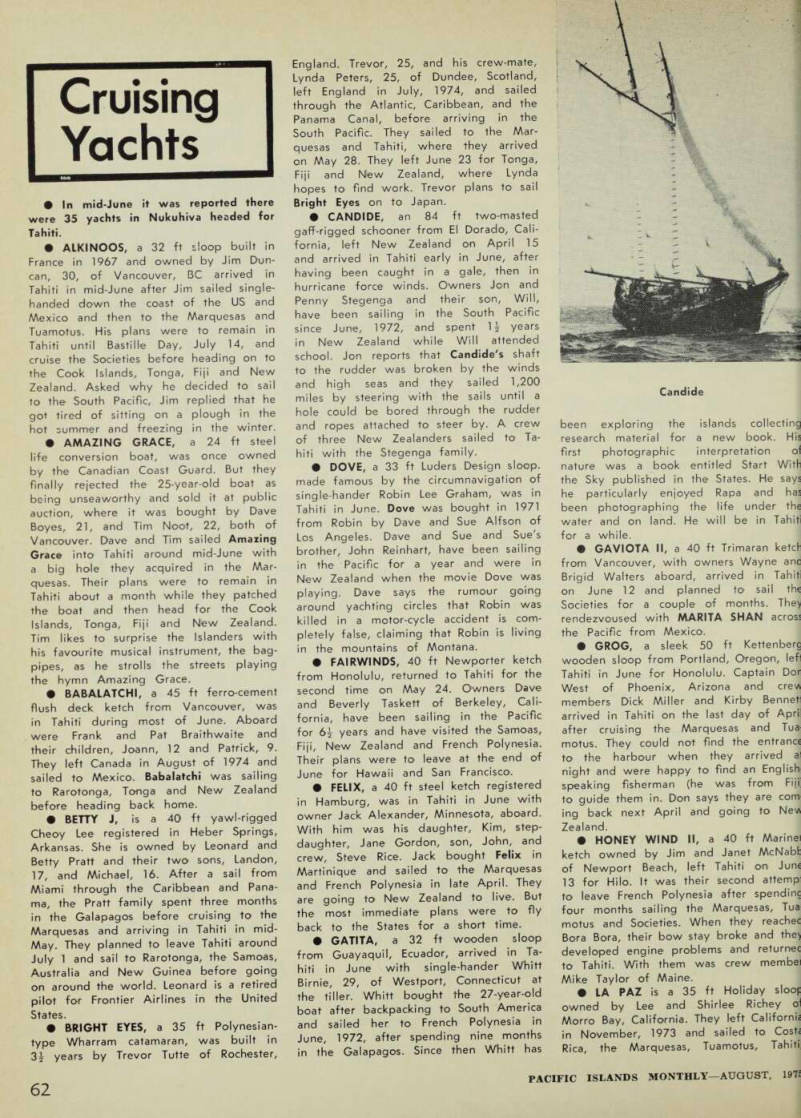
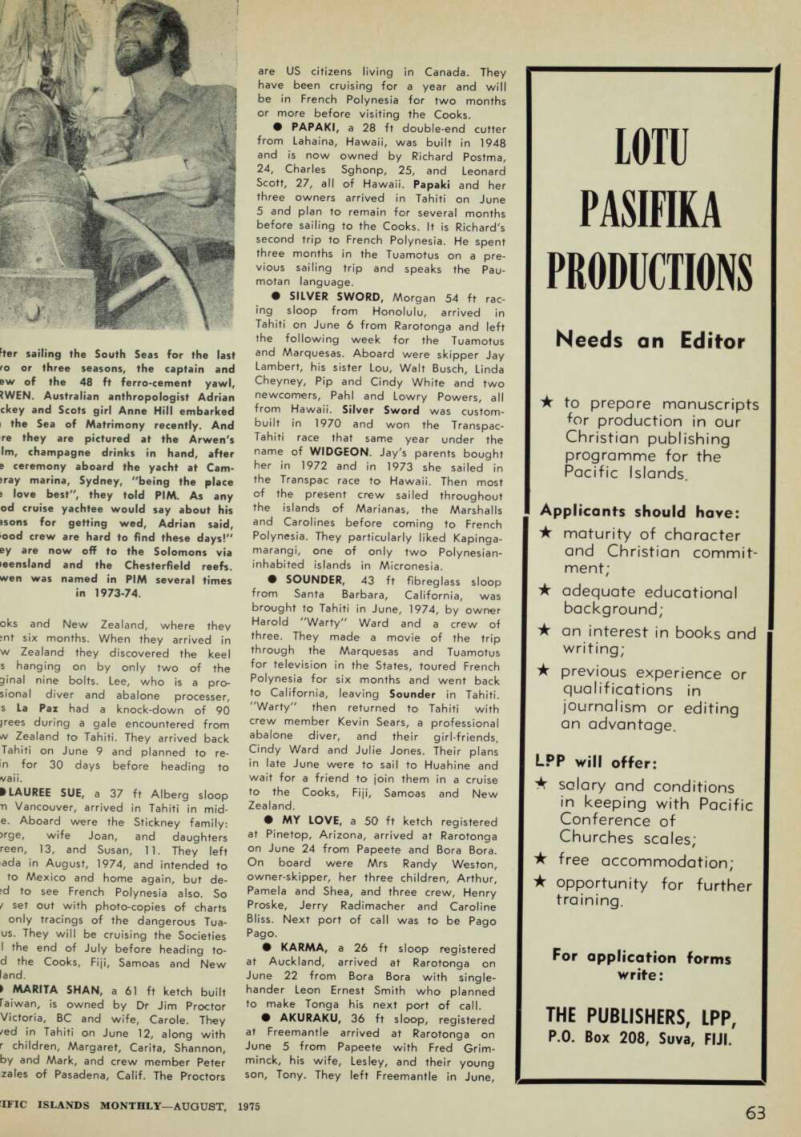
Yachts
• In mid-June it was reported there were 35 yachts in Nukuhiva headed for Tahiti. • ALKINOOS, a 32 ft sloop built in France in 1967 and owned by Jim Dun can, 30, of Vancouver, BC arrived in Tahiti in mid-June after Jim sailed single handed down the coast of the US and Mexico and then to the Marquesas and Tuamotus. His plans were to remain in Tahiti until Bastille Day, July 14, and cruise the Societies before heading on to the Cook Islands, Tonga, Fiji and New Zealand. Asked why he decided to sail to the South Pacific, Jim replied that he got tired of sitting on a plough in the hot summer and freezing in the winter. • AMAZING GRACE, a 24 ft steel life conversion boat, was once owned by the Canadian Coast Guard. But they finally rejected the 25-year-old boat as being unseaworthy and sold it at public auction, where it was bought by Dave Boyes, 21, and Tim Noot, 22, both of Vancouver. Dave and Tim sailed Amazing Grace into Tahiti around mid-June with a big hole they acquired in the Mar quesas. Their plans were to remain in Tahiti about a month while they patched the boat and then head for the Cook Islands, Tonga, Fiji and Ntew Zealand.
Tim likes to surprise the Islanders with his favourite musical instrument, the bag pipes, as he strolls the streets playing the hymn Amazing Grace. • BABALATCHI, a 45 ft ferro-cement flush deck ketch from Vancouver, was in Tahiti during most of June. Aboard were Frank and Pat Braithwaite and their children, Joann, 12 and Patrick, 9.
They left Canada in August of 1974 and sailed to Mexico. Babalatchi was sailing to Rarotonga, Tonga and New Zealand before heading back home. • BETTY J, is a 40 ft yawl-rigged Cheoy Lee registered in Heber Springs, Arkansas. She is owned by Leonard and Betty Pratt and their two sons, Landon, 17, and Michael, 16. After a sail from Miami through the Caribbean and Pana ma, the Pratt family spent three months in the Galapagos before cruising to the Marquesas and arriving in Tahiti in mid- May. They planned to leave Tahiti around July 1 and sail to Rarotonga, the Samoas, Australia and New Guinea before going on around the world. Leonard is a retired pilot for Frontier Airlines in the United States. • BRIGHT EYES, a 35 ft Polynesian type Wharram catamaran, was built in 3i years by Trevor Tutte of Rochester,
England. Trevor, 25, and his crew-mate, Lynda Peters, 25, of Dundee, Scotland, left England in July, 1974, and sailed through the Atlantic, Caribbean, and the Panama Canal, before arriving in the South Pacific. They sailed to the Mar quesas and Tahiti, where they arrived on May 28. They left June 23 for Tonga, Fiji and New Zealand, where Lynda hopes to find work. Trevor plans to sail Bright Eyes on to Japan. • CANDIDE, an 84 ft two-masted gaff-rigged schooner from El Dorado, Cali fornia, left New Zealand on April 15 and arrived in Tahiti early in June, after having been caught in a gale, then in hurricane force winds. Owners Jon and Penny Stegenga and their son, Will, have been sailing in the South Pacific since June, 1972, and spent li years in New Zealand while Will attended school. Jon reports that Candida's shaft to the rudder was broken by the winds and high seas and they sailed 1,200 miles by steering with the sails until a hole could be bored through the rudder and ropes attached to steer by. A crew of three New Zealanders sailed to Ta hiti with the Stegenga family. • DOVE, a 33 ft Luders Design sloop, made famous by the circumnavigation of single-hander Robin Lee Graham, was in Tahiti in June. Dove was bought in 1971 from Robin by Dave and Sue Alfson of Los Angeles. Dave and Sue and Sue's brother, John Reinhart, have been sailing in the Pacific for a year and were in New Zealand when the movie Dove was playing. Dave says the rumour going around yachting circles that Robin was killed in a motor-cycle accident is com pletely false, claiming that Robin is living in the mountains of Montana. • FAIRWINDS, 40 ft Newporter ketch from Honolulu, returned to Tahiti for the second time on May 24. Owners Dave and Beverly Taskett of Berkeley, Cali fornia, have been sailing in the Pacific for years and have visited the Samoas, Fiji, New Zealand and French Polynesia.
Their plans were to leave at the end of June for Hawaii and San Francisco. • FELIX, a 40 ft steel ketch registered in Hamburg, was in Tahiti in June with owner Jack Alexander, Minnesota, aboard.
With him was his daughter, Kim, step daughter, Jane Gordon, son, John, and crew, Steve Rice. Jack bought Felix in Martinique and sailed to the Marquesas and French Polynesia in late April. They are going to New Zealand to live. But the most immediate plans were to fly back to the States for a short time. • GATITA, a 32 ft wooden sloop from Guayaquil, Ecuador, arrived in Ta hiti in June with single-hander Whitt Birnie, 29, of Westport, Connecticut at the tiller. Whitt bought the 27-year-old boat after backpacking to South America and sailed her to French Polynesia in June, 1972, after spending nine months in the Galapagos. Since then Whitt has
been exploring the islands collecting research material for a new book. His first photographic interpretation ol nature was a book entitled Start With the Sky published in the States. He says he particularly enjoyed Rapa and has been photographing the life under the water and on land. He will be in Tahiti for a while. • GAVIOTA 11, a 40 ft Trimaran ketch from Vancouver, with owners Wayne anc Brigid Walters aboard, arrived in Tahiti on June 12 and planned to sail the Societies for a couple of months. They rendezvoused with MARITA SHAN across the Pacific from Mexico. • GROG, a sleek 50 ft Kettenberc wooden sloop from Portland, Oregon, left Tahiti in June for Honolulu. Captain Dor West of Phoenix, Arizona and crew members Dick Miller and Kirby Bennetl arrived in Tahiti on the last day of Apri after cruising the Marquesas and motus. They could not find the entrance to the harbour when they arrived al night and were happy to find an English speaking fisherman (he was from Fiji, to guide them in. Don says they are com ing back next April and going to New Zealand. • HONEY WIND 11, a 40 ft Marinei ketch owned by Jim and Janet McNabb of Newport Beach, left Tahiti on June 13 for Hilo. It was their second attemp to leave French Polynesia after spendinc four months sailing the Marquesas, Tua motus and Societies. When they reachec Bora Bora, their bow stay broke and they developed engine problems and returnee to Tahiti. With them was crew membei Mike Taylor of Maine. • LA PAZ is a 35 ft Holiday sloop owned by Lee and Shirlee Richey ol Morro Bay, California. They left Californic in November, 1973 and sailed to Costc Rica, the Marquesas, Tuamotus, Tahiti,
Candide
oks and New Zealand, where they ;nt six months. When they arrived in w Zealand they discovered the keel s hanging on by only two of the ginal nine bolts. Lee, who is a pro sional diver and abalone processer, s La Pax had a knock-down of 90 jrees during a gale encountered from i/v Zealand to Tahiti. They arrived back Tahiti on June 9 and planned to re in for 30 days before heading to vaii. • LAUREE SUE, a 37 ft Alberg sloop n Vancouver, arrived in Tahiti in mid e. Aboard were the Stickney family: >rge, wife Joan, and daughters reen, 13, and Susan, 11. They left ada in August, 1974, and intended to to Mexico and home again, but de sd to see French Polynesia also. So f set out with photo-copies of charts only tracings of the dangerous Tua us. They will be cruising the Societies I the end of July before heading to d the Cooks, Fiji, Samoas and New land. > MARITA SHAN, a 61 ft ketch built Faiwan, is owned by Dr Jim Proctor Victoria, BC and wife, Carole. They red in Tahiti on June 12, along with r children, Margaret, Carita, Shannon, by and Mark, and crew member Peter zales of Pasadena, Calif. The Proctors
are US citizens living in Canada. They have been cruising for a year and will be in French Polynesia for two months or more before visiting the Cooks. • PAPAKI, a 28 ft double-end cutter from Lahaina, Hawaii, was built in 1948 and is now owned by Richard Postma, 24, Charles Sghonp, 25, and Leonard Scott, 27, all of Hawaii. Papaki and her three owners arrived in Tahiti on June 5 and plan to remain for several months before sailing to the Cooks. It is Richard's second trip to French Polynesia. He spent three months in the Tuamotus on a pre vious sailing trip and speaks the Pau
motan language.
• SILVER SWORD, Morgan 54 ft rac ing sloop from Honolulu, arrived in Tahiti on June 6 from Rarotonga and left the following week for the Tuamotus and Marquesas. Aboard were skipper Jay Lambert, his sister Lou, Walt Busch, Linda Cheyney, Pip and Cindy White and two newcomers, Pahl and Lowry Powers, all from Hawaii. Silver Sword was custom built in 1970 and won the Transpac- Tahiti race that same year under the name of WIDGEON. Jay's parents bought her in 1972 and in 1973 she sailed in the Transpac race to Hawaii. Then most of the present crew sailed throughout the islands of Marianas, the Marshalls and Carolines before coming to French Polynesia. They particularly liked Kapinga marangi, one of only two Polynesian inhabited islands in Micronesia. • SOUNDER, 43 ft fibreglass sloop from Santa Barbara, California, was brought to Tahiti in June, 1974, by owner Harold "Warty" Ward and a crew of three. They made a movie of the trip through the Marquesas and Tuamotus for television in the States, toured French Polynesia for six months and went back to California, leaving Sounder in Tahiti.
"Warty" then returned to Tahiti with crew member Kevin Sears, a professional abalone diver, and their girl-friends, Cindy Ward and Julie Jones. Their plans in late June were to sail to Huahine and wait for a friend to join them in a cruise to the Cooks, Fiji, Samoas and New Zealand. • MY LOVE, a 50 ft ketch registered at Pinetop, Arizona, arrived at Rarotonga on June 24 from Papeete and Bora Bora.
On board were Mrs Randy Weston, owner-skipper, her three children, Arthur, Pamela and Shea, and three crew, Henry Proske, Jerry Radimacher and Caroline Bliss. Next port of call was to be Pago Pago. • KARMA, a 26 ft sloop registered at Auckland, arrived at Rarotonga on June 22 from Bora Bora with single hander Leon Ernest Smith who planned to make Tonga his next port of call. • AKURAKU, 36 ft sloop, registered at Freemantle arrived at Rarotonga on June 5 from Papeete with Fred Grim minck, his wife, Lesley, and their young son, Tony. They left Freemantle in June,
Fter sailing the South Seas for the last [?] or three seasons, the captain and New of the 48 ft ferro-cement yawl, RWEN. Australian anthropologist Adrian ckey and Scots girl Anne Hill embarked the Sea of Matrimony recently. And re they are pictured at the Arwen's Im, champagne drinks in hand, after [?] ceremony aboard the yacht at Cam fay marina, Sydney, "being the place [?] love best", they told PIM. As any [?]od cruise yachtee would say about his asons for getting wed, Adrian said, ood crew are hard to find these days!" [?]ey are now off to the Solomons via [?]eensland and the Chesterfield reefs, hwen was named in PIM several times in 1973-74.
1972, and called at islands in the Indian Ocean, off South Africa, and South America and in the West Indies. Tony was born in Trinidad. They passed through the Panama Canal in February, 1975, and expect to reach Australia in September, after calling at Tonga, Fiji and New Caledonia. • GYPSY COWBOY, 41 ft ketch from Fort Lauderdale, Florida, arrived at Raro tonga on June 9 with owner Bill Duncan and Captain Carl Ericksonn. They called at the Bahamas, Jamaica, and Panama where they stayed six months. Pacific ports of call were the Marquesas and Society Islands. The cruise has lasted 18 months and they plan to complete a circumnavigation within five years. • WENDY, 29 ft sloop, arrived at Rarotonga on June 10 with Bruce Silock and Anne Mac Niven from Papeete and Bora Bora. The yacht is registered at Southamption. Plans were to visit Aitu taki and Tonga. • WHITE HORSE OF KENT, 38 ft ketch, carrying owner-designer-builder Colin Usmar and Ruth Boydell arrived at Port Moresby on May 29 from Auckland.
Colin built the ketch at Cape Town in 1971. He planned to sail for Africa, via the Seychelles, after Port Moresby. • MYONIE, 36 ft ketch, was a recent arrival in Port Moresby from the Solomon Islands, carrying Dr Al and Helen Gehrman. They intended to sail through Torres Strait and then return to their home in the US after their third world cruise.
• RONNARCHY, 36 ft ketch, was abandoned about 60 miles east of Cape Brett, New Zealand, early in June, while on the way from Auckland to Fiji. The three people on board included the owner-skipper, Mr Rob Ray. The three were picked up by the freighter. Union Wellington, which was diverted to the area in response to distress signals. • MARIS, 36 ft wooden yawl, which left Sydney in September, 1974, arrived in Honolulu in April carrying skipper lan B. Kiernan, of Mosman, Sydney, and Mark Fraser, of Half Moon Bay, California.
On the way Maris stopped at Lord Howe Island, Rarotonga, Tahiti, the Marquesas and Hilo. • VIAJERA, 27 ft fibre glass sloop, arrived in Honolulu on May 12 from Papeete, carrying skipper William E.
Lonez, of Riverside, California, and Pamela G. Richmond, of Bay of Islands, NZ. • PAGURUS, 42 ft wooden ketch, reached Honolulu on May 26 from French Polynesia. She sailed south on August 4, 1974, from Santa Cruz, California, and before arrival at Honolulu called at Aca pulco, Galapagos, the Marquesas, Tahiti and Bora Bora. She weathered a hurricane and a six-day gale off Acapulco. On board Pagurus were skipper Albert Towle, Brad Towle and Russell Magardy. ® LEAU'I, 45 ft ferro-cement ketch, carrying Webster and Wilma Larsen, of Honolulu, returned to Honolulu on May 31 after a voyage to the Marquesas.
Also on board, as crew, was Tom Sawyer, of Millbrae, California. • LA CARETA, 32 ft sloop, carrying Anders and Gunnar Eriksson, arrived at Niue on May 20 from Rarotonga, and sailed on May 26 for Vavau. • MYANNA 111, 30 ft yacht, was a May 23 arrival at Niue from Rarotonga, carrying Daniel Roose and Denise Plourde.
She left for Vavau on May 31. • AQUARIUS, 34 sloop, arrived at Niue on May 26 from Rarotonga and sailed in June for Pago Pago. On board were Othell and Maxine Mallouf. © MOANA, 34 ft ketch, arrived at Niue from Rarotonga on May 28 and sailed on June 4 for Vavau, carrying Raymond Quint. • SHAULA, a 48 ft yawl registered at Seattle, Washington, USA, arrived at Rarotonga on June 27 from Pago Pago and Suwarrow. On board were owner captain Gordon Crawford and crewman Ken Vogel. Plans were to call at Tahiti, Hawaii, and the west coast of the USA. • MUSCARI, a 29 ft sloop, registered at Faversham, UK, arrived at Rarotonga on June 26 from Bora Bora with skipper D. J. Merely and crew H. M. Downie.
Next port of call was to be in Tonga. • ALEZA, a 40 ft yacht registered at London, arrived at Rarotonga from Auck land, Raiatea and Bora Bora on June 26 with an all-British crew —skipper R.
Hood, M. Price, E. Hammick and A.
Julian. Plans were to call at Tonga.
Advertisements & other items, p. 67 (2 items)
63
IFIC ISLANDS MONTHLY—AUGUST, 1975
Productions
10TU
PASIFIKA
Needs an Editor ★ to prepare manuscripts for production in our Christian publishing programme for the Pacific Islands.
Applicants should have: ★ maturity of character and Christian commitment; ★ adequate educational background; ★ an interest in books and writing; ★ previous experience or qualifications in journalism or editing an advantage.
LPP will offer: ★ salary and conditions in keeping with Pacific Conference of Churches scales; ★ free accommodation; ★ opportunity for further training.
For application forms write:
THE PUBLISHERS, LPP,
P.O. Box 208, Suva, FIJI.
Rim's Power
A nice thing happened to PIM recently—this letter from Mr Peter Ell of the Niue Island and Blue water Yacht Club. It speaks for itself but we are proud to add that it just shows how our Cruise Yacht section travels as widely as our very generous readers.
"The publicity you gave Niue Island Blue Water Yacht Club when you printed my letter in PIM (Hey Yachties! Feb p 75) really has made a difference to us here. Many people from as far away as USA and Australia have sent our club donations as well as buying our fund-raising club shirt. Again, many thanks Mr Editor.
"The money we have raised recently has been put to immedi ate use; several of our members assisted in installing a mooring buoy at Utuko, close by the Alof) landings; so when Niue Public Works Dept gets motivated enough to re-install the old mooring buoy at Alofi there will be two spots for visiting yachts to take a moor ing".
Advertisements & other items, p. 68 (1 item)
Become a part
of PlM’s Pacifi and subscribe now ft s v a i- £ o •fH ’G 03 Gh © © a Sh © M-H fl •fH S ' o (/) Ph 43 03 Fill in the deta on the attache order form.
Business and Development
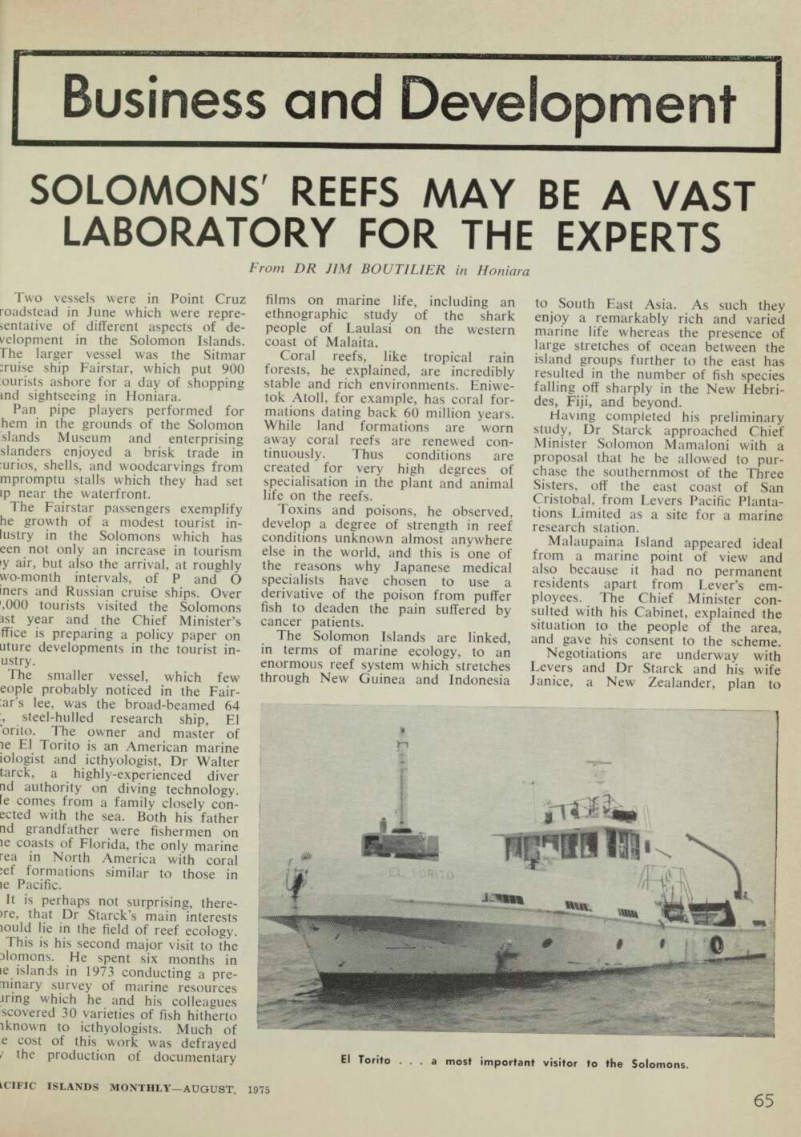

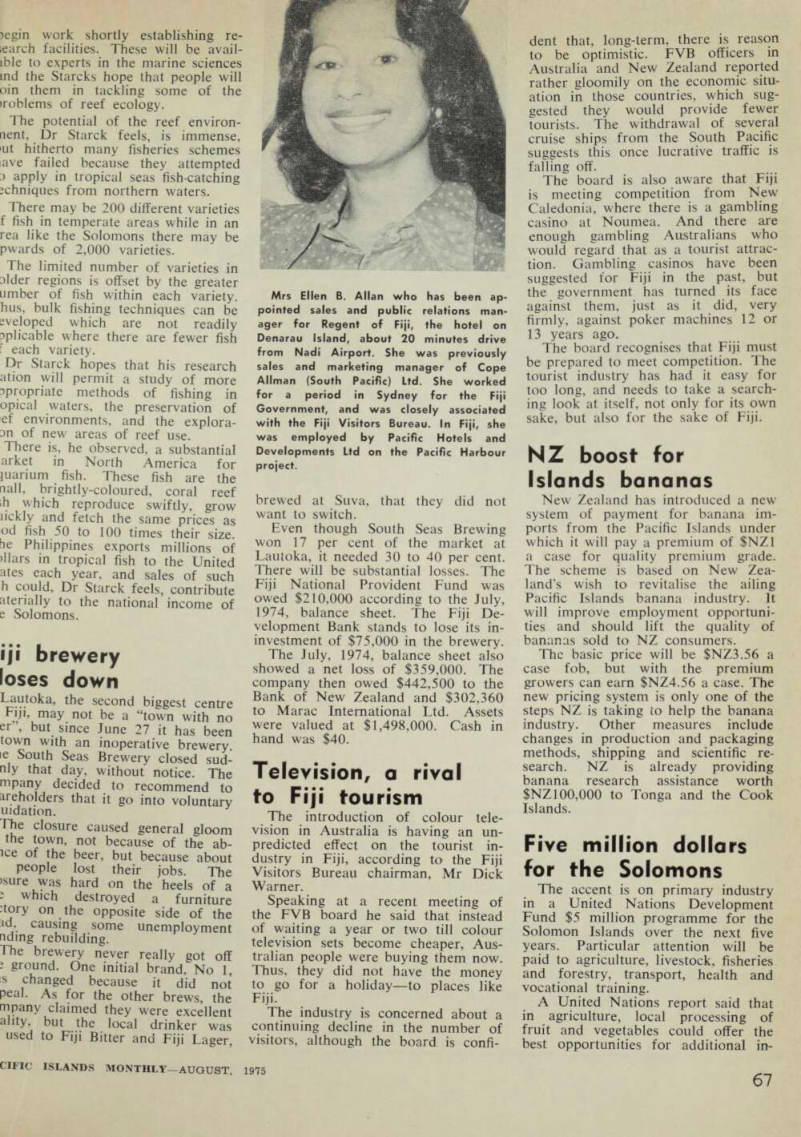

Solomons' Reefs May Be A Vast
Laboratory For The Experts
From DR JIM BOUTILIER in Honiara
Two vessels were in Point Cruz roadstead in June which were repre sentative of different aspects of de velopment in the Solomon Islands.
The larger vessel was the Sitmar :ruise ship Fairstar, which put 900 ourists ashore for a day of shopping md sightseeing in Honiara, Pan pipe players performed for hem in the grounds of the Solomon slands Museum and enterprising slanders enjoyed a brisk trade in :urios, shells, and woodcarvings from mpromptu stalls which they had set ip near the waterfront.
The Fairstar passengers exemplify he growth of a modest tourist in lustry in the Solomons which has een not only an increase in tourism •y air, but also the arrival, at roughly wo-month intervals, of P and O iners and Russian cruise ships. Over ',OOO tourists visited the Solomons ast year and the Chief Minister’s ffice is preparing a policy paper on uture developments in the tourist in ustry.
The smaller vessel, which few eople probably noticed in the Fair ar’s lee, was the broad-beamed 64 steel-hulled research ship, El brito. The owner and master of le El Torito is an American marine iologist and icthyologist, Dr Walter
tarck, a highly-experienced diver
ad authority on diving technology, le comes from a family closely con ected with the sea. Both his father ad grandfather were fishermen on le coasts of Florida, the only marine rea in North America with coral ; ef formations similar to those in le Pacific.
It is perhaps not surprising, there >re, that Dr Starck’s main interests lould lie in the field of reef ecology.
This is his second major visit to the Dlomons. He spent six months in ic islands in 1973 conducting a pre rninary survey of marine resources iring which he and his colleagues scovered 30 varieties of fish hitherto iknown to icthyologists. Much of e cost of this work was defrayed / the production of documentary
films on marine life, including an ethnographic study of the shark people of Laulasi on the western coast of Malaita.
Coral reefs, like tropical rain forests, he explained, are incredibly stable and rich environments. Eniwetok Atoll, for example, has coral formations dating back 60 million years.
While land formations are worn away coral reefs are renewed contmuously. Thus conditions are created for very high degrees of specialisation m the plant and animal lue on the reefs. toxins and poisons, he observed, develop a degree of strength in reef conditions unknown almost anywhere else in the world, and this is one of the reasons why Japanese medical specialists have chosen to use a denvative of the poison from puffer fish to deaden the pain suffered by Ca^f F P a V entS - T . • the Solomon Islands are linked, in terms of marine ecology, to an enormous reef system which stretches through New Guinea and Indonesia
to South East Asia. As such they enjoy a remarkably rich and varied marine life whereas the presence of large stretches of ocean between the island groups further to the east has resulted in the number of fish species falling off sharply in the New Hebri des, Fiji, and beyond.
Having completed his preliminary study, Dr Starck approached Chief Minister Solomon Mamaloni with a proposal that he be allowed to pur chase the southernmost of the Three Sisters, off the east coast of San Cristobal, from Levers Pacific Planta tions Limited as a site for a marine research station.
Malaupaina Island appeared ideal from a marine point of view and also because it had no permanent residents apart from Lever’s em ployees. The Chief Minister con sulted with his Cabinet, explained the situation to the people of the area, and gave his consent to the scheme.
Negotiations are underway with Levers and Dr Starck and his wife Janice, a New Zealander, plan to
El Tonto ... a most important visitor to the Solomons.
jegin work shortly establishing re icarch facilities. These will be avail ible to experts in the marine sciences md the Starcks hope that people will oin them in tackling some of the iroblems of reef ecology.
The potential of the reef environ nent, Dr Starck feels, is immense, ut hitherto many fisheries schemes ave failed because they attempted a apply in tropical seas fish-catching jchniques from northern waters.
There may be 200 different varieties f fish in temperate areas while in an rea like the Solomons there may be pwards of 2,000 varieties.
The limited number of varieties in alder regions is offset by the greater umber of fish within each variety, hus, bulk fishing techniques can be sveloped which are not readily aplicable where there are fewer fish I each variety.
Dr Starck hopes that his research ation will permit a study of more apropriate methods of fishing in opical waters, the preservation of ef environments, and the explora -3n of new areas of reef use.
There is, he observed, a substantial arket in North America for luarium fish. These fish are the nail, brightly-coloured, coral reef ;h which reproduce swiftly, grow lickly and fetch the same prices as od fish 50 to 100 times their size, be Philippines exports millions of ’liars in tropical fish to the United ates each year, and sales of such h could, Dr Starck feels, contribute aterially to the national income of e Solomons.
iji brewery
loses down
Lautoka, the second biggest centre Fiji, may not be a “town with no er , but since June 27 it has been town with an inoperative brewery. ie South Seas Brewery closed sud nly that day, without notice. The mpany decided to recommend to areholders that it go into voluntary uidation.
The closure caused general gloom the town, not because of the ab ice of the beer, but because about people lost their jobs. The •sure was hard on the heels of a J which destroyed a furniture dory on the opposite side of the ad, causing some unemployment
riding rebuilding.
The brewery never really got off ' ground. One initial brand, No 1, s changed because it did not peal. As for the other brews, the mpany claimed they were excellent ahty, but the local drinker was used to Fiji Bitter and Fiji Lager,
brewed at Suva, that they did not want to switch.
Even though South Seas Brewing won 17 per cent of the market at Lautoka, it needed 30 to 40 per cent.
There will be substantial losses. The Fiji National Provident Fund was owed $210,000 according to the July, 1974, balance sheet. The Fiji De velopment Bank stands to lose its in investment of $75,000 in the brewery.
The July, 1974, balance sheet also showed a net loss of $359,000. The company then owed $442,500 to the Bank of New Zealand and $302,360 to Marac International Ltd. Assets were valued at $1,498,000. Cash in hand was $4O.
Television, a rival
to Fiji tourism
The introduction of colour tele vision in Australia is having an un predicted effect on the tourist in dustry in Fiji, according to the Fiji Visitors Bureau chairman, Mr Dick Warner.
Speaking at a recent meeting of the FVB board he said that instead of waiting a year or two till colour television sets become cheaper, Aus tralian people were buying them now.
Thus, they did not have the money to go for a holiday—to places like Fiji.
The industry is concerned about a continuing decline in the number of visitors, although the board is confi
dent that, long-term, there is reason to be optimistic. FVB officers in Australia and New Zealand reported rather gloomily on the economic situ ation in those countries, which sug gested they would provide fewer tourists. The withdrawal of several cruise ships from the South Pacific suggests this once lucrative traffic is falling off.
The board is also aware that Fiji is meeting competition from New Caledonia, where there is a gambling casino at Noumea. And there are enough gambling Australians who would regard that as a tourist attrac tion. Gambling casinos have been suggested for Fiji in the past, but the government has turned its face against them, just as it did, very firmly, against poker machines 12 or 13 years ago.
The board recognises that Fiji must be prepared to meet competition. The tourist industry has had it easy for too long, and needs to take a search ing look at itself, not only for its own sake, but also for the sake of Fiji.
NZ boost tor
Islands bananas
New Zealand has introduced a new system of payment for banana im ports from the Pacific Islands under which it will pay a premium of SNZI a case for quality premium grade.
The scheme is based on New Zea land’s wish to revitalise the ailing Pacific Islands banana industry. It will improve employment opportuni ties and should lift the quality of bananas sold to NZ consumers.
The basic price will be $NZ3.56 a case fob, but with the premium growers can earn 5NZ4.56 a case. The new pricing system is only one of the steps NZ is taking to help the banana industry. Other measures include changes in production and packaging methods, shipping and scientific re search. NZ is already providing banana research assistance worth SNZ 100,000 to Tonga and the Cook Islands.
Five million dollars
for the Solomons
The accent is on primary industry in a United Nations Development Fund $5 million programme for the Solomon Islands over the next five years. Particular attention will be paid to agriculture, livestock, fisheries and forestry, transport, health and vocational training.
A United Nations report said that in agriculture, local processing of fruit and vegetables could offer the best opportunities for additional in
Mrs Ellen B. Allan who has been ap pointed sales and public relations man ager for Regent of Fiji, the hotel on Denarau Island, about 20 minutes drive from Nadi Airport. She was previously sales and marketing manager of Cope Allman (South Pacific) Ltd. She worked for a period in Sydney for the Fiji Government, and was closely associated with the Fiji Visitors Bureau. In Fiji, she was employed by Pacific Hotels and Developments Ltd on the Pacific Harbour project.
come. Coconut research is also en visaged. Much of the aid will be supplied in the form of consultants and fellowships for Solomon Is landers.
The advice from consultants should ensure that various projects are pro perly launched.
Copra planters
feel the pinch
New Hebrides copra exports in the first five months of 1975 at 11,937 tonnes, were well down on the 15,438 tonnes exported in the corresponding period of 1974. Lower values re flected the decline of the world copra market.
Fiji planters too are feeling the pinch, so much so that the govern ment has introduced a subsidy scheme under which $2 million will be available to keep the price of grade one copra at $l9O a ton, double the grade one price in June.
However, the subsidy is no more than a palliative. It will ease the economic strain on planters till Christmas. Unless there is a dramatic increase in world prices before then, the government may have to look at providing another subsidy.
Copra mill
tor Micronesians
The Micronesian Industrial Corpo ration is able to press ahead and set up a copra oil mill on Palau. The president of the corporation, Mr Guy A. Luttrell, expects that, barring un foreseen delays, the mill will be operational in July, 1976. The copra storage building will be finished about the middle of December, and the corporation will be ready to buy the entire production of the Trust Terri tory from next January 2.
If necessary, copra will be bought from the Philippines to augment the mill output. The mill will be able to produce about 100 tons of oil and about 40 tons of copra cake a day.
Fiji town council
bocks new sawmill
An Australian company, Robb and Brown Ltd, of Queensland, is in terested in setting up a sawmilling venture oustide Savusavu in Fiji The savusavu Town Council recently approved the company’s plan for a -2-acre mill site on the town’s out skirts The company, in 1974, bought .ontrol of Whites Enterprises Ltd, a savusavu timber milling company.
Ihe Mayor of Savusavu, Cr Hugh
Thaggard, said the project was of vital importance to the future of the town, particularly as copra prices had slumped. He understood the com pany would invest about S 3 million in the project. The project would give fuller use of the Savusavu power station, which was running at only a fraction of its capacity.
A Mini-Moke
coming to PNG
Papua New Guinea will have a new heavy industry when British Leyland (Aust) and Aveling-Barford Pacific, which have formed a new company, start a vehicle assembly venture. The plant will be at Lae, and will be operated by Leyland Pacific Pty Ltd, which will aim at an export industry for the South Pacific Islands.
Initially, production will be con fined to the Leyland Mini-Moke, at the rate of 25 a month. Production
Australia saw the Industrial beginnings of independent Papua New Guinea at a huge Forest Industries Machinery Expo sition in north-eastern Victoria. This machine (pictured above) claimed to be the first ever to come out of PNG, called the "Chipper-Austin" Travelmill" was displayed and demonstrated at the Exposition by New Guineans. It is the end result of six years of research and development. The machine was originally designed and built as a grass roots saw mill which could be operated by New Guineans without supervision. Easily transported, rugged and of low cost, the mill can be set down and erected in the forest thus cutting log hauling dis tances to a minimum. There are eight such units operating in PNG and a further five under construction. The Djaul Island Timbers operate two Chipper- Austin Travelmills each with a production target of 5,000 super feet of sawn timber per day. The machines are manu factured and sold by J. Austin Engineer ing of Rabaul.
will be stepped later, and so will the local content of the vehicle.
A share in the new company will be available for Papua New Guinea people. Whether this will be by government shareholding, by Develop ment Bank involvement, or by direct share issues, will be decided by the government.
A survey by Aveling-Barford sug gested that local assembly would re duce costs sufficiently to enable the Mini-Moke to compete with Japanese vehicles in the 1,000 cc range.
Gilbertese hopes
for Christmas
Christmas Island may provide a substitute—though not as remunera tive—for the Gilbert Islands when revenue ceases to come in from Ocean Island phosphate which now provides about $lO million a year for the GEIC.
The GEIC Government recently sent a high-powered team to Christ mas Island to get first-hand know ledge of resources being developed by the Gilbert and Ellice Islands Development Authority.
The team comprised the Chief Minister, Mr Naboua Ratieta, the Minister for Commerce and Industry, Mr Otiuea Tanentoa, the Minister for Communications, Works and
Utilities, Mr Bwebwetake Areieta, and the Minister for Education, Training and Culture, Mr Roniti Teiwaki, with GEIDA officials, including the mana ger, Mr Soutar Brown, and scientific consultants from Honolulu.
The team saw a number of in dustrial sites, including those for the brine-shrimp factory, the copra in dustry and the fisheries industry.
There is also a site for a hotel, which will be the base for a tourist industry for the island. The brine-shrimp industry is likely to be the first to get off the ground. Markets have been found in Europe for this delicacy.
The seas off the island are potenti ally rich in fish resources.
PNG government
buys rejected cars
The PNG Government has quietly bought five of the controversial 25 Mercedes cars which precipitated a major political row earlier this year.
The purchase price is believed to be $lO,OOO each, and the cars will be part of the VIP fleet for inde pendence celebrations in September.
Late last year, the Transport Minister, Mr lambakey Okuk, ordered the 25 cars from Germany at a bulk order price totalling $185,000 —equal to $7,400 per unit.
Cabinet endorsed the order, but a political row erupted over what was described as unnecessary and irregular expenditure. The Chief Minister, Mr Michael Somare, cancelled the order on his own initiative as political pressures mounted.
However, the cancellation came too late to prevent the arrival of the cars —complete with fittings for pennants and flags. Since then the government
has been negotiating compensation
arrangements with the importers.
A few of the cars have been sold privately, but five are now being registered for the government.
Koreans to
develop PNG timber
The Papua New Guinea Govern ment will spend up to $3O million in the next 10 years to develop the Kapuluk timber area on the north coast of West New Britain. One of two Korean companies will be chosen to develop the area. The National Resources Minister, Mr Bruce Jeph cott, said a new town and an in dustrial complex would be established to meet development needs. The timber area covers about 180,000 hectares, and is estimated to contain about 5.8 million cubic metres of saw veneer log and 7.3 million cubic metres of pulpwood.
• Fiji cane farmers expect to earn record $43,405,000 payout from the 974 crop. Their payment of $20.50 ton from the Fiji Sugar Corpora on is more than double the previous ;cord payout—slo.o6 in 1972. They an expect even better in 1975, pro ided Fiji is able to meet its new Dmmitments to the European Eco omic Community. But one or two ;cent rumbles of discontent caused le Minister for Information, Ratu )avid Toganivalu, to say that dis aptions could cost Fiji millions of ollars. • The Bank of Tonga in its first sar of business, issued more than [)0 personal loans of about $l,OOO ach, mainly for housebuilding. The umber of inquiries increased as the jar drew to a close.
. . . and briefly • Another attempt is being made to set up a sheep industry in Papua New Guinea. A flock of about 900 ewes in lamb arrived from New Zealand recently to test the possi bility of establishing a combined mutton and cottage wool industry.
The late Sir Edward Hallstrom, of Sydney, more than 20 years ago, introduced sheep to the Highlands of New Guinea at Nondugl, as a wool industry experiment. The ex periment was discontinued several years later. • Papua New Guinea and Aus tralia have announced agreement in principle to a mutual long-term free trade policy after PNG achieves nationhood. The PNG Trade Minis ter, Sir Maori Kiki, and the Austra
lian Overseas Trade Minister, Mr Frank Crean, announced this in Port Moresby after three days of talks and said that officials from the two countries would meet soon in Port Moresby to begin drafting a formal agreement. • Mr Phillip Best, general man ager of Bums Philp (SS) Co Ltd, has been transferred to Burns Philp and Co Ltd in Sydney to become assistant to the general manager, Mr M. O’Connor. Mr Best, Fiji-born, joined Burns Philp in 1952, and held several senior appointments before becoming general manager of the South Sea company. He has been succeeded in Suva by Mr Ronald Rowland, who joined the company in 1974 after a career in commerce in Australia and the Far East.
Advertisements & other items, pp. 69-74 (4 items)
65
ICIFIC ISLANDS MONTHLY—AUGUST, 1975
International
There's an International Truck
lor every application. Yours too
Whatever you carry on or off the highway, we’re certain we’ve got just the truck you need.
Thirty-five basic models include petrol and diesel power, single axle and tandem drive, 4 x 2, 6 x 4 and Bx 4, automatic and manual transmission, conventional cab and cab over.
Two series of truck designs which together comprise these 35 options, make up the International truck range.
ACCO-A Series (cab over) Twenty-three basic models feature a ‘human engineered’ all-steel cab for outstanding driver comfort and safety. It tilts for easy access to the engine, cutting servicing and maintenance delays.
Models cater for a wide range of applications tippers, trays, vans, cement agitators, tankers and semi-trailers. A total of 7 petrol and diesel engines power the range.
D-Line (conventional cab) Twelve basic models including four-wheeldrive vehicles for off-highway use. Suited to tray, tippers, vans and as prime movers for semi- trailers.
There’s an International truck to suit almost every practical application. And they’re all backed by reliable after-sales service and parts supply. f For further information contact our authorised distributors—• NGG Trading Co., PO Box 459, Lae, PNG.
Solomon Motors Ltd., PO Box Cl 6, Honiara, Guadalcanal, BSIP.
S.I.F.R.A. BP 806,
Noumea, New Caledonia.
Niranjans Autoport Limited, GPO Box 450, Suva, Fiji.
Kerr Bros Pty. Ltd., PO Box 3838, Sydney, NSW, 2001 Tahiti Produits Shelltex, Boite Postale 350, Papeete, Tahiti.
Pacific Products Inc., PO Box 698, Pago Pago, American Samoa 95920 International Harvester Australia Limited
IH29R
International
THed the new
Kodak film yet?
Kodachtome 64
This new film has a new emulsion that will give you bright greens, reds and blues.
In addition you have the flexibility of a fast film rating (ASA 64) to help you take good color shots even under dull or difficult light conditions. Try it soon and see the difference for yourself. It’s in the familiar yellow box, at your local island photo dealer.
Ask for Kodachrome 64 film-the slide improver ‘Available in sizes to fit 135, 126 and 110 size cameras.
“Kodak” and are registered trademarks of KODAK (Australasia) PTY. LTD.
K6l 4948
color slide film
KODAK (Australasia) PTY. LTD.
AITCHISON YACHT MASTS OF
NEW ZEALAND
CONSTRUCT AND SUPPLY FOR YACHTS:
WOODEN MASTS AND SPARS • ALUMINIUM MASTS AND SPARS • ALL SPAR FITTINGS, LIGHTING, ROPES. RIGGING
WINCHES, STAINLESS STEEL BOAT FITTINGS.
Yachties for quick experienced service contact the specialist firm with the world wide reputation now 111 We air freight and ship all over the islands. Flagpoles also made and supplied.
AITCHISON YACHT MASTS,
71 ROWANDALE AVE., MANUREWA (P.O. BOX 274, MANUREWA),
AUCKLAND, N.Z. Ph: 63-500
■fv a Jfc-y; a* «« »
isss
J Hand Planer 19238
2* V-v N SI M
ELectn.izPowajxTD&LA
NOW CELEBRATING
60
YEARS OF LEADERSHIP IN INDUSTRY.
OVER 130 MODELS FOR EVERY PURPOSE.
(8) htoKilcL
REPRESENTATIVE: DEMKA (AUSTRALIA)
PTY. LIMITED, 184 Sussex Street (Third Floor), Sydney, N.S.W. 2000, Australia.
DISTRIBUTORS: Papua New Guinea; BURNS
PHILP (NEW GUINEA) LTD.. TUTT BRYANT
PACIFIC LTD., NEW GUINEA COMPANY
LIMITED, TERRITORIAL PLUMBING SUP-
PLIES & SERVICES PTY. LTD., British Solo-
mon Islands, CONCRETE INDUSTRIES LTD.,
New Hebrides; BURNS PHILP (NEW HEBRI- DES) LTD., New Caledonia; CALEDONIENNE
D'IMPORT ATI ON DE MATERIEL AUTOMO-
BILE ET CONSTRUCTION, ETS. CHU VAN
FRERES Norfolk Island; IRVINE'S BUI LO-
NG SUPPLY CENTRE, Fiji,CORAL ISLAND
MOTORS, Tahiti; SIN TUNG RING MATERI-
AUX DE CONSTRUCTION.
67
CIFIC ISLANDS MONTHLY—AUGUST. 1975
69
ACIFIC ISLANDS MONTHLY-AUGUST, 1975
Australia's loans battle
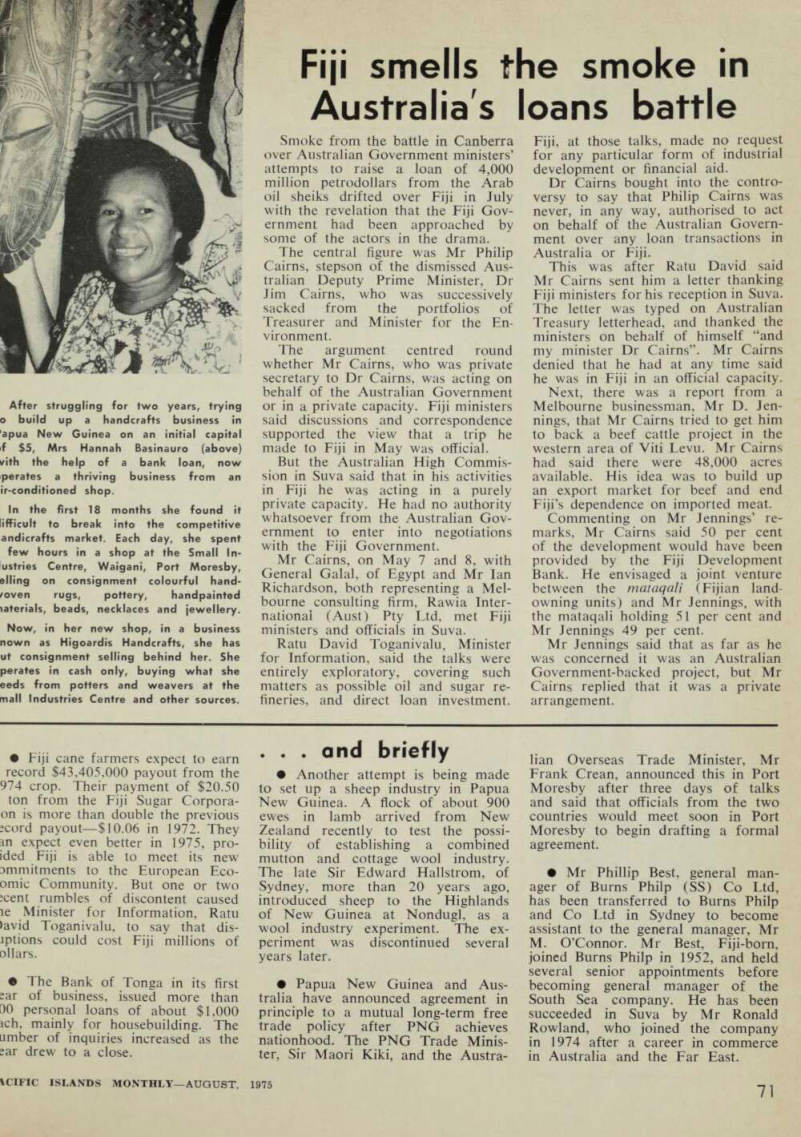
Fiji smells the smoke in Australia's loans battle
Smoke from the battle in Canberra over Australian Government ministers’ attempts to raise a loan of 4,000 million petrodollars from the Arab oil sheiks drifted over Fiji in July with the revelation that the Fiji Gov ernment had been approached by some of the actors in the drama.
The central figure was Mr Philip Cairns, stepson of the dismissed Aus tralian Deputy Prime Minister, Dr Jim Cairns, who was successively sacked from the portfolios of Treasurer and Minister for the En vironment.
The argument centred round whether Mr Cairns, who was private secretary to Dr Cairns, was acting on behalf of the Australian Government or in a private capacity. Fiji ministers said discussions and correspondence supported the view that a trip he made to Fiji in May was official.
But the Australian High Commis sion in Suva said that in his activities in Fiji he was acting in a purely private capacity. He had no authority whatsoever from the Australian Gov ernment to enter into negotiations with the Fiji Government.
Mr Cairns, on May 7 and 8, with General Galal, of Egypt and Mr lan Richardson, both representing a Mel bourne consulting firm, Rawia Inter national (Aust) Pty Ltd, met Fiji ministers and officials in Suva.
Ratu David Toganivalu, Minister for Information, said the talks were entirely exploratory, covering such matters as possible oil and sugar re fineries, and direct loan investment.
Fiji, at those talks, made no request for any particular form of industrial development or financial aid.
Dr Cairns bought into the contro versy to say that Philip Cairns was never, in any way, authorised to act on behalf of the Australian Govern ment over any loan transactions in Australia or Fiji.
This was after Ratu David said Mr Cairns sent him a letter thanking Fiji ministers for his reception in Suva.
The letter was typed on Australian Treasury letterhead, and thanked the ministers on behalf of himself “and my minister Dr Cairns”. Mr Cairns denied that he had at any time said he was in Fiji in an official capacity.
Next, there was a report from a Melbourne businessman, Mr D. Jen nings, that Mr Cairns tried to get him to back a beef cattle project in the western area of Viti Levu. Mr Cairns had said there were 48,000 acres available. His idea was to build up an export market for beef and end Fiji’s dependence on imported meat.
Commenting on Mr Jennings’ re marks, Mr Cairns said 50 per cent of the development would have been
provided by the Fiji Development
Bank. He envisaged a joint venture between the mataqali (Fijian land owning units) and Mr Jennings, with the mataqali holding 51 per cent and Mr Jennings 49 per cent.
Mr Jennings said that as far as he was concerned it was an Australian Government-backed project, but Mr Cairns replied that it was a private arrangement.
After struggling for two years, trying [?]o build up a handcrafts business in Papua New Guinea on an initial capital of $5, Mrs Hannah Basinauro (above) vith the help of a bank loan, now perates a thriving business from an
ir-conditioned shop.
In the first 18 months she found it [?]ifficult to break into the competitive andicrafts market. Each day, she spent few hours in a shop at the Small In ustries Centre, Waigani, Port Moresby, [?]elling on consignment colourful hand
roven rugs, pottery, handpainted
[?]aterials, beads, necklaces and jewellery.
Now, in her new shop, in a business nown as Higoardis Handcrafts, she has out consignment selling behind her. She perates in cash only, buying what she needs from potters and weavers at the mall Industries Centre and other sources.
Advertisements & other items, p. 75 (1 item)
71
ICIFIC ISLANDS MONTHLY—AUGUST, 1975
Produce Prices
Unless otherwise stated, quotations are in Australian currency. Australian dollar (July 14) equals New Zealand, $1.0254 (buying), $1.0210 (selling); Fiji, $l.OBll (buying), $1.0571 (selling); Western Samoa, tala 0.8401 (buying), 0.7931 (selling); Tonga, pa'anga 0.8826 (buying), 0.8650 (selling); US, $1.3192 (buying), $1.3142 (selling); UK, £0.6017 (buying), £0.5965 (selling); French Pacific, CFP. 100.647 (buying), 99.169 (selling).
Copra
Copra industries are controlled through copra boards in PNG, the Solomons, the GEIC, both Samoas, Fiji, Tonga, the Cooks and the US Trust Territory. New Hebrides, French Polynesia and New Caledonia do not have boards and copra is either sold individually by growers to overseas buyers or used locally.
NEW GUINEA: The board, with planters' reps, directs distribution and sales and pays planters. Shipments are made to UK, European markets and to Australia and Japan, and coco nut oil mills on New Britain.
Prices, April 1, were: Per tonne, de livered main ports, hot-air dried, k 145; FMS, k 142; smoke-dried, kl4o.
FIJI:—The board fixes prices on Philippines '■oora, taking into account freight, taxes, selling costs, shrinkage, etc. The price is subsidised.
Prices on July 7 were: Fiji 1, $190; Fiji 2,
$171; Cas, $63.
NEW HEBRIDES: Copra sold direct by planters to France and Japan. Burns Philp paying on wharf, Vila or Santo, July 7 3500 NHF, July 11, 97.75 met francs.
US TRUST TERRITORY:—Ist grade, $2OO, 2nd grade, $l9O, 3rd grade, $lBO. Outer islands, $175, $165 and $155 ton for the three grades, if serviced by government ships, and $165, $155 and $145 if serviced by private ships.
COOK ISLANDS.—AII production is sold to Abels Ltd, Auckland. Prices are based on average world prices for the prior three or six months, and remain in force for three months.
GILBERT ISLANDS.—SI79.2O a ton, or 8c a pound.
WESTERN SAMOA:—Ist grade, SWSIO2; 2nd grade, $W589.50.
Other Produce
COCOA.—lslands rates are based on Ghana prices. Ghana price on July 14 was spot £stg 684 ton, c.i.f., UK, Continent.
July 14, in store, Rabaul, export quality, kBOO per tonne; delivered ex wharf Sydney $935 per tonne.
Solomons.—Delivered to Agriculture Dept, offices in Honiara and Auki, Recent price was 25c per lb dried beans first grade, 20c second grade COFFEE.—PNG, July 15: Good quality. A grade, 46c per lb; B grade, 44c; C grade, 42c; Y grade, 40c (ex-store Sydney).
W. Samoa. —Recently, WSTEC ground and dried beans, 60 sene per lb wholesale.
PEANUTS. PNG: Svdney agents reported recently f.0.b., Lae: Kernels —white Spanish 19c lb.
RICE fAustl: —PNG; Dried brown, 25 kilo bags, $298.94 per tonne. Vitamin enriched white, 25 kilo bags, $303.94 per tonne, all f.o.w. Sydney/Melbourne. f.o.w. Sydney/Melbourne. Pacific Islands; Calrose med. grain, white, 25 kilo bags, $3lO per tonne. Kulu long grain white, 25 kilo bags, $355 per tonne. All prices c.&f. Sydney/ Me ! bourne.
RUBBER.—Singapore, July 14: 37c a kilo.
VANILLA BEANS. Prices recently were: -."d yellow label processed standard packs, $7.50; green label $7.40, c.i.f., Sydney.
Tonga.—sT4.2o, f.0.b., Nukualofa; $T4.50, Mel bourne.
Exchange Rates
FlJl.—Through Bank of NSW, ANZ Bank, Bank of NZ, Bank of Baroda, First National City Bank, Aust $ on Fiji $ buying SFI.OBIII
= Sai.
COOK 15.,, NIUE. —New Zealand currency is used.
NEW HEBRIDES.—Through Bank of NSW, ANZ Bank, Commercial Bank of Australia, National Bank of A'asia, Banque Nationale De Paris,!
Barclays Bank, Hong Kong & Shanghai Banking Corp, Mosbert Bank. SAI 89.19 New Heb ridean francs (buying); 87.98 (selling)—airmail] transfer rate.
WESTERN SAMOA.—Through Bank of Western Samoa, controlled from NZ, SWS Tala 1 = $A0.8041 (buying), $A0.7931 (selling).
TONGA. —Tongan dollar (pa'anga) = $A0.8826 (buying), $A0.8650 (selling).
Norfolk Is, Solomon Is, Geic, Nauru.—
Australian currency used; no exchange payable in transactions with Australia.
PAPUA NEW GUINEA.—PNG and Australian currency used; no exchange payable in trans-! actions with Australia.
FRENCH PACIFIC COLONIES.—Pacific francs (CFP) are used in New Caledonia, Wallis and Futuna Is, and Fr Polynesia French Bank, Sydney, on July 15, quoted: SAI = 100.33 CFP (buying), 98.98 (selling). Paris-London, July 14: £1 - 9.1500 francs (buying), 9.1400 francs (selling). Pacific franc —London, July 14: £1 = 166 3636 CFP (buying), 166.1818 CFP (selling. CFP to 1 metropolitan franc 18.43, (buying), 17.94 (selling).
Banks should be approached for daily rates.
• Twenty-eight cruise ships carry ing 30,361 passengers called at Vila in 1974. The ships generally stayed for less than 12 hours. Projected for 1975 are 42 ships, which will make Vila the third busiest port for such ships in the South Pacific. Santo is in the list of ports-of-call for cruise ships from 1976. The number of visitors to the condominium in 1974, apart from those in cruise ships, was 17,247, a figure slightly higher than that for 1973. The average stay was 9.9 days.
Advertisements & other items, p. 76 (2 items)
anywhere,
any time,
any gas.
:^#' V %- -■ For further information & addresses of your local distributor contact:
THE COMMONWEALTH
INDUSTRIAL GASES LIMITED
Gases Export Department, 138 Bourke Road, Alexandria, N.S.W., Australia 2015.
Cables ‘CIGAS’-Telex 20241 Sydney. 017.0308
I —*\ Converters
MERCHANTS
LEAD
SHEET
INGOT
ALLOY
SCRAP
RESIDUES
BERJAK METALS PTY. LTD.
424 ST. KILDA ROAD, MELBOURNE, 3004
Cable: METJAK MELBOURNE Telex: AA30334
Micronesia
Still friends in Micronesia
Although the Micronesians voted by more than three to one in favour of the covenant which will set up the US Commonwealth of the Northern Marianas—voting in the plebiscite in June was 78.9 per cent in favour of union with America—there’s still a lot of sentimental regard for the rest of the Trust Territory.
So much so, in fact, that the Marianas senators reversed a previ ous decision and decided to take part in the Micronesian Constitutional Congress scheduled to begin mid- July.
In view of that, there was a sur prising lack of interest by the Marianas in the Trust Territory-wide referendum in July over future poli tical status. Only five per cent of the Marianas people cast their votes, and reports were that the voting was “generally low” throughout the terri tory.
Results were not available for the Marshalls and the Carolines.
Any real opposition to the Mari anas decision to separate from the rest seems to have disappeared— nowadays there are only good wishes voiced by all—and it is expected that the US Congress will ratify the covenant shortly. President Ford has sent it to Congress with his “strong endorsement”.
Advertisements & other items, pp. 77-79 (2 items)
Samoa's Royal Sons
From p 15
Generating Sets
by BRAYBON
Capacities available are: Petrol 2 kva-7i kva • Diesel 2 kva-200 kva Write for brochure and prices:
BRAYBON BROS. PTY. LTD.,
2 ROTHWELL AVE., CONCORD WEST,
N.S.W., 2138. Phone: 73-3246.
I I -•» l; r y ■ - -■ Caterpillar reliability, productivity, availability. Now you can get it all in a wheel skidder. The 518.
A whole new standard in skidder engineering. 120 turbocharged horsepower, 20,400 pounds of working muscle with full articulation and frame oscillation for stability and minimum maintenance.
Single lever “on the go” powershift. Dual rate steering for controlled response at all speeds. An operator’s compartment engineered for efficiency with safety features built In for man and machine.
Vou 5 1l find all the best skidder ideas, plus added refinement and top quality manufacturing that can make the 518 the backbone of your logging operation.
And South-West Pacific Caterpillar dealers will ensure that your backbone stays in top condition no matter how far in the bush you are.
Parts, maintenance, repairs or simple information—we’ll see that you get it fast.
So tackle the jungle with the new Cat 518.
Caterpillar Dealers in South-West Pacific.
FORGOTTEN
MONEY !
Four organisations in the Islands appear to have forgotten they have money in the bank! The Australian Commonwealth Bank published in July a list of unclaimed balances in the savings accounts in NSW. The balances, unclaimed for seven years, included Gilbertese and Ellice Protestant Youth Fellowship $82.94; Nauru Administration Hospital Ladies’ Auxiliary $482.55; Nauru Christian Endeavour $65.87 and the Solomon Islands Planters’ Association $1,123.54.
long lasting

Bring long lasting loveliness to your skin
Over the centuries women have tried countless skin beauty treatments in their search for a perfect complexion. One of the most significant advances has been achieved through the scientific develop ment of a unique tropically moist oil blend which has proved highly effective and become widely known and widely used throughout the world.
The promise of fine flawless com plexion beauty is initially found be neath the surface of the skin where the tiny oil and moisture reservoirs maintain a delicate balance by re leasing just the right amounts of natural fluids to keep the complexion soft, supple and gloriously radiant.
As you grow older the supply of natural fluids is slowed down by ad vancing age and by the drying effects of climate, resulting in roughness and wrinkle dryness which can make your complexion look prematurely older.
With the scientific development of a tropically moist oil blend it is possible to supplement the skin’s own natural oils and moisture helping to maintain their balance and so restore a youthful loveliness to the complex ion.
A soft, dewy
fresh complexion
The tropically moist oil blend, lightly and regularly smoothed over
the complexion, simulates the action of the natural oils and moisture, creating a moist environment provid ing benefits to the skin similar to those created by Nature herself.
Known in England as Oil of Ulay and in America as Oil of Olay this unique beautifying fluid is available here from chemists and beauty counters as Oil of Ulan.
Every morning and at night, smooth on your Oil of Ulan to further your skin’s ability to maintain a constantly soft and dewy fresh complexion. Oil of Ulan moist oil blend also protects the complexion from the excessive dryness that can result from artificial indoor environ ments and, above all, it is the truly wonderful means of bringing a youth ful freshness and radiance to your complexion now and in the years to come.
Advertisements & other items, p. 79 (1 item)
New Hebrides
nationalism rom p 7
Budgeting For Sunshine In Samoa
From FEL/SE VA’A in Pago Pago
“It could have been worse,” the philosophers said here in late June, after they’d heard the best and the worst about American Samoa finances from Lieutenant-Governor Frank Bar nett on whose shoulders fell the job of presenting the 1976 Budget to the 14th Legislature.
Governor Earl B. Ruth was away, attending the national governors’ annual convention in Louisiana, after which he managed to squeeze SUS 3 million from the US Department of Housing and Urban Development for American Samoa’s water supply.
Things have been in such a mess in the territory lately, that Barnett’s task of bringing in a Budget which would spread a little sunshine over the gloom wasn't an easy one. But Barnett, an ex-FBI agent, played his
part immaculately.
The times were not so happy but neither were they so hard, Barnett seemed to be saying. In brief, the 1976 Budget showed every sign of being an “austerity” one. Government expenditure for basic operations has been held at a minimum level. On the other hand, the major financial efforts will be in the field of capital improvements for electricity, water, roads, sewers and so on.
The government’s strategy will then seem to be to hold one flank steady while delivering the major blow with the other. Obviously, as the administration now sees it through
the eyes of Governor Ruth, Barnett and the Department of the Interior, the road to prosperity for the terri tory lies in projects for improving the territory’s electrical system, water supply, road networks and sewer system. These may be classified under the term “capital improvement” be cause they either directly or indirectly promote further wealth for American Samoa.
Last September, the administration put to the Fono (legislature) a pre liminary budget proposal for 1976.
In that preliminary proposal, it was estimated that local revenues would come to around $15,993,000.
However, the Fono had not reckoned with two things: © The fish catch received by the Star Kist and Van Camp canneries was only a quarter of that normally received. • A severe drought late in 1974 forced the two canneries to cease operations for a considerable period.
Both these facts could mean only one thing: reduced output at the canneries which, in turn, meant re duced income from taxes. Now, it is estimated that local revenues for 1976 will come to only $8 million.
However, the administration has a well-known ace up its sleeve. Ex congressman Ruth earlier in the year had applied to the Interior and Con gress for an additional $10,292,000
to finance capital improvement pro jects in the territory for 1976. His application is still being considered but if approved, it will be a big help to the territory’s ailing economy.
It will also have the effect of freeing local funds to meet matching requirements for an additional $5.55 million in capital improvement funds.
So that all in all, American Samoa’s total budget for 1976 (beginning July 1, 1975, and ending June 30, 1976) could come to $47.3 million.
Barnett told the legislators he had not said much about unemployment and underemployment. However, he did point out that if the governor’s request for an additional $lO million for capital improvements was ap proved, this would mean opening up new employment opportunities for the people of the territory.
“We need people to work on the water, road, power and sewer pro jects,” he said.
As was expected, both the Senate and the House of Representa tives approved the whole of the Budget. The only major change made was to divert $149,000 from the De partment of Education operating budget to the scholarship fund, thus raising the total available for scholar ships from $lOl,OOO to $250,000.
Among the significant changes pro posed under the new budget is the separation of the television station KVZK-TV from the Education De partment.
Henceforth, the television station will come under a new entity, the Office of Television Operations. It will continue to broadcast educational lessons for the schools, though at a much reduced rate than in the past.
The educational system, it appears, has gone full circle and is returning more fully to the old system which stressed the importance of the teacher rather than the medium. This return has been due partly to social pressure, and also to lack of funds to run an expensive station and pay high salaries for contract employees.
The station staff maintain Gover nor Ruth had not consulted them about the move to separate the station from the Education Department.
It perhaps illustrates the governor’s determination to solve the financial riddle which now faces his adminis tration. He is prepared to solve this riddle regardless of whose toes he may step on, and it appears he is annoying some people.
Advertisements & other items, p. 80 (1 item)
Pacific
I THROUGHOUT THE PACIFIC
Single hand control
TERJ-tll OUTBOARD MOTOR
And look at some of the
outstanding features . . .
Needle Roller Bearings throughout—Heavy Duty Crankshaft and Main Bearings—Loop Scavenging. Stainless Steel and Non Ferrous Metal on all water contact parts.
The Quality is The Best! Spare Parts amongst the Cheapest!
HUNDREDS OF OTHER FINE POINTS ON THIS REALLY
MODERN TERHI OUTBOARD MOTOR FROM FINLAND
The full range available ex stock
Pacific
D.A.T.A.
19 Carrington Rd., Marrickville.
N.S.W. 2204 Australia.
CABLES: "DIESELTECH" SYDNEY. TELEX; AA 25568.
Shipping & Airways Information
Shipping
SYDNEY - NZ - FIJI/TAHITI - UK Chandris Lines maintains a twice-monthly passenger service from Sydney via NZ, Suva or Papeete.
Details from Chandris Lines, 135 King Street, Sydney (28-2451).
SYDNEY - LORD HOWE IS - NORFOLK
Is - New Caledonia
Somacal operates 25-day service from Sydney to Lord Howe and Norfolk Is.
CTetails from Karlander (Aust) Pty Ltd, 19-31 ’itt Street, Sydney (27-6301), Compagnie des Chargeurs Caledoniens oper ites four-weekly cargo service Sydney-Lord lowe Island-Norfolk Island-Noumea.
Details: Hetherington Kingsbury Pty Ltd. 17-49 Pitt Street, Sydney (27-1671).
SYDNEY - NORFOLK IS - AUCKLAND -
New Caledonia
Compagnie des Chargeurs Caledoniens perates four-weekly cargo service from Sydney D Norfolk Island, Auckland and Noumea.
Details: Hetherington Kingsbury Pty Ltd, 37- 9 Pitt Street, Sydney (27-1671).
SYDNEY - NZ - FIJI ■ HAWAII -
Canada ■ Us
P and 0 liners call at Auckland, Suva and onolulu on eastbound and westbound voyages etween Sydney and the US.
Details from P & 0 Australia Ltd, 55 Hunter freet, Sydney (230-0177).
SYDNEY ■ NZ - FIJI - TONGA ■ VILA •
Noumea - Samoas - Tahiti
. sh , aw Savill liner cruises in the Pacific sail '"9 fro T Australiai and New Zealand calling at K T^,r a Apla!° n v S a a ; au Vi ' a oiKSaiV*” Sa,i " Line ' 62 pin s *' Sy,fney Sitmar Cruises operates a South Pacific cruise programme to include most of the above countries plus the Solomons.
MKjSil "»
R Ro , ya Ly. iking c Line i with luxu ry cruise ships 5 0ya / Vl , kmg Star and Sk V' cruises the Pacific from - S V dne V' ca||in 9 at most of above countries.
Detaiis from Wilh. Wilhelmsen Agency Pty Ltd p 't'S ? ridge St ;* et ' Sydne V (2-0517)/ D P & ? ‘ners call at Suva, Honiara, Pago Pago, Auckland, Vila, Noumea, Honolulu, Nukualofa, Vavau, Savusavu, Jakarta and Bali regularly on cruises from Australia.
Details from P & 0 Australia Ltd, 55 Hunter Street, Sydney (230-0177).
Australia New Caledonia
c , A ,A * NEW CALEDONIA Sofrana-Unilines operates a 21-day service to c N ° umei J: ... „ .
Sydney(27^sJ 3 , S ° frana - Un,lines ' 37 Pltt Street. s y <lney (27-203 )
Australia - New Caledonia •
New Hebrides
s J^ an8 ul£"l!l #S l Ca " r69ularly at
340 Collins Street, Melbourne (67-8941) and Jol l n Swire and Brisbane (46-1155).
Pac ‘ fic United Line s with Polynesia Noirnla Vila aSd' P s a a S nto 9er sai,m 9 s - S V dne y' . Brokers P.y three-weekly cargo service from Sydney to P a ' Santo. . o D |t?, lls = Hethermgton Kingsbury Pty Ltd, 37-
alUr'a^A'%'u,
.Sofrana-Unilines operates Melbourne-Sydney- Fiji every 28 days.
Details from Sofrana-Unilines, 37 Pitt Street.
Sydney (27-2031); Burns Philo and Co Ltd 340 Collins Street, Melbourne (67-8941).
Nauru Pacific Line operates cargo/passenger service to Fi|i and South Pacific ports. „ Details from Nauru Pacific Line, 227 Collins Street, Melbourne (654-4977); Interocean Swire, 8 Spring Street, Sydney (20-522); Dalgety Shipping, 291 Elizabeth Street, Brisbane (31-0331).
Karlander (Aust) Pty Ltd operates three weekly cargo services from Sydney to Suva and Lautoka Details from Karlander (Aust) Pty Ltd. 19-31 Pitt Street Sydney (27-6301); DalgJty Shipping. 461 Bourke St, Melbourne (60-0731); Burni Philp (SS) Co Ltd, Suva and Lautoka.
Australia - Tahiti Mexico Ik
South Pacific United Lines has two ’vessels,
Ess®* - »
Details from Omni Traders & Brokers Pty Limited, 261 George Street, Sydney (241-2872/6).
Australia - Png
Containers Pacific Express (Burns Philp and AWP Line) operates four-weekly cargo service from Melbourne (direct) with Milos & Samos and Sydney and Brisbane to Lae and Port Moresby with Nimos.
Details from Burns Philp & Co Ltd, 51 Pitt Street, Sydney (241-3816).
Pacific Far East Line operates a service every 18 days from Tasmania, Melbourne, Sydney and Brisbane to Lae, Rabaul and Kieta.
Details from PFEL, 50 Young Street, Sydney. (27-4272), 454 Collins Street, Melbourne (67-7237), Burns Philp (NG) Ltd, Rabaul and Kieta, Robert Laurie-Carpenter (NG) Pty Ltd, Lae.
New Guinea Express Lines with two ships operates three-weekly Melbourne, Sydney, Brisbane, Port Moresby, Lae, Rabaul.
Details from New Guinea Express Lines, PO Box R 73, Royal Exchange PO, Sydney (241-1396) and 72 Eagle St, Brisbane (21-9333), Westralian Farmers Transport Pty Ltd, 459 Collins St, Melbourne (67-8291), Breckwoldt's Shipping Agencies in Port Moresby, Lae, Rabtrad Niu gini Pty Ltd, Rabaul.
Karlander New Guinea Line's cargo vessels call at Melbourne, Sydney, Lae, Madang, Wewak, Manus, Kimbe.
Details from Karlander (Aust) Pty Ltd, 19-31 Pitt Street, Sydney (27-6301); Dalgety Shipping, 461 Bourke St, Melbourne (60-0731).
Australia - Png - Bsip
New Guinea Australia Line's vessels operate from Sydney and Brisbane to Port Moresby, Lae, Rabaul, Kavieng, Honiara, Kieta, Gizo, Madang and Samarai.
Details from Interocean Swire, 8 Spring Street, Sydney (20-522).
Australia - Ng - Micronesia -
Guam
Nauru Pacific Line operates monthly con ventional/container service Melbourne/Sydney to New Guinea, Guam and Micronesia.
Details from Nauru Pacific Line, 227 Collins Street, Melbourne (654-4977); Interocean Swire, 8 Spring Street, Sydney (20-522).
Australia - Png - Far East
E. and A. Line passenger ships make regular round voyages from Melbourne, Sydney ano Brisbane calling at Port Moresby, Manila, Hong Kong, Keelung, Kobe, Yokohama (Tokyo) and Rabaul.
Details from P & 0 Australia Ltd, 55 Hunter Street, Sydney (230-0177).
Us - Png
Pacific Far East Line operates regular services from all US west coast ports to Lae, Rabaul, Kieta.
Details from PFEL, One Embarcadero Centre, San Francisco, Burns Philp (NG) Ltd, Rabaul and Kieta, Robert Laurie-Carpenter (PNG) Pty Ltd, Lae.
Png - Us - Canada
Pacific Far East Line operates regular services from Lae, Rabaul and Kieta to US west coast ports and Vancouver.
Details from Burns Philp (NG) Ltd, Rabaul and Kieta, Robert Laurie-Carpenter (PNG) Pty Ltd, Lae, PFEL, One Embarcadero Centre, San Francisco and 50 Young Street, Sydney (27-4272).
FAR EAST - FIJI - NEW ZEALAND New Zealand Unit Express (CNC, MOL, RIL) operates a three-weekly cargo service from Hong Kong to Lautoka, Suva, NZ ports, Manila, Kaoshiung, Keelung, Hong Kong.
Details from Interocean Swire, 8 Spring Street, Sydney (20-522).
Royal Interocean Lines operates rnonthly pass enger/cargo service with three ships from Sura baya, Bangkok, Port Kelang and Singapore to Suva and NZ ports.
Details Irom Interocean Australia Services, 261 George Street, Sydney (2-0573), Burns Philp (SSI Co Ltd Suva and Lautoka.
Ben Shipping Pty Ltd, with Liverpool Clipper, operates monthly cargo service between Singa pore and Suva.
Details from Seatrans (Fiji) Ltd.
FAR EAST - PNG - BSI - NEW HEBRIDES •
Noumea - Tahiti - Samoa
China Navigation Co's vessels operate a reaular caroo service from Hong Kong tc Rabaul. Wewak. Madang, Lae, Port Moresby, Honiara. New Hebrides, Noumea, Papeete and Samoa.
Details from Interocean Swire, 8 Spring Street, Sydney (20-5221.
North Europe - New Caledonia
Hamburg/Sued operates monthly cargo services from Dunkirk and Le Havre to Noumea, via Panama.
Details from Columbus Overseas Services Pty Ltd, 333 George Street, Sydney (290-2966).
Messageries Maritimes operates five cargo services a month from north and Mediterranean European ports to Papeete and Noumea.
Details from Messageries Maritimes, 332 Pitt Street, Sydney (61-6664).
JAPAN - GUAM - FIJI - SAMOA •
N Caledonia • N Hebrides
Oaiwa Line runs a monthly cargo servlet from Japan via Guam to Suva, Lautoka, Pago Pago, Apia, Vila, Santo and Noumea.
Details from Burns Philp (SS) Co Ltd, Suva.
TONGA ■ SAMOA - FIJI - AUSTRALIA Pacific Navigation Co Ltd operates a monthly cargo service between Nukualofa, Apia, Suva and Lautoka to Sydney.
Details from Karlander (Aust) Pty Ltd, 19-31 Pitt St, Sydney (27-6301); Burns Philp (SS) Co Ltd.
NZ - FIJI - TONGA - SAMOAS -
Tahiti
Union Steam Ship Co of New Zealand operates a fully containerised service Auckland, Suva, Pago Pago, Apia and Nukualofa every 14 days.
A unitised service is operated Auckland, Lautoka, Suva, Apia, Auckland monthly.
A 28-day service is operated from Auckland to Papeete.
Details from any office of the Union Steam Ship Co, Fiji, Tonga, Samoa, Auckland.
Nz - Norfolk Is
USS Co vessels operate 40-day cargo service Auckland, Norfolk Is., Papeete.
Details from Union Steam Ship Co of NZ Ltd, PO Box 12, Auckland.
NZ - N CALEDONIA - N HEBRIDES -
Ng - Bsip
Sofrana/Unilines with four ships operates to Vila and Santo; to Honiara ana New Guinea; and to Noumea.
Details from Sofrana-Unilines, 42 Customs Street, Auckland (73-279), P.O. Box 3614.
Telex: NZ 2313.
Nz - Png
Pacific Far East Line operates regular service every 18 days from Auckland to Lae, Rabaul, Kieta.
Details from PFEL, 109 Queen Street, Auck land (31022) Burns Philp (NG) Ltd, Rabaul and Kieta, Robert Laurie-Carpenter (PNG) Pty Ltd, Lae.
NZ - FIJI - NORTH AMERICA (WC) Crusader cargo ships call at Suva, Levuka and Honolulu on NZ-US west coast trips and at Suva and/or Lautoka on US-NZ return trips.
Details from Blue Star Port Lines (Manage ment) Ltd, P.O. Box 192 Wellington (70179); Burns Philp (SS) Co Ltd.
Nz - Fiji
La Bonita operates a regular 18 day service from Auckland to Suva and Lautoka.
Details from Reef Shipping Agencies Ltd, P.O. Box 13-315, Onehunga, NZ. (Phone 663- 918, 663-928).
Nz - Tonga
Pacific Navigation Co Ltd operates two ships Auckland-Lyttelton-Nukualofa-Vavau-Haapai, on a 14-21-day schedule, and other ports by inducement.
Details from the Northern Steam Ship Co Ltd, 22-24 Quay Street, Auckland (362-730).
Nz - Fiji - Samoa
Pacific Line with one ship operates monthly cargo service, New Zealand, Lautoka, Suva, Apia.
Details: Sofrana-Unilines, 42 Customs Street, Auckland (73-279) PO Box 3614, Telex: NZ 2313.
UK - PANAMA - SAMOA - FIJI The Fiji Direct Service, cargo only, is main tained by Conference vessels, sailing at regular monthly intervals out of London, via Panama, for Apia, Suva and Lautoka.
Details from Burns Philp (SS) Co Ltd, Suva.
UK - PNG - BSIP - GEIC - N HEBRIDES •
N Caledonia
Bank Line operates a monthly direct cargo service from Europe, via the Panama Canal to
Papeete, Noumea, Vila, major PNG ports and Honiara, occasionally to Tarawa, Santo, Kieta, Jayapura and Yandina and return.
Details from Bank Line (A'asia) Pty Ltd 1 York St, Sydney (27-2041); Burns Philp (SS) Co Ltd, Suva.
EUROPE - TAHITI - W SAMOA - FIJI -
N Caledonia
Nedlloyd offers regular cargo services from Northern Europe and UK to Papeete, Apia, Fiji and New Caledonia, Details: Interocean Aust. Services Pty Ltd, 261 George Street, Sydney (2-0573).
US - A. SAMOA - NZ - AUSTRALIA Pacific Far East Line LASH ships operate egularly from US to Australia, via Pago Pago md Auckland, returning via PNG ports.
Details from PFEL, 50 Young Street, Sydney 27-4272), 454 Collins Street, Melbourne 67-7237), One Embarcadero Centre, San •rancisco (576-4000), 109 Queen Street, Auck and (31-022), Kneubuhl Maritime Services, Paqo ’ago (633-5121).
US - SYDNEY - GEIC - HONOLULU Columbus Line operates a three weekly ontainer cargo sailing from West Coast, US to wstralasia, returning via Tarawa, GEIC and lonolulu to Nth America.
Details from Columbus Overseas Services Pty td, 333 George Street, Sydney (290-2966),
Us - Fiji/Tahiti - Australia
Bank Line Ltd operate regular cargo ser ices from US Gulf ports to Australia and MZ. alls at Suva, Lautoka and Papeete on demand Details from Bank Line (A/asia) Ptv Ltd York St, Sydney (27-2041).
Pacific Far East Line cruise ships operate igularly from San Francisco, Los Angeles onolulu, Moorea, Papeete, Rarotonga, Auck nd, Opua, Sydney, and return via Suva, luafoou, Pago Pago and Honolulu to San ancisco.
Freight is carried on these passenger liners.
Pacific Far East Line cellular container issels operate regularly from North American est coast ports to Australia, via Papeete, turning via Auckland and Pago Pago Details from PFEL, 50 Young Street, Sydney 7-4272).
Us - Tahiti - Samoa
Pacific Islands Transport operates a /e/six weekly cargo service from North nencan west coast ports to Papeete, Paqo qo, Apia.
Details from Trans-Austral Shipping Ptv Ltd Pitt Street, Sydney (27 -2441'.
Polynesia Line operates cargo service from west coast ports to Papeete and Pago qo.
Details from Funness Inter Ocean Corp, 465 liforma Street, San Francisco (398-2000).
Advertisements & other items, pp. 81-82 (2 items)
77
:iFIC ISLANDS MONTHLY-AUGUST, 1975
Commercial Vessels For Sale
HYDROFOIL: Built 1972 Messina. Steel & Aluminium alloy. 30 passengers. 43 m.p.h. cruising speed. Draft 0.75 m moving—1.75 m stationary. $A90,000.00. Delivery Australia.
CARGO VESSEL: Built Honiara 1970. LOA 70' DWT 55 t approx. 8.5.1. P. Survey; M.E. BL3 Gardner; 1 x 1 ton SWL Derrick with Lister Winch; 9 knots/8 galls per hr ; accomm. 9 berths 4- 49 deck passengers. All nav aids & L.S A $A60,000.00 0.N.0.
BARGE: Built 1971; LOA 55'; 25 tons DWT (350 bags) M.E. Twin Perkins 85 H.P. each. Enclosed Dry Hatch plus ramp. Accomm. for 5, Radio.
We also have additional large listings of CARGO VESSEL; Built Brisbane 1970, P.N.G. Survey 5/75; LOA 60' 6" DWT 65 tons approx (700 bags) M.E. Single Screw Diesel Gardner 6 LX BHP 110; 1 x H tons SWL Derrick, Radar, radio, dinghy. Accomm. for 10 + Saloon/Galley. $A70,000.00 cash.
CARGO VESSEL: Built 1971 Halvorsen Sydney; Wooden Const; LOA 55' Draft T approx. Carrying Cap. 350 bags copra/25 tons; M.E. 4 cyl.
Caterpillar 180 BHP 12 knots. Derrick 25 cwt lift; Accomm. Master + Engineer -4- 8 crew $A42,000.00. all Classes of Vessel for Sale or Charter.
Telephone For further details of listed vessels, and those available for charter contact:
NEW GUINEA MARINE SURVEYS & SERVICES,
SHIP BROKERS,
P.O. Box 783, LAE, Papua New Guinea. 42 4305 Cables: Marineserv.
Telex: NE 42518.
UNION STEAM SHIP CO. of N.Z.
LIMITED
Serving the Pacific for nearly 100 years.
Regular Sailings by Modern Vessels
From Auckland to Lautoka, Suva, Pago Pago, Apia, Niue, Vavau, Nukualofa. Also from Tauranga to Lautoka, Suva, Apia, Nukualofa. Regular sailings from Australia to New Zealand to enable transhipment of cargo to all the above ports.
Ship your cargo by a Union Company Vessel.
BRANCHES AT ALL MAIN AUSTRALIAN, NEW ZEALAND AND ISLAND PORTS.
Airways
From Australia
3antas ( 7 q 7s , 7475. DC4)—PNG, Norfolk Is, * Caledonia, Fiji, Tahiti, US, Canada. 3A f. 7s anc * 747s ) — F 'ii, American Samoa, wan, US. -P Air (DCS) —Fiji, Hawaii, Canada JTA (DCSs and DClOs)—New Caledonia, Fiji, v Zealand, Tahiti, US.
Vir-NZ (DClOs)—New Zealand, Fiji, Hawaii, Ur Nauru (F2B)—New Caledonia, Solomon mds, Tarawa, Majuro. and TAA (727 s) —PNG. advance Aviation (from Sydney), North Coast lines (from Coffs Harbour) and Oxley Air is (from Port Macquarie)—Lord Howe Is.
From New Zealand
ur-NZ (DCSs and DClOs)—Fiji, American 10a, Cook Is, Tahiti, US, New Caledonia, folk Is.
AA (707 s) —American Samoa.
ITA (DCS)—Tahiti.
Advertisements & other items, p. 83 (2 items)
79
2IFIC ISLANDS MONTHLY—AUGUST, 1975
Bank
THE
LINE
GLOBAL SERVICE FOR' SHIPPERS
' \ \fisj \kr?i y fj
MONTHLY SERVICES
United Kingdom and Continent to: Papeete, Noumea, New Hebrides, Papua New Guinea and Solomon Islands.
Papua New Guinea to: North America, United Kingdom and Continent.
Solomons, Fiji, Tonga, Samoa and Tarawa to: United Kingdom and Continent.
For particulars apply:
THE BANK LINE (AUSTRALASIA) PTY. LTD.,
18TH FLOOR, 1 YORK STREET,
SYDNEY, N.S.W.
Islands People
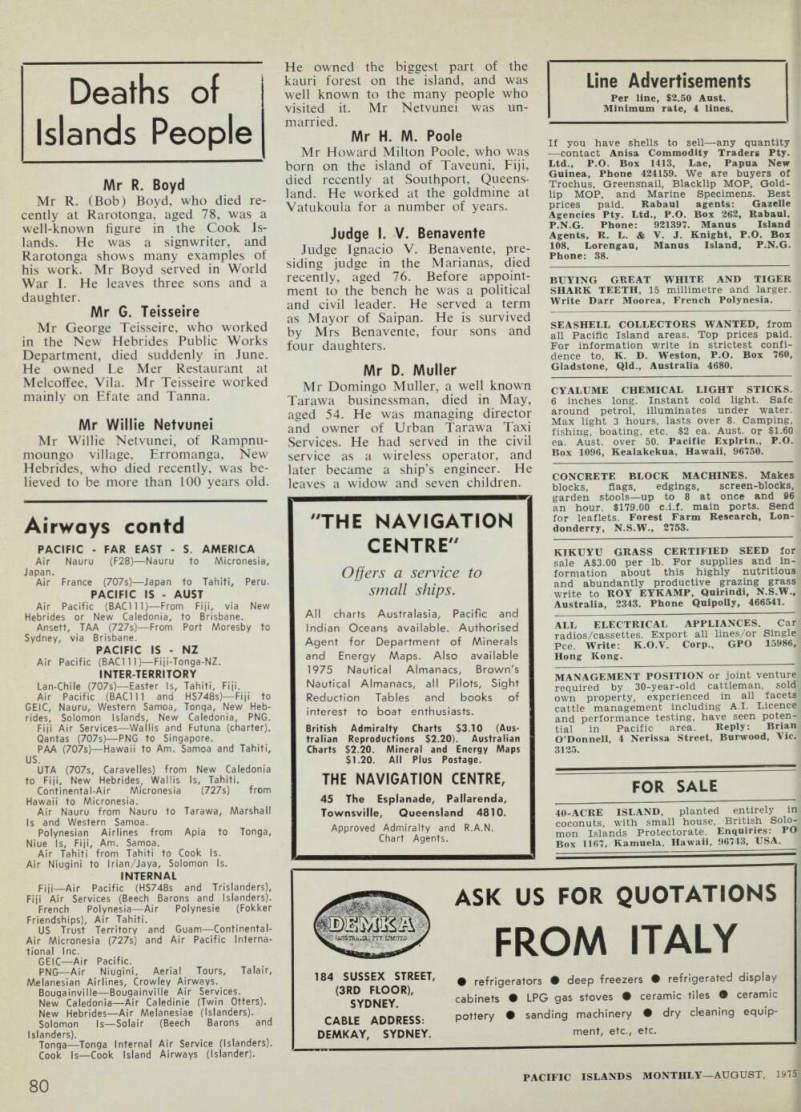
Deaths of Islands People
Mr R. Boyd Mr R. (Bob) Boyd, who died re cently at Rarotonga, aged 78, was a well-known figure in the Cook Is lands. He was a signwriter, and Rarotonga shows many examples of his work. Mr Boyd served in World War I. He leaves three sons and a daughter.
Mr G. Teisseire Mr George Teisseire, who worked in the New Hebrides Public Works Department, died suddenly in June.
He owned Le Mer Restaurant at Melcoffee, Vila. Mr Teisseire worked mainly on Efate and Tanna.
Mr Willie Netvunei Mr Willie Netvunei, of Rampnu moungo village, Erromanga, New Hebrides, who died recently, was be lieved to be more than 100 years old.
He owned the biggest part of the kauri forest on the island, and was well known to the many people who visited it. Mr Netvunei was un married.
Mr H. M. Poole Mr Howard Milton Poole, who was born on the island of Taveuni, Fiji, died recently at Southport, Queens land. He worked at the goldmine at Vatukoula for a number of years.
Judge I. V. Benavente Judge Ignacio V. Benavente, pre siding judge in the Marianas, died recently, aged 76. Before appoint ment to the bench he was a political and civil leader. He served a term as Mayor of Saipan. He is survived by Mrs Benavente, four sons and four daughters.
Mr D. Muller Mr Domingo Muller, a well known Tarawa businessman, died in May, aged 54. He was managing director and owner of Urban Tarawa Taxi Services. He had served in the civil service as a wireless operator, and later became a ship’s engineer. He leaves a widow and seven children.
Advertisements & other items, pp. 84-88 (3 items)
From Italy
Line Advertisements
Per line, $2.50 Aust.
Minimum rate, 4 lines.
If you have shells to sell—any quantity —contact Anisa Commodity Traders Pty.
Ltd., P.O. Box 1413, Lae, Papua New Guinea, Phone 424159. We are buyers of Trochus, Greensnail, Blacklip MOP, Goldlip MOP, and Marine Specimens. Best prices paid. Rabaul agents: Gazelle Agencies Pty. Ltd., P.O. Box 262, Rabaul, P.N.G. Phone: 921397. Manus Island Agents, R. L. & V. J. Knight, P.O. Box 108, Lorengau, Manus Island, P.N.G.
Phone; 38.
BUYING GREAT WHITE AND TIGER
SHARK TEETH, 15 millimetre and larger.
Write Darr Moorea, French Polynesia.
SEASHELL COLLECTORS WANTED, from
all Pacific Island areas. Top prices paid.
For information write in strictest confidence to, K. D. Weston, P.O. Box 760, Gladstone, Qld., Australia 4680.
CYALUME CHEMICAL LIGHT STICKS.
6 inches long. Instant cold light. Safe around petrol, illuminates under water.
Max light 3 hours, lasts over 8. Camping, fishing, boating, etc. $2 ea. Aust. or $1.60 ea. Aust. over 50. Pacific Explrtn., P.O.
Box 1096, Kealakekua, Hawaii, 96750.
CONCRETE BLOCK MACHINES. Makes
blocks, flags, edgings, screen-blocks, garden stools —up to 8 at once and 96 an hour. $179.00 c.i.f. main ports. Send for leaflets. Forest Farm Research, Londonderry, N.S.W., 2753.
KIKUYU GRASS CERTIFIED SEED for
sale A 53.00 per lb. For supplies and information about this highly nutritious and abundantly productive grazing grass write to ROY EYKAMP, Quirindi, N.S.W., Australia, 2343. Phone Quipolly, 466541.
ALL ELECTRICAL APPLIANCES. Car
radios/cassettes. Export all lines/or Single Pee. Write: K.O.V. Corp., GPO 15986, Hong Kong.
MANAGEMENT POSITION or joint venture required by 30-year-old cattleman, sold own property, experienced in all facets cattle management including A.I. Licence and performance testing, have seen potential in Pacific area. Reply; Brian O’Donnell, 4 Nerissa Street, Burwood, Vic. 3125.
"THE NAVIGATION
CENTRE"
Offers a service to
small ships.
All charts Australasia, Pacific and Indian Oceans available. Authorised Agent for Department of Minerals and Energy Maps. Also available 1975 Nautical Almanacs, Brown's Nautical Almanacs, all Pilots, Sight Reduction Tables and books of interest to boat enthusiasts.
British Admiralty Charts $3.10 (Australian Reproductions $2.20). Australian Charts $2.20. Mineral and Energy Maps $1.20. All Plus Postage.
THE NAVIGATION CENTRE,
45 The Esplanade, Pallarenda, Townsville, Queensland 4810.
Approved Admiralty and R.A.N.
Chart Agents.
Airways contd
PACIFIC - FAR EAST - S. AMERICA Air Nauru (F2B) —Nauru to Micronesia, Japan.
Air France (707 s) —Japan to Tahiti, Peru.
PACIFIC IS - AUST
Air Pacific (BAC 111) —From Fiji, via New Hebrides or New Caledonia, to Brisbane.
Ansett, TAA (727 s) —From Port Moresby to Sydney, via Brisbane.
PACIFIC IS - NZ
Air Pacific (BAClll)—Fiji-Tonga-NZ.
INTER-TERRITORY
Lan-Chile (707 s) —Easter Is, Tahiti, Fiji.
Air Pacific (BACIII and HS74Bs) —Fiji to GEIC, Nauru, Western Samoa, Tonga, New Hebrides, Solomon Islands, New Caledonia, PNG.
Fiji Air Services—Wallis and Futuna (charter).
Qantas (707 s) —PNG to Singapore.
PAA (707 s) —Hawaii to Am. Samoa and Tahiti, US.
UTA (7075, Caravelles) from New Caledonia to Fiji, New Hebrides, Wallis Is, Tahiti.
Continental-Air Micronesia (7275) from Hawaii to Micronesia.
Air Nauru from Nauru to Tarawa, Marshall Is and Western Samoa.
Polynesian Airlines from Apia to Tonga, Niue Is, Fiji, Am. Samoa.
Air Tahiti from Tahiti to Cook Is.
Air Niugini to Irian/Jaya, Solomon Is.
INTERNAL
Fiji—Air Pacific (HS74Bs and Trislanders), Fiji Air Services (Beech Barons and Islanders).
French Polynesia—Air Polynesia (Fokker Friendships), Air Tahiti.
US Trust Territory and Guam —Continental- Air Micronesia (7275) and Air Pacific International Inc.
GEIC—Air Pacific.
PNG —Air Niugini, Aerial Tours, Talair, Melanesian Airlines, Crowley Airways.
Bougainville—Bougainville Air Services.
New Caledonia —Air Caledinie (Twin Otters).
New Hebrides —Air Melanesiae (Islanders).
Solomon Is —Solair (Beech Barons and Islanders).
Tonga—Tonga Internal Air Service (Islanders).
Cook Is —Cook Island Airways (Islander).
FOR SALE
40-ACRE ISLAND, planted entirely in coconuts, with small house, British Solomon Islands Protectorate. Enquiries: PO Box 1167, Kamuela. Hawaii, 96743, USA.
fASSmusu-idem
ASK US FOR QUOTATIONS
FROM ITALY
184 SUSSEX STREET,
(3RD FLOOR),
SYDNEY.
CABLE ADDRESS:
DEMKAY, SYDNEY.
• refrigerators • deep freezers • refrigerated display cabinets • LPG gas stoves • ceramic tiles • ceramic pottery • sanding machinery • dry cleaning equipment, etc., etc.
LnnJ §s) LnnJ D= §s) InnJ 1
DATELINE HOTEL
TONGA
'Friendly Hotel” of the "Friendly Islands"
Situated along the Nukualofa waterfront. Only five minutes walk from town. Single, double, family suites, airconditioning, and hot and cold water showers. Pool, bar, restaurant, duty-free shop, tour desk and boutique.
Book through your travel agent or write to International Dateline Hotel, P.O. Box 62, Nukualofa Tonga, Cable Address; "DATELINE".
Represented Overseas by: Charles J. Henry and Associates Pty. Ltd.
Sydney and Melbourne.
PARK VIEW MOTEL—BRISBANE
Quiet location—opp. Botanic Gardens.
Single, double, family suites, all with refrig., air conditioning, phone, TV, radio, tea making facilities, from $l2. Pool and restaurant.
Phone 31-2695—Telex 40270.
Write for coloured brochure— Park View Motel, 128 Alice St, BRISBANE Old., 4000.
A SOOTHING AID
FOR BABY
You'll be delighted what a soothing and effective aid Fisher's Teething Powders are to baby's natural teething disorders. Sore gums, digestive disturbances and intestinal upsets quickly respond to Fisher's Teething Powders. So safe too, if used as directed, they do not contain Calomel, Opiates, Bromides, or any harmful substances. Save yourself distress and keep the little one happy and well by using Fisher's Teething Powders as needed. At your chemist or store.
Fisher & Co., Manufacturing Chemists, (Est. 1876) 17 May St., St. Peters,
N.S.W. 2044.
PM 807/72
ELECTRONIC COMPONENTS
EXPORTERS, MANUFACTURERS,
GENERAL MERCHANTS,
WHOLESALERS, IMPORTERS
• All enquiries answered • Keen prices • Prompt delivery Contact us for any requirement.
ELECTRONIC EXPORTS A'ASIA PTY. LTD.,
G.P.O. Box 1365, Brisbane, Q., 4101.
Telegraphic: SZEKELY, Brisbane.
Primitive luxury
( I’olyncsiiin style) Nestled away in the untouched Kingdom of Tonga is new, luxurious “Port of Refuge" International resort. Here is a unique opportunity for your clients to experience the tranquil and relaxed Tongan atmosphere while they enjoy the picturesque surroundings of the new "Port of Refuge". And only a short flight from Fiji.
Reasonable tariffs from $17.50 with special concessions for children. Agents commission 10 per cent.
Tonga's
Port of Refuge
wfcV INTERNATIONAL RESORT °
M- Uava’u Tonga -ables: "Refuge" Tonga or "Tongatours" iydney. Phone: Sydney 85-1603 or 922-1817
PACIFIC ISIABS TRANSPORT UNI
Owners: Thor Dahls Hvalfangerselskap A/S — Sandefjord, Norway.
MOTOR VESSEL "THORSISLE"
Regular Freight and Passenger Services between Pacific
Coast Ports of U.S.A. and Canada
and
TAHITI and SAMOA
GENERAL STEAMSHIP CORPORATION LTD.
General Agents
400 California Street, San
APlA—Burns Philp (South Sea) Company, Ltd.
PAPEETE—Agence Maritime Internationale Tahiti.
PAGO PAGO —Polynesia Shipping Services, Inc.
NOUMEA—Etablissements Ballande.
Francisco, California, U.S.A.
SYDNEY—Trans-Austral Shipping Pty. Ltd.
SUVA—Burns Philp (South Sea) Company, Ltd.
LAE/RABAUL—Burns Philp (New Guinea) Ltd.
PORT VlLA—Comptoirs Francais de Nouvelles Hebrides.
>ggie Grey's the
outh Pacific's legendary hotel
ituated right in the heart of Western ?d I slrvfc n e o 'in P rl Vr ? esian stvle fri endlinlss service, in cool surroundmas sunerh mH rt h nm k nt and food. Magnificent white rconditlnSn ° nly a shor? drive away ll bar d fa?ilil?es roomS ' sw,mmin 9 P°°' and Imnanu J# hr< ilr9 h d Unio A n Steamship a P v °1- NZ - Pan Am, Air New c r direct to Aggie Grey's, Apia, astern Samoa. Cables: AGGIES, APIA.
ffl
as
SOUTHERN PACIFIC INSURANCE
COMPANY (PNG) LIMITED
(INCORPORATED IN PAPUA NEW GUINEA)
HEAD OFFICE: BANK HAUS, CHAMPION PDE. P.O. BOX 136 PORT MORESBY, PAPUA NEW GUINEA. PH. 2623 • FIRE • FIRE AND VOLCANIC ERUPTION • HOUSEHOLD COMPREHENSIVE • MOTOR VEHICLE • COMPULSORY THIRD PARTY • COMPULSORY WORKERS COMPENSATION
MARINE • PUBLIC LIABILITY • BURGLARY
Enquiries are Invited for all classes of Insurance from special representatives at: POI I Y H ' A - McKEE ' General Manager, Champion Pde., P.O. Box 136, Ph 2623 daraim ad' anager for Lae, Central Ave., P.O. Box 758, Ph. 42-4590 or 92 2417 2755 J ’ ARMSTRONG ' Mana 9 er for Rabaul, Mango Ave., P.O. Box 123 Ph
TIMELY PACIFIC READING!
Specially selected titles from Publications
JSi
m m L«®
PAPUA NEW GUINEA
HANDBOOK
7th edition
This new edition of the Papua New Guinea Handbook —completely revised and reset —provides the first full upto-date details of the new self-governing nation.
For businessmen, travellers, schools, universities and libraries, government departments, tourists and Papua New Guinea residents, this timely, up-to-the-minute' edition, is essential.
A large attractive fold-out map of Papua New Guinea is also included. 392 pages of text.
PRICE: Australia, $5.50 plus 85c posted. Pacific Islands and Overseas, $5.50 Aust., plus $l.lO posted; U.S.A., $9.80 U.S. posted. m m m
HOLY TORTURE IN FIJI
Written by a group of academic participants and observers.
Editing and commentary by Prof. Ron Crocombe.
This book describes sacred ancient rituals involving physical ordeals which are performed once a year at certain Hindu temples in Fiji. The rituals include walking on fire, dancing on upturned knife-blades, whipping, plunging the hands in burning fat and piercing the body with steel skewers and silver wires.
Yet those who go through the ordeals suffer no pain, burns or injuries.
The book is beautifully produced in full colour and black-and-white.
PRICE: Australia, Pacific Islands and Overseas, $3.95 Aust., plus 50c posted; U.$.A., $6.40 U.S. posted.
Percy Chatterton's Papua
DAY THAT I HAVE LOVED
This is more than an autobiography by well-known Percy Chatterton, OBE, who has spent 50 years in Papua as missionary, teacher and outspoken politician fighting for the underdog. It is a colourful, and charming, account of the Papuan people, giving warm insight into their hopes, fears and changing way of life. Some Papuan leaders say they don't want Papua to be submerged by New Guinea in the move towards independence, and readers of Percy Chatterton's timely book will readily sympathise with their desire to retain their identity. The book is illustrated with evocative pen sketches by Percy Chatterton's longtime friend and neighbour in Port Moresby, Rev. Bert Brown. 144 pages, illustrated.
PRICE: Australia, Pacific Islands and Overseas, $5.25 Aust., plus 50c posted; U.5.A., $8.30 U.S. posted.
THE STORY OF THE
SOLOMONS Charles E. Fox
“Refreshingly frank . . .”
“Admirably simple and lucid . . .”
“A rare blend of objectivity and affection . . .”
That is what some of the critics have said about this unusual book which outlines the history of the Solomon Islands from the point of view of the people who live there.
The Reverend C. E. Fox, CBE, MA, LittD, spent more than 70 years in the Pacific Islands, 65 of them in the Solomon Islands, and no person is better qualified to write of the Solomons and the Solomon Islanders. Dr Fox is now living in retirement in New Zealand. 88 pages.
PRICE: Australia, Pacific Islands and Overseas, $2.50 Aust. plus 35c posted; U.S.A., $3.75 U.S. posted. »
Pacific Publications (Aust.) Pty. Ltd.
29 Alberta Street, Sydney, N.S.W. 2000 (Postal Address: Box 3408, G.P.0., Sydney, N.S.W, 2001.)
SBfiS ,v , 4 .
A \ - l in
Performance
You Enjoy Living With.
Honda is a true life drama, performed on the world’s stage. By average folks, teenagers, men, and women everywhere. Your neighbors, maybe even you are playing a part. If so, you know Honda is more than great machines.
It’s people concerned with taking people where they want to go in life.
On two wheels, we’re the best selling motorcycle. The easy to operate hard workers who don’t demand much. Honda is always ready and gets you there safely. We move on four wheels. The precedent setting Honda Civic continues to receive international economy and performance awards. It’s the elegant compact car.
Sometimes, we have no wheels. Honda portable power operates machinery, generates electricity, pumps water and tills the soil.
Little wonder good things happen on Honda -we work harder to assure they do. * 7/ * Vl v - • r World’s Largest Motorcycle Manufacturer
HONDA MOTOR CO., LTD. TOKYO, JAPAN
masßSßßstssss&m^s^^Bm
ts. COMIMPEX P.O. Box 200 Paoeete/COOK islands- CALEDONIA Establissements Ballande, Noumea / TAHITI:
Luth ao im Mr. Chau Jin Man, motor mechanic.
VdtAUM.-Ll&phJKhtdj 10
WT. *>
tSS ■* H ■"?
r >^ .
I'Ut ckjOAc, drUcauAt ofr
[tS umma u/Ctkt SastAffiLcm Qo^oal
m vw w* ■MB
PHIS
i
Your Datsiin.Yhiir special island.
Once it has found you, it'll never let you go.
Where else can you find such
economical, worry-free
motoring? Little wonder Datsuns are enjoyed in Tahiti —and in 130 other nations! In a series of on-thespot global interviews, Nissan Motor representatives met many owners and asked them for a frank assessment of their Datsuns. Answers were surprisingly similar, despite the very different circumstances in which the Datsuns were used.
The Datsun, they told us. is economical, reliable, durable, comfortable.
Fun to own.
Again and again.
DATSUN
Product of NISSAN DATSUN distributor network covers the following areas: Fiji -T.P.N.G.-W. Samoa-New Caledonia-New Hebrides*B.S.lP. -Timor•Norfolk Is.*- A. Samoa-Tahiti*Cook Is.-Nauru .Tonga-Saipan -Guam-Australia-New Zealand
Published by PACIFIC PUBLICATIONS (AUSTJ PTY. LTD. 29 Alberta Street, Sydney, 2000 (Telephone: 61-9197)
Printed by The Harbour Press, Chalmers Street, Sydney.
REGISTERED AT THE GPO SYDNEY FOR TRANSMISSION BY POST AS A NEWSPAPER CATEGORY B Australian price given on the front cover is recommended Australian retail price only.