Pacific Islands Monthly

News Magazine Of The South Pacific
July, 1975
AUSTRALIA,* N.Z., P.N.G., FIJI, N. HEBRIDES, TONGA 75c W. SAMOA, G.E.1.C., COOKS, NORFOLK, NIUE, NAURU 75c
Solomons 85C
Am. Samoa, Hawaii, Micronesia, Guam $1.25
NEW CALEDONIA AND FRENCH POLYNESIA 125 CFP
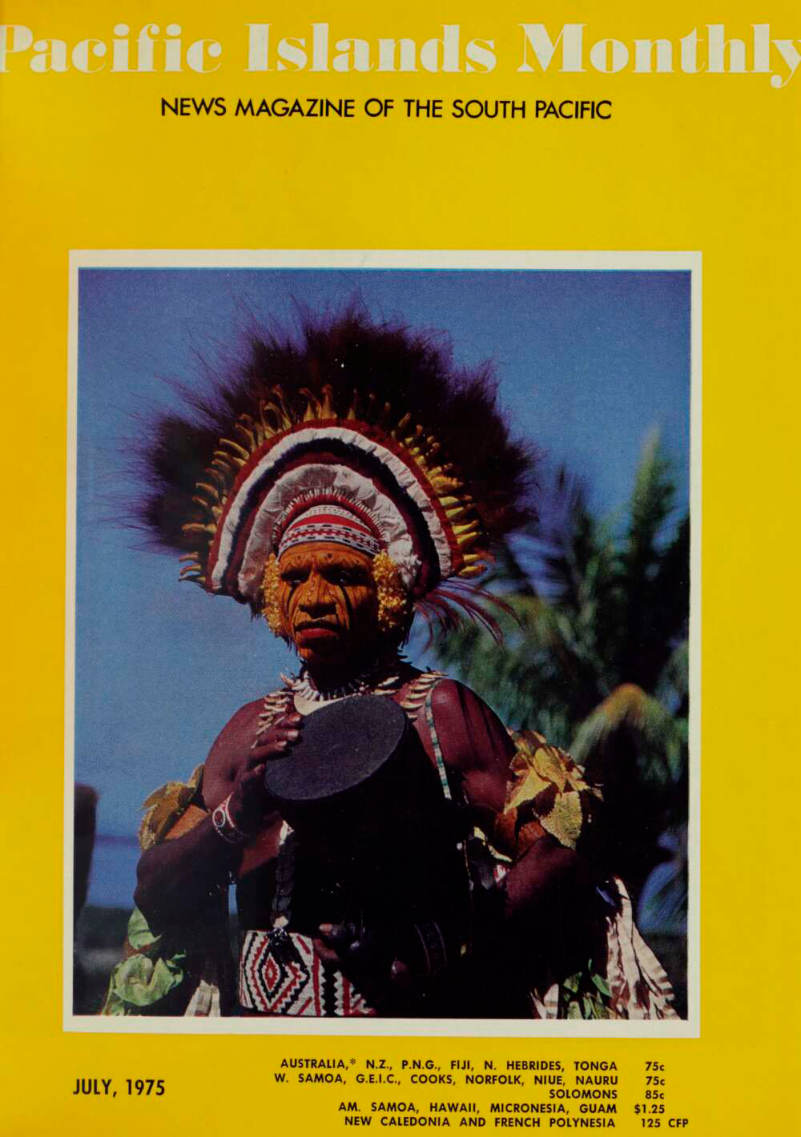
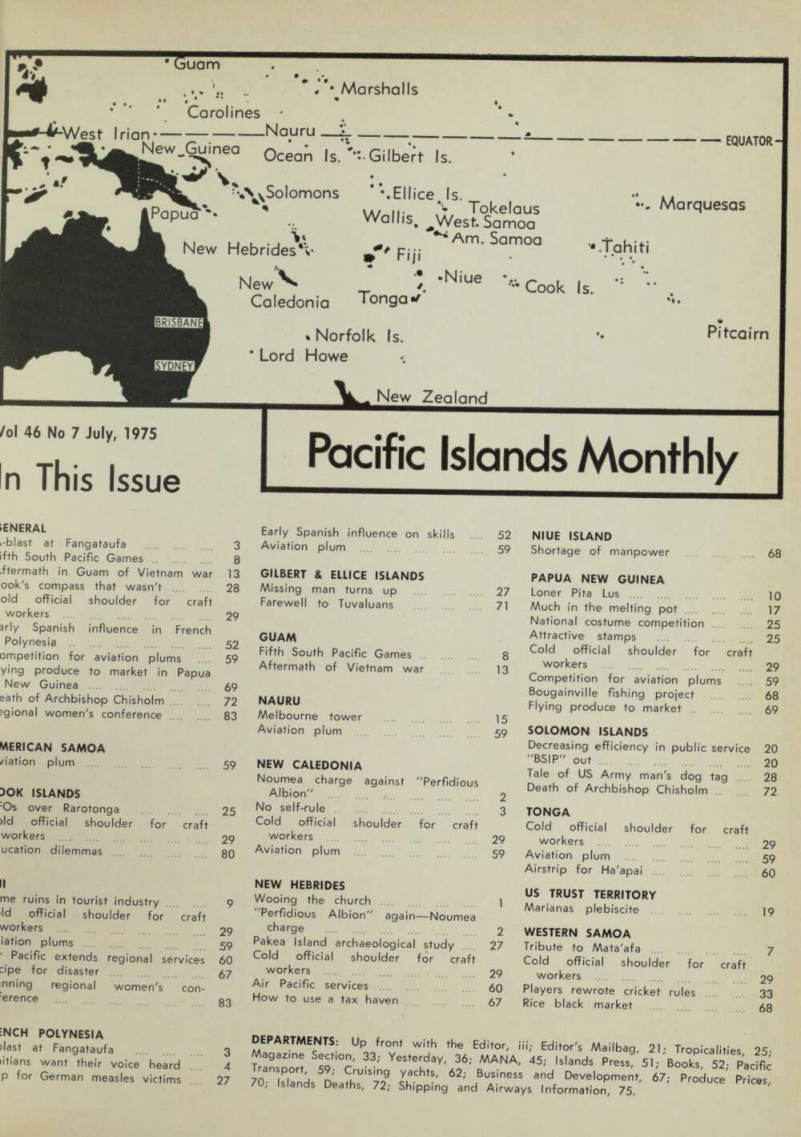
Our Cover
Headed for independence September 16 is this PNG Highlands warrior.
Advertisements & other items, p. 2 (1 item)
Sony’s original stereo
radio/cassette-corder.
Can you imagine a better pickme-up?
The honest-to-goodness sound of real Sony stereo. At the beach, the park, or on a picnic.
And remember, the Sony CF-550A is x, v. the daddy of all one-piece stereos. A tried and proved design.
It’s unique Sound Stereo System plus four built-in speakersgiveyou richer
/ . CF-550A x
(({(((CO»))) and more natural stereo reproduction.
“Live” stereo recording is simple with two sensitive built-in electret condenser microphones. And besides that, you can also record directly off AM or FM wavebands.
Sony’s original stereo radio/ cassette-corder works off batteries, mains power (AC cord included) or off your car/boat battery (adaptor optional). Pick one up. You’ll love it.
What seems like magic is actually great Sony design. m Vs f x'V
In This Issue
General
i-blast at Fangataufa 3 ifth South Pacific Games 8 ■ftermath in Guam of Vietnam war 13 ook's compass that wasn't 28 old official shoulder for craft workers ... 29 arly Spanish influence in French Polynesia 52 ompetition for aviation plums ... 59 ying produce to market in Papua New Guinea 69 Bath of Archbishop Chisholm 72 jgional women's conference 83
Merican Samoa
/iation plum 59
X)K Islands
■Os over Rarotonga ... 25 >ld official shoulder for craft workers 29 ucation dilemmas ... 80 II me ruins in tourist industry 9 Id official shoulder for craft
workers 29
iation plums 59 ■ Pacific extends regional services 60 :ipe for disaster 57 nning regional women's con
:erence 83
Inch Polynesia
> last at Fangataufa 3 litians want their voice heard 4 p for German measles victims 27
Early Spanish influence on skills ... 52 Aviation plum 59
Gilbert & Ellice Islands
Missing man turns up 27 Farewell to Tuvaluans 71
Guam
Fifth South Pacific Games 8 Aftermath of Vietnam war 13
Nauru
Melbourne tower 15 Aviation plum 59
New Caledonia
Noumea charge against “Perfidious Albion" ... 2 No self-rule 3 Cold official shoulder for craft workers 29 Aviation plum ... 59
New Hebrides
Wooing the church ... 1 “Perfidious Albion" again—Noumea
charge 2
Pakea Island archaeological study ... 27 Cold official shoulder for craft workers 29 Air Pacific services 60 How to use a tax haven 67
Niue Island
Shortage of manpower 68
Papua New Guinea
Loner Pita Lus iq Much in the melting pot 17 National costume competition 25 Attractive stamps 25 Cold official shoulder for craft workers 29 Competition for aviation plums 59 Bougainville fishing project 68 Flying produce to market 69
Solomon Islands
Decreasing efficiency in public service 20 “BSIP" out 20 Tale of US Army man's dog tag 28 Death of Archbishop Chisholm 72
Tonga
Cold official shoulder for craft workers 29 Aviation plum 59 Airstrip for Ha'apai 60
Us Trust Territory
Marianas plebiscite 19
Western Samoa
Tribute to Mata'afa 7 Cold official shoulder for craft workers 29 Players rewrote cricket rules 33 Rice black market ... 53
DCPaptmcmtc x aa PARTMENTS: U P front w,th tb e Editor, iii; Editor's Mailbag, 21; Topicalities 25- Transport - 3 ' YeSt€ T day ' 36; N[ANA ' 4 5; Islands Press, 51; Books, 52; Pacific 70- Islands cu—’ 62f Bu * lne “ and Dev =lopment, 67; Produce Prices, /u, islands Deaths, 72; Shipping and Airways Information 75
Advertisements & other items, p. 4 (1 item)
“thank goodness
we have Air Pacific!”
THANK GOODNESS
WE HAVE AIR PACIFIC
r N?£Tnr gnr
FAKAFETAI,
KO MAUA
NE MATOU IE
EA-PASEFIKA
FAAFETAI ILE "
EA PASEFIKA’
MO LE
GALUEGA LELEI
TAGIO TUMAS
IU Ml KAREM
EA PASIFIK M
TAGIO TUMAS
IU Ml KAREM
EA PASIFIK
TAGIO TUMAS
IU Ml KAREM
EA PASIFIK'
ME'A LELEI KO
ETAU MA’U E
EA PASIFIKI'
mm &
Hi Hi
€ * » K i *
Hkai
IP i a M H i % *1 ►
E RABA! EA REKE
- I POURATE
"AIR PACIFIC”
E UASIVI DUADUA
NA AIR PACIFIC
mM w:
IMIWUR OMO
ATSIN TURIN - s ,
AIR PACIFIC v
Hf*
the one we know!
When you live in an area as big as our
South Pacific you will appreciate having
an airline like Air Pacific. Fast, reliable and
efficient!
Not too big to lose its friendly personal South Seas island touch-and'not too small to give you a crowded feeling. When you fly Air Pacific-you'll expedience that wonderful 'welcome back home' feeling from the people you know. Jet Air Pacific to the REAL PACIFIC.
GILBERT ' ISLANDS
MORESBY
NAURU
BRISBANE
ISLAN
NEW
HEBRIDES
• SAMOA
TONGA
AUCKLAND
We fly to more South Pacific Islands than any other Airline.
For details and bookings contact your travel agent or Air Pacific, Private Bag, Suva Fiji. 4223
Pacific Islands
Monthly
FOUNDED BY R. W. ROBSON IN 1930
Published Monthly By
Pacific Publications (Aust.) Pty. Ltd.,
29 Alberta St., Syoney, N.S.W., 2000.
Postal Address: G.P.O. BOX 3408, SYDNEY,
N.S.W., 2001.
Telegraphic Address.- PACPUB, Sydney, Telex 25168.
Telephones: 61-9197, 61-7101, 61-4369.
Consulting Directors: R. W. Robson, Judy Tudor Director of Advertising; Alan Batt.
Manager: Selwyn Hughes.
Publisher: Stuart Inder.
Pacific Islands Monthly
Editor: Stuart Inder.
Assistant Editor: John Carter.
Subscription Rates:
"Pacific Islands Monthly" is airfreighted to the majority of subscribers and agents in the Pacific Islands and the U.S.A.; copies to the Cook Islands, Nauru, Niue, Micronesia and Guam go by surface mail.
Australia (including Lord Howe and Thursday Islands), New Zealand, Papua New Guinea, Fiji, New Habrides, Tonga, Cook Islands, Western Samoa, Gilbert & Ellice Islands, Norfolk Island, Niue and Nauru; $9.00 (local currency); Solomon Islands: $lO.OO Aust., American Samoa, Micronesia and Guam: $12.00 US- Hawaii and US Mainland: $15.00 US; New Caledonia and French Polynesia: 1,500 CFP; United Kingdom: £6.50; Japan: 4,000 Yen Elsewhere $11.50 Aust.
Representatives
■iji: Advertising and Distribution—Fiji Times & Hera Id Ltd., 20 Gordon St., Suva. Telephone: >5-601. Telex.: FJ 2124. >a Pua New Guinea; PORT MORESBY, PNG Print 'll. Co. Pty. Ltd., P.O. Box 633; LAE, P.O. Box !27; RABAUL, Mr. Oavid Simpson, P.O. Box 164 (c/- Rabaul Photographic. Tel.; 2677.) rench Polynesia. Distribution—Hachette Pacl ique, 10 Ave Bruat, Papeete, lew Zealand: Pacific Publications, C.P.O. ox 2229, Auckland. inited Kingdom: Advertising—Overseas Publicity td., 214 Oxford Street, London, WIN OEA. hone: 01-636 8296/7. Subscriptions—T. B. raham. Park House, 22 Park Street, Croydon,
Cr9 3Np. Tel.: 01-6884177.
apan: Advertising—Universal Media Corpora tion, C.P.O. Box 46, Tokyo. Tel.: 666-3036. ictoria: Advertising Pacific Publications PtY. Ltd., Herald & Weekly Times uildmg, 2nd Floor, 61 Flinders Lane, Mel ourne, 3000. Telephone: 652-1565. a " d «-S- Mainland only; N. Grogan, 354 Hayden Street, Honolulu, 96815. end change of address notices, Form 3579 id new subscriptions to P.O. Box 2193 Honolulu, Hawaii, U.S.A. 96805) scond class postage paid at Honolulu, Hawaii.
Copyright ©, 1975,
Pacific Publications (Aust) Pty. Ltd.
Vol. 46, No. 7 , , '
Ju| V' 1975
Up Front
with the Editor
Western Samoa’s Prime Minister Fiame Mata’afa had the knack of making himself one of the surrounding company without loss or dignity and thus he was regularly to be seen playing bil liards or a game of cards at the Returned Soldiers Association club as just one of the boys.
And yet on other occasions he could be a strict believer in protocol, insisting on correct dress and speech.
The fact is he understood the re quirements, and responsibilities, of both business and pleasure, and didn’t confuse them.
Mata’afa is now dead, at 53, but this attribute of his is shared by those other Island leaders who have come to power in the South Pacific during the last 10 years. They’ve formed an elite club of men with mutual respect for each other, and now for the first time their member ship has been broken by death. 1 refer to Mata’afa and President Deßoburt of Nauru, Prime Minister Ratu Sir Kamisese Mara of Fiji, and Premier Sir Albert Henry of the Cook Islands.
These are what I think of as “the originals”, the men who spelled out the need for independence in the South Seas, and then all at the same time put it into practice with firm ness, skill and Islands charm.
They were the pathfinders. Each in his own way got his people to gether and asked for their support, and then battered at the doors of the colonial governments, the UN, the South Pacific Commission, de manding a place in the sun. They have fought for independent airlines and shipping companies, attacked trade barriers and overseas combines, and often appealed directly to the overseas public for a hearing when they felt the metropolitan govern ments were not working fast enough to give them relief.
They made a good team, those leaders. Without exception they have been men of purpose, competence, political skill and humanity.
As a result of their team spirit, independence is a fact of life in the South Pacific now. Mata’afa was the first to see his country achieve it, and his wise leadership in the early
days of Samoan independence, I do believe, made it easier for his friends and neighbours to convince their masters that they too were respons ible People. And his friends P and neighbours recognise it. *
I ‘ Cs Mis Vt?
nl lfr P ay * t
s as remarkable as a De- T ?“ mttic chTrm ,h! h 31 ,he chans :
X ity to ?e’t
should be and * h thmk j to lose Lk n prepa, : ed has been shown tIV J ar ’ ™ hlch his lone fisht V agam . in to § h D f pite eVery,hin « we hear about breakaway movements, PNG recoe- M P ichael -on toT
feadtr. /'"tellere"'nobody 8 / Tl
c nobody else but
fnXfhuXs ofThe £5 ° V6r
rh® D f last tbree years f 5011111 Pa cific nations have for the manage , d to find tbe man tinuf h * and ° ng may that COn ' e *
Stuart Inder
Advertisements & other items, pp. 5-6 (2 items)
Iii
*CIFIC ISLANDS MONTHLY-JULY, 1975
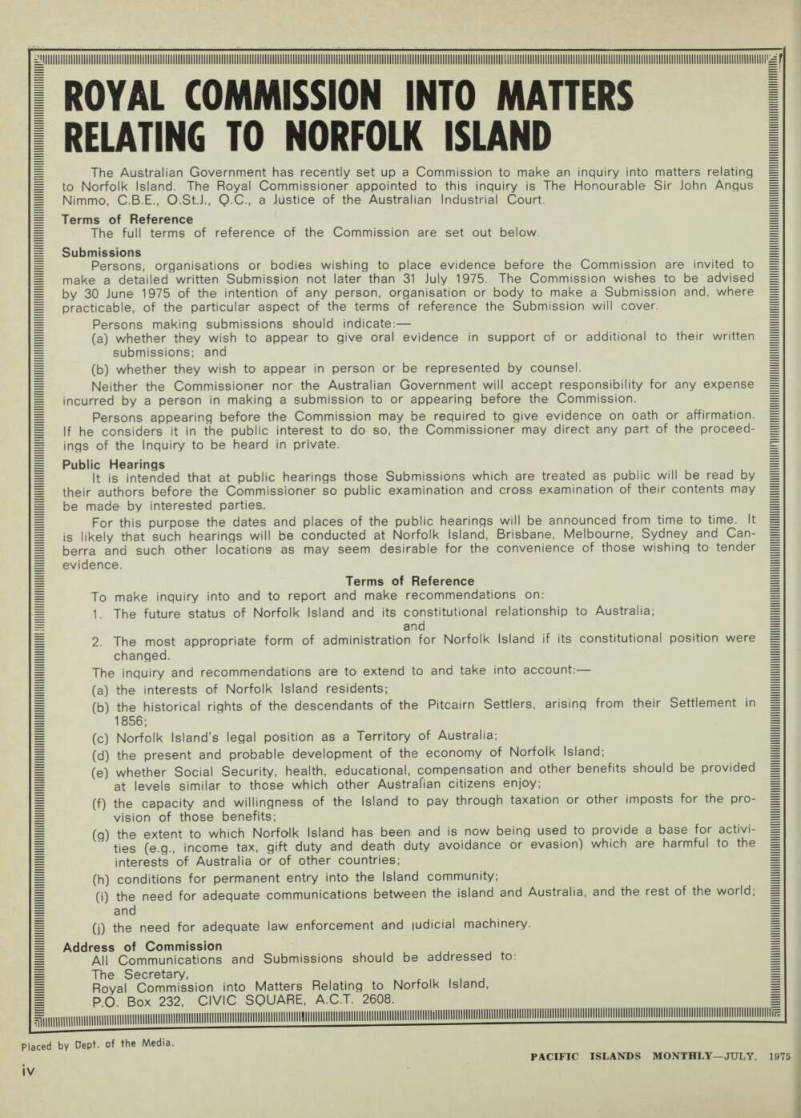
Royal Commission Into Matters
RELATING TO NORFOLK ISLAND
The Australian Government has recently set up a Commission to make an inquiry into matters relating to Norfolk Island. The Royal Commissioner appointed to this inquiry is The Honourable Sir John Angus Nimmo, C.8.E., O.St.J., Q.C., a Justice of the Australian Industrial Court.
Terms of Reference The full terms of reference of the Commission are set out below.
Submissions Persons, organisations or bodies wishing to place evidence before the Commission are invited to make a detailed written Submission not later than 31 July 1975. The Commission wishes to be advised by 30 June 1975 of the intention of any person, organisation or body to make a Submission and, where practicable, of the particular aspect of the terms of reference the Submission will cover.
Persons making submissions should indicate: — (a) whether they wish to appear to give oral evidence in support of or additional to their written submissions: and (b) whether they wish to appear in person or be represented by counsel.
Neither the Commissioner nor the Australian Government will accept responsibility for any expense incurred by a person in making a submission to or appearing before the Commission.
Persons appearing before the Commission may be required to give evidence on oath or affirmation.
If he considers it in the public interest to do so, the Commissioner may direct any part of the proceedings of the Inquiry to be heard in private.
Public Hearings It is intended that at public hearings those Submissions which are treated as public will be read by their authors before the Commissioner so public examination and cross examination of their contents may be made by interested parties.
For this purpose the dates and places of the public hearings will be announced from time to time. It is likely that such hearings will be conducted at Norfolk Island, Brisbane, Melbourne, Sydney and Canberra and such other locations as may seem desirable for the convenience of those wishing to tender evidence.
Terms of Reference To make inquiry into and to report and make recommendations on: 1. The future status of Norfolk Island and its constitutional relationship to Australia; and 2. The most appropriate form of administration for Norfolk Island if its constitutional position were changed.
The inquiry and recommendations are to extend to and take into account: — (a) the interests of Norfolk Island residents; (b) the historical rights of the descendants of the Pitcairn Settlers, arising from their Settlement in 1856; (c) Norfolk Island’s legal position as a Territory of Australia: (d) the present and probable development of the economy of Norfolk Island; (e) whether Social Security, health, educational, compensation and other benefits should be provided at levels similar to those which other Australian citizens enjoy; (f) the capacity and willingness of the Island to pay through taxation or other imposts for the provision of those benefits: (g) the extent to which Norfolk Island has been and is now being used to provide a base for activities (e.g., income tax, gift duty and death duty avoidance or evasion) which are harmful to the interests of Australia or of other countries; (h) conditions for permanent entry into the Island community; (i) the need for adequate communications between the island and Australia, and the rest of the world; and (j) the need for adequate law enforcement and judicial machinery.
Address of Commission All Communications and Submissions should be addressed to; The Secretary, .
Royal Commission into Matters Relating to Norfolk Island, P.O. Box 232, CIVIC SQUARE. A.C.T. 2608.
Placed by Dept, of the Media.
Pacific Islands Monthly
Wooing The Church In The New
Hebrides With Elections In Mind
By John Garrett
When New Hebrides French Resi- Commissioner Robert Gauger and British Resident Commissioner Roger du Boulay turned up in May an the same boat to attend a morning session of the Assembly of the Presbyenan Church of the New Hebrides ® ?V ter 18 a P[J of Emae, some i’ k?°u a P ts johshed their spectacles.
>an£d Uni “ahST
an President of' the National' pfrtv
Dokesman for and
TANK ("he French-kanine coalition
,f interests) and Mr David Curbs n Australian workfwith he Honolulu-based Peacock land deelopment concern, who explained hat he was along to fill the assembly i on the recent land deals in South anto between his clients, Jimmy tephens of Nagriamel, and a local anto chief, Puluk.
Mr Gauger, a French Reformed rotestant with family connections mong well-known Madagascar rench missionaries, spoke in French. le was interpreted throughout by lr du Boulay, who explained that s was a Roman Catholic, but wel- )med the muting of old animosities id the recognition that “we are all hristians”.
Both commissioners as good as said ey had come to build bridges into e Presbyterian Church in view of e coming elections in September r the country’s first representative sembly. Most observers expect the ational Party to poll well. Cynics ive even begun to regard the ajonty Presbyterian Church as the ational Party at prayer—an impliurrh P "T P u tly dlsowned hy the * lcn stresses h is not S !ii tt, a ( ny xrr party ' • , . *ll a F au £? r ’ J n bls pf liTf add . ress ’ Pomted out nani 3 n ?f haS , pre P ared wal mnrllil^l,'1 a l a . bOUtt, . I ? e
enctTsnplwnt the
,n°t f lu® COD ’
miniums population and the pas-
tors and elders who are nominating for the elections. j n the out-of-session activities of the delegates at Emae it was a toss- U p whether theology was as much discussed as politics. Walter Lini’s presence underlined the parallel activity on behalf of the National Party within the Anglican Church, which is stronger in the north. His speech .characteristically alluded to 3 mornll ’S bible study preceding the Presentation of the visiting celebrities, P ° mt ' nB ‘? a ,t ‘ he obscure biblical |? r ?P het , Habbakuk was a peaceful fig !! er tt This is hardly likely to send New Hebndes planters scurrying to get them selves a copy of Habbakuk, but serves notice that Father Lini, like hls vi ce-president Pastor Fred Karlo- ?? ua P a (Assembly Clerk of the Presbyterian Church) is determined fo think theologically about nationbui ldmg- Both men will attend the World Council of Churches Fifth Assembly at Nairobi next December. Tanzanian thinking about rural development is already reflected in the National Party’s platform as expounded by Walter Lini—though with little trace of the Marxist ideology that peppers theory and practice in the African country.
At question time Mr Gauger went out of his way to stress the need for changes in education that will speed up French in English schools, and vice-versa. In conversation in his office I found his own English is improving all the time, though we spoke French. He keeps constructively in touch in Vila with Pastor Karlomuana, who welcomes the thaw between the church and the French administration.
What did the two commissioners have m mind in the long-term in vls J t ; n B the a?sembly?
Its a question that invites shrewd s P e c c . ula,lon - . .
Since the election of Giscard
d’Fstaing as French President there are many signs of a streamlined approach in the UN and on the inter national diplomatic front. The im mobile France d’outre-mer policies of Pompidou and Messmer are up for a second look, no doubt in the light of de Gaulle’s initial explosive in sistence, in the late 19505, that Algeria would decide its own future.
The London negotiations about the future of the New Hebrides, fol lowed by the affable visit of France’s Olivier Stim and Britain’s Joan Lestor to the territory, seem to herald the possibility of a phased withdrawal of France’s political presence and a simultaneous attempt to maintain moral and economic influence after independence arrives.
This is not to say that the same thing is afoot in New Caledonia and Tahiti; indications are contrary. But a successfully adroit extraction of France from the condominium could be a feather in the cap of France while she takes time to consider how she is going to deal with the calamitous divisions plaguing her other Pacific territories.
If France adopts this course, Britain is likely to follow at the same speed. Despite recession and inflation, the French are in a rosier economic condition than the British, with prospects of good grants and loans towards a viable autonomous New Hebrides. Mr du Boulay can hardly feel consoled by current dire forebodings of bankruptcy in the UK.
He couldn’t be blamed for biting a midnight fingernail over the Common Market referendum in his homeland.
Question time at the assembly session saw some polite needling over the land question. The New Hebrides Presbyterians are on record about the need to return church and other alienated land to the rightful original owners when these are con clusively traced. Mr Curtis claimed in his speech that a recent acquisition of South Santo land by his clients
had been a model of legal and finan cial propriety.
Under the deal, areas made over for development in Nagriamel terri tory were ceded by Chief Puluk and will yield handsome returns for com munity betterment. Mr Curtis ap pealed to the two resident commis sioners to confirm that this was the sort of legal-financial quid pro quo they would like to see encouraged.
After a certain amount of sotto voce conference between, they replied that it was indeed a legally and financially sound affair in principle, but that they wouldn’t wish to com mit themselves on the details.
Some laughter greeted the reply, since many people are asking how much of the money will flow on to the individual family proprietors and how much will remain in the hands of a few at the top who sealed the deal.
Presbyterian consistency was put to the test later in the assembly when the church faced up to a request from influential leaders of the Kalsakau family of Vila for the return of the church-owned island of Iririki in Vila Harbour. The British have a virtual thousand-year tenure on the site of their commissioner’s residence there. The Presbyterian Paton Memorial Hospital former buildings are on the island, unused since the hospital went to government control and a mainland site.
After much debate on and off the floor, the assembly decided to offer to return the bulk of the island to the people of nearby Fila Island, who evidently owned it before the missionaries acquired it in 1870 for six bits of cloth, two handkerchiefs, some beads, and 11 knives.
No conditions were set about use
of the land, which is rumoured to be up for discussion as a hotel or casino. This rather surprised those who give the Presbyterians a blue nose reputation. However, the assembly stipulated that the church must be satisfied under the terms of the deal that funds derived from future use will be applied for the
long-term benefit of all the Fila island people. They also asked for compensation on buildings of around $120,000, payable at long term, on generous interest terms.
It’s obvious, as Mr Gauger sug gested in his speech, that the Presby terians are going to have to watch out in the next few years to give Caesar and God their rightful dues of obedience, or they are likely to run into some trouble with Caesar and even a little with God.
Mr Kalkot-Matas Kele of the National Party wound up the morn ing’s proceedings on the occasion of the commissioners’ visit with a burst of acclamation, when he pointed out to his fellow-Presbyterians that the church is as inevitably involved in New Hebrides politics, as the Christians were at the time of Christ’s crucifixion.
So, at the same time Mr Gauger, as a spiritual descendant of John Calvin, is likely to have to discuss with his Melanesian fellow Protes tants the consequences of a con clusion universally drawn by theo logians of the Reformed tradition— as distinct from the Lutheran—that when the chips are down, and people feel they must choose between Caesar and God on issues of justice and freedom, God should get the nod.
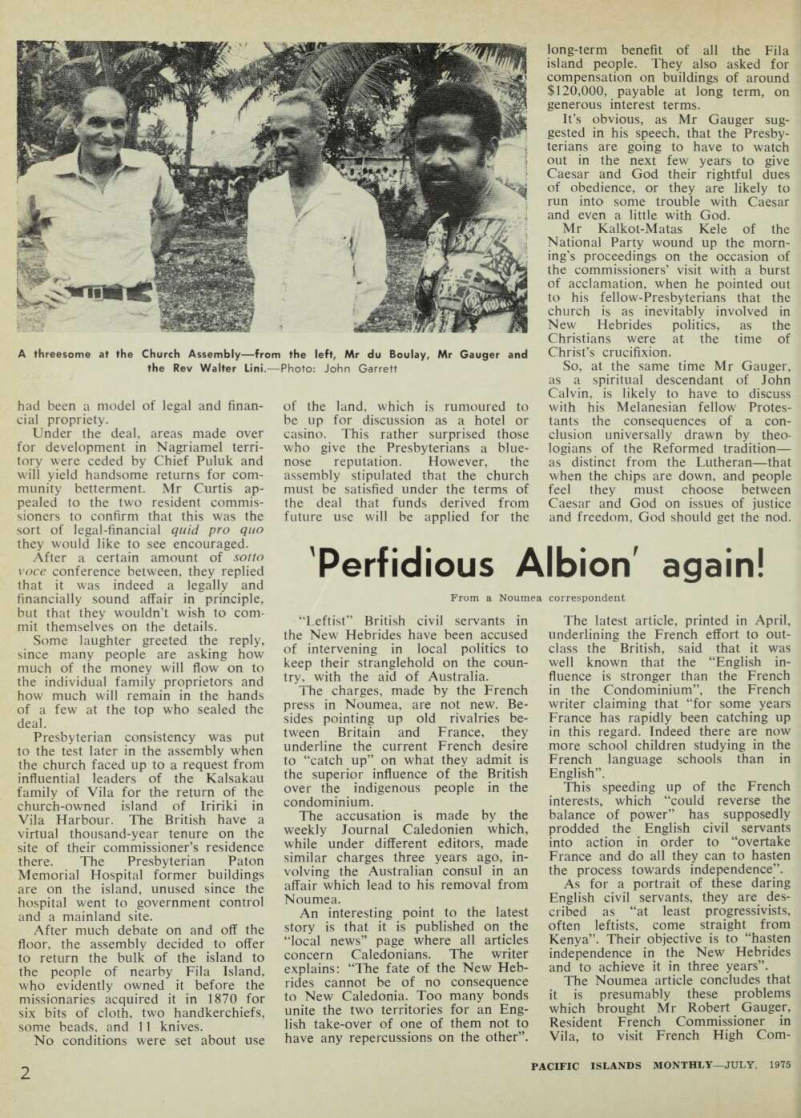
A threesome at the Church Assembly—from the left, Mr du Boulay, Mr Gauger and the Rev Walter Uni.— Photo: John Garrett
Advertisements & other items, p. 7 (1 item)
1
CIFIC ISLANDS MONTHLY— JULY, 1975
Perfidious Albion' again!
From a Noumea correspondent
“Leftist” British civil servants in the New Hebrides have been accused of intervening in local politics to keep their stranglehold on the coun try, with the aid of Australia.
The charges, made by the French press in Noumea, are not new. Be sides pointing up old rivalries be tween Britain and France, they underline the current French desire to “catch up” on what they admit is the superior influence of the British over the indigenous people in the condominium.
The accusation is made by the weekly Journal Caledonien which, while under different editors, made similar charges three years ago, in volving the Australian consul in an affair which lead to his removal from Noumea.
An interesting point to the latest story is that it is published on the “local news” page where all articles concern Caledonians. The writer explains: “The fate of the New Heb rides cannot be of no consequence to New Caledonia. Too many bonds unite the two territories for an Eng lish take-over of one of them not to have any repercussions on the other”.
The latest article, printed in April, underlining the French effort to out class the British, said that it was well known that the “English in fluence is stronger than the French in the Condominium”, the French writer claiming that “for some years France has rapidly been catching up in this regard. Indeed there are now more school children studying in the French language schools than in English”.
This speeding up of the French interests, which “could reverse the balance of power” has supposedly prodded the English civil servants into action in order to “overtake France and do all they can to hasten the process towards independence”, As for a portrait of these daring English civil servants, they are des cribed as “at least progressivists, often leftists, come straight from Kenya”. Their objective is to “hasten independence in the New Hebrides and to achieve it in three years”, The Noumea article concludes that it is presumably these problems which brought Mr Robert Gauger, Resident French Commissioner in Vila, to visit French High Com
missioner in the Pacific, Mr Jean- Gabriel Eriau, in Noumea, in April.
Mr Gauger has, no doubt, had to cope with more dangerous “auto nomist” activities, as he was re portedly born on the island of Cor sica (home of the Mafia-like Union Corse) and has recently served in :he French territory of Djibouti, where deaths in public demonstra ions prompted more liberal French ittitudes in recent years.
Meanwhile, “perfidious Albion”, as he French traditionally refer to their ;ver-suspect English neighbours, offered a similar attack by the Journal Caledonien in February 1972. fhat episode led to the recall of Mr Man Edwards, then Australian con ul in Noumea, after the paper illeged he was supporting the Cale lonian autonomy movement.
At the same time the paper tressed French concern at the grow ng Australian interest in the New lebrides. Citing the presence of )antas, Australian banks and other iusiness interests, the paper claimed hat a plot was underway with “the rand dream of Great Britain: the reation of a Pacific Commonwealth, diich she would direct through Australia”. The paper explained that the English would very much like 3 abandon the condominium, but le French mean to stay and con nue to help the people”.
Meanwhile, the fact that metro olitan French journalists should rig p such offshore battle scenes be veen Britain and France or Austra a and New Zealand suggests that )me outside enemy is required to istract the Caledonians and relieve le stress of their own political and :onomic confrontations with Paris.
Meanwhile, in the New Hebrides, ranee is gearing up for a last-minute ash to win the Anglo-French relay; rst lap will be the municipal elec ons planned for July. The second )rint will be fore the first territorial :tions later in the year.
Blast!
France exploded a nuclear device underground on Fanga taufa atoll in French Polynesia on June 5, according to un official reports from Tahiti.
Two days earlier the French Defence Minister, Mr Yvon Bourges, said France would soon hold an underground test, which would be followed by several more in 1975. Ship ping was warned to keep 48 kilometres clear of Mururoa and Fangataufa atolls.
for New Caledonians
A stern 'non' to self-rule for New Caledonians
From a Noumea correspondent
Mr Olivier Stirn, French Minister for Overseas Territories, has knocked back a Noumea reform project seek ing internal autonomy for New Caledonia.
Speaking from Paris, Mr Stirn was quoted in the Noumea press as saying, “There is no possibility of granting New Caledonia the internal autonomy demanded by Mr Roch Pidjot (Deputy for New Caledonia in the French National Assembly).
Talks have begun towards a revision of this territory’s political status . . . and I shall myself table a project in June seeking greater autonomy for the Governor’s Advisory Council (Conseil de Gouvernement ) and the communes (municipalities) in New Caledonia and French Polynesia”.
The project advanced in May by New Caledonia’s Melanesian deputy, Roch Pidjot, calls for the appoint ment of ministers with the right to elect their chief executive (Council President) and have him answerable to the Territorial Assembly. How ever, France insists it must retain the power to fill this top executive post, which is held by the French Gover nor, a public servant, who answers to Paris and not the Territorial Assembly. This Caledonian desire to reduce the power of the governor is the same as that of French Polynesia, where France also insists it must con tinue to nominate a French public servant as governor and head of the executive (PIM, May, p 4).
Caledonian politicians met Mr Stirn in Paris late in May for talks over the island’s political status and the nickel tax issue. The delegation included 11 members of the Terri torial Assembly, representing five of the eight fragmented parties now in existence.
An outline of Paris policy to con tinue firm political and economic control of the island was given by Governor Eriau, on May 13. The Governor was delivering the “address from the throne” at the opening of the latest session of the Territorial Assembly. After his speech, detailing what he wants to do in the name of France, the governor always leaves the chamber with no address in reply from the elected members or debate of issues raised.
The latest such speech contained no new revelations for the Cale
donians but reiterated French govern ment proposals to change the system of collecting local revenue through nickel tax. Also mentioned were slight changes to widen the debating powers of the Governor’s Advisory Council. But this will still leave the Caledonians with no final control over the public service, which answers to the Governor and not elected representatives of the people.
In addition, municipal (communal) changes are intended, to flatter the numerous mayors, but this will prob ably tie the fund-seeking municipali ties more closely to Paris sources of revenue, and thus Paris control.
In the long drawn-out debate over nickel expansion, Governor Hriau warned Caledonians that they must try to check local inflation which is reducing the island’s competitivity in attracting new investors. (Of course, Caledonians blame Paris for bungling negotiations and delaying new com panies in their projects to build extra nickel smelters on the island.) The Governor also repeated that the local system of collecting revenue must be changed so that nickel smelt ing companies are taxed on their level of profits rather than simply on the quantity of nickel they ship out of the island. The reason given is that a Paris company shipping out Cale donian nickel should not be taxed if it is operating at a loss, as happens to the SLN. This of course brings into question the value and techniques of French management, over which the Caledonians have no control.
Governor Eriau said the SLN group is prepared to invest enough to increase their production from 70,000 to 90,000 tonnes over the next four years if (tax) conditions are favourable. Linked with future Caledonian development, the Gover nor also spoke of the building of local nuclear power plants in about 10 years’ time.
News reached PIM from Paris in June that four pro-autonomy mem bers of the New Caledonia group in cluding the chairman of the Terri torial Assembly, Mr Yann Celene Uregei, walked out of the talks and flew back to Noumea after reportedly disagreeing with their fellow dele gates and protesting over the French Government’s proposals for reform of the island’s statute.
Advertisements & other items, p. 9 (1 item)
3
CIFIC ISLANDS MONTHLY—JULY, 1975
Tahiti Letter
From Al Prince In Papeete
Tahitians Want Their Voice Heard
GOUGH WHITLAM, the roving Australian Prime Minister, stopped off in Tahiti en route to and after the British Commonwealth Prime Ministers’ Con ference in Kingston, Jamaica. But, before leaving the second time on May 11, Mr Whitlam and Governor Daniel Videau sat down to dinner for a second tete-a tete talk that reportedly produced some good results.
According to one knowledgeable source, “A lot of good things were said at the dinner”. Although the source declined to go into specifics about what was said, he left the strong impression that Mr Whitlam and Governor Videau took advantage of the informal atmos phere to say a lot towards improving relations between Australia and French Polynesia.
It was not that long ago that relations between the two became quite strained as the Australian public and labour unions mounted protest campaigns against France’s atmospheric nuclear testing programme on the French Polynesian atoll of Mururoa. The French nuclear testing programme has since gone underground, and so, apparently, has most of the protesting.
APOLITICAL delegation left Tahiti for Paris in early June with three questions weighing heavily on their minds and not necessarily making for a bon voyage.
The three questions were: • Would they be able to change the French Govern ment’s apparently firm position on a key part of a new governing law scheduled to go into effect next January 1? • Would the new group that took over in the French Polynesia Territorial Assembly by two votes on May 29 be able to hold that majority when the delegation re turned from Paris about mid-June? • Will Tahiti be able to avoid recording its first fiscal budget deficit in history?
The delegation’s visit to Paris was staged against the background of the March visit to French Polynesia by Mr Olivier Stirn, French Secretary of State for Overseas Departments and Territories, and an interview in Paris with Mr Stirn by Michael Anglade, editor of the Tahiti French language newspaper, La Depeche. The main issue is the role the French-appointed Governor of French Polynesia should play in a reformed Government Council set up under the new law changing the relation ship between France and French Polynesia.
The government’s position is that the governor should have an equal voice on the Government Council with the six other members, and also serve as its appointed President. However, the majority of political leaders in Tahiti appear opposed to this, preferring to have
the president elected by the people. This was one of the key wrinkles to be ironed out during the delegation’s week-long visit to Paris.
But persuading the government to change its mind will not be easy, and may not even be possible as Mr Stirn indicated when asked during the interview if he had changed his mind on the key issue.
He said, “I’m not in the habit of changing the in tentions Tve stated. The representative of the State (the Governor) will always remain a member of the Government Council, and being such a member will be its President.
“There are not 36 possible solutions. .Either Polynesia will be an independent state or Polynesia remains part of the French Republic. Independence is a position that could have been admitted if it had been wanted, which was not the case, and, therefore, good liaison is required between the territory and the State. It is only normal that within the Government Council of seven persons the State has its own representative. This does not seem shocking to me and is what the govern ment will propose.”
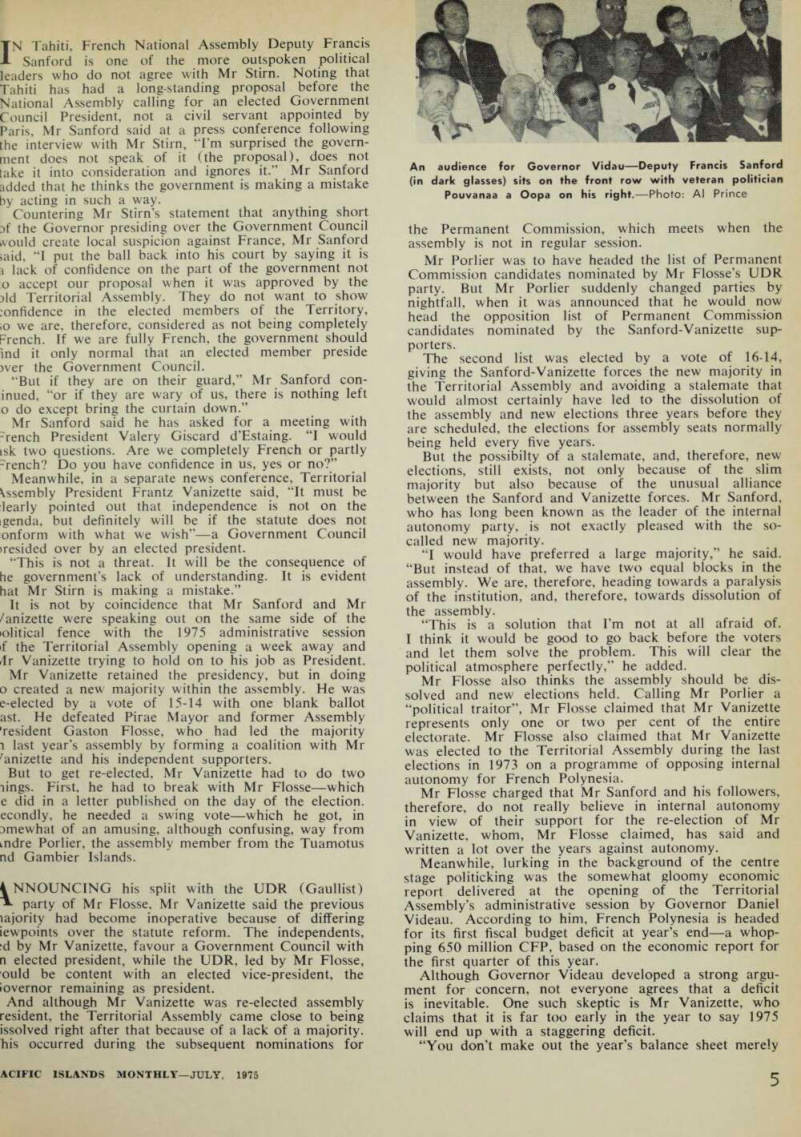
Long legs—first time unveiled in public?—and a short, short shirt. Mr Whitlam relaxes at the Bora Bora Hotel. — Photo: AI Prince
IN Tahiti, French National Assembly Deputy Francis Sanford is one of the more outspoken political leaders who do not agree with Mr Stirn. Noting that Tahiti has had a long-standing proposal before the National Assembly calling for an elected Government Council President, not a civil servant appointed by Paris, Mr Sanford said at a press conference following the interview with Mr Stirn, “I’m surprised the govern ment does not speak of it (the proposal), does not take it into consideration and ignores it.” Mr Sanford added that he thinks the government is making a mistake by acting in such a way.
Countering Mr Stirn’s statement that anything short Df the Governor presiding over the Government Council would create local suspicion against France, Mr Sanford >aid, “I put the ball back into his court by saying it is a lack of confidence on the part of the government not o accept our proposal when it was approved by the aid Territorial Assembly. They do not want to show ;onfidence in the elected members of the Territory, io we are, therefore, considered as not being completely French. If we are fully French, the government should ind it only normal that an elected member preside )ver the Government Council.
“But if they are on their guard,” Mr Sanford con inued, “or if they are wary of us, there is nothing left o do except bring the curtain down.”
Mr Sanford said he has asked for a meeting with -rench President Valery Giscard d’Estaing. “I would isk two questions. Are we completely French or partly -rench? Do you have confidence in us, yes or no?”
Meanwhile, in a separate news conference, Territorial Assembly President Frantz Vanizette said, “It must be learly pointed out that independence is not on the igenda, but definitely will be if the statute does not onform with what we wish”—a Government Council (resided over by an elected president.
“This is not a threat. It will be the consequence of he government’s lack of understanding. It is evident hat Mr Stirn is making a mistake.”
It is not by coincidence that Mr Sanford and Mr Vanizette were speaking out on the same side of the •olitical fence with the 1975 administrative session if the Territorial Assembly opening a week away and Ar Vanizette trying to hold on to his job as President.
Mr Vanizette retained the presidency, but in doing o created a new majority within the assembly. He was e-elected by a vote of 15-14 with one blank ballot ast. He defeated Pirae Mayor and former Assembly 'resident Gaston Flosse, who had led the majority i last year’s assembly by forming a coalition with Mr 'anizette and his independent supporters.
But to get re-elected, Mr Vanizette had to do two lings. First, he had to break with Mr Flosse—which e did in a letter published on the day of the election, econdly, he needed a swing vote—which he got, in amewhat of an amusing, although confusing, way from mdre Porlier, the assembly member from the Tuamotus nd Gambier Islands. iNNOUNCING his split with the UDR (Gaullist) party of Mr Flosse, Mr Vanizette said the previous lajority had become inoperative because of differing iewpoints over the statute reform. The independents, ;d by Mr Vanizette, favour a Government Council with n elected president, while the UDR, led by Mr Flosse, ould be content with an elected vice-president, the iovernor remaining as president.
And although Mr Vanizette was re-elected assembly resident, the Territorial Assembly came close to being issolved right after that because of a lack of a majority, his occurred during the subsequent nominations for
the Permanent Commission, which meets when the assembly is not in regular session.
Mr Porlier was to have headed the list of Permanent Commission candidates nominated by Mr Flosse’s UDR party. But Mr Porlier suddenly changed parties by nightfall, when it was announced that he would now head the opposition list of Permanent Commission candidates nominated by the Sanford-Vanizette sup porters.
The second list was elected by a vote of 16-14, giving the Sanford-Vanizette forces the new majority in the Territorial Assembly and avoiding a stalemate that would almost certainly have led to the dissolution of the assembly and new elections three years before they are scheduled, the elections for assembly seats normally being held every five years.
But the possibilty of a stalemate, and, therefore, new elections, still exists, not only because of the slim majority but also because of the unusual alliance between the Sanford and Vanizette forces. Mr Sanford, who has long been known as the leader of the internal autonomy party, is not exactly pleased with the so called new majority.
“I would have preferred a large majority,” he said.
“But instead of that, we have two equal blocks in the assembly. We are, therefore, heading towards a paralysis of the institution, and, therefore, towards dissolution of the assembly.
“This is a solution that I’m not at all afraid of.
I think it would be good to go back before the voters and let them solve the problem. This will clear the political atmosphere perfectly,” he added.
Mr Flosse also thinks the assembly should be dis solved and new elections held. Calling Mr Porlier a “political traitor”, Mr Flosse claimed that Mr Vanizette represents only one or two per cent of the entire electorate. Mr Flosse also claimed that Mr Vanizette was elected to the Territorial Assembly during the last elections in 1973 on a programme of opposing internal autonomy for French Polynesia.
Mr Flosse charged that Mr Sanford and his followers, therefore, do not really believe in internal autonomy in view of their support for the re-election of Mr Vanizette, whom, Mr Flosse claimed, has said and written a lot over the years against autonomy.
Meanwhile, lurking in the background of the centre stage politicking was the somewhat gloomy economic report delivered at the opening of the Territorial Assembly’s administrative session by Governor Daniel Videau. According to him, French Polynesia is headed for its first fiscal budget deficit at year’s end—a whop ping 650 million CFP, based on the economic report for the first quarter of this year.
Although Governor Videau developed a strong argu ment for concern, not everyone agrees that a deficit is inevitable. One such skeptic is Mr Vanizette, who claims that it is far too early in the year to say 1975 will end up with a staggering deficit.
“You don’t make out the year’s balance sheet merely
An audience for Governor Vidau—Deputy Francis Sanford (in dark glasses) sits on the front row with veteran politician Pouvanaa a Oopa on his right.— Photo: Al Prince
on the results of the first quarter. Many things can take place in the months to pme,” he pointed out.
TTOWEVER, Mr Vanizette does agree that there is a problem, which stems mainly from a sharp re duction in import tax collections so far this year.
Governor Videau noted that customs collections during the first quarter were 431,000 CFP less than in the same period a year ago. A study of quarterly statistics over the past three years and a fairly optimistic estimate of what will happen in the next six months enabled the Governor to predict an 800 million CFP drop in customs collections for all of 1975. Although he said some of this can be made up, the budget deficit, as it looks now, will be 650 million francs.
The main reason for the drop in customs collections, according to the governor’s office, is that merchants stockpiled inventories last year and have imported far less this year. And it is estimated that the merchants will not exhaust last year’s inventories until the end of June. After that, it is estimated that imports will again increase, improving the tax collections somewhat for the second half of the year.
But the fact still remains that a huge budget deficit for the year is anticipated. To combat this, the govern ment has recommended 345 million francs in new direct and indirect taxes.
Governor Videau said in his address to the Territorial Assembly that taxes in French Polynesia do not exceed 13 per cent of the Gross National Product, yet the territory remains, according to international classification standards, a modern country with one of the highest per capita incomes. He said no other country assumes its public service charges with such a low taxation factor.
In fact, he said French Polynesia has one of the highest costing public service systems in the world.
“This contradiction can be explained by the fact that France has supported over the past few years an ever increasing amount of expenses for operating and equip ping Polynesia’s public service. Having taken education under its wing, France has now almost reached its limits,” Governor Videau said.
The present taxation system is aimed at paying for permanent expenses and relies on up to 80 per cent in indirect taxes, such as customs duties, he said.
One proposal the government has made is to intro duce new direct taxes on some 30 commercial or service companies that earned between 50 and 200 million francs last year. The government has also proposed setting higher taxes for certain products and increasing the minimum import tax service charge on all goods passing through customs. And the government is thinking of applying new taxes voted in January, 1974, but shelved right after that and never put into effect.
However, Mr Vanizette claims that the concern about a budget deficit stems from worries in the com mercial community and from politics. He noted that many merchants are just waiting to see what the real impact will be from the gradual reduction of man power in the French Atomic Energy Commission and Pacific Experiments Centre operations.
And he maintains that there is no need for new taxes at this time.
“We are the only overseas territory that has never had a deficit,” he said. “It should not be dramatised.”
He noted that New Caledonia had a 900 million franc deficit for 1973 and a 1.4 billion deficit for 1974, but that the French Government paid the deficit in both cases.
Mr Vanizette says that in Africa during the past few years, France wrote off far more important debts— “So how can they refuse us as Frenchmen assistance they so generously distributed to foreign nations?”
Advertisements & other items, pp. 11-12 (2 items)
5
ACIFIC ISLANDS MONTHLY—JULY, 1975
Security
lb Future Generations,
iV. rv. < k Titans of the Past.
Social welfare is a subject of serious consideration in most modern societies. Man in the twentieth century accepts his responsibility to bequeath to the next generation a society better than his own.
Daiwa Bank is not unique in accepting this responsibility, but Daiwa is unique in making acceptance of this role in society an integral part of their banking service.
Daiwa is the only Japanese city bank to combine banking and trust business. Daiwa is thus a fully integrated banking institution, comprising banking, international financing, trust, pension trust, and real estate business. This integration is part of our effort to fulfil our social responsibility consistent with society's needs in a contemporary environment. a fully integrated banking service
DAIWA BANK
Head Office: Osaka, Japan London and Frankfurt Branches New York and Los Angeles Agencies Singapore, Sydney and Sao Paulo Representative Offices Joint Venture Banks: P.T. Bank Perdania, Jakarta, International Credit Alliance, Ltd., Hong Kong
Mata'afa, friend to all, who
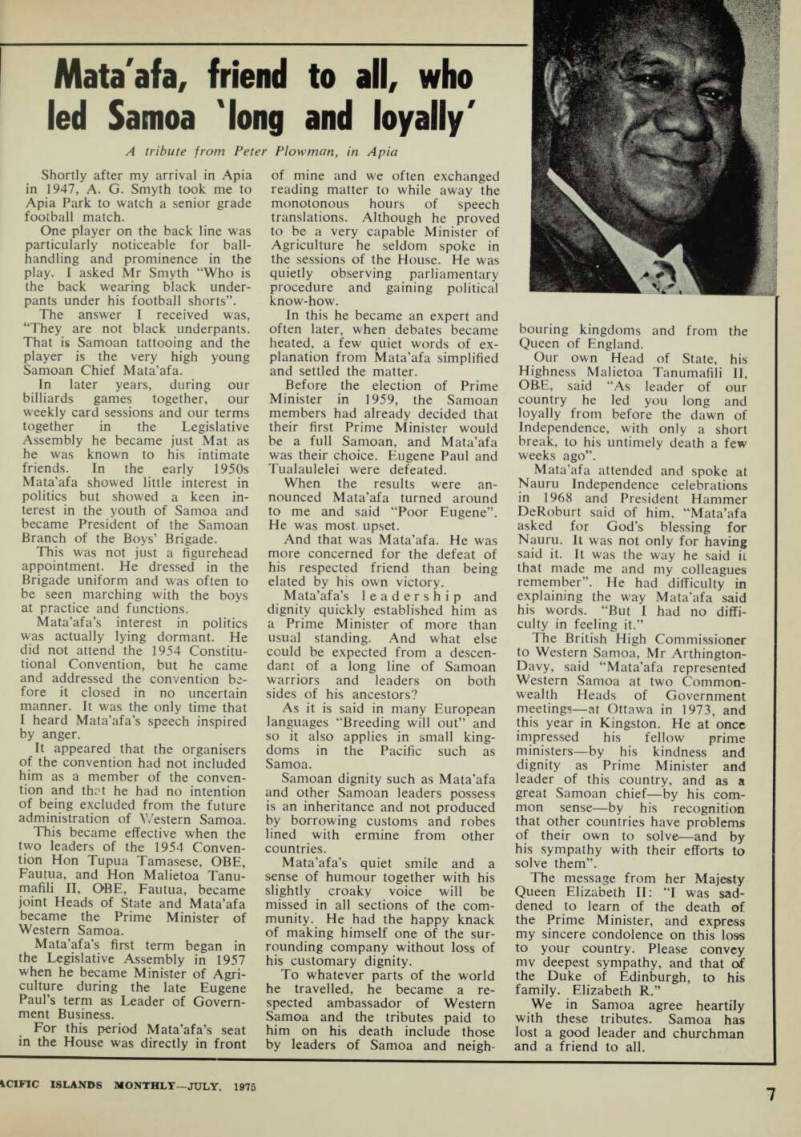
led Samoa 'long and loyally'
A tribute from Peter Plowman, in Apia
Shortly after my arrival in Apia in 1947, A. G. Smyth took me to Apia Park to watch a senior grade football match.
One player on the back line was particularly noticeable for ball handling and prominence in the play. I asked Mr Smyth “Who is the back wearing black under pants under his football shorts”.
The answer I received was, “They are not black underpants.
That is Samoan tattooing and the player is the very high young Samoan Chief Mata’afa.
In later years, during our billiards games together, our weekly card sessions and our terms together in the Legislative Assembly he became just Mat as he was known to his intimate friends. In the early 1950 s Mata’afa showed little interest in politics but showed a keen in terest in the youth of Samoa and became President of the Samoan Branch of the Boys’ Brigade.
This was not just a figurehead appointment. He dressed in the Brigade uniform and was often to be seen marching with the boys at practice and functions.
Mata’afa’s interest in politics was actually lying dormant. He did not attend the 1954 Constitu tional Convention, but he came and addressed the convention be fore it closed in no uncertain manner. It was the only time that I heard Mata’afa’s speech inspired by anger.
It appeared that the organisers of the convention had not included him as a member of the conven tion and that he had no intention of being excluded from the future administration of Western Samoa.
This became effective when the two leaders of the 1954 Conven tion Hon Tupua Tamasese, OBE, Fautua, and Hon Malietoa Tanu mafili 11, OBE, Fautua, became joint Heads of State and Mata’afa became the Prime Minister of Western Samoa.
Mata’afa’s first term began in the Legislative Assembly in 1957 when he became Minister of Agri culture during the late Eugene Paul’s term as Leader of Govern ment Business.
For this period Mata’afa’s seat in the House was directly in front
of mine and we often exchanged reading matter to while away the monotonous hours of speech translations. Although he proved to be a very capable Minister of Agriculture he seldom spoke in the sessions of the House. He was quietly observing parliamentary procedure and gaining political know-how.
In this he became an expert and often later, when debates became heated, a few quiet words of ex planation from Mata’afa simplified and settled the matter.
Before the election of Prime Minister in 1959, the Samoan members had already decided that their first Prime Minister would be a full Samoan, and Mata’afa was their choice. Eugene Paul and Tualaulelei were defeated.
When the results were an nounced Mata’afa turned around to me and said “Poor Eugene”.
He was most upset.
And that was Mata’afa. He was more concerned for the defeat of his respected friend than being elated by his own victory.
Mata’afa’s leadership and dignity quickly established him as a Prime Minister of more than usual standing. And what else could be expected from a descen dant of a long line of Samoan warriors and leaders on both sides of his ancestors?
As it is said in many European languages “Breeding will out” and so it also applies in small king doms in the Pacific such as Samoa.
Samoan dignity such as Mata’afa and other Samoan leaders possess is an inheritance and not produced by borrowing customs and robes lined with ermine from other countries.
Mata’afa’s quiet smile and a sense of humour together with his slightly croaky voice will be missed in all sections of the com munity. He had the happy knack of making himself one of the sur rounding company without loss of his customary dignity.
To whatever parts of the world he travelled, he became a re spected ambassador of Western Samoa and the tributes paid to him on his death include those by leaders of Samoa and neigh-
bouring kingdoms and from the Queen of England.
Our own Head of State, his Highness Malietoa Tanumafili 11, OBE, said “As leader of our country he led you long and loyally from before the dawn of Independence, with only a short break, to his untimely death a few weeks ago”.
Mata’afa attended and spoke at Nauru Independence celebrations in 1968 and President Hammer Deßoburt said of him, “Mata’afa asked for God’s blessing for Nauru. It was not only for having said it. It was the way he said it that made me and my colleagues remember”. He had difficulty in explaining the way Mata’afa said his words. “But I had no diffi culty in feeling it.”
The British High Commissioner to Western Samoa, Mr Arthington- Davy, said “Mata’afa represented Western Samoa at two Common wealth Heads of Government meetings— at Ottawa in 1973, and this year in Kingston, He at once impressed his fellow prime ministers—by his kindness and dignity as Prime Minister and leader of this country, and as a great Samoan chief—by his com mon sense—by his recognition that other countries have problems of their own to solve—and by his sympathy with their efforts to solve them”.
The message from her Majesty Queen Elizabeth II; “I was sad dened to learn of the death of the Prime Minister, and express my sincere condolence on this loss to your country. Please convey mv deepest sympathy, and that of the Duke of Edinburgh, to his family. Elizabeth R.”
We in Samoa agree heartily with these tributes. Samoa has lost a good leader and churchman and a friend to all.
Advertisements & other items, p. 13 (1 item)
7
ICIFIC ISLANDS MONTHLY—JULY, 1975
The Islands Are Almost Ready
For The Fifth Games Clash
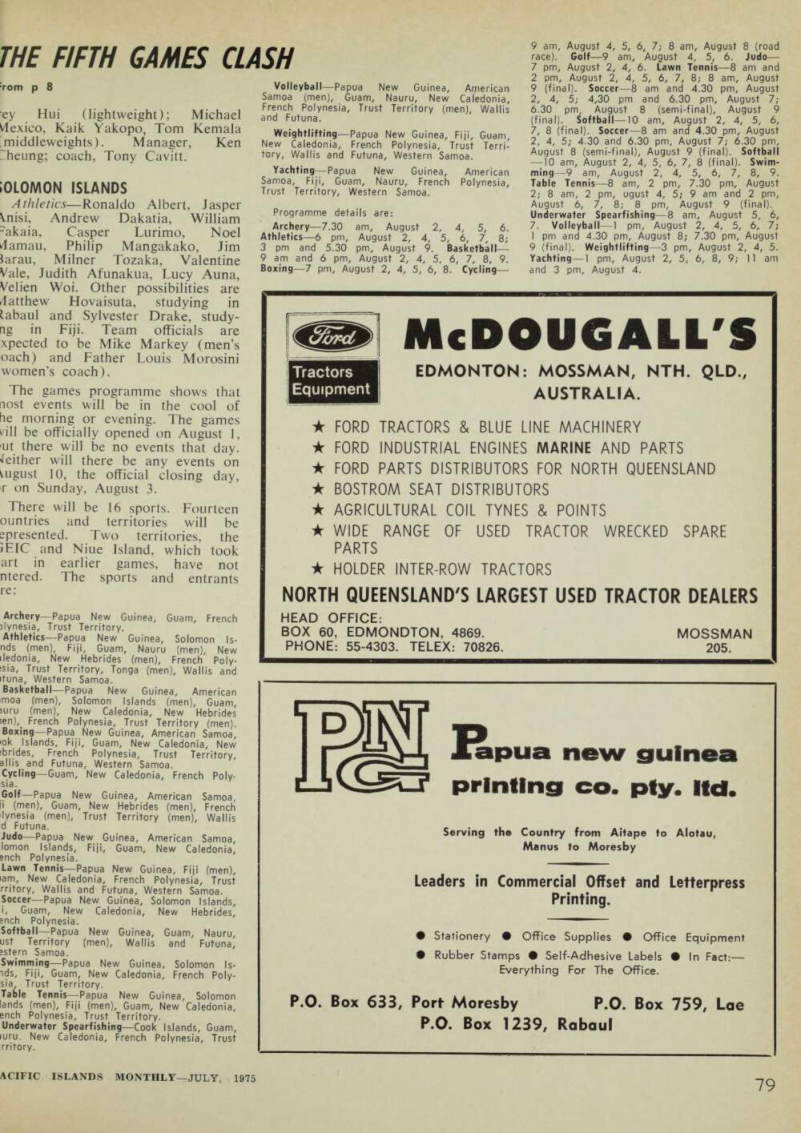
The composition of teams for the Fifth South Pacific Games in Guam from August 1 to 10 was starting to take shape in June. In some countries, teams were selected for several sports. In others, a pro gramme of trials was under way be fore the selectors finally committed themselves. In the first week in June, Papua New Guinea had made most progress, with the athletics, swim ming, table tennis, weightlifting and boxing teams named.
The Solomon Islands reached the stage of recommending a team to the BSIP Amateur Sports Association, and inquiring about the availability of two athletes studying overseas.
Papua New Guinea chose a strong team for the men’s table tennis. It included Ted Sokolowski, four times PNG singles champion and twice runner-up, and co-winner of the men’s doubles at the 1971 Tahiti Games. He is a former Australian and Victorian representative and was co-winner of the Australian doubles title in 1959. Rick Strellan, another member of the team, is current PNG singles champion.
The women’s team does not have the same impressive performances be hind it, and may not win a medal.
But the experience in Guam is ex pected to stand the team in good stead in the future.
At the final pre-selection meeting for athletes in the Solomon Islands, Lucy Auna ran the 400 metres in 63.7 sec, the best time for the season. Mary Kelesi, running the 1500 metres in 5 min 31.7 sec, took almost 10 sec off the previous best time for the season. Jim Marau won the 100 metres and 200 metres in 11 sec and 22.7 sec respectively. Ronaldo Albert and Andrew Dakatia tried themselves out over the 5000 metres.
Albert won in 16 min 37.8 sec, with Dakatia five seconds behind.
New Caledonians have been train ing enthusiastically in their special ties. Discus thrower Martial Bone broke his old record to throw 52.88 metres in May. Wallisian gold medal hopeful Losesio Tuita broke another New Caledonian record to throw the javelin 76.16 metres. A new long distance runner has made a spec tacular emergence 23 - year - old Noumea-born Alain Lazare.
Several tennis men, including, of course, Melanesian N’Godrella Wanaro, have been playing in France while others back in Noumea com peted against an Australian eight in May. Among the judo men, 12 hope fuls were due home in June from con tests in New Zealand. Other teams to compete against the New Zea landers were the swimmers who put up a rather disappointing perform ance against their visitors in Noumea late May.
Other sportsmen to benefit from New Zealand encouragement were the table tennis players who were coached by New Zealand champion Richard Lee in Noumea for 10 days before the 1966 Games. As for New Cale donian soccer players, they were training hard to test their strength against a visiting English team.
Sheffield United, in early June.
Teams named so far include:
Papua New Guinea
Athletics —Naibi Levi, Anamason Paulius, Delin Lemen, Naomi Tarain gal, Daisy Irwin, Paiwa Bogela,
Trevor Vorke, Sisia Morea, Wavala Kali, Mike Joyce, Philip Kayo, Iroa Pamoa, Evan lewago, Wallace Hofa gao, John Kokinai, Mo’uro Kaida, Salitia Muga, Vuatha Kapa. Officials —manager, Goa Koiti; assistant manager, Mrs Kuni Tigilai; coach, Jack Pross.
Swimming Mark Hutchings, Charlie Martin, Donald Martin, Oala Moi, Deveni Temu, Peter Yates, Karen Antione, Joanne Kohnke, Fiona Mooney, Lorene Moyle, Alison Newtown, Mati Verave.
Boxing —Zoffa Yar a w i (light flyweight); Jack Eki (flyweight); Tumat Sogolik (bantamweight); John Aba (featherweight); Titi Christian (lightweight); Mark Apai (light welterweight); Samuel Kasa (welter weight); Som Agum (light-middle weight). Manager, Alan Richardson.
Table tennis Ted Sokolowski (men’s capt,), Simon Zial, David Petelo, Rick Strellan, Vui Kila (women’s capt), Geua Kwalahu, Miriam Mark, Haoda Frank. Mana ger, Neil Roberts.
Weightlifting —Edward Seeto (fly weight); Kava Heveapu, Jackson Seeto (bantamweights); Sibona Oka, David Seeto (featherweights); Geoff
Continued on p 79
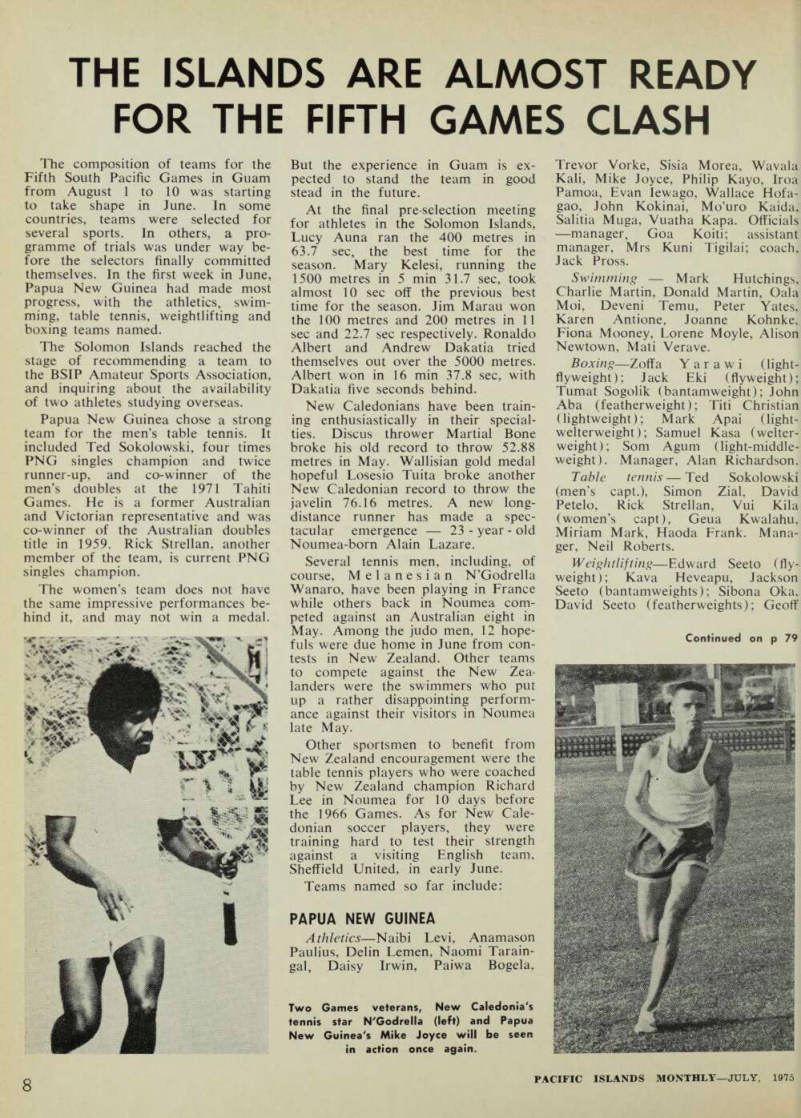
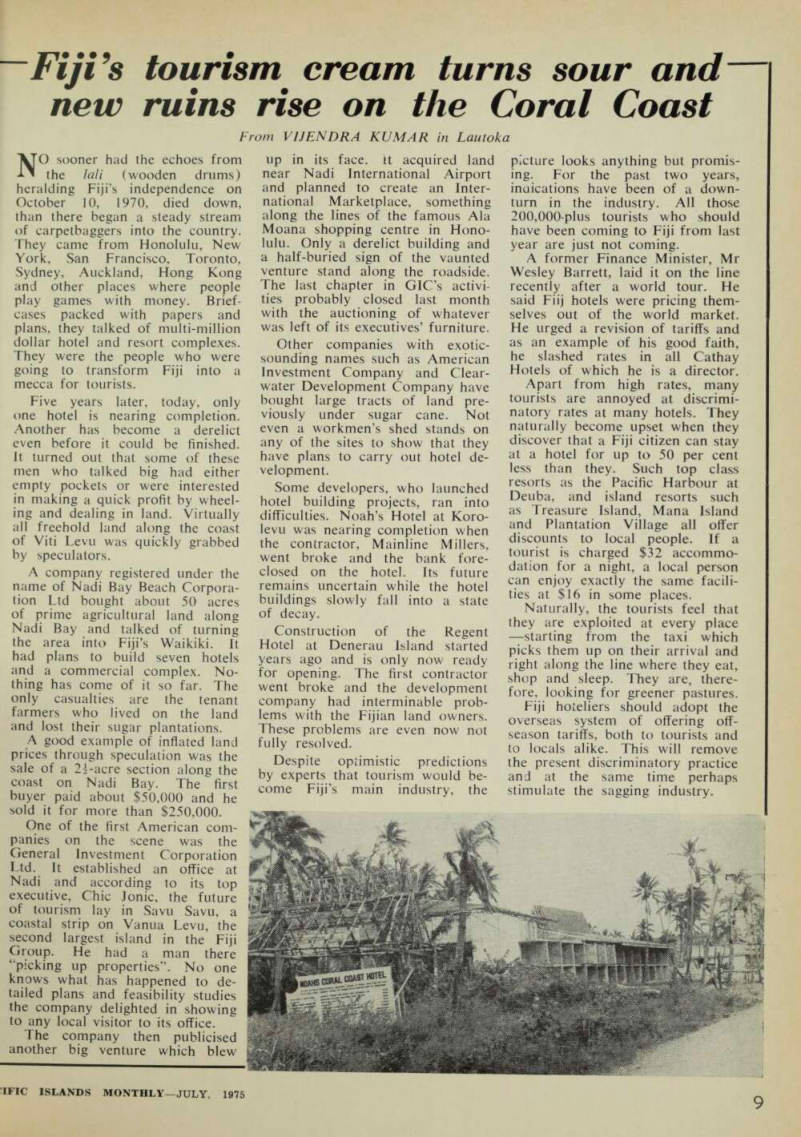
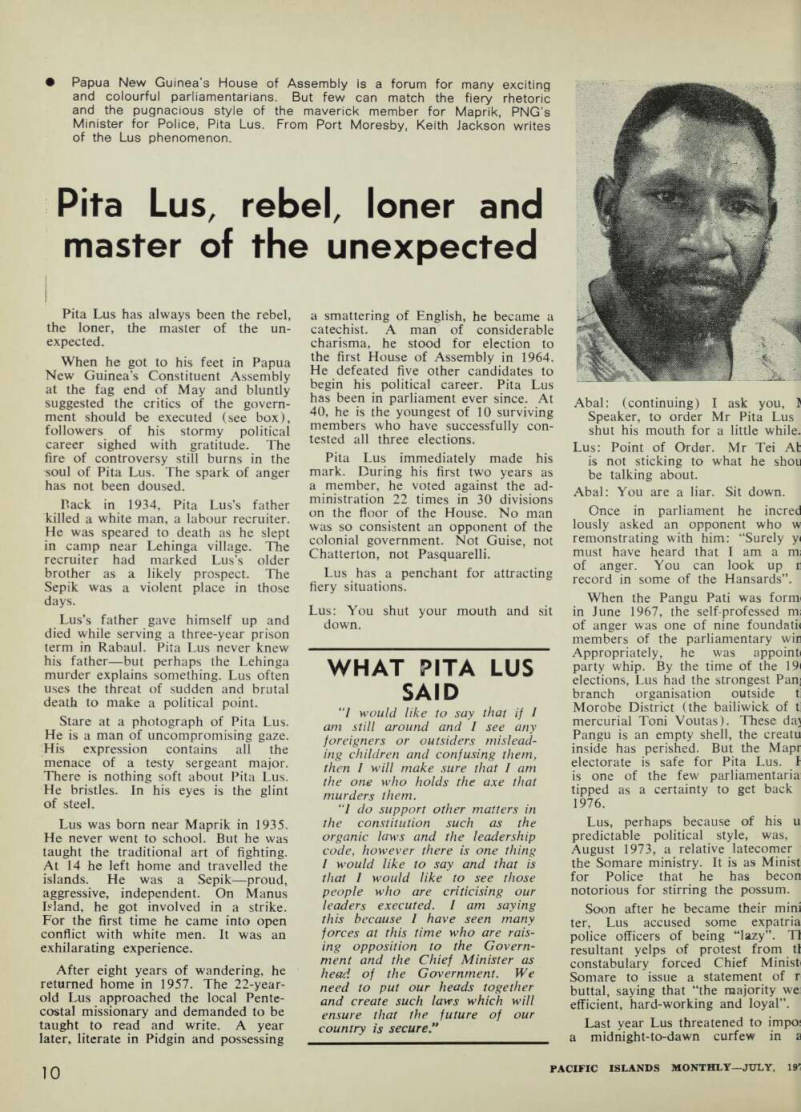
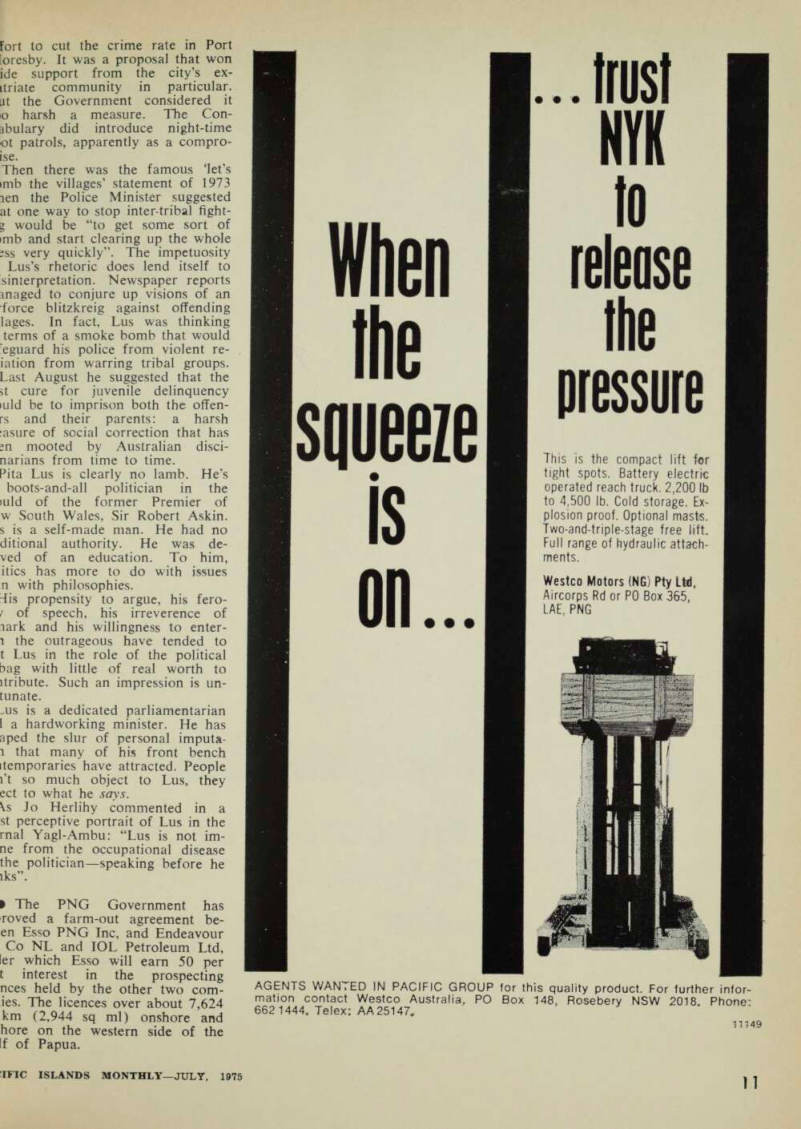
Two Games veterans, New Caledonia's tennis star N'Godrella (left) and Papua New Guinea's Mike Joyce will be seen in action once again.
•ey Hui (lightweight); Michael
Mexico, Kaik Yakopo, Tom Kemala rniddleweights). Manager, Ken
Cheung; coach, Tony Cavitt.
Iolomon Islands
Athletics —Ronaldo Albert, Jasper Vnisi, Andrew Dakatia, William
"akaia, Casper Lurimo, Noel
damau, Philip Mangakako, Jim larau, Milner Tozaka, Valentine Vale, Judith Afunakua, Lucy Auna, Velien Woi. Other possibilities are datthew Hovaisuta, studying in tabaul and Sylvester Drake, study tig in Fiji. Team officials are xpected to be Mike Markey (men’s oach) and Father Louis Morosini women’s coach).
The games programme shows that riost events will be in the cool of
he morning or evening. The games
vill be officially opened on August 1, ut there will be no events that day.
Neither will there be any events on tugust 10, the official closing day, r on Sunday, August 3.
There will be 16 sports. Fourteen ountries and territories will be Two territories, the iEIC and Niue Island, which took art in earlier games, have not ntered. The sports and entrants re: Archery— Papua New Guinea, Guam, French )lynesia. Trust Territory.
Athletics— Papua New Guinea, Solomon ls nds (men), Fiji, Guam, Nauru (men). New iledonia, New Hebrides (men), French Poly isia. Trust Territory, Tonga (men), Wallis and ituna. Western Samoa.
Basketball —Papua New Guinea, American moa (men), Solomon Islands (men), Guam, iuru (men). New Caledonia, New Hebrides ten), French Polynesia, Trust Territory (men).
Boxing —Papua New Guinea, American Samoa, ►ok Islands, Fiji, Guam, New Caledonia, New 'brides, French Polynesia, Trust Territory, allis and Futuna, Western Samoa.
Cycling —Guam, New Caledonia, French Poly sia.
Golf —Papua New Guinea, American Samoa, ii (men), Guam, New Hebrides (men), French lynesia (men). Trust Territory (men), Wallis d Futuna.
Judo —Papua New Guinea, American Samoa, lomon Islands, Fiji, Guam, New Caledonia, ench Polynesia.
Lawn Tennis— Papua New Guinea, Fiji (men), iam. New Caledonia, French Polynesia, Trust rritory, Wallis and Futuna, Western Samoa.
Soccer —Papua New Guinea, Solomon Islands, i, Guam, New Caledonia, New Hebrides, ench Polynesia.
Softball —Papua New Guinea, Guam, Nauru, ust Territory (men), Wallis and Futuna, estern Samoa.
Swimming —Papua New Guinea, Solomon Is ids, Fiji, Guam, New Caledonia, French Poly sia. Trust Territory.
Table Tennis— Papua New Guinea, Solomon lands (men), Fiji (men), Guam, New Caledonia, ench Polynesia, Trust Territory.
Underwater Spearfishing —Cook Islands, Guam, luru. New Caledonia, French Polynesia, Trust rritory.
Volleyball —Papua New Guinea, American Samoa (men), Guam, Nauru, New Caledonia, French Polynesia, Trust Territory (men), Wallis and Futuna.
Weightlifting —Papua New Guinea, Fiji, Guam, New Caledonia, French Polynesia, Trust Terri tory, Wallis and Futuna, Western Samoa.
Yachting— Papua New Guinea, American Samoa, Fiji, Guam, Nauru, French Polynesia, Trust Territory, Western Samoa.
Programme details are: Archery —7.3o am, August 2,4, 5, 6.
Athletics —6 pm, August 2, 4, 5,6, 7,8; 3 pm and 5.30 pm, August 9. Basketball— -9 am and 6 pm, August 2,4, 5,6, 7,8, 9.
Boxing —7 pm, August 2,4, 5,6, 8. Cycling—
9 am, August 4,5, 6,7; 8 am, August 8 (road race). Golf —9 am, August 4,5, 6. Judo— -7 pm, August 2,4, 6. Lawn Tennis —B am and 2 pm, August 2,4, 5,6, 7,8; 8 am, August 9 (final). Soccer — 8 am and 4.30 pm, August 2,4, 5; 4,30 pm and 6.30 pm, August 7; 6.30 pm, August 8 (semi-final), August 9 (final). Softball —lo am, August 2,4, 5,6, 7, 8 (final). Soccer —8 am and 4.30 pm, August 2,4, 5; 4.30 and 6.30 pm, August 7; 6.30 pm, August 8 (semi-final), August 9 (final). Softball —lO am, August 2,4, 5,6, 7, 8 (final). Swim ming—9 am, August 2,4, 5,6, 7,8, 9.
Table Tennis —B am, 2 pm, 7.30 pm, August 2; 8 am, 2 pm, ugust 4,5; 9 am and 2 pm, August 6,7, 8; 8 pm, August 9 (final).
Underwater Spearfishing —B am, August 5,6, 7. Volleyball —l pm, August 2,4, 5,6, 7; 1 pm and 4.30 pm, August 8; 7.30 pm, August 9 (final). Weightlifting —3 pm, August 2,4, 5.
Yachting —l pm, August 2,5, 6,8, 9; 11 am and 3 pm, August 4.
Fiji’s tourism cream turns sour and new ruins rise
new ruins rise on the Coral Coast
From VIJENDRA KUMAR in Lautoka
NO sooner had the echoes from the lali (wooden drums) heralding Fiji’s independence on October 10, 1970, died down, than there began a steady stream of carpetbaggers into the country.
They came from Honolulu, New York, San Francisco, Toronto, Sydney, Auckland, Hong Kong and other places where people play games with money. Brief cases packed with papers and plans, they talked of multi-million dollar hotel and resort complexes.
They were the people who were going to transform Fiji into a mecca for tourists.
Five years later, today, only one hotel is nearing completion.
Another has become a derelict even before it could be finished.
It turned out that some of these men who talked big had either empty pockets or were interested in making a quick profit by wheel ing and dealing in land. Virtually all freehold land along the coast of Viti Levu was quickly grabbed by speculators.
A company registered under the name of Nadi Bay Beach Corpora tion Ltd bought about 50 acres of prime agricultural land along Nadi Bay and talked of turning the area into Fiji’s Waikiki. It had plans to build seven hotels and a commercial complex. No thing has come of it so far. The only casualties are the tenant farmers who lived on the land and lost their sugar plantations.
A good example of inflated land prices through speculation was the sale of a 2i-acre section along the coast on Nadi Bay. The first buyer paid about $50,000 and he sold it for more than $250,000.
One of the first American com panies on the scene was the General Investment Corporation Ltd. It established an office at Nadi and according to its top executive, Chic Jonic, the future of tourism lay in Savu Savu, a coastal strip on Vanua Levu, the second largest island in the Fiji Group. He had a man there “picking up properties”. No one knows what has happened to de tailed plans and feasibility studies the company delighted in showing to any local visitor to its office.
The company then publicised another big venture which blew
up in its face, it acquired land near Nadi International Airport and planned to create an Inter national Marketplace, something along the lines of the famous Ala Moana shopping centre in Hono lulu. Only a derelict building and a half-buried sign of the vaunted venture stand along the roadside.
The last chapter in GlC’s activi ties probably closed last month with the auctioning of whatever was left of its executives’ furniture.
Other companies with exotic sounding names such as American Investment Company and Clear water Development Company have bought large tracts of land pre viously under sugar cane. Not even a workmen’s shed stands on any of the sites to show that they have plans to carry out hotel de velopment.
Some developers, who launched hotel building projects, ran into difficulties. Noah’s Hotel at Koro levu was nearing completion when the contractor, Mainline Millers, went broke and the bank fore closed on the hotel. Its future remains uncertain while the hotel buildings slowly fall into a state of decay.
Construction of the Regent Hotel at Denerau Island started years ago and is only now ready for opening. The first contractor went broke and the development company had interminable prob lems with the Fijian land owners.
These problems are even now not fully resolved.
Despite optimistic predictions by experts that tourism would be come Fiji’s main industry, the
picture looks anything but promis ing. For the past two years, indications have been of a down turn in the industry. All those 200,000-plus tourists who should have been coming to Fiji from last year are just not coming.
A former Finance Minister, Mr Wesley Barrett, laid it on the line recently after a world tour. He said Fiij hotels were pricing them selves out of the world market, He urged a revision of tariffs and as an example of his good faith. he slashed rates in all Cathay Hotels of which he is a director, Apart from high rates, many tourists are annoyed at discrimi natory rates at many hotels. They naturally become upset when they discover that a Fiji citizen can stay at a hotel for up to 50 per cent Jess than they. Such top class s °u S aS t ! le . Paci . fic Harbour at Deuba, and island resorts such as Treasure Island Mana Island Plantatl °7 Village all offer discounts to local people. If a u J lst j s char P e u d accommo- Nation for a night, a local person an e^ actl y the same facili that
-starling from the taxi* which
sh g OD and B see n Thev are there fore looking for greener pastures Fiji hotefiers should adopt the ftV prkpnk svNtpm nf nflFprina rtfF season tariffs, both to tourisfs and i nra ic Thk will
the present ditcrimmatoly p“
and at the same time perhaps stimulate the sagging industry.
Advertisements & other items, p. 15 (1 item)
Ific Islands Monthly-July, 1975
Pita Lus, rebel, loner and master
master of the unexpected
• Papua New Guinea's House of Assembly is a forum for many exciting and colourful parliamentarians. But few can match the fiery rhetoric and the pugnacious style of the maverick member for Maprik, PNG’s Minister for Police, Pita Lus. From Port Moresby. Keith Jackson writes of the Lus phenomenon.
Pita Lus has always been the rebel, the loner, the master of the un expected.
When he got to his feet in Papua New Guinea’s Constituent Assembly at the fag end of May and bluntly suggested the critics of the govern ment should be executed (see box), followers of his stormy political career sighed with gratitude. The fire of controversy still burns in the soul of Pita Lus. The spark of anger has not been doused.
Back in 1934, Pita Lus’s father killed a white man, a labour recruiter.
He was speared to death as he slept in camp near Lehinga village. The recruiter had marked Lus’s older brother as a likely prospect. The Sepik was a violent place in those days.
Lus’s father gave himself up and died while serving a three-year prison term in Rabaul. Pita Lus never knew his father—but perhaps the Lehinga murder explains something. Lus often uses the threat of sudden and brutal death to make a political point.
Stare at a photograph of Pita Lus.
He is a man of uncompromising gaze.
His expression contains all the menace of a testy sergeant major.
There is nothing soft about Pita Lus.
He bristles. In his eyes is the glint of steel.
Lus was born near Maprik in 1935.
He never went to school. But he was taught the traditional art of fighting.
At 14 he left home and travelled the islands. He was a Sepik—proud, aggressive, independent. On Manus Island, he got involved in a strike.
For the first time he came into open conflict with white men. It was an exhilarating experience.
After eight years of wandering, he returned home in 1957. The 22-year old Lus approached the local Pente costal missionary and demanded to be taught to read and write. A year later, literate in Pidgin and possessing
a smattering of English, he became a catechist. A man of considerable charisma, he stood for election to the first House of Assembly in 1964.
He defeated five other candidates to begin his political career. Pita Lus has been in parliament ever since. At 40, he is the youngest of 10 surviving members who have successfully con tested all three elections.
Pita Lus immediately made his mark. During his first two years as a member, he voted against the ad ministration 22 times in 30 divisions on the floor of the House. No man was so consistent an opponent of the colonial government. Not Guise, not Chatterton, not Pasquarelli.
Lus has a penchant for attracting fiery situations.
Lus: You shut your mouth and sit down.
Abal; (continuing) I ask you, J Speaker, to order Mr Pita Lus shut his mouth for a little while.
Lus: Point of Order. Mr Tei At is not sticking to what he shou be talking about.
Abal: You are a liar. Sit down.
Once in parliament he incred lously asked an opponent who w remonstrating with him: “Surely y< must have heard that I am a m; of anger. You can look up c record in some of the Hansards”.
When the Pangu Pati was form* in June 1967, the self-professed m; of anger was one of nine foundatu members of the parliamentary wic Appropriately, he was appoint) party whip. By the time of the 19( elections, Lus had the strongest Pan] branch organisation outside ti Morobe District (the bailiwick of t\ mercurial Toni Voutas). These da} Pangu is an empty shell, the creatu inside has perished. But the Mapr electorate is safe for Pita Lus. I is one of the few parliamentaria tipped as a certainty to get back 1976.
Lus, perhaps because of his u
predictable political style, was,
August 1973, a relative latecomer the Somare ministry. It is as Minist for Police that he has becon notorious for stirring the possum.
Soon after he became their mini ter, Lus accused some expatria police officers of being “lazy”. Tl resultant yelps of protest from tl constabulary forced Chief Minist Somare to issue a statement of r buttal, saying that “the majority we: efficient, hard-working and loyal”.
Last year Lus threatened to impo; a midnight-to-dawn curfew in a
Fort to cut the crime rate in Port [oresby. It was a proposal that won ide support from the city’s ex itriate community in particular, at the Government considered it 0 harsh a measure. The Con abulary did introduce night-time ot patrols, apparently as a compro ise.
Then there was the famous ‘let’s imb the villages’ statement of 1973 icn the Police Minister suggested at one way to stop inter-tribal fight g would be “to get some sort of imb and start clearing up the whole jss very quickly”. The impetuosity Lus’s rhetoric does lend itself to sinterpretation. Newspaper reports anaged to conjure up visions of an force blitzkreig against offending lages. In fact, Lus was thinking terms of a smoke bomb that would : eguard his police from violent re lation from warring tribal groups.
Last August he suggested that the it cure for juvenile delinquency >uld be to imprison both the offen rs and their parents: a harsh :asure of social correction that has m mooted by Australian disci narians from time to time.
Pita Lus is clearly no lamb. He’s boots-and-all politician in the luld of the former Premier of w South Wales, Sir Robert Askin. s is a self-made man. He had no ditional authority. He was de ved of an education. To him, itics has more to do with issues n with philosophies. -iis propensity to argue, his fero j of speech, his irreverence of lark and his willingness to enter -1 the outrageous have tended to t Lus in the role of the political bag with little of real worth to itribute. Such an impression is un tunate. .us is a dedicated parliamentarian 1 a hardworking minister. He has aped the slur of personal imputa i that many of his front bench [temporaries have attracted. People i’t so much object to Lus, they ect to what he says.
Jo Herlihy commented in a st perceptive portrait of Lus in the rnal Yagl-Ambu: “Lus is not im ne from the occupational disease
the politician—speaking before he
iks”.
I The PNG Government has roved a farm-out agreement be en Esso PNG Inc, and Endeavour Co NL and lOL Petroleum Ltd, ler which Esso will earn 50 per t interest in the prospecting nces held by the other two com ics. The licences over about 7,624 km (2,944 sq ml) onshore and hore on the western side of the If of Papua.
What Pita Lus
Said
“I would like to say that if I am still around and I see any foreigners or outsiders mislead ing children and confusing them, then I will make sure that I am the one who holds the axe that murders them.
“I do support other matters in the constitution such as the organic laws and the leadership code, however there is one thing I would like to say and that is that 1 would like to see those people who are criticising our leaders executed. I am saying this because / have seen many forces at this time who are rais ing opposition to the Govern ment and the Chief Minister as head of the Government. We need to put our heads together and create such laws which will ensure that the future of our country is secure”
Advertisements & other items, pp. 17-18 (2 items)
11
IFIC ISLANDS MONTHLY—JULY. 1975
squeeze
... trust
NYK
to
Wen
release
the
the
pressure
squeeze
This is the compact lift for tight spots. Battery electric operated reach truck. 2,200 lb to 4,500 lb. Cold storage. Explosion proof. Optional masts.
Two-and-triple-stage free lift.
Full range of hydraulic attachments.
IS 0n...
Westco Motors (NG) Pty Ltd, Aircorps Rd or PO Box 365,
LAE, PNG
AGENTS WANTED IN PACIFIC GROUP for this quality product. For further information contact Westco Australia, PO Box 148, Rosebery NSW 2018 Phone- -6621444. Telex: AA25147, 11149
■ X i r i ■;i X
Mixmaster Mixer
3 times better than any
other mixer. Designed especially for family food preparation. 12-speed mixfinder dial indicates the correct speed for each mixing action. Complete with 2 heat-resistant bowls and juice extractor. Sunbeam’s exclusive 3-way beating action— extra large, contoured beaters, and automatic bowl movement— gives perfect aeration and more even mixing. It can handle everything from beating one egg to mixing a large fruit cake.
aftermath
When war’s aftermath came to Guam
M Frank J. Cunningham
on Guam a day-to-day activities on Guam, t to the Fifth South Pacific nes, residents hardly know that e than 106,000 South Vietnamese gees had found a temporary ;n on the island, heir presence has, however, stirred :ontinuing debate among island dators over executive authority, ied a minor shortage of water, ised some concern over the spread lengue fever and put nearly $3.5 ion into the local economy in a veek period. uam was used as a “staging ”, a place where refugees could placed for several days before ement to the mainland US. Its ive proximity to SE Asia allowed es to drop off refuges and return aigon for more. nee Saigon fell, the influx slowed iderably, but the lull only lasted May 7 when the first of a n or more cargo liners, freighters former South Vietnamese Navy i arrived at Guam carrying any e from several hundred to 4,000 ?ees in each ship, jspite the influx, people in the less, residential and recreational ; of the island saw little or no of the refugees. Feared food ages never developed. The only i hard to find were paint and igated sheet metal, and some bing supplies. ansportation and housing of the ;ees were completely the respon ty of the US military, with the n Government having almost no msibility. Abandoned or unused ary barracks, as well as empty icks for alien construction ers with private firms, were used ause nearly 20,000 people. But reat mass of refugees was housed ;nt City on Orote Peninsula.
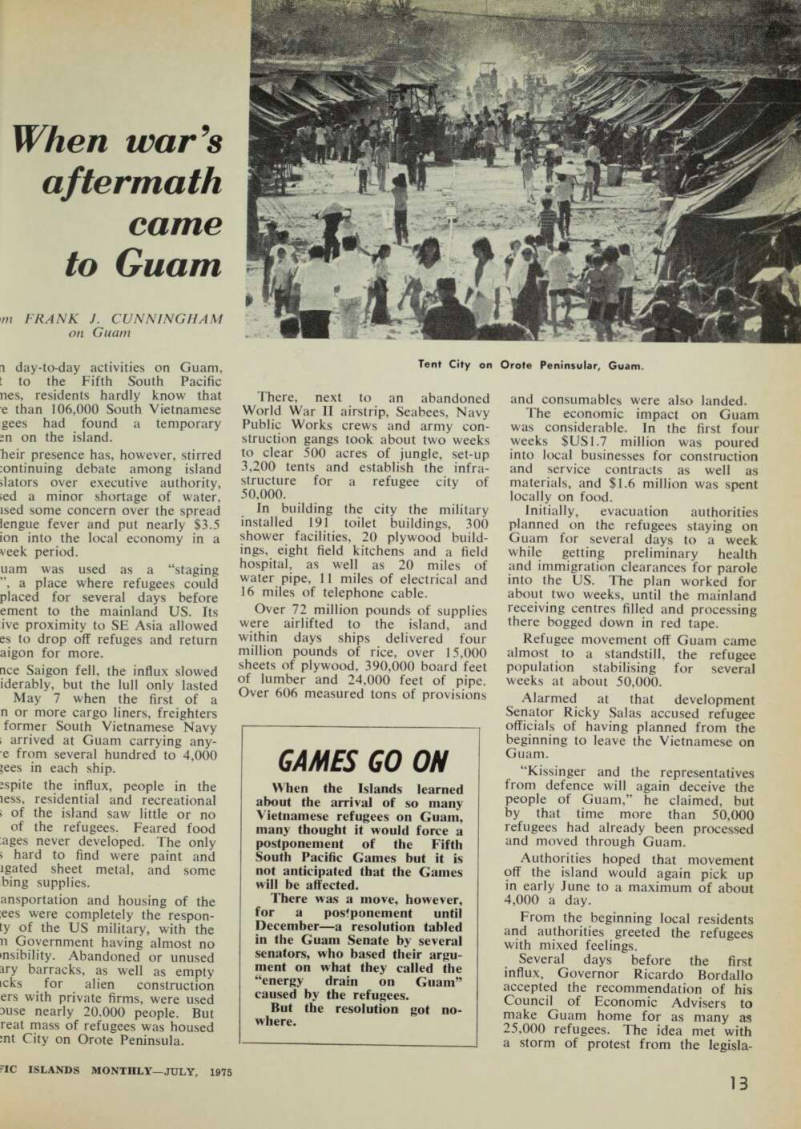
There, next to an abandoned World War II airstrip, Seabees, Navy Public Works crews and army con struction gangs took about two weeks to clear 500 acres of jungle, set-up 3,200 tents and establish the infra structure for a refugee city of 50,000.
In building the city the military installed 191 toilet buildings, 300 shower facilities, 20 plywood build ings, eight field kitchens and a field hospital, as well as 20 miles of water pipe, 11 miles of electrical and 16 miles of telephone cable.
Over 72 million pounds of supplies were airlifted to the island, and within days ships delivered four million pounds of rice, over 15,000 sheets of plywood, 390,000 board feet of lumber and 24,000 feet of pipe.
Over 606 measured tons of provisions
and consumables were also landed.
The economic impact on Guam was considerable. In the first four
weeks SUSI. 7 million was poured
into local businesses for construction and service contracts as well as materials, and $1.6 million was spent locally on food.
Initially, evacuation authorities planned on the refugees staying on Guam for several days to a week while getting preliminary health and immigration clearances for parole into the US. The plan worked for about two weeks, until the mainland receiving centres filled and processing there bogged down in red tape.
Refugee movement off Guam came almost to a standstill, the refugee population stabilising for several weeks at about 50,000.
Alarmed at that development Senator Ricky Salas accused refugee officials of having planned from the beginning to leave the Vietnamese on Guam.
“Kissinger and the representatives from defence will again deceive the people of Guam,” he claimed, but by that time more than 50,000 refugees had already been processed and moved through Guam.
Authorities hoped that movement off the island would again pick up in early June to a maximum of about 4.000 a day.
From the beginning local residents and authorities greeted the refugees with mixed feelings.
Several days before the first influx. Governor Ricardo Bordallo accepted the recommendation of his Council of Economic Advisers to make Guam home for as many as 25.000 refugees. The idea met with a storm of protest from the legisla
Tent City on Orote Peninsular, Guam.
ture and residents and was soon abandoned.
By the time the first refugees arrived, the legislature was bogged down in debate over giving the gov ernor authority to spend any money or use government resources to assist the programme.
In long, tedious hearings, legisla tors refused to approve any expendi tures without guarantees of federal reimbursal. When it became ap parent these guarantees had been made, the legislators started arguing that nothing should be spent until they had guarantees from immigra tion officials that the refugees would not be allowed to remain indefinitely on Guam.
Senator Joseph Ada, Speaker of the legislature, expressed concern that Guam would become “another Miami with Cuban refugees staying for life”.
On May 8, 15 days after the air lift began, the legislature approved $250,000 in federally reimbursable funds to be spent to assist Operation New Life. On-island transportation presented logistical difficulties since refugees had to be ferried back and forth among 11 different camp sites and Andersen Air Force Base and Naval Air Station, the main arrival and departure areas.
The problem was further compli cated with the arrival of the ships with thousands of refugees on board, who had to be transferred en masse from the dock area to the camps.
To help solve the problem, Governor Bordallo declared a State of Emergency, closed the elementary schools for three days and turned over the extensive fleet of school buses for use by Operation New Life.
He announced the state of emergency on May 6, saying that, in fact, it had been in effect since April 26, but had not been announced because of some “bureaucratic hang-up”. The ensuing storm of legislative protest lasted for days.
On May 3 a federal official in the
US announced that the government would “indefinitely detain bar girls, prostitutes and others of questionable background” in the refugee camps on Guam.
Senator Ada, in a letter to Presi dent Ford and Secretary of State Kissinger, strongly protested, saying that the action “could only result in a major increase in crime, the destruc tion of moral attitudes and values and would totally destroy the reputa tion and image of Guam.”
He added that “the people of Guam are warm and hospitable people, but by turning Guam into a sort of Devil’s Island, Guam’s image would be permanently and irrepar ably damaged”.
No mention was made of the fact that there was very little contact be tween residents and people in the camps, and that refugees were not allowed out of the camps.
Senator Roy Duenas urged a survey of the refugees to find those who might want to stay and the possible contribution they could make to the island, and Senator Alan Sekt noted that “there is a strong Asiatic strain running through the population of Guam, which would make it easy for the Vietnamese to blend into our culture than if they were shipped off to Arkansas”.
As the dust began to settle towards May’s end, the legislature’s finance and taxation advisory board proposed a programme to help 5,000 refugees to resettle on Guam.
With $2O million supposedly to come from the federal government, the committee proposed a new 1,100 acre community of 1,000 houses and the necessary roads and utilities for 5,000 Vietnamese. Their principal occupations would be fishing, farm ing, animal husbandry and construc tion trades, and related commercial and administrative activities.
Under the guidance of a non profit sponsor co-ordinating their economic activities, the refugees would be set up in a co-operative
association for five years. After th period the refugees would be free remain with the co-operative or lea it.
Despite the presence of so mai people, surprisingly few probler arose. May, usually a transition month into the wet season was n usually dry. Less than an inch rain was recorded. The influx refugees taxed the water system, b water conservation urged by milita and civilian authorities, eased t problem.
Two cases of dengue fever we reported, but representatives of t US Communicable Disease Cent said that it posed little danger the local population even thouj Guam had the fever-carrying me quite. To be safe however, moderate aerial spraying campai was undertaken by the Air Force.
More indicative of local reactic however, was the tremendo volunteer effort. Thousands Guam residents, particularly milita dependants, turned out to work whe needed and to donate thousands pounds of clothes and toys.
Admiral Steve Morrison, Coi mander Naval Force Marianas aj Co-ordinator of Operation New Lil consistently praised the voluntee pointing out that the operation won not have succeeded without them.
There's no caption needed!
Games Go On
When the Islands learned about the arrival of so many Vietnamese refugees on Guam, many thought it would force a postponement of the Fifth South Pacific Games but it is not anticipated that the Games will be affected.
There was a move, however, for a postponement until December—a resolution tabled in the Guam Senate by several senators, who based their argu ment on what they called the “energy drain on Guam” caused by the refugees.
But the resolution got no where.
Advertisements & other items, pp. 19-20 (2 items)
13
?IC ISLANDS MONTHLY—JULY, 1975
Amphibious Dukw
FOR SALE
(EX ARMY)
• Only 500 miles of use • In outstanding condition throughout Fully equipped for land use (6x6 wheel drive) or water use Large type (30 ft long) with big rear mounted winch.
FULL PRICE $4,000.
For further particulars contact:
NORM BEECHEY TRUCKS
101 BELL STREET, PRESTON, VIC., 3072.
PHONE: MELB r 'U?N" 44 7969 OR
AFTER HOURS 846 2280.
A . A.
S;-: •
get their
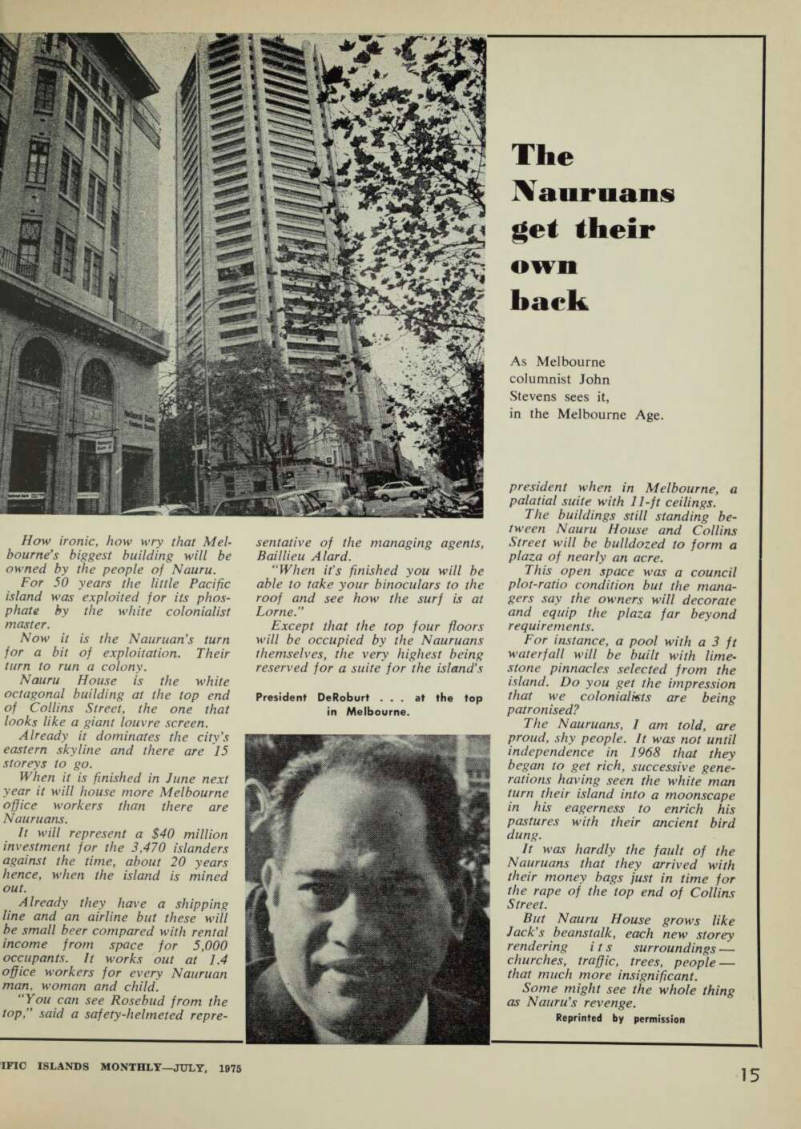
The Nauruans get their own bark
As Melbourne columnist John Stevens sees it, in the Melbourne Age.
How ironic, how wry that Mel bourne’s biggest building will be owned by the people of Nauru.
For 50 years the little Pacific island was exploited for its phos phate by the white colonialist master.
Now it is the Nauruan’s turn for a bit of exploitation. Their turn to run a colony.
Nauru House is the white octagonal building at the top end of Collins Street, the one that looks like a giant louvre screen.
Already it dominates the city’s eastern skyline and there are 15 storeys to go.
When it is finished in June next year it will house more Melbourne office workers than there are Nauruans.
It will represent a S4O million investment for the 3,470 islanders against the time, about 20 years hence, when the island is mined out.
Already they have a shipping line and an airline but these will be small beer compared with rental income from space for 5,000 occupants. It works out at 1.4 office workers for every Nauruan man , woman and child.
“You can see Rosebud from the top,” said a safety-helmeted repre
sentative of the managing agents, Bail lieu A lard.
“When it’s finished you will be able to take your binoculars to the roof and see how the surf is at Lome.”
Except that the top four floors will be occupied by the Nauruans themselves, the very highest being reserved for a suite for the island’s
president when in Melbourne, a palatial suite with 11-ft ceilings.
The buildings still standing be tween Nauru House and Collins Street will be bulldozed to form a plaza of nearly an acre.
This open space was a council plot-ratio condition but the mana gers say the owners will decorate and equip the plaza far beyond requirements.
For instance, a pool with a 3 ft waterfall will be built with lime stone pinnacles selected from the island. Do you get the impression that we colonialists are being patronised?
The Nauruans, I am told, are proud, shy people. It was not until independence in 1968 that they began to get rich, successive gene rations having seen the white man turn their island into a moonscape in his eagerness to enrich his pastures with their ancient bird dung.
It was hardly the fault of the Nauruans that they arrived with their money bags just in time for the rape of the top end of Collins Street.
But Nauru House grows like Jack’s beanstalk, each new storey rendering its surroundings churches, traffic, trees, people that much more insignificant.
Some might see the whole thing as Nauru’s revenge.
Reprinted by permission
President DeRoburt ... at the top in Melbourne.
Advertisements & other items, pp. 21-22 (2 items)
15
IFIC ISLANDS MONTHLY—JULY. 1975
sdfdfdf
melting pot
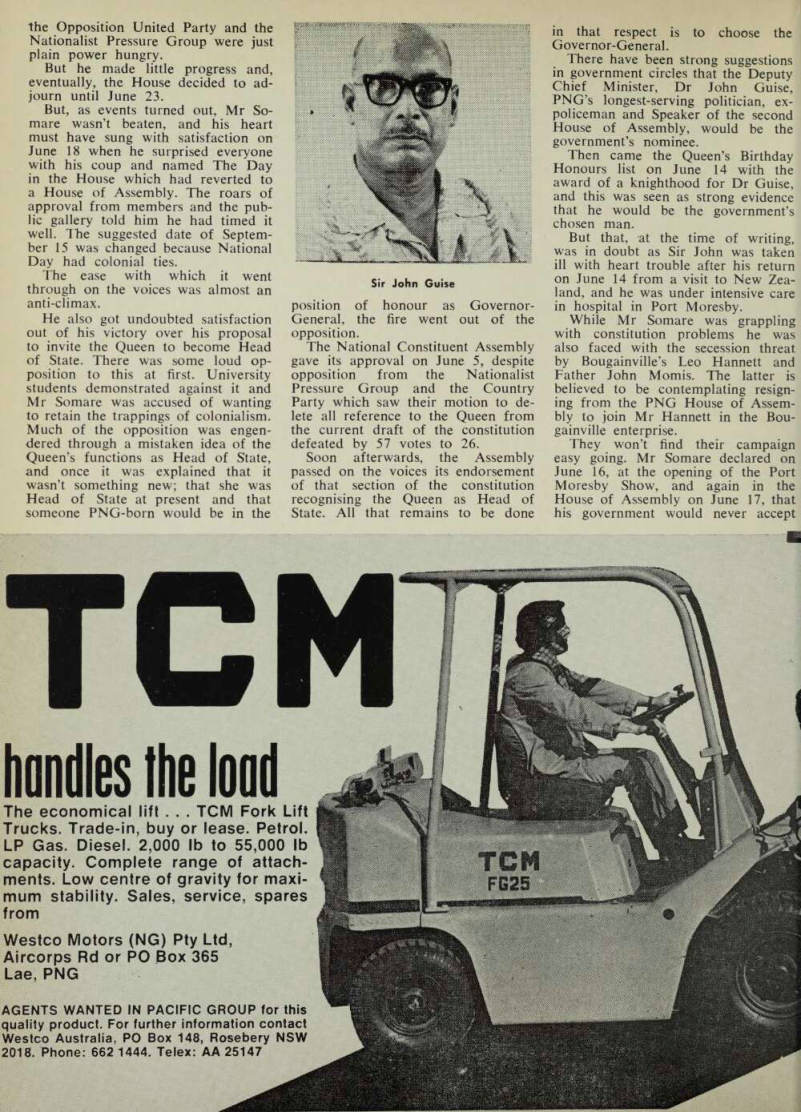
A real stew in PNG's melting pot
From a Port Moresby correspondent
Not since the Japanese invasion lave so many things been together in the melting pot in Papua New Guinea —Independence is coming, at ast, on September 16; Papua Besena, dthough not now as aggressive, is dill hankering for secession; there’s ?een a row over who should be Head )f State and, finally, some Bougain fille leaders have sworn to wrest in lependence for their copper island fom PNG’s central government.
The House of Assembly, bearing he label—for constitutional purposes —of the National Constituent Assem >ly, wrestled and wrangled over Minister Michael Somare’s pro tosal that the Queen should be in ited to become Head of State of ndependent PNG and also bogged lown several times over the few re naming clauses in the constitution.
Opposition members said they /anted more time to consider the lauses and Mr Somare, still hoping a get his heart’s desire of indepen ence in September, and believing here was a plot to hold it up, asked ae House, “Can’t we trust each ther any more?”
He was fighting against proposals d adjourn the constitution debate 11 later in June. He managed to lake some progress. The Constituent Lssembly approved the preamble and Production early in June but didn’t et much further.
There were many angry exchanges nd a few choice phrases such as the utburst from Nationalist Pressure Iroup leader John Kaputin, who filed against delays in deciding con itutional issues with, “Why this de iy? Just because someone did not iclude some stupid bloody point in le motion”.
Mr Somare wasn’t far behind. In reference to Opposition leader Tei bal’s complaints that they weren’t sing given enough time to consider le constitutional proposals, the hief Minister accused “half-baked lack politicians, who lived like white lillionaires” of trying to delay in spendence and destroy the govern ient. It was obvious, he said, that
the Opposition United Party and the Nationalist Pressure Group were just plain power hungry.
But he made little progress and, eventually, the House decided to ad journ until June 23.
But, as events turned out, Mr So mare wasn’t beaten, and his heart must have sung with satisfaction on June 18 when he surprised everyone with his coup and named The Day in the House which had reverted to a House of Assembly. The roars of approval from members and the pub lic gallery told him he had timed it well. The suggested date of Septem ber 15 was changed because National Day had colonial ties.
The ease with which it went through on the voices was almost an anti-climax.
He also got undoubted satisfaction out of his victory over his proposal to invite the Queen to become Head of State. There was some loud op position to this at first. University students demonstrated against it and Mr Somare was accused of wanting to retain the trappings of colonialism.
Much of the opposition was engen dered through a mistaken idea of the Queen’s functions as Head of State, and once it was explained that it wasn’t something new; that she was Head of State at present and that someone PNG-born would be in the
position of honour as Governor- General, the fire went out of the opposition.
The National Constituent Assembly gave its approval on June 5, despite opposition from the Nationalist Pressure Group and the Country Party which saw their motion to de lete all reference to the Queen from the current draft of the constitution defeated by 57 votes to 26.
Soon afterwards, the Assembly passed on the voices its endorsement of that section of the constitution recognising the Queen as Head of State. All that remains to be done
in that respect is to choose the Governor-General.
There have been strong suggestions in government circles that the Deputy Chief Minister, Dr John Guise, PNG’s longest-serving politician, ex policeman and Speaker of the second House of Assembly, would be the government’s nominee.
Then came the Queen’s Birthday Honours list on June 14 with the award of a knighthood for Dr Guise, and this was seen as strong evidence that he would be the government’s chosen man.
But that, at the time of writing, was in doubt as Sir John was taken ill with heart trouble after his return on June 14 from a visit to New Zea land, and he was under intensive care in hospital in Port Moresby.
While Mr Somare was grappling with constitution problems he was also faced with the secession threat by Bougainville’s Leo Hannett and Father John Momis. The latter is believed to be contemplating resign ing from the PNG House of Assem bly to join Mr Hannett in the Bou gainville enterprise.
They won’t find their campaign easy going. Mr Somare declared on June 16, at the opening of the Port Moresby Show, and again in the House of Assembly on June 17, that his government would never accept
Sir John Guise
the Bougainville secession threat seriously because it was a threat to the peace, stability and well-being of the whole country. It was essential, he said, that all the people of PNG should stand together.
About the same time, there were signs of increasing opposition to the secession threat from Bougainvilleans themselves who have accused the secessionists of being power-hungry.
Mr Simon Kariup, president of the Buka Local Government Council, who was a member of the Bougain ville negotiating team in abortive talks in Port Moresby about the island’s future, wrote to the Chief Minister on behalf of the people of north Bougainville saying the island should remain part of PNG.
Mr Somare made a further state ment in the House of Assembly when ne told members there had been a breakdown in communications be ween his department and Bougain ville Provincial Government execu tes. He had not been aware that heir representatives wanted to talk ibout secession rather than about a vorks programme when they met in 3 ort Moresby.
The Bougainville representatives lad said that secession was a non legotiable issue, but there had been io direct communication with him.
“National unity is also non
negotiable”, Mr Somare told the House. “National unity is something no individual or group can violate or be allowed to discard or destroy just because it suits an unprincipled, unselfish political desire”.
Mr Somare also explained that it had been decided that all royalties on copper from Bougainville would go, after June 30, to the Bougainville Provincial Government for it to spend according to its own priorities, although it could still negotiate an annual capital works programme with the central government.
Mr Somare added that he had in vited Bougainville regional member Mr Hannett to a meeting after the central government’s offer of a K 1.3 million programme for Bougainville had been rejected. Bougainville Pro vincial Government had asked for K 5.3 million. Mr Hannett did not attend the meeting.
Meanwhile, land is also coming back into the news. Plans to develop Wuvulu Island off the New Guinea north coast appear to have faded with a decision announced in the middle of June by the PNG Govern ment to resume land on the island, which had been bought by a group of developers, and hand it back to the islanders, who are Micronesians.
The proposal to develop the island and sell off half-acre blocks at $5,000
to $B,OOO was extensively promoted.
Film actor William Holden, who was one of 40 who had bought blocks, was in Papua New Guinea in June to try to salvage something from a plan to set up a sanctuary for wild life. With him was Sydney solicitor, Mr Colin Helliar, a director of Wuvulu Holdings, of Sydney, who was a driving force in the develop ment scheme.
They flew to Wuvulu to inspect improvements. Mr Helliar said he would ask the PNG Government for $1.5 million compensation.
Advertisements & other items, pp. 23-25 (2 items)
17
ICIFIC ISLANDS MONTHLY—JULY, 1975
Successful Career
QUALIFY FOR A
IN BUSINESS AND THE PROFESSIONS
375,000 EXAM SUCCESSES
Whichever you want - rapid promotion in your present job, a bigger opportunity with another company or an independent career of your own - a
Metropolitan College home study
training, direct from the U.K., is the shortest route to your goal. A fast, world-wide airmail service brings expert tuition direct to your home and we guarantee coaching until successful. Find out how you can reap high rewards in money and prestige.
Get the facts now, by sending for your free copy of 'GUIDE TO
CAREERS'.
Accountancy Costing • Company Sec.
Pitmanscript Law • Banking Marketing Hotel Et Catering Insurance • Export Commerce External Degrees of London University: (B.Sc.Econ. LL.B.) Royal Society of Arts London Chamber of Commerce Cambridge Overseas Certificate GCE 'O' 0- A' Level over 8,000 Successes To The Prinicipal B. Mendes, B.Sc. Econ., F.C.A..
METROPOLITAN COLLEGE, DEPT. WTBI
ALDERMASTON COURT, READING, RG74PW, ENGLAND
Accredited by the Council for the Accreditation of Correspondence Colleges
POST COUPON NOW FOR FREE GUIDE
Metropolitan 3
College
NAME
BLOCK CAPITALS
ADDRESS
. METROPOLITAN COLLEGE,
\J3EPT. WTBI ALDERMASTON COURT. READING. RG7 4PW, ENGLAND^
handles the load
The economical lift . . . TCM Fork Lift Trucks. Trade-in, buy or lease. Petrol.
LP Gas. Diesel. 2,000 lb to 55,000 lb capacity. Complete range of attachments. Low centre of gravity for maximum stability. Sales, service, spares from Westco Motors (NG) Pty Ltd, Aircorps Rd or PO Box 365 Lae, PNG AGENTS WANTED IN PACIFIC GROUP for this quality product. For further information contact Westco Australia, PO Box 148, Rosebery NSW 2018. Phone: 662 1444. Telex: AA 25147
TCM
FB2S
PUNCTUREPROOF
AICHI tyres. Ride like pneumatics, but absolutely impossible to deflate, because they’re solid rubber with inbuilt cushioning. Long lasting. Extremely reliable. Full range of sizes to suit all brands of forklifts. No luqqinq required. AICHI TYRES from ...
Westco Motors (NG) Pty Ltd,
Aircorps Rd or PO Box 365, Lae, PNG AGENTS WANTED IN PACIFIC GROUP for this quality product. For further information contact Westco Australia, PO Box 148, Rosebery NSW 2018. Phone- 6621444 Telex: AA25147. © 11150
Marianas' Yes
The people of the Marianas are 76 per cent in favour of common wealth status with the United States.
This means they will almost certainly become US citizens. A plebiscite on the future status of the islands was held on June 17. Pre-plebiscite opin ion was that there would be a “yes” vote. It is now up to the US Con gress, which could reject it but won’t.
Next in the agenda is the referen dum by the people of Micronesia on July 12 on the next move to be made in the negotiations with the US over future political status. Whatever the result, America has indicated that the trusteeship will be terminated simultaneously in all six districts.
extracts colonial glue'
A sticky time as Mamaloni extracts colonial glue'
From a Honiara correspondent
Already in Honiara complaints are growing of decreasing efficiency in the public service while expatriate public servants are being skimmed off at upper and upper-middle levels, with the aid of a compensation scheme approved in the UK.
Chief Minister Mamaloni is en gaged on something of a crash Solomonising of the service, to get the emerging country’s priorities right, he says.
He has said publicly that he is de termined to get rid of some deadwood and replace them with his own people, while also saying the Solo mens needed and welcomed ex patriate assistance in some fields for many years to come. ‘But it must be reduced to a level which does not get in the way of our national objectives,” he has said.
A compensation scheme at present gives some expatriate civil servants the option to take a lump sum or upgraded pension and go if they want to, if they are superseded by Solomon Islanders.
If enough don’t go—usually people the government wants to move don’t go willingly—a compulsory compen sation scheme will follow inevitably.
Standards of efficiency—or perhaps the definition of efficiency—are changing through lack of protection they received under the colonial sys tem which never let a Solomon Islander near the top, and even, for years, required dozens of Fijians to maintain numbers in the trades.
The danger in the process of deter mined localisation is that much accu mulated experience is being sent over the waves with its pockets full of pension or gratuity. The unhappy shrugs of many expatriates remaining testify to new problems in govern ment as a result.
But Mr Mamaloni’s warning about expatriates and his actions to subvert their entrenched powers are needed to make the quick changes he sees are necessary.
It has been necessary to extract the colonial glue—the people and their “old boy” network, and their devious ness developed around the rules of government procedure—to pull apart the system and build a new one based on sometimes radicallv riifferent think ing of the Council of Ministers.
The Chief Minister has reaffirmed his government’s intention to carry
on as he began with what is now be ing called the National Development Plan during the next four years.
He has dubbed it the 3-D Plan, de centralisation of government to strengthened local government coun cils, distribution of development to all island groups and involvement of more Solomon Islanders in business, and decolonisation.
All these aims, co-incidentally, have been very close to Mr Mamaloni’s heart for years.
He has spoken repeatedly of being only a leader of a team of politicians, of governing by concensus, in build ing a Solomon Islands nation using traditional Solomon Islands concensus methods.
Nevertheless, the demonstrated weaknesses of some of his ministerial colleagues and his own personal de termination to see certain things done are giving the 3-D Plan his personal stamp, however much others are in volved in its detailed planning and implementation.
Mr Mamaloni comes from the once remote and long-neglected Eastern District; he worked in his governing council days in the early 1970 s as an assistant council clerk because of his desire to improve government at grass roots; and he is known to have deep personal feelings about the frustrations he and others felt in the old, expatriate-dominated public service.
Though anxious to appear a demo cratic leader, Mr Mamaloni has no equally strong-willed men near him (they are all in the opposition).
He appears to be finding himself more in the role of the “big man” that, he says, he tries to avoid being. • A finance minister was to be one of two new ministers appointed in the Solomon Islands about the end of June. The Chief Minister, Mr Solomon Mamaloni, said the new ap pointments, and the name, Solomon Islands, to replace British Solomon Islands Protectorate, had been ap proved by the Queen in Council.
Along with other political advances, the Solomon Islands should be self governing by November , and at the latest by December 31. A constitu tional committee will be appointed in August to make recommendations for an independence constitution.
Advertisements & other items, p. 26 (1 item)
Caravel
The Book
Sensation
of the
Pacific
THE
LOST
CARAVEL
by Robert Langdon
Was a group of 16th century shipwrecked Spanish sailors responsible for the legendary Polynesian canoe-building and navigation skills?
This and many equally startling questions are answered in Robert Langdon’s important new book, THE LOST CARA- VEL, which shatters many traditionally-held views on the origin of the Polynesians. Mr Langdon contends that the crew of the Spanish caravel San Lesmes, shipwrecked east of Tahiti in 1526 en route for the East Indies, survived and established themselves in Polynesian society, forming dynasties that lasted down to Captain Cook’s time.
PRICE: Australia, $14.50 Aust. plus $1.20 posted; Pacific Islands and Overseas, $14.50 Aust. plus SI.7C posted; USA, $20.00 US plus S2.OC US posted.
Fill in the details
on the attached
order form
The Mailbag
Understanding
Polynesians
Under the heading “Understanding Polynesians” in the Editor’s Mailbag (PIM, May, p 29) one of your cor respondents takes Margaret Lee of the NZ Vocational Training Council to task for being “racist and discrimi natory”.
Your correspondent obviously did not understand the full implication of what the booklet Understanding Polynesians tried to do. I did not read the article in PIM and there fore cannot judge whether your cor respondent had justification for his rather lengthy, often confused and frequently off the track outburst about the article. However, I would like to set the record straight about what Understanding Polynesians was all about and its follow-ups Under standing Samoans (later Tongans, etc, are to be brought out in a similar booklet) by sending you a copy of jach, I am also enclosing a report of a >eminar which I attended on Under standing Samoans, at which this booklet was first published.
In NZ we have a truly multi-racial society. I will not argue with those who maintain that coloureds in NZ are treated as inferiors, given little opportunity for advancement and so on —the points of argument are too well-known and have been refuted oo often to need repeating here.
The fact of the matter is that :here is a very large amount of good will in NZ towards people of all aces, no matter what their origin.
Phis manifests itself in large num bers of people involving themselves n the welfare of people of races other than European.
From the government downwards oeople have, in recent years, become nore aware of their social responsi oilities towards those not so used to our way of life. The active steps aken to realistically face the many oroblems associated with non- Europeans in NZ industry are, in oart, found in the seminars organised )y the Vocational Training Council, he Employers Federation and the various societies looking after immi grants from the different parts of the Pacific.
The seminars are attended by in
terested people from mainly the in dustrial sector, personnel officers, supervisors, managers, foremen and others in daily contact with people who, because of their different back ground, are liable to what Alwyn Toffler calls culture-shock. The booklets attempt to summarise briefly what the seminars discuss and act as a basis only of understanding the dif ferent cultures that exist in our labour force. They are directed at people who are normally not very great readers, who have never in their life heard of Margaret Mead, or Homans, or any of the many sociologists and anthropologists who could have told them in depth what the cultural differences between Pacific Islands people are.
However, cultural differences do exist irrespective of the opinion of your correspondent from Honiara and they are real and important enough to cause problems when they appear in NZ industry.
With regard to Musu, I must admit, as a personnel officer I have never come across it myself, nor do I think that it is as prevalent as some might make it out to be. What is a fact is that many Island people leave after only a short time in our factory, mainly men. I suspect that musu may have played its part in this turnover since it involves the difficult early adjustment period in a new job.
The way to get around this prob lem is not to attack a small part of a big problem as your Honiara cor respondent has done, but by patiently educating both management and employees be they brown or white or any other colour by way of lectures, seminars, training within industry and publications such as Understanding Polynesians.
“Whanga”.
Wellington (NZ).
P.S.: I apologise for the use of a nom-de-plume, but my involvement in the employment situation of a large company makes this necessary. • The booklets referred to in Whanga’s letter are being sent to Mr Tema, who may be interested to learn that a special series is being prepared on Understanding Euro peans to help Polynesians to under stand the European way of life, language and customs.
Apolosi—'More
Than A Man'
I read the article by Vijendra Kumar (PIM, April, p 16) and felt the least I could do is to correct a few of the many inaccuracies con cerning Apolosi Ranawai whom he had made the central figure of the article.
Apolosi Ranawai, known by all as Apolosi not Ranawai, did not belong to Narewa, near Nadi. His father was of Nawaka Village, Nadi, and his mother belonged to Malevu Village, Naviti Island, Yasawa Group.
The movement Apolosi began was not unlike the “cargo cults” of other Melanesian groups. He hood winked the Fijians but only in the western districts which have a lot of differences from the rest of Fiji and whose people use a different group of languages. Apolosi deprived them of their savings, if any, and exploited them in every way to pro mote his phoney co-operative scheme.
His “gift of the gab” led his fol lowers to believe he had divine gifts.
Of Apolosi I have heard them say, “He was more than a man”.
For the protection of the Fijian people, Apolosi was given 10 years’ exile in Rotuma where he lived in luxury on the money collected for him and sent to him by his followers.
The government stopped this money and then it was channelled to him by a part-Rotuman in Fiji who sent it to his mother in Rotuma who passed it on to Apolosi with, of course, commission to both co operators.
Apolosi’s sexual prowess was some thing that is still marvelled at even to this day. He did not have just a dozen “wives” as Kumar referred to them. He usually had about a dozen young teenage girls sleeping with him at a time but the total number over the years would run into several hundreds. Fathers were honoured to have their daughters accepted into Apolosi’s current harem. Even in Rotuma he had at least a dozen concubines according to a friend of mine who was employed by Burns Philp’s branch in Rotuma and who used to visit Apolosi quite often.
At no time was Apolosi ever exiled to Yasawa, let alone a remote island there as Kumar stated. Yasawa was
Advertisements & other items, pp. 28-30 (1 item)
stick it, fill it, coat it,
Repco Woodhill will
dissolve it
or clean it in the tropics
HdflWITWn PRODUCTS
fcaniilffll i ill CO \Q\
or anywhere else
The best of Australian and American technology has combined to bring you these top quality Handyman products by Repco Woodhill. A versatile range of adhesives, body fillers, metal protective coatings and rust dissolving chemicals for general handyman applications.
• RUST DISSOLVER JELLY
• ALUMINIUM CLEANER
• E-POX-E RIBBON General purpose adhesive filler
• E-POX-E RESIN GLUES
• AUTO BODY FILLER
• AUTO BODY UNDERSEALER Sound
deadener and Rust Preventive • FORMULA 4 De watering Fluid, Lubricant and Rust Preventive
• MUFFLER BANDAGE
• MUFFLER PUTTY
• EXHAUST JOINT SEALER
Repco Woodhill continues to develop exciting new products. Don’t forget to post the coupon now for full details of the complete Repco Woodhill handyman range. >
Moocflll.ll
For further information on Repco Woodhill products post coupon to: Repco Woodhill Chemicals Pty. Ltd., 176 Canterbury Road, Bayswater, Victoria 3153, Aust.
NAME
ADDRESS
• PERMATEX Range of Gasket Sealants WITH REPCO WOODHILL IT’S AS GOOD AS FIXED
Caterpillar reliability, productivity, availability. Now you can get it all in a wheel skidder. The 518.
A whole new standard in skidder engineering. 120 turbocharged horsepower, 20,400 pounds of working muscle with full articulation and frame oscillation for stability and minimum maintenance.
Single lever “on the go” powershift. Dual rate steering for controlled response at all speeds. An operator’s compartment engineered for efficiency with safety features built in for man and machine.
You ; ll find all the best skidder ideas, plus added refinement and top quality manufacturing that can make the 518 the backbone of your logging operation.
And South-West Pacific Caterpillar dealers will ensure that your backbone stays in top condition no matter how far in the bush you are.
Parts, maintenance, repairs or simple information—we’ll see that you get it fast.
So tackle the jungle with the new Cat 518.
Caterpillar Dealers in South-West Pacific.
HD929
Letters
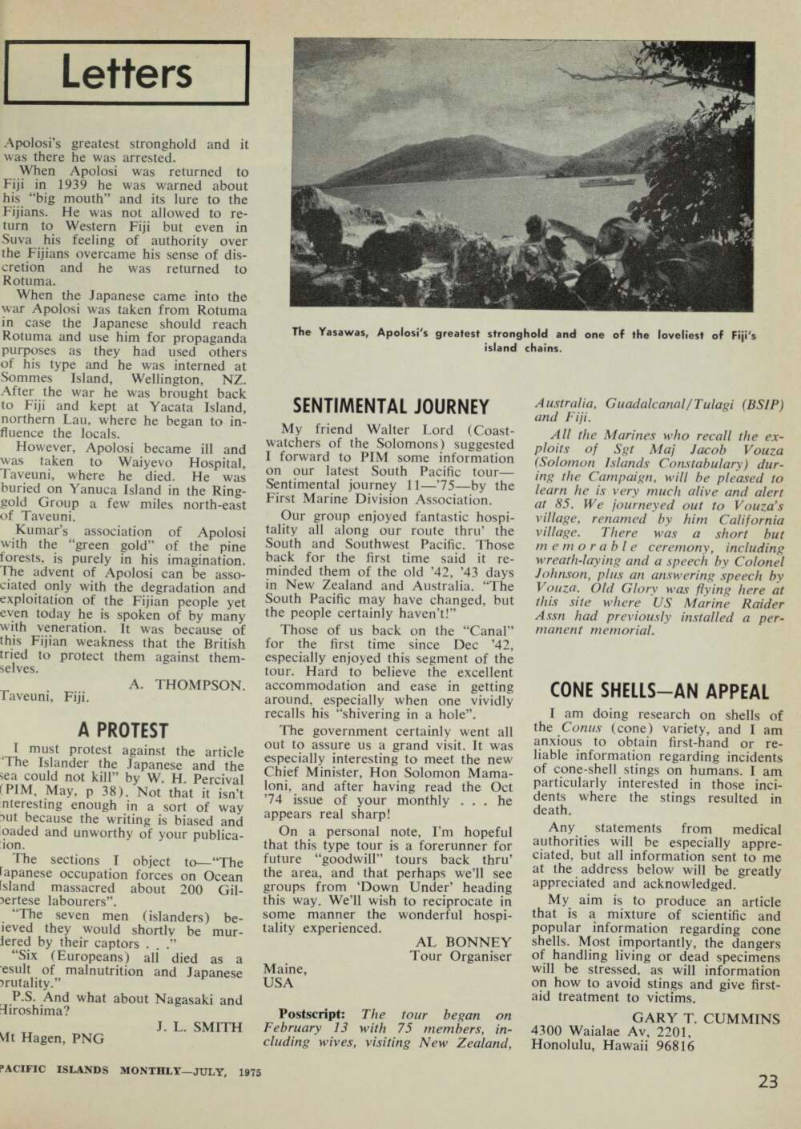
Apolosi’s greatest stronghold and it was there he was arrested.
When Apolosi was returned to Fiji in 1939 he was warned about his “big mouth” and its lure to the Fijians. He was not allowed to re turn to Western Fiji but even in Suva his feeling of authority over the Fijians overcame his sense of dis cretion and he was returned to Rotuma.
When the Japanese came into the war Apolosi was taken from Rotuma in case the Japanese should reach Rotuma and use him for propaganda purposes as they had used others of his type and he was interned at Sommes Island, Wellington, NZ.
After the war he was brought back to Fiji and kept at Yacata Island, northern Lau, where he began to in fluence the locals.
However, Apolosi became ill and was taken to Waiyevo Hospital, Taveuni, where he died. He was buried on Yanuca Island in the Ring gold Group a few miles north-east of Taveuni.
Kumar’s association of Apolosi with the “green gold” of the pine forests, is purely in his imagination.
The advent of Apolosi can be asso ciated only with the degradation and exploitation of the Fijian people yet even today he is spoken of by many with veneration. It was because of this Fijian weakness that the British tried to protect them against them selves.
A. Thompson.
Taveuni, Fiji.
A Protest
I must protest against the article ‘The Islander the Japanese and the sea could not kill” by W. H. Percival (PIM, May, p 38). Not that it isn’t nteresting enough in a sort of way 3Ut because the writing is biased and oaded and unworthy of your publica ion.
The sections I object to—“ The Japanese occupation forces on Ocean fsland massacred about 200 Gil- Tertese labourers”.
“The seven men (islanders) be icved they would shortly be mur lered by their captors . . .”
“Six (Europeans) ali died as a esult of malnutrition and Japanese brutality.”
P.S. And what about Nagasaki and Hiroshima?
J. L. Smith
Vft Hagen, PNG
Sentimental Journey
My friend Walter Lord (Coast watchers of the Solomons) suggested 1 forward to PIM some information on our latest South Pacific tour — Sentimental journey 11—’75—by the First Marine Division Association.
Our group enjoyed fantastic hospi tality all along our route thru’ the South and Southwest Pacific. Those back for the first time said it re minded them of the old ’42, ’43 days in New Zealand and Australia. “The South Pacific may have changed, but the people certainly haven’t!”
Those of us back on the “Canal” for the first time since Dec ’42, especially enjoyed this segment of the tour. Hard to believe the excellent accommodation and ease in getting around, especially when one vividly recalls his “shivering in a hole”.
The government certainly went all out to assure us a grand visit. It was especially interesting to meet the new Chief Minister, Hon Solomon Mama loni, and after having read the Oct ’74 issue of your monthly ... he appears real sharp!
On a personal note, Tm hopeful that this type tour is a forerunner for future “goodwill” tours back thru’ the area, and that perhaps we’ll see groups from ‘Down Under’ heading this way. We’ll wish to reciprocate in some manner the wonderful hospi tality experienced.
Al Bonney
Tour Organiser Maine,
Usa
Postscript: The tour began on February 13 with 75 members, in cluding wives, visiting New Zealand,
Australia, Guadalcanal/Tulagi (BS1P) and Fiji.
All the Marines who recall the ex ploits of Sgt Maj Jacob Vouza (Solomon Islands Constabulary) dur ing the Campaign, will be pleased to learn he is very much alive and alert at 85. We journeyed out to Vouza’s village, renamed by him California village. There was a short but memorable ceremony, including wreath-laying and a speech by Colonel Johnson, plus an answering speech by Vouza. Old Glory was flying here at this site where US Marine Raider Assn had previously installed a per manent memorial.
Cone Shells-An Appeal
I am doing research on shells of the Conus (cone) variety, and I am anxious to obtain first-hand or re liable information regarding incidents of cone-shell stings on humans. I am particularly interested in those inci dents where the stings resulted in death.
Any statements from medical authorities will be especially appre ciated, but all information sent to me at the address below will be greatly appreciated and acknowledged.
My aim is to produce an article that is a mixture of scientific and popular information regarding cone shells. Most importantly, the dangers of handling living or dead specimens will be stressed, as will information on how to avoid stings and give first aid treatment to victims.
Gary T. Cummins
4300 Waialae Av, 2201, Honolulu, Hawaii 96816
The Yasawas, Apolosi's greatest stronghold and one of the loveliest of Fiji's island chains.
Tropicalities
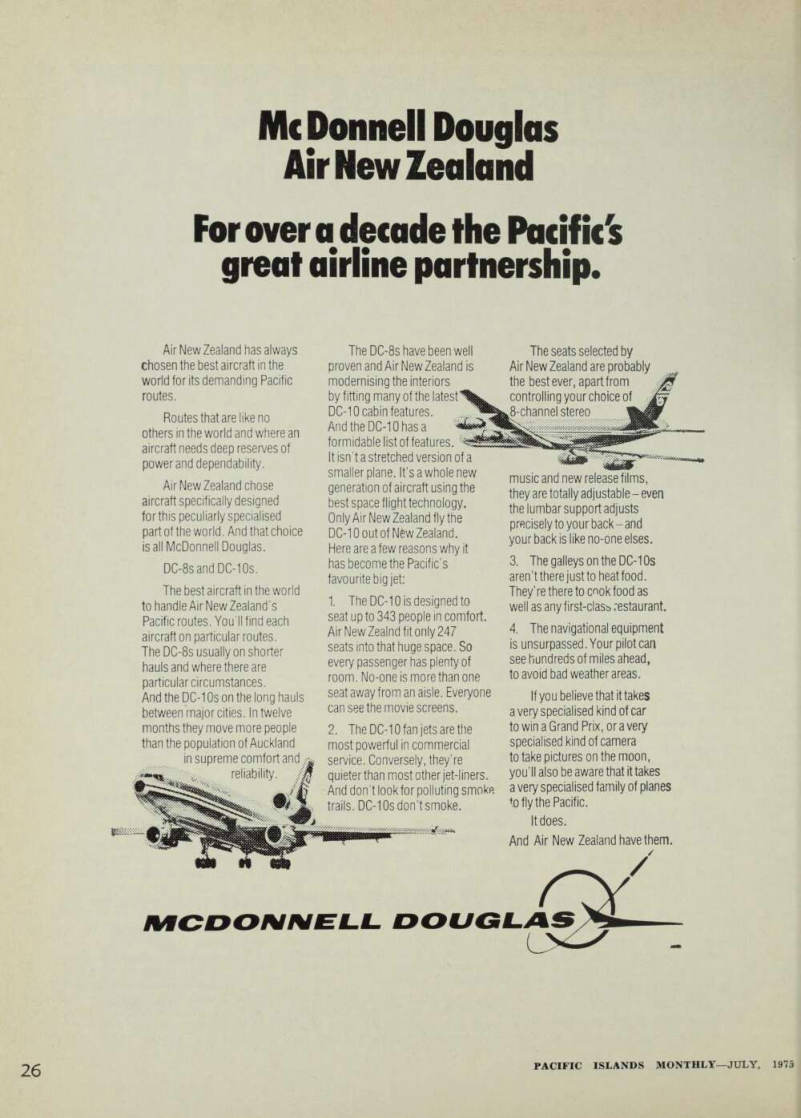
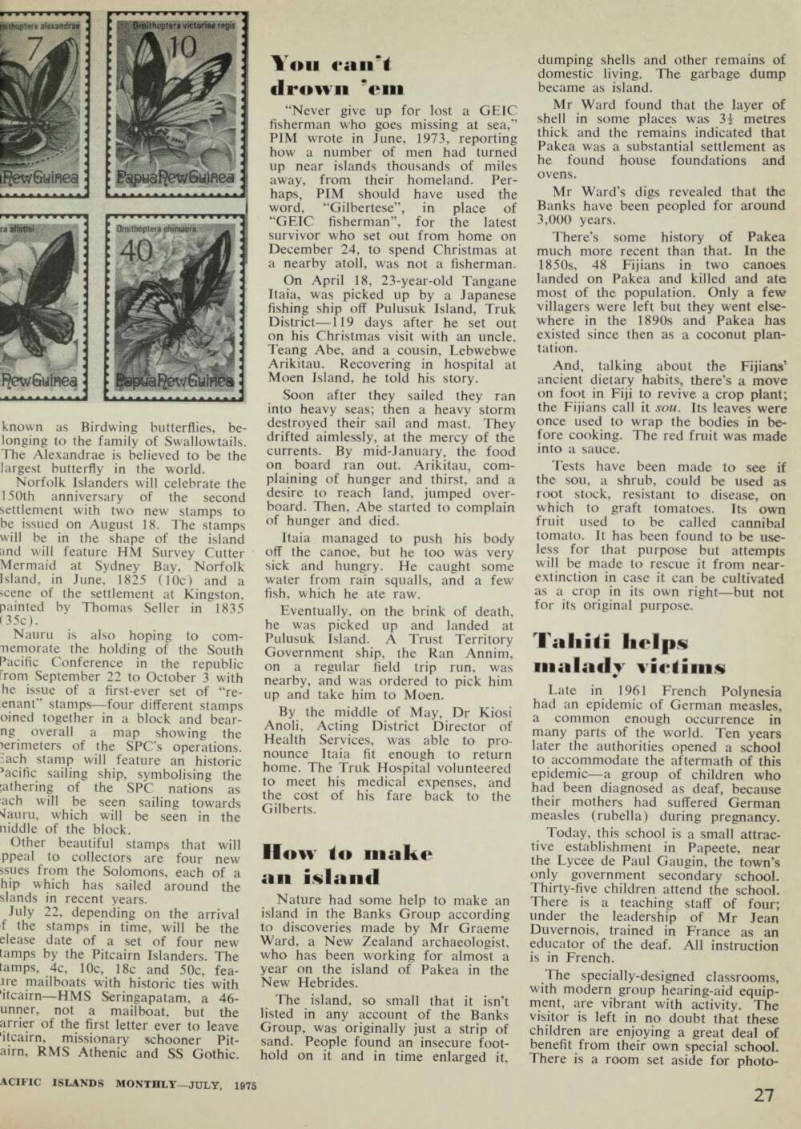

Ufos over
Elarotonga
Two strange flying objects were sighted near the Arorangi district of Rarotonga early on April 24 by Mr Rena Jonassen and his wife who were at their home in Vaiokura, They watched the phenomenon for about m hour, writes Don Percival.
At first, they saw an object of a ahosphorescent sea-blue colour, either foating on the ocean or hovering just above the surface. It was a clear noonlit night and the sea was very :alm.
After about 30 minutes it was oined by a second one. Later, they ook off together and flew out to sea, Jimbing rapidly. As they flew away heir blue light changed to a very jowerful, bright white and they apidly diminished in size.
Between 7.30 and 7.40 pm on darch 3, two members of the Raro onga Golf Club Bill Quinn and .arry Price watched an unidentified lying object pass over the clubhouse nd disappear over Black Rock [uarry and towards Arorangi, They aw it emerge from a bank of black loud and, as it passed over them, the jound around the clubhouse was rightly illuminated by the object’s ights. It appeared to be at a very 3w altitude, and seemed to have a evolving circle of lights and long ail like a comet.
But it was in controlled flight and in view for about 25 seconds.
Whatever it was, it was certainly ot a meteorological balloon, al fough it had appeared from the irection of Rarotonga Airport.
Taese balloons are released twice aily, at 12 noon or 12.30 pm and t 12 midnight. The night balloons re illuminated by a small, low owered electric battery—and they on’t fly on straight and level courses.
Io balloon had been released by the let. station that night between 7.30 nd 7.40.
The first reported sighting of flying aucers over Rarotonga was made to
me by my son William, aged 15.
About 7 pm on December 4, last year William and four other boys were walking through Te Puka village which is adjacent to the airport. The sun was sinking and the evening shadows were closing in.
All the boys saw four flying ob jects emerge from a bank of black cloud to the north; circular in shape and flying in line abreast. They flew in a straight line for several seconds and each had a revolving circle of blue-green lights underneath. Then they flew into an area of blue sky.
About six seconds later the objects broke formation and shot upwards in different directions and at fantastic speeds. They left two trails of white vapour—or something that looked like it, in their wake.
On January 21, William was about to go to bed in his home in Te Puka village. He was looking through the window at the stars around midnight.
The sky was bright and clear. He saw one of the “stars” suddenly move towards the mountains, zig zagging through the air as if out of control. It was orange-coloured. Sud denly, the light changed to sparkling white, then back to orange, then sparkling white again.
When it neared the mountain it climbed, and then became stationary.
After a while William gave up watch ing it and went to bed.
PXG wants; a
national costume
Does Papua New Guinea have a “national costume”?
Port Moresby YWCA intends to find out. It has opened a national costume competition, seeking entries from villagers as well as city resi dents, with KlOO first prize in male and female sections.
On a recent overseas trip, YWCA president Mrs Nerrie Tololo could only describe a variety of traditional dress fashions when asked if PNG had a national costume.
These fashions include, for women, a lap-lap and meri blouse, tapa cloth and bare top, grass skirts and beads, or mini-skirts or frocks for city resi
dents. Men wear either the shorts and shirt combination introduced by expatriates, tapa cloth or cotton lap laps and beads, or a lap-lap and Afro shirt.
Chief Minister Mr Michael Somare and some of his ministers prefer a sulu (Melanesian style lap-lap) and Afro shirt.
Final judging of entries will be at a rnuvii at Konedobu Cultural Centre, Port Moresby, early in August.
Chairman of the judging panel is Minister for Culture and Recreation, Mr Moses Sasakila.
]V« licences for
Solomons* harlots
Licensing of prostitutes in the Solomon Islands is out, unless pre sent circumstances change, and it is what the people want.
The BSIP Attorney-General, Mr G. Nazareth, said in the Legislative Assembly recently the government had no plans to license prostitution.
Prostitution itself was not an offence, but living off immoral earnings and similar activities were offences. The government was aware there was a certain amount of prostitution in the Solomons.
Mr Nazareth’s remarks were in reply to a question by Mr Moffat Bonunga, who had asked whether the government would consider legalising the oldest profession.
Some lieaudes
foe albums
Papua New Guinea is earning a. reputation among stamp collectors for the very attractive stamps which have made their appearance in the last few years as a medium for cul tural expression or to underline the uniqueness and beauty of its flora and fauna.
Latest in the series is this set of four (over page) issued on June 11, featuring four protected butter flies found in Papua New Guinea and so much coveted by collectors that it is now an offence to kill, collect or export them. They are
known as Birdwing butterflies, be longing to the family of Swallowtails.
The Alexandrae is believed to be the largest butterfly in the world.
Norfolk Islanders will celebrate the 150th anniversary of the second settlement with two new stamps to be issued on August 18. The stamps will be in the shape of the island and will feature HM Survey Cutter Mermaid at Sydney Bay, Norfolk Island, in June, 1825 (10c) and a >cene of the settlement at Kingston, painted by Thomas Seller in 1835 (35c).
Nauru is also hoping to com memorate the holding of the South Pacific Conference in the republic from September 22 to October 3 with he issue of a first-ever set of “re enant” stamps—four different stamps oined together in a block and bear ng overall a map showing the perimeters of the SPC’s operations, stamp will feature an historic J acific sailing ship, symbolising the lathering of the SPC nations as ach will be seen sailing towards "Jauru, which will be seen in the niddle of the block.
Other beautiful stamps that will ppeal to collectors are four new ssues from the Solomons, each of a hip which has sailed around the slands in recent years.
July 22, depending on the arrival f the stamps in time, will be the elease date of a set of four new tamps by the Pitcairn Islanders. The tamps, 4c, 10c, 18c and 50c, fea ire mailboats with historic ties with 'itcairn —HMS Seringapatam, a 46unner, not a mailboat, but the arrier of the first letter ever to leave
'itcairn, missionary schooner Pit
airn, RMS Athenic and SS Gothic.
Voii eairt
drown ’em
“Never give up for lost a GEIC fisherman who goes missing at sea,”
PIM wrote in June, 1973, reporting how a number of men had turned up near islands thousands of miles away, from their homeland. Per haps, PIM should have used the word, “Gilbertese”, in place of “GEIC fisherman”, for the latest survivor who set out from home on December 24, to spend Christmas at a nearby atoll, was not a fisherman.
On April 18, 23-year-old Tangane Itaia, was picked up by a Japanese fishing ship off Pulusuk Island, Truk District—ll 9 days after he set out on his Christmas visit with an uncle, Teang Abe, and a cousin, Lebwebwe Arikitau. Recovering in hospital at Moen Island, he told his story.
Soon after they sailed they ran into heavy seas; then a heavy storm destroyed their sail and mast. They drifted aimlessly, at the mercy of the currents. By mid-January, the food on board ran out. Arikitau, com plaining of hunger and thirst, and a desire to reach land, jumped over board. Then, Abe started to complain of hunger and died.
Itaia managed to push his body off the canoe, but he too was very sick and hungry. He caught some water from rain squalls, and a few fish, which he ate raw.
Eventually, on the brink of death, he was picked up and landed at Pulusuk Island. A Trust Territory Government ship, the Ran Annim, on a regular field trip run, was nearby, and was ordered to pick him up and take him to Moen.
By the middle of May, Dr Kiosi Anoli, Acting District Director of Health Services, was able to pro nounce Itaia fit enough to return home. The Truk Hospital volunteered to meet his medical expenses, and the cost of his fare back to the Gilberts.
Hon io make
an island
Nature had some help to make an island in the Banks Group according to discoveries made by Mr Graeme Ward, a New Zealand archaeologist, who has been working for almost a year on the island of Pakea in the New Hebrides.
The island, so small that it isn’t listed in any account of the Banks Group, was originally just a strip of sand. People found an insecure foot hold on it and in time enlarged it,
dumping shells and other remains of domestic living. The garbage dump became as island.
Mr Ward found that the layer of shell in some places was 3\ metres thick and the remains indicated that Pakea was a substantial settlement as he found house foundations and ovens.
Mr Ward’s digs revealed that the Banks have been peopled for around 3,000 years.
There’s some history of Pakea much more recent than that. In the 1850 s, 48 Fijians in two canoes landed on Pakea and killed and ate most of the population. Only a few villagers were left but they went else where in the 1890 s and Pakea has existed since then as a coconut plan tation.
And, talking about the Fijians’ ancient dietary habits, there’s a move on foot in Fiji to revive a crop plant; the Fijians call it sou. Its leaves were once used to wrap the bodies in be fore cooking. The red fruit was made into a sauce.
Tests have been made to see if the sou, a shrub, could be used as root stock, resistant to disease, on which to graft tomatoes. Its own fruit used to be called cannibal tomato. It has been found to be use less for that purpose but attempts will be made to rescue it from near extinction in case it can be cultivated as a crop in its own right—but not for its original purpose.
Tahiti help*
inaladv victims
Late in 1961 French Polynesia had an epidemic of German measles, a common enough occurrence in many parts of the world. Ten years later the authorities opened a school to accommodate the aftermath of this epidemic—a group of children who had been diagnosed as deaf, because their mothers had suffered German measles (rubella) during pregnancy.
Today, this school is a small attrac tive establishment in Papeete, near the Lycee de Paul Gaugin, the town’s only government secondary school.
Thirty-five children attend the school.
There is a teaching staff of four; under the leadership of Mr Jean Duvernois, trained in France as an educator of the deaf. All instruction is in French.
The specially-designed classrooms, with modern group hearing-aid equip ment, are vibrant with activity. The visitor is left in no doubt that these children are enjoying a great deal of benefit from their own special school.
There is a room set aside for photo
graphy work, complete with dark room and the latest in photographic equipment. Next door is the girls’ craft room where they learn sewing.
Displayed recently were some of the fine pandanus hats and baskets they had made.
Just as impressive is the boys’ craft room where woodwork is taught, including wood-carving, Poly nesian style. Mr Duvemois is justifi ably proud of the work in this room which he personally supervises. On a trip to France last year he bought and freighted to Papeete some of the equipment for this room.
Four of these deaf children come from the neighbouring island of Moorea and two come from the more distant Tuamotus.
Apart from children whose deaf ness is caused by meningitis, a family history of deafness, or an undiag nosed cause, these children are all deaf because of maternal rubella.
Because it took 10 years before action was taken to educate them, they must try to condense their schooling into four short years. (In French Polynesia compulsory school attendance is from six to 14 years.) In this brief time they must learn the rudiments of the three Rs, a difficult process for any deaf child even when deafness is diagnosed and speech and language teaching and auditory training begun in the first year of life. Mr Duvemois is also rightly concerned with preparing them for life and work after they leave school, hence the stress laid on craft work. A lot to do in a short time and one can only wish them well, both teachers and children, and hope that such “pressure cooker” type education succeeds.
Cook's compass
that Hasn’t
PIM reported in Tropicalities in April that an unnamed collector had bought Captain Cook’s compass and sundial at an auction in New South Wales, paying $4,050 for it. The deal created a fuss in government circles, and the day before the sale it slapped a ban on the instrument’s export.
The buyer was more than satisfied with his purchase, saying that he would have given almost twice as much for it.
Now it turns out, that buyer and government were on the wrong track.
The compass isn’t a compass and, what’s more, it couldn’t possibly have belonged to Captain Cook, who, ac cording to much more reliable evi dence than that attached to the instrument at the sale, had been dead about 70 years when the thing was made.
Along with the instrument was a picture of Lord Kelvin, who was supposed to have received it from Captain Cook, and a card with faded handwriting saying that it once be longed to the great navigator.
The buyer, now identified as Mr W. J. Blundell, a Coogee (NSW) art collector, checked his purchase with the London Royal Society and the Maritime Museum at Greenwich.
The Royal Society pointed out that the maker, Pizzala, worked between 1838 and 1860. Captain Cook died in 1779. The Maritime Museum said is wasn’t even a compass. It was a sundial.
Tale of
a clog lag
When US Army Sergeant Pat Hayes lost his dog tag on Guadal canal in 1942, he gave it little thought. In fact, he did not think about it again till last April when he got it back after an unusual train of events.
Former US Navy man Dick McGehee, returning to the Solomons for a visit in January, 1975, to look at some of the old battlefields, saw a 12-year-old boy wearing the dog tag round his neck. The boy said he found it in bush on Guadalcanal.
McGehee induced the boy to part with it for 60c.
From the tag he was able to dis cover that it belonged to Patrick C.
Hayes, that Hayes had been drafted, his last tetanus shot was in 1942, he had B type blood and that he was a Catholic. The next-of-kin was listed as living in Cleveland. McGehee re garded the dog tag as a souvenir, but back home in the States, friends ad vised him to try to get in touch with the next-of-kin, as he considered Hayes was long dead.
Inquiries led to Evansville, and the discovery that Hayes was alive and well, and working for a plastics firm.
McGehee did not go to Evansville himself, but telephoned Hayes, then wrote to him and sent him the dog tag. Light-heartedly, he wrote, “Leave it to the Navy to pick up after the Army. Next time please ‘police the area’ before you move out. Forget the 60c you owe me.
It’s great to learn that Patrick C.
Hayes is alive and well and living in Evansville, Indiana”.
Hayes, in reply said he lost his dog tag the first time he was hurt.
“I don’t remember it too clearly,” he wrote. “I think I cut my chin on a ‘C’ ration can sliding into a fox hole. The army had a bunch of Purple Hearts made up and needed someone to give them to.”
Advertisements & other items, pp. 31-34 (3 items)
25
ACIFIC ISLANDS MONTHLY—JULY, 1975
Me Donnell Douglas
Air New Zealand
For over a decade the
great airline partnership.
Air New Zealand has always chosen the best aircraft in the world for its demanding Pacific routes.
Routes that are like no others in the world and where an aircraft needs deep reserves of power and dependability.
Air New Zealand chose aircraft specifically designed for this peculiarly specialised part of the world. And that choice is all McDonnell Douglas.
DC-8s and DC-1 Os.
The best aircraft in the world to handle Air New Zealand's Pacific routes. You’ll find each aircraft on particular routes.
The DC-8s usually on shorter hauls and where there are particular circumstances.
And the DC-1 Os on the long hauls between major cities. In twelve months they move more people than the population of Auckland in supreme comfort and - The DC-8s have been well proven and Air New Zealand is modernising the interiors by fitting many of the latest DC-10 cabin features.
And the DC-10 has a formidable list of features. % It isn’t a stretched version of a smaller plane. It’s a whole new generation of aircraft using the best space flight technology.
Only Air New Zealand fly the DC-10 out of Nfew Zealand.
Here are a few reasons why it has become the Pacific’s favourite big jet: 1. The DC-10 is designed to seat up to 343 people in comfort.
Air New Zealnd fit only 247 seats into that huge space. So every passenger has plenty of room. No-one is more than one seat away from an aisle. Everyone can see the movie screens. 2. The DC-10 fan jets are the most powerful in commercial service. Conversely, they’re quieterthan most other jet-liners.
And don’t lookfor polluting smoke trails. DC-1 Os don’t smoke.
The seats selected by Air New Zealand are probably the best ever, apart from controlling your choice of .8-channel stereo music and new release films, they are totally adjustable - even the lumbar support adjusts precisely to your back-and your back is like no-one elses. 3. The galleys on the DC-1 Os aren’t there just to heat food.
They’re there to cook food as well as any first-clasb restaurant. 4. The navigational equipment is unsurpassed. Your pilot can see hundreds of miles ahead, to avoid bad weather areas.
If you believe that it takes a very specialised kind of car to win a Grand Prix, ora very specialised kind of camera to take pictures on the moon, you’ll also be aware that it takes a very specialised family of planes to fly the Pacific.
It does.
And Air New Zealand have them. /
MCD O/V/Vl
anywhere,
any time,
any gas
--**••- «:’** • 4^'* ■-1 ■■*'s''&■'■' & |7#>* For further information & addresses of your local distributor contact:
THE COMMONWEALTH
INDUSTRIAL GASES LIMITED
Gases Export Department, 138 Bourke Road, Alexandria, N.S.W., Australia 2015.
Cables ‘CIGAS’-Telex 20241 Sydney. 017.0308
27
ACIFIC ISLANDS MONTHLY—JULY, 1975
Officialdom's
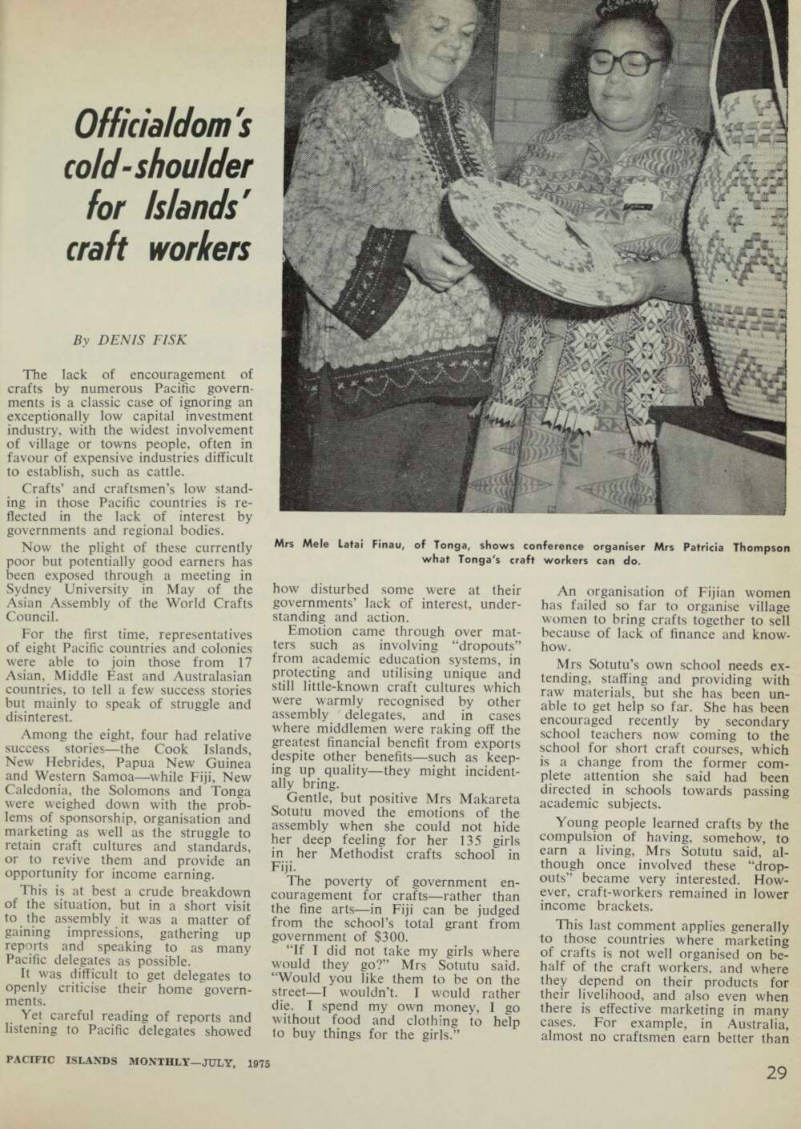
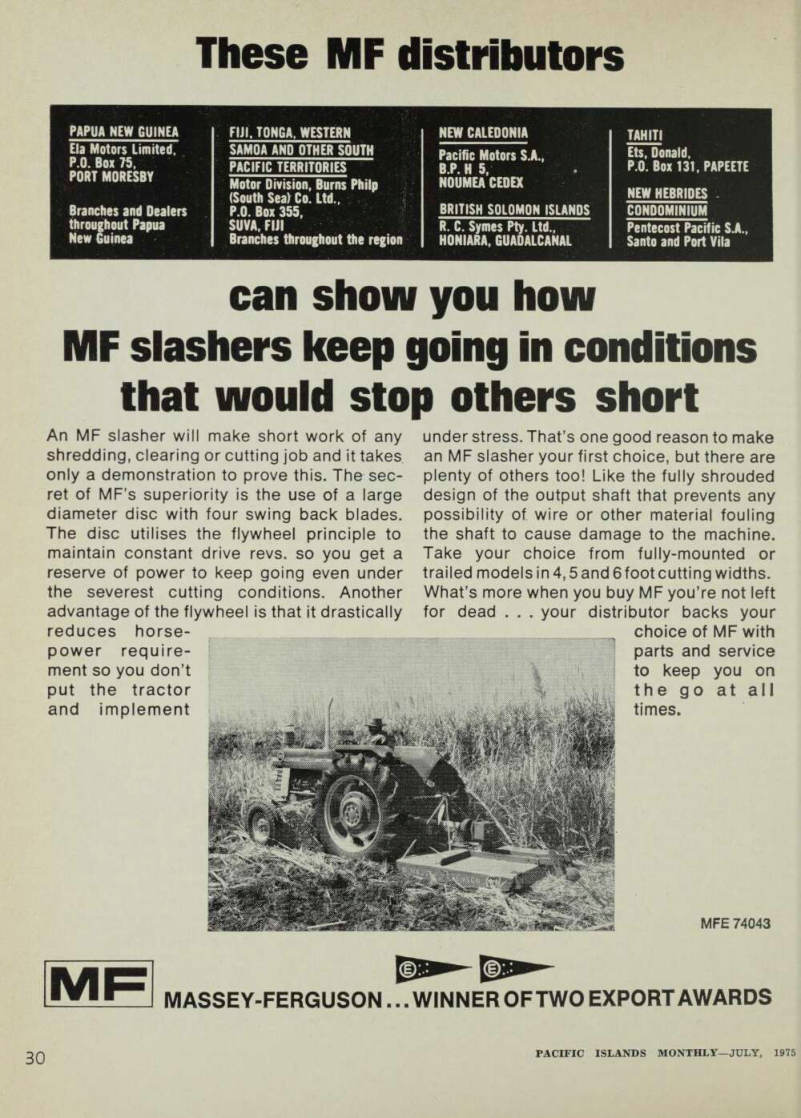
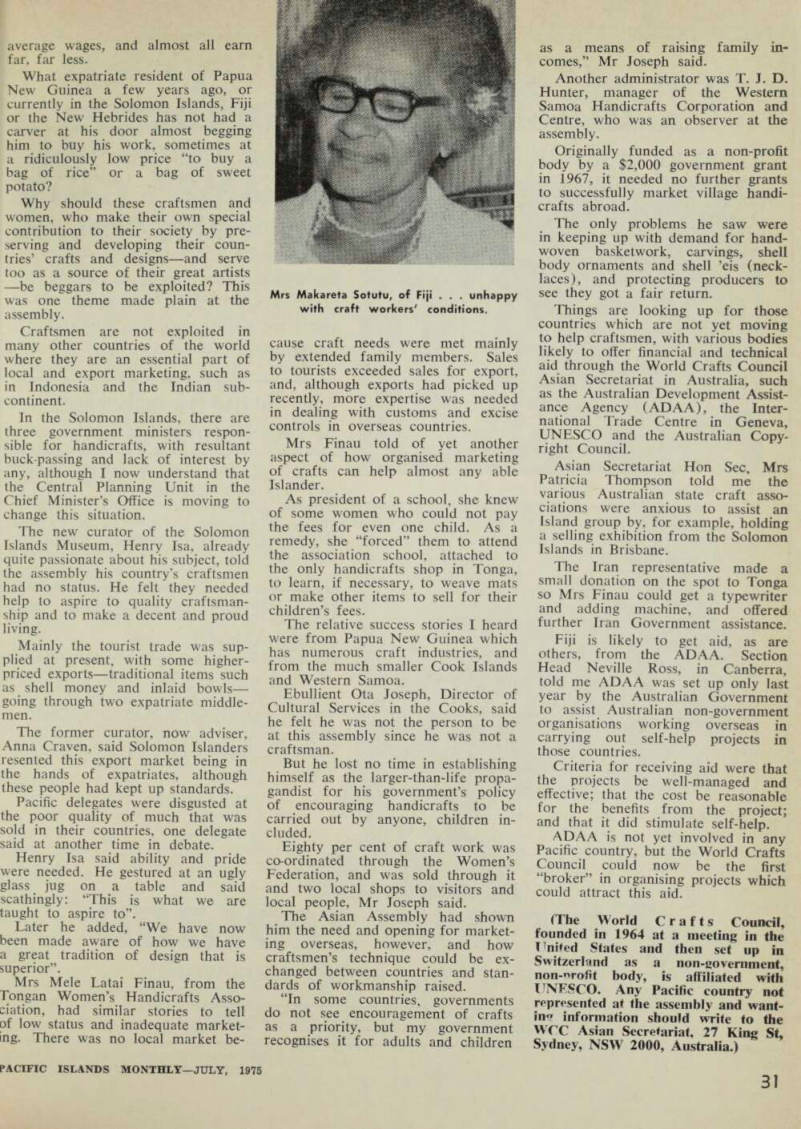
cold-shoulder for Islands' craft workers
By Denis Fisk
The lack of encouragement of crafts by numerous Pacific govern ments is a classic case of ignoring an exceptionally low capital investment industry, with the widest involvement of village or towns people, often in favour of expensive industries difficult to establish, such as cattle.
Crafts’ and craftsmen’s low stand ing in those Pacific countries is re flected in the lack of interest by governments and regional bodies.
Now the plight of these currently poor but potentially good earners has been exposed through a meeting in Sydney University in May of the Asian Assembly of the World Crafts Council.
For the first time, representatives of eight Pacific countries and colonies were able to join those from 17 Asian, Middle East and Australasian countries, to tell a few success stories but mainly to speak of struggle and disinterest.
Among the eight, four had relative success stories—the Cook Islands, New Hebrides, Papua New Guinea and Western Samoa—while Fiji, New Caledonia, the Solomons and Tonga were weighed down with the prob lems of sponsorship, organisation and marketing as well as the struggle to retain craft cultures and standards, or to revive them and provide an opportunity for income earning.
This is at best a crude breakdown of the situation, but in a short visit to the assembly it was a matter of gaining impressions, gathering up reports and speaking to as many Pacific delegates as possible.
It was difficult to get delegates to openly criticise their home govern ments.
Yet careful reading of reports and listening to Pacific delegates showed
how disturbed some were at their governments’ lack of interest, understanding and action.
Emotion came through over matters such as involving “dropouts” from academic education systems, in ftm u !!i 8 v utilising unique and still little known craft cultures which e m b7v ar^.a^ ogniSe H er S mbly -J elegateS ’ and i.' m ff a fu S m nl d l ei? ? l u Wer |/? kmB ° ff the /5S anC {f beuefit from exports fna Plt « ben f fb ts s .uch as keepalf qua lty tbey mi ght incident- Ir'UftuJ* u * i * Gentle, but positive Mrs Makareta Sotutu moved the emotions of the assembly when she could not hide her deep feeling for her 135 girls in her Methodist crafts school in Fiji.
The poverty of government encouragement for crafts—rather than the fine arts—in Fiji can be judged from the school’s total grant from government of $3OO.
“If I did not take my girls where would they go?” Mrs Sotutu said, “Would you like them to be on the street I wouldn t. I would rather die. I spend my own money, I go without food and clothing to help to buy things for the girls.”
An organisation of Fijian women has failed so far to organise village women to bring crafts together to sell because of lack of finance and know how, Mrs Sotutu’s own school needs ex tending, staffing and providing with raw materials, but she has been un able to S £t hel P 50 far - She has be en encouraged recently by secondary schoGl teachers now coming to the sc hool for short craft courses, which j s a change from the former com piete attention she said had been directed in schools towards passing academic subjects.
Young people learned crafts by the compulsion of having, somehow, to earn a llvm 8> Mrs Sotutu said, al though once involved these “drop °uts” became very interested. Howf ver > craft-workers remained in lower income brackets, This last comment applies generally to those countries where marketing of crafts is not well organised on be half of the craft workers, and where they depend on their products for their livelihood, and also even when there is effective marketing in many cases. For example, in Australia, almost no craftsmen earn better than
Mrs Mele Latai Finau, of Tonga, shows conference organiser Mrs Patricia Thompson what Tonga's craft workers can do.
average wages, and almost all earn far, far less.
What expatriate resident of Papua New Guinea a few years ago, or currently in the Solomon Islands, Fiji or the New Hebrides has not had a carver at his door almost begging him to buy his work, sometimes at a ridiculously low price “to buy a bag of rice” or a bag of sweet potato?
Why should these craftsmen and women, who make their own special contribution to their society by pre serving and developing their coun tries’ crafts and designs—and serve too as a source of their great artists —be beggars to be exploited? This was one theme made plain at the assembly.
Craftsmen are not exploited in many other countries of the world where they are an essential part of local and export marketing, such as in Indonesia and the Indian sub continent.
In the Solomon Islands, there are three government ministers respon sible for handicrafts, with resultant buck-passing and lack of interest by any, although I now understand that the Central Planning Unit in the Chief Minister’s Office is moving to change this situation.
The new curator of the Solomon Islands Museum, Henry Isa, already quite passionate about his subject, told the assembly his country’s craftsmen had no status. He felt they needed help to aspire to quality craftsman ship and to make a decent and proud living.
Mainly the tourist trade was sup plied at present, with some higher priced exports—traditional items such as shell money and inlaid bowls— going through two expatriate middle men.
The former curator, now adviser, Anna Craven, said Solomon Islanders resented this export market being in the hands of expatriates, although these people had kept up standards.
Pacific delegates were disgusted at the poor quality of much that was sold in their countries, one delegate said at another time in debate.
Henry Isa said ability and pride were needed. He gestured at an ugly glass jug on a table and said scathingly: “This is what we are taught to aspire to”.
Later he added, “We have now been made aware of how we have a great tradition of design that is superior”.
Mrs Mele Latai Finau, from the Tongan Women’s Handicrafts Asso ciation, had similar stories to tell of low status and inadequate market ing. There was no local market be-
cause craft needs were met mainly by extended family members. Sales to tourists exceeded sales for export, and, although exports had picked up recently, more expertise was needed in dealing with customs and excise controls in overseas countries.
Mrs Finau told of yet another aspect of how organised marketing of crafts can help almost any able Islander.
As president of a school, she knew of some women who could not pay the fees for even one child. As a remedy, she “forced” them to attend the association school, attached to the only handicrafts shop in Tonga, to learn, if necessary, to weave mats or make other items to sell for their children’s fees.
The relative success stories I heard were from Papua New Guinea which has numerous craft industries, and from the much smaller Cook Islands and Western Samoa.
Ebullient Ota Joseph, Director of Cultural Services in the Cooks, said he felt he was not the person to be at this assembly since he was not a craftsman.
But he lost no time in establishing himself as the larger-than-life propa gandist for his government’s policy of encouraging handicrafts to be carried out by anyone, children in cluded.
Eighty per cent of craft work was co-ordinated through the Women’s Federation, and was sold through it and two local shops to visitors and local people, Mr Joseph said.
The Asian Assembly had shown him the need and opening for market ing overseas, however, and how craftsmen’s technique could be ex changed between countries and stan dards of workmanship raised.
“In some countries, governments do not see encouragement of crafts as a priority, but my government recognises it for adults and children
as a means of raising family in comes,” Mr Joseph said.
Another administrator was T. J. D.
Hunter, manager of the Western Samoa Handicrafts Corporation and Centre, who was an observer at the assembly.
Originally funded as a non-profit body by a $2,000 government grant in 1967, it needed no further grants to successfully market village handi crafts abroad.
The only problems he saw were in keeping up with demand for hand woven basketwork, carvings, shell body ornaments and shell ’eis (neck laces), and protecting producers to see they got a fair return.
Things are looking up for those countries which are not yet moving to help craftsmen, with various bodies likely to offer financial and technical aid through the World Crafts Council Asian Secretariat in Australia, such as the Australian Development Assist ance Agency (ADAA), the Inter national Trade Centre in Geneva, UNESCO and the Australian Copy right Council.
Asian Secretariat Hon Sec, Mrs Patricia Thompson told me the various Australian state craft asso ciations were anxious to assist an Island group by, for example, holding a selling exhibition from the Solomon Islands in Brisbane.
The Iran representative made a small donation on the spot to Tonga so Mrs Finau could get a typewriter and adding machine, and offered further Iran Government assistance.
Fiji is likely to get aid, as are others, from the ADAA. Section Head Neville Ross, in Canberra, told me ADAA was set up only last year by the Australian Government to assist Australian non-government organisations working overseas in carrying out self-help projects in those countries.
Criteria for receiving aid were that the projects be well-managed and effective; that the cost be reasonable for the benefits from the project; and that it did stimulate self-help.
ADAA is not yet involved in any Pacific country, but the World Crafts Council could now be the first “broker” in organising projects which could attract this aid. (The VVorld Crafts Council, founded in 1964 at a meeting in the United States and then set up in Switzerland as a non-government, non-profit body, is affiliated with UNESCO. Any Pacific country not represented at the assembly and want ing information should write to the wcc Asian Secretariat, 27 King St, Sydney, NSW 2000, Australia.)
Mrs Makareta Sotutu, of Fiji . . . unhappy with craft workers' conditions.
Advertisements & other items, pp. 36-38 (1 item)
These MF distributors
can show you how
MF slashers keep going in conditions
that would stop others short
An MF slasher will make short work of any shredding, clearing or cutting job and it takes only a demonstration to prove this. The secret of MF’s superiority is the use of a large diameter disc with four swing back blades.
The disc utilises the flywheel principle to maintain constant drive revs, so you get a reserve of power to keep going even under the severest cutting conditions. Another advantage of the flywheel is that it drastically reduces horse- -1111 lit ■ II under stress. That’s one good reason to make an MF slasher your first choice, but there are plenty of others too! Like the fully shrouded design of the output shaft that prevents any possibility of wire or other material fouling the shaft to cause damage to the machine.
Take your choice from fully-mounted or trailed models in 4,5 and 6 foot cutting widths.
What’s more when you buy MF you’re not left for dead . . . your distributor backs your choice of MF with power requirement so you don’t put the tractor and implement Si parts and service to keep you on the go at all times.
MFE 74043
MASSEY-FERGUSON... WINNER OF TWO EXPORT AWARDS
A growing airline
in a shrinking world...
Fly to any of 16 AIR NEW ZEALAND Gateways to the World. 3 (csr ft m
Los Angeles
i
Singapore
AIR NEW ZEALAND is a truly international airline, flying you throughout the Pacific to any of 16 Gateways to the World, as far apart as Wellington and Singapore, Auckland and Los Angeles.
. You fly the friendly fleet
* of DC-10s and DC Bs.
Our magnificent wide-bodied DC-lOs now fly on most international AIR NEW ZEALAND routes. On other flights and services, our personalised DC-8s provide outstanding AIR NEW ZEALAND service.
16 exciting Gateways
to the World.
AIR NEW ZEALAND flies to Hawaii Los Angeles, Hong Kong, Singapore, Sydney, Melbourne, Brisbane, Auckland, Wellington, Christchurch, Fiji, Tahiti, New Caledonia, Samoa, Rarotonga and Norfolk Island.
air new zEBLano
Friendliest wings across your world.
Talk to AIR NEW ZEALAND or your travel agent
ANZ 233
Magazine Section
When Cricket Came To Samoa, The
Players Re-Wrote The Rules
William B. Churchward, an Englishman, acted as British Consul in Samoa, based in Apia, for four years from 1881. This was an interesting time, in the Samoan Islands, because politically they were in turmoil, and the time had not arrived when the islands were divided into both American and Ger man spheres of influence. English, German and American viewed each other’s ambitions with sus picion in Churchward’s time, as he made clear in a book he published in 1887, called My Consulate in Samoa. But there were plenty of lighter moments, as on the occasion that Churchward and one of his colleagues introduced cricket to the Samoan islands, and found they had started something that was almost too big for them. . . .
For the first two years of my stay in Samoa, neither I nor any of the few British residents could ever persuade one single Samoan to join in our cricket, although their congeners, the Tongan residents in the group, were always ready for a game. In Tonga the game was adopted so strongly, to the neglect of all domestic pursuits, that a law had to be passed to prevent their playing for more than one day a week.
All at once the village of Apia was seized with a most frantic desire to fathom the mysteries of the game, and to become proficient in its practice; owing, it appeared, to some discussion the Samoan inhabitants had had with some Tongans who had twitted them on the subject of their ignorance of so grand an amusement.
A deputation attended on the Judge, a Britisher, and myself, requesting us to instruct them in the strict ‘Fa’a Peritania’—British manner—of playing cricket, for that was the version they wanted to learn, and not the ‘Fa’a Tonga’—Tongan—one.
They explained that as it was a British sport, we as British were likely to know more about it than the Tongans, and they thought that we could teach them in such a way that they might be able to beat those boasting fellows. We accordingly took them in hand, and soon succeeded in in stilling the initial idea into their heads.
For a time all went on very smoothly, but the quiet and serious English style did not suit them long.
One by one, innovations of their own and Tongan manufacture crept into the game, until soon nothing remained of cricket but the practice of one man bowling a ball to another man trying
to hit it. All the rest of the proceedings were purely of their own manufacture.
However, this Samoan cricket found great favour all round, giving as it did in its improved form the excuse, always welcome, and never rejected, for feasting and parade, so dear to all Samoans. Soon all the neighbouring towns were playing, and cricket at last becoming quite an epidemic.
It not only took possession of the island of its origin, Upolu, but crossed the straits on both sides, spread all over Tutuila and Savaii, until the whole group was infected with it. Age, sex and dignity alike fell under its influence, until at last there was not a village in which it was not vigorously practised to such a degree as to seriously interfere with domestic affairs.
German anger
The Germans were loud in their condemnation of cricket, seeing in it, quite irrespective of prob able reduced supply of native produce for them to deal in, an inclination to favour things British, which it always was their studied practice to con demn and underrate, to the glorification of their own importance.
Although they could not effect a cure in the provinces, they did succeed in putting such re strictions on the game in the municipality of Apia, that in the most popular play-places it was ren dered impossible to carry it on. It was restricted on account of its danger, one ball having gone
near to a woman in the course of over a year’s play.
I don’t mean for one moment to say that these lunatics did not carry their frenzy to a somewhat hurtful extreme, but I am sure that the only damage done was to themselves; for I maintain that if they had never thought of cricket they would not have made an ounce more copra than they did.
I also know that a very large amount of money must have passed into the hands of the store keepers for cricket material and dresses, a dif ferent style of which they had new for nearly every match.
The processions on match-days are fearful and wonderful to behold. Headed by their Faamasinos, or judges, as they term their umpires, to the dulcet strains of the penny whistle and drum, banners flaunting gaily on the breeze, dressed up in the latest novelty specially designed for the purpose —most likely gone tick for at their pet store— bewreathed and begarlanded to an outrageous extent, the players in single file march through the town in swaggering military order.
Full uniform
Each one is armed with his bat, shouldering it as though it were a war-club, and, at the word of command from their officers, goes through an entire special manual exercise whilst en route to the field. These officers are generally dressed in full naval uniform, with swords and cocked-hats complete, and are continuously running up and down the ranks, keeping their men in place and showing them off to the fullest extent in their power.
Following them close up will be the non effective brigade, consisting of the women and children belonging to the doughty cricketers, also in gala dress, and carrying with them large quanti ties of eatables and drinkables for the refreshment of their relations about to do battle for the credit of the village they belong to.
It was the invariable practice of the Apia men on turning out for a match to halt in front of my Consulate, and drawn up in line receive word of command, ‘Salute the British Consul!’ Whereupon the whole line would perform a studied exercise with their bats and arms, equivalent in significa tion. I suppose, to the ‘present’, whilst the band, with the colours in front of them, performed a duet for my benefit. They would then form up again in single file, and move off to their game.
This again roused the jealous suspicions of the
Germans; for this compliment was never extended to anyone else but the Municipal Magistrate—who was a Britisher—and the one to whom they chiefly owed whatever they knew about cricket.
Their antics in the field beggar description.
Each club would have a distinct method of ex pressing its joy at the dismissal of an adversary from the wickets. Some of them, of a most elaborate nature, must have taken much careful drilling in private to ensure such perfect perform ance in public.
200_ to bat
The conventional number of eleven players is thoroughly put on one side. It is nothing unusual to see thirty or forty opposed to one another, and I have known them to play as many as two hundred odd a side!
The fact is that these matches are of one town against another, in which all insist upon taking a hand. These huge meetings, as may be readily imagined, last a week or more, junketing going on the whole time, and generally wind up with a big feast.
Once, during a time of political trouble, cricket assumed a political importance, by the aid of which the Samoans hoped to tide over a dan gerous time until their expected relief arrived in the shape of British annexation, to put them out of their misery.
They had officially written to England offering their country, and then, to avoid all further compli cations, they determined to start a cricket match of such stupendous proportions that it would last until they got an answer from home; during which time they considered that, being engaged in playing, they had a valid excuse for not taking notice of any business that might unpleasantly crop up.
In fact, the entire Government was playing cricket, and could not be disturbed.
I don’t know whether that game was ever finished or not. Anyhow, I don’t think it had any particular effect upon the usual run of politics; but I do know that their letter to England never was answered.
Shortly after this incident the Germans were very much down upon the natives, finding fault with everything they did, and continually informing them that their insignificant little group was in sulting the great German Empire; and they eventu ally forbade the King, under dire penalties, to play “the game called cricket” at his seat of govern ment.
Advertisements & other items, p. 41 (1 item)
The freshest butter and cheese
u*«as
is made by your neighbours.
Not so very far away from here, your neighbour Australia is making the world’s finest butter and cheese. Because these products come to you straight from our farms, you can be sure that they are really fresh at the peak of their flavour and goodness. So when you buy good food for your family, look for the word “Australia” on your butter and cheese.
Australian butter and cheese 0
poo
p C
Yesterday
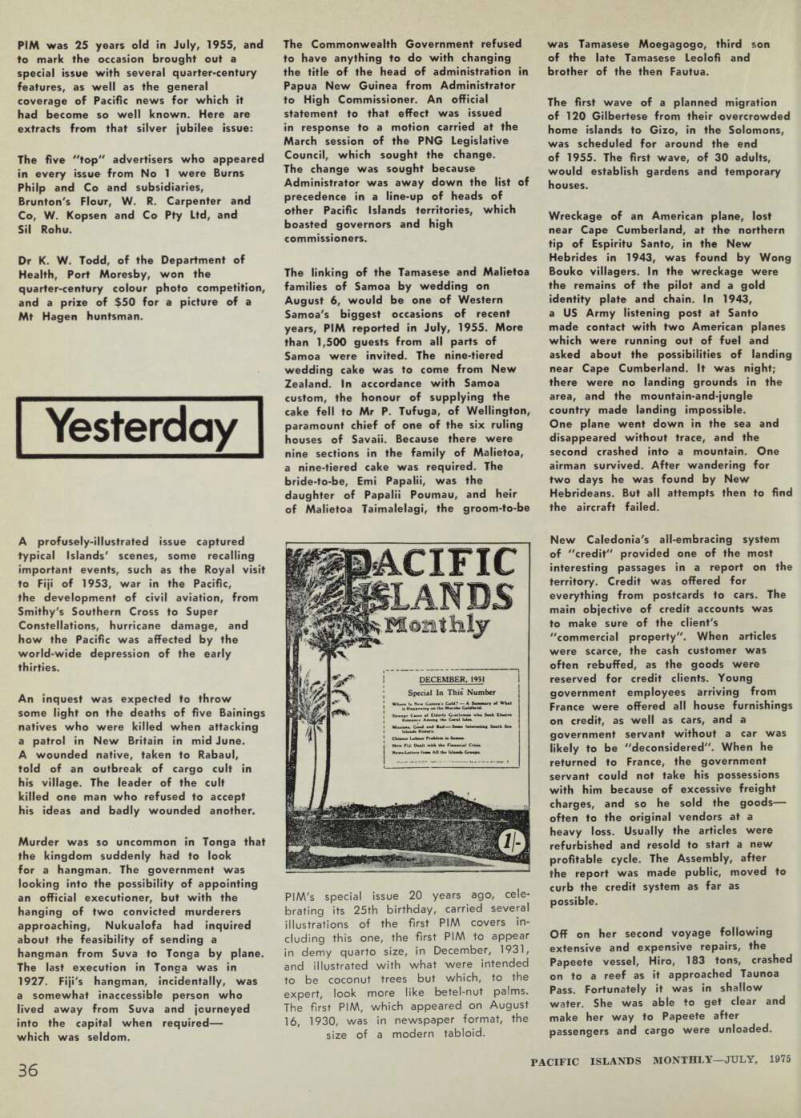
PIM was 25 years old in July, 1955, and to mark the occasion brought out a special issue with several quarter-century features, as well as the general coverage of Pacific news for which it had become so well known. Here are extracts from that silver jubilee issue: The five "top" advertisers who appeared in every issue from No 1 were Burns Philp and Co and subsidiaries, Brunton's Flour, W. R. Carpenter and Co, W. Kopsen and Co Pty Ltd, and Sil Rohu.
Dr K. W. Todd, of the Department of Health, Port Moresby, won the quarter-century colour photo competition, and a prize of $5O for a picture of a Mt Hagen huntsman.
A profusely-illustrated issue captured typical Islands' scenes, some recalling important events, such as the Royal visit to Fiji of 1953, war in the Pacific, the development of civil aviation, from Smithy's Southern Cross to Super Constellations, hurricane damage, and how the Pacific was affected by the world-wide depression of the early thirties.
An inquest was expected to throw some light on the deaths of five Bainings natives who were killed when attacking a patrol in New Britain in mid June.
A wounded native, taken to Rabaul, told of an outbreak of cargo cult in his village. The leader of the cult killed one man who refused to accept his ideas and badly wounded another.
Murder was so uncommon in Tonga that the kingdom suddenly had to look for a hangman. The government was looking into the possibility of appointing an official executioner, but with the hanging of two convicted murderers approaching, Nukualofa had inquired about the feasibility of sending a hangman from Suva to Tonga by plane.
The last execution in Tonga was in 1927. Fiji's hangman, incidentally, was a somewhat inaccessible person who lived away from Suva and journeyed into the capital when required— which was seldom.
The Commonwealth Government refused to have anything to do with changing the title of the head of administration in Papua New Guinea from Administrator to High Commissioner. An official statement to that effect was issued in response to a motion carried at the March session of the PNG Legislative Council, which sought the change.
The change was sought because Administrator was away down the list of precedence in a line-up of heads of other Pacific Islands territories, which boasted governors and high commissioners.
The linking of the Tamasese and Malietoa families of Samoa by wedding on August 6, would be one of Western Samoa's biggest occasions of recent years, PIM reported in July, 1955. More than 1,500 guests from all parts of Samoa were invited. The nine-tiered wedding cake was to come from New Zealand. In accordance with Samoa custom, the honour of supplying the cake fell to Mr P. Tufuga, of Wellington, paramount chief of one of the six ruling houses of Savaii. Because there were nine sections in the family of Malietoa, a nine-tiered cake was required. The bride-to-be, Emi Papalii, was the daughter of Papalii Poumau, and heir of Malietoa Taimalelagi, the groom-to-be
was Tamasese Moegagogo, third son of the late Tamasese Leolofi and brother of the then Fautua.
The first wave of a planned migration of 120 Gilbertese from their overcrowded home islands to Gizo, in the Solomons, was scheduled for around the end of 1955. The first wave, of 30 adults, would establish gardens and temporary houses.
Wreckage of an American plane, lost near Cape Cumberland, at the northern tip of Espiritu Santo, in the New Hebrides in 1943, was found by Wong Bouko villagers. In the wreckage were the remains of the pilot and a gold identity plate and chain. In 1943, a US Army listening post at Santo made contact with two American planes which were running out of fuel and asked about the possibilities of landing near Cape Cumberland. It was night; there were no landing grounds in the area, and the mountain-and-jungle country made landing impossible.
One plane went down in the sea and disappeared without trace, and the second crashed into a mountain. One airman survived. After wandering for two days he was found by New Hebrideans. But all attempts then to find the aircraft failed.
New Caledonia's all-embracing system of "credit" provided one of the most interesting passages in a report on the territory. Credit was offered for everything from postcards to cars. The main objective of credit accounts was to make sure of the client's "commercial property". When articles were scarce, the cash customer was often rebuffed, as the goods were reserved for credit clients. Young government employees arriving from France were offered all house furnishings on credit, as well as cars, and a government servant without a car was likely to be "deconsidered". When he returned to France, the government servant could not take his possessions with him because of excessive freight charges, and so he sold the goods— often to the original vendors at a heavy loss. Usually the articles were refurbished and resold to start a new profitable cycle. The Assembly, after the report was made public, moved to curb the credit system as far as
possible.
Off on her second voyage following extensive and expensive repairs, the Papeete vessel, Hiro, 183 tons, crashed on to a reef as it approached Taunoa Pass. Fortunately it was in shallow water. She was able to get clear and make her way to Papeete after passengers and cargo were unloaded.
PIM's special issue 20 years ago, cele brating its 25th birthday, carried several illustrations of the first PIM covers in cluding this one, the first PIM to appear in demy quarto size, in December, 1931, and illustrated with what were intended to be coconut trees but which, to the expert, look more like betel-nut palms.
The first PIM, which appeared on August 16, 1930, was in newspaper format, the size of a modern tabloid.
Advertisements & other items, pp. 43-51 (4 items)
Statesman
smoothest cigars on
iternational scene
S RE64
.0^(0 1801 i
scorf
) p IS HI
STATESMAN
CORONA
Corona
D 585
f .. «* /, » i *
VVE
r
NOW COMES THE POWER LINE.
FROM SANSUI.
Good, solid Sansui quality in a line of receivers with more stereo power and performance for less than you’d expect.
That, folks, is The Power Line.
Top-of-the-line is Sansui 881: 63 watts per channel minimum RMS into 8 ohms from 20 to 20,000 Hz with no more than 0.3% total harmonic distortion.
Inside, eleven computer-grade ICs and special Circuit Board Module construction eliminate a lot of the internal wiring to assure
long-term stability.
Outside, rugged controls tailor the sound and direct ‘signal traffic’ throughout the 881 for 3 pairs of stereo loudspeakers, tuner section, turntables,
decks, tape dubbing, microphone mixing, and
much more.
But if the 881 is too much of a good thing, The Power Line offers other big-value receivers with
similar cost/performance
advantages. See them soon.
Sfutsui.
441 551 661 771 881
Sansui. Dynamic audio answers.
Australia Rank Industries Australia Pty. Ltd. 58 Queensbridge Street, South Melbourne, Victoria 3205 Phone: 61 3281 Australia Atkins Carlyle Ltd. 894 Hay Street, Perth, Western Australia 6000 Phone: 21 0101 Fiji Prabhu Brothers Ltd.
P.O. Box 183, Nadi Phone: 70183/4 Papua New Guinea Oceania Indent Agency (P.N.G.) Pty. Ltd.
Box 5518, Boroko, Port Moresby Phone; PM 56406 New Zealand David J. Reid (N.Z.) Ltd.
C.P.O. Box 2630, Auckland. 1 Phone; 492-189 Nlle-Caledonie Ets Michel MERCIER 9, rue de Sebastopol. Noumea Phone: 759.11 South Pacific Miltons Department Stores Limited P.O. Box 146, Norfolk Island 2899 Western Samoa H.J. Keil and Company, Ltd.
P.O. Box 7, Apia Phone; 198 New Hebrides South Pacific Audio & Photo Supplies B.P. 274, Vila Cook Islands United Island Traders Ltd.
Box Nos. 1 & 2, Rarotonga Tahiti Societe JAUNEZ & Cie B.P. 322, Papeete Phone: 2.04.24
SANSUI ELECTRIC CO., LTD.
14-1, 2-chome, Izumi, Suginami-ku, Tokyo 168, Japan
Our business is cargo.
Your cargo: to anywhere in our Pacific Two paddle steamers on the Yangtse River in 1873 marked the beginning of the China Navigation Company. Today, the same flag flies above eighteen modern motor ships plying an extensive network of cargo routes between Papua New Guinea and Pacific Island ports (as far East as Tahiti) and Japan, New Zealand, Australia and Thailand.
For 100 years, the flag of the China Navigation Company has meant experience, reliability and speed across the sea. Today, it’s lying as strong as ever.
Papeete. New Caledonia; Etablissements Ballande, lles-Hebrides.Vilaand Santo. AUSTRALIA—Sydney:! „ • Gilchrist & Sanderson Pty. Ltd. NEW ZEALAND— P. &O.fN Z 1 Ltd Swire. 9 Connadght Rd„ Centraf Hong Ko’ng’ B Napier ' lapan: Swire McKinn °n. Tokyo, Yokohama, Osaka, Kobe and Nagoya. Eastern Managers: Butterfield uckland, Wellington, Christchurch, Dunedi CN CO JOHN SWIRE & SONS PTY. LTD. General Agents in Australia, 8 Spring Street, Sydney, Phone- 27 9351
THE CHINA NAVIGATION CO LTD
MEMBER OF THE SWIRE GROUP.
-■. •* f • *' / i-T J. • f * ,y * r * •. t 4 ' ” !•» ■' * - >■» 4 * t ' *%, * * * M i s 4 *%a %* * i 4 * K J v>„ *v ? I • , ' * * f n .-.*r f 4 v .* •/'/..>» ■• **; •*{•;‘i / , * < *#i 11 % » * - 4 •* 4 » w ; I * Hi . . #4 1 »(-' , • *, • , •.< • rf®3 v .., , ,i ..
il' .''A
'.v M , I I , I M'L. r **
iff.
If you’ve got work to do,
we’ve got trucks to do it
g/TOYOTA
Hi Ace
TOYOTA
Stout
TOYOTA
Land Cruiser Pickup
TOYOTA Hi-Lux
PAPUA, NEW GUINEA: ELA MOTORS LIMITED. Scratchley Rd., Badili, Papua. U.S. TRUST TERRITORY: MICROL CORPORATION, P.O. Box 267, Saipan FIJI ISLANDS: AUTOMOTI SUPPLIES CO., LTD , G.P.O. Box 355, Suva. AMERICAN SAMOA: BURNS PHILP (SOUTH SEA) CO.. LTD., Pago Pago WESTERN SAMOA. BURNS PHILP (SOUTH SEA) LTD , P.O. Box T Apia GUAM: RICKY’S AUTO CO., P.O, Box 1458, Agana NEW HEBRIDES: NEW HEBRIDES MOTORS LTD , P.O, Box 18, Vila. SOLOMON ISLANDS: MENDANA ENTERPRISES (5.1.), LT.
P O, Box 1 74, Honiara.
' . * % *%\ * . . ' \ * ' - .■** .A 4 > M v v , l> > I V K % \ %K> ’H * / |\ *-x » % \i V - ' X V & X-JV xvV ' « „ ■ t > % . V 4 X * VI \ * \ • * ■.
TOYOTA Land Cruiser
li I % <TT>tnoir. £** From different styles of the 4-wheel-drive Land Cruiser, to vans and pickups, to heavy duty trucks. Toyota makes them.
And Toyota makes them tough.
There’s a Toyota truck that will work for you. Economically.
Reliably.
Find out about it. From your local Toyota dealer. pi
TOYOTA Dyna
TOYOTA
T oyo-Ace TOYOTA Truck
OYOTA
TAHITI: NIPPON AUTOMOTO. B P 545. Papeete COOK ISLANDS: COOK ISLANDS TRADING CORPORATION LTD PO Box 92 Rarotonga. NAURU ISLAND: NAURU COOPERATIVE SOCIETY GILBERT & ELLICE ISLANDS COLONY: TARAWA MOTORS Box 36' Baink, Tarawa NORFOLK ISLAND: MARIE’S NORFOLK TOURS, LTD., P.O Box 276. TIMOR: SANG TAI HOO Sang Tai Building Dili NEW CALEDONIA: SOCIETE IMPORTATION AUTOMOBILE DU PACIFIQUE, Rond-Point du Pacific (Station Total) B.P. 438 Noumea
i <r> m n l • * km •I ■^3 M m 0 •i •i is »ft - •* s •* *« I
A Mighty,
Profitable Lift Capability.
TCM delivers more—in economy, rugged performance and operating ease. Japans pioneer material handling equipment maker is a specialist with over two and a half decades of experience building lift trucks.
The profit-producing TCM lineup includes gasoline, diesel and battery-powered models. A quality attachment selection and versatile choice of lift capacities are available to match every job requirement.
TCM manufactures other advanced material handling equipment. From shovel loaders and tractor shovels to container carriers.
Customers in over 100 countries rely on TCM equipment and service. It pays—in big ways. Please write for further information. 15-5,
TCM
TOYO UMPANKI CO., LTD.
l-chome. Nishi-Shimbashi, Minato-ku.
Tokyo, Japan Tel: Tokyo (03) 591-8171
Telex: 222-221 7 TOYOUMPANKI
Cable: "TOYOU M RANK I TOKYO
TRUCK OWNERS!
M & S DIESEL OFFER
TURNER QUICK LIFT
AIR SUSPENSION SYSTEMS
Turner Quick Lift will increase your pay load and profit. Design simplicity with minimum parts assures many thousands of trouble free operational miles. The patented* Turner Quick Lift with its lower weight increases payload, gives true air ride and eliminates need for shock absorbers. Ease of installation is assured because TQL units are manufactured and shipped unitised, that is, with axle, wheel and drum assembly together. Models of the TQL air suspension systems are available for single or dual wheel pusher or tag applications. *US Patents 328 5621 & 361 7072, CANADIAN Patents 917684 & 918184.
Wi
TECO AUTOMATIC
WHEEL BALANCERS
Teco balance while you drive—Fitted to the front wheels of your truck, centrifugal force combines with Teco patented *wheel balancers to automatically and constantly balance the total rotating mass of tyre, wheel, hub and drum. Teco automatic wheel balancers offer other advantages too! Reduction of driver fatigue, greater tyre mileage, reduced vibration, extended life of front and components and cutting of continued tyre balance charges. * US Patents 3164413 & 3316021.
FOR FULL DETAILS ON THESE TRIED TESTED AND
PROVEN UNITS THAT WILL EFFECTIVELY REDUCE
OPERATION COSTS
PLEASE TELEX AA33864 OR WRITE TODAY TO . . . (Ml UJ
M&S DIESELK
502 Williomstown Rd., Port Melbourne, Vic. 3207.
Phone: 645 1711, 6451397. A.H. 233 1965.
Distributors and dealers sought for the Pacific Islands
a new dimension in outboard motors
from Finland
★ RANGING FROM 3 TO 40 H.P.
+ BUILT IN GENERATORS
FROM 5 H.P. UPWARDS.
★ 2 YEARS WARRANTY
TSSt-tl <- •A
look at these outstanding features
TER-Kil
the great name in family boating
from Pacific . .
LIGHTWEIGHT: Anti corrosion alloy materials with stainless steel underwater parts and shafts.
MODERN DESIGN: Modern loop scavenged oesign, all roller bearing on crankshafts.
ECONOMICAL: Fixed jet carburettors gives extremely economical running.
SYNCHRONISED TILLER CONTROL: All in one gearshift and throttle incorporated. (Forward and reverse).
BUILT IN GENERATORS: 5 hp and up equipped with generating coils for running lights or battery charging.
PUSH BUTTON START: Electric starting models, 15-20-40 easy start with push button.
SPARE PARTS AND ACCESSORIES: All parts and accessories available ex stock at very reasonable prices.
mg*m DEALER INQUIRIES INVITED.
D.A.T.A., 19 Carrington Road, Marrickville, N.S.W., Aust., 2204.
Ph.: 55 3473. Telex: 25568. Cables: "Dieseltech", Sydney.
Acific Islands Monthly—July. 1975
43
ACIFIC ISLANDS MONTHLY—JULY, 1975
mAnA
is a vehicle for Pacific Islands’ writers and artists to publish their work. It is an organ of the South Pacific Creative Arts Society and its editorial committee comprises writers from many islands.
Material for publication must be sent direct to MANA’s editor, Marjorie Crocombe, South Pacific Creative Arts Society, Box 5083, Suva.
The July MANA is a mixed bag with short stories, legends, poems and traditional art forms from the Sepik. Two of the stories, authors Titilia Dugulele (Adi Cakobau School, Fiji) and Merelita Varo (St John’s College, Fiji), were highly-commended entries in the Fiji Association of English Teachers short story competition. Donald Kalpokas, Mildred Sope, John Laan, Loreen P. Ala and George Baddeley Borugu are all from the New Hebrides, and, with the exception of the first two named, are newcomers to MANA. Albert Leomala and Matthew Fakaia are well known to readers.
always fun
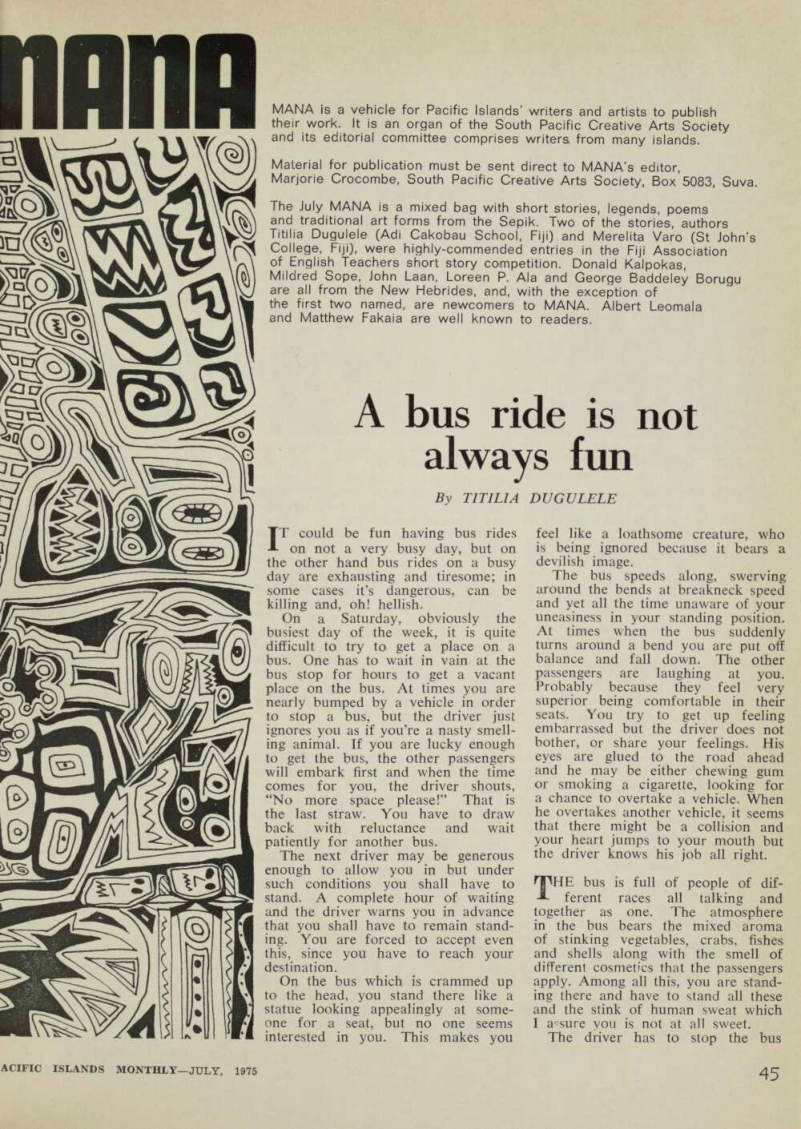
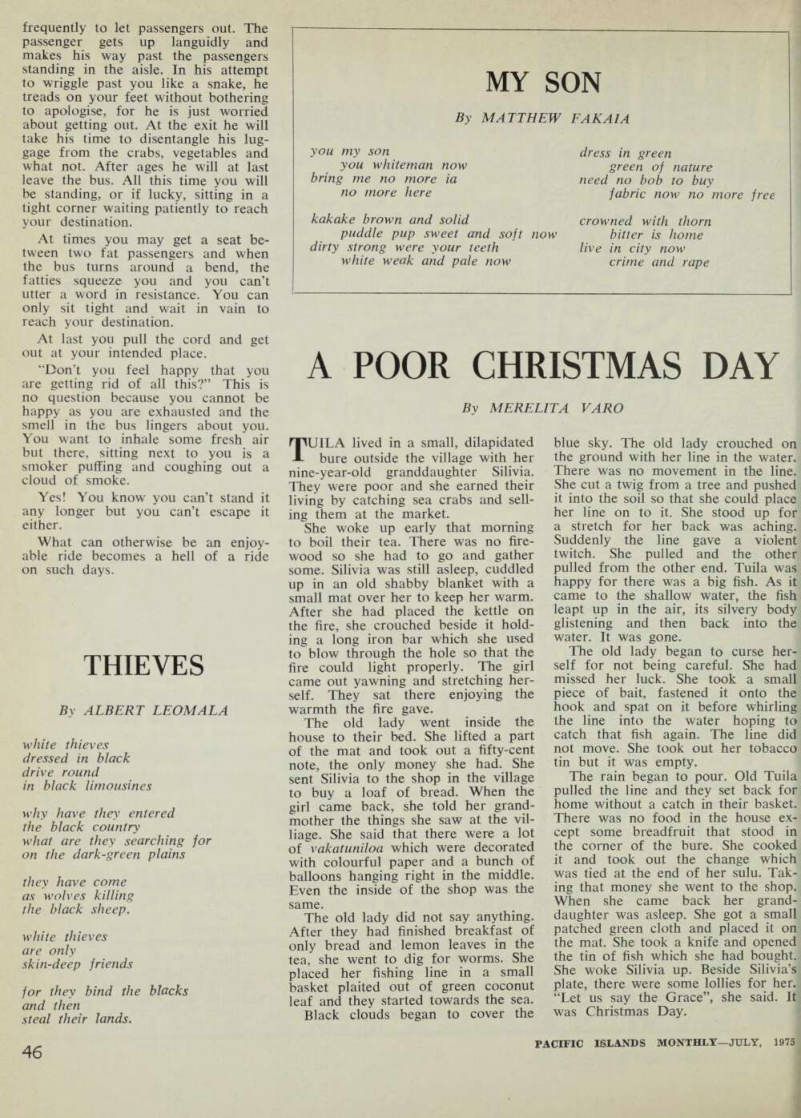
A bus ride is not always fun
By Tit Ilia Dugulele
IT could be fun having bus rides on not a very busy day, but on the other hand bus rides on a busy day are exhausting and tiresome; in some cases it’s dangerous, can be killing and, oh! hellish.
On a Saturday, obviously the busiest day of the week, it is quite difficult to try to get a place on a bus. One has to wait in vain at the bus stop for hours to get a vacant place on the bus. At times you are nearly bumped by a vehicle in order to stop a bus, but the driver just ignores you as if you’re a nasty smell ing animal. If you are lucky enough to get the bus, the other passengers will embark first and when the time comes for you, the driver shouts, “No more space please!” That is the last straw. You have to draw back with reluctance and wait patiently for another bus.
The next driver may be generous enough to allow you in but under such conditions you shall have to stand. A complete hour of waiting and the driver warns you in advance that you shall have to remain stand ing. You are forced to accept even this, since you have to reach your destination.
On the bus which is crammed up to the head, you stand there like a statue looking appealingly at some one for a seat, but no one seems interested in you. This makes you
feel like a loathsome creature, who is being ignored because it bears a devilish image.
The bus speeds along, swerving around the bends at breakneck speed and yet all the time unaware of your uneasiness in your standing position.
At times when the bus suddenly turns around a bend you are put off balance and fall down. The other passengers are laughing at you.
Probably because they feel very superior being comfortable in their seats. You try to get up feeling embarrassed but the driver does not bother, or share your feelings. His eyes are glued to the road ahead and he may be either chewing gum or smoking a cigarette, looking for a chance to overtake a vehicle. When he overtakes another vehicle, it seems that there might be a collision and your heart jumps to your mouth but the driver knows his job all right.
THE bus is full of people of dif ferent races all talking and together as one. The atmosphere in the bus bears the mixed aroma of stinking vegetables, crabs, fishes and shells along with the smell of different cosmetics that the passengers apply. Among all this, you are stand ing there and have to stand all these and the stink of human sweat which I assure you is not at all sweet.
The driver has to stop the bus
frequently to let passengers out. The passenger gets up languidly and makes his way past the passengers standing in the aisle. In his attempt to wriggle past you like a snake, he treads on your feet without bothering to apologise, for he is just worried about getting out. At the exit he will take his time to disentangle his lug gage from the crabs, vegetables and what not. After ages he will at last leave the bus. All this time you will be standing, or if lucky, sitting in a tight comer waiting patiently to reach your destination.
At times you may get a seat be tween two fat passengers and when the bus turns around a bend, the fatties squeeze you and you can’t utter a word in resistance. You can only sit tight and wait in vain to reach your destination.
At last you pull the cord and get out at your intended place.
“Don’t you feel happy that you are getting rid of all this?” This is no question because you cannot be happy as you are exhausted and the smell in the bus lingers about you.
You want to inhale some fresh air but there, sitting next to you is a smoker puffing and coughing out a cloud of smoke.
Yes! You know you can’t stand it any longer but you can’t escape it either.
What can otherwise be an enjoy able ride becomes a hell of a ride on such days.
Advertisements & other items, p. 51 (1 item)
45
ACIFIC ISLANDS MONTHLY—JULY, 1975
Thieves
By Albert Leomala
white thieves dressed in black drive round in black limousines why have they entered the black country what are they searching for on the dark-green plains they have come as wolves killing the black sheep. white thieves are only skin-deep friends for they bind the blacks and then steal their lands.
My Son
By Matthew Fakaia
you my son you whiteman now bring me no more ia no more here kakake brown and solid puddle pup sweet and soft now dirty strong were your teeth white weak and pale now
dress in green green of nature need no bob to buy fabric now no more free crowned with thorn bitter is home live in city now crime and rape
A Poor Christmas Day
By Merelita Varo
TUILA lived in a small, dilapidated bure outside the village with her nine-year-old granddaughter Silivia.
They were poor and she earned their living by catching sea crabs and sell ing them at the market.
She woke up early that morning to boil their tea. There was no fire wood so she had to go and gather some. Silivia was still asleep, cuddled up in an old shabby blanket with a small mat over her to keep her warm.
After she had placed the kettle on the fire, she crouched beside it hold ing a long iron bar which she used to blow through the hole so that the fire could light properly. The girl came out yawning and stretching her self. They sat there enjoying the warmth the fire gave.
The old lady went inside the house to their bed. She lifted a part of the mat and took out a fifty-cent note, the only money she had. She sent Silivia to the shop in the village to buy a loaf of bread. When the girl came back, she told her grand mother the things she saw at the vil liage. She said that there were a lot of vakatuniloa which were decorated with colourful paper and a bunch of balloons hanging right in the middle.
Even the inside of the shop was the same.
The old lady did not say anything.
After they had finished breakfast of only bread and lemon leaves in the tea, she went to dig for worms. She placed her fishing line in a small basket plaited out of green coconut leaf and they started towards the sea.
Black clouds began to cover the
blue sky. The old lady crouched on the ground with her line in the water.
There was no movement in the line.
She cut a twig from a tree and pushed it into the soil so that she could place her line on to it. She stood up for a stretch for her back was aching.
Suddenly the line gave a violent twitch. She pulled and the other pulled from the other end. Tuila was happy for there was a big fish. As it came to the shallow water, the fish leapt up in the air, its silvery body glistening and then back into the water. It was gone.
The old lady began to curse her self for not being careful. She had missed her luck. She took a small piece of bait, fastened it onto the hook and spat on it before whirling the line into the water hoping to catch that fish again. The line did not move. She took out her tobacco tin but it was empty.
The rain began to pour. Old Tuila pulled the line and they set back for home without a catch in their basket.
There was no food in the house ex cept some breadfruit that stood in the comer of the bure. She cooked it and took out the change which was tied at the end of her sulu. Tak ing that money she went to the shop.
When she came back her grand daughter was asleep. She got a small patched green cloth and placed it on the mat. She took a knife and opened the tin of fish which she had bought.
She woke Silivia up. Beside Silivia’s plate, there were some lollies for her.
“Let us say the Grace”, she said. It was Christmas Day.
How Sakiusa Became A Meke Teacher
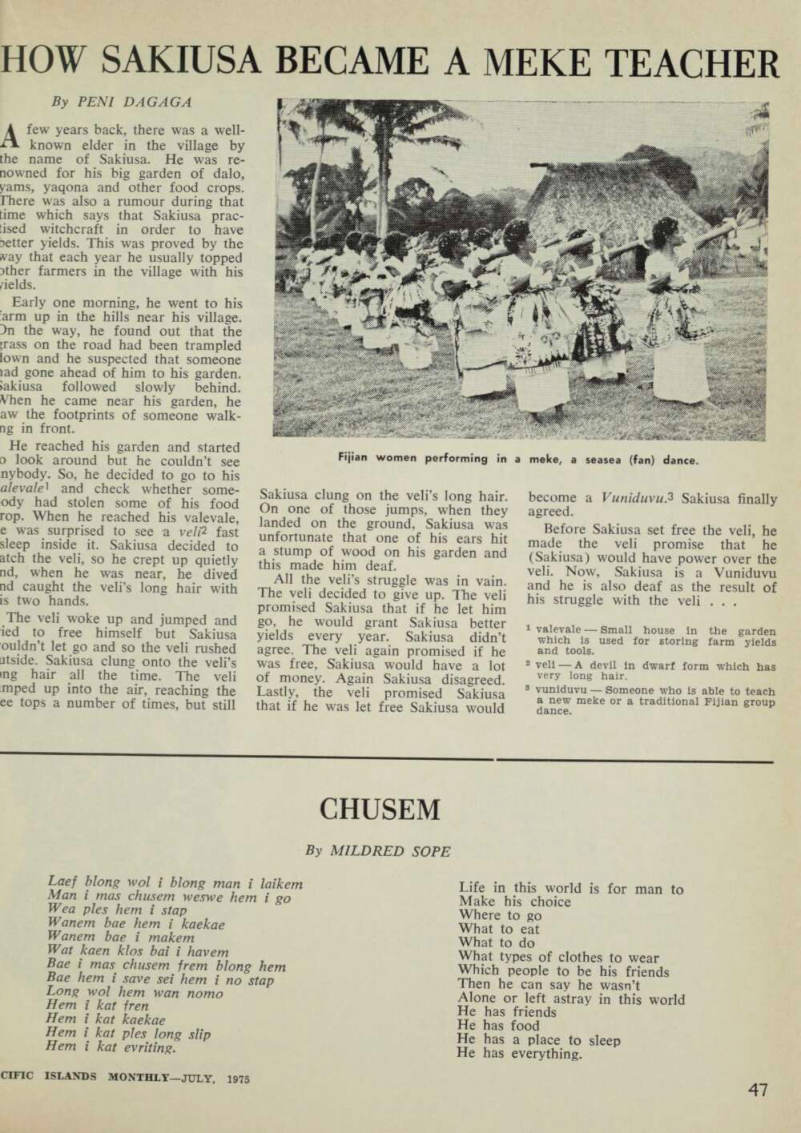
By Peni Dagaga
A few years back, there was a well known elder in the village by the name of Sakiusa. He was re nowned for his big garden of dalo, yams, yaqona and other food crops.
Fhere was also a rumour during that time which says that Sakiusa prac tised witchcraft in order to have setter yields. This was proved by the vay that each year he usually topped sther farmers in the village with his delds.
Early one morning, he went to his arm up in the hills near his village. >n the way, he found out that the ;rass on the road had been trampled lown and he suspected that someone lad gone ahead of him to his garden, lakiusa followed slowly behind.
Vhen he came near his garden, he aw the footprints of someone walk ng in front.
He reached his garden and started o look around but he couldn’t see nybody. So, he decided to go to his alevale ] and check whether some ody had stolen some of his food rop. When he reached his valevale, e was surprised to see a velft fast sleep inside it. Sakiusa decided to atch the veli, so he crept up quietly nd, when he was near, he dived nd caught the veli’s long hair with is two hands.
The veli woke up and jumped and ied to free himself but Sakiusa ouldn’t let go and so the veli rushed atside. Sakiusa clung onto the veli’s »ng hair all the time. The veli mped up into the air, reaching the ee tops a number of times, but still
become a Vuniduvu* Sakiusa finally agreed.
Before Sakiusa set free the veli, he made the veli P romise that ’he (Sakiusa) would have power over the veli * , Now ’ Sakiusa is a Vuniduvu u" d he IS , also - u Caf as the result of hIS Stmggle Wlth the vdi * * * i . . .. £ eiy ”h^Vu S s “S" t o? OU .“rlig SSSn^SSS and tools. 2 veli — A devil in dwarf form which has very long hair -8 vunlduvu someone who is able to teach daSc?. meke ° r a traditional Fijian grou P
Sakiusa cll jng °n the veli’s long hair, ° n one of those Jumps, when they
of T't
TltoZof wood™
this m fde f him h 8 d n and All the veli’s struck was in vain The veli decided to ud The vdi promTsid Saklusa to th g arifTete? hfm go, he would grant Sakiusa better yieWS ,- year -. Sakiusa didr,,t agree. The veil again promised if he was free, Sakiusa would have a lot of money. Again Sakiusa disagreed.
Lastly, the veli promised Sakiusa that if he was let free Sakiusa would
Fijian women performing in a meke, a seasea (fan) dance.
Chusem
By Mildred Sope
Laef blong wol i blong man i laikem Man i mas chusem weswe hem i go Wea pies hem i stap Wanem bae hem i kaekae Wanem bae i makem Wat kaen klos bai i havem Bae i mas r chusem frem blong hem Bae hem i save sei hem i no stap Long wol hem wan nomo Hem i kat fren Hem i kat kaekae Hem i kat pies long slip Hem i kat evriting.
Life in this world is for man to Make his choice Where to go What to eat What to do What types of clothes to wear Which people to be his friends Then he can say he wasn’t Alone or left astray in this world He has friends He has food He has a place to sleep He has everything.
Advertisements & other items, p. 53 (1 item)
Cific Islands Monthly—July, 1975
I am a customs dance
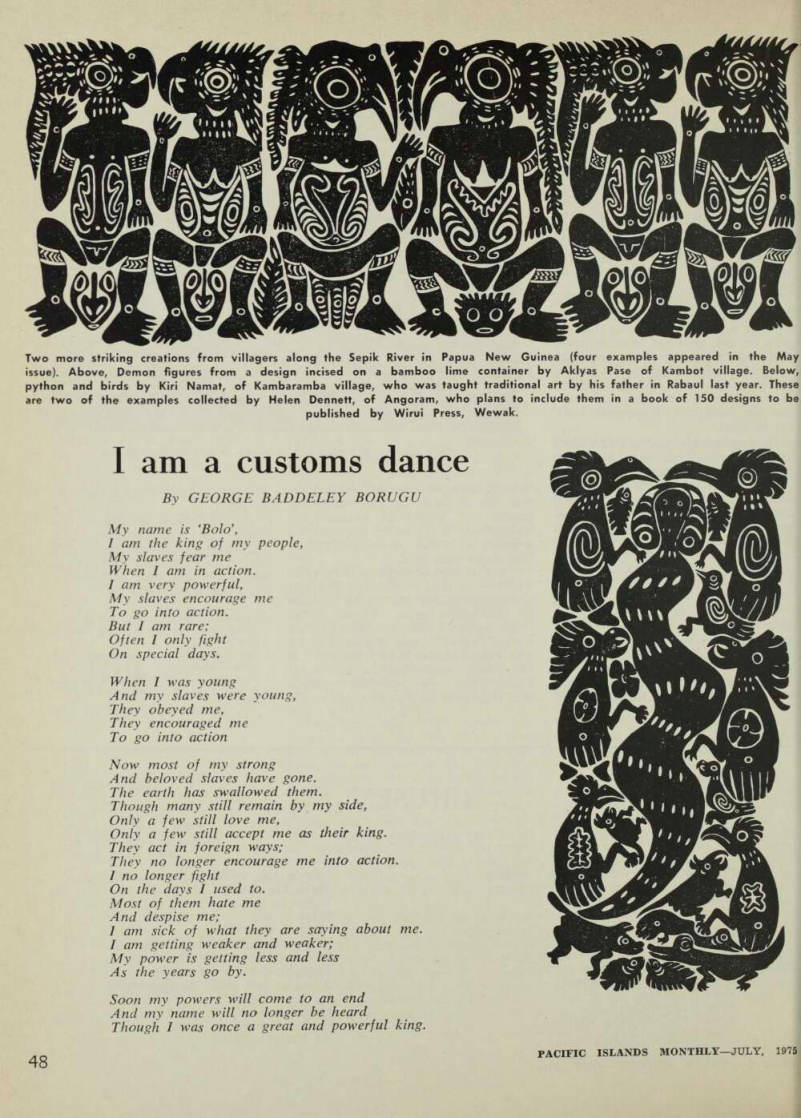
By George Baddeley Borugu
My name is ‘Solo’, I am the king of my people, My slaves fear me When I am in action.
I am very powerful, My slaves encourage me To go into action.
But I am rare; Often I only fight On special days.
When I was young And my slaves were young, They obeyed me.
They encouraged me To go into action Now most of my strong And beloved slaves have gone.
The earth has swallowed them.
Though many still remain by my side, Only a few still love me, Only a few still accept me as their king.
They act in foreign ways; They no longer encourage me into action.
I no longer fight On the days I used to.
Most of them hate me And despise me; I am sick of what they are saying about me.
I am getting weaker and weaker; My power is getting less and less As the years go by.
Soon my powers will come to an end And my name will no longer be heard Though I was once a great and powerful king.
Two more striking creations from villagers along the Sepik River in Papua New Guinea (four examples appeared in the May issue). Above, Demon figures from a design incised on a bamboo lime container by Aklyas Rase of Kambot village. Below, python and birds by Kiri Namat, of Kambaramba village, who was taught traditional art by his father in Rabaul last year. These are two of the examples collected by Helen Dennett, of Angoram, who plans to include them in a book of 150 designs to be published by Wirui Press, Wewak.
A man-eating
ogre
By Donald Kalpokas
LONG long ago there was a village on a beautiful plain.
It had a lot of people. Sadly, some people began to disappear slowly.
There was an Ogre who was causing this. He lived in a big, dark cave on a hill, above the village. He used to steal down to the village in the day and take away a human prey when nobody else was around.
The fearful deed went on for a long time. Nobody could stand against him. The fear of the cannibal grew so big that every body was scared of making a fire because this would only tell the Ogre of their presence.
One day a man and his wife decided to go to their food garden. They asked their two children, a boy and a girl, to remain at home. They had to prepare their food for the evening. They were told to have the left-overs from their break fast for lunch. It was important not to light a fire before three o’clock in the afternoon. By then a lot of people would have come home from their gardens.
Unfortunately they did not do exactly what their parents asked
them to do. They started pre paring their food well before anybody came back from the gardens. They had to light a fire and make some yam pudding.
This meant of course starting a fire in the umu. Of course a lot of smoke was created.
The early preparation of food was not without thought. The 12-year-old boy had thought of a way to kill the Ogre.
The giant saw the smoke.
Immediately he gnashed his teeth and sharpened his wooden sword, and then set off. It took him quite a while to get to the compound of the house. He was weak and tired as a result of fasting so long. He smelt the smell of cooked food as he approached the house. This made him feel more ravenous.
He moved towards the house
very silently, like a cat. A big surprise came to him when he saw the occupants of the home.
The boy had cleverly thought of colouring his hair to attract the Ogre’s attention; he used the blossoms of a ‘Nakavika’ tree (native apple). The colour is attractively red or pink.
The monster was so interested in the colour of the boy’s hair, that he asked the boy how he got the colour on his hair. The boy told the Ogre that he had got it by placing red hot stones in his mouth.
The Ogre was led to believe that the process was true. He knelt down patiently by the fire in which the boy had placed some stones. He opened his mouth and both the boy and the girl put the first stone in. He started moaning because of the pain. The boy told him not to move for fear that the process might not work. So the second, third, and fourth stones were put in quickly. By the time the fourth one was put in, the cannibal dropped dead.
The parents and the people of the village were very happy to find the Ogre lying dead.
Tell Me
By John Laan
Tell me about the town The streets and the cars The wharves and the buildings And why are they there Tell me about the town people How they dress The way they speak, their behaviour And why they never return Tell me about the tourists Where they come from Who they are And why they carry cameras Tell me about the shops Who the shopkeepers are The goods they sell And why they are so expensive Tell me about the cinemas Who shows the pictures How much you pay And why are some not suitable for children Finally tell me If you will marry me And take me to town with you.
A new village and a new life
By Loreen P. Ala
‘Where has old Saranabuga gone?* Sighs my grandfather.
Where there had been no Corrugated iron roofs, and brick walls, But only the tagures * with Their bare earth inside which Meant home to the old and Young people of Saranabuga. ‘Who will wear mats and learn the custom dances?’ ‘No no, no, not // say the young. ‘A mini skirt and a short dress is mine.
And dancing to a guitar is mine.
This is the new generation * A tagure is a traditional thatched house.
Advertisements & other items, pp. 55-57 (4 items)
49
’ACIFIC ISLANDS MONTHLY—JULY, 1975
S. E. Tatham
SOME OF THE FIRMS
WE REPRESENT ARE :
Asia Rubber Works (Singapore Rubber Shoes) Frappier (French Brandy) Huvet (French Brandy) Indika (Belgium Dairy Produce) Durobor S.A. (Belgium Glassware) AAiroiterie Gen. de Belgiqe S.A. (Louvre glass and mirrors) City Engineers (U.K. Bicycles) F.H.I. Japan (Subaru Cars) Kraggs (Wines, Spirits, Ciders) Sunshine Biscuits Sunrise (Confectionery) Flamenco (Instant Coffee & Tea) Quaker Products (Oats, Jets) Hancocks (Spaghetti, Cereals) Melbourne Canning (Jams) Amatil (Twisties, Twirlies) Edward Zorn (Margarine, Cooking Fats) Allens (Confectionery) Red Tulip (Fine Chocolates) Robert Timms (New Guinea Gold Instant Coffees and Teas) S.P.C (Canned Fruit) S.P.C. (Abalone) Wing Lee (See You Sauce) Magnet (Mattresses) Essteel (Cookware) Warner-Drayton (Fans) Mitchell's (Abrasives) Tilbury & Lewis (Sports Trophies & Silverplate) Regent (Swiss watches) Lega Marcasite (Jewellery) Austramax (Pressure Lanterns) Lawn Chair; Tubco (Garden Furniture) Electronic Industries (Electrical Household Appliances) Jex (Steelwool) Arnbro (Folding Beds) James Miller (Blankets) Elmaco (Plastics —Electrical Fittings) B.X. (Plastics) Stegbar (Wooden Louvres) Franklite (Light Fittings) J.J. Cash (Embroidered Labels) Disston (Saws)
S. E. TATHAM
& CO. PIY. HD.
ASKEW HOUSE, 364 LONSDALE ST.,
MELBOURNE, 3001, AUSTRALIA.
G.P.O. BOX 8—
CABLES "SET",
TELEPHONE: 601125
BUYERS FOR THE
PACIFIC ISLANDS
YOUR GUARANTEE
i i
GORDON
FOR SERVICE
T. 2
DIRECT ENQUIRIES WELCOMED
PAPUA NEW GUINEA; S. E. TATHAM (P.N.G.) PTY. LTD.,
LAE: MALAITA STREET (P.O. BOX 1562).
PORT MORESBY: CNR. GOROA AND MUNAHU STREETS
(P.O. BOX 6733, BOROKO).
FJJI: S. E. TATHAM (FIJI) LTD.,
LAUTOKA: P.O. BOX 366.
SUVA: G.P.O. BOX 671
SINCE 1924
From the
Islands Press
A Tohi Tala Niue reader's opinions of candidates in the House of Assembly elections included these: Member for Hikutavake: Never was cut out to be a politician. He's only suitable to support his religion. Member for Alofi Toga (Premier Rex): Dignified. Deep thinker, good orator. Only real leader we have. Should again be Premier.
Member for Makefu: Should not be re-elected.
A vacancy at Niue Hotel for a barman.
From the Micronesian Independent under a Saipan dateline: "Like it or not", a local businessman grumbled here this week, "the US military is one of the biggest roadblocks to economic development in the Marianas. The most suitable area on the island for commercial or industrial use has been 'tied up' with the commonwealth covenant and set aside for use by the military. I would like to see this and released to local government control for use by \Aarianas citizens for development purposes".
From a letter by Julius Nakuromo, of Bible School, Vlaprik, East Sepik, in the PNG Our News: [ would like to say something about the council in uy area, the Yangoru Council. From what I have seen, [ feel the council is not doing its job properly . . .
Most people in the council area did not bother about heir children’s education and wasted all their money )n buying pigs. They often wasted up to $2OO and ater claim that they just don’t have the money to )ay for their children’s school fees.
Tom a letter by Bill Goldsmith, of Vavau in the
ronga Chronicle:
sit here next to my flickering kerosene lamp and vatch wistfully as the last precious drops of its fuel ’ urn away. Suddenly, I remember the days of World Var 11 petrol rationing. Vavau is certainly not at var, yet our kerosene supply is very austere. Stoves ind lanterns alike grow dimmer. Tonga, do you emember that there is a kingdom due north of Nukualofa. Yes, and we even use kerosene. rom the Norfolk Islander: m attempt to import poker machines into Norfolk Island as met with dismal failure. The local wharfies— /ho have a distinct aversion to one-armed bandits— laced them under a green ban. And the Norfolk sland green ban is 10 fathoms deep. . . . There was slight mishap between the ship and the shore and ie six machines went to the bottom. . . . But the /harfies have a good record. No matter how rough ie seas, they have never dropped a case of uty-free grog.
From the Arawa Bulletin:
Lady from Island Office Supplies was delayed in Kieta . . .
Meanwhile her assistant at Arawa was anxious to close shop but was unable to because she did not have the key.
She rang the police who promptly came to stand guard outside the shop so that she could go home to her family.
From a letter by Kautu Kamoriki, chairman of GEIC Censorship Board, in the Atoll Pioneer: After much thought and consideration we have come to the conclusion that parents here do not object to their children viewing "the ever popular Karate films" no matter that they may be "little more than blood baths of slashed bodies and torture".
From a letter by Walter C. Thiessen in the
Micronesian Independent:
... I will again repeat my earlier observation that your newspaper does, from time to time,
contain correct information.
Suggestion by James Kyle, of Scotland, in the Atoll Pioneer of a new name for the Gilbert Islands: Why not adopt the old Banaban name Abariringa, the Sunlit Isles beside the bright water? . . . An additional advantage is that it would ensure that your country always came first in any alphabetical list of the countries of the world. The first place is always the best place to occupy!
Letter by Valerie Laughton in Arawa Bulletin: With deepest regret we wish to publish the passing of two faithful friends . . . Girlie Humphries and Caesar Schneider were loved by all, but some malicious fiend chose to end their lives with a corrosive poison, probably battery acid. The death being slow, and painful—up to three days of suffering while the stomach is eaten away. Be it known to the public that the person or persons responsible will strike again, so do protect the pets which are protecting you.
From a letter by Raomi in the Atoll Pioneer, GEIC: I was told that this (coming together of families of bride and groom on day of wedding celebrations) was once a very important occasion when the two families came together rejoicing because their children became one in marriage.
This union somehow became a symbol of expression of the union between the two families involved. One regrets that this is about to disappear. The families are being pushed off the platform. If I may pot it in the order as I see it: We have the bridegroom, bride and invited guests on the stage, and the families become the spectators with the exception of one or more who have been asked to supervise the whole show. This, I think, had never been the situation before in our marriage customs. The families had never been spectators, but actors or co-actors.
From the Group radio news in the New Hebrides: Although girls are expected to be good cooks, single boys on leaving school and living away from home sometimes have a hard time. But boys at the British Secondary School are keen to change all that, and 23 of them have joined a cookery class run every Saturday morning by catering supervisor John Holden. What's more, they're doing so well that John is offering to cater for any number from 20 to 200. And anyone who has joined in the feasts he has prepared for various festive occasions will know that this is no idle boast.
51
ACIFIC ISLANDS MONTHLY—JULY, 1975
Books, Reviews, writers
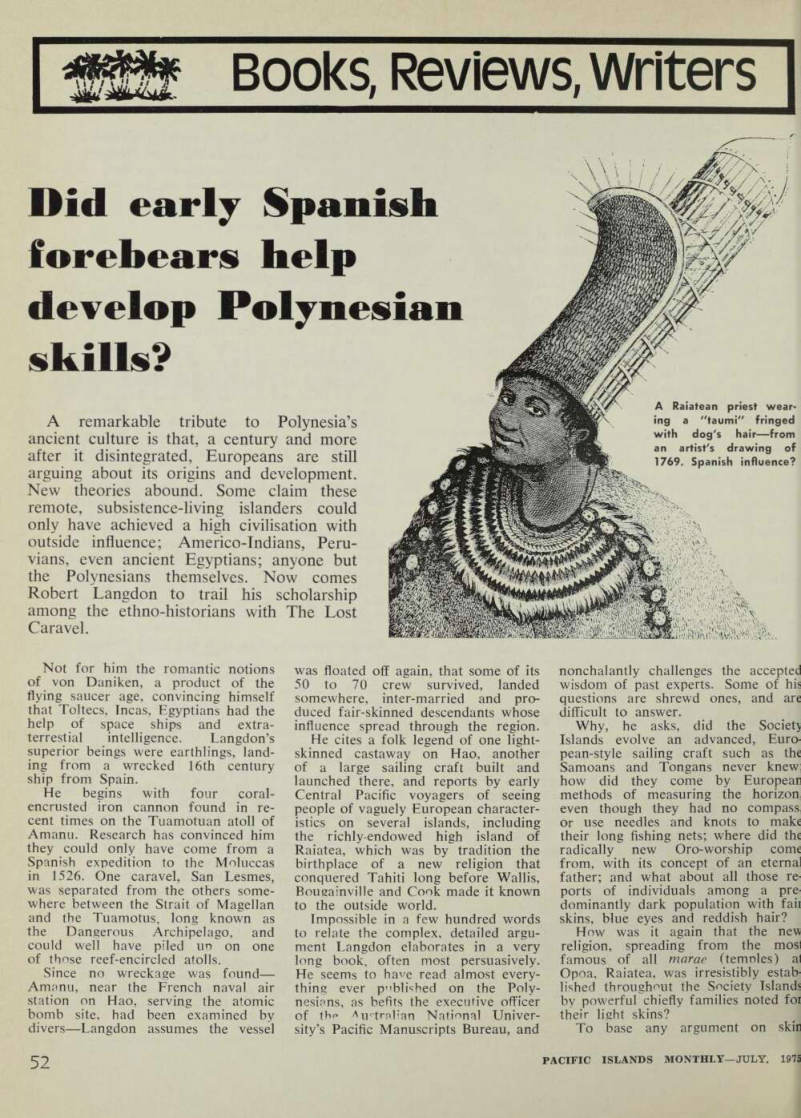
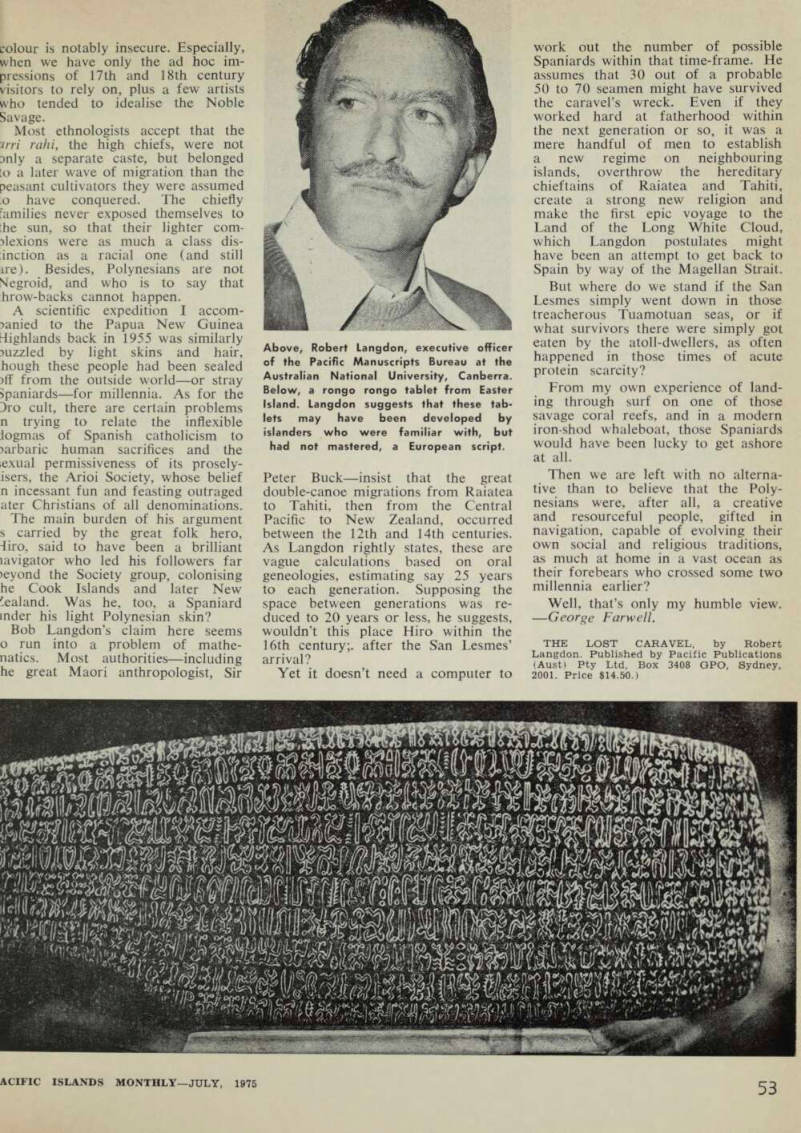
Did early Spanish forebears help develop Polynesian skills?
A remarkable tribute to Polynesia’s ancient culture is that, a century and more after it disintegrated, Europeans are still arguing about its origins and development.
New theories abound. Some claim these remote, subsistence-living islanders could only have achieved a high civilisation with outside influence; Americo-Indians, Peru vians, even ancient Egyptians; anyone but the Polynesians themselves. Now comes Robert Langdon to trail his scholarship among the ethno-historians with The Lost Caravel.
Not for him the romantic notions of von Daniken, a product of the flying saucer age, convincing himself that Toltecs, Incas, Egyptians had the help of space ships and extra terrestial intelligence. Langdon’s superior beings were earthlings, land ing from a wrecked 16th century ship from Spain.
He begins with four coral encrusted iron cannon found in re cent times on the Tuamotuan atoll of Amanu. Research has convinced him they could only have come from a Spanish expedition to the Moluccas in 1526. One caravel, San Lesmes, was separated from the others some where between the Strait of Magellan and the Tuamotus, long known as the Dangerous Archipelago, and could well have piled un on one of those reef-encircled atolls.
Since no wreckage was found— Amanu, near the French naval air station on Hao, serving the atomic bomb site, had been examined by divers—Langdon assumes the vessel
was floated off again, that some of its 50 to 70 crew survived, landed somewhere, inter-married and pro duced fair-skinned descendants whose influence spread through the region.
He cites a folk legend of one light skinned castaway on Hao, another of a large sailing craft built and launched there, and reports by early Central Pacific voyagers of seeing people of vaguely European character istics on several islands, including the richly-endowed high island of Raiatea, which was by tradition the birthplace of a new religion that conquered Tahiti long before Wallis, Bougainville and Cook made it known to the outside world.
Impossible in a few hundred words to relate the complex, detailed argu ment Langdon elaborates in a very long book, often most persuasively.
He seems to have read almost every thing ever published on the Poly nesians, as befits the executive officer of tb#» National Univer sity’s Pacific Manuscripts Bureau, and
nonchalantly challenges the accepted wisdom of past experts. Some of his questions are shrewd ones, and are difficult to answer.
Why, he asks, did the Society Islands evolve an advanced, Euro pean-style sailing craft such as the Samoans and Tongans never knew: how did they come by European methods of measuring the horizon, even though they had no compass ; or use needles and knots to make their long fishing nets; where did the radically new Oro-worship come from, with its concept of an eternal father; and what about all those re ports of individuals among a pre dominantly dark population with fail skins, blue eyes and reddish hair?
How was it again that the new religion, spreading from the most famous of all marae (temnles) al Opoa, Raiatea, was irresistibly estab lished throughout the Society Islands by powerful chiefly families noted for their light skins?
To base any argument on skin
A Raiatean priest wear ing a "taumi" fringed with dog's hair—from an artist's drawing of 1769. Spanish influence?
colour is notably insecure. Especially, when we have only the ad hoc im pressions of 17th and 18th century visitors to rely on, plus a few artists who tended to idealise the Noble Savage.
Most ethnologists accept that the mi rahi, the high chiefs, were not jnly a separate caste, but belonged to a later wave of migration than the peasant cultivators they were assumed ;o have conquered. The chiefly families never exposed themselves to the sun, so that their lighter com plexions were as much a class dis tinction as a racial one (and still ire). Besides, Polynesians are not Negroid, and who is to say that hrow-backs cannot happen.
A scientific expedition I accom panied to the Papua New Guinea Highlands back in 1955 was similarly puzzled by light skins and hair, hough these people had been sealed pff from the outside world—or stray Spaniards—for millennia. As for the >ro cult, there are certain problems n trying to relate the inflexible logmas of Spanish Catholicism to parbaric human sacrifices and the exual permissiveness of its prosely isers, the Arioi Society, whose belief n incessant fun and feasting outraged ater Christians of all denominations.
The main burden of his argument s carried by the great folk hero, Hiro, said to have been a brilliant lavigator who led his followers far >eyond the Society group, colonising he Cook Islands and later New Zealand. Was he, too, a Spaniard mder his light Polynesian skin?
Bob Langdon’s claim here seems o run into a problem of mathe natics. Most authorities—including he great Maori anthropologist, Sir
Peter Buck—insist that the great double-canoe migrations from Raiatea to Tahiti, then from the Central Pacific to New Zealand, occurred between the 12th and 14th centuries.
As Langdon rightly states, these are vague calculations based on oral geneologies, estimating say 25 years to each generation. Supposing the space between generations was re duced to 20 years or less, he suggests, wouldn’t this place Hiro within the 16th century;, after the San Lesmes’ arrival?
Yet it doesn’t need a computer to
work out the number of possible Spaniards within that time-frame. He assumes that 30 out of a probable 50 to 70 seamen might have survived the caravel’s wreck. Even if they worked hard at fatherhood within the next generation or so, it was a mere handful of men to establish a new regime on neighbouring islands, overthrow the hereditary chieftains of Raiatea and Tahiti, create a strong new religion and make the first epic voyage to the Land of the Long White Cloud, which Langdon postulates might have been an attempt to get back to Spain by way of the Magellan Strait.
But where do we stand if the San Lesmes simply went down in those treacherous Tuamotuan seas, or if what survivors there were simply got eaten by the atoll-dwellers, as often happened in those times of acute
protein scarcity?
From my own experience of land ing through surf on one of those savage coral reefs, and in a modern iron-shod whaleboat, those Spaniards would have been lucky to get ashore at all.
Then we are left with no alterna tive than to believe that the Poly nesians were, after all, a creative and resourceful people, gifted in navigation, capable of evolving their own social and religious traditions, as much at home in a vast ocean as their forebears who crossed some two millennia earlier?
Well, that’s only my humble view.
—George Farwell.
THE LOST CARAVEL, by Robert Langdon. Published by Pacific Publications (Aust) Pty Ltd, Box 3408 GPO, Sydney, 2001. Price $14.50.)
Above, Robert Langdon, executive officer of the Pacific Manuscripts Bureau at the Australian National University, Canberra.
Below, a rongo rongo tablet from Easter Island. Langdon suggests that these tab lets may have been developed by islanders who were familiar with, but had not mastered, a European script.
Advertisements & other items, pp. 59-60 (2 items)
53
ACIFIC ISLANDS MONTHLY—JULY, 1976
Timely Pacific Reading!
Send your order direct to
Pacific Publications (Aust.) Pty. Ltd.
29 Alberta Street, Sydney, N.S.W. 2000
PAPUA NEW GUINEA
HANDBOOK
7th edition This new edition of the Papua New Guinea Handbook —completely revised and reset —provides the first full upto-date details of the new self-governing nation.
For businessmen, travellers, schools, universities and libraries, government departments, tourists and Papua New Guinea residents, this timely, up-to-the-minute edition, is essential.
A large attractive fold-out map of Papua New Guinea is also included. 332 pages of text.
PRICE: Australia, 55.50 plus 90c posted, Pacific Islands and Overseas, $5.50 Aust., plus $1.30 posted; U S.A., $9.80 U.S. posted.
FOR CHILDREN
LITTLE CHIMBU IN
BOUGAINVILLE Nancy Curtis This is the story of lovable Little Chimbu, and his friends, who go off to see the biggest hole in the world . . . the Bougainville copper mine, at Panguna, in New Guinea.
Adventures follow one after the other on their arrival at the mine, and young readers (and their parents) will be fascinated by Nancy Curtis' colourful, yet accurate and instructive account of the workings of the big Bougainville enterprise ... its giant trucks, its processing plant, its port and shipping.
Illustrated in full colour.
PRICE: Australia, Pacific Islands and Overseas, $3.25 Aust., plus 50c posted; U.S.A., $5.30 U.S. posted.
Percy Chatterton's Papua
DAY THAT I HAVE LOVED
Percy Chatterton This is more than an autobiography by well-known Percy Chatterton, OBE, who has spent 50 years in Papua as missionary, teacher and outspoken politician fighting for the underdog. It is a colourful, and charming, account of the Papuan people, giving warm insight into their hopes, fears and changing way of life. Some Papuan leaders say they don't want Papua to be submerged by New Guinea in the move towards independence, and readers of Percy Chatterton's timely book will readily sympathise with their desire to retain their identity. The book is illustrated with evocative pen sketches by Percy Chatterton's longtime friend and neighbour in Port Moresby, Rev. Bert Brown. 144 pages, illustrated.
PRICE: Australia, Pacific Islands and Overseas, $5.25 Aust., plus 50c posted; U.S.A., $8.30 U.S. posted.
HOLY TORTURE IN FIJI
Written by a group of academic participants and observers.
Editing and commentary by Prof. Ron Crocombe.
This book describes sacred ancient rituals involving physical ordeals which are performed once a year at certain Hindu temples in Fiji. The rituals include walking on fire, dancing on upturned knife-blades, whipping, plunging the hands in burning fat and piercing the body with steel skewers and silver wires.
Yet those who go through the ordeals suffer no pain, burns or injuries.
The book is beautifully produced in full colour and black-and-white.
PRICE: Australia, Pacific Islands and Overseas, $3.95 Aust., plus 50c posted; U.S.A., $6.40 U.S. posted.
PRPUR
nisu Guinea
HRSIDBOOH
HOLY
TORTURE
DAY THAT I
HAVE LOVED
IN FIJI
Understanding the past to keep up
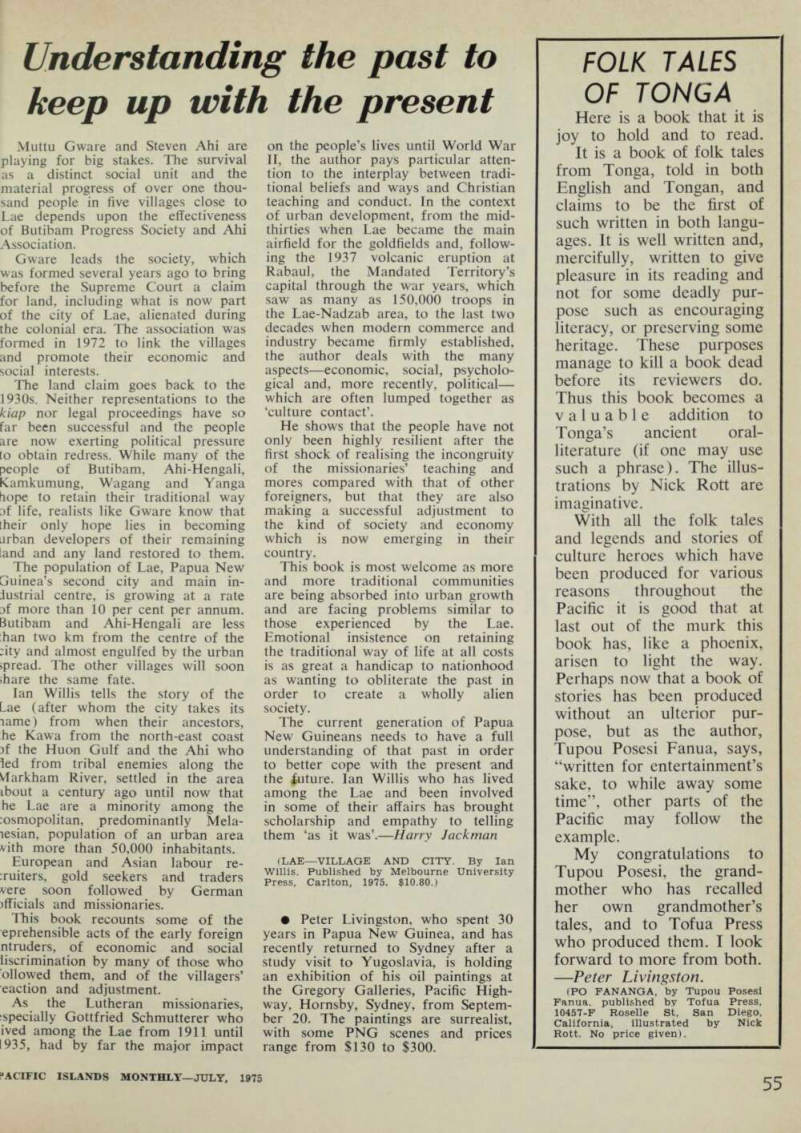
keep up with the present
Muttu Gware and Steven Ahi are playing for big stakes. The survival as a distinct social unit and the material progress of over one thou sand people in five villages close to Lae depends upon the effectiveness of Butibam Progress Society and Ahi Association.
Gware leads the society, which was formed several years ago to bring before the Supreme Court a claim for land, including what is now part of the city of Lae, alienated during the colonial era. The association was formed in 1972 to link the villages and promote their economic and social interests.
The land claim goes back to the 19305. Neither representations to the kiap nor legal proceedings have so far been successful and the people are now exerting political pressure to obtain redress. While many of the people of Butibam, Ahi-Hengali, Kamkumung, Wagang and Yanga hope to retain their traditional way jf life, realists like Gware know that their only hope lies in becoming urban developers of their remaining iand and any land restored to them.
The population of Lae, Papua New Guinea’s second city and main in dustrial centre, is growing at a rate jf more than 10 per cent per annum, Butibam and Ahi-Hengali are less han two km from the centre of the city and almost engulfed by the urban spread. The other villages will soon share the same fate. lan Willis tells the story of the Lae (after whom the city takes its lame) from when their ancestors, he Kawa from the north-east coast if the Huon Gulf and the Ahi who led from tribal enemies along the Vlarkham River, settled in the area ibout a century ago until now that he Lae are a minority among the :osmopolitan, predominantly Mela lesian, population of an urban area vith more than 50,000 inhabitants.
European and Asian labour re :ruiters, gold seekers and traders vere soon followed by German ifficials and missionaries.
This book recounts some of the eprehensible acts of the early foreign ntruders, of economic and social liscrimination by many of those who ollowed them, and of the villagers’ eaction and adjustment.
As the Lutheran missionaries, specially Gottfried Schmutterer who ived among the Lae from 1911 until 1935, had by far the major impact
on the people’s lives until World War 11, the author pays particular atten tion to the interplay between tradi tional beliefs and ways and Christian teaching and conduct. In the context of urban development, from the mid thirties when Lae became the main airfield for the goldfields and, follow ing the 1937 volcanic eruption at Rabaul, the Mandated Territory’s capital through the war years, which saw as many as 150,000 troops in the Lae-Nadzab area, to the last two decades when modern commerce and industry became firmly established, the author deals with the many aspects—economic, social, psycholo gical and, more recently, political— which are often lumped together as ‘culture contact’.
He shows that the people have not only been highly resilient after the first shock of realising the incongruity of the missionaries’ teaching and mores compared with that of other foreigners, but that they are also making a successful adjustment to the kind of society and economy which is now emerging in their country.
This book is most welcome as more and more traditional communities are being absorbed into urban growth and are facing problems similar to those experienced by the Lae.
Emotional insistence on retaining the traditional way of life at all costs is as great a handicap to nationhood as wanting to obliterate the past in order to create a wholly alien society.
The current generation of Papua New Guineans needs to have a full understanding of that past in order to better cope with the present and the future. lan Willis who has lived among the Lae and been involved in some of their affairs has brought scholarship and empathy to telling them ‘as it was’. —Harry Jackman
(Lae—Village And City. By Lan
Willis. Published by Melbourne University Press, Carlton, 1975. $10.80.) • Peter Livingston, who spent 30 years in Papua New Guinea, and has recently returned to Sydney after a study visit to Yugoslavia, is holding an exhibition of his oil paintings at the Gregory Galleries, Pacific High way, Hornsby, Sydney, from Septem ber 20. The paintings are surrealist, with some PNG scenes and prices range from $l3O to $3OO.
Folk Tales
Of Tonga
Here is a book that it is joy to hold and to read.
It is a book of folk tales from Tonga, told in both English and Tongan, and claims to be the first of such written in both langu ages. It is well written and, mercifully, written to give pleasure in its reading and not for some deadly pur pose such as encouraging literacy, or preserving some heritage. These purposes manage to kill a book dead before its reviewers do.
Thus this book becomes a valuable addition to Tonga’s ancient oral literature (if one may use such a phrase). The illus trations by Nick Rott are
imaginative.
With all the folk tales and legends and stories of culture heroes which have been produced for various reasons throughout the Pacific it is good that at last out of the murk this book has, like a phoenix, arisen to light the way.
Perhaps now that a book of stories has been produced without an ulterior pur pose, but as the author, Tupou Posesi Fanua, says, “written for entertainment’s sake, to while away some time”, other parts of the Pacific may follow the example.
My congratulations to Tupou Posesi, the grand mother who has recalled her own grandmother’s tales, and to Tofua Press who produced them. I look forward to more from both. —Peter Livingston. (PO PANANGA, by Tupou Posesi Fanua. published by Tofua Press, 10457-F Roselle St, San Diego, California, illustrated by Nick Rott. No price given).
Him: Almost
A Moon Trip!
Hiri is the story of two boys and a girl who stow away on a large canoe during one of the Motu people’s traditional trading voyages to the Gulf of Papua.
Perhaps the last such voyage, known as hiri, took place in 1958 when a lagatoi, a four-hull dug-out, built in accordance with all the tra ditional ritual requirements, sailed from Manumanu with 1,100 day pots.
A year earlier two hakona, double hulled dug-outs, from the same vil lage, two others, four puapua and a chartered scow had taken about 10,000 pots from Manumanu, Boera, Porebada, Rea Rea and Kido to the west.
The stowaways, having broken the taravatu, the traditional law that only ritually-prepared men may go on the voyage, face the anger of what the author calls the puri puri man—village sorcerer—but they re deem themselves by making the crew aware of an enemy tribe’s plot to destroy the expedition. All then ends well.
It is not clear whether this book is meant for Papua New Guinea children or those from other lands.
No one who has read the description of a hiri by Capt Barton, Adminis trator of Papua from 1904 to 1906, in Seligman’s classic The Melanesians of British New Guinea (1910) or later accounts by, say, Prof Murray Groves, or who has spoken with old men among the Motu, will regard this book as anything but a failure to understand the vital part that the hiri played in the socio-economic life of the Motu. This failure turns the book into the kind of foolish tale that an account of moon trips would be if it were assumed that the planet is made of cheese. Even the name of one of the boys, Vaki, is not a Motu but a Kivori one and that of the girl, Kori, is found among the inland Rigo people. Those four-hull canoes are called lagatoi, not, as the author has it, lakatoi, and tama, though mean ing ‘father’ in Motu, is not in use as a first name.
It is all a great pity because child ren’s books based on the old life in Papua New Guinea are badly needed for brown and white children alike, and the publisher deserves plaudits for ‘having a go’. Moreover, Gava Aura’s illustrations are a delight. One hopes that Neil Thompson will, after first doing the necessary research, have another try, and that other writers, whether sons and daughters of Papua New Guinea or foreigners, will write in this genre for the young.
To sum up, this book regrettably earns no better than the comment, in Hiri Motu, of a Papuan to whom I lent it: edana bamona (why?).— Harry Jackman (HIRI. By Neil Thompson. Published by Niugini Press, Port Moresby. No price given.) PACIFIC MAPS.— Two detailed, fold-out maps in full colour of Nor folk Island and Lord Howe Island are the first of a series of the Pacific Islands now being produced by Pacific Maps of Sydney. Others will shortly follow. The map of Lord Howe Island is 21 in. by 29 in. and the Norfolk Island map is 18 in. by 24 in. Both maps show roads and land marks and each is available at S1.25 posted direct from Pacific Publica tions, Box 3408, GPO, Sydney.
Advertisements & other items, pp. 62-64 (2 items)
® Bekaert Means Miles Of Fences
n\ ■ 21S m
★ CHOICE OF STYLES
★ FIRST QUALITY
★ GALVANISED OR
PLASTIC COATINGS
BEKAERT is the leading European wire-mill with a yearly capacity of over 350,000 tons of high quality wires and wire-products and all kinds of ornamental, welded or chain link fences.
For further information or supplies contact: The BEKAERT people for the Pacific Islands.
KERR BROTHERS PTY. LTD. 65 York St., Sydney, N.S.W., 2001.
Whichever way
you choose to go,
go Pan Am.
70 LONDON
Honolulu Los Angeles San Francisco New York London
TO LONDON \i\A.
Sydneu Honq Konq DeftVi FrankfurV London Pan Am, the only airline Three times a week in either operating out of Fiji to take you direction. Ask your travel agent all the way around the world, about it. via London. In either direction.
In fact, the only airline that can take you direct to London (via the U.S.A.) at all.
Or call Panair, Suva 22.641, Nadi 72.100.
You call it the world. We call it home. 250.P.193A
BUILT TO EARN A LIVING
SHIPS AND WORKBOATS BY CARPENTERS INDUSTRIAL
4S *5 X From a village fishing boat to an inter-island trader. A tugboat to a 100 foot barge. We design and build them all, in wood or steel up to 120 feet in length.
If you trust your living to the sea, trust your shipbuilding to Carpenters Industrial.
CARPENTERS INDUSTRIAL
BOX 296 SUVA FIJI. PHONE 23031. Cable MILLERS SUVA Telex 2195FJ £ 2
Ml
Franco-Asiatic Trading Co. Ltd.
EXPORTERS • IMPORTERS
FOR A RELIABLE AND PERSONAL BUYING SERVICE Please contact us: • GENERAL MERCHANDISE (Foodstuffs, Beverages, Hardware, Garments . .) • COMPLETE SETS OF MACHINERY (Suitable to establish small industries) • AIRPLANES & HELICOPTERS (Second Hand: "DCS", /, Beechcraft // etc ) LOOKING FOR RELIABLE AGENTS THROUGHOUT THE PACIFIC
INQUIRIES:
(English, French or Chinese language) P.O. BOX K-270 KOWLOON CENTRAL, HONG KONG
Cable: FRANSIATIC. Telex: HX 73981-STORM.
Bank References: Banque Nationale de Paris, Central Building, Hong Kong.
57
ICIFIC ISLANDS MONTHLY—JULY, 1975
Pacific Transport
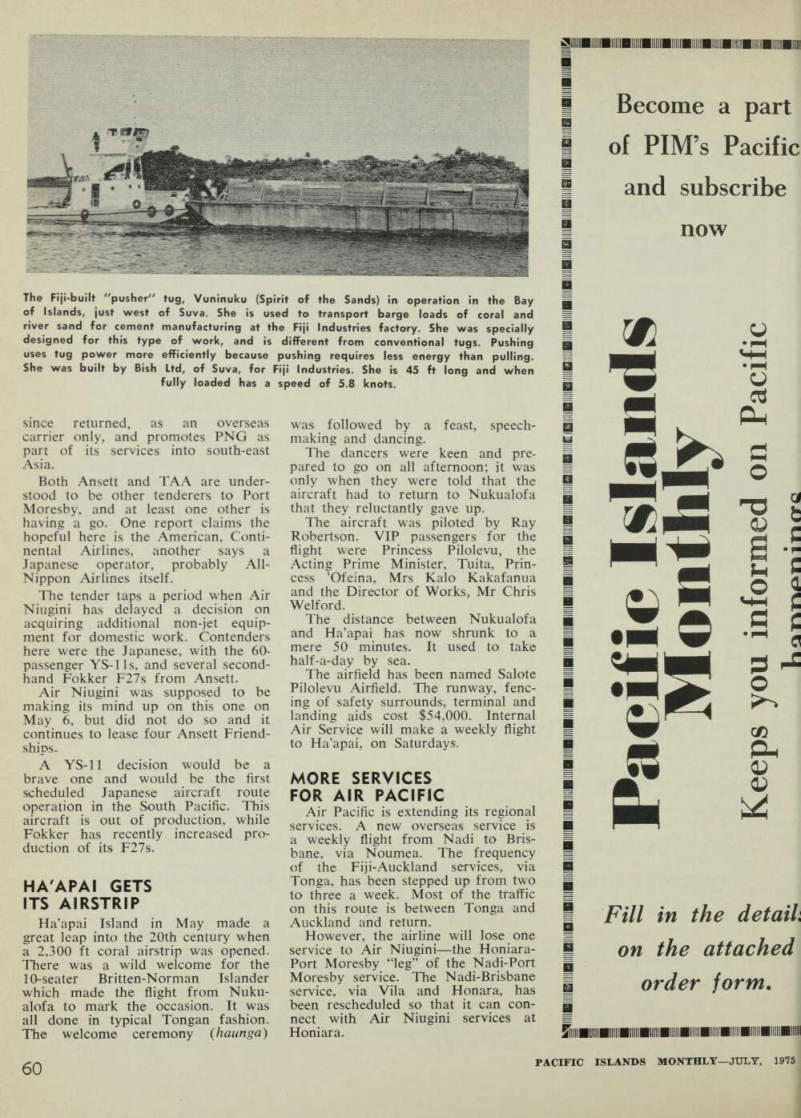
Japanese In The Competition
For Png's Aviation Plums
By Ken Mcgregor
Overseas aviation links in the ature are up for grabs in Papua lew Guinea and it appears the race between Qantas and Japanese in vests.
The competitive situation follows ic release, in recent weeks, of a :nder by the PNG Government for peration of the territory’s overseas ffieduled air services in the im lediate period following indepen mce.
Nature of the tender—and its nplications—have excited consider ate interest throughout the regional /iation scene. It is but the latest in South Seas air mtings, which have stayed most ilatile and uncertain during the ast 10 years.
The question mark on PNG air rvices externally comes on the eve several significant events effecting e area, the most important of which elude: • Introduction by Fiji-based Air icific of its first “fast” route to ustralia, Nadi to Brisbane, via ily one stop, Noumea. • The arrival, in July, of a 100issenger capacity Boeing 737 jet— th final seat configuration unknown -for Noumea, which will tempo rily at least expand its all-jet fleet three. • Advanced examinations by ihiti-based Air Polynesie, of its lall-jet requirements, with forays :o the Cooks and Fiji most likely. • Increased pressure by Asian rriers, Thai International and igapore Airlines, for traffic rights
:o American Samoa/Tahiti, and
ji, respectively.
• Reports that Apia-based Poly sian Airlines may go into jets, at Air Pacific may recall its leased lll jet from Africa for an tended Nauru run into Majuro and awaii, plus word of an aviation reement close between Tonga and mru.
PNG, however, is the biggest
aviation story around, in view of what equipment it may use, who it will use for expertise as its initial contractor and whence it will fly.
Obviously, first priority is to maintain links with Australia. Then there are other probables, such as Fiji, via the Solomons, New Cale donia and possibly New Zealand.
To the north, the possibilities are more interesting. Jakarta, West Irian, Singapore, Hong Kong, Manila, Japan and even Hawaii are all there.
Traffic rights and scheduled passenger
seat capacities have yet to be deter mined.
Then who will operate the service as the territory is apparently in capable of doing this at first?
Japan is reported to be lobbying strongly, both with a view to selling YS-11 aircraft to internal carrier, Air Niugini, and selling Boeing 727 (from All Nippon Airlines) jets to operate the actual external services.
Boeing 727 sales to PNG would be a massive success for the Japanese, should they pull it off. It would eclipse other sales of Boeing 7275, model 100, that the domestic carriers in Australia, TAA and Ansett, are also trying to flog to the territory.
Acquisition of jet aircraft could well mean PNG might drop the idea of using outsiders to manage the ex ternal service.
One report has it Air Niugini would go the PNG-Australia service alone, with behind-the-scenes Japanese help. And that’s after buying out Qantas, Ansett and TAA sharehold ings in Air Niugini.
If this happens, it would mean a loss in influence for Australia’s De partment of Transport, the unwieldy dispersed mass of Minister Charlie Jones, which would have had a say in PNG’s civil aviation had Qantas won the external deal.
Qantas could well do this, of course. It has confirmed that the Australian international carrier is, indeed, tendering, to PNG, to carry the independent country’s first over seas air services under contract.
Here, it goes in with previous ex perience and a proven record in aiding carriers of developing countries find their feet—there are a couple of south-east Asian examples, plus, of course. Air Pacific, which still has a Qantas chairman.
Qantas’ reputation in PNG is understood to be much better than when it left operating both the terri tory’s domestic and external air services several years ago. It has
since returned, as an overseas carrier only, and promotes PNG as part of its services into south-east Asia.
Both Ansett and TAA are under stood to be other tenderers to Port Moresby, and at least one other is having a go. One report claims the hopeful here is the American, Conti nental Airlines, another says a Japanese operator, probably All- Nippon Airlines itself.
The tender taps a period when Air Niugini has delayed a decision on acquiring additional non-jet equip ment for domestic work. Contenders here were the Japanese, with the 60passenger YS-lls, and several second hand Fokker F27s from Ansett.
Air Niugini was supposed to be making its mind up on this one on May 6, but did not do so and it continues to lease four Ansett Friend ships.
A YS-11 decision would be a brave one and would be the first scheduled Japanese aircraft route operation in the South Pacific. This aircraft is out of production, while Fokker has recently increased pro duction of its F27s.
Ha'apai Gets
Its Airstrip
Ha’apai Island in May made a great leap into the 20th century when a 2,300 ft coral airstrip was opened.
There was a wild welcome for the 10-seater Britten-Norman Islander which made the flight from Nuku alofa to mark the occasion. It was all done in typical Tongan fashion.
The welcome ceremony (haunga)
was followed by a feast, speech making and dancing.
The dancers were keen and pre pared to go on all afternoon; it was only when they were told that the aircraft had to return to Nukualofa that they reluctantly gave up.
The aircraft was piloted by Ray Robertson. VIP passengers for the flight were Princess Pilolevu, the Acting Prime Minister, Tuita, Prin cess ’Ofeina, Mrs Kalo Kakafanua and the Director of Works, Mr Chris Welford.
The distance between Nukualofa and Ha’apai has now shrunk to a mere 50 minutes. It used to take half-a-day by sea.
The airfield has been named Salote Pilolevu Airfield. The runway, fenc ing of safety surrounds, terminal and landing aids cost $54,000. Internal Air Service will make a weekly flight to Ha’apai, on Saturdays.
More Services
For Air Pacific
Air Pacific is extending its regional services. A new overseas service is a weekly flight from Nadi to Bris bane, via Noumea. The frequency of the Fiji-Auckland services, via Tonga, has been stepped up from two to three a week. Most of the traffic on this route is between Tonga and Auckland and return.
However, the airline will lose one service to Air Niugini—the Honiara- Port Moresby “leg” of the Nadi-Port Moresby service. The Nadi-Brisbane service, via Vila and Honara, has been rescheduled so that it can con nect with Air Niugini services at Honiara.
The Fiji-built "pusher" tug, Vuninuku (Spirit of the Sands) in operation in the Bay of Islands, just west of Suva. She is used to transport barge loads of coral and river sand for cement manufacturing at the Fiji Industries factory. She was specially designed for this type of work, and is different from conventional tugs. Pushing uses tug power more efficiently because pushing requires less energy than pulling.
She was built by Bish Ltd, of Suva, for Fiji Industries. She is 45 ft long and when fully loaded has a speed of 5.8 knots.
Kava, Not Champagne
For Tui Cakau
The Tui Cakau, the shipping company-union owned ship operating between New Zealand, Fiji and Western Samoa since May, went into service after a launching, which in cluded Fijian ceremonies.
Formerly the Capitaine La Perouse, operated by Sofrana-Unilines, she is now owned by that company, the Carpenter group in Fiji and the Fiji Waterside Workers and Seamen’s Union.
The ship was built in Norway in 1951, and has been in the Pacific for about two years. She can carry 2,800 tons of cargo and has accommodation for 12 passengers.
The ship was officially renamed by Adi Salote Lalabalavu, daughter of the Tui Cakau, Ratu Ratavo Lala balavu, who was guest of honour.
Shaw Savill Sails Out
Of Cruise Market
Economics are forcing Shaw Savill 0 quit the cruise market. The ship ping line’s last cruiser, the Northern star, 24,000 tons, will be withdrawn Tom service in October. Shaw Savill operated three passenger cruisers, the Northern Star, the Southern Cross md the Ocean Monarch. The kmthern Cross was sold in 1971 and he Ocean Monarch will be scrapped.
Shaw Savill cruised in the Pacific rom Australia from December to \pril. Island groups visited were the 4ew Hebrides, New Caledonia, Fiji, Ponga, American Samoa, Western ►amoa and Tahiti. A spokesman for he line said it had become un economic to run one passenger ship, mel costs alone had risen by more han 300 per cent in 18 months. • Air Melanesiae has been advised •y the Civil Aviation Department in he New Hebrides that it may resume wice-daily flights to Norsup. The trip was closed in mid-December, .ater, daily services were allowed. • Twenty-three politicians and usinessmen of Koror have launched campaign to have a port developed 1 Palau for a super tanker. They ave started a “joint planning effort”, t was reported recently in Micro lesia that more than SUSSOO,OOO ad already been spent on a study explore a plan to bring together JS, Japanese and Iranian financial nterests for the project, the first base of which will cost more than 600 million. • Air Pacific Inc, of Guam, re ently added a DC3 aircraft to ouble its one-plan effect. The air raft will be used on a service be ween Guam and the Marianas.
Multi-Million Kina
Airport For Lae
A new airport at Lae, capable of handling aircraft up to medium-sized jets, is expected to be operational by the end of 1976. Two new contracts, worth 4.7 million kina (dollars), were let recently to build the airport.
The new airport will be capable of unrestricted use by Fokker Friend ships, and weekly use by medium sized jets, such as the Air Pacific BAG 111. The existing airport, when phased out, will allow Lae to develop further.
Hyundai Construction Co Ltd, a Korean firm, won a contract, worth 2,956,114 kina for civil engineering works, including work on the existing runway, construction of a new taxi way, parking aprons, airfield ducts and drainage, access roads, perimeter road, car park, building area pave ments and ancillary works.
The second contract, for building work, was for 1,738,000 kina, and was awarded to Morobe Construc tions Pty Ltd. This work includes the terminal, fire station, control tower, lighting room and powerhouse, opera tions building, maintenance com plexes, transmitter and receiver build ing.
The project is being financed by the Australian Government as an aid project for PNG.
Advertisements & other items, pp. 65-67 (3 items)
59
CIFIC ISLANDS MONTHLY—JULY, 1975
Vlwm
Become a part of PIM’s Pacific and subscribe now S_b
V St & o a Ph P o T3 t S ? o a s o CO Ph Fz7/ m /Ac detail on the attached order form.
DAIWA LINE
DIRECT REGULAR SERVICE
JAPAN-SOUTH PACIFIC
TARAWA-PAPEETE-PAGO PAGO-APIA
SUVA-LAUTOKA-NOUMEA-VILA
SANTO-HONIARA
JAPAN-TAIWAN-GUAM
JAPAN-KEELUNG-GUAM BY
EXCELLENT CAR/CONTAINER-CARRIER
JAPAN-WEST IRIAN-DILI
HONG KONG-TAIWAN-WEST IRIAN-DILI
GUAM: ATKINS, KROLL (GUAM) LTD.
TARAWA: G. & E. I. DEVELOPMENT AUTHORITY.
APIA: BURNS PHILP (SOUTH SEA) CO.. LTD.
PAGO PAGO: KNEUBUHL MARITIME SERVICES CORP.
NUKUALOFA: PACIFIC NAVIGATION CO., LTD.
SUVA: BURNS PHILP (SOUTH SEA) CO., LTD.
LAUTOKA: BURNS PHILP (SOUTH SEA) CO., LTD.
NOUMEA; AGENCE MARITIME ET AERIENNE
CALEDONIENNE.
SANTO: BURNS PHILP (NEW HEBRIDES) LTD.
VILA; BURNS PHILP (NEW HEBRIDES) LTD.
HONIARA: BRITISH SOLOMONS TRADING CO., LTD.
PAPEETE: AGENCE MARITIME DE FARA UTE.
HONG KONG: IKE MARITIME CO., LTD.
SINGAPORE: THE BORNEO CO., (SINGAPORE) LTD.
DJAJAPURA: P. N. PELAJARAN NASIONAL INDONESIA
DILI: SANG TAI HOO
TAIWAN: FOR CARGO BETWEEN JAPAN/GUAM/TAIWAN
FORMOSA SHIPPING & ENTERPRISE CORP.
TAIWAN: FOR CARGO BETWEEN JAPAN/SOUTH PACIFIC/
WEST IRIAN/DILI
MARITIME TRANSPORTATION AGENCIES, LTD.
THE DAIWA NAVIGATION CO.,LTD.
AGENTS
OSAKA; “DAILINE”
TOKYO; “FUNEDAILINE”
HEAD OFFICE
DAIICHI KYOGYO BLDG.,
45, 2-CHOME, AWAZAMINAMI-DOR
NISHI-KU, OSAKA, JAPAN
TELEPHONE: (06) 531-0471 ~9
TELEX: 525-6324 & 525-6325
TOKYO OFFICE
SHIN-DAI ICH I BLDG.,
4-13, NIHONBASHI 3-CHOME, CHUO-KU
TOKYO, JAPAN
TELEPHONE: (03) 274-3251 ~8
61
ACIFIC ISLANDS MONTHLY—JULY, 1975
Cruising
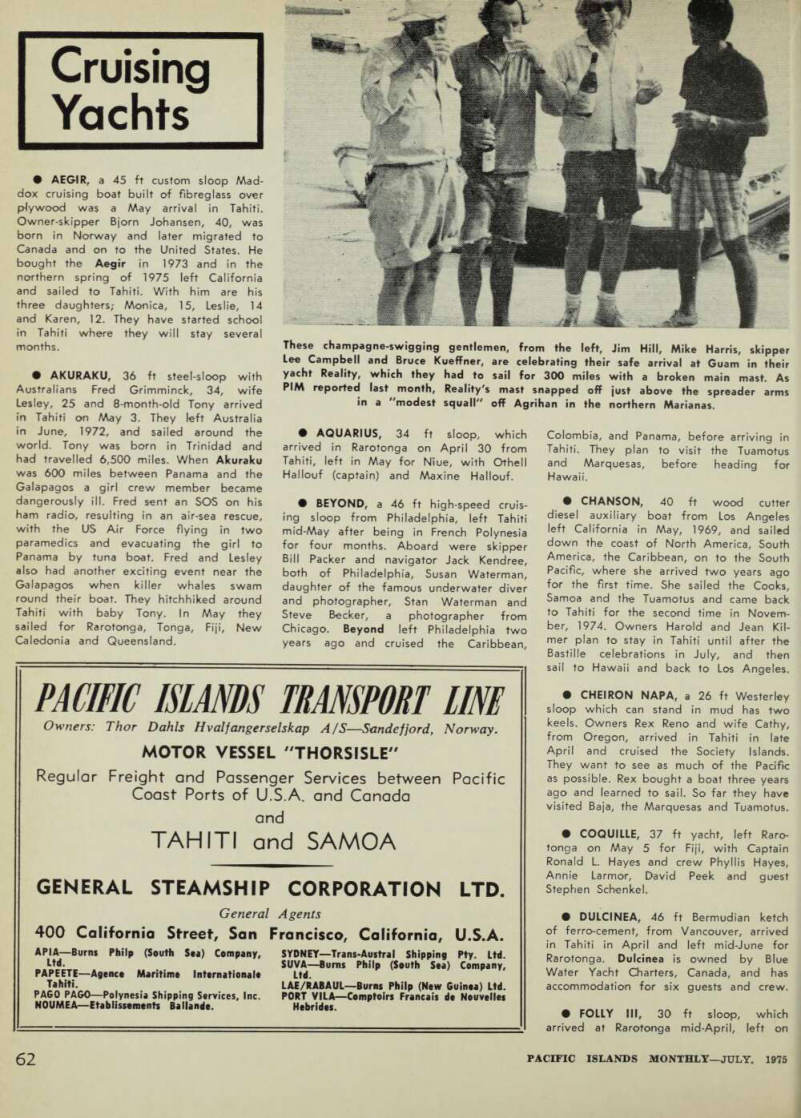
Yachts
• AEGIR, a 45 ft custom sloop Mad dox cruising boat built of fibreglass over plywood was a May arrival in Tahiti.
Owner-skipper Bjorn Johansen, 40, was born in Norway and later migrated to Canada and on to the United States. He bought the Aegir in 1973 and in the northern spring of 1975 left California and sailed to Tahiti. With him are his three daughters; Monica, 15, Leslie, 14 and Karen, 12. They have started school in Tahiti where they will stay several months. • AKURAKU, 36 ft steel-sloop with Australians Fred Grimminck, 34, wife Lesley, 25 and 8-month-old Tony arrived in Tahiti on May 3. They left Australia in June, 1972, and sailed around the world. Tony was born in Trinidad and had travelled 6,500 miles. When Akuraku was 600 miles between Panama and the Galapagos a girl crew member became dangerously ill. Fred sent an SOS on his ham radio, resulting in an air-sea rescue, with the US Air Force flying in two paramedics and evacuating the girl to Panama by tuna boat. Fred and Lesley also had another exciting event near the Galapagos when killer whales swam round their boat. They hitchhiked around Tahiti with baby Tony. In May they sailed for Rarotonga, Tonga, Fiji, New Caledonia and Queensland.
• AQUARIUS, 34 ft sloop, which arrived in Rarotonga on April 30 from Tahiti, left in May tor Niue, with Othell Hallouf (captain) and Maxine Hallouf. • BEYOND, a 46 ft high-speed cruis ing sloop from Philadelphia, left Tahiti mid-May after being in French Polynesia for four months. Aboard were skipper Bill Packer and navigator Jack Kendree, both of Philadelphia, Susan Waterman, daughter of the famous underwater diver and photographer, Stan Waterman and Steve Becker, a photographer from Chicago. Beyond left Philadelphia two years ago and cruised the Caribbean,
Colombia, and Panama, before arriving in Tahiti. They plan to visit the Tuamotus and Marquesas, before heading for Hawaii. • CHANSON, 40 ft wood cutter diesel auxiliary boat from Los Angeles left California in May, 1969, and sailed down the coast of North America, South America, the Caribbean, on to the South Pacific, where she arrived two years ago for the first time. She sailed the Cooks, Samoa and the Tuamotus and came back to Tahiti for the second time in Novem ber, 1974. Owners Harold and Jean Kil mer plan to stay in Tahiti until after the Bastille celebrations in July, and then sail to Hawaii and back to Los Angeles. • CHEIRON NAPA, a 26 ft Westerly sloop which can stand in mud has two keels. Owners Rex Reno and wife Cathy, from Oregon, arrived in Tahiti in late April and cruised the Society Islands.
They want to see as much of the Pacific as possible. Rex bought a boat three years ago and learned to sail. So far they have visited Baja, the Marquesas and Tuamotus. • COQUILLE, 37 ft yacht, left Raro tonga on May 5 for Fiji, with Captain Ronald L. Hayes and crew Phyllis Hayes, Annie Larmor, David Peek and guest Stephen Schenkel. • DULCINEA, 46 ft Bermudian ketch of ferro-cement, from Vancouver, arrived in Tahiti in April and left mid-June for Rarotonga. Dulcinea is owned by Blue Water Yacht Charters, Canada, and has accommodation for six guests and crew. • FOLLY 111, 30 ft sloop, which arrived at Rarotonga mid-April, left on
These champagne-swigging gentlemen, from the left, Jim Hill, Mike Harris, skipper Lee Campbell and Bruce Kueffner, are celebrating their safe arrival at Guam in their yacht Reality, which they had to sail for 300 miles with a broken main mast. As PIM reported last month, Reality's mast snapped off just above the spreader arms in a "modest squall" off Agrihan in the northern Marianas.
May 12 for Aitutaki and Pago Pago carry ing co-owners Suzanne M. Wilson (cap tain) and Eleanor A. Gobrecht. • GRETEL, an 85 ft three-masted schooner registered at Stockholm, Sweden, arrived at Rarotonga from Tahiti on May 1 with Captain Lars Fran berg and six crew, one an American who joined the yacht in Tahiti. The rest are Swedes. • HONNALEE, a 42 ft ketch, with owners Canadians Roy and Rika Gingell and cat Brutus, called at Kavieng, New Ireland, in May bound for Madang via the Admiralty Islands. Ports in Irian Jaya and Singapore are next on the sailing list. • INTERLUDE I, a 30 ft cutter regis tered at Auckland, arrived at Rarotonga on May 26 from Christmas Island with skipper T. J. McKenzie and Trevor John Beckett. Plans were to visit Samoa. • JUBILATION, 48 ft Cal sloop, arrived in Tahiti on May 19, carrying Gil Smith, of Newport Beach, California, his wife, Helen, son Dave, 18, daughter Susan, 20, Susan's friend, Marge, and Steve Sadler, of Hawaii. Gil bought Jubilation three years ago from Harry Steward, who had raced her in many rompetitions, including the Transpac dawaii race. They left Los Angeles in lune, 1974 and after two weeks in Tahiti, jlanned to leave for Samoa, Fiji and New Zealand. • KARMA, a 30 ft German built fibre glass slooo arrived in Tahiti early May. «on Smith, 40, Auckland, said he be ieved he was the only person from New Zealand to circumnavigate single-handed.
He left New Zealand in November, 1972, md sailed to Australia and on around the vorld until he met up with RESOLVE in Martinique. Leon was to leave Tahiti at he end of May for Rarotonga, Tonga, iji and Auckland. • LA CARETA, 32 ft sloop, left Raro :>nga on May 12 for Niue, carrying co wners, Swedish brothers Anders and iunnar Eriksson. • LA FLOR, 30 ft ketch from Tahiti, /hich arrived at Rarotonga in March left i May for Penrhyn and Samoa. On rrival she was carrying owner-skipper olf Heimann and American Jane Hol rook. Heimann left on his own. Miss folbrook having decided to stay in Raro >nga and try for a schoolteacher's osition. • LE MARIPIER 111, 40 ft yacht, from witzerland, arrived in Tahiti on April 22 nth owner-captain George Geston, ariett Carlson of Sweden, and Bernard riet, of Switzerland. They began their rcumnavigation from the south of
France and cruised the West Indies be fore coming through the Panama Canal to the Pacific. They visited the Galapagos, Marquesas, Tuamotus and the Society Islands. They plan to sail to the Cook Islands, Fiji and New Guinea, before they leave the Pacific area. • LEISURE V, 37 ft trimaran, arrived at Rarotonga on May 9 from Papeete and Bora Bora and left on May 20 for Tonga.
She was carrying owner-skipper Clair L.
Smith, who built the craft himself be tween 1971 and 1974, Donna Rhodes, who joined at Bora Bora, Jim Dyal, who signed on in Tahiti and Keith Ela. After Tonga, Leisure V is expected to sail to Fiji. • MARIPOSA, 38 ft trimaran from Lima, Peru is visiting Tahiti for three or four months. On board are owner-captain John Zuanich, 29, and wife Pilar, 23 and Les Raos, 23, Auckland. John is an Ameri can who lived in Peru for 18 years. He sailed the Mariposa from Callau, Peru, to Panama and installed his engine there.
After six months in Panama he and Les sailed to the Marquesas where Pilar joined them. Two months later they visited the Tuamotus and then sailed to Tahiti.
From Tahiti they will head for Hawaii and then California. • MERIDIAN 11, a 40 ft ketch, arrived at Rarotonga from Auckland on May 21 with owner-captain Bill Kitching, his wife.
Dawn, and their seven-year-old son, Simon. They struck rough weather and water ruined the electrical system putting both the engine and deep-freeze out of action. Plans were to call at Tahiti, other islands of the Society Group, American
Samoa, Tonga and Fiji during the return voyage to Auckland. • MOANA, 34 ft San Diego-registered ketch, left Rarotonga on May 22 for Niue carrying lone sailor Raymond Quint. • MUSCARI, a Deb 33 ft sloop, be longing to D. J, Morley and wife Hilary, of Faversham, England, dropped anchor at Tahiti in May, having left home in August, 1974 and called at the Gala pagos, Tuamotus and Marquesas on the way. After two months in French Poly nesia they hope to sail or the Cooks, Tonga, Fiji and New Zealand. • MYANNA 111, 30 ft yacht, regis tered in Montreal, was a May 2 arrival at Rarotonga from Papeete. On board were skipper Daniel Roose and Denise Plourde. They intended to sail to Vavau from Rarotonga. • MY LOVE, a Cheoy Lee offshore 50 ft from Pinetop, Arizona, left Tahiti May 8 for the Cook Islands, Pago Pago, Vavau and Fiji. Owner-skipper Randy Weston, her two daughters Heather and Pamela and son Shea were in Tahiti for six months. Randy reported the marine con version salt water pump was worn out and the Folly 111 helped to get the needed part from Los Angeles by calling for assistance on the ham radio. Also aboard My Love as she left Tahiti were two crew members from Vancouver, Henry Proske and Caroline Bliss, who will accompany the boat to New Zea land. • NUNAGA, 50 ft wooden sloop, arrived in Tahiti on April 1 and left mid-
May for Hawaii. Aboard were owner Peter Francis of Marion, Massachusetts, and three crew members—Dr and Mrs Roger Tuck, London, and Tom Pillion, Detroit. Peter sailed the Atlantic when he was 16 and is a recent Middlebury (Vermont) graduate, who plans to return to the US, then come back to the South Pacific for a circumnavigation. • OPTY, 30 ft yawl, arrived in Fiji in May carrying Pole, Stanislaw Teliga, a retired journalist. Mr Teliga is following a course round the world sailed by his brother, Leonid, six years ago. Leonid later died from cancer. Poland issued a postal stamp to commemorate his feat of sailing single-handed round the world. Mr Stanislaw Teliga, in Fiji, met
people who helped his brother to make the trip. Later the Opty will go on show in Poland's national maritime museum. • PATRICIA, 60 ft replica of the original Chesapeake Bay oyster fishing boat with slanted masts to use the main halyards for hoisting the cargo of oysters on board is a dream come true for owner E. O. "Ollie" Olson from Los Angeles. Ollie was a tourist to Tahiti two years ago. He sold his 27 ft Cheoy Lee and bought Patricia. He arrived in Tahiti on April 30. He plans to tour the Society Islands for the time being. • PHYLLIS GRAHAM, a 45 ft yawl, registered at Sydney, arrived at Rarotonga from Papeete on May 24 with owner
skipper Russell Roxburgh and Phyllis Mary Roxburgh. Their next port of call was to be Vavau. • PRINCESS, 43 ft Rhodes yawl, from Santa Barbara, California is back in Tahiti, after cruising the Society Islands. She arrived in Tahiti in November with owner Ed Schmidt, 32, Annie Christensen, Ali Warren and Willy Wilson, all from Cali fornia. Annie wanted to travel so Ed bought the Princess, even though he knew nothing about boats at that time.
He's had a chance to learn as the voyage took them from California to Hawaii, Fiji and Tonga, before Tahiti. They will leave in July or August, probably for the Cook Islands. • RESOLVE, Hinckley Bermuda 40 ft yawl built in Maine in 1959 by Bill Tripp and the first one ever to visit the South Pacific. Owners Sy Carkhuff 111, 38 and wife Vicki, 30, of Akron, Ohio arrived in Tahiti mid-May, along with son David, 7, and the cat. They left Maine in No vember, 1973, and sailed down the east coast of the United States to the Carib bean Venezuela, Colombia and Panama.
They arrived in Nukahiva, Marquesas in early 1975 and from there visited the Tuamotus. They plan to cruise the Society Islands before going to Rarotonga, Vavau and Fiji and ending in Auckland for the hurricane season. Afterwards, they will continue their circumnavigation. They have been travelling with yacht KARMA since they met in Martinique a year ago. • S.E.A. QUEST (Scientific Enterprises Associates Institute, Inc) is the name of a 40 ft ferro-cement diesel auxiliary ketch owned by Richard Johnson of Los Angeles and wife, Chantal, of Strasbourg, France.
Richard leases the boat to the institute, of which he is the founder and executive director. He has been in French Polynesia since October, 1972, filming document aries of the ultrasonic telemetry tagging of sharks to obtain information on their daily movements and depths. This re search has been principally in Rangiroa and was supported by the US Office of Naval Research and the National Geo graphic Society and Cal State University of Long Beach. Richard and Chantal met and married in French Polynesia. They will sail to Hawaii soon because Richard wants to use the library there to aid him in writing a book on sharks of Polynesia.
They will return to Tahiti between October and December. • SILVER SWORD, 54 ft racing cutter, left Rarotonga on May 12 for Papeete.
She carried skipper Jay Lambert, his wife Lou, Walter Bush, Pip and Cindy White, and Linda Cheyney. • SUNDAY, 44 ft ketch, from San Francisco, an April 12 arrival at Rarotonga from Papeete, left in May for Pago Pago,
carrying owner-skipper William Podbreger and J. Podbreger. • SUNDANCER, 104 ft schooner, was a recent arrival at Vila in the course of a Pacific cruise, after which she will sail to the UK, via Australia. She has been described as the world's fastest schooner.
She is owned by Mr Felix, a 27-year-old Englishman, who bought her in 1974 from Mr Len Last, another Englishman, for £35,000. Mr Last built the Sundancer.
Apart from Mr Holmer, she carried seven others —NZ lawyers Mr and Mrs C. W.
Stanton; John Patrick Callow, a UK econ omist, who is mate; Hugh Tod, another New Zealander, Sara Anne de Haan, a passenger on the way to Australia; John Eric Gilbert, an Englishman; and Miss Barbara Grace McDonald, from NZ, travel organiser, who went to the New Hebrides about four years ago. • SUPER SHRIMP, 18 ft Caprice class yacht, which looks like a day sailer, arrived in Tahiti in April carrying owner Shane Acton, of Cambridge, England, and Iris Derungs, of Switzerland, who joined the yacht at Panama. The owner spent 2i years in the Atlantic and the Pacific, and intends to make a circum navigation in what he believes is the smallest boat to attempt such a feat. He planned to spend some time in French Polynesia before sailing west. • TARMIN, 25 ft sloop, from London, which arrived in Rarotonga via Papeete with lone sailor, J. Sowden, left in May for Tonga. • TAREWA, 21 ft sloop, arrived at Rarotonga on May 3 from Opua, NZ, carrying Gary F. Adams. She left on May 12 for Papeete. • TROUBADOR, 41 ft imperial ketch from San Francisco, arrived in Tahiti May 20. Owner-skipper "Jug" Shoaf, wife Lou, sons Doug, 23, and John, 14, were to be joined by daughter, Diane. Two years ago Jug bought a boat and decided to sail around the world. In January, 1975 he and his family boarded Troubador for their circumnavigation.
They visited the Marquesas and the Tua motus before Tahiti. They planned to stay in the Society Islands for at least a month before sailing on to Rarotonga, Fiji, Samoa and New Zealand. • WILLY WILLY, 40 ft Euros ketch, from Paris, arrived in Tahiti on May 4 with owner William Cremer, of Paris. He left the south of France and toured the Caribbean before coming to the South Pacific. In Panama crew-member Daniel Anizon, of France, joined him for the trip to Tahiti. Willy Willy is being stored in Tahiti for an indefinite period while the owner flies back to Paris to return to work on his specialty, making TV stages and lighting them. He will return to Tahiti later, and continue his cruising to Samoa, Fiji and New Zealand.
Advertisements & other items, pp. 68-72 (2 items)
Pacific Islands Transport Une
Owners: Thor Dahls Hvalf angerselskap A/S — Sandefjord, Norway.
MOTOR VESSEL "THORSISLE"
Regular Freight and Passenger Services between Pacific
Coast Ports of U.S.A. and Canada
and
TAHITI and SAMOA
GENERAL STEAMSHIP CORPORATION LTD.
General Agents 400 California Street. San Francisco, California, U.S.A.
APlA—Burn* Philp (South Sea) Company, Ltd.
PAPEETE—Agence (Maritime Internationale Tahiti.
PASO PAGO—Polynesia Shipping Services, Inc.
NOUMEA—Etablissements Ballande.
SYDNEY—Trans-Austral Shipping Pty. ltd.
SUVA—Bums Philp (South Sea) Company, Ltd.
LAE/RABAUL —Burns Philp (New Guinea) Ltd.
PORT VlLA—Comptoirs Francais de Nouvelles Hebrides.
DIESEL ENGINES
For industrial applications ...
A range of DIESEL ENGINES for 27 H.P. to 120 H.P. available as basic units or as power packs.
FORD, LEYLAND, MITSUBISHI.
Also available replacement engines for older model Ford Tractors.
INDUSTRIES LIMITED
to p . Mr G «* u . s i ,n ' T *; ees , " dust ;i« s Ltd - Private Ba 9> Papakura, Auckland, New Zealand. Phone 86-019. Telegraphic Address "Leeslift". Telex Leeslift NZ 2615.
to the Pacific Islands
In our 80th year
Selling
"SERVICE"
NELSON & ROBERTSON
PTY. LIMITED
(Established 1895)
PLANTATION HOUSE, 197 CLARENCE STREET, SYDNEY
CABLES: "IVAN", SYDNEY, BRISBANE. TELEX: AA22381, SYDNEY.
FOR:
INDENTS
COMMODITIES
SHIPPING
TRAVEL
INSURANCE
REAL ESTATE
Branch Office: Nelson & Robertson Pty. Ltd., 303 Adelaide St., Brisbane, Old.
New Guinea Representatives: Rabtrad Niugini Pty. Ltd., Rabaul Lae Madang Kieta.
EE3
serves the Islands with expert
insurance service and advice.
QUEENSLAND INSURANCE
COMPANY LIMITED
(Incorporated 1886 in Australia) Head Office: 82 Pitt Street, Sydney FlJl—Branch Office, Suva, Manager for Fiji: F. N. Davies (A.A.1.1.).
LAUTOKA—Assistant Manager; G, A. Wooley.
HONIARA (8.5.1. P.) —Breckwoidt & Company (5.1.) Pty. Limited.
NEW CALEDONIA—T. A. Hagen, Sle. W. A. Johnston, S.A.R.L. —Noumea.
NEW HEBRlDES—Resident Officer: R. J. Allsop (A.A.1.1.) Vila; Santo: Bums Philp (New Hebrides) Ltd.
TAHlTl—Arthur Chung; Immeuble 8.1., Front de Mer, Papeete.
NIUE, NORFOLK ISLAND, SAMOA, TONGA and other South Sea Islands—Bums Philp (South Sea) Company Ltd.
QUEENSLAND INSURANCE (P.N.G.) LTD
PAPUA NEW GUINEA
Head Office, Port Moresby: General Manager: D. J. Granter.
District Managers at Rabaul: C. D. Dickings; Lae: R. Jackson; Mt. Hagen: D. F. Carroll.
H 359
= = s W
SWIBO
THE NEW LONGER LIFE
KNIVES THAT HAVE THE EDGE
OVER ALL OTHERS
Swiss design and manufacture
OBTAINABLE
FROM THE
LEADING
BUTCHER
SUPPLIERS
Sole Importers:
PETER FISHER
TRADING PTY. LTD.
321 Pitt Street
SYDNEY
UUphoiw 26 1109
VAUXHALL
I ▼ •I# 9 mr , s . ■' ••• ■ ■ • -.* 4 .v^-Vis^M New Vauxhall^Chevette combines all tne virtues of an estate car, a sporty coupe and a family saloon.
Wide-opening doors and forward-tilting front seats allow easy entry to the rear compartment. And with the back seat folded down, you get unobstructed access to 18.6 cubic feet of load space through the counterbalanced rear door.
Performance and economy are exceptional. Chevette’s lively 1256 cc engine accelerates from 0 to 60 mph in less than 16 seconds. Early fuel consumption tests returned 50.76 mpg at a steady 50 mph.* Tests carried out by Vauxhall Motors Ltd.
Handling and road-holding are in the sports car class, with rack-and-pinion steering, 4-coil suspension and radial ply tyres as standard equipment.
Wheels are positioned well out to the four corners a big factor in Chevette’s handling.
Built-in safety starts with impact-absorbing front and rear sections: continues with energyabsorbing steering, dual-circuit brakes, and many other features.
Chevette is built to last with a strong and rigid body shell.
Complete body undersealing.
Aluminized exhaust system.
And finally, a 10-stage body protection treatment.
Sales, spares and service will be available at: FIJI: Millers Motors Ltd.
NEW CALEDONIA:
Etablissements Ballande PORTUGUESE TIMOR: Sociedade Agricola Patria e Trabalho Lda.
SOLOMON ISLANDS: Solomon
Islands Service Station
WESTERN SAMOA:
0. F. Nelson & Co. Ltd.
General Motors A 1059
63
ACIFIC ISLANDS MONTHLY—JULY, 1975
Business and Development
How To Use-And Not To Use-The
New Hebrides As A Tax Haven
The New Hebrides, as a tax haven, will play a dominant role in Australia’s future international tax planning, according to a Sydney public accountant, Mr Anthony Two hill.
The group is relatively unknown in international circles, but it will attract a great deal of attention.
Countries like Japan, the US, the UK, France, and, to a lesser extent.
New Zealand, are using the New Hebrides in international monetary transactions and in tax-planning operations.
The New Hebrides, in spite of the major problem of obtaining exchange approval for remission of funds from Australia, may be used by Aus tralian residents in international tax planning techniques. There are ways which satisfy the tax authorities.
About 18 months ago, the Aus tralian Government moved to stop the flow of funds to the New Heb rides, and other tax havens, if there was any suggestion of tax avoidance or evasion. But as Australia is committed to helping developing countries, and the New Hebrides is largely under-developed, funds may be sent to those countries for invest ment in local industry. So far Aus tralia has been generous in its assist ance to the newly-emerging countries of the South Pacific, and to territories which it feels are in need of assist ance.
There are many investment oppor tunities in the New Hebrides, says Mr Twohill. Australian interests have several projects under way in the condominium, not the least of which is beef cattle development. Other current investment opportunities are in a joint timber and cattle project, a piggery on Efate, and unit and housing projects, also on Efate.
Mr Twohill, at a recent inter national tax conference in Sydney, outlined how the New Hebrides met the criteria of a good tax haven. One of these was low, or no, taxes, on at least one important category of income. The New Hebrides has no income tax, and no estate or death
duties. It must be politically stable.
The New Hebrides is politically stable, and is likely to remain so if the UK and France remain there.
It must be acceptable, physically and legally, and it meets both those criteria, said Mr Twohill.
The New Hebrides offers those tax advantages, plus sophisticated com pany laws, and the services of a financial community, highly com petitive with those of the better known tax havens of the Caribbean or Atlantic.
He mentioned the Bahamas as a tax haven which became a highly developed settlement because it was a tax haven. Fifteen to 20 years ago the United States tried various tech niques to stop the use of the Bahamas as a tax haven for US citizens and residents, and failed. The Bahamas proved a good tax haven, and has been used by multi-national com panies to avoid the heavy incidence of income tax. A parallel could be drawn of what the Bahamas is now and what the New Hebrides could be.
Mr Twohill warned against some techniques in attempting to use the
New Hebrides as a tax haven. For example, a company should not be set up to engage in a re-export trade.
In such a case payment for the im ported goods would almost certainly be refused, unless the Australian authorities were satisfied about the bona fides of the New Hebrides com pany.
Professional men and other tax payers could benefit directly in in vestment in the New Hebrides, pro vided that their particular type of investment was approved by the Aus tralian authorities.
Mr Twohill said one of these would be New Hebrides Beef Developments, in which he has an interest. It would provide 50 Australian residents and taxpayers with the opportunity to benefit from a development operation in an under developed country.
Apart from a proposal to buy a property in New South Wales, NH Beef Developments intends to manage, and ultimately purchase a large cattle station near Vila over the next three years, which would give certain tax advantages to Aus tralian residents.
A Fiji 'recipe for disaster'
Mr Wesley Barrett, managing director of Cathay Hotels (Fiji) Ltd, has given a positive lead to attempts to bolster Fiji’s stagnant tourist in dustry by slashing room rates on the company’s hotels by 24 per cent from July 1. Mr Barrett’s announcement, in May, was followed two weeks later by official figures which showed that the number of visitors to Fiji in January was 14.4 per cent below the January, 1974, figure.
High costs in all segments of the tourist industry were a topic keenly discussed at the April tourism con vention in Fiji. But no one segment was prepared to shoulder the blame; rather, one was only too ready to say it was high costs in another sector
which was the main factor preventing growth.
Mr Barrett said before the conven tion he felt Fiji was pricing itself out of the tourist market. Announcing the new rates, he said the industry was depressed, and was facing tough competition from other Pacific countries. These two factors, added to prices which put a Fiji holiday out of the reach of many people, could be a recipe for disaster. It was important for Fiji to move quickly and again make its prices competitive.
Cathay Hotels operates the Grand Pacific Hotel, Suva, the Cathay Hotel, Lautoka, Tubakula Beach Bungalows, on the Coral Coast, and
Saweni Beach apartments, near Lau toka.
The January statistics showed that the number of American visitors was down by 35.4 per cent. Other falls, by country, were Australia 2.6 per cent, New Zealand 8.6 per cent and Canada 12 per cent. Twelve cruise ships carrying 13,353 passengers visited Fiji in January, compared with 15, carrying 16,381 passengers in January, 1974.
The New Zealand Government dealt a blow to the Fiji tourist in dustry when it brought down the budget, which removed the duty concession allowed on stereo record players. Importers feared that hun dreds of thousands of sets, worth $3 to $4 million would remain un sold. Mr M. K. Patel, a director of the Fiji Visitors Bureau, who holds a concession at Nadi Airport, described the move as “ethically and morally wrong”. Fiji importers were given no warning of the move—which invites the question—how is the NZ Government obliged to inform Fiji importers or anybody else, of bud getary moves, which are confidential anyway?
Mr Patel claimed the NZ Govern ment should have reduced the num ber of sets a person was allowed to take in, or stipulated that they could only be used personally, if NZ wanted to reduce the flow of funds overseas.
Black market for
rice In W, Samoa
Western Samoans have an in satiable appetite for rice. The de mand is so heavy that rice orders for stores are often sold off the de livery truck before there is any chance of getting them on to the shelf.
Recently a co-operative store manager described a delivery of seven truck loads, each of 200 sacks, as “drops in the ocean”.
A black market is slowly develop ing. The wholesale price is around $8.70 a sack, but some village shops are selling it for $9 a sack. One village was reported to be selling rice at $l5 a sack. Shipments cannot arrive quickly enough.
Niue short
of manpower
Niue is suffering a shortage of manpower and this is delaying pro gress on several major development projects.
In a recent advertisement in the local government-controlled weekly newspaper the Public Works Depart ment reported there were about 50 positions for skilled and semi-skilled tradesmen.
“Applications will be accepted from
all sections of the community on Niue and outside of Niue. If you have relations or friends overseas who want work they will find a a £' amval ’” in NZ who return to Nine to w U get naid locTl rates between 60 cents and * ,n » horn ' dBB cents an ■*»%/■' lI A wuugamvilie TO
aid 'nGalecfed' areas
-t- R ■ ... D .
The Itougamville Provincial Gov eminent is developing an ambitious j£ an *Jet up► a local fishing industry * or + th f oat A er lsl ands of Nissan, £ a^ ere * s ;. ° Ck ’ a Tasman . and rt •' t f h ; , people will use traditional methods to catch fish and dive for trochus shell. A new company, Atoll Ship ping Pty Ltd, formed by the govern ment, will buy the fish from the people and sell it in places like Kieta, Arawa and Panguna No other fishing industry will be allowed in Bougainville, as fish in waters round the island are a limited economic resource.
Advertisements & other items, p. 74 (1 item)
Sigma Coatings
EX. HOLLAND
(Merger between PIETER SCHOEN, VAROSSIEAU and VE I I EWINKEL, three Companies with a long standing reputatlon around the world.)
'JGMAvSIGM-
SIGMATEX
latex rmiurverf peinture vinyliqu® dispersions vvand-mw fassadenfarbe smuts ton walipa*^ wrr/etANC WEiSSt WHftt
BV ■ UITHOOBNI^s^
• ENAMELS • PAINTS • VARNISHES • MARINE PAINTS • CONTACT GLUE • METAL GLUE • WOOD GLUE • RUST PRIMER GREY • RED OXIDE PAINT, etc., etc.
Skilled knowledge and years of research can be found in every product.
Also including the huge range of
RAMRO HANDYMAN PRODUCTS
The SIGMA people for the Pacific Islands:
KERR BROTHERS PTY LTD
65 YORK STREET, SYDNEY, N.S.W., 2001.
To market—
by the seat of your pants
From Capt Noel Bellamy
in Port Moresby
To the north-east of Port Moresby, 35 air miles (or two days walk), nestling in the valleys under the shadows of the Owen Stanley Range and just below “The Gap” are five of the most unlikely airstrips served by regular public transport aircraft.
These strips range from 1,700 ft above sea level to 3,900 ft and vary in length from 1,300 ft to 1,900 ft.
Each of these strips can only be approached from one direction and once an approach to land has been started there is no alternative.
Usually, the cloud coverage is extensive with a base of some 2,500 ft and as often as not ground fog blankets the valleys. The strips, named Naoro, Manari, Efogi, Kagi and Munumu, have fairly irregular surfaces and Manari, Efogi and Kagi are steeply sloped. Efogi rises rapidly up to a ridge and then flattens out at the top. It also has a bend in it.
Why a regularly-scheduled service into those strips? I took Bruce Adams, a well-known aviation photo grapher, into Efogi and he goggled at the thought of operating in the narrow valleys let alone landing.
The Seventh-day Adventists have most mission centres in the area and, with the aid of the locals, the Koiaris, who are bushmen and hill people, and the Department of Agri culture, have developed a cash crop programme, specialising in citrus fruits, especially mandarins.
Citrus is perishable and wouldn’t survive the long haul down the Ko koda Track to Owers Corner and Port Moresby. That’s where aircraft come in.
Aerial Tours of Papua New Guinea took a look at the scene and, with the help of the very versatile Britten Norman Islander—one of the
most popular flying work horses in the South Pacific—set up a regular flight to market service.
The Islander can lift off the strips with around 726 kg (1,600 lb) but the actual load is dependent on the surface conditions prevailing at the time. Only specially-selected pilots, who’ve been given extensive training, are allowed on the market flights.
The BN2A takes 15 minutes flying time between Port Moresby and the “jungle” strips, but those 15 minutes are not without interest. To get into the main valley, a ridge of about 3,600 ft needs to be crossed and the cloud base invariably nestles on this ridge, so a “no see—no go” situation develops.
At Efogi the aircraft passes over the strip at 4,800 ft and begins a left turn on to a “down wind”, passing over Kagi only three miles away. Then, takes a further left turn to parallel the mountains to the west and descends towards the valley floor. The strip is on the edge of a cliff and runs into a dead-end where there is no chance of carrying out a missed approach—irrespective of the reason for wanting to do so.
With Bruce as passenger I came over the top at 80 knots, set the aircraft for landing, assessed the wind effect on the approach path and settled into a steady approach at 75 knots with sufficient power to allow for an adjustment to the flight path.
A glide approach is out of the question. Over the end, power was closed and the aircraft touched down at 55 knots, then power on again to get up the hill to the end of the strip.
As we shut down, the locals surrounded the aircraft and their warm greetings sounded in our ears. The cargo had been weighed and was
laid out near the parking bay ready for shipment.
The mandarins sell for 10 to 20 cents each at the local Koki market in Port Moresby. The passenger and freight rates are $lO and 6c a pound.
Two wantoks escort the produce to market and although there are many packages none of them appears to be identified, The aircraft is loaded and a mani fest completed. Now for the take-off.
Engines to full power, check temps, pressures and engine indications, All okay. Release the brakes and we disappear over the ridge and down the runway.
An engine failure is unthinkable during the take-off run—so you keep fingers crossed. You’re airborne, take a left turn to climb out through the valley and then over the ridge to Port Moresby. The aircraft is cleared to enter the control zone “not above 4,000 ft”, This allows manoeuvering to maintain separation with the cloud base—past Hombrom Bluff and on to Jacksons.
Waiting at the cargo terminal is a mass of people. The cargo is dis charged and the unmarked produce is distributed—but how?
Each package has been tied with a particular vine and this vine iden tifies the recipient. Payment is then made according to its weight, and carried off to Koki market, In all, the aircraft would have been away from base for an hour, Hence, the fruit and vegetables are garden-fresh and fetch a good price.
The whole economy of the “jungles” is based on air transport and should this become irregular, their produce is lost.
The "Mandarin Express" arrives in the valley.— Photo: Bruce Adams
Produce Prices
Unless otherwise stated, quotations are in Australian currency. Australian dollar (June 10) equals New Zealand, $1.0183 (buying), $1.0139 (selling); Fiji, $1.0753 (buying), $1.0513 (sell ing); Western Samoa, tala 0.8200 (buying), 0.8087 (selling); Tonga, pa'anga 0.8826 (buy ing), pa'anga 0.8650 (selling); US, $1.3451 (buying), $1.3401 (selling); UK, £0.5818 (buy ing), £0.5768 (selling); French Pacific, CFP 99.055 (buying), 97.451 (selling),
Copra
Copra industries are controlled through copra boards in PNG, the Solomons, the GEIC, both Samoas, Fiji, Tonga, the Cooks and the US Trust Territory. New Hebrides, French Polynesia and New Caledonia do not have boards and copra is either sold individually by growers to overseas buyers or used locally.
NEW GUINEA: The board, with planters' reps, directs distribution and sales and pays planters. Shipments are made to UK, European markets and to Australia and Japan, and coco nut oil mills on New Britain.
Prices, April 1, were: Per tonne, de livered main ports, hot-air dried, k 145; FMS, k 142; smoke-dried, kl4o.
FIJI:—The board fixes prices on Philippines copra, taking into account freight, taxes, selling costs, shrinkage, etc, prices from June 9 were: Ist grade, $ll6, 2nd grade, $lO6, s.s. $BO.
NEW HEBRIDES: Copra sold direct by planters to France and Japan. Burns Philp paying on wharf, Vila or Santo, May 19 3500 NHF, June 6, 88 met francs.
US TRUST TERRITORY:— Ist grade, $2OO, 2nd grade, $l9O, 3rd grade, $lBO. Outer islands, $175, $165 and $155 ton for the three grades, if serviced by government ships, and $165, $155 and $145 if serviced by private ships.
COOK ISLANDS.— AII production is sold to Abels Ltd, Auckland. Prices are based on average world prices for the prior three or six months, and remain in force for three months.
GILBERT ISLANDS.— SI79.2O a ton, or 8c a pound.
WESTERN SAMOA:— Ist grade, SWSIO2; 2nd grade, $W589.50.
Other Produce
COCOA. —Islands rates are based on Ghana prices. Ghana price on June 10 was spot £Stg 554 ton, c.i.f., UK, Continent.
June 10, in store, Rabaul, export quality, k 720 per tonne; delivered ex wharf Sydney $B3O per tonne.
Solomons. —Delivered to Agriculture Dept, offices in Honiara and Aukl. Recent price was 25c per lb dried beans first grade, 20c second grade COFFEE. —PNG: Good quality. A grade, 48c per lb; B grade, 46c; C grade, 44c; Y grade, 43aC (ex-store Sydney).
W. Samoa. —Recently, WSTEC ground and dried beans, 60 sene per lb wholesale.
PEANUTS. PNG: Sydney agents reported recently f.0.b., Lae: Kernels—white Spanish 19c lb.
RICE (Aust): —PNG: Dried brown, 25 kilo bags, $298.94 per tonne. Vitamin enriched white, 25 kilo bags, $303.94 per tonne, all f.o.w. Sydney/Melbourne.
Pacific Islands; Calrose med. grain, white, 25 kilo bags, $3lO per tonne. Kulu long grain white, 25 kilo bags, $355 per tonne. All prices c.&f. Sydney/Melbourne.
RUBBER. —Singapore, June 10: 27.50 c a kilo.
VANILLA BEANS. Prices recently were: White and yellow label processed standard packs, $7.50; green label $7.40, c.i.f., Sydney.
Tonga.—sT4.2o, f.0.b., Nukualofa; 5T4.50, Mel bourne.
Exchange Rates
FlJl. —Through Bank of NSW, ANZ Bank, Bank of NZ, Bank of Baroda, First National City Bank, Aust $ on Fiji $ buying $F1.0529
= Sai.
COOK IS., NIUE. —New Zealand currency is used.
NEW HEBRIDES —Through Bank of NSW, ANZ Bank, Commercial Bank of Australia, National Bank of A'asia, Banque Nationale De Paris, Barclays Bank, Hong Kong & Shanghai Banking Corp, Mosbert Bank. SAI = 86.83 New Heb ridean francs (buying); 85.57 (selling)—airmail transfer rate.
WESTERN SAMOA.—Through Bank of Western Samoa, controlled from NZ, SWS. Tala 1 = $A0.8200 (buying), $A0.8087 (selling).
TONGA. —Tongan dollar (pa'anga) = $A0.8826 (buying), $A0.8650 (selling).
Norfolk Is, Solomon Is, Geic, Nauru.—
Australian currency used; no exchange payable in transactions with Australia.
PAPUA NEW GUINEA.— PNG and Australian currency used; no exchange payable in trans actions with Australia.
FRENCH PACIFIC COLONIES.—Pacific francs fCFP) are used in New Caledonia, Wallis and Futuna Is, and Fr Polynesia. French Bank, Sydney, on June 13, quoted: SAI = 97.68 CFP (buying), 96.27 (selling). Paris-London: £1 9.11 francs (buying), 9.09 francs (selling). Pacific franc—London: £1 = 167.27 CFP (buying), 167.09 CFP (selling.
CFP to 1 metropolitan franc 18.43 (buying), 17.94 (selling).
Banks should be approached for daily rates.
• The Fiji Government plans to invest $700,000 in a $2.3 million edible oil mill, which will be built at Nasinu by Fiji Foods Ltd. Fiji ex pects to save about $1.5 million a year if it produces its own edible oil.
A UK company is expected to invest $200,000 in the project, and Fijian copra growers will provide $lOO,OOO.
The company will get a $700,000 loan from the UK at 7 per cent, and $600,000 working capital will be provided by a local bank.
Advertisements & other items, p. 76 (2 items)
The Forestmil Portable
3W
Sawmill turns trees into
timber at the rate of
2 cub. metres per hour.
Forestmil produces house building or construction size timber direct from the log in the forest. No need to resaw, its ready to use.
Inter-acting vertical and horizontal blades cut simultaneously for speed and accuracy (see illustration).
Produces any size up to 30 cm.
X 15 cm. X 5 metres, including boards, framing, bridge sizes, etc.
Larger machines also available.
CHECK THESE STANDARD
FEATURES:
• Dismantles into small sections. • Only two men required to operate. • Total weight 1,560 lbs. • Erected ready to use in 1 hour. • Powered by petrol or diesel engine. • New mechanism for raising or lowering the machine makes Forestmil now even easier than ever to operate.
MACQUARRIE INDUSTRIES
PTY LTD
P.O. Box 20,
COBURG, VICTORIA 3058
AUSTRALIA.
CABLES: AAACBOUND, MELBOURNE
TELEX: AA33729.
MC PM/1
31
MERCHANTS
CONVERTERS
LEAD
SHEET
INGOT
ALLOY
SCRAP
RESIDUES
BERJAK METALS PTY. LTD.
424 ST. KILDA ROAD, MELBOURNE, 3004
Cable: METJAK MELBOURNE Telex: AA30334
for departing Tuvaluans
Gilbertese fond farewell for departing Tuvaluans
Members of the Gilbert and Ellice Islands House of Assembly had plenty of local issues to get their teeth into in the May session, which extended over several days.
It was a historic session in one respect—it was the last meeting at tended by Ellice Islands members.
The Chief Minister, Mr Naboua Ratieta, at the close of the session, said that from October 1, as Tuvalu, the Ellice Islanders would have their own government, all Gilbertese mem bers would wish them well.
Replying to a question about the future of employees and students of Ellice nationality when the separation became effective, the Deputy Governor, Mr Tom Layng, said government officers would have the option of transferring to the Tuvalu civil service, remaining in the Gil berts, or retiring. Ellice Islanders in other employment would be allowed to continue in their jobs, but it was government policy to encourage employers in future to give priority to Gilbertese.
Ellice students in the Gilberts would be allowed to complete their courses if they wished.
The Minister of State, Mr Ibeata Tonganibeia, speaking of the problem of repatriating GEIC people working in the New Hebrides, said they had not shown any wish to go home be cause they were doing well where they were. They could not be ordered to return home.
Mr Teatao Teannaki (Abaiang) asked if the government could make arrangements, similar to those which applied to GEIC men working on Nauru and Ocean Island, for wives to join their husbands in the New Hebrides. Mr Tonganibeia promised to looked into the matter.
Mrs Russell asked what steps the government and the Gilbert and Ellice Islands Authority took to en sure that civil servants and govern ment employees were legally married before they were granted full matri monial benefits.
Mr Layng said the government did not take any formal steps. All mar riages could not be supported by documentary proof. However, minis tries and divisions, such as GEIDA, knew if their employees were married.
When Mrs Russell asked if that meant that single persons could get
marital benefits, Mr Layng said that was not the case, and added there were customary marriages, which were recognised, but outside the Marriages Ordinance.
There were three types of marriage —civil marriage performed by the Registrar of Marriages, religious marriage by churches, and customary marriages, accepted locally, and which the government, being kind and liberal, honoured, in whichever form they were, as distinct from the imported type of marriage.
The house approved a bill to ex tend licensed bar trading times by two hours. Mrs Tekarei Russell op posed the move, saying the extra two hours would endanger people because they might drive their cars or motor cycles without knowing what they were doing.
Mr Ratieta said Mrs Russell had rightly warned of the dangers of excessive drinking, but statistics showed that it was not longer drink ing hours which caused drunkenness.
Shorter hours were responsible for most drunkenness as people tended to drink faster before the bars closed.
Another bill approved by the house removed the differentiation between doctors who had qualifications from metropolitan countries, and those who graduated from the Fiji School of Medicine. It also gave local doctors the right to go into private practice.
It was a controversial measure, with most members speaking.
Previously the law allowed expatri ate doctors, who qualified in Austra lia or New Zealand to set up in private practice, but it barred those who qualified at the Fiji School of Medicine, where the GEIC sent its medical students. Mr Ratieta said it was crucial to stop the discrimination.
The Fiji standards were quite high; anyone who undertook medical studies had to have a university entrance certificate to the University of the South Pacific.
Some members took advantage of the bill to air grievances about lack of medical services in some areas.
Mr Maheu Naniseni, one of the “antis” said he felt local doctors practising the art of healing with their local medicines should be allowed to set up their own practices.
He, for one, could stop stomach-ache in one second, and had, in fact, done that for a member while on the way from Bairiki to Tarawa by launch.
Advertisements & other items, p. 77 (1 item)
Seabury Hall
MAUI
HAWAIIAN ISLANDS
Boys and Girls —
Boarding and
Day School
GRADES 7-12
COLLEGE PREP CURRICULUM
Sponsored by Episcopal Church in Hawaii
Founded 1964—Fully
Accredited Interviews may be arranged with headmaster at the following places and dates: GUAM—St. John's Episcopal School, July 12-13 SAIPAN—Inter - Continental Hotel, July 13-14 MAJURO—Eastern Gateway Hotel, July 15-16 NAURU—Meneng Hotel, July 16-19 APlA—Aggie Gray's Hotel, July 18-20 PAGO PAGO—Pago Pago Americana, July 20-23
SEABURY HALL
P.O. BOX 497
MAKAWAO, HAWAII 96768
808-572-7235
Islands People
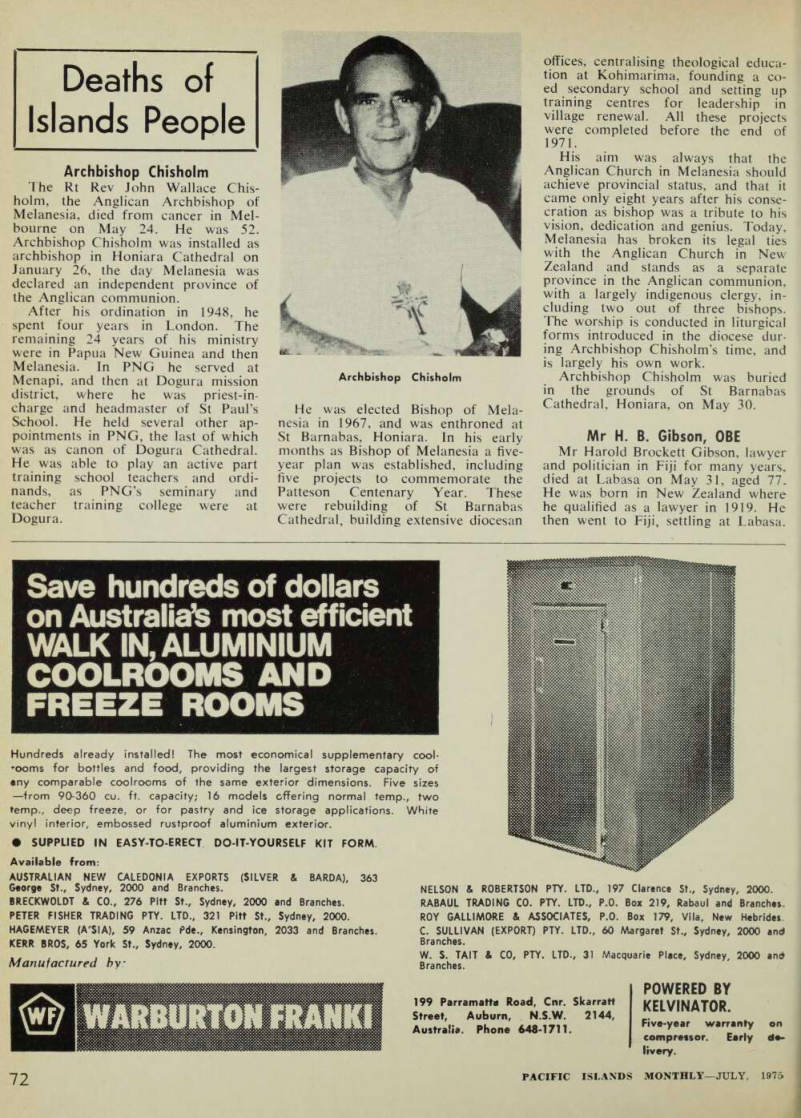
Deaths of Islands People
Archbishop Chisholm
The Rt Rev John Wallace Chis holm, the Anglican Archbishop of Melanesia, died from cancer in Mel bourne on May 24. He was 52.
Archbishop Chisholm was installed as archbishop in Honiara Cathedral on January 26, the day Melanesia was declared an independent province of the Anglican communion.
After his ordination in 1948, he spent four years in London. The remaining 24 years of his ministry were in Papua New Guinea and then Melanesia. In PNG he served at Menapi, and then at Dogura mission district, where he was priest-in charge and headmaster of St Paul’s School. He held several other ap pointments in PNG, the last of which was as canon of Dogura Cathedral.
He was able to play an active part training school teachers and ordi nands, as PNG’s seminary and teacher training college were at Dogura.
He was elected Bishop of Mela nesia in 1967, and was enthroned at St Barnabas, Honiara. In his early months as Bishop of Melanesia a five year plan was established, including five projects to commemorate the Patteson Centenary Year. These were rebuilding of St Barnabas Cathedral, building extensive diocesan
offices, centralising theological educa
tion at Kohimarima, founding a co ed secondary school and setting up training centres for leadership in village renewal. All these projects were completed before the end of 1971.
His aim was always that the Anglican Church in Melanesia should achieve provincial status, and that it came only eight years after his conse cration as bishop was a tribute to his vision, dedication and genius. Today, Melanesia has broken its legal ties with the Anglican Church in New Zealand and stands as a separate province in the Anglican communion, with a largely indigenous clergy, in cluding two out of three bishops.
The worship is conducted in liturgical forms introduced in the diocese dur ing Archbishop Chisholm's time, and is largely his own work.
Archbishop Chisholm was buried in the grounds of St Barnabas Cathedral, Honiara, on May 30.
Mr H. B. Gibson, QBE Mr Harold Brockett Gibson, lawyer and politician in Fiji for many years, died at Labasa on May 31, aged 77.
He was born in New Zealand where he qualified as a lawyer in 1919. He then went to Fiji, settling at Labasa.
Archbishop Chisholm
He was admitted to practice as a barrister and solicitor in Fiji in 1927.
He developed an interest in politics, ind in 1937 was elected to the Fiji legislative Council, holding the seat ill his retirement in 1972, except for wo terms, when he was beaten at he elections by Mr F. G. Archibald.
Mr Gibson was a member of the Id Labasa Township Board, serving term as chairman. He was also a lember of the Fiji Visitors Bureau, nd several other organisations. In 950 he represented Fiji as a bowler t the Commonwealth Games in Auckland. In business, he was a irector of Eastern Hotels Ltd and le Labasa Electricity Co Ltd.
He leaves a daughter, Fay (Mrs foel Wareham), and a widow, Mrs era Gibson.
Vakatini Ariki Makea - Te - Pou - o - te - Rangi akatini Ariki, a Cook Islands heredi ty high chief, died at his home in laraerenga, Rarotonga, on May 21. ext day he was buried at the tra tional burial place of high chiefs Rarotonga, the ancient marae of aputapuatea.
Among those who attended the meral were Cooks Premier, Sir Ibert Henry, the Canadian High qmmissioner to New Zealand, Mr live Glover, and his wife, Makea ui Ariki, CBE, Kariki Ariki, women liefs of Rarotonga and Rongoma ne Ariki of Atiu Island.
Vakatini Ariki had held his title r 30 years, was a staunch supporter the Cook Islands Christian Church d, in his earlier years, was a keen anter and sportsman. He married ain after his first wife died and has e children in the Cook Islands and hers in New Zealand.
Mr N. E. Nilsen Mr Nils Emil Nilsen, who was )sely linked with the goldmining lustry at Vatukoula in Fiji for my years, died on April 17, aged . He helped to develop two mines, nperor and Dolphin, and the com inities at Vatukoula. He was a quent visitor to the mine from dbourne till some years age, when and other members of the nperor Gold Mining Co Ltd re ned after what amounted to a take tr by a number of shareholders.
In Australia, he held senior execu e positions in a number of mining ripanies. In 1970, he was awarded Australasian Institute of Mining i Metallurgy medal for outstanding vices to Australian exploration, aing and metallurgical operations, e award mentioned his work at Emperor mine.
Vlr Nilsen leaves a widow, a son 1 daughter.
Mr S. D. Marshall, MBE Mr Sidney David Marshall, who died in Sydney on May 7 aged 72, was the first airman to fly solo from Papua to the Australian mainland.
Mr Marshall was an engineer in Guinea Airways, at Lae, from 1930 to 1936.
In 1934, when he went on leave, rather than follow the conventional method of a sea passage, he decided to fly. His route took him from Lae to Port Moresby, then across the Coral Sea to Cooktown, and down the coast to Mascot airport in Sydney.
The flight, in a Westland Widgeon monoplane, took 3± days. Later that year he flew back to Lae.
When he left Lae in 1936 to re turn to Australia he left the aircraft behind, but went back in 1937 to pick it up and fly it back to Australia.
In 1937 he flew Daily Telegraph reporters to Rabaul to cover the volcano eruption which devastated the town.
Back in Australia, with three small aircraft, Mr Marshall set up an aerial ambulance service, operating from Mascot. Later he transferred to Bankstown airport. His business also included charter flights and aircraft maintenance. He was active in busi ness up till his death.
Maj-Gen B. M. Morris Major-General Basil Moorhouse Morris, CBE, DSO, who was re sponsible for the civil government of Papua New Guinea during and after World War II as Commander of the Australian New Guinea Ad ministrative Unit (ANGAU), died at Beaconsfield, Victoria, in April. He was 87.
The third son of a Hertfortshire (England) solicitor, who became Registrar of the Diocese of Mel bourne, he was born in Melbourne in 1888. After education at Mel bourne Grammar School and Trinity College in the University of Mel bourne, and a short spell as a jackeroo, he joined the Royal Aus tralian Garrison Artillery Regiment.
He was a Lieutenant when World War I broke out in 1914 and an original officer of the Siege Artillery Brigade. He was three times men tioned in despatches and was awarded the DSO in 1917.
A soldier by temperament and pro fession, he rose in rank until at the outbreak of war in 1939 he was Director of Supplies, Transport, Movements and Quartering at Aus tralian Army Headquarters. In 1940, as Brigadier, he was appointed Commandant of the Australian Over seas Base and posted to Delhi as Liaison Officer.
Morris went to Papua in 1941 as
Officer Commanding the Bth Military District. His was a daunting task.
The Australian soldiers in Port Moresby, though they later proved themselves in battle, were untrained and disorderly. An uneasy partner ship began with a confused civil government under H. Leonard Murray, the Administrator of Papua.
After receiving news of the Japa nese advance from Rabaul, and be lieving government control over Papua to be worsening, Morris de cided to cut the Gordian knot in February, 1942. He drafted a plan for the transfer of Papuan affairs to himself and requested Murray’s de parture within three days. The plan was backed by Lieutenant-General Sydney Rowell, Morris’ immediate superior in Australia.
Unhappily, Murray at first refused to leave without confirmation and told Canberra that in these circum stances he would not go unless placed under arrest and deported.
Thus, at one stroke Morris ended almost 40 years of Murray tradition and acquired the reputation of a soldier who rode roughshod over civilian feelings. Undoubtedly the looting of stores by soldiers in Port Moresby did not enhance his reputa tion in early 1942; but he claimed the exigencies of war had diverted his attention. Though most of the blame for the looting lay with Aus tralian Army headquarters, for a time Morris attracted a shower of abuse in Australia and was roundly criti cised by PIM.
Morris’ plans for Papuan adminis tration were innovative. He was more avuncular in his approach to Papuans than some of his ex-New Guinea ANGAU officers who gave the Papuans a rough handling. He argued that while he was in absolute control, and money was available, there should be rapid expenditure on schools to overcome the pre-war stag nation in Papuan education. Such a chance, he said, might never happen again.
When the Japanese threat receded, Morris turned his energy to the establishment of secondary education, starting with an army base at Sogeri which he turned into the Papuan Central Training School. His main interest was in the training of Papuan medical practitioners.
It was fitting that one of his con tributions was in the field of educa tion, since he came from a noted family of educationists. His sisters had begun the Melbourne Church of England Grammar School for Girls (Merton Hall) and his brother.
Canon W. P. F. Morris, was the founder of the Church of England
Grammar School (Churchie) in Brisbane.
In some European quarters Morris did not regain popularity, because ANGAU was believed to have been tardy in handing over control to civilians.
An example of his bluff solutions to complex problems was the matter of military chaplaincies. When there were church protests about Morris’s plan to use a consecrated Anglican field chapel for ecumenical services, Morris snapped, “None of that here, this is the Parish Church, I am head of it, and it is for everybody”. Here on Sundays, Morris read the lessons and Merari Dickson from Kwato (later the first Papuan MLC) con ducted the church choir. Music was another of Morris’ interests. He established the Pacific Islands Regi ment band and organised a post-war tour of Australia.
Although Morris had a reputation for bluntness, it should be put on record that the leader of one organi sation in Papua asked Canberra to have him appointed Administrator of the combined territories after the war.
It was argued that his progressive policies, personal integrity and strong humanitarian sympathies fitted him for the post. But he was recalled.
His final wartime broadcast to Papuans i : July, 1945, ended with the words, “You are Papuans. You are men. You, too, need to do every thing you can to keep your country”.
On leaving Papua New Guinea in
June, 1946, he retired from the Army.
At the funeral service in St John’s, Beaconsfield, the panegyric was de livered by Archbishop Strong. Major- General Morris leaves a widow and
five daughters.-
D.F.W.
Tamasese Meatuai Solialofi Tamasese Meatuai Solialofi, a daughter of the late Tupua Tamasese Lealofi I, of Western Samoa, died in hospital in Auckland in April, aged 77. She was an aunt of the Prime Minister of Western Samoa Tupua Tamasese Lealofi VI. She went to New Zealand in 1972.
Mr A. Tupouniua Mr ’Alipate Tupouniua, who gave a lifetime of service in a number of areas in Tonga, died recently. He was once a Member of Parliament, and served on the Produce and Copra Boards till those boards became part of the Tonga Commodities Board in 1974. He also served the community as an inspector of schools for the Free Church of Tonga, in which he was a lay preacher.
He leaves seven sons and two daughters. One of his sons is Mr Mahe Tupouniua, director of the South Pacific Bureau of Economic Co-operation. Two other sons are well known in education fields— Penisimani, as principal of Tonga High School, and Sione as a lecturer at the University of the South Pacific.
Advertisements & other items, pp. 78-80 (2 items)
Coolrooms And
Save hundreds of dollars
on Australians most efficient
WALK IN, ALUMINIUM
COOLROOMS AND
FREEZE ROOMS
Hundreds already installed! The most economical supplementary coolr ooms for bottles and food, providing the largest storage capacity of any comparable coolrooms of the same exterior dimensions. Five sizes —from 90-360 cu. ft. capacity; 16 models offering normal temp., two temp., deep freeze, or for pastry and ice storage applications. White vinyl interior, embossed rustproof aluminium exterior. • SUPPLIED IN EASY-TO-ERECT DO-IT-YOURSELF KIT FORM Available from; AUSTRALIAN NEW CALEDONIA EXPORTS (SILVER & BARDA), 363 George St., Sydney, 2000 and Branches.
BRECKWOLDT & CO., 276 Pitt St., Sydney, 2000 and Branches.
PETER FISHER TRADING PTY. LTD., 321 Pitt St., Sydney, 2000.
HAGEMEYER (A'SIA), 59 Anzac Pde., Kensington, 2033 and Branches.
KERR BROS, 65 York St., Sydney, 2000.
Manufactured by:
■HR NELSON & ROBERTSON PTY. LTD., 197 Clarence St., Sydney, 2000.
RABAUL TRADING CO. PTY. LTD., P.O. Box 219, Rabaul and Branches.
ROY GALLIMORE & ASSOCIATES, P.O. Box 179, Vila, New Hebrides.
C. SULLIVAN (EXPORT) PTY. LTD., 60 Margaret St., Sydney, 2000 and Branches.
W. S. TAIT & CO, PTY. LTD., 31 Macquarie Place, Sydney, 2000 and Branches.
(wf> Uf ADDIIDTmi EDAMIfI
i iiFiillii
199 Parramatta Road, Cnr. Skarratt Street, Auburn, N.S.W. 2144, Australia. Phone 648-1711.
POWERED BY
KELVINATOR.
Five-year warranty compressor. Early livery. on de-
Specify Naco'
Louvre
Windows for
Dependable
Service.
JU Proven design features have ensured Naco as one of the most popular louvres on international markets. High volume manufacture enables us to provide prompt delivery and offer competitive prices. Design features include a central rib for improved performance; fingertip operating handle incorporating positive lock and a centre pivoted blade that ensures excellent balance.
Double operating bars are totally enclosed to ensure clean modern lines. Anodised aluminium or zinc plated steel construction: optional security bars available for additional security protection.
Contact Comalco Fabricators Export Pty Limited, manufacturers and overseas distributors of Naco products.
COMALCO FABRICATORS
EXPORT PTY. LIMITED
BOX 715 G.P.O.
BRISBANE 4001
AUSTRALIA.
COMALCO
is aluminium
C0M924
POLYNESIA LINE, LTD.
Containers, General and Refrigerated Cargo
Express service between US West Coast
and
TAHITI and SAMOA
GENERAL AGENTS:
FURNESS INTEROCEAN CORPORATION
465 California Street, Suite 1001, San Francisco, Ca. 94104 Telephone TWX 910-372-7350 RCA 278-207 CABLE
(415)398-2000 INTEROCEAN INTER UR "INTERCO"—SF
PORT AGENTS
TAHITI
MORGAN-VERNEX
Boite Postale 449 Papeete Telephone: 309 Cables: MOREX
AMERICAN SAMOA
POLYNESIA SHIPPING SERVICES, INC
Pago Pago.
Telephone: 633-5169 Cables: POLYSHIP
73
ACIFIC ISLANDS MONTHLY—JULY. 1975
Shipping & Airways Information
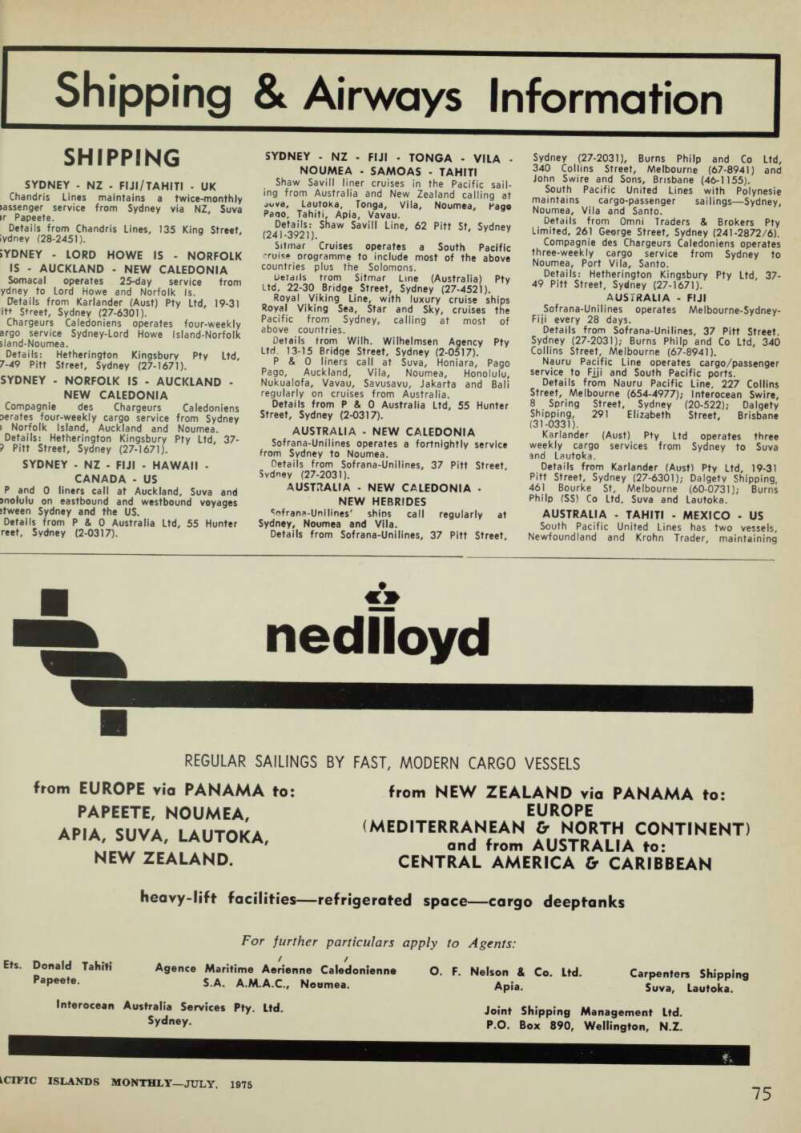
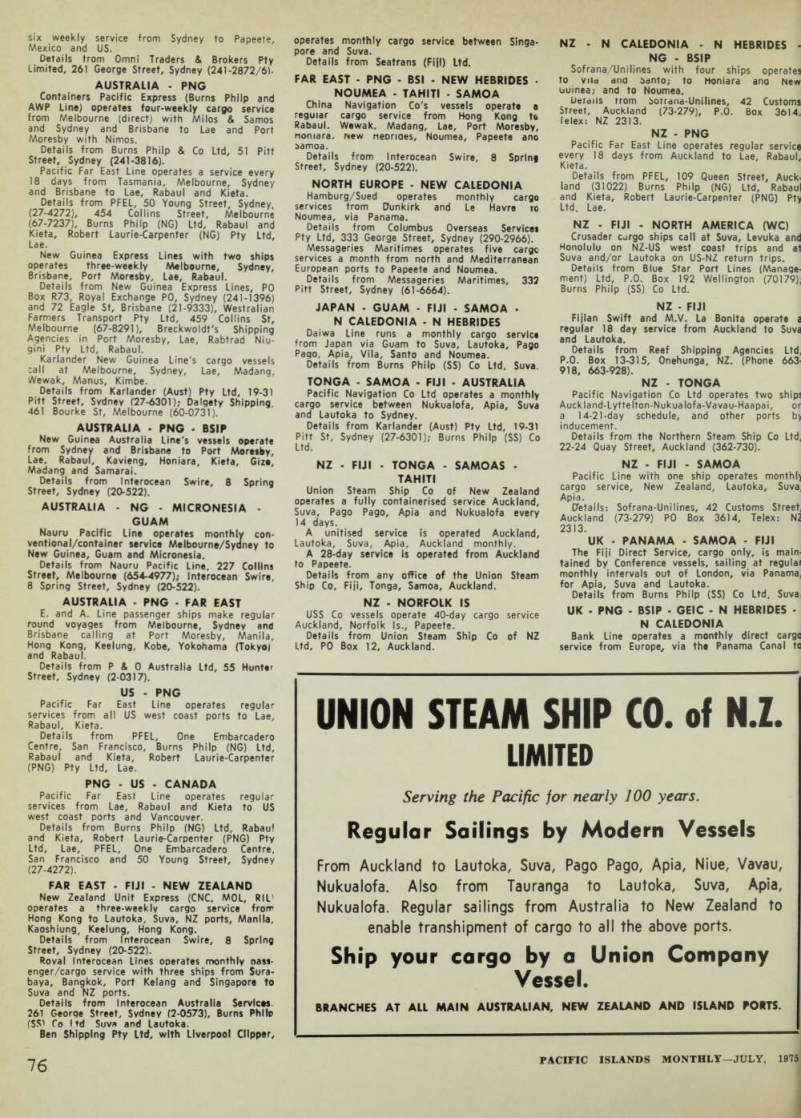
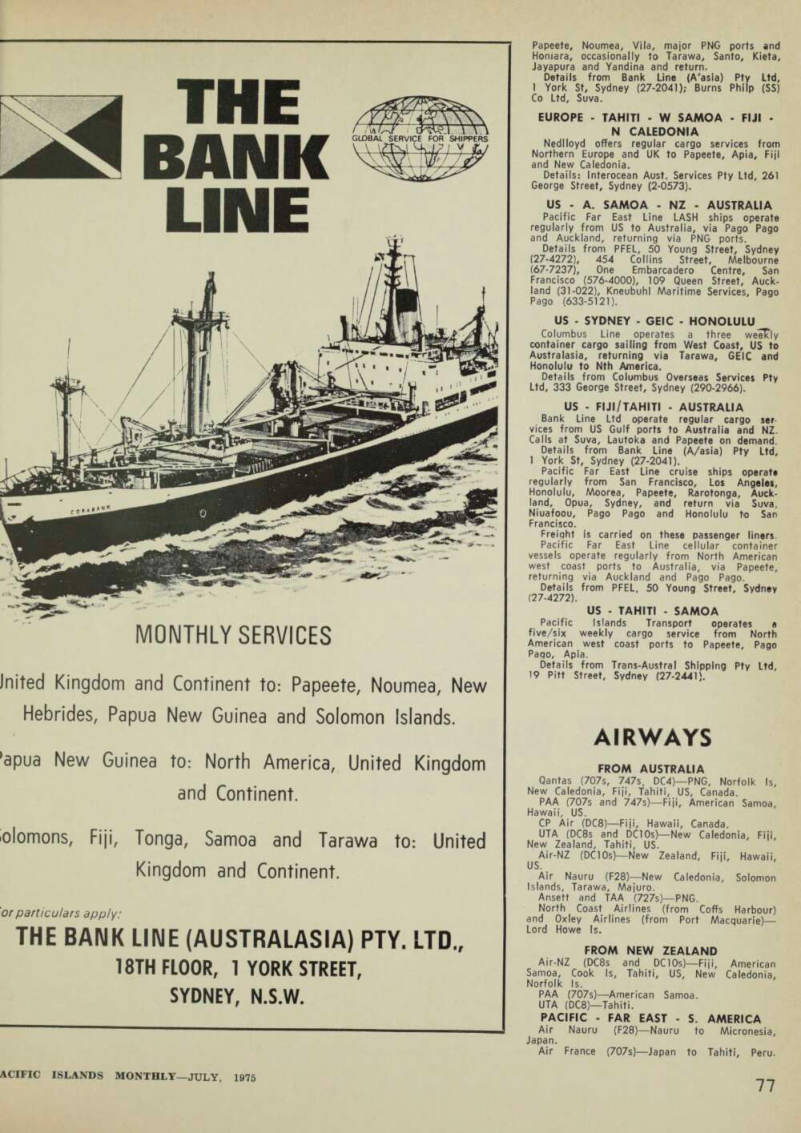
Shipping
SYDNEY - NZ - FIJI/TAHITI - UK Chandris Lines maintains a twice-monthly lassenger service from Sydney via NZ, Suva >r Papeete.
Details from Chandris Lines, 135 King Street, iydney (28-2451).
JYDNEY - LORD HOWE IS - NORFOLK
Is ■ Auckland - New Caledonia
Somacal operates 25-day service from ydney to Lord Howe and Norfolk Is.
Details from Karlander (Aust) Pty Ltd, 19-31 it+ Street, Sydney (27-6301).
Chargeurs Caledoniens operates four-weekly argo service Sydney-Lord Howe Island-Norfolk sland-Noumea.
Details: Hetherington Kingsbury Pty Ltd, 7-49 Pitt Street, Sydney (27-1671).
SYDNEY - NORFOLK IS - AUCKLAND -
New Caledonia
Compagnie des Chargeurs Caledoniens aerates four-weekly cargo service from Sydney > Norfolk Island, Auckland and Noumea.
Details: Hetherington Kingsbury Pty Ltd, 37- ? Pitt Street, Sydney (27-1671).
SYDNEY - NZ - FIJI - HAWAII -
Canada - Us
P and 0 liners call at Auckland, Suva and snolulu on eastbound and westbound voyages stween Sydney and the US.
Details from P & 0 Australia Ltd, 55 Hunter reet, Sydney (2-0317).
SYDNEY - NZ - FIJI ■ TONGA ■ VILA •
Noumea - Samoas - Tahiti
Shaw Savill liner cruises in the Pacific sail ing from Australia and New Zealand calling at ■>ova, Lautoka, Tonga, Vila, Noumea, Pago Paqo, Tahiti, Apia, Vavau.
Details: Shaw Savill Line, 62 Pitt St, Sydney (241-3921).
Sitmar Cruises operates a South Pacific -ruise orogramme to include most of the above countries plus the Solomons.
Derails from Sitmar Line (Australia) Pty ltd, 22-30 Bridge Street, Sydney (27-4521).
Royal Viking Line, with luxury cruise ships Royal Viking Sea, Star and Sky, cruises the Pacific from Sydney, calling at most of above countries.
Details from Wilh. Wilhelmsen Agency Pty Ltd. 13-15 Bridge Street, Sydney (2-0517).
P & 0 liners call at Suva, Honiara, Pago Pago, Auckland, Vila, Noumea, Honolulu, Nukualofa, Vavau, Savusavu, Jakarta and Bali regularly on cruises from Australia.
Details from P & 0 Australia Ltd, 55 Hunter Street, Sydney (2-0317).
Australia - New Caledonia
Sofrana-Unilines operates a fortnightly service from Sydney to Noumea.
Details from Sofrana-Unilines, 37 Pitt Street, Sydney (27-2031).
Australia - New Caledonia •
New Hebrides
Sofrana-Unilines' ships call regularly at Sydney, Noumea and Vila.
Details from Sofrana-Unilines, 37 Pitt Street,
Sydney (27-2031), Burns Philp and Co Ltd, 340 Collins Street, Melbourne (67-8941) and John Swire and Sons, Brisbane (46-1155).
South Pacific United Lines with Polynesie maintains cargo-passenger sailings—Sydney, Noumea, Vila and Santo.
Details from Omni Traders & Brokers Pty Limited, 261 George Street, Sydney (241-2872/6).
Compagnie des Chargeurs Caledoniens operates three-weekly cargo service from Sydney to Noumea, Port Vila, Santo.
Details: Hetherington Kingsbury Pty Ltd, 37- 49 Pitt Street, Sydney (27-1671).
Australia - Fiji
Sofrana-Unilines operates Melbourne-Sydney- Fiji every 28 days.
Details from Sofrana-Unilines, 37 Pitt Street.
Sydney (27-2031); Burns Philp and Co Ltd, 340 Collins Street, Melbourne (67-8941).
Nauru Pacific Line operates cargo/passenger service to Fjji and South Pacific ports.
Details from Nauru Pacific Line, 227 Collins Street, Melbourne (654-4977); Interocean Swire, 8 Spring Street, Sydney (20-522); Dalgety Shipping, 291 Elizabeth Street, Brisbane (31-0331).
Karlander (Aust) Pty Ltd operates three weekly cargo services from Sydney to Suva and Lautoka.
Details from Karlander (Austl Pty Ltd, 19-31 Pitt Street, Sydney (27-6301); Dalgety Shipping, 461 Bourke St, Melbourne (60-0731); Burns Philp (SS) Co Ltd, Suva and Lautoka.
AUSTRALIA • TAHITI - MEXICO - US South Pacific United Lines has two vessels, Newfoundland and Krohn Trader, maintaining
six weekly service from Sydney to Papeete, Mexico and US.
Details from Omni Traders & Brokers Pty Limited, 261 George Street, Sydney (241-2872/6).
Australia - Png
Containers Pacific Express (Burns Philp and AWP Line) operates four-weekly cargo service from Melbourne (direct) with Milos & Samos and Sydney and Brisbane to Lae and Port Moresby with Nimos.
Details from Burns Philp & Co Ltd, 51 Pitt Street, Sydney (241-3816).
Pacific Far East Line operates a service every 18 days from Tasmania, Melbourne, Sydney and Brisbane to Lae, Rabaul and Kieta.
Details from PFEL, 50 Young Street, Sydney. (27-4272), 454 Collins Street, Melbourne (67-7237), Burns Philp (NG) Ltd, Rabaul and Kieta, Robert Laurie-Carpenter (NG) Pty Ltd, Lae.
New Guinea Express Lines with two ships operates three-weekly Melbourne, Sydney, Brisbane, Port Moresby, Lae, Rabaul.
Details from New Guinea Express Lines, PO Box R 73, Royal Exchange PO, Sydney (241-1396) and 72 Eagle St, Brisbane (21-9333), Westralian Farmers Transport Pty Ltd, 459 Collins St, Melbourne (67-8291), Breckwoldt's Shipping Agencies in Port Moresby, Lae, Rabtrad Niu gini Pty Ltd, Rabaul.
Karlander New Guinea Line's cargo vessels call at Melbourne, Sydney, Lae, Madang, Wewak, Manus, Kimbe.
Details from Karlander (Aust) Pty Ltd, 19-31 Pitt Street, Sydney (27-6301); Dalgety Shipping, 461 Bourke St, Melbourne (60-0731).
Australia - Png - Bsip
New Guinea Australia Line's vessels operate from Sydney and Brisbane to Port Moresby, Lae, Rabaul, Kavieng, Honiara. Kieta, Gizo, Madang and Samarai.
Details from Interocean Swire, 8 Spring Street, Sydney (20-522).
Australia - Ng • Micronesia •
Guam
Nauru Pacific Line operates monthly con ventiona(/container service Melbourne/Sydney to New Guinea, Guam and Micronesia.
Details from Nauru Pacific Line, 227 Collins Street, Melbourne (654-4977); Interocean Swire, 8 Spring Street, Sydney (20-522).
Australia ■ Png - Far East
E. and A. Line passenger ships make regular round voyages from Melbourne, Sydney and Brisbane calling at Port Moresby, Manila, Hong Kong, Keelung, Kobe, Yokohama (Tokyo) and Rabaul.
Details from P & 0 Australia Ltd, 55 Hunter Street, Sydney (2-0317).
Us - Png
Pacific Far East Line operates regular services from all US west coast ports to Lae, Rabaul, Kieta.
Details from PFEL, One Embarcadero Centre, San Francisco, Burns Philp (NG) Ltd, Rabaul and Kieta, Robert Laurie-Carpenter (PNG) Pty Ltd, Lae.
Png ■ Us - Canada
Pacific Far East Line operates regular services from Lae, Rabaul and Kieta to US west coast ports and Vancouver.
Details from Burns Philp (NG) Ltd, Rabaul and Kieta, Robert Laurie-Carpenter (PNG) Pty Ltd, Lae, PFEL, One Embarcadero Centre, San Francisco and 50 Young Street, Sydney (27-4272).
FAR EAST • FIJI - NEW ZEALAND New Zealand Unit Express (CNC, MOL, RIL' operates a three-weekly cargo service from Hong Kong to Lautoka, Suva, NZ ports, Manila, Kaoshiung. Keelung, Hong Kong.
Details from Interocean Swire, 8 Spring Street, Sydney (20-522).
Royal Interocean Lines operates monthly oass enger/cargo service with three ships from Sura baya, Bangkok, Port Kelang and Singapore to Suva and NZ ports.
Details from Interocean Australia Services 261 George Street, Sydney (2-0573), Burns Philp (SSI Co l td Suva and Lautoka.
Ben Shipping Pty Ltd, with Liverpool Clipper,
operates monthly cargo service between Singa pore and Suva.
Details from Seatrans (Fiji) Ltd.
FAR EAST - PNG - BSI - NEW HEBRIDES -
Noumea - Tahiti - Samoa
China Navigation Co's vessels operate a regular cargo service from Hong Kong te Rabaul, Wewak, Madang, Lae, Port Moresby, nomara. New neonaes, Noumea, Papeete ano aamoa.
Details from Interocean Swire, 8 Spring Street, Sydney (20-522).
North Europe - New Caledonia
Hamburg/Sued operates monthly cargo services from Dunkirk and Le Havre to Noumea, via Panama.
Details from Columbus Overseas Services Pty Ltd, 333 George Street, Sydney (290-2966).
Messageries Maritimes operates five cargo services a month from north and Mediterranean European ports to Papeete and Noumea.
Details from Messageries Maritimes, 332 Pitt Street, Sydney (61-6664).
JAPAN - GUAM - FIJI ■ SAMOA -
N Caledonia - N Hebrides
Daiwa Line runs a monthly cargo service from Japan via Guam to Suva, Lautoka, Pago Pago, Apia, Vila, Santo and Noumea.
Details from Burns Philp (SS) Co Ltd, Suva.
TONGA - SAMOA • FIJI - AUSTRALIA Pacific Navigation Co Ltd operates a monthly cargo service between Nukualofa, Apia, Suva and Lautoka to Sydney.
Details from Karlander (Aust) Pty Ltd, 19-31 Pitt St, Sydney (27-6301); Burns Philp (SS) Co Ltd.
NZ - FIJI - TONGA - SAMOAS -
Tahiti
Union Steam Ship Co of New Zealand operates a fully containerised service Auckland, Suva, Pago Pago, Apia and Nukualofa every 14 days.
A unitised service is operated Auckland, Lautoka, Suva, Apia, Auckland monthly.
A 28-day service Is operated from Auckland to Papeete.
Details from any office of the Union Steam Ship Co, Fiji, Tonga, Samoa, Auckland.
Nz - Norfolk Is
USS Co vessels operate 40-day cargo service Auckland, Norfolk Is., Papeete.
Details from Union Steam Ship Co of NZ Ltd, PO Box 12, Auckland.
NZ - N CALEDONIA • N HEBRIDES -
Ng - Bsip
Sofrana/Unilines with four ships operates to Vila and santo; to Honiara ana New Guinea; and to Noumea.
Details from Sotrana-Unilines, 42 Customs Street, Auckland (73-279), P.O. Box 3614.
Telex: NZ 2313.
Nz - Png
Pacific Far East Line operates regular service every 18 days from Auckland to Lae, Rabaul, Kieta.
Details from PFEL, 109 Queen Street, Auck land (31022) Burns Philp (NG) Ltd, Rabaul and Kieta, Robert Laurie-Carpenter (PNG) Pty Ltd, Lae.
NZ - FIJI - NORTH AMERICA (WC) Crusader cargo ships call at Suva, Levuka and Honolulu on NZ-US west coast trips and at Suva and/or Lautoka on US-NZ return trips.
Details from Blue Star Port Lines (Manage ment) Ltd, P.O. Box 192 Wellington (70179); Burns Philp (SS) Co Ltd.
Nz - Fiji
Fijian Swift and AA.V. La Bonita operate a regular 18 day service from Auckland to Suva and Lautoka.
Details from Reef Shipping Agencies Ltd, P.O. Box 13-315, Onehunga, NZ. (Phone 663- 918, 663-928).
Nz - Tonga
Pacific Navigation Co Ltd operates two ships Auckland-Lyttelton-Nukualofa-Vavau-Haapai, or a 14-21-day schedule, and other ports by inducement.
Details from the Northern Steam Ship Co Ltd, 22-24 Quay Street, Auckland (362-730).
Nz • Fiji • Samoa
Pacific Line with one ship operates monthly cargo service. New Zealand, Lautoka, Suva, Apia.
CTetails; Sofrana-Unilines, 42 Customs Street, Auckland (73-279) PO Box 3614, Telex: N 2 2313.
UK - PANAMA - SAMOA - FIJI The Fiji Direct Service, cargo only, is main tained by Conference vessels, sailing at regular monthly intervals out of London, via Panama, for Apia, Suva and Lautoka.
Details from Burns Philp (SS) Co Ltd, Suva.
UK • PNG - BSIP - GEIC - N HEBRIDES -
N Caledonia
Bank Line operates a monthly direct cargo service from Europe, via the Panama Canal to
Papeete, Noumea, Vila, major PNG ports and Honiara, occasionally to Tarawa, Santo, Kieta, Jayapura and Yandina and return.
Details from Bank Line (A'asia) Pty Ltd, 1 York St, Sydney (27-2041); Burns Philp (SS) Co Ltd, Suva.
EUROPE - TAHITI - W SAMOA - FIJI -
N Caledonia
Nedlloyd offers regular cargo services from Northern Europe and UK to Papeete, Apia, Fiji and New Caledonia.
Details: Interocean Aust. Services Pty Ltd, 261 George Street, Sydney (2-0573).
US - A. SAMOA - NZ - AUSTRALIA Pacific Far East Line LASH ships operate regularly from US to Australia, via Pago Pago and Auckland, returning via PNG ports.
Details from PFEL, 50 Young Street, Sydney (27-4272), 454 Collins Street, Melbourne (67-7237), One Embarcadero Centre, San Francisco (576-4000), 109 Queen Street, Auck land (31-022), Kneubuhl Maritime Services, Pago Pago (633-5121).
US - SYDNEY - GEIC - HONOLULU Columbus Line operates a three weekly container cargo sailing from West Coast, US to Australasia, returning via Tarawa, GEIC and Honolulu to Nth America.
Details from Columbus Overseas Services Pty Ltd, 333 George Street, Sydney (290-2966).
Us - Fiji/Tahiti - Australia
Bank Line Ltd operate regular cargo ser vices from US Gulf ports to Australia and NZ.
Calls at Suva, Lautoka and Papeete on demand.
Details from Bank Line (A/asia) Pty Ltd, 1 York St, Sydney (27-2041).
Pacific Far East Line cruise ships operate regularly from San Francisco, Los Angeles, Honolulu, Moorea, Papeete, Rarotonga, Auck land, Opua, Sydney, and return via Suva, Niuafoou, Pago Pago and Honolulu to San Francisco.
Freight is carried on these passenger liners.
Pacific Far East Line cellular container vessels operate regularly from North American west coast ports to Australia, via Papeete, returning via Auckland and Pago Pago.
Details from PFEL, 50 Young Street, Sydney (27-4272).
Us - Tahiti - Samoa
Pacific Islands Transport operates a five/six weekly cargo service from North American west coast ports to Papeete, Pago Pago, Apia.
Details from Trans-Austral Shipping Pty Ltd, 19 Pitt Street, Sydney (27-2441),
Advertisements & other items, pp. 81-83 (2 items)
Icific Islands Monthly—July. 1975
nedlloyd
REGULAR SAILINGS BY FAST, MODERN CARGO VESSELS from EUROPE via PANAMA to:
PAPEETE, NOUMEA,
APIA, SUVA, LAUTOKA,
NEW ZEALAND.
from NEW ZEALAND via PANAMA to:
EUROPE
(MEDITERRANEAN Cr NORTH CONTINENT)
and from AUSTRALIA to:
CENTRAL AMERICA & CARIBBEAN
heavy-lift facilities—refrigerated space—cargo deeptanks
Donald Tahiti Papeete.
Interocean For further particulars apply to Agents: it Agence Maritime Aerienne Caledonienne O. F. Nelson & Co, Ltd. Carpenters Shipping S.A. A.M.A.C., Noumea. Apia. Suva, Lautoka.
Australia Services Pty. ltd. Joint Shipping Management ltd.
Sydne ''- P.O. Box 890, Wellington, N.Z.
UNION STEAM SHIP CO. of N.Z.
LIMITED
Serving the Pacific for nearly 100 years.
Regular Sailings by Modern Vessels
From Auckland to Lautoka, Suva, Pago Pago, Apia, Niue, Vavau, Nukualofa. Also from Tauranga to Lautoka, Suva, Apia, Nukualofa. Regular sailings from Australia to New Zealand to enable transhipment of cargo to all the above ports.
Ship your cargo by a Union Company Vessel.
BRANCHES AT ALL MAIN AUSTRALIAN, NEW ZEALAND AND ISLAND PORTS.
THE
GLOBAL SERVICE FOR SHIPPERS
LINE
mmESK*
MONTHLY SERVICES
Inited Kingdom and Continent to: Papeete, Noumea, New Hebrides, Papua New Guinea and Solomon Islands. *apua New Guinea to; North America, United Kingdom and Continent. demons, Fiji, Tonga, Samoa and Tarawa to: United Kingdom and Continent. or particulars apply:
THE BANK LINE (AUSTRALASIA) PTY. LTD.,
18TH FLOOR, 1 YORK STREET,
SYDNEY, N.S.W.
Airways
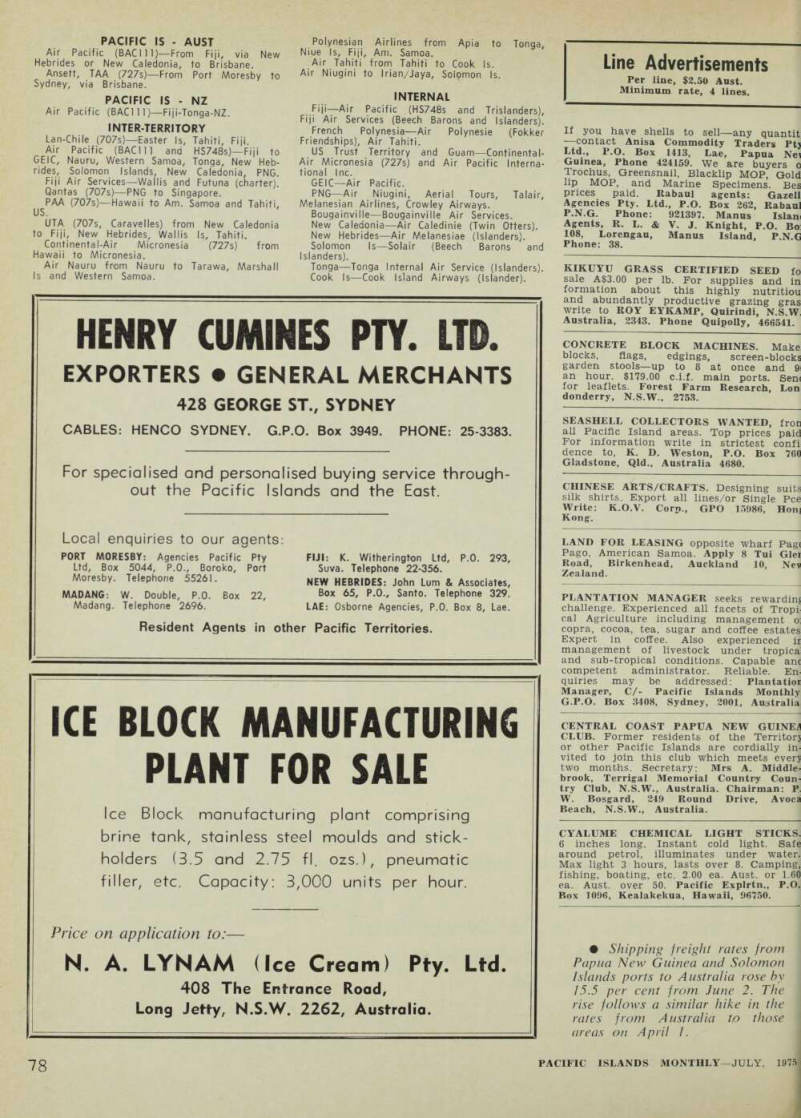
From Australia
Qantas (7075, 7475, DC4)—PNG, Norfolk Is, New Caledonia, Fiji, Tahiti, US, Canada.
PAA (707 s and 747 s) —Fiji, American Samoa, Hawaii, US.
CP Air (DCS) —Fiji, Hawaii, Canada.
UTA (DCSs and DClOs) —New Caledonia, Fiji, New Zealand, Tahiti, US.
Air-NZ (DClOs) —New Zealand, Fiji, Hawaii, US.
Air Nauru (F2B) —New Caledonia, Solomon Islands, Tarawa, Majuro.
Ansett and TAA (727s)—PNG.
North Coast Airlines (from Coffs Harbour) and Oxley Airlines (from Port Macquarie)— Lord Howe Is.
From New Zealand
Air-NZ (DCSs and DClOs) —Fiji, American Samoa, Cook Is, Tahiti, US, New Caledonia.
Norfolk Is.
PAA (707 s) —American Samoa.
UTA (DCS)—Tahiti.
PACIFIC - FAR EAST - S. AMERICA Air Nauru (F2B) —Nauru to Micronesia, Japan.
Air France (707s)—Japan to Tahiti, Peru.
Pacific Is - Aust
Air Pacific (BACIII) —From Fiji, via New Hebrides or New Caledonia, to Brisbane.
Ansett, TAA (727 s) —From Port Moresby to Sydney, via Brisbane.
Pacific Is - Nz
Air Pacific (BAClll)—Fiji-Tonga-NZ.
Inter-Territory
Lan-Chile (707 s) —Easter Is, Tahiti, Fiji.
Air Pacific (BACIII and HS74Bs)—Fiji to GEIC, Nauru, Western Samoa, Tonga, New Heb rides, Solomon Islands, New Caledonia, PNG.
Fiji Air Services—Wallis and Futuna (charter).
Qantas (707 s) —PNG to Singapore.
PAA (707 s) —Hawaii to Am. Samoa and Tahiti, US.
UTA (7075, Caravelles) from New Caledonia to Fiji, New Hebrides, Wallis Is, Tahiti.
Continental-Air Micronesia (7275) from Hawaii to Micronesia.
Air Nauru from Nauru to Tarawa, Marshall Is and Western Samoa.
Polynesian Airlines from Apia to Tonga, Niue Is, Fiji, Am. Samoa.
Air Tahiti from Tahiti to Cook Is.
Air Niugini to Irian/Jaya, Solomon Is.
Internal
Fiji—Air Pacific (HS74Bs and Trislanders), Fiji Air Services (Beech Barons and Islanders).
French Polynesia—Air Polynesia (Fokker Friendships), Air Tahiti.
US Trust Territory and Guam—Continental- Air Micronesia (7275) and Air Pacific Interna tional Inc.
GEIC—Air Pacific.
PNG—Air Niugini, Aerial Tours, Talair, Melanesian Airlines, Crowley Airways.
Bougainville—Bougainville Air Services.
New Caledonia—Air Caledinie (Twin Otters).
New Hebrides—Air Melanesiae (Islanders).
Solomon Is —Solair (Beech Barons and Islanders).
Tonga—Tonga Internal Air Service (Islanders).
Cook Is—Cook Island Airways (Islander).
Advertisements & other items, pp. 83-85 (3 items)
77
ACIFIC ISLANDS MONTHLY—JULY, 1975
Henry Cumines Pr Ltd.
Line Advertisements
Per line, $2.50 Aust.
Minimum rate, 4 lines.
If you have shells to sell—any quantit —contact Anisa Commodity Traders Ptj Ltd., P .O. Box 1413, Lae, Papua Nei Guinea, Phone 424159. We are buyers o Trochus, Greensnail, Blacklip MOP, Gold lip MOP, and Marine Specimens. Bes prices paid. Rabaul agents: Gazell Agencies Pty. Ltd., P.O. Box 262, Rabaul P.N.G. Phone: 921397. Manus Islam Agents, R. L. & V. J. Knight, P.O. Bo 108, Lorengau, Manus Island, P.N.G Phone: 38.
KIKUYU GRASS CERTIFIED SEED fo
sale A 53.00 per lb. For supplies and in formation about this highly nutritiou and abundantly productive grazing gras write to ROY EYKAMP, Quirindi, N.S.W, Australia, 2343. Phone Quipolly, 466541.
CONCRETE BLOCK MACHINES. Make
blocks, flags, edgings, screen-blocks garden stools—up to 8 at once and 9i an hour. $179.00 c.i.f. main ports. Sem for leaflets. Forest Farm Research, Lon donderry, N.S.W., 2753.
SEASHELL COLLECTORS WANTED, fron
all Pacific Island areas. Top prices paid For information write in strictest confi dence to, K. D. Weston, P.O. Box 760 Gladstone, Qld„ Australia 4680.
CHINESE ARTS/CRAFTS. Designing suits silk shirts. Export all lines/or Single Pee Write: K.O.V. Corp., GPO 15986, Hon) Kong, LAND FOR LEASING opposite wharf Pag( Pago, American Samoa. Apply 8 Tui Gler Road, Birkenhead, Auckland 10, Nev Zealand.
PLANTATION MANAGER seeks rewarding challenge. Experienced all facets of Tropical Agriculture including management o: copra, cocoa, tea, sugar and coffee estates Expert in coffee. Also experienced ir management of livestock under tropica: and sub-tropical conditions. Capable anc competent administrator. Reliable. Enquiries may be addressed: Plantatior Manager, C/- Pacific Islands Monthly G.P.O. Box 3408, Sydney, 2001, Australia
CENTRAL COAST PAPUA NEW GUINE4
CLUB. Former residents of the Territorj or other Pacific Islands are cordially invited to join this club which meets every two months. Secretary: Mrs A. Middlebrook, Terrigal Memorial Country Country Club, N.S.W., Australia. Chairman; P.
W. Bosgard, 249 Round Drive, Avoca Beach, N.S.W., Australia.
CYALUME CHEMICAL LIGHT STICKS.
6 inches long. Instant cold light. Safe around petrol, illuminates under water.
Max light 3 hours, lasts over 8. Camping, fishing, boating, etc. 2.00 ea. Aust. or 1.6 C ea. Aust. over 50. Pacific Explrtn., P.O.
Box 1096, Kealakekua, Hawaii, 96750.
• Shipping freight rates from
Papua New Guinea and Solomon Islands ports to Australia rose by 15.5 per cent from June 2. The rise follows a similar hike in the rates from Australia to those areas on April 1.
HENRY CUMINES PR LTD.
EXPORTERS • GENERAL MERCHANTS
428 GEORGE ST., SYDNEY
CABLES: HENCO SYDNEY. G.P.O. Box 3949. PHONE: 25-3383.
For specialised and personalised buying service throughout the Pacific Islands and the East.
Local enquiries to our agents: PORT MORESBY: Agencies Pacific Pty Ltd, Box 5044, P. 0., Boroko, Port Moresby. Telephone 55261.
MADANG: W. Double, P.O. Box 22, Madang. Telephone 2696.
Resident Agents in ot FIJI: K. Witherington Ltd, P.O . 293, Suva. Telephone 22-356.
NEW HEBRIDES: John Lum & Associates, Box 65, P. 0., Santo. Telephone 329.
LAE: Osborne Agencies, P.O. Box 8, Lae. • Pacific Territories.
ICE BLOCK MANUFACTURING
PLANT FOR SALE
Ice Block manufacturing plant comprising brine tank, stainless steel moulds and stickholders (3.5 and 2.75 fl. ozs.), pneumatic filler, etc. Capacity: 3,000 units per hour.
Price on application to: — N. A. LYNAM (Ice Cream) Pty. Ltd. 408 The Entrance Road, Long Jetty, N.S.W. 2262, Australia.
McDOUGALL'S
EDMONTON: MOSSMAN, NTH. QLD.,
AUSTRALIA.
★ FORD TRACTORS & BLUE LINE MACHINERY ★ FORD INDUSTRIAL ENGINES MARINE AND PARTS ★ FORD PARTS DISTRIBUTORS FOR NORTH QUEENSLAND
★ BOSTROM SEAT DISTRIBUTORS
★ AGRICULTURAL COIL TYNES & POINTS
★ WIDE RANGE OF USED TRACTOR WRECKED SPARE
PARTS
★ HOLDER INTER-ROW TRACTORS
NORTH QUEENSLAND'S LARGEST USED TRACTOR DEALERS
HEAD OFFICE:
BOX 60, EDMONDTON, 4869. MOSSMAN
PHONE: 55-4303. TELEX: 70826. 205.
D apua new guinea
printing co. ply. ltd.
Serving the Country from Aitape to Alotau, Manus to Moresby Leaders in Commercial Offset and Letterpress Printing. • Stationery • Office Supplies • Office Equipment • Rubber Stamps • Self-Adhesive Labels • In Fact:— Everything For The Office.
P.O. Box 633, Fort Moresby P.O. Box 759, Lae P.O. Box 1239, Rabaul
The Fifth Games Clash
: rom p 8
Cook Islands Tackles Two


Educational Dilemmas
Prom a special correspondent
The Cook Islands Education De partment has embarked on a number of innovations which may have pro found effects on the entire educa tional process there. It was decided that the third-form entry into Tereora College should be restricted, and that for a trial period all third-form pupils at Titikaveka (on Rarotonga) and Mauke Island should attend the local schools which would be given the status of high schools. The intention is that, eventually, almost all lower secondary school pupils will remain in their village schools.
The changes, planned in February, were to be immediate. The two pri mary schools were to be transferred into high schools within 14 days.
Both the Premier, Sir Albert Henry, and the Minister of Social Services, Mr T. A. Henry, gave assurances to parents and teachers that the gov ernment would fully support the two schools in the way of additional accommodation, staffing and equip ment.
There was reaction from some parents and from the Opposition Democratic Party. The latter in The Weekender said “What is the object of all these measures? Is it, to quote the Premier, that ‘The Cook Islanders are getting too well edu cated?’ Are these measures aimed at correcting this grave fault?” Un doubtedly there are some economic reasons for the changes. The govern ment obviously wants to reduce the cost of school bus transport on Raro tonga and also, it seems, to reduce the number of expatriate teachers employed on Rarotonga.
In an interview, the Premier said there were also certain social reasons for re-assessing the educational struc ture of the Cook Islands. He wanted to stabilise the population by retain ing as many pupils as possible in the village schools in all islands.
He also considered that a heavy emphasis on academic attainments in the present secondary school system was not necessarily providing the pool of trade and semi-trade skills re quired to service development needs.
Sir Albert also wanted to ensure that the education system developed diversified agricultural skills. He sees the village schools as playing a vital role in that respect.
In a further move to prune the educational structure, there has been no new intake of students into the
Teachers’ Training College for 1975.
Some staff has been transferred to Tereora College.
Demographically, the Cook Islands are in an “at risk” situation. Air New Zealand flights are crowded with young people migrating to seek jobs.
Labour in the islands is becoming scarce and obviously the viability of many government plans depends on finding ways of stemming the flow to New Zealand. It may well be that the educational innovations will pro vide part of the answer, but the education authorities obviously need a measure of breathing space in which to move a system largely estab lished during the New Zealand ad ministration.
They also face two educational dilemmas. • Priorities must be decided. Are young Cook Islanders being educated for life in their home islands, for life in industrialised New Zealand, or a mixture of both? • Decisions must be made as to how academic education will be provided for those pupils who will be destined to compete academically in professional and technical training overseas.
The Cook Islands will continue to need an inflow of its own select young people with highly-skilled qualifications. It is to be hoped that the government will be able to pro vide the answer to The Weekender which commented, “In the event that localisation succeeds in the meantime, there will come a time when, be cause of a lack of continuity, we will have to call on overseas experience to fill the gap. That would be another retrograde step”.
Sir Albert’s educational programme was stated quite clearly when he spoke to the parents of Titikaveka, “Today you don’t have to travel 1,600 miles for higher education. This move by the Education Department is to bring the education into the community, bring it closer to your home”. • Salaries for civil servants in the Cook Islands are now the second highest in the South Pacific, the Premier, Sir Albert Henry, said when he announced a new scale. The new maximum is $9,100 a year, paid to secretaries of ministers, department directors and specialists. The mini mum pay for beginners is $B6O a year. Fiji has the highest scale.
The United Nations has declared 1975 International Women’s Year, but whether it will bring about far reaching changes is another matter.
Nevertheless, it is a good opportunity for people and governments to face the issue and attempt to bring about some change.
As far as governments in the Pacific are concerned, the response has been more in token words than in substantial financial support or a genuine desire to improve the position af women in Pacific societies. The Papua New Guinea Government has given $68,000 for International Women’s Year activities in that country. But it is the only one to Jo so. It also has the improvement af the position of women as part of ts Eight Point Plan. Sometimes that is forgotten but at least it is there.
The women of the Pacific are not going to let this opportunity slip by meventfully. A South Pacific Re gional Women’s conference will be leld at the end of the year, at which vomen from all over the region will alk about themselves and what they ee as the main issues and problems :oncerning them.
Advertisements & other items, pp. 86-88 (2 items)
Pacific Area
DISTRIBUTORS
COOK ISLANDS
Cook Is. Trading Corp. Ltd
FIJI
Burns Philp (SS) Co. Ltd
NEW GUINEA
Bougainville Marine Pty Ltd, Kieta Burns Philp (NG) Ltd, Madang Elvee Trading Pty Ltd, Rabaul Faulkner & Tait (NG) Pty Ltd, Lae S. A. Heath & Co. Pty Ltd, Port Moresby
NEW HEBRIDES
Burns Philp (NH) Ltd
NOUMEA
Guy Limousin Pacific Yachting
NORFOLK ISLAND
Irvine Bid. Supply Centre
PAGO PAGO
Max Haleck Inc.
TAHITI
Marine Corail Tahiti Sport Tahiti Voile
TONGA
Riechelmann Bros.
WESTERN SAMOA
Burns Philp (SS) Co. Ltd E. A. Coxon Ltd Gold Star Transport Co. Ltd Morris Hedstrom Ltd
SOLOMON ISLANDS
George Yee Fai Ltd j
New range of
Epiglass antifoulings
give up to 12 months
growth-free performance.
Consolidated Chemicals Ltd have launched a new range of antifoulings now being marketed under the name of Epiglass E-type. Superior, in terms of performance, to any antifouling currently on the market, they are the result of years of research and development work in the company’s laboratories followed by extensive testing.
PRODUCT PERFORMANCE PROVED
Tests have been carried out under widely varying conditions throughout the Pacific area which have conclusively proved the effectiveness of E-type antifouling on both Commercial and Pleasure craft.
12 MONTHS GROWTH-FREE PERFORMANCE
Epiglass E-type antifouling is formulated to guard your boat against the expensive damage that can be done by algae, barnacles, slime weed and general fouling. The formulation includes a very high percentage of special toxins which are release controlled This positive control release of toxins means that if applied as directed you can expect up to 12 months growth-free performance.
Whatever size your boat, whether it is power or sail, protect below the water line with new Epiglass E-type antifouling.
GLAS
Consolidated Chemicals Ltd.
P.O. Box 15-104, New Lynn. Auckland.
Please send me a free copy of your Epiglass Boat Owners Manual plus facts on new E-type antifouling.
Mr Address (Block letters please) I 1
from 7ft to 73ft [
PIG
] power or sail
OWN YOUR OWN VIDEO GAME
and be financially independent!
A Video Computer Game is a coin operated game that can earn you from SASO to SA2OO a week— And all you do is count the cash in your spare time.
You can speak to the Operators and Locations currently running our unique money making games —that’s the proof—the best hotels—bars— lounges and clubs all operate our Video Computer Games.
How would you like to be one of these Operators enjoying a return of up to SA2OO per week from an investment of $A2,995.
BANK FINANCE AVAILABLE ON LOW DEPOSIT
Records of our claims are available for your inspection. • NO SELLING • NO COMPETITION • NO EXPERIENCE NECESSARY All machines are sold to you in established money making locations.
MINIMUM CAPITAL INVESTMENT $A2995
(Fully secured by equipment) Take advantage of this opportunity NOW by writing to
VIDEO CHALLENGE AUSTRALIA
274 Moroubra Road, Maroubra, N.S.W. 2035, Australia. Phone: 34-6500.
Please send further information to: —
NAME
ADDRESS I
PHONE
81
ACIFIC ISLANDS MONTHLY—JULY. 1975
Pacific
women's chance
From VANESSA GRIFFIN in Suva Claire Slatter, the organising secre tary for the conference, said that about 35 delegates will attend from Fiji, Tonga, Samoa, the Cooks, Gilberts, New Hebrides, New Cale donia, the Solomons, Papua New Guinea and Micronesia. Aboriginal and Maori women from Australia and New Zealand will also attend.
The conference is being funded by various organisations, among them the World YWCA. A regional plan ning committee of Pacific women has been set up in Suva, to plan the programme for the conference and co-ordinate efforts across the region.
Letters and information have been sent to individuals and organisations and so far the response has been good.
To step up planning activities and raise issues concerning women, a
monthly publication. Women Speak Out, is being issued.
Efforts are being made to use the radio, press and the Peace Satellite at USP to reach women in the Pacific with information about the con ference and International Women’s Year.
One of the first areas where change is needed is in the attitudes to women held by society, that is, the attitudes of men to women, and the attitudes women have about themselves. In the Pacific, this is a particularly sensitive area, since many traditional values have been lost or threatened by change. The women’s question is often labelled as one of these threatening changes, and passed oft as ‘Women’s Lib’.
The South Pacific Regional Women’s Conference will be a chance for women throughout the Pacific to get together to discuss the issues which they feel are relevant to their situation in the Pacific, and decide the areas in which they feel change is most needed.
It certainly will be a chance for women from different areas to meet and share their ideas and experiences.
Advertisements & other items, pp. 89-92 (4 items)
83
•ACTFIC ISLANDS MONTHLY—JULY, 1975
the Regent of Fiji
BOOK SPACE IN PARADISE
S? • ..v ft
I ill
mg* -f
ilHwnii!
The Regent of Fiji, with 300 gracious guest rooms, is paradise on the glistening Pacific shore.
Cordial, like a Fijian village, the Regent invites you to a treasure of Melanesian arts. The Steakhouse and The Terrace serve delicious food platters and a spectacular ocean-view.
What s more, the Regent is well-mannered service: in-room phones, air conditioning, Fijian stewards, complete banquet/convention pavilion and duty free shopping.
And the Regent is sports: scuba, sailing, fishing, beachcombing swimming, tennis and golf. All in wave-free Nadi Bay.
Book space in paradise. For the night of a lifetime.
The Regent of Fiji—2o minutes from the airport.
POST OFFICE BOX 441 • NADI, FUI • PHONE 70700 • TELEX (792) 5214 ONE of THE MANY WORLDS OF REGENT INTERNATIONAL HOTELS
the Regent of Fiji
DENARAU BEACH RESORT
Sydney, Australia Sales Office No. 1 York Street, 14th floor Sydney, Australia 2000 Phone (02) 276469 In Auckland, New Zealand, phone 71909
w InnJ §s) Lnnl O nr~' i §s) InnJ (sS ■=o Sej
3007
Stay at
Aggie Grey's the
South Pacific's legendary hotel Situated right in the heart of Western Samoa. Enjoy Polynesian-style friendliness fnt d J!- rvice ' In C °°J surroundings, superb 3nd i food- |y ,a 9 nifi cent white ° n ‘ V 3 Short drive away, full bar fSilte s roomS ' swlrTlmin 9 pool and ?°£" gs through Union Steamship y °X P f n - Am ' Air N ew Zealand or direct to Aggie Grey's Apia Western Samoa. Cables: AGGIES, APIA. 3 '
PARK VIEW MOTEL—BRISBANE
Quiet location—opp. Botanic Gardens.
Single, double, family suites, all with refrig., air conditioning, phone, TV, radio tea making facilities, from $l2. Pool and restaurant.
Phone 31-2695—Telex 40270.
Write for coloured brochure— Park View Motel, 128 Alice St, BRISBANE, Old., 4000
ELECTRONIC COMPONENTS
EXPORTERS, MANUFACTURERS,
GENERAL MERCHANTS,
WHOLESALERS, IMPORTERS
• All enquires answered • Keen prices • Prompt delivery Contact us for any requirement.
ELECTRONIC EXPORTS A'ASIA PTY. LTD.,
G.P.O. Box 1365, Brisbane, Q., 4101.
Telegraphic: SZEKELY, Brisbane.
p*
SOUTHERN PACIFIC INSURANCE
COMPANY (PNG) LIMITED
(INCORPORATED IN PAPUA NEW GUINEA)
HEAD OFFICE: BANK HAUS, CHAMPION PDE, P.O. BOX 136 PORT MORESBY, PAPUA NEW GUINEA. PH. 2623 • FIRE • FIRE AND VOLCANIC ERUPTION • HOUSEHOLD COMPREHENSIVE • MOTOR VEHICLE • COMPULSORY THIRD PARTY • COMPULSORY WORKERS COMPENSATION
MARINE • PUBLIC LIABILITY • BURGLARY
Enquiries are invited for all classes of insurance from special representatives at: PORT MORESBY: H. A. McKEE, General Manager, Champion Pde., P.O. Box 136, Ph. 2623 or 2075. LAE: K. J. ARMSTRONG, Manager for Lae, Central Ave, P.O. Box 758, Ph. 42-4590 or 42-4256. RABAUL: R. H. MEYER, Manager for Rabaul, Mango Ave., P.O. Box 123, Ph. 92-2417 or 92-2755.
Primitive luxury
(Polynesian style) ■ Nestled away In the untouched Kingdom of Tonga is new, luxurious "Port of Refuge" International resort. Here is a unique opportunity for your clients to experience the tranquil and relaxed Tongan atmosphere while they enjoy the picturesque surroundings of the new "Port of Refuge". And only a short flight from Fiji.
Reasonable tariffs from $17.50 with special concessions for children. Agents commission 10 per cent.
Tonga's
Port of Refuge
INTERNATIONAL RESORT U
Vava’u Tonga Cables: "Refuge" Tonga or "Tongatours"
Sydney. Phone: Sydney 85-1603 or 922-1817
iSIMK
ru
ASK US FOR QUOTATIONS
FROM SOUTH AFRICA
• chocolates • hard boiled sweets • automotive parts • exhaust systems P.O. BOX 507, MANLY, N.S.W. 2095. CABLE ADDRESS: DEMKAY, SYDNEY.
COLONIAL ERA
CEMETERY OF
NORFOLK IS.
Researchers, genealogists, visitors to Norfolk Island and everybody interested in Australia's early history will find it fascinating.
It's fully illustrated and written by R. Nixon Dalkin, a former administrator of Norfolk Island.
PRICE; Australia, $6.00 Aust. plus 90c posted; Pacific Islands and Overseas, $6.00 Aust. plus $1.30 posted; U.S.A., $10.60 U.S. posted.
Pacific Publications
(Aust.) Pty. Ltd.
G.P.O. Box 3408, Sydney,
N.S.W. 2001.
fMf [NTERNATIONALTm
W* DATELINE HOTEL ViM
r TONGA
"Friendly Hotel" of the "Friendly Islands"
Situated along the Nukualofa waterfront. Only five minutes walk from town. Single, double, family suites, airconditioning, and hot and cold water showers. Pool, bar, restaurant, duty-free shop, tour desk and boutique.
Book through your travel agent or write to International Dateline Hotel, P.O. Box 62, Nukualofa Tonga.
Cable Address: "DATELINE".
Represented Overseas by: Charles J. Henry and Associates Pty. Ltd.
Sydney and Melbourne. 797 ,
WHAT'S THE MATTER
WITH BABY?
Most probably it's teething troubles and the surest way of soothing baby's sore gums, digestive disturbances and intestinal upsets, is to give baby Fisher's Teething Powders. You'll be delighted how effective they are—and so safe too, if used as directed.
Fisher's Teething Powders are available from your chemist. Fisher & Co., Manufacturing Chemists (Est. 1876), 17 May St., St. Peters, N.S.W. 3044.
PM 806/72
Performance
You Enjoy Living With.
Honda is a true life drama, performed on the world’s stage. By average folks, teenagers, men, and women everywhere. Your neighbors, maybe even you are playing a part. If so, you know Honda is more than great machines.
If s people concerned with taking people where they want to go in life.
On two wheels, we’re the best selling motorcycle. The easy to operate hard workers who don’t demand much. Honda is always ready and gets you there safely. We move on four wheels. The precedent setting Honda Civic continues to receive international economy and performance awards. If s the elegant compact car.
Sometimes, we have no wheels. Honda portable power operates machinery, generates electricity, pumps water and tills the soil.
Little wonder good things happen on Honda —we work harder to assure they do. m KONtt* World’s Largest Motorcycle Manufacturer
HONDA
HONDA MOTOR CO.. LTD. TOKYO, JAPAN
*APUA NEW GUINEA: Steamships Trading Co.. Ltd. P.O. Box 74, Papua/U.S. TRUST TERRITORY: J.C. Tenorio Enterprise P.O. Box 137, Jaipan/FIJI ISLANDS: Coral Island Motors Walu Bay Suva Fiji Island. P.O. Box 48, Suva, Fiji /TARAWA: The Gilbert & Ellice Islands development Authority Gilbert & Ellice Islands / WESTERN SAMOA: Motor Distributors (Samoa) Ltd. P.O. Box 576, Apia / AM ERICAN SAMOA: Halook’s Service Center P.O. Box 1138, Pago Pago, American Samoa/TONGA: E.M. Jones Ltd. P.O. Box 34, Nukualofa/SOLOMON SLANDS: British Solomons Trading Co., Ltd. P.O. Box 114. Honiara/NEW CALEDONIA: Establissements Ballande, Noumea / TAHITI: its. COMIMPEX P.O. Box 200, Papeete/COOK ISLANDS: Cook Islands Motor Centre Ltd. P.O. Box 74, Rarotonga / NAURU ISLAND: »lauru Cooperative Society 14th Floor, Wales Corner, 227 Collins Street Melbourne Victoria 3000 / NIUE ISLAND: S. Jessop & Sons. ».0. Box 71, Alofi South, Niue Island/SAIPAN: United Micronesia Development Association P.O. Box 298, Saipan, Marianas Islands 96951
mm
■BBS m
h~tiwitamttw
m W M 889 m m m'M. sp-v. is-'- ■ % i lit m ' ■ ■■: W*
Your Datsim. Your special island.
Once it has found you, it’ll never let you go.
Where else can you find such
economical, worry-free
motoring? Little wonder Datsuns are enjoyed in Tahiti —and in 130 other nations! In a series of on-thespot global interviews, Nissan Motor representatives met many owners and asked them for a frank assessment of their Datsuns. Answers were surprisingly similar, despite the very different circumstances in which the Datsuns were used.
The Datsun, they told us, is economical, reliable, durable, comfortable.
Fun to own.
Again and again.
DATSUN
Product of NISSAN DATSUN distributor network covers the following areas; Fiji‘T.P.N.G.* W. Samoa*New Caledonia‘New Hebrides*B.s.l.P.‘Timor‘Norfolk Is.» A. Samoa ‘Tahiti• Cook Is. ‘Nauru ‘Tonga‘Saipan ‘Guam ‘Australia ‘New Zealand
84
Published by PACIFIC PUBLICATIONS (AUST.) PTY. LTD. 29 Alberta Street, Sydney, 2000 (Telephone: 61-9197).
Printed by The Harbour Press, Chalmers Street, Sydney.
REGISTERED AT THE QPO SYDNEY FOR TRANSMISSION BY POST AS A NEWSPAPER CATEGORY B * Australian price given on the front cover is recommended Australian retail price only.