Pacific Islands Monthly

News Magazine Of The South Pacific
June, 1975
AUSTRALIA, N.Z., P.N.G., FIJI, N. HEBRIDES, TONGA 75c W. SAMOA, G.E.1.C., COOKS, NORFOLK, NIUE, NAURU 75c
Solomons 85C
Am. Samoa, Hawaii, Micronesia, Guam $1.25
NEW CALEDONIA AND FRENCH POLYNESIA 125 CFP
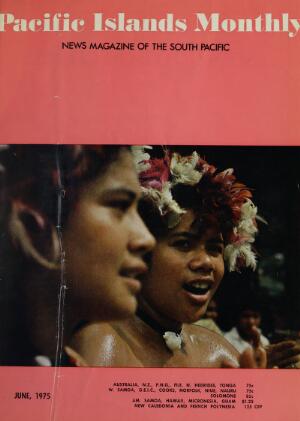
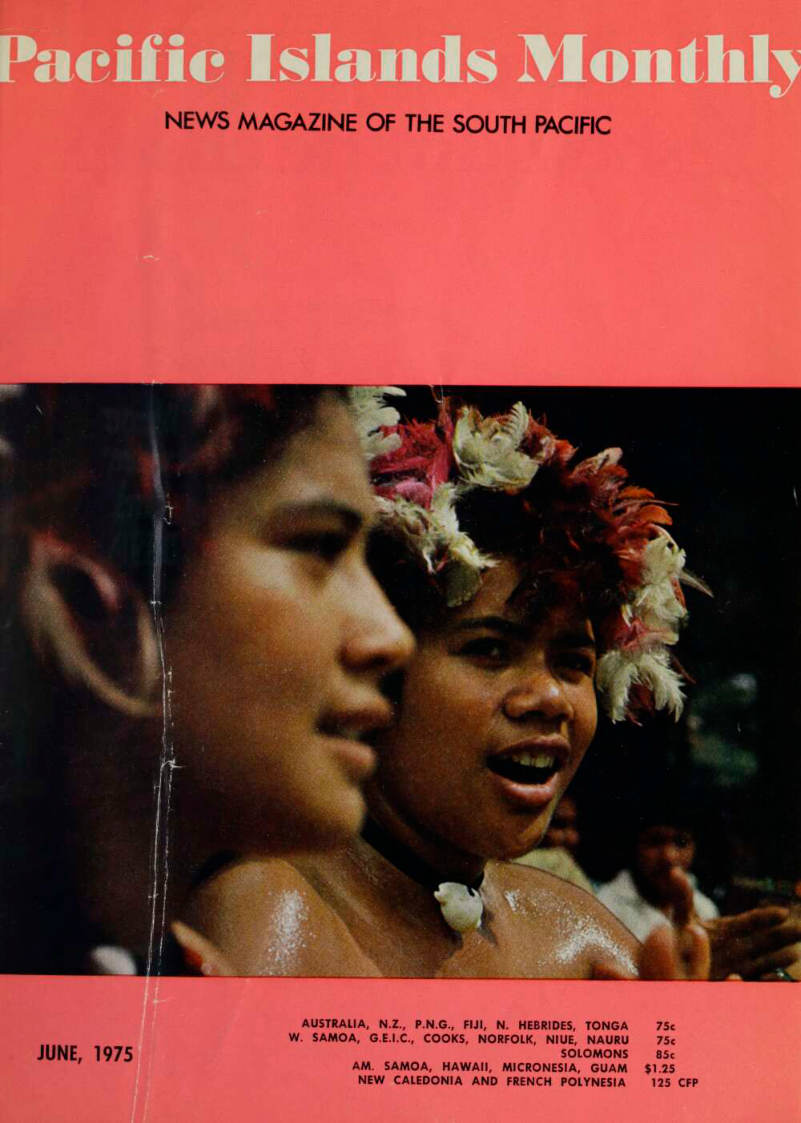
Our Cover
These attractive Friendly Islanders were “captured” by Australian photographer Jozef Vissel in Tonga re cently during a tour made by Mr Vissel and well known author Olaf Ruhen.
They are collaborating on a full-colour book on Ton gan life. Tonga is becoming each month a more popular tourist destination for Aus tralians and New Zea landers.
Advertisements & other items, p. 2 (1 item)
shouldn’t be cheap.
An economy car
TOYOTA COROLLA
We put more than economy into a Toyota* We build them to be comfortable* We build them to be safe.
And we build them very carefully . • ♦ so that they’ll last.
Before you buy your next car, check with your Toyota dealer. He has a lot of economical models to choose from*
But no cheap ones.
4t
TOYOTA 1000
TOYOTA CORONA
TOYOTA CELICA
TOYOTA MARK II
TOYOTA
PAPUA, NEW GUINEA: ELA MOTORS LIMITED, Scratchley Rd„ Badili, Papua. U.S. TRUST TERRITORY: MICROL CORPORATION, P O. Box 267, Saipan FIJI ISLANDS: AUTOMOTIVE SUPPLIES CO LTD GP O Box 355 Suva. AMERICAN SAMOA: BURNS PHILP (SOUTH SEA) CO , LTD., Pago Pago. WESTERN SAMOA: BURNS PHILP (SOUTH SEA) LTD , P.O. Box 188, Apia GUAM: RICKY'S AUTO CO., P. 6. Box 1458, Agana. NEW HEBRIDES: NEW HEBRIDES MOTORS LTD., P.O, Box 18, Vila SOLOMON ISLANDS: MENDANA ENTERPRISES (S.I ), LTD., P.O. Box 174, Honiara. TAHITI: NIPPON AUTOMOTO, B P. 545, Papeete, COOK ISLANDS: COOK ISLANDS TRADING CORPORATION LTD,, P.O. Box 92. Rarotonga, NAURU ISLAND: NAURU COOPERATIVE SOCIETY GILBERT & ELLICE ISLANDS COLONY: TARAWA MOTORS, Box 36, Bairiki Tarawa NORFOLK ISLAND: MARIE’S NORFOLK TOURS, LTD , P.O. Box 276 TIMOR. SANG TAI HOO. Sang Tai Building, Dili NEW CALEDONIA: SOCIETE IMPORTATION AUTOMOBILE DU PACIFIQUE, Rond-Point du Pacific (Station Total) B.P. 438, Noumea.
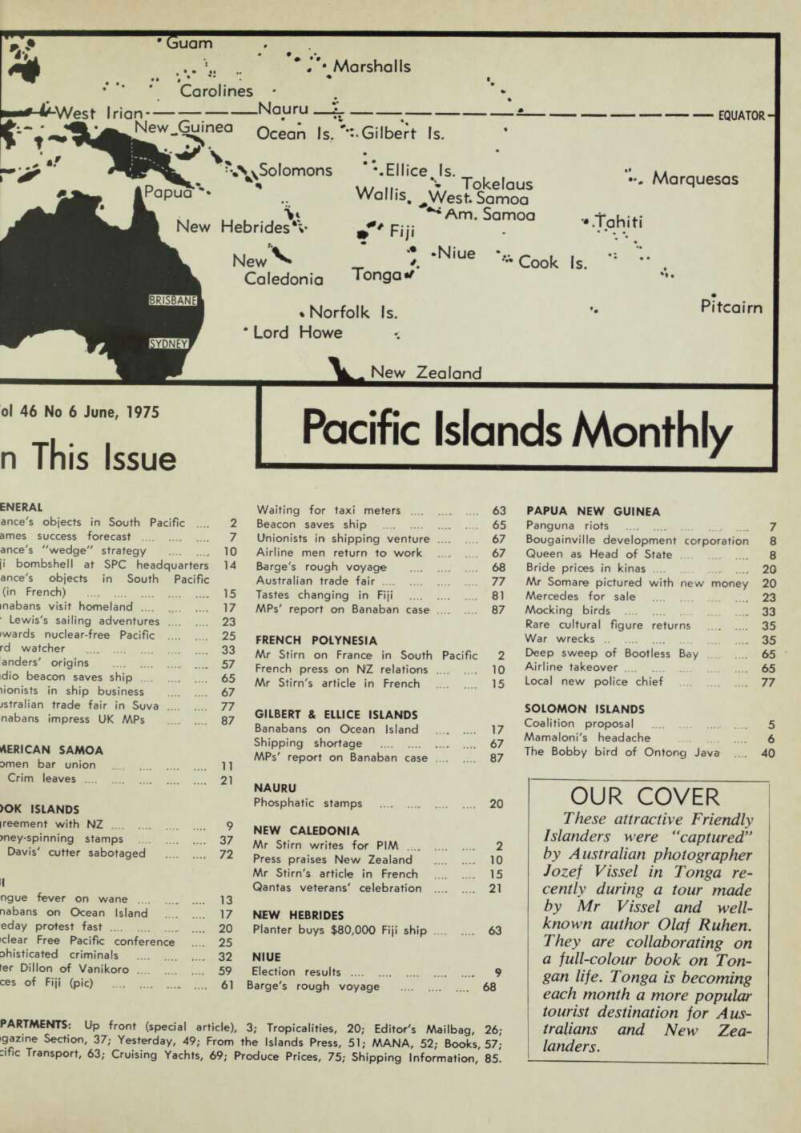
In This Issue
Eneral
ance's objects in South Pacific ... 2 ames success forecast 7 ance's "wedge" strategy 10 ji bombshell at SPC headquarters 14 ance's objects in South Pacific (in French) 15 mabans visit homeland 17 ■ Lewis's sailing adventures 23 •wards nuclear-free Pacific 25 rd watcher 33 anders' origins 57 dio beacon saves ship 65 lionists in ship business 67 jstralian trade fair in Suva 77 nabans impress UK MPs 87
African Samoa
omen bar union 11 Crim leaves 21
>Ok Islands
ireement with NZ 9 >ney-spinning stamps 37 Davis' cutter sabotaged 72 l| ngue fever on wane 13 nabans on Ocean Island 17 eday protest fast 20 •clear Free Pacific conference ... 25 ohisticated criminals ... 32 fer Dillon of Vanikoro 59 ces of Fiji (pic) 61
Waiting for taxi meters 63 Beacon saves ship 65 Unionists in shipping venture 67 Airline men return to work 67 Barge's rough voyage 68 Australian trade fair 77 Tastes changing in Fiji 81 MPs' report on Banaban case 87
French Polynesia
Mr Stirn on France in South Pacific 2 French press on NZ relations 10 Mr Stirn's article in French 15
Gilbert & Ellice Islands
Banabans on Ocean Island 17
Shipping shortage 67
MPs' report on Banaban case 87
Nauru
Phosphatic stamps 20
New Caledonia
Mr Stirn writes for PIM 2 Press praises New Zealand 10 Mr Stirn's article in French 15 Qantas veterans' celebration 21
New Hebrides
Planter buys SBO,OOO Fiji ship 63
Niue
Election results 9 Barge's rough voyage 68
Papua New Guinea
Panguna riots 7 Bougainville development corporation 8 Queen as Head of State ... .8 Bride prices in kinas 20 Mr Soma re pictured with new money 20 Mercedes for sale ... 23 Mocking birds 33 Rare cultural figure returns 35 War wrecks 35 Deep sweep of Bootless Bay 65 Airline takeover 65 Local new police chief 77
Solomon Islands
Coalition proposal 5 Mamaloni's headache 6 The Bobby bird of Ontong Java ... 40
PARTMENTS; Up front (special article), 3; Tropicalities, 20; Editor's Mailbag, 26; gazine Section, 37; Yesterday, 49; From the Islands Press, 51; MAN A, 52; Books, 57; :ific Transport, 63; Cruising Yachts, 69; Produce Prices, 75; Shipping Information, 85.
Pacific Islands
Monthly
FOUNDED BY R. W. ROBSON IN 1930
Published Monthly By
Pacific Publications (Aust.) Pty. Ltd.,
29 Alberta St., Sydney, N.S.W., 2000.
Postal Address: G.P.O. BOX 3408, SYDNEY,
N.S.W., 2001.
Telegraphic Address: PACPUB, Sydney.
Telex 25168.
Telephones: 61-9197, 61-7101, 61-4369.
Consulting Directors: R. W. Robson, Judy Tudor.
Director of Advertising: Alan Batt.
Manager: Selwyn Hughes.
Publisher: Stuart Inder.
Pacific Islands Monthly
Editor: Stuart Inder.
Assistant Editor: John Carter.
Subscription Rates:
"Pacific Islands Monthly" is airfreighted to the majority of subscribers and agents in the Pacific Islands and the U.S.A.; copies to the Cook Islands, Nauru, Niue, Micronesia and Guam go by surface mail.
Australia (including Lord Howe and Thursday Islands), New Zealand, Papua New Guinea, Fiji, New Hebrides, Tonga, Cook Islands, Western Samoa, Gilbert & Ellice Islands. Norfolk Island, Niue and Nauru: $9.00 (local currency); Solomon Islands: $lO.OO Aust., American Samoa, Micronesia and Guam: $12.00 US; Hawaii and US Mainland: $15.00 US; New Caledonia and French Polynesia; 1,500 CFP; United Kingdom: £6.50; Japan: 4,000 Yen.
Elsewhere $11.50 Aust.
Representatives
Fiji: Advertising and Distribution —Fiji Times & Herald Ltd., 20 Gordon St., Suva. Telephone: 25-601. Telex.; FJ 2124.
Papua New Guinea: PORT MORESBY, PNG Print ing Co. Pty. Ltd., P.O. Box 633; LAE, P.O. Box 227; RABAUL, Mr. David Simpson, P.O. Box 164 (c/- Rabaul Photographic, Tel.: 2677.) French Polynesia. Distribution—Hachette Pacl fique, 10 Ave Bruat, Papeete.
New Zealand: Pacific Publications, C.P.O.
Box 2229, Auckland.
United Kingdom: Advertising—Overseas Publicity Ltd., 214 Oxford Street, London, WIN OEA.
Phone: 01-636 8296/7. Subscriptions— T. B.
Graham, Park House, 22 Park Street, Croydon,
Cr9 3Np. Tel.: 01-6884177.
Japan: Advertising—Universal Media Corpora tion, C.P.O. Box 46, Tokyo. Tel.: 666-3036.
Victoria: Advertising Pacific Publications (Aust.) Pty. Ltd.. Herald & Weekly Times Building, 2nd Floor, 61 Flinders Lane, Mel bourne, 3000. Telephone: 652-1565.
Hawaii and U.S. Mainland only: N. Grogan, 3354 Hayden Street, Honolulu, 96815. (Send change of address notices, Form 3579 and new subscriptions to P.O. Box 2193, Honolulu, Hawaii, U.S.A. 96805).
Second class postage paid at Honolulu, Hawaii.
Copyright ©, 1975,
Pacific Publications (Aust) Pty. Ltd.
Vol. 46, No. 6 June, 1975
Up Front
with the a guest
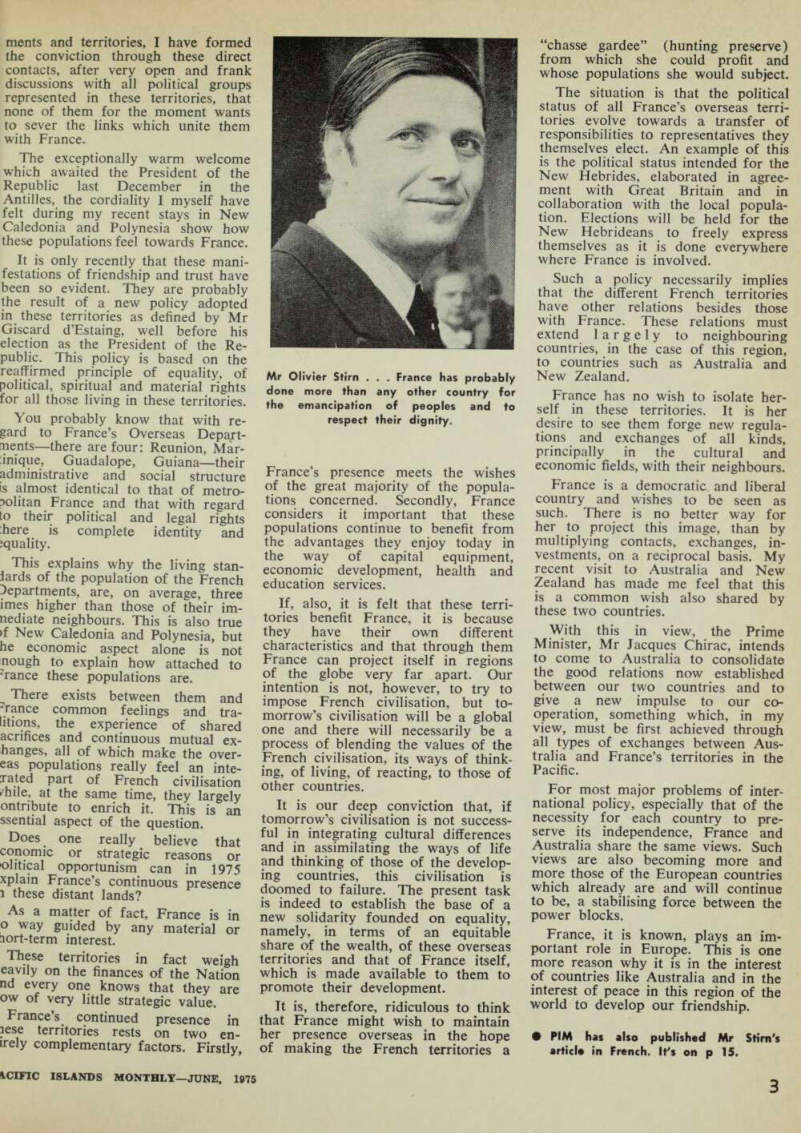
MR OLIVIER STIRN, Secretary of State in charge of French Overseas Departments and Territories, writes for RIM on certain aspects of Franco- Australian relations and France’s place in the South Pacific.
There is no doubt that 1975 marks a new phase in Franco-Australian relations. A turning point, which will probably bring about a new type of rapport between Europe itself and countries of South Pacific. A new mode of co-operation setting out new opportunities to preserve peace not only in these two regions of the world but wherever it might be threatened.
To achieve this new understanding, government leaders had, first, to meet at a personal level. This has now been done.
The visit to Paris last January of Mr Whitlam (Australian Prime Minister) has made it possible to discuss the differences which existed between our two countries regarding France’s nuclear tests in the Pacific.
A further step towards the normalisa tion of our relations was made last March when I visited Australia.
As our differences draw to an end, it has to be recalled once more, that France’s nuclear tests were in no way the expression of aggressive am bitions, but a contribution to the defence of the free world to which Australia belongs. In the light of events in Indochina and of major crises in some parts of Europe it becomes abundantly clear that the world continues to be threatened.
For the last 17 years, France has pursued an original and coherent defence policy aimed at preserving her independence vis-a-vis the major blocks while maintaining her support for countries which share her con cept of democracy.
While Australia has adopted other principles with regard to defence matters, it has for matters concerning foreign policy adopted similar views on many aspects to those of France.
Thus, the difference over nuclear testing could no longer keep our two countries apart, especially since France has now undertaken not to hold atmospheric nuclear tests for a
period of time far greater than any other nuclear power has ever ac cepted to commit itself.
Furthermore, no one can deny that France has taken every precaution to minimise any risks that may result from such tests, and that, to date, it cannot be said that these tests have proved harmful to people living on Australian territory or elsewhere.
In a somewhat curious way, these tests have led some to question France’s presence in the Pacific and in other regions of the world. Some who probably lack sufficient informa tion, depict France as a country living in the past, preoccupied with preserv ing the last remnants of her colonial empire and with constraining against their will the populations of these territories within a system of ex changes and relations directly in herited from colonialism.
What a mistaken and unfair view!
France has probably done more than any other country for the emancipa tion of peoples and to respect their dignity. Wherever there is a wish for independence, France is granting it. Not as some powers have done, abandoning everything from one da> to the next, thus exposing the newl> independent countries to a long period of anarchy, but by leading them progressively to the full exercise o! the responsibilities of national sovereignty.
This was the case for all Africa! countries many of which, today, re tain ties with France. This coulc also be the case for the territoriei which are still French; for example the Comoro Islands which have just through a referendum, opted foi their independence, while maintain ing with France ties of friendship and co-operation which will enable these four islands in the Indian Ocear to face more easily the inevitable difficulties they will face on the threshold of their new destiny.
Following a series of visits U nearly all France’s overseas depart
ments and territories, I have formed the conviction through these direct contacts, after very open and frank discussions with all political groups represented in these territories, that none of them for the moment wants to sever the links which unite them with France.
The exceptionally warm welcome which awaited the President of the Republic last December in the Antilles, the cordiality I myself have felt during my recent stays in New Caledonia and Polynesia show how these populations feel towards France.
It is only recently that these mani festations of friendship and trust have been so evident. They are probably the result of a new policy adopted in these territories as defined by Mr Giscard d’Estaing, well before his election as the President of the Re public. This policy is based on the reaffirmed principle of equality, of political, spiritual and material rights for all those living in these territories.
You probably know that with re gard to France’s Overseas Depart ments—there are four; Reunion, Mar inique, Guadalope, Guiana—their administrative and social structure is almost identical to that of metro politan France and that with regard to their political and legal rights here is complete identity and equality.
This explains why the living stan iards of the population of the French Departments, are, on average, three imes higher than those of their im nediate neighbours. This is also true >f New Caledonia and Polynesia, but he economic aspect alone is not nough to explain how attached to Yance these populations are. , There exists between them and Yance common feelings and tra litions, the experience of shared acrifices and continuous mutual ex hanges, all of which make the over eas populations really feel an inte rred part of French civilisation /hile, at the same time, they largely ontribute to enrich it. This is an ssential aspect of the question.
Does one really believe that conomic or strategic reasons or olitical opportunism can in 1975 xplain France’s continuous presence i these distant lands?
As a matter of fact, France is in o way guided by any material or port-term interest.
These territories in fact weigh eavily on the finances of the Nation nd every one knows that they are ow of very little strategic value.
France s continued presence in icse territories rests on two en irely complementary factors. Firstly,
France’s presence meets the wishes of the great majority of the popula tions concerned. Secondly, France considers it important that these populations continue to benefit from the advantages they enjoy today in the way of capital equipment, economic development, health and education services.
If, also, it is felt that these terri tories benefit France, it is because they have their own different characteristics and that through them France can project itself in regions of the globe very far apart. Our intention is not, however, to try to impose French civilisation, but to morrow’s civilisation will be a global one and there will necessarily be a process of blending the values of the French civilisation, its ways of think ing, of living, of reacting, to those of other countries.
It is our deep conviction that, if tomorrow’s civilisation is not success ful in integrating cultural differences and in assimilating the ways of life and thinking of those of the develop ing countries, this civilisation is doomed to failure. The present task is indeed to establish the base of a new solidarity founded on equality, namely, in terms of an equitable share of the wealth, of these overseas territories and that of France itself, which is made available to them to promote their development.
It is, therefore, ridiculous to think that France might wish to maintain her presence overseas in the hope of making the French territories a
“chasse gardee” (hunting preserve) from which she could profit and whose populations she would subject.
The situation is that the political status of all France’s overseas terri tories evolve towards a transfer of responsibilities to representatives they themselves elect. An example of this is the political status intended for the New Hebrides, elaborated in agree ment with Great Britain and in collaboration with the local popula tion. Elections will be held for the New Hebrideans to freely express themselves as it is done everywhere where France is involved.
Such a policy necessarily implies that the different French territories have other relations besides those with France. These relations must extend largely to neighbouring countries, in the case of this region, to countries such as Australia and New Zealand.
France has no wish to isolate her self in these territories. It is her desire to see them forge new regula tions and exchanges of all kinds, principally in the cultural and economic fields, with their neighbours.
France is a democratic and liberal country and wishes to be seen as such. There is no better way for her to project this image, than by multiplying contacts, exchanges, in vestments, on a reciprocal basis. My recent visit to Australia and New Zealand has made me feel that this is a common wish also shared by these two countries.
With this in view, the Prime Minister, Mr Jacques Chirac, intends to come to Australia to consolidate the good relations now established between our two countries and to give a new impulse to our co operation, something which, in my view, must be first achieved through all types of exchanges between Aus tralia and France’s territories in the Pacific.
For most major problems of inter national policy, especially that of the necessity for each country to pre serve its independence, France and Australia share the same views. Such views are also becoming more and more those of the European countries which already are and will continue to be, a stabilising force between the power blocks.
France, it is known, plays an im portant role in Europe. This is one more reason why it is in the interest of countries like Australia and in the interest of peace in this region of the world to develop our friendship.
• PIM has also published Mr Stim's article in French. It's on p 15.
Mr Olivier Stirn . . . France has probably done more than any other country for the emancipation of peoples and to respect their dignity.
Advertisements & other items, pp. 5-6 (2 items)
3
ICEFIC ISLANDS MONTHLY—JUNE, 1975
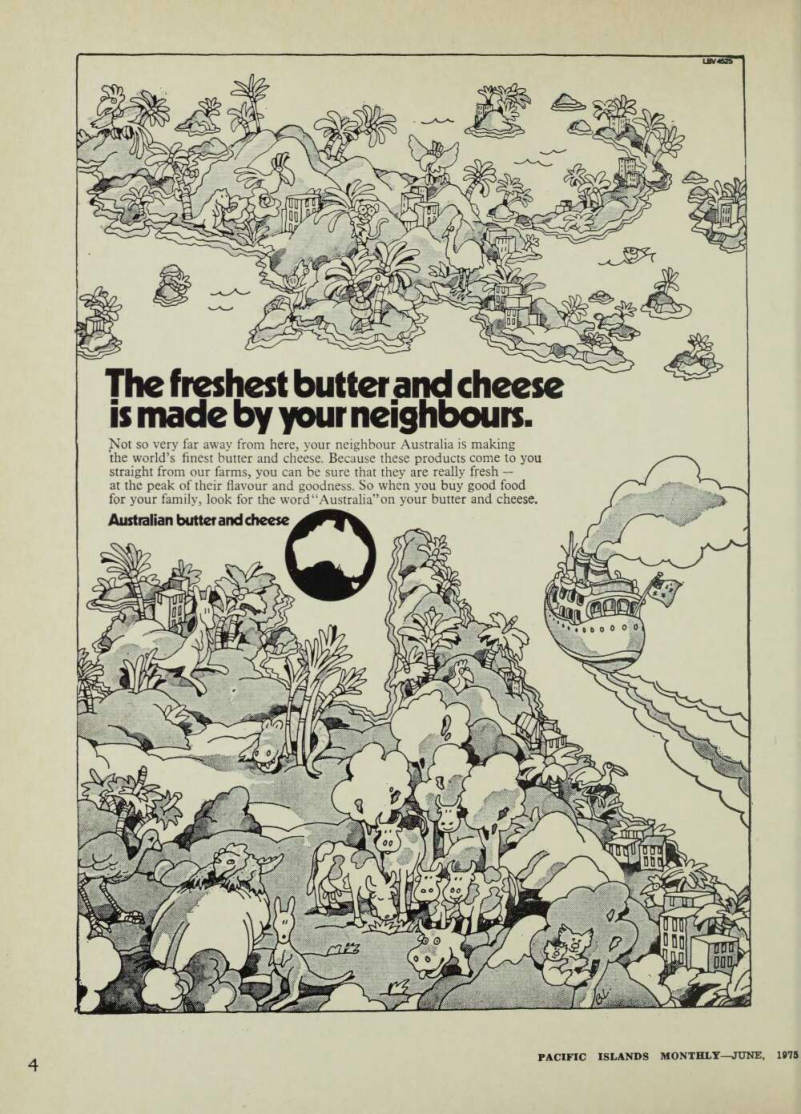
is made by your neighbours.
LBV 4625
«S,
The freshest butter and cheese
is made by your neighbours.
Not so very far away from here, your neighbour Australia is making the world’s finest butter and cheese. Because these products come to you straight from our farms, you can be sure that they are really fresh at the peak of their flavour and goodness. So when you buy good food for your family, look for the word “Australia” on your butter and cheese.
Australian butter and cheese p Du c
Pacific Islands Monthly
A Coalition Could Be The Recipe
For Solomons Political Hot-Pot
Prom a Honiara correspondent
From its outset, May seemed likely to be a controversial month in Solo mon Islands politics. As the poli ticians began the third meeting of the first session of the first Legislative Assembly, 150 students from the Solomons Teachers Training College went on strike following the impo sition of new conditions for students as recommended by the Education Policy Review Committee and en dorsed by parliament in a special sitting last January.
On Monday, April 28, the students marched from the college to the education offices—a long way in the dusty, early morning Honiara heat.
They were met by the Education Minister Stephen Cheka and Perma nent Secretary Francis Bugotu.
Neither was inclined to give much consideration to the students’ de mands for the abolition of fees (newly-introduced), for student pocket money and better food at the college. After an exchange of only a few minutes the students’ petition was rejected and the demonstrators dispersed.
Mr Cheka told the students that those who did not attend classes at 2 pm that day would be ex pelled immediately. Despite his strong stand, the students decided to defy the minister, and as a result 117 students were automatically expelled rom the college that afternoon.
Many of them returned to their lomes immediately.
It was left to Opposition parliamen arian Leslie Fugui to make political :apital on Cheka’s inability to negoti ite a less-drastic solution. The fol owmg night Fugui led an Opposition valk-out from the Legislative Assembly, which only failed to dis upt proceedings completely because if procedural peculiarities.
In any case, the assembly quickly djourned soon after allowing Chief Minister Solomon Mamaloni to inter ene in the dispute. With a close dviser he called at the teachers ollege that night to discuss the ituation with students and staff.
On the Wednesday morning the
assembly sitting was postponed while the Chief Minister, following an all night ordeal, worked out a solution to the conflict with the Council of Ministers and this was accepted by parliament early that afternoon.
The government agreed to “recon sider” the fees dispute and to examine other complaints which the students had put forward. The ex pulsion of the students was revoked and they were all urged to present themselves at the college for the beginning of the new term on May 19. In Mamaloni’s words, “a minor national crisis” had been prevented from becoming “a major national crisis”.
The students’ strike and the Opposition walk-out proved to be the main sparks in what otherwise looked like being a fairly routine parliamen tary meeting. Towards its end, there were signs that the Opposition was unhappy with some of the implica tions of the proposed 1975-79 De velopment Plan, which seemed likely to be approved.
Among other things the Opposition sought recognition that some of the ideas included in the plan originated with the Opposition party’s policy manifesto and were, originally, opposed by the governing party!
The possibility that the govern ment, led by the minority People’s Progressive Party (PPP), has de liberately sought to put the Oppo sition United Solomon Islands Party (USIPA) into disarray by adopting some of their policies is a high one.
Already two leading USIPA mem bers, Zoleveke and Solodia, have joined the government’s front bench and more might follow. Nine months after its formation, the Mamaloni government depends for survival on the support of five independent par liamentarians plus Solodia, who still claims to belong to USIPA! The PPP itself has only seven party members in the assembly, two fewer than the remaining USIPA members.
Undoubtedly, Mamaloni has played his numbers game well. From a de cidedly minority position, he has
been able to attract enough support from independent and USIPA mem bers to allow him a bare parliamen tary majority of 13 fairly safe votes —leaving USIPA with nine and two other independents. The composition of the Council of Ministers reflects Mamaloni’s political success: out of seven ministers two are independents and one is professedly USIPA. And, if USIPA back-benchers are to be believed, the government has taken to stealing not only the Opposition’s personnel but also its policies!
The tendency towards a formal all party government has been empha sised by the latest proposals for constitutional reform. The assembly set up a bi-partisan committee to consider urgent constitutional changes in the Solomons. The committee has completed its task and a delegation was due to leave Honiara on May 15 for London to make certain pro posals to the British Government.
Significantly, the delegation itself reflects different interest groups within the assembly: Mamaloni, Betu and Solodia (two non-PPP ministers), Wickham (USIPA), an adviser from the public service and a colonial ad ministrator (probably the governor or his deputy).
In effect, therefore, the talks are concerned with the progress of the Solomon Islands towards self government. The only real dispute between the Solomon Islanders and the British on this question concerns whether or not a timetable and definite dates for the transfer of power should be set.
The British believe that a clear schedule should be announced at an early opportunity. Mamaloni, on the other hand, learning the bitter lessons of Michael Somare’s experience next door in Papua New Guinea, opposes the announcement of a definite schedule and favours the de facto accomplishment of self-determined status prior to its announcement.
In fact, Mamaloni has already stated, in an interview published earlier this year in the government newspaper, The Solomons News Drum, that people may be “sur
prised” how quickly self-government is achieved—with the inference that it would some later this year. In this case independence could be an nounced during 1976.
But, if the rapid transfer of power in the Solomon Islands is a surprise to some, another effect of these de velopments may be to thrust the two parliamentary parties closer together.
After more than 18 months existence neither the PPP nor USIPA is much more than a paper party outside the Legislative Assembly—at best no more than a handful of the parlia mentary members’ constituents have any idea of what either party is about, or what affiliations their mem bers profess. Even within parliament it is not easy to pin down the allegi ances of some of the members, at least one-third of them having played fickle to one party or the other from time to time.
As a result of the informality of party politics, the parties’ joint par ticipation in a coalition government should be easier to achieve than might otherwise have been the case.
If two new ministers are to be ap pointed to the council the pressure on more USIPA members to join the government will be considerable.
Already some observers feel that the governing group’s resources have been stretched to the limit in finding seven assembly members competent enough to handle present executive responsibility. It seems very unlikely that Mamaloni can find two more supporters from his own ranks to take the additional chores.
From all this then, the chances are good that an expanded government team will emerge later this year, on present indications still under Mama loni’s leadership, based on a broader cross-section of interests than the present council. If this does happen, one effect might be to lessen the impact of the personality conflicts which have so influenced the assembly from its inception in 1973.
Honiara has also witnessed during the last few months an attempt to found a nationally-based trade union organisation. This attempt has been led by Bart Ulufa’alu, an economics graduate and one-time student presi dent at UPNG. Mamaloni may well have tamed his parliamentary op position! It remains to be seen how he will cope with the development of radical politics outside the Legis lative Assembly. • It was announced from London on May 21 that the Solomons de legation and British Government re presentatives had agreed on a self-rule date for the Solomons. A joint state ment issued at the end of the talks said the Solomons would have in dependance by the middle of 1977.
Advertisements & other items, p. 7 (1 item)
5
ACIFIC ISLANDS MONTHLY—JUNE, 1975
Mamaloni's
Ministers!
Mamaloni's headache
Some kind of peaceful co existence with the Opposition or further poaching from their ranks may be the only solution to the present problems Chief Minister Solomon Mamaloni is having with three out of six of his Council of Ministers.
It’s getting more difficult for him all the time to keep up an image before the country of re sponsible, capable ministers when some engage in fist and verbal fights in bars, bring on a Legisla tive Assembly and development plan crisis over the sacking of virtually all teacher trainees, and are closely involved in the collapse of the politically and economically important Malaita Development Company with its all-local share holders.
The only expatriate minister in the Council, New Zealand Angli can priest, Father Peter Thomp son, was sent off on a month’s “sick leave” and had the portfolio of Trade Industry and Labour taken from him by Mr Mamaloni in a reshuffle of portfolios.
It was a sorry end to Fr Thomp son’s long-held ambitions to be involved in the country’s business affairs, as he had made it plain for years in the legislature he thought he had much to offer.
The portfolio, described by Mr Mamaloni as the most vital for the country, was given to the steady and uncontroversial Willie Betu, a probably unwelcome task for a man whose health in recent times had suffered as a result of his conscientious working habits.
Perhaps more spectacular has been the performance of former Health and Welfare Minister, Stephen Cheka. He was moved in the reshuffle to Education and Cultural Affairs where he promptly created the crisis at the Teachers Training College described on p 5.
This followed his involvement in a fight in the Guadalcanal Club —Honiara’s best—in a scene with
other politicians.
Whether the fight, a four cornered one, was about politics eye-witnesses didn’t say, but four
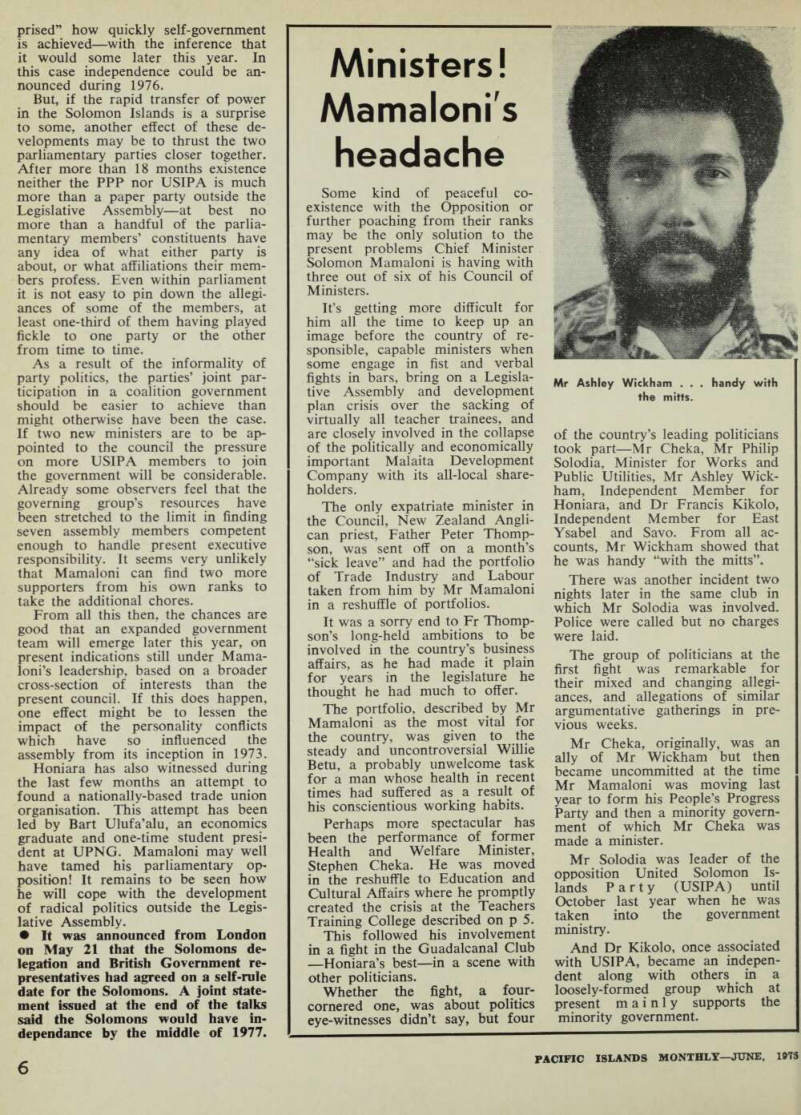
of the country’s leading politicians took part—Mr Cheka, Mr Philip Solodia, Minister for Works and Public Utilities, Mr Ashley Wick ham, Independent Member for Honiara, and Dr Francis Kikolo, Independent Member for East Ysabel and Savo. From all ac counts, Mr Wickham showed that he was handy “with the mitts”.
There was another incident two nights later in the same club in which Mr Solodia was involved.
Police were called but no charges were laid.
The group of politicians at the first fight was remarkable for their mixed and changing allegi ances, and allegations of similar argumentative gatherings in pre vious weeks.
Mr Cheka, originally, was an ally of Mr Wickham but then became uncommitted at the time Mr Mamaloni was moving last year to form his People’s Progress Party and then a minority govern ment of which Mr Cheka was made a minister.
Mr Solodia was leader of the opposition United Solomon Is lands Party (USIPA) until October last year when he was taken into the government ministry.
And Dr Kikolo, once associated with USIPA, became an indepen dent along with others in a loosely-formed group which at present mainly supports the minority government.
Mr Ashley Wickham . . . handy with the mitts.
PNG official forecasts big
success for the Guam Games
Prom a Port Moresby correspondent
Widely - experienced Papua New Guinea sports official, Jack Pini, predicts that the South Pacific Games in Guam in August will be a great success, with contestants experiencing “the true spirit of the Games”.
He made this prediction in May after returning to Port Moresby from Guam where he checked out Guam’s arrangements for the Games on be half of the Papua New Guinea Amateur Sports Association. Mr Pini is secretary of the association and general manager of PNG’s 290-man Games team. It’s the largest team yet to be sent out by PNG.
The PNG and Solomon Islands teams will fly direct to Guam in two
Air Micronesia Boeing 727 s whose
charter was finalised by Mr Pini in Guam.
Mr Pini has given to PNG sporting bodies full details of the various venues for sports at the Games.
He says the main stadium and the athletics venue will not be up to the same standard as in the Tahiti and Port Moresby Games; but venues for basketball, golf, lawn tennis, judo, softball, volley ball, table tennis, yachting, weight-lifting and boxing were “certainly better” than at Tahiti and Port Moresby. The venues for soccer, swimming and athletics would be of a lower standard.
He said Guam was unable to put in a touch plate for electronic timing in the swimming pool and thus six timekeepers would be required for each lane. Swimming would be held in the mornings.
Athletics would take place in the afternoon at the J. F. Kennedy Field, using a track of crushed coral base, with a sand-clay mix for the top course. There was no covering on the stands. There would be no stadium for the opening ceremony; a baseball park would be used which was small and only a small section of it was covered.
But team accommodation was ex client—much higher than at Tahiti or Port Moresby. Accommodation md venues were fairly widely scattered, but 200 school buses would oe made available for transport, as Jiere was no public transport in 3uam.
Mr Pini said he was impressed by he amount of organisation done in 3uam over a short period. The early roubles had been overcome, and juam had achieved in three months
what it normally would have been expected to achieve over three years.
There was a great spirit of en thusiasm among all officials and sup porters of the organising committee and there was no doubt in his mind that Guam would “magnificently” meet that part of the South Pacific Games Charter which said that the first objective was to bring people together so that they could create bonds of friendship and understand ing, and secondly to engage in amateur sport.
Mr Pini said contestants could expect very hot weather during the day with cool nights, with “every chance” of typhoons. Cost of living in Guam was very high, including taxi charges, but there was a great deal of entertainment. Colour tele vision would be provided in the Games villages. Guam itself had a bowling alley, four picture theatres, plenty of nightclubs and good beaches.
Talking of dress, Mr Pini noted that “strangely enough” shorts were not used to any great degree in Guam. The women wore slacks and casual dresses, the men long trousers and casual shirts.
Chief of mission for the PNG team, Mr Sam Piniau, said in Port Moresby that PNG’s strength at the Games would be in athletics (par ticularly marathon and long-distance), boxing and soccer.
He said the PNG public had given the team great financial support fol lowing a very sound fund-raising campaign. The public had subscribed $120,000, the government $45,000.
The PNG team will be wearing a new “independence” uniform of green and white Afro-shirt, green lap lap (or skirt) and sandals.
Countries taking part in the Games, which will be from August 1 to 10, are American and Western Samoa, the Solomons, New Hebrides, Cook Islands, French Polynesia, Fiji, Tonga, Nauru, New Caledonia, Papua New Guinea, Wallis and Futuna, and the Trust Territory of the Pacific Islands. The Trust Terri tory is sending a big team of 129 men and 29 women.
The total number of athletes taking part will be 1,048, plus 114 officials.
Some teams will be bringing large numbers of supporters with them— French Polynesia will probably bring about 120 and New Caledonia 160.
Bougainville's
"shame"
From a Port Moresby correspondent “ Disgraceful, shameful” conduct by “a mob of irresponsible and un disciplined hooligans”, said PNG Minister for Police Mr Peter Lus.
“I’m shocked by the magnitude of violence and damage ”, said Chief Minister Michael Somare.
They were referring to two days of violent rioting by more than 1,000 miners which began on May 12 at the Bougainville open-cut copper mine at Panguna, the world’s largest.
The rioting shut down the mine, caused the temporary evacuation to the coast of mine-worker families, mass arrests and gaolings, and exten sive damage to buildings and vehicles estimated at about $500,000 as the mine workers went on a wild ram page of destruction. Police moved in with tear gas.
Mr Somare said the government would act in future to prevent simi lar “industrially-inspired violence”, but he gave no details of his plans.
The Bougainville Copper Com pany, partly owned by the PNG Government, has had an excellent record of industrial relations, there being only one previous strike; for three days last December. Only a small proportion of the strikers worked directly for Bougainville
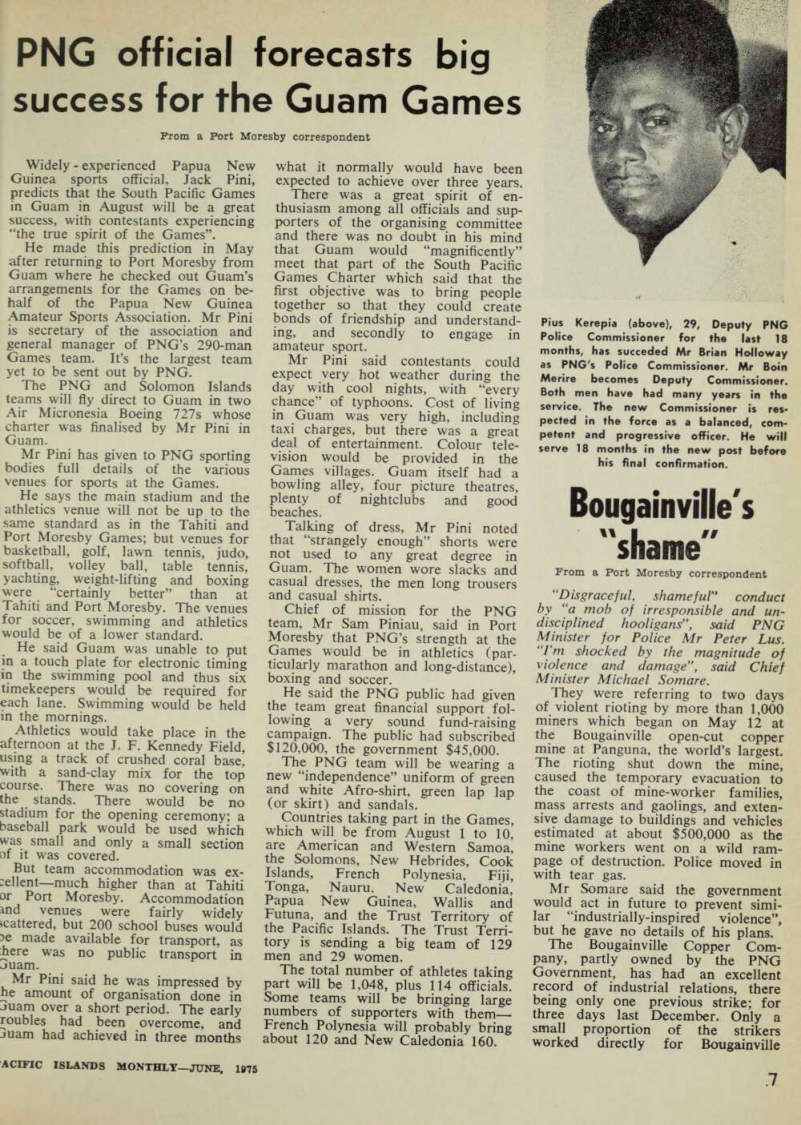
Pius Kerepia (above), 29, Deputy PNG Police Commissioner for the last 18 months, has succeded Mr Brian Holloway as PNG's Police Commissioner. Mr Boin Merire becomes Deputy Commissioner.
Both men have had many years in the service. The new Commissioner is res pected in the force as a balanced, com petent and progressive officer. He will serve 18 months in the new post before his final confirmation.
Copper Ltd—the others being em ployed by service industries and sub contractors at the mine site.
Frustrations which started the riot ing seem to rest on the difference between pay rates for the trained and skilled New Guineans at the mine and those with minor skills and in transient jobs. The unskilled have resented the growing economic gulf separating them from their country men. There is also the problem of large numbers of workers in a con fined area, despite the amenities pro vided.
Union officials encouraged the men to take action for better pay, but there are indications that the unions are now concerned over what they unleashed.
About 200 company and police vehicles were damaged, some bodily capsized or pushed into gullies. The government office and police station suffered heavily. Roads were tom up or littered with boulders, overturned vehicles and oil drums. An attempt was made to block the only road out of Panguna. The strikers holed them selves up in buildings between periodic forays of violence. Despite pillaging of food supplies, hunger and fatigue eventually drove the strikers, bearded and dirty, into the arms of the police.
Special courts sat into the night to hear charges against more than 800 defendants. Some were given gaol sentences, others were remanded.
Those arrested were penned in make shift camps on the coast, where con ditions were so sub-standard that police feared further violence and eventually released them to return to Panguna.
Convicted workers will be sacked and returned to the mainland, and the mine is already advertising for more workers to keep production up. • Meanwhile, on the political front, as PNG gets closer to indepen dence, expected later this year, the PNG Cabinet has announced the country will join the British Com monwealth and will ask Queen Eliza beth to become Head of State. The Queen has said she will decide whether to accept on independence.
If she agrees, she will be represented in PNG by a Governor-General, with no executive power, appointed on the advice of the PNG Cabinet after parliament decides nominations. Chief Minister Michael Somare will in any case become Prime Minister. • In Port Moresby on May 19 the House of Assembly turned itself into a National Constituent Assem bly, to finally approve the constitu tion, agree on an independence date, and nominate a Governor-General.
It will continue into June.
Advertisements & other items, p. 9 (1 item)
7
ACIFIC ISLANDS MONTHLY-JUNE, 1875
Bougainville Govt, sets up shop
From Harry Jackson In Png
Throughout Papua New Guinea local government has to find more revenue to meet the fast-growing population’s increasing demands for more and better services. A number of councils are seeking a partial solution through operating commercial enterprises, and it looks as if the provincial governments may go into business in a big way The Bougainville Provincial Government, first of its kind, is setting up a Development Corporation with $2 million nominal capital. Shares will initially be held by BPG but a public issue is to be made to Bougainvilleans.
The corporation is a holding company for several subsidiary public and proprietary companies. It has established Bougainville Air Services Pty Ltd, which has acquired the service including aircraft, formerly owned md managed by the Missionarv Aviation g Fellowship, and Atoll Shipping Pty Ltd, with a 50 ft vessel in which seven freezers are to be installed, to service the outer islands with consumer goods and charter C work ““ ** “ Wd ‘ “ do '" g Another subsidiary is Bougainville Canteens Pty Ltd which conducts four Set cameern, owned by Bougainville Conner Ltd for a management fee. fk-ht control with monthly finanpany, should ensure profitability.
Also being formed, in 50:50 part-
nership with a foreign firm, is Pan guna Catering Services Pty Ltd, which will have a labour only cater ing and accommodation contract worth $500,000 a year for the whole of the mining area, Each partner will contribute $250,000 for equipment, fleet and supplies, and the partnership will borrow the additional funds needed for working capital, The Bougainville D eveJopment Corporation Ltd will be helped by the non-renewable resources fund into which Bougainville Copper Limited has to pay 50 cents per tonne of exported copper, with an equal amount contributed by the Papua New Guinea Government. The fund s annual current mcome is about $350,000. . , In pursuit of its programme of (a) acquisition, (b) consolidation, and (c) having Bougamvilleans take over the management, the corpora tion does not hesl * ate emp oy foreigners for the ll ™ e L the Pro- Under the eagle eye of^he vincial Government s s ‘aff, h e Eided by execu live officer, three other Bougam villean university graduates, and Mr Gary Ray an Austrian busmes velopment officer, the Corporation looks like setting a good example to portion hopes for $250,000 net prom m 1985-86.
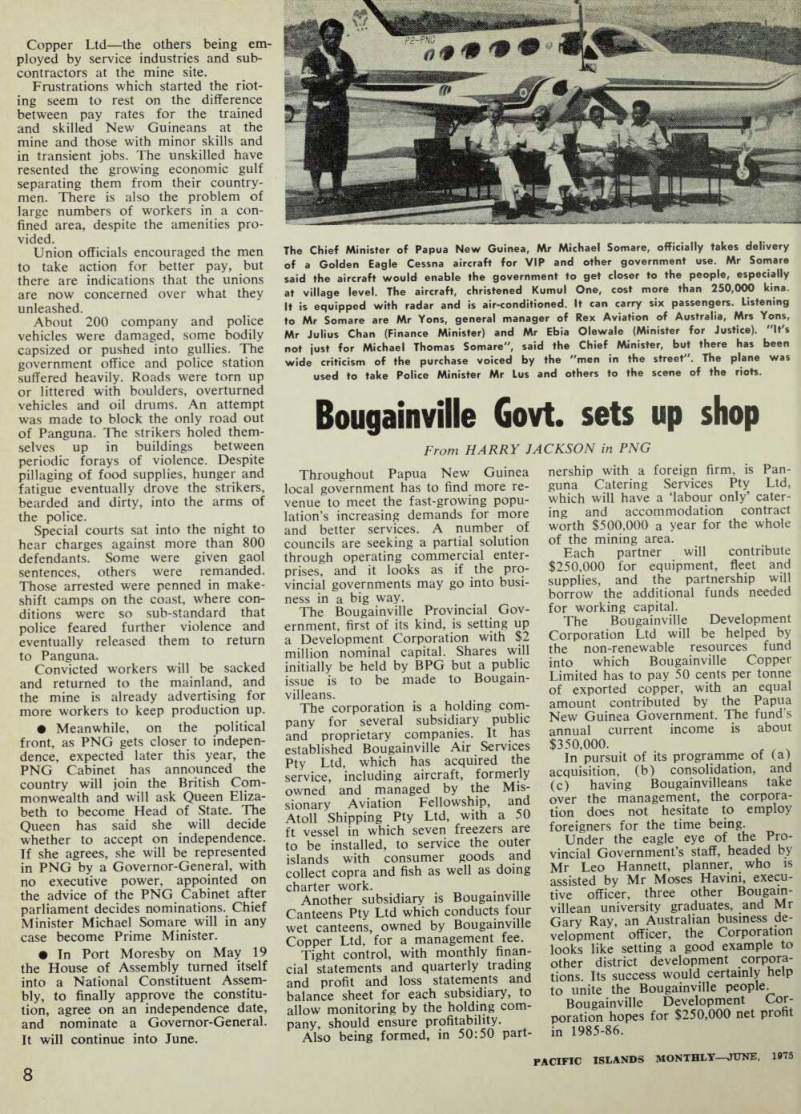
The Chief Minister of Papua New Guinea, Mr Michael Somare, officially takes delivery of a Golden Eagle Cessna aircraft for VIP and other government use. Mr Somare said the aircraft would enable the government to get closer to the people, especially at village level. The aircraft, christened Kumul One, cost more than 250,000 kina.
It is equipped with radar and is air-conditioned. It can carry six passengers. Listening to Mr Somare are Mr Yons, general manager of Rex Aviation of Australia, Mrs Yens, Mr Julius Chan (Finance Minister) and Mr Ebia Olewale (Minister for Justice). "It's not just for Michael Thomas Somare", said the Chief Minister, but there has been wide criticism of the purchase voiced by the "men in the street". The plane was used to take Police Minister Mr Lus and others to the scene of the riots.
dynasty
No Rex dynasty for Niue
From Stafford L. K. Guest
on Niue.
An attempt by the Rex family to snap up a fifth of the Legislative Assembly seats in the recent general election on Niue failed.
A large number of candidates seek ing six common roll seats split the votes. The Premier’s wife, Mrs P. T.
Rex, gained a government seat by a narrow margin but her bachelor son, Robert Richmond jr and his uncle, Mr Leslie Rex of Avatele were left “knocking on the door”.
The election, the first to be held since this tiny, isolated island with a population of 3,700 attained self government status last year, resulted in; • Niuean electors voting into gov ernment two women for the first time in history; • Three well-known families, Tongokilo, Viviani and Rex, each holding two seats in the assem bly; • Niue having one politician repre senting every 80 electors— probably the highest ratio of representation in the world.
Popular village headmaster, Mr Pope Talagi, topped the poll in a tussle with 15 other candidates seek ing six common roll seats. He was 130 votes ahead of his nearest rival, Mr T. Viviani, father of the Minister of Agriculture, Mr Young Vivian,
who was re-elected unopposed in the village constituency of Hakupu.
Mr P. Tanu of Avatele who con sidered himself an “outside horse” polled higher than the Premier’s wife.
The Commissioner of the Niue Court, Mr Tongokilo and his daughter, ex nurse Mrs Lapati Raka, from Muta lau, narrowly defeated public works foreman Mr P. Hiku, and another woman candidate, Mrs T. Ikinpule.
Eleven village constituent members including the Premier and three cabinet ministers were re-elected un opposed. In three areas where sitting members were challenged, only one toppled. Mutalau favoured young planter Mr Don Vilitama who ousted Mr T. Kalauni.
Speaker of the House, Mr S. P. E.
Tagelagi, who was originally nomi nated as a government candidate, withdrew his nomination at the 11th hour and was re-appointed Speaker
at the first meeting of the new assembly five days after the election.
Mr Robert Rex was again elected Premier by the 20-member govern ment and he, in turn, appointed Dr Enetama, Mr Frank Lui and Mr Young Vivian to the Cabinet.
Premier Rex is obviously going to keep a tight reign over his domain.
He has taken on responsibility for 10 portfolios—Finance, Immigration, Emigration, Customs, Trade, Inland Revenue, Information, Police, Prisons and Transport. It is also likely he will retain chairmanship of the Liquor Authority and the Price Tribunal.
Mr Young Vivian, who has fallen from favour in the past 12 months, lost his Tourism post to planter fisherman Mr Frank Lui but retains the Education, Agriculture and Economic Development files.
A Fiji-trained Niuean doctor, who gave up a medical career to enter politics, Dr Enetama of Namukulu, will be responsible for Health, lustice, Local Government Affairs, Lands and Radio.
Mr Lui is Minister for Works, Tourism, Forests, Fisheries and Electricity.
About 1,600 islanders went to the booths to elect the government which is now solely responsible for spending NZ grants totalling about $2.8 million a year.
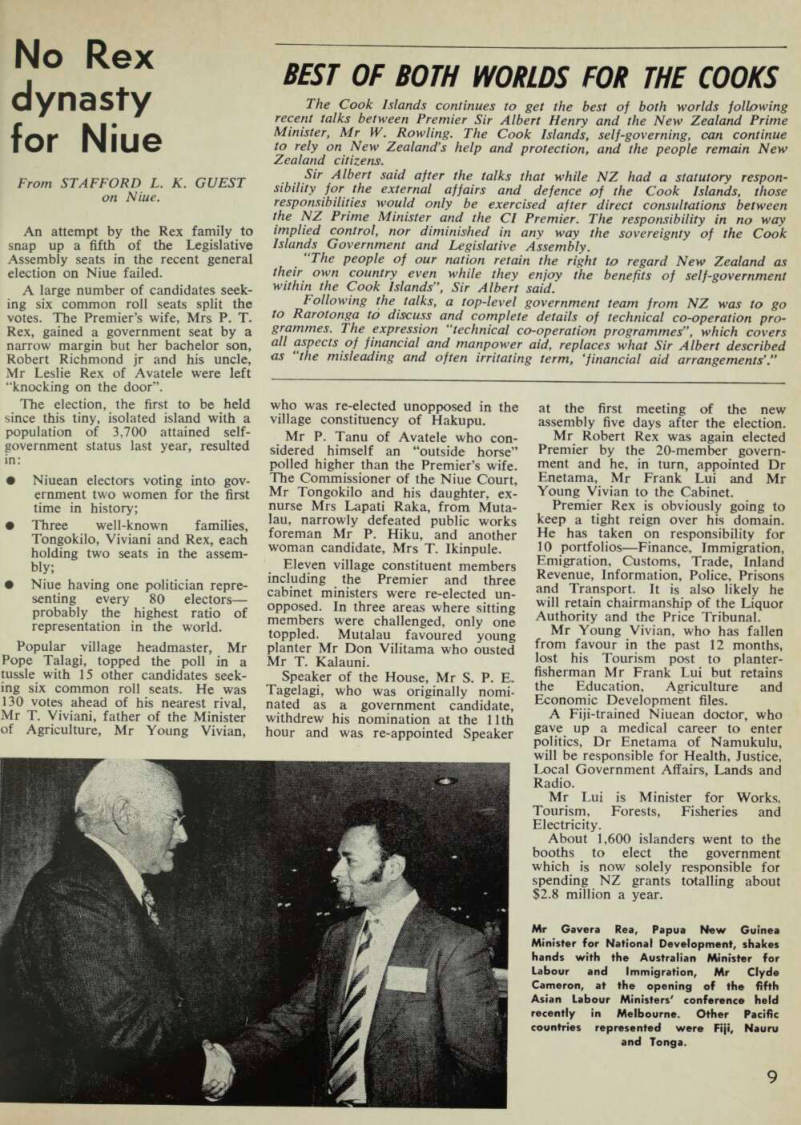
Mr Gavera Rea, Papua New Guinea Minister for National Development, shakes hands with the Australian Minister for Labour and Immigration, Mr Clyde Cameron, at the opening of the fifth Asian Labour Ministers' conference held recently in Melbourne. Other Pacific countries represented were Fiji, Naum and Tonga.
Best Of Both Worlds For The Cooks
The Cook Islands continues to get the best of both worlds following recent talks between Premier Sir Albert Henry and the New Zealand Prime Minister, Mr W. Rowling. The Cook Islands, self-governing, can continue to rely on New Zealand's help and protection, and the people remain New Zealand citizens.
Sir Albert said after the talks that while NZ had a statutory respon sibility for the external affairs and defence of the Cook Islands, those responsibilities would only be exercised after direct consultations between the NZ Prime Minister and the Cl Premier. The responsibility in no way implied control, nor diminished in any way the sovereignty of the Cook Islands Government and Legislative Assembly.
The people of our nation retain the right to regard New Zealand as their own country even while they enjoy the benefits of self-government within the Cook Islands”, Sir Albert said.
Following the talks, a top-level government team from NZ was to go to Rarotonga to discuss and complete details of technical co-operation pro grammes. The expression “technical co-operation programmes”, which covers all aspects of financial and manpower aid, replaces what Sir Albert described as the misleading and often irritating term, ‘financial aid arrangements'.”
wedge of NZ cheese
French bargain over a wedge of NZ cheese
From a Noumea correspondent
Two recent entertaining articles in the Noumea press highlight the Paris strategy of supporting a weaker country in order to drive a wedge into what the French regard as the Anglo-Saxon power block challenging the French presence in the Pacific.
Briefly, the articles point out what a delightful, even simple people the New Zealanders are, so desperately in need of foreign, thus French, aid and so kindly disposed to France, contrasting sharply with the aggressive, imperialistic Australians who are under no obligation to applaud French economic and political activity in the Pacific.
Pointing out that New Zealand is largely a land of farmers, the French articles emphasise the quiet, pastoral way of life of three million inhabitants who have little ambition beyond looking after their eight million cattle and 60 million sheep. In this pacifist, even “naive” temperament,
the French find none of the “obvious imperialists” of Australia and note a sharp distinction between New Zealand and Australian protests over the French nuclear tests in the Pacific.
The New Zealand opposition was quite “sincere”, and although it fol lowed “virulent Australia” it was not directed by anti-militarism, and especially “not by hatred of the French presence—on the cultural, economic and administrative levels— in waters close to their own”, Qnce “la bombe” had gone under ground, it was not difficult for New Zealand to re-establish friendly re lations with France, “warm ties which Australia has great difficulty in establishing, let alone re-establish”, And to crown it all, the French dis covered that “New Zealand is pro- French, even more so than pro- English”.
So, once the nuclear testing had
been forgotten, and the Kiwis and French had finished rubbing noses, embracing on both cheeks etc, they got down to the main business of talking dollars and cents, or in French currency gros sous.
And it is here that France finds an important role to play, with her technology capable of helping to build up an economy currently suf fering 3,000 unemployed and a 1975 balance of payments deficit of SNZI,OOO million.
But once again, the contrast is drawn with Australia: “If the un pleasantly aggressive Australian with a desire to be first, the best and to conquer, produces a constructive dynamism, (on the other hand) the relaxed kindliness of the New Zea lander remains ineffective . . . with no imagination, no dynamism to restore the economy”.
It is at this strategic point, ap parently, when New Zealand defences are low, that the French offensive must strike. Already the Paris authorities have lent a sympathetic jar to New Zealand’s pleading for continued sales of its primary pro luce to British markets within the EEC context. And now “France has he chance to carry off its first good leals in the South Pacific”. Though he contracts may be small, they :ould provide a “showcase for expert Tench technology”, a French display n the heart of the British Common vealth.
This follows upon Prime Minister bowling’s visit to Paris in February, Jlivier Stirn’s 24-hour visit to New Zealand in March, with a scheduled isit late September of Mr Segard, Tench Minister for Overseas Trade nd possibly that of French Prime Minister Jacques Chirac before the nd of the year, to formally “sign tie contracts”.
After French trade has been hit by tiree years of hostile Pacific boycotts, tie Paris government is anxious to e-launch French industry in the egion.
The targets the French are aiming or in New Zealand cannot include ranium and Concorde. However, iey include a series of 10 main pro mts, ranging from the sale of Air us for local transport to the con duction of power stations, petro hemical plant, sugar beet refinery, lectric railways, oil prospecting at ea and study grants in France.
Finally, in what seems no more lan another red herring to excite Caledonians, there are remote plans > build a nickel smelter to treat Caledonian ore in the north island f New Zealand.
Meanwhile, as a friendly gesture, lis year’s delegation of New Zea
landers visiting Noumea for the ANZAC day ceremonies in April was flown back and forth by a French naval plane based in New Caledonia.
The subsequent memorial gatherings at the Noumea war monument and the New Zealand war graves at Bourail were given exceptional publicity. Anzac Day was described as New Zealand’s national day with no indication that it is of equal significance to Australia.
Of course, in all currencies money talks big and as the French articles point out, where the franc goes there develop “common interests to defend”. The lesson is obvious in French Territories where the political struggle has now been smothered: since France controls the purse strings (through the hold on Caledonian nickel and operation of the Polynesian nuclear test base) so local political power has become irrelevant.
France has no illusions about the great potential of the Pacific Basin— that stage where she believes the future great dramas of world history will be acted out. New Caledonia’s strategic position in the operation has been well emphasised in the past: didn’t a former French governor in Noumea refer to New Caledonia as the “aircraft carrier” springboard for French sorties into the Pacific region?
France is gearing up to play a stirring role in the Pacific and in view of her offers to help overcome the “serious crisis” in the Kiwi economy, it will be interesting to watch future New Zealand diplomatic attitudes towards France.
Advertisements & other items, pp. 12-13 (2 items)
Braybon
PORTABLE
PETROL SETS
Capacities available: 1,2, 33, K.V.A. 240 V 50 cycle. For domestic appliances, T.V., power tools, electric welders and motors up to 3 H.P.
Write for brochure and prices:
BRAYBON BROS. PTY. LTD.
2 ROTHWELL AVE., CONCORD WEST,
N.S.W., 2138. Phone: 73-3246.
Security
To Future Generations,
Fk' < m Titans of the Past Social welfare is a subject of serious consideration' in most modern societies. Man in the twentieth century accepts his responsibility to bequeath to the next generation a society better than his own.
Daiwa Bank is not unique in accepting this responsibility, but Daiwa is unique in making acceptance of this role in society an integral part of their banking service.
Daiwa is the only Japanese city bank to combine banking and trust business. Daiwa is thus a fully integrated banking institution, comprising banking, international financing, trust, pension trust, and real estate business. This integration is part of our effort to fulfil our social responsibility consistent with society's needs in a contemporary environment. a fully integrated banking service
DAIWA BANK
Head Office: Osaka, Japan London and Frankfurt Branches New York and Los Angeles Agencies Singapore, Sydney and Sao Paulo Representative Offices Joint Venture Banks: P.T. Bank Perdania, Jakarta, International Credit Alliance, Ltd., Hong Kong
DIESEL ENGINES
For industrial applications ...
A range of DIESEL ENGINES for 27 H.P. to 120 H.P. available as basic units or as power packs.
FORD, LEYLAND, MITSUBISHI.
Also available replacement engines for older model Ford Tractors.
INDUSTRIES LIMITED
Enquiries to Mr G. Austin, Lees Industries Ltd. Private Bag, Papakura, Auckland, New Zealand. Phone 86-019. Telegraphic Address "Leeslift". Telex Leeslift NZ 2615.
Even From
Women's Lib
Trade Unions
f rom FLLISE VA'A in Pago Pago a historical development took place i n American Samoa earlier this year when the United States National Labour Relations Board (NLRB), the highest labour court in the US, ma de a landmark decision bringing American Samoa under its jurisdiction and making it possible for United States unions to expand into the territory.
The decision was the outcome of a battle that has been waged between the United Cannery and Industrial Workers of the Pacific and Van Camp Co, a major fish canning company in the United States with a branch in American Samoa, Heartened by a federal court’s de cision extending its jurisdiction to cover oil monopolies in American Samoa (in the case of Standard Oil), United Cannery was one of the earliest, if not the first union, to try to establish in the territory. But its attempt was contested all the way by Van Camp which, though unionised in other places, apparently did not want to see unionism in American Samoa, “But at every step of the fight, we won,” said Steve Edney, president of United Cannery, during a recent visit to the territory.
Unfortunately for the union, when the union elections were held at Van
Camp in May, the majority of the Van Camp workers, mostly women tuna packers, voted against joining United Cannery. The voting figures were 179 for, 391 against joining.
Here at the time to conduct public relations on behalf of the United Cannery union were Edney, president, Larry Parks, vice-president (and president of the Brotherhood of Beverage Workers), and Edward Lefeiloai, a special assistant to Edney.
The union men had expected an overwhelming victory. Before the election, they claimed they had 70 per cent of the workers’ signatures in favour of joining the union. But it was almost the other way round.
What could have gone wrong in the election? Whether by a coinci dence or by a well-prepared plan on the part of the union’s opponents, Senate President Salanoa Tumoeua logo had made a blistering attack on unionism over KVZK-TV the very evening before the union election.
Salanoa had been widely known as an anti-unionist, for the simple reason he feared unions would destroy the faaSamoa (Samoan way of living embodying Samoa’s customs and traditions and a moral, ethical and ritualistic code) as well as the matai system.
The United Cannery officials had no doubt that Salanoa, an influential matai and politician, dealt a mortal blow to their cause. They rated many of Salanoa’s charges as slanderous and plan to sue him for damages.
They also plan to lodge an official complaint with the Federal Communi cations Commission against KVZK’s so-called unethical election practices.
Under law, elections whether to join a union can be held yearly and it is almost a foregone conclusion that the United Cannery people will be back next year.
The reaction to the election results was mixed. Van Camp’s general manager, Vernon Wright, was re ported by a local newspaper to be extremely happy with the results.
The union fever is still spreading.
National Labour Relations Board examiner, Edward Parnell, is reported to be working on election dates for stevedoring and bottling company em ployees as well as for other small businesses.
Advertisements & other items, pp. 13-14 (2 items)
11
ACIFIC ISLANDS MONTHLY—JUNE, 1875
Queensland Insurance
Throughout the Islands
are foremost in General Insurance
COMPANY LIMITED
(Incorporated 1886 in Australia) Head Office: 82 Pitt Street, Sydney FlJl—Branch Office, Suva, Manager for Fiji: F. N. Davies (A.A.I.L).
LAUTOKA—Assistant Manager; G. A. Wooley.
HONIARA (8.5.1. P.) —Breckwoldt & Company (5.1.) Pty. Limited.
NEW CALEDONIA—T. A. Hagen, Ste. W. A. Johnston, S.A.R.L. —Noumea.
NEW HEBRlDES—Resident Officer: R. J. Allsop (A.A.I.L) Vila; Santo: Bums Philp (New Hebrides) Ltd.
TAHlTl—Arthur Chung: Immeuble 8.1., Front de Mer, Papeete.
NIUE, NORFOLK ISLAND, SAMOA, TONGA and other South Sea Islands—Bums Philp (South Sea) Company Ltd.
QUEENSLAND INSURANCE (P.N.G.) LTD
PAPUA NEW GUINEA
Head Office, Port Moresby: General Manager: D. J. Granter.
District Managers at Rabaul: C. D. Dickings; Lae: R. Jackson; Mt. Hagen: D. F. Carroll.
D pua new guinea
printing co. pfy. ltd.
Serving the Country from Aitape to Alotau, Manus to Moresby Leaders in Commercial Offset and Letterpress Printing. Stationery • Office Supplies • Office Equipment • Rubber Stamps • Self-Adhesive Labels • In Fact: — Everything For The Office.
P.O. Box 638, Port Moresby P.O. Box 759, Lae P.O. Box 1239, Rabaul
MATAAFA DIES
Western Samoa’s Prime Minister, Fiame Mataafa died in Apia on May 20 after a long illness. Aged 54, Mr. Mataafa became first Prime Minister in 1959. He was defeated in 1970 by Tamasese Lealofi but became Prime Minister again 2 years ago. Tamasese was sworn in as the new Prime Minister by the Head of State Malietoa Tanumafili.
Mosquitoes
Brought
A Killer
From SEONA MARTIN in Suva The dreaded dengue is on the wane now in Fiji. But not before claiming several lives and costing untold amounts in lost man-hours.
What began with the minor irrita tion of a mosquito bite back in Feb ruary this year developed into a major, potentially fatal, epidemic in the past two months.
The villain of the piece is the Aedes aegypti day-biting mosquito, the only insect in Fiji which carries, and transmits to humans, the dengue virus.
Some days after the bite—and doctors are not too sure just how long after—the victim develops a raging fever, vicious headache, aching joints and possibly a rash. In some suf ferers, for no known reason, other more sinister symptoms appear.
They begin bleeding—either vomit ing blood, bleeding from nose or showing red spots on the skin. They lose body fluid, plasma and develop signs of shock. In some cases, they die.
There is still no known cure for the fever, although it is not neces sarily fatal.
Fiji’s epidemic was heralded by a cautious statement in early February from the Ministry of Health that blood samples sent to New Zealand for analysis had showed strong evi dence of a dengue virus infection.
By early March four people had died, more than 500 cases of dengue were recorded and Suva was in the ?rip of a crippling epidemic.
Two medical experts, Dr Terry Vlaguire from Otago University and Or Dwayne Reed, from the South pacific Commission, Noumea, con irmed that the outbreak was Type Dne strain dengue, the one which caused the haemorrhagic fever.
This type had caused an epidemic n the South Pacific, including Fiji, luring World War 11. The doctors’ confirmation shocked the community Hit of an apathy mainly caused by he fact that the previous dengue epidemic, in 1971, had not been learly as dangerous.
The ’7l epidemic was of Type Two lengue, which infected, but did not ill, 20,000 to 30,000 people in Fiji.
The total number infected in this atest outbreak is still to be com
puted, but it will run into many thousands.
As there is no cure or vaccination for the fever, the only way to break the epidemic was by eradicating the Aedes aegypti mosquito.
The insect breeds prolifically in containers, which means it is a domestic insect pest lurking in such place as old tyres, empty tins, flower vases, pot-plant saucers, fallen up turned palm fronds, or any other sort of container in which a little water could be trapped.
It has a seven-day breeding cycle, so a weekly check of possible breed ing spots could virtually eradicate the pest.
As the epidemic mounted, health workers swung into action with a limited supply of insecticide-spraying equipment and a massive public education campaign to destroy the mosquito.
A special sprayer mounted on the back of a truck which was flown in from Australia was a major help to the campaign. But the peak of the epidemic had not then been reached and meanwhile, unknowing victims carried the disease to all comers of the country and to other Pacific Islands.
Throughout the epidemic’s height, Fiji people remained stoic. No-one panicked, which is perhaps why the outbreak lasted so long.
With more than six deaths in Fiji and eight in Tonga, people may be gin regarding the mosquito for the menace it is and give support to the health authorities repetitive and largely ineffective eradication cam paigns.
Advertisements & other items, p. 15 (2 items)
13
ACIFIC ISLANDS MONTHLY—JUNE. 1975
Braybon
DIESEL SETS
Capacities available from: 2 K.V.A. TO 25 K.V.A. for property lighting and power as remote control or fully automatic.
Write for brochure and prices:
BRAYBON BROS. PTY. LTD.
2 ROTHWELL AVE., CONCORD WEST,
N.S.W., 2138. Phone: 73-3246.
HENRY CUMINES PTY. LTD.
EXPORTERS • GENERAL MERCHANTS
428 GEORGE ST., SYDNEY
CABLES: HENCO SYDNEY. G.P.O. Box 3949. PHONE: 25-3383 For specialised and personalised buying service throughout the Pacific Islands and the East.
Local enquiries to our agents: PORT MORESBY: Agencies Pacific Pty Ltd, Box 5044, P. 0., Boroko, Port Moresby. Telephone 55261.
MADANG: W. Double, P.O. Box 22, Madang. Telephone 2696.
FIJI: K. Witherington Ltd, P.O. 293, Suva. Telephone 22-356.
NEW HEBRIDES: John Lum & Associates, Box 65, P. 0., Santo. Telephone 329.
LAE: Osborne Agencies, P.O. Box 8, Lae.
Resident Agents in other Pacific Territories.
'La Bombe Fidjienne' In Noumea
From a Noumea correspondent
The French “Secret Police”, currently engaged in a massive campaign to track down agents of Australian imperialism in the Pacific, were shocked in May to find some of those agents had penetrated the security net at Tontouta Airport and reached the Caledonian capita, of Noumea.
The secret agents even went so far as to drop a “bombe”—a Fiji one— at the headquarters of the South Pacific Commission The French press, which is energetically crusading for the expansion of French influence in the Pacific, could not fail to accuse Australia of being the instigator of this “bombe Fidjienne”. The point was that in a detailed document Fiji had urged drastic cuts to certain SPC activities in the Social and Health departments while concentrating more on economic development aid.
The proposal was made when the SPC’s member governments met at the SPC’s Noumea headquarters for the annual Planning Committee meeting, which, under the new arrangements streamlined the SP Con-
ference activities, recommends the future work projects for approval at the annual SP Conference, to be held this year at Nauru. .. th « r oHino pffprt nf recess ion and inflation on . <, pr , h H t thp piiians orocuts but they 'wer'e C the on i y ones to suggest more effective U J G f commission funds.
The French press, however, was ? ui t c . k hfch ffhSSl
*° cA LrS
by French performance in this sector has b £ en P ? fte . r tbe no f on ? r ? poi J ,? n hygiene, or the lack of it, in Wallis J® la ? d s^ a ! y f ar f f go d t *° f b f in F J e t^ c^plec^i ng Wall S out ' Meanwhile, noting Fiji’s emphasis on economic development aid, the French immediately saw the proposal as a move to get the SPC headquarters out of Noumea and across to Suva where is housed the_ South Pacific Bureau for Economic Co-
operation—an “Australian organisa tion” according to the Noumea press, which saw that such a move would allow Australia to “demonstrate her leadership in the South Pacific”.
Now, Island leaders and others have often expressed the desire to see the SPC’s headquarters in an atmosphere where it would be more welcome among local people, since the French claim that they have little need for outside help in the terri tories.
Moreover, at various times the French have cast covetous eyes on the precious piece of real estate occupied by the SPC at Anse Vata beach. However, it has served as a convenient spot for Paris to keep a close watch on all the Pacific Islands, the French having been the only power to keep an official based for many years in Noumea with the sole task of keeping an eye on SPC staff activities.
France would, therefore, certainly wish to avoid any SPC move away from the strategic Noumea monitor ing centre.
Advertisements & other items, p. 16 (1 item)
Powerlite Generators
aqpa \
n 7 SH •
15 YEARS PROVEN SERVICE
THROUGHOUT AUSTRALIA
PORTABLE or
STATIONARY
We offer you a choice of AIR or WATER cooled Power units.
DIESEL or PETROL driven by the engine of your choice.
BRUSHLESS or SLIP RING ALTERNATORS made to any requirement or specification in either— Manual, Automatic, Electric and Start-A-Matic.
A full range available from:
1 KVA THROUGH TO 500 KVA
Service and parts readily available.
POWERLITE PTY. LTD.
i23A Gordon St., Chipping Norton, N.S.W., 2170, Australia. —727-0077. Telex: 24893. im m mm
Dans Le Pacifioue Sud

Les Objectifs De La France
Par M.
Olivier Stirn
Comment douter que I’annee 1975 marque un veritable tournant dans les relations entre I’Australie et la France? Tournant qui amorcera sans doute un nouveau type de rapports entre I’Europe elle-meme et les pays du Pacifique Sud. Un nouveau mode de cooperation aussi et partant des chances nouvelles de preserver la paix non seulement dans ces deux regions du Monde, mais en d’autres aussi ou elle pourrait etre menacee.
Pour y parvenir, il fallait d’abord que les hommes se rencontrent : c’est chose faite.
Le sejour a Paris en Janvier dernier de Monsieur WHITLAM a permis d’evoquer les elements du contentieux jui existaient entre nos deux pays h propos des experiences nucleates franchises dans le Pacifique. Ma jropre visite, au mois de mars, aura vermis de franchir une nouvelle etape iur la voie de la normalisation.
Au moment ou ce contentieux va e clore, ne faut-il pas rappeler, une ois encore, que pour la France, :es experiences n’etaient nullement ’expression d’une ambition guer iere mais seulement sa contribution l la defense du monde libre dont ’Australie fait partie. A la lumi&re les evenements d’lndochine et des rises profondes qui secouent certains Europeens, il apparait d’une paniere eclatante que ce monde con mue d’etre menace. Depuis dix-sept ns, la France poursuit une politique le defense originale et coherente lestinee a pr6server son independance is-a-vis des grands blocs tout en uarantissant son soutien aux pays ui partagent sa conception de la emocratie.
L’Australie, tout en adherant ’autres principes en matiere de efense, conduit pour sa part une olitique exterieure analogue en bien es points a celle de la France.
Le contentieux nucleaire ne pouvait one separer plus longtemps nos eux pays, d’autant que la France est engag6e pour une periode beau oup plus longue que ne I’ont fait :s autres puissances nucleates a e pas renouveler ses essais dans atmosphere. Nul ne peut nier, par illeurs, que la France a pris toutes :s precautions pour limiter au maxi mm les risques que de tels essais ouvaient comporter et, k ce jour, ersonne ne peut soutenir que ces ssais aient pu porter atteinte & int6grite d’Stres humains sur le erritoire australien ou ailleurs.
Curieusement, ces experiences ont entraine chez certains un esprit qui consiste a remettre en question la legitimite meme de la presence fran chise dans le Pacifique et dans d’autres regions du monde.
Faute sans doute d’informations suffisantes, on se plait parfois a depeindre la France comme un pays du passe, occupe a sauver les derniers restes de son empire colonial et maintenant contre leur gre les popu lations qui y habitent dans un systeme d’echange et de relations directement herites du colonialisme.
Quelle erreur et quelle injustice!
Aucun pays n’a sans doute plus fait pour des peuples et la respect de leur dignite que la France.
Partout ou ces peuples le souhai tent, elle leur accorde I’independance.
Non pas comme certaines puissances en pliant bagages du jour au lendemain, exposant ainsi les pays decolonises a une anarchic durable, mais en les faisant acceder progressivement au plein exercice des responsabilites de la souverainete nationale.
Ce fut le cas pour tousles pays africains, dont plusieurs conservent avec la France des rapports re co operation tres etroits. Cela pourrait etre le cas pour les Territoires qui font encour partie a I’heure actuelle de I’ensemble frangais : a preuve les Comores qui viennent tout juste de se prononcer par referendum en
faveur de leur independance dans I’amitie avec la France et le maintien de certaines formes de soutien et de cooperation qui permettront a ces quatre ties de I’Ocean indien de mieux supporter les inevitables diffi cultes du passage a leur nouveau destin.
Au terme d’une serie de visites dans la quasi totalite des departements et des Territoires de I’Outre-Mer j’ai pu me convaincre per sonnellement apres des discussions tres libres et tres franches avec toutes les tendances politiques representees dans ces territoires, qu’aucun d’entre eux ne voulait pour I’instant mettre fin aux liens qui les unissent a la France. L’accueil exceptionnellement chaleureux dont a beneficie le President de la Republique aux Antilles franchises en decembre dernier, la sympathie dont j’ai moi meme ete entoure lors de mes recents passages en Nouvelle Cale donie et en Polynesie temoignent de I’attachement de ces populations a la France.
Ces marques d’amiti6 et de con fiance n’ont en fait pris qu’assez recemment un toui aussi marqu6.
C’est sans doute parce qu’une politique nouvelle, definie des avant son election a la Presidence de la Republique I’an dernier par Monsieur Giscard d’Estaing s’instaure a present dans ces territoires. Cette politique est fondee sur le principe reaffirme de I’egalite des droits politiques, spirituels et materiels de tous ceux qui y habitent.
Vous savez sans doute que pour ce qui est des departements fran?ais d’Outre-Mer, qui sont au nombre de quatre (La Reunion, la Martinique,
la Guadeloupe et la Guyane) il y a identite presque totale au plan ad ministratif et social entre ces departe ments et ceux de la metropole et qu’au plan des droits politiques et juridiques, cette identite, cette egalit6, sont tout a fait realisees. C’est pour cette raison que le niveau de vie des populations de ces departements est en moyenne au moins trois fois plus eleve que celui de leurs voisins im mediates, ce qui est egalement vrai de territoires comme la Nouvelle Cal donie et la Polynesie. Mais cette situation 6conomique n’explique pas a elle seule I’attachement de ces populations a la France. Dans toutes ces regions, dont certaines sont franchises depuis plus de trois cents ans, se sont noues avec la metropole des liens etroits. Entre ces pays et la France existe une sensibility commune, des traditions et des sacri fices partages, des echanges continuels et des apports reciproques qui font que ceux-ci se sentent reellement integres a la civilisation frangaise tout en contribuant a enrichir celle-ci puis samment. C’est d’ailleurs li I’essentiel de la question.
Croyez-vous done que la France de 1975 continue de ne rester pry sente dans ces terres lointaines que pour des raisons d’interet, d’oppor tunisme politique ou pour des motifs strategiques?
En verity, aucun interet a court terme ou d’ordre materiel ne guide la France en ce domaine.
Ces territoires coutent en effet fort cher k la Communaute nationale et tout a ety dit sur le peu d’inter£t qu’ils presentent desormais du point de vue stratygique. Ce qui determine en fait la France a rester, se sont deux ordres de choses parfaitement complementaires. C’est tout d’abord que la presence de la France corres pond au voeu de la grande majority des populations. C’est qu’ensuite il importe a la France que ces popula tions puissent continuer & beneficier de I’apport en equipements, en mature de santy et d’education, de developpement economique aussi, dont dies jouissent a present.
Si nous pouvons avoir malgry tout le sentiment que ces regions repr6sentent un enrichissement pour la France c’est que celles-ci sont “dif ferentes” et qu’a partir d’elles, le rayonnement de la France peut s’exercer dans des regions tres eloignees du globe. Non pas que nous ayons la pretention d’imposer aux autres la civilisation franchise mais parce que la civilisation de demain sera mondialiste et qu’il sera necessaire de marier les valeurs de la civilisation fran?aise et la maniere
(tire la suite en p 75)
(Suite de la p 16)
de sentir, de penser el de vivre proprcs aux autres pays.
Nous pensons protondemem que si la civilisation de demain n’arrive pas a iniegrcr les differences cuKurelles et a assimiler les modes de vie et de pensee qui sont ceux des pays en voie de deveioppemem, cetie civilisation sera un echec. Celle-ci devra d’autre part etablir les bases d’une solidarity nouvelle fundee sur I’egalite, notam menl pour ce qui est du partage equitable entre tcus des richesses de ces pays et de celles que la com munaute fran?aise met a leur dis position pour favoriser leur develop pemenl.
II serait done risible de penser que la France veut s’y maintenir avec I’espoir d’en faire une “chasse gardee” pour tirer des profits ou pour maintenir ces peuples sous sa domination.
Partout, les statuts qui regissent ceux-ci evoluent dans le sens d’un transfer! des responsabilites vers des elus et des administrations issues des territoires de I’Outre-Mer A cet egard, le futur statut des Nou velles Hebrides, elabore en accord avec la Grande-Bretagne et en con ception avec les populations locales est tout a fait exemplaire. Comme le cas partout oil la responsa bilite de la France est engagee, des elections viendront ratifier le libre choix des Hebridais.
Une telle politique implique neces sairemem que les differentes parties ie I’Outre-Mer n’aient pas de rela tions qu’avec la metropole. Ces "elations doivent s’etendre largement iux regions avoisinantes et s’ouvrir, par exemple, a de grands pays comme I Australie ou la Nouvelle-Zelande.
Bien loin de se replier ou de se :risper sur ces terres d’Outre-Mer, la France, au contraire tient a voir louer entre eux et leurs voisins des apports neufs sous la forme I’echanges de toutes sortes, culturels 'X economiques notamment.
La France est un pays liberal et lemocratique et entend apparaitre :omme tel. II n’y a pas de meilleure naniere pour elle d’y parvenir qu’en nultipliant les contacts, les echanges, es investissements reciproques avec es pays voisins. Mes visiles recentes :n Australie et en Nouvelle-Zelande n’ont donne le sentiment qu’un tel 'oeu realisable et partage par es autorites de ces deux pays.
Le Premier Ministre, M. Jacques CHIRAC, viendra d’ailleurs probable nent en Australie pour consolider C ' S bonnes relations maintenant etablies entre les deux pays et lonner une impulsion nouvelle a totre cooperation qui, a mon sens,
doit s’exercer en priorite sur les echanges de toutes natures entre votre pays et les Territoires frangais du Pacifique.
Les vues que partagent la France et I’Australie sur la plupart des grands problemes de politique Inter nationale et notamment sur la necessity pour chaque pays de pre server son independence sont egale ment partagees de plus en plus par les pays qui composent I’Europe.
Celle-ci est deja et doit devenir de plus en plus un facteur d’equilibre entre les blocs. La France tient en Europe, comme on le sait, une place preponderate. C’est la sans doute une raison de plus, dans I’interet de pays comme I’Australie et de la paix dans cette region du monde, de developper notre amide.
Advertisements & other items, pp. 17-18 (2 items)
15
ACIFIC ISLANDS MONTHLY—JUNE, 1975
Wahtokc3
A home-grown news magazine in Melanesian Pidgin for grass roots Papua New Guineans.
Over 50,000 readers in the South Pacific and in fifteen foreign countries.
IF YOU HAVE LEFT PAPUA NEW GUINEA, KEEP WITH IT.
GET WANTOK, AUTHENTIC SOURCE OF STRAIGHT NEWS.
Subscription rate to Australia: Surface mail, 1 year —ss.oo; Air mail, 1 year—sB.oo.
To anywhere in the world by surface mail: $5.00 (Aust.), or $6.25 (U.S.).
WANTOK-BOX 396-WEWAK, PAPUA NEW GUINEA
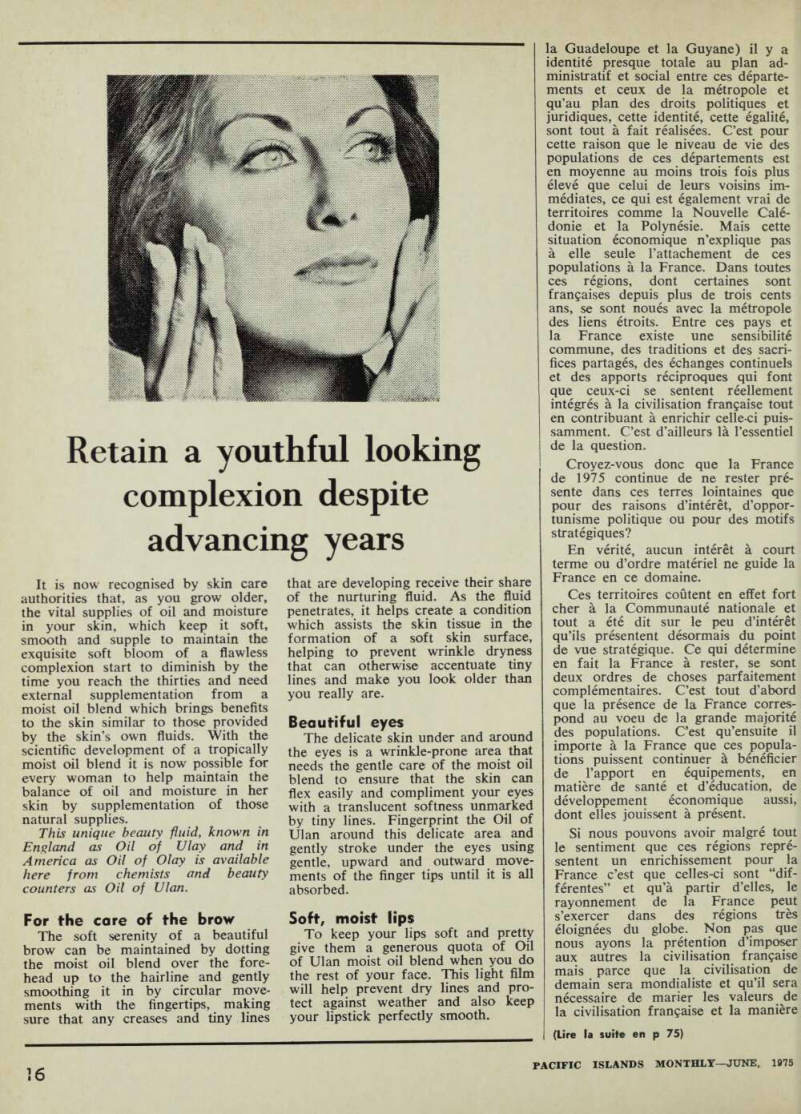
Retain a youthful looking
complexion despite
advancing years
It is now recognised by skin care authorities that, as you grow older, the vital supplies of oil and moisture in your skin, which keep it soft, smooth and supple to maintain the exquisite soft bloom of a flawless complexion start to diminish by the time you reach the thirties and need external supplementation from a moist oil blend which brings benefits to the skin similar to those provided by the skin’s own fluids. With the scientific development of a tropically moist oil blend it is now possible for every woman to help maintain the balance of oil and moisture in her skin by supplementation of those natural supplies.
This unique beauty fluid, known in England as Oil of Ulay and in America as Oil of Olay is available here from chemists and beauty counters as Oil of Ulan.
For the core of the brow The soft serenity of a beautiful brow can be maintained by dotting the moist oil blend over the forehead up to the hairline and gently smoothing it in by circular movements with the fingertips, making sure that any creases and tiny lines that are developing receive their share of the nurturing fluid. As the fluid penetrates, it helps create a condition which assists the skin tissue in the formation of a soft skin surface, helping to prevent wrinkle dryness that can otherwise accentuate tiny lines and make you look older than you really are.
Beautiful eyes The delicate skin under and around the eyes is a wrinkle-prone area that needs the gentle care of the moist oil blend to ensure that the skin can flex easily and compliment your eyes with a translucent softness unmarked by tiny lines. Fingerprint the Oil of Ulan around this delicate area and gently stroke under the eyes using gentle, upward and outward move ments of the finger tips until it is all absorbed.
Soft, moist lips
To keep your lips soft and pretty give them a generous quota of Oil of Ulan moist oil blend when you do the rest of your face. This light film will help prevent dry lines and protect against weather and also keep vour lipstick perfectly smooth.
the homeland
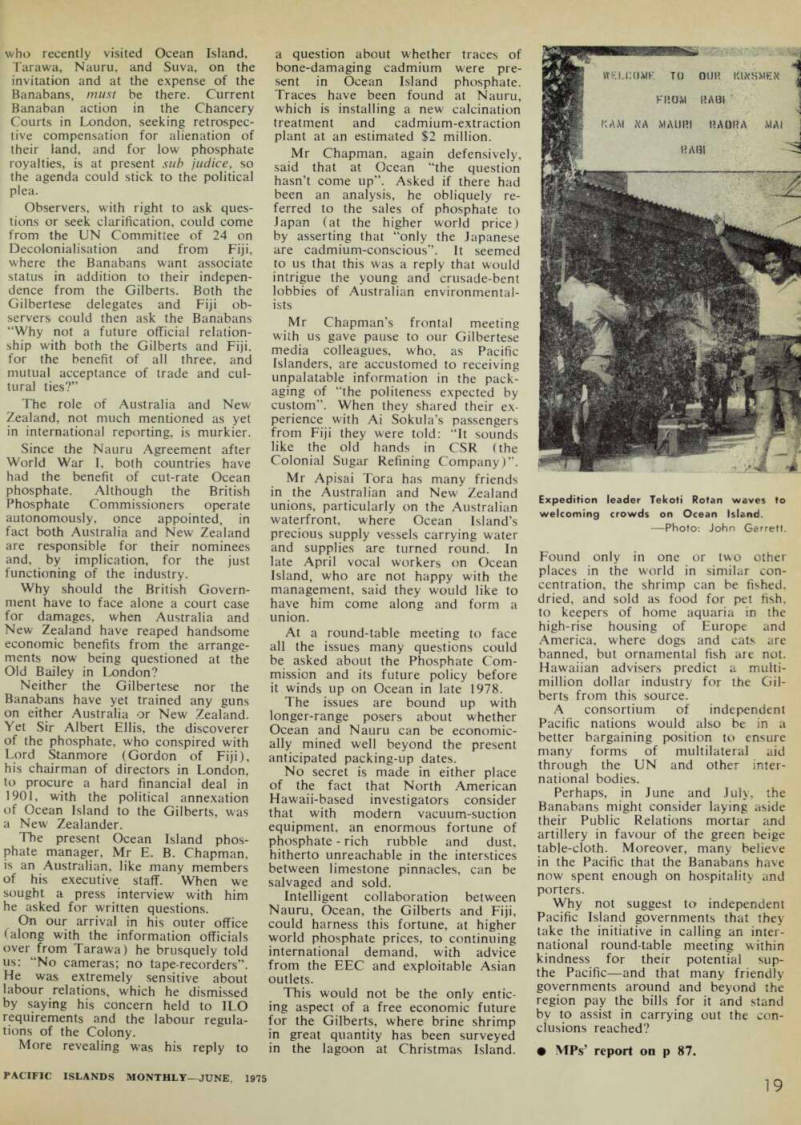
Banabans take their fight to the homeland
By JOHN GARRETT, who went with the Banabans from Rabi in Fiji, home to Ocean Island.
Ocean Island phosphate, after three-quarters of a century of crop and herd enrichment in Australia and New Zealand, is now producing food for thought at an alarming rate.
When the Fiji inter-island vessel Ai Sokula, 399 tons, under Captain Frank Mitchell, landed 36 labourers from the Banaban community of Rabi, Fiji, on Ocean Island in March, tension between the Ocean Islanders and the GEIC zoomed from medium to high.
On the way to Ocean Island, via Nauru, we heard on the ship’s radio that British minister Joan Lestor, re sponsible for Pacific territories, had characterised the trip as a political manoeuvre and that an official party was coming over from Tarawa to cope.
Ocean had been declared a closed district in early March, so all on board were given a licence to land.
The GEIC’s small white ship Nareau was riding the waves ahead jf us. Officials and police clambered iboard and walkie-talkies dotted the >cene ashore throughout the four-day /isit. On Nareau was Mr Colin Red iton, deputy secretary to the GEIC -hief Minister and ex-District Officer it Funafuti in the Ellice.
He had been sent to “back up” the >cean Island DO Kamuta Latasi, a ivil servant who will “secede” later his year when his islands, the Ellice, >ecome the Tuvalus. With him came i team of information men from farawa’s radio station and official lews publication The Atoll Pioneer.
But the most intriguing aspect of be Tarawa supervisory mission, /hich also said it was assisting the ianabans to settle-in their pilgrim ather work-force, was its abortive dld-goose chase for Fiji opposition arliamentarian and mercurial union rganiser Apisai Tora.
Captain Mitchell of the Ai Sokula 'as piqued when his passenger list 'as challenged. He told the GEIC olice officer that Mr Tora was not n board. Colin Redston “reserved Dmment” as to whether he would ave been refused landing rights, but ie police told Captain Mitchell that
their superiors had instructed that he was not to land.
Later conversations ashore revealed extreme official sensitivity about Mr Tora’s coming to Ocean to cause “big trouble” on the labour scene. The scares and rumours seem to have been based on wild speculation, originating somewhere in Fiji, that Mr Tora might come along. He is an acquaintance and sometime-business associate of Tekoti Rotan, the leader of the Rabi Banabans on the trip.
In the event, Mr Tora, who was amused by the report, reaped un solicited international publicity. The Tarawa officials, who knew very little about his record, were surprised to hear that he was an MF.
The episode showed the patchy intelligence about Fiji, a neighbour nation, where the Banaban landing party held citizenship to a man.
Possibly, the sequel will be more serious reflection in the Gilberts about future intra-regional relation ships. The sensation of being still tied to Britannia’s petticoats is un mistakable in dealing with the Tarawa government as of now. This in itself is a psychological irritant in contacts with Fiji and Nauru. The outgoing colonial power might well do more to encourage policy formation by re ference to the Pacific rather than London.
In a stance of free contact and dialogue with its already independent Pacific neighbours, the GEIC might be better able to find some of the chinks in the armour of its rich and active Ocean Island assailant.
Many impartial observers doubt the Banaban claim to be a “distinct race”, quite apart from the emotive quality of the inaccurate word race when used in the United Nations.
Linguistically, and to a large ex tent culturally, the present indivisi bility of Ocean Island and the rest of the GEIC becomes more obvious as the Banabans become better known. No political solution of the Banaban claim for separate status can ignore the truth that now, and for a long future, intermarriage and the pay-cheques of phosphate workers are going to accentuate the liaison.
Therefore, say friendly observers, why not a properly-convened inter national round-table meeting, or series of meetings, for all parties to the current disputes, under neutral auspices?
The proviso would now rule out neighbouring Nauru as sponsor.
Although the Gilbertese and Bana bans met on Nauru for cagey and not unfriendly talks earlier this year, Nauru has always had an axe to grind because of its own long struggle to get out from under Australia. On April 25 the Nauruan Government presented $lO,OOO to a party of Bana ban dancers and announced its full support for the Banaban claim to independent status.
Assuming the round tablecloth is laid “somewhere in the Pacific", who should be there?
The British, following the report of two British parliamentarians. Sir Bernard Braine and Mr John Lee,
Ocean Island scene where all but the rim has been pitted and pockmarked by 75 years of phosphate mining, due to end in 1968. Photo: John Garrett.
who recently visited Ocean Island, Tarawa, Nauru, and Suva, on the invitation and at the expense of the Banabans, must be there. Current Banaban action in the Chancery Courts in London, seeking retrospec tive compensation for alienation of their land, and for low phosphate royalties, is at present sub judice, so the agenda could stick to the political plea.
Observers, with right to ask ques tions or seek clarification, could come from the UN Committee of 24 on Decolonialisation and from Fiji, where the Banabans want associate status in addition to their indepen dence from the Gilberts. Both the Gilbertese delegates and Fiji ob servers could then ask the Banabans “Why not a future official relation ship with both the Gilberts and Fiji, for the benefit of all three, and mutual acceptance of trade and cul tural ties?”
The role of Australia and New Zealand, not much mentioned as yet in international reporting, is murkier.
Since the Nauru Agreement after World War I, both countries have had the benefit of cut-rate Ocean phosphate. Although the British Phosphate Commissioners operate autonomously, once appointed, in fact both Australia and New Zealand are responsible for their nominees and, by implication, for the just functioning of the industry.
Why should the British Govern ment have to face alone a court case for damages, when Australia and New Zealand have reaped handsome economic benefits from the arrange ments now being questioned at the Old Bailey in London?
Neither the Gilbertese nor the Banabans have yet trained any guns on either Australia or New Zealand.
Yet Sir Albert Ellis, the discoverer of the phosphate, who conspired with Lord Stanmore (Gordon of Fiji), his chairman of directors in London, to procure a hard financial deal in 1901, with the political annexation of Ocean Island to the Gilberts, was a New Zealander.
The present Ocean Island phos phate manager, Mr E. B. Chapman, is an Australian, like many members of his executive staff. When we sought a press interview with him he asked for written questions.
On our arrival in his outer office (along with the information officials over from Tarawa) he brusquely told us: “No cameras; no tape-recorders”.
He was extremely sensitive about labour relations, which he dismissed by saying his concern held to ILO requirements and the labour regula tions of the Colony.
More revealing was his reply to
a question about whether traces of bone-damaging cadmium were pre sent in Ocean Island phosphate.
Traces have been found at Nauru, which is installing a new calcination treatment and cadmium-extraction plant at an estimated S 2 million.
Mr Chapman, again defensively, said that at Ocean “the question hasn’t come up”. Asked if there had been an analysis, he obliquely re ferred to the sales of phosphate to Japan (at the higher world price) by asserting that “only the Japanese are cadmium-conscious”. It seemed to us that this was a reply that would intrigue the young and crusade-bent lobbies of Australian environmental ists Mr Chapman’s frontal meeting with us gave pause to our Gilbertese media colleagues, who, as Pacific Islanders, are accustomed to receiving unpalatable information in the pack aging of “the politeness expected by custom”. When they shared their ex perience with Ai Sokula’s passengers from Fiji they were told: “It sounds like the old hands in CSR (the
Colonial Sugar Refining Company)”.
Mr Apisai Tora has many friends in the Australian and New Zealand unions, particularly on the Australian waterfront, where Ocean Island’s precious supply vessels carrying water and supplies are turned round. In late April vocal workers on Ocean Island, who are not happy with the management, said they would like to have him come along and form a union.
At a round-table meeting to face all the issues many questions could be asked about the Phosphate Com mission and its future policy before it winds up on Ocean in late 1978.
The issues are bound up with longer-range posers about whether Ocean and Nauru can be economic ally mined well beyond the present anticipated packing-up dates.
No secret is made in either place of the fact that North American Hawaii-based investigators consider that with modern vacuum-suction equipment, an enormous fortune of phosphate - rich rubble and dust, hitherto unreachable in the interstices between limestone pinnacles, can be salvaged and sold.
Intelligent collaboration between Nauru, Ocean, the Gilberts and Fiji, could harness this fortune, at higher world phosphate prices, to continuing international demand, with advice from the EEC and exploitable Asian outlets.
This would not be the only entic ing aspect of a free economic future for the Gilberts, where brine shrimp in great quantity has been surveyed in the lagoon at Christmas Island.
Found only in one or two other places in the world in similar con centration, the shrimp can be fished, dried, and sold as food for pet fish, to keepers of home aquaria in the high-rise housing of Europe and America, where dogs and cals are banned, but ornamental fish axe not.
Hawaiian advisers predict a multi million dollar industry for the Gil berts from this source.
A consortium of independent Pacific nations would also be in a better bargaining position to ensure many forms of multilateral aid through the UN and other inter national bodies.
Perhaps, in June and July, the Banabans might consider laying aside their Public Relations mortar and artillery in favour of the green beige table-cloth. Moreover, many believe in the Pacific that the Banabans have now spent enough on hospitality and porters.
Why not suggest to independent Pacific Island governments that they take the initiative in calling an inter national round-table meeting within kindness for their potential sup the Pacific—and that many friendly governments around and beyond the region pay the bills for it and stand by to assist in carrying out the con clusions reached?
• MPs’ report on p 87.
Expedition leader Tekoti Rotan waves to welcoming crowds on Ocean Island.
Photo: John Garrett.
Advertisements & other items, pp. 19-20 (2 items)
Acific Islands Monthly—June, 1975
Build your
business on Bedford
Britains No.l export truck for 1974.
Complete forward-control range from 3 to 20 ton payload.
Check the advantages of Bedford Forward Control. Better payload distribution. More manoeuvrable. Day after day and year after year, Bedford does the job reliably and economically.
Bedford’s TK forward-control models available in a wide range to suit all needs. Trucks, Prime movers. Tippers. Bus chassis. Every one built and backed by General Motors.
Spares and service
readily available.
Fiji; MILLERS MOTORS LTD.
New Caledonia: ETABLISSEMENTS BALLANDE. Portuguese Timor:
SOCIEDADE AGRICOLA PATRIA
E TRABALHO LDA. Solomon
Islands: SOLOMON ISLANDS
SERVICE STATION. Western
Samoa O. F. NELSON & CO. LTD.
-aaSS^BHytik,
.. > v 4 ill Bedford VAM diesel
GENERAL MOTORS
Bedford M 4 x 4, \ 4-wheel drive V tipper, petrol or diesel.
AlO5B
A*r* ” A
Tropicalities
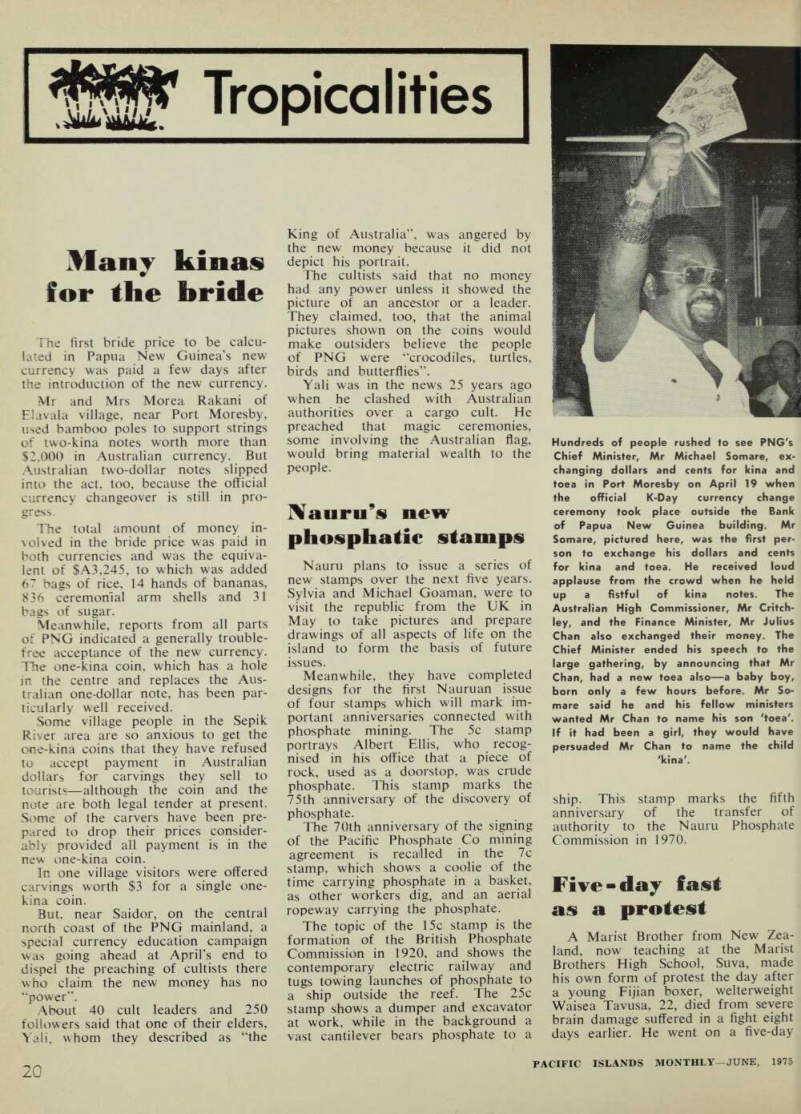
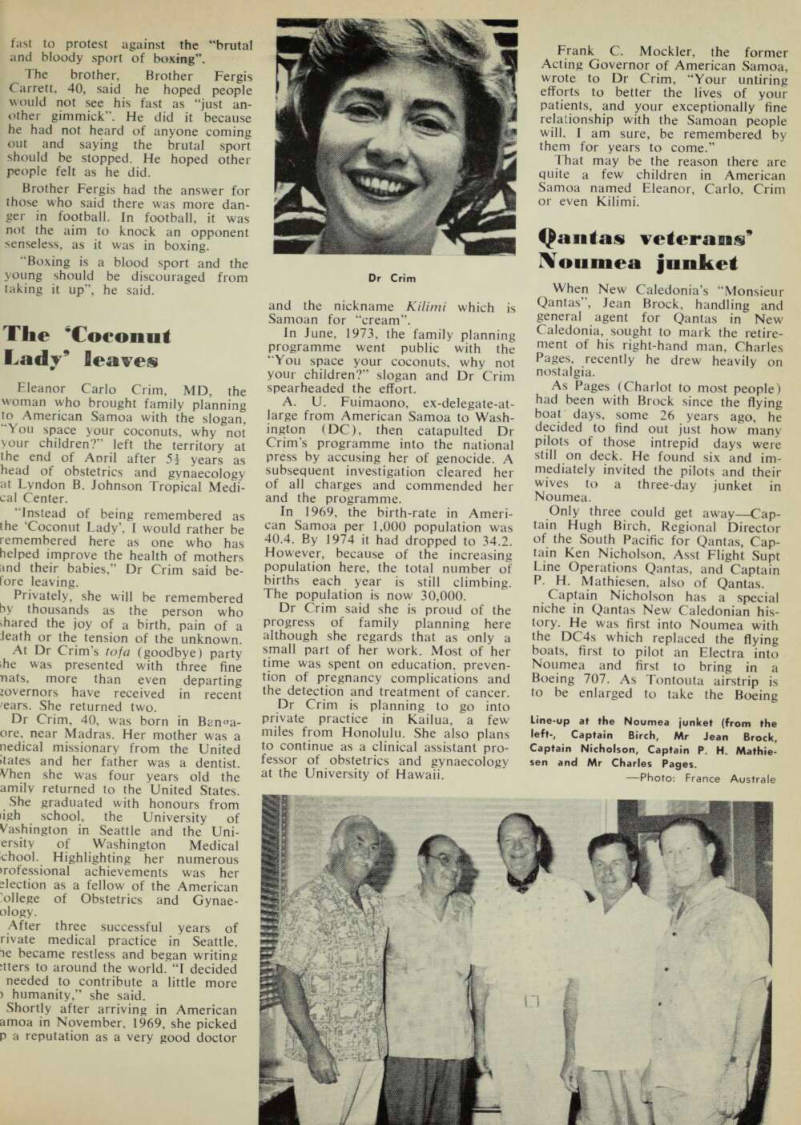

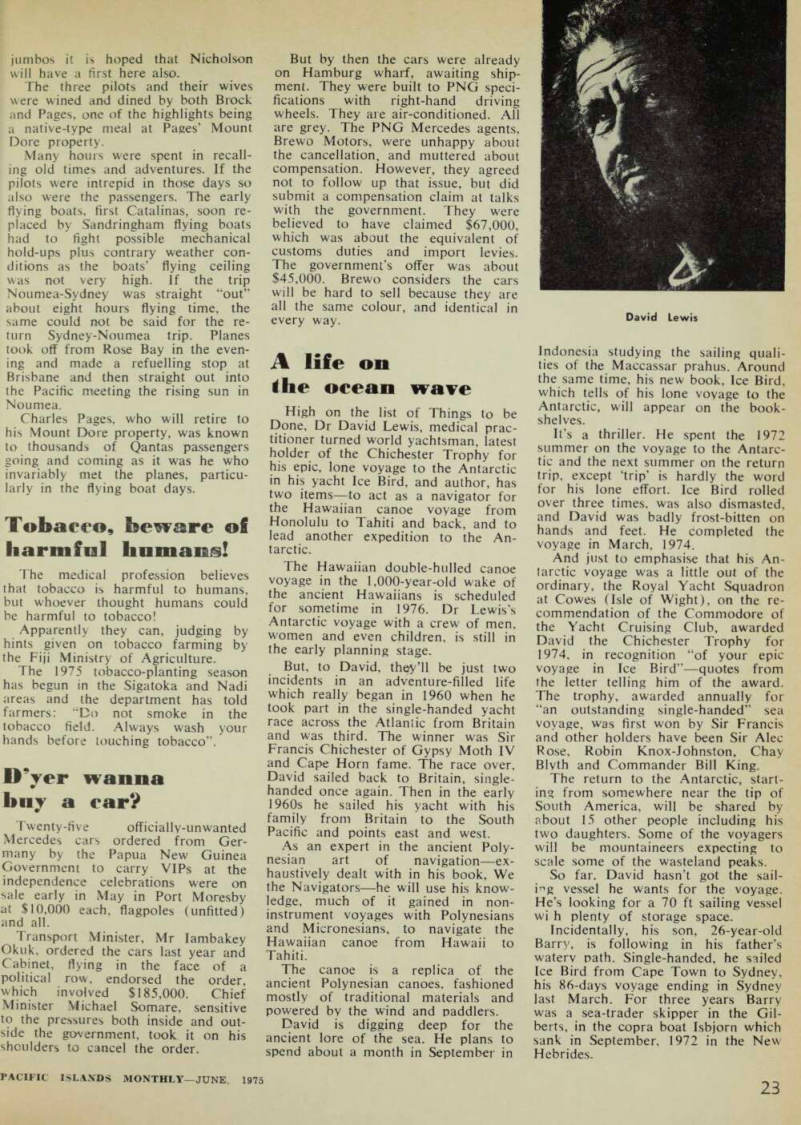
Many kinas
for the bride
The first bride price to be calcu lated in Papua New Guinea’s new currency was paid a few days after the introduction of the new currency.
Mr and Mrs Morea Rakani of Elavala village, near Port Moresby, used bamboo poles to support strings of two-kina notes worth more than $2,000 in Australian currency. But Australian two-dollar notes slipped into the act, too, because the official currency changeover is still in pro gress.
The total amount of money in volved in the bride price was paid in both currencies and was the equiva lent of $A3,245, to which was added 67 bags of rice, 14 hands of bananas, 836 ceremonial arm shells and 31 bags of sugar.
Meanwhile, reports from all parts of PNG indicated a generally trouble free acceptance of the new currency.
The one-kina coin, which has a hole in the centre and replaces the Aus tralian one-dollar note, has been par ticularly well received.
Some village people in the Sepik River area are so anxious to get the one-kina coins that they have refused to accept payment in Australian dollars for carvings they sell to tourists—although the coin and the note are both legal tender at present.
Some of the carvers have been pre pared to drop their prices consider ably provided all payment is in the new one-kina coin.
In one village visitors were offered carvings worth S 3 for a single one kina coin.
But, near Saidor, on the central north coast of the PNG mainland, a special currency education campaign was going ahead at April’s end to dispel the preaching of cultists there who claim the new money has no
“power”.
About 40 cult leaders and 250 followers said that one of their elders, Yali, whom they described as “the
King of Australia”, was angered by the new money because it did not depict his portrait.
The cultists said that no money had any power unless it showed the picture of an ancestor or a leader.
They claimed, too, that the animal pictures shown on the coins would make outsiders believe the people of PNG were “crocodiles, turtles, birds and butterflies”.
Yali was in the news 25 years ago when he clashed with Australian authorities over a cargo cult. He preached that magic ceremonies, some involving the Australian flag, would bring material wealth to the people.
Nauru’s new
phosphatie stamps
Nauru plans to issue a series of new stamps over the next five years.
Sylvia and Michael Goaman, were to visit the republic from the UK in May to take pictures and prepare drawings of all aspects of life on the island to form the basis of future issues.
Meanwhile, they have completed designs for the first Nauruan issue of four stamps which will mark im portant anniversaries connected with phosphate mining. The 5c stamp portrays Albert Ellis, who recog nised in his office that a piece of rock, used as a doorstop, was crude phosphate. This stamp marks the 75th anniversary of the discovery of phosphate.
The 70th anniversary of the signing of the Pacific Phosphate Co mining agreement is recalled in the 7c stamp, which shows a coolie of the time carrying phosphate in a basket, as other workers dig, and an aerial ropeway carrying the phosphate.
The topic of the 15c stamp is the formation of the British Phosphate Commission in 1920, and shows the contemporary electric railway and tugs towing launches of phosphate to a ship outside the reef. The 25c stamp shows a dumper and excavator at work, while in the background a vast cantilever bears phosphate to a
ship. This stamp marks the fifth anniversary of the transfer of authority to the Nauru Phosphate Commission in 1970.
Five - day fast
as a protest A Marist Brother from New Zea land, now teaching at the Marist Brothers High School, Suva, made his own form of protest the day after a young Fijian boxer, welterweight Waisea Tavusa, 22, died from severe brain damage suffered in a fight eight days earlier. He went on a five-day
Hundreds of people rushed to see PNG's Chief Minister, Mr Michael Somare, ex changing dollars and cents for kina and toea in Port Moresby on April 19 when the official K-Day currency change ceremony took place outside the Bank of Papua New Guinea building. Mr Somare, pictured here, was the first per son to exchange his dollars and cents for kina and toea. He received loud applause from the crowd when he held up a fistful of kina notes. The Australian High Commissioner, Mr Critch ley, and the Finance Minister, Mr Julius Chan also exchanged their money. The Chief Minister ended his speech to the large gathering, by announcing that Mr Chan, had a new toea also—a baby boy, born only a few hours before. Mr So mare said he and his fellow ministers wanted Mr Chan to name his son 'toea'.
If it had been a girl, they would have persuaded Mr Chan to name the child 'kina'.
fast to protest against the “brutal and bloody sport of boxing”.
The brother, Brother Fergis Carrett, 40, said he hoped people would not see his fast as “just an other gimmick”. He did it because he had not heard of anyone coming out and saying the brutal sport should be stopped. He hoped other people felt as he did.
Brother Fergis had the answer for those who said there was more dan ger in football. In football, it was not the aim to knock an opponent senseless, as it was in boxing.
“Boxing is a blood sport and the young should be discouraged from taking it up”, he said.
The 'Coconut
Lady 9 leaves
Eleanor Carlo Crim, MD, the woman who brought family planning to American Samoa with the slogan, “You space your coconuts, why not your children?” left the territory at the end of Aoril after years as head of obstetrics and gynaecology at Lyndon B. Johnson Tropical Medi cal Center.
“Instead of being remembered as the ‘Coconut Lady’, I would rather be remembered here as one who has helped improve the health of mothers and their babies,” Dr Crim said be fore leaving.
Privately, she will be remembered by thousands as the person who shared the joy of a birth, pain of a Jeath or the tension of the unknown.
At Dr Crim’s to fa (goodbye) party she was presented with three fine nats, more than even departing governors have received in recent 'ears. She returned two.
Dr Crim, 40, was born in Band ore, near Madras. Her mother was a nedical missionary from the United states and her father was a dentist.
Vhen she was four years old the amily returned to the United States.
She graduated with honours from ligh school, the University of Vashinglon in Seattle and the Uni ersity of Washington Medical chool. Highlighting her numerous orofessional achievements was her election as a fellow of the American College of Obstetrics and Gynae cology.
After three successful years of rivate medical practice in Seattle. ie became restless and began writing ;tters to around the world. “I decided needed to contribute a little more ) humanity,” she said.
Shortly after arriving in American amoa in November, 1969, she picked p a reputation as a very good doctor
and the nickname Kilimi which is Samoan for “cream”.
In June, 1973, the family planning programme went public with the “You space your coconuts, why not your children?” slogan and Dr Crim spearheaded the effort.
A. U. Fuimaono, ex-delegate-at large from American Samoa to Wash ington (DC), then catapulted Dr Crim’s programme into the national press by accusing her of genocide. A subsequent investigation cleared her of all charges and commended her and the programme.
In 1969, the birth-rate in Ameri can Samoa per 1,000 population was 40.4. By 1974 it had dropped to 34.2.
However, because of the increasing population here, the total number of births each year is still climbing.
The population is now 30,000.
Dr Crim said she is proud of the progress of family planning here although she regards that as only a small part of her work. Most of her time was spent on education, preven tion of pregnancy complications and the detection and treatment of cancer.
Dr Crim is planning to go into private practice in Kailua, a few miles from Honolulu. She also plans to continue as a clinical assistant pro fessor of obstetrics and gynaecology at the University of Hawaii.
Frank C. Mockler, the former Acting Governor of American Samoa, wrote to Dr Crim, “Your untiring efforts to better the lives of your patients, and your exceptionally fine relationship with the Samoan people will, I am sure, be remembered by them for years to come.”
That may be the reason there are quite a few children in American Samoa named Eleanor, Carlo, Crim or even Kilimi.
Qantas veterans’
Noumea Junket
When New Caledonia’s “Monsieur Qantas’’, Jean Brock, handling and general agent for Qantas in New Caledonia, sought to mark the retire ment of his right-hand man, Charles Pages, recently he drew heavily on nostalgia.
As Pages (Chariot to most people) had been with Brock since the flying boat days, some 26 years ago, he decided to find out just how many pilots of those intrepid days were still on deck. He found six and im mediately invited the pilots and their wives to a three-day junket in Noumea.
Only three could get away—Cap tain Hugh Birch, Regional Director of the South Pacific for Qantas, Cap tain Ken Nicholson, Asst Flight Supt Line Operations Qantas, and Captain P. H. Mathiesen, also of Qantas.
Captain Nicholson has a special niche in Qantas New Caledonian his tory. He was first into Noumea with the DC4s which replaced the flying boats, first to pilot an Electra into Noumea and first to bring in a Boeing 707. As Tontouta airstrip is to be enlarged to take the Boeing
Line-up at the Noumea junket (from the left-. Captain Birch, Mr Jean Brock, Captain Nicholson, Captain P. H. Mathie sen and Mr Charles Pages.
Photo: France Australe
Dr Crim
jumbos it is hoped that Nicholson will have a first here also.
The three pilots and their wives were wined ami dined by both Brock and Pages, one of the highlights being a native-type meal at Pages’ Mount Dore property.
Many hours were spent in recall ing old times and adventures. If the pilots were intrepid in those days so also were the passengers. The early flying boats, first Catalinas, soon re placed by Sandringham flying boats had to fight possible mechanical hold-ups plus contrary weather con ditions as the boats’ flying ceiling was not very high. If the trip Noumea-Sydney was straight “out” about eight hours flying time, the same could not be said for the re turn Sydney-Noumea trip. Planes took off from Rose Bay in the even ing and made a refuelling stop at Brisbane and then straight out into the Pacific meeting the rising sun in Noumea.
Charles Pages, who will retire to his Mount Dore property, was known to thousands of Qantas passengers going and coming as it was he who invariably met the planes, particu larly in the flying boat days.
Tobacco, beware of
harmful human§!
The medical profession believes that tobacco is harmful to humans, but whoever thought humans could be harmful to tobacco!
Apparently they can, judging by hints given on tobacco farming by the Fiji Ministry of Agriculture.
The 1975 tobacco-planting season has begun in the Sigatoka and Nadi areas and the department has told farmers: “Do not smoke in the tobacco field. Always wash your hands before touching tobacco”.
HVcr wanna
buy a car?
Twenty-five officially-unwanted Mercedes cars ordered from Ger many by the Papua New Guinea Government to carry VIPs at the independence celebrations were on sale early in May in Port Moresby at $lO,OOO each, flagpoles (unfitted) and all.
Transport Minister, Mr lambakey Okuk, ordered the cars last year and Cabinet, flying in the face of a political row, endorsed the order, which involved $185,000. Chief Minister Michael Somare, sensitive to the pressures both inside and out side the government, took it on his shoulders to cancel the order.
But by then the cars were already on Hamburg wharf, awaiting ship ment. They were built to PNG speci fications with right-hand driving wheels. They are air-conditioned. All are grey. The PNG Mercedes agents, Brewo Motors, were unhappy about the cancellation, and muttered about compensation. However, they agreed not to follow up that issue, but did submit a compensation claim at talks with the government. They were believed to have claimed $67,000, which was about the equivalent of customs duties and import levies.
The government’s offer was about $45,000. Brewo considers the cars will be hard to sell because they are all the same colour, and identical in every way.
A life on
the ocean wave High on the list of Things to be Done, Dr David Lewis, medical prac titioner turned world yachtsman, latest holder of the Chichester Trophy for his epic, lone voyage to the Antarctic in his yacht Ice Bird, and author, has two items—to act as a navigator for the Hawaiian canoe voyage from Honolulu to Tahiti and back, and to lead another expedition to the An tarctic.
The Hawaiian double-hulled canoe voyage in the 1,000-year-old wake of the ancient Hawaiians is scheduled for sometime in 1976. Dr Lewis’s Antarctic voyage with a crew of men. women and even children, is still in the early planning stage.
But, to David, thqy’ll be just two incidents in an adventure-filled life which really began in 1960 when he took part in the single-handed yacht race across the Atlantic from Britain and was third. The winner was Sir Francis Chichester of Gypsy Moth IV and Cape Horn fame. The race over, David sailed back to Britain, single handed once again. Then in the early 1960 s he sailed his yacht with his family from Britain to the South Pacific and points east and west.
As an expert in the ancient Poly nesian art of navigation—ex haustively dealt with in his book. We the Navigators—he will use his know ledge, much of it gained in non instrument voyages with Polynesians and Micronesians, to navigate the Hawaiian canoe from Hawaii to Tahiti.
The canoe is a replica of the ancient Polynesian canoes, fashioned mostly of traditional materials and powered by the wind and paddlers.
David is digging deep for the ancient lore of the sea. He plans to spend about a month in September in
Indonesia studying the sailing quali ties of the Maccassar prahus. Around the same time, his new book. Ice Bird, which tells of his lone voyage to the Antarctic, will appear on the book shelves.
It’s a thriller. He spent the 1972 summer on the voyage to the Antarc tic and the next summer on the return trip, except ‘trip’ is hardly the word for his lone effort. Ice Bird rolled over three times, was also dismasted, and David was badly frost-bitten on hands and feet. He completed the voyage in March, 1974.
And just to emphasise that his An tarctic voyage was a little out of the ordinary, the Royal Yacht Squadron at Cowes (Isle of Wight), on the re commendation of the Commodore of the Yacht Cruising Club, awarded David the Chichester Trophy for 1974, in recognition “of your epic voyage in Ice Bird”—quotes from the letter telling him of the award.
The trophy, awarded annually for “an outstanding single-handed” sea voyage, was first won by Sir Francis and other holders have been Sir Alec Rose, Robin Knox-Johnston, Chay Blyth and Commander Bill King.
The return to the Antarctic, start ing from somewhere near the tip of South America, will be shared by about 15 other people including his two daughters. Some of the voyagers will be mountaineers expecting to scale some of the wasteland peaks.
So far. David hasn’t got the sail ing vessel he wants for the voyage.
He’s looking for a 70 ft sailing vessel wi h plenty of storage space.
Incidentally, his son, 26-year-old Barry, is following in his father’s waterv path. Single-handed, he sailed Ice Bird from Cape Town to Sydney, his 86-days voyage ending in Sydney last March. For three years Barry was a sea-trader skipper in the Gil berts, in the copra boat Isbjorn which sank in September. 1972 in the New Hebrides.
David Lewis
Advertisements & other items, pp. 24-26 (1 item)
Kodachrome 64
Tried die new
Kodak film yet?
* * ♦ “i * This new film has a new emulsion that will give you bright greens, reds and blues.
In addition you have the flexibility of a fast film rating (ASA 64) to help you take good color shots even under dull or difficult light conditions. Try it soon and see the difference for yourself. It’s in the familiar yellow box, at your local island photo dealer.
Ask for Kodachrome 64 film-the slide improver •Available in sizes to fit 135,126 and 110 size cameras.
"Kodak" and ■'Kodachro'"'' 1 ' are registered trademarks of KODAK (Australasia) PTY. LTD
color slide film
KODAK (Australasia) PTY. LTD.
K6l 4948
GLENYS
DICKSON
COUNTDOWN
your top sounds tune to Radio Australia 0900=1100 G.M.T. Monday oFriday =r £
IiADIO AIMOAUA
write to ; Countdown, Radio Australia. Melbourne.3ooo, for record requests, programme guides,fan cards & posters
Towards A Nuclear-Free Pacific
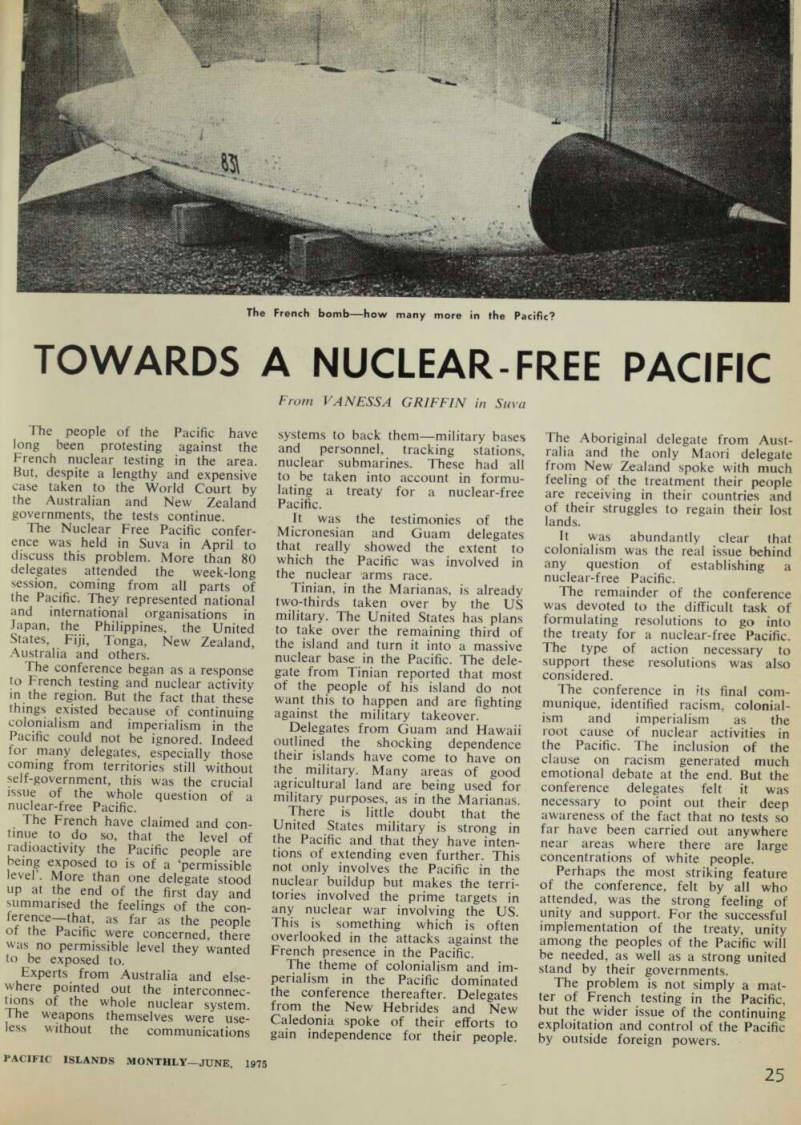
From VANESSA GRIFFIN in Suva
,™ e JL e ° ple °/ !- he Paci ? c ha u e Frpnnh b( ™ i prot . est . l . ng a gai n st the d h esnhe T r ipl e ath ng *”« he case taken to S m r* P .he Australian Zealand gcvernments, the tests continue. ine Nuclear Free Pacific conference was held in Suva m April to discuss this Problem. More than 80
delegates attended the week-long
session, coming from all parts of the Pacific. They represented national
Japan
States' Fiji Ton? New
Australia and others NewZealand ’
The conference beean as a frk b I f res Pou se n the r fT ty
things existed continnfna
® x,stea because of continuing Pacific co™ld a not for manv In.!™*, b lgnor ? d ; Inde « d man r dele B a tes, especially those renr^ n was S, ;he W cr hOU i “sue of the who e TfesHnn T nudear free Pacific ° f a THf* Fnsnoti l i , tinue to do\o tha Tbif radioactivity the Pacific being exposed to is of a C? P ? ui level’ More than onH up at the end of the fi fl l ference—that as far § as the neon?c of the Pacific were concerned P ?£fj! was no permissible level thev d wantPß to be ex P poSd to Experts from Australia anri ~i The 5 lx .ess wiLu. the
systems t 0 back them—military bases
and personnel, tracking stations, nuc [ ear submarines. These had all , f - be take " into account in formu- Pacify trea ‘ y ** 3 nUdear - free It was the testimonies of the Micronesian and Guam delegates that really showed the extent to which the Pacific was involved in the nuclear arms race.
Tinian, in the Marianas, is already two-thirds taken over by the US milltar y* The United St .ates has plans lu ° ver re ™ amm g third . of the island and turn it into a massive nucle ar base m the Pacific. 'Uie delegate from Tinian reported that most ° f the pCOpI u of his island do not Waa ha P pen an ? are fighting against the military takeover. !?? le § ate l fro "? Gl,anl and Hawaii outlined the shocking dependence their islands have come to have on I™ ° f «°° d agricultural land are being used for md i‘ ary P“ r P°, s . es ; as in the Marianas, There is little doubt that the strol ?8 in ? e Pacific and that they have mten- T°f e ? tendlng e L ven farther. This !A VZ° W *l ! he Pacific u in the ? bu ! ldup u Ut makes the tern * involved the prime targets in Thl n . Uclear invol . v . m 8 f he US.
Th , v . somet bmg w h lch is often £ verl ° oked m the a “ acks against the "“f “ / he - ?- aclfic - . • b r tber P e colonialism and im- P h enal,sm f in th " Pac i fic d ominated “ «
The Aboriginal delegate from Aust ralia and the only ß Maori delegate from New Zealand spoke with much feeling of the treatment their people
foft
lands.
It was abundantly clear that colonialism was the real issue behind any question of establishing a nuclear free Pacific eStam,smng a The remainder of the conference was devoted to the task of formulating resolutions to go into the tre aty for a nuclear-free Pacific.
The type of action necessary to support these resolutions was also considered.
The conference in its final com identified racism, colonial ism and imnerialism as the root cause of nuclear activities in the Pacific. The inclusion of the clause on racism generated much
emotionaT debatTa. fhe" the
conference delegates felt it was necessary to point out their deep awareness of the fact that no tests so far have been carried out anywhere near areas where there are large concentrations of white people.
Perhaps the most striki "g Mature of the conference, felt by all who attended, was the strong feeling of unity and support. For the successful implementation of the treaty, unity among the peoples of the Pacific will be needed ’ as well as a strong united stand by their governments, The problem is not simply a mat
iS W £?& t th co„S
The French bomb—how many more in the Pacific?
The Editor's Mailbag
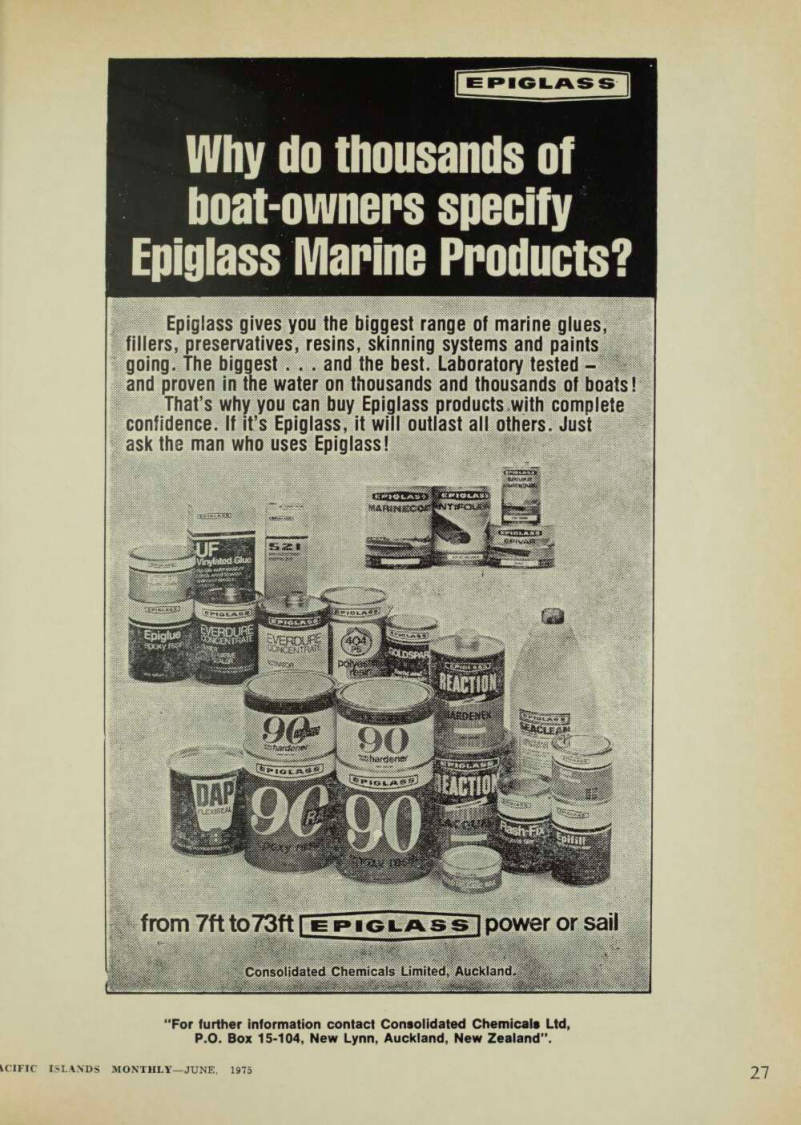
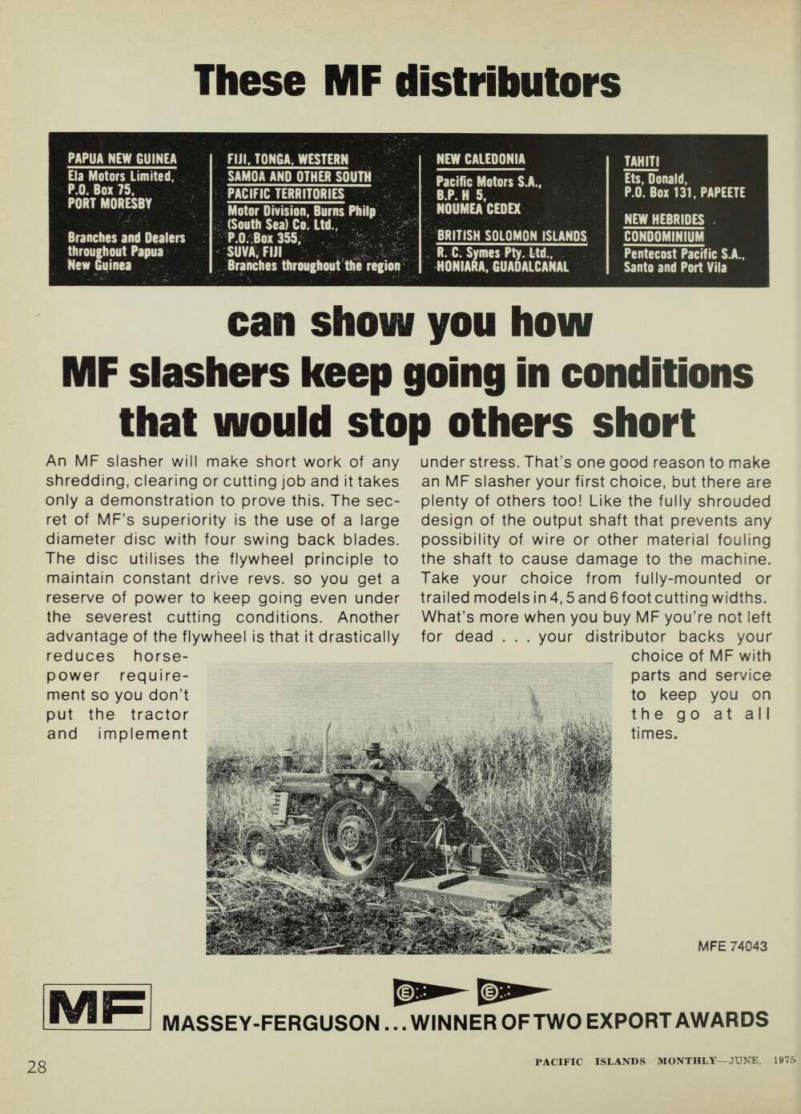
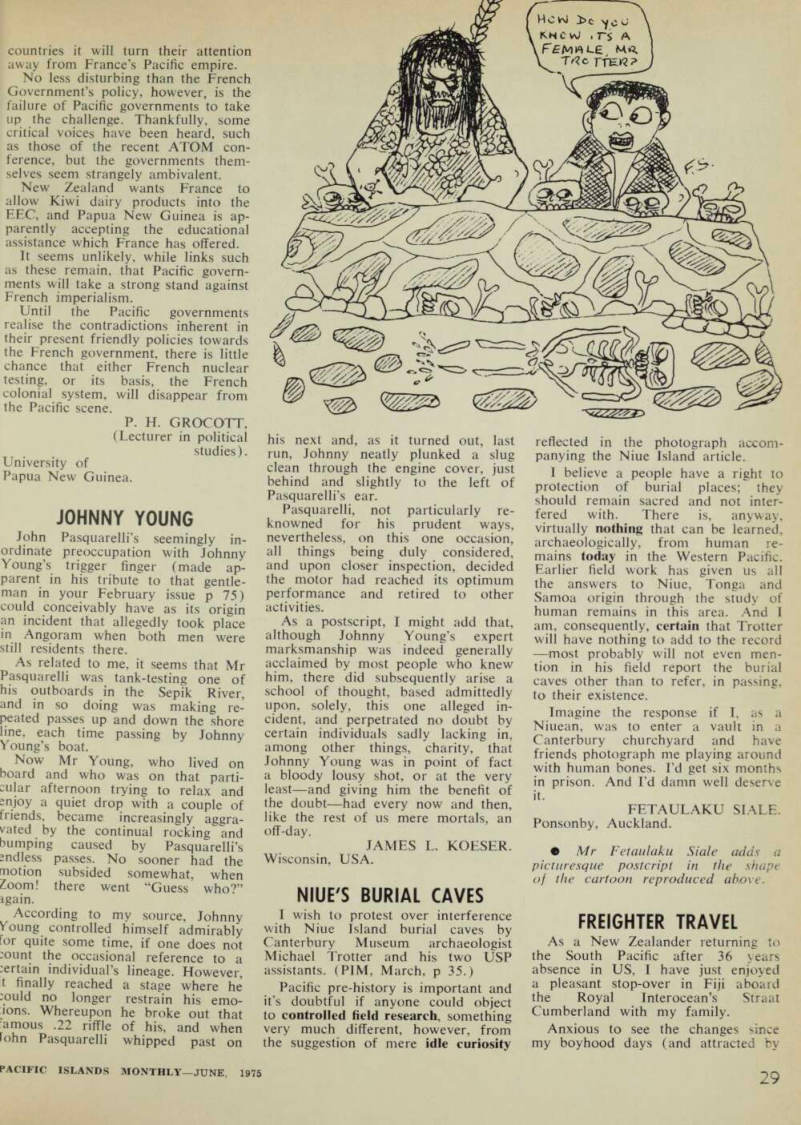
International Date Line
You report Mr Hughes, a Seventh day Adventist in Tonga (PIM, March p 18) as wanting to know by what authority the International Date Line bends round Tonga; he doesn’t feel right going to church on Sunday.
In the first half of the last cen tury, when circumnavigating the world had become commonplace, a Date Line became essential to avoid a well-known anomaly; common usage placed it on the 180th meri dian, half the world away from the Greenwich meridian, a base line for accurate nautical tables. It is interest ing to speculate what would have been the effect if Tokyo rather than Greenwich had been the origin of this information; presumably the Date Line could have been placed down the centre of the Atlantic Ocean, discommoding only Green landers.
Four governments took steps to eliminate inconvenience caused by the 180th meridian being the Date Line. The Russian Government moved the Date Line east to avoid Siberia; the US Government moved it west to avoid the Aleutians; the UK Government moved it east so that all Fiji and New Zealand islands kept the same date. The Tongan Government was the last to act and decided, on the recommendation of its Prime Minister, to keep the same date as Fiji because of close religious and commercial ties with the then Colony.
Since both the 180th meridian and the International Date Line are made by Man for Man’s convenience, I find it difficult to appreciate Mr Hughes’ basic problem. His church prefers to standardise its Sabbath according to the 180th meridian when in Tonga, although not I be lieve in the Chatham Islands which are on a similar line of longitude. In Tonga this reduces the inconvenience to members of his Church, in that they observe Sabbatarian restrictions once each week only, from sunset Saturday to midnight Sunday. Mr Hughes would seem to favour fol lowing his Church’s restrictions from sunset Friday to sunset Saturday and being restricted by Tongan law from midnight Saturday to midnight
Sunday. The present arrangement seems more satisfactory to everyone except Mr Hughes,
T. G. Hawley,
(formerly Principal, Fiji School of Medicine and previously Chief Medi cal Officer, Tonga.) Auckland, NZ.
Wake Up Enterprise!
“Halcyon days of the tourist trade are over”—why? (PIM, April p 79).
I don’t wonder that so many hotels in the Islands are half-empty. What chance does the ordinary Australian have of reaching the Islands, almost his nearest neighbours, when even “Economy” or “Excursion” air fares are beyond the average pocket.
Air fares and package tours (with the exception of UTA New Caledonia deals) bear no comparison with the excursion fares to Europe and pack age tours to SE Asia. The Pacific Area Travel Association seems to cater for tourists in the millionaire class from the USA only, so that the only way the ordinary Australian can catch a glimpse of the Islands is by an “expenses paid” business trip or a crowded cruise.
Could not enterprising airlines and hotels get together on package tour weekly departures at attractive prices, thereby guaranteeing each other full seats and beds respectively. Wake up enterprise!
D. C. Wright, A.C.I.I., A.I.L.
Watsonia, Vic.
France's 'Quiet' Threats
The news in PIM (March, p 80) that the opposition of the New Zealand Government to French nuclear testing in the Pacific is being moderated is very disturbing.
It indicates clearly that the French Government intends to use whatever methods it can to maintain its hold over the French colonies in the Pacific. The quiet threats which France has used in order to compro mise New Zealand are by no means unique. Recently the French have launched diplomatic initiatives in Papua New Guinea for precisely these same reasons. The French Government is hoping that by offer ing material comforts to Pacific
countries it will turn their attention away from France’s Pacific empire.
No less disturbing than the French Government’s policy, however, is the failure of Pacific governments to take up the challenge. Thankfully, some critical voices have been heard, such as those of the recent ATOM con ference, but the governments them selves seem strangely ambivalent.
New Zealand wants France to allow Kiwi dairy products into the EEC, and Papua New Guinea is ap parently accepting the educational assistance which France has offered.
It seems unlikely, while links such as these remain, that Pacific govern ments will take a strong stand against French imperialism.
Until the Pacific governments realise the contradictions inherent in their present friendly policies towards the French government, there is little chance that either French nuclear testing, or its basis, the French colonial system, will disappear from the Pacific scene.
P. H. Grocott,
(Lecturer in political studies).
University of Papua New Guinea.
Johnny Young
John Pasquarelli’s seemingly in ordinate preoccupation with Johnny Young’s trigger finger (made ap parent in his tribute to that gentle man in your February issue p 75) could conceivably have as its origin an incident that allegedly took place in Angoram when both men were still residents there.
As related to me, it seems that Mr Pasquarelli was tank-testing one of his outboards in the Sepik River, and in so doing was making re peated passes up and down the shore line, each time passing by Johnny Young’s boat.
Now Mr Young, who lived on board and who was on that parti :ular afternoon trying to relax and -njoy a quiet drop with a couple of friends, became increasingly aggra vated by the continual rocking and bumping caused by Pasquarelli’s -ndless passes. No sooner had the motion subsided somewhat, when Zoom! there went “Guess who?” again.
According to my source, Johnny VTuing controlled himself admirably for quite some time, if one does not :ount the occasional reference to a certain individual’s lineage. However, t finally reached a stage where he :ould no longer restrain his emo tions. Whereupon he broke out that amous .22 riffle of his, and when lohn Pasquarelli whipped past on
his next and, as it turned out, last run, Johnny neatly plunked a slug clean through the engine cover, just behind and slightly to the left of Pasquarelli’s ear.
Pasquarelli, not particularly re knowned for his prudent ways, nevertheless, on this one occasion, all things being duly considered, and upon closer inspection, decided the motor had reached its optimum performance and retired to other activities.
As a postscript, I might add that, although Johnny Young’s expert marksmanship was indeed generally acclaimed by most people who knew him, there did subsequently arise a school of thought, based admittedly upon, solely, this one alleged in cident, and perpetrated no doubt by certain individuals sadly lacking in, among other things, charity, that Johnny Young was in point of fact a bloody lousy shot, or at the very least—and giving him the benefit of the doubt—had every now and then, like the rest of us mere mortals, an off-day.
James L. Koeser.
Wisconsin, USA.
Niue's Burial Caves
I wish to protest over interference with Niue Island burial caves by Canterbury Museum archaeologist Michael Trotter and his two USP assistants. (PIM, March, p 35.) Pacific pre-history is important and it’s doubtful if anyone could object to controlled field research, something very much different, however, from the suggestion of mere idle curiosity
reflected in the photograph accom panying the Niue Island article.
I believe a people have a right to protection of burial places; they should remain sacred and not inter fered with. There is, anyway, virtually nothing that can be learned, archaeologically, from human re mains today in the Western Pacific.
Earlier field work has given us all the answers to Niue, Tonga and Samoa origin through the study of human remains in this area. And I am, consequently, certain that Trotter will have nothing to add to the record —most probably will not even men tion in his field report the burial caves other than to refer, in passing, to their existence.
Imagine the response if I. as a Niuean, was to enter a vault in a Canterbury churchyard and have friends photograph me playing around with human bones. I’d get six months in prison. And I’d damn well deserve it.
Fetaulaku Stale.
Ponsonby, Auckland. • Mr Fetaulaku Siale adds a picturesque postcript in the shape of the cartoon reproduced above.
Freighter Travel
As a New Zealander returning to the South Pacific after 36 years absence in US, I have just enjoyed a pleasant stop-over in Fiji aboard the Royal Interocean’s Straat Cumberland with my family.
Anxious to see the changes since my boyhood days (and attracted by
Letters
the" delightful cover . . . what a change from the old PIMs!) I bought a copy of your March issue and was particularly interested in the article an Fiji’s rise in port dues (p 63).
Although I am sure this is an in :vitable innovation probably to be Followed by other Pacific Island sorts, it is sad to learn that it may seriously impede passenger ships stopping over, or at least cut the ength of time they stop in Fiji.
One way around this for the south Pacific traveller, however, is he passenger-carrying freighters with service and cuisine we rated equal to ;or better than) the luxury SS France we took from New York to London . . . another short-lived sleasure with an end not as imminent is the port dues problem.
Indeed, like so many freight corn sanies, Royal Interocean will sell our straat Cumberland and other passen ger-carrying freighters within the Text 10 years and are building no nore of that type. Containerised
shipping is the new freighter economy.
But who knows whether or not an increased demand for these ser vices, often enabling one to island hop around the South Pacific, might not delay the axe? The Fiji Visitors Bureau might even be interested in promoting tourist travel in favour of those companies maintaining passen ger service!
Lincoln V. Adair.
Christchurch, NZ.
Guise, The Trader
Mr Nigel Oram (PIM, April, p 23) has succeeded in turning what he calls a “myth” into a “mythtery”.
He reaches his conclusions, as I have done in many matters, by research, but my information came from the mouth of the Bishop, who, as mission priest at Taupota, knew Guise and married him to his wife.
Those who knew Bishop Newton could never consider him gullible, nor irresponsible, and he told his story on various occasions. I could get support of this from the captain of our yacht at the time he gave me his version, who, now retired, a Devonian, lives within a few miles of me here.
My purpose in writing originally was due to my disgust at the sniping that went on about soi-disant petty French counts and “traders”, used
derogatively.
Between us, whoever is correct, it is established that John Guise, whether it be from a de Guise (rhyming with ‘bees’) in the Almanac de Gotha or from the beef eating Guise (rhyming with ‘guys’) of Burke’s Peerage, has a lineage that many a European in the Pacific would envy, not to be belittled.
I feel that Dr John Guise has given a splendid sense of leadership in Papua-New Guinea’s move to wards independence that will be written large in history. Good luck to him.
The Ven. C. W. Whonsbon
Aston.
Castle Hill, NSW. • Correspondents are asked to leave sufficient space between the lines in their letters for the sake of clarity and to enable easy insertion of corrections or alterations. A signed letter has a better chance of publica tion although a nom-de-plume may be used if publication of the name would be embarrassing. A signature must ac company a letter, though not neces sarily for publication.
Advertisements & other items, pp. 28-33 (3 items)
Pacific Area
DISTRIBUTORS
COOK ISLANDS
Cook Is. Trading Corp. Ltd
FIJI
Burns Philp (SS) Co. Ltd
NEW GUINEA
Bougainville Marine Pty Ltd, Kieta Burns Philp (NG) Ltd, Madang Elvee Trading Pty Ltd, Rabaul Faulkner & Tait (NG) Pty Ltd, l_ ae S. A. Heath & Co. Pty Ltd, Port Moresby
NEW HEBRIDES
Burns Philp (NH) Ltd
NOUMEA
Guy Limousin Pacific Yachting
NORFOLK ISLAND
Irvine Bid. Supply Centre
PAGO PAGO
Max Haleck Inc.
TAHITI
Marine Corail Tahiti Sport Tahiti Voile
TONGA
Riechelmann Bros.
WESTERN SAMOA
Burns Philp (SS) Co. Ltd E. A. Coxon Ltd Gold Star Transport Co. Ltd Morris Hedstrom Ltd
SOLOMON ISLANDS
j George Yee Fai Ltd
Why do thousands of
boat-owners specify
Epiglass Marine Products?
Epiglass gives you the biggest range of marine glues, fillers, preservatives, resins, skinning systems and paints going. The biggest... and the best. Laboratory tested - V and proven in the water on thousands and thousands of boats!
That’s why you can buy Epiglass products with complete confidence. If it’s Epiglass, it will outlast all others. Just ask the man who uses Epiglass! mm .v.v. vw. !&?**?SitAa ‘■■A& 90 I from 7ft to73ft iepiglass |power or sail Consolidated Chemicals Limited, Auckland. ■ ' > -■- Tor further information contact Consolidated Chemicals Ltd, P.O. Box 15-104, New Lynn, Auckland, New Zealand”.
These MF distributors
can show you how
MF slashers keep going in conditions
that would stop others short
An MF slasher will make short work of any shredding, clearing or cutting job and it takes only a demonstration to prove this. The secret of MF’s superiority is the use of a large diameter disc with four swing back blades.
The disc utilises the flywheel principle to maintain constant drive revs, so you get a reserve of power to keep going even under the severest cutting conditions. Another advantage of the flywheel is that it drastically reduces horsepower requirement so you don’t put the tractor and implement under stress. That’s one good reason to make an MF slasher your first choice, but there are plenty of others too! Like the fully shrouded design of the output shaft that prevents any possibility of wire or other material fouling the shaft to cause damage to the machine.
Take your choice from fully-mounted or trailed models in 4,5 and 6 foot cutting widths.
What’s more when you buy MF you’re not left for dead . . . your distributor backs your choice of MF with parts and service to keep you on the go at all times.
MFE 74043
MF M ASSEY-FERGUSON... WINNER OF TWO EXPORT AWARDS
Whatever your
irrigation problem,the
answer is in here!
There are two ways you can get the benefit of Dunlop/IBC’s 86 years of experience in irrigation for all types of country: send for this free booklet, prepared by our irrigation experts; or call your local Dunlop/IBC branch, and speak to the experts yourself!
Either way you’ll benefit from the advice and assistance of a company that’s long been leader in irrigation. With Australia’s largest range of pumping, water handling, and water conditioning equipment.
Post the coupon now. Or call'.
The sooner you do, the quicker you’ll reap the benefit. v I tq
f FREE 12 page booklet from:
& C I B
DUNLOP
I send me free Irrigation Booklet
NAME:
ADDRESS:
I| QLD.: Dunlop/IBC Ltd., Station Road, Yeerongpilly, 4105. Phone 40 9011.
VIC.: 795 Springvale Road, Mulgrave, 3170. Phone 560 6222.
S.A.: 98 Churchill Road, Prospect, 5082. Phone 44 6944.
Indicate if for school project □ N.S.W. Distributors: Flexhide TAS.: J.S.W. Products, Pty. Ltd., 536 Botany Road, Alexandria, 2015. Phone 699 8444. 990-994 Hunter Street, Newcastle, 2302. Phone 69 1688. 186 Charles Street, Launceston, 7250. Phone 25 312.
W.A.: Westralian Farmers Co-Op. Ltd., Railway Parade, Bassendean, 6054. Phone 791671. a L8Q1717
yt pm-
/vVMIT 1:
17 d
BACARDI
f/v/tSHH-
*wMa ffmst ans i R Feel Free. Mix BACARDI rum any vvay you want. i -1- . »' 75
27
kCIFIC ISLANDS MONTHLY—JUNE. 1975
29
ACIFIC ISLANDS MONTHLY—JUNE, 1975
Sophistication in the underworld:
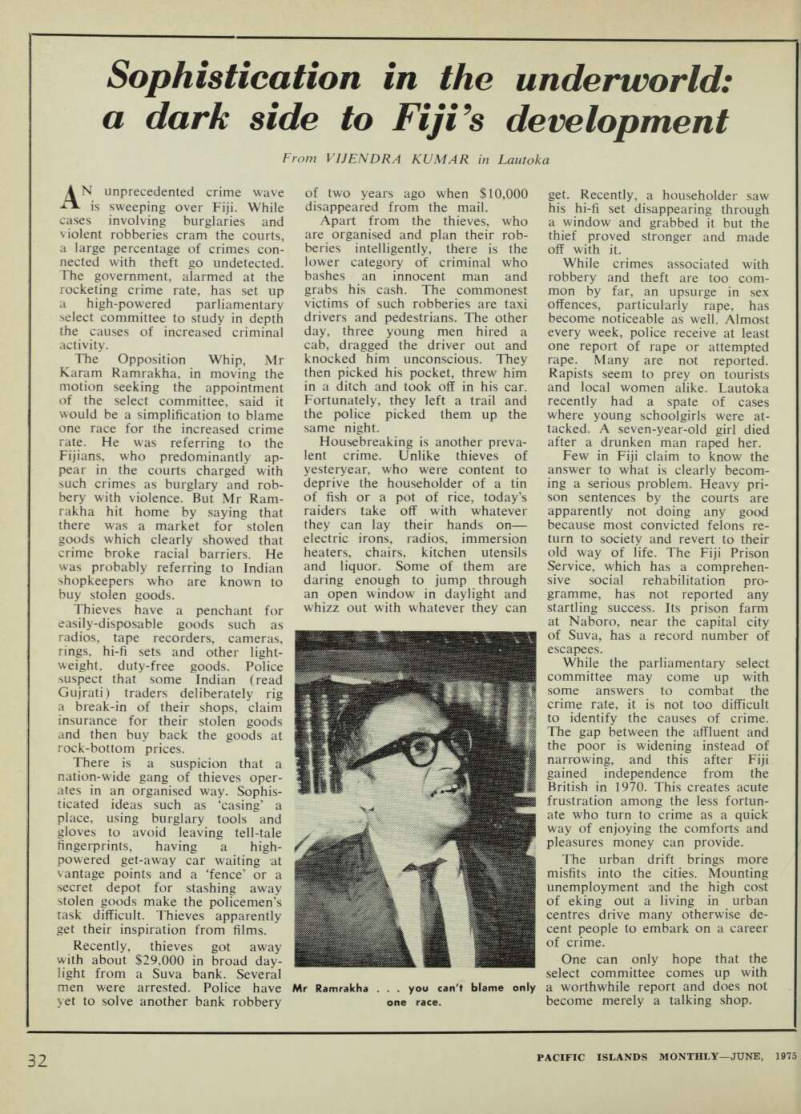
a dark side to Fiji’s development
From VI JEN DR A KUMAR in Emit oka
A N unprecedented crime wave is sweeping over Fiji. While cases involving burglaries and violent robberies cram the courts, a large percentage of crimes con nected with theft go undetected.
The government, alarmed at the rocketing crime rate, has set up a high-powered parliamentary select committee to study in depth the causes of increased criminal activity.
The Opposition Whip, Mr Karam Ramrakha, in moving the motion seeking the appointment of the select committee, said it would be a simplification to blame one race for the increased crime rate. He was referring to the Fijians, who predominantly ap pear in the courts charged with such crimes as burglary and rob bery with violence. But Mr Ram rakha hit home by saying that there was a market for stolen goods which clearly showed that crime broke racial barriers. He was probably referring to Indian shopkeepers who are known to buy stolen goods.
Thieves have a penchant for easily-disposable goods such as radios, tape recorders, cameras, rings, hi-fi sets and other light weight, duty-free goods. Police suspect that some Indian (read Gujrati) traders deliberately rig a break-in of their shops, claim insurance for their stolen goods and then buy back the goods at rock-bottom prices.
There is a suspicion that a nation-wide gang of thieves oper ates in an organised way. Sophis ticated ideas such as ‘casing’ a place, using burglary tools and gloves to avoid leaving tell-tale fingerprints, having a high powered get-away car waiting at vantage points and a ‘fence’ or a secret depot for stashing away stolen goods make the policemen’s task difficult. Thieves apparently get their inspiration from films.
Recently, thieves got away with about $29,000 in broad day light from a Suva bank. Several men were arrested. Police have yet to solve another bank robbery
of two years ago when $lO,OOO disappeared from the mail.
Apart from the thieves, who are organised and plan their rob beries intelligently, there is the lower category of criminal who bashes an innocent man and grabs his cash. The commonest victims of such robberies are taxi drivers and pedestrians. The other day, three young men hired a cab, dragged the driver out and knocked him unconscious. They then picked his pocket, threw him in a ditch and took off in his car.
Fortunately, they left a trail and the police picked them up the same night.
Housebreaking is another preva lent crime. Unlike thieves of yesteryear, who were content to deprive the householder of a tin of fish or a pot of rice, today’s raiders take off with whatever they can lay their hands on— electric irons, radios, immersion heaters, chairs, kitchen utensils and liquor. Some of them are daring enough to jump through an open window in daylight and whizz out with whatever they can
get. Recently, a householder saw his hi-fi set disappearing through a window and grabbed it but the thief proved stronger and made off with it.
While crimes associated with robbery and theft are too com mon by far, an upsurge in sex offences, particularly rape, has become noticeable as well. Almost every week, police receive at least one report of rape or attempted rape. Many are not reported.
Rapists seem to prey on tourists and local women alike. Lautoka recently had a spate of cases where young schoolgirls were at tacked. A seven-year-old girl died after a drunken man raped her.
Few in Fiji claim to know the answer to what is clearly becom ing a serious problem. Heavy pri son sentences by the courts are apparently not doing any good because most convicted felons re turn to society and revert to their old way of life. The Fiji Prison Service, which has a comprehen sive social rehabilitation pro gramme, has not reported any startling success. Its prison farm at Naboro, near the capital city of Suva, has a record number of escapees.
While the parliamentary select committee may come up with some answers to combat the crime rate, it is not too difficult to identify the causes of crime.
The gap between the affluent and the poor is widening instead of narrowing, and this after Fiji gained independence from the British in 1970. This creates acute frustration among the less fortun ate who turn to crime as a quick way of enjoying the comforts and pleasures money can provide.
The urban drift brings more misfits into the cities. Mounting unemployment and the high cost of eking out a living in urban centres drive many otherwise de cent people to embark on a career of crime.
One can only hope that the select committee comes up with a worthwhile report and does not become merely a talking shop.
Mr Ramrakha . . . you can't blame only one race.
birds - P-NG style
Listen to the mocking birds - P-NG style
By Susi Collins
Lm a bird-listener now. I used to be a bird-watcher, but not long ago I put all that behind me when I went to Papua New Guinea, land of, supposedly, 568 varieties of birds.
I thought it would be pretty good bird-watching in a land where there were 568 varieties, so many of whose showy plumage and extra ordinary displays are without rival in the world.
I soon found out, however, that in the particular area where I was staying it’s easier to sample the com plete range of a certain brand of American soups than see a wide variety of Papua New Guinea’s re nowned feathered fauna.
Armed with binoculars, notebook, mosquito repellant, glucose tablets for exhaustion, matches to burn leeches off my body and a stout stick to do battle with anything reptilian in character, I skidded on sloshy trails, groped my way through soupy swamps, and even sank thigh-high in a mucus-looking pool—all for the pleasure of stalking birds whose songs or strange calls had made me childishly happy. But always the songsters eluded me.
Take the hornbill, for instance.
Its cackle almost splinters your skull.
It’s big and wears a yellow vest, and has a nose as large as a clam shell. (I know because I’ve seen a picture of it many times.) I’ve stalked this bird for hours over tentacle-like roots, meshed myself in strangling vines, sat death-like with leeches glutting themselves on me—all for a view of the grotesque hornbill.
But my reward was only the thrash ing of its wings and its nerve-shatter ing scream.
The jacky winters, butcher birds, wrens, blue-winged kingfishers, gos sip birds, etc all sang to me (in their own way) yet were as elusive as Lassiter’s gold.
“Doodle-doo”, called the little doves. “Doodle-doo” all day long, it seemed. But they, too, played hard to see, as did the cassowaries that woke me at 3.30 every morning with
their hollow drumming kind of call as they pussy-footed past my donga.
I would leap from my bed with glee, and peer through the wire mesh win dows. But ghostly mists, rising from the valley below, hid the creatures from me.
Now the goura pigeons are com mon enough, surely. A villager brought me a crown feather once.
“But I want to see a live goura”, I said.
“Plenty goura. Plenty moorak (cassowary)”, he replied, pointing to the swirling valley below.
I never did get to see a live goura.
Fluting, piping, screeching—birds, birds. I remember vividly the dramas of night when poignant cries, almost human-like, broke my sleep and I knew there were predators after my elusive birds.
If I’d seen all the birds I’ve heard, I guess I’d be unrivalled in the bird watching field. Through these dis appointments at not seeing my feathered friends, however, I culti vated extrasensory hearing; and with the help of my village friends I was able to identify many bird calls.
But it was Armand and Michaela Dennis who helped me, through their famous TV series, to identify the most rewarding of all bird calls— the Bird of Paradise (in my case the Lesser Bird of Paradise).
On the first leg of a two-day trek, I heard them—loud crow-like calls, aggressive and excited. High above, flashes of yellow and warm browns caught my eye.
I turned to my village companion, Saiya, who stood totally unmoved.
“Birds of Paradise, Saiya. No one back home will ever believe me”, I yelled in ecstasy.
Saiya said, “Often they come to this tree to dance”. A tree blossom ing with Lesser Birds of Paradise was just part of the fabric of Saiva’s life in the jungle.
But looking for birds in many parts of Papua New Guinea, isn’t easy.
That’s why I’ve become a bird listener!
Advertisements & other items, pp. 35-36 (2 items)
Lost
The Book
Sensation
of the
Pacific
THE
LOST
CARAVEL
by Robert Langdon
Was a group of 16th century shipwrecked Spanish sailors responsible for the legendary Polynesian canoe-building and navigation skills?
This and many equally startling questions are answered in Robert Langdon’s important new book, THE LOST CARA- VEL, which shatters, many traditionally-held views on the origin of the Polynesians. Mr Langdon contends that the crew of the Spanish caravel San Lesmes, shipwrecked east of Tahiti in 1526 en route for the East Indies, survived and established themselves in Polynesian society, forming dynasties that lasted down to Captain Cook’s time.
PRICE: Australia, 514.50 Aust. plus $1.20 posted; Pacific Islands and Overseas, $14.50 Aust. plus SI.7C posted; USA, $20.00 US plus $2 0C US posted.
Fill in the details
on the attached
order form
with.... }/!£&
TURNS GRASS INTO LAWN
lity U Tl I
UTILITY 160
THE 'WORK HORSE” OF THE
VICTA RANGE
SUPER 24
THE BIG MOWER FOR
BIG AREAS
The big mower from Victa. It takes a full 61 cm wide bite into and cuts a smooth swath over large expanses of grass. It is the mower for municipal parks and gardens, sports grounds, road-side growth control as well as home owners with large areas of land. The lightweight construction of the mower makes it easy to manoeuvre and the giant rear wheels ride rough ground effortlessly. Two freeswinging blades on the cutting disc absorb shock when hard objects are encountered.
A tough but lightweight mower without grasscatcher, a model designed to do a superb grasscutting job—on meadows full of weeds or on a fine lawn. It cuts up to trees and fences and is the lightest Victa mower of all to use. Available with either a 125 c.c. Victa 2-stroke engine or with the Victa 160 c.c. 2-stroke engine— Folding handle and single-lever simultaneous height adjustment are other features that make this lowest priced VICTA a popular mower.
lip up & away
with... }/!£&
new heritage
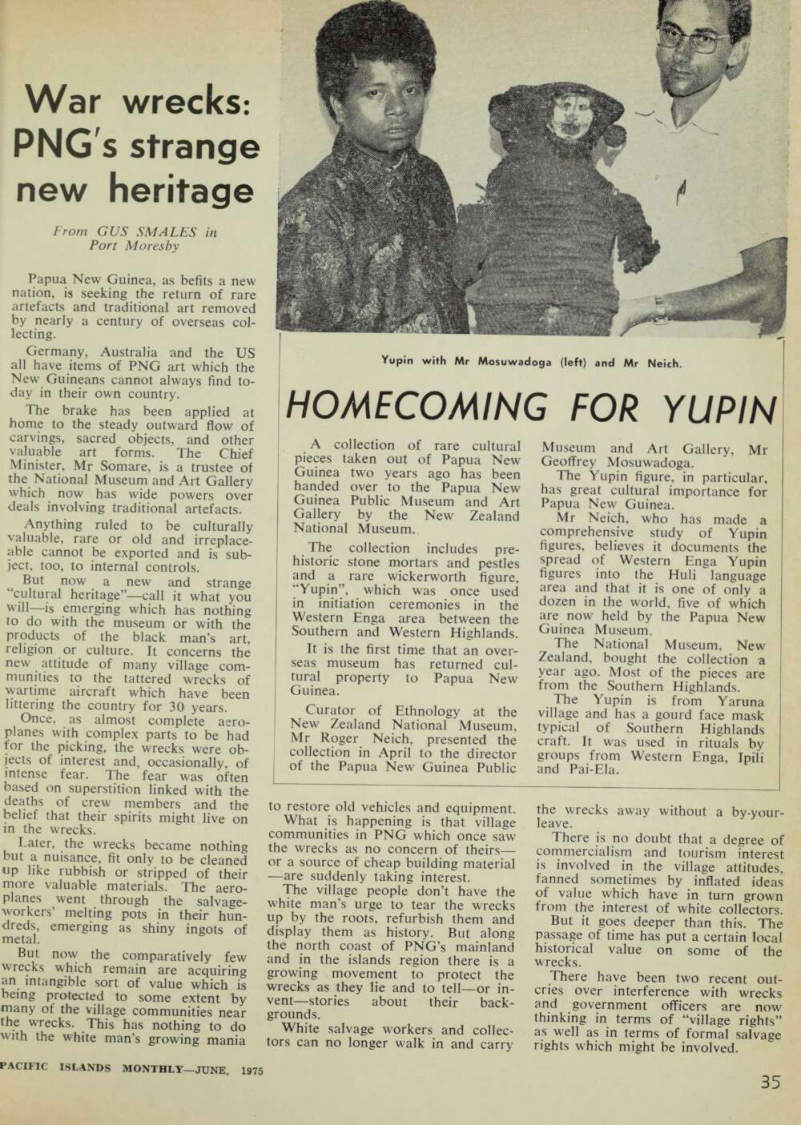
War wrecks: PNG's strange new heritage
From GUS SMALES in Port Moresby Papua New Guinea, as befits a new nation, is seeking the return of rare artefacts and traditional art removed by nearly a century of overseas col lecting, Germany, Australia and the US all have items of PNG art which the New Guineans cannot always find to day in their own country.
The brake has been applied at home to the steady outward flow of carvings, sacred objects, and other valuable art forms. The Chief Minister, Mr Somare, is a trustee of the National Museum and Art Gallery which now has wide powers over deals involving traditional artefacts.
Anything ruled to be culturally valuable, rare or old and irreplace able cannot be exported and is sub ject, too, to internal controls.
But now a new and strange “cultural heritage”—call it what you will—is emerging which has nothing to do with the museum or with the products of the black man’s art, religion or culture. It concerns the new attitude of many village com munities to the tattered wrecks of wartime aircraft which have been littering the country for 30 years.
Once, as almost complete aero planes with complex parts to be had for the picking, the wrecks were ob jects of interest and, occasionally, of intense fear. The fear was often based on superstition linked with the deaths of crew members and the belief that their spirits might live on in the wrecks.
Later, the wrecks became nothing but a nuisance, fit only to be cleaned up like rubbish or stripped of their more valuable materials. The aero planes went through the salvage workers’ melting pots in their hun dreds, emerging as shiny ingots of metal.
But now the comparatively few wrecks which remain are acquiring an intangible sort of value which is being protected to some extent by many of the village communities near the wrecks. This has nothing to do with the white man’s growing mania
to restore old vehicles and equipment.
What is happening is that village communities in PNG which once saw the wrecks as no concern of theirs— or a source of cheap building material —are suddenly taking interest.
"Hie village people don’t have the white man’s urge to tear the wrecks up by the roots, refurbish them and display them as history. But along the north coast of PNG’s mainland and in the islands region there is a growing movement to protect the wrecks as they lie and to tell—or in vent —stories about their back grounds.
White salvage workers and collec tors can no longer walk in and carry
the wrecks away without a by-your leave, There is no doubt that a degree of commercialism and tourism interest is involved in the village attitudes fanned sometimes by inflated ideas of value which have in turn grown from the interest of white collectors But it goes deeper than this The passage of time has put a certain local historical value on some of the wrecks.
There have been two recent out cries over interference with wrecks and government officers are now thinking in terms of “village rights” as well as in terms of formal salvage rights which might be involved.
Homecoming For Yupin
A collection of rare cultural pieces taken out of Papua New Guinea two years ago has been handed over to the Papua New Guinea Public Museum and Art Gallery by the New Zealand National Museum.
The collection includes pre historic stone mortars and pestles and a rare wickerworth figure, “Yupin”, which was once used in initiation ceremonies in the Western Enga area between the Southern and Western Highlands.
It is the first time that an over seas museum has returned cul tural property to Papua New Guinea.
Curator of Ethnology at the New Zealand National Museum, Mr Roger Neich, presented the collection in April to the director of the Papua New Guinea Public
Museum and Art Gallery, Mr Geoffrey Mosuwadoga.
The Yupin figure, in particular, has great cultural importance for Papua New Guinea.
Mr Neich, who has made a comprehensive study of Yupin figures, believes it documents the spread of Western Enga Yupin figures into the Huli language area and that it is one of only a dozen in the world, five of which are now held by the Papua New Guinea Museum.
The National Museum, New Zealand, bought the collection a year ago. Most of the pieces are from the Southern Highlands.
The Yupin is from Yaruna village and has a gourd face mask typical of Southern Highlands craft. It was used in rituals by groups from Western Enga, Ipili and Pai-Ela.
Yupin with Mr Mosuwadoga (left) and Mr Neich.
Advertisements & other items, p. 38 (1 item)
Caterpillar Dealers in South-West Pacific.
8 I i i Caterpillar reliability, productivity, availability. Now you can get it all in a wheel skidder. The 518.
A whole new standard in skidder engineering. 120 turbocharged horsepower, 20,400 pounds of working muscle with full articulation and frame oscillation for stability and minimum maintenance.
Single lever “on the go” powershift. Dual rate steering for controlled response at all speeds. An operator’s compartment engineered for efficiency with safety features built in for man and machine.
You’ll find all the best skidder ideas, plus added refinement and top quality manufacturing that can make the 518 the backbone of your logging operation.
And South-West Pacific Caterpillar dealers will ensure that your backbone stays in top condition no matter how far in the bush you are.
Parts, maintenance, repairs or simple information—we’ll see that you get it fast.
So tackle the jungle with the new Cat 518.
Caterpillar Dealers in South-West Pacific.
■ - ■ ■ ■ ■ 1 - -i ■ i I I ai.am Ad A i irtrtne D nor!
HASTINGS DEIRING
Lae: Milford Haven Road, Ph: 42 2355 Port Moresby: Champion Parade, Knoedobu.
Ph: 3138 or 2098.
Bougainville: Itakara.
Industrial Park, Arawa.
Ph- 95 9004. 154 Queens Road, Suva.
Ph: 24 051-4 Cables: Carptrac Suva Telex; Carptrac FG2190
Cl IWQ
iL t ‘lt’B
CARPENTERS
TRACTOR B EQUIPMENT
Magazine Section
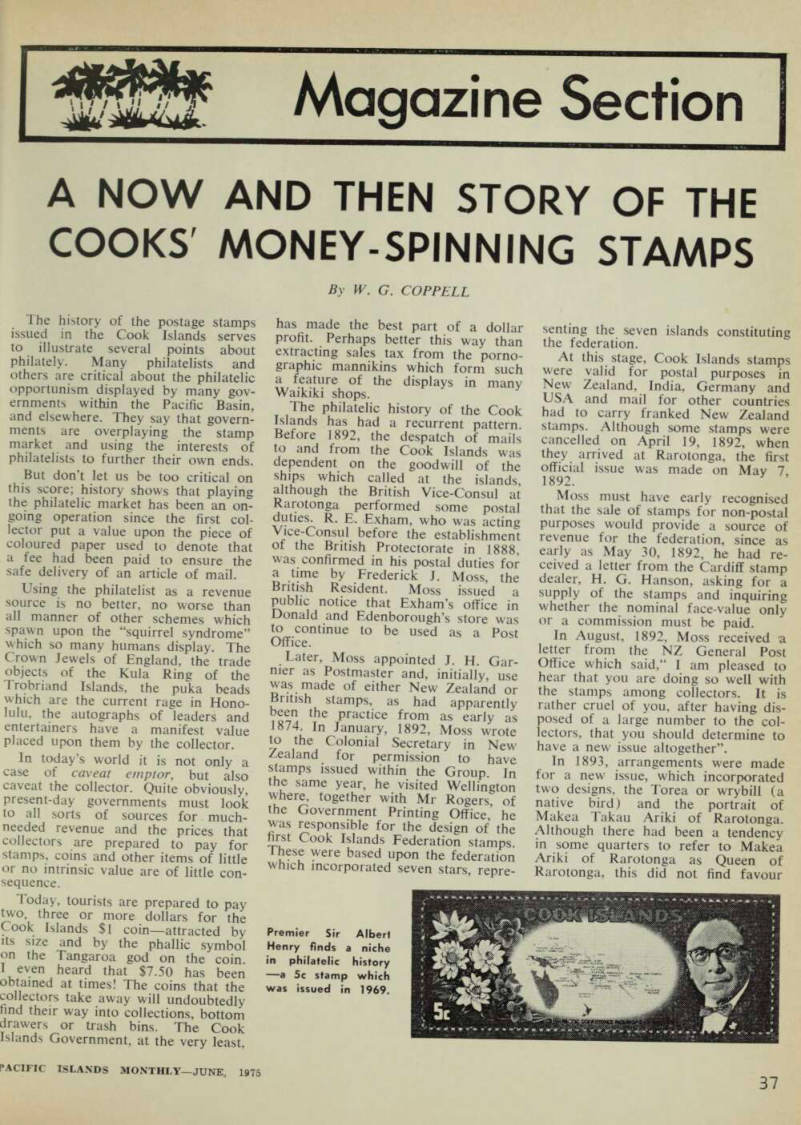
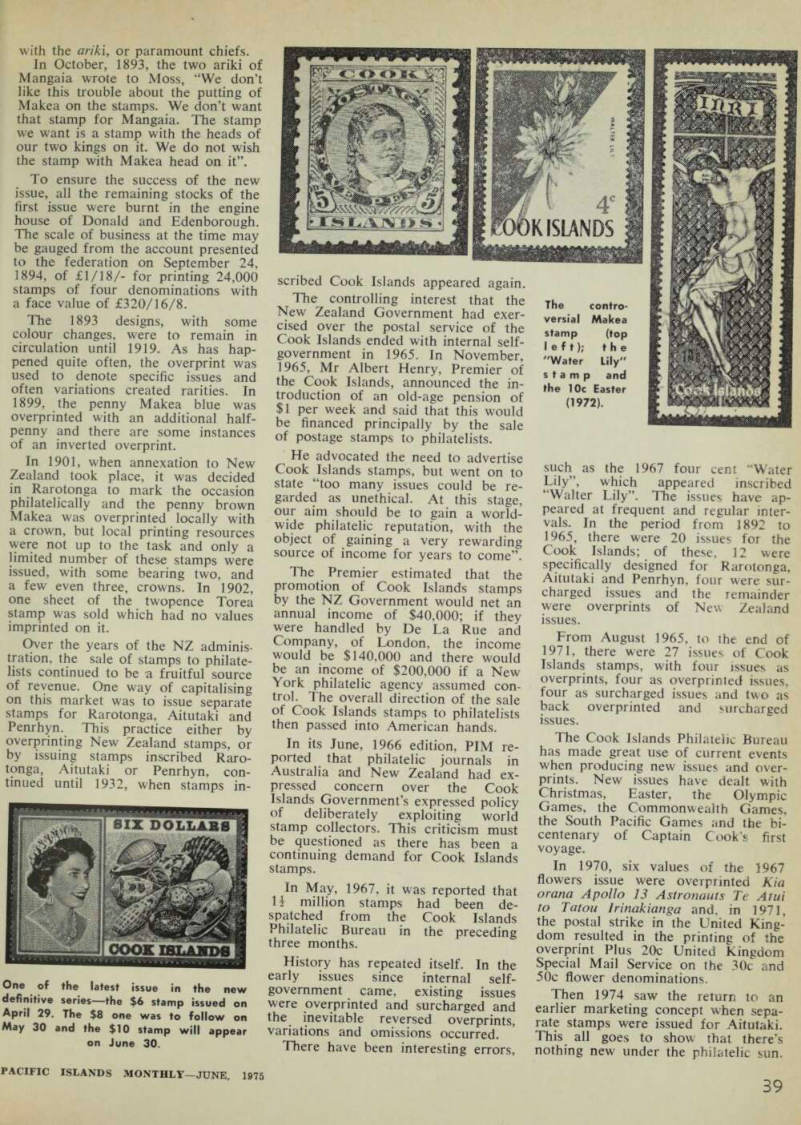
A NOW AND THEN STORY OF THE
Cooks' Money-Spinning Stamps
By W. G. Coppell
The history of the postage stamps issued in the Cook Islands serves to illustrate several points about philately. Many philatelists and others are critical about the philatelic opportunism displayed by many gov ernments within the Pacific Basin, and elsewhere. They say that govern ments are overplaying the stamp market and using the interests of philatelists to further their own ends.
But don’t let us be too critical on this score; history shows that playing the philatelic market has been an on going operation since the first col lector put a value upon the piece of coloured paper used to denote that a fee had been paid to ensure the safe delivery of an article of mail.
Using the philatelist as a revenue source is no better, no worse than all manner of other schemes which spawn upon the “squirrel syndrome” which so many humans display. The Crown Jewels of England, the trade objects of the Kula Ring of the Trobriand Islands, the puka beads which are the current rage in Hono lulu, the autographs of leaders and entertainers have a manifest value placed upon them by the collector.
In today’s world it is not only a case of caveat emptor , but also caveat the collector. Quite obviously, present-day governments must look to all sorts of sources for much needed revenue and the prices that collectors are prepared to pay for stamps, coins and other items of little or no intrinsic value are of little con sequence.
Today, tourists are prepared to pay Lvo, three or more dollars for the Cook Islands $1 coin— attracted by its size and by the phallic symbol on the Tangaroa god on the coin.
I even heard that $7.50 has been obtained at times! The coins that the collectors take away will undoubtedly find their way into collections, bottom drawers or trash bins. The Cook Islands Government, at the very least.
has made the best part of a dollar profit. Perhaps better this way than extracting sales tax from the porno graphic mannikins which form such a feature of the displays in many Waikiki shops.
The philatelic history of the Cook Islands has had a recurrent pattern Before 1892, the despatch of mails to and from the Cook Islands was dependent on the goodwill of the ships which called at the islands, although the British Vice-Consul at Rarotonga performed some postal duties. R. E. Exham, who was acting Vice-Consul before the establishment of the British Protectorate in 1888, was confirmed in his postal duties for a time by Frederick J. Moss, the British Resident. Moss issued a public notice that Exham’s office in Donald and Edenborough’s store was to continue to be used as a Post Office.
Later, Moss appointed J. H. Gar mer as Postmaster and, initially, use was made of either New Zealand or British stamps, as had apparently been the practice from as early as 1874. In January, 1892, Moss wrote to the Colonial Secretary in New Zealand for permission to have stamps issued within the Group In the same year, he visited Wellington where, together with Mr Rogers, of the Government Printing Office he was responsible for the design of the first Cook Islands Federation stamps.
These were based upon the federation which incorporated seven stars, repre
seating the seven islands constituting the federation.
At this stage. Cook Islands stamps were valid for postal purposes in New Zealand, India, Germany and USA and mail for other countries had to carry franked New Zealand stamps. Although some stamps were cancelled on April 19, 1892, when they arrived at Rarotonga, the first official issue was made on May 7, 1892.
Moss must have early recognised that the sale of stamps for non-postal purposes would provide a source of revenue for the federation, since as early as May 30, 1892, he had re ceived a letter from the Cardiff stamp dealer, H. G. Hanson, asking for a supply of the stamps and inquiring whether the nominal face-value only or a commission must be paid.
In August, 1892, Moss received a letter from the NZ General Post Office which said,“ I am pleased to hear that you are doing so well with the stamps among collectors. It is rather cruel of you, after having dis posed of a large number to the col lectors, that you should determine to have a new issue altogether”.
In 1893, arrangements were made for a new issue, which incorporated two designs, the Torea or wrybill (a native bird) and the portrait of Makea Takau Ariki of Rarotonga.
Although there had been a tendency in some quarters to refer to Makea Ariki of Rarotonga as Queen of Rarotonga, this did not find favour
Premier Sir Albert Henry finds a niche in philatelic history —a 5c stamp which was issued in 1969.
with the ariki, or paramount chiefs.
In October, 1893, the two ariki of Mangaia wrote to Moss, “We don’t like this trouble about the putting of Makea on the stamps. We don’t want that stamp for Mangaia. The stamp we want is a stamp with the heads of our two kings on it. We do not wish the stamp with Makea head on it”.
To ensure the success of the new issue, all the remaining stocks of the first issue were burnt in the engine house of Donald and Edenborough.
The scale of business at the time may be gauged from the account presented to the federation on September 24, 1894, of £l/18/- for printing 24,000 stamps of four denominations with a face value of £320/16/8.
The 1893 designs, with some colour changes, were to remain in circulation until 1919. As has hap pened quite often, the overprint was used to denote specific issues and often variations created rarities. In 1899, the penny Makea blue was overprinted with an additional half penny and there are some instances of an inverted overprint.
In 1901, when annexation to New Zealand took place, it was decided in Rarotonga to mark the occasion philatelically and the penny brown Makea was overprinted locally with a crown, but local printing resources were not up to the task and only a limited number of these stamps were issued, with some bearing two, and a few even three, crowns. In 1902, one sheet of the twopence Torea stamp was sold which had no values imprinted on it.
Over the years of the NZ adminis tration, the sale of stamps to philate lists continued to be a fruitful source of revenue. One way of capitalising on this market was to issue separate stamps for Rarotonga, Aitutaki and Penrhyn. This practice either by overprinting New Zealand stamps, or by issuing stamps inscribed Raro tonga, Aitutaki or Penrhyn, con tinued until 1932, when stamps in-
scribed Cook Islands appeared again.
The controlling interest that the New Zealand Government had exer cised over the postal service of the Cook Islands ended with internal self government in 1965. In November, 1965, Mr Albert Henry, Premier of the Cook Islands, announced the in troduction of an old-age pension of $1 per week and said that this would be financed principally by the sale of postage stamps to philatelists.
He advocated the need to advertise Cook Islands stamps, but went on to state “too many issues could be re garded as unethical. At this stage, our aim should be to gain a world wide philatelic reputation, with the object of gaining a very rewarding source of income for years to come”.
The Premier estimated that the promotion of Cook Islands stamps by the NZ Government would net an annual income of $40,000; if they were handled by De La Rue and Company, of London, the income would be $140,000 and there would be an income of $200,000 if a New York philatelic agency assumed con trol. The overall direction of the sale of Cook Islands stamps to philatelists then passed into American hands.
In its June, 1966 edition, PIM re ported that philatelic journals in Australia and New Zealand had ex pressed concern over the Cook Islands Government’s expressed policy of deliberately exploiting world stamp collectors. This criticism must be questioned as there has been a continuing demand for Cook Islands stamps.
In May, 1967, it was reported that H million stamps had been de spatched from the Cook Islands Philatelic Bureau in the preceding three months.
History has repeated itself. In the early issues since internal self government came, existing issues were overprinted and surcharged and the inevitable reversed overprints, variations and omissions occurred.
There have been interesting errors,
such as the 1967 four cent “Water Lily”, which appeared inscribed “Walter Lily”. The issues have ap peared at frequent and regular inter vals. In the period from 1892 to 1965, there were 20 issues for the Cook Islands; of these, 12 were specifically designed for Rarotonga, Aitutaki and Penrhyn, four were sur charged issues and the remainder were overprints of New Zealand issues.
From August 1965, to the end of 1971, there were 27 issues of Cook Islands stamps, with four issues as overprints, four as overprinted issues, four as surcharged issues and two as back overprinted and surcharged issues.
The Cook Islands Philatelic Bureau has made great use of current events when producing new issues and over prints. New issues have dealt with Christmas, Easter, the Olympic Games, the Commonwealth Games, the South Pacific Games and the bi centenary of Captain Cook’s first voyage.
In 1970, six values of the 1967 flowers issue were overprinted Kia or ana Apollo 13 Astronauts Te Atui to Tatou Irinakianga and. in 1971, the postal strike in the United King dom resulted in the printing of the overprint Plus 20c United Kingdom Special Mail Service on the 30c and 50c flower denominations.
Then 1974 saw the return to an earlier marketing concept when sepa rate stamps were issued for Aitutaki.
This all goes to show that there’s nothing new under the philatelic sun.
One of the latest issue in the new definitive series—the $6 stamp issued on April 29. The $8 one was to follow on May 30 and the $lO stamp will appear on June 30.
The contro versial Makea stamp (top left); the "Water Lily" stamp and the 10c Easter (1972).
Advertisements & other items, p. 40 (1 item)
&
S' /'■l-A / ■/ fA / Vi s f f. / y/ v i Manufactured by Commonwealth New Guinea Timbers Ltd. and available from leading suppliers throughout the Pacific.
Bobby' still
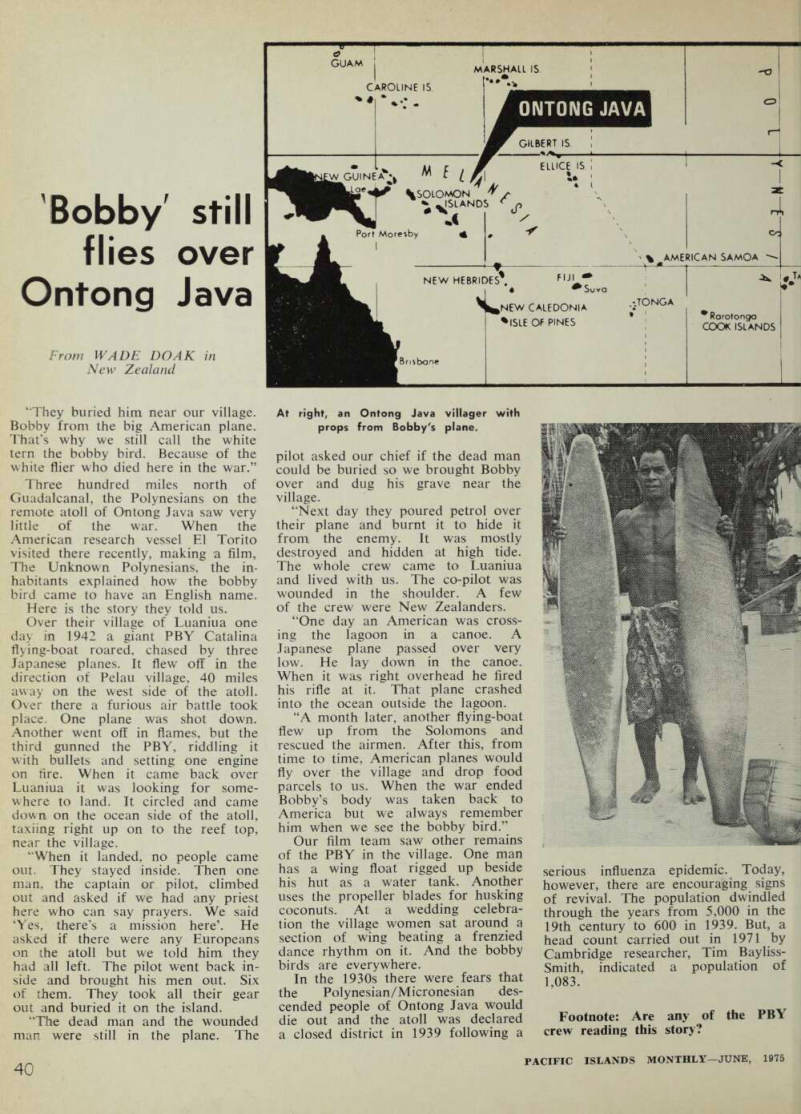
flies over Ontong Java
From WADE DOAK in New Zealand “They buried him near our village.
Bobby from the big American plane.
That’s why we still call the white tern the bobby bird. Because of the white flier who died here in the war.”
Three hundred miles north of Guadalcanal, the Polynesians on the remote atoll of Ontong Java saw very little of the war. When the American research vessel El Torito visited there recently, making a film, The Unknown Polynesians, the in habitants explained how the bobby bird came to have an English name.
Here is the story they told us.
Over their village of Luaniua one day in 1942 a giant PBY Catalina flying-boat roared, chased by three Japanese planes. It flew off in the direction of Pelau village, 40 miles away on the west side of the atoll.
Over there a furious air battle took place. One plane was shot down.
Another went off in flames, but the third gunned the PBY, riddling it with bullets and setting one engine on fire. When it came back over Luaniua it was looking for some where to land. It circled and came down on the ocean side of the atoll, taxiing right up on to the reef top, near the village.
“When it landed, no people came out. They stayed inside. Then one man, the captain or pilot, climbed out and asked if we had any priest here who can say prayers. We said ‘Yes, there’s a mission here’. He asked if there were any Europeans on the atoll but we told him they had all left. The pilot went back in side and brought his men out. Six of them. They took all their gear out and buried it on the island.
“The dead man and the wounded man were still in the plane. The
pilot asked our chief if the dead man could be buried so we brought Bobby over and dug his grave near the
village.
“Next day they poured petrol over their plane and burnt it to hide it from the enemy. It was mostly destroyed and hidden at high tide.
The whole crew came to Luaniua and lived with us. The co-pilot was wounded in the shoulder. A few of the crew were New Zealanders.
“One day an American was cross ing the lagoon in a canoe. A Japanese plane passed over very low. He lay down in the canoe.
When it was right overhead he fired his rifle at it. That plane crashed into the ocean outside the lagoon.
“A month later, another flying-boat flew up from the Solomons and rescued the airmen. After this, from time to time, American planes would fly over the village and drop food parcels to us. When the war ended Bobby’s body was taken back to America but we always remember him when we see the bobby bird.”
Our film team saw other remains of the PBY in the village. One man has a wing float rigged up beside his hut as a water tank. Another uses the propeller blades for husking coconuts. At a wedding celebra tion the village women sat around a section of wing beating a frenzied dance rhythm on it. And the bobby birds are everywhere.
In the 1930 s there were fears that the Polynesian/Micronesian des cended people of Ontong Java would die out and the atoll was declared a closed district in 1939 following a
serious influenza epidemic. Today, however, there are encouraging signs of revival. The population dwindled through the years from 5,000 in the 19th century to 600 in 1939. But, a head count carried out in 1971 by Cambridge researcher, Tim Bayliss- Smith, indicated a population of 1,083.
Footnote: Are any of the PBY crew reading this story?
At right, an Ontong Java villager with props from Bobby's plane.
Advertisements & other items, pp. 43-50 (4 items)
V
“So this is a Lamborghini,” she breathed, as we sped down the autostrada towards Turin.
“Yes,” I said, offering her a Benson and Hedges. “Five forward gears and 170 in top.”
“Can you prove that?” she demanded.
“Do I really have to? You did say you only wanted a little car to do the
shopping,”
\\ V Si tu: 4t> r, £ V' ■*s m\ 'MB* m Benson & Hed \a/VOK^ When only4l)e best will do.
BBS*
oMi I’ :mo(i n t.\
J ( ( s .'• f 111 r i
NOW COMES THE POWER LINE.
FROM SANSUI.
Good, solid Sansui quality in a line of receivers with more stereo power and performance for less than you’d expect.
That, folks, is The Power Line.
Top-of-the-line is Sansui 881: 63 watts per channel minimum RMS into 8 ohms from 20 to 20,000 Hz with no more than 0.3% total harmonic distortion.
Inside, eleven computer-grade ICs and special Circuit Board Module construction eliminate a lot of the internal wiring to assure
long-term stability.
Outside, rugged controls tailor the sound and direct ‘signal traffic’ throughout the 881 for 3 pairs of stereo loudspeakers, tuner section, turntables,
decks, tape dubbing, microphone mixing, and
much more.
But if the 881 is too much of a good thing, The Power Line offers other big-value receivers with
similar cost/performance
advantages. See them soon.
Sansui. Dynamic audio answers.
441 551 661 771 881 Australia Rank Industries Australia Pty. Ltd. 58 Queensbridge Street, South Melbourne, Victoria 3205 Phone: 61 3281 Australia Atkins Carlyle Ltd. 394 Hay Street, Perth, Western Australia 6000 Phone; 21 0101 Fiji Prabhu Brothers Ltd.
P.O. Box 183, Nadi Phone: 70183/4 Papua New Guinea Oceania Indent Agency (P.N.G.) Pty. Ltd.
Box 5518, Boroko, Port Moresby Phone; PM 56406 New Zealand David J. Reid (N.Z.) Ltd.
C.P.O. Box 2630, Auckland. 1 Phone: 492-189 Nlle-Caledonie Ets Michel MERCIER 9. rue de Sebastopol, Noumea Phone: 759.11 South Pacific Miltons Department Stores Limited P.O. Box 146, Norfolk Island 2899 Western Samoa H.J. Keil and Company, Ltd.
P.O. Box 7, Apia Phone; 198 New Hebrides South Pacific Audio & Photo Supplies B.P. 274, Vila Cook Islands United Island Traders Ltd.
Box Nos. 1 & 2, Rarotonga Tahiti Societe JAUNEZ & Cie B.P. 322, Papeete Phone; 2.04,24
SANSUI ELECTRIC CO., LTD.
14-1,2-chome, Izumi, Suginami-ku, Tokyo 168, Japan
a new dimension in outboard motors
from Finland
★ RANGING FROM 3 TO 40 H.P.
★ BUILT IN GENERATORS
FROM 5 H.P. UPWARDS.
★ 2 YEARS WARRANTY
TgRH'
V* B.
look ot these outstanding features
TSRH-IJ
the great name in family boating
from Pacific . . .
LIGHTWEIGHT: Anti corrosion alloy materials with stainless steel underwater parts and shafts.
MODERN DESIGN; Modern loop scavenged cesign, all roller bearing on crankshafts.
ECONOMICAL: Fixed jet carburettors gives extremely economical running.
SYNCHRONISED TILLER CONTROL: All in one gearshift and throttle incorporated. (Forward and reverse).
BUILT IN GENERATORS: 5 hp and up equipped with generating coils for running lights or battery charging.
PUSH BUTTON START: Electric starting models, 15-20-40 easy start with push button.
SPARE PARTS AND ACCESSORIES: All parts and accessories available ex stock at very reasonable prices.
Pacific
DEALER INQUIRIES INVITED.
D.AJ.A., 19 Carrington Road, Marrickville, N.S.W., Aust., 2204.
Ph.: 55 3473. Telex; 25568. Cables: "Dieseltech", Sydney.
m ,r n / f /
CJUART? S
'WED 2 -
< / ! I \ / u \ % BE
THE WORLD'S
LARGEST SELECTION OF
QUARTZ WATCHES. SEIKO.
Seiko sold the world's first quartz wristwatch. And Seiko makes the world's most accurate quartz, the world's thinnest quartz and the world's largest selection of quartz watches.
Seiko makes every part of every quartz watch it sells.
Our quality control is unparalleled in the industry. That's why our finest quartz watch can be guaranteed accurate to within one second a month, our quartz dress styles are the thinnest in the world, our digital model offers a continuous read out, down to the precise second, with no nml buttons to push.
Whatever Seiko Quartz model you select, you get more than just a technologically advanced timepiece, you get the watch that's changing the world's standard of accuracy. SEIKO s9l
SEIKO QUARTZ
Someday all watches will be made this way.
It took time to perfect the
NEW Hyster electrics.
Time to make the best.
HYSTER
m i. * * ' ' *' . : ■ u We could have added new Hyster electric trucks to our extensive lift truck range some time ago. After all, we knew what people wanted, and we had the dealer and service network to back our sales Australia-wide.
But long after electric lift trucks first hit the market, we were busy perfecting a better hydraulic system to overcome the oil leaks and minimise the battery drain other manufacturers weren't so concerned about.
We wanted to make ours the top performance electric. An easy-handling truck with a short turning radius. Longer life between charges. Smoother deceleration. And single pedal control to keep the drivers happy.
Now, we’ve built these advantages into a range of Hyster electric trucks with load capacities of up to 10,000 lbs (5,000 kgs). We believe they're the world’s finest, and they’re available from your Hyster dealer. Ask to see them in action. Or contact Hyster Australia Pty. Ltd., Ashford Avenue, Milperra, N.S.W. 2214. Telephone Sydney 77 0511.
HYSTER AUSTRALIA PTY. LTD.
HR39.84
**■ •>* , •**. t * »?r »'?•■■ - |^*.Vuv»v^i’’. •> .■ ■ • Pis* «SC -rt:Ss(?* ‘V^ -v **• * <** ■ «•**« -# ■■■ iS
*SA'J
• I «< »s
sri
r -3 a
'zMastszs -
■#••'•;■■■ * a » i il »« **'■•■■ i c 8 f
iri*
•'-'v-'A-JiR, iOc*'**.
The flag we’ve flown for a hundred years.
Two paddle steamers on the Yangtse River in 1873 marked the beginning of the China Navigation Company. Today, the same flag flies above eighteen modern motor ships plying an extensive network of cargo routes between Papua New Guinea and Pacific Island ports (as far East as Tahiti) and Japan, New Zealand, Australia
and Thailand.
For 100 years, the flag of the China Navigation Company has meant experience, reliability and speed across the sea. Today, it's flying as strong as ever.
For further details and all enquiries there are Agents at the following ports; Papua New Guinea; Steamships Trading Co. Ltd., Port Moresby, Samarai, Lae, Madang, Rabaul. Kieta. Burns Philp (New Guinea) Ltd , VVewak, Kavieng. Fiji: Morris Hedstrom Ltd., Suva, Lautoka. Western Samoa: Morris Hedstrom Ltd., Apia. orr 'f Hedstrom Ltd,, Nuku’alofa and Vava’u. Tahiti: Etablissements Donald, Tahiti, Papeete. New Caledonia: Etablissements Ballande, Noumea. 8.5.1. P : British Solomons Trading Co. Ltd., Honiara. New Hebrides: Les Comptoirs Francais des Nouvelles-Hebrides, Vila and Santo. AUSTRALIA—Sydney: Interocean Swire Pty. Ltd Melbourne: Interocean Australia Services Pty. Ltd. Brisbane; Wills, Gilchrist & Sanderson Pty. Ltd. NEW ZEALAND-P. & O. (N.Z.) Ltd.
Auckland, U ellington, Christchurch, Dunedin, Bluff, Napier. Japan: Swire McKinnon, Tokyo, Yokohama, Osaka, Kobe and Nagoya. Eastern Managers: Butterfield & Swire, 9 Connaught Rd., Central, Hong Kong.
CN co JOHN SWIRE & SONS PTY. LTD. General Agents in Australia, 8 Spring Street, Sydney, Phone: 27 9351.
THE CHINA NAVIGATION CO LTD
MEMBER OF THE SWIRE GROUP.
IS 008
- ’1 % iiii S##® o tt§ &rn2 V 3 o CS ti % r«2 n s .Tserve simply with SAO Arnott’s Sao biscuits are the handiest cracker biscuits you can buy. No sooner is one pack finished than you're opening another. They’re always fresh and ready when you want them, pack after pack. Just take anything you fancy and...
.rnott's.*— Biscuits
There is no Substitute for Quality X 532
43
•ACIFIC ISLANDS MONTHLY—JUNE, 1975
Acific Islands Monthly—June, 1975
%Cific Islands Monthly—June, 1975
Yesterday
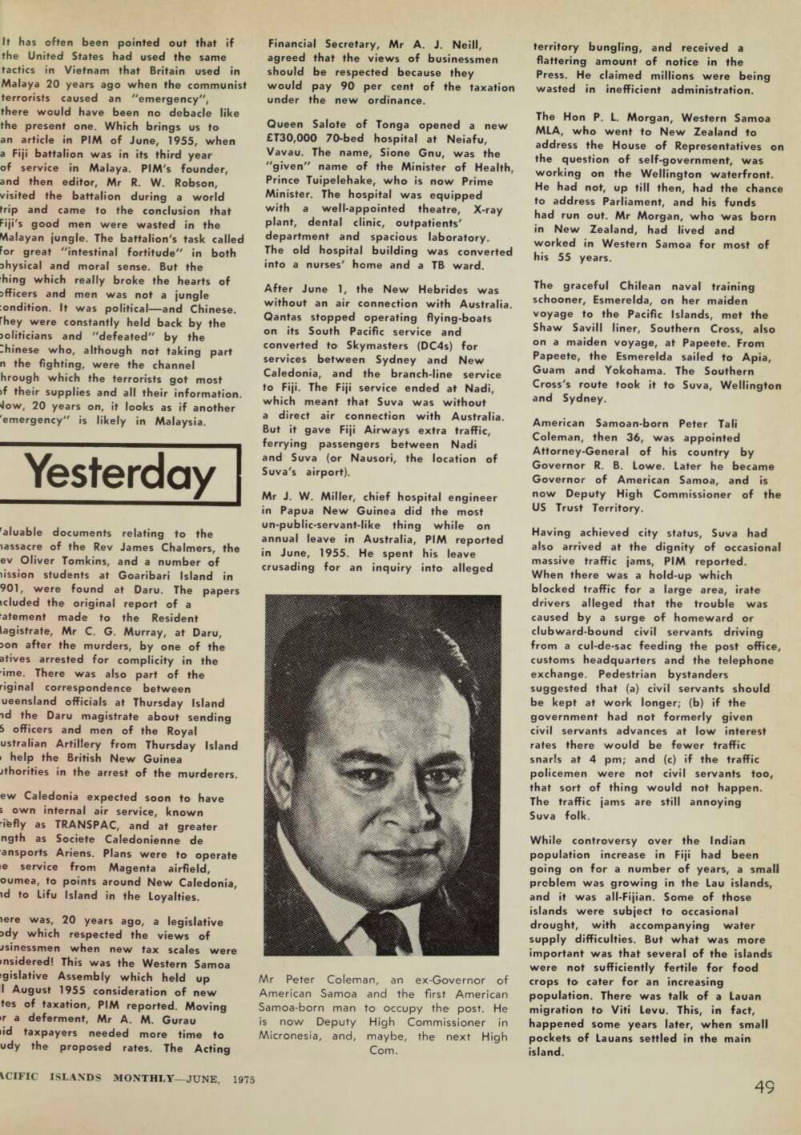
It has often been pointed out that if the United States had used the same tactics in Vietnam that Britain used in Malaya 20 years ago when the communist terrorists caused an "emergency", there would have been no debacle like the present one. Which brings us to an article in PIM of June, 1955, when a Fiji battalion was in its third year of service in Malaya. PlM's founder, and then editor, Mr R. W. Robson, visited the battalion during a world trip and came to the conclusion that Fiji's good men were wasted in the Malayan jungle. The battalion's task called For great "intestinal fortitude" in both ihysical and moral sense. But the hing which really broke the hearts of ifficers and men was not a jungle :ondition. It was political—and Chinese.
Fhey were constantly held back by the icliticians and "defeated" by the Chinese who, although not taking part n the fighting, were the channel hrough which the terrorists got most >f their supplies and all their information.
Jow, 20 years on, it looks as if another
'emergency" is likely in Malaysia.
'aluable documents relating to the lassacre of the Rev James Chalmers, the ev Oliver Tomkins, and a number of fission students at Goaribari Island in 901, were found at Daru. The papers ■ eluded the original report of a atement made to the Resident lagistrate, Mr C. G. Murray, at Daru, >on after the murders, by one of the atives arrested for complicity in the •ime. There was also part of the riginal correspondence between ueensland officials at Thursday Island id the Daru magistrate about sending S officers and men of the Royal ustralian Artillery from Thursday Island > help the British New Guinea jthorities in the arrest of the murderers. ew Caledonia expected soon to have s own internal air service, known "ifeAy as TRANSPAC, and at greater ngth as Societe Caledonienne de ansports Ariens. Plans were to operate e service from Magenta airfield, oumea, to points around New Caledonia, »d to Lifu Island in the Loyalties. lere was, 20 years ago, a legislative idy which respected the views of jsinessmen when new tax scales were msidered! This was the Western Samoa Assembly which held up I August 1955 consideration of new tes of taxation, PIM reported. Moving r a deferment, Mr A. M. Gurau iid taxpayers needed more time to udy the proposed rates. The Acting
Financial Secretary, Mr A. J. Neill, agreed that the views of businessmen should be respected because they would pay 90 per cent of the taxation under the new ordinance.
Queen Salote of Tonga opened a new £T30,000 70-bed hospital at Neiafu, Vavau. The name, Sione Gnu, was the "given" name of the Minister of Health, Prince Tuipelehake, who is now Prime Minister. The hospital was equipped with a well-appointed theatre, X-ray plant, dental clinic, outpatients' department and spacious laboratory.
The old hospital building was converted into a nurses' home and a TB ward.
After June 1, the New Hebrides was without an air connection with Australia.
Qantas stopped operating flying-boats on its South Pacific service and converted to Skymasters (DC4s) for services between Sydney and New Caledonia, and the branch-line service to Fiji. The Fiji service ended at Nadi, which meant that Suva was without a direct air connection with Australia.
But it gave Fiji Airways extra traffic, ferrying passengers between Nadi and Suva (or Nausori, the location of Suva's airport).
Mr J, W. Miller, chief hospital engineer in Papua New Guinea did the most un-public-servant-like thing while on annual leave in Australia, PIM reported in June, 1955. He spent his leave crusading for an inquiry into alleged
territory bungling, and received a flattering amount of notice in the Press. He claimed millions were being wasted in inefficient administration.
The Hon P. L. Morgan, Western Samoa MLA, who went to New Zealand to address the House of Representatives on the question of self-government, was working on the Wellington waterfront.
He had not, up till then, had the chance to address Parliament, and his funds had run out. Mr Morgan, who was born in New Zealand, had lived and worked in Western Samoa for most of his 55 years.
The graceful Chilean naval training schooner, Esmerelda, on her maiden voyage to the Pacific Islands, met the Shaw Saviil liner, Southern Cross, also on a maiden voyage, at Papeete. From Papeete, the Esmerelda sailed to Apia, Guam and Yokohama. The Southern Cross's route took it to Suva, Wellington and Sydney.
American Samoan-born Peter Tali Coleman, then 36, was appointed Attorney-General of his country by Governor R. B. Lowe. Later he became Governor of American Samoa, and is now Deputy High Commissioner of the US Trust Territory.
Having achieved city status, Suva had also arrived at the dignity of occasional massive traffic jams, PIM reported.
When there was a hold-up which blocked traffic for a large area, irate drivers alleged that the trouble was caused by a surge of homeward or clubward-bound civil servants driving from a cul-de-sac feeding the post office, customs headquarters and the telephone exchange. Pedestrian bystanders suggested that (a) civil servants should be kept at work longer; (b) if the government had not formerly given civil servants advances at low interest rates there would be fewer traffic snarls at 4 pm; and (c) if the traffic policemen were not civil servants too, that sort of thing would not happen.
The traffic jams are still annoying Suva folk.
While controversy over the Indian population increase in Fiji had been going on for a number of years, a small problem was growing in the Lau islands, and it was all-Fijian. Some of those islands were subject to occasional drought, with accompanying water supply difficulties. But what was more important was that several of the islands were not sufficiently fertile for food crops to cater for an increasing population. There was talk of a Lauan migration to Viti Levu. This, in fact, happened some years later, when small pockets of Lauans settled in the main island.
Mr Peter Coleman, an ex-Governor of American Samoa and the first American Samoa-born man to occupy the post. He is now Deputy High Commissioner in Micronesia, and, maybe, the next High Com.
Advertisements & other items, pp. 51-54 (5 items)
49
VCIFIC ISLANDS MONTHLY—JUNE, 1975
S. E. Tatham
SOME OF THE FIRMS
WE REPRESENT ARE;
Asia Rubber Works (Singapore Rubber Shoes) Frappier (French Brandy) Huvet (French Brandy) Indika (Belgium Dairy Produce) Durobor S.A. (Belgium Glassware) Miroiterie Gen. de Belgiqe S.A. (Louvre glass and mirrors) City Engineers (U.K. Bicycles) F.H.I. Japan (Subaru Cars) Kraggs (Wines, Spirits, Ciders) Sunshine Biscuits Sunrise (Confectionery) Flamenco (Instant Coffee & Tea) Quaker Products (Oats, Jets) Hancocks (Spaghetti, Cereals) Melbourne Canning (Jams) Amatil (Twisties, Twirlies) Edward Zorn (Margarine, Cooking Fats) Allens (Confectionery) Red Tulip (Fine Chocolates) Robert Timms (New Guinea Gold Instant Coffees and Teas) S.P.C (Canned Fruit) S.P.C. (Abalone) Wing Lee (See You Sauce) Magnet (Mattresses) Essteel (Cookware) Warner-Drayton (Fans) Mitchell's (Abrasives) Tilbury & Lewis (Sports Trophies & Silverplate) Regent (Swiss watches) Lega Marcasite (Jewellery) Austramax (Pressure Lanterns) Lawn Chair; Tubco (Garden Furniture) Electronic Industries (Electrical Household Appliances) Jex (Steelwool) Arnbro (Folding Beds) James Miller (Blankets) Elmaco (Plastics —Electrical Fittings) B.X. (Plastics) Stegbar (Wooden Louvres) Franklite (Light Fittings) J.J. Cash (Embroidered Labels) Disston (Saws)
S. E. TATHAM
& CO. P!Y. LTD.
ASKEW HOUSE, 364 LONSDALE ST.,
MELBOURNE, 3001, AUSTRALIA.
G.P.O, BOX 8—
CABLES "SET",
TELEPHONE; 601125
BUYERS FOR THE
PACIFIC ISLANDS
$6 % 1
DIRECT ENQUIRIES WELCOMED
PAPUA NEW GUINEA: S. E. TATHAM (P.N.G.) PTY. LTD.,
LAE: MALAITA STREET (P.O. BOX 1562).
PORT MORESBY: CNR. GOROA AND MUNAHU STREETS. GORDON
(P.O. BOX 6733, BOROKO).
FIJI: S. E. TATHAM (FIJI) LTD.,
LAUTOKA: P.O. BOX 366.
SUVA: G.P.O. BOX 671.
YOUR GUARANTEE
SINCE 1924
1 1 1
FOR SERVICE
T. 2.
From the
Islands Press
From a leading article in The Fiji Times criticising elephone services: The old adage “time is money” is not any less rue because it is so familiar and the increasing imount of time wasted in trying to get calls nade over even comparatively short distances, rot to mention internationally, is not only a drain m finances but also a dependable way of creating ulcers and increasing blood pressure. : rom a letter by Laufili Vaifou in the Samoa Times m the application in the High Court by Director if Education, Dr Fanaafi Larkin, for an injunction o stop an inquiry into her alleged behaviour: he Chief Justice . . . made reference to the Profumo candal as being a similar case. It is difficult to draw any •arallels between the two, other than the fact that the (legations made against the Director of Education involves member of Parliament . . . With respect, I would like 0 point out that no state secrets have passed to the ’ussians nor do I for one see the Director of Education 1 the role of a Christine Keeler or a AAandy Davies. rom the Tonga Chronicle: lugby referees are getting wary. We spotted me last Saturday who carried a freshly cut stick ust in case players—or spectators—became inndy. rom Tahi Tala Niue, quoting and commenting on m interview a Niuean, the Rev Lagaua Talagi, now iving in Auckland, had with the Sunday News, in vhich the minister was scathingly critical of the liue Government: k 9°® s on further to say, that if the rate of migration loesn t stop, the only people on Niue in four years me will be the Premier Mr Rex and its Assembly of 20. he referendum (on self-government) that was held in eptember was supported 2:1, but they are still leaving. rom a letter by Deborah Eupu of Popondetta High chool in the PNG Post-Courier: am not happy about the new currency for Papua Jew Guinea. I think it is not a good idea because tost of the young citizens of Papua New Guinea re not used to the new currency. They have always sed dollars and cents and so they will really have hard time when we start using kina and toea. i s^ *° keep dollars and cents as a nark of respect to the Australian Government who ave looked after us for so long.
The Tonga Chronicle, in an editorial exhorting the people to vote for "representatives to the Legislative Assembly of whom we will always be proud . . declares: ... In the past we have not been serious enough about our choice of representatives to the House. We have tended to be swayed in our choice by family and friendship ties. But more important, our votes were far too easily bought by candidates who had money to burn . . . Tonga’s awareness of the outside world is increasing and the necessity for involvement in regional affairs make it important for us to have representatives in parliament who know what is good for us and Tonga . . .
And an election candidate, Viliami Lino, asks in the
Tonga Chronicle:
Why is Nukualofa not the gateway to the Pacific instead of Suva where they have strikes?
From a letter by B. I. Valve in the PNG Post-Courier: When I was a child I read books about American gangsters, where the dialogue went something like this: “OK, buddy you owe da boss one thousand clams and dat aint hay”, etc. Now that shellfish are to be the official name for money there could be some interesting changes to slang terms. No longer will a “fishy deal” be a suspect operation, but a big contract involving numerous clams; and of course “clamming up” will mean “really loaded”, and not a matter of keeping silent. A clambake will either be a fire at the local bank or inflationary trends heating up the economy.
Lucky golfers as reported in the Cook Islands News: No 6 tee is adjacent to the main road between Avarua and Arorangi. Jill Johnston teed off No 6, sent the ball out of bounds which then hit a concrete post and bounced right back into bounds.
On the same tee Joe Williams shanked the ball clearly out of bounds; the ball disappeared into the trees, suddenly flew out of the trees, landed on the road twice, then bounced right back into bounds.
From an open letter in the Micronesian Independent by Nelson Anjain, magistrate of Rongeiap and uncle of Lokoj Anjain, who died of radiation effects from a nuclear test fall-out. The letter is to the head of the radiological effect survey on
the Rongeiap people.
... I realise now that your entire career is based on our illness. We are far more valuable to you than you are to us. You have never really cared about us as people— only as a group of guinea pigs for your government's bomb research effort. For me and for the people of Rongeiap, it is life which matters most. For you it is facts and figures. There is no question about your technical competence, but we often wonder about your humanity.
We don't need you and your technological machinery. We want our life and our health. We want to be free . . .
From the Lae Nius: The city of Lae showed very little interest in the Australian Governor-General, Sir John Kerr, when he arrived on Wednesday afternoon.
When his RAAF VIP aircraft touched down, the number of officials on hand to greet the Governor-General outtnumbered the number of spectators, most of whom were aircraft workers.
51
ACIFIC ISLANDS MONTHLY—JUNE, 1975
Mana
is a vehicle for Pacific Islands’ writers and artists to publish their work. It is an organ of the South Pacific Creative Arts Society and its editorial committee comprises writers from many islands.
Material for publication must be sent direct to MANA’s editor, Marjorie Crocombe, South Pacific Creative Arts Society, Box 5083, Suva.
All the work in this month’s issue of MANA, except for the story by Julia Ung, which is the second prizewinner in the Fiji Association of English Teachers short story competition, and a poem by Kenneth Kakamuria, comes from the writing class which Samoan author Albert Wendt is conducting in the School of Education at the University of the South Pacific. This is the first time some of them have had the opportunity to take part in such a class. Fijian writers Isimeli Cokanasiga, Rejieli Racule and Alefina Vuki are studying for degrees. Vilisoni Tausie is also a degree student and comes from Rotuma. Makiuti Tongia, of the Cook Islands, has published many times in MANA and is certainly developing as a mature writer because of the work Albert Wendt is doing in encouraging students at the University of the South Pacific and getting their work published through MANA.
Will ever the palms
beckon to me?
By Julia Ung
A FIGURE of a girl is seen sitting on a rock against the setting sun.
Darkness has fallen and the cool sea breeze rustles her short dark hair playfully which frames a sensitive and quiet face of a 15-year-old child, She is not a tall girl but is of medium build. The wind blew against her knee-length skirt which was matched with a sleeveless blue and white spotted blouse. The ever gentle wind blew a wisp of hair across her face but she made no move—Muriam was lost in her world of thoughts. , . „... . . ...
Munam Taka is a Fijian girl with two smaller sisters and an older brother, David. David, a cashier in a bank, works in town and is quite an uncommunicative person. Anne and Pam are still going to Primary Sch ool.
The soft grass was stirred by the forever gentle breeze, and all the while, the girl was deep in thought . . . The land, her land, where she was born . . . which brought her up, gave her her education, home and life. Yet could one say she was happy, satisfied and contented?
Could she feel a sense of well-being . . . of having done her best? No, her answer cannot be truly otherwise. If asked why she was so, she could honestly admit to herself that she was not too strong a character.
She stopped and kicked some loose stones into the sea before her mind was on the subject again.
Yes she was weak-charactered.
Was not this proved when it seemed
that all her will-power was sapped away when at lessons? She could sit at her desk and try her best to follow and give intelligent answers. The teacher would ask and her mind would go blank rendering her a com plete fool—and the result was that she would be the class’s object for jesting and made a fool of for several days. Her so-called friends were many. They would laugh and be merry and tell little secrets to her.
But later, to Munam s misery, she found that they were no less than sneaks—they would carry tales be hind her back and ] aug h and j o ke abnnt them aDOUt 6 * riHE once told her parents about 0 her hurt feeling and t h e result was that she was brande d a ‘tale teller’ but they did from that time onwards leave her alone though con temptuous glances were sometimes cas t at her. The good friends she had, though few, did ease up her school life. She also had a teacher wb o, though old, was kind and understanding. It seemed to her, looking back into her primary days that it was a mixture of enjoyment —ij ke going for picnics with one’s familv and winning a large doll at a raffle, and feeling sorry for one self an d wanting, When on hearing that she had pas sed her Secondary Entrance Examinations, Muriam was quite happy. Her parents made much of her success and she was looking for ward to starting high school and
did not pay much attention to her parents’ emphasis on more home study. She was awed on her first day in high school and was on her best behaviour. Lately she was ask ing her parents for new books and pens and rulers. Her parents promised to get her those when her own was broken or used up. She was most disappointed and bitterly ashamed as how could she explain to her parents that all the students at school had everything new and she was the odd one out.
Muriam did not feel too bad at playing with her schoolmates as they did not play much. At any rate, she could not play very well in anything.
She did manage to pass her exams though it was not plain sailing for her as for the other students. She made one steadfast friend in the per son of Penny Oake at that school.
PENNY was a farmer’s daughter and though not at all good mannered, she was a straightforward girl who would stand by her friends.
After some time she did get on quite well with the other girls who did not actually look down upon her. She realised that she was too shy and stupid to be witty and make clever remarks to the boys of her form.
The girls took advantage of her shy ness and embarassed her to such an extent that it always left her de pressed when she left. It occurred to ner that she had quite a restricted ife—more so than most girls of her ige.
"Muri!”, her mother’s calling brought her back to the present.
Her thoughts were resumed after re plying to her mother’s call that she would be coming in soon.
Yes, she did rather have a muddle some and not too spirited life at home. It was not too good for her and she longed to go and start anew.
And she remembered with a quick ness of her mind that she would be leaving for New Zealand for the furthering of her studies next week.
Yes, she hoped everything would be fine. Her idea of New Zealand was hazy but to her it was everything that Fiji was not. There would be many easy jobs for her to take and be proud of but of course she would be at a boarding school and would make new school friends. Her rela tives over there would be taking her to visit exciting new places ... It would be a wonderful life. She would learn to become a specialist in language and do useful work and help people when she grew up. And she would learn all the things she had wanted to since the beginning of her time.
Yes, she would be leaving soon, leaving and soon go back into the house to help her mother to pack her clothing and belongings. Yes, she was leaving for a very, very long time. She was very excited; there was no doubt. It would be her very first time going on a huge plane.
THE palm trees were holding proudly their waving fronds. It
looked to Muriam as if, . . . as if they were waving goodbye, fare-you well ... as her dear parents would soon be doing. And as sudden, it was, she knew she must say goodbye to everything she was familiar with, the familiar blue horizon, the dark mountains and the house with the bedrooms facing the rippling sea with the shore crawling with tiny crabs. This was her home . . . and sitting where she was she could think clearly and peacefully; the atmos phere of the clear, the wide and the fresh space had slowly and steadily brought home to her a kind of sad ness.
“Muri, will you come in or do you want to catch a cold!" her mother called again. Night had truly arrived and the chirping of the crickets was
more prominent, revitalising her
dulled senses. With an exclamation she stood up and then slowly walked towards the house. Yes she would be leaving. She w-a-s glad to leave wasn’t she? . , . and eager to start on her own. But this would mean she must leave her old life, the life she had known when she emerged from her childhood mist of blankness and ignorance.
Then in her heart of hearts, she knew that by going away she would have her first test of whether she really loved her homeland. Fiji, enough to return. Will her memories of home in Fiji fight for her return? . . . Will ever the palm trees beckon to her?
Spirit Of The Land
Two poems by Makiuti Tongia
I’M Not Evil
Vow that windows are opened into the rivers of myths *eople tell of me In the past before my Christian banishment was their ally. r oday cobweb minds work late in the night to instil fear into their children r he hills and valleys echo my presence And young minds live the story of me, a beast! n hey travel in hushed groups and I strive to tell them “Vm here, it’s alright Tm not evil . . .” hit no one listens 7 mcli one of them hurries o the safety of their Kainga.
Spirit Of The Land
This land is my home Where the naked mountains caress the sky and the veins of hills run to the sea.
This land is my home Where 111 live alone until my hair grows white and my bones grow old Then I’ll hang my spirit on tree tops To provide a cushion of coolness for children who gather around evening fires.
Advertisements & other items, p. 55 (1 item)
53
ACIFIC ISLANDS MONTHLY—JUNE, 1975
Grandad came up from the Wairarapa
By A Rom A Matenga
Grandad came up from the Wairarapa With a pinstripe suit, a gold watch and a tartan tie Grandad came up from the Wairarapa to teach us his mokopuna.
Grandad came up from the Wairarapa with dried eels, pickled paua and bottled seaweed.
Grandad came up from the Wairarapa to teach us his mokopuna.
Grandad came up from the Wairarapa and the eels smelt bad And the bottled seaweed looked funny And the pickled paua didn’t taste so good And the Green Hornet and Batman excited us more than Grandad’s genealogical tales And Grandad went back to the Wairarapa.
The Convert
By Vilisoni Tausie
SHE was woken up early in the morning by the beating of the lali. It only beat once at the end so she knew she had plenty of time.
She didn’t feel like getting up but she knew she had to go. She’d never missed any session once she started going. Not because she enjoyed it but because . . . She tried to think of a reason but couldn’t. She didn’t like the Minister personally, and she wondered why she kept going. There was something about church that really attracted her. She felt a com pulsion to go.
It was then that she heard the lali for the second time. It sounded so loud this time. She glanced at her husband. He was still asleep. Some thing buzzed in her ear and she slapped hard. There was blood on her hands. What a fat mosquito, she thought.
She lifted her husband’s hand that was lying carelessly across her bosom and put it by her husband’s side. She couldn’t understand why he was always twisting in his sleep.
He never could keep still in bed.
Perhaps he has had dreams? What was it he had said in his sleep the Other night? Something about catch ing a thief. Her husband turned onto his side and she shifted her eyes from the ceiling to look at him.
Suddenly it struck her that he looked so thin. She didn’t want to keep looking at him and closed her eyes for a minute. Someone coughed. She looked at their children. It was Malu.
QUIETLY she got out of bed. She stepped into gaps between the
children carefully so as not to waken them. She found the bucket at the back of the house, cupped some water in her hands and washed her face with it. She dried her face with her sulu making sure to remove the concealed sleep at the corners of her eyes.
Hurriedly she returned into the sleeping house. Everyone was still asleep. As she passed the boys she noticed that Mue had the bed sheet wrapped around himself and the two younger boys were curled up like round balls. What a selfish boy. She thought of waking up Mue and teach ing him a lesson but she knew she was running out of time. Also she didn’t want to wake everybody up, especially her husband.
The suitcase containing her clothes were under the wooden bed which she shared with her husband. She lifted the mat and pulled it out.
Furiously she searched for her white dress. A cockroach scurried out of the suitcase and disappeared behind the safe where she kept their few china plates and cups. She expected more to appear from among the clothes and stood back. She looked at the safe. “What dirty creatures cockroaches are”, she thought. “And the smell they leave behind them”.
The dress was third from the top in the suitcase. She picked it up, pressed it against her nose and then held it against the window. It was not too-badly creased. She put it on.
The comb was on the top of the safe. She brushed her hair hurriedly and then threw the comb down. She lifted the mirror up and it made a
protesting noise. She cursed and put it back.
HER small bag was hanging on a nail. She reached out for her bible. Then she returned to the bed and lifted the pillow. The hand kerchief lay before her and she un did the knot and put its contents into the pocket of her dress.
“Where are you going?” She stopped, frozen in the doorway, not knowing what to say. Her husband stared at her with eyes that betrayed he had been awake all the time. She was afraid because she knew her husband was against her going to church. The quarrels they have had in the past came back to her mind.
She had tried to get him to go to church but she had been unsuccess ful. He was particularly mean about Sunday donations for the church.
“Church”, she stammered.
“How much you take?” He asked.
She kept looking down at the floor.
She was almost in tears now for she knew only too well what was to hap pen. She tried to think of God but he seemed so far away.
“I said how much you take?” She shivered. He got out of bed and wrapped his sulu tightly around his waist. Without taking his eyes off her he lifted the pillow and felt for the handkerchief. Yes, it was there, but there wasn’t any knot, NOT even a small one.
Slowly and deliberately he moved towards her. She heard the lali beat for the third and final time but this time it sounded so far away.
Growing Up
By Rejieli Racule
My daughter Yesterday morning You were soft and cuddly.
Yesterday noon You were tottering After the ball Around the room.
Yesterday evening You were saying ‘Don’t disturb me I’m listening To the lizard Talking to the moth There on the wall’.
This morning You were waving “Bye, Ma, I’m off To school”.
Lies
By Alefina Vuki
Iknew it but everybody tried so hard to hide the truth from me. I could tell from the mournful wailing coming from the bedroom, and from the grim faces that silently moved in and out of the house that something was terribly wrong.
So I refused to be fooled by the lies I was told and confronted my older brother and younger sisters with the truth. I could tell that my three younger sisters had sensed that something unusual had occurred but I guessed they were too young to grasp the horror of it all; they simply stared blankly at me. My older brother’s face expressed shock and disbelief—he knew it all right. And anyway if a ten-year-old kid like me would see through the facade of lies the adults had built up, perhaps out of kindness and concern for us (or maybe they simply did not know how to convey the message across to us painlessly), isn’t it only natural that my twelve-year-old brother should have guessed the truth too?
Everyone in that house should have been handed a certificate for lying, at least those who refused to answer my questions directly and gave evasive answers which, instead of putting my mind at ease, made me more confused than ever. For I think it was simply cruelty of the first degree when they went to such lengths to hush up the truth, and then sending a strange red-eyed woman (a relation of some sort) to dress us up and then lead us to the bedroom to kiss our beloved father cold in his coffin.
My father—the axeman
By Makiuti Tongia
Vl/dTH the sun sinking slowly, the birds at last nested in their tree homes, ** and the distant fire and home beckoning for me, I ran triumphantly for that plate of taro and rukau,* mixed with coconut sauced fish.
In the comer of my kainga, a lonely pandanus mat, newly-plaited, shines in the evening breeze. It waits for me to sleep on her, but I do not hurry. Instead I put more wood on the fire, watching the fire eat that firewood: “Must be hungry too, this fire”. I then retreated to my special corner.
The beach gravel that is the floor of my kainga defied the night in their brilliance, and I felt safe from the evil spirits.
In the night, I cling to the posts of my dreams and see a falling tree, and Tane the god of the forest, shouting angrily at my father, the axeman.
A rooster warned of the coming sun, and I dwell even more into the warmth of my mat, I think of the day when I would be going away to a new kainga with my wife. O how lovely it would be then where I’ll be the father of my own house. It would be an honour to take part in the decision-making with the other old Papa of the village.
“• • • Papa . . . ? what Papa . . . !” My mama shakes me rudely.
“. . . Papa is . . . gone . . . !”
I looked to the far corner where slept my father. So peacefully, so real. No feeling of pain was evident on his face. He just slept with a satis fied smile as if he had not been a failure in this world.
One rooster walked boldly to the front of our door and, with a proud tilt of the head, crowed.
My Mama only nodded in approval.
And I just sat there thinking, thinking of my father, the axeman. Tane had taken him to compensate for his dead tree. * Rukau—top taro leaves, a delicacy.
Advertisements & other items, p. 57 (1 item)
55
kCIFIC ISLANDS MONTHLY—JUNE, 1975
Think It Out First
By Kenneth Fakamuria
Three starving mosquitoes Waited patiently for their prey In a dark gloomy corner.
They had been travelling for three long days And had scarcely anything left in their stomachs.
At last out of the corner of their eyes They saw it come.
It pulled down the mosquito net And its tired eyes closed in bed.
The three mosquitoes sat back And smiled a veiy big smile.
Then down they zoomed And alighted safely on the net.
They crawled through the holes And tiptoed quietly up the bed.
Their mouths watered At the sight of the Jood.
Then they thrust in their mouths And sucked up the blood hungrily Until their stomachs expanded and expanded And became so red That the prick of a needle would explode them.
When they had had enough to eat They made their way towards the net Singing high and singing low But at the sight of the holes in the net They scratched their heads in great dismay For the holes in the net were much too small For their big red stomachs.
However hard they tried to struggle They never succeeded in getting through The three mosquitoes sat down in tears Imprisoned in the dark gloomy net.
The way of a mother
By Isimeli Cokanasiga
Twenty-six years ago you bore me.
Now you are gone.
You taught me to live the way You and those who were closer to your heart thought was good and true.
But like many countless mothers You little realised that times are ever-changing, with it come new and strange ideologies.
Yes, strange they may be Yet unavoidable.
Will I be lost in these changes?
Advertisements & other items, p. 58 (1 item)
Monthly
Become a part of PlM’s Pacific and subscribe now
Pacific Islands Monthly Keeps you informed on Pacific happenings
Fill in the details on the attached order form.
Books, Reviews, Writers

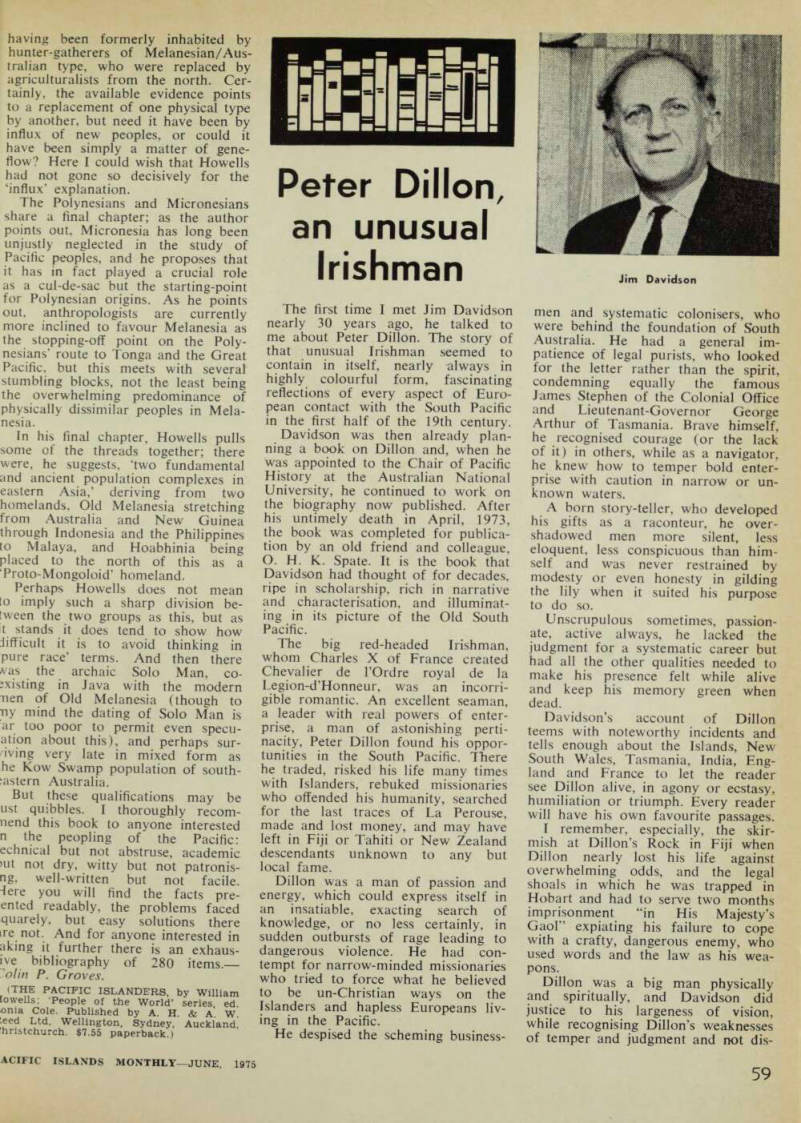
The Islanders' Origins: A Modern
Solution To An Ancient Riddle
Australia, Melanesia, Micronesia, Polynesia: when did man first set foot in these regions, where did he come from, what other peoples was he related to? These questions are of interest to many Pacific people: to the indigenous peoples wanting to know more of their origins and heri tage, and to settlers seeking an identi fication with their adopted countries.
William Howells’ Pacific Islanders is aimed at filling this need; it is to my knowledge the only thorough going, modern treatment of all the Pacific Island peoples and their rela tionships, both broad in scope and authoritative in detail, able to dismiss old myths about racial stereotypes and to replace them with a more realistic modern view.
The author is one of the most eminent names in Physical Anthro pology, the field which covers human evolution and variation in modern man. It is quite usual to find a man of his acknowledged position a kind of fossilisation of body and mind: of body, because having achieved the sought-for status, the individual ceases to be active in original re search; and of mind, in a reluctance to accept new advances in the field made by other, younger colleagues.
Not so Howells: in this book one will find a description of work re cently undertaken by the author him self on elucidating relationships be tween Pacific peoples, and on every page is evidence of serious considera tion of recent findings by other
physical anthropologists, by linguists,
and by archaeologists. Not only this; the relevant information is slotted in,’ its implications discussed, its ramifica tions explored even when it requires revision of older views, including those formerly espoused by Howells himself. AH this indicates that we are in the presence of an up-to-date work written by a considerable authority.
In case anyone is put off by all this air of science, let me say at once that the book is written with humour and humanity. Not a dry academic irony, but a genuine light touch per vades the text; where there is no
alternative but to give long lists and quote statistics, the author is duly apologetic but in the meantime he has taken care to draw attention to the importance of such things, and give the reader an interest in what the statistics reveal. There is no attempt to blind with science; even such a complex topic as Multi variate Analysis is duly explained so that the reader is borne along and is made to understand not just what the solutions are, but how they are arrived at.
The first chapter, entitled Taming the Wild Surmise, has a first-rate dis cussion of the concept of race.
Howells describes how older writers on the subject interpreted variations within a population as being the re sult of race mixture, and how a spurious appearance of authority could be imparted to this interpreta tion by referring to migration and conquests, historical or legendary, which were supposed to have caused an influx of foreign blood.
He does not say so, but it is prob ably World War II as much as any influence from the science of genetics which forced a change of heart on the part of anthropologists studying race: the ‘pure race’ concept had been the cause of so much bloodshed that it came into disrepute and so fell into abeyance; since then specialists have found, sometimes rather to their
surprise, that they could well do without it from a scientific point of view as well as a purely humanitarian one.
And so it is that Howells, having dismissed the excesses of the Pure Race concept and gently chided those who might be tempted to revive it, can go on quite naturally to trace not racial movements, but distribu tions of features that vary geo graphically; skin colour, skull form and single-gene characters including what he calls, following R. A. Fisher, ‘honorary blood-groups’, such as different types of ear-wax! Then follows a section on language: while warning that languages can be adopted by peoples apart from the original speakers, he feels that the problem of the origin and spread of the Austronesian language—the Malayo-Polynesian group, and related tongues—is of relevance to the study of the peopling of the Pacific region.
The four gross regions of the Pacific are then described one by one, their prehistory being described along with physical anthropology and linguistics. First, the aboriginal peoples of Australia (including Tas mania) are described: there is quite a full discussion of Birdsell’s theory that three different ‘racial stocks’ in vaded Australia and mixed to pro duce the present aboriginal popula tion, and the theory is eventually rejected though after sympathetic handling.
Also laid to rest are the hoary old claims that the Australian aborigines are in any way related to the Ainu of Japan, and that the Tasmanian aborigines were displaced Negritos (Oriental pygmies) or indeed in any way dwarfish. The prehistory of Australia is described in some depth, and the difficult problem of the apparent coexistence of two anatomic ally different human populations in Australia in the Upper Pleistocene is discussed but not solved.
The chapter on Melanesia is inter twined with a consideration of the history of population changes in Indonesia, which the author sees as
having been formerly inhabited by hunter-gatherers of Melanesian/Aus tralian type, who were replaced by agriculturalists from the north. Cer tainly, the available evidence points to a replacement of one physical type by another, but need it have been by influx of new peoples, or could it have been simply a matter of gene flow? Here I could wish that Howells had not gone so decisively for the ‘influx’ explanation.
The Polynesians and Micronesians share a final chapter; as the author points out, Micronesia has long been unjustly neglected in the study of Pacific peoples, and he proposes that it has in fact played a crucial role as a cul-de-sac but the starting-point for Polynesian origins. As he points out, anthropologists are currently more inclined to favour Melanesia as the stopping-off point on the Poly nesians’ route to Tonga and the Great Pacific, but this meets with several stumbling blocks, not the least being the overwhelming predominance of physically dissimilar peoples in Mela nesia.
In his final chapter, Howells pulls some of the threads together; there were, he suggests, ‘two fundamental and ancient population complexes in eastern Asia,’ deriving from two homelands. Old Melanesia stretching from Australia and New Guinea through Indonesia and the Philippines to Malaya, and Hoabhinia being placed to the north of this as a Proto-Mongoloid’ homeland.
Perhaps Howells does not mean to imply such a sharp division be tween the two groups as this, but as t stands it does tend to show how difficult it is to avoid thinking in pure race’ terms. And then there vas the archaic Solo Man, co existing in Java with the modern nen of Old Melanesia (though to ny mind the dating of Solo Man is ar too poor to permit even specu ation about this), and perhaps sur viving very late in mixed form as he Kow Swamp population of south :astern Australia.
But these qualifications may be ust quibbles. I thoroughly recom nend this book to anyone interested n the peopling of the Pacific: echnical but not abstruse, academic »ut not dry, witty but not patronis ng, well-written but not facile.
Jere you will find the facts pre ented readably, the problems faced quarely, but easy solutions there ire not. And for anyone interested in aking it further there is an exhaus ive bibliography of 280 items.— "olin P. Groves.
(The Pacific Islanders, By William
Lowells; People of the World’ series, ed. onia Cole. Published by A. H. & A. W. :eed Ltd, Wellington, Sydney, Auckland, 'hnstchurch. $7.55 paperback.)
Gifts from Britain
Books for education are high on the list of gifts from Britain to Fiji. Recently the UK High Com missioner in Fiji, Mr J. S. Arthur, handed 1,660 primary-level English books, worth about $F1,200 to the Minister for Education, Mr lone Naisara. In the next few months further gifts of 1,600 text books for junior secondary schools, the Uni versity of the South Pacific and the Ministry of Urban Development, Housing and Social Welfare will be handed over.
Advertisements & other items, p. 60 (1 item)
the Regent of Fiji
20 MINUTES FROM THE AIRPORT;
CENTURIES APART FROM THE WORLD.
kkkkkkkkkkkkkki kkkkkkkkKk r V 0 ™n m 1 nHn a “
ISsM
b; MHnMH^rMWHaiiN s=T s Pocific passengers can step into one of the world’s most legendary experiences.
The Regent of Fiji is a beach-front paradise. 300 gracious rooms clustered among towering palms and dazzling orchids. With two enchanted dining rooms. The rousing Meke Lounge. Complete banquet/convention pavilion and duty free shopping.
Outside, the gleaming Vuda—white shore—slopes into wavefree Nadi Bay. Experience our realm of ocean sports. Beachcombing, tennis, or golf. And our own fresh-water pool.
Book space in paradise now. For the night of a lifetime.
The Regent of Fiji—2o minutes from the airport.
POST OFFICE BOX 441 • NADI, FUI • PHONE 70700 • TELEX (792) 5214 ONE OF the many WORLDS OF REGENT INTERNATIONAL HOTELS
the Regent of Fiji
DENARAU BEACH RESORT
Sydney, Australia Sales Office No. 1 York Sfreef, 14fh floor Sydney, Australia 2000 Phone (02) 276469 Phone collect for reservations In Auckland, New Zealand, phone 71909
Save hundreds of dollars
on Australians most efficient
WALK IN, ALUMINIUM
COOLROOMS AND
FREEZE ROOMS
Hundreds already installed! The most economical supplementary cool- -ooms for bottles and food, providing the largest storage capacity of any comparable coolrooms of the same exterior dimensions. Five sizes —from 90-360 cu. ft. capacity; 16 models offering normal temp., two temp., deep freeze, or for pastry and ice storage applications. White vinyl interior, embossed rustproof aluminium exterior. • SUPPLIED IN EASY-TO-ERECT, DO-IT-YOURSELF KIT FORM Available from: AUSTRALIAN NEW CALEDONIA EXPORTS (SILVER & BARDA), 363 George St., Sydney, 2000 and Branches.
BRECKWOLDT & CO., 276 Pitt St., Sydney, 2000 and Branches.
PETER FISHER TRADING PTY. LTD., 321 Pitt St., Sydney, 2000.
HAGEMEYER (A'SIA), 59 Anzac Pde., Kensington, 2033 and Branches.
KERR BROS, 65 York St., Sydney, 2000.
Manufactured hv: NELSON & ROBERTSON PTY. LTD., 197 Clarence St., Sydney, 2000.
RABAUL TRADING CO. PTY. LTD., P.O. Box 219, Rabaul and Branches ROY GALLIMORE & ASSOCIATES, P.O. Box 179, Vila, New Hebrides.
C. SULLIVAN (EXPORT) PTY. LTD., 60 Margaret St., Sydney, 2000 and Branches.
W. S. TAIT & CO, PTY. LTD., 31 Macquarie Place, Sydney, 2000 and Branches.
WARBURTON FRANK!
199 Parramatta Road, Cnr. Skarratt Street, Auburn, N.S.W. 2144, Australia. Phone 648-1711.
POWERED BY
KELVINATOR.
Five-year warranty on compressor. Early delivery.
Peter Dillon,
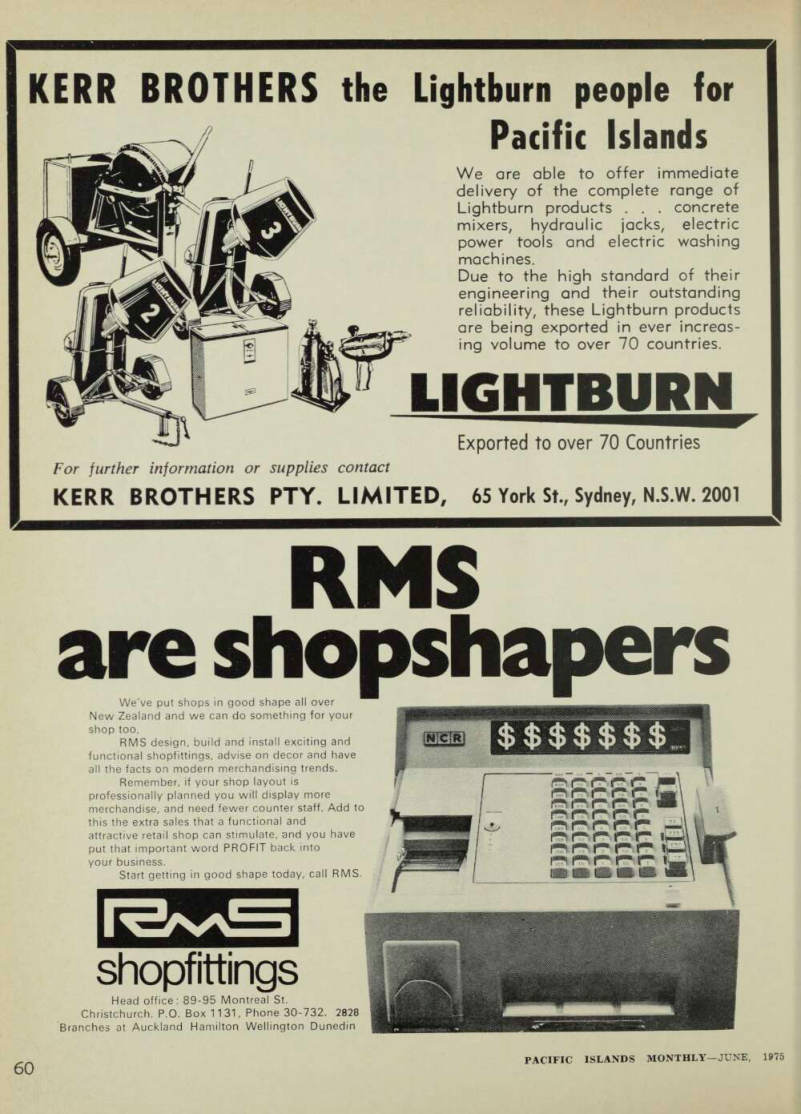
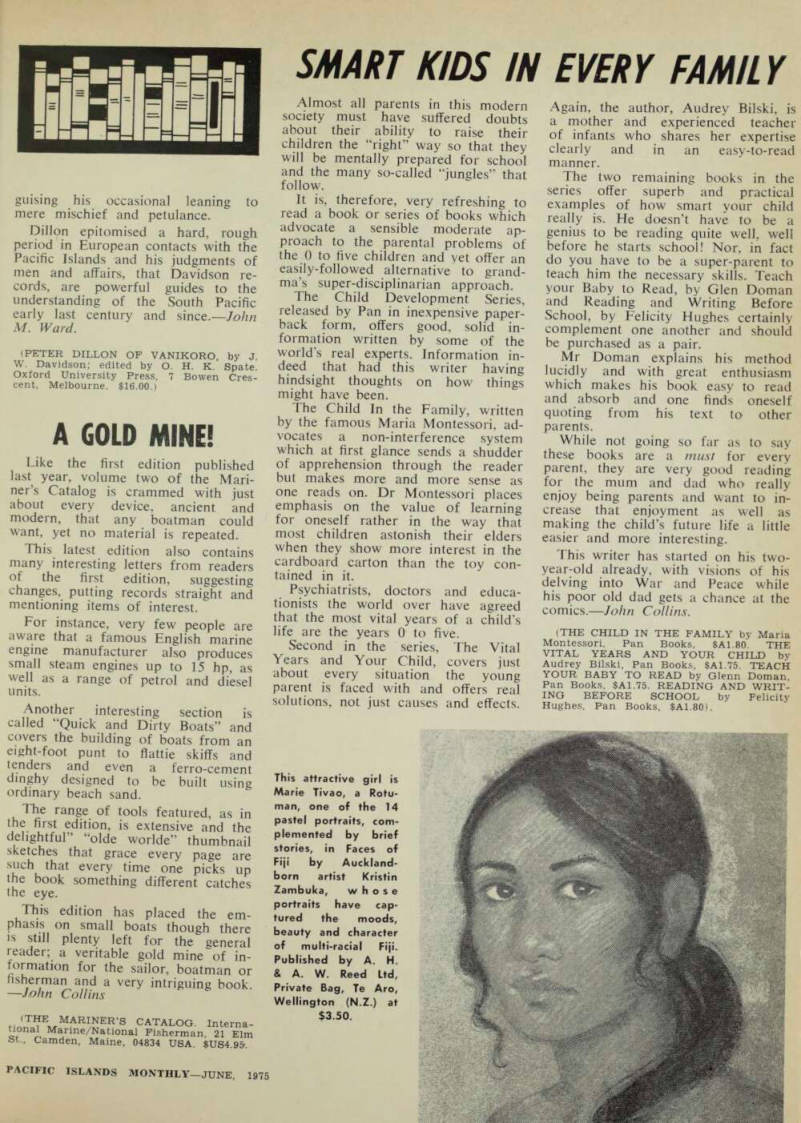
an unusual Irishman
The first time I met Jim Davidson nearly 30 years ago, he talked to me about Peter Dillon. The story of that unusual Irishman seemed to contain in itself, nearly always in highly colourful form, fascinating reflections of every aspect of Euro pean contact with the South Pacific in the first half of the 19th century.
Davidson was then already plan ning a book on Dillon and, when he was appointed to the Chair of Pacific History at the Australian National University, he continued to work on the biography now published. After his untimely death in April, 1973, the book was completed for publica tion by an old friend and colleague, O. H. K. Spate. It is the book that Davidson had thought of for decades, ripe in scholarship, rich in narrative and characterisation, and illuminat ing in its picture of the Old South Pacific.
The big red-headed Irishman, whom Charles X of France created Chevalier de I’Ordre royal de la Legion-d’Honneur, was an incorri gible romantic. An excellent seaman, a leader with real powers of enter prise, a man of astonishing perti nacity, Peter Dillon found his oppor tunities in the South Pacific. There he traded, risked his life many times with Islanders, rebuked missionaries who offended his humanity, searched for the last traces of La Perouse, made and lost money, and may have left in Fiji or Tahiti or New Zealand descendants unknown to any but local fame.
Dillon was a man of passion and energy, which could express itself in an insatiable, exacting search of knowledge, or no less certainly, in sudden outbursts of rage leading to dangerous violence. He had con tempt for narrow-minded missionaries who tried to force what he believed to be un-Christian ways on the Islanders and hapless Europeans liv ing in the Pacific.
He despised the scheming business-
men and systematic colonisers, who were behind the foundation of South Australia. He had a general im patience of legal purists, who looked for the letter rather than the spirit, condemning equally the famous James Stephen of the Colonial Office and Lieutenant-Governor George Arthur of Tasmania. Brave himself, he recognised courage (or the lack of it) in others, while as a navigator, he knew how to temper bold enter prise with caution in narrow or un known waters.
A born story-teller, who developed his gifts as a raconteur, he over shadowed men more silent, less eloquent, less conspicuous than him self and was never restrained by modesty or even honesty in gilding the lily when it suited his purpose to do so.
Unscrupulous sometimes, passion ate, active always, he lacked the judgment for a systematic career but had all the other qualities needed to make his presence felt while alive and keep his memory green when dead.
Davidson’s account of Dillon teems with noteworthy incidents and tells enough about the Islands, New South Wales, Tasmania, India, Eng land and France to let the reader see Dillon alive, in agony or ecstasy, humiliation or triumph. Every reader will have his own favourite passages.
I remember, especially, the skir mish at Dillon’s Rock in Fiji when Dillon nearly lost his life against overwhelming odds, and the legal shoals in which he was trapped in Hobart and had to serve two months imprisonment “in His Majesty’s Gaol” expiating his failure to cope with a crafty, dangerous enemy, who used words and the law as his wea pons.
Dillon was a big man physically and spiritually, and Davidson did justice to his largeness of vision, while recognising Dillon’s weaknesses of temper and judgment and not dis-
Jim Davidson
guising his occasional leaning to mere mischief and petulance.
Dillon epitomised a hard, rough period in European contacts with the Pacific Islands and his judgments of men and affairs, that Davidson re cords, are powerful guides to the understanding of the South Pacific
early last century and since.
John
M. Ward.
(Peter Dillon Of Vanikoro, By J
W. Davidson; edited by O. H. K. Spate.
Oxford University Press, 7 Bowen Cres cent, Melbourne. $16.00.)
Advertisements & other items, pp. 61-62 (2 items)
59
ACIFIC ISLANDS MONTHLY-JUNE, 1975
are shopshapers
KERR BROTHERS the Lightburn people for
Pacific Islands
M K We are able to offer immediate delivery of the complete range of Lightburn products . . . concrete mixers, hydraulic jacks, electric power tools and electric washing machines.
Due to the high standard of their engineering and their outstanding reliability, these Lightburn products are being exported in ever increasing volume to over 70 countries.
LIGHTBURN
Exported to over 70 Countries For further information or supplies contact KERR BROTHERS PTY. LIMITED, 65 York St., Sydney, N.S.W. 2001
RMS
are shopshapers
We've put shops in good shape all over New Zealand and we can do something for your shop too.
RMS design, build and install exciting and functional shopfittings, advise on decor and have all the facts on modern merchandising trends.
Remember, if your shop layout is professionally planned you will display more merchandise, and need fewer counter staff. Add to this the extra sales that a functional and attractive retail shop can stimulate, and you have put that important word PROFIT back into your business.
Start getting in good shape today, call RMS.
shopfittings
Head office: 89-95 Montreal St.
Christchurch. P.O. Box 1131, Phone 30-732. 2828 branches at Auckland Hamilton Wellington Dunedin Ct CD dN Cp a*
vj> vp \J> Cp vp
SCCCC F 1
M
RPPPP
r% r* r* rt r* r* r* r* i m
A Cold Mine!
Like the first edition published last year, volume two of the Mari ner’s Catalog is crammed with just about every device, ancient and modern, that any boatman could want, yet no material is repeated.
This latest edition also contains many interesting letters from readers of the first edition, suggesting changes, putting records straight and mentioning items of interest.
For instance, very few people are aware that a famous English marine engine manufacturer also produces small steam engines up to 15 hp, as well as a range of petrol and diesel units.
Another interesting section is called “Quick and Dirty Boats” and covers the building of boats from an eight-foot punt to flattie skiffs and tenders and even a ferro-cement dinghy designed to be built using ordinary beach sand.
The range of tools featured, as in the first edition, is extensive and the delightful” “olde worlde” thumbnail sketches that grace every page are such that every time one picks up the book something different catches the eye.
This edition has placed the em phasis on small boats though there is still plenty left for the general reader; a veritable gold mine of in formation for the sailor, boatman or fisherman and a very intriguing book.
John Collins
Manner’S Catalog. Interna
tional Manne/National Fisherman, 21 Elm St., Camden, Maine, 04834 USA. $U54.95.
Smart Kids In Every Family
Almost all parents in this modern society must have suffered doubts +U II «^ b ul» y t 0 rai^ e their children the right way so that they will be mentally prepared for school and the many so-called “jungles” that TfTj f r i • It is, therefore, very refreshing to read a book or series of books which advocate a sensible moderate apfk°n C . *2 the P aren tal problems of the 0 to five children and yet offer an easily-followed alternative to grandma ,L SUP rT^ SCl f ma V an appro , ach -
I . V „ Development Senes,
released by Pan in inexpensive paperback form, offers good, solid information written by some of the world s real experts. Information indeed that had this writer having hindsight thoughts on how things been.
Ine Child In the Family, written by the famous Maria Montessori, advocates a non-interference system which at first glance sends a shudder of apprehension through the reader but makes more and more sense as one reads on. Dr Montessori places emphasis on the value of learning tor oneself rather in the way that most children astonish their elders
s h i
that the most vital years of a child s life are the years 0 to five.
Second in the series The Vital
Yp9rc 1 Vn?,r I
rears ana Your Child, covers just about every situation the young parent is faced with and offers real solutions, not just causes and effects
Again, the author, Audrey Bilski, is a mother and experienced teacher of infants who shares her expertise clearly and in an easy-to-read manner.
The two remaining books in the series offer superb and practical examples of how smart your child really is. He doesn’t have to be a genius to be reading quite well, well before he starts school! Nor, in fact do you have to be a super-parent to teach him the necessary skills. Teach your Baby to Read, by Glen Doman and Reading and Writing Before School, by Felicity Hughes certainly complement one another and should be purchased as a pair.
Mr Doman explains his method lucidly and with great enthusiasm which makes his book easy to read and absorb and one finds oneself quoting from his text to other parents.
While not going so far as to say these books are a must for every parent, they are very good reading for the mum and dad who really enjoy being parents and want to in crease that enjoyment as well as making the child’s future life a little easier and more interesting.
This writer has started on his two year:old already, with visions of his delving into War and Peace while his poor old dad gets a chance at the
comics.
John Collins.
(THE CHILD IN THE FAMILY by Maria Montessori, Pan Books, SAI,BO. THE
Vital Years And Your Child By
Audrey Bilski, Pan Books, $A1.75. TEACH YOUR BABY TO READ by Glenn Doman,
Pan Books, $A1.75. Reading And Writ
ING BEFORE SCHOOL by Felicity Hughes, Pan Books, $A1.80).
This attractive girl is Marie Tivao, a Rotu man, one of the 14 pastel portraits, com plemented by brief stories, in Faces of Fiji by Auckland born artist Kristin Zambuka, whose portraits have cap tured the moods, beauty and character of multi-racial Fiji.
Published by A. H. & A. W. Reed Ltd, Private Bag, Te Aro, Wellington (N.Z.) at $3.50.
Advertisements & other items, p. 64 (1 item)
“thank goodness
we have Air Pacific!”
THANK GOODNESS
WE HAVE AIR PACIFIC
o* N» ?hh' 'TRT
FAKAFETAI.
KO MAUA
NE MATOU TE
EA-PASEFIKA
FAAFETAI ILE
EA PASEFIKA’
MO LE
GALUEGA LELEI
TAGIO TUMAS
IU Ml KAREM
EA PASIFIK a
TAGIO TUMAS
IU Ml KAREM
EA PASIFIK
TAGIO TUMAS
IU Ml KAREM
ME’A LELEI KO
ETAU MA’U E
EA PASIFIKI’
EA PASIFIK
& £ *6* £ * * M m m : 1 i m. ■■ fj
OMO
IMIWUR
ATSIN
TURIN
yg E RABA! EA REKE
IROURATE
-AIR PACIFIC”
AIR
-Vv
E UASIVI
DUADUA
NA
PACIFIC
JR***
PACIFIC . , .
t*sk " . is®*
the one we know!
When you live in an area as big as our
South Pacific you will appreciate having
an airline like Air Pacific. Fast, reliable and
efficient!
GILBERT ISLANDS
PORT VMJOJ* “
MORESBY SOLOMON jFsLANDS
ISLANDS| SAMOA
BRISBANE
NEW
HEBI
BRIDES
TONGA
AUCKLAND
Not too big to lose its friendly personal South Seas island touch-and’not too small to give you a crowded feeling. When you fly Air Pacific-you II experience that wonderful 'welcome back home' feeling from the people you know. Jet Air Pacific to the REAL PACIFIC.
am aacm
We fly to more South Pacific Islands than any other Airline.
For details and bookings contact your travel agent or Air Pacific, Private Bag, Suva Fiji.
Pacific Transport
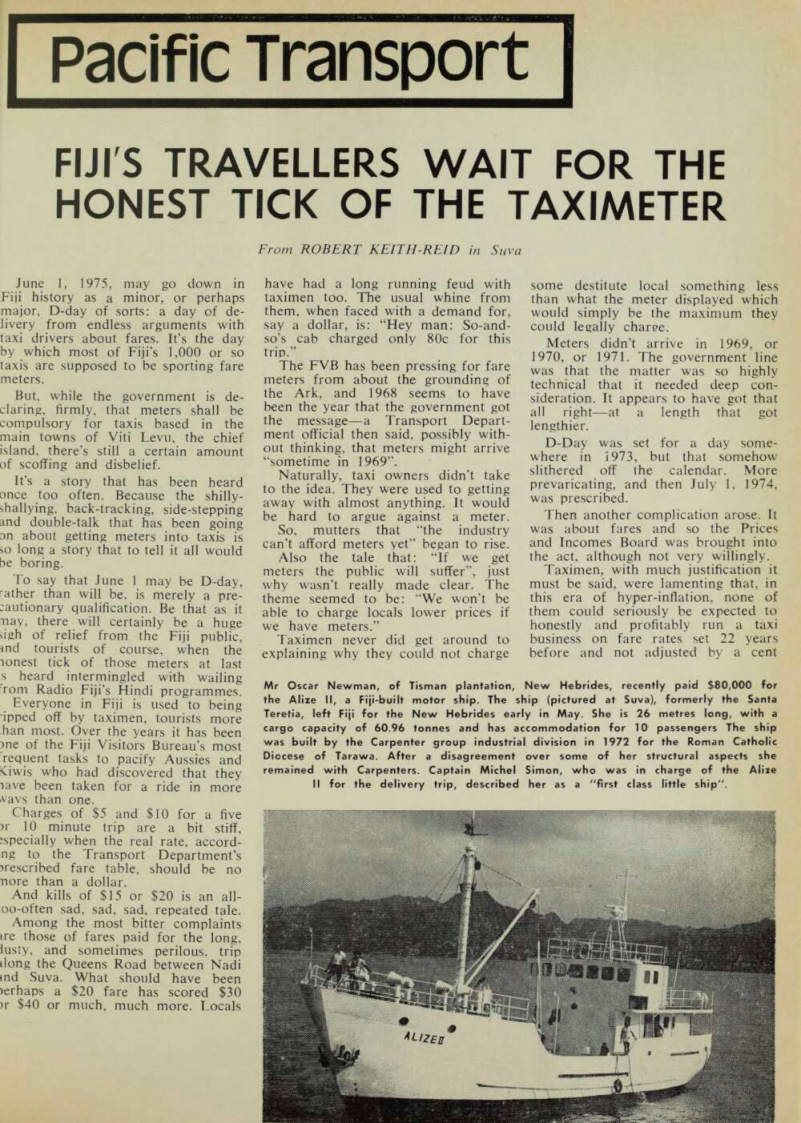
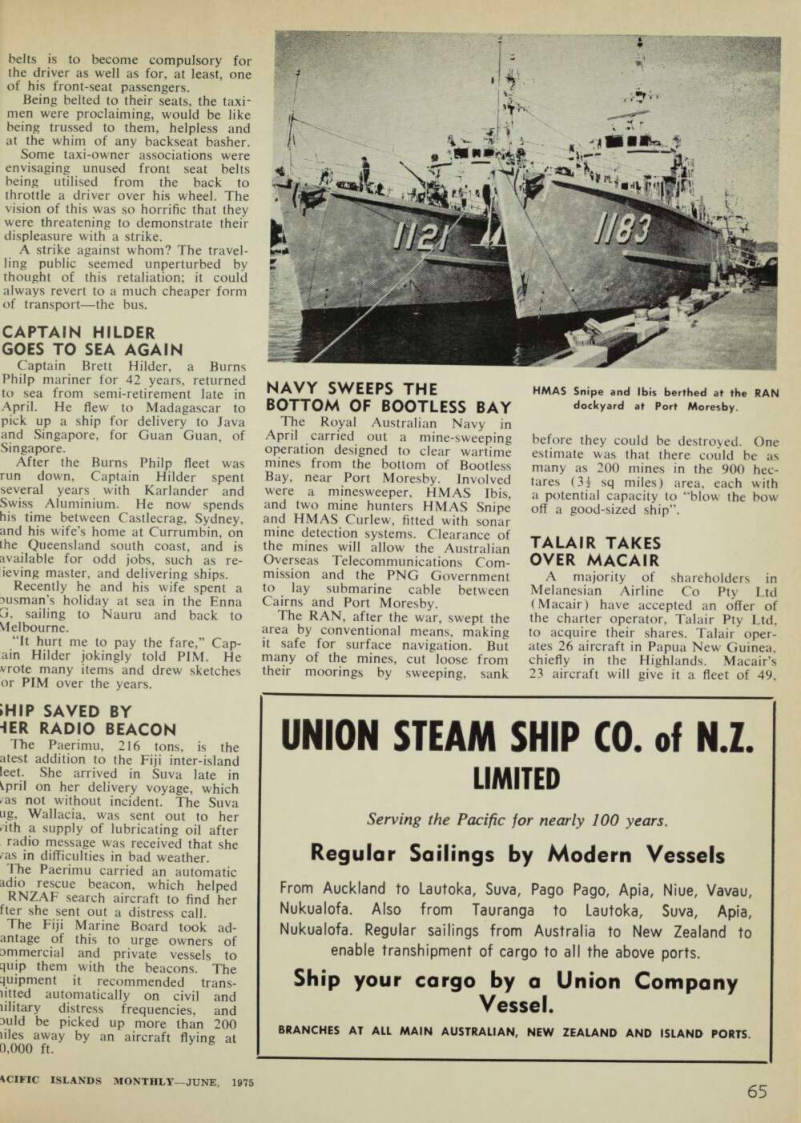
Fiji's Travellers Wait For The
Honest Tick Of The Taximeter
From ROBERT KEITH-REID in Suva
June 1, 1975, may go down in Fiji history as a minor, or perhaps major, D-day of sorts: a day of de livery from endless arguments with taxi drivers about fares. It’s the day by which most of Fiji’s 1,000 or so taxis are supposed to be sporting fare meters.
But, while the government is de claring, firmly, that meters shall be compulsory for taxis based in the main towns of Viti Levu, the chief island, there’s still a certain amount of scoffing and disbelief.
It’s a story that has been heard once too often. Because the shilly shallying, back-tracking, side-stepping and double-talk that has been going on about getting meters into taxis is so long a story that to tell it all would be boring.
To say that June 1 may be D-day, "ather than will be, is merely a pre :autionary qualification. Be that as it iiay, there will certainly be a huge sigh of relief from the Fiji public, and tourists of course, when the aonest tick of those meters at last s heard intermingled with wailing rom Radio Fiji’s Hindi programmes.
Everyone in Fiji is used to being ipped off by taximen, tourists more han most. Over the years it has been me of the Fiji Visitors Bureau’s most Vequent tasks to pacify Aussies and Kiwis who had discovered that they aave been taken for a ride in more vavs than one.
Charges of S 5 and $lO for a five )r 10 minute trip are a bit stiff, specially when the real rate, accord ng to the Transport Department’s described fare table, should be no nore than a dollar.
And kills of $l5 or $2O is an all oo-often sad, sad, sad, repeated tale.
Among the most bitter complaints ire those of fares paid for the long, lusty, and sometimes perilous, trip dong the Queens Road between Nadi md Suva. What should have been >erhaps a $2O fare has scored $3O >r $4O or much, much more. Locals
have had a long running feud with taximen too. The usual whine from them, when faced with a demand for, say a dollar, is: “Hey man: So-and so’s cab charged only 80c for this trip.”
The FVB has been pressing for fare meters from about the grounding of the Ark, and 1968 seems to have been the year that the government got the message—a Transport Depart ment official then said, possibly with out thinking, that meters might arrive “sometime in 1969”.
Naturally, taxi owners didn’t take to the idea. They were used to getting away with almost anything. It would be hard to argue against a meter.
So, mutters that “the industry can’t afford meters yet” began to rise.
Also the tale that: “If we get meters the public will suffer”, just why wasn’t really made clear. The theme seemed to be: “We won’t be able to charge locals lower prices if we have meters.”
Taximen never did get around to explaining why they could not charge
some destitute local something less than what the meter displayed which would simply be the maximum they could legally charge.
Meters didn’t arrive in 1969, or 1970, or 1971. The government line was that the matter was so highly technical that it needed deep con sideration. It appears to have got that all right—at a length that got lengthier.
D-Day was set for a day some where in 1973, but that somehow slithered off the calendar. More prevaricating, and then July 1, 1974, was prescribed.
Then another complication arose. It was about fares and so the Prices and Incomes Board was brought into the act, although not very willingly.
Taximen, with much justification it must be said, were lamenting that, in this era of hyper-inflation, none of them could seriously be expected to honestly and profitably run a taxi business on fare rates set 22 years before and not adjusted by a cent
Mr Oscar Newman, of Tisman plantation, New Hebrides, recently paid $BO,OOO for the Alize 11, a Fiji-built motor ship. The ship (pictured at Suva), formerly the Santa Teretia, left Fiji for the New Hebrides early in May. She is 26 metres long, with a cargo capacity of 60.96 tonnes and has accommodation for 10 passengers The ship was built by the Carpenter group industrial division in 1972 for the Roman Catholic Diocese of Tarawa. After a disagreement over some of her structural aspects she remained with Carpenters. Captain Michel Simon, who was in charge of the Alize II for the delivery trip, described her as a "first class little ship".
since—3oc for the first mile and 20c for each successive one.
Why, even a former Finance Minis ter, Mr Wesley Barrett, boss of the Cathay Hotel chain, had gone on record in parliament as saying he couldn’t understand how any taximan could make a living. He had tried running a few cabs and found they just didn’t pay.
The government agreed that an in crease was needed but added that proposals it had been mulling over needed to be okayed by the PIB.
“Okay,” said the PIB. but not with out a technical study that was beyond its means to carry out.
So D-day was postponed until November, and then months of De cember and January were bandied about.
By January, the taximen were get ting really fed up about fares and in several towns declared that the gov ernment and PIB could go to hell.
They would charge what they thought was a reasonable rate —60c to 70c for the first mile and 40c to 50c after.
The mutiny brought warnings of dire consequences from the board and Transport Department. It lasted a few days but seemed to spur the Ministry for Communications and Works to a declaration of an upward revised table —20c at flagfall, 10c for each quarter of a mile; a 5c surcharge in country areas reckoned to be extra rough on vehicles and a 25c surcharge for trips made between midnight and 6 am.
There were some moans, but, sur prisingly, the majority of taximen accepted this formula without pro test.
June 1 was then hailed as the for real, genuine thing for all 815 taxis based in Suva, Lautoka, Nadi, Nau sori and Sigatoka. Taxis elsewhere were to equip with meters at a date to be decided later.
Several companies began advertis ing the gadgets at around $4OO and caused more screams.
“Meters in Australia cost only $7O —they shouldn’t cost more than $lOO here —we’re being done,” Or just simply: “Boss, we can’t afford.”
As this article was being written, it was D-day minus 30 and Secre tary for Communications, Works and Tourism, Mr Bob Dods, had issued a warning. Hardly any taxis, he said, seemed to be getting fitted with meters —there’s only a month to go— you’d better get a move on because from June 1 it will be illegal to run without one.
There seemed to be little response to his edict; taximen were too busy holding meetings to condemn another date. , r .
Along with meters the use of seat
belts is to become compulsory for the driver as well as for, at least, one of his front-seat passengers.
Being belted to their seats, the taxi men were proclaiming, would be like being trussed to them, helpless and at the whim of any backseat basher.
Some taxi-owner associations were envisaging unused front seat belts being utilised from the back to throttle a driver over his wheel. The vision of this was so horrific that they were threatening to demonstrate their displeasure with a strike.
A strike against whom? The travel ling public seemed unperturbed by thought of this retaliation; it could always revert to a much cheaper form of transport—the bus.
Captain Milder
Goes To Sea Again
Captain Brett Hilder, a Burns Philp mariner for 42 years, returned to sea from semi-retirement late in April. He flew to Madagascar to pick up a ship for delivery to Java and Singapore, for Guan Guan, of Singapore.
After the Burns Philp fleet was run down, Captain Hilder spent several years with Karlander and Swiss Aluminium. He now spends his time between Castlecrag, Sydney, and his wife’s home at Currumbin, on the Queensland south coast, and is available for odd jobs, such as re ieving master, and delivering ships.
Recently he and his wife spent a jusman’s holiday at sea in the Enna 3, sailing to Nauru and back to Melbourne. ‘‘lt hurt me to pay the fare,” Cap ain Hilder jokingly told PIM. He vrote many items and drew sketches or PIM over the years.
►Hip Saved By
Her Radio Beacon
The Paerimu, 216 tons, is the atest addition to the Fiji inter-island leet. She arrived in Suva late in on her delivery voyage, which /as not without incident. The Suva ug, Wallacia, was sent out to her /ith a supply of lubricating oil after radio message was received that she /as in difficulties in bad weather.
The Paerimu carried an automatic adio rescue beacon, which helped RNZAF search aircraft to find her fter she sent out a distress call.
The Fiji Marine Board took ad antage of this to urge owners of ammercial and private vessels to quip them with the beacons. The quipment it recommended trans uded automatically on civil and lilitary distress frequencies, and juld be picked up more than 200 files away by an aircraft flying at 0,000 ft.
Navy Sweeps The
Bottom Of Bootless Bay
The Royal Australian Navy in April carried out a mine-sweeping operation designed to clear wartime mines from the bottom of Bootless Bay, near Port Moresby. Involved were a minesweeper, HMAS Ibis, and two mine hunters HMAS Snipe and HMAS Curlew, fitted with sonar mine detection systems. Clearance of the mines will allow the Australian Overseas Telecommunications Com mission and the PNG Government to lay submarine cable between Cairns and Port Moresby.
The RAN, after the war, swept the area by conventional means, making it safe for surface navigation. But many of the mines, cut loose from their moorings by sweeping, sank
before they could be destroyed. One estimate was that there could be as many as 200 mines in the 900 hec tares (3i sq miles) area, each with a potential capacity to “blow the bow off a good-sized ship”.
Talair Takes
Over Macair
A majority of shareholders in Melanesian Airline Co Pty Ltd (Macair) have accepted an offer of the charter operator, Talair Pty Ltd, to acquire their shares. Talair oper ates 26 aircraft in Papua New Guinea, chiefly in the Highlands. Macair’s 23 aircraft will give it a fleet of 49,
HMAS Snipe and Ibis berthed at the RAN dockyard at Port Moresby.
and will enable it to extend opera tions to eastern Papua and the Morobe area.
The airline will service, on a regular timetable, 92 PNG and Solo mon Islands airports, as well as undertaking charters in PNG. In cluded in the takeover will be the Solomon Islands Airways Ltd (Solair), which recently acquired rights to operate between Honiara and Kieta.
Geic Hit By
Shipping Shortage
A sudden shortage of shipping has hit the Gilbert and Ellice Islands.
The Teraka, after a recent trip to Christmas Island, was found to be in need of extensive repairs, which were expected to take about three weeks. Then she had to go for slip ping and overhaul, which would put her out of action for another three months.
This came at a time when the Moana Raoi was in Suva for annual overhaul. The demand for shipping at the time has been particularly high, with people from Nauru re turning home, and others being recruited to go to Nauru. The* re maining ships were expected to be hard pressed on internal work. These services will be disrupted for several months; it may not be possible to maintain the normal frequency of services to outer islands.
Sacked Air Pacific Men
Return To Work
A dispute between Air Pacific and the Air Pacific Transport Employees’
Association ended after arbitration proceedings, when the arbitrator, Mr R. I. Kapadia, said that about 300 employees should be reinstated with out delay.
The dispute rose when the presi dent of the association, Mr Gyanen dra Singh, refused to accept a new post, which he claimed was a down grading, and he was dismissed. A strike followed.
Air Pacific told the strikers to re turn to work, setting a deadline, and saying that those who did not return to work by then would be dismissed.
A number were dismissed on that ground, although many of them claimed they were held up getting to work through a transport delay.
The arbitrator said Mr Singh should take the new post, and if he did not, the company would be en titled to dismiss him on one month’s notice. Air Pacific flights were not affected.
Advertisements & other items, pp. 66-68 (2 items)
Daiwa Line
I^IWA
fc|N»
DIRECT REGULAR SERVICE
JAPAN-SOUTH PACIFIC
TARAWA-PAPEETE-PAGO PAGO-APIA
SUVA-LAUTOKA-NOUMEA-VILA
SANTO-HONIARA
JAPAN-GUAM-TAIWAN
JAPAN-GUAM-KEELUNG BY
EXCELLENT CAR/CONTAINER-CARRIER
JAPAN-WEST IRIAN-DILI
HONG KONG-TAI WAN-WEST IRIAN-DILI
AGENTS:
GUAM: ATKINS, KROLL (GUAM) LTD.
TARAWA: G. & E. I. DEVELOPMENT AUTHORITY.
APIA; BURNS PHILP (SOUTH SEA) CO., LTD.
PAGO PAGO: KNEUBUHL MARITIME SERVICES CORP.
NUKUALOFA: PACIFIC NAVIGATION CO., LTD.
SUVA: BURNS PHILP (SOUTH SEA) CO., LTD.
LAUTOKA: BURNS PHILP (SOUTH SEA) CO.. LTD.
NOUMEA: AGENCE MARITIME ET AERIENNE
CALEDONIENNE.
SANTO: BURNS PHILP (NEW HEBRIDES) LTD.
VILA: BURNS PHILP (NEW HEBRIDES) LTD.
HONIARA: BRITISH SOLOMONS TRADING CO., LTD.
PAPEETE: AGENCE MARITIME DE FARA UTE.
HONG KONG: IKE MARITIME CO., LTD.
SINGAPORE: THE BORNEO CO., (SINGAPORE) LTD.
DJAJAPURA: P. N. PELAJARAN NASIONAL INDONESIA.
DILI: SANG TAI HOO
TAIWAN: FOR CARGO BETWEEN JAPAN/GUAM/TAIWAN
FORMOSA SHIPPING & ENTERPRISE CORP.
TAIWAN: FOR CARGO BETWEEN JAPAN/SOUTH PACIFIC/
WEST IRIAN/DILI
MARITIME TRANSPORTATION AGENCIES, LTD.
THE DAIWA MAX IG AXIOM CO.. LTD,
OSAKA: "DAILINE" TOKYO; “FUNEDAILINE"
HEAD OFFICE TOKYO OFFICE
NO. 25-1, 4-CHOME MINAMIKYUTARO- NO. 20, 3-CHOME KANDA-NISHIKI-
MACHI, HIGASHI-KU, OSAKA CHO CHIYODA-KU, TOKYO
TEL: OSAKA (244) 1281-9 TEL: TOKYO (292) 2441-5
UNION STEAM SHIP CO. of N.Z.
LIMITED
Serving the Pacific for nearly 100 years.
Regular Sailings by Modern Vessels
From Auckland to Lautoka, Suva, Pago Pago, Apia, Niue, Vavau, Nukualofa. Also from Tauranga to Lautoka, Suva, Apia, Nukualofa. Regular sailings from Australia to New Zealand to enable transhipment of cargo to all the above ports.
Ship your cargo by a Union Company Vessel.
BRANCHES AT ALL MAIN AUSTRALIAN, NEW ZEALAND AND ISLAND PORTS.
McDonnell Douglas
Air Hew Zealand
For over a decade the Pacific's
great airline partnership.
Air New Zealand has always chosen the best aircraft in the world for its demanding Pacific routes.
Routes that are like no others in the world and where an aircraft needs deep reserves of power and dependability.
Air New Zealand chose aircraft specifically designed for this peculiarly specialised part of the world. And that choice is all McDonnell Douglas.
DC-8s and DC-1 Os.
The best aircraft in the world to handle Air New Zealand's Pacific routes. You'll find each aircraft on particular routes.
The DC-8s usually on shorter hauls and where there are particular circumstances.
And the DC-1 Os on the long hauls between major cities. In twelve months they move more people than the population of Auckland in supreme comfort and „
*** , reliability. /$
i The DC-8s have been well proven and Air New Zealand is modernising the interiors by fitting many of the latest DC-10 cabin features.
And the DC-10 has a formidable list of features.
It isn’t a stretched version of a smaller plane. It’s a whole new generation of aircraft using the best space flight technology.
Only Air New Zealand fly the DC-10 out of New Zealand.
Here are a few reasons why it has become the Pacific’s favourite big jet; 1. The DC-10 is designed to seat up to 343 people in comfort.
AirNewZealnd fit only 247 seats into that huge space. So every passenger has plenty of room. No-one is more than one seat away from an aisle. Everyone can see the movie screens. 2. The DC-10 fan jets are the most powerful in commercial service. Conversely, they're quieter than most other jet-liners.
And don’t look for polluting smoke trails. DC-1 Os don’t smoke.
The seats selected by Air New Zealand are probably the best ever, apart from controlling your choice of k B-channel stereo music and new release films, they are totally adjustable - even the lumbar support adjusts precisely to your back - and your back is like no-one elses. 3. The galleys on the DC-1 Os aren’t there just to heat food.
They’re thereto cook food as well as any first-class restaurant. 4. The navigational equipment is unsurpassed. Your pilot can see hundreds of miles ahead, to avoid bad weather areas.
If you believe that it takes a very specialised kind of car to win a Grand Prix, ora very specialised kind of camera to take pictures on the moon, you’ll also be aware that it takes a very specialised family of planes *o fly the Pacific.
It does.
And Air New Zealand have them.
MCDONNi
65
%CIFIC ISLANDS MONTHLY—JUNE, 1975
Unionists in ship business
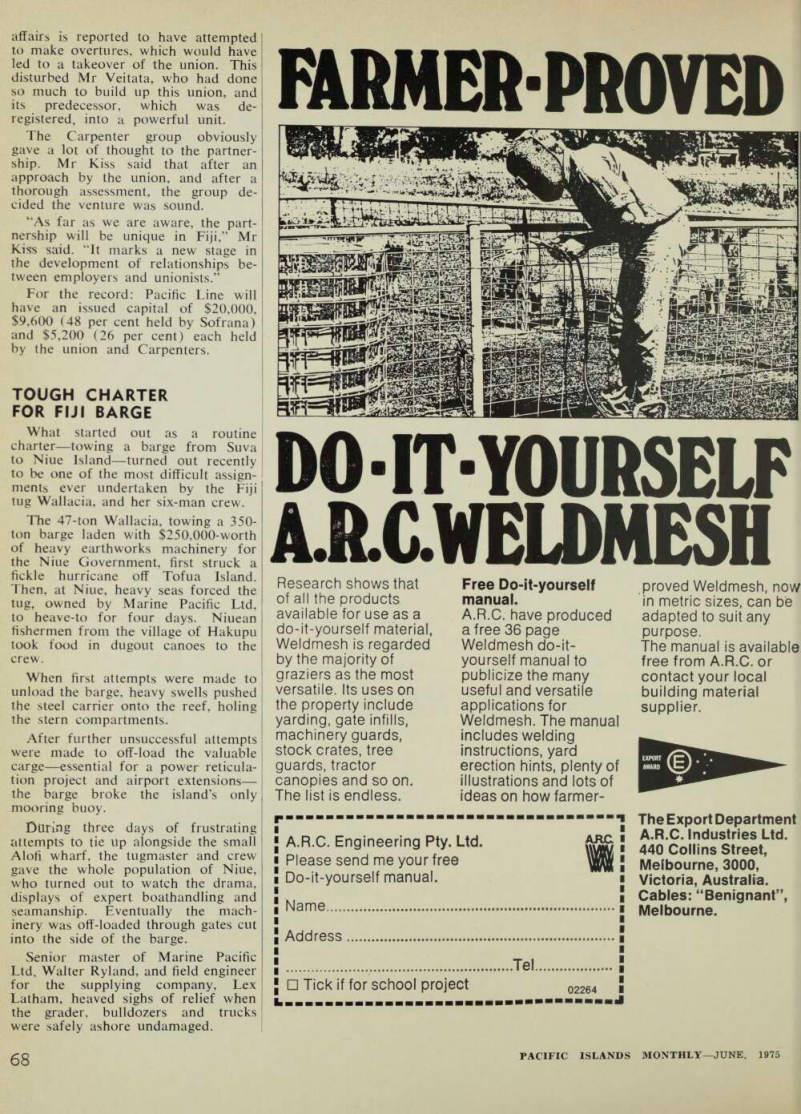
A Fiji trade union has linked with two major companies to form a ship ping line—possibly the first time the world has seen such an alliance.
The union, the Fiji Waterside Workers and Seamen’s Union, is as militant as many overseas maritime unions, yet it has formed a partner ship with a shipping company, Sof rana Fiji Express Line Ltd, and W.
R. Carpenter (South Pacific) Ltd.
For the Carpenter group, it is a return to shipping, which it aban doned several years ago. The new company is Pacific Line Ltd, which has chartered the Capitaine La Perouse from Sofrana, and renamed it Tui Cakau, a name well known in Fiji shipping and stretching back over the years.
The ship will operate on a monthly schedule covering Auckland, Tau ranga, Lautoka, Suva and Apia. It will carry general and freezer cargo from New Zealand, transshipment consignments and other cargo from Fiji for Apia, and Fiji exports to New Zealand. The line does not
contemplate operating a regional
service along the lines of the SPEC
regional service.
On the board of the new company are Captain Alain Munch, managing director of Sofrana, Mr Harry Kiss, general manager of the Carpenter shipping division, and Mr Taniela Veitata, the union’s industrial officer.
Mr Kiss is managing director.
To become a member of the board, as well as hold a paid position in a
maritime union, is a tremendous step for Mr Veitata. In future dealings with the union on industrial matters, he will have a foot in both camps— as far as the Tui Cakau is concerned at any rate.
But that does not worry him in the slightest. He said that about two years ago, his union, of which he was then secretary, planned to buy a ship, but lacked finance, and technical and managerial expertise.
“I know it is unusual for a union to team up with employers like this, but we think the new company offers the best scope for the union to get into commercial shipping,” he said.
“It should also lead to an improve ment in industrial relations.”
About 26 members of his union will have permanent posts in the Tui Cakau.
He described the new venture as only the start. The union was look ing at the possibility of getting in volved in other business ventures.
Apart from appearing in a new role, Mr Veitata has made a real comeback in union affairs. He had been disqualified from holding an elective position in the union because of a brush with the law. but when his services became available again, the union employed him as a paid industrial officer, and, in fact, he is again a strong force and possibly leader in everything but name, of his union.
While he was out of circulation another figure prominent in Fiji
affairs is reported to have attempted to make overtures, which would have led to a takeover of the union. This disturbed Mr Veitata, who had done so much to build up this union, and its predecessor, which was de registered, into a powerful unit.
The Carpenter group obviously gave a lot of thought to the partner ship. Mr Kiss said that after an approach by the union, and after a thorough assessment, the group de cided the venture was sound.
“As far as we are aware, the part nership will be unique in Fiji,” Mr Kiss said. “It marks a new stage in the development of relationships be tween employers and unionists.”
For the record: Pacific Line will have an issued capital of $20,000, $9,600 (48 per cent held by Sofrana) and $5,200 (26 per cent) each held by the union and Carpenters.
Tough Charter
For Fiji Barge
What started out as a routine charter—towing a barge from Suva to Niue Island—turned out recently to be one of the most difficult assign ments ever undertaken by the Fiji tug Wallacia, and her six-man crew.
The 47-ton Wallacia, towing a 350ton barge laden with $250,000-worth of heavy earthworks machinery for the Niue Government, first struck a fickle hurricane off Tofua Island.
Then, at Niue, heavy seas forced the tug, owned by Marine Pacific Ltd, to heave-to for four days. Niuean fishermen from the village of Hakupu took food in dugout canoes to the crew.
When first attempts were made to unload the barge, heavy swells pushed the steel carrier onto the reef, holing the stern compartments.
After further unsuccessful attempts were made to off-load the valuable carge—essential for a power reticula tion project and airport extensions— the barge broke the island’s only mooring buoy.
During three days of frustrating attempts to tie up alongside the small Alofi wharf, the tugmaster and crew gave the whole population of Niue, who turned out to watch the drama, displays of expert boathandling and seamanship. Eventually the mach inery was off-loaded through gates cut into the side of the barge.
Senior master of Marine Pacific Ltd, Walter Ryland, and field engineer for the supplying company, Lex Latham, heaved sighs of relief when the grader, bulldozers and trucks were safely ashore undamaged.
Advertisements & other items, pp. 69-70 (1 item)
Pacific Isiands Transport Lint
Owners: Thor Dahls Hvalfangerselskap A/S —Sande fjord, Norway.
MOTOR VESSEL "THORSISLE"
Regular Freight and Passenger Services between Pacific Coast Ports of U.S.A. and Canada and
TAHITI and SAMOA
GENERAL STEAMSHIP CORPORATION LTD.
General Agents 400 California Street, San Francisco, California, U.S.A.
APlA—Burns Philp (South Sea) Company, SYDNEY—Trans-Austral Shipping Pty. Ltd.
Ltd. SUVA—Burns Philp (South Sea) Company, PAPEETE —Age nee Maritime Internationale Ltd.
Tahiti. LAE/RABAUL—Burns Philp (New Guinea) Ltd.
PAGO PAGO —Polynesia Shipping Services, Inc. PORT VlLA—Comptoirs Francais de Nouvelles NOUMEA— Etablissements Ballande. Hebrides.
FARMER-PROVED
IF
: ; VP-nBC
W msmssmsm .fg 811 ■ ff HSi m \ms - KB mm 1 es»K» q
DO-IT-YOURSELF
A.RX.WELDMESH
Research shows that of all the products available for use as a do-it-yourself material, Weldmesh is regarded by the majority of graziers as the most versatile. Its uses on the property include yarding, gate infills, machinery guards, stock crates, tree guards, tractor canopies and so on.
The list is endless.
Free Do-it-yourself manual.
A.R.C. have produced a free 36 page Weldmesh do-ityourself manual to publicize the many useful and versatile applications for Weldmesh. The manual includes welding instructions, yard erection hints, plenty of illustrations and lots of ideas on how farmerproved Weldmesh, now in metric sizes, can be adapted to suit any purpose.
The manual is available free from A.R.C. or contact your local building material supplier.
The Export Department A.R.C. Industries Ltd. 440 Collins Street, Melbourne, 3000, Victoria, Australia.
Cables: “Benignant”, Melbourne.
Cruising

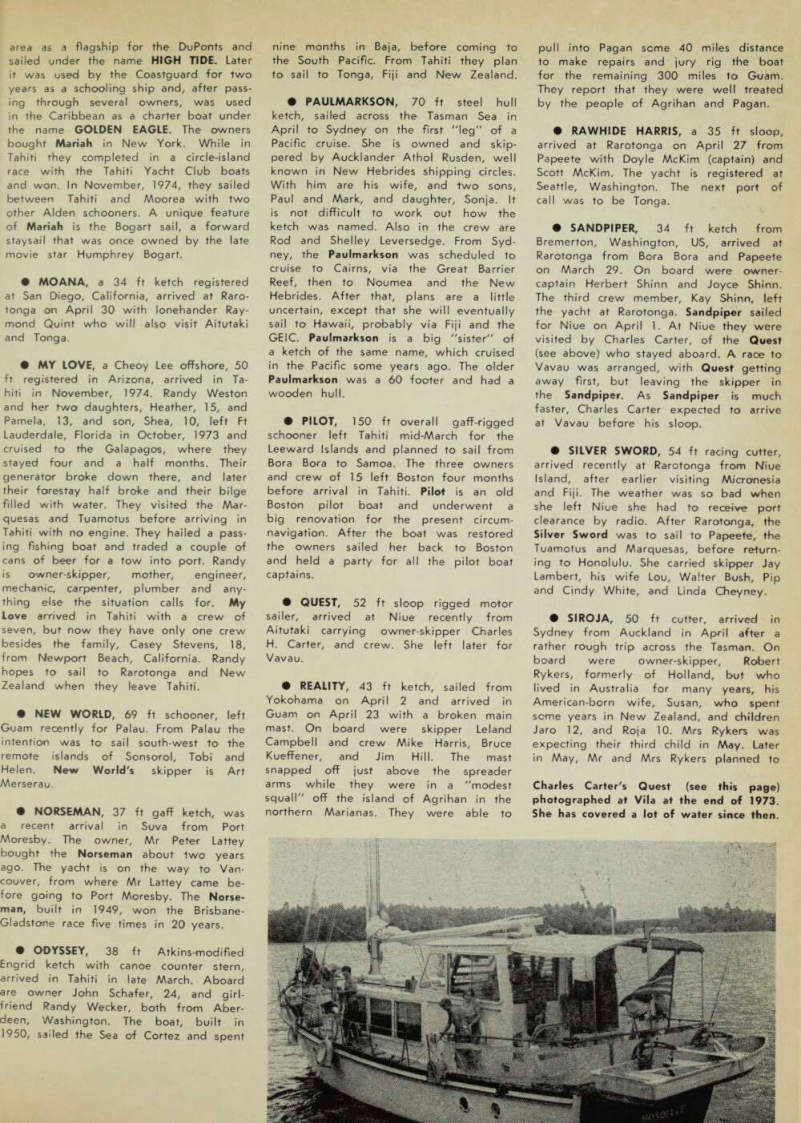
Yachts
• APHRODITE, yacht, which had been cruising in Fiji waters for several months, caught a thief's eye recently while anchored at Levuka. The owner, Robert Meelberg, a retired US businessman, discovered two outboard engines had been stolen. The police caught the thief, who admitted taking the engines, plus a fuel tank from the yacht's dinghy. The thief got nine months in gaol. • AQUARIUS, a 34 ft sloop registered in Portland, Oregon, arrived at Rarotonga on April 30 from Tahiti with Othell Hallouf (captain) and Maxine Hallouf.
They planned to call at Aitutaki, Su warrow and Pago Pago. • CHAMARU, 50 ft ketch-rigged diesel auxiliary trimaran, arrived at Raro tonga from Bora Bora and Papeete on April 1 with owner-skipper Commander Charles M. Sturkey, USNI ret, his wife Mary, and a Filipino. Cdr Sturkey, who did his last stint with the navy in Japan, had the tri built at Sasebo, Japan, in 1965-68, by local craftsmen under his supervision. Commander Sturkey is a marine architect and also a radio ham (K7BGS —W7TNA). The tri is registered in Seattle, Washington, which is the Sturkeys' home. Plans were to call at Aitutaki, Samoa, Fiji, New Hebrides, the Solomons and the Philippines. The Sturkeys had cruised 49,000 miles in Chamaru since leaving Japan. • CHERRY BRA 111, a 30 ft sloop of Japanese registry, arrived in Guam re cently from Hawaii with stops at Fanning Island, Tarawa, Kusaie, Ponape and Truk.
Owner-skipper Shiro Sugiyama named his boat because of his partiality for cherry brandy. With Sugiyama are his crew, Yoshio Suzuki and Yoshihiro Kusuda.
From Guam they planned to sail back to Japan, with stops at Saipan, Pagan
and Agrihan.
• COQUILLE, a 37 ft yacht, arrived at Rarotonga on April 18 from Papeete with Captain Ronald L. Hayes and crew Phyllis Hayes, Annie Larmor, David Peek, and guest Stephen Schenkel. • EASTERN WANDERER, 30 ft sloop n Tahiti, was bought a year ago by : renchman Bernard Calvet, and his Swedish wife, Kerstin. They are living aboard with their 8-month-old daughter, sabrina. Bernard is a former captain of he South Seas Winds boat chartering
company and is working in Tahiti repair ing boats. Kerstin formerly worked as crew on windjammer cruises in the Caribbean. They hope to sail the islands of French Polynesia and perhaps to Hawaii. • FOLLY 111, 30 ft sloop, left Tahiti on April 5 and arrived at Rarotonga a week later, carrying co-owners Suzanne M. Wilson (captain) and Eleanor A.
Gobrecht. They spent five months in French Polynesia. On the way south from Long Beach, California, they called at Acapulco, the Galapagos, Marquesas and Tahiti. They lost a gudgeon in the Gala pagos. From Rarotonga they planned to sail to Aitutaki, Suwarrow, Pago Pago, Tonga and Fiji. • GRAY BEARD, 73 ft ketch out of Vancouver, stopped at Guam on its way to Japan. On board were captain Lol Killam and his wife Rose and crew members Go Southam, Tony Griffin, Chett Chettleburgh, Brent Davis, and Tom Fee.
The big ketch made many interesting stops in Micronesia and the Solomons in the past few months. • GRETEL, which is at Rarotonga, is an ex-trading vessel converted for ocean cruising and is both roomy and comfort able. The globe-circling cruise started from Stockholm on September 1, 1974, with ports of call at the Canary Islands, the West Indies, Panama, then the Gala pagos and Marquesas. The circumnavi gation will take them to Samoa, Fiji, Tonga and Port Moresby. If the Suez Canal is open for shipping, they will use it to return home to Sweden. If not, they will take the longer route around the Cape of Good Hope. • GYPSY COWBOY, a 41 ft Sea Wolf ketch, Miami, Florida, planned to leave Tahiti mid-April to continue a circum navigation. Captain Carl Erickson, Colo rado, and owner-crew Bill Duncan, Mis souri, left Miami a year ago and have sailed to Jamaica, through the Panama Canal to the Galapagos, Marquesas and arrived in Tahiti in December, 1974. They intend to sail to New Zealand via Hua hine, Bora Bora, the Cook Islands, Samoa and Fiji. • HIKUERU 111, 43 ft ketch-rigged Calypso built in Holland, arrived in Tahiti on March 31. Owners Peter and Dorothy Bufe of Berlin, Germany, started their round-the-world trip from Southern France in July, 1974. They have visited Gibraltar, Palma de Mallorca, Marbella, Casablanca, the Canary Islands, several islands in the Caribbean, Colombia, and Panama before passing through the Pana ma Canal to the Pacific. They went to the Galapagos and the Tuamotus. They also visited the island their boat is named for, Hikueru, formerly a pearl diving locale. Their scheduled calls for an April
11 departure were Samoa, the New Hebrides and Port Moresby, before going on to Indonesia. • KISSES, 45 ft Columbia motor-sailer, left Tahiti on March 25 for Hilo, Hawaii.
Owners Don and Mickey Kidder left California in December, 1973, and sailed down the coast of California and Mexico, then came to the South Pacific, where they visited the Marquesas, Tuamotus, the Society Islands, the Samoas, Fiji, Tonga and Rarotonga before returning to Tahiti. They were joined in Tahiti by Mickey's sister, Mary Jo Downing, for the trip to Hawaii. From Hilo they will sail to Honolulu and back to California.
Also aboard were pets Tammy and Dam mit, a cockatoo and a Siamese cat. • LA CARETA, a 32 ft sloop, arrived at Rarotonga from Tahiti and Bora Bora on April 14 with twin brothers Anders and Gunnar Eriksson, co-owners of the yacht. Their voyage started from north Sweden in July 1973 and took them to Germany, England, Portugal, Spain, and across the Atlantic to Barbados. From Panama they sailed direct to the Mar quesas and then Tahiti. Plans are to call at Tonga, Fiji, New Caledonia and Port Moresby. • MAHINA, a 27 ft sloop built in Sweden in 1969, arrived at Rarotonga on April 2 from the French Polynesian Islands with single-hander, John Neal.
John, born in the Sudan, and now from the US, started his voyage from Seattle.
Ports of call included San Francisco and the Hawaiian Islands—where he spent two months. He then attempted the diffi cult 2,300 miles "leg" to the Marquesas —difficult because it was the wrong time of the year and he had to battle against head-winds and seas. His yachting friends who had attempted the same feat before and failed, told him he would never reach the Marquesas and would have to "run off" to an easier landfall. However, John made the passage in 22 days— which he believes is a record. His plans were uncertain, but he hoped to visit Aitutaki, Palmerston, Suwarrow and Niue. • MARI AH, a 44-year-old 81 ft John Alden schooner from Portland, Maine, was to sail from Tahiti in mid-April for Samoa, Fiji, Tonga and Brisbane. Aboard are: Phin Sprague, captain and co-owner, of Portland, Maine; Gladys Szapary, co owner from New York; Mimi Sprague, Phin's sister; Joanna Makela, Phin's fiancee from Canada; and crew Tim Harris from California and Fraser Drum mond of Canada. Seth Sprague, brother, will join the boat in Samoa for the rest of the circumnavigation that has, so far, brought them from Maine in November, 1973 to the Caribbean, through the Pana ma Canal to the Galapagos and Tahiti.
Mariah was built in the Chesapeake Bay
area as a flagship for the DuPonts and sailed under the name HIGH TIDE. Later it was used by the Coastguard for two years as a schooling ship and, after pass ing through several owners, was used in the Caribbean as a charter boat under the name GOLDEN EAGLE. The owners bought Mariah in New York. While in Tahiti they completed in a circle-island race with the Tahiti Yacht Club boats and won. In November, 1974, they sailed between Tahiti and Moorea with two other Alden schooners. A unique feature of Mariah is the Bogart sail, a forward staysail that was once owned by the late movie star Humphrey Bogart. • MO ANA, a 34 ft ketch registered at San Diego, California, arrived at Raro tonga on April 30 with lonehander Ray mond Quint who will also visit Aitutaki and Tonga. • MY LOVE, a Cheoy Lee offshore, 50 ft registered in Arizona, arrived in Ta hiti in November, 1974. Randy Weston and her two daughters, Heather, 15, and Pamela, 13, and son, SFiea, 10, left Ft Lauderdale, Florida in October, 1973 and cruised to the Galapagos, where they stayed four and a half months. Their generator broke down there, and later their forestay half broke and their bilge filled with water. They visited the Mar quesas and Tuamotus before arriving in Tahiti with no engine. They hailed a pass ing fishing boat and traded a couple of cans of beer for a tow into port. Randy is owner-skipper, mother, engineer, mechanic, carpenter, plumber and any thing else the situation calls for. My Love arrived in Tahiti with a crew of seven, but now they have only one crew besides the family, Casey Stevens, 18, from Newport Beach, California. Randy hopes to sail to Rarotonga and New Zealand when they leave Tahiti. • NEW WORLD, 69 ft schooner, left Guam recently for Palau. From Palau the intention was to sail south-west to the remote islands of Sonsorol, Tobi and Helen. New World's skipper is Art Merserau. • NORSEMAN, 37 ft gaff ketch, was a recent arrival in Suva from Port Moresby. The owner, Mr Peter Lattey bought the Norseman about two years ago. The yacht is on the way to Van couver, from where Mr Lattey came be fore going to Port Moresby. The Norse man, built in 1949, won the Brisbane- Gladstone race five times in 20 years. • ODYSSEY, 38 ft Atkins-modified Engrid ketch with canoe counter stern, arrived in Tahiti in late March. Aboard are owner John Schafer, 24, and girl friend Randy Wecker, both from Aber deen, Washington. The boat, built in 1950, sailed the Sea of Cortez and spent
nine months in Baja, before coming to the South Pacific. From Tahiti they plan to sail to Tonga, Fiji and New Zealand. • PAULMARKSON, 70 ft steel hull ketch, sailed across the Tasman Sea in April to Sydney on the first "leg" of a Pacific cruise. She is owned and skip pered by Aucklander Athol Rusden, well known in New Hebrides shipping circles.
With him are his wife, and two sons, Paul and Mark, and daughter, Sonja. It is not difficult to work out how the ketch was named. Also in the crew are Rod and Shelley Leversedge. From Syd ney, the Paulmarkson was scheduled to cruise to Cairns, via the Great Barrier Reef, then to Noumea and the New Hebrides. After that, plans are a little uncertain, except that she will eventually sail to Hawaii, probably via Fiji and the GEIC. Paulmarkson is a big "sister" of a ketch of the same name, which cruised in the Pacific some years ago. The older Paulmarkson was a 60 footer and had a wooden hull. • PILOT, 150 ft overall gaff-rigged schooner left Tahiti mid-March for the Leeward Islands and planned to sail from Bora Bora to Samoa. The three owners and crew of 15 left Boston four months before arrival in Tahiti. Pilot is an old Boston pilot boat and underwent a big renovation for the present circum navigation. After the boat was restored the owners sailed her back to Boston and held a party for all the pilot boat captains. • QUEST, 52 ft sloop rigged motor sailer, arrived at Niue recently from Aitutaki carrying owner-skipper Charles H. Carter, and crew. She left later for Vavau. • REALITY, 43 ft ketch, sailed from Yokohama on Atpril 2 and arrived in Guam on April 23 with a broken main mast. On board were skipper Leland Campbell and crew Mike Harris, Bruce Kueffener, and Jim Hill. The mast snapped off just above the spreader arms while they were in a "modest squall" off the island of Agrihan in the northern Marianas. They were able to
pull into Pagan some 40 miles distance to make repairs and jury rig the boat for the remaining 300 miles to Guam.
They report that they were well treated by the people of Agrihan and Pagan. • RAWHIDE HARRIS, a 35 ft sloop, arrived at Rarotonga on April 27 from Papeete with Doyle McKim (captain) and Scott McKim. The yacht is registered at Seattle, Washington. The next port of call was to be Tonga. • SANDPIPER, 34 ft ketch from Bremerton, Washington, US, arrived at Rarotonga from Bora Bora and Papeete on March 29. On board were owner captain Herbert Shinn and Joyce Shinn.
The third crew member, Kay Shinn, left the yacht at Rarotonga. Sandpiper sailed for Niue on April 1. At Niue they were visited by Charles Carter, of the Quest (see above) who stayed aboard. A race to Vavau was arranged, with Quest getting away first, but leaving the skipper in the Sandpiper. As Sandpiper is much faster, Charles Carter expected to arrive at Vavau before his sloop. • SILVER SWORD, 54 ft racing cutter, arrived recently at Rarotonga from Niue Island, after earlier visiting Micronesia and Fiji. The weather was so bad when she left Niue she had to receive port clearance by radio. After Rarotonga, the Silver Sword was to sail to Papeete, the Tuamotus and Marquesas, before return ing to Honolulu. She carried skipper Jay Lambert, his wife Lou, Walter Bush, Pip and Cindy White, and Linda Cheyney. • SIROJA, 50 ft cutter, arrived in Sydney from Auckland in April after a rather rough trip across the Tasman. On board were owner-skipper, Robert Rykers, formerly of Holland, but who lived in Australia for many years, his American-born wife, Susan, who spent some years in New Zealand, and children Jaro 12, and Roja 10. Mrs Rykers was expecting their third child in May. Later in May, Mr and Mrs Rykers planned to
Charles Carter's Quest (see this page) photographed at Vila at the end of 1973.
She has covered a lot of water since then.
sail north to Cairns, spend some months there, then cruise in the Pacific Islands, and perhaps turn north to Japan, • STOWAWAY, 24 ft Endeavour class yacht, recently sailed from Guam to Sai pan and back, stopping at Rota and Tinian. She did the 300-mile journey in seven days. On board were skipper Tony Heaney and Bob Bradford. • SUNDAY, a 44 ft ketch from San Francisco, arrived at Rarotonga on April 12 from Papeete. On board were owner captain William Podbreger and J. Pod breger. Their next call was to be Fiji. • SUN MATE 11, 46 ft fero-concrete sloop, met with disaster after sailing 1,600 miles on her maiden voyage from Japan—running hard aground on the reefs of Guam. In a heavy and confused sea Sun Mate II missed the entrance to the Agana boat basin. She broke up and became unsalvageable. It was the first leg of a round-the-world voyage by hus band and wife, Juji and Yoko Inoue.
Juji and Yoko plan to return to Japan and either build or buy another yacht and continue their voyage. [Cruising yachtsmen visiting Guam for the first time should be cautioned against pulling into Agana boat basin. The chan nel is narrow and for the uninitiated it can be tricky even in good weather. Apra Harbour is far better suited. The channel
is wide and there is plenty of room. It is also close to immigration and customs
officials.]
• TRADITION, 50 ft ferro cement gaff rigged cutter, left San Diego in Septem ber, 1974 and sailed to the Marquesas and Tuamotus, arriving in Tahiti in De cember. Owner-skipper, Walter E.
Gleckler, is a singing teacher at a college in Costa Mesa, California, and his wife, Jean, who joined the boat in Tahiti in January, is a first-grade teacher in Cali fornia. Both are on one-year sabbaticals and have been cruising the Society Islands with their two daughters, Allison, 20, and Dana, 15, and their son Jeff, 18.
The Tradition, which they completely out fitted on the inside in two and a half years, adding a head, was hauled out for repairs in Tahiti. The family planned to leave in mid-April for Rangiroa or Hawaii, depending on the winds. • TYREE 11, 37 ft trimaran owned by Charles Burnett of Hawaii, has been in Tahiti since September, 1974. She left Hawaii in January, 1974, and arrived in the Galapagos 52 days later; she then visited the Marquesas and sailed to Tahiti. The captain, John Fraser, is aboard and says the boat has no engine.
He is awaiting instructions as to whether the boat will sail tO‘ New Zealand or back to Hawaii. • WHISPER and FREE SPIRIT, sister yachts, skippered by Dick Lewis and Larry Liberty sailed from Guam together headed for the uninhabited island of Anatahan about 200 miles to the north.
The two yachts are Taiwan-built CT 41 ft ketches. Larry and Dick along with an assortment of guests planned to spend about a week at Anatahan before return ing to Guam. • WINDSONG IV, 40 ft ketch, was in Sydney late in April being prepared by owner-skipper Greg Ellers for a two year cruise. South Australian Greg bought Windsong IV, which was built in 1959, from Phillip Weate, of Sydney, who cruised the world in her several years ago. From Sydney, Greg intends to sail to Cairns, via the Great Barrier Reef, then across the Coral Sea to Honiara.
After that, well he is "just going to hop round here and there". With him are his wife, Jenny, two children, aged five and four, his brother Roger, and Penny Gil lard, who is teacher for the children. • The Niue Island and Blue Water Yacht Club is concerned that it is unable to offer a mooring buoy for visiting yachts. Without a buoy, visiting yachts have to anchor. This may be all right in fine weather, but is very trying in some of the rough weather the island experi ences. The club is looking to the Public Works Department to reinstall a buoy.
Advertisements & other items, p. 72 (1 item)
Hinomdto
KERR BROS.
THE
trailers
PEOPLE FOR THE PACIFIC ISLANDS
It Pays to Buy WEEKS the
Big Value Trailer Range!
From 3 ton up to 10 ton, 2 or 4 wheels, tipping and norv-tipping. Weeks trailers are specially designed for heavy duty work and long life. From the Weeks range, you will find a trailer to suit your particular carrying application. For further details, please write to
KERR BROS. PTY. LTD
X.-2* t*
ISLAND MERCHANTS,
65 YORK STREET, SYDNEY. CABLES: CAREFULNESS, SYDNEY.
HINOMDTO
MB-1100 13hp gasoline
Help Your Business
With Dependable
HINOMDTO
- Tractors
MB-1500 17hp gasoline E-23 25hp diesel (Horse power figures rated on SAE) ■ For more information contact:
ftTDYOSHfI CO., LTD.
Offer compact HINOMOTO tractors to farmers and gardners.
You'll profit. Others wilt get needed machinery. These tractors already have proven records.
Sold in many countries. Used profitably for all types of work plowing, mowing spraying, etc.
The HINOMOTO tractors feature exceptional maneuverability, a wide choice of speeds and much more. They're so versatile.
They almost sell themselves.
For your own business check on the HINOMOTO tractors today! 55 (RIM), Joshoji-16, Kadoma-city, Osaka, 571 Japan
Cable: TOYOSHA NEYAGAWA
Telex: 05347763 MBTRAC J
Cutter Sabotaged
The cutter TOREA, owned by Dr Tom Davis, leader of the Cook Islands Democratic (Opposition) political party, sank at its berth in Avatiu Harbour, Rarotonga early on April 16. It had been sabotaged.
It appeared unlikely, at first, that the yacht had been deliberately sunk because the small harbour was crowded with shipping—the TOA MOAN A from New Zealand, inter- Cook islands trading vessels, fishing boats and cruising yachts. In addi tion, there should have been a watchman on board.
But, after the Torea was hauled up from the bottom by a crane mounted on a government truck, it was found that four in. diameter holes had been bored in the timber hull, two from the outside and two from the inside.
The electrical system was com pletely ruined, and the engine had to be completely stripped down, cleaned, reassembled and tested.
Rumours were that the sabotage was not motivated by political feel ings, but by somebody with a per sonal grudge against Dr Davis. At the time of writing the police had not made their findings public.
Advertisements & other items, pp. 74-76 (1 item)
Specify Naco'
Louvre
Windows for
Dependable
Service.
Proven design features have ensured Naco as one of the most popular louvres on international markets. High volume manufacture enables us to provide prompt delivery and offer competitive prices. Design features include a central rib for improved performance: fingertip operating handle incorporating positive lock and a centre pivoted blade that ensures excellent balance.
Double operating bars are totally enclosed to ensure clean modern lines. Anodised aluminium or zinc plated steel construction; optional security bars available for additional security protection.
Contact Comalco Fabricators Export Pty Limited, manufacturers and overseas distributors of Naco products.
COMALCO FABRICATORS
EXPORT PTY. LIMITED
BOX 715G.P.0.
BRISBANE 4001
AUSTRALIA.
COMALCO
is aluminium
COM92'
\ 1* ■*&£ ? ■"
KNOX SCHIAPP PTY. LTD.
SOUTH WEST PACIFIC AGENTS FOR:
- •>-' .V*«V , ;
marine
d. 1 i •
lesel engines
■ : - V.' mssm W: **?
WORLD RENOWNED
FOR OVER 100 YEARS
IN BOTH PLEASURE
AND WORKBOATS
Vrrn * * 1 ** mm ; - .> v £J* C ■ tv;? -' s > -M M.Y. PAULAAARKSON owned and skippered by Mr Athol Rusden of Auckland, NZ. Mr Rusden chose Gardner 6L38 engine to power this fine vessel which gives 10 knots @ 1150 RPM. This beautiful steel hull yacht has a 72 ft. A/O 17 ft beam, 6 ft 6 in. draft and has a Hundersfed Variable Pitch Propeller.
/bV' x
KNOX SCHLAPP PTY. LTD
135-139 McEVOY STREET, ALEXANDRIA, N.S.W., 2015.
Phone: 699 8333. Telex: AA20483. Telegrams: "KNOXSCHLAP", Sydney.
SUB AGENTS:
• FATHOM FISHERIES, TONGA.
• S. A. HEATH & SONS, PORT MORESBY.
• LUTHERAN SHIPPING, MADANG.
• NEW HEBRIDES MTS, PORT VILA.
• SASAPE SLIPWAYS, TULAGI, HONIARA.
• SHERWOOD ENGINEERING, RABAUL.
*msm
mt ' ■ I m \t Ze :>' ,'■■■: \v\e^ just copV njOU' rartv^ o© s 5 t»us\ \\eot Name
cotvdsfo
s£»*** . tVve Stators > n 1' \r>d' cat \\ V° urS A's 6^ s '° n wst ceW®
00vse«°^.£ac^
rr>o W eS
’3sSsSas»»
ovetae aS ° n a°ecoaO^' C a 3 ' - daV <!
sSaSSSr
au e cou ora' c aoP P ost »r; k o' • rt WV° U ' up°°, sauP f '"'r es tw aw cP oUP® Please put me on your mailing list for free monthly issues of 'BNZ Business Indicators'.
Business address Type of business Position in Company
BANK OF
NEW ZEALAND
Produce Prices
Unless otherwise stated, quotations are in Australian currency. Australian dollar (May 12) equals New Zealand, $1.0187 (buying), $1.0143 (selling); Fiji, $1.0752 (buying), $1.0512 (sell ing); Western Samoa, $0.8189 (buying), $0.8067 (selling); Tonga, $0.8826 (buying), $0.8650 (selling); US, $1.3417 (buying), $1.3367 (sell ing), UK, £0.5851 (buying), £0,5801 (selling); French Pacific, 100.01 CFP (selling), 99.53 (selling).
Copra
Copra industries are controlled through copra boards in PNG, the Solomons, the GEIC, both Samoas, Fiji, Tonga, the Cooks and the US Trust Territory. New Hebrides, French Polynesia and New Caledonia do not have boards and copra is either sold individually by growers to overseas buyers or used locally.
NEW GUINEA: The board, with planters' reps, directs distribution and sales and pays planters. Shipments are made to UK, European markets and to Australia and Japan, and coco nut oil mills on New Britain.
Prices, April 1, were: Per metric tonne, de livered main ports, hot-air dried, k 145; FMS, k 142; smoke-dried, kl4o.
FIJI:—The board fixes prices on Philippines coora, taking into account freight, taxes, selling costs, shrinage, etc. rices from May 12 were: grade, $131.75, 2nd grade, $121.75, s.s.
NEW HEBRIDES; Copra sold direct by planters to France and Japan. Burns Philp paying on wharf, Vila or Santo, May 5 4500 NHF, May 7, 110 met francs.
US TRUST TERRITORY:—Ist grade, $2OO, 2nd grade, $l9O, 3rd grade, $lBO. Outer islands, $175, $165 and $155 ton for the three grades, if serviced by government ships, and $165, $155 and $145 if serviced by private ships.
Other Produce
COCOA.—lslands rates are based on Ghana prices. Ghana price on May 12 was spot £stg 534 ton, c.i.f.; UK, Continent.
May 13, in store, Rabaul, export quality, k 660 per tonne; delivered ex wharf Sydney kB3O per tonne, Solomons.—Delivered to Agriculture Dept, offices in Honiara and Aukl. Recent price was 25c per lb dried beans first grade, 20c second grade.
COFFEE. —PNG: Good quality. A grade, 43c per lb; B grade, 41c, C grade, 38c, Y grade, 37ic (ex-store Sydney).
W. Samoa.—Recently, WSTEC ground and dried beans, 60 sene per lb wholesale.
PEANUTS. PNG: Sydney agents reported recently f.0.b., Lae: Kernels—white Spanish 19c lb.
RICE (Aust):—PNG: Dried brown, 25 kilo bags, $298.94 per metric tonne. Vitamin enriched white, 25 kilo bags, $303.94 per metric tonne, all f.o.w. Sydney/Melbourne.
Pacific Islands: Calrose med. grain, white, 25 kilo bags, $3lO per metric tonne. Kulu long grain white, 25 kilo bags, $355 per metric tonne. All prices c.&f. Sydney/Melbourne.
VANILLA BEANS. Prices recently were: White and yellow label processed standard packs, $7.50; green label $7.40, c.1.f., Sydney.
Tonga.—sl4.2o, f.0.b., Nukualofa; $T4.50, Mel bourne.
Exchange Rates
FIJI. — Inrougn Bank of NbW, *NZ Bank, 8■ '‘k of Bank of Baroda, First National City Bank, Aust $ on Fiji $ buying 5A1.0675 - ir i COOK IS., NIUE.—New Zealand currency Is used.
NEW HEBRIDES.—Through Bank of NSW, AN2 Bank, Commercial Bank of Australia, National Bank of A'asia, Banque Nationale De Paris, Barclays Bank, Hong Kong & Shanghai Banking Corp, Mosbert Bank. SAI = 89.87 New Heb ridean francs (buying); 87.91 (selling)—airmail transfer rate.
WESTERN SAMOA.—Through Bank of Western Samoa, controlled from NZ, SWS. Tala 1 = 5A0.8216 (buying), 5A0.8104 (selling).
TONGA.—Tongan dollar (pa'anga) = 5A0.8826 (buying), 5A0.8650 (selling).
Norfolk Is, Solomon Is, Geic, Nauru,
PAPUA NEW GUlNEA.—Australian currency used; no exchange payable in transactions with Aus tralia.
FRENCH PACIFIC COLONIES.—Pacific francs (CFP) are used in New Caledonia, Wallis and Futuna Is, and Fr Polynesia. French Bank, Sydney, on May 15, quoted: SAI = 99.57 CFP (buying), 98.21 (selling). Paris-London: £1 = 9.35 francs (buying), 9.34 francs (selling). Pacific franc—London: £1 = 169.36 CFP (buying), 169.18 CFP (selling).
CFP to 1 metropolitan franc 18.43 (buying),
17.94 (selling).
Banks should be approached for daily rates.
Advertisements & other items, pp. 77-78 (2 items)
Acific Islands Monthly—June, 1975
Merchants
I— CONVERTERS
LEAD
SHEET
INGOT
ALLOY
SCRAP
RESIDUES
BERJAK METALS PTY. LTD.
424 ST. KILDA ROAD, MELBOURNE, 3004
Cable: METJAK MELBOURNE Telex: AA30334
THINGS
TO SEE
IN SUVA
B m h& ’... *" o -sv ! ■I ■ llll - Brand new products and great new ideas from Australia. They’re all to be featured at the Australian Trade Display in Suva. Everything from boots to boats, tools to tiles, adhesives to abrasives, lubricators to refrigerators. Things for the home, the office, the factory, for leisure, for outdoors. All have proved their value on Australian and overseas markets, and were specially selected for showing in Suva. Whatever business you’re in, it’s one display you can’t afford to miss. Over 70 Australian manufacturers are being represented.
For further information contact the Australian Trade Commissioner, 7th Floor, Dominion House, Thomson Street, Suva.
Phone 31 2844.
Australian
Trade
Display
Tradewinds
Hotel
June 23-26. Hours: 2 pm-8 pm (Public admitted June 26 only) o Australian Department of Overseas Trade
Australia's
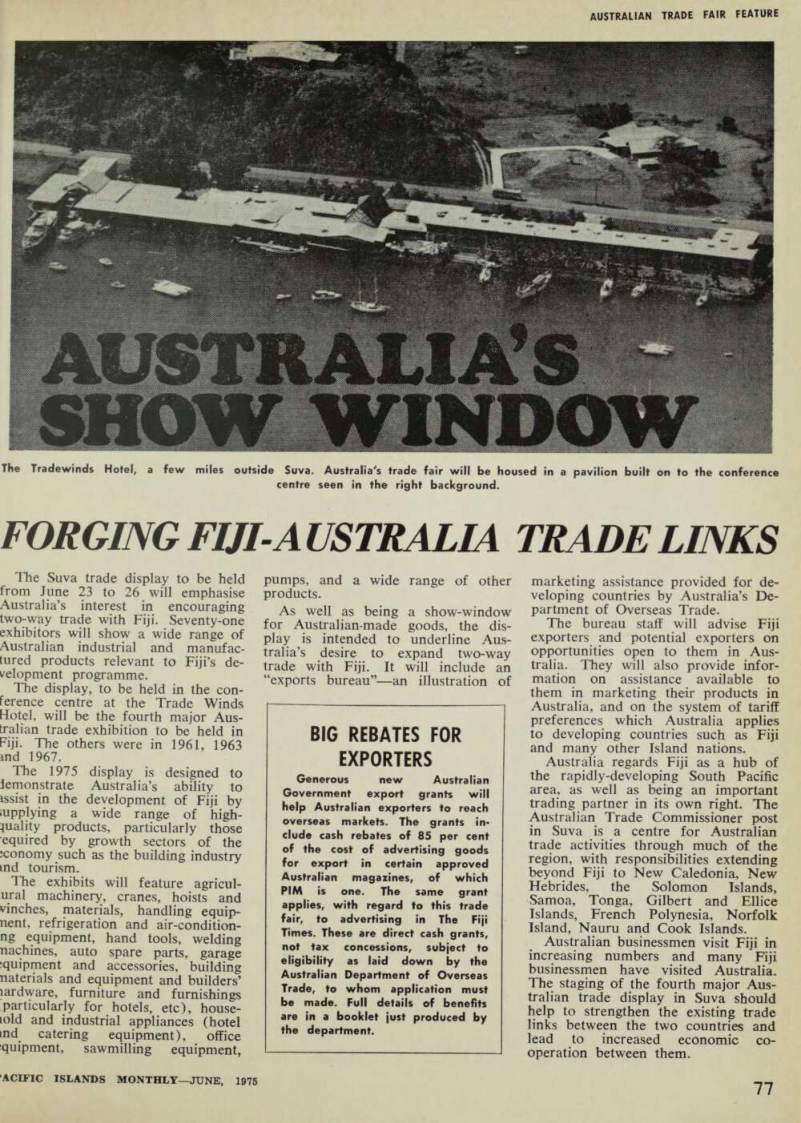
Show Window
Forging Fiji-Australia Trade Links
Australian Trade Fair Feature
The Suva trade display to be held from June 23 to 26 will emphasise Australia’s interest in encouraging two-way trade with Fiji. Seventy-one exhibitors will show a wide range of Australian industrial and manufac tured products relevant to Fiji’s de velopment programme.
The display, to be held in the con ference centre at the Trade Winds Hotel, will be the fourth major Aus tralian trade exhibition to be held in Fiji. The others were in 1961, 1963 md 1967.
The 1975 display is designed to iemonstrate Australia’s ability to issist in the development of Fiji by ►applying a wide range of high juality products, particularly those equired by growth sectors of the ;conomy such as the building industry md tourism.
The exhibits will feature agricul tural machinery, cranes, hoists and vinches, materials, handling equip nent, refrigeration and air-condition ng equipment, hand tools, welding nachines, auto spare parts, garage :quipment and accessories, building naterials and equipment and builders’ lardware, furniture and furnishings particularly for hotels, etc), house hold and industrial appliances (hotel md catering equipment), office equipment, sawmilling equipment,
pumps, and a wide range of other products.
As well as being a show-window for Australian-made goods, the dis play is intended to underline Aus tralia’s desire to expand two-way trade with Fiji. It will include an “exports bureau”—an illustration of
marketing assistance provided for de veloping countries by Australia’s De partment of Overseas Trade.
The bureau staff will advise Fiji exporters and potential exporters on opportunities open to them in Aus tralia. They will also provide infor mation on assistance available to them in marketing their products in Australia, and on the system of tariff preferences which Australia applies to developing countries such as Fiji and many other Island nations.
Australia regards Fiji as a hub of the rapidly-developing South Pacific area, as well as being an important trading partner in its own right. The Australian Trade Commissioner post in Suva is a centre for Australian trade activities through much of the region, with responsibilities extending beyond Fiji to New Caledonia, New Hebrides, the Solomon Islands, Samoa, Tonga, Gilbert and Ellice Islands, French Polynesia, Norfolk Island, Nauru and Cook Islands.
Australian businessmen visit Fiji in increasing numbers and many Fiji businessmen have visited Australia.
The staging of the fourth major Aus tralian trade display in Suva should help to strengthen the existing trade links between the two countries and lead to increased economic co operation between them.
The Tradewinds Hotel, a few miles outside Suva. Australia's trade fair will be housed in a pavilion built on to the conference centre seen in the right background.
Big Rebates For
Exporters
Generous new Australian Government export grants will help Australian exporters to reach overseas markets. The grants in clude cash rebates of 85 per cent of the cost of advertising goods for export in certain approved Australian magazines, of which PIM is one. The same grant applies, with regard to this trade fair, to advertising in The Fiji Times. These are direct cash grants, not tax concessions, subject to eligibility as laid down by the Australian Department of Overseas Trade, to whom application most be made. Full details of benefits are in a booklet just produced by the department.
Advertisements & other items, pp. 79-80 (2 items)
77
ACIFIC ISLANDS MONTHLY—JUNE, 1975
Singer
Your friends for a lifetime.
All over the world, the Singer name stands for the very best in sewing machines. For dependability.
Reliability. The latest in technical innovation. Whatever you sew, see Singer.
Simply the best you can buy. & Singer Model 242 zig-zag sewing machine, electrically operated.
Singer Model 179N1, traditional treadle-operated machine. 3s Singer Model 179N2, hand or electrically operated.
SINGER
THE NAME YOU KNOW
WHEREVER YOU GO
Fiji’s good neighbour
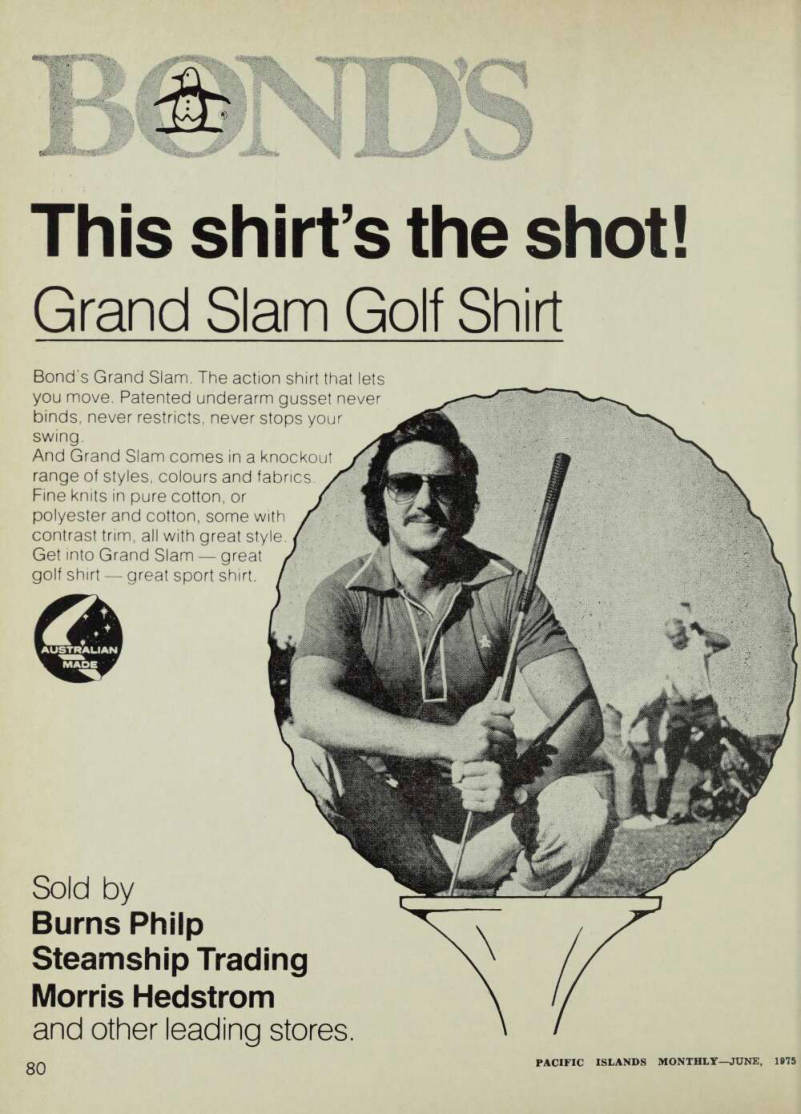
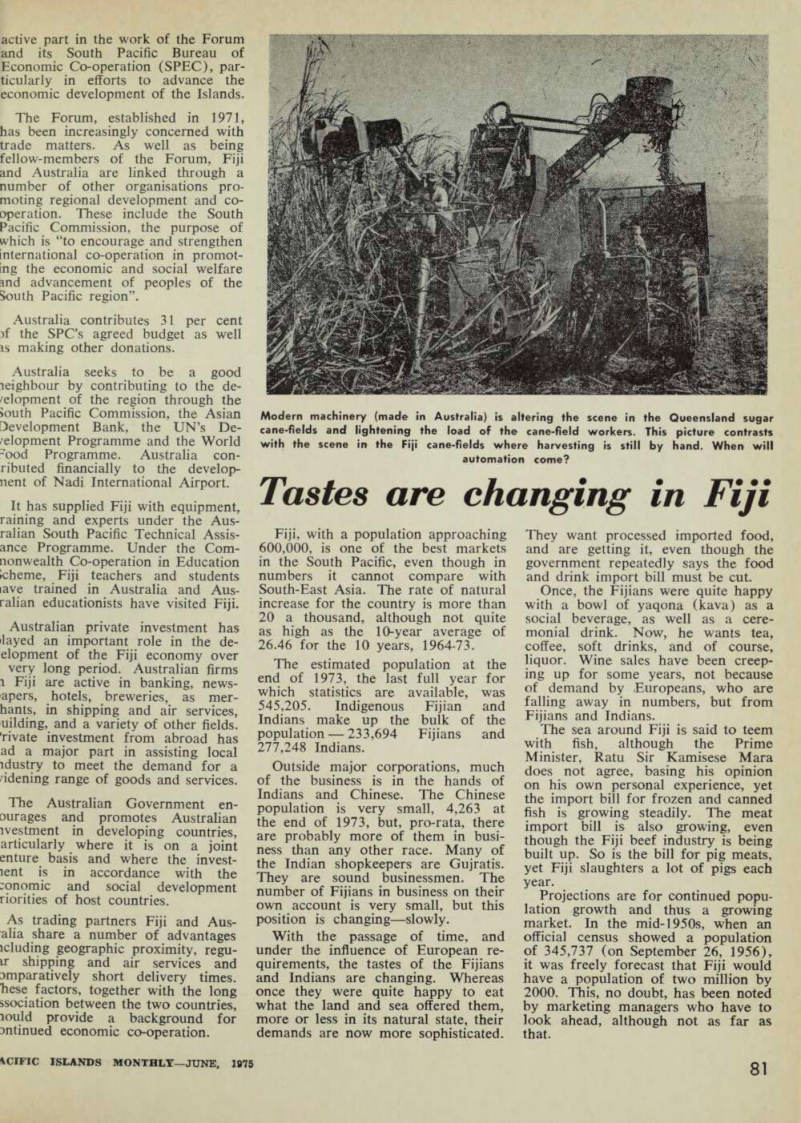
How Australia works at the Job of being Fiji’s good neighbour
The cost of staging the fair is expected to be about $250,000. Seventy of the 71 displays will be by private enterprise. The Australian Government will have one stand, staffed by a business specialist, who will help Fiji businessmen interested in exporting to Australia.
Fiji and Australia are neighbours ith a common interest in the xmomic advancement of the Pacific ;gion, and thus the important and >ng-standing trade partnership be tween them has been a natural de dopment.
Australia is well-placed to supply variety of the manufactured and dustrial products which Fiji needs • assist in its own development pro ammes, and at the same time it is i increasingly important market for iji’s exports. The value of two-way ade has increased steadily to reach record 5A57.8 million in 1973-74.
Australia exports to Fiji machinery, etals and manufactures, iron and sel, rice, wheat, flour, sporting >ods, toys, chemicals and a variety ? other products. The value of ese exports in 1973-74 was 5A49.9 illion, compared with 5A40.8 illion in 1972-73 and only $A19.9 illion in 1969.70.
Australia’s imports from Fiji in ade unrefined gold bullion, coconut I, molasses, wood, timber and cork id other products, the total of which ached a record SAB.4 million in *73-74 —nearly double the 1971-72 tal of $A4.3.
To a large extent, the deficit in ade between the two countries is fset by proceeds of the important urist industry which employs 20 r cent of Fiji’s work force, and a major contributor to the country’s reign exchange receipts. Australians e the largest national group of sitors to Fiji and Australia is an tablished supplier of building aterials, catering and transport uipment, food and other items aich Fiji needs for the continuing owth of the tourist industry.
Australia recognises that any althy trading partnership between 3 two countries must benefit both of em. In accordance with this belief, has a record of practical assistance ued at helping countries like Fiji overcome their development prob ns and improve the level of their ports. In 1966, Australia became 3 first nation to offer assistance to e developing countries, including ji, to obtain increased export oppor
timities for their products through a system of tariff preferences.
In January, 1974, it revised and expanded this system, providing preferential entry for manufactures, semi-manufactures and substantiallyprocessed primary products except for revenue items (cigarettes, spirits, etc) and some products where deve oping countries are already competitive. Quotas have been abolished on all except about 50 items. Duty free and quota-free treatment for handicraft products has been retained but with a revised definition of handicratts.
For exporters in Fiji seeking a better understanding of the Austrahan market and of the selling and other techniques associated with it, assistance and advice is available from the Australian Trade Commis-
sioner in Suva and from Australia’s Department of Overseas Trade through its market assistance section in Canberra.
Australia demonstrated its concern f or encouraging equitable two-way trade with its Padfic neighbours by supporting the three priorities agreed on hy the island countries and accepted by the South Pacific Forum, These are • Development of further process ing of primary products; • The rationalisation of import substitution industries; and • The establishment of export oriented manufacturing industries as a means of encouraging and developing viable economies, Australia sees its role as taking an
active part in the work of the Forum and its South Pacific Bureau of Economic Co-operation (SPEC), par ticularly in efforts to advance the economic development of the Islands.
The Forum, established in 1971, has been increasingly concerned with trade matters. As well as being fellow-members of the Forum, Fiji and Australia are linked through a number of other organisations pro moting regional development and co operation. These include the South Pacific Commission, the purpose of which is “to encourage and strengthen international co-operation in promot ing the economic and social welfare and advancement of peoples of the South Pacific region”.
Australia contributes 31 per cent af the SPC’s agreed budget as well as making other donations.
Australia seeks to be a good leighbour by contributing to the de velopment of the region through the Jouth Pacific Commission, the Asian Development Bank, the UN’s De velopment Programme and the World "ood Programme. Australia con ributed financially to the develop nent of Nadi International Airport.
It has supplied Fiji with equipment, raining and experts under the Aus ralian South Pacific Technical Assis ance Programme. Under the Com monwealth Co-operation in Education Scheme, Fiji teachers and students lave trained in Australia and Aus ralian educationists have visited Fiji.
Australian private investment has •layed an important role in the de elopment of the Fiji economy over very long period. Australian firms i Fiji are active in banking, news apers, hotels, breweries, as mer hants, in shipping and air services, uilding, and a variety of other fields, tivate investment from abroad has ad a major part in assisting local idustry to meet the demand for a videning range of goods and services.
The Australian Government en □urages and promotes Australian ivestment in developing countries, articularly where it is on a joint enture basis and where the invest lent is in accordance with the :onomic and social development riorities of host countries.
As trading partners Fiji and Aus alia share a number of advantages icluding geographic proximity, regu ir shipping and air services and amparatively short delivery times, hese factors, together with the long ssociation between the two countries, lould provide a background for jntinued economic co-operation.
Advertisements & other items, pp. 81-82 (2 items)
79
tune ISLANDS MONTHLY—JUNE, 1875
stalled
/< w x * * t /; m * o it/, t i’“/l / U 4/
WET
556 tu m * tf
meat
* V.
Sid m * d m did ltd / W
SPECIALTY CHEMICAL
PRODUCTS FOR -
AUTOMOTIVE - ELECTRICAL
ENGINEERING & MARINE
CRC CHEMICALS AUSTRALIA PTY. LTD.
PRAY with
AT THE
AUSTRALIA TRADE FAIR
SUVA.
DRIVES OUT
MOISTURE FROM
AFFECTED PARTS
(Distributor, ignition wires, starter motors, spark plugs, etc.)
This shirt’s the shot!
Grand Slam Golf Shirt
Bond’s Grand Slam. The action shirt that lets you move. Patented underarm gusset never binds, never restricts, never stops your swing.
And Grand Slam comes in a knockout range of styles, colours and fabrics Fine knits in pure cotton, or polyester and cotton, some with contrast trim, all with great style.
Get into Grand Slam great golf shirt great sport shirt.
Sold by
Burns Philp
Steamship Trading
Morris Hedstrom
and other leading stores.
■ ■ Hill Hi • : ill mb ill iii . ... ■ i ■ Mm \
Tastes are changing in Fiji
Fiji, with a population approaching 600,000, is one of the best markets in the South Pacific, even though in numbers it cannot compare with South-East Asia. The rate of natural increase for the country is more than 20 a thousand, although not quite as high as the 10-year average of 26.46 for the 10 years, 1964-73.
The estimated population at the end of 1973, the last full year for which statistics are available, was 545,205. Indigenous Fijian and Indians make up the bulk of the population —233,694 Fijians and 277 248 Indians. ’ . . , Outside major corporations, much of the business is in the hands of Indians and Chinese. The Chinese population is very small, 4,263 at the end of 1973, but, pro-rata, there are probably more of them in business than any other race. Many of me Indian shopkeepers are Gujratis.
They are sound businessmen. The number of Fijians in business on their own account is very small, but this position is changing slowly.
With the passage of time, and under the influence of European requirements, the tastes of the Fijians and Indians are changing. Whereas once they were quite happy to eat what the land and sea offered them, more or less in its natural state, their demands are now more sophisticated,
They want processed imported food, and are getting it, even though the government repeatedly says the food and drink import bill must be cut.
Once, the Fijians were quite happy with a bowl of yaqona (kava) as a social beverage, as well as a cere monial drink. Now, he wants tea, coffee, soft drinks, and of course, i( I uor - W ine sales have been , creep in 8 U P * or some years, not because of demand by Europeans, who are awa V ™ numbers, but from Fl h^ s anc * Bea arou , n d Fl P is said to teem with fish, although the Prime Minister, Ratu Sir Kamisese Mara do es no t agree, basing his opinion on b j s own personal experience, yet the import bill for frozen and canned fi sb j s growing steadily. The meat import bill is also growing, even though the Fiji beef industry is being bui i t up . So is the bin for pig meats , y e t Fiji slaughters a lot of pigs each year.
Projections are for continued popu iation gr owth and thus a growing market. In the mid-19505, when an official census showed a population of 345,737 (on September 26, 1956), it was freely forecast that Fiji would have a population of two million by 2000. This, no doubt, has been noted by marketing managers who have to look ahead, although not as far as that.
Modern machinery (made in Australia) is altering the scene in the Queensland sugar cane-fields and lightening the load of the cane-field workers. This picture contrasts with the scene in the Fiji cane-fields where harvesting is still by hand. When will automation come?
Advertisements & other items, pp. 83-84 (2 items)
81
%CIFIC ISLANDS MONTHLY—JUNE, 1875
plumbing supplies -fast
Total service 0n...
WATSON £l CRANE
are organised to fulfil your needs
wherever you are in the South Pacific See our range at Stand 39 at the Australian Trade Display in SUVA. « You can get all you need from one supply source; water taps, valves, copper tube, tools and a host of other fittings and related plumbing equipment for domestic, industrial and multistorey buildings.
Watson & Crane Pty Ltd have over 20,000 plumbing items in stock at their central warehouse located at Waterloo, NSW, Australia.
Years of experience in handling and shipping right throughout the South Pacific add up to another big reason for you to deal with Watson & Crane Pty Ltd.
Representatives call regularly at New Guinea, Papua, the Solomons, New Hebrides and Fiji Islands to personally discuss your requirements and appropriate credit arrangements.
Write, cable or telephone today for complete plumbers' supplies service.
Watson & Crane Pty. Ltd, 1037 Bourke Street, Waterloo,
NSW 2017.
Phone: Sydney 699-1333.
Telex: AA 25548.
Cables: "Watcrane" Sydney.
Pacific Island distributors of Crane Enfield copper tube for water, sanitation, engineering, refrigeration and air conditioning.
Balm for Fiji’s sore point
Fiji has been important to Aus tralia for many years—long before the Australian States federated in 1901, and long before Fiji was ceded to Great Britain in 1874. The Governor of NSW on behalf of the UK government kept a watch on Fiji and it was a governor of NSW who accepted Fiji on behalf of Queen Victoria when the chiefs ceded their land to her on October 10, 1874.
Fiji was an important port of call for ships trading between Australia and the United States, and for ships which passed round Cape Horn on the way to Australia, rather than via the more popular, and easier Cape of Good Hope route.
Australia has provided a lot of capital to develop Fiji’s trade and commerce. Fiji’s biggest industry, sugar, was developed to its present stage by the Colonial Sugar Refining Co Ltd, which went to Fiji in 1882, after several other sugar ventures failed, and withdrew on March 31, 1973—about three months after the end of the 1972 crushing season.
Although not always popular among some sections of the Fiji com munity, it can never be denied that Fiji owes its place in the 20th century in large measure to the Colonial Sugar Refining Co Ltd (now CSR Ltd). While the main object of the company was to make profits, secon dary fields of culture, sport, educa tion and providing amenities for the people were not neglected.
Australian capital established two 3f the major trading firms, which went into many aspects of industry and commerce, and Australian capital »et up the gold fields at Vatukoula, which is now as prosperous as it has
By Norman Baxter
ever been. Australian capital went into many other smaller ventures.
The tourist industry, which really started booming about 15 years ago, also attracted a lot of Australian money.
Since Fiji became independent on October 10, 1970, she has received a lot of assistance, in many forms, from metropolitan countries. Aus tralia’s main effort has been to pro vide technical help, training selected people in a variety of skills needed in a country at Fiji’s stage of develop ment. Australia has also provided a lot of the equipment Fiji needs to develop her resources.
Australian businessmen recognise that Fiji is a growing market. Several trade missions from Australia have visited Fiji in the last 15 years, and the current mission is by no means the last. Once business contacts have been established they have to be kept up.
Australia now meets more com petition from New Zealand and Fiji in the field of manufactures, and that keeps Australian manufacturers on their toes. Hong Kong, Taiwan and Japan also provide competition for Australia in Fiji, in rather limited fields.
Australia, for many years, has en joyed the situation of being the No 1 supplier to Fiji. Although that position has been eroded in recent years, it is not likely to be seriously challenged for a long time yet.
It is a sore point in Fiji that Fiji has an annual adverse visible trading balance with Australia. Yet there is little which can be done to change that position. Fiji’s exports are very limited. She could not hope to export sugar to Australia, which is one of the big growers in the world. Fiji can export bananas to Australia, but comes up against a tariff, and anyway Fiji’s banana industry is going back ward instead of forward.
But trade between countries can never be expected to balance. Fiji may have an adverse trade balance with Australia, but through her sugar export has favourable balances with several countries. On the “invisible” side of trading, Fiji does very nicely out of Australia. Australia provides the majority of visitors to Fiji, and certainly the biggest spenders. While it may be difficult to get accurate figures of visitor spending as easily as those for sugar, gold and fish exports, there seems little doubt that tourism is the No 2 industry in Fiji in rela tion to foreign earnings.
Advertisements & other items, pp. 85-86 (2 items)
83
ACIFIC ISLANDS MONTHLY—JUNE* 1975
anywhere,
any time,
any gas.
■? ;- -j&-. or ..- * - .<»£&> For further information & addresses of your local distributor contact;
THE COMMONWEALTH
INDUSTRIAL GASES LIMITED
Gases Export Department, 138 Bourke Road, Alexandria, N.S.W., Australia 2015.
Cables ‘CIGAS’-Telex 20241 Sydney. 017.0308
Fiji attracts a lot of overseas investment, encouraged by generous taxation terms which allow new companies to become established. At the end of 1973, there were 1,495 companies registered in the country—43 public with issued capital of $37,153,800 (nominal $125,163,500) and 1,452 private with issued capital of $57,032,136 (nominal $250,275,440).
Two hundred and nine of the companies were classed as “foreign” with overseas incorporations. Eighty-one were Australian, 41 UK, 30 US and 27 New Zealand.
HIULS
EAMUY PLANNING
Sales forecasting is rarely more reliable than when you have a family product to sell.
There’s no unpredictable high fashion fads involved.
Hills recognised this many years ago and have gone from strength to strength catering for family needs in Australia and in countries around the world.
They’ve made products for families who wash, dryand ironclothes,cook meals,keep fit,and have children who like to play. Sounds like just about every family you’ve ever come across doesn’t it?
You’re right.
When you see these products on display, think Family Planning with Hills for yourself.
16’ SUPA HOIST
Built tough to dry big family washes.
Lifts wash into the fresh, clean air easily Easy wind up. wind down action.
EXTEND ALINE
The disappearing space saving clothes line.
PARALINE
The foldaway clothes dryer for limited space.
Paraline fits anywhere. % L^j
PLAYTIME
Junior Slippery Slide, Senior Playgym, Quad Swing. Adda Ladder and Rotating See Saw will all be on display.
CORDONWARE
Mardi Gras, Pioneer New Europea and Nova suites.
V! a I ms.
Mm 4
FITNESS EXCERCISERS
No. 3 Rower No. 5 Cycle Part of the Hills Family Fitness Program to make you feel good, and cope better
LOOK
FOR HILLS
at the Trade Display Stand No. 59
Shipping Information
SYDNEY - NZ - FIJI/TAHITI - UK Chandris Lines maintains a twice-monthly passenger service from Sydney via NZ, Suva or Papeete.
Details from Chandris Lines, 135 King Street, Sydney (28-2451).
SYDNEY - LORD HOWE IS - NORFOLK IS
New Caledonia
Somacal operates 25-day service from Sydney to Lord Howe and Norfolk Is.
Details from Karlander (Aust) Pty Ltd, 19-31 Pitt Street, Sydney (27-6301).
Chargeurs Caledoniens operates four-weekly cargo service Sydney-Lord Howe Island-Norfolk Island-Noumea.
Details: Hetherington Kingsbury Pty Ltd, 37-49 Pitt Street, Sydney (27-1671).
SYDNEY • NORFOLK IS - AUCKLAND -
New Caledonia
Compagnie des Chargeurs Caledoniens operates four-weekly cargo service from Sydney to Norfolk Island, Auckland and Noumea.
Details: Hetherington Kingsbury Pty Ltd, 37- 49 Pitt Street, Sydney (27-1671).
SYDNEY - NZ - FIJI - HAWAII -
Canada - Us
P and 0 liners call at Auckland, Suva and Honolulu on eastbound and westbound voyages between Sydney and the US.
Details from P & 0 Australia Ltd, 55 Hunter Street, Sydney (2-0317).
SYDNEY - NZ - FIJI - TONGA - VILA -
Noumea - Samoas - Tahiti
Shaw Savill liners cruise in the Pacific sailing From Australia and New Zealand calling at Suva, Lautoka, Tonga, Vila, Noumea, Pago Paoo, Tahiti, Apia, Vavau.
Details: Shaw Savill Line, 62 Pitt St, Sydney 1241-3921).
Sitmar Cruises operates a South Pacific cruise programme to include most of the above sorts plus the Solomons.
Details from Sitmar Line (Australia) Pty -td, 22-30 Bridge Street. Sydney (27-4521).
Royal Viking Line, with luxury cruise ships ?oyal Viking Sea, Star and Sky, cruises the Pacific from Sydney, calling at most of the jbove ports plus Port Moresby and Rarotonga.
Details from Wilh. Wilhelmsen Agency Pty -td. 13-15 Bridge Street, Sydney (2-0517).
P & 0 liners call at Suva, Honiara, Pago Pago, Auckland, Vila, Noumea, Honolulu, Nukualofa, Vavau, Savusavu, Jakarta and Bali 'egularly on cruises from Australia.
Details from P & 0 Australia Ltd, 55 Hunter Street, Sydney (2-0317).
Australia - New Caledonia
Sofrana-Unilines operates a fortnightly service rom Sydney to Noumea.
Details from Sofrana-Unilines, 37 Pitt Street, lydney (27-2031).
Australia ■ New Caledonia •
New Hebrides
Sofrana-Unilines' shios call regularly at lydney, Noumea and Vila.
Details from Sofrana-Unilines, 37 Pitt Street, lydney (27-2031), Burns Philp and Co Ltd, 140 Collins Street, Melbourne (67-8941) and ohn Swire and Sons, Brisbane (46-1155).
South Pacific United Lines with Polynesia aaintains cargo-passenger sailings—Sydney, ioumea, Vila and Santo.
Details from Omni Traders & Brokers Pty imited. 261 Georoe Street, Sydney (241-2872/6).
Compagnie des Chargeurs Caledoniens operates hree-weekly cargo service from Sydney to loumea. Port Vila, Santo.
Details: Hetherington Kingsbury Pty Ltd 37- 19 Pitt Street, Sydney (27-1671).
Australia - Fiji
Sofrana-Unilines operates Melbourne-Sydney i|i every 28 days.
Details from Sofrana-Unilines, 37 Pitt Street Ydney (27-2031); Burns Philp and Co Ltd, 340 ollins Street, Melbourne (67-8941).
Nauru Pacific Line operates cargo/passenger service to Fiji and South Pacific ports.
Details from Nauru Pacific Line, 227 Collins Street, Melbourne (654-4977); Interocean Swire, 8 Spring Street, Sydney (20-522); Dalgety Shipping, 291 Elizabeth Street, Brisbane (31-0331).
Karlander (Aust) Pty Ltd operates three weekly cargo services from Sydney to Suva and Lautoka.
Details from Karlander (Aust) Pty Ltd, 19-31 Pitt Street, Sydney (27-6301); Dalgety Shipping. 461 Bourke St, Melbourne (60-0731); Burns Philp (SS) Co Ltd, Suva and Lautoka.
AUSTRALIA - TAHITI - MEXICO - US South Pacific United Lines has three vessels, Newfoundland, Nova Scotia and Krohn Trader, maintaining six weekly service from Sydney to Papeete, Mexico and US.
Details from Omni Traders & Brokers Pty Limited, 261 George Street, Sydney (241-2872/6).
Australia - Png
Containers Pacific Express (Burns Philp and AWP Line) operates four-weekly cargo service from Melbourne (direct) with Milos & Samos and Sydney and Brisbane to Lae and Port Moresby with Nimos.
Details from Burns Philp & Co Ltd, 51 Pitt Street, Sydney (241-3816).
Pacific Far East Line operates a service every 18 days from Tasmania, Melbourne, Sydney and Brisbane to Lae, Rabaul and Kieta.
Details from PFEL, 50 Young Street, Sydney. (27-4272), 454 Collins Street, Melbourne (67-7237), Burns Philp (NG) Ltd, Rabaul and Kieta, Robert Laurie-Carpenter (NG) Pty Ltd, Lae.
New Guinea Express Lines with two ships operates three-weekly Melbourne, Sydney, Brisbane, Port Moresby, Lae, Rabaul.
Details from New Guinea Express Lines, PO Box R 73, Royal Exchange PO, Sydney (241-1396) and 72 Eagle St, Brisbane (21-9333), Westralian Farmers Transport Pty Ltd, 459 Collins St, Melbourne (67-8291), Breckwoldt's Shipping Agencies in Port Moresby, Lae, Rabaul.
Karlander New Guinea Line's two cargo vessels call at Melbourne, Sydney, Lae, Madang, Wewak, Manus, Kimbe.
Details from Karlander (Aust) Pty Ltd, 19-31 Pitt Street, Sydney (27-6301); Dalgety Shipping, 461 Bourke St, Melbourne (60-0731).
Australia - Png • Bsip
New Guinea Australia Line's vessels operate from Sydney and Brisbane to Port Moresby, Lae, Rabaul, Kavieng, Honiara. Kieta, Gizo, Madang and Samara!.
Details from Interocean Swire, 8 Spring Street, Sydney (20-522).
Australia - Marshall Islands -
Guam
Nauru Pacific Line operates monthly con ventional/container service Melbourne/Sydney to New Guinea, Guam and Micronesia.
Details from Nauru Pacific Line, 227 Collins Street, Melbourne (654-4977); Interocean Swire, 8 Spring Street, Sydney (20-522).
Australia - Png - Far East
E. and A. Line passenger ships make regular round voyages from Melbourne, Sydney and Brisbane calling at Port Moresby, Manila, Hong Kong, Keelung, Kobe, Yokohama (Tokyo), and Rabaul.
Details from P & 0 Australia Ltd, 55 Hunter Street, Sydney (2-0317).
Us - Png
Pacific Far East Line operates regular services from all US west coast ports to Lae, Rabaul, Kieta.
Details from PFEL, One Embarcadero Centre, San Francisco, Burns Phtlp (NG) Ltd, Rabaul and Kieta, Robert Laurie-Carpenter (PNG) Pty Ltd, Lae.
Png - Us - Canada
Pacific Far East Lines operates regular
services from Lae, Rabaul and Kieta to US west coast ports and Vancouver.
Details from Burns Philp (NG) Ltd, Rabaul and Kieta, Robert Laurie-Carpenter (PNG) Pty Ltd, Lae, PFEL, One Embarcadero Centre, San Francisco and 50 Young Street, Sydney (27-4272).
FAR EAST - FIJI - NEW ZEALAND New Zealand Unit Express (CNC, MOL, RIL) operates a three-weekly cargo service from Hong Kong to Lautoka, Suva, NZ ports, Manila, Kaoshiung, Keelung, Hong Kong.
Details from Interocean Swire, 8 Spring Street, Sydney (20-522).
Royal Interocean Lines operates monthly pass enger/cargo service with three ships from Sura baya, Bangkok, Port Kelang and Singapore to Suva and NZ ports.
Details from Interocean Australia Services, 261 George Street, Sydney (2-0573), Burns Philp (SS) Co Ltd Suva and Lautoka.
Ben Shipping Pty Ltd, with Liverpool Clipper, operates monthly cargo service between Singa pore and Suva.
Details from Seatrans (Fiji) Ltd.
FAR EAST • PNG - BSI - NEW HEBRIDES •
Noumea ■ Tahiti - Samoa
China Navigation Co's vessels operate a regular cargo service from Hong Kong te Rabaul. Wewak, Madang, Lae, Port Moresby, Honiara. New Hebrides, Noumea, Papeete and Samoa.
Details from Interocean Swire, 8 Spring Street, Sydney (20-522).
North Europe - New Caledonia
Hamburg/Sued operates monthly carge services from Dunkirk and Le Havre to Noumea, via Panama.
Details from Columbus Overseas Services Pty Ltd, 333 George Street, Sydney (290-2966), Messageries Maritimes operates five carge services a month from north and Mediterranean European ports to Papeete and Noumea.
Details from Messageries Maritimes, 332 Pitt Street, Sydney (61-6664).
JAPAN - GUAM - FIJI - SAMOA -
N Caledonia • N Hebrides
Daiwa Line runs a monthly cargo service from Japan via Guam to Suva, Lautoka, Pago Pago, Apia, Vila, Santo and Noumea.
Details from Burns Philp (SS) Co Ltd, Suva.
TONGA - SAMOA - FIJI - AUSTRALIA Pacific Navigation Co Ltd operates a monthly cargo service between Nukualofa, Apia, Suva and Lautoka to Sydney.
Details from Karlander (Aust) Ptv Ltd, 19-31 Pitt St, Sydney (27-6301); Burns Philp (SS) Co Ltd.
NZ - FIJI - TONGA - SAMOAS -
Tahiti
Union Steam Ship Co of New Zealand operates a fully containerised service Auckland, Suva, Pago Pago, Apia and Nukualofa every 14 days.
A unitised service is operated Auckland, Lautoka, Suva, Apia, Auckland approximately every two weeks.
A 28-day service Is operated from Auckland to Papeete.
Details from any office of the Union Steam Ship Co, Fiji, Tonga, Samoa, Auckland.
Nz - Norfolk Is
USS Co vessels operate 26-day cargo service Auckland, Norfolk Is., Papeete.
Details from Union Steam Ship Co of NZ Ltd. PO Box 12, Auckland.
NZ - N CALEDONIA - N HEBRIDES -
Ng • Bsip
Sofrana/Unilines with four ships operates to Vila and Santo; to Honiara and New Guinea; and to Noumea.
Details from Sofrana-Unllines, 42 Customs Street, Auckland (73-279), P.O. Box 3614, Telex: NZ 2313.
Nz - Png
Pacific Far East Line operates regular service every 18 days from Auckland to Lae, Rabaul, Kieta.
Details from PFEL, 109 Queen Street, Auck land (31022) Burns Philp (NG) Ltd, Rabaul
and Kieta, Robert Laurie-Carpcnter (PNC) Pty Ltd. Lae.
NZ - FIJI - NORTH AMERICA (WC) Crusader cargo ships call at Suva, Levuka and Honolulu on NZ-US west coast trips and at Suva and/or Lautoka on US-NZ return trips.
Details trom Blue Star Port Lines (Manage ment) Ltd, P.O. Box 192 Wellington (70179); Burns Philp (SS) Co Ltd.
Nz - Fiji
Fijian Swift and M.V. La Bonita operate a regular 18 day service from Auckland to Suva and Lautoka.
Details from Reef Shipping Agencies Ltd, P.O. Box 13-315, Onehunga, NZ. (Phone 663- 918, 663-928).
Nz - Tonga
Pacific Navigation Co Ltd operates two ships Auckland-Nukualofa-Vavau-Haapai, on a 14-16day schedule, monthly timber service from Mt Maunganui, and other NZ ports by inducement.
Details from the Northern Steam Ship Co Ltd, 22-24 Quay Street, Auckland (362-730).
Nz - Fiji - Samoa
Pacific Line with one ship operates monthly cargo service. New Zealand, Lautoka, Suva, Apia. details: Sofrana-Unilines, 42 Customs Street, Auckland (73-279) PO Box 3614, Telex; NZ 2313.
UK - PANAMA - SAMOA - FIJI The Fiji Direct Service, cargo only, is main tained by Conference vessels, sailing at regular monthly intervals out of London, via Panama, for Apia, Suva and Lautoka.
Details from Burns Philp (SS) Co Ltd, Suva.
UK • PNG - BSIP - GEIC - N HEBRIDES -
N Caledonia
Bank Line operates a monthly direct cargo service from Europe, via the Panama Canal to Papeete, Noumea, Vila, major PNG ports and Honiara, occasionally to Tarawa, Santo, Kieta, Jayapura and Yandina and return.
Details from Bank Line (A'asia) Pty Ltd, 1 York St, Sydney (27-2041); Burns Philp (SS) Co Ltd, Suva.
EUROPE - TAHITI - W SAMOA • FIJI •
N Caledonia
Nedlloyd offers regular cargo services from Northern Europe and UK to Papeete, Apia, Fiji and New Caledonia.
Details; Interocean Aust. Services Pty Ltd, 261 George Street, Sydney (2-0573).
US - A. SAMOA - NZ - AUSTRALIA Pacific Far East Line LASH ships operate regularly from US to Australia, via Pago Pago and Auckland, returning same route.
Details from PFEL, 50 Young Street, Sydney (27-4272), 454 Collins Street, Melbourne (67-7237), One Embarcadero Centre, San Francisco (576-4000), 109 Queen Street, Auck land (31-022), Kneubuhl Maritime Services, Pago Pago (32-617).
US - SYDNEY - GEIC - HONOLULU Columbus Lines operates a three weakly container cargo sailing from West Coast, US to Australasia, returning via Tarawa, GEIC and Honolulu to Nth America.
Details from Columbus Overseas Services Pty Ltd, 333 George Street, Sydney (290-2966).
Us - Fiji/Tahiti - Australia
Bank Line Ltd operate regular cargo ser vices from US Gulf ports to Australia and NZ.
Calls at Suva, Lautoka and Papeete on demand.
Details from Bank Line (A/asia) Pty Ltd, 1 York St, Sydney (27-2041).
Pacific Far East Line cruise ships operate regularly from San Francisco, Los Angeles, Honolulu, Moorea, Papeete, Rarotonga, Auck land, Opua, Sydney, and return via Suva, Niuafoou, Pago Pago and Honolulu to San Francisco.
Freight is carried on these passenger liners.
Details from PFEL. 50 Young Street, Sydney (27-4272).
Us - Tahiti - Samoa
Pacific Islands Transport operates a five/six weekly cargo service from North American west coast ports to Papeete, Pago Pago, Apia.
Details from Trans-Austral Shipping Pty Ltd, 19 Pitt Street, Sydney (27-2441),
Advertisements & other items, pp. 87-88 (2 items)
85
•ACIFIC ISLANDS MONTHLY—JUNE, 1975
The
GLOBAL SERVICE FOR SHIPPERS
V
MONTHLY SERVICES
United Kingdom and Continent to: Papeete, Noumea, New Hebrides, Papua New Guinea and Solomon Islands.
Papua New Guinea to: North America, United Kingdom and Continent.
Solomons, Fiji, Tonga, Samoa and Tarawa to-. United Kingdom and Continent.
For particulars apply:
THE BANK LINE (AUSTRALASIA) PTY. LTD.,
18TH FLOOR, 1 YORK STREET,
SYDNEY, N.S.W.
Banabans impress MPs
From BERTRAM JONES in London
Two British Members of Parlia ment back in London after visiting the GEIC have presented their find ings to the Foreign and Common wealth Office on the Ocean Island independence issue.
The report’s contents have not been revealed but I understand they recommend immediate talks between the governments of UK, Australia and New Zealand to cover, not only the Banabans’ claim for Ocean Island independence but the future economic needs of the GEIC when the anticipated separation of the Ellice Islands from the Gilberts be comes a reality.
The MPs, Sir Bernard Braine (Conservative) and Mr John Lee (Labour) are believed to have been impressed by the Banabans’ case, especially their contention that they are a different people from the Gil bertese and therefore independence would be right and proper. Tliat would appear to be an important point in the Banabans’ favour, especially as the MPs’ report has been studied by top officials in the Foreign and Commonwealth Office and could go to the Foreign Sec retary, Mr James Callaghan.
Added weight to the MPs’ opinion derives from their experience in colonial affairs. Sir Bernard was Parliamentary Under-Secretary at the Commonwealth Relations Office in Mr Harold Macmillan’s government in 1961-62. Mr Lee spent seven years in the colonial service, mostly in Ghana.
The MPs are back with the belief that ministers and officials in Tarawa are greatly concerned about the financing of development plans for the Gilberts in preparation for the cessation of their phosphate revenue when the deposits are worked out; expected to be in February, 1978.
Ministers in Tarawa gained the impression that Sir Bernard and Mr Lee thought that, because of the assured income from the Ocean Island phosphate, too little had been done to prepare for the phosphate less future.
At Tarawa MPs made it clear that they felt impelled to consider the Banabans question in relation to the outlook for the whole colony after independence and that they fully re cognised the need for generous pro vision for all.
That left the Banabans happy, too, because although they would like the
full income from the Ocean Island phosphate for its few remaining years they have repeatedly declared that they do not want the colony to be the loser.
In Fiji, en-route to Australia, the MPs had informal talks with Fiji’s Prime Minister, Ratu Sir Kamisese Mara, who is believed to have reiterated his government’s view that, although it could not become involved in the independence issue, it was prepared favourably to con sider a request by the Banabans for associate status for Ocean Island with Fiji if independence were achieved.
In Canberra, as in Tarawa, Sir Bernard and Mr Lee expressed the view that, nowadays, a people’s identity was what that people be lieved itself to be—one way of say ing that if the Banabans believed themselves to be a separate race then they were a separate race.
They disagreed, as politicians, with the reported British point of view that Britain cannot force the GEIC to give independence to Ocean Island, and on their return to London are understood to have stated categoric ally that ultimately a political de cision will have to be made by British ministers, having regard to the realities of the situation and to what was sensible and fair.
Sir Bernard and Mr Lee are con vinced that the Banabans have a distinct identity which, politically as well as morally, it would be wrong to ignore.
Britain’s refusal to agree to in dependence for Ocean Island is purely economic and stems from British concern about the economic future of the Gilbert and Ellice Islands.
Advertisements & other items, pp. 89-92 (3 items)
Line Advertisements
Per line, 12.60 Aust.
Minimum rate, 4 lines.
If you have shells to sell— any quantity —contact Anisa Commodity Traders Pty.
Ltd., P.O. Box 1413, Lae, Papua New Guinea, Phone 424159. We are buyers of Trochus, Greensnail, Blacklip MOP, Ooldlip MOP, and Marine Specimens. Best prices paid. Rabaul agents: Gazelle Agencies Pty. Ltd., P.O. Box 262, Rabaul, P.N.G. Phone: 921397. Manns Island Agents, R. L. A V. J. Knight, P.O. Box 108, Lorengau, Manns Island, P.N.G.
Phone: 38.
CONCRETE BLOCK MACHINES. Makes
blocks, flags, edgings, screen-blocks, garden stools—up to 8 at once and 96 an hour. $179.00 c.i.f. main ports. Send for leaflets. Forest Farm Research, Londonderry. N.S.W., 2753.
KIKUYU GRASS CERTIFIED SEED for
sale A 53.00 per lb. For supplies and information about this highly nutritious and abundantly productive grazing grass write to ROY EYKAMP, Qnirindi, N.S.W., Australia, 2343. Phone Qnipolly, 466541.
LIVE LIZARDS, FROGS AND SNAKES
REQUIRED. Also preserved beetles, butterflies and seashells. Write to M. Farrell, 2009 Santa Fe, Del Mar, California 92014
U.S.A.
QUARTZ/DIGITAL WATCHES. CAMERAS.
All forms mail order. Export & individual.
Write: K.O.V. Corp., GPO 15986, Hong Kong.
SLR GARDNER AUXILIARY ENGINE.
Reconditioned. 1000 RPM. 50 BHP. Elec, hand start. $2,000 P. 0.8. Sydney.
Knox Schlapp Pty. Ltd., 135-139 McEvoy Street, Alexandria, N.S.W. 2015. Australia.
SEASHELL COLLECTORS WANTED, from
all Pacific Island areas. Top prices paid.
For information write in strictest confidence to, K. D. Weston, P.O. Box 760, Gladstone, Qld., Australia 4680.
HERVEY BAY, QUEENSLAND (where the
sun is always shining). I have an approved motel site for sale overlooking the Golf Club on the main road into the area.
Only one mile to beach and shops. Water and electricity. Consists of V. 2 acre (2023.4 m) with 180 ft. (54.8 m) frontage. $25,000 with plans. Would consider terms of half now and balance 12 months. Write G. Haysom, 4 Eric Street, Torquay, Qld. 4657.
AITCHISON YACHT MASTS OF
NEW ZEALAND
CONSTRUCT AND SUPPLY FOR YACHTS:
WOODEN MASTS AND SPARS • ALUMINIUM MASTS AND SPARS • ALL SPAR FITTINGS, LIGHTING, ROPES, RIGGING,
WINCHES, STAINLESS STEEL BOAT FITTINGS.
Yachtles for quick experienced service contact the specialist firm with the world wide reputation now 111 Wo air freight and ship all over the Islands. Flagpoles also made and supplied.
AITCHISON YACHT MASTS,
71 ROWANOALE AVE., MANUREWA (P.O. BOX 274, MANUREWA),
AUCKLAND, N.Z. Pb: 63-500
o [nnJ §s) SS innJ F 33 r.~" i Se) InnJ cipj
international;
DATELINE HOTEL
TONGA
"Friencßy Hotel” of the "Friendly Islands”
Situated along the Nukualofa waterfront. Only five minutes walk from town. Single, double, family suites, airconditioning, and hot and cold water showers. Pool, bar, restaurant, duty-free shop, tour desk and boutique.
Book through your travel agent or write to International Dateline Hotel, P.O. Box 62, Nukualofa Tonga.
Cable Address: "DATELINE".
Represented Overseas by: Charles J. Henry and Associates Pty. Ltd.
Sydney and Melbourne. ™
PARK VIEW MOTEL—BRISBANE
Quiet location —opp. Botanic Gardens.
Single, double, family suites, all with refrlg., air conditioning, phone, TV, radio, tea making facilities, from $l2. Pool and restaurant.
Phone 31-2695—Telex 40270.
Write for coloured brochure— Park View Motel, 128 Alice St, BRISBANE, Old., 4000.
ELECTRONIC COMPONENTS
EXPORTERS, MANUFACTURERS,
GENERAL MERCHANTS,
WHOLESALERS, IMPORTERS
• All enquiries answered • Keen prices • Prompt delivery Contact us for any requirement.
ELECTRONIC EXPORTS A'ASIA PTY. LTD.,
G.P.O. Box 1365, Brisbane, Q., 4101.
Telegraphic: SZEKELY, Brisbane.
trt Uhtrvs}. -
ASK US FOR QUOTATIONS
FROM ITALY
184 SUSSEX STREET,
(3RD FLOOR),
SYDNEY.
CABLE ADDRESS:
DEMKAY, SYDNEY.
• refrigerators • deep freezers • refrigerated display cabinets • LPG gas stoves • ceramic tiles • ceramic pottery • sanding machinery • dry cleaning equipment, etc, etc.
Primitive luxury
(I*ol> iii'siiin style) Nestled away In the untouched Kingdom of Tonga is new, luxurious "Port of Refuge" International resort. Here Is a unique opportunity for your clients to experience the tranquil and relaxed Tongan atmosphere while they enjoy the picturesque surroundings of the new "Port of Refuge". And only a short flight from Fiji- Reasonable tariffs from $17.50 with special concessions for children. Agents commission 10 per cent.
Tonga's
Port of Refuge
INTERNATIONAL RESORT U
Uava’u Tonga
Cables: "Refoqe" Tonga or "Tongatoors"
Sydney. Phone: Sydney 85-1603 or 922-1817
Hi s as
SOUTHERN PACIFIC INSURANCE
COMPANY (PNG) LIMITED
(INCORPORATED IN PAPUA NEW GUINEA)
HEAD OFFICE: BANK HAUS, CHAMPION PDE. P.O. BOX 136 PORT MORESBY, PAPUA NEW GUINEA. PH. 2623 • FIRE • FIRE AND VOLCANIC ERUPTION • HOUSEHOLD COMPREHENSIVE • MOTOR VEHICLE • COMPULSORY THIRD PARTY • COMPULSORY WORKERS COMPENSATION
MARINE • PUBLIC LIABILITY • BURGLARY
Enquiries are Invited for all classes of Insurance from special representatives at: PORT MORESBY: H. A. McKEE, General Manager, Champion Pde., P.O. Box 136, Ph. 2623 or 2075. LAE: K. J. ARMSTRONG, Manager for Lae, Central Ave, P.O. Box 758, Ph. 42-4590 or 42-4256. RABAUL: R. H. MEYER, Manager for Rabaul, Mango Ave., P.O. Box 123, Ph. 92-2417 or 92-2755.
SUCCEED as an ACCOUNTANT
QUALIFY by AIRMAIL
Qualified accountants are always in demand. British qualifications are recognised world-wide. SOA has helped over 100,000 students to success in leading exams-ACCA,
ACMA, ACIS AAIA, ASCA,
GCE etc. Let tne experts help you.
Send for FREE details of guaranteed airmail tuition.
A ccredited by the Council for the A ccreditation of Correspondence Schools.
■The School of Accountancy
& Business Studies EST. 1910
1 140 Hmm, Londofl SWB 4UJ. ENGLAND
KEEPING BABY
HAPPY & WELL-
By giving your baby a Fisher's Teething Powder as needed, you not only keep the little one happy and well, but save yourself all those upsets and nervous tension that beset a mother when baby suffers distress. If used as directed Fisher's Teething Powders quickly and safely soothe baby's sore gums, digestive disorders and intestinal upsets.
Get a packet from your chemist or store today—only 30c for 20 powders —you'll be so glad you did. Fisher & Co., Manufacturing Chemists (Est. 1876), 17 May St., St. Peters, N.S.W. 2044.
PIM 808/72
3007
Stay at
Aggie Grey's the
South Pacific's legendary hotel Situated right in the heart of Western Samoa. Enjoy Polynesian-style friendliness and service, in cool surroundings, superb entertainment and food. Magnificent white sand beaches only a short drive away.
Airconditioned rooms, swimming pool and full bar facilities.
Bookings through a Union Steamship Company of Pan Am, Air New Zealand or direct to Aggie Grey's, Apia
es: AGGIES, APIA.
Western Samoa. Cables:
V.
Performance
You Enjoy Living With.
Honda is a tpje life drama, performed on the world’s stage. By average folks, teenagers, men, and women everywhere. Your neighbors, maybe even you-are playing a part. If so, you know Honda 1$ more than great 'machines.
It’s people concerned with taking people where they want to gi in life.
On two wheels, we’re the best selling motorcycle. The easy to operate hard workers who don’t demand much. Honda is always ready and gets you there safely. We move on four wheels. The precedent setting Honda Civic continues to receive international economy and performance awards. If s the elegant compact car.
Sometimes, we have no wheels. Honda portable power operates machinery, generates electricity, pumps water and tills the soil.
Little wonder good things happen on Honda —we work harder to assure they do. : ' \l - i :
HONUa
World's Largest Motorcycle Manufacturer
HONDA MOTOR CO.. LTD. TOKYO, JAPAN
S A ea "? S . h i PS T r ® ding Co ’ Ltd - p -°- Box 74 - Papua/U.S. TRUST TERRITORY: J.C. Tenorio Enterprise P.O. Box 137 Saipan/FIJI ISLANDS: Coral Island Motors Walu Bay Suva Fiji Island. P.O. Box 48, Suva, Fiji/TARAWA: The Gilbert & Ellice Islands SAR^O < A* , Ha , t lt c° nty G !! bert & D E i| ice lslands / WESTERN SAMOA: Motor Distributors (Samoa) Ltd. P.O. Box 576, Apia /AM ERICAN fsLANDS H Rr?t t !Sf^ e rV,Ce C ® nt ® r . P °- Box 1138 > p ago Pago. American Samoa/TONGA: E.M. Jones Ltd. P.O. Box 34, it*^° n onn ra o dmgCo 7 Ltd P 0 Box 114 * Honiara/NEW CALEDONIA: Establissements Ballande. Noumea /TAHITI- Ets. COMIMPEX P.O Box 200, Papeete/COOK ISLANDS: Cook Islands Motor Centre Ltd. P.O. Box 74, Rarotonga / NAURU ISLAND- Nauru Cooperative Society 14th Floor, Wales Corner, 227 Collins Street Melbourne Victoria 3000 / NIUE ISLAND- S Jessop & Sons P.O. Box 71, Alofi South. Niue Island/SAIPAN: United Micronesia Development Association P.O. Box 298, Saipan, Marianas Islands 96951
slßßr
L~tit£A&motfteAcaAM
I ■
mimical cutfti ad ImjuAl puuuk?
■ WSi *w ■% iff . ?•
UJt clmc drhejiouAz. i|f m
mmmu ri
HSI
Your Datsun. Your special island.
Once it has found you, it’ll never let you go.
Where else can you find such
economical, worry-free
motoring? Little wonder Datsuns are enjoyed in Tahiti —and in 130 other nations! In a series of on-thespot global interviews, Nissan Motor representatives met many owners and asked them for a frank assessment of their Datsuns. Answers were surprisingly similar, despite the very different circumstances in which the Datsuns were used.
The Datsun, they told us. is economical, reliable, durable, comfortable.
Fun to own.
Again and again.
DATSUN
m Product of NISSAN DATSUN distributor network covers the following areas: Fiji •T.P.N.G.* W. Samoa*New Caledonia‘New Hebrides *8.5.1.F. ‘Timor‘Norfolk Is.* A. Samoa-Tahiti*Cook Is.‘Nauru ‘Tonga‘Saipan ‘Guam ‘Australia‘New Zealand
88
Published by PACIFIC PUBLICATIONS (AUST.) PTY. LTD. 29 Alberta Street, Sydney, 2000 (Telephone: 61-9197).
Printed by The Harbour Press, Chalmers Street, Sydney.
REGISTERED AT THE OPO SYDNEY POR TRANSMISSION BY POST AS A NEWSPAPER CATEGORY B * Australian price given on the front cover is recommended Australian retail price only.