Pacific Islands Monthly

News Magazine Of The South Pacific
May, 1975
AUSTRALIA,* N.Z., P.N.G., FIJI, N. HEBRIDES, TONGA 75c W. SAMOA, G.E.1.C., COOKS, NORFOLK, NIUE, NAURU 75c
Solomons 85C
Am. Samoa, Hawaii, Micronesia, Guam $1.25
NEW CALEDONIA AND FRENCH POLYNESIA 125 CFP
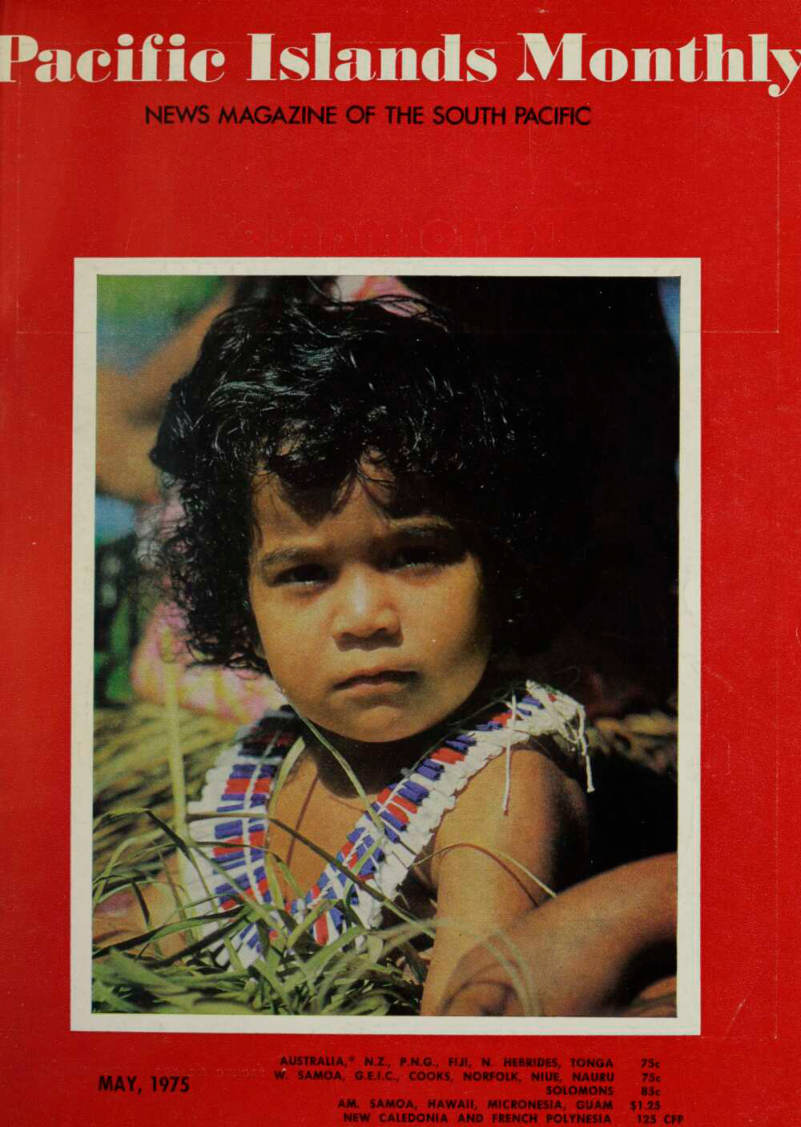
Our Cover
So young, yet with such a self-assured gaze straight into the camera's eye—an attractive study by Chris Moorhouse of a Nauruan child.
Advertisements & other items, p. 2 (1 item)
You Enjoy Living With.
Performance
Honda is a true life drama, performed on the world’s stage. By average folks, teenagers, men, and women everywhere. Your neighbors, maybe even you arc playing a part. If so, you know Honda is more than great machines.
It’s people concerned with taking people where they want to go in life.
On two wheels, we’re the best selling motorcycle. The easy to operate hard workers who don’t demand much. Honda is always ready and gets you there safely. We move on four wheels. The precedent setting Honda Civic continues to receive international economy and performance awards. If s the elegant compact car.
Sometimes, we have no wheels. Honda portable power operates machinery, generates electricity, pumps water and tills the soil.
Little wonder good things happen on Honda —we work harder to assure they do.
, CIVIC
World’s Largest Motorcycle Manufacturer
HONDA MOTOR CO.. LTD. TOKYO. JAPAN
PAPUA NEW GUINEA: Steamships Trading Co., Ltd. P.O. Box 74. Papua/U.S. TRUST TERRITORY: J.C. Tenorio Enterprise P.O. Box 137, Saipan /FIJI ISLANDS: Coral Island Motors Walu Bay Suva Fiji Island. P.O. Box 48. Suva, Fiji /TARAWA: The Gilbert & Ellice Islands Development Authority Gilbert & Ellice Islands / WESTERN SAMOA: Motor Distributors (Samoa) Ltd. P.O. Box 576, Apia /AMERICAN SAMOA: Halook’s Service Center P.O. Box 1138, Pago Pago. American Saanoa/TONGA: E.M. Jones Ltd. P.O. Box 34, Nukualofa/SOLOMON ISLANDS: British Solomons Trading Co., Ltd. P.O. Box 114. Honiara/ NEW CALEDONIA: Establissements Ballande, Noumea / TAHITI: Ets. COMIMPEX P.O. Box 200, Papeete /COOK ISLANDS: Cook Islands Motor Centre Ltd. P.O. Box 74, Rarotonga / NAURU ISLAND: Nauru Cooperative Society 14th Floor, Wales Corner, 227 Collins Street Melbourne Victoria 3000 / NIUE ISLAND: S. Jessop & Sons.
P.O. Box 71, Alofi South, Niue Island / SAIPAN: United Micronesia Development Association P.O. Box 298, Saipan, Marianas Islands 96951
In This Issue
General
NZ firms ready to operate in Islands 73 World copra prices drop 76 Dengue fever strikes 78
American Samoa
Electric power problems 24 Female Director of Education 24 Big mess for new governor to clear 69 Radio station for sale 70
Cook Islands
Chief Judge retires 15 Mew coins 17 Oovernment's newspaper 19 Opposition members suspended ... 79
: Iji
?oyal commission into electoral system 15 loom in sugar 16 >ockers threaten to ban container ships ... 59 >chool for waterfront workers 60 974 trade in the red 72 Jovt wants airline's shares 75 Jew manager of BP subsidiary ... 75 ijians form new companies 77
Rench Polynesia
\r Stirn's Tahitian love song ... 4 Vhy does France want to stay in Tahiti 5 ound waves to catch fish 82
Gilbert & Ellice Islands
Lagoon ride 33 Banabans' case opens in London .. . 78 Ellice goes it alone in October ... 83
Lord Howe Island
Rare bird in danger ... 18 NSW Lands Dept takes over 76
Nauru
Air service to Hong Kong 59
New Caledonia
Mr Stirn's visit 6 Youth movement disbanded 7
New Hebrides
Bi-lingual stamps 15 Man drowned 83
Niue
Govt in cattle business 73
Norfolk Island
Better shipping service 64 New luxury hotel 76
Papua New Guinea
September date for independence ... 7 Senior police officers leaving 8 Bougainville wants the vagrants out 8 Strikes averted 15 Wuvulu's future 15 Prison labour for road works 15 Fireworks banned 15 Cave exploration 17
Unwelcome giant snails 18 Meteorite mystery 23 Ropeways may solve transport problems 65 Japan wins the car markets 71 Rubber companies slump 74 Clearing the minefields 78
Pitcairn Island
Is end in sight? 17
Solomon Islands
Tough times ahead for government 9 "Dead" man comes alive 21 Leapfrogging at Honiara wharf ... 64
Tonga
Arabs stall over bulk carrier 62 Still hopes of off-shore oil 72
Us Trust Territory
Guam Games tune-up 11 Plebiscite date 15 Pangelinan at White House 26
Wallis Islands
New French Administrator 78
Western Samoa
Officer's conduct investigated 14 Sex and the public service 14
APARTMENTS: Up front with the Editor, 3; In a Nutshell, 5; Topicalities, 17; ditors Mailbag, 29; Magazine Section, 37; Yesterday, 45; MANA, 46; Books, 53; rom the Islands Press, 58; Pacific Transport, 59; Cruising Yachts, 68; Business' and development, 73; Produce Prices and Exchange Rates, 77; Shipping Information, 80; >lands deaths, 83.
Advertisements & other items, p. 4 (1 item)
Top Pacific Titles!
Send your order direct to
Pacific Publications (Aust) Pty. Ltd.
29 Alberta Street, Sydney, N.S.W. 2000
FOLKLORIC IN AUSTRALIA
Text: Beth Dean Photographs: Stan Goik This attractive large format book illustrates the beauty and vitality of national folk dances brought to Australia by newcomers from Europe and elsewhere, and now a strongly growing cultural movement in our cities and towns. Performances of some of the leading folk dance groups in Australia have been captured on stage, in colour, and the better known dances described. Folk groups represented include those from Greece, the USSR, Croatia, Israel, Lebanon, Sweden, the United Kingdom, Armenia, Bulgaria, Latvia, Latin America, Australia and others. Surprisingly, this is the first book to illustrate the scope of the great folk dance cultural development in Australia. 88 pages in full colour.
PRICE: Australia, $6.95 plus 90c posted. Pacific Islands and Overseas, $6.95 Aust., plus $1.30 posted; U.S.A., $11.95 U.S. posted.
THE STORY OF THE
SOLOMONS
Charles E. Fox An unusual history of the Solomon Islands, from the first European sighting in 1568, through the violent blackbirding years, the adjustment to colonial rule, the impact of the Pacific war, the striving for a Melanesian identity . . . lovingly told from the Solomon Islanders' viewpoint by Reverend C. E. Fox, CBE, MA, Litt D, who spent more than 70 years in the Pacific Islands, 65 of them in the Solomons. No person is better qualified to write of the Solomons than Dr Fox, who is now living in retirement in New Zealand.
PRICE: Australia, Pacific Islands and Overseas, $2.50 Aust., plus 35 cents posted; U.S.A., $3.75 US posted.
FRIENDLY ISLAND
Patricia Ledyard Tonga, sunlit South Pacific island kingdom, was described as a "Friendly Island" by Captain Cook, but nobody was ever more enchanted by its spell than a young Scottish doctor and a young American girl who fell in love with it and with one another more than 20 years ago. Here is the warming story of their life in Tonga, and of their Tongan friends and neighbours, told by the American girl.
Patricia Matheson, formerly Ledyard, still lives on the sandy point in the beautiful harbour of Vava'u. Her book, first published in 1956 and now updated with a new foreword by the author, has become a South Pacific classic. 256 pages, illustrated.
PRICE: Australia, Pacific Islands and Overseas, $3.00 Aust., plus 48c posted; U.S.A., $8.30 U.S. posted.
COLONIAL ERA CEMETERY
OF NORFOLK ISLAND
R. Nixon Dalkin An important addition to Australiana is this first detailed examination of the graves in the Norfolk Island cemetery.
The author is a former Administrator of Norfolk Island, now living in Canberra. The attractive book, well illustrated with early drawings and photographs, including close-ups of the major headstones, records all inscriptions in the colonial cemetery and relates many of the colourful stories of those buried there —convicts, soldiers and civilians.
Norfolk Island was settled within a few weeks of the arrival of the First Fleet in 1788, and the cemetery is thus of great historical interest and importance. The oldest extant grave in the historic cemetery, its headstone still intact, is that of a First Fleet convict who died on the island in 1789. 48c posted; U.S.A., $4.95 U.S. posted.
Overseas, $6.00 Aust., plus $1.30 posted; U.S.A., $10.60 U.S. posted iii 1 111
Pacific Islands
Monthly
FOUNDED BY R. W. ROBSON IN 1930
Published Monthly By
Pacific Publications (Aust.) Pty. Ltd.,
29 Alberta St., Syctney, N.S.W., 2000.’
Postal Address: G.P.O. BOX 3408, SYDNEY
N.S.W., 2001.
Telegraphic Address: PACPUB, Sydney.
Telex 25168.
Telephones: 61-9197, 61-7101, 61-4369.
Consulting Directors: R. W. Robson, Judy Tudor.
Chief Executives: Manager: Selwyn Hughes.
Publisher: Stuart Inder.
Director of Advertising; W. A. Gasnier.
Pacific Islands Monthly
Editor: Stuart Inder.
Assistant Editor: John Carter.
Subscription Rates:
'Pacific Islands Monthly" is airfreighted to the maiority of subscribers and agents in the Pacific San j S a t n , d the LI.S.A.; copies to the Cook Islands, Nauru, Niue, Micronesia and Guam go by surface mail.
Australia (including Lord Howe and Thursday Islands), New Zealand, Papua New Guinea, Fiji, New Hebrides, Tonga, Cook Islands, Western Samoa, Gilbert & Ellice Islands, Norfolk Island, Sol n e mn and . , Na l/ rU: * s9 - 00 (local currency) c S i™ n ‘ slands . : $lO.OO Aust., American Samoa, Micronesia and Guam: $12.00 US- Hawaii and US Mainland; $15.00 US; New Caledonia and French Polynesia: 1,500 CFP- United Kingdom: £6.50; Japan: 4,000 Yen"
Elsewhere $11.50 Aust.
Representatives
Herald IM and Distribution-Fiji Times & 2l^l. L |eiex“fJ G 2, d 2 °;. SUVS - Teleph ° ne: Papua New Guinea: PORT MORESBY, PNG Print 227.Crabaul mV n O, w 633; LAE ' p -°- Box ' fc/ B Dh^ Vld S !T ,pso n ' 1 P-O. Box 164 (c/- Rabaul Photographic. Tel.; 2677.) SSf Pac| te 2229 U "A d u k,a P „ a d CifiC PubMCa,i ° nS ' CP '°l U t n H ited ofr d n°T : , Ad vertising—Overseas Publicity o|d' 2141 Oxford Street, London, WIN OEA* Phone.- 01-636 8296/7. Subscriptions—T. b!
G 9ham ' Pa : k “° use ' T 22 Park Street, Croydon,
Cr9 3Np. Tel.: 01-6884177.
Advertising—Universal Media Corpora tion, C.P.O. Box 46, Tokyo. Tel.: 666-3036 (A C usn la: Pt v Ad 7f r H Sin l -,/ ac 0 ific Publications (must.; Pty. Ltd., Herald & Weeklv Timo« Buying 2nd Floor, 61 Flinders Lane Mel bourne, 3000. Telephone: 652-1565. " a " d “ s - Mainland only: N. Grogan 3354 Hayden Street, Honolulu, 96815. (Send change of address notices, Form 3579 and new subscriptions to P.O. Box 2193 - . Honolulu, Hawaii, U.S.A. 96805).
Second class postage paid at Honolulu, Hawaii.
Copyright ©, 1975,
Pacific Publications (Aust) Pty. Ltd.
Vol. 46, No. 5 May, 1975
Up Front
with the Editor
Norfolk Islanders it seems will shortly have a choice of two local newspapers. That’s something that few communities of only 1,700 people enjoy.
Ed Howard, who has been a part time resident of the island for six years (the major part has been spent m Sydney, about 1,000 miles to the south-west), last year moved to Norfolk with his wife Alice to begin taking over gradually as editor and proprietor of The Norfolk Islander, which Tom and his wife Tim Lloyd started in 1965. Tom was to concen trate on his printing business.
As takeover time approached, Tom and Tim realised they didn’t want to lay down the editorial pen after all.
Ed thinks there may be room for a second paper on the island, and is now preparing the Norfolk Island News to find out whether he’s right.
American-born, Ed and Alice have become Australian citizens, and Ed has handed over to associates the Sydney public relations firm of Edward Howard and Co which he successfully operated for 12 years, so he’s really thrown in his lot with Norfolk Island. In fact as associate editor of the Norfolk Islander he has in recent months introduced a newsier style and layout, and pro duced a number of in-depth inter views.
It’s surprising how many small newspapers can and do exist in Island communities, each with its own flavour, and thus its special appeal, and there is probably no reason why Norfolk Island should be an exception. Most of these Island papers would win no prizes for pro duction standards, being little more than roneoed newsheets, but their charm is in their contents —as regular readers of PlM’s From the Islands Press section will have long since observed. Spades are called spades, sometimes with delightful disregard for the laws of libel.
They usually manage to reflect their Island community, but that doesn t mean their publishers are always appreciated. Tom Lloyd last year was a delegate at the formation of the Pacific Islands News Asso ciation in Suva, and presented a typical address to the gathering—
warm, informative, folksy—in which he made the point, “Tim and I write things as we see them—most times in a friendly, relaxed Pacific Island style, but occasionally with a sting in our tail, which usually sees us ostracised by whoever we have bitten the very next time we walk down the street. But we are human enough to admit that there are times when we agree that possibly we could have said it a little better and both wished we had had a little more expertise. However we try to keep alive our Norfolk way of life.”
Tom described the Norfolk Way of life as he saw it this way: “Due to our geographical isolation Norfolk Island is not really a part of the wider developing areas of the Pacific region—but at the same time it is intensely proud of its heritage as part-Polynesian, and the life style that was carried there by our fore fathers when they left Pitcairn Island to make a new home on Norfolk Many of my readers and I still feei that we can, given the right kind of encouragement, teach many other countries how life should be lived.
“We do not have income tax—yet we have no destitute old persons.
We provide from our own resources a weekly pension, be it ever so small, that allows them to live in dignity.
“There are many other ways in which we look after our own. Even in death, the islanders help dig the grave of the deceased, make the coffin and even provide the hearse for the burial service. All at no cost to the mourners.
“In a changing world, and with more and more of our people tasting the so-called materialistic pleasures of the mainland, and with an ever increasing flow of new settlers bring ing their outside influences to bear on our way of life, the role of the Press as I see it, is not only to act as dispenser of news but also to act as the conscience of the community.
Not only to keep alive the traditions and life-style of our Pitcairn fore bears, but to also remind newcomers and the Government that the people of Norfolk have, with great sacrifice to family relations and personal hard ship kept alive the spirit of Norfolk.”
Advertisements & other items, p. 5 (1 item)
3
"ACIFIC ISLANDS MONTHLY—MAY, 1975
Pacific Islands Monthly
Mr Stirn's Tahitian Love Song: A
New Style With New Chances
From AL PRINCE in Papeete
Olivier Stirn, the French Secretary of State for Overseas Departments and Territories, made an historic, seven-day visit to French Polynesia at the end of March, ruling out inde pendence and internal autonomy for Tahiti, but proposing more local auto nomy through a reformed, seven-man government council with Governor Daniel Videau as its president. Mr Stirn’s visit was historical, not only for what he did say but also for what he did not say, but implied.
Although Mr Stirn is due to return to Tahiti in six or eight months, but definitely before the end of the year, to continue the dialogue he began, two things became clear about Tahiti’s future as the minister boarded his plane at the end of a very busy visit.
First, Mr Stirn in no way indicated that France has any intention of pull ing out of French Polynesia at any time in the near future or tightening the generous purse strings that have contributed to a very modern, but increasingly expensive and infla tionary, way of life in Tahiti.
Secondly, Mr Stirn indicated that the relationship between France and French Polynesia, as spelled out in a 1966 law, will perhaps never be quite the same again. About this, Mr Stirn was more specific, saying that a new law governing this relationship will go into effect next January 1. Ostensibly, the purpose of Mr Stirn’s visit—his first as French President Valery Gis card d’Estaing’s Overseas Territories Minister—was to open a dialogue with local officials and political leaders on how this new law will be worded. This dialogue will continue in May when a delegation from Tahiti visits Mr Stirn in Paris and when he returns later this year.
Under this new law, instead of in dependence or autonomie interne — greater self-government short of in dependence—Mr Stirn said French Polynesia will get more autonomy through the reformed seven-man government council. The governor, he said, will have an equal voice with the
other six council members, who will represent local political factions.
The council will have full powers, even over administrative services, and added that the governor will no longer have his present absolute prerogatives as head of the current six-man gov ernment council. (It is perhaps be cause of the proposed change that Gov Videau has not been participat ing in votes by the current council for several months.) Mr Stirn said at a press con ference on his last day in Tahiti that he considers it normal for the gov ernor to remain president of the new council because “taking this presidency away from him would be an act of suspicion against the government (of France). I believe the political groups can accept this. One must give the territory autonomy and not ambiguous internal autonomy.”
However, what Mr Stirn described as the new relationship is not exactly what the three major political parties in Tahiti have been after. They had envisioned an elected official as head of a new government council, with the governor being nothing more than a High Commissioner.
But Mr Stirn said the exclusion of the governor as president of the new council would create undue suspicion towards France, and he indicated such suspicion by viewing internal auto
nomy as a stepping stone to indepen dence, although the local parties have argued that this is not true.
About a week after Mr Stirn left Tahiti, Agence France Presse, the French news agency, quoted him as saying in Paris that the political parties in Tahiti had abandoned their pre vious demand that the governor’s role as president be removed from a reform of the government council.
This prompted immediate, angry de nials by the autonomist and inde pendent parties.
But for the most part, the local political leaders appeared to be one big, happy family during Mr Stirn’s visit. A photograph in a local news paper showed former Territory Assembly President Gaston Flosse and French National Assembly Deputy Francis Sanford smiling with arms wrapped around each other as they accompanied the minister on a visit to some of the outer islands.
Mr Stirn arrived in Tahiti on March 19 under the theme of “a new style, new chances”. But on the day of his arrival, the three local French language newspapers carried an open letter to the minister from the autono mist party, which said, “We want to very frankly point out that at this moment the government is playing France’s last card in Polynesia. We hope that they play well.” The letter also reminded Mr Stirn that in two interviews just before coming to Tahiti he had said that “the large majority of Polynesians wish to remain French.”
But the letter pointed out that a delegation from Tahiti recently told Mr Stirn in Paris that: • “Polynesians in no way wish to renounce the right to independence that the Constitution of the Republic (of France) grants them; • “They will utilise this right in the case where the new territorial statute, which will be granted or im posed on them, will not give them the internal autonomy that a great maiority of them are claiming” and • “Therefore, their wish to re
main French will never be uncondi tional, but quite the contrary, will de pend in the near and distant future on the conditions in which France will or will not allow them to live free as they wish on the land of their an cestors, caring for their own matters themselves.”
And Mr Stirn got another reminder when he attended a meeting of the French Polynesia Territorial Assembly in Papeete the very next day. This came from Assembly President Frantz Vanizette, who told the Minister, “We don’t wish to pretend that the future of the territory, and its future as a whole, depends exclusively on the statutes of the territory. The example of the current world economic crisis is there to make us more modest.”
And Mr Vanizette said that although the French Constitution’s section governing overseas territories “leaves room for a possible accession to independence, in the context of
present discussions . . . independence
is not on the agenda either literally or implied.”
However, he stressed, “One thing is certain—and my personal experience of 18 years presence in this assembly is proof of this—unanimously— I re peat, unanimously—an evolution of the statute of our territory is wished.
For 17 years there has never been a session of the assembly where the statutory problem has not been brought up, either directly or in directly. Everyone, whether they had the majority or not, after having explored the present statute, ... by different roads and at different times, all of us have come to desire an evolution.”
When Mr Stirn’s time came to address Gov Videau and the assembly, the first thing he did was to rule out independence for Tahiti.
“I’ve already been able to see . . . that Polynesians do not want inde pendence. Some of you would have admitted this only as a last resort, with fear and against your will. They would have only done this if, to quote French President Giscard d’Estaing, ‘The change that took place was only because they were unable to find what they were looking for in France.’
“Therefore,” Mr Stirn said, “a referendum on independence is use less.”
The minister said that a French ministerial group will meet in Paris in June on the country’s overseas ter ritories with the aim of formulating a definite position. The text of this position, he said, will be submitted to the French Polynesia Territorial Assembly for approval and will be debated in the French National Assembly and Senate in Paris during the autumn (northern) session this
year and go into effect next January 1.
But Mr Stirn noted, “Of course, this does not naturally imply that the text is already ready. This merely means that the main lines of what appears to be suitable to the government, after its first contacts with you, have already been defined.
“Of course, the dialogue that has begun will enable us to reach legisla tion that I hope will be of such a nature that it satisfies all political tendencies making up the territory.
Of course, no one will be totally satisfied because when getting down to details and arrangements, different points of view appear.”
Mr Stirn said he hopes that an arrangement can be reached that “will do away with any misunderstandings or permanent fighting on this point.
It is clear that the rupture of ties with France is neither wanted nor hoped for. . . .”
In stating his theme of “a new style, new chances,” Mr Stirn said, “That is the contract, which, from the bot tom of my heart, I propose today to the Polynesians.” He later added, “I am sure that France can give the territory more real independence; that France can give the territory more dignity. But as a counterpart, French Polynesia must give France more justice and more brotherhood.”
He did not elaborate.
During his visit to the outer islands
a couple of days later, he said a fear that the territory would not remain French had to be done away with to enable the moral and economic con tract he has proposed for France and French Polynesia to work. “I can clearly here that French Poly nesia is, and will remain, French because of the close ties uniting you to France and because you give France a lot, and in return it gives you much too.”
A little more than a week after Mr Stirn left Tahiti, French Social ist Party leader Francois Mitterrand arrived, ostensibly to join his wife who had already spent a week’s vacation in Tahiti. Claiming that he had not come to hold any important
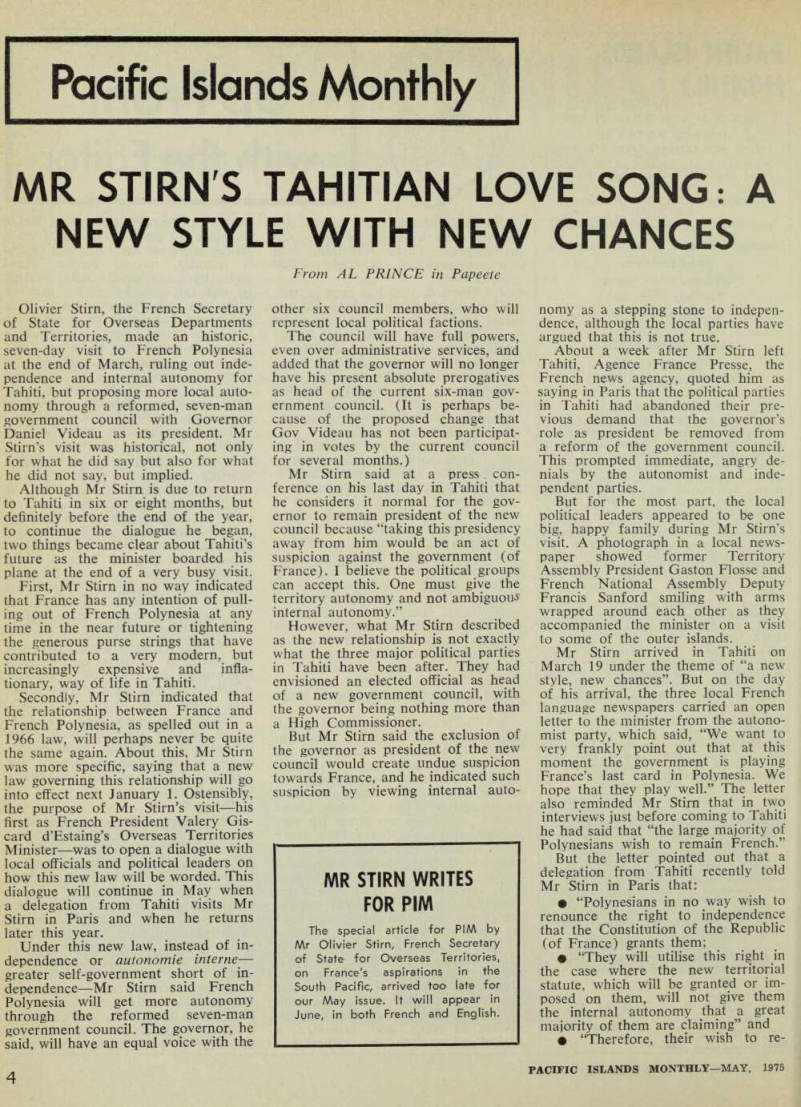
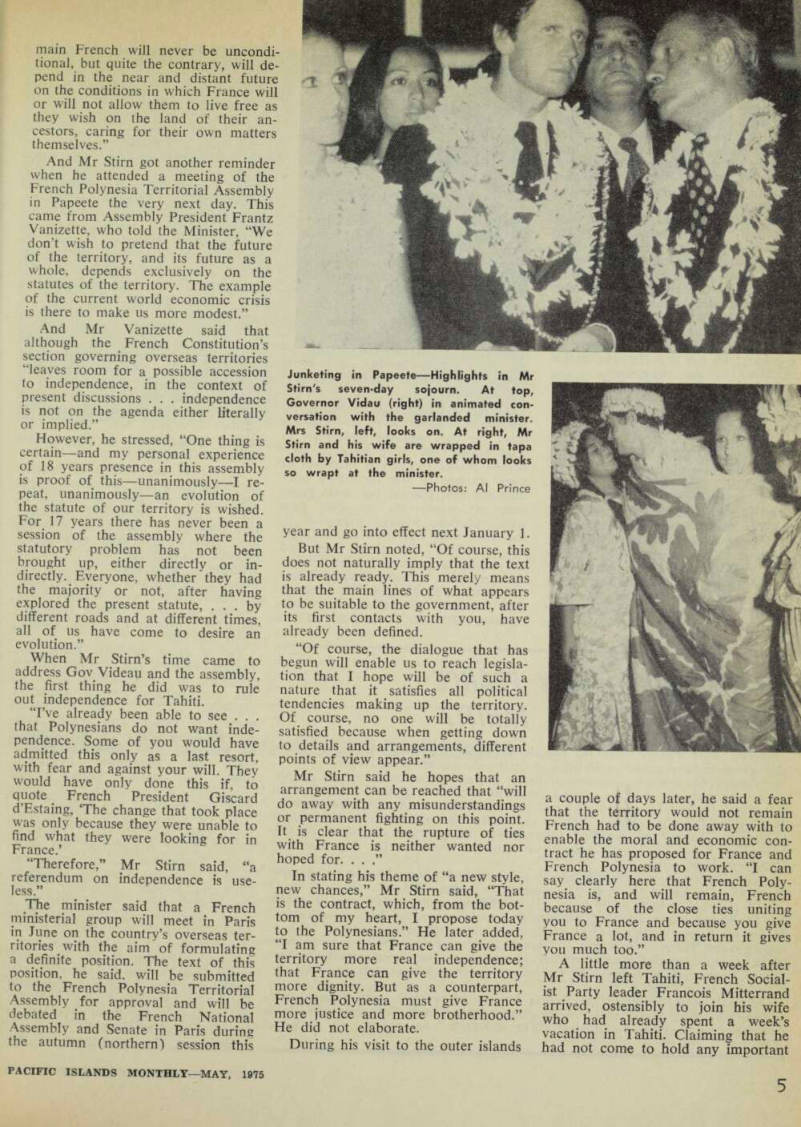
Junketing in Papeete—Highlights in Mr Stirn's seven-day sojourn. At top, Governor Vidau (right) in animated con versation with the garlanded minister.
Mrs Stirn, left, looks on. At right, Mr Stirn and his wife are wrapped in tapa cloth by Tahitian girls, one of whom looks so wrapt at the minister. —Photos: Al Prince
political meetings, Mr Mitterrand addressed a crowd of around 2,000 outside Papeete’s City Hall the day after his arrival.
French National Assembly De puty Francis Sanford introduced the Socialist leader to the receptive crowd, many of whom voted for him in his close but unsuccessful bid last year to defeat Valery Giscard d’Estaing in the French presidential election.
Mr Mitterrand said, “I’m not your President, but in any case, I can guarantee you I’m your friend. The liberal programme of the Left men tions ‘auto-determination’, meaning it is up to the population of each territory to decide for itself in what way it intends to manage its affairs.
We did not say that auto-determin ation is independence, autonomy or a colony; we say it is the free choice exercised by the population.
“Of course, our adversaries have tried to make everyone believe that we were going to decide to cut the links between Tahiti and France.
That is a lie.
“If I let my heart speak, my wish is that we remain together. If I let my political conscience speak, it is up to you to decide”. • The Permanent Commission of the Territorial Assembly voted early in April in favour of flying the Tahitian flag—formed by three horizontal bands of red, white and red—next to the French flag at all public places. The measure now goes to the Government Council for approval.
Advertisements & other items, p. 6 (1 item)
Mr Stirn Writes
FOR PIM
The special article for PIM by Mr Olivier Stirn, French Secretary of State for Overseas Territories, on France's aspirations in the South Pacific, arrived too late for our May issue. It will appear in June, in both French and English.
No-One Asked Why France
Wants To Stay In Tahiti?
Why does France want to remain in Tahiti? This is the question no one seems to have asked — officially, at least —during Mr Stirn s visit.
France has already announced that it is pulling out many of its people connected with the nuclear testing programme, which initially raised fears that France might be planning to pull out of Tahiti completely. Nevertheless, the dent in Tahiti's economy left by the manpower reductions in the testing programme cannot be repaired immediately, or perhaps not even in the immediate future, by local industry or tourism, which so far this year has fallen off drastically. . ,„ , But France apparently still intends to pump money into French Polynesia s economy as it has in the past. The question remains, “Why?”
A possible answer came from a local French source, who said it could be “for sentimental reasons”. He denied that such sentimentality is an expensive luxury for France at this time of world economic crisis, quickly adding, When you mention Tahiti to someone in France, their eyeballs start to turn as they enter a semi-conscious state of ecstasy, dreaming of Tahiti and paradise . For just that very reason, he said, he feels that France would sooner give up New Caledonia than Tahiti. . . „ Could another part of the reason be one of prestige, with France rep resenting a viable force in the South Pacific with French Polynesia and New Caledonia as Overseas Territories? “Yes, definitely,” he replied.
disappointed
New Caledonian journalists disappointed
From a Noumea correspondent Noumea journalists who flew to Australia to cover the visit of French Overseas Territories Minister Olivier Stirn sent home disappointing reports of economic statements on New Cale donia and alleged anti-French feeling in the Australian press.
Of course there was pleasure and pride in the official courtesy sur rounding the visit with its confirma tion of a rapprochement, at least at government level, between France and Australia.
As far as Caledonian problems are concerned, there was no exciting news for the Noumea journalists to send back. One brief sentence con firmed earlier ministerial promises of some change in the territory’s poli tical statutes. But on the main prob lem of economics, as one pro administration weekly expressed it, the Stirn visit was the “confirmation of a failure” ie, there were no heartening nickel developments after the minister’s announcements during his New Caledonian visit in January.
The Noumea journalists were keen to hear Mr Stim’s reactions to his
February talks in Paris with AM AX president lan MacGregor and INCO’s Edward Grubb.
However, the Noumea weekly could only repeat that the Cale donians are tired of vague promises and that Mr Stirn’s remarks in Syd ney were far from reassuring. In view of the lack of hope of anything from the French Government, the paper showed there was little point in the Caledonian Territorial Assem bly approving company tax reforms which Mr Stim stressed, again in Sydney, were urgently required to permit the building of long-promised new nickel works.
The Noumea press pointed out that on the national level, the main objects of the French ministerial visit were uranium and aeronautics.
The French were in fact lobbying for the use of French technology in the setting up of any Australian uranium-enrichment plant, as well as promoting the sale of French aircraft such as the airbus and Concorde. In return Australia was hoping for French sympathy in allowing greater beef exports to the Common Market.
As far as any fallout of benefits to Caledonians was concerned, hopes centred on an increase in tourist traffic from Australia, although shortcomings of Caledonian welcome and amusements were emphasised, especially compared with Fiji’s at traction to Australians. This is a sore point, since Minister Stirn last Janu ary had already exhorted the Cale donians to take a lesson from the immense revenue Fiji was earning from tourism.
On a more personal plane, the French visitors felt an anti-French sentiment in the Australian press. As one metropolitan French journalist expressed it, “. . . the Australian press still remains unpleasantly anti- French, fixed with a colonialist image of France”, with Australian politi cians and journalists frequently using the words “colony” and “colonial”, words which are ‘‘never used any more by the French”.
In an article entitled “Australian Press Sulky with Mr Stirn”, the same writer’s paper complained that Aust ralian journalists did not meet the French minister upon his arrival at Canberra airport. Moreover, when the Noumea press was invited to a press luncheon at the Journalists Club in Sydney they met only the club president, a non-journalist mem ber and a Papuan writer. The small cover given to the French visit sug gested that “the Australian press does not want to support the Whitlam government in its desire to extend a friendly hand to France”.
However, the importance of this
mission to the French is emphasised by trade follow-ups to come. An Austrahan visit is planned shortly by the French Minister for Overseas Trade, Mr Segard, as well as an economic and industrial mission, with a possible trip by French Prime Minister Jacques Chirac before the end of 1975.
Meantime, as France seeks to establish friendlier ties in the South Pacific, the Noumea press reported that Mr Stirn had asked Mr Whitlam and his Department of Foreign
Affairs to help improve Franco- Fijian relations, especially over diffi culties encountered with Fiji trade lln : on o « . . . u , . . .
Referring to the latest strike action announced against UTA French Air hnes at Nadl air Port in March, a Noumea daily claimed that Fiji union leader Tora was reportedly “sup ported by the International Corn munist Party to drive France from the South Pacific by all the means at his disposal”.
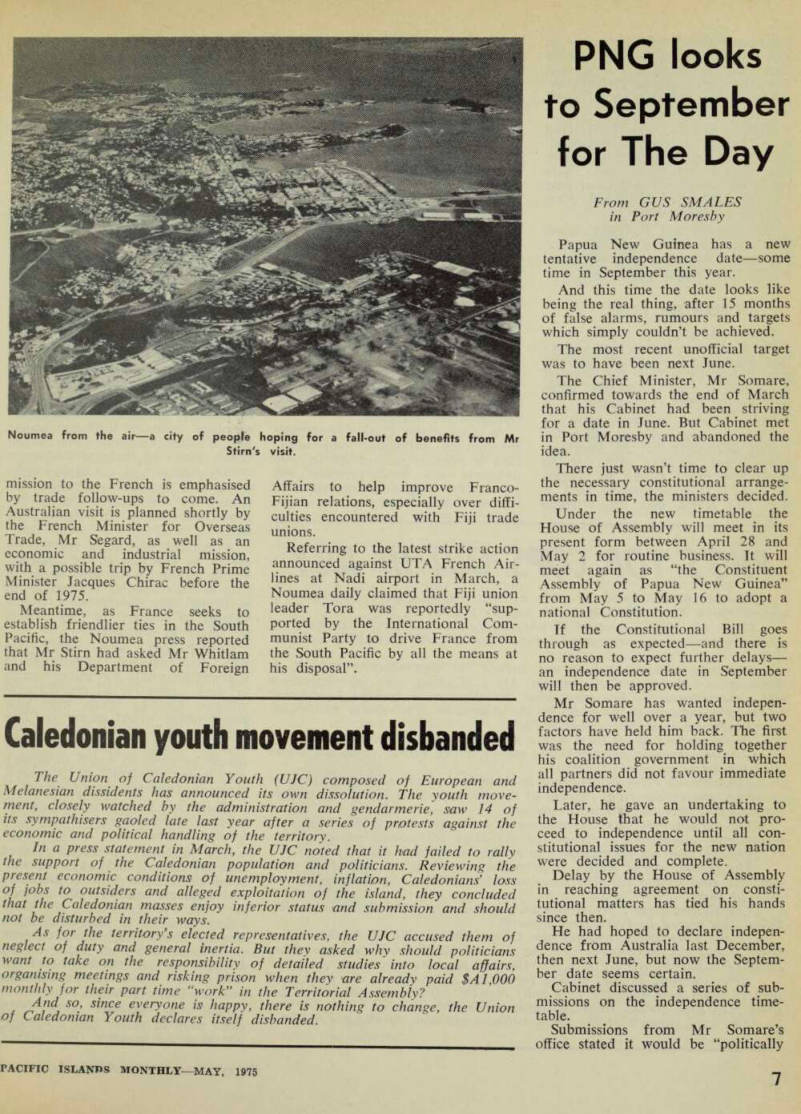
Noumea from the air—a city of people hoping for a fall-out of benefits from Mr Stirn's visit.
Caledonian youth movement disbanded
The Union of Caledonian Youth (UJC) composed of European and Melanesian dissidents has announced its own dissolution. The youth move ment, closely watched by the administration and gendarmerie, saw 14 of its sympathisers gaoled late last year after a series of protests against the economic and political handling of the territory.
In a press statement in March, the UJC noted that it had failed to rally the support of the Caledonian population and politicians. Reviewing the present economic conditions of unemployment, inflation, Caledonians’ loss of jobs to outsiders and alleged exploitation of the island, they concluded that the Caledonian masses enjoy inferior status and submission and should not be disturbed in their ways.
As for the territory s elected representatives, the UJC accused them of neglect of duty and general inertia. But they asked why should politicians want to take on the responsibility of detailed studies into local affairs, organising meetings and risking prison when they are already paid $ A 1,000 monthly for their part time “work” in the Territorial Assembly?
A*,, so : s * nce everyone is happy, there is nothing to change, the Union of Caledonian Youth declares itself disbanded.
to September
PNG looks to September for The Day
From Gus Smales
in Port Moresby Papua New Guinea has a new tentative independence date—some time in September this year.
And this time the date looks like being the real thing, after 15 months of false alarms, rumours and targets which simply couldn’t be achieved.
The most recent unofficial target was to have been next June.
The Chief Minister, Mr Somare, confirmed towards the end of March that his Cabinet had been striving for a date in June. But Cabinet met in Port Moresby and abandoned the idea.
There just wasn’t time to clear up the necessary constitutional arrange ments in time, the ministers decided.
Under the new timetable the House of Assembly will meet in its present form between April 28 and May 2 for routine business. It will meet again as “the Constituent Assembly of Papua New Guinea” from May 5 to May 16 to adopt a national Constitution.
If the Constitutional Bill goes through as expected—and there is no reason to expect further delays— an independence date in September will then be approved.
Mr Somare has wanted indepen dence for well over a year, but two factors have held him back. The first was the need for holding together his coalition government in which all partners did not favour immediate independence.
Later, he gave an undertaking to the House that he would not pro ceed to independence until all con stitutional issues for the new nation were decided and complete.
Delay by the House of Assembly in reaching agreement on consti tutional matters has tied his hands since then.
He had hoped to declare indepen dence from Australia last December, then next June, but now the Septem ber date seems certain.
Cabinet discussed a series of sub missions on the independence time table.
Submissions from Mr Somare’s office stated it would be “politically
advantageous” for all parties to be absolutely clear on all constitutional issues before embarking on a vote.
Extra time was necessary if this ab solute clarity were to be achieved, the submission said.
Cabinet was also told that to hold to a tentative date in June was be coming increasingly risky if proper celebrations were to be held. There would be insufficient margin of time to invite heads of state and other overseas representatives.
Mr Somare said that the delays had occurred because of “the time necessary to produce a good home grown Constitution”.
Planters 7 Fears
Fears are growing among Aust ralian planters in Papua New Guinea that Australian Government attitudes may drastically affect the level of compensation for properties taken over by the PNG Government.
This became evident early in April when a government office dis closed unofficially that the Australian Government couldn’t make up its mind how much money to allocate to PNG as a compensation fund. It was also learnt that the Whitlam
government had rejected a scheme proposed by the PNG Government to provide a basis for compensating Australian nationals on plantation properties.
In theory, the matter of acquisition and compensation is entirely the responsibility of the PNG Govern ment, and subject entirely to PNG Government policy.
The Australian Government —to the annoyance of many Australians in PNG—has refused to accept any direct responsibilities towards its nationals.
The PNG Government has given an assurance that it will not take over any properties without due nego tiation and compensation.
But, at the same time, PNG is re lying on an ex-gratia offer of special aid funds from Australia to provide the pool from which compensation payments will be made. Until the extent of Australia’s allocation is known, either in total or on a year to year basis, PNG is unable to fix a compensation formula.
At present the PNG Government is acquiring properties only where land is urgently needed for its own nationals, and these pressures will govern the long-range operation of the acquisition scheme.
Png's Top Cops Out In July
Nineteen of the 23 senior white officers remaining in the Papua New Guinea Police Force will leave their jobs by the end of July.
There will still be another 55 white officers in the force, but made up of contract men with less general experience or with specialised technical sk i Us The men who are pulling out include the Commissioner, Mr B. J.
Holloway, an Assistant Commissioner, Mr J. Graham, nine superintendents and eight inspectors. They are taking advantage of a golden handshake retirement arrangement financed by the Australian Government to smooth the changeover to local staffing in PNG.
The departure of 19 men in the space of a few months is caused by the retirement formula which favours mid-1975. An officer gains no further advantage if he stays any longer.
Although the PNG Government is committed to the speedy replacement of whites, the exodus from the top of the police force is expected to create huge staffing and administrative strains.
The departure involves the nucleus of men who have formed the main higher-level administrative strength of the force for several years.
The 19 men are all classified as permanent officers in the force The recruitment of whites as permanent career officers ended 12 years ago, and each of the 19 officers has served in PNG for an average of just over 20 years. , . „ . . .
The Commissioner, Mr Holloway, formerly from the South Australian Police, has served in PNG for 27 years.
If the government replaces the Commissioner with a PNG national from within the force —which is the present indication — the new Com missioner could be a man with less than 10 years service.
New Guineans did not qualify for officer status within the force until only 11 years ago, when the first cadet training scheme was established and some men were chosen from the ranks for officer training.
The total strength of the force, officers and men, is about 4,5 UV.
Bougainville
wants the vagrants out
Prom a Bougainville correspondent Bougainville’s growing political independence was demonstrated at the last meeting of the island’s Pro vincial Assembly, the interim body which will be replaced this year by an elected Premier and eighteen members.
The Provincial Assembly called for strong measures by the PNG Government to control the influx of “outsiders” who have flooded into Bougainville in the wake of the copper mine.
Father John Momis, the regional MHR for Bougainville encouraged members to protect their own people against the vagrancy and urban crime caused by these newcomers.
“They come here for money only, shame our women and show dis respect for our customs, disrupt our peace and offend our dignity”, he said.
A demand was made for the in crease in the number of Bougain villean police to be sent home to help in understanding the culture. In particular they should work in the villages to support the new system of village government.
Consultations were called for with the national authorities to approve proposals for identity cards or work passes for all non-Bougain villeans. Landing bonds were pro posed which would ensure the fare home for those who arrived to work, and the assembly urged that power should be given to courts to repatri ate those convicted of vagrancy, repeated drunkenness and assault.
The money to repatriate the current large numbers of vagrants was re quested immediately.
The assembly executive moved that all leaders find ways to over come the serious drinking problems, and members called for the appoint ment of “peace officers” in every village to arrest or fine troublesome drunks. Other suggestions covered, possible curtailing of liquor trading licences, shorter trading hours for taverns and limits on the amounts purchased by customers.
Said one member sadly, “We don’t want to ‘pasim’ beer altogether; just stop the ‘spaking’ (inebriation).
'seclusive democrats'
Tough times are ahead for the Solomons 'seclusive democrats'
From Warren A. Paia
It is now nine months since the Solomon Islands adopted the West minster format of government and elected to office its first Chief Minister, Mr Solomon Mamaloni. It has become clear that the new Mamaloni government means busi ness in its attempt to show that it can run its own affairs.
But the precarious nature inherent in a minority government and the unpredictability of party alignments, have created some concern for it.
Not unrelated to such concerns, moreover, has been the existence of an unshakable pillar of expertise and experience provided by the staunch, tough-minded and, very often, devious bureaucrats whose governmental skills are often quite unmatched by those of the new poli tical leaders.
Mr Mamaloni’s government, there fore, may be sympathised with, if not for anything else than for emerg ing at an important juncture of the nation’s history. To facilitate a smooth transition to nationhood at such a time is not exactly an easy task to carry out in a colonial out post where the seeds of British colonialism have sprouted rather well on the soils of a remote group of tropical islands. So the new government could perhaps be ex cused should it be over-cautious, seclusive and uneasy in its approach to shaping a new nation.
Indeed, the new regime has ap peared like a novice swimmer strugg ling desperately to keep her head above the murky waters of a deep, stagnant pool. And the fact that it has found itself in a dilemma is not surprising.
While on the one hand the Mama loni government is trying its utmost to break new ground in political respectability and innovation, on the other hand the urge to conform to the requirements of foreign concepts and institutions (which only a hand ful of people in the Solomons seem able to understand) has become somewhat irresistible.
But such obstacle aside, the new government is certainly making de termined moves toward self government. Many old policies are
now being scrutinised closely. Besides the formation of a long-overdue Lands Review Committee, designed to solve the country’s increasing land problems, the setting up of a Forestry Review Committee recently, has also shown how much the government recognises the need to nationalise its essential resources.
A further sign that self-government might only be around the corner is indicated by the proposed appoint ment of a first Solomon Islander Minister for Finance. He is expected to take his seat sometime in the middle of the year. It seems how ever, that the difficulty here will not be on whether or not to fill the post but who to man it.
Suitable candidates for this very important and demanding senior job are scarce, at least in the governing party. But it is an attractive post, and since potential candidates are almost all in the opposition party, it is conceivable that shrewd Mr Mama loni might “con” a further opposition member into joining him.
As self-government is now immi nent (some unofficial calculations
Mr Paia, a Solomon Islander from New Georgia in the Western Solomons is
a tutor in Poli t i cal Studies at the Uni versity of Papua New Guinea. Be fore taking up an aca dem i c career, he
worked as a civil servant for four years, 1966-70, with the British Solomons Government.
His article was written after he spent 12 weeks in the Solo mons “observing certain poli tical phenomena”.
have suggested end of 1975 or Janu ary 1976 as possible dates while Mr Mamaloni has said he would sur prise everybody) increasing govern mental activities in other fields have also become evident.
Mr David Kausimae, the Minister for Agriculture and Rural Economy, has been enthusiastic lately about his ministry improving agriculture gener ally and the cattle industry in parti cular. He told Western Council members in January that New Zea land was prepared to establish a meat factory in the country and to supply sea-trucks for carrying meat from different islands to the factory.
He also said that copra and charcoal factories might be set up in the near future.
The government’s Education Policy Review Committee’s report, which earlier was tossed out by the Legis lative Assembly, was reconsidered recently and has now been accepted.
This means that the Ministry of Education will now be able to put into practice most of the committee’s recommendations. Free education for children in standards one to three, the establishment of district education boards and area secondary schools have been some of the recommenda tions said to have been agreed to.
As for free education, most parents in the Solomons have probably not yet realised that free education for their children would probably mean higher prices for the sugar, meat and rice, etc , . . the prices which in the Solomons today are alarmingly exorbitant.
The government’s highly-praised Local Government Council Review is now in the process of being put into full operation. New legislation amending most provisions of the existing LGC Ordinance, 1963, has been effective since January. It re-
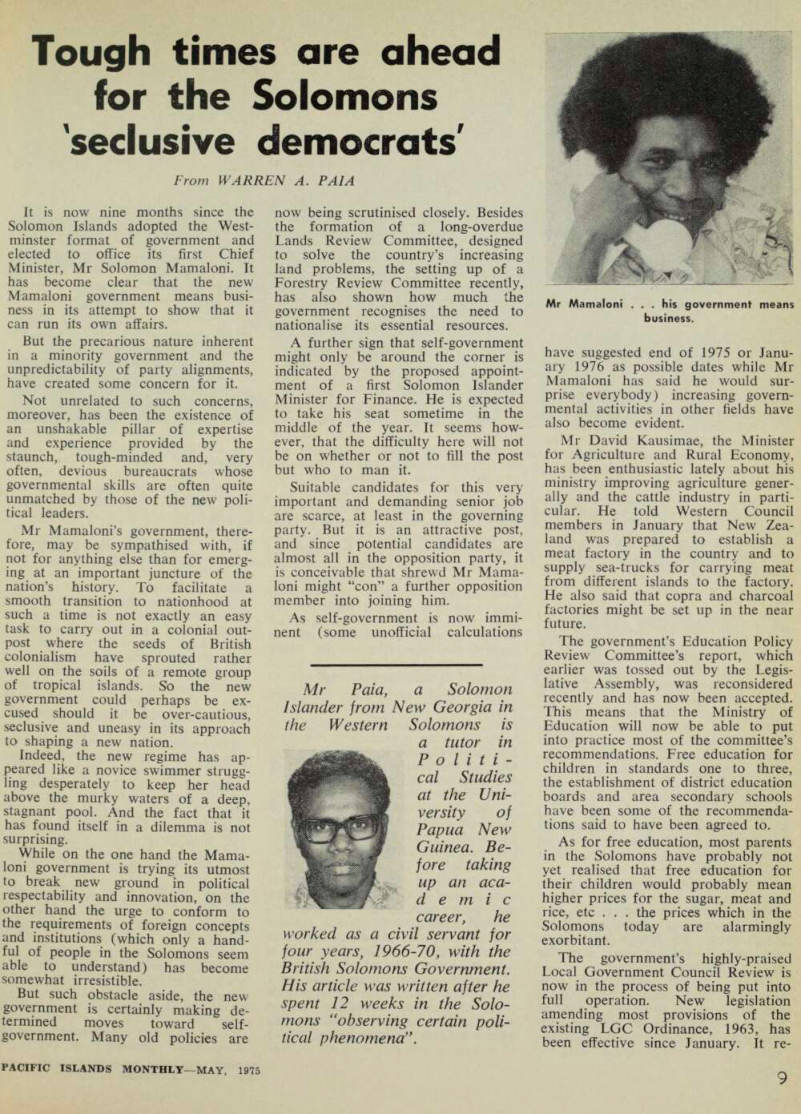
Mr Mamaloni . . . his government means business.
defines the powers and functions of a lot of officials beginning from the governor down to the ordinary council members.
But it seems that the paradox of the decentralisation programme in the Solomons is that while it de centralises certain important func tions, it, in fact, re-centralises in tegral aspects of decision-making and the power to have the final word.
While, in theory, the new policy makes councillors believe that they would be bosses in their respective areas, in practice the councillors and their presidents are made totally de pendent on the Ministry for Home Affairs and, inevitably, on the Pub lic Service.
In effect, therefore it tends to mean that the new Local Govern ment Council system unavoidably leads to the strengthening of central government and the turning of the now well-organised local councils into mere “agents” of it.
There is, of course, nothing unique about the decentralisation scheme in the Solomons. Its main themes have been based on the Anglo/ French models of devolution and de concentration of functions and powers. Unfortunately, in the Solo mons, the whole exercise appears to have been carried out (perhaps in advertently) according to colonial patterns that have existed in Africa and elsewhere.
Then the new policy has also re sulted in the restructuring of the whole governmental apparatus into a two-tier set-up: central and local governments; the district administra tion system being fused into the local government structure.
Direct contact with and easy access to the central government, however, could now be facilitated with ease by such a two-tier mechan ism. But in a highly-fragmented so
ciety where inhabitants do not yet fully enjoy the essence of mutual unity and respect, the new system could crack in the face of strong regional movements, or be chal lenged by the now-popular idea (even in the Solomons) of a provincial government system which many people in the country seem to see as a more realistic and constructive alternative than relentlessly to pur sue a course toward unitarism.
Because the civil service in the Solomons has been for a long time somewhat neglected, the new govern ment is continuing its recent move of restructuring it. One major empha sis in this exercise has been on the simplification of its hierarchical nature so that it could meet the re quirements of the new government set-up. A new classification of the general civil service hierarchy based on the well-known notion of ‘class’ or ‘level’ is now being employed.
Like most ex-colonial countries which, when moving to attain nation hood, have regarded economic via bility as being a necessary condition for independence, the Solomons has been no different in her concern over her economic plight. And indications so far have shown that she is doing all she can to solve the problem of under-development—even to the frightening extent, it seems, of open ing wide the country’s door to foreign investors.
It is, indeed, in the handling of political and economic issues that the new government could yet meet its greatest challenge. So far the gutless, directionless and lukewarm approach to establishing the foundation of a new state has concerned a number of people in the country. For ulti mately, they say, such an approach could only create a mediocre nation with no worthwhile philosophy to adhere to, no genuine principles to
cling to, no alternative constructive policies to pursue, etcetera.
And what is felt to be more serious is that a happy-go-lucky attitude to nation-building—by welcoming more aid, courting international business men, using one’s political power to enrich oneself, allowing the influence of like-minded parties from other countries to take root, etc—might only harm the country.
But in the Solomons, sad to say, any political or economic blunder appears possible at one’s whim—and the perpetrator be able to get away with it. How could a gross blunder of a public figure be found out, any way? By the press? No, not in the Solomon Islands.
The country’s news media (Radio Solomons and the Solomons News Drum) are government-controlled.
They have apparently become pro paganda machines of the regime, as they were before its establishment.
Through them, the 180,000 inhabit ants of those islands are continuously being subjected to the same old colonial indoctrination that has put many of them into a political stupor.
It has been said that in November 1974 the opposition party, USIPA (which, it is said, the Chief Minister has blatantly refused to recognise) called for the establishment of an autonomous broadcasting service.
The new government which appar ently enjoys its seclusive kind of de mocracy, took little notice of the eall. . .
Such an attitude is perhaps under standable: the colonial power is probably desirous of handing over the islands to local leaders in as quiet and orderly a way as possible.
However, the absence of unbiased news media through which the public could exercise its democratic right of scrutinising its own government,
Continued on p 79
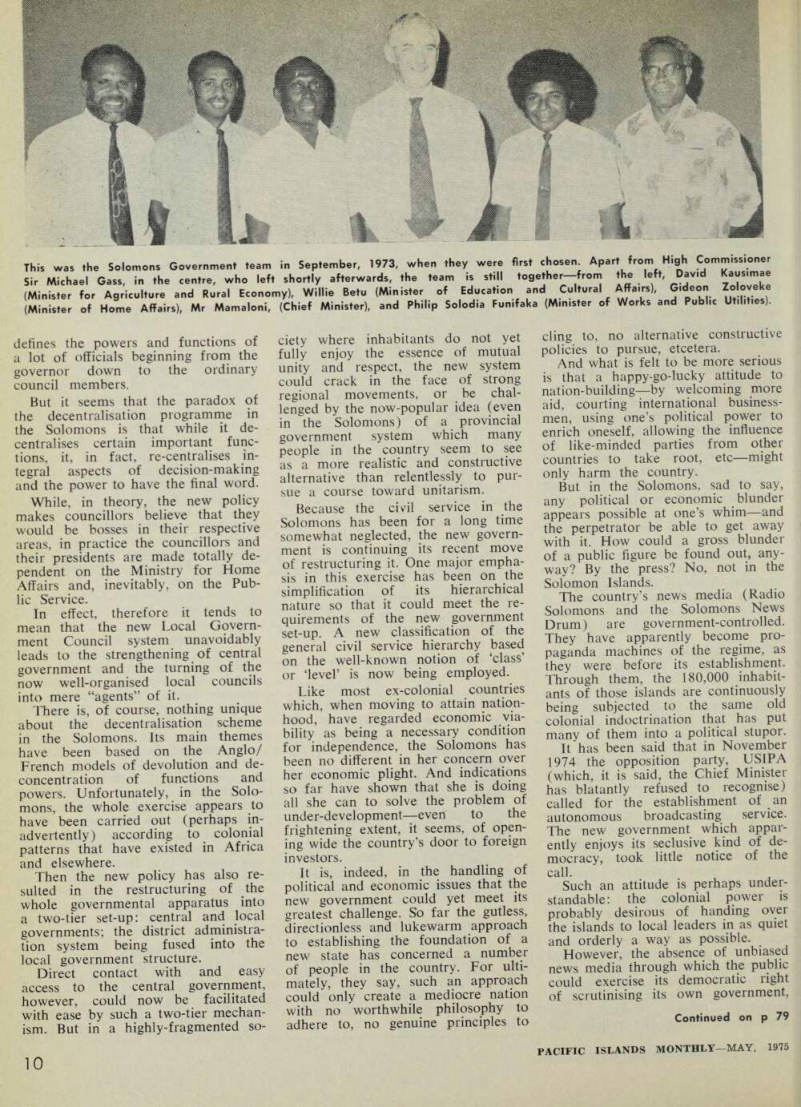
This was the Solomons Government team in September, 1973, when they were first chosen. Apart from High Commissioner Sir Michael Gass, in the centre, who left shortly afterwards, the team is still together-from the left, David kausimae (Minister for Agriculture and Rural Economy), Willie Betu (Minister of Education and Cultural Affairs), Gideon Zoloveke (Minister of Home Affairs), Mr Mamaloni, (Chief Minister), and Philip Solodia Funifaka (Minister of Works and Public Utilities).
ias conveniently provided a neat cur ain behind which the political ;aders have tended to hide them elves from the fury of the increas igly-disenchanted public.
And, while any behind-locked-door ictic of running a country could nly boost corruption and succour ishonest political practitioners, hard lets and serious rumours pertaining ) such events already occurring ave indeed been transmitted via the lands’ effective network of “coconut ireless“. Examples are numerous.
A young, disenchanted local leader om the chief’s own area recently ;nt a somewhat tough letter to the Dvernment. He wrote: “The plan of le new proposed government is now 1 rubbish. The local government ys a programme but this will not ? effective as the shipping here is dw run by business and not the wernment. The Ship today runs [amaloni’s business, therefore, tour g officers are not able to do what ey are supposed to be doing . . .
“Mamaloni is chopping the govern ent’s neck and tries to get his busi es to run the country. This is bad pervision. Is Mamaloni a poli :ian or the manager of the Patosha ampany? I don’t know which is tiich. Please look carefully into this id choose a new and better chief inister to run this country of
Its . . .
“I take this seriously on behalf of akira people and small neighbours ound”.
Government ships in the Solomons e in such short supply and the de and for them for public services in
that island world is understandably high. Yet the present government has apparently deemed it appropriate to allow the few large vessels available to be hired out to those thoroughly patronised development and invest ment companies. Other districts in the Solomons are said to have also suffered from this policy.
Another recent event, which had caused an uproar among the people in the district nearest to Bougain ville, and which had led them to call for secession from the rest of the Protectorate, was incited by a visit paid to the area by the country’s Minister for Agriculture and Rural Economy, Mr Kausimae. The row was over the insistence of the minis ter on resettling a group of people from the bauxite-rich Rennell Island on alienated Baga Island which is within the area of the district’s Local Government Council.
The Western District which Mr Kausimae visited on that occasion in January has regarded itself as neglected, has become suspicious of the central government’s actions, and has apparently become a politically angry region of the group. For sometime now, it has had ideas of secession.
The Western people have fre quently made it known both inside and outside parliament that they have not had a fair share of the national fund to which their district has contributed the largest amount.
Moreover, having the richest local government council in the country (which money surplus, it is said, the central government has also even tried to give to other councils or to put in a central fund—but all to no avail) tended to encourage the dis trict to talk of breaking away.
Furthermore, because of its rela tively-sophisticated population and concerned local leaders, the ‘West’ has begun to agitate for its rights. In addition, the problems caused by the preponderance of alienated lands in the area and the increasing disputes over customary lands have been of continuous concern to Westerners.
Their grievances have frequently been directed at the colonial central government which, they claim, in almost all cases has grabbed returned alienated lands without consulting the originally-dispossessed true owners of such lands.
Yet, in an off-handed and arm twisting manner, Mr David Kausimae tried to reach a favourable agreement on the resettlement question with these disgruntled people. To them in the January session of the Western Council he even put a surprisingly straight question: “What would you do if the central government goes
ahead and resettles the Rennellese on Baga?” The answer from the Western Council members was ex pectedly forthright: “If you are frightened that the Shortland Islands might join Bougainville, you would do well to also fear that prospect from the whole Western District”.
Although the minister’s negotiation for the resettlement plan met with very little success, on his return to Honiara he had apparently led the public, through the government radio, to believe that his proposal had been accepted by the Western people.
The Western Council’s negative decision on the matter surfaced later, and the episode raised some eye-brows in the capital.
The seemingly-worthwhile trip of the Chief Minister, Mr Mamaloni, to Papua New Guinea, Japan and New Zealand recently has now appeared tainted by certain alleged back-door private business deals in Papua New Guinea and Japan. These contacts were said to have been made in pri vate hotel rooms.
The winds of change are certainly blowing hard in the Solomons, but so far they have not exactly re freshed the suffocating island demo cracy.
Guam Officials Squabble As The
Islands Tune Up For The Games
the gathering in Guam is threatened by a major split between Ted Nelson, president of the Games Council, and Joe Paulino, who resigned in March as South Pacific Games Commission director of organisation PanHnr. oii A „ o ,i • . f .
Nelson, a charge denfed byNdson! and committees mission stall » , . . . . • t , le jf lslative committee, originally mended to explore the backgrounds or tour appointments to the Games commission, finished up delving into Panlinnffi. between Nelson and Hiding ’evidenc e e an fr B om various' wT nesses. During this evidence, Paulino smd he estimated that another $BOO,OOO would be needed from the wliat e-er‘he rights an d wrongs o( the squabble, it was unfortunate it should occur with the Games so close. For many months it looked as though they would be a sporting flop so little information came from Guam.’
However, Pebrnarv, ...r.
'£“rf‘ "T"
SaSn 0^? ¥ r Budy
ernn? ’lUr*S?Ju beha i! f ° f the Gov ' Bo .^ dalI + 0 ’ , who was absent, u^ da dlr^ c lve to department heads 5° 1 :° the Games * He asked each department to make specific commitmenf anl materia ' S ’ eqUip ‘ c P®. Geor f . Washin Ston High School was asked to provide housing tor the men > and the Agueda Johnston Junior High School for the women. Other education institutions were asked to provide back-up facilities and Games sites.
The Governor’s Games Commis f h h ® aded ( by Mr ™ ian ,f«eo.
The headquarters is in Mangilao. A television series; about the Games The . pro '
he "X* Seiko 'wiTpro
vide electronic timing equ’ipmenf at next to no cost aM timing devices and at least 10 tprhnicians Tfip wfimViun mi • ecb ' Guam onPul! 1 Can,,. .
■”* While final selections may not be ™ ad ? Ul \ aS , late July ’ teams are starting to take shape. Most partici patmg countries are using normal sporting fixtures plus trials, and special events to help in team selec tion. * COUntries American Samoa.—This should be one of the best-managed and best coached teams at the Games with one official for every 2i competitors. The s °-strong team will comprise 10 boxers, 12 volleyballers, 12 basket bailers (men), four judo men, seven golfers (four men and three women),
££. wdlte "mana-'
gers, coaches and “others”
Fiji.—The team will probablv nnm her a few less than 100. Fiji confi ?°tu,u - a distance runner His per- [ ormances U P *° 5,000 metres have been ., outstanding. Joe Roden is a P oss, bdity as a hurdler. Recently, at Buckhurst Park, Suva, he won the r°° m ? tr < e . s /) hurdles >n the Fiji record
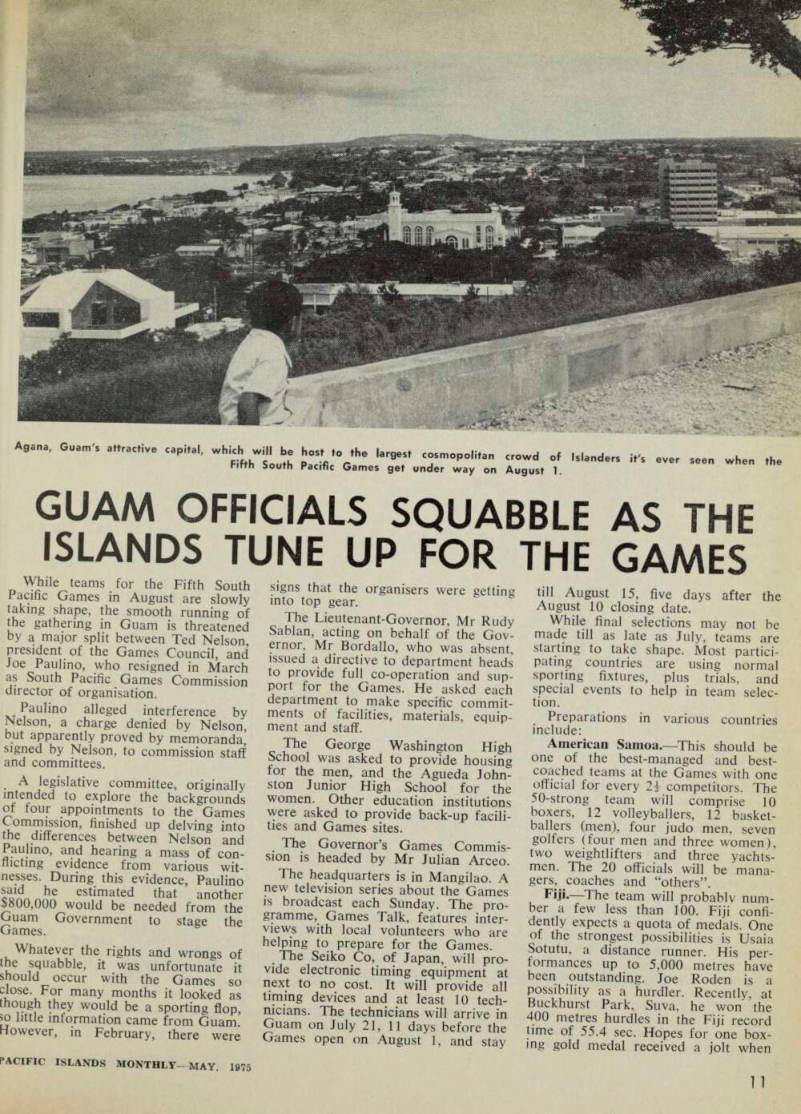
Ag an a, Guam's attractive capital , which will be host to t he l arg e st cos m opolitan crowd o f Islanders it's ever seen when the Fifth south Pacific Games get under way on August 1.
Guam games tune-up
outstanding light-middleweight, Jovesa Keresi, decided to turn professional.
Micronesia. The Micronesian Sports Council is entering a team for the first time. A four-man committee will visit each district to watch the best athletes perform. The following have been appointed head coaches: Marc Walton (softball), Alan Steed (basketball), Steve Remley (volley ball), Don Schuster (track and field events), Kurt Barnes (women’s track and field events), Bill Sakovich (swimming) and Cindy Giorgis (women’s swimming).
New Caledonia. —Final selections have yet to be made, but the swim ming team could include Eric Verla guet, Thierry and Patrick Legras, Andre Mouren (who is studying in France), Daniele Maussion, Beatrice Godard and Francoise Calla. There will be a better idea of who will be in the team about the end of May, after a visit by New Zealand swim mers.
Prospects for the athletics team are distance runner Alain Lazare, a dis tinct medal hope, and Martial Bone, Lelesio Tuito and Penisio Lutui in the field events.
New Hebrides. —Thanks to generous financial assistance from the French Government, a team of 55 will be sent. Plans are to send 20 footballers, 10 to 12 netballers, five or six boxers, two golfers and 10 athletes (five men and five women).
Papua New Guinea. —The team of about 200 will be one of the biggest, if not the biggest, in Guam. The size of the team ensures Papua New Guinea should take home several medals. Recently, distance runner John Kokinai, covered the 10,000 metres in 32 min 31.4 sec on a heavy track. Another recent good perform ance was by sprinter Wavala Kali, who ran the 100 metres in 11.1 sec. and the 400 metres in 50.9 sec, Wallace Hofagao, who had to with draw from the 1974 Commonwealth Games team because of injury, could well represent PNG in the 1,500 metres.
The 1975 PNG swimming cham pionships at Port Moresby showed that there is plenty of talent from which to choose a strong team.
Twenty new national records were set up. The swimming team could include Chris White, Marlene Rau, Michelle Capon, Paul Sinclair, Lorene Moyle, Bill Woolhouse, Gala Moi, Mark Hutchings, and Charlie and Donald Martin, The PNG Yachting Association will choose a team of two or three Fire balls to go to Guam. Other yachting competitors are expected to be Fiji,
American Samoa, New Caledonia and French Polynesia.
A managerial team of five has been named —Sam Pinau, chairman of the National Broadcasting Commission, chief of mission; Jack Pini, general team manager; Dr Alan Hutchinson, team doctor; Les Bridges, physio therapist; and Bette Pini, team secre tary.
Solomon Islands. —The team will be at least 90, and at the most 104.
Of likely aspirants for medals, sprin ters are closest to international stan dards. The best times for the sprinters are below the South Pacific Games records, but that does not mean the Solomons’ sprinters will be outclassed.
Their best times were recorded on rough and bumpy grass tracks, while the French Polynesians have fast tracks. Jasper Anisi (100 metres) and Valentine Wale (200 and 400 metres) are capable of improvement, and each could pick up a medal. But they will first have to make the team, for they are closely pressed by Benedict Esi beia, Felix Kalinomae, Thomas Kama, Casper Luiramo and Robert Kimisi. A strong relay team will be fielded.
Tonga. —The team will be small, but will include several medal chances. One of these is Sanitesi Latu, a leading athlete, now living in Mel bourne, who has been asked to make himself available. Losaline Faka’ata has been asked to continue her shot put and discus training. But Sione Peau Haukinima, who performed well during the recent Suva athletics championships when he won the 800 and 3,000 metres, has said he is will ing to represent Fiji, if he is not con sidered for Tonga. He has been run ning well, and recently bettered the time of 10 min 34.6 sec which earned him fifth place in the 3,000 metres at Papeete in 1971. A small boxing team will be chosen after a series of trials.
Wallis and Futuna. —The team is expected to number about 40, includ ing officials. The star could be Tuita, 32-year-old javelin thrower, who is in line to win his fourth gold medal. Wallis and Futuna will be represented in boxing, athletics, weightlifting, cycling, volleyball and spear fishing. The javelin throwers and boxers expect to have pipe-openers in Fiji and Samoa before going to Guam.
Western Samoa. —The president of the Amateur Weightlifting Associa tion, Mr Asi Eikeni, forecasts seven gold medals and two silver medals for the team of nine weightlifters. The team will be headed by Paul Wall work, who won a silver medal at the Commonwealth Games in Christ church in 1974. Four of the weight lifters are SP Games gold medallists —Otto Ah Aiu, P. Leung Wai, S.
Petelo and T. Amato.
Advertisements & other items, pp. 14-16 (1 item)
Pacific Area
DISTRIBUTORS
COOK ISLANDS
Cook Is. Trading Corp. Ltd
FIJI
Burns Philp (SS) Co. Ltd
NEW GUINEA
Bougainville Marine Pty Ltd, Kieta Burns Philp (NG) Ltd, Madang Elvee Trading Pty Ltd, Rabaul Faulkner & Tait (NG) Pty Ltd, l_ ae S. A. Heath & Co. Pty Ltd, Port Moresby
NEW HEBRIDES
Burns Philp (NH) Ltd
NOUMEA
Guy Limousin Pacific Yachting
NORFOLK ISLAND
Irvine Bid. Supply Centre
PAGO PAGO
Max Haleck Inc.
TAHITI
Marine Corail Tahiti Sport Tahiti Voile
TONGA
Riechelmann Bros.
WESTERN SAMOA
Burns Philp (SS) Co. Ltd E. A. Coxon Ltd Gold Star Transport Co. Ltd Morris Hedstrom Ltd
SOLOMON ISLANDS
George Yee Fai Ltd V
Why do thousands of
boat-owners specify
Epiglass Marine Products?
Epiglass gives you the biggest range of marine glues, fillers, preservatives, resins, skinning systems and paints going. The biggest... and the best. Laboratory tested - “ V and proven in the water on thousands and thousands of boats!
That’s why you can buy Epiglass products with complete confidence. If it’s Epiglass, it will outlast all others. Just ask the man who uses Epiglass! mm m&m
m* s oo
iiPfl
■ from 7ft to73ftrEf»iGi.A.ss~| power or sail Consolidated Chemicals Limited, Auckland, •;> ‘For further information contact Consolidated Chemicals Ltd, P.O. Box 15-104, New Lynn, Auckland, New Zealand”.
INVESTIGATION
An inquiry by the Western Samoa Public Service Commission opened in Apia at the end of March. The inquiry, preceded by a court action, is into the “conduct” of the Director of Education, Dr Fanaafi Larkin.
The inquiry is into allegations made about Dr Larkin’s private life, which, she argued in Supreme Court, had in no way affected her efficiency as Director of Education. Chief Justice Scully dismissed an application by Dr Larkin for an order to stop the inquiry.
JACKSON
SHANDS P/L
announce that we offer a full range of hospital ward and theatre equipment. We represent the most modern and efficient Australian manufacturers:- Joyce Bedsteads fixed height, tilt, variable.height, cardiac and intensive care and assorted equipment.
Vost stainless steel trolleys of all descriptions.
"Shanline" bedside cabinets.
Steel's U.K. Obstetric Tables.
Enquiries:- 1 Stewart Street, Windsor Vic. 3181 Australia Phone 51 8759 Cable Address - "JACSHA" Melb.
Samoa's public service
Sex rears its head in Samoa's public service
From an Apia correspondent
It did not take long for Western Samoa’s new government staff train ing officer, Dr Melvin Schnapper, to find out about several aspects of the public service which had little appeal for him.
At his first meeting with depart mental heads or their deputies he heard a call for a regulation to govern the sexual behaviour of
members of the public service, and ran up against a couple of ex pressions requiring clarification— “too much carnation milk” and “too many gang-bangs”.
One departmental head, who re mained nameless, said a regulation about sexual behaviour was neces sary because of the irregular be haviour of members of the public service, including some heads of de partments.
He would not name anybody, but said one particular case was “quite obvious”. Some junior and inter mediate public servants lost their positions because of indiscretions, but senior men and women were misbehaving with impunity.
Dr Schnapper learned that the ex pression about carnation milk re ferred to the practice of “sucking up” to the boss. “Gang-bangs” was an expression which did not mean what it appeared to mean—it re ferred to “ganging up” to ensure the success or failure of a colleague.
He heard a lot more complaints, which suggested that the public ser vice was not running like a well-oiled machine. There were allegations about keeping bad records, staff not turning up on time, or taking too much sick leave, failing to work as a team, or staying away from work without notifying the office. At the higher level it was stated that there was not enough co-operation between departments, and too much “castle building”.
Dr Schnapper, 32, married, with two sons, was formerly a newspaper reporter in Washington, a school teacher in Nigeria and Peace Corps volunteer in the Virgin Islands and Louisiana.
He said after the meeting, he was pleased with it, even though he had been told beforehand it was imposs ible to get heads of departments to gether in one place for even a few minutes. Most local departmental heads attended; three expatriate heads were represented by deputies while one was not represented at all.
He said it was essential that tech niques used for training were suitable for Samoa’s needs. Time will tell how effective he is in welding the public service into a cohesive and efficient unit.
Nutshell
In a Nutshell
Commercial gambling should not be allowed in the US Trust Territory of Micronesia “at this time”, accord ing to a report by an ad hoc com mittee on gambling. The report called on the Secretary of the In terior to outlaw commercial gam bling from January 1, 1976, the date present slot machine licences expire.
The recommendations were based on such factors as the increase in some crimes after the machines were introduced, municipal and TT governments were ill-equipped to monitor and police machines, a re cent disruption in individual econ omic stability and a decrease in per sonal savings accounts which sug gested that the majority of people playing the machines were residents and not tourists, and confusion about the exact extent of foreign influences and control in introducing and main taining slot machine activities in Saipan.
Bi Lingual Stamps
The New Hebrides had two new stamps scheduled for issue on April 29, one English and the other French. The design on the 10 franc stamps reflected the importance of cattle rearing in the New Hebrides, where planters run them on coconut plantations. There is a growing interest in beef cattle rearing, and substantial areas of bush have been cleared for grazing.
Royal Commission
Fiji’s royal commission into its electoral system is under way at last.
But it will be a long time before it reports to the government. The chair man, Professor Harry Street, 55, a British lawyer, visited Fiji in April for a few on-the-spot inquiries. He hopes written submissions will reach the commission secretary, Mr Rod ney Acraman, in Suva by August.
Mr Acraman will send the sub missions to all members of the com mission. Professor Street will return to Fiji in August with the other members of the commission, who have yet to be appointed.
Fatal Fight
Mr Tebetanga Teauoki, of Mara kei, GEIC, died almost immediately after a fight at Fanning Island late in March. He was a wireless operator.
Unions' Truce
An agreement between employer and trade union bodies in Papua New Guinea has averted strikes of any sort—for the time being. The PNG Employers’ Federation and the Trade Union Congress agreed on 13 claims put forward by the TUC, and agreed that a further seven claims should go to arbitration. The TUC will not consider strike action till after the arbitration results are announced.
Meanwhile, the trade union move ment in PNG could get stronger. The TUC represents unions in New Guinea, and a few in Papua, outside Port Moresby. The Port Moresby based Council of Trade Unions is considering a proposal to amalgamate with the TUC, which will create one powerful body to represent unions throughout the country.
New Png Work Force
The Papua New Guinea Govern ment will build up a large construc tion unit for big national develop ments, such as wharves, airports and roads. Included will be smaller self contained groups, capable of carry ing out specialist tasks at present undertaken by overseas contractors.
Whither Wuvulu
The future of Wuvulu Island to the north of the New Guinea main land, was scheduled for discussion at a meeting of the Papua New Guinea cabinet held at Alotau, in the Milne Bay District in April. The government holds as many cabinet meetings as possible outside Port Moresby.
Free Labour
Prisoners in Papua New Guinea will soon be forced into work gangs to help maintain roads and govern ment buildings. This work will get them away from prison confines, and from the government’s point of view the free labour will save money. The Cabinet, early in April, strongly approved the principle of prisoners contributing to community develop ment. In Fiji, prisoners are put to work, both inside and outside gaols on public works, such as keeping the Government House compound clean, and cutting grass in cemeteries. In Suva, it is not an uncommon sight to see a working party of a dozen or more prisoners wielding cane knives in the charge of a solitary warder, armed with nothing more than a baton.
Bang Control
Fireworks have been banned in Papua New Guinea. In future, fire works displays to mark important occasions will be organised under an
official’s eye, and the import of crackers will only be allowed by the Minister for Defence, Foreign Re lations and Trade. For several years, officers of the Department of Labour and Industry have been concerned about the uncontrolled sale of fire works. Many children and adults have been injured. On top of that, improper use of fireworks creates a fire hazard. Officially, all types of fireworks have been classified as “dangerous goods” under the cus toms regulations.
Chief Judge Retires
Mr Justice Fraser, Chief Judge of the High Court of the Cook Islands retired at the end of March on his 65th birthday. He was appointed Chief Judge and Judge of the Native Land Court on July 8, 1961, and later became Chief Judge of the Land Court. He has also acted as High Commissioner. New Zealand-born, Judge Fraser was with the old NZ Native Department (now the Depart ment of Maori Affairs) and after war service returned to the depart ment until he went to the Cook Islands.
Protected Snake
Reptile dealers in the United States are offering $1,500 for single specimens of a rare Papua New Guinea python. But the snake, unique to PNG, has been gazetted as a protected specimen. The snake is known as Boelen’s Python, and lives in the Highland Forests of PNG.
Wildlife officers are making checks with known fauna dealers to make sure that none of the snakes is being exported. The python is silky-black on the back, and bright yellow under the belly and sides. The long snouted Echidna of PNG has also been recently gazetted as a protected animal.
Marianas' Choice
The people of the Northern Mari anas in the United States Trust Terri tory of Micronesia will vote on June 17 whether they want to join the United States as a commonwealth or stay with the Marshalls and Carolines and eventually decide with them Micronesia’s political future. Wash ington named the plebiscite date and appointed a former editor of the Christian Science Monitor, Mr Erwin D. Canham, as plebiscite supervisor.
Observers from the United Nations and the US Congress have been in vited to oversee the voting and asso ciated activities such as the plebiscite education programme and voters’ registration. America has guaranteed a “fair and impartial” plebiscite.
• See p 26.
in the ears of Fiji’s farmers
Boom in sugar is sweet music in the ears of Fiji’s farmers
From VIJEN DR A KUMAR in Lautoka
THERE is a resurgence of hope among Fiji’s 16,000 cane farmers. A new sugar deal that Fiji has signed with British and Common Market countries will bring the country an estimated S7O million for this year’s crop.
It means a windfall for the far mers who stand to earn up to $35 per ton of cane—more than double the present price.
The prospects for the industry look bright. Sugar experts fore cast a continuing boom for the next five years at least. If poli ticians leave the farmers alone, they could give the national economy a jab in the arm.
Sugar and the predominantly- Indian farmers who grow the sweet reed have long been the hot-bed of political activity. It is an irony of history that such a sweet commodity has spawned bitterness from one generation to another. The sugar industry, since its inception in the latter part of the last century, has had a series of crippling strikes.
Such political luminaries as the late Mr A. D. Patel, the founder of the Opposition National Feder ation Party, the late Mr Ayodhya Prasad, the founder of the Fiji Kisan Sangh, and the bulk of the present NFP leadership, rode to power on the backs of the cane farmers. Some of them did and still do much for the farmers.
Others play on their fears and passions to keep themselves poli tically alive.
The canefarmer’s life history is one of debts passed on from one generation to another. Some years ago, the government Co operatives Department carried out a survey and was staggered to find that the overall debt of farmers in the sugar belt in Viti Levu was about $2O million.
Most of this was money they owed to their merchants in town from whom they bought all their goods and borrowed cash to tide them over until the next cane payments. Many merchants were unscrupulous thieves who preyed
on the illiterate farmers by making false entries in their charge books.
I remember my grandfather buying everything from one merchant. When he died, my father inherited his debts running into several hundred dollars. He slowly paid it off after several years.
Such is the story of many others, During the past 10 years, sugar cane production has been steadily declining. Canefarmers found that they could not support and educate their children from their farm earnings. They took outside jobs and encouraged their children to do likewise.
The prickly land problem saw thousands of acres of fertile land go into Fijian reserves. Indian canefarmers were displaced and resettled elsewhere.
Although the cane price remained virtually unchanged, land rents kept shooting up. Prices of farm machinery, fertiliser and work bullocks kept soaring, Labour costs continued rising. The farmer was being driven to the wall but the government seemed
unconcerned at his plight, Now there is a ray of light at the end of the tunnel. The govern ment and the Native Land Trust Board are opening up more land for cane farming under better lease conditions. The Prime Minister, Ratu Sir Kamisese Mara, took a personal interest in their case and was instrumental in hammering out a good deal for them after protracted negotiations with hard-driving British and European buyers, Last month, the farmers’ lead ers, headed by the saffron-robed Indian monk, Swami Rudrananda, took an independent stand and carved out a favourable deal from the Fiji Sugar Corporation for an increased share of the proceeds from the sale of sugar. As poli ticians saw their strongest plut form slip from their fingers, they made desperate attempts to get into the act.
But the talk on the farms m the countryside is different these days. The farmers are far too busy growing cane to bother about the politicians.
A familiar scene in Fiji's sugar cane growing districts—harvest time Although more lorries are being used to cart the cane to the mills, the bulk of the crop is still transported by the cane trains. The wagons are loaded in the fields through which is laid a temporary track linking the main permanent way with the fields.
Tropica I ities
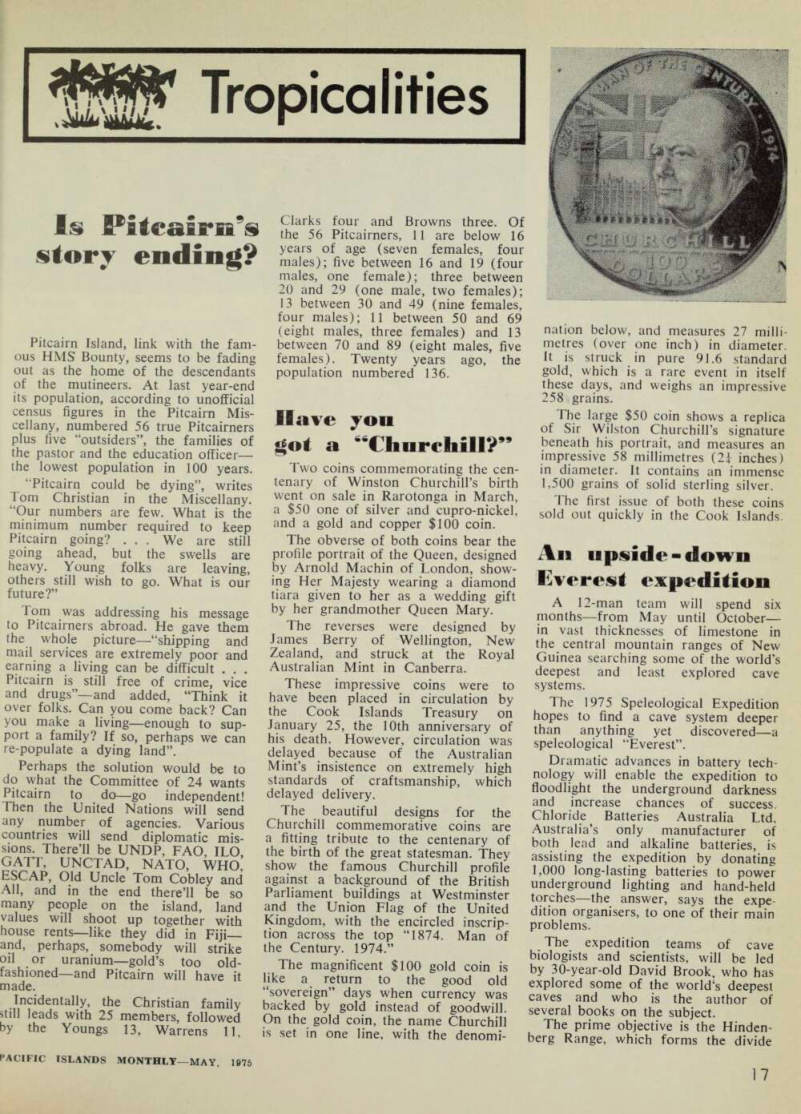
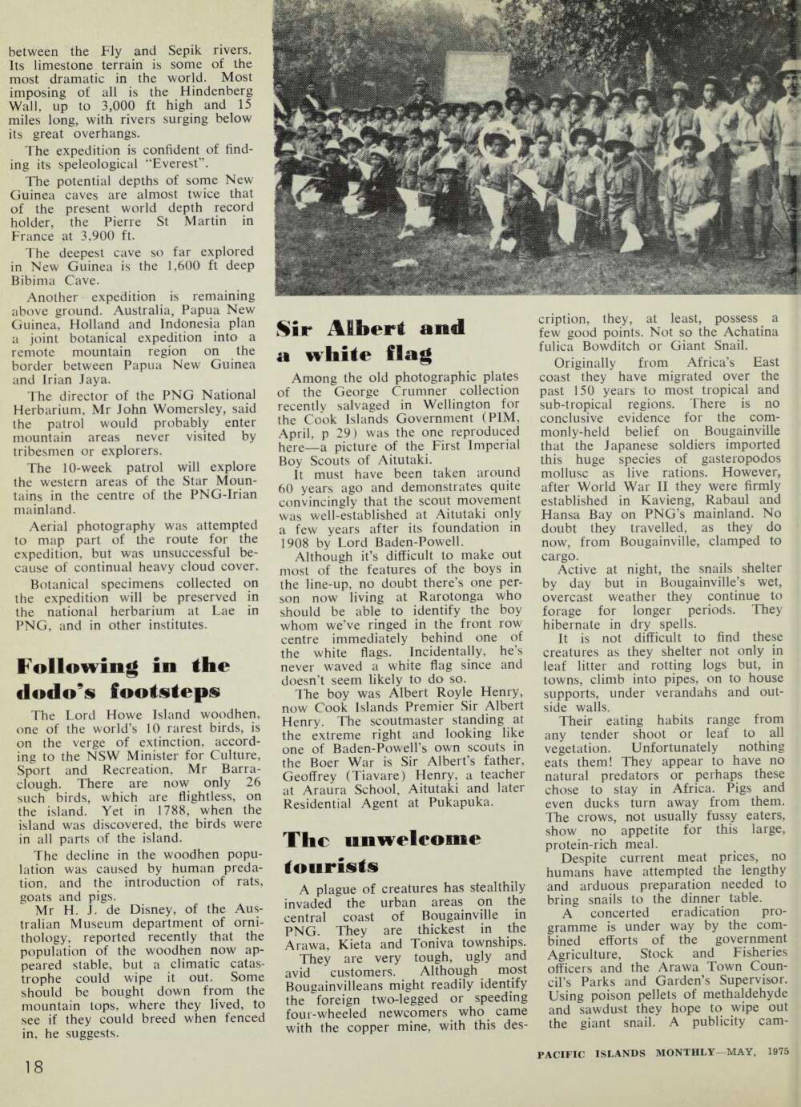
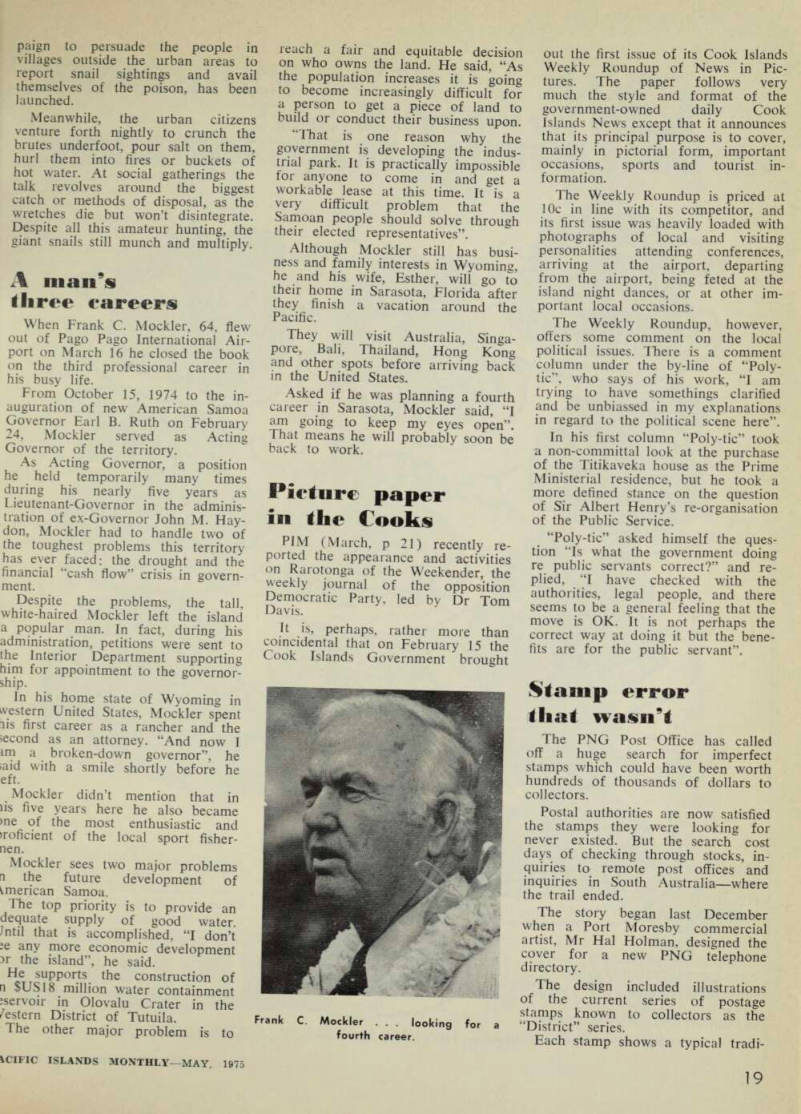

Is P’Bieairss’s
story ending?
Pitcairn Island, link with the fam ous HMS Bounty, seems to be fading out as the home of the descendants of the mutineers. At last year-end its population, according to unofficial census figures in the Pitcairn Mis cellany, numbered 56 true Pitcairners plus five “outsiders”, the families of the pastor and the education officer— the lowest population in 100 years.
“Pitcairn could be dying”, writes Tom Christian in the Miscellany.
“Our numbers are few. What is the minimum number required to keep Pitcairn going? ... We are still going ahead, but the swells are heavy. Young folks are leaving, others still wish to go. What is our future?”
Tom was addressing his message to Pitcairners abroad. He gave them the whole picture—“shipping and mail services are extremely poor and earning a living can be difficult . . .
Pitcairn is still free of crime, vice and drugs”—and added, “Think it over folks. Can you come back? Can you make a living—enough to sup port a family? If so, perhaps we can re-populate a dying land”.
Perhaps the solution would be to do what the Committee of 24 wants Pitcairn to do—go independent!
Then the United Nations will send any number of agencies. Various countries will send diplomatic mis sions. There’ll be UNDP, FAO, ILO,
Gatt, Unctad, Nato, Who,
ESCAP, Old Uncle Tom Cobley and All, and in the end there’ll be so many people on the island, land values will shoot up together with house rents—like they did in Fiji and, perhaps, somebody will strike oil or uranium—gold’s too old fashioned—and Pitcairn will have it made.
Incidentally, the Christian family still leads with 25 members, followed by the Youngs 13, Warrens 11.
Clarks four and Browns three. Of the 56 Pitcairners, 11 are below 16 years of age (seven females, four males); five between 16 and 19 (four males, one female); three between 20 and 29 (one male, two females); 13 between 30 and 49 (nine females, four males); 11 between 50 and 69 (eight males, three females) and 13 between 70 and 89 (eight males, five females). Twenty years ago, the population numbered 136.
■lave you
got a “Churchill?”
Two coins commemorating the cen tenary of Winston Churchill’s birth went on sale in Rarotonga in March, a $5O one of silver and cupro-nickel, and a gold and copper $lOO coin.
The obverse of both coins bear the profile portrait of the Queen, designed by Arnold Machin of London, show ing Her Majesty wearing a diamond tiara given to her as a wedding gift by her grandmother Queen Mary.
The reverses were designed by James Berry of Wellington, New Zealand, and struck at the Royal Australian Mint in Canberra.
These impressive coins were to have been placed in circulation by the Cook Islands Treasury on January 25, the 10th anniversary of his death. However, circulation was delayed because of the Australian Mint’s insistence on extremely high standards of craftsmanship, which delayed delivery.
The beautiful designs for the Churchill commemorative coins are a fitting tribute to the centenary of the birth of the great statesman. They show the famous Churchill profile against a background of the British Parliament buildings at Westminster and the Union Flag of the United Kingdom, with the encircled inscrip tion across the top “1874. Man of the Century. 1974.”
The magnificent $lOO gold coin is like a return to the good old “sovereign” days when currency was backed by gold instead of goodwill.
On the gold coin, the name Churchill is set in one line, with the denomi-
nation below, and measures 27 milli metres (over one inch) in diameter.
It is struck in pure 91.6 standard gold, which is a rare event in itself these days, and weighs an impressive 258 grains.
The large $5O coin shows a replica of Sir Wilston Churchill’s signature beneath his portrait, and measures an impressive 58 millimetres (2i inches) in diameter. It contains an immense 1,500 grains of solid sterling silver.
The first issue of both these coins sold out quickly in the Cook Islands.
Aii upside-down
Everest expedition
A 12-man team will spend six months—from May until October— in vast thicknesses of limestone in the central mountain ranges of New Guinea searching some of the world’s deepest and least explored cave systems.
The 1975 Speleological Expedition hopes to find a cave system deeper than anything yet discovered—a speleological “Everest”, Dramatic advances in battery tech nology will enable the expedition to floodlight the underground darkness and increase chances of success.
Chloride Batteries Australia Ltd, Australia’s only manufacturer of both lead and alkaline batteries, is assisting the expedition by donating 1,000 long-lasting batteries to power underground lighting and hand-held torches—the answer, says the expe dition organisers, to one of their main problems.
The expedition teams of cave biologists and scientists, will be led by 30-year-old David Brook, who has explored some of the wor!d‘s deepest caves and who is the author of several books on the subject.
The prime objective is the Hindcn berg Range, which forms the divide
between the Fly and Sepik rivers.
Its limestone terrain is some of the most dramatic in the world. Most imposing of all is the Hindenberg Wall, up to 3,000 ft high and 15 miles long, with rivers surging below its great overhangs.
The expedition is confident of find ing its speleological “Everest”.
The potential depths of some New Guinea caves are almost twice that of the present world depth record holder, the Pierre St Martin in France at 3,900 ft.
The deepest cave so far explored in New Guinea is the 1,600 ft deep Bibima Cave.
Another expedition is remaining above ground. Australia, Papua New Guinea, Holland and Indonesia plan a joint botanical expedition into a remote mountain region on the border between Papua New Guinea and Irian Jaya.
The director of the PNG National Herbarium, Mr John Womersley, said the patrol would probably enter mountain areas never visited by tribesmen or explorers.
The 10-week patrol will explore the western areas of the Star Moun tains in the centre of the PNG-Irian mainland.
Aerial photography was attempted to map part of the route for the expedition, but was unsuccessful be cause of continual heavy cloud cover.
Botanical specimens collected on the expedition will be preserved in the national herbarium at Lae in PNG, and in other institutes.
Following in the
dodo’s footsteps
The Lord Howe Island woodhen, one of the world’s 10 rarest birds, is on the verge of extinction, accord ing to the NSW Minister for Culture, Sport and Recreation, Mr Barra clough. There are now only 26 such birds, which are flightless, on the island. Yet in 1788, when the island was discovered, the birds were in all parts of the island.
The decline in the woodhen popu lation was caused by human preda tion, and the introduction of rats, goats and pigs.
Mr H. J. de Disney, of the Aus tralian Museum department of orni thology, reported recently that the population of the woodhen now ap peared stable, but a climatic catas trophe could wipe it out. Some should be bought down from the mountain tops, where they lived, to see if they could breed when fenced in, he suggests.
Sir Albert and
a white flag
Among the old photographic plates of the George Crumner collection recently salvaged in Wellington for the Cook Islands Government (PIM, April, p 29) was the one reproduced here—a picture of the First Imperial Boy Scouts of Aitutaki.
It must have been taken around 60 years ago and demonstrates quite convincingly that the scout movement was well-established at Aitutaki only a few years after its foundation in 1908 by Lord Baden-Powell.
Although it’s difficult to make out most of the features of the boys in the line-up, no doubt there’s one per son now living at Rarotonga who should be able to identify the boy whom we’ve ringed in the front row centre immediately behind one of the white flags. Incidentally, he’s never waved a white flag since and doesn’t seem likely to do so.
The boy was Albert Royle Henry, now Cook Islands Premier Sir Albert Henry. The scoutmaster standing at the extreme right and looking like one of Baden-Powell’s own scouts in the Boer War is Sir Albert’s father, Geoffrey (Tiavare) Henry, a teacher at Araura School, Aitutaki and later Residential Agent at Pukapuka.
The unwelcome
tourists
A plague of creatures has stealthily invaded the urban areas on the central coast of Bougainville in PNG. They are thickest in the Arawa, Kieta and Toniva townships.
They are very tough, ugly and avid customers. Although most Bougainvilleans might readily identify the foreign two-legged or speeding four-wheeled newcomers who came with the copper mine, with this des
cription, they, at least, possess a few good points. Not so the Achatina fulica Bowditch or Giant Snail.
Originally from Africa’s East coast they have migrated over the past 150 years to most tropical and sub-tropical regions. There is no conclusive evidence for the com monly-held belief on Bougainville that the Japanese soldiers imported this huge species of gasteropodos mollusc as live rations. However, after World War II they were firmly established in Kavieng, Rabaul and Hansa Bay on PNG’s mainland. No doubt they travelled, as they do now, from Bougainville, clamped to cargo.
Active at night, the snails shelter by day but in Bougainville’s wet, overcast weather they continue to forage for longer periods. They hibernate in dry spells.
It is not difficult to find these creatures as they shelter not only in leaf litter and rotting logs but, in towns, climb into pipes, on to house supports, under verandahs and out side walls.
Their eating habits range from any tender shoot or leaf to all vegetation. Unfortunately nothing eats them! They appear to have no natural predators or perhaps these chose to stay in Africa. Pigs and even ducks turn away from them.
The crows, not usually fussy eaters, show no appetite for this large, protein-rich meal.
Despite current meat prices, no humans have attempted the lengthy and arduous preparation needed to bring snails to the dinner table.
A concerted eradication pro gramme is under way by the com bined efforts of the government Agriculture, Stock and Fisheries officers and the Arawa Town Coun cil’s Parks and Garden’s Supervisor.
Using poison pellets of methaldehyde and sawdust they hope to wipe out the giant snail. A publicity cam
paign to persuade the people in villages outside the urban areas to report snail sightings and avail themselves of the poison, has been launched.
Meanwhile, the urban citizens venture forth nightly to crunch the brutes underfoot, pour salt on them, hurl them into fires or buckets of hot water. At social gatherings the talk revolves around the biggest catch or methods of disposal, as the wretches die but won’t disintegrate.
Despite all this amateur hunting, the giant snails still munch and multiply.
A man 9 s
three careers
When Frank C. Mockler, 64, flew out of Pago Pago International Air port on March 16 he closed the book on the third professional career in his busy life.
From October 15, 1974 to the in auguration of new American Samoa Governor Earl B. Ruth on February 24, Mockler served as Acting Governor of the territory.
As Acting Governor, a position he held temporarily many times during his nearly five years as Lieutenant-Governor in the adminis tration of ex-Governor John M. Hay don, Mockler had to handle two of the toughest problems this territory has ever faced: the drought and the financial “cash flow” crisis in govern ment.
Despite the problems, the tall, white-haired Mockler left the island a popular man. In fact, during his administration, petitions were sent to the Interior Department supporting him for appointment to the governor ship.
In his home state of Wyoming in western United States, Mockler spent lis first career as a rancher and the second as an attorney. “And now I irn a broken-down governor”, he ►aid with a smile shortly before he eft.
Mockler didn’t mention that in lis five years here he also became me of the most enthusiastic and iroficient of the local sport fisher nen.
Mockler sees two major problems n the future development of American Samoa.
The top priority is to provide an dequate supply of good water.
Jntil that is accomplished, “I don’t le any more economic development 3r the island”, he said.
He supports the construction of n SUSIB million water containment ;servoir in Olovalu Crater in the Western District of Tutuila.
The other major problem is to
reach a fair and equitable decision on who owns the land. He said, “As the population increases it is going to become increasingly difficult for a person to get a piece of land to build or conduct their business upon.
“That is one reason why the government is developing the indus trial park. It is practically impossible for anyone to come in and get a workable lease at this time. It is a very difficult problem that the Samoan people should solve through their elected representatives”.
Although Mockler still has busi ness and family interests in Wyoming, he and his wife, Esther, will go to their home in Sarasota, Florida after they finish a vacation around the Pacific.
They will visit Australia, Singa pore, Bali, Thailand, Hong Kong and other spots before arriving back in the United States.
Asked if he was planning a fourth career in Sarasota, Mockler said, “I am going to keep my eyes open”.
That means he will probably soon be back to work.
Picture paper
in the Cooks
PIM (March, p 21) recently re ported the appearance and activities on Rarotonga of the Weekender, the weekly journal of the opposition Democratic Party, led by Dr Tom Davis.
It is, perhaps, rather more than coincidental that on February 15 the Cook Islands Government brought
out the first issue of its Cook Islands Weekly Roundup of News in Pic tures. The paper follows very much the style and format of the government-owned daily Cook Islands News except that it announces that its principal purpose is to cover, mainly in pictorial form, important occasions, sports and tourist in formation.
The Weekly Roundup is priced at 10c in line with its competitor, and its first issue was heavily loaded with photographs of local and visiting personalities attending conferences, arriving at the airport, departing from the airport, being feted at the island night dances, or at other im portant local occasions.
The Weekly Roundup, however, offers some comment on the local political issues. There is a comment column under the by-line of “Poly tic”, who says of his work, “I am trying to have somethings clarified and be unbiassed in my explanations in regard to the political scene here”.
In his first column “Poly-tic” took a non-committal look at the purchase of the Titikaveka house as the Prime Ministerial residence, but he took a more defined stance on the question of Sir Albert Henry’s re-organisation of the Public Service.
“Poly-tic” asked himself the ques tion “Is what the government doing re public servants correct?” and re plied, “I have checked with the authorities, legal people, and there seems to be a general feeling that the move is OK. It is not perhaps the correct way at doing it but the bene fits are for the public servant”.
Stamp error
that wasn’t
The PNG Post Office has called off a huge search for imperfect stamps which could have been worth hundreds of thousands of dollars to collectors.
Postal authorities are now satisfied the stamps they were looking for never existed. But the search cost days of checking through stocks, in quiries to remote post offices and inquiries in South Australia—where the trail ended.
The story began last December when a Port Moresby commercial artist, Mr Hal Holman, designed the cover for a new PNG telephone directory.
The design included illustrations of the current series of postage stamps known to collectors as the “District” series.
Each stamp shows a typical tradi
Frank C. Mockler . . . looking for a fourth career.
tional scene, and indicates the name of the district illustrated.
The Post Office issued Mr Holman with mint sets of the stamps to be used in the art work for the tele phone directory cover.
The art work was approved by the Post Office but it was not until the printed directories were delivered that the names of three of the dis tricts—Bougainville, Central and Milne Bay—were seen to be missing from the reproduced stamps.
Postal authorities began extensive inquiries through Mr Holman and the printers of the directory, fearing that imperfect stamps had been issued.
Meantime, a huge search was undertaken of existing stocks of stamps to detect any other similar imperfections.
Mr Holman, who had mounted the stamps directly on the artwork, said, “I could have kicked myself.
I thought I had let a fortune slip through my hands”.
But the inquiries ended when con tact was established with a South Australian company which had the contract for printing the directory.
There was nothing wrong with the stamps, and the error had apparently occurred during multi-colour pro cessing to print the directory cover.
The not -so - late
old man Moke
Old man Muke, about 70, of Patu
801 l Bolivi village, Ranongga Island,
BSIP, is a living example of the old saying that “reports of his death are grossly exaggerated”. He was assumed dead. More than 200 mourners went to his village to see the body wrapped in the coffin.
Sorrowing relatives and friends were startled, and possibly even shocked, when Muke started to move as preparations were made to nail the coffin lid. They quickly took him out, and put him to bed.
At the last report, Muke is back in his village taking an active part in community life.
This set of four stamps, which the GEIC will release on May 26, should be well worth any philatelist's money. They could be the last stamps to come from the colony bearing the legend Gilbert & Ellice Islands. The two partners separate on October 1 this year and the Ellice Islands will become Tuvalu and not Tu valu Islands. The set depicts four types of living cowries found in GEIC waters, of which there's a large quantity. The shells are, the Cypraea Argus (4c) —it sounds like a newspaper, but it's a creamy-brown thing mottled with dark brown and has cream-coloured papillae— the Cypraea Cribraria (10c), the Cypraea Talpa (25c) and the Cypraea Mappa (35c).
You can read all about sea shells in Walter O. Cernohorsky's two volumes of Marine Shells of the Pacific published by PlM's owners, Pacific Publications.
Advertisements & other items, pp. 21-25 (5 items)
Vcific Islands Monthly—May. 1975
Is To Provide, Safe,
OUR AIM IN THE SOUTH PACIFIC
RELIABLE, EFFICIENT TRANSPORTATION.
/ r r* r il N \ r r € r / c3k /• Ti r \ O ■ i \' r f r< * •]z 1 i Holden. Isuzu r r r / ■r> * O r Holden.
The illustration shows the various vehicles that General Motors )ealers sell in the South Pacific. They lave been thoroughly proven to be safe efficient and reliable. G.M. vehicles put he driver and passengers first, in terms >f comfort and ease of handling.
GENERAL MOTORS VEHICLES...THEY MAKE A LOT OF SENSE FOR THE SOUTH PACIFIC.
And everywhere you see a General Motors car or truck indicated on the illustration you know there is a General Motors Authorised Dealer.
He is factory selected, his staff factory trained, his Dealership stocked with genuine, economical General Motors parts. Because General Motors put you first ...they are the leaders in the Automotive world today.
A 899
The VOLTA Super Suction Cleaners
V °lT
M Upright or cylinder cleaner, there is a VOLTA model to suit every need. All of them with outstanding cleaning power and advanced features—at a realistic price— to make home cleaning easier and quicker.
VOLTA
VOLTA offers three magnificent models: The dashing BLUE VOLTA speed cleaner with super power, the economy-priced WHITE VOLTA for the smaller home. And if you prefer an upright, there is the outstanding performer, the superbly styled DUAL ACTION VOLTA combining the powered brush and easy manoeuvrability of an upright with the powerful suction and convenience of a cylinder.
For sale through The VOLTA people for the Pacific Islands;
KERR BROTHERS PIT. LIMITED
65 York St., Sydney, N.S.W. 2001
Caterpillar reliability, productivity, availability. Now you can get it all in a wheel skidder. The 518.
A whole new standard in skidder engineering. 120 turbocharged horsepower, 20,400 pounds of working muscle with full articulation and frame oscillation for stability and minimum maintenance.
Single lever “on the go” powershift. Dual rate steering for controlled response at all speeds. An operator’s compartment engineered for efficiency with safety features built in for man and machine.
You ; ll find all the best skidder ideas, plus added refinement and top quality manufacturing that can make the 518 the backbone of your logging operation.
And South-West Pacific Caterpillar dealers will ensure that your backbone stays in top condition no matter how far in the bush you are.
Parts, maintenance, repairs or simple information—we’ll see that you get it fast.
So tackle the jungle with the new Cat 518.
Caterpillar Dealers in South-West Pacific.
■ ■- ■-i ■ - R :i x I I -i C. A Hi
HASTINGS DIERING
Lae: Milford Haven Road, Ph: 42 2355 Port Moresby: Champion Parade, Knoedobu.
Ph: 3138 or 2098.
Bougainville: Itakara.
Industrial Park, Arawa.
Ph- 95 9004. 154 Queens Road, Suva.
Ph: 24 051-4 Cables; Carptrac Suva Telex: Carptrac FG2190 Ql l\/Q (Si
CARPENTERS
TRACTOR E EQUIPMENT
21
ACIFIC ISLANDS MONTHLY—MAY. 1975
SSzrr
The magic stone: a celestial gift for the Highlands
From a Goroka correspondent
At about 7.45 am, on Tuesday, March 4, villagers at Ijopega hamlet, a few miles north of Goroka in
SSzrr
whirring noise before crashing on to a spur inside a coffee plantation about 150 yards east of the busy Highlands Highway.
Villagers, who were brave enough to investigate, found a small crater about 18 in. deep. At the bottom was a wedge-shaped, mustardcoloured rock about the size of a football. Initial efforts to retrieve it were hampered because the rock was extremely hot. When, at last it was prised from the ground the "Ijopega Meteorite", as it was subsequently named by its finders, became a scientific fact.
Much to the disappointment of many who inspected it, this meteorite looked like any other stone: irregular in shape, smooth-sided and with a small flake missing from the part which first made contact with the eart h- The only unique feature seemed to be its weight for it felt much heavier than similar-sized earth rocks. If its arrival seemed an anticlimax in Goroka this was not shared in Port Moresby and a government geologist, Dr Peter Lowenstein, was sen to investigate.
The meteorite’s arrival brought consternation to the Ijopega people who regarded it as a heaven-sent omen. It had seen the cross on top of the village church, one villagers said, and had homed in on it.
Some wondered if it proclaimed the end of the world while others speculated that its arrival heralded a “Ancient mortars found in Goroka y alley revive old mystery ’, pim, May, 66, p 86 ‘
less important, but nevertheless, spectacular, local catastrophe per haps in the nature of an epidemic.
-Jstfjrsgz
properties yet ,0
be determmed
t Great importance is placed on “magic stones” in the Goroka Valley where any geological oddity is likely to . be reverenced as an ija gehani - (p i B stone) ’ a s !° ne hav, "« s P ec , la > influences over the growth, health and fertility of ptgs. Ancient stone mo^? r s’ cal ! ed are also credlt . ed w ‘ th . magical properties, f xe !; clsln B benign influences over food . gardens and the affairs of men P™^ lded th ?y are used in accordance Wldl P rescrl^ed ritual, The most attractive “magic stones” are rock crystals, called sonohi, which is also the word for ‘star’, Some very beautiful amethyst cry stals are found in the Eastern High lai?ds and these are particularly P rized for their magical properties, With local tradition placing much value on strange stones, it was little wonder that it took government field officers the best part of a day to convince the villagers that no harm would befall them if they allowed the Ijopega meteorite to be taken away for scientific examination, Much can be said for their trust, and their public-spiritedness, when the owners agreed to make it avail able for analysis on condition that half of it should be returned to them for preservation in their village church.
It may not be rare for meteorites t 0 strike the earth but it is rare for them to be seen doing so. The in teresting thing about the Ijopega meteorite is that it is a stone, and theSe are far IeSS eas y t 0 identify than the typical meteorite formed of nickel and iron compounds. Stone
meteorites look like typical earth rocks, and the effects of weathering and oxidation, once they are on earth, soon hides any apparent signs of their extra-terrestrial origin.
It is estimated that this meteorite when it first entered earth’s atmos phere may have been three or four times as big as when it was found.
The rate at which it burnt up in the atmosphere would depend on such variables as its angle of entry and its velocity.
How long had the Ijopega meteo rite hurtled through the universe?
Possibly for as long as 4,500,000,000 years one expert estimated. It could be that this insignificant-looking stone is a relic of a planet or a star which disintegrated eons ago. Just as likely it could be a fragment which was never attracted to others of its kind to form a star, and has wandered a lonely path from the time of its creation, until it settled near Goroka. • A feature of Papua New Guinea’s Independence Day cele brations will be an exhibition in Port Moresby of priceless artefacts seized by Customs as they were being loaded on to a ship at Madang for an overseas dealer. One, a mask from Mendam village in the Murik Lakes, is so rare it can never be sold.
This is not the "magic stone" of Ijopega, which hasn't been as neatly shaped by nature, but one which was found at Aiyura, near Kainantu in the Eastern Highlands, and is in the J. K. McCarthy Museum at Goroka.
“Acific Islands Monthly May. 1975
American Samoans
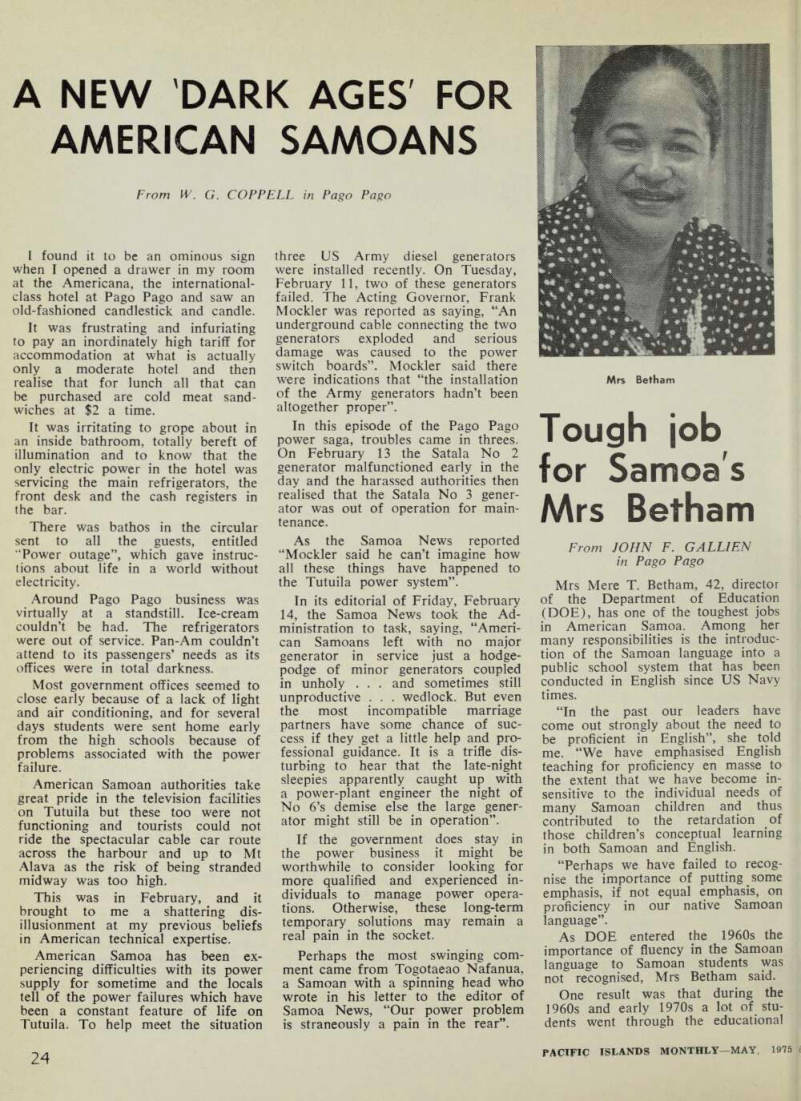
A New 'Dark Ages' For
From W . G. COPPELL in Pago Pago
I found it to be an ominous sign when I opened a drawer in my room at the Americana, the international class hotel at Pago Pago and saw an old-fashioned candlestick and candle.
It was frustrating and infuriating to pay an inordinately high tariff for accommodation at what is actually only a moderate hotel and then realise that for lunch all that can be purchased are cold meat sand wiches at $2 a time.
It was irritating to grope about in an inside bathroom, totally bereft of illumination and to know that the only electric power in the hotel was servicing the main refrigerators, the front desk and the cash registers in the bar.
There was bathos in the circular sent to all the guests, entitled “Power outage”, which gave instruc tions about life in a world without electricity.
Around Pago Pago business was virtually at a standstill. Ice-cream couldn’t be had. The refrigerators were out of service. Pan-Am couldn’t attend to its passengers’ needs as its offices were in total darkness.
Most government offices seemed to close early because of a lack of light and air conditioning, and for several days students were sent home early from the high schools because of problems associated with the power failure.
American Samoan authorities take great pride in the television facilities on Tutuila but these too were not functioning and tourists could not ride the spectacular cable car route across the harbour and up to Mt Alava as the risk of being stranded midway was too high.
This was in February, and it brought to me a shattering dis illusionment at my previous beliefs in American technical expertise.
American Samoa has been ex periencing difficulties with its power supply for sometime and the locals tell of the power failures which have been a constant feature of life on Tutuila. To help meet the situation
three US Army diesel generators were installed recently. On Tuesday, February 11, two of these generators failed. The Acting Governor, Frank Mockler was reported as saying, “An underground cable connecting the two generators exploded and serious damage was caused to the power switch boards”. Mockler said there were indications that “the installation of the Army generators hadn’t been altogether proper”.
In this episode of the Pago Pago power saga, troubles came in threes.
On February 13 the Satala No 2 generator malfunctioned early in the day and the harassed authorities then realised that the Satala No 3 gener ator was out of operation for main tenance.
As the Samoa News reported “Mockler said he can’t imagine how all these things have happened to the Tutuila power system”.
In its editorial of Friday, February 14, the Samoa News took the Ad ministration to task, saying, “Ameri can Samoans left with no major generator in service just a hodge podge of minor generators coupled in unholy . . . and sometimes still unproductive . . . wedlock. But even the most incompatible marriage partners have some chance of suc cess if they get a little help and pro fessional guidance. It is a trifle dis turbing to hear that the late-night sleepies apparently caught up with a power-plant engineer the night of No 6’s demise else the large gener ator might still be in operation”.
If the government does stay in the power business it might be worthwhile to consider looking for more qualified and experienced in dividuals to manage power opera tions. Otherwise, these long-term temporary solutions may remain a real pain in the socket.
Perhaps the most swinging com ment came from Togotaeao Nafanua, a Samoan with a spinning head who wrote in his letter to the editor of Samoa News, “Our power problem is straneously a pain in the rear”.
Tough job

for Samoa's Mrs Betham
From John F. Gallien
in Pago Pago Mrs Mere T. Betham, 42, director of the Department of Education (DOE), has one of the toughest jobs in American Samoa. Among her many responsibilities is the introduc tion of the Samoan language into a public school system that has been conducted in English since US Navy times.
“In the past our leaders have come out strongly about the need to be proficient in English”, she told me. “We have emphasised English teaching for proficiency en masse to the extent that we have become in sensitive to the individual needs of many Samoan children and thus contributed to the retardation of those children’s conceptual learning in both Samoan and English.
“Perhaps we have failed to recog nise the importance of putting some emphasis, if not equal emphasis, on proficiency in our native Samoan language”.
As DOE entered the 1960 s the importance of fluency in the Samoan language to Samoan students was not recognised, Mrs Betham said.
One result was that during the 1960 s and early 1970 s a lot of stu dents went through the educational
Mrs Betham
£1 ™ p° U f- u maStering either S Th? £Lf n t ghsh 'A a AwnMc ,-n 1 p d rch e ik d f d i U 1? readmg words in English, but lacked understanding of the message communicated through the reading.
“I really feel we did an injustice to those kids. It wasn’t their fault.
It was the fault of the system”, Mrs Betham said.
“That was the main reason DOE took a long look at itself and, in particular, examined the language teaching problem”.
Born in Fagatogo, American Samoa, Mrs Betham was a member of the first graduating class from S f* m0 i ai !i a r. Hlgh in 1 , 950 ‘ She attended Pomona College, Claremont, California for a year and graduated from Geneva College, Beaver Falls, ra. in 1934 with a BA degree in economics and a minor in education. one returned to American Samoa ana taugnt m Samoana. She was rp7ncta!°in1 C 96T i and P tas a, lhet e s n t Samoan to be a fi in IQ?] y p ,
As^,rk“cmr B o^ E m duc”nd
in 1972 was oromoted tn Dprmtv Director for Educational Services y I ast Tnlv a a xri, i '
Pulf 1 nL ! succeeded Nikolao
Pula as Director of Education.
Ia additi ?? td her educational fi°y k h r?’ rs Betham was on the rst pohtical status commission for American Samoa in 1969 and recently became the first member of the board of directors of the Council of Chief State School Officers elected from a territory In 1971 Mrs Betham became part of a group of Samoans and valasis under the leadership of Milton de- Mello, a former director of education, who saw the need for changing the system’s method of language education.
“Research has shown that familiarity in home language is necessary t 0 a mast ery of a second language”, she said. “Admittedly there are some children who assimilate very easily, but for most children it is desirable that the home language be learned first in order to enhance and facilitate the learning of, and in, a second language ‘1" the paSt three years we have !? ade •, *} tcm £ ts t ° em Ph a sise more l^ an d has heen, the teaching of the fl k a resu tße Brst three years ? f l choolmg now taught mostly ? n Samoan Wlth English skills being introduced and taught as a foreign language.
The amount of English taught to Samoan children increases during the first three grades as the children progress from year to year c'l * I, V 1 + u- Sam .°an is used for the teaching socia studies and science because Jt c f n A c ° nve y the abstract concepts ere - Maths 18 taught with En f hsh beca , use can con Y, ey con ' exan ?j )les just as easil y, Mrs am . said ; Individualised instruction and team tea chmg are also teaching methods which have been introduced nto tlie elementary schools in order to Better help students learn.
Early education in the Samoan language is an important step in a child’s educational growth because it enriches its cultural experience as well as makes it easier for that Samoan child to continue its edu cation in English, Mrs Betham be lieves. a time when many of our children would switch to English without difficulty, with everything
It*W ■"
their school ladder and without handicapping themselves”, she said.
But there will always be some children who will need to be taught in Samoan” g
Advertisements & other items, p. 27 (2 items)
Acific Islands Monthly-May, 1975
Coolrooms And
Save hundreds of dollars
on most efficient
WALK IN, ALUMINIUM
COOLROOMS AND
FREEZE ROOMS
Hundreds already installed! The most economical supplementary cool- 'ooms for bottles and food, providing the largest storage capacity of any comparable coolrooms of the same exterior dimensions. Five sizes —from 90-360 cu. ft. capacity; 16 models offering normal temp., two femp., deep freeze, or for pastry and ice storage applications. White /myl interior, embossed rustproof aluminium exterior. • SUPPLIED IN EASY-TO-ERECT, DO-IT-YOURSELF KIT FORM.
Available from; AUSTRALIAN NEW CALEDONIA EXPORTS (SILVER & BARDA) 363 >eorge St., Sydney, 2000 and Branches. A) ' 363 IRECKWOLDT & CO., 276 Pitt St., Sydney, 2000 and Branches 'ETER FISHER TRADING PTY. LTD., 321 Pitt St., Sydney, 2000.
'AGEMEYER (A'SIA), 59 Anzac Pde„ Kensington, 2033 and Branches. .ERR BROS, 65 York St., Sydney, 2000.
Manufactured by:
NELSON & ROBERTSON PTY. LTD., 197 Clarence St., Sydney 2000 RABAUL TRADING CO. PTY. LTD., P.O. Box 219, Rabaul and'Branches ROY GALLIMORE & ASSOCIATES, P.O. Box 179, Vila, New Hebrides Branch. L s VAN (EXP ° RT) PTV - LT °' 60 “ argare ’ »- *»*>•». 2000 anc Branches* 17 * C °' PTY ' LT °'' 31 Macquari “ pl,ce - Sydney, 2000 anc
® WARBURTON FRANK!
199 Parramatta Road, Cnr. Skarratt Street, Auburn, N.S.W. 2144, Australia. Phone 648-1711.
POWERED BY
KELVINATOR.
Five-year warranty on compressor. Early delivery.
And A Presidential Blessing For
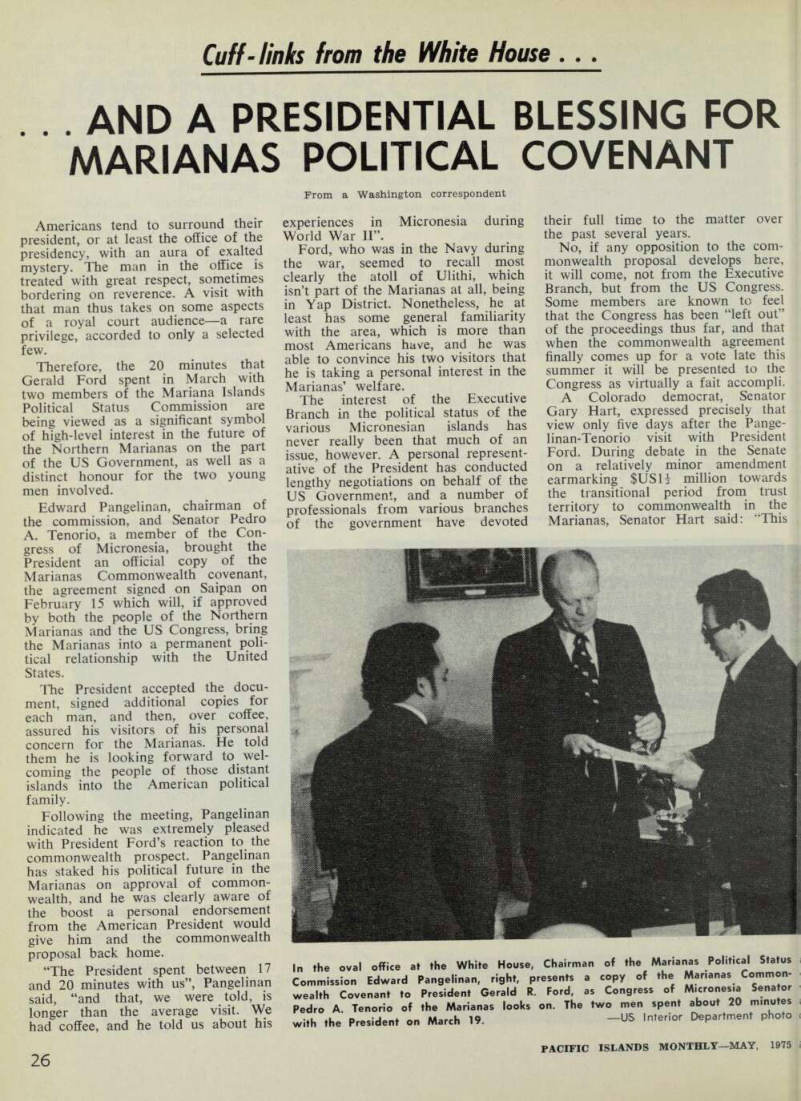

Cuff-links from the White House ...
Marianas Political Covenant
From a Washington correspondent
Americans tend to surround their president, or at least the office of the presidency, with an aura of exalted mystery. The man in the office is treated with great respect, sometimes bordering on reverence. A visit with that man thus takes on some aspects of a royal court audience—a rare privilege, accorded to only a selected few.
Therefore, the 20 minutes that Gerald Ford spent in March with two members of the Mariana Islands Political Status Commission are being viewed as a significant symbol of high-level interest in the future of the Northern Marianas on the part of the US Government, as well as a distinct honour for the two young men involved.
Edward Pangelinan, chairman of the commission, and Senator Pedro A. Tenorio, a member of the Con gress of Micronesia, brought the President an official copy of the Marianas Commonwealth covenant, the agreement signed on Saipan on February 15 which will, if approved by both the people of the Northern Marianas and the US Congress, bring the Marianas into a permanent poli tical relationship with the United States.
The President accepted the docu ment, signed additional copies for each man, and then, oyer coffee, assured his visitors of his personal concern for the Marianas. He told them he is looking forward to wel coming the people of those distant islands into the American political family.
Following the meeting, Pangelinan indicated he was extremely pleased with President Ford’s reaction to the commonwealth prospect. Pangelinan has staked his political future in the Marianas on approval of common wealth, and he was clearly aware of the boost a personal endorsement from the American President would give him and the commonwealth proposal back home.
“The President spent between 17 and 20 minutes with us”, Pangelinan said, “and that, we were told, is longer than the average visit. We had coffee, and he told us about his
experiences in Micronesia during World War II”.
Ford, who was in the Navy during the war, seemed to recall most clearly the atoll of Ulithi, which isn’t part of the Marianas at all, being in Yap District. Nonetheless, he at least has some general familiarity with the area, which is more than most Americans have, and he was able to convince his two visitors that he is taking a personal interest in the Marianas’ welfare.
The interest of the Executive Branch in the political status of the various Micronesian islands has never really been that much of an issue, however. A personal represent ative of the President has conducted lengthy negotiations on behalf of the US Government, and a number of professionals from various branches of the government have devoted
their full time to the matter over the past several years.
No, if any opposition to the com monwealth proposal develops here, it will come, not from the Executive Branch, but from the US Congress.
Some members are known to feel that the Congress has been “left out” of the proceedings thus far, and that when the commonwealth agreement finally comes up for a vote late this summer it will be presented to the Congress as virtually a fait accompli.
A Colorado democrat, Senator Gary Hart, expressed precisely that view only five days after the Pange linan-Tenorio visit with President Ford. During debate in the Senate on a relatively minor amendment earmarking SUSH million towards the transitional period from trust territory to commonwealth in the Marianas, Senator Hart said: “This
In the oval office at the White House, Chairman of the Marianas Political Status Commission Edward Pangelinan, right, presents a copy of the Marianas Common wealth Covenant to President Gerald R. Ford, as Congress of Micronesia Senator Pedro A Tenorio of the Marianas looks on. The two men spent about 20 minutes with the President on March 19. —US Interior Department photo
whole procedure raises serious ques tions of domestic and foreign policy that I believe Congress should con sider before we proceed any further down the road to making the Marianas Islands a part of the United States”.
The senator then went on to out line some of the problem areas as he sees them. He questioned the wisdom of creating a new group of American citizens at this time; said he doubts the strategic importance of the Marianas, and pointed out that the US will be paying lease money for land on Tinian for a base which the Defence Department at the present time has no intention of building.
The senator also suggested that the method of conducting the com monwealth negotiations—by separat ing the Marianas from the other five districts of the Trust Territory des pite the opposition of the Congress of Micronesia—may tend to work against the US in the United Nations.
The amendment was finally passed, 47 to 39. But the closeness of the vote surprised some observers, in cluding those in the Executive Branch who have worked most closely on the commonwealth. A lobbying effort is now said to be underway to try to bring some of those opposing senators around. But both pro- and anti-commonwealth people here agree that the covenant is going to be the subject of con siderable debate in the Congress be fore it is approved, if approved it ever is.
In the meantime, two members of the Marianas status commission have returned to Saipan with autographed copies of the covenant from Gerald Ford, along with his assurances of support for these newest would-be Americans. And, for good measure, each man was also given a pair of cuff-links bearing the Presidential Seal, as a souvenir of his visit to the Oval Office.
In Saipan, Mr Pangelinan, accord ing to the Micronesian News Service, refuted Senator Hart’s arguments and said the US Congress had not been left out of the deal. The $H million could not be handed over until the US Congress approved the covenant, which had also to be approved by a plebiscite in the Marianas.
Mr Pangelinan said he disagreed with Senator Hart’s suggestion that the Congress of Micronesia had any legal authority or right to dictate to the people of the Marianas the kind 3f political status which was most appropriate for them.
As administering authority under he trusteeship agreement, the United
. S hf e ri^? d J n to “respect the right of self-determination for the people of the Marianas. The United States’ decision to engage in separate status negotiations with the Marianas reflected US recognition of that obligation. The action of the United States in that regard had been recognised by the UN Trusteeship Council p nnrn ' .. th?t B thp l iT^ Senat S r K Hart,S ?nt l w? th 1 the! , us f w ou ld be paywhil L n 1 1? for land on Tinian which the Defence Department had no present intention of using, Mr
Pangelinan said the senator must have been misinformed, , . , xl cjrtl! 16 lf ?. ppr £ v f d both sldes .’ v^? ldc i T ? er Pe’ but dld not re fl uire > tbe United States to lease on f n 18, °° 0 j? ? Mananas, most of Man * S r de / ence Purposes.
Tbe De fence Department late last year announced its decision to defer c . onstruction of any substantial facili ties on Tinian. At present the depart ment’s plan was to use portions of Tinian for military training purposes only. s p p
Advertisements & other items, pp. 29-30 (2 items)
27
’ACIFIC ISLANDS MONTHLY—MAY, 1975
fete label
MPPMip. ; vi g. ||\ I V\ :»i4 V""M- * * fs '® A “ 5 oni Prize M'* al \ * * c *'’° *
Scotch Whisk y •Np Ltd evva Sons ‘ scon
For people who value
tradition.
Dewar’s “White Label”-it never varies.
These IMF distributors
can show you, the
MFSO backhoe loader is yards ahead
of any other in output and versatility Wherever it has been in operation around the world, the 60 hp MFSO three-in-one rig has proved to be an extremely reliable machine capable of high hourly output and big profitearning capacity. The backhoe is available with a standard bucket that gives a maximum digging depth of 15 feet 5 inches (lEMC digging depth 13 feet 6 inches). The backhoe incorporates the unique Power- Slide system which enables the operator to shift the boom hydraulically in a matter of seconds without leaving the seat. And slew control seat mounted above the boom gives the operator a superb view of his work. A one cubic yard bucket is standard on the loader and lift capacity to full height is 3700 lbs. You can buy the MFSO with confidence in its performance —what’s more your MF distributor backs yourchoice with genuine parts and service backup to keep you on
thejobatalltimes.
m m . ©
MFE 74042
MF MASSEY-FERGUSON ...WINNER OFTWO EXPORT AWARDS
The Editor's Mailbag

Sorry, Mr
Matas-Kele
We act for Kalkot Matas-kele, who has instructed us to write to you to request that an apology be printed as soon as practicable in your maga zine in respect of certain errors which appear in the article headed “Fiery rumours, and facts, in Vila”, on page 5 of the February issue.
These errors are: (a) That Mr Matas-kele “grabbed a picture of the Queen which was hanging in the club and, in the words of a club member, wrapped it around the superintendent’s neck”. This did not in fact occur. At the hearing of charges against Mr Matas-kele in the Native Court arising from the in cident (at which our Mr Hudson represented him and his companion), it was established that the other New Hebridean with him was the person who took hold of the picture, and that the superintendent did in fact ward off the blow aimed at him with the picture. (b) That Mr Matas-kele “was sent to prison for two weeks”.
Actually, the Magistrate sentenced him and his companion to two weeks in prison each on charges of obstruct ing the New Hebridean policemen in execution of their duty. However, when the sentences came before the Resident Commissioners for review, they decided to suspend both of them provided that the defendants be not convicted of any other offence during a year after these convictions.
These errors of fact are de famatory, but our client will be satis fied if you redress the matter by in serting an apology among the pages of your magazine carrying major articles about the New Hebrides, in approximately the following form: Apology. We apologise to Kalkot Matas-kele for some errors of fact which we published in our February issue, under the heading “Fiery rumours, and facts, in Vila”.
Firstly, we want to correct the statement that he wrapped a picture of the Queen around the neck of a police superintendent. In fact, Mr Matas-kele did not touch the picture, nor was it wrapped around the superintendent’s neck.
Secondly, Mr Matas-kele was not sent to prison, as his sentence was
suspended by the Resident Com missioners on their review of the matter.
We offer our apologies and those of our local correspondent for any embarrassment caused. It seems that our article contained even more rumours than we thought!
The apology should be outlined in black, as was the article com plained of.
Hudson & Co.
(Barristers & Solicitors) Vila, New Hebrides. • PIM happily gives the main letter in its widely-read Letters pages to set the record straight on the in cident involving Mr Kalkot Matas kele, to whom we apologise.
Understanding
Polynesians
I refer to an article “When a Polynesian goes Deadpan” from a Wellington correspondent (PIM, March, p 31).
What a shame! And I presuming this can be a spark to “racism”, “Understanding Polynesians” a booklet by Mrs Lee may be a good counsellor on deadpans but why pick on Polynesians?
Is this the only race in the whole wide earth that can be exploited and classified as lowgrade deadpans?
Why not Europeans? Why not Indians? Why not any other races you can think of.
Mrs Margaret Lee and her book let has put a diagnosis of a perfectly healthy Polynesian as a state known as Musu which is also known further as sheer fright or some sort of nervousness which may be true and which may became an epidemic in Polynesia, but she fails to give it specific radical treatment.
Instead, she jumps from her diag nosis to preventive measures leaving sufferers of Musu to suffer and con centrates on giving antibodies to non musu sufferers, Europeans and other races, to prevent them catching deadly reactions from musu-sufferers, the Polynesians.
It would be more sensible if musu sufferers could be given curative treatment first and get them better.
At the same time, give preventive measures especially to ex-sufferers of musu (if they ever get cured), then to the non-sufferers.
In that case probably nobody from any race will suffer from musu.
From a medical point of view that’s how a confirmed disease has to be faced—diagnosis—treatment— prevention.
Interruption to this chain nearly always gives unsatisfactory results.
But in this case, it’s not a human blood and bone disease. I see it as some sort of newly-emerged in curable “racial disease” and un fortunately said to affect specifically the Polynesians.
I am wondering if what you call musu has any effect on any other race? If other races came into con tact with Polynesians? Or, do other races have strong resistance or strong immunity against becoming musu sufferers? Or, is it just because other races of the world are musu-proof human beings? Then what sort of blood docs the Polynesian have?
If you think musu is common in some Polynesian islands as you stated, Samoans and Niueans and relatively common among Cook islanders and New Zealand Maoris, why not put your fullstop there, instead of involving “all” Polynesian communities and island in your “musu fishing net” by blanket use of the word ‘Polynesians’?
Bear in mind that not all Poly nesians will be musu victims and “not all” of other races will be musu proof beings.
I’m not commenting on the subject as a Polynesian of course, or on the other side of an argument, and I don’t really care if the Polynesian adviser to the New Zealand Voca tional Training Council and author of the booklet Understanding Poly nesians, Mrs Margaret Lee, and co author, the Secretary for Maori and Island Affairs in New Zealand Mr J. M. McEwen, and senior lecturer in sociology at Auckland University Mr C. Macpherson are themselves Polynesians or not, but I am merely commenting as a neutralist.
Understanding Polynesians had some portions of it printed in PlM’s article commenting on positions occupied by Polynesian workers which sounds very much lowgrading.
Something one doesn’t want to hear about oneself.
Imagine if someone was low grading you, unaware you were there hearing him talking. What would be your reaction? Recommend him to a higher position on top of the world? Maybe you will, but one will react in opposition never with a compassionate smile but with a boiling hate. What you should do is keep your comments about others to yourself.
I regard the booklet Understand ing Polynesians as a shield for Europeans against Polynesians and the designer of the book as a good discriminative reporter.
It would be fair enough if Under standing Polynesians was re-named Understanding Human Beings. If that’s so, then the Wellington corres pondent will entitle his article “When a Human Being goes deadpan”.
That involves all the human race, but don’t do open reports on others specifically as it is bad-mannered.
What you should do to correct someone you think is wrong, hand
cup your mouth against his ears and say in a whisper, “Sir, thats not how”, and not in front of so many ears. In that case he’ll give you a good response to any corrective ad vice he receives from you. But if you do it openly in front of others, he’ll be mad.
Remember, you’ve got to make sure you’re absolutely straight forward before trying to straighten others.
Joseph Tema.
Honiara, BSIP.
Danger Underground
Underground testing does not re move the problem of radioactive pollution; it merely diverts it. A hole will be drilled thousands of feet down through the dead coral base of the atoll to a basalt rock mountain below.
For each test a new drill hole is re quired, the nuclear device being lowered to the bottom.
The intense heat from the ex plosion melts the surrounding basalt rock. As it cools, it hardens, sup posedly trapping radioactivity. Un fortunately, the experience with most underground American tests has been that cracks in the rock shell allow the escape of radioactive bases to the surface, a process called “venting”.
At Fagataufa and Mururoa in French Polynesia we expect radio activity to be released at various times from the submerged sides of the bases of these atolls. Near to the surface such radioactivity will be carried westward by ocean currents towards Fiji.
The greater risk to South Pacific people, however, lies in eating migra tory ocean fish like tuna, some of which are likely to feed on small fish which have become radioactive in the vicinity of the test sites.
During American nuclear tests at Bikini in the Marshall Islands, Japanese tuna boats began to discover radioactive tuna in their catches. The Japanese Government set up an agency to check every tuna fish landed in Japan. Many had to be rejected for human consumption be cause of the high radioactivity levels.
Some of the rejected fish had been caught in South Pacific waters well south of Fiji.
Tuna fishing companies operating in Fiji, Samoa and the Solomons should arrange for monitoring of their catches during and after the series of underground tests about to be initiated.
Dr Graham Baines
(Technical Adviser) ATOM Committee, Suva.
Irian Java
Congratulations for the article (PIM, Jan p 25) entitled: “Irian Jaya a forthcoming bonanza—but who for?” In the name of Irian Jaya nationalists we wish to express our appreciations for your courteous assistance and willingness in publish ing this article.
Seeing and experiencing Indo nesian colonial activities in Irian Jaya, we do open our hearts and say: “We have been sold out to today’s world colonialism, practised by Indonesian military regime”. We do believe that nobody will stand behind this regime and that colonial ism will no longer take place in Irian Jaya.
We also appreciate Mr Paul Gro cott, Lecturer in Political Studies University of Papua New Guinea for his congratulations in PIM (Feb, p 71).
We will be looking forward to further information in the PIM and hope that you will pay more atten tion to our threatening voice from Irian Jaya.
B. K. Pasificus.
East West Center, Box 2033, Honolulu.
Png Films Wanted
When Papua New Guinea gains ts Independence later this year, the Film Library of the Office of In 'ormation will become the National Film Library of Papua New Guinea.
The library’s collection of archival ilm is disappointingly small, and we vould appreciate your assistance in lelping us contact all residents, past )r present, who might hold film vhich would be of value in building ip a pictorial history of our young lation.
Any movie film despite its quality night help build up the overall pic ure of Papua New Guinea’s develop aent through various administrations wer past years.
If owners of such films wish to etain them, they could assist us reatly by allowing the Film Library a borrow and copy their material.
Jtmost care would be taken to pre erve and protect any film lent to le library.
B. K. Amini.
)ffice of Information, lonedobu, PNG.
Advertisements & other items, pp. 32-59 (3 items)
Finest Quality
fi m m m
MITSUI CO. LTD—JAPAN
MACKERAL IN NATURAL OIL
MACKERAL IN TOMATO SAUCE
MACKERAL SALMON STYLE
15 OZ. TALL, 7 OZ. ROUND, 5i OZ.
TALL, 15 OZ. OVAL, 7* OZ, OVAL, For further information, prices and supplies please contact: The 111 people for the Pacific Islands KERR BROTHERS PTY. LTD .65 York Street, Sydney, N.S.W. 2000, Australia.
Itf;
iilsi
n a 9
SHIP
mM
fJT»W
■ ■.w
sSSH#
4ii l's vm
lIP 11
iktyi
l- w mmmm 1 ass
What a beautiful way
to fence yourself in!
Attractive, strong and safe.
Economical and easy to erect.
A.R.C. Weldmesh have the fence to suit your situation.
To help separate you from the rest of the world. To keep children in and animals out.
To provide pool safety and peace of mind. Available in a range of heights, the A.R.C.
Weldmesh fence is ideal for around the home, swimming pool, factory, or sporting venue.
For literature, contact your local building material supplier, or write to: The Export Department, A.R.C. Industries Ltd., 440 Collins Street, Melbourne, Victoria.
Australia, 3000 Cables:
‘BENIGNANT’ MELBOURNE
A.R.C.
K 0228 S
TIMELY PACIFIC READING!
Send your order direct to
Pacific Publications (Aust.) Pty. Ltd.
29 Alberta Street, Sydney, N.S.W. 2000
PAPUA NEW GUINEA
HANDBOOK
7th edition This new edition of the Papua New Guinea Handbook —completely revised and reset —provides the first full upto-date details of the new self-governing nation.
For businessmen, travellers, schools, universities and libraries, government departments, tourists and Papua New Guinea residents, this timely, up-to-the-minute edition, is essential.
A large attractive fold-out map of Papua New Guinea is also included. 332 pages of text.
PRICE: Australia, $5.50 plus 85c posted, Pacific Islands and Overseas, $5.50 Aust., plus $l.lO posted; U.S.A., $9.80 U.S. posted
FOR CHILDREN
LITTLE CHIMBU IN
BOUGAINVILLE Nancy Curtis This is the story of lovable Little Chimbu, and his friends, who go off to see the biggest hole in the world ... the Bougainville copper mine, at Panguna, in New Guinea.
Adventures follow one after the other on their arrival at the mine, and young readers (and their parents) will be fascinated by Nancy Curtis' colourful, yet accurate and instructive account of the workings of the big Bougainville enterprise ... its giant trucks, its processing plant, its port and shipping.
Illustrated in full colour.
PRICE: Australia, Pacific Islands and Overseas, $3.25 Aust., plus 48c posted; U.S.A., $5.30 U.S. posted.
PRPUR
REUIGUIRER
HRRDBOOK
mm M r • Percy Chatterton's Papua
DAY THAT I HAVE LOVED
Percy Chatterton This is more than an autobiography by well-known Percy Chatterton, QBE, who has spent 50 years in Papua as missionary, teacher and outspoken politician fighting for the underdog. It is a colourful, and charming, account of the Papuan people, giving warm insight into their hopes, fears and changing way of life. Some Papuan leaders say they don't want Papua to be submerged by New Guinea in the move towards independence, and readers of Percy Chatterton's timely book will readily sympathise with their desire to retain their identity. The book is illustrated with evocative pen sketches by Percy Chatterton's longtime friend and neighbour in Port Moresby, Rev. Bert Brown. 144 pages, illustrated.
PRICE: Australia, Pacific Islands and Overseas, $5.25 Aust., plus 48c posted; U.S.A., $8.30 U.S. posted.
HOLY TORTURE IN FIJI
Written by a group of academic participants and observers.
Editing and commentary by Prof. Ron Crocombe.
This book describes sacred ancient rituals involving physical ordeals which are performed once a year at certain Hindu temples in Fiji. The rituals include walking on fire, dancing on upturned knife-blades, whipping, plunging the hands in burning fat and piercing the body with steel skewers and silver wires.
Yet those who go through the ordeals suffer no pain, burns or injuries.
The book is beautifully produced in full colour and black-and-white.
PRICE; Australia, Pacific Islands and Overseas, $3.95 Aust., plus 48c posted; U.S.A., $6.40 U.S. posted.
HOLY
TORTURE
r" ! ■ Percy Cbsmertoss’ft Fapua
DAY THAT I
HAVE LOVED
IN FIJI
PACIFIC ISLANDS MONTHLY, MAY, 1975
r SUBSCRIPTION RATES (from January, 1975) Australia (including Lord Howe and Thursday One Year Islands), New Zealand, Papua New Guinea, Fiji, New Hebrides, Tonga, ‘Cook Islands, Western Samoa, Gilbert and Ellice Islands, Norfolk Island, ‘Niue and ‘Nauru $9.00 (local currency) Solomon Islands $lO.OO Aust American Samoa, ‘Micronesia and ‘Guam $12.00 US Hawaii and US Mainland $15.00 US New Caledonia and French Polynesia 1,500 CFP ‘United Kingdom £6 50 * Japan 4,000 Yen * Elsewhere $11.50 Aust With asterisk, delivered surface mail. All other subscription rates listed include delivery.
Pacific
Islands
Monthly
NEWS MAGAZINE OF THE SOUTH PACIFIC
\«0 Overleaf is your order form for a 12 months subscription.
See our announcement opposite.
SUBSCRIPTION FORM
address city/state/country/post code (please print) Attached is my payment of for a 12 months' subscription.
New □ Renewal □
Pacific Islands Monthly
29 Alberta Street, Sydney, N.S.W. 2000, Australia (Postal Address: Box 3408, G.P.O., Sydney, N.S.W. 2001.)
To become
a regular
reader, fill in the details on the attached order form.
Become a part of PI M’s Pacific and subscribe now
Pacific Islands Monthly Keeps you informed on Pacific happenings
Fill in the details on the attached order form.
Letters
31
ACIFIC ISLANDS MONTHLY—MAY, 1975
Solomons
"THE STORY OF THE SOLOMONS" sells in Australia for $2.50 plus 35c posted; Pacific Islands and Overseas, $2.50 Aust., plus 35c posted; U.S.A., $3.75 U.S. posted.
the story of the
Charles E. Fox Overleaf is your order form.
See our announcement opposite.
ORDER FORM
I enclose my payment of for copy(ies) of "The Story of the Solomons". nami address city/state/country/post code (please print)
Pacific Publications (Aust.) Pty. Ltd.
29 Alberta Street, Sydney, N.S.W. 2000, Australia (Postal Address: Box 3408, G.P.0., Sydney, N.S.W. 2001.)
* Pacific Publications hooks make the best gifts
★ When ordering ask for our Pacific book catalogue.
vrtvap
to out
>*• ililiiii F&
eto
thW o.» f\no B^ s ' o* eNN OP s od' v os/et at' oo b\e van BV \V\n9 ao Went >^Ze> d " Va etf 00 out* pu tv o^ e>N fi\\ BaP^ yovi' *
BANK OF
NEW ZEALAND
BUUK SPACE IN PARADISE
m >■ m Mi ■t® if iir ■ ’ ■' ■ ■ :uk:zM ; ggiilfeS ' ' 4 "" -'" ■ The Regent of Fiji, with 300 gracious guest rooms, is paradise on the glistening Pacific shore.
Cordial, like a Fijian village, the Regent invites you to a treasure of Melanesian arts. The Steakhouse and The Terrace serve delicious food platters and a spectacular ocean-view.
What’s more, the Regent is well-mannered service: in-room phones, air conditioning, Fijian stewards, complete banquet/convention pavilion and duty free shopping.
And the Regent is sports: scuba, sailing, fishing, beachcombing, swimming, tennis and golf. All in wave-free Nadi Bay.
Book space in paradise. For the night of a lifetime.
The Regent of Fiji—2o minutes from the airport.
POST OFFICE BOX 441 • NADI, FUI • PHONE 70700 • TELEX (792) 5214 ONE OF THE MANY worlds OF REGENT INTERNATIONAL HOTELS Wl
the Regent of Fiji
DENARAU BEACH RESORT
Sydney, Australia Sales Office No. 1 York Street, 14th floor Sydney, Australia 2000 Phone (02) 276469 In Auckland, New Zealand, phone 71909
To Future Generations,
Security
m ■■V v'V;
•P^SI
Titans of the Past.
Social welfare is a subject of serious consideration in most modern societies. Man in the twentieth century accepts his responsibility to bequeath to the next generation a society better than his own.
Daiwa Bank is not unique in accepting this responsibility, but Daiwa is unique in making acceptance of this role in society an integral part of their banking service.
Daiwa is the only Japanese city bank to combine banking and trust business. Daiwa is thus a fully integrated banking institution, comprising banking, international financing, trust, pension trust, and real estate business. This integration is part of our effort to fulfil our social responsibility consistent with society's needs in a contemporary environment. a fully integrated banking service
DAIWA BANK
Head Office: Osaka, Japan London and Frankfurt Branches New York and Los Angeles Agencies Singapore, Sydney and Sao Paulo Representative Offices Joint Venture Banks: P.T. Bank Perdania, Jakarta, International Credit Alliance, Ltd., Hong Kong
Selling well[
The
Story
of the
SOLOMONS
Charles E. Fox
“Refreshingly frank . .
“Admirably simple and
lucid . . ”
“A rare blend of objectivity and affection . . ”
That is what some of the critics have said about this unusual book which outlines the history of the Solomon Islands from the point of view of the people who live there.
The Reverend C. E. Fox, CBE, MA, LittD, spent more than 70 years in the Pacific Islands, 65 of them in the Solomon Islands, and no person is better qualified to write of the Solomons and the Solomon Islanders. Dr.
Fox is now living in retirement in New Zealand.
PRICE: Australia, Pacific Islands and Overseas, $2.50 Aust. plus 35c posted; USA, $3.75 US posted.
Fill in the details
on the attached
order form.
A blue lagoon and a ride

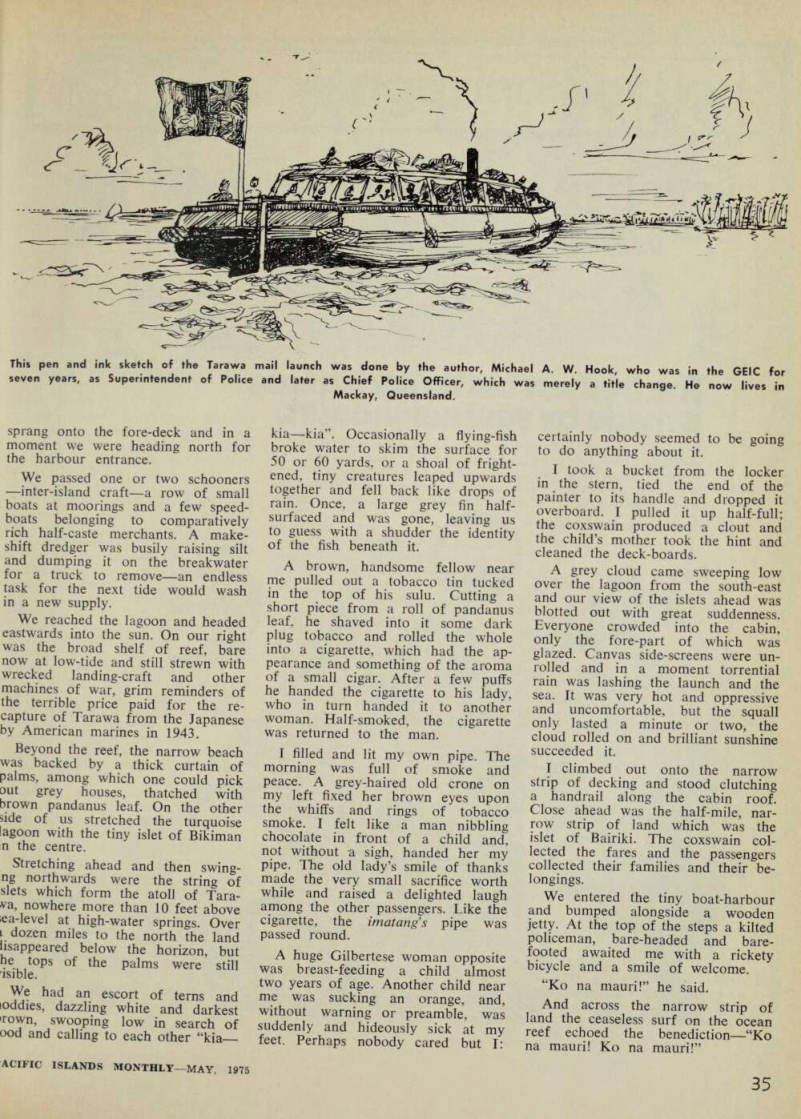
with Her Majesty's mails
By Michael Hook
You can walk from Betio to the adjoining islet of Bairiki at low tide.
Many do so, and even carry bicycles across when the water is up to their knees or higher, but the passage is a good half-mile in length and ex posed to a fierce sun.
Her Majesty’s mails and their smiling, brown, kilted bearer travel in the mail launch back and forth every two hours or so from dawn to dusk, and, in my day, for one Australian shilling (or for nothing if “on duty”) anyone else could go the same way. It was a longer jour ney, but infinitely more pleasant.
Our house faced the lagoon and on any day that my duties took me to Colony headquarters on Bairiki, I could eat my breakfast in peace, knowing that I should hear that familiar chug-chug-chug long before the launch came into view on its first run of the day from Bairiki. From that moment I had at least 10 min utes before I need mount my bicycle and set off westwards along the bumpy road of dried reef-mud, un der the blessed shade of the coconut palms, for the harbour.
By the steps would be a colourful assembly of some 30 or 40 souls— honey-skinned islanders, all bare footed and most bare-headed except for a crown of frangipani blossoms (for a day’s outing on Bairiki would be something of a holiday, whatever the reason for going).
The women would be dressed in gay, cotton frocks with perhaps a riri (pandanus skirt) over the top of it round their ample hips, the men in coloured sulus, either bare chested or wearing bright Hawaiian shirts, and the children in nothing but the briefest of lavalavas.
Round about on the quay-side was their luggage, without which no Gil bertese or Ellice islander could em bark on even such a short journey— bundles of pandanus mats, cartons tied with string or flex, ancient suit cases long discarded by the im provident Europeans, wooden boxes, crates of squawking hens, bottles of coconut toddy and bicycles sadly in need of oil and attention.
Beside the travellers were at least as many “seers-off” plus a policeman
perhaps (who would look the other way, like the gentle fellow he was, when more than the “twenty-five souls” crowded into the launch).
The local postmaster was there with a bag of mail, and a dozen care free folk who had simply come to stand and stare. A gang of small boys, playing hookey from school, their naked golden bodies glinting and dripping in the sunshine, surged up the steps at the very last moment before the launch came alongside and leaped back into the water from the quay.
The launch was a stout, wooden vessel, painted white and green.
Over her stern hung a Blue Ensign, emblazoned with the crest of the Gil bert and Ellice Islands Colony, alas much tattered by the buffeting of the South-East Trades. She was a roomy craft, but appeared to be nigh burst ing with humanity and a varied col lection of goods atop the cabin roof.
Almost before the bow-man had leaped ashore with the painter and while the coxswain was still pulling in the stern with the boat-hook, a sort of human explosion took place.
There was a surge upwards of gay, laughing, shouting, brown folk and a simultaneous down-current of the hitherto passive people on the wharf.
To the inexperienced eye bedlam and chaos reigned. Baggage flew upwards: cartons were tossed downwards.
Bicycles seemed to have grown wings and rolls of mats floated like chaff in the wind. The extraordinary thing was that nothing and nobody fell into the water, except a couple of the small nude bathers, who were pushed in by the coxswain for tres passing on his launch.
I was last aboard, not out of pride or humility or politeness, but from simple caution, and I took a seat in the stern-sheets.
On the engine-cowl amidships was an alarm-clock of that shy variety which only goes when lying on its face. The engineer looked at it, lay it back face-down, nodded at the coxswain and swung the starting handle. The engine puttered loudly and confidently. The coxswain gave an order and put the helm hard over as we came astern. The bow-man
sprang onto the fore-deck and in a moment we were heading north for the harbour entrance.
We passed one or two schooners —inter-island craft—a row of small boats at moorings and a few speed boats belonging to comparatively rich half-caste merchants. A make shift dredger was busily raising silt and dumping it on the breakwater for a truck to remove—an endless task for the next tide would wash in a new supply.
We reached the lagoon and headed eastwards into the sun. On our right was the broad shelf of reef, bare now at low-tide and still strewn with wrecked landing-craft and other machines of war, grim reminders of the terrible price paid for the re capture of Tarawa from the Japanese by American marines in 1943.
Beyond the reef, the narrow beach was backed by a thick curtain of palms, among which one could pick out grey houses, thatched with brown pandanus leaf. On the other side of us stretched the turquoise lagoon with the tiny islet of Bikiman n the centre.
Stretching ahead and then swing ng northwards were the string of slets which form the atoll of Tara va nowhere more than 10 feet above lea-level at high-water springs. Over i dozen miles to the north the land lisappeared below the horizon, but he tops of the palms were still isible.
We had an escort of terns and ioddies, dazzling white and darkest Town, swooping low in search of ood and calling to each other “kia—
kia—kia”. Occasionally a flying-fish broke water to skim the surface for 50 or 60 yards, or a shoal of fright ened, tiny creatures leaped upwards together and fell back like drops of rain. Once, a large grey fin half surfaced and was gone, leaving us to guess with a shudder the identity of the fish beneath it.
A brown, handsome fellow near me pulled out a tobacco tin tucked in the top of his sulu. Cutting a short piece from a roll of pandanus leaf, he shaved into it some dark plug tobacco and rolled the whole into a cigarette, which had the ap pearance and something of the aroma of a small cigar. After a few puffs he handed the cigarette to his lady, who in turn handed it to another woman. Half-smoked, the cigarette was returned to the man.
I filled and lit my own pipe. The morning was full of smoke and peace. A grey-haired old crone on my left fixed her brown eyes upon the whiffs and rings of tobacco smoke. I felt like a man nibbling chocolate in front of a child and, not without a sigh, handed her my pipe. The old lady’s smile of thanks made the very small sacrifice worth while and raised a delighted laugh among the other passengers. Like the cigarette, the imatang’s pipe was passed round.
A huge Gilbertese woman opposite was breast-feeding a child almost two years of age. Another child near me was sucking an orange, and, without warning or preamble, was suddenly and hideously sick at my feet. Perhaps nobody cared but I:
certainly nobody seemed to be going to do anything about it.
I took a bucket from the locker in the stern, tied the end of the painter to its handle and dropped it overboard. I pulled it up half-full; the coxswain produced a clout and the child’s mother took the hint and cleaned the deck-boards.
A grey cloud came sweeping low over the lagoon from the south-east and our view of the islets ahead was blotted out with great suddenness.
Everyone crowded into the cabin, only the fore-part of which was glazed. Canvas side-screens were un rolled and in a moment torrential rain was lashing the launch and the sea. It was very hot and oppressive and uncomfortable, but the squall only lasted a minute or two, the cloud rolled on and brilliant sunshine succeeded it.
I climbed out onto the narrow strip of decking and stood clutching a handrail along the cabin roof.
Close ahead was the half-mile, nar row strip of land which was the islet of Bairiki. The coxswain col lected the fares and the passengers collected their families and their be longings.
We entered the tiny boat-harbour and bumped alongside a wooden jetty. At the top of the steps a kilted policeman, bare-headed and bare footed awaited me with a rickety bicycle and a smile of welcome.
“Ko na mauri!” he said.
And across the narrow strip of land the ceaseless surf on the ocean reef echoed the benediction—“Ko na mauri! Ko na mauri!”
This pen and ink sketch of the Tarawa mail launch was done by the author, Michael A. W. Hook, who was in the GEIC for seven years, as Superintendent of Police and later as Chief Police Officer, which was merely a title change. He now lives in Mackay, Queensland.
Advertisements & other items, pp. 40-42 (2 items)
Manufactured by Commonwealth New Guinea Timbers Ltd.
and available from leading suppliers throughout the Pacific.
The freshest butterand cheese
is made by your neighbours.
Not so very far away from here, your neighbour Australia is making the world’s finest butter and cheese. Because these products come to you straight from our farms, you can be sure that they are really fresh at the peak of their flavour and goodness. So when you buy good food for your family, look for the word “Australia” on your butter and cheese.
Australian butter and cheese
ODD
P d
35
ACIFIC ISLANDS MONTHLY—MAY, 1975
Magazine Section
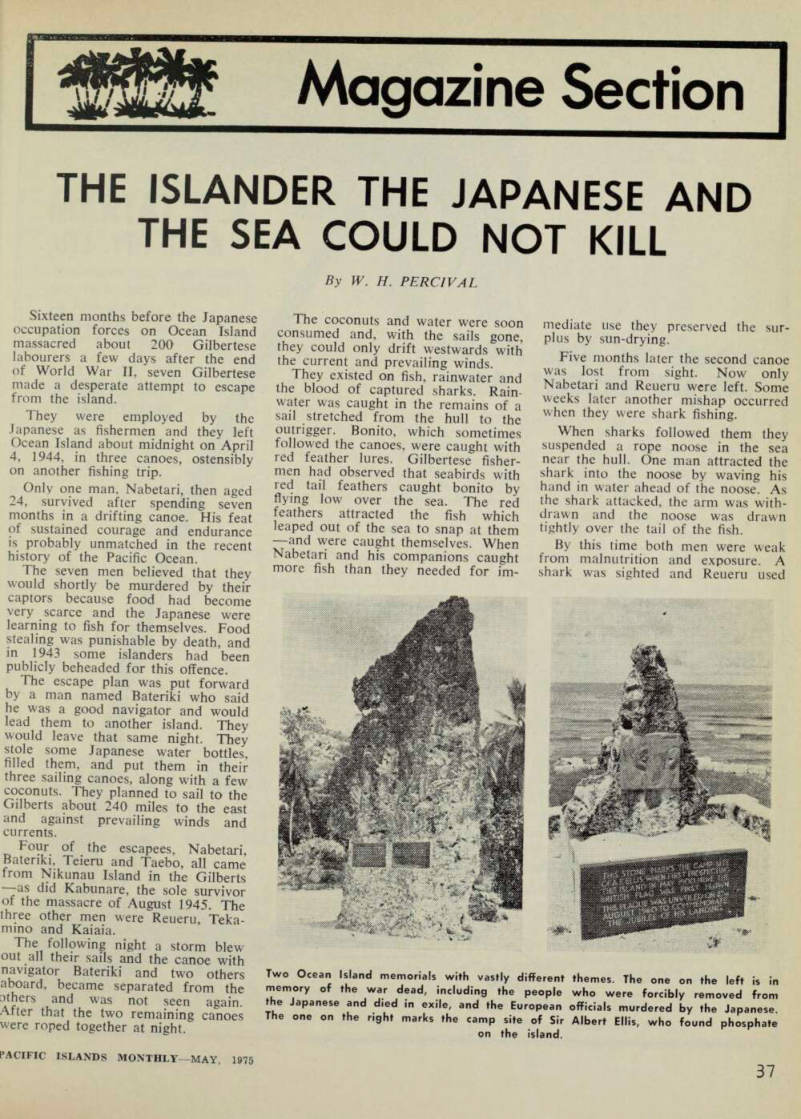

The Islander The Japanese And
The Sea Could Not Kill
By W. H. Percival
Sixteen months before the Japanese occupation forces on Ocean Island massacred about 200 Gilbertese labourers a few days after the end of World War 11, seven Gilbertese made a desperate attempt to escape from the island.
They were employed by the Japanese as fishermen and they left Ocean Island about midnight on April 4, 1944, in three canoes, ostensibly on another fishing trip.
Only one man, Nabetari, then aged 24, survived after spending seven months in a drifting canoe. His feat of sustained courage and endurance is probably unmatched in the recent history of the Pacific Ocean.
The seven men believed that they would shortly be murdered by their captors because food had become very scarce and the Japanese were learning to fish for themselves. Food stealing was punishable by death, and in 1943 some islanders had been publicly beheaded for this offence.
The escape plan was put forward by a man named Bateriki who said he was a good navigator and would lead them to another island. They would leave that same night. They stole some Japanese water bottles, filled them, and put them in their three sailing canoes, along with a few coconuts. They planned to sail to the Gilberts about 240 miles to the east and against prevailing winds and currents.
Four of the escapees, Nabetari, Bateriki, Teieru and Taebo, all came from Nikunau Island in the Gilberts -as did Kabunare, the sole survivor of the massacre of August 1945. The three other men were Reueru, Teka mmo and Kaiaia.
The following night a storm blew out all their sails and the canoe with navigator Bateriki and two others aboard, became separated from the Dthers and was not seen again.
After that the two remaining canoes were roped together at night.
The coconuts and water were soon consumed and, with the sails gone, they could only drift westwards with the current and prevailing winds.
They existed on fish, rainwater and the blood of captured sharks. Rain water was caught in the remains of a sail stretched from the hull to the outrigger. Bonito, which sometimes followed the canoes, were caught with red feather lures. Gilbertese fisher men had observed that seabirds with red tail feathers caught bonito by flying low over the sea. The red feathers attracted the fish which leaped out of the sea to snap at them —and were caught themselves. When Nabetari and his companions caught more fish than they needed for im
mediate use they preserved the sur plus by sun-drying.
Five months later the second canoe was lost from sight. Now only Nabetari and Reueru were left. Some weeks later another mishap occurred when they were shark fishing.
When sharks followed them they suspended a rope noose in the sea near the hull. One man attracted the shark into the noose by waving his hand in water ahead of the noose. As the shark attacked, the arm was with drawn and the noose was drawn tightly over the tail of the fish.
By this time both men were weak from malnutrition and exposure. A shark was sighted and Reueru used
Two Ocean Island memorials with vastly different themes. The one on the left is in memory of the war dead, including the people who were forcibly removed from the Japanese and d.ed in exile, and the European officials murdered by the Japanese.
The one on the right marks the camp site of Sir Albert Ellis, who found phosphate on the island.
the white palm of his hand as bait.
The shark attacked—and Reueru was badly bitten on the upper arm. All Nabetari could do was bandage the wound.
One night, about a week later, both men were asleep when something overturned the canoe. Nabetari awoke to find himself in the sea close to the capsized craft. He located Reueru and gave him a paddle and a tin to help support him while he righted the canoe. By the time he succeeded in righting the outrigger Reueru had dis appeared. He searched for him again at first light. But Reueru had gone forever, Nabetari continued his long drift west, too weak to paddle and ignorant of where land lay. Twice a high flying aircraft flew over him but failed to see either the canoe or the piece of cloth he waved. Once he sighted a ship a long way off, but the ship did not spot him. Some time after this a ship passed so close to him he plainly saw the crew. It appeared to be a naval vessel—and it did not stop to pick him up.
“This ship was very close to me and I could see the men on it,” Nabe tari said later. “I think they were Japanese. The ship had one high mast, was high at the bow and low at
the stern. It was travelling very fast as though it was being chased.”
Nabetari was very weak when he finally sighted land and was washed up on the reef the following day. In the words of the doctor who treated him: “This native arrived in an ex treme state of physical exhaustion, covered with sores and with his hair falling out.”
Nabetari crawled up on an empty beach, rested there that afternoon and slept there that night. The next day he set off to find a village by crawling in the shallows so that the buoyancy of the sea supported him and eased his painful labour. Late that after noon he sighted a village and was found by an old man and three young ones whose language he could not understand. They carried him to the village where he was cared for during the next four days. Then a European doctor arrived by launch, presum ably after the villagers had got word to him.
Nabetari learned that the name of the place was Maron, but did not know if that was the name of the village or the island. He had reached one of the Ninigo Islands which lie near New Guinea’s north-east coast and about 125 miles north-west of
Manus in the Admiralty Group. It was then early November 1944, and he had drifted about 1,800 miles in seven months.
He was taken to the Australian Base Hospital at Manus where he made a partial recovery after three months treatment. From the little he was able to tell them, the authorities realised that he could give valuable military information regarding the Japanese defences on Ocean. As soon as he was strong enough, he was flown to Tarawa for interrogation.
At Tarawa, where he recovered completely, he was taught map read ing by an Army Intelligence officer.
He then gave military information which, when cross-checked, proved to be amazingly accurate. He also gave information about the fate of the six Europeans who elected to remain be hind on Ocean Island to care for the natives when it was known that the island would shortly be invaded by the Japanese, and when they could have been evacuated with the rest of the European staff. The six all died as a result of malnutrition and Japanese brutality.
A few years ago, Nabetari was working as a butcher on Ocean Island, a happily-married man with a family.
Advertisements & other items, pp. 44-45 (1 item)
S. E. Tatham
m
SOME OF THE FIRMS
WE REPRESENT ARE:
Asia Rubber Works (Singapore Rubber Shoes) Frappier (French Brandy) Huvet (French Brandy) Indika (Belgium Dairy Produce) Durobor S.A. (Belgium Glassware) Miroiterie Gen. de Belgiqe S.A. (Louvre glass and mirrors) City Engineers (U.K. Bicycles) F.H.I. Japan (Subaru Cars) Kraggs (Wines, Spirits, Ciders) Sunshine Biscuits Sunrise (Confectionery) Flamenco (Instant Coffee & Tea) Quaker Products (Oats, Jets) Hancocks (Spaghetti, Cereals) Melbourne Canning (Jams) Amatil (Twisties, Twirlies) Edward Zorn (Margarine, Cooking Fats) Allens (Confectionery) Red Tulip (Fine Chocolates) Robert Timms (New Guinea Gold Instant Coffees and Teas) S.P.C (Canned Fruit) S.P.C. (Abalone) Wing Lee (See You Sauce) Magnet (Mattresses) Essteel (Cookware) Warner-Drayton (Fans) Mitchell's (Abrasives) Tilbury & Lewis (Sports Trophies & Silverplate) Regent (Swiss watches) Lega Marcasite (Jewellery) Austramax (Pressure Lanterns) Lawn Chair; Tubco (Garden Furniture) Electronic Industries (Electrical Household Appliances) Jex (Steelwool) Arnbro (Folding Beds) James Miller (Blankets) Elmaco (Plastics —Electrical Fittings) B.X. (Plastics) Stegbar (Wooden Louvres) Franklite (Light Fittings) J.J. Cash (Embroidered Labels) Disston (Saws)
S. E. TATHAM
& CO. PTY. LTD.
ASKEW HOUSE, 364 LONSDALE ST.,
MELBOURNE, 3001, AUSTRALIA.
G.P.O. BOX 8—
CABLES "SET".
TELEPHONE: 601125
BUYERS FOR THE
PACIFIC (SUNOS
1 % % % 1 1
DIRECT ENQUIRIES WELCOMED
PAPUA NEW GUINEA: S. E. TATHAM (P.N.G.) PTY. LTD.,
LAE: MALAITA STREET (P.O. BOX 1562).
PORT MORESBY: CNR. GOROA AND MUNAHU STREETS
(P.O. BOX 6733, BOROKO).
FIJI: S. E. TATHAM (FIJI) LTD.,
LAUTOKA; P.O. BOX 366.
SUVA: G.P.O. BOX 671.
YOUR GUARANTEE
i i i
GORDON
T. 2.
FOR SERVICE
SINCE 1924
Cordial Makers-Pastrycooks-Smallgoods Manufacturers-
Confectioners—Canners
FOLLOW THE EXAMPLE OF
AUSTRALIAN AND SOUTH EAST
ASIAN LEADING FOOD PROCESSORS
GOLD BADGE
ESSENCES, SEASONINGS,
PERFUMES, COLOURS.
USE
ALSO
CREATIVE TECHNOLOGY,
FLAVOURS AND FRAGRANCES
JUSFRUTE
We invite your enquiries, either direct, or through your normal Buying Agent.
FRUIT JUICE CONCENTRATES
OUR TECHNICAL LABORATORIES ARE
AT YOUR SERVICE
KEITH HARRIS & CO. LTD. 7 SEFTON ROAD, THORNLEIGH, 2120, N.S.W.
Cables: KEHAR, Sydney. 1015 Ann Street, Valley, Q'ld., 4006. Cables: KEHARBRIS, Brisbane.
Doomsday
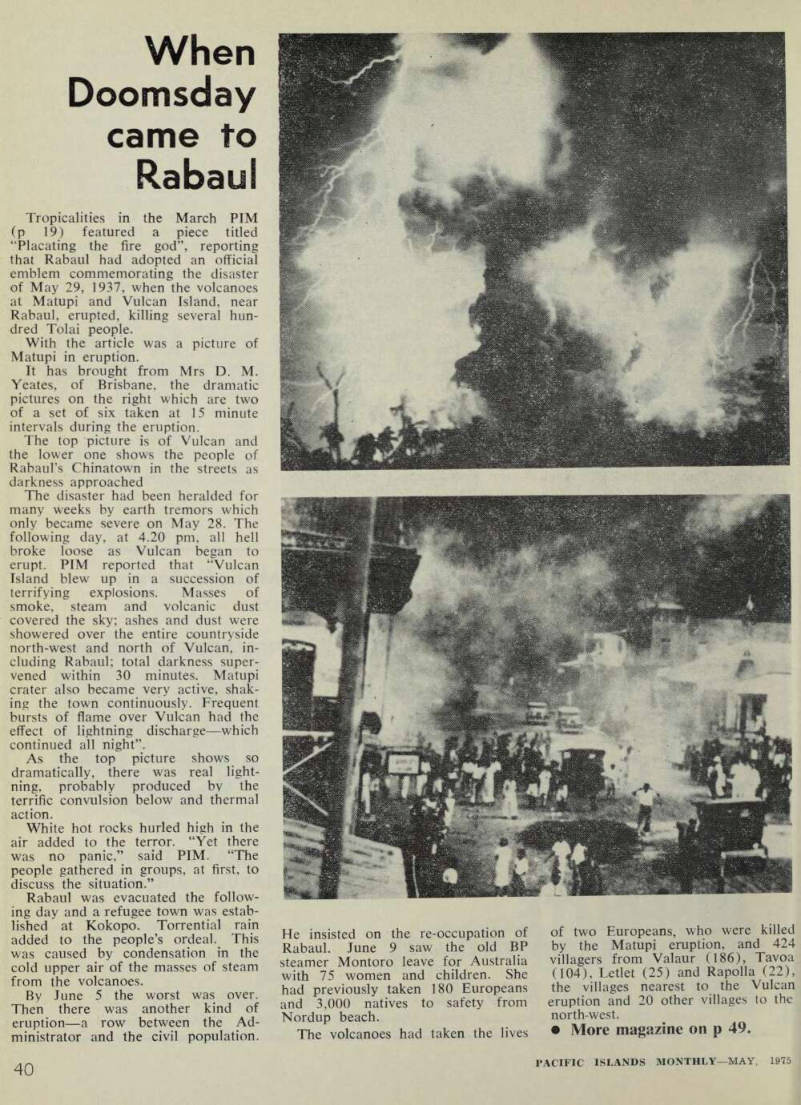
When Doomsday came to Rabaul
Tropicalities in the March PIM (p 19) featured a piece titled “Placating the fire god”, reporting that Rabaul had adopted an official emblem commemorating the disaster of May 29, 1937, when the volcanoes at Matupi and Vulcan Island, near Rabaul, erupted, killing several hun dred Tolai people.
With the article was a picture of Matupi in eruption.
It has brought from Mrs D. M.
Yeates, of Brisbane, the dramatic pictures on the right which are two of a set of six taken at 15 minute intervals during the eruption.
The top picture is of Vulcan and the lower one shows the people of Rabaul’s Chinatown in the streets as darkness approached The disaster had been heralded for many weeks by earth tremors which only became severe on May 28. The following day, at 4.20 pm, all hell broke loose as Vulcan began to erupt. PIM reported that “Vulcan Island blew up in a succession of terrifying explosions. Masses of smoke, steam and volcanic dust covered the sky; ashes and dust were showered over the entire countryside north-west and north of Vulcan, in cluding Rabaul; total darkness super vened within 30 minutes. Matupi crater also became very active, shak ing the town continuously. Frequent bursts of flame over Vulcan had the effect of lightning discharge—which continued all night”.
As the top picture shows so dramatically, there was real light ning, probably produced by the terrific convulsion below and thermal action.
White hot rocks hurled high in the air added to the terror. “Yet there was no panic,” said PIM. “The people gathered in groups, at first, to discuss the situation.”
Rabaul was evacuated the follow ing day and a refugee town was estab lished at Kokopo. Torrential rain added to the people’s ordeal. This was caused by condensation in the cold upper air of the masses of steam from the volcanoes.
By June 5 the worst was over.
Then there was another kind of eruption—a row between the Ad ministrator and the civil population.
He insisted on the re-occupation of Rabaul. June 9 saw the old BP steamer Montoro leave for Australia with 75 women and children. She had previously taken 180 Europeans and 3,000 natives to safety from Nordup beach.
The volcanoes had taken the lives
of two Europeans, who were killed by the Matupi eruption, and 424 villagers from Valaur (186), Tavoa (104), Letlet (25) and Rapolla (22), the villages nearest to the Vulcan eruption and 20 other villages to the north-west.
• More magazine on p 49.
Advertisements & other items, pp. 47-50 (1 item)
for extra freshness
Come up to Kool
m . m * > % :A > f ■ A s S(. ■'jtr *S m A U597-8/71
% s . f * , f I 6 f e 1 f« *; m f *ft t *M 11 *♦» .-V’i* f f . * » ' - .4 : i “ ■ „.^MS * f < Ui ® ‘‘v* 5 i
Ajjj.
P * TV '•
€#' H .• * / / * V* i-m * .*■ v «Us r ** r If you vc got work to do. we ve got trucks to do it W£m
TOYOTA
TOYOTA
Stout Hi Ace
TOYOTA
Land Cruiser Pickup
TOYOTA Hi Lux
PAPUA, NEW GUINEA: ELA MOTORS LIMITED, Sci.lchN, RP , 6.P.1., P*u.. US. TRUST TERRITORY: MICROL SJTES.^l^f’SSir P.O. Box 174, Honiara.
* tV V ' ' ! ‘XI s -
I V* V N‘%’>
W,"‘. w.- * % % - A\' I %' t. . . * x -\_r *v# *- v ' S -’\ \ x> , .v w % ' -a \ “S\ s *\ s . .
"■ x % N 4 \ r . * V \ /’ V A' *., i > - - v* v ■ k\ ■> x *■ l? ■ , • * 1 - .VS, *-4 ‘ * k \ U| imr ■ .-■,•■ ik — ■ ■' ' V
sjfe&y : x
L ; -§Sfc* \ - At * Vx N "■
TOYOTA Land Cruiser
» igunviL £r From different styles of the 4-wheel-drive Land Cruiser, to vans and pickups, to heavy duty trucks. Toyota makes them.
And Toyota makes them tough.
There s a Toyota truck that will work for you. Economically.
Reliably.
Find out about it. From your local Toyota dealer.
TOYOTA Dyna
liir
TOYOTA Truck
TOYOTA
Toyo-Ace FOYHTA R^rotonga^ NAURTISLANd"^AURTcOO^P^RAT!VE^OcIET^^GfI”RFRtV 1 TRADING CORPORATION LTD., P.O. 80. 92. ■WI W M Bair,k, Tarawa. NORFOLK E d LL, «* slan D s COL °N Y : TARAWA MOTORS. Box 36
SOC. E T E .MPOR^^S Sti
It took time to perfect the
NEW Hyster electrics.
Time to make the best.
I '.'K . * V
HYSTER
1 liil m r i^n We could have added new Hyster electric trucks to our extensive lift truck range some time ago. After all. we knew what people wanted, and we had the dealer and service network to back our sales Australia-wide.
But long after electric lift trucks first hit the market, we were busy perfecting a better hydraulic system to overcome the oil leaks and minimise the battery drain other manufacturers weren't so concerned about.
We wanted to make ours the top performance electric. An easy-handling truck with a short turning radius. Longer life between charges. Smoother deceleration. And single pedal control to keep the drivers happy.
Now, we’ve built these advantages into a range of Hyster electric trucks with load capacities of up to 10,000 lbs (5,000 kgs). We believe they re the world's finest, and they’re available from your Hyster dealer. Ask to see them in action. Or contact Hyster Australia Pty. Ltd., Ashford Avenue, Milperra, N.S.W. 2214. Telephone Sydney 77 0511.
HYSTER AUSTRALIA PTY. LTD.
HR39.84
Yesterday
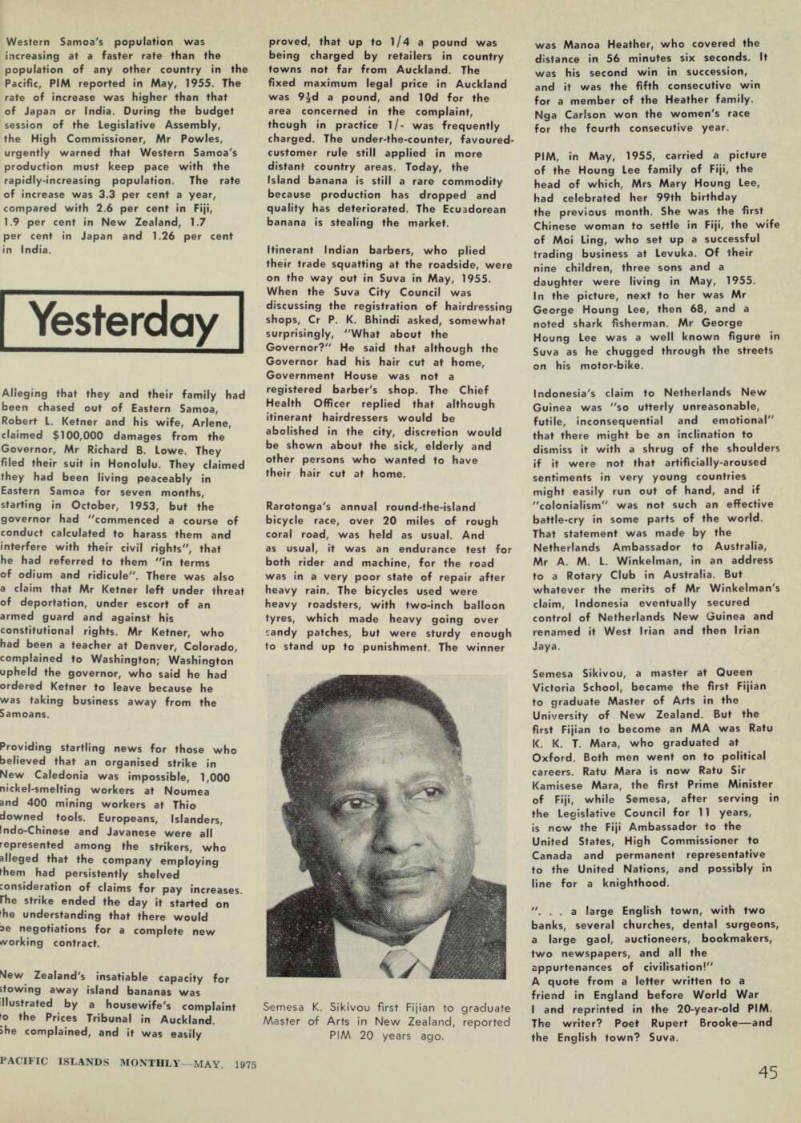
Western Samoa's population was increasing at a faster rate than the population of any other country in the Pacific, PIM reported in May, 1955. The rate of increase was higher than that of Japan or India. During the budget session of the Legislative Assembly, the High Commissioner, Mr Powles, urgently warned that Western Samoa's production must keep pace with the rapidly-increasing population. The rate of increase was 3.3 per cent a year, compared with 2.6 per cent in Fiji, 1.9 per cent in New Zealand, 1.7 per cent in Japan and 1.26 per cent in India.
Alleging that they and their family had been chased out of Eastern Samoa, Robert L. Ketner and his wife, Arlene, claimed $lOO,OOO damages from the Governor, Mr Richard B. Lowe. They filed their suit in Honolulu. They claimed they had been living peaceably in Eastern Samoa for seven months, starting in October, 1953, but the governor had "commenced a course of conduct calculated to harass them and interfere with their civil rights", that he had referred to them "in terms of odium and ridicule". There was also a claim that Mr Ketner left under threat of deportation, under escort of an armed guard and against his constitutional rights. Mr Ketner, who had been a teacher at Denver, Colorado, complained to Washington; Washington upheld the governor, who said he had ordered Ketner to leave because he was taking business away from the Samoans.
Providing startling news for those who believed that an organised strike in New Caledonia was impossible, 1,000 nickel-smelting workers at Noumea and 400 mining workers at Thio downed tools. Europeans, Islanders, Indo-Chinese and Javanese were all represented among the strikers, who alleged that the company employing Ihem had persistently shelved consideration of claims for pay increases.
Fhe strike ended the day it started on »he understanding that there would ae negotiations for a complete new working contract.
Mew Zealand's insatiable capacity for stowing away island bananas was llustrated by a housewife's complaint the Prices Tribunal in Auckland. >he complained, and it was easily
proved, that up to l/4 a pound was being charged by retailers in country towns not far from Auckland. The fixed maximum legal price in Auckland was a pound, and lOd for the area concerned in the complaint, though in practice l/- was frequently charged. The under-the-counter, favoured customer rule still applied in more distant country areas. Today, the Island banana is still a rare commodity because production has dropped and quality has deteriorated. The Ecuadorean banana is stealing the market.
Itinerant Indian barbers, who plied their trade squatting at the roadside, were on the way out in Suva in May, 1955.
When the Suva City Council was discussing the registration of hairdressing shops, Cr P. K, Bhindi asked, somewhat surprisingly, "What about the Governor?" He said that although the Governor had his hair cut at home.
Government House was not a registered barber's shop. The Chief Health Officer replied that although itinerant hairdressers would be abolished in the city, discretion would be shown about the sick, elderly and other persons who wanted to have their hair cut at home.
Rarotonga's annual round-the-island bicycle race, over 20 miles of rough coral road, was held as usual. And as usual, it was an endurance test for both rider and machine, for the road was in a very poor state of repair after heavy rain. The bicycles used were heavy roadsters, with two-inch balloon tyres, which made heavy going over tandy patches, but were sturdy enough to stand up to punishment. The winner
was Manoa Heather, who covered the distance in 56 minutes six seconds. It was his second win in succession, and it was the fifth consecutive win for a member of the Heather family.
Nga Carlson won the women's race for the fourth consecutive year.
PIM, in May, 1955, carried a picture of the Houng Lee family of Fiji, the head of which, Mrs Mary Houng Lee, bad celebrated her 99th birthday the previous month. She was the first Chinese woman to settle in Fiji, the wife of Moi Ling, who set up a successful trading business at Levuka. Of their nine children, three sons and a daughter were living in May, 1955.
In the picture, next to her was Mr George Houng Lee, then 68, and a noted shark fisherman. Mr George Houng Lee was a well known figure in Suva as he chugged through the streets on his motor-bike.
Indonesia's claim to Netherlands New Guinea was "so utterly unreasonable, futile, inconsequential and emotional" that there might be an inclination to dismiss it with a shrug of the shoulders if it were not that artificially-aroused sentiments in very young countries might easily run out of hand, and if "colonialism" was not such an effective battle-cry in some parts of the world.
That statement was made by the Netherlands Ambassador to Australia, Mr A. M. L. Winkelman, in an address to a Rotary Club in Australia. But whatever the merits of Mr Winkelman's claim, Indonesia eventually secured control of Netherlands New Guinea and renamed it West Irian and then Irian Jaya.
Semesa Sikivou, a master at Queen Victoria School, became the first Fijian to graduate Master of Arts in the University of New Zealand. But the first Fijian to become an MA was Ratu K. K. T. Mara, who graduated at Oxford. Both men went on to political careers. Ratu Mara is now Ratu Sir Kamisese Mara, the first Prime Minister of Fiji, while Semesa, after serving in the Legislative Council for 11 years, is now the Fiji Ambassador to the United States, High Commissioner to Canada and permanent representative to the United Nations, and possibly in line for a knighthood.
"... a large English town, with two banks, several churches, dental surgeons, a large gaol, auctioneers, bookmakers, two newspapers, and all the appurtenances of civilisation!"
A quote from a letter written to a friend in England before World War I and reprinted in the 20-year-old PIM.
The writer? Poet Rupert Brooke —and the English town? Suva.
Semesa K. Sikivou first Fijian to graduate Master of Arts in New Zealand, reported PIM 20 years ago.
mana
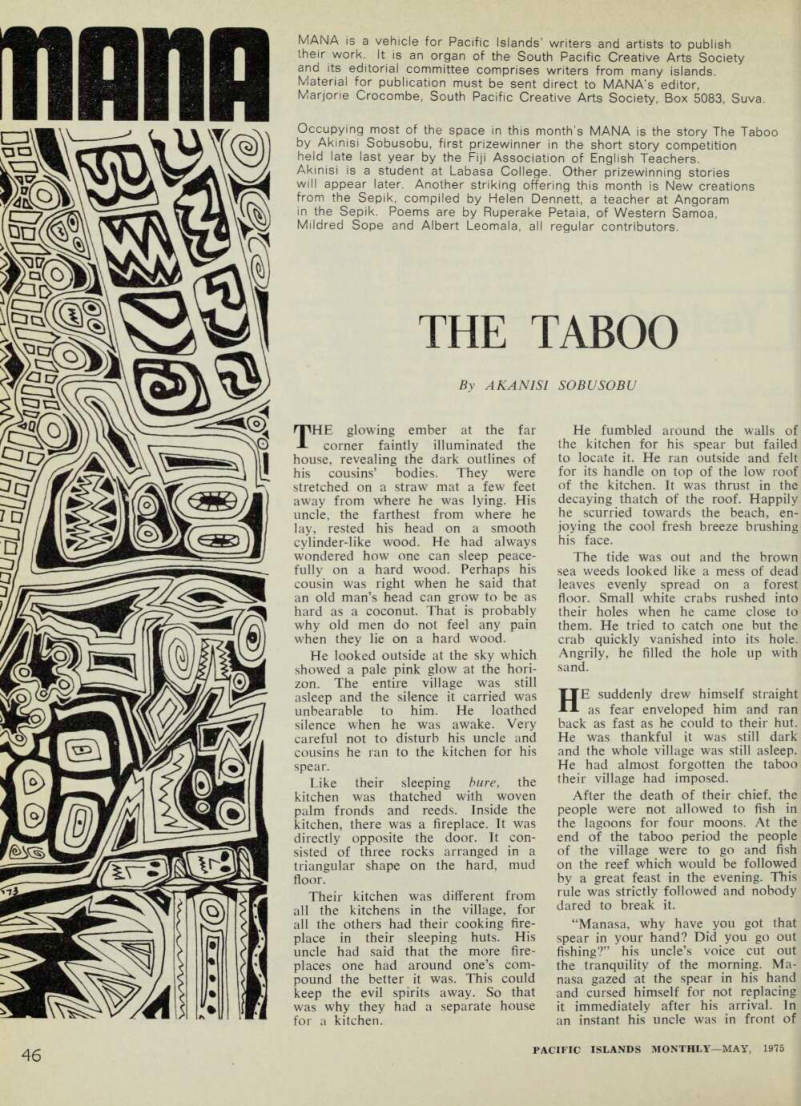
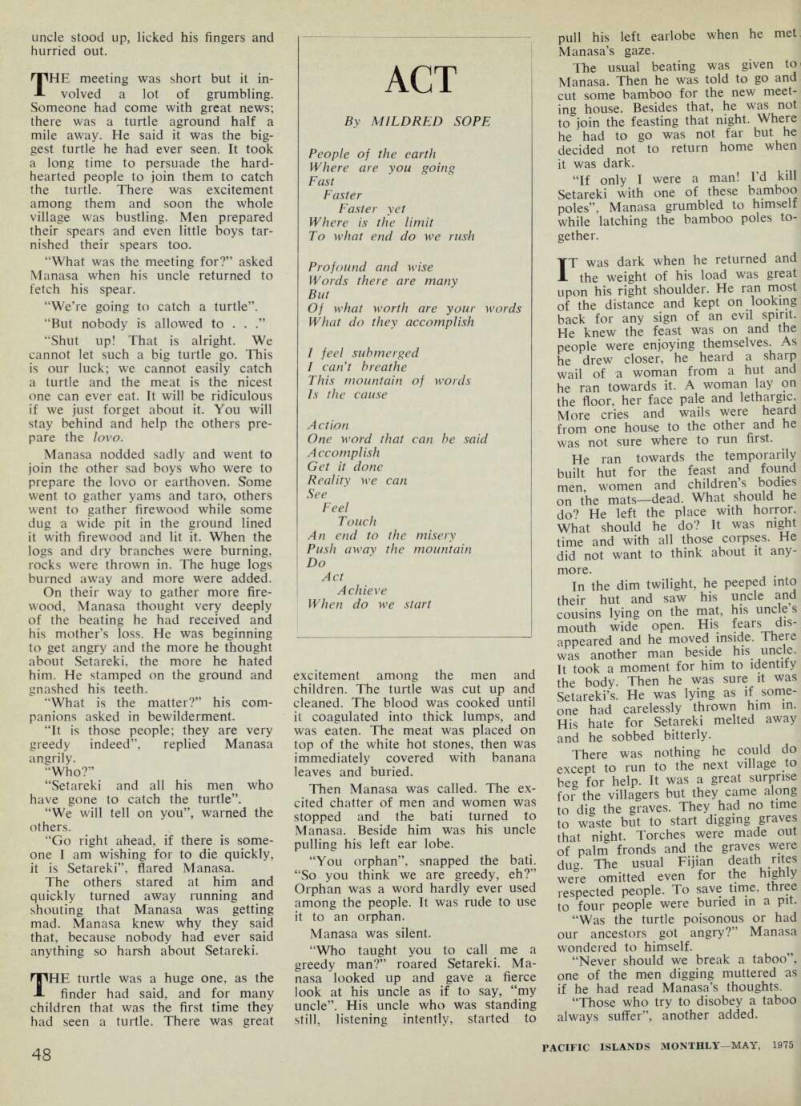
The Taboo
MANA is a vehicle for Pacific Islands’ writers and artists to publish their work. It is an organ of the South Pacific Creative Arts Society and its editorial committee comprises writers from many islands.
Material for publication must be sent direct to MANA’s editor, Marjorie Crocombe, South Pacific Creative Arts Society, Box 5083, Suva.
Occupying most of the space in this month’s MANA is the story The Taboo by Akinisi Sobusobu, first prizewinner in the short story competition held late last year by the Fiji Association of English Teachers.
Akinisi is a student at Labasa College. Other prizewinning stories will appear later. Another striking offering this month is New creations from the Sepik, compiled by Helen Dennett, a teacher at Angoram in the Sepik. Poems are by Ruperake Petaia, of Western Samoa, Mildred Sope and Albert Leomala, all regular contributors.
By Akanisi Sobusobu
THE glowing ember at the far corner faintly illuminated the house, revealing the dark outlines of his cousins’ bodies. They were stretched on a straw mat a few feet away from where he was lying. His uncle, the farthest from where he lay, rested his head on a smooth cylinder-like wood. He had always wondered how one can sleep peacefully on a hard wood. Perhaps his cousin was right when he said that an old man’s head can grow to be as hard as a coconut. That is probably why old men do not feel any pain when they lie on a hard wood.
He looked outside at the sky which showed a pale pink glow at the horizon. The entire village was still asleep and the silence it carried was unbearable to him. He loathed silence when he was awake. Very careful not to disturb his uncle and cousins he ran to the kitchen for his spear.
Like their sleeping bure, the kitchen was thatched with woven palm fronds and reeds. Inside the kitchen, there was a fireplace. It was directly opposite the door. It consisted of three rocks arranged in a triangular shape on the hard, mud floor.
Their kitchen was different from all the kitchens in the village, for all the others had their cooking fireplace in their sleeping huts. His uncle had said that the more fireplaces one had around one’s compound the better it was. This could keep the evil spirits away. So that was why they had a separate house for a kitchen.
He fumbled around the walls of the kitchen for his spear but failed to locate it. He ran outside and felt for its handle on top of the low roof of the kitchen. It was thrust in the decaying thatch of the roof. Happily he scurried towards the beach, en joying the cool fresh breeze brushing his face.
The tide was out and the brown sea weeds looked like a mess of dead leaves evenly spread on a forest floor. Small white crabs rushed into their holes when he came close to them. He tried to catch one but the crab quickly vanished into its hole.
Angrily, he filled the hole up with sand, IJE suddenly drew himself straight -ll as fear enveloped him and ran back as fast as he could to their hut.
He was thankful it was still dark and the whole village was still asleep, He had almost forgotten the taboo *eir village had imposed, After the death of their chief, the people were not allowed to fish in the lagoons for four moons. At the end of the taboo period the people of the village were to go and fish on the reef which would be followed by a great feast in the evening. This was strictly followed and nobody dared to break it.
“Manasa, why have you got that spear in your hand? Did you go out fishing?” his uncle’s voice cut out the tranquility of the morning. Ma nasa gazed at the spear in his hand and cursed himself for not replacing it immediately after his arrival. In an instant his uncle was in front of
him pulling his left ear lobe furi ously. When his uncle pulled his left ear lobe it suggested that he was very angry. His cousins came out to investigate their father’s early
morning anger.
“I did not . . .” Manasa tried to protest but his uncle cut him short.
“Liar! You have broken the taboo and you will be punished for it. No □ne has ever dared to break it but you have. Show me the fish you have speared”, roared his uncle.
I did not spear any”, Manasa re
plied truthfully.
“You have brought great shame jpon the family and you’ll be punished by Setareki. I’ll go and call um right now”. was the bati or warrior of the village. He was a strong nuscular man with heavy eyebrows.
Te always wore a stern face which nade him a stern and fearful man. fhere was no need to go to Setareki’s lome for he was already there among he crowd who were eager to know he cause of the commotion.
“He has broken the taboo” Ma lasa’s uncle told Setareki. A deep nurmur went through the crowd , cn they heard this. Silence sud lenly fell among them and many t'ere starting to feel very uneasy ot because of the warrior and the ig crowd around him but because f the silence.
The sun was already casting thin 3ng shadows to the ground. Then uddenly Setareki stepped out and rabbing Manasa’s left shoulder he
tiook it violently.
“Leave me alone, I haven’t done nything that deserves punishment” lanasa protested to the warrior. ’
Get me a big stick, someone!”
Three or four boys pushed irough the crowd to find a stick lanasa was then taken to the arnor s hut where he was severely eaten. J Go and apologise to your uncle nd „ to all the old men of the vill ?e , ordered the warrior. Manasa id as he was told.
For a week, the people of Sici Iked persistently about the incident which Manasa was involved, arents were very careful not to let icir children play with Manasa.
'omen gossiped about bad orphans no lacked good manners. years before, when Manasa was a boy of six, his father was lied in a tribal war against the atumabu tribe. He remembered his irents and the day his mother re
ceived the tragic news of his father’s death. His mother, a very thin woman collected her husband’s spears, stone axe, clubs and ten mats and tapa cloth, Manasa was an only child and for this their family was regarded as the unluckiest family in the village. His mother could not bear any more children. The witch doctor said that his mother had done something which had agitated their ancestors.
As he watched his mother collect his father’s weapons and her mats, Manasa was happy but was surprised to see his mother’s stern face. He asked if she did not like the soqo or social gathering they were ready to go to. His mother then cried bit terly without Manasa knowing why.
People made their way to the grave when his father’s body arrived. It was at the graveside that his mother said goodbye to him and it was then he knew why she was crying at home. Manasa yelled out to save his mother but people pretended not to hear him. A length of rope was passed to Setareki, the warrior, and he tied it loosely around his mother’s neck. Before he pulled the rope into a tight knot, Setareki told Manasa’s mother to bid her last words of farewell and request.
Her speech was short and she smiled while she was talking, pre
tending not to fear death. Then she asked Manasa’s uncle to love Ma nasa and to take care of him; and she wished the others happy long lives. She ended by saying that she would be waiting for them and she was going to prepare a big feast when they later joined her and their an cestors. Everyone clapped and yelled out “moce" to her. This was their way of saying goodbye. Setareki tightened the cord and pulled the two ends in opposite direction with all his might suffocating her to an agonising death. This cruel meaning less ritual was unbearable to Ma nasa. If there was a person who was to be punished when he grew up, it was Setareki.
Manasa walked into their sleeping hut and found his uncle inside, eat ing alone. He called Manasa to join him. Manasa fearing further punish ment joined him reluctantly. A young man walked in at that moment and told his uncle that a meeting was to be held very soon in the bati’s hut.
“What is it for?” asked Manasa’s uncle.
“I do not know”, lied the young man who was trying hard to dis guise the excitement in him while speaking.
“Alright, I’m coming”. Manasa’s
unde stood up, licked his fingers and hurried out.
THE meeting was short but it in volved a lot of grumbling.
Someone had come with great news; there was a turtle aground half a mile away. He said it was the big gest turtle he had ever seen. It took a long time to persuade the hard hearted people to join them to catch the turtle. There was excitement among them and soon the whole village was bustling. Men prepared their spears and even little boys tar nished their spears too.
“What was the meeting for?” asked Manasa when his uncle returned to fetch his spear.
“We’re going to catch a turtle”.
“But nobody is allowed to . . .”
“Shut up! That is alright. We cannot let such a big turtle go. This is our luck; we cannot easily catch a turtle and the meat is the nicest one can ever eat. It will be ridiculous if we just forget about it. You will stay behind and help the others pre pare the lovo.
Manasa nodded sadly and went to join the other sad boys who were to prepare the lovo or earthoven. Some went to gather yams and taro, others went to gather firewood while some dug a wide pit in the ground lined it with firewood and lit it. When the logs and dry branches were burning, rocks were thrown in. The huge logs burned away and more were added.
On their way to gather more fire wood, Manasa thought very deeply of the beating he had received and his mother’s loss. He was beginning to get angry and the more he thought about Setareki, the more he hated him. He stamped on the ground and gnashed his teeth.
“What is the matter?” his com panions asked in bewilderment.
“It is those people; they are very greedy indeed”, replied Manasa angrily.
“Who?”
“Setareki and all his men who have gone to catch the turtle”.
“We will tell on you”, warned the others.
“Go right ahead, if there is some one I am wishing for to die quickly, it is Setareki”, flared Manasa.
The others stared at him and quickly turned away running and shouting that Manasa was getting mad. Manasa knew why they said that, because nobody had ever said anything so harsh about Setareki.
THE turtle was a huge one, as the finder had said, and for many children that was the first time they had seen a turtle. There was great
excitement among the men and children. The turtle was cut up and cleaned. The blood was cooked until it coagulated into thick lumps, and was eaten. The meat was placed on top of the white hot stones, then was immediately covered with banana leaves and buried.
Then Manasa was called. The ex cited chatter of men and women was stopped and the bati turned to Manasa. Beside him was his uncle pulling his left ear lobe.
“You orphan”, snapped the bati.
“So you think we are greedy, eh?”
Orphan was a word hardly ever used among the people. It was rude to use it to an orphan.
Manasa was silent.
“Who taught you to call me a greedy man?” roared Setareki. Ma nasa looked up and gave a fierce look at his uncle as if to say, “my uncle”. His uncle who was standing still, listening intently, started to
pull his left earlobe when he met Manasa’s gaze.
The usual beating was given to Manasa. Then he was told to go and cut some bamboo for the new meet ing house. Besides that, he was not to join the feasting that night. Where he had to go was not far but he decided not to return home when it was dark.
“If only I were a man! I’d kill Setareki with one of these bamboo poles”. Manasa grumbled to himself while latching the bamboo poles to gether.
IT was dark when he returned and the weight of his load was great upon his right shoulder. He ran most of the distance and kept on looking back for any sign of an evil spirit.
He knew the feast was on and the people were enjoying themselves. As he drew closer, he heard a sharp wail of a woman from a hut and he ran towards it. A woman lay on the floor, her face pale and lethargic.
More cries and wails were heard from one house to the other and he was not sure where to run first.
He ran towards the temporarily built hut for the feast and found men, women and children’s bodies on the mats —dead. What should he do 9 He left the place with horror.
What should he do? It was night time and with all those corpses. He did not want to think about it any more.
In the dim twilight, he peeped into their hut and saw his uncle and cousins lying on the mat, his uncle s mouth wide open. His fears dis appeared and he moved inside. There was another man beside his uncle.
It took a moment for him to identify the body. Then he was sure it was Setareki’s. He was lying as if some one had carelessly thrown him in.
His hate for Setareki melted away and he sobbed bitterly.
There was nothing he could do except to run to the next village to beg for help. It was a great surprise for the villagers but they came along to dig the graves. They had no time to waste but to start digging graves that night. Torches were made out of palm fronds and the graves were dug. The usual Fijian death rites were omitted even for the highly respected people. To save time, three to four people were buried in a pit.
“Was the turtle poisonous or had our ancestors got angry?” Manasa wondered to himself.
“Never should we break a taboo”, one of the men digging muttered as if he had read Manasa’s thoughts.
“Those who try to disobey a taboo always suffer”, another added.
Freedom Day
By Ruperake Petaia
This Day I see On a stage A small group of Big Men, These so called liberators.
Up on a pole The national flag waves, That say of Freedom.
I will hear once more Solemn promises Re-Assurances Of Freedom and Unity Of Prosperity and Satisfaction Of Toleration and Peace.
I see On the Malae A People-misled, With more flags and Fancy uniformed marches And brass band parades.
I see their weary faces Masked with bright-coloured Images of the liberators.
I see them made To sing and dance In the sun’s pain, Lured to Compete for the prize money Of the Big Men.
The people Assume this day Will last forever.
But soon, Too soon, The darkness will return The People to their villages.
And 1 will join them Chanting Their evening rituals In prayers of hope For another today Tomorrow.
And Freedom flies on, Way up on a pole Unreachable.
Advertisements & other items, p. 53 (1 item)
47
ICIFIC ISLANDS MONTHLY-MAY, 1975
Act
By Mildred Sope
People of the earth Where are you going Fast Faster Faster yet Where is the limit To what end do we rush Profound and wise Words there are many But Of what worth are your words What do they accomplish I feel submerged I can’t breathe This mountain of words Is the cause A ction One word that can be said Accomplish Get it done Reality we can See Feel Touch An end to the misery Push away the mountain Do Act Achieve When do we start
Songs from Ranga
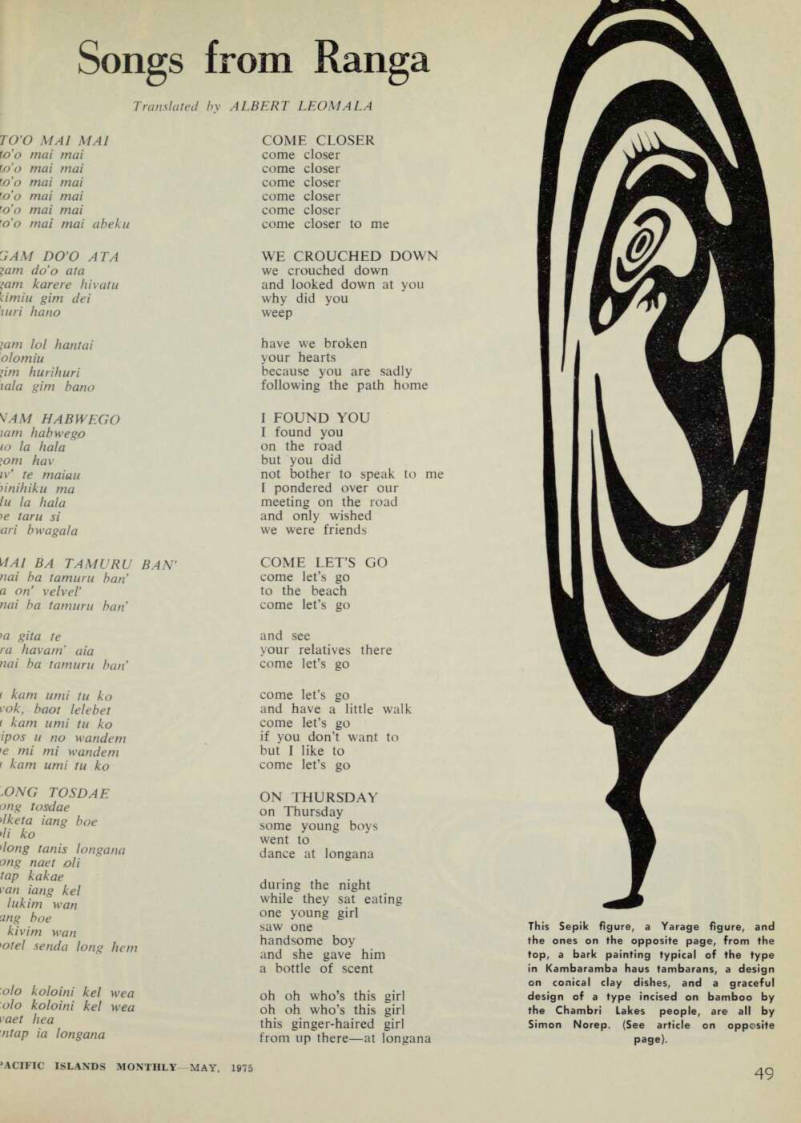
Translated by ALBERT LEOMALA
To’O Mai Mai
to’o mai mai to’o mai mai to’o mai mai 'o'o mai mai to’o mai mai f o’o mai mai abeku
Sam Do’O At A
?am do'o ata lam karere hivatu \imiu gim dei iuri ha no ?am 10l hantai blomiu jim hurihuri lala gim bano
Vam Habwego
mm habwego 10 la hala tom hav iv’ te maiau nnihiku ma lu la hala ye taru si ari bwagala
Mai Ba Tamuru Ban’
nai ba tamuru ban’ a on’ velvet’ nai ba tamuru ban’ >a gita te ra hav am’ aia nai ba tamuru ban’ i kam umi tu ko vok, baot lelebet i kam umi tu ko ipos u no wandem 'e mi mi wandem i kam umi tu ko
Ong Tosdae
ong tosdae dketa iang boe >li ko dong tanis longana ong naet oli tap kakae van iang kel lukim wan ang boe kivim wan 'otel senda long hem 010 koloini kel wea 010 koloini kel wea vaet hea ntap ia longana
Come Closer
come closer come closer come closer come closer come closer come closer to me
We Crouched Down
we crouched down and looked down at you why did you weep have we broken your hearts because you are sadly
following the path home
I Found You
I found you on the road but you did not bother to speak to me I pondered over our meeting on the road and only wished we were friends
Come Let’S Go
come let’s go to the beach come let’s go and see your relatives there come let’s go come let’s go and have a little walk come let’s go if you don’t want to but I like to come let’s go
On Thursday
on Thursday
some young boys went to dance at longana during the night while they sat eating one young girl saw one handsome boy and she gave him a bottle of scent oh oh who’s this girl oh oh who’s this girl this ginger-haired girl from up there —at longana
This Sepik figure, a Yarage figure, and the ones on the opposite page, from the top, a bark painting typical of the type in Kambaramba haus tambarans, a design on conical clay dishes, and a graceful design of a type incised on bamboo by the Chambri Lakes people, are all by Simon Norep. (See article on opposite page).
Advertisements & other items, p. 55 (1 item)
49
’ACIFIC ISLANDS MONTHLY —MAY, 1975
Creations
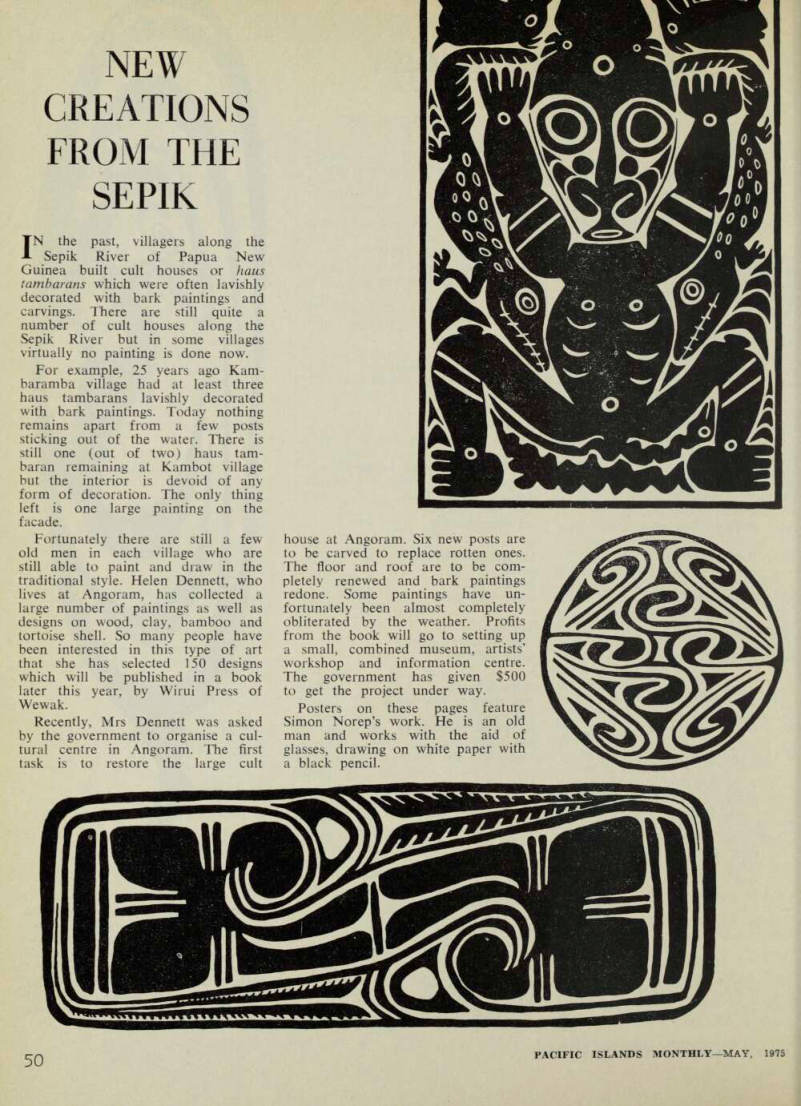
New
From The
Sepik
IN the past, villagers along the Sepik River of Papua New Guinea built cult houses or haus tambarans which were often lavishly decorated with bark paintings and carvings. There are still quite a number of cult houses along the Sepik River but in some villages virtually no painting is done now.
For example, 25 years ago Kam baramba village had at least three haus tambarans lavishly decorated with bark paintings. Today nothing remains apart from a few posts sticking out of the water. There is still one (out of two) haus tam baran remaining at Kambot village but the interior is devoid of any form of decoration. The only thing left is one large painting on the facade.
Fortunately there are still a few old men in each village who are still able to paint and draw in the traditional style. Helen Dennett, who lives at Angoram, has collected a large number of paintings as well as designs on wood, clay, bamboo and tortoise shell. So many people have been interested in this type of art that she has selected 150 designs which will be published in a book later this year, by Wirui Press of Wewak.
Recently, Mrs Dennett was asked by the government to organise a cul tural centre in Angoram. The first task is to restore the large cult
house at Angoram. Six new posts are to be carved to replace rotten ones, The floor and roof are to be corn pletely renewed and bark paintings redone. Some paintings have un fortunately been almost completely obliterated by the weather. Profits from the book will go to setting up a small, combined museum, artists’ workshop and information centre, The government has given $5OO to get the project under way.
Posters on these pages feature Simon Norep’s work. He is an old man and works with the aid of glasses, drawing on white paper with a black pencil.
Advertisements & other items, p. 57 (1 item)
Ific Islands Monthly—May, 1975
Book Reviews
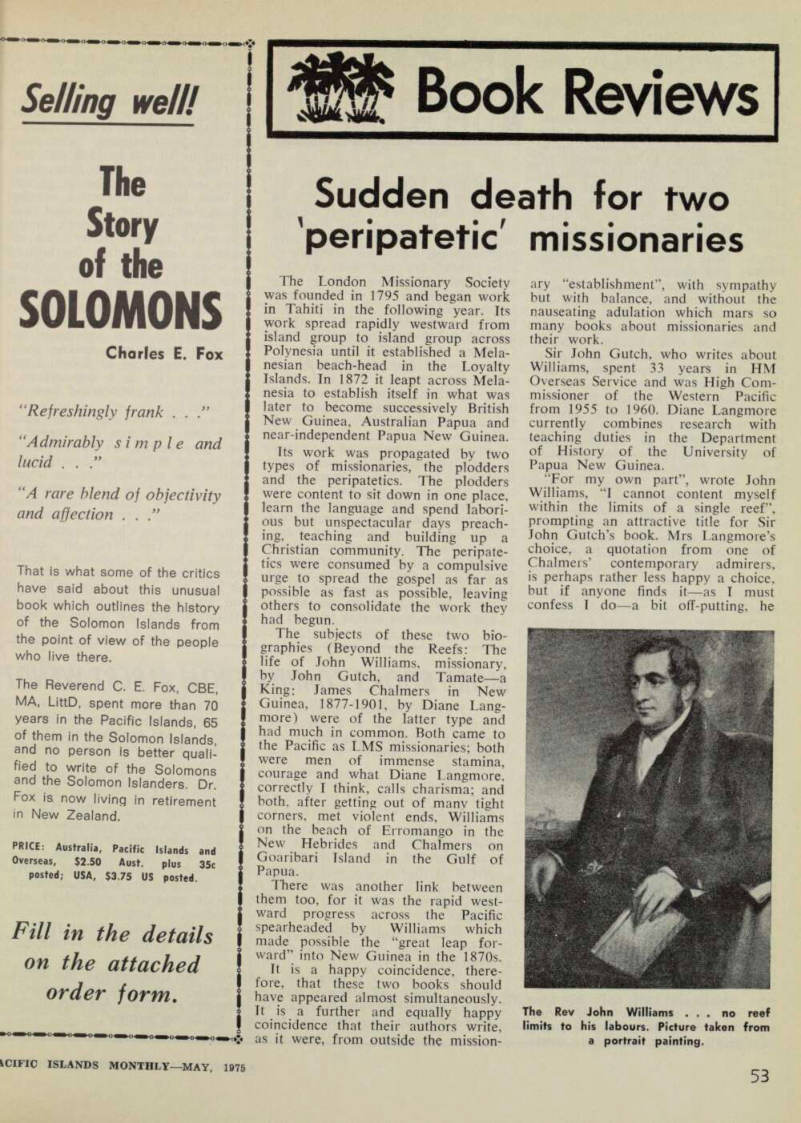

Sudden death for two 'peripatetic' missionaries
The London Missionary Society was founded in 1795 and began work in Tahiti in the following year. Its work spread rapidly westward from island group to island group across Polynesia until it established a Mela nesian beach-head in the Loyalty Islands. In 1872 it leapt across Mela nesia to establish itself in what was later to become successively British New Guinea, Australian Papua and near-independent Papua New Guinea.
Its work was propagated by two types of missionaries, the plodders and the peripatetics. The plodders were content to sit down in one place, learn the language and spend labori ous but unspectacular days preach ing, teaching and building up a Christian community. The peripate tics were consumed by a compulsive urge to spread the gospel as far as possible as fast as possible, leaving others to consolidate the work they had begun.
The subjects of these two bio graphies (Beyond the Reefs: The life of John Williams, missionary, by John Gutch, and Tamate—a King: James Chalmers in New Guinea, 1877-1901, by Diane Lang more) were of the latter type and had much in common. Both came to the Pacific as LMS missionaries; both were men of immense stamina, courage and what Diane Langmore, correctly I think, calls charisma; and both, after getting out of manv tight corners, met violent ends, Williams on the beach of Erromango in the New Hebrides and Chalmers on Goaribari Island in the Gulf of Papua.
There was another link between them too, for it was the rapid west ward progress across the Pacific spearheaded by Williams which made possible the “great leap for ward” into New Guinea in the 1870 s.
It is a happy coincidence, there fore, that these two books should have appeared almost simultaneously.
It is a further and equally happy coincidence that their authors write, as it were, from outside the mission
ary “establishment”, with sympathy but with balance, and without the nauseating adulation which mars so many books about missionaries and their work.
Sir John Gutch, who writes about Williams, spent 33 years in HM Overseas Service and was High Com missioner of the Western Pacific from 1955 to 1960. Diane Langmore currently combines research with teaching duties in the Department of History of the University of Papua New Guinea.
“For my own part”, wrote John Williams, “I cannot content myself within the limits of a single reef”, prompting an attractive title for Sir John Gutch’s book. Mrs Langmore’s choice, a quotation from one of Chalmers’ contemporary admirers, is perhaps rather less happy a choice, but if anyone finds it—as I must confess I do—a bit off-putting, he
The Rev John Williams ... no reef limits to his labours. Picture taken from a portrait painting.
should not allow himself to be put off by it, or he will miss a very good book.
John Williams and his wife arrived in Moorea, near Tahiti, in 1816. In 1818 they moved to Raiatea, which was their home for 13 years and the jumping-off point for Williams’ mari time adventures. In a variety of vessels, one of which, The Messen ger of Peace, he built himself under circumstances of almost incredible difficulty well described by Sir John Gutch, Williams established mission ary activity successively in Raro tonga, Niue (then called Savage Island) and Samoa.
After a visit to England, during which he found himself lionised, he returned to the South Seas in 1838.
A little over a year later, in Novem ber 1839, he was clubbed to death on the beach at Erromango during his first attempt to make contact with the people of Melanesia.
Perhaps he relied too much on Melanesian reactions being similar to those of the Polynesians he knew so well. Perhaps he chose a bad moment for his landing, one at which important tribal ceremonies were being enacted. Or perhaps he was just catching the backlash of the Erromangans’ previous contacts with Europeans. We shall never know.
All the missionaries, brown and white, who pioneered LMS work in New Guinea came from the South Seas; first Cook Islanders and Loyalty Islanders, then in succession MacFarlane from the Loyalties, Lawes from Niue and Chalmers from Rarotonga. MacFarlane retired early in the piece; Lawes, a plodder, settled down quietly to the training of Papuan pastors; Chalmers, from his arrival in New Guinea in 1877 till his death in 1901, explored the southern New Guinean coast from Suau Island in the east to the Fly River in the west, preparing the way for the later arrival of pastors from the South Seas and missionaries from England who would consolidate the work which he began.
Often he was in danger, especially when he visited places which had had earlier and unhappy contacts with Europeans, but always he man aged to scrape through until on that fatal landing at Goaribari Island his flair for getting out of tight corners deserted him.
Mrs Langmore discusses at some length the various theories which have been propounded to account for the apparent recklessness he dis played on this occasion, a reckless ness which cost not only his own life but also the lives of his com panions, among whom was a young missionary, Oliver Tomkins, newly
arrived from England. She sums the matter up in these words: “While he may have harboured a secret longing to come to the end of his work, his faith would almost certainly have precluded any conscious attempts to bring about his end and certainly would have forbidden him to bring about the death of so many col leagues. Perhaps it was with this fatalistic attitude of not seeking death but not flinching from it that Chalmers died at Goaribari”.
Men with one-track minds are rarely easy men to live and work with. Relations were often strained between these dedicated pioneers on the one hand and their missionary colleagues and the mission’s board of directors in London on the other.
As an ex-missionary I can sympa thise with both sides in these some times acrimonious disputes.
On the one side there was the un restrainable passion for spreading the Gospel which would brook no delay; on the other there was a conscious ness of the problems of planning and financing the follow-up which must take place if the achievements of the pioneers were not to be wasted.
Their wives had a thin time of it.
Mary Williams, who brought up three sons and survived her husband, at least had the companionship of other missionaries during her hus band’s long absences. Jane Chalmers died in 1879, only two years after the Chalmers’ arrival in New Guinea, But Lizzie Chalmers, who was married to Tamate in 1888 and died in 1900, suffered much from lone liness, isolation and ill-health, as well as from having to keep a mission station ticking over on what was little more than a mudbank in the estuary of the Fly River. She re tained a deep affection for him to the end; but it is pleasing to learn from Mrs Langmore that on one occasion one of his Papuan converts “gave him an impassioned lecture on his duties as a husband”.
Perhaps the most significant and revealing words ever spoken about Tamate were those of Robert Louis Stevenson: “He is a man whom I admire for his virtues and love for his faults”.
The most amazing thing about these two men was the impact of their personalities, on Polynesians in the case of Williams and on Papuans in the case of Chalmers, an impact which was felt on first contact and developed on further acquaintance into affection and near-veneration.
Fifty years after Chalmers was struck down at Goaribari, an elderly Papuan, by now familiar with the story of the Crucifixion, told me how on the day Tamate was killed the sun was darkened from midday till afternoon; and this legend is widely
irrent all along the southern coast today’s Papua.
These two books, well-written, sll-balanced and well-documented, ould fascinate not only enthusiasts r the spread of Christianity but so all who are interested in the )ry of the impact of the West on e south Pacific.
I cannot do better than conclude is review with a quotation from John Gutch’s opening chapter. It astrates the poise and humour nch characterise both these books.
Tie missionaries”, he writes, ffered them (ie the Polynesians) new way of life in place of their m cruel practices, one which uld at the same time help them to list the vices brought by other ropeans. Sadly they would also tidemn many innocent aspects of lynesian custom and make life less -efree and uninhibited, but on lance the arrival of the missionaries the Polynesian scene was timely J the Polynesians themselves were nature well equipped to modify ! m ore rigorous restraints de
mded of them”.-
Percy Chat-
[?]Rton.
Beyond The Reefs; The Life Of
MISSIONARY, by John Published by Macdonald, London.
'at atttdo A^ TE—A kinq : JAMES
Almers In New Guinea, 1877-1901.
Ehane Langmore. Published by Mel irne University Press. $10.80.)
Advertisements & other items, p. 59 (1 item)
53
ICIFIC ISLANDS MONTHLY—MAY. 1975
More Books Coming From Albert Wendt
Western Samoan author Albert Wendt, whose second book (of short stories), Flying-fox in a Freedom Tree, was published recently, is cur rently working on two other novels, preparing for publication his first collection of poems, and editing two anthologies of Pacific Islands writings.
Flying-fox in a Freedom Tree is a collection of eight short stories and a novella, all set in the neighbourhood of Apia, Western Samoa, and is selling well in New Zealand. It’s published by Longman Paul.
The same publishers have read the first of his two novels and have asked him to shorten it before publication, possibly in 1977. It’s currently 600 pages in length. His second novel, which is almost com pleted, is shorter and will probably be published before the long novel.
The two anthologies are by Pacific Island poets and Island short story writers. They will be published as soon as he completes his editing.
Wendt’s own collection of poems covers the period from 1960 to 1974, and will be published either at the end of this year or the be ginning of 1976.
Albert Wendt is currently working at the University of the South Pacific, Suva, and plans to stay there another two years before return ing to Samoa. In Suva he says, “We miss our homeland, but here at the USP Vve found the time and freedom to do my writing”.
The French Pacific
What will happen to French territories in the South Pacific should the French pack up and leave? France has four terri tories and shares a fifth, the New Hebrides. Ron Crocombe, of the University of the South Pacific, examines the past and present of French territories and attempts to forecast the future in an article in the latest issue of “New Guinea, and Australia, the Pacific and South-East Asia”, published quarterly by the Council on New Guinea Affairs. In the same issue, Ken Inglis and Paul Mench discuss the future of Papua New Guinea, Helen Duncan writes of the Torres Strait environment, and law and lawyers come under the scrutiny of R. V. Gyles. Sub scriptions to the journal are available from New Guinea Quarterly, Box 3408, GPO, Sydney, 2001, at $5 per year in Australia and $6 in PNG and elsewhere (posted in both cases).
This living reef: pictures

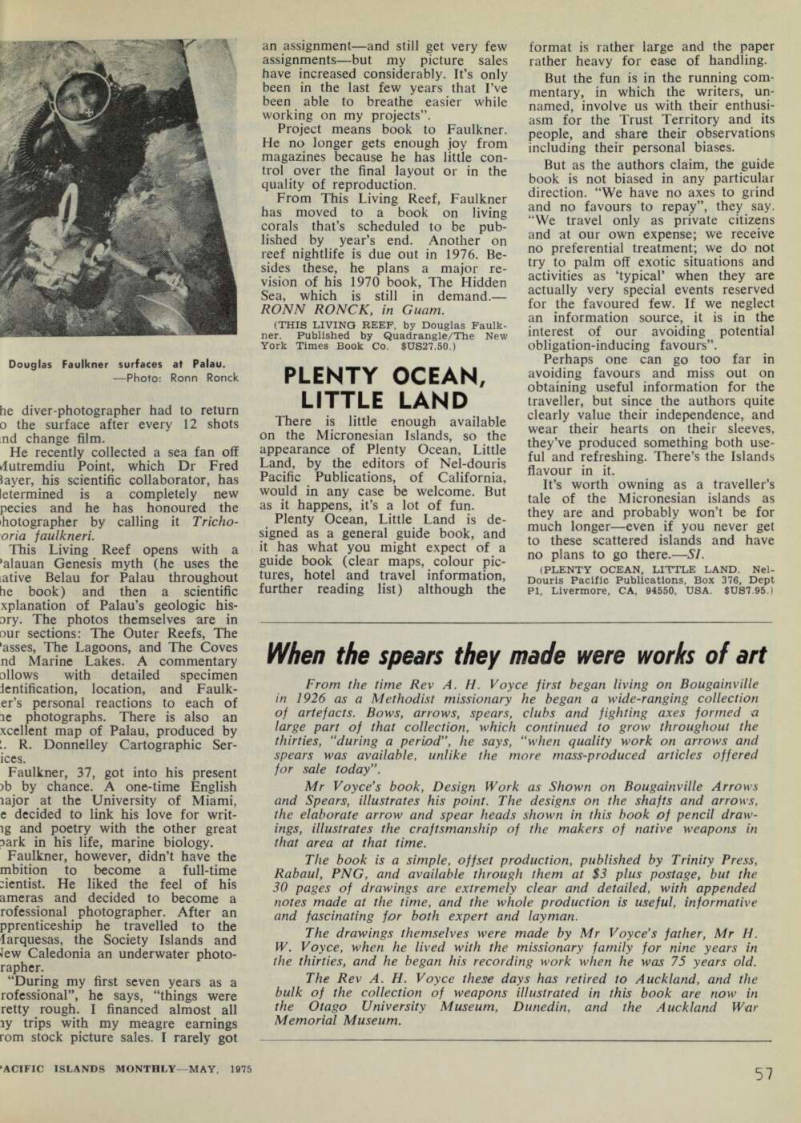
from a watery paradise
Douglas Faulkner agrees with those who call him the best marine life photographer in the world. He doesn’t consider the truth egotistical.
And once you’ve seen Faulkner’s colour photos of Palau, it’s not hard to be a believer.
He isn’t satisfied to document this famous fish and coral paradise, but he has to produce underwater art as well. Because of this it has taken him over eight years to shoot the 25,000 transparencies that provided the pickings for the 107 colour plates that he has selected for his latest book, This Living Reef.
Faulkner first went to the Western Carolines in 1967 on a magazine assignment to photograph dangerous tropical marine animals. There he found one of the Pacific’s legendary reefs at Palau, and he has returned frequently since then to gather material for this book and others.
He expects to spend most of 1975 in Palau photographing the life and death of a coral reef for Audubon magazine, and the life cycle of the elusive Chambered Nautilus for Natural History magazine.
While the Palau archipelago has much to offer the underwater adven turer, Faulkner has his own favour ite One of these is the Great Reef, which borders Bailechesengel Island in the Ngemelis group. It is here that a good many shots were
taken for This Living Reef and it was here in February that he cap tured the first Chambered Nautilus ever recorded in Micronesia.
The Chambered Nautilus study will be a joint effort with marine biologist Norine Haven from Hop kins Marine Station in Pacific Grove, California.
Faulkner’s Great Reef is a solid wall of growing coral that drops straight down from the surface to a depth of 800 ft. Because most reef walls of this type don’t begin to drop until the diver has gone beyond the 50 ft level, he considers this one truly unique.
I was with him during the summer of 1973 when he was almost through with This Living Reef.
“I’ve already got enough good shots to fill a half-dozen more books on these islands”, he said.
“Why are you still here then?” I asked.
“I might find something even bet ter. You never quit while you’re ahead”.
Underwater photography is hard work and Faulkner takes better pic tures because he works harder at it.
He has a habit of driving himself into healthy exhaustion day after day, showing a stamina that is quite simply amazing. To take the 25,000 transparencies from which the This Living Reef pictures were selected,
he diver-photographer had to return o the surface after every 12 shots nd change film.
He recently collected a sea fan off Tutremdiu Point, which Dr Fred layer, his scientific collaborator, has letermined is a completely new pecies and he has honoured the ihotographer by calling it Tricho oria faulkneri.
This Living Reef opens with a ’alauan Genesis myth (he uses the iative Belau for Palau throughout he book) and then a scientific xplanation of Palau’s geologic his ary. The photos themselves are in □ur sections: The Outer Reefs, The ’asses, The Lagoons, and The Coves nd Marine Lakes. A commentary □Hows with detailed specimen lentification, location, and Faulk er’s personal reactions to each of ic photographs. There is also an xccllent map of Palau, produced by :. R. Donnelley Cartographic Ser iccs.
Faulkner, 37, got into his present )b by chance. A one-time English lajor at the University of Miami, e decided to link his love for writ ig and poetry with the other great park in his life, marine biology.
Faulkner, however, didn’t have the mbition to become a full-time :icntist. He liked the feel of his ameras and decided to become a rofessional photographer. After an pprenticeship he travelled to the larquesas, the Society Islands and lew Caledonia an underwater photo rapher.
“During my first seven years as a rofessional”, he says, “things were retty rough. I financed almost all ly trips with my meagre earnings rom stock picture sales. I rarely got
an assignment—and still get very few assignments—but my picture sales have increased considerably. It’s only been in the last few years that I’ve been able to breathe easier while working on my projects”.
Project means book to Faulkner.
He no longer gets enough joy from magazines because he has little con trol over the final layout or in the quality of reproduction.
From This Living Reef, Faulkner has moved to a book on living corals that’s scheduled to be pub lished by year’s end. Another on reef nightlife is due out in 1976. Be sides these, he plans a major re vision of his 1970 book, The Hidden Sea, which is still in demand.—
Ronn Ronck,
in Guam.
(THIS LIVING REEF, by Douglas Faulk ner. Published by Quadrangle/The New York Times Book Co. $U527.50.)
Plenty Ocean,
Little Land
There is little enough available on the Micronesian Islands, so the appearance of Plenty Ocean, Little Land, by the editors of Nel-douris Pacific Publications, of California, would in any case be welcome. But as it happens, it’s a lot of fun.
Plenty Ocean, Little Land is de signed as a general guide book, and it has what you might expect of a guide book (clear maps, colour pic tures, hotel and travel information, further reading list) although the
format is rather large and the paper rather heavy for ease of handling.
But the fun is in the running com mentary, in which the writers, un named, involve us with their enthusi asm for the Trust Territory and its people, and share their observations including their personal biases.
But as the authors claim, the guide book is not biased in any particular direction. “We have no axes to grind and no favours to repay”, they say.
“We travel only as private citizens and at our own expense; we receive no preferential treatment; we do not try to palm off exotic situations and activities as ‘typical’ when they are actually very special events reserved for the favoured few. If we neglect an information source, it is in the interest of our avoiding potential obligation-inducing favours”.
Perhaps one can go too far in avoiding favours and miss out on obtaining useful information for the traveller, but since the authors quite clearly value their independence, and wear their hearts on their sleeves, they’ve produced something both use ful and refreshing. There’s the Islands flavour in it.
It’s worth owning as a traveller’s tale of the Micronesian islands as they are and probably won’t be for much longer—even if you never get to these scattered islands and have
no plans to go there.
SI.
(Plenty Ocean, Little Land. Nel-
Douris Pacific Publications, Box 376, Dept PI, Livermore, CA, 94550, USA. $U57.95.)
Douglas Faulkner surfaces at Palau. —Photo: Ronn Ronck
Advertisements & other items, pp. 61-62 (2 items)
Cific Islands Monthly— May, 1975
Plenty Ocean ,Little '
New Book on Micronesia . . .
The only full-colour book devoted exclusively to the unique tropical North Pacific.
SEE
• stone city of Nan Madol • ship-rich Truk lagoon • fantastic rock islands of Palau Beautiful full-colour photographs with where-to-go and what-to-see text.
Price $U57.95
Check or money order, please. (Book rate postage included.) From publisher of 'A Kwajalein Portfolio'—lo 8* xll in. colour prints of 'Kwaj' scenes: SUSS.OO (Surface postage included) 10-day money back guarantee
NEL-DOURIS PACIFIC PUBLICATIONS
Box 376, Dept. P-1 Livermore, CA. 94550 USA
GLENYS
DICKSON
COUNTDOWN"
your top sounds * tune to Radio Australia 0900°1100 G.M.T. Monday oFriday write to: Countdown .Radio Australia, Melbourne,3ooo, for record requests, programme guides.fan cards & posters
When the spears they made were works of art
From the time Rev A. H. Voyce first began living on Bougainville in 1926 as a Methodist missionary he began a wide-ranging collection of artefacts. Bows, arrows, spears, clubs and fighting axes formed a large part of that collection, which continued to grow throughout the thirties, “during a period”, he says, “when quality work on arrows and spears was available, unlike the more mass-produced articles offered for sale today”.
Mr Voyce’s book, Design Work as Shown on Bougainville Arrows and Spears, illustrates his point. The designs on the shafts and arrows, the elaborate arrow and spear heads shown in this book of pencil draw ings, illustrates the craftsmanship of the makers of native weapons in that area at that time.
The book is a simple, offset production, published by Trinity Press, Rabaul, PNG, and available through them at $3 plus postage, but the 30 pages of drawings are extremely clear and detailed, with appended notes made at the time, and the whole production is useful, informative and fascinating for both expert and layman.
The drawings themselves were made by Mr Voyce’s father, Mr H.
W. Voyce, when he lived with the missionary family for nine years in the thirties, and he began his recording work when he was 75 years old.
The Rev A. H. Voyce these days has retired to Auckland, and the bulk of the collection of weapons illustrated in this book are now in the Otago University Museum, Dunedin, and the Auckland War Memorial Museum.
Advertisements & other items, p. 63 (1 item)
57
’ACIFIC ISLANDS MONTHLY—MAY, 1975
Islands Press
From the Islands Press
Senator Felix Emberson, in Fiji Senate, during debate on move to close night clubs at 1 am instead of 2 am, as reported in The Fiji Times: I cannot see how you can break into a house or rape a woman while you are in a night club.
Preamble to open letter to Western Samoa Public Service Training Officer (American Melvin Schnapper) by Faalogo F. Pito in the Samoa Times: At the outset I apologise that this letter has to be in English. My American is hopeless and I know you will be lost in everyday Samoan let alone the chiefly language that I, as the holder of two orator titles (Faalogo in Sagone, Savaii, and Fata in Afega, Upolu) am entitled to be addressed in.
From the Micronesian Independent: I need a girl friend, one that is true. Her age should be between 18-24 years, she should be 4' 11" high (heavy or thin makes no difference), able to control her temper, be courteous, somewhat wise, and friendly towards people in general. She must also be able to wash clothes, do general housework (no Kiki Ran). She must be appropriate to share a house with her husband. If interested please write Box 8385 (Kwajalein, Roi Namur Security), APO San Francisco, 96555. Thank you.
From the PNG Post-Courier: Miss Papua New Guinea, Eau Suve, has blasted Melbourne's Moomba Festival as being boring, bitchy, sexist and disgusting. Eau, who returned to Port Moresby last week, said she had even thought of quitting the festival's Queen of the Pacific quest. "People kept on calling me Miss New Guinea, and I was representing Papua New Guinea".
Eau says she will never attend another such festival in Australia.
Mr Solomon Mamaloni, the Solomons Chief Minister, speaking of his experiences as a civil servant as reported in a Solomons News Drum interview: . . . The bitterness and frustration of our own people who for year after year were patronised, patted on the head, laughed at in the expatriate clubs, shouted at in the office and denied the training and help which would have equipped us for promotion. All this is in our blood and is still not understood by the expatriates, especially the long-service carriers of the white-man’s burden . . .
The trials of the nursing profession in Fiji as reported in The Fiji Times: . . . Matron Korol said nurses on early and late shifts faced serious transport problems. By the time they were ready to go to work, bus services had either stopped or not
begun. "To get to work on time, nursing staff have been known to hitch rides on bread vans and delivery trucks", she said. "Others who take short cuts along tracks leading to Suva, Lautoka and Labasa hospitals have been attacked. There have been incidences of attempted rape".
From comments in the Solomons News Drum by Mrs Katarina Mataira, NZ specialist in art workshops, in Honiara for the University of the South Pacific's first regional art workshop: . . . Pacific people are always measuring themselves against the white man and making
themselves second-best. Unless they can have
something which is theirs alone, they could build up complexes and be unable to cope with life . . .
From a letter by Carol Adams
in The Norfolk Islander:
Ever since the influx of outside companies, and their controllers, made their presence felt here for the express purpose of dodging taxation and not as benevolent fathers as they would like us to think, there has been nothing but discontent always revolving around them and their dislike of the Australian Government, simply because they expect Norfolk to be open slather for them to dodge their commitments to the government while others continue to honour theirs. What do these company controllers care for the welfare or wellbeing of families or residents on Norfolk? I haven’t heard of them donating a percentage of their company tax savings (reported to be in the millions) when they had a free hand and the opportunity do so, to set up a welfare fund or the like, to directly benefit the people of Norfolk.
It is very comforting to know that at the moment Norfolk is secure in the hands of the Australian Government, we certainly wouldn’t have any security If a bunch of private individuals intent on developing Norfolk for their own ends got their sticky fat fingers on the controls.
From a speech by Mrs Short, president
of the Ngatangiia Country Women's Institute,
reported in the Cook Islands News: Helping men do “men’s work” is the interpretation applied by Rarotongan women to the term equal opportunity. It may merely mean packing bananas or keeping the island looking attractive for local satisfaction as well as for tourists. But the spirit of
co-operation between people working for people,
irrespective of sex, reaches much higher than road verges. Three Rarotongan women are chiefs . . .
From Town Talk in the Arawa Bulletin: Heartening news. BCL (Bougainville Copper) saved the life of a seriously-ill child last week. One part of a small heart-monitoring machine was connected to the mouthpiece of a telephone, another part pressed against the child's chest. This enabled the Melbourne heart clinic to monitor the heart by telephone and give their medical advice. The company then chartered an Air Niugini Fokker for an emergency flight out of Bougainville for specialist treatment.
Pacific Transport
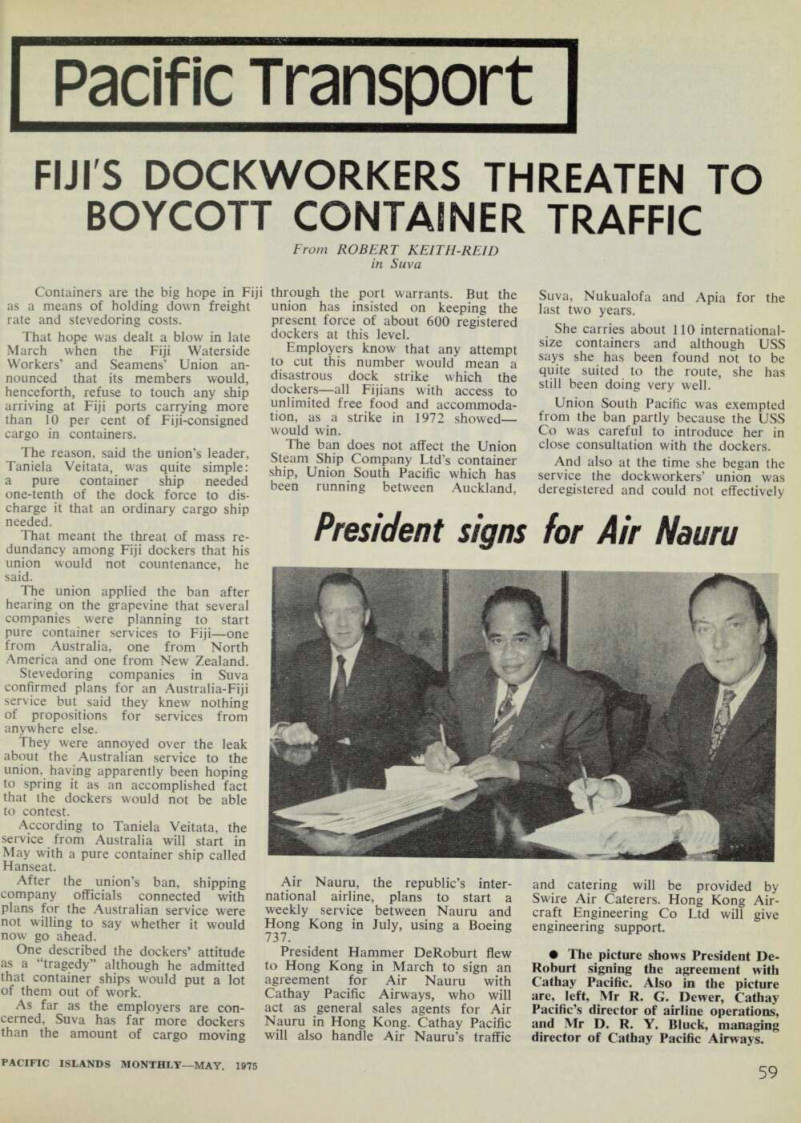

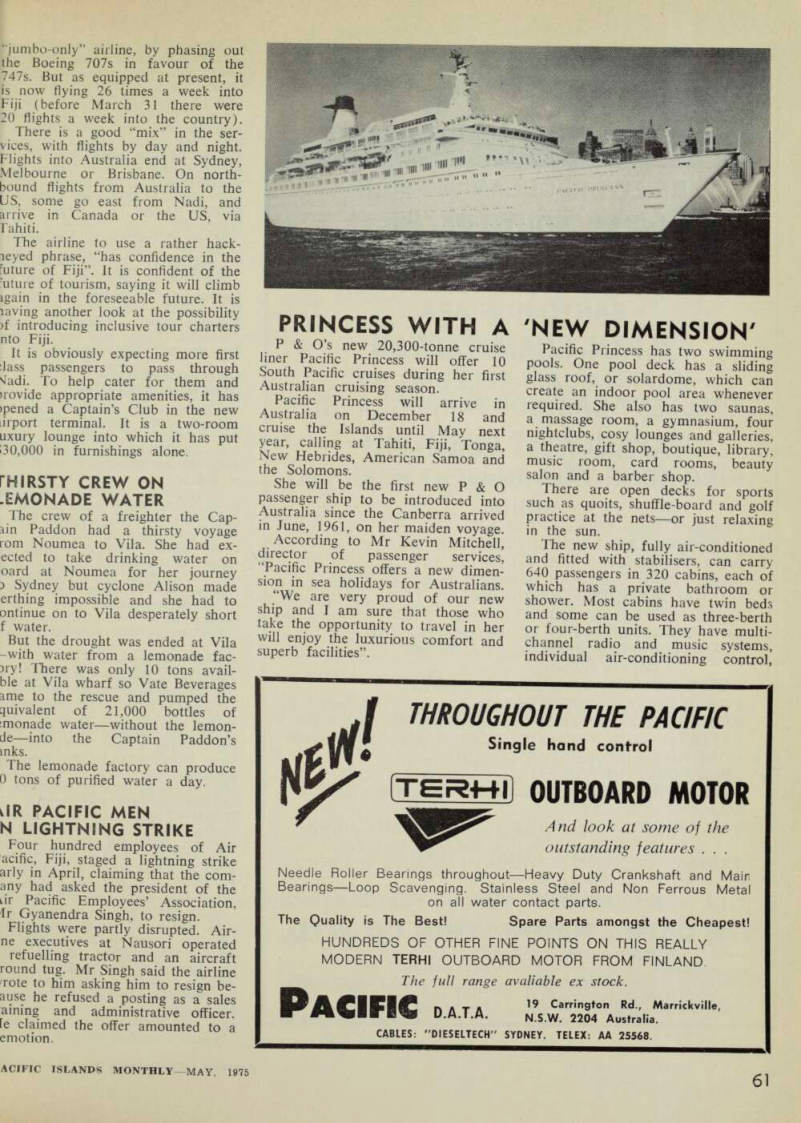
Fiji's Dockworkers Threaten To
Boycott Container Traffic
From Robert Keith-Reid
in Suva
Containers are the big hope in Fiji as a means of holding down freight rate and stevedoring costs.
That hope was dealt a blow in late March when the Fiji Waterside Workers' and Seamens’ Union an nounced that its members would, henceforth, refuse to touch any ship arriving at Fiji ports carrying more than 10 per cent of Fiji-consigned cargo in containers.
The reason, said the union’s leader, Taniela Veitata, was quite simple: a pure container ship needed one-tenth of the dock force to dis charge it that an ordinary cargo ship needed.
That meant the threat of mass re dundancy among Fiji dockers that his union would not countenance, he said.
The union applied the ban after hearing on the grapevine that several companies were planning to start pure container services to Fiji—one from Australia, one from North America and one from New Zealand.
Stevedoring companies in Suva confirmed plans for an Australia-Fiji service but said they knew nothing of propositions for services from anywhere else.
They were annoyed over the leak about the Australian service to the union, having apparently been hoping to spring it as an accomplished fact that the dockers would not be able to contest.
According to Taniela Veitata, the service from Australia will start in May with a pure container ship called Hanseat.
After the union’s ban, shipping company officials connected with plans for the Australian service were not willing to say whether it would now go ahead.
One described the dockers’ attitude as a “tragedy” although he admitted that container ships would put a lot of them out of work.
As far as the employers are con cerned, Suva has far more dockers than the amount of cargo moving
through the port warrants. But the union has insisted on keeping the present force of about 600 registered dockers at this level.
Employers know that any attempt to cut this number would mean a disastrous dock strike which the dockers—all Fijians with access to unlimited free food and accommoda tion, as a strike in 1972 showed— would win.
The ban does not affect the Union Steam Ship Company Ltd’s container ship, Union South Pacific which has been running between Auckland,
Suva, Nukualofa and Apia for the last two years.
She carries about 110 international size containers and although USS says she has been found not to be quite suited to the route, she has still been doing very well.
Union South Pacific was exempted from the ban partly because the USS Co was careful to introduce her in close consultation with the dockers.
And also at the time she began the service the dockworkers’ union was deregistered and could not effectively
oppose her arrival on the regional shipping scene.
After the revelation of the dockers’ ban, Mr Harry Kiss, chairman of the shipping committee of the Fiji Employers’ Consultative Association, said it would be discussing it.
Just what stand the shipping com panies will take against the union is not yet clear—even to them.
But it is expected that they will try to talk the union into a deal in volving compensation payments of some kind.
And they might also be hoping for miracles from the dynamic Mr Loh Heng Kee, former boss of the Port of Singapore and now, as a
kind of retirement hobby, first direc tor of the new Ports Authority of Fiji.
Mr Loh is very much a container advocate and one of his first moves since his arrival at the end of last year was to open container depots in suburban areas of Suva so that con tainers can be packed and unpacked there instead of in the congested wharf area itself.
At present the container ban does not mean much because apart from the lucky Union South Pacific, none of the conventional cargo-ships work ing Fiji carries over 10 per cent of Fiji cargo in the 20-ton capacity boxes that the dockers have black listed.
But if the shipping companies and Mr Loh fail to change the dockers’ attitudes, the task before the Ports Authority in bringing greater efficiency and order to the ports of Fiji is going to be made a lot more difficult.
Officials of the union, in a full page advertisement in the Fiji Times, argued that from an economic point of view, it was cheaper to handle conventional cargo than container cargo. As Fiji imported most of its requirements from Australia, it chose Sydney to compare the different costs in handling the two types of cargo.
The stevedoring cost involved in load ing a ton of conventional cargo was $2O, and of container cargo $25.50.
The union also claimed there had never been a recorded reduction in freight rates for any container service between Fiij and any country which gave a container service. In fact, containerisation was a major factor in increased freight rates throughout the world, it argued.
The union also said they considered container vessels were best suited only in a country where the demand for labour was high. In Fiji, there was not enough work for the perma nent dockers, who averaged about 22 hours a week.
Fiji's School For
Waterfront Workers
Suva saw the opening in March of the first course in a school for waterfront workers. Attending the course were 10 forklift drivers who were told by the Fiji Port Authority’s director-general, Mr Loh Heng Kee, that through training the workers would be able to play more meaning ful roles in the progress and advance ment of the shipping industry of Fiji.
With the present emphasis on new modes and concepts of transport and cargo handling, such as the con tainer, Mr Loh said, the trial and error method of the ports must give way to more systematic and sophis ticated forms of training.
Qantas Has A Big
Role In Fiji Tourism
The Qantas role in the Fiji tourist industry is staggering. The airline conservatively estimates that under new schedules it will fly more than 60,000 visitors a year to Fiji—so,ooo from Australia, 10,000 from the US, and 2,000 from Canada. Between Australia and Fiji 67,000 seats a year will be available, although many of these will be taken up by passen gers passing through Nadi.
The figure is bound to grow as Qantas is aiming to become a
“jumbo-only” airline, by phasing out the Boeing 707 s in favour of the 7475. But as equipped at present, it is now flying 26 times a week into Fiji (before March 31 there were 20 flights a week into the country).
There is a good “mix” in the ser vices, with flights by day and night.
Flights into Australia end at Sydney, Melbourne or Brisbane. On north bound flights from Australia to the US, some go east from Nadi, and arrive in Canada or the US, via Fahiti.
The airline to use a rather hack leyed phrase, “has confidence in the future of Fiji”. It is confident of the : uture of tourism, saying it will climb igain in the foreseeable future. It is laving another look at the possibility )f introducing inclusive tour charters nto Fiji.
It is obviously expecting more first :lass passengers to pass through To help cater for them and >rovide appropriate amenities, it has ipened a Captain’s Club in the new Jrport terminal. It is a two-room uxury lounge into which it has put 130,000 in furnishings alone.
Fhirsty Crew On
.Emonade Water
The crew of a freighter the Cap ain Paddon had a thirsty voyage rom Noumea to Vila. She had ex ected to take drinking water on card at Noumea for her journey d Sydney but cyclone Alison made erthing impossible and she had to ontinue on to Vila desperately short f water.
But the drought was ended at Vila -with water from a lemonade fac iry! There was only 10 tons avail ble at Vila wharf so Vate Beverages ame to the rescue and pumped the quivalent of 21,000 bottles of :monade water—without the lemon de—into the Captain Paddon’s inks.
The lemonade factory can produce 0 tons of purified water a day.
Tir Pacific Men
N Lightning Strike
Four hundred employees of Air acific, Fiji, staged a lightning strike arly in April, claiming that the com any had asked the president of the dr Pacific Employees’ Association, lr Gyanendra Singh, to resign.
Flights were partly disrupted. Air ne executives at Nausori operated refuelling tractor and an aircraft round tug. Mr Singh said the airline 'rote to him asking him to resign be ause he refused a posting as a sales aining and administrative officer, fe claimed the offer amounted to a emotion.
President signs for Air Nauru
Air Nauru, the republic’s inter national airline, plans to start a weekly service between Nauru and Hong Kong in July, using a Boeing 737.
President Hammer Deßoburt flew to Hong Kong in March to sign an agreement for Air Nauru with Cathay Pacific Airways, who will act as general sales agents for Air Nauru in Hong Kong. Cathay Pacific will also handle Air Nauru’s traffic
and catering will be provided by Swire Air Caterers. Hong Kong Air craft Engineering Co Ltd will give
engineering support.
• The picture shows President De- Roburt signing the agreement with Cathay Pacific. Also in the picture are, left, Air R. G. Dewer, Cathay Pacific’s director of airline operations, and Mr D. R. Y. Bluck, managing director of Cathay Pacific Airways.
Advertisements & other items, p. 66 (1 item)
500 Million
GERMS
COMING YOUR WAY?
CONCENTRATED PEA-6EU
The strong one that cares for your world.
The common house fly is a notorious disease carrier. On average it brings in 500 million germs or more into your home. So it's worth getting rid of fast. Concentrated Pea-Beu contains one of the world's most powerful insecticides so it kills insects in seconds and it's rigidly tested through every stage /||| of manufacture so you can spray it safely with confidence j||| to protect the health and well-being of your family.
Concentrated Pea-Beu kills flies, mosquitoes, d[ disease carrying insects in seconds.
Princess With A 'New Dimension'
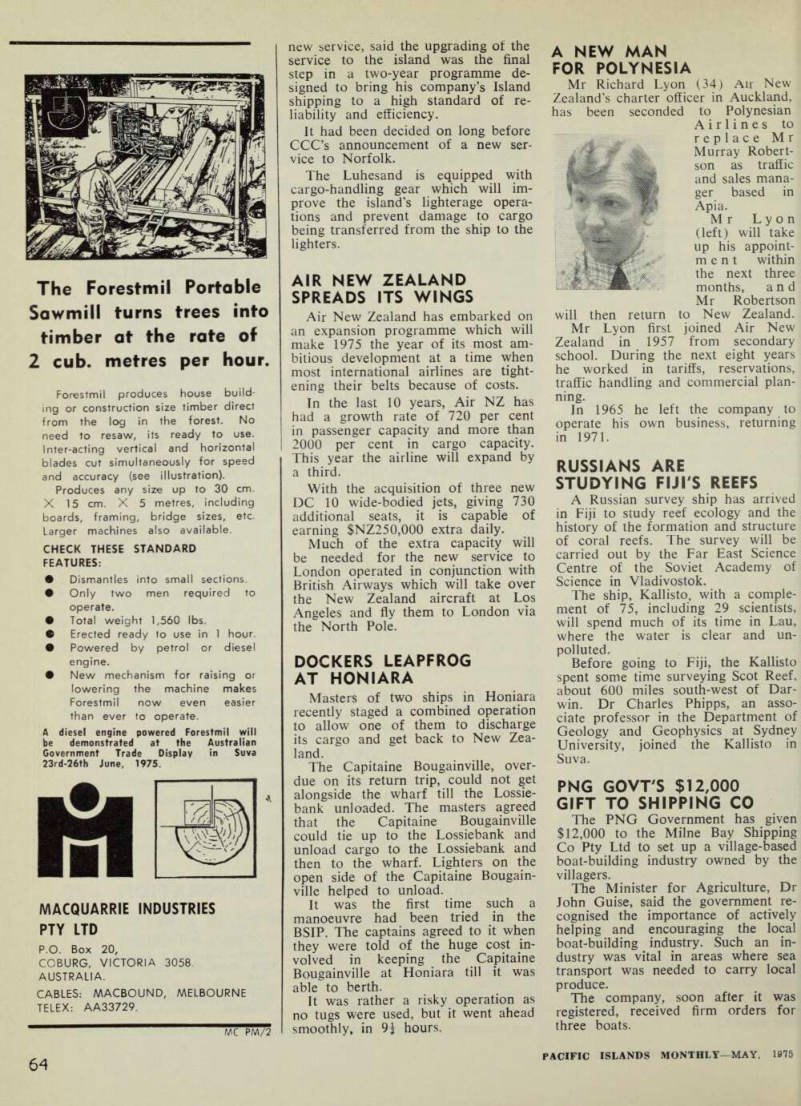
P & O’s new 20,300-tonne cruise liner Pacific Princess will offer 10 South Pacific cruises during her first Australian cruising season.
Pacific Princess will arrive in Australia on December 18 and cruise the Islands until May next year, calling at Tahiti, Fiji, Tonga, New Hebrides, American Samoa and the Solomons.
She will be the first new P & O passenger ship to be introduced into Australia since the Canberra arrived in June, 1961, on her maiden voyage.
According to Mr Kevin Mitchell, director of passenger services, “Pacific Princess offers a new dimen sion in sea holidays for Australians.
“We are very proud of our new ship and I am sure that those who take the opportunity to travel in her will enjoy the luxurious comfort and superb facilities”.
Pacific Princess has two swimming pools. One pool deck has a sliding glass roof, or solardome, which can create an indoor pool area whenever required. She also has two saunas, a massage room, a gymnasium, four nightclubs, cosy lounges and galleries, a theatre, gift shop, boutique, library, music room, card rooms, beauty salon and a barber shop.
There are open decks for sports such as quoits, shuffle-board and golf practice at the nets—or just relaxing in the sun.
The new ship, fully air-conditioned and fitted with stabilisers, can carry 640 passengers in 320 cabins, each of which has a private bathroom or shower. Most cabins have twin beds and some can be used as three-berth or four-berth units. They have multi channel radio and music systems, individual air-conditioning control,
telephone and wall-to-wall carpet, and many can be converted into comfortable sitting rooms by day.
Special suites have their own re frigerator and separate sitting room.
Pacific Princess’s first cruise from Australia will be a Christmas and New Year cruise. The ship will leave Sydney on December 19 for 15 nights, calling at Suva, Vava’u and Nukualofa (both in Tonga) Auck land and Bay of Islands (Russell), arriving back in Sydney on January 2.
Most of the cruises will be be tween 12 and 15 nights duration.
The exception will be a 25-night cruise, leaving Sydney on March 11 and calling at Noumea, Lautoka, Suva, Pago Pago, Bora Bora, Papeete, Vava’u, Nukualofa and Auckland. Fares will range from $483 for a 12-night cruise.
Qantas' Chief
Defends Airlines
Captain Bert Ritchie, general manager of Qantas, effectively turned back criticism of airlines’ fares when he addressed the annual Pacific Area Travel Association conference in Sydney.
International airlines had cut South Pacific fares nearly as low as they could go, yet charges for hotels, rental cars and other related services in the regions were, on average, the highest in the world, he said. The rest of the travel industry constantly told airlines to reduce fares by 10 to 30 per cent, but if hire car com panies, etc, did what they told the airlines to do, they would go broke.
Arabs Stall Over
Tonga's Bulk Carrier
King Taufa’ahau Tupon of Tonga, late in March was close to clinching a deal with Bahrain to buy a bulk carrier, but Bahrain “cried off” tem porarily just before it was due to make a firm decision. The king and his party, which included the Acting Minister of Finance Dr Sione Tapa, Secretary of the Government Mr Taniela Tufui, and the general manager of Pacific Navigation, Cap tain C. Hill-Willis, discussed loan finance with leading officials in Bahrain, after which Bahrain asked for 10 days to consider the matter.
Just before the 10th day, Bahrain advised Tonga it wanted longer, and asked for two or three weeks. The king was as optimistic as usual about some of his ambitious proposals when he returned to Tonga. He said the Bahrain leaders, including the emir, Isa bin Sulman al-Khalifa, were favourably impressed with Tonga’s plan.
Tonga wanted to buy a 65,000 ton
deadweight carrier. It would be chartered to an Australian mining company to carry ore to Europe and the US (via Suez), and coal from the US to Japan (via Panama) on the return trip. It would carry the Tongan flag and a Tongan crew. The king said Tonga was interested in a new Norwegian-owned bulk carrier.
If several Arab countries were in volved in the loan it would help to establish the credit-worthiness of Pacific Navigation and Tonga in Future bulk purchases. Tonga would eventually have several bulk carriers.
Services Swap Might
Bring Airline A Profit
American Airlines, which swapped ts routes to the South Pacific with s an-Am in return for some Pan Am outes across the Caribbean, is still vaiting for the US Government’s ipproval of the swap.
According to its president and :hairman, Mr A. V. Casey, Ameri an Airlines might make a profit if jovernment approval is given. The Jrline made a profit of !U520,446,000 last year but if the conomy does not improve and fuel irice increases remain no profit is xpected this year.
There was a net loss in February if $11,538,000, revenue increasing iy 4.6 per cent against a rise in perating expenses of 9.3 per cent.
»Ng Shipowners
Day Cut Services
Papua New Guinea shipowners ave warned that they may have to ut services between the main ports, blowing rejection by the PNG ’abinet of an increase in freight harges. In January, the PNG Ship ing Association asked the Transport )epartment for increases between lain ports.
Mr John Edwards, chairman of le association, said the cabinet had iven no reason for its decision.
The decision caused great concern i the industry, he said, and services ould deteriorate unless it was re oked. Operating costs had risen ramatically since the last tariff diedule which was fixed in July, .part from a rise in fuel prices, ris ig wages led to increased stevedor ig costs, and the costs of vessel irveys. Cuts in services were poss )le on less profitable routes.
The Freight Tariff Committee, smprising representatives of the NG Shippers Council, the Asso iated Chambers of Commerce, the Apartment of Finance and the ransport Department recommended i February that an increase be ranted. The recommendation was iter vetoed.
Hardship Allowance
For Fiji Officers . . .
The Fiji Marine Department’s sea going officers will get an allowance of 20 per cent of their salaries as compensation for the hardships which go with the job. There’s a limit to the allowance, however, of $BOO and it will not be paid to officer-cadets or officers temporarily on shore.
The hardships, according to the arbitrator, Mr Jai Reddy, who made the award, include long hours of work, absence from family and home, danger in sailing in relatively difficult waters in small ships in all conditions and difficult living con ditions.
Seamen employed by the depart ment went on strike last year to sup port their demand for a special allowance. The Fiji Public Service Association claimed, on their behalf, allowances ranging from $605 a year for a man earning $1,323 to $2,453 for a man earning $3,379. . . . AND A PAY RISE
For The Dockworkers
Stevedoring companies in Fiji and the Fiji Waterside Workers and Sea men’s Union took only two hours towards the end of March to reach agreement on a wages increase—22 per cent to give hundreds of dock workers a minimum pay rate of $1 an hour.
The increase, which took effect on April 1, makes the dockers the highest-paid unskilled and semi skilled workers in Fiji. Permanent dock labourers got a minimum of 94c an hour and the top rate is $1.13 an hour for manifest clerks.
There was a pay-off, however. The union agreed to changes in work shift times, which, Mr Harry Kiss, chairman of the Fiji Employers’ Con sultative Association’s shipping com mittee, said, should enable the com panies to get more work done. The new arrangements would give dock workers more leisure time but they should be fitter and the employers would expect greater productivity.
The pay rise will mean higher stevedoring charges which had not at that time been calculated.
Better Cargo Service
For Norfolk Island
The Union Steam Ship Company of NZ had good news for Norfolk Island at the beginning of March, a greatly-improved cargo service be tween New Zealand and the island with its modern, fully-refrigerated ship, the 2,700-ton Luhesand.
The service—once every 30 days— was scheduled to begin in late March, and will take over the irregular ser vice given by the company’s Holm burn, which has been retired as the final phase in the USS’s plan to re organise its services, using the 3,500ton crane ship Karepo, the Luhe sand, and the container ship Union South Pacific.
The USS announcement comes only weeks after the Noumea-based company, Compagnie des Chargeurs Caledoniens (CCC), announced it was starting a new 28-day service, Auckland - Sydney - Norfolk Island with the 963-ton He de Lumiere.
The USS’s foreign trade department manager, Mr S. Caspari, who visited Norfolk in February to arrange the
new service, said the upgrading of the service to the island was the final step in a two-year programme de signed to bring his company’s Island shipping to a high standard of re liability and efficiency.
It had been decided on long before CCC’s announcement of a new ser vice to Norfolk.
The Luhesand is equipped with cargo-handling gear which will im prove the island’s lighterage opera tions and prevent damage to cargo being transferred from the ship to the lighters.
Air New Zealand
Spreads Its Wings
Air New Zealand has embarked on an expansion programme which will make 1975 the year of its most am bitious development at a time when most international airlines are tight ening their belts because of costs.
In the last 10 years, Air NZ has had a growth rate of 720 per cent in passenger capacity and more than 2000 per cent in cargo capacity.
This year the airline will expand by a third.
With the acquisition of three new DC 10 wide-bodied jets, giving 730 additional seats, it is capable of earning 5NZ250,000 extra daily.
Much of the extra capacity will be needed for the new service to London operated in conjunction with British Airways which will take over the New Zealand aircraft at Los Angeles and fly them to London via the North Pole.
Dockers Leapfrog
At Honiara
Masters of two ships in Honiara recently staged a combined operation to allow one of them to discharge its cargo and get back to New Zea land.
The Capitaine Bougainville, over due on its return trip, could not get alongside the wharf till the Lossie bank unloaded. The masters agreed that the Capitaine Bougainville could tie up to the Lossiebank and unload cargo to the Lossiebank and then to the wharf. Lighters on the open side of the Capitaine Bougain ville helped to unload.
It was the first time such a manoeuvre had been tried in the BSIP. The captains agreed to it when they were told of the huge cost in volved in keeping the Capitaine Bougainville at Honiara till it was able to berth.
It was rather a risky operation as no tugs were used, but it went ahead smoothly, in 9i hours.
A New Man
For Polynesia
Mr Richard Lyon (34) Air New Zealand’s charter officer in Auckland, has been seconded to Polynesian
Airlines to replace Mr Murray Robert son as traffic and sales mana ger based in Apia.
Mr Lyon (left) will take up his appoint me n t within the next three months, and Mr Robertson
will then return to New Zealand.
Mr Lyon first joined Air New Zealand in 1957 from secondary school. During the next eight years he worked in tariffs, reservations, traffic handling and commercial plan ning.
In 1965 he left the company to operate his own business, returning in 1971.
Russians Are
Studying Fiji's Reefs
A Russian survey ship has arrived in Fiji to study reef ecology and the history of the formation and structure of coral reefs. The survey will be carried out by the Far East Science Centre of the Soviet Academy of Science in Vladivostok.
The ship, Kallisto, with a comple ment of 75, including 29 scientists, will spend much of its time in Lau, where the water is clear and un polluted.
Before going to Fiji, the Kallisto spent some time surveying Scot Reef, about 600 miles south-west of Dar win. Dr Charles Phipps, an asso ciate professor in the Department of Geology and Geophysics at Sydney University, joined the Kallisto in Suva.
Png Govt's $12,000
Gift To Shipping Co
The PNG Government has given $ 12,000 to the Milne Bay Shipping Co Pty Ltd to set up a village-based boat-building industry owned by the villagers.
The Minister for Agriculture, Dr John Guise, said the government re cognised the importance of actively helping and encouraging the local boat-building industry. Such an in dustry was vital in areas where sea transport was needed to carry local produce.
The company, soon after it was registered, received firm orders for three boats.
Advertisements & other items, pp. 67-70 (2 items)
Acific Islands Monthly—May, 1975
Pacific
THROUGHOUT THE PACIFIC
Single hand control
OUTBOARD MOTOR
And look at some of the
outstanding features . . .
TERf-fl
Needle Roller Bearings throughout—Heavy Duty Crankshaft and Main Bearings—Loop Scavenging. Stainless Steel and Non Ferrous Metal on all water contact parts.
The Quality is The Best! Spare Parts amongst the Cheapest!
HUNDREDS OF OTHER FINE POINTS ON THIS REALLY
MODERN TERHI OUTBOARD MOTOR FROM FINLAND.
The full range available ex stock.
Pacific
D.A.T.A.
19 Carrington Rd., Marrickville, N.S.W, 2204 Australia.
CABLES: "DIESELTECH" SYDNEY. TELEX: AA 25568.
m
DAIWA LINE
DIRECT REGULAR SERVICE
JAPAN-SOUTH PACIFIC
TARAWA-PAPEETE-PAGO PAGO-APIA
SUVA-LAUTOKA-NOUMEA-VILA
SANTO-HONIARA
JAPAN-GUAM-TAIWAN
JAPAN-GUAM-KEELUNG BY
EXCELLENT CAR/CONTAINER-CARRIER
JAPAN-WEST IRIAN-DILI
HONG KONG-TAIWAN-WEST IRIAN-DILI
AGENTS:
GUAM: ATKINS, KROLL (GUAM) LTD.
TARAWA: G. & E. I. DEVELOPMENT AUTHORITY.
APIA: BURNS PHILP (SOUTH SEA) CO., LTD.
PAGO PAGO: KNEUBUHL MARITIME SERVICES CORP.
NUKUALOFA: PACIFIC NAVIGATION CO., LTD.
SUVA: BURNS PHILP (SOUTH SEA) CO., LTD.
LAUTOKA: BURNS PHILP (SOUTH SEA) CO., LTD.
NOUMEA: AGENCE MARITIME ET AERIENNE
CALEDONIENNE.
SANTO: BURNS PHILP (NEW HEBRIDES) LTD.
VILA: BURNS PHILP (NEW HEBRIDES) LTD.
HONIARA: BRITISH SOLOMONS TRADING CO., LTD.
PAPEETE: AGENCE MARITIME DE FARA UTE.
HONG KONG: IKE MARITIME CO., LTD.
SINGAPORE: THE BORNEO CO., (SINGAPORE) LTD.
DJAJAPURA: P. N. PELAJARAN NASIONAL INDONESIA.
DILI: SANG TAI HOO
TAIWAN: FOR CARGO BETWEEN JAPAN/GUAM/TAIWAN
FORMOSA SHIPPING & ENTERPRISE CORP.
TAIWAN: FOR CARGO BETWEEN JAPAN/SOUTH PACIFIC/
WEST IRIAN/DILI
MARITIME TRANSPORTATION AGENCIES, LTD.
THE DAIWA NAVIGATION CO., LTD*
OSAKA: “DAILINE” TOKYO: "FUNEDAILINE”
HEAD OFFICE TOKYO OFFICE
NO. 25-1, 4-CHOME MINAMIKYUTARO- NO. 20, 3-CHOME KANDA-NISHIKI-
MACHI, HIGASHI-KU, OSAKA CHO CHIYODA-KU, TOKYO
TEL: OSAKA (244) 1281-9 TEL; TOKYO (292) 2441-5
PACIFIC ISLANDS TRANSPORT LINE
Owners: Thor Dahls Hvalfangerselskap A/S—Sandefjord, Norway.
MOTOR VESSEL "THORSISLE"
Regular Freight and Passenger Services between Pacific
Coast Ports of U.S.A. and Canada
and
TAHITI and SAMOA
GENERAL STEAMSHIP CORPORATION LTD.
General Agents 400 California Street, San Francisco. California, U.S.A.
APlA—Burns Philp (South Sea) Company, Ltd.
PAPEETE—Agence Maritime Internationale Tahiti.
PAGO PAGO—G, H. C. Reid & Co.
NOUMEA—Etablissements Ballande.
SYDNEY—Trans-Austral Shipping Pty. Ltd.
SUVA—Burns Philp (South Sea) Company, LAE/RABAUL—Burns Philp (New Guinea) Ltd.
PORT VlLA—Comptoirs Francais de Nouvelles Hebrides.
The Forestmil Portable
Sawmill turns trees into
timber at the rate of
2 cub. metres per hour.
Forestmil produces house building or construction size timber direct from the log in the forest. No need to resaw, its ready to use.
Inter-acting vertical and horizontal blades cut simultaneously for speed and accuracy (see illustration).
Produces any size up to 30 cm.
X 15 cm. X 5 metres, including boards, framing, bridge sizes, etc.
Larger machines also available.
CHECK THESE STANDARD
FEATURES:
• Dismantles into small sections. • Only two men required to operate. • Total weight 1,560 lbs. ® Erected ready to use in 1 hour. • Powered by petrol or diesel engine. • New mechanism for raising or lowering the machine makes Forestmil now even easier than ever to operate.
A diesel engine powered Forestmil will be demonstrated at the Australian Government Trade Display in Suva 23rd-26th June, 1975.
MACQUARRIE INDUSTRIES
PTY LTD
P.O. Box 20,
COBURG, VICTORIA 3058
AUSTRALIA.
CABLES: MACBOUND, MELBOURNE
TELEX: AA33729.
MC PM/2
Judge Winds Up Transpac Case

A legal bar to the liquidation of Transpacific Lines (Transpac) which held an exclusive franchise in the US Trust Territory, was removed recently when Associate Justice Arvin H.
Brown, ruled the receivership was valid and should be upheld. Creditors, shareholders and others in March, 1974, started an action to have the receiver, Mr John F. Meadows, dis missed.
The plaintiffs also asked that: Transpac have the right to sue and be sued; Trust Territory Government claims against the assets of Transpac should not be given priority; any receiver appointed be required to take all necessary steps to prevent can cellation of the Transpac franchise; the receiver be required to post a bond of $3l million; and full hear ings be held requiring the government to justify its action in placing Trans pac in receivership.
Mr Justice Brown, rejecting argu ments that the High Commissioner, Mr Edward E. Johnston, had no power to set up a receivership, said he not only had that right, but had to do so.
Since Transpac’s demise, per mission for other ships to enter Micronesian ports has been given on
a case-by-case basis. The following lines have been given permission to serve Micronesian ports: Nauru Pacific Line, a container service with the Elizabeth Bornhofen, a 45-day direct service from San Francisco and Honolulu to Majuro, Ponape and Truk, with transshipment at Kusaie and Ebeye, and direct monthly services to the same islands from Australia with the Weser Des patches Eigamoiya and Cenpac Rounder; Pacific Far East Line, US west coast cargo for transshipment at Guam to Saipan Shipping Co ships for delivery to Saipan, Yap, and Koror (PFEL has since left Guam); Matson Line, to serve Ebeye through Kwajalein every 25 days from Oakland; Daiwa Line, to serve Saipan monthly with the new container ship, Ponape Maru from Japan and Tai wan; Sause Bros Ocean Towing Co to serve eastern districts and Saipan on an inducement basis with a tug and a barge carrying lumber and other cargo from the Pacific north-west; Tiger Line, a subsidiary of United Micronesian Development Associ
ation, to time-charter the TT ship, Herkimer, and pick up copra from all districts for Japan; Dilmar Corporation to serve Saipan, Truk, Yap and Koror from Guam.
Ropeways To Solve
Png Problems
Transport Department officials looking at new ways to solve com munications and transport problems in Papua New Guinea, have started feasibility studies into the use of ropeways—aerial structures which ferry goods and people by cables suspended high above the ground.
The investigation is seen as a possible solution to breaking down the isolation barrier in under developed areas, and providing an economical transportation of cash crops from remote areas to markets in main centres.
Transport Minister, Mr lambakey Okuk, gave the go-ahead for the studies after a six-week overseas trip last year when he inspected rope ways operating in Nepal, Austria, India and Norway.
Three ropeways are planned for the Huon Peninsula area of the Morobe District and another three
may be set up between the Hirilano Highway at Bereina and Tapini in the Central District. They would be used to transport coffee and other cash crops.
However, their long-term appli cation, although generally regarded as the most economical transport medium in mountainous areas, is still in doubt. Developments so far are part of an overall master plan for rapid improvement of Papua New Guinea’s transport system.
Mr Okuk’s overseas study tour was the first stage of establishing a transport network in isolated areas.
A second and more comprehensive study will be commissioned by the Transport Department in the next few months.
It will look into the comparative costs of roads and different types of ropeways. In most cases road con struction in Papua New Guinea is extremely costly and maintenance expensive because of heavy rainfall and unstable soil conditions.
For these reasons ropeways are favoured by Mr Okuk who weighs favourably the heavy initial cost of ropeways against the long-term benefits of reliability and minor maintenance.
Feasibility studies are being carried out at Pindiu, Kabwum and Finschhafen in the Morobe District and at three sites between Bereina and Tapini in the Central District.
Pfel Opens Container
Service To Papeete
Pacific Far East Line, in a new 25-day sailing schedule, has opened a fully-containerised service from America’s west coast to Papeete with the container ship New Zealand Bear scheduled to make her first arrival at Tahiti on April 22.
PFEL’s South Pacific director, Mr N. Morrison, said that, in another change, the container ships Hawaii Bear and New Zealand Bear will call at Pago Pago on the northbound leg from Australia and New Zealand as well as north-west Pacific ports.
The line’s LASH (Lighter Aboard Ship) barges have been so success ful that it is intended to bring 200 more barges into use, bringing the total to 360. • Tonga’s Ministry of Works is examining the possibility of building a permanent wharf at Niuafoou.
However, it will not be an easy task because of the exposed layout of the deep water. The previous structure, a concrete bridge between the land ing rock and shore was washed away during Hurricane Val, making it difficult to load and discharge ships calling at the island.
Transport briefs
• At 3.15 am on Tuesday, March 11, the P and O liner Oriana, a familiar sight at Pacific ports, logged her two-millionth mile. She was sailing from Suva to Auckland.
Launched 15 years ago, Oriana spends most of her time in the cruise business. • The United States Civil Aero nautics Board has rejected 13 per :ent fare increases proposed by the [nternational Air Transport Associa ion for flights between the US and he South Pacific. • An airstrip at Nutuve in the 3 omio area of East New Britain PNG) was officially opened on Monday, March 17, and then officially :losed a few hours later because of orrential rain. Two aircraft, which lew in officials from Rabaul for the •pening ceremony, became bogged lown. The planes left later but lassengers left behind were taken iut by helicopter. • Engineers are working on a lesign for a new wharf at Gizo in he Solomons’ Western District. The ew wharf, on steel columns, will ost $38,000, and will be similar to he one at Auki. • Air New Zealand introduced new Auckland-Rarotonga service n April 3 which increases the requency to three DC-8 flights a /eek. It leaves Auckland at 11.59 m to arrive in the Cook Islands at .20 am the same day. The airline iperates another direct service on hndays, leaving at 10 am and arriv ing at 3.20 pm the previous day. The bird flight goes through Nadi and perates on Tuesdays. Departure is 1.30 pm and arrival in the Cook slands is 8 am the same day. • A New Hebridean, Roan Dainel 26), of Paama, has been promoted a third officer of the China Naviga ion Company’s ship Hu Peh. The ompany has given him leave to study i New Zealand for his second mate’s ertificate. Before joining the Hu 'eh, he did marine training at loniara. • Air Pacific’s second Britten Jorman Trislander aircraft, delivery f which has been held up for three lonths, arrived in Fiji on March 18, ist in time to fill the service gap lade the previous Sunday when the nly Trislander in the fleet was
grounded after a fire in one of its three engines. The new plane was flown in by Miss Janet Ferguson, pilot of a British company which specialises in delivering aircraft to new owners. The new aircraft is on the Suva-Savusavu-Taveuni service. • About 400 workers at Nadi Air port in Fiji, members of the Public Employees’ Union staged a three-day strike in March as a protest against the replacement of a driver in the transport section. A settlement was reached after talks between the air port management and union officials.
No flights were affected. • Tolair is making a takeover bid for one of its main rivals in PNG third level aviation—Macair Hold ings. Macair Holdings operates Mela nesian Airline Co, ANC and Solomon Islands Airways (Solair). Solair operates to Kieta as well as inside the BSIP. Macair operates mainly in the Morobe district and in some Papuan areas, and flies into the Southern Highlands. • Polynesian Airlines recently raised air fares in line with higher international fares, which have gone up because of increased costs. The Apia-Pago Pago fare is unchanged.
New single fares on other routes are: Apia-Nadi, SWS6O; Apia-Tonga, 5W561.60; Tonga-Niue, $W543.20; Niue-Apia or Apia-Niue, $W543.20.
• Pan American World Airways, on April 8 discontinued its weekly service between Australia and Los Angeles, via New Caledonia. The service, which started in Melbourne, and was via Sydney, Noumea and Honolulu, was cut out to reduce operational cost in the South Pacific PAA had been flying to, or through, New Caledonia for 36 years. • Shaw Savill’s Ocean Monarch, well-known cruiser around the Islands, left Sydney at the beginning of April for her last cruise. She will return to Britain in June where she will be auctioned. Another Pacific favourite, the P and O liner Oronsay, will also disappear from the Pacific scene. She will sail to Hong Kong in mid-September for scrapping. • A small Fiji inter-island ship, the Tui Nadovu, overturned in the Koro Sea on April 1, throwing the 17 people on board into the water.
Four of them reached safety that day, and next day it was reported that another 11 had either made land themselves or had been picked up by rescue ships. An air/sea search was under way for the remaining two.
The Tui Nadovu was on the way from Nasau Village, Koro, to Levuka. • The Solomons landing craft Makambo, which has been on char ter to the GEIC transporting heavy airfield construction machinery to Nonouti island, has returned to Honiara. The GEIC Marine Superin tendent, Captain Willie Schutz, took the Makambo on her return voyage.
Advertisements & other items, pp. 71-73 (2 items)
Built To Earn A Living
SHIPS AND WORKBOATS BY CARPENTERS INDUSTRIAL
t
JU ’I
X From a village fishing boat to an inter-island trader. A tugboat to a 100 fool barge. We design and build them all, in wood or steel up to 120 feet in length.
If you trust your living to the sea, trust your shipbuilding to Carpenters Industrial.
CARPENTERS INDUSTRIAL
BOX 296 SUVA FIJI. PHONE 23031. Cable MILLERS SUVA Telex 2195FJ £
so
offers expert insurance service
throughout the Islands
QUEENSLAND INSURANCE
COMPANY LIMITED
(Incorporated 1886 in Australia) Head Office: 82 Pitt Street, Sydney FlJl—Branch Office, Suva, Manager for Fiji; F. N. Davies (A.A.1.1.).
LAUTOKA—Assistant Manager; G, A. Wooley.
HONIARA (8.5.1. P.) —Breckwoldt & Company (5.1.) Pty. Limited.
NEW CALEDONIA—T. A. Hagen, Ste. W. A. Johnston, S.A.R.L. —Noumea.
NEW HEBRlDES—Resident Officer: R, J. Allsop (A.A.1,1.) Vila; Santo: Bums Philp (New Hebrides) Ltd.
TAHlTl—Arthur Chung: Immeuble 8.1., Front de Mer, Papeete.
NIUE, NORFOLK ISLAND, SAMOA, TONGA and other South Sea Islands—Bums Philp (South Sea) Company Ltd.
QUEENSLAND INSURANCE (P.N.G.) LTD
PAPUA NEW GUINEA
Head Office, Port Moresby: General Manager: D. J. Granter.
District Managers at Rabaul: C. D. Dickings; Lae: R. Jackson; Mt. Hagen: D. F. Carroll.
H 360
DIESEL ENGINES
For industrial applications .. .
A range of DIESEL ENGINES for 27 H.P. to 120 H.P. available as basic units or as power packs.
FORD, LEYLAND, MITSUBISHI.
Also available replacement engines for older model Ford Tractors. o=o
INDUSTRIES LIMITED
Enquiries to Mr G. Austin, Lees Industries Ltd. Private Bag, Papakura, Auckland, New Zealand. Phone 86-019. Telegraphic Address "Leeslift". Telex Leeslift NZ 2615.
D apua new guinea
printing co. ply. ltd.
Serving the Country from Aitape to Alotau, Manus to Moresby Leaders in Commercial Offset and Letterpress Printing. • Stationery • Office Supplies • Office Equipment • Rubber Stamps • Self-Adhesive Labels • In Fact: — Everything For The Office.
P.O. Box 633, Port Moresby P.O. Box 759, Lae P.O. Box 1239, Rabaul
67
ACIFIC ISLANDS MONTHLY—MAY, 1975
Cruising
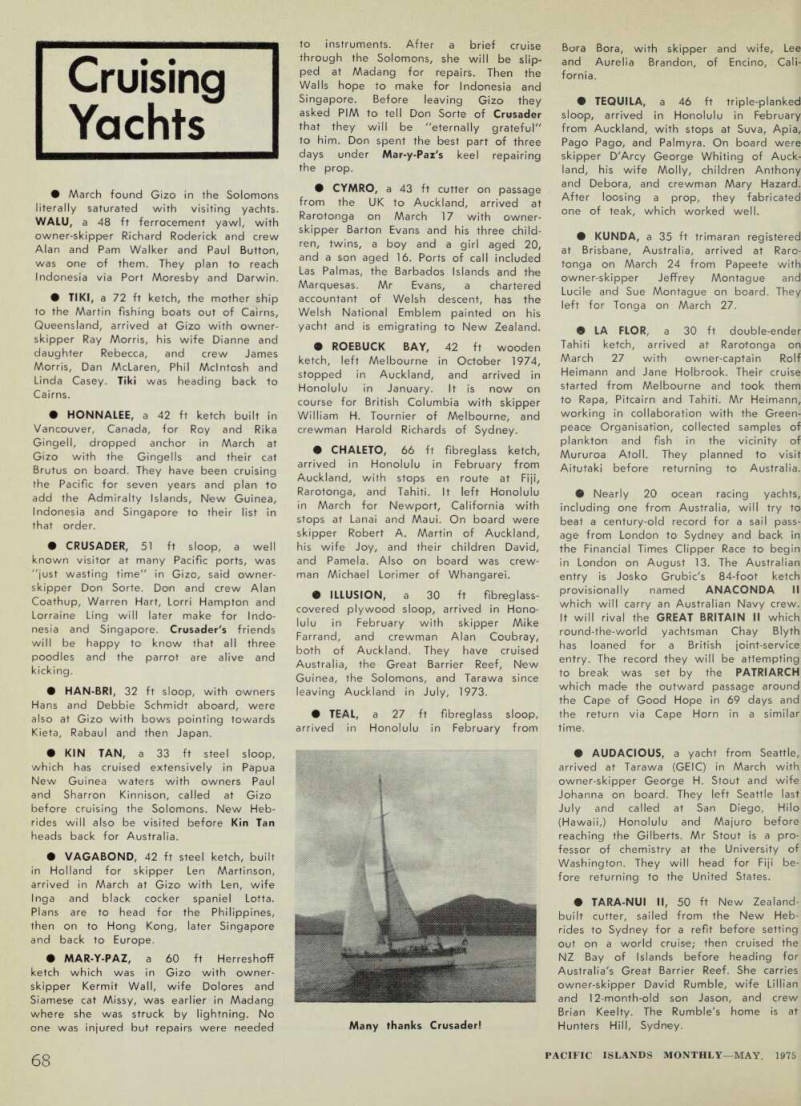
Yachts
• March found Gizo in the Solomons literally saturated with visiting yachts.
WALU, a 48 ft ferrocement yawl, with owner-skipper Richard Roderick and crew Alan and Pam Walker and Paul Button, was one of them. They plan to reach Indonesia via Port Moresby and Darwin. • TIKI, a 72 ft ketch, the mother ship to the Martin fishing boats out of Cairns, Queensland, arrived at Gizo with owner skipper Ray Morris, his wife Dianne and daughter Rebecca, and crew James Morris, Dan McLaren, Phil Mclntosh and Linda Casey. Tiki was heading back to Cairns. • HONNALEE, a 42 ft ketch built in Vancouver, Canada, for Roy and Rika Gingell, dropped anchor in March at Gizo with the Gingells and their cat Brutus on board. They have been cruising the Pacific for seven years and plan to add the Admiralty Islands, New Guinea, Indonesia and Singapore to their list in that order. • CRUSADER, 51 ft sloop, a well known visitor at many Pacific ports, was "just wasting time" in Gizo, said owner skipper Don Sorte. Don and crew Alan Coathup, Warren Hart, Lorri Hampton and Lorraine Ling will later make for Indo nesia and Singapore. Crusader's friends will be happy to know that all three poodles and the parrot are alive and kicking. • HAN-BRI, 32 ft sloop, with owners Hans and Debbie Schmidt aboard, were also at Gizo with bows pointing towards Kieta, Rabaul and then Japan. • KIN TAN, a 33 ft steel sloop, which has cruised extensively in Papua New Guinea waters with owners Paul and Sharron Kinnison, called at Gizo before cruising the Solomons. New Heb rides will also be visited before Kin Tan heads back for Australia. • VAGABOND, 42 ft steel ketch, built in Holland for skipper Len Martinson, arrived in March at Gizo with Len, wife Inga and black cocker spaniel Lotta.
Plans are to head for the Philippines, then on to Hong Kong, later Singapore and back to Europe. • MAR-Y-PAZ, a 60 ft Herreshoff ketch which was in Gizo with owner skipper Kermit Wall, wife Dolores and Siamese cat Missy, was earlier in Madang where she was struck by lightning. No one was injured but repairs were needed
to instruments. After a brief cruise through the Solomons, she will be slip ped at Madang for repairs. Then the Walls hope to make for Indonesia and Singapore. Before leaving Gizo they asked PIM to tell Don Sorte of Crusader that they will be "eternally grateful" to him. Don spent the best part of three days under Mar-y-Paz's keel repairing the prop. © CYMRO, a 43 ft cutter on passage from the UK to Auckland, arrived at Rarotonga on March 17 with owner skipper Barton Evans and his three child ren, twins, a boy and a girl aged 20, and a son aged 16. Ports of call included Las Palmas, the Barbados Islands and the Marquesas. Mr Evans, a chartered accountant of Welsh descent, has the Welsh National Emblem painted on his yacht and is emigrating to New Zealand. © ROEBUCK BAY, 42 ft wooden ketch, left Melbourne in October 1974, stopped in Auckland, and arrived in Honolulu in January. It is now on course for British Columbia with skipper William H. Tournier of Melbourne, and crewman Harold Richards of Sydney. • CHALETO, 66 ft fibreglass ketch, arrived in Honolulu in February from Auckland, with stops en route at Fiji, Rarotonga, and Tahiti. It left Honolulu in March for Newport, California with stops at Lanai and Maui. On board were skipper Robert A. Martin of Auckland, his wife Joy, and their children David, and Pamela. Also on board was crew man Michael Lorimer of Whangarei. • ILLUSION, a 30 ft fibreglass covered plywood sloop, arrived in Hono lulu in February with skipper Mike Farrand, and crewman Alan Coubray, both of Auckland. They have cruised Australia, the Great Barrier Reef, New Guinea, the Solomons, and Tarawa since leaving Auckland in July, 1973. • TEAL, a 27 ft fibreglass sloop, arrived in Honolulu in February from
Bora Bora, with skipper and wife, Lee and Aurelia Brandon, of Encino, Cali fornia. • TEQUILA, a 46 ft triple-planked sloop, arrived in Honolulu in February from Auckland, with stops at Suva, Apia, Pago Pago, and Palmyra. On board were skipper D'Arcy George Whiting of Auck land, his wife Molly, children Anthony and Debora, and crewman Mary Hazard.
After loosing a prop, they fabricated one of teak, which worked well. • KUNDA, a 35 ft trimaran registered at Brisbane, Australia, arrived at Raro tonga on March 24 from Papeete with owner-skipper Jeffrey Montague and Lucile and Sue Montague on board. They left for Tonga on March 27. © LA FLOR, a 30 ft double-ender Tahiti ketch, arrived at Rarotonga on March 27 with owner-captain Rolf Heimann and Jane Holbrook. Their cruise started from Melbourne and took them to Rapa, Pitcairn and Tahiti. Mr Heimann, working in collaboration with the Green peace Organisation, collected samples of plankton and fish in the vicinity of Mururoa Atoll. They planned to visit Aitutaki before returning to Australia. © Nearly 20 ocean racing yachts, including one from Australia, will try to beat a century-old record for a sail pass age from London to Sydney and back in the Financial Times Clipper Race to begin in London on August 13. The Australian entry is Josko Grubic's 84-foot ketch provisionally named ANACONDA II which will carry an Australian Navy crew.
It will rival the GREAT BRITAIN II which round-the-world yachtsman Chay Blyth has loaned for a British joint-service entry. The record they will be attempting to break was set by the PATRIARCH which made the outward passage around the Cape of Good Hope in 69 days and the return via Cape Horn in a similar time. • AUDACIOUS, a yacht from Seattle, arrived at Tarawa (GEIQ in March with owner-skipper George H. Stout and wife Johanna on board. They left Seattle last July and called at San Diego, Hilo (Hawaii,) Honolulu and Majuro before reaching the Gilberts. Mr Stout is a pro fessor of chemistry at the University of Washington. They will head for Fiji be fore returning to the United States. • TARA-NUI 11, 50 ft New Zealand built cutter, sailed from the New Heb rides to Sydney for a refit before setting out on a world cruise; then cruised the NZ Bay of Islands before heading for Australia's Great Barrier Reef. She carries owner-skipper David Rumble, wife Lillian and 12-month-old son Jason, and crew Brian Keelty. The Rumble's home is at Hunters Hill, Sydney.
Many thanks Crusader!
Business and Development
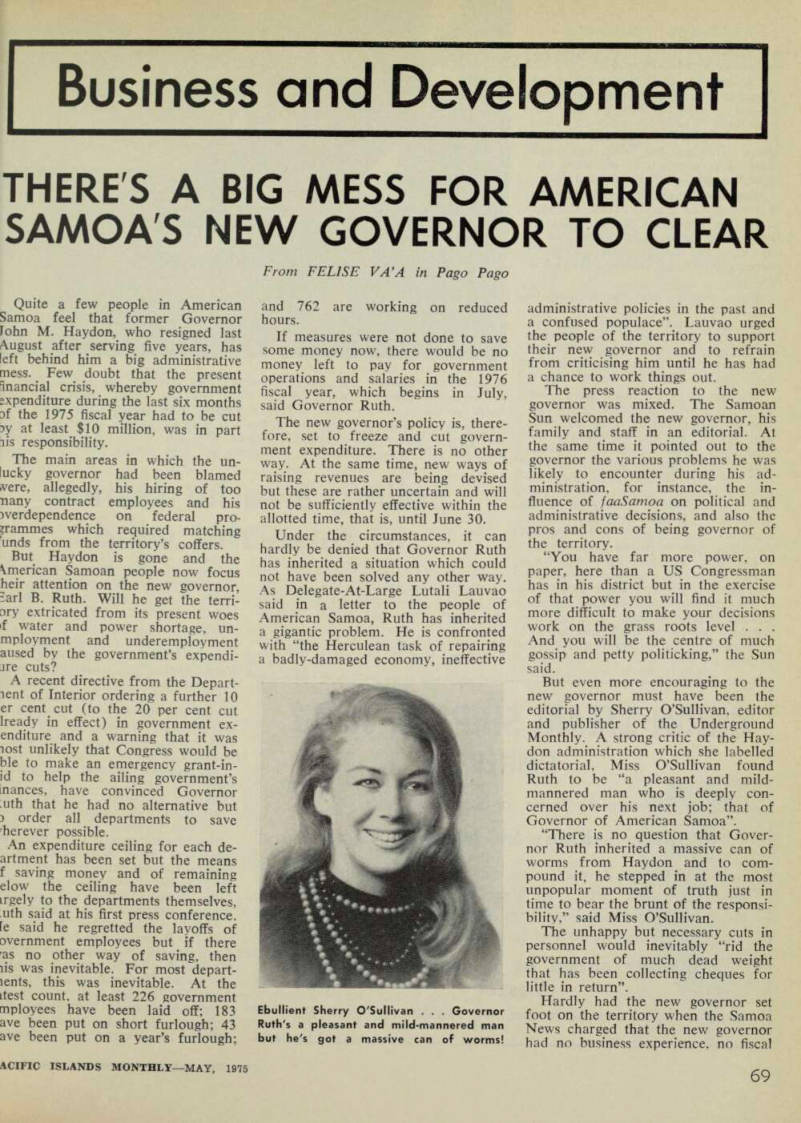
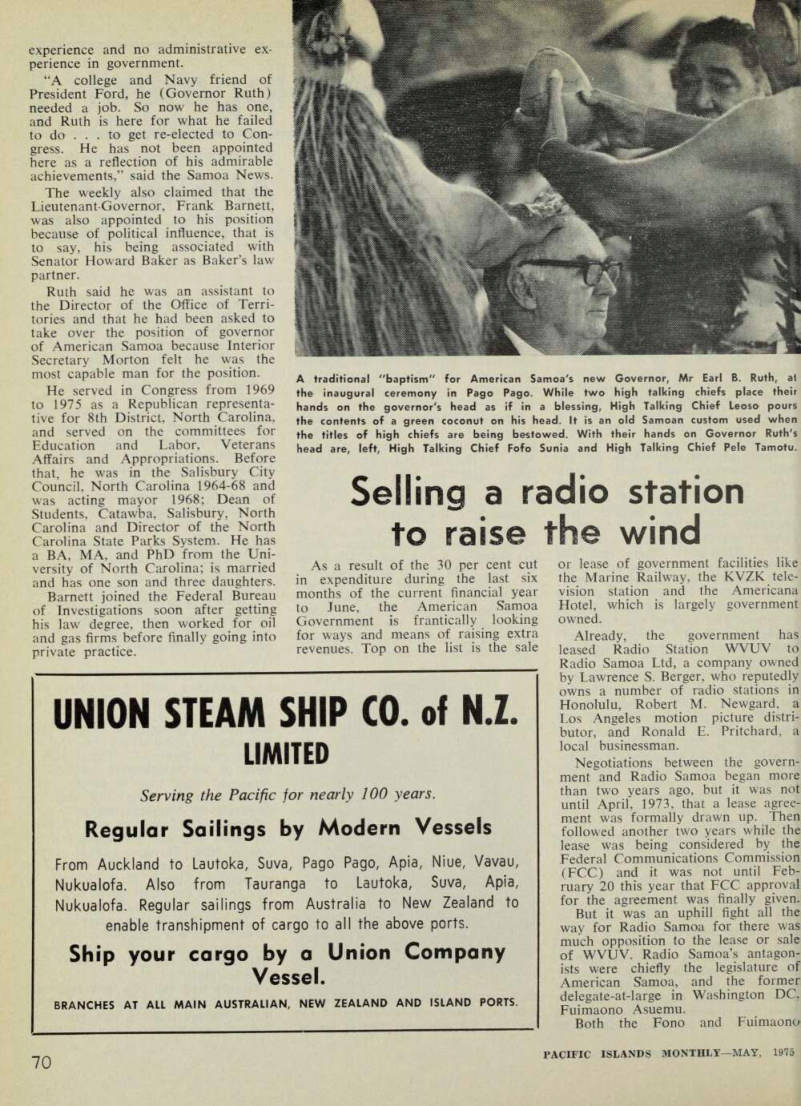
There's A Big Mess For American
Samoa's New Governor To Clear
From FELISE VA’A in Pago Pago
Quite a few people in American Samoa feel that former Governor lohn M. Haydon, who resigned last August after serving five years, has left behind him a big administrative mess. Few doubt that the present inancial crisis, whereby government expenditure during the last six months Df the 1975 fiscal year had to be cut ?y at least SlO million, was in part lis responsibility.
The main areas in which the un lucky governor had been blamed vere, allegedly, his hiring of too nany contract employees and his iverdependence on federal pro p-ammes which required matching unds from the territory’s coffers.
But Haydon is gone and the \merican Samoan people now focus heir attention on the new governor, narl B. Ruth. Will he get the tern ary extricated from its present woes •f water and power shortage, un mployment and underemployment aused by the government’s expendi jre cuts?
A recent directive from the Depart nent of Interior ordering a further 10 er cent cut (to the 20 per cent cut Iready in effect) in government ex enditure and a warning that it was lost unlikely that Congress would be ble to make an emergency grant-in id to help the ailing government’s nances, have convinced Governor uth that he had no alternative but i order all departments to save Jierever possible.
An expenditure ceiling for each de artment has been set but the means f saving money and of remaining elow the ceiling have been left irgely to the departments themselves, uth said at his first press conference, ie said he regretted the layoffs of overnment employees but if there r as no other way of saving, then lis was inevitable. For most depart lents, this was inevitable. At the itest count, at least 226 government mployees have been laid off; 183 ave been put on short furlough; 43 ave been put on a year’s furlough;
and 762 are working on reduced hours.
If measures were not done to save some money now, there would be no money left to pay for government operations and salaries in the 1976 fiscal year, which begins in July, said Governor Ruth.
The new governor’s policy is, there fore, set to freeze and cut govern ment expenditure. There is no other way. At the same time, new ways of raising revenues are being devised but these are rather uncertain and will not be sufficiently effective within the allotted time, that is, until June 30.
Under the circumstances, it can hardly be denied that Governor Ruth has inherited a situation which could not have been solved any other way.
As Delegate-At-Large Lutali Lauvao said in a letter to the people of American Samoa, Ruth has inherited a gigantic problem. He is confronted with “the Herculean task of repairing a badly-damaged economy, ineffective
administrative policies in the past and a confused populace”. Lauvao urged the people of the territory to support their new governor and to refrain from criticising him until he has had a chance to work things out.
The press reaction to the new governor was mixed. The Samoan Sun welcomed the new governor, his family and staff in an editorial. At the same time it pointed out to the governor the various problems he was likely to encounter during his ad ministration, for instance, the in fluence of jaaSamoa on political and administrative decisions, and also the pros and cons of being governor of the territory.
“You have far more power, on paper, here than a US Congressman has in his district but in the exercise of that power you will find it much more difficult to make your decisions work on the grass roots level . . .
And you will be the centre of much gossip and petty politicking,” the Sun said.
But even more encouraging to the new governor must have been the editorial by Sherry O’Sullivan, editor and publisher of the Underground Monthly. A strong critic of the Hay don administration which she labelled dictatorial. Miss O’Sullivan found Ruth to be “a pleasant and mild mannered man who is deeply con cerned over his next job; that of Governor of American Samoa”.
“There is no question that Gover nor Ruth inherited a massive can of worms from Haydon and to com pound it, he stepped in at the most unpopular moment of truth just in time to bear the brunt of the responsi bility,” said Miss O’Sullivan.
The unhappy but necessary cuts in personnel would inevitably “rid the government of much dead weight that has been collecting cheques for little in return”.
Hardly had the new governor set foot on the territory when the Samoa News charged that the new governor had no business experience, no fiscal
Ebullient Sherry O'Sullivan . . . Governor Ruth's a pleasant and mild-mannered man but he's got a massive can of worms!
experience and no administrative ex perience in government.
“A college and Navy friend of President Ford, he (Governor Ruth) needed a job. So now he has one, and Ruth is here for what he failed to do ... to get re-elected to Con gress. He has not been appointed here as a reflection of his admirable achievements,” said the Samoa News.
The weekly also claimed that the Lieutenant-Governor, Frank Barnett, was also appointed to his position because of political influence, that is to say, his being associated with Senator Howard Baker as Baker’s law partner.
Ruth said he was an assistant to the Director of the Office of Terri tories and that he had been asked to take over the position of governor of American Samoa because Interior Secretary Morton felt he was the most capable man for the position.
He served in Congress from 1969 to 1975 as a Republican representa tive for Bth District, North Carolina, and served on the committees for Education and Labor, Veterans Affairs and Appropriations. Before that, he was in the Salisbury City Council, North Carolina 1964-68 and was acting mayor 1968; Dean of Students, Catawba, Salisbury, North Carolina and Director of the North Carolina State Parks System. He has a BA, MA, and PhD from the Uni versity of North Carolina; is married and has one son and three daughters.
Barnett joined the Federal Bureau of Investigations soon after getting his law degree, then worked for oil and gas firms before finally going into private practice.
Advertisements & other items, p. 75 (1 item)
69
ACIFIC ISLANDS MONTHLY—MAY, 1975
Selling a radio station
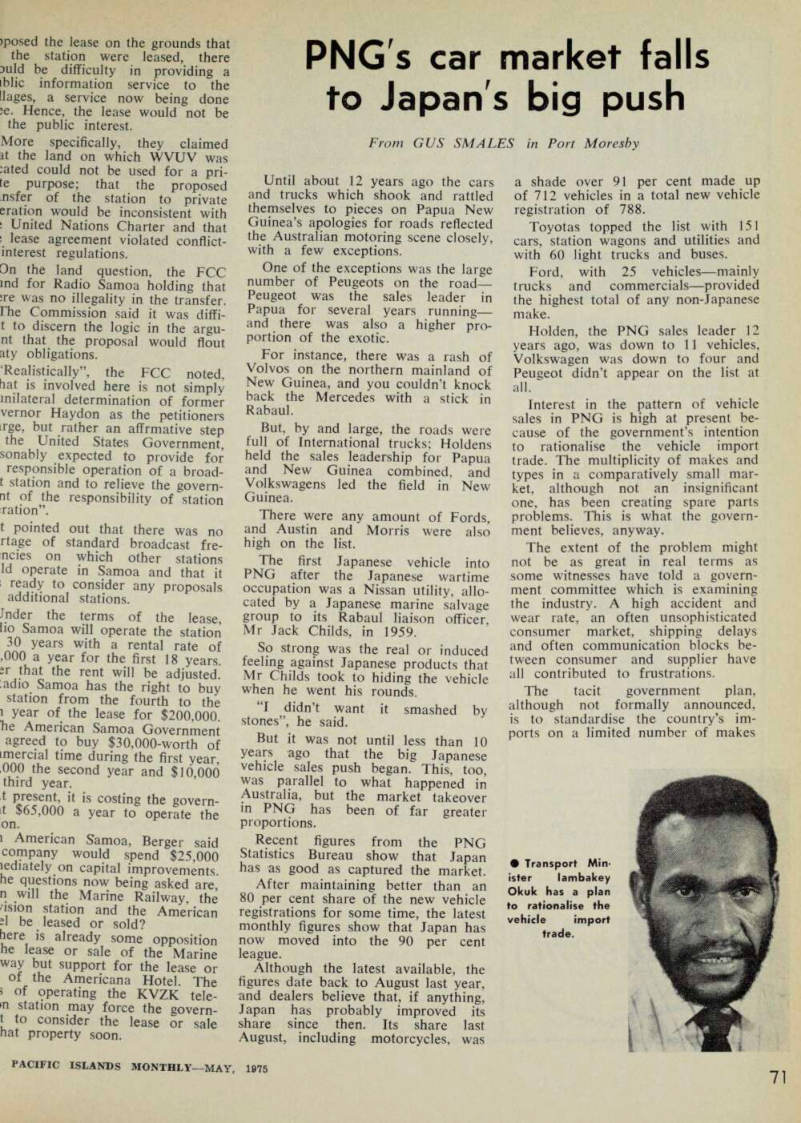
to raise the wind
As a result of the 30 per cent cut in expenditure during the last six months of the current financial year to June, the American Samoa Government is frantically looking for ways and means of raising extra revenues. Top on the list is the sale
or lease of government facilities like the Marine Railway, the KVZK tele vision station and the Americana Hotel, which is largely government owned.
Already, the government has leased Radio Station WVUV to Radio Samoa Ltd, a company owned by Lawrence S. Berger, who reputedly owns a number of radio stations in Honolulu, Robert M. Newgard, a Los Angeles motion picture distri butor, and Ronald E. Pritchard, a local businessman.
Negotiations between the govern ment and Radio Samoa began more than two years ago, but it was not until April, 1973, that a lease agree ment was formally drawn up. Then followed another two years while the lease was being considered by the Federal Communications Commission (FCC) and it was not until Feb ruary 20 this year that FCC approval for the agreement was finally given.
But it was an uphill fight all the way for Radio Samoa for there was much opposition to the lease or sale of WVUV. Radio Samoa’s antagon ists were chiefly the legislature of American Samoa, and the former delegate-at-large in Washington DC, Fuimaono Asuemu.
Both the Fono and Fuimaono
A traditional "baptism" for American Samoa's new Governor, Mr Earl B. Ruth, at the inaugural ceremony in Pago Pago. While two high talking chiefs place their hands on the governor's head as if in a blessing, High Talking Chief Leoso pours the contents of a green coconut on his head. It is an old Samoan custom used when the titles of high chiefs are being bestowed. With their hands on Governor Ruth's head are, left, High Talking Chief Fofo Sunia and High Talking Chief Pele Tamotu.
)posed the lease on the grounds that the station were leased, there Duld be difficulty in providing a iblic information service to the llages, a service now being done ;e. Hence, the lease would not be the public interest.
More specifically, they claimed it the land on which WVUV was :ated could not be used for a pri te purpose; that the proposed nsfer of the station to private eration would be inconsistent with : United Nations Charter and that : lease agreement violated conflict interest regulations.
On the land question, the FCC ind for Radio Samoa holding that :re was no illegality in the transfer.
Fhe Commission said it was diffi t to discern the logic in the argu nt that the proposal would flout aty obligations. ‘Realistically”, the FCC noted, fiat is involved here is not simply inilateral determination of former vernor Haydon as the petitioners irge, but rather an affrmative step the United States Government, sonably expected to provide for responsible operation of a broad t station and to relieve the govern nt of the responsibility of station ration”. t pointed out that there was no rtage of standard broadcast fre ncies on which other stations Id operate in Samoa and that it ready to consider any proposals additional stations.
Jnder the terms of the lease, ho Samoa will operate the station 30 years with a rental rate of ,000 a year for the first 18 years, sr that the rent will be adjusted, .adio Samoa has the right to buy station from the fourth to the i year of the lease for $200,000. he American Samoa Government agreed to buy $30,000-worth of imercial time during the first year, ,000 the second year and $lO,OOO third year. * present, is costing the govern t $65,000 a year to operate the on. i American Samoa, Berger said company would spend $25,000 jediately on capital improvements he questions now being asked are, n will the Marine Railway, the vision station and the American -I be leased or sold? here is already some opposition he lease or sale of the Marine way but support for the lease or of the Americana Hotel. The 5 of operating the KVZK tele ►n station may force the govern t to consider the lease or sale hat property soon.
Advertisements & other items, p. 76 (1 item)
Union Steam Ship Co. Of N.Z.
LIMITED
Serving the Pacific for nearly 100 years.
Regular Sailings by Modern Vessels
From Auckland to Lautoka, Suva, Pago Pago, Apia, Niue, Vavau, Nukualofa. Also from Tauranga to Lautoka, Suva, Apia, Nukualofa. Regular sailings from Australia to New Zealand to enable transhipment of cargo to all the above ports.
Ship your cargo by a Union Company Vessel.
BRANCHES AT ALL MAIN AUSTRALIAN, NEW ZEALAND AND ISLAND PORTS.
to Japan's big push
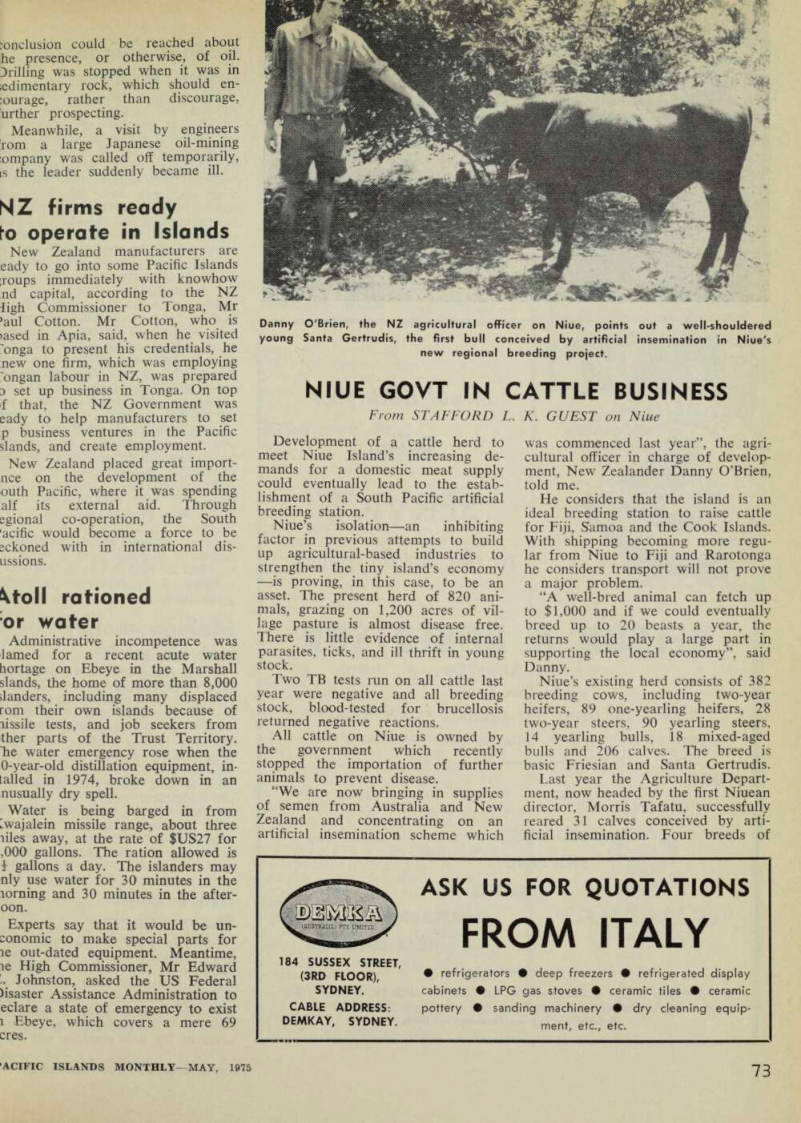
PNG's car market falls to Japan's big push
From GUS SMALES in Port Moresby
Until about 12 years ago the cars and trucks which shook and rattled themselves to pieces on Papua New Guinea’s apologies for roads reflected the Australian motoring scene closely, with a few exceptions.
One of the exceptions was the large number of Peugeots on the road— Peugeot was the sales leader in Papua for several years running— and there was also a higher pro portion of the exotic.
For instance, there was a rash of Volvos on the northern mainland of New Guinea, and you couldn’t knock back the Mercedes with a stick in Rabaul.
But, by and large, the roads were full of International trucks; Holdens held the sales leadership for Papua and New Guinea combined, and Volkswagens led the field in New Guinea.
There were any amount of Fords, and Austin and Morris were also high on the list.
The first Japanese vehicle into PNG after the Japanese wartime occupation was a Nissan utility, allo cated by a Japanese marine salvage group to its Rabaul liaison officer, Mr Jack Childs, in 1959.
So strong was the real or induced feeling against Japanese products that Mr Childs took to hiding the vehicle when he went his rounds.
“I didn’t want it smashed by stones”, he said.
But it was not until less than 10 years ago that the big Japanese vehicle sales push began. This, too, was parallel to what happened in Australia, but the market takeover in PNG has been of far greater proportions.
Recent figures from the PNG Statistics Bureau show that Japan has as good as captured the market.
After maintaining better than an 80 per cent share of the new vehicle registrations for some time, the latest monthly figures show that Japan has now moved into the 90 per cent league.
Although the latest available, the figures date back to August last year, and dealers believe that, if anything, Japan has probably improved its share since then. Its share last August, including motorcycles, was
a shade over 91 per cent made up of 712 vehicles in a total new vehicle registration of 788.
Toyotas topped the list with 151 cars, station wagons and utilities and with 60 light trucks and buses.
Ford, with 25 vehicles—mainly trucks and commercials—provided the highest total of any non-Japanese make.
Holden, the PNG sales leader 12 years ago, was down to 11 vehicles, Volkswagen was down to four and Peugeot didn’t appear on the list at all.
Interest in the pattern of vehicle sales in PNG is high at present be cause of the government’s intention to rationalise the vehicle import trade. The multiplicity of makes and types in a comparatively small mar ket, although not an insignificant one, has been creating spare parts problems. This is what the govern ment believes, anyway.
The extent of the problem might not be as great in real terms as some witnesses have told a govern ment committee which is examining the industry. A high accident and wear rate, an often unsophisticated consumer market, shipping delays and often communication blocks be tween consumer and supplier have all contributed to frustrations.
The tacit government plan, although not formally announced, is to standardise the country’s im ports on a limited number of makes
• Transport Min ister lambakey Okuk has a plan to rationalise the vehicle import trade.
and types—possibly a mere five or six.
This would be achieved by apply ing nominal import duties to the chosen makes, and prohibitive import duties to others.
But the big question, still to be resolved, is who gets the low import duties and who gets the high ones?
The Transport Minister, Mr lambakey Okuk, has told parliament that sales lists are not necessarily the yardsticks by which the makes will be measured.
The degree to which existing agents have carried spares and sup plied service will be a big factor, although this will be difficult to assess without a lot of political dynamite. The big sales lists are ob viously going to have some effect on the situation, too, which would fur ther entrench at least some of the major Japanese suppliers.
Some commercial lobbies fear the government might stultify the indus try to the detriment of the long-term national economy. They say that although duplication and high costs may exist in some degree, the vehicle supply and maintenance trade is be coming a major source of skilled local employment and involvement.
They also see the industry as one of major potential to satisfy the government’s aim of phasing in PNG shareholding—but only if the indus try is allowed to remain competitive.
Japan has lion's
share in Fiji
Japan has also captured a lion’s share of the car market in Fiji. The country in 1974 imported 1,535 vehicles for private use and as taxis.
The value was $2,885,000. Japan supplied 1,119 of those vehicles, worth $1,836,000. Next on the list was Britain with 270, valued at $514,856, followed by Australia with 141, valued at $517,000. Hardly affecting the market were Germany with two, and Italy, New Zealand and Sweden with one each.
Imports of vehicles, less than two tons totalled 90 with Japan supply ing 86 valued at $189,623, and Britain three. Japan supplied nine of 37 buses imported, and Britain 27.
The value of bus imports was $76,625. • Negotiations for a new sugar agreement between Fiji and New Zealand started in April. New Zea land, which has enjoyed low prices for Fiji sugar for many years, ex pects to pay a much higher price in future.
Fiji's 1974 trade
in the red
Fiji had a visible trade deficit of: $94.3 million in 1974, according to provisional figures issued by the: country’s statistics office. Imports; were valued at $217.8 million, while: exports earned $123.5 million. Sugar exports were valued at $67 million,, coconut oil $10.7 million and gold! $8.6 million. Other significant exports; were molasses $1,263 million, sawn timber $973,000, veneer sheets $Bll,OOO, biscuits $621,000, ginger $548,000 and cement $500,000.
Petroleum, miscellaneous manu factured goods, foodstuffs and duty free goods accounted for most of the import bill. Australia had 30.4 per cent of the market ($66.3 mil lion), Japan 18 per cent ($39.3 mil lion), New Zealand 11.2 per cent ($24.4 million) and Britain 9.8 per cent ($21.5 million).
Britain was the country’s best cus tomer, taking 26 per cent of the ex ports, worth $37.1 million. Other big customers were Australia 13.3 per cent ($15.3 million), New Zealand 6.6 per cent ($B.l million) and Malaysia and Singapore 3.6 per cenl ($4.4 million).
Natural gas
search in PNG
A search for natural gas in Papus is expected to cost about $2O million PNG Petroleum will soon drill th« first hole at Kanau, about 70 mile; north-west of Kikori. Contractor; have cleared a mountain top for the first drilling. As there are no roac communications all equipment ha; to be flown in by helicopter.
Other pinnacles will be cleared a Darai and Orie. The three sites are spread out over 60 miles along ; limestone plateau which geologist: have recommended as a likely ga; area. Each test hole is expected t< cost more than $3 million.
Still hopes of
oil in Tonga!
There is still hope that Tonga ma; find off-shore oil, according to D Rudi Katz, the chief petroleun geologist in New Zealand. He visite< Tonga recently to make a report oi exploration so far conducted. Th nature of the 5,500 ft holes alread; drilled indicated favourable pros pects, he said.
Dr Katz said that in previous ex ploration the holes had not been du deep enough. Drilling should hav gone to at least 10,000 ft before
inclusion could be reached about he presence, or otherwise, of oil.
Drilling was stopped when it was in ledimentary rock, which should en :ourage, rather than discourage, urther prospecting.
Meanwhile, a visit by engineers fom a large Japanese oil-mining ;ompany was called off temporarily, is the leader suddenly became ill.
NZ firms ready
Fo operate in Islands
New Zealand manufacturers are eady to go into some Pacific Islands ;roups immediately with knowhow nd capital, according to the NZ ligh Commissioner to Tonga, Mr *aul Cotton. Mr Cotton, who is >ased in Apia, said, when he visited "onga to present his credentials, he new one firm, which was employing 'ongan labour in NZ, was prepared 3 set up business in Tonga. On top f that, the NZ Government was eady to help manufacturers to set p business ventures in the Pacific slands, and create employment.
New Zealand placed great import nce on the development of the outh Pacific, where it was spending alf its external aid. Through egional co-operation, the South acific would become a force to be with in international dis ussions.
\toll rationed
or water
Administrative incompetence was lamed for a recent acute water hortage on Ebeye in the Marshall slands, the home of more than 8,000 danders, including many displaced rom their own islands because of fissile tests, and job seekers from ther parts of the Trust Territory, die water emergency rose when the 0-year-old distillation equipment, to talled in 1974, broke down in an nusually dry spell.
Water is being barged in from iwajalein missile range, about three files away, at the rate of SUS 27 for ,000 gallons. The ration allowed is i gallons a day. The islanders may nly use water for 30 minutes in the lorntog and 30 minutes in the after oon.
Experts say that it would be un conomic to make special parts for le out-dated equipment. Meantime, le High Commissioner, Mr Edward . Johnston, asked the US Federal lisaster Assistance Administration to eclare a state of emergency to exist i Ebeye, which covers a mere 69 cres.
Advertisements & other items, p. 78 (1 item)
r Jrs
Round gourmet
“Skillet”
THE HANDIEST NEW APPLIANCE
SINCE FRYPANS
Bacon and eggs for two? Simple for the Sunbeam "Skillet". Yet "Skillet" is big enough to roast a size 8 chicken to perfection. And to wash simply remove the control and dunk the pan in the sink.
Another first and it comes only from Sunbeam.
8 Speed
Power
Blender
4
THE APPLIANCE YOU CAN USE
EVERY MEAL
With powerful. Solid-state motor. Which means the exact blending action you need to— Whip, grate, mix, chop or liquefy. Stainless steel cutters give fast food preparation while switching from speed to speed without turning off . . .
Niue Govt In Cattle Business
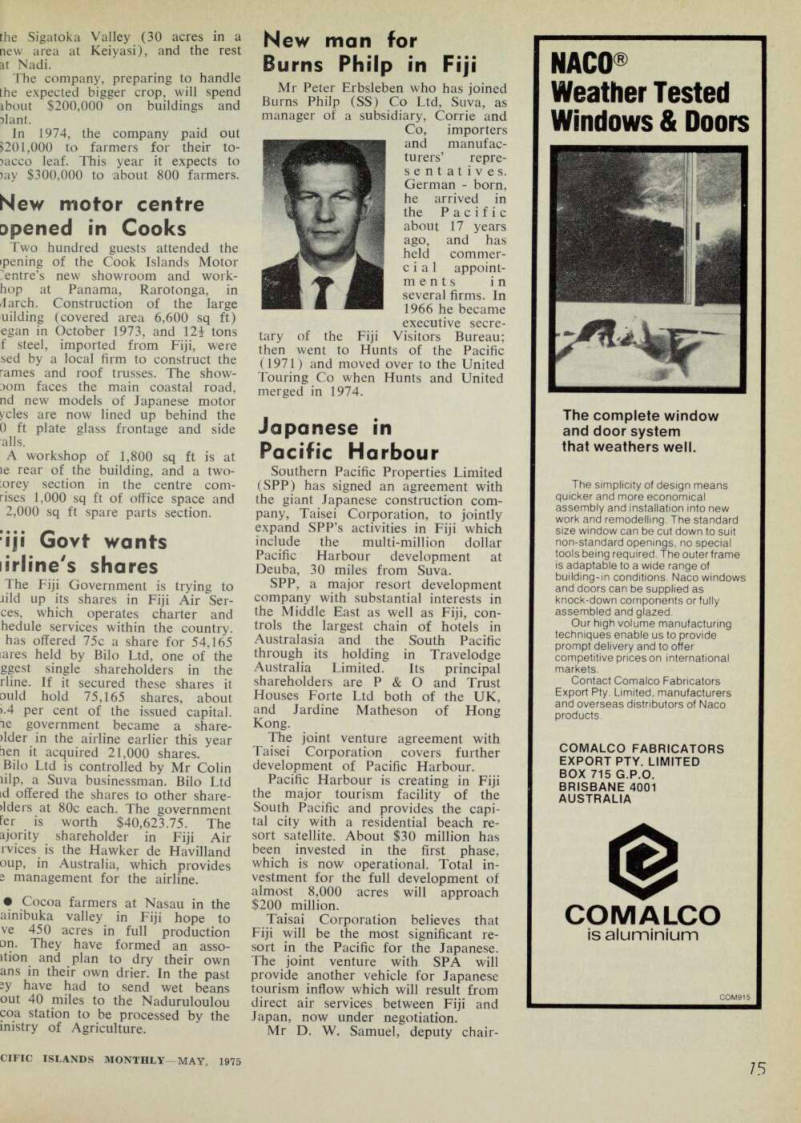
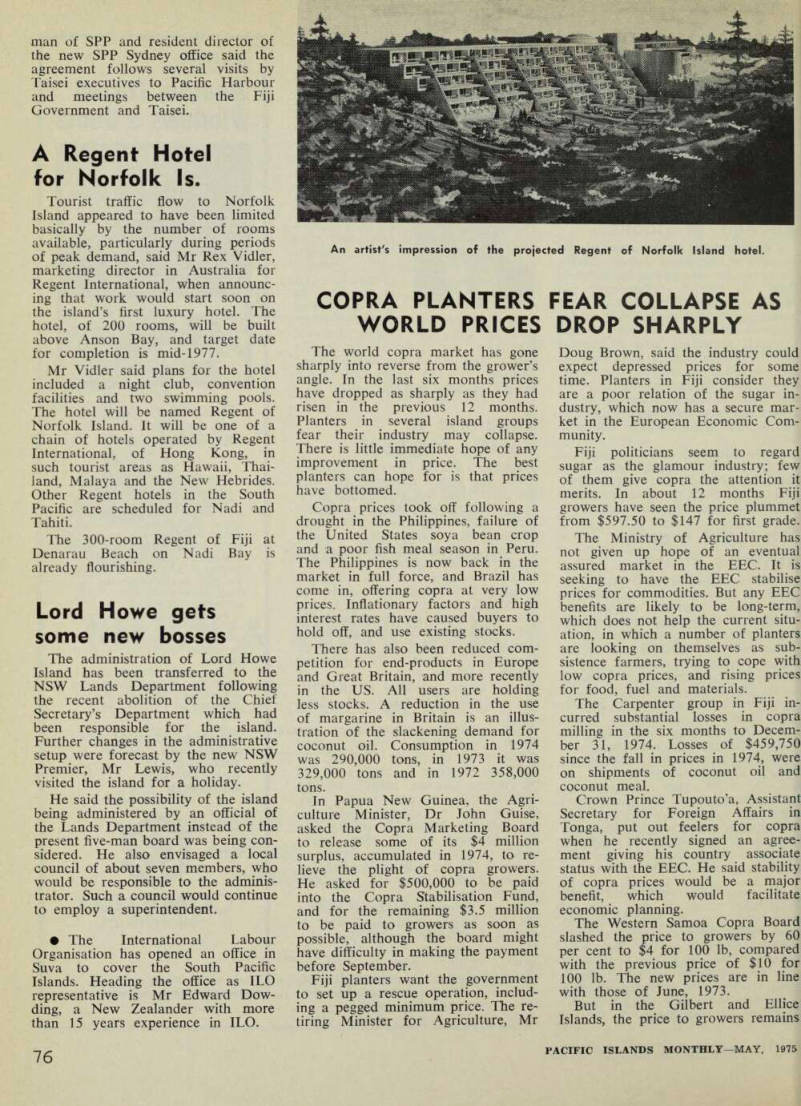
From STAFFORD L. K. GUEST on Niue
Development of a cattle herd to meet Niue Island’s increasing demands for a domestic meat supply could eventually lead to the establishment of a South Pacific artificial breeding station.
Niue’s isolation—an inhibiting factor in previous attempts to build up agricultural-based industries to strengthen the tiny island’s economy —is proving, in this case, to be an asset. The present herd of 820 animals, grazing on 1,200 acres of village pasture is almost disease free.
There is little evidence of internal parasites, ticks, and ill thrift in young stock.
Two TB tests run on all cattle last year were negative and all breeding stock, blood-tested for brucellosis returned negative reactions.
All cattle on Niue is owned by the government which recently stopped the importation of further animals to prevent disease.
“We are now bringing in supplies of semen from Australia and New Zealand and concentrating on an artificial insemination scheme which
was commenced last year”, the agri cultural officer in charge of develop ment, New Zealander Danny O’Brien, told me.
He considers that the island is an ideal breeding station to raise cattle for Fiji, Samoa and the Cook Islands, With shipping becoming more regu lar from Niue to Fiji and Rarotonga he considers transport will not prove a major problem, “A well-bred animal can fetch up to $l,OOO and if we could eventually breed up to 20 beasts a year, the returns would play a large part in supporting the local economy”, said Danny.
Niue’s existing herd consists of 382 breeding cows, including two-year heifers, 89 one-yearling heifers, 28 two-year steers, 90 yearling steers, 14 yearling bulls, 18 mixed-aged bulls and 206 calves. The breed is basic Friesian and Santa Gertrudis.
Last year the Agriculture Depart ment, now headed by the first Niuean director, Morris Tafatu, successfully reared 31 calves conceived by arti ficial insemination. Four breeds of
Danny O'Brien, the NZ agricultural officer on Niue, points out a well-shouldered young Santa Gertrudis, the first bull conceived by artificial insemination in Niue's new regional breeding project.
Friesian, Santa Gertrudis, Hereford and Angus were established.
Next year it is hoped to put about 460 heifers from the existing herd with a locally-reared bull. About 90 will be artificially inseminated.
It is intended to introduce Brah min blood into Friesian stock to produce a breed which can with stand tropical conditions.
A Niuean veterinary officer, Mr H. Jackson, has been in NZ study ing artificial insemination techniques and will soon travel to Australia.
The first artificial insemination was carried out by Mr Gary Cooper, a qualified AI technician, who heads a construction company here.
At present Niue can only meet
about 25 per cent of demands on its domestic meat market. Steers are killed at two years and average about 420 lb weight. Killing and packag ing is carried out at the Develop ment Board’s new food processing factory at Fonuakula.
Original cattle imports were made into Niue in the late 1950 s mainly from Friesian stock. A small number of Friesian, Santa Gertrudis and Herefords were introduced from Fiji in 1966.
How soon could the island produce stock for export and undertake breed ing for other Pacific regions?
“I am confident that we could meet a client’s order immediately”, said Danny O’Brien.
Rubber companies
losing money
Three Papua rubber companies showed net losses in the latest financial terms, two of them drop ping from a profit situation and the third suffering an even heavier loss.
The directors of the three companies said in their reports that excessive wage increases over the last nine months and the continued low prices for rubber had had the effect of plac ing them in loss situations, which were certain to continue. Every en deavour was being made to cut costs.
Low yielding areas had been taken out of production.
Mariboi in the December half-year had a loss of $40,176, compared with a profit of $13,916 in the pre vious corresponding term. The aver age sale price was 50.81 c a kg, com pared with 54.03 c, and production was 212,550 kg against 260,520 kg.
Kerema for a full year had a loss of $31,807, against a previous profit of $5,139. Kerema lifted the average sale price from 50.08 c a kg to 58.89 c, but production dropped from 291,090 kg to 282,350 kg.
Rubberland had a loss of $19,957, compared with $12,262 for a full year. The average sales price was 59.49 c a kg, compared with 50.41 c in the previous year. Production, however, dropped from 160,536 kg to 146,758 kg.
None of the companies is paying a dividend.
Making money
out of rock
Tonga may soon have a new in dustry—processing volcanic rock from Niuafoou into building materials or for interior decoration. An Italian visitor to the country, Mr Tina Biancini, took a piece of rock home with him for cutting and testing. It was shipped by stonemasons and sent back to King Taufa’ahau Tupou with the comment that, in sufficient quantity, it could be marketable. “We have the raw materials,” the king commented. “It is now a question of importing the machinery to process it.”
More land
for smokers
More land for growing tobacco is being opened in Fiji. The general manager of the South Development Co, Mr Murray Charters, said re cently his company would plant 600 acres this year, compared with 499 acres in 1974. One hundred and five acres of the new planting will be in
the Sigatoka Valley (30 acres in a new area at Keiyasi), and the rest at Nadi.
The company, preparing to handle the expected bigger crop, will spend about $200,000 on buildings and alant.
In 1974, the company paid out £201,000 to farmers for their to aacco leaf. This year it expects to aay $300,000 to about 800 farmers.
New motor centre
opened in Cooks
Two hundred guests attended the •pening of the Cook Islands Motor Centre’s new showroom and work hop at Panama, Rarotonga, in darch. Construction of the large uilding (covered area 6,600 sq ft) egan in October 1973, and 12i tons f steel, imported from Fiji, were sed by a local firm to construct the rames and roof trusses. The show aom faces the main coastal road, nd new models of Japanese motor ycles are now lined up behind the 0 ft plate glass frontage and side alls.
A workshop of 1,800 sq ft is at le rear of the building, and a two :orey section in the centre corn rises 1,000 sq ft of office space and 2,000 sq ft spare parts section.
: iji Govt wants
lirline's shares
The Fiji Government is trying to aild up its shares in Fiji Air Scr ees, which operates charter and hedule services within the country, has offered 75c a share for 54,165 lares held by Bilo Ltd, one of the ggest single shareholders in the rline. If it secured these shares it ould hold 75,165 shares, about >.4 per cent of the issued capital, le government became a share )lder in the airline earlier this year tien it acquired 21,000 shares.
Bilo Ltd is controlled by Mr Colin flip, a Suva businessman. Bilo Ltd id offered the shares to other share >lders at 80c each. The government Fer is worth $40,623.75. The ajority shareholder in Fiji Air rvices is the Hawker de Havilland oup, in Australia, which provides 2 management for the airline. • Cocoa farmers at Nasau in the ainibuka valley in Fiji hope to ve 450 acres in full production on. They have formed an asse rtion and plan to dry their own ans in their own drier. In the past sy have had to send wet beans out 40 miles to the Naduruloulou coa station to be processed by the inistry of Agriculture.
New man tor
Burns Philp in Fiji
Mr Peter Erbsleben who has joined Burns Philp (SS) Co Ltd, Suva, as manager of a subsidiary, Corrie and
Co, importers and manufac turers’ repre sentatives.
German - born, he arrived in the Pacific about 17 years ago, and has held commer cial appoint m e n t s in several firms. In 1966 he became executive secre
tary of the Fiji Visitors Bureau; then went to Hunts of the Pacific (1971) and moved over to the United Touring Co when Hunts and United merged in 1974.
Japanese in
Pacific Harbour
Southern Pacific Properties Limited (SPP) has signed an agreement with the giant Japanese construction com pany, Taisei Corporation, to jointly expand SPP’s activities in Fiji which include the multi-million dollar Pacific Harbour development at Deuba, 30 miles from Suva.
SPP, a major resort development company with substantial interests in the Middle East as well as Fiji, con trols the largest chain of hotels in Australasia and the South Pacific through its holding in Travelodge Australia Limited. Its principal shareholders are P & O and Trust Houses Forte Ltd both of the UK, and Jardine Matheson of Hong Kong.
The joint venture agreement with Taisei Corporation covers further development of Pacific Harbour.
Pacific Harbour is creating in Fiji the major tourism facility of the South Pacific and provides the capi tal city with a residential beach re sort satellite. About $3O million has been invested in the first phase, which is now operational. Total in vestment for the full development of almost 8,000 acres will approach $2OO million.
Taisai Corporation believes that Fiji will be the most significant re sort in the Pacific for the Japanese.
The joint venture with SPA will provide another vehicle for Japanese tourism inflow which will result from direct air services between Fiji and Japan, now under negotiation.
Mr D, W. Samuel, deputy chair
man of SPP and resident director of the new SPP Sydney office said the agreement follows several visits by Taisei executives to Pacific Harbour and meetings between the Fiji Government and Taisei.
A Regent Hotel
for Norfolk Is.
Tourist traffic flow to Norfolk Island appeared to have been limited basically by the number of rooms available, particularly during periods of peak demand, said Mr Rex Vidler, marketing director in Australia for Regent International, when announc ing that work would start soon on the island’s first luxury hotel. The hotel, of 200 rooms, will be built above Anson Bay, and target date for completion is mid-1977.
Mr Vidler said plans for the hotel included a night club, convention facilities and two swimming pools.
The hotel will be named Regent of Norfolk Island. It will be one of a chain of hotels operated by Regent International, of Hong Kong, in such tourist areas as Hawaii, Thai land, Malaya and the New Hebrides.
Other Regent hotels in the South Pacific are scheduled for Nadi and Tahiti.
The 300-room Regent of Fiji at Denarau Beach on Nadi Bay is already flourishing.
Lord Howe gefs
some new bosses The administration of Lord Howe Island has been transferred to the NSW Lands Department following the recent abolition of the Chief Secretary’s Department which had been responsible for the island.
Further changes in the administrative setup were forecast by the new NSW Premier, Mr Lewis, who recently visited the island for a holiday.
He said the possibility of the island being administered by an official of the Lands Department instead of the present five-man board was being con sidered. He also envisaged a local council of about seven members, who would be responsible to the adminis trator. Such a council would continue to employ a superintendent. • The International Labour Organisation has opened an office in Suva to cover the South Pacific Islands. Heading the office as ILO representative is Mr Edward Dow ding, a New Zealander with more than 15 years experience in ILO.
Fijians form
new companies
A group of Fijians is aiming at making the province of Namosi something more than a vegetable growing area supplying towns along the south-east coast of Viti Levu.
Namosi is the least developed of the 14 provinces in Fiji.
A new public company, Namosi Holdings Ltd, formed by leaders of the province will supply gravel, and a timber milling partnership is being negotiated with an overseas business man. Two thousand people of the province have been invited to take shares in the holding company, which is operating through sub sidiaries, Namosi Gravel Ltd and Namosi Timber Ltd.
Advertisements & other items, pp. 79-81 (3 items)
73
ACIFIC ISLANDS MONTHLY—MAY, 1975
From Italy
184 SUSSEX STREET,
(3RD FLOOR),
SYDNEY.
CABLE ADDRESS:
DEMKAY, SYDNEY.
ASK US FOR QUOTATIONS
FROM ITALY
• refrigerators • deep freezers • refrigerated display cabinets • LPG gas stoves • ceramic tiles • ceramic pottery • sanding machinery • dry cleaning equipment, etc., etc.
to the Pacific Islands
In our 80th year
Selling
"SERVICE"
NELSON & ROBERTSON
PTY. LIMITED
(Established 1895)
PLANTATION HOUSE, 197 CLARENCE STREET, SYDNEY
CABLES: "IVAN", SYDNEY, BRISBANE. TELEX: AA22381, SYDNEY.
FOR:
INDENTS
COMMODITIES
SHIPPING
TRAVEL
INSURANCE
REAL ESTATE
Branch Office: Nelson & Robertson Pty. Ltd., 303 Adelaide St., Brisbane, Old.
New Guinea Representatives: Rabtrad Niugini Pty. Ltd., Rabaul Lae Madang Kieta.
NACO®
Weather Tested
Windows & Doors
* The complete window and door system that weathers well.
The simplicity of design means quicker and more economical assembly and installation into new work and remodelling. The standard size window can be cut down to suit non-standard openings, no special tools being required. The outer frame is adaptable to a wide range of building-in conditions. Naco windows and doors can be supplied as knock-down components or fully assembled and glazed.
Our high volume manufacturing techniques enable us to provide prompt delivery and to offer competitive prices on international markets.
Contact Comalco Fabricators Export Pty. Limited, manufacturers and overseas distributors of Naco products.
COMALCO FABRICATORS
EXPORT PTY. LIMITED
BOX 715 G.P.O.
BRISBANE 4001
AUSTRALIA
$
COMALCO
is aluminium
C0M915
75
CIFIC ISLANDS MONTHLY MAY, 1975
Copra Planters Fear Collapse As
World Prices Drop Sharply
The world copra market has gone sharply into reverse from the grower’s angle. In the last six months prices have dropped as sharply as they had risen in the previous 12 months.
Planters in several island groups fear their industry may collapse.
There is little immediate hope of any improvement in price. The best planters can hope for is that prices have bottomed.
Copra prices took off following a drought in the Philippines, failure of the United States soya bean crop and a poor fish meal season in Peru.
The Philippines is now back in the market in full force, and Brazil has come in, offering copra at very low prices. Inflationary factors and high interest rates have caused buyers to hold off, and use existing stocks.
There has also been reduced com petition for end-products in Europe and Great Britain, and more recently in the US. All users are holding less stocks. A reduction in the use of margarine in Britain is an illus tration of the slackening demand for coconut oil. Consumption in 1974 was 290,000 tons, in 1973 it was 329,000 tons and in 1972 358,000 tons.
In Papua New Guinea, the Agri culture Minister, Dr John Guise, asked the Copra Marketing Board to release some of its $4 million surplus, accumulated in 1974, to re lieve the plight of copra growers.
He asked for $500,000 to be paid into the Copra Stabilisation Fund, and for the remaining $3.5 million to be paid to growers as soon as possible, although the board might have difficulty in making the payment before September.
Fiji planters want the government to set up a rescue operation, includ ing a pegged minimum price. The re tiring Minister for Agriculture, Mr
Doug Brown, said the industry could expect depressed prices for some time. Planters in Fiji consider they are a poor relation of the sugar in dustry, which now has a secure mar ket in the European Economic Com munity.
Fiji politicians seem to regard sugar as the glamour industry; few of them give copra the attention it merits. In about 12 months Fiji growers have seen the price plummet from $597.50 to $147 for first grade.
The Ministry of Agriculture has not given up hope of an eventual assured market in the EEC. It is seeking to have the EEC stabilise prices for commodities. But any EEC benefits are likely to be long-term, which does not help the current situ ation, in which a number of planters are looking on themselves as sub sistence farmers, trying to cope with low copra prices, and rising prices for food, fuel and materials.
The Carpenter group in Fiji in curred substantial losses in copra milling in the six months to Decem ber 31, 1974. Losses of $459,750 since the fall in prices in 1974, were on shipments of coconut oil and coconut meal.
Crown Prince Tupouto’a, Assistant Secretary for Foreign Affairs in Tonga, put out feelers for copra when he recently signed an agree ment giving his country associate status with the EEC. He said stability of copra prices would be a major benefit, which would facilitate economic planning.
The Western Samoa Copra Board slashed the price to growers by 60 per cent to $4 for 100 lb, compared with the previous price of $lO for 100 lb. The new prices are in line with those of June, 1973.
But in the Gilbert and Ellice Islands, the price to growers remains
An artist's impression of the projected Regent of Norfolk Island hotel.
unchanged. The GEIC Copra Board decided to draw on its reserves, built up in 1974 when prices were high, to maintain the price.
The high prices for copra for most of 1974 were reflected in Tonga’s rade figures for February when the country recorded a visible trade sur olus of about $600,000. It was the irst time since July, 1974, when nonthly trade figures first became ivailable, that Tonga had a surplus )f exports over imports.
Commerce Briefs
• Total group profit of Burns Tiilp and Co Ltd declined by about 3 per cent in the six months to December 31. There was a 66 per ent fall in profit in Australia and >lew Zealand, but net earnings from slands’ activities rose by 71 per cent.
Tie directors expect the profit fall or the full year to be more than 13 er cent. The interim dividend for tie latest half-year is a steady 7i er cent, on capital increased by the 974 one-for-five bonus issue. • Katafaga Island in Lau, Fiji, as been bought by a new Fiji pri ate company, Katafaga Plantation 'o Ltd, for $175,000. It was owned y Lady Scott, of Suva, wife of Sir laurice Scott, and before that by ady Scott’s first husband, the late larold Gatty, aviation pioneer, katafaga < covers about 700 acres, lost of it planted in coconut trees.
Tie directors of Katafaga Plantation o Ltd are Mr David Blackley and )r C. Blackley, both of New Zealand. • A three-man delegation from apua New Guinea left for Paris, Washington and York in April to iscuss the copper industry, and to nd a manager for the Ok Tedi Dpper project. In Washington, the elegation was scheduled to see Mr obert McNamara, former US De mce Secretary and now president of le World Bank, to discuss World ank funding of the Ok Tedi project, he delegation consisted of Mr Nigel gonia, Director of Mines (leader), Ir David Beatty, Director of the entral Planning Office, and Mr rown Bai, of the Central Planning ffice. 5 • Ratu Josua Toganivalu has sen appointed Minister for Agricul ire, Fisheries and Forests in Fiji, icceeding Mr Doug Brown, who signed to devote more time to his instituency as a backbencher in the [ouse of Representatives, and to is farming interests near Nausori.
Ir Brown was minister for eight sars. Ratu Josua has been suc "fded as Minister for Lands and lineral Resources by Mr Sakeasi Waqanivavalagi.
Produce Prices
Unless otherwise stated, quotations are in Australian currency. Australian dollar (April clnnTB 03 S / n- eW N Zea j a . nd ' 51.0122 (buying), ..f’"' $1.0675 (buying, $1.0435 (selling); Western Samoa, $0 8216 (buying), $0.8104 (selling); US, $1.3478 (buying), $1.3428 (selling); UK, 0.5683 np 0.5633 (selling); French 7lci(”c' (bu V m 9)' 102 CFP (selling); Tonga $0.8826 (buying), $0.8650 (selling). 9 '
Copra
Copra industries are controlled through copra boards in PNG, the Solomons, the GEIC, both Samoas, Fiji, Tonga, the Cooks and the US Trust Territory. New Hebrides, French Polynesia and New Caledonia do not have boards and copra is either sold individually by growers to overseas buyers or used locally.
NEW GUINEA: The board, with planters' reps directs distribution and sales and pays Planters. Shipments are made to UK, European markets and to Australia and Japan, and coco nut oil mills on New Britain.
Prices, April 1, were; Per metric tonne de hyered mam ports, hot-air dried, $122; FMS, $119; smoke-dried, $ll7.
The 21% export tax on copra has been lifted from March 27.
FIJI:—The board fixes prices on Philippines copra, taking into account freight, taxes, selling costs, shrinkage, etc. Prices from April 14 were: Ist grade, $153, 2nd grade, $143, s.s. $BO.
NEW HEBRIDES: Copra sold direct by planters to France and Japan. Burns Philp (NH) and CFNH (April) were buying copra at 6,000 FNH per ton on wharf, Vila or Santo.
The British Co-operatives Dept, was paying 6 cents per kilo to member societies
Other Produce
COCOA—lslands rates are based on Ghana prices. Ghana price on April 1 was spot £stg 614 ton, c.i.f.; UK, Continent. Nigerian cocoa was quoted at £stg 500 per ton basis c.i.f. Europe.
April 14. in store Rabaul, export quality, $BBO per tonne; delivered ex wharf Sydney $1025 per tonne.
Solomons.—Delivered to Agriculture Dept, offices in Honiara and Auki. Recent price was 25c per lb dried beans first grade, 20c second grade.
COFFEE.—PNG; Good quality. A grade, 42c
per lb; B grade, 39£c, C grade, 38£c, Y grade, 38£c (ex-store Sydney).
W. Samoa.—Recently, WSTEC ground and dried beans, 60 sene per lb wholesale.
PEANUTS. PNG: Sydney agents reported recently f.0.b., Lae; Kernels—white Spanish 19c lb.
RICE (Aust): —PNG: Dried brown, 25 kilo bags, $298.94 per metric tonne. Vitamin enriched white, 25 kilo bags, $303.94 per metric tonne, all f.o.w. Sydney/Melbourne.
Pacific Islands: Calrose med. grain, white, 25 kilo bags, $3lO per metric tonne. Kulu long grain white, 25 kilo bags, $355 per metric tonne. All prices c.&f. Sydney/Melbourne, VANILLA BEANS. Prices recently were: White and yellow label processed standard packs, $7.50; green label $7.40, c.i.f., Sydney.
Tonga.—sT4.2o, f.0.b., Nukualofa; $T4.50. Mel bourne.
Exchange Rates
FlJl.—Through Bank of NSW, ANZ Bank, Bank of NZ, Bank of Baroda, First National City Bank. Aust $ on Fiji $ buying $A1.0675 = $ Fl.
COOK IS., NIUE.—New Zealand currency Is used.
NEW HEBRIDES—Through Bank of NSW, ANZ Bank, Commercial Bank of Australia, National Bank of A'asia, Barclays Bank, Hong Kong & Shanghai Ban ting Corp, Mosbert Bank. SAI = 93.22 New Hebridean francs (buying); 91.23 (selling)—airmail transfer rate.
WESTERN SAMOA—Through Bank of Western Samoa, controlled from NZ, SWS. Tala 1 = 5A0.8216 (buying), $A0.8104 (selling).
TONGA. —Tongan dollar (pa'anga) = $A0.8826 (buying), $A0.8650 (selling).
Norfolk Is, Solomon Is, Geic, Nauru,
PAPUA NEW GUlNEA.—Australian currency used; no exchange payable in transactions with Aus tralia.
FRENCH PACIFIC COLONIES—Pacific francs (CFP) are used in New Caledonia, Wallis and Futuna Is, and Fr Polynesia. French Bank, Sydney, on April 11, quoted: SAI = 104.00 CFP (buying), 102.61 (selling). Paris-London: £1 = 10.127 francs (buying), 9.905 francs (selling). Pacific franc—London: £1 = 184.14 CFP (buying), 180.08 CFP (selling).
CFP to 1 metropolitan franc 18.43 (buying), 17.94 (selling).
Banks should be approached for daily quotes
Advertisements & other items, p. 83 (2 items)
Acific Islands Monthly—May, 1975
I *1 Converters
MERCHANTS
LEAD
SHEET
INGOT
ALLOY
SCRAP
RESIDUES
BERJAK METALS PTY. LTD.
424 ST. KILDA ROAD, MELBOURNE, 3004
Cable: METJAK MELBOURNE Telex: AA30334
postscripts
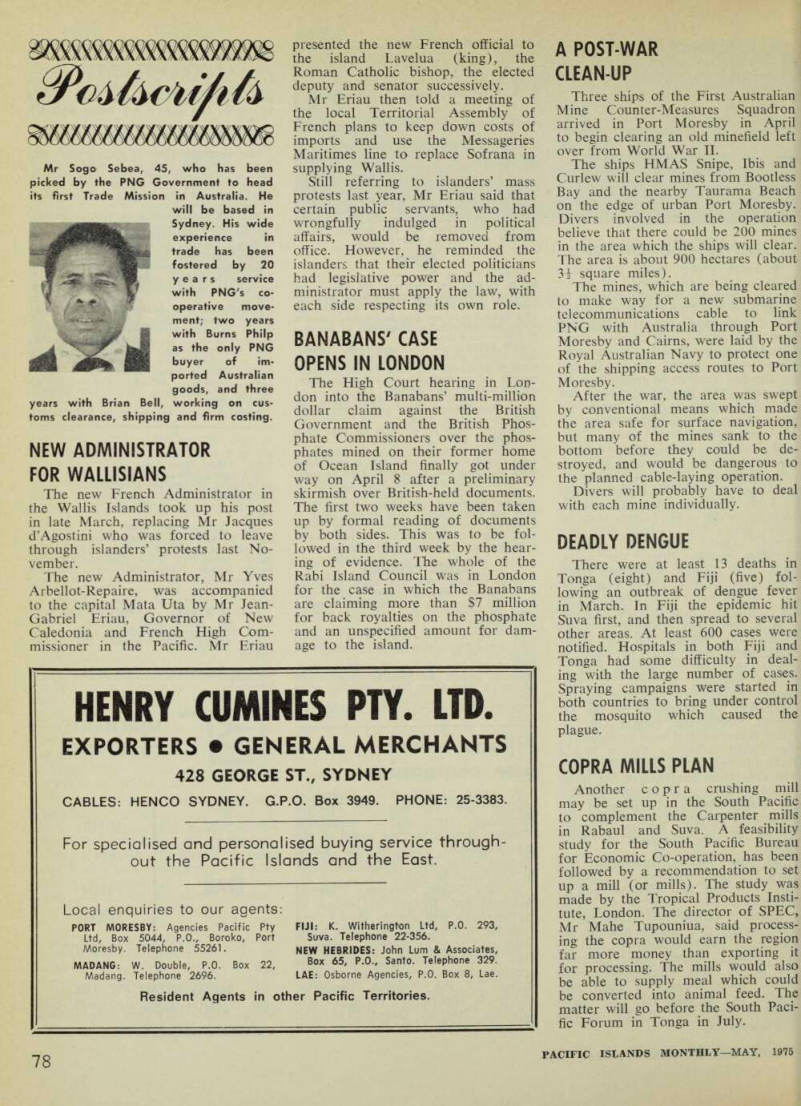
New Administrator
For Wallisians
The new French Administrator in the Wallis Islands took up his post in late March, replacing Mr Jacques d’Agostini who was forced to leave through islanders’ protests last No vember.
The new Administrator, Mr Yves Arbellot-Repaire, was accompanied to the capital Mata Uta by Mr Jean- Gabriel Eriau, Governor of New Caledonia and French High Com missioner in the Pacific. Mr Eriau
presented the new French official to the island Lavelua (king), the Roman Catholic bishop, the elected deputy and senator successively.
Mr Eriau then told a meeting of the local Territorial Assembly of French plans to keep down costs of imports and use the Messageries Maritimes line to replace Sofrana in supplying Wallis.
Still referring to islanders’ mass protests last year, Mr Eriau said that certain public servants, who had wrongfully indulged in political affairs, would be removed from office. However, he reminded the islanders that their elected politicians had legislative power and the ad ministrator must apply the law, with each side respecting its own role.
Banabans' Case
Opens In London
The High Court hearing in Lon don into the Banabans’ multi-million dollar claim against the British Government and the British Phos phate Commissioners over the phos phates mined on their former home of Ocean Island finally got under way on April 8 after a preliminary skirmish over British-held documents.
The first two weeks have been taken up by formal reading of documents by both sides. This was to be fol lowed in the third week by the hear ing of evidence. The whole of the Rabi Island Council was in London for the case in which the Banabans are claiming more than $7 million for back royalties on the phosphate and an unspecified amount for dam age to the island.
A Post-War
Clean-Up
Three ships of the First Australian Mine Counter-Measures Squadron arrived in Port Moresby in April to begin clearing an old minefield left over from World War 11.
The ships HMAS Snipe, Ibis and Curlew will clear mines from Bootless Bay and the nearby Taurama Beach on the edge of urban Port Moresby.
Divers involved in the operation believe that there could be 200 mines in the area which the ships will clear.
The area is about 900 hectares (about 3i square miles).
The mines, which are being cleared to make way for a new submarine telecommunications cable to link PNG with Australia through Port Moresby and Cairns, were laid by the Royal Australian Navy to protect one of the shipping access routes to Port Moresby.
After the war, the area was swept by conventional means which made the area safe for surface navigation, but many of the mines sank to the bottom before they could be de stroyed, and would be dangerous to the planned cable-laying operation.
Divers will probably have to deal with each mine individually.
Deadly Dengue
There were at least 13 deaths in Tonga (eight) and Fiji (five) fol lowing an outbreak of dengue fever in March. In Fiji the epidemic hit Suva first, and then spread to several other areas. At least 600 cases were notified. Hospitals in both Fiji and Tonga had some difficulty in deal ing with the large number of cases.
Spraying campaigns were started in both countries to bring under control the mosquito which caused the plague.
Copra Mills Plan
Another copra crushing mill may be set up in the South Pacific to complement the Carpenter mills in Rabaul and Suva. A feasibility study for the South Pacific Bureau for Economic Co-operation, has been followed by a recommendation to set up a mill (or mills). The study was made by the Tropical Products Insti tute, London. The director of SPEC, Mr Mahe Tupouniua, said process ing the copra would earn the region far more money than exporting it for processing. The mills would also be able to supply meal which could be converted into animal feed. The matter will go before the South Paci fic Forum in Tonga in July.
Mr Sogo Sebea, 45, who has been picked by the PNG Government to head its first Trade Mission in Australia. He
years with Brian Bell, working on cus toms clearance, shipping and firm costing.
will be based in Sydney. His wide experience in trade has been fostered by 20 years service with PNG's co operative move ment; two years with Burns Philp as the only PNG buyer of im ported Australian goods, and three
Advertisements & other items, p. 84 (1 item)
Henry Cumines Pty. Ltd.
EXPORTERS • GENERAL MERCHANTS
428 GEORGE ST., SYDNEY
CABLES: HENCO SYDNEY. G.P.O. Box 3949. PHONE: 25-3383.
For specialised and personalised buying service throughout the Pacific Islands and the East.
Local enquiries to our agents: PORT MORESBY: Agencies Pacific Pty Ltd, Box 5044, P. 0., Boroko, Port Moresby. Telephone 55261.
MADANG: W. Double, P.O. Box 22, Madang. Telephone 2696.
FIJI: K. Witherington Ltd, P.O. 293, Suva. Telephone 22-356.
NEW HEBRIDES: John Lum & Associates, Box 65, P. 0., Santo. Telephone 329.
LAE: Osborne Agencies, P.O. Box 8, Lae.
Resident Agents in other Pacific Territories.
Opposition suspended
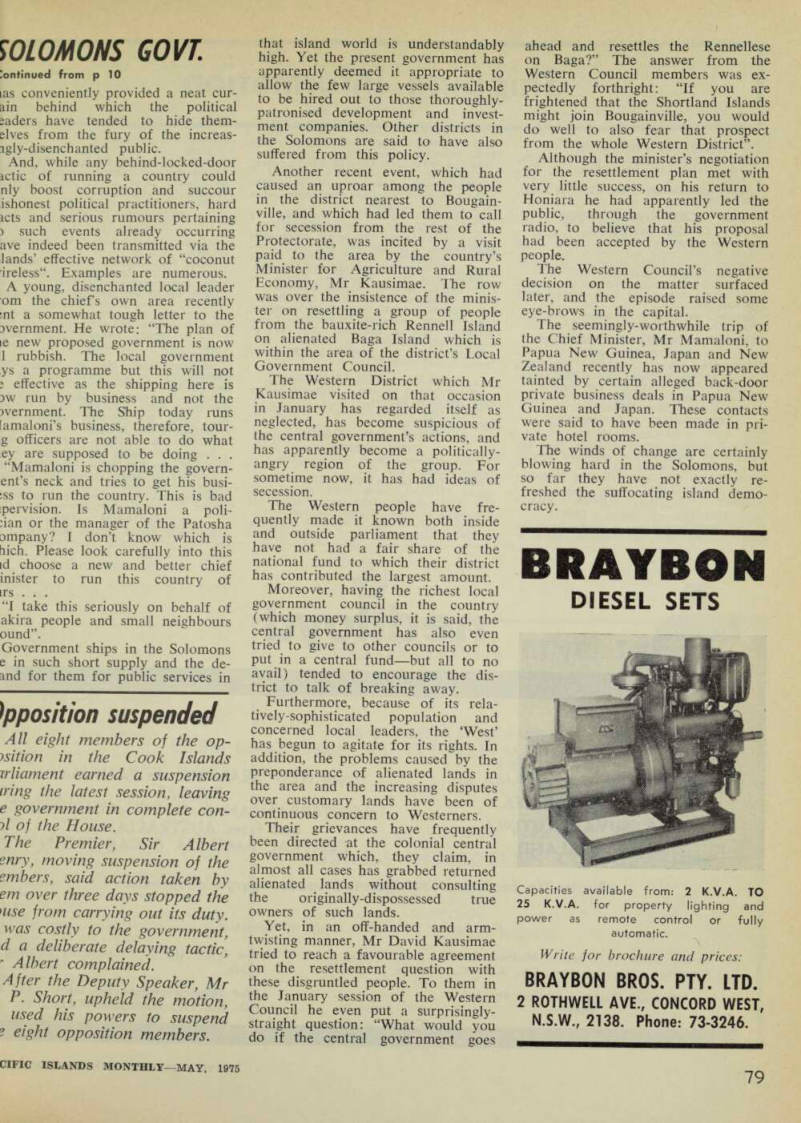
All eight members of the op isition in the Cook Islands irliament earned a suspension iring the latest session, leaving e government in complete con ?/ of the House.
The Premier, Sir Albert enry, moving suspension of the embers, said action taken by em over three days stopped the 'use from carrying out its duty, was costly to the government, d a deliberate delaying tactic, ' Albert complained.
After the Deputy Speaker, Mr P. Short, upheld the motion, used his powers to suspend ? eight opposition members.
Advertisements & other items, p. 85 (2 items)
Solomons Govt.
CIFIC ISLANDS MONTHLY-MAY, 1975
Continued from p 10
Braybon
DIESEL SETS
Capacities available from: 2 K.V.A. TO 25 K.V.A. for property lighting and power as remote control or fully automatic.
Write for brochure and prices:
BRAYBON BROS. PTY. LTD.
2 ROTHWELL AVE., CONCORD WEST,
N.S.W., 2138. Phone: 73-3246.
Shipping Information
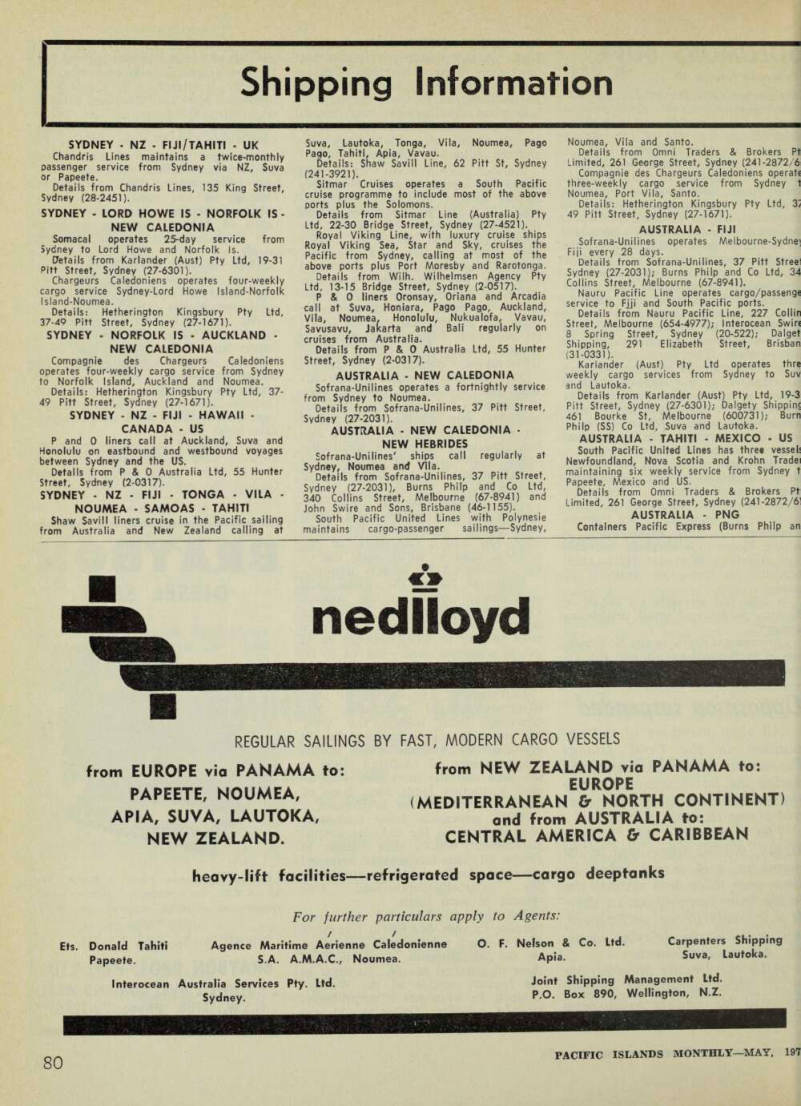
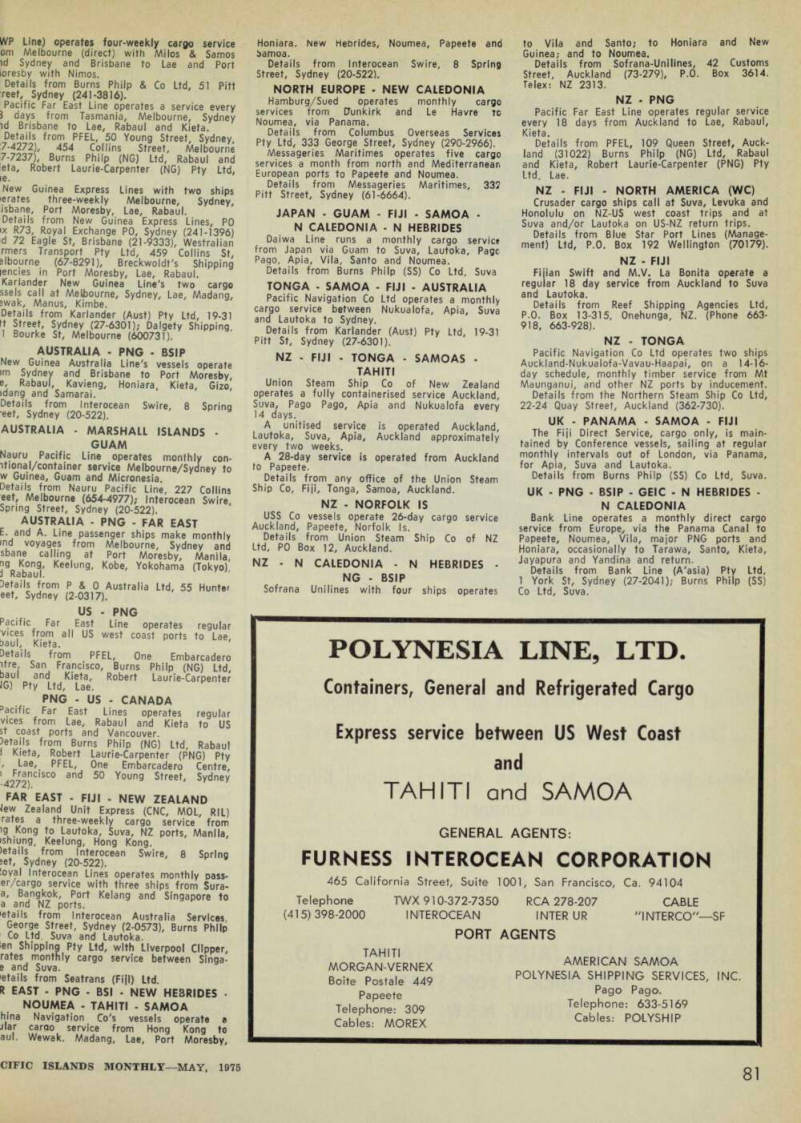
SYDNEY - NZ - FIJI/TAHITI - UK Chandris Lines maintains a twice-monthly passenger service from Sydney via NZ, Suva or Papeete.
Details from Chandris Lines, 135 King Street, Sydney (28-2451).
SYDNEY - LORD HOWE IS - NORFOLK IS -
New Caledonia
Somacal operates 25-day service from Sydney to Lord Howe and Norfolk Is.
Details from Karlander (Aust) Pty Ltd, 19-31 Pitt Street, Sydney (27-6301).
Chargeurs Caledoniens operates four-weekly cargo service Sydney-Lord Howe Island-Norfolk Island-Noumea.
Details: Hetherington Kingsbury Pty Ltd, 37-49 Pitt Street, Sydney (27-1671).
SYDNEY - NORFOLK IS - AUCKLAND -
New Caledonia
Compagnie des Chargeurs Caledoniens operates four-weekly cargo service from Sydney to Norfolk Island, Auckland and Noumea.
Details: Hetherington Kingsbury Pty Ltd, 37- 49 Pitt Street, Sydney (27-1671).
SYDNEY - NZ - FIJI - HAWAII •
Canada - Us
P and 0 liners call at Auckland, Suva and Honolulu on eastbound and westbound voyages between Sydney and the US.
Details from P & 0 Australia Ltd, 55 Hunter Street, Sydney (2-0317).
SYDNEY - NZ - FIJI - TONGA - VILA •
Noumea - Samoas - Tahiti
Shaw Savill liners cruise in the Pacific sailing from Australia and New Zealand calling at
Suva, Lautoka, Tonga, Vila, Noumea, Pago Pago, Tahiti, Apia, Vavau.
Details: Shaw Savill Line, 62 Pitt St, Sydney (241-3921).
Sitmar Cruises operates a South Pacific cruise programme to include most of the above ports plus the Solomons.
Details from Sitmar Line (Australia) Pty Ltd, 22-30 Bridge Street, Sydney (27-4521).
Royal Viking Line, with luxury cruise ships Royal Viking Sea, Star and Sky, cruises the Pacific from Sydney, calling at most of the above ports plus Port Moresby and Rarotonga.
Details from Wilh. Wilhelmsen Agency Pty Ltd, 13-15 Bridge Street, Sydney (2-0517).
P & 0 liners Oronsay, Oriana and Arcadia call at Suva, Honiara, Pago Pago, Auckland, Vila, Noumea, Honolulu, Nukualofa, Vavau, Savusavu, Jakarta and Bali regularly on cruises from Australia.
Details from P & 0 Australia Ltd, 55 Hunter Street, Sydney (2-0317).
Australia - New Caledonia
Sofrana-Unilines operates a fortnightly service from Sydney to Noumea.
Details from Sofrana-Unilines, 37 Pitt Street, Sydney (27-2031).
Australia - New Caledonia -
New Hebrides
Sofrana-Unilines' ships call regularly at Sydney, Noumea and Vila.
Details from Sofrana-Unilines, 37 Pitt Street, Sydney (27-2031), Burns Philp and Co Ltd, 340 Collins Street, Melbourne (67-8941) and John Swire and Sons, Brisbane (46-1155).
South Pacific United Lines with Polynesie maintains cargo-passenger sailings—Sydney,
Noumea, Vila and Santo.
Details from Omni Traders & Brokers Ptl Limited, 261 George Street, Sydney (241-2872/6i Compagnie des Chargeurs Caledoniens operate three-weekly cargo service from Sydney 1 Noumea, Port Vila, Santo.
Details: Hetherington Kingsbury Pty Ltd, 3/ 49 Pitt Street, Sydney (27-1671).
Australia - Fiji
Sofrana-Unilines operates Melbourne-Sydne> Fiji every 28 days.
Details from Sofrana-Unilines, 37 Pitt Street Sydney (27-2031); Burns Philp and Co Ltd, 34 Collins Street, Melbourne (67-8941).
Nauru Pacific Line operates cargo/passenge service to FJji and South Pacific ports.
Details from Nauru Pacific Line, 227 Collin Street, Melbourne (654-4977); Interocean Swire 8 Spring Street, Sydney (20-522); Dalget Shipping, 291 Elizabeth Street, Brisban (31-0331).
Karlander (Aust) Pty Ltd operates thre weekly cargo services from Sydney to Suv and Lautoka.
Details from Karlander (Aust) Pty Ltd, 19-3 Pitt Street, Sydney (27-6301); Dalgety Shipping 461 Bourke St, Melbourne (600731); Burn Philp (SS) Co Ltd, Suva and Lautoka.
AUSTRALIA - TAHITI ■ MEXICO - US South Pacific United Lines has three vessels Newfoundland, Nova Scotia and Krohn Tradei maintaining six weekly service from Sydney t Papeete, Mexico and US.
Details from Omni Traders & Brokers Pt Limited, 261 George Street, Sydney (241-2872/61
Australia - Png
Containers Pacific Express (Burns Philp an
WP Line) operates four-weekly cargo service om Melbourne (direct) with Milos & Samos id Sydney and Brisbane to Lae and Port loresby with Nimos.
Details from Burns Philp & Co Ltd, 51 Pitt reet, Sydney (241-3816).
Pacific Far East Line operates a service every 5 days from Tasmania, Melbourne, Sydney id Brisbane to Lae, Rabaul and Kieta.
Details from PFEL, 50 Young Street, Sydney, 7-4272), 454 Collins Street, Melbourne 7-7237), Burns Philp (NG) Ltd, Rabaul and eta, Robert Laurie-Carpenter (NG) Pty Ltd, New Guinea Express Lines with two ships grates three-weekly Melbourne, Sydney, isbane. Port Moresby, Lae, Rabaul.
Details from New Guinea Express Lines, PO ix R 73, Royal Exchange PO, Sydney (241-1396) d 72 Eagle St, Brisbane (21-9333), Westralian rmers Transport Pty Ltd, 459 Collins St, slbourne (67-8291), Breckwoldt's Shipping lencies in Port Moresby, Lae, Rabaul.
Karlander New Guinea Line's two cargo ssels call at Melbourne, Sydney, Lae, Madang, jwak, Manus, Kimbe.
Details from Karlander (Aust) Pty Ltd, 19-31 ft Street, Sydney (27-6301); Dalgety Shipping, 1 Bourke St, Melbourne (600731).
Australia - Png - Bsip
New Guinea Australia Line's vessels operate >m Sydney and Brisbane to Port Moresby, e, Rabaul, Kavieng, Honiara. Kieta, Gizo, idang and Samarai.
Details from Interocean Swire, 8 Spring eet, Sydney (20-522).
Australia - Marshall Islands -
Guam
Nauru Pacific Line operates monthly con ditional/container service Melbourne/Sydney to w Guinea, Guam and Micronesia.
Details from Nauru Pacific Line, 227 Collins eet, Melbourne (654-4977); Interocean Swire, Spring Street, Sydney (20-522).
Australia - Png - Far East
E. and A. Line passenger ships make monthly ind voyages from Melbourne, Sydney and sbane calling at Port Moresby, Manila , 9 Kong, Keelung, Kobe, Yokohama (Tokyo) J Rabaul.
Details from P & 0 Australia Ltd, 55 Hunter eet, Sydney (2-0317).
Us - Png
Pacific Far East Line operates regular vices from all US west coast ports to Lae, haul, Kieta.
Details from PFEL, One Embarcadero it re, San Francisco, Burns Philp (NG) Ltd ayl. anc J Kieta, Robert Laurie-Carpenter IG) Pty Ltd, Lae.
Png - Us - Canada
“acific Far East Lines operates regular vices from Lae, Rabaul and Kieta to US st coast ports and Vancouver.
Details from Burns Philp (NG) Ltd, Rabaul 1 Kieta, Robert Laurie-Carpenter (PNG) Pty , Lae, PFEL, One Embarcadero Centre, i Francisco and 50 Young Street, Sydney -4272).
FAR EAST - FIJI - NEW ZEALAND Jew Zealand Unit Express (CNC, MOL, RIL) rates a three-weekly cargo service from ig Kong to Lautoka, Suva, NZ ports, Manila, ishiung, Keelung, Hong Kong, letails from Interocean Swire, 8 Spring Jet, Sydney (20-522). foyal Interocean Lines operates monthly pass er/cargo service with three ships from Sura a, Bangkok, Port Kelang and Singapore to a and NZ ports. details from Interocean Australia Services George Street, Sydney (2-0573), Burns Philp Co Ltd, Suva and Lautoka. *n Shipping Pty Ltd, with Liverpool Clipper, rates monthly cargo service between Singa s and Suva.
'etails from Seatrans (Fiji) Ltd.
R EAST ■ PNG - BSI ■ NEW HEBRIDES •
Noumea ■ Tahiti - Samoa
hina Navigation Co's vessels operate e jlar cargo service from Hong Kong to aul. Wewak. Madang, Lae, Port Moresby,
Honiara. New Hebrides, Noumea, Papeete and s>amoa.
Details from Interocean Swire, 8 Spring Street, Sydney (20-522).
North Europe ■ New Caledonia
Hamburg/Sued operates monthly cargo services from Dunkirk and Le Havre re Noumea, via Panama.
Details from Columbus Overseas Services Pty Ltd, 333 George Street, Sydney (290-2966).
Messageries Maritimes operates five cargo services a month from north and Mediterranean European ports to Papeete and Noumea.
Details from Messageries Maritimes, 332 Pitt Street, Sydney (61-6664).
JAPAN - GUAM - FIJI - SAMOA -
N Caledonia - N Hebrides
Daiwa Line runs a monthly cargo servlet from Japan via Guam to Suva, Lautoka, Page Pago, Apia, Vila, Santo and Noumea.
Details from Burns Philp (SS) Co Ltd, Suva TONGA - SAMOA - FIJI - AUSTRALIA Pacific Navigation Co Ltd operates a monthly cargo service between Nukualofa, Apia, Suva and Lautoka to Sydney.
Details from Karlander (Aust) Pty Ltd, 19-31 Pitt St, Sydney (27-6301).
NZ - FIJI - TONGA - SAMOAS -
Tahiti
Union Steam Ship Co of New Zealand operates a fully containerised service Auckland, Suva, Pago Pago, Apia and Nukualofa every 14 days.
A unitised service is operated Auckland, Lautoka, Suva, Apia, Auckland approximately every two weeks.
A 28-day service is operated from Auckland to Papeete.
Details from any office of the Union Steam Ship Co, Fiji, Tonga, Samoa, Auckland.
Nz - Norfolk Is
USS Co vessels operate 26-day cargo service Auckland, Papeete, Norfolk Is.
Details from Union Steam Ship Co of NZ Ltd, PO Box 12, Auckland.
NZ - N CALEDONIA - N HEBRIDES -
Ng - Bsip
Sofrana Unilines with four ships operates
to Vila and Santo; to Honiara and New Guinea; and to Noumea.
Details from Sofrana-Unilines, 42 Customs Street, Auckland (73-279), P.O. Box 3614.
Telex: NZ 2313.
Nz - Png
Pacific Far East Line operates regular service every 18 days from Auckland to Lae, Rabaul, Kieta.
Details from PFEL, 109 Queen Street, Auck land (31022) Burns Philp (NG) Ltd, Rabaul and Kieta, Robert Laurie-Carpenter (PNG) Pty Ltd, Lae.
NZ - FIJI - NORTH AMERICA (WC) Crusader cargo ships call at Suva, Levuka and Honolulu on NZ-US west coast trips and at Suva and/or Lautoka on US-NZ return trips.
Details from Blue Star Port Lines (Manage ment) Ltd, P.O. Box 192 Wellington (70179).
Nz - Fiji
Fijian Swift and M.V. La Bonita operate a regular 18 day service from Auckland to Suva and Lautoka.
Details from Reef Shipping Agencies Ltd, P.O. Box 13-315, Onehunga, NZ. (Phone 663- 918, 663-928).
Nz - Tonga
Pacific Navigation Co Ltd operates two ships Auckland-Nukualofa-Vavau-Haapai, on a 14-16day schedule, monthly timber service from Mt Maunganui, and other NZ ports by inducement.
Details from the Northern Steam Ship Co Ltd, 22-24 Quay Street, Auckland (362-730).
UK - PANAMA - SAMOA ■ FIJI The Fiji Direct Service, cargo only, is main tained by Conference vessels, sailing at regular monthly intervals out of London, via Panama, for Apia, Suva and Lautoka.
Details from Burns Philp (SS) Co Ltd, Suva.
UK - PNG - BSIP - GEIC - N HEBRIDES -
N Caledonia
Bank Line operates a monthly direct cargo service from Europe, via the Panama Canal to Papeete, Noumea, Vila, major PNG ports and Honiara, occasionally to Tarawa, Santo, Kieta, Jayapura and Yandina and return.
Details from Bank Line (A'asia) Pty Ltd, 1 York St, Sydney (27-2041); Burns Philp (SS) Co Ltd, Suva.
EUROPE - TAHITI - W SAMOA - FIJI •
N Caledonia
Nedlloyd offers regular cargo services fromi Northern Europe and UK to Papeete, Apia, Fiji! and New Caledonia.
Details: Interocean Aust. Services Pty Ltd, 261 George Street, Sydney (2-0573).
US - A. SAMOA - NZ - AUSTRALIA Pacific Far East Line LASH ships operate regularly from US to Australia, via Pago Pago and Auckland, returning same route.
Details from PFEL, 50 Young Street, Sydney (27-4272), 454 Collins Street, Melbourne (67-7237), One Embarcadero Centre, San Francisco (576-4000), 109 Queen Street, Auck land (31-022), Kneubuhl Maritime Services, Pago Pago (32-617).
US - SYDNEY - GEIC - HONOLULU Columbus Lines operates a three weekly container cargo sailing from West Coast, US to Australasia, returning via Tarawa, GEIC and Honolulu to Nth America.
Details from Columbus Overseas Services Pty Ltd, 333 George Street, Sydney (290-2966).
Us - Fiji/Tahiti - Australia
Bank Line Ltd operate regular cargo set vices from US Gulf ports to Australia and NZ.
Calls at Suva, Lautoka and Papeete on demand.
Details from Bank Line (A/asia) Pty Ltd, 1 York St, Sydney (27-2041).
Pacific Far East Line cruise ships operate regularly from San Francisco, Los Angeles, Honolulu, Moorea, Papeete, Rarotonga, Auck land, Opua, Sydney, and return via Suva, Niuafoou, Pago Pago and Honolulu to San Francisco.
Freight is carried on these passenger liners.
Details from PFEL, 50 Young Street, Sydney (27-4272).
Us - Tahiti - Samoa
Pacific Islands Transport operates a five/six weekly cargo service from North American west coast ports to Papeete, Pago Pago, Apia.
Details from Trans-Austral Shipping Pty Ltd, 19 Pitt Street, Sydney (27-2441),.
Sound waves
to catch fish
Australian scientists working in
French Polynesia are reportedly
making progress in the use of under water sound emissions to attract and
repel fish.
The research, in the Rangiroa lagoon, is being directed by Mr Theo W. Brown and sponsored by about 50 French and foreign companies.
The aim is to aid the fishing industry on the one hand and safeguard human lives (against sharks) on the other.
Main problem has been that fish may finally become conditioned to the sounds and no longer make the
appropriate approach or withdrawal.
However, it is reported that this diffi
culty is being overcome, particularly
in regard to the attracting process, so that the scientists are able to attract shoals of several thousand fish and control their movements for several hours on end.
These results could be revolu
tionary for the fishing industry, al
though they inevitably raise the
problem of over-exploitation of the sea.
Advertisements & other items, pp. 86-88 (2 items)
nedlloyd
REGULAR SAILINGS BY FAST, MODERN CARGO VESSELS from EUROPE via PANAMA to:
PAPEETE, NOUMEA,
APIA, SUVA, LAUTOKA,
NEW ZEALAND.
from NEW ZEALAND via PANAMA to:
EUROPE
(MEDITERRANEAN & NORTH CONTINENT)
and from AUSTRALIA to:
CENTRAL AMERICA & CARIBBEAN
heavy-lift facilities —refrigerated space—cargo deeptanks For further particulars apply to Agents: Ets. Donald Tahiti Agence Maritime Aerienne Caledonienne O. F. Nelson & Co. Ltd.
Papeete. S.A. A.M.A.C., Noumea. Apia.
Carpenters Shipping Suva, Lautoka.
Interocean Australia Services Pty. Ltd.
Sydney.
Joint Shipping Management ltd.
P.O. Box 890, Wellington, N.Z.
POLYNESIA LINE, LTD.
Containers, General and Refrigerated Cargo
Express service between US West Coast
and
TAHITI and SAMOA
GENERAL AGENTS;
FURNESS INTEROCEAN CORPORATION
465 California Street, Suite 1001, San Francisco, Ca. 94104 Telephone TWX 910-372-7350 RCA 278-207 CABLE
(415)398-2000 INTEROCEAN INTER UR "INTERCO"—SF
PORT AGENTS
TAHITI
MORGAN-VERNEX
Boite Postale 449 Papeete Telephone: 309 Cables: MOREX
AMERICAN SAMOA
POLYNESIA SHIPPING SERVICES, INC,
Pago Pago.
Telephone: 633-5169 Cables: POLYSHIP
THE
GLOBAL SERVICE FOR SHIPPERS
LINE
MONTHLY SERVICES
United Kingdom and Continent to: Papeete, Noumea, New Hebrides, Papua New Guinea and Solomon Islands.
Papua New Guinea to: North America, United Kingdom and Continent.
Solomons, Fiji, Tonga, Samoa and Tarawa to: United Kingdom and Continent.
For particulars apply:
THE BANK LINE (AUSTRALASIA) PTY. LTD.,
18TH FLOOR, 1 YORK STREET,
SYDNEY, N.S.W.
81
CIFIC ISLANDS MONTHLY—MAY, 1975
October 1
Ellice goes it alone on October 1
The constitutional separation of he Gilbert Islands from the Ellice slands will take place on October when the Ellice people will change he name of their new state to Tu alu. There will be two separate louses of Assembly with the Ellice jgislature meeting at Funafuti, /hich has been made the capital.
These decisions were reached fter a conference at Bairiki in late larch under the chairmanship of ie GEIC Governor, Mr John Smith.
The British Government was by Mr E. W. Bullock, ead of the Pacific Dependent Terri fies Department in the Foreign and Commonwealth Office, and his de uty, Mr R. G. Pettitt, and the Ellice eople were represented by the lembers of the Ellice Separation Committee, who are members for the llice constituencies in the present louse of Assembly.
After October 1 they, together ith some ex-officio members, will )rm the Tuvalu House of Assembly, lections will follow within two jars of the coming into force of le constitutional order for the sepa ttion. There will be three ministers, nly, including the Chief Minister, ho will be elected. The administra on of both territories will remain i at present with existing ministries itil the year-end.
Ellice hopes that Britain would t up a Tuvalu Reserve Fund be mse the Ellice people will not get share of the present colony’s re rve fund were dashed. The British degation rejected the idea, saying at as Tuvalu will be grant-aided, e British Government would be luctant to give the Tuvalu Govern ent money for such a fund.
The Ellice people were assured at Britain would not leave the new ition in the lurch, the British presentatives saying that, while ey were not in a position to make m commitments about future lancial aid, finance would be pro- Jed for capital projects as well as r the recurrent costs of govern jnt.
On the question of the rights of lice people who had established smselves permanently in the Gil rts, GEIC’s Chief Minister, Mr aboua Ratieta, said that Ellice °ple applying for “belonger” itus in the Gilberts would be :ated as Gilbertese.
Islands People
Deaths of Islands People
Inspector A. Harris Inspector Albert Harris, who was a member of the Nauru Police Force for about 42 years, died recently, aged 60. He joined as a bugler in 1933, and served in several capa cities, including station sergeant and police prosecutor. He was awarded three good conduct badges and the Police Long Service and Good Con duct Medal. He also served as Re gistrar of the District Court, Regis trar of the Central Court, Registrar of the Court of Appeal, Registrar of Motor Vehicles, Collector of Cus toms and Film Censor. Several times he acted as Director of Police, His funeral was attended by a cabinet minister, parliamentarians, senior members of the public service, and executives of the British Phos phate Commission.
Mr C. Nisak Mr Charlie Nisak, vice-president of Dillon’s Bay local council, New Hebrides, died in March after being attacked by a wild boar. He was 60.
Mr Nisak was the biggest landowner in the district, and a sandalwood cutter. He was a deacon of the Pres byterian Church. Mr Nisak left four daughters and three sons,
Mr Joly
Mr Joly, who went to the New Hebrides in 1958 as a policeman, died recently, aged 52. He remained a policeman till 1965, when he re turned to France. He went back to the New Hebrides in 1966 as chief employer with UNELCO Co, Vila.
He took a keen interest in sport, and was president of the New Heb rides Basketball Federation.
Mrs K. Tariu Mrs Kakepare Tariu, known at Tekura Pivai, of Atiu, Cook Islands, died recently, aged 101. She is sur vived by four children, and more than 20 grandchildren and great grandchildren.
Mr A. Deffargue Mr Andre Deffargue, 42, who went to the New Hebrides about three months ago to work for Air Mela nesiae, was drowned recently at Rentabou beach. He went into the water to help one of his children, who appeared to be in difficulties.
The child was able to get to shore.
Mr Deffargue left a wife and three children.
Advertisements & other items, pp. 89-92 (4 items)
83
CIFIC ISLANDS MONTHLY—MAY, 1975
Line Advertisements
Per line, $2.50 Aust.
Minimum rate, 4 lines.
AMERICAN, 27 yrs, USAP pilot, 3 years flying in Pacific. Civil Engineer—B.S., M.S., International Relations—M.A.
Speaks French, Portuguese, Spanish.
French, Swiss Universities. Seeks position with varied responsibilities. Available July. Clifford King, 814 High Avenue, Redlands, California, U.S.A.
USED STAMPS WANTED. Foreign stamps of all kinds—No United States stamps please—will pay $7.00 Aust. per lb stamps —for large quantities please contact— Send to: Tobey Huff, Box 878, Goroka E.H.D., Papua New Guinea.
If you have shells to sell —any quantity —contact Anisa Commodity Traders Pty.
Ltd., P.O. Box 1413, Lae, Papua New Guinea, Phone 424159. We are buyers of Trochus, Greensnail, Blacklip MOP, Goldlip MOP, and Marine Specimens. Best prices paid. Rabaul agents: Gazelle Agencies Pty. Ltd., P.O. Box 262, Rabaul, P.N.G. Phone: 921397. Manus Island Agents, R. L. & V. J. Knight, P.O. Box 108, Lorengau, Manus Island, P.N.G.
Phone: 38.
CONCRETE BLOCK MACHINES. Makes
blocks, flags, edgings, screen-blocks, garden stools—up to 8 at once and 96 an hour. $179.00 c.i.f. main ports. Send for leaflets. Forest Farm Research, Londonderry, N.S.W., 2753.
KIKUYU GRASS CERTIFIED SEED for
sale A 53.00 per lb. For supplies and information about this highly nutritious and abundantly productive grazing grass write to ROY EYKAMP, Quirindi, N.S.W., Australia, 2343. Phone Quipolly, 466541.
BARGE FOR SALE —Just completed 26 ft x 9 ft x 3 ft freeboard —Va inch solid fibreglass construction—built-in buoyancy.
Loading-door-ramp. Basic price $15,000.
Contact Honiara Fibreglass, P.O. Box 99, Honiara, Guadalcanal, 8.5.1.
FOR SALE SPERM WHALE’S TEETH.
Suitable for jewellery manufacturers, carvers, collectors, souvenir retail, etc.
Kampf & Co., 27 Urawa Road, Duncraig, W.A. 6023, Australia.
KEEPING BABY
HAPPY & WELL-
By giving your baby a Fisher's Teething Powder as needed, you not only keep the little one happy and well, but save yourself all those upsets and nervous tension that beset a mother when baby suffers distress. If used as directed Fisher's Teething Powders quickly and safely soothe baby's sore gums, digestive disorders and intestinal upsets.
Get a packet from your chemist or store today—only 30c for 20 powders —you'll be so glad you did. Fisher & Co., Manufacturing Chemists (Est. 1876), 17 May St., St. Peters, N.S.W. 2044.
PIM 808/72
n §s) (s) LnnJ §e) ra §s) LrmJ §s)
DATELINE HOTEL
TONGA ™
Friendly Hotel” of the "Friendly Islands' Situated along the Nukualofa waterfront. Only five minutes walk from town. Single, double, family suites, airconditioning, and hot and cold water showers. Pool, bar, restaurant, duty-free shop, tour desk and boutique.
Book through your travel agent or write to International Dateline Hotel, P.O. Box 62, Nukualofa Tonga.
Cable Address: "DATELINE".
Represented Overseas by: Charles J. Henry and Associates Pty. Ltd.
Sydney and Melbourne. 797
SOUTHERN PACIFIC INSURANCE
COMPANY (PNG) LIMITED
(INCORPORATED IN PAPUA NEW GUINEA)
HEAD OFFICE: BANK HAUS, CHAMPION PDE. P.O. BOX 136 PORT MORESBY, PAPUA NEW GUINEA. PH. 2623 • FIRE • FIRE AND VOLCANIC ERUPTION • HOUSEHOLD COMPREHENSIVE • MOTOR VEHICLE • COMPULSORY THIRD PARTY • COMPULSORY WORKERS COMPENSATION
MARINE • PUBLIC LIABILITY • BURGLARY
Enquiries are invited for all classes of Insurance from special representatives at: PORT MORESBY: H. A. McKEE, General Manager, Champion Pde., P.O. Box 136, Ph. 2623 or 2075. LAE: K. J. ARMSTRONG, Manager for Lae, Central Ave, P.O. Box 758, Ph. 42-4590 or 42-4256. RABAUL: R. H. MEYER, Manager for Rabaul, Mango Ave., P.O. Box 123, Ph. 92-2417 or 92-2755. $ m!
ffl
ELECTRONIC COMPONENTS
EXPORTERS, AAANUFACTURERS,
GENERAL MERCHANTS,
WHOLESALERS, IMPORTERS
• All enquiries answered • Keen prices • Prompt delivery Contact us for any requirement.
ELECTRONIC EXPORTS A'ASIA PTY. LTD.,
G.P.O. Box 1365, Brisbane, Q., 4101.
Telegraphic: SZEKELY, Brisbane.
PARK VIEW MOTEL—BRISBANE
Quiet location—opp. Botanic Gardens.
Single, double, family suites, all with refrig., air conditioning, phone, TV, radio, tea making facilities, from $l2. Pool and restaurant.
Phone 31-2695—Telex 40270.
Write for coloured brochure— Park View Motel, 128 Alice St, BRISBANE, Old., 4000.
3007
Stay at
Aggie Grey's the
South Pacific's legendary hotel Situated right in the heart of Western Samoa. Enjoy Polynesian-style friendliness and service, in cool surroundings, superb entertainment and food. Magnificent white sand beaches only a short drive away.
Aircondifoned rooms, swimming pool and full bar facilities.
Bookings through Union Steamship Company of N 2, Pan Am, Air New Zealand or direct to Aggie Grey's, Apia, Western Samoa. Cables: AGGIES, APIA.
SUCCEED as an ACCOUNTANT
QUALIFY by AIRMAIL
Qualified accountants are always in demand. British qualifications are recognised world-wide. SOA has helped over 100,000 students to success in leading exams-ACCA,
ACMA, ACIS AAIA, ASCA,
GCE etc. Let tne experts help you.
Send for FREE details of guaranteed airmail tuition.
A ccredited by the Council for the A ccreditation of Correspondence Schools. mi
The School of Accountancy
& Business Studies ESI. 19*0
140 House,
London SWB 4UJ. ENGLAND.
START YOUR OWN SOFT
DRINK FACTORY
One complete 8 Head Semi-automatic bottling line including:
3 TRACK WASHER WITH AUTO-
MATIC UN LO ADE R
CONVEYOR CHAINS
8 HEAD PROGRESSIVE MACHINE
AND ESSENTIAL ANCILLI ARIES
Plant in perfect condition. Sale due only to takeover.
PRICE COMPLETE (A)510,250
Ex Ipswich Also 3,000 dozen stock 7 oz bottle and cases valued at deposit rates.
PHONE (072) 81 2044
McMahon's Soft Drinks Pty. Ltd., West Street, IPSWICH Old. 4305.
Primitive luxury
(Polynesian style) Nestled away In the untouched Kingdom of Tonga is new, luxurious "Port of Refuge" International resort. Here Is a unique opportunity for your clients to experience the tranquil and relaxed Tongan atmosphere while they enjoy the picturesque surroundings of the new "Port of Refuge". And only a short flight from Fiji.
Reasonable tariffs from $17.50 with special concessions for children. Agents commission 10 per cent.
Tonga's
Port of Refuge
INTERNATIONAL RESORT U
Uava’u Tonga Cables: "Refuge" Tonga or "Tongatours"
Sydney. Phone: Sydney 85-1603 or 922-1817
PUBLISHED SOON
. . . a significant addition to Pacific historical literature Robert Langdon's controversial new book:
The Lost Caravel
More details in next month's PIM.
COLOURFUL MAPS OF NORFOLK ISLAND AND
LORD HOWE ISLAND
Big fold-out maps in colour showing main points of interest in these islands —both attractive tourist destinations.
Produced by Pacific Maps, and available direct from Pacific Publications (Aust) Pty Ltd, Box 3408 GPO, Sydney 2000, at $1 each or $1.25 each posted.
Our business is cargo.
Your cargo; to anywhere in our Pacific Two paddle steamers on the Yangtse River in 1873 marked , he beginning of the China Navigation Company. Today, the same lag hies above eighteen modern motor ships plying an extensive letwork of cargo routes between Papua New Guinea and Pacific S u P °i rtS i as far East as Tahiti ) an d Japan, New Zealand, Australia ind Thailand.
For 100 years, the flag of the China Navigation Company has neant experience, reliability and speed across the sea. Today, it’s lying as strong as ever. ‘ baUl ’^*' a ®" r "” d ‘ScivuLg B FH? Mor P “s“ Sdstom Ud Sle |'” Shl L S 7 v“ n w C °' Lld " P ° r ' Moresb V- Samatai, Lae. Madang, mga: Morris Hedstrom Ltd Nukualofa and Vava'u Tahiti- Donafd Tahlt; S p UVa ’ aut ° ka - Western Samoa: Morris Hedstrom Ltd., Apia. 5.1. P.: British Solomons Trading Co. Ltd., Honiara New Hebrides-1 d Tahltl ’ ,^ apeat ® New Caledonia: Etablissements Ballande, Noumea, nre Pty Ltd. Melbourne: Interocean Australia Services Pty Ltd wn, r®? He b ndes -YdaandSanto AUSTRALIA-Sydney; Interocean ickland, Wellington, Christchurch Dunedin Rlnff i ' V ' Lt c • w‘lf* Wllls ' Gilchrist & Sanderson Pty. Ltd. NEW ZEALAND—P &O(N Z 1 Ltd Swire, 9 Connaught Rd„ ? ,apa " ! SW,Fe McK,nnon ’ T ° k V°’ Yokohama. Osaka, Kobe and Nagoya. Eastern Managers: BuUerfidd JOHN SWIRE & SONS PTY. LTD. General Agents in Australia, 8 Spring Street, Sydney, Phone- 27 9351
THE CHINA NAVIGATION CO LTD
MEMBER OF THE SWIRE GROUP. -U X XJ CN co
m a»i«t tuss i V \ ’I V 4' "V r ■ in I if U 5
yWj *st.
' f V 'l* « Pi^i And wherever you’ll go in over 120 nations throughout the world you’ll find proud DATSUN drivers.
Perhaps the main reason is that DATSUN was designed to meet a wide variety of conditions—mountain roads and super highways, blistering suns and freezing temperatures, DATSUN is indeed the international car that has precision engineering and a stunning string of rally victories behind it.
Its superb handling, safety features and high speed efficiency make DATSUN the choice of young and old alike. DATSUN-the car that really satisfies the world over.
DATSUN
NISSAN
\ DATSUN distributor network covers the following areas: 53 Fiji*T,P.N.G,*W, Samoa* New Caledonia• New Hebrides* B.S.l.P.‘Timor*Norfolk- W 4. Samoa* Tahiti * Cook • Nauru* Tonga* Saipan»Guam ♦ Australia* New Zealand
84
Published by PACIFIC PUBLICATIONS (AUST.) PTY. LTD. 29 Alberta Street, Sydney, 2000 (Telephone: 61-9197).
Printed by Mastercraft Printing, 39 Collins Street, Alexandria, NSW, 2019.
REGISTERED AT THE OPO SYDNEY FOR TRANSMISSION BY POST AS A NEWSPAPER CATEGORY B * Australian price given on the front cover is recommended Australian retail price only.