Fdgadgstrer

Advertisements & other items, p. 2 (1 item)
shouldn’t be cheap.
An economy car
TOYOTA COROLLA
We put more than economy into a Toyota.
We build them to be comfortable. We build them to be safe.
And we build them very carefully ... so that they*!! last.
Before you buy your next car, check with your Toyota dealer. He has a lot of economical models to choose from.
But no cheap ones.
7 *
TOYOTA 1000
TOYOTA CORONA
TOYOTA CELICA
TOYOTA MARK II
TOYOTA
PAPUA. NEW GUINEA: ELA MOTORS LIMITED. Scratchley Rd„ Badili, Papua. U.S. TRUST TERRITORY: MICROL CORPORATION, P O. Box 267, Saipan. FIJI ISLANDS: AUTOMOTIVE SUPPLIES CO LTD GP O Box 355 Suva. AMERICAN SAMOA: BURNS PHILP (SOUTH SEA) CO., LTD., Pago Pago. WESTERN SAMOA: BURNS PHILP (SOUTH SEA) LTD .P O Box 188, Apia GUAM RICKV : S AUTO CO. P. 6. Box 1458, Agana. NEW HEBRIDES: NEW HEBRIDES MOTORS LTD P.O. Box 18, Vila. SOLOMON ISLANDS: MENDANA ENTERPRISES (5.1.), LTD.
P O Box 1 74, Honiara TAHITI: NIPPON AUTOMOTO, B.P. 545, Papeete COOK ISLANDS: COOK ISLANDS TRADING CORPORA 7 lON LTD . P O Box 92, Rarotonga NAURU ISLAND NAURU COOPERATIVE SOCIETY GILBERT & ELLICE ISLANDS COLONY: TARAWA MOTORS, Box 36. Bairiki Tarawa. NORFOLK ISLAND: MARIE'S NORFOLK TOURS, LTD P.O. Box 276 TIMOR: SANG TAI HOO, Sang Tai Building, Dili NEW CALEDONIA: SOCIETE IMPORTATION AUTOMOBILE DU PACIFIQUE. Pond-Point du Pac;‘;c (Station Total) B.P 438, Noumea
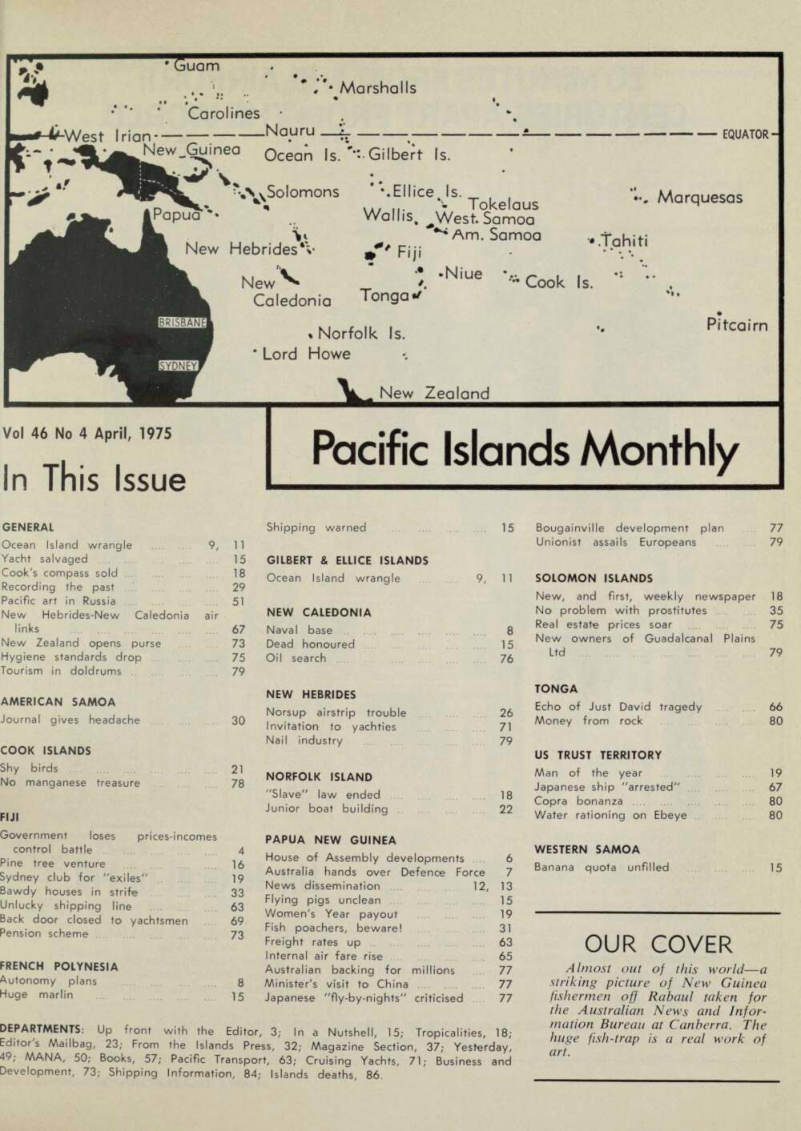
In This Issue
General
Ocean Island wrangle 9, 11 Yacht salvaged 15 Cook's compass sold 18 Recording the past 29 Pacific art in Russia 51 New Hebrides-New Caledonia air links 67 New Zealand opens purse 73 Hygiene standards drop 75 Tourism in doldrums 79
American Samoa
Journal gives headache 30
Cook Islands
Shy birds 21 No manganese treasure 78
Fiji
Government loses prices-incomes control battle 4 Pine tree venture 16 Sydney club for "exiles" 19 Bawdy houses in strife 33 Unlucky shipping line 63 Back door closed to yachtsmen 69 Pension scheme 73
French Polynesia
Autonomy plans 8 Huge marlin 15
Shipping warned 15
Gilbert & Ellice Islands
Ocean Island wrangle 9, 11
New Caledonia
Naval base 8 Dead honoured 15 Oil search 76
New Hebrides
Norsup airstrip trouble 26 Invitation to yachties 71 Nail industry 79
Norfolk Island
"Slave" law ended 18 Junior boat building . 22
Papua New Guinea
House of Assembly developments 6 Australia hands over Defence Force 7 News dissemination 12, 13 Flying pigs unclean 15 Women's Year payout 19 Fish poachers, beware! 31 Freight rates up 63 Internal air fare rise 65 Australian backing for millions 77 Minister's visit to China 77 Japanese "fly-by-nights" criticised 77
Bougainville development plan 77 Unionist assails Europeans 79
Solomon Islands
New, and first, weekly newspaper 18 No problem with prostitutes 35 Real estate prices soar 75 New owners of Guadalcanal Plains Ltd 79
Tonga
Echo of Just David tragedy 66 Money from rock 80
Us Trust Territory
Man of the year 19 Japanese ship "arrested" 67 Copra bonanza 80 Water rationing on Ebeye 80
Western Samoa
Banana quota unfilled 15
DEPARTMENTS: Up front with the Editor, 3; In a Nutshell, 15; Tropicalities, 18; Editors Mailbag, 23; From the Islands Press, 32; Magazine Section, 37; Yesterday, 49; MANA, 50; Books, 57; Pacific Transport, 63; Cruising Yachts, 71; Business and Development, 73; Shipping Information, 84; Islands deaths, 86.
Advertisements & other items, p. 4 (1 item)
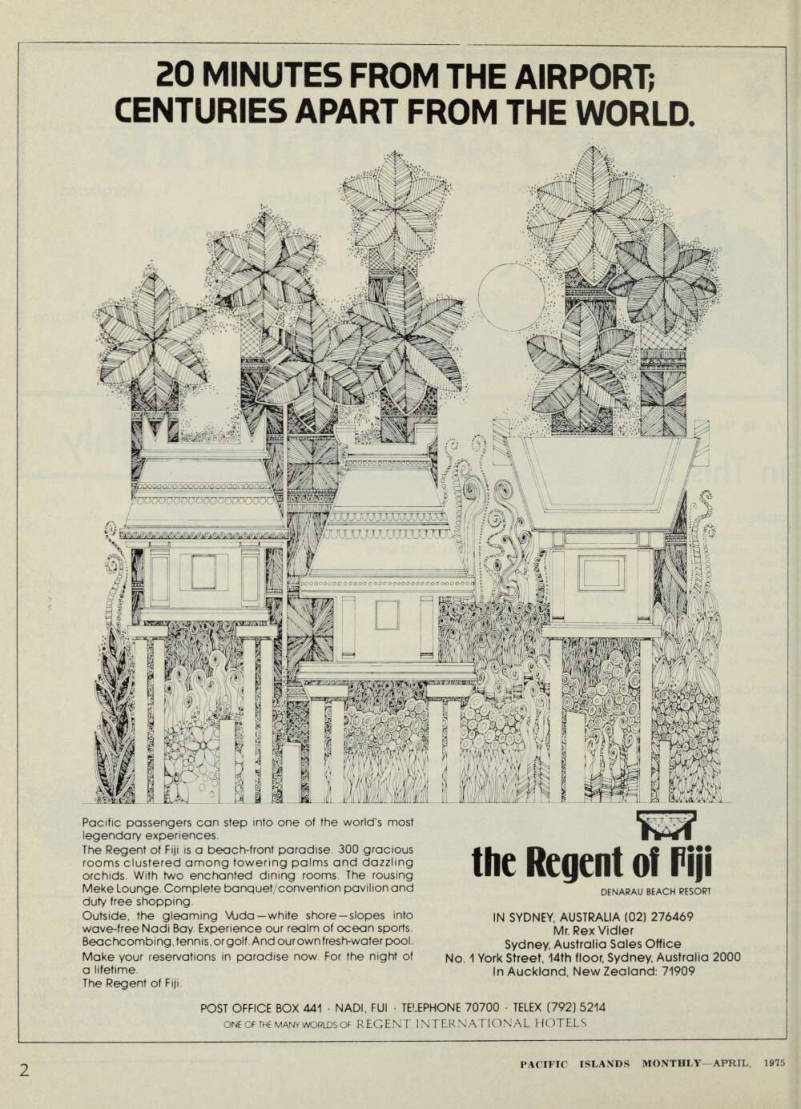
the Regent of Fiji
20 MINUTES FROM THE AIRPORT;
CENTURIES APART FROM THE WORLD
U - „ Pacific passengers can step into one of the world’s most legendary experiences.
The Regent of Fiji is a beach-front paradise. 300 gracious rooms clustered among towering palms and dazzling orchids. With two enchanted dining rooms. The rousing Meke Lounge. Complete banquet/convention pavilion and duty free shopping Outside, the gleaming Mjda—white shore—slopes into wave-free Nadi Bay. Experience our realm of ocean sports.
Beachcombing, tennis, orgolf. And ourown fresh-water pool Make your reservations in paradise now. For the night of a lifetime.
The Regent of Fiji.
the Regent of Fiji
DENARAU BEACH RESORT
IN SYDNEY, AUSTRALIA (02) 276469
Mr. Rex Vidler Sydney, Australia Sales Office No. 1 York Street, 14th floor, Sydney, Australia 2000 In Auckland, New Zealand: 71909 POST OFFICE BOX 441 • NADI, FUI ■ TELEPHONE 70700 ■ TELEX (792) 5214 ONE OF THE MANY WORLDS OF REGENT INTERNATIONAL HOTELS
Pacific Islands
Monthly
FOUNDED BY R. W. ROBSON IN 1930
Published Monthly By
Pacific Publications (Aust.) Pty. Ltd.,
29 Alberta St., Sydney, N.S.W., 2000.
Postal Address: G.P.O. BOX 3408, SYDNEY,
N.S.W., 2001.
Telegraphic Address: PACPUB, Sydney.
Telex 25168.
Telephones: 61-9197, 61-7101, 61-4369.
Consulting Directors: R. W. Robson, Judy Tudor.
Chief Executives; Manager: Selwyn Hughes.
Publisher: Stuart Inder.
Director of Advertising; W. A. Gasnier.
Pacific Islands Monthly
Editor: Stuart Inder.
Assistant Editor: John Carter.
Advertising Manager: W. A. Gasnier.
Circulation Manager: Jill Garland.
Subscription Rates:
"Pacific Islands Monthly" is airfreighted to the majority of subscribers and agents in the Pacific Islands and the U.S.A.; copies to the Cook Islands, Nauru, Niue, Micronesia and Guam go by surface mail.
Australia (including Lord Howe and Thursday Islands), New Zealand, Papua New Guinea, Fiji, New Hebrides, Tonga, Cook Islands, Western Samoa, Gilbert & Ellice Islands, Norfolk Island, Niue and Nauru: $9.00 (local currency); Solomon Islands: $lO.OO Aust., American Samoa, Micronesia and Guam: $12.00 US; Hawaii and US Mainland: $15.00 US; New Caledonia and French Polynesia: 1,500 CFP; United Kingdom: £6.50; Japan: 4,000 Yen.
Elsewhere $11.50 Aust.
Representatives
Fiji: Advertising and Distribution—Fiji Times & Herald Ltd., 20 Gordon St., Suva. Telephone: 25-601. Telex.: FJ 2124.
Papua New Guinea: PORT MORESBY, PNG Print ing Co. Pty. Ltd., P.O. Box 633; LAE, P.O. Box 227; RABAUL, Mr. David Simpson, P.O. Box 164 (c/- Rabaul Photographic. Tel.: 2677.) French Polynesia. Distribution—Hachette Paci ique, 10 Ave Bruat, Papeete.
New Zealand: Pacific Publications, C.P.O. 3ox 2229, Auckland.
Jnited Kingdom: Advertising—Overseas Publicity .td., 214 Oxford Street, London, WIN OEA. ’hone: 01-636 8296/7. Subscriptions—T. B.
Jraham, Park House, 22 Park Street, Croydon.
Cr9 3Np. Tel.: 01-6884177.
lapan: Advertising—Universal Media Corpora tion, C.P.O. Box 46, Tokyo. Tel.: 666-3036.
Victoria: Advertising Pacific Publications Aust.) Pty. Ltd., Herald & Weekly Times Juildmg, 2nd Floor, 61 Flinders Lane, Mel lourne, 3000. Telephone: 652-1565. lawaii and U.S. Mainland only: N. Grogan 1354 Hayden Street, Honolulu, 96815.
Send change of address notices. Form 3579 md new subscriptions to P.O. Box 2193, Honolulu, Hawaii, U.S.A. 96805). lecond class postage paid at Honolulu, Hawaii.
Copyright ©, 1975, Pacific Publications (Aust) Pty. Ltd.
April, 1975 Vol. 46, No. 4
Up Front
with the Editor
It is now 10 years since my wife Jo, 1 and our young family were enjoying a holiday in a beach cot tage at Korotoga, Fiji, when we had an unexpected visitor. He introduced himself as the Rev. Tebuke Rotan, a Banaban from the island of Rabi, in the Fiji group, and said he had come from Rabi especially to appeal to me to visit his island and talk to the people “so PIM can tell the world about our plight”.
He pleaded, “Come and write the truth about how our people have nothing, and live on unripe bread fruit and boiled bananas. Come and learn how we are the owners of a rich phosphate island, yet all the riches are given to people who have nothing to do with us!” 1 knew Rabi only as a small island out towards Taveuni, which had been settled by people from Ocean Island, in the Gilbert and Ellice Islands Colony. I didn’t know until then that they were called Banabans, after the native name of Ocean Island, Banaba. But all of us soon got to know a lot more about the Banabans, because our visitor was so insistent that I must pay them a visit that a few days later we packed our bags and took a bus to Suva, a plane to Savusavu, a rented car 2J hours up the Hibiscus High way to Buca Bay, and finally a launch five miles across the Georgia Channel to Rabi, high and wooded.
Never have I been received so warmly anywhere. The children, then at an impressionable age, ate their first octopus and breadfruit and saw their first “real” island dancing, at which they were guests of honour.
All of us made friendships which still endure. But the children were asleep, exhausted, the night the Rabi Island Council held a full council meeting in the main room of the comfortable house the council had generously provided us with, which went on into the early hours. At that meeting the islanders, led by Tebuke’s father, the impressive Ro tan Tito, then 62, left Jo and me in no doubt about the depth of their belief that the Banabans had been cheated of a rightful share of their
birthright by the British Government, and the British Phosphate Com missioners who mined the rich phosphate for Britain, Australia and New Zealand.
Their resentment went right back to the beginning of mining on Ocean Island. One bitter aspect of it was that, in the words of Rotan Tito, they felt they were still “treated like primitive savages” by Britain, who refused even to have them pre sent at the occasional talks between the BPC and the GEIC Government on phosphate royalties and mining plans for the island.
In Suva 1 could find no officials who took the Banabans’ complaints seriously. They were dismissed as troublesome people who preferred to sit down and whine about alleged past injustices instead of helping themselves to build a better future.
It was true that they might have done more for themselves on Rabi, although I wonder how much in view of what the Japanese wartime occu pation of Ocean Island did to their numbers and consequently their morale. But none of this seemed to touch on the Banabans’ main griev ances about being cheated, so PIM told their story in some detail in October, 1965, and encouraged other media to take an interest in the for gotten Banabans.
A lot has happened in the inter vening 10 years. They have taken their rightful place at royalty talks, they have got more money and today the islanders are face to face with Britain in the British High Court, putting their case in detail.
Recently they have asked for Ocean Island’s independence from the GEIC, and are “occupying” their island as a gesture. The latest de velopments are reported on p. 9.
Meanwhile, the GEIC Govern ment complains that it, too, has a case, but nobody publicises it. The GEIC does have a case in this pan of scrambled eggs, but it can hardly protest about the publicity tide turn ing in the Banabans’ favour. The Banabans cried in vain in the wilder ness for many years before they fought their own way out.
Pacific Islands Monthly
Fiji Government Loses Battle
For Price And Income Control
From Robert Keith-Reid
in Suva
Fiji can offer the world a lot as a laboratory for an experiment in multi-racial communal living. But as a laboratory for an experiment in fighting inflation it’s been a flop.
In February, the Fiji Government admitted the failure of its prices and incomes policy when Deputy Prime Minister Ratu Sir Penaia Ganilau told the House of Representatives that a report urging a return to free collective bargaining and lifting of price controls had been accepted.
From March 31 pay controls be come a matter of history, much to the glee of trade unions. Price con trols go by the board also, except for curbs on rent, local freight rates and a dozen items —including flour, rice, tea, bread, canned fish and meat, milk, butter and kerosene —felt to be household essentials.
“On prices”, said Ratu Penaia, “we’re prepared to allow these to be regulated by the law of supply and demand and free market forces”.
As for pay—well, he said there had been “voluntary offers of co operation from employers and labour”.
In short, the sky was once more the limit.
The government’s capitulation came 22 months after the raising of the curtain on a three-act anti inflation drama.
It came 10 months after the body charged with directing the show, the three-man Prices and Incomes Board, had more or less washed its hands of the whole business.
The show opened in April, 1973 with the announcement that because of the serious impact inflation was having on the economy, a compre hensive prices and incomes control policy would be imposed. It would be modelled along tried (and found wanting) British and American lines.
When he broke the news, Minister for Commerce Mr Mohammed Khan, in whose portfolio the policy had been thrust, admitted the British
and US failures but was quick to add, more or less, that “it can’t hap pen here”.
“Fiji can succeed where others have failed because we are a small country and our economy is not too complicated. We are fortunate enough to be able to see the trees as well as the wood”.
The government was certainly justified in stepping out boldly along the path. Inflation, which had been insignificant—under 1 per cent in 1968—had jumped to close to 10 per cent by the time Mr Khan pressed the control buttons.
“From creeping it began to walk and then run and the government dare not let it start to gallop,” he said.
The reason for the increase was partly imported.
Inflation in Australia and New Zealand —the sources of more than half Fiji’s imports—had caused dras-
tic increases in the cost of imported goods, particularly food.
The trend had worsened with hefty increases in Fiji-Australia and Fiji- New Zealand freight rates.
On the home-front it had been noted that merchants had somehow zipped up their mark-ups from 40 per cent in 1969 to as much as 89 per cent by 1970, increases which couldn’t be explained away by cost increases.
Also on the home-front, pressure by increasingly-vocal and militant trade unions had sent hourly pay rates zooming.
Between June, 1970 and April, 1973 they rose 61 per cent while the estimated increase in national pro ductivity was only 2.6 per cent. Mr Khan’s announcement was followed by the enactment of the Counter Inflation Act.
This created the Prices and In comes Board (PIB) with power to govern any pay or price increase.
The board was to work according to guidelines set by the government.
The policy was, initially, imposed in three phases. First came Phase One, right after Mr Khan’s an nouncement —a 90-day total freeze on all prices, salaries, wages, divid ends and rents, to allow for time to prepare for Phase Two—a time covering the second half of 1973 during which pay increases were limited to eight per cent and various curbs were applied to prices and profits.
Finally, came Phase Three —introduced in February 1974, a month later than intended and meant to run until the end of the year.
And after Phase Three —the government was a bit vague about that, but it was generally assumed that there would be some form of continuing overall control.
Phase Three, in theory, limited pay rises to 10 per cent and con tinued with curbs on prices, profits, rents and dividends. It sounded
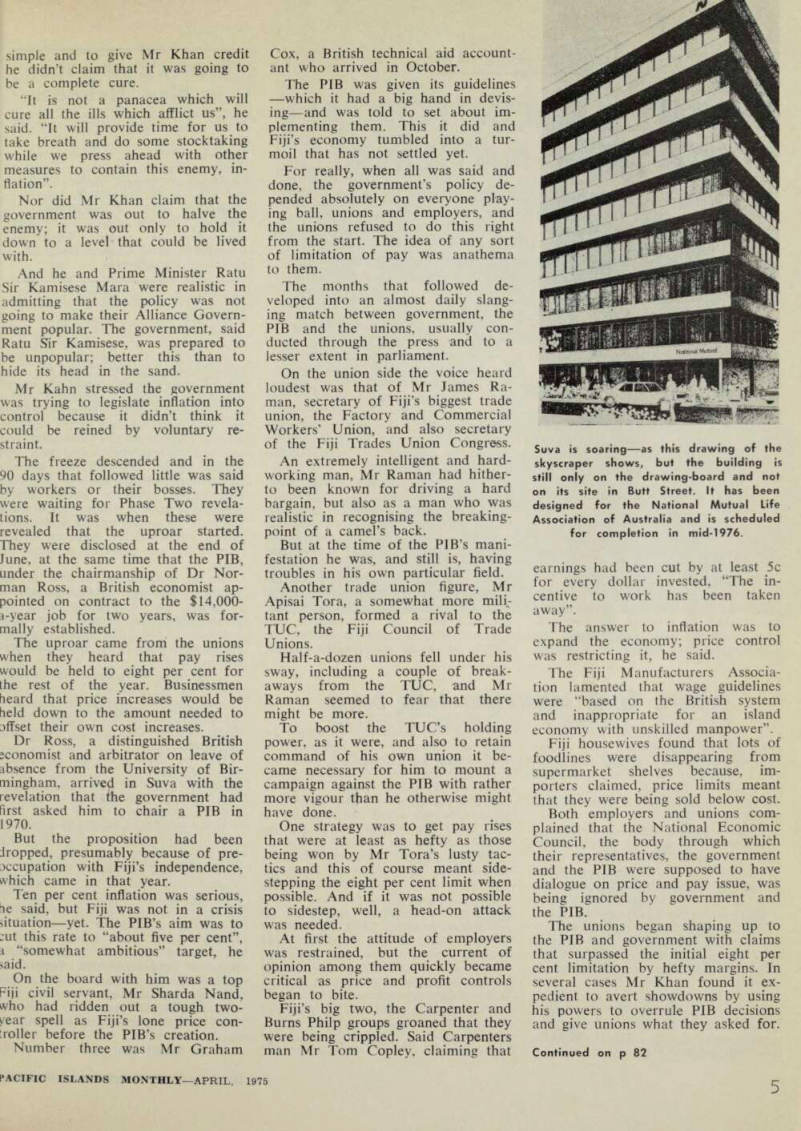
Minister for Commerce Mr Mohammed T. Khan . . . tried to legislate for inflation.
simple and to give Mr Khan credit he didn’t claim that it was going to be a complete cure.
“It is not a panacea which will cure all the ills which afflict us”, he said. “It will provide time for us to take breath and do some stocktaking while we press ahead with other measures to contain this enemy, in flation”.
Nor did Mr Khan claim that the government was out to halve the enemy; it was out only to hold it down to a level that could be lived with.
And he and Prime Minister Ratu Sir Kamisese Mara were realistic in admitting that the policy was not going to make their Alliance Govern ment popular. The government, said Ratu Sir Kamisese, was prepared to be unpopular; better this than to hide its head in the sand.
Mr Kahn stressed the government was trying to legislate inflation into control because it didn’t think it could be reined by voluntary re straint.
The freeze descended and in the 90 days that followed little was said by workers or their bosses. They were waiting for Phase Two revela tions. It was when these were revealed that the uproar started.
They were disclosed at the end of June, at the same time that the PIB, under the chairmanship of Dr Nor man Ross, a British economist ap pointed on contract to the $14,000a-year job for two years, was for mally established.
The uproar came from the unions when they heard that pay rises would be held to eight per cent for the rest of the year. Businessmen heard that price increases would be held down to the amount needed to affset their own cost increases.
Dr Ross, a distinguished British jconomist and arbitrator on leave of absence from the University of Bir mingham, arrived in Suva with the revelation that the government had first asked him to chair a PIB in 1970.
But the proposition had been dropped, presumably because of pre accupation with Fiji’s independence, which came in that year.
Ten per cent inflation was serious, he said, but Fiji was not in a crisis situation —yet. The PlB’s aim was to :ut this rate to “about five per cent”, a “somewhat ambitious” target, he said.
On the board with him was a top Fiji civil servant, Mr Sharda Nand, who had ridden out a tough two ycar spell as Fiji’s lone price con holler before the PlB’s creation.
Number three was Mr Graham
Cox, a British technical aid account ant who arrived in October.
The PIB was given its guidelines —which it had a big hand in devis ing—and was told to set about im plementing them. This it did and Fiji’s economy tumbled into a tur moil that has not settled yet.
For really, when all was said and done, the government’s policy de pended absolutely on everyone play ing ball, unions and employers, and the unions refused to do this right from the start. The idea of any sort of limitation of pay was anathema to them.
The months that followed de veloped into an almost daily slang ing match between government, the PIB and the unions, usually con ducted through the press and to a lesser extent in parliament.
On the union side the voice heard loudest was that of Mr James Ra man, secretary of Fiji’s biggest trade union, the Factory and Commercial Workers’ Union, and also secretary of the Fiji Trades Union Congress.
An extremely intelligent and hard working man, Mr Raman had hither to been known for driving a hard bargain, but also as a man who was realistic in recognising the breaking point of a camel’s back.
But at the time of the PlB’s mani festation he was, and still is, having troubles in his own particular field.
Another trade union figure, Mr Apisai Tora, a somewhat more mili tant person, formed a rival to the TUC, the Fiji Council of Trade Unions.
Half-a-dozen unions fell under his sway, including a couple of break aways from the TUC, and Mr Raman seemed to fear that there might be more.
To boost the TUC’s holding power, as it were, and also to retain command of his own union it be came necessary for him to mount a campaign against the PIB with rather more vigour than he otherwise might have done.
One strategy was to get pay rises that were at least as hefty as those being won by Mr Tora’s lusty tac tics and this of course meant side stepping the eight per cent limit when possible. And if it was not possible to sidestep, well, a head-on attack was needed.
At first the attitude of employers was restrained, but the current of opinion among them quickly became critical as price and profit controls began to bite.
Fiji’s big two, the Carpenter and Burns Philp groups groaned that they were being crippled. Said Carpenters man Mr Tom Copley, claiming that
earnings had been cut by at least 5c for every dollar invested, “The in centive to work has been taken away”.
The answer to inflation was to expand the economy; price control was restricting it, he said.
The Fiji Manufacturers Associa tion lamented that wage guidelines were “based on the British system and inappropriate for an island economy with unskilled manpower”.
Fiji housewives found that lots of foodlines were disappearing from supermarket shelves because, im porters claimed, price limits meant that they were being sold below cost.
Both employers and unions com plained that the National Economic Council, the body through which their representatives, the government and the PIB were supposed to have dialogue on price and pay issue, was being ignored by government and the PIB.
The unions began shaping up to the PIB and government with claims that surpassed the initial eight per cent limitation by hefty margins. In several cases Mr Khan found it ex pedient to avert showdowns by using his powers to overrule PIB decisions and give unions what they asked for.
Continued on p 82
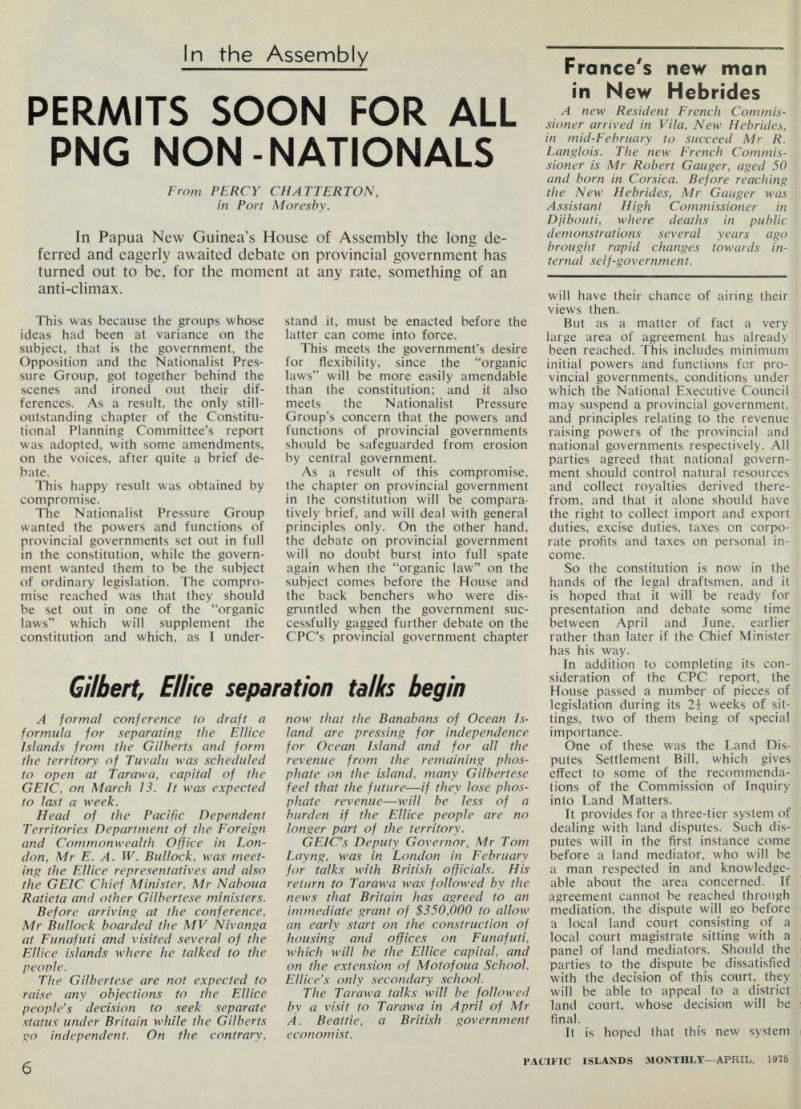
Suva is soaring—as this drawing of the skyscraper shows, but the building is still only on the drawing-board and not on its site in Butt Street. It has been designed for the National Mutual Life Association of Australia and is scheduled for completion in mid-1976.
One concession led to another and in May, 1974 the inevitable hap pened. Claims by brewery workers for 60c an hour and by cement workers for 61c were cut back by the PIB to 57.25 cents.
The FTUC, in retaliation, an nounced a general strike and made demands on the government which include a cost-of-living adjustment to pay rates every three months and “recognition of collective bargain ing”.
The PIB condemned the cost of living request as inflationary and interpreted the recognition demand as being simply the restoration of unconditional bargaining rights.
This, it said, would simply mean the collapse of the pay side of the prices and incomes policy.
The Cabinet and FTUC got to gether and the government side quickly agreed on the cost of living concession, various other concessions and that “where the employer and employee are able to reach an agree ment on the basis of past practice and historical relativity” the pay
rates agreed upon by them should be beyond a PIB veto.
The PIB became very bitter and made it very clear that it felt that the government had weakly backed down to avoid a general strike.
One half of the whole anti inflation strategy, pay control, had indeed collapsed and the con sequences would be dire, it warned.
It said that as the government hadn’t consulted it in striking a deal with the FTUC, it “disclaimed any responsibility for consequences flow ing from the agreement’’. These con sequences, it forecast, would include massive unemployment and high inflationary wage jumps.
Since wage increases for the most part would virtually be unrestricted, the board said it would have diffi culty in denying businessmen the price increases they would seek to absorb them.
Hence the whole policy would be nullified.
Subsequent months saw the PlB’s words of doom borne out almost to the last letter.
On a couple of occasions it issued a couple of “we told you so” state ments in which it reiterated that it was all the government’s fault.
Thanks to the cost of living ad justments—which soon cosily be came know as Coda increases—and the mysterious “historical relativity” clause, wage rates began to climb at astronomical rates.
In a year when they were sup posed to have been held down to 10 per cent many rates were upped from 28 per cent to 69 per cent between January and October alone.
At arbitration courts unions gaily quoted “historical relativity” and asked for the earth.
Employers and the PIB asked arbitrators to kindly explain what the phrase meant, since they didn’t know.
At arbitration hearings between building companies and their work ers PIB member Mr Sharda Nand said bluntly that only the PlB’s over lord, Mr Khan, could explain.
“He and he alone should be able to explain that code” he said. “You can drive a horse and cart, and, in this case, a bulldozer through this phrase”.
Thanks to Coda increases some unions hardly bothered with pay de mands.
The theory behind Coda was that every three months the PIB declared a limit for rises based on the rise of the consumer price index for the previous three months. The increase was not to be automatic; employees had to ask for it and employers could negotiate for a smaller in crease.
Actually, the first Coda increase? was for January to June, hitting 9.37* per cent. Negotiating with the civii' service the government settled fon 8.83 per cent. For July to September it was 4.53 per cent —which civil servants got—and for October-!
December three per cent.
Employers, dazed by the train ole events, began surrendering with autoe matic Coda increases to the maxi-i mum specified.
The cumulative effect of such in-r creases was staggering and by thei end of the year the bulk of Fiji’s' urban workers looked to be up tco 70 per cent better off than they were at the beginning of it.
They were certainly showing signs of prosperity; while Ministen for Finance Mr Charles Stinson hacb been calling for thrift and restraint,! the number of shiny new cars om the roads of Fiji had never seemedb greater.
And Fiji’s hotels were full—thea expensive cocktail sections of themn that is, not the cheap public bars— with uproarious representatives off the working class toasting them selves, and the next Coda increase,,; with unending glasses and jugs oft beer.
Towards the year-end relations be tween the PIB and the government! became very strained as the PIB con tinued to show its disgust at the way\ things had so quickly turned out.
Ratu Mara, who in earlier Parlia mentary debates had defended thee PIB against Opposition attacks, be gan to hint, from August, that its? days might be numbered. About thee same time, partly in response toe Opposition sniping, the government! set up a House of Representatives ? select committee, on which the e Opposition refused to serve, to de- cide the PlB’s and associated policy’s i future.
The committee was asked to report j by the end of the year so that its i findings could be acted upon before .
Phase Three expired at the end of 1 December.
But the job was too big and when r the committee said it would be Feb- ■ ruary before its report would be ; ready the government extended i Phase three to March 31.
Before the committee delivered 1 its report the PIB came out with its ; first—and now presumably last— annual report.
This was a blockbuster and spelt J the end of the government’s romance ; with it.
“Had the board been allowed to < continue with the policy as laid down \ by government in January (1974) increases in wages and salaries ; would have been restricted to levels ;
)f around 20 to 25 per cent”, it laid. But due to the Cabinet-FTUC leal in May they had soared to ‘unprecedented rates” since then.
“It is ironical that a year in which ncomes are purported to have been inder control for counter-inflationary easons should have witnessed the argest number of record percentage ncreases in the wage rates of un killed workers since 1969 and poss bly since records have been kept”.
The board’s report said a lot more lasty things.
“The country needs to be alerted o the fact that it is living well be 'ond its means and that to continue 0 try to do so will delay the de 'elopment of the economy and re ard the nation’s progress towards ull economic independence.
“At the worst it could result in otal economic collapse”.
This last remark made the Prime dinister very annoyed.
“We are not about to collapse nor ire we bankrupt” he thundered at n Alliance Party convention.
Ratu Sir Kamisese, graduate from he London School of Economics, aid the board was forgetting itself.
“We had thought as a government ve should decide on a policy for hem to execute. But to tell us now /hat the economic organisation hould be is gratuitous advice”.
At the same meeting Finance dinister Mr Stinson claimed that 7 iji wasn’t really doing so badly as be PIB said.
Inflation last year had touched only” about 17i per cent instead f the 24 per cent figure predicted t one point.
“Fiji may fare better than some 1 our neighbours in 1975” he said, nd added that it shouldn’t be bought that the government thought be PIB was useless.
It had served a “very definite” urpose, “but whether it is required o the same extent during 1975 is /hat the select committee has been itting on”, he said.
The committee’s report, in late ■ebruary, was all for change. Fiji ouldn’t afford a PIB of the size and omplexity that was really needed or the job the government had set iut to do, it said.
But the PIB that had been created lad had a useful psychological im >act. There was, therefore, “some aerit” in retaining some form of imited control on certain items.
Otherwise, all other controls in luding wage controls should be bandoned.
The government agreed entirely.
Hard times lay ahead for some Fiji industries and it was hoped that realisation of this would lead to a tempering of pay demands, said Ratu Sir Penaia in announcing the govern ment’s acceptance of the report.
Control of what little remains of the policy will be switched from Mr Khan to Mr Stinson because, the Deputy PM said, for the Minis ter of Commerce to be promoting and at the same time controlling business was “anomalous”.
His sentiments were publicly re echoed, more or less by the FTUC and employers. But in private the Fiji Employers Consultative Associa tion took a much different outlook.
Early in March, it was warning its members that the first lot of claims by the unions bore no sign of the restraint the government had asked for, and some of the unions had promised.
If employers couldn’t convince the unions by argument, and, if neces sary, by disclosure of their books, that they couldn’t afford the claims, they had better be prepared to de monstrate the ultimate proof by closing their businesses down, FECA advised.
Png Non-Nationals
In the Assembly
Permits Soon For All
From Percy Chatterton,
in Port Moresby.
In Papua New Guinea’s House of Assembly the long de ferred and eagerly awaited debate on provincial government has turned out to be, for the moment at any rate, something of an anti-climax.
This was because the groups whose ideas had been at variance on the subject, that is the government, the Opposition and the Nationalist Pressure Group, got together behind the scenes and ironed out their differences. As a result, the only stilloutstanding chapter of the Constitutional Planning Committee’s report was adopted, with some amendments, on the voices, after quite a brief debate.
This happy result was obtained by compromise.
The Nationalist Pressure Group wanted the powers and functions of provincial governments set out in full in the constitution, while the government wanted them to be the subject of ordinary legislation. The compromise reached was that they should be set out in one of the “organic laws” which will supplement the constitution and which, as I under-
stand it, must be enacted before the latter can come into force, This meets the government’s desire for flexibility, since the “organic laws” will be more easily amendable than the constitution; and it also meets the Nationalist Pressure Group’s concern that the powers and functions of provincial governments should be safeguarded from erosion by central government, As a result of this compromise, the chapter on provincial government in the constitution will be compara tively brief, and will deal with general principles only. On the other hand, the debate on provincial government will no doubt burst into full spate again when the “organic law” on the subject comes before the House and the back benchers who were dis gruntled when the government suc cessfully gagged further debate on the CPC’s provincial government chapter
will have their chance of airing their views then.
But as a matter of fact a very large area of agreement has already been reached. This includes minimum initial powers and functions for pro vincial governments, conditions under which the National Executive Council may suspend a provincial government, and principles relating to the revenue raising powers of the provincial and national governments respectively. All parties agreed that national govern ment should control natural resources and collect royalties derived there from, and that it alone should have the right to collect import and export duties, excise duties, taxes on corpo rate profits and taxes on personal in come.
So the constitution is now in the hands of the legal draftsmen, and it is hoped that it will be ready for presentation and debate some time between April and June, earlier rather than later if the Chief Minister has his way.
In addition to completing its con sideration of the CPC report, the House passed a number of pieces of legislation during its 2i weeks of sit tings, two of them being of special importance.
One of these was the Land Dis putes Settlement Bill, which gives effect to some of the recommenda tions of the Commission of Inquiry into Land Matters.
It provides for a three-tier system of dealing with land disputes. Such dis putes will in the first instance come before a land mediator, who will be a man respected in and knowledge able about the area concerned. If agreement cannot be reached through mediation, the dispute will go before a local land court consisting of a local court magistrate sitting with a panel of land mediators. Should the parties to the dispute be dissatisfied with the decision of this court, they will be able to appeal to a district land court, whose decision will be final.
It is hoped that this new system
will produce quicker and more acceptable decisions than those reached in the past by the Land Titles Commission, which however, will presumably continue to deal with dis putes between land-owning groups and the government.
The second piece of legislation of importance to be enacted radically changes the provisions of the Migra tion Act in relation to the entry of non-nationals into Papua New Guinea and the continued residence of those already here.
It provides that after the end of this year all non-nationals in PNG must be in possession of a valid entry permit. Applications for such permits will be considered on their individual merits, and permits issued will specify the period for which they will remain valid.
Any non-national not in possession of a valid permit may be deported without right of appeal to the courts, though he will be entitled to have his case reviewed by a panel of ministers.
When I have been asked from time to time whether I intend to stay in Papua New Guinea after indepen dence I have always modestly replied, “Yes, unless they throw me out”.
It looks as if my caution has been well advised!
In the village of Baruni on the outskirts of Port Moresby on Sunday, March 16, one of the leaders of the Papuan independence movements, Miss Josephine Abaijah, formally “de clared” that Papua had seceded from Papua New Guinea.
“I declare that Papua is now a free and independent country”, she said. “From this day we will not recognise the authority of any person involved with any foreign or colonial power or institution.”
The PNG Government decided to take no action against Miss Abaijah and other separatist leaders who were involved in similar ceremonies around Port Moresby. At one, Mr Simon Kaumi, who was to be proclaimed President of Papua, was simply in troduced as one of the separatist leaders. Police leave had been can celled in anticipation of trouble, but everything was orderly.
Miss Abaijah said the declaration was not an attempt to overthrow the government and no attempt would be made to take over any of the services of central government. It was merely to make Australia face up to its re sponsibilities and recognise that Papua could not be forced to join New Guinea.
Gilbert, Ellice separation talks begin
A formal conference to draft a formula for separating the Ellice Islands from the Gilberts and form the territory of Tuvalu was scheduled to open at Tarawa, capital of the GEIC, on March 13. It was expected to last a week.
Head of the Pacific Dependent Territories Department of the Foreign and Commonwealth Office in Lon don, Mr E. A. W. Bullock, was meet ing the Ellice representatives and also the GEIC Chief Minister, Mr Naboua Ratieta and other Gilbertese ministers.
Before arriving at the conference, Mr Bullock boarded the MV Nivanga at Funafuti and visited several of the Ellice islands where he talked to the people.
The Gilbertese are not expected to raise any objections to the Ellice people’s decision to seek separate status under Britain while the Gilberts go independent. On the contrary.
now that the Banabans of Ocean Is land are pressing for independence for Ocean Island and for all the revenue from the remaining phos phate on the island, many Gilbertese feel that the future —if they lose phos phate revenue—will be less of a burden if the Ellice people are no longer part of the territory.
GEIC’s Deputy Governor, Mr Tom Layng, was in London in February for talks with British officials. His return to Tarawa was followed by the news that Britain has agreed to an immediate grant of $350,000 to allow an early start on the construction of housing and offices on Funafuti, which will be the Ellice capital, and on the extension of Motofoua School, Ellice’s only secondary school.
The Tarawa talks will be followed by a visit to Tarawa in April of Mr A. Beattie, a British government economist.
in New Hebrides
France's new man in New Hebrides
A new Resident French Commis sioner arrived in Vila, New Hebrides, in mid-February to succeed Mr R.
Langlois. The new French Commis sioner is Mr Robert Gauger, aged 50 and born in Corsica. Before reaching the New Hebrides, Mr Gauger was Assistant High Commissioner in Djibouti, where deaths in public demonstrations several years ago brought rapid changes towards in ternal self-government.
Australians hand over Defence Force
Defence Force to PNG
The Papua New Guinea Govern ment took over the Defence Force and military assets worth nearly $7O million on March 6 in a pre independence surprise move agreed between Australia and Papua New Guinea announced only two days before.
The move, described as a “gentle men’s agreement”, was seen as bring ing PNG into full and effective political, but still unlabelled, indepen dence.
The date when independence will be declared is still undecided although the House of Assembly approved with amendments on March 11 Chapter Ten of the Constitutional Planning Committee’s Report which
deals with provincial government.
This was the last obstacle to be sur mounted and the report now goes to the legislative draftsman who will draw up the Constitution.
Independence date will not be an nounced until the House has accepted the Constitution.
However, Papua New Guinea is now in full control thanks to consul tations between the two governments which, Defence and Foreign Rela tions Minister Sir Maori Kiki told the House on March 4, had arrived at a special relationship to make the plan work in the brief period before inde pendence.
Control over foreign relations has
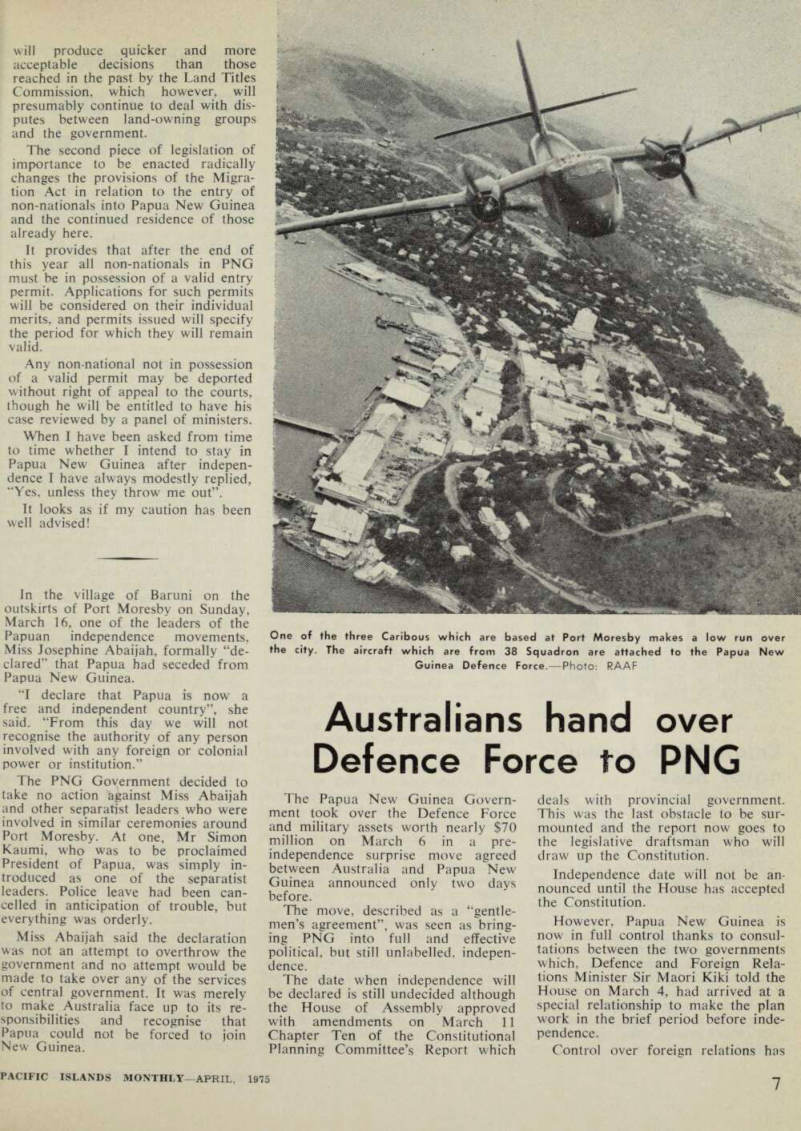
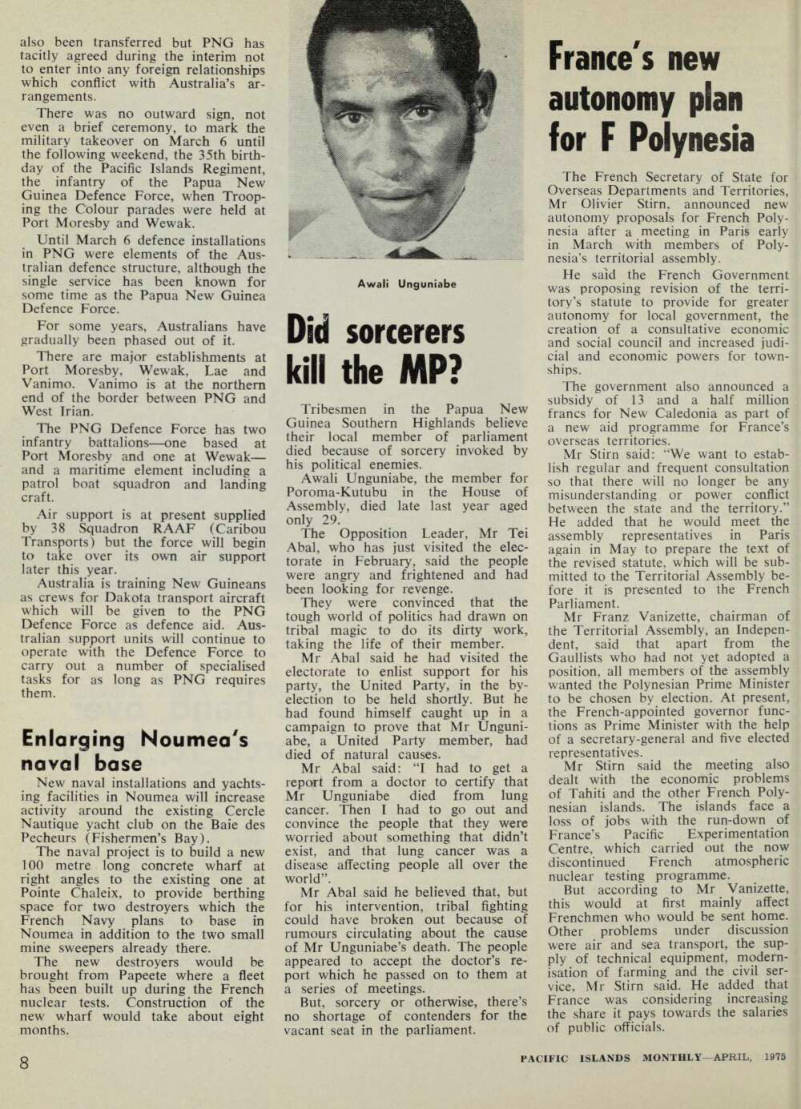
One of the three Caribous which are based at Port Moresby makes a low run over the city. The aircraft which are from 38 Squadron are attached to the Papua New Guinea Defence Force. — Photo: RAAF
also been transferred but PNG has tacitly agreed during the interim not to enter into any foreign relationships which conflict with Australia’s ar rangements.
There was no outward sign, not even a brief ceremony, to mark the military takeover on March 6 until the following weekend, the 35th birth day of the Pacific Islands Regiment, the infantry of the Papua New Guinea Defence Force, when Troop ing the Colour parades were held at Port Moresby and Wewak.
Until March 6 defence installations in PNG were elements of the Aus tralian defence structure, although the single service has been known for some time as the Papua New Guinea Defence Force.
For some years, Australians have gradually been phased out of it.
There are major establishments at Port Moresby, Wewak, Lae and Vanimo. Vanimo is at the northern end of the border between PNG and West Irian.
The PNG Defence Force has two infantry battalions—one based at Port Moresby and one at Wewak— and a maritime element including a patrol boat squadron and landing craft.
Air support is at present supplied by 38 Squadron RAAF (Caribou Transports) but the force will begin to take over its own air support later this year.
Australia is training New Guineans as crews for Dakota transport aircraft which will be given to the PNG Defence Force as defence aid. Aus tralian support units will continue to operate with the Defence Force to carry out a number of specialised tasks for as long as PNG requires them.
Enlarging Noumea's
naval base
New naval installations and yachts ing facilities in Noumea will increase activity around the existing Cercle Nautique yacht club on the Baie des Pecheurs (Fishermen’s Bay).
The naval project is to build a new 100 metre long concrete wharf at right angles to the existing one at Pointe Chaleix, to provide berthing space for two destroyers which the French Navy plans to base in Noumea in addition to the two small mine sweepers already there.
The new destroyers would be brought from Papeete where a fleet has been built up during the French nuclear tests. Construction of the new wharf would take about eight months.
Did sorcerers
kill the MR?
Tribesmen in the Papua New Guinea Southern Highlands believe their local member of parliament died because of sorcery invoked by his political enemies.
Awali Unguniabe, the member for Poroma-Kutubu in the House of Assembly, died late last year aged only 29.
The Opposition Leader, Mr Tei Abal, who has just visited the elec torate in February, said the people were angry and frightened and had been looking for revenge.
They were convinced that the tough world of politics had drawn on tribal magic to do its dirty work, taking the life of their member.
Mr Abal said he had visited the electorate to enlist support for his party, the United Party, in the by election to be held shortly. But he had found himself caught up in a campaign to prove that Mr Unguni abe, a United Party member, had died of natural causes.
Mr Abal said: “I had to get a report from a doctor to certify that Mr Unguniabe died from lung cancer. Then I had to go out and convince the people that they were worried about something that didn’t exist, and that lung cancer was a disease affecting people all over the world”.
Mr Abal said he believed that, but for his intervention, tribal fighting could have broken out because of rumours circulating about the cause of Mr Unguniabe’s death. The people appeared to accept the doctor’s re port which he passed on to them at a series of meetings.
But, sorcery or otherwise, there’s no shortage of contenders for the vacant seat in the parliament.
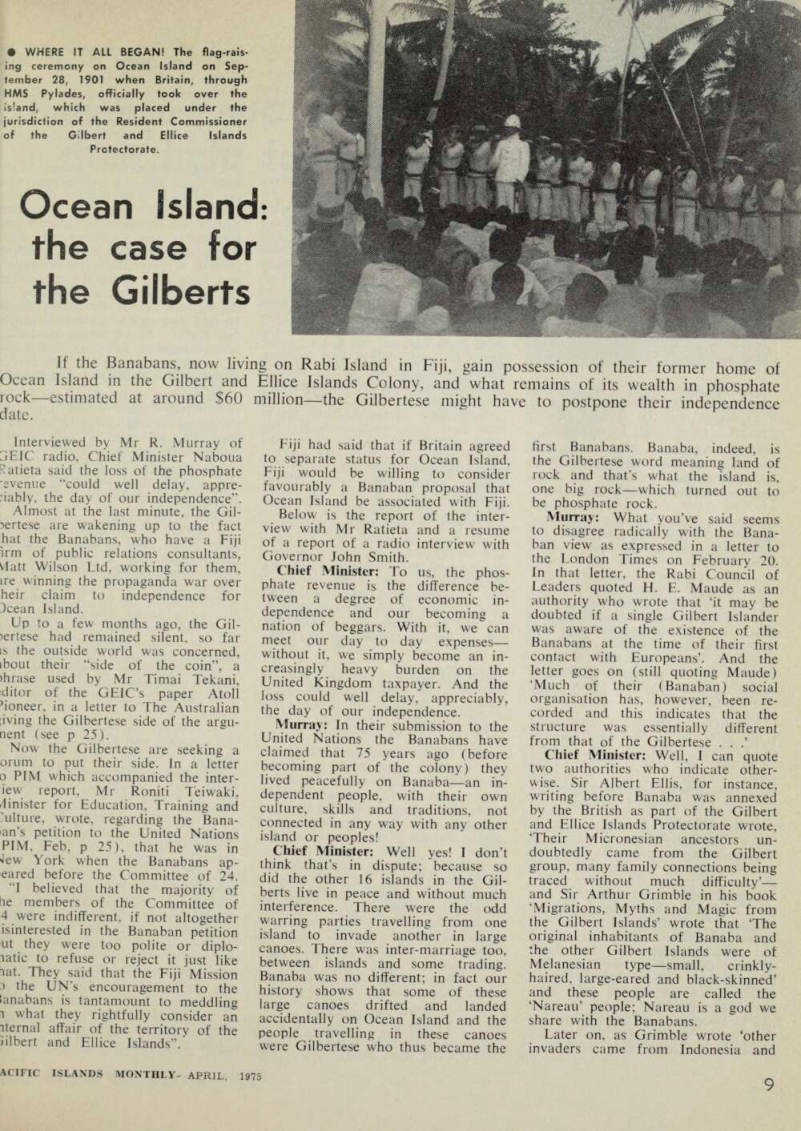
Awali Unguniabe
autonomy plan
France's new autonomy plan for F Polynesia
The French Secretary of State for Overseas Departments and Territories, Mr Olivier Stirn, announced new autonomy proposals for French Poly nesia after a meeting in Paris early in March with members of Poly nesia’s territorial assembly.
He said the French Government was proposing revision of the terri tory’s statute to provide for greater autonomy for local government, the creation of a consultative economic and social council and increased judi cial and economic powers for town ships.
The government also announced a subsidy of 13 and a half million francs for New Caledonia as part of a new aid programme for France’s overseas territories.
Mr Stirn said: “We want to estab lish regular and frequent consultation so that there will no longer be any misunderstanding or power conflict between the state and the territory,”
He added that he would meet the assembly representatives in Paris again in May to prepare the text of the revised statute, which will be sub mitted to the Territorial Assembly be fore it is presented to the French Parliament.
Mr Franz Vanizette, chairman of the Territorial Assembly, an Indepen dent, said that apart from the Gaullists who had not yet adopted a position, all members of the assembly wanted the Polynesian Prime Minister to be chosen by election. At present, the French-appointed governor func tions as Prime Minister with the help of a secretary-general and five elected representatives.
Mr Stirn said the meeting also dealt with the economic problems of Tahiti and the other French Poly nesian islands. The islands face a loss of jobs with the run-down of France’s Pacific Experimentation Centre, which carried out the now discontinued French atmospheric nuclear testing programme.
But according to Mr Vanizette, this would at first mainly affect Frenchmen who would be sent home.
Other problems under discussion were air and sea transport, the sup ply of technical equipment, modern isation of farming and the civil ser vice, Mr Stirn said. He added that France was considering increasing the share it pays towards the salaries of public officials.
Ocean Island;
the case for the Gilberts
If the Banabans, now living on Rabi Island in Fiji, gain possession of their former home of Ocean Island in the Gilbert and Ellice Islands Colony, and what remains of its wealth in phosphate rock —estimated at around $6O million—the Gilbertese might have to postpone their independence date.
Interviewed by Mr R. Murray of jhlC radio, Chief Minister Naboua 'atieta said the loss of the phosphate avenue could well delay, appre- :iab y, the day of our independence .
Almost at the last minute, the Gil- 3ertese aij wakening up to the fact hat the Banabans, who have a Fiji °^. PUb,l T C J elatl T Vlatt Wilson Ltd, working for them, ire winning the propaganda war over heir claim to independence for Jcean island. c J°hL/ eW m ° nt ? S M B °’f the S 1 “ ertese had remamed silent, so far l u_ tEe ° u * B,d( : t orld was concerned, K S i de iu° f x the - a Hitnr Pf Timai Te A* n )i >• °? tbe i t 9 E t C S T- K pa p er , A r° r r to The Australian ’ 8 . e Gilbertese side of the argu- VC , . . ti he 9 1 £ e f tese are T Beekl ,ng a or “ to their 8lde ; J n a ! etter lw M^ b p h - com P an - d tEe . ,nt f.report, Mr Roniti Teiwaki, f ° r Educatloa : Tra l nm f> and uimre, wrote regarding the Banaprior P TpK° n .F nit t d Nat10 ? 8 t, v v P k A. 1 d h6 u Was m It 6 Ba .^ abans a P’
“r d K tbe Committee of 24. l believed that the majority of e members or the Committee of • . . ere inherent, if not altogether ~ti nt i.r eSted m ♦ Bai ? aban P e ]} tlon ut they were too polite or diplof IC Ti? re f u . s ® ° r r ®l® ct ff. Just th irvp aid tbat tbe EIJI Mlss i° n ; tn k e encouragement to the tan f a F*® u I f t to meddling -.t« ff ey r '§ b^ ud y consider an ?}fi™ «nH ir p?r the r ! errd ?, ry of the jilbert and Ellice Islands .
Fiji had said that if Britain agreed to separate status for Ocean Island, Fiji would be willing to consider favourably a Banaban proposal that Ocean Island be associated with Fiji.
Below is the report of the interview with Mr Ratieta and a resume of a report of a radio interview with Governor John Smith. chief Minister: To us, the phosphate revenue is the difference between a degree of economic independence and our becoming a natlon of beggars. With it, we can meet our day to day expenses— without it, we simply become an inheav V burden on the United Kingdom taxpayer. And the loss could well delay, appreciably, the day of our independence.
Murray: In their submission to the United Nations the Banabans have claimed that 75 years ago (before becoming part of the colony) they lived Peacefully on Banaba—an independent people, with their own culture, skills and traditions, not connected in any way with any other island or peoples!
Chief Minister: Well yes! I don’t think that’s in dispute; because so did the other 16 islands in the Gilberts live in peace and without much interference. There were the odd warring parties travelling from one island to invade another in large canoes. There was inter-marriage too, between islands and some trading.
Banaba was no different; in fact our history shows that some of these large canoes drifted and landed accidentally on Ocean Island and the people travelling in these canoes were Gilbertese who thus became the
first Banabans. Banaba, indeed, is the Gilbertese word meaning land of rock and that's what the island is one big rock—which turned out to be phosphate rock.
Murray: What you’ve said seems to disagree radically with the Bana ban view as expressed in a letter to the London Times on February 20.
In that letter, the Rabi Council of Leaders quoted H. E. Maude as an authority who wrote that ‘it may be doubted if a single Gilbert Islander was aware of the existence of the Banabans at the time of their first contact with Europeans’. And the letter goes on (still quoting Maude) ‘Much of their (Banaban) social organisation has, however, been re corded and this indicates that the structure was essentially different from that of the Gilbertese . .
Chief Minister: Well, I can quote two authorities who indicate other wise. Sir Albert Ellis, for instance, writing before Banaba was annexed by the British as part of the Gilbert and Ellice Islands Protectorate wrote, ‘Their Micronesian ancestors un doubtedly came from the Gilbert group, many family connections being traced without much difficulty’— and Sir Arthur Grimble in his book ‘Migrations, Myths and Magic from the Gilbert Islands’ wrote that ‘The original inhabitants of Banaba and the other Gilbert Islands were of Melanesian type—small, crinkly haired, large-eared and black-skinned’ and these people are called the ‘Nareau’ people; Nareau is a god we share with the Banabans.
Later on, as Grimble wrote ‘other invaders came from Indonesia and
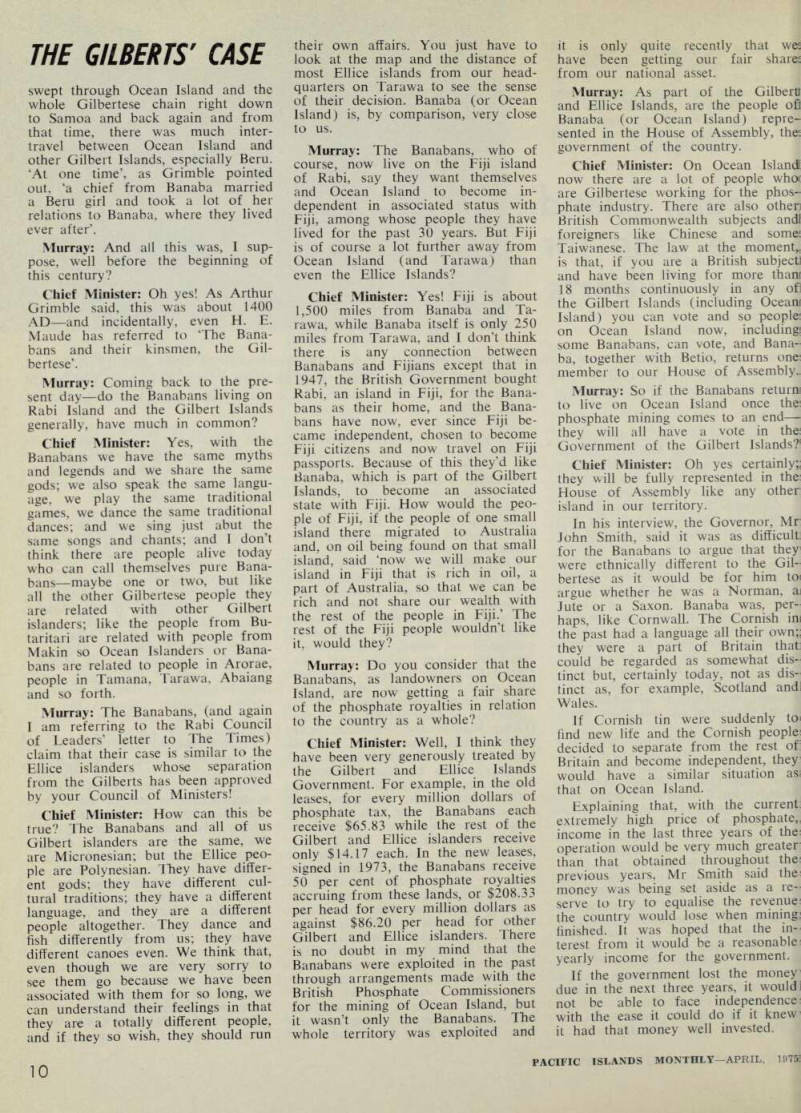
• WHERE IT ALL BEGAN! The flag-rais ing ceremony on Ocean Island on Sep tember 28, 1901 when Britain, through HMS Pylades, officially took over the island, which was placed under the jurisdiction of the Resident Commissioner of the Gilbert and Ellice Islands Protectorate.
The Gilberts' Case
swept through Ocean Island and the whole Gilbertese chain right down to Samoa and back again and from that time, there was much inter travel between Ocean Island and other Gilbert Islands, especially Bern. ‘At one time’, as Grimble pointed out, ‘a chief from Banaba married a Bern girl and took a lot of her relations to Banaba, where they lived ever after’.
Murray: And all this was, I sup pose, well before the beginning of this century?
Chief Minister: Oh yes! As Arthur Grimble said, this was about 1400 AD—and incidentally, even H. E.
Maude has referred to ‘The Bana bans and their kinsmen, the Gil bertese’.
Murray: Coming back to the pre sent day—do the Banabans living on Rabi Island and the Gilbert Islands generally, have much in common?
Chief Minister: Yes, with the Banabans we have the same myths and legends and we share the same gods; we also speak the same langu age, we play the same traditional games, we dance the same traditional dances; and we sing just abut the same songs and chants; and I don’t think there are people alive today who can call themselves pure Bana bans —maybe one or two, but like all the other Gilbertese people they are related with other Gilbert islanders; like the people from Bu taritari are related with people from Makin so Ocean Islanders or Bana bans are related to people in Arorae, people in Tamana, Tarawa, Abaiang and so forth.
Murray: The Banabans, (and again I am referring to the Rabi Council of Leaders’ letter to The Times) claim that their case is similar to the Ellice islanders whose separation from the Gilberts has been approved by your Council of Ministers!
Chief Minister: How can this be true? The Banabans and all of us Gilbert islanders are the same, we are Micronesian; but the Ellice peo ple are Polynesian. They have differ ent gods: they have different cul tural traditions; they have a different language, and they are a different people altogether. They dance and fish differently from us; they have different canoes even. We think that, even though we are very sorry to see them go because we have been associated with them for so long, we can understand their feelings in that they are a totally different people, and if they so wish, they should run
their own affairs. You just have to look at the map and the distance of most Ellice islands from our head quarters on Tarawa to see the sense of their decision. Banaba (or Ocean Island) is, by comparison, very close to us.
Murray: The Banabans, who of course, now live on the Fiji island of Rabi, say they want themselves and Ocean Island to become in dependent in associated status with Fiji, among whose people they have lived for the past 30 years. But Fiji is of course a lot further away from Ocean Island (and Tarawa) than even the Ellice Islands?
Chief Minister: Yes! Fiji is about 1,500 miles from Banaba and Ta rawa, while Banaba itself is only 250 miles from Tarawa, and I don’t think there is any connection between Banabans and Fijians except that in 1947, the British Government bought Rabi, an island in Fiji, for the Bana bans as their home, and the Bana bans have now, ever since Fiji be came independent, chosen to become Fiji citizens and now travel on Fiji passports. Because of this they’d like Banaba, which is part of the Gilbert Islands, to become an associated state with Fiji. How would the peo ple of Fiji, if the people of one small island there migrated to Australia and, on oil being found on that small island, said ‘now we will make our island in Fiji that is rich in oil, a part of Australia, so that we can be rich and not share our wealth with the rest of the people in Fiji.’ The rest of the Fiji people wouldn’t like it, would they?
Murray: Do you consider that the Banabans, as landowners on Ocean Island, are now getting a fair share of the phosphate royalties in relation to the country as a whole?
Chief Minister: Well, I think they have been very generously treated by the Gilbert and Ellice Islands Government. For example, in the old leases, for every million dollars of phosphate tax, the Banabans each receive $65.83 while the rest of the Gilbert and Ellice islanders receive only $14.17 each. In the new leases, signed in 1973, the Banabans receive 50 per cent of phosphate royalties accruing from these lands, or $208.33 per head for every million dollars as against $86.20 per head for other Gilbert and Ellice islanders. There is no doubt in my mind that the Banabans were exploited in the past through arrangements made with the British Phosphate Commissioners for the mining of Ocean Island, but it wasn’t only the Banabans. The whole territory was exploited and
it is only quite recently that we; have been getting our fair share; from our national asset.
Murray; As part of the Gilbert! and Ellice Islands, are the people ofi Banaba (or Ocean Island) repre sented in the House of Assembly, the; government of the country.
Chief Minister: On Ocean Island! now there are a lot of people whoc are Gilbertese working for the phos phate industry. There are also othen British Commonwealth subjects andl foreigners like Chinese and some: Taiwanese. The law at the moment,, is that, if you are a British subject) and have been living for more tharu 18 months continuously in any of] the Gilbert Islands (including Oceam Island) you can vote and so people; on Ocean Island now, including! some Banabans, can vote, and Bana ba, together with Betio, returns one: member to our House of Assembly..
Murray: So if the Banabans returni to live on Ocean Island once the: phosphate mining comes to an end — they will all have a vote in the: Government of the Gilbert Islands?' Chief Minister: Oh yes certainly;; they will be fully represented in the: House of Assembly like any other island in our territory.
In his interview, the Governor, Mr John Smith, said it was as difficult: for the Banabans to argue that they’ were ethnically different to the Gil bertese as it would be for him toi argue whether he was a Norman, ai Jute or a Saxon. Banaba was, per haps, like Cornwall. The Cornish ini the past had a language all their own;; they were a part of Britain that: could be regarded as somewhat dis tinct but, certainly today, not as dis tinct as, for example, Scotland andl Wales.
If Cornish tin were suddenly to< find new life and the Cornish people; decided to separate from the rest of: Britain and become independent, they 1 would have a similar situation as: that on Ocean Island.
Explaining that, with the current;
extremely high price of phosphate,,
income in the last three years of the operation would be very much greater than that obtained throughout the previous years, Mr Smith said the money was being set aside as a re serve to try to equalise the revenue the country would lose when mining finished. It was hoped that the in terest from it would be a reasonable yearly income for the government.
If the government lost the money 1 due in the next three years, it would: not be able to face independence; with the ease it could do if it knew 1 it had that money well invested.
Advertisements & other items, p. 11 (1 item)
9
ACIFIC ISLANDS MONTHLY- APRIL, 1975
Banabans add drama to their fight
their fight for home
From Bertram Jones
Events involving the Banabans 'ere gathering momentum as March tided.
A ship carrying the vanguard of 00 Banabans who are to re-settle on •cean Island had sailed from Fiji in blaze of publicity about what had een variously called “a Banaban in ision” and “a move to establish a anaban presence” in their old home md.
And a judge’s ruling in London had at fresh heart into the Banaban com innity as protracted and expensive reparations for their High Court :tion neared their climax.
The Banabans have waited for -ars to have their say in court and • redress—as they see it—some of le wrongs they have suffered during le 75-year history of phosphate ining on Ocean Island.
An application by the British Gov nment had looked like delaying the :tion even more. They had asked that irtain matters be dealt with as a eliminary to the main suit, due to ien early in April.
Mr Justice Walton, after hearing gal arguments, had taken about ree weeks to go into them. Then, a 15,000-word reserved judgement, ' dismissed the British move.
Reports from London quoted him saying: “It could not, I think, fail appear to the Banabans as a wyers’ trick, designed to prevent eir case being heard, and in their ew so designed because if it was :ard the whole world might acknow dge the justice of their cause.”
The judge observed that the Crown ared that the practical effect of lowing Banaban witnesses to use e witness-box might be to provoke wide-ranging attack” upon the nduct of the Crown in relation to ;ean Island and the Banabans nerally.
But, he said, he was content to cept the assurance of the Banabans’ unsel that they did not intend to ake such an attack.
While the 399-ton Ai Sokula—a maban ship—was preparing in Suva r the long voyage to Ocean Island th the first party of re-settlers from
Rabi Island (the Banabans’ present home in the Fiji group) two govern ment ministers and a senior civil servant from GEIC passed through Nadi airport on their way to New York to resist the Banaban indepen dence move in the United Nations.
They issued a press statement claiming that Ocean Island was an integral part of the colony and that the Gilbertese and the Banabans were the same people because they were all descended from the same Micro nesian settlers in the Pacific.
The GEIC Minister for Communi cations, Work and Utilities, Mr Bwebwetake Arieta, went even further. He alleged that the Banaban claim for sovereignty over Ocean Island was a family matter not sought by all the Banabans.
That brought a sharp retort from Mr Tekoti Rotan, managing director of Rabi Holdings Ltd (the Banabans’ commercial enterprise), who, in the absence in London of his brother, manager to the Rabi Council of Leaders, is spokesman in Suva for the Banaban community.
He dismissed Mr Arieta’s claim as nonsense and said it showed how hard-put the Gilbertese were to find arguments against the Banaban case.
“If Mr Arieta thinks that the Bana bans as a community are not fully in support of independence for Ocean Island he should visit Rabi Island to talk to our people,” Mr Rotan said.
“In fact, we invite him to do so.”
Mr Rotan’s brother, the Rev Tebuke Rotan, was just as decisive in answers to the other Gilbertese asser tions.
Speaking on the telephone from London to Suva, he said that to claim that the Banabans and the Gilbertese were one people because they were descended from common Micronesian settlers made about as much sense as saying that, because the early American settlers came from Britain, present-day Americans were British.
The Micronesian settlement took place more than 3,000 years ago, the Rev Tebuke said, quoting authorities.
Over the centuries they had split up
and established separate and indepen dent communities. “The Banabans were independent for centuries,’ he said.
The Banabans rejected Gilbertese claims that Ocean Island is an in tegral part of the GEIC. Both the Rotan brothers—sons of 75-year-old Mr Rotan Tito, the Banaban leader for more than 40 years—pointed out its distance from the nearest island in the Gilberts Group and how geo logically different it was from them.
They said: “There is strong evidence that before the British came the Gilbertese did not even know that Ocean Island or the Banabans were there, “Any Gilbertese who fled in canoes from their own island and were lucky enough to find refuge among the Banabans could not get back because of strong ocean currents, so how could there have been any link be tween the Gilbertese and us?
“There was no Gilbertese unity until the British came, and even then Ocean Island was left out until it was found to contain enormous phosphate wealth.”
The move to re-establish a Bana ban presence on Ocean Island stems from their uneasiness about their rights with independence for the colony approaching. It is an asser tion of Banaban ownership as well as of their belief that sovereignty should be theirs.
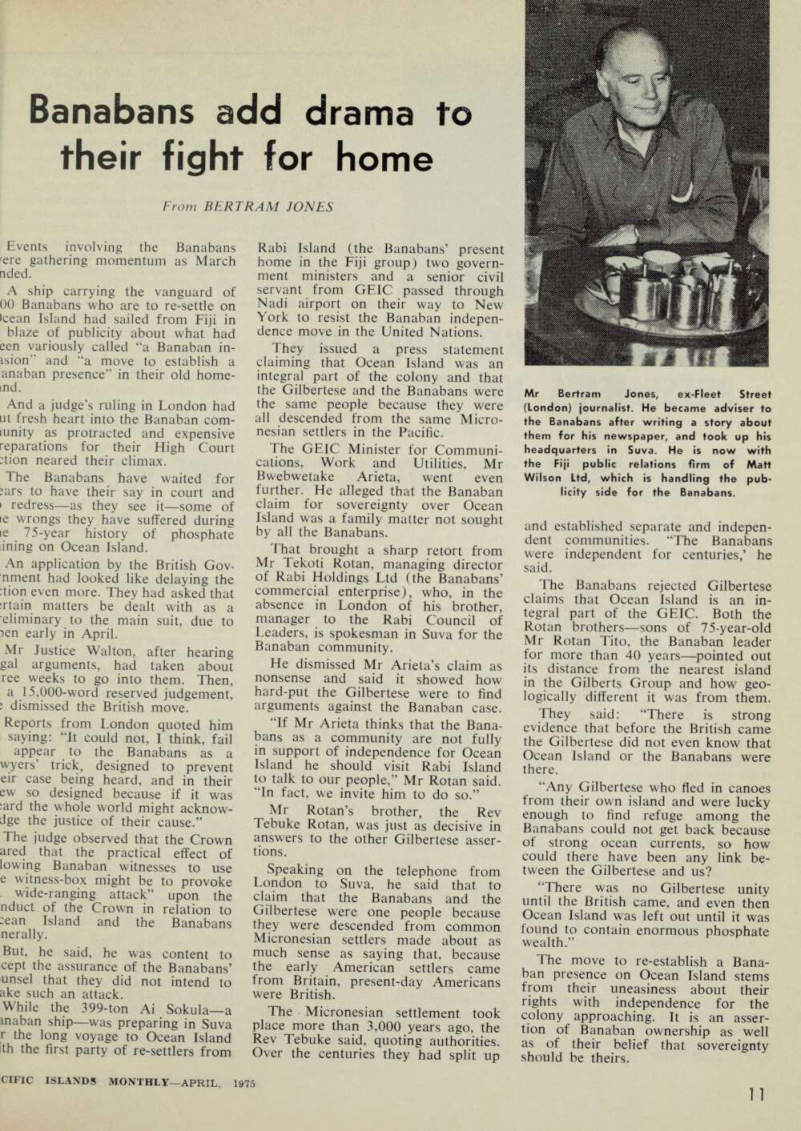
Mr Bertram Jones, ex-Fleet Street (London) journalist. He became adviser to the Banabans after writing a story about them for his newspaper, and took up his headquarters in Suva. He is now with the Fiji public relations firm of Matt Wilson Ltd, which is handling the pub licity side for the Banabans.
Advertisements & other items, p. 13 (1 item)
11
CIFIC ISLANDS MONTHLY—APRIL, 1975
Png Govt Takes Over The
Pressmen's Job But . . .
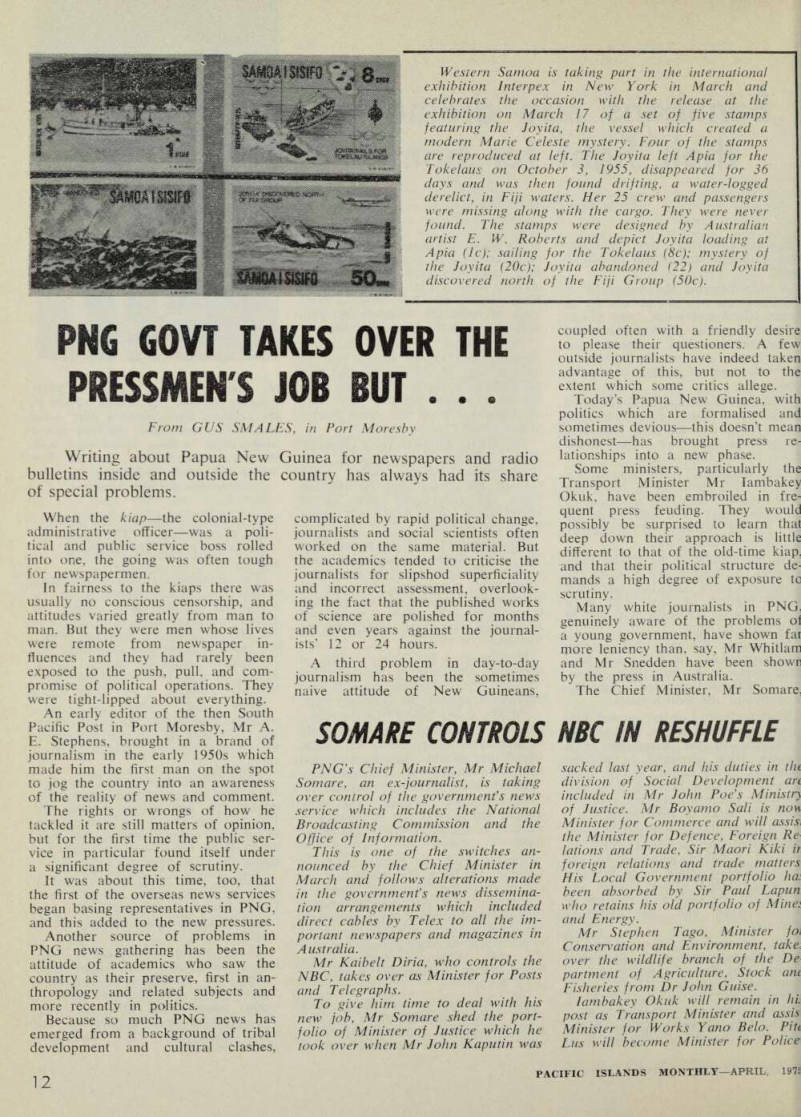
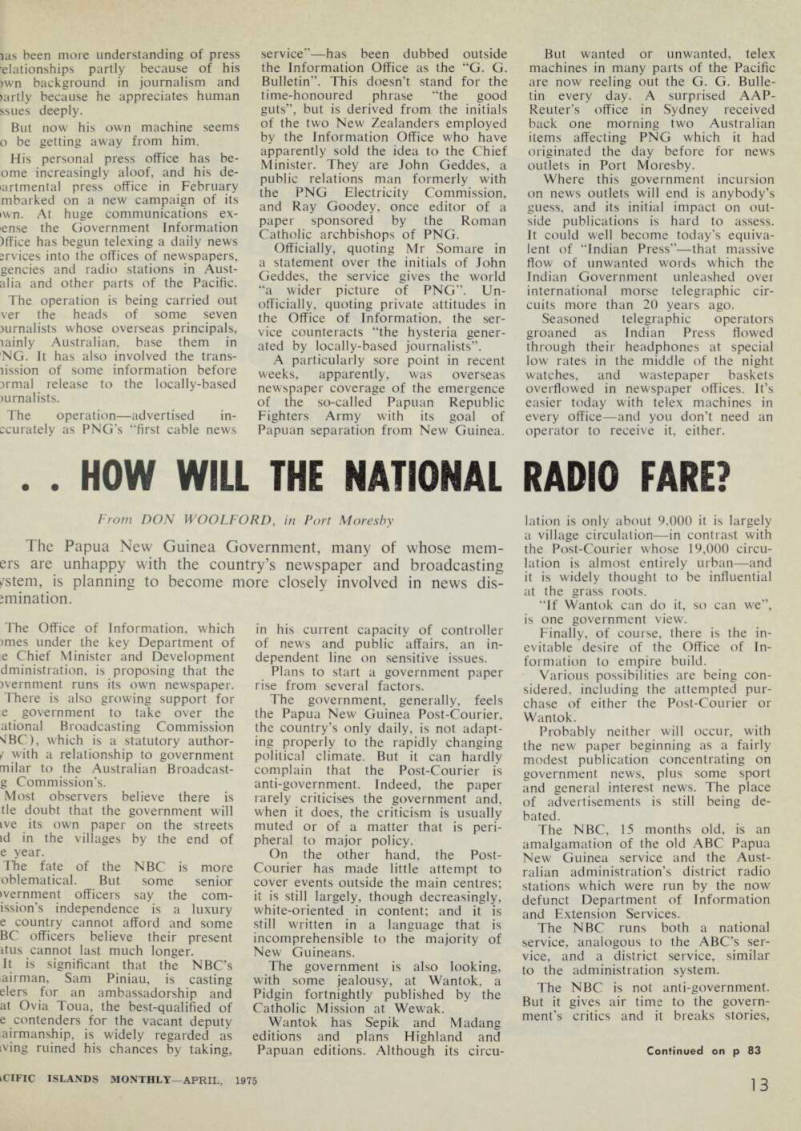
Western Samoa is taking part in the international exhibition Interpex in New York in March and celebrates the occasion with the release at the exhibition on March 17 of a set of five stamps featuring the Joyita, the vessel which created a modern Marie Celeste mystery. Four of the stamps are reproduced at left. The Joyita left Apia for the Tokelaus on October 3, 1955, disappeared for 36 days and was then found drifting, a water-logged derelict, in Fiji waters. Her 25 crew and passengers were missing along with the cargo. They were never found. The stamps were designed by Australian artist E. W. Roberts and depict Joyita loading at Apia (1c); sailing for the Tokelaus (8c); mystery of the Joyita (20c); Joyita abandoned (22) and Joyita discovered north of the Fiji Group (50c).
From GUS SMALES, in Port Moresby Writing about Papua New Guinea for newspapers and radio bulletins inside and outside the country has always had its share of special problems.
When the kiap —the colonial-type administrative officer—was a political and public service boss rolled into one, the going was often tough for newspapermen.
In fairness to the kiaps there was usually no conscious censorship, and attitudes varied greatly from man to man. But they were men whose lives were remote from newspaper influences and they had rarely been exposed to the push, pull, and compromise of political operations. They were tight-lipped about everything.
An early editor of the then South Pacific Post in Port Moresby, Mr A.
E. Stephens, brought in a brand of journalism in the early 1950 s which made him the first man on the spot to jog the country into an awareness of the reality of news and comment.
The rights or wrongs of how he tackled it are still matters of opinion. but for the first time the public service in particular found itself under a significant degree of scrutiny.
It was about this time, too, that the first of the overseas news services began basing representatives in PNG, and this added to the new pressures.
Another source of problems in PNG news gathering has been the attitude of academics who saw the country as their preserve, first in anthropology and related subjects and more recently in politics.
Because so much PNG news has emerged from a background of tribal development and cultural clashes,
complicated by rapid political change, journalists and social scientists often worked on the same material. But the academics tended to criticise the journalists for slipshod superficiality and incorrect assessment, overlook ing the fact that the published works of science are polished for months and even years against the journal ists’ 12 or 24 hours, A , hird pro blem in day-to-day journa , ism has been the som etimes najve attitude of New Guineans,
coupled often with a friendly desire to please their questioners. A few outside journalists have indeed taken advantage of this, but not to the extent which some critics allege.
Today’s Papua New Guinea, with politics which are formalised and sometimes devious—this doesn’t mean dishonest—has brought press re lationships into a new phase.
Some ministers, particularly the Transport Minister Mr lambakey Okuk, have been embroiled in fre quent press feuding. They would possibly be surprised to learn that deep down their approach is little different to that of the old-time kiap, and that their political structure de mands a high degree of exposure to scrutiny.
Many white journalists in PNG, genuinely aware of the problems ol a young government, have shown far more leniency than, say, Mr Whitlam and Mr Snedden have been shown by the press in Australia.
The Chief Minister, Mr Somare,
las been more understanding of press elationships partly because of his )wn background in journalism and >artly because he appreciates human ssues deeply.
But now his own machine seems o be getting away from him.
His personal press office has be ome increasingly aloof, and his de trimental press office in February mbarked on a new campaign of its iwn. At huge communications ex pense the Government Information )ffice has begun telexing a daily news srvices into the offices of newspapers, gencies and radio stations in Aust alia and other parts of the Pacific.
The operation is being carried out ver the heads of some seven mrnalists whose overseas principals, lainly Australian, base them in NG. It has also involved the trans lission of some information before 3rmal release to the locally-based mrnalists.
The operation—advertised in ccurately as PNG’s “first cable news
service”—has been dubbed outside the Information Office as the “G. G.
Bulletin”. This doesn’t stand for the time-honoured phrase “the good guts”, but is derived from the initials of the two New Zealanders employed by the Information Office who have apparently sold the idea to the Chief Minister. They are John Geddes, a public relations man formerly with the PNG Electricity Commission, and Ray Goodey, once editor of a paper sponsored by the Roman Catholic archbishops of PNG.
Officially, quoting Mr Somare in a statement over the initials of John Geddes, the service gives the world “a wider picture of PNG”. Un officially, quoting private attitudes in the Office of Information, the ser vice counteracts “the hysteria gener ated by locally-based journalists”.
A particularly sore point in recent weeks, apparently, was overseas newspaper coverage of the emergence of the so-called Papuan Republic Fighters Army with its goal of Papuan separation from New Guinea.
But wanted or unwanted, telex machines in many parts of the Pacific are now reeling out the G. G. Bulle tin every day. A surprised AAP- Reuter’s office in Sydney received back one morning two Australian items affecting PNG which it had originated the day before for news outlets in Port Moresby.
Where this government incursion on news outlets will end is anybody’s guess, and its initial impact on out side publications is hard to assess.
It could well become today’s equiva lent of “Indian Press”—that massive flow of unwanted words which the Indian Government unleashed over international morse telegraphic cir cuits more than 20 years ago.
Seasoned telegraphic operators groaned as Indian Press flowed through their headphones at special low rates in the middle of the night watches, and wastepaper baskets overflowed in newspaper offices. It’s easier today with telex machines in every office—and you don’t need an operator to receive it, either.
Somare Controls Nbc In Reshuffle
PNG’s Chief Minister, Mr Michael Somare, an ex-journalist, is taking over control of the government’s news service which includes the National Broadcasting Commission and the Office of Information.
This is one of the switches an nounced by the Chief Minister in March and follows alterations made in the government’s news dissemina tion arrangements which included direct cables by Telex to all the im portant newspapers and magazines in Australia.
Mr Kaibelt Diria, who controls the NBC, takes over as Minister for Posts and Telegraphs.
To give him time to deal with his new job, Mr Somare shed the port folio of Minister of Justice which he took over when Mr John Kaputin was
sacked last year, and his duties in the division of Social Development are included in Mr John Poe’s Ministry of Justice. Mr Boyamo Sail is now Minister for Commerce and will assist the Minister for Defence, Foreign Re lations and Trade, Sir Maori Kiki ir foreign relations and trade matters His Local Government portfolio hat been absorbed by Sir Paul Lapun who retains his old portfolio of Mine; and Energy.
Mr Stephen Tago, Minister foi Conservation and Environment, take, over the wildlife branch of the De partment of Agriculture, Stock am Fisheries from Dr John Guise. lambakey Okuk will remain in hi post as Transport Minister and assis Minister for Works Yano Belo. Pitt Lus will become Minister for Police
. . How Will The National Radio Fare?

From DON WOOLFORD, in Port Moresby The Papua New Guinea Government, many of whose mem ers are unhappy with the country’s newspaper and broadcasting /stem, is planning to become more closely involved in news dis
The Office of Information, which )mes under the key Department of e Chief Minister and Development dministration, is proposing that the jvernment runs its own newspaper.
There is also growing support for e government to take over the ational Broadcasting Commission 'JBC), which is a statutory author / with a relationship to government milar to the Australian Broadcast g Commission’s.
Most observers believe there is tie doubt that the government will ive its own paper on the streets id in the villages by the end of e year.
The fate of the NBC is more oblematical. But some senior ivernment officers say the com ission’s independence is a luxury e country cannot afford and some BC officers believe their present itus cannot last much longer.
It is significant that the NBC’s airman, Sam Piniau, is casting elers for an ambassadorship and at Ovia Toua, the best-qualified of e contenders for the vacant deputy airmanship, is widely regarded as iving ruined his chances by taking,
in his current capacity of controller of news and public affairs, an in dependent line on sensitive issues, Plans to start a government paper rise from several factors.
The government, generally, feels the Papua New Guinea Post-Courier, the country’s only daily, is not adapt ing properly to the rapidly changing political climate. But it can hardly complain that the Post-Courier is anti-government. Indeed, the paper rarely criticises the government and, when it does, the criticism is usually muted or of a matter that is peri pheral to major policy.
On the other hand, the Post- Courier has made little attempt to cover events outside the main centres; it is still largely, though decreasingly, white-oriented in content; and it is still written in a language that is incomprehensible to the majority of New Guineans.
The government is also looking, with some jealousy, at Wantok, a Pidgin fortnightly published by the Catholic Mission at Wewak.
Wantok has S'epik and Madang editions and plans Highland and Papuan editions. Although its circu
lation is only about 9,000 it is largely a village circulation—in contrast with the Post-Courier whose 19,000 circu lation is almost entirely urban—and it is widely thought to be influential at the grass roots.
“If Wantok can do it, so can we”, is one government view.
Finally, of course, there is the in evitable desire of the Office of In formation to empire build.
Various possibilities are being con sidered, including the attempted pur chase of either the Post-Courier or Wantok.
Probably neither will occur, with the new paper beginning as a fairly modest publication concentrating on government news, plus some sport and general interest news. The place of advertisements is still being de bated.
The NBC, 15 months old, is an amalgamation of the old ABC Papua New Guinea service and the Aust ralian administration’s district radio stations which were run by the now defunct Department of Information and Extension Services.
The NBC runs both a national service, analogous to the ABC’s ser vice, and a district service, similar to the administration system.
The NBC is not anti-government.
But it gives air time to the govern ment’s critics and it breaks stories,
Continued on p 83
when it can. which the government would prefer did not become public knowledge.
This has periodically put it under ministerial pressure, most recently when it ran interviews with the Papuan dissidents Simon Kaumi and Josephine Abaijah.
Furthermore, the Office of In formation is partly staffed by former DIES officers who regret their loss of responsibility for broadcasting and are alert to any chance to regain it.
Some argue that the NBC is not using the district stations as effectively as DIES used to—a claim for which there is little hard evi dence either way.
Quite apart from traditions regard ing the freedom of the press (not that Papua New Guinea has much in the way of such a tradition), the government may find, if it does get seriously involved in the news media business, that there are many prob lems.
It is probably impossible in a largely rural, illiterate and tribally atomised country to produce a real national newspaper.
One that attempted to meet the needs of hundreds of thousands of villagers with rudimentary reading skills and limited knowledge of life
outside their own society would have little appeal to the urban reader who, while a small minority, is by far the more influential.
On the other hand, despite their limited backgrounds, PNG villagers are no fools. The Australian ad ministration found this a few years ago when it tried to use its radio stations at Rabaul and Kieta for pro paganda.
There is no good reason to sup pose that if the national government tries to use the news media similarly it will not get a similar reaction— at best indifference, quite possibly, as on the Gazelle Peninsula in 1970,
outright hostility.
Advertisements & other items, pp. 15-16 (2 items)
13
iCIFIC ISLANDS MONTHLY—APHIL, 1975
Bank Of
vtfH \\\o$ e G© 1 cou o \/e' an --•V V
N/OVi
t>e^° T 0
on \\ae
rna^ e
on dec' \oe sS oov poS \ n ( N exN Z
gat* 0
Please put me on your mailing list for free monthly issues of 'BNZ Business Indicators' Name Business address Type of business.
Position in Company
BANK OF
NEW ZEALAND
Nutshell
In a Nutshell
Lig Catch
Captain Parea of Tahiti recently anded a huge marlin off Papeete, t weighed 814 lb (within 40 kilo ;rams of the world record) and was 3 ft 8 in. long. Captain Parea is he master of the 37 ft charter fishing ioat, Taumata. The marlin was the econd 500 lb-plus marlin boated by he Tumata in 10 days. The marlin /hen put on the scales attracted a iig crowd of onlookers, including the levitable children.
In Dead Honoured
Thirty men killed on the job during he past 15 years were recently re lembered at the unveiling of a lemorial at the SEN nickel factory t Doniambo, in Noumea. Most of he accident victims worked at the nelting works, although others died a accidents at the company’s various aland nickel mines. The worst ccident year for the SEN was in 973 when six men died from burns rom molten nickel.
Even Killed
The worst accident ever seen on lew Caledonian roads caused seven eaths in mid-February on the iuamenie River bridge, near La Foa. i a head-on crash on a single lane ridge, a Mobil petrol tanker over irned and a Peugeot van with seven assengers plunged 10 metres into the ver below. The mutilated bodies f victims remained visible to hom ed spectators as a special crane was riven up from Noumea to extricate ame of the dead. The tanker driver as the only survivor.
Es, We Have No Bananas
Banana producers in Western amoa failed to meet the quota of 000 cases for the first shipment for month to New Zealand in mid ebruary. A producer blamed high ast of fertilisers and labour and the •w price—$2.30 for a 50 lb case— btained for the bananas. Growers auld also get $3 to $4 for a 10-hand jnch at the local market. The ship ient was made, for the first time, 1 cases made from shocks produced Y the Japanese timber mill at Sina loga and Vaitele. One producer lid it was almost impossible to nail le lids on the cases.
Boating Mishap
Mrs Ricardo J. Bordallo, wife of the Governor of Guam, had a brush with death recently when a boat carrying her and four other women from Truk overturned between Fefan and Dublon. The women were in a glass-bottomed boat, the property of the Continental Hotel, Truk, which was carrying them from Tol Island back to Moen. They encountered heavy seas, and the casings of the glass tore loose, finally giving way altogether. Everybody went forward; then a wave washed four women overboard, leaving Mrs Maria Stolo behind, caught in the cabin. The boat overturned, and her only way out was through the open bottom. She called for help, and the other women rescued her. The five of them clung to the side of the overturned boat till rescued 20 minutes later by a govern ment boat.
Exam Cheaters
Similarity of marks made it obvious there had been mass cheating by about 30 children at Penang High School, Fiji, in the university entrance examination. A New Zealand official flew to Fiji to investigate the matter.
The NZ Education Department later cancelled the passes of the students.
There was also an investigation at the same school into the school certificate results of about 35 other children.
Fiji's 50 Center
Fiji’s 50c coins went into circula tion on March 3. They joined the traditional 50c note, and will be in circulation for a trial period of 18 months. The 12-edged coins, specially minted by the Royal Australian Mint.
Canberra, are of cupro-nickel, and carry the same image of the Queen as other Fiji coins. The design on the reverse is of a drua (Fijian double canoe).
Tauloto Rescues
Tonga’s Tauloto became a salvage ship on its March voyage from Nuku alofa to Sydney when it took in tow the ketch Seawind. The ketch dis appeared from its mooring in the Georges River, Sydney, in October, 1974. The Seawind, valued at $14,000, belongs to Mr Angus Gib son, a science teacher.
A freighter, the Maheno, sighted the Seawind about 135 kilometres east of Sydney, and took a man off it, but it was unable to take it in tow. The man was later charged in court in Auckland with the theft of the ketch. The Seawind apparently drifted till it was picked up by the Tauloto on March 5. Captain James Stott, master of the Tauloto, said the sails were in tatters. Karlander, which has chartered the Tauloto to Tonga, may lodge a claim for salvage rights,
More Bangs!
A French warning to shipping to keep clear of the underground nuclear testing sites of Mururoa and Ganga taufa atolls does not mean that fresh tests are imminent. A French Defence Ministry spokesman in Paris said the warning, issued in February, was permanent, and valid throughout the year. The area round the atolls is not a prohibited zone, but a danger area.
Miss Leone Rankin, eldest daughter of Bob and Sophia Rankin of Apia, and her bridegroom, ex-Peace Corps volunteer Kirk Dillon of the United States. The wedding, in perfect weather at the Roman Catholic Cathedral, Moamoa, took place in February, and was followed by a reception at the Rankin home, Vaoala.
Leone and her husband, who is a marine biologist, are living at Dunedin, New Zealand, where she is attending the Otago Medical School.
France And The
South Pacific
An article on France’s aspira tions in the South Pacific by the French Secretary of State for Overseas Territories, Mr Olivier Stirn, will appear in PlM’s May issue. The article, in French and English, is expected to deal with France’s plans for her South Pacific territories.
Advertisements & other items, p. 17 (1 item)
Acific Islands Monthly—April, 1975
Fiji’s ‘green gold’ is coming true
An exiled prophet’s vision of Fiji’s ‘green gold’ is coming true
From VIJENDRA KUMAR in Lautoka
FIJI’S history books make only passing mention of Apolosi Ranawai who soared to brief fame (or notoriety) in the 19305.
But his ghost still seems to haunt the country.
Writing in the March, 1939 issue of PIM, Gilchrist Alexander told of Ranawai’s abortive attempt to launch the first Fijian com mercial venture—the Viti Com pany. It was a co-operative move ment which was primarily con cerned with marketing bananas and other produce raised by Fijians.
Ranawai’s movement gathered considerable momentum but it was doomed to failure because of hos
tility from European planters,
businessmen and the British Co lonial Government. Given proper guidance and help, the venture could have helped emancipate and launch the Fijians into the com mercial world.
Ranawai, who was a com moner from Narewa village near Nadi, had a messianic effect on his followers who believed that he had divine powers. It is doubt ful whether his followers had the sort of affection the masses have for a popular leader. On the con trary, the more superstitious feared him.
After the formation of the Viti Company, Ranawai published the following statement in the Eng lish language newspapers; “Before I commence my business, I will let you know first the foundation of my work: “1. I shall love all my brethren.
“2. I shall honour all the chiefs.
“3. I will honour the King through all his subjects.
“4. I will fear the Lord, our God”.
Alexander wrote that soon after the company began operating, “the Wesleyan Methodist Mission suffered a huge financial loss when large numbers of Natives trans ferred their contributions, which they would ordinarily have given
to the mission, to the new company.
“To the government, Apolosi was anathema”.
Because of lack of experience and knowhow, Ranawai, who had declared himself the company’s managing director, and his corporate bedfellows soon found themselves in troubled waters.
They drank heavily and brawled among themselves. And Ranawai, in his own time, became a legendary womaniser. It is believed that he had more than a dozen wives.
Finally, power went to his head and he became involved in open conflict with the British Colonial Government. He was exiled to Rotuma but recalled after a few years and was put on the good behaviour bond. He forfeited it and the ov ® r "“® nt . ,^ ec ! h cisciin to ci remote islcincl in tne Yasawas. So Ranawai faded into
natfonaUs. SSS ST
ment died a sorry death.
Ranawai was not only a gifted orator but apparently had the gift
of prophecy. One of his prophetic utterances, which the Fijians re membered but did not understand for quite some time, seems to be
materialising now.
Looking at the dry and barren hills of Nabou, about 10 miles inland from Nadi International Airport, he told his followers that one day the place would yield “green gold”. The hills are now covered with Caribbean Pine trees and are expected eventually to bring Fiji millions of dollars, Ranawai ' s gre en gold flourishes and is already bringing increasing cash returns to the descendants of the people he once led. Sales of pressure-treated timber from thin nings i n 1973 totalled $51,300 an d $60,500 last year, T ~. , ( ... . , - n . • in 1981 when Fiji is expected to . i , tl •
hf “ctS
feZes? ‘ a,,6r 5,3865 of the han,est ' Ranawai’s ghost may now rest in peace.
"Green gold" in Fiji—a scene at the pine nursery at Lolo Forest station.
Advertisements & other items, p. 19 (1 item)
Timely Pacific Reading!
Send your order direct to
Pacific Publications (Aust.) Pty. Ltd.
29 Alberta Street, Sydney, N.S.W. 2000
PAPUA NEW GUINEA
HANDBOOK
7th edition This new edition of the Papua New Guinea Handbook —completely revised and reset —provides the first full upto-date details of the new self-governing nation.
For businessmen, travellers, schools, universities and libraries, government departments, tourists and Papua New Guinea residents, this timely, up-to-the-minute edition, is essential.
A large attractive fold-out map of Papua New Guinea is also included. 332 pages of text.
PRICE: Australia, $5.50 plus 85c posted. Pacific Islands and Overseas, $5.50 Aust., plus $l.lO posted; U.S.A., $9.80 U.S. posted
FOR CHILDREN
LITTLE CHIMBU
BOUGAINVILLE
IN Nancy Curtis This is the story of lovable Little Chimbu, and his friends, who go off to see the biggest hole in the world . . . the Bougainville copper mine, at Panguna, in New Guinea.
Adventures follow one after the other on their arrival at the mine, and young readers (and their parents) will be fascinated by Nancy Curtis' colourful, yet accurate and instructive account of the workings of the big Bougainville enterprise ... its giant trucks, its processing plant, its port and shipping.
Illustrated in full colour.
PRICE: Australia, Pacific Islands and Overseas, $3.25 Aust., plus 48c posted, U S A., $5.30 U.S. posted.
pRPun
HEW CUlilEfl
HBIIDBOOK
m Percy Chatterton's Papua
DAY THAT I HAVE LOVED
Percy Chatterton This is more than an autobiography by well-known Percy Chatterton, OBE, who has spent 50 years in Papua as missionary, teacher and outspoken politician fighting for the underdog. It is a colourful, and charming, account of the Papuan people, giving warm insight into their hopes, fears and changing way of life. Some Papuan leaders say they don't want Papua to be submerged by New Guinea in the move towards independence, and readers of Percy Chatterton's timely book will readily sympathise with their desire to retain their identity. The book is illustrated with evocative pen sketches by Percy Chatterton's longtime friend and neighbour in Port Moresby, Rev. Bert Brown. 144 pages, illustrated.
PRICE: Australia, Pacific Islands and Overseas, $5.25 Aust , plus 48c posted; U.S.A., $8.30 U.S. posted.
HOLY TORTURE IN FIJI
Written by a group of academic participants and observers.
Editing and commentary by Prof. Ron Crocombe.
This book describes sacred ancient rituals involving physical ordeals which are performed once a year at certain Hindu temples in Fiji. The rituals include walking on fire, dancing on upturned knife blades, whipping, plunging the hands in burning fat and piercing the body with steel skewers and silver wires.
Yet those who go through the ordeals suffer no pain, burns or injuries.
The book is beautifully produced in full colour and black-and-white.
PRICE: Australia, Pacific Islands and Overseas, $3.95 Aust., plus 48c posted; U.S.A., $6.40 U.S. posted.
HOLY
TORTURE
Percy Chatterton’s Papua
DAY THAT I
HAVE LOVED
IN FIJI
Tropica lities
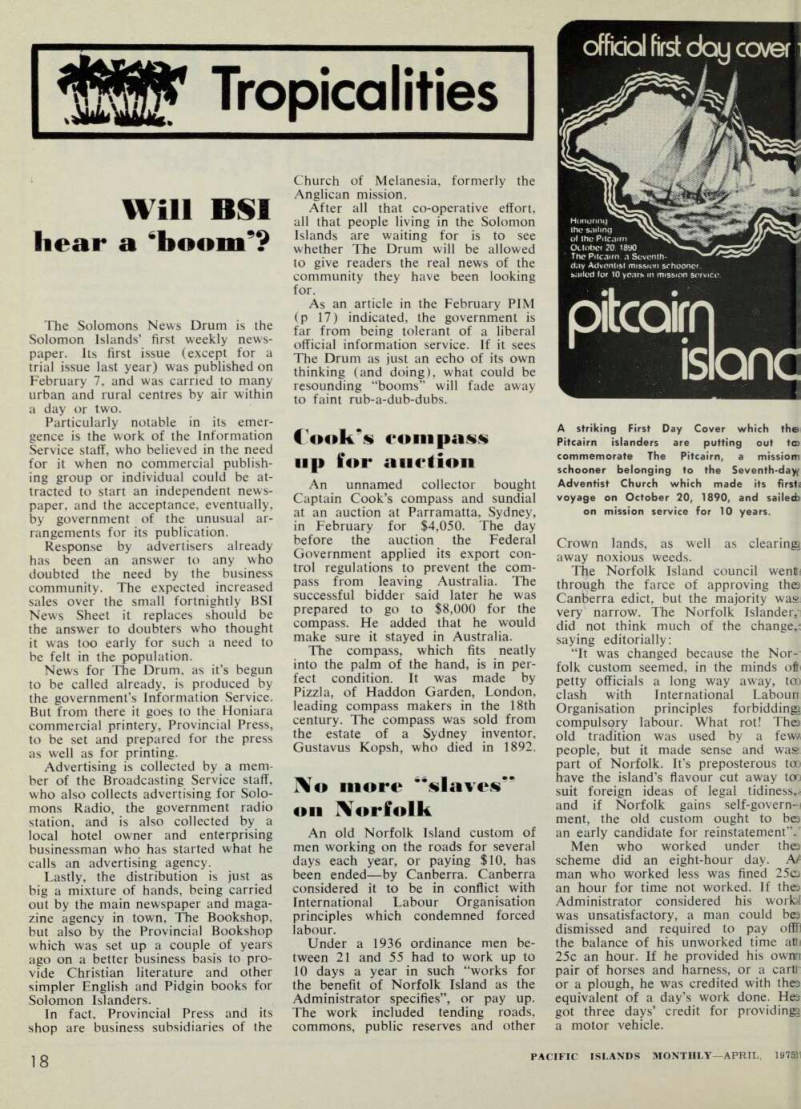
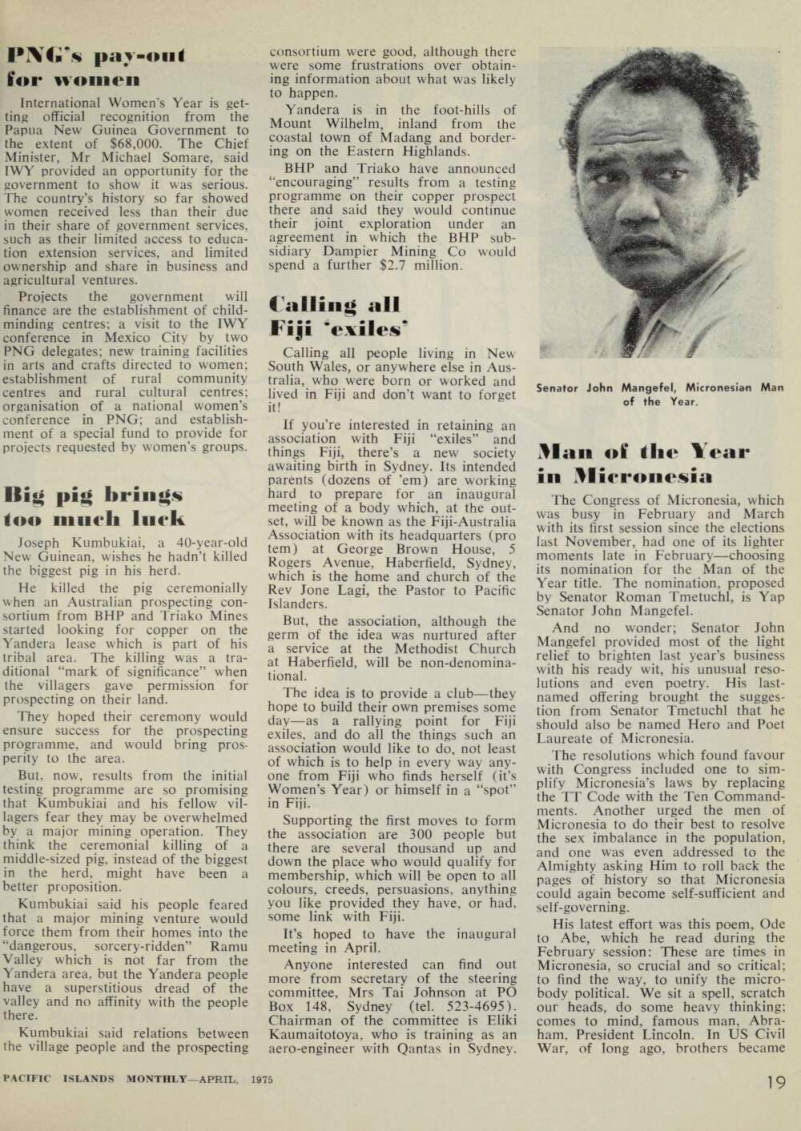
Will BSI
hear a ‘boom’?
The Solomons News Drum is the Solomon Islands’ first weekly news paper. Its first issue (except for a trial issue last year) was published on February 7, and was carried to many urban and rural centres by air within a day or two.
Particularly notable in its emer gence is the work of the Information Service staff, who believed in the need for it when no commercial publish ing group or individual could be at tracted to start an independent news paper, and the acceptance, eventually, by government of the unusual ar rangements for its publication.
Response by advertisers already has been an answer to any who doubted the need by the business community. The expected increased sales over the small fortnightly BSI News Sheet it replaces should be the answer to doubters who thought it was too early for such a need to be felt in the population.
News for The Drum, as it’s begun to be called already, is produced by the government’s Information Service.
But from there it goes to the Honiara commercial printery, Provincial Press, to be set and prepared for the press as well as for printing.
Advertising is collected by a mem ber of the Broadcasting Service staff, who also collects advertising for Solo mons Radio, the government radio station, and is also collected by a local hotel owner and enterprising businessman who has started what he calls an advertising agency.
Lastly, the distribution is just as big a mixture of hands, being carried out by the main newspaper and maga zine agency in town, The Bookshop, but also by the Provincial Bookshop which was set up a couple of years ago on a better business basis to pro vide Christian literature and other simpler English and Pidgin books for Solomon Islanders.
In fact. Provincial Press and its shop are business subsidiaries of the
Church of Melanesia, formerly the Anglican mission.
After all that co-operative effort, all that people living in the Solomon Islands are waiting for is to see whether The Drum will be allowed to give readers the real news of the community they have been looking for.
As an article in the February PIM (p 17) indicated, the government is far from being tolerant of a liberal official information service. If it sees The Drum as just an echo of its own thinking (and doing), what could be resounding “booms” will fade away to faint rub-a-dub-dubs.
Cook's 4*ompass
up for aii<*iion
An unnamed collector bought Captain Cook’s compass and sundial at an auction at Parramatta, Sydney, in February for $4,050. The day before the auction the Federal Government applied its export con trol regulations to prevent the com pass from leaving Australia. The successful bidder said later he was prepared to go to $B,OOO for the compass. He added that he would make sure it stayed in Australia.
The compass, which fits neatly into the palm of the hand, is in per fect condition. It was made by Pizzla, of Haddon Garden, London, leading compass makers in the 18th century. The compass was sold from the estate of a Sydney inventor, Gustavus Kopsh, who died in 1892.
more ‘‘slaves”
oil Norfolk
An old Norfolk Island custom of men working on the roads for several days each year, or paying $lO, has been ended—by Canberra. Canberra considered it to be in conflict with International Labour Organisation principles which condemned forced labour.
Under a 1936 ordinance men be tween 21 and 55 had to work up to 10 days a year in such “works for the benefit of Norfolk Island as the Administrator specifies”, or pay up.
The work included tending roads, commons, public reserves and other
Crown lands, as well as clearing away noxious weeds.
The Norfolk Island council went through the farce of approving thea Canberra edict, but the majority wasj very narrow. The Norfolk Islander,! did not think much of the saying editorially: “It was changed because the Nor folk custom seemed, in the minds oft< petty officials a long way away, too clash with International Laboun Organisation principles forbidding compulsory labour. What rot! Thea old tradition was used by a few* people, but it made sense and was, part of Norfolk. It’s preposterous too have the island’s flavour cut away too suit foreign ideas of legal tidiness,* and if Norfolk gains self-govern-i ment, the old custom ought to bes an early candidate for reinstatement”.' Men who worked under thea scheme did an eight-hour day. A/ man who worked less was fined 250 an hour for time not worked. If thea Administrator considered his world was unsatisfactory, a man could bea dismissed and required to pay offfi the balance of his unworked time ath 25c an hour. If he provided his ownn pair of horses and harness, or a earth or a plough, he was credited with thes equivalent of a day’s work done. Hea got three days’ credit for providing a motor vehicle.
A striking First Day Cover which the Pitcairn islanders are putting out to commemorate The Pitcairn, a mission schooner belonging to the Adventist Church which made its first, voyage on October 20, 1890, and saile on mission service for 10 years.
PNG’s pav-oni
for women
International Women’s Year is get ting official recognition from the Papua New Guinea Government to the extent of $68,000. The Chief Minister, Mr Michael Somare, said IWY provided an opportunity for the government to show it was serious.
The country’s history so far showed women received less than their due in their share of government services, such as their limited access to educa tion extension services, and limited ownership and share in business and agricultural ventures.
Projects the government will finance are the establishment of child minding centres; a visit to the IWY conference in Mexico City by two PNG delegates; new training facilities in arts and crafts directed to women; establishment of rural community centres and rural cultural centres; organisation of a national women’s conference in PNG; and establish ment of a special fund to provide for projects requested by women’s groups.
■lig pig bring*
100 mnrli lurk
Joseph Kumbukiai, a 40-year-old New Guinean, wishes he hadn’t killed the biggest pig in his herd.
He killed the pig ceremonially when an Australian prospecting con sortium from BHP and Triako Mines started looking for copper on the Yandera lease which is part of his tribal area. The killing was a tra ditional “mark of significance” when the villagers gave permission for prospecting on their land.
They hoped their ceremony would ensure success for the prospecting programme, and would bring pros perity to the area.
But, now, results from the initial testing programme are so promising that Kumbukiai and his fellow vil lagers fear they may be overwhelmed by a major mining operation. They think the ceremonial killing of a middle-sized pig, instead of the biggest in the herd, might have been a better proposition.
Kumbukiai said his people feared that a major mining venture would force them from their homes into the “dangerous, sorcery-ridden” Ramu Valley which is not far from the Yandera area, but the Yandera people have a superstitious dread of the valley and no affinity with the people there.
Kumbukiai said relations between the village people and the prospecting
consortium were good, although there were some frustrations over obtain ing information about what was likely to happen.
Yandera is in the foot-hills of Mount Wilhelm, inland from the coastal town of Madang and border ing on the Eastern Highlands.
BHP and Triako have announced “encouraging” results from a testing programme on their copper prospect there and said they would continue their joint exploration under an agreement in which the BHP sub sidiary Dampier Mining Co would spend a further $2.7 million.
Calling all
Fiji ‘exiles’
Calling all people living in New South Wales, or anywhere else in Aus tralia, who were born or worked and lived in Fiji and don’t want to forget it!
If you’re interested in retaining an association with Fiji “exiles” and things Fiji, there’s a new society awaiting birth in Sydney. Its intended parents (dozens of ’em) are working hard to prepare for an inaugural meeting of a body which, at the out set, will be known as the Fiji-Australia Association with its headquarters (pro tern) at George Brown House, 5 Rogers Avenue, Haberfield, Sydney, which is the home and church of the Rev Jone Lagi, the Pastor to Pacific Islanders.
But, the association, although the germ of the idea was nurtured after a service at the Methodist Church at Haberfield, will be non-denomina tional.
The idea is to provide a club —they hope to build their own premises some day—as a rallying point for Fiji exiles, and do all the things such an association would like to do, not least of which is to help in every way any one from Fiji who finds herself (it’s Women’s Year) or himself in a “spot” in Fiji.
Supporting the first moves to form the association are 300 people but there are several thousand up and down the place who would qualify for membership, which will be open to all colours, creeds, persuasions, anything you like provided they have, or had, some link with Fiji.
It’s hoped to have the inaugural meeting in April.
Anyone interested can find out more from secretary of the steering committee, Mrs Tai Johnson at PO Box 148, Sydney (tel. 523-4695).
Chairman of the committee is Eliki Kaumaitotoya, who is training as an aero-engineer with Qantas in Sydney.
Nlan of ih< k \ciir
in m ieronesia
The Congress of Micronesia, which was busy in February and March with its first session since the elections last November, had one of its lighter moments late in February—choosing its nomination for the Man of the Year title. The nomination, proposed by Senator Roman Tmetuchl, is Yap Senator John Mangefel.
And no wonder; Senator John Mangefel provided most of the light relief to brighten last year’s business with his ready wit, his unusual reso lutions and even poetry. His last named offering brought the sugges tion from Senator Tmetuchl that he should also be named Hero and Poet Laureate of Micronesia.
The resolutions which found favour with Congress included one to sim plify Micronesia’s laws by replacing the TT Code with the Ten Command ments. Another urged the men of Micronesia to do their best to resolve the sex imbalance in the population, and one was even addressed to the Almighty asking Him to roll back the pages of history so that Micronesia could again become self-sufficient and self-governing.
His latest effort was this poem, Ode to Abe, which he read during the February session; These are times in Micronesia, so crucial and so critical; to find the way, to unify the micro body political. We sit a spell, scratch our heads, do some heavy thinking; comes to mind, famous man, Abra ham. President Lincoln. In US Civil War, of long ago, brothers became
Senator John Mangefel, Micronesian Man of the Year.
foes, but democracy, and the Union stayed, as everybody knows. Old Abe was a master, his nation gone des perate; but he held the parts together, 3ne instead of separate. From this I drew a lesson, as any schoolboy :ould; America was example of unity, equality and good. Unity was the soil, which grew the flower democracy —despite recent Nixonian, presi dential hypocrisy. Despite all assur mces, my doubts began to grow, when seeds of discord, the US began o throw. They landed on our islands, irew by nights and days; and from hem, strange plants came in twisted ways. We are now in a quandary, :omplex, frustrating, and deep, to see \merican sow these seeds, and from hem. disunity reap. We see our ad ninistering authority, mother to Jncoln and others fool our Micro icsian family, our sisters and our mothers. Recent events if nothing, ;nforce our abiding awareness that \mericans truly believe, in the idea )f democratic fairness. But fine prin iple. actual practice often bothers— hey believe it for themselves, but not ilways for others. I recently visited DC, and Lincoln’s memorial place ind I saw that granite sadness, that ined and noble face. I was suddenly
struck, as the sun on his visage shone revealing soft tears, beneath those eyes of stone. The moral to this tale, if there is one to be found; America forsook the idea, of strength, thru unity bound.
Sbv birds
in Ill€* l ooks
A survey of bird life in the Cook Islands carried out in 1973 by Dr David T. Holyoak, under the sponsor ship of the International Council for Bird Preservation and the Smith sonian Institution has revealed the existence of seven birds previously unknown to science.
The survey was the first occasion on which birds of the Cooks have been studied.
The discoveries included two which are considered to be distinct species— the Mangaia kingfisher (Halcyon rufi collaris), and the Atiu swiftlet (Collocalia sawtelli), and two very distinctive new sub-species of the warbler (Acrocephalus vaughani).
Dr Holyoak also found that three bird species, known only to the Cooks, still survive. The fruit dove (Ptilino pus rarotongensis) and starling
(Aplonis cinerascens) of Rarotonga still survive in strength, but the fly catcher (Pomarea dimidiata) is now very rare. These birds are indigenous species.
By far the greatest number of birds seen in the Cook Islands are oceanic types that spend most of their lives over the open ocean, feeding upon various form of marine life. These sea birds are found on land only during their breeding seasons, and the commonest species seen in the Cooks are frigate birds, terns, tropic birds and boobies. Less frequently seen are albatrosses and storm petrels.
Suwarrow is a bird sanctuary where thousands of frigates and terns and smaller numbers of boobies breed, as they also do on Motu Kotawa, one of Pukapuka’s three islets. Frigate and bosun birds are seen in their hundreds on the small atoll of Taku tea, and are known on most of the other Cook Islands. Bosun birds are also called red-tailed tropic birds, and their scarlet tail feathers are valued by the islanders as decorations for their hats.
Migratory shore birds use the Cook Islands as wintering places after making amazingly long flights over the ocean from their breeding grounds
in Alaska and Siberia. These are ; Pacific godwits, American golden i plovers, wandering tattlers and bristle- ■ thighed curlews. These small, but ] hardy birds, return north in the ' spring.
The Cook Islands Government is < preparing legislation to give complete ; protection to the group’s indigenous < birds, and Dr Holyoak hopes to pub- lish a book shortly on the birds of i the south-east Pacific.
When this is completed, he intends < to start work on a popular, illustrated 1 booklet, on the birds of the Cook : Islands, which the Cook Islands i Library and Museum Society has i agreed to publish.
Korfolk’§ junior
boat builders
Fourth form pupils from the Nor- folk Island Central School are build- ing yachts, using as much local 1 material as possible, as a practical 1 exercise in woodwork. The class, in r 1974, started building an 8 ft Sabot J class sailing dinghy. It was finished t during the holidays by the manual f arts teacher, Mr David Regal, and I the science teacher, Mr John Smith..
The yacht performed satisfactorily \ during its shakedown cruise in Emily \ Bay.
Except for marine plywood and as few fittings, the boat was an all- - Norfolk product. The mast andt booms were built from famous Nor folk pine. About half the fittings z were machined at school. The sail! was sewn by Mr Smith’s wife.
The 1975 fourth formers are nowv building another boat. The first boat} will be raffled, and the money netted t will be used to buy materials for i more boats, as well as some equip- ment needed in the school wood- work shop. Mr Regal is aiming at} a fleet of at least four boats, to be s used for school racing on Emily Bay \ in the winter sports season.
Vvr lIM Kina*
N< k pi line’s post
A message in a bottle, dropped 1 from an Indian freighter in January, , has highlighted a beach on Lifou t Island in the Loyalty Group as a i favourite spot for currents to deposit reminders of distant ocean traffic.
The bottle message, dated July 17, , 1974. came from the radio officer i P. K. V. Menon, of Madras, India, . sailing aboard the MV Prabhu Puoyi i taking timber logs from New Zealand I to Yokkaichi in Japan. Dropped at sea 200 miles north of New Zealand, . at lat 26S and long 171 deg 39E, . the bottle had drifted 400 miles to c be discovered by fascinated Gale- donians in the Loyalty Islands.
Advertisements & other items, pp. 22-24 (1 item)
Sss£Ss»
ir_ I / / // / / ■// Y h e £ t 9 \s
0 0< »ed e * „tS " A otoo' e ® xd o?l® a od Manufactured by Commonwealth New Guinea Timbers Ltd. and available from leading suppliers throughout the Pacific.
RDI 1
4 Fed Free. Mix BACARDI rum any way you want.
BACARO. and me Bat Oe,
BAG 4924 75
ED
serves the Islands with expert
insurance service and advice.
QUEENSLAND INSURANCE
COMPANY LIMITED
(Incorporated 1886 in Australia) Head Office: 82 Pitt Street, Sydney FlJl—Branch Office, Suva, Manager for Fiji: F. N. Davies (A.A.1.1.).
LAUTOKA—Assistant Manager; G. A. Wooley.
HONIARA (8.5.1. P.) —Breckwoldt & Company (5.1.) Pty. Limited.
NEW CALEDONIA—T. A. Hagen, Ste. W. A. Johnston, S.A.R.L. —Noumea.
NEW HEBRlDES—Resident Officer: R. J. Allsop (A.A.1.1.) Vila; Santo: Bums Philp (New Hebrides) Ltd.
TAHlTl—Arthur Chung: Immeuble 8.1., Front de Mer, Papeete.
NIUE, NORFOLK ISLAND, SAMOA, TONGA and other South Sea Islands—Burns Philp (South Sea) Company Ltd.
QUEENSLAND INSURANCE (P.N.G.) LTD
PAPUA NEW GUINEA
Head Office, Port Moresby: General Manager: D. J. Granter.
District Managers at Rabaul: C. D. Dickings; Lae: R. Jackson; Mt. Hagen: D. F. Carroll.
H 359
D pua new guinea
printing co. ply. ltd.
Serving the Country from Aitape to Alotau, Manus to Moresby Leaders in Commercial Offset and Letterpress Printing. • Stationery • Office Supplies • Office Equipment • Rubber Stamps • Self-Adhesive Labels • In Fact: — Everything For The Office.
P.O. Box 633, Port Moresby P.O. Box 759, Lae P.O. Box 1239, Rabaul
The Mailbag

Irian Java: A Reply
And Invitation
As I returned from Irian Jaya re ;ently, I found comments on my article “From a dull Hollandia to a :olourful, bustling Jayapura” pub ished in the PIM, June ’74 issue (p 19) that I—in turn—would like to :omment on.
As for the remark of Mr Paul 3rocott (PIM, Feb, p 71) under ‘lrian Jaya”, it is true that I am a inguist. However, he has overlooked ny other academic qualifications that have acquired at the University of in the Netherlands. In fact, ny field is Indology which is a ipecialised study in Indonesian his ory, culture, law, sociology, eco lomics and politics. I hold a Doctorandus degree in Economics, md have also studied International Law.
In my long-standing career of caching Indonesian Studies (includ ng Bahasa Indonesia) —ever since I graduated from Leyden— at colleges putside Indonesia, such as the Pre idio of Monterey in California, the Jniversity of Hawaii, and Auckland Jniversity in New Zealand, I have jublished booklets and articles, not )nly on Indonesian linguistics, but dso on Indonesian political history. 3n my special interest in Pacific cul ures I published an article in the Journal of the Polynesian Society see June ’7O issue).
As for the article in the PIM January ’75 issue “Irian Jaya, a forth :oming bonanza—but who for?”, )ages 25-33, I must say that the greyish shade of the sand at Hamadi seach is a matter of taste. The igures given in my article dated back rom November 1973 when I was in rian Jaya, and were obtained from official sources.
One of the liaison officers who iccompanied Sir Maori Kiki on his ecent trip (September ’74) to Irian aya, and who is an Trianese himself, :xpressed surprise at seeing remark ible changes in Jayapura, and re portedly stated: “People on the other ;ide of the border never get the word icross”.
Rather than engaging myself in end
less polemics, I intend to publish a series of articles dealing with different aspects of life in Irian Jaya. I would also suggest that people—who are still holding an idee fixe of West Irian in Sukarno’s days—pay a visit to J ayapura.
With an Indonesian Consulate- General in Port Moresby, it should not be difficult for PNG-ans and other residents of Papua New Guinea to obtain a tourist visa. In Jayapura they can freely contact “the man in the street” and see things for them selves.
In this way, much of the thick mist of ignorance which shrouds some of the diehards’ minds, will hopefully be lifted.
R. S. Roosman
Senior Lecturer.
Dept of Political Studies, University of PNG.
Guise, The Trader
In his letter (PIM, Feb, p 73) Archdeacon Whonsbon-Aston gives an interesting account of the Guise family, but unfortunately it is a myth.
The family is a distinguished English family who have held, among other estates, the Manor of Elmore in Gloucestershire since 1274. Regi nald Edward Guise was born on June 2, 1850, the eldest son of Francis Edward Guise, Recorder of Hereford, who was the third son of General Sir John Guise, Bart, a veteran of the Napoleonic wars.
Guise’s nephew, Mr Francis Guise of Bristol is the source of this infor mation. Reginald Edward Guise’s name, together with an account of the family, is to be found in Burke’s Peerage, Baronetage and Knightage 1963 p 1057.
According to the Army List, Guise became an ensign in the Buffs on October 9, 1869 and later won the revolver-shooting championship of the army in India. He almost cer tainly first visited British New Guinea in November, 1883, where he later became a justice of the peace. He died in Gloucestershire on November 8, 1902, and was buried at Elmore.
University of PNG.
Ntgel Oram.
Png Business
A PIM article (Feb, p 70) “How not to win in PNG Business” had very familiar tones for PNG old hands. As I was involved in mission work, then in public health during 20 years in PNG until my retirement in July, 1972, I can’t pretend to be an economist or even to know much about business.
However, with previous experience in under-developed countries (South America, West Indies and others), before arriving in PNG in 1952, I had the opportunity to live in all the main areas of PNG.
Everywhere, many administration officers, missionaries and old planters, well before the “new wave of foreigners” (mentioned by Mr Paulius Matane), were often dis turbed by statements or reports from so-called experts and self-appointed specialists on New Guinea on about everything from education to agri culture, from religion to politics.
Peanut and rice scheme failures in the Sepik, Mekeo, the Western Dis trict and other places were typical of the work of some of these “instant economists”.
Generally, they forgot the human factor, especially the very rhythm of life in the tropics and the total in difference to our own mad concep tion of forced production.
Here are two examples of econ omic inefficiency as far as some Port Moresby bureaucrats were concerned.
During five years in Goroka, as a hobby on the side of my duties in Public Health (TB Control), and with former experience in tropical bee-keeping in South America and West Indies, I became interested in the same activity; even considering to extend it to medical research on bee-venom against arthritis. I co ordinated, advised and improved honey production around Goroka, for missions and schools. Several tons of “coffee-honey” were pro duced in a couple of years, samples displayed at Hagen and Goroka shows and bee-keepers trained.
At my retirement, I proposed to continue working as a technical ad viser, on native wages, supported by
my friend Barry Holloway, Member for the Eastern Highlands and Speaker of the House. I waited for several weeks in Port Moresby (July to August, 1972) for an answer from interested departments. Finally, discouraged, 1 left for Australia.
I understand that, shortly after wards, a Japanese group took over our Goroka beehives, posted a Japanese technician there, and now all honey is going to Japan. If that is not neo-colonialism?
The second example is Agnes Taureka’s originally good idea of a thong factory. 1 don’t know how it is working, now, but 1 paid more in Cairns for PNG thongs (in sym pathy) than for Chinese ones.
Meanwhile, it would seem so easy and cheap to use Papuan rubber in stead of importing expensive rubber from Asia. I bet another “expert” is going to write, straight away, a book on the subject.
John Huon.
Queensland.
Impasse In The Cooks
Island Foods Ltd, processors of citrus and pineapple products in the Cook Islands reported a poor year last year with a net profit of only S3OOO (PIM. Feb, p 67). This re sults largely from falling throughput and increased costs. Ironically the one cost which has hardly increased is the cost of the fruit and this factor is a substantial cause of the low throughput.
On the one hand, Island Foods say they will not increase their price unless throughput increases and the growers are hardly interested in in creasing production and in fact can not afford to, unless the price of fruit increases.
In 1969, the price to the grower for oranges was 2.4 cents lb and today it is 2.9 cents. During the same period the NZ retail price of a tin Df Raro (which takes just over a pound of fruit) increased by 10 :ents. As the growers cannot sell elsewhere they must take the price jffered (despite their increased costs) 3r take up other occupations in Raro onga or New Zealand. They are re porting to this latter alternative in ncreasing numbers and unless there s a drastic change in policy, the uture for both Island Foods and the Tuit industry in Rarotonga looks /ery bleak.
The 1973 season saw the first price ncrease in four years, with a 0.4 cent government subsidy. This was fol owed by record production of citrus or the year.
A Grower.
Rarotonga.
Advertisements & other items, pp. 25-26 (2 items)
23
ACIFIC ISLANDS MONTHLY— APRIL, 1975
Eawcaaneaua
GLENYS
DICKSON
COUNTDOWN
your top sounds Itune to Radio Australia 0900°1100 C.M.T. Monday oFriday i :
EAWCAanEAUA
write to Countdown, Radio Australia. Melbourne.3ooo. for record requests, programme guides.fan cards & posters
It From The Gilberts' Side

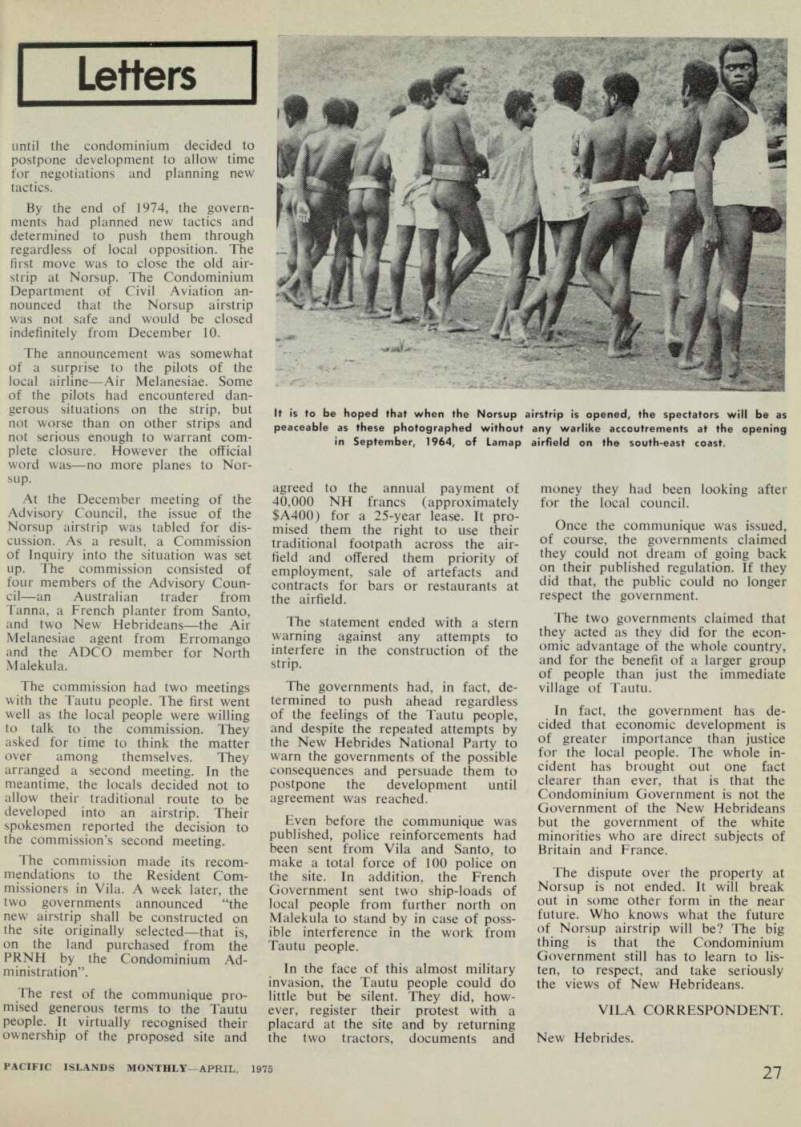
Ocean Island: A Letter Looks At
Mr Timai Tekaai, editor of the GEIC’s Atoll Pioneer has sent PIM a copy of a letter he has sent to the Australian newspaper, The Aust ralian, “so that” he writes, “Aust ralians can see the other side (our side) of the coin in the present Banaban kerfuffle for independence.
I would be most grateful if you can see your way to publishing it, wholly or in part, so that Pacific Islands Monthly readers may also be able to see our case”.
The letter follows publication in The Australian on February 6 of an article headlined “A colonialist status of our very own” which gives the Banabans’ side of the argument plus reference to the part the Aust ralian Federal Treasurer Dr Jim Cairns is reported to be taking in the case.
The writer, Bob Baudino, opened his article with, “The personal inter est of Dr Jim Cairns in the plight of 2,000 South Pacific islanders exiled from their tiny island home land, first by war and now by ex ploitation, is causing concern in our Department of Foreign Affairs”.
Mr Tekaai’s letter reads: Your issue of February 6 which included the article “A Colonialist Status of Our Very Own” has only just reached us here in the Gilbert and Ellice Islands. I hope that late as it is I may be allowed to com ment.
In content, the article is sub stantially correct although there are one or two inaccuracies. For exam ple, the Banaban landowners receive 15 per cent of phosphate revenue on some land but 50 per cent of the revenue from other land. But these inaccuracies are unimportant. What we fail to understand is why the people of one of our islands are being treated as a race apart.
Banaba is the Gilbertese name for Ocean Island. We also have Abemama, Butaritari, Tamana and so on. All these islands are occupied by our people. If the Banabans have a special position it is because it is on their particular island that a valu able mineral resource, phosphate, was found. Initially therefore they suffered most from the exploitation of our country’s only mineral wealth.
For this reason we sympathise with their claim for compensation. But it was the whole country which was exploited and we cannot accept that this compensation should be at the expense of the rest of our people.
Even here in the Gilbert and Ellice Islands we have heard of Dr Cairns and his reputation as a fighter for the underdog. But who is the underdog in the Banaban affair? The 2,000-odd Banabans liv ing on the relatively fertile island of Rabi with an income of $3,000,000 tax free this year, or the 55,000 other Gilbertese scratching a sub
sistence living on their drought plagued coral atolls and putting much of their share into reserves for the future?
We have also heard of Mr Apisai Tora and his reputation as a work ers’ representative. But who are the workers in this case? Are they the Banabans with their supermarkets and other capital investments in Fiji or the Gilbertese from our other islands who actually dig the phos phate? Is it not at least possible that the reason why no more than a hand ful of Banabans work on Ocean Island is because they are too well off to need to?
We wonder whether in the event of rich oil deposits being found under Tasmania Dr Cairns would rush to the support of a Tasmanian claim to independence or whether he might feel the wealth from the oil should benefit Australia as a whole.
Similarly, if a goldfield was found on Lau would Mr Apisai Tora feel obliged to add his weight to a peti tion for Lau independence or would he feel that all Fijian workers should benefit from the strike?
We freely admit we cannot poss ibly compete with the Banaban lobbying campaign. We would ask,
however, that those subjected to this lobbying should at least consider that there might be another side to the coin.
Timai Tekaai
Chief Information Officer,
Geic.
Tarawa.
Trouble Over Norsup
The Condominium Government of the New Hebrides has decided to build a new airstrip at Norsup on North Malekula, but it has come up against fierce opposition from the local inhabitants.
The site chosen seemed ideal to the British and French, being close to both their district agencies. They bought the land from a French owned company PRNH. (Plantation Reunies des Nouvelles Hebrides) which has operated a large coconut plantation in the area for well over 50 years. Indeed the PRNH claims undeveloped land and coconut plant ations stretching for miles along the east coast of Malekula including two of the largest plantations in the New Hebrides.
However, the Condominium Government could not have been unaware of the intense bitterness and hatred felt by the local inhabitants (especially of Tautu village) for PRNH, or of the fact that ownership of the land they purchased has been in question for many years.
The story of the original purchase of the land by PRNH is a familiar one in New Hebrides history. It tells of unfair dealings, of two ship-loads of French troops anchored off Nor sup while negotiations were proceed ing; of Vietnamese labourers brought in to clear and fence the plantation; of fences gradually being pushed further and further out until the local inhabitants of Tautu occupied only a tiny portion of rocky coast land; and of all native resistance being squashed by force of superior arms.
In addition to this long-standing land dispute, the land chosen for the airstrip was also the traditional route of the Tautu people to their gardens.
Three years ago, without any con sultation with the local people, the condominium landed their machinery and labour force and started to bull doze the area. This was the last straw for the Tautu people.
Led by Kennerrie Williams, a strong nationalist figure and secre tary of the North Malekula local council, the Tautu people retaliated by replanting the cleared land with young coconuts. The land was bull dozed again, and replanted again,
Letters
until the condominium decided to postpone development to allow time for negotiations and planning new tactics.
By the end of 1974, the govern ments had planned new tactics and determined to push them through regardless of local opposition. The first move was to close the old air strip at Norsup. The Condominium Department of Civil Aviation an nounced that the Norsup airstrip was not safe and would be closed indefinitely from December 10.
The announcement was somewhat of a surprise to the pilots of the local airline—Air Melanesiae. Some of the pilots had encountered dan gerous situations on the strip, but not worse than on other strips and not serious enough to warrant com plete closure. However the official word was—no more planes to Nor sup.
At the December meeting of the Advisory Council, the issue of the Norsup airstrip was tabled for dis cussion. As a result, a Commission of Inquiry into the situation was set up. The commission consisted of four members of the Advisory Coun cil—an Australian trader from Tanna, a French planter from Santo, and two New Hebrideans—the Air Melanesiae agent from Erromango and the ADCO member for North Malekula.
The commission had two meetings with the Tautu people. The first went well as the local people were willing to talk to the commission. They asked for time to think the matter over among themselves. They arranged a second meeting. In the meantime, the locals decided not to allow their traditional route to be developed into an airstrip. Their spokesmen reported the decision to the commission’s second meeting.
The commission made its recom mendations to the Resident Com missioners in Vila. A week later, the two governments announced “the new airstrip shall be constructed on the site originally selected—that is, on the land purchased from the PRNH by the Condominium Ad ministration”.
The rest of the communique pro mised generous terms to the Tautu people. It virtually recognised their ownership of the proposed site and
agreed to the annual payment of 40,000 NH francs (approximately SA4OO) for a 25-year lease. It pro mised them the right to use their traditional footpath across the air field and offered them priority of employment, sale of artefacts and contracts for bars or restaurants at the airfield.
The statement ended with a stern warning against any attempts to interfere in the construction of the strip.
The governments had, in fact, de termined to push ahead regardless of the feelings of the Tautu people, and despite the repeated attempts by the New Hebrides National Party to warn the governments of the possible consequences and persuade them to postpone the development until agreement was reached.
Even before the communique was published, police reinforcements had been sent from Vila and Santo, to make a total force of 100 police on the site. In addition, the French Government sent two ship-loads of local people from further north on Malekula to stand by in case of poss ible interference in the work from Tautu people.
In the face of this almost military invasion, the Tautu people could do little but be silent. They did, how ever, register their protest with a placard at the site and by returning the two tractors, documents and
money they had been looking after for the local council.
Once the communique was issued, of course, the governments claimed they could not dream of going back on their published regulation. If they did that, the public could no longer respect the government.
The two governments claimed that they acted as they did for the econ omic advantage of the whole country, and for the benefit of a larger group of people than just the immediate village of Tautu.
In fact, the government has de cided that economic development is of greater importance than justice for the local people. The whole in cident has brought out one fact clearer than ever, that is that the Condominium Government is not the Government of the New Hebrideans but the government of the white minorities who are direct subjects of Britain and France.
The dispute over the property at Norsup is not ended. It will break out in some other form in the near future. Who knows what the future of Norsup airstrip will be? The big thing is that the Condominium Government still has to learn to lis ten, to respect, and take seriously the views of New Hebrideans.
Vila Correspondent.
New Hebrides.
It is to be hoped that when the Norsup airstrip is opened, the spectators will be as peaceable as these photographed without any warlike accoutrements at the opening in September, 1964, of Lamap airfield on the south-east coast.
Advertisements & other items, pp. 27-30 (2 items)
25
ACIFIC ISLANDS MONTHLY—APRIL, 1975
Henry Cumines Pty. Ltd.
EXPORTERS • GENERAL MERCHANTS
428 GEORGE ST., SYDNEY
CABLES: HENCO SYDNEY. G.P.O. Box 3949. PHONE: 25-3383.
For specialised and personalised buying service throughout the Pacific Islands and the East.
Local enquiries to our agents: PORT MORESBY: Agencies Pacific Pty Ltd, Box 5044, P. 0., Boroko, Port Moresby. Telephone 55261.
MADANG: W. Double, P.O. Box 22, Madang. Telephone 2696.
FIJI: K. Witherington Ltd, P.O. 293, Suva. Telephone 22-356.
NEW HEBRIDES: John Lum & Associates, Box 65, P. 0., Santo. Telephone 329.
LAE: Osborne Agencies, P.O. Box 8, Lae.
Resident Agents in other Pacific Territories.
SIX FEETOF
DEADLY GERMS
CONCENTRATED PEA-BEU
The strong one that cares for your world.^ Like all insects the cockroach has six legsand every one will have thousands of germs on them from his unsavoury habits. So it's worth getting rid of fast. Concentrated Pea-Beu contains one of the world's most powerful insecticides so it kills insects in seconds and it's rigidly tested through every stage of manufacture so you can spray it safely with confidence to protect the health and well-being of your family.
Concentrated teo-Beu kills flies, mosquitoes.oli disease carrying insects in seconds.
m WM m M ;V :
COO
* * ■ 'om m mm M „. ..*■ Cu
HBJ*
jwmYN.SM
y®eoFAusrmi.
25 KG «£T
> A < Pi 4, IB
the most important ingredient
BREAD FLOURS:
CAKE FLOURS:
BISCUIT FLOURS:
SPECIALITY FLOURS:
• MAINTOP—high protein bread flour • ANCHOR—bakers flour • 50/50 MEAL—brown bread • MEDIUM —cake and pastry • SPONGE —sponge cakes • SPECIAL CAKE—madeira and cup cakes • STRONG—cracker biscuits • MEDlUM—Shortbreads • SOFT—sweet biscuits • RYE flour • RYE meal • KIBBLED RYE • SHARPS —roti and chapati flour © 100% STONE GROUND
WHOLEMEAL
GILLESPIE BROS. PTY. LTD.
HEAD OFFICE: BRISBANE OFFICE:
52 UNION ST., PYRMONT, SYDNEY, N.S.W. CABLE ADDRESS; ALBION, BRISBANE, QUEENSLAND. (G.P.O BOX 2518, SYDNEY, 2001.) "GILLESPIE", (P.O. BOX 8, ALBION, BRISBANE, 4010.) PHONE: 660-4933. SYDNEY AND BRISBANE. PHONE: 6-1121.
The Past
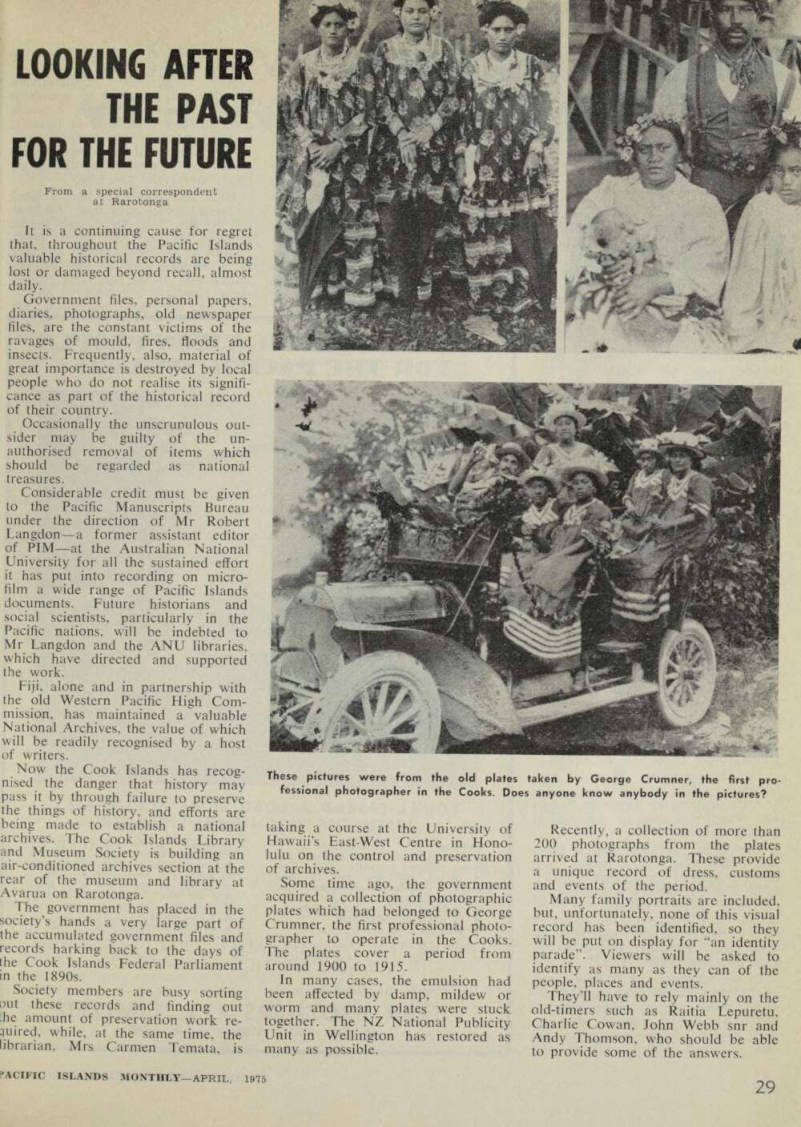
Looking After
For The Future
From a special correspondent at Rarotonga It is a continuing cause for regret that, throughout the Pacific Islands valuable historical records are being lost or damaged beyond recall, almost daily.
Government files, personal papers, diaries, photographs, old newspaper files, are the constant victims of the ravages of mould, fires, floods and insects. Frequently, also, material of great importance is destroyed by local people who do not realise its signifi cance as part of the historical record of their country.
Occasionally the unscrupulous out sider may be guilty of the un authorised removal of items which should be regarded as national treasures.
Considerable credit must be given to the Pacific Manuscripts Bureau under the direction of Mr Robert Langdon—a former assistant editor of PlM—at the Australian National University for all the sustained effort it has put into recording on micro film a wide range of Pacific Islands documents. Future historians and social scientists, particularly in the Pacific nations, will be indebted to Mr Langdon and the ANU libraries, which have directed and supported the work.
Fiji, alone and in partnership with the old Western Pacific High Com mission, has maintained a valuable National Archives, the value of which will be readily recognised by a host of writers.
Now the Cook Islands has recog nised the danger that history may pass it by through failure to preserve the things of history, and efforts are being made to establish a national archives. The Cook Islands Library and Museum Society is building an air-conditioned archives section at the rear of the museum and library at Avarua on Rarotonga.
The government has placed in the society’s hands a very large part of the accumulated government files and records harking back to the days of the Cook Islands Federal Parliament in the 1890 s.
Society members are busy sorting out these records and finding out :he amount of preservation work re quired, while, at the same time, the librarian, Mrs Carmen Temata, is
Recently, a collection of more than 200 photographs from the plates arrived at Rarotonga. These provide a unique record of dress, customs and events of the period, Many family portraits are included, but, unfortunately, none of this visual record has been identified, so they will be put on display for “an identity parade”. Viewers will be asked to identify as many as they can of the people, places and events, They’ll have to rely mainly on the old-timers such as Raitia Lepuretu, Charlie Cowan, John Webb snr and Andy Thomson, who should be able to provide some of the answers.
taking a course at the University of Hawaii’s East-West Centre in Honolulu on the control and preservation of archives.
Some time ago, the government acquired a collection of photographic plates which had belonged to George Crumner, the first professional photographer to operate in the Cooks.
The plates cover a period from around 1900 to 1915.
In many cases, the emulsion had been affected by damp, mildew or worm and many plates were stuck together. The NZ National Publicity Unit m Wellington has restored as many as possible.
These pictures were from the old plates taken by George Crumner, the first pro fessional photographer in the Cooks. Does anyone know anybody in the pictures?
Sherry gives
Pago officials a headache
From a Pago Pago correspondent If you speak to expatriate officers of American Samoa about one Sherry O’Sullivan, they’ll tell you they don’t want to know about her but will also admit that she does a good job of goading the government even if she may not always be entirely accurate in the assertions she makes.
Sherry was the editor of the now defunct Underground Press of American Samoa which ceased pub lication about six months ago be cause its proprietor, Sherry O’Sulli van, had been denied a business licence to operate in American Samoa.
Now Sherry, a Canadian citizen, has produced the first edition of the Underground Monthly apparently without bothering about the con vention of acquiring a licence.
She announced that the paper has a staff which has a cast of multiple personalities with Sherry O’Sullivan filling the roles of editor, publisher, art editor, advertising manager, lay out artist, legal adviser, cartoonist, distributor, columnist, reporter, scape goat and other categories ad nau seam.
The Underground Monthly prints a retraction of certain statements made in the Underground Press con cerning allegations about the oper ations of Water Resources Inter national and announces that the same company has scrapped its SUS 1,000,000 libel suit against the Underground Press and its editor.
The Underground Monthly fires trenchant salvos at all and sundry in high positions in American Samoa and frequently adds to the reports carried in the Samoan News.
The latter, in reporting a Fono joint committee investigation into the shooting of an escaped convict, states that the inquiry is expected to resume “amid reports of in committee frictions and the projected arrival of potentially explosive in formation concerning Public Safety Commissioner Tufele Li’a”.
In the Underground Monthly it is alleged that “while practising upside down reading in a certain office 1 saw a San Diego portrait” of a cer tain official. “Unfortunately it was one of those funny portraits with
both a front and side view. He was wearing a number. That number was 2994 ’.
Sherry also comments that the “liquor store has a liquid inventory of almost a quarter of a million dollars! I would love to have the job of reducing that inventory”, or “has anyone ever noticed when the power cuts off during the business day how fast the bars fill up?” or “Passports for anyone? For only $2OO you can buy a passport from some of our less-ethical and more-artistic oriental from Western Samoa is still only a hundred . . . For this kind of visa friends. The going rate for a visa you must go to more local sources.
So they say . . . those who have bought them”.
How long the Underground
Monthly will continue to appear is anyone’s guess. At present it would seem to offer a measure of financial viability for its entrepreneur as it carries substantial advertising blocks placed by a number of the larger l° ca l commercial concerns, It is also significant that a block is carried which says that “for rent, c/- PO Box 1465 Pago Pago (which happens to be the same postal address as the Underground Monthly) is a versatile creative and brilliant mind. Will tackle any task. Cheap daily rates”.
Advertisements & other items, p. 32 (1 item)
Kerr Brothers Pty. Limited
KERR RROS. THE VICOX PEOPLE
FOR THE PACIFIC ISLANDS
YOU'LL SPREAD A LOAD MORE ACCURATELY
WITH THE VICON VARI/SPREADER
And with th? fari/Spreader it is accuracy built to last —the use of corrosion resistant materials sees to that, o Strong, rust free, easy to clean hopper, moulded from glass fibre reinforced polyester. • Stainless steel regulating plate, e Polyester spreading bowl, • Stainless steel spout.
"Versatility" is the right word for the Vicon Vari/Spreader. It broadcasts fertilisers, grain, grass and clover seeds all with equal guaranteed precision. • Spreads as little as 5 lb of grass seed per acre H 2,500 lb per acre of fertiliser. • P.T.O. driven. • Effective spreading with up to 24 ft.
MAKE THE VARI/SPREADER YOUR CHOICE FOR
LONG DISTANCE ACCURACY
For further information contact:
KERR BROTHERS PTY. LIMITED
65 YORK STREET, SYDNEY, N.S.W. 2000.
Papua New Guinea Gets Tough
WITH FISH POACHERS AND . . .
From Gus Smales
in Port Moresby
Papua New Guinea will adopt new measures to control foreign poaching on its fishing grounds, the Chief Minister, Mr Somare, announced in February.
The government’s decision follows the increasing incidence of illegal fishing by foreign ships in PNG waters.
Mr Somare did not give details of the form which the new control mea sures would take. It is understood, however, that the measures will in clude the establishment of regular reports from outlying islands, ships and aircraft about shipping move ments.
This will be coupled with an organised patrol system to be oper ated by patrol ships of the PNG defence force.
It is understood, too, that govern ment legal officers will instruct in spectors in the types of charges which can be used most effectively when ships are detected fishing illegally under differing circum stances.
PNG will also establish proce dures to speed up negotiations with owners and agents once a ship has been arrested.
No changes in the law are con templated, but the government will do all it can to streamline processes associated with the prosecution of illegal fishing.
PNG has been responsible for its own fishing controls since last year, and has introduced tough penalties, including mandatory confiscation of vessels where charges of illegal fish ing have been proved.
Mr Somare said PNG was forced to take a tough line because fish represented one of the country’s major natural resources and because there had been a big increase in illegal fishing. He believed that many of the ships operated on what he called a “ruthless owner-crew profit sharing basis, with the owner taking the lion’s share”.
He believed that deliberate law breaking was being committed to get fish, exploiting a natural resource which belonged to PNG.
Two days after Mr Somare’s an nouncement, a Japanese-owned vessel was confiscated by a Rabaul magis
trate for illegal fishing in February, thus giving the lie to allegations made earlier that fishing prosecutions had been concentrated against Taiwanese because they were relatively defence less, having no diplomatic represent ation, whereas Japanese ships were being allowed to break the law with impunity.
The ship, the Kotura Maru, worth $750,000 was arrested near Green Island, between Bougainville and New Ireland.
The captain, Saichi Susuki, was fined $5OO, and later, the PNG Minister for Defence, Foreign Re lations and Trade, Sir Maori Kiki,
said the government was asking for $lO,OOO for the release of the ship.
He said $lO,OOO was a nominal sum when compared to the vessel’s real value.
The government had fixed a nomi nal amount, Sir Maori Kiki said, to demonstrate the importance .it attached to good relations with the Japanese, especially in the field of economic co-operation.
Japan has contested PNG’s right to seize vessels outside the three-mile limit but PNG maintains it has the right to enforce fishery laws out to at least 12 miles and over the whole continental shelf.
. . . sells back seized ships
The PNG Government is selling back confiscated Taiwanese ships to their owners.
The sale offers are being made at bargain prices to ensure the repatriation of the stranded crewmen still living on board two ships. The presence of the crewmen since last year has been an increasing source of embarrassment to PNG officials since the ships were seized for entering local fishing grounds.
“We just didn’t know how difficult and expensive it would become to get these men home again,” one official said today. He added, “No one wants to take them, no one is going their way anyhow, and they don’t have much money.”
The two ships involved have about 40 crewmen between them.
They are the Taiwanese clam fishing vessel Huang Shang Fay, held at Port Moresby, and Shin Sho, held at Samarai in Eastern Papua.
Both ships were seized in penalty. One master was fined $9O0 —which he paid from a wad of United States dollars in his pocket—and the other was gaoled for three months.
The crewmen, who did not face any charges, have been living in the ships since because there was nowhere else to put them.
Government engineers removed engine parts from the two ships so that they could not be moved.
The government has now negotiated the sale of one ship to its owners for $5,200 and a figure of $5,200 for the other is under consideration. This is considerably below the value of the ships, but the effective result is that a heavier fine has been paid—and PNG no longer has the responsibility of the crewmen.
The crew of the Huang Shang Fay were so short of money late in January that they were boiling leaves to make soup and eke out a small daily ration of rice and small fish. On January 31, their total supply of food was down to 15 lb of rice.
Meanwhile, in Rabaul another group of Taiwanese fishermen was about to leave for home after giving a concert to thank the town for its hospitality.
The men were stranded there last year when their ship was wrecked in the Carteret Islands north of Bougainville.
Advertisements & other items, p. 34 (1 item)
From the
Islands Press
From a letter in the Atoll Pioneer, GEIC, by James Tebutonga on "True love": Most men, especially husbands, do not understand well the love of a woman. So I would like to ask you some space in your AP because I would like to explain to them about this true love. Trust is the first sign of love. If a woman truly loves you, she will trust you. She will respect you and think of your needs first before her own needs. She will try to understand you, your feelings, your thoughts and your ambitions.
She will talk to you about her hopes and desires. She will think of you before she thinks of herself . . .
From a reply in the Lae Nius by Mr Richard Moaitz of Civil Aviation to criticism by Lae Chamber of Commerce which described Lae Airport terminal as the filthiest in the country: "We have installed rubbish bins everywhere but nobody uses them", he said. "We put soap, toilet paper and paper rolls in the toilets every day but minutes later they are gone. They just seem to walk away".
Ron Wanqa of the United Church Loaga Primary School, Misima, writes in the PNG Our News: Europeans must not put high prices on their things.
We have self-government already, and this is not their country. Papua New Guineans who own trade stores must put high prices on things like bush knives and cloth because these things last for months. But we should not have to pay a lot for things we eat like tinned fish and meat.
Impressions of Tahiti from a Tahitian, Miss Taupe Mokoha, as reoorted in the Cook Islands News; In Tahiti people seem to be always in a hurry.
There are also many accidents in Tahiti. Perhaps there is too much drinking. There seems to be more crime since television came to Tahiti, and many people are leaving the country for the neighbouring islands . . .
From a letter by G. E. Brook in The Norfolk islander: ... It Is compassion, not ignorance, which prompts Canberra to charitably subsidise this uniquely disunited and inept community . . . Even a benevolent government will eventually become tired of "turning the other cheek" to ingrates who not only won't help themselves but, as well, continually bite the hand that feeds them. Inmates' unwillingness to contribute financially toward preservation of the island and provision of social welfare for the old and
young is clear evidence that their bragged-about love for the isle is tantamount to hogwash . . .
From a pictorial feature in The Fiji Times on some of the sights seen in Suva's streets: They come to Suva, bound for booty in the shape of duty-free goods, like a bunch of Pacific pirates.
Unfortunately, they are not as colourfully dressed as pirates, indeed, some of them are hardly dressed at a 11...
Mr Stinson (Minister of Finance) was and still is, concerned about unshirted visitors wandering around Suva with pot bellies hanging out over shorts . . .
Fiji is traditionally hospitable towards and tolerant of its guests, who by long belief and customs are always made welcome. But the dress and attitudes of some visitors are beginning to stretch tolerance to its limits . . .
From the Western Herald in Fiji: Fiji workers in New Zealand lived in sub-human conditions in “seedy establishments” operated by unscrupulous landlords, a Lautoka man just back from a holiday told the Western Herald. The man, a secondary school teacher, said he was appalled to find as many as three people cramped in an 8 ft by 8 ft room in a dilapidated building in New Market, a suburb of Auckland . . . “Landlords charge anything from $lO to $24 a week rents”, he said . . .
“I spoke to several of these Fiji people. Quite a few of them work illegally and are frightened to complain to the health authorities in fear of being caught and deported”.
From a letter by Graham Skinner in the Norfolk Islander, on the inquiry by Mr Justice Nimmo into the island's constitutional position: . . . Once again, my feelings are aroused to the extent that Norfolk Islanders must be warned again, perhaps for the last time, that they are very close to extinction as a separate entity and a separate and most desirable way of life. One only has to look at the continued erosion of your rights and identity and must rise in anger at the ordinance eliminating your annual call to ten days work in the service of Norfolk Island . . .
Appeal by PNG's Chief Minister, Mr Michael Somare, to the people of Mount Hagen in a speech after a dance at the Holy Trinity Teachers College, as reported in the PNG Post-Courier: “We wish you all the best for 1975”, Mr Somare said, “and let's give Mount Hagen a new name. Let’s turn ‘crime city * into ‘fun city’”
"Are our streets safe?" asks Fearful Fred in the Arawa Bulletin: One notes with horror that incident of a nice little household terrier spending a quiet evening at home (while the master is out) ripping the baby daughter apart in the bedroom. That's London and not Bougainville. No one arrives home here to find the bedoom walls dripping in blood, no one leaves the dogs inside with the kids to do this—no, here it is such a nice climate outside that we put the dogs outside to play, guard the house, mingle with the other dogs and gain even more courage to rip up cats, other unsociable dogs and, perhaps, the kids who have also been put out in this nice warm climate to play . . .
bawdy boarding houses ...

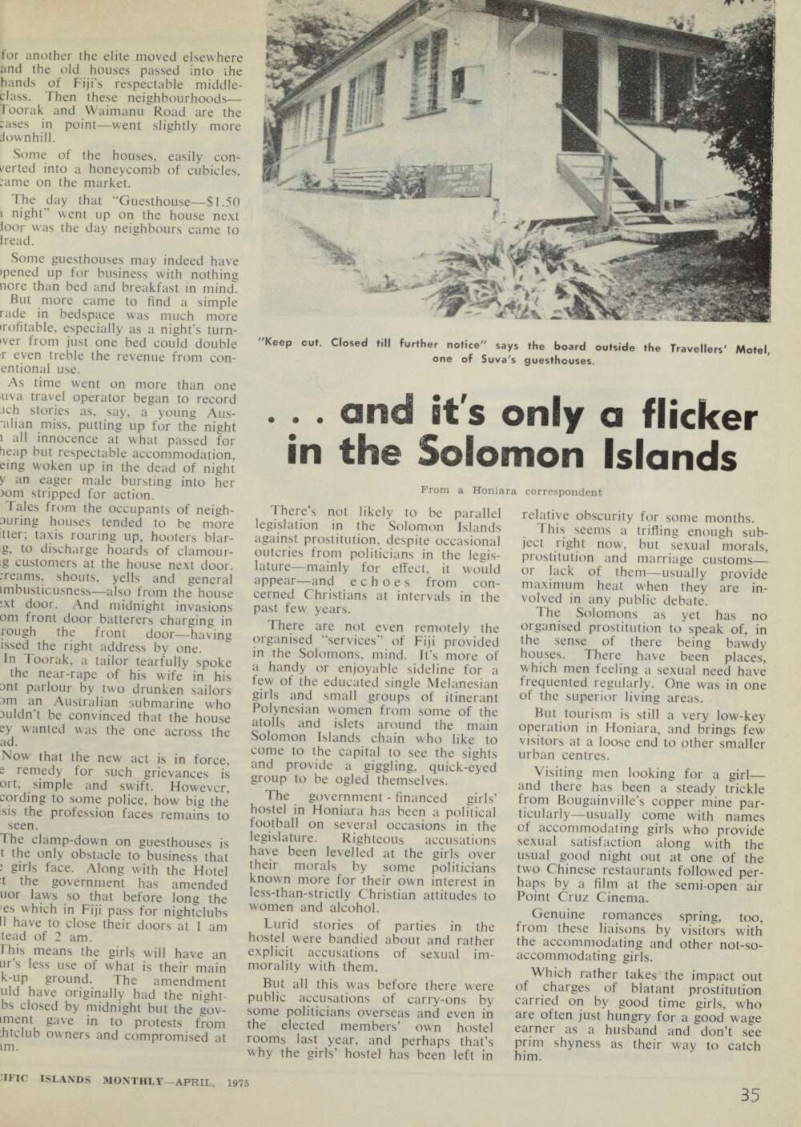
A red light is dying in Fiji's bawdy boarding houses ...
From ROBERT KEITH-REID in Suva
Lights are going out all over Fiji —red lights, that is.
After years of agitation by indig nant inhabitants of what may out wardly appear to be more respectable zones of Suva’s suburbia, authorities are at last cracking down on ‘guest houses’.
For guesthouses read brothels, be cause in Fiji that’s what most of them are. For a decade now they have been doing a rip-roaring unfettered trade thanks to legal loopholes that have made it hard for the police to make a head-on attack on prostitu tion.
But now it looks as if proprietors of Fiji’s bawdy boarding houses are in for a lean time.
Recent months have seen the closure of about a dozen of the best known, or perhaps most notorious of them. Several sport “Closed for business until further notice” signs on the front door.
The instrument of their demise is the Hotel Licensing Board, a weapon forged by the government last year for just this purpose. Since January 1 this year Fiji’s 130-odd hotels, from the biggest swish joint to the most humble bed-and-breakfast, have had to have an operating licence from the board to be able to stay in busi ness.
Qualifications for a licence are simple enough. There’s an annual fee to be paid and several rules to comply with.
Chief of these is that a guest register is kept; the premises them selves kept clean and in good repair; and that a licence from the board is displayed for all those who enter for a night’s sleep to see.
Most hotels being thoroughly re spectable establishments, have, of course, not had a moment’s trouble getting their licences. The other 10 per cent have fallen foul of a few other rules set down in the legislation which created the board.
They say a licence can be refused or withdrawn if the premises covered by it are too noisome for the local health department’s peace of mind, or if it is proved to be a den of im morality.
Usually the sleasy-looking guest houses are both, as members of the hotel board have found at first hand.
Chairman Mr Harold Picton-Smith, who is the Fiji Solicitor-General, re
ported at a public hearing in February that a personal spot check by board members the night before on three Suva guesthouses, Cliff Top Motel, Travellers Motel and Blue Diamond, had been quite an eye opener.
“Scrungy” rooms, much in need of a coat of paint, rickety service, worn beds and foul bathrooms and lavatories had been the rule. in one room the board had stumbled upon a Korean fisherman and two of his local, temporary, girlfriends—“ Both known prosti tutes,” reported Superintendent Pre mesh Raman, who accompanied the inspection trip.
Most of the women seen that night were in the same category, he added.
According to the superintendent, rooms at the Cliff Top which, unlike the others, at least had the distinction of being clean, were occupied by an average of two prostitutes each.
Indignant denials from the mana gers of all three guesthouses and by the owners of establishments of the same ilk at Lautoka and Nadi have not been entertained by the board with any sympathy. At the Suva meeting the board got a spate of written complaints about the Blue Diamond, a guesthouse in the Nasese area, an otherwise peaceful upper working class and lower middle-class residential suburb a mile from town.
The Blue Diamond’s reputation among Nasese residents is far from sparkling. Letters complained that rooms in the grimy two-storey con verted house were the scenes of a constant round of rowdy all-night parties at which Korean, Japanese and Chinese fishing boat crews enter tained and were entertained by ladies with a price on their virtue.
“We can’t get a decent night’s sleep,” was the consensus of com plaint. It was a cascade of stories like these, some times from house holders on the verge of tears over the disruption to their home life caused by the goings-on next door, that drove the government to draft and at last enact the Hotel Licensing Act last year.
What happened was that those with an eye for a quick dollar had bought some of the sprawling, old wooden houses in the city area which 50 years ago had been the castles of the colonial elite. As one era made way
for another the elite moved elsewhere and the old houses passed into the hands of Fiji's respectable middle class. Then these neighbourhoods— Toorak and Waimanu Road are the cases in point— went slightly more downhill.
Some of the houses, easily con certed into a honeycomb of cubicles, came on the market.
The day that “Guesthouse—sl.so i night” went up on the house next loor was the day neighbours came to Iread.
Some guesthouses may indeed have tpened up for business with nothing nore than bed and breakfast in mind.
But more came to find a simple rade in bedspace was much more irofitable, especially as a night’s turn •ver from just one bed could double r even treble the revenue from con entional use.
As time went on more than one uva travel operator began to record Jch stories as, say, a young Aus 'alian miss, putting up for the night i all innocence at what passed for heap but respectable accommodation, eing woken up in the dead of night y an eager male bursting into her )om stripped for action.
Tales from the occupants of neigh auring houses tended to be more itter; taxis roaring up, hooters blar g, to discharge hoards of clamour g customers at the house next door, creams, shouts, yells and general imbusticusness —also from the house ext door. And midnight invasions om front door batterers charging in rough the front door—having issed the right address by one.
In Toorak, a tailor tearfully spoke the near-rape of his wife in his ant parlour by two drunken sailors am an Australian submarine who auldn’t be convinced that the house ey wanted was the one across the ad.
Now that the new act is in force, s remedy for such grievances is ort, simple and swift. However, cording to some police, how big the sis the profession faces remains to seen.
The clamp-down on guesthouses is t the only obstacle to business that c girls face. Along with the Hotel :t the government has amended uor laws so that before long the jes which in Fiji pass for nightclubs II have to close their doors at 1 am tead of 2 am. khis means the girls will have an ar’s less use of what is their main k-up ground. The amendment uld have originally had the night bs closed by midnight but the gov iment gave in to protests from ihtclub owners and compromised at im.
Advertisements & other items, pp. 35-36 (3 items)
33
VCIFIC ISLANDS MONTHLY— APRIL, 1975
Become a part
of PIM’s Pacific and subscribe now CD a> cc O 3- P “ M. 3 3 3 w» 3 S 3- 3 I a. o •"d p o 3 p 25’ —* *“p* £ % ?i// m /Ac details on the attached order form.
Holden Muscle
RIGHT THROUGH THE ISLANDS
MAKES MORE SENSE.
••• Unchallenged reliability under every kind of operating condition has made Holden sales leader for 22 years.
Because Holden is built with the advanced design and engineering that combines sheer strength with performance and superb comfort. Full foam seats that are orthopedically designed to keep you more relaxed even on the longest, toughest trip.
You’ll feel more relaxed with Holden’s reliable Dealer backing, low-cost service and readily available spare parts, too.
Plus all the following: ■ Big 6 or 8 cylinder power. ■ Separate, insulated front chassis. ■ Forward mounted, predictable steering. ■ Wide track stability. ■ Full GM safety package. / % A , v i liiii
■i II I
BEHOLDEN-IT MAKES SENSE FOR TOO.
Holden is backed by the most comprehensive dealer network providing GM maintenance service and genuine GM spare parts.
COOK ISLANDS: Cook Islands Trading Co. Ltd. NEW CALEDONIA: Establissements Ballande NORFOLK ISLAND: Sirius Motors Ltd. SOLOMON ISLANDS: Solomon Islands Service Station TONGA; Burns Philp (South Sea) Co. FIJI ISLANDS: Burns Philp (South Sea) Co.
WESTERN SAMOA: O. F. Nelson & Co. Ltd. NEWHEBRlDES:ComptoirFrancaisdesNouvelles PAPUA NEW GUINEA: Tutt Bryant Pacific Ltd., Wamp Nga Motors Ltd. AlOl7
In the Solomon Islands
. . . and It's only a flicker In the Solomon Islands
From a Honiara correspondent
There’s not likely to be parallel legislation in the Solomon Islands against prostitution, despite occasional outcries from politicians in the legis lature—mainly for effect, it would appear—and echoes from con cerned Christians at intervals in the past few years.
There are not even remotely the organised “services” of Fiji provided in the Solomons, mind. It’s more of a handy or enjoyable sideline for a few of the educated single Melanesian girls and small groups of itinerant Polynesian women from some of the atolls and islets around the main Solomon Islands chain who like to come to the capital to see the sights and provide a giggling, quick-eyed group to be ogled themselves.
The government - financed girls’ hostel in Honiara has been a political football on several occasions in the legislature. Righteous accusations have been levelled at the girls over their morals by some politicians known more for their own interest in less-than-strictly Christian attitudes to women and alcohol.
Lurid stories of parties in the hostel were bandied about and rather explicit accusations of sexual im morality with them.
But all this was before there were public accusations of carry-ons by some politicians overseas and even in the elected members’ own hostel rooms last year, and perhaps that’s why the girls’ hostel has been left in
relative obscurity for some months.
This seems a trifling enough sub ject right now. but sexual morals, prostitution and marriage customs— or lack of them—usually provide maximum heat when they are in volved in any public debate.
The Solomons as yet has no organised prostitution to speak of, in the sense of there being bawdy houses. There have been places, which men feeling a sexual need have frequented regularly. One was in one of the superior living areas.
But tourism is still a very low-key operation in Honiara, and brings few visitors at a loose end to other smaller urban centres.
Visiting men looking for a girl— and there has been a steady trickle from Bougainville’s copper mine par ticularly—usually come with names of accommodating girls who provide sexual satisfaction along with the usual good night out at one of the two Chinese restaurants followed per haps by a film at the semi-open air Point Cruz Cinema.
Genuine romances spring, too, from these liaisons by visitors with the accommodating and other not-so accommodating girls.
Which rather takes the impact out of charges of blatant prostitution carried on by good time girls, who are often just hungry for a good wage earner as a husband and don’t see prim shyness as their way to catch him.
"Keep cut. Closed till further notice" says the board outside the Travellers' Motel, one of Suva's guesthouses.
Advertisements & other items, pp. 37-38 (2 items)
:Ific Islands Monthly— April, 1975
are shoplifters
RMS
When you install RMS Shopfittings, you lift the image of your shop and increase consumer traffic, which means increased turnover for you.
Call RMS today and ask what they can do to lift your shop way above the competition RMS design, build and install exciting and functional shopfittings, advise on decor, and have all the facts on modern merchandising trends.
shopfittings
Head office: 89-95 Montreal St.
Christchurch. P.O. Box 1131, Phone 30-732.
Branches at Auckland Hamilton Wellington Dunedin ✓ * / i if K I A
HANOI
'ucTT'
m *
IRON
Australia's best selling non-electric Iron! For reliability^• *«eof handling, and excellence of quality at a low price, you Mijt beat the HANOI. It's simplicity itself to operate—NO PUMPING IS REQUIRED IT'S IMPOSSIBLE TO OVERFILL THE FUEL TANK and one filling does approximately 2 hours effortless Attractively finished in nickel plate. Spare parts always available.
THE PORTABLE OUTDOORS COOKER at a sensible price!
Twin independent burners for fast cooking. Twin tanks for double caoacitv Steel case, when opened, acts as triple-wind shield. Rustoroof Noisy or silent burners as required. Small or large porcelain enamel ovensalso available separately. HANOI the lowest priced QUALITY Twin Burner Portable! . m mnifC PTY Evans Rd., Salisbury North. Ph. 47 2122
HANOI WORKS ltd; rrisbane. QUEENSLAND, Australia
Magazine Section

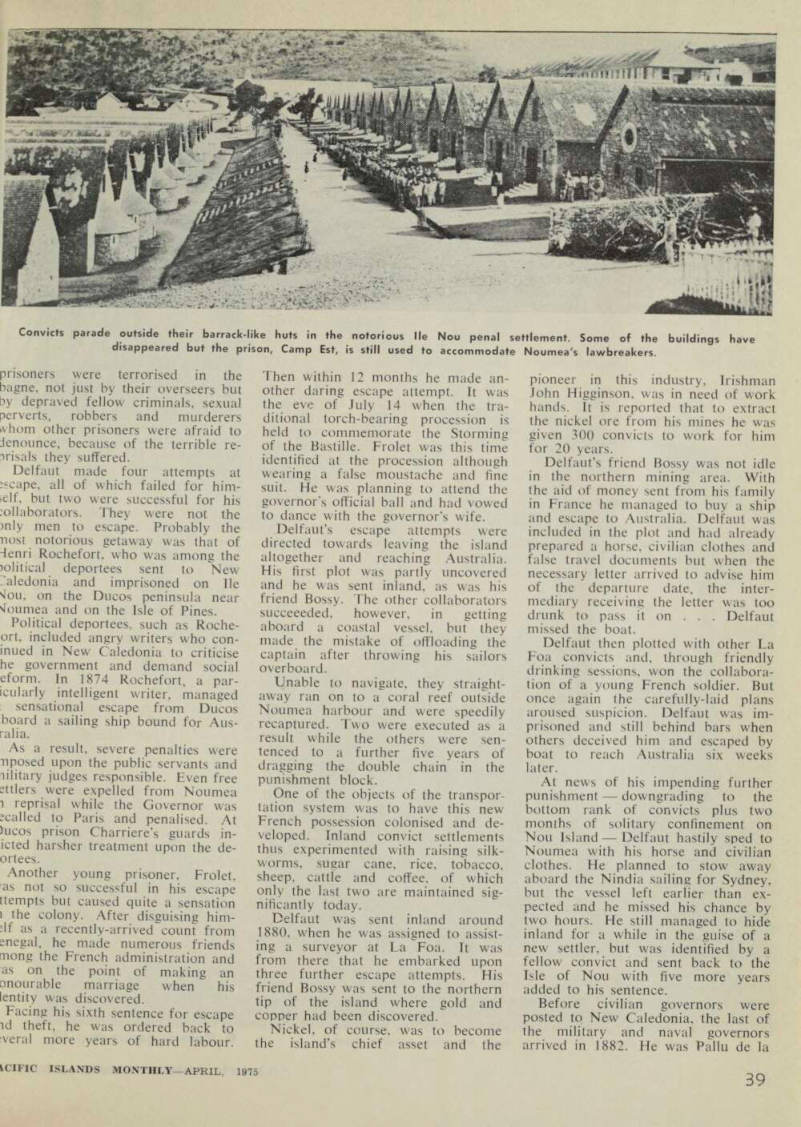
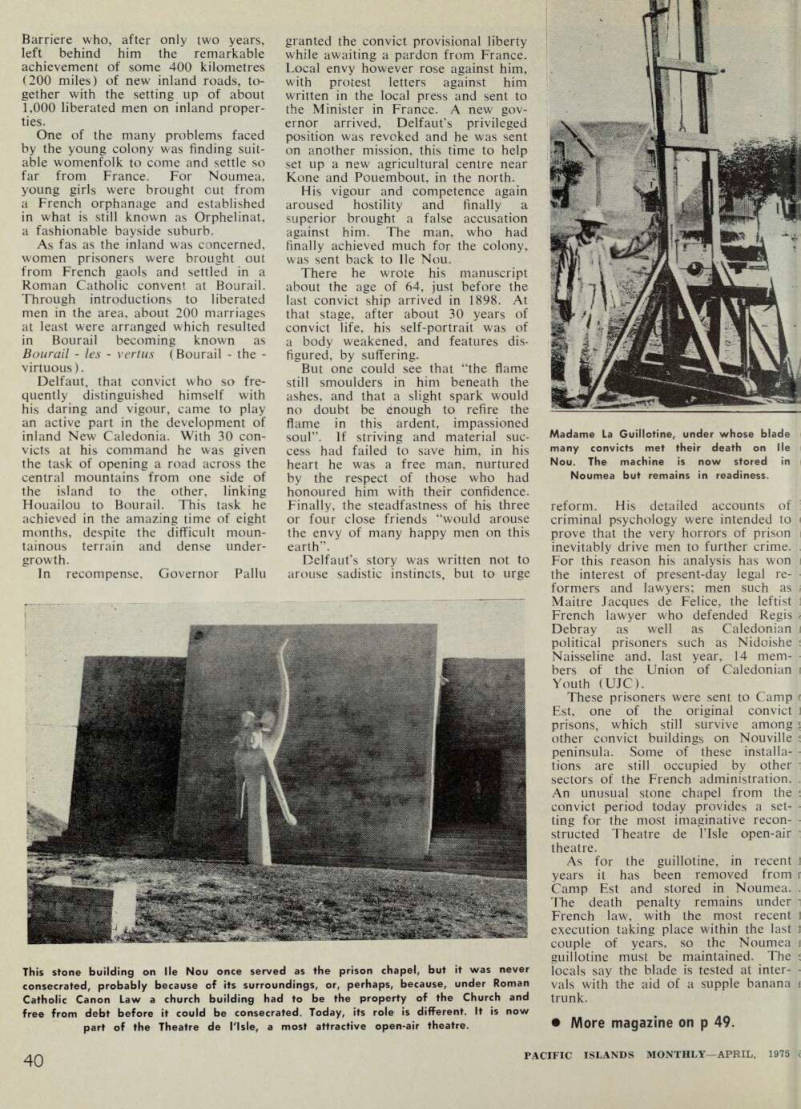
New Caledonia, Island Paradise'
Born Out Of A Convicts' Hell
By Helen Rousseau
Noumea, which today proudly boasts some of the most imaginative architecture in the South Pacific Islands, some of the most refined cuisine and the flashiest cars on its autoroutes, needs only to look back some 75 years to a time when starved French convicts crowded in stinking dungeons, murdered each other for a chunk of bread and, chained together For years on end, laboured to build the town’s first roads.
A graphic account of this hellish beginning to Caledonian history comes from Alphonse Delfaut, who, as convict No 1275, endured 30 years in the penal settlement centred on the Isle of Nou, in Noumea Harbour.
Delfaut’s struggle to escape; then to reform both his life and the system are vividly related in a manuscript unearthed by a young Caledonian intellectual, an autonomist member uf the Territorial Assembly, Paul Griscelli. The document was recently published in book form (Les Damnes Ju Pacifique) by the Kiwanis Club of Noumea which, by sales of this work, vas able to donate $A15,000 to a Noumea orphanage.
Raconteur Delfaut assumes a bare Jisguise to his identity by using the uom-de-plume of Daufelt to make lis autobiographical revelations. For : urther reasons of discretion, editor Griscelli replaced most names of other convicts by initials, since living persons could otherwise be easily :raced to their forebears, especially in he small farming towns where they are settled such as La Foa and Bourail. Unlike Australia, no one has constructed a “convict aristocracy”.
From his own and other accounts, t is obvious that Delfaut was a con vict of no ordinary intelligence and vigour. He arrived on the Isle of Nou n 1867, with the first convict ships From France. The prisoners were irst put to work building installations md roads, some of which still re
main, although He Nou is actually no longer an island: it was connected to the mainland at Noumea in 1972, by the new port installations built across the harbour.
He Nou convict gangs also worked at kilns for baking builder’s lime and at cutting granite stone. Under the first local French Governor Guillain, who arrived in 1862, the convicts also helped develop the island capital, a military post known as Port de France, until it was renamed Noumea in 1866.
The town’s foreshores consisted of an extensive swamp which the con victs had to fill in, by levelling down a bayside hilltop. In this way they filled in the Quartier Latin area which now includes the Noumea police station, museum and post office.
Delfaut himself was fortunate, at first, in being given a clerical position in the penitentiary administration service, but the authority which he gained there led to his downfall and a new departmental head, Colonel Charriere, had him sent straight to the horrors of convict prison life—the bagne (pron bahnye). Delfaut de scribed it as “that vast sewer where ignorance, perversion and shame wallow amid cowardice and contempt”.
He suffered that “cancerous wound which injects a frightful venom into the souls of those who stay there for long”.
He was not a man to submit easily to this humiliation. He voiced his protest by writing a vehement pamph let against Charriere for downgrading him. He also dared to resist an over seer who struck him unjustly and finally retaliated by killing the over seer. As a reprisal, an extra 40 years were added to his original term of 20 years hard labour. In addition, Char riere, overriding the judge’s decision, had him sent to the punishment block and chained up for five years to one of the worst criminals in the settle
ment. Here the punishments included starvation diet, terrible torture and the horror of being chained up with beings “depraved right through to the marrow in their bones”.
These were the depths to which a man could be cast in the Isle of Nou, yet in Delfaut’s case he had begun life with every promise of ease and comfort. The son of a provincial solicitor, he was originally educated by the Jesuits. But his father died a republican-socialist exile, under the Napoleonic empire and his mother died shortly afterwards of sorrow and despair.
Delfaut was left a young teenager shouldered with the task of support ing 10 younger brothers and sisters.
He strove bravely to provide for his family and joined the French Army in North Africa. But unable to tolerate insults, he struck a superior officer and was imprisoned.
He escaped, deserted from the army and fled to Tunisia where he prospered until the illness of a sister drew him back to France to her deathbed. The French Government granted him a “safe-conduct” to France, but on his return through Algeria this was revoked and he was promptly imprisoned. Again he fled, but with nowhere to go, in despera tion he disguised his identity and turned to crime as a forger. Betrayed by a friend, he was sentenced to 20 years hard labour.
The brutality of the penal setttle ment in New Caledonia drove many men to risk their lives in escape or even to choose the guillotine. Delfaut recorded that men did not pale as they walked towards their fate at the guillotine, since they knew that death would deliver them from the prison atrocities. He even told of prisoners deliberately killing each other in order to be sentenced to death and gain freedom on the edge of the fatal blade.
He also described the way in which
prisoners were terrorised in the bagne, not just by their overseers but by depraved fellow criminals, sexual perverts, robbers and murderers vhom other prisoners were afraid to denounce, because of the terrible re ?risals they suffered.
Delfaut made four attempts at escape, all of which failed for him self, but two were successful for his ;ollaborators. They were not the )nly men to escape. Probably the nost notorious getaway was that of denri Rochefort, who was among the political deportees sent to New raledonia and imprisoned on He dou, on the Ducos peninsula near Noumea and on the Isle of Pines.
Political deportees, such as Roche ort, included angry writers who con inued in New Caledonia to criticise he government and demand social eform. In 1874 Rochefort, a par icularly intelligent writer, managed sensational escape from Ducos board a sailing ship bound for Aus ralia.
As a result, severe penalties were riposed upon the public servants and lilitary judges responsible. Even free sttlers were expelled from Noumea i reprisal while the Governor was to Paris and penalised. At Jucos prison Charriere’s guards in icted harsher treatment upon the de ortees.
Another young prisoner, Frolet, as not so successful in his escape ttempts but caused quite a sensation i the colony. After disguising him -lf as a recently-arrived count from snegal, he made numerous friends mong the French administration and as on the point of making an □nourable marriage when his lentity was discovered.
Facing his sixth sentence for escape id theft, he was ordered back to veral more years of hard labour.
Then within 12 months he made an other daring escape attempt. It was the eve of July 14 when the tra ditional torch-bearing procession is held to commemorate the Storming of the Bastille. Frolet was this time identified at the procession although wearing a false moustache and fine suit. He was planning to attend the governor’s official ball and had vowed to dance with the governor’s wife.
Delfaut’s escape attempts were directed towards leaving the island altogether and reaching Australia.
His first plot was partly uncovered and he was sent inland, as was his friend Bossy. The other collaborators succeeeded, however, in getting aboard a coastal vessel, but they made the mistake of offloading the captain after throwing his sailors overboard.
Unable to navigate, they straight away ran on to a coral reef outside Noumea harbour and were speedily recaptured. Two were executed as a result while the others were sen tenced to a further five years of dragging the double chain in the punishment block.
One of the objects of the transpor tation system was to have this new French possession colonised and de veloped. Inland convict settlements thus experimented with raising silk worms, sugar cane, rice, tobacco, sheep, cattle and coffee, of which only the last two are maintained sig nificantly today.
Delfaut was sent inland around 1880, when he was assigned to assist ing a surveyor at La Foa. It was from there that he embarked upon three further escape attempts. His friend Bossy was sent to the northern tip of the island where gold and copper had been discovered.
Nickel, of course, was to become the island’s chief asset and the
pioneer in this industry, Irishman John Higginson, was in need of work hands. It is reported that to extract the nickel ore from his mines he was given 300 convicts to work for him for 20 years.
Delfaut’s friend Bossy was not idle in the northern mining area. With the aid of money sent from his family in France he managed to buy a ship and escape to Australia. Delfaut was included in the plot and had already prepared a horse, civilian clothes and false travel documents but when the necessary letter arrived to advise him of the departure date, the inter mediary receiving the letter was too drunk to pass it on . . . Delfaut missed the boat.
Delfaut then plotted with other La Foa convicts and, through friendly drinking sessions, won the collabora tion of a young French soldier. But once again the carefully-laid plans aroused suspicion. Delfaut was im prisoned and still behind bars when others deceived him and escaped by boat to reach Australia six weeks later.
At news of his impending further punishment downgrading to the bottom rank of convicts plus two months of solitary confinement on Nou Island Delfaut hastily sped to Noumea with his horse and civilian clothes. He planned to stow away aboard the Nindia sailing for Sydney, but the vessel left earlier than ex pected and he missed his chance by two hours. He still managed to hide inland for a while in the guise of a new settler, but was identified by a fellow convict and sent back to the Isle of Nou with five more years added to his sentence.
Before civilian governors were posted to New Caledonia, the last of the military and naval governors arrived in 1882. He was Pallu de la
Convicts parade outside their barrack-like huts in the notorious lie Nou penal settlement. Some of the buildings have disappeared but the prison, Camp Est, is still used to accommodate Noumea's lawbreakers.
Barriere who, after only two years, left behind him the remarkable achievement of some 400 kilometres (200 miles) of new inland roads, to gether with the setting up of about 1,000 liberated men on inland proper ties.
One of the many problems faced by the young colony was finding suit able womenfolk to come and settle so far from France. For Noumea, young girls were brought cut from a French orphanage and established in what is still known as Orphelinat, a fashionable bayside suburb.
As fas as the inland was concerned, women prisoners were brought out from French gaols and settled in a Roman Catholic convent at Bourail.
Through introductions to liberated men in the area, about 200 marriages at least were arranged which resulted in Bourail becoming known as Bourail - les - vertus (Bourail - the virtuous).
Delfaut, that convict who so fre quently distinguished himself with his daring and vigour, came to play an active part in the development of inland New Caledonia. With 30 con victs at his command he was given the task of opening a road across the central mountains from one side of the island to the other, linking Houailou to Bourail. This task he achieved in the amazing time of eight months, despite the difficult moun tainous terrain and dense under growth.
In recompense. Governor Pallu
granted the convict provisional liberty while awaiting a pardon from France.
Local envy however rose against him, with protest letters against him written in the local press and sent to the Minister in France. A new gov ernor arrived, Delfaut’s privileged position was revoked and he was sent on another mission, this time to help set up a new agricultural centre near Kone and Pouembout, in the north.
His vigour and competence again aroused hostility and finally a superior brought a false accusation against him. The man, who had finally achieved much for the colony, was sent back to He Nou.
There he wrote his manuscript about the age of 64, just before the last convict ship arrived in 1898. At that stage, after about 30 years of convict life, his self-portrait was of a body weakened, and features dis figured, by suffering.
But one could see that “the flame still smoulders in him beneath the ashes, and that a slight spark would no doubt be enough to refire the flame in this ardent, impassioned soul”. If striving and material suc cess had failed to save him, in his heart he was a free man, nurtured by the respect of those who had honoured him with their confidence.
Finally, the steadfastness of his three or four close friends “would arouse the envy of many happy men on this earth”.
Delfaut's story was written not to arouse sadistic instincts, but to urge
reform. His detailed accounts of criminal psychology were intended to prove that the very horrors of prison inevitably drive men to further crime.
For this reason his analysis has won the interest of present-day legal re formers and lawyers; men such as Maitre Jacques de Felice, the leftist French lawyer who defended Regis Debray as well as Caledonian political prisoners such as Nidoishe Naisseline and, last year, 14 mem bers of the Union of Caledonian Youth (UJC).
These prisoners were sent to Camp Est, one of the original convict prisons, which still survive among other convict buildings on Nouville peninsula. Some of these installa tions are still occupied by other sectors of the French administration.
An unusual stone chapel from the convict period today provides a set ting for the most imaginative recon structed Theatre de I’lsle open-air theatre.
As for the guillotine, in recent years it has been removed from Camp Est and stored in Noumea.
The death penalty remains under French law, with the most recent execution taking place within the last couple of years, so the Noumea guillotine must be maintained. The locals say the blade is tested at inter vals with the aid of a supple banana trunk.
• More magazine on p 49.
This stone building on He Nou once served as the prison chapel, but it was never consecrated, probably because of its surroundings, or, perhaps, because, under Roman Catholic Canon Law a church building had to be the property of the Church and free from debt before it could be consecrated. Today, its role is different. It is now part of the Theatre de I'lsle, a most attractive open-air theatre.
Madame La Guillotine, under whose blade many convicts met their death on Ile Nou. The machine is now stored in Noumea but remains in readiness.
Advertisements & other items, pp. 39-50 (3 items)
37
*ACIFIC ISLANDS MONTHLY—APRIL. 1975
Mixmaster Mixer
$ 11 ■ m ■ e J I
3 times better than any
other
mixer. Designed especially for family food preparation. 12-speed mixfinder dial indicates the correct speed for each mixing action. Complete with 2 heat-resistant bowls and juice extractor. Sunbeam’s exclusive 3-way beating action — extra large, contoured beaters, and automatic bowl movement — gives perfect aeration and more even mixing. It can handle everything from beating one egg to mixing a large fruit cake.
■26 s ** **.
s^Z^yr
... nof e 'H a// afl! - .< s v m X. s®i <r~ V? 1 »
Better Business
starts with
Australian Products.
Australian products have proven themselves the world over and can benefit you and your customers. The range of Australian products is wide and varied . . . from Agricultural Equipment, Pharmaceuticals, Telecommunications Equipment, Chemicals, Food and Wines to Building Materials, Motor Vehicles, Electrical and Hardware Goods, Automotive Accessories, Engineering and Mining Equipment, Fashions and Fabrics. Delivery times are sensible and prices are competitive, so when you think of development and expansion remember Australian products can assist you. 6 Quality and value that’s only hours away Ask the man who knows Australia. The Australian Trade Commissioner will be pleased to give you details of suppliers. You can contact him at: — PNG —P.O. Box 2123, Konedobu, Port Moresby.
FIJI —Cnr. Pratt and Joske Streets, Suva.
Tel: 25624. (P.O. Box 1252).
Australian Department of Overseas Trade.
The Mazda 81600 pickup.
A truck-load of fun and economy.
-,: 111 illlillll 'I 1 til 'lfliMlli I • ■ • tTi'*'S4 ftv" ’* w jiffll ■ : ; SP ■' %:S6s'
ItfitiK
Whatever you want in a pickup, the 81600 delivers it.
With performance. With economy. With style.
Consider the things we build into it so you can get more out of it The 1600 cc overhead cam engine, for instance, is a lot like the one you find in some sports cars. Yet ours just sips gas. And the important things like the heavy duty suspension system and the safe, sure braking system make operating the 81600 a joy.
Want a sporty pickup for the fun of it 7 Or just for its carry-all capabilities?
Test drive the Mazda 81600 pickup.
The truck-load of fun and economy. ® 1974 Toyo Kogyo Co., Ltd - #■ lEr - - . ■ j --- \ i
MAZDA
M & A % t * Uu WO B|6-00 mcuu j SL n ANDS N,ran)ans Autoport Ltd G.P.O. Box 450. Suva TEL: 22691 NEW CALEDONIA Societe Riviere et Bernanos. 27, Rue de Sebastopol. Noumea GUINEA PNG Motors Ltd P.O. Box 1394, Boroko, Papua TEL: 55788 NEW ZEALAND Mazda Motors of New Zealand Ltd. Auckland P.O. Box 22-472 TEL; 69 099 ERN SAMOA H & J. Retzlaff, P.O, Box 195, Apia TEL: 237 NEW HEBRIDES Societe Bourgeois et Cie, P.O, Box 28, Port Vila PORTUGUES TIMOR Sang Tai Hoo, Dil The trademark MAZDA in this advertisement stands for AUTOMOBILES MAZDA as far as France and her territories are concerned.
/ \ \ m \ / 6-mm \ \ \ / \
En<> s'
>tKn<
mT / m-f v \ / S > \ r \ s V \ ■/ y jr'\. < <f A ,C jT \ X .V < i, ,- F t,.S A / jk ✓ V ■r • v" * r"s r \ ,' \ y'\ ; ✓"i, :' . .V' 1 / ' JS *:-J "
V I ■- ,
THE WORLD'S
THINNEST QUARTZ WATCH.
SEIKO.
Seiko gives you elegance with accuracy by incorporating all the vital quartz components into a smaller, ultra-thin case.
But without sacrificing any of the accuracy and dependability you expect from a quartz timepiece.
Seiko makes every part of every quartz watch it sells, so we're never limited to any particular size or shape. ■ That's why Seiko can achieve these luxuriously thin dress models for men and women.
They're the thinnest quartz watches you can buy.
And they put Seiko years ahead of any other quartz watch manufacturer. <~^| j -v sa
SEIKO QUARTZ
Someday all watches will be made this way
“thank goodness
we have Air Pacific!”
THANK GOODNESS
WE HAVE AIR PACIFIC
Np 5 HI <' CRT
rrm: ifrafW t
FAKAFETAI,
KO MAUA
NE MATOU IE
EA-PASEFIKA
FAAFETAI ILE
EA PASEFIKA
MO LE
GALUEGA LELEI
TAGIO TUMAS
IU Ml KAREM
EA PASIFIK *
TAGIO TUMAS
IU Ml KAREM
EA PASIFIK
a
TAGIO TUMAS
IU Ml KAREM
EA PASIFIK'
ME A LELEI KO
ETAU MA U E
EA PASIFIKI
3 m m m m K S m * n - 4 m*-.
J H mm ./>. 'V • E RABA! EA REKE
: I ROURA TE
% AIR PACIFIC”
E UASIVI DUADUA
NA AIR PACIFIC
IMIWUROMO v ;
ATSIN TURIN
AIR pacific v
the one we know!
When you live in an area as big as our Not too big to lose its friendly personal South Seas South Pacific you will appreciate having island touch-and’not too small to give you a crowded an airline like Air Pacific. Fast, reliable and feeling. When you fly Air Pacific-you'll experience that wonderful 'welcome back home' feeling from the people you know. Jet Air Pacific to the REAL PACIFIC.
efficient!
GILBERT' ISLANDS
NAURU.
MORESBY \ ELLICE
muKtSBl SOLOMON ISLANDS
iISLANDS I
BRISBANE
SAMOA
NEW
HEBRIDES
tom; A
AUCKLAND
am p/icific
We fly to more South Pacific Islands than any other Airline.
For details and bookings contact your travel agent or Air Pacific, Private Bag, Suva Fiji.
PeffOMMMK*
Tfou Enjoy Living With.
Honda is a true life drama, performed on the world’s stage. By average folks, teenagers, men, and women everywhere. Your neighbors, maybe even you are playing a part. If so, you know Honda is more than great machines.
It’s people concerned with taking people where they want to go in life.
On two wheels, we’re the best selling motorcycle. The easy to operate hard workers who don’t demand much. Honda is always ready and gets you there safely. We move on four wheels. The precedent setting Honda Civic continues to receive international economy and performance awards. If s the elegant compact car.
Sometimes, we have no wheels. Honda portable power operates machinery, generates electricity, pumps water and tills the soil.
Little wonder good things happen on Honda —we work harder to assure they do. (9\ ■ honoa world s Largest Motorcycle Manufacturer
HONDA MOTOR CO- LTD. TOKYO, JAPAN
PAPUA NEW GUINEA: Steamships Trading Co., Ltd. P.O. Box 74, Papua/U.S. TRUST TERRITORY: J.C. Tenorio Enterprise P O. Box 137 Saipan/FIJI ISLANDS: Coral Island Motors Walu Bay Suva Fiji Island. P.O. Box 48. Suva. Fiji/TARAWA: The Gilbert & Ellice Islands A V thorit . y Gilbert & EHice Islands/WESTERN SAMOA: Motor Distributors (Samoa) Ltd. P.O. Box 576, Apia/AMERICAN „ look s Service Center P.O. Box 1138, Pago Pago, American Samoa/TONGA: E.M. Jones Ltd. P.O. Box 34, Nukualofa/SOLOMON ISLANDS: British Solomons Tiding Co., Ltd. P.O. Box 114, Honiara/NEW CALEDONIA: Establissements Ballande, Noumea / TAHITI: Ets. COMIMPEX P.O. Box 200, Papeete/COOK ISLANDS: Cook Islands Motor Centre Ltd. P.O. Box 74, Rarotonga / NAURU ISLAND- Nauru Cooperative Society 14th Floor, Wales Corner, 227 Collins Street Melbourne Victoria 3000 / NIUE ISLAND; S. Jessop & Sons.
P.O. Box 71, Alofi South, Niue Island / SAIPAN: United Micronesia Development Association P.O. Box 298, Saipan, Marianas Islands 96951
“So this is a Lamborghini,” she breathed, as we sped down the autostrada towards Turin. ‘Yes,” I said, offering her a Benson and Hedges. “Five forward j, 1 gears and 170 in top.”
“Can you prove that?” she demanded.
“Do I really have to? You did say you only wanted a little car to do the shopping.”
'V V v
. -i.min
nson & He hen only4l m ill do.
39
ICIFIC ISLANDS MONTHLY—APRIL, 1975
Yesterday
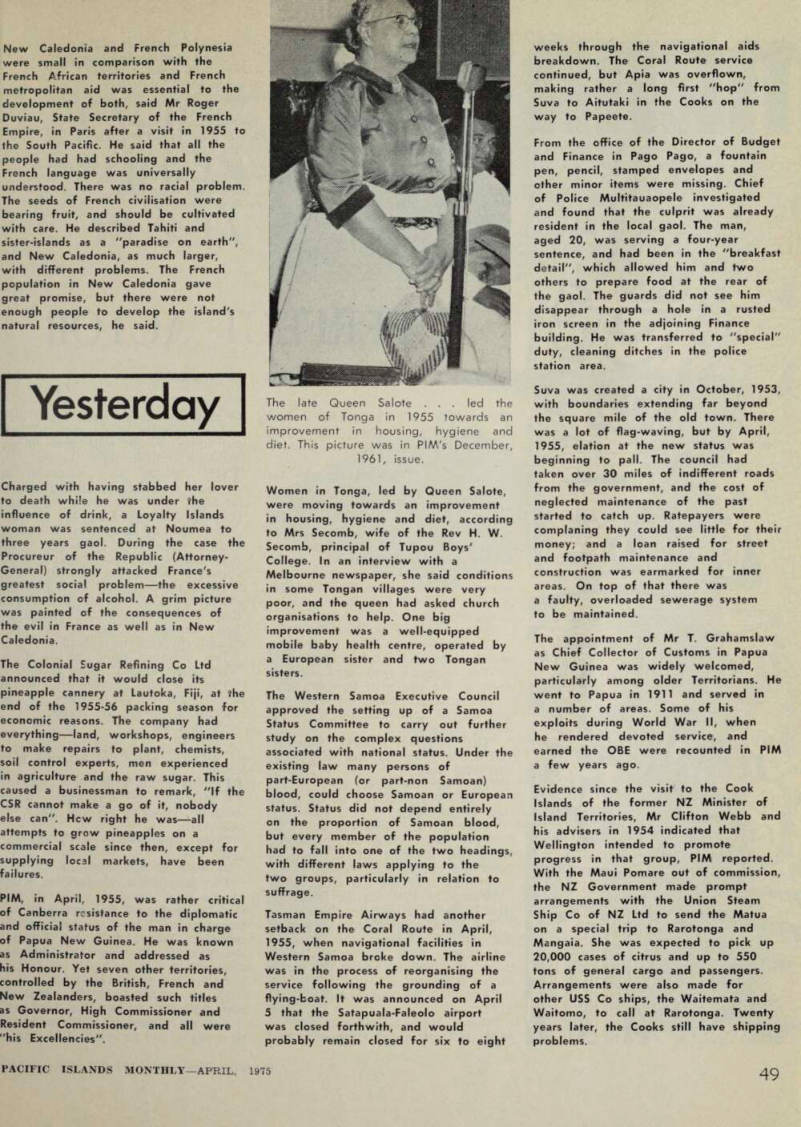
New Caledonia and French Polynesia were small in comparison with the French African territories and French metropolitan aid was essential to the development of both, said Mr Roger Duviau, State Secretary of the French Empire, in Paris after a visit in 1955 to the South Pacific. He said that all the people had had schooling and the French language was universally understood. There was no racial problem.
The seeds of French civilisation were bearing fruit, and should be cultivated with care. He described Tahiti and sister-islands as a "paradise on earth", and New Caledonia, as much larger, with different problems. The French population in New Caledonia gave great promise, but there were not enough people to develop the island's natural resources, he said.
Charged with having stabbed her lover to death while he was under the influence of drink, a Loyalty Islands woman was sentenced at Noumea to three years gaol. During the case the Procureur of the Republic (Attorney- General) strongly attacked France's greatest social problem—the excessive consumption of alcohol. A grim picture was painted of the consequences of the evil in France as well as in New Caledonia.
The Colonial Sugar Refining Co Ltd announced that it would close its pineapple cannery at Lautoka, Fiji, at the end of the 1955-56 packing season for economic reasons. The company had everything—land, workshops, engineers to make repairs to plant, chemists, soil control experts, men experienced in agriculture and the raw sugar. This caused a businessman to remark, "If the CSR cannot make a go of it, nobody else can". Hew right he was—all attempts to grow pineapples on a commercial scale since then, except for supplying local markets, have been failures.
PIM, in April, 1955, was rather critical of Canberra resistance to the diplomatic and official status of the man in charge of Papua New Guinea. He was known as Administrator and addressed as his Honour. Yet seven other territories, controlled by the British, French and New Zealanders, boasted such titles as Governor, High Commissioner and Resident Commissioner, and all were "his Excellencies".
Women in Tonga, led by Queen Salote, were moving towards an improvement in housing, hygiene and diet, according to Mrs Secomb, wife of the Rev H. W.
Secomb, principal of Tupou Boys' College. In an interview with a Melbourne newspaper, she said conditions in some Tongan villages were very poor, and the queen had asked church organisations to help. One big improvement was a well-equipped mobile baby health centre, operated by a European sister and two Tongan sisters.
The Western Samoa Executive Council approved the setting up of a Samoa Status Committee to carry out further study on the complex questions associated with national status. Under the existing law many persons of part-European (or part-non Samoan) blood, could choose Samoan or European status. Status did not depend entirely on the proportion of Samoan blood, but every member of the population had to fall into one of the two headings, with different laws applying to the two groups, particularly in relation to suffrage.
Tasman Empire Airways had another setback on the Coral Route in April, 1955, when navigational facilities in Western Samoa broke down. The airline was in the process of reorganising the service following the grounding of a flying-boat. It was announced on April 5 that the Satapuala-Faleolo airport was closed forthwith, and would probably remain closed for six to eight
weeks through the navigational aids breakdown. The Coral Route service continued, but Apia was overflown, making rather a long first "hop" from Suva to Aitutaki in the Cooks on the way to Papeete.
From the office of the Director of Budget and Finance in Pago Pago, a fountain pen, pencil, stamped envelopes and other minor items were missing. Chief of Police Multitauaopele investigated and found that the culprit was already resident in the local gaol. The man, aged 20, was serving a four-year sentence, and had been in the "breakfast detail", which allowed him and two others to prepare food at the rear of the gaol. The guards did not see him disappear through a hole in a rusted iron screen in the adjoining Finance building. He was transferred to "special" duty, cleaning ditches in the police station area.
Suva was created a city in October, 1953, with boundaries extending far beyond the square mile of the old town. There was a lot of flag-waving, but by April, 1955, elation at the new status was beginning to pall. The council had taken over 30 miles of indifferent roads from the government, and the cost of neglected maintenance of the past started to catch up. Ratepayers were complaning they could see little for their money; and a loan raised for street and footpath maintenance and construction was earmarked for inner areas. On top of that there was a faulty, overloaded sewerage system to be maintained.
The appointment of Mr T. Grahamslaw as Chief Collector of Customs in Papua New Guinea was widely welcomed, particularly among older Territorians. He went to Papua in 1911 and served in a number of areas. Some of his exploits during World War 11, when he rendered devoted service, and earned the OBE were recounted in PIM a few years ago.
Evidence since the visit to the Cook Islands of the former NZ Minister of island Territories, Mr Clifton Webb and his advisers in 1954 indicated that Wellington intended to promote progress in that group, PIM reported.
With the Maui Pomare out of commission, the NZ Government made prompt arrangements with the Union Steam Ship Co of NZ Ltd to send the Matua on a special trip to Rarotonga and Mangaia. She was expected to pick up 20,000 cases of citrus and up to 550 tons of general cargo and passengers.
Arrangements were also made for other USS Co ships, the Waitemata and Waitomo, to call at Rarotonga. Twenty years later, the Cooks still have shipping problems.
The late Queen Salote . . . led the women of Tonga in 1955 towards an improvement in housing, hygiene and diet. This picture was in PIM's December, 1961, issue.
Mana
is a vehicle for Pacific Islands’ writers and artists to publish their work. It is an organ of the South Pacific Creative Arts Society and its editorial committee comprises writers from many islands.
Material for publication must be sent direct to MANA’s editor, Marjorie Crocombe, South Pacific Creative Arts Society, Box 5083, Suva.
The South Pacific islands are, at last, turning their thoughts back to their rich, cultured past with its many art forms created for so many uses—for religious ceremonies, for battle and even for utilitarian jobs in the home. As they turn their thoughts to the past, they turn their eyes to other lands, mainly to Europe where so many of the Islands’ art treasures are. They want them back.
MANA editor Marjorie Crocombe shows four which are museum pieces in Soviet Russia.
A Perfect Actor
By Francis Tekonnang
IT was 2 pm. The students were already in, waiting for their teacher to come. They were compet ing to be heard.
“Seeee . . ,!” echoed through the room. The teacher had come, and the hub-bub fell rapidly under his boots.
“Good afternoon, sir”.
“Good afternoon. Sit down”. And he drew a diagram on the board.
“Suppose we want to reflect this triangle in this mirror line. Someone is going to do it for us. Lemeki!”
Someone entered the room.
“Saiasi, go and sit near Pailasa”.
The stranger—at least to the stu dents—went and sat in his place.
“Yes, Lemeki, you are going to draw us the image of that triangle”.
The stranger took his pad out, and started scribbling on it as the lesson proceeded.
“That is good, Lemeki. What do you notice about the size of the two
triangles, Sagil?”
"They are the same, sir”.
“Good. What do you notice about their shape, Anna?”
“They are the same, sir”.
“Very good. What do you notice about the distance of A, and A 1 from the mirror line. Anil?”
“I think they are the same, sir”.
“You think they are the same. All right, come and measure them”.
The stranger scribbled: very good questioning technique, the questions are spread, with the names men tioned last, and he knows the names of his students.
“Are they the same, Anil?”
“Yes, sir”.
“Good. Now, all of you turn to page 149 of your textbooks, and
do exercises one and two. I will give you 20 minutes to do those. When you finish, I will take them home and look through them tonight”.
THE students were surprised to hear that because he had always corrected their exercises in class.
They knew he was interested in them —they did not know why—but they liked him for calling them by their own names, and for helping them whenever they asked him for help, at least in class. Many liked him for scribbling ‘Very good, James’ or ‘Keep it up, John’ on the pages of their exercise books, as he went around checking their books.
The stranger came up to him.
“Very good indeed”. And then left.
The bell went for the end of his period, and he asked some of the students to collect the books.
“Is that all?”
“Yes, sir”.
“All right. Get ready for your next lesson”.
HE was sitting at his desk, looking through the exercises when someone knocked on the door. It was Anil.
“Yes, Anil, what can I do for you?”
“I want to talk to you”.
I’ve got plenty of work in front of me now; tomorrow will be my last day here, and I’ve got only one lesson, then I'll go back to Suva, he thought. “Sorry, Anil, but I can’t see you. I am very busy at the moment”.
“All right, sir”. Anil left.
He sat on his desk thinking about why Anil had come to see him.
I've got plenty of work on hand, he thought, and he resumed his work.
Pacific
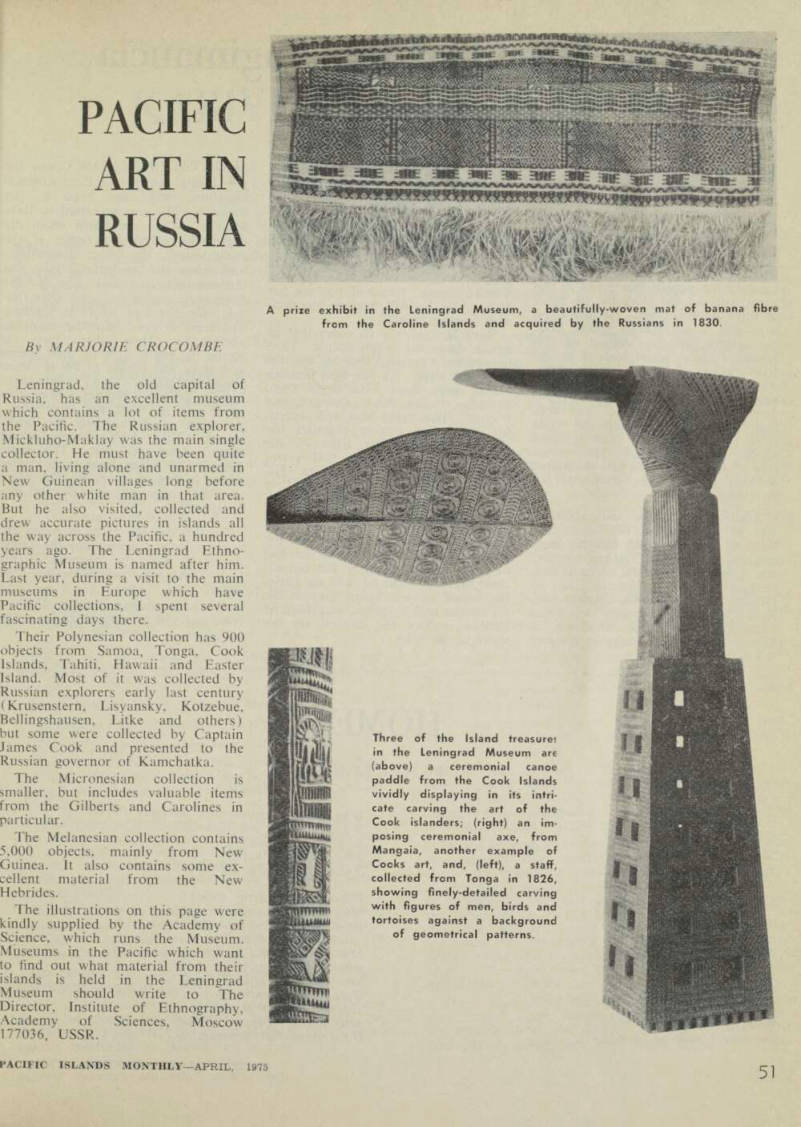
Art In
Russia
By Marjorie Crocombe
Leningrad, the old capital of Russia, has an excellent museum which contains a lot of items from the Pacific. The Russian explorer, Mickluho-Maklay was the main single collector. He must have been quite a man, living alone and unarmed in New Guinean villages long before any other white man in that area.
But he also visited, collected and drew accurate pictures in islands all the way across the Pacific, a hundred years ago. The Leningrad Ethno graphic Museum is named after him.
Last year, during a visit to the main museums in Europe which have Pacific collections, 1 spent several fascinating days there.
Their Polynesian collection has 900 objects from Samoa, Tonga, Cook Islands, Tahiti, Hawaii and Easter Island. Most of it was collected by Russian explorers early last century (Krusenstern, Lisyansky, Kotzebue, Bellingshausen, Litke and others) but some were collected by Captain James Cook and presented to the Russian governor of Kamchatka.
The Micronesian collection is smaller, but includes valuable items from the Gilberts and Carolines in particular.
The Melanesian collection contains 5,000 objects, mainly from New Guinea. It also contains some ex cellent material from the New Hebrides.
The illustrations on this page were kindly supplied by the Academy of Science, which runs the Museum.
Museums in the Pacific which want to find out what material from their islands is held in the Leningrad Museum should write to The Director, Institute of Ethnography, Academy of Sciences, Moscow
177036, Ussr.
A prize exhibit in the Leningrad Museum, a beautifully-woven mat of banana fibre from the Caroline Islands and acquired by the Russians in 1830.
Three of the Island treasures in the Leningrad Museum are (above) a ceremonial canoe paddle from the Cook Islands vividly displaying in its intri cate carving the art of the Cook islanders; (right) an im posing ceremonial axe, from Mangaia, another example of Cooks art, and, (left), a staff, collected from Tonga in 1826, showing finely-detailed carving with figures of men, birds and tortoises against a background of geometrical patterns.
Advertisements & other items, p. 53 (1 item)
51
ACIFIC ISLANDS MONTHLY—APRIL, 1975
The legend of the Tagimaucia
By Serenia Senikavika
MY grandmother told me the legend of how the Tagimaucia came to be on the island of Taveuni.
Lone lone aeo when the first Fijk„s g ianded in they separated and some groups came to Taveuni while others went on to Kadavu, Beqa, Ovalau and other islands.
Leading the people that came to this island was an old chief by the name of Ratu Kabunavanua. He had a son who was a courageous young man.
No sooner had they settled on this beautiful island, when fleets of canoes from Tonga came to attack them.
The little groups fought back, but they were outnumbered by the brave Tongan warriors. There was confusion, and blood soaked the white sand as clubs clashed and thudded as they hit human heads. Spears were thrown back and forth and shuddered as they hit the bare chests of the warrlors - The fight went on until nightfall, and b- the light of the full moon, the two parties could identify their enemies. Among the Tongan warriors was a witch doctor, and he came face to face with Ratu Maucia Gusu ni Deveta, Ratu Kabunavanua’s son.
Ratu Maucia was ready to strike when the witch doctor called out, “I beg you, don’t kill me, spare me and
let me be your canoe-cutter”. But the young warrior was determined to club his enemy, and so the witch doctor predicted, "If you kill me,
Tnd
i; . § , . ■ t K-^ rnniintn f n<s IIv SJg a will hi wt no (Se to tdk to . lonelv As for Adi Tale y iko asawa b you n ot see her aj / she become the wife £ Tonean chief!”
R • ’ anprv thaf he str^c \ tU d^ C L w tch doctor Then s u dden , y realised Slat he waj the
, J. , . d his
sl™?"^ dead He there k - at tbe dead enemies and The nieht was stUl except f , t g earine through the coconilt i eaV es The g lieht of the f lifeless § bodies and d heads of t h e warriors. His f „ onto the club c utche d in his hand; it was soaked with blood.
The canoes of the Tongans floated peacefully on the calm sea by the shore. Suddenly he thought of the witch doctor s words. No sooner had he remembered, when he felt himself changing and soon he was an eagle.
He found himself flying towards the mountains of Uluiqalau, and there he located a cave for himself on the shore of the lake.
\ Di Tal.Eikoyasawa Was The
A lovely daughter of Ratu Robana wasaliwa, and they lived in the Yasawas. She was promised to Ratu Maucia ' When she heard ab ° W the eagle, she asked her father if she could visit il - Her father allowed this and, when she reached the lake, she £id not want to return. She saw the huge eagle crying and tears were fall mg from the tree where ll perched, The tears dripped onto the branches and leaves. Her father’s men, on see J n S ‘he eagle, to <* s P R ea^ and clubs and sought to kill it. Ratu Wasakarakarawa, Adi Taleikoya sawa’s younger brother, threw his s P ear and il stmck lar^e eagle - As soon as lt touched the bird ’ s breast, a burst of tiny drops of blood flowed down the tree. The eagle stained the other trees and bushes where it flew m its pam. The eagle ‘hen flew right into the lake and dis appeared, Tq this d the drops of b i ood are said tQ hay& changed into the rarest flower in p... the tagimaucia (h i s which means “to name and tap which mens to cry ). So, when you tree, you will be sure to notice drops of water or tears on it.
Home
By Sina Fe’Ao
Why should I weep?
Should I care?
Should my children Suffer the same fate?
My mind starts questioning, my heart doubts the future you promised.
Where is our land?
Mother, you’re brown, I’m brown.
Why can’t I talk to you the way I talk to friends?
Why can’t I express my thoughts freely?
We belong to one home, why three houses?
You say it's a must, Agreed, but why not one?
What have I done wrong?
Why can’t my voice be heard?
Why was I born into this house?
My brothers and sisters are homeless, friends are begging for food, yet you hold unused land.
Going on expensive trips won’t solve it, yet you expect to satisfy your needs from our house.
Do I need this structure?
Karivi And His Canoe
By Hanson Lini
ONE day Karivi (Rat) decided to make a canoe out of a via stalk. After completing his canoe, he decided to visit the neighbouring island of Maewo. On his way he met Higo (Kingfisher).
Higo asked, “Where are you going?”
Karivi replied, “I’m going to Maewo.”
“Can I come with you?” asked Higo.
“Oh no!” replied Karivi. “The canoe is too small to take two.” Without replying, Higo sang a threaten ing song which frightened Karivi so much that he agreed to take him on his canoe;
Higo
Nani sage nani veve lawe tamaku I shall go up I shall say to my father.
Langi sis langi korogo Wind tie wind to stop you.
Karivi
Sue Sue vano sue vano
Paddle Paddling going Paddling going
Himai ba kalo Down come and aboard.
Karivi and Higo went on a little until they met Manubona (Dove) who asked, “Where are you two
going?”
They replied, “We’re going to Maewo.”
Manubona asked, “Can I come with you two?”
“Oh, no! You can’t, the canoe can only take two.”
Manubona started singing the same song that Higo had sung. When Karivi and Higo heard the song, they changed their minds and asked Manubona to join them on their trip.
These three went on until they met Maragi (Pigeon) who asked them where they were going. Karivi and his companions replied that they were heading for Maewo. On hearing this, Maragi wanted to join them but the occupants of the canoe protested that the canoe was too small.
Maragi started to threaten the occupants of the canoe saying, “I shall now go to Tuaaku (grandfather) and ask him to make the sea very rough so that you will all drown and be eaten by sharks.”
On hearing this, Karivi shook with fear but he was determined to get to Maewo.
He said to Maragi, “Come and join us, there’s plenty of room for everyone.” Maragi joined the canoeists; and they left the island of Raga and paddled quickly northward to Maewo.
WREN the canoe was in mid-ocean, Karivi told all the birds to take their lunch out and eat the food they had brought. They all took out their lunches, but Higo had not brought any lunch. Karivi gave clear instructions that none of the passengers were to drop a crumb of their yam and taro into the canoe. While everyone was eating, Higo sat staring from one bird to another, hoping that he would be offered some food, but no one bothered to do so. Maragi dropped a crumb of his yam, and Higo picked at the crumb so fiercely that his beak pierced a hole in the canoe. The water rushed in through the hole and the canoe began to sink.
Of course, all the birds flew away leaving poor Karivi behind.
Karivi sank to the bottom of the sea and looked around for help. He first met a whale, and he asked for a ride ashore but the whale replied that its place was in the ocean. Karivi went on until he met Tuna.
“Please, carry me to the shore,” he begged.
Tuna replied, “All my friends and brothers have been taken ashore, so I can’t risk my life.” Poor Karivi went on until he met a shark.
“Brother shark, help me to get back to the land.” he begged.
The shark turned and showed him a big wound on its tail. “You see that? That’s why I cannot help you.
The land people tried to take my life yesterday.”
Karivi went a little further until he met a turtle feeding on the nice juicy sea grass. “Turtle, please help me.”
The turtle viewed Karivi for a while then asked, “What’s the trouble?”
“I’m in trouble, I want to get back to the land.”
The turtle told Karivi to get on his back, and so to the shore they went.
When they arrived on the beach, Karivi asked the turtle to wait while he went to the bush to get some coconuts for him to take back to sea. Meanwhile, the villagers came, discovered the turtle, bound it, and took it to their village. Karivi saw them and followed.
In the village everyone gathered to see this huge sea creature. They danced around the turtle and, when they were eventually exhausted, they were sent off to collect taro, yam, via, firewood, and rau (baking leaves) to prepare the big feast of eating the turtle. They left the turtle in the chief’s house. When Karivi saw that the turtle was left unguarded, he went and broke all the vines that the people had used to bind the turtle.
While biting the vines, he said to the turtle that as soon as the vines were broken they had to race very quickly to the shore.
They raced down the hill to the beach and, when they arrived there, Karivi piled all the coconuts onto the turtle’s back and, saying goodbye to each other, they parted, going their own ways.
To Paradise
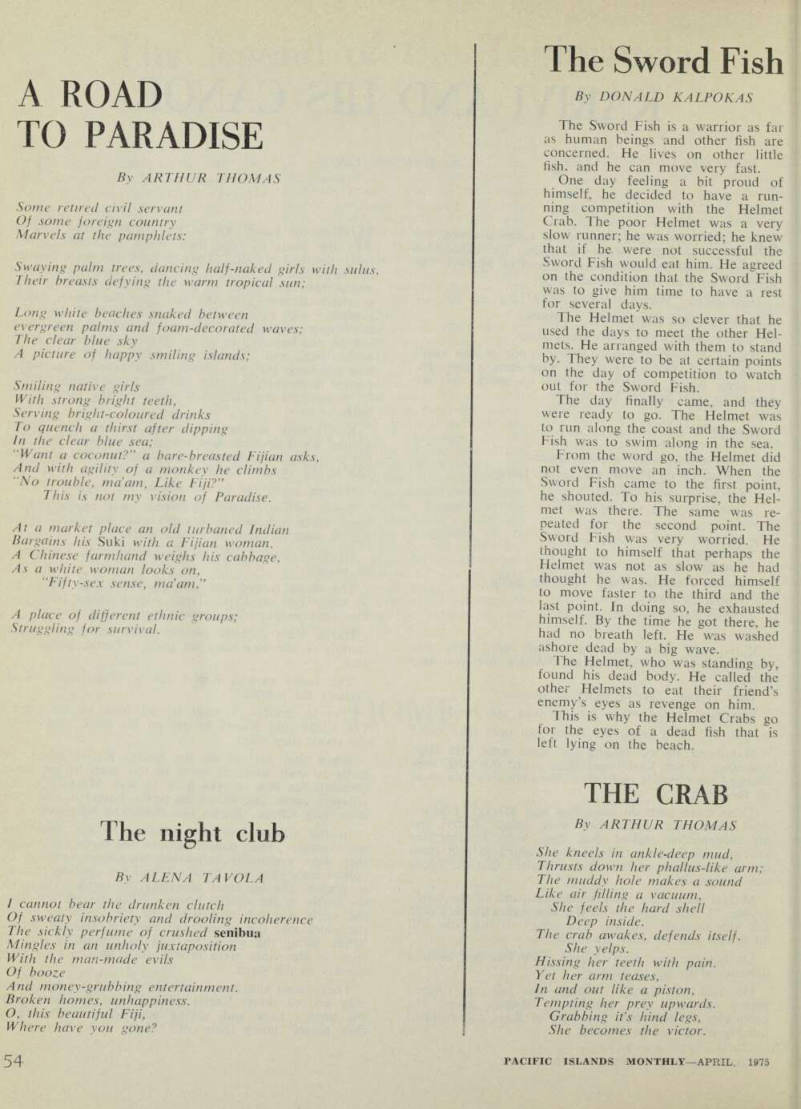
A Road
By Arthur Thomas
Some retired civil servant Of some foreign country Marvels at the pamphlets: Swaying palm trees, dancing half-naked girls with stilus, Their breasts defying the warm tropical sun; Long white beaches snaked between evergreen palms and foam-decorated waves; The clear blue sky A picture of happy smiling islands; Smiling native girls With strong bright teeth, Serving bright-coloured drinks To quench a thirst after dipping In the clear blue sea; "Want a coconut?” a bare-breasted Fijian asks, And with agility of a monkey he climbs "No trouble, ma’am. Like Fiji?”
This is not my vision of Paradise.
At a market place an old turbaned Indian Bargains his Suki with a Fijian woman.
A Chinese farmhand weighs his cabbage, As a white woman looks on, “Fifty-sex sense, ma’am.”
A place of different ethnic groups; Struggling for survival.
The night club
By Alena Tavola
I cannot bear the drunken clutch Of sweaty insobriety and drooling incoherence The sickly perfume of crushed senibua Mingles in an unholy juxtaposition With the man-made evils Of booze And money-grubbing entertainment.
Broken homes, unhappiness.
O, this beautiful Fiji, Where have you gone?
The Sword Fish
By Donald Kalpokas
The Sword Fish is a warrior as far as human beings and other fish are concerned. He lives on other little fish, and he can move very fast.
One day feeling a bit proud of himself, he decided to have a run ning competition with the Helmet Crab. The poor Helmet was a very slow runner; he was worried; he knew that if he were not successful the Sword Fish would eat him. He agreed on the condition that the Sword Fish was to give him time to have a rest for several days.
The Helmet was so clever that he used the days to meet the other Hel mets. He arranged with them to stand by. They were to be at certain points on the day of competition to watch out for the Sword Fish.
The day finally came, and they were ready to go. The Helmet was to run along the coast and the Sword Fish was to swim along in the sea.
From the word go, the Helmet did not even move an inch. When the Sword Fish came to the first point, he shouted. To his surprise, the Hel met was there. The same was re peated for the second point. The Sword Fish was very worried. He thought to himself that perhaps the Helmet was not as slow as he had thought he was. He forced himself to move faster to the third and the last point. In doing so, he exhausted himself. By the time he got there, he had no breath left. He was washed ashore dead by a big wave.
The Helmet, who was standing by,
found his dead body. He called the other Helmets to eat their friend’s enemy’s eyes as revenge on him.
This is why the Helmet Crabs go for the eyes of a dead fish that is left lying on the beach.
The Crab
By Arthur Thomas
She kneels in ankle-deep mud, Thrusts down her phallus-like arm; The muddy hole makes a sound Like air filling a vacuum, She feels the hard shell Deep inside.
The crab awakes, defends itself.
She yelps.
Hissing her teeth with pain.
Yet her arm teases, In and out like a piston, Tempting her prey upwards.
Grabbing it’s hind legs, She becomes the victor.
Advertisements & other items, pp. 57-59 (1 item)
The freshest butter and cheese
is made by your neighbours.
Not so very far away from here, your neighbour Australia is making the world’s finest butter and cheese. Because these products come to you straight from our farms, you can be sure that they are really fresh at the peak of their flavour and goodness. So when you buy good food for your family, look for the word “Australia’’on your butter and cheese.
Australian butter and cheese □cm p
Tried the new
Kodak film yet?
Kodachrome 64
This new film has a new emulsion that will give you bright greens, reds and blues.
In addition you have the flexibility of a fast film rating (ASA 64) to help you take good color shots even under dull or difficult light conditions. Try it soon and see the difference for yourself. It’s in the familiar yellow box, at your local island photo dealer.
Ask for Kodachrome 64 film-the slide improver ‘Available in sizes to fit 135, 126 and 110 size cameras.
“Kodak” and “Kodachroirr'” are registered trademarks of KODAK (Australasia) PTY. LTD.
K6l 4948
color slide film
KODAK (Australasia) PTY. LTD.
Handbook of
Papua
New Guinea
THE LATEST'
SELF-GOVERNMENT
EDITION!
This new edition of the Handbook of Papua New Guinea — completely revised and reset — provides the first full up-to-date details of the new self-governing nation.
For businessmen, travellers, schools, universities and libraries, government departments, tourists and Papua New Guinea residents, this timely, up -to - the - minute edition, is essential.
The Handbook covers everything —geography and history right up to self - government, commerce, trade and banking, forestry, primary and secondary industries, finance and taxation, communications and transport, health and education, law and defence, the churches and missions, land and land policy, etc. Each of the 19 districts is treated in detail, with clear and comprehensive maps, all newly drawn.
There is also a greatly expanded list, for easy reference, of company registrations and an enlarged tourist section that has all the latest information on facilities and amenities in all areas.
A large attractive fold-out map of Papua New Guinea is also included. The first edition of the Papua New Guinea handbook was published 20 years ago. This 7th edition, is the only reference book available today with all the information on the world's newest nation.
PRICE: Australia, $5.50 plus 85c posted, Pacific Islands and Overseas, $5.50 Aust., plus $l.lO posted, U.5.A., $9.80 U.S. posted.
Fill in the details
on the attached
order form.
Book Reviews
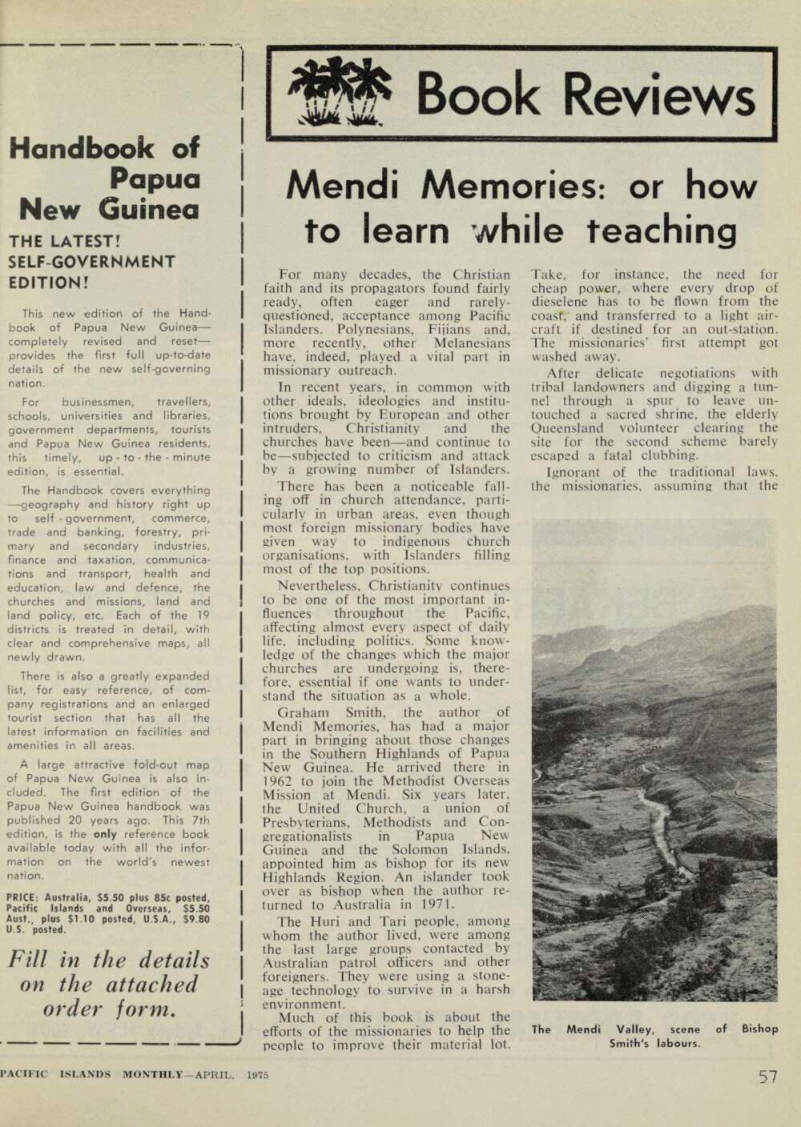

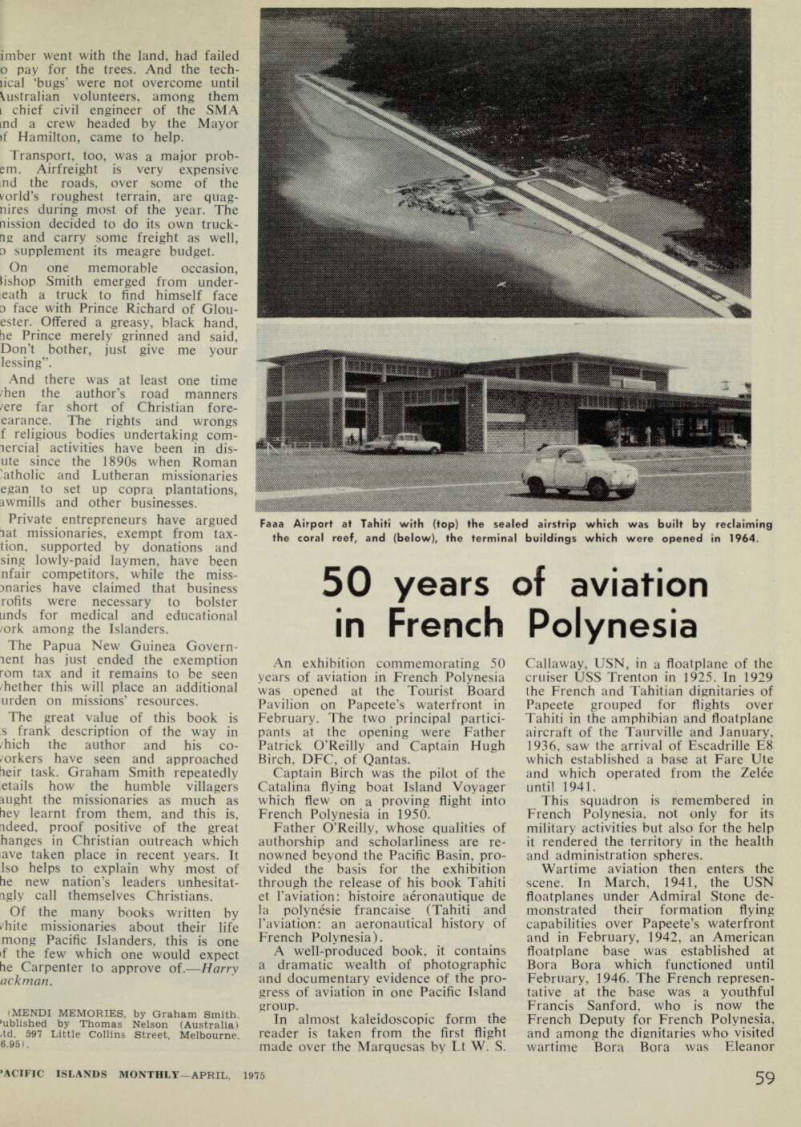
Mendi Memories: or how to learn while teaching
For many decades, the Christian faith and its propagators found fairly ready, often eager and rarely questioned, acceptance among Pacific Islanders. Polynesians, Fijians and, more recently, other Melanesians have, indeed, played a vital part in missionary outreach.
In recent years, in common with other ideals, ideologies and institu tions brought by European and other intruders, Christianity and the churches have been—and continue to be—subjected to criticism and attack by a growing number of Islanders.
There has been a noticeable fall ing off in church attendance, parti cularly in urban areas, even though most foreign missionary bodies have given way to indigenous church organisations, with Islanders filling most of the top positions.
Nevertheless, Christianity continues to be one of the most important in fluences throughout the Pacific, affecting almost every aspect of daily life, including politics. Some know ledge of the changes which the major churches are undergoing is, there fore, essential if one wants to under stand the situation as a whole.
Graham Smith, the author of Mendi Memories, has had a major part in bringing about those changes in the Southern Highlands of Papua New Guinea, He arrived there in 1962 to join the Methodist Overseas Mission at Mendi. Six years later, the United Church, a union of Presbyterians, Methodists and Con gregationalists in Papua New Guinea and the Solomon Islands, appointed him as bishop for its new Highlands Region. An islander took over as bishop when the author re turned to Australia in 1971.
The Huri and Tari people, among whom the author lived, were among the last large groups contacted by Australian patrol officers and other foreigners. They were using a stone age technology to survive in a harsh environment.
Much of this book is about the efforts of the missionaries to help the people to improve their material lot.
Take, for instance, the need for cheap power, where every drop of dieselene has to be flown from the coast, and transferred to a light air craft if destined for an out-station.
The missionaries’ first attempt got washed away.
After delicate negotiations with tribal landowners and digging a tun nel through a spur to leave un touched a sacred shrine, the elderly Queensland volunteer clearing the site for the second scheme barely escaped a fatal clubbing.
Ignorant of the traditional laws, the missionaries, assuming that the
The Mendi Valley, scene of Bishop Smith's labours.
imber went with the land, had failed 0 pay for the trees. And the tech lical ‘bugs’ were not overcome until Australian volunteers, among them 1 chief civil engineer of the SMA md a crew headed by the Mayor if Hamilton, came to help.
Transport, too, was a major prob em. Airfreight is very expensive nd the roads, over some of the world’s roughest terrain, are quag nires during most of the year. The nission decided to do its own truck rig and carry some freight as well, □ supplement its meagre budget.
On one memorable occasion, lishop Smith emerged from under eath a truck to find himself face a face with Prince Richard of Glou ester. Offered a greasy, black hand, he Prince merely grinned and said, Don’t bother, just give me your lessing”.
And there was at least one time /hen the author’s road manners /ere far short of Christian fore earance. The rights and wrongs f religious bodies undertaking com lercial activities have been in dis ute since the 1890 s when Roman 'atholic and Lutheran missionaries egan to set up copra plantations, awmills and other businesses.
Private entrepreneurs have argued aat missionaries, exempt from tax tion, supported by donations and sing lowly-paid laymen, have been nfair competitors, while the miss anaries have claimed that business rofits were necessary to bolster Linds for medical and educational /ork among the Islanders.
The Papua New Guinea Govern lent has just ended the exemption rom tax and it remains to be seen /hether this will place an additional urden on missions’ resources.
The great value of this book is s frank description of the way in /hich the author and his co /orkers have seen and approached heir task. Graham Smith repeatedly etails how the humble villagers aught the missionaries as much as bey learnt from them, and this is, adeed, proof positive of the great hanges in Christian outreach which ave taken place in recent years. It Iso helps to explain why most of he new nation’s leaders unhesitat rigly call themselves Christians.
Of the many books written by /hite missionaries about their life mong Pacific Islanders, this is one if the few which one would expect
he Carpenter to approve of.
Harry
[?]ackman.
(MENDI MEMORIES, by Graham Smith, •üblished by Thomas Nelson (Australia) itd, &97 Little Collins Street, Melbourne. 6.95).
Advertisements & other items, p. 60 (1 item)
1 Bekaert Means Miles Of Fences
Save hundreds of dollars
on Australians most efficient
WALK IN, ALUMINIUM
COOLROOMS AND
FREEZE ROOMS
Hundreds already installed! The most economical supplementary cool- 'ooms for bottles and food, providing the largest storage capacity of any comparable coolrooms of the same exterior dimensions. Five sizes —from 90-360 cu. ft. capacity; 16 models offering normal temp., two temp., deep freeze, or for pastry and ice storage applications. White vinyl interior, embossed rustproof aluminium exterior. • SUPPLIED IN EASY-TO-ERECT, DO-IT-YOURSELF KIT FORM Available from; AUSTRALIAN NEW CALEDONIA EXPORTS (SILVER & BARDA), 363 George St., Sydney, 2000 and Branches.
BRECKWOLDT & CO., 276 Pitt St., Sydney, 2000 and Branches.
PETER FISHER TRADING PTY. LTD., 321 Pitt St., Sydney, 2000.
HAGEMEYER (A'SIA), 59 Anzac Pde., Kensington, 2033 and Branches.
KERR BROS, 65 York St., Sydney, 2000.
Manufactured by:
NELSON & ROBERTSON PTY. LTD., 197 Clarence St., Sydney, 2000.
RABAUL TRADING CO. PTY. LTD., P.O. Box 219, Rabaul and Branchess ROY GALLIMORE & ASSOCIATES, P.O. Box 179, Vila, New Hebridesz C. SULLIVAN (EXPORT) PTY. LTD., 60 Margaret St., Sydney, 2000 ano Branches.
W. S. TAIT & CO, PTY. LTD., 31 Macquarie Place, Sydney, 2000 ano Branches.
WARBURTON FRANK!
199 Parramatta Road, Cnr. Skarratf Street, Auburn, N.S.W. 2144, Australia. Phone 648-1711.
POWERED BY
KELVINATOR.
Five-year warranty compressor. Early livery.
1 BEKAERT means MILES OF FENCES
The BEKAERT people for the Pacific Islands.
★ CHOICE OF STYLES
★ FIRST QUALITY
★ GALVANISED OR
PLASTIC COATINGS
BEKAERT is the leading European wire-mill with a yearly capacity of over 350,000 tons of high quality wires and wire-products and all kinds of ornamental, welded or chain link fences.
For further information or supplies contact: KERR BROTHERS PTY. LTD. 65 York St., Sydney, N.S.W., 2001.
in French Polynesia
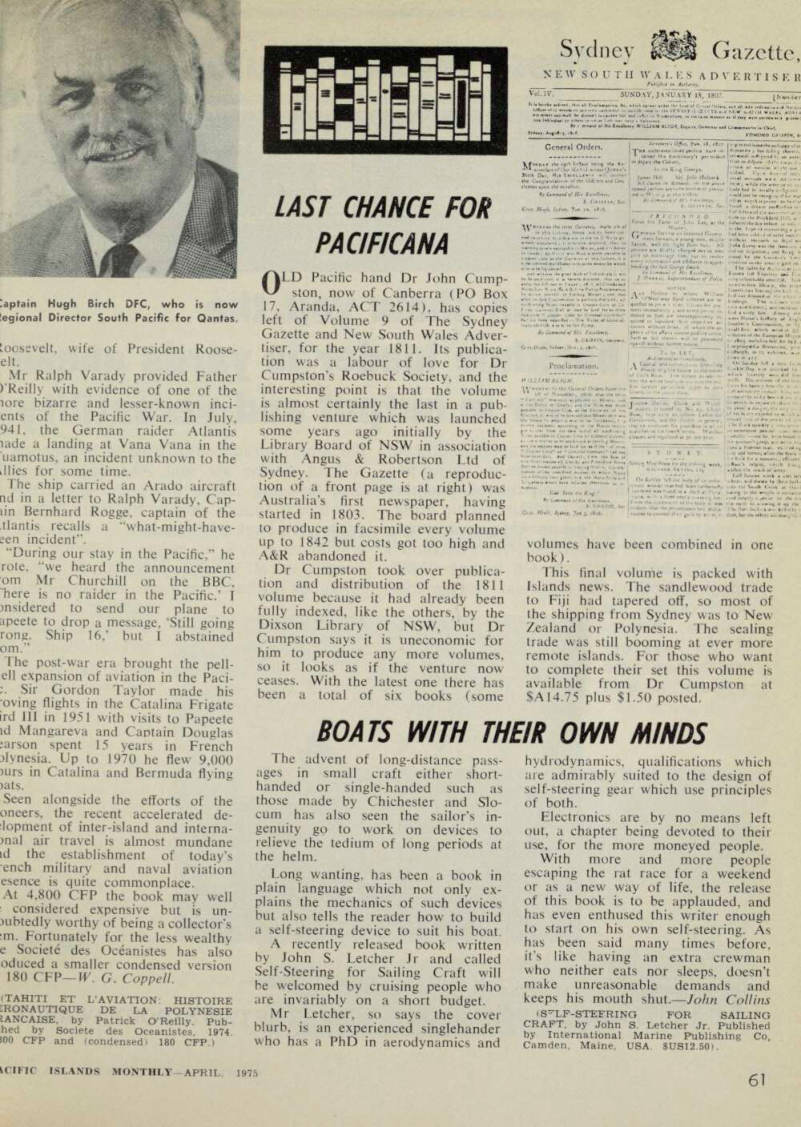
50 years of aviation in French Polynesia
An exhibition commemorating 50 years of aviation in French Polynesia was opened at the Tourist Board Pavilion on Papeete’s waterfront in February. The two principal participants at the opening were Father Patrick O’Reilly and Captain Hugh Birch, DFC, of Qantas.
Captain Birch was the pilot of the Catalina flying boat Island Voyager which flew on a proving flight into French Polynesia in 1950.
Father O’Reilly, whose qualities of authorship and scholarliness are renowned beyond the Pacific Basin, provided the basis for the exhibition through the release of his book Tahiti et I’aviation: histoire aeronautique de la polynesie francaise (Tahiti and I’aviation: an aeronautical history of French Polynesia).
A well-produced book, it contains a dramatic wealth of photographic and documentary evidence of the progress of aviation in one Pacific Island group.
In almost kaleidoscopic form the reader is taken from the first flight made over the Marquesas by Lt W. S.
Callaway, USN, in a floatplane of the cruiser USS Trenton in 1925. In 1929 the French and Tahitian dignitaries of Papeete grouped for flights over Tahiti in the amphibian and floatplane aircraft of the Taurville and January, 1936, saw the arrival of Escadrille E 8 which established a base at Fare Ute and which operated from the Zelee until 1941.
This squadron is remembered in French Polynesia, not only for its military activities but also for the help it rendered the territory in the health and administration spheres, Wartime aviation then enters the scene. In March, 1941, the USN floatplanes under Admiral Stone de monstrated their formation flying capabilities over Papeete’s waterfront and in February, 1942, an American floatplane base was established at Bora Bora which functioned until February, 1946. The French represen tative at the base was a youthful Francis Sanford, who is now the French Deputy for French Polynesia, and among the dignitaries who visited wartime Bora Bora was Eleanor
Faaa Airport at Tahiti with (top) the sealed airstrip which was built by reclaiming the coral reef, and (below), the terminal buildings which were opened in 1964.
loosevelt, wife of President Roose elt.
Mr Ralph Varady provided Father )’Reilly with evidence of one of the lore bizarre and lesser-known ind ents of the Pacific War. In July, 941, the German raider Atlantis iade a landing at Vana Yana in the uamotus, an incident unknown to the Lilies for some time.
The ship carried an Arado aircraft nd in a letter to Ralph Varady, Cap fin Bernhard Rogge, captain of the tlantis recalls a “what-might-have sen incident”.
“During our stay in the Pacific,” he rote, “we heard the announcement om Mr Churchill on the BBC.
"here is no raider in the Pacific.’ I msidered to send our plane to apeete to drop a message, ‘Still going rong. Ship 16,’ but I abstained om.”
The post-war era brought the pell ell expansion of aviation in the Paci :. Sir Gordon Taylor made his 'oving flights in the Catalina Frigate ird 111 in 1951 with visits to Papeete id Mangareva and Captain Douglas :arson spent 15 years in French flynesia. Up to 1970 he flew 9,000 )urs in Catalina and Bermuda flying >ats.
Seen alongside the efforts of the oneers, the recent accelerated de- Jopment of inter-island and interna )nal air travel is almost mundane id the establishment of today’s ench military and naval aviation esence is quite commonplace.
At 4,800 CFP the book may well considered expensive but is un mbtedly worthy of being a collector’s :m. Fortunately for the less wealthy e Societe des Oceanistes has also oduced a smaller condensed version
180 Cfp
W. G. Coppell.
(Tahiti Et L’Aviation: Histoire
Jronautique De La Polynesie
lANCAISE, by Patrick O’Reilly. Pub hed by Societe des Oceanistes, 1974. 100 CFP and (condensed) 180 CFP.)
Captain Hugh Birch DFC, who is now [?]egional Director South Pacific for Qantas.
Advertisements & other items, pp. 61-62 (2 items)
59
ACIFIC ISLANDS MONTHLY—APRIL 1975
S. E. Tatham
& CO. PTY. LTD.
SOME OF THE FIRMS
WE REPRESENT ARE;
ASKEW HOUSE, 364 LONSDALE ST.,
MELBOURNE, 3001, AUSTRALIA.
G.P.O. BOX 8—
CABLES "SET'
TELEPHONE: 601125
Asia Rubber Works (Singapore Rubber Shoes) Frappier (French Brandy) Huvef (French Brandy) Indika (Belgium Dairy Produce) Durobor S.A. (Belgium Glassware) AAiroiterie Gen. de Belgiqe S.A. (Louvre glass and mirrors) City Engineers (U.K. Bicycles) F.H.I. Japan (Subaru Cars) Kraggs (Wines, Spirits, Ciders) Sunshine Biscuits Sunrise (Confectionery) Flamenco (Instant Coffee & Tea) Quaker Products (Oats, Jets) Hancocks (Spaghetti, Cereals) Melbourne Canning (Jams) Amatil (Twisties, Twirlies) Edward Zorn (Margarine, Cooking Fats) Allens (Confectionery) Red Tulip (Fine Chocolates) Robert Timms (New Guinea Gold Instant Coffees and Teas) S.P.C (Canned Fruit) S.P.C. (Abalone) Wing Lee (See You Sauce) Magnet (Mattresses) Essteel (Cookware) Warner-Drayton (Fans) Mitchell's (Abrasives) Tilbury & Lewis (Sports Trophies & Silverplate) Regent (Swiss watches) Lega Marcasite (Jewellery) Austramax (Pressure Lanterns) Lawn Chair; Tubco (Garden Furniture) Electronic Industries (Electrical Household Appliances) Jex (Steelwool) Arnbro (Folding Beds) James Miller (Blankets) Elmaco (Plastics —Electrical Fittings; B.X. (Plastics) Stegbar (Wooden Louvres) Franklite (Light Fittings) J.J. Cash (Embroidered Labels) Disston (Saws) 0 £ 1 5!
BUYERS FOR THE
PACIFIC ISLANDS
DIRECT ENQUIRIES WELCOMED
PAPUA NEW GUINEA: S. E. TATHAM (P.N.G.) PTY. LTD.,
LAE: MALAITA STREET (P.O. BOX 1562).
PORT MORESBY: CNR. GOROA AND MUNAHU STREETS, GORDON
(P.O. BOX 6733, BOROKO).
FILM: S. E. TATHAM (FIJI) LTD.,
LAUTOKA: P.O. BOX 366.
SUVA: G.P.O. BOX 671.
YOUR GUARANTEE
SINCE 1924
1
FOR SERVICE
T. 2
Last Chance For
Pacificana
OLD Pacific hand Dr John Cump ston, now of Canberra (PO Box 17, Aranda, ACT 2614), has copies left of Volume 9 of The Sydney Gazette and New South Wales Adver tiser, for the year 1811. Its publica tion was a labour of love for Dr Cumpston’s Roebuck Society, and the interesting point is that the volume is almost certainly the last in a pub lishing venture which was launched some years ago initially by the Library Board of NSW in association with Angus & Robertson Ltd of Sydney. The Gazette (a reproduc tion of a front page is at right) was Australia’s first newspaper, having started in 1803. The board planned to produce in facsimile every volume up to 1842 but costs got too high and A&R abandoned it.
Dr Cumpston took over publica tion and distribution of the 1811 volume because it had already been fully indexed, like the others, by the Dixson Library of NSW, but Dr Cumpston says it is uneconomic for him to produce any more volumes, so it looks as if the venture now ceases. With the latest one there has been a total of six books (some
volumes have been combined in one book).
This final volume is packed with Islands news. The sandlewood trade to Fiji had tapered off, so most of the shipping from Sydney was to New Zealand or Polynesia. The sealing trade was still booming at ever more remote islands. For those who want to complete their set this volume is available from Dr Cumpston at SA 14.75 plus $1.50 posted.
Boats With Their Own Minds
The advent of long-distance pass ages in small craft either short handed or single-handed such as those made by Chichester and Slo cum has also seen the sailor’s in genuity go to work on devices to relieve the tedium of long periods at the helm.
Long wanting, has been a book in plain language which not only ex plains the mechanics of such devices but also tells the reader how to build a self-steering device to suit his boat.
A recently released book written by John S. Letcher Jr and called Self-Steering for Sailing Craft will be welcomed by cruising people who are invariably on a short budget.
Mr Letcher, so says the cover blurb, is an experienced singlehander who has a PhD in aerodynamics and
hydrodynamics, qualifications which are admirably suited to the design of self-steering gear which use principles of both.
Electronics are by no means left out, a chapter being devoted to their use, for the more moneyed people.
With more and more people escaping the rat race for a weekend or as a new way of life, the release of this book is to be applauded, and has even enthused this writer enough to start on his own self-steering. As has been said many times before, it’s like having an extra crewman who neither eats nor sleeps, doesn’t make unreasonable demands and keeps his mouth shut. —John Collins
For Sailing
CRAFT, by John S. Letcher Jr. Published by International Marine Publishing Co, Camden, Maine, USA. $U512.50).
Advertisements & other items, pp. 63-64 (2 items)
61
ICIFIC ISLANDS MONTHLY—APRIL, 1975
of any other in output and versatility
These MF distributors
UJXj
C. B. Norwood Limited, P.O. Box 298,
WELLINGTON
PAPUA NEW GUINEA
El P
FIJI ISLANDS
NEW CALEDONIA
industrial Machinery only Pacific Motors S.A.,
B.P. C 2,
NOUMEA CEDEX
NEW CALEDONIA
TAHITI
Henri Lombard, P.O. Box 36,
PAPEETE
BRITISH SOLOMON ISLANDS
can show you, the
MFSO backhoe loader is yards ahead
of any other in output and versatility Wherever it has been in operation around the world, the 60 hp MFSO three-in-one rig has proved to be an extremely reliable machine capable of high hourly output and big profitearning capacity. The backhoe is available with a standard bucket that gives a maximum digging depth of 15 feet 5 inches (lEMC digging depth 13 feet 6 inches). The backhoe
incorporates the
the boom hydraulically in a matter of seconds without leaving the seat. And slew control seat mounted above the boom gives the operator a superb view of his work. A one cubic yard bucket is standard on the loader and lift capacity to full height is 3700 lbs. You can buy the MFSO with confidence in its performance —what’s more your MF distributor backs yourchoice unique Power- Slide system which enables the operator to shift withgenuine parts and service backup to keep you on thejobatall times.
MFE 74042
MASSEY-FERGUSON... WINNER OFTWO EXPORT AWARDS
Pacific Transport
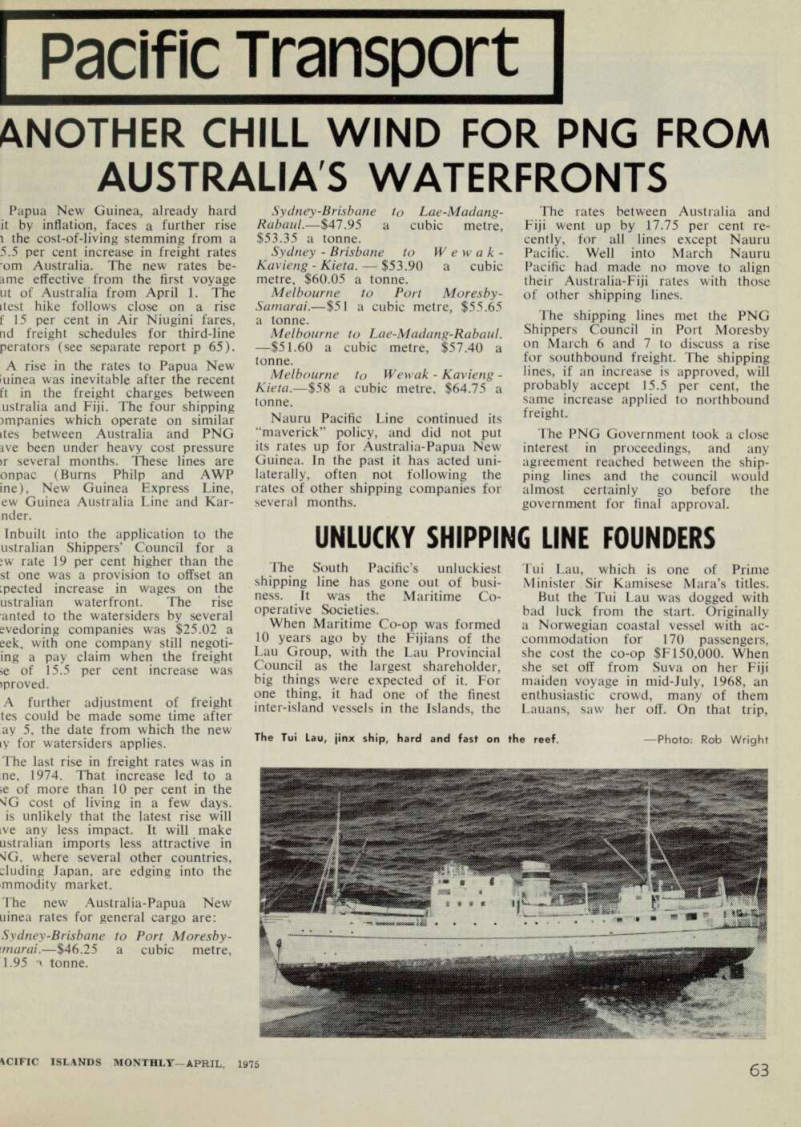
Another Chill Wind For Png From
Australia's Waterfronts
Papua New Guinea, already hard it by inflation, faces a further rise i the cost-of-living stemming from a 5,5 per cent increase in freight rates om Australia. The new rates be ame effective from the first voyage ut of Australia from April 1. The itest hike follows close on a rise f 15 per cent in Air Niugini fares, nd freight schedules for third-line perators (see separate report p 65).
A rise in the rates to Papua New luinea was inevitable after the recent ft in the freight charges between ustralia and Fiji, The four shipping ampanies which operate on similar ites between Australia and PNG ave been under heavy cost pressure >r several months. These lines are onpac (Burns Philp and AWP ine), New Guinea Express Line, ew Guinea Australia Line and Kar nder.
Inbuilt into the application to the ustralian Shippers’ Council for a jw rate 19 per cent higher than the st one was a provision to offset an :pected increase in wages on the ustralian waterfront. The rise anted to the watersiders by several evedoring companies was $25.02 a eek, with one company still negoti ing a pay claim when the freight >e of 15.5 per cent increase was >proved.
A further adjustment of freight tes could be made some time after ay 5, the date from which the new ly for watersiders applies.
The last rise in freight rates was in ne, 1974, That increase led to a >e of more than 10 per cent in the '•JG cost of living in a few days, is unlikely that the latest rise will ive any less impact. It will make ustralian imports less attractive in where several other countries, eluding Japan, are edging into the mmodity market.
The new Australia-Papua New uinea rates for general cargo are: Sydney-Brisbane to Port Moresby marai.—s46.2s a cubic metre, 1.95 tonne.
Sydney-Brisbane to Lae-Madang- Rabaul. —s47.9s a cubic metre, $53.35 a tonne.
Sydney - Brisbane to Wew a k - Kavieng - Kieta. $53.90 a cubic metre, $60.05 a tonne.
Melbourne to Port Moresby- Samarai. —ssl a cubic metre, $55.65 a tonne.
Melbourne to Lae-Madang-Rabaul. —551.60 a cubic metre, $57.40 a tonne.
Melbourne to Wewak - Kavieng - Kieta.— ssB a cubic metre, $64.75 a tonne.
Nauru Pacific Line continued its “maverick” policy, and did not put its rates up for Australia-Papua New Guinea. In the past it has acted unilaterally, often not following the rates of other shipping companies for several months.
The rates between Australia and Fiji went up by 17.75 per cent re cently, for all lines except Nauru Pacific. Well into March Nauru Pacific had made no move to align their Australia-Fiji rates with those of other shipping lines. , . . , The shipping lines met the PNG Shippers Council in Port Moresby ? n March 6 and 7 . to discuss a rise for southbound freight. The shipping lines, if an increase is approved, will probably accept 15.5 per cent, the same increase applied to northbound freight.
The PNG Government took a close interest in proceedings, and any agreement reached between the ship ping lines and the council would almost certainly go before the government for final approval.
Unlucky Shipping Line Founders
The South Pacific’s unluckiest shipping line has gone out of business. It was the Maritime Cooperative Societies.
When Maritime Co-op was formed 10 years ago by the Fijians of the Lau Group, with the Lau Provincial Council as the largest shareholder, big things were expected of it. For one thing, it had one of the finest inter-island vessels in the Islands, the
Tui Lau, which is one of Prime Minister Sir Kamisese Mara’s titles, But the Tui Lau was dogged with bad luck from the start. Originally a Norwegian coastal vessel with ac commodation for 170 passengers, she cost the co-op $F 150,000. When she set off from Suva on her Fiji maiden voyage in mid-July, 1968, an enthusiastic crowd, many of them Lauans, saw her off. On that trip,
The Tui Lau, jinx ship, hard and fast on the reef.
Photo: Rob Wright
under Captain Don Wendt, she lost! two anchors. Twice, as she berthed 1 in island lagoons and the anchors a were dropped, an anchor rattled off! the drum and down to the seabed,. lost for good so far as the Tui Lau i was concerned.
Then, on October 25, 1968, the e Tui Lau met her death—on a reefl near Totoya Island, 120 miles south-east of Suva. She ran on the reef at I 11 pm. The Royal Navy came to hen aid. Two vain attempts were made* to pull her off by the guided missile' destroyer HMS Fife while an anti- aircraft frigate HMS Puma stood by' as Fife’s helicopter rescued the 42! passengers and 37 crew. There were; no casualties except the Tui Lau,. which broke up rapidly in the heavy' seas.
Biggest tragedy of all. and the one i which really spelled finish to the co operative, was the foundering in i cyclone Lottie in December, 1973,, of the Uluilakeba with the loss of 79 < lives.
These losses and other misfortunes; have cost the shareholders dearly. .
When the co-operative’s affairs are; wound up, investors will get only l about 40c for every dollar they put; into it.
Norsup To Get
A New Airfield
A new airfield will be built at Nor- • sup, Malekuka, in the New Hebrides ; to replace the old strip closed on j December 10, 1974. It will be on land near Tautu village, the centre of : controversy over the land. The people of the village retain the right to use a traditional footpath across j the new airfield. Air Melanesiae has . offered to train a Tautu villager to be its agent there.
The Resident Commissioners, an ticipating opposition to the airfield, said in a joint statement they wished to make it clear that any attempt to hinder or interfere with the work, or incite others to do that, would lead to prosecution. (See p 26.)
Rough Voyage For
New Mission Boat
The Chen No 2, which belongs to the Liebenzell mission, a German protestant mission in Truk, took a severe buffeting on its 7,200 miles i delivery voyage from Vancouver to Moen Dock, Truk, via Hawaii. The crew of four praised it for its ex cellent performance in seas whipped up by winds of 75 knots.
The boat, a 64 ft steel hull motor ketch, is a replacement for the Chen No 1 which went aground on the reef
at West Faueu, Yap, in August, 1973.
Chen is a Trukese word meaning Move of God”. The ship will be used for meetings, seminars, workshops and training throughout Truk. It may be used, in emergency, for carrying passengers.
The captain on the delivery voyage was a Canadian, Captain Cres Ketchum. In the past he has ferried several ships to Micronesia from Japan. Hong Kong and the US. He was master of the Morning Star No 6, at Truk for several years.
Cheaper Flying
In The States
American Airlines passengers from the Pacific Basin, including Hawaii, flying to the US midwest or east now receive a 25 per cent discount on regular fares. The plan, approved by the Civil Aeronautics Board, applies to flights of 1,500 miles or more within the US. Passengers must make reservations at least seven days be fore departure, and must stay a minimum of seven days at their des tination and return within 28 days.
Children, two to 11, when accom panied by adults, get 50 per cent discount. The discount plan came into operation on February 1, and will continue to January 31, 1976, except in the busy northern summer period—June 15 to September 15— when the discount will be 20 per cent.
Islands Plan
To Pool Ships
A pooling arrangement will be the basis of the South Pacific regional shipping line, when it finally “gets to sea”. The South Pacific Forum’s ad visory board has been working out details which will go before the Forum meeting in Tonga in July.
That meeting is expected to put the final seal of approval on the shipping line.
The countries taking part have agreed to the pooling arrangement.
Nauru has already offered three ships. Any other ships required could come from a participating country’s fleet. In practice that means Tonga, for along with Nauru it is the only country within the Forum which operates its own government com mercial fleet outside its own waters.
The other countries may charter ships, or put up the cash. No details about possible routes have yet been “leaked". Western Samoa has com plained several times that it is in adequately serviced, and it may have a high priority on schedules.
Meanwhile, Silk and Boyd Ltd, of Rarotonga, is starting a private regional service. It recently acquired the Florida, 800 tons, to start a service link ng the Cook Islands with Niue, Tonga and Fiji.
Up And Up Go
Png's Air Fares
A 15 per cent rise in Air Niugini fares from February 15 meant a compound increase of 26.5 per cent in four months. The new fare and freight schedules also apply to third level operators. Transport Depart ment officials blamed the increases on rising costs of the civil aviation industry. Fuel, wages and aircraft maintenance were the main factors.
The new fares will hit hard as air is the only means of transport be tween many centres. Some new single fares from Port Moresby are: To Goroka, $48.30 (up $6.30); to Lae, $39.10 (up $5.10); to Rabaul, $86.60 (up $11.25).
Third level operators were dis appointed at the size of the increase.
They claimed they had been carrying cost increases higher than 15 per cent for more than six months. They hoped that the 15 per cent rise was an interim increase only.
It Was Just
Like The Movies
Australian holiday-makers in the Royal Viking Sky on a South Pacific cruise had a grandstand view of the culmination of a search-rescue opera tion after a Korean fishing ship, the Partera, caught fire north-west of Western Samoa. Twenty-six seamen, on two rafts were picked up about 26 miles from Apia.
There were two search attempts, one mounted by Lieutenant- Commander Ross Bell, of the US Coast Guard, Pago Pago, flying in a South Pacific Islands Airways plane, piloted by Jay McLean. After search ing for several hours, Lieutenant- Commander Bell changed the search pattern. Six hours later the Royal Viking Sky crew sighted the rafts, 76 miles away from the reported position.
The Koreans were checked by the liner’s doctor, fed and bathed. They then transferred to a tug which took them to Apia.
Air Pacific Hopes
For A Happier Year
Air Pacific expects to start one or two new services in 1975-76, but to look on it as a year of consolidation rather than expansion, the airline chairman, Captain P. G. Howson, said after a recent board meeting.
The airline is expecting to get back into the black to the tune of about 5350.000 after a loss in 1974-75.
A landmark will be the opening in Auckland in April of an office by the first overseas representative of the company. The Suva - Nukualofa- Auckland flights will increase from two to three a week. It is also possible that a service to Brisbane, via New Caledonia will be inaugurated.
The airline has extended indefi nitely the lease of one of its BAClll’s to Air Malawi, but the
plane may be recalled on 90 days’ notice if Air Pacific requires it.
The management has been in stmcted to open talks with Air Niugini “to see if there is any possible accommodation between the two air lines”.
As there has been a big increase of traffic in the Fiji-Auckland route, via Tonga, the BACIII will no longer service Tarawa from Fiji.
There will now be three HS74B flights a fortnight between Fiji and Tarawa.
Previously there was a weekly service, operated alternatively by the BACIII and an HS74B.
Captain Howson said the main reason for a loss in 1974-75 was a big pay increase which had not been budgeted for. and which cost about $350,000. However, a figure for 1974-75 was not yet available.
The Value Of Lost
Children—By The Ton
The value of two children, drowned when Just David sank off Eua, Tonga, in June, 1973, is $283 under Tonga law. The children’s parents, Inu and Tule Tupe, claimed $lOO,OOO damages under the coun try’s Fatal Accidents Act for the loss of their children, Elenoa, 4 and Pita, 6.
When the matter came before the Supreme Court in Nukualofa re cently, Chief Justice Roberts took the unusual course, before hearing any evidence, of explaining to counsel the legal principles involved. After quot ing English law, which had estab lished that the element of tragedy and personal grief could not be con sidered grounds for compensation under the Fatal Accidents Act, he mentioned the Law Reform Act of 1934, under which damages had been awarded for “shortened expectation of life” in England.
The House of Lords had decided that in the case of a child the maxi mum amount which could be awarded was £2OO, which could be raised to $1,200 with inflation. The Law Reform Act had to be con sidered in conjunction with Tonga’s Marine Shipping Act, which limited the amount of damages against an owner to a scale relating to the ship’s tonnage. In terms of Just David’s tonnage, the amount was $283.
Counsel, after a consultation, agreed to a settlement of $283 for each child, plus $5O taxed costs. The defendants were Maafu Enterprises, a partnership at the time of Peter Warner and Layton Zimmer, owner of Just David, and the master, Lo mano Totau.
A Newcomer
To Fiji's Skies
A Fiji company, Ikavuka Air Cargo Ltd, is interested in operating an air freight service in Fiji and from Fiji to neighbouring groups. It has applied to the Air Transport Licensing Board for a permit to operate the services for five years.
The application was made by Mr Donald Malcolm Geyer, of Lami, near Suva, who declined to elaborate further on his plans, pending the out come of the application to the licens ing board. It is understood that the company plans to use at least one ex armed forces aircraft.
Fiji Marine Board
Commends Master
The Fiji Marine Board recently commended the master of a small inter-island ship, the Vakananumi, Captain Emosi Tabusala, for good seamanship in taking care of his crew and passengers when the ship was caught in a freak squall and sank while on the way from Levuka to Gau on January 19. The board did this after a preliminary inquiry into the sinking.
It also held an inquiry into the grounding of the Yatu Lau while on its way from Levuka to Natovi.
It was damaged when it hit the southern edge of Shell Reef. The board decided formal investigations into the mishaps were not necessary.
Islands' Air Links
To Be Strengthened
The New Hebrides’ air links with New Caledonia and other Island groups will soon be stepped up. UTA is expected to operate 15 flights a week to Vila from Noumea from June, and there are hopes of an extra Air Pacific flight to Brisbane from the New Hebrides, calling at Honiara.
Mr Sujol, regional representative of UTA in the South Pacific, recently visited Vila for talks about improv ing UTA services between New Cale donia and the New Hebrides. He said UTA was preparing to cater for passenger and freight services, using three turbo-prop Fokkers. These aircraft can carry 44 passengers and would make the Noumea-Vila flight in li hours. It was planned that three flights a week would end at Pekoa airport, Santo.
The extra service would give a big boost to the New Hebrides tourist industry, and would help the New Hebrides to cope with increasing ex ports of beef. In 1974, the New Hebrides exported 159 tons of beef, and felt it could export 600 tons this year if a suitable freight agreement was drawn up.
Air Pacific, apart from the extra flight a week to Brisbane via the New Hebrides, offered promotional fares between Brisbane and Vila, which would allow Australian holiday makers to visit both the New Heb rides and the Solomons under a package deal.
More Trouble
For Air Pacific
Air Pacific is still having trouble Fully modernising its fleet. Two new Trislanders were to have been in service by the end of 1974, and an 3ther two were to arrive in March md April, 1975, to replace the old Terons. The first Trislander arrived 3n November 18, 1974, and went into service on December 1.
The second one was held up by production problems in the UK, and lelivery, instead of by the end of 1974, was put back to early March, 1975. The delays must cause a few loubts about the other two frislanders being delivered on chedule. One of the airline’s Herons vhich was withdrawn from service :arly in January, 1975, was recom nissioned after a special check, and vas expected to have 500 hours of lying time.
Advertisements & other items, pp. 65-68 (2 items)
63
\CIFIC ISLANDS MONTHLY— APRIL, 1975
Daiwa Line
DIRECT REGULAR SERVICE
JAPAN-SOUTH PACIFIC
TARAWA-PAPEETE-PAGO PAGO-APIA
SUVA-LAUTOKA-NOUMEA-VILA
SANTO-HONIARA
JAPAN-GUAM-TAIWAN
JAPAN-GUAM-KEELUNG BY
EXCELLENT CAR/CONTAINER-CARRIER
JAPAN-WEST IRIAN-DILI
HONG KONG-TAI WAN-WEST IRIAN-DILI
AGENTS:
GUAM: ATKINS, KROLL (GUAM) LTD.
TARAWA: G. & E. I. DEVELOPMENT AUTHORITY.
APIA: BURNS PHILP (SOUTH SEA) CO., LTD.
PAGO PAGO: KNEUBUHL MARITIME SERVICES CORP.
NUKUALOFA: PACIFIC NAVIGATION CO., LTD.
SUVA: BURNS PHILP (SOUTH SEA) CO., LTD.
LAUTOKA: BURNS PHILP (SOUTH SEA) CO., LTD.
NOUMEA; AGENCE MARITIME ET AERIENNE
CALEDONIENNE.
SANTO: BURNS PHILP (NEW HEBRIDES) LTD.
VILA: BURNS PHILP (NEW HEBRIDES) LTD.
HONIARA: BRITISH SOLOMONS TRADING CO., LTD.
PAPEETE: AGENCE MARITIME DE FARA UTE.
HONG KONG: IKE MARITIME CO., LTD.
SINGAPORE: THE BORNEO CO., (SINGAPORE) LTD.
DJAJAPURA: P. N. PELAJARAN NASIONAL INDONESIA.
DILI: SANG TAI HOO
TAIWAN: FOR CARGO BETWEEN JAPAN/GUAM/TAIWAN
FORMOSA SHIPPING & ENTERPRISE CORP.
TAIWAN: FOR CARGO BETWEEN JAPAN/SOUTH PACIFIC/
WEST IRIAN/DILI
MARITIME TRANSPORTATION AGENCIES, LTD.
THE DAIWA HAyiGATION CO., LTD.
OSAKA: “DAILINE" TOKYO: "FUNEDAILINE”
HEAD OFFICE TOKYO OFFICE
NO. 25-1, 4-CHOME MINAMIKYUTARO- NO. 20. 3-CHOME KANDA-NISHIKI-
MACHI, HIGASHI-KU, OSAKA CHO CHIYODA-KU, TOKYO
TEL: OSAKA (244) 1281-9 TEL: TOKYO (292) 2441-5
FOR SALE
AMPHIBIOUS DUKW
(EX ARMY)
• Only 500 miles of use • In ou'standing condition throughout © Fully equipped for land use (6x6 wheel drive) or water use • Large type (30 ft long) with big rear moun:ed winch.
FULL PRICE $4,000.
For further particulars contact:
NORM BEECHEY TRUCKS
101 BELL STREET, PRESTON, VIC., 3072.
PHONE: MELBOURNE 44 7969 OR
AFTER HOURS 846 2280.
THE BANK LINE
MONTHLY SERVICES
U.K., CONTINENT to PAPUA NEW GUINEA & SOLOMON ISLANDS PAPUA NEW GUINEA to NORTH AMERICA & U.K., CONTINENT SOLOMON ISLANDS, FIJI, TONGA, SAMOA AND TARAWA to U.K.,
CONTINENT
☆ U.S. GULF/AUSTRALASIA VESSELS CALL AT FIJI WHEN REQUIRED & \lili
FOR PARTICULARS APPLY:
THE BANK LINE (AUSTRALASIA) PTY. LTD., SYDNEY. N.S.W
Japanese Ship Arrested' At Palau
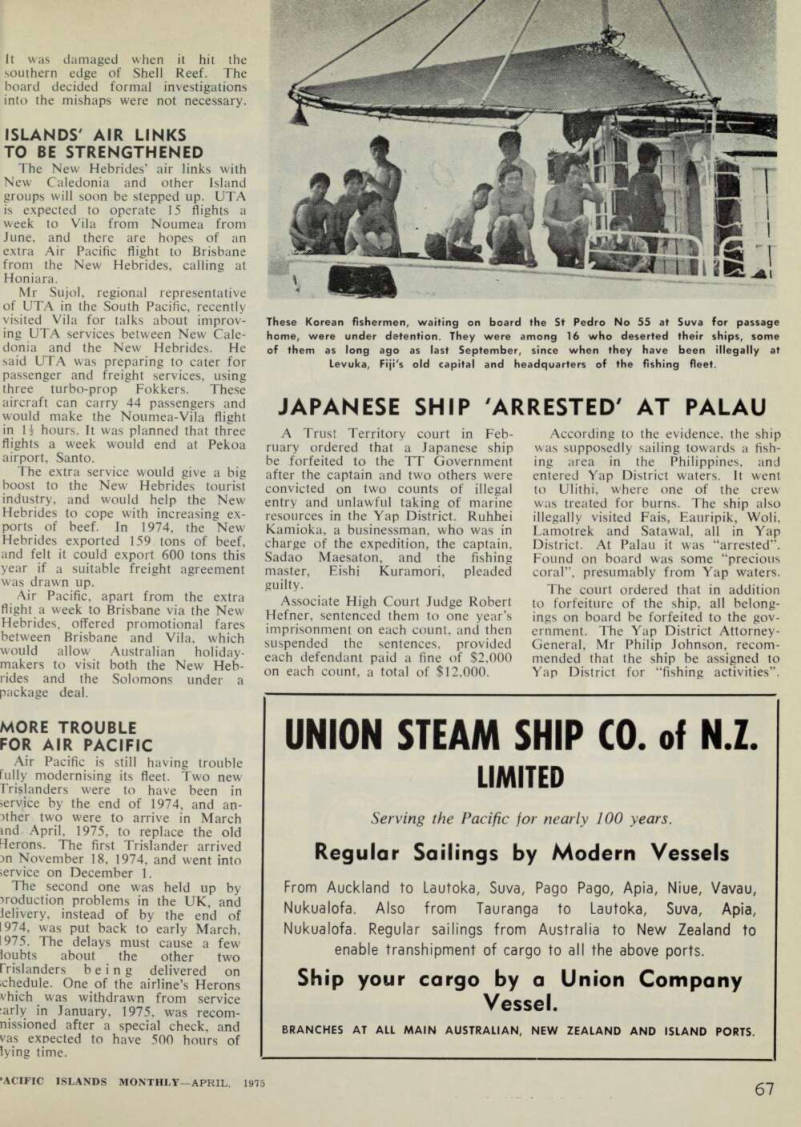
A Trust Territory court in Feb ruary ordered that a Japanese ship be forfeited to the TT Government after the captain and two others were convicted on two counts of illegal entry and unlawful taking of marine resources in the Yap District. Ruhhei Kamioka, a businessman, who was in charge of the expedition, the captain, Sadao Maesaton, and the fishing master, Eishi Kuramori, pleaded guilty.
Associate High Court Judge Robert Hefner, sentenced them to one year’s imprisonment on each count, and then suspended the sentences, provided each defendant paid a fine of 52,000 on each count, a total of $12,000.
According to the evidence, the ship was supposedly sailing towards a fish ing area in the Philippines, and entered Yap District waters. It went to Ulithi, where one of the crew was treated for burns. The ship also illegally visited Fais, Eauripik, Woli, Lamotrek and Satawal, all in Yap District. At Palau it was “arrested”.
Found on board was some “precious coral”, presumably from Yap waters.
The court ordered that in addition to forfeiture of the ship, all belong ings on board be forfeited to the gov ernment. The Yap District Attorney- General, Mr Philip Johnson, recom mended that the ship be assigned to Yap District for “fishing activities”.
These Korean fishermen, waiting on board the St Pedro No 55 at Suva for passage home, were under detention. They were among 16 who deserted their ships, some of them as long ago as last September, since when they have been illegally at Levuka, Fiji's old capital and headquarters of the fishing fleet.
Advertisements & other items, pp. 69-70 (2 items)
67
•ACIFIC ISLANDS MONTHLY—APRIL, 1975
Union Steam Ship Co. Of N.Z.
LIMITED
Serving the Pacific for nearly 100 years.
Regular Sailings by Modern Vessels
From Auckland to Lautoka, Suva, Pago Pago, Apia, Niue, Vavau, Nukualofa. Also from Tauranga to Lautoka, Suva, Apia, Nukualofa. Regular sailings from Australia to New Zealand to enable transhipment of cargo to all the above ports.
Ship your cargo by a Union Company Vessel.
BRANCHES AT ALL MAIN AUSTRALIAN, NEW ZEALAND AND ISLAND PORTS.
Whatever your
irrigation problem,the
answer is in here!
'esusxti-
There are two ways you can get the benefit of Dunlop/IBC’s 86 years of experience in irrigation for all types of country: send for this free booklet, prepared by our irrigation experts; or call your local Dunlop/IBC branch, and speak to the experts yourself!
Either way you’ll benefit from the advice and assistance of a company that’s long been leader in irrigation. With Australia’s largest range of pumping, water handling, and water conditioning equipment.
Post the coupon now. Or call'.
The sooner you do, the quicker you’ll reap the benefit.
FREE 12 page booklet from: "
send me free Irrigation Booklet i
DUNLOP
I
NAME:
ADDRESS:
I M OLD.: Dunlop/IBC Ltd., Station Road, Yeerongpilly, 4105. Phone 40 9011.
VIC.: 795 Springvale Road, Mulgrave, 3170. Phone 560 6222.
S.A.: 98 Churchill Road, Prospect, 5082. Phone 44 6944 Indicate if for school project □ N.S.W. Distributors: Flexhide TAS.: J.S.W. Products, Pty. Ltd., 536 Botany Road, Alexandria, 2015. Phone 699 8444. 990-994 Hunter Street, Newcastle, 2302. Phone 69 1688. 186 Charles Street, Launceston, 7250. Phone 25 312.
W.A.: Westralian Farmers Co-Op. Ltd., Railway Parade, Bassendean, 6054. Phone 79 1671.
L8Q1717
Back Door
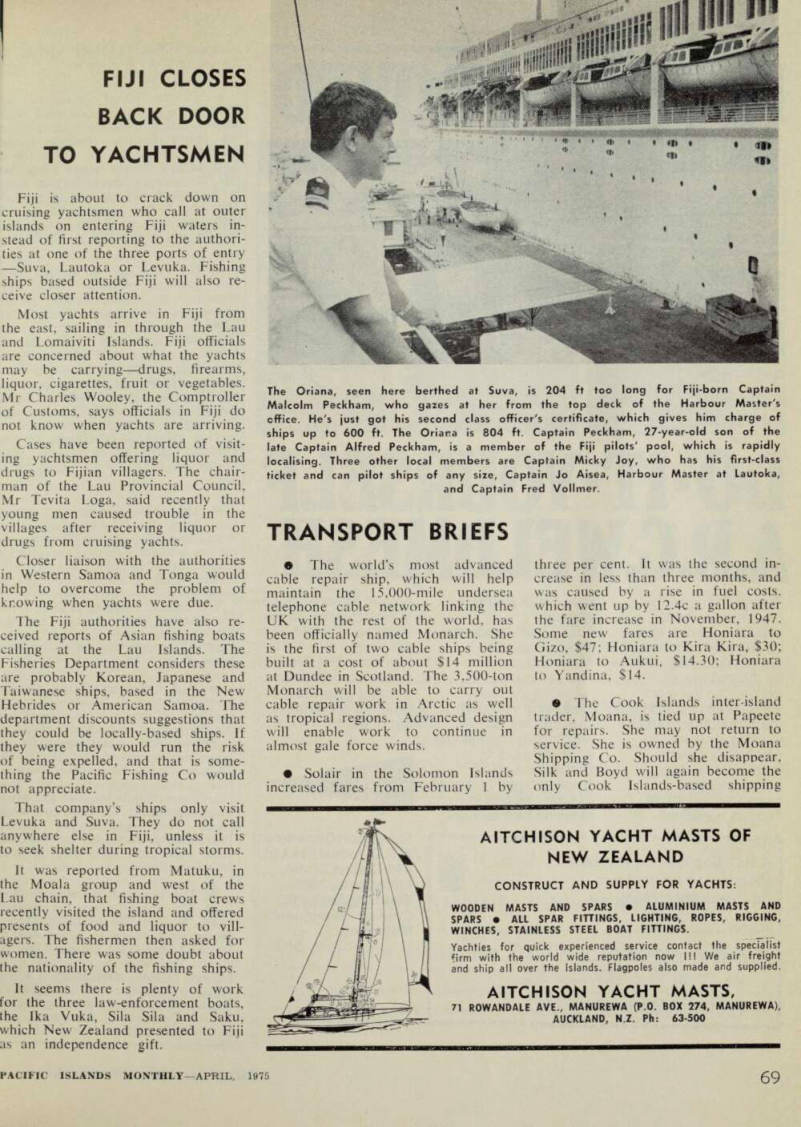
Fiji Closes
To Yachtsmen
Fiji is about to crack down on cruising yachtsmen who call at outer islands on entering Fiji waters in stead of first reporting to the authori ties at one of the three ports of entry —Suva, Lautoka or Levuka. Fishing ships based outside Fiji will also re ceive closer attention.
Most yachts arrive in Fiji from the east, sailing in through the Lau and Lomaiviti Islands. Fiji officials are concerned about what the yachts may be carrying—drugs, firearms, liquor, cigarettes, fruit or vegetables.
Mr Charles Wooley, the Comptroller of Customs, says officials in Fiji do not know when yachts are arriving.
Cases have been reported of visit ing yachtsmen offering liquor and drugs to Fijian villagers. The chair man of the Lau Provincial Council, Mr Tevita Loga, said recently that young men caused trouble in the villages after receiving liquor or drugs from cruising yachts.
Closer liaison with the authorities in Western Samoa and Tonga would help to overcome the problem of knowing when yachts were due.
The Fiji authorities have also re ceived reports of Asian fishing boats calling at the Lau Islands. The Fisheries Department considers these are probably Korean, Japanese and Taiwanese ships, based in the New Hebrides or American Samoa. The department discounts suggestions that they could be locally-based ships. If they were they would run the risk of being expelled, and that is some thing the Pacific Fishing Co would not appreciate.
That company’s ships only visit Levuka and Suva. They do not call anywhere else in Fiji, unless it is to seek shelter during tropical storms.
It was reported from Matuku, in the Moala group and west of the Lau chain, that fishing boat crews recently visited the island and offered presents of food and liquor to vill agers. The fishermen then asked for women. There was some doubt about the nationality of the fishing ships.
It seems there is plenty of work for the three law-enforcement boats, the Ika Vuka, Sila Sila and Saku, which New Zealand presented to Fiji
as an independence gift.
Transport Briefs

© The world’s most advanced cable repair ship, which will help maintain the 15,000-mile undersea telephone cable network linking the UK with the rest of the world, has been officially named Monarch. She is the first of two cable ships being built at a cost of about $l4 million at Dundee in Scotland. The 3,500-ton Monarch will be able to carry out cable repair work in Arctic as well as tropical regions. Advanced design will enable work to continue in almost gale force winds. • Solair in the Solomon Islands increased fares from February 1 by
three per cent. It was the second in crease in less than three months, and was caused by a rise in fuel costs, which went up by 12.4 c a gallon after the fare increase in November, 1947.
Some new fares are Honiara to Gizo, $47; Honiara to Kira Kira, $3O; Honiara to Aukui, $14.30; Honiara to Yandina, $l4. © The Cook Islands inter-island trader, Moana, is tied up at Papeete for repairs. She may not return to service. She is owned by the Moana Shipping Co. Should she disappear.
Silk and Boyd will again become the only Cook Islands-based shipping
The Oriana, seen here berthed at Suva, is 204 ft too long for Fiji-born Captain Malcolm Peckham, who gazes at her from the top deck of the Harbour Master's office. He's just got his second class officer's certificate, which gives him charge of ships up to 600 ft. The Oriana is 804 ft. Captain Peckham, 27-year-old son of the late Captain Alfred Peckham, is a member of the Fiji pilots' pool, which is rapidly localising. Three other local members are Captain Micky Joy, who has his first-class ticket and can pilot ships of any size, Captain Jo Aisea, Harbour Master at Lautoka, and Captain Fred Vollmer.
company servicing outer islands in the group from Rarotonga. • Norfolk Island plans to be come a force to be reckoned with among regional airline operators in the South Pacific. Norfolk Island Airlines has placed an order for a la-passenger Beech Super King Air 200 for delivery late in July or early m August. A deposit has been paid, ihe aircraft has a top speed of 333 mph a range of 2,000 miles, and can fly at altitudes up to 32,000 ft. • The “sea leg” of an Air Niu gmi package service from Port Moresby to Samarai has ended.
Passengers for Samarai disembarked from their aircraft at Gurney and then made a sea trip to Samarai. In future passengers will have to make their own arrangements to get from Gurney to Samarai. Steamships Trad ing Co runs a service between Sama rai and Gurney which connects with two flights a week. However, one service means an overnight stay in Gurney. Hire of a launch from Gurney to Samarai can cost up to $6O. ® The disabled cargo ship Manu tea, from the Cook Islands, was towed into Port Moresby harbour for repairs late on February 24 after its engines failed in heavy seas, 200 kilo metres south of Papua two days be fore.
The coastal freighter Maluka towed the Manutea to the harbour entrance where a tug took over. An assess ment of necessary repairs was being made in Port Moresby. © Pan American World Airways, from April 9, will double to four the number of Boeing 747 flights into Australia from the US. Two of the flights will end in Melbourne, inaugu rating new services into that city. The PAA managing director for Australia, New Zealand and Fiji, Mr Rush Clark, said that in spite of the world wide slump and the problems which faced many international carriers, Pacific travel had held up well, and there were indications that the trend would continue. • The Honiara Marina and Ship yard Co recently won a contract worth SUSI3O,OOO to build a 57 ft fishing and research vessel for the United States Trust Territory Govern ment. The boat is expected to be finished in July, after which it will be sailed to its base at Ulithi Island, Yap District. The project is being financed by the Congress of Micronesia. The boat will be operated by a fishing co operative.
Advertisements & other items, pp. 71-72 (1 item)
Aitchison Yacht Masts Of
NEW ZEALAND
CONSTRUCT AND SUPPLY FOR YACHTS:
WOODEN MASTS AND SPARS • ALUMINIUM MASTS AND SPARS • ALL SPAR FITTINGS, LIGHTING, ROPES, RIGGING,
WINCHES, STAINLESS STEEL BOAT FITTINGS.
Yachties for quick experienced service contact the specialist firm with the world wide reputation now 111 We air freight and ship all over the islands. Flagpoles also made and supplied.
AITCHISON YACHT MASTS,
71 ROWANDALE AVE., MANUREWA (P.O. BOX 274, MANUREWA),
AUCKLAND, N.Z. Ph: 63-500
FARMER-PROVED
A*
tTTTT
ir-.." !»-■» - : - 1 _>'C I
£'HMBlBfll
- . .■tejjgS&EMgM MS 3SS* rflSs
fg l
feß==iftW^S^S
DO-IT-YOURSELF
A.R.C.WELDMESH
Research shows that of all the products available for use as a do-it-yourself material, Weldmesh is regarded by the majority of graziers as the most versatile. Its uses on the property include yarding, gate infills, machinery guards, stock crates, tree guards, tractor canopies and so on.
The list is endless.
Free Do-it-yourself manual.
A.R.C. have produced a free 36 page Weldmesh do-ityourself manual to publicize the many useful and versatile applications for Weldmesh. The manual includes welding instructions, yard erection hints, plenty of illustrations and lots of ideas on how farmerproved Weldmesh, now in metric sizes, can be adapted to suit any purpose.
The manual is available free from A.R.C. or contact your local building material supplier. © The Export Department A.R.C. Industries Ltd. 440 Collins Street, Melbourne, 3000, Victoria, Australia.
Cables: “Benignant”, Melbourne.
To Yachties
An Invitation
The New Hebrides has an established club, the Yacht Club Port Vila, :reated through the efforts of a dedi :ated few. It started in 1967 close to he wharf, a not entirely suitable area, )ut a little more than two years ago the ite was moved about a mile away to Aalapoa.
Using any building materials they were ible to find, and without expert guid mce, members built a functional club louse on the new site beside a fringing eef. To get access to the water they iad to cut a small harbour in the coral, ince then the club has made rapid pro cess. There is yacht racing every week nd, to which spice is added when visit ig cruising yachts take part.
The clubhouse has a dance floor, which as become a recognised social centre for ort Vila. Ample space is available for ie children, so that gatherings at the lubhouse become real family affairs.
Unfortunately, the Yacht Club Port ila is unable to cater directly for the icreasing number of cruising yachts isiting the New Hebrides which still ichor near the wharf. However, the übhouse facilities are available for uising "yachties", and there is a ending invitation for them to take part club races.
A complete range of Finnish-made TERHI outboard engines is now being made available to Papua New Guinea and South Pacific Islands by the sole distributors, Pacific Diesel & Tech nical Agencies of Marrickville, New South Wales. There are six models available ranging in size from 3 hp to 40 hp and all are of two-stroke design. All engines incorporate loop scavenging, hemispherical shaped combustion chambers and anti friction bearings designed to reduce fuel consumption. A flywheel mag neto is fitted to most models, with CD (capacitor discharge) ignition on the 40 hp model. Larger sizes are also available with electric starting.
Great use has been made of the most modern materials in the con struction of the engines, including stainless steels, and other non corrosive alloys. A complete range of spare parts, together with service facilities is being laid down at strategic locations throughout Papua New Guinea and the Pacific Island area, with first-class back up from Sydney.
Cruising
Yachts
• BLUE STEELE, 33 ft modified Piver Nimble yacht, was on the east coast of Tahiti in February, with owner Don Travers, and crew man, Dave Miner. The yacht left Oakland in November and cruised down the US west coast before setting out for French Polynesia. It called at Mangareva, Rapa, Raivarae and Tubuai before arriving at Papeete. David Russell, a member of the crew, flew home to California from Papeete. • EASTWIND, 44 ft ketch, skippered by Dave Cookingham, arrived at Guam recently from Manila, via Palau. With him was his wife, Remy, and new man Alfredo. It was the second time Dave and Remy tried to reach Guam. Their first attempt was foiled when the East wind rolled about 150 degrees after run ning into a freak wave off the north coast of Luzon. Skilful use of three bilge pumps saved the ketch, and the crew.
From Guam the Eastwind will sail to Hawaii, via Saipan and northern Marianas. • NEW WORLD, 69 ft schooner was a recent arrival in Guam from Hawaii, via the Gilbert Islands and Truk. The New World is an exceptionally fast schooner. She sailed the 540 miles from Truk to Guam in two and a half days.
Since arrival in Guam New World has made a charter trip through the northern Marianas for the University of Guam.
She is captained by Art Merserau, whose
crew comprises Bruce Vasconcellos (first mate), Wick Barnett and Judy Cronin. • ARION, 30 ft sloop, arrived in Guam recently from Fiji carrying lan McClaren, who made the journey in 40 days, non-stop and single-handed. He plans to sail to Hong Kong, with a ten tative stop on the south coast of Taiwan on his schedule. • REALITY, 42 ft ketch, was expected to arrive in Guam from Yokohama in March. She is captained by Leland Camp bell, who has twice made the trip, one in the 32 ft cutter, THISTLE, and last year in the YA CHAN, 35 ft trimaran. • MISTY, 50 ft ketch, carrying Bob Weian, was due to arrive in Guam in March from Yokohama. It was the maiden voyage for both ketch and
skipper.
• TASA 111, 35 ft ketch, is being out fitted in Yokohama by skipper Jay Mc- Clintock, for a single transpacific crossing.
McClintock has already made one lone voyage across the Pacific. • CHAMARU, 50 ft ketch-rigged tri maran, arrived at Christmas Island in January, and she stayed for 14 days be fore leaving for Fiji, via Tahiti, the Cook Islands, Samoa and Tonga. Eventually she will sail to Leyte in the Philippines.
The trimaran, carrying skipper-owner Commander Charles M. Sturkey (USN ret), and his wife, Mary, left Japan in May, 1965. After cruising through islands in the north and south Pacific, they sailed to New Zealand, Australia, Singapore, the Seychelles, South Africa, Brazil, Azores, Panama Canal and Seattle. They left Seattle on their latest trip in August, 1974, and called at Hawaii and Fanning Island before reaching Christmas Island.
With Commander and Mrs Sturkey is Abraham Magpatoc, of Leyte.
Advertisements & other items, pp. 73-74 (2 items)
71
iCIFIC ISLANDS MONTHLY—APRIL, 1975
Pacific Islands Transport Line
Owners: Thor Dahls Hvalfangerselskap A/S — Sandefjord, Norway.
MOTOR VESSEL "THORSISLE"
Regular Freight and Passenger Services between Pacific
Coast Ports of U.S.A. and Canada
and
TAHITI and SAMOA
GENERAL STEAMSHIP CORPORATION LTD.
General Agents 400 California Street, San Francisco, California, U.S.A.
APlA—Borns Philp (South Sea) Company, Ltd.
PAPEETE—Agence Maritime Internationale Tahiti.
PAGO PAGO—G. H. C. Reid &Co
NOUMEA—Etablissements Ballande.
SYDNEY —Trans-Austral Shipping Pty. Ltd.
SUVA—Burns Philp (South Sea) Company, Ltd.
LAE/RABAUL—Burns Philp (New Guinea) Ltd.
PORT VlLA—Comptoirs Francais de Nouvelles Hebrides.
Caterpillar reliability, productivity, availability. Now you can get it all in a wheel skidder. The 518.
A whole new standard in skidder engineering. 120 turbocharged horsepower, 20,400 pounds of working muscle with full articulation and frame oscillation for stability and minimum maintenance.
Single lever “on the go” powershift. Dual rate steering for controlled response at all speeds. An operator’s compartment engineered for efficiency with safety features built in for man and machine.
You’ll find all the best skidder ideas, plus added refinement and top quality manufacturing that can make the 518 the backbone of your logging operation.
And South-West Pacific Caterpillar dealers will ensure that your backbone stays in top condition no matter how far in the bush you are.
Parts, maintenance, repairs or simple information—we’ll see that you get it fast.
So tackle the jungle with the new Cat 518.
Caterpillar Dealers in South-West Pacific
HASTINGS DEERING
Lae: Milford Haven Road, Ph: 42 2355 Port Moresby: Champion Parade, Knoedobu.
Ph: 3138 or 2098.
Bougainville; Itakara.
Industrial Park, Arawa, Ph: 95 9004. 154 Queens Road, Suva.
Ph: 24 051-4 Cables: Carptrac Suva Telex: Carptrac FG2190 Suva 'Si
CARPENTERS
TRACTOR E EQUIPMENT
11D329
Business and Development
Fiji's Pension Scheme: Blueprint
For Other Island Territories
From ROBERT KBITH-REID in Suva
Native Fijians have enjoyed one form of built-in social security for centuries their communally organised form of society has seen to that.
But Fijian tradition has been broken down by the impact of western city life.
Today, an old Fijian, at the end of a long life as a city dweller, as likely as not can no longer count on auto matic comfort from his koro (village) to cushion his old age.
His fate is more likely to be bleak years of destitution in a tiny tin shack on Suva’s outskirts, somehow surviving on a $6 a month govern ment destitute’s allowance.
Hundreds of Indians, part-Euro peans, Chinese and others making up Fiji’s multiracial community of 550,000 people already eke out such a miserable existence.
Tens of thousands of their grand children will, if all goes well, be much more fortunate.
In February, the foundations of what will eventually become a com prehensive form of 20th century-style social security was laid when the Fiji National Provident Fund paid out its first life pensions.
The pensions went to three people who, reaching the age of 55, the retirement age accepted by the fund, chose to take money it held to their credit as an annual pension rather than in a lump sum.
Assuming normal life expectancy— the FNPF sets this at 70—the pioneer pensioners will get a return of at least four times more than they would have collected in lump form.
Fiji’s Minister for Social Welfare, Mr Mohammed Ramzan, is proud of the new FNPF scheme, and calls it “probably one of the best in existence anywhere in the world”.
It marks the transformation of the National Provident Fund into a base upon which a comprehensive social security system covering everyone in regular employment can be built.
Twenty years from now, as the fund approaches its 30th year, thousands of Fiji citizens will be eligible to collect a life-pension worth several thousand dollars a year at present values.
The Fiji fund started nine years ago.
Based on a report by a British social security expert, it was put into working shape by another Briton, Mr Hugh Robinson, who is still its manager.
Membership is compulsory for almost everyone in Fiji with a regular job.
Until last December contributions were made to the fund at the rate of 10 cents for each dollar of an employee’s pay—sc from the employee and 5c from his boss.
On reaching 55 the employee got the whole lot, plus interest, as a lump sum. If he didn’t make 55, his dependants got the lump sum plus a $l,OOO special death benefit.
In December, contributions were hiked by 2c—a cent from the employee and a cent more from the boss —to build up a new pension element.
The pensions, for those that chose
to take their money as such, became available from January 1.
Going by averages the first pensions are not worth much. The FNPF’s 100,000 members have an average of $9OO each to their credit.
As a pension is one-quarter of the lump sum available on retirement, this means the first pensioners are drawing about $250 a year or just over $2O a month.
But this is, at least, better than the $6.50 a month destitutes’ pittance that some otherwise penniless old couples are trying somehow to live on.
According to Mr Robinson no one in the fund yet has $lO,OOO to his credit, but quite a number already have enough to give them a sl,ooo-a -year pension as of now.
As the fund, now standing at $41,000,000, grows, pensions will get
correspondingly bigger,
The basis for Mr Ramzan’s claim of “best in the world” says Mr Robin son, is that FNPF members now have a choice, They can opt for a lump sum or a combination of both.
“It’s up to an individual to make a choice in the light of his needs,” he
No Pensions For Non-Citizens
says. “As far as I know it is the first scheme in which there is a com pletely free choice.”
With, say, $12,000 against his name, a retiring worker can take this in one payment with which to buy a house or maybe a business or a small farm. Or he can take a $3,000 a year pension.
If he picks a pension and lives to 70 he’ll collect at least $45,000.
A combination of a lump sum and a pension could give him $6,000 in cash and a $1,500 pension.
There are some stipulations, how ever.
The FNPF won’t pay a pension of less than $4B a year which means anyone with under $192 in the fund must take the money in one payment.
And those wno opt for cash will not get all the money to their credit.
They wul lose one-sixth—the extra 2c in the dollar that people have been paying since December—because this money is needed to keep the pension scheme going.
The fund’s rules exclude payment of pensions to non-citizens who have to take a lump sum, but Fiji citizens who go abroad can still collect pen sion cheques.
A person who quits the fund and then rejoins it will not get a pension, nor will a woman who withdraws from it after marrying.
Another poin: is that a man can opt for a joint payment for himself and his wife. He will get two-thirds the pension he would have got other wise, but this will continue to be paid to his wife after his death.
According to Mr Robinson, the present rate of contribution to the pension scheme might not be big enough to sustain it, but it will be at least five years before an increase will become necessary.
FNPF members now get five per cent interest on the money they have in the fund.
This, says Mr Robinson, is not likely to go much higher for a long time because the fund prefers to con centrate on building the pension fund up rather than pay higher interest.
In any case, he adds, since the FNPPs own earning rate on invest ments made with fund money is just over per cent what members get is “not a bad rate”.
One drawback is that a pension will not get cost-of-living adjustments
made to it to counter the effects of inflation.
To do this it would need a massive direct government subsidy that the Fiji Government could not afford to pay.
So, anyone counting on a $5,000 pension 20 years from now needs to realise that this amount will buy a lot less than it will buy now.
But between now and then, the FNPF is bound to be modified to overcome, at least in part, erosion of value by inflation.
Mr Ramzan already has several improvements in mind.
Fiji’s pension scheme is likely to be adopted in other parts of the Pacific.
The British Solomons, Western Samoa, Papua New Guinea, the Cooks and the GEIC have already adopted the Fiij scheme in its original form or are in the process of doing so.
As these schemes become well established, only a little tinkering will be needed to make them pensioners also. • Several hundred people, protest ing against a new system devised by the Fiji Government for deciding who was eligible for family assistance, marched in procession to the Welfare Department building in Suva in March.
New Zealand opens its purse
New Zealand is spending about Sl6 million in direct aid in the South Pacific this year. Fiji will receive about 52.8 million, and over the next three years will get about $lO million to be spent in conjunction with Development Plan Seven. Mr David McDowell, head of the external aid division of the NZ Ministry of Foreign Affairs, said after talks with Fiji Government officials that much of the money would go to schemes in rural areas.
The emphasis over the next two or three years would be very much on projects outside Suva and to some extent, projects outside Viti Levu. What the next development plan covers is not yet known. It is unlikely to be published till just before the start of the period (1976-80) it will cover.
Current New Zealand projects in Fiji include pine afforestation in the western division, an abattoir at Nasinu, installation of $400,000-worth of equipment at the Rewa Co-op Dairy Co’s factory at Nabua, near Suva, and managerial and technical help with the Ra cattle scheme. A series of water and sewerage schemes for seven towns is under discussion.
Advertisements & other items, pp. 75-76 (2 items)
73
ACIFIC ISLANDS MONTHLY—APRIL, 1975
The Daiwa Bank Ltd
DAIWA BANK SERVING YOU IN THE PACIFIC BASIN Head Office : Osaka,Japan With 137 Branches throughout Japan Singapore Representative Office Suite No. 1007, 10th Floor Robina House 1 Shenton Way, Singapore 1 Republic of Singapore Coble Address; SINGDAIWA Affiliated Bank P.T BANK PERDANIA Djalan Raya Mangga Besar 7&9 Djakarta Our Correspondent Banks are in city— Apia, Suva. Lae.
Madang Port Moresby. Rabaul, Wewak. Guam, all Principal cities in Australia and New Zealand Contact your banker or our office.
Los Angeles Agency 555 South Flower St. Suite 4040 Los Angeles, Calif. 90071 Sydney Representative Office Bth Floor Prudential Building 39-49, Martin Place, Sydney
THE DAIWA BANK LTD
Head Office : 21. Bingomachi 2-chome, Higashi-ku, Osaka, Japan Overseas : London, New York, Los Angeles, Frank furt, Sydney , Singapore
Houses Are Scarce As Real Estate

Prices Soar In The Solomons
By Denis Fisk
From trying to sell his own home last year during a depressed business period, the Solomon Islands’ only non-government surveyor, lan Robins, has launched himself into a new busi ness—real estate.
His hill-side house was advertised in Australian newspapers in lyrical terms, but Robins decided to stay on in Honiara after all, and in Novem ber announced by leaflet the establish ment of the first real estate business in the country, Triangle Realty.
Business appears to be picking up for Triangle, which has booked a regular comer of the new weekly newspaper The Solomons News Drum to advertise houses and flats for sale or rent.
It’s interesting to compare rents for housing with other Pacific countries. In Australian dollars (still the local currency until the adoption of a Solomon Islands currency prob ably next year), a concrete brick two bedroomed residence on nearly one acre and less than five minutes walk from the main shopping area is sell ing for $20,000 or you can rent for $l6O a month unfurnished, $2OO furnished.
In a better spot—“glorious 350 deg view on top of the highest hill in Honiara”—a Housing Authority de sign 1008 (three bedrooms) built of timber and fibro-cement sheeting sells for the same price, or can be rented furnished for $2BO a month . . . that’s $64 a week!
The rent return on this latter house of 17 per cent on current value would delight most owners of properties-for rent anywhere.
Accommodation for rent continues to be hard to find in Honiara for locals or expatriates at anything like a reasonable rental due to the short age of both low-cost and high-cost houses.
The government has a waiting list of literally scores of married and single public servants who have no chance of getting government accom modation.
Much of it, anyway, appears rather primitive, even beside the simplest of the new Housing Authority buildings which have been developed to try to fit the incomes of employees right
down to labourer level, the ideal of any such authority.
The concrete block housing which succeeded earlier leaf and timber buildings has attracted severer criticism from people with an eye to retaining the local flavour even in the towns. It has almost without ex ception been more difficult in the low-cost range to keep them looking like dignified living quarters, when compared with the other places even when they are in a similar rundown state.
It has become government policy to point local people needing housing in the direction of the Housing Authority which will build new houses, or resell those already being bought, on very elastic finance ar rangements.
The Authority’s approach has been pragmatic in realising that it is prob ably impossible to build a permanent house of any size in permanent materials (timber floor and frame, fibro-cement walls, insulated corru
gated iron roof) to match the lowest incomes. in Honiara these can be $29 a month but are more usually in the $3O to $35 bracket, with accommo dation sometimes provided. This can be supportable if local tastes have not been spoiled by imported foods such as Australian sugar at 45 cents a pound.
The Authority offers some small blocks of land on which it connects the sewer and water to a fibreglass or concrete service unit of toilet, shower and washtub moulded in one piece in the ground.
For less than $2OO this provides the nucleus of a build-your-own house with whatever materials you decide
upon, including traditional lightweight
structures of stocks and leaf, and after some initial inertia, people have begun to move on to these blocks.
Part of the inertia was due to the scheme taking a while to seep through to people. But there was also some pride to swallow in living in the town
environment in bush housing, and some shaking off of the father provides-all expectations from gov ernment by public servants. They can hardly be blamed, however, for being slow to adopt this now-necessary in dependence from a government which has had to become increasingly cost conscious as it moves closer to meet ing all recurrent expenditure.
Despite the ultra-low income hous ing gap, the Authority last year did get the price of a permanent materials house and land down to $l,OO0 —a staggering feat, when it is realised that this included the service unit mentioned above.
Oil search off
New Caledonia
Three French oil companies are planning joint exploration of the sea bed and continental shelf off New Caledonia, where territorial waters extend to a limit of 12 miles off shore. The three exploration com panies are ELF, SNPA (Aquitaine) and Total.
Deep-sea research into possible oil deposits was undertaken in 1972 by Gulf Oil and Mobil as well as by official French marine survey vessels working through the scientific bodies ORSTOM in Noumea, CNEXO in Tahiti and the French Petroleum Institute (IFP). Noumea Mines De partment officials believe the structure of the Caledonian seabed suggests the possible presence of petroleum de posits. However, research is still very much at a preliminary stage.
Meanwhile, in the nickel field, recent Paris talks with North Ameri can mining interests have raised little hope for any early realisation of promised expansion in the north and south of the island. As foreshadowed by Overseas Territories Minister Olivier Stirn, during his January visit to Noumea, he and Industry Minister Michel d’Ornano met in February with the presidents of Canadian INCO and the US Amax, respectively.
The Noumea press described the results of the first round as “empty bluff”, since there was no new de velopment revealed in the southern stalemate after the talks with INCO’s Edward Grubb.
As far as the north of the island is concerned, since the shelving of the Patino-COFREMMI-SOMMENI project, Amax president lan Mac- Gregor was quoted as saying his group is prepared to consider working in the area with French partners.
These could be either part of the Patino effort or other French in terests, with some indication of the possibilities to be indicated by AMAX by June.
Advertisements & other items, p. 77 (1 item)
iTfiTa rtf’™ * ,'°
HYGIENE STANDARDS DROP IN ISLANDS
Independence or self-government for a number of groups in the Pacific has been accompanied by some undesirable side-effects, not the least of which is deteriorating public hygiene.
An Auckland suburban doctor, Dr Fdward Simpson, writing in the NZ Medical Journal, says New Zealanders visiting some of the islands run the nsk of contracting serious tropical diseases, including filariasis (which, m extreme cases, can lead to pht/falaLhic .T„ I rre r a y se) OSino ' r* ui j t .ion r ? in an th a ; Cook Islands, for the increasing number of neonle suffering from the diseases. P He P savs that control of the filariasis-carryina mosquito has not been adequately maintained, since independence, by some Pacific countries.
On hygienic standards, he said: “We are going back to a state of affairs little better than that which existed just after the Second WorH
War, when filariasis went virtually unchecked. Sanitation in Rarotonga is definitely worse than it was be fore independence (self-government), Samoa used to be a fairly safe place from a disease point of view when New Zealand was running the show —but not any more. All this makes it clear to me that the Island govern ments may also be getting lax about other tropical diseases such as leprosy ”
iTfiTa rtf’™ * ,'°
screen for filariasis any new Poly
“o"hn°
i f i ,• £ Bl ,ve ‘ e , as also I found the disease among other peo P. le who have . visited the islands, f d “ rlng summer, when ZZtT faV ° Ur the Spread ° f
asis ‘
Pulmonary eosinophilia was usually contracted by eating salad vegetables contaminated by a parasite carried by snails. That disease appeared to be pett.na more common.
dry complexion
Soft, dewy beauty can replace a dry complexion
For women whose skin is prone to dryness the passing of summer is a relief. But now that all-too-familiar feeling of tightness around the more sensitive areas of the face caused by dryness, which also accentuates tiny lines and wrinkle dryness, can be overcome with the simplest of skin care.
No longer do you have to condemn your complexion to the effects of harsh climatic conditions which, if allowed can give your complexion a prematurely older look. The basis of a flawless complexion lies in the ability of the skin to retain a correct balance of natural oils and moisture, but when this delicate balance is im paired by environmental and natural ageing factors inherent in the thirties and forties, fading complexions can benefit from the nurturing care of a tropically moist oil blend.
Prevent wrinkle dryness Now, with the remarkable develop ment of a unique beauty fluid, it is possible for women in all climates and of all ages to reverse the drying out process by supplementing the diminishing supplies of oil and mois ture and maintaining the delicate balance necessary to achieve the envi able glow of youthful radiance. This unique tropically moist oil blend, which penetrates rapidly, imbues your
skin with all the rich moisture en vironment that keeps your corn plexion soft and supple, smoothing those tiny lines and banishing wrinkle dryness areas to a problem of the past. Known in England as Oil of Ulay, and in America as Oil of Olay, this unique beauty fluid is available here from chemists and beauty coun ters as Oil of Ulan, By smoothing Oil of Ulan over your face and neck each mor ning, and at n i R ht, being especially generous in the very dry and delicate areas such as around the eyes, you hold the beauty secret that gives you the lasting re ward 0 f a youthful looking com plexion radiance, ...
Special help for drier
and more mature skin j n your forties and fifties un intentional neglect can cause worri some dryness particularly around the more wrinkle-prone areas such as the eyes, the mouth and the neck, which are especially vulnerable to dryness with advancing years, This is the time to take special care by pampering your skin lavishly with Oil of Ulan moist oil blend, it nur tures your complexion and penetrates rapidly, helping to restore the delicate oil and moisture balance that keeps your skin soft and beautifully smooth.
fly-by-nights may
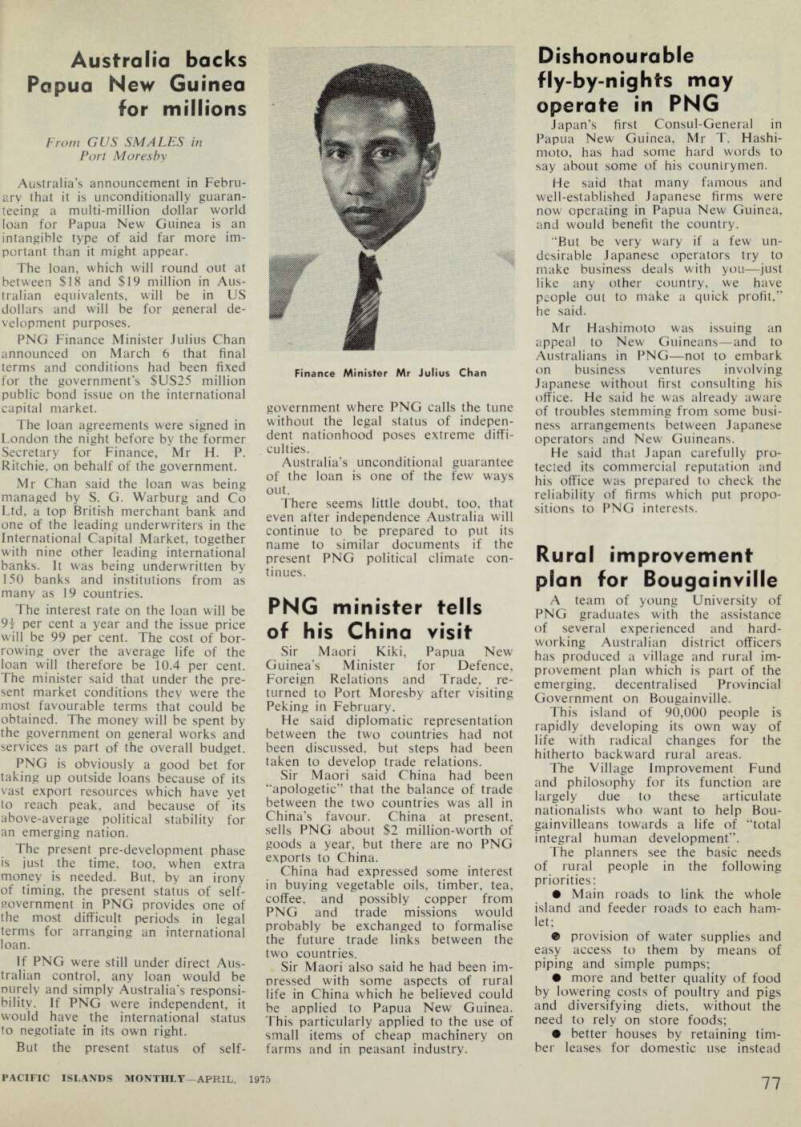
Australia backs Papua New Guinea for millions
From GUS SMALES in Port Moresby Australia’s announcement in Febru ary that it is unconditionally guaran teeing a multi-million dollar world loan for Papua New Guinea is an intangible type of aid far more im portant than it might appear.
The loan, which will round out at between $lB and $l9 million in Aus tralian equivalents, will be in US dollars and will be for general de velopment purposes.
PNG Finance Minister Julius Chan announced on March 6 that final terms and conditions had been fixed for the government’s SUS2S million public bond issue on the international capital market.
The loan agreements were signed in London the night before by the former Secretary for Finance, Mr H. P.
Ritchie, on behalf of the government.
Mr Chan said the loan was being managed by S. G. Warburg and Co Ltd, a top British merchant bank and one of the leading underwriters in the International Capital Market, together with nine other leading international banks. It was being underwritten by 150 banks and institutions from as many as 19 countries.
The interest rate on the loan will be 9i per cent a year and the issue price will be 99 per cent. The cost of bor rowing over the average life of the loan will therefore be 10.4 per cent.
The minister said that under the pre sent market conditions they were the most favourable terms that could be obtained. The money will be spent by the government on general works and services as part of the overall budget.
PNG is obviously a good bet for taking up outside loans because of its vast export resources which have yet to reach peak, and because of its above-average political stability for an emerging nation.
The present pre-development phase is just the time, too, when extra money is needed. But, by an irony of timing, the present status of self government in PNG provides one of the most difficult periods in legal terms for arranging an international loan.
If PNG were still under direct Aus tralian control, any loan would be nurely and simply Australia’s responsi bility. If PNG were independent, it would have the international status to negotiate in its own right.
But the present status of self-
government where PNG calls the tune without the legal status of indepen dent nationhood poses extreme diffi culties.
Australia’s unconditional guarantee of the loan is one of the few ways out.
There seems little doubt, too, that even after independence Australia will continue to be prepared to put its name to similar documents if the present PNG political climate con tinues.
PNG minister tells
of his China visit
Sir Maori Kiki, Papua New Guinea’s Minister for Defence, Foreign Relations and Trade, re turned to Port Moresby after visiting Peking in February.
He said diplomatic representation between the two countries had not been discussed, but steps had been taken to develop trade relations.
Sir Maori said China had been “apologetic” that the balance of trade between the two countries was all in China’s favour. China at present, sells PNG about S 2 million-worth of goods a year, but there are no PNG exports to China.
China had expressed some interest in buying vegetable oils, timber, tea, coffee, and possibly copper from PNG and trade missions would probably be exchanged to formalise the future trade links between the two countries.
Sir Maori also said he had been im pressed with some aspects of rural life in China which he believed could be applied to Papua New Guinea.
This particularly applied to the use of small items of cheap machinery on farms and in peasant industry.
Dishonourable
fly-by-nights may
operate in PNG
Japan’s first Consul-General in Papua New Guinea, Mr T. Hashi moto, has had some hard words to say about some of his countrymen.
He said that many famous and well-established Japanese firms were now operating in Papua New Guinea, and would benefit the country. ‘But be very wary if a few un desirable Japanese operators try to make business deals with you—just like any other country, we have people out to make a quick profit,” he said.
Mr Hashimoto was issuing an appeal to New Guineans—and to Australians in PNG—not to embark on business ventures involving Japanese without first consulting his office. He said he was already aware of troubles stemming from some busi ness arrangements between Japanese operators and New Guineans.
He said that Japan carefully pro tected its commercial reputation and his office was prepared to check the reliability of firms which put propo sitions to PNG interests.
Rural improvement
plan for Bougainville
A team of young University of PNG graduates with the assistance of several experienced and hard working Australian district officers has produced a village and rural im provement plan which is part of the emerging, decentralised Provincial Government on Bougainville.
This island of 90,000 people is rapidly developing its own way of life with radical changes for the hitherto backward rural areas.
The Village Improvement Fund and philosophy for its function are largely due to these articulate nationalists who want to help Bou gainvilleans towards a life of “total integral human development”.
The planners see the basic needs of rural people in the following priorities: • Main roads to link the whole island and feeder roads to each ham let; ® provision of water supplies and easy access to them by means of piping and simple pumps; • more and better quality of food by lowering costs of poultry and pigs and diversifying diets, without the need to rely on store foods; • better houses by retaining tim ber leases for domestic use instead
Finance Minister Mr Julius Chan
of letting them go to commercial exporters; • finding a cheap source of power and light through hydro-electric schemes and human and animal waste digesters; ® the setting up of community village centres for social, political educational and recreational use.
The funds for village improvement projects would be limited to a maxi mum of $2,000 excluding such major works as hydro-electricity schemes.
It’s hoped that a spirit of self reliance will be engendered by the people’s participation in the form of money or man-power. The point was made that during Bougainville’s abundant cocoa flush between $2 million and $3 million was dissipated in part on beer and trade store goods.
The new village governments will discuss and choose community needs and ensure that no one person will benefit financially from projects nor that they be profit ventures only. Im provement funds will go only to Bougainvilleans.
Air Niugini
makes a profit
Air Niugini has made a profit of $167,245 in its first eight months of operation till the end of the 1973/74 financial year.
Delivering the Air Niugini report in the House of Assembly in March Transport Minister lambakey Okuk said total revenue was $10,168,357, total expenses were $9,600,440 and tax totalled $400,663.
The PNG Government will get 60 per cent of the profit, Ansett 16 per cent and Qantas and TAA 12 per cent.
Mr Okuk must have licked his lips before tabling the report. He had been under fire from the other side of the House over Air Niugini’s finances. Questions were hurled at him about the “expensive insuf ciency” of the airline and its manager, Mr Ralph Conley.
Allegations were made that there was trouble and discontent in Air Niugini, and an Australian member, Mr Tim Ward, the Opposition’s Shadow Minister for Transport, claimed Mr Okuk was trying to hide a “stinking, putrid mess”.
There were suggestions that the government wanted to get rid of Mr Conley, and Mr Okuk told the House that the government intended to advertise the post.
The announcement of the profit made by the airline, which must have come as a surprise to most members and, maybe, to Mr Okuk himself, should silence the airline’s critics.
No treasures
in the Cooks
The Cook Islands will not get its manganese industry after all. The seabed nodules on which the Cook Islands and New Zealand industrial interests pinned so many hopes of future wealth do not contain enough nickel, copper and cobalt to make mining them an economic propo sition. Nodules, collected by an ex pedition from the NZ Department of Scientific and Industrial Research in 1974, were scientifically analysed, with a gloomy report.
Dr Geoffrey Glasby, DSIR expe dition leader and NZ Oceanographic Institute scientist, said tests on the nodules indicated the metal content was far below the three per cent level regarded as necessary for economic exploration. The average contents were .4 per cent nickel, .22 per cent copper and .38 per cent cobalt. Com parative percentages of metal in nodules found near Hawaii were 1.16, 1.02 and .25 respectively.
The finding is a blow for the Cook Islands Premier, Sir Albert Henry.
He based his recent successful general election campaign partly on a promise to mine the nodules and build a new industry for the group. At the Law of the Sea conference in Caracas in 1974, Sir Albert emphasised the need for his country and other Island territories to control the wealth of the seas and the seabed in an economic zone which, he suggested, should ex tend for 200 miles around each Island.
A big, privately-owned New Zealand group, RAO Holdings Ltd, recently expressed an interest in de veloping the Cook Islands deposits.
Mr Hans-Joachim Hauck (above) has taken over the management of the Regent of Fiji Hotel, on Denarau Island, Nadi Bay.
The 300-room hotel is scheduled to open in May. Mr Hauck has been a hotelier for 16 years in Montevideo, Venezuela, Dusseldorf, Paris, Cologne and Honolulu.
Halcyon days
of the tourist
trade are over The uncrowded foyers and re stricted guest lists of the tourist hotels of the South Pacific are telling their own story—the halcyon days of an expanding tourist trade are over, tem porarily, at least. The Fiji Bureau of Statistics reports that in 1973 for hotels with more than 30 beds, the occupancy rate was 57 per cent.
At Rutaki, Rarotonga, there is a group of six lagoon-side lodges, attractively sited, designed and fur nished with a sad tale to tell of virtually no customers in the months since they were opened.
In Papeete, there is a hotel with a large number of additional rooms under construction, but with only a handful of guests to occupy the pre sent accommodation. The Americano Hotel at Pago Pago would appear to be bedevilled with the same prob lems as fell on preceding manage ments —too frequently there is only a handful of tourists in American Samoa, yet there are several hundred beds to fill.
Some hotels have the name or a uniqueness which continues to pull in the customers. The Club Medi terannee on Moorea offers an un inhibited camp atmosphere that seems to appeal to young and old alike.
Aggie Greys in Apia remains
inimitably a nostalgic reminder of the past in the Pacific and its patrons love it.
But the future for other hotels carries an air of foreboding. The
Tusitala Hotel in Apia typifies the
malaise. It has 96 rooms, with a very low occupancy rate, an income that covers running expenses, but with no surplus to keep up with the payments Df the loan from the First National Zity Bank of New York. This loan was arranged in terms of a rate on he Euro-dollar rate and the interest ate has fluctuated from 11 per cent o 14i per cent.
The Samoan Times in February re ?orted that the Nauru Trust may :ome to the rescue of the Tusitala by naking a loan of $1.4 million and hat it may also become a share lolder. At present there are one nillion $1 shares of which the Western Samoa Government holds 100,000, Naviti Investments of Fiji lolds 100,000 and the National 3 rovident Funds holds 100,000. If the 'Jauru Trust takes up the offer to buy 150,000 shares, then the intention is hat the remaining shares would be )ffered to the Samoan public.
The Tusitala has also taken a step
which, perhaps, foreshadows a more widely accepted realisation of the truth of the situation. It reduced its room rates since the beginning of 1975.
New Hebrides making
its own nails
The New Hebrides wire nail mar ket has been virtually captured by a local company, Melanesia Wire Pro ducts, which went into production in Vila in January. The company expects to make 350 tons of nails a year in sizes from 1 in. to 6 in. It is capable of making 200 lb an hour. Five New Hebrideans are em ployed in the factory.
Production will eventually be ex tended to other wire products, in cluding copra driers and barbed wire nails. The company hopes to enter the export market. The New Heb rides Co-op Federation has taken a substantial interest in the new com pany.
PNG unionist
attacks whites
Low-grade whites are still “rough, rude, tactless, ignorant and un civilised” towards New Guinean workers a union leader said at the end of February.
Mr Tony Ila, president of the PNG Trade Union Congress, was speaking on his return from a visit to Australia where he discussed worker-manage ment relationships with Australian companies which have subsidiaries in Papua New Guinea.
He said he had not accused any specific company of having bad relationships between their white fore men and black workers, but he had told all companies to watch their situation.
Continuation of some trends could be a real source of future trouble, Mr Ila said. There were too many “neurotic and uncivilised” whites working as supervisors and foremen, who didn’t hesitate to swear at their black workers and kick them.
If workers complained about their conditions they became sick and tired of hearing white foremen saying “Well why don’t you go and see your mate Michael (Mr Somare) about it?”
Mr Ila said he had told company executives in Australia that the ten sions and attitudes appeared to in volve only a minority of “lower grade white employees”. But there was no place in today’s Papua New Guinea society for such people.
Company executives had offered
their co-operation in overcoming problems of this type.
Mr Ila said he believed his visit to Australia had cleared up a number of bottlenecks in communication be tween Australian companies and their subsidiaries in Papua New Guinea.
Mr Ila was on the Australia visit with the general secretary of the Trade Union Congress, Mr Tom Collins.
The two men also held talks in Australia with union officials.
Brewer takes over
Guadalcanal Plains
C. Brewer and Co Ltd, of Hono lulu, has taken over Guadalcanal Plains Ltd, which was owned by an American company, Mindoro Inter national Corp. Brewer paid $950,000 for the assets of Guadalcanal Plains.
Mindoro went into liquidation in October, 1974, about a year after It took over Guadalcanal Plains from Australian interests.
Brewer, one of Hawaii’s “Big Five”, has also leased about 10,000 acres, formerly held by Guadalcanal Plains, from the BSIP Government.
The leases have 33 years to run.
About half the land will be planted in rice, which is expected to increase annual production of milled rice in the BSIP from 1,500 tons to 15,000 tons. This will enable the Solomons to become a rice exporter. Current consumption is about 3,000 tons a year.
The Brewer interests in Guadal canal Plains will be controlled by a
new company. Brewer Solomons Associates, which will be managed by Mr Richard Ward.
The BSIP Chief Minister, Mr Solomon Mamaloni, was obviously delighted with the deal. In a state ment after the agreement was signed, he said it would save the jobs of about 200 Solomon Islanders, for merly employed by Guadalcanal Plains. New jobs would become available as expansion continued. The rice industry would be saved, and rice sold for local consumption would be sold at lower than overseas prices.
The government would get increas ingly substantial revenue, and would have the right to buy into the busi ness on “very favourable terms”.
There would be other benefits for the Solomon Islands.
Apart from the money it paid for the assets of Guadalcanal Plains, Brewer would invest a further $4 million in the next few years, which should produce an efficient rice in dustry.
The Brewer group has wide rang ing interests. Its main business is sugar, but it also owns insurance companies, hotels, cattle ranches, meat-packing plants and rice projects.
Copra bonanza
in Micronesia
Copra planters in the Trust Terri tory are enjoying a bonanza. About the middle of February the United Micronesian Development Association paid out 5U5205,000 to sub contractors. It was the highest amount paid for copra in a single week in tne last 22 years. UMDA is the marketing contractor for the Copra Stabilisation Board.
The payments were made while the grade one price of SUS42S a ton was operative. However, the bonanza is not likely to continue. World prices have been receding. The authorised price in the Trust Territory of SUS3OO a ton was expected to be reduced soon if world prices do not
increase substantially.
PNG Govt takes
over Ok Tedi
The Papua New Guinea Govern ment has taken over operations in the Ok Tedi copper field from Kenne cott, whose licence for further drill ing expired on March 13 and was not renewed by the government. Talks with Kennecott have failed so far to reach agreement on tax and other financial provisions required by the company. These talks are not yet considered to be formally completed.
Mr Somare said in parliament that Kennecott was insisting on a mini mum rate of return on their invest ment higher than other investors in Papua New Guinea had accepted and higher than the company was receiv ing elsewhere in the world.
Also the company wanted auto matic indexation—provision to deal with future inflation—that was more
far-reaching in its possible impact
than any measures conceded by a government to a mining company anywhere in the world. These points were to be agreed before the size and richness of the ore body had been established.
The Chief Minister said the gov ernment would now undertake two more years of drilling and evaluation before a final decision to start mining was made. No drilling has been done for the past three years. An approach will be made to a company of highest international standing to manage drill ing and evaluation for the govern ment.
Existing services provided by the Kennecott company in the past will be maintained. A study will begin on
April 2 to investigate the possibility
of integrating transport and other infrastructure for Ok Tedi and other possible mine sites.
French squeeze
NZ dairymen
From a Noumea correspondent The French Government appears to be counting on New Zealand to de fend Paris interests in the South Pacific in return for France lending an ear to the Kiwis’ plea for con tinued sales of their dairy products to the UK and Common Market.
New Zealand Prime Minister Mr W. E. Rowling was reported to have been discussing his trade problem late February in Paris with French Presi dent V. Giscard d’Estaing. After hear ing of New Zealand’s anxiety not to lose the dairy sales, French Foreign Minister J. Sauvagnargues was quoted as saying that the French nuclear tests in the Pacific had not been men tioned in talks with the French Presi dent, since this was a “closed dossier”.
The French Foreign Minister was then quoted as saying that France attaches “great importance to the role that New Zealand can play in the Pacific and hopes she will continue to play an important restraining role there”. The French press report, re layed to Noumea, then noted that “certain small States in this region are opposed to the maintaining of French possessions. This is why France wishes . . . New Zealand to play a ‘restraining’ influence upon friends who were formerly under her sphere of influence”.
So, if New Zealand wants to keep selling goods to the Common Market, it has to play ball and have its milk men acting as honorary French am bassadors in the Pacific and defending French treatment of its island terri tories.
Actually, France has been working on this kind of blackmail for several years, but the question still remains as to whether New Zealand exporters would get any reward for their efforts.
BP's Suva
store on fire
Suva’s worst fire for many years, probably since most of Gumming S.reet was destroyed in 1921, severely damaged one of the city’s landmarks, the Burns Philp (SS) Co Ltd store.
Initial estimates put the loss at close to $2 million. The fire, reported about 1.30 am on March 12, destroyed the milk bar, toy and pharmacy sections, and part of the supermarket, and badly damaged the rest of the super market, men’s and women’s wear sec tions. sports and crockery sections and the tourist department.
Advertisements & other items, pp. 80-84 (5 items)
78
PASIFIC ISLANDS MONTHLY—APRIL. 1975
Specify Naco*
Louvre
Windows for
Dependable
Service.
Proven design features have ensured Naco as one of the most popular louvres on international markets. High volume manufacture enables us to provide prompt delivery and offer competitive prices. Design features include a central rib for improved performance: fingertip operating handle incorporating positive lock and a centre pivoted blade that ensures excellent balance.
Double operating bars are totally enclosed to ensure clean modern lines. Anodised aluminium or zinc plated steel construction: optional security bars available for additional security protection.
Contact Comalco Fabricators Export Pty Limited, manufacturers and overseas distributors of Naco products.
COMALCO FABRICATORS
EXPORT PTY. LIMITED
BOX 715 G.P.O.
BRISBANE 4001
AUSTRALIA.
COMALCO
is aluminium
C0M924
fel
MERCHANTS
CONVERTERS
LEAD
SHEET
INGOT
ALLOY
SCRAP
RESIDUES
BERJAK METALS PTY. LTD.
424 ST. KILDA ROAD, MELBOURNE, 3004-
Cable: METJAK MELBOURNE Telex: AA30334
BRAYBON
PORTABLE
PETROL SETS
Capacities available: 1,2, 3§, K.V.A. 240 V 50 cycle. For domestic appliances, T.V., power tools, electric welders and motors up to 3 H.P.
Write for brochure and prices:
BRAYBON BROS. PTY. LTD.
2 ROTHWELL AVE., CONCORD WEST,
N.S.W., 2138. Phone: 73-3246.
PAPUA NEW GUINEA CURRENCY
KINA AND TOEA
A MESSAGE TO THE AUSTRALIAN PUBLIC AND OTHER PACIFIC COUNTRIES FROM MR JULIUS CHAN, C.8.E., M.H.A., MINISTER FOR FINANCE, PAPUA NEW GUINEA Papua New Guinea has now almost completed its progress towards political independence and entire responsibility for its own affairs. It is therefore an appropriate time for the country to introduce its own national currency, a step which will enable us to take decisions over the full range of economic and monetary policy areas.
Papua New Guinea's own currency will be introduced on 19th April. The major unit of currency will be called the Kina and the minor unit the Toea, these replacing Australian dollars and cents.
The names kina and toea (pronounced "toya") are names for certain kinds of traditional money used in Papua New Guinea. The choice of these distinctive names is intended to increase awareness of both the separate national identity of Papua New Guinea and the continuity between old and new in economic social development.
The introduction of Papua New Guinea's currency on 19th April will be followed by a dual currency period lasting until 31st December, 1975, during which time Australian currency will gradually be phased out. During this time Australian and Papua New Guinean currency will circulate side by side and the kina will remain at the same value as the Australian Dollar.
I would like to bring to the notice of the Australian public special arrangements which have been made to facilitate payments between residents of Papua New Guinea and Australia during the dual currency period. Between 19th April and 31st December, 1975, Papua New Guinea residents wishing to make payments to residents of Australia may write cheques denominated in terms of Papua New Guinean kina. The Australian Bankers Association (which represents the private banks) and the Commonwealth Banking Corporation, have agreed to accept kina cheques during the changeover period. Australian residents receiving kina cheques should therefore present them to their banks in the same way as at present.
Similarly, during the dual currency period, cheques received from Australia, written in Australian dollars, will continue to be accepted by banks in Papua New Guinea in the same way as at present.
There will be no change in the present exchange control regulations nor in fomalities governing the flow of funds between our two countries during the dual currency period. However, at the end of this period the Australian dollar will cease to be legal tender in Papua New Guinea and Australian currency will then become a foreign currency. The exchange control requirements which presently apply between Papua New Guinea and other foreign countries will be reviewed and extended to apply to movements of funds between Papua New Guinea and Australia.
When Papua New Guinea completes its withdrawal from the Australian monetary area, our Government will be in a position to make its own decisions concerning the external value of the kina. Whilst no Government can say what its future circumstances will be, and cannot therefore make binding and absolute commitments in respect of the value of its currency, I believe there is every reason for confidence in the future external value of the Papua New Guinean Kina.
Any person requiring further information about Papua New Guinea's currency should contact: The Chairman Currency Working Group Bank of Papua New Guinea P.O. Box 121 Port Moresby.
MR JULIUS CHAN
Minister for Finance
BRAYBON
DIESEL SETS
Capacities available from: 2 K.V.A. TO 25 K.V.A. for property lighting and power as remote control or fully automatic.
Write for brochure and prices:
BRAYBON BROS. PTY. LTD.
2 ROTHWELL AVE., CONCORD WEST,
N.S.W., 2138. Phone: 73-3246.
79
ACIFTC ISLANDS MONTHLY—APRIL, 1975
81
ICIFIC ISLANDS MONTHLY—APRIL, 1975
Fiji's prices battk
82
PACIFIC ISLANDS MONTHLY—APRIL. 1975
Fiji's prices battk Continued from p 5
Customs Decision
Helps Fiji
The Fiji economy particularly will benefit from the decision by the Australian Customs in March to relax restrictions on duty-free goods brought into Australia by overseas visitors. Norfolk Island is another duty-free area which will also benefit from the Austra lian decision. Both islands are important Australian tourist des tinations.
Previously travellers were en titled to bring back to Australia duty free various personal articles, binoculars, a portable typewriter, cameras, one radio, other electronic entertainment de vices such as a cassette or record player, one litre of liquor, 200 cigarettes, plus SIOO worth of other duty-free goods. The radio and other devices were restricted as to weight. In future, travellers can bring in $2OO worth of duty free goods, plus a further SI2O worth at 20 per cent duty, but the weight restrictions have been removed from the radios and other electrical entertainment de vices, and these concessions must now be included in the over-all S2OO worth of duty-free allow ances. There is no alteration to the other allowances. TV sets are still not included.
In some ways the Australian traveller may be worse off, be cause there were only weight and not monetary restrictions on the previous radio and electronic concessions. So long as weight met the requirements there was nothing to stop travellers buying several hundred dollars worth of electronic equipment, plus $lOO worth of other concessions. How ever, Fiji and Norfolk Island traders now expect a big increase in sales of radios to travellers.
Advertisements & other items, p. 85 (1 item)
Fiji's prices battle
83
PNG news controls Continued from p 13
ACIFIC ISLANDS MONTHLY—APRIL, 1975
Fiji's prices battle Continued from previous page
Shipping Information
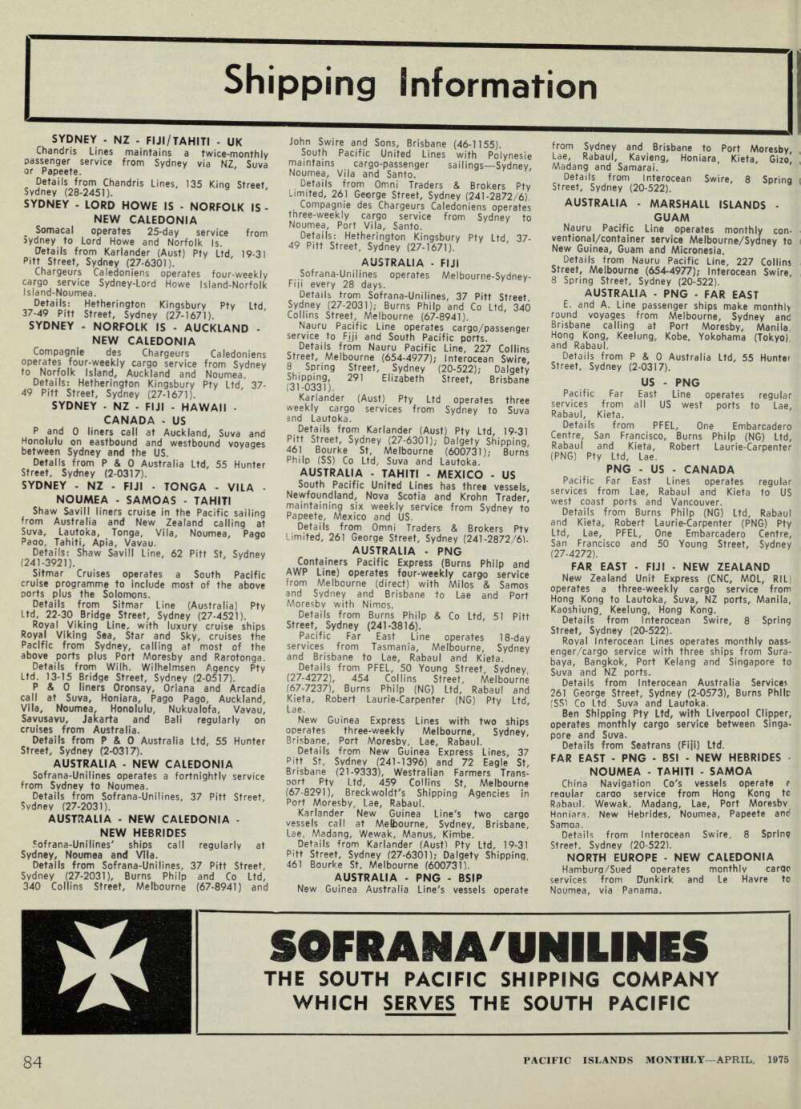

SYDNEY - NZ - FIJI/TAHITI - UK Chandris Lines maintains a twice-monthly passenger service from Sydney via NZ Suva or Papeete.
Details from Chandris Lines, 135 King Street Sydney (28-2451).
SYDNEY - LORD HOWE IS - NORFOLK IS -
New Caledonia
Somacal operates 25-day service from Sydney to Lord Howe and Norfolk Is.
Details from Karlander (Aust) Pty Ltd, 19-31 Pitt Street, Sydney (27-6301).
Chargeurs Caledoniens operates four-weekly cargo service Sydney-Lord Howe Island-Norfolk Island-Noumea.
Details: Hetherington Kingsbury Pty Ltd 37-49 Pitt Street, Sydney (27-1671).
SYDNEY - NORFOLK IS - AUCKLAND -
New Caledonia
Compagnie des Chargeurs Caledoniens operates four-weekly cargo service from Sydney to Norfolk Island, Auckland and Noumea.
Details: Hetherington Kingsbury Pty Ltd 37- 49 Pitt Street, Sydney (27-1671).
SYDNEY - NZ - FIJI - HAWAII ■
Canada - Us
P and 0 liners call at Auckland, Suva and Honolulu on eastbound and westbound voyages between Sydney and the US.
Details from P & 0 Australia Ltd, 55 Hunter Street, Sydney (2-0317).
SYDNEY - NZ - FIJI - TONGA ■ VILA ■
Noumea - Samoas - Tahiti
Shaw Savill liners cruise in the Pacific sailing from Australia and New Zealand calling at Suva, Lautoka, Tonga, Vila, Noumea, Pago Paoo, Tahiti, Apia, Vavau.
Details: Shaw Savill Line, 62 Pitt St, Sydney (241-3921).
Sitmar Cruises operates a South Pacific cruise programme to include most of the above ports plus the Solomons.
Details from Sitmar Line (Australia) Pty Ltd, 22-30 Bridge Street, Sydney (27-4521).
Royal Viking Line, with luxury cruise ships Royal Viking Sea, Star and Sky, cruises the Pacific from Sydney, calling at most of the above ports plus Port Moresby and Rarotonga.
Details from Wilh. Wilhelmsen Agency Pty Ltd. 13-15 Bridge Street, Sydney (2-0517).
P & 0 liners Oronsay, Oriana and Arcadia call at Suva, Honiara, Pago Pago, Auckland, Vila, Noumea, Honolulu, Nukualofa, Vavau, Savusavu, Jakarta and Bali regularly on cruises from Australia.
Details from P & 0 Australia Ltd, 55 Hunter Street, Sydney (2-0317).
Australia - New Caledonia
Sofrana-Unilines operates a fortnightly service from Sydney to Noumea.
Details from Sofrana-Unilines, 37 Pitt Street, Sydney (27-2031).
Australia - New Caledonia -
New Hebrides
Sofrana-Unilines' ships call regularly at Sydney, Noumea and Vila.
Details from Sofrana-Unilines, 37 Pitt Street, Sydney (27-2031), Burns Philp and Co Ltd, 340 Collins Street, Melbourne (67-8941) and
John Swire and Sons, Brisbane (46-1155).
South Pacific United Lines with Polynesie maintains cargo-passenger sailings—Sydney Noumea, Vila and Santo.
Details from Omni Traders & Brokers Pty Limited, 261 George Street, Sydney (241-2872/6).
Compagnie des Chargeurs Caledoniens operates three-weekly cargo service from Sydney to Noumea, Port Vila, Santo.
Details: Hetherington Kingsbury Pty Ltd 37- 49 Pitt Street, Sydney (27-1671).
Australia - Fiji
Sofrana-Unilines operates Melbourne-Sydney- Fiji every 28 days.
Details from Sofrana-Unilines, 37 Pitt Street, Sydney (27-2031); Burns Philp and Co Ltd, 340 Collins Street, Melbourne (67-8941).
Nauru Pacific Line operates cargo/passenger service to FJji and South Pacific ports.
Details from Nauru Pacific Line, 227 Collins Street, Melbourne (654-4977); Interocean Swire 8 Spring Street, Sydney (20-522); Dalgety Shipping, 291 Elizabeth Street, Brisbane (31-0331).
Karlander (Aust) Pty Ltd operates three weekly cargo services from Sydney to Suva and Lautoka.
Details from Karlander (Aust) Pty Ltd, 19-31 Pitt Street, Sydney (27-6301); Dalgety Shipping 461 Bourke St, Melbourne (600731); Burns Philp (SS) Co Ltd, Suva and Lautoka.
AUSTRALIA - TAHITI - MEXICO - US South Pacific United Lines has three vessels, Newfoundland, Nova Scotia and Krohn Trader, maintaining six weekly service from Sydney to Papeete, Mexico and US.
Details from Omni Traders & Brokers Pty Limited, 261 George Street, Sydney (241-2872/61.
Australia - Png
Containers Pacific Express (Burns Philp and AWP Line) operates four-weekly cargo service from Melbourne (direct) with Milos & Samos and Sydney and Brisbane to Lae and Port Moresby with Nimos.
Details from Burns Philp & Co Ltd, 51 Pitt Street, Sydney (241-3816).
Pacific Far East Line operates 18-day services from Tasmania, Melbourne, Sydney and Brisbane to Lae, Rabaul and Kieta.
Details from PFEL, 50 Young Street, Sydney, (27-4272), 454 Collins Street, Melbourne (67-7237), Burns Philp (NG) Ltd, Rabaul and Kieta, Robert Laurie-Carpenter (NG) Pty Ltd, Lae.
New Guinea Express Lines with two ships operates three-weekly Melbourne, Sydney, Brisbane, Port Moresby, Lae, Rabaul.
Details from New Guinea Express Lines, 37 Pitt St, Sydney (241-1396) and 72 Eagle St, Brisbane (21-9333), Westralian Farmers Trans port Pty Ltd, 459 Collins St, Melbourne (67-8291), Breckwoldt's Shipping Agencies in Port Moresby, Lae, Rabaul.
Karlander New Guinea Line's two cargo vessels call at Melbourne, Sydney, Brisbane, Lae, Madang, Wewak, Manus, Kimbe.
Details from Karlander (Aust) Pty Ltd, 19-31 Pitt Street, Sydney (27-6301); Dalgety Shipping, 461 Bourke St, Melbourne (600731).
Australia - Png • Bsip
New Guinea Australia Line's vessels operate
from Sydney and Brisbane to Port Moresby, Lae, Rabaul, Kavieng, Honiara. Kieta, Giro' Madang and Samarai.
Details from Interocean Swire, 8 Sprino Street, Sydney (20-522). 9
Australia • Marshall Islands •
Guam
Nauru Pacific Line operates monthly con ventional/container service Melbourne/Sydney to New Guinea, Guam and Micronesia.
Details from Nauru Pacific Line, 227 Collins Street, Melbourne (654-4977); Interocean Swire, 8 Spring Street, Sydney (20-522).
Australia - Png ■ Far East
E. and A. Line passenger ships make monthly round voyages from Melbourne, Sydney and Brisbane calling at Port Moresby, Manila Hong Kong, Keelung, Kobe, Yokohama (Tokyo) and Rabaul.
Details from P & 0 Australia Ltd, 55 Hunter Street, Sydney (2-0317).
Us - Png
Pacific Far East Line operates regular services from all US west ports to Lae, Rabaul, Kieta.
Details from PFEL, One Embarcadero Centre, San Francisco, Burns Philp (NG) Ltd, Rabaul and Kieta, Robert Laurie-Carpenter (PNG) Pty Ltd, Lae.
Png - Us - Canada
Pacific Far East Lines operates regular services from Lae, Rabaul and Kieta to US west coast ports and Vancouver.
Details from Burns Philp (NG) Ltd, Rabaul and Kieta, Robert Laurie-Carpenter (PNG) Pty Ltd, Lae, PFEL, One Embarcadero Centre, San Francisco and 50 Young Street, Sydney (27-4272).
FAR EAST - FIJI - NEW ZEALAND New Zealand Unit Express (CNC, MOL, RIL) operates a three-weekly cargo service from Hong Kong to Lautoka, Suva, NZ ports, Manila, Kaoshiung, Keelung, Hong Kong.
Details from Interocean Swire, 8 Spring Street, Sydney (20-522).
Royal Interocean Lines operates monthly oass enger/cargo service with three ships from Sura baya, Bangkok, Port Kelang and Singapore to Suva and NZ ports.
Details from Interocean Australia Services 261 George Street, Sydney (2-0573), Burns Philp (SSI Co Ltd Suva and Lautoka.
Ben Shipping Pty Ltd, with Liverpool Clipper, operates monthly cargo service between Singa pore and Suva.
Details from Seatrans (Fiji) Ltd.
FAR EAST - PNG - BSI ■ NEW HEBRIDES
Noumea - Tahiti - Samoa
China Navigation Co's vessels operate ? reoular caroo service from Hong Kong to Rabaul. Wewak, Madang, Lae, Port Moresby Honiara. New Hebrides, Noumea, Papeete and Samoa.
Details from Interocean Swire, 8 Spring Street, Sydney (20-522).
North Europe - New Caledonia
Hamburq/Sued operates monthly carqo services from Dunkirk and Le Havre to Noumea, via Panama.
Details from Columbus Overseas Services >ty Ltd, 333 George Street, Sydney (290-2966).
Messageries Maritimes operates five cargo ervices a month from north and Mediterraneai. uropean ports to Papeete and Noumea.
Details from Messageries Maritimes, 332 itt Street, Sydney (61-6664).
JAPAN ■ GUAM - FIJI - SAMOA -
N Caledonia • N Hebrides
Daiwa Line runs a monthly cargo service rom Japan via Guam to Suva, Lautoka, Pago ago, Apia, Vila, Santo and Noumea.
Details from Burns Philp (SS) Co Ltd, Suva TONGA - SAMOA - FIJI - AUSTRALIA Pacific Navigation Co Ltd operates a monthly argo service between Nukualofa, Apia, Suva nd Lautoka to Sydney.
Details from Karlander (Aust) Pty Ltd, 19-31 itt St, Sydney (27-6301).
NZ - FIJI - TONGA - SAMOAS -
Tahiti
Union Steam Ship Co of New Zealand perates a fully containerised service Auckland, uva, Pago Pago, Apia and Nukualofa every 4 days, A unitised service is operated Auckland, autoka, Suva, Apia, Auckland approximately very two weeks.
A 28-day service is operated from Auckland ) Papeete.
Details from any office of the Union Steam hip Co, Fiji, Tonga, Samoa, Auckland.
Nz - Norfolk Is
USS Co vessels operate 26-day cargo service uckland, Suva, Norfolk Is, Auckland.
Details from Union Steam Ship Co of NZ Id. PO Box 12, Auckland.
IZ - N CALEDONIA - N HEBRIDES -
Ng - Bsip
Sofrana Unilines with four ships operates > Vila and Santo; to Honiara and New uinea,- and to Noumea.
Details from Sofrana-Unilines, 42 Customs treet, Auckland (73-279), P.O. Box 3614. elex; NZ 2313.
Nz ■ Png
Pacific Far East Line operates regular 18day services from Auckland to Lae, Rabaul, Kieta.
Details from PFEL, 109 Queen Street, Auck land (31022) Burns Philp (NG) Ltd, Rabaul and Kieta, Robert Laurie-Carpenter (PNG) Pty Ltd, Lae.
NZ - FIJI - NORTH AMERICA (WC) Crusader cargo ships call at Suva, Levuka and Honolulu on NZ-US west coast trips and at Suva and/or Lautoka on US-NZ return trips.
Details trom Blue Star Port Lines (Manage ment) Ltd, P.O. Box 192 Wellington (70179).
Nz - Fiji
Fijian Swift and M.V. La Bonita operate a regular 18 day service from Auckland to Suva and Lautoka.
Details from Reef Shipping Agencies Ltd, P.O. Box 13-315, Onehunga, NZ. (Phone 663- 918, 663-928).
Nz - Tonga
Pacific Navigation Co Ltd operates two ships Auckland-Nukualofa-Vavau-Haapai, on a 14-16day schedule, monthly timber service from Mt Maunganui, and other NZ ports by inducement.
Details from the Northern Steam Ship Co Ltd, 23-24 Quay Street, Auckland (362-730).
UK - PANAMA - SAMOA - FIJI The Fiji Direct Service, cargo only, is main tained by Conference vessels, sailing at regular monthly intervals out of London, via Panama, for Apia, Suva and Lautoka.
Details from Burns Philp (SS) Co Ltd, Suva.
UK - PNG - BSIP - GEIC - N HEBRIDES -
N Caledonia
Bank Line operates a monthly direct cargo service from Europe, via the Panama Canal to Papeete, Noumea, Vila, major PNG ports and Honiara, occasionally to Tarawa, Santo, Kieta, Jayapura and Yandina and return.
Details from Bank Line (A'asia) Ptv Ltd, 1 York St, Sydney (27-2041); Burns Philp (SS) Co Ltd, Suva.
EUROPE - TAHITI - W SAMOA - FIJI •
N Caledonia
Nedlloyd offers regular cargo services from Northern Europe and UK to Papeete, Apia, Fiji and New Caledonia.
Details: Interocean Aust. Services Pty Ltd, 261 George Street, Sydney (2-0573).
Us - Samoa - Australia
Pacific Far East Line operates a three weekly freighter service from Pacific coast ports to Pago Pago, Sydney, Melbourne, Tasmania and Brisbane, returning via Auckland, Pago Pago, to Pacific northwest ports, Vancouver, San Francisco and Los Angeles. (No passengers carried).
Details from PFEL, 50 Young Street, Sydney (27-4272).
US - SYDNEY - GEIC - HONOLULU Columbus Lines operates a three weekly container cargo sailing from West Coast, US to Australasia, returning via Tarawa, GEIC and Honolulu to Nth America.
Details from Columbus Overseas Services Pty Ltd, 333 George Street, Sydney (290-2966).
Us - Fiji/Tahiti - Australia
Bank Line Ltd operate regular cargo sei vices from US Gulf ports to Australia and NZ.
Calls at Suva, Lautoka and Papeete on demand.
Details from Bank Line (A/asia) Pty Ltd, 1 York St, Sydney (27-2041).
Pacific Far East Line cruise ships operate regularly from San Francisco, Los Angeles, Honolulu, Moorea, Papeete, Rarotonga, Auck land, Opua, Sydney, and return via Suva, Niuafoou, Pago Pago and Honolulu to San Francisco.
Freight is carried on these passenger liners.
Details from PFEL, 50 Young Street, Sydney (27-4272).
Us - Tahiti - Samoa
Pacific Islands Transport operates a five/six weekly cargo service from North American west coast ports to Papeete, Pago Pago, Apia.
Details from Trans-Austral Shipping Pty Ltd, 19 Pitt Street, Sydney (27-2441).
Advertisements & other items, pp. 86-87 (2 items)
*
SOFRANA'UNILINES
THE SOUTH PACIFIC SHIPPING COMPANY
WHICH SERVES THE SOUTH PACIFIC
POWERLITE GENERATORS
WBi
15 YEARS PROVEN SERVICE
THROUGHOUT AUSTRALIA
PORTABLE or
STATIONARY
We offer you a choice of AIR or WATER cooled Power units.
DIESEL or PETROL driven by the engine of your choice.
BRUSHLESS or SLIP RING ALTERNATORS made to any requirement or specification in either- Manual, Automatic, Electric and Start-A-Matic.
A full range available from:
1 KVA THROUGH TO 500 KVA
Service and parts readily available.
POWERLITE PTY. LTD.
23A Gordon St., Chipping Norton, N.S.W., 2170, Australia.
Phone: 727-0077. Telex: 24893.
85
ACIFIC ISLANDS MONTHLY— APRIL, 1975
Deaths of Islands People
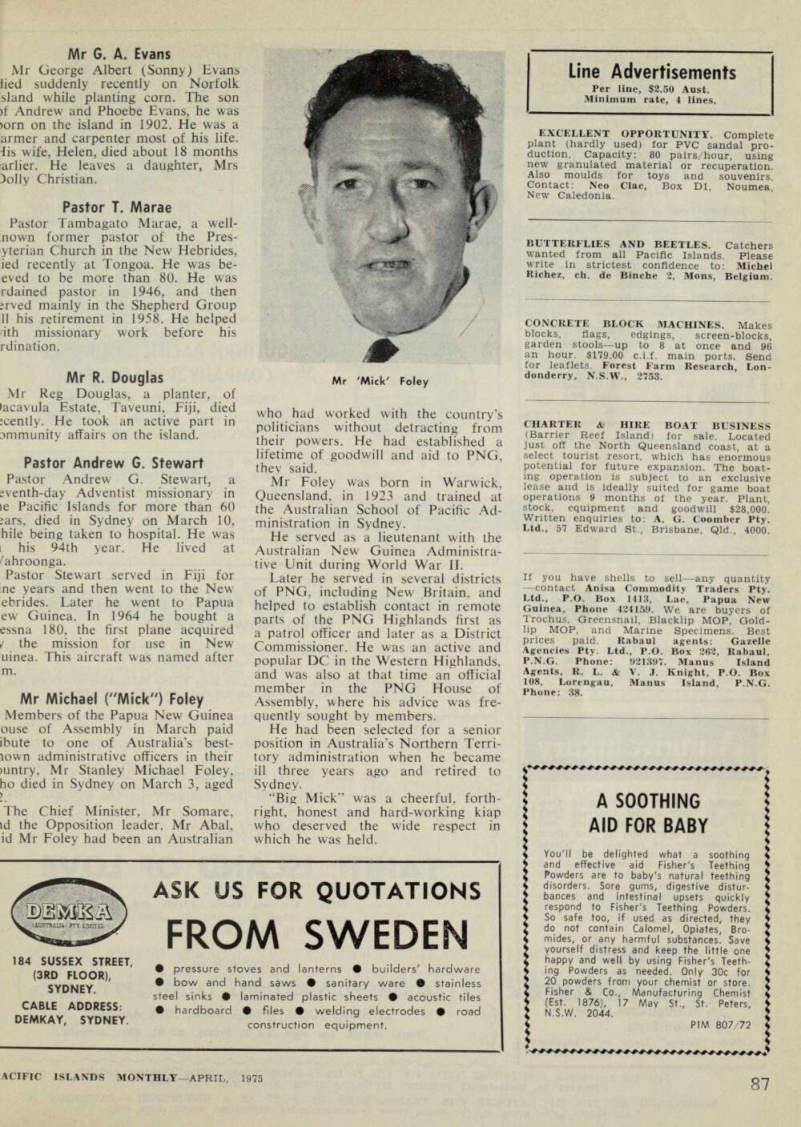
Death Recalls A Great Png Trek
Mr Louis James O’Malley, who died in Sydney in February, during a long career in the public service in Papua New Guinea, won fame in 1935, when, as a 23-years-old patrol officer, he was second in command of an expedition which penetrated deep into the Highlands. The patrol was led by the famous Jack Hides.
The Lieutenant-Governor of Papua described the expedition as “one of the hardest and most difficult expeditions ever undertaken in any part of the island of New Guinea”.
The expedition received much pub licity in Australian newspapers for its feat. PlM’s editor, and founder, Mr R. W. Robson, commented . . .
“on this occasion the Australian press—and, in fact, the press of the world—gave to Mr Hides’ exploits and discoveries the same publicity they might have given to H. M.
Stanley’s travels a couple of genera tions ago”.
Hides and O’Malley set out from Dam on January 1, 1935 with 14 native police, 30 carriers and eight tons of stores. They went 350 miles up the Fly and Strickland rivers in the government launch, Vailala, and then on into the then unknown hinterland, over terrible country, for the next two months.
They once took seven days to cover 11 miles, over a limestone surface broken by great chasms and fissures, amid dwarfed and twisted vegetation. The police and carriers suffered from torn feet and bitterly cold rain. Six were disabled. The party abandoned half its stores.
From 7,000 ft, they finally gazed far over a series of thickly populated and intensely-cultivated valleys, the Tari Furoro River sys tem. They descended from the lime stone barrier, crossed the river, named Ryan, and a mountain, and entered the valley system. The Ryan, or Tari, seemed to be a tributary of the Kikori.
For five weeks, they marched through the Tari Furoro district, attacked repeatedly by hordes of per sistently-hostile natives. They saw an astonishing system of irrigation and cultivation. There was evidence of constant inter-tribal fighting and cannibalism. The first tribes met
were people with light brown skins and long curling hair. The party was refused food. They were conserving their rice, and were almost starving in the midst of plenty.
Travelling north and east, they crossed a mountain, about 13,000 ft high, which they provisionally named Mt Champion, and came down on May 5 into valleys, part of the headwaters of the Purari.
During May, they travelled east and south through a thickly populated region in which the people were hostile and treacherous. They were constantly under attack. The natives refused to give or sell food.
The men were bearded, and usually wore large wigs of human hair. The party, on May 13, fought a day-long battle against many hundreds of warriors. The native police were splendid—cool and unflinching.
At the end of May, the party turned south, and started the return trip across the terrible limestone barrier. They suffered great priva tions, chiefly from cold, and extreme hunger, and were extremely lucky to escape death. South of the barrier, near the Erewa River, they met friendly tribes, who gave them food, shelter and transport. They arrived at the government station at Kikori on June 19, just 160 days after they left Dam.
"Which is Hides and which is O’Malley?” asked the officer there, as two scarecrows, bearded, tattered, torn and emaciated, crawled wearily out of the canoes.
The two men went to Australia on leave to recuperate, and tell the story of their trip.
Mr O’Malley later served in a number of areas in Papua New Guinea, becoming District Com missioner, first at Kikori, which had so many memories for him, and later of Manus District, with headquarters at Lorengau. He retired in 1968 to live in Sydney. In World War 11, Mr O’Malley served with ANGAU, and reached the rank of major.
Mr L. H. Wilkinson Mr Lancelot Harcourt Wilkinson, who died at Cairns on February 7 after a severe illness, spent 40 years
in Papua, mainly in the Milne Bay\ district. He went to Papua in 19311 to work in the Misima gold mine. Hes was employed there till 1941, whenr he joined the RAF, training inr Canada, and taking part in Lancaster! bomber raids over Germany.
Mr Wilkinson started a business 2 at Maclean, NSW, on his discharge, , but the call of Papua was too strong<; and he returned there. After a short! time at Misima he bought a planta- tion in the Milne Bay district, carry- ing on a trading and recruiting enter- prise at the same time. He sold the ; plantation to become a trader only, e and then took on maintenance work : at Loani airstrip, near Samarai. He ; is survived by his wife and three ; children.
Lance Wilkinson was a regular ■ correspondent in PIM for many years, and his stories of Island life had the smell of copra about them.
He was the real Island “old hand” with many friends in all walks of life.
Mr Naku Ngati Mr Naku Ngati, who died recently at Muri, Cook Islands, was well known in his younger days as a sea man working on trading schooners in many parts of the Pacific. He was 80. He served in the Middle East in World War I. Mr Ngati was a deacon in the church at Ngatangiia. He is survived by a son and a daughter.
Mr W. Magnay Mr. William Magnay, superinten dent of operations in the Papua New Guinea Teacher Education Division, was killed recently in a car accident in Adelaide, He went to Papua New Guinea in 1954 as a primary school teacher. He had a wide knowledge of education in PNG, particularly in teacher education. He leaves a widow and two daughters.
Rev N. Wright The Rev Norman Wright, who was the first fulltime probation officer in Fiji, died recently in Adelaide, aged 80. He went to Fiji in 1927 to start probation work, and lay the founda tions of the present Social Welfare Department. Later he joined the Methodist Church, and worked for the Indian mission at Ba, Lautoka and Suva. In 1951, when his appoint ment in the church as Methodist secretary for education expired, he joined the Education Department as a probation officer. He retired in 1961 to live in South Australia. He is survived by his wife and adult family.
Mr G. A. Evans Mr George Albert (Sonny) Evans lied suddenly recently on Norfolk sland while planting corn. The son >f Andrew and Phoebe Evans, he was >orn on the island in 1902. He was a armer and carpenter most of his life, lis wife, Helen, died about 18 months arlier. He leaves a daughter, Mrs )olly Christian.
Pastor T. Marae Pastor Tambagato Marae, a well nown former pastor of the Pres yterian Church in the New Hebrides, ied recently at Tongoa. He was be eved to be more than 80. He was rdained pastor in 1946, and then ;rved mainly in the Shepherd Group 11 his retirement in 1958. He helped 4th missionary work before his rdination.
Mr R. Douglas Mr Reg Douglas, a planter, of ►acavula Estate, Taveuni, Fiji, died jcently. He took an active part in [immunity affairs on the island.
Pastor Andrew G. Stewart Pastor Andrew G. Stewart, a Adventist missionary in le Pacific Islands for more than 60 died in Sydney on March 10, hile being taken to hospital. He was i his 94th year. He lived at Pastor Stewart served in Fiji for ne years and then went to the New ebrides. Later he went to Papua ew Guinea. In 1964 he bought a essna 180, the first plane acquired / the mission for use in New uinea. This aircraft was named after m.
Mr Michael ("Mick") Foley
Members of the Papua New Guinea ouse of Assembly in March paid ibute to one of Australia’s best lown administrative officers in their >untry, Mr Stanley Michael Foley, ho died in Sydney on March 3, aged > The Chief Minister, Mr Somare, id the Opposition leader. Mr Abal, id Mr Foley had been an Australian
who had worked with the country’s politicians without detracting from their powers. He had established a lifetime of goodwill and aid to PNG, they said.
Mr Foley was born in Warwick, Queensland, in 1923 and trained at the Australian School of Pacific Ad ministration in Sydney.
He served as a lieutenant with the Australian New Guinea Administra tive Unit during World War 11.
Later he served in several districts of PNG, including New Britain, and helped to establish contact in remote parts of the PNG Highlands first as a patrol officer and later as a District Commissioner. He was an active and popular DC in the Western Highlands, and was also at that time an official member in the PNG House of Assembly, where his advice was fre quently sought by members.
He had been selected for a senior position in Australia’s Northern Terri tory administration when he became ill three years ago and retired to Sydney.
“Big Mick’’ was a cheerful, forth right, honest and hard-working kiap who deserved the wide respect in which he was held.
Mr 'Mick' Foley
Advertisements & other items, pp. 89-92 (3 items)
87
ACIFIC ISLANDS MONTHLY APRIL, 1975
From Sweden
Line Advertisements
Per line, $2.50 Aust.
Minimum rate, 4 lines.
EXCELLENT OPPORTUNITY. Complete
plant (hardly used) for PVC sandal production. Capacity; 80 pairs/hour, using new granulated material or recuperation.
Also moulds for toys and souvenirs.
Contact; Neo Clac, Box Dl, Noumea, New Caledonia.
BUTTERFLIES AND BEETLES. Catchers
wanted from all Pacific Islands. Please write in strictest confidence to: Michel Richez, ch. de Binche 2, Mens, Belgium.
CONCRETE BLOCK MACHINES. Makes
blocks, flags, edgings, screen-blocks, garden stools—up to 8 at once and 96 an hour. $179.00 c.i.f. main ports. Send for leaflets Forest Farm Research, Londonderry, N.S.W., 2753.
CHARTER & HIRE BOAT BUSINESS
(Barrier Reef Island) for sale. Located just off the North Queensland coast, at a select tourist resort, which has enormous potential for future expansion. The boating operation is subject to an exclusive lease and is ideally suited for game boat operations 9 months of the year. Plant, stock, equipment and goodwill $28,000.
Written enquiries to: A. G. Coomber Pty.
Ltd., 57 Edward St., Brisbane. Qld , 4000.
If you have shells to sell —any quantity —contact Anisa Commodity Traders Ptv.
Ltd., P.O. Box 1413, Lae, Papua New Guinea, Phone 424159. We are buyers of Trochus, Greensnail, Blacklip MOP, Goldlip MOP, and Marine Specimens. Best prices paid. Rabaul agents: Gazelle Agencies Pty. Ltd., P.O. Box 262, Rabaul, PNG. Phone: 921397. Manus Island Agents, R. L. & V. J. Knight, P.O. Box 108, Lorengau, Manus Island, P.N.G.
Phone: 38.
A SOOTHING
AID FOR BABY
You'll be delighted what a soothing and effective aid Fisher's Teething Powders are to baby's natural teething disorders. Sore gums, digestive disturbances and intestinal upsets quickly respond to Fisher's Teething Powders.
So safe too, if used as directed, they do not contain Calomel, Opiates, Bromides, or any harmful substances. Save yourself distress and keep the little one happy and well by using Fisher's Teething Powders as needed. Only 30c for 20 powders from your chemist or store.
Fisher & Co., Manufacturing Chemist (Est. 1876), 17 May St., St. Peters,
N.S.W. 2044.
PIM 807/72
ASK US FOR QUOTATIONS
FROM SWEDEN
184 SUSSEX STREET,
(3RD FLOOR),
SYDNEY.
CABLE ADDRESS:
DEMKAY, SYDNEY.
• pressure stoves and lanterns • builders' hardware • bow and hand saws sanitary ware ® stainless steel sinks • laminated plastic sheets • acoustic tiles • hardboard • files • welding electrodes • road construction equipment.
LnnJ §s) LrmJ o=^ O i InnJ §e)
W* DATELINE HOTEL Si)
f TONGA
'Friendly Hotel” of the "Friendly Islands' Situated along the Nukualofa waterfront. Only five minutes walk from town. Single, double, family suites, airconditioning, and hot and cold water showers. Pool, bar, restaurant, duty-free shop, tour desk and boutique.
Book through your travel agent or write to International Dateline Hotel, P.O. Box 62, Nukualofa Tonga.
Cable Address: "DATELINE".
Represented Overseas by: Charles J. Henry and Associates Pty. Ltd.
Sydney and Melbourne. ™
PARK VIEW MOTEL—BRISBANE
Quiet location —opp. Botanic Gardens.
Single, double, family suites, all with refrig., air conditioning, phone, TV, radio tea making facilities, from $l2. Pool and restaurant.
Phone 31-2695—Telex 40270.
Write for coloured brochure— Park View Motel, 128 Alice St, BRISBANE, Old., 4000.
ELECTRONIC COMPONENTS
EXPORTERS, MANUFACTURERS,
GENERAL MERCHANTS,
WHOLESALERS, IMPORTERS
• All enquiries answered • Keen prices • Prompt delivery Contact us for any requirement.
ELECTRONIC EXPORTS A'ASIA PTY. LTD.,
G.P.O. Box 1365, Brisbane, Q., 4101.
Telegraphic: SZEKELY, Brisbane.
SOUTHERN PACIFIC INSURANCE
COMPANY (PNG) LIMITED
(INCORPORATED IN PAPUA NEW GUINEA)
HEAD OFFICE; BANK HAUS. CHAMPION PDE. P.O. BOX 136 PORT MORESBY, PAPUA NEW GUINEA. PH. 2623 • FIRE • FIRE AND VOLCANIC ERUPTION • HOUSEHOLD COMPREHENSIVE • MOTOR VEHICLE • COMPULSORY THIRD PARTY • COMPULSORY WORKERS COMPENSATION
MARINE • PUBLIC LIABILITY • BURGLARY
Enquiries are invited for all classes of insurance from special representatives at: PORT MORESBY: H. A. McKEE, General Manager, Champion Pde., P.O. Box 136, Ph. 2623 or 2075. LAE: K. J. ARMSTRONG, Manager for Lae, Central Ave, P.O. Box 758, Ph. 42-4590 or 42-4256. RABAUL: R. H. MEYER, Manager for Rabaul, Mango Ave., P.O. Box 123, Ph. 92-2417 or 92-2755. 5® $
3007
Stay at
Aggie Grey's the
South Pacific's legendary hotel Situated right in the heart of Western Samoa. Enjoy Polynesian-style friendliness and service, in cool surroundings, superb ent ?i rt u inmen t f°°d. Magnificent white sand beaches only a short drive away Airconditioned rooms, swimming pool and full bar facilities.
Bookings through Union Steamship Company of NZ, Pan Am, Air New Zealand or direct to Aggie Grey's, Apia, Western Samoa. Cables: AGGIES, APIA.
COLOURFUL MAPS OF NORFOLK ISLAND AND
LORD HOWE ISLAND
Big fold-out maps in colour showing main points of interest in these islands —both attractive tourist destinations.
Produced by Pacific Maps, and available direct from Pacific Publications (Aust) Pty Ltd, Box 3408 GPO, Sydney 2000, at $1 each or $1.25 each posted.
Primitive luxury
(Polynesian style) Nestled away in the untouched Kingcorn of Tonga is new, luxurious "Port of Refuge" International resort. Here is a unique opportunity for your clients to experience the tranquil and relaxed Tongan atmosphere while they enjoy the picturesque surroundings of the new "Port of Refuge". And only a short flight from Fiji.
Reasonable tariffs from $17.50 with special concessions for children. Agents commission 10 per cent.
Tonga's
Port of Refuge
INTERNATIONAL RESORT
A-£ Uava’u Tonga Cables: "Refuge" Tonga or "Tongatours"
Sydney. Phone: Sydney 85-1603 or 922-1817
The only book telling the vivid history of Tahiti from its discovery to the present day
Robert Langdon’s
TAHITI: ISLAND OF LOVE
PRICE: Australia, Pacific Islands and overseas, $3.50 Aust., plus 50c posted; U.S.A. $5.70 U.S. posted.
A vailable from:
PACIFIC PUBLICATIONS (AUST.) PTY. LTD.,
29 Alberta Street, Sydney, N.S.W. 2000, Australia. (Postal address: Box 3408, G.P.0., Sydney, N.S.W., 2001, Australia.)
' v^V''\', n * , . ' - " , . ~-V^r ' - >W ,'?,!<r.:'k/-' A;; |t ,-y <&!»*:■ , ••stov..- ' "■■ P Jf/ * ~* v • V 'S^&^ ; '- ■
t -I# / - S W
r m» ‘farms m
iSfe
sp": m :
iss
» 4D*«* **%r !fc r B'* a** * -s * - '' '- •■: ' ■"• -*i. . - ■ • ' * v v? *•.*£ * v . - '. > •■ ■; 'hr: .. ' -;■ S' * ;- ■;:■■ .w. ,ft* **' ■ ■ ... • 9 ■• is isa* *> !!■> • I s 9 3 I 1 f *9\ 4 f :v4f>yo;<r.- The flag we’ve flown for a hundred years.
Two paddle steamers on the Yangtse River in 1873 marked the beginning of the China Navigation Company. Today, the same flag flies above eighteen modern motor ships plying an extensive network of cargo routes between Papua New Guinea and Pacific Island ports (as far East as Tahiti) and Japan, New Zealand, Australia
and Thailand.
For 100 years, the flag of the China Navigation Company has meant experience, reliability and speed across the sea. Today, it’s flying as strong as ever.
For further details and .ill enquiries there are Agents at the following ports: Papua New Guinea: Steamships Trading Go. Ltd., Port Moresby, Samarai, Lae, Madang, Rabaul, Kieta. Burns Philp (New Guinea) Ltd., Wewak, Kavieng. Fiji: Morris Hedstrom Ltd., Suva, Lautoka. Western Samoa: Morris Hedstrom Ltd., Apia.
Tonga; Morris Hedstrom Ltd., Nuku'alofa and Vava’u. Tahiti: Etablissements Donald, Tahiti, Papeete. New Caledonia: Etablissements Ballande, Noumea. 8.5.1. P.: British Solomons Trading Co. Ltd., Honiara. New Hebrides: Les Comptoirs F rancais des Nouvelles-Hebrides, Vila and Santo. AUSTRALIA—Sydney; Interocean Swire Ply. Ltd. Melbourne: Interocean Australia Services Pty. Ltd. Brisbane: Wills, Gilchrist & Sanderson Pty. Ltd. NEW ZEALAND — P. & O. (N.Z.) Ltd, Auckland, Wellington, Christchurch, Dunedin, Bluff, Napier Japan: Swire McKinnon. Tokyo, Yokohama, Osaka, Kobe and Nagoya. Eastern Managers: Butterfield & Swire, 9 Connaught Rd., Central, Hong Kong.
CN co JOHN SWIRE & SONS PTY. LTD. General Agents in Australia, 8 Spring Street, Sydney, Phone: 27 9351.
THE CHINA NAVIGATION CO LTD
MEMBER OF THE SWIRE GROUP.
IS 008
* 4 *• 4 m j •
you
i £ p .if * / % , ,-> :
immr&§
And wherever you’ll go in over 120 nations throughout the world you’ll find proud DATSUN drivers.
Perhaps the main reason is that DATSUN was designed to meet a wide variety of conditions—mountain roads and super highways, blistering suns and freezing temperatures. DATSUN is indeed the international car that has precision engineering and a stunning string of rally victories behind it.
Its superb handling, safety features and high speed efficiency make DATSUN the choice of young and old alike. DATSUN—the car that really satisfies the world over.
DATSUN
NISSAN
DATSUN distributor network covers the following areas: Fiji*T.P.N.G.*W. Samoa* New Caledonia • New Hebrides* 8.5.1.P.* Timor ‘Norfolk V
88
Published by PACIFIC PUBLICATIONS (AUST.) PTY. LTD. 29 Alberta Street Sydney, 2000 (Telephone: 61-9197).
Printed by Mastercraft Printing, 39 Collins Street, Alexandria, NSW, 2015.
REGISTERED AT THE GPO SYDNEY FOR TRANSMISSION BY POST AS A NEWSPAPER CATEGORY B * Australian price given on the front cover is recommended Australian retail price only.