Pacific Islands Monthly
News Magazine Of The South Pacific
March, 1975
AUSTRALIA,* N.Z., P.N.G., FIJI, N. HEBRIDES, TONGA 75c W. SAMOA, G.E.1.C., COOKS, NORFOLK, NIUE, NAURU 75c
Solomons 85C
Am. Samoa, Hawaii, Micronesia, Guam $1.25
NEW CALEDONIA AND FRENCH POLYNESIA 125 CFP
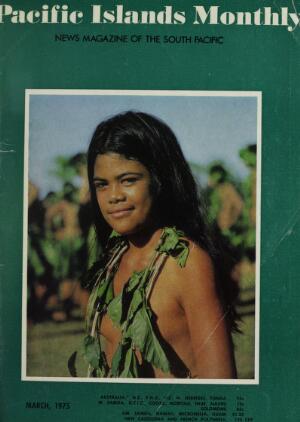
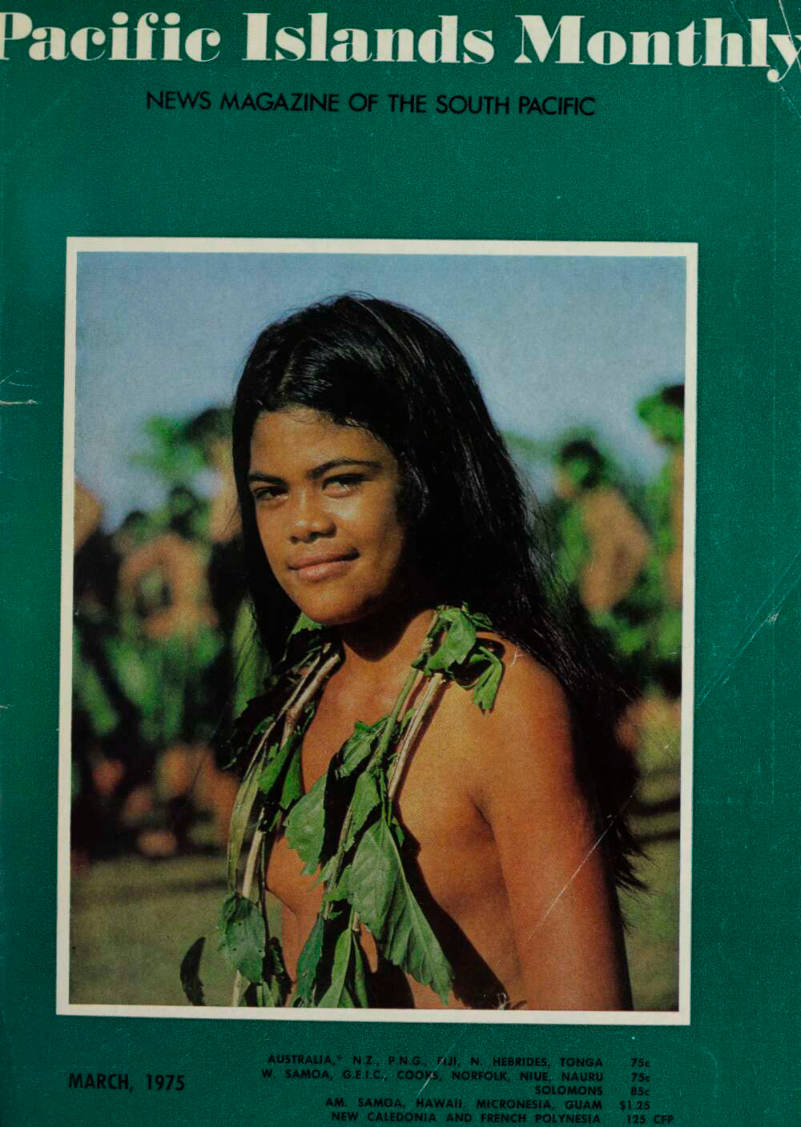
Our Cover
This winsome Niue Island girl, with the sly side-glance, spared a few moments for Fiji Times photographer Chris Moorhouse with this result.
Advertisements & other items, p. 2 (1 item)
So Superior It’s Sensational!
Discover the easy, delicious way famous chefs use to enhance the flavor of meat, poultry, fish . . . casseroles, stews and gravies.
There's no substitute for "vintage flavor"
Kikkoman - the preferred soy sauce.
KIKKOMAN SHOYU CO., LTD.
Nihonbashi, Tokyo 103, Japan
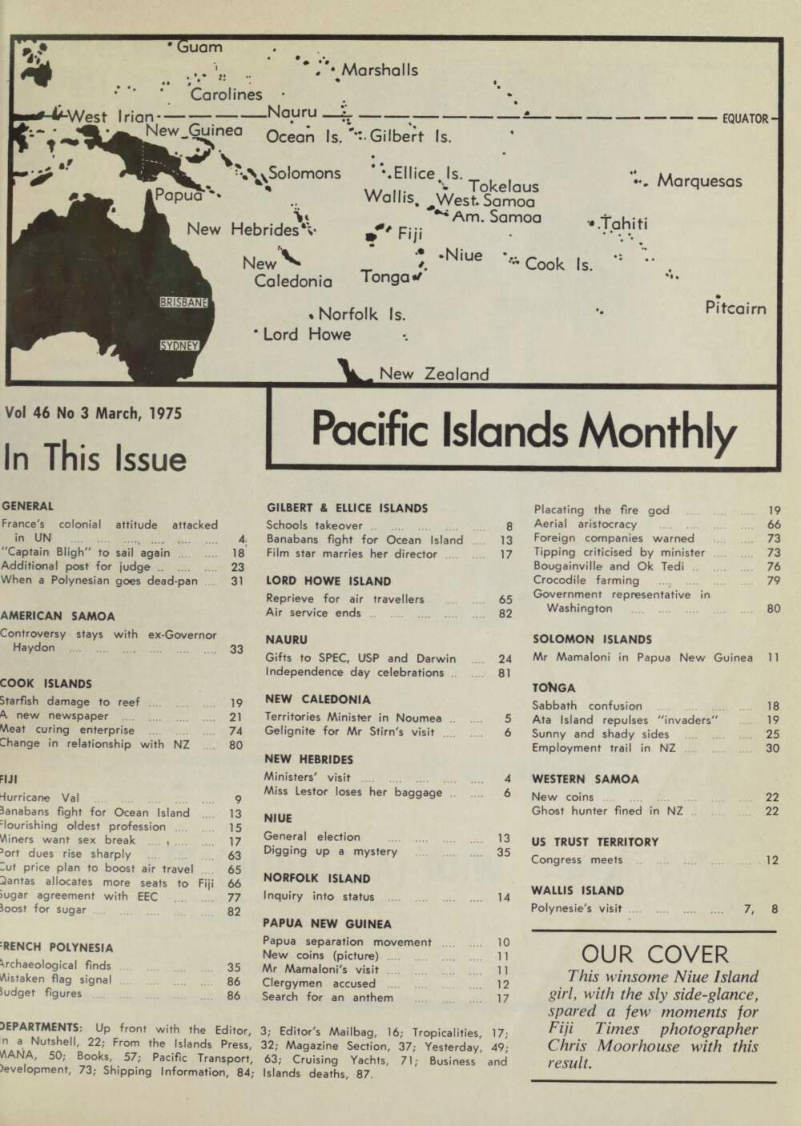
In This Issue
General
France's colonial attitude attacked in UN 4.
"Captain Bligh" to sail again ... 18 Additional post for judge 23 When a Polynesian goes dead-pan 31
American Samoa
Controversy stays with ex-Governor Haydon 33
Cook Islands
Starfish damage to reef 19 A new newspaper 21 Meat curing enterprise 74 Change in relationship with NZ ... 80
Fiji
Hurricane Val 9 Banabans fight for Ocean Island ... 13 Nourishing oldest profession 15 Miners want sex break , 17 3 ort dues rise sharply ... 63 lut price plan to boost air travel ... 65 3antas allocates more seats to Fiji 66 >ugar agreement with EEC 77 Boost for sugar ... 82
: Rench Polynesia
Archaeological finds 35
Mistaken flag signal 86
ludget figures 86
Gilbert & Ellice Islands
Schools takeover 8 Banabans fight for Ocean Island 13 Film star marries her director 17
Lord Howe Island
Reprieve for air travellers 65 Air service ends 82
Nauru
Gifts to SPEC, USP and Darwin 24
Independence day celebrations 81
New Caledonia
Territories Minister in Noumea 5 Gelignite for Mr Stirn's visit 6
New Hebrides
Ministers' visit 4 Miss Lestor loses her baggage 6
Niue
General election 13 Digging up a mystery 35
Norfolk Island
Inquiry into status 14
Papua New Guinea
Papua separation movement 10 New coins (picture) 11 Mr Mamaloni's visit 11 Clergymen accused 12 Search for an anthem 17
Placating the fire god 19 Aerial aristocracy 66 Foreign companies warned 73 Tipping criticised by minister 73 Bougainville and Ok Tedi 76 Crocodile farming 79 Government representative in
Washington 80
Solomon Islands
Mr Mamaloni in Papua New Guinea 11
Tonga
Sabbath confusion 18 Ata Island repulses "invaders" ... 19 Sunny and shady sides 25 Employment trail in NZ 30
Western Samoa
New coins 22 Ghost hunter fined in NZ 22
Us Trust Territory
Congress meets 12
Wallis Island
Polynesie's visit 7, 8
DEPARTMENTS: Up front with the Editor, 3; Editor's Mailbag, 16; Tropicalities, 17; ?AK-,A N ' UtShell ' 22; Fr ° m the lslands Press ' 32 ; Magazine Section, 37; Yesterday, 49; f ANA, 50; Books, 57; Pacific Transport, 63; Cruising Yachts, 71; Business and Development, 73; Shipping Information, 84; Islands deaths, 87.
Advertisements & other items, p. 4 (1 item)
Timeless precision.
vM
Wild
automatics
for absol
ifidence.
W &
iSiiiii
m Wild makes automatic levelling easy, quick and accurate.
NAKO - a compact, robust level for the construction site.
NAKI - a general purpose instrument for all routine work in surveying and engineering.
NA2/NAK2 - universal automatics for every task including first-order levelling and industrial applications.
Made in Switzerland, serviced the world over.
Timeless precision.
HEERBRUGG
CH-9435 Heerbrugg/Switzerland
WILD (AUSTRALIA) PTY. LTD.
45 Epping Road, North Ryde, N.S.W. 2113 11 Buchanan Street, West End, Brisbane, Qld. 4101 83-85 Palmerston Cres., Sth. Melbourne, Vic. 3205 BRIAN BELL & CO. PTY. LTD., BOROKO, T.P.N.G.
Pacific Islands
Monthly
FOUNDED BY R. W. ROBSON IN 1930
Published Monthly By
Pacific Publications (Aust.) Pty. Ltd.,
29 Alberta St., Sydney, N.S.W., 2000.
Postal Address: G.P.O. BOX 3408, SYDNEY,
N.S.W., 2001.
Telegraphic Address: PACPUB, Sydney.
Telex 25168.
Telephones: 61-9197, 61-7101, 61-4369.
Consulting Directors: R. W. Robson, Judy Tudor.
Chief Executives: Manager: Selwyn Hughes.
Publisher: Stuart Inder.
Director of Advertising; W. A. Gasnler.
Pacific Islands Monthly
Editor: Stuart Inder, Assistant Editor: John Carter.
Advertising Manager: W. A. Gasnier.
Circulation Manager: Jill Garland.
Subscription Rates:
'Pacific Islands Monthly" is airfreighted to the najority of subscribers and agents in the Pacific slands and the U.S.A.; copies to the Cook slands, Nauru, Niue, Micronesia and Guam )o by surface mail.
Australia (including Lord Howe and Thursday slands). New Zealand, Papua New Guinea, Fiji, Jew Hebrides, Tonga, Cook Islands, Western iamoa, Gilbert & Ellice Islands, Norfolk Island, liue and Nauru; $9.00 (local currency); iolomon Islands: $lO.OO Aust., American lamoa, Micronesia and Guam: $12.00 US lawaii and US Mainland: $15.00 US; New aledonia and French Polynesia: 1,500 CFP- Inited Kingdom: £6.50; Japan: 4,000 Yen.
Isewhere $11.50 Aust.
Representatives
i|i: Advertising and Distribution—Fiji Times & * r f"J Ltd., 20 Gordon St., Suva. Telephone: 5-601. Telex.: FJ 2124. apua New Guinea; PORT MORESBY, PNG Print 's Co. Pty. Ltd., P.O. Box 633; LAE, P.O. Box 27; RABAUL, Mr. David Simpson, P.O. Box 164 (c/- Rabaul Photographic. Tel. : 2677.) rench Polynesia. Distribution—Hachette Pacl que, 10 Ave Bruat, Papeete. nited Kingdom: Advertising—Overseas Publicity Id., 214 Oxford Street, London, WIN* OEA. none: 01-636 8296/7. Subscriptions—T. B. raham. Park House, 22 Park Street, Croydon,
Cr9 3Np. Tel.: 01-6884177.
ipan: Advertising—Universal Media Corpora tion, C.P.O. Box 46, Tokyo. Tel.: 666-3036. ictoria: Advertising Pacific Publications Pty. Ltd.. Herald & Weekly Times uildmg, 2nd Floor, 61 Flinders Lane, Mel )urne, 3000. Telephone: 652-1565. •* aii u a " d U- s - Mainland only; N. Grogan, 154 Hayden Street, Honolulu, 96815. end change of address notices. Form 3579 id new subscriptions to P.O. Box 2193 Honolulu, Hawaii, U.S.A. 96805). scond class postage paid at Honolulu, Hawaii.
Copyright ©, 1975,
Pacific Publications (Aust) Pty. Ltd.
March, 1975
w i m, u « ” o ‘* No. 3
Up Front
with the Editor
Whatever anybody might think about Gough Whitlam’s Australian Government, it would be hard to criticise it for the lift it has given the arts in Australia. Literature, theatre, art are all getting generous injections of government money, and in the midst of a business depression cul ture is booming! And now the Islands of the South Pacific are about to get their share of Mr Whitlam’s culture money.
We’ve given on p 23 a list of organisations that has already been promised about $40,000 in grants, but this is hardly even the beginning.
Australia has promised $1 million over the next four years, $250,000 a year between this coming July and June 30, 1979. The current handout is meant only to be a goodwill sample.
How the million dollars will be spent is the subject of a detailed, confidential report which in Feb ruary was presented to the Australian Government by two Australians, Jim Specht and Robert Langdon. The government sent these two men on a tour of the Islands at the end of last year so they could make re commendations.
They visited New Caledonia, New Hebrides, the Solomons, Fiji, West ern Samoa and Tonga, and were interested in all manner of cultural things that could benefit from some financial help—the development of a cultural centre, for example, or the establishment of archives, the promotion of festivals, sponsorship of art, the equipping of libraries, subsidies for writing and theatre.
Everything cultural, so long as it benefits Pacific Islanders.
How all this aid will be adminis tered I don’t pretend to know, but the report can be expected to suggest priorities for expenditure and suggest methods of distribution. The Aust ralian Government will make the final decision.
Australia’s largesse has come at the right time. Islanders’ interest in their own cultural life has been grow ing steadily in recent years, but it needs support and encouragement at
just this point. The establishment of universities in recent years has helped develop interest. So too has the first South Pacific Arts Festival, held in Suva in 1972, Various magazines of creative writing have begun to ap pear in the Islands, and painters and writers are becoming more promi nent. (As I write this, a review copy of Albert Wendt’s new book of short stories, Flying Fox in a Freedom Tree, has just landed on my desk).
We on PIM take a little credit for the growing interest in creative writ ing because of the Mana section which we’ve now run in PIM for two years, edited by Cook Islander Marjorie Crocombe. Some of our readers regard it as rubbish; fortun ately others don’t, and there is cer tainly no doubt that PIM has given many Island writers and poets their first opportunity to compare them selves.
Mention of the Fiji Arts Festival reminds me that a workshop con ference has just been completed in Noumea during which it was decided to establish a South Pacific Arts Festival Council and to hold the Second South Pacific Arts Festival in Rotorua, NZ in February 1976.
The workshop was attended by delegates from NZ, Tonga, Fiji, Niue, New Caledonia, Guam, the Solo mons, Micronesia, New Hebrides and the GEIC (with apologies from the Cooks, American Samoa and PNG, whose delegates couldn’t get there on time). Representing Australia was Victor Carell, director of the success ful 1972 festival, and his wife Beth Dean.
The conference decided that in future each festival will have a par ticular theme. For Roturua it will be the visual arts (painting, sculpture, etc), but song and dance will be in cluded in this as well as all future festivals whatever the theme.
Myself, I hope that Australia’s action will be followed by gifts from other countries, and that one day the Islands will have interest and money enough even to begin buying back their art from the rest of the world.
'-Stuart Inder.
Advertisements & other items, p. 5 (1 item)
3
ICIFIC ISLANDS MONTHLY—MARCH, 1975
Pacific Islands Monthly
Paris And London Prime A Fuse
In The New Hebrides
From a Vila correspondent
Joan Lestor and Olivier Stirn left a charge in the New Hebrides . . . a living, lingering spark of excite ment which, except for the most blase and the unimaginative, still illuminates and invigorates the cor ridors of the British and French Residencies.
Tinder for the spark was provided by the personalities of the two minis ters —Miss Lestor, from the Foreign and Commonwealth Office in Lon don, speaking her mind with obvious sincerity, and Mr Stirn, from the Department of Overseas Territories in Paris, listening sympathetically and pledging his support for political, social and economic development in the condominium.
They made impact. Their four-day joint visit to the islands—talking, listening, discussing, observing—be came much more than a top-level public relations exercise, as many of the scoffers and cynics thought.
And in an interview at the end of her 96 hours in the New Hebrides, the British Minister Miss Lestor said: “This is an area of enormous po tential that has been neglected over the years quite shamefully. There are lots of people here, expatriates, New Hebrideans, all sorts of people, who are very anxious to get a great deal more development going. There has been a lot of wastage and we really must get to work in terms of long
term planning”.
Perhaps the most interesting reac tion to the visit of the two ministers came from the group’s political parties. Both sides —the National Party on one hand, and the menage a-trois of UCNH, MANH and Na griamel on the other —had been ominously quiet immediately before the ministers’ arrival.
After their talks and interviews with Miss Lestor and Mr Stirn, how ever, they agreed (for the first time ever!) that there had been value and relevance in the ministerial trip.
Even the National Party-organised
demonstration outside the condo minium headquarters in Vila, where the ministers met a large cross-sec tion of political, financial and com mercial leaders, was neatly side stepped and deflated by the Briton and the Frenchman.
Talking about the small group of banner-waving demonstrators . . .
“Independence In 1977”, “You
Are Not Our Ministers” And
“Freedom Yes, Condo
MINIUM NO” . . . Miss Lestor de clared: “I was pleased to see that some of you, quite rightly, used your democratic right to bring to our attention some of the points you want tackled. I would have thought the New Hebridean people pretty passive if nothing of this sort had been organised”.
Mr Stirn said; “Nothing better could have happened for the first visit of the British and French minis
ters than to see and hear this sort of thing. It is a symbol of demo cracy and liberalism which Britain and France want to see here in the New Hebrides”.
Inside the condominium HQ the National Party maintained its attack.
President Father Walter Lini said the reforms agreed in London seemed designed to maintain French and British domination of the group.
Miss Lestor replied: “That is not true. Mr Stirn and I are here to dis cuss the reforms with you and many other people and discover how effec tive and meaningful changes can be made. There is no question of a sys tem being imposed on the people of the New Hebrides.
“We want to initiate reforms which will be acceptable to all the people living in these islands”.
This point was emphasised by Miss Lestor in what was perhaps her most telling speech of the tour, during a
reception at the Lagon Hotel. She said: “Both Mr Stirn and I agreed that it is not for us, and it would be quite wrong for us, to promote or to participate in your political activi ties. All we have to do is to create the necessary conditions where de mocracy and political activity can flourish constructively, remembering the golden rule of democracy, that it’s not just the will of the majority, it is also that the minority has its rights and that everybody tolerates the other person’s point of view”.
It’s said that certain French interests greeted that speech with alarm and that members of the tax haven fraternity were decidedly un easy about its implications.
To officials of the British and French Residencies it merely under lined the intent of the London agree ment—that there should be a sub stantial shift of decision-taking to wards New Hebrideans, and that the condominium should at last shake off its 19th century “Pandemonium” image.
Throughout the tour, both Miss Lestor and Mr Stim stressed the unity of Britain and France in re organising and re-vitalising the ad ministration of the group. They said it in public and in private. At cock tail parties, dinner engagements, over informal cups of coffee and in planes and boats and cars.
“I can’t emphasise the point too often”, Miss Lestor said to one of the 14 French journalists covering the visit. “Our two governments are agreed: we need and want reforms— and we are going to have them”.
Both ministers agreed to return to the New Hebrides in 1976—“ during the cool season!”—to review pro gress in political, social and economic development. They will, meantime, meet again in Europe, probably in July, for further discussions on the shape and direction of the London agreement.
Last word to Miss Lestor as she left Vila: “I am firmly convinced that we have started something here —and that we can go on to build a progressive and prosperous com munity”.
As if galvanised by the impact and the words of the ministers, both re sidencies are now immersed in the logistic problems of organising elec tions for local and municipal coun cils and planning for the elections to the new Representative Assembly.
Thj wheels are rolling in the New Hebrides—l97s will be a very in teresting year.
Fiji's voice is heard at the UN
France was taken to task at a meeting of the United Nations Trusteeship Council by a Fiji representative, Mr Poseci Bune.
After welcoming promised reforms by the New Hebrides condo minium partners, Britain and France, Mr Bune said he regretted there were examples of colonial exploitation in the Pacific region in New Caledonia, Wallis and Futuna and French Polynesia.
The administering power, he said, had not made any effort to im plement the declaration on decolonisation in those territories.
Earlier, Mr Bune referred to Pitcairn, saying that with its popu lation of less than 90 persons, the prospect of constitutional develop ment in the accepted sense in that territory was as remote as the island ltSe,f of the position in the GEIC, Mr Bune said that, although the sepa ration of the Ellice Islands would mean fragmentation of an already small territory, it was his delegation's view that the wishes of the majority of the population should be paramount and respected.
Several speakers referred in favourable terms to New Zealand s role in the attainment of self-government on Niue Island.
Mr Stirn dispenses youthful
charm but few ideas
Prom a Noumea correspondent
While sticks of gelignite and wall slogans marked the recent Noumea visit of French Overseas Territories Minister Mr Stirn, in many other ways his dispensing of youthful charm and vitality was very similar to the “Operation Smiles” of OT Minister Michel Inchauspe, in 1968.
However, Inchauspe came at a time when Paris was confidently talk ing about the 6,000 new workers needed from France to assist with the mammoth nickel development ahead.
Olivier Stirn had to face islanders disillusioned with waiting vainly for 10 years for the promised projects to materialise and having to cope in the meantime, so the “locals” said, with an influx of metropolitan French ousting locals from their jobs and overtaxing territorial resources, leav ing a budget deficit unable to finance the swollen ranks of the French ad ministration.
In face of the built-up tension, Stirn had to tread a cautious path, making few promises, vaguely sug gesting possible reform, aimed mainly at appeasing the most vocal of the disillusioned sectors—the Melanesians, trade unionists and young people.
During his week-long visit late January, the Paris Minister had, in fact, no new concrete developments to announce to the Caledonians. As he aired ideas for slight economic and political readjustments, he re jected the idea of internal autonomy and instead entertained Caledonians with a new hope of more direct sub sidies from France, to be achieved by a system of “regionalisation”—an old idea sounded out in the Pacific at the time of Inchauspe’s visit.
Then, a project was submitted to the Territorial Assembly proposing a new consultative body, within or outside the existing Territorial As sembly. But the regions plan was rejected in France, provoking the re signation of President de Gaulle.
The bureaucracy which really maintains the power in France has not relinquished the principle, how ever, and Olivier Stirn used it skil fully as a decoy from the autonomy issue and as a weapon against the unemployment problem, where that fear flourishes most, among the in land municipalities and in the trade unions.
As far as the French administra tion is concerned, the vaguely-defined scheme would seemingly allow more
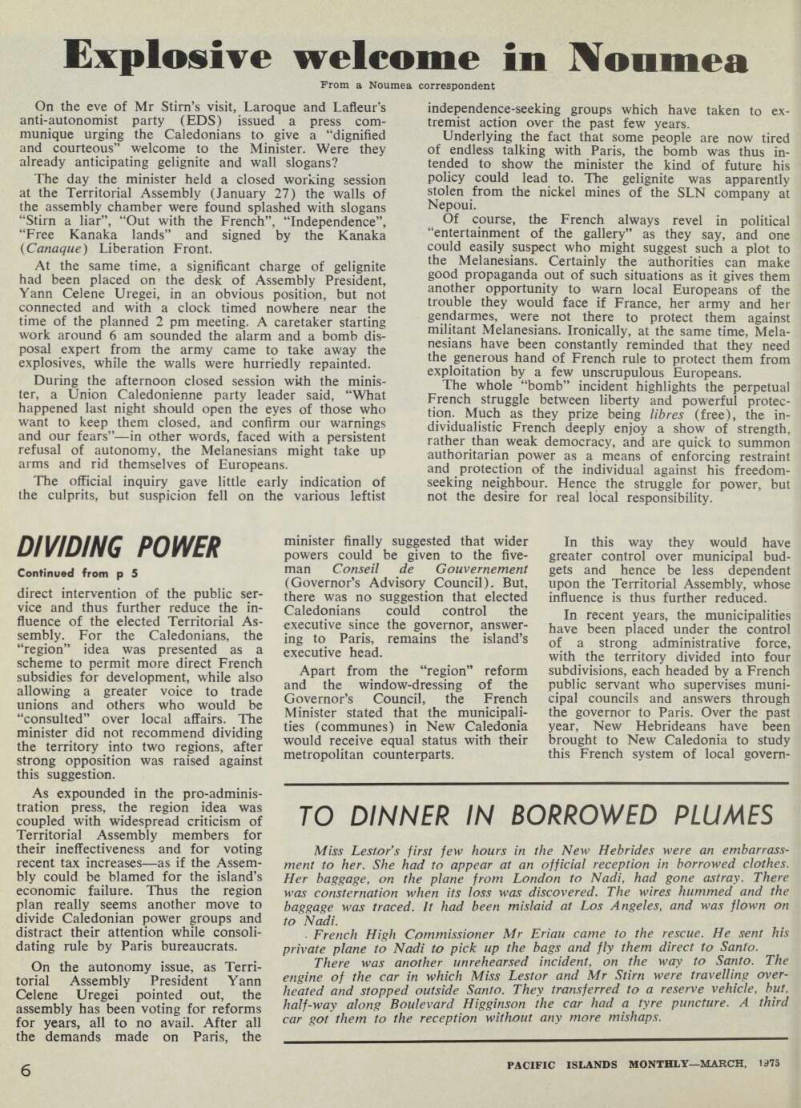
The Entente Cordiale and a coconut cordial—Miss Lestor and Mr Stirn sample their first New Hebridean coconut drink.
direct intervention of the public ser vice and thus further reduce the in fluence of the elected Territorial As sembly. For the Caledonians, the “region” idea was presented as a scheme to permit more direct French subsidies for development, while also allowing a greater voice to trade unions and others who would be “consulted” over local affairs. The minister did not recommend dividing the territory into two regions, after strong opposition was raised against this suggestion.
As expounded in the pro-adminis tration press, the region idea was coupled with widespread criticism of Territorial Assembly members for their ineffectiveness and for voting recent tax increases—as if the Assem bly could be blamed for the island’s economic failure. Thus the region plan really seems another move to divide Caledonian power groups and distract their attention while consoli dating rule by Paris bureaucrats.
On the autonomy issue, as Terri torial Assembly President Yann Celene Uregei pointed out, the assembly has been voting for reforms for years, all to no avail. After all the demands made on Paris, the
minister finally suggested that wider powers could be given to the five man Conseil de Gouvernement (Governor’s Advisory Council). But, there was no suggestion that elected Caledonians could control the executive since the governor, answer ing to Paris, remains the island’s executive head.
Apart from the “region” reform and the window-dressing of the Governor’s Council, the French Minister stated that the municipali ties (communes) in New Caledonia would receive equal status with their metropolitan counterparts.
In this way they would have greater control over municipal bud gets and hence be less dependent upon the Territorial Assembly, whose influence is thus further reduced.
In recent years, the municipalities have been placed under the control of a strong administrative force, with the territory divided into four subdivisions, each headed by a French public servant who supervises muni cipal councils and answers through the governor to Paris. Over the past year, New Hebrideans have been brought to New Caledonia to study this French system of local govem-
Big Brother Role
ment, since in the New Hebrides also the French have been keen to deve lop municipal government.
One essential message the Over seas Territories Minister brought to the Caledonians was to remind them that they represent France in the Pacific. He thus urged them to re member their “big brother” role to the Wallisians and New Hebrideans, while nobly reflecting French culture.
He further insisted that the justi fication for the presence and action taken by France was to excel in the art of co-existence of different races and, above all, France must demon strate this ability in New Caledonia.
If some extremist elements were not satisfied with the result, then at least Mr Stirn was less threatening than Governor Eriau, and urged that such outsiders simply be ignored.
The main problem faced by the Caledonians, as defined to Minister Stirn by Territorial Assembly Presi dent Yann Celene, was the Paris failure to achieve the planned nickel expansion. It is this failure which has led to loss of confidence, lack of finance and increasing unemployment caused by a cutback in the con struction industry.
Unfortunately, the minister could only promise that the islanders should expect some nickel news in the next few months, a promise they have heard ever since Minister Bil lotte’s assertions in 1966.
The minister did say, however, that France could now be more open to foreign investment in the territory for fear of missing out in the nickel race, since Caledonian nickel ore no longer represents 75 per cent of the known-world reserves, but only 30 per cent.
During February and March, the minister said, he would meet with the presidents of US Amax and Canadian INCO, companies which are interested in the north and south of the island respectively. As a con dition to all new nickel factory de velopment, the minister insisted that the Territorial Assembly must ap prove a change in the local tax sys tem. Then the first project to go ahead would be the new partnership between the SLN and the state oil company Aquitaine (SNPA).
The new fiscal system would avoid taxation simply on the basis of the volume of a company’s exports irres pective of profit or loss, and would allow tax only on the basis of profits declared. For a preliminary period, the French would guarantee the terri-
torial budget to the level of revenue collected in 1974.
Of course the nickel companies would maintain their headquarters in Paris, under the control of the cen tral government, so the territory could not question the amount of tax paid.
Meanwhile, the minister insisted that this taxation of company profits would not be extended, as feared, to the taxation of private individuals, who would thus continue to pay their contribution to the Treasury through the numerous indirect (sales etc) taxes. As for meeting the 1975 bud getary deficit of about SAIO million, the minister indicated that France would solve the difference but in sisted that the territory must also seek to impose new taxes on the locals.
Amid the economic downturn, un employment problems were placed before the minister, with unionists particularly resentful of jobs going to metropolitan French rather than Caledonians. In addition, fears were expressed over a possible influx of more overseas workers following re cent political changes in the status of New Hebrideans. Already jobs in Noumea are a valuable source of support for French influence in the New Hebrides and Wallis.
Meanwhile, the French Minister was soon expected back in the Paci fic. After Prime Minister Whitlam’s December visit to Paris, Olivier Stirn planned to visit Canberra in March —to sign a French uranium deal with Australia?
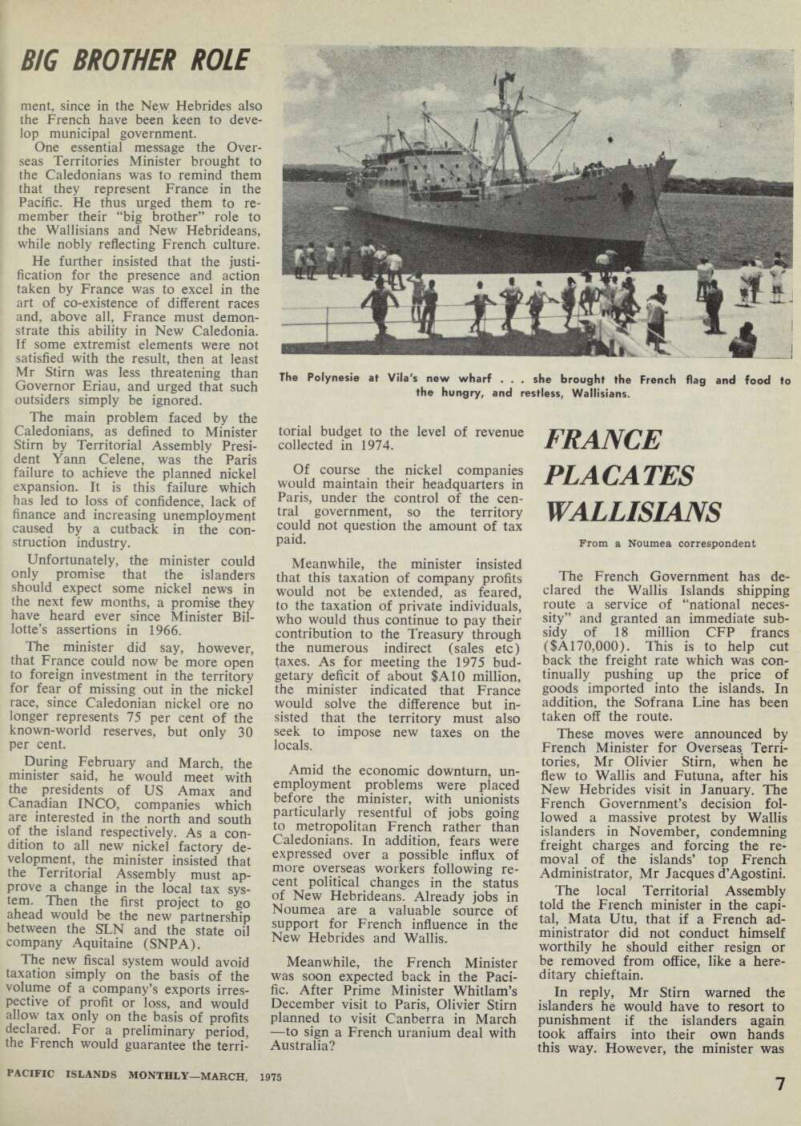
The Polynesie at Vila's new wharf . . . she brought the French flag and food to the hungry, and restless, Wallisians.
Explosive welcome in Noumea
From a Noumea correspondent
On the eve of Mr Stirn’s visit, Laroque and Lafleur’s anti-autonomist party (EDS) issued a press com munique urging the Caledonians to give a “dignified and courteous” welcome to the Minister. Were they already anticipating gelignite and wall slogans?
The day the minister held a closed working session at the Territorial Assembly (January 27) the walls of the assembly chamber were found splashed with slogans “Stirn a liar”, “Out with the French”, “Independence”, “Free Kanaka lands” and signed by the Kanaka (Canaque ) Liberation Front.
At the same time, a significant charge of gelignite had been placed on the desk of Assembly President, Yann Celene Uregei, in an obvious position, but not connected and with a clock timed nowhere near the time of the planned 2 pm meeting. A caretaker starting work around 6 am sounded the alarm and a bomb dis posal expert from the army came to take away the explosives, while the walls were hurriedly repainted.
During the afternoon closed session with the minis ter, a Union Caledonienne party leader said, “What happened last night should open the eyes of those who want to keep them closed, and confirm our warnings and our fears”—in other words, faced with a persistent refusal of autonomy, the Melanesians might take up arms and rid themselves of Europeans.
The official inquiry gave little early indication of the culprits, but suspicion fell on the various leftist
independence-seeking groups which have taken to ex tremist action over the past few years.
Underlying the fact that some people are now tired of endless talking with Paris, the bomb was thus in tended to show the minister the kind of future his policy could lead to. The gelignite was apparently stolen from the nickel mines of the SLN company at Nepoui.
Of course, the French always revel in political “entertainment of the gallery” as they say, and one could easily suspect who might suggest such a plot to the Melanesians. Certainly the authorities can make good propaganda out of such situations as it gives them another opportunity to warn local Europeans of the trouble they would face if France, her army and her gendarmes, were not there to protect them against militant Melanesians. Ironically, at the same time, Mela nesians have been constantly reminded that they need the generous hand of French rule to protect them from exploitation by a few unscrupulous Europeans.
The whole “bomb” incident highlights the perpetual French struggle between liberty and powerful protec tion. Much as they prize being litres (free), the in dividualistic French deeply enjoy a show of strength, rather than weak democracy, and are quick to summon authoritarian power as a means of enforcing restraint and protection of the individual against his freedom seeking neighbour. Hence the struggle for power, but not the desire for real local responsibility.
To Dinner In Borrowed Plumes
Miss Lestor’s first few hours in the New Hebrides were an embarrass ment to her. She had to appear at an official reception in borrowed clothes.
Her baggage, on the plane from London to Nadi, had gone astray. There was consternation when its loss was discovered. The wires hummed and the baggage was traced. It had been mislaid at Los Angeles, and was flown on to Nadi.
French High Commissioner Mr Eriau came to the rescue. He sent his private plane to Nadi to pick up the bags and fly them direct to Santo.
There was another unrehearsed incident, on the way to Santo. The engine of the car in which Miss Lestor and Mr Stirn were travelling over heated and stopped outside Santo. They transferred to a reserve vehicle, but, half-way along Boulevard Higginson the car had a tyre puncture. A third car got them to the reception without any more mishaps.
Advertisements & other items, p. 8 (1 item)
Dividing Power
6
PACIFIC ISLANDS MONTHLY—MARCH, Is#7s
Continued from p 5
Placates
France
Wallisians
From a Noumea correspondent The French Government has de clared the Wallis Islands shipping route a service of “national neces sity” and granted an immediate sub sidy of 18 million CFP francs ($A170,000). This is to help cut back the freight rate which was con tinually pushing up the price of goods imported into the islands. In addition, the Sofrana Line has been taken off the route.
These moves were announced by French Minister for Overseas Terri tories, Mr Olivier Stirn, when he flew to Wallis and Futuna, after his New Hebrides visit in January. The French Government’s decision fol lowed a massive protest by Wallis islanders in November, condemning freight charges and forcing the re moval of the islands’ top French Administrator, Mr Jacques d’Agostini.
The local Territorial Assembly told the French minister in the capi tal, Mata Utu, that if a French ad ministrator did not conduct himself worthily he should either resign or be removed from office, like a here ditary chieftain.
In reply, Mr Stira warned the islanders he would have to resort to punishment if the islanders again took affairs into their own hands this way. However, the minister was
also quoted as promising that sanc tions would be imposed on public servants who overstepped the mark and that the excessive number of public servants (250 persons) would be cut back.
Meanwhile, the protesting Walli sians have scored on two fronts: forcing both the French Adminis trator and the Sofrana shipping line out of their waters. In late January, the Polynesie from the Messageries Maritimes line, was unexpectedly dispatched beyond its usual Sydney- New Hebrides-Noumea route to take supplies to Wallis, during the minis ter’s visit. The islands had been left without a shipping service for two months, since late November.
Amid this general appeasement, Mr Stim emphasised that “Wallis is France” and toasted the health of the Kings of Wallis and Futuna. The minister also pointed out that the French of Wallis are the same as the Wallisians of France. Mr Stirn pro mised that a radio station would be set up in Wallis this year.
To further break the isolation of the 8,000 Polynesians living in the group (10,000 more have migrated to New Caledonia) the minister also announced that the UTA airlines service from Noumea to Hihifo air port would be stepped up to a weekly frequency with flights twice a week between Wallis and Futuna Islands. • Dr Earl Baker Ruth has been appointed Governor of American Samoa, succeeding Mr John M. Hay don. Dr Ruth, 58, was a North Caro lina representative in Congress from 1968 to 1974, serving on several committees. He is married and has three daughters and a son.
A triumph for Captain Pierre
One of PlM’s men, a passenger in the Polynesie, who saw the “relief” operation from a front seat, writes: Allied to France's eagerness to appease the irate Wallisians and Futunions was the seamanship of the Polynesie’s captain, Com mandant Pierre Soulie, which made the whole manoeuvre a success.
From the time he received word to take stores and passengers to Futuna and Wallis, Pierre was both seaman and diplomat, hand ling his ship and the hysterical approach of a drama-seeking Noumea newspaperman with quiet aplomb.
The Polynesie, a small ship but, so far as the islanders were con cerned, one of the biggest they'd ever seen, had to take risks. There was no pilot and, close by the bridge, I shared the skipper’s anxiety as we passed only centi metres from deadly coral teeth.
And, to berth at a 28 metre wharf was no mean feat either.
No wonder Commandant Pierre was welcomed by the whole popu lation of Futuna and feted by the island chiefs in their large French style cathedral.
He returned the compliment, entertaining Lavelua, the King of Wallis, on board Polynesie after the Wallis welcome for Mr Stirn.
After the call at Wallis, Poly nesie had to return to Futuna to land passengers from Wallis and badly-needed supplies. The shelves at the superstore had been almost
empty. They were filled and any Sydney housewife would have been envious had she seen how the goods were marked down.
Hurricane Val was around and it was impossible to berth at Futuna so rough were the seas, so we had to cruise around Fu tuna and Alofi for a couple of days until we were able to anchor offshore between Futuna and Alofi and put off the passengers in the ship’s boat.
The boat was swamped and poor old Sampson, in charge of the boat, and his two crewmates were marooned—but not forgot ten by Commandant Pierre, whose precise messages to shore by hooter and morse betrayed his anxiety for his crew, My diary told me, while we circled Futuna, that it was Aust ralia Day. Although he had so much on his mind, Pierre knew it too. He served champagne for we Aussies and the flag hung in the dining room, The night we left Futuna, we were hit by Force 10 winds and heard later that Futuna had been hit by Val.
Perhaps the biggest compliment to Commandant Soulie’s handling of the whole affair was seen in the behaviour of the journalist photographer who reported the departure from Noumea of the Polynesie to Wallis and Futuna, He gave us a friendly wave on our return although we had no dramatic stories to tell. Maybe he expected a “bloody” report!
Mission Schools Take-Over In Geic
Free, compulsory education for children six to 12, is planned in a number of major changes in the education policy of the Gilbert and Ellice Islands Colony. The new policy may also involve island sec ondary schools catering for children over 13, and full-time technical courses at Tarawa.
The new policy will not be put into effect till the Minister of Edu cation, Training and Culture, Mr Roniti Teiwaki, knows the public reaction to a number of reports on education.
A national system of primary education was recommended under which government, island council and mission schools would be directly administered by the Educa
tion Ministry. Mission school build ings would be transferred on com pensation or leased. There would be safeguards for the teaching, and teachers, of denominational doctrine.
Private (unaided and independent) schools would be registered and supervised by the Education Ministry.
Primary education has been largely in the hands of mission or volunteer agency schools, some of which were subsidised by the government. There are more than 200 of these schools.
At the secondary schools, for children over 13, teaching would be centred on island life and local de velopment. The present classes 7, 8 and 9, would be absorbed into the new schools. As a first step, one island secondary school would be
established as a pilot project.
Secondary education has been concentrated at the King George V School and the Elaine Bemacchi Secondary School, two run by the Catholic Mission, and one by the Congregational Church.
The development of a Form VI for the King George V and Elaine Bemacchi Schools will be examined.
Steps will be taken to integrate the mission junior secondary schools in to a national system of secondary education.
Under the new policy the Tarawa Technical Institute will offer full time courses in technical and com mercial education for post-secondary training, as well as continuing in service training on as wide a basis as possible. Evening classes under the umbrella of the institute will be held at Betio, Bairiki and Bikenibeu.
Val, the Lauans' unwelcome guest
Lauans' unwelcome guest
Hurricane Val, which passed through the east and south of Fiji on January 31 and February 1, was more intense than Hurricane Bebe of October, 1972 but it did not leave a comparable trail of destruction.
Val hit a number of the Lau islands, Moala, Totoya and Matuku, and edged past Kadavu before spending itself somewhere on the way to Nor folk Island. Bebe, by contrast, de vastated the Ellice Islands on the way south, and then on hitting Fiji, followed the classical hurricane trail down the Wainibuka Valley to cause a lot of damage to Viti Levu.
Villagers in Lau were Val’s chief victims, many of them losing their homes. For them it was not a new experience, just a case of grinning and bearing it, and setting about to rebuild. Some copra plantations took a severe buffeting, and it will be several years before they are back in full production, Tubou village in Lakeba, at pre sent the holder of the Dewar Shield, symbol of district cricket supremacy in Fiji, seemed to suffer the most damage from Val, with gusts esti mated at 120 knots. The Fiji Deputy Prime Minister, Ratu Sir Penaia Ganilau, who was acting as Prime Minister while Ratu Sir Kamisese Mara was at EEC sugar talks in Brussels, flew to the disaster areas to discuss aid programmes.
Soon after, two government ships, the Degei and the Vuniwai, left Suva for Lau with relief supplies. They :arned rice, milk, sugar, canned meat, fresh water and tents. Carpen
ters went along with building mater ials to repair damaged buildings and help provide some temporary shelter for those who lost their homes.
The rest of Fiji, with memories of Bebe fresh in mind, battened down soon after first word of ap proaching hurricane was received. As is usual with violent “blows”, there were strong winds and heavy rain many miles away from the centre of the hurricane capable of doing a lot of damage. There was some tempo rary interruption of power supplies and a few telephone services were cut. There was little damage in Suva —there were some cases of trees falling on to houses and across parked cars.
Nadi airport remained open throughout the storm. One inter national flight overflew the airport, otherwise flights were practically normal. High winds at Nausori air port, near Suva, led to a cancellation of Air Pacific flights. Fiji Air Ser vices cancelled some services to Levuka because of strong cross winds.
Fortunately Val was not like
Lottie of December 10, 1973, which claimed more than 80 lives when two ships—the 212-ton Uluilakeba and Makogai sank in southern Lau Doll . Tl . to C OSt $250 000 eXPeC ‘ e<l to cost 5250,000.
One of the first benefits for Fiji of associate membership with the European Common Market could be hurricane relief. Although Fiji is not yet formally associated with the EEC, EEC headquarters in Brussels is be lieved to have indicated an ap- Pioach for help will be sympathetic ally considered. Two types of EEC help are available—one is direct disaster relief from the European Development Fund and the other is a to cover copra production losses caused b y the hurricane, • , , ... 5 ! • s , ™bo . v t sit ® d the ?°3 h Pacific in 1974 said the EEC had a . d, ? a . ste L r fllnd for associate cou P tnes l hlt by such catastrophes as earthc l uakes > hurricanes and drought.
Though hurricane Val kept clear of Western Samoa, she created a bad-weather zone in the area and strong winds and floods wreaked havoc in Apia and some of the villages.
Severe damage by flooding to Aggie Grey’s Hotel and other pro perty is expected to run into many thousands of dollars. Gale-force winds uprooted coconut and other trees and scores of people lost their homes. The Vaisigano and Vaimoso rivers in the Apia area burst their banks, flooding large tracts of land, and at Leone, houses, trees and a large section of the river bank were washed away.
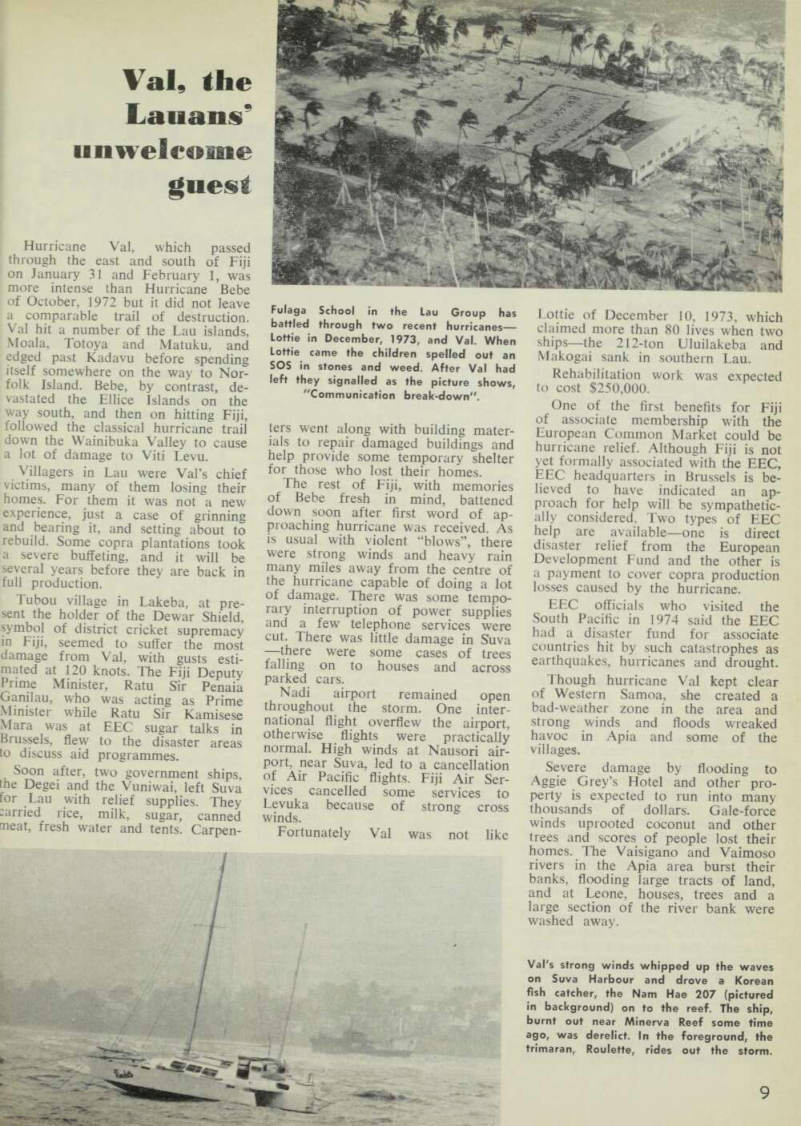
Fulaga School in the Lau Group has battled through two recent hurricanes— Lottie in December, 1973, and Val. When Lottie came the children spelled out an SOS in stones and weed. After Val had left they signalled as the picture shows, "Communication break-down".
Val's strong winds whipped up the waves on Suva Harbour and drove a Korean fish catcher, the Nam Hae 207 (pictured in background) on to the reef. The ship, burnt out near Minerva Reef some time ago, was derelict. In the foreground, the trimaran, Roulette, rides out the storm.
Papua home-rulers
A noisy time for the Papua home-rulers
From correspondents in Port Moresby
Commentators who wrote about Panin New Guinea affairs a few years' ago always made a point of callins the country Niugini. It was their way of demonstrating that the Papuans to the south and the New Guineans to the north were brothers nnH cictprc under the skin divided only by a worthless line which unfashionable white colonialists had drawn nn the man drawn on the map.
A few diehards still talk about Niugini, and the country s national airline, Air Niugini, manages to carry the label with some authority But today the problem of creating a single national name would appear to have become secondary to the problem of creating a single national country.
The point is that it doesn’t matter how much the white man is to blame for a line on the map—he can’t make subconscious atonement today simply by pretending that the line is meaningless.
The border has become part of history, it has superimposed its own differing patterns on its two sides, and in any event certain cultural and ethnic differences do in fact exist between Papuans on one side and New Guineans on the other.
Papua, population about one million, has been an Australian territorial possession since the turn of the century. New Guinea, population about two million, was formerly a German territorial possession and has been administered by Australia under trust since 1921.
Legally the differing status still exists, but the long-standing plan has been for the emergence of a single unified nation at independence. Unity at independence is the official policy of the legal Government of Papua New Guinea, a government drawn from both sides of the border.
Australia supports this policy. So does the United Nations.
But now, in the dying hours of
political dependence, a vocal group of Papuan activists has established what it calls the first interim govern ment of Papua.
The r6 p el govern^ en i d g^ dent proclaim Papua as an republic free from w a G d u a Ji ’ head says it will do so on a date ahead of the official J^F^New 6 Guinea the combined Papua New Guinea, expected this year.
Its political weapons are a moun tain £ legal argument to indicate p s is an ent ity a nd cannot bg forced into union with any other country unless the people decide otherwise by referendum. Its argu based he avily on cultura i differenceS; and on economic dif ferences which it daims Australia created between the Papuans and the ew Guineans, xh e re bel republic has a flag—six stars j n an arc? a cross, a bird of para dise and the word “Papua” in ver tical lettering. It has an anthem too—the song “Papua”, which a Hanuabadan villager wrote in 1936 on t h e occasion of a missionary cele bration. The flag and the song have j n f ad been used for some time by one G f t b e activist groups, the Papua Besena.
And there has also emerged an “ a rmy”—a barefoot brigade which par ades with sticks for rifles and which in January took possession of a white-owned plantation, The movement also has its ex tremist mouthpieces, men who are trying to intimidate whites and New Guineans living in Papua, and who are P romising bloodshed, commando warfare and guerilla tactics, The Papua republican movement j s an amalgamation of five main groups; who call themselves the “first interim government of Papua”. • The strongest and longest established is Miss Josephine Abaijah’s Papua Besena. Miss Abaijah, PNG’s only woman member
of the House of Assembly, has ; rallied, protested, demonstrated, cam- ■ paigned and cajoled with machine- like efficiency. Her home in the Port i Moresby suburb of Hohola flies the i Papua flag and she claims tacit sup- port, or potential support, from welll over half the population of Papua. • The other major partner in thei republic movement is Mr Simon i Kaumi’s Eriwo Development Asso ciation and its so-called military wing,< the Papua Republic Fighters Army..
Mr Kaumi, a gentlemanly, balding' senior civil servant and a contempo rary of several of PNG’s political! leaders, went overboard on thes separation movement last year and is now under public service suspensiom for his anti-government stand. Ho hints at a ready supply of weapons and equipment for his “army”, butj so far there is little evidence oh supply channels to support his claims* Mr Kaumi’s base is in Northern!
Papua where he was born and he claims strong support there, all though local politicians deny hisi claims. He is at present attempting to establish branches of his movemenr in about six other Papuan centres. • Three smaller groups make ujr : the other factions in the republic movement. They are the Papua Black Power Movement led by its governn nor, Mr Leo Kavaua, the Papuan Liberation Movement led by its pres* dent, Mr James Mopio, and thr Socialist Workers’ Party led by itti president. Mr Luki Oiwaya.
All three organisations are ven much a product of urban Poik Moresby, with the Black Power anr Socialist groups taking up extremis! minority positions.
Mr Kavaua in January proclaimea his own state of national emergency; telling whites and New Guineans tt get out of Papua or face the conse< quences.
And on February 5, Mr Kaunri
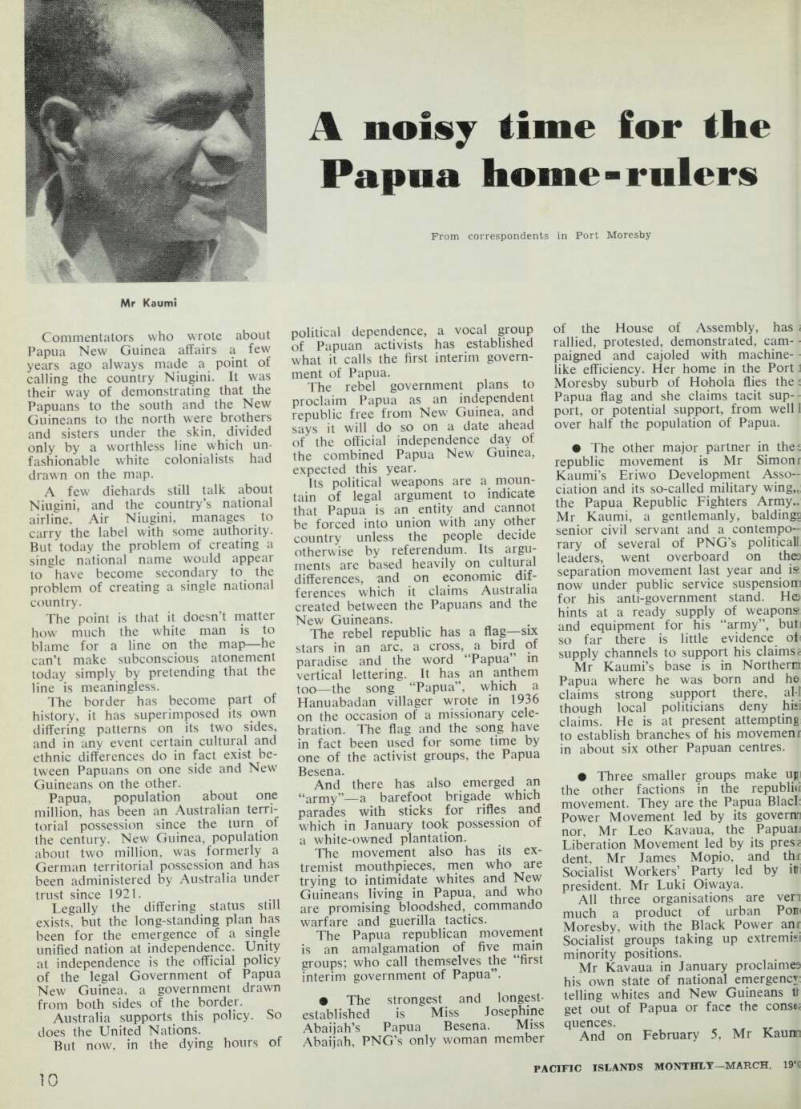
Mr Kaumi
and Miss Abaijah issued a joint state ment announcing Mr Kaumi’s nomi nation as “President” of the so-called Government of the Republic of Papua, when it comes. The statement also attacked Australian Prime Minister Gough Whitlam for having recently criticised the breakaway movement, and said Mr Whitlam’s attitude “made the future of Aus tralians and their property in Papua very gloomy indeed”.
The statement said that Papua and Papuan land were for the Papuan people only and that the new republic vould free Papua “from black and vhite colonialism”. It described both :hief Minister Michael Somare and he Leader of the Opposition, Mr fei Abal (both New Guineans) as colonialists”.
Mr Somare during the month •randed the activities of Mr Kaumi nd Miss Abaijah as “disloyal”, and aid Mr Kaumi’s “army” was an ttempt by “a small group of frus rated and manipulated people to stir isunity among the Papua New minean people”. He said stories of
the “army”, particularly in the Aus tralian press, had been blown up out of all proportion.
The Chief Minister also replied to the Black Power statement threaten ing expulsion of New Guineans and whites. “All good citizens will be protected against ratbags and irre sponsible fools,” he said. The gov ernment would take a firm stand against lawlessness or attempts at in timidation by “troublemakers” such as Mr Kavaua.
The position in mid-February is that despite talks of rebels, armies, secret weapon supplies, guerilla war fare, bloodshed, and unilateral inde pendence there is far more talk than action.
Miss Abaijah’s gool old-fashioned campaigning with its street marches and demonstrations is still a far more potent force than quasi-military threats—although on several oc casions Miss Abaijah has conceded that bloodshed could occur. The real
Continued on p 82
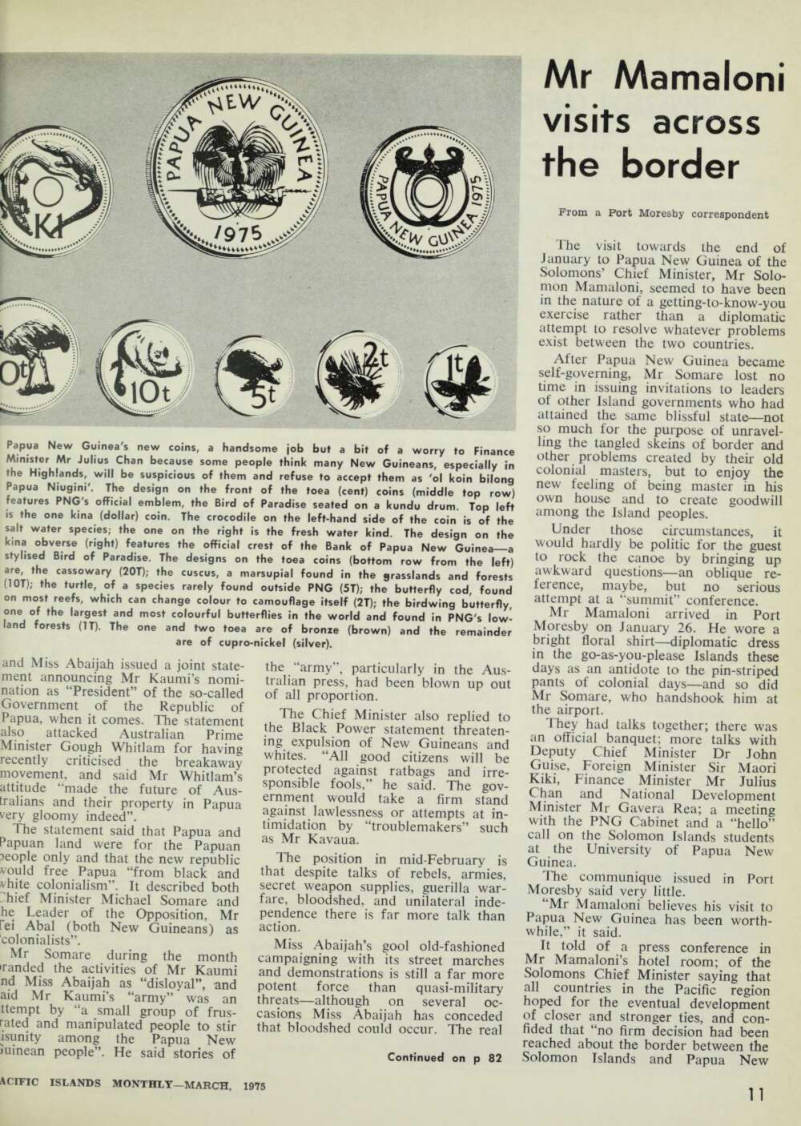
Papua New Guinea's new coins, a handsome job but a bit of a worry to Finance Minister Mr Julios Chan because some people think many New Guineans, especially in the Highlands, will be suspicious of them and refuse to accept them as 'ol koin bilong Papua Niugini'. The design on the front of the toea (cent) coins (middle top row) features PNG's official emblem, the Bird of Paradise seated on a kundu drum. Top left is the one kina (dollar) coin. The crocodile on the left-hand side of the coin is of the salt water species; the one on the right is the fresh water kind. The design on the kina obverse (right) features the official crest of the Bank of Papua New Guinea- a stylised Bird of Paradise. The designs on the toea coins (bottom row from the left) are, the cassowary (20T); the cuscus, a marsupial found in the grasslands and forests (10T); the turtle, of a species rarely found outside PNG (5T); the butterfly cod found on most reefs, which can change colour to camouflage itself (2T); the birdwing butterfly, one of the largest and most colourful butterflies in the world and found in PNG's low and forests (IT). The one and two toea are of bronze (brown) and the remainder are of cupro-nickel (silver).
danger lies in under-estimating the potential which exists for emotional support.
It’s safe to say that a real appreci ation of the Papua versus Papua New Guinea issue simply doesn’t exist in the average rural village. Political ignorance is still extensive. But the desire to join in with an emotional issue with a bit of action is ever present.
The evidence suggests that Mr Somare was unable to get all his Papuan ministers to sign a Papuan unity pledge for public circulation.
This doesn’t mean that some of his Papuan ministers oppose unity, or are on the rebel side. But it does suggest that they don’t want to upset their electors on a delicate issue.
Miss Abaijah has claimed that about 40 leading public servants have signed support for Papuan indepen dence aims.
Simon Kaumi’s “army” consists of about 160 ex-policemen, some mal contents, and villagers looking for a bit of excitement. It’s no trained or disciplined force, but a political activist group. Mr Kaumi says it has general support of the local people in the Popondetta area of Panua where it is operating, but Mr Edric Eupu, th chairman of the Northern District Area Authority, which is a form of regional government co ordinating the work of local councils in the area, denies this.
There is also some disagreement as to whether the army really has
emerged from the Eriwo Develop ment Association, which is an organi sation of Papuan nationalists opposed to anybody but Papuans in Papua.
Some association members condemn the so-called army.
The plantation which the activists took over is Jiropa, between Popon detta and Buna, owned by Gilbert Renton, 54, a blinded ex-serviceman who is well known. He moved from the plantation more than a year ago because of harassment by Papuans in the area and ekes out an existence running a trade store at Girua air port, about 20 miles from the pro perty. He was thus not on the pro perty when the activists moved in and squatted. Mr Renton’s wife was killed in a car accident in 1973.
He had already been negotiating with the government to sell the pro perty, but the offer received, about $12,000, was too low. Mr Renton owes more than this to the bank which financed him, according to a PNG Government statement, and the government is considering paying the amount direct to the bank, acquiring the plantation and selling it to Mr Kaumi’s followers.
White land holders throughout PNG are following these develop ments closely.
Mr Kaumi has said he wants to develop the plantation as a tourist resort.
Mr Kaumi, the man behind it all, has been a public servant for more than 20 years. Up until his recent rise to notoriety his main energies seemed to go into his steady rise through public service ranks. He became PNG’s Chief Electoral Officer and then Secretary of the Department of the Interior—which put him in the top bracket of the public service. His gentle politeness was renowned.
The first public indication of change came in the middle of last year when Mr Kaumi clashed with his minister, Mr John Poe.
But fellow-workers say now that a change in Mr Kaumi’s outlook and personality began more than 18 months earlier during the time he organised the relief appeal for a famine in the PNG Highlands.
They said he became touchy and frus trated in a manner most unlike him self.
The clash with Mr Poe was smoothed over quickly. But soon afterwards Mr Kaumi became in volved in matters which went far deeper than day-to-day criticism of government policies.
He became a “Papuan supreme”, with increasing intolerance towards New Guineans in power or Aus tralians. His participation in a rally which called for the downfall of the government, by force if necessary, led
to his suspension from the public service.
Until the end of January he was still being paid as a public servant, but now his pay has been stopped, he has been moved from head-of department status to a subordinate position in the Department of Chief Minister, and he has been recharged with disciplinary charges of disgrace ful and improper conduct related to his more recent activities.
Meanwhile Mr Tony Voutas, former member of the House of Assembly, adviser to the Chief Minister and one of the strongest white influences in the emergence of Mr Somare’s Pangu Party, believes the political future for PNG is “quite heartening”.
Mr Voutas has decided to leave PNG after 14 years because he says the day of the white liberal fighting PNG causes in PNG is over. He said in a farewell radio interview in February that although there might be a lot of noise it was not likely there would be counter-insurgency in PNG because this was “just not an acceptable way of gaining power in this country”.
The country’s resources were rich and there did not seem to be a ten dency towards violence in the com munity. The basic problem facing the central government was establish ment of its own legitimacy in the eyes of the rank and file. The villagers did not understand the rules of the political game.
the border
Mr Mamaloni visits across the border
From a Port Moresby correspondent The visit towards the end of January to Papua New Guinea of the Solomons’ Chief Minister, Mr Solo mon Mamaloni, seemed to have been in the nature of a getting-to-know-you exercise rather than a diplomatic attempt to resolve whatever problems exist between the two countries.
After Papua New Guinea became self-governing, Mr Somare lost no time in issuing invitations to leaders of other Island governments who had attained the same blissful state—not so much for the purpose of unravel ling the tangled skeins of border and other problems created by their old colonial masters, but to enjoy the new feeling of being master in his own house and to create goodwill among the Island peoples.
Under those circumstances, it would hardly be politic for the guest to rock the canoe by bringing up awkward questions—an oblique re ference, maybe, but no serious attempt at a “summit” conference.
Mr Mamaloni arrived in Port Moresby on January 26. He wore a bright floral shirt—diplomatic dress in the go-as-you-please Islands these days as an antidote to the pin-striped pants of colonial days—and so did Mr Somare, who handshook him at the airport.
They had talks together; there was an official banquet; more talks with Deputy Chief Minister Dr John Guise, Foreign Minister Sir Maori Kiki, Finance Minister Mr Julius Chan and National Development Minister Mr Gavera Rea; a meeting with the PNG Cabinet and a “hello” call on the Solomon Islands students at the University of Papua New Guinea.
The communique issued in Port Moresby said very little.
“Mr Mamaloni believes his visit to Papua New Guinea has been worth while,” it said.
It told of a press conference in Mr Mamaloni’s hotel room; of the Solomons Chief Minister saying that all countries in the Pacific region hoped for the eventual development of closer and stronger ties, and con fided that “no firm decision had been reached about the border between the Solomon Islands and Papua New
Guinea”, which was what everyone had wanted to know about. (PIM, Feb, p 7).
Mr Mamaloni completed his tour by visiting other PNG centres and then left for Hong Kong.
Gus Smales reported from Port Moresby: Papua New Guinea and the British Solomon Islands should establish diplomatic offices in each other’s country, Mr Mamaloni said in Port Moresby.
He also suggested that customs duties could be eased between the two countries.
Mr Mamaloni was commenting on the result of talks he held with Mr Somare and Foreign Minister Sir Maori Kiki.
Mr Mamaloni said that because of PNG’s greater wealth and greater size close relations between the two countries could lead to accusations that the Solomon Islands was inter ested only in selfish gains.
This was not so, however, as he believed that the Island countries of the Pacific had much to contribute to each other despite disparities in size.
He did not comment on the border which separates Papua New Guinea from the Solomons in a narrow strait between the Shortland Islands and Bougainville Island.
There have been some complaints from islanders living in the border area that they resent having to go through international border-crossing procedures merely to meet other islanders who are tribally linked to them.
By and large, however, the border between Papua New Guinea and the Solomons has always been one of the least-contentious of Papua New Guinea’s international boundaries.
The others are with Indonesia and Australia. Indonesian border arrange ments have been formalised after several years of problems, but legal arguments still exist over the Torres Strait border with Australia.
The talks with the Cabinet are ex pected to make tentative arrange ments for some form of diplomatic representation between the two coun tries and for greater recognition of the links existing between islanders in the border area.
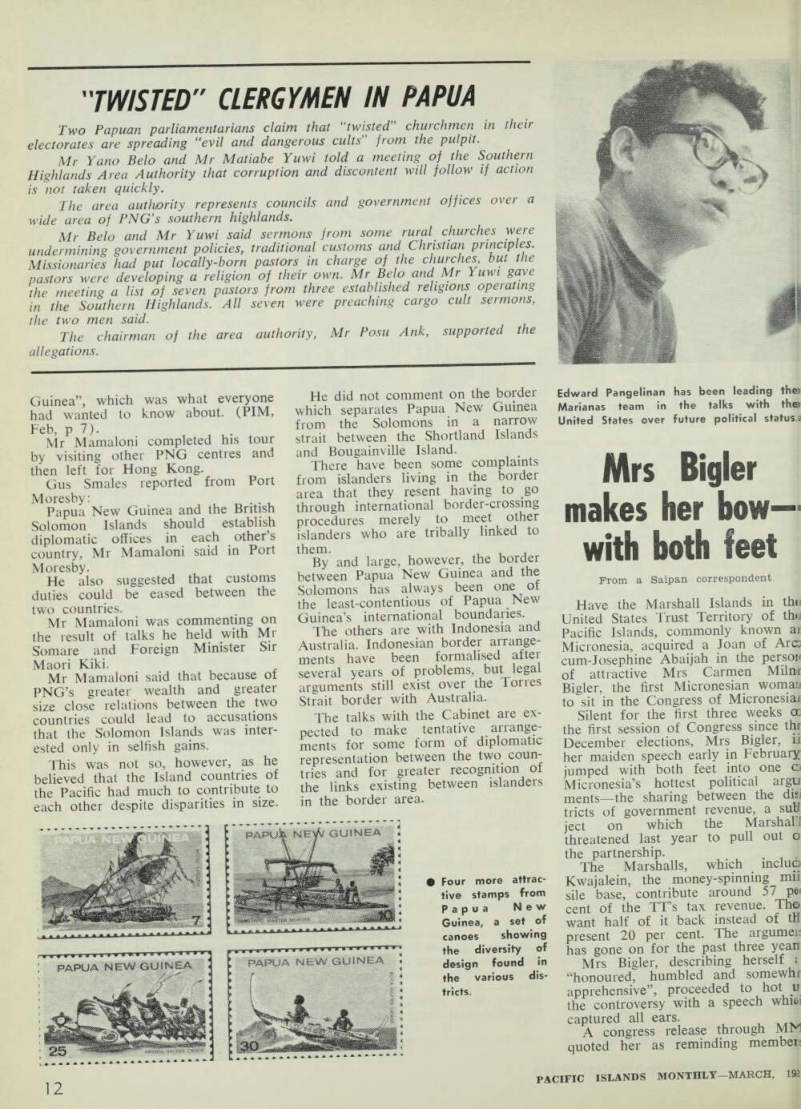
Four more attrac tive stamps from Papua New Guinea, a set of canoes showing the diversity of design found in the various dis tricts.
Advertisements & other items, p. 13 (1 item)
11
ACIFIC ISLANDS MONTHLY—MARCH. 1975
"Twisted" Clergymen In Papua
Two Papuan parliamentarians claim that “twisted” churchmen in their electorates are spreading “evil and dangerous cults ” from the pulpit.
Mr Yano Belo and Mr Matiabe Yuwi told a meeting of the Southern Highlands Area Authority that corruption and discontent will follow if action is not taken quickly.
The area authority represents councils and government offices over a wide area of PNG’s southern highlands.
Mr Belo and Mr Yuwi said sermons from some rural churches were undermining government policies, traditional customs and Christian principles.
Missionaries had put locally-born pastors in charge of the churches, but the pastors were developing a religion of their own. Mr Belo and Mr Yuwi gave the meeting a list of seven pastors from three established religions operating in the Southern Highlands. All seven were preaching cargo cult sermons, the two men said.
The chairman of the area authority, Mr Posu Ank, supported the allegations.
Mrs Bigler
makes her bow— with both feet
From a Saipan correspondent Have the Marshall Islands in thn United States Trust Territory of th« Pacific Islands, commonly known a* Micronesia, acquired a Joan of Area cum-Josephine Abaijah in the person of attractive Mrs Carmen Milnr Bigler, the first Micronesian woman to sit in the Congress of Micronesia* Silent for the first three weeks oc the first session of Congress since thr December elections, Mrs Bigler, Li her maiden speech early in February jumped with both feet into one o Micronesia’s hottest political argu ments —the sharing between the disi tricts of government revenue, a sub ject on which the Marshall! threatened last year to pull out o
the partnership. . .
The Marshalls, which mclub
Kwajalein, the money-spinning mu
sile base, contribute around 57 pe< cent of the TTs tax revenue. Tho want half of it back instead of m present 20 per cent. The argumei; has gone on for the past three yean, Mrs Bigler, describing herself j “honoured, humbled and somewhr apprehensive”, proceeded to hot u the controversy with a speech whioi captured all ears. A congress release through MM quoted her as reminding member;
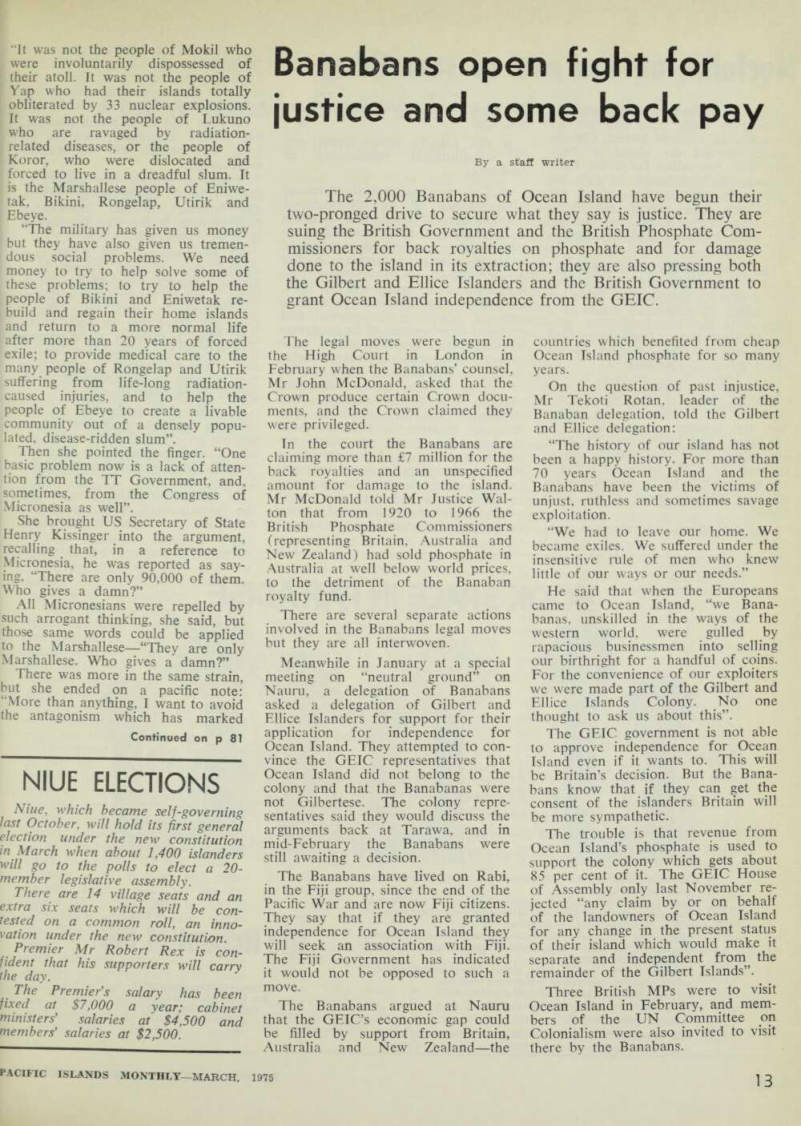
Edward Pangelinan has been leading the Marianas team in the talks with tho United States over future political status.
I “It was not the people of Mokil who were involuntarily dispossessed of their atoll. It was not the people of Yap who had their islands totally obliterated by 33 nuclear explosions.
It was not the people of Lukuno who are ravaged by radiation related diseases, or the people of Koror, who were dislocated and forced to live in a dreadful slum. It ; is the Marshallese people of Eniwe tak, Bikini, Rongelap, Utirik and Ebeye.
“The military has given us money but they have also given us tremen dous social problems. We need money to try to help solve some of these problems; to try to help the people of Bikini and Eniwetak re build and regain their home islands and return to a more normal life after more than 20 years of forced exile; to provide medical care to the many people of Rongelap and Utirik suffering from life-long radiation caused injuries, and to help the people of Ebeye to create a livable community out of a densely popu lated, disease-ridden slum”.
Then she pointed the finger. “One basic problem now is a lack of atten tion from the IT Government, and, sometimes, from the Congress of Micronesia as well”.
She brought US Secretary of State Henry Kissinger into the argument, recalling that, in a reference to Micronesia, he was reported as say ing, “There are only 90,000 of them.
Who gives a damn?”
All Micronesians were repelled by such arrogant thinking, she said, but those same words could be applied to the Marshallese—“They are only Marshallese. Who gives a damn?”
There was more in the same strain, but she ended on a pacific note: “More than anything, I want to avoid the antagonism which has marked
Continued on p 81
debate on this issue in the past, an tagonism which is driving a wedge between us and striking a mortal blow to the dream of a united Micronesia. Let us reason together and solve this problem in the spirit of harmony and goodwill”.
There were other bitter speeches railing at the niggardliness of the United States and Japan over Micro nesian war claims.
Truk Congressman Lambert Aafin and Marianas representative Herman R. Guerrero called on the two powers to compensate Micronesians fully for war damage.
Aafin described as “deplorable and shocking”, the War Claims Com mission’s policy of awarding only 16 per cent of the amount of an agreed claim.
At the same time, Mr Guerrero declared, “The United States and the Government of Japan appear to be ready to wash their hands of their international legal and moral res ponsibilities”.
One contentious bone the Congress got rid of was the question of the credentials of three new members vhose election had been challenged m the grounds that there had been rregularities and breaches of the electoral laws.
The Credentials Committee had ecommended the seating of two of he members and the rejection of he third, but Congress overruled the eommittee in a secret ballot and ap jroved the seating of all three— Bdgar Edwards, of Ponape, Chiro Mbert, of Truk, and Lambert Aafin, ITuk.
The committee had rejected Aafin md urged the High Commissioner to ‘all a special election and asked Congress to direct the Attorney jeneral to investigate Aafin’s elec ion for possible criminal prosecution
of the government officials con cerned.
The recommendations fell on deaf ears. When Aafin took his seat on a 9-8 vote he said, “I have always held the belief that the free, open and outward expression of the mind is the most beautiful attribute in all God’s creation”.
The Congress session’s dramatics tended to overshadow the much big ger issues of the future status talks between the United States and the Micronesians, but the talks came to the fore again with the arrival at Sai pan of US Ambassador Franklin Haydn Williams for the resumption of talks with the Marianas Political Status Commission.
This could be the end of the road for the Marianas, who want a com monwealth of their own in political union with America. All that re mained to be done, so far as the talks were concerned, was the review of the final wording of the docu ments and the signing of the joint agreement. This was accomplished on February 15.
There could be a hitch, however.
Several congressmen have argued that the referendum through which the Marianas people will be asked for their final views on future asso ciation with the United States, should embrace all Micronesians, the point being that the Marianas shouldn’t be allowed to opt out of the “consortium” without the blessing of the remainder—the Marshalls and the Carolines.
Chairman of the Marianas Poli tical Status Commission ex-Senator Edward Pangelinan, who lost his seat in the Congress in the last elections, has been reappointed a member of the Status Commission by Saipan’s Mayor Vicente D. Sablan, taking the seat vacated by Senator Olympic T.
Borja, who resigned because of other pressing duties.
Presumably, Mr Pangelinan, who has been concerned with the nego
tiations from the beginning, will con tinue as commission chairman.
Meanwhile, there are no signs that resumption is pending of the talks between the Congress of Micronesia’s Joint Committee on Future Status and the United States. The Micro nesians suspended the talks in pro test at America’s action in returning land to the various districts by executive order instead of through an agreement with Congress.
However, High Commissioner Edward E. Johnston might have cleared the air a little. In late Janu ary he explained that, so far as “so called military retention areas” were concerned, there were no such lands in Palau, Yap, Truk, Ponape or the Marshalls, and all the remaining “military retention” land in the Marianas would be returned to the Marianas. This would complete the return of all such lands throughout Micronesia held by the United States under agreement executed almost 30 years ago.
Around the same time, Congress Speaker Bethwel Henry referred to Senator Salii’s statement that the talks might be stopped because of America’s action in issuing an executive order for the return of lands, and said the matter was still being studied by the joint committee, which had made no decision.
Niue Elections
Niue, which became self-governing last October, will hold its first general election under the new constitution in March when about 1,400 islanders will go to the polls to elect a 20member legislative assembly.
There are 14 village seats and an extra six seats which will be con tested on a common roll, an inno vation under the new constitution.
Premier Mr Robert Rex is con fident that his supporters will carry the day.
The Premier's salary has been fixed at $7,000 a year; cabinet ministers' salaries at $4,500 and members' salaries at $2,500.
Banabans open fight for justice
justice and some back pay
By a staff writer
The 2,000 Banabans of Ocean Island have begun their two-pronged drive to secure what they say is justice. They are suing the British Government and the British Phosphate Com missioners for back royalties on phosphate and for damage done to the island in its extraction; they are also pressing both the Gilbert and Ellice Islanders and the British Government to grant Ocean Island independence from the GEIC.
The legal moves were begun in the High Court in London in February when the Banabans’ counsel, Mr John McDonald, asked that the Crown produce certain Crown docu ments, and the Crown claimed they were privileged.
In the court the Banabans are claiming more than £7 million for the back royalties and an unspecified amount for damage to the island.
Mr McDonald told Mr Justice Wal ton that from 1920 to 1966 the British Phosphate Commissioners (representing Britain. Australia and New Zealand) had sold phosphate in Australia at well below world prices, to the detriment of the Banaban royalty fund.
There are several separate actions involved in the Banabans legal moves but they are all interwoven.
Meanwhile in January at a special meeting on “neutral ground” on Nauru, a delegation of Banabans asked a delegation of Gilbert and Ellice Islanders for support for their application for independence for Ocean Island. They attempted to con vince the GEIC representatives that Ocean Island did not belong to the colony and that the Banabanas were not Gilbertese. The colony repre sentatives said they would discuss the arguments back at Tarawa, and in mid-February the Banabans were still awaiting a decision.
The Banabans have lived on Rabi, in the Fiji group, since the end of the Pacific War and are now Fiji citizens.
They say that if they are granted independence for Ocean Island they will seek an association with Fiji.
The Fiji Government has indicated it would not be opposed to such a move.
The Banabans argued at Nauru that the GEIC’s economic gap could be filled by support from Britain, Australia and New Zealand—the
countries which benefited from cheap Ocean Island phosphate for so many years.
On the question of past injustice, Mr Tekoti Rotan, leader of the Banaban delegation, told the Gilbert and Ellice delegation: “The history of our island has not been a happy history. For more than 70 years Ocean Island and the Banabans have been the victims of unjust, ruthless and sometimes savage exploitation.
“We had to leave our home. We became exiles. We suffered under the insensitive rule of men who knew little of our ways or our needs.”
He said that when the Europeans came to Ocean Island, “we Bana banas, unskilled in the ways of the western world, were gulled by rapacious businessmen into selling our birthright for a handful of coins.
For the convenience of our exploiters we were made part of the Gilbert and Ellice Islands Colony. No one thought to ask us about this”.
The GEIC government is not able to approve independence for Ocean Island even if it wants to. This will be Britain’s decision. But the Bana bans know that if they can get the consent of the islanders Britain will be more sympathetic.
The trouble is that revenue from Ocean Island’s phosphate is used to support the colony which gets about 85 per cent of it. The GEIC House of Assembly only last November re jected “any claim by or on behalf of the landowners of Ocean Island for any change in the present status of their island which would make it separate and independent from the remainder of the Gilbert Islands”.
Three British MBs were to visit Ocean Island in February, and mem bers of the UN Committee on Colonialism were also invited to visit there by the Banabans.
Advertisements & other items, p. 15 (1 item)
13
ACIFIC ISLANDS MONTHLY—MARCH, 1975
Norfolk—on the eve of something
The Australian Government is planning to settle once and for all the status of Norfolk Island. Quietly looking around the island in February was Australian Judge Sir John Nimmo, ex-Chief Justice of Fiji; his mission, to prepare the ground for an inquiry into almost everything pertaining to the island, its relationship with Australia and its inhabitants’ welfare.
The news that the government had decided on an inquiry, which may take a year to complete, so wide are the terms of reference, came as a surprise to the islanders. They only heard about it on January 31, the day before Sjr John landed on the island for a 10-day tour.
The announcement came from Canberra, Minister for the Capital Territory Mr Gordon Bryant saying that the government considered it was timely and appropriate for open discussion about the island’s future.
It would be in the islanders’ interests for the inquiry to be conducted by such an eminent jurist as Sir John Nimmo.
The full terms of reference are:
To report and make recommendations on; « • i„ n j) c flltnrp , ctatnc Us * relationship to Australia* * . . , • The most appropriate form of administration if its constitutional position were changed, and to make such report and recommendations, taking into account, the residents’ & » descend a n ts of Pitcairn 8 settlers aris- . f . . sett i ement ; n i gs6*
Present and
y bab] f e its economy; s.. „ nrial *L riir itv health edu- “ benefits shou)d fee pr £ vided at levels similar to those which other Australian citizens enjoy; the capacity and willingness of the island to pay through taxation to provide those services; the extent to which the island is being used to provide a base for activities (such as company taxation evasion) which are harmful to the interests of Australia or of other countries; conditions of permanent entry into the island commun-
ity; the need for adequate communi cations between the island and Australia and the rest of the world, and the need for adequate law enforcement and justice machinery”.
Sir John told the Norfolk Islander, the island’s newspaper, that his in quiry and report will be entirely independent.
“I am an entirely free agent”, he said. “I am in subjection to no one, and wouldn’t tolerate interference from anyone in the way the inquiry is to be conducted.”
Sir John stressed: “If I had con cluded that Norfolk Island is a unique country with unique prob lems, I would recommend a unique constitution. It may be different from any other that we know of to day. This I mention to emphasise that this is an independent inquiry; and I will be seeking a constitution that is going to be acceptable to the people of Norfolk Island”.
One thing is clear. It’s the first time in the history of the Pitcairn settlers on Norfolk that any real effort has been planned to regularise Norfolk Island’s position in relation to Australia.
It will provide the islanders and the “mainlanders” with material for discussion and argument for years.
Advertisements & other items, p. 16 (1 item)
the Regent of Fiji
BOOK SPACE IN PARADISE
f b The Regent of Fiji, with 300 gracious guest rooms, is paradise on the glistening Pacific shore.
Cordial, like a Fijian village, the Regent invites you to a treasure of Melanesian arts. The Steakhouse and The Terrace serve delicious food platters and a spectacular ocean-view.
What’s more, the Regent is well-mannered service: in-room phones, air conditioning, Fijian stewards, complete banquet/convention pavilion and duty free shopping.
And the Regent is sports: scuba, sailing, fishing, beachcombing, swimming, tennis and golf. All in wave-free Nadi Bay.
Book space in paradise. For the night of a lifetime.
The Regent of Fiji-20 minutes from the airport.
Paradise opens early 1975.
POST OFFICE BOX 441 • NADI, FUI • TELEPHONE 70466 • TELEX 5180 ONE OF the many WORLDS OF REGENT INTERNATIONAL HOTELS
the Regent of Fiji
NADI BAY
Sydney, Australia Sales Office No. 1 York Street, 14th floor Sydney, Australia 2000 Phone 276-469
Fiji’s most flourishing industries
The 6 oldest professioone of Fiji’s most flourishing industries
From VI JEN DR A KUMAR in Lautoka
TWO coeds from the University of the South Pacific caused a minor sensation last month when they published their findings of a survey on prostitution in Fiji, According to the girls, Miss Taina Naibavu, of Fiji, and Miss Betty Schutz, of the Gilbert and Ellice Islands Colony, the world’s oldest profession is a thriving multi-million dollar business in Fiji. They reported that pleasure seekers poured out $20,000 daily for the favours of male and female prostitutes.
The two students interviewed 250 prostitutes and wrote their report on the basis of what they learned from them. They claimed that an average female prostitute in Suva charged about $6 to $7 and averaged four customers a day. Earnings from by-products of the industry included taxi fares, room charges and liquor purchases.
The students conceded that their survey was not intended to be comprehensive. They did not expect to provide conclusive answers to the problem.
They said they came across two types of male prostitutes during the course of their study. One group was made up of men who entertained older women, mainly tourists, and charged them or ac cepted cash gifts as the Italian gigolos do. The other group com prised homosexuals who were also paid for their services.
The report drew fire from some people who questioned the stu dents’ credentials to carry out such a survey. Others expressed surprise that prostitution was so rampant in Fiji. If anything, the report gave public airing to a social problem which can no longer be hidden in the closet.
Some social workers and com munity leaders feel that the in crease Jn prostitution is linked with Fiji’s growing tourist indus try. The report reinforces this claim. It is not unusual to see male tourists driving around the country m rental cars with local girls beside them. They sometimes can be seen strolling the streets of a town arm in arm like lovers.
Prostitutes frequent guest
houses, night clubs and saloon bars on the hunt for a tourist who would be liberal with his wallet.
Many girls (local name—six to six girls) seem to be satisfied with a good time—drinks, meals and a place to spend a night—and do not always insist on money.
A second category of girls usually operates from guesthouses, motels and low-dive hotels. They are managed by pimps who feed them and give them lodgings. It is all done very discreetly. Taxi drivers often act as their “con nections” and provide a steady clientele. The girls pick up a small percentage of their earnings while the pimps usually fatten on them.
Recently, the Western Division Liquor Tribunal rejected an ap plication from a guesthouse owner at Lautoka for the renewal of his licence because of evidence of it being run as a brothel. During the hearings, a school teacher testified that he had seen school students frequenting such places in search of what “was not avail able at home”.
A third group of prostitutes is made up of sophisticated call-girls wh ose charges may run as high as $5O to $lOO. They are described as escorts” for businessmen and overseas tycoons. This business is carried on with utmost secrecy and discretion and few people know who the call-girls are. . Under Fiji’s laws, prostitution is illegal but past experience has shown that it is not easy for the police to take prostitutes to court and get convictions. Those few who do get convicted are back in bu siness after paying their fines.
While prostitution in Fiji is nowhere near on the same level as in other countries like Singa pore, Hong Kong, Japan, India and the continental countries, it is becoming alarmingly prevalent.
In time, it could become highly organised and then there will be serious cause for concern. Its side effects could be organised crime, gangland warfare and drug traf ficking.
The sad thing is that no country, including such disciplined states as Singapore, has been able to eradicate the problem.
According to the authors of the article on prostitution, which ob tained for Pacific Perspective, the journal of the South Pacific Social Sciences Association, a much wider readership than usual, there are around 30 to 40 brothels in Fiji. The new laws, unless they are already honoured in the breach, should have reduced that number greatly as most of the brothels have been masquerading under the title of guest house— which is embarrassing for the owners of innocent institutions.
The economics of the thing are impressive, if the survey result was correct.
“Prostitution meets the criteria laid down in the government’s Development Plan more fully than almost any other industry.
Let us leave aside for a moment the questions of morality and social values, and look only at the financial aspects of prostitution in the Fiji economy.
“Prostitution is a fully localised industry which gives employment to unskilled female workers for most of whom no other jobs are available. It requires no invest ment of foreign capital, yet it brings in large amounts of foreign exchange with a minimum of leakage back overseas”.
Calculating the income from the industry, the surveyors con cluded that 250 girls in brothels and ships averaged four customers each a day at an average charge of $6 to $7 with another S 3 to S 4 spent on taxis, liquor, food, etc, connected with picking up or associating with the prostitute.
That amounted to an income of $20,000 a day, or $600,000 a month. “It thus probably brings in some millions of dollars a year”, the authors reasoned.
Which could be far out, be cause ships aren’t in Fiji every day and most of the tourists who are picked up by the prostitute or her pimp are from ships in port for a day or two. Your tourist who comes in by plane, usually pn a tour company’s package deal, is invariably involved with a wife and family. He hasn’t much chance of kicking over the traces.
Advertisements & other items, p. 17 (1 item)
15
CIFIC ISLANDS MONTHLY—MARCH, 1975
The Editors' Mailbag
Egyptian-Polynesians
With regard to your comment (PIM, Jan, p 13) “Was grandad a mummy” I guess our society has to do a little public relations work on your side of the Pacific.
Let me assure you that the hiero glyphs not only exist, but can be read, and on the basis of what they said the attention of American archaeologists was directed to points on the west American coast where similar inscriptions, probably dated either 15th or 16th year of the reign of Ptolemy 111, ought to be found.
Within eight days of the publica tion of the find (Nov 21, 1974) Pro fessor George F. Carter of Texas A & M University successfully located the first inscription, carrying the predicted date of Ptolemy regnal year 16 (BC 231).
Since then five more related in scriptions have been found on the west coast of the Americas.
The Polynesian Epigraphic Society has a membership comprising quali fied graduates and professors, repre senting the fields of archaeology, astronomy, physics, geography and linguistics, all of them fields which relate to the highly-technical nature of the ancient inscriptions and calcu lations.
The West Irian caves contain the oldest-known account of Eratosthenes’ calculation of the circumference of the world, as well as much else that has aroused the interest of leading astronomers, here and overseas.
Barry Fell
(President, Polynesian
Epigraphic Society)
Arlington.
Mass, USA.
Misfits And Bums
It is pleasing to note that the nations of the South Pacific are mak ing a concerted effort to tackle the labour problems in the islands (PIM, Jan, p 77) ). However, one is a little perturbed by the fact that some Island nations continue to play hosts to a group of misfits from other societies.
It is difficult to gauge the authori ties’ decision allowing derelict ex patriates as well as beach bums to
remain in the Islands. I cannot, for the life of me, imagine any developed nation welcoming misfits from the Islands. In fact, the ones that want to get out have to stow away and, more often than not, find a cold re ception in the quarantine station of the first port of call, followed by deportation and embarrassment to the culprits and relatives in the Islands.
A few have found unofficial econ omic asylum in the two developed economies of the South Pacific— New Zealand and Australia. The ‘economic demonstration effect’ and the sheer lack of things to do (whether employed in the modern or the traditional sense) are the main causes why people migrate today, as the South Pacific Commission, the South Pacific Forum, ILO or what ever body charged with the res ponsibility of undertaking the recom mended research will find.
It seems the leaders of the Island nations—for whatever reasons —have agreed or rather been convinced that training in one’s own environment is better than training in a foreign en vironment. Again research is needed to determine the effectiveness (in terms of time and the degree of ap plicability) of the locational factor in training. The donor nations would undoubtedly favour the least cost approach.
The effectiveness of the Peace Corps and the like should also be questioned. Are these fresh university and college graduates (working with in movements instigated by leaders of super-powers primarily for per sonal glorification) making any posi tive contribution to the development of the Islands? Are the Island authorities making full use of the trained indigenes, who are more familiar with the problems of the Islands, and making sure that the trained personnel are engaged in areas they were trained for?
The money spent sending out ‘raw’ human resources to the Islands, could be better spent training in digenes to serve their own communi ties.
Viliami M. Kaihau Holani.
Haberfield, NSW.
Green Sea Turtles
Perhaps PIM readers can be of assistance in solving a mystery which has arisen during the course of my studies on green sea turtles at French Frigate Shoals (23°45’N 165°10’W), the only remaining nesting site in the Hawaiian Archipelago.
During 1974, a number of adult male and female green sea turtles were observed that had distinct “U” and “V”-shaped notches cut into the marginal plates of their upper shell.
These notches, which ranged between one and two centimetres in width, appeared to be quite old and had apparently been placed there for identification purposes. Unfortun ately, no knowledge on the history of these notches exists with the US Fish and Wildlife Service, the Hawaii State Division of Fish and Game or anyone else I have contacted.
Although tagging studies con ducted in recent years strongly sug gested that turtles nesting at French Frigate Shoals only travel within the confines of the archipelago, there is still the possibility of international migrations occurring in at least a portion of the population.
I would therefore greatly appre ciate receiving from your readers; any information on green sea turtle; research in the Pacific that involved! shell notching, regardless of long ago it may have been conducted..
No reliable information exists on the; longevity of sea turtles in the wild,, and any clues to the origin of these; notches could provide valuable in formation on the biology of the; species.
I might add that I am familian with the October, 1969 PIM article by Dr H. R. Bustard which describes the clipping of turtle shells fon identification purposes on the Great.
Barrier Reef. After examining photo-< graphs, Dr Bustard has assured me that my turtles in question are nob those marked during his previous; experiments.
George H. Balazs[?]
Jr Marine Biologist Hawaii Inst of Marine Biology, PO Box 1346, Kaneohe, Hawaii 96744.
Tropicalities
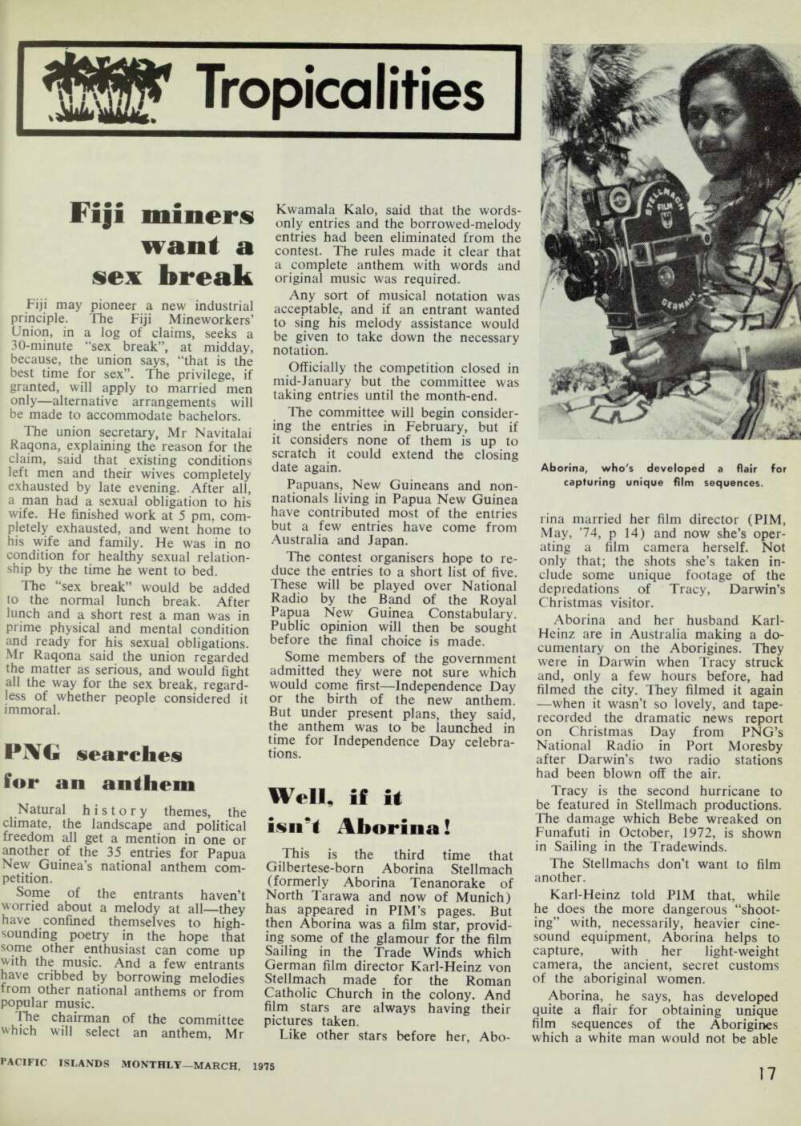
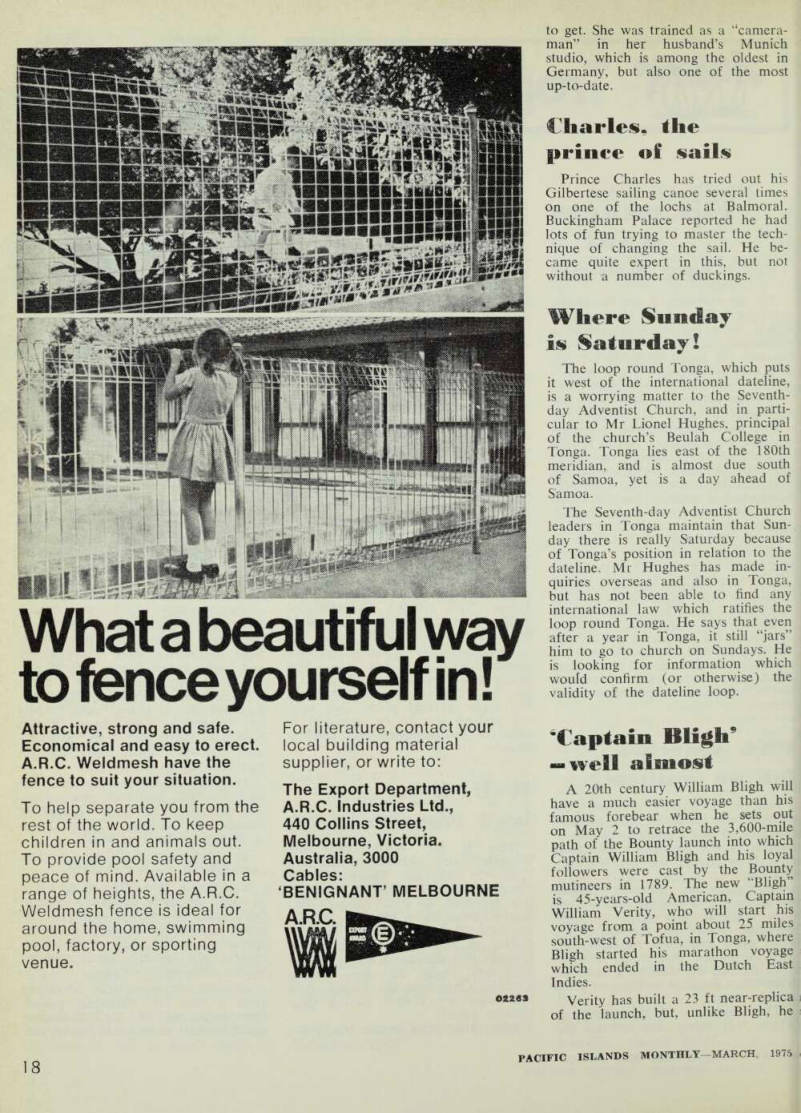
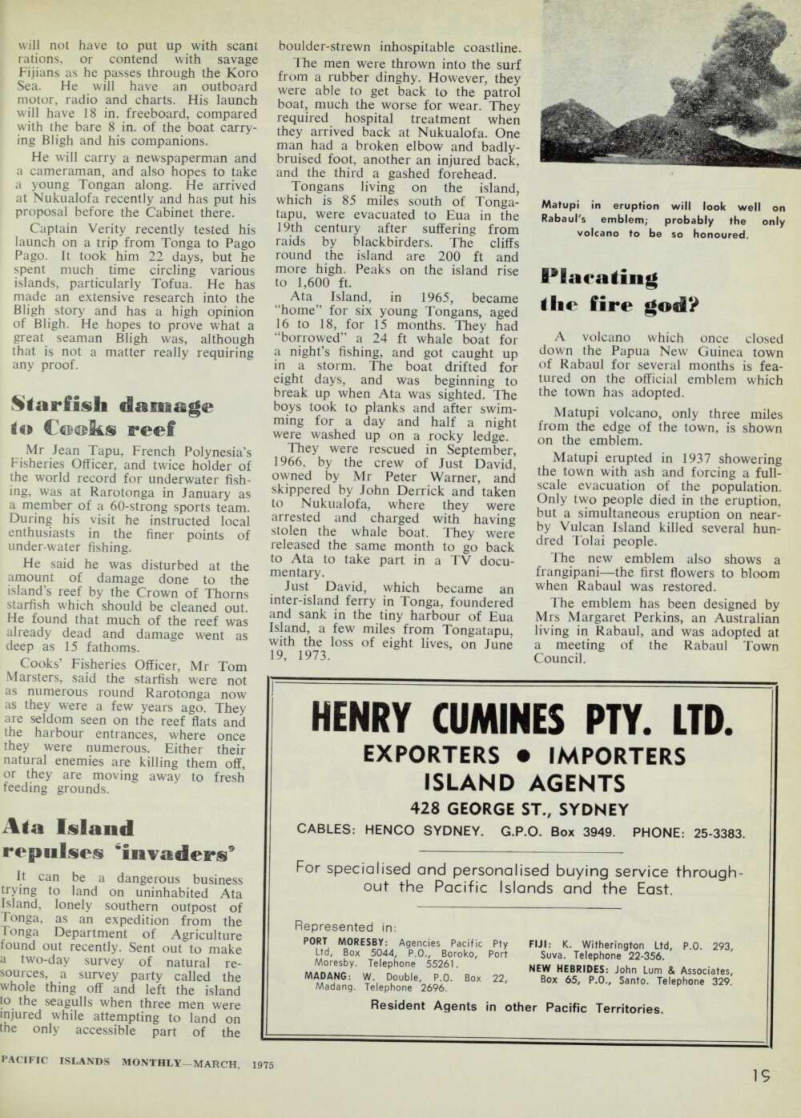
Fiji miners
want a
sex break
Fiji may pioneer a new industrial principle. The Fiji Mineworkers’
Union, in a log of claims, seeks a 30-minute “sex break”, at midday, because, the union says, “that is the best time for sex”. The privilege, if granted, will apply to married men only—alternative arrangements will be made to accommodate bachelors.
The union secretary, Mr Navitalai Raqona, explaining the reason for the claim, said that existing conditions left men and their wives completely exhausted by late evening. After all, a man had a sexual obligation to his wife. He finished work at 5 pm, com pletely exhausted, and went home to his wife and family. He was in no condition for healthy sexual relation ship by the time he went to bed.
The “sex break” would be added to the normal lunch break. After lunch and a short rest a man was in prime physical and mental condition and ready for his sexual obligations.
Mr Raqona said the union regarded the matter as serious, and would fight all the way for the sex break, regard less of whether people considered it immoral.
PXG searches
for an anthem
Natural history themes, the climate, the landscape and political freedom all get a mention in one or another of the 35 entries for Papua New Guinea’s national anthem com petition.
Some of the entrants haven’t worried about a melody at all—they have confined themselves to high sounding poetry in the hope that some other enthusiast can come up with the music. And a few entrants have cribbed by borrowing melodies from other national anthems or from popular music.
The chairman of the committee which will select an anthem, Mr
Kwamala Kalo, said that the words only entries and the borrowed-melody entries had been eliminated from the contest. The rules made it clear that a complete anthem with words and original music was required.
Any sort of musical notation was acceptable, and if an entrant wanted to sing his melody assistance would be given to take down the necessary notation.
Officially the competition closed in mid-January but the committee was taking entries until the month-end.
The committee will begin consider ing the entries in February, but if it considers none of them is up to scratch it could extend the closing date again.
Papuans, New Guineans and non nationals living in Papua New Guinea have contributed most of the entries but a few entries have come from Australia and Japan.
The contest organisers hope to re duce the entries to a short list of five.
These will be played over National Radio by the Band of the Royal Papua New Guinea Constabulary.
Public opinion will then be sought before the final choice is made.
Some members of the government admitted they were not sure which would come first—lndependence Day or the birth of the new anthem.
But under present plans, they said, the anthem was to be launched in time for Independence Day celebra tions.
Well, if it
isn't Aborina!
This is the third time that Gilbertese-born Aborina Stellmach (formerly Aborina Tenanorake of North Tarawa and now of Munich) has appeared in PlM’s pages. But then Aborina was a film star, provid ing some of the glamour for the film Sailing in the Trade Winds which German film director Karl-Heinz von Stellmach made for the Roman Catholic Church in the colony. And film stars are always having their pictures taken.
Like other stars before her, Abo-
rina married her film director (PIM, May, 74, p 14) and now she’s oper ating a film camera herself. Not only that; the shots she’s taken in clude some unique footage of the depredations of Tracy, Darwin’s Christmas visitor.
Aborina and her husband Karl- Heinz are in Australia making a do cumentary on the Aborigines. They were in Darwin when Tracy struck and, only a few hours before, had filmed the city. They filmed it again —when it wasn’t so lovely, and tape recorded the dramatic news report on Christmas Day from PNG’s National Radio in Port Moresby after Darwin’s two radio stations had been blown off the air.
Tracy is the second hurricane to be featured in Stellmach productions.
The damage which Bebe wreaked on Funafuti in October, 1972, is shown in Sailing in the Tradewinds.
The Stellmachs don’t want to film another.
Karl-Heinz told PIM that, while he does the more dangerous “shoot ing” with, necessarily, heavier cine sound equipment, Aborina helps to capture, with her light-weight camera, the ancient, secret customs of the aboriginal women.
Aborina, he says, has developed quite a flair for obtaining unique film sequences of the Aborigines which a white man would not be able
Aborina, who's developed a flair for capturing unique film sequences.
to get. She was trained as a “camera man” in her husband’s Munich studio, which is among the oldest in Germany, but also one of the most up-to-date.
Charles, the
prinee of sails
Prince Charles has tried out his Gilbertese sailing canoe several times on one of the lochs at Balmoral.
Buckingham Palace reported he had lots of fun trying to master the tech nique of changing the sail. He be came quite expert in this, but not without a number of duckings.
Where Sunday
is Saturday!
The loop round Tonga, which puts it west of the international dateline, is a worrying matter to the Seventh day Adventist Church, and in parti cular to Mr Lionel Hughes, principal of the church’s Beulah College in Tonga. Tonga lies east of the 180th meridian, and is almost due south of Samoa, yet is a day ahead of Samoa.
The Seventh-day Adventist Church leaders in Tonga maintain that Sun day there is really Saturday because of Tonga’s position in relation to the dateline. Mr Hughes has made in quiries overseas and also in Tonga, but has not been able to find any international law which ratifies the loop round Tonga. He says that even after a year in Tonga, it still “jars” him to go to church on Sundays. He is looking for information which would confirm (or otherwise) the validity of the dateline loop.
‘Captain Bligh’
well almost
A 20th century William Bligh will have a much easier voyage than his famous forebear when he sets out on May 2 to retrace the 3,600-mile path of the Bounty launch into which Captain William Bligh and his loyal followers were cast by the Bounty mutineers in 1789. The new “Bligh is 45-years-old American, Captain William Verity, who will start his voyage from a point about 25 miles south-west of Tofua, in Tonga, where Bligh started his marathon voyage which ended in the Dutch East Indies.
Verity has built a 23 ft near-replica of the launch, but, unlike Bligh, he
will not have to put up with scant rations, or contend with savage Fijians as he passes through the Koro Sea. He will have an outboard motor, radio and charts. His launch will have 18 in. freeboard, compared with the bare 8 in. of the boat carry ing Bligh and his companions.
He will carry a newspaperman and a cameraman, and also hopes to take a young Tongan along. He arrived at Nukualofa recently and has put his proposal before the Cabinet there.
Captain Verity recently tested his launch on a trip from Tonga to Pago Pago. It took him 22 days, but he spent much time circling various islands, particularly Tofua. He has made an extensive research into the Bligh story and has a high opinion of Bligh. He hopes to prove what a great seaman Bligh was, although that is not a matter really requiring any proof.
Starfish damage
to reef
Mr Jean Tapu, French Polynesia’s Fisheries Officer, and twice holder of the world record for underwater fish ing, was at Rarotonga in January as a member of a 60-strong sports team.
During his visit he instructed local enthusiasts in the finer points of under-water fishing.
He said he was disturbed at the amount of damage done to the island’s reef by the Crown of Thorns starfish which should be cleaned out.
He found that much of the reef was already dead and damage went as deep as 15 fathoms.
Cooks’ Fisheries Officer, Mr Tom Marsters, said the starfish were not as numerous round Rarotonga now as they were a few years ago. They are seldom seen on the reef flats and the harbour entrances, where once they were numerous. Either their natural enemies are killing them off, or they are moving away to fresh feeding grounds.
Ata Island
repulses ‘invaders 9
It can be a dangerous business trying to land on uninhabited Ata Island, lonely southern outpost of Tonga, as an expedition from the Tonga Department of Agriculture found out recently. Sent out to make a two-day survey of natural re sources, a survey party called the whole thing off and left the island to the seagulls when three men were injured while attempting to land on the only accessible part of the
boulder-strewn inhospitable coastline.
The men were thrown into the surf from a rubber dinghy. However, they were able to get back to the patrol boat, much the worse for wear. They required hospital treatment when they arrived back at Nukualofa. One man had a broken elbow and badly bruised foot, another an injured back, and the third a gashed forehead.
Tongans living on the island, which is 85 miles south of Tonga tapu, were evacuated to Eua in the 19th century after suffering from raids by blackbirders. The cliffs round the island are 200 ft and more high. Peaks on the island rise to 1,600 ft.
Ata Island, in 1965, became “home” for six young Tongans, aged 16 to 18, for 15 months. They had “borrowed” a 24 ft whale boat for a night’s fishing, and got caught up in a storm. The boat drifted for eight days, and was beginning to break up when Ata was sighted. The boys took to planks and after swim ming for a day and half a night were washed up on a rocky ledge.
They were rescued in September, 1966, by the crew of Just David, owned by Mr Peter Warner, and skippered by John Derrick and taken to Nukualofa, where they were arrested and charged with having stolen the whale boat. They were released the same month to go back to Ata to take part in a TV docu mentary.
Just David, which became an inter-island ferry in Tonga, foundered and sank in the tiny harbour of Eua Island, a few miles from Tongatapu, with the loss of eight lives, on June 19, 1973.
Placating
Hie fire god?
A volcano which once closed down the Papua New Guinea town of Rabaul for several months is fea tured on the official emblem which the town has adopted.
Matupi volcano, only three miles from the edge of the town, is shown on the emblem.
Matupi erupted in 1937 showering the town with ash and forcing a full scale evacuation of the population.
Only two people died in the eruption, but a simultaneous eruption on near by Vulcan Island killed several hun dred T'olai people.
The new emblem also shows a frangipani—the first flowers to bloom when Rabaul was restored.
The emblem has been designed by Mrs Margaret Perkins, an Australian living in Rabaul, and was adopted at a meeting of the Rabaul Town Council.
Matupi in eruption will look well on Rabaul's emblem; probably the only volcano to be so honoured.
Advertisements & other items, pp. 20-22 (1 item)
What a beautiful way
•rK
»£ 3iS5Si «aSiiii
M
mfm
IN
WOm
W» wn "““■""'•■vll mmw* *
ngjs.^
Imil
'■■■SsSSSsa
■■FISSISS
> :f 16 *wra ■»* << •«*?
Ic m
-^SSSSiSi
fm Hsr HI? ti II WMißrn ■«* «S: -*. *
What a beautiful way
to fence yourself in!
Attractive, strong and safe.
Economical and easy to erect.
A.R.C. Weldmesh have the fence to suit your situation.
To help separate you from the rest of the world. To keep children in and animals out.
To provide pool safety and peace of mind. Available in a range of heights, the A.R.C.
Weldmesh fence is ideal for around the home, swimming pool, factory, or sporting venue.
For literature, contact your local building material supplier, or write to: The Export Department, A.R.C. Industries Ltd., 440 Collins Street, Melbourne, Victoria.
Australia, 3000 Cables:
‘BENIGNANT’ MELBOURNE
A.R.C.
Ups*-
0228*
HENRY CUMINES PTY. LTD.
EXPORTERS • IMPORTERS
ISLAND AGENTS
428 GEORGE ST., SYDNEY
CABLES: HENCO SYDNEY. G.P.O. Box 3949. PHONE: 25-3383.
For specialised and personalised buying service throughout the Pacific Islands and the East.
Represented in: PORT MORESBY: Agencies Pacific Pty Ltd, Box 5044, P. 0., Boroko, Port Moresby. Telephone 55261.
MADANG: W. Double, P.O. Box 22, Madang. Telephone 2696.
Resident Agents in c FIJI: K. Witherington Ltd, P.O. 293, Suva. Telephone 22-356.
NEW HEBRIDES: John Lum & Associates, Box 65, P. 0., Santo. Telephone 329. sr Pacific Territories.
“thank goodness
we have Air Pacific!”
THANK GOODNESS
WE HAVE AIR PACIFIC
£TFST N> PITT
n-TTT
FAKAFETAI,
KO MAUA
NE MATOU TE
EA-PASEFIKA'
FAAFETAI ILE "
EA PASEFIKA’
MO LE
GALUEGA LELEI
TAGIO TUMAS
IU Ml KAREM
EA PASIFIK A
TAGIO TUMAS
IU Ml KAREM
EA PASIFIK
TAGIO TUMAS
IU Ml KAREM
EA PASIFIK’
ME’A LELEI KO
ETAU MA’U E
EA PASIFIKI’
mm ,C "V *
idw. ■- *J
L T N * *
IMIWUROMO , ..
ATSIN TURIN ,
AIR PACIFIC’
E RABA! EA REKE
I ROURA TE
m, “AIR PACIFIC”
m
E UASIVI DUADU
NA “AIR PACIFIC
r m
the one we know!
r>, o# Vhen you live in an area as big as our
lOuth Pacific you will appreciate having
n airline like Air Pacific. Fast, reliable and
fficient!
GILBERT ISLANDS
NAURU**
MORESBY SOL/IMOnYsIANDS
JSLANDS SAMOA
TONGA
BRISBANE
NEW
HEBRIDES
AUCKLAND
Not too big to lose its friendly personal South Seas island touch-and’not too small to give you a crowded feeling. When you fly Air Pacific-you'll experience that wonderful 'welcome back home' feeling from the people you know. Jet Air Pacific to the REAL PACIFIC.
mu pacific
We fly to more South Pacific Islands than any other Airline.
For details and bookings contact your travel agent or Air Pacific, Private Bag, Suva Fiji. 4229
in the Cook Islands
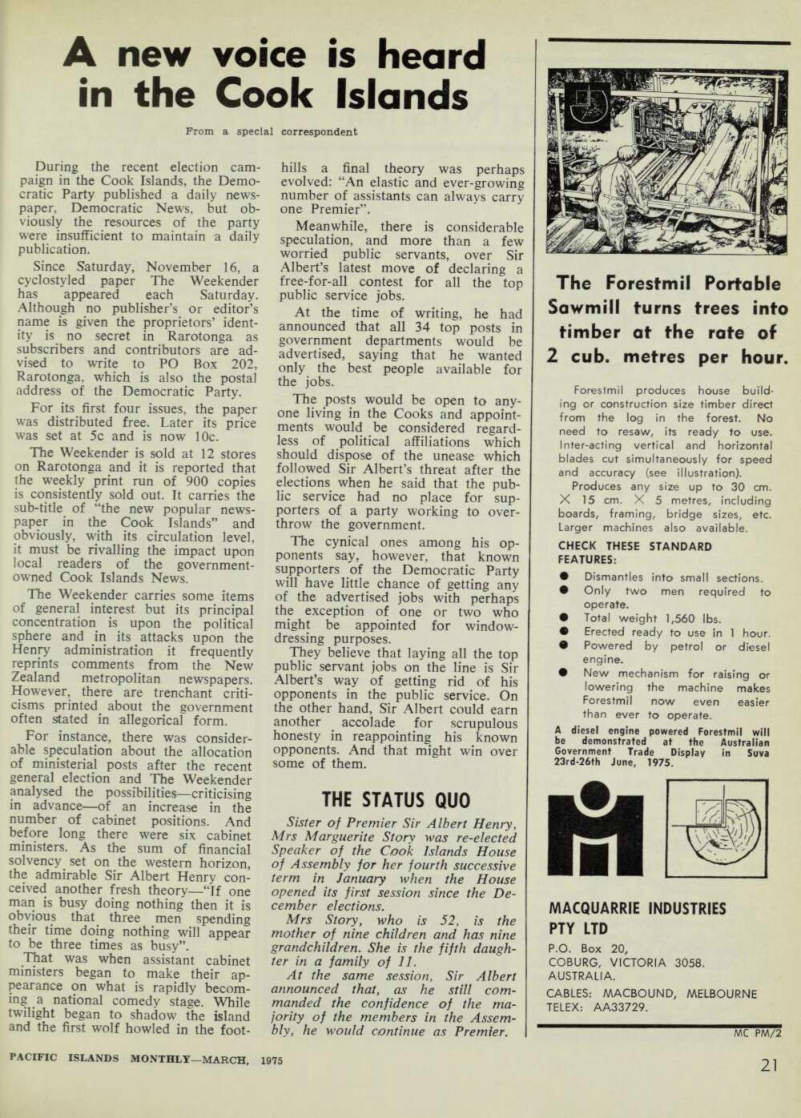
A new voice is heard in the Cook Islands
From a special correspondent
During the recent election cam paign in the Cook Islands, the Demo cratic Party published a daily news paper, Democratic News, but ob viously the resources of the party were insufficient to maintain a daily publication.
Since Saturday, November 16, a cyclostyled paper The Weekender has appeared each Saturday.
Although no publisher’s or editor’s name is given the proprietors’ ident ity is no secret in Rarotonga as subscribers and contributors are ad vised to write to PO Box 202, Rarotonga, which is also the postal address of the Democratic Party.
For its first four issues, the paper was distributed free. Later its price was set at 5c and is now 10c.
The Weekender is sold at 12 stores on Rarotonga and it is reported that the weekly print run of 900 copies is consistently sold out. It carries the sub-title of “the new popular news paper in the Cook Islands” and obviously, with its circulation level, it must be rivalling the impact upon local readers of the government owned Cook Islands News.
The Weekender carries some items of general interest but its principal concentration is upon the political sphere and in its attacks upon the Henry administration it frequently reprints comments from the New Zealand metropolitan newspapers.
However, there are trenchant criti cisms printed about the government often stated in allegorical form.
For instance, there was consider able speculation about the allocation of ministerial posts after the recent general election and The Weekender analysed the possibilities—criticising in advance—of an increase in the number of cabinet positions. And before long there were six cabinet ministers. As the sum of financial solvency set on the western horizon, the admirable Sir Albert Henry con ceived another fresh theory—“lf one man is busy doing nothing then it is obvious that three men spending their time doing nothing will appear to be three times as busy”.
That was when assistant cabinet ministers began to make their ap pearance on what is rapidly becom ing a national comedy stage. While twilight began to shadow the island and the first wolf howled in the foot
hills a final theory was perhaps evolved: “An elastic and ever-growing number of assistants can always carry one Premier”.
Meanwhile, there is considerable speculation, and more than a few worried public servants, over Sir Albert’s latest move of declaring a free-for-all contest for all the top public service jobs.
At the time of writing, he had announced that all 34 top posts in government departments would be advertised, saying that he wanted only the best people available for the jobs.
The posts would be open to any one living in the Cooks and appoint ments would be considered regard less of political affiliations which should dispose of the unease which followed Sir Albert’s threat after the elections when he said that the pub lic service had no place for sup porters of a party working to over throw the government.
The cynical ones among his op ponents say, however, that known supporters of the Democratic Party will have little chance of getting any of the advertised jobs with perhaps the exception of one or two who might be appointed for window dressing purposes.
They believe that laying all the top public servant jobs on the line is Sir Albert’s way of getting rid of his opponents in the public service. On the other hand, Sir Albert could earn another accolade for scrupulous honesty in reappointing his known opponents. And that might win over some of them.
The Status Quo
Sister of Premier Sir Albert Henry, Mrs Marguerite Story was re-elected Speaker of the Cook Islands House of Assembly for her fourth successive term in January when the House opened its first session since the De cember elections.
Mrs Story, who is 52, is the mother of nine children and has nine grandchildren. She is the fifth daugh ter in a family of 11.
At the same session, Sir Albert announced that, as he still com manded the confidence of the ma jority of the members in the Assem bly, he would continue as Premier.
Advertisements & other items, p. 23 (1 item)
The Forestmil Portable
Sawmill turns trees into
timber at the rate of
2 cub. metres per hour.
Forestmil produces house building or construction size timber direct from the log in the forest. No need to resaw, its ready to use.
Inter-acting vertical and horizontal blades cut simultaneously for speed and accuracy (see illustration).
Produces any size up to 30 cm.
X 15 cm. X 5 metres, including boards, framing, bridge sizes, etc.
Larger machines also available.
CHECK THESE STANDARD
FEATURES:
• Dismantles into small sections. • Only two men required to operate. • Total weight 1,560 lbs. • Erected ready to use in 1 hour. • Powered by petrol or diesel engine. • New mechanism for raising or lowering the machine makes Forestmil now even easier than ever to operate.
A diesel engine powered Forestmil will be demonstrated at the Australian Government Trade Display in Suva 23rd-26th June, 1975.
MACQUARRIE INDUSTRIES
PTY LTD
P.O. Box 20,
COBURG, VICTORIA 3058.
AUSTRALIA.
CABLES: MACBOUND, MELBOURNE
TELEX: AA33729.
MC PM/2
News in a Nutshell
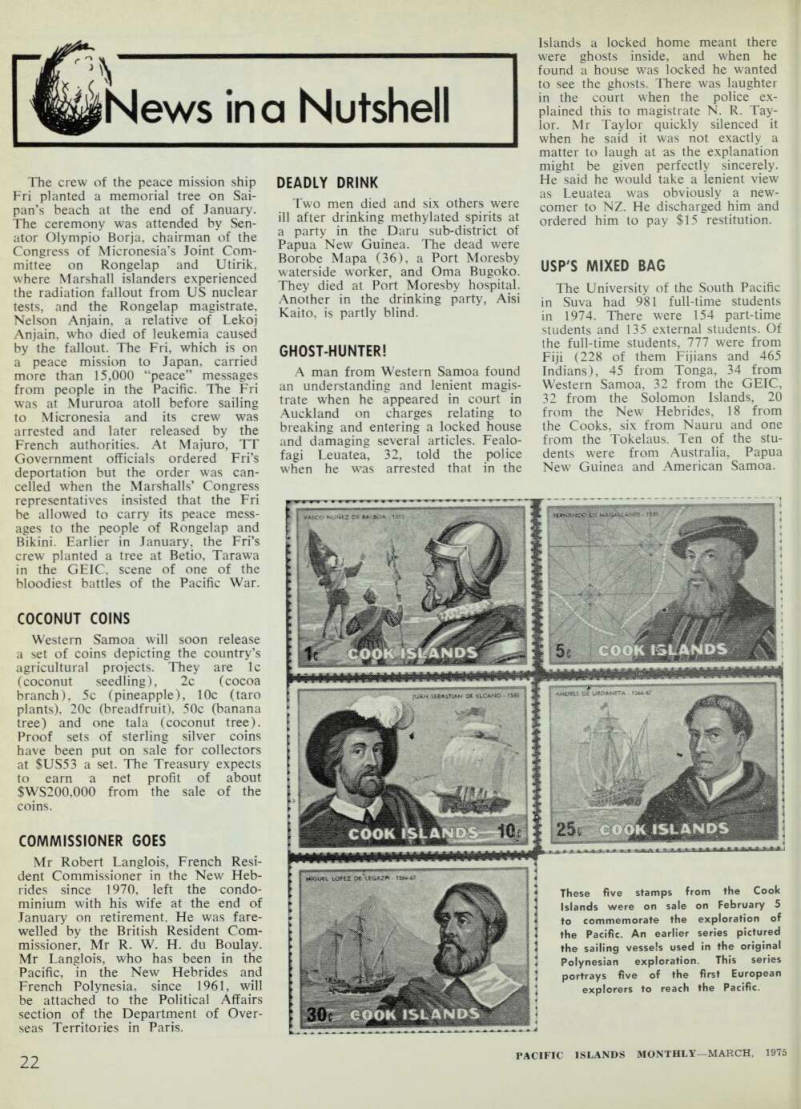
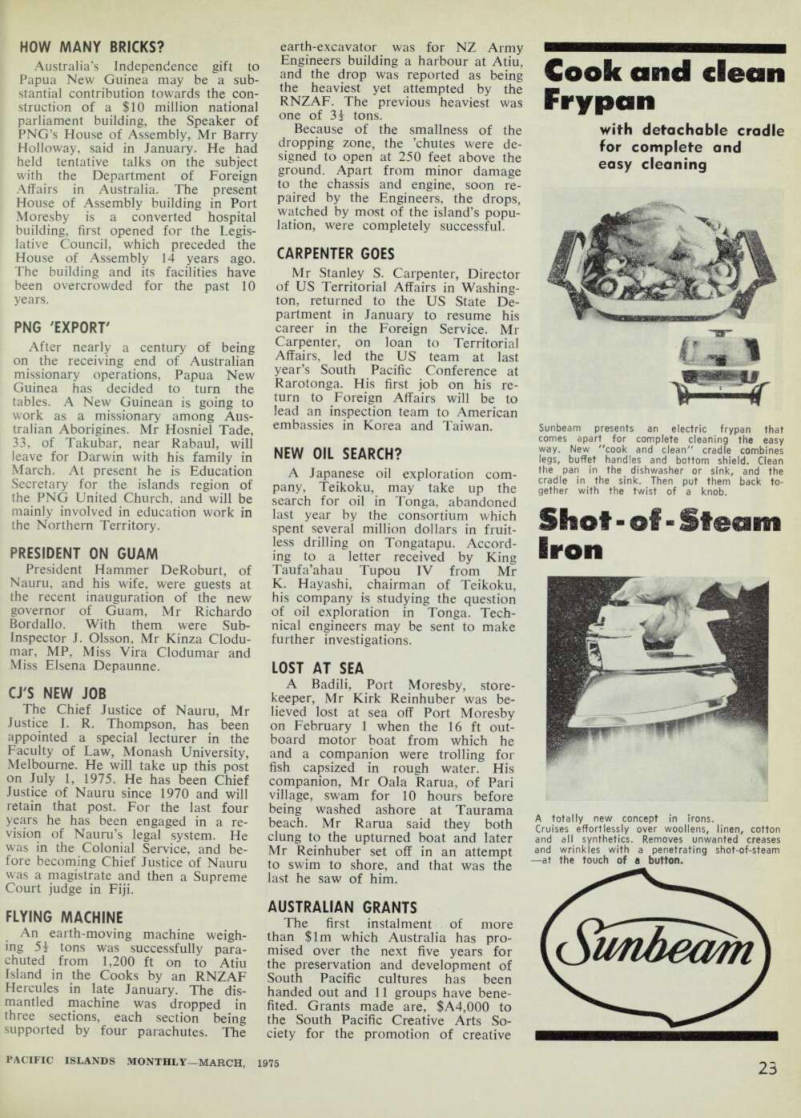
The crew of the peace mission ship Fri planted a memorial tree on Sai pan’s beach at the end of January.
The ceremony was attended by Sen ator Olympic Borja, chairman of the Congress of Micronesia’s Joint Com mittee on Rongelap and Utirik, where Marshall islanders experienced the radiation fallout from US nuclear tests, and the Rongelap magistrate, Nelson Anjain, a relative of Lekoj Anjain, who died of leukemia caused by the fallout. The Fri, which is on a peace mission to Japan, carried more than 15,000 “peace” messages from people in the Pacific. The Fri was at Mururoa atoll before sailing to Micronesia and its crew was arrested and later released by the French authorities. At Majuro, TT Government officials ordered Fri’s deportation but the order was can celled when the Marshalls’ Congress representatives insisted that the Fri be allowed to carry its peace mess ages to the people of Rongelap and Bikini. Earlier in January, the Fri’s crew planted a tree at Betio, Tarawa in the GEIC. scene of one of the bloodiest battles of the Pacific War.
Coconut Coins
Western Samoa will soon release a set of coins depicting the country’s agricultural projects. They are 1c (coconut seedling), 2c (cocoa branch), 5c (pineapple), 10c (taro plants), 20c (breadfruit), 50c (banana tree) and one tala (coconut tree).
Proof sets of sterling silver coins have been put on sale for collectors at SUSS3 a set. The Treasury expects to earn a net profit of about SWS2OO,OOO from the sale of the coins.
Commissioner Goes
Mr Robert Langlois, French Resi dent Commissioner in the New Heb rides since 1970. left the condo minium with his wife at the end of January on retirement. He was fare welled by the British Resident Com missioner, Mr R. W. H. du Boulay.
Mr Langlois, who has been in the Pacific, in the New Hebrides and French Polynesia, since 1961, will be attached to the Political Affairs section of the Department of Over seas Territories in Paris.
Deadly Drink
Two men died and six others were ill after drinking methylated spirits at a party in the Darn sub-district of Papua New Guinea. The dead were Borobe Mapa (36), a Port Moresby waterside worker, and Oma Bugoko.
They died at Port Moresby hospital.
Another in the drinking party, Aisi Kaito, is partly blind.
Ghost-Hunter!
A man from Western Samoa found an understanding and lenient magis trate when he appeared in court in Auckland on charges relating to breaking and entering a locked house and damaging several articles. Fealo fagi Leuatea, 32, told the police when he was arrested that in the
Islands a locked home meant there were ghosts inside, and when he found a house was locked he wanted to see the ghosts. There was laughter in the court when the police ex plained this to magistrate N. R. Tay lor. Mr Taylor quickly silenced it when he said it was not exactly a matter to laugh at as the explanation might be given perfectly sincerely.
He said he would take a lenient view as Leuatea was obviously a new comer to NZ. He discharged him and ordered him to pay $l5 restitution.
Usp's Mixed Bag
The University of the South Pacific in Suva had 981 full-time students in 1974. There were 154 part-time students and 135 external students. Of the full-time students, 777 were from Fiji (228 of them Fijians and 465 Indians), 45 from Tonga, 34 from Western Samoa, 32 from the GEIC, 32 from the Solomon Islands, 20 from the New Hebrides, 18 from the Cooks, six from Nauru and one from the Tokelaus. Ten of the stu dents were from Australia, Papua New Guinea and American Samoa.
These five stamps from the Cook Islands were on sale on February 5 to commemorate the exploration of the Pacific. An earlier series pictured the sailing vessels used in the original Polynesian exploration. This series portrays five of the first European explorers to reach the Pacific.
How Many Bricks?
Australia’s Independence gift to Papua New Guinea may be a sub stantial contribution towards the con struction of a $lO million national parliament building, the Speaker of PNG’s House of Assembly, Mr Barry Holloway, said in January. He had held tentative talks on the subject with the Department of Foreign Affairs in Australia. The present House of Assembly building in Port Moresby is a converted hospital building, first opened for the Legis lative Council, which preceded the House of Assembly 14 years ago.
The building and its facilities have been overcrowded for the past 10 years.
Png 'Export 7
After nearly a century of being on the receiving end of Australian missionary operations, Papua New Guinea has decided to turn the tables. A New Guinean is going to work as a missionary among Aus tralian Aborigines. Mr Hosniel Tade, 33, of Takubar, near Rabaul, will leave for Darwin with his family in March. At present he is Education Secretary for the islands region of the PNG United Church, and will be mainly involved in education work in the Northern Territory.
President On Guam
President Hammer Deßoburt, of Nauru, and his wife, were guests at the recent inauguration of the new governor of Guam, Mr Richardo Bordallo. With them were Sub- Inspector J. Olsson, Mr Kinza Clodu mar, MP, Miss Vira Clodumar and Miss Elsena Depaunne.
Cj's New Job
The Chief Justice of Nauru, Mr Justice I. R. Thompson, has been appointed a special lecturer in the Faculty of Law, Monash University, Melbourne. He will take up this post on July 1, 1975. He has been Chief Justice of Nauru since 1970 and will retain that post. For the last four years he has been engaged in a re vision of Nauru’s legal system. He was in the Colonial Service, and be fore becoming Chief Justice of Nauru was a magistrate and then a Supreme Court judge in Fiji.
Flying Machine
An earth-moving machine weigh ing 5i tons was successfully para chuted from 1,200 ft on to Atiu Island in the Cooks by an RNZAF Hercules in late January. The dis mantled machine was dropped in three sections, each section being supported by four parachutes. The
earth-excavator was for NZ Army Engineers building a harbour at Atiu, and the drop was reported as being the heaviest yet attempted by the RNZAF. The previous heaviest was one of tons.
Because of the smallness of the dropping zone, the ’chutes were de signed to open at 250 feet above the ground. Apart from minor damage to the chassis and engine, soon re paired by the Engineers, the drops, watched by most of the island’s popu lation, were completely successful.
Carpenter Goes
Mr Stanley S. Carpenter, Director of US Territorial Affairs in Washing ton, returned to the US State De partment in January to resume his career in the Foreign Service. Mr Carpenter, on loan to Territorial Affairs, led the US team at last year’s South Pacific Conference at Rarotonga. His first job on his re turn to Foreign Affairs will be to lead an inspection team to American embassies in Korea and Taiwan.
New Oil Search?
A Japanese oil exploration com pany, Teikoku, may take up the search for oil in Tonga, abandoned last year by the consortium which spent several million dollars in fruit less drilling on Tongatapu. Accord ing to a letter received by King Taufa’ahau Tupou IV from Mr K. Hayashi, chairman of Teikoku, his company is studying the question of oil exploration in Tonga. Tech nical engineers may be sent to make further investigations.
Lost At Sea
A Badili, Port Moresby, store keeper, Mr Kirk Reinhuber was be lieved lost at sea off Port Moresby on February 1 when the 16 ft out board motor boat from which he and a companion were trolling for fish capsized in rough water. His companion, Mr Oala Rama, of Pari village, swam for 10 hours before being washed ashore at Taurama beach. Mr Rama said they both clung to the upturned boat and later Mr Reinhuber set off in an attempt to swim to shore, and that was the last he saw of him.
Australian Grants
The first instalment of more than Sim which Australia has pro mised over the next five years for the preservation and development of South Pacific cultures has been handed out and 11 groups have bene fited. Grants made are, $A4,000 to the South Pacific Creative Arts So ciety for the promotion of creative
In A Nutshell
arts; $A 12,700 to the University of the South Pacific Extension Services for cultural work; $A9,000 to the Western Pacific Archives for micro filming its work; SAI,OOO to the South Pacific Social Sciences Asso ciation to promote the publication of writings by Islanders; $A1,500 to the Fiji Museum for educational services; $A2,000 for a project to compile a Fijian dictionary; SA7SO to assist in the establishment of an archive of Pacific music; $ A 1,000 to the Nelson Memorial Library in
Western Samoa for the development of its collection of cultural material; $A2,500 to the Department of Edu cation in Tonga for the promotion of cultural activities in schools and the improvement of library collec tions of cultural materials; $ A 1,755 to the British Solomon Islands Pro tectorate to promote the teaching of traditional cultural activities in schools, and to supply books and equipment to the National Library and Museum; SA7SO to the Vila Cultural Centre in the New Hebrides for the purchase of publications re lating particularly to New Hebridian cultural matters.
Custom Money!
Custom chiefs on Aoba island in the New Hebrides have decided that “there’s money in custom” and will charge visitors $lO each entrance fee to their custom ceremonies.
Photographing or tape recording ceremonies will cost an additional $lO. Anthropologists will also have to foot the bill—a $lO down pay ment before carrying out any re search on the island. A spokesman for the chiefs said a lot of custom stories and ceremonies were taken out by visitors and the Aoba people were taken for granted. “In fact some of the ceremonies are sacred and these should be preserved on the island instead of being taken else where and sold or displayed pub licly”, he said.
Costly Fire
Fire destroyed the administrative centre of the LDS Church School at Havelu, Tongatapu, towards Janu ary’s end. Damage was estimated at around $lOO,OOO. The fire, discovered at 6 am, destroyed a modern, brick walled block which contained six offices and two classrooms. It is be lieved the fire was caused by an electrical fault in the water pump servicing the building’s ornamental fountain.
Tonga’s police will take over the Nukualofa fire fighting service, which was maintained by the Minis try of Works. Australia has approved a scheme to provide Nukualofa with a $51,000 fire engine, a supporting vehicle worth $20,700, two 100,000 gallon reservoirs, a generator, pumps and hydrants.
Generous Nauruans
Nauru, often called the world’s richest republic because of its phos phatic riches, has parted with more than half a million dollars in gifts over the last couple of months. One of $250,000 went to the South Pacific Bureau for Economic Co-operation (SPEC) for investment, with the interest to be applied to financing natural disaster insurance in the Islands. Another was one of $200,000 to the University of the South Pacific, of which President Hammer De- Roburt is Chancellor; $210,000 was handed over in Melbourne to be; shared by three of the city’s leading; hospitals, and Nauru went to the; help of hurricane-shattered Darwin j with a gift of $lOO,OOO. • Mr Sitiveni Yaqona, the Fijii government public relations officer,, officer, has been appointed managen of the Fiji Visitors Bureau in Western Division. He succeeds Mn Radike Qereqeretabua, who base joined Fiji Resorts Ltd.
Advertisements & other items, pp. 25-26 (1 item)
Frypan
Cook and clean
with detachable cradle for complete and
easy cleaning
4- » >—hT Sunbeam presents an electric frypan that comes apart for complete cleaning the easy way. New "cook and clean" cradle combines legs, buffet handles and bottom shield. Clean the pan in the dishwasher or sink, and the cradle in the sink. Then put them back together with the twist of a knob.
Shot -of- Steam
Iron
A totally new concept in irons.
Cruises effortlessly over woollens, linen, cotton and all synthetics. Removes unwanted creases and wrinkles with a penetrating shot-of-steam —at the touch of a button.
ARE YOU GIVING
BLOOD
THE DANGEROUS WAY?
Mosquito biting a human being.
CONCENTRATED PEA-BEU
The strong one that cares for your world The common mosquito is more than just a nuisance, its bite can spread dangerous disease. So it's worth getting rid of fast.
Concentrated Pea-Beu contains one of the world's most powerful insecticides so it kills insects in seconds and it s rigidly tested through every stage of manufacture so you can spray it safely with confidence to protect the health and well-being of your family.
Concentrated Pea-Beu kills flies, mosquitoes,aH disease carrying insects in seconds.
Returned Honeymooner’ Looks At
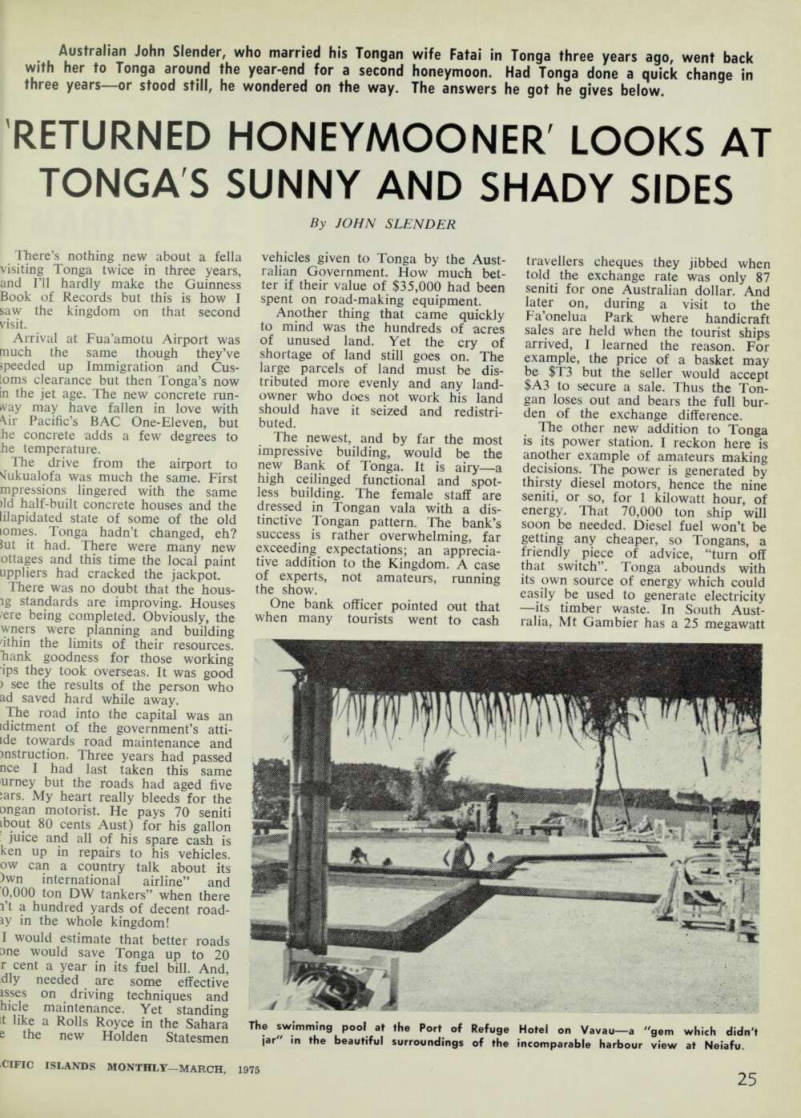
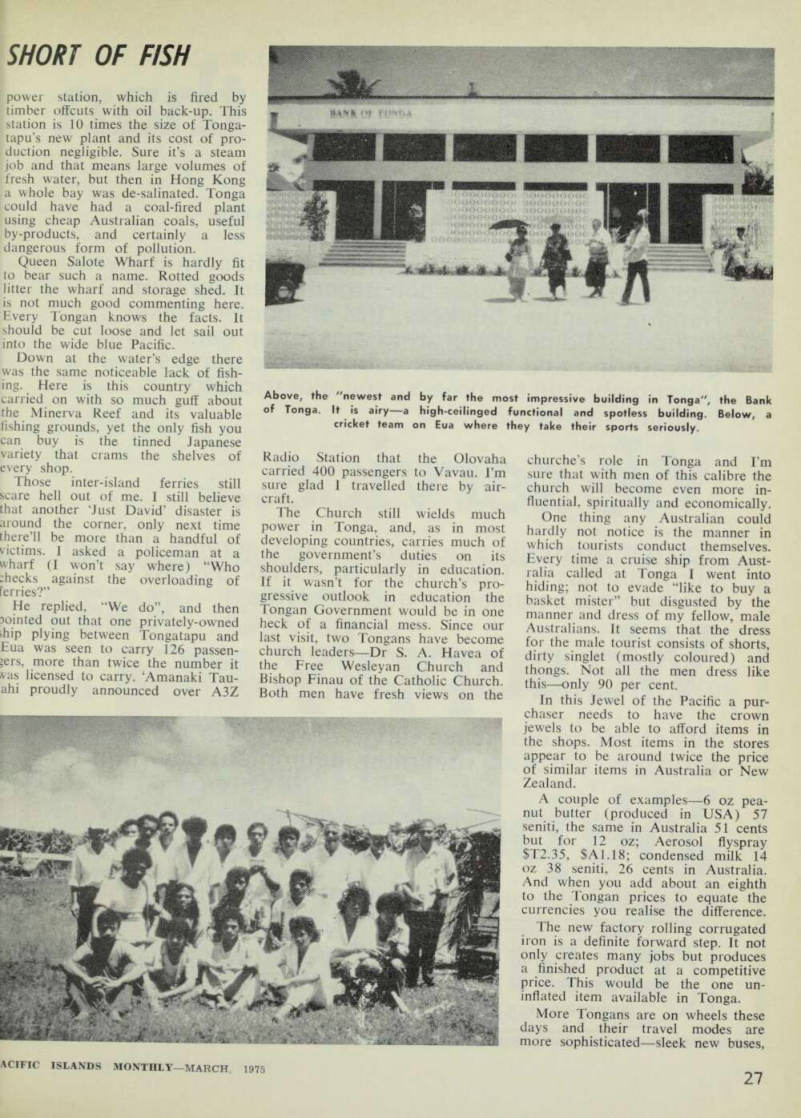

Tonga's Sunny And Shady Sides
Australian John Slender, who married his Tongan wife Fatai in Tonga three years ago, went back with her to Tonga around the year-end for a second honeymoon. Had Tonga done a quick change in three years—or stood still, he wondered on the way. The answers he got he gives below.
By John Slender
There’s nothing new about a fella visiting Tonga twice in three years, and I’ll hardly make the Guinness Book of Records but this is how I saw the kingdom on that second visit.
Arrival at Fua’amotu Airport was much the same though they’ve speeded up Immigration and Cus toms clearance but then Tonga’s now in the jet age. The new concrete run way may have fallen in love with Mr Pacific’s BAG One-Eleven, but he concrete adds a few degrees to he temperature.
The drive from the airport to Nukualofa was much the same. First mpressions lingered with the same )ld half-built concrete houses and the lilapidated state of some of the old lomes. Tonga hadn’t changed, eh?
Jut it had. There were many new ottages and this time the local paint uppliers had cracked the jackpot.
There was no doubt that the hous ig standards are improving. Houses 'ere being completed. Obviously, the wners were planning and building dthin the limits of their resources, hank goodness for those working ips they took overseas. It was good ) see the results of the person who ad saved hard while away.
The road into the capital was an idictment of the government’s atti ide towards road maintenance and instruction. Three years had passed nee I had last taken this same urney but the roads had aged five jars. My heart really bleeds for the ongan motorist. He pays 70 seniti ibout 80 cents Aust) for his gallon juice and all of his spare cash is ken up in repairs to his vehicles, ow can a country talk about its )wn international airline” and 0,000 ton DW tankers” when there I’t a hundred yards of decent road ty in the whole kingdom!
I would estimate that better roads Me would save Tonga up to 20 r cent a year in its fuel bill. And, dly needed are some effective isses on driving techniques and hide maintenance. Yet standing t like a Rolls Royce in the Sahara e new Holden Statesmen
vehicles given to Tonga by the Aust ralian Government. How much bet ter if their value of $35,000 had been spent on road-making equipment.
Another thing that came quickly to mind was the hundreds of acres of unused land. Yet the cry of shortage of land still goes on. The large parcels of land must be dis tributed more evenly and any land owner who does not work his land should have it seized and redistri buted.
The newest, and by far the most impressive building, would be the new Bank of Tonga. It is airy—a high ceilinged functional and spot less building. The female staff are dressed in Tongan vala with a dis tinctive Tongan pattern. The bank’s success is rather overwhelming, far exceeding expectations; an apprecia tive addition to the Kingdom. A case of experts, not amateurs, running the show.
One bank officer pointed out that when many tourists went to cash
travellers cheques they jibbed when told the exchange rate was only 87 seniti for one Australian dollar. And later on, during a visit to the Fa’onelua Park where handicraft sales are held when the tourist ships arrived, I learned the reason. For example, the price of a basket may be ST3 but the seller would accept SA3 to secure a sale. Thus the Ton gan loses out and bears the full bur den of the exchange difference.
The other new addition to Tonga is its power station. I reckon here is another example of amateurs making decisions. The power is generated by thirsty diesel motors, hence the nine seniti, or so, for 1 kilowatt hour, of energy. That 70,000 ton ship will soon be needed. Diesel fuel won’t be getting any cheaper, so Tongans, a friendly piece of advice, “turn off that switch”. Tonga abounds with its own source of energy which could easily be used to generate electricity —its timber waste. In South Aust ralia, Mt Gambier has a 25 megawatt
The swimming pool at the Port of Refuge Hotel on Vavau—a "gem which didn't jar" in the beautiful surroundings of the incomparable harbour view at Neiafu.
Short O Fish
power station, which is fired by timber offcuts with oil back-up. This station is 10 times the size of Tonga tapu's new plant and its cost of pro duction negligible. Sure it’s a steam job and that means large volumes of fresh water, but then in Hong Kong a whole bay was de-salinated. Tonga could have had a coal-fired plant using cheap Australian coals, useful by-products, and certainly a less dangerous form of pollution.
Queen Salote Wharf is hardly fit to bear such a name. Rotted goods litter the wharf and storage shed. It is not much good commenting here.
Every Tongan knows the facts. It should be cut loose and let sail out into the wide blue Pacific.
Down at the water’s edge there was the same noticeable lack of fish ing. Here is this country which carried on with so much guff about the Minerva Reef and its valuable fishing grounds, yet the only fish you can buy is the tinned Japanese variety that crams the shelves of every shop.
Those inter-island ferries still scare hell out of me. I still believe that another ‘Just David’ disaster is around the corner, only next time there’ll be more than a handful of victims. I asked a policeman at a wharf (I won’t say where) “Who :hecks against the overloading of ferries?”
He replied, “We do”, and then Dointed out that one privately-owned ship plying between Tongatapu and Eua was seen to carry 126 passen gers, more than twice the number it vas licensed to carry. ‘Amanaki Tau ahi proudly announced over A3Z
Radio Station that the Olovaha carried 400 passengers to Vavau. I’m sure glad I travelled there by air craft.
The Church still wields much power in Tonga, and, as in most developing countries, carries much of the government’s duties on its shoulders, particularly in education.
If it wasn’t for the church’s pro gressive outlook in education the Tongan Government would be in one heck of a financial mess. Since our last visit, two Tongans have become church leaders—Dr S. A. Havea of the Free Wesleyan Church and Bishop Finau of the Catholic Church.
Both men have fresh views on the
churche’s role in Tonga and I’m sure that with men of this calibre the church will become even more in fluential, spiritually and economically.
One thing any Australian could hardly not notice is the manner in which tourists conduct themselves.
Every time a cruise ship from Aust ralia called at Tonga I went into hiding; not to evade “like to buy a basket mister” but disgusted by the manner and dress of my fellow, male Australians. It seems that the dress for the male tourist consists of shorts, dirty singlet (mostly coloured) and thongs. Not all the men dress like this—only 90 per cent.
In this Jewel of the Pacific a pur chaser needs to have the crown jewels to be able to afford items in the shops. Most items in the stores appear to be around twice the price of similar items in Australia or New Zealand.
A couple of examples—6 oz pea nut butter (produced in USA) 57 seniti, the same in Australia 51 cents but for 12 oz; Aerosol flyspray 5T2.35, $A1.18; condensed milk 14 oz 38 seniti, 26 cents in Australia.
And when you add about an eighth to the Tongan prices to equate the currencies you realise the difference.
The new factory rolling corrugated iron is a definite forward step. It not only creates many jobs but produces a finished product at a competitive price. This would be the one un inflated item available in Tonga.
More Tongans are on wheels these days and their travel modes are more sophisticated—sleek new buses,
Above, the "newest and by far the most impressive building in Tonga", the Bank of Tonga. It is airy—a high-ceilinged functional and spotless building. Below, a cricket team on Eua where they take their sports seriously.
A Gem Which Didn't Jar
more Mini-Mokes, trucks and cars and fewer in the Ve’etolu ranks.
And the travel agency business must be good. There seems to be one on nearly every corner, while one organ isation has an overseas employment service. That one will go. The government is taking over the job of placing peripatetic Tongans in temporary work overseas.
Standing out like a sore thumb is ‘that’ German Consulate office.
Seems quite a laugh but then equally humorous is the lack of any Aust ralian permanent diplomatic organis ation—it’s incredible when Australia is a near neighbour.
The Queen Salote memorial build ing is smaller than the tall weeds that smother its ‘would-be splendour’.
Such a shame, but full marks to Princess Pilolevu who is, at least, endeavouring to get things moving so that it can be finished.
We’d heard that the Port of Re fuge Hotel in Vavau was really something. We’d wondered if any man-made object would really merge with the beautiful surround ings of Neiafu Harbour, but there it was —a gem which didn’t jar. It :ouldn’t have been bettered.
On Vavau I saw my old mate, Dr Viliami Tufui, the group’s senior medical officer. He and his staff of less than 20 administer to the needs of a population of around 18,000 — little time for leisure.
After four days on Vavau I con cluded that the Vavau folk are more industrious than those on Tongatapu.
And the same goes for ’Eua, which now has a new airport, many new cottages and some spectacular churches.
My favourite was Hango, the Free Wesleyan Church’s farming complex.
It’s a large undertaking, effectively laid out, and indeed a sight for the eyes of a former country boy. The college has clearly demonstrated that nearly any type of farming can be successfully carried out in Tonga provided people with know-how are brought in and their knowledge studied and applied, not criticised through ignorance.
The people of ’Eua are not a wealthy section of Tonga’s commun ity. They exist with the bare essen tials. But they are not whingers. They work hard and enjoy their leisure hours to the utmost.
The timber industry has a good
share in the economy of ’Eua and all mills are doing good business as do the truck owners who transport the timber.
It looks likely that in a few years ’Eua will be supplying Tongatapu with larger quantities of meat, veget ables and timber.
The sum total of my impressions is that Tonga hasn’t progressed to any great extent in the last three years. The scales appear heavily loaded in favour of the nobles, top government officials and those with fat bank accounts, and it seems the poor people will remain that way for some considerable time.
But there are hopes. Many of the young people are asking more ques tions, probing for answers to ques tions that should have been asked long ago; expressing opinions more openly than previous generations.
Tonga has some very well educated people overseas, but I doubt if many of them will return permanently to pass on their know ledge to Tonga’s betterment.
The kindom needs trade unions, not the Aussie brand, but some organisation which will cater for the workers and their rights.
Tonga still openly advertises waste and inefficiency. Red tape seems the order of the day. Ever tried to see
a senior government officer? Damn near impossible to get past the in quiry counter clerk.
Don’t be the least bit surprised if some really influential and well known people have a lash at the next general elections. Tonga needs some changes badly and urgently.
Others can take their order of priority.
I hope sincerely that when I next visit Tonga (that’s if they’ll allow me in), I’ll see changes that will bring about more equal opportunities for all the people.
Advertisements & other items, pp. 27-32 (4 items)
25
CIFIC ISLANDS MONTHLY—MARCH. 1975
S. E. Tatham
58
& CO. PIY. LTD.
SOME OF THE FIRMS
WE REPRESENT ARE:
ASKEW HOUSE, 364 LONSDALE ST.,
MELBOURNE, 3001, AUSTRALIA.
G.P.O. BOX 8—
CABLES "SET",
TELEPHONE: 601125
Asia Rubber Works (Singapore Rubber Shoes) Frappier (French Brandy) Huvet (French Brandy) Indika (Belgium Dairy Produce) Durobor S.A. (Belgium Glassware) AAiroiterie Gen. de Belgiqe S.A. (Louvre glass and mirrors) City Engineers (U.K. Bicycles) F.H.I. Japan (Subaru Cars) Kraggs (Wines, Spirits, Ciders) Sunshine Biscuits Sunrise (Confectionery) Flamenco (Instant Coffee & Tea) Quaker Products (Oats, Jets) Hancocks (Spaghetti, Cereals) Melbourne Canning (Jams) Amatil (Twisties, Twirlies) Edward Zorn (Margarine, Cooking Fats) Allens (Confectionery) Red Tulip (Fine Chocolates) Robert Timms (New Guinea Gold Instant Coffees and Teas) S.P.C (Canned Fruit) S.P.C. (Abalone) Wing Lee (See You Sauce) Magnet (Mattresses) Essteel (Cookware) Warner-Drayton (Fans) Mitchell's (Abrasives) Tilbury & Lewis (Sports Trophies & Silverplate) Regent (Swiss watches) Lega Marcasite (Jewellery) Austramax (Pressure Lanterns) Lawn Chair; Tubco (Garden Furniture) Electronic Industries (Electrical Household Appliances) Jex (Steelwool) Arnbro (Folding Beds) James Miller (Blankets) Elmaco (Plastics —Electrical Fittings) B.X. (Plastics) Stegbar (Wooden Louvres) Franklite (Light Fittings) J.J. Cash (Embroidered Labels) Disston (Saws)
BUYERS FOR THE
PACIFIC ISLANDS
DIRECT ENQUIRIES WELCOMED
PAPUA NEW GUINEA: S. E. TATHAM (P.N.G.) PTY. LTD.,
LAE: MALAITA STREET (P.O. BOX 1562).
PORT MORESBY: CNR. GOROA AND MUNAHU STREETS, GORDON
(P.O. BOX 6733, BOROKO).
FIJI: S. E. TATHAM (FIJI) LTD.,
LAUTOKA: P.O. BOX 366.
SUVA: G.P.O. BOX 671.
YOUR GUARANTEE
i 1 1
FOR SERVICE
SINCE 1924
Wfe re more than
machinery...
We're distributors for Bucyrus-Erie, Ruston-Bucyrus and Komatsu-Bucyrus construction equipment, Hendrix dragline buckets, VM air-cooled diesel engines, Olding generating and pump sets, Geho dewatering and Pumpex submersible pumps, Mitsubishi pile hammers, and electric and hydraulic winches.
service...
You get Australia's best after-sales service through our branches in Townsville, Brisbane, Sydney, Melbourne, Launceston and Adelaide.
Vfe supply...
We stock an extensive range of parts for all products, ensuring minimum equipment down time.
Vife perform...
—just like the great equipment we distribute. \\fe re more than r
(OLDING)
INDUSTRIES PTY. LIMITED
machinery...
Townsville; Phone: (077) 79-7722' Telex: AA77140 Brisbane: Phone: (072) 72-3566 Telex: AA41451 Sydney: Phone; (02) 848-8288 Telex: AA24586 Melbourne: Phone: (03) 551-2666 Telex: AA32879 Launceston: Phone: (003) 46-9402 Adelaide: Phone: (08) 268-2126 Telex: AA88144
KERR BROS
THE
trailers
PEOPLE FOR THE PACIFIC ISLANDS
It Pays to Buy WEEKS the
Big Value Trailer Range!
From 3 ton up to 10 ton, 2 or 4 wheels, tipping and non-tipping. Weeks trailers are specially designed for heavy duty work and long life. From the Weeks range, you will find a trailer to suit your particular carrying application. For further details, please write to
KERR BROS. PTY. LTD
W sk
ISLAND MERCHANTS,
65 YORK STREET, SYDNEY.
CABLES: CAREFULNESS, SYDNEY.
Throughout the Islands
are foremost in General Insurance
QUEENSLAND INSURANCE
COMPANY LIMITED
(Incorporated 1886 in Australia) Head Office: 82 Pitt Street, Sydney FlJl—Branch Office, Suva, Manager for Fiji: F. N. Davies (A.A.1.1.).
LAUTOKA—Assistant Manager: G. A. Wooley.
HONIARA (8.5.1. P.) —Breckwoldt & Company (5.1.) Pty. Limited.
NEW CALEDONIA—T. A. Hagen, Ste. W. A. Johnston, S.A.R.L. —Noumea. , NEW HEBRlDES—Resident Officer: R. J. Allsop (A.A.1.1.) Vila; Santo: Bums Philp (New Hebrides) Ltd.
TAHlTl—Arthur Chung: Immeuble 8.1., Front de Mer, Papeete.
NIUE, NORFOLK ISLAND, SAMOA, TONGA and other South Sea Islands—Bums Philp (South Sea) Company Ltd.
QUEENSLAND INSURANCE (P.N.G.) LTD
PAPUA NEW GUINEA
Head Office, Port Moresby: General Manager: D. J. Granter.
District Managers at Rabaul: C. D. Dickings; Lae: R. Jackson; Mt. Hagen: D. F. Carroll.
D
lapua new guinea
printing co. ply. ltd.
Serving the Country from Aitape to Alotau, Manus to Moresby Leaders in Commercial Offset and Letterpress Printing. • Stationery • Office Supplies • Office Equipment • Rubber Stamps • Self-Adhesive Labels • In Fact: — Everything For The Office.
P.O. Box 633, Port Moresby P.O. Box 759, Lae P.O. Box 1239, Rabaul
Acific Islands Monthly—March. 1975
29
ACIFIC ISLANDS MONTHLY-MARCH, 1975
Unemployed Tongans
The Tongan unemployment situ- • ation in New Zealand is shifting ; south towards Wellington, the capital. .
Many Tongans who arrived in the ; country before the new immigration i laws came into effect have been un- ■ able to get work. Under those laws < Tongans must have a guarantee of 5 employment before they go to NZ. .
The employment situation in Auck- ■ land is not as easy as it was. Wei- fare organisations have been finding? it hard to get work for unemployed!
Islanders. Although Tongans receive; the most publicity, other Pacific: Islanders, chiefly Fiji-Indians, are; moving south from Auckland on thee work trail.
More than 100 Auckland firms i were asked to take on unemployed!
Tongans but no jobs could be found..
Although sympathetic, the Ministen of Immigration, Mr Colman, was, at! the same time, critical of the Tongans..
Some statements, he said, made it! appear that the government owed! them a living. In fact, they should! have come to New Zealand withx their eyes open.
Auckland’s Mayor, Sir Dove-Myen Robinson, absolved his city from a t duty to look after the unemployed!
Tongans. That duty, he said, lay\ with the government.
“The city can’t be fairy god mother to everyone who wants toe live here, and we will only provider relief work if there is unemployment! as a result of a recession; but not! in cases like this”, he said.
Not all the applicants for jobs inr the South Island are Polynesians on Fiji-Indians. Europeans are also drift ing in from smaller country centres..
Only four Tongans obtained work} outside the Hutt Valley in under the new scheme organised by\ the NZ and Tonga governments but! it is hoped to place more in Feb ruary. The names of more than 3,800 C prospective workers have been regis tered in Tonga for NZ jobs unden the scheme.
Polynesian
When a Polynesian goes 'deadpan'
From a Wellington correspondent When a Polynesian—apparently in perfect health—becomes totally withdrawn, develops a deadpan look, will say nothing and give no reaction, what is wrong?
The probable answer, according to a booklet called Understanding Polynesians—and published in New Zealand to help European employers understand their Polynesian staff— is that he has gone into a state known as Musu, and is suffering from sheer fright or nervousness.
Musu is common among Samoans and Niueans and relatively common among Cook Island and NZ Maoris.
The booklet was prepared by the Polynesian adviser to the NZ Voca tional Training Council, Mrs Margaret Lee, and co-authored by the Secretary for Maori and Island Affairs in New Zealand Mr J. M.
McEwen, and Mr C. Macpherson, a senior lecturer in Sociology at Auck land University.
It is designed to help employers understand Polynesian staff and their reaction to varying situations.
“One of the more evident features of the changing face of New Zealand industry is the increasing number of Maoris and Pacific Islanders em ployed in that sector”, the introduc tion states. “Race relations will play a growing part in industrial relations in New Zealand”.
As well as discussing fully the difficulty of Musu, the booklet also looks at language, reaction to insults, negative questioning, working with Polynesians, involvement in decision making, work rewards, work r hythms, and work language.
It has earned the personal support of the NZ Minister of Education, and former Minister of Island Affairs, Mr P. A. Amos, who said he had been most impressed with the publication, which set out the differ ences in attitude and behaviour which arose from the cultural back ground of the various Polynesian groups.
Commenting on positions occu pied by Polynesian workers, Under standing Polynesians said: “Jobs held by Polynesian migrants Jo not generally permit any great feeling of achievement, do not offer
any intrinsic satisfaction and permit little room for individual expression.
“They hold little prestige and do not invite any great interest from busy management.
“This is quite different from the working situation migrants have been used to in which members of work groups are bound to one another by personal relationships.
“Their interests are represented at the top levels of decision-making; decisions result from discussion and consensus, rather than handing down edicts from a production office.
“The average rural plantation agri culturalist does a complete range of productivity activity: he clears, plants,
tends and crops his product. He is involved at every stage of the process and he exercises control over cause and effect.
“In New Zealand, it takes some time for a person to adjust to the idea that work is of little interest to anyone other than himself and that its rewards are solely economic.
“ ‘lt’s not like the Islands’, runs a typical view. ‘You work hard here and no one takes any notice. Nobody cares about that, but they start to squawk the moment something goes wrong with the machine.
“ ‘Half the people with whom I work don’t care about what they are doing—just the money’
Advertisements & other items, pp. 33-34 (2 items)
flps®
'l'
In our year
Selling
"SERVICE"
to the Pacific Islands
NELSON & ROBERTSON
PTY. LIMITED
(Established 1895)
PLANTATION HOUSE, 197 CLARENCE STREET, SYDNEY
CABLES: "IVAN", SYDNEY, BRISBANE. TELEX: AA22381, SYDNEY. z cl lP A/
FOR:
INDENTS
COMMODITIES
SHIPPING
TRAVEL
INSURANCE
REAL ESTATE
Branch Office: Nelson & Robertson Pty. Ltd., 303 Adelaide St., Brisbane, Old.
New Guinea Representatives: Rabtrad Niugini Pty, Ltd., Rabaul Lae Madang Kieta.
From the
Islands Press
Extract from a land policy statement from the New Hebrides National Party as reported in the Radio Group News: The gathering was told that traditional and custom ways of dealing with land avoided some of the problems that had arisen since European principles of land tenure and titles were used ... In the villages on outer islands, because land was passed on in the traditional manner, there was enough ground for everyone.
As a result everyone has enough to eat . . .
From a speech by the GEIC Minister of Communications etc, Bwebwetake Areieta, reported in the Atoll Pioneer: ... If you meet an MP in Australia or New Zealand he wouldn’t have a clue of where the Gilbert & Ellice Islands are. I had been introduced once to an MP in Victoria, and the person who introduced me said I came from the Gilbert & Sullivan . . .
From a letter in the Tonga Chronicle: May I be permitted to comment and clarify the rumours around town regarding the boys who are in Japan for training in Sumo. Some time ago there was a rumour around town that one of the parents had received a letter from their son saying that the boys had been castrated and that they knew nothing about it till they woke up from their sleep . . . Let it be known that the rumours they are spreading around are not true. I have not told anyone such stories. If anyone is in doubt I am prepared to let him read all the letters that have been sent by my son.
From a report in The Fiji Times: Work on a $500,000 building contract at the Native Land Trust Board building in Suva stopped abruptly yesterday when police arrested the works foreman and a compressor drill operator. Police took the two men about 150 yards to Suva Court where a magistrate, Mr Neville Scriven, told them the noise from the compressor was interfering with court proceedings. After telling the men that the interference was an offence for which they could go to gaol, Mr Scriven released them.
An editorial from the Papua New Guinea Post-Courier: It is almost unbelievable that schools have had to be closed in Papua New Guinea because of vandalism and stealing.
Two schools have already been closed in the Western Highlands and four more, including the Mt Hagen primary school, may have to be closed. That there should be people in the community who are prepared to deprive
children of a proper education through their own criminal acts is a terrible indictment. It is made worse by the fact that a high school teacher recently arrived from England had his home broken into on his first night in Mt Hagen, and was greeted by a barrage of stones when he attempted to intervene. This is lawlessness at its worst.
From the GEIC Atoll Pioneer's report of the House of Assembly's debate on a motion to change sessions from mornings to afternoons: Mr Roniti Teiwaki (Betio-Ocean) supported the motion because he felt he was energetic not only in the afternoons but in the mornings as well—in fact, he is energetic whenever it comes to discussing politics, whether in the House, in the toilets or on the beach.
Another side to the French nuclear tests as experienced by the Pitcairn Islanders in the front row and reported in the Pitcairn Miscellany: . . . While nobody here liked the idea of having nuclear explosions so close to home, there were benefits that could be directly attributed to the tests that did help the Island. The ship Sir Percivale has become a regular visitor at this time of the year and has always been most generous with gifts for the Island, as well as being a great outlet for the sale of curios etc. The two RFA monitors who stay on the Island for the duration of the test series have also become a part of our lives at this time of the year and they will be sorely missed. Even the visits by the French frigates will become a thing of the past and another source of selling carvings etc will have been lost.
A quote in The Fiji Times from Prime Minister Ratu Sir Kamisese Mara in defence of Fijian culture in a reply to criticism by the Young Alliance of a scheme for a Fiji cultural centre: "I am building a house in my village, built by the old traditional carpenters. I defy any architect or engineer today to go and build something better ... I will invite representatives of the Young Alliance to go and see what their forefathers can be proud of, which they have lost now. I hope you can then revert to pride in your own culture, make a contribution to the world instead of being a follower of some people strumming guitars, having long hair and no shirts".
From the American Samoa News Bulletin: Commissioner of Public Safety Tufele Li'a, who ordered an emergency police task force into operation from December i 22 to January 5 to prevent accidents and crimes during the Christmas-New Year holiday, has offered a special thanks to the police reservists who gave their time and strength to assist the regular police officers. "I honestly believe that statistics will eventually prove that American Samoans enjoyed a holiday less marked by tears, blood, accidents, fires and accidental deaths than any other state or territory in the Union", he said.
The season of goodwill in Western Samoa as reported in the Samoa Times: Five people were killed during the Christmas week. Three men were killed during fights andh two others took their own lives . . . According to official sources no one died in a traffic
accident during the week.
Haydon fights
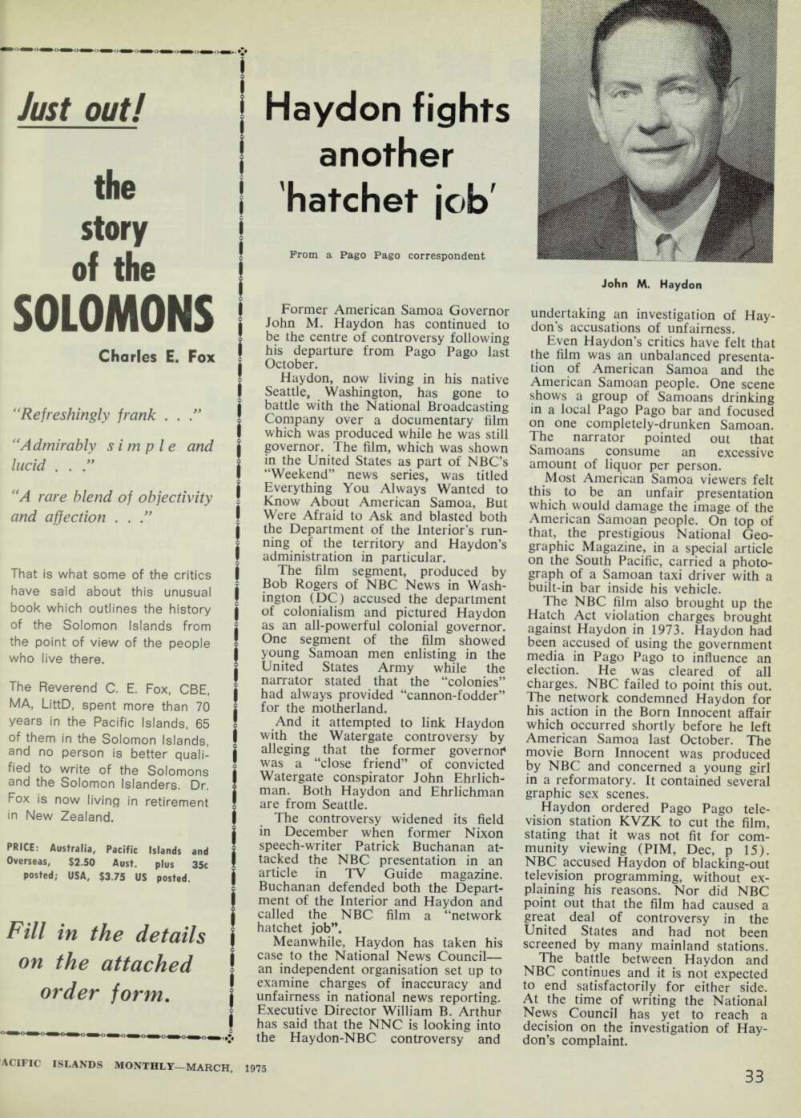
another 'hatchet job'
Prom a Pago Pago correspondent
Former American Samoa Governor John M. Haydon has continued to be the centre of controversy following his departure from Pago Pago last October.
Haydon, now living in his native Seattle, Washington, has gone to battle with the National Broadcasting Company over a documentary film which was produced while he was still governor. The film, which was shown in the United States as part of NBC’s “Weekend” news series, was titled Everything You Always Wanted to Know About American Samoa, But Were Afraid to Ask and blasted both the Department of the Interior’s run ning of the territory and Haydon’s administration in particular.
The film segment, produced by Bob Rogers of NBC News in Wash ington (DC) accused the department of colonialism and pictured Haydon as an all-powerful colonial governor.
One segment of the film showed young Samoan men enlisting in the United States Army while the narrator stated that the “colonies” had always provided “cannon-fodder” for the motherland.
And it attempted to link Haydon with the Watergate controversy by alleging that the former governor* was a “close friend” of convicted Watergate conspirator John Ehrlich man. Both Haydon and Ehrlichman are from Seattle.
The controversy widened its field in December when former Nixon speech-writer Patrick Buchanan at tacked the NBC presentation in an article in TV Guide magazine.
Buchanan defended both the Depart ment of the Interior and Haydon and called the NBC film a “network hatchet job”.
Meanwhile, Haydon has taken his case to the National News Council— an independent organisation set up to examine charges of inaccuracy and unfairness in national news reporting.
Executive Director William B. Arthur has said that the NNC is looking into the Haydon-NBC controversy and
undertaking an investigation of Hay don’s accusations of unfairness.
Even Haydon’s critics have felt that the film was an unbalanced presenta tion of American Samoa and the American Samoan people. One scene shows a group of Samoans drinking in a local Pago Pago bar and focused on one completely-drunken Samoan.
The narrator pointed out that Samoans consume an excessive amount of liquor per person.
Most American Samoa viewers felt this to be an unfair presentation which would damage the image of the American Samoan people. On top of that, the prestigious National Geo graphic Magazine, in a special article on the South Pacific, carried a photo graph of a Samoan taxi driver with a built-in bar inside his vehicle.
The NBC film also brought up the Hatch Act violation charges brought against Haydon in 1973. Haydon had been accused of using the government media in Pago Pago to influence an election. He was cleared of all charges. NBC failed to point this out.
The network condemned Haydon for his action in the Born Innocent affair which occurred shortly before he left American Samoa last October. The movie Born Innocent was produced by NBC and concerned a young girl in a reformatory. It contained several graphic sex scenes.
Haydon ordered Pago Pago tele vision station KVZK to cut the film, stating that it was not fit for com munity viewing (PIM, Dec, p 15).
NBC accused Haydon of blacking-out television programming, without ex plaining his reasons. Nor did NBC point out that the film had caused a great deal of controversy in the United States and had not been screened by many mainland stations.
The battle between Haydon and NBC continues and it is not expected to end satisfactorily for either side.
At the time of writing the National News Council has yet to reach a decision on the investigation of Hay don’s complaint.
John M. Haydon
Advertisements & other items, pp. 35-36 (3 items)
Acific Islands Monthly-March, 1975
Solomons
Just gut!
the
story
of the
SOLOMONS
Charles E. Fox
“Refreshingly frank . . ”
“Admirably simple and
lucid . .
“A rare blend of objectivity and affection . .
That is what some of the critics have said about this unusual book which outlines the history of the Solomon Islands from the point of view of the people who live there.
The Reverend C. E. Fox, CBE, MA, LittD, spent more than 70 years in the Pacific Islands, 65 of them in the Solomon Islands, and no person is better qualified to write of the Solomons and the Solomon Islanders. Dr.
Fox is now living in retirement in New Zealand.
PRICE: Australia, Pacific Islands and Overseas, $2.50 Aust. plus 35c posted; USA, $3.75 US posted.
Fill in the details
on the attached
order form .
greater the load or
These MF distributors
PAPUA NEW GUINEA
Ela Motors Limited.
P.O. Box 75,
PORT MORESBY
Branches and Dealers throughout Papua New Guinea
FIJI. TONGA. WESTERN
SAMOA AND OTHER SOUTH
PACIFIC TERRITORIES
Motor Division, Burns Philp (South Sea) Co. Ltd..
P.O. Box 355,
SUVA. FIJI
Branches throughout the region
can show
greater the load or
the better the grip!
you the
i an MF2I Trailer
The all-steel hydraulic-tipping MF2I is a “goanywhere” unit with large section tyres to give good flotation on wet ground and MF’s famous rear axle design which puts 25% of the load on the tractor’s rear wheels. The bigger the load, the betterthe grip!
Capacity is 3 1 /2. nr tons, tray area 60 square feet. A powerful hydraulic ram tips the tray to 56 degrees for fast, clean unloading. Everything about this trailer is planned for one-man operation. What’s more, it’s built for years of tough work in the field or on the road. m i m / m A mm
MFE 74041
MF
MASSEY-FERGUSON... WINNER OFTWO EXPORT AWARDS
Digging up
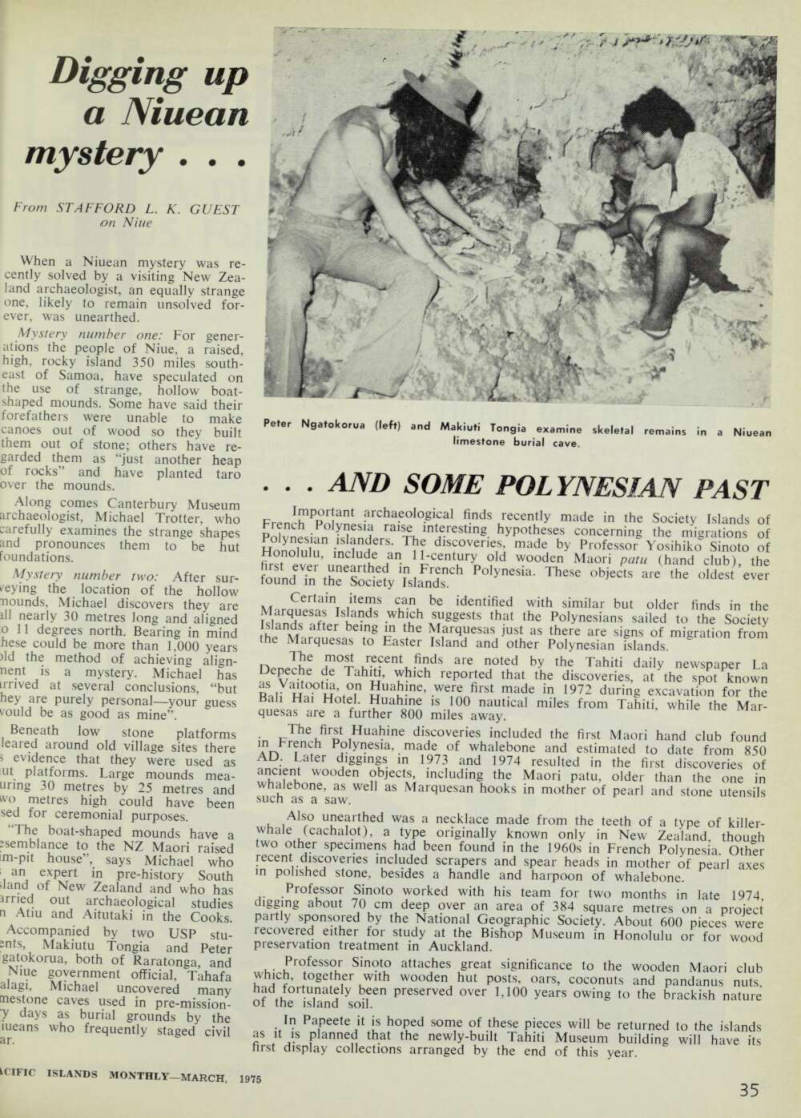
a Niuean mystery . . .
. . . AND SOME POLYNESIAN PAST
From Stafford L. K. Guest
on Niue
When a Niuean mystery was re cently solved by a visiting New Zea land archaeologist, an equally strange one, likely to remain unsolved for ever, was unearthed.
Mystery number one: For gener ations the people of Niue, a raised, high, rocky island 350 miles south east of Samoa, have speculated on the use of strange, hollow boat shaped mounds. Some have said their forefathers were unable to make canoes out of wood so they built them out of stone; others have re garded them as “just another heap of rocks” and have planted taro over the mounds.
Along comes Canterbury Museum archaeologist, Michael Trotter, who carefully examines the strange shapes and pronounces them to be hut foundations.
Mystery number two: After sur veying the location of the hollow nounds, Michael discovers they are dl nearly 30 metres long and aligned o 11 degrees north. Bearing in mind hese could be more than 1,000 years )ld the method of achieving align nent is a mystery. Michael has irnved at several conclusions, “but hey are purely personal—your guess vould be as good as mine”.
Beneath low stone platforms lea red around old village sites there ? evidence that they were used as ut platforms. Large mounds mea unng 30 metres by 25 metres and wo metres high could have been sed for ceremonial purposes.
“The boat-shaped mounds have a to the NZ Maori raised m-pit house”, says Michael who an expert in pre-history South iland of New Zealand and who has arned out archaeological studies n Atiu and Aitutaki in the Cooks.
Accompanied by two USP stu nts, Makiutu Tongia and Peter gatokorua, both of Raratonga, and Niue government official, Tahafa alagi, Michael uncovered many tnestone caves used in pre-mission 7 da y s as burial grounds by the means who frequently staged civil ar.
Frpn^h lP p^i ant archa . eolo .B lcal finds recently made in the Society Islands of Polynesian ! n £ restm «. h yP°‘heses concerning the migrations of areffsaijs* Th Vf.,r„ ( ;,oo tairi T r‘ te T S c . a . n . be ident 'fi ed with similar but older finds in the Mands fflr ht" - Wh m h „ S ,, ugges,s lhat the Polynesians sailed to the Society fh. vr ft b 8 J- n the Marquesas just as there are signs of migration from he Marquesas to Easter Island and other Polynesian islands. JSf , mo 2J , r «? ent . fi? ds are noted by the Tahiti daily newspaper La Depeche de Tahrn, which reported that the discoveries, at the spot known Ha?V?AteT n 5 Ua v ne ’ • We , r L first ITlade in 1972 duri "B excavation for the Bah Hat Hotel. Huahme is 100 nautical miles from Tahiti, while the Mar quesas are a further 800 miles away. • c , The Huahine discoveries included the first Maori hand club found t 4 Ppjyncsm, made of whalebone and estimated to date from 850 AD. Later diggings in 1973 and 1974 resulted in the first discoveries of wooden objects, including the Maori patu, older than the one in whalebone, as well as Marquesan hooks in mother of pearl and stone utensils sucn as a saw.
Also unearthed was a necklace made from the teeth of a type of killer whale (cachalot), a type originally known only in New Zealand though two other specimens had been found in the 1960 s in French Polynesia Other recent discoveries included scrapers and spear heads in mother of pearl axes m polished stone, besides a handle and harpoon of whalebone.
Professor Sinoto worked with his team for two months in late 1974 digging about 70 cm deep over an area of 384 square metres on a project partly sponsored by the National Geographic Society. About 600 pieces were recovered either for study at the Bishop Museum in Honolulu or for wood preservation treatment in Auckland.
Professor Sinoto attaches great significance to the wooden Maori club which, together with wooden hut posts, oars, coconuts and pandanus nuts had fortunately been preserved over 1,100 years owing to the brackish nature of the island soil.
In Papeete it is hoped some of these pieces will be returned to the islands as it is planned that the newly-built Tahiti Museum building will have its first display collections arranged by the end of this year.
Peter Ngatokorua (left) and Makiuti Tongia examine skeletal remains in a Niuean limestone burial cave.
Advertisements & other items, pp. 37-38 (2 items)
35
tCIFIC ISLANDS MONTHLY-MARCH. 1975
Australian Building
Materials
strength and quality
Australian building materials are available to exact specifications at competitive prices.
The range is wide. The quality is guaranteed.
Products include: structural steel, hardboards, veneers, cast-iron pipe fittings, all kinds of insulation, aluminium framed doors and windows, louvre doors, kitchen and bathroom fittings, cupboard furniture, and concrete placement equipment.
For the construction and design of factories, schools, housing or offices you can rely on Australian building materials.
Quality and value that’s only hours away The Australian Trade Commissioner can give you details of suppliers.
You can contact him at: Corner Pratt and Joske Streets, Suva,
FIJI (P.O. Box 1252).
Telephone: 25624, or; P.O. Box 2123, Konedobu, Port Moresby, P.N.G.
Telephone; 44 661.
Australian Department of Overseas Trade
Magazine Section

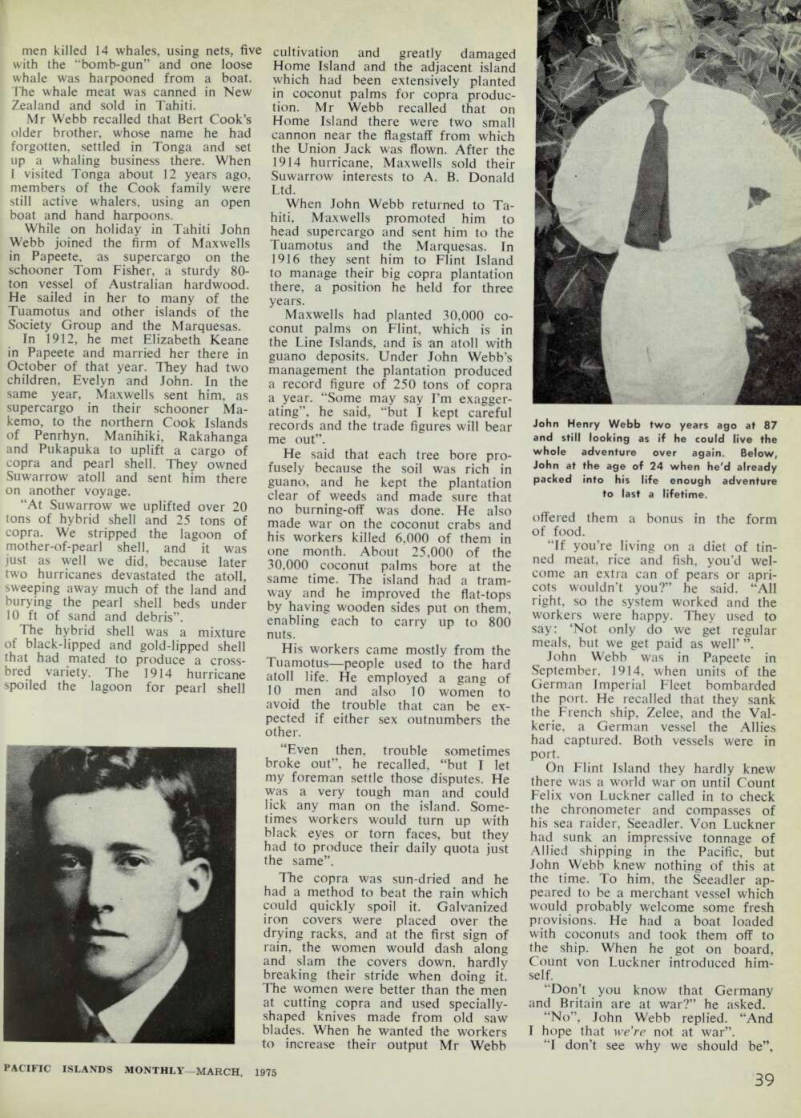
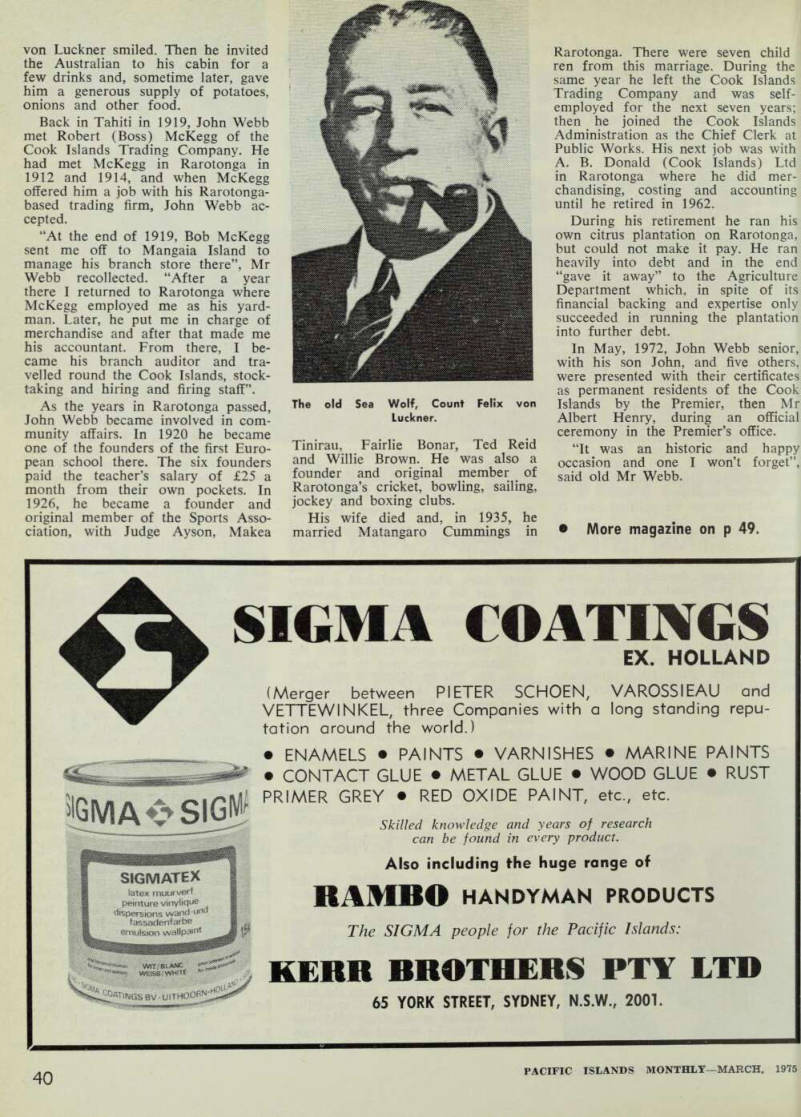
Never A Dull Moment In The
Islands For Cooks' John Webb
By W. H. Percival
A last-minute check-up on John Webb brought this from Don Percival in Rarotonga: John Henry Webb is still sprightly and cheerful at the age of 89, except for oc casional bouts of neuralgia of the face. Until recently, he used to drive his own car, but the car has worn out before he has, and he can't get spares for it. So now he hitches rides into town, where he can be seen walking around most days of the week.
John Henry Webb, aged 89, is one of the Cook Islands’ grand old men. During his long and adven turous career he has been an engineer, whaler, chief supercargo on trading schooners, accountant, man ager of a large copra plantation, and owner of a citrus plantation.
Bom in Bridgewater, Victoria, Australia, on November 23, 1885, he landed in the Cook Islands in January, 1910. After matriculating and winning two scholarships, he studied accountancy at Ballarat but his studies were cut short by his father’s death. He spent the next two years cycling over most of Victoria and New South Wales and also reached parts of Queensland and the Northern Territory, and Broome and Perth in Western Australia.
After taking part in the Tarna gulla gold rush, without any marked success, he went to Sydney and be came a supercargo for a small Syd ney syndicate, a job which took him to the Solomons, the New Hebrides, Tonga, Samoa, Fiji and New Guinea.
“They were pretty wild and woolly places in those days”, Mr Webb re called, “but I managed to keep my head”. His firm had several depots in New Guinea, where head-hunting was the favourite local pastime.
After New Guinea, he island hopped on different ships, calling at Borneo and the Dutch East Indies.
“The Javanese were very simple minded and did everything the Dutch told them to do”, Mr Webb said.
“They trusted and respected Euro peans and I got on well with them.
But the Dutch were a different mat ter. They were developing recently discovered oil fields, and were very suspicious of foreigners. They fol lowed me about and harried me with questions, placing obstacles in my path when I wanted to visit certain areas.
“Several times I predicted that, eventually, the Dutch would be
driven out of the country. Events proved me right, but this didn’t occur until shortly after World War 11. By that time, however, the Indo nesians developed a hatred of all Europeans”.
John Webb then travelled to Japan and the China Coast in 1906, using a British passport. In those distant days people could travel anywhere in the world without a passport. But a passport helped because it showed that the holder was a person of sound financial and social standing.
After leaving Japan, John Webb went to Tasmania and worked there in the silver mines in Mount Magnet.
While there he obtained his second class stationary steam certificate.
Then he went to Bluff, in the South Island of New Zealand, later work ing his way through NZ to Whanga mumu, near the Bay of Islands.
He became a shore engineer at the Whangamumu whaling station and looked after the boilers and winches.
Sometimes he was required to go out with the whalers.
Bert Cook, who owned and ran the station, was a big, powerful, half caste Maori. He could out-work and out-fight any of the men there, and often did so although some of them
were also big, tough men. Cook was also something of an inventor. He invented a method of netting whales, and killing them with a device Mr Webb called a “bomb-gun”.
There were some pinnacle rocks off-shore, and a deep and narrow passage. The whales went through the passages to rub the barnacles off their huge bodies. Bert Cook had strong rope nets hung across the en trance to the passage, but they all burst when the whales crashed into them. Then Cook had the idea of replacing the rope nets with steel nets—and these worked.
His later nets were made of i in. diameter steel wire rope with meshes 5 ft square that were shackled to gether. Each end of the net was made fast to the rocks with new manilla rope, one inch in diameter.
When a whale swam into the steel nets, the rope dragged the net firmly over the mammal’s head before the ropes snapped. As the whale rolled helplessly on the surface, the boats rushed in and the whale was lanced and killed. Then a steam launch made fast and towed the whale, net and all, into the station for pro cessing.
The wire meshes bit a foot deep into the whales’ bodies when they rolled over; then the net was pulled out, unshackled, and then re shackled to form a new net.
Bert Cook’s bomb-gun was mounted on a swivel on his big steam launch. Originally, it was a military weapon with an inch or U in. bore.
Cook enlarged the bore and de signed special projectiles, about 18 in. long and guided in flight by leather vanes. He used charges of black gunpowder, and the projectiles were designed to enter the whale’s body and explode near the heart. If well aimed, they caused instantane ous death.
John Webb worked at the whaling station for six months in 1908 dur ing which time Bert Cook and his
men killed 14 whales, using nets, five with the “bomb-gun” and one loose whale was harpooned from a boat.
The whale meat was canned in New Zealand and sold in Tahiti.
Mr Webb recalled that Bert Cook’s older brother, whose name he had forgotten, settled in Tonga and set up a whaling business there. When I visited Tonga about 12 years ago, members of the Cook family were still active whalers, using an open boat and hand harpoons.
While on holiday in Tahiti John Webb joined the firm of Maxwells in Papeete, as supercargo on the schooner Tom Fisher, a sturdy 80ton vessel of Australian hardwood.
He sailed in her to many of the Tuamotus and other islands of the Society Group and the Marquesas.
In 1912, he met Elizabeth Keane in Papeete and married her there in October of that year. They had two children, Evelyn and John. In the same year, Maxwells sent him, as supercargo in their schooner Ma kemo, to the northern Cook Islands of Penrhyn, Manihiki, Rakahanga and Pukapuka to uplift a cargo of copra and pearl shell. They owned Suwarrow atoll and sent him there on another voyage.
“At Suwarrow we uplifted over 20 tons of hybrid shell and 25 tons of copra. We stripped the lagoon of mother-of-pearl shell, and it was just as well we did, because later two hurricanes devastated the atoll, sweeping away much of the land and burying the pearl shell beds under 10 ft of sand and debris”.
The hybrid shell was a mixture of black-lipped and gold-lipped shell that had mated to produce a cross bred variety. The 1914 hurricane spoiled the lagoon for pearl shell
cultivation and greatly damaged Home Island and the adjacent island which had been extensively planted in coconut palms for copra produc tion. Mr Webb recalled that on Home Island there were two small cannon near the flagstaff from which the Union Jack was flown. After the 1914 hurricane, Maxwells sold their Suwarrow interests to A. B. Donald Ltd.
When John Webb returned to Ta hiti, Maxwells promoted him to head supercargo and sent him to the Tuamotus and the Marquesas. In 1916 they sent him to Flint Island to manage their big copra plantation there, a position he held for three years.
Maxwells had planted 30,000 co conut palms on Flint, which is in the Line Islands, and is an atoll with guano deposits. Under John Webb’s management the plantation produced a record figure of 250 tons of copra a year. “Some may say I’m exagger ating”, he said, “but I kept careful records and the trade figures will bear me out”.
He said that each tree bore pro fusely because the soil was rich in guano, and he kept the plantation clear of weeds and made sure that no burning-off was done. He also made war on the coconut crabs and his workers killed 6,000 of them in one month. About 25,000 of the 30,000 coconut palms bore at the same time. The island had a tram way and he improved the flat-tops by having wooden sides put on them, enabling each to carry up to 800 nuts.
His workers came mostly from the Tuamotus—people used to the hard atoll life. He employed a gang of 10 men and also 10 women to avoid the trouble that can be ex pected if either sex outnumbers the other.
“Even then, trouble sometimes broke out”, he recalled, “but I let my foreman settle those disputes. He was a very tough man and could lick any man on the island. Some times workers would turn up with black eyes or torn faces, but they had to produce their daily quota just the same”.
The copra was sun-dried and he had a method to beat the rain which could quickly spoil it. Galvanized iron covers were placed over the drying racks, and at the first sign of rain, the women would dash along and slam the covers down, hardly breaking their stride when doing it.
The women were better than the men at cutting copra and used specially shaped knives made from old saw blades. When he wanted the workers to increase their output Mr Webb
offered them a bonus in the form of food.
“If you’re living on a diet of tin ned meat, rice and fish, you’d wel come an extra can of pears or apri cots wouldn’t you?” he said. “All right, so the system worked and the workers were happy. They used to say: ‘Not only do we get regular meals, but we get paid as well’ ”.
John Webb was in Papeete in September, 1914, when units of the German Imperial Fleet bombarded the port. He recalled that they sank the French ship, Zelee, and the Val kerie, a German vessel the Allies had captured. Both vessels were in port.
On Flint Island they hardly knew there was a world war on until Count Felix von Luckner called in to check the chronometer and compasses of his sea raider, Seeadler. Von Luckner had sunk an impressive tonnage of Allied shipping in the Pacific, but John Webb knew nothing of this at the time. To him, the Seeadler ap peared to be a merchant vessel which would probably welcome some fresh provisions. He had a boat loaded with coconuts and took them off to the ship. When he got on board, Count von Luckner introduced him self.
“Don’t you know that Germany and Britain are at war?” he asked.
“No”, John Webb replied. “And I hope that we're not at war”.
“I don’t see why we should be”,
John Henry Webb two years ago at 87 and still looking as if he could live the whole adventure over again. Below, John at the age of 24 when he'd already packed into his life enough adventure to last a lifetime.
von Luckner smiled. Then he invited the Australian to his cabin for a few drinks and, sometime later, gave him a generous supply of potatoes, onions and other food.
Back in Tahiti in 1919, John Webb met Robert (Boss) McKegg of the Cook Islands Trading Company. He had met McKegg in Rarotonga in 1912 and 1914, and when McKegg offered him a job with his Rarotonga based trading firm, John Webb ac cepted.
“At the end of 1919, Bob McKegg sent me off to Mangaia Island to manage his branch store there”, Mr Webb recollected. “After a year there I returned to Rarotonga where McKegg employed me as his yard man. Later, he put me in charge of merchandise and after that made me his accountant. From there, I be came his branch auditor and tra velled round the Cook Islands, stock taking and hiring and firing staff”.
As the years in Rarotonga passed, John Webb became involved in com munity affairs. In 1920 he became one of the founders of the first Euro pean school there. The six founders paid the teacher’s salary of £25 a month from their own pockets. In 1926, he became a founder and original member of the Sports Asso ciation, with Judge Ayson, Makea
Tinirau, Fairlie Bonar, Ted Reid and Willie Brown. He was also a founder and original member of Rarotonga’s cricket, bowling, sailing, jockey and boxing clubs.
His wife died and, in 1935, he married Matangaro Cummings in
Rarotonga. There were seven child ren from this marriage. During the same year he left the Cook Islands Trading Company and was self employed for the next seven years; then he joined the Cook Islands Administration as the Chief Clerk at Public Works. His next job was with A. B. Donald (Cook Islands) Ltd in Rarotonga where he did mer chandising, costing and accounting until he retired in 1962.
During his retirement he ran his own citrus plantation on Rarotonga, but could not make it pay. He ran heavily into debt and in the end “gave it away” to the Agriculture Department which, in spite of its financial backing and expertise only succeeded in running the plantation into further debt.
In May, 1972, John Webb senior, with his son John, and five others, were presented with their certificates as permanent residents of the Cook Islands by the Premier, then Mr Albert Henry, during an official ceremony in the Premier’s office.
“It was an historic and happy occasion and one I won’t forget”, said old Mr Webb.
More magazine on p 49.
The old Sea Wolf, Count Felix von Luckner.
Advertisements & other items, pp. 40-50 (2 items)
Todays roofs
demand
new materials
i Si 8 *1: J ■ ■* w "
S- V yah* m % i ■ . w Illustrations depict: Roman Catholic Seminary, Suva.
Pacific Fishing Company, Levuka.
The Fiji Times' Extensions, Suva.
I The General Manager, I Shf Shelter Engineering Limited, P.O. Box 10-043, Christchurch, New Zealand.
Please forward information on
□ BUTYNOL ROOFING MEMBRANE
□ SHELTERLINE & DUNLINE ROOFING
MEMBRANES
□ MEMBRANES FORWATER
MANAGEMENT
NAME
ADDRESS
Dunlop Membranes
BUTYNOL-Based on Butyl Rubber
One-ply roofing has far less weight and bulk than built-up systems.
Therefore, the architect gains greater design freedom plus reduced loads on supporting members.
For the owner, certain structural costs are lowered and maintenance problems minimised. The contractor benefits from reduced materials handling, lower shipping costs and a work day with more productive hours.
SHELTERLINE Asbestos backed
DUNLINE • Unbacked
Both based on well-proven Hypalon* Synthetic Rubber.
Hurricane Bebe' October 1972 and Cyclone Lottie' December 1973 produced no problems for Dunlop Membranes and Adhesives.
O Dunlop membranes are widely used also for Water
Management- Ponds, Reservoirs, etc .
$
SHELTER
ENGINEERING (>
LIMITED
A DUNLOP COMPANY
♦HYPALON is a registered Du Pont trademark for chlorosulfonated polyethylene synthetic rubber.
SIGMA COATINGS
EX. HOLLAND
(Merger between PIETER SCHOEN, VAROSSIEAU and VETTEWINKEL, three Companies with a long standing reputation around the world.)
'IGIVIA v SIGN
SIGMATEX
latex muurverf peinture vinylipu® dispersions yvand-i#** fassadenfarbe eteuteton wallp® n * as --2 s" iIg GS BV - UitHOOßN'^ rf s • ENAMELS • PAINTS • VARNISHES • MARINE PAINTS • CONTACT GLUE • METAL GLUE • WOOD GLUE • RUST PRIMER GREY • RED OXIDE PAINT, etc., etc.
Skilled knowledge and years of research can be found in every product.
Also including the huge range of
RAMBO HANDYMAN PRODUCTS
The SIGMA people for the Pacific Islands:
KERR BROTHERS PTY LTD
65 YORK STREET, SYDNEY, N.S.W., 2001.
STATESMAN
smoothest cigars on
national scene
i S * * o or*D fo 1801 % p IS . r>- BH A
STATESMAN
CORONA
5
Corona
D 585
A new approach
to easier operation.
the front.
CT-F 7171
o: o o Now, a truly precision Dolby* cassette deck that fits in perfectly with the rest of your system. Your other components are accessible from the front, because shelf mounted or stacked, that’s the way you approach them. With Pioneer's new CT-F 7171, loading a cassette is as easy as putting your hand in your podket. No more wasted space by providing vertical accessibility.
While front access design makes it easy to use, Pioneer’s "think ahead” engineering makes it easy to listen to. A long-life ferrite-solid head and built-in Dolby really reduce the noise (S/N ratio; 58dB).
An electronically controlled DC motor guarantees
■ Australia Pioneer Electronics Australia Pty Ltd.. 256-8, City Road. South Melbourne.
Victoria 3205. Australia Tel: 696605 Branches in all states Fiji Islands Brijlal & Company, G.P.O. Box No. 362.
Suva. Fiji Islands Tel: 22-258 Lae Hagemeyer (Australasia) 8.V., P.O. Box No. 90. Lae. New Guinea Tel: 2718 Rabaul Hagemeyer (Australasia) 8.V.. P.O, Box No. 63. Rabaul. New Guinea stable tape transport and a precision capstan all but eliminates vibration (wow and flutter: less than 0.10%
WRMS).
Making your own Dolbyized tapes is easy. An LED recording peak level indicator reacts within milliseconds to warn of excessive input signals. And for special chromium dioxide tapes, there is separate Bias and EQ selection.
But, no matter how you look at the CT-F 7171, you’re bound to change your view about cassette decks. You see, it’s the one that offers truly top performance via access to the front.
Port Moresby Hagemeyer (Australasia) 8.V., P.O. Box No. 1428. Boroko. Port Moresby.
New Guinea Madang Hagemeyer (Australasia) 8.V., P.O. Box No. 673, Madang.T.P.N.G.
New Zealand Tee Vee Radio Ltd., P.O. Box No. 5029, Auckland, New Zealand Tel: 763-064 Norfolk Island Burns Philp (South Sea) Co., Ltd., Norfolk Island. South Pacific Nauru Island Jacob Enterprises, P.O. Box No. 4.
Nauru Island Tahiti Ets. PERFECT, B.P. 594. Papeete.
Tahiti Tel: 20-407 New Caledonia Menard Freres, B.P. 123. Noumea, New Caledonia Tel: 52-22 American Samoa Transpac Corporation, P.O. Box 1477, Pago Pago. American Samoa 96799 Tel: 2227 *" Dolby" is a trademark of Dolby Laboratories, Inc.
Our business is cargo.
Your cargo: to anywhere in our Pacific.
Two paddle steamers on the Yangtse River in 1873 marked beginning of the China Navigation Company. Today, the same flag flies above eighteen modern motor ships plying an extensive network of cargo routes between Papua New Guinea and Pacific Island ports (as far East as Tahiti) and Japan, New Zealand, Australia and Thailand.
For 100 years, the flag of the China Navigation Company has meant experience, reliability and speed across the sea. Today, it’s tlymg as strong as ever.
Rabaul, Kieta. Burns Philp Guinea 7U cT "We wak hT Gulnea: , S,e mshi P s Tradin 8 Co. Ltd., Port Moresby, Samarai, Lae. Madang, Tonga: Morris Hedstrom Ltd., Nukualofa and' VWuT.W f■ t Hedstrom Ltd Suva, Lautoka. Western Samoa; Morris Hedstrom Ltd., Apia.
B.S,l.P.:BritishSolomonsTradingCo Ltd Honiara New Hebrides- 1 Tn ♦ • % onald Tahiti, Papeete. New Caledonia: Etablissemenfs Ballande, Noumea.
Swire Pty. Ltd. Melbourne: Interocean Aus?S SeTvkes Ptvft .ttn Fran " ais^^o u y e le s- He bri de s. v ilaandSanto.AUSTßALlA-Sydney: lnterocean Auckland, Wellington. Christchurch.DunedinßluffNanTer llnan W .lls Gilchrist &: Sanderson Pty. Ltd. NEW ZEALAND-P. &O. (N.Z.) Ltd. & Swire, 9 Connaught Rd., Central. Hong Kong.' ’ P P S McKmnon . Tokyo, Yokohama, Osaka, Kobe and Nagoya. Eastern Managers: Butterfield /S\ JOHN SWIRE & SONS PTY. LTD. General Agents in Australia, 8 Spring Street, Sydney, Phone: 27 9351.
(cm) THE CHINA NAVIGATION CO LTD
MEMBER OF THE SWIRE GROUP.
If you ve got work to do,
weve got trucks to do it.
TOYOTA Hi Lux
TOYOTA
TOYOTA
Stout Hi-Ace
TOYOTA
Land Cruiser Pickup
SUPPLIES CX)
--- AUTO CO., P.O. Box 1458, Agana. NEW HEBRIDES: NEW HEBRIDES MOTORS LTD, P.O, Box 18, Vila, SOLOMON ISLANDS: MENDANA ENTERPRISES (5.1.1, L LIMITED, Scratchley Rd„ Badili, Papua. U.S. TRUST TERRITORY: MICROL CORPORATION, P.O. Box 267, Saipan. FIJI AUTOMOTIVE 3
Apia GUAM: RICKY'S
P.O. Box 1 74, Honiara
1 « *1 It % r . » ' ' * ' Jr ’ . ■* * a
v v^v
SX.VXi
- • % t •« 'A ■ -» V* ' V* S*V - - %
TOYOTA Land Cruiser
w n ffUnV.*’lf: L~ From different styles of the 4-wheel-drive Land Cruiser, to vans and pickups, to heavy duty trucks. Toyota makes them.
And Toyota makes them tough.
There’s a Toyota truck that will work for you. Economically,
Reliably.
Find out about it. From your local Toyota dealer.
ixis
TOYOTA Dyna
TOYOTA
T oyo-Ace TOYOTA Truck
OYOTA
TAHITI: NIPPON AUTOMOTO, B.P. 545, Papeete. COOK ISLANDS; COOK ISLANDS TRADING CORPORATION LTD PO Box 92 Rarotonga. NAURU'ISLAND; NAURU COOPERATIVE SOCIETY GILBERT & ELLICE ISLANDS COLONY: TARAWA MOTORS Box 3b’ rlf pnn^A MAR ' ES NORFOLK TOURS, LTD , PO, Box 276. TIMOR: SANG TA I HOO. Sang Tai Building, Dili!
NEW CALEDONIA: SOCIETE IMPORTATION AUTOMOBILE DU PACIFIQUE, Rond-Point du Pacific (Station Total) B.P 438 Noumea
Wunderflex gives
good design at low cost
E324ED
You want modern design?
Then use modern material that won’t warp, shrink or rot You want least cost?
Then build with a board that can be worked with handyman’s tools.
Inside and out, your home will have the modern, simple lines of Wunderflex building board.
kViunderlich
Wunderflex
Available from: Papua New Guinea: Steamships Trading Co Ltd.
Norfolk Island: Irvine’s Building Supply Centre Made in Australia and marketed by CSR Building Materials Export Sales: 4 O’Connell Street, Sydney, Australia 2000
a new dimension in outboard motors
from Finland
★ RANGING FROM 3 TO 40 H.P.
★ BUILT IN GENERATORS
FROM 5 H P, UPWARDS.
★ 2 YEARS WARRANTY
XBrt ■ 'em m
look at these outstanding features
TERf-HI
the great name in family boating
from Pacific . . .
LIGHTWEIGHT: Anti corrosion alloy materials with stainless steel underwater parts and shafts.
MODERN DESIGN; Modern loop scavenged design, all roller bearing on crankshafts.
ECONOMICAL: Fixed jet carburettors gives extremely economical running.
SYNCHRONISED TILLER CONTROL: All in one gearshift and throttle incorporated. (Forward and reverse).
BUILT IN GENERATORS: 5 hp and up equipped with generating coils tor running lights or battery charging.
PUSH BUTTON START: Electric starting models, 15-20-40 easy start with push button.
SPARE PARTS AND ACCESSORIES: All parts and accessories available ex stock at very reasonable prices.
Pacific
DEALER INQUIRIES INVITED.
D.A.T.A., 19 Carrington Road, Marrickville, N.S.W., Aust., 2204.
Ph.: 55 3473. Telex: 25568. Cables: "Dieseltech", Sydney.
serve simply with SAO
Arnott’s Sao biscuits are the handiest cracker biscuits you can buy. No sooner is one pack finished than you’re opening another. They’re always fresh and ready when you want them, pack after pack. Just take anything you fancy and...
rnott's/'"’ Biscuits
There is no Substitute for Quality
47
PACIFir ISLANDS MONTHLY—MARCH, 1975
Yesterday
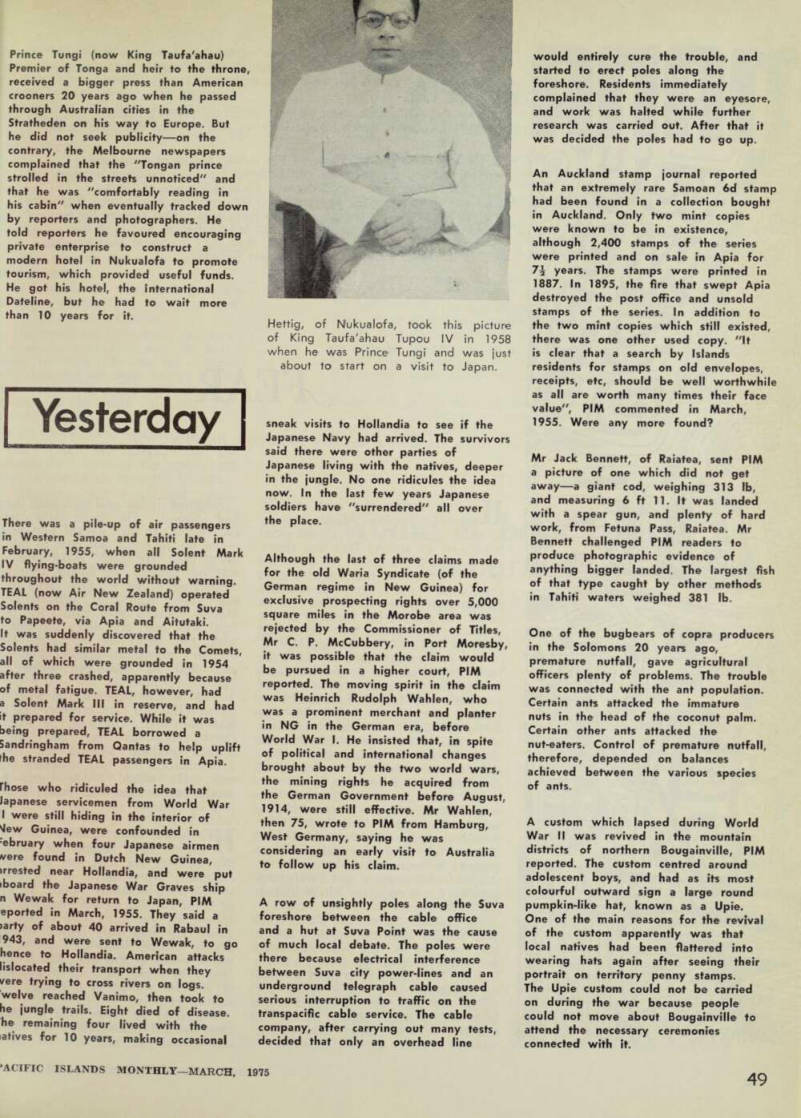
Prince Tungi (now King Taufa'ahau) Premier of Tonga and heir to the throne, received a bigger press than American crooners 20 years ago when he passed through Australian cities in the Stratheden on his way to Europe. But he did not seek publicity—on the contrary, the Melbourne newspapers complained that the "Tongan prince strolled in the streets unnoticed" and that he was "comfortably reading in his cabin" when eventually tracked down by reporters and photographers. He told reporters he favoured encouraging private enterprise to construct a modern hotel in Nukualofa to promote tourism, which provided useful funds.
He got his hotel, the International Dateline, but he had to wait more than 10 years for it.
There was a pile-up of air passengers in Western Samoa and Tahiti late in February, 1955, when all Solent Mark IV flying-boats were grounded throughout the world without warning.
TEAL (now Air New Zealand) operated Solents on the Coral Route from Suva to Papeete, via Apia and Aitutaki.
It was suddenly discovered that the Solents had similar metal to the Comets, ail of which were grounded in 1954 after three crashed, apparently because of metal fatigue. TEAL, however, had a Solent Mark 111 in reserve, and had it prepared for service. While it was being prepared, TEAL borrowed a Sandringham from Qantas to help uplift fhe stranded TEAL passengers in Apia. fhose who ridiculed the idea that Japanese servicemen from World War I were still hiding in the interior of Mew Guinea, were confounded in ■ebruary when four Japanese airmen vere found in Dutch New Guinea, irrested near Hollandia, and were put iboard the Japanese War Graves ship n Wewak for return to Japan, PIM eported in March, 1955. They said a >arty of about 40 arrived in Rabaul in 943, and were sent to Wewak, to go hence to Hollandia. American attacks lislocated their transport when they vere trying to cross rivers on logs, welve reached Vanimo, then took to he jungle trails. Eight died of disease, he remaining four lived with the natives for 10 years, making occasional
sneak visits to Hollandia to see if the Japanese Navy had arrived. The survivors said there were other parties of Japanese living with the natives, deeper in the jungle. No one ridicules the idea now. In the last few years Japanese soldiers have "surrendered" all over the place.
Although the last of three claims made for the old Waria Syndicate (of the German regime in New Guinea) for exclusive prospecting rights over 5,000 square miles in the Morobe area was rejected by the Commissioner of Titles, Mr C. P. McCubbery, in Port Moresby, it was possible that the claim would be pursued in a higher court, PIM reported. The moving spirit in the claim was Heinrich Rudolph Wahlen, who was a prominent merchant and planter in NG in the German era, before World War I. He insisted that, in spite of political and international changes brought about by the two world wars, the mining rights he acquired from the German Government before August, 1914, were still effective. Mr Wahlen, then 75, wrote to PIM from Hamburg, West Germany, saying he was considering an early visit to Australia to follow up his claim.
A row of unsightly poles along the Suva foreshore between the cable office and a hut at Suva Point was the cause of much local debate. The poles were there because electrical interference between Suva city power-lines and an underground telegraph cable caused serious interruption to traffic on the transpacific cable service. The cable company, after carrying out many tests, decided that only an overhead line
would entirely cure the trouble, and started to erect poles along the foreshore. Residents immediately complained that they were an eyesore, and work was halted while further research was carried out. After that it was decided the poles had to go up.
An Auckland stamp journal reported that an extremely rare Samoan 6d stamp had been found in a collection bought in Auckland. Only two mint copies were known to be in existence, although 2,400 stamps of the series were printed and on sale in Apia for years. The stamps were printed in 1887. In 1895, the fire that swept Apia destroyed the post office and unsold stamps of the series. In addition to the two mint copies which still existed, there was one other used copy. "It is clear that a search by Islands residents for stamps on old envelopes, receipts, etc, should be well worthwhile as all are worth many times their face value", PIM commented in March, 1955. Were any more found?
Mr Jack Bennett, of Raiatea, sent PIM a picture of one which did not get away—a giant cod, weighing 313 lb, and measuring 6 ft 11. It was landed with a spear gun, and plenty of hard work, from Fetuna Pass, Raiatea. Mr Bennett challenged PIM readers to
produce photographic evidence of
anything bigger landed. The largest fish of that type caught by other methods in Tahiti waters weighed 381 lb.
One of the bugbears of copra producers in the Solomons 20 years ago, premature nutfall, gave agricultural officers plenty of problems. The trouble was connected with the ant population.
Certain ants attacked the immature nuts in the head of the coconut palm.
Certain other ants attacked the nut-eaters. Control of premature nutfall, therefore, depended on balances achieved between the various species of ants.
A custom which lapsed during World War II was revived in the mountain districts of northern Bougainville, PIM reported. The custom centred around adolescent boys, and had as its most colourful outward sign a large round pumpkin-like hat, known as a Upie.
One of the main reasons for the revival of the custom apparently was that local natives had been flattered into wearing hats again after seeing their portrait on territory penny stamps.
The Upie custom could not be carried on during the war because people could not move about Bougainville to attend the necessary ceremonies connected with it.
Hettig, of Nukualofa, took this picture of King Taufa'ahau Tupou IV in 1958 when he was Prince Tungi and was just about to start on a visit to Japan.
Advertisements & other items, p. 51 (1 item)
49
•ACIFIC ISLANDS MONTHLY—MARCH. 1975
Mana
is a vehicle for Pacific Islands’ writers and artists to publish their work. It is an organ of the South Pacific Creative Arts Society and its editorial committee comprises writers from many islands.
Material for publication must be sent direct to MANA’s editor, Marjorie Crocombe, South Pacific Creative Arts Society, Box 5083, Suva March MANA is predominantly a Fiji issue. Margaret Knox and Parmesh Chand are teachers and Falaniko Tiputa, a Western Samoan, is at the Pacific Regional Seminary. Belinda Brown, of Suva Grammar School, whose short story, Fear, appears below, won first prize in a recent essay competition. Viggo Rasmussen, who prefers his two poems to be untitled, has published in MANA before and is at the University of the South Pacific. ‘‘Odd man out” is Joseph Sukwianomb, who is at the University of Papua New Guinea.
Fear
By Belinda Brown
HE ran across the lawn wildly, heart thumping, breath coming in quick gasps. The sun blazed over head and all around him was space, empty and frightening. He must get away—away from these agoraphobic conditions and find somewhere hidden and sheltered. Behind him he heard the thundering footfalls of his pursuers and knew that he would have to make his escape quickly.
There was a turning away from the nark on his left and he hurried down it thankfully, pausing onlv a moment to check how far his followers were behind him. As he made his way down it blindly, he picked his way along beside the little stream that ran down it, half bv instinct and half by an accuracy which the desperation of the moment had lent him.
He must get away, he must—he was obsessed with the idea and if they caught him only God knew what would happen. He stumbled and almost fell, but reached up and grasped a branch hanging over the stream in his urgencv and hurried on, sobbing for breath, the blood pound ing in his ears.
He reached the end of the turning and hurtled into the small wood it lead out on to. He was exhausted and knew he could not carry on much longer. He would have liked to keep on running until he reached the village on the other side, where he knew of a good hiding place, but realised it was sheer madness to attempt to cover that distance now.
He must lie low and wait until they had passed. He must stay un discovered. If they caught him now —but no, he could not bear to think about that. He would make sure he was not caught. He found what he considered to be a fairly large tree and leant against it, winded and almost doubled with pain. He felt faint with fear, and dizzy and numb with the effort of running. His brother’s words still thundered in his ears and he shuddered when he thought of them.
And he had believed Jim was his i friend —Jim, his own brother, and he; had said that. Oh well, he would 1 show them—his fear and anger seemed nothing against the rigid I determination that had possessed him j now. He would evade them—he; would evade them—he would make; sure of that.
HE heard them coming and he: shrank back behind the protec tive form of the tree, fists and teeth] clenched, every nerve in his body' stretched to breaking point. Jt was< as if the rustling of the trees and the; calling of the birds had ceased tO( exist. He was only aware of the; people behind him—they were the; whole world to h>m now, and if t > found him out he’d have nothing,, at all. He waited in a silence that! seemed endless.
Suddenly, he heard one of themr close behind him—calling his name: out mockingly, and for an awful!
moment he thought they’d found him.
But no—they were just trying to frighten him, knowing he was some where in the vicinity and aiming to torture him until he gave himself up.
He felt he would rather die than do that. He was not as lily-livered as they thought.
He stayed in hiding for 10 minutes, dodging from tree to tree as they searched for him vainly, insulting him, ridiculing him, trying to spring on him, but all the time under estimating his inborn sense of know ing exactly when to dodge and when to stay put. In the end, it was they that gave up.
“Come on—he must have gone on into the village. Too late to go now —we’ll have to get back.”
He could hardly believe his luck.
He waited a moment until he heard their footsteps fade into the distance and then ran out from behind a tree, Dvercome with relief and throwing :aution to the wind. He was free!
Free! He was . . , “So we’ve finally caught you.”
He froze. He looked up, dis aelievingly, to meet the cold hard ;aze of one of his brother’s friends.
“Thought that would get you— hem going off like that. What you lidn’t realise was that I stayed be u'nd.”
He had a wild impulse to run, to ake one last crazy chance and make i desperate bid for freedom. But he :new it was no good. He had to sur ender now—it was the rule of the ame.
“Okay Alec, Jim. I’ve got him.
Tm can come back now.”
He hung his head and stared de jctedly at the ground while they ame back, not even trusting himself 3 speak.
“Well, well—you’ve really proved ourself now, haven’t you? Never new you had it in you! Well done!” \I AS that Jim’s voice? Jim, his brother, who had said he would irash him well and truly if . . .
“Come on, you must be tired after 11 that. Come here and I’ll give you piggy back home.” ‘But . . . but you said you’d irash me . . he finally managed > blurt out, feeling a mixture of un slievable relief, joy and indignation.
What about . . .”
The boy gasped, overwhelmed with appiness, and ran to his 15-year-old other with tears of relief shining his eyes. Jim would never really we thrashed him. Not his brother m. Good old Jim. He wouldn’t we thrashed him just for being mght in a silly game of hide-and ek.
Suva Blanket
By Falaniko Tiputa
Suva at night is like the first sky, Its colourful lights twinkle, capturing an eye.
Over the sea, white, yellow snakes wriggle along feeling the dark breeze which cools the water.
Lights of all sorts seem to overwhelm me, When 1 wink, they dart a smile, When I’m in agony, they reflect hopefully, In their beauty I lose myself, my worries.
But man-made destroyers mar this sky Down the streets, the traffic eyes search my footsteps Through blocked houses, through the blind crossings They try to corner me, punch me unawares.
Death, real death storms in my brain Its callings increase trying to split my conscience, It eats through my guts; rules my whole world.
Death still reigns inside my alarm clock.
Under this sky, I think of escaping to darkness leaving my yesterdays and tomorrows.
Slowly I stagger to my mat, for surely Under my blanket reigns comfort and life.
tomorrow?
Would it be a better tomorrow?
By Parmesh Chand
THE dawn was breaking. The mist that was covering the little house on the hill was slowly disappearing.
A man came out on the verandah; he looked up at the sky for a moment and went back into the house.
Soon he emerged with a billycan in one hand and started for the road. A gentle breeze blew across his face, causing him to shiver in his tattered old clothes. But the cold did not worry him. He had become used to it over the past few years.
The mist was disappearing very quickly. The sun was just emerging on the horizon. As he walked along, the man mumbled to himself, some thing about the monotonous routine of getting up early in the morning, catching a crowded bus. and filling in hours with the humiliating job of cutting grass and collecting rubbish by the roadside.
Ten minutes later he was boarding the bus that would take him to his place of work. A man called out to him, “Bahut Thanda lage ka yaar?” (“You feeling very cold or what?”) “Bahut jor ” (“Very much) replied the man.
The man looked around for an empty seat where he could sit alone.
He did not feel like involving himself in the laughter and the conversation of his other work-mates.
As he sat there he began thinking about his home. His children must be stirring out of bed now. Funny, how he never saw them in the morn ing; the only times he ever got the chance of sitting with them and shar ing their experiences were in the evenings after work.
Then his thoughts shifted to his wife. His eyes seemed to cloud at the thought of her. She did not under stand his problems. Did she realise how hard he worked in order to feed and clothe his family? Just the other day, during one of their quarrels, she had yelled at him, “If I had known that my parents would marry me off to a pauper, I would have killed my self”.
He had cringed at that accusation.
He knew he could not meet his family’s demands. How could he?
He only earned $l4 a week. With this money he had to feed and clothe his five children, send three boys to
school, pay the water bills and house rent. It wasn’t his fault that he could not get a better job. After all he was an illiterate man.
THE bus made a sudden bump, jolting him from his thoughts.
He realised his other workmates were getting off the bus. So he got up and joined their queue. His hard work had begun. He was handed a cane-knife and was told to cut grass until lunch-time. The man was thankful the day was cloudy but he knew as the hours nassed it would become very hot and sticky.
So the man stooped down to work, cut grass for a while, stopped to rest for a few minutes, and then going back to cutting. Now and then he would stand up, take off his hat, wipe off the sweat on his forehead and then resume his work.
It was midday and time for a break for an hour for lunch. The man sat under a tree beside the road. He would view almost every vehicle that passed by the road.
Virtually everyone who passed him gave him a second look. He asked himself why they did so. Were they making fun of his tattered old clothes or were they pitying him because of the job he was doing? After a few
minutes of his meditation he shrugged his shoulders as if to show that he didn’t care. He couldn’t afford to care for he and his family depended on this “dirty” job. It occurred to him that in two days time he would be getting his pay. But what was $l4? Already he had received notice for his children’s fees. His sons needed raincoats, his son Pradeep had asked him for a school bag, but could he afford to give him his luxury? That $l4 will be sufficient only for their meals and perhaps pay part of the fees.
He wondered how long he would have to endure such poverty.
With these thoughts, he went back to work and continued till 4.30 pm when he knocked off. He took a bus back home. He got offat the feeder that led to his home. On bis way he J omed fnend wh o was going his way. They exchanged a few words about the weather and the cunrent happenings m their community. After some time they separated. The man trudged along towards his His sons, who were playing marbles on the road, when they saw him, ran towards him to help him carry his billy-can. They were hoping the billycan would contain some left-over food which they could eat.
THE man sat down on the chaiii on the verandah. Momentarily! he closed his eyes as though to sheo; his tiredness.
He heard his wife calling out frorai the kitchen, “Pradeep, go and aslh your father if he wants a cup of tea”"
Pradeep came and mumbled ther message. The man did not reply. Hei opened his eyes and began studying! the boy’s big head and thin legs. Thei legs were long, thin and covered with sores.
Suddenly the little boy gave him s big smile and ran down into his armse “Father, did you bring my schooc bag?”
The man answered, “Not todays son. Tomorrow maybe. Now run along and get me a cup of tea”.
The boy went to the kitchen ano came back with a cup. The man took' it from him and finished the tea in three gurgling draughts, snorting ano; sighing in between. He placed thei cup on the floor, took off his hatt and began smoothing his damp hain On the horizon, the sun was sett ting. The man thought to himself! another day has gone. Tomorrow will come but would it be a better tomorrow for me?
Advertisements & other items, p. 53 (1 item)
51
ICIFIC ISLANDS MONTHLY—MARCH, 1975
Where Are The Green Leaves?
By Joseph W. Sukwianomb
Sure enough, .
A confounded eye witnessed the unintelligible forces Devouring and digesting rocks and soil, Overpowering rivers and gullies.
“Well and good,” some desperate people say.
But then you hear the moonlight quiver in anguish, The green trees wither and bend leafless, Like a naked body ashamed to dance.
The alarming sounds of prodigious intensity, Lure the ear to breaking the eardrums, Amidst thy despicable wants, Despoils and detaches and deteriorates the green, green leaves.
In the emptiness of the dawn, An incessant low roaring of the wind, Whispers through the air in pursuit, of the green, green leaves.
Soft and alarming it blows again, Filling ears to sadden the effect, Like the morning of a funeral day.
Goddamn machines.
Development Erected with finished silver, Alien and extravagant luxury, Glittering the sun’s rays, Deceiving us below.
There, standing lifeless and boastful The cone of the architectural symbol.
Overweighing kunai huts Mud walls Gardening lands, Et cetera.
Substitution?
Plumbed in air for Cool, Clean, breeze.
Get the hell out of here, let me breathe my native air like my native husband Who will caress me plainly.
Composing With The Help
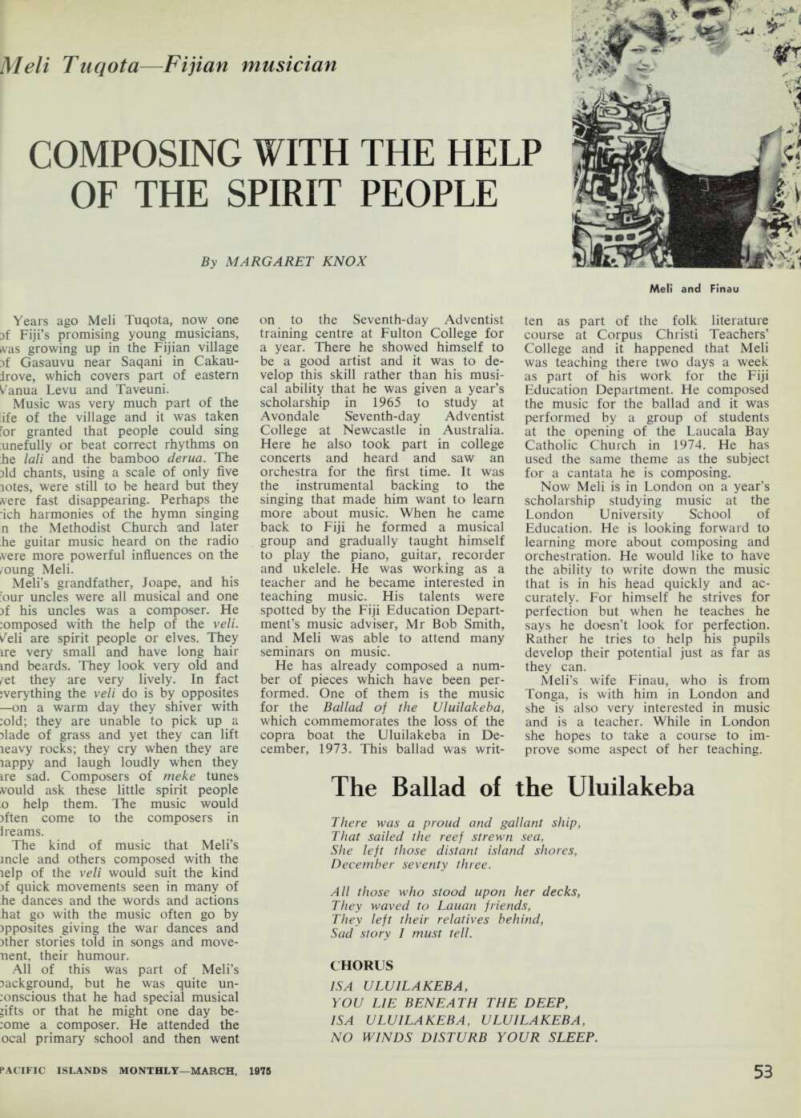
Of The Spirit People
Meli Tuqota—Fijian musician
By Margaret Knox
Years ago Meli Tuqota, now one Df Fiji’s promising young musicians, ivas growing up in the Fijian village Df Gasauvu near Saqani in Cakau- Irove, which covers part of eastern yanua Levu and Taveuni.
Music was very much part of the ife of the village and it was taken [or granted that people could sing unefully or beat correct rhythms on he lali and the bamboo derua. The Did chants, using a scale of only five lotes, were still to be heard but they vere fast disappearing. Perhaps the •ich harmonies of the hymn singing n the Methodist Church and later he guitar music heard on the radio vere more powerful influences on the /oung Meli.
Meli’s grandfather, Joape, and his :our uncles were all musical and one Df his uncles was a composer. He composed with the help of the veli. /eli are spirit people or elves. They ire very small and have long hair ind beards. They look very old and they are very lively. In fact everything the veli do is by opposites —on a warm day they shiver with cold; they are unable to pick up a Dlade of grass and yet they can lift leavy rocks; they cry when they are lappy and laugh loudly when they ire sad. Composers of meke tunes vould ask these little spirit people o help them. The music would Dften come to the composers in Ireams.
The kind of music that Meli’s mcle and others composed with the iclp of the veli would suit the kind Df quick movements seen in many of he dances and the words and actions hat go with the music often go by Dpposites giving the war dances and Dther stories told in songs and move nent, their humour.
All of this was part of Meli’s Dackground, but he was quite un conscious that he had special musical »ifts or that he might one day be come a composer. He attended the ocal primary school and then went
on to the Seventh-day Adventist training centre at Fulton College for a year. There he showed himself to be a good artist and it was to de velop this skill rather than his musi cal ability that he was given a year’s scholarship in 1965 to study at Avondale Seventh-day Adventist College at Newcastle in Australia.
Here he also took part in college concerts and heard and saw an orchestra for the first time. It was the instrumental backing to the singing that made him want to learn more about music. When he came back to Fiji he formed a musical group and gradually taught himself to play the piano, guitar, recorder and ukelele. He was working as a teacher and he became interested in teaching music. His talents were spotted by the Fiji Education Depart ment’s music adviser, Mr Bob Smith, and Meli was able to attend many seminars on music.
He has already composed a num ber of pieces which have been per formed. One of them is the music for the Ballad of the Uluilakeba, which commemorates the loss of the copra boat the Uluilakeba in De cember, 1973. This ballad was writ
ten as part of the folk literature course at Corpus Christi Teachers’
College and it happened that Meli was teaching there two days a week as part of his work for the Fiji Education Department. He composed the music for the ballad and it was performed by a group of students at the opening of the Laucala Bay Catholic Church in 1974. He has used the same theme as the subject for a cantata he is composing.
Now Meli is in London on a year’s scholarship studying music at the London University School of Education. He is looking forward to learning more about composing and orchestration. He would like to have the ability to write down the music that is in his head quickly and ac curately. For himself he strives for perfection but when he teaches he says he doesn’t look for perfection.
Rather he tries to help his pupils develop their potential just as far as they can.
Meli’s wife Finau, who is from Tonga, is with him in London and she is also very interested in music and is a teacher. While in London she hopes to take a course to im prove some aspect of her teaching.
Meli and Finau
The Ballad of the Uluilakeba
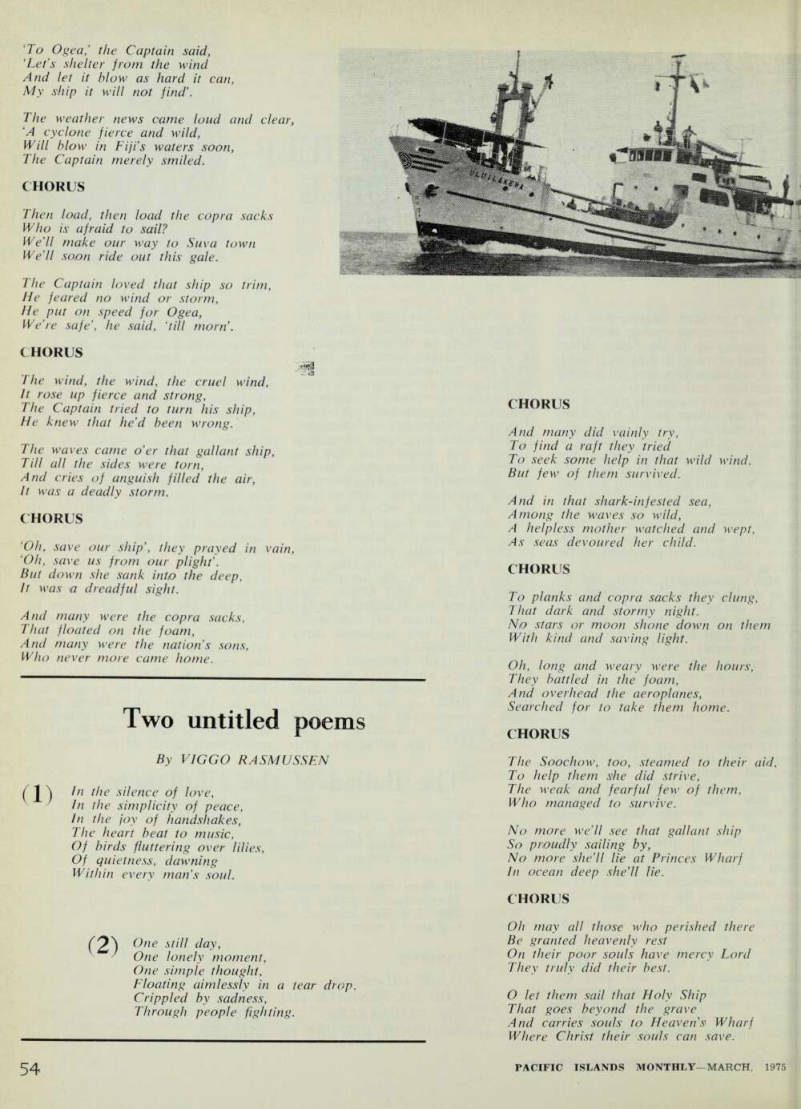
There was a proud and gallant ship, That sailed the reef strewn sea, She left those distant island shores, December seventy three.
All those who stood upon her decks, They waved to Lauan friends, They left their relatives behind, Sad story I must tell.
Chorus
Isa Uluilakeba,
You Lie Beneath The Deep,
Isa Uluilakeba, Uluilakeba,
No Winds Disturb Your Sleep.
To Ogea,’ the Captain said, ‘Let’s shelter from the wind And let it blow as hard it can, My ship it will not find’.
The weather news came loud and clear, ‘A cyclone fierce and wild, Will blow in Fiji’s waters soon, The Captain merely smiled.
Chorus
Then load, then load the copra sacks Who is afraid to sail?
We’ll make our way to Suva town We’ll soon ride out this gale.
The Captain loved that ship so trim, He feared no wind or storm, He put on speed for Ogea, We’re safe', he said, 'till morn’.
Chorus
The wind, the wind, the cruel wind, It rose up fierce and strong, The Captain tried to turn his ship, He knew that he’d been wrong.
The waves came o’er that gallant ship, Till all the sides were torn, And cries of anguish filled the air, It was a deadly storm.
Chorus
‘Oh, save our ship’, they prayed in vain, ‘Oh, save us from our plight’.
But down she sank into the deep, It was a dreadful sight.
And many were the copra sacks, That floated on the foam, And many were the nation’s sons, Who never more came home.
Chorus
And many did vainly try, To find a raft they tried To seek some help in that wild wind, But few of them survived.
And in that shark-infested sea, Among the waves so wild, A helpless mother watched and wept, As seas devoured her child.
Chorus
To planks and copra sacks they clung, That dark and stormy night.
No stars or moon shone down on them With kind and saving light.
Oh, long and weary were the hours, They battled in the foam, And overhead the aeroplanes, Searched for to take them home.
Chorus
The Soochow, too, steamed to their aid.
To help them she did strive, The weak and fearful few of them, Who managed to survive.
No more we’ll see that gallant ship So proudly sailing by, No more she’ll lie at Princes Wharf In ocean deep she’ll lie.
Chorus
Oh may all those who perished there Be granted heavenly rest On their poor souls have mercy Lord They truly did their best.
O let them sail that Holy Ship That goes beyond the grave And carries souls to Heavens Wharf Where Christ their souls can save.
Two untitled poems
By Viggo Rasmussen
f 1) n *I IC silence of love, In the simplicity of peace, In the joy of handshakes, The heart beat to music, Of birds fluttering over lilies, Of quietness, dawning Within every man’s soul.
One still day, One lonely moment, One simple thought, Floating aimlessly in a tear drop.
Crippled by sadness, Through people fighting.
Advertisements & other items, pp. 57-59 (2 items)
55
ACIFIC ISLANDS MONTHLY-MARCH, 1975
A growing airline
in a shrinking world...
Fly to any of 16 AIR NEW ZEALAND Gateways to the World. a
Los Angeles
SR I ft ■ i U
Singapore
AIR NEW ZEALAND is a truly international airline, flying you throughout the Pacific to any of 16 Gateways to the World, as far apart as Wellington and Singapore, Auckland and Los Angeles. . You fly the friend ly fleet Mm of DC 10s and DC Bs.
Our magnificent wide-bodied DC-lOs now fly on most international AIR NEW ZEALAND routes. On other flights and services, our personalised DC-8s provide outstanding AIR NEW ZEALAND service.
16 exciting Gateways
to the World.
AIR NEW ZEALAND flies to Hawaii Los Angeles, Hong Kong, Singapore, Sydney, Melbourne, Brisbane, Auckland, Wellington, Christchurch, Fiji, Tahiti, New Caledonia, Samoa, Rarotonga and Norfolk Island.
air newZEßLano
Friendliest wings across your world.
1 alk to AIR NEW ZEALAND or your travel agent
ANZ 233
and available from leading suppliers throughout the Pacific
Become a part of PIM’s Pacific and subscribe now CD CD OS O tr d p d d CD 5‘ 3 w 2 os S 2 - O d p o o i-s 3 gj 25 % Fi// m details on the attached order form .
Book Reviews
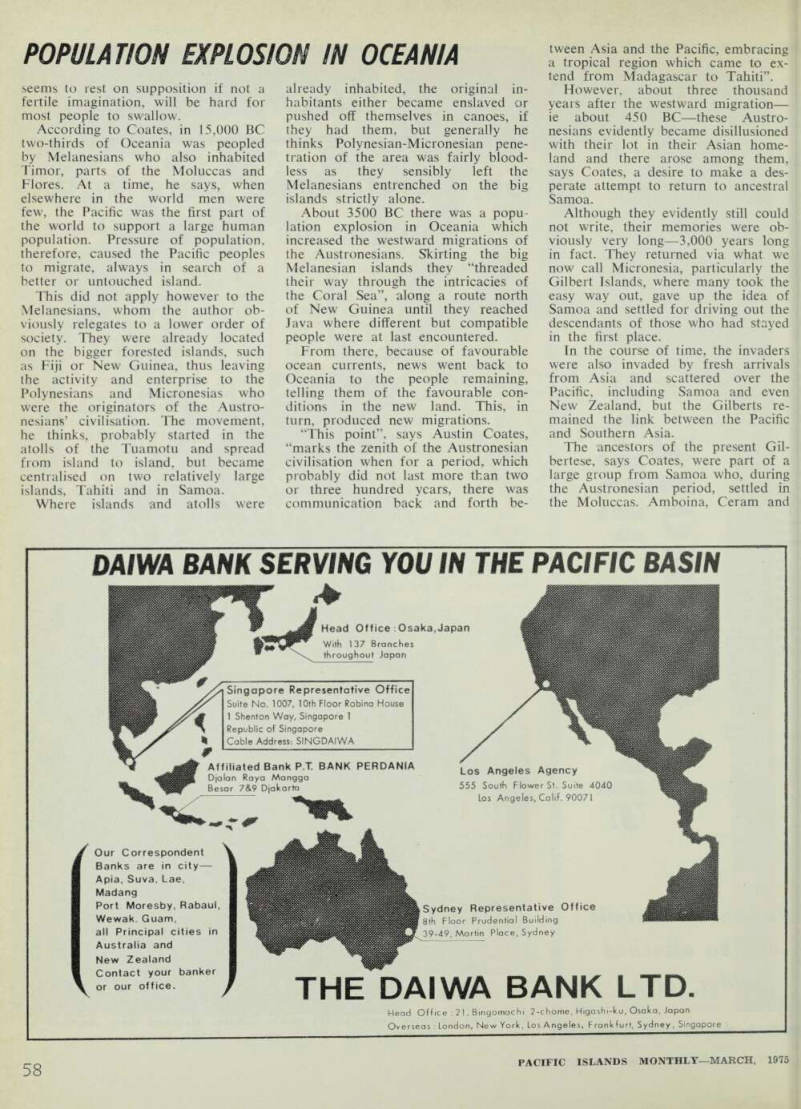
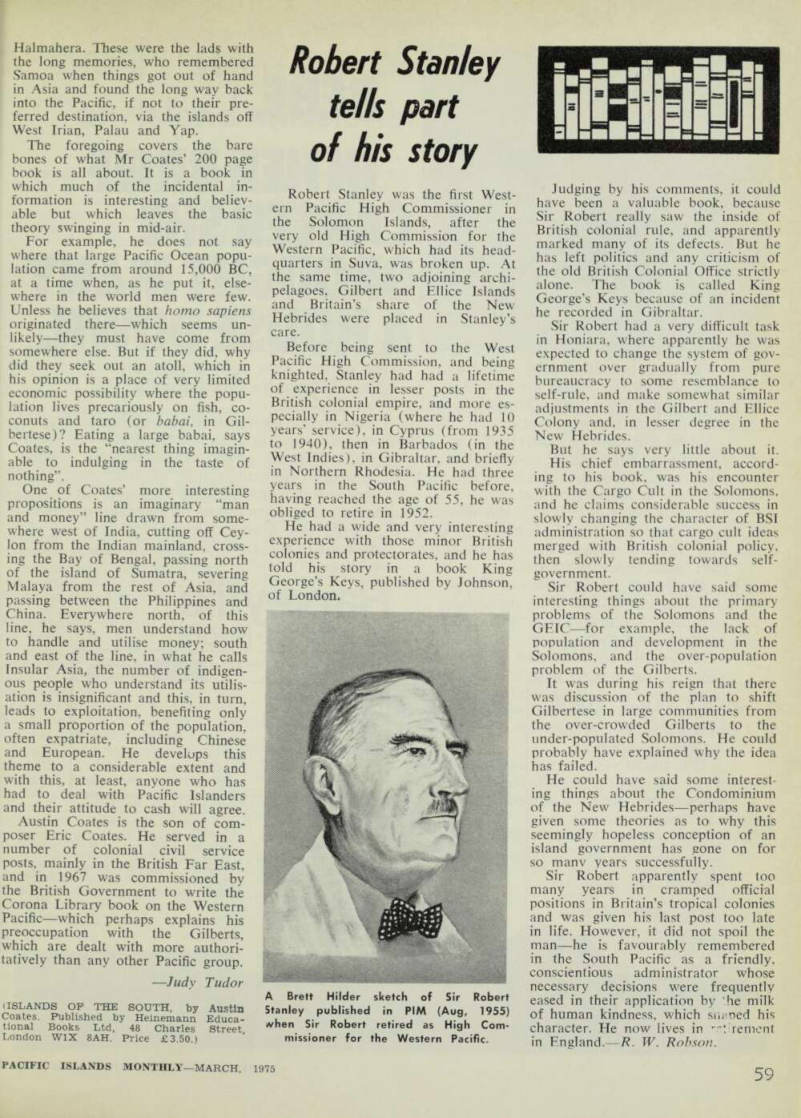
So, Polynesians were in the Pacific all the time!
Theorising about the origin of the people of the Pacific has become so popular among academics and quasi academics that the average layman can be pardoned if he begins to feel that the whole subject is a great big bore. Even so, even the most blase might lift a languid eyebrow at the newest of the current crop, as pro pounded by Austin Coates in Islands of the South.
Mr Coates thinks that Polynesia and Micronesia were not populated from the Malaysian chain, hiving off from Indonesia as population pres sure built up behind, which was the conception of old-time anthropolo gists like Sir Peter Buck.
He thinks that the people of the Pacific atolls populated southern Asia, particularly the island chains off southern Asia. In this context he gives this area the blanket term of Austronesia, meaning islands of the
south, which generally embraces the area where the Malayo-Polynesian group of languages are spoken.
There is one safe bet about this, as in all such theories—there is no way of proving it wrong. The big thing is to propound an idea and get into business; positive proof of whether you are correct or not is lost in the effluxion of time, Islanders up to the advent of Europeans on the scene, having no written records and modern Islanders not giving a damn, being disposed to thinking that they have always been there, or there abouts.
A lot of what this author had to say about the similarities of life-style of the Pacific atoll dwellers and that of villagers in the Indonesian chain, Malaya, the Philippines, even Ceylon and Madagascar far over in the In dian Ocean, is interesting enough but some of his basic theory, which
A maneaba (assembly house) at Eita in the Gilberts. Maneabas were described by Coates as the "world's oldest parliament houses".
Population Explosion In Oceania
seems to rest on supposition if not a fertile imagination, will be hard for most people to swallow.
According to Coates, in 15,000 BC two-thirds of Oceania was peopled by Melanesians who also inhabited Timor, parts of the Moluccas and Flores. At a time, he says, when elsewhere in the world men were few, the Pacific was the first part of the world to support a large human population. Pressure of population, therefore, caused the Pacific peoples to migrate, always in search of a better or untouched island.
This did not apply however to the Melanesians, whom the author obviously relegates to a lower order of society. They were already located on the bigger forested islands, such as Fiji or New Guinea, thus leaving the activity and enterprise to the Polynesians and Micronesias who were the originators of the Austronesians’ civilisation. The movement, he thinks, probably started in the atolls of the Tuamotu and spread from island to island, but became centralised on two relatively large islands, Tahiti and in Samoa.
Where islands and atolls were
already inhabited, the original inhabitants either became enslaved or pushed off themselves in canoes, if they had them, but generally he thinks Polynesian-Micronesian penetration of the area was fairly bloodless as they sensibly left the Melanesians entrenched on the big islands strictly alone.
About 3500 BC there was a population explosion in Oceania which increased the westward migrations of the Austronesians. Skirting the big Melanesian islands they “threaded their way through the intricacies of the Coral Sea”, along a route north of New Guinea until they reached Java where different but compatible people were at last encountered.
From there, because of favourable ocean currents, news went back to Oceania to the people remaining, telling them of the favourable conditions in the new land. This, in turn, produced new migrations.
“This point”, says Austin Coates, “marks the zenith of the Austronesian civilisation when for a period, which probably did not last more than two or three hundred years, there was communication back and forth be-
tween Asia and the Pacific, embracing a tropical region which came to ex tend from Madagascar to Tahiti”.
However, about three thousand years after the westward migration— ie about 450 BC—these Austro nesians evidently became disillusioned with their lot in their Asian home land and there arose among them, says Coates, a desire to make a des perate attempt to return to ancestral Samoa.
Although they evidently still could not write, their memories were ob viously very long—3,ooo years long in fact. They returned via what we now call Micronesia, particularly the Gilbert Islands, where many took the easy way out, gave up the idea of Samoa and settled for driving out the descendants of those who had stayed in the first place.
In the course of time, the invaders were also invaded by fresh arrivals from Asia and scattered over the Pacific, including Samoa and even New Zealand, but the Gilberts re mained the link between the Pacific and Southern Asia.
The ancestors of the present Gil bertese, says Coates, were part of a large group from Samoa who, during the Austronesian period, settled in the Moluccas. Amboina, Ceram and
Halmahera. These were the lads with the long memories, who remembered Samoa when things got out of hand in Asia and found the long way back into the Pacific, if not to their pre ferred destination, via the islands off West Irian, Palau and Yap.
The foregoing covers the bare bones of what Mr Coates’ 200 page book is all about. It is a book in which much of the incidental in formation is interesting and believ able but which leaves the basic theory swinging in mid-air.
For example, he does not say where that large Pacific Ocean popu lation came from around 15,000 BC, at a time when, as he put it, else where in the world men were few.
Unless he believes that homo sapiens originated there—which seems un likely—they must have come from somewhere else. But if they did, why did they seek out an atoll, which in his opinion is a place of very limited economic possibility where the popu lation lives precariously on fish, co conuts and taro (or babai, in Gil bertese)? Eating a large babai, says Coates, is the “nearest thing imagin able to indulging in the taste of nothing”.
One of Coates’ more interesting propositions is an imaginary “man and money” line drawn from some where west of India, cutting off Cey lon from the Indian mainland, cross ing the Bay of Bengal, passing north of the island of Sumatra, severing Malaya from the rest of Asia, and passing between the Philippines and China. Everywhere north, of this line, he says, men understand how to handle and utilise money; south and east of the line, in what he calls Insular Asia, the number of indigen ous people who understand its utilis ation is insignificant and this, in turn, leads to exploitation, benefiting only a small proportion of the population, often expatriate, including Chinese and European. He develops this theme to a considerable extent and with this, at least, anyone who has had to deal with Pacific Islanders and their attitude to cash will agree.
Austin Coates is the son of com poser Eric Coates. He served in a number of colonial civil service posts, mainly in the British Far East, and in 1967 was commissioned by the British Government to write the Corona Library book on the Western Pacific—which perhaps explains his preoccupation with the Gilberts, which are dealt with more authori tatively than any other Pacific group.
Judy Tudor
(ISLANDS op THE SOUTH, by Austin Coates. Published by Heinemann Educa tional Books Ltd, 48 Charles Street London WIX BAH. Price £3.50.)
Advertisements & other items, p. 60 (1 item)
The Daiwa Bank Ltd.
04/WA BANK SERVING YOU IN THE PACIFIC BASIN Head Office Osaka,Japan With 137 Branches throughout Japan Singapore Representative Office Suite No. 1007, 10th Floor Robina House 1 Shenton Way, Singapore 1 Republic of Singapore Cable Address: SINGDAIWA Affiliated Bank P.T. BANK PERDANIA Djalan Raya Mangga Besar 7&9 Djakarta f Our Correspondent Banks are in city— Apia, Suva. Lae, Madang Port Moresby, Rabaul, Wewak. Guam, all Principal cities in Australia and New Zealand Contact your banker or our office. y Los Angeles Agency 555 South Flower St. Suite 4040 Los Angeles, Calif. 90071 Sydney Representative Office Bth Floor Prudential Building 39-49, Martin Place, Sydney
Head Office ; 21. Bingomachi 2-chome, Higashi-ku, Osaka, Japan Overseas : London, New York, Los Angeles, Frankfurt, Sydney, Singapore
Robert Stanley
tells part of his story
Robert Stanley was the first West ern Pacific High Commissioner in the Solomon Islands, after the very old High Commission for the Western Pacific, which had its head quarters in Suva, was broken up. At the same time, two adjoining archi pelagoes, Gilbert and Ellice Islands and Britain’s share of the New Hebrides were placed in Stanley’s care.
Before being sent to the West Pacific High Commission, and being knighted, Stanley had had a lifetime of experience in lesser posts in the British colonial empire, and more es pecially in Nigeria (where he had 10 years’ service), in Cyprus (from 1935 to 1940), then in Barbados (in the West Indies), in Gibraltar, and briefly in Northern Rhodesia. He had three years in the South Pacific before, having reached the age of 55, he was obliged to retire in 1952.
He had a wide and very interesting experience with those minor British colonies and protectorates, and he has told his story in a book King George’s Keys, published by Johnson, of London.
Judging by his comments, it could have been a valuable book, because Sir Robert really saw the inside of British colonial rule, and apparently marked many of its defects. But he has left politics and any criticism of the old British Colonial Office strictly alone. The book is called King George’s Keys because of an incident he recorded in Gibraltar.
Sir Robert had a very difficult task in Honiara, where apparently he was expected to change the system of gov ernment over gradually from pure bureaucracy to some resemblance to self-rule, and make somewhat similar adjustments in the Gilbert and Ellice Colony and, in lesser degree in the New Hebrides.
But he says very little about it.
His chief embarrassment, accord ing to his book, was his encounter with the Cargo Cult in the Solomons, and he claims considerable success in slowly changing the character of BSI administration so that cargo cult ideas merged with British colonial policy, then slowly tending towards self government.
Sir Robert could have said some interesting things about the primary problems of the Solomons and the GElC—for example, the lack of population and development in the Solomons, and the over-population problem of the Gilberts.
It was during his reign that there was discussion of the plan to shift Gilbertese in large communities from the over-crowded Gilberts to the under-populated Solomons. He could probably have explained why the idea has failed.
He could have said some interest ing things about the Condominium of the New Hebrides—perhaps have given some theories as to why this seemingly hopeless conception of an island government has gone on for so manv years successfully.
Sir Robert apparently spent too many years in cramped official positions in Britain’s tropical colonies and was given his last post too late in life. However, it did not spoil the man—he is favourably remembered in the South Pacific as a friendly, conscientious administrator whose necessary decisions were frequently eased in their application by ‘he milk of human kindness, which siiaoed his character. He now lives in •'F remont in England.—/?. W. Robson.
A Brett Milder sketch of Sir Robert Stanley published in PIM (Aug, 1955) when Sir Robert retired as High Com missioner for the Western Pacific.
Advertisements & other items, p. 62 (1 item)
Career She
■ A f T *
BROUGHT MANY
A HOUSE DOWN.
On October 26th 1972 Hurricane Bebe struck Fiji. Huge areas were completely devastated. Houses were flattened, roofs were ripped off.
It was during this storm that a partially completed Harveytile roof met and weathered what was the toughest test any roof is likely to meet.
It took the full brunt of this ferocious storm without losing so much as one tile. Nor did days of driving torrential rain cause the roof to leak.
The larger, longer tiles of Harveytile
mean fewer joints. Thus providing complete weather protection for a lifetime and then some.
Harveytile roofs began with violent volcanic upheavals where rocks were born. The ceaseless march of ancient
glaciers, ground and splintered the rock
into particles which rivers then carried to line their banks.
It is these very same particles that form the protective surfacing of Harveytile roofs. Quarried stone silica and natural river pebble chips are selected from locations around New Zealand.
Harveytile roofs offer you eight beautiful roofing colours. Natural colours that are as old as the hills.
As Bebe demonstrated, even a hurricane can't budge the tiles of a roof that was a million years in the making.
Harveytile. Riverstone roofs.
The roof that's a million years in the
making.
Harveytile
Riverstone Roofs
Please send me your free Harveytile Brochure that will show me, in colour, the full range of textures available. msm Company Limited Name Address Please send to; Harvey Tile Company Ltd. 40 Mt. Wellington Highway, P.O. Box 62-019 Auckland, New Zealand.
PAPUA NEW
GUINEA
A.C.I. (New Guinea) Pty. Ltd.
P.O. Box 613, Lae.
NORFOLK
ISLAND
Irvine's Building Supply Centre, Box 117, .Norfolk Island.
WESTERN
SAMOA
H. & ). Retzlaff., P.O. Box 195, Apia, Western Samoa.
FIJI
A.C.I. - Harvey (South Pacific) Ltd., P.O. Box 1095.
Suva, Fiji
TAHITI
Ets. Sin Tung Hing., B.P. 1605, Fare-Ute, Papeete, Tahiti.
The Tradewinds Convention Centre in Fiji that weathered the full force of Hurricane Bebe, without losing a tile.
There's some fun being
an Island missionary
Contemporary accounts of what life was like in the South Seas in the early 19th century have come to us through the writings of the early missionaries and to these people stu dents of the Pacific owe a great debt.
Missionaries have been pretty ardent scribblers ever since, although a good many of their books, in later times, have been directed mostly at those like-minded about saving the heathen, being a bit too evangelistic for the ordinary reader. Two new books from missionaries that are not unduly so are Married to Melanesia by Murial Jones; and Doctor in Papua by Berkeley Vaughan.
Both make pleasant enough read ing, each writer having a well developed sense of humour.
Together these two books show that Melanesia and Melanesians don’t change very much in a generation.
Although Dr Vaughan writes of Papua before World War II and Mrs Jones of the Solomons in the late 19605-early 19705, the problems en countered by each differ very little.
Dr Vaughan went to Kwato, a tiny island near Samarai in SE Papua, as its first medical officer, not long after he graduated from St Bartholomew’s Hospital, London in the early 19305. Kwato was already an unusual organisation in the miss ionary world of New Guinea, having begun as an offshoot of the London Missionary Society by the Rev Charles Abel in 1891. It emphasised the practical side of missionary work and was a generation before its time.
It early went into the business of saw-milling and taught boat-building, carpentry, engineering and ran suc cessful coconut and rubber plant ations. It also gave its people a fair standard of English and in the 1930 s a Papuan who had passed through Kwato was set apart from his fel ows in the same way as in England a graduate of Oxford might have aeen set apart among the coal miners af a Welsh valley.
Dr Vaughan’s story covers the aeriod between 1935 and when he eft at the beginning of the Pacific War in 1942. After the war great changes took place in Papua and one af them was the gradual demise of Kwato, at least in the form that he cnew it.
When he arrived with his wife and
three young children in 1935 Kwato, although advanced in technical edu cation, was back in the dark ages— medically speaking. How this was put right, under very difficult circum stances, is the most interesting part of the story, told in the best tradi tions of writers of “doctor” books.
Due to Anglican bishops’ habit of dropping their surnames and calling themselves after their diocese, it is easy to jump to the conclusion from the title of Mrs Jones’ book that she was married to the Bishop of Mela nesia. She wasn’t. Her husband was a theologian, posted to St Peter’s College, Siota (later transferred to Guadalcanal) to train Melanesians for the Anglican priesthood.
Before her marriage, Mrs Jones was, more or less, in the same line of business and spent 14 years in Ghana, which should have prepared her for anything the BSIP could offer, but obviously didn’t. Although their business in the Solomons was religion, she doesn’t let it get her down and writes a good domestic story about the kind of things that happen to everyone who has stayed long enough in Melanesia. Further more, she does it all with a welcome and irreverent wit.
Of the new Anglican Cathedral in Honiara which is beautiful, spacious and cool, she says: “It is embellished with some remarkable local works of art including the inevitable shell de coration but also the only example I have ever seen anywhere in the world of what you might call Our Lady of the Mini-skirt, a most lovely figure in wood that depicts Mary as a Melanesian schoolgirl, bareheaded and in a simple short frock”.
She then describes the other Anglican church, in what the Yanks might describe as downtown Honiara, which has among its other art objects a gift from a carver in an outer island.
“More than life size”, she says, “it purports to be an effigy of the late Bishop Alfred Hill, an Englishman who died in 1969. The figure is in ebony wood, lavishly decorated with shell-work which would be tolerable perhaps in the trimmings of the cope and mitre, but when it comes to the fingernails and teeth ... It was in tended as a lectern, with the book rest growing, as it were, out of the
shoulders of the figure so that the reader was forced to lurk invisible behind the late bishop’s mitred head uttering oracles like a priest with a bull-roarer at a heathen shrine. The whole thing proved too much . . . and the good bishop was ultimately banished to the doorway where he stands, rather a sinister figure, especially at night when the false teeth grin out at the passers-by and the finger nails take on the aspect of claws, gleaming in the casual illu mination from nearby shops. It is all a million miles from the bishop as I remember him on the one occasion we met, a rather conventional per son with a slightly plummy, but very public school voice, an ex-sea cap tain and very, very British”.
Mrs Jones is in her best form when describing the contemporary social habits of BSIP, which is still a bit of an anachronism in spite of the political progress of the last few years. Missionary wife disappears entirely and she becomes all sophisticated observer, and great fun. —Judy Tudor. (DOCTOR IN PAPUA, by Berkeley Vaughan. Published by Rigby Limited, 30 North Terrace, Kent Town, South Aust ralia. $6.95, and MARRIED TO MELA NESIA, by Muriel Jones. Published by George Allen & Unwin Ltd, Ruskin House, 40 Museum Street. London, WCIA ILU. £3.50.)
Advertisements & other items, pp. 63-64 (1 item)
Photographs
PNG AVIATION
WANTED
The Air Museum of Papua New Guinea is assembling a photographic record of Civil Aviation in PNG from 1945 until the formation of
AIR NIUGiNI
in November 1973.
If you hold any photographs which may be of interest please contact: Mr B. D. Hoy, Research Section,
AIR MUSEUM OF PAPUA NEW
GUINEA,
P.O. Box 2067, Konedobu, P.N.G
KNOX SCHLAPP PTY. LTD
SOUTH WEST PACIFIC AGENTS FOR:
marine
WORLD RENOWNED
FOR OVER 100 YEARS
IN BOTH PLEASURE
Hf ■ diesel
> J &BSS
s* J
M* I , I »
engines
ATS
AND
AA.Y. SOUTH PACIFIC owned and skippered by Mr Ron Youngman of Sydney: Radio relay vessel 1974 Sydney-Hobart yacht race: member vessel of volunteer coastal patrol.
Mr Youngman chose a Gardner 6LW as the power source for the M.V. South Pacific.
KNOX SCHLAPP PTY. LTD.
135-139 McEVOY STREET, ALEXANDRIA, N.S.W., 2015.
Phone; 699 8333. Telex; AA20483. Telegrams: "KNOXSCHLAP", Sydney.
SUB AGENTS:
• FATHOM FISHERIES, TONGA.
• S. A. HEATH & SONS, PORT MORESBY.
• LUTHERAN SHIPPING, MADANG.
• NEW HEBRIDES MTS, PORT VILA.
• SASAPE SLIPWAYS, TULAGI, HONIARA.
• SHERWOOD ENGINEERING, RABAUL.
Pacific Transport
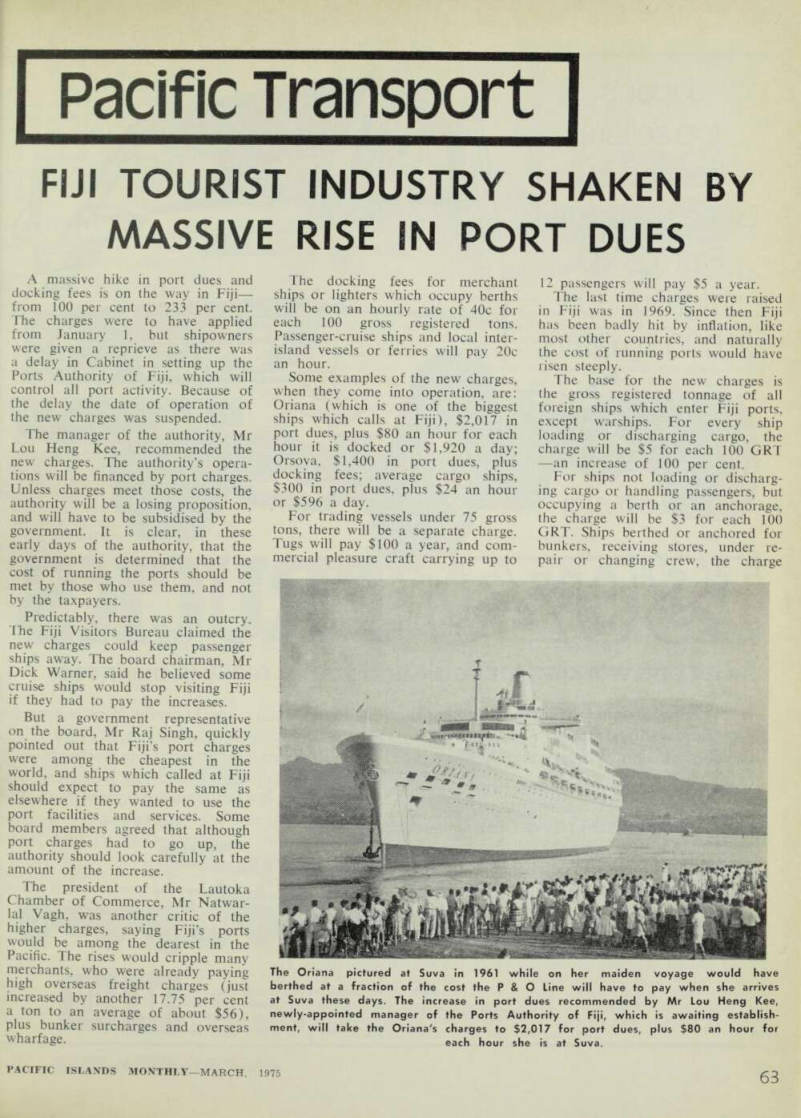

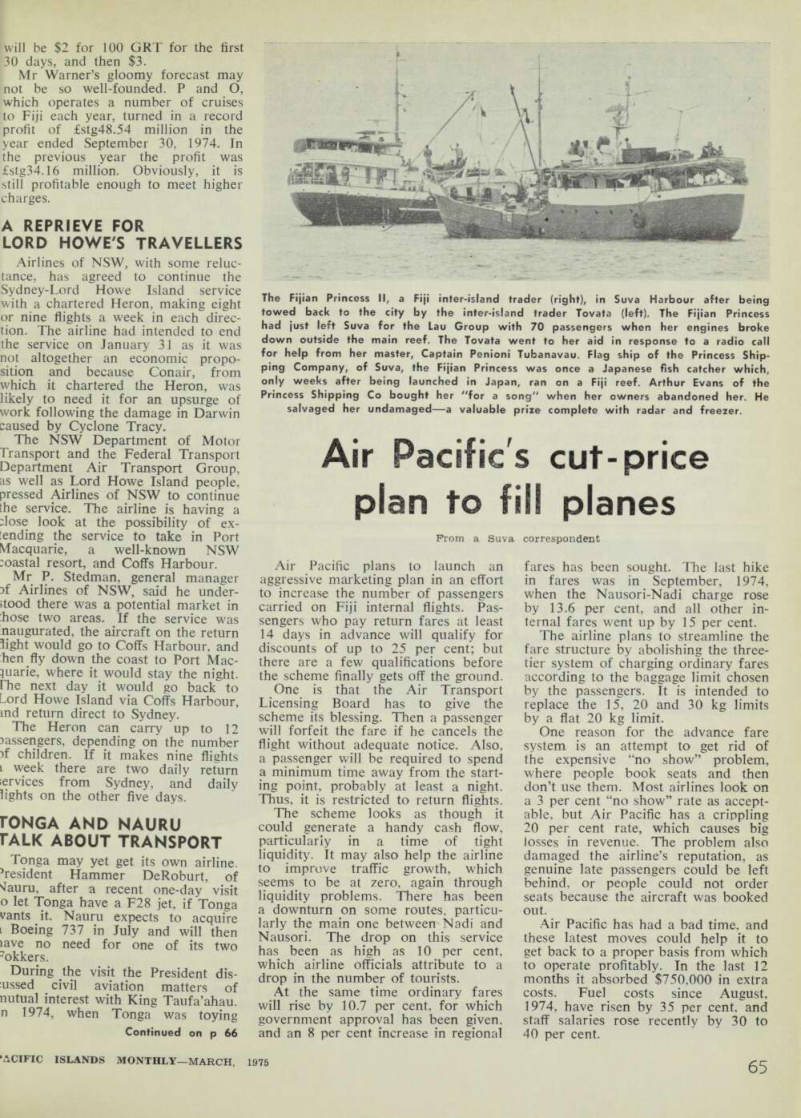

Fiji Tourist Industry Shaken By
Massive Rise In Port Dues
A massive hike in port dues and docking fees is on the way in Fiji— from 100 per cent to 233 per cent.
The charges were to have applied from January 1, but shipowners were given a reprieve as there was a delay in Cabinet in setting up the Ports Authority of Fiji, which will control all port activity. Because of the delay the date of operation of the new charges was suspended.
The manager of the authority, Mr Lou Heng Kee, recommended the new charges. The authority’s opera tions will be financed by port charges.
Unless charges meet those costs, the authority will be a losing proposition, and will have to be subsidised by the government. It is clear, in these early days of the authority, that the government is determined that the cost of running the ports should be met by those who use them, and not by the taxpayers.
Predictably, there was an outcry.
The Fiji Visitors Bureau claimed the new charges could keep passenger ships away. The board chairman, Mr Dick Warner, said he believed some cruise ships would stop visiting Fiji if they had to pay the increases.
But a government representative on the board, Mr Raj Singh, quickly pointed out that Fiji’s port charges were among the cheapest in the world, and ships which called at Fiji should expect to pay the same as elsewhere if they wanted to use the port facilities and services. Some board members agreed that although port charges had to go up, the authority should look carefully at the amount of the increase.
The president of the Lautoka Chamber of Commerce, Mr Natwar lal Vagh, was another critic of the higher charges, saying Fiji’s ports would be among the dearest in the Pacific. The rises would cripple many merchants, who were already paying high overseas freight charges (just increased by another 17.75 per cent a ton to an average of about $56), plus bunker surcharges and overseas wharfage.
The docking fees for merchant ships or lighters which occupy berths will be on an hourly rate of 40c for each 100 gross registered tons.
Passenger-cruise ships and local inter island vessels or ferries will pay 20c an hour.
Some examples of the new charges, when they come into operation, are: Oriana (which is one of the biggest ships which calls at Fiji), $2,017 in port dues, plus $BO an hour for each hour it is docked or $1,920 a day; Orsova, $1,400 in port dues, plus docking fees; average cargo ships, $3OO in port dues, plus $24 an hour or $596 a day.
For trading vessels under 75 gross tons, there will be a separate charge.
Tugs will pay $lOO a year, and com mercial pleasure craft carrying up to
12 passengers will pay $5 a year.
The last time charges were raised in Fiji was in 1969. Since then Fiji has been badly hit by inflation, like most other countries, and naturally the cost of running ports would have risen steeply.
The base for the new charges is the gross registered tonnage of all foreign ships which enter Fiji ports, except warships. For every ship loading or discharging cargo, the charge will be $5 for each 100 GRT —an increase of 100 per cent.
For ships not loading or discharg ing cargo or handling passengers, but occupying a berth or an anchorage, the charge will be $3 for each 100 GRT. Ships berthed or anchored for bunkers, receiving stores, under re pair or changing crew, the charge
The Orlana pictured at Suva in 1961 while on her maiden voyage would have berthed at a fraction of the cost the P & O Line will have to pay when she arrives at Suva these days. The increase in port dues recommended by Mr Lou Heng Kee, newly-appointed manager of the Ports Authority of Fiji, which is awaiting establish ment, will take the Oriana's charges to $2,017 for port dues, plus $80 an hour for each hour she is at Suva.
will be $2 for 100 GRT for the first 30 days, and then $3.
Mr Warner’s gloomy forecast may not be so well-founded. P and O, which operates a number of cruises to Fiji each year, turned in a record profit of £stg4B.s4 million in the year ended September 30, 1974. In the previous year the profit was £stg34.l6 million. Obviously, it is still profitable enough to meet higher charges.
A Reprieve For
Lord Howe's Travellers
Airlines of NSW, with some reluc tance, has agreed to continue the Sydney-Lord Howe Island service with a chartered Heron, making eight or nine flights a week in each direc tion. The airline had intended to end the service on January 31 as it was not altogether an economic propo sition and because Conair, from which it chartered the Heron, was likely to need it for an upsurge of work following the damage in Darwin caused by Cyclone Tracy.
The NSW Department of Motor Transport and the Federal Transport Department Air Transport Group, as well as Lord Howe Island people, pressed Airlines of NSW to continue the service. The airline is having a close look at the possibility of ex tending the service to take in Port Macquarie, a well-known NSW coastal resort, and Coffs Harbour.
Mr P. Stedman, general manager >f Airlines of NSW, said he under stood there was a potential market in ;hose two areas. If the service was naugurated, the aircraft on the return light would go to Coffs Harbour, and hen fly down the coast to Port Mac quarie, where it would stay the night.
Phe next day it would go back to Lord Howe Island via Coffs Harbour, md return direct to Sydney.
The Heron can carry up to 12 3assengers, depending on the number )f children. If it makes nine flights i week there are two daily return services from Sydney, and daily lights on the other five days.
Fonga And Nauru
Falk About Transport
Tonga may yet get its own airline, ’resident Hammer Deßoburt, of after a recent one-day visit 0 let Tonga have a F2B jet, if Tonga vants it. Nauru expects to acquire 1 Boeing 737 in July and will then lave no need for one of its two 7 okkers.
During the visit the President dis ussed civil aviation matters of nutual interest with King Taufa’ahau. n 1974, when Tonga was toying
Continued on p 66
with the idea of operating a national airline, which would have been under Japanese control, the question of a joint Tonga-Nauru airline was discussed. One of the proposals was that the aircraft would have a double insignia.
President Deßoburt’s remark about being prepared to turn a Fokker over to Tonga rather suggests that the airline would be a Tongan venture.
The discussions were not confined to air transport. The king and the president also talked about the two countries operating a service similar Co of NZ 1 Ltd with the n Tofur some time ago. Nauru was prepared to offer the Enna G for such a service. hut opposition by New Zealand trade unions had not yet been resolved. ici e /vc i i/ut
Isle Of Light
On Noumea Run
A second French shipping company (after Sofrana) joined the Auckland-Noumea service in February as a new ship was introduced by a company formed by Caledonian importers, the Compagnie des Chargeurs Caledoniens (CCC).
The ship, ex-Magdalena, was renamed the He de Lumiere (Isle of
Light—a symbolic name used for New Caledonia).
Built at Rotterdam in 1962, the ship measures 87 metres and will have a turnaround of just under four weeks on the route Sydney-Lord Howe Is-Norfolk Is-Auckland-Noumea. The He de Lumiere backs up the service of the CCC’s Port de France which will now extend its schedule to Vila and Santo in the New Hebrides.
Png's Aerial
Aristocracy
Senior pilots employed by Air Niu . gini no *, earn more than a pHendshin 6 now s2° 000
“IL %°Ls $2 fly“g
, * hours £ ould receive much more .
The captain of an old warhorse, the DC3, now earns an average of 120,160. First officers earn between $11,480 and 513,750.
The airline employs 93 pilots, all of whom are expatriate, except for four PNG first officers. The new rates came into force after recent talks between the pilots, represented by the Australian Pilots’ Federation, and Air Niugini. The pilots were awarded one per cent less than Australian domestic airline pilots. How-
ever, rents and family allowances put them in front of their Australian counterparts in pay and fringe bene fits,
A Oakitas
R J*. Car El Ii
Oim Ruk Mji
The Prime Minister of Fiji, Ratu Sir Kamisese Mara, unwittingly put his foot in it in Sydney early in February when he criticised Qantas and Air New Zealand for over-flying Fiji a \ l east 50 times a week with an est i mate d 10,000 passengers. Two
beta's'"ofnew
schedules which meant an effective i ncrease of more than 800 seats a *** between Australia and Ftp.
The newspapers, in their wisdom, at least in Sydney, did not say any thing about these new schedules, and m a stopover on the way back Fiji f rom sugar talks with the EEC, Ratu Sir Kamisese was ap parently not briefed on the Qantas moves.
Ratu Sir Kamisese claimed that the overflying caused a significant downturn in Fiji tourism. The rea sons advanced by Qantas—fuel costs —were not very convincing, he said, The downturn had had a significant
effect on the Fiji economy.
The increases in Qantas seating, subject to approval by both the Fiji and Australian Governments, was to be more than half (more than 800 seats a week) and to operate from March. The increase in flights to Fiji was one of the features of the new schedule. Qantas planned to route all Australia-US services through Nadi, instead of operating some direct between Sydney and Honolulu. The frequency between Canada and Australia was to be doubled from one to two a week, with the aircraft calling at Nadi in both directions. To that would be added a weekly Sydney-Tahiti ser vice, via Nadi, and services to Fiji from Sydney and Brisbane.
A Qantas spokesman said the new schedules had nothing to do with what Ratu Sir Kamisese said. It was simply coincidence that the criticism was made about the time the new schedules were issued.
No Room To Move
\T Port Moresby
A mail strike in Australia and an nflux of shipping, led to congestion >n the Port Moresby wharf recently, fhe mail strike held up necessary )apers in Australia, and importers vere unable to take delivery of the :argo. It took them weeks, months in i few instances, to get goods from he wharf.
A new storage shed added to the ongestion as goods had to be moved nto it from the main wharf. This aused a continual flow of trucks and ront-end loaders, which held up •ther traffic. Record shipping enter ag the port made it impossible for he port authorities to keep up with he discharge of cargo.
>Ng Plane's
Mver Plunge
The pilot and 10 passengers scaped without injury late in Janu ry when a Cessna 402 aircraft failed a lift on takeoff and plunged into ie Ramu River in northern Papua lew Guinea.
The accident was at the isolated Jttlement of Annanberg in the wampy coastal plains area of the )wer Ramu west of Madang. The 02 —one of Cessna’s range of big ommuter twins—was operated by le PNG airline Talair.
The occupants scrambled to safety ith a wetting as the aircraft sank ito the muddy Ramu which crosses ie end of the airstrip. The tentative ieory of investigators is that the ircraft was unable to reach lift-off ?eed in the length of strip available
because of the height and dampness of the grass surface.
Making Allowance
For Wharf Thieves
Some importers in the South Pacific Islands expand their orders from New Zealand by 12 to 15 per cent to allow for complete orders after pillage and damage. According to Mr R. W. White, New Zealand general manager of Mogul Trans portation, this pillage and damage happens in local wharf areas, after ships discharge their cargoes.
Mr White was critical of facilities at many ports. There was much room to improve handling and storage facilities at the major ports in the South Pacific. Although container ships now service some of the Islands, the receiving ports did not have the facilities to handle them properly, which denied traders the benefit of containerisation.
Marine Mishap
Caused Suspicion
Palau District officials in Micro nesia had their doubts about a large wave inundating a Korean fishing ship recently, and made an investi gation. Two members of the crew of the Haeng Bok No 707 were admit ted to Koror hospital for treatment for injuries sustained in an accident at sea. One man was reported lost.
The ship, of 440 tons, was said to be fishing several miles off Yap when an unusually large wave struck it, “inundating everything from bow to stern”. Two of the three men fishing from the bows were thrown to the deck and a third was washed over
board. Attempts to find the missing man failed.
The official investigation was to discover if the alleged accident did happen, and that the story was not a cover-up for foul play.
Why Plane Crashed
Near Pago Pago
Probable cause of the Pan-Am 707 plane crash near Pago Pago on January 30 last year which killed 98 of the 91 passengers and 10 crew was the failure of the pilot to cor rect an excessive rate of descent while attempting a visual landing, reports the US National Transportation Safety Board after an inquiry.
Lack of crew co-ordination resulted in inadequate altitude callouts and inadequate instrument cross-monitor ing by other flight crew, the report said. Except for an officer, who died from leg and arm injuries, all deaths were from smoke inhalation and burns. The plane was on its way from Auckland to Honolulu.
Cooks Have
A New Ship
The Cook Islands have a new ship, the 690-ton dwt MV Florida, which has been acquired by Silk and Boyd Ltd, of Rarotonga. The Florida has a cargo capacity of 850 cubic tons and is designed for inter-regional Pacific Islands trade.
In late January, she was bound from Panama to Papeete and was expected in Rarotonga in mid- February. From Rarotonga she was expected to sail to Fiji and Niue, returning to Rarotonga in early March.
Advertisements & other items, p. 66 (1 item)
Rucks
Japan’s
top sellers
backed by
General Motors!
From 2083
right up to
21,000 kg GVW.
St mm
RUCKS
Get one working for you - and you’re really in business.
No matter what your job there’s an Isuzu ready and waiting to do it for you.
Reliably. Efficiently. And profitably.
Light delivery vehicles. Buses. Tippers.
Twin steers. Heavy transport trucks.
From 2,083 to 21,000 kg GVW. Isuzu makes them all. And every one shares the same high quality and attention to detail that have made Isuzu the top selling truck in Japan.
General Motors, who know the truck business better than anybody, stand behind every Isuzu. And your investment is protected by IsUzu/GM’s unbeatable warranty. Spares and service are available throughout the islands to the dealers listed below.
A 976 FIJI ISLANDS: Bums Philp (South Sea) Co.
TONGA: Burns Philp (South Sea) Co.
PORTUGUESE TIMOR: Sociedade Agricola Patria E Trabalho WESTERN SAMOA: O. F. Nelson & Co. Ltd.
plan to fill planes
Air Pacifies cut-price plan to fill planes
Prom a Suva correspondent
Air Pacific plans to launch an aggressive marketing plan in an effort to increase the number of passengers carried on Fiji internal flights. Pas sengers who pay return fares at least 14 days in advance will qualify for discounts of up to 25 per cent; but there are a few qualifications before the scheme finally gets off the ground.
One is that the Air Transport Licensing Board has to give the scheme its blessing. Then a passenger will forfeit the fare if he cancels the flight without adequate notice. Also, a passenger will be required to spend a minimum time away from the start ing point, probably at least a night.
Thus, it is restricted to return flights.
The scheme looks as though it could generate a handy cash flow, particularly in a time of tight liquidity. It may also help the airline to improve traffic growth, which seems to be at zero, again through liquidity problems. There has been a downturn on some routes, particu larly the main one between Nadi and Nausori. The drop on this service has been as high as 10 per cent, which airline officials attribute to a drop in the number of tourists.
At the same time ordinary fares will rise by 10.7 per cent, for which government approval has been given, and an 8 per cent increase in regional
fares has been sought. The last hike in fares was in September, 1974, when the Nausori-Nadi charge rose by 13.6 per cent, and all other in ternal fares went up by 15 per cent.
The airline plans to streamline the fare structure by abolishing the three tier system of charging ordinary fares according to the baggage limit chosen by the passengers. It is intended to replace the 15, 20 and 30 kg limits by a flat 20 kg limit.
One reason for the advance fare system is an attempt to get rid of the expensive “no show” problem, where people book seats and then don’t use them. Most airlines look on a 3 per cent “no show” rate as accept able, but Air Pacific has a crippling 20 per cent rate, which causes big losses in revenue. The problem also damaged the airline’s reputation, as genuine late passengers could be left behind, or people could not order seats because the aircraft was booked out.
Air Pacific has had a bad time, and these latest moves could help it to get back to a proper basis from which to operate profitably. In the last 12 months it absorbed $750,000 in extra costs. Fuel costs since August, 1974, have risen by 35 per cent, and staff salaries rose recently by 30 to 40 per cent.
The Fijian Princess 11, a Fiji inter-island trader (right), in Suva Harbour after being towed back to the city by the inter-island trader Tovata (left). The Fijian Princess had just left Suva for the Lau Group with 70 passengers when her engines broke down outside the main reef. The Tovata went to her aid in response to a radio call for help from her master, Captain Penioni Tubanavau. Flag ship of the Princess Ship ping Company, of Suva, the Fijian Princess was once a Japanese fish catcher which, only weeks after being launched in Japan, ran on a Fiji reef. Arthur Evans of the Princess Shipping Co bought her "for a song" when her owners abandoned her. He salvaged her undamaged—a valuable prize complete with radar and freezer.
Advertisements & other items, pp. 67-69 (3 items)
65
•ACIFIC ISLANDS MONTHLY—MARCH, 1975
Coolrooms And
Save hundreds of dollars
on Australians most efficient
WALK IN, ALUMINIUM
COOLROOMS AND
FREEZE ROOMS
Hundreds already installed! The most economical supplementary cool- 'ooms for bottles and food, providing the largest storage capacity of any comparable coolrooms of the same exterior dimensions. Five sizes —from 90-360 cu. ft. capacity; 16 models offering normal temp., two temp., deep freeze, or for pastry and ice storage applications. White vinyl interior, embossed rustproof aluminium exterior. 9 SUPPLIED IN EASY-TO-ERECT, DO-IT-YOURSELF KIT FORM Available from: AUSTRALIAN NEW CALEDONIA EXPORTS (SILVER & BARDA), 363 George St., Sydney, 2000 and Branches.
BRECKWOLDT & CO., 276 Pitt St., Sydney, 2000 and Branches.
PETER FISHER TRADING PTY. LTD., 321 Pitt St., Sydney, 2000.
HAGEMEYER (A'SIA), 59 Anzac Pde., Kensington, 2033 and Branches.
KERR BROS, 65 York St., Sydney, 2000.
Manufactured by:
m NELSON & ROBERTSON PTY. LTD., 197 Clarence St., Sydney, 2000.
RABAUL TRADING CO. PTY. LTD., P.O. Box 219, Rabaul and Branches ROY GALLIAAORE & ASSOCIATES, P.O. Box 179, Vila, New Hebrides.
C. SULLIVAN (EXPORT) PTY. LTD., 60 Margaret St., Sydney, 2000 andt Branches.
W. S. TAIT & CO, PTY. LTD., 31 Macquarie Place, Sydney, 2000 andt Branches.
POWERED BY
KELVINATOR.
Five-year warranty on compressor. Early delivery. 199 Parramatta Road, Cnr. Skarratt Street, Auburn, N.S.W. 2144, Australia. Phone 648-1711.
PACIFIC ISLANDS TRANSPORT IMF
Owners: Thor Dahls Hvalfangerselskap A/S — Sandefjord, Norway.
MOTOR VESSEL "THORSISLE"
Regular Freight and Passenger Services between Pacific Coast Ports of U.S.A. and Canada and
TAHITI and SAMOA
GENERAL STEAMSHIP CORPORATION LTD.
General Agents 400 California Street, San Francisco, California, U.S.A.
APlA—Burns Philp (South Sea) Company, SYDNEY —Trans-Austrai Shipping Pty. Ltd.
Ltd. SUVA—Burns Philp (South Sea) Company, PAPEETE—Agence Maritime Internationale Ltd.
Tahiti. LAE/RABAUL—Burns Philp (New Guinea) Ltd.
PAGO PAGO —G. H. C. Reid & Co. PORT VlLA—Comptoirs Francais de Nouvelles NOUMEA—Etablissements Ballande. Hebrides.
67
CIFIC ISLANDS MONTHLY—MARCH, 1975
Transport Briefs
• The Moana Roa, which was the principal (and most expensive) sea link between Auckland and Raro tonga for many years, will be con verted into a hydrographic survey ship for the Royal New Zealand Navy. The conversion involves ex tending the forecastle deck aft to the bridge and removing the masts and derricks. A helicopter deck will be installed aft, and there will be a hangar to house the “chopper”. The funnel will be raised slightly. • The Union Steam Ship Co of NZ Ltd has reorganised its schedules for the South Pacific following a de cision to withdraw two old ships, the Holmburn and Parera. These ships will be replaced by the Karepo, 3,500 tons. The services now will be: Union South Pacific (container ship) Auckland - Fiji - Pago Pago - Apia - Nukualofa; Karepo (crane ship)— unitised cargoes from Auckland to Fiji, Samoa and Tonga; Luhesand (refrigerated general cargo ship)— Auckland to Tonga, Tahiti and Samoa. • Fiji’s small internal airline, Fiji Air Services, in which the government has taken a financial interest, carried a record 27,000 passengers in 1974.
The figure was 35 per cent up on the 1973 figure. Revenue exceeded $500,000 for the first time. Passenger loadings on the Suva-Lakeba service rose by 80 per cent, and by 40 per cent on the Suva-Levuka service, • Three helicopters will be used to search for gas in Papua New Guinea in areas in which Oil Search has an interest. One of the heli copters was recently shipped from New York and the other two were to be flown out. • Freight rates for marine cargo from Australia to Fiji rose by 17.75 per cent recently, to make the aver age rate about $56 a ton. At the same time the bunkers surcharge was reduced from 6.08 per cent to 5.5 per cent. The surcharge on cargoes from Australia to the New Hebrides was increased at the same time from 8.9 per cent to 10.44 per cent. • Mr John Alioto, 29, has been appointed head of the Pacific Far East Line. He is the son of Mr Joseph Alioto, Mayor of San Fran cisco. Soon after his appointment he announced that PFEL had made big gains in the few months since the Alioto family paid $4.6 million for 49.6 per cent of the company’s stock.
• Each British supervised co operative society in the New Hebrides has agreed to give $l,OOO towards the purchase of a new Co-operative Federation ship. The federation plans to buy a vessel of up to 500 tons to serve all British-supervised co-ops. • The Union Steam Ship Co of NZ Ltd earned a net profit of $2,245,855 in the year ended June 30, ,1974, slightly higher than the re turn of $2,221,180 in the previous year. The dividend for the year is 6.75 per cent (which includes a final payout of three per cent), compared with 10 per cent previously. The an nual report said the company over came severe operating difficulties to earn the latest profit. © Pago Pago’s harbour had one of the busiest times in its history over the Christmas and New Year holidays with the arrival and de parture of 12 ships including four cruise vessels, the Australis (Decem ber 23), Arcadia (December 24), Oronsay (December 30) and North ern Star (December 31). • Freight rates on Bank Line ships sailing from Papua New Guinea to America rose by 12i per cent on February 1. • The Papua New Guinea Govern ment will spend $612,000 chartering helicopters over the next year for forestry, land, agricultural, road and bridge surveys, health and police emergencies and posts and telegraphs communications work. A contract for that amount has been awarded to Airfast Helicopter Utilities Pty Ltd, of Port Moresby, to provide the helicopters. • Japanese investors plan to install an oil-storage complex and port for supertankers in the Palau Islands, Micronesia, at an estimated initial cost of SUS7S million. Before the project goes ahead it will be neces sary for the promoters to get_ per mission from the High Commissioner, Mr Edward Johnston. • Interocean Swire Pty Ltd, a shipping agent owned bv John Swire and Sons Pty Ltd and NSU Transport Holdings Pty Ltd, both of Sydney, had a net profit of $26,452 in the year ended September 30, compared with $24,754 in the previous year.
The result was after a tax provision of $39,500, depreciation of $4,928, and a rise in directors’ emoluments from $4,750 to $25,000.
Advertisements & other items, pp. 70-72 (2 items)
Pacific Area
DISTRIBUTORS
COOK ISLANDS
Cook Is. Trading Corp. Ltd
FIJI
Burns Philp (SS) Co. Ltd
NEW GUINEA
Bougainville Marine Pty Ltd, Kieta Burns Philp (NG) Ltd, Madang Elvee Trading Pty Ltd, Rabaul Faulkner & Tait (NG) Pty Ltd l_ ae S. A. Heath & Co. Pty Ltd, Port Moresby
NEW HEBRIDES
Burns Philp (NH) Ltd
NOUMEA
Guy Limousin Pacific Yachting
NORFOLK ISLAND
Irvine Bid. Supply Centre
PAGO PAGO
Max Haleck Inc.
TAHITI
Marine Corail Tahiti Sport Tahiti Voile
TONGA
Riechelmann Bros.
WESTERN SAMOA
Burns Philp (SS) Co. Ltd E. A. Coxon Ltd Gold Star Transport Co. Ltd Morris Hedstrom Ltd
SOLOMON ISLANDS
George Yee Fai Ltd
Why do thousands of
boat-owners specify
Epiglass Marine Products?
Epiglass gives you the biggest range ot marine glues, fillers, preservatives, resins, skinning systems and paints going. The biggest... and the best. Laboratory tested and proven in the water on thousands and thousands of boats!
That’s why you can buy Epiglass products with complete confidence. If it’s Epiglass, it will outlast all others. Just ask the man who uses Epiglass! 99* 90 -hflfderwr m
>GIA
I -v: i from 7ft to73ft I epiglass |power or sail Consolidated Chemicals Limited, Auckland.
“For further information contact Consolidated Chemicals Ltd, P.O. Box 15-104, New Lynn, Auckland, New Zealand”.
YOU GET A BETTER DEAL FROM
PA CIFIC MA CH/NERY
X!..
' : s , Si -V X. , S?
CAT 3208
Marine Engine 205 Shaft Horsepower.
Includes Twin Disc MGSO2 2:1 Marine Gear.
Several in stock. Other Ratios Available.
Parts Availability Throughout the Pacific 'mm *mw
PAriFir
MACHINERY, INC.
SUBSIDIARY OF
THEO. H. DAVIES 8c CO., LTD.
YOUR
CATERPILLAR
DEALER
HAWAII: 94-025 Farrington Hwy., Waipahu, Hawaii 96797. Phone: 677-9111. Cable: "PAMACAT.” TLX: 723397.
GUAM: Phone: 646-4479. Also U.S. Trust Territory and American Samoa.
■Ll 1 * i 1 * j ■ 'mLi 1 ifa I „ LA j > 1 A < , — Lh a.l — Lh a( - — ULj
nedlloyd Koninklijke Nedlloyd bv
REGULAR SAILINGS BY FAST, MODERN CARGO VESSELS from EUROPE via PANAMA fro:
PAPEETE, NOUMEA,
APIA, SUVA, LAUTOKA,
NEW ZEALAND.
from NEW ZEALAND via PANAMA fro:
EUROPE
(MEDITERRANEAN Cr NORTH CONTINENT)
and from AUSTRALIA fro:
CENTRAL AMERICA & CARIBBEAN
INDUCEMENT SAILINGS BY CARCARRIER
heavy-Siffr facilities—refrigerated space—cargo deepfranks
For further particulars apply to Agents: Ets. Donald Tahiti Papeete.
Agence Maritime et Aerienne Caledonienne S.A. A.M.A.C., Noumea.
Russell & Somers (Wellington) Ltd.
Wellington, N.Z.
D. F. Nelson & Co. Ltd. Island Transport Ltd.
Apia. Suva, Lautoka.
NEDLLOYD
Interocean Australia Services Pty. Ltd. General Representative Pacific Sydney. Box 194, Wellington, N.Z. - I A I I J — - laill
69
LCIFIC ISLANDS MONTHLY—MARCH, 1975
Cruising
Yachts
• MAKALAU, 29 ft Columbia fibre (lass yacht, was a December arrival in lonolulu from the Marquesas, taking 17 lays, and carrying skipper Thomas Miley ind Sandy Meier. They were on the way o California to deliver the sloop, built n 1963, to the owner. Dr William Grant. • SHU Bl HIMMANY, 29 ft plywood loop, arrived in Honolulu in December fter a 17-day trip from Nukuhiva, in he Marquesas. The owner, Australian awrence Jenkins, was on the final leg >f a round-the-world cruise. He planned 0 leave Honolulu in March for Australia, ia Fiji. His crew on arrival in Honolulu omprised Mary and Peter Clarke, of Jew Zealand. The sloop was built in ydney in 1967. • MARLUVA, 43 ft yacht, was a re ent arrival at Port Moresby from Sydney ia the Barrier Reef and Cairns carrying he owners, Dan Noyes and Andrew iurnes. Will Castle, a member of the rew, left the yacht at Cairns to take up t/ork, while another crew man, Niko ullivan, had to leave at Port Moresby nd return home. Dan, Andrew and mdrew's wife, Amy, will continue cruis ig, taking in Rabaul and the BSIP, be ore heading through Torres Strait. • In a cordial New Year note from iaptain Irving and his wife, Mrs Exy ohnson, PIM learns that 43 years of ruising around the world—much of it 1 the Pacific —will end this year. The ohnsons propose to sell their now smous vessel YANKEE next October, fter one last wander among the rivers nd canals of Europe.
When PIM last heard of it, the bones f the original Yankee still lay on the ;ef at Rarotonga.
Old hands in the Pacific will remember ow Captain and Mrs Johnson cruised Imost every year, over a long period, mong the Islands of the Pacific and :ores —probably hundreds —of young mericans learned their seamanship that 'ay.
Year after year. Captain Johnson has ad an interesting story to tell of their wanderings. That which covers 1974 tows how the adventurers took their acht into the river Rhone and thence lade their way right across France, just
north of the Pyrenees. Then they went back to the Mediterranean, spent some time in Sardinia and Sicily, dodged a couple of vicious storms, and ended the summer in the Adriatic. What a life! • QUEST, a 52 ft sloop-rigged motor sailer, arrived at Rarotonga on January 19 from Sydney, Hobart, and Russell in New Zealand's Bay of Islands. On board were owner-captain Charles H. Carter, his wife Vann, son Christopher, daughter Charla, and four crew. The cruise started about 3 years ago from San Diego and took the Carters to Honolulu, the Micro nesian islands, Japan, Korea, Hong Kong, the Philippines, the Solomons, New Heb rides, Australia and New Zealand. Plans were to call at Aitutaki and Palmerston Islands, then Tahiti, Niue, Tonga and Fiji, reaching Fiji in May or June, then to New Caledonia and Australia's Great Barrier Reef. • MRS BALSER, a 34 ft ketch-rigged double ender, which is registered at San Diego, California, has arrived in Fiji with her owner-skipper Linda M. Balser and crew Guido Rissone, and intends sitting out the hurricane season in Fiji waters and then sail to New Zealand. At the time of writing the two Mrs Balsers, yacht and skipper, were cruising in the Lau Group. Leaving San Diego last June, Mrs Balser called at Kauai and Oahu in Hawaii, staying for a month, and then, after a quick stop to visit a friend on Canton Island, spent three weeks in the Samoas, followed by five weeks in Tonga, with Suva as the next stop. Sign ing herself Linda M. Balser, "that Lady skipper—customs officials never believe it's my boat but this is the Year of the Women and there should be more lady
9 Yachting veteran Alex Bentley, who has died in Fiji, had a "wonder ful devotion to yachting in Suva and, prior to the foundation of the Suva Yacht Club in (1932 (now the RSYC) was responsible for the form ing of a model yacht club at Suva", writes Basil A. Lee, of Dee Why, NSW. "During all his years of devo tion to sailing in one way or an other, he was one to whom juniors and seniors could go at anytime for advice, which he gave, no matter how busy he was. His name will always be remembered in yachting in Suva and by owners and crews of overseas visiting yachts".
captains", she told PIM, "Your publica tion is most interesting —something I dis covered here in the South Pacific". • REBEL 11, a 38 ft trimaran with owner-skipper 30-year-old Tony Allen, of Christchurch, overturned on the morning of December 29 about 360 km south-east of Brisbane. He spent 20 days adrift in a rubber life raft before being rescued by a Greek freighter KHIAN STAR on Janu ary 17. Tony Allen, said, when he landed at Adelaide on January 20 that he was asleep when Rebel II began to capsize.
He awoke when she was half-way over.
He worked his way to the deck and dived into the sea. He cut a hole in the side of the hull with an axe to get gear, clothing, food and water which he loaded on to the raft. He stayed by the upturned tri for two days, attached to it by a 150 ft line.
Advertisements & other items, pp. 73-74 (2 items)
71
ACIFIC ISLANDS MONTHLY-MARCH, 1975
Union Steam Ship Co. Of N.Z.
LIMITED
Serving the Pacific for nearly 100 years.
Regular Sailings by Modern Vessels
From Auckland to Lautoka, Suva, Pago Pago, Apia, Niue, Vavau, Nukualofa. Also from Tauranga to Lautoka, Suva, Apia, Nukualofa. Regular sailings from Australia to New Zealand to enable transhipment of cargo to all the above ports.
Ship your cargo by a Union Company Vessel.
BRANCHES AT ALL MAIN AUSTRALIAN, NEW ZEALAND AND ISLAND PORTS.
I I s r» I i 9 I m, ? rl Caterpillar reliability, productivity, availability. Now you can get it all in a wheel skidder. The 518.
A whole new standard in skidder engineering. 120 turbocharged horsepower, 20,400 pounds of working muscle with full articulation and frame oscillation for stability and minimum maintenance.
Single lever “on the go” powershift. Dual rate steering for controlled response at all speeds. An operator’s compartment engineered for efficiency with safety features built in for man and machine.
You ; ll find all the best skidder ideas, plus added refinement and top quality manufacturing that can make the 518 the backbone of your logging operation.
And South-West Pacific Caterpillar dealers will ensure that your backbone stays in top condition no matter how far in the bush you are.
Parts, maintenance, repairs or simple information—we’ll see that you get it fast.
So tackle the jungle with the new Cat 518.
Caterpillar Dealers in South-West Pacific.
HASTINGS DEERING
Lae; Milford Haven Road, Ph: 42 2355 Port Moresby: Champion Parade, Knoedobu.
Ph: 3138 or 2098.
Bougainville: Itakara.
Industrial Park, Arawa.
Ph: 95 9004. 154 Queens Road, Suva.
Ph: 24 051-4 Cables: Carptrac Suva Telex: Carptrac FG2190 Suva HD329
Business and Development
Png Minister Threatens 'Foreign'
Companies With The Big Stick
From GUS SMALES in Port Moresby
The Papua New Guinea Govern ment is threatening legal action against Australians and other non nationals who are not responding to new requirements for the control of their business ventures. And in ex treme circumstances the government could cancel the rights of any Aust ralian to continue in business there.
Only 50 of an estimated 2,000 to 3.000 businesses have provided in formation which the government is now seeking by law.
“Don’t think we have forgotten— you will be prosecuted if necessary” the National Development Minister, Mr Gavera Rea, warned at the end of January.
Late last year the government in troduced the first of a new set of controls directed against what it calls “foreign” businesses, “foreign” not necessarily meaning a business based or owned outside the country.
It could mean a business fully based, owned and managed within the country by residents. However, if these residents happen to be Aust ralians, the business is classified as “foreign”.
The new rules are the first step in a registration process designed to keep a close watch on “foreign” businesses, and are said to be in the interests of phasing as many New Guineans as possible into the equity section of the economy.
One of the first control require ments, brought in late last year, was that all foreign businesses should notify the government of their over seas foreign exchange arrangements, and of subsequent changes in the arrangements.
Another was that any person other than a black New Guinean (with a few exceptional circumstances) had to notify the government if he was offering to buy shares in businesses.
But Mr Rea disclosed that, despite widespread publicity for the require ments, few businesses had complied.
He said the government would not hesitate to use the law to enforce what it wanted.
Some businesses apparently couldn’t be bothered to supply the information which the government required, perhaps in the belief that the government was bluffing, Mr Rea said. But he suggested some businesses were “too scared” to meet the requirements.
He said the process was part of plans which would eventually lead to the registration of all foreign ven tures under the government’s National Investment and Develop ment Authority (NIDA). Businesses which failed to meet their require
ments would be denied registration.
This meant they would no longer be able to operate in PNG.
In Port Moresby, the head of the Department of Business Develop ment, Mr Paulius Matane, told members of Port Moresby Rotary Club that PNG was being much tougher than Fiji in forcing the pace of black localisation.
He has just returned from a pub lic service study tour to Fiji which looked at localisation of skills, rural development, and decentralisation of government decision-making.
Tips are out, says Mr Rea
Tipping in Papua New Guinea should be strongly discouraged the country’s National Development Minister, Mr Gavera Rea, said when he opened, near the end of January, Port Moresby’s newest hotel, The Islander, one of the salvaged pro jects from the collapse in Australia of Cambridge Credit Corporation.
Mr Rea said he had seen the “unfortunate results of tipping” in some overseas countries. He was personally opposed to the practice, and he would strongly discourage it in Papua New Guinea.
He said the new hotel had adopted a policy of not allowing tipping, and he hoped other accommodation and service industries in PNG would do the same.
“There’s a natural friendliness and a ready courtesy in Papua New Guineans,” Mr Rea said, “and tip ping or anything else which interferes with these attributes should be out lawed.”
The Islander, which is the biggest hotel in PNG, was a partly completed Cambridge Credit Corpo ration project when the company collapsed last year. The work was completed without interruption when funds were provided by lAC’s PNG subsidiary, LAC (NG).
There is speculation in PNG that lAC wants to sell its interest and that the government is a potential buyer.
However, Mr Rea made no reference to the speculation in his address.
He said the government wanted more control over the growth of tourism to prevent lopsided develop
Minister Gavera Rea . . . he thinks tip ping should be outlawed.
ment which could damage the economy as a whole. A tourist ad visory council and a government office of tourism would be established soon to implement this policy.
Mr Rea said hasty hotel develop ment could lead to some undesirable aspects of tourism. He believed PNG needed a greater number of medium standard lower-cost hotels than it had at present.
The Post-Courier commended Mr Rea for his outspoken comments on tipping, and drew attention to aspects of what it called an extortion racket in some overseas countries. For example, there was the real VIP treatment in America and Europe for “big tippers”, who were known to head porters and head waiters before they stepped inside a hotel door.
Their bags were marked, or a tele phone call preceded their arrival.
They got the treatment.
But those who were known as careful tippers, or those who did not tip at all, were likely to have to wait for service. As a charge for service was built in to hotel costs, a waiter or porter should not be entitled to anything extra, as he received his wages.
The system, unfortunately, was already operating in other parts of the Pacific, chiefly Tahiti. The Post- Courier described the Tahiti system
as a “scandalous rip-off”. There was confusion about it in Fiji—in some places it was accepted, in others it was frowned on. Papua New Guineans were known for natural courtesy and a ready friendliness.
Preservation of that reputation was beyond price, and to encourage tip ping would be one way of destroying it, said the Post-Courier.
Minister's eye
on tax dodgers
Papua New Guinea’s Finance Minister, Mr Julius Chan, is con cerned at rumours that some Aus tralian businessmen in the country were deliberately withholding tax returns.
Information put to Mr Chan sug gested that returns were being with held by some operators who intended to leave the country shortly. They hoped in this way to avoid paying tax on the final one or two years of their PNG operations.
Mr Chan said the extent to which delays were being caused by in efficient or deliberate action was not known. But any “monkey business” would be stopped immediately.
He had instructed the tax office to take legal action against firms which had not lodged tax returns for
which they were liable. He had also instructed the tax office to levy its own penalty fines, as provided for in the law, against businesses lodging late returns.
Bringing home the
bacon in the Cooks
Two enterprising Cook Islanders, Ta Tukaroa of Atiu Island, and his cousin, Vaine Tairea of Mauke, re turned to Rarotonga recently after 20 years in New Zealand and set up a meat curing business—the first ven ture of its kind in the Cooks.
Their small Coral Meat Company makes corned beef from meat im ported from New Zealand, and sausages, bacon and ham from local pigs. The two partners have de veloped a special curing process which makes silverside and other meat much more palatable in sub tropical climates than the imported, frozen varieties.
They plan to sell to the Rarotonga public and to export to the outer Cooks where meat is extremely scarce.
The company’s premises were opened in January by Premier Sir Albert Henry, at Marairenga, on the outskirts of Avarua. Cabinet ministers, their wives, and about 40
businessmen and planters were among the guests.
Sir Albert said he saw the new enterprise as one way of fighting in !ation which is passed on from NZ n the form of food and other im ported goods. He added that his government’s policy was to encourage I'ook Islanders to take part in local ndustries.
The two directors, who learned heir trade in NZ, gave a demon itration of meat curing and provided asty samples of their products for heir guests.
Mr Vaine Tairea said he hoped hat, in its small way, their company yould provide employment, give local ivestock breeders a reasonable re urn for their efforts, and provide the )eople with fresh food they could ifford.
tonga plans
jn oyster project . . .
A new fisheries station will soon •e set up on the Tonga island of favau, near the Vavau Rest Home.
Tie station, in the early stages at sast, will concentrate on research ato growing shellfish. Mr Scott lennessey, a Peace Corps marine liologist, and Mr Alipate Mapu’aho, fisheries assistant, will start grow ng oysters.
Later, research will include mus els. The object of the project is to se more locally-grown oysters and aiissels as a source of protein. There /ill also be a survey of local fish pecies and the number of fishing oats used in the area. A shipment f about 2,000 oysters from the US, about $5O is expected to rrive in Tonga soon. Most of these /ill be sent to Vavau for exped ients, along with some oysters from r angauta lagoon.
. . and its coconuts
jam record income
Tonga’s desiccated coconut in ustry earned a record $T427,666 in xports in 1974. In the previous year ic earnings were 5T336.010. How ver, the 1974 output at 808 tons, was own on the 1973 figure of 1,348.
'he industry started about 10 years go.
The best market in 1974 was New ealand, which took 313 tons, fol ded bv Australia with 266 tons and •ritain 216 tons. In the previous year iritain bought 694 tons. Australia 323 ms and New Zealand 316 tons. An ther good vear is expected in 1975, Ithough prices, in line with copra, /ill probably be lower.
Advertisements & other items, p. 76 (1 item)
Built To Earn A Living
SHIPS AND WORKBOATS BY CARPENTERS INDUSTRIAL
: ms X - c - From a village fishing boat to an inter island trader. A tugboat to a 100 foot barge. We design and build them all. in wood or steel up to 120 feet in length.
If you trust your living to the sea. trust your shipbuilding to Carpenters Industrial.
CARPENTERS INDUSTRIAL
BOX 296 SUVA FIJI. PHONE 23031. Cable MILLERS SUVA Telex 2195FJ L 77
The Islands Agent Who Bought
A Hoodoo Ship
The old established Sydney-based islands trading firm of Nelson and Robertson was 80 years old on February 18, set up with a capital of £5O. Ivan Nelson, the founder, was a resourceful individual, born in Sweden, who had arrived in Australia six years earlier. He tried his hand at several callings—surveying, a bank teller and an “Ivan-of-all-trades” for Gibson and Co, Sydney shipbrokers and chandlers.
He became so proficient at carrying out many and varied tasks for this company that he was commissioned in 1893 by the New Australian Cooperatives Settlement Association to buy the Royal Tar, a 597-ton barque, then the largest sailing ship built in Australia. In his later years, Ivan Nelson, who died on July 31, 1941, may have reflected on this assignment without a great deal of pleasure.
The Royal Tar was a hoodoo ship and was eventually wrecked on the Shearer Rocks, outside Auckland. She was chartered for some dubious work.
Ivan Nelson supervised the refitting of the barque and victualling it for about 200 Australians bound for a supposed New Utopia, founded by a
William Lane in Paraguay. Captain Jack Hamilton, in an appreciation of Nelson and Robertson on the firm’s 60th anniversary in 1955, wrote about the Royal Tar.
There was a tribute to Ivan Nelson for the way he completed the work of preparing the ship for the Para guay charter. This was said to be the sole success of the venture. Poetess Dame Mary Gilmore, who made that voyage, attributed some of her longevity to the Nelson victualling plan. She was also indebted to him for supervising on board the safe passage of her most valued possession —the first Japanese teaset to arrive in Australia.
Captain Hamilton wrote that she protected it so carefully “during that ordeal”, and subsequently, that only one cup and a saucer were missing when she presented the set to the Royal Historical Society of Australia, Another prominent person associated with the Paraguay venture was Voltaire Molesworth, who once repre sented Cumberland in the NSW Legislative Assembly, In 1912, the Royal Tar arrived in Suva, under charter to a smart
The Royal Tar . . . a hoodoo.
operator, who was recruiting settlers from Indian labourers, who had completed their indentures in Fiji, for a highly-coloured rich Eldorado in Argentina. This charter did not come off—its fraudulence was ex posed before the Royal Tar sailed.
Captain Hamilton recorded that the promoter of the venture died soon after and was buried at sea “at the dead of night” from a small boat commissioned to counteract a threat from some of his dupes of “splitting his heart in twain, alive or dead”.
That marine funeral provided the only requiem of the Eldorado, erected on vague promises, money for nothing and ending in thin air.
There was another unfortunate chapter in the life of the Royal Tar, apparently before Ivan Nelson bought it for the co-op association. She had discharged coal in New Guinea be fore carrying out a charter to load timber in the US for Sydney. The officers and crew, or at least some of them, went on a shooting expe dition in New Guinea, and were bitten by the anopheles mosquito.
This caused an epidemic of malignant malaria.
The captain died, the chief mate and the second mate went down, along with many others, leaving only
the third mate and two weakened seamen to carry on. The Royal Tar made San Francisco, with the sur vivors suffering many privations. The US authorities wanted to scuttle the ship to prevent the epidemic spread ing through the country. This pro posal was quashed by the third mate, and the Royal Tar survived for other ill-fated ventures.
Advertisements & other items, p. 77 (1 item)
75
ACIFIC ISLANDS MONTHLY—MARCH, 1975
Woody's Gone
An Australian woman, who came to Port Moresby in 1948 for a short term catering job but stayed to establish one of Papua New Guinea’s best-known country pubs has left to live in Australia.
She is Dorothea Troeth (Mrs Clarrie Troeth), better known to thousands of Australian visitors as “Woody” of the Hotel Rouna near Rouna Falls outside Port Moresby.
Her hotel became widely-known for its collection of hats provided by tourists and visitors from many parts of the world —including a hat from a Salvation Army officer.
Mr and Mrs Troeth will live in Brisbane.
Bougainville
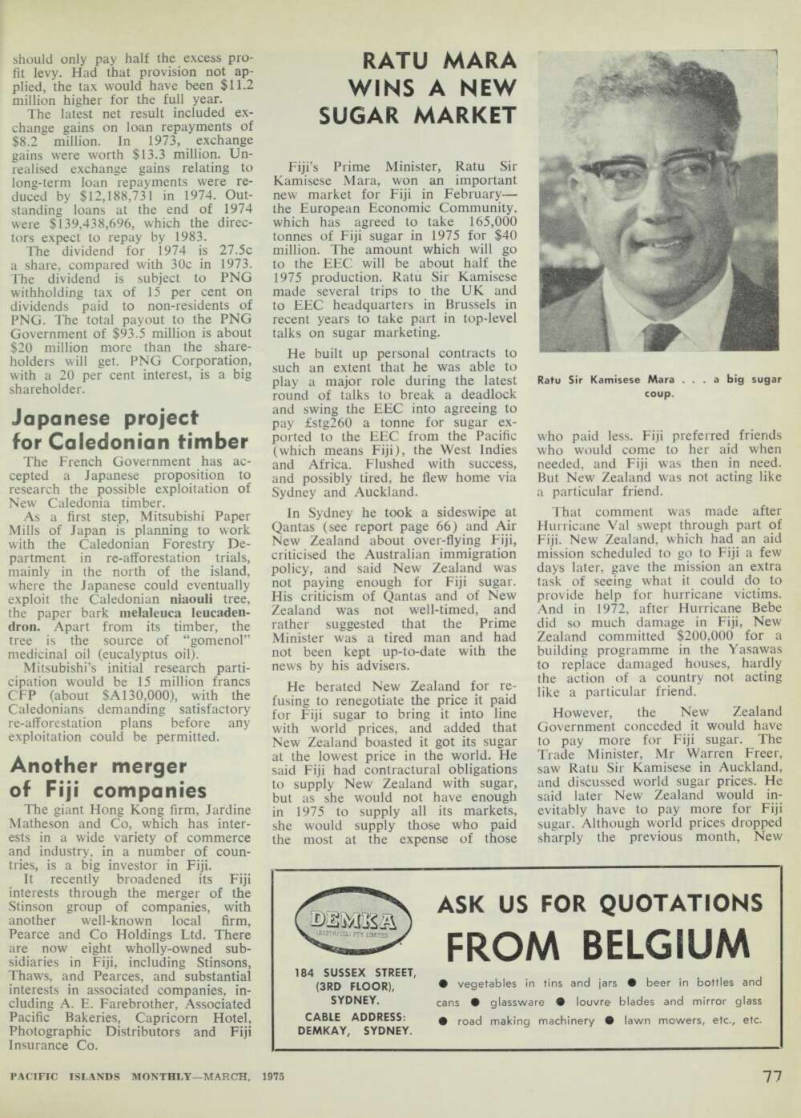
Brightness And
Ok Tedi Tarnish
Bougainville Copper Ltd was a bonanza for the Papua New Guinea Government in 1974 to the extent of about $94 million. There was a jarring note however, for on the same day the profit was announced the managing director of Kennecott PNG Ltd, Mr K. R. Hulley, warned that his company was willing to aban don the Ok Tedi copper project be cause of a deadlock in negotiations with the PNG Government aimed at setting up a fiscal policy. Differences were settled a few days later and ne gotiations were resumed.
Kennecott has invested about $l6 million in proving 150 million tonnes of 0.9 per cent porphry copper at Ok Tedi in the remote mountainous region of north-west Papua. Ok Tedi, before it can become an operating mine, needs a tremendous infrastruc ture, not the least of which is easy access to the coast.
The PNG Chief Minister, Mr Michael Somare, said exploratory work would continue if Kennecott pulled out. The facilities set up by Kennecott at Ok Tedi would be maintained, whatever happened. He was disappointed that Kennecott might abandon the project. The government, in its last message to Kennecott, indicated it considered a number of key questions still open.
The Bougainville balance sheet was an interesting exercise for ac countants. There were several “might have beens”, which did not happen because the company was forced to renegotiate the Bougainville copper agreement with the PNG Govern ment, following its huge profit of $l5B million in its first full year of operation.
The net earnings for 1974 were $114,575,000, compared with $158.4 million in 1973. Two factors contri buted to the drop—tax, and lower world copper prices. Under the re negotiated agreement the company had to pay tax in 1974, from Janu ary 1. This reduced the profit for the first half of 1974 from $llB million to $62 million. But for the agreement the 1974 profit would have been $lBl million.
The renegotiated agreement was signed after June 30, and provided for the company to pay current tax at 33 1/3 per cent, plus an excess profit tax on earnings above $B7 million. It also provided that in the first half of the year, the company
should only pay half the excess pro fit levy. Had that provision not ap plied, the tax would have been $11.2 million higher for the full year.
The latest net result included ex change gains on loan repayments of $8.2 million. In 1973, exchange gains were worth $13.3 million. Un realised exchange gains relating to long-term loan repayments were re duced by $12,188,731 in 1974. Out standing loans at the end of 1974 were $139,438,696, which the direc tors expect to repay by 1983.
The dividend for 1974 is 27.5 c a share, compared with 30c in 1973.
The dividend is subject to PNG withholding tax of 15 per cent on dividends paid to non-residents of PNG. The total payout to the PNG Government of $93.5 million is about $2O million more than the share holders will get. PNG Corporation, with a 20 per cent interest, is a big shareholder.
Japanese project
for Caledonian timber
The French Government has ac cepted a Japanese proposition to research the possible exploitation of New Caledonia timber.
As a first step, Mitsubishi Paper Mills of Japan is planning to work with the Caledonian Forestry De partment in re-afforestation trials, mainly in the north of the island, where the Japanese could eventually exploit the Caledonian niaouli tree, the paper bark melaleuca leucaden dron. Apart from its timber, the tree is the source of “gomenol” medicinal oil (eucalyptus oil).
Mitsubishi’s initial research parti cipation would be 15 million francs CFP (about $A 130,000), with the Caledonians demanding satisfactory re-afforestation plans before any exploitation could be permitted.
Another merger
of Fiji companies
The giant Hong Kong firm, Jardine Matheson and Co, which has inter ests in a wide variety of commerce and industry, in a number of coun tries, is a big investor in Fiji.
It recently broadened its Fiji interests through the merger of the Stinson group of companies, with another well-known local firm, Pearce and Co Holdings Ltd. There are now eight wholly-owned sub sidiaries in Fiji, including Stinsons, Thaws, and Pearces, and substantial interests in associated companies, in cluding A. E. Farebrother, Associated Pacific Bakeries, Capricorn Hotel, Photographic Distributors and Fiji Insurance Co.
Advertisements & other items, p. 78 (1 item)
Commercial Vessels For Sale
BARGE. Extensive work close to completion, including renewal of decks, plating and accommodation. Built 1948; Length 63'; Gross 58 tons; Nett 13 tons; DWT 40 tons; Bulk Fuel capacity 6,000 gallons; Twin G.M. Diesels, 6 cylinder; 185 BHP each. $55,000.00.
BARGE. Built Hong Kong 1970; Length 128'; Beam 32'; Draft loaded 7'. Gross 281 tons; Nett 144; DWT 250. Deck area 90' x 30'. Bow Door width 18'.
Bulk fuel capacity 220 tons; Dry Hold 60 tons; 2x3 ton SWL Derricks. 3 x D 333 Caterpillar engines, Triple Screw. Total BHP 570. $265,000.00.
TUG. Built Canada 1944. Dimensions 64' x 16' x 6'. Hull: i" plate in V.G. condition; Engine Vl6 G.M. Diesel. 550 H.P. Bollard Pull 6 tons. Speed 11 knots. Fuel Capacity 3,000 galls. This vessel was completely redesigned and rebuilt in 1971, is in excellent condition and is classed under the Victorian Marine Board and also under the Commonwealth of Australia. $75,000.00 0.N.0.
CARGO VESSEL. Built Gemany 1921. Rebuilt 1962. Gross 104 tons. Nett 44 tons. DWT 95; 140 tons cubic capacity. Length 87' Beam 18' Draft 2.24 metres. Engines —Main 6-71 GM 165. Aux. 2 x 1 cyl. Lister. 1 x 2 cyl. Lister Derrick 1 x SWL (will lift 3 tons) Radar, Radio, Dinghy plus outboard.
Engine recently completely overhauled and reconditioned. $50,000.00.
EX FAIRCHILD LAUNCH. Reconstructed 1971. Length 39' O.A. New Twin Cummins V 8 Diesels 1971, 185 H.P. each. Speed 12 knots. Survey just completed. Licensed 30 passengers; Radio, Depth Sounder etc. $18,000.00 0.N.0.
Terms available.
We urgently require work boats and barges of all sizes for waiting clients.
For further details of listed vessels and others contact:
NEW GUINEA MARINE SURVEYS & SERVICES
Ship Brokers, P.O. Box 783, LAE, Papua New Guinea.
Telephone 42 4305 Cable: Marineserv.
Wins A New
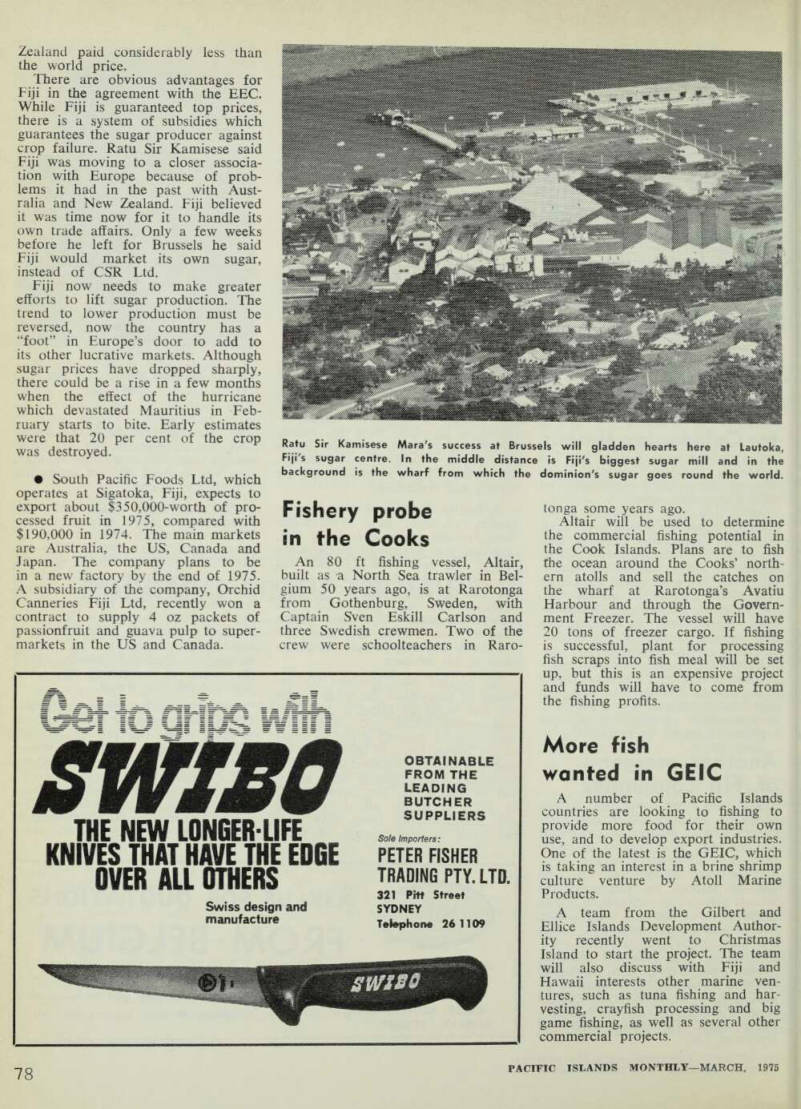
Ratu Mara
Sugar Market
Fiji’s Prime Minister, Ratu Sir Kamisese Mara, won an important new market for Fiji in February— the European Economic Community, which has agreed to take 165,000 tonnes of Fiji sugar in 1975 for $4O million. The amount which will go to the EEC will be about half the 1975 production. Ratu Sir Kamisese made several trips to the UK and to EEC headquarters in Brussels in recent years to take part in top-level talks on sugar marketing.
He built up personal contracts to such an extent that he was able to play a major role during the latest round of talks to break a deadlock and swing the EEC into agreeing to pay £stg26o a tonne for sugar ex ported to the EEC from the Pacific (which means Fiji), the West Indies and Africa. Flushed with success, and possibly tired, he flew home via Sydney and Auckland.
In Sydney he took a sideswipe at Qantas (see report page 66) and Air New Zealand about over-flying Fiji, criticised the Australian immigration policy, and said New Zealand was not paying enough for Fiji sugar.
His criticism of Qantas and of New Zealand was not well-timed, and rather suggested that the Prime Minister was a tired man and had not been kept up-to-date with the news by his advisers.
He berated New Zealand for re fusing to renegotiate the price it paid for Fiji sugar to bring it into line with world prices, and added that New Zealand boasted it got its sugar at the lowest price in the world. He said Fiji had contractural obligations to supply New Zealand with sugar, but as she would not have enough in 1975 to supply all its markets, she would supply those who paid the most at the expense of those
who paid less. Fiji preferred friends who would come to her aid when needed, and Fiji was then in need.
But New Zealand was not acting like a particular friend.
That comment was made after Hurricane Val swept through part of Fiji. New Zealand, which had an aid mission scheduled to go to Fiji a few days later, gave the mission an extra task of seeing what it could do to provide help for hurricane victims.
And in 1972, after Hurricane Bebe did so much damage in Fiji, New Zealand committed $200,000 for a building programme in the Yasawas to replace damaged houses, hardly the action of a country not acting like a particular friend.
However, the New Zealand Government conceded it would have to pay more for Fiji sugar. The Trade Minister, Mr Warren Freer, saw Ratu Sir Kamisese in Auckland, and discussed world sugar prices. He said later New Zealand would in evitably have to pay more for Fiji sugar. Although world prices dropped sharply the previous month, New
Ratu Sir Kamisese Mara . . . a big sugar coup.
Zealand paid considerably less than the world price.
There are obvious advantages for Fiji in the agreement with the EEC.
While Fiji is guaranteed top prices, there is a system of subsidies which guarantees the sugar producer against crop failure. Ratu Sir Kamisese said Fiji was moving to a closer associa tion with Europe because of prob lems it had in the past with Aust ralia and New Zealand. Fiji believed it was time now for it to handle its own trade affairs. Only a few weeks before he left for Brussels he said Fiji would market its own sugar, instead of CSR Ltd.
Fiji now needs to make greater efforts to lift sugar production. The trend to lower production must be reversed, now the country has a “foot” in Europe’s door to add to its other lucrative markets. Although sugar prices have dropped sharply, there could be a rise in a few months when the effect of the hurricane which devastated Mauritius in Feb ruary starts to bite. Early estimates were that 20 per cent of the crop was destroyed. • South Pacific Foods Ltd, which operates at Sigatoka, Fiji, expects to export about 1350,000-worth of pro cessed fruit in 1975, compared with $190,000 in 1974. The main markets are Australia, the US, Canada and Japan. The company plans to be in a new factory by the end of 1975.
A subsidiary of the company, Orchid Canneries Fiji Ltd, recently won a contract to supply 4 oz packets of passionfruit and guava pulp to super markets in the US and Canada.
Fishery probe
in the Cooks
An 80 ft fishing vessel, Altair, built as a North Sea trawler in Bel gium 50 years ago, is at Rarotonga from Gothenburg, Sweden, with Captain Sven Eskill Carlson and three Swedish crewmen. Two of the crew were schoolteachers in Raro
tonga some years ago.
Altair will be used to determine the commercial fishing potential in the Cook Islands. Plans are to fish the ocean around the Cooks’ north ern atolls and sell the catches on the wharf at Rarotonga’s Avatiu Harbour and through the Govern ment Freezer. The vessel will have 20 tons of freezer cargo. If fishing is successful, plant for processing fish scraps into fish meal will be set up, but this is an expensive project and funds will have to come from the fishing profits.
More fish
wanted in GEIC
A number of Pacific Islands countries are looking to fishing to provide more food for their own use, and to develop export industries.
One of the latest is the GEIC, which is taking an interest in a brine shrimp culture venture by Atoll Marine Products.
A team from the Gilbert and Ellice Islands Development Author ity recently went to Christmas Island to start the project. The team will also discuss with Fiji and Hawaii interests other marine ven tures, such as tuna fishing and har vesting, crayfish processing and big game fishing, as well as several other commercial projects.
Ratu Sir Kamisese Mara's success at Brussels will gladden hearts here at Lautoka, Fiji's sugar centre. In the middle distance is Fiji's biggest sugar mill and in the background is the wharf from which the dominion's sugar goes round the world.
• Singapore Airlines plans to open a new service from Singapore to New Zealand, via Port Moresby, possibly late in 1975. The airline which is also studying new destina tions, including Fiji and Timor, con siders Port Moresby is an ideal intermediate point between Singapore and Auckland. • The Cook Islands Broadcasting and Newspaper Corporation was scheduled to release a new publica tion, Cook Islands Photo News, late in January or early February. The journal, of 28 pages, was expected to have a print run of 1,000. The range of pictures will be wide. • Australia and Japan have signed an agreement under which Australia will sell more than three million
. . . and briefly tonnes of raw sugar to Japanese sugar mills over the next five years.
The deal is reported to be worth more than $1,200 million. CSR Ltd, which is the marketing agent for all Australian (and Fiji) sugar, nego tiated the agreement with a group of Japanese refining companies, led by Mitsubishi Corporation and Mitsui and Co Ltd. • The New Hebrides company, Burns Philp and International Trus tee Company Ltd, has changed its name to the South Seas International Trust Co Ltd. The change, in name only, does not affect the company’s structure or personnel.
• Mr Mahuru Rarua Rama, 45, of Port Moresby, and Mr Jawing Muttu Gware, of Lae, have been ap pointed to the board of the Bank of South Pacific Ltd. Mr Rama Rama was elected Lord Mayor of Port Moresby in 1974. He is a business man, with interests in passenger buses and taxis. Bank of South Pacific Ltd was inaugurated on October 1, 1974, to acquire the PNG business of the National Bank of Australasia Ltd in readiness for PNG’s independence. • Fiji plans to use some of its pine forests to supply the raw material for a paper mill. The Prime Minister, Ratu Sir Kamisese Mara, said recently it was a long-range plan, which would be among projects he would discuss during a tour of the Middle East in March.
Advertisements & other items, pp. 79-80 (1 item)
From Belgium
ASK US FOR QUOTATIONS
184 SUSSEX STREET,
(3RD FLOOR),
SYDNEY.
CABLE ADDRESS;
DEMKAY, SYDNEY.
• vegetables in tins and jars • beer in bottles and cans • glassware • louvre blades and mirror glass • road making machinery • lawn mowers, etc., etc.
SWISO
THE NEW LONGER-LIFE
KNIVES THAT HAVE THE EDGE
OVER ALL OTHERS
Swiss design and manufacture
OBTAINABLE
FROM THE
LEADING
BUTCHER
SUPPLIERS
Sole Importers:
PETER FISHER
TRADING PTY. LTD.
321 Pitt Street
SYDNEY
Telephone 26 1109
Papua New Guinea Finds A New
Twist To The Crocodile Tale
Crocodiles have loomed large re cently in the thinking and planning of PNG’s government departments— breeding them in captivity as the be ginning of a new industry, the end product of which is the reptile’s tanned hide, and the conservation of the crocodile through new laws which came into effect in February.
To save the wild crocodile from extinction, PNG, writes Gus Smales from Port Moresby, has developed a new twist on the usual fisherman’s rule of throwing back the little ones and keeping only the big ones.
It all depends on what you are fishing for.
Throwing back the little ones is usually a conservation measure to ensure that normal breeding patterns are maintained. But if you live in Papua New Guinea and you happen to be fishing for crocodiles, it’s essential that you push the big ones back (if they don’t get you first).
You can keep the little ones, and the medium-sizes ones as well.
New conservation laws which came into effect in February make it an offence for anyone to buy, sell or “otherwise trade in” crocodile skins with a belly-width greater than 20 in.
In principle, the restriction has existed throughout PNG for several years, but, because of pressures from crocodile hunters, blanket exemptions applied to the major crocodile areas in the East and West Sepik Districts and the Madang District.
Under the new legislation there are no exemptions. Department of Agri culture officials said that crocodiles
were “late breeders”. The retention of big adult crocodiles was a far better breeding insurance than look ing to the future with large numbers of small crocodiles.
Young crocodiles were produced in prolific numbers, but the early mortality rate was high. Best con servation resulted if older crocodiles were protected and suitable breeding conditions encouraged.
The department believes that, initially, some PNG crocodile hunters will lose income because of the restrictions. In the long run, how ever, they are expected to be far better off because of the impetus to breeding which will be given.
Statistics already available show that the exemption programme which was followed in the East and West Sepik Districts and in the Madang District has already undermined the hunting potential.
Research workers believe Papua Guinea has become the first country in the world to breed freshwater crocodiles in captivity.
The success of a six-year-old breed ing experiment is seen to provide new potential for the country’s crocodile farming industry. The breeding ex periments have been carried out at the Moitaka Wildlife Research Centre near Port Moresby.
The leader of the crocodile management team, Mr John Lever, said in January that a batch of seven baby crocodiles had hatched and were thriving. Their mother was one of a number of freshwater crocodiles of the breed Crocodylus Novae-
Guineae which were in captivity at the research centre.
Mr Lever said salt-water crocodiles had been bred in captivity in a num ber of countries. Freshwater croco diles, however, were facing extinction in many parts of he world and so far all attempts to breed them in captivity had failed.
Freshwater breeds are considered far more valuable for the production of skins in the crocodile-farming in dustry.
Mr Lever said he believed the result of the Moitaka experiment would “capture the imagination of conservationists and crocodile farmers around the world”.
About 90 eggs were still awaiting hatching. The mothers had buried them in grass and would tear them open when the young were ready to hatch. The help provided by the mothers in opening the eggs was one of the reasons why simple incuba tion processes were not sufficient in the breeding experiment.
Mr Lever said the techniques de veloped at Moitaka would not mean that every crocodile farmer would start breeding his own crocodiles. The value lay in the fact that a central breeding establishment could supply young crocodiles to farmers in all parts of the country.
'Hie Agriculture Minister, Dr John Guise, believes that crocodile farming will become a multi-million dollar village industry in PNG although it is at present in depression because of a number of world factors.
holds New Zealand's hand
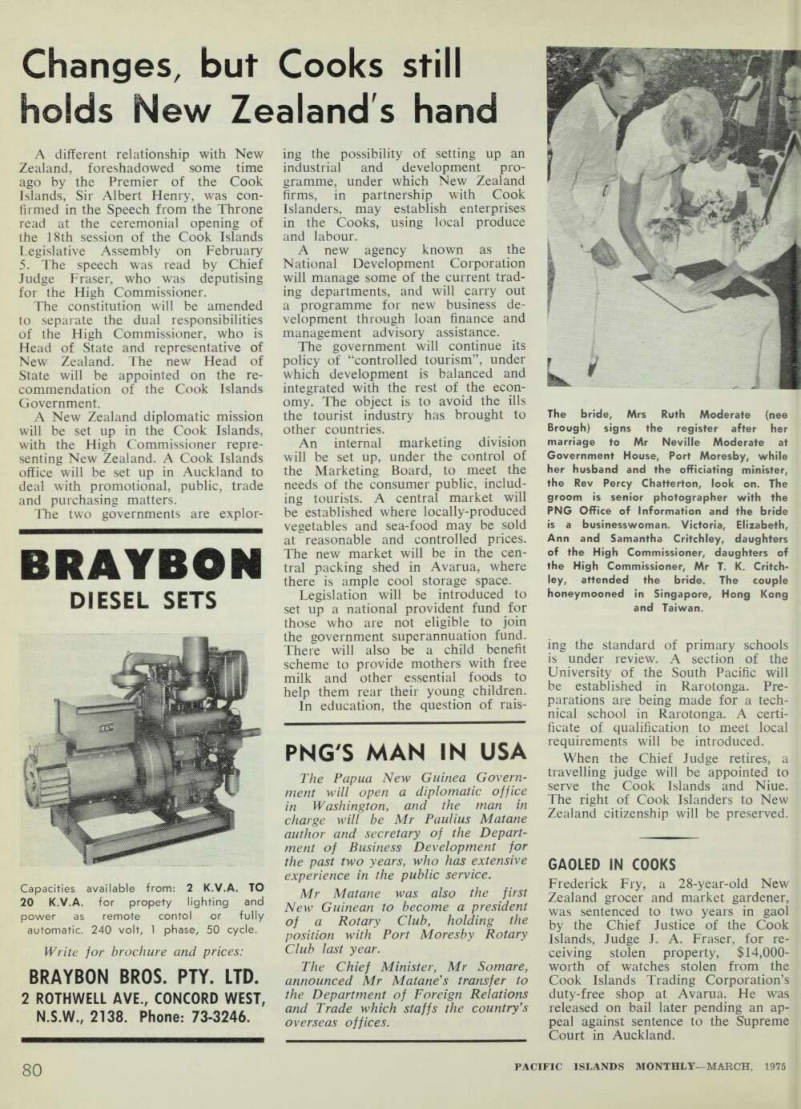
Changes, but Cooks still holds New Zealand's hand
A different relationship with New Zealand, foreshadowed some time ago by the Premier of the Cook Islands, Sir Albert Henry, was con firmed in the Speech from the Throne read at the ceremonial opening of the 18th session of the Cook Islands Legislative Assembly on February 5. The speech was read by Chief Judge Fraser, who was deputising for the High Commissioner.
The constitution will be amended to separate the dual responsibilities of the High Commissioner, who is Head of State and representative of New Zealand. The new Head of State will be appointed on the re commendation of the Cook Islands Government.
A New Zealand diplomatic mission will be set up in the Cook Islands, with the High Commissioner repre senting New Zealand. A Cook Islands office will be set up in Auckland to deal with promotional, public, trade and purchasing matters.
The two governments are explor
ing the possibility of setting up an industrial and development pro gramme, under which New Zealand firms, in partnership with Cook Islanders, may establish enterprises in the Cooks, using local produce and labour.
A new agency known as the National Development Corporation will manage some of the current trad ing departments, and will carry out a programme for new business de velopment through loan finance and management advisory assistance.
The government will continue its policy of “controlled tourism”, under which development is balanced and integrated with the rest of the econ omy. The object is to avoid the ills the tourist industry has brought to other countries.
An internal marketing division will be set up, under the control of the Marketing Board, to meet the needs of the consumer public, includ ing tourists. A central market will be established where locally-produced vegetables and sea-food may be sold at reasonable and controlled prices.
The new market will be in the cen tral packing shed in Avarua, where there is ample cool storage space.
Legislation will be introduced to set up a national provident fund for those who are not eligible to join the government superannuation fund.
There will also be a child benefit scheme to provide mothers with free milk and other essential foods to help them rear their young children.
In education, the question of rais-
ing the standard of primary schools is under review. A section of the University of the South Pacific will be established in Rarotonga. Pre parations are being made for a tech nical school in Rarotonga. A certi ficate of qualification to meet local requirements will be introduced.
When the Chief Judge retires, a travelling judge will be appointed to serve the Cook Islands and Niue.
The right of Cook Islanders to New Zealand citizenship will be preserved.
Gaoled In Cooks
Frederick Fry, a 28-year-old New Zealand grocer and market gardener, was sentenced to two years in gaol by the Chief Justice of the Cook Islands, Judge J. A. Fraser, for re ceiving stolen property, $ 14,000worth of watches stolen from the Cook Islands Trading Corporation’s duty-free shop at Avarua. He was released on bail later pending an ap peal against sentence to the Supreme Court in Auckland.
The bride, Mrs Ruth Moderate (nee Brough) signs the register after her marriage to Mr Neville Moderate at Government House, Port Moresby, while her husband and the officiating minister, the Rev Percy Chatterton, look on. The groom is senior photographer with the PNG Office of Information and the bride is a businesswoman. Victoria, Elizabeth, Ann and Samantha Critchley, daughters of the High Commissioner, daughters of the High Commissioner, Mr T. K. Critch ley, attended the bride. The couple honeymooned in Singapore, Hong Kong and Taiwan.
Png's Man In Usa
The Papua New Guinea Govern ment will open a diplomatic office in Washington, and the man in charge will be Mr Paulius Matane author and secretary of the Depart ment of Business Development for the past two years, who has extensive experience in the public service.
Mr Matane was also the first New Guinean to become a president of a Rotary Club, holding the position with Port Moresby Rotary Club last year.
The Chief Minister, Mr Somare, announced Mr Matane's transfer to the Department of Foreign Relations and Trade which staffs the country’s overseas offices.
Advertisements & other items, p. 82 (1 item)
Braybon
DIESEL SETS
Capacities available from: 2 K.V.A. TO 20 K.V.A. for propety lighting and power as remote contol or fully automatic. 240 volt, 1 phase, 50 cycle.
Write for brochure and prices:
BRAYBON BROS. PTY. LTD.
2 ROTHWELL AVE., CONCORD WEST,
N.S.W., 2138. Phone: 73-3246.
Mr Chan Talks To The Nauruans
Nauru celebrated its seventh year of independence at the beginning of February. Attending the celebrations as representative of Papua New Guinea's Chief Minister, Mr Michael Somare, Finance Minister Mr Julius Chan emphasised the value of close relationships between South Pacific countries.
“We share many common attitudes to life and many common prob lems”, he said. “Our people live in small and relatively isolated communities and share the problems of transport and communications that result from this.
“As relatively small countries, we share the problems that arise from economic developments in a world too big for us to control”.
Mr Chan added that Papua New Guinea had little influence over de cisions made by larger countries. But it was able to control relations with those countries.
Advertisements & other items, p. 83 (2 items)
War claims grumble
81
ACIFIC ISLANDS MONTHLY—MARCH, 1975
War claims grumble Continued from p 13
Braybon
PORTABLE
PETROL SETS
Capacities available: 1,2, 3f, 7i K.V.A. 240 V 50 cycle. For domestic appliances, T.V., power tools, electric welders and motors up to 3 H.P.
Write for brochure and prices:
BRAYBON BROS. PTY. LTD.
2 ROTHWELL AVE., CONCORD WEST,
N.S.W., 2138. Phone: 73-3246.
Fiji sugar
Big boost for Fiji sugar
Fiji now has unlimited access to the United States sugar market. This news arrived in the country in February from the US Secretary of State, Dr Henry Kissinger, who wrote to the Prime Minister, Ratu Rir Kamisese Mara: “Fiji can ship as much sugar as it desires to the US, unencumbered by the restrictions of an individual quota ceiling”. Fiji’s quota had risen to 45,000 short tons a year. Dr Kissinger wrote that Fiji’s record as a supplier was a consistently good one.
About the same time Ratu Sir Kamisese received a “Thank you” letter from the British Prime Minister, Mr Harold Wilson, for his part in bringing recent EEC sugar negoti ations to a successful conclusion (see P 77).
Lord Howe air
service is off
Off again—the Airlines of NSW service to Lord Howe Island. And this time it is for keeps, says the manager of the airline, Mr P. Sted man. ‘Airlines of NSW announced in January that services to the island would end, but later reversed the decision (see report page 66).
Mr Stedman said the services would end on February 28 as the Australian Federation of Airline Pilots refused to allow it to use pilots from another company, Conair, of Alice Springs, from which it had chartered a Heron for the Lord Howe service. It would be uneconomic to retrain Airlines of NSW pilots.
The future of a service to the island was very much “in the clouds” about the middle of February. North Coast Airlines, of Coffs Harbour, has a licence to operate such a service.
Other third line operators are also interested. Whatever happens, a new operator has to be approved by the NSW Transport Department and Federal Air Transport Group.
Advertisements & other items, pp. 84-85 (3 items)
Papua home-rulers
82
PACIFIC ISLANDS MONTHLY—MARCH, 1975
Papua home-rulers Continued from p 11
83
ACIFIC ISLANDS MONTHLY—MARCH, 1975
Timely Pacific Reading!
Send your order direct to
Pacific Publications (Aust.) Pty. Ltd.
29 Alberta Street, Sydney, N.S.W. 2000
PAPUA NEW GUINEA
HANDBOOK
7th edition This new edition of the Papua New Guinea Handbook —completely revised and reset—provides the first full upto-date details of the new self-governing nation.
For businessmen, travellers, schools, universities and libraries, government departments, tourists and Papua New Guinea residents, this timely, up-to-the-minute edition, is essential.
A large attractive fold-out map of Papua New Guinea is also included. 332 pages of text. 5 s - 5 ? P J“ S 85c posted ' Pac,fic ,slands and Overseas, $5.50 Aust., plus $l.lO posted; U.S.A., $9.80 U.S. posted
FOR CHILDREN
LITTLE CHIMBU IN
BOUGAINVILLE
This is the story of lovable Little Chimbu, and his friends, who go off to see the biggest hole in the world ... the Bougainville copper mine, at Panguna, in New Guinea.
Adventures follow one after the other on their arrival at the mine, and young readers (and their parents) will be fascinated by Nancy Curtis' colourful, yet accurate and instructive account of the workings of the big Bougainville enterprise ... its giant trucks, its processing plant, its port and shipping.
PRICE:
Illustrated in full colour.
Australia, Pacific Islands and Overseas, $3.25 Aust., plus 48c posted; U.S.A., $5.30 U.S. posted. P Percy Chatterton's Papua
DAY THAT I HAVE LOVED
Percy Chatterton This is more than an autobiography by well-known Percy Chatterton, OBE, who has spent 50 years in Papua as missionary, teacher and outspoken politician fighting for the underdog. It is a colourful, and charming, account of the Papuan people, giving warm insight info their hopes, fears and changing way of life. Some Papuan leaders say they don't want Papua to be submerged by New Guinea in the move towards independence, and readers of Percy Chatterton's timely book will readily sympathise with their desire to retain their identity. The book is illustrated with evocative pen sketches by Percy Chatterton s longtime friend and neighbour in Port Moresby, Rev. Bert Brown. 48c posted; U.S.A., SB.C
HOLY TORTURE IN FIJI
Written by a group of academic participants and observers.
Editing and commentary by Prof. Ron Crocombe.
This book describes sacred ancient rituals involving physical ordeals which are performed onoe a year at certain Hindu temples in Fiji. The rituals include walking on fire, dancing on upturned knife-blades, whipping, plunging the hands in burning fat and piercing the body with steel skewers and silver wires.
Yet those who go through the ordeals suffer no pain, burns or injuries.
The book is beautifully produced in’ full colour and black-and-white.
PRICE: Australia, Pacific Islands and Overseas, $3.95 Aust plus 48c posted; U.S.A., $6.40 U.S. posted.
HEiU GlililEß
HfHIDBOOK
n m m in \ • -
HOLY
TORTURE
Percy Chatterton’s Papua
DAY THAT I
HAVE LOVED
IN FIJI
Shipping Information
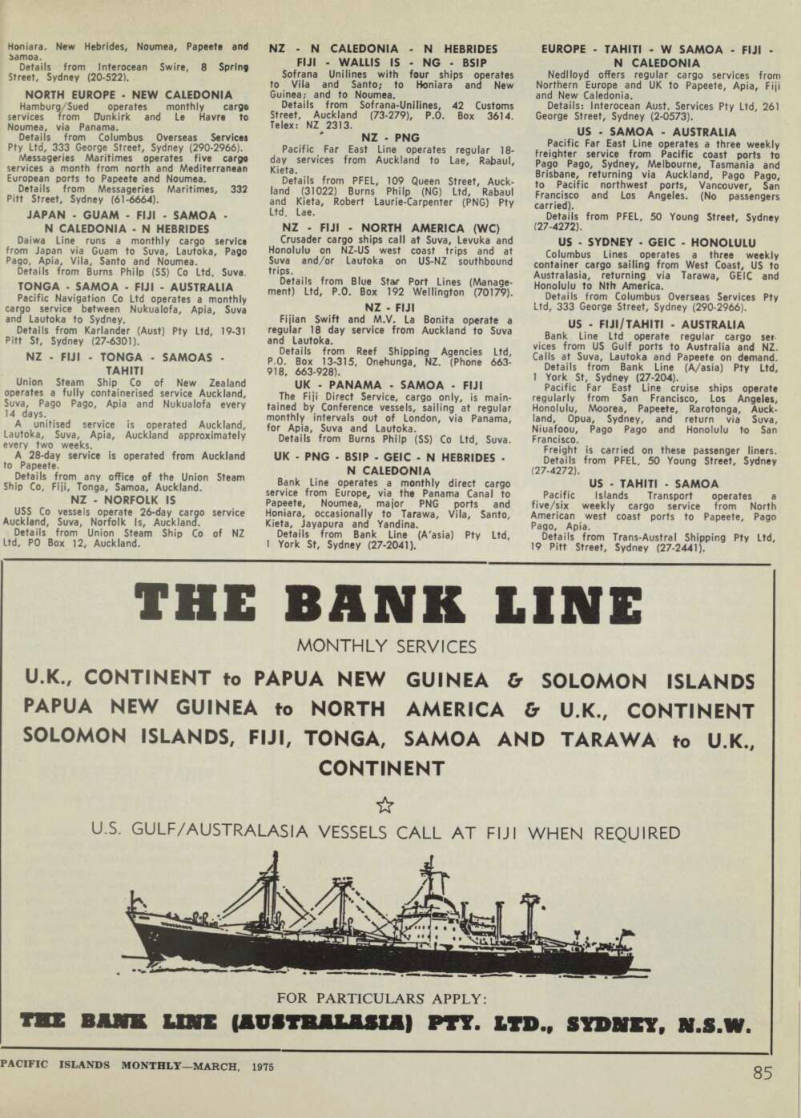
SYDNEY - NZ - FIJI/TAHITI - UK Chandris Lines maintains a twice-monthly passenger service from Sydney via NZ, Suva or Papeete.
Details from Chandris Lines, 135 King Street, Sydney (28-2451).
SYDNEY - LORD HOWE IS - NORFOLK IS Somacal operates 25-day service from Sydney to Lord Howe and Norfolk Is.
Details from Karlander (Aust) Pty Ltd, 19-31 Pitt Street, Sydney (27-6301).
Chargeurs Caledoniens operates three-weekly cargo service Sydney-Norfolk Island-Noumea.
Details: Hetherington Kingsbury Pty Ltd, 37-49 Pitt Street, Sydney (27-1671).
SYDNEY - NORFOLK IS - AUCKLAND -
New Caledonia
Compagnie des Chargeurs Caledoniens operates four-weekly cargo service from Sydney to Norfolk Island, Auckland and Noumea.
Details: Hetherington Kingsbury Pty Ltd, 37- 49 Pitt Street, Sydney (27-1671).
SYDNEY • NZ - FIJI - HAWAII •
Canada - Us
P and 0 liners call at Auckland, Suva and Honolulu on eastbound and westbound voyages between Sydney and the LIS.
Details from P & 0 Australia Ltd, 55 Hunter Street, Sydney (2-0317).
SYDNEY - NZ - FIJI - TONGA - VILA •
Noumea ■ Samoas - Tahiti
Shaw Savill liners cruise in the Pacific sailing from Australia and New Zealand calling at Suva, Lautoka, Tonga, Vila; Noumea, Pago Paoo, Tahiti, Apia, Vavau.
Details; Shaw Savill Line, 62 Pitt St, Sydney (241-3921).
Sitmar Cruises operates a South Pacific cruise programme to include most of the above ports plus the Solomons.
Details from Sitmar Line (Australia) Pty Ltd, 22-30 Bridge Street, Sydney (27-4521).
Royal Viking Line, with luxury cruise ships Royal Viking Sea, Star and Sky, cruises the Pacific from Sydney, calling at most of the above ports plus Port Moresby and Rarotonga.
Details from Wilh. Wilhelmsen Agency Pty Ltd 13-15 Bridge Street, Sydney (2-0517).
P & 0 liners Oronsay, Oriana and Arcadia call at Suva, Honiara, Pago Pago, Auckland, Vila, Noumea, Honolulu, Nukualofa, Vavau, Savusavu, Jakarta and Bali regularly on cruises from Australia.
Details from P & 0 Australia Ltd, 55 Hunter Street, Sydney (2-0317).
Australia - New Caledonia
Sofrana-Unilines operates a fortnightly service from Sydney to Noumea.
Details from Sofrana-Unilines, 37 Pitt Street, Sydney (27-2031).
Australia - New Caledonia -
New Hebrides
Sofrana-Unilines' ships call regularly at Sydney, Noumea and Vila.
Details from Sofrana-Unilines, 37 Pitt Street,
Sydney (27-2031), Burns Philp and Co Ltd, 340 Collins Street, Melbourne (67-8941) and John Swire and Sons, Brisbane (46-1155).
South Pacific United Lines with Polynesie maintains cargo-passenger sailings—Sydney, Noumea, Vila and Santo.
Details from Omni Traders & Brokers Pty Limited, 261 George Street, Sydney (241-2872/6).
Compagnie des Chargeurs Caledoniens operates three-weekly cargo service from Sydney to Noumea, Port Vila, Santo, with Port de France.
Details: Hetherington Kingsbury Pty Ltd, 37- 49 Pitt Street, Sydney (27-1671).
Australia - Fiji
Sofrana-Unilines operates Sydney-Fiji every 28 days.
Details from Sofrana-Unilines, 37 Pitt Street, Sydney (27-2031).
Nauru Pacific Line operates cargo/passenger service to Fiji and South Pacific ports.
Details from Nauru Pacific Line, 227 Collins Street, Melbourne (654-4977); Interocean Swire, 8 Spring Street, Sydney (20-522); Dalgety Shipping, 291 Elizabeth Street, Brisbane (31-0331).
Karlander (Aust) Pty Ltd operates three weekly cargo services from Sydney to Suva and Lautoka.
Details from Karlander (Aust) Pty Ltd, 19-31 Pitt Street, Sydney (27-6301.; Dalgety Shipping, 461 Bourke St, Melbourne (600731); Burns Philp (SS) Co Ltd, Suva and Lautoka.
AUSTRALIA ■ TAHITI ■ MEXICO - US South Pacific United Lines has three vessels, Newfoundland, Nova Scotia and Krohn Trader, maintaining six weekly service from Sydney to Papeete, Mexico and US.
Details from Omni Traders & Brokers Ptv Limited, 261 George Street, Sydney (241-2872/61.
Australia - Png
Containers Pacific Express (Burns Philp and AWP Line) operates four-weekly cargo service from Melbourne (direct) with Milos & Samos and Sydney and Brisbane to Lae and Port Moresby with Nimos.
Details from Burns, Philp & Co Ltd, 51 Pitt Street, Sydney (241-3816).
Pacific Far East Line operates 18-day services from Tasmania, Melbourne, Sydney and Brisbane to Lae, Rabaul and Kieta.
Details from PFEL, 50 Young Street, Sydney. (27-4272), 454 Collins Street, Melbourne (67-7237), Burns Philp (NG) Ltd, Rabaul and Kieta, Robert Laurie-Carpenter (NG) Pty Ltd, Lae.
New Guinea Express Lines with two ships operates three-weekly Melbourne, Sydney, Brisbane, Port Moresby, Lae, Rabaul.
Details from New Guinea Express Lines, 37 Pitt St, Sydney (241-1396) and 72 Eagle St, Brisbane (21-9333), Westralian Farmers Trans port Pty Ltd, 459 Collins St, Melbourne (67-8291), Breckwoldt's Shipping Agencies in Port Moresby, Lae, Rabaul.
Karlander New Guinea Line's two cargo vessels call at Melbourne, Sydney, Brisbane, Lae, Madang, Wewak, Manus, Kimbe.
Details from Karlander (Aust) Pty Ltd, 19-31 Pitt Street, Sydney (27-6301); Dalgety Shipping, 461 Bourke St, Melbourne (600731).
Australia • Png - Bsip
New Guinea Australia Line's vessels operate from Sydney and Brisbane to Port Moresby, Lae, Rabaul, Kavieng, Honiara, Kieta, Gizo, Madang and Samarai.
Details from Interocean Swire, 8 Spring Street, Sydney (20-522).
Australia • Marshall Islands -
Guam
Nauru Pacific Line operates monthly con ventional/container service Melbourne/Sydney to New Guinea, Guam and Micronesia.
Details from Nauru Pacific Line, 227 Collins Street, Melbourne (654-4977); Interocean Swire, 8 Spring Street, Sydney (20-522).
Australia - Png - Far East
E. and A. Line passenger ships make monthly round voyages from Melbourne, Sydney and Brisbane calling at Port Moresby, Manila, Hong Kong, Keelung, Kobe, Yokohama (Tokyo), and Rabaul.
Details from P & 0 Australia Ltd, 55 Hunter Street, Sydney (2-0317).
Us - Png
Pacific Far East Line operates regular services from all US west ports to Lae, Rabaul, Kieta.
Details from PFEL, One Embarcadero Centre, San Francisco, Burns Philp (NG) Ltd, Rabaul and Kieta, Robert Laurie-Carpenter (PNG) Pty Ltd, Lae.
Png • Us - Canada
Pacific Far East Lines operates regular services from Lae, Rabaul and Kieta to US west coast ports and Vancouver.
Details from Burns Philp (NG) Ltd, Rabaul and Kieta, Robert Laurie-Carpenter (PNG) Pty Ltd, Lae, PFEL, One Embarcadero Centre, San Francisco and 50 Young Street, Sydney (27-4272).
FAR EAST - FIJI - NEW ZEALAND New Zealand Unit Express (CNC, MOL, RIL' operates a three-weekly cargo service from Hong Kong to Lautoka, Suva, NZ ports, Manila, Kaoshiung, Keelung, Hong Kong.
Details from Interocean Swire, 8 Spring Street, Sydney (20-522).
Royal Interocean Lines operates monthly pass enger/cargo service with three ships from N 7 to Bangkok, Pt Kelang, Singapore, Djakarta to Fiji and NZ.
Details from Interocean Australia Services 261 George Street, Sydney (2-0573), Burns Philp (SSI Co Ltd Suva and Lautoka Ben Shipping Pty Ltd, with Liverpool Clipper, operates monthly cargo service between Singa pore and Suva.
Details from Seatrans (Fi|i) Ltd.
FAR EAST - PNG - BSI - NEW HEBRIDES •
Noumea - Tahiti - Samoa
China Navigation Co's vessels operate a regular cargo service from Hong Kong to Rabaul. Wewak. Madang, Lae, Port Moresby,
Honiara. New Hebrides, Noumea, Papeete and iamoa.
Details from Interocean Swire, 8 Spring Street, Sydney (20-522).
North Europe - New Caledonia
Hamburg/Sued operates monthly cargo services from Dunkirk and Le Havre to Noumea, via Panama.
Details from Columbus Overseas Services Pty Ltd, 333 George Street, Sydney (290-2966).
Messageries Maritimes operates five cargo services a month from north and Mediterranean European ports to Papeete and Noumea.
Details from Messageries Maritimes, 332 Pitt Street, Sydney (61-6664).
JAPAN - GUAM - FIJI - SAMOA -
N Caledonia - N Hebrides
Daiwa Line runs a monthly cargo service from Japan via Guam to Suva, Lautoka, Pago Pago, Apia, Vila, Santo and Noumea.
Details from Burns Philp (SS) Co Ltd, Suva.
TONGA - SAMOA - FIJI - AUSTRALIA Pacific Navigation Co Ltd operates a monthly cargo service between Nukualofa, Apia, Suva and Lautoka to Sydney.
Details from Karlander (Aust) Pty Ltd, 19-31 Pitt St, Sydney (27-6301).
NZ - FIJI - TONGA - SAMOAS -
Tahiti
Union Steam Ship Co of New Zealand operates a fully containerised service Auckland, Suva, Pago Pago, Apia and Nukualofa every 14 days.
A unitised service is operated Auckland, Lautoka, Suva, Apia, Auckland approximately every two weeks.
A 28-day service is operated from Auckland to Papeete.
Details from any office of the Union Steam Ship Co, Fiji, Tonga, Samoa, Auckland.
Nz - Norfolk Is
USS Co vessels operate 26-day cargo service Auckland, Suva, Norfolk Is, Auckland.
Details from Union Steam Ship Co of NZ Ltd, PO Box 12, Auckland.
NZ - N CALEDONIA - N HEBRIDES FIJI - WALLIS IS - NG - BSIP Sofrana Unilines with four ships operates to Vila and Santo; to Honiara and New Guinea,- and to Noumea, Details from Sofrana-Unilines, 42 Customs Street, Auckland (73-279), P.O. Box 3614.
Telex: NZ 2313.
' Nz - Png
Pacific Far East Line operates regular 18day services from Auckland to Lae, Rabaul, Kieta.
Details from PFEL, 109 Queen Street, Auck land (31022) Burns Philp (NG) Ltd, Rabaul and Kieta, Robert Laurie-Carpenter (PNG) Pty Ltd. Lae.
NZ - FIJI - NORTH AMERICA (WC) Crusader cargo ships call at Suva, Levuka and Honolulu on NZ-US west coast trips and at Suva and/or Lautoka on US-NZ southbound trips.
Details from Blue Staj- Port Lines (Manage ment) Ltd, P.O. Box 192 Wellington (70179).
Nz - Fiji
Fijian Swift and M.V. La Bonita operate a regular 18 day service from Auckland to Suva and Lautoka.
Details from Reef Shipping Agencies Ltd, P.O. Box 13-315, Onehunga, HZ. (Phone 663- 918. 663-928).
UK - PANAMA - SAMOA - FIJI The Fiji Direct Service, cargo only, is main tained by Conference vessels, sailing at regular monthly intervals out of London, via Panama, for Apia, Suva and Lautoka.
Details from Burns Philp (SS) Co Ltd, Suva.
UK ■ PNG - BSIP - GEIC - N HEBRIDES -
N Caledonia
Bank Line operates a monthly direct cargo service from Europe, via the Panama Canal to Papeete, Noumea, major PNG ports and Honiara, occasionally to Tarawa, Vila, Santo, Kieta, Jayapura and Yandina.
Details from Bank Line (A'asia) Pty Ltd, 1 York St, Sydney (27-2041).
EUROPE - TAHITI - W SAMOA - FIJI -
N Caledonia
Nedlloyd offers regular cargo services from Northern Europe and UK to Papeete, Apia, Fiji and New Caledonia.
Details: Interocean Aust, Services Pty Ltd, 261 George Street, Sydney (2-0573).
Us - Samoa ■ Australia
Pacific Far East Line operates a three weekly freighter service from Pacific coast ports to Pago Pago, Sydney, Melbourne, Tasmania and Brisbane, returning via Auckland, Pago Pago, to Pacific northwest ports, Vancouver, San Francisco and Los Angeles. (No passengers carried).
Details from PFEL, 50 Young Street, Sydney (27-4272).
US - SYDNEY - GEIC - HONOLULU Columbus Lines operates a three weekly container cargo sailing from West Coast, US to Australasia, returning via Tarawa, GEIC and Honolulu to Nth America.
Details from Columbus Overseas Services Pty Ltd, 333 George Street, Sydney (290-2966).
Us - Fiji/Tahiti - Australia
Bank Line Ltd operate regular cargo ser vices from US Gulf ports to Australia and NZ.
Calls at Suva, Lautoka and Papeete on demand.
Details from Bank Line (A/asia) Pty Ltd, 1 York St, Sydney (27-204).
Pacific Far East Line cruise ships operate regularly from San Francisco, Los Angeles, Honolulu, Moorea, Papeete, Rarotonga, Auck land, Opua, Sydney, and return via Suva, Niuafoou, Pago Pago and Honolulu to San Francisco.
Freight is carried on these passenger liners.
Details from PFEL, 50 Young Street, Sydney (27-4272).
Us - Tahiti - Samoa
Pacific Islands Transport operates a five/six weekly cargo service from North American west coast ports to Papeete, Pago Pago, Apia.
Details from Trans-Austral Shipping Pty Ltd, 19 Pitt Street, Sydney (27-2441).
Advertisements & other items, pp. 86-88 (1 item)
sdfdf
THE BANK LINE
MONTHLY SERVICES
U.K., CONTINENT to PAPUA NEW GUINEA & SOLOMON ISLANDS PAPUA NEW GUINEA to NORTH AMERICA & U.K., CONTINENT SOLOMON ISLANDS, FIJI, TONGA, SAMOA AND TARAWA to U.K.,
CONTINENT
☆ US. GULF/AUSTRALASIA VESSELS CALL AT FIJI WHEN REQUIRED Vllljj
FOR PARTICULARS APPLY:
THE BANK LINE (AUSTBALASZA) PTY. LTD., SYDNEY, M.S.W.
IIQpAIWA line
DIRECT REGULAR SERVICE
JAPAN-SOUTH PACIFIC
TARAWA-PAPEETE-PAGO PAGO-APIA
SUVA-LAUTOKA-NOUMEA-VILA
SANTO-HONIARA
JAPAN-GUAM-TAIWAN
JAPAN-GUAM-KEELUNG BY
EXCELLENT CAR/CONTAINER-CARRIER
JAPAN-WEST IRIAN-DILI
HONG KONG-TAIWAN-WEST IRIAN-DILI
AGENTS:
GUAM: ATKINS, KROLL (GUAM) LTD.
TARAWA: G. & E. I. DEVELOPMENT AUTHORITY.
APIA: BURNS PHILP (SOUTH SEA) CO., LTD.
PAGO PAGO; KNEUBUHL MARITIME SERVICES CORP.
NUKUALOFA: PACIFIC NAVIGATION CO., LTD.
SUVA: BURNS PHILP (SOUTH SEA) CO., LTD.
LAUTOKA: BURNS PHILP (SOUTH SEA) CO., LTD.
NOUMEA: AGENCE MARITIME ET AERIENNE
CALEDONIENNE.
SANTO: BURNS PHILP (NEW HEBRIDES) LTD.
VILA: BURNS PHILP (NEW HEBRIDES) LTD.
HONIARA: BRITISH SOLOMONS TRADING CO., LTD.
PAPEETE: AGENCE MARITIME DE PARA UTE.
HONG KONG: IKE MARITIME CO., LTD.
SINGAPORE: THE BORNEO CO., (SINGAPORE) LTD.
DJAJAPURA: P. N. PELAJARAN NASIONAL INDONESIA.
DILI: SANG TAI HOO
TAIWAN: FOR CARGO BETWEEN JAPAN/GUAM/TAIWAN
FORMOSA SHIPPING & ENTERPRISE CORP.
TAIWAN; FOR CARGO BETWEEN JAPAN/SOUTH PACIFIC/
WEST IRIAN/DILI
MARITIME TRANSPORTATION AGENCIES, LTD.
THE DAIWA NAVIGATION CO.,LTD.
OSAKA: "DAILINE" TOKYO: "FUNEDAILINE”
HEAD OFFICE TOKYO OFFICE
NO. 25-1, 4-CHOME MINAMIKYUTARO- NO, 20, 3-CHOME KANDA-NISHIKI-
MACHI. HIGASHI-KU, OSAKA CHO CHIYODA-KU, TOKYO
TEL: OSAKA (244) 1281-9 TEL: TOKYO 12921 2441-5
in Tahiti
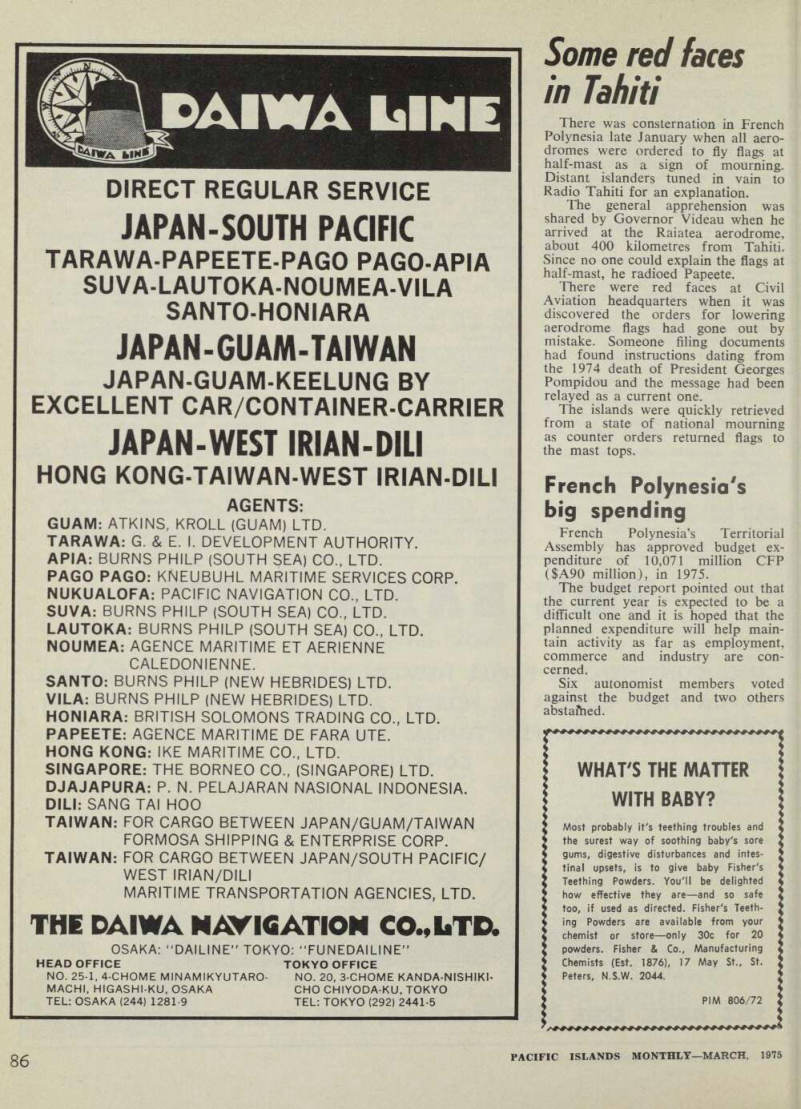
Some red faces in Tahiti
There was consternation in French Polynesia late January when all aero dromes were ordered to fly flags at half-mast as a sign of mourning.
Distant islanders tuned in vain to Radio Tahiti for an explanation.
The general apprehension was shared by Governor Videau when he arrived at the Raiatea aerodrome, about 400 kilometres from Tahiti.
Since no one could explain the flags at half-mast, he radioed Papeete.
There were red faces at Civil Aviation headquarters when it was discovered the orders for lowering aerodrome flags had gone out by mistake. Someone filing documents had found instructions dating from the 1974 death of President Georges Pompidou and the message had been relayed as a current one.
The islands were quickly retrieved from a state of national mourning as counter orders returned flags to the mast tops.
French Polynesia's
big spending
French Polynesia’s Territorial Assembly has approved budget ex penditure of 10,071 million CFP (SA9O million), in 1975.
The budget report pointed out that the current year is expected to be a difficult one and it is hoped that the planned expenditure will help main tain activity as far as employment, commerce and industry are con cerned.
Six autonomist members voted against the budget and two others abstained.
Advertisements & other items, p. 88 (1 item)
With Baby?
WHAT'S THE MATTER
Most probably it's teething troubles and the surest way of soothing baby's sore gums, digestive disturbances and intestinal upsets, is to give baby Fisher's Teething Powders. You'll be delighted how effective they are—and so safe too, if used as directed. Fisher's Teething Powders are available from your chemist or store—only 30c for 20 powders. Fisher & Co., Manufacturing Chemists (Est. 1876), 17 May St., St.
Peters, N.S.W. 2044.
PIM 806/72
Islands People
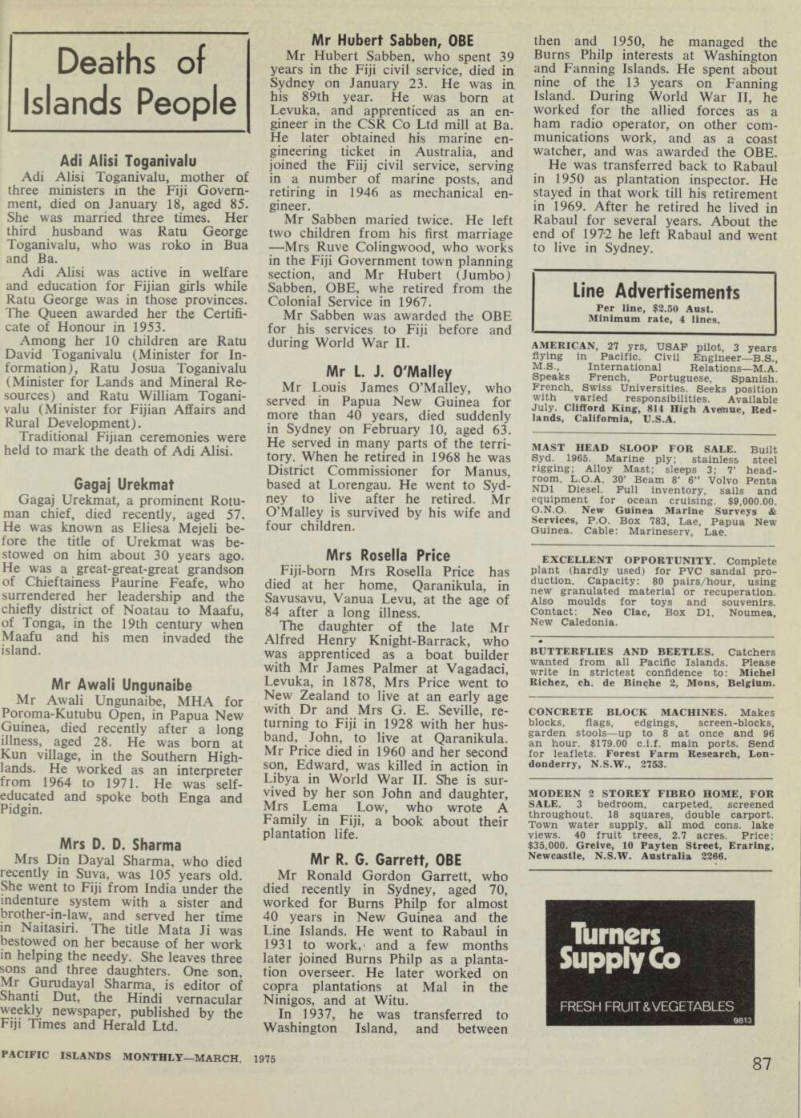
Deaths of Islands People
Adi Alisi Toganivalu Adi Alisi Toganivalu, mother of three ministers in the Fiji Govern ment, died on January 18, aged 85.
She was married three times. Her third husband was Ratu George Toganivalu, who was roko in Bua and Ba.
Adi Alisi was active in welfare and education for Fijian girls while Ratu George was in those provinces.
The Queen awarded her the Certifi cate of Honour in 1953.
Among her 10 children are Ratu David Toganivalu (Minister for In formation), Ratu Josua Toganivalu (Minister for Lands and Mineral Re sources) and Ratu William Togani valu (Minister for Fijian Affairs and Rural Development).
Traditional Fijian ceremonies were held to mark the death of Adi Alisi.
Gagaj Urekmat
Gagaj Urekmat, a prominent Rotu man chief, died recently, aged 57.
He was known as Eliesa Mejeli be fore the title of Urekmat was be stowed on him about 30 years ago.
He was a great-great-great grandson of Chieftainess Paurine Feafe, who surrendered her leadership and the chiefly district of Noatau to Maafu, of Tonga, in the 19th century when Maafu and his men invaded the island.
Mr Awali Ungunaibe Mr Awali Ungunaibe, MHA for Poroma-Kutubu Open, in Papua New Guinea, died recently after a long illness, aged 28. He was born at Kun village, in the Southern High lands. He worked as an interpreter from 1964 to 1971. He was self educated and spoke both Enga and Pidgin.
Mrs D. D. Sharma Mrs Din Dayal Sharma, who died recently in Suva, was 105 years old.
She went to Fiji from India under the indenture system with a sister and brother-in-law, and served her time in Naitasiri. The title Mata Ji was bestowed on her because of her work in helping the needy. She leaves three sons and three daughters. One son, Mr Gurudayal Sharma, is editor of Shanti Dut, the Hindi vernacular weekly newspaper, published by the Fiji Times and Herald Ltd.
Mr Hubert Sabben, OBE Mr Hubert Sabben, who spent 39 years in the Fiji civil service, died in Sydney on January 23. He was in. his 89th year. He was born at Levuka, and apprenticed as an en gineer in the CSR Co Ltd mill at Ba.
He later obtained his marine en gineering ticket in Australia, and joined the Fiij civil service, serving in a number of marine posts, and retiring in 1946 as mechanical en gineer.
Mr Sabben maried twice. He left two children from his first marriage —Mrs Ruve Colingwood, who works in the Fiji Government town planning section, and Mr Hubert (Jumbo) Sabben, OBE, whe retired from the Colonial Service in 1967.
Mr Sabben was awarded the OBE for his services to Fiji before and during World War 11.
Mr L J. O'Malley Mr Louis James O’Malley, who served in Papua New Guinea for more than 40 years, died suddenly in Sydney on February 10, aged 63.
He served in many parts of the terri tory. When he retired in 1968 he was District Commissioner for Manus, based at Lorengau. He went to Syd ney to live after he retired. Mr O’Malley is survived by his wife and four children.
Mrs Rosella Price Fiji-born Mrs Rosella Price has died at her home, Qaranikula, in Savusavu, Vanua Levu, at the age of 84 after a long illness.
The daughter of the late Mr Alfred Henry Knight-Barrack, who was apprenticed as a boat builder with Mr James Palmer at Vagadaci, Levuka, in 1878, Mrs Price went to New Zealand to live at an early age with Dr and Mrs G. E. Seville, re turning to Fiji in 1928 with her hus band, John, to live at Qaranikula.
Mr Price died in 1960 and her second son, Edward, was killed in action in Libya in World War 11. She is sur vived by her son John and daughter, Mrs Lema Low, who wrote A Family in Fiji, a book about their plantation life.
Mr R. G. Garrett, OBE Mr Ronald Gordon Garrett, who died recently in Sydney, aged 70, worked for Burns Philp for almost 40 years in New Guinea and the Line Islands. He went to Rabaul in 1931 to work,' and a few months later joined Burns Philp as a planta tion overseer. He later worked on copra plantations at Mai in the Ninigos, and at Witu.
In 1937, he was transferred to Washington Island, and between
then and 1950, he managed the Burns Philp interests at Washington and Fanning Islands. He spent about nine of the 13 years on Fanning Island. During World War 11, he worked for the allied forces as a ham radio operator, on other com munications work, and as a coast watcher, and was awarded the OBE.
He was transferred back to Rabaul in 1950 as plantation inspector. He stayed in that work till his retirement in 1969. After he retired he lived in Rabaul for several years. About the end of 1972 he left Rabaul and went to live in Sydney.
Advertisements & other items, pp. 89-92 (3 items)
87
ACIFIC ISLANDS MONTHLY—MARCH, 1975
Supply Co
Line Advertisements
Per line, $2,50 Aust.
Minimum rate, 4 lines.
AMERICAN, 27 yrs, USAF pilot, 3 years flying in Pacific. Civil Engineer—B.S., M.S., International Relations—M.A.
Speaks French, Portuguese, Spanish.
French, Swiss Universities. Seeks position with varied responsibilities. Available July. Clifford King, 814 High Avenue, Redlands, California, U.S.A.
MAST HEAD SLOOP FOR SALE. Built
Syd. 1965. Marine ply; stainless steel rigging; Alloy Mast; sleeps 3; 7’ headroom. L.O.A. 30’ Beam 8’ 6” Volvo Penta NDI Diesel. Pull inventory, sails and equipment for ocean cruising. $9,000.00. 0.N.0. New Guinea Marine Surveys & Services, P.O. Box 783, Lae, Papua New Guinea. Cable: Marineserv, Lae.
EXCELLENT OPPORTUNITY. Complete
plant (hardly used) for PVC sandal production. Capacity; 80 pairs/hour, using new granulated material or recuperation.
Also moulds for toys and souvenirs.
Contact: Neo Clac, Box Dl, Noumea, New Caledonia.
BUTTERFLIES AND BEETLES. Catchers
wanted from all Pacific Islands. Please write in strictest confidence to: Michel Richez, ch. de Binche 2, Mons, Belgium.
CONCRETE BLOCK MACHINES. Makes
blocks, flags, edgings, screen-blocks, garden stools—up to 8 at once and 96 an hour. $179.00 c.i.f. main ports. Send for leaflets. Forest Farm Research, Londonderry, N.S.W., 2753.
MODERN 2 STOREY FIBRO HOME, FOR
SALE. 3 bedroom, carpeted, screened throughout. 18 squares, double carport.
Town water supply, all mod cons, lake views. 40 fruit trees, 2.7 acres. Price: $35,000. Greive, 10 Payten Street, Eraring, Newcastle, N.S.W. Australia 2266.
Turners Supply Co
FRESH FRUIT & VEGETABLES
n §e) LnnJ !bs3 InnJ [? i" i §s) LnnJ ®1
PARK VIEW MOTEL—BRISBANE
Quiet location—opp. Botanic Gardens.
Single, double, family suites, all with refrlg., air conditioning, phone, TV, radio, tea making facilities, from $12. Pool and restaurant.
Phone 31-2695—Telex 40270.
Write for coloured brochure— Park View Motel, 128 Alice St, BRISBANE, Old., 4000.
3007
Stay at
Aggie Grey's the
South Pacific's legendary hotel Situated right in the heart of Western Samoa. Enjoy Polynesian-style friendliness and service, in cool surroundings, superb entertainment and food. Magnificent white sand beaches only a short drive away Aircpnditioned rooms, swimming pool and full bar facilities.
Bookings through Union Steamship Company of NZ, Pan Am. Air New Zealand or direct to Aggie Grey's, Apia, Western Samoa. Cables: AGGIES, APIA.
ELECTRONIC COMPONENTS
EXPORTERS, MANUFACTURERS,
GENERAL MERCHANTS,
WHOLESALERS, IMPORTERS
• All enquiries answered • Keen prices • Prompt delivery Contact us for any requirement.
ELECTRONIC EXPORTS A'ASIA PTY. LTD.,
G.P.O. Box 1365, Brisbane, Q., 4101.
Telegraphic: SZEKELY, Brisbane.
Primitive luxury
(Polynesian style) Nestled away In the untouched Kingdom of Tonga is new, luxurious "Port of Refuge" International resort. Here is a unique opportunity for your clients to experience the tranquil and relaxed Tongan atmosphere while they enioy the picturesque surroundings of the new "Port of Refuge". And only a short flight from Fi|i, Reasonable tariffs from $17.50 with special concessions for children. Agents commission 10 per cent.
Tonga's
Port of
INTERNATIONAL RESORT
Uava’u Tonga Cables: "Refuge" Tonga or "Tongatours"
Sydney. Phone: Sydney 85-1603 or 922-1817
DATELINE HOTEL
TONGA
"Friendly Hotel" of the "Friendly Islands"
Situated along the Nukualofa waterfront. Only five minutes walk from town. Single, double, family suites, airconditioning, and hot and cold water showers. Pool, bar, restaurant, duty-free shop, tour desk and boutique.
Book through your travel agent or write to International Dateline Hotel, P.O. Box 62, Nukualofa Tonga.
Cable Address: "DATELINE"., Represented Overseas by: Charles J. Henry and Associates Pty. Ltd.
Sydney and Melbourne. 76
RAROTONGA
COOK ISLANDS
FULLY FURNISHED
Lagoon-side home
FOR SALE
Set among coconut palms and banana trees, coral sand beach at end of garden, summer temperatures all year round. All mod. cons.
Completed only 1972. Regular jet plane service.
Full details on application to "RMG", C/- Pacific Publications (Aust) Pty. Ltd., C.P.O. Box 2229, Auckland, New Zealand.
SOUTHERN PACIFIC INSURANCE
COMPANY (PNG) LIMITED
(INCORPORATED IN PAPUA NEW GUINEA)
HEAD OFFICE: BANK HAUS, CHAMPION PDE. P.O. BOX 136 PORT MORESBY, PAPUA NEW GUINEA. PH. 2623 • FIRE • FIRE AND VOLCANIC ERUPTION • HOUSEHOLD COMPREHENSIVE • MOTOR VEHICLE • COMPULSORY THIRD PARTY • COMPULSORY WORKERS COMPENSATION
MARINE • PUBLIC LIABILITY • BURGLARY
Enquiries are invited for all classes of insurance from special representatives at: PORT MORESBY: H. A. McKEE, General Manager, Champion Pde., P.O. Box 136, Ph. 2623 or 2075. LAE: K. J. ARMSTRONG, Manager for Lae, Central Ave, P.O. Box 758, Ph. 42-4590 or 42-4256. RABAUL: R. H. MEYER, Manager for Rabaul, Mango Ave., P.O. Box 123, Ph. 92-2417 or 92-2755.
Ci
Turners and Growers
FRESH FRUIT & VEGETABLES
9828.
INTEROCEAN-NEW ZEALAND LTD.
STEAMSHIP OPERATORS • AGENTS • BROKERS
TELEX. NZ3791 • ANS. BACK: PLYZETIM • TELEGRAPHIC ADDRESS: ZEAMARINER WELLINGTON • TELEPHONE: 71-976 • P.O. BOX 3637, WELLINGTON, N.Z.
LEVEL M. WILLIAMS PARKING CENTRE • BOULCOTT STREET. WELLINGTON
The natural Choice.
It's Honda. Anywhere there’s action. A job to be done, s. Fun to be had. Safely and economically, jh The snappy line-up is studded with star performers.
Easy-to-handle motorbikes that possess a big-hearted spirit. for breezing through traffic or escaping to the country. Rugged reliability that lets you go, go, go. 1 Little wonder so many people around I the world ride Honda, r It’s the all-round natural choice. m C-90K1 ST 70 PAPUA NEW GUINEA: Steamships Trading Co. f Ltd. P.O. Box 74, Papua/U.S. TRUST TERRITORY: J.C. Tenorio Enterprise P.O. Box 137, Saipan/FIJI ISLANDS: Coral Island Motors Walu Bay Suva Fiji Island. P.O. Box 48. Suva, Fiji /TARAWA: The Gilbert & Ellice Islands Development Authority Gilbert & Ellice Islands/WESTERN SAMOA: Motor Distributors (Samoa) Ltd. P.O. Box 576, Apia / AMERICAN SAMOA: Halook’s Service Center P.O. Box 1138, Pago Pago. American Samoa/TONGA: E.M. Jones Ltd. P.O. Box 34, Nukualofa/SOLOMON ISLANDS; British Solomons Trading Co., Ltd. P.O. Box 114, Honiara/NEW CALEDONIA; Establissements Ballande, Noumea / TAHITI: Ets. COMIIY.PEX P.O. Box 200, Papeete /COOK ISLANDS: Cook Islands Motor Centre Ltd. P.O. Box 74, Rarotonga / NAURU ISLAND: Nauru Cooperative Society 14th Floor, Wales Corner, 227 Collins,Street Melbourne Victoria 3000 / NIUE ISLAND: S. Jessop & Sons.
P.O. Box 71, Alofi South, Niue Island / SAIPAN: United Micronesia Development Association P.O. Box 298, Saipan, Marianas Islands 96951
t * ■»<, w imp - -• «#'!■; .„ *■ -*v* >H' £> ,-V - : ; "
And wherever you’ll go in over 120 nations throughout the world you’ll find proud DATSUN drivers.
Perhaps the main reason is that DATSUN was designed to meet a wide variety of conditions—mountain roads and super highways, blistering suns and freezing temperatures. DATSUN is indeed the international car that has precision engineering and a stunning string of rally victories behind it.
Its superb handling, safety features and high speed efficiency make DATSUN the choice of young and old alike. DATSUN—the car that really satisfies the world over. 3 ■
DATSUN
<§wm NISSAN
DATSUN distributor network covers the following: areas: Fiji*T.P.N.G.*W. Samoa*New Caledonia * New Hebrides*B.S.l.P.*Timor*Norfolk A. Samoa*Tahiti*Cook*Nauru* Tonga*Saipan*Guam*Australia*New Zealand
Published by PACIFIC PUBLICATIONS (AUST.) PTY. LTD. 29 Alberta Street, Sydney, 2000 (Telephone: 61-9197).
Printed by Mastercraft Printing, 39 Collins Street, Alexandria, NSW, 201&.
REGISTERED AT THE QPO SYDNEY FOR TRANSMISSION BY POST AS A NEWSPAPER CATEGORY B * Australian price given on the front cover is recommended Australian retail price only.