Reform' Says Tonga's King
pp. 31-33 · Read in the full issue
The Time Has Come For Land
From RUTH LECHTE, in Nukualofa
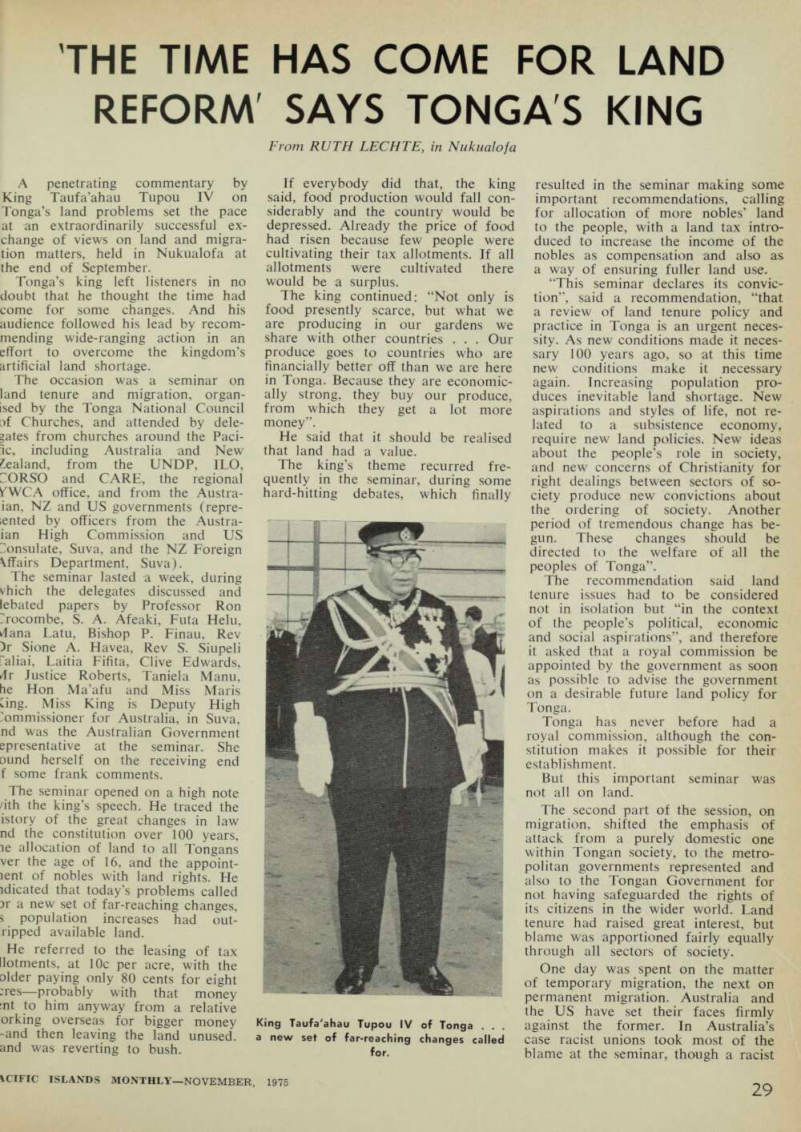
A penetrating commentary by King Taufa’ahau Tupou IV on Tonga’s land problems set the pace at an extraordinarily successful ex change of views on land and migra tion matters, held in Nukualofa at the end of September.
Tonga’s king left listeners in no doubt that he thought the time had come for some changes. And his audience followed his lead by recom mending wide-ranging action in an effort to overcome the kingdom’s artificial land shortage.
The occasion was a seminar on land tenure and migration, organ ised by the Tonga National Council af Churches, and attended by dele gates from churches around the Paci ic, including Australia and New Zealand, from the UNDP, ILO, ~ORSO and CARE, the regional ifWCA office, and from the Austra ian, NZ and US governments (repre icnted by officers from the Austra ian High Commission and US Consulate, Suva, and the NZ Foreign \ffairs Department, Suva).
The seminar lasted a week, during vhich the delegates discussed and lebated papers by Professor Ron >ocombe, S. A. Afeaki, Futa Helu, Tana Latu, Bishop P. Finau, Rev )r Sione A. Havea, Rev S. Siupeli faliai, Laitia Fifita, Clive Edwards, At Justice Roberts, Taniela Manu, he Hon Ma’afu and Miss Maris Cing. Miss King is Deputy High Commissioner for Australia, in Suva, nd was the Australian Government epresentative at the seminar. She aund herself on the receiving end f some frank comments.
The seminar opened on a high note nth the king’s speech. He traced the istory of the great changes in law nd the constitution over 100 years, le allocation of land to all Tongans ver the age of 16, and the appoint lent of nobles with land rights. He idicated that today’s problems called 3r a new set of far-reaching changes, 5 population increases had out ripped available land.
He referred to the leasing of tax llotments, at 10c per acre, with the aider paying only 80 cents for eight :res —probably with that money :nt to him anyway from a relative orking overseas for bigger money -and then leaving the land unused, and was reverting to bush.
If everybody did that, the king said, food production would fall con siderably and the country would be depressed. Already the price of food had risen because few people were cultivating their tax allotments. If all allotments were cultivated there would be a surplus.
The king continued: “Not only is food presently scarce, but what we are producing in our gardens we share with other countries . . , Our produce goes to countries who are financially better off than we are here in Tonga. Because they are economic ally strong, they buy our produce, from which they get a lot more money”.
He said that it should be realised that land had a value.
The king’s theme recurred fre quently in the seminar, during some hard-hitting debates, which finally
resulted in the seminar making some important recommendations, calling for allocation of more nobles’ land to the people, with a land tax intro duced to increase the income of the nobles as compensation and also as a way of ensuring fuller land use, “This seminar declares its convic tion”, said a recommendation, “that a review of land tenure policy and practice in Tonga is an urgent neces sity. As new conditions made it neces sary 100 years ago, so at this time new conditions make it necessary again. Increasing population pro duces inevitable land shortage. New aspirations and styles of life, not re lated to a subsistence economy, require new land policies. New ideas about the people’s role in society, and new concerns of Christianity for right dealings between sectors of so ciety produce new convictions about the ordering of society. Another period of tremendous change has be gun. These changes should be directed to the welfare of all the peoples of Tonga”.
The recommendation said land tenure issues had to be considered not in isolation but “in the context of the people’s political, economic and social aspirations”, and therefore it asked that a royal commission be appointed by the government as soon as possible to advise the government on a desirable future land policy for Tonga.
Tonga has never before had a royal commission, although the con stitution makes it possible for their establishment.
But this important seminar was not all on land.
The second part of the session, on migration, shifted the emphasis of attack from a purely domestic one within Tongan society, to the metro politan governments represented and also to the Tongan Government for not having safeguarded the rights of its citizens in the wider world. Land tenure had raised great interest, but blame was apportioned fairly equally through all sectors of society.
One day was spent on the matter of temporary migration, the next on permanent migration. Australia and the US have set their faces firmly against the former. In Australia’s case racist unions took most of the blame at the seminar, though a racist
King Taufa'ahau Tupou IV of Tonga . . . a new set of far-reaching changes called for.
society might be equally responsible.
Permanent migration in all three countries could only be for those with developed skills, thus represent ing a brain drain in the very coun tries that receive overseas aid.
The nonsense of the migration 3olicies exposed in the seminar made >ome delegates wish that the audi ence was less polite! The churches >f Australia and NZ were in fact ess polite, and made it quite clear luring the debates that they did not igree with their governments policies.
In a joint statement they said.
We (Australia and NZ) hold econ imic power within the region. We elieve that this power should be xercised with responsibility towards iur Pacific neighbours. Therefore, vc do not accept the principle of contribution to the national econ my’ as the sole criteria of immigra ion. While accepting economic quality as a social goal, we do not link that migration should be limited ) those who are within reach of it efore they arrived”.
The statement said that the Aus alian and NZ churches, ‘represent tive of the views of large numbers f Christians within our countries’, elieved in cultural pluralism and, 5 immigrant communities them :lves, wanted to continue to receive irichment of a wide range of cul ires. It asked that the Australian id NZ governments allow immigra an of a wide range of age groups, id added, “We protest at the narrow efinition of skills as applied to igration, and point out that when ills are applied solely to the tech ilogical or economic needs of the cipient country they rob that nation the rich heritage of social and iltural gifts with which the migrat g people are endowed”.
The seminar itself declared its inviction that the review of all pects of migration and its effects Tonga was an urgent necessity.
“With limited resources to support e rising aspirations of a rapidly creasing population in Tonga, igration is seen as a very important onomic and developmental neces y”, it said.
It asked that the Australian and cw Zealand governments be ap oached to initiate “more liberal d flexible attitudes to the whole gration question”, and that NZ crease the number of Tongan migrants to NZ from 150 to 300 ually. • Funds for the seminar came ough the Foundation for the oples of the Sou*h Pacific, the ard of Global Ministries United ethodist Church and British Chris n Aid in London.