reached in
pp. 33-35 · Read in the full issue
Stalemate reached in Micronesia?
By PAMELA G. HOLLIE on Saipan
Micronesia, the Trust Territory of the Pacific Islands, is the last remain ing United Nations trusteeship. And, it seems, it will be the only one of the original 11 UN trusteeships which will not be resolved with indepen dence.
The reason is that the 2,100 diverse islands would not be able to support themselves as an independent nation.
There is no industry in Micronesia.
The US’s commitment to help the islands toward economic self sufficiency has been a failure, due to neglect. Americanised-Micronesia is a consumer economy, not a pro ducing one.
The islands’ dependency upon the US for its revenue, jobs, education and imports is a major factor in their consideration of future political status.
The US supports most of the economy. The US Congress provides nearly 90 per cent of the trust terri tory’s revenue. The 1976 budget, end ing next June 30, will easily top SUSBO million.
Supporters of self-government have long been concerned with the effects of Micronesia’s economy—or lack of one—on the islands’ self-determina tion. Since 1967, the US and Micro nesia have had talks concerning the fate of the territory after the trustee ship ends in about 1981. There was never much hope for independence.
After Micronesia rejected a US offer for commonwealth status in 1970, negotiations for “free association” began. Talks came to a halt last December.
Some Micronesians, recognising the territory’s economic problems, have come to the conclusion that for military reasons, the US wants to keep Micronesia dependent.
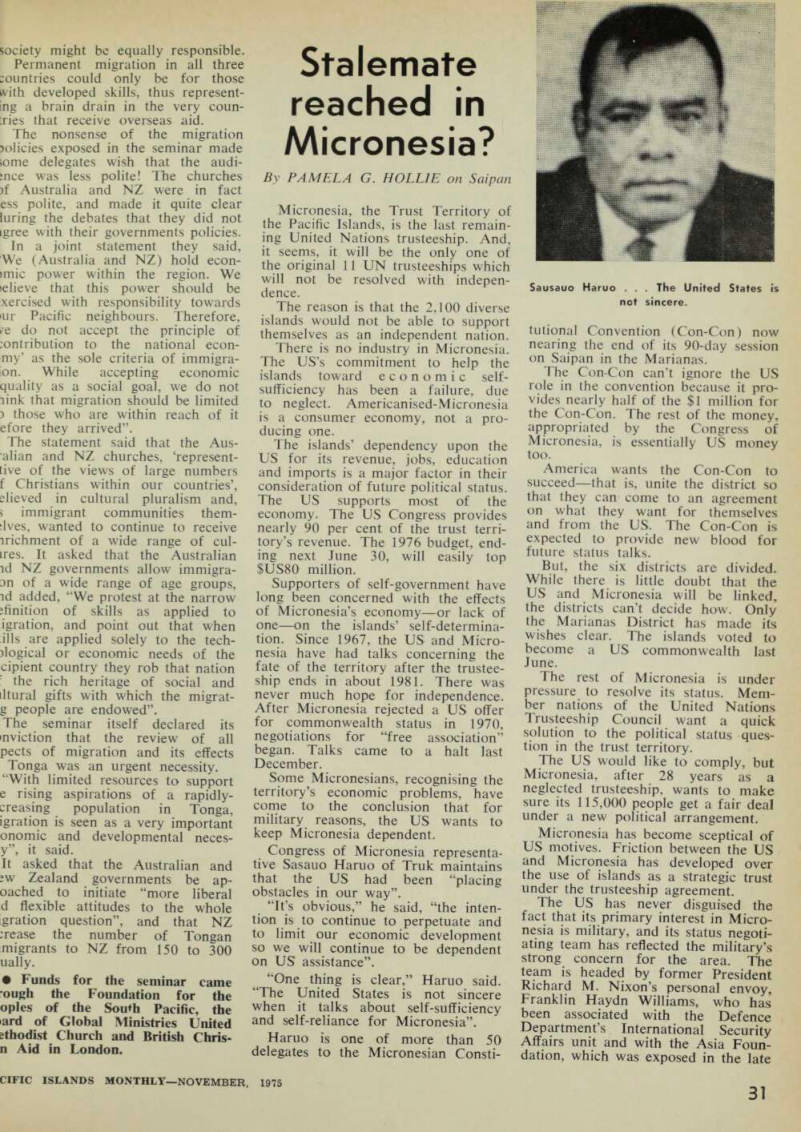
Congress of Micronesia representa tive Sasauo Haruo of Truk maintains that the US had been “placing obstacles in our way”.
“It’s obvious,” he said, “the inten tion is to continue to perpetuate and to limit our economic development so we will continue to be dependent on US assistance”.
“One thing is clear,” Haruo said.
“The United States is not sincere when it talks about self-sufficiency and self-reliance for Micronesia”.
Haruo is one of more than 50 delegates to the Micronesian Consti-
tutional Convention (Con-Con) now nearing the end of its 90-day session on Saipan in the Marianas.
The Con-Con can’t ignore the US role in the convention because it pro vides nearly half of the SI million for the Con-Con. The rest of the money, appropriated by the Congress of Micronesia, is essentially US money too.
America wants the Con-Con to succeed—that is, unite the district so that they can come to an agreement on what they want for themselves and from the US. The Con-Con is expected to provide new blood for future status talks.
But, the six districts are divided.
While there is little doubt that the US and Micronesia will be linked, the districts can’t decide how. Only the Marianas District has made its wishes clear. The islands voted to become a US commonwealth last June.
The rest of Micronesia is under pressure to resolve its status. Mem ber nations of the United Nations Trusteeship Council want a quick solution to the political status ques tion in the trust territory.
The US would like to comply, but Micronesia, after 28 years as a neglected trusteeship, wants to make sure its 115,000 people get a fair deal under a new political arrangement.
Micronesia has become sceptical of US motives. Friction between the US and Micronesia has developed over the use of islands as a strategic trust under the trusteeship agreement.
The US has never disguised the fact that its primary interest in Micro nesia is military, and its status negoti ating team has reflected the military’s strong concern for the area. The team is headed by former President Richard M. Nixon’s personal envoy, Franklin Haydn Williams, who has been associated with the Defence Department’s International Security Affairs unit and with the Asia Foun dation, which was exposed in the late
Sausauo Haruo . . . The United States is not sincere.
960 s as a Central Intelligence gency (CIA) funded organisation.
Micronesia has been using its rategic military possibilities as a argaining point. The islands have ttle else to attract outside interest, i terms of dollars and cents, the lands will need about $l5O million om the US in 1980 to support its irrent standard of living as they pro ice much less than one-tenth that nount in taxes and exports.
Micronesia’s current economy is ised almost entirely on the opera ins of the Trust Territory Govern ent. US funds were not spent on e most obvious economic projects, tiich would have encouraged self fficiency.
What US spending did was to sate an artificial economy centred ound a government in which a very lented man can make more than 5,000 a year. The average Micro sian government worker makes ,000 a year, about the same money :eived from husking 100,000 coco ts to make 28 tons of copra or im catching about 2,240 tuna fish ighing 10 lb each. The minimum ige in the trust territory is 80c an ur, a recent hike from 60c.
Micronesia imports nearly 90 per it of all the goods it consumes, ipra is the largest export, but in best year, exports of copra have ly reached about $4.5 million.
Government has proved an accept le industry for Micronesians, who ve mastered the rhetoric of bureau icy. Young Micronesians, lured by t-finding junkets, leadership grants i a good income, have become less 1 less prepared to lead Micronesia yards independence. Instead, as •re and more Micronesians gradu from American universities with ideal science and law degrees, the ser the dependency on the US has :ome.
JS-Micronesian ties have not 'ays been close. For many years, US wasn’t interested in Micro ia. Except for the brief use of pan, now the capital of Micronesia, a top-secret CIA training ground, US generally neglected its finan l obligations to the trust territory.
' the first five years of the trustee p, Micronesia received about $1 lion a year. Later expenditures rose about $5.5 million annually, ixpenditures began increasing in •3 when the late President John F. inedy launched a programme to mericanise” Micronesia. The under ig motive was to solidify the nds’ allegiance to the US at a e when Vietnam focused military intion on South-east Asia and the :ific. n 1963, the budget for the trust itory jumped to $17.5 million
from $7.5 million two years before.
By 1968, the US was spending $35 million in Micronesia.
When South Vietnam and Cam bodia fell to the communists, the US began making plans for Micronesia.
Micronesian bases would make up for other US bases lost in South-east Asia.
Micronesian bases seem to fill the US military’s basic requirements.
They can be isolated and shielded.
For a small investment, the local population will be co-operative.
Micronesian bases along with bases in Japan, the Philippines, Australia and Diego Garcia form a strategic ring around Asia.
The US military’s need for Micro nesian bases to close the ring gives Micronesia more clout than the
islands would normally have had, if South-east Asia hadn’t been lost.
Yet, the US’s economic hold on the islands precludes discussions of a political status outside of one ensur ing a “close association” between the two. So, Micronesia is locked into an irreversible dependency upon the US.
And, the US has made a commitment it can hardly ignore.
Micronesia has about five years be fore the trusteeship ends to settle its future political status. During that time it is inconceivable that it will ask for less US money or that the US would give the trust territory less.
As the dependency on US funds grows, Micronesia’s chance for inde pendence lessens. It is a dependency —that for better or worse—neither the US nor Micronesia have attempted to change.