The Editor's Mailbag
pp. 27-30 · Read in the full issue
Ballad Of Charlie Gough
1 was most interested to read the story of my friend, Pita Lus, MHA id Minister of Police in the Govern ent of Papua New Guinea (PIM ily, p 10).
The mention of how Pita Lus’s ther killed a white man at Leihinga ought back many memories for I as very closely concerned in the atter —in fact, I have described it ther fully in my book, Patrol into in the chapter, The illad of Charlie Gough.
There are several errors in the tide. Charlie Gough was the Euro an killed at Leihinga and his death curred in 1936—and not 1934 as mtioned in the PIM account and was not killed as he slept but was eared when he was approaching the lage.
In 1935-36 I was Assistant District ficer at Aitape. The District Officer icre were no district commissioners those days) of the Sepik District is G. W. L. Townsend and the adquarters was at Wewak. Charlie nigh, then aged about 52, had a ire at Aitape and had formerly □spected for gold at Wau and ilolo. He still dreamt of finding
Id and occasionally recruited
lourers for work in other parts of :w Guinea. His Aitape store was :cessful but Charlie never missed opportunity to make a bob and his /e of money was to be the cause of i death.
The area, now known as Maprik which Leihinga village was a part, is then prohibited country. The ministration had declared it a losed area” and no Europeans, ler than official patrols, were per iled to enter it without a permit.
In 1936 I was on patrol on the rder of this restricted area. To my rprise I learned that Gough was
mped in a nearby village: unknown
me he had followed me in. I went the place and found that Gough s using one of the village headmen, nedical tultul, to recruit labourers, is was strictly illegal and I warned arhe and the tultul about it and it the latter back to his village. I 0 warned Gough that he was near : uncontrolled area border and was t under any account to enter it. 1 Charlie was all apologies and muses when I left him and con ued with my patrol.
Early next morning, at Amom
village, there were rumours that Gough had been killed and soon some of his carriers arrived to tell me the story. The tultul had re turned to Gough as soon as I had left his camp and had suggested to him that he (the tultul) should go to Leihinga, in the uncontrolled area, and try to recruit natives. Gough would remain at Ilahaup village and the tultul would bring the recruits to him. Gough agreed to this and off went the man to Leihinga, whose people he said he knew. Later, the tultul returned bringing with him a youth, aged about 14, named Lanu wan. Charlie was delighted to see him and to bind the bargain gave him a present of an axe, a knife and a lavalava. However, Lanuwan’s absence from Leihinga was soon dis covered and Ulabuli, his father, set out to get him back. At Ilahaup Ulabuli called to his son from the bush surrounding the village and young Lanuwan obeyed him. He de camped, taking his presents with him.
Charlie Gough was very angry at the loss of his recruit and his trade goods, which were worth about 12/6 —say Si,2s—as I say, he hated losing money.
“No damned boy puts it over me!” he roared and he determined to get the boy back.
Gough had 10 carriers with him—■ men from the coastal areas—and he had five shotguns and a Winchester .44 rifle. He distributed the shotguns amongst his carriers and gave them two cartridges each and armed him self with the rifle. They set out for Leihinga and by late afternoon had reached the outskirts of the village.
Across the track a tree had been felled and two spears were planted in the ground—an ominous sign of hostility and some of his carriers begged Charlie to go no further.
Gough cursed them as cowards; up rooted the spears and went on. A man’s voice from the bush called upon them to go back but Charlie was a determined man. He demanded that either Lanuwan return to him or that the axe and knife be handed back. A spear whistled through the air as Gough reached the clearing before the haus tambaran and then there was a shower of arrows. Gough fired his rifle and a spear pierced his thigh. The carriers fired too, but were soon out of ammunition, “More cartridges in my pack,” gasped Gough
now badly wounded and those were his last words. A man rushed at him and his spear went through Gough’s neck. It killed him instantly and now the carriers fled but no attack was made on them. Apparently the white man who had come to take their child was the Leihinga’s only enemy.
My feelings were mixed as I heard the story. I felt sorry for Charlie Gough for I knew him well but I also had a sympathy for the men who had killed him.
In a few days “Kassa” Townsend, the DO, myself and young Kyngdon, a cadet, returned to the Maprik area.
Leihinga was a large place and as we expected it was utterly deserted. Some remains of Gough’s gear, a few tins and a toothbrush were in the empty houses and in an hour we found Gough’s body. It had been dragged from the clearing and lay under some bamboo. There were many wounds in the corpse and his rifle was miss ing. We buried him nearby and fenced his grave. Poor old Charlie, he had faults like the rest of us but he was a courageous, if foolish, man.
Later, the Soaniimbi gave us infor mation and it came bit by bit over many patient talks. Walamini had speared the white man in the thigh and Kumbul had led the attack.
Ulabuli, father of the boy Lanuwan,
had killed the white man by a spear through the neck and Ambob had also been in the attack.
Kumbul surrendered voluntarily and the arrests of the other three men followed a similar pattern. When Ulabuli surrendered he brought with him his son, Lanuwan. He pushed the youth behind him and pranced in front of him, gesturing as though he held a spear to protect the boy;
a graphic pantomime and I saw which way the defence would go should the men stand trial for
Gough’s killing.
The four men eventually stood trial for the murder of Charlie Gough and I was a witness. I hoped that my evidence would show that the reason for the killing was a father’s love for his son and my hope came true for the judge reduced the crime to manslaughter and in sentencing Ulabuli, Walamini, Ambob and Kum bul to five years imprisonment he said that he would be prepared to recommend their earlier release after a reasonable period.
And so my friend, Pita Lus, is a brother of the youth, Lanuwan— according to the PIM article. I did not know this, nor did I know that his father was Ulabuli. At the time of the Gough killing, 1936, Pita Lus must have been an infant, being bom in 1935. But none of the four men of Leihinga died in prison, as men tioned in the article, there appears to be some error here.
As for Mr Pita Lus, I have known him since his election to the PNG House of Assembly in 1964. During that parliament I was Deputy Speaker and Chairman of Committees and so we met frequently. If I may say so.
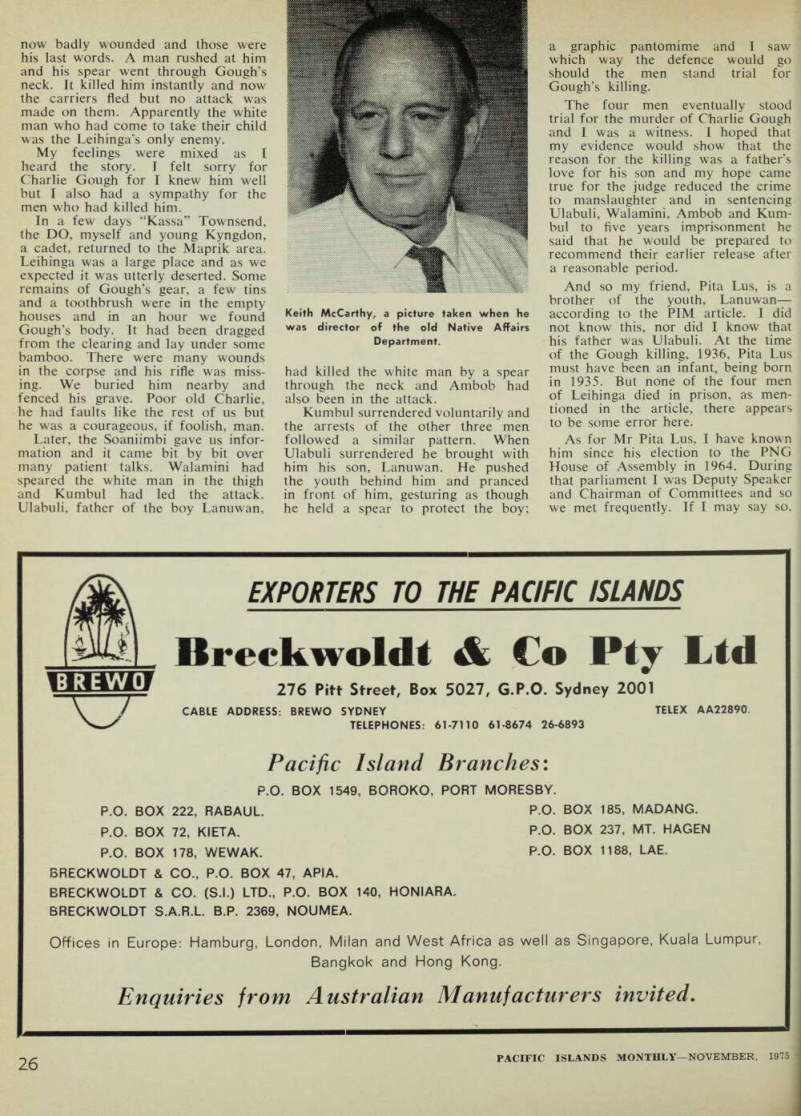
Keith McCarthy, a picture taken when he was director of the old Native Affairs Department.
Mr Lus was sometimes pretty fiery in his speeches but I remember that he was often goaded by the taunts of some Europeans who were mem bers of the House at the time.
This is a pretty long-winded epistle, typical of a lapun who is apt to babble on, but I hope Pita Lus reads it for I am sure that it is in his generous nature to appreciate that at least there were some white men who had a sympathy for men, like his brave father, Ulabuli.
J. K. Mccarthy.
Mt Eliza, Vic.
The Pangu Rati
In 1967, Mr Oala Oala Rama described the Pangu Pati as a white man’s party, run by white men— Messrs Abel, Holloway, and Voutas.
Jackson’s characterisation of Pangu today—“an empty shell, the creature inside has perished” (PIM, July, p 10)—suggests it was indeed a white idea.
Papua New Guinea, we are fre quently told, is a unique country.
However the major component in its government lacking grass-roots sup port can hardly be one of the more encouraging special features it has.
One can appreciate why Pangu’s leaders should be grateful for what Poni Voutas has achieved for them, md that gratitude has now been ex pressed in a very tangible fashion I PIM, August, p 5).
While no one doubts his personal iincerity—proven by his practice of dways stepping down—the benefits of vhat he believed in, worked for, and las seen come to pass, have yet to ?e demonstrated for the ordinary people of Papua New Guinea.
John R. Horne.
3unedoo, NSW.
Golden Sail For Guam?
Reading this article (PIM, Sept, p 5) did astound all yachtsmen of -rench territories of the Pacific. How ome a magazine with the impor ance of yours is so misinformed ihout what happened to sailing in juam? Why was this other scandal mshed? To spare Nelson’s glory or naybe in a true commercial aim? . . .
So, we must settle up things, so s not to leave any ambiguity which light be prejudicial to sailing. When ailing was accepted in the First outh Pacific Games, the territories ecided, by a democratic vote, to hoose the FIRE-BALL.
Although not having that kind of mghy, the French territories, in re pect with the committee decisions ought quite a few Fire-balls and tarted practising with them.
We always did respect the Games barter.
The Guam Committee, after sending several contradictory advices, even letting us think that it would be possible to sail with Fire-ball, as long as we took care to bring our own dinghies, decided a few months before the Games that the race would be performed with the LASER. The Laser, which, of course, the French territories didn’t have . . . Why not sailing - rollerskates or SUNFISH?
What is the good of buying Fire-ball and training young ones if the Guam precedent is to be renewed?
So we have decided, in agreement with New Zealand, New Caledonia, New Hebrides and Australia, and if the Federation agrees, to organise a
high-level competition in the South Pacific, with the name of Sailing Challenge of Southern Pacific. The technical and sporting level of such a competition will be of no compari son with the Guam one, thanks to the sharing of Australian and New Zealand crews.
All interested territories of the South Pacific are most welcome. The chosen groups are as follows: Optimist Class—cadets; 420—juniors; 470 and Fire-ball—juniors and seniors.
The first challenge took place from August 20 to 30, 1975, in Noumea.
Sixty-eight yachtsmen joined that beautiful race. This will happen again
Letters
from August 20 to 30, 1976, in French Polynesia, the organising terri tory.
As for sailing, consideration as discipline of the South Pacific Games, the Guam way of action in 1975 is bound to have it banished to its leisure side, which does not interest our youth. Remember the 1971 Games, when Tahiti took all three medals, despite very hard and unpre dictable conditions.
Jean Campistron.
(Technical sailing adviser for French Polynesia and delegate at large (UNCL) for French Pacific Territories.) Papeete, Tahiti.
Yachting As An Event
With reference to your editorial comments (Up Front with the Editor, p 3) in the September 1975 issue of the Pacific Islands Monthly re garding the 1975 South Pacific Games at Guam, your comments
prompt me to correct some incorrect assumptions made from your ob
viously isolated viewpoint.
Your mention of some sports eg yachting as not being a necessary sport to be staged is an example of
the bigoted uninformed opinions
usually to be found in issues of PIM 20 years ago.
People do live on Guam. They had, and many still have, a limited knowledge of the rest of the Pacific Islands. The yachtsmen and their families and friends on Guam have been exposed to the friendly exuber ance of the Papua New Guineans, the gentle, good-nature of the Fiji team, the dignified beauty of Ameri can Samoa in the person of Faave Foi-Fua, Western Samoa and the New Hebrides contributed two gentle men who were a credit to the areas they represented.
We do not know or care whether they were expatriates or black, brown or spotted in colour; we recall it was a pleasure to meet and compete with them and long after their names or colour are forgotten here, the areas they represented will be remembered with affection.
Your comments sir, do nothing to assist the spirit of any future Games.
If your closing paragraph is sincere, I ask you in your examination, to seek out some of the competitors so that they may fill the large vacuum that obviously exists in your mind.
Mick Wood.
(Commodore, Marianas Yacht Club).
Agana, Guam. • Stuart Inder did not say that yachting is unnecessary. He suggested several sports should be reviewed, and if we continued with yachting why not add canoe racing.
Rim's Cover
Was PIM employing sarcasm, or did it really think, of the numerous photos it must have had available, that the one chosen for the September cover was the most appropriate?
PIM could not have chosen a more non-Pacific representation in its choice of the New Caledonian ‘golden girls’.
Vaessa Griffen.
Suva, Fiji.
• The cover was a tie-in with the South Pacific Games story inside ana was chosen, not for skin colour, bin for the colour of the many medals won by the girls. — Editor.