Tropicalities
pp. 21-25 · Read in the full issue

A costly
haircut
To cut a boy’s hair when he’s in i New Zealand detention centre must •e an ordinary job but not if the •oy happens to be a Niuean.
An eight-year-old Niuean boy, who /as placed in the Owairaka Boys’ )etention Centre, had shoulder-length air, so somebody at the centre cut . There was a hair-raising row when is parents saw his close-cropped ead because his long hair had a otential value of several thousand ollars.
The clippers had cut right through liuean custom under which all males row their hair long until they’re round 12 or 13 years old.
Then it’s ceremoniously cut in the Ifiulu ceremony when all the rela ons and friends give money. The st such ceremony in New Zealand lised $7,000.
The parents were upset and com ained to the Pacific Islanders’ Ad sory Council, which has taken the alter up with the NZ Government id is claiming compensation and an surance that such a breach of iuean custom won’t happen again.
A Niuean member of the council, r John Kolo, said: “They should sped our culture. These people ive lost an investment they were anning on, because they would have ►t several thousand dollars at the remony.” io more
oor soakers;
The action of the rich in “soaking” poor on Saipan will stop, says a icronesia Congress release through NS.
PIM reported in Tropicalities last mth (p 27) that rainwater which llected in the new Continental )tel car-park was flooding into
nearby houses—“A classic example of the rich people getting richer at the expense of the poor people,” said Congressman Herman Guerrero.
Mr Guerrero arranged a meeting between the hoteliers, the wet and aggrieved residents and half a dozen boards and authorities. As a result, holding ponds and drainpipes will be installed to stop the flooding both at the Continental Hotel and the now building Intercontinental Inn.
Treasure
under the bed
There’s buried treasure all over the Islands—old coins that have been stashed away in boxes and under beds in readiness for that inevitable rainy day.
The hoarders are now bringing out the treasure and banking it or chang ing it for new currency, as in Papua New Guinea, without, in many cases, realising the enhanced value.
The changeover in PNG from Aus tralian currency to the kina and toea is literally unearthing a fortune. Re ports of German marks and old British and Australian coins being handed in to banks have been re ceived.
One coin collector, while being shown a new shipment of coins just arrived at the Rabaul branch of the Bank of PNG, was offered a few old “holey” PNG shillings. The collector bought all 12 offered at face value one kina, 20 toea.
He reports that four of the coins, dated between 1935 and 1945, are in mint condition, except for mild oxida tion. The other eight had suffered damage from the soil which had obviously been their owner’s bank vault over the years.
A similar story is told by Mr Ted Britton, manager of the New Hebrides Co-operative Federation Bank in Vila, who says there’s a steady stream of gold sovereigns and half-sovereigns coming into the bank’s agencies scattered throughout the condo minium.
The coins are sent to Mr Britton’s office and he arranges for their sale
to collectors. The money raised, in many cases a considerable sum, is deposited to the credit of the person who handed in the coins.
Says Mr Britton: “In a few in stances, people haven’t realised just how valuable these coins are. If they have no immediate need for money, they should keep the gold coins as they are assets which will grow in value over the years.”
Looking after
Noumea's anchors
An Australian anti-corrosion pro duct could be used to preserve old anchors retrieved from New Cale donian waters and exhibited as historic relics around the city of Noumea.
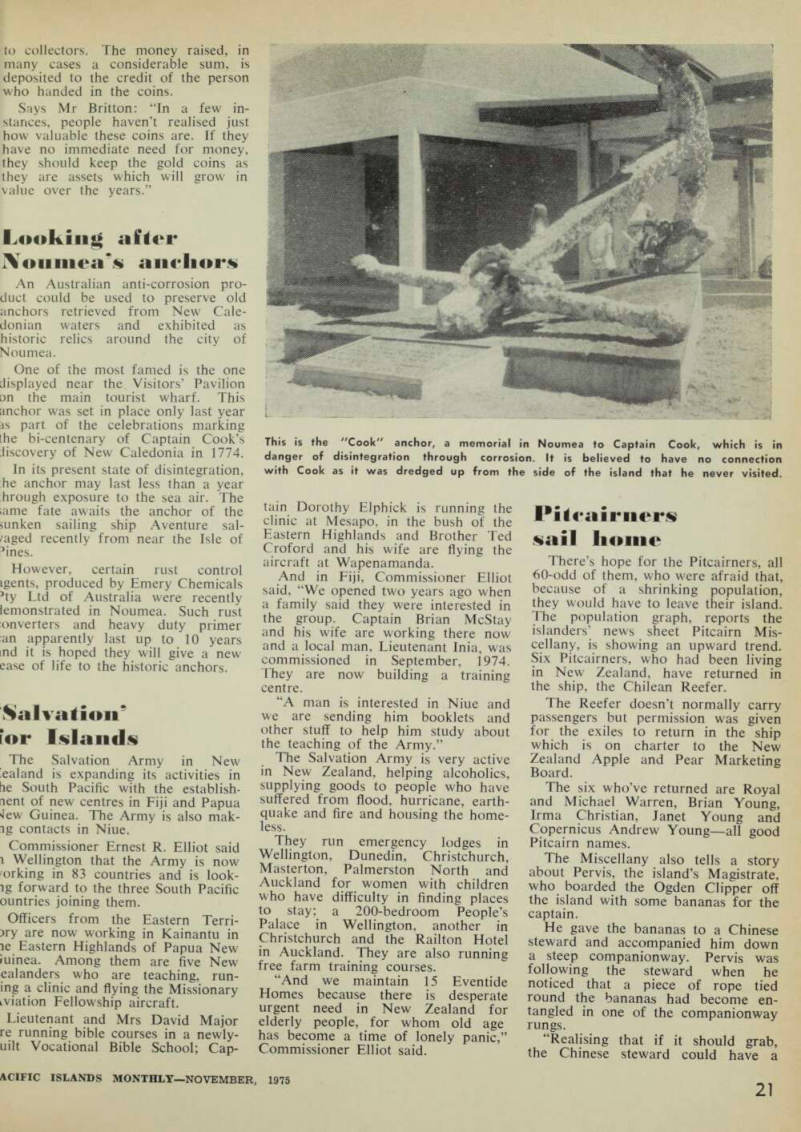
One of the most famed is the one displayed near the Visitors’ Pavilion on the main tourist wharf. This anchor was set in place only last year as part of the celebrations marking the bi-centenary of Captain Cook’s discovery of New Caledonia in 1774.
In its present state of disintegration, he anchor may last less than a year hrough exposure to the sea air. The lame fate awaits the anchor of the sunken sailing ship Aventure sal vaged recently from near the Isle of 3 ines.
However, certain rust control igents, produced by Emery Chemicals *ty Ltd of Australia were recently lemonstrated in Noumea. Such rust onverters and heavy duty primer an apparently last up to 10 years md it is hoped they will give a new ease of life to the historic anchors.
Salvation 9
for Islands
The Salvation Army in New Zealand is expanding its activities in lie South Pacific with the establish rient of new centres in Fiji and Papua "Jew Guinea. The Army is also mak ig contacts in Niue.
Commissioner Ernest R. Elliot said i Wellington that the Army is now working in 83 countries and is look ig forward to the three South Pacific ountries joining them.
Officers from the Eastern Tern ary are now working in Kainantu in le Eastern Highlands of Papua New luinea. Among them are five New ealanders who are teaching, Tun ing a clinic and flying the Missionary iviation Fellowship aircraft.
Lieutenant and Mrs David Major re running bible courses in a newly uilt Vocational Bible School; Cap-
tain Dorothy Elphick is running the clinic at Mesapo, in the bush of the Eastern Highlands and Brother Ted Croford and his wife are flying the aircraft at Wapenamanda.
And in Fiji, Commissioner Elliot said, “We opened two years ago when a family said they were interested in the group. Captain Brian McStay and his wife are working there now and a local man, Lieutenant Inia, was commissioned in September, 1974.
They are now building a training centre.
“A man is interested in Niue and we are sending him booklets and other stuff to help him study about the teaching of the Army.”
The Salvation Army is very active in New Zealand, helping alcoholics, supplying goods to people who have suffered from flood, hurricane, earth quake and fire and housing the home less.
They run emergency lodges in Wellington, Dunedin, Christchurch, Masterton, Palmerston North and Auckland for women with children who have difficulty in finding places to stay; a 200-bedroom People’s Palace in Wellington, another in Christchurch and the Railton Hotel in Auckland. They are also running free farm training courses.
“And we maintain 15 Eventide Homes because there is desperate urgent need in New Zealand for elderly people, for whom old age has become a time of lonely panic,”
Commissioner Elliot said.
Pig oairners
Mail home
There’s hope for the Pitcairners, all 60-odd of them, who were afraid that, because of a shrinking population, they would have to leave their island.
The population graph, reports the islanders' news sheet Pitcairn Mis cellany, is showing an upward trend.
Six Pitcairners, who had been living in New Zealand, have returned in the ship, the Chilean Reefer.
The Reefer doesn’t normally carry passengers but permission was given for the exiles to return in the ship which is on charter to the New Zealand Apple and Pear Marketing Board.
The six who’ve returned are Royal and Michael Warren, Brian Young, Irma Christian, Janet Young and Copernicus Andrew Young—all good Pitcairn names.
The Miscellany also tells a story about Pervis, the island’s Magistrate, who boarded the Ogden Clipper off the island with some bananas for the captain.
He gave the bananas to a Chinese steward and accompanied him down a steep companionway. Pervis was following the steward when he noticed that a piece of rope tied round the bananas had become en tangled in one of the companionway rungs.
“Realising that if it should grab, the Chinese steward could have a
This is the "Cook" anchor, a memorial in Noumea to Captain Cook, which is in danger of disintegration through corrosion. It is believed to have no connection with Cook as it was dredged up from the side of the island that he never visited.
nasty fall, Pervis whipped out his knife and yelled ‘Hey’. The steward turned round and all he could see vas six foot four inches of Pitcairn [slander with a knife in his hand lowering above him.
“With one almighty yell, the Chinese dropped the bananas and an for his life.”
Says Miscellany (editor Peter C. >hea): “Funny—l never could make mt why. What’s more, we didn’t see urn again the rest of the time we vere on board.”
iileep at the
Hurling Moose
The Hurling Moose Youth Hostel pened its doors late September to oung travellers visiting American amoa.
Located on the Cable Car Road in Jtulei, the three-room hostel is perated by Dave Wood, 22, a Canadian, and Gary Milici, 21, a Inited States citizen.
The unusual name for the hostel ime from the name used by Wood ad a group of college friends at ueens University, Ontario, Canada, ho brewed beer under the Hurling loose label.
It was Wood's idea to start a youth astel in American Samoa because, When I came here in July I got T the plane at 4 am, just like every pdy else. I was given the alternative sleeping at the airport or paying -7 at the Americana”.
Wood chose the former and began thinking about less expensive alterna tives than the local hotel.
He camped at Utulei beach until the Immigration Office and the Attorney-General’s Office put a stop to that. Then he moved in with Milici and soon plans to make the house into a hostel were underway.
Milici worked in a hostel in New Zealand and Wood had stayed in many hostels in North America.
The Hurling Moose charges S 2 a night and for that visitors get a foam rubber pad to sleep on, restroom and kitchen privileges.
The price is comparable with those of other hostels around the world.
Wood said the hostel could house a maximum of 10 people. He ex pects, however, to average about two or three per night.
The pair will not be paid for operating the hostel, and revenue will go towards the rent of the house.
Wood said he hopes to join the local hostel with the International Youth Hostel Association.
He has received a lot of “private” encouragement but little official back ing from government officials.
Business for the first month has been good, Wood said.
Wlii‘ii one
man’s meal . . .
The Constitutional Conference which the Micronesians are holding at Saipan has heard some unusual resolutions but none as strange per haps as one introduced by a Marshalls delegate, Dr Isaa Lanwi, although it won’t sound strange, perhaps, to those well-versed in Island customs.
Dr Lanwi called for a law restrict ing the government from regulating a person’s diet unless the regulation related to health, welfare, ecology or the conservation of natural resources.
The regulation he was talking about was regarding the prohibition of the consumption of some food solely be cause it might be an insult to the custom of the people of the area.
Dr Lanwi commented: “In Kusaie, for instance, it is an insult to their custom to eat fresh or salt water eels.
Eels are very nourishing and if an outsider comes to Kusaie and wishes to eat eels because it is a delicacy at home, he should not be pro hibited from doing so just because it is against the custom in Kusaie.
“There are many other foods throughout Micronesia which are really nourishing, but because of custom people cannot eat them. This is also true of the Marshalls where I come from.”
The resolution isn’t likely to get far.
Many people have similar customs, some of them a question of etiquette like the time the writer had dinner with two Fijians. One seemed em barrassed when offered pork and he explained later to his host that it wouldn’t have been right for him to have eaten pork in the presence of the other Fijian whose family totem was the pig.
But the other Fijian enjoyed it.
It wasn’t prohibited so far as he was concerned.
Fri‘iu*li Xavv find*
an €>ld wreck
The French Army and Navy in Noumea are kept occupied in ma/iy tasks, from patrolling the water and airways, rescuing accident victims, to diving inside the coral reef in search of anchors from shipwrecked sailing vessels.
The French Air Force landed its first Alouette II helicopter in Nou mea in July. The gendarmerie already makes extensive use of heli copter flights to bring sick and in jured persons to the capital for emergency treatment.
Now the nautical brigade of the gendarmerie has been equipped with two Boston Walher boats which, equipped with 85 hp engines, should be among the fastest craft on the lagoon.
As far as the navy is concerned, with no foreign invasion or internal rebellion to trouble it, one of its chief interests recently was a mission to find and recover any remains of the Aventure which was wrecked on the coral north of the Isle of Pines in April, 1855.
This corvette, about 42 metres long, was commanded by Joseph du Bouzet, then Governor of French Establishments in Oceania, based in Tahiti. Relics of his wrecked vessel were found when divers from the mine sweeper Dunkerquoise dis covered eight anchors, several cannon and various pieces of metal.
The 120-year-old remains were firmly encrusted with coral and it was not without considerable diffi culty that an anchor was finally ham mered free and brought to the sur face, together with a small cannon and scraps of metal.
It is hoped that other pieces may be retrieved later to be displayed in the central courtyard of the Noumea Museum, amid relics of other early French ships, the Boussole and Astrolabe,
We Wood hangs up the shingle on the hostel in American Samoa.