quiet birth
pp. 13-15 · Read in the full issue
It was a quiet birth for Tuvalu
From STUART INDER, on Nauru There was no flag-waving or fire works on Tuvalu on October 1. When my Air Pacific aircraft put down at the capital, Funafuti, at mid-morning, the new-born colony was clearly tak ing its new status in the manner in which it can be expected to approach its future—with quiet reserve.
October 1 was Constitution Dav— the day that the Gilbert and Ellice Islands became legally separated and the Ellice changed its name. There was a small crowd at the airport to welcome Mr Tom Layng, who had been Deputy Governor of the Gil bert and Ellice Islands Colony until the previous day, but who now is Deputy Governor of the Gilbert Islands and Her Majesty’s Commis sioner in Tuvalu. He would be from that afternoon, anyhow.
Mr Layng had been in Fiji and we were on the same plane, together with—Mr Layng hoped—a parcel of printed Constitutions for Tuvalu which he intended to distribute pub licly after being sworn in and officially proclaiming the Constitu tion that day. As it happened, there was no parcel in the freight compart ments, so he made do with the single copy he had, pinning it up on the wall of the meeting house that after noon after he had read it out.
Among the crowd at the airport, whose surroundings were still show ing signs of the ravages of Hurricane Bebe three years previously, were six of the eight members of Tuvalu’s new House of Assembly.
The assembly is to have its first meeting on October 28, during which the eight elected members will be joined by the Attorney-General and Financial-Secretary, as ex-officio members, and will elect a Speaker from their numbers. The elected members represent eight of the nine former Ellice islands, the ninth, Niu lakita, being tiny and regarded as part of Niutao anyway. The name Tuvalu is the old name of Ellice and means ‘eight standing together’.
The welcome of the parliament
arians for Tom Layng was a warm one. Mr Layng will continue to live at Tarawa, in the Gilberts. In fact there will continue to be much to-ing and fro-ing between Funafuti and Tarawa at least until the new year, while the two territories satisfactorily complete their separation.
From October 1 to January 1, Tuvalu is still administratively linked to Tarawa so as to make the sepa ration formalities as smooth as possible.
From January 1, Tuvalu is set adrift, with direct access to Britain going through Her Majesty’s Com missioner. She is then a separate colony of Britain in just the same way that the Gilberts are.
Of the six members of the new House I saw at the airport there was a possibility that one would become Tuvalu’s first Chief Minister the next day, when the election was to be held from among the eight members.
The two missing men were Isakala Paeniu and Tau Finikaso.
The information I had was that the Chief Minister would either be Isakala Paeniu or Toalipi Lauti.
Some time earlier, front-running had definitely been given to Isa, but I heard on Funafuti that morning that Isa had lost his chance because he had for too long preached the gospel of non-separation of the two groups.
The fact was that the Ellice Islanders had been overwhelmingly in favour of separation during the referendum of August-September, 1974, and now appeared quite pre pared to paddle their own canoe des pite the obvious need for some furi ous baling.
The seven of us talked for half an hour while the search went on in the aircraft compartments for the parcel of Constitutions. The six members said they knew very well that Tuvalu had ended up with little in a material sense out of today’s separation. They would get one small ship, the Nivanga, absolutely no money from the Ocean Island phosphate royalties, a fish and coconut economy virtually at subsistence level for their popu lation of 7,000, and a promise of a handout from the UK.
They were at least their own man, and the choice had been theirs, they said—but surely Australia and New Zealand could do something for them? We discussed it. We discussed what I had heard discussed many times over many years by these same islanders, that is, the need for tempo-
rary or permanent migration to Aus tralia and New Zealand.
Tuvaluans, they said (and one should add, Gilbertese) should be able to benefit like the Niueans, West Samoans and Cook Islanders, who lived or worked in New Zealand and sent much-needed money home.
Tongans weren’t New Zealand citi zens, but they worked in New Zea land. What could Australia do for the Tuvaluans? Surely aid was going to be needed?
I don’t speak for Australia, but I reported that Australia had set itself against temporary migration for workers, and that there was evidence that the strength of the unions in Australia saw to it that the govern ment would continue to operate this policy.
This unofficial open-air meeting of the new Tuvalu House of Assem bly was not particularly impressed by my explanation, and I could hardly blame them.
My aircraft flew north to the great
lagoon of Tarawa, headquarters of the new separate colony of the Gil bert Islands, population 43,000, and then to the Republic of Nauru, popu lation 7,000, only about 3,800 of them being Nauruans (most of the others being Gilbert or Tuvalu workers in the phosphate).
On October 2 we heard the results of the Tuvalu elections. There had been two nominations, that of Toa lipi and Isa. Isa got two votes, his own and that of the Member for Nukufetau. Toalipi got six.
Tuvalu heard the details in the very first broadcast of Radio Tuvalu, with an interview by Faimalanga Luka with the new Chief Minister, who said he had this message to give to all the people of Tuvalu: “We have now a Chief Minister, and that’s me. I do not want to be famous but I want to serve you as your servant, so that we can obtain what we have been aiming for. We should be united to achieve a com mon good for Tuvalu. For those things which we do not yet have and wish to have, I assure you that I shall do my best to make the Government of Tuvalu a good one so that we can get them. There will be difficul ties, but we should never be dis heartened and give up all too easily”.
It was a simple and honest mess age which he repeated two days later at the South Pacific Conference here at Nauru, when he arrived to take the seat that had been reserved for the Tuvalu delegate.
He was given an extremely cordial welcome by President Deßoburt, an old friend who later described the new Chief Minister to me as a fair, honest and very capable man. The President should know, because for 12 years Toalipi Laud was Labour Relations and Training Officer on Nauru, first for the British Phosphate Commissioners and then with the Nauruan Phosphate Corporation. He left Nauru last year only because his people asked him to come home so they could elect him unopposed to the GEIC House of Assembly as Member for Funafuti. By then, sepa-
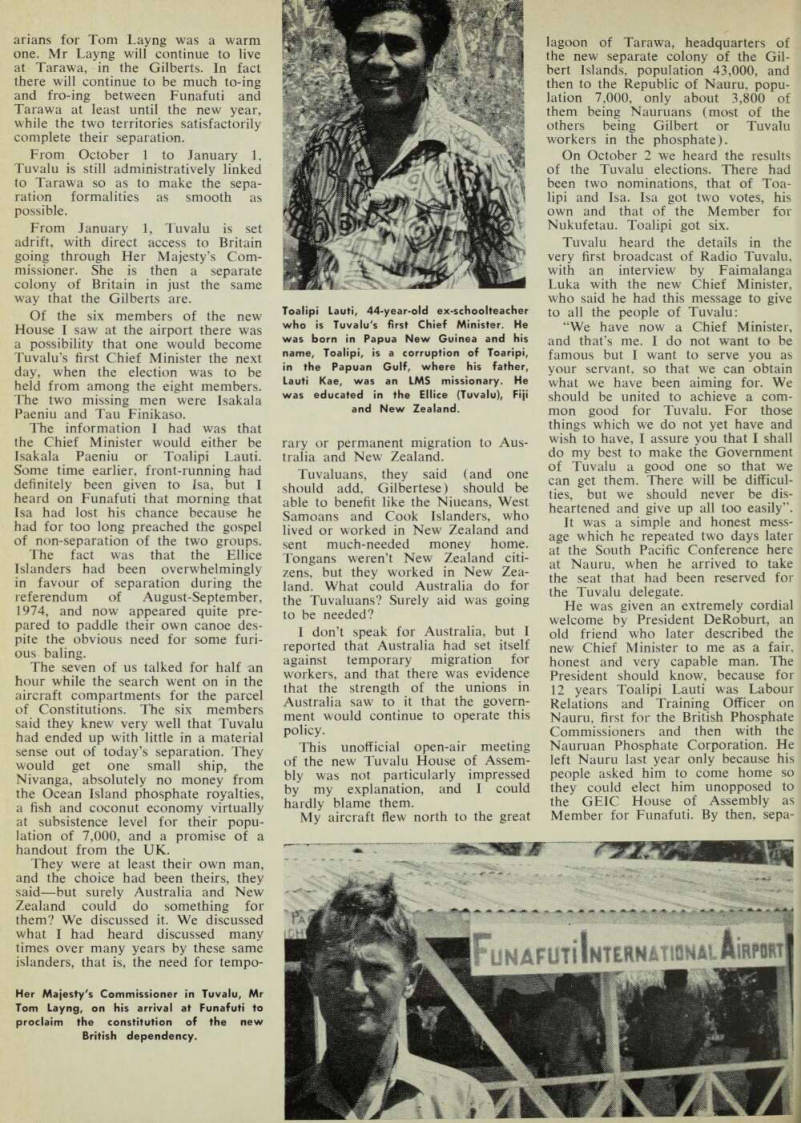
Her Majesty's Commissioner in Tuvalu, Mr Tom Layng, on his arrival at Funafuti to proclaim the constitution of the new British dependency.
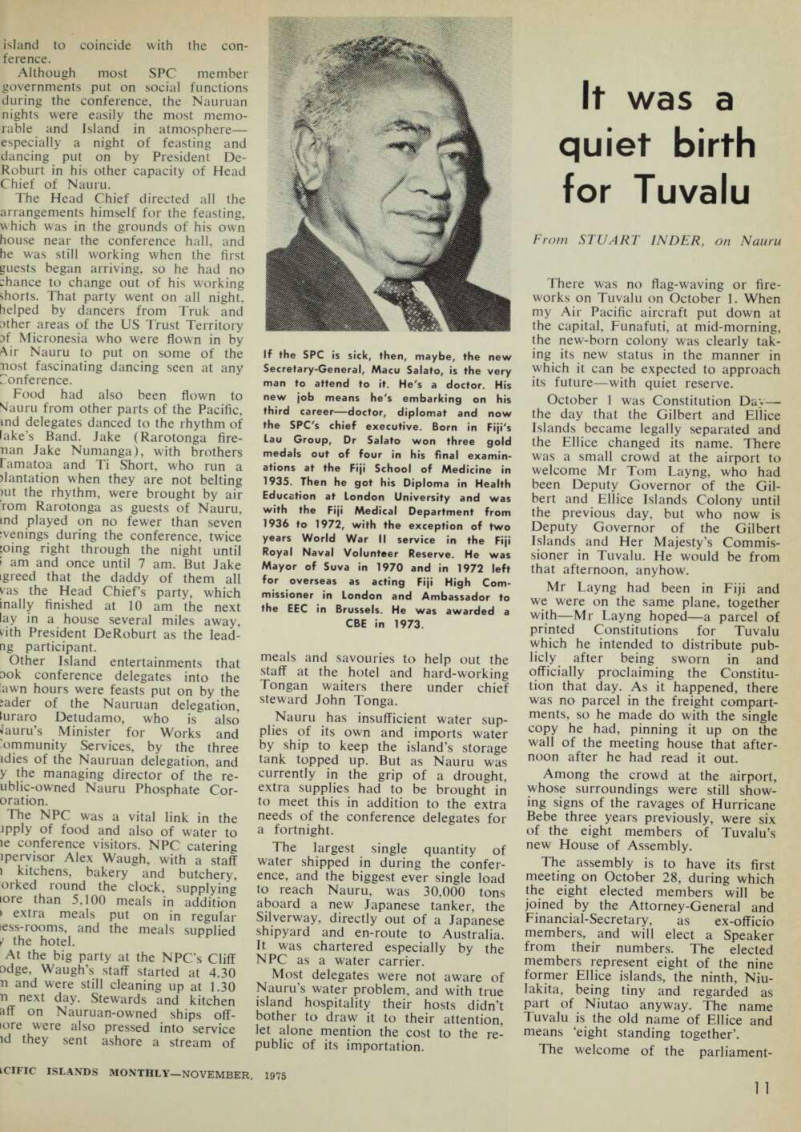
Toalipi Lauti, 44-year-old ex-schoolteacher who is Tuvalu's first Chief Minister. He was born in Papua New Guinea and his name, Toalipi, is a corruption of Toaripi, in the Papuan Gulf, where his father, Lauti Kae, was an LMS missionary. He was educated in the Ellice (Tuvalu), Fiji and New Zealand.
ration was in the air, and he was needed.
Toalipi told the conference in his maiden address that he was pleased that the birth of Tuvalu had been so readily accepted, and that Tuvalu was now able to work out its destiny on its own. Meanwhile Tuvaluans thanked their Gilbertese friends and could assure them they would con tinue to maintain and extend their good relations.
Toalipi’s new cabinet is Minister for Social Services, Taui Finikaso, and Minister for Commerce and In dustries, Tomu Sione. As Chief Minister, Toalipi also holds the port folio of Home Affairs.
At a news conference he explained that Tuvalu had decided to go sepa rately because democracy was a rule of the majority, and the Ellice would always have been a minority in the GEIC. The people had to retain their identity.
Yes, he would like to see self government—which Tuvalu now had followed by independence as soon as possible—possibly in two or three years.
Meanwhile, they depended upon Britain, who had promised develop ment money to make it possible to build administration offices and staff housing and get the new government running. From 1975 to 1978, the UK had promised about $4 million, but this presumably would drop when there was no further need for estab lishment costs.
He expected that total internal revenue for the first year would be no more than about $400,000, from taxes, some copra sales and sale of postage stamps. Projections were that as much as $300,000 might come from stamps the first year.
“We have been assured we can be
independent without being financially
independent”, he said, “But I don’t like that. It’s got to be real indepen dence”.
There is also untangling to be done of the joint GEIC co-operative, so that Tuvalu can get continuity of supplies as it moves over to dealing with suppliers direct. And then, of course, there’s the physical disruption caused by moving Tuvalu public ser vants from Tarawa to the new head quarters.
Probably most men’s families will be transferred before housing is ready for them, because now that the split has been made the public ser vants are anxious that it be com pleted before relations deteriorate.
There are resentments on Tarawa about the transfer of allegiance, be cause Ellice Islanders have been im portant to the proper functioning of the GEIC public service.