From the Middle Temple
pp. 15-16 · Read in the full issue
to the South Seas
It’s now almost 40 years since Gilchrist Alexander wrote his autobiographical book of reminiscences of a British barrister from London’s Middle Temple who became a Fiji magistrate, titled From the Middle Temple to the South Seas. If they should get a copy of the book, some of Alexander’s experiences would probably be of interest to British High Court Judge Sir Robert Megarry and a small group of London barristers and solicitors who in October made their own quick dash from the Middle Temple to the South Seas. The Middle Temple is one of the Inns of Court, the centre of the British legal profession.
The occasion was the case of the Banaban people of Ocean Island who are suing the British Crown and the British Phosphate Commissioners over their past use of the island—a case which has been going on for some months, Mr Justice Megarry, who is hearing the matter, agreed to adjourn the London court for a special visit of inspection to Ocean Island.
With him went a large part of the court, including Sir Robert’s clerk, Mr Arthur Bradford, who at 65, is the same age as the judge; Mr John Vinelott, QC, who is the counsel leading the Crown case, with Mr Roy Price, the Treasury solicitor instructing him; Mr Donald Rattee, the barrister representing the British Phosphate Commissioners at the hearing, with his instructing solicitor, Mr
George Clarke; Mr John Mc- Donald, barrister leading the Banaban case, with his instructing solicitor, Mr Keith Hollis.
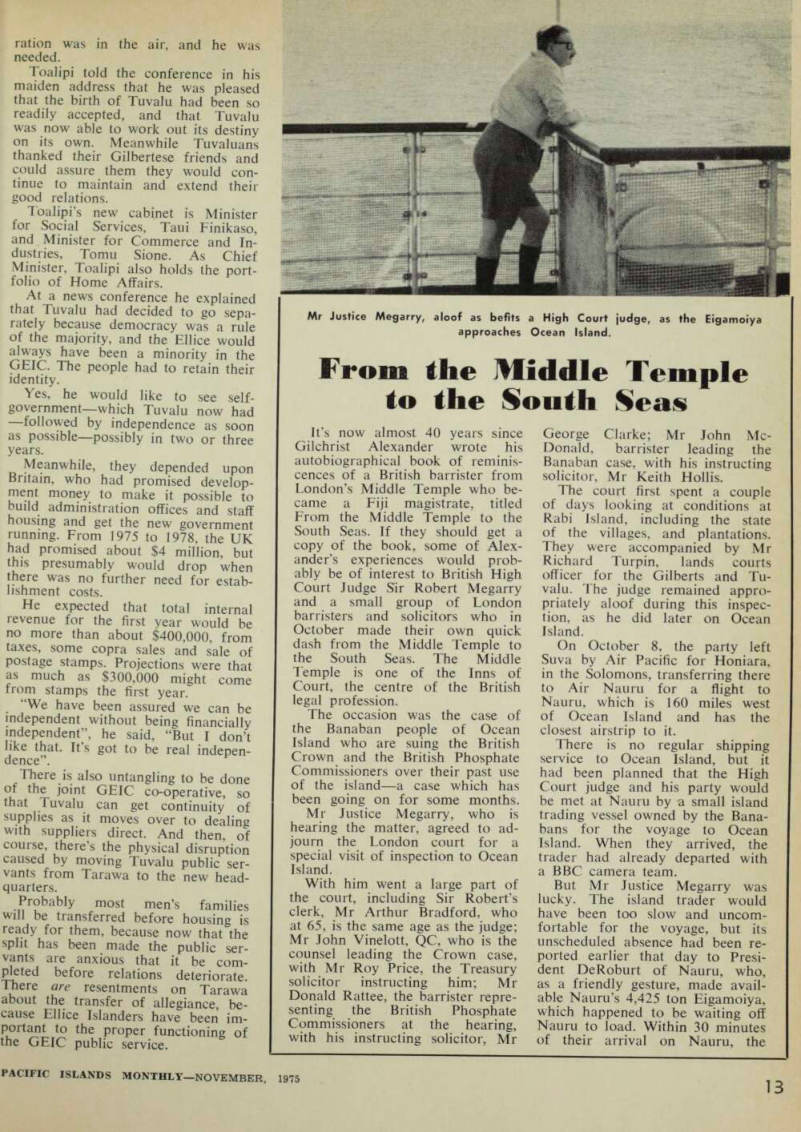
The court first spent a couple of days looking at conditions at Rabi Island, including the state of the villages, and plantations, They were accompanied by Mr Richard Turpin, lands courts officer for the Gilberts and Tu valu. The judge remained appro priately aloof during this inspec tion, as he did later on Ocean Island.
On October 8, the party left Suva by Air Pacific for Honiara, in the Solomons, transferring there to Air Nauru for a flight to Nauru, which is 160 miles west of Ocean Island and has the closest airstrip to it.
There is no regular shipping service to Ocean Island, but it had been planned that the High Court judge and his party would be met at Nauru by a small island trading vessel owned by the Bana bans for the voyage to Ocean Island. When they arrived, the trader had already departed with a BBC camera team.
But Mr Justice Megarry was lucky. The island trader would have been too slow and uncom fortable for the voyage, but its unscheduled absence had been re ported earlier that day to Presi dent Deßoburt of Nauru, who, as a friendly gesture, made avail able Nauru’s 4,425 ton Eigamoiya, which happened to be waiting off Nauru to load. Within 30 minutes of their arrival on Nauru, the
Mr Justice Megarry, aloof as befits a High Court judge, as the Eigamoiya approaches Ocean Island.
judge’s party was comfortably embarked on the 14-hour over night voyage to its final destin ation. Also aboard was Rotan Tito, the Banabans’ leader.
While the legal group thankfully relaxed in the bar, Mr Justice Megarry walked the deck alone, watching the flying fish. The voy age paralleled the equator, only about 30 miles south of it, and this was the real mid-Pacific— empty, and with a warm and
balmy breeze.
But next morning, as Ocean Island came up on the horizon, it was obvious on the bridge that getting the judge ashore would be a hazardous undertaking.
Strong winds and choppy seas made it impossible for the Eiga moiya to moor at the island.
Captain Phil Brimley decided to have the ship’s derrick hoist the party over the side into a heaving barge which had come out from the island. A special container with wooden seats was prepared on deck and half the party was locked into it. Mr Justice Megarry was to go in the second group.
The judge was again in luck, because three times that first group was hoisted from the deck in their box and swung far over the side like a funfair hurdy-gurdy in an effort to lower them into the pitching barge below. On each occasion, winds and currents played havoc with the timing, and
the effort had to be abandoned before the drifting ship ran foul of the rugged coastline.
And on each occasion the cargo from the Middle Temple, plus old Rotan Tito making a rare return visit to his homeland, was almost continuously banged and thumped against the steel plating of the ship, sending up sparks, knocking off paint and shaking the back teeth of the occupants, who were now beginning to lose the smiles they had put on for this fun occasion.
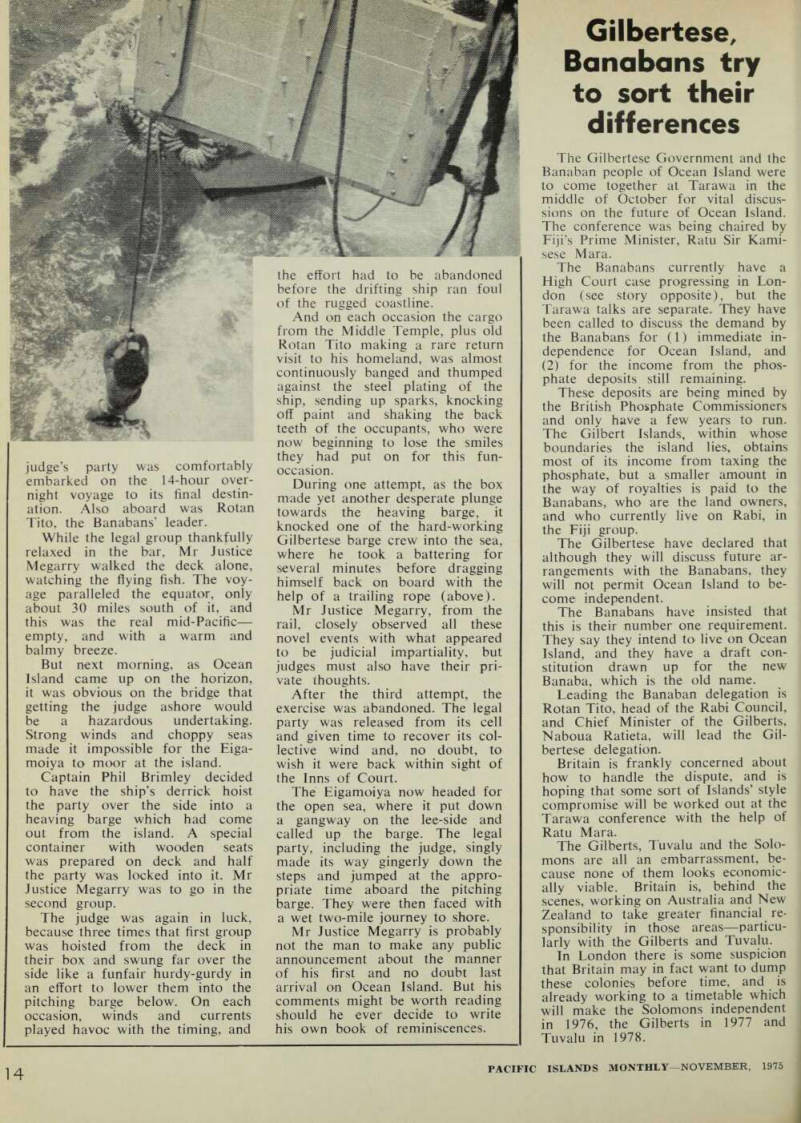
During one attempt, as the box made yet another desperate plunge towards the heaving barge, it knocked one of the hard-working Gilbertese barge crew into the sea, where he took a battering for several minutes before dragging himself back on board with the help of a trailing rope (above).
Mr Justice Megarry, from the rail, closely observed all these novel events with what appeared to be judicial impartiality, but judges must also have their pri vate thoughts.
After the third attempt, the exercise was abandoned. The legal party was released from its cell and given time to recover its col lective wind and, no doubt, to wish it were back within sight of the Inns of Court.
The Eigamoiya now headed for the open sea, where it put down a gangway on the lee-side and called up the barge. The legal party, including the judge, singly made its way gingerly down the steps and jumped at the appro priate time aboard the pitching barge. They were then faced with a wet two-mile journey to shore.
Mr Justice Megarry is probably not the man to make any public announcement about the manner of his first and no doubt last arrival on Ocean Island. But his comments might be worth reading should he ever decide to write his own book of reminiscences.