Bouquets, Brickbats And
pp. 65-96 · Read in the full issue
Spanish Cocktails For
Lost Caravel
Robert Langdon’s controversial new book The Lost Caravel, which Pacific Publications recently launched as ‘the book sensation of the Pacific’ and ‘the book that changes Pacific history’, has had a lively and varied reception in its first few weeks on the market.
Some reviewers accepted its theories with strings of superlatives.
Others, like PlM’s own reviewer (PIM July, p 52), felt its theories were fallacious or in the realm of fantasy.
The Spanish Ambassador in Can berra celebrated the book’s appear ance with a reception for 50 or so guests.
The Lost Caravel advances the theory that the caravel San Lesmes, lost from a Spanish expedition to the East Indies, in 1526, was wrecked on Amanu Atoll to the east of Tahiti; that the crew survived and inter married with local women; and that they and their descendants spread to many Polynesian islands, including Tahiti, New Zealand and Easter Island.
The book begins with an account of the discovery of four ancient cannon on the Amanu reef in 1929.
It claims that the Spanish crew that left them there significantly in fluenced Polynesian culture.
First off the mark to review the book was Grant McCall, an anthro pologist at the Australian National University, who is writing a PhD thesis on the modern Easter Islanders.
After lavishing much praise on the book’s author for the breadth of his researches, etc, McCall declared—in a review for a Basque journal in Buenos Aires—that he himself was only competent to judge the author on the question of Easter Island.
He then devoted considerable space to examining the last page or so of Langdon’s 13-page chapter on Easter Island, and finally declared that as far as Easter Island was concerned,
the author’s theories ‘began to fall into disintegrated little pieces’.
Three reviews that appeared in Australian newspapers on June 21 found Langdon’s theories more ac ceptable.
Olaf Ruhen, writing in the Mel bourne Age, said that Langdon’s researches had ‘accumulated an astonishing weight of evidence that at least lends credibility to postula tions that Spanish, or rather a pre dominantly Basque, influence helped to mould eastern Polynesians into a marine community of which some skills derived from Europe’. ‘lt does not, of course, decry the astonishing abilities they had pre viously,’ he said.
Ruhen added: I was convinced while this book was only a rumour that it could not have respectable standing. That conviction I now re tract, absolutely and ashamedly; I accept many of its arguments, though not all, against my former belief.’
Kylie Tennant, writing in the Sydney Morning Herald, devoted half of her review to the views of a skeptical friend, who said: ‘The Poly nesians do not need any theory that they are descended from red-haired, blue-eyed Basques . . .’
However, she went on: ‘One should read The Lost Caravel not with skepticism but in the spirit of delight . . . When we are introduced to lost Spanish mariners repairing their ship, the San Lesmes, on a remote island of the Tuamotus, following Robert Langdon’s skilfully presented case for their survival, the very breadth of ad venture blows through the narrative.’
A reviewer for the Melbourne Herald, Frederick Howard, said Lang don’s book made ‘new and challeng ing probes into the Pacific past’. If Langdon was right, the survivors of a ship of 450 years ago had left traces overran immense area. ‘The experts will debate, perhaps inconclusively and endlessly,’ Howard added. ‘Meanwhile, there is a fat book of deduction, adventure and
Lost Caravel
sails briskly on
historical curiosities for armchair ex plorers to digest.’
John Fraser, writing in the Mel bourne Sun-Pictorial on June 28, described The Lost Caravel as ‘an exceptional piece of historical detec ion, research and journalism’. The vriting in it was excellent and it was i difficult work to put down.
It is a romantic enough propo rtion,’ Fraser said, ‘that these Spaniards [of the San Lesmes] might lave been the guiding force behind vhat has hitherto been regarded as he natural genius of the Polynesians. ‘But Langdon has assembled what 0 the reader must be an overwhelm ng array of evidence—and in some :ases—proof of the extent of this 'rafting of Iberian culture.’
Professor Ron Crocombe, pro essor of Pacific studies at the Uni ersity of the South Pacific in Suva, Iso left no doubt as to where he tood. ‘This book is a masterpiece, as ascinating as it is important,’ he said 1 a review in The Fiji Times on June 8.
For any one interested in the istory of the Pacific, Robert Lang on’s book The Lost Caravel is ex ellent reading for it solves some Id mysteries and throws new light n others. ‘The author produces a wealth of vidence in great detail. He uses enetics, blood analysis, linguistic hanges, veterinary science, compari ms of religious beliefs, navigational and a range of other infor lation. He convinces me that the road details of the story he tells re true . . . ‘. . . any one wanting to read a jperb detective story, as well as a iscinating chapter of Pacific history ill be well rewarded by reading the hole book. It will undoubtedly be ame a classic of Pacific literature.’
A Perth journalist, Athol Thomas, eeted The Lost Caravel with some hat similar enthusiasm in the West ustralian on July 3. For him, the 3ok was ‘a kind of ethnic whodunit’ lat had involved ‘some of the most itute detective work of all time’.
The evidence was marshalled so <pertly that even those who norm ly reached for Agatha Christie light, at least once, prefer Langdon. ‘He handles the narrative like a lurnalist, and therein lies part of s appeal,’ Thomas went on. ‘Even ic name of his book, The Lost aravel, has a come-hither aura about The next reviewers, two academics,
Drs Peter Corris and Roger Hains worth, took a rather more jaundiced view of the whole thing. Corris re viewed for The Australian and Hains worth for the Adelaide Advertiser on July 5.
Corris, who, like Crocombe, got a PhD in Pacific history at the ANU, began by branding Langdon an ‘amateur historian’, and claiming that although he wrote from the heart, he played ‘fast and loose’ with the evidence.
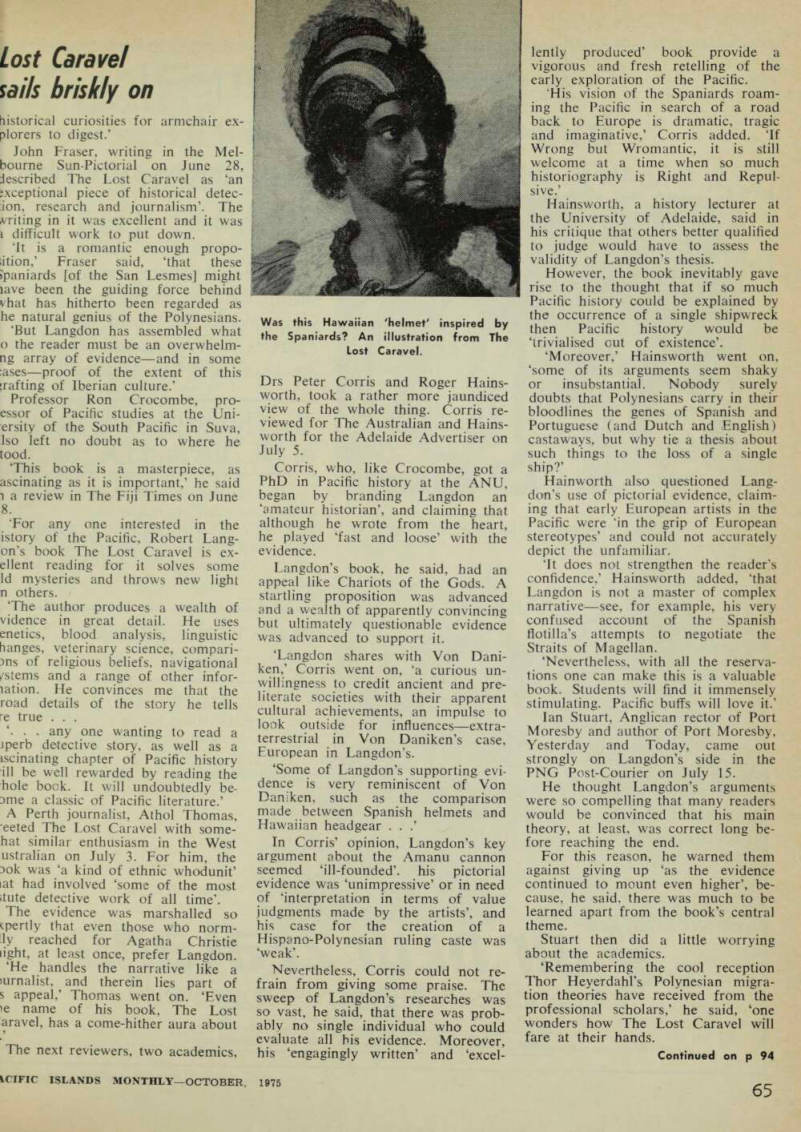
Langdon’s book, he said, had an appeal like Chariots of the Gods. A startling proposition was advanced and a wealth of apparently convincing but ultimately questionable evidence was advanced to support it. ‘Langdon shares with Von Dani ken,’ Corris went on, ‘a curious un willingness to credit ancient and pre literate societies with their apparent cultural achievements, an impulse to look outside for influences—extra terrestrial in Von Daniken’s case, European in Langdon’s. ‘Some of Langdon’s supporting evi dence is very reminiscent of Von Daniken, such as the comparison made between Spanish helmets and Hawaiian headgear . . .’
In Corris’ opinion, Langdon’s key argument about the Amanu cannon seemed ‘ill-founded’, his pictorial evidence was ‘unimpressive’ or in need of ‘interpretation in terms of value judgments made by the artists’, and his case for the creation of a Hispano-Polynesian ruling caste was ‘weak’.
Nevertheless, Corris could not re frain from giving some praise. The sweep of Langdon’s researches was so vast, he said, that there was prob ably no single individual who could evaluate all his evidence. Moreover, his ‘engagingly written’ and ‘excel
lently produced’ book provide a vigorous and fresh retelling of the early exploration of the Pacific.
His vision of the Spaniards roam ing the Pacific in search of a road back to Europe is dramatic, tragic and imaginative,’ Corris added. ‘lf Wrong but Wromantic, it is still welcome at a time when so much historiography is Right and Repul sive.’
Hainsworth, a history lecturer at the University of Adelaide, said in his critique that others better qualified to judge would have to assess the validity of Langdon’s thesis.
However, the book inevitably gave rise to the thought that if so much Pacific history could be explained by the occurrence of a single shipwreck then Pacific history would be ‘trivialised out of existence’. ‘Moreover,’ Hainsworth went on, ‘some of its arguments seem shaky or insubstantial. Nobody surely doubts that Polynesians carry in their bloodlines the genes of Spanish and Portuguese (and Dutch and English) castaways, but why tie a thesis about such things to the loss of a single ship?’
Hainworth also questioned Lang don’s use of pictorial evidence, claim ing that early European artists in the Pacific were ‘in the grip of European stereotypes’ and could not accurately depict the unfamiliar. ‘lt does not strengthen the reader’s confidence,’ Hainsworth added, ‘that Langdon is not a master of complex narrative—see, for example, his very confused account of the Spanish flotilla’s attempts to negotiate the Straits of Magellan. ‘Nevertheless, with all the reserva tions one can make this is a valuable book. Students will find it immensely stimulating. Pacific buffs will love it.’ lan Stuart, Anglican rector of Port Moresby and author of Port Moresby, Yesterday and Today, came out strongly on Langdon’s side in the PNG Post-Courier on July 15.
He thought Langdon’s arguments were so compelling that many readers would be convinced that his main theory, at least, was correct long be fore reaching the end.
For this reason, he warned them against giving up ‘as the evidence continued to mount even higher’, be cause, he said, there was much to be learned apart from the book’s central theme.
Stuart then did a little worrying about the academics. ‘Remembering the cool reception Thor Heyerdahl’s Polynesian migra tion theories have received from the professional scholars,’ he said, ‘one wonders how The Lost Caravel will fare at their hands.
Continued on p 94
Was this Hawaiian 'helmet' inspired by the Spaniards? An illustration from The Lost Caravel.
‘Can one already hear the long knives being sharpened? Langdon himself notes that academics are in stinctively resistant to revolutionary ideas. One hopes that his work will at least attract the scholarly attention it deserves.’
Two Pacific ‘names’ had praise for The Lost Caravel. In the Honolulu Star Bulletin, E. H. Bryan Jr, mana ger of the Pacific Science Information Centre at the Bishop Museum, wrote that ‘we should regard this book as another well-written and informative contribution to the knowledge of
Pacific history’.
In the Canberra Times, Professor O. H. K Spate, acting head of the Research School of Pacific Studies at the Australian National University, said the book ‘is not only a fascinat ing whodunnit for the general reader, but one of real importance to the serious student’. He added, ‘Lang don cannot justly be compared (as he has been) to Von Daniken; rather to
Andrew Sharp or Heyerdahl, though
he conducts his argument with much more skill and restraint than Heyer dahl does’.
Referring to the book as ‘an excit ing and on the whole very well sus tained reconsideration of history, with many fascinating episodes set in the main story’ Professor Spate sums up The Lost Caravel thus: T do not think that Langdon has established his case in its totality; he has estab lished a great deal. At the very least, he has successfully re-opened some old questions thought closed; and he has posed new ones which will demand serious consideration.
That is about as much as anyone can expect to achieve in one book.’
One of the first reviews to appear in the New Zealand press was a double-page spread with seven pic tures in the NZ Listener for July 19.
The reviewer, Jenny Cannon, gave a well-schooled summary of the book’s contents and said it provided ‘a credible solution to some long un
ravelled mysteries.’
Although she thought some readers might feel that Langdon was stretch ing a point by getting some of his castaways to New Zealand, she her self seemed to accept the idea. ‘Langdon has gathered some evi dence to prove that the supposed Maori fleet was a Spanish fleet and that it arrived about 200 years later than commonly thought,’ she said. ‘The strongest link in the chain of evidence is the story of Hiro . . .’
A review in the Otago Dailv Times of Dunedin of July 2, by GJG, said The Lost Caravel was likely to re
main in the ‘permanent canon of Pacific scholarship’.
The most convincing part of it con cerned evidence of European clothing and shipbuilding methods in the general area where the Basque- Spaniards may have survived.
The occurrence of blond and red haired people among the Polynesians also sat well with Langdon’s theories. ‘lf even a twentieth of what Lang don suggests is sound, the history of Maori origins will have to be re written,’ GJG went on. ‘As it is The Lost Caravel must inevitably cause some rumpus in the world of Pacific scholarship, if only for the effort needed to prove or disprove its many ramifications.’
The reviews in the New Zealand press would no doubt have appealed to Spain’s Ambassador to Australia, Don Alberto Pascual Villar.
The ambassador, who has long been an enthusiastic advocate of Langdon’s theories, held a reception on July 24 to celebrate the publica tion of The Lost Caravel. The date was a very special one—the 450th anniversary of the departure from Spain of the San Lesmes and six other ships under the command of Garcia Jofre de Loaisa.
Among the guests were the am bassadors of Portugal, Mexico, the Philippines, Peru, Chile, Argentina, Uruguay and Brazil, other diplomats from those countries, and their wives.
The invitations said that the Loaisa expedition had opened ‘nuevas rutas de Hispanidad’—new routes of Spanishness—in the South Seas.
At the reception, the Spanish Am bassador paid a glowing tribute to the author of The Lost Caravel, and the latter replied with a speech in Spanish. He also presented the am bassador with a copy of his book bound in red leather and yellow cloth, the colours of Spain.