chronicle,
pp. 63-65 · Read in the full issue

Missionary chronicle, unhistorical
John Wesley’s message came to apua New Guinea on Sunday, ugust 15, 1875, when the Rev eorge Brown, a New Zealander, his ijian colleagues Aminio Baledroka oka and Ratu Livai Volavola, and handful of Fijian and Samoan istor-teachers arrived in the Duke York Islands. Most were accom inied by their wives.
One year later there were five ission stations in those islands, nine i New Britain and three on New eland. Brown had set up head larters at Kinavanua, a Samoan was charge at Urakukur, and Fijians oked after the other stations.
Sixteen Fijian ministers, 153 pastor achers from Fiji, Samoa and Tonga, id their wives, went to the New Liinea Islands region between 1875 d 1929. Together with 92 Hum an ministers and many European irses, teachers, artisans and other Ipers, they made a crucial contribu n to the development of an indi nous church in times when the local ople did not have the necessary lining and experience.
The author, an Australian minister New Guinea since 1961, presents chronicle, a continuous register of ents in order of time, with em asis on the men and women in- Ived. Many of the accounts of iristian outreach when the islanders re illiterate or just beginning to be iched by Western education are irred by their authors’ ethno itricity and/or religious exclusiv n. Threlfall goes some way toward Dviding a balanced picture.
He rightly gives as much atten n to men like Aparam To Bobo, ptised in 1894, who became a lay -acher and leader in the Vunamami -a, and to Peni To Pitmur of Mata 1, the first indigenous minister, as the importers of the lotu. The de mds made of the converts were tre-
mendous, not only in physical matters such as risking their lives in the early years when tribal warfare had not yet given way to the pax gennanica but also in coping with the psycho logical traumas of culture contact.
Apart from having to adjust to rapid socio-economic changes, the Christian Tolais, for instance, were also con fronted by traditional secret societies, eg dukduk and ingiet.
The author claims that there has been a continuous effort to have the local people take responsibility for church affairs. A grassroots organisa tion was under way in less than two decades, with a kivung na liiluai, headmen’s meeting, in each circuit by 1910, and district meetings two years later. The first printed book in any of the New Britain dialects, Brown’s Wesleyan Catechism, ap peared in 1879; the first New Testa ment in Kuanua, the language of the Tolais which was used as the Methodists’ lingua franca, was pub lished in 1902; and A Nilai Ra Dovot, The Voice of Truth, now the oldest newspaper in Papua New Guinea, was started in 1909.
Why, then, were there only 13 indigenous ministers among tens of thousands of practising Methodists when World War II broke out? Why did it take 87 years, until 1962. to give a local man, Mikael To Bilak,
a place in the leadership of the Church. The author puts it down to the white missionaries’ paternalistic reluctance and the local people’s diffi dence; but it stems from more than just that. It was part and parcel of the colonial era, of the indigenous people’s ‘station in life’ during those years.
As mentioned earlier, this book is a chronicle; as such, it is praise worthy, filling a long-standing gap in the missology of Papua New Guinea, It takes us to 1968, that momentous year when Methodists and Congregationalists joined together in the United Church of Papua New Guinea and the Solomon Islands, and gives a brief acount of the years since then.
The local people are now well and truly in a cash economy, and pia no
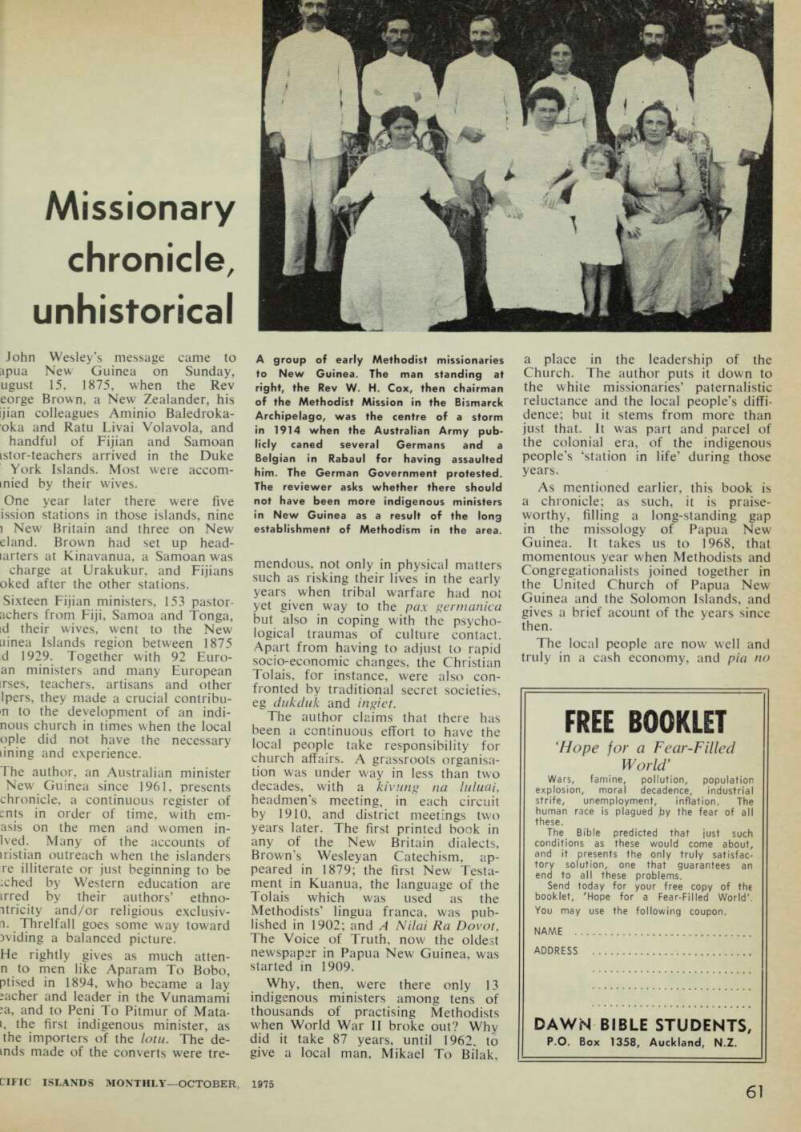
A group of early Methodist missionaries to New Guinea. The man standing at right, the Rev W. H. Cox, then chairman of the Methodist Mission in the Bismarck Archipelago, was the centre of a storm in 1914 when the Australian Army pub licly caned several Germans and a Belgian in Rabaul for having assaulted him. The German Government protested.
The reviewer asks whether there should not have been more indigenous ministers in New Guinea as a result of the long establishment of Methodism in the area.
votovoto, congregations holding cus tomary land and producing cash crops to pay the salaries of pastors and teachers, has almost disappeared. But the work of those mentioned in this chronicle continues. Leslie Bosito, a Solomon Islander, heads the United Church and Saimon Gaius, a Tolai, is bishop of the New Guinea Islands region—both of them ‘products’ of Methodism.
Regrettably, this book is not a history. It neither gives an adequate iccount of the setting for the chron cle nor does it properly analyse the nteraction between ‘extraneous fac ers’, eg changes in villages society, ntrusion of modem forms of govern ment and commerce, and the Method st church (taking the term ‘Church’ n its full sense).
Cne can appreciate the dilemma of he author, a Christian clergyman in m ecumenical era, having to deal vith unpleasant historical facts such is instances of mutual intolerance be ween Methodists and Catholics and strained relations between expatriate entrepreneurs and missionaries. But much more than just glimpses of hose facts, and not merely glossing hem over, is needed in an historical iccount. Mr Threlfall has provided he bones; one hopes that others, especially Melanesians, will add the lesh.
Finally, it is good to see mention )f the late Hosea Linge whose life ; tory, translated into English in 1931 is The Erstwhile Savage, was the first mtobiography by a Papua New juinean. All who saw him help the 'Jew Ireland people rehabilitate therm elves after World War II will surely >e pleased. —Harry Jackman.
(One Hundred Years In The
SLANDS, by N. Threlfall. Published in Inited Church Book Dept., Rabaul Papua lew Guinea, 1975. $5.50 in the Pacific, 6.95 elsewhere.)