Books, Reviews, writers
p. 62 · Read in the full issue
Search For Png's
Artistic Soul
In the Suau world gigibori means the power, authority or prestige of an art-work, the capacity of the finished work to exert an influence on those within its range of contact.
Gigibori is therefore a good and catchy title for a magazine avowedly devoted to assisting in the creation of a national identity for Papua New Guinea, an impressive ideal.
The first issue, exploring and ex plaining some aspects of the country’s many-faceted tradition seems to head in the right direction to assist in estab lishing this end.
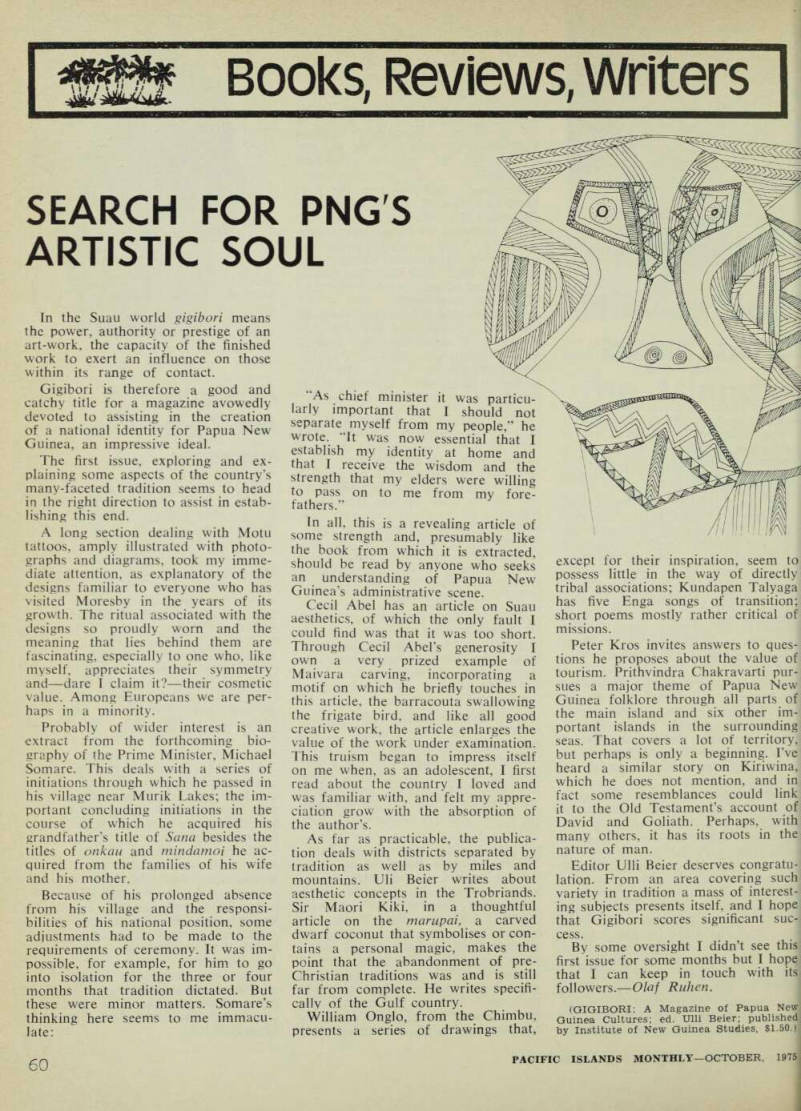
A long section dealing with Motu tattoos, amply illustrated with photo graphs and diagrams, took my imme diate attention, as explanatory of the designs familiar to everyone who has visited Moresby in the years of its growth. The ritual associated with the designs so proudly worn and the meaning that lies behind them are fascinating, especially to one who, like myself, appreciates their symmetry and—dare I claim it?—their cosmetic value. Among Europeans we are per haps in a minority.
Probably of wider interest is an extract from the forthcoming bio graphy of the Prime Minister, Michael Somare. This deals with a series of initiations through which he passed in his village near Murik Lakes; the im portant concluding initiations in the course of which he acquired his grandfather’s title of Sana besides the titles of onkau and mindamoi he ac quired from the families of his wife and his mother.
Because of his prolonged absence from his village and the responsi bilities of his national position, some adjustments had to be made to the requirements of ceremony. It was im possible, for example, for him to go into isolation for the three or four months that tradition dictated. But these were minor matters. Somare’s thinking here seems to me immacu late:
As chief minister it was particu larly important that I should not separate myself from my people,” he wrote. “It was now essential that I establish my identity at home and that I receive the wisdom and the strength that my elders were willing to pass on to me from my fore fathers.”
In all, this is a revealing article of some strength and, presumably like the book from which it is extracted, should be read by anyone who seeks an understanding of Papua New Guinea’s administrative scene.
Cecil Abel has an article on Suau aesthetics, of which the only fault I could find was that it was too short.
Through Cecil Abel’s generosity I own a very prized example of Maivara carving, incorporating a motif on which he briefly touches in this article, the barracouta swallowing the frigate bird, and like all good creative work, the article enlarges the value of the work under examination.
This truism began to impress itself on me when, as an adolescent, I first read about the country I loved and was familiar with, and felt my appre ciation grow with the absorption of the author’s.
As far as practicable, the publica tion deals with districts separated by tradition as well as by miles and mountains. Uli Beier writes about aesthetic concepts in the Trobriands.
Sir Maori Kiki, in a thoughtful article on the marupai, a carved dwarf coconut that symbolises or con tains a personal magic, makes the point that the abandonment of pre- Christian traditions was and is still far from complete. He writes specifi cally of the Gulf country.
William Onglo, from the Chimbu, presents a series of drawings that,
except for their inspiration, seem to possess little in the way of directly tribal associations; Kundapen Talyaga has five Enga songs of transition; short poems mostly rather critical of missions.
Peter Kros invites answers to ques tions he proposes about the value of tourism. Prithvindra Chakravarti pur sues a major theme of Papua New Guinea folklore through all parts of the main island and six other im portant islands in the surrounding seas. That covers a lot of territory, but perhaps is only a beginning. I’ve heard a similar story on Kiriwina, which he does not mention, and in fact some resemblances could link it to the Old Testament’s account of David and Goliath. Perhaps, with many others, it has its roots in the nature of man.
Editor Dili Beier deserves congratu lation. From an area covering such variety in tradition a mass of interest ing subjects presents itself, and I hope that Gigibori scores significant suc-j cess.
By some oversight I didn’t see this first issue for some months but I hope that I can keep in touch with its
followers.
Olaf Ruhen.
(GIGIBORI: A Magazine of Papua New Guinea Cultures; ed. Ulli Beier; published by Institute of New Guinea Studies, $1.50.)