the Islands
pp. 60-61 · Read in the full issue
How radio came to the Islands
By Ian K. Mackay
On March 10, 1931 AWA opened its new high-speed telegraph centre in the main street of Port Moresby, replacing the old station at nearby Konedobu. These facilities updated Papua’s external communications.
Their more spectacular abilities were demonstrated the following month when two Papuan Boy Scouts attend ing a jamboree in Sydney spoke over the AWA circuit to their friends in Port Moresby’s Hanuabada village.
This was the world’s first broadcast in the Motuan language.
In August 1933, AWA’s 20 KW short wave station, VK2ME, at Pen nant Hills (Sydney) began a series of weekly broadcasts directed to Pacific Islands residents. These con tinued until World War II and ap parently enjoyed a substantial audi ence, particularly for prices of min ing shares, London copra prices, etc.
During 1933 AWA introduced its pedal ratio set ‘for use in New Guinea and other remote places’.
This transportable equipment became enormously popular and was used by government patrols, oil survey parties, mining camps and mission aries. These sets dominated domestic communications in Papua New Guinea and led to an expectation that the Australian Government would equip Papua with some form of radio telephony.
When the Australian Minister for Island Territories, Major Charles Marr, made his first tour of Papua New Guinea in 1934, the year he was knighted, he saw many potential
es for radio. Marr, a distinguished ireless operator from World War was undoubtedly the most ardent otagonist of radio in the Australian overnment. He was also a personal lend of AWA’s then managing rector, Ernest Fisk.
On March 12-13, 1934 he chaired meeting of Pacific Islands adminis itors. This meeting ‘discussed the ed for making wireless broadcast g available to residents of the Pad territories’. Marr “regarded the alter as of first class importance, le possibility of utilising the Towns le broadcasting station 4TO as a Jans of distributing entertainment d news to Pacific Islands residents is being explored”, to quote PIM April 1934, p 38.
A dispute between the Australian avernment and the editor of the w defunct Papuan Courier news per, and strongly supported by M, preceded the beginnings of aadcasting, not only in Papua New linea, but also in the Pacific Islands ath of the equator.
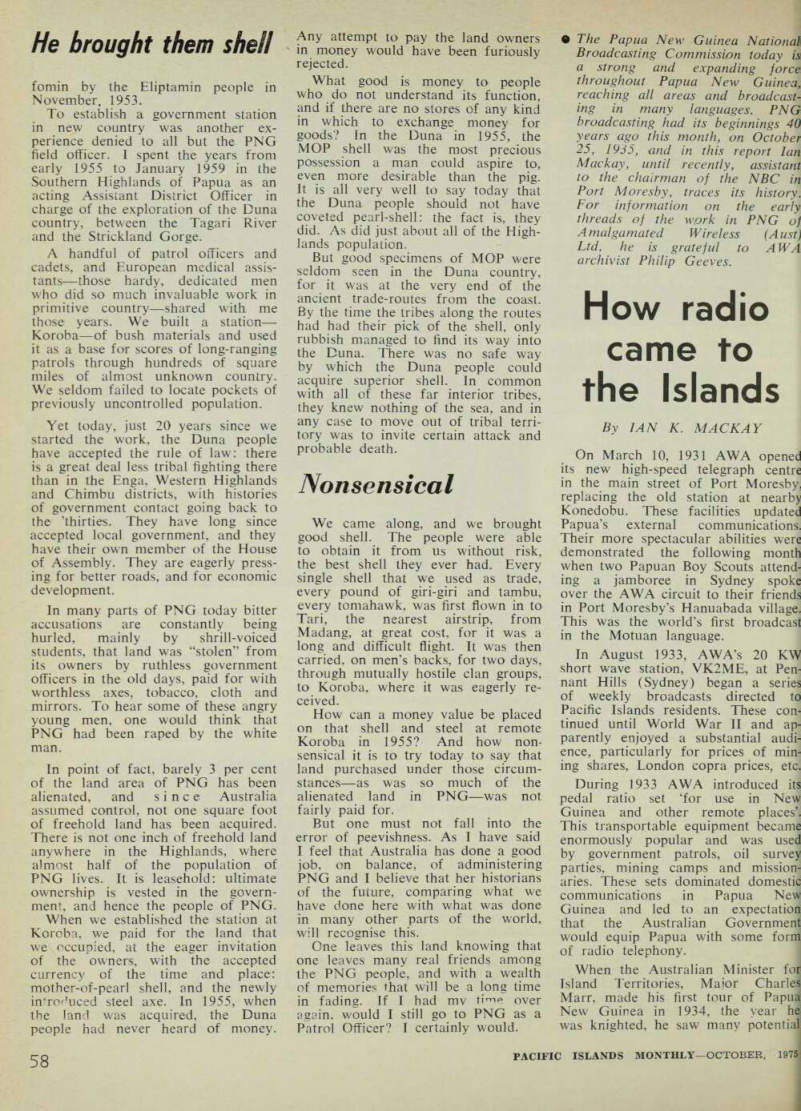
The rumpus started in 1934 when : Australian Government attempted collect fees from expatriate lis lers in Papua on the grounds they -ild tune in Australian broadcasting tions in Queensland. Papuan 'urier editor E. A, (Jimmy) Res (who after the war became a ding member of the PNG Legis ive Council), editorialised, ‘We do t admit the right of any country tax residents of Papua and at the ne time treat us as foreigners’.
IM, June 1934, p 9). PIM re red to the Australian demand as i absurdity. At no time of the day reception good and for three or ir months of the year only, can
Australian stations be heard”, it said.
The incident assumed the air of a cause celebre. Editor James refused to pay, urged listeners in Papua to do likewise, and challenged the Aus tralian Government to sue him. The Commonwealth obliged and launched a prosecution against James for un lawful use of wireless receiving equipment.
The case was heard in the Port Moresby Court of Petty Sessions on December 27, 1934. The magistrate found in favour of the jubilant editor, and costs were granted against the government. The court accepted the argument that it had no jurisdiction in cases of offences against the laws of the Commonwealth.
Australia was in an uneviable posi tion and a calculated guess is that Ernest Fisk extricated the govern ment by offering to establish a broad casting station in Papua. The Aus tralian Government was a major shareholder in AWA at the time.
When the Papua Lieut-Governor, Sir Hubert Murray, opened 4PM Port Moresby on October 25, 1935 he was somewhat optimistic on what 100 watts of power could accomplish m the medium-wave band. He said that during tests ‘reports from vari ous parts of Australia and New Zea land have remarked upon the splen did quality and strength of the new transmission’. On 100 watts! This would indicate a listener durability and an acceptance of noise level cer tainly not evident today!
The Lieut-Gov continued, ‘We shall all benefit by this service but it will in particular be a priceless blessing to those who hold the lonely posts of this territory. The planters, miners and those who are far removed from the centres of settlement’.
Sir Hubert regarded the establish ment of 4PM Port Moresby as the most remarkable of the many changes ‘since I came here more than thu-ty years ago’. He thanked AWA for ‘this great service’ and offered ‘my congratulations to all residents Y 935) US ' Radiogram, Dec There was no such panegyric when PNG’s National Broadcasting Com mission opened in Port Moresby 38 years later, on December 1, 1973.
Three days afterwards a VIP wrote to NBC Chairman Sam Piniau and offered some trenchant criticism of alleged NBC shortcomings. This prompted Chairman Piniau’s oft quoted quip, ‘Sir, with respect. The good Lord took six days to make the world and on the seventh day He rested. I think I have done rea sonably well in my first three days’.
He was the
first Papuan
announcer
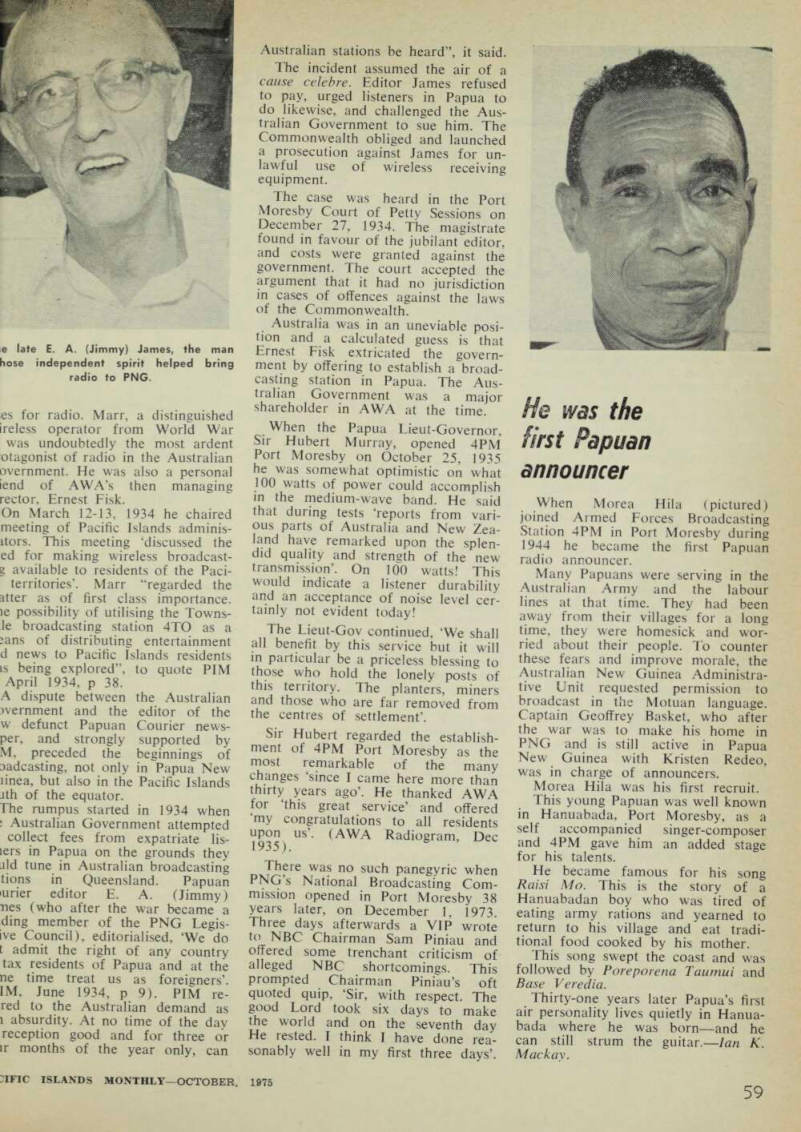
When Morea Hila (pictured) joined Armed Forces Broadcasting Station 4PM in Port Moresby during 1944 he became the first Papuan radio announcer.
Many Papuans were serving in the Australian Army and the labour lines at that time. They had been away from their villages for a long time, they were homesick and wor ried about their people. To counter these fears and improve morale, the Australian New Guinea Administra tive Unit requested permission to broadcast in the Motuan language.
Captain Geoffrey Basket, who after the war was to make his home in PNG and is still active in Papua New Guinea with Kristen Redeo, was in charge of announcers.
Morea Hila was his first recruit.
This young Papuan was well known in Hanuabada, Port Moresby, as a self accompanied singer-composer and 4PM gave him an added stage for his talents.
He became famous for his song Raisi Mo. This is the story of a Hanuabadan boy who was tired of eating army rations and yearned to return to his village and eat tradi tional food cooked by his mother.
This song swept the coast and was followed by Poreporena Taumui and Base Veredia.
Thirty-one years later Papua’s first air personality lives quietly in Hanua bada where he was born—and he can still strum the guitar. —lan K.
Mackay.
[? ]e late E. A. (Jimmy) James, the man hose independent spirit helped bring radio to PNG.