‘Yes, we brought them shell-the
pp. 57-60 · Read in the full issue
best shell they ever had! '
One cannot spend over 27 years in Papua New Guinea and fail to experience sadness and regret when forced to leave it, particularly when the circumstances are beyond one's control," writes J. P. Sinclair, one of Papua New Guinea's best known District Commissioners, on the eve of his departure from the country that has been his life and his vocation. Jim Sinclair, in this special article for PIAA's Papua New Guinea Independence Issue, recalls some of his experiences and defends the work of the field officers in bring ing the word of law to great tracts of once uncontrolled Papua New Guinea.
says Jim Sinclair without apologies.
In Papua New Guinea today, many Australians who have spent the best years of their lives in that fascinating land are leaving, and facing up to the lecessity of coming to grips with life n Australia, which to me, at any ate, does not look much like the Lucky Country.
With independence it is right, just md inevitable that Australians should tep aside to make room for the :ager young nationals who now fill virtually all of the senior positions n the PNG Public Service and who ire rapidly assuming positions of im )ortance in the private sector.
It is usual today for Australia to >e blamed for all sorts of errors of
commission and omission by some PNG nationalists, and this is natural enough: when things don’t always go the way one would like them to go, a scapegoat is always needed, and in colonial situations of this sort, the metropolitan country is invariably elected to the position.
Australia made many mistakes in her administration of PNG, but I believe they were in most cases honest mistakes, and I think that the people of PNG were fortunate that it was Australia that assumed the responsi bility for their future.
Looking back, it seems clear that our greatest error was complacency: we all thought that we had plenty
of time in which to prepare the people of PNG for independence, and we did not wake up quickly enough to the fact that time was fast run ning out.
When I came to PNG as a cadet patrol officer in 1948, intensely proud to be following in the footsteps of the great Australian field officers of the past, it was reckoned that Aus tralia would remain in PNG for at least another hundred years! Any person prophesying full independence within 30 years would have been in stantly deported as a dangerous, irresponsible lunatic! And so PNG becomes a sovereign state, in many areas woefully unprepared. But we did our best in the time we had, and all in all we achieved much: we do not have to apologise to anyone.
Many of us came to PNG filled with a spirit of idealism, which some few even managed to retain, at least for their first years. It is the refusal, or inability, of so many of the young educated PNG nationals to recognise this fact that is discouraging.
Certainly we did not come to make money, as those who recall the miserly pay scales of the immediate post-war years will agree. And it was not high living that lured us.
Compared with the Australia of those years, PNG possessed very few physical attractions. Housing stan dards were abysmally poor—how many field officers built their own crude houses of bush timber, grass and bamboo, and then paid rent (admittedly small) to the Administra tion for the privilege of occupying them?
Food came mainly in tins, at in flated prices, mails were few and far between, and Australian beer was a rare luxury doled out by the big stores to their steady, bill-paying customers only, two dozen bottles at
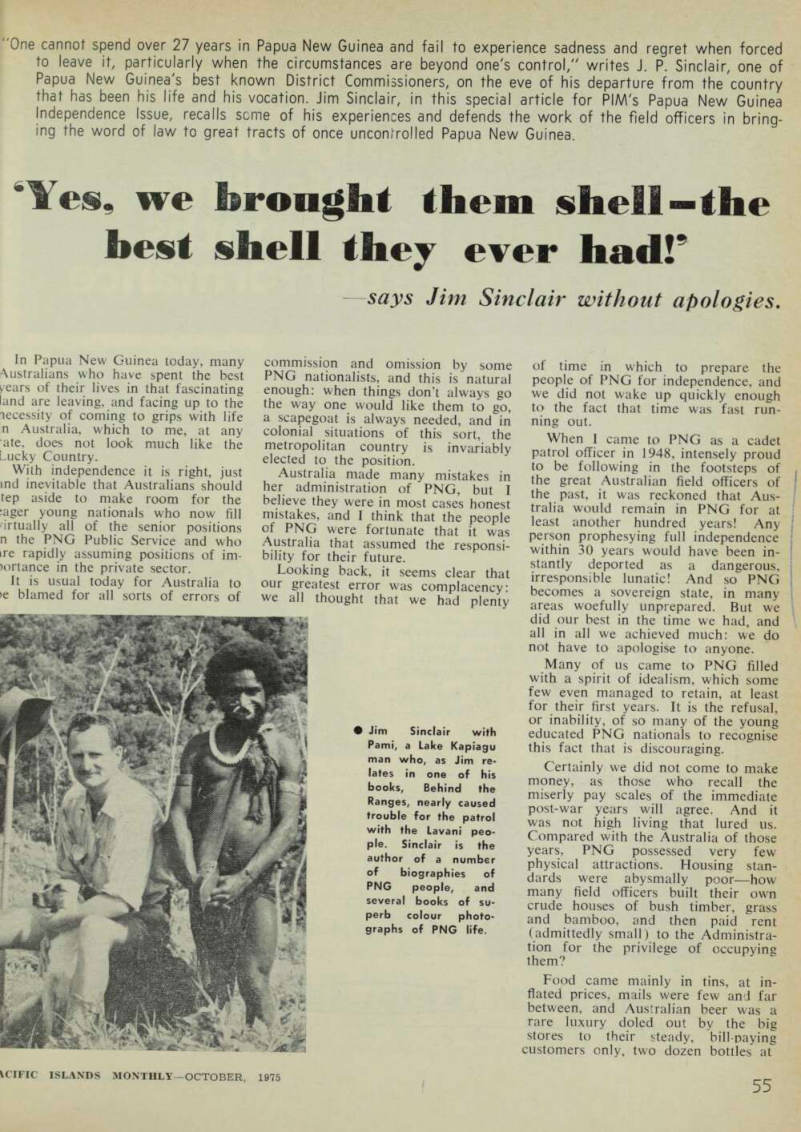
• Jim Sinclair with Pami, a Lake Kapiagu man who, as Jim re lates in one of his books, Behind the Ranges, nearly caused trouble for the patrol with the Lavani peo ple. Sinclair is the author of a number of biographies of PNG people, and several books of su perb colour photo graphs of PNG life.
a time, two or three times a year. (There was a lot of Continental and British beer around, varying from mediocre to plain horrible. Remember Tennants Pale Ale, Alsop’s Lager and —shudder —Revolver Brand?) Communications were for all prac tical purposes confined to small ships md to aeroplanes. Such aeroplanes!
Most were relics of the war, and even pre-war: De Havilland Dragons and Fox Moths, Ansons, Hudsons, Cata linas, Austers. It was the Dragons and the Fox Moths that kept the xitstations supplied. They didn’t have self-starters, and it was common : or the outstation patrol officer to lave to swing the propeller to get the mgines going. And what men those pilots were!
They cheerfully acted as buying igents for the people in the field: heir spare time back at Madang, Lae, Vewak, Moresby, was spent in latiently searching the inadequate locks of BP’s, Carpenters and Steam hips stores for odd bits and pieces or the stations along their routes: oys for the kids, freezer meat when t was available, clothes for the wives, nedicines, radio batteries—you name :• Friendships were forged between he pilots and the outstation people hat endured for years. Just about 11 of those pilots have gone, too.
Adventure
But when one was young and fit, nd looking for adventure, none of ic drawbacks to life in PNG seemed ) matter. For there was adventure plenty to be had. There was a huge rea of country still classed as “un trolled” in 1948: about 37,000 juare miles out of a total land rea of 179,000 square miles, approximately 24,000 square miles of le uncontrolled country was either nexplored, or merely “penetrated by atrols” as the official description ent. Most of this country was in the ir interior; the Highlands, and the :tremities of the Western, Gulf, [adang, Morobe and Sepik districts.
No matter what the future holds •r me, I will always be grateful that was my good fortune to be given e chance to lead a great many itrols into some of this uncontrolled mntry, and my clearest memories life in PNG are of those days, othing can take them away, and
many of my contemporaries feel the same.
No experience I can imagine can equal that of leading a patrol into new country: of contacting primitive bush people seeing their first white man, their first government patrol. To stand on a mountain-top and see below populated valleys not marked on any map! Where else in the world could this have happened?
Even the nerve-tingling business of attack and ambush was, in retrospect, an experience to be cherished now.
The tribesmen of PNG used, and use today, flightless arrows. I have seen clouds of arrows, fired high into the air from dense cover, falling into the patrol camp. Curiously, one could easily follow the upward flight to the top of the trajectory and even the beginning of the downward plunge, but then the arrow would vanish in a flash to appear again quivering in the ground. The police showed me how to dodge them, and they were in fact easily avoided.
The relationship between the patrol officer and his police in those days was usually close and affectionate.
Patrols of two or three months dura
tion were not uncommon, and officers, police and carriers shared the same risks and discomforts. It was sometimes necessary, for various reasons, for young officers to lead patrols into dangerous country with out prior experience of such work, and there are many old hands today (living in retirement in Australia!) who will admit their debt to some wise old veteran corporal or sergeant of the police who gently, but firmly, put their young officer on the right path, and kept him there.
Police courage
The courage and devotion of the police was remarkable. They were men, they had their faults—indeed, some missionaries and anthropologists will admit no virtues in them—but the exploration and pacification of the wild interior country of PNG would have been impossible without them.
They usually stuck to the job, what ever the odds, as they proved when Patrol Officers Szarka and Harris and two police constables, Buritori and Purari, were killed near Tele-
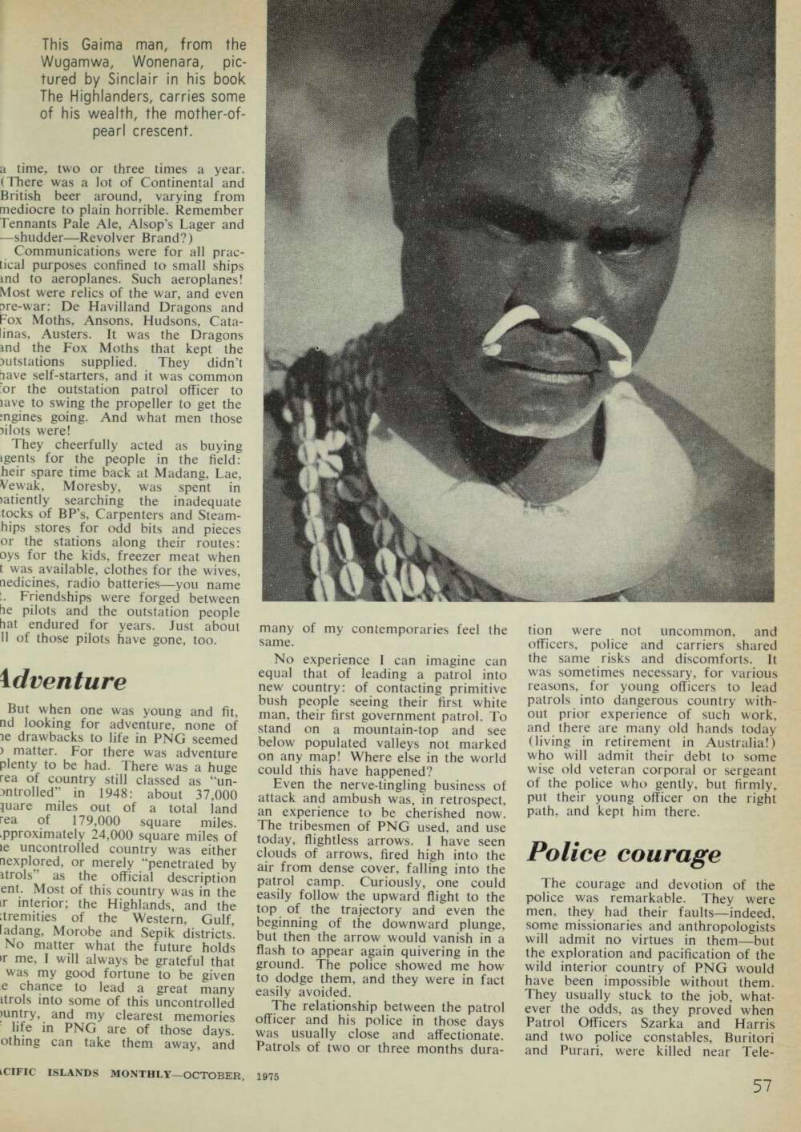
This Gaima man, from the Wugamwa, Wonenara, pic tured by Sinclair in his book The Highlanders, carries some of his wealth, the mother-of pearl crescent.
He brought them shell
fomin by the Eliptamin people in November, 1953.
To establish a government station in new country was another ex perience denied to all but the PNG field officer. I spent the years from early 1955 to January 1959 in the Southern Highlands of Papua as an acting Assistant District Officer in charge of the exploration of the Duna country, between the Tagari River and the Strickland Gorge.
A handful of patrol officers and cadets, and European medical assis tants —those hardy, dedicated men who did so much invaluable work in primitive country —shared with me those years. We built a station— Koroba—of bush materials and used it as a base for scores of long-ranging patrols through hundreds of square miles of almost unknown country.
We seldom failed to locate pockets of previously uncontrolled population.
Yet today, just 20 years since we started the work, the Duna people have accepted the rule of law: there is a great deal less tribal fighting there than in the Enga, Western Highlands and Chimbu districts, with histories of government contact going back to the ’thirties. They have long since accepted local government, and they have their own member of the House of Assembly. They are eagerly press ing for better roads, and for economic
development.
In many parts of PNG today bitter accusations are constantly being hurled, mainly by shrill-voiced students, that land was “stolen” from its owners by ruthless government officers in the old days, paid for with worthless axes, tobacco, cloth and mirrors. To hear some of these angry young men, one would think that PNG had been raped by the white man.
In point of fact, barely 3 per cent of the land area of PNG has been alienated, and since Australia assumed control, not one square foot of freehold land has been acquired.
There is not one inch of freehold land anywhere in the Highlands, where almost half of the population of PNG lives. It is leasehold: ultimate ownership is vested in the govern ment, and hence the people of PNG.
When we established the station at Koroba, we paid for the land that we occupied, at the eager invitation of the owners, with the accepted currency of the time and place: mother-of-pearl shell, and the newly in f ror>uced steel axe. In 1955, when the land was acquired, the Duna people had never heard of money.
Any attempt to pay the land owners in money would have been furiously rejected.
What good is money to people who do not understand its function, and if there are no stores of any kind in which to exchange money for goods? In the Duna in 1955, the MOP shell was the most precious possession a man could aspire to, even more desirable than the pig.
It is all very well to say today that the Duna people should not have coveted pearl-shell: the fact is, they did. As did just about all of the High lands population.
But good specimens of MOP were seldom seen in the Duna country, for it was at the very end of the ancient trade-routes from the coast.
By the time the tribes along the routes had had their pick of the shell, only rubbish managed to find its way into the Duna. There was no safe way by which the Duna people could acquire superior shell. In common with all of these far interior tribes, they knew nothing of the sea, and in any case to move out of tribal terri tory was to invite certain attack and probable death.
Nonsensical
We came along, and we brought good shell. The people were able to obtain it from us without risk, the best shell they ever had. Every single shell that we used as trade, every pound of giri-giri and tambu, every tomahawk, was first flown in to Tari, the nearest airstrip, from Madang, at great cost, for it was a long and difficult flight. It was then carried, on men’s backs, for two days, through mutually hostile clan groups, to Koroba, where it was eagerly re ceived.
How can a money value be placed on that shell and steel at remote Koroba in 1955? And how non sensical it is to try today to say that land purchased under those circum stances —as was so much of the alienated land in PNG—was not fairly paid for.
But one must not fall into the error of peevishness. As I have said I feel that Australia has done a good job, on balance, of administering PNG and I believe that her historians of the future, comparing what we have done here with what was done in many other parts of the world, will recognise this.
One leaves this land knowing that one leaves many real friends among the PNG people, and with a wealth of memories that will be a long time in fading. If I had mv over again, would I still go to PNG as a Patrol Officer? I certainly would.
• The Papua New Guinea National Broadcasting Commission today is a strong and expanding force throughout Papua New Guinea, reaching all areas and broadcast ing in many languages. PNG broadcasting had its beginnings 40 years ago this month, on October 25, 1935, and in this report lan Mockery, until recently, assistant to the chairman of the NBC in Port Moresby, traces its history.
For information on the early threads of the work in PNG oj Amalgamated Wireless (Aust) Ltd, he is grateful to AWA archivist Philip Geeves.