Pacific Transport
pp. 69-75 · Read in the full issue

Png Commission Wants To Ban All
But Japanese-Made Vehicles
From GUS SMALES in Port Moresby
Private car ownership was bitterly riticised in a technical report tabled i the Papua New Guinea Parliament ite in August.
The report suggests that private ar ownership should be phased out ver the next five years or so, and escribes private car ownership as a aangover from the colonial period”.
The report recommends that cheap icycles and an expanded public ansport system should replace pri ate cars in urban areas, and that the >e of buffalo, horses and mules tould be investigated in country eas.
But it also suggests that cheap elec icity from hydro schemes could be >ed for some trunk-system transport, id suggests an inquiry into a type : trolley-system running on roads id drawing power from overhead ics.
The report was prepared by the ommission of Inquiry into Stan irds, an independent body created f the PNG Government to con- Jer the standardisation of a large nge of technical equipment in the terests of economy and efficiency.
It has recommended that only five akes of vehicle—all Japanese— ould be imported into PNG.
Other makes would be kept out r prohibitive import duties, and 3uld not be handled by a proposed •vernment importing business.
Japan already has about 80 per nt of the PNG motor vehicle mar t, and Australia, which once had e largest share, now has a little er 10 per cent.
Under the recommended proposals, hide imports would be restricted Datsun, Toyota, Mazda, Mit bishi and Isuzu.
The proposals exclude large trucks d buses.
The proposal to phase out private r ownership will not be well re ived in a country where many ople for the first time are finding r ownership within their reach.
The report says that private motor
vehicles are unsuitable for PNG and continues: “Failure to eliminate the private motor vehicle will lead to increased economic divisions and social tensions in the community.
“The private motor car in PNG and the attitudes to it are very much a hangover from the colonial period, when it was a symbol of the power and affluence of the ruling elite. It is clear that much of the present motivation for car ownership is in terms of status rather than actual economic advantage”.
The report lists the disadvantages of private cars as high cost in foreign exchange, inefficient use of roads, traffic delays, being available only to the “highest-paid” members of the community, excessive and unnecessary
pollution, discouraging the develop ment of other more-efficient means of transport, and separating the “decision-makers” from the public, Discussing the possible uses of animals in country areas, the report says: “The present of a tractor to people of a remote area is pointless if they have to charter a large heli copter to get the thing home, and then pay for further air charters to bring in fuel.
“It is obviously far better to walk or fly in young beasts of burden which, although operating at lower ratings than the tractor, use local fodder and at the end of their useful working life can be eaten, “At this stage they may be tough, but their food value is much greater
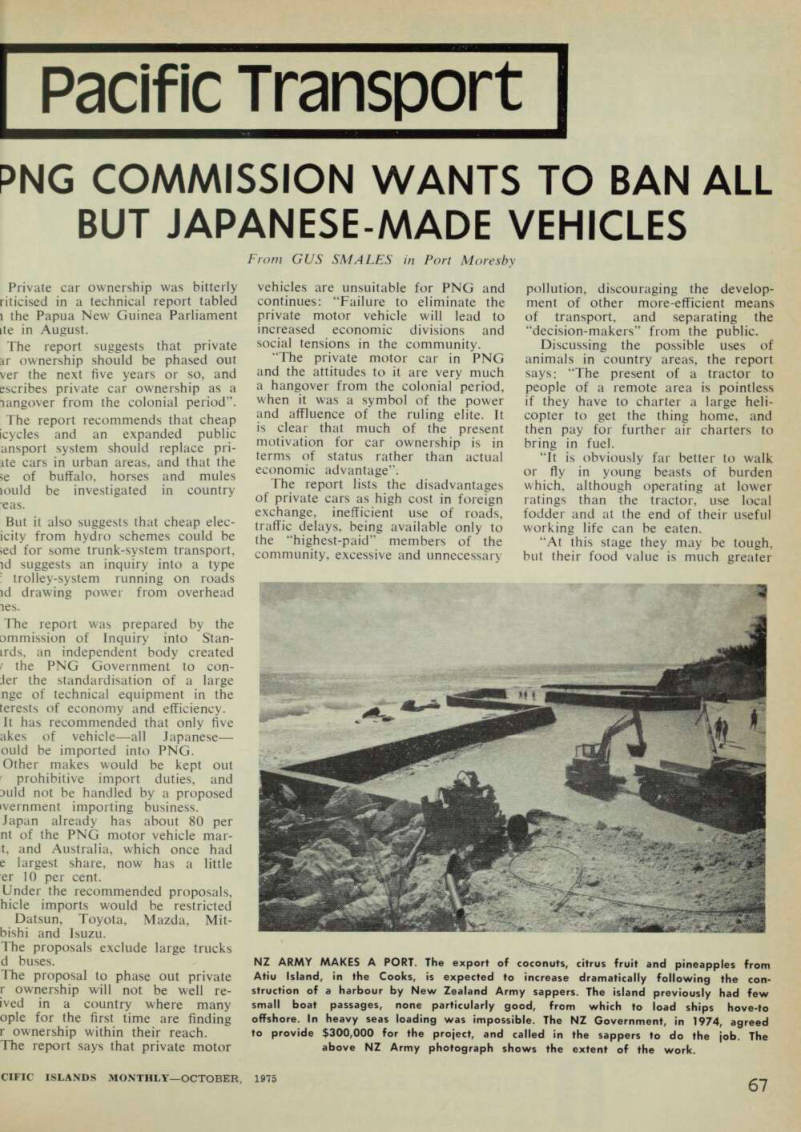
NZ ARMY MAKES A PORT. The export of coconuts, citrus fruit and pineapples from Atiu Island, in the Cooks, is expected to increase dramatically following the con struction of a harbour by New Zealand Army sappers. The island previously had few small boat passages, none particularly good, from which to load ships hove-to offshore. In heavy seas loading was impossible. The NZ Government, in 1974, agreed to provide $300,000 for the project, and called in the sappers to do the job. The above NZ Army photograph shows the extent of the work.
han that of a worn-out tractor, and he hide if suitably treated is valu ible”.
Juieter Time On
Iji's Wharves In 1974
Less cargo passed across Fiji diarves in 1974 than 1973, and there 'as also a falling-off in the number f overseas cargo ships calling at iji ports. At the other end of the :ale, Fiji’s exports over wharves r ere 5.1 per cent higher in 1974, Dmpared with 1973.
The overseas cargo tonnage andled in all ports was 1,143,689 >ns, down 57,894 tons.
The King’s Wharf, Suva, handled 56.000 tons in 1974, of which 58.000 tons were petroleum pro ducts. Wheat, most of it for the cal flour mill, accounted for about ) per cent of the King’s Wharf irgo.
Lautoka, from where most of Fiji’s gar is exported, handled 402,879 ns of cargo, including 201,000 tons unrefined sugar and 67,000 tons molasses. Vuda (mainly petro- Jm products), Vatia (mainly used " the Emperor Gold Mining Co), alau (mainly unrefined sugar) and lington (mainly unrefined sugar) ndled 263,000 tons of cargo.
The reason given for a decline in j number of overseas ships calling Fiji was that bigger and more )dern ships, are slowly replacing laller ships.
There has been a big improvement performance by Suva watersiders ce the Ports Authority of Fiji took er the running of Fiji wharves, e director of the authority, Mr Lou ;ng Kee, said recently that their xluction had doubled, which is ad news for shipowners.
Mr Lou said the men had adopted nore conscientious outlook towards :ir work, and had generated in ased productivity, which could be asured in terms of cargo handled I the tumround of ships.
Fhe watersiders had been the sub t of criticism for some time for v production capacity related to ges. They were also criticised for amount of pilferage which ’’rred on the wharves.
Ylr Lou, praising the dockworkers, I the authority’s main function ? to create a congenial atmosphere iduciye to greater efficiency and ducfion. The men had responded earnest.
Ill Oakij4S Clip
5 Norfolk Wings?
Jantas. which lost about $700,000 the Svdnev-Norfolk Island service the last financial year, may not
be averse to a bid by Norfolk Island Airlines, to take over the run. Fokker- VFW International is seeking to sell a Fokker F2B jet to Norfolk Island Airlines, claiming it could go into service almost immediately, and that the existing airport is suitable for F2B operations.
A F2B would be about twice as fast as the lumbering DC4s which Qantas has used for many years. The Royal Commission inquiring into the future of the island has heard sub missions on behalf of Norfolk Island Airlines.
On August 26, Qantas put up the fare and cargo rates for the Sydney- Norfolk Island run. The one-way fare is now $94.10, compared with the previous rate of $78.40. Even the new rates are unlikely to make a big dent in the loss Qantas incurs on the service. The latest rise was in line with the Australian Government’s policy of calculating Norfolk Island fares on the same basis as other domestic airlines in Australia.
Png's New Laws
For Shipping
A new law in Papua New Guinea will give the country the international right to fly the national flag on the high seas. The law established a shipping register under which mer chant ships owned only by citizens and corporations approved by the National Investment and Develop ment Authority will be registered in
Png.
Pleasure craft, canoes and ships less than 10 metres long will be exempt from registration. Registra tion fees will be kept at the minimum needed to run the system.
To encourage the employment of PNG seamen, large ships will be given a rebate of fees if a fixed pro portion of the crew is Papua New Guinean.
Anyone who uses the national flag to pretend a ship is registered will be liable to forfeit his ship. Ship owners or masters who conceal their PNG registration or pretend to be foreign-registered are liable to a penalty of K 1,000 and forfeiture.
A New Fokker
For The Pacific
Fokker is developing a new version of the F-28 Fellowship, a medium haul aircraft, which will carry 85 passengers over distances between 2,000 and 2,700 kilometres. The F-28 Mark 4000 was developed in consul tation with potential users from the prototype of the Mark 6000 version.
It will have longer wings and quieter, stronger Rolls Royce Spey engines. The first F-28 Mark 4000 aircraft will be available for delivery about mid-1976.
Air Nauru operates a F-28 Fellow ship from Melbourne to Nauru, via Tontouta in New Caledonia and Honiara, and then uses it on services from Nauru to Tarawa and Majuro, and to Kagoshima in Japan, via Ponape, Guam and Okinawa.
W. Samoa Frowns
At Aerial Opposition
Western Samoa is not at all happy about having to grant landing rights at Faleolo Airport, near Apia, to American Samoa-based South Pacific Island Airways. But she was obliged
to do so in return for rights at Ta funa Airport in American Samoa.
Western Samoa’s Secretary to the Government, Mr lulai Toma, was quite frank about the matter. He said his government had delayed granting rights to SP Island Air ways to protect Polynesian Airlines.
It was also reluctant to grant rights because it felt there was not enough traffic between Tafua and Faleolo to warrant two airlines.
Pan American World Airways, till December, 1974, was the official designated US airline for rights at Faleolo. But the possibility of this huge airline taking up the rights with a small aircraft was remote.
Mr Toma said the WS Government felt that as Polynesian Airlines had pioneered the route, it was entitled to have time to recover expenses. As the WS Government is the major shareholder in Polynesian Airlines, Mr Toma’s statement is not surpris ing.
At Western Samoa’s insistence it will have to operate a scheduled service, with a fare level comparable with that of Polynesian Airlines.
SP Island Airways did not accept the suggestion that there would not be enough traffic for two airlines.
The airline claims it will not make a dent in Polynesian Airlines opera tions, but rather will generate, and encourage, new traffic from American Samoa to Western Samoa.
The president of SPIA, Mr George Wray, said SPIA would start a ser vice within 30 days of August 5, the day rights were granted, using 9passenger Britten-Norman Islander aircraft. Eventually it will provide commuter-type services with 20 to 30 passenger aircraft, yet to be selected. The 93-mile route had an annual boarding rate of 78,000 passengers, and provided Polynesian Airlines with revenue of SUSI.B million.
Another Patrol
Boat For Tonga
Tonga expects to take delivery early next year of a second fast patrol boat, which will cost $115,000. The boat is being built at the Brooke Marine shipyard, Lowestoft, England.
It will be capable of 30 knots, and will have a continuous maximum speed of 24 knots.
The twin 350 bhp diesel engines will be installed in October, and sea trials are scheduled for November.
The ship has an aluminium hull. It is a sister ship to the 40 ft Ngahau Koula, which is in service. The new boat will incorporate a number of modifications which will give it a longer range than the Ngahau Koula.
The normal complement of the
new ship will be two officers and six crew.
One of the boats will be posted permanently at Vavau to patrol northern waters. The other will operate mainly in the Tongatapu and southern Haapai areas, and will be based at Nukualofa. The boats’ duties include fisheries patrols, mercy mis sions, communications support, troop transport and resources surveys.
Air Micronesia's
Earnings Drop
Net earnings of Air Micronesia Inc in the year ended December 31, 1974, totalled $7,557, compared with $22,295 in 1973. Total revenue at $1,553,413 was 6.1 per cent higher than the 1973 revenue of $1,464,722.
Continental, which has complete financial and operational responsi bility for the air service, incurred a pre-tax loss of $2,268,900 on its Trust Territory operation, compared with a 1973 pre-tax loss of $1,714,800. The after-tax loss was $1,727,200, compared with $891,600 in 1973.
Continental/Air Micronesia links the Trust Territory with Honolulu, Johnston Island, Guam and Okinawa.
In the Trust Territory itself, the air line services Majuro, Kwajalein, Ponape, Truk, Saipan, Tinian, Rota, Yap and Palau. It has authority to operate from the Trust Territory to Pago Pago, Funafuti, Tarawa and Nauru, but service to those points has been postponed as the landing facilities at Tarawa and Funafuti need to be improved to handle jet airliners. In addition bilateral negoti ations between the US and the UK to institute a Continental/Air Micro nesia service have not yet been held.
Lindenbank
Runs On Reef
The Bank Line’s Lindenbank went on a reef off Fanning Island late in August while loading copra. On Sep tember 7 the forward part of the ship was afloat, but she was still fast aground amidships. The owners were hopeful of being able to discharge cargo to lighten the ship sufficiently to enable her to float off, provided the weather remained calm.
The Lindenbank was carrying a cargo of copra, coconut oil and copra pellets loaded in New Guinea, Fiji and other South Pacific ports.
When she went aground another Bank Line ship, the Elmbank, which was nearby, was called in to help.
Then two United States Navy tugs were brought from Hawaii to try to shift the Lindenbank. All efforts were fruitless.
Some cargo was jettisoned and
me was taken to the island to hten the Lindenbank. Early reports re that there was some rupturing the bulkheads, and that the tail ift was damaged, which means it she will have to be towed, as : will have no power.
I Die In
Lip Fire
Several Fijian and other Pacific mds seamen were among 16 >ple who lost their lives after mdoning the blazing Sofrana ilines ship, Capitaine Bougainville, the New Zealand east coast, north Whangarei, on September 3. The ‘ broke out early in the morning, e ship left Auckland the previous r to sail for Papua New Guinea, Sydney. fhere were grim and harrowing ries of efforts to fight the fire, and n efforts to save life as the 37 sengers and crew had to abandon 3 in mountainous and icy seas, ne life rafts and life boats were ited with only the greatest of diffi ty. Others were washed away. i master, Captain Thomas Jean was able to steer the ntaine Bougainville to within 500
metres of the shore before giving the “abandon ship” order.
The captain’s wife and three chil dren were among the casualties. There were several individual tales of heroism.
Apoa Samuels, of Fiji, a member of the crew, dived into the water after his pregnant wife, when she fell into the water. He crashed his head against the side of the ship as he dived. He managed to find his wife and after a long struggle hauled her on to a raft. He battled to get the raft ashore, and then went off to help others to get out of the water. He was later found to have a minor face fracture.
Chief Engineer Afefaoi Panapa, finding there was not enough room on a life raft for all, held on to the edge and suffered the freezing water. When a big wave threw everybody into the water, he floated in his life-jacket till dawn and was carried ashore in the
current, along with other survivors.
Captain Raymond, with his wife, was in a lifeboat which turned over several times. He was holding his wife over the keel as daylight came.
As the boat drifted to the shore he felt the sand, and then realised his wife had died. She slipped from his grasp and drifted away.
The hulk of the Capitain Bougain ville was towed to Whangarei. A formal preliminary inquiry into the disaster was started soon after.
Sofrana-Unilines bought the Capi taine Bougainville, 4,200 tons dead weight, then the Balzac, from northern Europe late in 1972, for the Auckland-New Caledonia-Papua New Guinea-Solomon Islands-New Hebrides-Auckland service. She had 900 cubic metres of refrigerated space and was equipped with two six-ton crane, one one-ton crane, two 12-ton derricks and four six-ton derricks.
Her speed was 15 knots.
The Capitaine Bou gainville before the name-change from Balzac.