Yesterday
p. 49 · Read in the full issue
e big shipping companies were starting show interest in the Pacific, PIM aorted in August, 1955. The chairman the Orient Line said the frequency the trans-Pacific service would be Teased to six voyages a year in ch direction (Sydney-American west ast ports of Vancouver and San incisco) via Auckland, Suva and nolulu. And the Matson Line rtounced that two 14,000-tonners would on the California-Australia run in te for the 1956 Olympic Games in Jbourne in November.
gress was in the air in Suva, in just, 1955, when Burns Philp (SS) Co announced a couple of what were n rather ambitious building projects— toria Arcade, on the site of Donald's Hotel (blown down in the >2 hurricane) and a new motor wroom, opposite the company's dquarters. Victoria Arcade, a fine Iding which surrounds a central rt, was the start of a building boom ch slowly gathered pace in the 19505, carried on to late 1973 early 1974 and made Suva the it-developed (sic) capital in the nds. re was concern in Fiji, Tonga, Samoa New Caledonia about increasing nkenness, often involving serious >e. In Suva, drunkenness became so that the police banned any form dancing in three Suva halls. The ;ct was to encourage dance anisers, when dances were again wed, to refuse admission to drunken i. New Caledonia capitalised on the land for intoxicating liquor by osing a five per cent tax on imported hoi, excluding beer, wine and licinal alcohol. The estimated revenue 100,000 francs a year was to lidise the price of seed potatoes. n soldiers fighting communist arists in the Malayan jungles, were happy about the conduct of many ians. One of them, in hospital in <land before going back to Fiji, the troops were rather tired of fiting for civilians who helped enemy". He added: "The civilians the terrorists and give them food, terrorists are not good fighters.
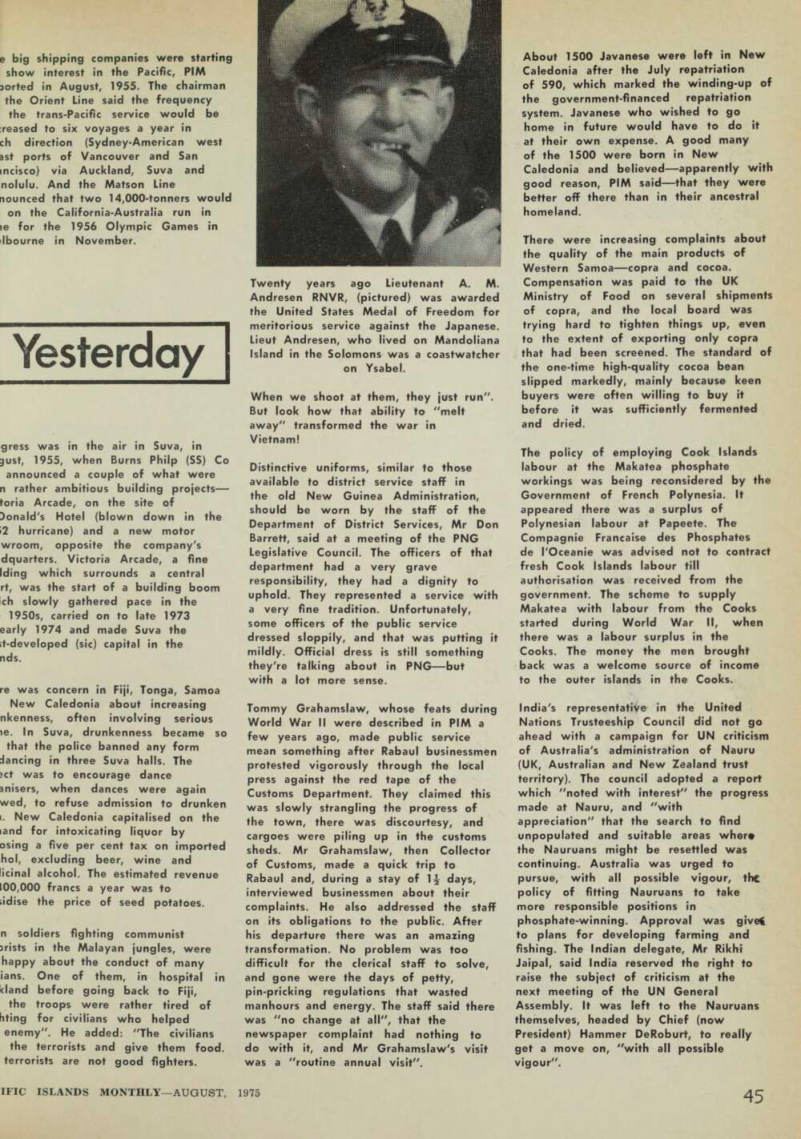
Twenty years ago Lieutenant A. M.
Andresen RNVR, (pictured) was awarded the United States Medal of Freedom for meritorious service against the Japanese.
Lieut Andresen, who lived on Mandoliana Island in the Solomons was a coastwatcher on Ysabel.
When we shoot at them, they just run".
But look how that ability to "melt away" transformed the war in Vietnam!
Distinctive uniforms, similar to those available to district service staff in the old New Guinea Administration, should be worn by the staff of the Department of District Services, Mr Don Barrett, said at a meeting of the PNG Legislative Council. The officers of that department had a very grave responsibility, they had a dignity to uphold. They represented a service with a very fine tradition. Unfortunately, some officers of the public service dressed sloppily, and that was putting it mildly. Official dress is still something they're talking about in PNG—but with a lot more sense.
Tommy Grahamslaw, whose feats during World War II were described in PIM a few years ago, made public service mean something after Rabaul businessmen protested vigorously through the local press against the red tape of the Customs Department. They claimed this was slowly strangling the progress of the town, there was discourtesy, and cargoes were piling up in the customs sheds. Mr Grahamslaw, then Collector of Customs, made a quick trip to Rabaul and, during a stay of 1£ days, interviewed businessmen about their complaints. He also addressed the staff on its obligations to the public. After his departure there was an amazing transformation. No problem was too difficult for the clerical staff to solve, and gone were the days of petty, pin-pricking regulations that wasted manhours and energy. The staff said there was "no change at all", that the newspaper complaint had nothing to do with it, and Mr Grahamslaw's visit was a "routine annual visit".
About 1500 Javanese were left in New Caledonia after the July repatriation of 590, which marked the winding-up of the government-financed repatriation system. Javanese who wished to go home in future would have to do it at their own expense. A good many of the 1500 were born in New Caledonia and believed —apparently with good reason, PIM said—that they were better off there than in their ancestral homeland.
There were increasing complaints about the quality of the main products of Western Samoa —copra and cocoa.
Compensation was paid to the UK Ministry of Food on several shipments of copra, and the local board was trying hard to tighten things up, even to the extent of exporting only copra that had been screened. The standard of the one-time high-quality cocoa bean slipped markedly, mainly because keen buyers were often willing to buy it before it was sufficiently fermented and dried.
The policy of employing Cook Islands labour at the Makatea phosphate workings was being reconsidered by the Government of French Polynesia. It appeared there was a surplus of Polynesian labour at Papeete. The Compagnie Francaise des Phosphates de I'Oceanie was advised not to contract fresh Cook Islands labour till authorisation was received from the government. The scheme to supply Makatea with labour from the Cooks started during World War 11, when there was a labour surplus in the Cooks. The money the men brought back was a welcome source of income to the outer islands in the Cooks.
India's representative in the United Nations Trusteeship Council did not go ahead with a campaign for UN criticism of Australia's administration of Nauru (UK, Australian and New Zealand trust territory). The council adopted a report which "noted with interest" the progress made at Nauru, and "with appreciation" that the search to find unpopulated and suitable areas wher* the Nauruans might be resettled was continuing. Australia was urged to pursue, with all possible vigour, the policy of fitting Nauruans to take more responsible positions in
phosphate-winning. Approval was givet
to plans for developing farming and fishing. The Indian delegate, Mr Rikhi Jaipal, said India reserved the right to raise the subject of criticism at the next meeting of the UN General Assembly. It was left to the Nauruans themselves, headed by Chief (now President) Hammer Deßoburt, to really get a move on, "with all possible vigour".