Going to
p. 40 · Read in the full issue
church in the Cooks
From G. K. Chambers
at Rarotonga Since the missionaries arrived in the Cook Islands over 130 years ago a great deal of import ance has been attached to church going and religion. You may be at a boxing tournament, a dance, a meeting at the airport, or an election meeting and you will be asked to join in prayer. Prayers asking for prowess in boxing, happiness at a dance, safe engines in the planes, success to the poli tical party.
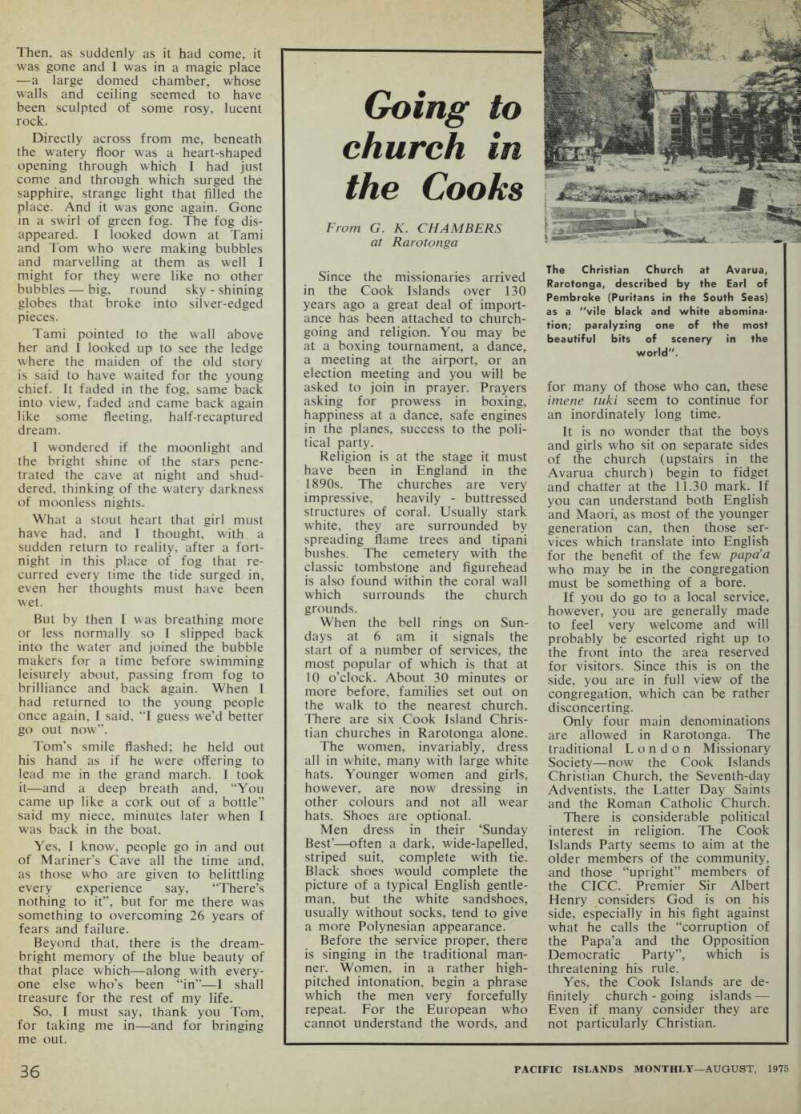
Religion is at the stage it must have been in England in the 1890 s. The churches are very impressive, heavily - buttressed structures of coral. Usually stark white, they are surrounded by spreading flame trees and tipani bushes. The cemetery with the classic tombstone and figurehead is also found within the coral wall which surrounds the church grounds.
When the bell rings on Sun days at 6 am it signals the start of a number of services, the most popular of which is that at 10 o’clock. About 30 minutes or more before, families set out on the walk to the nearest church.
There are six Cook Island Chris tian churches in Rarotonga alone.
The women, invariably, dress all in white, many with large white hats. Younger women and girls, however, are now dressing in other colours and not all wear hats. Shoes are optional.
Men dress in their ‘Sunday Best’ —often a dark, wide-lapelled, striped suit, complete with tie.
Black shoes would complete the picture of a typical English gentle man, but the white sandshoes, usually without socks, tend to give a more Polynesian appearance.
Before the service proper, there is singing in the traditional man ner. Women, in a rather high pitched intonation, begin a phrase which the men very forcefully repeat. For the European who cannot understand the words, and
for many of those who can, these imene tuki seem to continue for an inordinately long time.
It is no wonder that the boys and girls who sit on separate sides of the church (upstairs in the Avarua church) begin to fidget and chatter at the 11.30 mark. If you can understand both English and Maori, as most of the younger generation can, then those ser vices which translate into English for the benefit of the few papa’a who may be in the congregation must be something of a bore.
If you do go to a local service, however, you are generally made to feel very welcome and will probably be escorted right up to the front into the area reserved for visitors. Since this is on the side, you are in full view of the congregation, which can be rather disconcerting.
Only four main denominations are allowed in Rarotonga. The traditional London Missionary Society—now the Cook Islands Christian Church, the Seventh-day Adventists, the Latter Day Saints and the Roman Catholic Church.
There is considerable political interest in religion. The Cook Islands Party seems to aim at the older members of the community, and those “upright” members of the CICC. Premier Sir Albert Henry considers God is on his side, especially in his fight against what he calls the “corruption of the Papa’a and the Opposition Democratic Party”, which is threatening his rule.
Yes, the Cook Islands are de finitely church - going islands Even if many consider they are not particularly Christian.
The Christian Church at Avarua, Rarotonga, described by the Earl of Pembroke (Puritans in the South Seas) as a "vile black and white abomina tion; paralyzing one of the most beautiful bits of scenery in the world".