Magazine Section
pp. 37-40 · Read in the full issue

In-At Last! And Out Again:
A Magic Moment In Tonga
By Pa Tricia Ledyard Matheson
Twenty-six years ago, when I first came to Tonga, I had already read of Mariner’s, the famous Vavau cave that can be reached only by diving.
Naturally, I decided I must see it.!
I had heard, too, the oft-told tale of the young Tongan chief who, having fallen in love with a beautiful maiden of a family that was due for extermiV nation in the civic broils of the time/ spirited her away from danger ancj hid her for two weeks in the cave. \ There he brought food and protes tations of love to sustain the girl until he was able to prepare an ex pedition to Fiji. Then he picked her up enroute, married her, and, when the time of trouble had passed,, brought her back to Vavau and lived ! happily ever after. My determination to get into the cave was strengthened by the romantic story.
My own romance thwarted me. My newly-married husband shook his sober Scots head and gave me a gruesone account of an officer from a copra ship who, while attempting to swim in, smashed into the coral at the top of the passage, cracked his skull and died.
“I wouldn’t do that,” I said, with ( all the courage of ignorance, but, when my husband spoke of the ob vious fact that I had no skill whatso ever as a surface diver, and men tioned the eight-foot descent to the entry to the cave and the 14 feet of the passage in, I hesitated and in that hesitation fear was born.
The cave is miles down the harbour from my home, but that did not keep it from haunting me. As the years went by, humiliation was added to fear as hosts of people of every age and both sexes came to boast to me that they had been “in” and to give vivid descriptions of the place’s eerie beauty.
The crowning humiliation came when —our daughters half-grown— my husband said one day, “Oh go in if you must and get it out of your
system”. With so much agreement from him, 1 set out that very after noon with visiting American yachts men, undaunted by the grey blustery weather that threatened to blow up a storm. As we left our home beach my husband bade us farewell and added sternly, “You mustn’t let the girls attempt it today”.
The warning was unnecessary.
Long before we’d reached Nuapapu, the island on which the cave is located, one of them was violently seasick and the other was shivering with cold. It was, to say the least,
an unpropitious day for diving.
By the time we reached our desti nation, the sea had risen so high that
we had to anchor far out lest the yacht be dashed against the island’s sheer coral cliffs. Mrs Yacht took one look at the stormy world and said at once that she didn’t feel up to trying it and would stay on board with the girls.
What could I do but follow Mr Yacht and the Tongan guide we’d brought along? I slipped over the side into the wild, grey waves and beat my way towards the forbidding looking island. Long before I got there, I was winded and, when at last, I stood on the narrow ledge beside the cave’s entrance, I was panting for breath.
The guide stood beside me and
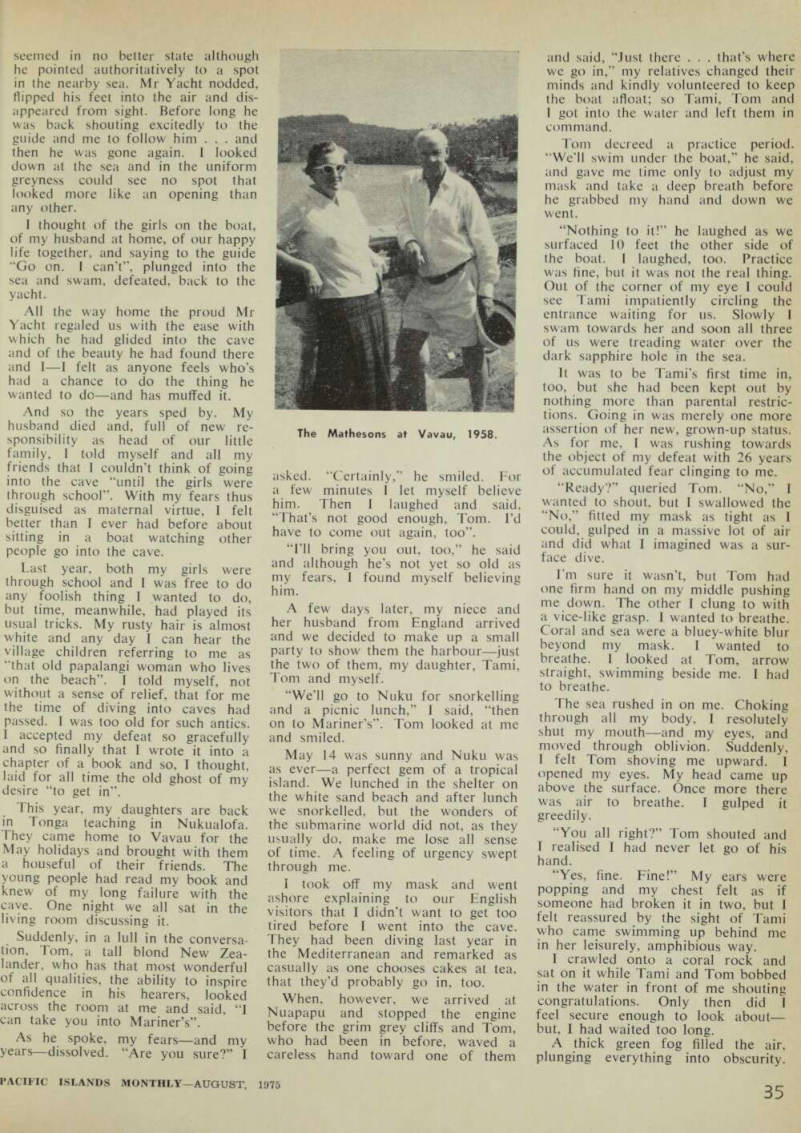
. . . "That's where we go in".
seemed in no better state although he pointed authoritatively to a spot in the nearby sea. Mr Yacht nodded, flipped his feet into the air and dis appeared from sight. Before long he was back shouting excitedly to the guide and me to follow him . . . and then he was gone again. 1 looked down at the sea and in the uniform greyness could see no spot that looked more like an opening than any other.
I thought of the girls on the boat, of my husband at home, of our happy life together, and saying to the guide “Go on. I can’t”, plunged into the sea and swam, defeated, back to the yacht.
All the way home the proud Mr Yacht regaled us with the ease with which he had glided into the cave and of the beauty he had found there and I—l felt as anyone feels who’s had a chance to do the thing he wanted to do—and has muffed it.
And so the years sped by. My husband died and, full of new re sponsibility as head of our little family, I told myself and all my friends that 1 couldn’t think of going into the cave “until the girls were through school”. With my fears thus disguised as maternal virtue, I felt better than I ever had before about sitting in a boat watching other people go into the cave.
Last year, both my girls were through school and I was free to do any foolish thing I wanted to do, but time, meanwhile, had played its usual tricks. My rusty hair is almost white and any day I can hear the village children referring to me as “that old papalangi woman who lives on the beach”. I told myself, not without a sense of relief, that for me the time of diving into caves had passed. I was too old for such antics.
I accepted my defeat so gracefully and so finally that I wrote it into a chapter of a book and so, I thought, laid for all time the old ghost of my desire “to get in”.
This year, my daughters are back in Tonga teaching in Nukualofa.
They came home to Vavau for the May holidays and brought with them a houseful of their friends. The young people had read my book and knew of my long failure with the cave. One night we all sat in the living room discussing it.
Suddenly, in a lull in the conversa tion, Tom, a tall blond New Zea lander, who has that most wonderful of all qualities, the ability to inspire confidence in his hearers, looked across the room at me and said, “I can take you into Mariner’s”.
As he spoke, my fears—and my years—dissolved. “Are you sure?” I
asked. “Certainly,” he smiled. For a few minutes I let myself believe him. Then I laughed and said, “That’s not good enough, Tom. I’d have to come out again, too”.
“I’ll bring you out, too,” he said and although he’s not yet so old as my fears, I found myself believing him.
A few days later, my niece and her husband from England arrived and we decided to make up a small party to show them the harbour—just the two of them, my daughter, Tami, Tom and myself.
“We’ll go to Nuku for snorkelling and a picnic lunch,” 1 said, “then on to Mariner’s”. Tom looked at me and smiled.
May 14 was sunny and Nuku was as ever—a perfect gem of a tropical island. We lunched in the shelter on the white sand beach and after lunch we snorkelled, but the wonders of the submarine world did not, as they usually do, make me lose all sense of time. A feeling of urgency swept through me.
I took off my mask and went ashore explaining to our English visitors that I didn’t want to get too tired before I went into the cave.
They had been diving last year in the Mediterranean and remarked as casually as one chooses cakes at tea, that they’d probably go in, too.
When, however, we arrived at Nuapapu and stopped the engine before the grim grey cliffs and Tom, who had been in before, waved a careless hand toward one of them
and said, “Just there . . . that’s where we go in,” my relatives changed their minds and kindly volunteered to keep the boat afloat; so Tami, Tom and I got into the water and left them in command.
Tom decreed a practice period.
“We’ll swim under the boat,” he said, and gave me time only to adjust my mask and take a deep breath before he grabbed my hand and down we went.
“Nothing to it!” he laughed as we surfaced 10 feet the other side of the boat. I laughed, too. Practice was fine, but it was not the real thing.
Out of the corner of my eye 1 could see Tami impatiently circling the entrance waiting for us. Slowly 1 swam towards her and soon all three of us were treading water over the dark sapphire hole in the sea.
It was to be Tami’s first time in, too, but she had been kept out by nothing more than parental restric tions. Going in was merely one more assertion of her new, grown-up status.
As for me, I was rushing towards the object of my defeat with 26 years of accumulated fear clinging to me.
“Ready?” queried Tom. “No,” I wanted to shout, but I swallowed the “No,” fitted my mask as tight as I could, gulped in a massive lot of air and did what 1 imagined was a sur face dive.
I'm sure it wasn’t, but Tom had one firm hand on my middle pushing me down. The other I clung to with a vice-like grasp. I wanted to breathe.
Coral and sea were a bluey-white blur beyond my mask. I wanted to breathe. I looked at Tom, arrow straight, swimming beside me. I had to breathe.
The sea rushed in on me. Choking through all my body, I resolutely shut my mouth—and my eyes, and
moved through oblivion. Suddenly,
I felt Tom shoving me upward. 1 opened my eyes. My head came up above the surface. Once more there was air to breathe. I gulped it
greedily.
“You all right?” Tom shouted and I realised I had never let go of his hand.
“Yes, fine. Fine!” My ears were popping and my chest felt as if someone had broken it in two, but I felt reassured by the sight of Tami who came swimming up behind me in her leisurely, amphibious way.
I crawled onto a coral rock and sat on it while Tami and Tom bobbed in the water in front of me shouting congratulations. Only then did I feel secure enough to look about— but, I had waited too long.
A thick green fog filled the air,
plunging everything into obscurity.
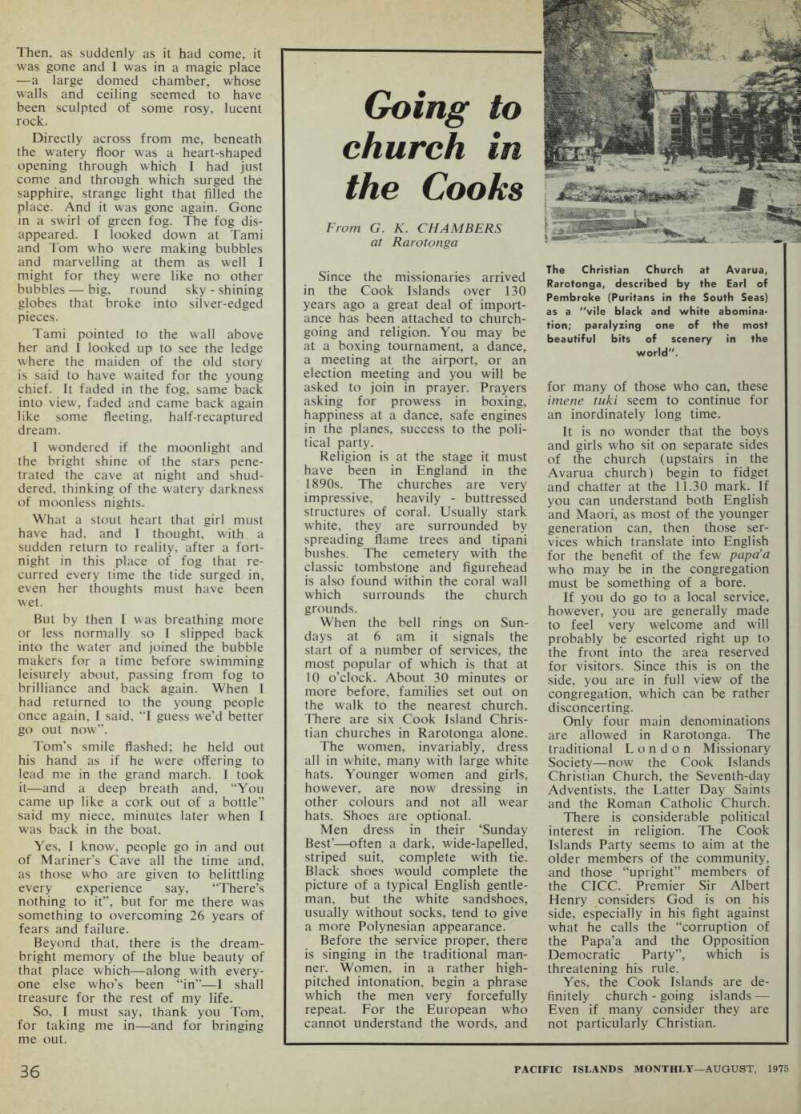
The Mathesons at Vavau, 1958.
Then, as suddenly as it had come, it was gone and I was in a magic place —a large domed chamber, whose walls and ceiling seemed to have been sculpted of some rosy, lucent rock.
Directly across from me, beneath the watery floor was a heart-shaped opening through which I had just come and through which surged the sapphire, strange light that filled the place. And it was gone again. Gone in a swirl of green fog. The fog dis appeared. I looked down at Tami and Tom who were making bubbles and marvelling at them as well I might for they were like no other
bubbles big, round sky - shining
globes that broke into silver-edged pieces.
Tami pointed to the wall above her and I looked up to see the ledge where the maiden of the old story is said to have waited for the young chief. It faded in the fog, same back into view, faded and came back again like some fleeting, half-recaptured dream.
I wondered if the moonlight and the bright shine of the stars pene trated the cave at night and shud dered, thinking of the watery darkness of moonless nights.
What a stout heart that girl must have had, and I thought, with a sudden return to reality, after a fort night in this place of fog that re curred every time the tide surged in, even her thoughts must have been wet.
But by then I was breathing more or less normally so I slipped back into the water and joined the bubble makers for a time before swimming
leisurely about, passing from fog to
brilliance and back again. When I had returned to the young people once again, I said, “I guess we’d better go out now”.
Tom’s smile flashed; he held out his hand as if he were offering to lead me in the grand march. I took it—and a deep breath and, “You came up like a cork out of a bottle” said my niece, minutes later when I was back in the boat.
Yes, I know, people go in and out of Mariner’s Cave all the time and, as those who are given to belittling every experience say, “There’s nothing to it”, but for me there was something to overcoming 26 years of fears and failure.
Beyond that, there is the dream bright memory of the blue beauty of that place which—along with every one else who’s been “in”—l shall treasure for the rest of my life.
So, I must say, thank you Tom, for taking me in—and for bringing me out.